


Abstract
This paper examines the relationship between tourism flows and gender equality in the 27 member states of the European Union (EU27). Drawing on a labor market and structural change perspective, we argue that tourism, as a labor-intensive and female-intensive service activity, may be associated with higher gender equality through employment, economic independence and human capital channels, while occupational segregation and poor job quality may weaken this link. Using a balanced panel dataset for 2013–2023 (297 country-year observations), with effective estimation samples of 2015–2023 or 2016–2023 owing to lagged regressors, we estimate country fixed-effects specifications with panel-generalized least squares (with and without cross-section weights), robust M-estimation and a backward variable selection procedure. Tourism flows appear to be positively associated with the Gender Equality Index (GEI) of the European Institute for Gender Equality (EIGE) in all 15 specifications, conditional on human capital, full-time equivalent employment, gender segregation, GDP per capita and R&D; the association is statistically significant at the 5% level in ten specifications and at or around the 10% level in the remaining five. The estimated elasticity is small (about 0.01) and considerably weaker than those of human capital and employment, and there is some evidence, although not robust across all specifications, that the association is stronger in the EU27 periphery, where gender equality is lower and tourism demand higher. Given the observational design, the findings are interpreted as conditional associations rather than causal effects. They suggest that tourism development in peripheral member states may complement, but not substitute for, policies targeting tertiary education, women’s full-time employment and job quality in tourism.
1. Introduction
Gender equality is fundamental to a just and progressive society, where individuals enjoy equal rights, responsibilities, and opportunities regardless of their gender. Attaining gender equality is not merely an issue of justice and fairness; it is also crucial for sustainable development, economic growth, and social cohesion (see, e.g., refs. [1,2]).
In numerous regions globally, systemic barriers persistently obstruct women’s and girls’ access to education, employment, and leadership opportunities. These limitations not only restrict individual potential but also have detrimental effects on communities at large [3]. Moreover, economies characterized by inclusivity, which leverage the diverse talents and skills of all citizens, tend to be more productive and innovative. Notably, bridging the gender gap in the workforce has the potential to contribute greatly to the global gross domestic product (GDP), highlighting the economic imperative of addressing gender disparities in employment [4] and education. Furthermore, ref. [5] show that there is heterogeneity in travel preferences by gender and age. Gender equality also serves as a catalyst for enhanced governance and organizational performance. Empirical studies have demonstrated that organizations exhibiting diverse leadership, particularly those that include women in senior roles, tend to experience superior financial outcomes and engage in more ethical decision-making processes [6,7,8]. Furthermore, the pursuit of gender equality plays a pivotal role in challenging and dismantling entrenched stereotypes that restrict individuals to conventional gender roles [9]. Apart from the economic and social benefits, the promotion of gender equality constitutes a fundamental moral imperative. Despite notable advancements, significant challenges remain prevalent on a global scale, including gender-based violence, persistent wage disparities [10,11], and underrepresentation of women in leadership roles [12]. These issues underscore the necessity for ongoing efforts to address systemic inequalities and foster inclusive development.
Over recent decades, gender equality has attracted growing scholarly attention in tourism research [13,14,15,16,17]. The sector expanded considerably before COVID-19, contributing more than 10% of global GDP [18], and it employs a disproportionately high share of women [19]. A body of case study and cross-country evidence associates tourism development with women’s employment, entrepreneurship and empowerment [3,20,21,22], whereas other studies document occupational segregation, low pay and limited career progression for women in the sector [9,23,24]. The relationship between tourism and gender equality is, therefore, an empirical question, and its answer may depend on context [25,26].
Cross-national evidence on this relationship remains limited and heterogeneous in scope. Ref. [25] studied 24 EU countries over 1995–2015, focusing on women’s empowerment jointly with financial development; Ref. [22] analyzed 36 Asian economies over 2006–2018; Refs. [26,27] used global panels of 111 and 144 countries, respectively, with Jackman’s analysis centered on gender equality in the labor market and her Europe and Central Asia subsample combining EU and non-EU economies; and ref. [28] examined ten South American countries over 2006–2019. Closest to our setting, ref. [1] examined the link between overtourism and gender equality in the EU27. The present study differs from and complements the literature in four respects. First, it covers all EU27 member states over the recent period of 2013–2023, including the pandemic shock to tourism, and uses the EIGE Gender Equality Index, a harmonized and multidimensional measure designed specifically for comparisons among EU member states, rather than global indices or single labor market indicators. Second, the variable of interest is the scale of total tourism flows (domestic and inbound), rather than international arrivals, receipts or indicators of tourism pressure, so that it captures the overall tourism-related demand for services and labor in the host economy. Third, the relationship is examined conditional on a set of economic determinants of gender equality—income, human capital, full-time equivalent employment, gender segregation and R&D—within an explicit conceptual framework that leads to testable hypotheses. Fourth, it investigates whether the association differs between core and periphery EU27 member states, which differ markedly in both gender equality levels and tourism specialization.
We adopt what we term an economic perspective on the tourism–gender equality nexus. In contrast with the predominantly sociological and case study literature, which examines gender relations within tourism workplaces and host communities, we treat gender equality as a macro-level outcome shaped by labor market conditions and the sectoral structure of the economy, and tourism flows as a source of demand for labor-intensive services. This perspective is reflected in the empirical analysis in three ways: the use of national-level, harmonized quantitative indicators; the inclusion of standard economic determinants of gender equality as controls; and the interpretation of the estimates as elasticities, which allows the economic magnitude of the relationships to be assessed. Accordingly, this paper addresses two research questions: (RQ1) Are tourism flows positively associated with gender equality in the EU27, conditional on its key economic determinants? (RQ2) Does this association differ between core and periphery EU27 member states? These questions are formalized as hypotheses in Section 3. Given the observational nature of the data, the analysis reveals conditional associations and does not claim to establish causal effects.
The remainder of this paper is organized as follows. Section 2 reviews the relevant literature thematically. Section 3 develops the conceptual framework and the hypotheses. Section 4 describes the data, and Section 5 presents the econometric methodology and the empirical results. Section 6 discusses the findings, and Section 7 concludes with policy implications, limitations and directions for future research.
2. Literature Review
2.1. Tourism as a Source of Employment, Entrepreneurship and Empowerment for Women
Tourism is widely regarded as a sector that expands economic opportunities for women. Women account for about 54% of the tourism workforce worldwide, and in the accommodation and food services sector, their share reached 69% in Africa, 67% in Europe and 53% in the USA over 2009–2018 [19,29]. Tourism growth thus creates employment opportunities for women [30,31], which is particularly relevant because the disproportionate time women devote to child rearing and domestic care constrains their full-time participation in the labor market [32]. Low start-up costs also make tourism an accessible field for female entrepreneurship [33,34], and in many countries, the share of tourism businesses managed by women is higher than in other sectors [35].
Beyond employment, several studies argue that participation in tourism fosters women’s financial and social independence, improves their status within households and communities, and challenges patriarchal norms [3,14,20,21,36,37,38]. Improved social standing may, in turn, widen women’s access to education and rights [39], and tourism has been discussed as a means of reducing gender gaps and poverty [40,41]. Tourism may also act as a vehicle of social change through the exchange of values and cultural practices [27,42]. Consistent with these arguments, gender equality is increasingly regarded as a prerequisite for sustainable tourism [43,44] and as a central challenge for corporate social responsibility in the sector [45].
2.2. Occupational Segregation, Job Quality and Persistent Barriers
The literature equally documents mechanisms through which tourism may reproduce, or even reinforce, gender inequalities. Tourism employment is characterized by both horizontal and vertical segregation [23,46]. Horizontally, social stereotypes channel women into jobs requiring interpersonal skills, such as flight attendants, sales staff, waiting staff, travel agents and cleaners, and men into jobs such as pilots, gardeners, drivers and builders [31]. Vertically, women are concentrated in low-grade positions with limited opportunities for promotion [9,12,24]; persistent beliefs about women’s suitability for managerial posts act as a barrier to their advancement [9,47]; and gender wage gaps persist in the sector [11]. European evidence from Spain documents distinct patterns of occupational segregation by gender in hospitality [48] and lower job quality for women [24]. More broadly, tourism workers face unfavorable working conditions, limited autonomy and weak social protection [49,50], and discriminatory laws, practices and stereotypes can restrict women’s employment in the sector [30,51,52].
Cultural and institutional contexts shape the extent to which women benefit from tourism. In strongly patriarchal settings, women face exclusion from tourism jobs, segregated workplaces and customer preferences for male guides [53,54,55,56,57], and women entrepreneurs face barriers related to education and segregation [58]. Empowerment gains may also generate new tensions. Ref. [20] show that women’s greater independence can create conflicts within the family that again restrict their participation, and ref. [30] note that patriarchal culture limits women’s ability to take full advantage of tourism. The balance between positive and negative mechanisms is, therefore, context-specific, which motivates examining whether the aggregate relationship differs across groups of countries with different economic structures and levels of gender equality.
2.3. Cross-Country Empirical Evidence and Research Gap
Cross-country econometric studies generally report a positive association between tourism and gender equality, but with notable heterogeneity. Ref. [22] found that international tourist arrivals were positively associated with gender equality in 36 Asian countries over 2006–2018, mainly in East and Southeast Asia. Ref. [25] reported a positive link between tourism and women’s empowerment in 24 EU countries, and ref. [27], distinguishing domestic from international tourism, reached a similar conclusion for 111 economies over 1995–2017. Ref. [26] found a positive relationship with gender equality in the labor market in developed economies but no relationship in Middle East and North Africa economies. Ref. [28], employing fixed-effects, random-effects and GLS estimators with controls for real GDP per capita, education expenditure and female labor participation by sector, found a positive association for ten South American countries. For the EU, ref. [59] analyzed tourism, economic growth, decent employment and gender equality over 2009–2018 within the Sustainable Development Goals framework, and ref. [1] examined overtourism and gender equality in the EU27.
Three gaps emerge from this review. First, the positive and negative mechanisms identified in the case study literature are rarely integrated into a framework that guides the econometric specification, so it often remains unclear which dimensions of gender equality tourism is expected to relate to and what role the control variables play. Second, evidence covering all EU27 member states with a harmonized multidimensional measure of gender equality and recent data is scarce. Third, although heterogeneity across country groups is repeatedly documented [22,26], it has not been examined along the core–periphery divide of the EU, which is associated with persistent differences in economic structure [60]. Section 3 addresses the first gap, and the empirical analysis addresses the second and the third.
3. Conceptual Framework and Hypotheses
3.1. Mechanisms Linking Tourism Flows and Gender Equality
Our framework combines a gender-aware view of tourism processes [61] with the economics of structural change and gender gaps. Tourism is a labor-intensive service activity, and a large share of its tasks in accommodation, food and beverage service, retail and personal services belong to occupations in which women are strongly represented. Ref. [62] showed that the expansion of the service economy raises women’s relative hours and wages, and ref. [63] documented the close link between the rise of services and the narrowing of gender gaps in industrialized countries. An increase in tourism flows, which raises the demand for such services in the host economy, is, therefore, expected to be associated with higher gender equality through four channels, each related to specific domains of the EIGE Gender Equality Index [64]. (i) An employment channel: Additional labor demand in tourism-related activities raises women’s participation and full-time equivalent employment, relating mainly to the work domain. (ii) An income and economic independence channel: Earnings from employment and entrepreneurship reduce gender gaps in financial resources and strengthen women’s bargaining position within households [65], relating mainly to the money domain and, indirectly, to the power and time domains. (iii) A human capital channel: Expanding employment opportunities raises the expected returns to women’s education and training [66], relating to the knowledge domain. (iv) A social change channel: The exposure of host communities to visitors and to more diverse norms may gradually weaken restrictive gender stereotypes [27,42], relating to the power and time domains.
These positive channels are counteracted by the mechanisms reviewed in Section 2.2. To the extent that tourism jobs are segregated, seasonal, part-time, low-paid and offer limited career progression [23,24], the gains in the work and money domains may be small, and vertical segregation may leave the power domain largely unaffected. The expected net association is, therefore, positive but modest in magnitude, and its sign is ultimately an empirical question.
3.2. Direction of the Relationship
The relationship between tourism and gender equality is not necessarily unidirectional. Tourism flows are shaped to a large extent by factors that are unrelated to gender relations in the host country, such as natural and cultural endowments, climate, geography, accessibility and income in origin markets, which supports treating tourism flows as the explanatory variable in our framework. Nevertheless, reverse causality cannot be ruled out; greater gender equality raises women’s income and bargaining power and can thereby increase the demand for travel [67,68,69], including domestic travel, which is part of our tourism measure. More generally, the relationship between economic development and women’s empowerment runs in both directions [65]. In addition, unobserved time-varying factors, such as institutional quality or EU cohesion funding, may be related to both variables. For these reasons, the empirical analysis is designed to estimate conditional associations. Country fixed effects remove time-invariant unobserved heterogeneity, and lagged controls reduce simultaneity, but these features do not amount to a causal identification strategy (see Section 7.3).
3.3. Heterogeneity Between Core and Periphery Member States
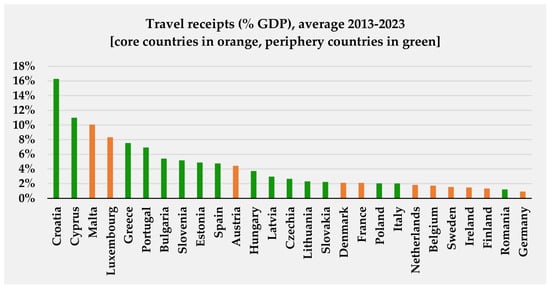
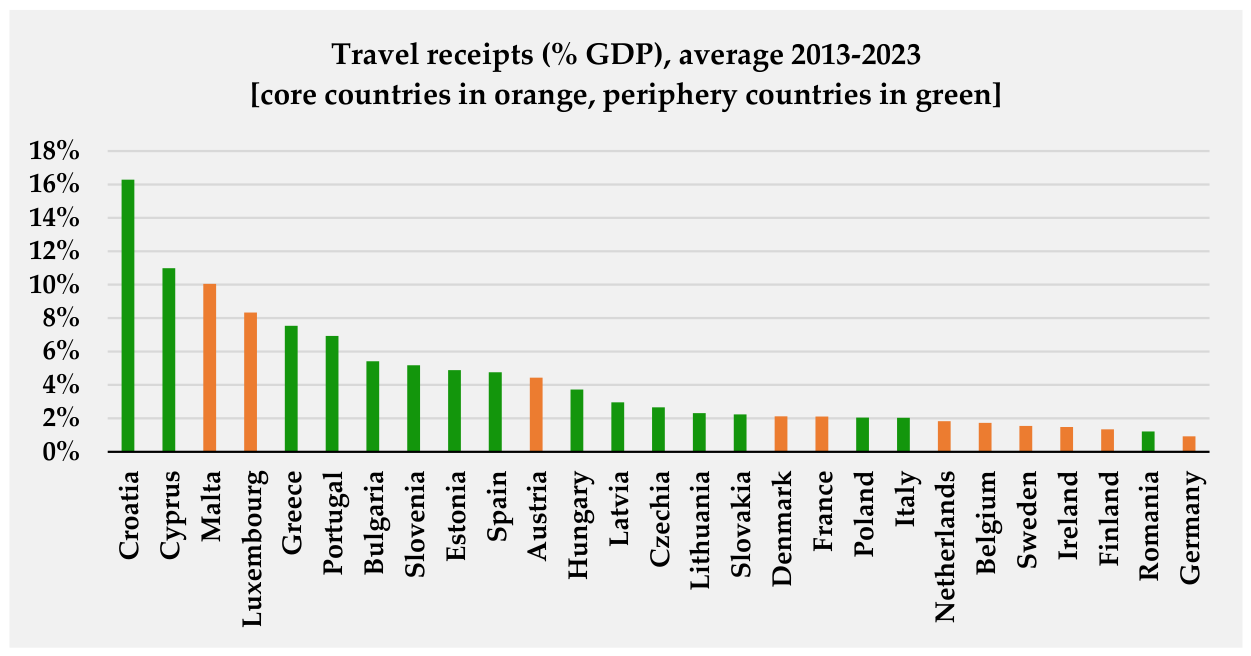
There are three reasons to expect the association to differ between core and periphery EU27 member states. First, research on European economic integration documents persistent structural polarization between a core of technologically advanced economies and a periphery with weaker productive capabilities and a greater reliance on lower value-added activities [60]. Periphery economies are, on average, more specialized in tourism (see Figure 1), so changes in tourism flows represent a larger share of labor demand, including the demand for women’s labor. Second, gender equality is substantially lower in the periphery (Section 5), and female employment rates have historically been low in several southern member states; where gender gaps are wider, an expansion of service employment is more likely to draw women into paid work and to narrow those gaps. Third, in core countries, high levels of gender equality are supported by long-established institutions, such as childcare provision, parental leave and anti-discrimination frameworks, so the marginal contribution of a single sector may be smaller.
Figure 1.
Travel receipts (% GDP), average 2013–2023, and core vs. periphery. Source: Eurostat, authors’ calculations.
3.4. The Role of the Control Variables
The controls are established determinants of gender equality that may also be correlated with tourism flows. Table A1 in Appendix A summarizes their definitions, expected signs and roles. GDP per capita (PGDP), human capital (HC) and R&D (RD) are treated primarily as confounders; higher income and educational attainment are associated with greater gender equality [70,71] and with higher domestic and inbound tourism demand, while R&D and innovation activity expand high-skilled employment opportunities and are related to gender equality [72]. Full-time equivalent employment (EMP) and gender segregation (SG) are instead potential mediators because the employment channel of tourism operates partly through these variables. Conditioning on them implies that the tourism coefficient captures the association net of the part transmitted through overall employment and occupational composition, so it should be read as a conservative estimate of the overall association; for this reason, specifications that exclude EMP, SG and RD (Models VII and VIII) are also reported. EMP, SG and HC are also conceptually related to components of the GEI, an issue discussed in Section 4.
3.5. Hypotheses
In the context of the above framework, we formulate the following hypotheses:
H1.
Conditional on GDP per capita, human capital, full-time equivalent employment, gender segregation and R&D, tourism flows are positively associated with gender equality in the EU27.
H2.
The positive association between tourism flows and gender equality is stronger in periphery than in core EU27 member states.
H2 is examined by estimating the models separately for each group and by formally testing whether the tourism coefficients of the two groups are equal. Because a statistically insignificant coefficient in one group can arise from several sources, including a smaller number of countries and lower within-country variation, group differences are interpreted with caution.
4. Data Description
We evaluate quantitatively the relationship between tourism flows and gender equality in the 27 EU member states, taking into account other determinants of gender equality. For this purpose, several panel data models are estimated. The dataset spans the period of 2013–2023 (27 countries × 11 years = 297 observations); because some regressors enter with lags of up to three years, the effective estimation samples cover 2015–2023 (243 observations) or 2016–2023 (216 observations), depending on the specification (see Section 5). We next present the variables and the data sources. The dependent variable is the Gender Equality Index (GEI) of the European Institute for Gender Equality [73]; GEI data start in 2013.
The GEI is a composite indicator that measures gender gaps, adjusted for the overall level of achievement, in six core domains—work, money, knowledge, time, power and health—on the basis of 31 indicators; it ranges from 1 (full inequality) to 100 (full equality) and is rescaled to the unit interval in our dataset [64]. Indicators are normalized and aggregated into sub-domain and domain scores, which are then combined using domain weights derived from expert opinion [64]. Three features of the index are relevant for our analysis. First, the EIGE recalculates the complete time series with each edition using a consistent methodology so that scores are comparable across years and countries. Second, the index draws on data sources with different reference years, so that year-to-year changes in the GEI are gradual; this is one of the reasons why several regressors are introduced with lags. Third, missing indicator values are treated by the EIGE according to its methodology, and the resulting panel used here is balanced, with no missing country-year observations. Finally, some explanatory variables are conceptually close to GEI components: the full-time equivalent employment rate and sectoral segregation enter the work domain, and tertiary education enters the knowledge domain. The coefficients for EMP, SG and HC may, therefore, partly reflect this overlap and should not be interpreted as fully independent determinants of the index. Tourism flows are not a component of the GEI, so the coefficient of interest is not mechanically affected by the overlap, although its magnitude is conditional on these controls (Section 3.4).
The main variable of interest is the tourism variable (TF), which represents total tourism flows, that is, the combined domestic and inbound flows [74]. Including domestic flows is important because domestic tourism accounts for a large share of tourism activity in many member states, so that inbound indicators alone would understate the tourism-related demand for services and labor. The variable of total employment (EMP) indicates the full-time equivalent employment rate (%) of men and women in the economy [73]. Positive associations of tourism flows and total employment with gender equality are anticipated (Section 3).
The gender segregation (SG) variable is calculated as the ratio of the number of women employed in occupations to the respective number of men1. Despite its label, which follows the terminology of the EIGE database, SG increases with women’s representation relative to men: a higher value indicates a more balanced gender composition of employment, i.e., lower male dominance in the occupations considered, whereas a lower value indicates stronger segregation to the disadvantage of women. A positive association between SG and gender equality is, therefore, expected, because a more balanced representation of women reflects fewer barriers to women’s entry into these occupations and is linked to smaller gender gaps in earnings and career progression [46,63]. Accordingly, a positive coefficient for SG should be read as a positive association between more balanced female representation and gender equality, not as a positive association between segregation and equality.
Economic activity (PGDP) is measured by the gross domestic product per capita in real values [74], and a positive association with gender equality is anticipated. We use an index of PGDP with 2020 as a base year, taking the value of 1. The variable of human capital (HC) indicates the share of the population aged 25–34 who have completed tertiary studies (ISCED levels 5–8, e.g., university and higher technical institutes) [74], and one could expect a positive linkage with gender equality. Finally, the innovation effect is assessed by the “research and development personnel and researchers” index [74], and a positive association is also expected with the equality of men and women.
The panel dataset concerns the 27 European Union member states covering the sample period of 2013–2023, namely, a total of 297 observations; the effective estimation samples are smaller because of the lagged regressors. Table 1 depicts the basic descriptive statistics of all data variables for the full 2013–2023 dataset.
Table 1.
Descriptive statistics.
5. Methodology and Empirical Results
The econometric model is presented in Equation (1) in general form as follows:
where, GEI is the Gender Equality Index, TF is the tourism flows index, HC is the human capital, EMP is the full-time equivalent employment rate, SG is the gender segregation, PGDP is the gross domestic product per capita, RD is the research and development index, e is the error term, a0 is constant term, and ai are the country dummies.
lnGEIi,t = a0 + ai + a1 lnTFi,t-j + a2 lnHCi,t-j + a3 lnEMPi,t-j + a4 lnSGi,t-j
+ a5lnPGDPi,t-j + a6lnRDi,t-j + e
+ a5lnPGDPi,t-j + a6lnRDi,t-j + e
Several variations of Equation (1) are used to examine the association of total tourism flows with the equality between women and men, controlling for human capital, employment rate, gender segregation, GDP per capita, and the research and development index (see Table 2; Models I to VIII). Country fixed effects are used to account for unobserved time-invariant heterogeneity. The EViews 14 econometric software is used for econometric estimations. All variables are used in their natural logarithms in econometric modeling to achieve better estimation results and reduce the impact of any outliers on the variables. Moreover, given the use of natural logarithms, the estimated coefficients represent elasticities.
Table 2.
Main results (GLS).
The estimation strategy is sequential; each step addresses a specific threat to the reliability of the baseline estimates, rather than offering unrelated alternative models. (i) The baseline specifications (Models I, III, V and VII) include country fixed effects, which remove time-invariant differences in culture, institutions and geography that may affect both tourism and gender equality, and period random effects, which capture common shocks affecting all member states, most notably the collapse of tourism flows during COVID-19 in 2020–2021. (ii) Because member states differ considerably in size and economic structure, the error variance is likely to differ across countries; Models II, IV, VI and VIII, therefore, apply GLS with cross-section weights, which yields more efficient estimates under cross-sectional heteroskedasticity. (iii) The pairs of models differ in the set of controls: SG and RD are highly correlated (see footnote 2), so Models III-IV exclude SG, Models V-VI additionally exclude RD, and Models VII-VIII exclude EMP, SG and RD, which also allows the association of tourism flows to be assessed without the potential mediators discussed in Section 3.4. (iv) Since a few member states with very high tourism intensities, as well as the pandemic years, may exert a disproportionate influence, the weighted models are re-estimated with robust M-estimation (Table 3). (v) Finally, to verify that the tourism coefficient is not an artefact of the chosen set of controls, we apply a backward variable selection procedure in which tourism flows are always retained, while the controls and country dummies are selected according to a statistical criterion (Table 4).
Table 3.
Results from robust least squares (M-estimation with Welsch-type weights).
The lag structure reflects both economic reasoning and the timing of the data. GDP per capita enters with a lag of two or three years because improvements in economic conditions are expected to be reflected in gender equality gradually—through public revenues and spending on care services, household resources and adjustments in labor market institutions—rather than contemporaneously; the use of lagged income also reduces simultaneity between the GEI and the business cycle. Gender segregation enters with a one-year lag, since changes in the gender composition of occupations take time to translate into gaps in earnings and career outcomes. For R&D, both contemporaneous and one-year lagged values are plausible, as innovation activity affects employment structures with a short delay. Tourism flows, human capital and employment enter contemporaneously because tourism-related labor demand and employment adjust within the year, while the human capital indicator is a slowly moving stock. Within these theoretically allowable ranges (zero to three years), lag selection was applied only to the control variables whose timing is theoretically uncertain (PGDP and RD), while tourism flows always enter contemporaneously. For each specification, we estimated alternative lag lengths and retained the one that was statistically significant at the 5% level with the expected coefficient sign. Because data-driven selection can overstate the precision of the selected coefficients, we do not attach a substantive interpretation to the specific lag lengths of the controls. Also, the adjusted R2 values increase if the newly added regressor essentially improves the model’s explanatory ability and is suitable for comparing model specifications with different numbers of regressors. Importantly, the results for tourism flows are robust to the alternative lag structures reported; the tourism coefficient remains positive and of similar size whether GDP per capita enters with two or three lags and whether R&D enters contemporaneously or with one lag (Table 2, Table 3 and Table 4). The use of lags explains why the effective estimation samples begin in 2015 (two-year lag of PGDP; 243 observations) or in 2016 (three-year lag of PGDP; 216 observations) rather than in 2013.
The main results are depicted in Table 2. The p-values are shown in parentheses2. All models in Table 2 are estimated with panel-generalized least squares (GLS) (see also ref. [28] for the case of 10 South American countries). Particularly, Models II, IV, VI and VIII are estimated with GLS with cross-section weights, allowing for cross-sectional heteroskedasticity. Running the redundant fixed-effects LR test and correlated random-effects Hausman test in Models I, III, V and VII, it turns out that country fixed effects and period random effects are required in these model specifications. Furthermore, the redundant fixed-effects LR test justifies the inclusion of country fixed effects in Models II, IV, VI, and VIII.
Turning to the variable of interest, the coefficient of tourism flows is positive in all eight specifications, ranging from 0.0066 to 0.0123. It is statistically significant at the 5% level in Models III, V, VI and VIII, at the 10% level in Models I, IV and VII, and borderline at the 10% level in Model II (p = 0.10). The GLS evidence in favor of H1 is, therefore, consistent in sign but of moderate statistical strength, and it is more precise in the more parsimonious specifications that exclude SG. The estimates imply that a 1% increase in tourism flows is associated with an increase of about 0.01% in the GEI. Among the controls, human capital displays the most precisely estimated association (elasticities between 0.17 and 0.27; p < 0.01 in all models), followed by full-time equivalent employment (0.24–0.45); GDP per capita (0.05–0.14; p < 0.01) and SG (0.38 and 0.46, with p = 0.067 and p = 0.003, respectively) are also positively associated with the GEI, while the R&D coefficient is small (about 0.015) but significant at the 5% level. The larger coefficients for HC, EMP and SG are consistent with the employment and human capital channels outlined in Section 3.1, but as noted in Section 4, they also partly reflect the conceptual overlap of these variables with components of the GEI. The high adjusted R2 values (0.97–0.99) largely reflect the country fixed effects, which absorb the substantial cross-country differences in the level of gender equality, and should not be read as evidence of the explanatory power of the regressors themselves.
Next, we perform a series of robustness checks (Table 3 and Table 4). First, Models II, IV, VI and VIII of Table 2 are estimated with a robust least-squares method (M-estimation with Welsch-type weights; see Table 3), which is robust to the presence of outliers. Second, Table 4 shows the results from ordinary least squares with a backwards selection method3, based on a 5% p-value forwards/backwards stopping criterion; country-fixed effects are also included in these specifications to remove any unobserved time-invariant heterogeneity. Model A relies on the full specification of Model II of Table 2, and Models B and C are like Model A without the RD and SG variables, respectively, due to high correlation between the variables of RD and SG (see also footnote #2). Finally, in all models of Table 3 and Table 4, the inclusion of country dummies is justified by Wald tests.
Table 4.
Results from backwards variable selection (5% forward and 5% backward p-value criterion).
Robustness checks strengthen the empirical evidence for H1. Under robust M-estimation (Table 3), the tourism coefficient remains positive and is significant at the 1% level in all four specifications, with somewhat smaller point estimates (0.0056–0.0093), which indicates that the baseline results are not driven by outlying observations. In the backward selection models (Table 4), in which tourism flows are always retained but the controls must survive the selection criterion, the coefficient ranges from 0.0102 to 0.0133 and is significant at the 5% level in Models B and C and at approximately the 5% level in Model A (p = 0.0502). Across all 15 specifications, the tourism coefficient is, therefore, consistently positive, lies within a narrow range (0.006–0.013), and is statistically significant at the 5% level in ten specifications and at or around the 10% level in the remaining five.
Finally, to examine H2, we split the sample into core and periphery EU27 member states and re-estimate all model specifications of Table 2, Table 3 and Table 4 for each group; we then formally test whether the tourism coefficients of the two groups are equal (Section 6). The classification follows [75], who built on the analysis of structural polarization in European economic integration by [60], which distinguished member states according to their productive structures and development paths rather than geography alone. This classification is appropriate for our purposes because these structural differences are closely related to both tourism specialization and the labor market position of women (Section 3.3). The core group comprises Austria, Belgium, Denmark, Finland, France, Germany, Ireland, Luxembourg, Malta, the Netherlands and Sweden, and the periphery group consists of Bulgaria, Croatia, Cyprus, Czechia, Estonia, Greece, Hungary, Italy, Latvia, Lithuania, Poland, Portugal, Romania, Slovakia, Slovenia and Spain. We acknowledge that any binary classification is stylized, as some member states share features of both groups; the results should, therefore, be read as evidence for broad group differences rather than for individual countries. The core countries exhibit a higher average GEI than the periphery countries (0.7113 vs. 0.5773), with the difference being statistically significant at the 1% level, which is consistent with their different structural and institutional characteristics5.
6. Discussion of Our Results
The empirical results provide consistent support for H1: across 15 specifications and three estimation approaches, tourism flows are positively and, in most cases, significantly associated with the GEI, conditional on the economic determinants of gender equality. Rather than restating the estimates, this section interprets the magnitude of the association, relates it to the proposed mechanisms and to previous studies, and discusses the core–periphery asymmetry.
Regarding economic magnitude, the average elasticity of the GEI with respect to tourism flows across the eight models of Table 2 is about 0.01. Given that the standard deviation of tourism flows is about 32% of its mean for the EU27, a one-standard-deviation increase in tourism flows is associated with an increase in the GEI of about 0.28%: (1 + 0.32)^0.0100 − 1 ≈ 0.0028. The corresponding figure for the periphery countries is (1 + 0.34)^0.0126 − 1 ≈ 0.0037, i.e., about one-third larger. Evaluated at the sample mean of the GEI (0.632, or 63.2 on EIGE’s 1–100 scale), this corresponds to less than 0.2 index points, which is very small relative to the average GEI gap of about 13 index points between core and periphery countries. In comparison, on the basis of the average elasticity of human capital in Table 2 (about 0.22) and a standard deviation of about 22% of its mean, a one-standard-deviation increase in human capital is associated with an increase in the GEI of about 4.5%, roughly sixteen times the figure for tourism flows. The practical significance of tourism flows for gender equality is, therefore, modest; tourism is one of several structural correlates of gender equality, and its association with the GEI is an order of magnitude weaker than that of education and employment.
The positive association is consistent with the employment, income and human capital channels outlined in Section 3.1, and with evidence that the expansion of labor-intensive services is linked to narrower gender gaps in advanced economies [62,63]. It is also in line with cross-country studies reporting a positive relationship between tourism and gender equality [22,25,27,28], and particularly with [26], who finds the relationship to be present in developed economies. Our results extend this evidence to the full EU27, using a multidimensional index and a period that includes the pandemic shock to tourism.
At the same time, the small magnitude of the association is informative, and it can be reconciled with studies that identify negative or mixed consequences of tourism for women. Tourism jobs are frequently segregated, seasonal, part-time and poorly paid, and women face vertical segregation and limited promotion prospects in the sector [9,23,24,46]. These countervailing mechanisms imply that tourism-related labor demand may raise women’s participation in paid work and, thus, relate mainly to the work and money domains of the GEI, without substantially narrowing gaps in the power domain or in job quality. A positive but modest aggregate association is, therefore, compatible with the persistence of occupational and hierarchical inequalities within the sector; both may hold simultaneously. Moreover, the fact that the association remains when employment is controlled for suggests that tourism may also relate to gender equality through channels beyond aggregate employment, such as entrepreneurship, income and social change, although our aggregate data do not allow these channels to be separated.
The core–periphery split provides partial support for H2. Because a statistically significant coefficient in one group and an insignificant coefficient in the other does not by itself imply that the two coefficients differ, we formally test the null hypothesis that the tourism coefficients of the periphery and core subsamples are equal, using a Welch-type t-test based on the estimated coefficients and their standard errors, which allows for unequal variances across the two independently estimated subsamples [76,77]. The results differ across estimation approaches. For the GLS specifications of Table 2, the tourism coefficient tends to be larger in the periphery than in the core, but the null hypothesis of equal coefficients cannot be rejected at the 10% level in any model; the baseline estimates, therefore, provide no statistically significant evidence of a difference between the two groups. For the four robust M-estimation models of Table 3, the tourism coefficient is positive and statistically significant in both subsamples and larger in the periphery, and the null hypothesis of equal coefficients is rejected at the 1% level in all models. For the backward selection models of Table 4, the tourism coefficient is positive and statistically significant in the periphery subsample but insignificant in the core subsample, and the null hypothesis is rejected at the 5% level in Models A and B and at the 10% level in Model C6. The evidence that the association between tourism flows and gender equality is stronger in the periphery, where gender equality is lower, is, therefore, specification-dependent: it is statistically supported in the robust and backward selection specifications but not in the baseline GLS models. We accordingly interpret the core–periphery asymmetry as suggestive rather than conclusive.
Several explanations are consistent with this asymmetry. Periphery economies are more specialized in tourism. As shown in Figure 1, travel receipts as a percentage of GDP are generally higher in the periphery than in the core, so that tourism accounts for a larger share of labor demand. In addition, where gender gaps are wider, an expansion of service employment is more likely to draw women into paid work. One possible interpretation of the weaker association in the core group (insignificant in Table 2 and Table 4 and smaller in Table 3) is a ceiling or diminishing returns effect, whereby, at high levels of gender equality sustained by established institutions, the marginal contribution of tourism is small. We stress, however, that a weaker or insignificant coefficient does not in itself demonstrate a ceiling effect; it may also reflect the smaller number of core countries (11), lower within-country variation in tourism flows or in the GEI, or differences in the composition of tourism employment. The ceiling interpretation should, therefore, be regarded as a possible explanation that requires further research, for instance, by interacting tourism flows with the initial level of gender equality or by applying panel quantile methods.
7. Conclusions, Policy Implications and Limitations
7.1. Conclusions
This paper examined the relationship between tourism flows and gender equality in the EU27. Adopting an economic perspective, which treats gender equality as a macro-level outcome of labor market conditions and sectoral structure, we developed a conceptual framework linking tourism flows to the domains of the EIGE Gender Equality Index through employment, income, human capital and social change channels, while recognizing the countervailing role of occupational segregation and poor job quality. Using a balanced panel dataset for 2013–2023, with effective estimation samples of 2015–2023 or 2016–2023, we estimated a sequence of fixed-effects panel models with GLS, robust M-estimation and backward variable selection.
Three main findings emerge. First, consistent with H1, tourism flows are positively associated with the GEI across all specifications, conditional on human capital, full-time equivalent employment, gender segregation, GDP per capita and R&D, with the association being significant at the 5% level in most specifications. Second, the association is economically modest: the elasticity is about 0.01, an order of magnitude smaller than the associations of human capital and employment with the GEI. Third, the association appears stronger in the periphery member states, which display lower gender equality and higher tourism specialization; however, a formal test confirms this difference only in the robust and backward selection specifications, not in the baseline GLS models, so H2 receives partial support. All three findings should be read as conditional associations; given the observational design, they do not establish that changes in tourism flows cause changes in gender equality. Building on [1,25,26,27], this paper contributes to the literature by providing EU27-wide evidence based on a harmonized multidimensional index and recent data, by grounding the empirical specification in an explicit framework with testable hypotheses, and by providing suggestive evidence of a core–periphery asymmetry in the tourism–gender equality nexus.
7.2. Policy Implications
Gender equality is one of the Sustainable Development Goals of the United Nations [78], and tourism is often presented as a vehicle for achieving it. Our policy implications, however, must remain proportionate to the observational design and to the small size of the estimated association. The results do not imply that promoting tourism growth will by itself improve gender equality. Rather, they suggest that, in periphery member states, where tourism is a more important part of the economy, tourism development is compatible with, and may complement, progress towards gender equality, provided that the quality of the jobs it generates is addressed. Measures that could strengthen this complementarity include reducing occupational and vertical segregation in tourism, promoting women’s access to managerial positions and entrepreneurship, reducing seasonality and involuntary part-time work, and supporting care services that enable women’s full-time participation [32,44]. Given the considerably larger associations of human capital and employment with the GEI, policies that promote tertiary education and women’s full-time employment remain the more important levers for gender equality in both core and periphery member states, while the positive, albeit small, association with R&D points to a complementary role for innovation policies.
7.3. Limitations and Future Research
Several limitations should be acknowledged. First, and most importantly, the analysis reveals conditional associations rather than causal effects. Although country fixed effects and lagged controls mitigate some sources of bias, reverse causality, whereby gender equality raises the demand for travel, and time-varying omitted factors, such as institutional quality, social policy or EU cohesion funding, cannot be ruled out. Future research could address endogeneity using dynamic panel estimators (e.g., [79]) or instruments for tourism flows based on exogenous determinants of tourism demand, such as income in origin markets or natural and cultural endowments. Second, some controls (employment, gender segregation and tertiary education) are conceptually related to components of the GEI, which complicates the interpretation of their coefficients, and the inclusion of potential mediators implies that the tourism coefficient is a conservative estimate of the overall association.
Third, total tourism flows constitute an aggregate measure that does not distinguish between domestic and inbound tourism, between types of tourism, or between the quantity and the quality of the jobs generated; likewise, the national-level GEI does not capture regional differences, although tourism is often regionally concentrated. Future research could use regional data, domain-level GEI scores and sex-disaggregated tourism employment to identify the specific channels proposed in Section 3.1. Fourth, the time dimension is relatively short and includes the exceptional pandemic years; although period effects absorb common shocks, the results may not fully generalize to periods of stable tourism growth. Fifth, the lag lengths were selected within theoretically admissible ranges using statistical criteria (p-value < 5%), and the core–periphery analysis relied on a stylized binary classification with a relatively small core group; moreover, the evidence of a stronger association in the periphery is not robust across all specifications, and a pooled model interacting tourism flows with a periphery indicator would provide a complementary test. Finally, socio-economic conditions, disposable income and purchasing power, and cultural characteristics may shape the relationship between tourism and gender equality [80,81], and their moderating role is a promising avenue for future work.
Author Contributions
Conceptualization, G.A.; Methodology, A.A., E.A., A.K., G.B. and G.A.; Software, A.A. and G.B.; Validation, G.A.; Investigation, A.A., E.A., A.K., G.B. and G.A.; Resources, G.B.; Data curation, A.A. and G.B.; Writing—original draft, A.A., E.A., A.K., G.B. and G.A.; Writing—review & editing, E.A., A.K., G.B. and G.A.; Supervision, G.A.; Project administration, G.A. All authors have read and agreed to the published version of the manuscript.
Funding
This research received no funding.
Institutional Review Board Statement
Not applicable.
Informed Consent Statement
Not applicable.
Data Availability Statement
Data are available upon reasonable request. They can be downloaded free of charge from the Eurostat and EIGE websites.
Acknowledgments
We thank the Editors of the Journal and two anonymous reviewers for their helpful and constructive comments.
Conflicts of Interest
The authors declare no conflict of interest.
Appendix A
Table A1.
Variables, expected signs and roles in the empirical model.
Notes
| 1 | EIGE database: https://eige.europa.eu/gender-statistics/dgs (accessed on 31 January 2025). |
| 2 | The RD and SG variables share a high correlation coefficient (more than 50%); however, coefficient signs do not alter if we include both or remove at least one of them (see Table 2). |
| 3 | The variable of tourism flows and the constant term are “always included” regressors, while the rest of the regressors (including the country dummies) are in the list of “search” regressors. Namely, tourism flows and the intercept are the only variables that cannot be removed during the selection procedure. |
| 4 | The variables included in the final specifications of models A, B and C in Table 4 are individually significant by construction. Running a Wald test to test whether the country dummies are jointly insignificant as well, we reject the null (as anticipated), since each of them is individually significant. |
| 5 | The same findings are obtained for the median values of the GEI (core: 0.7213; periphery: 0.5626). |
| 6 | These results are available upon reasonable request. |
References
- Kyriakaki, A.; Arvanitaki, E.; Adamopoulos, A.; Bertsatos, G.; Agiomirgianakis, G.M. Overtourism and Gender Equality: Empirical evidence from the EU27 member states. J. Tour. Herit. Serv. Mark. 2025, 11, 72–81. [Google Scholar]
- Ferguson, L.; Alarcon, D.M. Gender and sustainable tourism: Reflections on theory and practice. J. Sustain. Tour. 2015, 23, 401–416. [Google Scholar] [CrossRef] [Scilit]
- Ferguson, L. Promoting gender equality and empowering women? Tourism and the third millennium development goal. Curr. Issues Tour. 2011, 14, 235–249. [Google Scholar] [CrossRef] [Scilit]
- P., J.; Baruah, A.; Arayankalam, J. Impact of Tourism Development on Employer Share: A Gendered Perspective. Tour. Anal. 2025, 30, 521–537. [Google Scholar] [CrossRef] [Scilit]
- Rodriguez-Pallas, A.; Sarabia-Molina, M.Y.; Sanchez-Fernandez, M.D.; Ramon-Cardona, J. Gender and Age in the Travel Choice by Spanish Travel Agency Consumers. Societies 2024, 14, 90. [Google Scholar] [CrossRef] [Scilit]
- Askarany, D.; Jafari, S.; Pouryousof, A.; Habibi, S.; Yazdifar, H. Board Gender Diversity and Risk Management in Corporate Financing: A Study on Debt Structure and Financial Decision-Making. Risks 2025, 13, 11. [Google Scholar] [CrossRef] [Scilit]
- Keller, H. Gender Diversity in Corporate Leadership and Firm Financial Performance in Germany. Int. J. Leadersh. Gov. 2024, 4, 37–48. [Google Scholar] [CrossRef] [Scilit]
- Noland, M.; Moran, T.; Kotschwar, B.R. Is Gender Diversity Profitable? Evidence from a Global Survey; Working Paper Series WP16-3; Peterson Institute for International Economics: Washington, DC, USA, 2016. [Google Scholar] [CrossRef] [Scilit]
- Carvalho, I.; Costa, C.; Torres, A. Gender awareness and women managers in tourism: Perceptions of inequality and what could be done. In Handbook of Research on Women in Management and the Global Labor Market; IGI Global Scientific Publishing: Hershey, PA, USA, 2019; pp. 218–238. [Google Scholar] [CrossRef] [Scilit]
- Agiomirgianakis, G.M.; Bertsatos, G.; Tsounis, N. Gender Wage Gaps and Economic Crisis in Greece. Int. Rev. Appl. Econ. 2019, 33, 254–276. [Google Scholar] [CrossRef] [Scilit]
- Kortt, M.A.; Sinnewe, E.; Pervan, S.J. The Gender Wage Gap in the Tourism Industry: Evidence from Australia. Tour. Anal. 2018, 23, 139–149. [Google Scholar] [CrossRef] [Scilit]
- Stavrinoudis, T.; Maroudas, L.; Doumi, M.; Kyriakaki, A.; Vlassi, E. Corporate climate and glass ceiling in the hospitality industry. In Gender and Tourism Challenges and Opportunities; Valeri, M., Katsoni, V., Eds.; Emerald Publishing: Bingley, UK, 2021; pp. 183–204. [Google Scholar]
- Stonich, S.C.; Sorensen, J.H.; Hundt, A. Ethnicity, class, and gender in tourism development: The case of the Bay Islands, Honduras. J. Sustain. Tour. 1995, 3, 1–28. [Google Scholar] [CrossRef] [Scilit]
- Wilkinson, P.F.; Pratiwi, W. Gender and tourism in an Indonesian village. Ann. Tour. Res. 1995, 22, 283–299. [Google Scholar] [CrossRef] [Scilit]
- Aitchison, C. Gender and leisure research: The “codification of knowledge”. Leis. Sci. 2001, 23, 1–19. [Google Scholar] [CrossRef] [Scilit]
- Figueroa-Domecq, C.; Pritchard, A.; Segovia-Perez, M.; Morgan, N.; Villace-Molinero, T. Tourism gender research: A critical accounting. Ann. Tour. Res. 2015, 52, 87–103. [Google Scholar] [CrossRef] [Scilit]
- Okumus, F.; van Niekerk, M.; Koseoglu, M.A.; Bilgihan, A. Interdisciplinary research in tourism. Tour. Manag. 2018, 69, 540–549. [Google Scholar] [CrossRef] [Scilit]
- WTTC. Economic Impact Reports. 2020. Available online: https://wttc.org/Research/Economic-Impact (accessed on 31 January 2025).
- UNWTO. Tourism Leading Other Global Sectors in Advancing Gender Equality, New Report Shows. 2019. Available online: https://www.unwto.org/tourism-leading-other-global-sectors-in-advancing-gender-equality (accessed on 31 January 2025).
- Duffy, L.N.; Kline, C.S.; Mowatt, R.A.; Chancellor, H.C. Women in tourism: Shifting gender ideology in the DR. Ann. Tour. Res. 2015, 52, 72–86. [Google Scholar] [CrossRef] [Scilit]
- Cole, S. Gender Equality and Tourism: Beyond Empowerment; CABI: Oxfordshire, UK, 2018. [Google Scholar]
- Zhang, J.; Zhang, Y. Tourism and gender equality: An Asian perspective. Ann. Tour. Res. 2020, 85, 103067. [Google Scholar] [CrossRef] [Scilit]
- Baum, T. International Perspectives on Women and Work in Hotels, Catering and Tourism; Bureau for Gender Equality Working Paper 1/2013; Sectoral Activities Department Working Paper No. 289; International Labour Office: Geneva, Switzerland, 2013. [Google Scholar]
- Santero-Sanchez, R.; Segovia-Perez, M.; Castro-Nunez, B.; Figueroa-Domecq, C.; Talon-Ballestero, P. Gender differences in the hospitality industry: A job quality index. Tour. Manag. 2015, 51, 234–246. [Google Scholar] [CrossRef] [Scilit]
- Nassani, A.A.; Aldakhil, A.M.; Abro, M.M.Q.; Islam, T.; Zaman, K. The impact of tourism and finance on women empowerment. J. Policy Model. 2019, 41, 234–254. [Google Scholar] [CrossRef] [Scilit]
- Jackman, M. The effect of tourism on gender equality in the labour market: Help or hindrance? Women’s Stud. Int. Forum 2022, 90, 102554. [Google Scholar] [CrossRef] [Scilit]
- Nguyen, C.P. Tourism and gender (in)equality: Global evidence. Tour. Manag. Perspect. 2022, 41, 100933. [Google Scholar] [CrossRef] [Scilit]
- Hernandez-Medina, P.; Velasco, B.V. Can tourism contribute to gender equality? Evidence from South American countries. Investig. Tur. 2024, 28, 64–82. [Google Scholar] [CrossRef] [Scilit]
- Umbelino, J.; Rodriguez-Anton, J.M.; Celemin-Pedroche, M.S.; Filipe, R.; Amorim, E.; Carranca, M.A. EU membership and the impact on the image and attractiveness on tourism destinations. Enlightening Tour. 2014, 4, 112–146. [Google Scholar]
- Gil Arroyo, C.; Barbieri, C.; Sotomayor, S.; Knollenberg, W. Cultivating Women’s empowerment through Agritourism: Evidence from Andean communities. Sustainability 2019, 11, 3058. [Google Scholar] [CrossRef] [Scilit]
- Rinaldi, A.; Salerno, I. The tourism gender gap and its potential impact on the development of the emerging countries. Qual. Quant. 2019, 54, 1465–1477. [Google Scholar] [CrossRef] [Scilit]
- International Labour Organization. Care Work and Care Jobs for the Future of Decent Work; International Labour Office: Geneva, Switzerland, 2018. [Google Scholar]
- Aghazamani, Y.; Hunt, C.A. Empowerment in tourism: A review of peer reviewed literature. Tour. Rev. Int. 2017, 21, 333–346. [Google Scholar] [CrossRef] [Scilit]
- Pritchard, A. Predicting the next decade of tourism gender research. Tour. Manag. Perspect. 2018, 25, 144–146. [Google Scholar] [CrossRef] [Scilit]
- Pastore, F.; Webster, A.; Hope, K. Assessing the role of women in tourism related sectors in the Caribbean. Int. J. Tour. Res. 2021, 23, 378–400. [Google Scholar] [CrossRef] [Scilit]
- Acharya, B.P.; Halpenny, E.A. Homestays as an alternative tourism product for sustainable community development: A case study of women-managed tourism product in rural Nepal. Tour. Plan. Dev. 2013, 10, 367–387. [Google Scholar] [CrossRef] [Scilit]
- Farmaki, A. Women in Airbnb: A neglected perspective. Curr. Issues Tour. 2019, 25, 3110–3114. [Google Scholar] [CrossRef] [Scilit]
- Wen, J.J.; Lin, Q.; Wangzhou, K. Living with Colours and Pride: Tourism, Ethnicity, and Gender in Yunnan, China. Tour. Hosp. 2022, 3, 870–879. [Google Scholar] [CrossRef] [Scilit]
- Xu, H.; Wang, C.; Wu, J.; Liang, Y.; Jiao, Y.; Nazneen, S. Human poverty alleviation through rural women’s tourism entrepreneurship. J. China Tour. Res. 2018, 14, 445–460. [Google Scholar] [CrossRef] [Scilit]
- Tucker, H.; Boonabaana, B. A critical analysis of tourism, gender and poverty reduction. J. Sustain. Tour. 2012, 20, 437–455. [Google Scholar] [CrossRef] [Scilit]
- Scheyvens, R.; Hughes, E. Can tourism help to “end poverty in all its forms everywhere”? The challenge of tourism addressing SDG1. J. Sustain. Tour. 2019, 27, 1061–1079. [Google Scholar] [CrossRef] [Scilit]
- Richards, G. Cultural tourism: A review of recent research and trends. J. Hosp. Tour. Manag. 2018, 36, 12–21. [Google Scholar] [CrossRef] [Scilit]
- Boley, B.B.; Ayscue, E.; Maruyama, N.; Woosnam, K.M. Gender and empowerment: Assessing discrepancies using the resident empowerment through tourism scale. J. Sustain. Tour. 2017, 25, 113–129. [Google Scholar] [CrossRef] [Scilit]
- Alarcón, D.M.; Cole, S. No sustainability for tourism without gender equality. J. Sustain. Tour. 2019, 27, 903–919. [Google Scholar] [CrossRef] [Scilit]
- Romo, R.S.; Gabriel, L.P.; Soares, J.R. Gender equality in access to Management in the tourism industry. In Contemporary Human Resources Management in the Tourism Industry; Tüzünkan, D., Altıntas, V., Eds.; IGI Global: Hershey, PA, USA, 2019; pp. 85–103. [Google Scholar] [CrossRef] [Scilit]
- Hutchings, K.; Moyle, C.; Chai, A.; Garofano, N.; Moore, S. Segregation of women in tourism employment in the APEC region. Tour. Manag. Perspect. 2020, 34, 100655. [Google Scholar] [CrossRef] [Scilit]
- Kattara, H. Career challenges for female managers in Egyptian hotels. Int. J. Contemp. Hosp. Manag. 2005, 17, 238–251. [Google Scholar] [CrossRef] [Scilit]
- Campos-Soria, J.A.; Marchante-Mera, A.; Ropero-García, M.A. Patterns of occupational segregation by gender in the hospitality industry. Int. J. Hosp. Manag. 2011, 30, 91–102. [Google Scholar] [CrossRef] [Scilit]
- International Labour Office. ILO Guidelines on Decent Work and Socially Responsible Tourism; International Labour Office, Sectoral Policies Department: Geneva, Switzerland, 2017. [Google Scholar]
- Winchenbach, A.; Hanna, P.; Miller, G. Rethinking decent work: The value of dignity in tourism employment. J. Sustain. Tour. 2019, 27, 1026–1043. [Google Scholar] [CrossRef] [Scilit]
- Mooney, S. Jobs for the girls? Women’s employment and career progression in the hospitality industry. In Handbook of Human Resource Management in the Tourism and Hospitality Industries; Burke, R., Hughes, J., Eds.; Edward Elgar Publishing: Cheltenham, UK, 2018; pp. 184–215. [Google Scholar]
- Uduji, J.I.; Okolo-Obasi, E.N.; Asongu, S.A. Sustaining cultural tourism through higher female participation in Nigeria: The role of corporate social responsibility in oil host communities. Int. J. Tour. Res. 2020, 22, 120–143. [Google Scholar] [CrossRef] [Scilit]
- Nyaruwata, S.; Nyaruwata, L.T. Gender equity and executive management in tourism: Challenges in the Southern African Development Community (SADC) region. Afr. J. Bus. Manag. 2013, 7, 2059–2070. [Google Scholar]
- Alsawafi, A.M. Exploring the challenges and perceptions of Al Rustaq College of Applied Sciences students towards Omani women’s empowerment in the tourism sector. Tour. Manag. Perspect. 2016, 20, 246–250. [Google Scholar] [CrossRef] [Scilit]
- Masadeh, M.; Al-Ababneh, M.; Al-Sabi, S.; Allah, M.H. Female tourist guides in Jordan: Why so few? Eur. J. Soc. Sci. 2018, 56, 89–102. [Google Scholar]
- Alrwajfah, M.M.; Almeida-García, F.; Cortes-Macías, R. Females’ perspectives on tourism’s impact and their employment in the sector: The case of Petra, Jordan. Tour. Manag. 2020, 78, 104069. [Google Scholar] [CrossRef] [Scilit]
- Banerjee, S.; Chua, A.Y. How alluring is the online profile of tour guides? Ann. Tour. Res. 2020, 81, 102887. [Google Scholar] [CrossRef] [Scilit]
- Nomnga, V.J. Unlocking the potential of women entrepreneurs in the tourism and hospitality industry in the eastern Cape Province, South Africa. J. Econ. Behav. Stud. 2017, 9, 6–13. [Google Scholar] [CrossRef] [Scilit]
- Pena-Sanchez, A.R.; Ruiz-Chico, J.; Jimenez-García, M.; Lopez-Sanchez, J.A. Tourism and the SDGs: An analysis of economic growth, decent employment, and gender equality in the European Union (2009–2018). Sustainability 2020, 12, 5480. [Google Scholar] [CrossRef] [Scilit]
- Gräbner, C.; Heimberger, P.; Kapeller, J.; Schütz, B. Structural Change in Times of Increasing Openness: Assessing Path Dependency in European Economic Integration. J. Evol. Econ. 2020, 30, 1467–1495. [Google Scholar] [CrossRef] [Scilit]
- Kinnaird, V.; Hall, D. Understanding tourism processes: A gender-aware framework. Tour. Manag. 1996, 17, 95–102. [Google Scholar] [CrossRef] [Scilit]
- Ngai, L.R.; Petrongolo, B. Gender gaps and the rise of the service economy. Am. Econ. J. Macroecon. 2017, 9, 1–44. [Google Scholar] [CrossRef] [Scilit]
- Olivetti, C.; Petrongolo, B. The evolution of gender gaps in industrialized countries. Annu. Rev. Econ. 2016, 8, 405–434. [Google Scholar] [CrossRef] [Scilit]
- EIGE. Gender Equality Index 2017: Methodological Report; Publications Office of the European Union: Luxembourg, 2017. [Google Scholar]
- Duflo, E. Women empowerment and economic development. J. Econ. Lit. 2012, 50, 1051–1079. [Google Scholar] [CrossRef] [Scilit]
- Goldin, C. The quiet revolution that transformed women’s employment, education, and family. Am. Econ. Rev. 2006, 96, 1–21. [Google Scholar] [CrossRef] [Scilit]
- Collins, D.; Tisdell, C. Gender and differences in travel life cycles. J. Travel Res. 2002, 41, 133–143. [Google Scholar] [CrossRef] [Scilit]
- Yang, E.C.L.; Yang, M.J.H.; Khoo-Lattimore, C. The meanings of solo travel for Asian women. Tour. Rev. 2019, 74, 1047–1057. [Google Scholar] [CrossRef] [Scilit]
- Wang, Y.; Li, M. Family identity bundles and holiday decision making. J. Travel Res. 2021, 60, 486–502. [Google Scholar] [CrossRef] [Scilit]
- Cooray, A.; Potrafke, N. Gender inequality in education: Political institutions or culture and religion? Eur. J. Political Econ. 2011, 27, 268–280. [Google Scholar] [CrossRef] [Scilit]
- Klasen, S. From ‘MeToo’ to Boko Haram: A survey of levels and trends of gender inequality in the world. World Dev. 2020, 128, 104862. [Google Scholar] [CrossRef] [Scilit]
- Nguyen, C.P. Gender equality and economic complexity. Econ. Syst. 2021, 45, 100921. [Google Scholar] [CrossRef] [Scilit]
- EIGE. European Institute for Gender Equality Online Database. 2024. Available online: https://eige.europa.eu/gender-equality-index/2024 (accessed on 31 January 2025).
- Eurostat. Eurostat Online Database. 2024. Available online: https://ec.europa.eu/eurostat/data/database (accessed on 31 January 2025).
- Bertsatos, G.; Missos, V.; Rizos, A. Does the Productivity of SMEs Affect Poverty Within the EU27? Bull. Econ. Res. 2025, 77, 181–197. [Google Scholar] [CrossRef] [Scilit]
- Clogg, C.C.; Petkova, E.; Haritou, A. Statistical methods for comparing regression coefficients between models. Am. J. Sociol. 1995, 100, 1261–1293. [Google Scholar] [CrossRef] [Scilit] [PubMed]
- Paternoster, R.; Brame, R.; Mazerolle, P.; Piquero, A. Using the correct statistical test for the equality of regression coefficients. Criminology 1998, 36, 859–866. [Google Scholar] [CrossRef] [Scilit]
- UN. Gender Equality. 2021. Available online: https://www.un.org/sustainabledevelopment/gender-equality/ (accessed on 31 January 2025).
- Arellano, M.; Bond, S. Some tests of specification for panel data: Monte Carlo evidence and an application to employment equations. Rev. Econ. Stud. 1991, 58, 277–297. [Google Scholar] [CrossRef] [Scilit]
- Akerlof, G.A.; Kranton, R.E. Economics and identity. Q. J. Econ. 2000, 115, 715–753. [Google Scholar] [CrossRef] [Scilit]
- Ponthieux, S.; Meurs, D. Chapter 12—Gender inequality. In Handbook of Income Distribution; Atkinson, A.B., Bourguignon, F., Eds.; Elsevier: Amsterdam, The Netherlands, 2015; Volume 2, pp. 981–1146. [Google Scholar]

Disclaimer/Publisher’s Note: The statements, opinions and data contained in all publications are solely those of the individual author(s) and contributor(s) and not of MDPI and/or the editor(s). MDPI and/or the editor(s) disclaim responsibility for any injury to people or property resulting from any ideas, methods, instructions or products referred to in the content. |
© 2026 by the authors. Licensee MDPI, Basel, Switzerland. This article is an open access article distributed under the terms and conditions of the Creative Commons Attribution (CC BY) license.