


Abstract
Global peace indices rank whole countries on a single template and cannot reveal the variation within a country that governs peace policy in developing societies, where peace is unevenly distributed. Drawing on the local turn and composite-indicator methodology, this article sets out a transferable, five-stage protocol for building a context-sensitive, subnational peace index under data scarcity and demonstrates it on Thailand using province-level data for all seventy-seven provinces before and during the COVID-19 pandemic. Four findings emerge that a national score conceals. First, the dispersion of peace is large at the indicator level but progressively masked by aggregation, so the composite understates within-country inequality. Second, the four dimensions of peace are almost uncorrelated across provinces, so peace is multidimensional, and no single ranking represents it. Third, the cross-province distribution narrowed asymmetrically, the least peaceful provinces improving while the most peaceful slipped, a robustness split showing the rising floor reflects improvement in recorded conditions, not perception. Fourth, region explains only about four percent of the variation, so peace is local rather than regional. The protocol answers the critique that peace measurement imports external templates and offers a reproducible, transparent instrument for monitoring peace across the Global South.
1. Introduction
The measurement of peace has become an established part of how governments and international organizations understand social progress, yet the instruments that dominate the field were built for comparing countries rather than for guiding policy within them. The most systematic is the work of the Institute for Economics and Peace, whose Global Peace Index measures the absence of violence and the threat of violence across more than one hundred and sixty countries and whose Positive Peace Index measures the attitudes, institutions, and structures associated with peaceful societies [1,2]. These instruments have established robustly that peaceful societies tend to be more prosperous and more resilient. Their design, however, carries two limitations that bind precisely where developing-country policy operates. A fixed cross-national template under-represents the particular forms that violence, discrimination, and inequality take in any one society, a concern that resonates with the “local turn” in peace studies and its insistence that peace is made and experienced locally [3]. In addition, a single national score is an average that hides the variation inside a country, so a nation can post an improving national figure while many of its regions fall behind.
This article responds by changing the unit and the origin of measurement. Instead of ranking a country against others on an imported template, it asks how peace varies within a country, on dimensions drawn from that country’s own context, and it treats the description of that internal variation as the central task. The contribution is twofold. The first part is a method: a five-stage protocol for building a context-sensitive, subnational peace index under conditions of data scarcity, described in plain terms with the technical specification gathered in an appendix for replication. The second part is an empirical demonstration on Thailand [4,5] that does not merely report the index but interrogates its internal structure graphically, using measures of inequality, co-movement, convergence, and variance decomposition more familiar from economics than from the peace-index literature. Thailand is the demonstration case rather than the subject; the design ensures that the procedure and the analytical lens, not the particular Thai numbers, are the transferable output.
The demonstration uses a window spanning the years immediately before and during the COVID-19 pandemic (2019 and 2022). We treat this window as a natural experiment in which a single shock arrived across all provinces at once, which lets us observe how a common shock interacts with the differences already present. The design is deliberately retrospective, and its usefulness does not fade with time because its purpose is to reveal relationships rather than to report a current ranking.
The analysis is organized around three propositions, each examined graphically. The first concerns concealed inequality: the spread of peace is large at the level of indicators but shrinks as indicators are combined, so the composite understates the inequality beneath it. The second concerns multidimensionality: the dimensions of peace are weakly correlated across provinces, so no single ranking represents them and the geography of peace differs from one dimension to another. The third concerns convergence under shock: across the window the distribution of peace narrowed, with the least peaceful provinces improving and the most peaceful slipping back. A fourth, supporting result is that region explains very little of the variation, so peace is local rather than regional. Section 2 sets out the conceptual background, locating the study in the debate over the meaning of peace, in the critique of templated peacebuilding, in the local turn, and in the methodology of composite social indicators and synthesizes these into a conceptual framework (Figure 1). Section 3 describes the protocol, the data, and the analytical measures. Section 4 reports the results with seven figures and a summary of the evidence. Section 5 discusses what the analysis recovers, its policy implications for peace and social reconciliation, robustness, transferability, and limitations. Section 6 concludes. The technical specification of every step is in Appendix A.
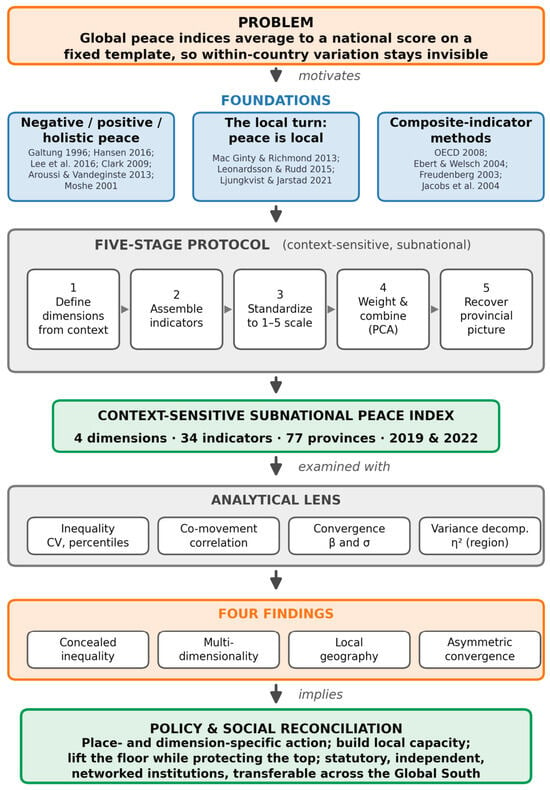
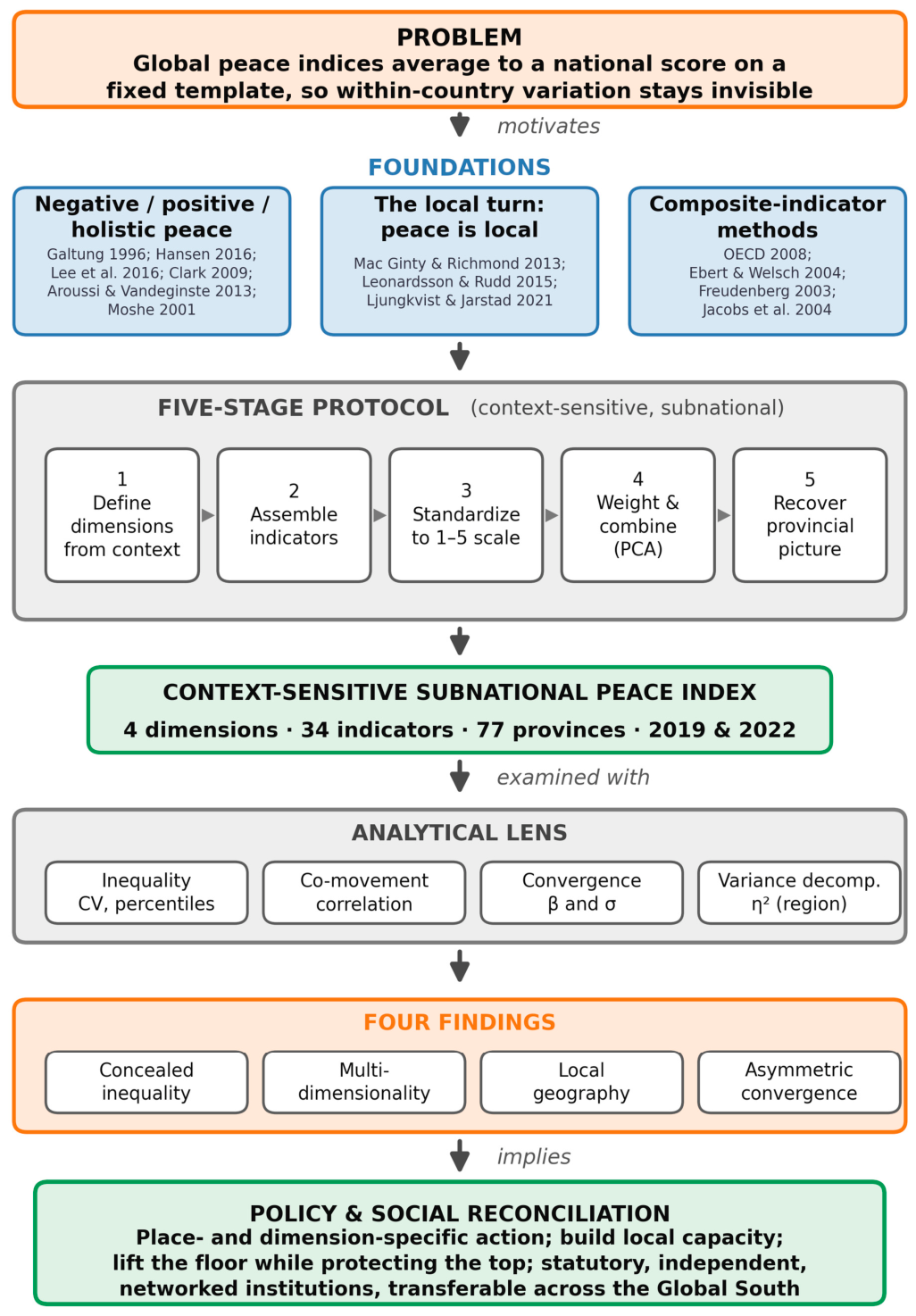
Figure 1.
Conceptual framework: from the limits of global indices, through context-sensitive subnational measurement and a four-part analytical lens, to four findings and their use for policy and social reconciliation. [3,6,7,8,9,10,11,12,13,14,15,16,17].
2. Conceptual Background
2.1. Negative, Positive, and Holistic Peace
The conceptual foundation is the distinction, due to Galtung, between negative peace, the absence of war and direct physical violence, and positive peace, the presence of the institutions, relationships, and structures that allow a society to be cohesive and just and that prevent violence from arising, so that the elimination of structural violence is itself part of peace [3]. The distinction continues to organize the field, but it has been refined and contested in ways that bear directly on measurement. Hansen reconsiders and extends it into a tripartite framework of “holistic peace,” reframing violence as harm and arguing that the binary of negative and positive peace is too coarse to capture what peaceful coexistence requires [6]. Lee, Mac Ginty, and Joshi distinguish a “social” peace oriented toward welfare and people from a “security” peace oriented toward the absence of armed threat and show, through the content and implementation of modern peace accords, that peacemaking remains biased toward security over the social foundations of peace [7]. Clark, examining Bosnia and Hercegovina, treats the move “from negative to positive peace” as an empirical question about whether reconciliation has taken root and finds a negative peace that has not matured into a positive one [8]. Aroussi and Vandeginste define positive peace operationally as “the removal of structural violence and of systemic patterns of discrimination and oppression,” a definition that maps almost directly onto the diversity and inequality dimensions used below [9], and Moshe identifies the eradication of inequality as the linking factor that transforms conflict into coexistence [10]. Recent work has begun to test these relationships quantitatively: Bayerlein, Kamin, and Krahmann relate societal norms to peace and show that the norms most strongly associated with peace differ for negative peace, proxied by the absence of intrastate armed conflict, and positive peace, proxied by interpersonal trust [18], while Krahmann and Podder argue that contestation in peacebuilding is “not merely over norms, but also, and already over the meaning of peace” [19]. The lesson this body of work carries into measurement is that peace is multidimensional, that its dimensions need not move together, and that the meaning of peace is itself context-dependent rather than fixed.
Context enters even at the level of definition. In the Thai source material, peace is understood not only as the absence of war and physical violence but as a value expressed from within the person and the surrounding social setting, appearing as harmony, a decent standard of living, safety, mutual respect, and a sense of freedom. This understanding is consistent with the negative, positive, and holistic distinctions but places particular weight on social harmony, and it reflects local intellectual and cultural traditions. The methodological lesson is that the construct and its dimensions should be drawn from the society being measured rather than fixed in advance by an outside instrument.
2.2. The Critique of Templated Peace and of Measuring It
A substantial amount of the critical literature warns against exactly the move that global indices make, namely the application of a single external template across very different societies. Richmond traces the genealogy of the “liberal peace” and argues that the real “problem of peace” is the absence of debate over its conceptualization, so that peace is treated as a negative epistemology imported wholesale rather than defined in context [20]. Heathershaw urges the field to move beyond the liberal-versus-local binary toward mid-level, explanatory theory [21]; Paffenholz argues that the “linear cause-effect problem-solving model” of liberal peacebuilding is in profound crisis and calls for a “perpetual peacebuilding” that abandons its linearity [22]. Lipschutz, writing earlier, criticizes a “neoliberal peace” built on formal procedures and markets that “fail to address the deeper causes and consequences of communitarian violence” [23]. The challenge to externally fixed templates has sharpened as the global order has changed, with Kobayashi, Krause, and Yuan calling for the boundaries of peacebuilding to be reset around the practices of political ordering in conflict-affected states [24], and Kreikemeyer documenting how traditional and Indigenous peacemaking has been marginalized in the post-liberal debate [25]. Most pointed for present purposes is Denskus, who argues that the mainstreaming of peacebuilding into results-based aid management has “marginalised and depoliticised critical questions” by promoting “comforting notions for donors that peace can be built and measured without challenging Western understanding of economy, governance, and social aspirations of people” [26]. This is a direct challenge to the enterprise of measuring peace, and the protocol developed here is in part a response to it: by deriving dimensions from local context and measuring at the subnational level rather than importing a template and reporting a single national rank, the approach concedes the critique’s force and answers it in method rather than rejecting measurement altogether.
2.3. The Local Turn and the Case for Subnational Measurement
If the critique of templated peace supplies the negative case against a single national rank, the “local turn” in peace studies supplies the positive case for measuring peace from below. Mac Ginty and Richmond situate the renaissance of interest in “the local” within the wider critical turn and pose the question of how power and peace relate when peace is built locally rather than imposed [11]. Leonardsson and Rudd, reviewing the literature, organize the local turn along two dimensions, the local as a means of effective peacebuilding through decentralization, subnational governments, and local capacity and the local as a means of emancipation through voices from below [12]; the first of these is precisely the register in which a subnational peace index operates. Ljungkvist and Jarstad press the question of “who, what and where is the local,” proposing an urban approach to resolve the “conceptual fuzziness” of the local [13], a fuzziness that quantitative subnational measurement helps to discipline by fixing the local at the level of the province. The governance literature reinforces the point from a different direction: Belloni and Jarstad, in the framing of “hybrid peace governance,” describe peace as emerging from the interaction of international and domestic actors at multiple levels rather than from a single national settlement [27,28], and Brown argues that the reform of governance, “democratization in the broader sense,” is the foundation of sustainable peace and resides in a society’s own subnational capacity to manage tensions [29]. Taken together, this literature establishes that peace is made and experienced locally and that its measurement should therefore be subnational, which is the gap that global indices, by their comparative national design, cannot fill.
2.4. Measuring Peace: Indices, Social Indicators, and Composite Methods
The cross-national indices put the two understandings of peace to work at the level of the country. The Global Peace Index measures negative peace through ongoing conflict, societal safety and security, and militarization, while the Positive Peace Index measures positive peace through eight pillars: a well-functioning government, a sound business environment, an equitable distribution of resources, acceptance of the rights of others, good relations with neighbors, a free flow of information, high levels of human capital, and low levels of corruption [1,2]. Related instruments measure the rule of law, political freedom, and the impact of terrorism on the same comparative logic [30,31,32]. The aggregation to one national value is the source of the blind spot addressed here: a national index averages over very different provinces and so cannot reveal the within-country distribution that subnational policy must address. That peace and its near neighbors can be measured as social indicators at all is established by Gibson, who shows that “truth” and “reconciliation,” usually treated as societal abstractions, can be measured rigorously, reliably, and validly as attributes of individuals and tracked as a “reconciliation barometer” [33]; the present study extends that ambition from the individual to the province. Constructing such a measure is a problem of composite-indicator design, whose central caution is that indicators measured in different units cannot be summed directly but must be made comparable, grouped, weighted, normalized, and only then aggregated [14,15], with the consequences of alternative scaling and weighting choices well documented [16,17] and principal component analysis established as a means of deriving weights from the data rather than imposing them. A second caution, less often acted upon, is that aggregation discards information about how indicators are distributed and how they relate to one another, information that is frequently of most interest to policy; the protocol below therefore treats the composite as the beginning of analysis rather than its end. Quantitative work on peace at the subnational and agreement level supplies further precedent for the analytical posture taken here: Vitiara, Herdiansyah, and Frimawaty use path analysis to quantify the drivers of conflict resolution in local communities [34]; Lacatus and Nash code a large corpus of peace agreements to analyze the institutionalization of human rights across levels [35], and De Luca and Lin review the pathways by which health and health systems promote social capital, political participation, and peace, connecting the inequality and human-capital dimensions of positive peace to measurable outcomes [36].
Table 1 organizes the literature into the streams that bear on a subnational, context-sensitive index and states what each contributes to the present study.
Table 1.
Streams in the peace literature and their bearing on a subnational, context-sensitive peace index.
2.5. Three Propositions
The conceptual discussion yields three propositions that the demonstration examines graphically.
Proposition 1.
Concealed inequality: the dispersion of peace across provinces is substantial at the level of indicators and dimensions but is progressively masked as indicators are combined, so the overall composite understates within-country inequality.
Proposition 2.
Multidimensionality: the dimensions of peace are weakly correlated across provinces, so a province that is peaceful on one dimension need not be peaceful on another, and no single ranking represents the geography of peace.
Proposition 3.
Convergence under shock: across the pandemic window the cross-province distribution of peace narrowed, with provinces that began with less peace improving and those that began with more peace slipping back.
The three are examined using measures of dispersion and inequality, of co-movement, and of convergence, set out in Section 3.
2.6. A Conceptual Framework
Figure 1 draws the foregoing together into the framework that organizes the rest of the article. It begins from the problem that global indices, by averaging to a national score on a fixed template, render within-country variation invisible. It draws on three foundations, the negative–positive–holistic understanding of peace, the local turn, and the methodology of composite indicators, to motivate a five-stage protocol that derives dimensions from context and measures at the level of the province. The protocol yields a context-sensitive subnational index, which is then examined through an analytical lens of four measures, and that examination produces the four findings reported below and the policy reading developed in the discussion. The figure is read from top to bottom: each layer motivates the next, and the contribution of the article is the passage from the limits of global indices at the top to place- and dimension-specific policy and social reconciliation at the bottom.
3. Materials and Methods
3.1. The Protocol in Outline
The protocol builds a peace index in five stages: it defines the dimensions of peace from local context; assembles indicator data with documented provenance; places each indicator on a common, interpretable scale; weights and combines the indicators into a composite score for each dimension and an overall score; and recovers a complete provincial picture where data are sparse (Supplementary Materials). The overall peace score of a unit, whether the nation or a province, is reported on a one-to-five scale. Every step is described below in plain terms; the corresponding formulas and estimation details are collected in Appendix A so that the construction can be reproduced exactly. In the Thai instantiation, there are four dimensions and thirty-four sub-indicators.
3.2. Stage One: Defining the Dimensions from Context
The first stage establishes what peace means in the society being measured, beginning from local discourse, policy concerns, and the history of conflict rather than from a fixed external list, in keeping with the contextual lesson of Section 2. For Thailand, this yields four dimensions: the absence of physical violence (P1); safety and security in society (P2); the acceptance of diversity, non-discrimination, and respect for human rights (P3); and low inequality with a fair distribution of resources (P4). The first two correspond broadly to negative peace and the second two to positive peace, but the categories are organized around the Thai context. The four dimensions hold thirty-four sub-indicators, six of which were added relative to an earlier edition [4] to register locally important phenomena: the balance of development spending against arms procurement, drug-related cases, dismissed cases in the southern border provinces, the enforcement of a specific legal provision, children out of the education system, and the ratio of medical personnel to population. Table 2 sets out the full structure. The point of these additions is not to lengthen the index but to make it reflect the particular forms that violence, discrimination, and inequality take in this society.
Table 2.
Dimensions and thirty-four sub-indicators of the Thai instantiation.
3.3. Stage Two: Assembling Indicators Under Data Scarcity
The second stage assembles the data and documents, for each indicator, its source, collection method, geographic level, and how recent it is. In a developing society, the data environment is mixed: some indicators come from population surveys and some from administrative records, and they differ in whether they are available for each province and in how current they are. In the Thai instantiation, the perception-based indicators in P1 and P3 come from a nationwide opinion survey run by national institutions [44], while the recorded-event indicators in P2 and P4 come from the registers of the responsible agencies. Documenting provenance is a substantive part of the method: it makes clear which parts of the index rest on perceptions and which on recorded events, fixes the level at which each is available, and allows individual series to be updated later without disturbing the rest of the construction.
3.4. Stages Three to Five: Scaling, Combining, and Recovering the Provincial Picture
The remaining stages convert the assembled indicators into comparable scores and combine them. Because the raw indicators are measured in different units, each is first expressed relative to a reference average so that it carries no unit and then placed on an interpretable one-to-five scale by ranking it and grouping it into five bands, where one corresponds to the least peaceful fifth of values and five to the most peaceful (Appendix A, Equations (A1) and (A2)). Within each dimension, related indicators are grouped and their relative weights are determined from the data using principal component analysis, subject to the usual checks that the indicators are suitable for this treatment (Appendix A, Equation (A3)). The weighted indicators are rescaled to a common range and combined into a composite score for each dimension, and the four dimension scores are averaged into an overall score (Appendix A, Equations (A4) and (A5)). The final stage addresses the central difficulty of subnational measurement, which is that provincial data are often sparse and discontinuous, so using the raw provincial values directly to set the score bands would carry noise into the thresholds. The protocol instead fits a flexible statistical distribution, one commonly applied to skewed economic data such as income, to the available provincial values and uses the fitted distribution to set the bands (Appendix A, Equations (A6) and (A7)). Out-of-date series are projected forward with a simple time-series model before inclusion (Appendix A, Equation (A8)).
3.5. Analytical Measures for the Three Propositions
The demonstration goes beyond reporting the index to interrogate its internal structure with four measures. Dispersion is summarized by the standard deviation, the coefficient of variation, and the realized range of provincial scores. Because a fall in dispersion can arise either from improvement at the bottom of the distribution or from decline at the top and because equality of peace is not the same as a high level of peace, the distribution is also compared across the two years at fixed percentiles, namely the minimum, the tenth, twenty-fifth, fiftieth, seventy-fifth, and ninetieth, and the maximum, which shows the level of peace at each part of the distribution rather than only its overall spread; the mean is reported alongside so that a narrowing distribution is never mistaken for a rising one. We deliberately avoid the Gini coefficient here because on a bounded one-to-five scale whose floor is one rather than zero, the Gini is mechanically small and, as a pure inequality measure, cannot distinguish leveling-up from leveling-down. Co-movement among the dimensions is summarized by the cross-province correlation matrix of the four dimension scores. Convergence is then examined in two complementary ways familiar from growth economics: sigma-convergence, the change in the cross-province standard deviation between the two years, and beta-convergence, the relationship between a province’s initial peace level and its subsequent change, where a negative relationship indicates that initially less peaceful provinces improved most (Appendix A, Equation (A9)). The geographic structure of peace is summarized by a variance decomposition reporting the share of total cross-province variation accounted for by differences between regions.
3.6. Data and the Reconstructed Provincial Score
The demonstration uses the project’s national dimension scores and its provincial score tables for all seventy-seven provinces in the pre-pandemic reference year and the pandemic year [4,5]. Bangkok is administratively a special administrative area rather than a province; for ease of exposition, it is counted here as one of the seventy-seven provincial units, which does not affect the analysis. The analysis draws on both the published project reports and secondary data obtained from the responsible offices, namely King Prajadhipok’s Institute and the National Statistical Office for the survey-based indicators and the Strategic Transformation Office together with the relevant line agencies for the administrative records [4,5,45]. For the subnational analyses we constructed, directly from the project’s provincial tables, a reconstructed provincial peace score defined as the equal-weighted average of the twenty-two sub-indicator one-to-five scores reported at the provincial level, computed separately for each year. This reconstructed score is transparent and reproducible, and at the national level, it tracks the official figures closely, rising by about five hundredths of a point across the window in line with the official national change. It is not identical to the official composite, which uses principal component weights, a different base year, and the full set of indicators, including those available only nationally; where the reconstructed score and the official composite differed in their provincial ordering, we treated the difference as informative rather than as error since it is itself a consequence of the multidimensionality documented below. The window was used as a natural experiment rather than as a current snapshot, and the index was designed to be recomputed as new data become available. The 2022 wave is, moreover, the most recent available: the implementing institution did not continue the index after 2022, so it is the latest measurement of peace in Thai society at this resolution. This matters for how the vintage should be read. Because the purpose of the demonstration is to establish a method and to identify relationships, the absence of violence, the independence of dimensions, the local structure of variation, and the asymmetry of convergence rather than to publish a current ranking, the analysis retains its validity both as the most recent available evidence and as a reusable baseline against which any future wave can be compared; a finding about how peace is distributed and how it responds to a shock does not expire when the calendar advances.
4. Results
4.1. The National Picture
At the national level, the overall index rises modestly across the window, from 3.37 to 3.42 on the five-point scale, a change that remains within the moderate band. The aggregate movement conceals divergence across the four dimensions, reported in Table 3. Three dimensions improved while one, the absence of physical violence, declined slightly, and looking inside that dimension explains the decline: perceptions of violence in the country, the community, and the family worsened even though the recorded number of deaths from internal conflict fell. The national figure therefore combines improving recorded conditions with worsening perceptions, a composition that a single number cannot convey and that is the first reason to look beneath the national average.
Table 3.
National peace index by dimension, pre-pandemic reference year versus pandemic year (five-point scale).
4.2. Concealed Inequality (Proposition 1)
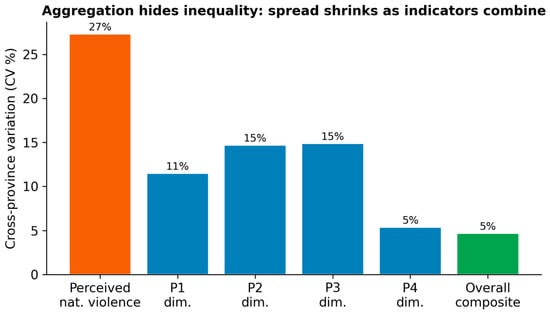
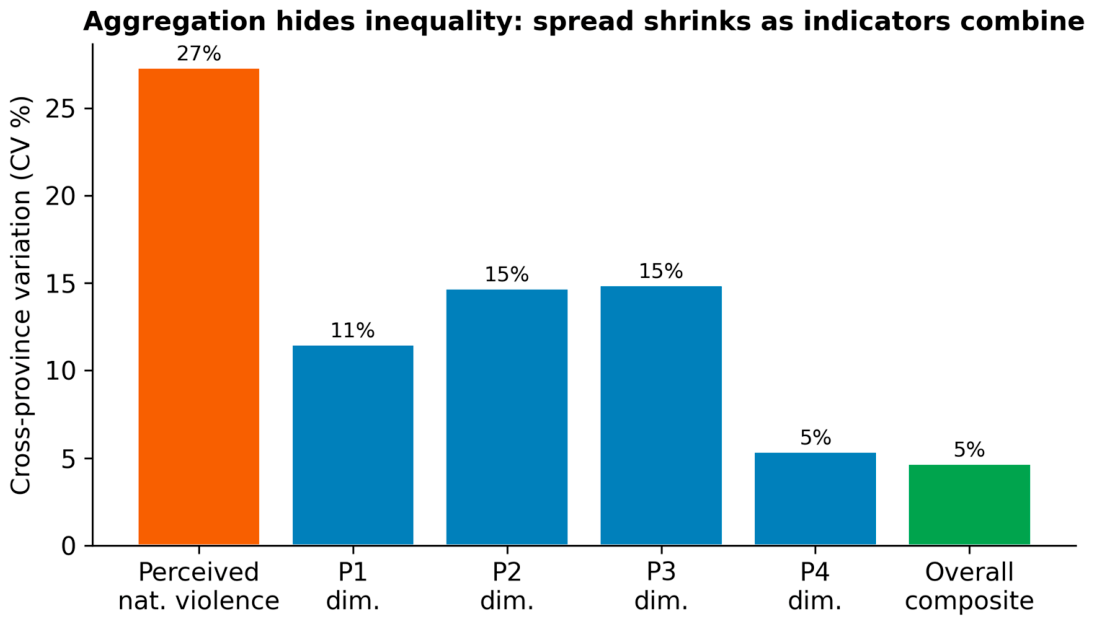
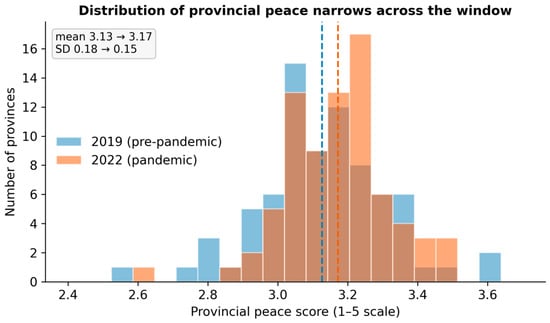
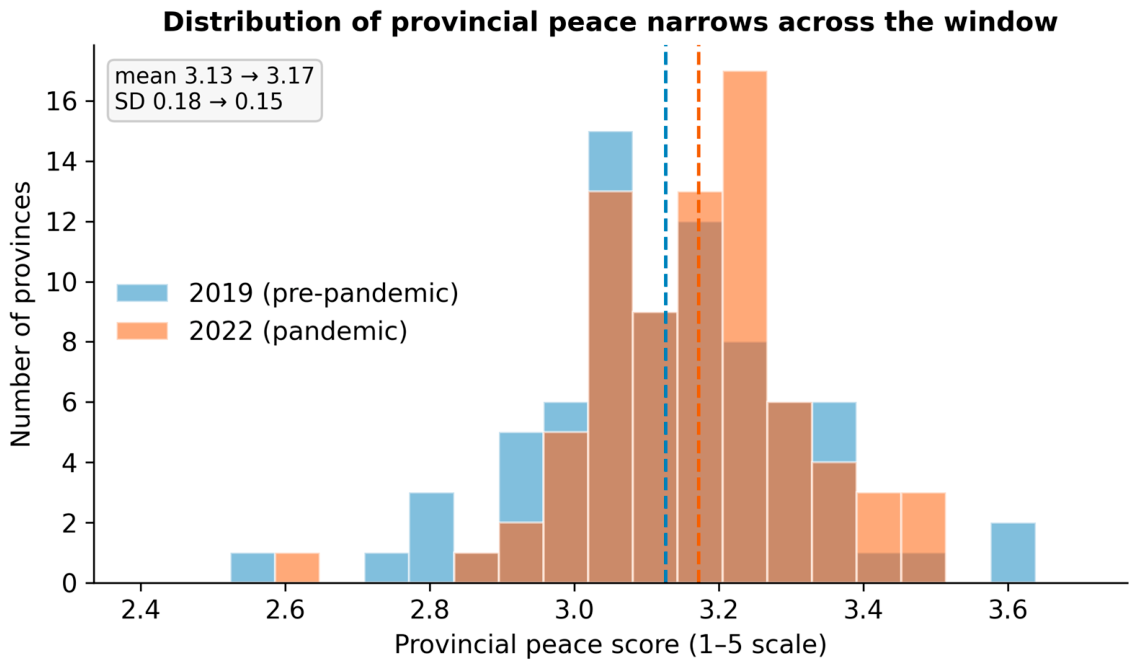
The spread of peace across provinces depends dramatically on the level of aggregation. Table 4 reports dispersion in the physical-violence dimension across all seventy-seven provinces in the pandemic year, computed directly from the provincial score tables, and the contrast within it is the first result. The single sub-indicator of perceived national violence runs across the entire one-to-five scale with a coefficient of variation of 27.3 percent, while the dimension composite that contains it spans 1.80 to 5.00 with a coefficient of variation of 11.5 percent. Figure 2 generalizes the point across the index: the cross-province coefficient of variation falls from 27 percent for a single indicator to about 11 percent for a dimension and to under 5 percent for the overall composite. Aggregation, in other words, does not merely smooth the data; it systematically conceals the inequality that exists at the level where people actually experience violence, safety, rights, and resources. Figure 3 shows the same compression over time in the overall score, whose distribution is already narrow and becomes narrower across the window. The policy implication is immediate: an instrument reported only at the composite level will understate how unequally peace is distributed, and the case for disaggregated reporting is therefore not presentational but substantive.
Table 4.
The spread of the physical-violence dimension across provinces, pandemic year, and seventy-seven provinces (five-point scale; authors’ computation from the provincial score tables). Relative variation is the standard deviation as a percentage of the mean.
Figure 2.
Cross-province variation at successive levels of aggregation. The coefficient of variation falls from 27 percent for a single indicator to under 5 percent for the overall composite, showing that aggregation conceals inequality present at the indicator level.
Figure 3.
The distribution of the reconstructed provincial peace score across the seventy-seven provinces in the pre-pandemic and pandemic years. The distribution is narrow and compresses further over the window; dashed lines mark the annual means.
4.3. Multidimensionality and Local Geography (Proposition 2)
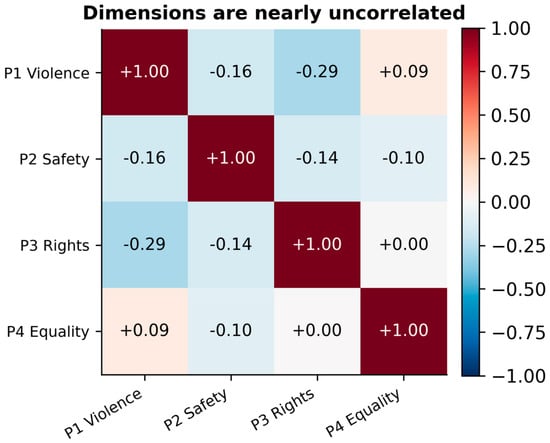
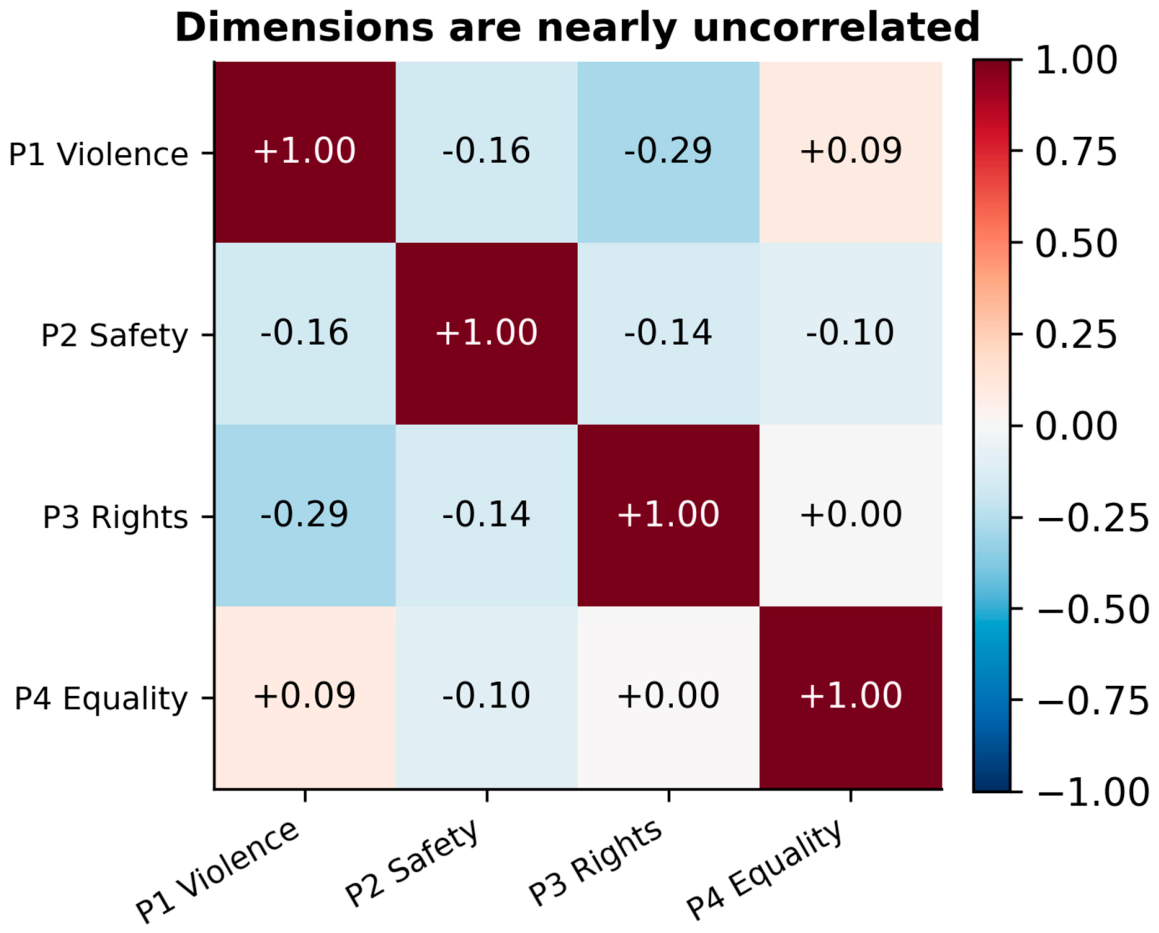
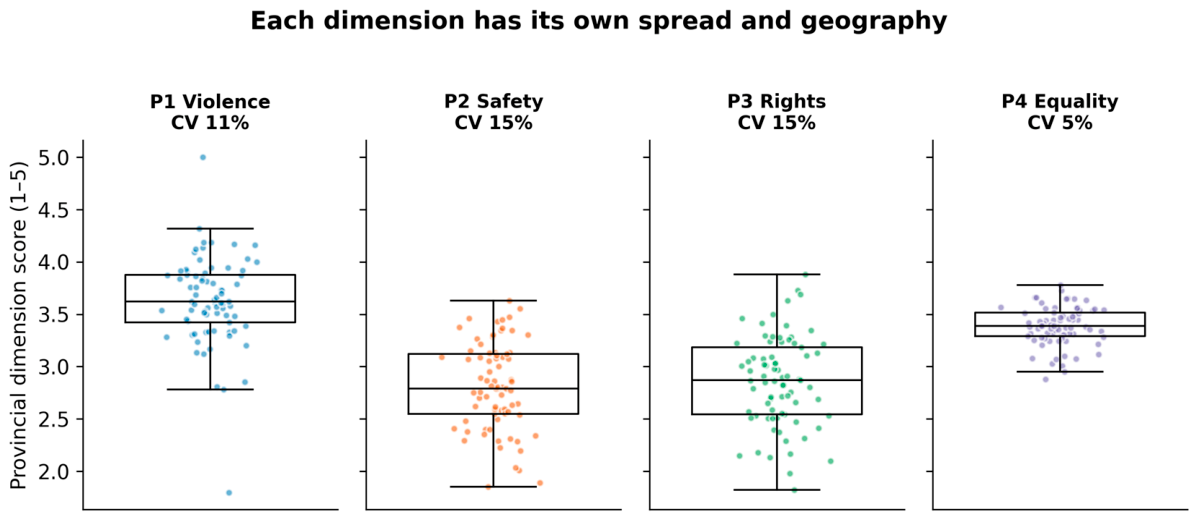
If the dimensions of peace moved together across provinces, a single ranking would capture them, and the choice of dimensions would matter little. They do not. Figure 4 reports the cross-province correlations among the four dimension scores, and they are weak and mostly negative: the strongest off-diagonal correlation, between the absence of physical violence and the acceptance of rights, is only −0.29, and the others are nearer zero. A province that scores well on safety is not thereby a province that scores well on rights or on equality; each dimension has its own geography. Figure 5 shows the same point as four distinct provincial distributions, differing in level and in spread, and it explains why the reconstructed equal-weighted score can rank provinces differently from the official composite: when dimensions are nearly orthogonal, the ranking is sensitive to how they are weighted, and no single ordering is privileged. This is the strongest empirical vindication in the paper of the multidimensional view of peace advanced by Hansen and by Lee, Mac Ginty, and Joshi [6,7] because it shows that collapsing peace to one number is not a harmless simplification but a destruction of structure that policy needs.
Figure 4.
Cross-province correlations among the four peace dimensions in the pandemic year. The dimensions are nearly uncorrelated, so a province peaceful on one dimension need not be peaceful on others.
Figure 5.
Provincial distribution of each dimension. The four dimensions differ in level and spread and have distinct geographies, so a single composite conceals dimension-specific patterns.
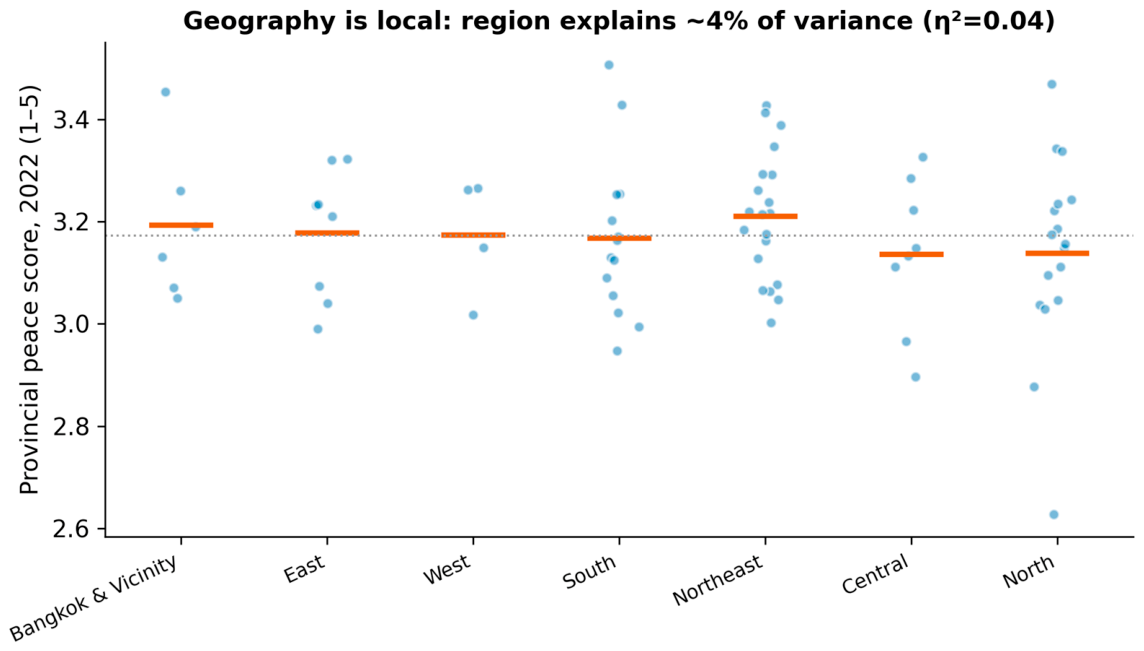
The geography of peace is also local rather than regional. Figure 6 plots provincial scores by region with the regional means, and a variance decomposition attributes only about four percent of the total cross-province variation to differences between regions, the remaining ninety-six percent lying within regions. Provinces in the same region are nearly as different from one another as provinces drawn at random, so regional targeting would misallocate effort; the province, and plausibly the district beneath it, is the level at which peace varies and at which intervention must be designed. This is the local turn rendered quantitative [11,12,13]: it locates the relevant variation below the region and even below the province, and it qualifies the familiar center-periphery summary since the dominance of within-region variation means that every region contains both high- and low-peace provinces and a regional label is a poor guide to any place.
Figure 6.
Provincial peace by region with regional means (orange) and the national mean (dotted). Region accounts for only about four percent of cross-province variation, so peace is predominantly a local phenomenon.
4.4. Convergence Under Shock (Proposition 3)
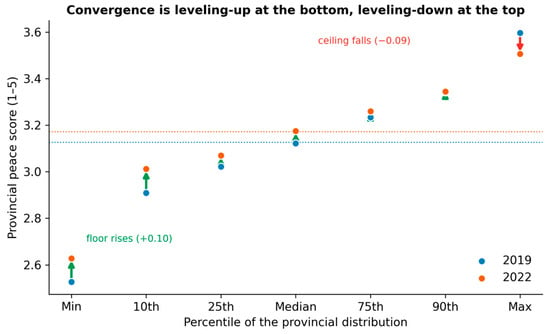
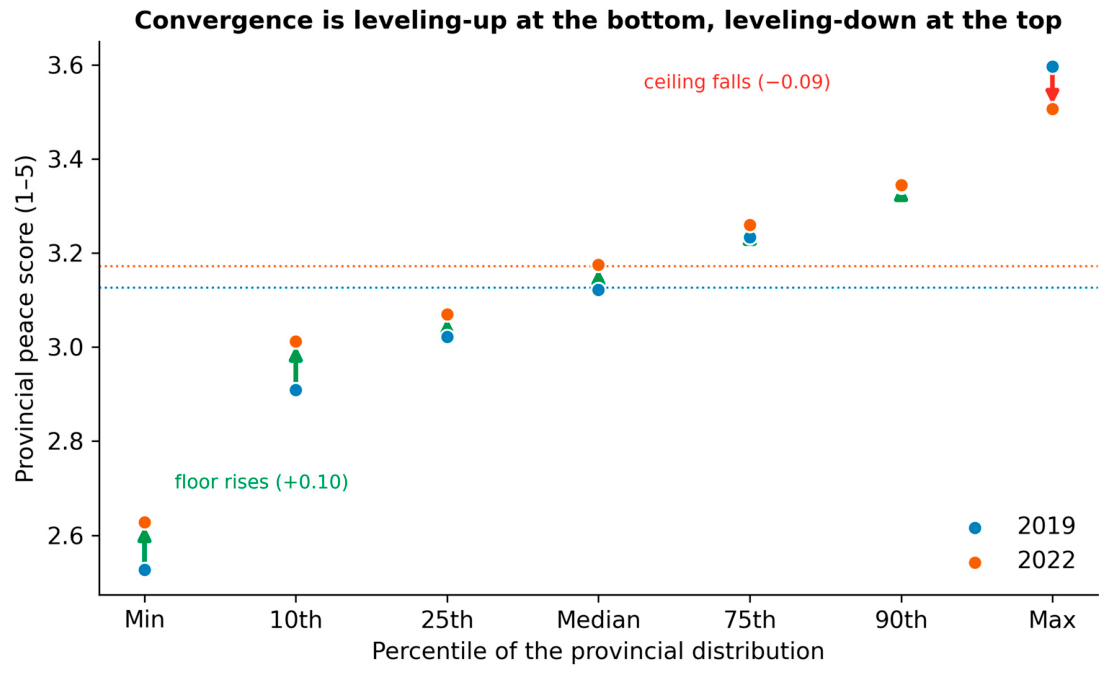
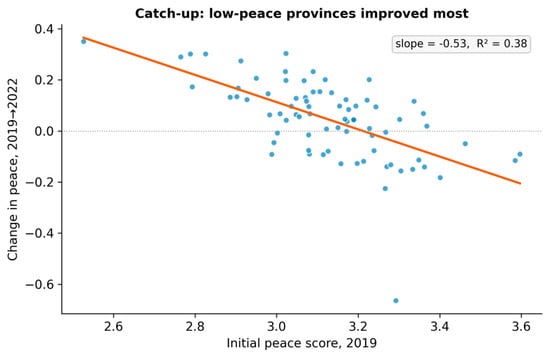
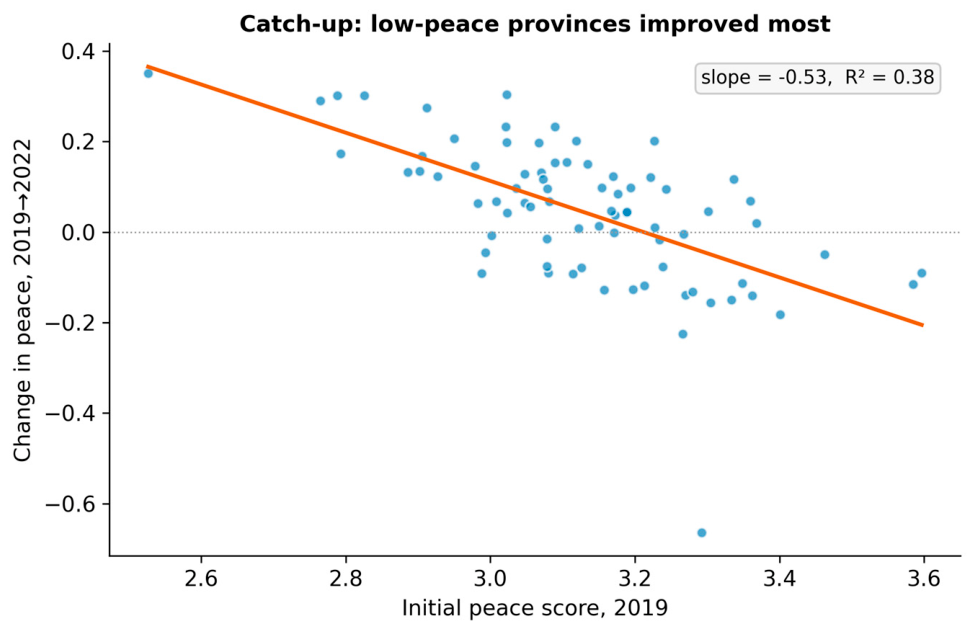
The pandemic window coincided with a narrowing of the gaps between provinces, but the narrowing has a structure that a single inequality number would conceal. The cross-province standard deviation fell from 0.18 to 0.15 while the mean rose only slightly, from 3.13 to 3.17, so the distribution compressed rather than simply shifting upward. Figure 7 shows where the compression came from by comparing the distribution at fixed percentiles. The floor rose: the least peaceful province gained about a tenth of a point, and the bottom tenth and quarter of provinces rose with it. The ceiling fell: the most peaceful province lost about a tenth of a point, and the top decile barely moved. Averaged over the bottom quarter of provinces, the gain was about +0.16, while over the top quarter, the change was about −0.10. The convergence is therefore not a uniform improvement but a mixture of leveling-up at the bottom and leveling-down at the top, and reading it as “more peace” would be a mistake because peace became more equal in part because the most peaceful provinces lost ground. Figure 8 confirms the pattern at the level of individual provinces: regressing each province’s change on its initial level gives a strongly negative slope of −0.53 with an explained variance of 0.38, so initially less peaceful provinces improved most, and initially, more peaceful provinces tended to slip back toward the middle. This is a policy-relevant result because it shows that a common shock need not aggravate spatial inequality in peace, but the asymmetry between the rising floor and the falling ceiling is itself the finding of interest. It should be read as a description of this window rather than as a guarantee, and the mechanism, whether the movement reflects genuine change in conditions or regression toward the mean in the perception-based components, is addressed by the robustness analysis in Section 5.5, which splits the indicators and shows that the rising floor reflects genuine improvement in recorded conditions in lagging provinces rather than a shift in perception.
Figure 7.
Provincial peace at fixed percentiles of the distribution, 2019 versus 2022. The floor (minimum, tenth, and twenty-fifth percentiles) rises while the ceiling (maximum and ninetieth percentile) falls, so the distribution narrows through a mixture of leveling-up at the bottom and leveling-down at the top rather than a uniform improvement; dotted lines mark the annual means.
Figure 8.
Beta-convergence. Each point is a province; the change in peace is plotted against the initial level. The strong negative slope (−0.53) indicates that initially less peaceful provinces improved most.
4.5. Summary
The four results compose a coherent picture that no national figure could provide. Inequality in peace is real but is hidden by aggregation, so it must be read at the level of indicators and dimensions. The dimensions are nearly independent, so peace is genuinely multidimensional and cannot be reduced to one ranking. Its variation is local, with region explaining almost none of it. Over the shock window, the distribution converged asymmetrically, the floor rising while the ceiling fell, so equality of peace improved partly because the most peaceful provinces lost ground. Each result is a property of the within-country distribution of peace, and each becomes visible only when peace is measured on locally derived dimensions at the level of the province and then examined, rather than merely reported.
Table 5 collects the four findings with the evidence that supports each and the literature each is consistent with.
Table 5.
Findings, supporting evidence, and consistency with the literature.
5. Discussion
5.1. What Subnational Analysis Recovers
The results make precise the sense in which the unit and the treatment of measurement are not neutral choices. A national index reports a mean and discards the distribution; reporting a single composite, even at the provincial level, discards the relationships among dimensions. Yet the discarded information is exactly what the four findings depend on. The concealment of inequality by aggregation, the near-independence of the dimensions, the local rather than regional structure of variation, and the convergence over the window are all properties of the joint distribution of provincial dimension scores, and all are invisible to an instrument that reports only an aggregate. This is also where the approach answers the critique of measured peace voiced by Denskus, that measurement imports an external template and depoliticizes the question of what peace is [26]: a context-derived, subnational, multidimensional instrument does not assume the answer but exposes the structure for deliberation, and Gibson’s demonstration that reconciliation can be a tracked social indicator shows that disciplined measurement and critical sensitivity are not in opposition [33]. For the design of indices, this implies a reporting standard rather than a presentational preference: a subnational peace index should publish the dimension scores and their joint distribution, not only a composite, because the composite is the most aggregated and therefore least informative layer of the entire construction, and it is the layer at which the four findings disappear.
5.2. Equity, Multidimensionality, and the Foundations of Peace
The findings carry a consistent policy reading. Because inequality in peace is concealed by aggregation and because the dimensions are nearly independent, effective intervention must be both place-specific and dimension-specific: a province weak on rights and a province weak on safety require different responses, and neither is identifiable from an overall ranking. Because variation is local, the province and the district, not the region, are the unit of design. In addition, because the window shows asymmetric convergence, with the worst-off provinces improving while the most peaceful slipped, the period invites attention both to what allowed laggards to catch up and to what eroded peace at the top. These readings align the two understandings of peace in practice and connect to the substantive literature on the foundations of positive peace. The near-independence of the rights and equality dimensions from the violence dimensions gives empirical content to the claim, common to Moshe and to Aroussi and Vandeginste, that structural foundations are distinct from the absence of violence and must be addressed in their own right [9,10]. The inequality and human-capital dimensions connect to evidence that health systems build social capital, participation, and peace [36]; to the role of education and social-emotional learning in cultivating the foundations of a peaceful society [46,47]; and to the comparative and transitional experience of social work and educational innovation in divided and post-conflict settings [48,49,50]. The fair-distribution dimension connects in turn to the distributional questions that peace agreements often leave unresolved, as in the Colombian case where land and illicit-crop economies remain core conflict issues [51], and to the governance of natural resources as a foundation of durable peace [52]. The point is not that any single foundation is decisive but that because the dimensions vary independently across places, a society cannot secure peace by attending to violence alone; it must strengthen each foundation where that foundation is weak. Read together with the foundational literature, the result locates peace within the same analytical space as the study of inequality and human development, where the distribution of an outcome, and not only its average, is the proper object of policy, and where progress is judged by what happens to the worst-off rather than to the mean.
5.3. Extension to Positive Peace and Its Institutional Dimension
The same context-sensitive, comparative logic can be applied to the positive peace foundations directly. Benchmarking a country against a small set of comparators on the eight pillars of positive peace situates its structural strengths and weaknesses against peers that have faced comparable challenges. In the underlying project [45], the comparator set comprised Bhutan, Rwanda, Georgia, Costa Rica, Vietnam, and Thailand, chosen for sustained improvement on positive peace, similarity of context, success across several pillars, and the clarity of the policy lessons each offers. Over the window from 2018 to 2022, all six improved their positive peace, Thailand by the largest margin among them: because the source scale runs in reverse, with a lower score denoting stronger positive peace, Thailand’s summed pillar score fell the most, by about two points. A cross-sectional comparison of the 2024 pillar scores nonetheless places Thailand behind the best-in-class comparators on most pillars, so improvement from a weaker base has not yet closed the structural gap, a reminder that the foundations of peace require sustained attention even where overt violence stays low. The institutional dimension concerns the body charged with coordinating a response across the many agencies whose work bears on the eight pillars, and here, the reconciliation and governance literature is directly relevant. The debate over truth and reconciliation commissions, from the principled-compromise defense offered by Allen to the conceptual cautions of Pankhurst about the relationship between justice and reconciliation, bears on whether such bodies can confer legitimacy [37,38], a question sharpened by work on how public acts of remembrance shape post-conflict relations [39], on how states can recast political claims as cultural ones and so blunt reconciliation even while performing it [40,41], and by the reminder that reconciliation is understood in several incompatible registers, from legal settlement to interpersonal repair [42,43]. The comparative experience of South Africa’s Truth and Reconciliation Commission; the Philippines’ Office of the Presidential Adviser on Peace, Reconciliation and Unity; and Indonesia’s National Commission on Human Rights, examined in the underlying project, converges on the lesson that the legitimacy and independence of the coordinating institution shape its effectiveness. The hybrid-governance literature adds that effective peace governance is multi-level and combines international, national, and local authority rather than residing in a single body [27,28,29], a lesson reinforced by analyses of how rights-based peace architectures expand and strain over time [53], of the difference between pacification and genuine reconciliation in externally driven governance [54], of the orchestration of top-down and bottom-up institutional change toward shared goals [55], and of the practical reconciliation of representative government with network governance at the local level [56]. The local and multidimensional character of peace documented here strengthens the case for coordinating institutions that reach below the region and work across several foundations at once.
5.4. Policy Implications and Social Reconciliation
The analysis converts a measurement instrument into a set of concrete policy directions, and each of its results carries a distinct implication. Because inequality in peace is concealed by aggregation, monitoring should report dimensions and indicators, not only a headline score, so that the places and the domains in difficulty are visible to those who must act. Because the dimensions are nearly independent, intervention must be dimension-specific: a province whose weakness is the protection of rights and a province whose weakness is physical safety call for different instruments, and an overall ranking would direct the same generic response to both. Because variation is local, the province and the district, rather than the region, are the unit of design, and building local capacity is therefore not a slogan but the operational consequence of where the variation lies. In addition, because the shock window produced an asymmetric convergence, with the floor rising while the ceiling fell, policy must do two things at once, lifting the least peaceful places while guarding against erosion in the most peaceful since a narrowing distribution achieved by the best provinces losing ground is not a success.
These directions connect measurement to the practice of social reconciliation, which is the institutional counterpart of positive peace. The reconciliation and governance literature reviewed above suggests that the effectiveness of a coordinating body depends on its legitimacy and independence, on its reach below the national level, and on its capacity to work across several foundations at once. Table 6 sets out, for each dimension and cross-cutting finding, the policy implication, the social-reconciliation mechanism it points to, and the institutional lesson drawn from the comparative experience reviewed here and in the underlying project. The table is offered not as a fixed prescription but as a structured menu from which a coordinating institution, such as a national reconciliation or strategic-transformation office, can select according to where its own subnational index shows weakness, and it makes explicit the link this article draws between the measurement of peace and the practice of building it.
Table 6.
From measurement to action: peace dimensions and findings, policy implications, social-reconciliation mechanisms, and institutional lessons.
5.5. Robustness
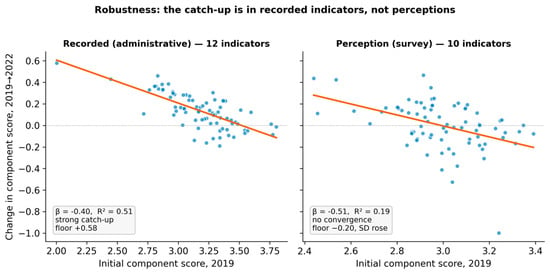
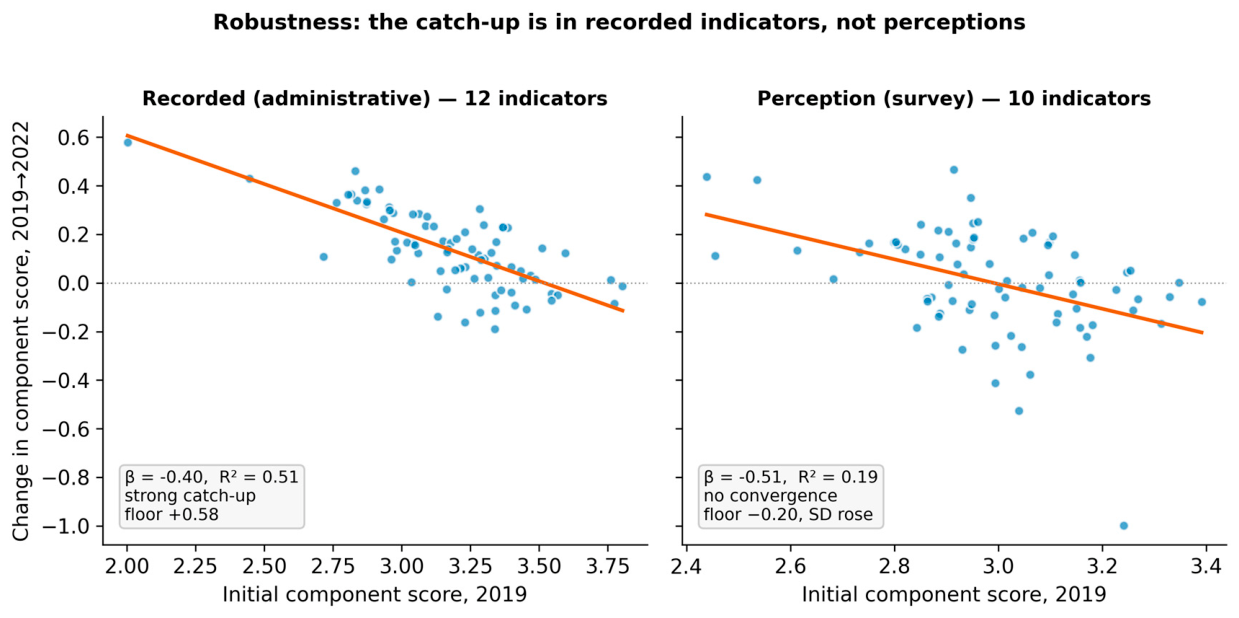
Three sources of sensitivity bear on the results, and each suggests a check. First, the reconstructed provincial score is equal-weighted; recomputing it under the official principal component weights and under the alternative scaling choices catalogued in the composite-indicator literature [16,17] tests which conclusions survive. The four findings emphasized here are properties of the distribution and the co-movement of standardized scores rather than of any particular weighting, and the near-independence of the dimensions in Figure 4 implies that they are robust to reweighting since reweighting nearly orthogonal components rearranges the ranking without creating co-movement that is not there. Second, the convergence result must be distinguished from regression toward the mean in the perception-based components, and this check has been carried out by splitting the twenty-two province-level sub-indicators into the ten that derive from the opinion survey and the twelve that derive from administrative records, then refitting the convergence analysis on each in the spirit of the dimension-specific quantitative analysis of peace pursued by Bayerlein, Kamin, and Krahmann [18]. The result, reported in Figure 9 and Table 7, is decisive. The catch-up is concentrated in the recorded-event indicators: Their mean rises by 0.13, and their dispersion falls from 0.29 to 0.21; the least peaceful province gains 0.58, and the bottom decile gains 0.25. The beta-convergence relationship is strong and well determined (slope −0.40, R2 = 0.51), with the bottom quarter of provinces improving by 0.31, while the top quarter barely moves. The perception indicators show no such convergence: Their mean is unchanged; their dispersion actually rises from 0.19 to 0.22. The floor falls rather than rises, and although the beta-convergence slope is negative, it is weak and poorly determined (slope −0.51, R2 = 0.19), the signature of noise and reversion rather than systematic improvement. The rising floor documented above is therefore a genuine improvement in the material conditions recorded by administrative data in the least peaceful provinces, not an artifact of sentiment, while perceived peace did not improve at the bottom, consistent with the national-level finding that perceptions of violence worsened even as recorded conditions improved. Third, the variance decomposition depends on the regional classification; repeating it under an alternative grouping and at a finer spatial level where data permit confirms that the dominance of within-region variation is not an artifact of where regional boundaries are drawn. Reporting only the conclusions that survive these checks is what keeps the demonstration disciplined.
Figure 9.
Robustness check: beta-convergence of the recorded (administrative) sub-indicators and the perception (survey) sub-indicators separately, 2019 to 2022. The recorded indicators show strong, well-determined catch-up with a rising floor; the perception indicators show weak, noisy reversion with a falling floor, so the overall convergence is driven by genuine improvement in recorded conditions rather than by perception.
Table 7.
Robustness: convergence of perception (survey) versus recorded (administrative) sub-indicators, 2019 to 2022 (77 provinces).
5.6. Transferability
The protocol and its analytical lens travel because each is a procedure rather than a fixed content. Defining the dimensions is a procedure for drawing out locally salient categories; assembling the indicators is a procedure for combining and documenting heterogeneous data. Scaling, combining, and recovering the provincial picture are general techniques, and the four analytical measures, inequality, co-movement, convergence, and variance decomposition, apply to any subnational index. A team in another society would arrive at its own dimensions, indicators, weights, and provincial classification and could ask the same four questions of the result. Three conditions favor transfer: the society should be internally diverse enough that the subnational distribution is the policy-relevant quantity; it should have at least sparse subnational survey and administrative data since the fitting stage is designed for sparsity but not for absence, and it should have, or be able to build, an institution capable of acting on the results. These conditions hold across much of the middle-income Global South, where the local turn and the critique of imported templates have the most practical purchase [11,25].
5.7. Limitations
Four limitations bound the claims. First, the demonstration covers a historical window; although that window is used as a natural experiment, the substantive provincial findings describe the period and would need recomputation on updated series before being read as current. The 2022 wave is nonetheless the most recent measurement available since the index has not been continued, so no more current series at this resolution yet exists. Second, several sub-indicators are perception-based, so a measured movement may reflect a shift in perception rather than in conditions, and this caution applies with particular force to the convergence result, which the robustness analysis in Section 5.5 directly addresses, showing that the convergence is driven by recorded rather than perceived indicators. Third, the reconstructed provincial score is equal-weighted and uses the twenty-two province-level indicators; it is transparent and tracks the national figures but is not the official composite, and the provincial orderings should be read accordingly. Fourth, the analysis is associational and descriptive; it identifies structure in the distribution of peace, not the causes of that structure, and a causal account of why dimensions are independent or why the window produced convergence would require data and a design beyond the present demonstration. None of these limitations affects the central contribution, which is the transferable procedure and the analytical lens; each marks the boundary of what the demonstration establishes.
6. Conclusions
Developing societies need an instrument that measures peace where their policy actually operates, within the country and on locally meaningful dimensions, and the cross-national indices cannot supply it because a national average does not reveal the distribution beneath it, still less its structure. Building on the local turn in peace studies and the methodology of composite social indicators, this article has set out a five-stage protocol that does and has shown that the value of a subnational index lies as much in the structure it preserves for analysis as in the score it reports. Demonstrated on Thailand across a window before and during the pandemic and examined with measures drawn from the study of inequality and growth, the index reveals what a national figure conceals: inequality in peace that is large at the level of indicators but hidden by aggregation; four dimensions that are nearly independent, so that peace is irreducibly multidimensional; variation that is local rather than regional, so that region is a poor guide to any place; and a shock window in which the distribution converged and lagging provinces caught up. Together these recast peace as a localized, multidimensional, unequally distributed condition and peace-building as a place-specific and dimension-specific undertaking. Because the protocol and its analytical lens are documented, transferable procedures rather than a fixed template, they offer a reproducible public good for peace monitoring across the middle-income, plural societies of the Global South and a baseline that can be recomputed and re-examined as conditions change.
Supplementary Materials
The following supporting information can be downloaded at: https://www.mdpi.com/article/10.3390/soc16100302/s1.
Author Contributions
Conceptualization, methodology, and writing—original draft and review and editing, C.P. and K.L.; formal analysis and visualization, K.L.; literature review and data collection, N.S., W.N., and J.B.; data curation, N.S., W.N., J.B., and K.L.; project administration and supervision, C.P. All authors have read and agreed to the published version of the manuscript.
Funding
This study received no external funding.
Institutional Review Board Statement
Not applicable. The study uses secondary, aggregated, province-level data and does not involve human subjects.
Informed Consent Statement
Not applicable.
Data Availability Statement
The subnational analyses use the province-level peace-score tables published in the Thai Peace Index project reports [4,5] and the Strategic Transformation Office study [45]. The reconstructed provincial peace scores and all derived statistics were computed by the authors from those tables and are available from the corresponding author on reasonable request.
Acknowledgments
The authors thank King Prajadhipok’s Institute for access to the Thai Peace Index project materials.
Conflicts of Interest
Co-authors N.S., W.N., and J.B. are affiliated with Miles Consulting Group Co. Ltd. They received no funding or compensation for this research, which was conducted as an independent academic exercise, and the company had no role in the study’s design; in the collection, analysis, or interpretation of data; in the writing of the manuscript; or in the decision to publish the results. The other authors declare no conflict of interest.
Appendix A. Technical Specification
This appendix collects the formulas underlying the protocol and the analytical measures so that the construction can be reproduced. Notation: u indexes units (the nation or provinces); d indexes the D dimensions, and j indexes the Jd sub-indicators of dimension d.
Standardization (Stage Three). Each sub-indicator value xj,t is expressed relative to a base distribution with mean barxj,b and standard deviation sj,b:
The standardized values are ranked and assigned a five-point score by quintile band, where Qp is the p-th percentile:
Weighting and aggregation (Stage Four). Within a dimension, weights come from the leading principal component of the standardized sub-indicators, with lambdak the k-th eigenvalue of the correlation matrix mathbfR and akj the loadings:
The component associated with the largest eigenvalue is retained, subject to a Kaiser–Meyer–Olkin statistic above 0.5, a significant Bartlett test of sphericity, communalities of at least 0.5, and cumulative variance of at least 60 percent. Each sub-indicator index is rescaled to the zero-to-one range:
The dimension composite is the weight-averaged aggregate, rescaled to the one-to-five reporting scale with weights omegaj = |a1j|, and the overall score is the mean of the D dimension composites:
Recovering the provincial picture (Stage Five). Where provincial data are sparse, a Singh–Maddala (Burr XII) distribution is fitted [57], with scale b > 0 and shape parameters a,q > 0, and estimated by maximum likelihood:
A non-current series is projected to the target year by a first-order autoregressive model before inclusion:
Distributional change and convergence. Distributional change is assessed by comparing the cross-province distribution at fixed percentiles between the two years, which separates a rise in the floor from a fall in the ceiling, and by sigma-convergence, a fall in the cross-province standard deviation of Pu between the two years. Beta-convergence is the slope beta1 in
where Pu,0 is the initial provincial score and Delta Pu = Pu,1 − Pu,0 the change across the window, with beta1 < 0 indicating that initially less peaceful provinces improved most. The Gini coefficient is deliberately not used because on a bounded one-to-five scale, it is mechanically small and cannot separate leveling-up from leveling-down. The regional variance decomposition reports eta2 = mathrmSStextbetween/mathrmSStexttotal, the share of cross-province variance accounted for by differences between regions.
References
- Institute for Economics and Peace. Global Peace Index 2021: Measuring Peace in a Complex World; Institute for Economics and Peace: Sydney, Australia, 2021. [Google Scholar]
- Institute for Economics and Peace. Positive Peace Report 2022: Analysing the Factors that Build, Predict and Sustain Peace; Institute for Economics and Peace: Sydney, Australia, 2022. [Google Scholar]
- Galtung, J. Peace by Peaceful Means: Peace and Conflict, Development and Civilization; Sage Publications: London, UK, 1996. [Google Scholar]
- Prateungrattana, C.; Lounkaew, K. Project on the Development of Indicators and Measurement of Peace in Thai Society (Thai Peace Index); King Prajadhipok’s Institute: Bangkok, Thailand, 2019. (In Thai) [Google Scholar]
- Prateungrattana, C.; Lounkaew, K. Project on the Development of Indicators and Measurement of Peace in Thai Society (Thai Peace Index), 2022; King Prajadhipok’s Institute: Bangkok, Thailand, 2022. (In Thai) [Google Scholar]
- Hansen, T. Holistic peace. Peace Rev. 2016, 28, 212–219. [Google Scholar] [CrossRef] [Scilit]
- Lee, S.; Mac Ginty, R.; Joshi, M. Social peace vs. security peace. Glob. Gov. 2016, 22, 491–512. [Google Scholar] [CrossRef] [Scilit]
- Clark, J.N. From negative to positive peace: The case of Bosnia and Hercegovina. J. Hum. Rights 2009, 8, 360–384. [Google Scholar] [CrossRef] [Scilit]
- Aroussi, S.; Vandeginste, S. When interests meet norms: The relevance of human rights for peace and power-sharing. Int. J. Hum. Rights 2013, 17, 183–203. [Google Scholar] [CrossRef] [Scilit]
- Moshe, M. Peace building: A conceptual framework. Int. J. Soc. Welf. 2001, 10, 14–26. [Google Scholar] [CrossRef] [Scilit]
- Mac Ginty, R.; Richmond, O.P. The local turn in peace building: A critical agenda for peace. Third World Q. 2013, 34, 763–783. [Google Scholar] [CrossRef] [Scilit]
- Leonardsson, H.; Rudd, G. The ‘local turn’ in peacebuilding: A literature review of effective and emancipatory local peacebuilding. Third World Q. 2015, 36, 825–839. [Google Scholar] [CrossRef] [Scilit]
- Ljungkvist, K.; Jarstad, A. Revisiting the local turn in peacebuilding–through the emerging urban approach. Third World Q. 2021, 42, 2209–2226. [Google Scholar] [CrossRef] [Scilit]
- Organisation for Economic Co-operation and Development. Handbook on Constructing Composite Indicators: Methodology and User Guide; OECD: Paris, France, 2008. [Google Scholar] [CrossRef] [Scilit]
- Ebert, U.; Welsch, H. Meaningful environmental indices: A social choice approach. J. Environ. Econ. Manag. 2004, 47, 270–283. [Google Scholar] [CrossRef] [Scilit]
- Freudenberg, M. Composite Indicators of Country Performance: A Critical Assessment; OECD Science, Technology and Industry Working Papers; OECD: Paris, France, 2003. [Google Scholar] [CrossRef]
- Jacobs, R.; Smith, P.; Goddard, M. Measuring Performance: An Examination of Composite Performance Indicators; Centre for Health Economics, University of York: York, UK, 2004; Available online: https://pure.york.ac.uk/portal/en/publications/measuring-performance-an-examination-of-composite-performance-ind/ (accessed on 22 January 2026).
- Bayerlein, M.; Kamin, K.; Krahmann, E. From negative to positive peace: How norms relate to different peace dimensions. J. Interv. Statebuild. 2025, 19, 519–539. [Google Scholar] [CrossRef] [Scilit]
- Krahmann, E.; Podder, S. Norms and peace in a turbulent world. J. Interv. Statebuild. 2025, 19, 439–456. [Google Scholar] [CrossRef] [Scilit]
- Richmond, O.P. The problem of peace: Understanding the ‘liberal peace’. Confl. Secur. Dev. 2006, 6, 291–314. [Google Scholar] [CrossRef] [Scilit]
- Heathershaw, J. Towards better theories of peacebuilding: Beyond the liberal peace debate. Peacebuilding 2013, 1, 275–282. [Google Scholar] [CrossRef] [Scilit]
- Paffenholz, T. Perpetual peacebuilding: A new paradigm to move beyond the linearity of liberal peacebuilding. J. Interv. Statebuild. 2021, 15, 367–385. [Google Scholar] [CrossRef] [Scilit]
- Lipschutz, R.D. Beyond the neoliberal peace: From conflict resolution to social reconciliation. Soc. Justice 1998, 25, 5–19. [Google Scholar]
- Kobayashi, K.; Krause, K.; Yuan, X. (Re)setting the boundaries of peacebuilding in a changing global order. Contemp. Secur. Policy 2025, 46, 226–252. [Google Scholar] [CrossRef] [Scilit]
- Kreikemeyer, A. The marginalization of traditional and Indigenous peacemaking in the post-liberal debate. J. Interv. Statebuild. 2026, 20, 161–181. [Google Scholar] [CrossRef] [Scilit]
- Denskus, T. Peacebuilding does not build peace. Dev. Pract. 2007, 17, 656–662. [Google Scholar] [CrossRef] [Scilit]
- Belloni, R. Hybrid peace governance: Its emergence and significance. Glob. Gov. 2012, 18, 21–38. [Google Scholar] [CrossRef] [Scilit]
- Jarstad, A.K.; Belloni, R. Introducing hybrid peace governance. Glob. Gov. 2012, 18, 1–6. [Google Scholar] [CrossRef] [Scilit]
- Brown, M.M. Democratic governance: Toward a framework for sustainable peace. Glob. Gov. 2003, 9, 141–146. [Google Scholar] [CrossRef] [Scilit]
- The World Justice Project. World Justice Project Rule of Law Index 2021; The World Justice Project: Washington, DC, USA, 2021; Available online: https://worldjusticeproject.org/sites/default/files/documents/WJP-INDEX_2021.pdf (accessed on 22 January 2026).
- Freedom House. Freedom in the World 2021; Freedom House: Washington, DC, USA, 2021; Available online: https://freedomhouse.org/report/freedom-world/2021/democracy-under-siege (accessed on 8 February 2026).
- Institute for Economics and Peace. Global Terrorism Index 2020: Measuring the Impact of Terrorism; Institute for Economics and Peace: Sydney, Australia, 2020; Available online: https://www.visionofhumanity.org/wp-content/uploads/2020/11/GTI-2020-web-1.pdf (accessed on 10 February 2026).
- Gibson, J.L. “Truth” and “reconciliation” as social indicators. Soc. Indic. Res. 2007, 81, 257–281. [Google Scholar] [CrossRef] [Scilit]
- Vitiara, M.D.; Herdiansyah, H.; Frimawaty, E. Pathway to peace: Utilizing path analysis to resolve social conflicts in palm oil communities. Humanit. Soc. Sci. Commun. 2026, 13, 230. [Google Scholar] [CrossRef] [Scilit]
- Lacatus, C.; Nash, K. Peace agreements and the institutionalisation of human rights: A multi-level analysis. Int. J. Hum. Rights 2020, 24, 889–912. [Google Scholar] [CrossRef] [Scilit]
- De Luca, G.D.; Lin, X. The role of health and health systems in promoting social capital, political participation and peace: A narrative review. Health Policy 2024, 141, 105009. [Google Scholar] [CrossRef] [Scilit] [PubMed]
- Allen, J. Balancing justice and social unity: Political theory and the idea of a truth and reconciliation commission. Univ. Tor. Law J. 1999, 49, 315–353. [Google Scholar] [CrossRef] [Scilit]
- Pankhurst, D. Issues of justice and reconciliation in complex political emergencies: Conceptualising reconciliation, justice and peace. Third World Q. 1999, 20, 239–255. [Google Scholar] [CrossRef] [Scilit]
- Rigney, A. Reconciliation and remembering: (How) does it work? Mem. Stud. 2012, 5, 251–258. [Google Scholar] [CrossRef] [Scilit]
- Kuokkanen, R. Culturalization as a governance logic: Reconciliation in Norway. Int. Political Sci. Rev. 2026, 01925121261427412. [Google Scholar] [CrossRef] [Scilit]
- Broderstad, E.G.; Josefsen, E. Who governs our stories? The collected material of the Norwegian truth and reconciliation commission. Acta Boreal. 2024, 41, 91–101. [Google Scholar] [CrossRef] [Scilit]
- McThenia, A.W.; Shaffer, T.L. For reconciliation. Yale Law J. 1985, 94, 1660–1668. [Google Scholar] [CrossRef] [Scilit] [PubMed]
- Volf, M. The final reconciliation: Reflections on a social dimension of the eschatological transition. Mod. Theol. 2000, 16, 91–113. [Google Scholar] [CrossRef] [Scilit]
- King Prajadhipok’s Institute; National Statistical Office. Survey of Public Opinion on Satisfaction with Public Services and the Work of Government Agencies; King Prajadhipok’s Institute: Bangkok, Thailand; National Statistical Office: Bangkok, Thailand, 2019. (In Thai)
- Strategic Transformation Office. Study Project to Support the Promotion of Unity and Reconciliation in Thailand; Office of the National Reform, National Strategy, and National Reconciliation: Bangkok, Thailand, 2025. (In Thai)
- Hymel, S.; Darwich, L. Building peace through education. J. Peace Educ. 2018, 15, 345–357. [Google Scholar] [CrossRef] [Scilit]
- Purwanto, Y.; Suprapto; Munaf, D.R.; Albana, H.; Marifataini, L.; Siregar, I.; Sumarni. The peace education concept and practice at universities: A systematic review. Cogent Educ. 2023, 10, 2260724. [Google Scholar] [CrossRef] [Scilit]
- Campbell, J.; Ioakimidis, V.; Maglajlic, R.A. Social work for critical peace: A comparative approach to understanding social work and political conflict. Eur. J. Soc. Work. 2019, 22, 1073–1084. [Google Scholar] [CrossRef] [Scilit]
- Ioakimidis, V.; Neocleous, G.; Zachariades, A.; Ozada, A.; Erzeybek, B. ‘Educating for peace’: Conflict, division and social work education in Cyprus. Eur. J. Soc. Work. 2022, 25, 696–707. [Google Scholar] [CrossRef] [Scilit]
- Cifuentes, G.; Aguilar-Forero, N.; Martínez-Salgado, A.M. Leadership and management: Key factors to implement educational innovations for promoting peace in Colombia. Int. J. Leadersh. Educ. 2026, 1–30. [Google Scholar] [CrossRef] [Scilit]
- Rettberg, A. Peace-making amidst an unfinished social contract: The case of Colombia. J. Interv. Statebuild. 2020, 14, 84–100. [Google Scholar] [CrossRef] [Scilit]
- Dam-de Jong, D. Building a sustainable peace: How peace processes shape and are shaped by the international legal framework for the governance of natural resources. Rev. Eur. Comp. Int. Environ. Law 2020, 29, 21–32. [Google Scholar] [CrossRef] [Scilit]
- Richmond, O. Human rights and the development of a twenty-first century peace architecture: Unintended consequences? Aust. J. Int. Aff. 2019, 73, 45–63. [Google Scholar] [CrossRef] [Scilit]
- Pogodda, S.; Richmond, O.; Tocci, N.; Mac Ginty, R.; Vogel, B. Assessing the impact of EU governmentality in post-conflict countries: Pacification or reconciliation? Eur. Secur. 2014, 23, 227–249. [Google Scholar] [CrossRef] [Scilit]
- Schmeisser, B.; Lindner, T.; Miska, C.; Doh, J. Reconciling top-down with bottom-up institutional change: A co-evolutionary perspective for advancing the IB contribution to the SDGs. J. World Bus. 2026, 61, 101722. [Google Scholar] [CrossRef] [Scilit]
- Nyholm, I.; Haveri, A. Between government and governance—Local solutions for reconciling representative government and network governance. Local Gov. Stud. 2009, 35, 109–124. [Google Scholar] [CrossRef] [Scilit]
- Singh, S.K.; Maddala, G.S. A function for the size distribution of incomes. Econometrica 1976, 44, 963–970. [Google Scholar] [CrossRef] [Scilit]

Disclaimer/Publisher’s Note: The statements, opinions and data contained in all publications are solely those of the individual author(s) and contributor(s) and not of MDPI and/or the editor(s). MDPI and/or the editor(s) disclaim responsibility for any injury to people or property resulting from any ideas, methods, instructions or products referred to in the content. |
© 2026 by the authors. Licensee MDPI, Basel, Switzerland. This article is an open access article distributed under the terms and conditions of the Creative Commons Attribution (CC BY) license.