


Abstract
We examined the direct and indirect associations among positive self-perception of Ramadan (PSPR), intrinsic and extrinsic religious motivation (IRM, ERM), positive and negative mood (PMood, NMood), and perceived performance (PP) in 470 male Tunisian footballers observing Ramadan fasting (RF). Data were collected through an online questionnaire and analyzed via structural equation modeling with bias-corrected bootstrapping. PSPR was the strongest correlate of PP (β = 0.38, p < 0.001) and was associated with higher PMood (β = 0.55, p = 0.001) and lower NMood (β = −0.45, p < 0.001). PSPR was also indirectly associated with PP through both PMood (β = 0.17, p < 0.001) and NMood (β = 0.11, p < 0.001). In contrast, religious motivation played a limited role: ERM showed a small negative association with PP (β = −0.15, p = 0.034), whereas IRM was unrelated to mood and PP; neither motive showed significant indirect associations through mood. Although the cross-sectional design precludes causal inference, our findings suggest that how athletes appraise fasting is more closely related to their mood and performance perceptions than their general religious motivation. This highlights the appraisal of RF as a relevant target for sport psychology research and practice.
1. Introduction
In Islam, Ramadan fasting (RF) is an obligatory practice involving daily abstinence from eating, drinking, smoking and coitus from dawn to sunset throughout the month of Ramadan. Beyond abstinence, RF constitutes a normative framework that shapes the daily behaviors, practices, and social interactions of Muslims [1]. For athletes, it is therefore a multidimensional experience that is physiological, psychological, and spiritual. RF alters metabolic functioning and modifies eating patterns, hydration, sleep, and training schedules [2,3,4], yet it is also experienced by many athletes as a period of refocusing, discipline, and self-regulation [5,6]. This spiritual dimension has been described as a potential source of mental stability, motivation, and resilience in competitive settings [7,8].
Research on RF and sport performance has nevertheless produced a paradox. The two most comprehensive syntheses diverge: one reported a performance deficit in Muslim football players [9], whereas the other reported no effect on most physical parameters [10]. More strikingly, performance decreases were observed even when dietary intake, sleep, and training load were controlled. Aziz et al. [11] reported poorer intermittent sprint performance in fasted footballers despite unchanged blood markers, muscle strength, and thermoregulatory responses and attributed this decrease to a nocebo effect. When the physiological constraint is comparable but performance differs, the explanatory variable is unlikely to be physiological; rather, it may lie in the meaning that athletes attribute to fasting.
The transactional model of stress offers a framework for examining this meaning. According to this model, emotional responses and subsequent evaluations depend less on an event itself than on its cognitive appraisal [12]. Through primary appraisal, athletes judge whether fasting represents a threat or a challenge to their performance; through secondary appraisal, they evaluate the resources available to cope with it [13,14]. Applied to Ramadan, both appraisals together form a situation-specific evaluation of fasting, shaped by personal beliefs, past encounters, and the cultural and religious value attributed to this practice [12]. In addition to this situation-specific evaluation, athletes’ religious motivation (RM) constitutes a second, more stable psycho-spiritual factor relevant to the coping process. Within self-determination theory, intrinsic religious motivation (IRM) reflects autonomous, personally endorsed engagement, whereas extrinsic religious motivation (ERM) reflects engagement driven by guilt or social pressure [15]. RM has been associated with performance-related outcomes in occupational, academic, and sport settings, although these relationships appear complex and context-dependent [16,17]. An internalized faith may provide coping resources such as patience, trust, and a sense of meaning, whereas controlled engagement may heighten perceived pressure during demanding periods [1,18]. The appraisal of fasting and RM thus represent two distinct but related psycho-spiritual factors, the former specific to the fasting situation and the latter reflecting a general orientation toward religion.
Mood states (MS) constitute the expected affective outcome of these processes. In sport psychology, mood is conceptualized as a proximal affective state that translates cognitive and motivational processes into performance-related evaluations by shaping attentional focus, confidence, and self-evaluation [19]; accordingly, athletes reporting higher positive and lower negative moods tend to evaluate their performance more favorably [20]. During Ramadan, these affective states are particularly sensitive: fasting has been associated with greater fatigue and lower vigor in athletes [21,22,23], as well as with increased tension [24] and irritability [25], whereas other studies have reported decreases in depressive and anxious symptoms [26]. This heterogeneity suggests that the emotional experience of Ramadan is not uniform and depends largely on how fasting is cognitively interpreted and integrated into daily life and sporting practices [6,27]. Consistent with the transactional model, athletes who interpret situational demands as challenges report more positive emotional states, including greater vigor, whereas threat appraisals are associated with a negative mood [13,28]. Similarly, religious coping grounded in intrinsic motivation has been associated with lower anxiety and more positive emotional states in athletes, whereas pressure-driven engagement may heighten emotional strain [18,29]. Positive and negative mood may therefore statistically account for part of the association between both psycho-spiritual factors and perceived performance (PP).
Despite the abundance of research on RF and sport performance, these psycho-spiritual factors have mostly been examined in isolation, with studies focusing either on athletes’ attitudes and beliefs toward fasting [5,14], on mood changes during Ramadan [21,23], or, outside the Ramadan context, on the links between religiosity and sport-related outcomes [18,30]. Even the nocebo hypothesis rests on the elimination of physiological explanations rather than on a direct measurement of athletes’ appraisals [11]. Three questions therefore remain unresolved. First, it is unknown whether the situation-specific appraisal of fasting or the general RM is the more relevant correlate of performance perception once their shared variance is accounted for, a question that contrasts an appraisal-based to a motivational account of athletes’ experience of RF. Second, it remains unclear whether psycho-spiritual factors relate to performance perception mainly through the enhancement of positive affect, the attenuation of negative affect, or both, as these two affective pathways have rarely been examined in parallel. Third, these relationships have seldom been examined in a Muslim-majority context, where fasting is a near-universal collective norm that may reduce the discriminative power of individual RM while leaving the personal appraisal of fasting more variable. By integrating these constructs into a single structural model, the present study addresses these three questions and moves beyond the documentation of isolated associations toward a comparative test of competing psycho-spiritual accounts of performance perception during RF.
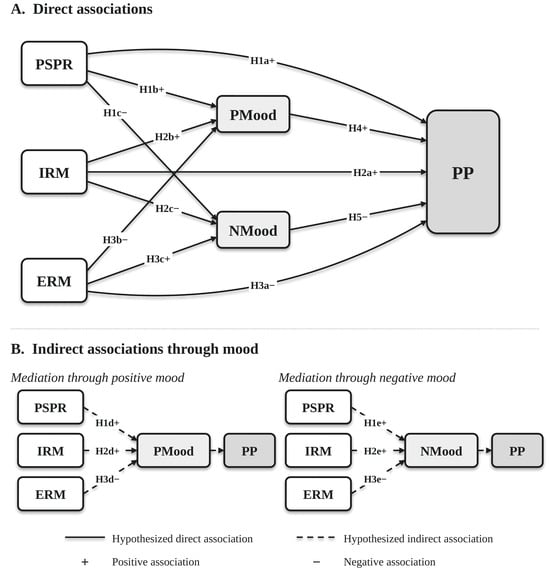
Accordingly, the present study aimed to examine the direct and indirect associations among positive self-perception of Ramadan (PSPR), IRM, ERM, positive and negative mood, and PP in Tunisian footballers observing RF. Five broad hypotheses, encompassing the 17 paths of the conceptual model (Figure 1), were tested: the first three address the direct and indirect associations of each psycho-spiritual factor with PP, and the last two address the associations between MS and PP.
Figure 1.
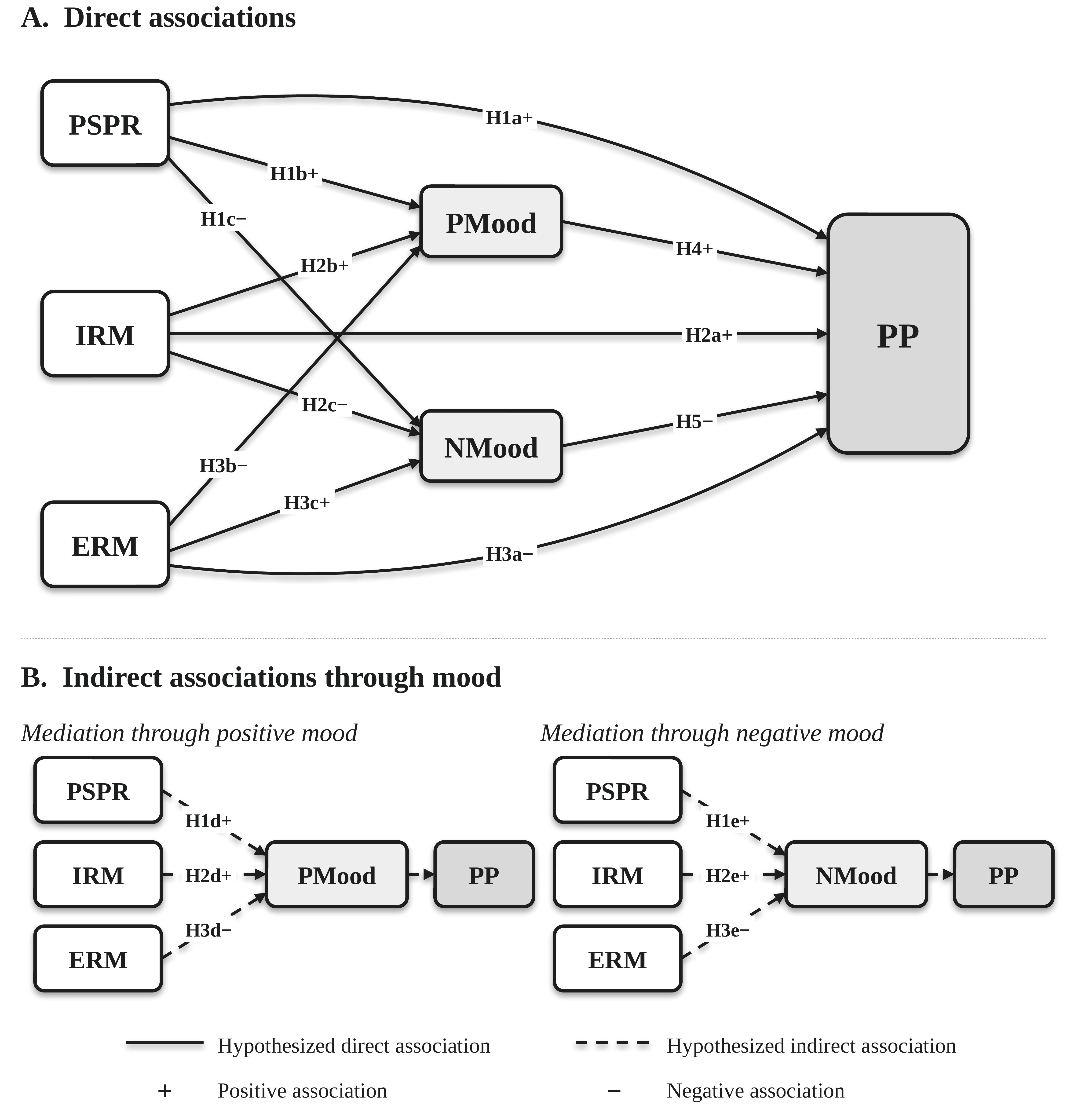
Conceptual model of the hypothesized direct and indirect associations among positive self-perception of Ramadan, intrinsic and extrinsic religious motivation, mood states, and perceived performance. NMood: Negative Mood; PMood: Positive Mood; PSPR: Positive Self-Perception of Ramadan; IRM: Intrinsic Religious Motivation; ERM: Extrinsic Religious Motivation; PP: Perceived Performance.+ positive association, − negative association.
H1.
PSPR is positively associated with PP (H1a) and positive mood (H1b), negatively associated with negative mood (H1c), and indirectly associated with PP through positive mood (H1d) and negative mood (H1e).
H2.
IRM is positively associated with PP (H2a) and positive mood (H2b), negatively associated with negative mood (H2c), and indirectly associated with PP through positive mood (H2d) and negative mood (H2e).
H3.
ERM is negatively associated with PP (H3a) and positive mood (H3b), positively associated with negative mood (H3c), and indirectly associated with PP through positive mood (H3d) and negative mood (H3e).
H4.
Positive mood is positively associated with PP.
H5.
Negative mood is negatively associated with PP.
Because the design is cross-sectional, both direct and indirect paths are tested as statistical associations specified on theoretical grounds; their support would be consistent with, but would not demonstrate, causal or mediating mechanisms [31].
2. Method
2.1. Participants and Data Collection
Data were collected through an Arabic online questionnaire (Google Forms) disseminated via social media and messaging applications, without any involvement of clubs. The study protocol was approved by the Ethics Committee of Farhat Hached University Hospital of Sousse, Tunisia (reference: 02-2023), and all participants provided electronic informed consent before starting the survey. The participants were informed about the voluntary, anonymous and uncompensated nature of the study and about their right to withdraw at any time before submission. To allow adaptation to fasting, the questionnaire opened on 1 April 2023, approximately one week after the onset of RF (23 March), and closed at Eid al-Fitr (21 April); participants could respond either before or after Iftar. The participants completed the RM and PSPR scales with reference to their Ramadan experience and then rated their mood before and their PP after their most recent training session. Submission times were recorded automatically and located relative to daily Fajr(dawn prayer marking the start of the fast) and Iftar times (Tunis, UTC+1).
Of the 575 respondents, 47 players who trained after Iftar (the sunset meal breaking the daily fast) were excluded, as the study focused on training during fasting hours; all retained players therefore trained in the afternoon, before Iftar. Female players (n = 23) were also excluded because MS [32] and religious practices [33] differ between sexes, and pooling heterogeneous subgroups may bias parameter estimates [34]. Finally, 35 non-licensed players were excluded so that only players training regularly within an official club were retained. The final sample comprised 470 male footballers aged 18–35 years, including amateurs (43.8%), semiprofessionals (29.6%) and professionals (26.6%) (Table 1). Of these, 182 (38.7%) responded before Iftar, on average, 1.08 ± 0.93 h before the fast was broken, and 288 (61.3%) responded after Iftar, on average, 2.29 ± 1.72 h afterwards.
Table 1.
Sample characteristics. Age, Ramadan Fasting (RF) experience, and Football experience are presented in years (mean ± SD.)
2.2. Sample Size Adequacy
Sample adequacy was evaluated via complementary criteria. The sample (N = 470) fell within the recommended range of 10–15 observations per observed indicator, corresponding to 430–645 participants for the 43 initial items (approximately 11 observations per item). It also exceeded the minimum of 200 participants generally recommended for SEM [35]. Given the model’s complexity (99 freely estimated parameters), an RMSEA-based power analysis was also conducted. Power was computed from the noncentral χ2 distribution, with non-centrality parameters λ = (N − 1) × df × ε2, using ε0 = 0.05 under the null hypothesis of close fit and εa = 0.08 under the alternative hypothesis, at α = 0.05 [36]. For df = 721, the present sample yielded a power greater than 0.99, well above the conventional 0.80 threshold.
2.3. Instruments and Cross-Cultural Adaptation
2.3.1. Instruments
RM was assessed in terms of IRM, which reflects autonomous religious engagement grounded in personal conviction and the integration of religious values into one’s self-concept, and ERM, which reflects religious engagement driven by internal pressures such as guilt, anxiety, or the need for social approval [15]. Both constructs were measured with the Islamic Religious Internalization Scale (IRI) from the Psychological Measure of Islamic Religiousness [37]. IRM was assessed with the five-item identification subscale (e.g., “I pray because I find it satisfying” and “I read the Holy Quran because I feel that Allah is talking to me when I do that”), and ERM with the five-item introjection subscale (e.g., “I go to the masjid/mosque because one is supposed to go to the masjid” and “I fast in Ramadan because I would feel bad if I did not”). The items were rated on a four-point Likert scale ranging from 1 (not at all true) to 4 (very true), with an additional “not applicable” option coded 0.
MS was assessed with the Brunel Mood Scale (BRUMS) [20], which comprises 24 items rated on a five-point scale ranging from 0 (not at all) to 4 (extremely) and grouped into six four-item subscales: five negative dimensions, namely tension (e.g., “anxious”), depression (e.g., “unhappy”), anger (e.g., “angry”), fatigue (e.g., “tired”), and confusion (e.g., “muddled”), and one positive dimension, vigor (e.g., “energetic”). Positive self-perception of Ramadan (PSPR) was assessed with the four-item scale developed by Farooq et al. [14], which evaluates athletes’ appraisal of the anticipated effect of Ramadan fasting on the physical and psychological resources underlying their sporting performance. The two negatively worded items (1 and 3) were reverse-scored so that higher scores consistently reflected a more positive appraisal: item 1, “Ramadan fasting can reduce my endurance/stamina during a game”; item 2, “Ramadan fasting can increase my physical skills”; item 3, “Ramadan fasting can reduce my mental skills”; and item 4, “Ramadan fasting can increase my confidence”. The items were rated on a five-point Likert scale ranging from 1 (strongly disagree) to 5 (strongly agree).
Perceived performance (PP) was measured with an adapted version of the five-item scale proposed by Almagro et al. [38], which assesses athletes’ perceived effectiveness and overall performance quality (e.g., “I believe my performance is good.” and “I am satisfied with my results in the competition.”). The items were rated on a five-point Likert scale ranging from 1 (strongly disagree) to 5 (strongly agree), with 3 representing a neutral response (undecided). In the structural equation modeling analyses, item responses for all instruments served directly as indicators of their respective latent constructs; consequently, no composite scores were computed.
2.3.2. Translation and Content Validity
Given that Arabic is the first language of the Tunisian population, all the measurement instruments were administered in Arabic. In accordance with established methodological guidelines [39], the scales were independently translated from English to Arabic by two bilingual PhD-level experts, one in psychology and one in Islamic education. Discrepancies were resolved through discussion, after which a blind back-translation was independently performed by two other bilingual experts in psychology and Islamic education to ensure conceptual and linguistic equivalence. During cultural adaptation, “competition” in the PP items was replaced by “training”, as the present study focused on athletes’ perceived performance in training during Ramadan. The English wording of the items reported by Almagro et al. [38] served as the source for the Arabic translation. In addition, a content validation procedure was conducted before data collection: ten native Arabic speakers rated the clarity and relevance of each item on a four-point scale, and all the items reached an item-level content validity index of at least 0.80 [40]. The psychometric properties of the Arabic versions of the BRUMS [41] and the IRI subscales [42] were examined in separate validation studies conducted on data from the same project; the present study addresses a distinct research question, namely, the structural relationships among psycho-spiritual factors, MS, and perceived performance.
2.4. Statistical Analysis
2.4.1. Data Screening
Before the measurement model was estimated, the initial 43 items were screened for missing data, multivariate normality, and influential observations. Multivariate normality was evaluated via Mardia’s coefficient, with critical ratios exceeding 5 considered indicative of nonnormality [43], and multivariate outliers were identified via Mahalanobis distances at a significance level of p < 0.001. All the items were treated as continuous under maximum likelihood estimation, an approach that yields acceptable estimates when items have five or more response categories [44]. This criterion was met by the BRUMS, PSPR, and PP items and by the IRI items, whose five response options were coded from 0 (not applicable) to 4 (very true); the bias-corrected bootstrap procedure further protected inferences against departures from continuity and normality.
2.4.2. Common-Method Variance
Because all the constructs were assessed through the same self-report questionnaire, common method variance (CMV) was addressed through both procedural and statistical methods [45]. Procedurally, participants were assured of the anonymity of their responses, the scales used distinct response formats and anchors, and each instrument was presented in a separate section with its own instructions. Harman’s single-factor test was conducted on the 43 initial items via unrotated principal component analysis in SPSS 26, which also included the Kaiser–Meyer–Olkin (KMO) measure and Bartlett’s test of sphericity to verify the factorability of the data. CMV was considered problematic when the first component accounted for more than 50% of the total variance. In addition, a single-factor confirmatory model including all 43 items was also estimated, and its fit was compared with that of the initial measurement model via a χ2 difference test.
2.4.3. Measurement Model
Following the two-step approach [46], the measurement model (MM) was evaluated through confirmatory factor analysis (CFA) before the structural model was tested. An initial measurement model including all 43 items was first estimated, with all latent factors allowed to correlate, and its fit was evaluated via the χ2 statistic, χ2/df, CFI, TLI, RMSEA with its 90% confidence interval, and SRMR, according to the criteria described in the following subsection.
Within this model, NMood was specified a priori as a second-order reflective construct, with tension, depression, anger, fatigue, and confusion as first-order dimensions. This specification was preferred over five separate first-order factors because the study aimed to capture participants’ global experience of negative mood rather than specific emotions and because it provides a parsimonious representation of the variance shared by the five dimensions while avoiding collinearity among their disturbances in the structural model. Each first-order dimension was measured by four items, and the metric of the second-order factor was set by fixing the loading of confusion to 1; with five first-order dimensions exceeding the minimum of three required dimensions, the higher-order factor was statistically identified [35]. Because fatigue during Ramadan may partly reflect physiological rather than purely affective processes [23], its loading on the higher-order factor was examined with particular attention. Item retention was then examined. Standardized factor loadings (λ) of 0.50 or higher were considered acceptable, whereas items with loadings below 0.50 or squared multiple correlations (R2) below 0.25 were considered for removal [47]. Items were also considered for removal when redundancy with another item was supported by both a very high model-implied correlation and similar item content [48]. The refined measurement model was then re-estimated.
The reliability and validity of the final MM were subsequently assessed. Construct reliability was evaluated with Cronbach’s alpha (α) and composite reliability (CR), with values above 0.60 considered acceptable [47,49]. Convergent validity was evaluated with the average variance extracted (AVE), with values of 0.50 or higher indicating that the construct explains most of the variance of its indicators; when the AVE fell below 0.50 but the CR exceeded 0.60, convergent validity was considered acceptable but limited [49]. Discriminant validity was assessed with the heterotrait–monotrait ratio of correlations (HTMT) [50], with values below 0.85 indicating adequate discriminant validity [51]. For NMood, convergent and discriminant validity were assessed at both levels [52]. HTMT among the five first-order dimensions was checked to ensure that they represented related but nonredundant facets of negative mood, and the higher-order factor was then tested against the other latent constructs.
2.4.4. Structural Model Estimation and Fit Assessment
After confirming the adequacy of the measurement model, SEM was conducted to test the hypothesized direct and indirect relationships through mood between psycho-spiritual factors and PP. Owing to the multivariate normality violation, ML estimation was combined with bias-corrected bootstrapping with 5000 samples to obtain robust standard errors and confidence intervals [53], and overall model fit was further evaluated via the Bollen–Stine bootstrap procedure [54]. The six path-specific indirect effects were estimated as user-defined estimands. Each effect was computed in standardized form by multiplying the product of the corresponding path coefficients by the ratio of the model-implied standard deviations of the predictor and PP so that bias-corrected confidence intervals and p values were obtained directly for β. In evaluating model adequacy, several fit indices were considered. A chi-square-to-degrees of freedom ratio (χ2/df) less than 3 indicated acceptable fit. Tucker–Lewis index (TLI) and comparative fit index (CFI) values of 0.90 or higher were considered acceptable, and values of 0.95 or higher were considered indicative of good fit. For the root mean square error of approximation (RMSEA), values below 0.05 reflected a close fit, and values below 0.08 reflected a reasonable fit; its 90% confidence interval and the test of close fit (PCLOSE) were also reported. Standardized root mean square residual (SRMR) values below 0.05 indicate good fit, and values up to 0.08 indicate acceptable fit [35]. These cutoffs were used as heuristic guidelines rather than strict criteria. The explanatory power of the structural model was evaluated through the squared multiple correlations (R2) of the endogenous variables, interpreted according to Cohen’s [55] benchmarks for small (0.02), medium (0.13), and large (0.26) proportions of explained variance. Standardized direct effects were interpreted according to Cohen’s [55] guidelines (0.10 small, 0.30 medium, 0.50 large), and standardized indirect effects were interpreted according to the squared benchmarks recommended by Kenny [56] for products of coefficients (0.01 small, 0.09 medium, 0.25 large). All analyses were conducted via Amos (Version 31.0) and SPSS 26 (IBM Corp., Armonk, NY, USA).
3. Results
Data screening and common-method variance are reported first, followed by the reliability and validity of the measurement model. Finally, the structural model fit and its direct and indirect associations are presented.
3.1. Preliminary Analyses
As all the items were set as mandatory in the online questionnaire, the dataset contained no missing values. Mardia’s coefficient indicated a clear violation of multivariate normality (655.03, c.r. = 114.14), and 53 cases (11.3%) were identified as multivariate outliers (Mahalanobis d2 > 77.42, p < 0.001). These cases were retained because responses were selected from predefined options in the online questionnaire, which precluded out-of-range values and data-entry errors, and the bias-corrected bootstrap procedure was used to obtain inferences robust to the resulting nonnormality.
Regarding common method variance (CMV), the data were suitable for factor analysis (KMO = 0.910; Bartlett’s test of sphericity, χ2 (903) = 13,600.17, p < 0.001). In Harman’s single-factor test, the first unrotated component accounted for 29.12% of the total variance, which was well below the 50% threshold [45]. Furthermore, the single-factor CFA fit the data poorly (χ2 (860) = 8233.37, CFI = 0.439, TLI = 0.411, RMSEA = 0.135, 90% CI [0.133, 0.138]) and substantially worse than the initial 43-item measurement model (χ2(840) = 2311.53, CFI = 0.888, TLI = 0.880, RMSEA = 0.061, 90% CI [0.058, 0.064]; Δχ2(20) = 5921.84, p < 0.001). Taken together, these results indicate that CMV is unlikely to account for the observed relationships.
3.2. Measurement Model Assessment
The initial measurement model, including all 43 items with NMood specified as a second-order factor, showed a marginal fit to the data (χ2 = 2311.53, df = 840, p < 0.001; χ2/df = 2.75; CFI = 0.888; TLI = 0.880; RMSEA = 0.061, 90% CI (0.058, 0.064), PCLOSE < 0.001; SRMR = 0.076), with CFI and TLI falling below the 0.90 criterion. After the removal of three items (IRM4, IRM5, and PP5; see below), the final 40-item measurement model showed an acceptable fit (χ2 = 1694.10, df = 720, p < 0.001; χ2/df = 2.35; CFI = 0.917; TLI = 0.910; RMSEA = 0.054, 90% CI (0.050, 0.057); SRMR = 0.055, PCLOSE = 0.033). Although the test of close fit was significant, indicating that close fit could not be retained, the upper bound of the RMSEA confidence interval (0.057) remained well below 0.08, thereby excluding poor fit. This refined measurement model was therefore retained for testing the structural model.
On the basis of the initial measurement assessment, the IRM subscale demonstrated inadequate convergent validity, with an AVE of 0.37, which was well below the recommended threshold of 0.50, indicating that the items shared insufficient common variance. Two of the five items (Item 4: “I read the Holy Quran because I find it satisfying”; Item 5: “I fast in Ramadan because when I fast, I feel close to Allah”) displayed standardized loadings of 0.22 and 0.40 and R2 values of 0.05 and 0.16, respectively, both below the recommended thresholds. Because these items share little variance with the latent construct and mainly contribute to measurement error, they were removed on empirical grounds [47,57]. This refinement increased the α and AVE above the recommended thresholds and improved the overall reliability and convergent validity of the IRM construct (Table 2). In addition, Item 5 of the PP scale was removed from the final measurement model because of empirical redundancy with Item 4: both items presented very high values (Item 4: λ = 0.99, R2 = 0.98; Item 5: λ = 0.97, R2 = 0.95), and their model-implied correlation reached 0.96, indicating that they captured nearly identical content within the construct. This statistical overlap was mirrored at the conceptual level, as Item 4 (“I feel that I am performing very well in the training session”) and Item 5 (“I am providing a good performance”) both refer to the athlete’s global evaluation of the current quality of their own performance. Taken together, Item 5 was removed rather than retained with residual covariance, as the corresponding modification index (2.25) was below the 3.84 threshold to preserve model parsimony and avoid introducing a parameter with limited substantive justification [48].
Table 2.
Reliability and convergent validity of the constructs in the final measurement model. λ: standardized factor loading; α: Cronbach’s alpha; CR: composite reliability; AVE: average variance extracted. CR and AVE were computed from the standardized loadings of the final model (CR = (Σλ)2/[(Σλ)2 + Σ(1 − λ2)]; AVE = Σλ2/n). For NMood, the second-order factor, n refers to its five first-order dimensions and λ to their loadings on the higher-order factor; α is not defined at that level. NMood: Negative Mood; PMood: Positive Mood; PSPR: Positive Self-Perception of Ramadan; IRM: Intrinsic Religious Motivation; ERM: Extrinsic Religious Motivation; PP: Perceived Performance.
Both the PSPR and ERM constructs presented AVE values below the conventional threshold of 0.50 (AVE = 0.38 and 0.47, respectively). Because their CR exceeded 0.60, their convergent validity was considered acceptable but limited [49], indicating that measurement error accounts for a substantial part of their indicator variance.
All other scales and their respective components met the recommended criteria for construct reliability and convergent validity (Table 2).
All HTMT ratios remained below the 0.85 threshold at both the first-order and second-order levels (Table 3 and Table 4), supporting the discriminant validity of the constructs, including those sharing conceptual proximity, such as IRM and ERM or PSPR and PP. In particular, although PSPR and PP were moderately related (HTMT = 0.62), their ratios remained well below the threshold, indicating that the two constructs are empirically distinct. The results also supported the higher-order specification of negative mood: the five negative dimensions were strongly interrelated (Table 3) and loaded substantially on the second-order factor (Table 2). In addition, fatigue loaded strongly on the higher-order factor (λ = 0.73), with more than half of its variance shared with the common negative affective factor (R2 = 0.53), indicating that, despite its possible physiological component during Ramadan, fatigue primarily reflected the same underlying affective state. The latent correlations among the main study constructs (Table 5) revealed two distinct patterns. The appraisal of Ramadan, MS and perceived performance formed a coherent cluster of moderate-to-strong associations, which is consistent with the hypothesized model, whereas RM was largely disconnected from this cluster, showing no bivariate association with PP and only weak associations with MS, although IRM and ERM were strongly interrelated.
Table 3.
HTMT ratios among the study constructs at the first-order level, with negative mood represented by its five dimensions. Ten: Tension; Ang: Anger; Dep: Depression; Fat: Fatigue; Conf: Confusion; PMood: Positive Mood; PP: Perceived Performance; PSPR: Positive Self-Perception of Ramadan; ERM: Extrinsic Religious Motivation; IRM: Intrinsic Religious Motivation.
Table 4.
HTMT Ratios among the study constructs at the Second-Order Level for Negative Mood. NMood: Negative Mood; PMood: Positive Mood; PSPR: Positive Self-Perception of Ramadan; IRM: Intrinsic Religious Motivation; ERM: Extrinsic Religious Motivation; PP: Perceived Performance.
Table 5.
Latent correlations among the study constructs in the second-order measurement model. Values are latent factor correlations estimated in the second-order measurement model; significance was determined from 95% bias-corrected bootstrap confidence intervals (5000 resamples). NMood: Negative Mood (higher-order factor); PMood: Positive Mood; PSPR: Positive Self-Perception of Ramadan; IRM: Intrinsic Religious Motivation; ERM: Extrinsic Religious Motivation; PP: Perceived Performance. * p < 0.05; ** p < 0.01.
3.3. Structural Model Testing
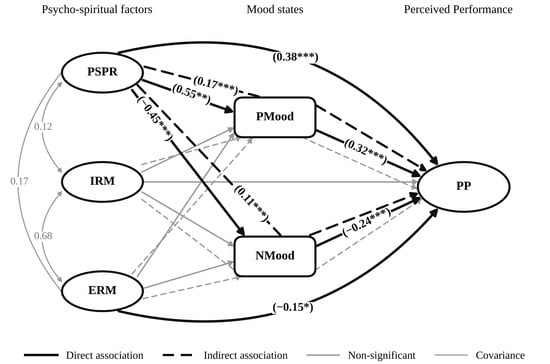
The overall fit of the structural model was evaluated via multiple goodness-of-fit indices. The χ2 test was significant (χ2 = 1708.73, df = 721, p < 0.001), a result confirmed by the Bollen–Stine bootstrap correction for nonnormality (p < 0.001); both outcomes were expected given the sensitivity of the χ2 statistic to sample size and model complexity. The χ2/df ratio (2.37) fell within the range considered acceptable for complex models. The incremental fit indices indicated an adequate fit (CFI = 0.916; TLI = 0.909), exceeding the 0.90 criterion but remaining below the 0.95 value associated with good fit. The SRMR (0.060) and the RMSEA (0.054, 90% CI (0.051, 0.057)) were within acceptable limits. Although the test of close fit was significant (PCLOSE = 0.022), the upper bound of the RMSEA interval remained well below 0.08, ruling out poor fit. Taken together, these indices indicate an adequate, but not close, approximation of the data. In terms of explanatory power, the model accounted for 54.0% of the variance in PP (R2 = 0.540), 31.1% in PMood (R2 = 0.311), and 21.9% in NMood (R2 = 0.219), all corresponding to large proportions of explained variance according to Cohen’s [55] benchmarks. Figure 2 illustrates the structural model and reports the standardized path coefficients linking the latent variables. The full model, including all measurement indicators, first-order dimensions, and error terms, is provided in Supplementary Table S1.
Figure 2.
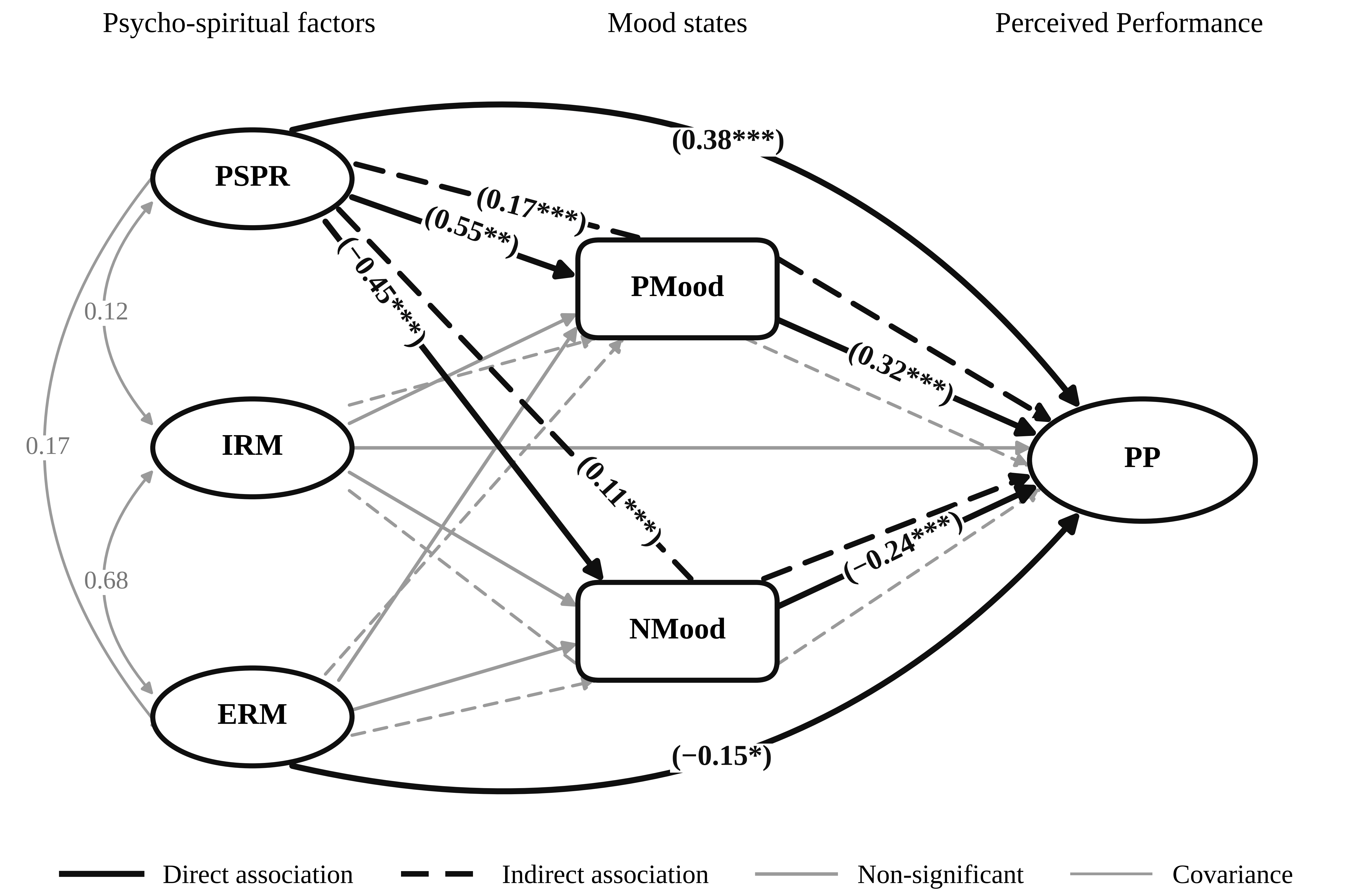
Structural model of the direct and indirect associations through mood, between psycho-spiritual factors and perceived performance. Values are standardized coefficients (β); NMood: Negative Mood; PMood: Positive Mood; PSPR: Positive Self-Perception of Ramadan; IRM: Intrinsic Religious Motivation; ERM: Extrinsic Religious Motivation; PP: Perceived Performance * p < 0.05. ** p < 0.01. *** p < 0.001.
The proposed hypotheses were tested via standardized (β) path coefficients, their 95% bias-corrected bootstrap confidence intervals and the associated p values to assess the strength, direction, and statistical significance of the relationships involving PP. Table 6 summarizes the path coefficients for both direct and indirect associations.
Table 6.
Direct and path-specific indirect associations among positive self-perception of Ramadan, intrinsic and extrinsic religious motivation, mood states, and perceived performance. NMood: Negative Mood; PMood: Positive Mood; PSPR: Positive Self-Perception of Ramadan; IRM: Intrinsic Religious Motivation; ERM: Extrinsic Religious Motivation; PP: Perceived Performance; β: standardized path coefficient; 95% BC CI: bias-corrected bootstrap 95% confidence interval (5000 resamples); p: two-tailed bootstrap significance. Standardized indirect associations, together with their bias-corrected confidence intervals and p values were estimated directly through user-defined estimands.
As reported in Table 6, H1 was fully supported. PSPR was positively associated with PP (H1a: β = 0.38, p < 0.001) and PMood (H1b: β = 0.55, p = 0.001) and negatively associated with NMood (H1c: β = −0.45, p < 0.001). Both indirect associations of PSPR with PP were significant through PMood (H1d: β = 0.17, p < 0.001) and NMood (H1e: β = 0.11, p < 0.001).
H2 was not supported. IRM was not significantly associated with PP (H2a: β = 0.00, p = 0.948), PMood (H2b: β = 0.04, p = 0.629), or NMood (H2c: β = −0.11, p = 0.235), and neither of its indirect associations with PP was significant (H2d: β = 0.01, p = 0.603; H2e: β = 0.03, p = 0.187).
H3 was only partially supported. ERM showed a small negative association with PP (H3a: β = −0.15, p = 0.034) but was unrelated to PMood (H3b: β = 0.02, p = 0.879) and NMood (H3c: β = 0.04, p = 0.602), and its indirect associations were not significant (H3d: β = 0.01, p = 0.852; H3e: β = −0.01, p = 0.558).
Finally, PMood was positively associated with PP (H4: β = 0.32, p < 0.001), and NMood was negatively associated with PP (H5: β = −0.24, p < 0.001), supporting H4 and H5.
4. Discussion
The present study examined how positive self-perception of Ramadan (PSPR) and RM were associated with MS and perceived performance (PP) in Tunisian footballers observing RF. The main finding is that athletes’ appraisal of fasting, rather than their RM, was associated with their affective state and perceived performance. PSPR showed a medium-sized direct association with PP and two medium-sized indirect associations through higher positive mood and lower negative mood, whereas IRM was unrelated to MS and PP, and ERM showed only a small negative association with PP.
A more positive appraisal of the anticipated effect of fasting on athletes’ physical and psychological resources revealed a medium-sized direct association (β = 0.38) with greater perceived performance. This finding is consistent with qualitative reports that Muslims who frame fasting as spiritually meaningful describe the experience as enriching despite its physical demands [6,58] and with evidence that appraising demanding situations as a challenge rather than a threat predicts more adaptive stress responses and better performance in both simulated [59] and occupational settings [60]. PSPR was most strongly related to mood, showing a strong association with positive mood (β = 0.55) and a medium-to-large association with negative mood (β = −0.45), in line with experimental evidence that positively framed guidance around Ramadan practices improves mental well-being during fasting [61] and with findings that the appraisal of a stressor, rather than the stressor itself, predicts mood [62]. Mood, in turn, was related to PP, with a medium association for positive mood (β = 0.32) and a small-to-medium association for negative mood (β = −0.24), supporting meta-analytic evidence that mood, particularly vigor, is a well-established correlate of athletic performance [63,64]. Both indirect associations were of medium size (β = 0.17 through positive mood; β = 0.11 through negative mood), the one through negative mood lying close to the lower bound of this range. Athletes who expect fasting to preserve or even enhance their resources may therefore experience the demands of Ramadan as more energizing and less distressing, which is related to more favorable evaluations of their performance, in line with research showing that emotions influence mental energy mobilization, concentration, and confidence in sport contexts [65]. Theoretically, these results suggest that athletes’ experience of RF is better captured by a situation-specific appraisal of fasting than by general motivational dispositions, positioning PSPR as a particularly informative psycho-spiritual construct for sport psychology research during RF.
In contrast to the appraisal of fasting, RM contributed little to athletes’ affective states and performance evaluations. IRM showed only near-zero to small, nonsignificant associations with PP (β = 0.00), positive mood (β = 0.04), and negative mood (β = −0.11), as well as with PP through positive (β = 0.01) and negative mood (β = 0.03). This absence of associations is at odds with a substantial body of research linking IRM to well-being [66], life satisfaction [67], adaptive functioning [68], job performance [69], and Ramadan engagement [70], but previous empirical research offers an explanation for this phenomenon. According to the principle of correspondence, general dispositions are only weakly related to specific outcomes, whereas measures that match the target situation predict them more strongly [71]. This may explain why fasting-specific appraisal, but not general religious motivation, was associated with mood and PP. Consistent with this principle, the motives that people hold specifically for fasting have been shown to shape how they experience Ramadan [1]. In the present study, this lack of correspondence was further accentuated by the removal of the only fasting-specific item (item 5) because of its weak contribution to the latent construct; thus, the retained IRM factor reflected intrinsic motivation for prayer and Quran reading rather than for fasting itself, whereas the PSPR directly targeted the fasting situation. Similarly, religiosity has been only modestly related to psychological outcomes among football players [72], and the performance-relevant effects of Ramadan observance appear to depend more on the intensity and framing of religious practice than on motivational orientation [73]. ERM was likewise unrelated to positive (β = 0.02) and negative mood (β = 0.04) and to PP through either MS (β = 0.01 and −0.01) but showed a small negative direct association with PP (β = −0.15). This association is consistent with meta-analytic evidence that an extrinsic religious orientation is associated with greater depressive symptoms [74] and with findings that introjected and external RM are related to lower self-esteem and a sense of purpose and to more internalizing problems [68]; however, given its small size, this association requires replication before being interpreted substantively. Theoretically, these results suggest that the predictions of self-determination theory regarding religious internalization may not transfer directly to fasting-related affective and performance outcomes in a Muslim-majority context and that RM should be assessed at a level that corresponds to the fasting situation.
In addition to these theoretically and empirically grounded interpretations, other mechanisms not measured in our study may also be involved and should be regarded as hypotheses for future research rather than as explanations supported by our data. The direct association between PSPR and PP, which remained after accounting for mood, may reflect processes such as meaning-making, motivation, or self-regulatory resources. With respect to religious motivation, athletes may experience fasting as a religious duty rather than as the voluntary religious involvement assumed in Allport and Ross’s [75] framework, which could weaken the link between RM and fasting-related outcomes; male athletes may also compartmentalize their religious identity from sport, treating competition as a secular domain [76], and masculine norms of emotional stoicism may attenuate self-reported mood [77]. The observed associations may also have been shaped by individual and contextual variables not included in the model, which should be regarded as potential confounders rather than as explanations supported by the present data. The competitive level, age, and football experience differed across participants (Table 1): semiprofessional and professional players were older and reported longer RF experience than amateurs did, and repeated exposure to fasting may have allowed them to develop more effective adaptation strategies [27,78], whereas professional clubs may have provided more structured nutritional, medical, and psychological support during Ramadan [79]. Such resources could simultaneously foster a more favorable appraisal of fasting, a better mood, and greater perceived performance, given that disrupted meal timing and sleep have been linked to poorer perceived performance in fasting footballers [80]. Training demands, including training load, intensity, and the timing of sessions relative to Iftar, as well as Ramadan-related lifestyle adjustments in sleep, meal timing, and hydration, were not assessed, likely varied across athletes, and may have influenced both their appraisal of fasting and their mood. These unmeasured factors could therefore act as common causes of the appraisal of Ramadan, mood, and perceived performance, thereby inflating their associations, or as moderators of the relationships examined here.
Limitations and Future Research
Our study has several limitations. First, the sample was exclusively composed of Tunisian male footballers, which limits the generalizability of the findings to female athletes and to other countries, sports, or competitive levels where ritual engagement and emotional regulation may follow different patterns. Second, the cultural context is restricted to a predominantly Muslim country and does not capture the experiences of Muslim athletes competing in Muslim-minority environments, where psycho-spiritual demands and coping dynamics may substantially differ [81]. In addition, our study relies on self-reported measures of PP rather than objective performance indicators, which may be influenced by individual appraisal biases. Future research would benefit from mixed-method designs combining qualitative approaches, field-based performance assessments, and cross-cultural comparisons to further clarify adaptation processes during religious fasting.
Further limitations should be acknowledged. The cross-sectional design precludes causal and temporal inferences: the indirect associations reported here are statistical, may differ from those that a longitudinal design would yield [31], and remain compatible with alternative directional models. For example, a favorable perception of one’s performance may itself foster a more positive mood and a more favorable appraisal of Ramadan. Such alternative configurations may fit the data equally well. Although common-method variance was unlikely to account for the results, the statistical tests used exclude only a dominant common factor and cannot rule out more moderate method effects arising from the single self-report questionnaire. Similarly, although the PSPR and PP items address different content and the two constructs are empirically distinct, both are self-evaluations made by the same athletes, so a generally positive evaluative tendency may have contributed to their association. The limited convergent validity of PSPR and ERM may also have reduced the precision of the path estimates involving these two constructs, particularly those of PSPR, the strongest correlate of PP in the model. In addition, the shortening of the IRM scale after item removal limits comparability with previous studies. Finally, the exact times of the training sessions were not documented, so the interval between the sessions and questionnaire completion could not be determined, and the responses collected before and after Iftar may have reflected different subjective perceptions and affective states. Future studies should record training times and standardize the timing of assessment relative to training and Iftar.
5. Conclusions and Implications
By integrating RM, PSPR, MS, and PP within a single structural model, the present study advances the understanding of athletes’ psychological experience during RF. The findings indicate that the appraisal of Ramadan, together with MS, constitutes the set of variables most strongly associated with PP. Specifically, a more positive appraisal of Ramadan was associated with greater PP, both directly and through significant indirect associations involving higher PMood and lower NMood. In contrast, RM played a more limited role: ERM was associated with modestly lower PP, whereas IRM showed neither direct nor indirect associations with PP. Overall, these results suggest that how athletes appraise the fasting period matters more for their performance perceptions than their general motivational orientation toward religion does.
From an applied perspective, our findings should be interpreted with caution. Given the cross-sectional design and the absence of any intervention, they cannot support direct practical recommendations. They nevertheless suggest that coaching and support staff may benefit from considering not only the physiological and organizational adjustments required during RF but also athletes’ cognitive appraisals and emotional states. These findings therefore yield a testable hypothesis, namely, that interventions designed to promote adaptive appraisals of fasting and to support emotional regulation may help fasting athletes preserve their psychological balance and perceived performance, a proposition that warrants examination in controlled experimental studies. Finally, future research should test the proposed model across different sports, cultural contexts, competitive levels, and religious configurations in both male and female athletes, using multigroup structural equation modeling to examine whether the structural paths differ between them.
Supplementary Materials
The following supporting information can be downloaded at: https://www.mdpi.com/article/10.3390/sports14110502/s1, Table S1. Parameters and results of the RMSEA-based power analysis.
Author Contributions
Conceptualization, A.Y., C.F., Z.Z., H.J. and K.C.; methodology, A.Y., C.F., K.C., H.J. and I.L.; software, H.J. and A.Y.; validation, A.R.A., I.L., C.F., H.J. and K.C.; formal analysis, I.M.-C., I.L. and Z.Z.; investigation, A.Y., I.M.-C., C.F., Z.Z., I.L. and A.R.A.; resources, A.Y., C.F., I.M.-C. and Z.Z.; data curation, A.Y. and H.J.; writing—original draft preparation, A.Y.; writing—review and editing, C.F., Z.Z., I.M.-C., I.L., H.J., A.R.A. and K.C.; visualization, Z.Z., I.M.-C., C.F. and I.L.; supervision, K.C. and C.F.; project administration, I.L. and A.R.A. All authors have read and agreed to the published version of the manuscript.
Funding
This research received no external funding”. This research received no external funding
Data Availability Statement
The data that support the findings of this study are openly available in SciDB at https://doi.org/10.57760/sciencedb.43993.
Acknowledgments
The authors would like to thank all the participants. During the preparation of this manuscript, the authors used Claude (Anthropic; Claude Opus 5.5) to assist with language editing, restructuring of the text, consistency checks of statistical reporting, and the preparation of figures. The authors reviewed and edited all output and take full responsibility for the content of this publication.
Conflicts of Interest
The authors declare no conflicts of interest.
References
- Rad, M.S. Ramadan fasting as a goal-pursuit: Why people fast, and how motives affect their experience. Motiv. Sci. 2023, 9, 327–339. [Google Scholar] [CrossRef] [Scilit]
- Afridi, M.I. Ramadan fasting: The true rejuvenation of body and mind. J. Pak. Psychiatr. Soc. 2024, 21, 1–3. [Google Scholar] [CrossRef] [Scilit]
- Chamari, K.; Briki, W. Training and competing during Ramadan—Practical recommendations for athletes and coaches. Tunis. Med. 2025, 103, 868–876. [Google Scholar] [CrossRef] [Scilit]
- Chamari, K.; Roussi, M.; Bragazzi, N.L.; Chaouachi, A.; Abdul, R.A. Optimizing training and competition during the month of Ramadan: Recommendations for a holistic and personalized approach for the fasting athletes. Tunis. Med. 2019, 97, 1095–1103. [Google Scholar]
- Briki, W.; Chamari, K. Fasting and performing during Ramadan: Faith and autonomous spirituality as psychological resources for adaptation in Muslim athletes—A theoretical reflection within a Western context. Tunis. Med. 2025, 103, 936–942. [Google Scholar] [CrossRef] [Scilit]
- Yacoubi, A.; Fitouri, C.; Kamal, S.; Ben Jomâa, H.; Latiri, I.; Chamari, K. How religious engagement shapes performance perception during Ramadan: Insights from fasting Tunisian footballers. Br. Med. Bull. 2026, 157, ldag004. [Google Scholar] [CrossRef] [Scilit]
- Chamari, K.; Kamal, R.; Mohamed-Ali, V.; Al-Maadheed, M. Psychological impact of Ramadan fasting: Insights for general population and athletes. N. Asian J. Med. 2024, 2, 27–31. [Google Scholar] [CrossRef] [Scilit]
- Kaloda, Y.S.; Ahmed, A.A.E. Psychological and socio-religious effects of Ramadan fasting among healthy non-smoker adults. Egypt. Acad. J. Biol. Sci. C Physiol. Mol. Biol. 2024, 16, 29–37. [Google Scholar] [CrossRef] [Scilit]
- DeLang, M.D.; Salamh, P.A.; Chtourou, H.; Saad, H.B.; Chamari, K. The effects of Ramadan intermittent fasting on football players and implications for domestic football leagues over the next decade: A systematic review. Sports Med. 2022, 52, 585–600. [Google Scholar] [CrossRef] [Scilit]
- Abaïdia, A.E.; Daab, W.; Bouzid, M.A. Effects of Ramadan fasting on physical performance: A systematic review with meta-analysis. Sports Med. 2020, 50, 1009–1026. [Google Scholar] [CrossRef] [Scilit]
- Aziz, A.R.; Che Muhamad, A.M.; Roslan, S.R.; Mohamed, N.G.; Singh, R.; Chia, M.Y.H. Poorer intermittent sprints performance in Ramadan-fasted Muslim footballers despite controlling for pre-exercise dietary intake, sleep and training load. Sports 2017, 5, 4. [Google Scholar] [CrossRef] [Scilit]
- Lazarus, R.S.; Folkman, S. Stress, Appraisal, and Coping; Springer Publishing Company: New York, NY, USA, 1984. [Google Scholar]
- Didymus, F.F.; Fletcher, D. Getting to the heart of the matter: An examination of swimmers’ appraisals of organizational stressors. In Proceedings of the 13th FEPSAC European Congress of Sport Psychology, Madeira, Portugal, 12–17 July 2011. [Google Scholar]
- Farooq, A.; Herrera, C.P.; Zerguini, Y.; Almudahka, F.; Chamari, K. Knowledge, beliefs and attitudes of Muslim footballers towards Ramadan fasting during the London 2012 Olympics: A cross-sectional study. BMJ Open 2016, 6, e012848. [Google Scholar] [CrossRef] [Scilit]
- Ryan, R.M.; Rigby, S.; King, K. Two types of religious internalization and their relations to religious orientations and mental health. J. Pers. Soc. Psychol. 1993, 65, 586–596. [Google Scholar] [CrossRef]
- Kusuma, N.; Wijayanti, D.G.S. The relationship between religiosity and performance on competition anxiety among male basketball athletes of the POPDA team in Brebes Regency. J. Phys. Educ. Health Sport 2025, 12, 35–41. [Google Scholar] [CrossRef] [Scilit]
- Riruma, O.W.; Sandra, L. The impact of work motivation and religiosity on faculty member performance: The mediating role of meaningful life. Ekombis Rev. 2024, 12, 1989. [Google Scholar] [CrossRef] [Scilit]
- Noh, Y.E.; Zaki, F.; Danaee, M. The impact of religious–psychological factors on self-perceived sport performance among religious athletes in Malaysia. Psychol. Sport Exerc. 2024, 72, 102612. [Google Scholar] [CrossRef] [Scilit]
- Lazarus, R.S. How emotions influence performance in competitive sports. Sport Psychol. 2000, 14, 229–252. [Google Scholar] [CrossRef] [Scilit]
- Terry, P.C.; Lane, A.M.; Fogarty, G.J. Construct validity of the Profile of Mood States–Adolescents for use with adults. Psychol. Sport Exerc. 2003, 4, 125–139. [Google Scholar] [CrossRef] [Scilit]
- Chtourou, H.; Hammouda, O.; Souissi, H.; Chamari, K.; Chaouachi, A.; Souissi, N. The effect of Ramadan fasting on physical performances, mood state and perceived exertion in young footballers. Asian J. Sports Med. 2011, 2, 177–185. [Google Scholar] [CrossRef] [Scilit]
- Khemila, S.; Romdhani, M.; Farjallah, M.A.; Abid, R.; Bentouati, E.; Souissi, M.A.; Abedelmalek, S.; Garbarino, S.; Souissi, N. Effects of Ramadan fasting on the diurnal variations of physical and cognitive performances at rest and after exercise in professional football players. Front. Psychol. 2023, 14, 1148845. [Google Scholar] [CrossRef] [Scilit]
- Trabelsi, K.; Ammar, A.; Boujelbane, M.; Khacharem, A.; Elghoul, Y.; Boukhris, O.; Aziz, A.R.; Taheri, M.; Irandoust, K.; Khanfir, S.; et al. Ramadan observance is associated with higher fatigue and lower vigor in athletes: A systematic review and meta-analysis with meta-regression. Int. Rev. Sport Exerc. Psychol. 2025, 18, 1–28. [Google Scholar] [CrossRef] [Scilit]
- Lone, A.L.; Hadadi, A.S.; Alnawah, A.K.; Alshammary, A.A.; Almutairi, R.M.; Ali, S.I.; Abid, N. Exploring mood and anxiety disturbances across Ramadan: A comparative study of Saudi medical students before, during, and after fasting. Front. Psychol. 2025, 16, 1570557. [Google Scholar] [CrossRef] [Scilit]
- Kadri, N.; Tilane, A.; El Batal, M.; Taltit, Y.; Tahiri, S.M.; Moussaoui, D. Irritability during the month of Ramadan. Psychosom. Med. 2000, 62, 280–285. [Google Scholar] [CrossRef] [Scilit]
- Ahmed, D.R.; Al Azzawi, M.A.D.; Ahmed, J.O.; Elzahaby, A.; Hussein, A.M.; Heun, R. Systematic review reveals mental health benefits of Ramadan fasting with mixed effects on sleep quality and cognitive functioning. Discov. Psychol. 2026, 6, 2. [Google Scholar] [CrossRef] [Scilit]
- Roy, J.; Hamidan, S.; Singh, R. Temporal patterns of subjective experiences and self-regulation during Ramadan fasting among elite archers: A qualitative analysis. Asian J. Sports Med. 2011, 2, 195–204. [Google Scholar] [CrossRef] [Scilit]
- Andrade de Brito, M.; Raimundo Fernandes, J.; Vieira Andrade, A.; de Toledo Nóbrega, O.; Miarka, B.; Aedo-Muñoz, E.; Valenzuela Pérez, D.; Lau Barbosa, P.H.; Ferreira Costa, K.; José Brito, C. Emotional regulation and competitive outcome in combat sports: Affective dynamics before and after matched bouts. Retos 2025, 73, 577–587. [Google Scholar] [CrossRef] [Scilit]
- Shahdan, S.; Noh, Y.E.; Adnan, Y. The role of religious faith in sport-related anxiety among elite athletes: An exploratory study. J. Sains Sukan Pendidik. Jasm. 2022, 11, 11–23. [Google Scholar] [CrossRef] [Scilit]
- Noh, Y.E.; Shahdan, S. A systematic review of religion/spirituality and sport: A psychological perspective. Psychol. Sport Exerc. 2020, 46, 101603. [Google Scholar] [CrossRef] [Scilit]
- Maxwell, S.E.; Cole, D.A. Bias in cross-sectional analyses of longitudinal mediation. Psychol. Methods 2007, 12, 23–44. [Google Scholar] [CrossRef] [Scilit]
- Terry, P.C.; Parsons-Smith, R.L.; King, R.; Terry, V.R. Influence of sex, age, and education on mood profile clusters. PLoS ONE 2021, 16, e0245341. [Google Scholar] [CrossRef] [Scilit]
- Pew Research Center. The Gender Gap in Religion Around the World. 2016. Available online: https://www.pewresearch.org/religion/2016/03/22/the-gender-gap-in-religion-around-the-world/ (accessed on 13 October 2026).
- Muthén, B.O. Latent variable modeling in heterogeneous populations. Psychometrika 1989, 54, 557–585. [Google Scholar] [CrossRef] [Scilit]
- Kline, R.B. Principles and Practice of Structural Equation Modeling, 5th ed.; Guilford Press: New York, NY, USA, 2023. [Google Scholar]
- MacCallum, R.C.; Browne, M.W.; Sugawara, H.M. Power analysis and determination of sample size for covariance structure modeling. Psychol. Methods 1996, 1, 130–149. [Google Scholar] [CrossRef]
- Abu-Raiya, H.; Pargament, K.I.; Mahoney, A.; Stein, C. A psychological measure of Islamic religiousness: Development and evidence for reliability and validity. Int. J. Psychol. Relig. 2008, 18, 291–315. [Google Scholar] [CrossRef] [Scilit]
- Almagro, B.J.; Sáenz-López, P.; Fierro-Suero, S.; Conde, C. Perceived performance, intrinsic motivation and adherence in athletes. Int. J. Environ. Res. Public Health 2020, 17, 9441. [Google Scholar] [CrossRef] [Scilit]
- Hernández, A.; Hidalgo, M.D.; Hambleton, R.K.; Gómez-Benito, J. International Test Commission guidelines for test adaptation: A criterion checklist. Psicothema 2020, 32, 390–398. [Google Scholar] [CrossRef] [Scilit]
- Yusoff, M.S.B. ABC of content validation and content validity index calculation. Educ. Med. J. 2019, 11, 49–54. [Google Scholar] [CrossRef] [Scilit]
- Yacoubi, A.; Fitouri, C.; Mahmoud, S.; Jahrami, H.; Latiri, I.; Chamari, K. Validation of the Arabic version of the Brunel Mood Scale (BRUMS-AR) for use with football players in Ramadan. Int. J. Sport Stud. Health 2025, 8, 1–8. [Google Scholar] [CrossRef] [Scilit]
- Yacoubi, A.; Fitouri, C.; Kamal, S.; Ben Jomâa, H.; Latiri, I.; Jahrami, H.; Chamari, K. Psychometric evaluation of the Islamic Religious Internalization subscales among Tunisian footballers in a Muslim-majority context. Ment. Health Relig. Cult. 2026, 29, 645–656. [Google Scholar] [CrossRef] [Scilit]
- Byrne, B.M. Structural Equation Modeling with AMOS: Basic Concepts, Applications, and Programming, 3rd ed.; Routledge: New York, NY, USA, 2016. [Google Scholar]
- Rhemtulla, M.; Brosseau-Liard, P.É.; Savalei, V. When can categorical variables be treated as continuous? A comparison of robust continuous and categorical SEM estimation methods under suboptimal conditions. Psychol. Methods 2012, 17, 354–373. [Google Scholar] [CrossRef] [Scilit]
- Podsakoff, P.M.; MacKenzie, S.B.; Lee, J.-Y.; Podsakoff, N.P. Common method biases in behavioral research: A critical review of the literature and recommended remedies. J. Appl. Psychol. 2003, 88, 879–903. [Google Scholar] [CrossRef] [Scilit]
- Anderson, J.C.; Gerbing, D.W. Structural equation modeling in practice: A review and recommended two-step approach. Psychol. Bull. 1988, 103, 411–423. [Google Scholar] [CrossRef]
- Hair, J.F.; Black, W.C.; Babin, B.J.; Anderson, R.E. Multivariate Data Analysis, 8th ed.; Cengage Learning: Andover, UK, 2019. [Google Scholar]
- Clark, L.A.; Watson, D. Constructing validity: New developments in creating objective measuring instruments. Psychol. Assess. 2019, 31, 1412–1427. [Google Scholar] [CrossRef] [Scilit]
- Fornell, C.; Larcker, D.F. Evaluating structural equation models with unobservable variables and measurement error. J. Mark. Res. 1981, 18, 39–50. [Google Scholar] [CrossRef] [Scilit]
- Henseler, J.; Ringle, C.M.; Sarstedt, M. A new criterion for assessing discriminant validity in variance-based structural equation modeling. J. Acad. Mark. Sci. 2015, 43, 115–135. [Google Scholar] [CrossRef] [Scilit]
- Rönkkö, M.; Cho, E. An updated guideline for assessing discriminant validity. Organ. Res. Methods 2022, 25, 6–14. [Google Scholar] [CrossRef] [Scilit]
- Sarstedt, M.; Hair, J.F., Jr.; Cheah, J.H.; Becker, J.M.; Ringle, C.M. How to specify, estimate, and validate higher-order constructs in PLS-SEM. Australas. Mark. J. 2019, 27, 197–211. [Google Scholar] [CrossRef] [Scilit]
- Nevitt, J.; Hancock, G.R. Performance of bootstrapping approaches to model test statistic and parameter standard error estimation in structural equation modeling. Struct. Equ. Model. 2001, 8, 353–377. [Google Scholar] [CrossRef] [Scilit]
- Bollen, K.A.; Stine, R.A. Bootstrapping goodness-of-fit measures in structural equation models. Sociol. Methods Res. 1992, 21, 205–229. [Google Scholar] [CrossRef] [Scilit]
- Cohen, J. Statistical Power Analysis for the Behavioral Sciences, 2nd ed.; Lawrence Erlbaum Associates: Hillsdale, NJ, USA, 1988. [Google Scholar]
- Kenny, D.A. Mediation. 2018. Available online: http://davidakenny.net/cm/mediate.htm (accessed on 7 March 2025).
- Brown, T.A. Confirmatory Factor Analysis for Applied Research, 2nd ed.; Guilford Press: New York, NY, USA, 2015. [Google Scholar]
- Latif, A.; Iqbal, S.; Bryant, E.J.; Lesk, V.E.; Stewart-Knox, B.J. Experiences of fasting during Ramadan in British Muslims: Psychological, social and health behaviours. PLoS ONE 2025, 20, e0313688. [Google Scholar] [CrossRef] [Scilit]
- Harvey, A.; Nathens, A.B.; Bandiera, G.; LeBlanc, V.R. Threat and challenge: Cognitive appraisal and stress responses in simulated trauma resuscitations. Med. Educ. 2010, 44, 587–594. [Google Scholar] [CrossRef] [Scilit]
- VonRosenberg, J. Cognitive appraisal and stress performance: The threat/challenge matrix and its implications on performance. Air Med. J. 2019, 38, 331–333. [Google Scholar] [CrossRef] [Scilit]
- Lauche, R.; Fathi, I.; Saddat, C.; Klose, P.; Al-Abtah, J.; Büssing, A.; Rampp, T.; Dobs, G.; Cramer, H. Effects of modified Ramadan fasting on mental well-being and biomarkers in healthy adult Muslims: A randomised controlled trial. Int. J. Behav. Med. 2025, 32, 953–968. [Google Scholar] [CrossRef] [Scilit]
- Awada, M.; Becerik-Gerber, B.; Lucas, G.M.; Roll, S.C. Stress appraisal in the workplace and its associations with productivity and mood: Insights from a multimodal machine learning analysis. PLoS ONE 2024, 19, e0296468. [Google Scholar] [CrossRef] [Scilit]
- Beedie, C.J.; Terry, P.C.; Lane, A.M. The profile of mood states and athletic performance: Two meta-analyses. J. Appl. Sport Psychol. 2000, 12, 49–68. [Google Scholar] [CrossRef] [Scilit]
- Lochbaum, M.; Zanatta, T.; Kirschling, D.; May, E. The Profile of Mood States and athletic performance: A meta-analysis of published studies. Eur. J. Investig. Health Psychol. Educ. 2021, 11, 50–70. [Google Scholar] [CrossRef] [Scilit]
- Nam, K.W.; Park, S.; Lee, S. Coaching knowledge, sport emotion and perceived performance: A structural equation modelling approach. Front. Psychol. 2025, 16, 1615383. [Google Scholar] [CrossRef] [Scilit]
- Shahama, A.; Patel, A.; Carson, J.; Abdel-Khalek, A.M. The pursuit of happiness within Islam: A systematic review of two decades of research on religiosity and happiness in Islamic groups. Ment. Health Relig. Cult. 2022, 25, 629–651. [Google Scholar] [CrossRef] [Scilit]
- Duffield, C.; Mateer, E.M.; Foster, M.; Jin, J.; Fung, W.; Fung, J. God perfectionism as a mediator of intrinsic religiosity and life satisfaction: A Christian sample of young adults. J. Psychol. Theol. 2024, 52, 115–127. [Google Scholar] [CrossRef] [Scilit]
- Hardy, S.A.; Nelson, J.M.; Frandsen, S.B.; Cazzell, A.R.; Goodman, M.A. Adolescent religious motivation: A self-determination theory approach. Int. J. Psychol. Relig. 2022, 32, 16–30. [Google Scholar] [CrossRef] [Scilit]
- Din, M.U.; Khan, F.; Khan, U.; Kadarningsih, A.; Astuti, S.D. Effect of Islamic work ethics on job performance: Mediating role of intrinsic motivation. Int. J. Islam. Bus. Ethics 2019, 4, 676–688. [Google Scholar] [CrossRef] [Scilit]
- Khan, Z.H.; Watson, P.J. Ramadan experience and behavior: Relationships with religious orientation among Pakistani Muslims. Arch. Psychol. Relig. 2010, 32, 149–168. [Google Scholar] [CrossRef] [Scilit]
- Ajzen, I.; Fishbein, M. Attitude–behavior relations: A theoretical analysis and review of empirical research. Psychol. Bull. 1977, 84, 888–918. [Google Scholar] [CrossRef]
- Slatinsky, C.P.; Farren, G.L.; Bartlett, M.; Fiaud, V.; Haasl, R. Relations among locus of control, religiosity, and resiliency in collegiate football players. Pastor. Psychol. 2022, 71, 503–510. [Google Scholar] [CrossRef] [Scilit]
- Hornung, E.; Schwerdt, G.; Strazzeri, M. Religious practice and student performance: Evidence from Ramadan fasting. J. Econ. Behav. Organ. 2023, 205, 100–119. [Google Scholar] [CrossRef] [Scilit]
- Smith, T.B.; McCullough, M.E.; Poll, J. Religiousness and depression: Evidence for a main effect and the moderating influence of stressful life events. Psychol. Bull. 2003, 129, 614–636. [Google Scholar] [CrossRef] [Scilit]
- Allport, G.W.; Ross, J.M. Personal religious orientation and prejudice. J. Pers. Soc. Psychol. 1967, 5, 432–443. [Google Scholar] [CrossRef]
- Ronkainen, N.J.; Ryba, T.V.; Tod, D. “Don’t ever mix God with sports”: Christian religion in athletes’ stories of life transitions. Sport Soc. 2020, 23, 613–628. [Google Scholar] [CrossRef] [Scilit]
- Reis, N.A.; Kowalski, K.C.; Mosewich, A.D.; Ferguson, L.J. ‘That’s how I am dealing with it—That is dealing with it’: Exploring men athletes’ self-compassion through the lens of masculinity. Qual. Res. Sport Exerc. Health 2021, 13, 320–337. [Google Scholar] [CrossRef] [Scilit]
- Shephard, R.J. The impact of Ramadan observance upon athletic performance. Nutrients 2012, 4, 491–505. [Google Scholar] [CrossRef] [Scilit]
- Maughan, R.J.; Zerguini, Y.; Chalabi, H.; Dvorak, J. Achieving optimum sports performance during Ramadan: Some practical recommendations. J. Sports Sci. 2012, 30, S109–S117. [Google Scholar] [CrossRef] [Scilit]
- Zerguini, Y.; Kirkendall, D.; Junge, A.; Dvorak, J. Impact of Ramadan on physical performance in professional soccer players. Br. J. Sports Med. 2007, 41, 398–400. [Google Scholar] [CrossRef] [Scilit]
- Fitouri, C.; Yaakoubi, A.; Dellal, A.; Aloui, A.; Latiri, I.; Chamari, K.; Ben Jomâa, H. Ramadan and sport: A pilot study on the perspectives of professionals and athletes in diverse cultural contexts. Tunis. Med. 2025, 103, 891–898. [Google Scholar] [CrossRef] [Scilit]

Disclaimer/Publisher’s Note: The statements, opinions and data contained in all publications are solely those of the individual author(s) and contributor(s) and not of MDPI and/or the editor(s). MDPI and/or the editor(s) disclaim responsibility for any injury to people or property resulting from any ideas, methods, instructions or products referred to in the content. |
© 2026 by the authors. Licensee MDPI, Basel, Switzerland. This article is an open access article distributed under the terms and conditions of the Creative Commons Attribution (CC BY) license.