


Abstract
An official Modern Standard Arabic version of the Borg CR Scale® (CR10) is available, but evidence on its measurement properties remains limited. This study evaluated measurement properties of the official Arabic CR10 without modification. Phase 1 involved cognitive interviews with 48 participants. Phase 2 comprised an experimental session (T1; n = 72) and a retest 7 ± 2 days later (T2; n = 52). Convergent validity was examined during ramp-incremental cycling using associations with work rate and heart rate (HR). Recovery was analyzed using a linear mixed-effects model. Test–retest reliability was assessed using the intraclass correlation coefficient [ICC(A,1)], Bland–Altman analysis, standard error of measurement (SEM), and minimal detectable change at the 95% confidence level (MDC95). Correct comprehension was 95.8%, and favorable acceptability was 93.8%. CR10 ratings were strongly associated with work rate (r_rm = 0.91; 95% CI, 0.89–0.93) and HR (r_rm = 0.86; 95% CI, 0.83–0.89; both p < 0.001). During recovery, HR remained positively associated with CR10 (β = 0.048 per bpm; 95% CI, 0.037–0.059; p < 0.001). Peak CR10 showed good test–retest reliability (ICC(A,1) = 0.82; 95% CI, 0.71–0.89), minimal bias (−0.08), SEM = 0.49, and MDC95 = 1.35. These findings support the measurement properties examined for the Arabic CR10 in Arabic-speaking Tunisian adults under standardized incremental cycling conditions.
1. Introduction
Monitoring exercise intensity is fundamental in sport, exercise, and rehabilitation for guiding workload, individualizing training, and evaluating responses to exercise. Physiological and external indicators such as heart rate, oxygen uptake, speed, and work rate provide important information about exercise demands, but they do not directly capture how strenuous an exercise task feels to the individual. Ratings of perceived exertion (RPE) therefore provide a simple, inexpensive, and practical complement to objective measures of exercise intensity [1,2,3,4,5].
The psychophysical approach developed by Borg led to standardized scales for quantifying perceived exertion, including the Borg CR Scale® (CR10) [1,2]. Because of its simplicity and applicability across a wide range of exercise intensities, the CR10 has been used extensively in exercise testing, training prescription, and athlete monitoring [2,3,4,5]. The CR10 also formed the basis of the modified scale used by Foster et al. within the session-RPE method, which is widely used to quantify internal training load in individual and team sports [6,7,8].
Despite the apparent simplicity of RPE scales, appropriate use depends on an accurate understanding of the instructions and verbal descriptors associated with the numerical categories. Because perceived exertion is a subjective construct, inadequate comprehension of the language used to administer a scale may alter interpretation of its anchors and introduce avoidable measurement error [9,10,11,12]. This issue is particularly relevant in Arabic-speaking countries where French is also commonly used in education, sport, and scientific practice. Indeed, recent studies conducted in Tunisia have used the French version of the modified CR10 previously evaluated by Haddad et al. [13] to assess perceived exertion or related psychophysiological responses in applied sport settings [14,15,16,17].
Although this approach has facilitated the use of RPE-based monitoring in these settings, reliance on a French-language instrument may not be optimal for all Arabic-speaking participants. French proficiency varies considerably between individuals and populations, and incomplete understanding of the instructions or verbal anchors could influence how perceived exertion is interpreted and reported. Moreover, the scale evaluated by Haddad et al. [13] was developed within the session-RPE framework and therefore reflects a retrospective global assessment of an exercise session rather than the momentary perceived-exertion construct examined in the present study. These considerations support direct evaluation of an Arabic-language instrument in Arabic-speaking users. Arabic is used daily by more than 400 million people worldwide, making it one of the most widely spoken languages globally [18]. Appropriately evaluated Arabic-language tools are therefore important for reducing linguistic barriers and promoting standardized assessment of perceived exertion across sport, exercise, rehabilitation, and research settings.
An official Modern Standard Arabic version of the Borg CR Scale® (CR10), including its accompanying official instructions, is available through the authorized Borg instrument source [19]. Modern Standard Arabic (Fusuha) is particularly well suited to standardized assessment among literate Arabic speakers because it provides a shared formal linguistic framework across Arabic-speaking countries; this can facilitate cross-regional comprehension, reduce dependence on any single regional dialect, and promote consistent interpretation of standardized instructions. However, the availability of an official language version does not by itself provide empirical evidence regarding its comprehensibility, response processes, convergent validity, test–retest reliability, agreement, or measurement error in the intended population. Translation certification documents the linguistic translation process but does not establish whether Arabic-speaking users consistently understand the instructions and verbal anchors, whether ratings behave as theoretically expected during exercise, or whether measurements are reproducible under repeated testing conditions.
Language-specific versions of Borg-based RPE scales have undergone evaluation of measurement properties in several populations [13,20,21]. In contrast, to our knowledge, no peer-reviewed study has specifically examined selected measurement properties of the official Modern Standard Arabic Borg CR Scale® (CR10) for assessing perceived exertion. Given the widespread use of Borg-based RPE scales and the size of the Arabic-speaking population, this lack of measurement-property evidence constitutes an important methodological gap in exercise and sport science.
Empirical evaluation of the official Modern Standard Arabic CR10 is therefore warranted. Mechanical work rate and heart rate can serve as theoretically related external variables for prespecified convergent-validity hypotheses, whereas repeated testing can characterize test–retest reliability, agreement, and measurement error [22,23,24,25]. Such analyses provide evidence regarding selected measurement properties; they should not be interpreted as criterion validation against a gold standard.
Accordingly, we hypothesized that the official Modern Standard Arabic CR10 would demonstrate adequate comprehensibility and acceptability, strong positive within-participant associations with mechanical work rate and heart rate during incremental cycling, and acceptable test–retest reproducibility under standardized conditions.
2. Materials and Methods
2.1. Study Design and Measurement Properties Evaluated
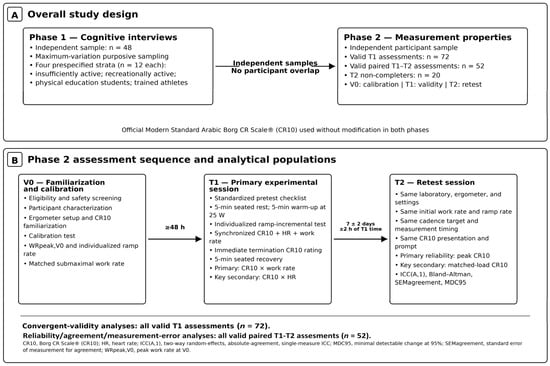
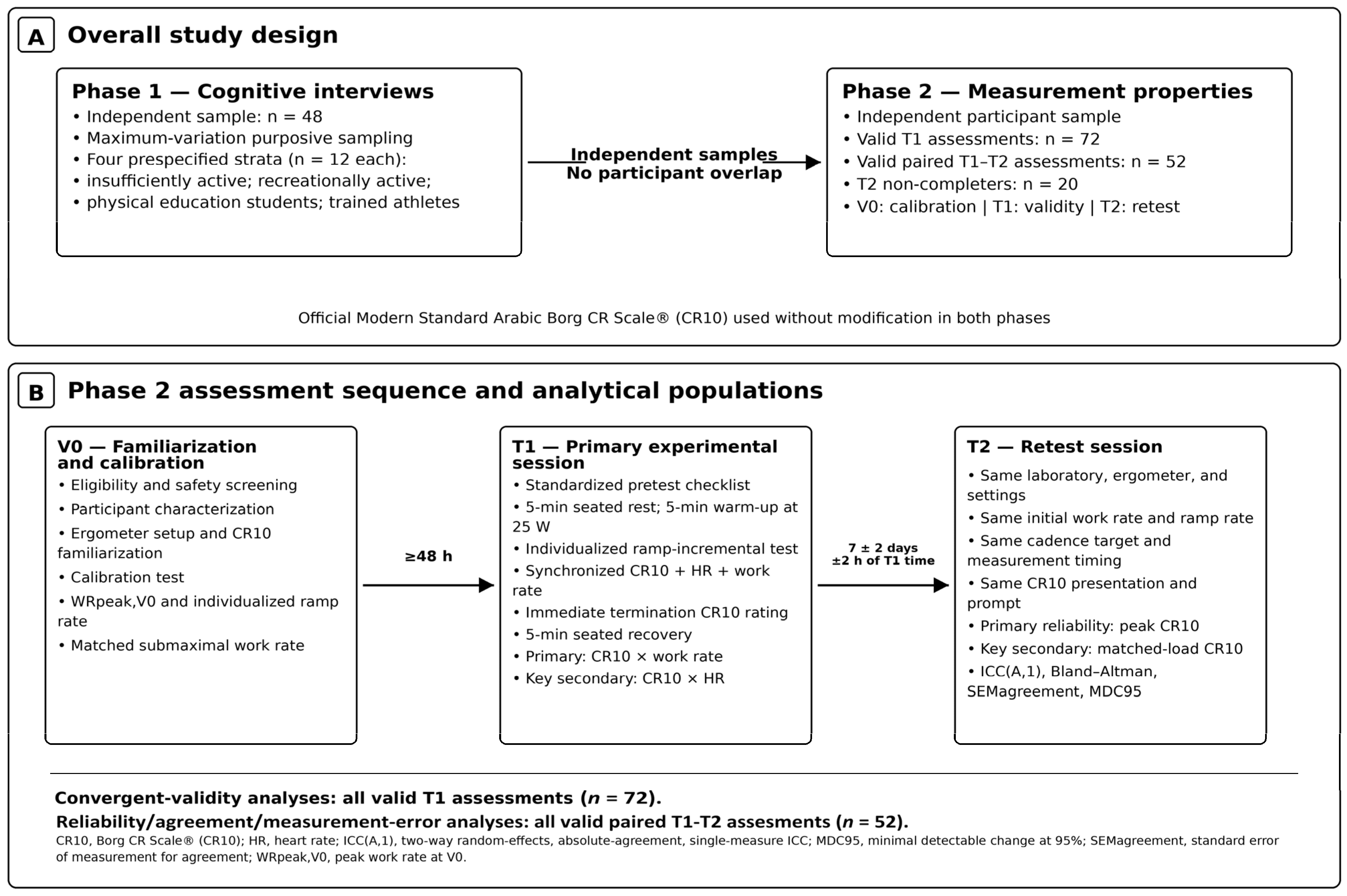
The study comprised two independent phases, with no participant overlap. Phase 1 used cognitive interviews to examine comprehensibility, response processes, acceptability, and usability of the official Modern Standard Arabic Borg CR Scale® (CR10). Phase 2 used a prospective repeated-measures design comprising a familiarization and protocol-calibration visit (V0), a primary experimental session (T1), and a retest session (T2). Phase 2 evaluated prespecified convergent-validity hypotheses during ramp-incremental cycle ergometry and post-exercise recovery and characterized test–retest reliability, absolute agreement, and measurement error. Participant flow and the assessment sequence are summarized in Figure 1.
Figure 1.
Study design, assessment sequence, and analytical populations. Note: Phase 1 comprised cognitive interviews in an independent sample of 48 participants. Phase 2 comprised V0 familiarization/protocol calibration, T1 convergent-validity assessment, and T2 retest 7 ± 2 days later; T1 occurred at least 48 h after V0 and T2 was scheduled within ±2 h of the participant-specific T1 time. Convergent-validity analyses included 72 valid T1 assessments, and reliability, agreement, and measurement-error analyses included 52 valid paired T1–T2 assessments. The official Modern Standard Arabic Borg CR Scale® (CR10) and its official instructions were used without modification. HR, heart rate; ICC, intraclass correlation coefficient; MDC95, minimal detectable change at the 95% confidence level; SEM, standard error of measurement; WRpeak, V0, peak work rate determined during V0.
2.2. Ethical Considerations
The study was approved by the Research Ethics Committee of the High Institute of Sport and Physical Education of Sfax, University of Sfax (CERS-ISSEPS-0012/2026), and was conducted in accordance with the Declaration of Helsinki. Participation was voluntary. Before enrollment, all participants received written information outlining the study objectives and procedures, potential risks and benefits, confidentiality of collected data, and their right to withdraw at any time without providing a reason. Written informed consent was obtained from all participants before participation.
2.3. Official Arabic CR10: Provenance, Translation Certification, and Instrument Integrity
Perceived exertion was assessed using the official Modern Standard Arabic Borg CR Scale® (CR10) and accompanying instructions obtained from the authorized Borg instrument source [19]. The original Borg CR Scale® (CR10) and its authorized language versions can be obtained under license from the official BorgPerception website (https://borgperception.se/, accessed on 17 August 2026). A Translation Certificate issued by Accent Language Service on 19 April 2021 documents professional translation from English into Arabic in December 2016, followed by independent proofreading and revision.
The scale and instructions were used without modification. Ratings > 10 were permitted in accordance with the official instructions, and the separate absolute-maximum category was retained without assignment of an arbitrary numerical value. Cognitive interviews evaluated comprehension and response processes but did not constitute translation or instrument development. The proprietary scale is reproduced in the Supplementary Materials with permission from BorgPerception AB (Åkersberga, Swedish).
2.4. Sample Size Justification
Sample-size planning was phase-specific and prespecified. Phase 1 included 48 participants selected by maximum-variation purposive sampling to ensure heterogeneity in activity and training background; no statistical power calculation was performed for this qualitative phase. The 48 interviews were allocated equally across the four prespecified strata (n = 12 per stratum) to provide balanced representation of contrasting participant profiles. This allocation was intended to enhance sampling diversity rather than support powered subgroup comparisons. Recruitment stopped when the planned sample was complete; formal thematic saturation was not assessed and was not used as a stopping criterion.
For Phase 2, recruitment targeted 72 valid T1 assessments (approximately 18 participants per prespecified participant-profile stratum), providing a balanced heterogeneous sample for the convergent-validity analyses. The test–retest target assumed an ICC of 0.75 with two repeated measurements and an approximate 95% confidence-interval total width of 0.25; using the standard precision-based approximation for ICC planning, this required approximately 49 paired participants. The target was therefore set at 52 valid paired T1–T2 assessments to provide a small margin. All valid paired completers were analyzed.
2.5. Phase 1: Cognitive Interviews: Comprehensibility, Response Processes, and Usability
2.5.1. Participants and Sampling
Phase 1 included 48 participants equally distributed across four mutually exclusive strata: insufficiently active adults, recreationally active adults, physical education students, and trained athletes (n = 12 each). Participants were recruited in Sfax through the university community, sports organizations and clubs, and institutional or community announcements.
Insufficiently active adults reported no regular structured exercise and did not meet current adult physical-activity recommendations during the preceding 3 months. Recreationally active adults participated in regular noncompetitive exercise or sport. Physical education students were enrolled in physical education or sport science and did not meet the trained-athlete criterion. Trained athletes had completed ≥6 months of structured sport-specific training, trained ≥ 3 sessions/week, and competed regularly at regional level or higher. When criteria overlapped, classification followed the hierarchy: trained athlete > physical education student > recreationally active adult > insufficiently active adult.
The strata were used to characterize sample heterogeneity rather than habitual physical activity. Habitual physical activity was documented separately using the International Physical Activity Questionnaire–Short Form (IPAQ-SF) [26], together with structured exercise/training frequency and duration, years of regular training, competitive status, sport/activity, sex, age, and educational background.
2.5.2. Cognitive Interview Procedure
Cognitive interviews examined comprehension of the official instructions and response categories, interpretation of current perceived exertion, and acceptability/usability. Interviews followed a response-process framework including comprehension, judgment, and response selection [27,28,29]. Participants read the official Arabic CR10 and instructions, restated them in their own words, and explained how they interpreted and used the response categories.
Targeted probes addressed the 0.5 and 7 anchors, the reference level at 10, ratings > 10, and the absolute-maximum category. Interviews were conducted individually in Modern Standard Arabic by a trained native Arabic-speaking researcher using a standardized semi-structured guide. The full interviews lasted a median of 19 min (range, 12–31 min). With consent, interviews were audio-recorded, supplemented by field notes, transcribed verbatim, anonymized, and checked.
A paraphrase was classified as correct when it preserved both perceived exertion and its current temporal reference. A major ambiguity was defined as an interpretation capable of materially altering rating selection or the intended meaning of the scale.
After completion of all 48 interviews and preparation of checked, anonymized transcripts, two Arabic-speaking evaluators independently coded paraphrase accuracy and major ambiguities using a prespecified framework. Their classifications were compared only after both evaluators had completed independent coding. Pre-consensus agreement was quantified using percentage agreement and Cohen’s κ with 95% confidence intervals. Disagreements were then resolved by consensus, with third-investigator adjudication if required.
Participants subsequently completed a timed response task and evaluated clarity, right-to-left presentation, ease of response, and overall acceptability. Prespecified study-specific operational criteria were comprehensibility ≥ 85%, major ambiguity ≤ 15% for each sensitive category, median response time ≤ 15 s, and favorable acceptability ≥ 75%. Comprehensibility and major ambiguity were treated as distinct outcomes and were not interpreted as complementary proportions. These pragmatic benchmarks were selected a priori to require correct interpretation by a large majority, limit potentially response-altering ambiguities to a small minority, preserve brief administration during exercise, and require a clear overall majority of favorable acceptability ratings. They were not treated as universally established psychometric cut-offs and were interpreted jointly with the observed estimates and their 95% confidence intervals.
2.6. Phase 2: Evaluation of Measurement Properties
2.6.1. Participants and Recruitment
Arabic-speaking adults aged ≥ 18 years who could read Modern Standard Arabic were recruited in Sfax through the university community, sports organizations and clubs, and institutional or community announcements. Recruitment aimed for approximately 18 participants in each of the four Phase 1 profile strata to preserve heterogeneity in activity and training backgrounds; the study was not designed or powered for confirmatory between-stratum comparisons of measurement properties.
Eligibility required no known contraindication to exercise testing and the ability to understand the study materials. Exclusion criteria included an acute medical condition or physical limitation affecting test safety, substantial pain on the assessment day, or self-reported cognitive impairment compromising scale use. Prior RPE/Borg exposure and physical-activity/training profile were documented descriptively.
Convergent-validity analyses included all valid T1 assessments (n = 72), whereas reliability, agreement, and measurement-error analyses included all valid paired T1–T2 assessments (n = 52).
2.6.2. V0 Familiarization and Protocol Calibration
At V0, participants underwent eligibility and safety screening, participant characterization, and familiarization with the cycle-ergometer procedure and official Arabic CR10. Ergometer settings were recorded for reproduction at T1 and T2.
A preliminary incremental test determined peak work rate (WRpeak, V0). The test began at 25 W, and the individualized ramp rate for T1 and T2 was calculated as (WRpeak, V0 − 25 W)/10 min and rounded to the available ergometer resolution, targeting an exercise duration of approximately 8–12 min. At T1, programmed individualized ramp rates ranged from 15 to 29 W/min. A matched submaximal work rate of approximately 60% WRpeak, V0 was prespecified for the secondary reliability analysis. T1 occurred ≥ 48 h after V0.
2.6.3. T1 and T2 Standardization
T1 and T2 were separated by 7 ± 2 days, with T2 scheduled within ±2 h of the participant’s T1 testing time. Participants were instructed to avoid strenuous or unusual exercise for 48 h, alcohol for 24 h, and caffeine and large meals for 3 h before testing while maintaining usual diet, hydration, and training habits. Intercurrent illness, injury, medication changes, and relevant changes in training status were documented.
The same laboratory, ergometer, participant-specific settings, starting work rate, ramp rate, cadence target, rest and warm-up procedures, measurement sequence, encouragement, and recovery protocol were used at T1 and T2. Participants were not shown their previous CR10 ratings or performance values at T2.
2.6.4. Exercise Protocol and Termination Criteria
Each session began with 5 min of seated rest followed by 5 min of cycling at 25 W. Participants then completed the individualized ramp-incremental test while maintaining approximately 60 rpm. Standardized encouragement was provided, with no feedback on heart rate (HR), elapsed time, work rate, or previous performance.
Testing ended at voluntary exhaustion, sustained cadence < 55 rpm for >5 s despite encouragement, the participant’s request, a safety-related event, or technical failure. Safety-related criteria included chest discomfort, marked dizziness or presyncope, disproportionate dyspnea, loss of coordination, marked malaise, or investigator concern. HR was used as a research variable only; no predicted maximum heart rate (HRmax) criterion was applied, and electrocardiography and blood pressure were not recorded.
A valid performance-limited test ended because of voluntary exhaustion or the prespecified cadence criterion without a safety event, major protocol violation, or technical failure affecting primary measurements. The termination reason and analytic classification were documented.
At cessation, CR10, HR, and work rate were recorded synchronously, followed by 5 min of seated passive recovery with CR10 and HR measured at minutes 1–5.
2.6.5. Assessment of Perceived Exertion and Measurement Timing
Perceived exertion was assessed using the official Modern Standard Arabic Borg CR Scale® (CR10) and accompanying official instructions [19]. The scale and official instructions were presented without modification. During exercise, a standardized study-specific prompt was delivered separately as an additional administration procedure and was not part of the official Borg instructions. The exact Arabic wording was:
ما شدة الجهد البدني الذي تشعر به الآن بصفة عامة؟
“How intense is the physical exertion you feel right now, overall?”.
CR10 ratings were obtained during the final 15 s of each completed minute. Work rate, cadence, and HR were summarized over the same 15 s window. An additional CR10 rating was obtained at test termination when cessation occurred between scheduled assessments. During recovery, CR10 and HR were recorded at the end of minutes 1–5.
Ratings were recorded exactly as reported, including decimals and values > 10. The absolute-maximum category was not assigned an arbitrary numerical value; nonnumeric selections were retained descriptively and excluded only from analyses requiring a numerical CR10 value. Peak CR10 remained defined as the highest numerical rating recorded during exercise, so a nonnumeric absolute-maximum response was not converted into a numerical peak score.
Peak work rate was defined as the highest attained ergometer work rate and peak CR10 as the highest numerical rating recorded during exercise, including the termination rating.
2.6.6. Instrumentation
The same electronically braked cycle ergometer (Excalibur Sport, Lode B.V., Groningen, The Netherlands) was used at V0, T1, and T2 to deliver the individualized ramp protocol and record mechanical work rate and pedaling cadence. HR was monitored continuously using a Polar H10 chest-strap sensor (Polar Electro Oy, Kempele, Finland) [30].
2.6.7. Data Management and Quality Control
Data were organized by participant, study phase, session, exercise time point, and recovery time point using a prespecified data dictionary. Quality-control checks addressed chronological consistency, plausible ranges, work-rate/time correspondence, synchronization of CR10, heart-rate, cadence, and work-rate measurements, session completeness, and documented technical or protocol deviations. All exclusions and corrections were recorded in an auditable decision log.
No CR10, heart-rate, work-rate, exercise-duration, or test–retest outcome was imputed or interpolated in the primary analyses. Exclusion required documented technical failure, data-entry error, signal invalidity, or protocol invalidity; plausible extreme observations were retained.
The statistical analysis plan, confidence-interval procedures, resampling settings, and random seeds were finalized before database lock. Analysis scripts, prespecified decisions, and outputs were archived to support computational reproducibility.
2.6.8. Construct-Validity Framework and a Priori Hypotheses
Convergent-validity evidence was evaluated within a prespecified construct-validity framework rather than as criterion validation against a gold standard. Mechanical work rate and HR were treated as theoretically related external variables.
The primary hypothesis specified a positive within-participant association between CR10 and mechanical work rate during T1 of r_rm ≥ 0.70. The key secondary hypothesis specified r_rm ≥ 0.60 for CR10 and HR. Their difference, Δr_rm = r_rm(CR10, work rate) − r_rm(CR10, HR), was estimated with a participant-cluster-bootstrap 95% confidence interval.
Complementary hypotheses specified positive associations between peak CR10 and peak work rate (ρ ≥ 0.40), end-of-exercise HR (ρ ≥ 0.40), and exercise duration. During recovery, a positive within-participant association between heart-rate variation and CR10 was expected after adjustment for recovery time. Recovery analyses were considered supportive. Participant-profile strata were used to preserve sampling diversity and were not treated as an adequately powered known-groups validity test.
2.6.9. Statistical Analyses
Statistical analyses were performed using R version 4.6.0 (R Foundation for Statistical Computing, Vienna, Austria) within RStudio Desktop 2026.06.0. Quantitative variables were summarized as mean ± standard deviation or median [interquartile range], as appropriate, and categorical variables as n (%). Analyses emphasized effect estimates and 95% confidence intervals. When resampling was used for repeated-measures data, participants were resampled as clusters. Tests were two-sided unless otherwise specified.
2.6.10. Phase 1 Analyses
Phase 1 outcomes were summarized descriptively. Comprehensibility and favorable acceptability were reported as n/N (%) with Wilson 95% confidence intervals, and major ambiguities separately for each prespecified sensitive category. Response time and acceptability score were summarized as median [IQR].
Pre-consensus inter-rater agreement was quantified using percentage agreement and Cohen’s κ with 95% confidence intervals. Consensus/adjudicated classifications were used for final analyses, and qualitative responses were organized according to comprehension, judgment, and response-selection domains.
2.6.11. Convergent-Validity Analyses
The primary analysis estimated the within-participant association between CR10 and concurrent mechanical work rate during T1 using repeated-measures correlation (r_rm) with a 95% confidence interval [31]. The CR10–heart-rate association was analyzed using the same framework. The difference between correlations (Δr_rm) was estimated using a participant-cluster bootstrap.
Complementary associations of peak CR10 with peak work rate, end-of-exercise HR, and exercise duration were estimated using Spearman’s ρ with 95% confidence intervals.
2.6.12. Recovery-Phase Analysis
Recovery analyses used T1 observations from minutes 1–5 and were considered supportive. Because CR10 and HR both changed systematically over time, the primary recovery inference used a linear mixed-effects model rather than an unadjusted repeated-measures correlation.
CR10 was modeled as the dependent variable, with within-participant heart-rate deviation, participant-mean HR, and recovery minute as fixed effects and participant as a random intercept:
CR10_ij = β0 + βW(HR_ij − meanHR_i) + βB(meanHR_i) + γminute + u_i + ε_ij.
Recovery minute was categorical in the primary model. βW represented the association between momentary within-participant heart-rate variation and CR10 after accounting for recovery time and between-participant differences in mean HR. A prespecified sensitivity analysis treated recovery minute as continuous.
2.6.13. Test–Retest Reliability, Agreement, and Measurement Error
Peak CR10 was prespecified as the primary test–retest outcome because the principal reliability question concerned reproducibility of the highest numerical perceived-exertion rating elicited by the complete individualized incremental test. Because this endpoint can incorporate between-visit variation in achieved exercise performance and tolerance, a key secondary analysis evaluated CR10 at the prespecified matched submaximal work rate reproduced identically at T1 and T2. The two outcomes therefore addressed complementary reproducibility questions.
Relative reliability was quantified using a two-way random-effects, absolute-agreement, single-measure intraclass correlation coefficient, ICC(A,1), with 95% confidence intervals [22,23,25]. An ICC point estimate ≥ 0.70 was the prespecified study-specific hypothesis for peak CR10 reproducibility.
Absolute agreement and measurement error were characterized using Bland–Altman mean bias and 95% limits of agreement, each with 95% confidence intervals, together with SEMagreement and MDC95 [24,32]. Differences were defined as T2 − T1. Heteroscedasticity and proportional bias were assessed using prespecified procedures. SEMagreement was calculated as √(σ2occasion + σ2error), and MDC95 as 1.96 × √2 × SEMagreement.
ICC(A,1), Bland–Altman estimates, SEMagreement, and MDC95 were interpreted jointly rather than using universal pass–fail thresholds.
2.6.14. Multiplicity Control and Inferential Hierarchy
The CR10–work-rate association was the single primary convergent-validity hypothesis and was tested at two-sided α = 0.05 without multiplicity adjustment. The CR10–heart-rate association was a prespecified key secondary analysis.
The three complementary end-of-exercise Spearman associations constituted a predefined family and were adjusted using the Holm procedure. Recovery analyses were supportive. Reliability, agreement, and measurement-error outcomes were interpreted primarily from estimates and 95% confidence intervals rather than multiplicity-adjusted hypothesis tests.
Exploratory participant-profile analyses were identified as such and did not alter interpretation of the prespecified primary or secondary hypotheses.
2.6.15. Participant Flow and Reporting Populations
Phase 1 and Phase 2 participant flow were reported separately. Phase 2 convergent-validity analyses included all valid T1 assessments, whereas reliability, agreement, and measurement-error analyses included all valid paired T1–T2 assessments.
3. Results
3.1. Phase 1: Cognitive Interviews
All 48 participants completed Phase 1. Participant characteristics across the four prespecified profile strata are presented in Table 1, confirming the intended heterogeneity in habitual physical activity and structured exercise or training background.
Table 1.
Characteristics of participants included in the Phase 1 cognitive interviews, overall and by prespecified participant-profile stratum.
Detailed cognitive-interview outcomes are reported in Supplementary Table S1. Overall comprehension and favorable acceptability were high, and point estimates for each prespecified ambiguity criterion were within the study-specific thresholds.
Pre-consensus inter-rater agreement was high for both paraphrase and major-ambiguity classifications, and all coding disagreements were resolved according to the prespecified consensus/adjudication procedure (Supplementary Table S1).
Although all point estimates met the prespecified operational criteria, upper 95% confidence limits for ambiguity at the 0.5 anchor, ratings > 10, and the absolute-maximum category exceeded the 15% criterion, so the point estimates alone do not establish that the underlying ambiguity proportions are ≤ 15%.
3.2. Phase 2: Measurement-Property Evaluation
3.2.1. Participant Characteristics and Flow
Among 72 participants with a valid T1 assessment, 52 completed T2 and contributed valid paired data to test–retest analyses; 20 did not complete the retest because of time constraints (n = 18) or illness (n = 2). The four prespecified participant-profile strata were equally represented at T1 (Table 2).
Table 2.
Baseline characteristics of the valid T1 sample, overall and according to T2 completion status.
T2 completers and non-completers showed only small standardized differences across measured baseline characteristics (Table 2); these comparisons were not interpreted as evidence of equivalence or absence of attrition bias.
3.2.2. Exercise and Recovery Responses at T1
Exercise and recovery responses at T1 are summarized in Table 3. Individualized ramp rates ranged from 15 to 29 W/min, and observed incremental exercise durations ranged from 7.8 to 12.5 min; the prespecified 8–12 min interval was the protocol-calibration target rather than the observed range. At the matched submaximal work rate, CR10 and heart-rate responses were lower than at exercise termination, and both declined progressively during seated recovery. The nonnumeric absolute-maximum response was selected at test termination by two of 72 participants at T1 (2.8%) and one of 52 participants at T2 (1.9%); these responses were retained descriptively and were not assigned a numerical value.
Table 3.
Exercise and recovery responses during T1 in the valid T1 sample (n = 72).
3.2.3. Convergent-Validity Analyses During Exercise
The prespecified primary CR10–work-rate association and key secondary CR10–heart-rate association were both strong and positive, with point estimates above their prespecified magnitude thresholds (Table 4). The CR10–work-rate result indicated that ratings tracked the prescribed graded increase in exercise intensity under the ramp protocol; because work rate and perceived exertion both increased systematically with exercise progression, the association should not be interpreted as independent of their shared temporal progression.
Table 4.
Prespecified convergent-validity analyses during exercise at T1 (n = 72).
The within-participant association was modestly stronger for mechanical work rate than for HR, as reflected by the prespecified difference between repeated-measures correlations (Table 4).
3.2.4. Complementary End-of-Exercise Associations
Peak CR10 was positively associated with peak work rate, end-of-exercise HR, and exercise duration. The point estimates for peak work rate (ρ = 0.48; 95% CI, 0.28–0.64) and end-of-exercise HR (ρ = 0.44; 95% CI, 0.23–0.61) met the prespecified ρ ≥ 0.40 magnitude criterion, but their confidence intervals included smaller associations; thus, these results support positive associations without establishing that the underlying magnitudes are necessarily ≥0.40. The exercise-duration association (ρ = 0.52; 95% CI, 0.33–0.67) satisfied its prespecified directional hypothesis of a positive association. All three associations remained statistically different from zero after Holm adjustment (Table 4).
3.2.5. Recovery-Phase Associations
In the prespecified recovery mixed-effects model, within-participant heart-rate deviation remained positively associated with CR10 after adjustment for recovery minute and participant-mean HR (Table 5).
Table 5.
Mixed-effects model of CR10 ratings during minutes 1–5 of recovery at T1.
Participant-mean HR was not statistically associated with CR10, whereas recovery-minute coefficients were negative relative to minute 1. Treating recovery minute as continuous yielded a similar within-participant heart-rate association (Table 5).
3.2.6. Test–Retest Reliability, Agreement, and Measurement Error
All 52 participants with valid paired T1–T2 assessments were included in the test–retest analyses.
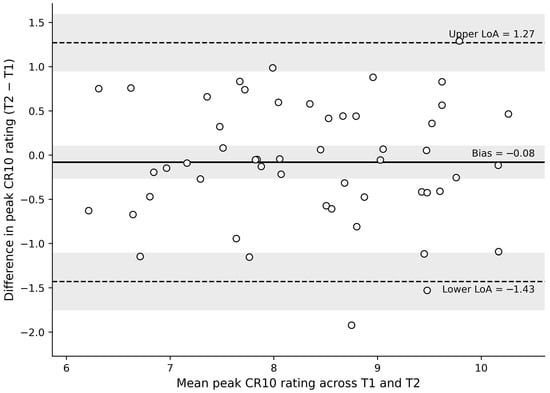
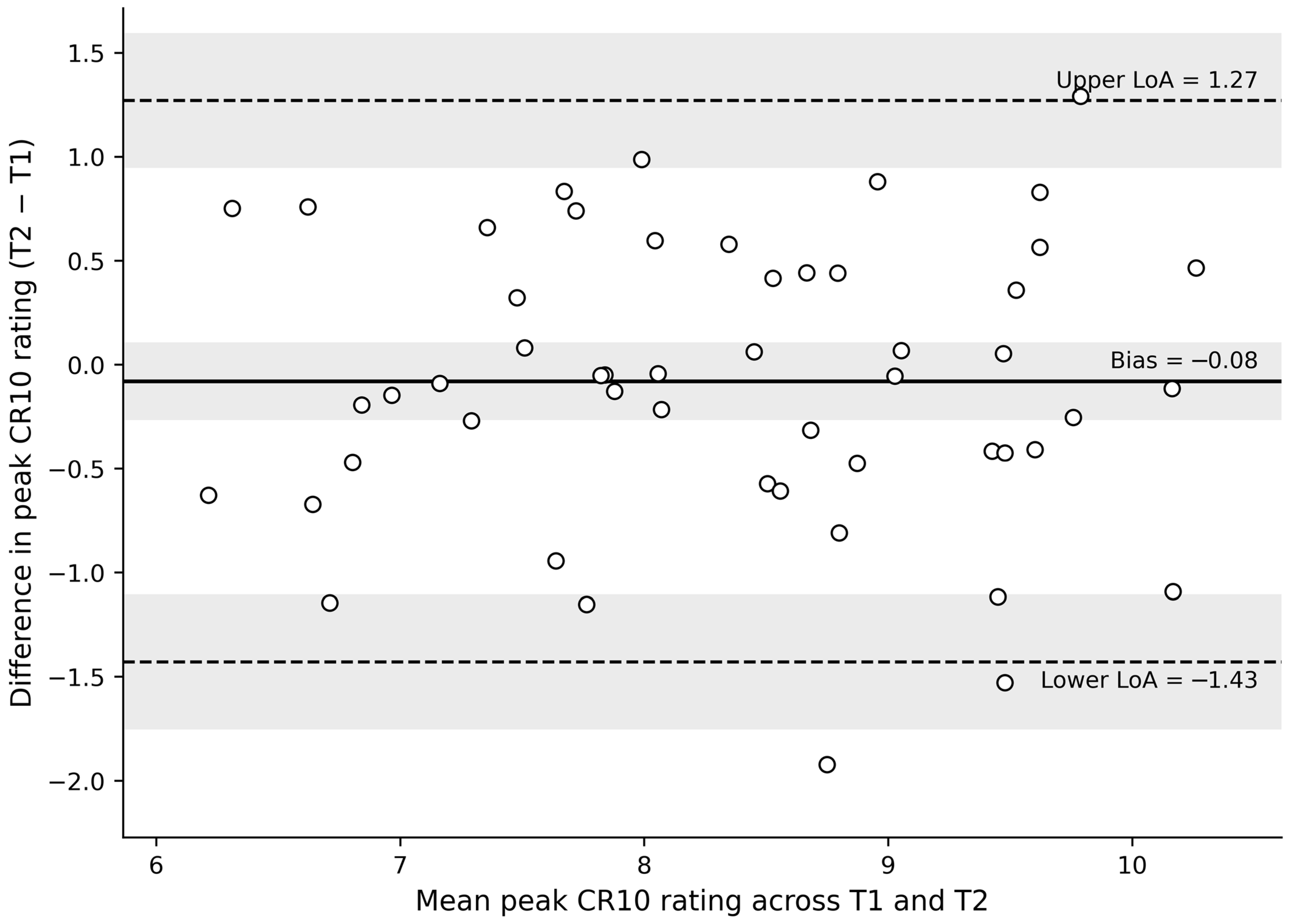
For peak CR10, ICC(A,1) was 0.82 (95% CI, 0.71–0.89), mean bias (T2 − T1) was −0.08 units, SEMagreement was 0.49 units, and MDC95 was 1.35 units (Table 6).
Table 6.
Test–retest reliability, agreement, and measurement error of CR10 ratings (n = 52).
At the matched submaximal work rate, ICC(A,1) was 0.86 (95% CI, 0.77–0.92), mean bias was −0.04 units, SEMagreement was 0.41 units, and MDC95 was 1.13 units, indicating slightly greater reproducibility and lower measurement error than for peak CR10 (Table 6).
The Bland–Altman plot for peak CR10 (Figure 2) showed differences centered near the mean bias without a marked visual pattern of heteroscedasticity or proportional disagreement; three of 52 paired observations (5.8%) lay outside the 95% limits of agreement.
Figure 2.
Bland–Altman agreement for peak CR10 ratings between T1 and T2 (n = 52).
4. Discussion
The present study provides evidence on selected measurement properties of the official Modern Standard Arabic Borg CR Scale® (CR10) for assessing momentary perceived exertion. Its principal contribution lies not in developing a new Arabic version, but in empirically evaluating the existing official instrument and its accompanying instructions without linguistic or structural modification. Across cognitive interviewing, incremental exercise, recovery, and repeated testing, the findings support the instrument’s comprehensibility, its theoretically expected behavior in relation to changing exercise demand, and its reproducibility under standardized conditions. These findings should be interpreted as evidence for the specific measurement properties examined, rather than as comprehensive validation of the CR10 across populations, exercise modalities, or applications.
The distinction between the availability of an official language version and empirical evidence regarding its measurement properties is important. Translation and linguistic certification establish the existence and provenance of an Arabic version, but they do not establish that respondents understand the intended construct, interpret the verbal anchors appropriately, or use the response structure as intended [9,10,11,12,19,33,34,35,36,37]. Cognitive interviewing therefore provided complementary evidence on the response process, including comprehension, judgment, and response selection [27,28,29,38]. The generally favorable findings across participants with heterogeneous activity and training backgrounds support the comprehensibility of the official Arabic CR10 within the adult sample examined.
Nevertheless, the cognitive findings identify aspects of the category-ratio structure that warrant particular attention during administration. Interpretive uncertainty was more apparent for the 0.5 anchor and for features at the upper end of the scale, including ratings above 10 and the separate absolute-maximum category; for these three categories, the upper 95% confidence limits exceeded the 15% operational criterion. These observations are relevant because the CR10 is not a conventional closed 0–10 numerical rating scale. Ratings above 10 are permitted when perceived magnitude exceeds the reference level at 10, whereas the absolute-maximum category retains a distinct conceptual function [1,2,19]. Accordingly, occasional uncertainty concerning these categories does not justify simplifying, truncating, or modifying the official instrument; rather, it reinforces the importance of presenting the complete scale and using the official instructions consistently.
The exercise findings provide convergent-validity evidence within the prespecified construct-validity framework. Perceived exertion increased systematically with exercise demand and covaried strongly with both mechanical work rate and cardiovascular strain, consistent with established relationships among exertion ratings, external workload, and physiological responses during graded exercise [1,2,3,4,5,39]. Importantly, neither work rate nor HR constitutes a criterion or gold-standard measure of perceived exertion. Perceived exertion is an integrative psychophysiological response that reflects multiple central and peripheral signals and cannot be reduced to any single physiological variable [1,2,3,4,5,39,40].
The modestly stronger within-participant association with mechanical work rate than with HR is theoretically plausible. Mechanical work rate represented the external demand directly manipulated by the incremental protocol, whereas HR represented one physiological response to that demand and is additionally influenced by individual cardiovascular characteristics, training status, autonomic regulation, and response kinetics. The observed pattern therefore provides convergent support for the expected behavior of perceived exertion without establishing criterion validity or implying that either external variable constitutes a reference standard. An important qualification is that the ramp protocol imposed a monotonic increase in work rate with elapsed time, while perceived exertion also typically increases across incremental exercise. Consequently, the high repeated-measures CR10–work-rate correlation may partly reflect this shared progression and should not be interpreted as a time-independent relationship. The finding is most appropriately viewed as evidence that CR10 ratings tracked the prescribed graded increase in external demand under the present protocol.
The contrast between the strong within-participant relationships observed throughout incremental exercise and the more moderate end-of-exercise associations is informative rather than contradictory. Repeated-measures correlation evaluates whether within-individual changes in perceived exertion track concurrent changes in exercise demand, whereas terminal associations compare individuals who may differ substantially in fitness, exercise tolerance, physiological response, and the workload or duration required to reach test termination. These analyses therefore address distinct aspects of convergent-validity evidence. For the peak work-rate and end-of-exercise heart-rate associations, point estimates met the prespecified ρ ≥ 0.40 criterion but their 95% confidence intervals extended below it; the findings therefore support positive associations without establishing that the underlying magnitudes are necessarily ≥ 0.40. The use of repeated-measures correlation as the primary analytical approach appropriately reflects the longitudinal within-participant structure of the exercise data [31].
The recovery analysis provides supportive evidence while addressing an important analytical issue. Because both perceived exertion and HR decline systematically after exercise, an unadjusted association may partly reflect their shared dependence on elapsed recovery time. By separating within-participant heart-rate variation from between-participant differences and explicitly accounting for recovery minute, the mixed-effects analysis provided a more defensible assessment of moment-to-moment covariation during recovery. The persistent within-participant association is consistent with the expected decline in perceived exertion as physiological strain resolves. Nevertheless, these recovery findings should remain supportive because they represent associative evidence within a dynamic post-exercise process rather than an independent validation criterion.
The test–retest findings should be interpreted through the joint consideration of relative reliability, absolute agreement, and measurement error [22,23,24,25,32]. Peak CR10 was selected as the primary reliability outcome to characterize the reproducibility of the highest numerical perceived-exertion rating elicited by the complete individualized incremental test. This endpoint can incorporate day-to-day variation in physiological state, motivation, exercise tolerance, and achieved performance in addition to variability in the rating process itself. The matched submaximal outcome therefore provided a complementary assessment at the same absolute external work rate, where reproducibility was slightly stronger. Thus, reliability is conditional on the measurement context rather than an invariant property of the CR10.
The agreement and measurement-error analyses further qualify the interpretation of reproducibility. Limited average systematic bias does not imply identical ratings within every participant across repeated sessions, making Bland–Altman analysis complementary to the ICC [23,24,25,32]. For peak CR10, SEMagreement = 0.49 units estimates the standard deviation of measurement error for a single peak rating under the study conditions, while MDC95 = 1.35 units represents the estimated minimum absolute difference between two peak ratings that would be detectable beyond measurement error at the 95% level under comparable conditions. For example, an absolute difference of 1.0 unit is below the MDC95, whereas a difference of 1.5 units exceeds it. A difference below 1.35 units does not establish absence of change, and a difference above 1.35 units does not by itself establish clinical or practical importance. SEM and MDC should therefore not be interpreted as estimates of minimally important change, because statistical detectability and practical importance are conceptually distinct.
Comparisons with previous language-specific investigations and generalization across exercise contexts require careful consideration of measurement context. Haddad et al. [13] evaluated a French version of a modified CR10 within the session-RPE framework, which is a retrospective global judgment of an entire exercise session and differs conceptually from the momentary perceived-exertion ratings examined here. Investigations of Hindi and Portuguese Borg-derived scales likewise differ in population, instrument form, exercise modality, administration procedure, and analytical framework [20,21]. Accordingly, the present findings concern momentary perceived exertion during standardized incremental cycling and recovery and do not establish equivalent performance for session-RPE, running, resistance exercise, rehabilitation, intermittent sport, or field-based monitoring. Those applications require separate evaluation.
Several methodological features strengthen confidence in the interpretation of the present findings. The official Arabic instrument was evaluated without modification, preserving the original category-ratio structure and complete response range. Cognitive interviewing examined actual response processes in participants with heterogeneous activity and training backgrounds rather than relying solely on linguistic documentation. The quantitative phase incorporated familiarization and protocol calibration, highly standardized repeated testing, and a matched-load reliability assessment. The statistical approach addressed the repeated-measures structure. In fact, repeated-measures correlation preserved within-participant dependence during incremental exercise, the recovery model explicitly addressed time-dependent covariation, and reproducibility was characterized using complementary measures of relative reliability, absolute agreement, and measurement error [22,23,24,25,31,32]. Together, these features provide a coherent framework for evaluating selected measurement properties of the official Arabic CR10.
Several limitations should be considered. First, participants were Arabic-speaking adults able to read Modern Standard Arabic and were recruited within a single geographic setting. Although inclusion of participants with different physical-activity and training backgrounds increased sample heterogeneity, the study cannot establish equivalent measurement performance across the full sociolinguistic diversity of Arabic-speaking populations. Differences in educational background, proficiency in Modern Standard Arabic, dialect exposure, age, and clinical status may affect comprehension or response processes and warrant investigation in broader populations.
Second, the quantitative evaluation was restricted to standardized ramp-incremental cycle ergometry. Although this controlled design strengthened internal validity and stimulus reproducibility, it limits direct generalization to running, resistance exercise, intermittent activity, prolonged exercise, rehabilitation, and field-based sport. Convergent evidence was also based principally on mechanical work rate and HR. Additional physiological measures, such as oxygen uptake, ventilation, or blood lactate, could provide broader physiological triangulation, although none should be regarded as a gold standard for perceived exertion [4,5,39].
Third, uncertainty remained around several relatively uncommon cognitive ambiguities despite favorable overall point estimates. Larger and more sociolinguistically diverse samples would provide greater precision for these less frequent response-process difficulties. In addition, 20 of the 72 participants with valid T1 assessments did not complete T2 (27.8%), so test–retest reliability, agreement, and measurement-error estimates were based on 52 paired completers. Although measured baseline characteristics showed no marked descriptive imbalance between completers and non-completers, this does not establish equivalence or exclude attrition related to unmeasured characteristics; the reliability estimates should therefore be interpreted with this limitation in mind.
Finally, the study addressed specific measurement properties within a specific standardized testing paradigm. Responsiveness, minimally important change, longer-term stability, measurement invariance across demographic or activity subgroups, and performance in clinical, rehabilitation, field-based, or longitudinal monitoring contexts were not evaluated. These properties should be examined separately before broader, context-independent claims regarding the Arabic CR10 are made.
5. Conclusions
The present study supports the measurement properties examined for the official Modern Standard Arabic Borg CR10 for momentary perceived exertion in Arabic-speaking adults from Tunisia, under standardized incremental cycling conditions, including comprehensibility, convergent-validity evidence, test–retest reliability, agreement, and measurement error. The findings also reinforce the importance of preserving the complete official scale structure and administration instructions, including ratings above 10 and the separate absolute-maximum category. These results should not be interpreted as demonstrating equivalent measurement performance across the wider Arabic-speaking population, other exercise modalities, session-RPE applications, rehabilitation, or field-based sport; those contexts require separate evaluation.
Supplementary Materials
The following supporting information can be downloaded at https://www.mdpi.com/article/10.3390/sports14110474/s1, Table S1: Cognitive-interview outcomes for the official Modern Standard Arabic Borg CR Scale® (CR10).
Author Contributions
All authors conceptualized the study. M.A.B., M.K., H.J. and L.M. collected the data. M.A.B., H.C., H.J., M.K., L.M. and K.T. conducted the literature review and prepared the first draft of the manuscript. L.M., A.A., M.K., H.J. and H.C. conducted the statistical analyses. All authors interpreted the data, critically reviewed the manuscript, contributed to the final version, and approved the version submitted. All authors have read and agreed to the published version of the manuscript.
Funding
This research received no external funding.
Institutional Review Board Statement
The study was approved by the Research Ethics Committee of the High Institute of Sport and Physical Education of Sfax, University of Sfax (CERS-ISSEPS-0012/2026, approval date: 24 March 2026), and was conducted in accordance with the Declaration of Helsinki. Participation was voluntary.
Informed Consent Statement
Informed consent was obtained from all subjects involved in the study.
Data Availability Statement
The data presented in this study are available on request from the corresponding author upon reasonable request due to participant confidentiality.
Conflicts of Interest
The authors declare no conflicts of interest.
Abbreviations
The following abbreviations are used in this manuscript:
| CR10 | Borg CR Scale® (CR10) |
| RPE | Rating of Perceived Exertion |
| HR | Heart Rate |
| ICC | Intraclass Correlation Coefficient |
| ICC(A,1) | Two-Way Random-Effects, Absolute-Agreement, Single-Measure Intraclass Correlation Coefficient |
| CI | Confidence Interval |
| LoA | Limits of Agreement |
| SEM | Standard Error of Measurement |
| SEMagreement | Standard Error of Measurement for absolute agreement |
| MDC95 | Minimal Detectable Change at the 95% confidence level |
| r_rm | Repeated-Measures Correlation |
| SD | Standard Deviation |
| BMI | Body Mass Index |
| T1 | Test Session 1 |
| T2 | Test Session 2 |
| V0 | Familiarization and Protocol-Calibration Visit |
| Holm | Holm Multiple-Comparison Adjustment |
| P | p-value/Probability Value |
References
- Borg, G.A. Psychophysical bases of perceived exertion. Med. Sci. Sports Exerc. 1982, 14, 377–381. [Google Scholar] [CrossRef] [Scilit]
- Borg, G. Psychophysical scaling with applications in physical work and the perception of exertion. Scand. J. Work Environ. Health 1990, 16, 55–58. [Google Scholar] [CrossRef] [Scilit] [PubMed]
- Robertson, R.J.; Noble, B.J. Perception of physical exertion: Methods, mediators, and applications. Exerc. Sport Sci. Rev. 1997, 25, 407–452. [Google Scholar] [CrossRef] [Scilit]
- Chen, M.J.; Fan, X.; Moe, S.T. Criterion-related validity of the Borg ratings of perceived exertion scale in healthy individuals: A meta-analysis. J. Sports Sci. 2002, 20, 873–899. [Google Scholar] [CrossRef] [Scilit] [PubMed]
- Scherr, J.; Wolfarth, B.; Christle, J.W.; Pressler, A.; Wagenpfeil, S.; Halle, M. Associations between Borg’s rating of perceived exertion and physiological measures of exercise intensity. Eur. J. Appl. Physiol. 2013, 113, 147–155. [Google Scholar] [CrossRef] [Scilit] [PubMed]
- Foster, C.; Florhaug, J.A.; Franklin, J.; Gottschall, L.; Hrovatin, L.A.; Parker, S.; Doleshal, P.; Dodge, C. A new approach to monitoring exercise training. J. Strength Cond. Res. 2001, 15, 109–115. [Google Scholar] [CrossRef] [Scilit]
- Impellizzeri, F.M.; Rampinini, E.; Coutts, A.J.; Sassi, A.; Marcora, S.M. Use of RPE-based training load in soccer. Med. Sci. Sports Exerc. 2004, 36, 1042–1047. [Google Scholar] [CrossRef] [Scilit] [PubMed]
- Halson, S.L. Monitoring training load to understand fatigue in athletes. Sports Med. 2014, 44, S139–S147. [Google Scholar] [CrossRef] [Scilit] [PubMed]
- Guillemin, F.; Bombardier, C.; Beaton, D. Cross-cultural adaptation of health-related quality of life measures: Literature review and proposed guidelines. J. Clin. Epidemiol. 1993, 46, 1417–1432. [Google Scholar] [CrossRef] [Scilit] [PubMed]
- Beaton, D.E.; Bombardier, C.; Guillemin, F.; Ferraz, M.B. Guidelines for the process of cross-cultural adaptation of self-report measures. Spine 2000, 25, 3186–3191. [Google Scholar] [CrossRef] [Scilit] [PubMed]
- Wild, D.; Grove, A.; Martin, M.; Eremenco, S.; McElroy, S.; Verjee-Lorenz, A.; Erikson, P.; ISPOR Task Force for Translation and Cultural Adaptation. Principles of good practice for the translation and cultural adaptation process for patient-reported outcomes (PRO) measures: Report of the ISPOR Task Force for Translation and Cultural Adaptation. Value Health 2005, 8, 94–104. [Google Scholar] [CrossRef] [Scilit] [PubMed]
- Sousa, V.D.; Rojjanasrirat, W. Translation, adaptation and validation of instruments or scales for use in cross-cultural health care research: A clear and user-friendly guideline. J. Eval. Clin. Pract. 2011, 17, 268–274. [Google Scholar] [CrossRef] [Scilit] [PubMed]
- Haddad, M.; Chaouachi, A.; Castagna, C.; Hue, O.; Wong, D.; Tabben, M.; Behm, D.; Chamari, K. Validity and psychometric evaluation of the French version of RPE scale in young fit males when monitoring training loads. Sci. Sports 2013, 28, e29–e35. [Google Scholar] [CrossRef] [Scilit]
- Kerkeni, M.; Ammar, A.; Boukhris, O.; Hbaieb, E.; Kerkeni, M.; Zmijewski, P.; Chtourou, H.; Aziz, A.R.; Jahrami, H.; Turki, M.; et al. Does pretraining napping improve time-motion metrics and psychophysiological responses during small-sided games in Ramadan-fasted professional soccer players? J. Sports Sci. 2026, 44, 1911–1924. [Google Scholar] [CrossRef] [Scilit] [PubMed]
- Kerkeni, M.; Chamari, K.; Kerkeni, M.; Boukhris, O.; Ammar, A.; Pyne, D.B.; Husain, W.; Chtourou, H.; Aziz, A.R.; Jahrami, H.; et al. Does Ramadan fasting influence time-motion metrics and psychophysiological responses in soccer players during small-sided games performed in fed and fasted states? Biol. Sport 2026, 43, 679–691. [Google Scholar] [CrossRef] [Scilit] [PubMed]
- Kerkeni, M.; Boukhris, O.; Kerkeni, M.; Ammar, A.; Husain, W.; Zmijewski, P.; Jahrami, H.; Chtourou, H.; Trabelsi, K. Effects of a 90-min nap on time-motion metrics and psychophysiological responses during small-sided games in professional soccer players. Scand. J. Med. Sci. Sports 2026, 36, e70193. [Google Scholar] [CrossRef] [Scilit] [PubMed]
- Baccouche, M.A.; Trabelsi, K.; Masmoudi, L.; Jahrami, H.; Ammar, A.; Chtourou, H. Cross-cultural adaptation and validation of the Arabic Rating-of-Fatigue Scale. Sports Med. Open 2026, 12, 76. [Google Scholar] [CrossRef] [Scilit] [PubMed]
- United Nations. World Arabic Language Day. 2026. Available online: https://www.un.org/en/observances/arabiclanguageday (accessed on 1 September 2026).
- BorgPerception AB. Borg CR Scale® (CR10): Official Licensing and Translation Certificates. 2026. Available online: https://borgperception.se/ (accessed on 17 August 2026).
- Shah, R.R.; Nagarwala, R.; Retharekar, S.; Dabadghav, R.P.; Shyam, A.; Sancheti, P. Translation and validation of the modified Borg scale (CR-10) in Hindi language in healthy Indian adults. Indian J. Respir. Care 2022, 11, 24–29. [Google Scholar] [CrossRef] [Scilit] [PubMed]
- Flôres, F.; Casanova, N.; Marconcin, P.; Silva, A.F.; Serpa, J.; Santos, V.; Soares, D.; Willig, R. Cross-cultural adaptation, validity, and reliability of the Borg Rating of Perceived Exertion CR-10 Scale in Portuguese adolescents. Open Sports Sci. J. 2025, 18, e1875399X386857. [Google Scholar] [CrossRef] [Scilit]
- Shrout, P.E.; Fleiss, J.L. Intraclass correlations: Uses in assessing rater reliability. Psychol. Bull. 1979, 86, 420–428. [Google Scholar] [CrossRef] [PubMed]
- Weir, J.P. Quantifying test–retest reliability using the intraclass correlation coefficient and the SEM. J. Strength Cond. Res. 2005, 19, 231–240. [Google Scholar] [CrossRef] [Scilit]
- Bland, J.M.; Altman, D.G. Statistical methods for assessing agreement between two methods of clinical measurement. Lancet 1986, 1, 307–310. [Google Scholar] [CrossRef] [Scilit]
- Koo, T.K.; Li, M.Y. A guideline of selecting and reporting intraclass correlation coefficients for reliability research. J. Chiropr. Med. 2016, 15, 155–163, Correction in J. Chiropr. Med. 2017, 16, 346. [Google Scholar] [CrossRef] [Scilit] [PubMed]
- Craig, C.L.; Marshall, A.L.; Sjöström, M.; Bauman, A.E.; Booth, M.L.; Ainsworth, B.E.; Pratt, M.; Ekelund, U.L.; Yngve, A.; Sallis, J.F.; et al. International Physical Activity Questionnaire: 12-country reliability and validity. Med. Sci. Sports Exerc. 2003, 35, 1381–1395. [Google Scholar] [CrossRef] [Scilit] [PubMed]
- Willis, G.B. Cognitive Interviewing: A Tool for Improving Questionnaire Design; SAGE Publications: Thousand Oaks, CA, USA, 2005. [Google Scholar] [CrossRef] [Scilit]
- Tourangeau, R.; Rips, L.J.; Rasinski, K. The Psychology of Survey Response; Cambridge University Press: Cambridge, UK, 2000. [Google Scholar] [CrossRef] [Scilit]
- Jobe, J.B. Cognitive psychology and self-reports: Models and methods. Qual. Life Res. 2003, 12, 219–227. [Google Scholar] [CrossRef] [Scilit] [PubMed]
- Schaffarczyk, M.; Rogers, B.; Reer, R.; Gronwald, T. Validity of the Polar H10 Sensor for heart rate variability analysis during resting state and incremental exercise in recreational men and women. Sensors 2022, 22, 6536. [Google Scholar] [CrossRef] [Scilit] [PubMed]
- Bakdash, J.Z.; Marusich, L.R. Repeated measures correlation. Front. Psychol. 2017, 8, 456, Correction in Front. Psychol. 2019, 10, 1201. [Google Scholar] [CrossRef] [Scilit] [PubMed]
- Atkinson, G.; Nevill, A.M. Statistical methods for assessing measurement error (reliability) in variables relevant to sports medicine. Sports Med. 1998, 26, 217–238. [Google Scholar] [CrossRef] [Scilit] [PubMed]
- Mokkink, L.B.; Terwee, C.B.; Patrick, D.L.; Alonso, J.; Stratford, P.W.; Knol, D.L.; Bouter, L.M.; de Vet, H.C. The COSMIN study reached international consensus on taxonomy, terminology, and definitions of measurement properties for health-related patient-reported outcomes. J. Clin. Epidemiol. 2010, 63, 737–745. [Google Scholar] [CrossRef] [Scilit] [PubMed]
- Terwee, C.B.; Prinsen, C.A.C.; Chiarotto, A.; Westerman, M.J.; Patrick, D.L.; Alonso, J.; Bouter, L.M.; de Vet, H.C.W.; Mokkink, L.B. COSMIN methodology for evaluating the content validity of patient-reported outcome measures: A Delphi study. Qual. Life Res. 2018, 27, 1159–1170. [Google Scholar] [CrossRef] [Scilit] [PubMed]
- Prinsen, C.A.C.; Mokkink, L.B.; Bouter, L.M.; Alonso, J.; Patrick, D.L.; de Vet, H.C.W.; Terwee, C.B. COSMIN guideline for systematic reviews of patient-reported outcome measures. Qual. Life Res. 2018, 27, 1147–1157. [Google Scholar] [CrossRef] [Scilit] [PubMed]
- Sperber, A.D.; DeVellis, R.F.; Boehlecke, B. Cross-cultural translation: Methodology and validation. J. Cross-Cult. Psychol. 1994, 25, 501–524. [Google Scholar] [CrossRef] [Scilit]
- Sperber, A.D. Translation and validation of study instruments for cross-cultural research. Gastroenterology 2004, 126, S124–S128. [Google Scholar] [CrossRef] [Scilit] [PubMed]
- Beatty, P.C.; Willis, G.B. Research synthesis: The practice of cognitive interviewing. Public Opin. Q. 2007, 71, 287–311. [Google Scholar] [CrossRef] [Scilit]
- Eston, R. Use of ratings of perceived exertion in sports. Int. J. Sports Physiol. Perform. 2012, 7, 175–182. [Google Scholar] [CrossRef] [Scilit] [PubMed]
- Marcora, S.M.; Staiano, W. The limit to exercise tolerance in humans: Mind over muscle? Eur. J. Appl. Physiol. 2010, 109, 763–770, Erratum in Eur. J. Appl. Physiol. 2010, 110, 1305. [Google Scholar] [CrossRef] [Scilit] [PubMed]

Disclaimer/Publisher’s Note: The statements, opinions and data contained in all publications are solely those of the individual author(s) and contributor(s) and not of MDPI and/or the editor(s). MDPI and/or the editor(s) disclaim responsibility for any injury to people or property resulting from any ideas, methods, instructions or products referred to in the content. |
© 2026 by the authors. Licensee MDPI, Basel, Switzerland. This article is an open access article distributed under the terms and conditions of the Creative Commons Attribution (CC BY) license.