


Simple Summary
Drosophila suzukii (Diptera: Drosophilidae), a major invasive pest, damages berries and other soft-skinned fruits and causes heavy economic losses. Essential oils, extracted from numerous plant species, exhibit excellent insecticidal and repellent activities against many kinds of pests, which renders them ideal alternatives to chemical pesticides. Here, we found that sweet fennel essential oil exhibited significant repellency against D. suzukii in a dose-dependent manner, as well as bioactive constituent trans-anethole in the laboratory. Additionally, to explore whether the repellency was mediated by the Orco pathway, we generated the Orco knockout homozygous strain (Orco−/−) using CRISPR–Cas9 genome editing. The results indicated that the EAG responses and repellency were significantly reduced in Orco−/− flies, elicited by both sweet fennel essential oil and trans-anethole. Our study demonstrates that sweet fennel essential oil elicits strong Orco-mediated repellency against D. suzukii adults.
Abstract
Essential oils are promising alternatives to conventional chemical pesticides due to their toxic, repellent or oviposition-deterrent effects against many kinds of pests. Sweet fennel essential oil is widely recognized for its pharmacological, antimicrobial, and acaricidal properties. Moreover, several studies have demonstrated its insecticidal and repellent activities against insects. In this study, we found that sweet fennel essential oil exhibited strong dose-dependent repellent activity in the dual-choice still-air assay and oviposition behavioral assays against Drosophila suzukii adults. Next, we confirmed that trans-anethole was the most abundant constituent in sweet fennel essential oil using GC-MS. In addition, the results of the behavioral assays indicated that trans-anethole displayed comparable repellency against D. suzukii. Furthermore, an Orco knockout homozygous strain (Orco−/−) was generated using CRISPR–Cas9 genome editing, and the EAG responses of Orco−/− flies to sweet fennel oil and trans-anethole were completely abolished. The repellency elicited by sweet fennel oil and trans-anethole were also dramatically reduced. Taken together, these laboratory results not only reveal that sweet fennel oil holds potential in pest management but also demonstrate that its repellency is mediated by the Orco pathway.
1. Introduction
Drosophila suzukii, a globally devastating invasive insect pest, causes serious damage to a variety of fruit crops, such as grapes, cherries, berries, and many other soft-skinned fruits. The females possess a specialized serrated ovipositor that can directly pierce the peel of fruits for oviposition. Larvae feed and grow inside the fruits, which may concurrently induce fungal infection, eventually leading to fruit rot and abscission. Consequently, this process causes substantial economic losses for the soft fruit industry, particularly for strawberries and blueberries [1,2]. At present, chemical control is the dominant strategy for field management of D. suzukii, and insecticides including cyantraniliprole and deltamethrin are frequently applied in fruit cultivation. However, long-term and sole application of chemical pesticides has resulted in the development of resistance in field populations to various insecticides [3]. Meanwhile, conventional pesticide spraying tends to cause excessive pesticide residue on fruits, failing to meet the safety standards for fresh consumption and export [4]. Furthermore, broad-spectrum insecticides induce high mortality in natural enemies such as parasitic wasps, disrupt the intricate ecological balance of orchard habitats, and diminish the inherent natural regulatory potential among coexisting organisms [5]. The limited availability of chemical pesticides for organic farming, coupled with high costs and short persistence, further exacerbates the difficulties of pest control [6].
As environmentally friendly biogenic pesticides, plant essential oils possess diverse biological activities against a wide array of agricultural, forestry and public health pests. Essential oils exert toxic, repellent or oviposition deterrent effects against many kinds of pests, thus rendering them ideal alternatives to conventional chemical pesticides [7,8,9,10]. For example, Piper essential oil rapidly kills D. suzukii adults and suppresses oviposition while exhibiting low toxicity to parasitic natural enemies [8]. In addition, essential oils derived from thyme and lemongrass, as well as their major bioactive components such as carvacrol and citral, effectively repel adult flies and reduce fruit infestation [9]. Previous studies have reported that diverse plant essential oils exhibit both larvicidal activity and adult repellent activity against Aedes aegypti [7,10]. Similarly, essential oils from Spanish oregano, laurel or basil significantly inhibit oviposition in lepidopteran pests [11]. These multi-target effects further demonstrate the broad-spectrum management potential of plant essential oils. Meanwhile, the multi-constituent synergistic action of essential oils on insect neural and behavioral targets poses a low risk of resistance, and their eco-friendliness and low non-target toxicity effectively overcome the drawbacks of conventional chemical control [7,8,9,10,11].
Fennel essential oil is widely used in green pest control, food preservation, pharmaceuticals and daily chemicals. It exhibits prominent contact toxicity and repellent effects against sanitary pests such as houseflies [12]. Also, it possesses highly efficient fumigant and contact activity against stored-product pests such as Tribolium castaneum and Sitophilus granarius, thus serving as an eco-friendly alternative to synthetic insecticides for grain storage protection and pest management in livestock and poultry farming [13]. In the food industry, fennel essential oil is applied as a natural antioxidant or antimicrobial preservative, and its characteristic aroma is also broadly exploited for flavoring [14]. Because fennel essential oil is already permitted for use in food and cosmetic industries, registering it for pest control could be more straightforward than other chemicals and blends, which is a major advantage of using essential oil for pest management. The composition of fennel essential oil differs significantly between its two major chemotypes, sweet fennel and bitter fennel. Sweet fennel contains trans-anethole and fenchone, which imparts a sweet, fresh fragrance suitable for food, daily chemicals and medicinal applications. In contrast, bitter fennel is rich in fenchone and methyl chavicol, with a pungent, bitter odor [12,15]. In addition, plant part, geographical origin, genotype and extraction process all significantly affect the composition of essential oil, and such compositional variation directly determines the strength of its biological activity and its application scenarios [13,14,15,16]. Given that attraction or avoidance behaviors in D. suzukii are largely governed by olfactory perception, fennel essential oil may achieve its control efficacy by interfering with olfactory signaling.
The conserved function of odorant receptor co-receptor (Orco) as a core olfactory co-receptor in insects has been extensively verified across diverse insects [17]. For example, Liu et al. reported that knockout of the Orco gene resulted in no response to rice volatile compounds and consequently no host plant preference in Nilaparvata lugens [18]. A previous study in Spodoptera frugiperda revealed that Orco knockout severely reduced the electrophysiological responses to plant volatiles and sex pheromones, and the mating behavior was fully disrupted in Orco knockout males [19], which was confirmed in another study [20]. The behavioral avoidance of D. melanogaster to plant-derived repellent compounds is also Orco-dependent, and repellency was reduced or abolished in two Orco mutants [21]. Furthermore, the loss of Orco function in D. suzukii prevents attraction to the odor of ripe strawberries, and the enhanced egg laying elicited by the odor was abolished [22]. These findings confirm that Orco serves as a core molecular element regulating its host selection, repellent responses and oviposition decisions. Given that D. suzukii relies on Orco for olfactory host location, and that many plant volatiles exert repellency through Orco-dependent pathways, sweet fennel essential oil may act as a repellent by interfering with this pathway. However, its bioactivity against D. suzukii and Orco-dependent mechanism remain elusive. Here, we assessed the repellency and oviposition deterrence of sweet fennel essential oil against D. suzukii, determined which constituents account for its repellent activity, and verified whether the repellency is mediated by Orco.
2. Materials and Methods
2.1. Insects
D. suzukii, kindly provided by Shaoying Wu (Hainan University), were collected from the field in Haikou, Hainan Province, China (20° N, 110° E) in 2018 and have been reared in laboratory conditions for more than five years. Both the wild-type and Orco knockout strains of D. suzukii were reared under identical laboratory conditions. Flies were maintained on standard cornmeal-yeast agar medium (Genesee Scientific, San Diego, CA, USA). Poplar wood wool (Hualeji, Hangzhou, China) and filter paper (Jiaojie, Dongguan, China) were added to rearing containers. All flies were kept in a growth chamber at 25 ± 0.5 °C under 65 ± 5% relative humidity with a 12 h light/12 h dark photoperiod.
2.2. Essential Oils and Chemicals
Sweet fennel oil was purchased from Dr Wong Co., Ltd. (Guangzhou, China). The primary constituent of sweet fennel essential oil, trans-anethole (purity ≥ 98%), 95% limonene and 97% fenchone, were obtained from Macklin Biochemical Co., Ltd. (Shanghai, China).
2.3. Dual-Choice Still-Air Assay
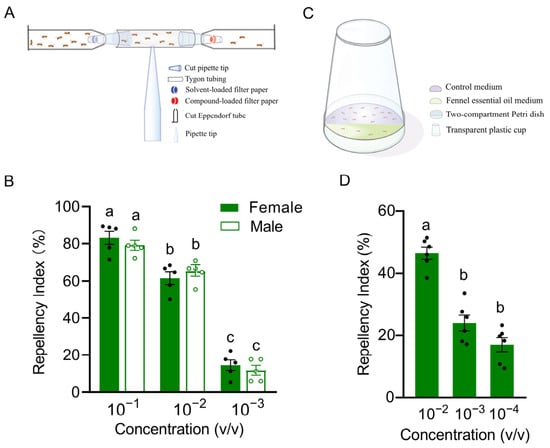
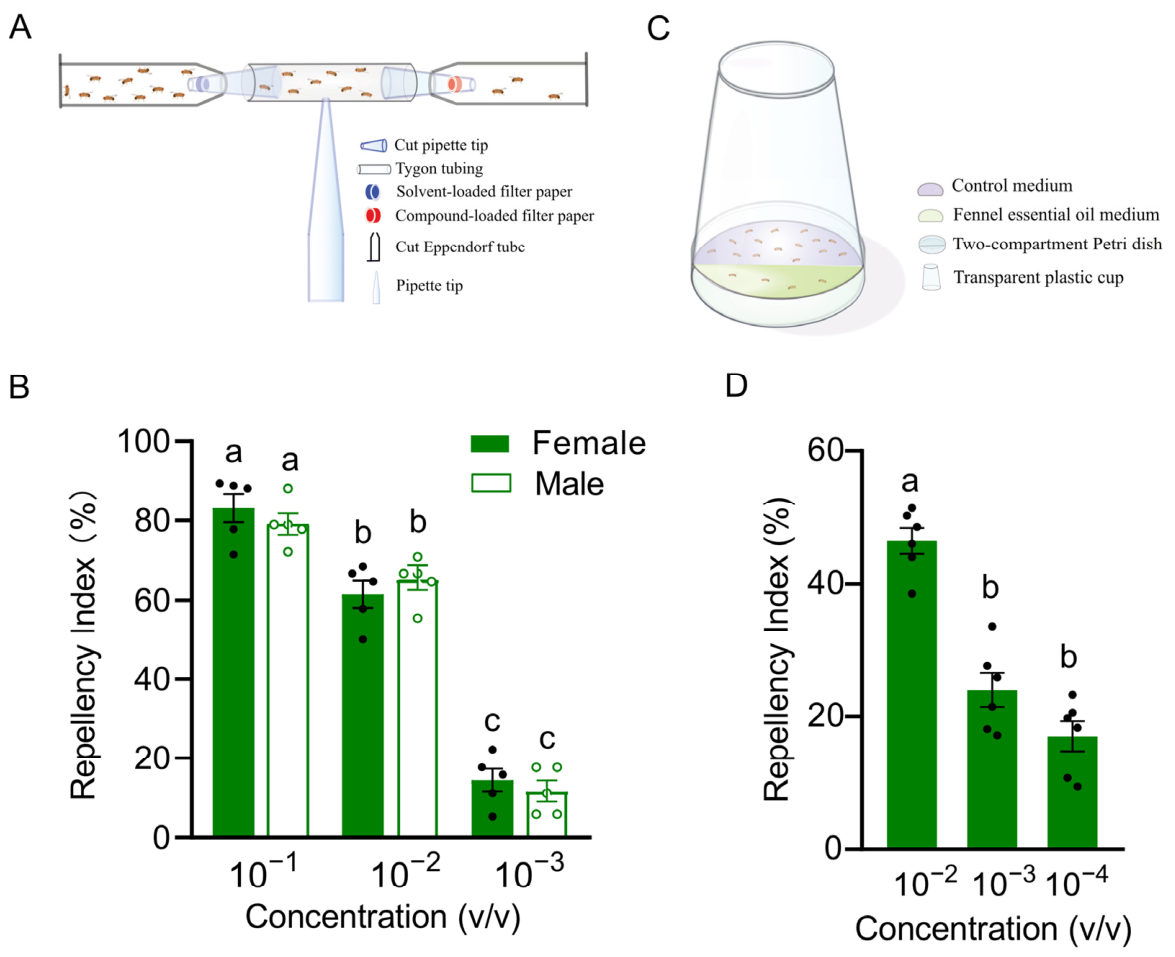
The apparatus (Figure 1A) consisted of three arms. The central starting zone was constructed from a pipette tip, while the two test arms were assembled from 1.5 mL microcentrifuge tubes and Tygon tubing (inner diameter 6.35 mm, length 4 cm), connected via 1000 μL pipette tips and arranged in a perpendicular T-shape. Small holes were pierced in the lids of the microcentrifuge tubes for ventilation. Filter paper (3.2 cm × 0.8 cm) saturated with 50 μL of the test odorant (dissolved in paraffin oil) or solvent control was affixed to the inner walls of the microcentrifuge tubes. Twenty 3- to 5-day-old D. suzukii were carefully transferred into the apparatus through the Tygon tubing. All assays were conducted in an environmental chamber maintained at 25 ± 0.5 °C with 65 ± 5% relative humidity under a 12 h light/12 h dark photoperiod. The number of flies in each test arm was recorded after 24 h. The Repellency Index (RI) was calculated as (C − O)/(O + C) × 100, with O referring to the flies counted in the odorant-treated arm and C to those in the solvent-control arm. To eliminate potential side bias, the two arms of the T-maze apparatus were swapped during replications.
Figure 1.
Repellency of sweet fennel essential oil against D. suzukii. (A) Schematic drawing of dual-choice still-air assay. (B) Repellency index of sweet fennel essential oil to female and male D. suzukii in dual-choice still-air assay (dilutions of sweet fennel essential oil were 10−1, 10−2 and 10−3 v/v, n = 5 for each dilution). (C) Schematic drawing of oviposition assay. (D) Repellency index of sweet fennel essential oil to D. suzukii in oviposition assay (dilutions of sweet fennel essential oil were 10−1, 10−2 and 10−3 v/v, n = 6 for each dilution). The number of eggs was as follows: 10−2 sweet fennel oil, 66.67 ± 2.89; control, 182.17 ± 3.32; 10−3 sweet fennel oil, 78.67 ± 3.88; control, 128.00 ± 3.03; 10−4 sweet fennel oil, 82.67 ± 2.06; control, 117.00 ± 4.86. Data are plotted as mean ± s.e.m. Dots denote the value of each repeat. Statistical analysis was conducted using one-way analysis of variance (ANOVA) followed by Tukey’s means separation test. Different letters indicate a significant difference between the repellency index of essential oils at different dilutions at p < 0.05.
2.4. Two-Choice Oviposition Preference Assay
The oviposition assay was performed as described by Joseph et al. (2009), with minor modifications [23]. The two-choice oviposition preference apparatus (Figure 1C) consisted of a transparent hollow cylinder (height 80 mm, diameter 60 mm) with an agar plate placed at the bottom to serve as the oviposition substrate for D. suzukii. A total of 10 μL, 1 μL or 0.1 μL of essential oil was individually added to 100 mL of cooled molten fly food to obtain the 10−2, 10−3 or 10−4 treatments, respectively. Equal volumes (10 mL) of grape juice agar medium supplemented with sweet fennel essential oil and the corresponding control medium were poured into each side of a two-compartment plate to form the selective oviposition medium. Before initiation, adult flies were conditioned on an agar plate containing yeast paste for 48 h to enhance fecundity. Subsequently, 40 adult flies at a female-to-male ratio of 3:1 were introduced into the apparatus to select oviposition sites without artificial interference. The experimental conditions were consistent with those of the dual-choice still-air assay. The number of eggs laid on the agar plates in the treatment and control groups was counted after 24 h. The Repellency Index (RI) of the oviposition assay was calculated as in the dual-choice still-air assay.
2.5. Electroantennography (EAG)
The head of each 3- to 5-day-old D. suzukii adult was immobilized at the narrow end of a truncated 200 μL pipette tip, which was affixed to a microscope slide with dental wax. The antenna was extended stably on a micromanipulator stage via glass microelectrodes, which were filled with 0.5% polyvinylpyrrolidone (PVP) and 0.1% potassium chloride. The distal region of one antenna was connected to the recording electrode, while the reference electrode was inserted into the contralateral eye. The target compounds were serially diluted with paraffin oil. A total of 10 μL of each dilution was applied to a filter paper strip (0.2 × 30 mm), which was then loaded into a Pasteur pipette to assemble the odorant delivery system. The antenna was continuously flushed with a humidified airflow at a rate of 20 mL/s, and a 0.5 s pulse stimulus (flow rate: 2 mL/s) was triggered by a CS55 stimulus controller (Syntech, Kirchzarten, Germany). EAG signals were amplified and captured via an IDAC-4 interface (Syntech, Kirchzarten, Germany), and the data were analyzed using EAG-Pro version 2 (Syntech, Kirchzarten, Germany). Each compound was tested with only one stimulus administered per individual fly. EAG response values were calculated by subtracting the average response elicited by paraffin oil.
2.6. Orco Knockout Line (Orco−/−) Establishment
The Orco knockout line of D. suzukii was successfully established using the CRISPR–Cas9 gene editing system developed by Kistler et al. [24]. Specific sgRNAs targeting the first exon of the Orco gene (Gene ID: NM_001328601.1) were precisely designed using Zifit (https://chopchop.cbu.uib.no, accessed on 6 June 2026). The template of sgRNA was generated from a linear DNA template, which was amplified with primers (Table 1) by Phusion HighFidelity DNA Polymerase (NEB, Shanghai, China). The sgRNA was synthesized using the MEGAshortscript T7 High Yield Transcription Kit (Thermo Fisher Scientific, Shanghai, China) according to the manufacturer’s protocol. Cas9 protein was purchased from Invitrogen (Thermo Fisher Scientific, Shanghai, China). The injection was outsourced to a company (Fungene, Qidong, China). Progeny flies were genotyped using genomic PCR and sequencing. The primers used for genotyping are given in Table 1. Multigenerational crossing, screening and homozygous breeding were then performed to purify the genetic background. Four independent mutant individuals were used to generate the final homozygous knockout strain, Orco−/−.
Table 1.
The primers used in this study.
2.7. Gas Chromatography–Mass Spectrometry (GC-MS)
Chemical constituents of sweet fennel essential oil were identified using a gas chromatography–mass spectrometry (GC-MS) system (QP2010 Plus, Kyoto, Japan) following the protocol described in our previous study [25]. An HP-5MS capillary column (30 m × 0.25 mm × 0.25 μm, Kyoto, Japan) was used for chromatographic separation. The temperature of the injector, transfer line and ion source were set to 250 °C, 290 °C and 230 °C, respectively. The column oven temperature was programmed: an initial temperature of 60 °C was held for 2 min, increased to 180 °C at 5 °C/min, then further raised to 280 °C at 10 °C/min. Helium served as the carrier gas with a constant flow rate of 1 mL/min. For sample pretreatment, essential oils were diluted to 1% (v/v) using ethyl acetate, and the injection volume was 1 μL. Mass spectrometry parameters were set as follows: scan rate of 0.5 scan/s, mass range of m/z 40–350, split ratio of 1:200, and ionization energy of 70 eV.
2.8. Statistical Analysis
GraphPad Prism 9.4.0 (GraphPad Software, San Diego, CA, USA) served as the tool for all statistical analyses, with the Shapiro–Wilk test adopted to assess the normality of the data. Repellency indices across diverse odorant dilutions were analyzed via one-way ANOVA, with Tukey’s multiple comparisons test or the Kruskal–Wallis test coupled with the Nemenyi test according to the parametric test prerequisites. Student’s unpaired t-test enabled direct comparison of EAG responses or repellency indices between the wild-type flies and Orco−/− flies.
3. Results
3.1. Sweet Fennel Essential Oil Repels D. suzukii Adults
We conducted two behavioral assays, the dual-choice still-air assay and oviposition assay, to investigate the repellency of sweet fennel essential oil against D. suzukii adults. The results of the dual-choice still-air assay showed that sweet fennel essential oil exhibited a significant repellent effect against both male and female flies. It exhibited strong repellent effects at the 10−1 and 10−2 dilutions (v/v), while it had no repellency at the 10−3 (v/v) dilution (Figure 1B). Furthermore, a dose-dependent oviposition deterrent was also observed, with higher repellent activity at higher concentrations (Figure 1D).
3.2. Analysis of the Constituents of Sweet Fennel Essential Oil
Essential oil consists of multiple volatile constituents. In order to investigate the major constituents of sweet fennel oil, we analyzed its constituents using GC-MS. The most abundant constituent in sweet fennel essential oil was trans-anethole, at 87.67%. The constituents with the second and third highest contents were limonene and fenchone, with proportions of 2.56% and 1.82%, respectively (Table 2). The proportions of the other constituents were rather low.
Table 2.
Constituents with relative abundance > 0.5% in sweet fennel essential oil.
3.3. Trans-Anethole Was Responsible for Repelling D. suzukii Adults
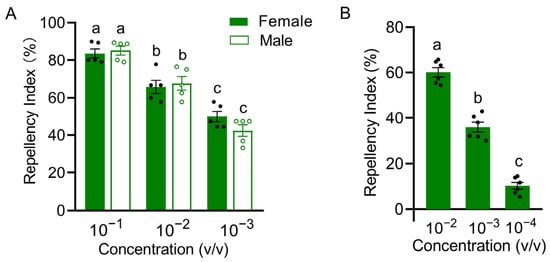
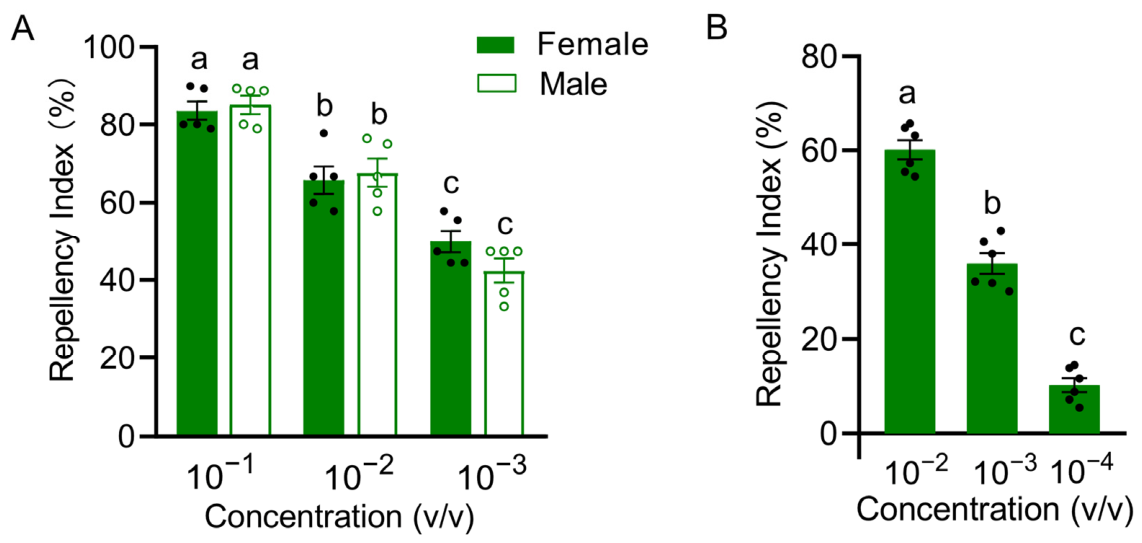
To investigate whether the major constituent, trans-anethole, was responsible for the repellency of sweet fennel oil, we evaluated the repellent activity of trans-anethole through the dual-choice still-air assay and oviposition assay. We found that trans-anethole exhibited significant repellency against flies in a dose-dependent manner in both assays. In the dual-choice still-air assay, trans-anethole showed repellency comparable to that of sweet fennel oil at 10−1 and 10−2 dilutions (v/v), and it maintained a repellency index of approximately 50% at the 10−3 dilution to both male and female flies (Figure 2A). Moreover, similar to that of sweet fennel essential oil, trans-anethole elicited significant oviposition deterrent at high concentrations (Figure 2B).
Figure 2.
Repellency of trans-anethole against D. suzukii. (A) Repellency index of trans-anethole to female and male D. suzukii in dual-choice still-air assay (dilutions of trans-anethole were 10−1, 10−2 and 10−3 v/v, n = 6 for each dilution). (B) Repellency index of trans-anethole to D. suzukii in oviposition assay (dilutions of trans-anethole were 10−2, 10−3 and 10−4 v/v, n = 6 for each dilution). The number of eggs was as follows: 10−2 trans-anethole, 28.67 ± 2.88; control, 113.50 ± 5.26; 10−3 trans-anethole, 55.00 ± 2.37; control, 117.00 ± 5.81; 10−4 trans-anethole, 105.33 ± 4.23; control 129.00 ± 5.02. Data are plotted as mean ± s.e.m. Dots denote the value of each repeat. Statistical analysis was conducted using one-way analysis of variance (ANOVA) followed by Tukey’s means separation test. Different letters indicate a significant difference between the repellency index of essential oils at different dilutions at p < 0.05.
3.4. Knockout of Orco Abolished the EAG Responses of Sweet Fennel Essential Oil and Trans-Anethole
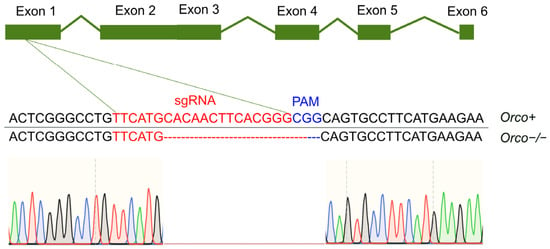
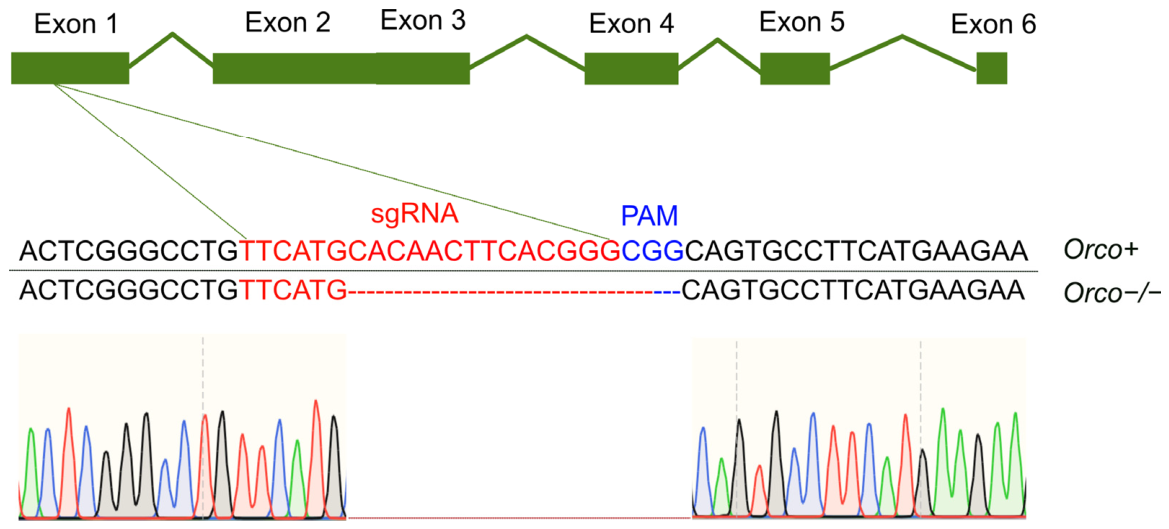
In order to verify whether the repellency elicited by sweet fennel essential oil was mediated by the Orco pathway, we used CRISPR–Cas9 genome editing to generate an Orco functional null D. suzukii strain. Among the diverse mutations, one mutation with a 17 bp deletion in the first exon of Orco, which introduced a frameshift mutation and resulted in a loss-of-function protein, was used to generate the Orco knockout homozygous strain (Orco−/−) after four generations of hybridization (Figure 3).
Figure 3.
CRISPR–Cas9-based knockout of Orco gene. The sgRNA targeting Orco gene was designed on exon 1 of the Orco gene. Homozygous mutation of Orco with a 17 bp nucleotide deletion in the genome was confirmed via sequencing. The dotted portion in the Orco−/− mutant indicates the nucleotide deletion.
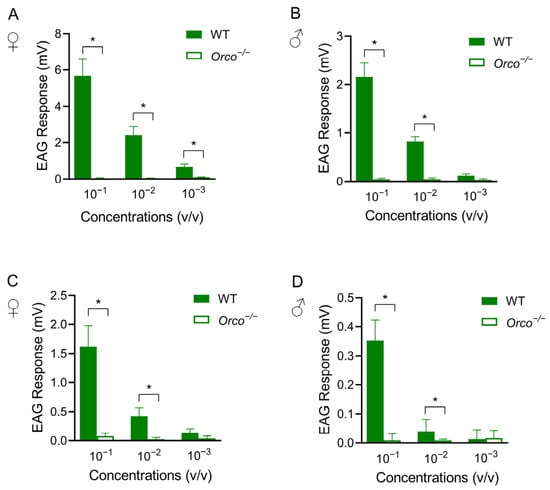
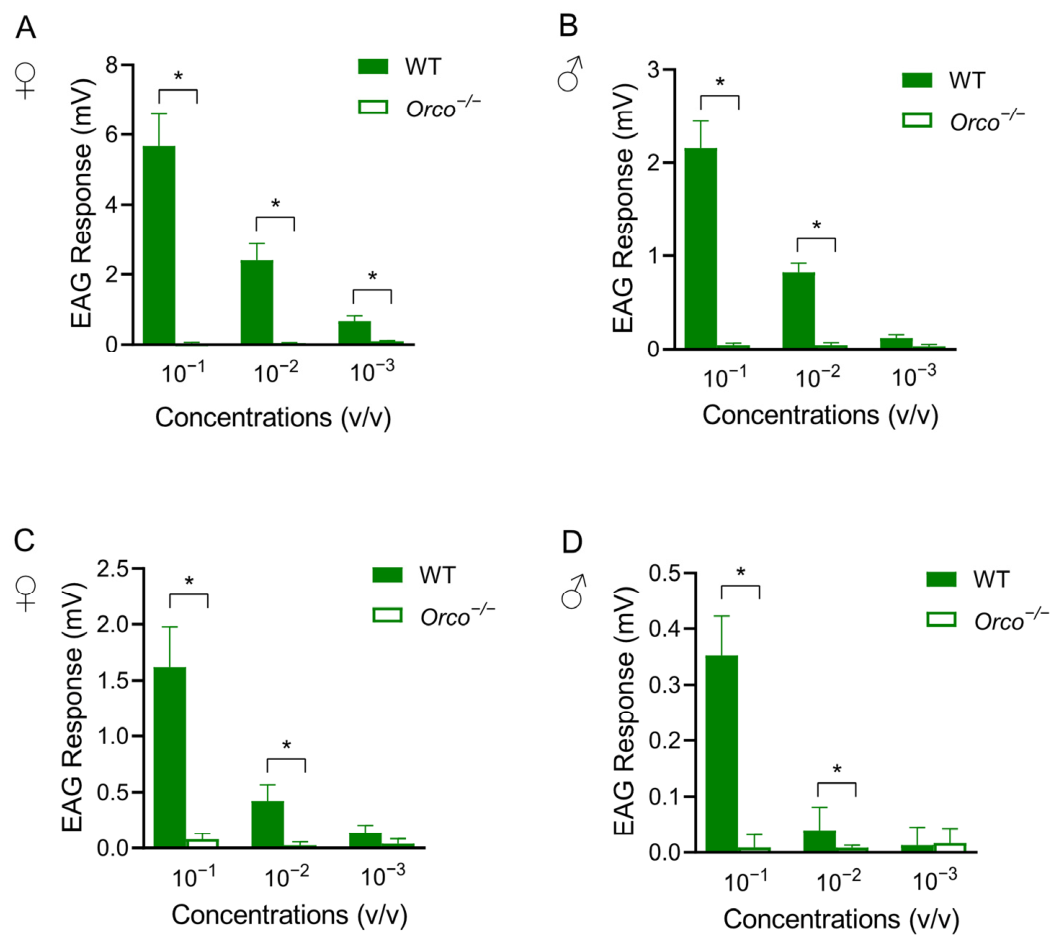
Then, we compared the EAG responses between wild-type and Orco−/− flies to explore whether sweet fennel essential oil and trans-anethole elicited EAG responses in D. suzukii and whether the EAG responses were affected by Orco knockout. We found that both sweet fennel oil (Figure 4A,B) and trans-anethole (Figure 4C,D) were able to elicit dose-dependent EAG responses in wild-type D. suzukii. Additionally, the EAG responses from females were much larger than those from males. Futhermore, the EAG responses of sweet fennel essential oil were obviously larger than those of trans-anethole. However, the EAG responses disappeared in both female and male Orco−/− flies at all concentrations, which was significantly different from those of wild-type D. suzukii (Figure 4).
Figure 4.
EAG responses of wild-type and Orco−/− D. suzukii to sweet fennel essential oil and trans-anethole. (A,B) EAG responses of female and male D. suzukii to sweet fennel essential oil. (C,D) EAG responses of female and male D. suzukii to trans-anethole. Data are plotted as mean ± s.e.m., n = 8. Statistical analysis was conducted using Student’s unpaired t-test, and asterisks indicate a significant difference between the responses for wild-type and Orco−/− flies at p < 0.05.
3.5. Sweet Fennel Essential Oil and Trans-Anethole Failed to Elicit Repellency in Orco−/− Flies
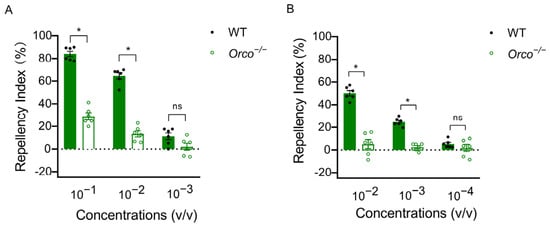
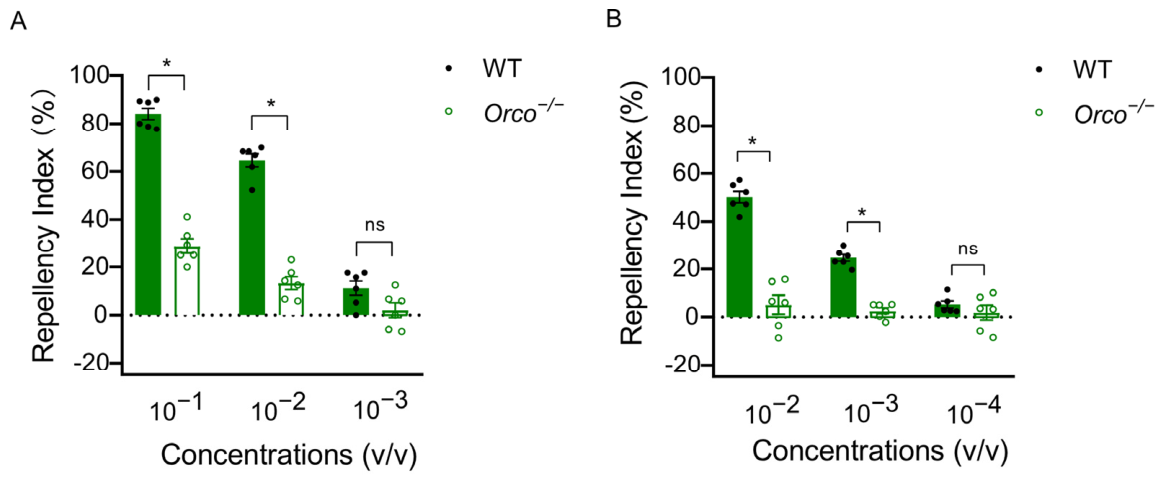
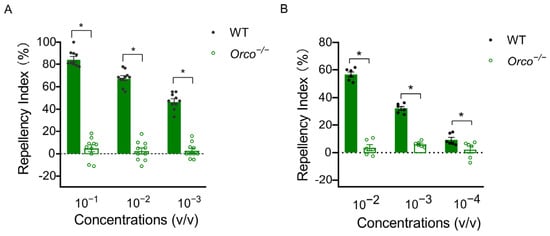
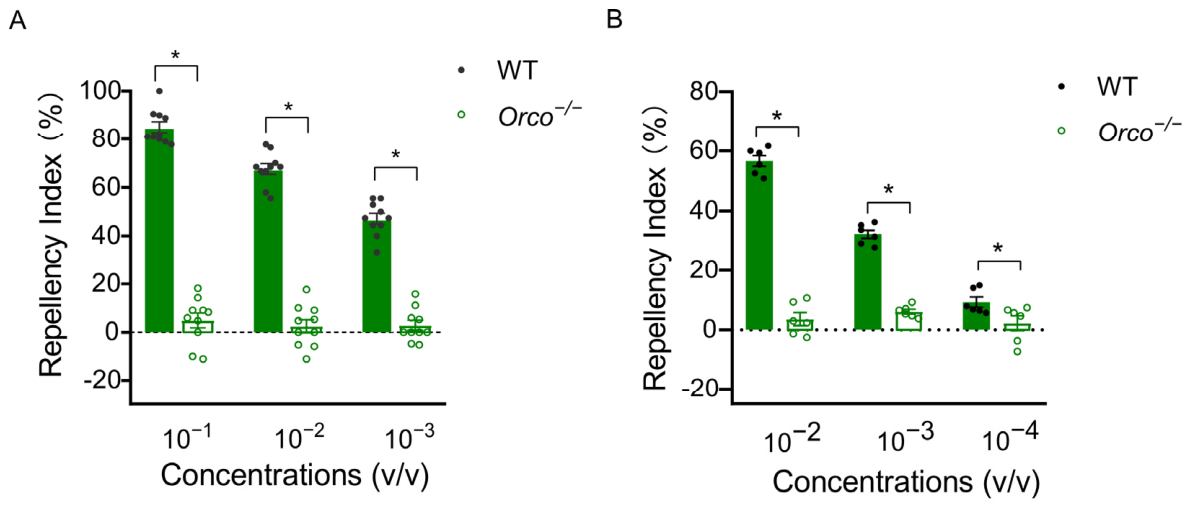
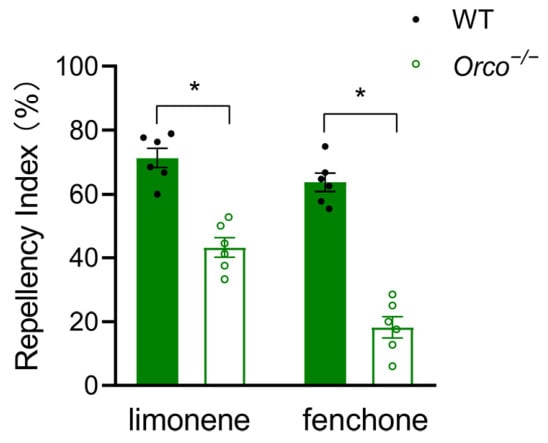
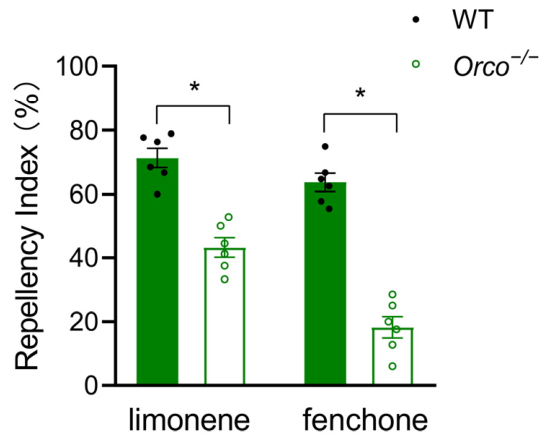
Behavioral assays were subsequently conducted with Orco−/− flies to determine the role of Orco. Since the EAG responses were abolished in both male and female Orco−/− files, we conducted the dual-choice still-air assay with mixed sexes in a 1:1 ratio. Inconsistent with those of the wild-type strain, the Orco−/− flies showed no significant avoidance to sweet fennel essential oil in the dual-choice still-air assay, except for 10−1 dilution (v/v), which exhibited a low Repellency Index of approximately 25% (Figure 5A). In addition, no significant oviposition deterrence was observed at any of the dilutions (Figure 5B). Moreover, we examined the repellency of trans-anethole against the Orco−/− strain. We found that the repellency was abolished in both assays at all dilutions (Figure 6), which was significantly different from that of wild-type flies. Finally, we also tested the repellency of minor constitutes, limonene and fenchone, against D. suzukii in the dual-choice still-air assay. Contrary to trans-anethole, both compounds exhibited low repellency to flies (Figure 7).
Figure 5.
Repellency of sweet fennel essential oil against wild-type (WT) and Orco−/− D. suzukii. (A) Repellency index of sweet fennel essential oil to D. suzukii in dual-choice still-air assay (dilutions of sweet fennel essential oil were 10−1, 10−2 and 10−3 v/v, n = 6 for each dilution). (B) Repellency index of sweet fennel essential oil to D. suzukii in oviposition assay (dilutions of sweet fennel essential oil were 10−2, 10−3 and 10−4 v/v, n = 6 for each dilution). The number of eggs was as follows: wild-type 10−2 sweet fennel oil, 56.00 ± 2.82; control, 169.00 ± 3.23; wild-type 10−3 sweet fennel oil, 89.33 ± 2.96; control, 147.83 ± 3.45; wild-type 10−4 sweet fennel oil, 105.83 ± 3.41; control, 117.50 ± 3.17; Orco−/− 10−2 sweet fennel oil, 96.50 ± 3.11; control, 107.83 ± 6.78; Orco−/− 10−3 sweet fennel oil, 108.00 ± 3.95; control, 114.17 ± 5.04; Orco−/− 10−4 sweet fennel oil, 102.83 ± 3.22; control, 107.17 ± 5.27. Data are plotted as mean ± s.e.m. Dots denote the value of each repeat. Statistical analysis was conducted using Student’s unpaired t-test, and asterisks indicate a significant difference between the repellency in wildtype and Orco−/− flies at p < 0.05.
Figure 6.
Repellency of trans-anethole against wild-type (WT) and Orco−/− D. suzukii. (A) Repellency index of trans-anethole to D. suzukii in dual-choice still-air assay (dilutions of trans-anethole were 10−1, 10−2 and 10−3 v/v, n = 10 for each dilution). (B) Repellency index of trans-anethole to D. suzukii in oviposition assay (dilutions of trans-anethole were 10−1, 10−2 and 10−3 v/v, n = 6 for each dilution). The number of eggs was as follows: wild-type 10−2 trans-anethole, 37.67 ± 2.33; control, 135.33 ± 2.33; wild-type 10−3 trans-anethole, 74.50 ± 3.14; control, 145.00 ± 2.72; wild-type 10−4 trans-anethole, 100.50 ± 3.89; control, 121.17 ± 4.82; Orco−/− 10−2 trans-anethole, 37.83 ± 1.54; control, 40.83 ± 6.24; Orco−/− 10−3 trans-anethole, 99.50 ± 3.43; control, 112.67 ± 5.15; Orco−/− 10−4 trans-anethole, 93.50 ± 4.35; control, 97.33 ± 1.78. Data are plotted as mean ± s.e.m. Dots denote the value of each repeat. Statistical analysis was conducted using Student’s unpaired t-test, and asterisks indicate a significant difference between the repellency in wild-type and Orco−/− flies at p < 0.05.
Figure 7.
Repellency of limonene and fenchone against wild-type (WT) and Orco−/− D. suzukii in dual-choice still-air assay. The dilution was 10−1 v/v. Data are plotted as mean ± s.e.m. Dots denote the value of each repeat. Statistical analysis was conducted using Student’s unpaired t-test, and asterisks indicate a significant difference between the repellency in wild-type and Orco−/− flies at p < 0.05.
4. Discussion
Plant essential oils have become promising and eco-friendly alternatives to conventional chemical pesticides owing to their environmental compatibility and low toxicity to mammals. Numerous essential oils have demonstrated strong repellency against D. suzukii, such as neem oil [26], Origanum vulgare oil, Artemisia herba-alba oil [27], Cinnamomum verum oil and Cymbopogon citratus oil [28], Litsea cubeba essential oil and Pectis brevipedunculata essential oil [29,30]. Fennel essential oil exhibited excellent repellent effects against Musca domestica [31], Sitophilus zeamais, Cryptolestes ferrugineus [32], Rhyzopertha dominica, and Tribolium confusum [33]. In the present study, we found that sweet fennel essential oil exerted significant repellent and oviposition-deterrent effects on adult D. suzukii, indicating the promising potential of fennel oil for pest management.
GC-MS analysis demonstrated that our tested sweet fennel essential oil belonged to the chemotype with high trans-anethole content [34,35,36]. As a typical monoterpenoid compound, trans-anethole has been proven to repel several agricultural pests and sanitary pests, including Plodia interpunctella [37], T. castaneum [38], M. domestica [39] and Periplaneta americana [40]. Existing evidence shows that star anise essential oil, which is rich in trans-anethole, displays strong repellency against D. melanogaster larvae [41]. Our results indicated that trans-anethole also exerts prominent repellent effects on adult D. suzukii, suggesting that essential oils abundant with trans-anethole might be excellent repellents against Drosophila species. In addition, pure trans-anethole exhibited comparable repellent activity to that of sweet fennel essential oil, further confirming that trans-anethole is the core active component responsible for the repellent and oviposition-deterrent effects of sweet fennel essential oil. Consistent with our previous study, the results revealed that EAG responses of females to odorants were stronger than those of males [42]. Here, we also compared the repellent efficiency of essential oil between the sexes, but no differences were found.
Feeding, mating, oviposition and other vital behaviors in insects are highly dependent on their olfactory systems. Our results showed that both sweet fennel essential oil and trans-anethole elicited obvious EAG responses in D. suzukii, indicating that both substances can be recognized by olfactory sensilla on fly antennae. Meanwhile, the EAG amplitude induced by sweet fennel oil was higher than that induced by constituent trans-anethole, which is consistent with our previous study in which clary sage oil elicited a larger EAG response than constituents linalyl acetate and linalool [25]. These results suggest that the olfactory system of D. suzukii is more sensitive to complex mixtures of essential oil components, and other minor volatile components might be also involved in the olfactory behavior.
A previous study indicated that D. melanogaster can suppress oviposition attraction to volatiles of ripe strawberries via an Orco-dependent pathway. However, the egg-laying behavior of D. suzukii was not affected by loss of Orco function; the Orco knockout strain remained attracted to both ripe strawberry odor substrates and the synthetic two-component blend [43]. These findings are discrepant with another study, which revealed that the loss of Orco function in D. suzukii prevented attraction to the odors of ripe strawberries, while besides Orco-mediated olfaction, contact chemosensation was also involved in the oviposition behavior of D. suzukii on ripe fruit [22]. Orco knockout eliminated the chemotactic response of D. suzukii to phenylacetaldehyde, a characteristic host volatile, and reduced olfactory sensitivity to acetic acid, a fermentation marker, thereby blocking the precise localization of ripe fruits at the peripheral sensory level [44]. Similar with that reported in D. melanogaster, Orco mediated the repellency of natural insecticide pyrethrum [45] and odorants including menthone, (R)-(+)-limoneneor and (+)-fenchone [21]. In this study, we also observed that the attraction of apple cider vinegar (ACV) disappeared in Orco−/− flies (Figure S1). Moreover, we found that the egg-laying ability of flies was not affected by Orco knockout, except at a high dose of trans-anethole, which slightly reduced egg numbers. Overall, our results showed that Orco knockout dramatically reduced the EAG responses and avoidance behaviors of flies to both sweet fennel essential oil and trans-anethole. These findings confirmed that the olfactory co-receptor Orco serves as a core target mediating odor recognition and the subsequent repellent behaviors.
Besides Orco-dependent signaling, other pathways might be involved in odorant recognition and behaviors. Flies may adopt distinct neural regulatory patterns in response to complex essential oils versus single chemical monomers. For instance, the dopamine signaling pathway specifically participates in regulating fly chemotaxis toward complex odors from a larval food or yeast paste, but it has no significant effect on responses to individual compounds [41]. Transient receptor potential ankyrin 1 (TRPA1) channels are nociceptors that can be activated by noxious heat or chemicals, and TRPA1 channels typically trigger repellency in mosquitoes [46,47,48], as well as in T. castaneum [49] and Lygus hesperus [50]. In this study, we found that the repellency of sweet fennel oil at high concentrations was not completely abolished in the T-maze assay, as well as those in minor constitutes, limonene and fenchone, indicating that Orco-independent mechanisms might also contribute. The complex oil likely activates a broad array of olfactory receptors or other pathways such as dopamine transmission and TRPA1 channels to trigger avoidance behavior in insects.
5. Conclusions
In conclusion, sweet fennel essential oil and the bioactive constituent trans-anethole evoked strong repellency in D. suzukii. Upon loss of Orco function, the EAG responses and repellency were significantly reduced, indicating that Orco is involved in the avoidance behavior of D. suzukii. Our results provide evidence that sweet fennel essential oil and trans-anethole are promising candidates for development as effective fly repellents and lay the foundation for exploring the molecular olfactory mechanism of natural plant essential oil in insects.
Supplementary Materials
The following supporting information can be downloaded at: https://www.mdpi.com/article/10.3390/insects17090957/s1, Figure S1: Preference index of apple cider vinegar against D. suzukii.
Author Contributions
Conceptualization, M.C.; methodology, J.Q., W.Z. and L.W.; investigation, J.Q., W.Z., L.W., C.T., F.W. and J.Y.; resources, M.C. and H.W.; writing—original draft preparation, M.C. and W.Z.; writing—review and editing, M.C. and C.T.; visualization, K.Z. and W.Z.; project administration, M.C.; funding acquisition, M.C., W.Z., Y.Z., H.W. and C.T. All authors have read and agreed to the published version of the manuscript.
Funding
This research was funded by Zhejiang Provincial Natural Science Foundation of China (No. ZCLMS26C1402 to M.C.), the National Innovation and Entrepreneurship Training Project (No. 202510341030 to W.Z.), Zhejiang Province’s “Three Rural and Nine Directions” Science and Technology Collaboration Plan (No. 2025SNJF066 to M.C.), the Joint Funds of the National Natural Science Foundation of China (No. U2243229 to H.W.), and the Medical and Health Science and Technology Plan of Zhejiang Province (No. 2024KY908 to C.T.).
Data Availability Statement
The data presented in this study are available upon request from the corresponding author.
Conflicts of Interest
The authors declare no conflicts of interest.
References
- Tait, G.; Cabianca, A.; Grassi, A.; Pfab, F.; Oppedisano, T.; Puppato, S.; Mazzoni, V.; Anfora, G.; Walton, V.M. Drosophila suzukii daily dispersal between distinctly different habitats. Entomol. Gen. 2020, 40, 25–37. [Google Scholar] [CrossRef] [Scilit]
- Pacella, M.; Sperandio, G.; Ruschioni, S.; Ramilli, F.; Corsi, L.; Abulebda, A.M.A.; Battistelli, M.C.; Riolo, P. Field-based spatiotemporal dynamics, ovarian maturation and laboratory oviposition behavior of Drosophila suzukii in peach. Agronomy 2025, 15, 2415. [Google Scholar] [CrossRef] [Scilit]
- Noble, R.; Walker, A.; Deakin, G.; Dobrovin-Pennington, A.; Shaw, B.; Hemer, S.; Fountain, M.T. Phagostimulant bait sprays improve control of spotted wing drosophila (Drosophila suzukii) in soft fruit. J. Pest Sci. 2025, 98, 2077–2086. [Google Scholar] [CrossRef] [Scilit] [PubMed]
- Bjeljac, M.; Spitaler, U.; Mori, N.; Fusillo, M.; Bombardini, E.; Preti, M.; Caruso, S.; Vaccari, G.; Eben, A.; Lentola, A.; et al. Canopy strip applications of Hanseniaspora uvarum combined with spinosad reduce insecticide use without compromising Drosophila suzukii control in cherry. Crop Prot. 2024, 186, 106868. [Google Scholar] [CrossRef] [Scilit]
- Movva, V.; Shrestha, B.; Hesler, S.P.; Sun, X.; Zhu, J.; Loeb, G.M.; Tay, J.W.; Cha, D.H. Oviposition deterrent as a component of a push–pull management approach for Drosophila suzukii. Environ. Entomol. 2025, 54, 756–763. [Google Scholar] [CrossRef] [Scilit] [PubMed]
- Kwon, E.H.; Pinto, A.F.; Dai, B.; Gómez, M.I.; Riggs, D.I.M.; Loeb, G.M.; Callahan, C.W.; Lane, D.E.; Wallis, A. Economic analysis of using exclusion netting for spotted-wing drosophila management in organic blueberry production systems. Pest Manag. Sci. 2025, 82, 1302–1318. [Google Scholar] [CrossRef] [Scilit] [PubMed]
- Vargas-Abasolo, R.; Aguilar-Marcelino, L.; Rodríguez-González, S.; Cime-Castillo, J.; Córdoba-Aguilar, A. Nature-inspired solutions: Semiochemical, botanical, and microbial tools for mosquito management. J. Pest Sci. 2026, 99, 21. [Google Scholar] [CrossRef] [Scilit]
- de Souza, M.T.; de Souza, M.T.; Bernardi, D.; Krinski, D.; de Melo, D.J.; da Costa Oliveira, D.; Rakes, M.; Zarbin, P.H.G.; de Noronha Sales Maia, B.H.L.; Zawadneak, M.A.C. Chemical composition of selected Piper essential oils and their insecticidal activity against Drosophila suzukii and Trichopria anastrephae. Environ. Sci. Pollut. Res. 2020, 27, 13056–13065. [Google Scholar] [CrossRef] [Scilit] [PubMed]
- Dam, D.; Molitor, D.; Beyer, M. Natural compounds for controlling Drosophila suzukii. Agron. Sustain. Dev. 2019, 39, 53. [Google Scholar] [CrossRef] [Scilit]
- Viteri Jumbo, L.O.; Moura, W.S.; Possel, R.D.; Herrera, O.M.; Fidelis, R.R.; Andrade, B.S.; Smagghe, G.; Santos, G.R.; Oliveira, E.E.; Aguiar, R.W.S. Phytochemistry, mode of action predictions, and synergistic potential of Hypenia irregularis essential oil mixtures for controlling Aedes aegypti. Toxins 2025, 17, 402. [Google Scholar] [CrossRef] [Scilit] [PubMed]
- Lo Pinto, M.; Vella, L.; Agrò, A. Oviposition deterrence and repellent activities of selected essential oils against Tuta absoluta Meyrick. Int. J. Trop. Insect Sci. 2022, 42, 3455–3464. [Google Scholar] [CrossRef] [Scilit]
- Oyarce, G.A.; Loyola, P.; Iubini-Aravena, M.; Romero, Á.; Rodríguez-Maciel, J.C.; Becerra, J.; Silva-Aguayo, G. Adulticidal and repellent activity of essential oils from three cultivated aromatic plants against Musca domestica L. Insects 2025, 16, 542. [Google Scholar] [CrossRef] [Scilit] [PubMed]
- Teke, M.A.; Mutlu, Ç. Insecticidal and behavioral effects of some plant essential oils against Sitophilus granarius L. and Tribolium castaneum (Herbst). J. Plant Dis. Prot. 2021, 128, 109–119. [Google Scholar] [CrossRef] [Scilit]
- Rubio, A.; López-Orenes, A.; Ferrer, M.A.; Calderón, A.A. Influence of genotype on antioxidant activity and phenolic profile of fennel bulbs. Agronomy 2024, 14, 484. [Google Scholar] [CrossRef] [Scilit]
- Magon, G.; Palumbo, F.; Barcaccia, G. Genetics, genomics and breeding of fennel. BMC Plant Biol. 2025, 25, 595. [Google Scholar] [CrossRef] [Scilit] [PubMed]
- Sahu, P.K.; Cervera-Mata, A.; Chakradhari, S.; Patel, K.S.; Towett, E.K.; Quesada-Granados, J.J.; Martín-Ramos, P.; Rufián-Henares, J.A. Seeds as potential sources of phenolic compounds and minerals for the Indian population. Molecules 2022, 27, 3184. [Google Scholar] [CrossRef] [Scilit] [PubMed]
- Yao, H.; Qi, Q.; Gou, D.; Liang, S.; Ferguson, S.T.; Li, M.; Zhang, H.; Ye, Z.; Liu, F. Unveiling the developmental dynamics and functional role of Odorant Receptor Co-receptor (Orco) in Aedes albopictus. PLoS Neglected Trop. Dis. 2025, 19, e0013753. [Google Scholar] [CrossRef] [Scilit] [PubMed]
- Liu, X.Y.; Yan, R.; Chen, S.J.; Zhang, J.L.; Xu, H.J. Orco mutagenesis causes deficiencies in olfactory sensitivity and fertility in the migratory brown planthopper, Nilaparvata lugens. Pest Manag. Sci. 2023, 79, 1030–1039. [Google Scholar] [CrossRef] [Scilit] [PubMed]
- Cao, S.; Sun, D.D.; Liu, Y.; Yang, Q.; Wang, G.R. Mutagenesis of odorant coreceptor Orco reveals the distinct role of olfaction between sexes in Spodoptera frugiperda. J. Integr. Agric. 2023, 22, 2162–2172. [Google Scholar] [CrossRef] [Scilit]
- Sun, H.; Bu, L.A.; Su, S.C.; Guo, D.; Gao, C.F.; Wu, S.F. Knockout of the odorant receptor co-receptor, Orco, impairs feeding, mating, egg-laying behavior in the fall armyworm Spodoptera frugiperda. Insect Biochem. Mol. Biol. 2023, 152, 103889. [Google Scholar] [CrossRef] [Scilit] [PubMed]
- Wang, Q.; Xu, P.; Sanchez, S.; Duran, P.; Andreazza, F.; Isaacs, R.; Dong, K. Behavioral and physiological responses of Drosophila melanogaster and D. suzukii to volatiles from plant essential oils. Pest Manag. Sci. 2021, 77, 3698–3705. [Google Scholar] [CrossRef] [Scilit] [PubMed]
- Karageorgi, M.; Bräcker, L.B.; Lebreton, S.; Minervino, C.; Cavey, M.; Siju, K.P.; Grunwald Kadow, I.C.; Gompel, N.; Prud’homme, B. Evolution of multiple sensory systems drives novel egg-laying behavior in the fruit pest Drosophila suzukii. Curr. Biol. 2017, 27, 847–853. [Google Scholar] [CrossRef] [Scilit] [PubMed]
- Joseph, R.M.; Devineni, A.V.; King, I.F.G.; Heberlein, U. Oviposition preference for and positional avoidance of acetic acid provide a model for competing behavioral drives in Drosophila. Proc. Natl. Acad. Sci. USA 2009, 106, 11352–11357. [Google Scholar] [CrossRef] [Scilit] [PubMed]
- Kistler, K.E.; Vosshall, L.B.; Matthews, B.J. Genome engineering with CRISPR-Cas9 in the mosquito Aedes aegypti. Cell Rep. 2015, 11, 51–60. [Google Scholar] [CrossRef] [Scilit] [PubMed]
- Wang, Y.; Wen, F.; Zhou, X.; Chen, G.; Tian, C.; Qian, J.; Wu, H.; Chen, M. Deterrent effects of clary sage oil and two major constituents against Drosophila suzukii (Diptera: Drosophilidae). Insects 2024, 15, 733. [Google Scholar] [CrossRef] [Scilit] [PubMed]
- Wernicke, M.; Lethmayer, C.; Blumel, S. Laboratory trials to investigate potential repellent/oviposition deterrent effects of selected substances on Drosophila suzukii adults. Bull. Insectology 2020, 73, 249–255. [Google Scholar]
- Polito, F.; De Feo, V.; Rosamilia, R.; Fanti, P.; Battaglia, D.; Trotta, V. Repellent activity of Origanum vulgare and Artemisia herba-alba essential oils and their major components against the spotted wing Drosophila suzukii. J. Essent. Oil Bear. Plants 2026, 29, 130–142. [Google Scholar] [CrossRef] [Scilit]
- Souza, M.T.D.; Souza, M.T.D.; Morais, M.C.; Oliveira, D.D.C.; Melo, D.J.D.; Figueiredo, L.; Zarbin, P.H.G.; Zawadneak, M.A.C.; Bernardi, D. Essential oils as a source of ecofriendly insecticides for Drosophila suzukii (Diptera: Drosophilidae) and their potential non-target effects. Molecules 2022, 27, 6215. [Google Scholar] [CrossRef] [Scilit] [PubMed]
- Gao, J.; Wang, L.; Pan, Z.; Liu, S.; Gu, Q.; Song, D. Insecticide activity of Litsea cubeba (Lour.) Pers. essential oil against Drosophila suzukii. J. Nat. Pestic. Res. 2024, 8, 100068. [Google Scholar] [CrossRef] [Scilit]
- da Cruz Araujo, S.H.; Mantilla-Afanador, J.G.; Svacina, T.; Nascimento, T.F.; da Silva Lima, A.; Camara, M.B.P.; Viteri Jumbo, L.O.; dos Santos, G.R.; da Rocha, C.Q.; de Oliveira, E.E. Contributions of GABA receptors for the activities of Pectis brevipedunculata essential oil against Drosophila suzukii and pollinator bees. Plants 2024, 13, 1392. [Google Scholar] [CrossRef] [Scilit] [PubMed]
- Passara, H.; Sittichok, S.; Puwanard, C.; Sinthusiri, J.; Moungthipmalai, T.; Murata, K.; Soonwera, M. Anise and fennel essential oils and their combination as natural and safe housefly repellents. Insects 2025, 16, 23. [Google Scholar] [CrossRef] [Scilit] [PubMed]
- Cosimi, S.; Rossi, E.; Cioni, P.L.; Canale, A. Bioactivity and qualitative analysis of some essential oils from Mediterranean plants against stored-product pests: Evaluation of repellency against Sitophilus zeamais Motschulsky, Cryptolestes ferrugineus (Stephens) and Tenebrio molitor (L.). J. Stored Prod. Res. 2009, 45, 125–132. [Google Scholar] [CrossRef] [Scilit]
- Bedini, S.; Bougherra, H.; Flamini, G.; Cosci, F.; Belhamel, K.; Ascrizzi, R.; Conti, B. Repellency of anethole- and estragole-type fennel essential oils against stored grain pests: The different twins. Bull. Insectology 2016, 69, 149–157. [Google Scholar]
- Cosge, B.; Kiralan, M.; Gurbuz, B. Characteristics of fatty acids and essential oil from sweet fennel (Foeniculum vulgare Mill. var. dulce) and bitter fennel fruits (F. vulgare Mill. var. vulgare) growing in turkey. Nat. Prod. Res. 2008, 22, 1011–1016. [Google Scholar] [CrossRef] [Scilit] [PubMed]
- Salami, M.; Rahimmalek, M.; Ehtemam, M.H.; Szumny, A.; Fabian, S.; Matkowski, A. Essential oil composition, antimicrobial activity and anatomical characteristics of Foeniculum vulgare mill. fruits from different regions of Iran. J. Essent. Oil Bear. Plants 2016, 19, 1614–1626. [Google Scholar] [CrossRef] [Scilit]
- Reyhani, Y.; Iranshahi, M.; Taghizadeh, S.F.; Saberi, S.; Farhadi, F. An evaluation of qH NMR: A complementary approach to GC-FID for quantification of thymol and trans-anethole in essential oils and supplements. J. Pharm. Biomed. Anal. 2022, 220, 114992. [Google Scholar] [CrossRef] [Scilit] [PubMed]
- Choi, I.; Kim, S.; Lee, J.S.; Chang, Y.; Han, J. Development of a multilayer insect-repelling film with trans-anethole for the storage of almond flake cereal. J. Food Sci. 2022, 87, 2869–2878. [Google Scholar] [CrossRef] [Scilit] [PubMed]
- Aboelhadid, S.M.; Eltalawy, H.M.; Al-Quraishy, S.; Awad, E.M.; Ahmed, M.; Abdeltwab, H.; Ibrahium, S.M.; Abdel-Baki, A.A.S. Repellent interactions of DEET with essential oil components against the red flour beetle, Tribolium castaneum (Herbst). J. Plant Dis. Prot. 2026, 133, 66. [Google Scholar] [CrossRef] [Scilit]
- Soonwera, M.; Sinthusiri, J.; Passara, H.; Moungthipmalai, T.; Puwanard, C.; Sittichok, S.; Murata, K. Combinations of lemongrass and star anise essential oils and their main constituent: Synergistic housefly repellency and safety against non-target organisms. Insects 2024, 15, 210. [Google Scholar] [CrossRef] [Scilit] [PubMed]
- Passara, H.; Moungthipmalai, T.; Laosinwattana, C.; Sittichok, S.; Murata, K.; Soonwera, M. Terpenoid mixtures as repellents against the American cockroach: Their synergy and low toxicity against non-target species. Insects 2026, 17, 65. [Google Scholar] [CrossRef] [Scilit] [PubMed]
- Shibuya, T.; Nakane, T.; Takano, A.; Yamauchi, J.; Morimoto, T. Dopamine modulation of chemotactic behavior in response to natural aroma substances in Drosophila melanogaster larvae. Phytomed. Plus 2021, 1, 100007. [Google Scholar] [CrossRef] [Scilit]
- Chen, G.; Chen, K.; Chen, P.; Yan, R.; Qian, J.; Liu, Y.; Zhang, Y.; Wu, H.; Zhu, G.; Xu, Z.; et al. Odorant receptor Btauor74a is essential for attraction of Bactrocera tau to host volatiles. J. Agric. Food Chem. 2026, 74, 13527–13536. [Google Scholar] [CrossRef] [Scilit] [PubMed]
- Lebreton, S.; Siju, K.P.; Cavey, M.; Minervino, C.; Delcroix, M.; Fernandez, X.; Michel, T.; Kadow, I.C.G.; Prud’homme, B. An Orco dependent pathway suppresses egg-laying attraction to ripe fruit volatile compounds in Drosophila melanogaster but not in D. suzukii. BMC Ecol. Evol. 2025, 25, 102. [Google Scholar] [CrossRef] [Scilit] [PubMed]
- Xue, Q.; Hasan, K.S.; Dweck, O.; Ebrahim, S.A.M.; Dweck, H.K.M. Functional characterization and evolution of olfactory responses in coeloconic sensilla of the global fruit pest Drosophila suzukii. BMC Biol. 2025, 23, 50. [Google Scholar] [CrossRef] [Scilit] [PubMed]
- Wang, Q.; Xu, P.; Andreazza, F.; Liu, Y.H.; Nomura, Y.; Duran, P.; Jiang, L.; Chen, M.L.; Takamatsu, G.; Ihara, M.; et al. Identification of multiple odorant receptors essential for pyrethrum repellency in Drosophila melanogaster. PLoS Genet. 2021, 17, e1009677. [Google Scholar] [CrossRef] [Scilit] [PubMed]
- Park, Y.; Piermarini, P.M. Heat activation desensitizes Aedes aegypti transient receptor potential ankyrin 1 (AaTRPA1) to chemical agonists that repel mosquitoes. Pestic. Biochem. Physiol. 2025, 209, 106326. [Google Scholar] [CrossRef] [Scilit] [PubMed]
- Li, Y.; Valbon, W.; Andreazza, F.; Dong, K. Involvement of multiple Ion channels and receptors in mediating the insecticidal and repellent actions of limonene. Int. J. Mol. Sci. 2025, 27, 416. [Google Scholar] [CrossRef] [Scilit] [PubMed]
- Melo, N.; Capek, M.; Arenas, O.M.; Afify, A.; Yilmaz, A.; Potter, C.J.; Laminette, P.J.; Para, A.; Gallio, M.; Stensmyr, M.C. The irritant receptor TRPA1 mediates the mosquito repellent effect of catnip. Curr. Biol. 2021, 31, 1988–1994.e5. [Google Scholar] [CrossRef] [Scilit] [PubMed]
- Shimomura, K.; Ino, S.; Tamura, K.; Terajima, T.; Tomizawa, M. TRPA1-mediated repellency behavior in the red flour beetle Tribolium castaneum. Sci. Rep. 2022, 12, 15270. [Google Scholar] [CrossRef] [Scilit] [PubMed]
- Hull, J.J.; Yang, Y.W.; Miyasaki, K.; Brent, C.S. TRPA1 modulates noxious odor responses in Lygus hesperus. J. Insect Physiol. 2020, 122, 104038. [Google Scholar] [CrossRef] [Scilit] [PubMed]

Disclaimer/Publisher’s Note: The statements, opinions and data contained in all publications are solely those of the individual author(s) and contributor(s) and not of MDPI and/or the editor(s). MDPI and/or the editor(s) disclaim responsibility for any injury to people or property resulting from any ideas, methods, instructions or products referred to in the content. |
© 2026 by the authors. Licensee MDPI, Basel, Switzerland. This article is an open access article distributed under the terms and conditions of the Creative Commons Attribution (CC BY) license.