


Simple Summary
Trichogramma japonicum is a tiny parasitic wasp widely used to control rice pests. In laboratory studies, researchers often place these wasps in a four-arm olfactometer to test which odors attract them. However, different researchers use different rules to decide whether a wasp’s visit to an odor is a real “choice” or just a random accidental entry—some count any visit, while others require the wasp to stay for 15, 20, 30, or even 60 s. This lack of a unified standard makes it difficult to compare results across studies. In this study, we analyzed the behavior of 3000 female wasps and found that applying different rules can change the experimental conclusions in 29% of cases. Based on the distribution of the wasps’ actual stay durations, we established a data-driven standard: a continuous stay of 10 s or more should be considered a genuine choice. We then validated this standard through egg-laying preference experiments, confirming that it reliably predicts the wasps’ real host-selection behavior. This study provides an objective, reproducible method for defining insect behavioral responses, which will help standardize future research in chemical ecology and biological control.
Abstract
Objectively defining an effective choice is crucial for the reliability of results in insect olfactory behavior research. Relying on subjective time thresholds often leads to inconsistent findings, primarily due to the high likelihood of mistaking an accidental intrusion for an effective choice. Our analysis indicated that 29% of preference responses were not consistent among 0 s, 15 s, 30 s, and 60 s, when these thresholds were applied to evaluate the behavioral responses of Trichogramma japonicum Ashmead (Hym.: Trichogrammatidae) to 20 odorants in a four-arm olfactometer. This inconsistency arises because subjective thresholds fail to distinguish between accidental, transient entries and sustained, purposeful choices, leading to false positives or false negatives. To address this issue, we compiled a database of the initial stay duration of T. japonicum in the odor zone, and applied the 5th percentile of its empirical distribution—a widely accepted statistical standard for excluding extreme outliers (i.e., accidental brief entries) in medical and biological research—as the threshold to differentiate between accidental intrusion and effective choice. We then systematically assessed the behavioral responses of T. japonicum to 20 odorants and validated the authenticity of olfactory preferences through oviposition choice experiments. A continuous stay of ≥10 s was determined as an effective choice. Based on this criterion, T. japonicum exhibited significant preference for 0.1 μg/μL α-pinene, 0.01 μg/μL D-limonene and 0.001 μg/μL citral, whereas avoiding 10 μg/μL β-ionone. The results of the oviposition choice experiments showed high consistency with the olfactory behavioral preferences, confirming the reliability of this standard in predicting its actual host selection decisions. Collectively, this study proposes a data-driven protocol for establishing an objective and stable behavioral criterion in insect olfactory behavior research.
1. Introduction
Research on insect olfactory behavior is crucial for understanding chemical communication, host location, and ecological adaptation [1,2]. In studies investigating insect behavioral preferences towards odorants, the Y-tube olfactometer, as one of the earliest technical tools [3], has been widely used [4,5,6,7,8]. Later, a four-arm olfactometer that creates clearly distinct, contiguous odor fields that can be easily entered, left and re-entered by walking insects was designed [9]. Furthermore, it supports the simultaneous presentation of multiple odors or different concentrations of an odor, enabling the study of complex olfactory preference scenarios. Consequently, it is widely regarded as a means to more realistically simulate natural conditions [9,10]. Both Y-tube and four-arm olfactometers have been used to investigate olfactory response behavior of various insects including hymenopterous parasitoids and small insects since they were designed [11,12,13,14,15,16,17,18,19,20], and a search on Web of Science yields a vast number of publications utilizing the four-arm olfactometer.
When using a four-arm olfactometer, the underlying hypothesis is that the insect will move towards and remain in arms emitting preferred odors. A specific area or length was set to indicate that a behavioral response occurred when the observed insect entered the area or crossed the length [9,10]. First choice and residence time were mostly used in studies assessing insect behavioral preference [21,22,23,24,25,26,27,28,29,30,31]. Ideally, an insect would move from a random crawl directly to the source of a preferred odor. However, insect olfactory navigation is complex. Due to the physiological phenomenon of sensory adaptation, insects often navigate by intermittently entering and exiting odor plumes to reset their olfactory receptors and perceive concentration gradients [32]. Consequently, an insect may enter an arm briefly during random searching or navigation without making a true biological choice. This creates a critical methodological challenge: distinguishing between “accidental intrusion” and “effective choice”. An “effective choice” is defined as a purposeful, directed behavioral response where the insect enters and remains in the odor zone driven by olfactory stimulation, as opposed to a random, transient entry. Currently, criteria for defining a response vary widely, ranging from “the first entry (0 s)” [33,34] to fixed time thresholds such as 15 s [35], 20 s [36], 30 s [15,24], or even 60 s [25,37]. These standards were established based on preliminary experiments or empirical experience, which compromise the comparability and reproducibility of experimental results across the field. To address this methodological issue, this study aims to propose an objective evaluation standard based on the distribution characteristics of the behavioral data itself.
Trichogramma japonicum (Ashmead) (Hymenoptera: Trichogrammatidae) is a dominant parasitoid wasp species used for controlling rice stem borers, holding significant value in reducing chemical pesticide use and promoting sustainable field ecology [38,39,40]. The ability of T. japonicum to accurately locate hosts via olfactory cues directly determines its parasitism efficiency and control efficiency [41,42,43].
Using T. japonicum as a model, we systematically observed its behavioral responses to 20 odorants in a four-arm olfactometer. We found that applying different time criteria to evaluate the preferences of T. japonicum yielded different outcomes, highlighting the importance of establishing a unified and objective temporal judgment standard. By analyzing the distribution of its stay duration after first entering an odor field, the 5th percentile of the distribution was set as the statistical threshold for distinguishing accidental intrusion and effective choice. Thus, a continuous stay duration of ≥10s was defined as an effective choice. Applying this newly established criterion, we systematically evaluated the olfactory behavioral response profile of T. japonicum to the 20 odorants. Furthermore, oviposition choice experiments were conducted to verify whether the olfactory behavioral preferences determined under this criterion had true biological significance. The results showed consistency between oviposition choice and olfactory behavioral preferences.
2. Materials and Methods
2.1. Insect Rearing
Trichogramma japonicum were mass-reared in glass vials (24 mm in diameter and 95 mm in length) under controlled conditions at 26 ± 1 °C, 70 ± 5% relative humidity, and a 14L:10D photoperiod in the Laboratory of Insect Molecular Ecology and Evolution, Nanjing Agricultural University, with Corcyra cephalonica (Stainton) (Lepidoptera: Pyralidae) eggs as the host. Adults were fed with 10% (m/m) sucrose solution before being tested. In all the tests, mated fresh (<12 h old) female wasps were used [44], because parasitoid wasps at this stage exhibit the strongest physiological drive for host-foraging and oviposition, resulting in the most sensitive and robust olfactory responses. The host C. cephalonica larvae were reared indoors for multiple generations on a 3:1 mixture of corn flour and soybean flour under conditions of 26 ± 1 °C, 40% relative humidity, and a 14L:10D photoperiod.
2.2. Odorants and Preparation
The test odorants (Table 1) were diluted with n-hexane (Shanghai Macklin Biochemical Technology Co., Ltd., Shanghai, China, with a purity of 97%) to prepare compounds at serial concentrations of 0.001, 0.01, 0.1, 1, and 10 μg/μL. Sex pheromone mixtures were also prepared (For Chilo suppressalis (Walker) (Lepidoptera: Crambidae): Z11-16:Ald: Z13-18:Ald: Z9-16:Ald = 48: 6: 5 [45,46,47]; for Cnaphalocrocis medinalis Guenée (Lepidoptera: Crambidae): Z11-18:Ald: Z13-18:Ald: Z11-18:OH: Z13-18:OH = 3:25:3:3 [48], and for Ostrinia furnacalis (Guenée) (Lepidoptera: Crambidae): Z12-14:Ac: E12-14:Ac = 53: 47 [49]).
Table 1.
List of odorant compounds tested for olfactory behavioral assays in Trichogramma japonicum.
2.3. Odor Preference Experiment
A four-arm olfactometer (18.0 cm × 18.0 cm, and 3.5 cm in height; Nanjing Xuelai Biotechnology Co., Ltd., Nanjing, China; XLM4-120) was used to investigate the behavioral preference of T. japonicum. The entire apparatus, connected in sequence using food-grade silicone tubing, consisted of the following components: an air pump → a flow meter → an air purification chamber → odor chamber → the arms of four-arm olfactometer. The olfactometer was equipped with an underlying LED panel (100 W, 6500–7500 K, rated input power: 16 W) as the light source. A total of 10 μL of the odorants or n-hexane was applied to a filter paper strips (3 cm × 2 cm), and the strips were placed into the four odor chambers as follows: two diametrically opposite chambers received the test odorant, while the other two diametrically opposite chambers received n-hexane as controls. The airflow in each arm was set to 100 mL/min [60], because it generates a stable and distinct odor plume without creating excessive turbulence that could disrupt the wasps delicate flight or walking behavior. The olfactometer tests were conducted at 25 ± 1 °C, 70 ± 5% RH. A female T. japonicum wasp was released from the central opening of the olfactometer, and its behavior was recorded for 5 min. To prevent odor cross-contamination, after every three wasps were tested, the filter paper strips were removed and discarded. The olfactometer arena and the four odor chambers were wiped thoroughly with 75% ethanol, and then wiped dry with fresh tissue. The system was then purged with clean air at 100 mL/min for 5 min to eliminate residual volatiles. New filter paper strips with freshly applied odorant or n-hexane were used for the subsequent tests. To avoid directional and positional biases, the olfactometer arena was rotated 90° counterclockwise, and the airflow tubing connected to the odor sources was correspondingly repositioned. Thirty wasps were tested per concentration for each of the 20 odorants. A wasp was recorded as having entered an odor zone when its body crossed the dashed line marking the boundary of that zone (Supplementary Figure S1). Number of entries into and the residence time of each entry in each odor zone were analyzed according to a given threshold time. Totally, 3000 T. japonicum female wasps were observed.
2.4. Olfactory Preference and Effective Residency
During the behavioral observations, we noted T. japonicum exhibited oscillatory exploration. Specifically, even towards preferred odors, individuals frequently displayed a repeated exploration pattern—entering the target odor field, briefly leaving, and then returning. Furthermore, some individuals exhibited non-directional movement due to initial environmental stress, indicating that their first choice might not reflect their true preference. Based on these observations, this study posits that only a stay duration that is longer than a given time (threshold time) could be considered as an effective choice. Consequently, relying solely on a single or the first entry as an attraction indicator may not accurately measure their ultimate behavioral tendency [61]. To more objectively quantify their selection preference, this study defined and adopted the attraction rate (AR) as the evaluation metric:
To illustrate how the threshold time affects the results of preference behavior, we evaluated the behavior using different thresholds (0, 10, 15, 20, 30, and 60 s).
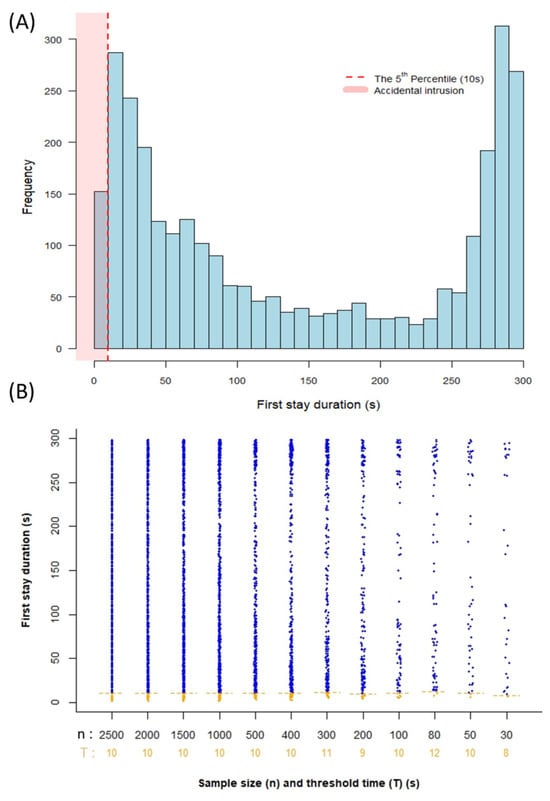
To establish an objective threshold, we compiled the first stay duration (regardless of the odor zone) of all 3000 female wasps to generate an empirical distribution. The 5th percentile of this distribution was selected as the candidate threshold time based on the convention of rejecting the null hypothesis at a probability level (α) of 5% [62]. A resampling procedure was performed to verify the stability of this threshold by randomly drawing subsamples of various sizes of 30, 50, 80, 100, 200, 300, 400, 500, 1000, 1500, 2000, and 2500 using the RAND () function in Microsoft Excel.
2.5. Oviposition Preference
This experiment was conducted in an oviposition selection box [63]. The 2 cm × 2 cm filter papers with 10 μL of host sex pheromone solution were placed on the floor of the odor source chambers at two diagonal corners of the box, while the other two odor source chambers were set with n-hexane (control). Then, after the egg cards were placed in the designated area, five wasps were introduced simultaneously into the oviposition selection box according to a pre-experiment [63]. After 3 h exposure, the wasps were removed and all the egg cards were transferred into plastic cylindrical tubes (one card per tube), and the parasitized eggs were counted three days later according to the color [64]. The oviposition index (OI) ((number of eggs parasitized at treatment − number of eggs parasitized at control)/total number of eggs parasitized) was calculated [65]. The preference of T. japonicum between each odorant (0.001, 0.01, 0.1, 1, and 10 μg/μL) and n-hexane were tested, and ten replicates were performed for each of the five concentrations.
2.6. Data Analysis
The olfactory choice preferences of T. japonicum for different odorants were analyzed using the Chi-square test in GraphPad Prism (version 9.5). The oviposition choice preference was analyzed using a Generalized Liner Mixed Model in IBM SPSS Statistics (version 27) [65]. The OI values were modeled with a Gaussian distribution and an identity link function, as they were continuous and approximately normally distributed (Shapiro–Wilk test, p > 0.05). Fixed effects included odorant treatment (test odor vs. n-hexane control), concentration (0.001, 0.01, 0.1, 1, and 10 μg/μL), and their interaction. Box ID was included as a random intercept to account for shared environmental variance within each replicate box, effectively nesting the individual treatment-vs-control comparisons within the replication unit. The model intercept was tested against zero to identify significant preferences (i.e., OI significantly different from 0, indicating preference or repellence). Model fit was assessed by examining Pearson residuals versus fitted values to check for homogeneity of variance, and Q-Q plots of residuals were used to verify approximate normality. The results were visualized using GraphPad Prism (version 9.5).
3. Result
3.1. Inconsistent Behavioral Results Arising from Different Temporal Judgment Criteria
We systematically evaluated the behavioral preferences of T. japonicum towards 20 odorants using different temporal criteria. When 0 s, 15 s, 30 s, and 60 s were used as thresholds for an effective choice, 29% of the tested odorant-concentration combinations (29 out of 100) yielded inconsistent outcomes depending on the threshold applied (Table 2, Table 3 and Table 4). For instance, 10 μg/μL O. furnacalis sex pheromone had no attractive effect on T. japonicum at thresholds of 0, 15, or 30 s, but was significantly attractive when a 60 s threshold was used (Table 2). Similarly, 10 μg/μL linalool was not repellent at thresholds of 0 or 15 s, but significant repellence was observed at 30 s and 60 s thresholds (Table 4). These results clearly demonstrate that applying different thresholds may directly lead to inconsistent research conclusions.
Table 2.
The attraction rates of host sex pheromone to T. japonicum under different threshold times (n = 30).
Table 3.
The attraction rates of sex pheromone components to T. japonicum under different threshold times (n = 30).
Table 4.
The attraction rates of plant-derived volatile compounds to T. japonicum under different threshold times (n = 30).
3.2. A Continuous Stay of 10 s or More Constitutes a Valid Olfactory Selection
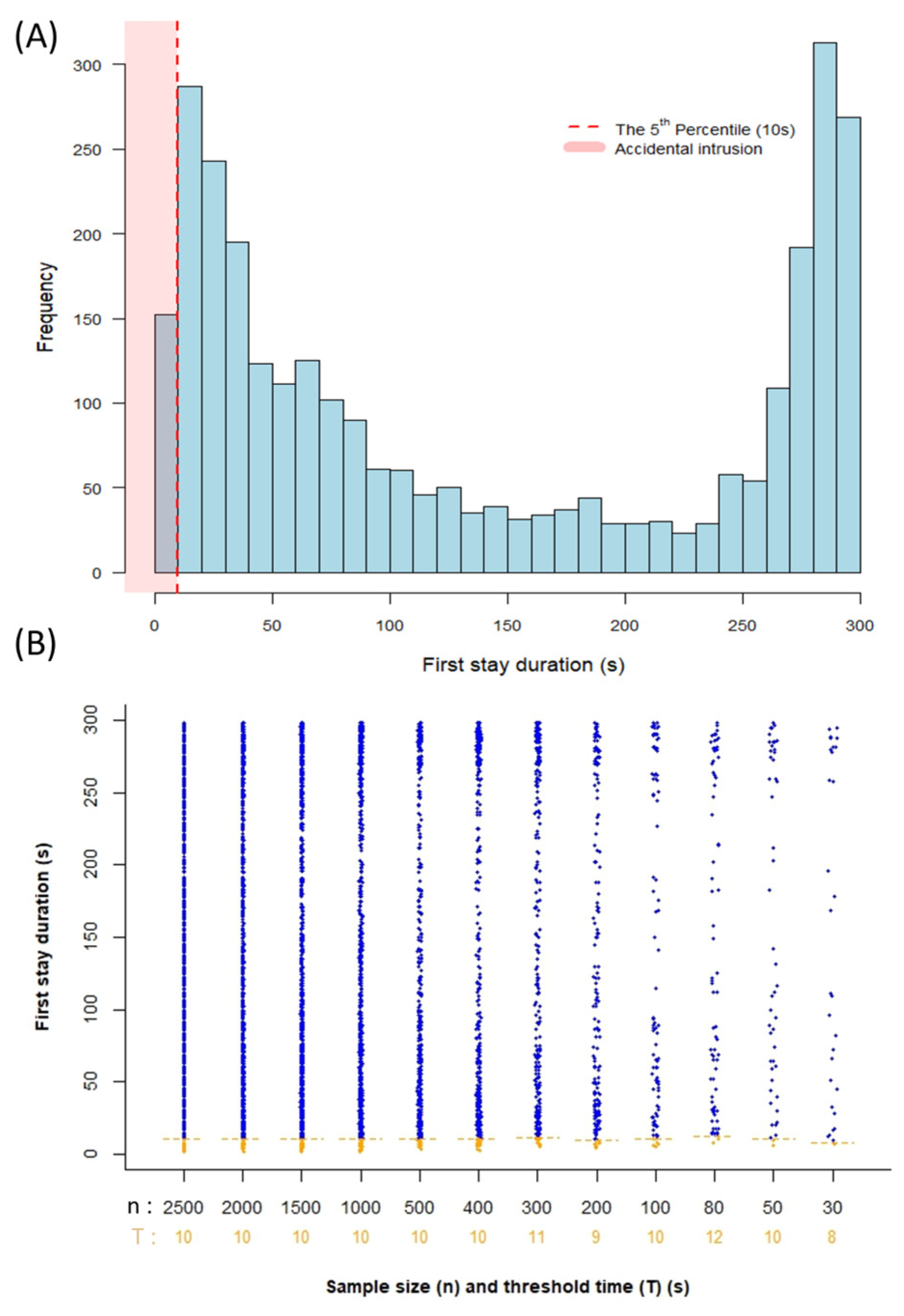
The 5th percentile value for the total sample was 10 s (Figure 1A). The resampling procedure indicated that the 5th percentile remained constant when subsamples were randomly drawn with sample sizes greater than 400, below which the 5th percentile value fluctuated between 8 and 12 s (Figure 1B).
Figure 1.
Determination and validation of the behavioral threshold based on the distribution of initial stay duration. (A) Frequency distribution of the first stay duration of T. japonicum in the first-entered odor zone (n = 3000). Durations < 10 s are classified as accidental intrusion, while those ≥ 10 s are classified as effective choice. (B) Threshold time (the 5th percentile) estimated by resampling analysis.
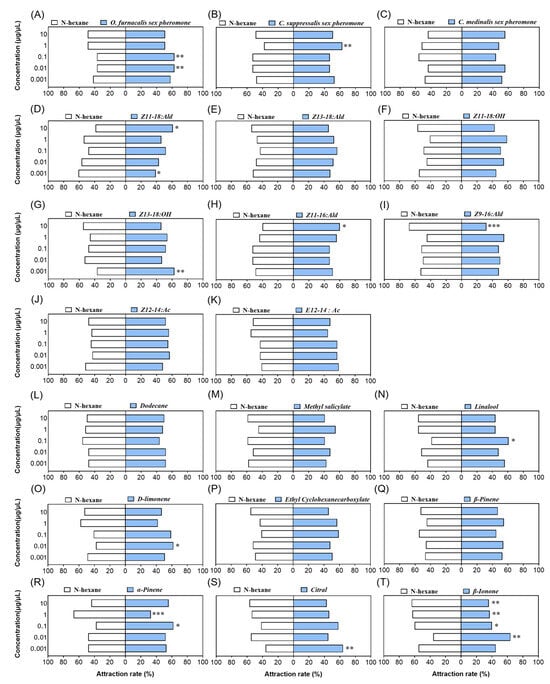
Based on this, a continuous stay of ≥ 10 s was defined as a valid olfactory selection. Applying the established 10 s criterion, we systematically evaluated the olfactory behavioral responses of T. japonicum to 20 different odorants (Figure 2). The results indicated that the sex pheromone of O. furnacalis exhibited an attractive effect on T. japonicum at concentrations of 0.1 μg/μL or 0.01 μg/μL (Figure 2A). The C. suppressalis sex pheromone was attractive at 1 μg/μL (Figure 2B). Specifically, the component Z11-16:Ald (10 μg/μL) attracted T. japonicum (Figure 2H), whereas Z9-16:Ald (10 μg/μL) repelled the wasps (Figure 2I). Components of C. medinalis sex pheromone, Z11-18:Ald (10 μg/μL) (Figure 2D) and Z13-18:OH (0.001 μg/μL) (Figure 2G) exhibited attractive effects on T. japonicum.
Figure 2.
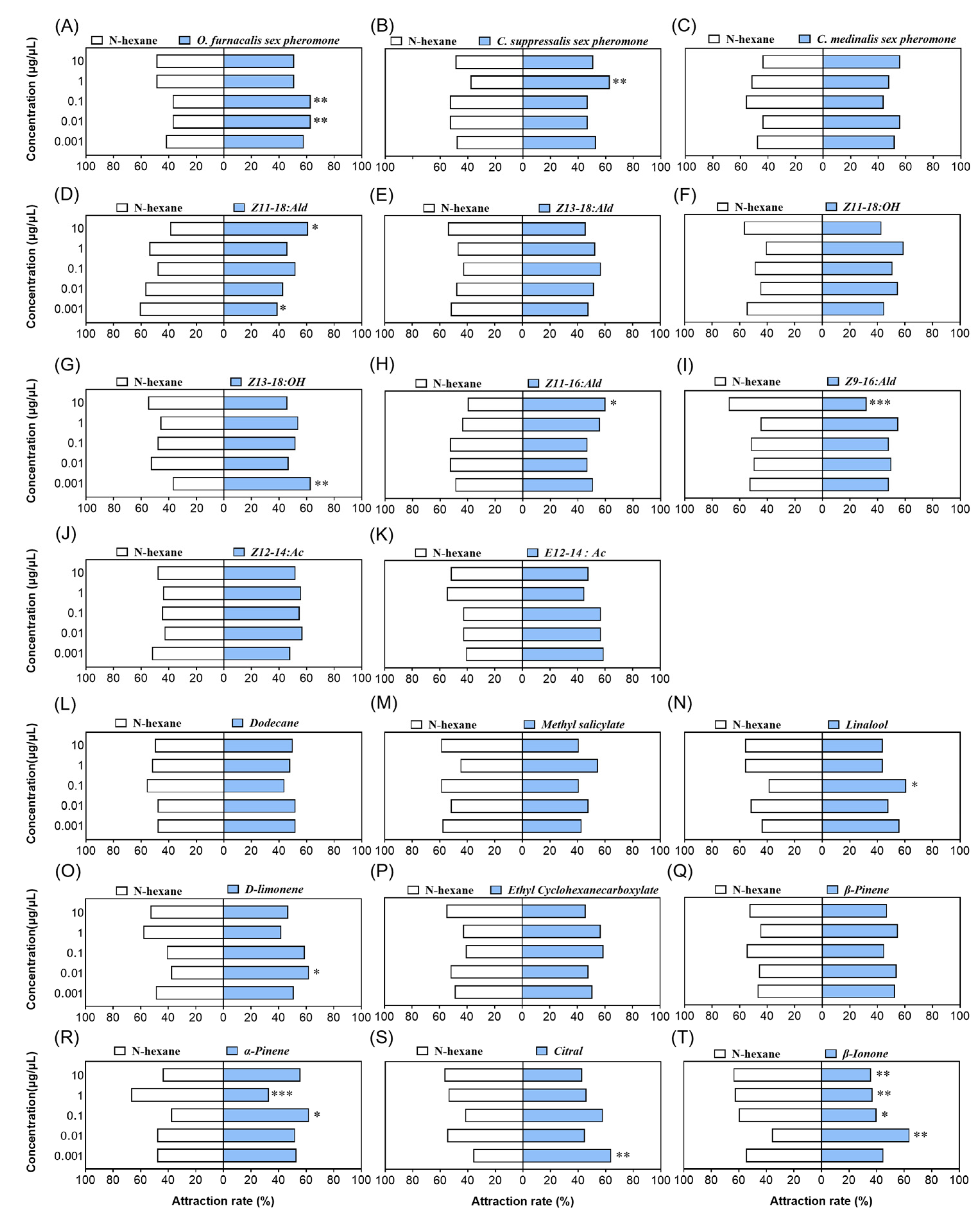
Olfactory behavioral response profile of T. japonicum to 20 odorants based on the 10 s threshold. (A) O. furnacalis sex pheromone; (B) C. suppressalis sex pheromone; (C) C. medinalis sex pheromone; (D) Z11-18:Ald; (E) Z13-18:Ald; (F) Z11-18:OH; (G) Z13-18:OH; (H) Z11-16:Ald; (I) Z9-16:Ald; (J) Z12-14:Ac; (K) E12-14:Ac; (L) Dodecane; (M) Methyl salicylate; (N) Linalool; (O) D-limonene; (P) Ethyl Cyclohexanecarboxylate; (Q) β-Pinene; (R) α-Pinene; (S) Citral; (T) β-Ionone;*: p < 0.05, **: p < 0.01, ***: p < 0.001; Chi-square test.
Plant-derived volatile compounds triggered distinct behavioral responses of T. japonicum, depending on the compound concentration. Notably, both β-ionone (Figure 2T) and α-pinene (Figure 2R) exhibited a typical biphasic dose–response pattern: low concentrations of the two compounds elicited attractive effects, whereas high concentrations elicited avoidance behavior of T. japonicum. This phenomenon was particularly pronounced for β-ionone, suggesting its potential role as a significant ecological signal for T. japonicum in the environment. Furthermore, citral (0.001 μg/μL) (Figure 2S) and linalool (0.1 μg/μL) (Figure 2N) also attracted T. japonicum.
To accurately reflect the potential sample size-dependent variability of the threshold, we performed a subsampling analysis with n = 30, 50 or 80, which yielded a 5th percentile of 8 s, 10 s, and 12 s, respectively (Figure 1B). Subsequently, we re-evaluated the olfactory behavioral data using 8 s and 12 s as candidate thresholds, and the results showed that only 3% of the treatment outcomes were inconsistent with those based on the 10 s threshold (Table 5, Table 6 and Table 7).
Table 5.
The attraction rates of host sex pheromone to T. japonicum under 8, 10 or 12-sthreshold time (n = 30).
Table 6.
The attraction rates of sex pheromone components to T. japonicum under 8, 10 or 12 s threshold time (n = 30).
Table 7.
The attraction rates of plant-derived volatile compounds to T. japonicum under 8, 10 or 12 s threshold time (n = 30).
3.3. Oviposition Choice Behavior Validates Olfactory Preferences
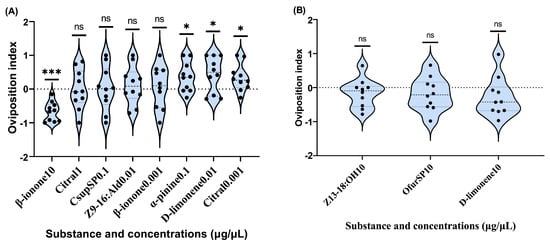
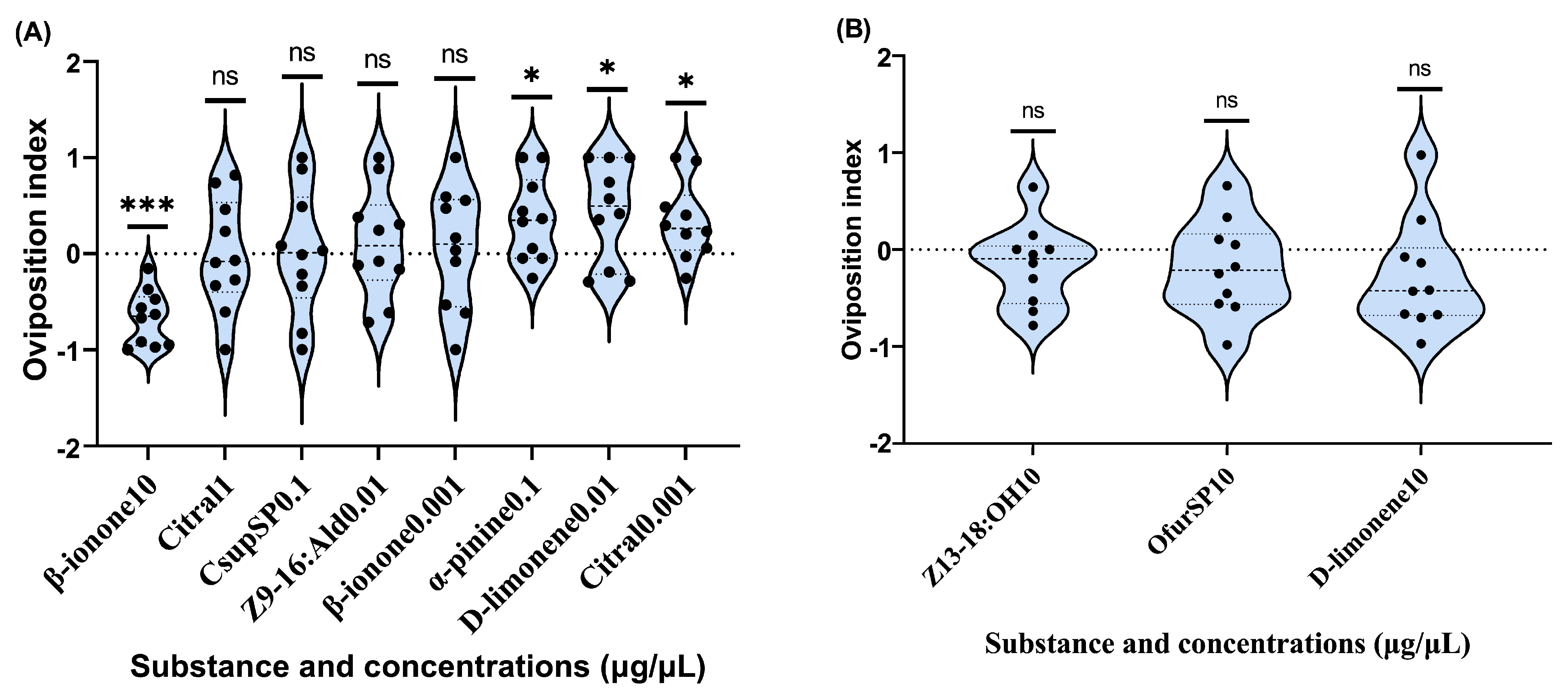
To verify whether the olfactory behavioral preferences have genuine biological significance, we randomly selected seven odorants (eight treatments) at specific concentrations, which had yielded consistent results across different temporal thresholds in the olfactory tests: β-ionone at 10 μg/μL, citral at 1 μg/μL, C. suppressalis sex pheromone at 0.1 μg/μL, Z9-16:Ald at 0.001 μg/μL, β-ionone at 0.001 μg/μL, α-pinene at 0.1 μg/μL, D-limonene at 0.01 μg/μL, and citral at 0.01 μg/μL to conduct an oviposition choice assay using the oviposition selection box. The effects of these seven odorants on T. japonicum oviposition preference were fully consistent with the results obtained in the four-arm olfactometer (Figure 2 and Figure 3A). Subsequently, we selected three odorants at specific concentrations that had shown inconsistent results when different time thresholds were applied in the four-arm olfactometer: Z13-18:OH at 10 μg/μL, the sex pheromone of O. furnacalis at 10 μg/μL, and D-limonene at 10 μg/μL. When the threshold time was set to 10 s, all three odorants had no effect on T. japonicum in the olfactometer assay. Correspondingly, these three odorants also showed no effect on T. japonicum oviposition preference (Figure 3B). The consistency between oviposition choice and olfactory behavioral preference strongly demonstrates that the olfactory behavior measured using the 10 s criterion can reliably predict the oviposition and host-selection decisions of T. japonicum under conditions more closely resembling natural scenarios.
Figure 3.
Oviposition choice assay validating olfactory preference. (A) Odorants at specific concentrations showing consistent behavioral responses across thresholds (n = 5 × 10). (B) Odorants showing inconsistent responses across thresholds (n = 5 × 10). OI > 0 indicates preference, OI < 0 indicates repellence. *: p < 0.05, ***: p < 0.001, ns: no significant difference (p > 0.05, GLMM).
4. Discussion
This study systematically investigated the impact of behavioral evaluation criteria on insect preference results. Using T. japonicum as a model, we successfully established a data-driven temporal standard. Data analysis revealed that when different thresholds ranging from 0 s to 60 s were applied, 29% of the test results varied with the change in the threshold time. This inconsistency, which is beyond random error, underscores the lack of objectivity in current subjective time standards. To address this issue, we applied statistical methods to the distribution of extensive behavioral data, identifying an objective temporal threshold that effectively distinguished accidental intrusion from effective choice, and established a data-driven criterion for olfactory behavior studies.
In experimental observations, when an insect first enters a specific odor field, it was considered that this field exerts an attractive effect on the insect. However, a brief, accidental intrusion into an odor field should not be considered as a valid choice. Thus, a genuine choice is defined by a stay duration exceeding that of a mere accidental intrusion, and a temporal threshold needed to be identified to distinguish accidental intrusion from effective choice. We systematically observed and recorded the behavior of 3000 T. japonicum wasps in a four-arm olfactometer, focusing on the timing of their entry into and exit from each odor zone. Within the empirical distribution of the first stay duration, we posited that behaviors with extremely short durations represent accidental intrusions resulting from random movement. To quantify this level of occasionality, we employed the statistical concept of percentiles [66]. Specifically, the 5th percentile was selected as the threshold [67,68].
The 5th percentile value is relatively stable and independent of sample size when a sufficient number of individuals are investigated. By analyzing the empirical distribution of the first stay duration for 3000 T. japonicum individuals and defining the behavioral threshold using the 5th percentile, our method treats the shortest 5% of durations as accidental intrusions. Consequently, an intentional choice is objectively defined as a continuous stay duration of ≥10 s. We validated this temporal standard through resampling, which confirmed the stability of the 10 s value across different subsample sizes with sample sizes greater than 400. This indicates that 10 s is a robust statistical characteristic independent of any specific subsample, although the 5th percentile was artificially selected. Crucially, further validation through oviposition choice experiments demonstrated that olfactory behavioral data obtained using the 10 s standard reliably predicted the oviposition decisions of T. japonicum wasps in near-natural conditions. This strongly confirms the ecological relevance and predictive value of the behavioral criterion established in this study, thereby providing a scientific basis for utilizing behavioral manipulation to enhance the efficacy of Trichogramma in biological control.
Derived from the intrinsic distribution of the experimental data and validated for reliability, this standard significantly enhances the objectivity and scientific rigor of behavioral assessment, and the 3% inconsistence is acceptable even when the sample is as small as 30 replications. However, it must be emphasized that when applying such data-driven methods to determine behavioral thresholds, sample size must be carefully evaluated [69] and reported to avoid distortion of threshold estimates due to insufficient sampling, which would compromise the reliability of research conclusions [70].
The behavioral responses of Trichogramma are complex and are modulated not only by odorant concentration but also by its chemical composition. In the olfactory preference study based on the 10 s threshold, we found that while O. furnacalis sex pheromone attracted T. japonicum (Figure 2A), its individual components, both Z12-14:Ac (Figure 2J) and E12-14:Ac (Figure 2K), did not. This suggests that the attraction relies on the combined action of both compounds, underscoring the precision of chemical communication. Z11-16:Ald (Figure 2H) attracted T. japonicum, whereas Z9-16:Ald (Figure 2I) repelled it. However, the C. suppressalis sex pheromone exhibited an attractive effect (Figure 2B). We propose that this is because the attractive effect of the major component, Z11-16:Ald (Figure 2H), dominates the repellent effect of the minor component, Z9-16:Ald (Figure 2I). Among the C. medinalis sex pheromone components, 10 μg/μL Z11-18:Ald (Figure 2D) and 0.001 μg/μL Z13-18:OH (Figure 2G) attracted T. japonicum. As these components are minor constituents in the full pheromone blend, the complete C. medinalis sex pheromone mixture did not show attraction to T. japonicum. Regarding plant-derived volatile compounds, both β-ionone (Figure 2T) and α-pinene (Figure 2R) exhibited a biphasic dose–response: attraction at low concentrations and repellence at high concentrations. This bidirectional response reflects the precision and complexity of plant chemical communication [65,71,72]. Low concentrations of plant volatiles may signal healthy or mildly stressed plants, often induced by pest oviposition [73], indicating to T. japonicum the potential presence of hosts in the vicinity, making the area worth exploring [74]. Conversely, high concentrations of herbivore-induced plant volatiles likely indicated severe plant stress, often due to larval feeding after egg hatching, leading to the release of large quantities of secondary metabolites [75]. At this stage, the pests have entered the larval stage, which is unsuitable for oviposition of the egg parasitoid Trichogramma, thus explaining the repellent effect—a key distinction between egg parasitoids and larval or pupal parasitoids [71,76,77]. Furthermore, specific concentrations of citral, D-limonene, and linalool also attracted T. japonicum, collectively forming a potential attractant portfolio alongside β-ionone and α-pinene.
The 17 compounds listed in Table 1 are all derived from ecological contexts relevant to Trichogramma habitats. Among them, some have been previously investigated in T. japonicum or other Trichogramma species, while the remaining compounds are reported for the first time in this study. For example, Tian et al. identified D-limonene and α-pinene as the dominant oviposition-induced plant volatiles emitted by rice plants infested with C. medinalis eggs, and demonstrated that synthetic versions of these two monoterpenes were highly attractive to T. japonicum females [41]. In addition, Bai et al. [78] reported that the sex pheromone of C. suppressalis attracted T. japonicum females in Y-tube olfactometer assays. Our results are largely consistent with these findings, as we also observed a clear olfactory preference of T. japonicum for the sex pheromone of C. suppressalis. However, for most of the compounds listed in Table 1—particularly the individual sex pheromone components (e.g., Z11-16:Ald, Z13-18:Ald, Z9-16:Ald, etc.) and certain plant volatiles (e.g., β-ionone, citral, ethyl cyclohexanecarboxylate, and n-dodecane)—although some have been sporadically reported in other Trichogramma species, direct evidence regarding their olfactory effects on T. japonicum remains scarce. Therefore, this study provides novel empirical data on the behavioral responses of T. japonicum to these compounds, contributing to a more comprehensive understanding of the chemical ecology of this important biological control agent.
While the 60 s threshold yields more “statistically significant” results, we argue this does not equate to higher true sensitivity for olfactory choice. A 60 s threshold effectively forces a prolonged observation, which measures arrestment (the tendency to stay) rather than the initial attraction/choice. Furthermore, requiring a 60 s stay artificially filters out many valid, quick choices, thereby skewing the denominator in AR calculations and potentially generating false positives. The 10 s threshold, derived from empirical data distribution, accurately captures the true “decision-making” moment without confounding attraction with long-term arrestment.
It is important to emphasize that the 10 s threshold specified in this study is an optimized standard for the specific context of T. japonicum in a four-arm olfactometer and should not be directly generalized as a universal constant across different experiments or species. The behavioral threshold may vary depending on species-specific locomotor activity, body size, olfactory sensitivity, and experimental parameters such as airflow rate, arena dimensions, and odorant concentration. Nevertheless, the true universal contribution of this study is not the specific 10 s value per se, but rather the methodological paradigm it demonstrates: shifting from subjective, empirically assigned thresholds to a data-driven approach that defines effective behavior based on the statistical distribution of behavioral data, using the 5th percentile to distinguish purposeful choices from accidental intrusions. This conceptual and statistical framework is broadly applicable to olfactory behavior studies across diverse insect taxa and can be adapted to various experimental systems, including Y-tube olfactometers, two-choice arenas, and wind tunnels, provided that sufficient behavioral data are collected to establish a reliable empirical distribution of the relevant behavioral parameter. Therefore, we recommend that future studies reporting insect behavioral preferences should not only present results but also explicitly detail the criteria used to define effective behavior and their statistical or biological rationale.
In summary, this study proposed and validated an objective behavioral assessment criterion grounded in data-driven framework and successfully implemented to investigate the olfactory preference patterns in T. japonicum. Our findings not only elucidate the olfactory behavioral responses of T. japonicum to specific odorants, laying a robust scientific basis for refining mass-rearing protocols of and field biocontrol tactics with the wasp, but also provide methodological underpinnings for constructing a repeatable paradigm for olfactory behavioral assays across other beneficial predatory and parasitic insects. This advancement further improves the reliability and cross-study comparability of relevant chemical ecology research outputs.
Supplementary Materials
The following supporting information can be downloaded at: https://www.mdpi.com/article/10.3390/insects17080798/s1, Figure S1: Schematic diagram of the four-arm olfactometer setup.
Author Contributions
Conceptualization, Y.-X.L. and S.W.; methodology, Y.-X.L., A.-N.Y. and Y.-X.F.; investigation, A.-N.Y., Y.-X.F., K.L. and H.L.; formal analysis, A.-N.Y., Y.-X.F., K.L. and H.L.; data curation, A.-N.Y. and H.L.; writing—original draft, A.-N.Y.; writing—review and editing, Y.-X.L., S.W., A.-N.Y., Y.-X.F., K.L. and H.L.; supervision, Y.-X.L.; project administration, Y.-X.L.; funding acquisition, Y.-X.L. All authors have read and agreed to the published version of the manuscript.
Funding
This research was supported by the National Natural Science Foundation of China (32172483) and National Key R&D Program of China (2023YFD1400600).
Data Availability Statement
The original contributions presented in this study are included in the article/Supplementary Material. Further inquiries can be directed to the corresponding author.
Conflicts of Interest
The authors declare that they have no conflicts of interest associated with this work.
References
- Leal, W.S. Odorant reception in insects: Roles of receptors, binding proteins, and degrading enzymes. Annu. Rev. Entomol. 2013, 58, 373–391. [Google Scholar] [CrossRef] [Scilit] [PubMed]
- Rihani, K.; Ferveur, J.-F.; Briand, L. The 40-Year mystery of insect odorant-binding proteins. Biomolecules 2021, 11, 509. [Google Scholar] [CrossRef] [Scilit] [PubMed]
- McIndoo, N.E. An insect olfactometer. J. Econ. Entomol. 1926, 19, 545–571. [Google Scholar] [CrossRef] [Scilit]
- Monteith, L.G. Host preferences of Drino bohemica Mesn. (Diptera: Tachinidae), with particular reference to olfactory responses. Can. Entomol. 1955, 87, 509–530. [Google Scholar] [CrossRef] [Scilit]
- Read, D.P.; Feeny, P.P.; Root, R.B. Habitat Selection by the aphid parasite Diaeretiella rapae (Hymenoptera: Braconidae) and hyperparasite Charips brassicae (Hymenoptera: Cynipidae). Can. Entomol. 1970, 102, 1567–1578. [Google Scholar] [CrossRef] [Scilit]
- Rotheray, G.E. Host searching and oviposition behaviour of some parasitoids of aphidophagous Syrphidae. Ecol. Entomol. 1981, 6, 79–87. [Google Scholar] [CrossRef] [Scilit]
- Shahjahan, M. Erigeron flowers as a food and attractive odor source for Peristenus pseudopallipes, a Braconid parasitoid of the tarnished plant bug. Environ. Entomol. 1974, 3, 69–72. [Google Scholar] [CrossRef] [Scilit]
- Wylie, H.G. Factors That affect host finding by Nasonia vitripennis (Walk.) (Hymenoptera:Pteromalidae). Can. Entomol. 1958, 90, 597–608. [Google Scholar] [CrossRef] [Scilit]
- Vet, L.E.M.; van Lenteren, J.C.; Heymans, M.; Meelis, E. An airflow olfactometer for measuring olfactory responses of hymenopterous parasitoids and other small insects. Physiol. Entomol. 1983, 8, 97–106. [Google Scholar] [CrossRef] [Scilit]
- Ding, H. Design, Produce and Apply of four-arm olfactometer for studying insect olfactory behavior. Entomol. Knowl. 1996, 33, 241–243. [Google Scholar] [CrossRef] [Scilit]
- Caballero-Vidal, G.; Bouysset, C.; Gévar, J.; Mbouzid, H.; Nara, C.; Delaroche, J.; Golebiowski, J.; Montagné, N.; Fiorucci, S.; Jacquin-Joly, E. Reverse chemical ecology in a moth: Machine learning on odorant receptors identifies new behaviorally active agonists. Cell. Mol. Life Sci. 2021, 78, 6593–6603. [Google Scholar] [CrossRef] [Scilit] [PubMed]
- Simonnet, M.M.; Berthelot-Grosjean, M.; Grosjean, Y. Testing Drosophila olfaction with a Y-maze assay. J. Vis. Exp. 2014, 88, 51241. [Google Scholar] [CrossRef] [Scilit] [PubMed]
- van Tol, R.W.; Diaz Rodriguez, C.M.; de Bruin, A.; Yang, D.; Taparia, T.; Griepink, F.C. Visual attraction of the european tarnished plant bug Lygus rugulipennis (Hemiptera: Miridae) to a water trap with LED light in chrysanthemum greenhouses and olfactory attraction to novel compounds in Y-tube tests. Pest Manag. Sci. 2022, 78, 2523–2533. [Google Scholar] [CrossRef] [Scilit] [PubMed]
- Wu, B.; Xie, R.; Gu, M.; Qin, H. Green lacewing Chrysoperla rufilabris (Neuroptera: Chrysopidae) is a potential biological agent for crapemyrtle bark scale (Hemiptera: Eriococcidae) pest management. Technol. Hortic. 2022, 2, 1–5. [Google Scholar] [CrossRef] [Scilit]
- Guo, H.; Mo, B.-T.; Li, G.-C.; Li, Z.-L.; Huang, L.-Q.; Sun, Y.-L.; Dong, J.-F.; Smith, D.P.; Wang, C.-Z. Sex pheromone communication in an insect parasitoid, Campoletis chlorideae Uchida. Proc. Natl. Acad. Sci. USA 2022, 119, e2215442119. [Google Scholar] [CrossRef] [Scilit] [PubMed]
- Mizuno, Y.; Kuramitsu, K.; Kainoh, Y. Determining suitable observation times for testing odor preferences of a parasitoid wasp, Cotesia kariyai, using a four-arm olfactometer. Entomol. Exp. Appl. 2022, 170, 843–849. [Google Scholar] [CrossRef] [Scilit]
- Hussain, M.; Gao, J.; Bano, S.; Wang, L.; Lin, Y.; Arthurs, S.; Qasim, M.; Mao, R. Diamondback moth larvae trigger host plant volatiles that lure its adult females for oviposition. Insects 2020, 11, 725. [Google Scholar] [CrossRef] [Scilit] [PubMed]
- Kecskeméti, S.; Erdei, A.L.; Simon, J.; Kiss, B.; Molnár, B.P. Oviposition behaviour of Rhagoletis completa on dead end host Cydonia oblonga. Sci. Rep. 2025, 15, 11070. [Google Scholar] [CrossRef] [Scilit] [PubMed]
- Ma, Z.; Guo, X.; Lei, H.; Li, T.; Hao, S.; Kang, L. Octopamine and tyramine respectively regulate attractive and repulsive behavior in locust phase changes. Sci. Rep. 2015, 5, 8036. [Google Scholar] [CrossRef] [Scilit] [PubMed]
- Zhan, Y.; Liu, Y.; Liu, J.; Liu, Y. Pheromones emitted by both female and male moths regulate coordination between the sexes for Agriphila Aeneociliella (Lepidoptera: Crambidae). Insect Sci. 2023, 30, 1481–1492. [Google Scholar] [CrossRef] [Scilit] [PubMed]
- Meiners, T.; Hilker, M. Induction of plant synomones by oviposition of a phytophagous insect. J. Chem. Ecol. 2000, 26, 221–232. [Google Scholar] [CrossRef] [Scilit]
- Francis, F.D.E.; Lognay, G.; Haubruge, E. Olfactory responses to aphid and host plant volatile releases: (E)-β-farnesene an effective kairomone for the predator Adalia bipunctata. J. Chem. Ecol. 2004, 30, 741–755. [Google Scholar] [CrossRef] [Scilit] [PubMed]
- Saïd, I.; Torre, R.A.D.L.; Morin, J.-P.; Rochat, D. Adaptation of a four-arm olfactometer for behavioural bioassays of large beetles. Chemoecology 2006, 16, 9–16. [Google Scholar] [CrossRef] [Scilit]
- Verheggen, F.J.; Fagel, Q.; Heuskin, S.; Lognay, G.; Francis, F.; Haubruge, E. Electrophysiological and behavioral responses of the multicolored asian lady beetle, Harmonia axyridis Pallas, to sesquiterpene semiochemicals. J. Chem. Ecol. 2007, 33, 2148–2155. [Google Scholar] [CrossRef] [Scilit] [PubMed]
- Michereff, M.F.F.; Laumann, R.A.; Borges, M.; Michereff-Filho, M.; Diniz, I.R.; Farias Neto, A.L.; Moraes, M.C.B. Volatiles mediating a plant-herbivore-natural enemy interaction in resistant and susceptible soybean cultivars. J. Chem. Ecol. 2011, 37, 273–285. [Google Scholar] [CrossRef] [Scilit] [PubMed]
- Fraga, D.F.; Parker, J.; Busoli, A.C.; Hamilton, G.C.; Nielsen, A.L.; Rodriguez-Saona, C. Behavioral responses of predaceous minute pirate bugs to tridecane, a volatile emitted by the brown marmorated stink bug. J. Pest Sci. 2017, 90, 1107–1118. [Google Scholar] [CrossRef] [Scilit]
- Thanikkul, P.; Piyasaengthong, N.; Menezes-Netto, A.C.; Taylor, D.; Kainoh, Y. Effects of quantitative and qualitative differences in volatiles from host-and non-host-infested maize on the attraction of the larval parasitoid Cotesia Kariyai. Entomol. Exp. Appl. 2017, 163, 60–69. [Google Scholar] [CrossRef] [Scilit]
- Liu, C.-M.; Matsuyama, S.; Kainoh, Y. Synergistic effects of volatiles from host-infested plants on host-searching behavior in the parasitoid wasp Lytopylus Rufipes (Hymenoptera: Braconidae). J. Chem. Ecol. 2019, 45, 684–692. [Google Scholar] [CrossRef] [Scilit] [PubMed]
- Koschier, E.H.; Dittmann, L.; Spangl, B. Olfactory responses of Asproparthenis punctiventris Germar to leaf odours of amaranthaceae Plants. Insects 2024, 15, 297. [Google Scholar] [CrossRef] [Scilit] [PubMed]
- Brunner, M.; Traugott, M.; Van Herk, W.G.; Angeli, S.; Favaro, R. OlfactionROOM: An optimised, low-cost olfactometer and easy-to-apply setup to mitigate the escape behaviour of insects. Ecol. Entomol. 2025, 50, 609–617. [Google Scholar] [CrossRef] [Scilit]
- Gonçalves De Sousa, I.; Naves, P.; Barros, G.; Mexia, A.; Brites, C. Behavioural response of Sitophilus zeamais to essential oil-derived compounds. J. Stored Prod. Res. 2026, 116, 102898. [Google Scholar] [CrossRef] [Scilit]
- Talley, J.L.; White, E.B.; Willis, M.A. A comparison of odor plume-tracking behavior of walking and flying insects in different turbulent environments. J. Exp. Biol. 2023, 226, jeb244254. [Google Scholar] [CrossRef] [Scilit] [PubMed]
- Manrique, V.; Jones, W.A.; Williams, L.H.; Bernal, J.S. Olfactory responses of Anaphes iole (Hymenoptera: Mymaridae) to volatile signals derived from host habitats. J. Insect Behav. 2005, 18, 89–104. [Google Scholar] [CrossRef] [Scilit]
- Kong, X.; Wang, Y.; Che, W.; Zhou, J.; Dong, H. Identification of compounds from the egg volatiles of asia corn borer, Ostrinia furnacalis, that attract egg parasitoid, Trichogramma ostriniae. Pest Manag. Sci. 2025, 81, 7827–7835. [Google Scholar] [CrossRef] [Scilit] [PubMed]
- Turlings, T.C.J.; Tumlinson, J.H.; Lewis, W.J.; Vet, L.E.M. Beneficial arthropod behavior mediated by airborne semiochemicals. VIII. Learning of host-related odors induced by a brief contact experience with host by-products in Cotesia marginiventris (Cresson), a Generalist Larval Parasitoid. J. Insect Behav. 1989, 2, 217–225. [Google Scholar] [CrossRef] [Scilit]
- Togni, P.H.B.; Laumann, R.A.; Medeiros, M.A.; Sujii, E.R. Odour masking of tomato volatiles by coriander volatiles in host plant selection of Bemisia tabaci biotype B. Entomol. Exp. Appl. 2010, 136, 164–173. [Google Scholar] [CrossRef] [Scilit]
- Yu, L.; Lin, K.; Xu, L.; Cui, J.; Zhang, Y.; Zhang, Q.; Yue, F.; Yan, L. Downy mildew (Peronospora aestivalis) infection of alfalfa alters the feeding behavior of the Aphid (Therioaphis trifolii) and the chemical characteristics of alfalfa. J. Pest Sci. 2023, 96, 989–1001. [Google Scholar] [CrossRef] [Scilit]
- Babendreier, D.; Tang, R.; Horgan, F.G. Prospects for integrating augmentative and conservation biological control of leaffolders and stemborers in rice. Agronomy 2022, 12, 2958. [Google Scholar] [CrossRef] [Scilit]
- Tang, R.; Babendreier, D.; Zhang, F.; Kang, M.; Song, K.; Hou, M.-L. Assessment of Trichogramma japonicum and T. chilonis as potential biological control agents of yellow stem borer in rice. Insects 2017, 8, 19. [Google Scholar] [CrossRef] [Scilit] [PubMed]
- G, B.G.; Pandi G, G.P.; Ullah, F.; Patil, N.B.; Sahu, M.; Adak, T.; Pokhare, S.; Yadav, M.K.; Mahendiran, A.; Mittapelly, P.; et al. Performance of Trichogramma japonicum under field conditions as a function of the factitious host species used for mass rearing. PLoS ONE 2021, 16, e0256246. [Google Scholar] [CrossRef] [Scilit] [PubMed]
- Tian, Z.; Wang, Y.; Sun, T.; Hu, X.; Hao, W.; Zhao, T.; Wang, Y.; Zhang, L.; Jiang, X.; Turlings, T.C.J.; et al. An egg parasitoid assesses host egg quality from afar using oviposition-induced plant volatiles. Curr. Biol. 2025, 35, 3001–3010.e4. [Google Scholar] [CrossRef] [Scilit] [PubMed]
- Zhang, H.; You, C.-M.; Wang, J.-Y.; Woodcock, B.A.; Chen, Y.-J.; Ji, X.-Y.; Wan, N.-F. A Parasitic wasp-releasing engineering to promote ecosystem services in paddy systems. Agric. Ecosyst. Environ. 2024, 373, 109126. [Google Scholar] [CrossRef] [Scilit]
- Zhu, X.-Y.; Wang, T.; Tariq, H.; Sun, J.-W.; Zang, L.-S. Plant immunity inducer-enhanced volatiles in rice: Boosting indirect defense against striped stem borers through parasitoid attraction. J. Agric. Food Chem. 2025, 73, 16408–16419. [Google Scholar] [CrossRef] [Scilit] [PubMed]
- Lv, Y.Q.; He, Y.R.; Xie, M.Q. Olfactory response of two parasitoids to volatiles release from Brassica alboglabra and Brassica campestris ssp. chinensis var. parachinensis. J. Environ. Entomol. 2010, 32, 510–515. [Google Scholar] [CrossRef]
- Nesbitt, B.F.; Beevor, P.S.; Hall, D.R.; Lester, R.; Dyck, V.A. Identification of the female sex pheromones of the moth, Chilo suppressalis. J. Insect Physiol. 1975, 21, 1883–1886. [Google Scholar] [CrossRef] [Scilit]
- Ohta, K.; Tatsuki, S.; Uchiumi, K.; Kurihara, M.; Fukami, J. Structures of sex pheromones of rice stem borer. Agric. Biol. Chem. 1976, 40, 1897–1899. [Google Scholar] [CrossRef] [Scilit]
- Tatsuki, S.; Kurihara, M.; Usui, K.; Ohguchi, Y.; Uchiumi, K.; Arai, K.; Yabuki, S.; Tanaka, F. Sex pheromone of the rice stem borer, Chilo suppressalis (WALKER) (Lepidoptera: Pyralidae): The third component, z-9-hexadecenal. Appl. Entomol. Zool. 1983, 18, 443–446. [Google Scholar] [CrossRef] [Scilit]
- Kawazu, K.; Adati, T.; Yosiyasu, Y.; Sumiartha, K.; Susila, W.; Sudiarta, P.; Purwanto, H.; Tatsuki, S. Sex pheromone components of the rice leaffolder, Cnaphalocrocis medinalis (Lepidoptera: Crambidae), in Indonesia. J. Asia-Pac. Entomol. 2009, 12, 97–99. [Google Scholar] [CrossRef] [Scilit]
- Klun, J.A.; Bierl-Leonhardt, B.A.; Schwarz, M.; Litsinger, J.A.; Barrion, A.T.; Chiang, H.C.; Jiang, Z. Sex pheromone of the asian corn borer moth. Life Sci. 1980, 27, 1603–1606. [Google Scholar] [CrossRef] [Scilit] [PubMed]
- Yu, H.; Khashaveh, A.; Li, Y.; Li, X.; Zhang, Y. Field trapping of predaceous insects with synthetic herbivore-induced plant volatiles in cotton fields. Environ. Entomol. 2018, 47, 114–120. [Google Scholar] [CrossRef] [Scilit] [PubMed]
- Li, F.; Li, D.; Dewer, Y.; Qu, C.; Yang, Z.; Tian, J.; Luo, C. Discrimination of oviposition deterrent volatile β-ionone by odorant-binding proteins 1 and 4 in the whitefly Bemisia tabaci. Biomolecules 2019, 9, 563. [Google Scholar] [CrossRef] [Scilit] [PubMed]
- Zhang, H.; Wang, J.-Y.; Chen, Y.-J.; Siemann, E.; Ji, X.-Y.; Jiang, J.-X.; Wan, N.-F. Beta-ionone is a functional plant volatile that attracts the parasitic wasp, Microplitis pallidipes. BioControl 2022, 67, 1–13. [Google Scholar] [CrossRef] [Scilit]
- Wang, Z. Attractiveness of Semiochemicals in Orchard Habitat to Trichogramma dendrolimi. Master’s Thesis, Zhejiang University, Hangzhou, China, 2022. [Google Scholar]
- Wang, J. Bottom-up Effects of Cadmium on Trichogramma Wasps and Underlying Mechanisms. Ph.D. Thesis, Nanjing Agricultural University, Nanjing, China, 2025. [Google Scholar]
- El-Sayed, A.M.; Sporle, A.; Colhoun, K.; Furlong, J.; White, R.; Suckling, D.M. Scents in orchards: Floral volatiles of four stone fruit crops and their attractiveness to pollinators. Chemoecology 2018, 28, 39–49. [Google Scholar] [CrossRef] [Scilit]
- Kovanci, O.B.; Schal, C.; Walgenbach, J.F.; Kennedy, G.G. Comparison of mating disruption with pesticides for management of oriental fruit moth (Lepidoptera: Tortricidae) in North Carolina apple orchards. J. Econ. Entomol. 2005, 98, 1248–1258. [Google Scholar] [CrossRef] [Scilit] [PubMed]
- Scutareanu, P.; Drukker, B.; Bruin, J.; Posthumus, M.A.; Sabelis, M.W. Leaf volatiles and polyphenols in pear trees infested by Psylla pyricola. evidence of simultaneously induced responses. Chemoecology 1996, 7, 34–38. [Google Scholar] [CrossRef] [Scilit]
- Scutareanu, P.; Drukker, B.; Bruin, J.; Posthumus, M.A.; Sabelis, M.W. Volatiles from Psylla-infested pear trees and their possible involvement in attraction of anthocorid predators. J. Chem. Ecol. 1997, 23, 2241–2260. [Google Scholar] [CrossRef] [Scilit]
- Liu, X.; Lv, J.; Wang, M. Effects of the volatiles of rice plants fed by Nilaparvata lugens and Chilo suppressalis. Chin. J. Appl. Entomol. 2023, 60, 595–601. [Google Scholar]
- Lv, Y.Q.; Chen, K.W.; He, Y.R.; Tang, C.; Ye, J.S. Olfactory response of four species of trichogrammatid to kairomones of Corcyra cephalomica (Stainton). J. South China Agric. Univ. 2006, 28, 14–17. [Google Scholar]
- Bai, S.-X.; Wang, Z.-Y.; He, K.-L.; Wen, L.-P.; Zhou, D.-R. Olfactory responses of Trichogramma ostriniae Pang et Chen to kairomones from eggs and different stages of female adults of Ostrinia furnacalis (Guenée). Acta Entomol. Sin. 2004, 48–54. [Google Scholar] [CrossRef]
- Zar, J.H. Biostatistical Analysis, 5th ed.; Pearson Prentice Hall: Upper Saddle River, NJ, USA, 2010; pp. 74–85. [Google Scholar]
- Li, K.; Yang, A.N.; Feng, Y.X.; Zhang, N.; Mei, J.; Li, Y.X. Host sex pheromones affect parasitization preference of Trichogramma ostriniae (Hymenoptera: Trichogrammatidae). J. Econom. Entomol. 2026. [Google Scholar] [CrossRef] [Scilit] [PubMed]
- Wang, J.; Yi, T.; Wang, M.; Wei, J.; Yan, W.; Wen, Y.; Zeng, L.; Xu, H. Herbivore-induced maize volatiles: Dual functions in repelling fall armyworm and attracting natural enemies. Pest Manag. Sci. 2025, 81, 3674–3684. [Google Scholar] [CrossRef] [Scilit] [PubMed]
- Verschut, T.A.; Ng, R.; Doubovetzky, N.P.; Le Calvez, G.; Sneep, J.L.; Minnaard, A.J.; Su, C.-Y.; Carlsson, M.A.; Wertheim, B.; Billeter, J.-C. Aggregation pheromones have a non-linear effect on oviposition behavior in Drosophila melanogaster. Nat. Commun. 2023, 14, 1544. [Google Scholar] [CrossRef] [Scilit] [PubMed]
- Bornmann, L.; Leydesdorff, L.; Mutz, R. The use of percentiles and percentile rank classes in the analysis of bibliometric data: Opportunities and limits. J. Informetr. 2013, 7, 158–165. [Google Scholar] [CrossRef] [Scilit]
- Wasserstein, R.L.; Schirm, A.L.; Lazar, N.A. Moving to a world beyond “p < 0.05.”. Am. Stat. 2019, 73, 1–19. [Google Scholar] [CrossRef] [Scilit]
- Cowles, M.; Davis, C. On the origins of the .05 level of statistical significance. Am. Psychol. 1982, 37, 553–558. [Google Scholar] [CrossRef]
- Nakagawa, S.; Cuthill, I.C. Effect Size, Confidence interval and statistical significance: A practical guide for biologists. Biol. Rev. 2007, 82, 591–605. [Google Scholar] [CrossRef] [Scilit] [PubMed]
- Forstmeier, W.; Wagenmakers, E.; Parker, T.H. Detecting and avoiding likely false-positive findings—A practical guide. Biol. Rev. 2017, 92, 1941–1968. [Google Scholar] [CrossRef] [Scilit] [PubMed]
- Dicke, M.; Van Loon, J.J.A.; Soler, R. Chemical complexity of volatiles from plants induced by multiple attack. Nat. Chem. Biol. 2009, 5, 317–324. [Google Scholar] [CrossRef] [Scilit] [PubMed]
- Erb, M.; Foresti, N.; Turlings, T.C. A Tritrophic signal that attracts parasitoids to host-damaged plants withstands disruption by non-host herbivores. BMC Plant Biol. 2010, 10, 247. [Google Scholar] [CrossRef] [Scilit] [PubMed]
- Hilker, M.; Fatouros, N.E. Plant responses to insect egg deposition. Annu. Rev. Entomol. 2015, 60, 493–515. [Google Scholar] [CrossRef] [Scilit] [PubMed]
- D’Alessandro, M.; Brunner, V.; Von Mérey, G.; Turlings, T.C.J. Strong attraction of the parasitoid Cotesia marginiventris towards minor volatile compounds of maize. J. Chem. Ecol. 2009, 35, 999–1008. [Google Scholar] [CrossRef] [Scilit] [PubMed]
- Turlings, T.C.J.; Tumlinson, J.H.; Lewis, W.J. Exploitation of herbivore-induced plant odors by host-seeking parasitic wasps. Science 1990, 250, 1251–1253. [Google Scholar] [CrossRef] [Scilit] [PubMed]
- Vinson, S.B. The general host selection behavior of parasitoid hymenoptera and a comparison of initial strategies utilized by larvaphagous and oophagous species. Biol. Control 1998, 11, 79–96. [Google Scholar] [CrossRef] [Scilit]
- Fatouros, N.E.; Dicke, M.; Mumm, R.; Meiners, T.; Hilker, M. Foraging behavior of egg parasitoids exploiting chemical information. Behav. Ecol. 2008, 19, 677–689. [Google Scholar] [CrossRef] [Scilit]
- Bai, Q.; Tian, J.C.; Lu, Y.H.; Zang, L.S.; Lü, Z.X. Olfaction responses of three Trichogramma species to sex pheromone of Chilo suppressalis and Cnaphalocrocis medinalis. Chin. J. Biol. Control 2017, 33, 584–589. [Google Scholar] [CrossRef]

Disclaimer/Publisher’s Note: The statements, opinions and data contained in all publications are solely those of the individual author(s) and contributor(s) and not of MDPI and/or the editor(s). MDPI and/or the editor(s) disclaim responsibility for any injury to people or property resulting from any ideas, methods, instructions or products referred to in the content. |
© 2026 by the authors. Licensee MDPI, Basel, Switzerland. This article is an open access article distributed under the terms and conditions of the Creative Commons Attribution (CC BY) license.