


Simple Summary
The oriental hornet Vespa orientalis is increasingly reported in southern Italy, where it threatens honey bee colonies and is becoming more common in urban areas. This study evaluated the attractiveness of three easily available food baits—beer, canned peaches, and fish-based cat food—used in plastic bottle traps placed in apiaries and urban sites across the Campania region during September–October 2025. A total of 419 hornets were captured, including V. orientalis and V. crabro. While V. crabro showed a clear preference for beer-baited traps, V. orientalis did not exhibit a significant attraction to any specific bait, although slightly more individuals were captured in protein-based traps. The two species also showed different spatial distributions: V. crabro was more common in apiaries, whereas V. orientalis predominated in urban sites. Despite frequent reports of predation on honey bees, the relatively low capture rate of V. orientalis suggests that traditional baited traps may not be sufficiently effective for monitoring this species. More behaviour-based monitoring strategies are therefore needed to improve management in both apicultural and urban contexts.
Abstract
Vespa orientalis is an emerging pest in southern Italy, with increasing impacts on bees in apiculture and urban environments. This study assessed the attractiveness of three bait types—beer, canned peaches, and commercial fish-based cat food—used in transparent plastic bottle traps deployed in apiary and urban sites across the Campania region. Trapping was conducted from September to October in 15 apiaries and 10 urban areas. A total of 419 hornets (V. orientalis and V. crabro) were collected. V. crabro showed a strong preference for beer-baited traps, whereas V. orientalis did not exhibit significant bait preferences, although most captures occurred in protein-baited traps. Species composition differed between environments, with V. orientalis more prevalent in urban sites. Overall, low capture rates of V. orientalis despite high presence in apiaries suggest that conventional attractant-based trapping is poorly suited for this species, highlighting the need for behaviour-based monitoring tools.
1. Introduction
Since ancient times, bees are the most widespread managed pollinator [1]. Across the world, beekeeping represents a valuable activity under the environmental, social and economic point of view as it sustains pollination, creates job opportunities and provides income to many families [2,3]. The Italian beekeeping market is composed mainly by professional beekeepers for which beekeeping represents the main source of income with approximately 50 colonies per activity [4]. It appears clear that for Italian beekeepers the loss of colonies due to different stressors could represent a serious threat to the economic stability of the family. Among the factors which can challenge the health of honey bee colonies, extreme weather conditions, pesticides and pathogens represent the most frequently associated with colony loss [5]; however, more recently, honey bee predators of the Vespidae family are raising many concerns in the beekeeping field [6,7].
Currently five different species of Vespa sp. have been reported in Europe: V. orientalis, V. velutina, V. soror, V. bicolor and V. crabro, the only species considered native to most European countries [8,9], including Italy, where it does not represent a great threat for apiculture probably due to its lower preference for honey bees [10]. On the contrary, V. velutina and V. orientalis represent, respectively, an everyday challenge for northern and southern Italian beekeepers.
Vespa orientalis (Linnaeus, 1771) is a hornet species (Hymenoptera: Vespidae) native to the southeastern Mediterranean region, northeastern and eastern Africa, the Middle East, and the southern part of southwestern Asia [11,12,13,14,15]. Given its origin, it is commonly known as the “Oriental hornet.” Over recent years, V. orientalis has expanded its distribution range in several new non-native territories [16,17,18,19], due to involuntary anthropic introduction, climate change, and habitat loss, which can reduce available nesting sites and food supplies for hornets [20,21]. It has significantly extended its distribution to other European countries [22,23,24,25,26,27], with records from eastern and southern Spain [6,22,23,24,25,26,27], Romania [27], southern France [26], and the Greek islands [28]. Climate-niche analyses indicate that V. orientalis is well adapted to warm temperatures and low-precipitation regimes, which facilitate its spread across semi-arid and Mediterranean climates [29]. In Italy, V. orientalis is well established in Sicily, Calabria and Campania. However, the species has recently expanded its range into central and northern regions of the country [30,31]. In 2021, a single adult specimen was reported from Sardinia (Cagliari) (www.stopvelutina.it), while a considerable presence of V. orientalis has been documented in Latium, Liguria, Tuscany [31], Marche and Trieste [30].
V. orientalis is recognizable by its rusty-red body coloration, yellow bands on the metasomal segments, and a distinctive yellow mark on the face [32]. Colonies are annual and originate from a single queen, which founds the nest in spring after winter diapause [33,34]. Colony size increases during spring and summer, reaching peaks of 4000 individuals in late summer/beginning of autumn, before declining with decreasing temperatures [35]. Reproduction occurs between September and December when new queens and drones emerge and mate, after which fertilised queens search for appropriate hibernation space [36]. However, in recent years a shift in the life cycle has been observed with colony peak and reproduction occurring later in time. Feeding behaviour varies with age: workers mainly consume carbohydrates such as fruit nectar and honey, whereas larvae require protein sources, often obtained from honey bees [11,22,35,37]. Larvae, for their part, process the proteins ingested and return them to the queen as a drop of saliva composed of carbohydrates and free amino acids [38].
Expansion of Vespa sp. populations in Apis mellifera apiaries may lead to increased honey bee mortality and reduced hive productivity, posing a serious threat to apiculture. V. orientalis attacks honey bee foragers upon returning to the hive after the foraging flights, reducing their foraging activity [36]. By plundering honey, pollen, and larvae from hives V. orientalis further weakens honey bee colonies [39,40]. Reduction in foraging activity, combined with a scarcity of food storage, could result in inadequate nourishment of honey bees [41,42], making them more susceptible to the effects of pesticides and pathogens [43]. Moreover, the predation of infected honey bees by hornets may facilitate the transmission of bee viruses to V. orientalis, representing a potential vector of honey bee pathogens [44,45]. Recent reports indicate a significant expansion of V. orientalis in urban areas, likely due to the urban “heat island effect” and the presence of green urban spaces such as domestic gardens, botanical gardens, food gardens, and urban apiaries, which provide abundant food resources and shelter for many insects [46,47]. The expansion of V. orientalis not only harms honey bee populations, but can pose risks to human safety, although V. orientalis appears not to be particularly aggressive toward humans when away from the nest [48,49]. In the Campania region, the rise in V. orientalis populations has been associated with an increase in stings and allergic reactions from encounters with both V. orientalis and other hornet species (In 2023, the project “Emergency Vespa Orientalis in Campania (EVOC)” was founded to evaluate the presence of V. orientalis in the Campania region and propose possible mitigation strategies). Bait trapping is one of the most used tools to capture wasps and hornets, working both as a monitoring and a controlling tool [50,51,52]. While bait trapping is often used to detect the presence of Vespa velutina [53,54], few studies have been conducted on trapping techniques for V. orientalis [37,55,56,57].
This study aimed to evaluate the attractiveness of V. orientalis to three different trap baits localised in both apiary and urban environments across the Campania region. Therefore, two carbohydrate-based baits (beer and canned peaches) and one protein-based bait (commercial cat food) were deployed in plastic bottle traps to evaluate their effectiveness as monitoring and capturing tools for V. orientalis. The results are expected to inform targeted management strategies and contribute to the development of more effective control measures for V. orientalis.
2. Materials and Methods
2.1. Sampling Sites
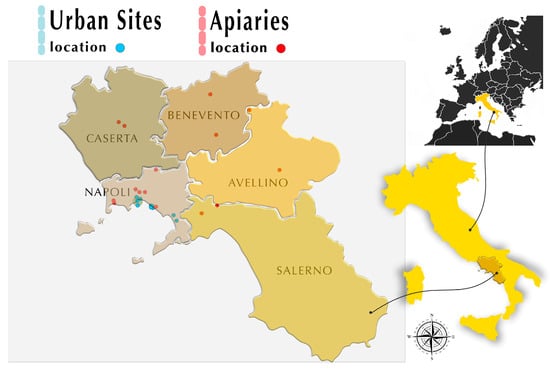
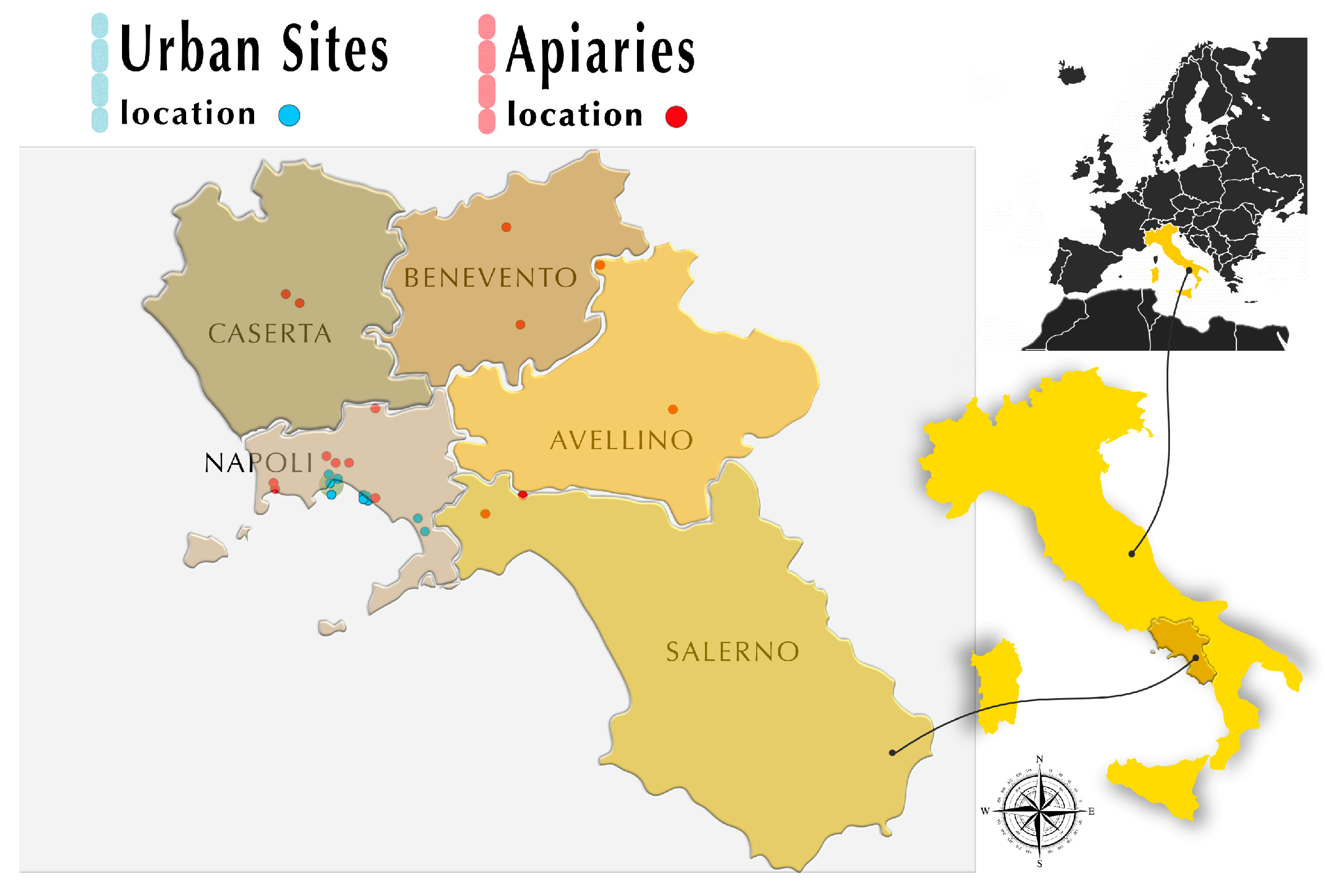
From early September to late October 2025, according to the aims of the EVOC project, bottle traps were installed in fifteen apiaries distributed across the Campania region (Figure 1, Table S1), as well as in ten urban sites within the city of Naples (Table S2), the latter selected based on the presence of large, heavily frequented public green areas. Each site was labelled, coded, and geo-referenced and information on the surrounding landscape was collected to classify sites as rural apiaries or urban/suburban locations. The trap-setting period was determined according to previous studies reporting highest hornet density and activity between late summer and early autumn [15].
Figure 1.
Map of the Campania region showing the location of monitored urban sites (blue) and apiaries (red) included in the study.
2.2. Traps and Baits
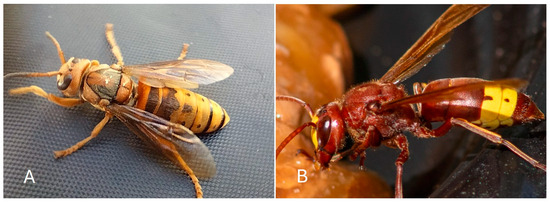
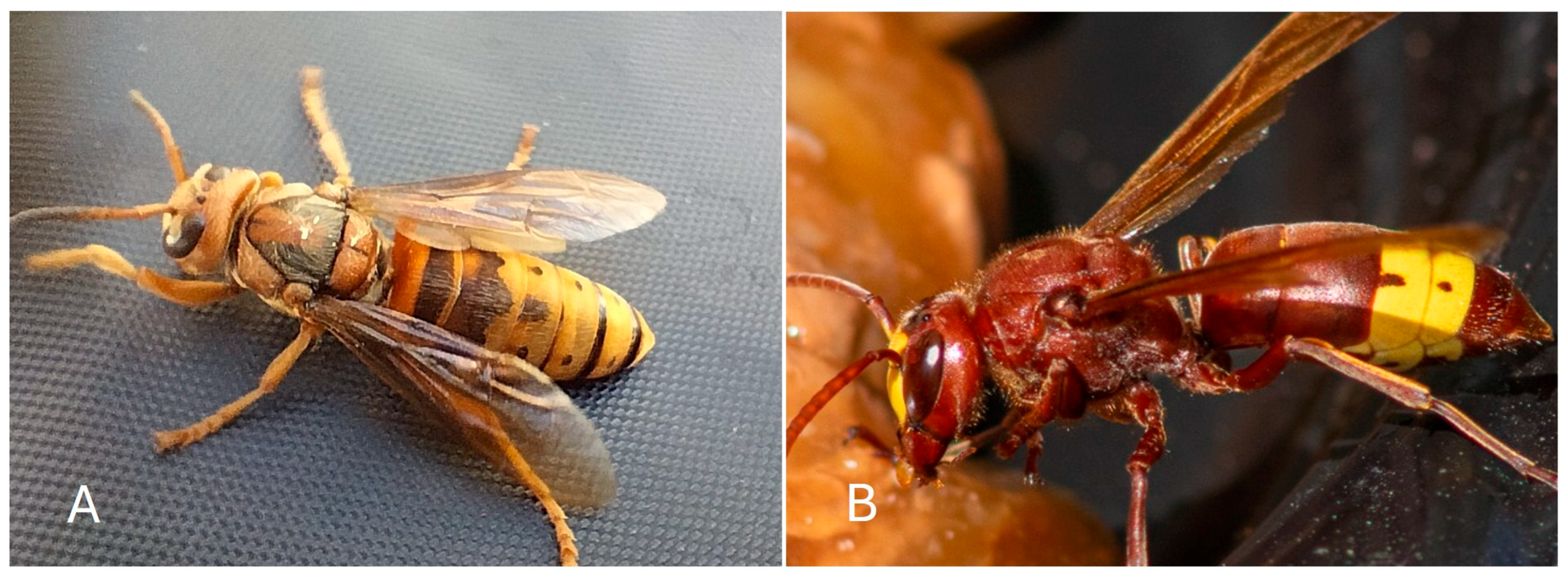
Traps were installed by trained personnel on branches of trees or shrubs at a height of 1.5–1.8 m above ground level. The trap (Tap Trap®, Carello Roberto, Pianezza, Italy) consisted of a bright yellow plastic cap, visually attractive to hornets, attached to the neck of a standard 1.5 L transparent plastic bottle. The colour of the cap and the bait inside encouraged hornets to enter, while the internal structure prevented their escape and allowed bees and other small non-target insects to exit. In each site, trap triplets were positioned 3 m apart across the site (141 triplets and total 423 bottles). Each bottle of the triplet contained a different bait consisting of two carbohydrate-based baits (canned peaches and beer) and one protein-based bait (commercial cat food). For the carbohydrate-based baits 80–100 g of canned peaches were cut and immersed in 250 mL water and 12–15 g of white sugar were mixed with 250 mL lager beer (5% alcohol); for the protein-based bait 40–50 g of salmon-flavoured wet cat food were homogenised in 250 mL of water. The number of trap triplets deployed at each site varied according to the width of the monitoring site to ensure adequate spatial coverage. Traps were inspected every week for eight following weeks by emptying the bottles on a white absorbable paper and baits were immediately replaced with fresh material of the same type. Captured hornets were morphologically identified and only individuals identified as V. orientalis and V. crabro were counted and included in the analysis (Figure 2).
Figure 2.
Morphological comparison of hornets: (A) Vespa crabro; (B) Vespa orientalis.
2.3. Statistical Analysis
Before conducting the inferential analysis, the composition of the sample was assessed using chi-square tests. These tests evaluated the overall species prevalence (V. crabro vs. V. orientalis), the heterogeneity in species composition between the two sampling environments (apiaries vs. urban sites), and the differences in species prevalence across the bait types used. These preliminary tests were performed to justify the inclusion of Species and Environment as covariates in the main model.
All count data (response variable: Catches) were analysed using a Generalised Linear Model (GLM) specified with a negative binomial distribution (chosen to account for significant overdispersion of the dispersion parameter, Phi) and a logarithmic link function.
Due to non-convergence of the initial complex model, the analysis was conducted using two separate GLMs (Model 1 and Model 2) focused on the fixed effects of interest.
Model 1 tested the primary hypothesis of a differential bait effect depending on the species and used as fixed effects: Bait (Peach = reference), Species (V. crabro = reference), and their interaction (Bait × Species).
Model 2 tested the secondary hypothesis of a differential environment effect depending on the species and used as fixed effects: Environment (urban = reference), Species (V. crabro = reference), and their interaction (Environment × Species).
Statistical significance for fixed effects was assessed using the Wald chi-square test.
Furthermore, to evaluate the potential influence of the geographic proximity of sampling sites on hornet abundance, a Global Moran’s I test for spatial autocorrelation was performed. This analysis was crucial to ensure the independence of observations, given the geographic clustering of some sites (e.g., the Naples metropolitan area). Spatial relationships were defined using a weight matrix based on the inverse of the Euclidean distance between coordinates (1/dij), ensuring that closer sites had a stronger weight in the autocorrelation calculation.
A significance level of alpha = 0.05 was used for all tests. All statistical analysis was conducted using JMP, version 18.0 (SAS Institute, Cary, NC, USA).
3. Results
3.1. Hornet Capture Count
Detailed results of the hornet counts, according to bait type and trap location (apiaries and urban sites), are reported in the Tables S1 and S2 of the Supplementary Materials. At the end of the experiment, a total of 419 hornets were captured, of which 268 (64%) were V. crabro and 151 (36%) were V. orientalis.
The Global Moran’s I test revealed no significant spatial autocorrelation for hornet captures across the study area (I = 0.082; E[I] = −0.062; z = 0.95; p = 0.34). These results indicate that the distribution of Vespa sp. captures is not significantly clustered or dispersed at a large scale. This suggests that hornet abundance is primarily influenced by site-specific environmental variables or local attractors, such as the presence of apiaries, rather than by a spatial contagion process, confirming the statistical independence of the sampling sites for the GLM analysis. In apiaries 295 hornets were captured. Of these, 69 individuals (23.4%) were identified as V. orientalis, while 226 individuals (76.6%) were identified as V. crabro. Among the V. orientalis specimens, 62 of the 69 individuals (89.9%), were captured in the bottles containing cat food; 4 out of 69 individuals (5.8%) were captured in bottles baited with canned peaches, while 3 of the 69 individuals (4.3%) were captured in the bottles baited with beer. V. orientalis was captured only in Naples and Caserta and was absent from apiary samples in Avellino, Benevento, and Salerno. Among the 226 V. crabro specimens collected, 33 individuals (14.6%) were captured in traps baited with canned peaches, 179 individuals (79.2%) in those baited with beer, and 14 individuals (6.2%) in traps containing cat food.
In urban sites 124 hornets were captured, of which 82 (66.13%) were identified as V. orientalis, while 42 individuals (33.9%) were identified as V. crabro.
Regarding the V. orientalis specimens, 77 individuals (93.90%) were captured in bottles containing cat food, three (3.66%) in bottles baited with canned peaches, two (2.44%) were captured in bottles containing beer. Regarding V. crabro specimens, 26 individuals (61.90) were found in bottles baited with beer, five individuals (11.90%,) in traps baited with canned peaches and 11 individuals (26.19%) in traps containing cat food.
3.2. Statistical Results
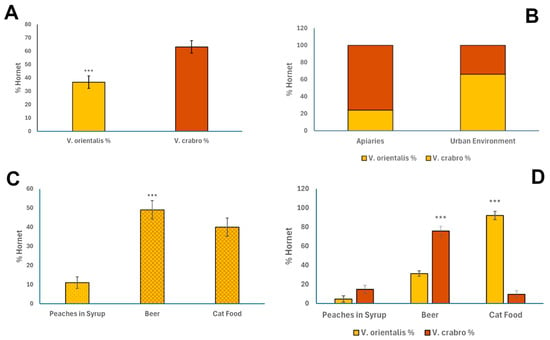
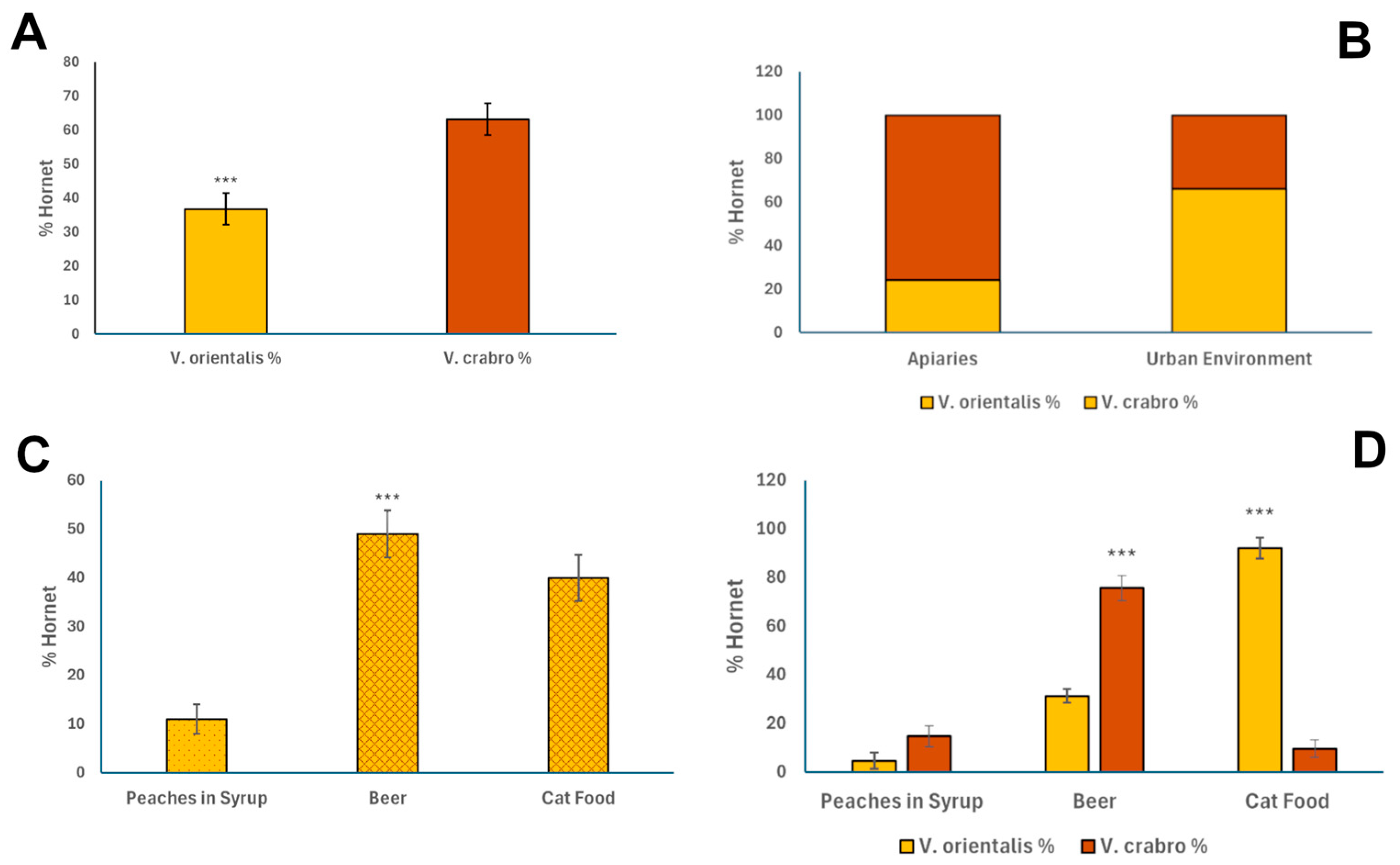
The overall analysis of the collected hornet population revealed a significant prevalence of V. crabro (63.2%) compared to V. orientalis (36.8%) (χ2 = 63.80, p < 0.0001). However, the sample composition was significantly heterogeneous between the two sampled environments (χ2 = 145.85, p < 0.0001). Specifically, the population was dominated by V. crabro (75.8%) in apiaries, while V. orientalis (66.1%) was the most captured species in urban environments. This spatial variation in captured species justified the inclusion of the Environment variable in the GLM (Figure 3).
Figure 3.
Descriptive analysis of hornet sample composition and bait preference. The figure summarises the aggregate sampling results used to justify the inclusion of covariates in the GLM. (A) Species Prevalence: overall proportion of the two sampled species; (B) Spatial Distribution: species composition across the two sampled environments (apiaries and urban); (C) Aggregate Palatability (Main Effect of Bait): percentage of preference for total baits; (D) Species-Specific Palatability: distribution of catches per bait. Data are expressed as percentage ± SE. *** p < 0.001.
Efficacy of Main Factors on Total Catches
The analysis was conducted using two separate GLMs with a negative binomial distribution (N = 150). Table 1 shows that the choice of the negative binomial distribution was justified, as the dispersion parameter (φ) was highly significant in both models (p < 0.0001 for both, with Phi for Model 1 = 0.8161). Fixed effects parameter estimates are summarised in Table 2.
Table 1.
Dispersion parameter (Phi) estimates obtained from the two GLMs with a negative binomial distribution. The dispersion parameter is a measure of unexplained overdispersion, and its significance justifies the use of the negative binomial over a Poisson model. ** p < 0.01.
Table 2.
Fixed effects test results obtained from two separate Generalised Linear Models (GLM) with a negative binomial distribution (Model 1: Bait × Species; Model 2: Environment × Species). The Wald chi-square test was used to evaluate the overall significance of the factor or interaction on the Log (Capture Rate).
Model 1 (testing the Bait × Species interaction) showed that the main effect of Bait was not statistically significant (Wald χ2 Prob > χ2 = 0.9705). However, the Bait × V. crabro interaction was statistically significant (Wald χ2 Prob > χ2 = 0.0125), indicating that bait effectiveness differs significantly for V. crabro (Table 2). The Bait × V. orientalis interaction was not significant (p = 0.3277).
Post hoc analysis of the significant Bait × V. crabro interaction (Wald χ2 Prob > χ2 = 0.0125) identified the nature of this specificity. The statistical significance is driven by the clear preference shown by V. crabro for the beer bait in terms of Log Capture Rate compared to the reference bait (canned peaches). The overwhelming effectiveness of the beer bait for the capture of V. crabro demonstrates that bait efficacy is highly species-dependent for V. crabro.
Model 2 (testing the Environment × Species interaction) found no significant difference in the total number of catches between the apiary and urban environments (Prob > χ2 = 0.2099). In this model, the main effect of Species was also not significant (Prob > χ2 = 0.8555). The Environment × Species interaction was also not significant (p = 0.9759).
Consequently, data support the hypothesis that bait efficacy acts as a species-specific factor, but this specificity is driven by the significant Bait × V. crabro interaction (p = 0.0125). The results suggest that bait efficacy is not consistent across all species. The environment did not act as a species-specific factor. Supporting these inferential results, descriptive analysis of bait attractiveness (without considering species) indicated that beer (49%, CI95: 44.19–53.86) and cat food (40%, CI95: 35.26–44.74) were the most frequently chosen baits overall, vastly surpassing canned peach (11%, CI95: 7.95–14.00).
4. Discussion
Today Vespa orientalis L. is considered the most problematic pest for beekeeping in the Campania Region. As hornets (Hymenoptera: Vespidae) have become unexpectedly abundant in apiaries, numerous trapping and control methods have been tested, and a wide range of baits has been employed [56,58,59,60,61]. Among the various approaches, baited traps have demonstrated notable efficacy. In particular, transparent plastic bottle traps with a coloured cap filled with beer have proven to be the most efficient for capturing several social wasp and hornet species in Europe [51,60,62,63], including V. crabro [51]. The same trap, when baited with fish-based proteins, was identified as the most effective for capturing V. orientalis [56].
In our study, we employed the Tap Trap® (www.taptrap.com) combined with three types of bait: canned peaches, lager beer mixed with sugar, and salmon-flavoured wet cat food diluted with water. Hornet attraction was assessed by counting the number of individuals captured in each trap, with the most effective bait defined as the one yielding the highest number of captures. Our results, consistent with Demichelis [51], confirm that beer is the most attractive bait for V. crabro, followed by peaches and fish-based cat food, with significant differences among them. Conversely, V. orientalis did not show a clear preference for any of the tested baits, as indicated by the absence of significant differences among the three baits. However, it still appears that V. crabro workers were more interested in sugar baits than in protein baits, whereas V. orientalis workers seemed to be still interested in the protein baits more than in the sugar baits. Given the different uses of food sources for Vespids (proteins for larvae and carbohydrates for workers), it is possible that the colonies of the two species were in different moments of their life cycles, with V. crabro colonies developing earlier than V. orientalis during the fall season. This is in line with our observations of the past years in which we noted a delay in the appearance of males and foundresses of V. orientalis. Thus, we can suggest that during fall, adults of V. crabro need to forage sugary foods for their survival, while V. orientalis larvae need to collect higher amounts of proteins for the correct development of larvae. On the other hand, compared to V.orientalis, observations on V. crabro foraging behaviour have shown that workers return to their nests carrying prey in approximately 1% of flights, indicating a limited reliance on proteinaceous resources. Therefore, it could be possible that this species is more likely to rely on carbohydrate rich substrates over protein-based baits [10]. Additionally, sweetened beer emits volatile organic compounds analogous to those produced by ripe or fermenting fruits, which are known to function as potent attractants for V. crabro.
Nevertheless, more details are needed to confirm these hypotheses.
Although bait preferences may vary geographically [64], our findings—in agreement with Demichelis et al. [51]—show that the same traps and baits deployed in different environments (apiary and urban sites) did not differ in their attractiveness to the captured hornet species. However, the number of hornets captured varied across different environments as V. crabro predominated in apiaries, whereas V. orientalis was more common in urban areas, highlighting the strong tendency of V. orientalis to colonise synanthropic habitats. This pattern may reflect differences in the surrounding landscape, as urban environments provide abundant anthropogenic food resources and nesting opportunities that may favour V. orientalis, whereas more rural contexts may support V. crabro and its preference towards wild insects.
Despite the high presence of V. orientalis in apiaries, its low capture rates suggest that current trapping systems and attractants are poorly suited to this species [65]. This discrepancy likely reflects behavioural traits: V. orientalis appears to visit apiaries primarily to prey on honey bees rather than to exploit general food resources [47]. Trap baits—often difficult to access and characterised by weak or unattractive odours—are unlikely to compete with the strong olfactory and visual cues emitted by honey bee colonies. Experimental work shows that V. orientalis exhibits selective feeding responses with many bait types being insufficiently attractive and rapidly losing efficacy [66,67]. Bees are concentrated at hive entrances, offer minimal defensive response, and their movement strongly stimulates predatory behaviour, making them far more attractive than static baits [47].
Trap placement may further limit capture efficiency. Studies comparing trap heights and positions demonstrate that traps placed away from hive entrances or at suboptimal heights capture significantly fewer individuals [68]. In this study traps were placed at 1.50–1.80 m of height to help prevent external manipulation that could interfere with the experiment. However, it is possible that the positioning was too high when compared to previous data which described highest number of catches at 1 m [68]. Therefore, we believe that this element should be further investigated to validate this point.
These findings indicate that conventional attractant-based trapping protocols are inadequate for monitoring or controlling V. orientalis in apiary [65]. Future research should prioritise the development of attractants that better mimic the trophic cues associated with predation, such as protein-based signals resembling brood odours or hive distress volatiles. Additionally, trap designs and placements should be reconsidered, with emphasis on positioning devices directly at hive entrances or along flight paths associated with predatory activity.
Overall, our results highlight the need for a shift from generalised attractant-based trapping toward behaviourally informed monitoring tools. A deeper understanding of the ecological and behavioural traits of V. orientalis will be essential for designing integrated management strategies capable of accurately detecting, quantifying, and mitigating its impact on honey bee colonies and apicultural productivity.
Supplementary Materials
The following supporting information can be downloaded at: https://www.mdpi.com/article/10.3390/insects17040368/s1, Table S1: Monitoring of Vespa orientalis (VO) and Vespa crabro (VC) in apiaries of Campania region; Table S2: Monitoring of Vespa orientalis (VO) and Vespa crabro (VC) in urban sites of Campania region.
Author Contributions
Conceptualisation, M.M. and P.M.; methodology, C.D. and S.M.; software, S.M.; validation, S.M. and M.M.; formal analysis, M.M.; investigation, C.D.; resources, M.E.; data curation, S.M.; writing—original draft preparation, P.M. and M.M.; writing—review and editing, K.P.; project administration, M.E.; funding acquisition, M.E. All authors have read and agreed to the published version of the manuscript.
Funding
This research was funded by UOS Prevenzione e Sanità Pubblica Veterinaria—Regione Campania; Project title: PROGRAMMA DI MONITORAGGIO E TUTELA DELL’APICOLTURA A DIFESA DELLA BIODIVERSITA E DELL’AMBIENTE-PROGETTO EMERGENZA VESPA ORIENTALIS IN CAMPANIA II (EVOC-2) (DR. 469 DEL 16 May 2024).
Data Availability Statement
Research data can be found in archived datasets generated during the study.
Conflicts of Interest
The authors declare no conflicts of interest.
Abbreviations
The following abbreviations are used in this manuscript:
| VO | Vespa orientalis |
| VC | Vespa crabro |
| EVOC | PROGETTO EMERGENZA VESPA ORIENTALIS IN CAMPANIA II |
References
- Asma, S.T.; Acaroz, U.; Alim, H.; Pandohee, J. The Origin and Evolution of Beekeeping in Honey Bees, Beekeeping and Bee Products; CRC Press: Boca Raton, FL, USA, 2024; pp. 1–9. [Google Scholar]
- Bertoni, D.; Pardo, A.; Paracchini, M.L. Assessing the environmental, social and economic sustainability of beekeeping activities. J. Apic. Res. 2025, 64, 1275–1293. [Google Scholar] [CrossRef] [Scilit]
- Popescu, C.R.G.; Popescu, G.N. The Social, Economic, and Environmental Impact of Ecological Beekeeping in Romania in Agrifood Economics and Sustainable Development in Contemporary Society; IGI Global: Hershey, PA, USA, 2019; pp. 75–96. [Google Scholar]
- Guiné, R.P.F.; Mesquita, S.; Oliveira, J.; Coelho, C.; Costa, D.T.; Correia, P.; Correia, H.E.; Dahle, B.; Oddie, M.; Raimets, R.; et al. Characterization of Beekeepers and Their Activities in Seven European Countries. Agronomy 2021, 11, 2398. [Google Scholar] [CrossRef] [Scilit]
- Insolia, L.; Molinari, R.; Rogers, S.R.; Williams, G.R.; Chiaromonte, F.; Calovi, M. Honey bee colony loss linked to parasites, pesticides and extreme weather across the United States. Sci. Rep. 2022, 12, 20787. [Google Scholar] [CrossRef] [Scilit]
- Otis, G.W.; Taylor, B.A.; Mattila, H.R. Invasion potential of hornets (Hymenoptera: Vespidae: Vespa spp.). Front. Insect Sci. 2023, 3, 1145158. [Google Scholar] [CrossRef] [Scilit]
- Diéguez-Antón, A.; Escuredo, O.; Seijo, M.C.; Rodríguez-Flores, M.S. Long-term Vespa velutina nigrithorax pressure: Honey bee risk survival to alien invasion. Apidologie 2025, 56, 34. [Google Scholar] [CrossRef] [Scilit]
- Robla, J.; Pérez-Gómez, Á.; Prunier, F.; Donnard, B.; Monje, J. Buzzworthy invasions: New data on alien Vespa (Hymenoptera, Vespidae) hornets in southern Spain. Biol. Invasions 2026, 28, 17. [Google Scholar] [CrossRef] [Scilit]
- Sánchez, O.; Castro, L.; Fueyo, Á.; Borrell, Y.J.; Arias, A. Early Alarm on the First Occurrence of the Southern Giant Hornet Vespa soror du Buysson, 1905 (Vespidae) in Europe. Ecol. Evol. 2024, 14, e70502. [Google Scholar] [CrossRef] [Scilit] [PubMed]
- Pusceddu, M.; Lezzeri, M.; Cocco, A.; Floris, I.; Satta, A. Bio-Ethology of Vespa crabro in Sardinia (Italy), an Area of New Introduction. Biology 2022, 11, 518. [Google Scholar] [CrossRef] [Scilit]
- Archer, M.E. Taxonomy, distribution and nesting biology of Vespa orientalis L. Entomol. Mon. Mag. 1998, 134, 45–51. [Google Scholar]
- Ćetković, A. A review of the European distribution of the oriental hornet (Hymenoptera: Vespidae: Vespa orientalis L.). Ekologija 2003, 37, 22. [Google Scholar]
- Khoobdel, M.; Sharififard, M.; Jonaidi, N.; Arbabi, M. The oriental hornet (Vespa orientalis L.): Biology, ecology, and medical importance. J. Arthropod-Borne Dis. 2014, 8, 1–8. [Google Scholar]
- Temreshev, I.I. On the expansion of the areas of Vespa orientalis and Polistes wattii (Hymenoptera: Vespidae) on the territory of the Republic of Kazakhstan. Acta Biol. Sib. 2018, 4, 41–46. [Google Scholar] [CrossRef] [Scilit]
- Fouad, H.; Faragalla, F.H.; Osman, M.A.M.; Rady, M.H. Biology and seasonal activity of the oriental hornet Vespa orientalis (L.) (Hymenoptera: Vespidae). J. Asia-Pac. Entomol. 2021, 24, 489–495. [Google Scholar] [CrossRef] [Scilit]
- Smith-Pardo, A.H.; Carpenter, J.M.; Kimsey, L. The Oriental hornet, Vespa orientalis Linnaeus, 1771: Diagnosis, potential distribution and geometric morphometrics across its natural distribution range. Front. Insect Sci. 2024, 4, 1384598. [Google Scholar] [CrossRef] [Scilit] [PubMed]
- Ríos, M.; Barrera-Medina, R.; Contreras, J.M. Primer reporte del género Vespa Linnaeus (Hymenoptera: Vespidae: Vespinae) en Chile. Rev. Chil. Entomol. 2020, 46, 237–242. [Google Scholar]
- du Buysson, R. Monographie des guêpes ou Vespa. Ann. Soc. Entomol. Fr. 1903, 72, 271–284. [Google Scholar]
- Dvořák, L. Oriental hornet Vespa orientalis Linnaeus, 1771 found in Mexico. Entomol. Probl. 2006, 36, 80. [Google Scholar]
- Ward, N.L.; Masters, G.J. Linking climate change and species invasion: An illustration using insect herbivores. Glob. Change Biol. 2007, 13, 1605–1615. [Google Scholar] [CrossRef] [Scilit]
- Renault, D.; Laparie, M.; McCauley, S.J.; Bonte, D. Environmental adaptations, ecological filtering, and dispersal central to insect invasions. Annu. Rev. Entomol. 2018, 63, 345–368. [Google Scholar] [CrossRef] [Scilit]
- Hernández, R.; García-Gans, F.J.; Selfa, J.; Rueda, J. Primera cita de la avispa oriental invasora Vespa orientalis Linnaeus 1771 (Hymenoptera: Vespidae) en la Península Ibérica. Bol. Soc. Entomol. Aragonesa 2013, 52, 299–300. [Google Scholar]
- Sánchez, I.; Fajardo, M.C.; Castro, M. Primeras citas del avispón oriental Vespa orientalis Linnaeus 1771 (Hymenoptera: Vespidae) para Andalucía (España). Rev. Soc. Gad. Hist. Nat. 2019, 13, 11–14. [Google Scholar]
- Castro, L.; del Pico, C. Sobre el problema de Vespa orientalis Linnaeus 1771 (Hymenoptera: Vespidae) en el sur de España. Rev. Gad. Entomol. 2021, 12, 183–206. [Google Scholar]
- Ceccolini, F. More records of Vespa orientalis Linnaeus, 1771 in the south of the Iberian Peninsula (Hymenoptera: Vespidae: Vespinae). Arq. Entomolóxicos/AEGA 2021, 24, 335–338. [Google Scholar]
- Gereys, B.; Coache, A.; Filippi, G. Présence en France métropolitaine d’un frelon allochtone: Vespa orientalis Linnaeus, 1771 (Hymenoptera, Vespidae, Vespinae). Faunitaxys 2021, 9, 1–5. [Google Scholar]
- Zachi, M.; Ruicănescu, A. Vespa orientalis, a new alien species in Romania. Trav. Mus. Natl. Hist. Nat. “Grigore Antipa” 2021, 64, 67–72. [Google Scholar] [CrossRef] [Scilit]
- Ceccolini, F. A review of the oriental hornet Vespa orientalis (Hymenoptera: Vespidae: Vespinae) Linnaeus, 1771 distribution in the islands of Greece. Entomol. Hell. 2022, 31, 41–49. [Google Scholar] [CrossRef] [Scilit]
- Lioy, S.; Carisio, L.; Manino, A.; Porporato, M. Climatic niche differentiation between the invasive hornet Vespa velutina nigrithorax and two native hornets in Europe, Vespa crabro and Vespa orientalis. Diversity 2023, 15, 495. [Google Scholar] [CrossRef] [Scilit]
- Bressi, N.; Colla, A.; Tomasin, G. Orientali verso Nord: Insediamento di una popolazione urbana di calabrone orientale (Vespa orientalis Linnaeus, 1771) a Trieste, NE Italy (Hymenoptera: Vespidae). Atti Mus. Civ. St. Nat. Trieste 2019, 60, 273–275. [Google Scholar]
- Graziani, F.; Cianferoni, F. The northernmost record of Vespa orientalis Linnaeus, 1771 (Hymenoptera: Vespidae) in peninsular Italy. Rev. Gad. Entomol. 2021, 12, 173–178. [Google Scholar]
- Smith-Pardo, A.H.; Carpenter, J.M.; Kimsey, L. The diversity of hornets in the genus Vespa (Hymenoptera: Vespidae; Vespinae), their importance and interceptions in the United States. Insect Syst. Divers. 2020, 4, 2. [Google Scholar] [CrossRef] [Scilit]
- Matsuura, M. Vespa and Provespa. In The Social Biology of Hornets; Ross, K.G., Matthews, R.W., Eds.; Cornell University Press: Ithaca, NY, USA, 1991; pp. 232–262. [Google Scholar]
- Cappa, F.; Cini, A.; Bortolotti, L.; Poidatz, J.; Cervo, R. Hornets and Honey Bees: A Coevolutionary Arms Race between Ancient Adaptations and New Invasive Threats. Insects 2021, 12, 1037. [Google Scholar] [CrossRef] [Scilit] [PubMed]
- Ibrahim, M.M.; Mazeed, M.M. Studies on the Oriental hornet, Vespa orientalis Linnaeus (Hymenoptera: Vespidae). Agric. Res. Rev. 1967, 45, 163–180. [Google Scholar]
- Ishay, J. Observations sur la biologie de la guêpe orientale Vespa orientalis F. Insectes Sociaux 1964, 11, 193–206. [Google Scholar] [CrossRef] [Scilit]
- Cini, A.; Cappa, F.; Petrocelli, I.; Pepiciello, I.; Bortolotti, L.; Cervo, R. Competition between the native and the introduced hornets Vespa crabro and Vespa velutina: A comparison of potentially relevant life-history traits. Ecol. Entomol. 2018, 43, 351–362. [Google Scholar] [CrossRef] [Scilit]
- Ishay, J.; Ikan, R. Food exchange between adults and larvae in Vespa orientalis F. Anim. Behav. 1968, 16, 298–303. [Google Scholar] [CrossRef] [Scilit]
- Morse, R.A. Honey Bee Pests, Predators, and Diseases; Comstock Pub. Associates: Ithaca, NY, USA, 1978. [Google Scholar]
- Abrol, D.P. Ecology, behaviour and management of social hornet, Vespa velutina Smith (Hymenoptera: Vespidae), attacking honeybee colonies. J. Apicult. 1994, 9, 5–10. [Google Scholar]
- Monceau, K.; Bonnard, O.; Thiéry, D. Vespa velutina: A new invasive predator of honeybees in Europe. J. Pest Sci. 2013, 86, 1–16. [Google Scholar] [CrossRef] [Scilit]
- Monceau, K.; Bonnard, O.; Thiéry, D. Seasonal and spatial patterns of Vespa velutina predation on honeybee foragers. Ecol. Entomol. 2014, 39, 55–64. [Google Scholar]
- Branchiccela, B.; Castelli, L.; Corona, M.; Diaz-Cetti, S.; Invernizzi, C.; de la Escalera, G.M.; Mendoza, Y.; Santos, E.; Silva, C.; Zunino, P.; et al. Impact of nutritional stress on the honeybee colony health. Sci. Rep. 2019, 9, 10156. [Google Scholar] [CrossRef] [Scilit]
- Power, K.; Altamura, G.; Martano, M.; Maiolino, P. Detection of honeybee viruses in Vespa orientalis. Front. Cell. Infect. Microbiol. 2022, 12, 896932. [Google Scholar] [CrossRef] [Scilit]
- Power, K.; Martano, M.; Ragusa, E.; Altamura, G.; Maiolino, P. Detection of honey bee viruses in larvae of Vespa orientalis. Front. Cell. Infect. Microbiol. 2023, 13, 1207319. [Google Scholar] [CrossRef] [Scilit]
- Jones, E.L.; Leather, S.R. Invertebrates in urban areas: A review. Eur. J. Entomol. 2012, 109, 463–478. [Google Scholar] [CrossRef] [Scilit]
- Zucca, P.; Granato, A.; Mutinelli, F.; Schiavon, E.; Bordin, F.; Dimech, M.; Spanjol, K. The oriental hornet (Vespa orientalis Linnaeus, 1771) as a potential vector of honey bee’s pathogens and a threat for public health in North East Italy. Vet. Med. Sci. 2024, 10, e1310. [Google Scholar] [CrossRef] [Scilit]
- Perrard, A.; Haxaire, J.; Rortais, A.; Villemant, C. Observations on the colony activity of the Asian hornet Vespa velutina Lepeletier 1836 (Hymenoptera: Vespidae: Vespinae) in France. Ann. Soc. Entomol. Fr. 2009, 45, 119–127. [Google Scholar] [CrossRef] [Scilit]
- de Haro, L.; Labadie, M.; Chanseau, P.; Cabot, C.; Blanc Brisset, I.; Penouil, F. Medical consequences of the Asian black hornet (Vespa velutina) invasion in southwestern France. Toxicon 2010, 55, 650–652. [Google Scholar] [CrossRef] [Scilit] [PubMed]
- Toft, S.; Harris, M.O. Resource feedbacks and the dynamic structure of a tri-trophic system. Ecol. Entomol. 2004, 29, 149–157. [Google Scholar]
- Demichelis, S.; Manino, A.; Minuto, G.; Mariotti, M.; Porporato, M. Social wasp trapping in north-west Italy: Comparison of different bait-traps and first detection of Vespa velutina. Bull. Insectol. 2014, 67, 307–317. [Google Scholar]
- Landolt, P.J.; Zhang, Q.-H. The discovery and development of chemical attractants used to trap pestiferous social wasps (Hymenoptera; Vespidae). J. Chem. Ecol. 2016, 42, 655–665. [Google Scholar] [CrossRef] [Scilit]
- Rojas-Nossa, S.V.; Novoa, N.; Serrano, A.; Calviño Cancela, M. Performance of baited traps used as control tools for the invasive hornet Vespa velutina and their impact on non-target insects. Apidologie 2018, 49, 872–885. [Google Scholar] [CrossRef] [Scilit]
- Lioy, S.; Laurino, D.; Capello, M.; Romano, A.; Manino, A.; Porporato, M. Effectiveness and selectiveness of traps and baits for catching the invasive hornet Vespa velutina (Hymenoptera: Vespidae). Insects 2020, 11, 706. [Google Scholar] [CrossRef] [Scilit]
- El-Sherif, M.E. Seasonal fluctuation of oriental hornet, Vespa orientalis Fab., its trapping efficiency and honey bee activities. J. Agric. Sci. Mansoura Univ. 2003, 28, 3133–3147. [Google Scholar]
- Bacandritsos, N.; Papanastasiou, I.; Saitanis, C.J. Three non-toxic insect traps useful in trapping wasps enemies of honey bees. Bull. Insectol. 2006, 59, 135–145. [Google Scholar]
- Sweelam, M.E.; Abdelaal, A.A.; Khattaby, A.M.; Mettwaly, Y.A. Integrated management of Vespa orientalis in honeybee colonies at Elsharkia governorate. Menoufia J. Plant Prot. 2019, 4, 163–172. [Google Scholar] [CrossRef] [Scilit]
- Wegner, G.S.; Jordan, K.K. Comparison of three liquid lures for trapping social wasps (Hymenoptera: Vespidae). J. Econ. Entomol. 2005, 98, 664–666. [Google Scholar] [CrossRef] [Scilit]
- Dvorak, L.; Landolt, P.J. Social wasps trapped in the Czech Republic with syrup and fermented fruit and comparison with similar studies (Hymenoptera: Vespidae). Bull. Insectol. 2006, 59, 115. [Google Scholar]
- Dvořák, L. Social wasps (Hymenoptera: Vespidae) trapped with beer in European forest ecosystems. Acta Musei Moraviae Sci. Biol. 2007, 92, 181–204. [Google Scholar]
- Landolt, P.J.; Tóth, M.; Jósvai, J. First European report of social wasps trapped in response to acetic acid, isobutanol, 2-methyl-2-propanol, and heptyl butyrate in tests conducted in Hungary. Bull. Insectol. 2007, 60, 7–11. [Google Scholar]
- Roberts, S.P.M.; Dvořák, L. Results of Wasp Beer Trapping 2007 in the UK and a Comparison Between Open and Wooded Habitats; Spring: Berlin/Heidelberg, Germany, 2008; pp. 14–19. [Google Scholar]
- Sorvari, J. Social wasp (Hymenoptera: Vespidae) beer trapping in Finland 2008–2012: A German surprise. Entomol. Fenn. 2013, 24, 156–164. [Google Scholar] [CrossRef] [Scilit]
- Grothaus, R.H.; Davis, H.G.; Rogoff, W.M.; Fluno, J.A.; Hirst, J.M. Baits and attractants for east coast yellowjackets, Vespula spp. Environ. Entomol. 1973, 2, 717–718. [Google Scholar]
- El Gohary, S.G.; Mohsen, A.E.A.M.; Youssif, M.A.I.; Alkeridis, L.A.; Al-Shuraym, L.A.; Sayed, S.; Shukry, M.; Helaly, S.M.M.Y. Seasonal dynamics and nest characterization of Vespa orientalis in apiaries: Insights from bait trap capture efficiency. Insects 2026, 17, 58. [Google Scholar] [CrossRef] [Scilit]
- Al Heyari, B.N.; Al Antary, T.M.; Nazer, I.K. Evaluation of the attractiveness of the Oriental wasp Vespa orientalis L. to different bait traps. Adv. Environ. Biol. 2016, 10, 1–8. [Google Scholar]
- Abd El-Kareim, A.I.; Abou El-Naga, A.M.; Mansour, H.M.; Gomaa, M.B.M. Behavioral reaction of the oriental wasp, Vespa orientalis L., adults in response to some olfactory stimulant materials. J. Plant. Prot. 2013, 4, 1109–1114. [Google Scholar] [CrossRef] [Scilit]
- Abdelaal, A.A.A.; El-Defrawy, B.M. Efficacy of new designed traps for controlling the oriental hornet (Vespa orientalis) in Egyptian apiaries. Int. J. Adv. Res. 2014, 2, 1–8. [Google Scholar]

Disclaimer/Publisher’s Note: The statements, opinions and data contained in all publications are solely those of the individual author(s) and contributor(s) and not of MDPI and/or the editor(s). MDPI and/or the editor(s) disclaim responsibility for any injury to people or property resulting from any ideas, methods, instructions or products referred to in the content. |
© 2026 by the authors. Licensee MDPI, Basel, Switzerland. This article is an open access article distributed under the terms and conditions of the Creative Commons Attribution (CC BY) license.