


Simple Summary
Micro bee flies are tiny flower-visiting flies, usually no more than 5 mm long, found in dry regions. Before this study, only one species had been recorded in Saudi Arabia; a few other specimens could not be identified. We collected flies in a large protected area about 140 km south of Riyadh. Sampling took place at nine sites in 2026, using Malaise traps, ultraviolet light traps and sweep nets. We obtained 27 specimens belonging to five species. All five had been described earlier from the United Arab Emirates, and two are also known from Oman. None had been found in Saudi Arabia before, and one of the five belongs to a genus that had not been recorded from the country before. These finds show that the flies live farther into central Arabia than was known. We also compiled an updated list of the 86 micro bee fly species reported from the Middle East. Our results are a starting point for future surveys.
Abstract
Mythicomyiidae are minute, flower-associated flies of arid regions, yet the Arabian Peninsula fauna remains poorly documented, and published Saudi Arabian records are limited to Cyrtosia pusilla and unidentified genus-level material. We report mythicomyiids collected in 2026 in the Ibex Protected Area, Riyadh Region, central Saudi Arabia, using Malaise traps, ultraviolet light traps, and sweep nets at nine sites between 630 and 730 m above sea level. Twenty-seven specimens were identified morphologically, confirmed by the author who described them, as five species originally described from the United Arab Emirates (UAE): Empidideicus anahoraticus, Glabellula thespia, Cephalodromia dichadopercnis, Cyrtosia arabica and C. panemplio. All five are first records for Saudi Arabia, and, to our knowledge, Cephalodromia is recorded from the country for the first time. The records extend the ranges of these species, known from the UAE and, for two, Oman, into central Arabia, and add species-level data to a fauna known mainly from generic records. The study is limited to one protected area and morphological identification, so the records are baseline data and do not bear on the Afrotropical–Palaearctic boundary. We also provide an updated checklist of the Mythicomyiidae of the Middle East, adding some new country records and excluding some Egyptian records listed previously in catalogs.
1. Introduction
Mythicomyiidae is a cosmopolitan family that was long treated within the Bombyliidae and is now recognized as a separate family within the Asiloidea [1,2]. The 2002 World catalog listed 337 species [3]; the revised 2024 catalog recognizes 467 valid species in 35 genera and six subfamilies [2]. The largest genera are Mythicomyia Coquillett, 1893 (183 species), Empidideicus Becker, 1907 (54), Cyrtosia Perris, 1839 (42) and Glabellula Bezzi, 1902 (35) [2]. Its members are very small flies, usually 0.5 to 5.0 mm in length, and are often referred to as “microbombyliids” because of their resemblance to the larger bee flies (Bombyliidae), though many feature a humpbacked thorax and lack dense hair [4]. Mythicomyiids are heavily associated with flowers, reaching peak diversity in the arid and semi-arid regions of Australia, the Middle East, and southern Africa [2,4,5]. The number of known species is expected to rise with further collecting [2].
The Mythicomyiidae of the Arabian Peninsula are poorly documented. The principal regional treatments of Arabian Bombyliidae sensu lato, by Greathead [6,7], recorded only two mythicomyiid species from the mainland, within the Eremic (desert) faunal zone that Uvarov [8] had defined for the region: Cyrtosia pusilla Loew, 1873 from Saudi Arabia and Cyrtosia tetragramma Bezzi, 1926 from Oman (as summarized by Evenhuis [4]). The fauna of Socotra (=Sokotra), a Yemeni island in the Arabian Sea about 380 km south of the mainland, shares some affinities with the mainland Arabian Peninsula but has been treated separately, with two new species of Empidideicus Becker, 1907 described from the island: E. socotrae Greathead & Evenhuis, 2001 and E. variegatus Greathead & Evenhuis, 2001 [9].
Recent faunal surveys in the Kingdom of Saudi Arabia (KSA) have begun to fill this gap, although mainly at the generic level for this family. El-Hawagry et al. [10] reported Cyrtosia pusilla from Rawdhat Al-Sabalah and an unidentified Empidideicus species from Rawdhat Farshet Sheaal. El-Hawagry et al. [11] then documented mythicomyiids from Rawdhat Khorim National Park, including a Glabellula sp., which the authors regarded as the first record of the genus from KSA, and an unidentified Empidideicus species. Species-level identification of these specimens was left open pending additional material [10,11]. Saudi Arabia therefore remains poorly known for this family compared with the UAE, where collecting has revealed a considerably richer fauna [4,12].
Evenhuis [4] reviewed the Mythicomyiidae of the UAE and adjoining countries of the Arabian Peninsula, and described 15 new species (listed in the 2024 catalog [2]), including the five species treated in the present study.
Evenhuis and Gharali [12] supplemented the previous 2009 list with 12 species from the UAE and adjoining countries, of which 9 species were described as new. They reported Glabellula yemeni Evenhuis & Gharali, 2020 from Yemen, only the second Glabellula species known from the Arabian Peninsula, confirmed further records of G. thespia from the UAE, extended the known range of C. panemplio into Oman, and provided keys to many mythicomyiid species of the peninsula and Iran. New species are still being described from the UAE, for example, Cyrtosia alwathbica Gharali, Evenhuis & Van Harten, 2025 from the Al Wathba Wetland Reserve [13].
Central Arabia is also of biogeographical interest. The Riyadh Region, including the study area, lies near the conventional northern limit of the Afrotropical Region at the Tropic of Cancer (about 23°26′ N) [14], and El-Hawagry et al. [10,11] argued that the central Arabian Desert forms a transitional zone between the Palaearctic and Afrotropical Regions.
Here we report five species of Mythicomyiidae from the Ibex Protected Area in central Saudi Arabia, each described from the UAE and none previously recorded from Saudi Arabia, including what is, to our knowledge, the first record of Cephalodromia Becker, 1914 for the country. We give the specimen data, compare the records with the known Arabian distributions of the species, and discuss their biogeographical significance and limitations. We also provide an updated checklist of Mythicomyiidae of the Middle East.
2. Materials and Methods
2.1. Study Area
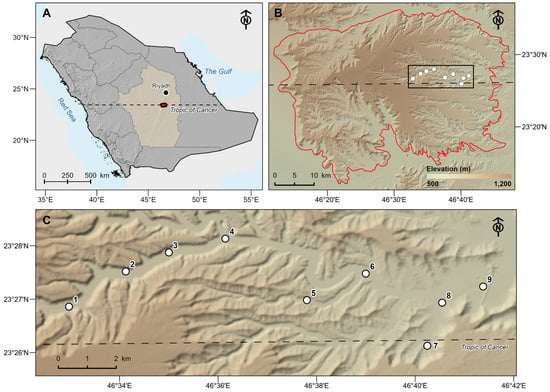
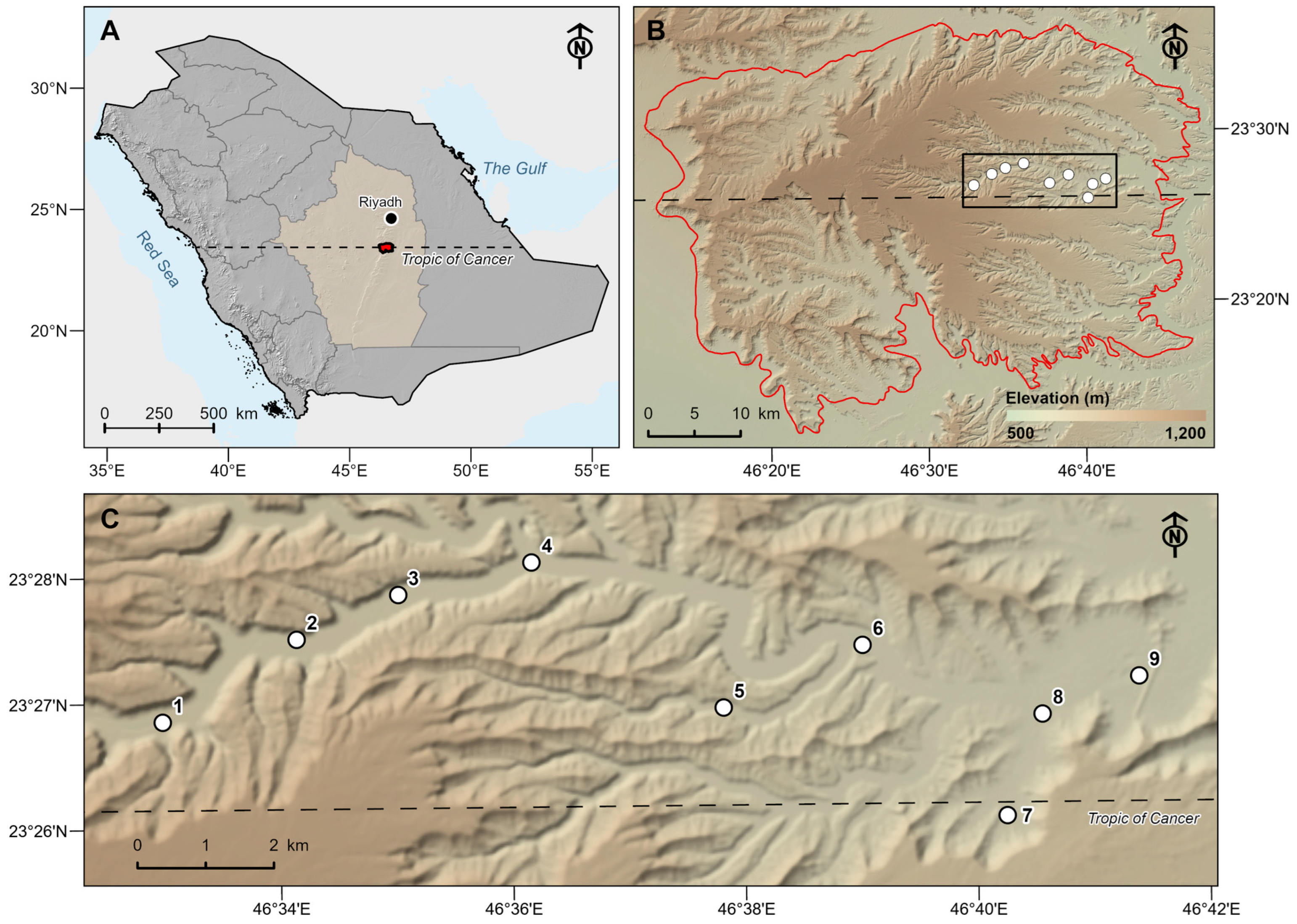
The Ibex Protected Area lies on the Tuwaiq escarpment in Riyadh Region, central Saudi Arabia, west of Hawtat Bani Tamim [15,16]. Its center is c. 140 km south of the city of Riyadh (Figure 1A). The Tropic of Cancer crosses the protected area (Figure 1B). The protected area covers 1840 km2 [17,18]. The area was established in 1988 to protect the last known population of Nubian ibex, Capra nubiana F. Cuvier, 1825, in central Saudi Arabia [15,19]. It is managed by the National Center for Wildlife (NCW) as a national park (IUCN management category II [17]).
Figure 1.
Study area and collecting sites of Mythicomyiidae in the Ibex Protected Area, Riyadh Region, Saudi Arabia. (A) Location of the protected area (red fill) in Saudi Arabia, on shaded relief (vertical exaggeration ×3). Riyadh Region is shown in beige. (B) The protected area (red outline) on elevation and shaded relief. The rectangle shows the extent of (C). (C) The nine collecting sites (1–9). In all panels, the dashed line is the Tropic of Cancer (about 23°26′ N). Elevation data: Copernicus DEM GLO-90 (A) and GLO-30 (B,C). Protected-area boundary: WDPA [18]. Base layers: Natural Earth.
Most of the protected area is an undulating, stony limestone plateau at 800–1100 m above sea level [19]. Deep wadis dissect the plateau between steep escarpments, and trees are largely confined to these wadis and to narrow canyons [19,20]. Towards the east, elevation falls to c. 600 m, where the escarpment meets a sandy plain (Figure 1B [19]). The dominant tree in the wadis is Vachellia tortilis (Forssk.) Galasso & Banfi (=Acacia tortilis (Forssk.) Hayne) [19]. Sixty-two perennial plant species in 34 families have been recorded, forming six communities [16]. The total flora exceeds 250 species [19]. The protected area features a mean annual temperature of ~26 °C and average annual precipitation of ~125 mm [21].
2.2. Methods
All specimens were collected from the Ibex Protected Area by the research team at the King Saud University Museum of Arthropods (KSMA) during a broader field-sampling program conducted monthly across the protected area between January and June 2026. The present study, however, is based solely on the February 2026 field survey, during which the five species reported here were collected at nine sites in the east-central section of the protected area, at elevations ranging from 630 to 730 m above sea level (Figure 1C). All specimens examined in this study bear the collection date 15 February 2026 (Section 3), irrespective of the collecting method. Specimens were captured using Malaise traps (MT, operated for three days), ultraviolet light traps (LT, operated for one night), and sweep nets (SW). The number of traps per site and the sweep-net effort were not recorded in a comparable form (Section 3.4 and Section 4.3), so sampling effort cannot be assumed to be equal among the nine sites. The sites span about 14 km from west to east and about 4 km from north to south (Figure 1C), and habitat and vegetation data for individual sites are not presented here, so differences among sites other than position and altitude (Table 1) are not assessed. Specimen numbers, sites and collecting methods for each species are summarized in Table 2. All collection activities were authorized by and coordinated with the National Center for Wildlife and the management of the protected area.
Table 1.
Collecting sites of Mythicomyiidae in the Ibex Protected Area, Riyadh Region, Saudi Arabia, and species collected at each site. Sites are numbered from west to east (Figure 1C). Coordinates are WGS 84. Altitudes are rounded to the nearest 10 m. Numbers in parentheses are the numbers of specimens. Species are listed in the order of sites.
Table 2.
Mythicomyiidae recorded in the Ibex Protected Area: specimen numbers, sites and collecting methods, and published records from the Arabian Peninsula before this study as cited in the present paper.
Species identifications were confirmed by the last author, who originally described these species from the UAE [4]. Detailed species descriptions, morphological illustrations, and taxonomic identification keys are available in that original work and in Evenhuis and Gharali [12]. The diagnoses given in Section 3 are condensed from the original descriptions [4]. Identification was based on morphology alone; no molecular data were generated. All specimens are deposited in KSMA.
The photos were taken at KSMA, using a Leica MZ125 stereo microscope (Leica Microsystems, Wetzlar, Germany) equipped with a QImaging MicroPublisher 5.0 RTV digital camera (QImaging, Surrey, British Columbia, Canada). Image stacks were combined in Zerene Stacker version 1.04 (Zerene Systems, Richland, WA, USA).
2.3. Regional Conventions and Species List
In this study, we adopt the Afrotropical Region boundaries delineated by Kirk-Spriggs [22], in conjunction with the broader definition proposed by El-Hawagry and Al Dhafer [23] and Roberts and El-Hawagry [24]. This approach extends the northern limit of the Afrotropical Region to the Tropic of Cancer. It includes a substantial portion of the Arabian Peninsula, specifically the southwestern provinces of Saudi Arabia, as well as the entirety of Yemen, Oman, and the UAE, all treated here at country level, although much of the UAE and the northern part of Oman lie north of the Tropic of Cancer. Realm codes are assigned from the country or, for Saudi Arabia, the province in which a record was made, and never from the coordinates of a locality: Yemen, Oman and the UAE are coded Afrotropical as wholes, as in Kirk-Spriggs [22], whereas in Saudi Arabia only the southwestern provinces are Afrotropical. The Riyadh Region, which includes the Ibex Protected Area, lies outside them, so the records from the nine sites are coded PA, as is the earlier record of Cyrtosia pusilla [2]. The Tropic of Cancer crosses the protected area, and the nine sites lie on both sides of it within a few kilometers, so their position relative to the line has no bearing on this coding. In the species list given in Section 3.5, the realm is stated country by country.
Following the regional classification outlined by Omran and Roudi [25], the species list given in Section 3.5 treats the Middle East as including Egypt, Iran, Iraq, Türkiye, the countries of the Levant (Israel, Jordan, Lebanon, Palestine and Syria) and the Arabian Peninsula. For each species recorded from these countries, the list gives an updated world distribution. Following taxonomic revisions by Efflatoun [26], El-Hawagry et al. [27], and El-Hawagry [1], we excluded some Egyptian records previously listed in international catalogs. Conversely, we incorporated additional records from Iran, Oman, Türkiye, the UAE, and Yemen, and a few from outside the Middle East (Armenia, Azerbaijan, and Georgia) based on revisions by Greathead [7], Evenhuis [4], Evenhuis and Gharali [12], Gharali et al. [28], Gharali et al. [13], Taheri et al. [29] and Gharali et al. [30]. Country records not listed in the 2024 World Catalog [2] are marked with an asterisk in Table 3, which also gives the source of each record.
The northern boundary of the Afrotropical Region is generally considered to encompass Gebel Elba, a disputed territory currently administered by Egypt but historically administered by Sudan [31]. Accordingly, early taxonomists (e.g., [26,32,33]) attributed mythicomyiid species collected from Gebel Elba to Sudan, which was then under Egyptian administration. This attribution was later reflected in global catalogs, where all Gebel Elba records were listed under Sudan as a country. Because the historical environmental extent of the Gebel Elba zone included areas now under Sudanese control, El-Hawagry [1] treated all mythicomyiid records from Gebel Elba as Afrotropical records from Egypt (formatted as “AF: Egypt [as Gebel Elba]”) and retained the Sudanese records listed in the catalogs. The present study follows this distributional framework.
Table 3.
Mythicomyiidae species recorded from the Middle East and their global distributions. An asterisk marks a country record not listed in the 2024 World catalog [2]. Species described after that catalog are Empidideicus ferrarius, E. primitus, E. reemeri, Cyrtosia alwathbica, Glabellula sargahi and Doliopteryx dizookensis.
3. Results
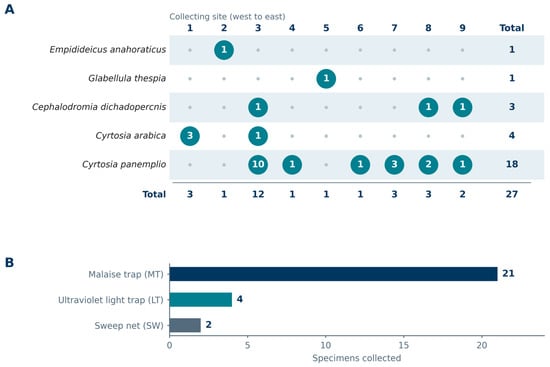
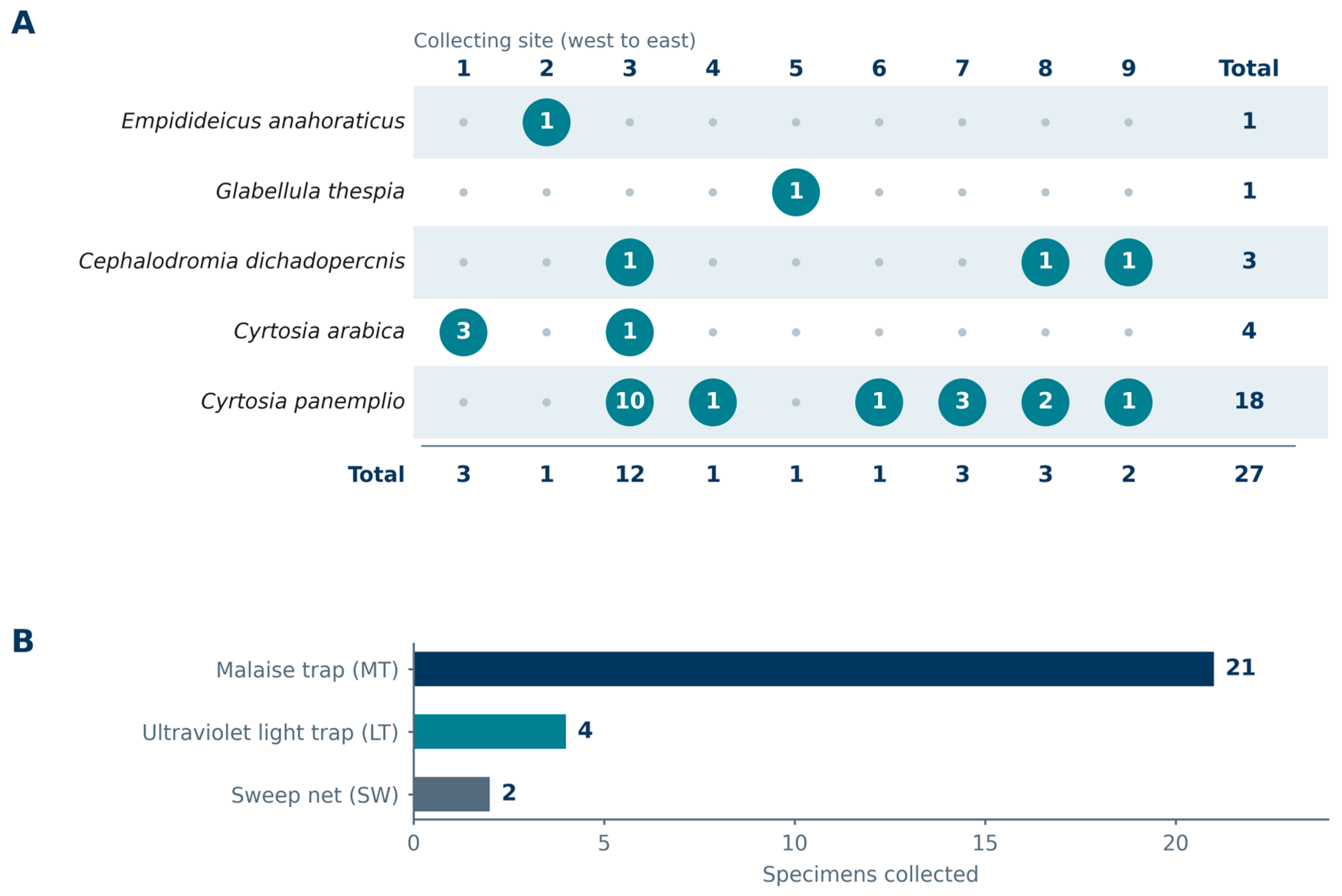
Twenty-seven specimens of five species were obtained from the nine sites (Table 1, Table 2). Cyrtosia panemplio Evenhuis, 2009 was the most numerous (18 specimens), followed by Cyrtosia arabica Evenhuis, 2009 (four), Cephalodromia dichadopercnis Evenhuis, 2009 (three), and Empidideicus anahoraticus Evenhuis, 2009 and Glabellula thespia Evenhuis, 2009 (one each). Twenty-one specimens came from Malaise traps, four from ultraviolet light traps and two from sweep nets. All five species are first records for Saudi Arabia and, to our knowledge, this is the first record of the genus Cephalodromia in Saudi Arabia.
3.1. Subfamily Empidideicinae
- Empidideicus anahoraticus Evenhuis, 2009
Figure 2.
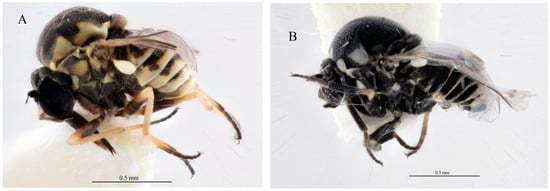
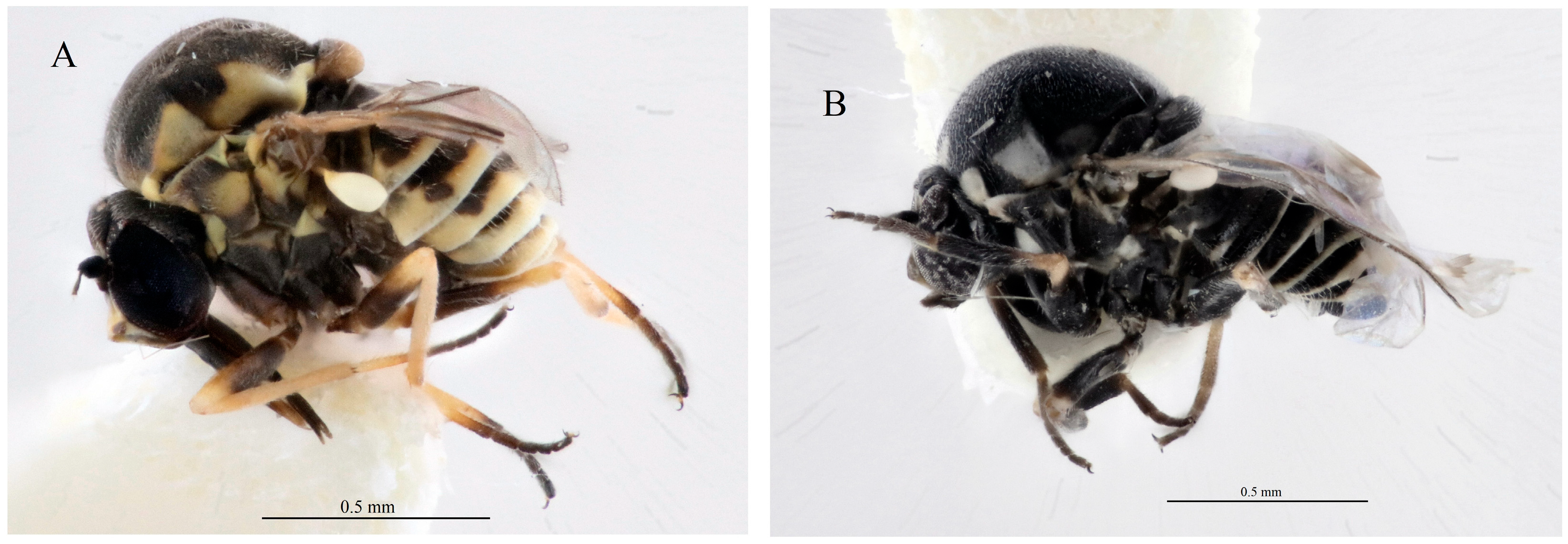
Mythicomyiidae from Saudi Arabia: (A) Empidideicus anahoraticus Evenhuis, female; (B) Glabellula thespia Evenhuis, female. Scale bars: 0.5 mm.
New record. SAUDI ARABIA—Riyadh Region • Ibex Protected Area; 15.II.2026; Abdel-Dayem M., et al. leg.; site 2, 23°27′30.1″ N, 46°34′09.0″ E, alt. 730 m, MT, 1♀; KSMA.
Diagnosis. The first antennal flagellomere is typically ovate, and the second flagellomere is present. The occiput is entirely black. The scutum is matte black, with yellowish-white markings along the lateral and anterior margins, including the interhumeral marking, the area extending from the humeral callus to the transverse suture, and the postalar callus. The scutellum is reddish-brown, and some pleural sclerites are brown to black. The discal cell of the wing is open distally and lacks a closing crossvein. The hind femur is white to yellow throughout or bears brown coloration basally or as a median band; it is never entirely brownish [4].
3.2. Subfamily Glabellulinae
- Glabellula thespia Evenhuis, 2009
New record. SAUDI ARABIA—Riyadh Region • Ibex Protected Area; 15.II.2026; Abdel-Dayem M., et al. leg.; site 5, 23°26′55.5″ N, 46°37′49.3″ E, alt. 690 m, LT, 1♀; KSMA.
Diagnosis. The frons is medially depressed, yellow to yellowish-white, with a small brown spot below the median ocellus. The occiput, vertex, and mentum are black. The antennae have a yellowish-brown scape and pedicel, with dark-brown flagellomeres; the antennal flagellomere is sub-globular, and the style ranges from small to prominent. The scutum and scutellum are dark brown to black, with scattered white hairs; admedian vittae are absent from the anterior half of the scutum, and only small interhumeral markings are present. The broad lateral yellowish-white stripe of the scutum is interrupted between the humeral callus and the notopleural area. Yellow coloration on the scutellum is restricted to the basolateral corners. The abdominal first tergite exhibits a median interruption in its sclerotization [4].
3.3. Subfamily Platypyginae
3.3.1. Cephalodromia dichadopercnis Evenhuis, 2009
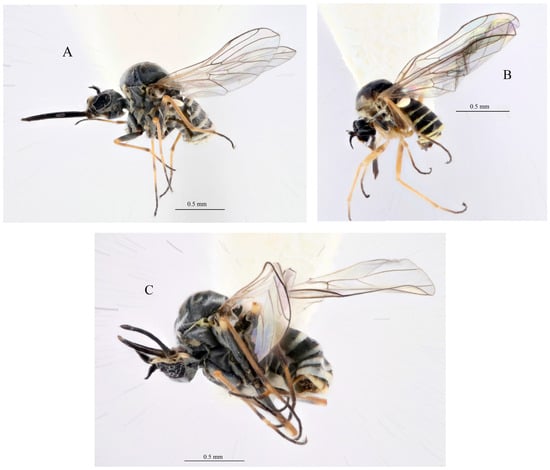
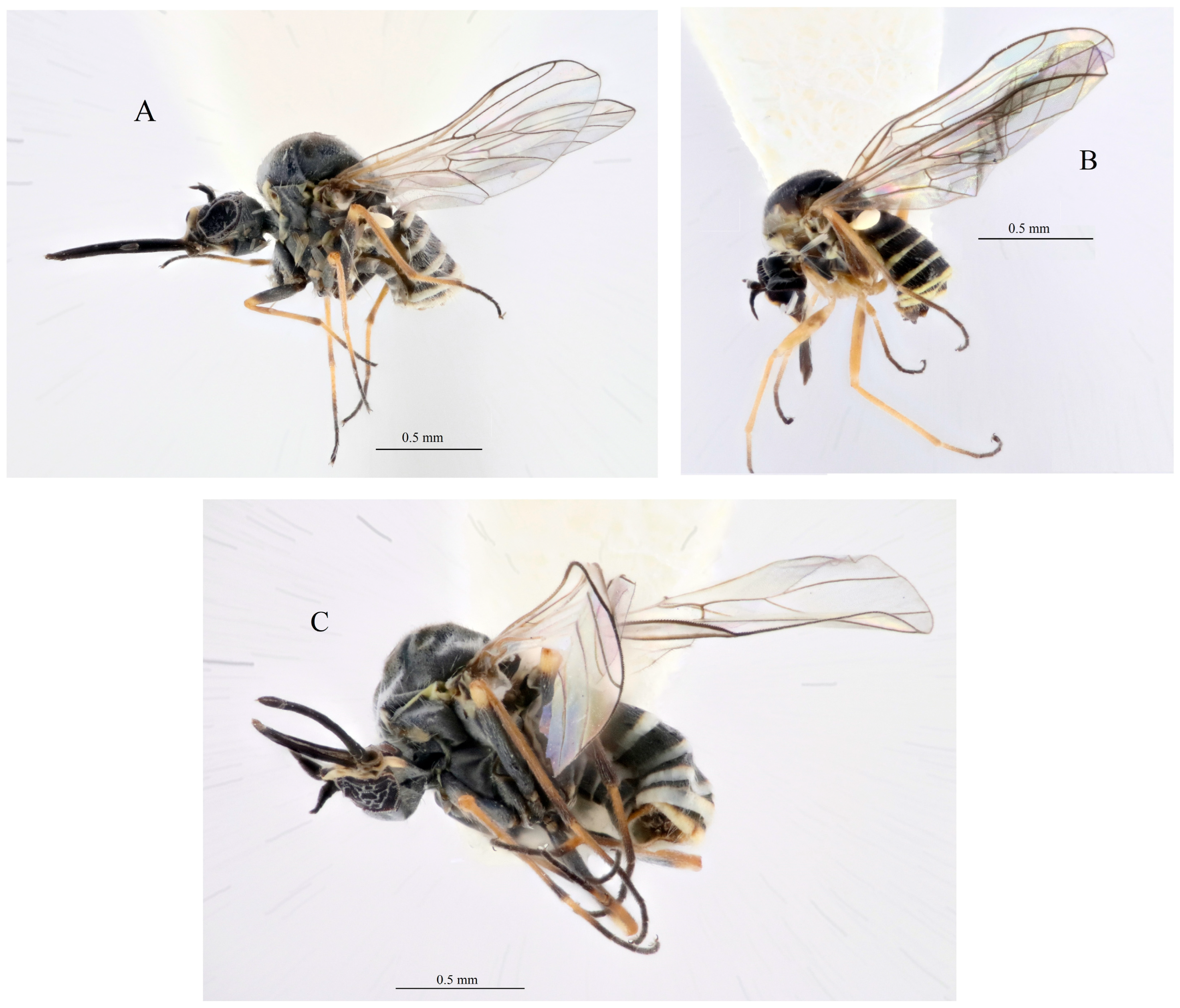
Figure 3.
Mythicomyiidae from Saudi Arabia: (A) Cephalodromia dichadopercnis Evenhuis, female; (B) Cyrtosia arabica Evenhuis, male; (C) Cyrtosia panemplio Evenhuis, female. Scale bars: 0.5 mm.
New record. SAUDI ARABIA—Riyadh Region • Ibex Protected Area; 15.II.2026; Abdel-Dayem M., et al. leg.; site 3, 23°27′50.8″ N, 46°35′01.7″ E, alt. 700 m, LT, 1♀; KSMA • same protected area, date and collector; site 8, 23°26′50.9″ N, 46°40′33.9″ E, alt. 640 m, LT, 1♂; KSMA • same protected area, date and collector; site 9, 23°27′08.5″ N, 46°41′24.0″ E, alt. 630 m, MT, 1♀; KSMA.
Diagnosis. The frons is predominantly black, with yellow to yellowish-white coloration on the lower quarter immediately above the antennae. The face is black, with the apical portion of the oral margin shiny. The antennae are dark brown. The scutum is grayish-black and bears scattered, minute dark hairs, while the scutellum is brownish-black, with white hairs posteriorly. The abdominal tergites are dark brown; each has a yellow posterior margin [4].
3.3.2. Cyrtosia arabica Evenhuis, 2009
New record. SAUDI ARABIA—Riyadh Region • Ibex Protected Area; 15.II.2026; Abdel-Dayem M., et al. leg.; site 1, 23°26′51.1″ N, 46°32′59.4″ E, alt. 730 m, MT, 2♂, 1♀; KSMA • same protected area, date and collector; site 3, 23°27′50.8″ N, 46°35′01.7″ E, alt. 700 m, MT, 1♀; KSMA.
Diagnosis. The frons is slightly depressed medially, black on the upper half and extending medially below the median ocellus toward the antennae, while the lower half is yellow to yellowish-white. The face and apical margin of the oral region are yellowish-white. The proboscis is brown and is 1.5–2.5 times the height of the head. The scutum and scutellum are matte black, with scattered white hairs anteriorly and bronzy hairs dorsally and posteriorly. Distinct interhumeral markings are present on the anterior scutum. The humeral callus, a narrow notopleural line extending to the wing base, a rounded marking extending anterodorsally from the postalar callus, and a narrow ridge extending to the scutellum are yellowish-white. The coxae and basal three-fourths of the femora are brown, whereas the apical fourth of the femora, tibiae, and basitarsi are yellow; tarsomeres 2–5 are brown. The abdomen is brown, with scattered white hairs. The first tergite is entirely yellow, whereas tergites 2–7 have yellow posterior margins [4].
3.3.3. Cyrtosia panemplio Evenhuis, 2009
New record. SAUDI ARABIA—Riyadh Region • Ibex Protected Area; 15.II.2026; Abdel-Dayem M., et al. leg.; site 3, 23°27′50.8″ N, 46°35′01.7″ E, alt. 700 m, MT, 3♂, 7♀; KSMA • same protected area, date and collector; site 4, 23°28′05.7″ N, 46°36′10.8″ E, alt. 690 m, MT, 1♀; KSMA • same protected area, date and collector; site 6, 23°27′24.6″ N, 46°39′01.3″ E, alt. 660 m, MT, 1♂; KSMA • same protected area, date and collector; site 7, 23°26′02.7″ N, 46°40′15.3″ E, alt. 660 m, MT, 1♂, 2♀; KSMA • same protected area, date and collector; site 8, 23°26′50.9″ N, 46°40′33.9″ E, alt. 640 m, SW, 2♀; KSMA • same protected area, date and collector; site 9, 23°27′08.5″ N, 46°41′24.0″ E, alt. 630 m, LT, 1♀; KSMA.
Diagnosis. The frons is slightly depressed medially, yellow to yellowish-white, with a small brown spot below the median ocellus. The face is yellow, with the tip of the oral margin dark brown. The proboscis is brown and tubular, subequal to the head height in its normal condition and 1.5–2.5 times the head height when extended. The scutum is subshining grayish-black, the scutellum is yellow, sometimes with a brown basomedial spot, and bears scattered dark hairs, while the pleura are predominantly black. The wing veins are brown, and the apical half of the costal cell is opaque and milky-white. The coxae, basal half of the femora, and tarsomeres 4–5 are dark brown; the remaining leg portions are yellow. The abdominal tergites are brown, with yellow posterior margins and scattered white hairs. The venter is paler brown than the dorsum, with yellow markings on the posterior portions of the segments [4].
3.4. Summary of the Material
Figure 4 summarizes the mythicomyiid specimens by species, collecting site and collection method. The values are counts of collected specimens. Trap numbers, deployment periods and sweep-net effort were not recorded in a comparable form, so the counts are not abundance estimates and do not show a preference of any species for a site or a method.
Figure 4.
Distribution of collected mythicomyiid specimens across the nine sampling sites and three collection methods. (A) Number of specimens of each species at each site; sites are numbered from west to east as in Table 1, and gray dots mean that the species was not collected at that site. (B) Number of specimens by collection method. Values are counts of collected specimens, not standardized abundance estimates.
3.5. Mythicomyiid Species Reported from the Middle East
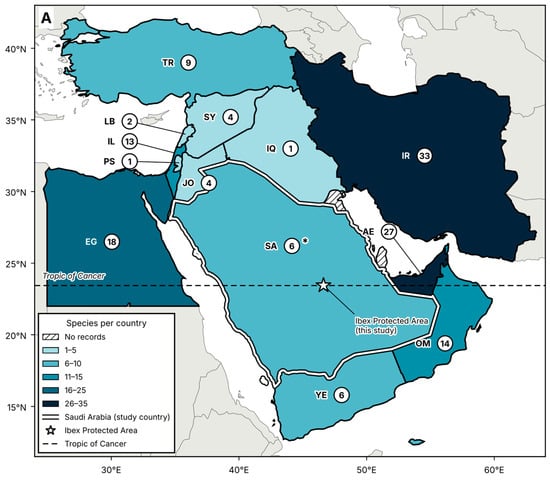
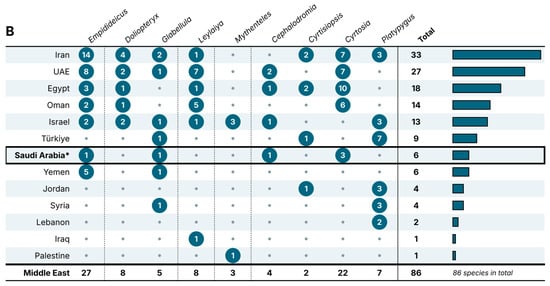
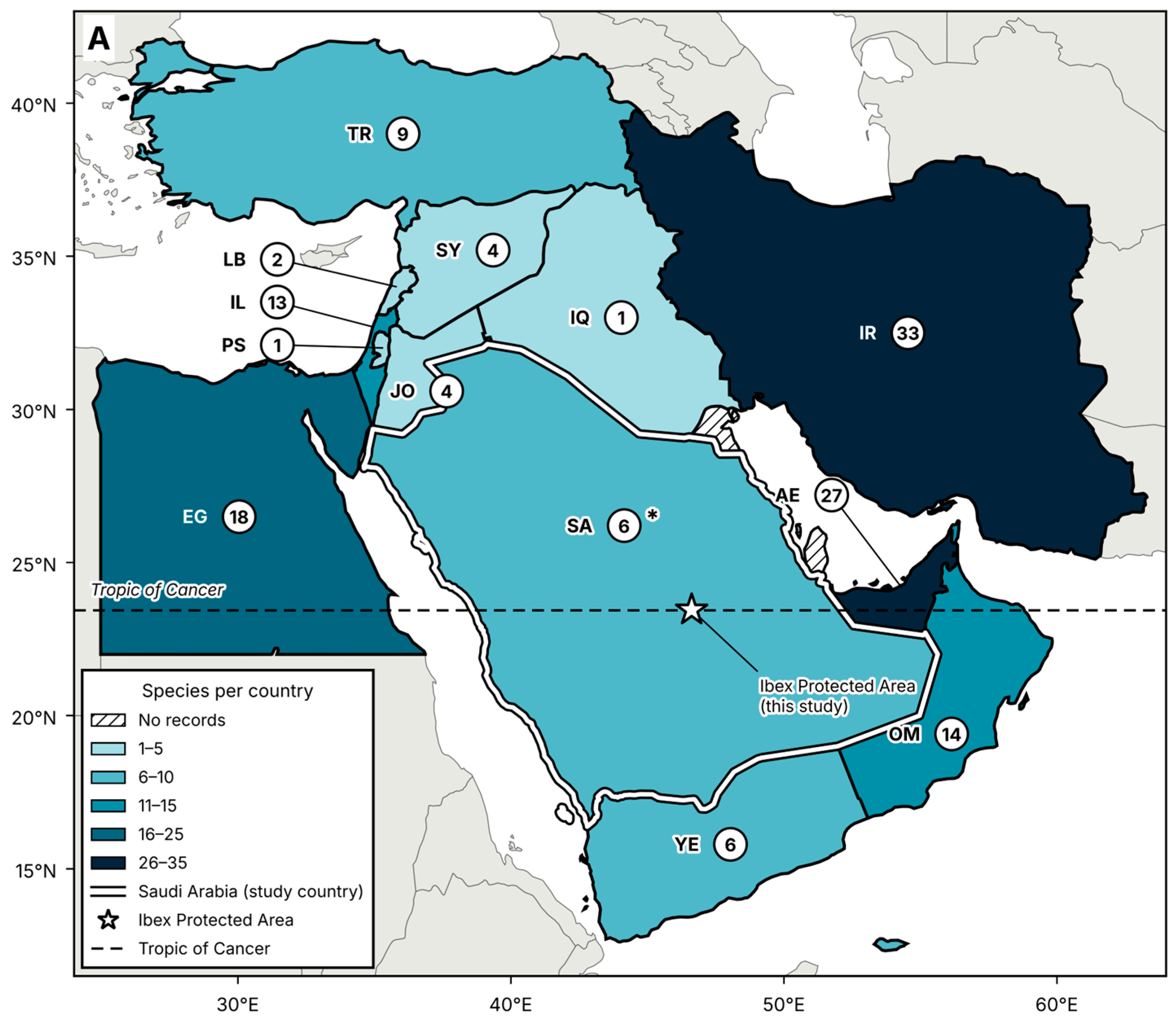
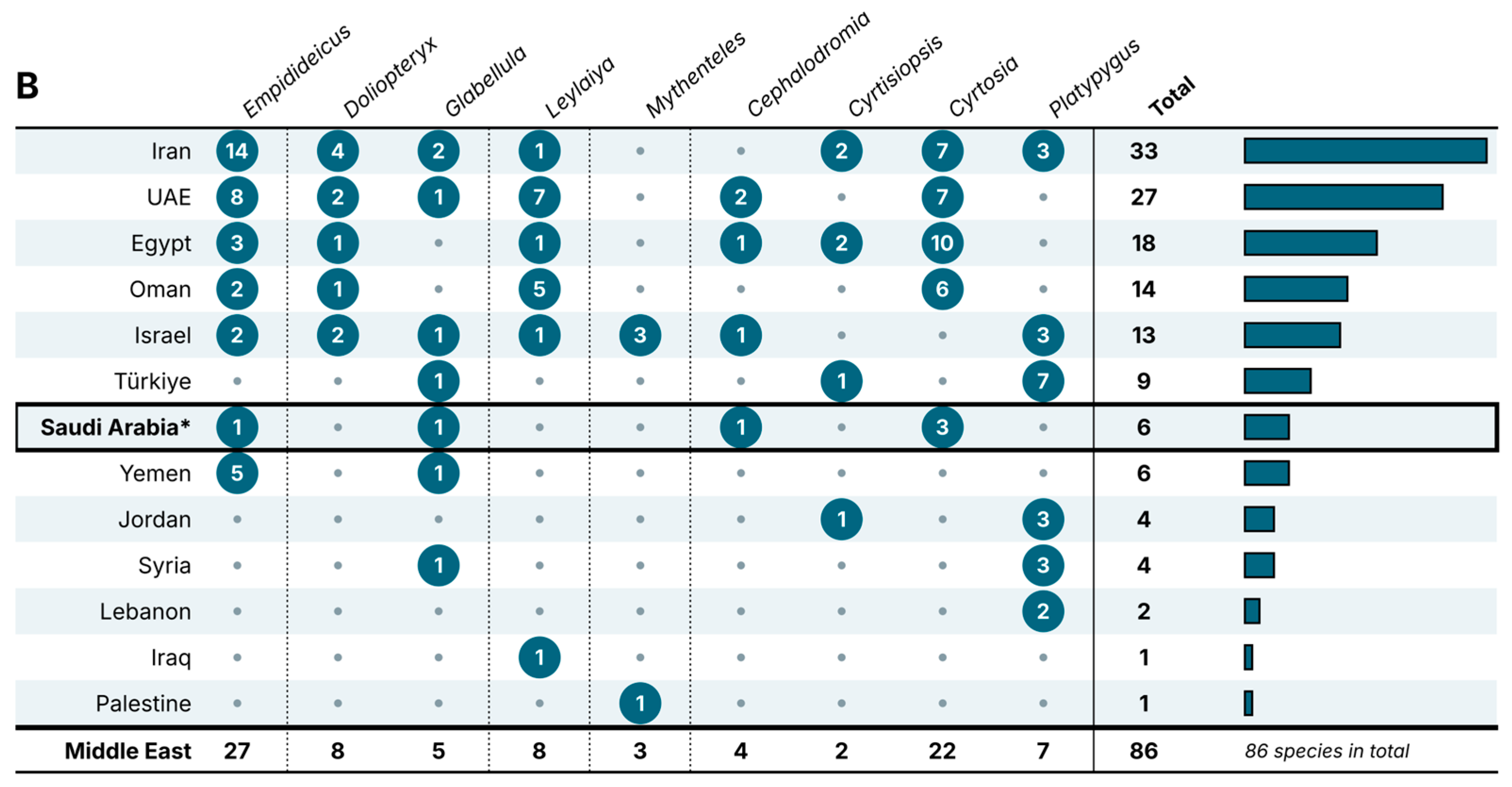
Table 3 lists the 86 species of Mythicomyiidae reported from the Middle East, as defined in Section 2.3, in nine genera and five subfamilies, with their world distribution. It includes the five species recorded here and Cyrtosia pusilla, the species recorded earlier from Saudi Arabia. Counting the records in Table 3, 27 species are known from the UAE, 14 from Oman, 6 from Yemen (including Socotra) and, with the present records, 6 from Saudi Arabia. Table 3 differs from the 2024 World catalog [2] as follows. Country records that are not listed in the catalog are marked with an asterisk, and their sources are given in the last column. Conversely, some Egyptian records listed in the catalog are not retained, following the Egyptian revisions used here [1,26,27]: those of Platypygus bellus Loew, 1869, P. chrysanthemi Loew, 1844, P. ridibundus (Costa, 1863) and Cyrtosia meridionalis Rondani, 1863. The Egyptian record of P. bellus is doubtful; the species is not listed from Egypt by Efflatoun [26] or El-Hawagry [1], and Egypt was deleted from its range by Gharali et al. [47]; the records of P. ridibundus from northern Africa are probably misidentifications [47]. The Egyptian records of Cyrtosia gulperii Efflatoun, 1945, listed as Palaearctic in the catalog, are treated as Afrotropical records from Gebel Elba (Section 2.3). The two Egyptian records that the catalog queries, those of Doliopteryx palaestinensis Evenhuis & Theodor in Evenhuis, 2000 and Cyrtisiopsis maculiventris (Loew, 1874), are accepted, following [2,12] and [1,2], respectively. The catalog gives Kazakhstan for Cyrtosia trivitta Hakimian, Nozari, Gharali & Evenhuis, 2018, although the species was described from Iran, and Table 3 follows the original description [46]. The distribution of these species among countries and genera is shown in Figure 5.
Figure 5.
Mythicomyiidae of the Middle East (Section 2.3, Table 3). (A) Number of species recorded in each country (circled; five shading classes; hatched: no records). Double border: Saudi Arabia. Star: Ibex Protected Area (this study; mean position of the nine sites in Table 1). Dashed line: Tropic of Cancer (about 23°26′ N). Codes: AE, UAE; EG, Egypt; IL, Israel; IQ, Iraq; IR, Iran; JO, Jordan; LB, Lebanon; OM, Oman; PS, Palestine; SA, Saudi Arabia; SY, Syria; TR, Türkiye; YE, Yemen. Asterisk in (A) and (B): Saudi Arabia had one species (Cyrtosia pusilla) before this study and has six now. (B) Species per genus and country, with country totals (bars) and regional genus totals (bottom row); dots: no records; dotted verticals separate subfamilies (left to right: Empidideicinae, Glabellulinae, Leylaiyinae, Mythicomyiinae, Platypyginae). A species recorded in several countries is counted in each; Egyptian counts include Gebel Elba and Yemeni counts include Socotra. Map: schematic drawn in Python 3.15.2 and Matplotlib 3.11.2, using Natural Earth 1:50 m public-domain boundaries (naturalearthdata.com, accessed 22 November 2026); WGS 84; graticule intervals are 10°; species counts were tallied from Table 3. Shading is a sequential teal scale with stepwise lightness, readable in grayscale and with color-vision deficiency. No satellite imagery, web-map service or generated image was used. Boundaries are for orientation only.
4. Discussion
4.1. New Records and Their Significance
The five species of Mythicomyiidae reported here are first records for Saudi Arabia. Until now, the Saudi Arabian fauna of the family has been represented by Cyrtosia pusilla and by unidentified Empidideicus and Glabellula material [6,10,11], so these records are the first confirmed species-level identifications beyond C. pusilla. Cyrtosia panemplio and Empidideicus anahoraticus, already known from the UAE and Oman [4,12], are now documented from central Arabia; the other three were previously known only from the UAE [4]. Cephalodromia dichadopercnis is also, to our knowledge, the first representative of Cephalodromia, as the genus is currently delimited, recorded from Saudi Arabia; none of the 24 Cephalodromia species in the 2024 catalog is listed from Saudi Arabia [2], and Cephalodromia and Glabellula were first recorded from the Arabian Peninsula in the UAE [4]. The records do not allow any statement on population size or habitat preference, but they show that the family is more diverse in Saudi Arabia than the published record suggests, and they provide a firm basis for future collecting in arid habitats, where the family is expected to be most diverse [4]. The Saudi Arabian specimens therefore extend the documented ranges of all five species into central Arabia. With these records, six identified species of Mythicomyiidae are documented from Saudi Arabia, five of them recorded from the country for the first time, compared with 27 from the UAE and 14 from Oman in Table 3. These numbers reflect where collecting has been carried out and published as much as the richness of each country (the UAE fauna, for example, has been the subject of dedicated studies [4,12]).
4.2. Biogeographical Context
The position of central Arabia relative to the Afrotropical and Palaearctic regions has long been debated. Sclater [50] and Wallace [51] placed the northern limit of the Afrotropical Region near the Tropic of Cancer, which intersects the study area within the Riyadh Region, whereas Uvarov [8], Greathead [6] and Larsen [52] regarded the central Arabian desert as an Eremic or Saharo-Arabian zone of predominantly Palaearctic affinity [10]. El-Hawagry and Al Dhafer [23] and El-Hawagry et al. [10,11] interpreted the Riyadh Region as a transitional zone between the two realms.
The five species reported here cannot settle this question. Five species from a single protected area, all described from the UAE, are compatible with a shared arid Arabian fauna (their presence in central Saudi Arabia is not unexpected) and are not a test of the transitional-zone hypothesis. The Tropic of Cancer is cited here only as geographical context for the study area, which it crosses, not as a biological boundary. The realm codes in Table 3 are an operational convention (Section 2.3) and are not evidence that any line is a biological boundary. The genera involved also give little guidance at species level: the 2024 catalog lists both Cyrtosia and Cephalodromia from the Palaearctic and the Afrotropical realms [2], Empidideicus is an Old World genus with high diversity in southern Africa and the Middle East [4], and Glabellula occurs in every realm except the Oriental [2]. The same catalog assigns the UAE and Omani records of the species treated here to the Afrotropical realm and the Saudi Arabian record of C. pusilla to the Palaearctic, following the realm boundaries of Kirk-Spriggs [22]; this is a delimitation and not evidence of faunal affinity [2]. Because the ranges of these genera span both regions, they cannot be used to assign the five species to either. A meaningful test would need dense sampling north and south of the supposed boundary, ideally with molecular data on the relationships among the Arabian, African and Palaearctic populations.
4.3. Sampling Methods and Limitations
Most specimens came from Malaise traps, and the remainder from ultraviolet light traps and sweep netting (Table 2). Trap deployment differed among methods (three days for Malaise traps, one night for light traps), and sweep-net effort and the number of traps per site are not recorded in a form that allows comparison, so these figures are not a measure of method efficiency. Pan trapping has been reported to collect mythicomyiids that flight-intercept traps miss, whereas multiple Malaise traps per site have produced large collections elsewhere [2]. Malaise traps yielded most of the specimens here, but no pan traps or systematic fine-mesh netting were used in this study.
Several limitations should be kept in mind. All records come from one protected area, from nine sites within a 630 to 730 m altitudinal band, and were collected over a short period, so seasonal occurrence and phenology cannot be assessed. The number of sampled specimens does not support conclusions on relative abundance. Identifications rest on morphology, although they were confirmed by the author of the species; no DNA data are available to test species limits or to link the Saudi Arabian specimens to the populations in the UAE. Finally, the biology and ecology of the five species remain unknown.
4.4. Biology and Future Work
Host or immature-stage data are known for only six of the 467 described species of the family [2]. Glabellula arctica (Zetterstedt, 1838) has been observed in the nests of Formica Linnaeus, 1758 ants [2,53], but emergence traps placed over ant nests at Florida sites where Glabellula occurs caught none [54], and whether G. thespia has any comparable association is unknown. Flower visitation is a documented aspect of adult biology in Mythicomyiidae [5,55,56]. A recent field study in the Sahelian zone of Senegal recorded the family during the mid-dry season [57], but seasonal activity cannot be established from the present sampling.
The Ibex Protected Area was established for the Nubian ibex [15,19], and the sources cited here for its biota deal mainly with plants and mammals [15,16,19]. The mythicomyiids add insect records to this baseline. Priorities for further work are sampling in other habitats and regions of Saudi Arabia and in other seasons, including fine-mesh netting and pan traps; DNA barcoding linked to voucher specimens to test the identifications and relate Arabian populations to those elsewhere; and re-examination of the earlier Saudi Arabian material of Cyrtosia and of the unidentified Empidideicus and Glabellula specimens [6,10,11].
5. Conclusions
Five species of Mythicomyiidae are recorded from Saudi Arabia for the first time, based on specimens from nine sites in the Ibex Protected Area; to our knowledge, this is also the first record of Cephalodromia in Saudi Arabia. The identifications were confirmed by the author of the species, but they rest on morphology and on material from a restricted area and a single sampling occasion. The records are best read as additions to the Saudi Arabian species list and as baseline data for an inconspicuous family, not as evidence on the delimitation of the Afrotropical and Palaearctic regions. Sampling in other habitats and seasons, with fine-mesh methods and voucher-linked DNA data, is the obvious next step.
Author Contributions
Conceptualization, M.S.E.-H. and N.L.E.; data curation, M.S.E.-H. and M.S.A.-D.; funding acquisition, H.M.A.D. and M.S.A.-D.; investigation, M.S.E.-H. and N.L.E.; methodology, M.S.E.-H.; resources, H.M.A.D. and M.S.A.-D.; supervision, H.M.A.D.; visualization, M.S.E.-H.; validation, H.M.A.D., M.S.E.-H., M.S.A.-D. and N.L.E.; writing—original draft, M.S.E.-H.; writing—review and editing, H.M.A.D., A.M., I.E., M.S.E.-H., M.S.A.-D. and N.L.E. All authors have read and agreed to the published version of the manuscript.
Funding
This research was supported by the Ongoing Research Funding Program (ORF-2026-1241), King Saud University, Riyadh, Saudi Arabia.
Institutional Review Board Statement
Not applicable.
Informed Consent Statement
Not applicable.
Data Availability Statement
The original contributions presented in this study are included in the article. The specimens are deposited in KSMA. Further inquiries can be directed to the corresponding authors.
Acknowledgments
We thank the National Center for Wildlife, Saudi Arabia, and the management team of the Ibex Protected Area for authorizing and facilitating fieldwork in the protected area. We are also grateful to the research team of the King Saud University Museum of Arthropods (KSMA), KSA, for collecting, mounting, and photographing specimens.
Conflicts of Interest
The authors declare no conflicts of interest.
Abbreviations
The following abbreviations are used in this manuscript:
| AF | Afrotropical |
| alt. | altitude |
| c. | circa (approximately) |
| DEM | digital elevation model |
| incl. | including |
| IUCN | International Union for Conservation of Nature |
| KSA | Kingdom of Saudi Arabia |
| KSMA | King Saud University Museum of Arthropods |
| leg. | legit (collected by) |
| LT | ultraviolet light trap |
| MT | Malaise trap |
| N, E | north, east (geographic coordinates) |
| NCW | National Center for Wildlife |
| OR | Oriental |
| PA | Palaearctic |
| SW | sweep net |
| UAE | United Arab Emirates |
| UK | United Kingdom |
| UNEP-WCMC | United Nations Environment Programme World Conservation Monitoring Centre |
| USA | United States of America |
| WA | Washington (US state) |
| WDPA | World Database on Protected Areas |
| WGS 84 | World Geodetic System 1984 |
| ♂ | male |
| ♀ | female |
References
- El-Hawagry, M.S. Catalog of Superfamily Asiloidea (Diptera: Brachycera) of Egypt. Efflatounia 2011, 11, 1–189. [Google Scholar]
- Evenhuis, N.L. World Catalog of Mythicomyiidae (Insecta: Diptera), Revised ed. Bish. Mus. Bull. Entomol. 2024, 17, 1–95. [Google Scholar]
- Evenhuis, N.L. Catalog of the Mythicomyiidae of the World (Insecta: Diptera). Bish. Mus. Bull. Entomol. 2002, 10, 1–85. [Google Scholar]
- Evenhuis, N.L. Order Diptera, Family Mythicomyiidae. In Arthropod Fauna of the UAE; Van Harten, A., Ed.; Dar Al Ummah: Abu Dhabi, United Arab Emirates, 2009; Volume 2, pp. 714–740. [Google Scholar]
- Yao, G.; Chen, G. First Record of the Genus Empidideicus Becker, 1907 (Diptera, Mythicomyiidae) in China and the Oriental Region, with Description of a New Species. ZooKeys 2019, 846, 65–73. [Google Scholar] [CrossRef] [Scilit] [PubMed]
- Greathead, D.J. Diptera, Fam. Bombyliidae. Fauna Saudi Arab. 1980, 2, 291–337. [Google Scholar]
- Greathead, D.J. Diptera, Fam. Bombyliidae of Saudi Arabia (Part 2). Fauna Saudi Arab. 1988, 9, 90–113. [Google Scholar]
- Uvarov, B.P. Ecological and Biogeographical Relations of Eremian Acrididae. Mém. Soc. Biogéogr. 1938, 6, 231–273. [Google Scholar]
- Greathead, D.J.; Evenhuis, N.L. Bombylioidea (Diptera: Bombyliidae; Mythicomyiidae) from the Island of Sokotra. Zootaxa 2001, 14, 1–11. [Google Scholar] [CrossRef] [Scilit]
- El-Hawagry, M.S.; Abdel-Dayem, M.S.; Al Dhafer, H.M. A Contribution to the Knowledge of Fly Fauna in the Kingdom of Saudi Arabia: New Country Records and an Account of Flies Identified from Rawdhats, Riyadh Region, with Biogeographical Remarks (Insecta: Diptera). J. Nat. Hist. 2018, 52, 1377–1393. [Google Scholar] [CrossRef] [Scilit]
- El-Hawagry, M.S.; Al Dhafer, H.M.; Abdel-Dayem, M.S. On the Fly Fauna of the Central Region of the Kingdom of Saudi Arabia: New Country Records from Riyadh Region, with a List of Associated Fly Species and Zoogeographical Remarks (Insecta: Diptera). J. Nat. Hist. 2019, 53, 17–43. [Google Scholar] [CrossRef] [Scilit]
- Evenhuis, N.L.; Gharali, B. The Mythicomyiidae (Insecta: Diptera) of the United Arab Emirates. Part 2: Genera Cyrtosia Perris, Doliopteryx Hesse, Glabellula Bezzi, and Leylaiya Efflatoun. Bish. Mus. Occas. Pap. 2020, 140, 1–29. [Google Scholar]
- Gharali, B.; Evenhuis, N.L.; Van Harten, A. Discovery of a New Species of Cyrtosia (Diptera: Mythicomyiidae) from the Al Wathba Wetland Reserve, United Arab Emirates. Entomol. Mon. Mag. 2025, 161, 199–205. [Google Scholar] [CrossRef] [Scilit]
- Hölzel, H. Zoogeographical Features of Neuroptera of the Arabian Peninsula. Acta Zool. Fenn. 1998, 209, 129–140. [Google Scholar]
- Wronski, T.; Macasero, W. Evidence for the Persistence of Arabian Wolf (Canis lupus pallipes) in the Ibex Reserve, Saudi Arabia and Its Preferred Prey Species. Zool. Middle East 2008, 45, 11–18. [Google Scholar] [CrossRef] [Scilit]
- Al-Khamis, H.H.; Al-Hemaid, F.M.; Ibrahim, A.S.S. Diversity of Perennial Plants at Ibex Reserve in Saudi Arabia. J. Anim. Plant Sci. 2012, 22, 484–492. [Google Scholar]
- IUCN (International Union for Conservation of Nature). IUCN Green List: Ibex Protected Area. 2026. Available online: https://iucngreenlist.org/sites/ibex-protected-area/ (accessed on 22 October 2026).
- UNEP-WCMC. Protected Planet: Ibex, WDPA Site ID 101910. 2026. Available online: https://www.protectedplanet.net/101910 (accessed on 22 October 2026).
- Bruce, T.; Al-Hazzah, Q.S.; Al-Othman, O.S.; Al-Khairi, M.H.; Wronski, T.; Wacher, T.; Davey, K.; Amin, R. Mammal Diversity Survey in the Ibex Reserve, Saudi Arabia. Final Report; King Khalid Wildlife Research Centre and Zoological Society of London: London, UK, 2016; Available online: https://cms.zsl.org/sites/default/files/2023-09/Wacher_etal_2016_Ibex%20Reserve%20Report%20-%20Final.pdf (accessed on 26 November 2026).
- Habibi, K.; Grainger, J. Distribution and Status of Nubian Ibex in Saudi Arabia. Oryx 1990, 24, 138–142. [Google Scholar] [CrossRef] [Scilit]
- Abatzoglou, J.T.; Dobrowski, S.Z.; Parks, S.A.; Hegewisch, K.C. TerraClimate, a High-Resolution Global Dataset of Monthly Climate and Climatic Water Balance from 1958–2015. Sci. Data 2018, 5, 170191. [Google Scholar] [CrossRef] [Scilit] [PubMed]
- Kirk-Spriggs, A.H. Introduction and Brief History of Afrotropical Dipterology. In Manual of Afrotropical Diptera; Kirk-Spriggs, A.H., Sinclair, B.J., Eds.; Introductory Chapters and Keys to Diptera Families; Suricata 4; South African National Biodiversity Institute: Pretoria, South Africa, 2017; Volume 1, pp. 1–67. [Google Scholar]
- El-Hawagry, M.S.; Al Dhafer, H.M. Five New Records of Bee Flies (Bombyliidae, Diptera) from Saudi Arabia with Zoogeographical Remarks. ZooKeys 2015, 489, 125–133. [Google Scholar] [CrossRef] [Scilit] [PubMed]
- Roberts, H.; El-Hawagry, M.S.A. New Records of Bee Flies (Bombyliidae, Diptera) from the United Arab Emirates. Egypt. J. Biol. Pest Control 2024, 34, 29. [Google Scholar] [CrossRef] [Scilit]
- Omran, A.R.; Roudi, F. The Middle East Population Puzzle. Popul. Bull. 1993, 48, 1–40. Available online: https://pubmed.ncbi.nlm.nih.gov/12318382/ (accessed on 5 November 2026).
- Efflatoun, H.C. A Monograph of Egyptian Diptera. Part VI. Family Bombyliidae. Section 1: Subfamily Bombyliidae Homeophthalmae. Bull. Soc. Fouad Ier Entomol. 1945, 29, 1–483. [Google Scholar]
- El-Hawagry, M.S.; Abdel-Dayem, M.S.; Hassan, S.A. An Annotated Key to Species of Family Mythicomyiidae (Diptera) from Egypt. Bull. Entomol. Soc. Egypt 2003, 80, 193–217. [Google Scholar]
- Gharali, B.; Evenhuis, N.L.; Moghbeli, S. Three New Species of the Genus Empidideicus Becker, 1907 (Diptera: Mythicomyiidae) from Iran with the First Record of the Subgenus Cyrtoides Engel, 1933. Zootaxa 2025, 5604, 529–541. [Google Scholar] [CrossRef] [Scilit] [PubMed]
- Taheri, S.; Mokhtari, A.; Gharali, B. Description of a New Mythicomyiid Species (Diptera: Mythicomyiidae: Glabellulinae) from Southern Iran. Zool. Middle East 2026, 72, 65–71. [Google Scholar] [CrossRef] [Scilit]
- Gharali, B.; Taheri, S.; Mokhtari, A.; Evenhuis, N.L. A New Species of the Genus Doliopteryx from Iran (Diptera: Mythicomyiidae). Bish. Mus. Occas. Pap. 2026, 176, 29–30. [Google Scholar]
- El-Hawagry, M.S.; Gilbert, F. Zoogeographical Affinities and Faunal Relationships of Bee Flies (Diptera: Bombyliidae) in Egypt. Zool. Middle East 2014, 60, 50–56. [Google Scholar] [CrossRef] [Scilit]
- Bezzi, M. Quelques notes sur les bombyliides (Dipt.) d’Égypte, avec description d’espèces nouvelles. Bull. Soc. R. Entomol. Égypte 1925, 8, 159–242. [Google Scholar]
- Engel, E.O. Bombyliidae. In Die Fliegen der Palaearktischen Region; Lindner, E., Ed.; Schweizerbart: Stuttgart, Germany, 1933; Volume 4, Part 3, pp. 97–144, pl. 3. [Google Scholar]
- Gharali, B.; Kamali, K.; Evenhuis, N.L.; Talebi, A.A.; Khalgani, J. First Record of the Genus Empidideicus (Diptera: Bombylioidea: Mythicomyiidae) from Iran, with Description of Six New Species. Zootaxa 2010, 2627, 1–19. [Google Scholar] [CrossRef] [Scilit]
- Gharali, B.; Evenhuis, N.L.; Lotfalizadeh, H. Two New Species of the Genus Empidideicus from Northern Iran. Zool. Middle East 2011, 54, 113–120. [Google Scholar] [CrossRef] [Scilit]
- Gharali, B.; Majnon Jahromi, B.; Evenhuis, N.L.; Fallahzadeh, M. First Record of the Genus Empidideicus Becker (Diptera: Mythicomyiidae, Empidideicinae) from Southern Iran with Description of a New Species. Entomol. Mon. Mag. 2015, 151, 27–34. [Google Scholar]
- Hakimian, S.; Talebi, A.A.; Gharali, B.; Evenhuis, N.L. A Study of the Genus Empidideicus Becker, 1907 (Diptera: Mythicomyiidae) in Northern Iran, with Description of a New Species. Turk. J. Zool. 2014, 38, 257–262. [Google Scholar] [CrossRef] [Scilit]
- Moghbeli, S.; Fekrat, L.; Gharali, B. Empidideicus jirofti sp. nov. (Diptera: Mythicomyiidae: Empidideicinae), a New Microbombyliid from Kerman Province, Southern Iran, with a Key to Species of Empidideicus in Iran. Zootaxa 2020, 4722, 352–360. [Google Scholar] [CrossRef] [Scilit] [PubMed]
- Gharali, B.; Moghbeli, S.; Evenhuis, N.L. A New Species of the Genus Doliopteryx Hesse (Diptera: Mythicomyiidae: Glabellulinae) from Southern Iran. Entomol. Mon. Mag. 2023, 159, 24–28. [Google Scholar] [CrossRef] [Scilit]
- Gharali, B.; Evenhuis, N.L. First Record of the Genus Doliopteryx Hesse, 1956 (Diptera: Mythicomyiidae: Glabellulinae) from Iran, with Description of Two New Species. Zootaxa 2017, 4358, 393–400. [Google Scholar] [CrossRef] [Scilit] [PubMed]
- Gharali, B.; Kamali, K.; Evenhuis, N.L.; Talebi, A.A. First Record of the Genus Glabellula Bezzi (Diptera: Mythicomyiidae: Glabellulinae) from Iran, with the Description of a New Species. Stud. Dipterol. 2011, 17, 113–120. [Google Scholar]
- Gharali, B.; Evenhuis, N.L. A New Species of Leylaiya Efflatoun (Diptera: Mythicomyiidae) from Iran. North-West. J. Zool. 2011, 7, 204–207. [Google Scholar]
- Evenhuis, N.L. World revision of the microbombyliid genus Mythenteles Hall & Evenhuis (Diptera: Mythicomyiidae). Zootaxa 2003, 346, 1–28. [Google Scholar] [CrossRef] [Scilit]
- Gharali, B.; Evenhuis, N.L. Review of the Genus Cyrtosia Perris (Diptera: Mythicomyiidae: Platypyginae) in Iran, with Description of Three New Species. Zootaxa 2017, 4269, 230–244. [Google Scholar] [CrossRef] [Scilit] [PubMed]
- Gharali, B.; Kamali, K.; Evenhuis, N.L.; Talebi, A.A. A New Microbombyliid, Cyrtosia persica spec. nov. (Bombylioidea: Mythicomyiidae: Platypyginae) from Northern Iran. Stud. Dipterol. 2011, 17, 151–157. [Google Scholar]
- Hakimian, S.; Nozari, J.; Gharali, B.; Evenhuis, N.L. A Study of the Genus Cyrtosia Perris (Diptera: Mythicomyiidae: Platypyginae) in Yazd Province, Iran, with Description of a New Species. Zootaxa 2018, 4387, 195–200. [Google Scholar] [CrossRef] [Scilit] [PubMed]
- Gharali, B.; Evenhuis, N.L.; Almeida, J. World Synopsis of Described Species of the Genus Platypygus Loew (Diptera: Mythicomyiidae: Platypyginae). Zootaxa 2013, 3745, 199–242. [Google Scholar] [CrossRef] [Scilit] [PubMed]
- Gharali, B.; Evenhuis, N.L.; Kamali, K.; Talebi, A.A. A Review of the Genus Platypygus Loew (Mythicomyiidae: Platypyginae) in Iran, with Notes on Cyrtisiopsis maculiventris (Loew) n. comb. Zootaxa 2011, 2979, 25–40. [Google Scholar] [CrossRef] [Scilit]
- Dils, J.; Gharali, B. Two New Species of the Genus Platypygus (Diptera: Mythicomyiidae: Platypyginae) from the Iberian Peninsula and Turkey. Phegea 2018, 46, 110–118. [Google Scholar]
- Sclater, P.L. On the General Geographical Distribution of the Members of the Class Aves. J. Proc. Linn. Soc. Zool. 1858, 2, 130–136. [Google Scholar] [CrossRef] [Scilit]
- Wallace, A.R. The Geographical Distribution of Animals; Macmillan: London, UK, 1876. [Google Scholar]
- Larsen, T.B. Butterflies of Saudi Arabia and Its Neighbours; Stacey International: London, UK, 1984; 160p. [Google Scholar]
- Andersson, H. Studies on the Myrmecophilous Fly, Glabellula arctica (Zett.) (Dipt. Bombyliidae). Entomol. Scand. 1974, 5, 29–38. [Google Scholar] [CrossRef] [Scilit]
- Evenhuis, N.L. The Genus Glabellula Bezzi (Diptera: Mythicomyiidae) in Florida, with Descriptions of Four New Species. Bish. Mus. Occas. Pap. 2025, 165, 1–14. [Google Scholar]
- Evenhuis, N.L. 44. Mythicomyiidae (Micro Bee Flies). In Manual of Afrotropical Diptera; Kirk-Spriggs, A.H., Sinclair, B.J., Eds.; Nematocerous Diptera and Lower Brachycera; Suricata 5; South African National Biodiversity Institute: Pretoria, South Africa, 2017; Volume 2, pp. 1005–1017. [Google Scholar]
- Evenhuis, N.L.; Almeida, J.; Andrade, R. The flower-loving microbombyliid genus Empidideicus Becker, 1907 (Diptera: Mythicomyiidae) in Portugal. Bish. Mus. Occas. Pap. 2023, 154, 1–28. [Google Scholar]
- Medina-Serrano, N.; Bagnères, A.-G.; Ndiaye, M.M.; Vrecko, V.; McKey, D.; Hossaert-McKey, M. Seasonal variation in insect assemblages at flowers of Balanites aegyptiaca, an ecologically and socially important tree species in the Ferlo region of Senegal’s Great Green Wall corridor. Peer Community J. 2026, 6, e37. [Google Scholar] [CrossRef] [Scilit]

Disclaimer/Publisher’s Note: The statements, opinions and data contained in all publications are solely those of the individual author(s) and contributor(s) and not of MDPI and/or the editor(s). MDPI and/or the editor(s) disclaim responsibility for any injury to people or property resulting from any ideas, methods, instructions or products referred to in the content. |
© 2026 by the authors. Licensee MDPI, Basel, Switzerland. This article is an open access article distributed under the terms and conditions of the Creative Commons Attribution (CC BY) license.