


Simple Summary
This study identifies Cry2Ah1-binding proteins in the midgut of Spodoptera exigua. Cry2Ah1 interacts with multiple BBMV proteins, including APN isoforms, ABCC2, ABCC3, polycalin, ALP, and a cadherin-like protein. APN and ABCC2 were expressed throughout larval development, with distinct expression patterns across instars. Recombinant APN2 directly binds activated Cry2Ah1 and exhibits stage-specific expression patterns. APN2 knockdown does not alter larval susceptibility to Cry2Ah1 in bioassays, indicating that APN2 acts only as a binding protein rather than a functional receptor. By contrast, ABCC2 knockdown alters larval mortality, demonstrating that ABCC2 functions as a functional receptor. In summary, our results distinguish between binding proteins and functional receptors of Cry2Ah1 in S. exigua. APN2 binds Cry2Ah1 but is not essential for toxicity, while ABCC2 acts as a functional receptor. This work improves our understanding of the molecular mode of action of Cry2Ah1 and provides useful information for the rational application of Cry2Ah1 to control S. exigua.
Abstract
Cry1Ac-producing transgenic cotton, widely planted in China, efficiently controls the major pest Helicoverpa armigera but exhibits poor efficacy against secondary lepidopteran pests, including Spodoptera exigua. Cry2Ah1 is a novel, independently developed Chinese Bacillus thuringiensis (Bt) protein with potent toxicity against S. exigua and other lepidopteran insects. However, its insecticidal mechanism remains poorly characterized. Herein, Cry2Ah1-binding proteins in the S. exigua midgut were identified via ligand blotting, pull-down assays, and LC–MS/MS, the functions of the candidate receptors APN2 and ABCC2 were further verified using qPCR, protein expression, ligand blotting, and RNAi. Multiple midgut brush border membrane vesicle (BBMV) proteins, including APN1/2/3/5/6, ABCC2/3, polycalin, alkaline phosphatase, and a cadherin-like protein, were found to bind Cry2Ah1. The transcript level of APN2 increased from the first to the fourth larval instar and subsequently decreased, whereas ABCC2 expression was continuously upregulated during larval development. Although APN2 protein can bind Cry2Ah1 in the larval midgut, silencing APN2 had no effect on larval susceptibility to Cry2Ah1. In contrast, ABCC2 knockdown significantly reduced larval mortality upon Cry2Ah1 exposure. This study reveals the molecular mechanism underlying Cry2Ah1 toxicity, identifies candidate proteins for functional characterization, and supports further investigations into Cry2Ah1 and its application for S. exigua management.
1. Introduction
Transgenic crops producing insecticidal crystal proteins from Bacillus thuringiensis (Bt) have been commercially cultivated for nearly three decades and remain a cornerstone for lepidopteran pest management [1,2]. In China, Bt cotton expressing Cry1Ac was first commercialized in 1997. Its large-scale cultivation has persistently suppressed cotton bollworm, Helicoverpa armigera, not only in cotton fields but also on other host crops [3]. By drastically reducing applications of broad-spectrum chemical insecticides targeting H. armigera, Bt cotton conserves natural enemy communities and enhances biological control services within agroecosystems [4]. Nevertheless, first-generation Bt cotton confers poor control of several secondary pests, including Agrotis ipsilon, Spodoptera litura and Spodoptera exigua [5]. Furthermore, continuous large-scale planting of this single-toxin cotton has already led to early-stage field resistance to Cry1Ac in H. armigera [6]. Pyramiding two or more Bt proteins with different modes of action in a single cultivar is the primary strategy for broadening the insecticidal spectrum and delaying pest resistance evolution [7]. First-generation single-gene Bt cotton expressing Cry1Ac was commercialized in the United States in 1996, followed by second-generation pyramided cotton producing Cry1Ac + Cry2Ab and Cry1Ac + Cry1F [5]. While first-generation cultivars targeted Helicoverpa zea, Heliothis virescens, and Pectinophora gossypiella, second-generation pyramids have an expanded insecticidal spectrum and markedly improved toxicity toward S. exigua and Spodoptera frugiperda [8,9,10].
The beet armyworm S. exigua (Lepidoptera: Noctuidae) is a highly polyphagous agricultural pest. Changes in cropping systems in China have expanded its populations in recent years [11]. Management of S. exigua still relies heavily on chemical insecticides, and this pest has evolved resistance to multiple insecticide classes [12]. Cry2Ah1, a Bt protein with independent Chinese intellectual property rights, displays potent larvicidal activity against S. exigua and S. litura [13], and Cry2Ah1 purified from Escherichia coli expression also exerts growth-inhibitory activity against both Cry1Ac-susceptible and Cry1Ac-resistant H. armigera strains [13]. Cry2Ah1 thus represents a promising candidate gene for second-generation transgenic cotton in China. However, its rational deployment is limited by incomplete knowledge of its insecticidal mechanism: identification of midgut proteins that functionally interact with Cry2Ah1 is required to predict cross-resistance to other Cry proteins, select suitable gene partners for pyramided cultivars, and develop molecular markers for resistance monitoring.
Binding to specific receptors on midgut BBMVs represents a central, specificity-determining step in the mode of action of Cry toxins [14]. Aminopeptidases N (APNs), alkaline phosphatases (ALPs), cadherins and ATP-binding cassette (ABC) transporters have all been identified as Cry-binding partners in lepidopteran insects [15,16,17]. In H. armigera, toxicity of activated Cry1Ac relies on synergistic interactions between CAD and ABCC transporters, whereas Cry1Ac protoxin toxicity is primarily mediated by ABCC transporters with minimal CAD involvement [18]. In Bombyx mori, ABCC2 generally functions as the primary high-efficiency functional receptor for Cry toxin, and cadherin often acts as a co-receptor, while APNs and ALPs are mostly not key determinants of toxicity [19]. In S. exigua, ABCC2 acts as the major receptor, whereas ABCC3 and cadherin play minor roles in mediating Cry1Ac toxicity [20]. Multiple APN isoforms can bind Cry toxins, and downregulation of APN1 expression confers Cry1Ca resistance in S. exigua [21]. ABCC2 acts as a functional receptor for Cry1Ca in Spodoptera litura [22]. Thus, whether Cry receptors are essential for toxin activity must be verified on a case-by-case basis, and this question remains unaddressed for Cry2Ah1.
To clarify the mode of Cry2Ah1, this study identified Cry2Ah1-binding proteins in the midgut of S. exigua by ligand blot, pull-down assays and LC–MS/MS, and quantified the expression of the candidate binding protein APN2 and ABCC2 across larval instars. Direct binding of Cry2Ah1 to heterologously expressed APN2 was confirmed by ligand blot. RNAi-mediated knockdown of APN2 and ABCC2 was then performed to assess whether reduced APN2 and ABCC2 expression affect larval susceptibility to Cry2Ah1. Our results show that APN2 directly binds Cry2Ah1 but is not required for Cry2Ah1 toxicity. Conversely, ABCC2 knockdown reduces Cry2Ah1 sensitivity. We therefore suggest that APN2 is merely a Cry2Ah1-binding protein, not a functional receptor, while ABCC2 functions as a functional receptor. These findings provide a foundation for elucidating the mode of action Cry2Ah1 and evaluating its potential for insect resistance management.
2. Materials and Methods
2.1. Insect Rearing and Cry2Ah1 Protein
The beet armyworm, S. exigua, was originally collected from cotton fields in Xinxiang, Henan Province, China, in 2019. This colony has since been continuously maintained on an artificial diet at the Xinxiang Experimental Station, Institute of Plant Protection, Chinese Academy of Agricultural Sciences, with no exposure to Bt proteins or insecticides. Larvae were reared on artificial diet, and adults were fed a 10% (w/v) sucrose solution. Rearing conditions were set at 27 ± 2 °C, a photoperiod of 14 h light:10 h dark (L: D = 14: 10), and 75 ± 10% relative humidity.
The Bt 407 strain that produces Cry2Ah1 was generously provided by the Research Group on Insect-Resistant Biotechnology, Institute of Plant Protection, Chinese Academy of Agricultural Sciences(Beijing, China). Prior to use, Cry2Ah1 protein was mixed with trypsin at a 10:1 ratio and incubated at 37 °C for 4 h to achieve protein activation.
2.2. Expression, Quantification and Insecticidal Activity of Cry2Ah1
Cry2Ah1 protein was extracted according to a standard protocol for soluble Cry2A-family proteins [13]. The purity and integrity of the extracted protein were verified via SDS–PAGE, and protein concentration was quantified using the bovine serum albumin (BSA) assay. All protein aliquots were stored at −80 °C until use.
The insecticidal activity of Cry2Ah1 against newly emerged S. exigua larvae was evaluated using a diet incorporation bioassay. Six gradient concentrations of Cry2Ah1 were designed for the bioassay. Briefly, purified Cry2Ah1 protoxin was serially diluted with 50 mmol/L Na2CO3/NaHCO3 buffer (pH 10.0) and fully incorporated into artificial diet to generate final concentrations of 0.375, 0.75, 1.5, 3, 6, and 12 μg/g. A diet group treated with only the buffer solution was set as the blank control. The homogenized diet was dispensed into 24-well culture plates, with one 1-day-old larva placed in each well. Each concentration treatment contained 24 individual larvae, and the entire bioassay was performed in three independent replicates. Larval mortality was recorded at 7 days post-treatment. Larvae exhibiting no movement upon gentle stimulation and those with stunted growth smaller than normal first-instar larvae were considered dead. The median lethal concentration (LC50) and its corresponding 95% confidence interval were calculated. All statistical analyses were performed using R software (R 4.3.0 (R Foundation for Statistical Computing, Vienna, Austria).) (https://www.r-project.org, accessed on 15 August 2026).
2.3. Preparation of BBMV and Ligand Blot Analysis
BBMVs were prepared from fourth-instar S. exigua larvae according to the method described by Wolfersberger et al. [23]. Polyclonal antibodies against Cry2Ah1 were generated by BGI (BGI Genomics Co., Ltd., Beijing, China).
The specificity of the Cry2Ah1 antibody was verified prior to the binding assays. Cry2Ah1 protein was separated by SDS–PAGE (Genscript, Nanjing, China) and transferred onto a PVDF membrane, which was then blocked with 3% BSA for 30 min at room temperature. The Cry2Ah1 polyclonal antibody was diluted in blocking solution at a ratio of 1:5000 and incubated with the membrane for 2 h at room temperature under rotation. The membrane was washed three times with PBST, for 10 min per wash. Alpaca anti-rabbit IgG-HRP antibody (HuaAn Biotechnology Co., Ltd., Hangzhou, China) was diluted in blocking solution at a ratio of 1:10,000 and incubated for 2 h at room temperature under rotation. Signal development was performed using an e-BLOT instrument following the manufacturer’s instructions for the EasySee Western Blot Kit (TransGen, Beijing, China). For the ligand blot assay, S. exigua BBMVs were separated by SDS–PAGE and transferred onto a PVDF membrane. The membrane was blocked with 3% BSA for 30 min at room temperature and washed three times with PBST, 10 min per wash. Activated Cry2Ah1 protein was added to fresh blocking solution at a ratio of 1:400 and incubated with the membrane for 1 h at room temperature. Subsequent membrane washing, antibody incubation and signal development steps were identical to those described above.
2.4. Pull-Down Assay and LC–MS/MS Identification
NHS-activated Sepharose™ 4 Fast Flow resin was taken from storage and washed with 1 mmol/L HCl for 15 min, followed by a 5 min wash with coupling buffer (0.1 mol/L NaHCO3, 0.5 mol/L NaCl, pH 8.3). The resin was incubated with activated Cry2Ah1 protein for 1 h at room temperature, and an aliquot of the flow-through was collected. Remaining uncoupled active sites were blocked using blocking buffer (0.1 mol/L Tris-HCl, pH 8.5) for 2 h at room temperature. The resin was then subjected to three cycles of washing with pre-cooled buffers (0.1 mol/L NaAc containing 0.5 mol/L NaCl, pH 4.0; and 0.1 mol/L Tris-HCl containing 0.5 mol/L NaCl, pH 8.0). The Cry2Ah1-coupled resin was stored in PBS at 4 °C.
The coupled resin was incubated with 100 μL of S. exigua BBMVs for 2 h at room temperature, after which the supernatant was harvested. Non-specifically bound proteins were removed by washing with PBS supplemented with 1 mol/L NaCl, followed by a final 10 min wash in PBS. The final eluate, containing proteins that interact with Cry2Ah1, was retained. The flow-through, supernatant and eluate fractions were analyzed by SDS–PAGE. Resin activated in the absence of Cry2Ah1 protein and subsequently blocked with blocking buffer served as the negative control. The SDS–PAGE gel containing Cry2Ah1-interacting proteins was submitted to BGI (Beijing, China) for LC–MS/MS identification. Protein abundance was estimated using label-free intensity-based absolute quantification (iBAQ) from LC-MS/MS data.
2.5. Quantification of APN2 and ABCC2 Expression in Different Larval Instars
Based on results from binding protein identification and pull-down assays, ABCC2 and APN2 were selected as representative binding protein genes, and their expression profiles in the larval midgut across different instars were quantified. Sample collections were performed as follows: 40 intact first-instar larvae, 30 intact second-instar larvae, and midgut tissues dissected from 20 third-instar, 20 fourth-instar, and 15 fifth-instar larvae, respectively. Three biological replicates and three technical replicates were included for each larval instar. Primers were designed based on the published sequences of S. exigua ABCC2 (GenBank accession No. KF926100.1) and APN2 (GenBank accession No. AY218843.1). GAPDH and RPL10 were used as reference genes. All primers were synthesized by Sangon Biotech (Shanghai, China) (Table 1). The qPCR thermal profile consisted of an initial activation step at 95 °C for 15 min, followed by 40 amplification cycles of 95 °C for 10 s and 60 °C for 32 s. The relative expression levels of ABCC2 and APN2 were calculated using the 2−ΔΔCt method. Differences in gene expression across larval instars and differences were assessed by one-way analysis of variance (ANOVA), followed by LSD multiple comparisons.
2.6. Expression Vectors Construction
APN2 primers were designed using the online tool (https://crm.vazyme.com/cetool/simple.html, accessed on 24 October 2025), with NdeI and HindIII as restriction sites (30a-APN2-F: ggatcttccagagatcatatgATGTATTTACTGACACTACTTTCCCTTATCG; 30a-APN2-R: ctgccgttcgacgataagcttTTAATGATTGAAAACTGTTACTACAAACG). Sequence-verified clones were scale-up cultured, and target fragments were linearized via PCR. The pET-30a vector and gel-purified APN2 PCR products were assembled with 2× Cloning Mix and transformed into E. coli BL21(DE3) competent cells (Biomed, Beijing, China), the seamless cloning reaction was incubated in a metal bath at 50 °C for 15 min. Positive constructs were identified via colony picking, shake culture, colony PCR and Sanger sequencing.
2.7. Fusion Protein Expression and Purification
The pET30a-APN2 plasmid was transformed into T7 Express competent cells (Biomed) for protein expression. Two single colonies were cultured in 5 mL LB medium supplemented with 100 mg/mL kanamycin at 37 °C and 200 rpm for 4 h, then inoculated into 500 mL LB broth containing 100 mg/mL kanamycin. When the OD600 reached 0.4–0.6, protein expression was induced by adding 0.5 mM isopropyl β-D-1-thiogalactopyranoside (IPTG), followed by incubation at 15 °C and 200 rpm for 16 h.
Cells were harvested by centrifugation at 8000× g for 30 min at 4 °C. The cell pellet was resuspended in 1 × PBS (pH 7.4) and lysed by sonication on ice at 400 W for 99 cycles (3 s on, 5 s off), repeated twice. The soluble fraction was collected from the crude lysate after centrifugation at 12,000× g for 30 min at 4 °C and verified using SDS–PAGE. The fusion protein was purified with Ni-Agarose Resin (CWBIO). After extensive washing with 1 × PBS, bound protein was gradient-eluted using five column volumes of elution buffer (1 × PBS, 500 mM imidazole, 5 M NaCl, pH 7.9). Peak fractions containing target protein were pooled and dialyzed overnight against 1 × PBS at 4 °C.
2.8. dsRNA Synthesis and Injection
APN2/ABCC2 expression was knocked down via dsRNA-mediated RNAi injection into third-instar larvae. Double-stranded RNAs targeting APN2 and GFP were synthesized with the T7 RiboMAX Express RNAi System (Promega Corporation, Madison, WI, USA) following the manufacturer’s protocol [24]. Gene-specific primers were designed using the SnapDragon (dsAPN2-F: ATGTTCGGTATTTACGTTTCGACT; dsAPN2-R: AACAGCAGCTTTGTCAAGTT. dsGFP-F: ATTCTCGTGGAACTGGATGG; dsGFP-R: GTGGACAGGTAATGGTTG) (dsABCC2-F: GGATCCTAATACGACTCACTATAGGAACGCCATCGGTAAGATGAG. dsABCC2-R: GGATCCTAATACGACTCACTATAGGCTTGCCACTTCAAGCTGGTT). For microinjection, early third-instar larvae were starved for 6 h and chilled on ice for 30 min. Each larva was injected with 1000 ng dsRNA for single-gene knockdown. Larvae were harvested at 48 h post-injection to evaluate changes in APN2/ABCC2 transcript levels and larval susceptibility to Cry2Ah1. Third-instar larvae were treated with Cry2Ah1 at 2.502 μg/g (LC80 for neonate larvae). Differences in RNAi knockdown efficiency were assessed by one-way analysis of variance (ANOVA), followed by LSD multiple comparisons.
3. Results
3.1. Expression, Activation and Insecticidal Activity of Cry2Ah1
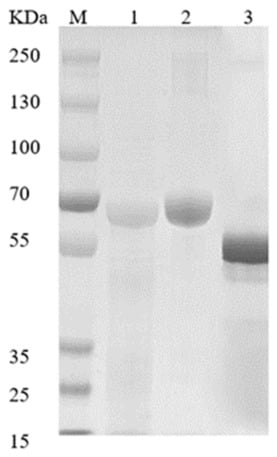
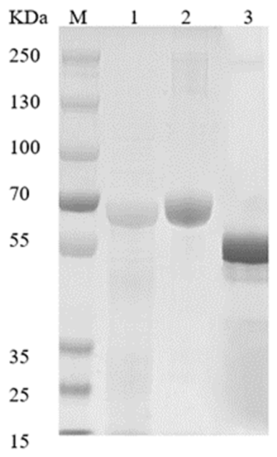
SDS–PAGE analysis of expressed and activated Cry2Ah1 protein (Figure 1) revealed a single band at approximately 70 kDa for the protoxin, matching its predicted molecular mass. The protein concentration quantified via the BSA assay was 0.6 mg/mL. Following trypsin activation, the protein exhibited an apparent molecular weight of ~55 kDa, and this activated protein was used for all subsequent experiments.
Figure 1.
SDS–PAGE analysis of the Cry2Ah1 protein. M: molecular weight marker; 1: BSA; 2: Cry2Ah1 protoxin; 3: trypsin-activated Cry2Ah1.
In bioassays using one-day-old S. exigua larvae, Cry2Ah1 yielded an LC50 of 1.34 μg/g with a 95% confidence interval of 0.63–1.97 μg/g (χ2 = 3.963), demonstrating potent insecticidal activity of Cry2Ah1 against S. exigua.
3.2. Identification of Cry2Ah1-Binding Proteins in the Midgut BBMV of S. exigua
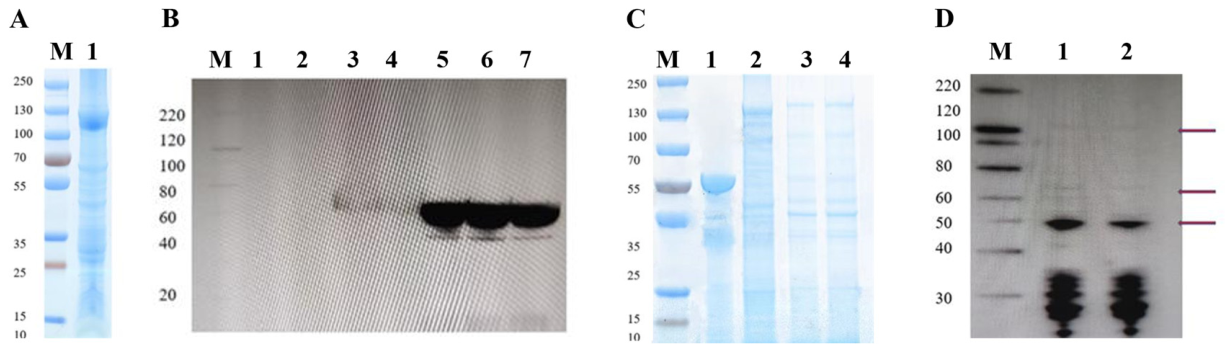
BBMV isolated from fourth-instar larvae contained numerous proteins with molecular masses spanning approximately 20–120 kDa (Figure 2A). Western blot assays demonstrated that the Cry2Ah1 polyclonal antibody specifically bound Cry2Ah1 without cross-reactivity to Cry1Ac (Figure 2B), verifying the high specificity of this antibody. Ligand blot analysis probing interactions between Cry2Ah1 and S. exigua midgut BBMV detected several discrete binding bands at roughly 50, 60 and 110 kDa (Figure 2C,D), indicating multiple Cry2Ah1-binding proteins are present on S. exigua midgut BBMV.
Figure 2.
Specificity detection of Cry2Ah1 antibody and identification of binding proteins in S. exigua. (A) SDS–PAGE of BBMV from the midgut of S. exigua. M: Marker; 1: BBMV. (B) Specificity of the Cry2Ah1 antibody. 1,2: PBS buffer; 3,4: Cry1Ac protein; 5,6,7: Cry2Ah1 protein. (C) SDS–PAGE analysis of S. exigua BBMV proteins binding to Cry2Ah1. (D) Western blot analysis of the binding between Cry2Ah1 protein and BBMV from S. exigua.
3.3. Identification of Cry2Ah1-Binding Proteins
The flow-through collected after coupling Cry2Ah1 to the resin, the supernatant obtained following incubation with BBMV, and the final eluate were analyzed using SDS-PAGE. The results demonstrated that Cry2Ah1 was successfully immobilized on the resin, and the immobilized Cry2Ah1 specifically bound to proteins from S. exigua BBMV. Multiple binding proteins were recovered, with bands at approximately 30, 50, 55, 60, 70, 110, and 120 kDa. The identities of these binding proteins were further characterized via LC–MS/MS, with searches performed against the UniProt database. The Cry2Ah1-interacting proteins identified from S. exigua BBMV included APN1, APN2, APN3, APN5, APN6, ABCC2, ABCC3, polycalin, ALP, a cadherin-like protein, and several uncharacterized proteins (Table 2).
Table 1.
Primer sequences used for qPCR.
Table 2.
Cry2Ah1-binding proteins in S. exigua BBMV identified via LC–MS/MS searches against the UniProt database.
3.4. Expression of APN2 and ABCC2 in the Midgut of S. exigua Larvae at Different Instars
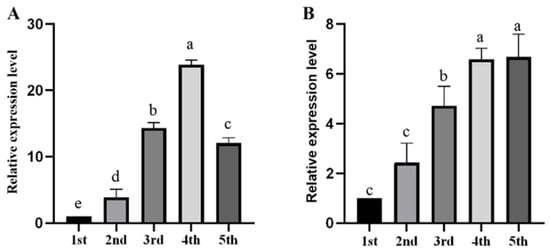
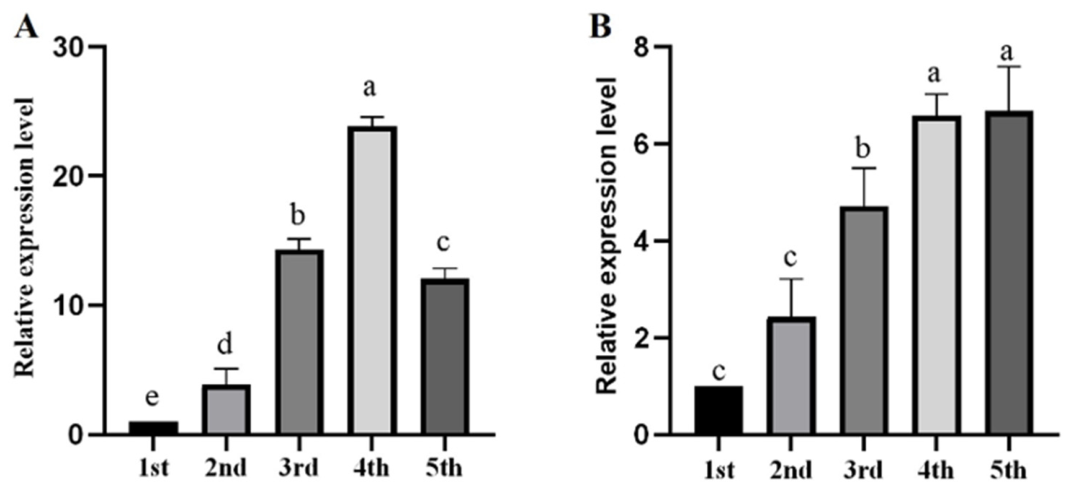
Quantitative real-time PCR revealed that, with advancing larval instar, APN2 expression in the midgut of S. exigua initially increased and subsequently decreased, peaking at the fourth instar. The expression level at the fourth instar was significantly higher than those in all other instars (p < 0.05) (Figure 3A). ABCC2 expression increased progressively during larval development and reached its maximum at the fifth instar. Although the expression level in fifth-instar larvae was not significantly different from that in the fourth instar, it was significantly higher than those in the first to third instars (p < 0.05) (Figure 3B).
Figure 3.
Relative expression of APN2 (A) and ABCC2 (B) in the midgut of S. exigua larvae at different instars. Different letters indicate significant differences in expression between instar groups (p < 0.05).
3.5. APN2 Expression, Purification, and Ligand Blot
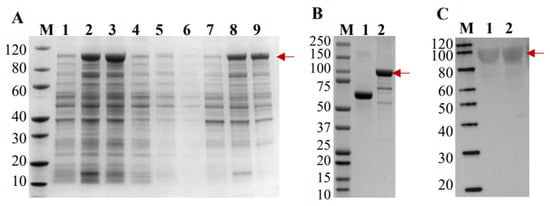
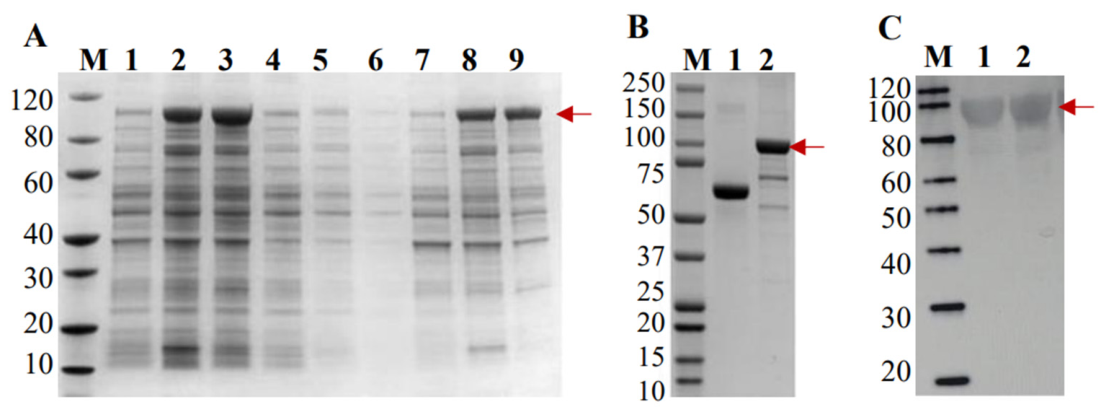
The plasmid pET30a-APN2 expressed in E. coli BL21(DE3) express competent cells and confirmed by SDS-PAGE (Figure 4A). In prediction, the molecular weight of APN2 was 108 kDa. Induction of APN2 protein with 0.5 mmol/L IPTG at 15 °C for 16 h or at 37 °C for 4 h yielded abundant target protein in inclusion bodies (Figure 4A). The recombinant protein was purified by Ni-Agarose Resin and the dialyzed soluble protein was consistent with the predicted molecular weight (Figure 4B). Ligand blot assays demonstrated that prokaryotically expressed APN2 protein could specifically bind to activated Cry2Ah1 toxin (Figure 4C).
Figure 4.
Ligand blot analysis of the specific binding between APN2 and Cry2Ah1. (A) SDS–PAGE analysis of APN2 expression in BL21. M: Protein marker; 1: Pre-induction cells; 2: Induction at 15 °C for 16 h; 3: Induction at 37 °C for 4 h; 4: Supernatant before induction; 5: Supernatant after induction at 15 °C for 16 h; 6: Supernatant after induction at 37 °C for 4 h; 7: Pellet before induction; 8: Pellet after induction at 15 °C for 16 h; 9: Pellet after induction at 37 °C for 4 h. (B) Purified APN2. M: Protein marker; 1: BSA; 2: Purified APN2. (C) Ligand blot analysis. M: Protein marker; 1–2: Binding protein.The arrows indicate APN2 proteins and Cry2Ah1 binding sites.
3.6. Sensitivity of S. exigua to Cry2Ah1 upon dsRNA Interference
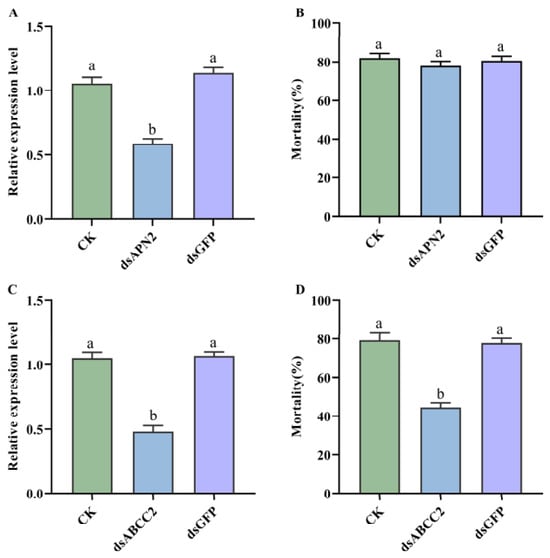
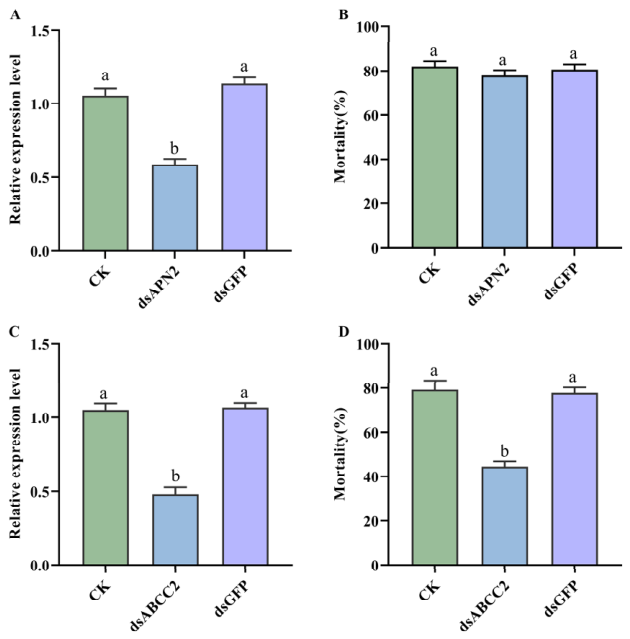
To confirm the role of APN2 and ABCC2 proteins in the Cry2Ah1 mode of action at the organism level, we knocked down the APN2 and ABCC2 by RNAi in S. exigua larvae and subsequently tested the susceptibility of larvae. At 48 h post-injection, relative to larvae injected with dsGFP, APN2 transcripts were significantly reduced (Figure 5A) (p < 0.05). In subsequent bioassays at 48 h post-injection, after APN2 interference, larval susceptibility to Cry toxin showed no significant difference compared with the control (Figure 5B) (p < 0.05). Following ABCC2 knockdown, ABCC2 expression was downregulated (Figure 5C) (p < 0.05), leading to reduced susceptibility of S. exigua to Cry2Ah1 (Figure 5D) (p < 0.05).
Figure 5.
Susceptibility of S. exigua to Cry2Ah1 after dsRNA-mediated gene silencing. (A) APN2 silencing efficiency. (B) Larval mortality. (C) ABCC2 silencing efficiency. (D) Larval mortality. Different letters indicate significant differences among groups (p < 0.05).
4. Discussion
Bt transgenic crops and Bt biopesticides have brought substantial economic and social benefits, yet insect resistance poses a growing threat [4]. At least 31 cases of field-evolved resistance have been documented across 11 pest species [25]. In the United States, western corn rootworm has developed resistance to Cry3Bb1 and Gpp34/Tpp35Ab1 [2]. In Asia, Cry1Ac resistance alleles in H. armigera are increasing in northern China, while Plutella xylostella, the first pest to evolve field resistance to Bt sprays exhibits high resistance with minimal fitness costs [5,26]. In Colombia, progeny of fall armyworm fed on leaf tissues of Bt maize (Cry1A.105 + Cry2Ab2 + Cry3Bb1) and non-Bt maize achieved neonate-to-adult survival rates as high as 50% [27]. To delay resistance, the multi-gene pyramiding strategy expresses two or more Bt proteins with distinct modes of action within a single crop, enabling redundant killing of susceptible and heterozygous insects [7].
Cry2Ah1 has previously been purified from E. coli expression systems exhibits growth-inhibitory activity against both Cry1Ac-susceptible and Cry1Ac-resistant H. armigera populations [13], and confers satisfactory control efficacy against S. exigua and S. litura [28]. Cry2Ah1 produced by Bt strain 407 displayed high insecticidal activity against 1-day-old S. exigua larvae in our bioassays (LC50 = 1.34 μg/g), ranking it as one of the most potent Bt proteins reported for this pest. Superior protein expression stability and toxin yields further make Bt strain 407 a suitable toxin source for mechanistic research and prospective large-scale application. The pull-down assay has been successfully employed to screen and characterize Cry-binding proteins in diverse insect species. For instance, Cry1Ca-, Cry4Ba-, and Cry11Aa-interacting proteins have been isolated from the midgut BBMVs of S. litura and Aedes aegypti [29,30]. In agreement with these prior observations, we identified eleven abundant proteins in S. exigua midgut BBMVs that bind Cry2Ah1, including APNs, ABCC2, polycalin, ALP, and a cadherin-like protein (Table 2). The binding of Cry toxins to midgut receptors is a critical prerequisite for their insecticidal activity. Previous studies have demonstrated that APNs, ABC transporters, ALPs, and cadherins participate centrally in the mode of action of Cry proteins, and mutations or altered expression of the corresponding genes can confer Bt resistance [15]. Importantly, physical binding to a Bt toxin does not equate to functional receptor activity. Thus, further investigations are required to clarify whether these Cry2Ah1-binding proteins contribute to the insecticidal action of Cry2Ah1 against S. exigua.
APN is a peptidase that preferentially cleaves neutral amino acids from the N-terminus of proteins or oligopeptides. Beyond their canonical function in digesting dietary proteins, APNs act as receptor proteins for Bt Cry toxins and are critical to the insecticidal activity of these toxins [16,17,31]. Since APN was first validated as a Cry toxin receptor in Manduca sexta [32], APN isoforms capable of binding Cry proteins have been documented in over 20 lepidopteran species, including H. virescens, M. sexta, H. armigera, and Lymantria dispar [17,33]. Consistent with these prior findings, our study demonstrated that multiple APN isoforms in S. exigua midgut BBMVs—namely APN1, APN2, APN3, APN5 and APN6—bind Cry2Ah1. Among them, APN2 was one of the most abundant Cry2Ah1-interacting proteins (Table 2). The expression profiles of distinct APN isoforms differ across lepidopteran species, developmental stages, and tissues [34]. Our data revealed that APN2 is expressed throughout all five larval instars of S. exigua, with peak transcript abundance in the midgut of fourth-instar larvae (Figure 3). Reduced APN expression or APN mutations are tightly linked to Bt resistance. Specific examples include the loss of APN1 conferring Cry1Ca resistance in S. exigua [21], a deletion mutation in APN1 identified in Cry1Ac-resistant H. armigera [35], and the downregulation of APN1 paired with the upregulation of APN6 in Cry1Ac-resistant Trichoplusia ni [36]. Furthermore, ligand blot analysis of prokaryotically expressed APN2 demonstrated that the purified protein is capable of binding activated Cry2Ah1 (Figure 4C). Nevertheless, silencing APN2 in S. exigua did not alter larval susceptibility to the Cry toxin (Figure 5B). Taken together, these findings indicate that while APN2 acts as a Cry2Ah1-binding protein, it may not be essential for toxicity under the tested conditions. Notably, iBAQ values reflect the relative abundance of proteins in pull-down eluates rather than their direct binding affinity to Cry2Ah1. Accordingly, proteins with lower iBAQ values may still serve as functional receptors and warrant further investigation in future studies.
ABC transporters are predominantly localized to the insect digestive tract and gut epithelium, where they mediate detoxification by exporting plant secondary metabolites and toxic heavy metal ions. In lepidopterans, ABC transporters also serve as functional receptors for Cry toxins and are essential for Bt-mediated insect killing [22]. Heterologous expression and RNA interference assays have validated ABCC2 as a Cry receptor in P. xylostella, H. armigera, S. litura, and B. mori [5,19]. RNAi-mediated knockdown of ABCC2 increases Cry1Ac resistance by 3.8-fold in H. armigera [18]. In the classical Cry1A intoxication model, the toxin binds cadherin-like receptors, undergoes proteolytic cleavage to form a prepore oligomer, and subsequently engages secondary receptors such as APN and ABCC2 before membrane insertion [17]. ABCC2 is thought to promote insertion of the toxin oligomer into the midgut epithelium, facilitating pore formation and osmotic lysis; consistent with this, reduced ABCC2 expression or mutations confer high-level Bt resistance in several lepidopteran pests, including P. xylostella, H. armigera, and S. frugiperda [5,37]. Cry2Ah1 differs from Cry1A toxins in its smaller size (~65 kDa) and distinct processing pathway, raising the possibility that its interaction with ABCC2 is not fully identical. Whether ABCC2 acts primarily as a membrane-insertion facilitator or as a concentration platform requires further investigation. Nevertheless, our data support a conserved role for ABCC2 as a critical functional receptor across distinct Cry toxin classes. Our results found RNAi-mediated knockdown of ABCC2 reduced larval mortality following Cry2Ah1 treatment (Figure 5D). Cry toxins bind multiple midgut proteins that vary in their roles in toxicity. Only some of these are functional receptors, and loss of these receptors leads to measurable differences in susceptibility [38,39]. Functional redundancy of midgut binding proteins is well established: Cry toxins often interact with multiple paralogous proteins, and loss of one can be compensated by others, as shown for ABC transporters in H. armigera [18]. Since Cry2Ah1 binds at least five APN isoforms in S. exigua (Table 2), simultaneous silencing of multiple isoforms may be necessary to uncover a phenotype. Cry2-class toxins rely on receptor sets that partially overlap with those of Cry1A toxins [29]. Thus, APNs may primarily function as low-affinity, non-essential binding sites for Cry2Ah1, whereas toxicity is likely mediated by other partners such as ABCC2 and ABCC3. Confirming this hypothesis will require the simultaneous knockdown of multiple APN isoforms, CRISPR/Cas9-mediated gene knockout, and the heterologous expression of candidate receptors in toxin-insensitive cell lines.
5. Conclusions
Cry2Ah1 produced by Bt strain 407 exhibits high toxicity to S. exigua, with an LC50 of 1.34 μg/g against 1-day-old larvae. Cry2Ah1 binds multiple proteins in S. exigua midgut BBMVs, including APN, ABCC2 and ABCC3, polycalin, ALP, and a cadherin-like protein. APN2 and ABCC2 are the most abundant Cry2Ah1-interacting partner recovered. APN is expressed throughout larval development, reaching peak abundance in the fourth instar, and directly binds activated Cry2Ah1 following heterologous expression. Nevertheless, RNA interference-mediated knockdown of APN2 did not detectably alter larval susceptibility to Cry2Ah1, demonstrating that APN2 is a Cry2Ah1-binding protein but not a functional receptor in S. exigua. ABCC2 is expressed across all larval instars, Following ABCC2 RNAi, larval susceptibility to Cry2Ah1 decreased, confirming that ABCC2 functions as a functional receptor. In summary, this work identifies candidate Cry2Ah1-interacting midgut proteins in S. exigua, laying a foundation for functional validation of these putative receptors and exploration of their contributions to Cry toxin resistance evolution.
Author Contributions
Conceptualization, G.L.; methodology, Z.D. and C.Z.; software, Z.D.; validation, C.Z. and Z.L.N.; formal analysis, Z.D.; investigation, Z.D. and C.Z.; resources, G.L.; data curation, Z.D. and Z.L.N.; writing—original draft preparation, C.Z.; writing—review and editing, G.L., Z.L.N. and X.F.; visualization, C.Z., Z.D. and Z.L.N.; supervision, G.L.; project administration, G.L.; funding acquisition, G.L. All authors have read and agreed to the published version of the manuscript.
Funding
This research was funded by the Biological Breeding National Science and Technology Major Project (2022ZD04021).
Institutional Review Board Statement
Not applicable.
Informed Consent Statement
Not applicable.
Data Availability Statement
The original contributions presented in this study are included in the article. Further inquiries can be directed to the corresponding authors.
Acknowledgments
We thank Jie Zhang (Institute of Plant Protection, Chinese Academy of Agricultural Sciences) for providing the Bacillus thuringiensis 407 strain.
Conflicts of Interest
The authors declare no conflicts of interest.
References
- Tabashnik, B.E.; Fabrick, J.A.; Carrière, Y. Global patterns of insect resistance to transgenic Bt crops: The first 25 years. J. Econ. Entomol. 2023, 116, 297–309. [Google Scholar] [CrossRef] [Scilit] [PubMed]
- Gassmann, A.J.; Reisig, D.D. Management of insect pests with Bt crops in the United States. Annu. Rev. Entomol. 2023, 68, 31–49. [Google Scholar] [CrossRef] [Scilit] [PubMed]
- Wu, K.M.; Guo, Y.Y. The evolution of cotton pest management practices in China. Annu. Rev. Entomol. 2005, 50, 31–52. [Google Scholar] [CrossRef] [Scilit] [PubMed]
- Lu, Y.; Wu, K.; Jiang, Y.; Guo, Y.; Desneux, N. Widespread adoption of Bt cotton and insecticide decrease promotes biocontrol services. Nature 2012, 487, 362–365. [Google Scholar] [CrossRef] [Scilit] [PubMed]
- Quan, Y.; Wu, K. Managing practical resistance of lepidopteran pests to Bt cotton in China. Insects 2023, 14, 179. [Google Scholar] [CrossRef] [Scilit] [PubMed]
- Dandan, Z.; Yutao, X.; Wenbo, C.; Yanhui, L.; Kongming, W. Field monitoring of Helicoverpa armigera (Lepidoptera: Noctuidae) Cry1Ac insecticidal protein resistance in China (2005–2017). Pest Manag. Sci. 2019, 75, 753–759. [Google Scholar] [CrossRef] [Scilit] [PubMed]
- Hu, D.; Wang, D.; Pan, H.; Liu, X. Molecular mechanisms underlying resistance to Bacillus thuringiensis Cry toxins in lepidopteran pests: An updated research perspective. Agronomy 2025, 15, 155. [Google Scholar] [CrossRef] [Scilit]
- Chitkowski, R.L.; Turnipseed, S.G.; Sullivan, M.J.; Bridges, W.C. Field and laboratory evaluations of transgenic cottons expressing one or two Bacillus thuringiensis var. kurstaki Berliner proteins for management of noctuid (Lepidoptera) pests. J. Econ. Entomol. 2003, 96, 755–762. [Google Scholar] [CrossRef] [Scilit] [PubMed]
- Sivasupramaniam, S.; Moar, W.J.; Ruschke, L.G.; Osborn, J.A.; Jiang, C.; Sebaugh, J.L.; Brown, G.R.; Shappley, Z.W.; Oppenhuizen, M.E.; Mullins, J.W.; et al. Toxicity and characterization of cotton expressing Bacillus thuringiensis Cry1Ac and Cry2Ab2 proteins for control of lepidopteran pests. J. Econ. Entomol. 2008, 101, 546–554. [Google Scholar] [CrossRef] [Scilit]
- Tindall, K.V.; Siebert, M.W.; Leonard, B.R.; All, J.; Haile, F.J. Efficacy of Cry1Ac:Cry1F proteins in cotton leaf tissue against fall armyworm, beet armyworm, and soybean looper (Lepidoptera: Noctuidae). J. Econ. Entomol. 2009, 102, 1497–1505. [Google Scholar] [CrossRef] [Scilit] [PubMed]
- Ma, H.T.; Zhou, L.H.; Tan, H.; Xiu, X.Z.; Wang, J.Y.; Wang, X.Y. Population dynamics and seasonal migration patterns of Spodoptera exigua in northern China based on 11 years of monitoring data. PeerJ 2024, 12, e17223. [Google Scholar] [CrossRef] [Scilit] [PubMed]
- Zhou, S.; Zhang, J.; Lin, Y.; Li, X.; Liu, M.; Hafeez, M.; Huang, J.; Zhang, Z.; Chen, L.; Ren, X.; et al. Spodoptera exigua multiple nucleopolyhedrovirus increases the susceptibility to insecticides: A promising efficient way for pest resistance management. Biology 2023, 12, 260. [Google Scholar] [CrossRef] [Scilit] [PubMed]
- Shu, C.; Zhang, J.; Chen, G.; Liang, G.; He, K.; Crickmore, N.; Huang, D.; Zhang, J.; Song, F. Use of a pooled clone method to isolate a novel Bacillus thuringiensis Cry2A toxin with activity against Ostrinia furnacalis. J. Invertebr. Pathol. 2013, 114, 31–33. [Google Scholar] [CrossRef] [Scilit] [PubMed]
- Bravo, A.; Gill, S.S.; Soberón, M. Mode of action of Bacillus thuringiensis Cry and Cyt toxins and their potential for insect control. Toxicon 2007, 49, 423–435. [Google Scholar] [CrossRef] [Scilit] [PubMed]
- Jurat-Fuentes, J.L.; Heckel, D.G.; Ferré, J. Mechanisms of resistance to insecticidal proteins from Bacillus thuringiensis. Annu. Rev. Entomol. 2021, 66, 121–140. [Google Scholar] [CrossRef] [Scilit] [PubMed]
- Pigott, C.R.; Ellar, D.J. Role of receptors in Bacillus thuringiensis crystal toxin activity. Microbiol. Mol. Biol. Rev. 2007, 71, 255–281. [Google Scholar] [CrossRef] [Scilit] [PubMed]
- Bravo, A.; Likitvivatanavong, S.; Gill, S.S.; Soberón, M. Bacillus thuringiensis: A story of a successful bioinsecticide. Insect Biochem. Mol. Biol. 2011, 41, 423–431. [Google Scholar] [CrossRef] [Scilit] [PubMed]
- Liao, C.; Jin, M.; Cheng, Y.; Yang, Y.; Soberón, M.; Bravo, A.; Liu, K.; Xiao, Y. Bacillus thuringiensis Cry1Ac protoxin and activated toxin exert differential toxicity due to a synergistic interplay of Cadherin with ABCC transporters in the cotton bollworm. Appl. Environ. Microbiol. 2022, 88, e0250521. [Google Scholar] [CrossRef] [Scilit] [PubMed]
- Endo, H. Molecular and kinetic models for pore formation of Bacillus thuringiensis Cry toxin. Toxins 2022, 14, 433. [Google Scholar] [CrossRef] [Scilit] [PubMed]
- Jin, Z.; Wang, X.; Wu, Y.; Yang, Y. Differential roles of ABCC2, ABCC3, and cadherin in mediating Cry1Ac toxicity in Spodoptera exigua. Pestic. Biochem. Physiol. 2026, 216, 106721. [Google Scholar] [CrossRef] [Scilit] [PubMed]
- Herrero, S.; Gechev, T.; Bakker, P.L.; Moar, W.J.; de Maagd, R.A. Bacillus thuringiensis Cry1Ca-resistant Spodoptera exigua lacks expression of one of four Aminopeptidase N genes. BMC Genom. 2005, 6, 96. [Google Scholar] [CrossRef] [Scilit] [PubMed]
- Yao, X.; Liu, C.; Duan, Y.; An, S.; Wei, J.; Liang, G. ABCC2 is a functional receptor of Bacillus thuringiensis Cry1Ca in Spodoptera litura. Int. J. Biol. Macromol. 2022, 194, 9–16. [Google Scholar] [CrossRef] [Scilit] [PubMed]
- Wolfersberger, M.G.; Luethy, P.; Maurer, A.; Parenti, P.; Sacchi, V.F.; Giordana, B.; Hanozet, G.M. Preparation and partial characterization of amino acid transporting brush border membrane vesicles from the larval midgut of the cabbage butterfly (Pieris brassicae). Arch. Insect Biochem. Physiol. 1993, 24, 139–147. [Google Scholar] [PubMed]
- Zhang, C.; Wei, J.; Li, W.; Li, N.; Soe, E.T.; Naing, Z.L.; Tang, J.; Yu, H.; Fang, F.; Li, X.; et al. Eukaryotic translation initiation factor 2 modulates the expression of midgut receptors to confer resistance to Bacillus thuringiensis Cry1Ac toxin in Helicoverpa armigera. J. Agric. Food Chem. 2025, 73, 7179–7186. [Google Scholar] [CrossRef] [Scilit] [PubMed]
- Tabashnik, B.E.; Carrière, Y. Rootworm resistance to Bt associated with increased injury to corn pyramids combining Bt proteins and RNA interference. Proc. Natl. Acad. Sci. USA 2025, 122, e2518683122. [Google Scholar] [CrossRef] [Scilit] [PubMed]
- Guan, F.; Dai, X.; Yang, Y.; Tabashnik, B.E.; Wu, Y. Population genomics of nonrecessive resistance to Bt toxin Cry1Ac in Helicoverpa armigera from northern China. J. Econ. Entomol. 2023, 116, 310–320. [Google Scholar] [CrossRef] [Scilit] [PubMed]
- Santos-Amaya, O.F.; Hernandez-Plata, J.E.; Baron-Ortiz, D.A.; Miranda-Montanez, C.Y.; Haddi, K. Practical resistance of fall armyworm to Cry1A.105+Cry2Ab2+Cry3Bb1 Bt maize in Colombia. Crop Prot. 2025, 194, 107229. [Google Scholar] [CrossRef] [Scilit]
- Li, S.; Wang, Z.; Zhou, Y.; Li, C.; Wang, G.; Wang, H.; Zhang, J.; Liang, G.; Lang, Z. Expression of cry2Ah1 and two domain II mutants in transgenic tobacco confers high resistance to susceptible and Cry1Ac-resistant cotton bollworm. Sci. Rep. 2018, 8, 508. [Google Scholar] [CrossRef] [Scilit] [PubMed]
- Agrawal, N.; Malhotra, P.; Bhatnagar, R.K. Interaction of gene-cloned and insect cell-expressed aminopeptidase N of Spodoptera litura with insecticidal crystal protein Cry1C. Appl. Environ. Microbiol. 2002, 68, 4583–4592. [Google Scholar] [CrossRef] [Scilit] [PubMed]
- Jiménez, A.I.; Reyes, E.Z.; Cancino-Rodezno, A.; Bedoya-Pérez, L.P.; Caballero-Flores, G.G.; Muriel-Millan, L.F.; Likitvivatanavong, S.; Gill, S.S.; Bravo, A.; Soberón, M. Aedes aegypti alkaline phosphatase ALP1 is a functional receptor of Bacillus thuringiensis Cry4Ba and Cry11Aa toxins. Insect Biochem. Mol. Biol. 2012, 42, 683–689. [Google Scholar] [CrossRef] [Scilit] [PubMed]
- Chen, J.; Likitvivatanavong, S.; Aimanova, K.G.; Gill, S.S. A 104 kDa Aedes aegypti aminopeptidase N is a putative receptor for the Cry11Aa toxin from Bacillus thuringiensis subsp. israelensis. Insect Biochem. Mol. Biol. 2013, 43, 1201–1208. [Google Scholar] [CrossRef] [Scilit] [PubMed]
- Knight, P.J.K.; Crickmore, N.; Ellar, D.J. The receptor for Bacillus thuringiensis CryIA(c) delta-endotoxin in the brush border membrane of the lepidopteran Manduca sexta is aminopeptidase N. Mol. Microbiol. 1994, 11, 429–436. [Google Scholar] [CrossRef] [Scilit] [PubMed]
- Sato, R. Aminopeptidase N as a receptor for Bacillus Thuringiensis Cry toxins. In Advances in Microbial Control of Insect Pests; Springer: Boston, MA, USA, 2002; pp. 1–13. [Google Scholar]
- Upadhyay, S.K.; Singh, P.K. Role of alkaline phosphatase in insecticidal action of Cry1Ac against Helicoverpa armigera larvae. Biotechnol. Lett. 2011, 33, 2027–2036. [Google Scholar] [CrossRef] [Scilit] [PubMed]
- Zhang, S.; Cheng, H.; Gao, Y.; Wang, G.; Liang, G.; Wu, K. Mutation of an aminopeptidase N gene is associated with Helicoverpa armigera resistance to Bacillus thuringiensis Cry1Ac toxin. Insect Biochem. Mol. Biol. 2009, 39, 421–429. [Google Scholar] [CrossRef] [Scilit] [PubMed]
- Tiewsiri, K.; Wang, P. Differential alteration of two aminopeptidases N associated with resistance to Bacillus thuringiensis toxin Cry1Ac in cabbage looper. Proc. Natl. Acad. Sci. USA 2011, 108, 14037–14042. [Google Scholar] [CrossRef] [Scilit] [PubMed]
- Heckel, D.G. The essential and enigmatic role of ABC transporters in Bt resistance of Noctuids and other insect pests of agriculture. Insects 2021, 12, 389. [Google Scholar] [CrossRef] [Scilit] [PubMed]
- Wang, J.; Ma, H.; Zhao, S.; Huang, J.; Yang, Y.; Tabashnik, B.E.; Wu, Y. Functional redundancy of two ABC transporter proteins in mediating toxicity of Bacillus thuringiensis to cotton bollworm. PLoS Pathog. 2020, 16, e1008427. [Google Scholar] [CrossRef] [Scilit] [PubMed]
- Wang, X.; Yue, Y.; Zhai, Y.; Wang, F.; Zhuang, X.; Wu, S.; Yang, Y.; Tabashnik, B.E.; Wu, Y. Functional redundancy in the toxic pathway of Bt protein Cry1Ab, but not Cry1Fa, against the Asian corn borer. Proc. Natl. Acad. Sci. USA 2025, 122, e2503674122. [Google Scholar] [CrossRef] [Scilit] [PubMed]
Disclaimer/Publisher’s Note: The statements, opinions and data contained in all publications are solely those of the individual author(s) and contributor(s) and not of MDPI and/or the editor(s). MDPI and/or the editor(s) disclaim responsibility for any injury to people or property resulting from any ideas, methods, instructions or products referred to in the content. |
© 2026 by the authors. Licensee MDPI, Basel, Switzerland. This article is an open access article distributed under the terms and conditions of the Creative Commons Attribution (CC BY) license.