


Simple Summary
Bumble bees often choose between flowers that offer nectar of different quality. Although previous studies have shown that bees can learn to distinguish between flowers providing different sugar rewards, it remains unclear how this approach compares directly with conventional laboratory training using water or bitter substances. We therefore trained bumble bees to distinguish two flower colours, with one offering concentrated sugar water and the other offering either less concentrated sugar water, plain water or a bitter substance (quinine). All three groups learned to prefer the colour associated with the higher sugar concentration. Bees trained with quinine made the most accurate choices, but generally visited fewer flowers when rewards were removed. Bees trained with two sugar rewards showed learning performance that did not differ significantly from bees trained with sugar and water, while maintaining relatively high flower-visiting activity. These findings suggest that using two positive rewards may provide a useful alternative for studying bee learning, particularly when researchers need bees to continue making choices during tests without rewards.
Abstract
In laboratory studies of bee learning, differential conditioning commonly pairs a sucrose reward with water or quinine, although foraging bees frequently choose between flowers that are both rewarding. While bees can learn to distinguish between sucrose rewards, how this approach compares with conventional reinforcement protocols remains unclear. We trained bumble bees (Bombus terrestris) to discriminate two colours, one associated with 40% sucrose and the other with 20% sucrose, water, or quinine, and measured their choices and landing activity in two unrewarded tests. Bees in all conditions learned to prefer the higher-rewarded colour. In the discrimination test, quinine-trained bees showed higher accuracy than both other groups, whereas discrimination did not differ significantly between sucrose–sucrose and sucrose–water training. Landing activity showed a contrasting pattern: sucrose–sucrose bees made more landings than both other groups in the discrimination test, while quinine-trained bees made fewer landings than both other groups in the novel-colour test. Preferences between the less favourable colour and a novel alternative did not differ detectably among conditions. These findings suggest that training with two sucrose rewards can support colour discrimination while maintaining relatively high flower-visiting activity, offering a useful alternative to aversive reinforcement when maximal discrimination accuracy is not essential.
1. Introduction
Pollinators such as bees frequently encounter flowers that differ in nectar composition [1] and sugar concentration [2]. Several chemical and physical properties of nectar, including nutrient content, secondary metabolites and viscosity, can influence bees’ feeding preferences and learned responses to floral cues [3,4,5,6,7,8]. Among these, sugar concentration is one of the most important determinants of reward value and flower choice, and bumble bees can rapidly learn to favour floral cues associated with more concentrated sucrose [9,10]. Learning which floral cues predict more favourable outcomes in natural settings therefore often involves distinguishing between two rewarding flower types.
In laboratory studies of bee learning, however, a sucrose-rewarded visual stimulus (CS+) is often contrasted with an alternative (CS−) associated with water or quinine [11,12,13,14]). Such reinforcement contrasts can influence learning; for example, quinine can improve discrimination accuracy compared with water, particularly when the colours are perceptually similar [12,14]. By contrast, early work in honeybees demonstrated that differences in sucrose concentration can support learned preferences [15]. The bumble bee (Bombus terrestris) is well suited to this study because commercially reared colonies are readily available and the species is widely used in agricultural pollination and research on learning and decision-making. Their colour learning and flower-visiting behaviour can also be studied together under controlled laboratory conditions. More recent studies in bumble bees have shown that differences between sucrose rewards shape the learned relative value of options [16], influencing subsequent choices and visual attention [17,18], and that training with 40% vs. 20% sucrose produces different flower selectivity and foraging efficiency from training with 40% sucrose vs. water [19]. However, how learning with two positive rewards directly compares with both unrewarding and aversive alternatives under the same experimental protocol remains unclear.
Here, we compared colour discrimination learning in bumble bees (Bombus terrestris) trained under three reinforcement conditions in which one colour always offered 40% (w/w) sucrose and the other offered 20% sucrose, water or quinine. The conditions therefore differed in the outcome of choosing the less favourable colour, which ranged from a smaller reward, through no reward, to an aversive taste. After 100 training landings, bees completed two unrewarded tests. In a colour discrimination test, we measured discrimination accuracy. In a novel-colour test, the previously less favourable colour was presented alongside a novel colour to examine whether reinforcement history affected bees’ responses to the less favourable option once it was no longer paired with the more favourable one. In both tests, we also recorded the total number of landings as an index of flower-visiting activity. Together, these tests allowed us to ask whether learning between two rewarding options differs from learning under conventional reward–nonreward and reward–punishment contrasts in terms of discrimination accuracy, unrewarded flower-visiting activity, and responses to the less favourable option, with implications for the choice of reinforcement protocols in studies of bee learning and memory.
2. Materials and Methods
2.1. Animals and Setup
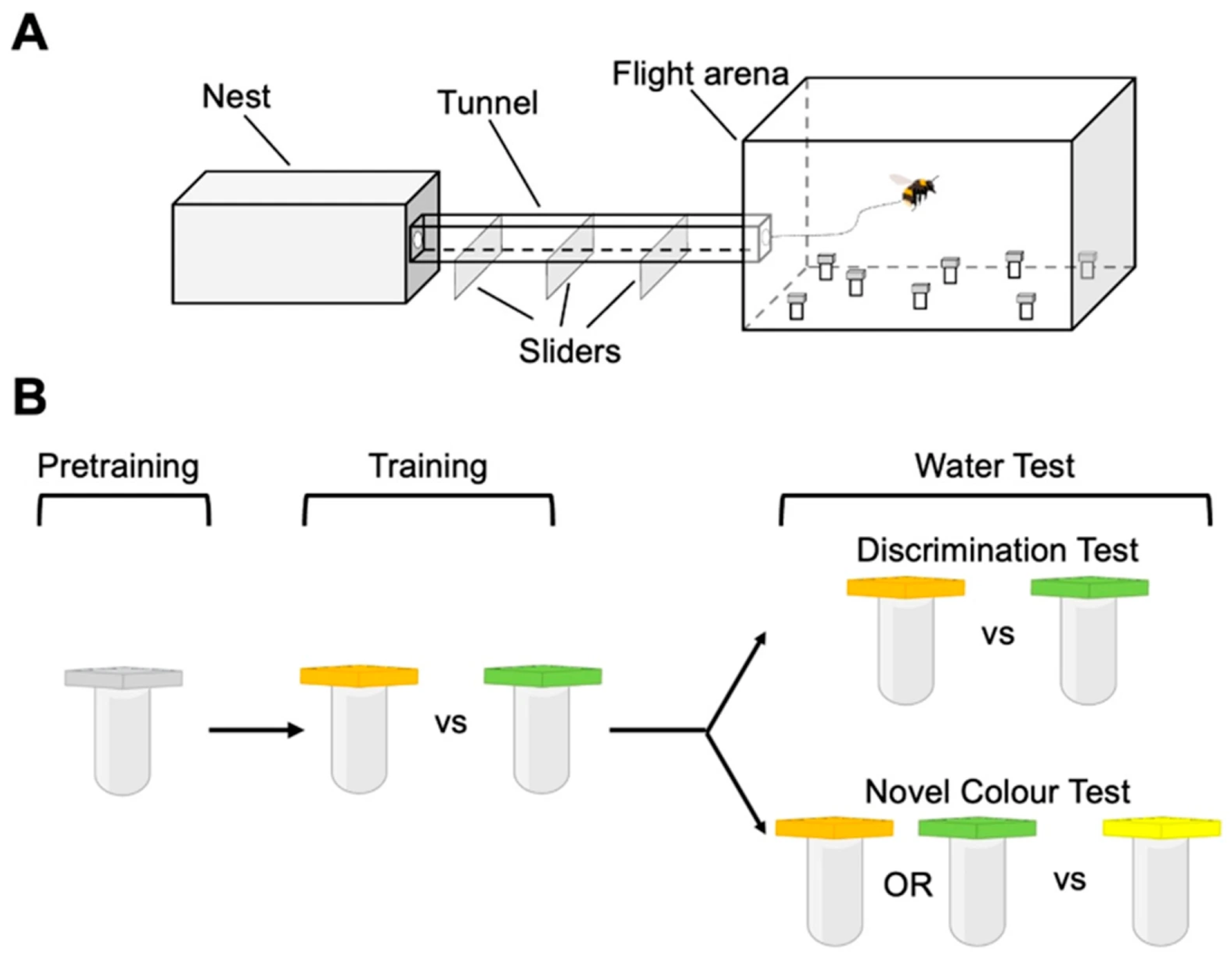
Sixty-one worker bumble bees, Bombus terrestris, from six commercially obtained colonies (Biobest’s Chinese branch, Biobest Belgium N.V., Westerlo, Belgium) were used. Colonies were housed in wooden nestboxes (27.9 cm × 16.2 cm × 11.2 cm). Outside the experiments, each colony was given approximately 3 g of pollen daily and 15% (w/w) sucrose solution ad libitum. Each nestbox was connected to a wooden flight arena (60 cm × 40.5 cm × 30.5 cm) via a transparent acrylic tunnel (30 cm × 4 cm × 4 cm) with four sliding doors, which allowed us to control individual access to the arena (Figure 1A). The arena was covered by a transparent acrylic lid with a central opening for a camera used to record foraging behaviour. Illumination was provided by six fluorescent tubes (MASTER TL-D 90 De Luxe 36W/965, Philips, Eindhoven, The Netherlands) driven by high-frequency electronic ballasts (42–60 kHz). Individual bees were identified by a number tag attached to the thorax.
Figure 1.
Experimental setup and procedure. (A) Schematic of the experimental apparatus, showing the nest connected to the flight arena through a transparent tunnel with sliding doors to control individual access. (B) Experimental procedure. Bees were pretrained on transparent flowers containing 15% sucrose, followed by 100 training landings on two coloured flower types. One colour (CS+) offered 40% sucrose, while the other (CS−) offered 20% sucrose, water or quinine, depending on the reinforcement condition. Here, CS− denotes the less favourable option, which was not necessarily unrewarding. Bees subsequently completed two 2-min unrewarded tests: a discrimination test presenting CS+ and CS−, and a novel-colour test presenting CS− alongside a novel yellow colour. All flowers contained water during testing. Colour–reinforcement assignments and test order were counterbalanced, with 20 additional training landings between the two tests.
2.2. Artificial Flowers and Colours
Each artificial flower (hereafter flower) consisted of a coloured acrylic square (25 mm × 25 mm, 5 mm thick) placed on top of a glass vial (7 mL; ca. 20 mm in diameter and 40 mm high). Reinforcement solutions were pipetted onto the centre of each flower. Eight flowers were pseudo-randomly scattered in the arena to prevent bees from associating spatial location with reinforcement. Two colours, orange and green (to human eyes), were used for training. A third colour, yellow, served as the novel colour in one of the tests (Figure 1B). The spectral reflectance of each colour was measured from 300 to 700 nm in 1 nm increments using a spectrophotometer (Ocean Optics USB 2000+, Orlando, FL, USA) with a deuterium/halogen light source. Colour loci were calculated in the bee colour hexagon [20]: orange, (0.14, −0.04); green, (0.36, −0.10); yellow, (0.25, −0.10). The distance between the two training colours was 0.23 hexagon units, so bumble bees could easily distinguish between them [21]. Yellow occupied an intermediate position between the two training colours, 0.13 and 0.11 hexagon units from orange and green, respectively.
2.3. Pretraining
Bees were first allowed to enter the arena as a group and forage freely from eight transparent acrylic flowers offering 15% (w/w) sucrose solution; transparent flowers were used so that bees had no prior experience with any of the colours used in training or testing. Bees that repeatedly collected sucrose solution and returned to the nest were tagged. Each tagged bee was then allowed into the arena individually, where each flower initially offered a 10 μL droplet of 15% sucrose solution, replenished after consumption. Only bees that completed three consecutive foraging bouts (collecting sucrose solution from the flowers and returning to the nest) proceeded to training.
2.4. Differential Training
Each bee was randomly assigned to one of three reinforcement conditions. In all conditions, one colour offered 40% (w/w) sucrose solution. The other colour offered 20% (w/w) sucrose solution (sucrose–sucrose; N = 21), distilled water (sucrose–water; N = 20) or quinine (sucrose–quinine; N = 20). For consistency across conditions, the colour associated with 40% sucrose is hereafter referred to as CS+ and the alternative colour as CS−. CS− denotes only the less favourable training option and does not imply that it was aversive in every condition. Colour–reinforcement mapping was counterbalanced across bees within each condition.
Each bee was trained individually with four flowers of each colour, each offering a 10 μL droplet of its reinforcement solution, replenished once consumed. A landing was recorded when a bee voluntarily landed on a flower and made stable contact with its surface, regardless of whether it then drank the solution. Training ended after 100 landings, which were divided into 10 blocks of 10 consecutive landings. Bees returned to the nest at their own volition. Between foraging bouts, the flowers and arena were washed with 75% ethanol to remove any potential scent marks left by bees. Flowers were also moved to new positions to prevent bees from associating reinforcement with location.
2.5. Unrewarded Tests
After training, each bee completed two 2-min unrewarded tests: a colour discrimination test and a novel-colour test. In both tests, each of the eight flowers offered 10 μL of distilled water, so neither sucrose nor quinine was available. Test order was counterbalanced across bees within each condition. After completing 100 training landings and returning to the nest, each bee entered the arena for its first test on its next foraging bout. Between the two tests, bees completed 20 additional training landings under the original colour–reinforcement associations to refresh their training experience. After returning to the nest, each bee completed the second test on its next visit to the arena.
In the colour discrimination test, bees were presented with four CS+ and four CS− flowers. We recorded the number of landings on each colour and calculated the proportion of landings on CS+. The total number of landings during each test was also recorded as an operational measure of unrewarded flower-visiting activity, reflecting the amount of flower-directed responding within a fixed period without assuming a particular underlying motivational state.
In the novel-colour test, bees were presented with four CS− flowers and four yellow flowers. We recorded the number of landings on each colour and calculated the proportion of landings on the novel colour to examine how different reinforcement histories influenced responses to the previously less favourable stimulus relative to a novel alternative.
2.6. Statistical Analysis
All analyses were performed in R (version 4.4.1, The R Foundation for Statistical Computing, Vienna, Austria) using generalized linear mixed models (GLMMs) fitted with glmmTMB (version 1.1.10). Colour-choice performance was analysed using binomial GLMMs with a logit link, weighted by the number of landings. Training performance was compared using the final training block, while learning across all ten blocks was presented descriptively. In the unrewarded tests, we analysed the proportions of landings on CS+ (discrimination test) or the novel colour (novel-colour test). Preferences within each condition were tested against chance (50%) using intercept-only binomial or beta-binomial GLMMs, as appropriate. Total landing numbers were analysed using a Poisson GLMM for the discrimination test and a negative-binomial GLMM for the novel-colour test.
Reinforcement condition, colour assignment and, where applicable, test order were considered as fixed effects, with colony identity included as a random effect. Bee identity nested within colony was additionally included in the final-block model to account for overdispersion. Non-significant covariates were removed where appropriate. Fixed effects were evaluated using likelihood-ratio tests, and pairwise comparisons were performed using estimated marginal means (emmeans, version 1.10.3) with Tukey adjustment. Results are reported as odds ratios for choice proportions or count ratios for landing numbers, with standard errors. Model fit was assessed using simulation-based residual diagnostics (DHARMa, version 0.4.6).
2.7. Ethical Considerations
Bumble bee colonies were maintained with regular food provision and husbandry throughout the experiment. Only workers that voluntarily foraged from artificial flowers were selected for behavioural testing. Bees were handled using containers rather than forceps wherever possible to minimise physical injury and stress, and experimental procedures were non-invasive.
3. Results
3.1. Acquisition of Colour Discrimination During Training
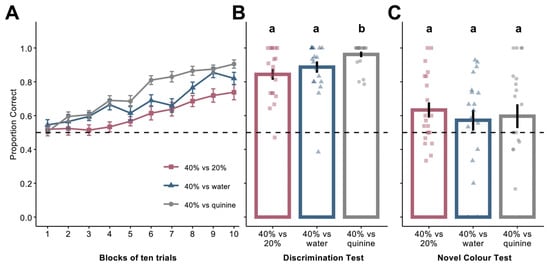
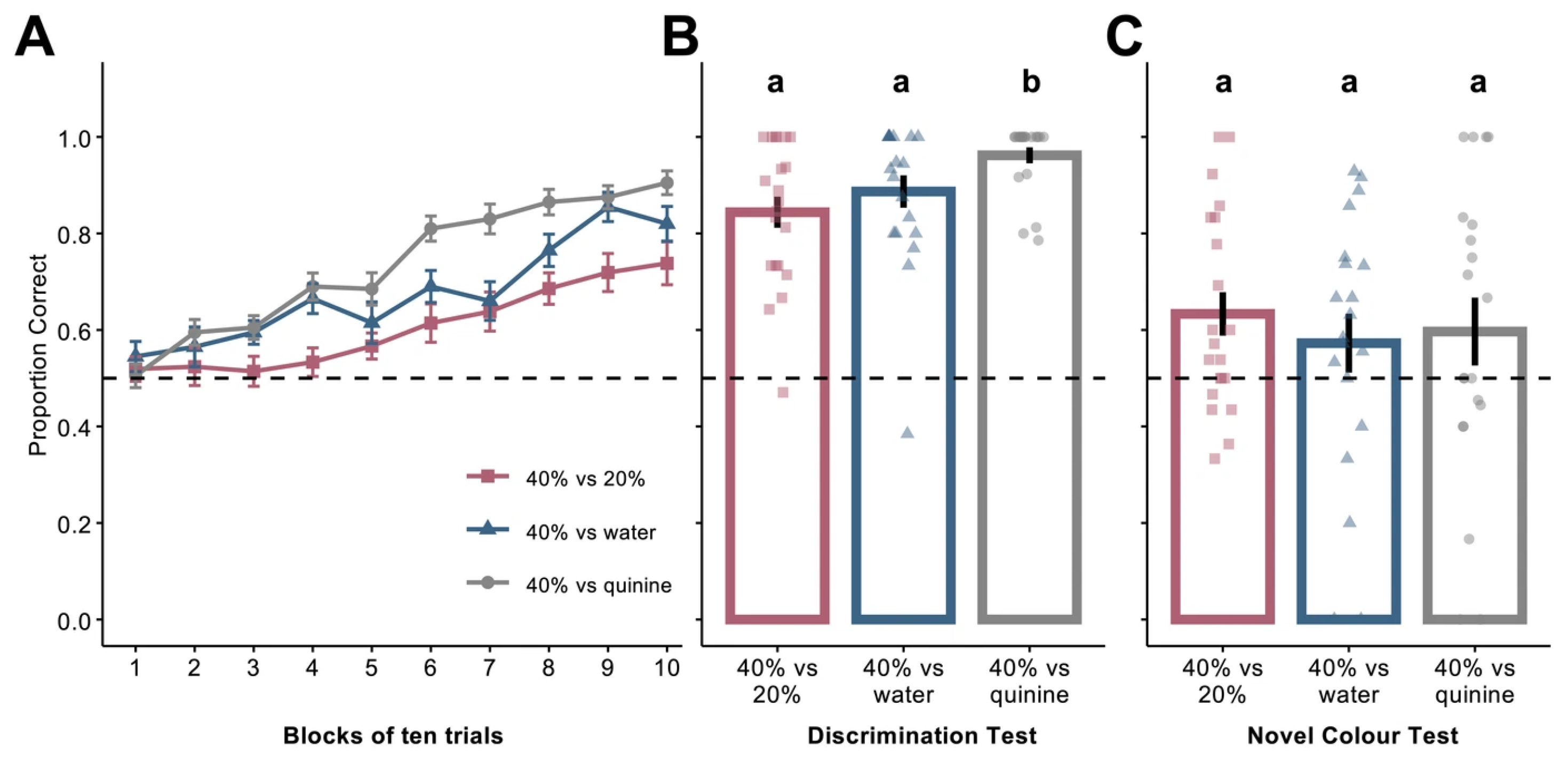
Across the ten training blocks, bees increasingly chose CS+ (Figure 2A). By the final training block, the proportion of choosing CS+ was 74.8%, 82.0%, and 90.5% for sucrose–sucrose (N = 21), sucrose–water (N = 20), and sucrose–quinine (N = 20) bees, respectively. Final-block performance differed significantly among reinforcement conditions (χ2(2) = 10.50, p = 0.005). Bees trained with sucrose–sucrose had significantly lower odds of choosing CS+ than those trained with sucrose–quinine (odd ratio [OR] = 0.265 ± 0.106 SE, z = −3.33, p = 0.0025). However, sucrose–water bees did not differ significantly from either sucrose–sucrose bees (OR = 0.588 ± 0.212, z = −1.47, p = 0.304) or sucrose–quinine bees (OR = 0.451 ± 0.186, z = −1.94, p = 0.129).
Figure 2.
Colour-choice performance during training and unrewarded testing. (A) Proportion of landings on CS+ (the colour associated with 40% sucrose) across ten training blocks of ten landings each. Bees were trained with 40% versus 20% sucrose (sucrose–sucrose; N = 21), 40% sucrose versus water (sucrose–water; N = 20), or 40% sucrose versus quinine (sucrose–quinine; N = 20). (B) Proportion of landings on CS+ in the unrewarded discrimination test. (C) Proportion of landings on the novel yellow colour when presented alongside CS− in the novel-colour test. Lines in (A) and bars in (B,C) represent group means ± SE; grey dots in (B,C) represent individual bees; different letters in (B,C) indicate statistically significant difference. Dashed horizontal lines indicate chance level (0.5).
3.2. Discrimination Accuracy in the Unrewarded Test
In the subsequent unrewarded discrimination test, in which all flowers contained water, bees in all three conditions chose CS+ significantly more often than expected by chance (sucrose–sucrose: 84.3%, z = 7.10, p < 0.001; sucrose–water: 88.7%, z = 4.81, p < 0.001; sucrose–quinine: 96.2%, z = 9.13, p < 0.001; Figure 2B). The proportion of CS+ choices differed significantly among reinforcement conditions (χ2(2) = 24.88, p < 0.001), with an additional effect of test order (χ2(1) = 5.09, p = 0.024). Bees trained with sucrose–quinine chose CS+ more frequently than those trained with sucrose–sucrose (OR = 0.214 ± 0.076, z = −4.32, p < 0.001) or sucrose–water (OR = 0.387 ± 0.150, z = −2.45, p = 0.038). Although sucrose–sucrose bees showed a numerically lower preference for CS+ than sucrose–water bees, this difference did not reach statistical significance (OR = 0.552 ± 0.142, z = −2.31, p = 0.055). Thus, training with two sucrose rewards supported colour discrimination without a statistically detectable reduction in accuracy relative to sucrose–water training.
3.3. Choices Between CS− and a Novel Colour
When CS− was presented alongside a novel yellow colour, bees in all three conditions directed more than half of their landings to the novel colour (Figure 2C). This preference was statistically significant in sucrose–sucrose bees (63.3%, z = 2.34, p = 0.019) and sucrose–water bees (57.3%, z = 2.04, p = 0.041), but did not reach statistical significance in sucrose–quinine bees (59.7%, z = 1.88, p = 0.060). Nevertheless, pairwise comparisons revealed no significant differences between sucrose–sucrose and sucrose–water (OR = 0.876 ± 0.175, z = −0.66, p = 0.786), sucrose–sucrose and sucrose–quinine (OR = 0.975 ± 0.241, z = −0.10, p = 0.994), or sucrose–water and sucrose–quinine bees (OR = 1.113 ± 0.278, z = 0.43, p = 0.905). Thus, preferences between the previously less favourable colour and a novel alternative did not differ detectably among reinforcement conditions.
3.4. Landing Activity During the Unrewarded Tests
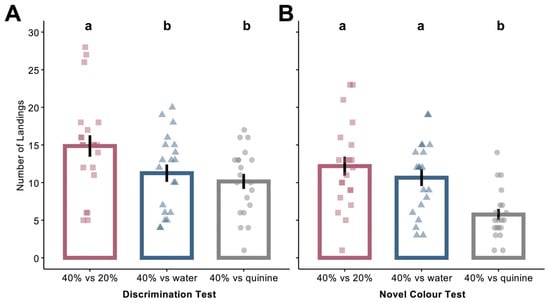
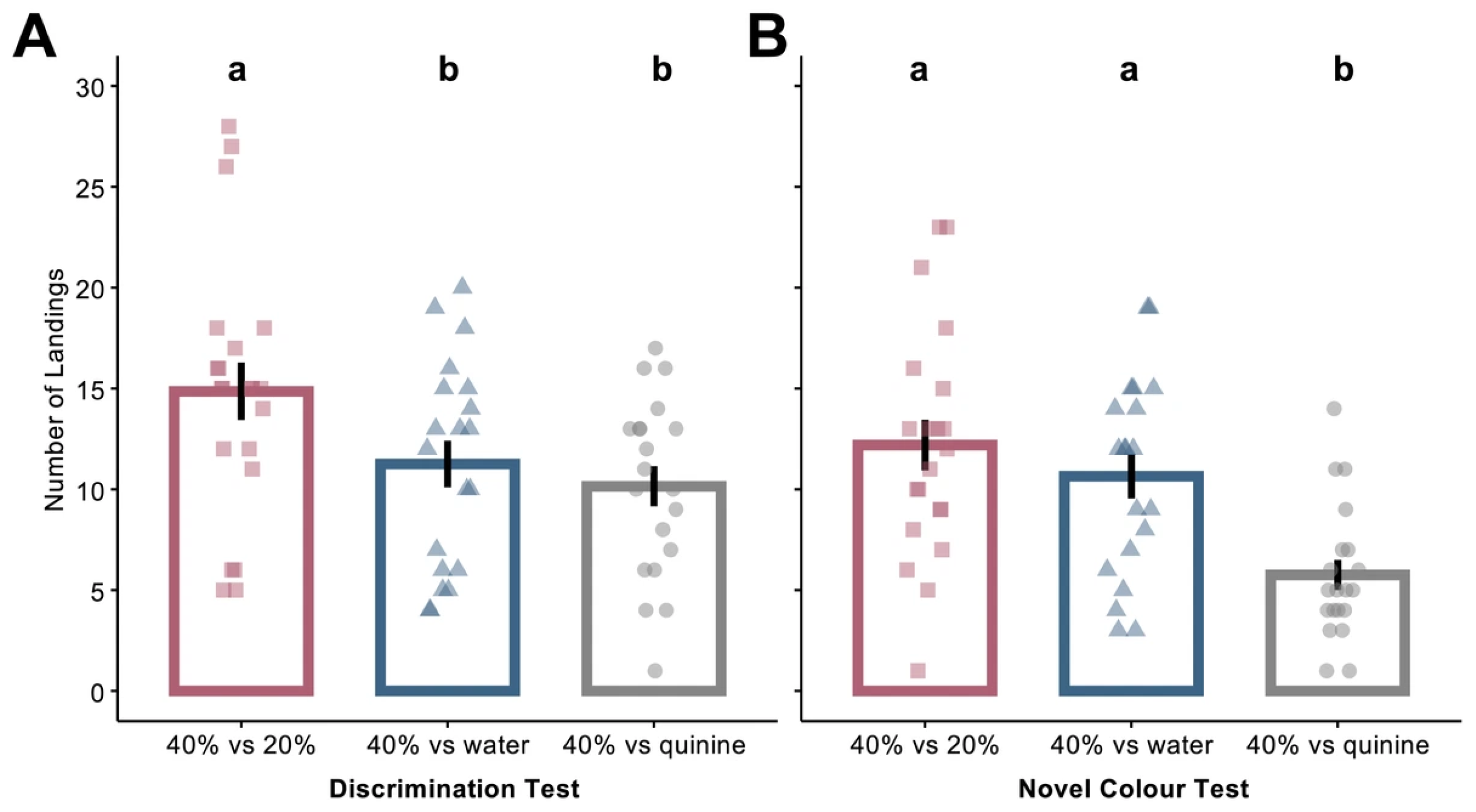
We compared the total number of landings to examine how reinforcement conditions influenced subsequent flower-visiting activity. In both tests, mean landing numbers were highest in sucrose–sucrose bees and lowest in sucrose–quinine bees (Figure 3A), contrasting with the pattern of discrimination accuracy. In the discrimination test, landing number differed significantly among reinforcement conditions (χ2(2) = 20.90, p < 0.001), with additional effects of colour assignment (χ2(1) = 7.57, p = 0.006) and test order (χ2(1) = 15.39, p < 0.001). Bees trained with sucrose–sucrose made significantly more landings than those trained with sucrose–water (count ratio = 1.27 ± 0.113, z = 2.66, p = 0.021) or sucrose–quinine (count ratio = 1.50 ± 0.137, z = 4.46, p < 0.001), whereas sucrose–water and sucrose–quinine bees did not differ significantly (count ratio = 1.18 ± 0.118, z = 1.70, p = 0.207).
Figure 3.
Total number of flower landings during the 2-min unrewarded tests. (A) Total landings in the discrimination test (CS+ versus CS−). (B) Total landings in the novel-colour test (CS− versus novel yellow). Bars represent group means ± SE, different letters indicate statistically significant difference, and dots represent individual bees. Reinforcement conditions and sample sizes are as described in Figure 2.
In the novel-colour test, landing number also differed significantly among reinforcement conditions (χ2(2) = 19.53, p < 0.001). Sucrose–sucrose bees made significantly more landings than sucrose–quinine bees (count ratio = 2.12 ± 0.345, z = 4.62, p < 0.001), as did sucrose–water bees (count ratio = 1.85 ± 0.308, z = 3.71, p < 0.001). However, landing numbers did not differ significantly between sucrose–sucrose and sucrose–water bees (count ratio = 1.14 ± 0.172, z = 0.90, p = 0.640). Thus, sucrose–sucrose training supported relatively high flower-visiting activity in both unrewarded tests, whereas quinine training, despite producing stronger discrimination, was associated with fewer landings.
4. Discussion
Our results show that the reinforcement conditions used during colour discrimination training influenced both learned preferences and subsequent flower-visiting activity in bumble bees, and that these two measures changed in opposite directions. Bees trained with two sucrose concentrations (40% vs. 20%) developed a clear preference for the higher-rewarded colour, with discrimination accuracy that did not differ significantly from that following sucrose–water training, although it was lower than that following sucrose–quinine training. At the same time, these bees made more landings during the unrewarded tests than quinine-trained bees and, in the discrimination test, also more than water-trained bees. Together, these findings suggest that training with two positive rewards can support colour discrimination learning while sustaining flower-visiting activity, a combination that may be valuable for future studies requiring both learned preferences and repeated choices during unrewarded tests.
Consistent with previous studies, quinine reinforcement produced more accurate colour discrimination than water in the unrewarded test [12,22]. In contrast, discrimination did not differ significantly between sucrose–sucrose and sucrose–water training, despite the alternative colour being rewarding in one condition but unrewarding in the other. One possible explanation is that the difference between 40% and 20% sucrose was already sufficient for bees to learn which colour was more profitable [9,10], replacing the lower sucrose reward with water may therefore have provided only a modest additional benefit for discrimination. Quinine, however, introduces an aversive consequence for choosing CS−, which may promote avoidance of that colour rather than simply a preference for the more rewarding option [12]. Indeed, electrophysiological recordings have shown that quinine can completely suppress sugar-evoked responses in bumble bee gustatory neurons [23], potentially contributing to its aversive effects.
In the novel-colour test, preferences between CS− and the novel colour did not differ detectably among reinforcement conditions. This contrasts with previous findings in honeybees, where quinine-trained bees avoided the quinine-associated colour when presented alongside a novel alternative, whereas water-trained bees did not [12]. One possible explanation is that choices in our test were influenced by colour generalisation rather than solely by the learned value of CS−. The novel yellow colour lay between the two training colours in bee colour space and was perceptually closer to both, potentially influencing responses through generalisation from previously learned stimuli [20,24]. Differences in stimulus configuration and experimental procedures may therefore explain the discrepancy with honeybees, although a species difference cannot be excluded. Future studies using novel colours at different perceptual distances from the trained stimuli would help distinguish learned avoidance from colour generalisation.
Landing activity during the unrewarded tests showed a contrasting pattern to discrimination accuracy. Sucrose–sucrose bees made more landings than both other groups in the discrimination test, whereas sucrose–quinine bees made fewer landings than both other groups in the novel-colour test. Thus, the reinforcement condition producing the highest discrimination accuracy did not produce the greatest flower-visiting activity. Previous studies in honeybees have shown that reward history influences persistence in visiting unrewarded flowers [25,26,27]. Similarly, experience with two rewarding colours in our study may have maintained reward expectations and encouraged continued flower visits, whereas quinine may have promoted more selective or cautious responding. This pattern is also consistent with previously reported speed–accuracy trade-offs in bees [22,28], although we did not measure decision latency and therefore cannot establish such a trade-off directly. Ecologically, our findings suggest that bees can learn to favour more profitable flowers while continuing to visit less rewarding alternatives, potentially maintaining foraging activity despite differences in reward quality.
Several limitations should be acknowledged. First, total landings during a fixed 2-min test cannot distinguish sustained motivation from differences in decision speed or flower selectivity. Measures of decision latency and flower inspections without landing would help separate these possibilities. Second, differences in cumulative sucrose intake during training may have contributed to subsequent landing activity, as both colours were rewarding in the sucrose–sucrose condition. Third, colour biases and generalisation from CS+ may have influenced choices in the novel-colour test, limiting conclusions about learned avoidance of CS−. Finally, with approximately 20 bees per condition, the absence of significant differences between sucrose–sucrose and sucrose–water training does not establish equivalence. Indeed, discrimination accuracy was numerically lower in the sucrose–sucrose condition, with the difference approaching the conventional significance threshold (p = 0.055).
Beyond its ecological relevance, training with two sucrose rewards may offer a useful alternative to conventional reinforcement protocols. In our study, sucrose–sucrose training supported colour discrimination without a statistically detectable reduction in accuracy relative to sucrose–water training, while producing equal or greater flower-visiting activity. Although quinine produced the strongest discrimination, it was also associated with fewer landings during unrewarded testing. When maximal discrimination is not essential, replacing quinine with a lower sucrose reward may also offer a potential animal-welfare refinement, consistent with recommendations to minimise adverse experiences in insect research [29]. This is particularly relevant given the documented aversive responses of bumble bees to quinine [14] and evidence of malaise-like behaviours following quinine ingestion in honeybees [30]. Together, our findings suggest that reinforcement protocols should be selected according to both the behavioural outcomes of interest and potential animal-welfare considerations, rather than discrimination accuracy alone.
Supplementary Materials
The following supporting information can be downloaded at https://www.mdpi.com/article/10.3390/insects17121229/s1. Data S1: Individual colour-choice data during training. Data S2: Individual colour-choice and landing data from the unrewarded tests.
Author Contributions
Conceptualization, F.P., C.S. and Y.Z.; Methodology, F.P., C.S. and Y.Z.; Investigation, Q.W., Y.W. and Y.F.; Formal Analysis, J.E.R.-G. and Y.Z.; Data Curation, J.E.R.-G. and Q.W.; Visualization, Y.Z.; Writing—Original Draft Preparation, J.E.R.-G., Y.Z. and F.P.; Writing—Review & Editing, J.E.R.-G., Q.W., Y.W., C.S., Y.Z. and F.P.; Supervision, F.P. and C.S.; Funding Acquisition, F.P. All authors have read and agreed to the published version of the manuscript.
Funding
This research was supported by the Guangzhou Science and Technology Planning Project (Grant No. 2025A04J5255).
Data Availability Statement
The data supporting the findings of this study are available in the Supplementary Materials (Data S1 and S2).
Conflicts of Interest
The authors declare no conflicts of interest.
References
- Nicolson, S.W. Sweet solutions: Nectar chemistry and quality. Philos. Trans. R. Soc. B 2022, 377, 20210163. [Google Scholar] [CrossRef] [Scilit] [PubMed]
- Pamminger, T.; Becker, R.; Himmelreich, S.; Schneider, C.W.; Bergtold, M. The nectar report: Quantitative review of nectar sugar concentrations offered by bee visited flowers in agricultural and non-agricultural landscapes. PeerJ 2019, 7, e6329. [Google Scholar] [CrossRef] [Scilit] [PubMed]
- Singaravelan, N.; Nee’man, G.; Inbar, M.; Izhaki, I. Feeding responses of free-flying honeybees to secondary compounds mimicking floral nectars. J. Chem. Ecol. 2005, 31, 2791–2804. [Google Scholar] [CrossRef] [Scilit] [PubMed]
- Wright, G.A.; Baker, D.D.; Palmer, M.J.; Stabler, D.; Mustard, J.A.; Power, E.F.; Borland, A.M.; Stevenson, P.C. Caffeine in floral nectar enhances a pollinator’s memory of reward. Science 2013, 339, 1202–1204. [Google Scholar] [CrossRef] [Scilit] [PubMed]
- Zhou, Y.; Ding, S.; Liao, C.; Wu, J.; Chittka, L.; Solvi, C.; Peng, F. Bumble bees’ food preferences are jointly shaped by rapid evaluation of nectar sugar concentration and viscosity. Anim. Behav. 2024, 210, 419–427. [Google Scholar] [CrossRef] [Scilit]
- Ding, S.; Ding, J.; Jiang, H.; Barron, A.B.; Solvi, C.; Peng, F. Understanding the caffeine paradox: Caffeinated nectar increases pollinators’ perceived value of flowers. Anim. Behav. 2026, 231, 123417. [Google Scholar] [CrossRef] [Scilit]
- Baracchi, D.; Marples, A.; Jenkins, A.J.; Leitch, A.R.; Chittka, L. Nicotine in floral nectar pharmacologically influences bumblebee learning of floral features. Sci. Rep. 2017, 7, 1951. [Google Scholar] [CrossRef] [Scilit] [PubMed]
- Finkelstein, C.J.; CaraDonna, P.J.; Gruver, A.; Welti, E.A.R.; Kaspari, M.; Sanders, N.J. Sodium-enriched floral nectar increases pollinator visitation rate and diversity. Biol. Lett. 2022, 18, 20220016. [Google Scholar] [CrossRef] [Scilit] [PubMed]
- Cnaani, J.; Thomson, J.D.; Papaj, D.R. Flower choice and learning in foraging bumblebees: Effects of variation in nectar volume and concentration. Ethology 2006, 112, 278–285. [Google Scholar] [CrossRef] [Scilit]
- Nachev, V.; Thomson, J.D.; Winter, Y. The psychophysics of sugar concentration discrimination and contrast evaluation in bumblebees. Anim. Cogn. 2013, 16, 417–427. [Google Scholar] [CrossRef] [Scilit] [PubMed]
- Dyer, A.G.; Chittka, L. Fine colour discrimination requires differential conditioning in bumblebees. Naturwissenschaften 2004, 91, 224–227. [Google Scholar] [CrossRef] [Scilit] [PubMed]
- Avarguès-Weber, A.; de Brito Sanchez, M.G.; Giurfa, M.; Dyer, A.G. Aversive reinforcement improves visual discrimination learning in free-flying honeybees. PLoS ONE 2010, 5, e15370. [Google Scholar] [CrossRef] [Scilit] [PubMed]
- Reser, D.H.; Witharanage, R.W.; Rosa, M.G.P.; Dyer, A.G. Honeybees (Apis mellifera) learn color discriminations via differential conditioning independent of long wavelength (green) photoreceptor modulation. PLoS ONE 2012, 7, e48577. [Google Scholar] [CrossRef] [Scilit] [PubMed]
- Rodríguez-Gironés, M.A.; Trillo, A.; Corcobado, G. Long term effects of aversive reinforcement on colour discrimination learning in free-flying bumblebees. PLoS ONE 2013, 8, e71551. [Google Scholar] [CrossRef] [Scilit] [PubMed]
- Loo, S.K.; Bitterman, M.E. Learning in honeybees (Apis mellifera) as a function of sucrose concentration. J. Comp. Psychol. 1992, 106, 29–36. [Google Scholar] [CrossRef] [Scilit] [PubMed]
- Solvi, C.; Zhou, Y.; Feng, Y.; Lu, Y.; Roper, M.; Sun, L.; Reid, R.J.; Chittka, L.; Barron, A.B.; Peng, F. Bumblebees retrieve only the ordinal ranking of foraging options when comparing memories obtained in distinct settings. eLife 2022, 11, e78525. [Google Scholar] [CrossRef] [Scilit] [PubMed]
- Nityananda, V.; Chittka, L. Different effects of reward value and saliency during bumblebee visual search for multiple rewarding targets. Anim. Cogn. 2021, 24, 803–814. [Google Scholar] [CrossRef] [Scilit] [PubMed]
- Robert, T.; Tarapata, K.; Nityananda, V. Learning modifies attention during bumblebee visual search. Behav. Ecol. Sociobiol. 2024, 78, 22. [Google Scholar] [CrossRef] [Scilit] [PubMed]
- Armand, M.; Beckenbauer, C.; Avarguès-Weber, A.; Lihoreau, M.; Czaczkes, T.J. Interindividual variability in flower pickiness by foraging bumblebees. Behav. Ecol. Sociobiol. 2025, 79, 101. [Google Scholar] [CrossRef] [Scilit]
- Chittka, L. The colour hexagon: A chromaticity diagram based on photoreceptor excitations as a generalized representation of colour opponency. J. Comp. Physiol. A 1992, 170, 533–543. [Google Scholar] [CrossRef] [Scilit]
- Dyer, A.G.; Chittka, L. Biological significance of distinguishing between similar colours in spectrally variable illumination: Bumblebees (Bombus terrestris) as a case study. J. Comp. Physiol. A 2004, 190, 105–114. [Google Scholar] [CrossRef] [Scilit] [PubMed]
- Chittka, L.; Dyer, A.G.; Bock, F.; Dornhaus, A. Psychophysics: Bees trade off foraging speed for accuracy. Nature 2003, 424, 388. [Google Scholar] [CrossRef] [Scilit] [PubMed]
- Parkinson, R.H.; Kessler, S.C.; Scott, J.; Simpson, A.; Bu, J.; Al-Esawy, M.; Mahdi, A.; Miriyala, A.; Wright, G.A. Temporal responses of bumblebee gustatory neurons to sugars. iScience 2022, 25, 104499. [Google Scholar] [CrossRef] [Scilit] [PubMed]
- Martínez-Harms, J.; Márquez, N.; Menzel, R.; Vorobyev, M. Visual generalization in honeybees: Evidence of peak shift in color discrimination. J. Comp. Physiol. A 2014, 200, 317–325. [Google Scholar] [CrossRef] [Scilit] [PubMed]
- Grüter, C.; Moore, H.; Firmin, N.; Helanterä, H.; Ratnieks, F.L.W. Flower constancy in honey bee workers (Apis mellifera) depends on ecologically realistic rewards. J. Exp. Biol. 2011, 214, 1397–1402. [Google Scholar] [CrossRef] [Scilit] [PubMed]
- Gil, M.; De Marco, R.J.; Menzel, R. Learning reward expectations in honeybees. Learn. Mem. 2007, 14, 491–496. [Google Scholar] [CrossRef] [Scilit] [PubMed]
- Gil, M.; De Marco, R.J. Honeybees learn the sign and magnitude of reward variations. J. Exp. Biol. 2009, 212, 2830–2834. [Google Scholar] [CrossRef] [Scilit] [PubMed]
- Chittka, L.; Skorupski, P.; Raine, N.E. Speed–accuracy tradeoffs in animal decision making. Trends Ecol. Evol. 2009, 24, 400–407. [Google Scholar] [CrossRef] [Scilit] [PubMed]
- Crump, A.; Gibbons, M.; Barrett, M.; Birch, J.; Chittka, L. Is it time for insect researchers to consider their subjects’ welfare? PLoS Biol. 2023, 21, e3002138. [Google Scholar] [CrossRef] [Scilit] [PubMed]
- Hurst, V.; Stevenson, P.C.; Wright, G.A. Toxins induce ‘malaise’ behaviour in the honeybee (Apis mellifera). J. Comp. Physiol. A 2014, 200, 881–890. [Google Scholar] [CrossRef] [Scilit] [PubMed]
Disclaimer/Publisher’s Note: The statements, opinions and data contained in all publications are solely those of the individual author(s) and contributor(s) and not of MDPI and/or the editor(s). MDPI and/or the editor(s) disclaim responsibility for any injury to people or property resulting from any ideas, methods, instructions or products referred to in the content. |
© 2026 by the authors. Licensee MDPI, Basel, Switzerland. This article is an open access article distributed under the terms and conditions of the Creative Commons Attribution (CC BY) license.