


Simple Summary
Hoverflies of the genus Eumerus are ecologically and economically important, functioning both as key wild pollinators and as potential agricultural pests whose larvae feed on plant roots and bulbs. However, effective conservation and pest management have long been obstructed by confused nomenclature, outdated literature, and incomplete distribution records. To resolve these issues, we re-examined historical literature, evaluated original descriptions, and critically reviewed type specimens across European museum collections. We updated the European species list by establishing four new synonymies, removing four doubtful taxa, and documenting the first European records for two non-native Asian species likely introduced through the international plant trade. The updated checklist confirms 81 valid Eumerus species in Europe. Geographically, species diversity peaks in the Mediterranean region, whereas Macaronesia exhibits the highest proportion of unique endemics. Because over 60% of native European Eumerus species are currently threatened with extinction, this revised classification establishes a reliable baseline to help agricultural authorities detect invasive pests and support conservation efforts for vulnerable pollinators.
Abstract
The hoverfly genus Eumerus includes both vital native pollinators and potential agricultural pests, yet taxonomic ambiguities and missing distribution data hinder effective conservation and pest management. To resolve questionable taxa and compile an updated European inventory, we examined historical type specimens, reviewed literature, and evaluated species descriptions. We designate a lectotype for Eumerus alpinus Rondani, 1857, establish four new synonymies (Eumerus aurofinis Grković, Vujić, & Radenković, 2015, is a junior synonym of E. rusticus Sack, 1932; E. lasiops Rondani, 1857, is a junior synonym of E. barbarus (Coquebert, 1804); E. alpinus Rondani, 1857, is a junior synonym of E. olivaceus Loew, 1848; E. nebrodesius Rondani, 1868, is a junior synonym of E. amoenus Loew, 1848; exclude four doubtful taxa; and record two non-native Asian species (E. aurifrons (Wiedemann, 1824) and E. figurans Walker, 1859) in Europe for the first time. The updated checklist comprises 81 valid European species. Biogeographical analysis reveals peak species richness in the Mediterranean (65 species), whereas Macaronesia exhibits the highest rate of localised endemism at 75% (9 of 12 recorded species), followed by the Mediterranean (28%) and Pannonian (25%) regions. With over 60% of assessed native European Eumerus species threatened according to the IUCN Red List, this updated taxonomic framework provides an essential baseline for monitoring non-native pest introductions and guiding targeted conservation strategies for vulnerable endemic pollinators.
Keywords:
hoverflies; Syrphidae; Eumerus; Merodontinii; taxonomic revision; synonymy; non-native species; endemism 1. Introduction
The genus Eumerus Meigen, 1822 (Diptera: Syrphidae; type species: Syrphus tricolor Fabricius, 1798) is one of the most species-rich hoverfly genera globally, comprising over 300 described species worldwide [1]. Prior to this study, 87 species were formally listed for the region [2]; however, by re-evaluating historical literature and type material, alongside documenting two Oriental species in Europe for the first time, the present work refines the valid European fauna to 81 species. The genus is primarily distributed across the Old World, with the highest diversity in the Mediterranean [3,4,5,6] and Afrotropical regions [7,8,9,10,11], while also comprising a remarkable number of species in Central Asia [12,13,14]. Larval stages of Eumerus species are primarily saprophytophagous, developing within bulbs, tubers, rhizomes, and stems of various plants [15,16,17,18,19,20,21]. This feeding behaviour has enabled the unintentional spread of several Eumerus species through global plant trade, resulting in their establishment beyond their native ranges [9,16,22]. Notably, Eumerus narcissi Smith, 1928 was even described from its newly established range, with its type locality recorded as Santa Cruz, California [16,23]. Speight et al. [16] were the first to report E. narcissi from Europe, documenting its presence in southern France. In their study, they also discussed the species’ introduction and establishment in North America, providing insights into its historical spread and association with the global trade of Narcissus bulbs, the primary host plants for its larvae. This species has been recently found in Corsica [24], Britain [25] and Italy [26]. In the Americas, at least five more Eumerus species have been recorded outside their native ranges, including E. strigatus (Fallén, 1817) and E. funeralis Meigen, 1822 [9,16,27,28,29,30,31], which are also introduced in Australia and New Zealand [32]. All three mentioned species belong to the strigatus group, a species group native to the Palearctic region. They primarily develop in the bulbs of Narcissus (Amaryllidaceae), onion, and other commercially cultivated plants and are already known to cause damage to crop fields, indicating their potential as agricultural pests [18,28,33,34,35,36,37,38,39,40,41,42,43,44,45,46].
On the other hand, the obliquus species group includes widespread Afrotropical and Oriental representatives. One of them, Eumerus obliquus (Fabricius, 1805), which is native to the Afrotropics, has been recorded in Brazil, Argentina, and Paraguay [9,22,31,47] and is also widespread in the Mediterranean, the Canary Islands [48,49,50], the Middle East and Australia and Oceania [9,51]. Its broad distribution is likely due to the ability of its larvae to develop in various plant tissues, ranging from Opuntia to commercially grown Solanum plants [16,20,52]. Another similar species, Eumerus vestitus Bezzi, 1912, has been reported from the Arabian Peninsula [53], India [54], and Pakistan [55]. In Europe, this species is recorded in Greece and Cyprus with scattered records. Considering its wide host preferences, Anooj et al. [54] highlight the potential of E. vestitus as a pest species for commercially grown plants. While there is a potential for certain Eumerus species to establish and spread in new environments, sometimes with economic consequences, many Eumerus species are rare and localised, with some facing conservation concerns due to habitat destruction and environmental changes [56]. This dual nature of the genus, comprising both potential pest species and vulnerable taxa, requires careful monitoring of newly introduced species. This is particularly evident in the European context, where the historical establishment of non-native elements is now joined by the arrival of species from entirely different biogeographical realms. In this study, we document for the first time the presence of two non-native species of Oriental origin in Europe: Eumerus aurifrons (Wiedemann, 1824) and Eumerus figurans Walker, 1859.
Consequently, the primary objectives of this study are to (1) document for the first time the presence of two non-native species of Oriental origin in Europe, Eumerus aurifrons (Wiedemann, 1824) and Eumerus figurans Walker, 1859; (2) provide a comprehensive, updated checklist of European Eumerus species; and (3) systematically resolve long-standing nomenclatural ambiguities by re-evaluating historical literature and type material. Ultimately, this work establishes a stable taxonomic and biogeographical framework essential for monitoring potential invasive alien pests and guiding targeted conservation planning for vulnerable endemic pollinators.
2. Materials and Methods
2.1. Studied Material and Collections
This study is based on the examination of adult specimens of Eumerus from several institutional and private collections. Material was studied directly or through high-resolution photographs when physical access was not possible. Photos of the holotype of Eumerus figurans are at the NMH, available at https://www.nhm.ac.uk/ (accessed on 15 May 2026). We examined material from the following collections:
FSUNS—Faculty of Sciences, University of Novi Sad, Novi Sad, Serbia;
MAegean—The Melissotheque of the Aegean, University of the Aegean, Mytilene, Greece;
M. H. coll.—Martin Hauser private collection;
M. B. coll.—Miroslav Barták private collection, Prague, Czech Republic;
MLUH—Center of Natural Science Collections of the Martin Luther University, Zoological Collection, Halle, Germany;
MZUF—Museo Zoologico della Università di Firenze, Florence, Italy;
MRSN—Museo Regionale di Scienze Naturali di Torino, Torino, Italy;
NMH—Natural History Museum, London;
SMF—Naturmuseum Senckenberg, Frankfurt, Germany;
ZMB—Museum für Naturkunde, Berlin, Germany;
ZMUC—Zoological Museum, University of Copenhagen, Denmark;
ZFMK—Zoological Research Museum Alexander Koenig, Bonn, Germany.
Specimen examination and morphological diagnoses were conducted using a Leica MZ16 stereomicroscope (Leica Microsystems GmbH, Wetzlar, Germany) under diffuse LED illumination. For specimens photographed by the authors, high-resolution photography was performed using a Canon EOS 6D Mark II camera (Canon Inc., Tokyo, Japan) body paired with a Canon MP-E 65 mm f/2.8 1–5× Macro Lens (Canon Inc., Tokyo, Japan). Lighting was supplied by two Canon Speedlite 430EX III-RT flash units (Canon Inc., Tokyo, Japan) controlled via a Canon Speedlite Transmitter ST-E2 (Canon Inc., Tokyo, Japan). Automated focus-stacking image series were captured using a Cognisys Stackshot Macro Rail Package (Cognisys Inc., Traverse City, MI, USA). Individual image Z-stacks were combined into composite images using Helicon Focus software (version 8.1.1), and improved in Adobe Photoshop.
2.2. Terminology
The morphological terminology used in the diagnoses is based on the terminology established by Thompson [57]. Terminology referring to male genitalia follows Doczkal [58]. Full label data are provided for type specimens. Label data are reproduced verbatim, with a slash (/) indicating a line break on the original label.
2.3. Species Groups
The classification of species into groups follows established literature [3,6,16,53,59,60,61]. However, certain modifications were made to ensure nomenclatural stability and priority:
excisus group: The previously used “torsicus group” is here referred to as the excisus group, as E. excisus Becker, 1921 holds priority over the more recently described E. torsicus Grković & Vujić, 2015.
longicornis group: For nomenclatural simplicity, the group formerly referred to as “minotaurus” is here designated the longicornis group, named after the senior synonym E. longicornis Loew, 1855. Furthermore, the name reflects the primary diagnostic character for the group: the distinctly elongated pedicel. The minotaurus complex is retained as a subordinate rank within this group to maintain consistency with recent revisions [4].
clavatus group: To ensure nomenclatural stability, the name clavatus group is retained here. Although E. uncipes Rondani, 1850, was described prior to E. clavatus Becker, 1921, the latter name is more widely established in current literature regarding this specific group’s definition [3].
2.4. Biogeographical Analysis and Diversity Metrics
Species richness and endemism patterns were analysed using the Biogeographical Regions of Europe map [62] as the spatial framework. Species were assigned to one or more regions based on verified occurrence data. To evaluate diversity, two metrics were employed: Total species richness was calculated as the absolute number of valid Eumerus species recorded within each biogeographical region. Local Endemism Rate: To distinguish between broad regional distributions and high-priority conservation targets, we applied a strict endemism criterion. Species were classified as “localised endemics” only if their known distribution is quantitatively restricted to a single discrete spatial unit defined as a single island or archipelago, a single isolated mountain range, or a single localised habitat patch (occupying ≤ 1 biogeographical sub-region or polygon). The endemism rate was calculated as the percentage of these localised endemics relative to the total species richness of that specific region.
2.5. Mapping
Distributional data for Eumerus aurifrons and Eumerus figurans were compiled from the online biodiversity database iNaturalist, examined specimens, material provided by the third author, and relevant literature sources. All records were visualised and mapped using QGIS. The species richness map was made in QGIS v3. × (QGIS Association, http://www.qgis.org (accessed on 15 June 2026)). Species richness data, derived from the compiled checklist and literature review, were integrated into the layer’s attribute table for each biogeographical region.
Occurrence data from iNaturalist (https://www.inaturalist.org (accessed on 5 June 2026)) were filtered to include European records of Eumerus, with species identifications individually verified by the authors.
Species distributions were summarised according to the biogeographical regions defined by the European Environment Agency (Figure 1) [62]. The following codes were used: Alpine—ALP, Anatolian—ANA, Arctic—ARC, Atlantic—ATL, Black Sea—BLS, Boreal—BOR, Continental—CON, Macaronesian—MAC, Mediterranean—MED, Pannonian Biogeographical Region—PAN, and Steppic—STE.
Figure 1.
Biogeographical regions in Europe (EEA, 2017).
3. Results
3.1. New Records for European Fauna
- Subfamily Eristalinae Newman, 1834 [63]Tribe Merodontini Edwards, 1915 [64]Genus Eumerus Meigen, 1822 [65]
Syrphus tricolor Fabricius, 1798:563 [66], by subsequent designation of Curtis, 1839: 749 [67].
- Pumilio Rondani, 1850: 127.
Pumilio delicatae Rondani, 1850 (monotypy) [68].
- Citibaena Walker, 1856: 124.
Citibaena aurata Walker, 1856 (monotypy) [69].
- Citibena Bigot, 1883: 225.
Misspelling of Citibaena Walker [70].
- Paragopsis Matsumura, 1916: 250.
Paragopsis griseofasciatus Matsumura, 1916 (by original designation) [71].
- Microxylota Jones, 1917: 230.
Microxylota robii Jones, 1917 (by original designation) [72].
- Citabaena Curran, 1938: 7.
Misspelling of Citibaena Walker [73].
- Eumerus aurifrons (Wiedemann, 1824)
Pipiza aurifrons Wiedemann, 1824: 32. Type locality: “India orientali” [East India] [74].
Eumerus albipes Keiser, 1971: 302. Type locality: Madagascar [75].
- Diagnosis. Eyes dichoptic in both sexes, densely covered with distinctive yellow hairs (Figure 2A,C); tarsomeres 2–5 of hind leg broad and flattened in males, densely covered in short, snow-white hairs (Figure 2D); abdominal tergite 2 with a pair of large, luminescent pale-yellow spots, in addition to yellowish-white oblique bands on abdominal tergites 3 and 4 (Figure 2B). Male genitalia: Small-sized and stubby. Posterior surstyle lobe oval (Figure 3A,B). Hamus significantly enlarged (Figure 3C).
Figure 2.
Eumerus aurifrons, male: (A,B) specimen from Palermo, Sicily; (C,D) specimen from Martin Hauser collection. (A) Habitus, lateral view; (B) abdomen, dorsal view; (C) head, anterior view; (D) hind leg, lateral view. Scale bars: 1 mm. (A,B) Photo: A. S. Grković. (C,D) Photo: M. Hauser.
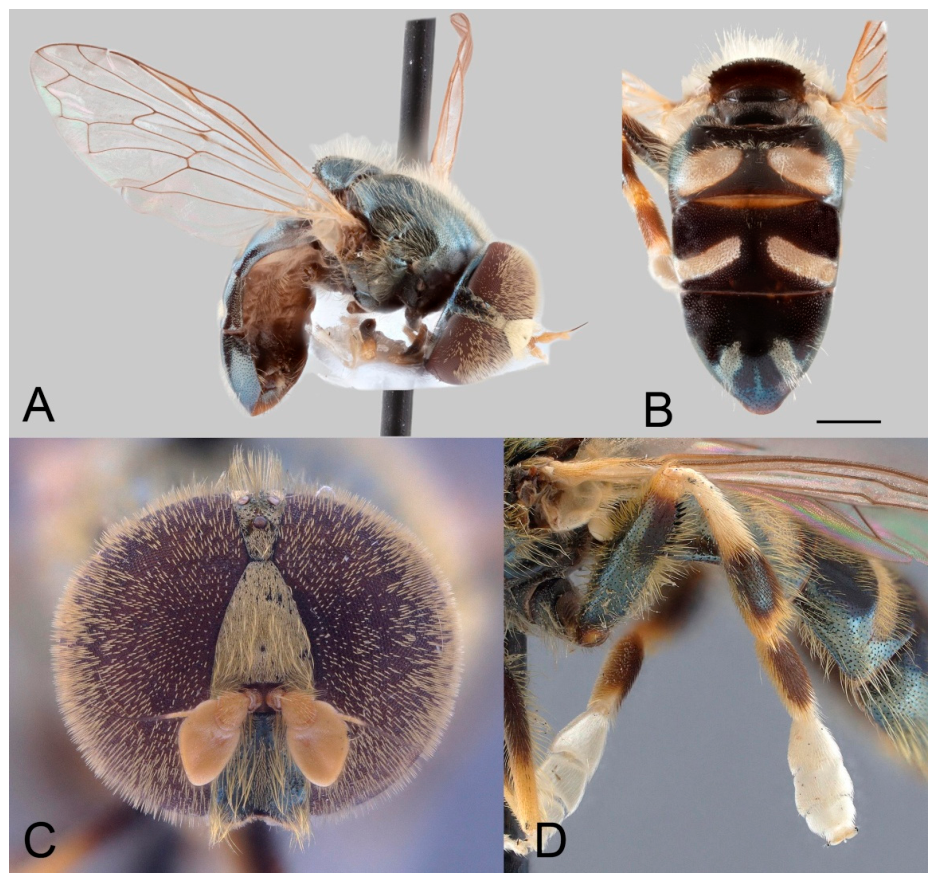
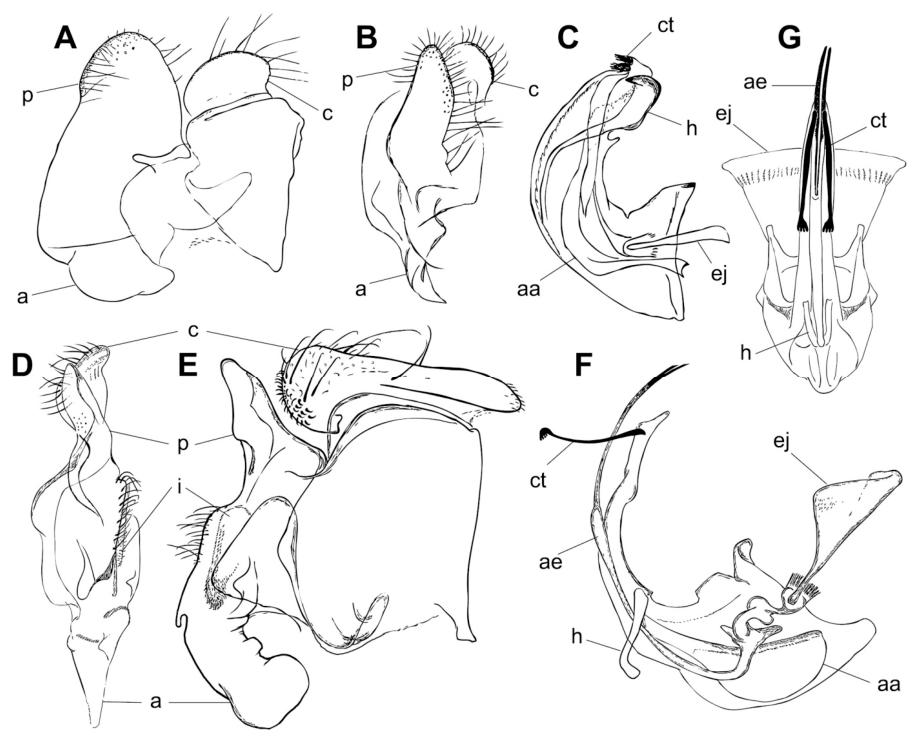
Figure 3.
Male genitalia: (A–C) Eumerus aurifrons; (D–G) Eumerus figurans. (A) epandrium, lateral view; (B) epandrium, ventral view; (C) hypandrium, lateral view; (D) epandrium, ventral view; (E) epandrium, lateral view; (F) hypandrium, lateral view; (G) hypandrium, ventral view. Abbreviations: a—anterior surstyle lobe, aa—aedeagal apodeme, ae—aedeagus, c—cercus, ct—ctenidion, ej—ejaculatory apodeme, h—hamus, and p—posterior surstyle lobe.
- Examined material. Mozambique: Maxixe, 1♂, 27.11–01.12.1997, leg. J. Bosák (ZFMK). Zimbabwe: Zambezi Valley, Rekomitjie, 4♂♂, 02.1987, leg. S. Gußmann (ZFMK). New record. Italy: Sicily, 20 km south of Palermo, 800 m, 1♂, 18.06.2012, leg. J. Halada (M. B. coll.).
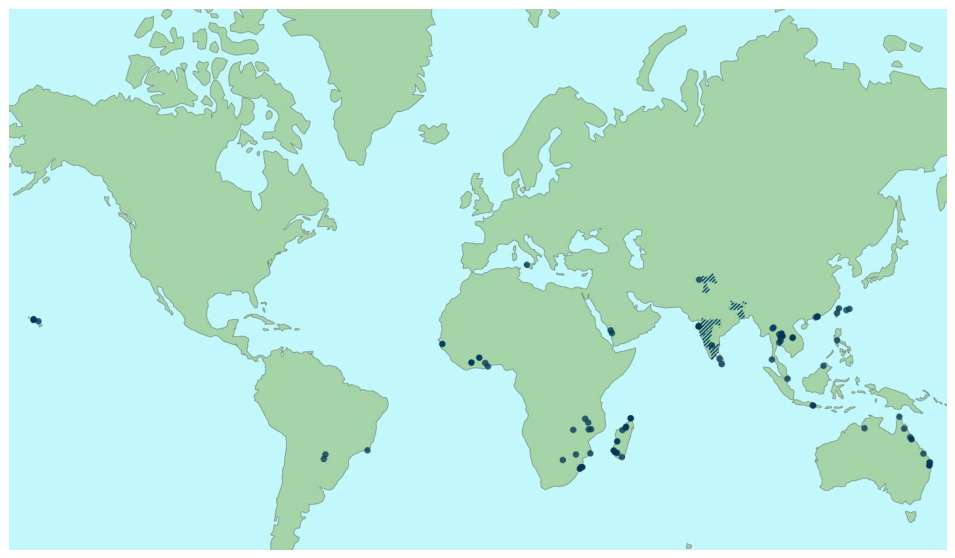
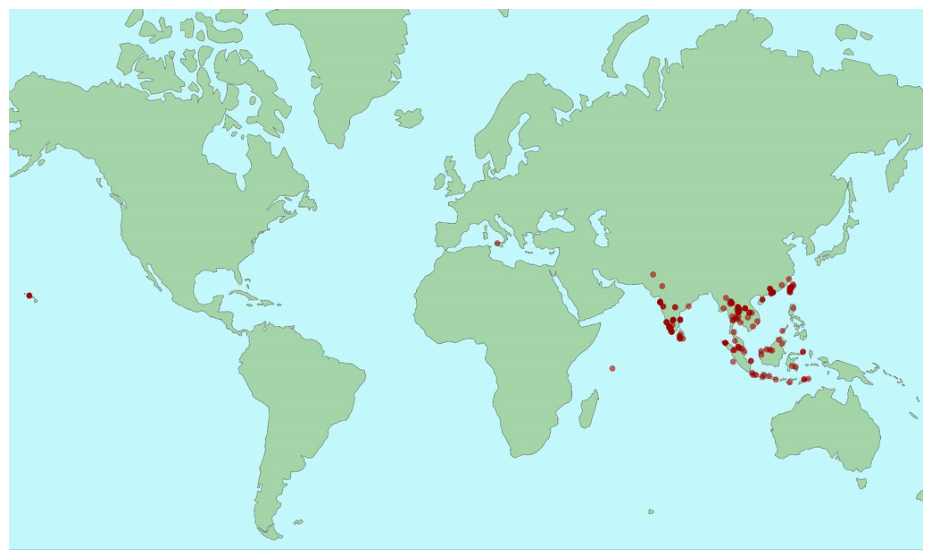
- Distribution. South and Southeast Asia, Africa, Australia, South America, Hawaii [9,51,74,76,77,78,79,80], and Italy (Sicily) (Figure 4).
Figure 4.
Distribution of Eumerus aurifrons. Precise record localities are indicated by dots; shaded areas correspond to regions reported by Mitra et al. [80] where no exact locality data are available.
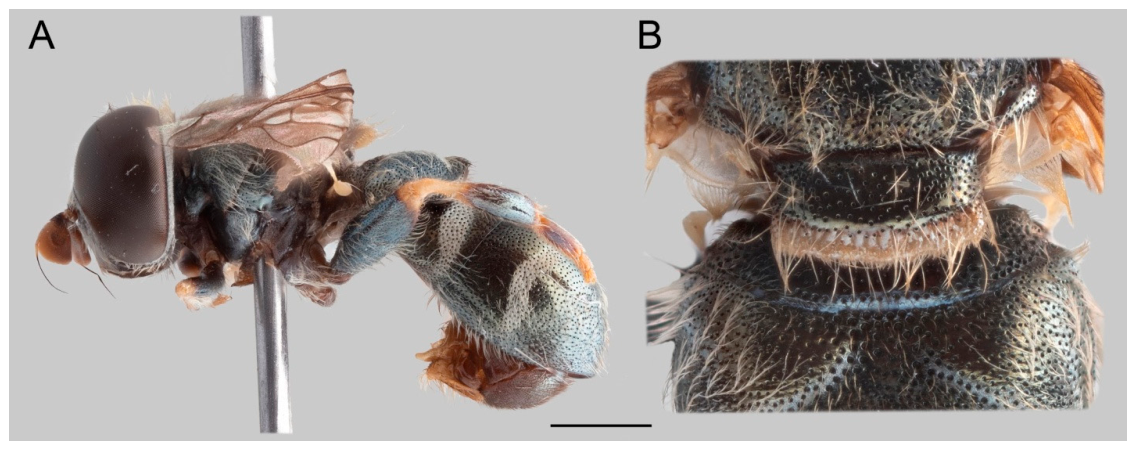
- Eumerus figurans Walker, 1859Eumerus figurans Walker, 1859: 121. Type locality: Indonesia [81].Eumerus marginatus Grimshaw, 1902: 82. Type locality: Hawaii [82].Diagnosis. Eyes almost bare; hind femur is more than three times as long as its maximum depth; scutellum rectangular, transversely elongated with posterior margin yellow; tergites black; dust spots on abdominal tergite 4 laterally sinuate (Figure 5). Male genitalia: Posterior surstyle lobe elongated, tapering apically (Figure 3D,E: p). Anterior surstyle lobe well developed (Figure 3D,E: a). Cercus elongated from lateral view (Figure 3D,E: c). Ctenidion extremely elongated (Figure 3F,G: ct). Apex of aedeagus elongated, protruding from the hypandrium (Figure 3F,G: ae).
Figure 5.
Eumerus figurans, male (Palermo, Sicily): (A) habitus, lateral view; (B) scutellum, dorsal view. Scale bar: 1 mm. Photo: A.S. Grković.
- Examined material. New record. Italy: Sicily, 20 km south of Palermo, 800 m, 1♂, 18.06.2012, leg. J. Halada (M. B. coll.).Remarks. The identification is based on comparison with the original description and photographs of the holotype of Eumerus figurans Walker, 1859 housed in the Natural History Museum, London.Distribution. Oriental and Afrotropical regions (incl. Indonesia, Taiwan, Sri Lanka, India, SE Asia, Seychelles); Pacific: Hawaiian Islands [9,20,51,83]; Italy (Sicily) (Figure 6).Note on distribution records. Public data portal records (e.g., BOLD, GBIF; https://doi.org/10.15468/dl.78ufz6 (accessed on 4 March 2025)) indicating the presence of Eumerus figurans in Northwestern Australia were evaluated and excluded from our distribution data. Morphological examination of these Canadian National Collection (CNC) specimens (which lack the characteristic bicoloured scutellum with a yellow rim typical of true E. figurans) confirms that these records represent endemic Australian species and are the result of misidentifications.
Figure 6.
Distribution of Eumerus figurans. Precise record localities are indicated by dots.
3.2. Proposed Synonymy
Eumerus amoenus Loew, 1848
- Eumerus amoenus Loew, 1848: 132. Type locality: (Sicily) Italy, Greece [84].
=Eumerus nebrodesius Rondani, 1868: 575 syn. nov. Type locality: (Sicily) Italy [85].
Type material examined. Eumerus nebrodesius. MALE SYNTYPE. [White handwritten label] “Madonie”; [white printed label] “148”; [red printed label, subsequent museum label] “Museo “La Specola”/coll. Rondani/HOLOTYPUS”; [white handwritten label] “nebrodesius/Rnd./Sicil.”; (MZUF).
Notes. Eumerus nebrodesius is listed as a valid species by Peck [23], Belcari et al. [86], Sforzi & Sommaggio [87]. After the examination of the male syntype preserved in the Museo “La Specola” (MZUF), we found it to be conspecific with Eumerus amoenus. Rondani [85] did not specify the number of specimens in his original description, making this specimen a syntype. The red “HOLOTYPUS” label was added subsequently during collection handling in the museum and does not constitute a valid holotype designation or lectotype fixation under ICZN rules.
Eumerus barbarus (Coquebert, 1804)
- Syrphus barbarus Coquebert, 1804:117. Type locality: “Barbaria” [88].Eumerus australis Meigen, 1838:110. Type locality: Spain (Andalusia) [89].Eumerus iris Loew, 1848:118. Type locality: Italy (Sicily) [84].Eumerus fucatus Rondani, 1868:575. Type locality: Italy (Parma) [85].
=Eumerus lasiops Rondani, 1857: 92 syn. nov. Type locality: Italy (Parma) [90].
Type material examined. FEMALE SYNTYPE. [White printed label] “146”; [white label, partly handwritten] “Eumerus/barbarus Coq./(=E. lasiops Rnd.)/det. M. Daccordi 1994”; [red printed label] “Museo “La Specola”/coll. Rondani/SYNTYPUS”; [white printed label] “Museo “La Specola”/University of/Florence”; (MZUF).
Note. Eumerus lasiops Rondani, 1857, was described from Italy [90] based on both sexes, but the original description is inadequate for reliable recognition, lacking clear diagnostic characters. Peck [23] treated this species as of uncertain status, Dirickx [91] indicated that its validity requires confirmation, and Speight [2] noted that there is no basis for recognising it as a distinct species. Although Sforzi & Sommaggio [87] did not locate unambiguous type material during their survey, the female specimen from the Rondani collection in MZUF (box 4) examined here bears a museum “SYNTYPUS” label. Our direct examination of this specimen confirms it is conspecific with Eumerus barbarus (Coquebert, 1804) (confirming the previous determination by M. Daccordi in 1994). On this basis, E. lasiops is formally proposed as a junior synonym of E. barbarus.
Eumerus olivaceus Loew, 1848
- Eumerus olivaceus Loew, 1848:116. Type locality: Italy (Sicily) [84].
=Eumerus alpinus Rondani, 1857: 91. Type locality: Italy (Piedmont) [90].
Type material examined. Eumerus olivaceus: MALE HOLOTYPE. 1♂: [white handwritten label] “Sicilia/15 4 Zeller”; [red printed label] “Typus”; [white handwritten label] “Eumerus/olivaceus/m”; [white printed label] “Coll./H.Loew”; [white printed label] “Zool.Mus./Berlin”; [white printed label] “/http://coll.mfn-berlin.de/u/c2e416”; (ZMB) (Figure 7).
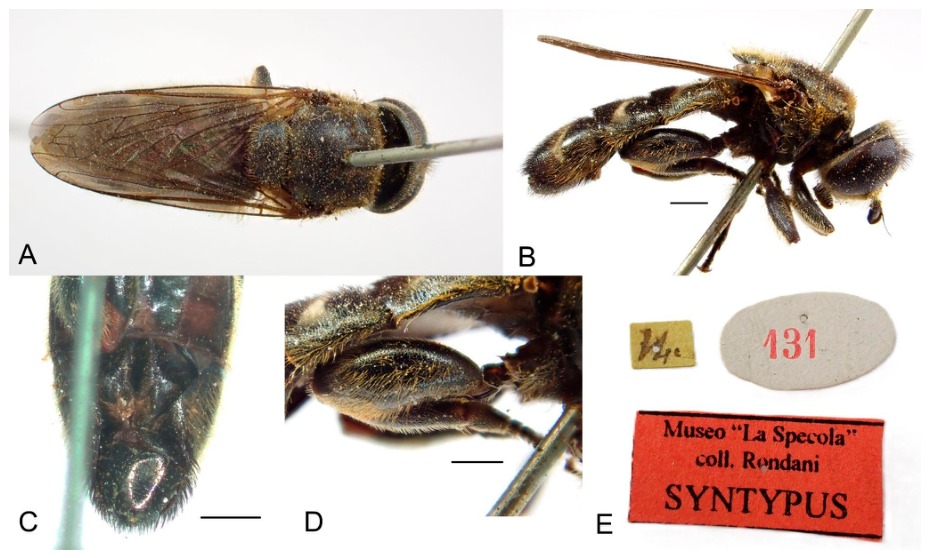
Other material. Eumerus alpinus: MALE LECTOTYPE (here designated in order to fix identity of the species). 1♂: [handwritten on small square yellow paper] “14.”; [printed in red on oval white paper] “131”; [red printed label] “Museo “La Specola”/coll. Rondani/SYNTYPUS” (Figure 8). MALE PARALECTOTYPES. 1♂: [printed in red on oval white paper] “131”; [red printed label] “Museo “La Specola”/coll. Rondani/SYNTYPUS” (MZUF); 4♂♂: [Specimen 1] [white printed label] “Eumerus/nudus Loew, 1848/Det. Sommaggio 2002 ♂”; [Specimen 2] bearing the same printed identification label; [Specimen 3] bearing the same printed identification label and a small, handwritten historical label “19”; [Specimen 4] bearing the same printed identification label and a handwritten historical label “28–68.” All four specimens share a collection box label: “E. alpinus Bell. ♂/Alpi” (MRSN).
New material. Italy: Belpasso, 5♂, 2♀, 06.04.2015, leg. A. Vujić et al. (FSUNS); Sicily, Pedara, 2♂, 1♀, 14.04.2024, leg. S. Radenković (FSUNS); 1♀, 14.04.2024, leg. T. Tot; 1♂ 18.04.2024, leg. S. Radenković, T. Tot; Ponte Antico Fiume Alcantara, Castiglione di Sicilia, 1♀, 20.04.2024, leg. S. Radenković (FSUNS).
Figure 7.
Eumerus olivaceus Loew, 1848: (A–D,F,G) male holotype (ZMB); (E) male from Montenegro. (A) head, dorsal view; (B) head, lateral view; (C) hind leg, lateral view; (D) sternite 4, showing symmetrical damage; (E) sternite 4 for comparison; (F) genitalia; (G) associated labels. Scale bars: 1 mm. (A–D,F,G) Photo: Eran Wolff, © Museum für Naturkunde Berlin; (E) Photo: A. S. Grković.
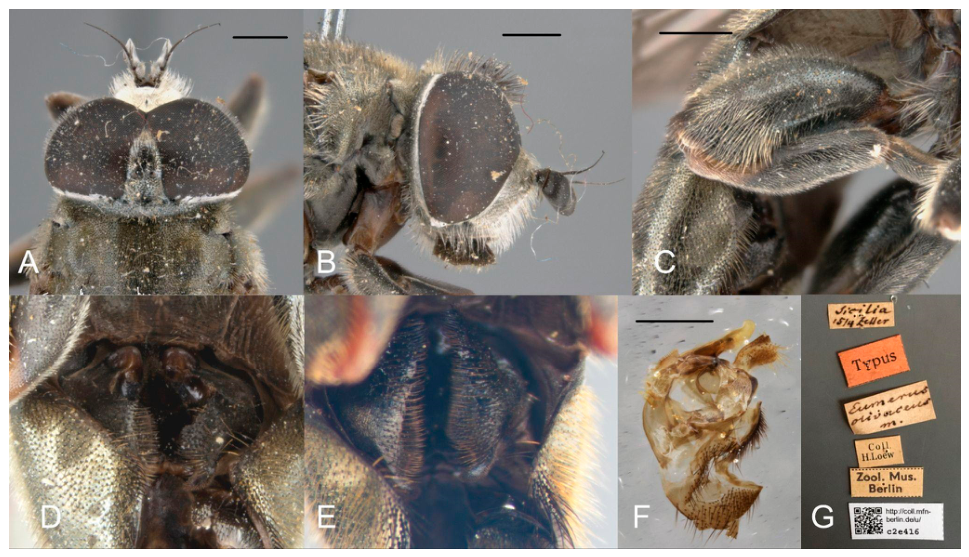
Notes. Eumerus alpinus was listed as a synonym of E. olivaceus by Peck ([23], p. 160), later resurrected as a valid species by Grković et al. ([92], p. 346), and is here resynonymised with E. olivaceus. The holotype of Eumerus olivaceus Loew, 1848, is housed in the Museum für Naturkunde, Berlin (ZMB) (Figure 7), while the syntype series of E. alpinus Rondani, 1857, is historically split between the MZUF (Florence) and the MRSN (Turin).
In the original description of E. alpinus, Rondani ([90], p. 91) stated: “Marem speciei in alpibus pedemontanis captum semel mihi Prof. Bellardi misit” [Prof. Bellardi sent me once a male of this species collected in the Piedmont Alps]. This phrasing led Grković et al. [92] to incorrectly conclude that only a single male specimen existed in the MZUF collection, which they treated as a holotype. However, Sforzi & Sommaggio [87] revealed that the original syntype series actually comprised six male specimens distributed across both the Florence and Turin collections.
To definitively fix the nomenclature and resolve longstanding ambiguities regarding this taxon, we evaluated the available syntype material. Our examination of the photographic data of the two MZUF syntypes confirmed that both specimens are morphologically conspecific and represent true E. olivaceus. The four remaining syntypes stored in the MRSN were previously identified by Sommaggio in 2002 as E. nudus Loew, 1848 [68]; however, based on the photos provided by the MRSN, these specimens belong to E. olivaceus (as E. alpinus) as well. To ensure nomenclatural stability, we herein designate the well-preserved male specimen from the Rondani collection in Florence (bearing the handwritten label “14.” and red collection number “131”) (Figure 8) as the lectotype of Eumerus alpinus. Consequently, the four MRSN specimens previously misidentified as E. nudus are here formally designated as paralectotypes of E. alpinus.
Grković et al. [92] previously resurrected E. alpinus as a valid species and restricted E. olivaceus as an endemic to Sicily. This decision was based on apparent morphological discrepancies between the E. olivaceus holotype (Figure 7) and continental European populations. However, our re-examination of the E. olivaceus holotype demonstrated that its sternite 4 was symmetrically damaged during the historical extraction of the male genitalia (Figure 7D), which led to a misinterpretation of its diagnostic characters.
Recent field sampling in Sicily yielded a larger series of Eumerus specimens from the topotypical region (Belpasso, Pedara, and Castiglione di Sicilia). A comparative analysis of this new topotypical material with the newly designated lectotype of E. alpinus confirms that they are morphologically identical. The structural differences previously used to split the two taxa are continuous variations or artefacts of preservation. Consequently, the identity of E. olivaceus is clarified: it is not an endemic island species, but rather a widely distributed taxon occurring across Southern Europe, from Greece to northern Spain, including the Apennine Peninsula and Sicily, with E. alpinus falling as its junior synonym.
Figure 8.
Eumerus alpinus Rondani, 1857, male lectotype (present designation) (MZUF): (A) habitus, dorsal view; (B) habitus, lateral view; (C) abdomen apex, lateral view; (D) hind leg, lateral view; (E) associated labels. Scale bars: 1 mm. Courtesy of the Museo di Storia Naturale dell’Università di Firenze (MZUF), Florence, Italy. Photo: G. F. Turrisi.
Eumerus rusticus Sack, 1932
- Eumerus rusticus Sack, 1932:414. Type locality: Turkey (Asia minor) [93].
=Eumerus aurofinis Grković, Vujić, & Radenković, 2015: 364 syn. nov. Type locality: Greece (Samos) [92].
Examined material. Type material. MALE SYNTYPE. [White label, partly handwritten] “Zool. Inst. Halle-S./Eumerus ♂/rusticus Sack/ det. P. Sack 1930”; [yellow handwritten label] “Typus”; [white handwritten label] “110”; [white printed label] “v. Röder”; [white handwritten label] “Asia min”; (MLUH) (Figure 9). FEMALE SYNTYPE. [White label, partly handwritten] “Zool. Inst. Halle-S./Eumerus ♀/rusticus Sack/ det. P. Sack 1930”; [yellow handwritten label] “Typus ♀”; [white printed label] “v. Röder”; [white handwritten label] “Asia min”; (MLUH) (Figure 10).
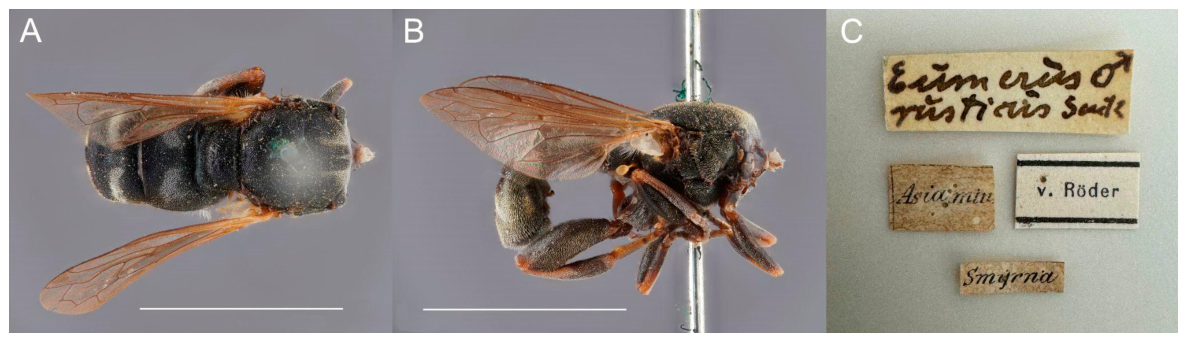
Other material. [White handwritten label] “Eumerus ♂/rusticus Sack”; [white handwritten label] “Asia min”; [white handwritten label] “Smyrna”; [white printed label] “v. Röder”; (SMF) (Figure 11).
Figure 9.
Eumerus rusticus Sack, 1932, male syntype (MLUH): (A) habitus, dorsal view; (B) habitus, lateral view; (C) associated labels. Scale bar: 5 mm. Courtesy of the Center of Natural Science Collections of the Martin Luther University, Zoological Collection, Halle, Germany. Photo: Joachim Händel.
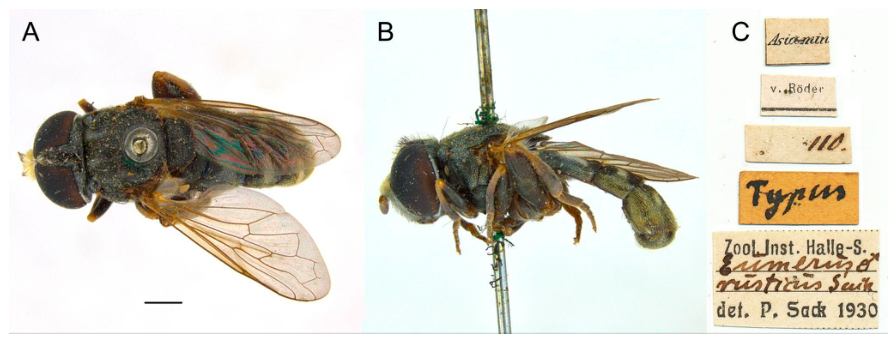
Figure 10.
Eumerus rusticus Sack, 1932, female syntype (MLUH): (A) habitus, dorsal view; (B) habitus, lateral view; (C) associated labels. Scale bar: 1 mm. Courtesy of the Center of Natural Science Collections of the Martin Luther University, Zoological Collection, Halle, Germany. Photo: Joachim Händel.
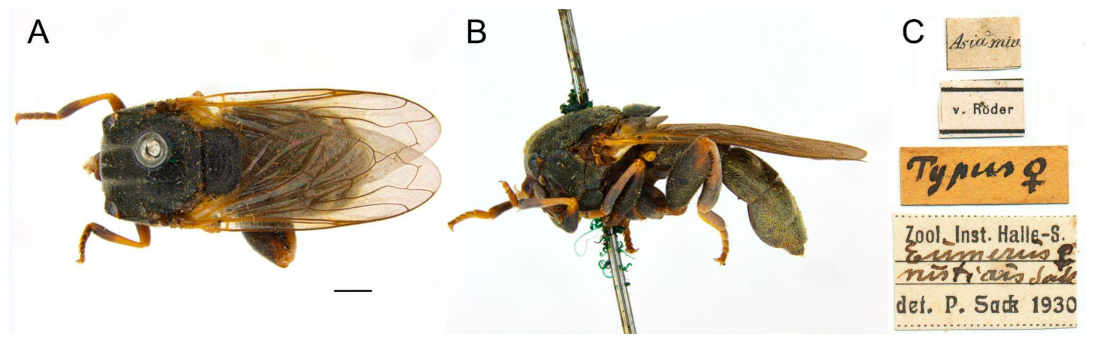
Notes. The identity of Eumerus rusticus Sack, 1932 was clarified and confirmed through the examination of high-resolution photographs of the male and female syntypes deposited in the Martin Luther University Halle-Wittenberg (MLUH) (Figure 9 and Figure 10) and one historical male specimen from the von Röder collection from Naturmuseum Senckenberg, Frankfurt (SMF) (Figure 11). All of these specimens perfectly match the original description by Sack [93] as well as the description of Eumerus aurofinis Grković, Vujić, & Radenković, 2015 [92]. The species can be distinguished from related taxa of the E. tricolor group by the following diagnostic characters: Body covered in very short hairs, characteristic short golden hairs present on the top of abdomen; scutum black and dull with two triangular dust spots anteriorly; wing with brownish tinge; legs predominantly black, with the basal third to half of the tibiae, tips of the femora and ventral sides of the tarsi yellow; coxae and trochanters mostly black; hind femur very strong and thickened and dorsally convex; ventral subapical setae long and sharp, with 9–10 setae in the anterior row, located on a raised edge, and 6–7 setae in the posterior row; abdomen elongated and entirely black; pairs of white dust spots present on tergites 2 to 4; sternites simple, bronze to brown coloured and covered in short white hairs. In addition, molecular data (COI sequences) from Turkish specimens collected on Bozdağ Mountain, alongside Greek specimens from the islands of Samos and Rhodes, demonstrate that all analysed material of Eumerus aurofinis belongs to the same taxon [92].
Eumerus aurofinis was described based on material collected on the East Aegean Islands (Samos and Lesvos) and Turkey (Mountain Bozdağ). The primary type material (male holotype and paratypes) is deposited in FSUNS collection, where it was designated and directly examined by the authors during the original description [92].
Taking all morphological, geographical, and molecular evidence into account, E. aurofinis is here considered a junior synonym of E. rusticus.
Figure 11.
Eumerus rusticus, historical male specimen from the von Röder collection (SMF): (A) habitus, dorsal view; (B) habitus, lateral view; (C) associated labels. Scale bar: 5 mm. Courtesy of the Senckenberg Research Institute and Natural History Museum Frankfurt, Germany. Photo: Nikolai Ignatev. © Senckenberg.
3.3. Taxonomic Status of Eumerus pauper Becker, 1921
- Eumerus pauper Becker, 1921
Eumerus pauper Becker, 1921: 71. Type locality: Spain [94].
- =Eumerus bifurcatus van Steenis & Hauser, 2019: Aguado-Aranda et al. (2025: 21) (as synonym). Type locality: Spain [13].Type material. The type material of E. pauper Becker, 1921 (ZMB) is currently unavailable for study; it has been on long-term loan since 1999 and remains unreturned despite the museum’s recovery efforts (J. Pohl, pers. comm.). The species was originally described from two female syntypes from Spain without a precise locality. A male was subsequently described by Gil Collado [95] based on additional Spanish material.Remarks. Aguado-Aranda et al. [96] examined historical material determined as E. pauper by Gil Collado (4♂♂, 2♀♀). Based on these specimens and the original descriptions, they concluded that E. bifurcatus van Steenis & Hauser, 2019, is identical to E. pauper. Notably, these authors attributed the drawings of the male genitalia from the original description of E. bifurcatus [13] to E. pauper. Although they did not formally propose a new synonymy (syn. nov.) due to the unavailability of the Becker types, they explicitly treated E. bifurcatus as a junior synonym by replacing its use with E. pauper. This interpretation is consistent with earlier expert feedback communicated to the last author (Claus Claussen, pers. comm.). Following this taxonomic judgment, the species are treated as synonyms here.
3.4. Checklist of Eumerus Species in Europe
- The European fauna of the genus Eumerus currently comprises 81 valid species (Table 1). Two species, Eumerus aurifrons and E. figurans are newly recorded from Europe.
- The taxonomic structure of the European fauna is distributed across 11 recognised species groups, while 10 species (12.3%) remain currently unassigned to any specific group or complex. The tricolor group represents the most species-rich group in the region, containing 23 species, followed by the strigatus group with 14 species.
- The checklist below presents the currently valid Eumerus species known from Europe, based on literature records and recent revisions, including new data reported in this study.
Table 1.
Taxonomic checklist of European Eumerus species with species group affiliation (including subgroups/complexes) and geographic distribution. Abbreviations: Alpine—ALP, Anatolian—ANA, Atlantic—ATL, Boreal—BOR, Continental—CON, Macaronesian—MAC, Mediterranean—MED, Pannonian Biogeographical Region—PAN, and Steppic—STE.
3.5. Species of Uncertain Status in the European Fauna
- The species listed below are either of uncertain taxonomic identity, of doubtful occurrence in Europe, or both.
- Eumerus acuticornis Sack, 1933
- Eumerus acuticornis Sack, 1933:8. Type locality: North China [97].
- Eumerus acuticornis was originally described from North China and is currently considered to have a Central to East Asian distribution. Its occurrence in Europe is doubtful. The only European record originates from Romania [98], but this record was already regarded as requiring confirmation by Dirickx [91]. No additional European material has been documented since, and no verified specimens are known from European collections.Gilasian et al. [99] suggested that Eumerus acuticornis is likely endemic to southern Mongolia. Evenhuis & Pape [100] listed E. acuticornis for Mongolia, supporting an Asian distribution pattern. In the absence of confirmed European material, E. acuticornis is here treated as a doubtful species for the European fauna.
- Eumerus angustifrons Loew, 1848
- Eumerus angustifrons Loew, 1848:125. Type locality: Turkey (Antalya) [84].
- Type material examined. [White handwritten label] Adalia/Oct. 40.; [green handwritten label] Kl.Asien/Adalia/H. Loew; [red printed label] Typus; [white handwritten label] Eumerus/angustifrons/m.; [white printed label] Coll./H.Loew; [white printed label] MfN/URI/ http://coll.mfn-berlin.de/u/0ee7bb; (ZMB).
- Eumerus angustifrons Loew, 1848, was described from Turkey (“Adalia”, modern-day Antalya). The female type specimen deposited in the Museum für Naturkunde, Berlin (Loew collection, ZMB) was directly examined. While this specimen is undeniably Loew’s type, its exact taxonomic identity, specifically whether it is conspecific with or distinct from other described species, remains uncertain. Because the type is a single female with a glued head, its key morphological characters cannot be evaluated with sufficient confidence to determine potential synonymy without topotypical male specimens.Direct examination of the female type specimen of E. angustifrons reveals the following morphological characters: The head is glued; the third antennal segment appears relatively large and rectangular, with a darkened dorsal and anterior margin and reddish colouration ventrally. The face is faintly dusted and white-haired; the frons is shiny, with only a narrow dusted stripe along the eye margin extending to the anterior ocellus. The ocellar triangle is slightly isosceles; hairs around the ocelli are black, with several additional black hairs on the vertex. Eyes covered in short, pale hairs. The hind trochanter angular ventrally. The hind femur is strong, with two rows of spines apicoventrally. The first row of sharp spines is normally developed, and the second row has only a few blunt-tipped spines. At the base of the ventral side of the hind femur, a small bulge is present, similar to that in E. funeralis Meigen, 1822.The species was described from Turkey. The Romanian record is based on Kowarz [101], Thalhammer [102], and Brădescu [98], but requires confirmation.
- Eumerus angustifrons is listed as a valid species by Kowarz [101], Thalhammer [102], Sack [93], Peck [23], Brădescu [98], and Speight [2]. Dirickx [91] stated that the only records from Romania are those of Kowarz [101] and Thalhammer [102]. Evenhuis & Pape [100] listed this species as valid with a range in Turkey. Stackelberg [12] briefly referenced this species in a footnote, placing it in the same group as E. chrysopygus Sack, 1941 from China.
- Eumerus graecus Becker, 1921
- Eumerus graecus Becker, 1921:69. Type locality: Greece (Poros) [94].
- The type material (3 syntypes: 2♂ and 1♀) of Eumerus graecus Becker, 1921, housed in the ZMB, is currently unavailable for study due to a long-term loan since 1999, despite the museum’s efforts to have it returned (Jenny Pohl, pers. comm.). Based on examination of comparative material from Greece that fits with the original description, as well as assessment of historically identified specimens (Martin Ebejer, pers. comm.), the diagnostic characters attributed to E. graecus appear to fall within the known range of intraspecific variation in the widely distributed Mediterranean species E. pusillus Loew, 1848. However, in the absence of direct examination of the type material, the taxonomic status of E. graecus cannot be confirmed with certainty. It is therefore treated as a doubtful species pending further study of the type material.
- Eumerus lunatus (Fabricius, 1794)
Syrphus lunatus Fabricius, 1794: 296. Type locality: “Barbaria” [103].
Milesia lunata (Fabricius, 1794): Fabricius, 1805: 193 (generic transfer) [104].
Type material examined. Syrphus lunatus: Male holotype. [White handwritten label] lunatus; [yellow handwritten label] 193.22; [red printed label] Type; [white printed label] NHMD/308691; (ZMUC).
Other material. Milesia lunata: Male. [red printed subsequent museum label] Type; [green handwritten label] Barb. (F.) MFW; [green handwritten label] Lunata F*W.; [purple printed label] 946; [yellow printed label] Zool. Mus./Berlin; [green handwritten label] Barbaria; (ZMB).
- The taxonomic identity and European occurrence of Eumerus lunatus (Fabricius, 1794) remain unresolved. Smit et al. [53], in their revision of Eumerus from the Arabian Peninsula, associated E. lunatus with E. lacertosus Smit, 2017 and E. triangularis Hervé-Bazin, 1913, based on a set of shared characters without examination of the type material of E. lunatus.Subsequent studies [11] expanded the concept of the E. triangularis species group, whose distribution is restricted to the Afrotropical region, by identifying additional African members and refining its diagnosis. Furthermore, they emphasised that, based on the original description and examination of the remaining parts of the holotype, E. lunatus does not fit the diagnostic character set of the E. triangularis group. The authors explained how confusion occurred regarding E. lunatus (originally described from North Africa that belongs to the Palaearctic region) being erroneously included within the exclusively Afrotropical Eumerus triangularis group. This mistake most probably arose because specimens of E. tessellatus Hull, 1964 (a member of the E. triangularis group), were misidentified as E. lunatus by Doesburg, and Stackelberg [12] likely incorporated characters of E. tessellatus under the name E. lunatus, leading to erroneous interpretations of both morphology and distribution.Dirickx [91] listed E. lunatus for North Africa and cited an additional record from Linosa (Pelagic Islands, Italy) after Venturi [105] but noted that the species’ distribution was poorly known. The other European record, from the former Yugoslavia, listed by Glumac [106], was later rejected by Vujić & Šimić [107], who did not confirm the presence of E. lunatus after examination of available museum material.According to Speight [2], the only basis for including this species in the European list is a record by Venturi [105] from the island of Linosa (Italy) near North Africa. He also emphasised that this material should be located and re-examined, and suggested that subsequent descriptions of similar species, such as E. etnensis, should also be taken into consideration for resolving the status of E. lunatus. The connection between the two species is supported by the fact that the specimen from “Barbaria” belonging to the Fabricius collection deposited in the Berlin museum (ZMB) and wrongly labelled as “Type” of “lunata”, which refers to the subsequent transfer of the genus Syrphus to Milesia by Fabricius personally, belongs to Eumerus etnensis. Given the poor condition of the ZMUC holotype of Eumerus lunatus (with only part of the thorax and one wing preserved), the lack of verified European specimens, and repeated historical misidentifications, E. lunatus is here treated as a taxonomically uncertain species and is therefore not included in the European Eumerus; its final status remains to be fully resolved in ongoing research.
3.6. Species Richness and Endemism Patterns
- The analysis of Eumerus diversity across European biogeographical regions reveals a distinct heterogeneity in both species richness (Figure 12) and the degree of local endemism. Total species richness was highest in the Mediterranean (MED) region (65 recorded species), followed by the Continental (CON) (25) and Alpine (ALP) (15) regions. However, when examining endemism, we focused exclusively on localised endemics (species restricted to specific islands, mountain ranges, or isolated habitats) rather than regional endemics (taxa widespread across an entire biogeographical province). Under this strict criterion, the Macaronesian (MAC) region exhibited the highest rate of endemism (75%), followed by the Mediterranean (28%) and the Pannonian (PAN) (25%) regions.Figure 12. Species richness of the genus Eumerus Meigen, 1822 across the Biogeographical Regions of Europe (based on EEA 2017).
4. Discussion
The Mediterranean region stands out as the primary centre of diversity for the genus on the European continent, harbouring 65 species, which account for over 80% of the total European Eumerus fauna. This high concentration of taxa is likely the result of the region’s favourable climatic conditions, complex topography, and its role as a major Pleistocene refugium, which facilitated both the persistence of ancient lineages and rapid speciation [108,109]. These environmental drivers also fostered a high diversity of endemic forage and host plants, which in turn supported the radiation and specialisation of phytophagous lineages [18,52,110,111]. While inferring centres of origin solely from modern distributions requires caution given major past climatic shifts (including Holocene thermal fluctuations and glaciations), the region consistently exhibits high diversity and endemism.
This dominance is consistent with broader patterns observed in other phytophagous syrphids with similar life histories, most notably the genus Merodon Meigen, 1803, where the Mediterranean and Balkan refugia also support the vast majority of European species richness [112,113,114]. In contrast, the Continental and Boreal regions, while supporting 25 and 8 species, respectively, consist primarily of widespread, eurytopic taxa such as Eumerus strigatus and E. funeralis. The total absence of localised endemics in these northern and central regions suggests that their current Eumerus fauna is the result of post-glacial recolonisation rather than in situ speciation [115].
While absolute richness is highest in the Mediterranean, the Macaronesian region exhibits the highest rate of localised endemism at 75%, despite a lower total richness (12 recorded species, 9 of which are endemic). This reflects the geographic isolation of the Macaronesian archipelagos, where the restricted gene flow inherent to the Canary Islands and Madeira has driven unique speciation events [116,117]. The genus Eumerus represents a significant component of the Macaronesian syrphid fauna [48,117,118,119,120,121], comprising 20% of the total 65 recorded species belonging to 26 genera in the region according to Reverté et al. [122]. This is also reflected in the broader systematic structure of the European fauna; nearly all of the species unassigned to any of the 11 recognised species groups in Europe in our updated checklist are endemic to Macaronesia (E. dubius, E. hispidus, E. latitarsis, E. macarius, E. nivariae, and E. purpureus). The only exceptions to this pattern among the 10 unassigned species are E. hungaricus and E. colladoi and 2 newly recorded Oriental species (E. aurifrons and E. figurans).
Furthermore, the high endemism rate of the Pannonian region (25%) is a significant finding. Although relatively restricted in area, the unique alkaline steppes and sandy habitats of the Pannonian basin have fostered a specialised fauna, including species such as E. pannonicus and E. banaticus [13,123], both members of the predominantly endemic bactrianus group, which comprises mostly highly localised species. This identifies the Pannonian region as a critical continental centre of endemism within Europe [124,125].
From a systematic perspective, the composition of the updated checklist is heavily dominated by two species groups that comprise nearly half of the entire European fauna: the tricolor group (23 species, representing 28.4%) and the strigatus group (including the strigatus/bactrianus complex; 14 species, representing 17.3%). The high species richness within the tricolor lineage is particularly linked to the Mediterranean Basin, where localised speciation events have resulted in numerous highly restricted endemics (e.g., E. ancylostylus, E. larvatus, and E. rubrum). The strigatus group’s evolutionary success across diverse bioclimatic zones is likely tied to its larval host preferences, which favour widespread, bulbous geophytes.
The fauna of the Mediterranean has undergone significant changes in recent decades, driven by climate change and the increasing influx of species from tropical regions.
Sometimes, a single introduction of a non-native fly can have wide-ranging ecological consequences. For instance, the spotted-wing drosophila Drosophila suzukii (Matsumura, 1931) (Diptera: Drosophilidae), native to East Asia, was first recorded in Europe in 2008, almost simultaneously in coastal Spain and Tuscany, Italy, before rapidly invading the entire Mediterranean Basin and Central Europe [126,127,128,129]. This illustrates how dipteran introductions can trigger swift, widespread range expansions with substantial ecological and agricultural impacts.
The fauna of Central Europe has experienced significant changes in recent decades as well, primarily driven by climate change and the increasing influx of flora and fauna from tropical and Mediterranean regions. According to Haris et al. [130], there are 803 non-native insect species documented in Central Europe, with 298 of these introduced in the last 25 years. Notably, 54% of the recently introduced species hail from warmer climates, including 86 from the Mediterranean and 74 from tropical regions, which underscores a clear trend of biogeographical shifts.
Furthermore, human activities have significantly influenced the distribution and dispersal of insect species, particularly through the global translocation of host plants. The international trade of ornamental and agricultural plants has inadvertently facilitated the introduction of numerous insect species into non-native ecosystems, often leading to ecological and economic consequences. Among these, some hoverfly species have expanded their ranges due to human-mediated transportation, either through trade-related movement of their larval host plants or by utilising anthropogenic environments as new habitats. A notable example includes species whose life cycles are linked to plants, such as those from the genera Eumerus and Merodon. The larvae of these species feed on bulbs, tubers, stems, rhizomes, and/or decaying plant material. Some of the host plants are commercially marketed, which has led to an unintentional spread of hoverfly species to new regions. In this way, the Merodon equestris (Fabricius, 1794), Eumerus funeralis, and E. narcissi, all native to Europe, have been unintentionally introduced to Nearctic (E. funeralis, E. narcissi, and E. strigatus), Neotropics (E. funeralis) and Australasian regions (E. funeralis, E. strigatus, and M. equestris) through the trade of ornamental and agricultural plants, particularly Narcissus, Lilium, and Allium bulbs [9,16,28,29,30,31,51].
Eumerus figurans Walker, 1859, a species morphologically close to the obliquus group, classified by Ricarte et al. [8] within the figurans group, has been noted in Hawaii since 1900 [131,132] and was quite recently recorded in Paraguay [9]. This species, which also expanded its range from Southeast Asia through the Indian Ocean to Seychelles [20,100], is known to cause considerable damage to lily bulbs and ginger, making it an important agricultural pest; it has further bred out of decomposing pineapple stumps and taro roots [9,18,20,131,132,133,134,135,136] but is also an important pollinator [137]. This species is sometimes referred to as the “ginger fly”.
Eumerus aurifrons (Wiedemann, 1824), a species originally described from India, is widespread and commonly found in the Oriental region [9,51,76,77,78,80]. However, it is also present in other zoogeographical regions, such as the Australian [9,51,79] and the Afrotropical, covering most of the African continent, including Madagascar, as indicated in the unpublished key of Leif Lyneborg (1932–2006) and other publications [51,78]. Its distribution even reaches Hawaii and South America [9].
The larvae of E. aurifrons were found under the bark and in fermenting sap of the widespread Albizia lebbeck (Fabaceae) [138,139], which may have played a role in facilitating the range expansion of the species. Its potential host plant, Albizia lebbeck, originally native to India and Southeast Asia, has been introduced as an ornamental tree in various regions (South and North America, Africa including Madagascar, and the Middle East), including Sicily [140,141,142,143,144], where the first European record of E. aurifrons was documented.
In summary, the widespread cultivation of Albizia lebbeck as an ornamental plant has been established outside its native range for a long time [145], suggesting that the introduction of Eumerus aurifrons was mediated by human activity and plant trade, whereas its potential establishment and range expansion may be further facilitated by changing environmental conditions. Climate change, particularly rising temperatures and altered precipitation patterns, can create highly favourable microclimatic conditions for larval development, thereby serving as a critical catalyst for successful population establishment of introduced species, even if global warming itself was not the direct driver of the initial human-mediated introduction. The Mediterranean Basin is one of the most vulnerable regions to climate change, characterised by accelerated warming compared to the global average [146]. Within this context, Italy and its southern part, including Sicily, have experienced a significant rise in temperature, particularly in recent decades, together with an increasing frequency and intensity of extreme heat events [147]. This trend is exemplified by the record-breaking temperature of 48.8 °C recorded in Sicily on 11 August 2021, officially recognised as the highest temperature measured in Europe [148]. While sharing the same climate preferences with E. aurifrons, E. figurans possesses a significantly broader spectrum of larval host plants and is frequently transported alongside economically important crops such as ginger and lilies [20]. Species with more generalist feeding habits can more easily establish populations in new regions with suitable hosts. However, since these observations are based on only two records, further research and continuous monitoring are needed to better understand the species’ dispersal mechanisms and ecological interactions.
According to Speight [2], plus 2 additional species from Dirickx [91], 92 species of Eumerus are recognised in Europe. Excluding three species of Asian distribution (E. anatolicus Grković, Vujić, & Radenković, 2018, E. hissaricus Stackelberg, 1949, and E. falsus Becker, 1922), and accounting for three names now treated as synonyms (E. bifurcatus van Steenis & Hauser, 2019 = E. pauper Becker, 1921; E. lateralis (Zetterstedt, 1819) = E. grandis and E. caballeroi Gil Collado, 1929 = E. nudus), the number is reduced to 86 species.
Taking into account the recently described Eumerus macarius Ricarte & Aguado-Aranda, 2025, the four new synonymies proposed herein (E. alpinus, E. aurofinis, E. lasiops, and E. nebrodesius), four taxa (E. acuticornis, E. angustifrons, E. graecus, and E. lunatus) here treated as species of uncertain status and the addition of two species newly recorded for Europe (E. aurifrons and E. figurans), there is a total of 81 currently accepted European species of Eumerus.
According to The European Red List of Hoverflies [149], the genus Eumerus is of significant conservation concern in Europe: 43 of the 70 assessed species (over 60%) are classified in threatened categories, including 7 species assessed as Critically Endangered (CR). This pattern is not unique to Eumerus, as similarly high proportions of threatened species are recorded in other species-rich hoverfly genera, including Merodon (59%) and Cheilosia (40.5%).
Taking all the above into account, the genus Eumerus in Europe represents an important but often underestimated component of the pollinator fauna. Although it comprises a relatively small number of species compared to other Diptera groups and includes taxa that are occasionally associated with agricultural systems, its ecological role is complex and its species diversity considerable. Moreover, some species may have potential as bioindicators, as their occurrence and population dynamics can reflect habitat quality. Therefore, Eumerus constitutes a significant element of the European Diptera fauna and warrants particular attention in conservation planning, including reassessment of the conservation status of native European species and continued monitoring.
Author Contributions
Conceptualization, A.S.G., S.R. and A.V.; methodology, A.S.G. and A.V.; validation, A.V., T.T. and M.H.; formal analysis, A.S.G.; investigation, A.S.G. and A.V.; resources, A.V.; data curation, A.S.G.; writing—original draft preparation, A.S.G.; writing—review and editing, A.S.G., S.R., T.T., J.A. and M.J.M.; visualization, A.S.G., J.A. and M.J.M.; supervision, A.V.; project administration, A.S.G.; funding acquisition, A.V. All authors have read and agreed to the published version of the manuscript.
Funding
This research was supported by the Ministry of Science, Technological Development and Innovation of the Republic of Serbia (Grants Nos. 451-03-33/2026-03/200125, 451-03-34/2026-03/200125, and 451-03-33/2026-03/200358).
Data Availability Statement
The taxonomic checklist and regional richness summaries are available within the article. Occurrence data were sourced from iNaturalist, relevant literature, and the private collection of M.H. To protect sensitive collection data, precise locality records are available from the authors upon reasonable request.
Acknowledgments
We thank Miroslav Barták (Czech University of Life Sciences Prague, Czechia) for providing specimens from Sicily. We are grateful to Giuseppe Fabrizio Turrisi (Università degli Studi di Firenze) for assistance with access to the Rondani Collection; to Matteo Ruzzon (Museo Regionale di Scienze Naturali, Turin, Italy) for locating and providing photographs of the Eumerus alpinus syntypes; to Jenny Pohl (Museum für Naturkunde, Berlin) for her help regarding the type material of different Eumerus species; to Nikolai Ignatev (Senckenberg Research Institute and Natural History Museum) for photographs of historical material of Eumerus rusticus; to Joachim Händel (Centre of Natural Science Collections, Martin Luther University Halle-Wittenberg) for photographing type material of E. rusticus; and to Thomas Pape (Natural History Museum of Denmark, Copenhagen) for providing photographs of the type of E. lunatus. We also thank Ximo Mengual (ZFMK) for the loan of additional specimens of E. aurifrons. We are grateful to Michelle Locke (Canadian National Collection of Insects, Arachnids and Nematodes, Ottawa, Canada) for her assistance in examining collection specimens and clarifying the status of Australian records. Without their help, the completion of this study would have been impossible. The authors gratefully acknowledge the financial support of the Ministry of Science, Technological Development and Innovation of the Republic of Serbia.
Conflicts of Interest
The authors declare no conflicts of interest.
References
- Bánki, O.; Roskov, Y.; Döring, M.; Ower, G.; Hernández Robles, D.R.; Plata Corredor, C.A.; Stjernegaard Jeppesen, T.; Örn, A.; Pape, T.; Hobern, D.; et al. Catalogue of Life (Version 2026-07-17 XR); Catalogue of Life Foundation: Amsterdam, The Netherlands, 2026. [Google Scholar] [CrossRef]
- Speight, M.C.D. Species accounts of European Syrphidae, 2024. In Syrph the Net, the Database of European Syrphidae (Diptera); Speight, M.C.D., Castella, E., Sarthou, J.-P., Lebard, T., Vanappelghem, C., Eds.; Syrph the Net publications: Dublin, Ireland, 2024; Volume 115, pp. 1–381. [Google Scholar]
- Grković, A.; Vujić, A.; Chroni, A.; van Steenis, J.; Djan, M.; Radenković, S. Taxonomy and systematics of three species of the genus Eumerus Meigen, 1822 (Diptera: Syrphidae) new to southeastern Europe. Zool. Anz. 2017, 270, 176–192. [Google Scholar] [CrossRef] [Scilit]
- Chroni, A.; Grković, A.; Ačanski, J.; Vujić, A.; Radenković, S.; Veličković, N.; Djan, M.; Petanidou, T. Disentangling a cryptic species complex and defining new species within the Eumerus minotaurus group (Diptera: Syrphidae), based on integrative taxonomy and Aegean palaeogeography. Contrib. Zool. 2018, 87, 197–225. [Google Scholar] [CrossRef] [Scilit]
- Aguado-Aranda, P.; Ricarte, A.; Nedeljković, Z.; Marcos-García, M.Á. An overlooked case for a century: Taxonomy and systematics of a new Iberian species of Eumerus Meigen, 1822 (Diptera, Syrphidae). Eur. J. Taxon. 2022, 817, 35–57. [Google Scholar] [CrossRef] [Scilit]
- Malidžan, S.; Grković, A.; Kočiš Tubić, N.; Radenković, S.; Vujić, A. A new species of Eumerus from Montenegro, belonging to newly established torsicus species group (Diptera: Syrphidae). Zool. Anz. 2022, 297, 71–78. [Google Scholar] [CrossRef] [Scilit]
- Whittington, A.E. The Afrotropical Syrphidae fauna: An assessment. Stud. Dipterol. 2003, 10, 579–607. [Google Scholar]
- Ricarte, A.; Hauser, M.; Kinnee, S.; Marcos-García, M.Á. A new Eumerus hoverfly (Diptera: Syrphidae) from Namibia and South Africa, with notes on similar species. Zootaxa 2020, 4890, 493–508. [Google Scholar] [CrossRef] [Scilit] [PubMed]
- Garcete-Barrett, B.R.; Morales, M.N.; Hauser, M.; Smit, J.T.; González, L.; Ramírez De López, M.B.; Arias, O.; Adorno, M.; Sormanti, G.; Mereles, A. A New geographical records and key to the species of Eumerus Meigen, 1823 (Diptera, Syrphidae) introduced into the Americas and Hawaii. Rev. Bras. Entomol. 2020, 64, e20190016. [Google Scholar] [CrossRef] [Scilit]
- Ssymank, A.; Jordaens, K.; Meyer, M.; Reemer, M.; Rotheray, G.E.; Chandler, P.J. 60. Syrphidae (Flower Flies or Hoverflies). In Brachycera-Cyclorrhapha, Excluding Calyptratae; Kirk-Spriggs, A.H., Sinclair, B.J., Eds.; Manual of Afrotropical Diptera, Suricata; South African National Biodiversity Institute: Pretoria, South Africa, 2021; Volume 3. [Google Scholar]
- Radenković, S.; Veličković, N.; Jordaens, K.; Grković, A.S.; Djan, M.; Ståhls, G.; Smit, J.; Vujić, A. Revision of the Afrotropical endemic Eumerus triangularis group (Diptera: Syrphidae: Merodontini)—Species with glistering antennae. PLoS ONE 2025, 20, e0313829. [Google Scholar] [CrossRef] [Scilit] [PubMed]
- Stackelberg, A.A. Palaearctic species of the genus Eumerus Mg. (Diptera, Syprhidae). Tr. Vses. Ent. Obshch. 1961, 48, 18–229. [Google Scholar]
- Grković, A.; van Steenis, J.; Kočiš Tubić, N.; Nedeljković, Z.; Hauser, M.; Hayat, R.; Demirözer, O.; Djan, M.; Vujić, A.; Radenković, S. Revision of the bactrianus subgroup of the genus Eumerus Meigen (Diptera: Syrphidae) in Europe, inferred from morphological and molecular data with descriptions of three new species. Arthropod Syst. Phylo. 2019, 77, 21–37. [Google Scholar] [CrossRef]
- Barkalov, A.V.; Mutin, V.A.; Daminova, D.B.; Rahimov, M.R. New species of the genus Eumerus Meigen, 1822 (Diptera: Syrphidae) from Central Asia. Far East. Entomol. 2020, 461, 24–30. [Google Scholar] [CrossRef] [Scilit]
- Rotheray, G.E.; Gilbert, F. Phylogeny of Palaeartic Syrphidae (Diptera): Evidence from larval stages. Zool. J. Linn. Soc. 1999, 127, 1–112. [Google Scholar] [CrossRef]
- Speight, M.C.; Hauser, M.; Withers, P. Eumerus narcissi Smith (Diptera, Syrphidae), presence in Europe confirmed, with a redescription of the species. Dipter. Dig. 2013, 20, 17–32. [Google Scholar]
- Speight, M.C.D.; Garrigue, J. Rearing of Eumerus nudus, E. olivaceus and E. pulchellus (Diptera, Syrphidae) from asphodel, with notes on separation of E. nudus and E. olivaceus. Dipter. Dig. 2014, 21, 59–72. [Google Scholar]
- Ricarte, A.; Souba-Dols, G.J.; Hauser, M.; Marcos-García, M.Á. A review of the early stages and host plants of the genera Eumerus and Merodon (Diptera: Syrphidae), with new data on four species. PLoS ONE 2017, 12, e0189852. [Google Scholar] [CrossRef] [Scilit] [PubMed]
- Piwowarczyk, R.; Mielczarek, Ł. First report of Eumerus mucidus (Diptera: Syrphidae) on Cistanche armena (Orobanchaceae) and from Armenia. Fla. Entomol. 2018, 101, 519–521. [Google Scholar] [CrossRef] [Scilit]
- Souba-Dols, G.J.; Ricarte, A.; Hauser, M.; Speight, M.; Marcos-García, M.Á. What do Eumerus Meigen larvae feed on? New immature stages of three species (Diptera: Syrphidae) breeding in different plants. Org. Divers. Evol. 2020, 20, 267–284. [Google Scholar] [CrossRef] [Scilit]
- Aracil, A.; Grković, A.; Pérez-Bañón, C.; Kočiš Tubić, N.; Juan, A.; Radenković, S.; Vujić, A.; Rojo, S. A new species of phytophagous flower fly (Diptera, Syrphidae), feeding on holoparasitic broomrape plants (Orobanchaceae) for the first time in Europe. Arthropod-Plant Interact. 2023, 17, 401–418. [Google Scholar] [CrossRef] [Scilit]
- Marinoni, L.; Morales, M.N. Second record of the genus Eumerus Meigen, 1822 (Diptera: Syrphidae) for the Neotropical Region and the first for Brazil. Proc. Entomol. Soc. Wash. 2007, 109, 493–495. [Google Scholar]
- Peck, L.V. Syrphidae. In Catalogue of Palaearctic Diptera; Soos, A., Papp, L., Eds.; Akad. Kiado: Budapest, Hungary, 1988; Volume 8, pp. 11–230. [Google Scholar]
- Lebard, T.; Canut, M.; Speight, M.C.D. Première observation en France d’Ischiodon aegyptius (Wiedemann,1830) et découverte en Corse d’Eumerus narcissi Smith, 1928 (Diptera, Syrphidae). Rev. Fr. d’Entomologie Générale 2019, 1, 203–210. [Google Scholar]
- Thomas, S.J.; Harrow, M.; Falk, S.J. Eumerus narcissi Smith (Diptera, Syrphidae) confirmed as British from the Isles of Scilly and mainland Cornwall. Dipter. Dig. 2023, 30, 134–139. [Google Scholar]
- Pasquali, L.; Bertoncini, M.; Beretta, A.; Bordoni, A.; Bruschini, C.; Flaminio, S.; Monterastelli, E.; Penco, M.; Salvati, V.; Smargiassi, S.; et al. Bees, hoverflies and butterflies of Giannutri Island (Tuscan archipelago, Italy), with the first record of Eumerus narcissi Smith, 1928 (Syrphidae) for Italy (Hymenoptera: Apoidea: Anthophila, Diptera: Syrphidae, lepidoptera: Papilionoidea). J. Insect Biodivers. 2025, 61, 31–48. [Google Scholar] [CrossRef] [Scilit]
- Thompson, F.C.; Vockeroth, J.R.; Sedman, Y.S. Family Syrphidae: A Catalogue of the Diptera of the Americas South of the United States; Departamento de Zoologia, Secretaria da Agricultura: São Paulo, Brazil, 1976. [Google Scholar]
- Gerding, M.; Cisternas, E.; Aguilera, A.; Apablaza, J. Eumerus strigatus (Fallén) (Diptera: Syrphidae) infestando Alliaceae en Chile. Agric. Téc. 1999, 59, 133–135. [Google Scholar]
- Miranda, G.F.G.; Young, A.D.; Locke, M.M.; Marshall, S.A.; Skevington, J.H.; Thompson, F.C. Key to the genera of Nearctic Syrphidae. Can. Arthropod Identif. 2013, 23, 351. [Google Scholar] [CrossRef]
- Montoya, A.L. Family Syrphidae. Zootaxa 2016, 4122, 457–537. [Google Scholar] [CrossRef] [Scilit] [PubMed]
- Torretta, J.P.; Maza, N.; Bado, S.G. Rhingia nigra and Eumerus obliquus (Diptera: Syrphidae): First records in Argentina, and comments on range expansion of Eumerus strigatus. Rev. Soc. Entomol. Argent. 2023, 82, 3. [Google Scholar] [CrossRef] [Scilit]
- Speight, M.C.D.; Fisler, L.; Pétremand, G.; Hauser, M. A key to the males of the Eumerus species known from Switzerland & surrounding parts of central Europe (Diptera: Syrphidae). Syrph Net 2021, 112, 1–36. [Google Scholar]
- Collin, J.E. Eumerus strigatus Fallén and tuberculatus Rondani (Diptera, Syrphidae). Entomol. Mon. Mag. 1920, 56, 102–106. [Google Scholar]
- Broadbent, B.M. Notes on the life history of the lesser bulb fly Eumerus strigatus Fallén. J. Econ. Entomol. 1925, 18, 141–143. [Google Scholar] [CrossRef] [Scilit]
- Wilcox, J. The Lesser Bulb Fly, Eumerus strigatus Fallén, in Oregon. J. Econ. Entomol. 1926, 19, 762–772. [Google Scholar] [CrossRef] [Scilit]
- Hodson, W.E.H. The bionomics of the lesser bulb flies, Eumerus strigatus, Flyn., and Eumerus tuberculatus, Rond., in South-West England. Bull. Entomol. Res. 1927, 17, 373–384. [Google Scholar] [CrossRef] [Scilit]
- Hodson, W.E.H. A comparison of the larvae of Eumerus strigatus, Flyn., and Eumerus tuberculatus, Rond. (Syrphidae). Bull. Entomol. Res. 1932, 23, 247–249. [Google Scholar] [CrossRef] [Scilit]
- McDaniel, E. Onion and bulb crops’ pest appears in State. Q. Bull. Mich. State Univ. Agric. Exp. Stn. 1927, 10, 48–52. [Google Scholar]
- Keifer, H.H. Notes on Lesser Bulb Flies in California. Mon. Bull. Calif. Dept. Agric. 1930, 19, 760. [Google Scholar]
- Gyulai, P. Eumerus strigatus Meig., pest of carrots. Novenyvedelem 1980, 16, 58–61. [Google Scholar]
- Klein-Krautheim, F. Die Zwiebelmondfliege (Eumerus strigatus Fall.) als Schädling von Runkelrüben. Anz. Schädlingskd. 1934, 10, 99–101. [Google Scholar] [CrossRef] [Scilit]
- Martin, C.H. Notes on the larval feeding habits and life history of Eumerus tuberculatus Rondani. Bull. Brooklyn Entomol. Soc. 1934, 29, 27–36. [Google Scholar]
- Bean, J.L. Eumerus strigatus Reared from Decayed Potatoes. J. Econ. Entomol. 1947, 40, 452–454. [Google Scholar] [CrossRef] [Scilit] [PubMed]
- Gherasim, V. The bulb fly Eumerus strigatus Fall. (Diptera: Syrphidae) a pest new to onion crops in the Republic of Romania. Anu. Inst. Cercet. Prot. Plant. 1973, 11, 141–146. [Google Scholar]
- Perry, S. Onion Industry Biosecurity Plan: Pest Risk Review; Plant Health Australia: Canberra, Australia, 2007. [Google Scholar]
- Kizil, S.; Arslan, N.; Ölmez-Bayhan, S.; Khawar, K.M. Effects of different planting dates on improving yield of Fritillaria imperialis L. and Fritillaria persica L. bulbs damaged by small narcissus fly (Eumerus strigatus Fallén). Afr. J. Biotechnol. 2008, 7, 4454–4458. [Google Scholar]
- Morales, M.N.; Marinoni, L. Syrphidae. In Catálogo Taxonômico da Fauna do Brasil; PNUD: Brasília, Brazil, 2019. [Google Scholar]
- Haeseler, V.; Lauterbach, K.E.; Barkemeyer, W. Erstnachweis für Eumerus obliquus (Fabricius, 1805) auf den Kanarischen Inseln (Diptera, Syrphidae). Stud. Dipterol. 2002, 9, 212. [Google Scholar]
- Burt, T.O.; Mengual, X. New records of hoverflies (Diptera, Syrphidae) from La Palma, Canary Islands, Spain. Bol. Asoc. Esp. Entomol. 2018, 42, 307–331. [Google Scholar]
- Aranda, P.A.; Hauser, M. New records of the hoverfly Eumerus obliquus (Fabricius, 1805) (Diptera, Syrphidae) from the Canary Islands, Spain. Bol. Asoc. Esp. Entomol. 2026, 50, 181–186. [Google Scholar] [CrossRef] [Scilit]
- Thompson, F.C.; Vockeroth, J.R. Family Syrphidae. In Catalog of the Diptera of the Australasian and Oceanian Regions; Evenhuis, N.L., Ed.; Bishop Museum Special Publication: Honolulu, HI, USA, 2016; pp. 437–458. [Google Scholar]
- Ricarte, A.; Marcos-García, M.Á.; Rotheray, G.E. The early stages and life histories of three Eumerus and two Merodon species (Diptera: Syrphidae) from the Mediterranean region. Entomol. Fenn. 2008, 19, 129–141. [Google Scholar] [CrossRef] [Scilit]
- Smit, J.T.; van Harten, A.; Ketelaar, R. Order Diptera, family syrphidae. Hoverflies Arab. Penins. Arthropod Fauna UAE 2017, 6, 572–612. [Google Scholar]
- Anooj, S.S.; Kalia, V.; Krishna, G.K.; Ghopade, K.D. New biogeographic distribution record of phytophagous syrphid, Eumerus vestitus Bezzi, its biosystematics, host preferences and association behavior. Int. J. Trop. Insect Sci. 2020, 40, 527–538. [Google Scholar] [CrossRef] [Scilit]
- Hassan, M.A.; Shehzad, A.; Dyola, U.; Qasim, M.; Fatima, N.; Maryam, Z. Two species of the hoverfly genus Eumerus Meigen (Diptera: Syrphidae) new record for Pakistan. Pap. Avulsos Zool. 2022, 62, e202262067. [Google Scholar] [CrossRef] [Scilit]
- Vujić, A.; Gilbert, F.; Flinn, G.; Englefield, E.; Varga, Z.; Ferreira, C.C.; Eggert, F.; Woolcock, S.; Böhm, M.; Vrba, J.; et al. Pollinators on the edge: Our European hoverflies. In The European Red List of Hoverflies; European Commission: Brussels, Belgium, 2022; p. 96. [Google Scholar]
- Thompson, F.C. A key to the genera of the flower flies (Diptera: Syrphidae) of the Neotropical Region including descriptions of new genera and species and a glossary of taxonomic terms used. Contrib. Entomol. Int. 1999, 3, 321–378. [Google Scholar]
- Doczkal, D. Description of two new species of the genus Eumerus Meigen (Diptera, Syrphidae) from Corsica. Volucella 1996, 2, 3–19. [Google Scholar]
- Chroni, A.; Djan, M.; Obreht Vidaković, D.; Petanidou, T.; Vujić, A. Molecular species delimitation in the genus Eumerus (Diptera: Syrphidae). Bull. Entomol. Res. 2017, 107, 126–138. [Google Scholar] [CrossRef] [Scilit] [PubMed]
- van Steenis, J.; Hauser, M.; van Zuijen, M.P. Review of the Eumerus barbarus species group (Diptera: Syrphidae) from the western Mediterranean Basin. Bonn Zool. Bull. 2017, 66, 145–165. [Google Scholar]
- Grković, A.; van Steenis, J.; Miličić, M.; Kočiš Tubić, N.; Djan, M.; Radenković, S.; Vujić, A. Taxonomic revision of the highly threatened Eumerus tricolor species group (Diptera: Syrphidae) in Southeast Europe, with insights into the conservation of the genus Eumerus. Eur. J. Entomol. 2021, 118, 368–393. [Google Scholar] [CrossRef] [Scilit]
- European Environment Agency (EEA). Biogeographical Regions in Europe; European Environment Agency: Copenhagen, Denmark, 2017. [Google Scholar]
- Newman, E. Attempted division of British insects into natural orders. Entomol. Mag. 1834, 2, 379–431. [Google Scholar]
- Edwards, F.W. Report on the Diptera collected by the British Ornithologists’ Union Expedition and the Wollaston Expedition in Dutch New Guinea. Trans. Zool. Soc. 1915, 20, 391–422. [Google Scholar] [CrossRef] [Scilit]
- Meigen, J.W. Systematische Beschreibung der Bekannten Europäischen Zweiflügeligen Insekten; Schulz-Wundermann: Hamm, Germany, 1822; Volume 3, pp. 1–416. [Google Scholar]
- Fabricius, J.C. Supplementum Entomologiae Systematicae; Proft et Storch: Copenhagen, Denmark, 1798; pp. 1–572. [Google Scholar]
- Curtis, J. British Entomology; Being Illustrations and Descriptions of the Genera of Insects Found in Great Britain and Ireland; Printed for the Author: London, UK, 1839; Volume 16, pp. 726–769. [Google Scholar]
- Rondani, C. Species italicae Generis Eumeri, observatae et distinctae. Fragmentum decimum-sextum ad inserviendum Dipterologiae Italicae. Ann. Soc. Entomol. Fr. 1850, 8, 117–130. [Google Scholar]
- Walker, F. Catalogue of the dipterous insects collected at Sarawak, Borneo, by Mr. A. R. Wallace, with descriptions of new species. J. Proc. Linn. Soc. Lond. Zool. 1856, 1, 105–136. [Google Scholar] [CrossRef] [Scilit]
- Bigot, J.M.F. Diptères nouveaux ou peu connus. 21e partie, XXXII: Syrphidi (1re partie). Ann. Soc. Entomol. Fr. 1883, 3, 221–258. [Google Scholar]
- Matsumura, S. Thousand Insects of Japan. Additamenta; Keisei-sha: Tokyo, Japan, 1916; Volume 2 (Diptera), pp. 185–474. (In Japanese) [Google Scholar]
- Jones, C.R. New species of Colorado Syrphidae. Ann. Entomol. Soc. Am. 1917, 10, 219–231. [Google Scholar] [CrossRef] [Scilit][Green Version]
- Curran, C.H. Records and descriptions of African Syrphidae.—I (Diptera). Amer. Mus. Novit. 1938, 1009, 1–15. [Google Scholar]
- Wiedemann, C.R.W. Analecta Entomologica ex Museo Regio Hafniensi; Regio Typographeo scholarum: Kiel, Germany, 1824; pp. 1–60. [Google Scholar]
- Keiser, F. Syrphidae von Madagaskar (Dipt.). Verh. Naturforsch. Ges. Basel 1971, 81, 223–318. [Google Scholar]
- Bigot, J.M.F. Catalogue of the Diptera of the Oriental Region. Part II. J. Asiat. Soc. Bengal 1892, 61, 133–178. [Google Scholar] [CrossRef] [Scilit]
- Paramonov, S.J. Notes on Australian Diptera (XXIV). Key to Australian Eumerus species (Syrphidae). Ann. Mag. Nat. Hist. 1957, 10, 125–128. [Google Scholar] [CrossRef] [Scilit]
- Smith, K.G.V.; Vockeroth, J.R. 38. Family Syrphidae. In Catalogue of the Diptera of the Afrotropical Region; Crosskey, R.W., Ed.; British Museum (Natural History): London, UK, 1980; pp. 488–510. [Google Scholar]
- Ôhara, K.; Kusigemati, K. Syrphidae of Solomon Islands and Fiji (Insecta, Diptera). Kagoshima Univ. Res. Cent. S. Pac. Occas. Pap. 1985, 5, 81–86. [Google Scholar]
- Mitra, B.; Roy, S.; Imam, I.; Ghosh, M. A review of the hover flies (Syrphidae: Diptera) from India. Int. J. Fauna Biol. Stud. 2015, 2, 61–73. [Google Scholar]
- Walker, F. Catalogue of the dipterous insects collected at Makessar in Celebes, by Mr. A. R. Wallace, with descriptions of new species. J. Proc. Linn. Soc. Lond. Zool. 1859, 4, 90–172. [Google Scholar] [CrossRef] [Scilit]
- Grimshaw, P.H.; Speiser, P. Diptera (Supplement). Fauna Hawaii 1902, 3, 79–86. [Google Scholar]
- Gerlach, J. (Ed.) The Diptera of the Seychelles Islands; Pensoft Publishers: Sofia, Bulgaria, 2009; p. 431. [Google Scholar]
- Loew, H. Ueber die europäischen Arten der Gattung Eumerus. Stettin. Entomol. Ztg. 1848, 9, 108–128+130–136. [Google Scholar]
- Rondani, C. Specierum italicarum ordinis dipterorum catalogus notis geographicis. Atti Soc. Ital. Sci. Nat. Milano 1868, 11, 559–603. [Google Scholar]
- Belcari, A.; Daccordi, M.; Kozánek, M.; Munari, L.; Raspi, A.; Rivosecchi, L. Diptera Platypezoidea, Syrphoidea. In Checklist delle Specie della Fauna Italiana; Minelli, A., Ruffo, S., La Posta, S., Eds.; Calderini: Bologna, Italy, 1995; Volume 70, pp. 1–25. [Google Scholar]
- Sforzi, A.; Sommaggio, D. Catalog of the Diptera types described by Camillo Rondani. Zootaxa 2021, 4989, 1–438. [Google Scholar] [CrossRef] [Scilit] [PubMed]
- Coquebert, A.J. Illustratio Iconographica Insectorum Quae in Musaeis Parisinis; P. Didot: Paris, France, 1804; Tabularum Decas Tertia; pp. 91–142. [Google Scholar]
- Meigen, J.W. Systematische Beschreibung der Bekannten Europäischen Zweiflügeligen Insekten; Schultz: Hamm, Germany, 1838; Volume 7 (Supplementband), pp. 1–434. [Google Scholar]
- Rondani, C. Dipterologiae italicae prodromus. Vol. II. Species italicae ordinis dipterorum in genera characteribus definita, ordinatim collectae, methodo analitica distinctae, et novis vel minus cognitis descriptis. In Pars prima. Oestridae: Syrphidae: Conopidae; A. Stocchi: Parma, Italy, 1857; p. 264. [Google Scholar]
- Dirickx, H.G. Atlas des Diptères Syrphides de la Région Méditerranéenne; Documents de Travail de l’Institut Royal des Sciences Naturelles de Belgique: Brussels, Belgium, 1994; Volume 75, pp. 1–317. [Google Scholar]
- Grković, A.; Vujić, A.; Radenković, S.; Chroni, A.; Petanidou, T. Diversity of the genus Eumerus Meigen (Diptera, Syrphidae) on the eastern Mediterranean islands with description of three new species. Ann. Soc. Entomol. Fr. 2015, 51, 361–373. [Google Scholar] [CrossRef] [Scilit]
- Sack, P. 31. Syrphidae. In Die Fliegen der Paläarktischen Region; Lindner, E., Ed.; Schweizerbart’sche Verlagsbuchhandlung: Stuttgart, Germany, 1932; Band IV/6; pp. 1–451. [Google Scholar]
- Becker, T. Neue Dipteren meiner Sammlung. Mitt. Zool. Mus. Berl. 1921, 10, 1–93. [Google Scholar] [CrossRef]
- Gil-Collado, J. Monografía de los Sírfidos de España; Trabajos del Museo Nacional de Ciencias Naturales, Serie Zoológica; Museo Nacional de Ciencias Naturales: Madrid, Spain, 1930; p. 54. [Google Scholar]
- Aguado-Aranda, P.; Ricarte, A.; Nedeljković, Z.; Kelso, S.; Skevington, J.H.; Marcos-García, M.Á. Diversity and systematics of the Ibero-Balearic Eumerus (Diptera: Syrphidae): Providing tools for species identification. Eur. J. Entomol. 2025, 122, 13–34. [Google Scholar] [CrossRef] [Scilit]
- Sack, P. Syrphidae. In Schwedisch-Chinesische Wissenschaftliche Expedition nach den Nordwestlichen Provinzen Chinas, Unter Leitung von Dr. Sven Hedin und Prof. Sü Ping-Chang. Ark. Zool. 1933, 26A, 1–9. [Google Scholar]
- Brădescu, V. Les Syrphides de Roumanie (Diptera, Syrphidae). Clés de détermination et répartition. Trav. Mus. Hist. Nat. “Grigore Antipa” 1991, 31, 7–83. [Google Scholar]
- Gilasian, E.; van Steenis, J.; Parchami-Araghi, M. Six new species of the genus Eumerus Meigen, 1822 from Iran (Diptera, Syrphidae). J. Insect Biodivers. Syst. 2022, 8, 483–512. [Google Scholar] [CrossRef] [Scilit]
- Evenhuis, N.L.; Pape, T. (Eds.) Systema Dipterorum, Version 6.0. 2025. Available online: http://diptera.org/ (accessed on 7 February 2025).
- Kowarz, F. Beitrag zur Dipteren-Fauna Ungarns. Verh. Zool.-Bot. Ges. Wien 1873, 23, 453–464. [Google Scholar]
- Thalhammer, J. Adatok az erdélyi légy-fauna ismertetéséhez. In A Jézus-társasági kalocsai érseki főgymnasium negyvenkettedik értesítője 1901–1902; Jurcsó Antal Könyvnyomda: Kalocsa, Hungary, 1902; pp. 3–25. [Google Scholar]
- Fabricius, J.C. Entomologia Systematica Emendata et Aucta; C.G. Proft: Copenhagen, Denmark, 1794; Volume 4, pp. 1–472. [Google Scholar]
- Fabricius, J.C. Systema Antliatorum Secundum Ordines, Genera, Species Adiectis Synonymis, Locis, Observationibus, Descriptionibus; Carolum Reichard: Brunswick, Germany, 1805; pp. 1–372. [Google Scholar]
- Venturi, F. Diptera. In Biogeografia delle Isole Pelagie; Zavattari, E., Ed.; Rendiconti dell’Accademia Nazionale dei XL, Serie IV; Accademia Nazionale dei XL: Roma, Italy, 1960; Volume 11, pp. 342–349. [Google Scholar]
- Glumac, S. Catalogus Faunae Jugoslaviae. III/6. Syrphoidea; Slovenska Akademija Znanosti in Umetnosti: Ljubljana, Slovenia, 1972; p. 71. [Google Scholar]
- Vujić, A.; Šimić, S. Genus Eumerus Meigen, 1822 (Diptera: Syrphidae) in area of former Yugoslavia. Glas. Prir. Muz. Beogr. 1999, 49–50, 173–190. [Google Scholar]
- Myers, N.; Mittermeier, R.A.; Mittermeier, C.G.; da Fonseca, G.A.B.; Kent, J. Biodiversity hotspots for conservation priorities. Nature 2000, 403, 853–858. [Google Scholar] [CrossRef] [Scilit] [PubMed]
- Médail, F.; Diadema, K. Glacial refugia influence plant diversity patterns in the Mediterranean Basin. J. Biogeogr. 2009, 36, 1333–1345. [Google Scholar] [CrossRef] [Scilit]
- Vujić, A.; Radenković, S.; Likov, L.; Veselić, S. Taxonomic complexity in the genus Merodon Meigen, 1803 (Diptera, Syrphidae). ZooKeys 2021, 1031, 85–124. [Google Scholar] [CrossRef] [Scilit] [PubMed]
- Aracil, A.; Andrić, A.; Rojo, S.; Pérez-Bañón, C.; Campoy, A. Insights from the preimaginal morphology of the constans species-group, to reveal novel morphological patterns of the Merodon albifrons-evolutionary lineage (Diptera, Syrphidae). Zoomorphology 2024, 143, 89–97. [Google Scholar] [CrossRef] [Scilit]
- Vujić, A.; Petanidou, T.; Tscheulin, T.; Cardoso, P.; Radenković, S.; Ståhls, G.; Baturan, Ž.; Mijatović, G.; Rojo, S.; Pérez-Bañón, C.; et al. Biogeographical patterns of the genus Merodon Meigen, 1803 (Diptera: Syrphidae) in islands of the eastern Mediterranean and adjacent mainland. Insect Conserv. Divers. 2016, 9, 181–191. [Google Scholar] [CrossRef] [Scilit]
- Radenković, S.; Schweiger, O.; Milić, D.; Harpke, A.; Vujić, A. Living on the edge: Forecasting the trends in abundance and distribution of the largest hoverfly genus (Diptera: Syrphidae) on the Balkan Peninsula under future climate change. Biol. Conserv. 2017, 212, 216–229. [Google Scholar] [CrossRef] [Scilit]
- Likov, L.; Vujić, A.; Kočiš Tubić, N.; Đan, M.; Veličković, N.; Rojo, S.; Pérez-Bañón, C.; Veselić, S.; Barkalov, A.; Hayat, R.; et al. Systematic position and composition of Merodon nigritarsis and M. avidus groups (Diptera, Syrphidae) with a description of four new hoverflies species. Contrib. Zool. 2020, 89, 74–125. [Google Scholar] [CrossRef] [Scilit]
- Hewitt, G.M. Post-glacial re-colonization of European biota. Biol. J. Linn. Soc. 1999, 68, 87–112. [Google Scholar] [CrossRef]
- Triantis, K.A.; Borges, P.A.V.; Hortal, J.; Whittaker, R.J. The Macaronesian province: Patterns of species richness and endemism of arthropods. In Terrestrial Arthropods of Macaronesia—Biodiversity, Ecology and Evolution; Serrano, A.R.M., Borges, P.A.V., Boieiro, M., Oromí, P., Eds.; Sociedade Portuguesa de Entomologia: Lisbon, Portugal, 2010; pp. 49–71. [Google Scholar]
- Aguado-Aranda, P.; Ricarte, A.; Miró-Espí, D.; Kelso, S.; Skevington, J.H.; Marcos-García, M.Á. Diversification of Eumerus Meigen, 1822 on Islands: Revision of the Most Speciose Syrphidae Genus (Diptera) on the Canaries, Spain. J. Zool. Syst. Evol. Res. 2025, 2025, 7199829. [Google Scholar] [CrossRef] [Scilit]
- Macquart, J. Diptères. In Histoire Naturelle des Iles Canaries; Webb, P.B., Berthelot, S., Eds.; Béthune: Paris, France, 1839; pp. 97–119. [Google Scholar]
- Becker, T. Dipteren der Kanarischen Inseln; Zoologischen Museum in Berlin: Berlin, Germany, 1908; Volume 4, pp. 1–180. [Google Scholar]
- Santos Abreu, E. Monografía de los Syrphídos de Canarias. Mem. R. Acad. Cienc. Artes Barc. 1924, 19, 1–147. [Google Scholar]
- Báez, M. Nuevas especies del género Eumerus en las Islas Canarias (Diptera, Syrphidae). Ann. Mus. Civ. Stor. Nat. Giacomo Doria 1982, 84, 41–51. [Google Scholar]
- Reverté, S.; Miličić, M.; Ačanski, J.; Andrić, A.; Aracil, A.; Aubert, M.; Ballesteros, M.; Beltran, D.; Bermejo, A.; Bitsch, J.; et al. National records of 3000 European bee and hoverfly species: A contribution to pollinator conservation. Insect Conserv. Divers. 2023, 16, 758–775. [Google Scholar] [CrossRef] [Scilit]
- Markov, Z.; Nedeljković, Z.; Ricarte, A.; Vujić, A.; Jovičić, S.; Józan, Z.; Mudri-Stojnić, S.; Radenković, S.; Ćetković, A. Bee (Hymenoptera: Apoidea) and hoverfly (Diptera: Syrphidae) pollinators in Pannonian habitats of Serbia, with a description of a new Eumerus Meigen species (Syrphidae). Zootaxa 2016, 4154, 27–50. [Google Scholar] [CrossRef] [Scilit] [PubMed]
- Vujić, A.; Šimić, S.; Radišić, P. Fauna of hoverflies (Diptera: Syrphidae) of the Yugoslavian part of Banat. In Proceedings of the 3rd International Symposium Interdisciplinary Regional Research (Hungary, Romania, Yugoslavia), Novi Sad, FR Yugoslavia, 24–25 September 1998; pp. 491–495. [Google Scholar]
- Csapó, H.; Krzywoźniak, P.; Grabowski, M.; Wattier, R.; Bącela-Spychalska, K.; Mamos, T.; Jelić, M.; Rewicz, T. Successful post-glacial colonization of Europe by single lineage of freshwater amphipod from its Pannonian Plio-Pleistocene diversification hotspot. Sci. Rep. 2020, 10, 18695. [Google Scholar] [CrossRef] [Scilit]
- Calabria, G.; Máca, J.; Bächli, G.; Serra, L.; Pascual, M. First records of the potential pest species Drosophila suzukii (Diptera: Drosophilidae) in Europe. J. Appl. Entomol. 2012, 136, 139–147. [Google Scholar] [CrossRef] [Scilit]
- Cini, A.; Ioriatti, C.; Anfora, G. A review of the invasion of Drosophila suzukii in Europe and a draft research agenda for integrated pest management. Bull. Insectology 2012, 65, 149–160. [Google Scholar]
- Cini, A.; Anfora, G.; Escudero-Colomar, L.A.; Pannebakker, B.A.; Kraaijeveld, K.; Rasplus, J.-Y.; Ancroffi, R.; Valenzano, D.R.; Salvemini, M.; De Biasi, G.; et al. Tracking the invasion of the alien fruit pest Drosophila suzukii in Europe. J. Pest Sci. 2014, 87, 559–566. [Google Scholar] [CrossRef] [Scilit]
- Toševski, I.; Milenković, S.; Krstić, O.; Kosovac, A.; Jakovljević, M.; Mitrović, M.; Cvrković, T.; Jović, J. Drosophila suzukii (Matsumura, 1931) (Diptera: Drosophilidae)–nova invazivna vrsta u Srbiji [Drosophila suzukii (Matsumura, 1931) (Diptera: Drosophilidae)—A new invasive species in Serbia]. Zašt. Bilja 2014, 65, 111–119. [Google Scholar]
- Haris, A.; Józan, Z.; Schmidt, P.; Glemba, G.; Tomozii, B.; Csóka, G.; Hirka, A.; Šima, P.; Tóth, S. Climate Change Influences on Central European Insect Fauna over the Last 50 Years: Mediterranean Influx and Non-Native Species. Ecologies 2025, 6, 16. [Google Scholar] [CrossRef] [Scilit]
- Hardy, D.E. Insects of Hawaii. In Volume 11: Diptera: Brachycera II–Cyclorrhapha I.; University of Hawaii Press: Honolulu, HI, USA, 1964; pp. 1–458. [Google Scholar]
- Carter, W. Notes and exhibitions: Eumerus figurans (Walker). Proc. Hawaii. Entomol. Soc. 1968, 20, 15–16. [Google Scholar]
- Mitchell, W.C. Notes and exhibitions: Eumerus figurans (Walker). Proc. Hawaii. Entomol. Soc. 1968, 20, 18. [Google Scholar]
- Leathers, J. Eumerus figurans (Walker): Ginger maggot. In Pest Rating Proposals and Final Ratings; California Department of Food and Agriculture (CDFA): Sacramento, CA, USA, 24 March 2015. Available online: https://blogs.cdfa.ca.gov/Section3162/?p=626 (accessed on 6 August 2026).
- Thompson, F.C. Flower flies (Diptera: Syrphidae) of Christmas Island, Indian Ocean. Aust. Entomol. 2014, 41, 129–134. [Google Scholar]
- Sandhya, P.T. Bioecology and Management of Ginger Rhizome Maggots. Master’s Thesis, College of Horticulture, Kerala Agricultural University, Vellanikkara, India, 2015. [Google Scholar]
- Bänziger, H.; Pumikong, S.; Srimuang, K. The missing link: Bee pollination in wild lady slipper orchids Paphiopedilum thaianum and P. niveum (Orchidaceae) in Thailand. Mitt. Schweiz. Entomol. Ges. 2012, 85, 1. [Google Scholar]
- Beeson, C.F.C. The Ecology and Control of the Forest Insects of India and the Neighbouring Countries, 2nd ed.; Vasant Press: Dehra Dun, India, 1953; pp. 339–340. [Google Scholar]
- Alam, M.M.; Beg, M.N.; Syed, R.A.; Shah, S. Survey of Parasites of Insect Pests of Cultivated and Useful Plants and Survey of Insects Destroying Weeds and Their Parasites; Final Report; Commonwealth Institute of Biological Control, Pakistan Station: Rawalpindi, Pakistan, 1969; pp. 1–243. [Google Scholar]
- Doran, J.C.; Turnbull, J.W. (Eds.) Australian Trees and Shrubs: Species for Land Rehabilitation and Farm Planting in the Tropics; ACIAR Monograph No. 24; Australian Centre for International Agricultural Research (ACIAR): Canberra, ACT, Australia, 1997; pp. 1–384.
- Lowry, J.B.; Prinsen, J.H.; Burrows, D.M. Albizia lebbeck—A promising forage tree for semiarid regions. In Forage Tree Legumes in Tropical Agriculture; Gutteridge, R.C., Shelton, H.M., Eds.; CAB International: Wallingford, UK, 1994; pp. 75–83. [Google Scholar]
- Rossini Oliva, S.; Raimondo, F.M.; Valdés, B. Le specie ornamentali della famiglia delle Fabaceae coltivate nella Sicilia Occidentale con chiave di identificazione. Inform. Bot. Ital. 2004, 36, 69–74. [Google Scholar]
- Acevedo-Rodríguez, P.; Strong, M.T. Catalogue of Seed Plants of the West Indies; Smithsonian Contributions to Botany, No. 98; Smithsonian Institution Scholarly Press: Washington, DC, USA, 2012; pp. 1–1192. [Google Scholar]
- Mariod, A.A.; Mirghani, M.E.S.; Hussein, I. Chapter 41—Albizia lebbeck (L. Benth.) lebbeck tree seed. In Unconventional Oilseeds and Oil Sources; Mariod, A.A., Mirghani, M.E.S., Hussein, I., Eds.; Academic Press: San Diego, CA, USA, 2017; pp. 277–281. [Google Scholar]
- Morton, J.F. Woman’s tongue, or cha-cha (Albizia lebbeck Benth.), a fast-growing weed tree in Florida, is prized for timber, fuel, and forage elsewhere. Proc. Fla. State Hortic. Soc. 1983, 96, 173–178. [Google Scholar]
- MedECC. Climate and Environmental Change in the Mediterranean Basin—Current Situation and Risks for the Future; First Mediterranean Assessment Report; Cramer, W., Guiot, J., Marini, K., Eds.; Union for the Mediterranean, Plan Bleu, UNEP/MAP: Marseille, France, 2020; pp. 1–632. [Google Scholar]
- Brunetti, M.; Maugeri, M.; Monti, F.; Nanni, T. Temperature and precipitation variability in Italy in the last two centuries from homogenised instrumental time series. Int. J. Climatol. 2006, 26, 345–381. [Google Scholar] [CrossRef] [Scilit]
- Merlone, A.; Pasotti, L.; Musacchio, C.; Bessemoulin, P.; Brunet, M.; El Faldi, K.; Jones, P.; van der Schrier, G.; Raspanti, A.; Trewin, B.; et al. Evaluation of the highest temperature WMO region VI Europe (continental): 48.8 °C, Siracusa Sicilia, Italy on 11 August 2021. Int. J. Climatol. 2024, 44, 721–728. [Google Scholar] [CrossRef] [Scilit]
- European Commission: Directorate-General for Environment; Vujić, A.; Gilbert, F.; Flinn, G.; Englefield, E.; Ferreira, C.C.; Varga, Z.; Eggert, F.; Woolcock, S.; Böhm, M.; et al. Pollinators on the Edge—Our European Hoverflies—The European Red List of Hoverflies; Publications Office of the European Union: Luxembourg, 2023; Available online: https://data.europa.eu/doi/10.2779/359875 (accessed on 13 September 2026).
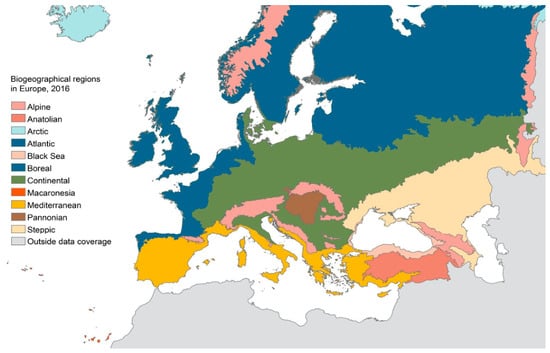
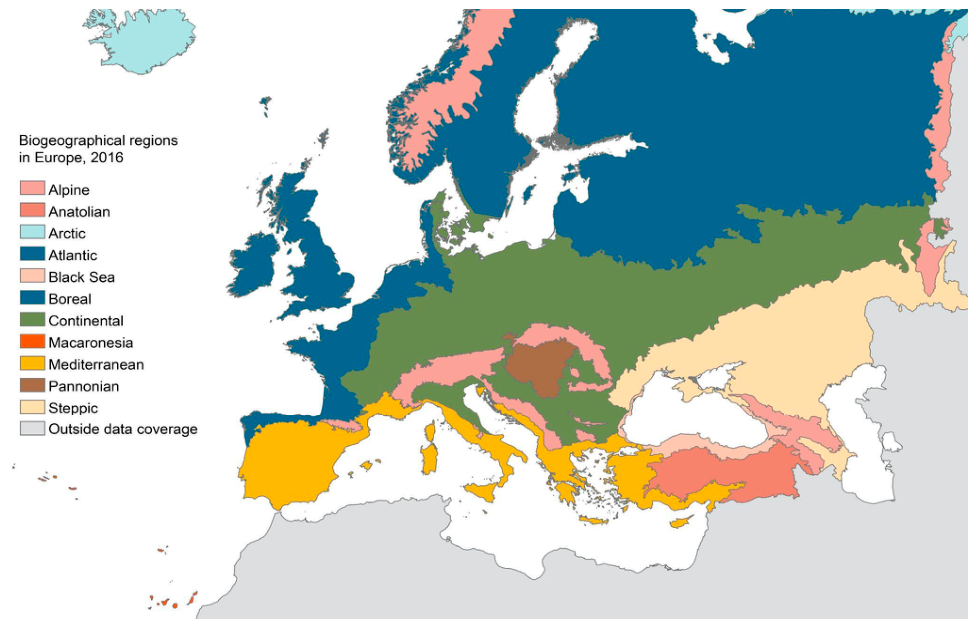
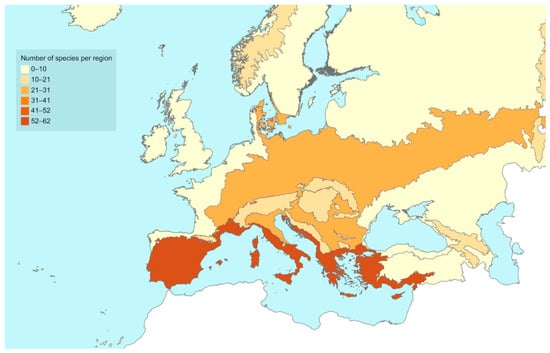
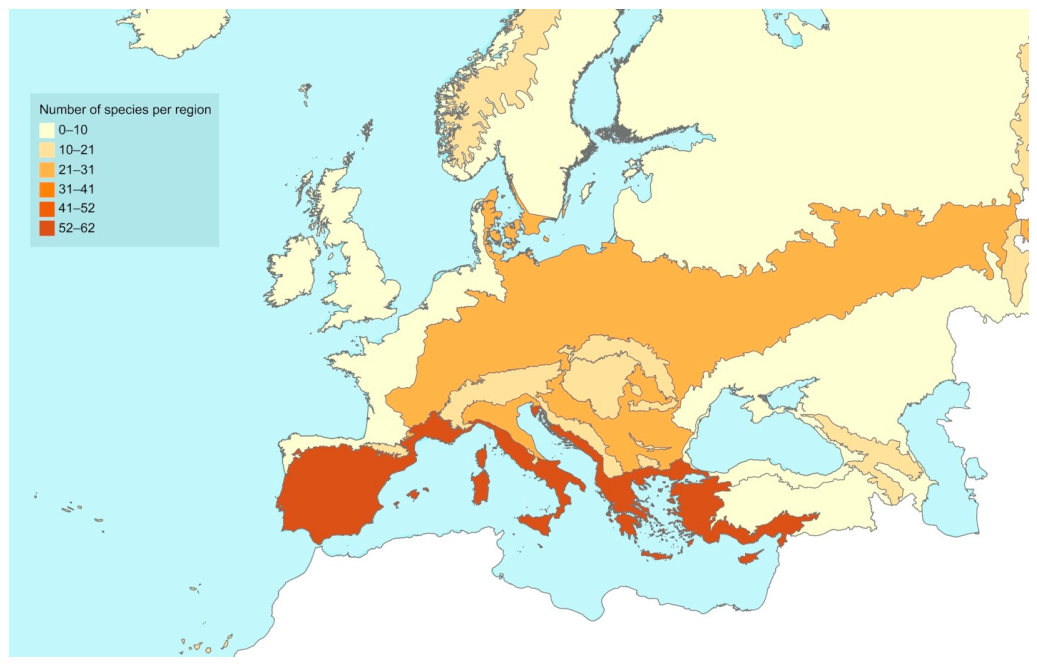
Disclaimer/Publisher’s Note: The statements, opinions and data contained in all publications are solely those of the individual author(s) and contributor(s) and not of MDPI and/or the editor(s). MDPI and/or the editor(s) disclaim responsibility for any injury to people or property resulting from any ideas, methods, instructions or products referred to in the content. |
© 2026 by the authors. Licensee MDPI, Basel, Switzerland. This article is an open access article distributed under the terms and conditions of the Creative Commons Attribution (CC BY) license.