


Simple Summary
Onion thrips are minute insects that feed on potato leaves, scarring the foliage, reducing yields and spreading plant viruses. Growers have long relied on chemical sprays to control them, but thrips have become resistant to many of these chemicals, and the sprays also harm the beneficial insects that would otherwise help keep pests in check. One alternative is to release tiny predatory mites that hunt thrips on the crop. Growers can only buy a handful of predatory mite species, and these are usually chosen based on how many pests they eat, even though these predators also feed on pollen when prey is scarce and are often released together with other predator species. We compared three predatory mite species on potato plants, measuring how quickly each found and attacked thrips, how long each survived on thrips, on pollen and on both together, and how each fared when sharing a leaf with another predator species. No single species was best at everything. The fastest hunter survived longest when food was scarce and was the only one to benefit from having pollen alongside prey, yet it lost out when a competing predator was present. Choosing the right predator therefore means testing several different abilities, not just counting how many pests it eats.
Abstract
Phytoseiid mites (PDMs) utilize both herbivorous prey and an alternative food source in agroecosystems. However, biocontrol screening of PDMs has largely focused on their predation function against prey, with their use of alternative food often ignored. Therefore, in the present study, we compared the performance of three PDM species (Amblyseius largoensis (Muma), Neoseiulus californicus (McGregor) and Neoseiulus barkeri Hughes), fed on two food sources: onion thrips (Thrips tabaci) and pollen (an alternative food) on potato plants. All three PDMs concentrated their attacks on the vulnerable prey stages, with early larval instars attacked at the highest rate, while N. californicus proved the most effective egg predator and N. barkeri the least. A. largoensis located and attacked prey the fastest both in leaf arenas and on intact plants, despite the longest per-prey handling time and attacked the fewest prey across a density gradient while leaving the least thrips-induced leaf damage. Prey rather than pollen was the primary driver of survival in every PDM, and A. largoensis persisted longest under food limitation and was the only species to gain further benefit from pollen when prey was already available. This ranking inverted in mixed-species arenas, where N. californicus consistently outsurvived the other two species under prey-present and pollen-only conditions. Foraging efficiency, food resource use and intraguild dominance were dissociated for PDM performance. Thus, a multiple-trait screening can be considered in PDM selection for thrips management in crops.
1. Introduction
Insect pests remain one of the most persistent threats to global food security, with pest-related losses continuing to constrain crop productivity across major agricultural systems despite decades of management effort [1,2,3]. Potato (Solanum tuberosum L.), one of the most widely cultivated food crops worldwide and a critical source of caloric and nutritional security in both developed and developing regions, is particularly vulnerable to a broad complex of insect pests that reduce yield and tuber quality [4,5]. Among these, the onion thrips, Thrips tabaci Lindeman (Thysanoptera: Thripidae), has emerged as a particularly damaging generalist herbivore of potato, causing direct feeding injury, leaf silvering, chlorotic and necrotic lesions and stunted growth, while also serving as a vector of economically important plant viruses [6,7]. The polyphagous habit of T. tabaci, combined with its cryptic feeding behavior, short generation time and capacity for rapid population growth under favorable conditions, makes it a notably difficult pest to manage using conventional approaches, and outbreaks continue to impose substantial economic losses on potato growers worldwide [8].
Management of T. tabaci and other thrips species has historically relied heavily on repeated applications of broad-spectrum synthetic insecticides [9]. This reliance has produced a range of well-documented negative consequences. Thrips populations, including T. tabaci, have repeatedly evolved resistance to multiple insecticide classes within relatively few growing seasons, substantially eroding the long-term efficacy of chemical control programs [10,11,12]. Beyond resistance, intensive insecticide use poses considerable risks to human health, non-target organisms and broader ecosystem function and frequently disrupts populations of naturally occurring predators and parasitoids that would otherwise contribute to pest suppression, reinforcing a cycle of dependence on chemical inputs [13,14]. These concerns are compounded by shifting consumer demand for produce with minimal pesticide residues and by increasingly stringent regulatory restrictions on insecticide registration in many potato-producing regions [15]. Collectively, these pressures have created an urgent need for effective, environmentally sustainable alternatives capable of suppressing thrips populations while reducing reliance on synthetic inputs.
Biological control using natural enemies represents one of the most promising alternatives to conventional insecticide-based thrips management [16,17]. Among the natural enemies available for thrips control, predatory mites (PDMs) of the family Phytoseiidae have received considerable attention owing to their small size, high reproductive potential, capacity to feed on multiple thrips developmental stages and, in many PDMs, the ability to subsist on alternative food sources such as pollen when prey availability is low [18,19]. Several phytoseiid PDMs are now produced and marketed commercially for augmentative release against thrips and other arthropod pests in protected and open-field cropping systems [20]. Phytoseiids differ in the breadth of their diets, with generalist species able to persist for long periods on pollen and other non-prey resources [18,21]. The extent to which pollen substitutes for prey differs among phytoseiids, however, and whether a species can exploit both resources together, rather than merely tolerating pollen in the absence of prey, has direct consequences for how long a released population persists before pest pressure builds. Screening of candidate agents has nonetheless concentrated on predation rate against the target pest, with alternative food use assessed separately if at all.
However, the set of PDMs available commercially is small relative to the diversity of the family, and its composition reflects mass-rearing feasibility, historical precedent and cost as much as demonstrated performance in any particular crop–pest system [22,23]. Selection of an agent for a given system is therefore often guided by what can be purchased rather than by system-specific evaluation of predatory capacity, environmental resilience or compatibility with the target pest and cropping conditions. Indigenous phytoseiid faunas, by contrast, include numerous PDMs that occur naturally in agricultural landscapes yet have never been assessed as candidate agents, and the few studies that have evaluated such PDMs report performance comparable to established commercial agents [24,25]. A further consideration, rarely addressed at the screening stage, is how candidate PDMs interact with one another. Augmentative programs increasingly deploy more than one PDM, yet phytoseiids compete directly where their diets overlap, and the outcome of such interactions need not follow from the performance of each PDM measured in isolation [26,27]. Whether the traits that determine predatory efficiency also determine competitive standing within a mixed guild is therefore a practically consequential question that single-PDM screening cannot answer.
Here we compare three phytoseiid PDMs—Amblyseius largoensis (Muma), Neoseiulus californicus (McGregor) and Neoseiulus barkeri Hughes—as candidate agents against T. tabaci on potato plants. N. californicus and N. barkeri are established commercial agents deployed across a range of cropping systems, whereas A. largoensis, although recorded from the phytoseiid fauna of southern China, has not been developed for augmentative release against thrips [28,29]. A. largoensis was selected because it occurs naturally in the region, is widely distributed across tropical and subtropical zones and has not been evaluated against thrips on potato. We asked whether predatory performance measured in isolation predicts how these PDMs perform when food resources vary and when they occur together. To address this, we evaluated stage-specific prey attack and foraging behavior under confined and whole-plant conditions, survival under prey, pollen and their combination, and interactions among the three PDMs when sharing an arena under prey-present and prey-absent conditions. Together these assays test whether the traits that determine predatory efficiency also determine performance under resource limitation and within a mixed guild and therefore whether single-assay screening is a sound basis for agent selection.
2. Materials and Methods
2.1. Biological Materials and Experimental Conditions
Onion thrips, T. tabaci, served as the target prey in all predation and behavioral assays. The founding population was collected in 2025 from field-grown cabbage at the Zijingang Campus of Zhejiang University, Hangzhou, China and established as a laboratory colony at the Institute of Insect Sciences, Zhejiang University. The colony was reared on potato plants for multiple generations before experimental use to minimize effects of field acclimation and to obtain a stable laboratory population [8]. Three phytoseiid PDMs were used: A. largoensis, N. californicus and N. barkeri. N. californicus was obtained from a commercial producer (Fujian Yanxuan Biological Control Technology Co., Ltd., Fujian, China; distributed by Hangzhou Guoyou Agricultural Production Materials Co., Ltd., Hangzhou, China). A. largoensis was originally collected from Ficus benjamina at Qiongtai Normal University, Hainan, and N. barkeri was originally obtained as a commodity population from Chaozhou Zhongtian Agricultural Co., Ltd.; both have since been maintained in continuous culture for more than ten generations at the Institute of Zoology, Guangdong Academy of Sciences, Guangzhou, China. Colony provenance and PDM identity are as described previously [19]. A. largoensis was reared on the mite Carpoglyphus lactis (Linnaeus) and N. barkeri on the mite Aleuroglyphus ovatus (Troupeau), each on a wheat bran carrier. Adult female mites were used in all assays. Unless otherwise stated, all experiments were conducted at 25 ± 1 °C, 70 ± 5% relative humidity and a 16 h:8 h (light: dark) photoperiod under fluorescent lighting.
Potato plants, Solanum tuberosum L. (cv. Lishu), were grown at Zhejiang University, Hangzhou, Zhejiang Province, China. Plantlets were propagated in vitro by tissue culture and maintained at 20 ± 1 °C under a 16 h photoperiod at a light intensity of 100 μmol m−2 s−1 using LED T5 lamps. Four weeks after sub-culturing, plantlets were transferred to pots containing peat-based potting soil and maintained in a glasshouse under a 16 h:8 h (light: dark) cycle at 25 ± 2 °C (light) and 20 ± 2 °C (dark), with a light intensity of 600–800 μmol m−2 s−1. Plants were watered daily, and three-week-old plants were used for thrips maintenance and all experimental assays [30].
2.2. Stage-Specific Prey Attack and Predatory Behavior
Stage-specific prey attack and predatory behavior were assessed in detached potato leaf arenas prepared in Petri dishes (90 mm × 15 mm), each containing a single intact potato leaf with the petiole wrapped in moist cotton to maintain turgidity and reduce desiccation. Newly emerged T. tabaci female adults of uniform size and condition, drawn from the same cohort of eggs, were used throughout so that age and physiological state were standardized across PDMs. Unless otherwise stated, females were starved for 24 h before release and each PDM species was tested in isolation under the environmental conditions described in Section 2.1, with five replicates per species [18].
2.2.1. Stage-Specific Prey Attack
Five exposed developmental stages of T. tabaci were offered simultaneously: first-instar larvae, second-instar larvae, prepupae, pupae and adults. Five individuals of each stage were released onto a single leaf arena, giving 25 prey per arena, and allowed to settle for 12 h before five PDMs of a single species were introduced. After 24 h the number of surviving thrips of each stage was recorded and the number attacked was calculated as the difference between the initial and final numbers of individuals of that stage. Because prepupae and pupae may molt or leave the leaf surface during the assay, values for these two stages represent apparent rather than absolute attack.
2.2.2. Egg Consumption
Egg predation was assessed separately because T. tabaci oviposits into potato leaf tissue [31]. Eight male–female pairs of adult T. tabaci were released onto an intact potato leaf and allowed to oviposit for 48 h, after which adults were removed and the initial number of eggs was counted under a stereo microscope (ZEISS/OPLENIC digital imaging system, 1.0×; working distance 81 mm, Carl Zeiss Microscopy GmbH, Jena, Germany). Three 24 h-starved PDMs of a single species were then released onto each egg-bearing arena and allowed to feed for 24 h. Predators were removed and leaves were held at 20 ± 1 °C to permit hatching, after which the numbers of hatched larvae and unhatched eggs were recorded. Egg consumption was calculated as the initial egg number minus the sum of larvae hatched and eggs remaining unhatched. No predator-free control was included, so this estimate assumes that egg loss from causes other than predation was negligible. Because T. tabaci inserts its eggs into leaf tissue, predation was limited to the exposed portion of the chorion at the oviposition site; eggs were not manipulated or exposed artificially.
2.2.3. Prey Density Response
The effect of prey availability on consumption was assessed using first-instar T. tabaci larvae, the stage attacked at the highest rate by all three PDMs in the stage-preference assay, at five initial densities: 5, 10, 20, 30 and 40 larvae per arena. Larvae at the assigned density were released onto a detached potato leaf arena and allowed to settle for 24 h. Prior to the assay, adult female PDMs were starved for 24 h to standardize their feeding motivation. Two starved adult females of a single predator species were then introduced into each arena. After 48 h, surviving larvae were counted, and the number of prey attacked was calculated as the difference between the initial and final numbers of larvae. Leaf area damaged by thrips feeding was quantified from digital images of each leaf using ImageJ (v.1.54f), as a measure of the crop protection achieved by each PDM [32]. Ten replicates were performed for each predator × prey density combination.
2.2.4. Foraging Behavior
Behavioral parameters of each PDM were recorded using first-instar T. tabaci larvae as prey, with each mite observed continuously from release under a stereomicroscope (ZEISS/OPLENIC digital imaging system, 1.0×; working distance 81 mm). For handling time, a single larva was placed on a leaf arena followed by one PDM; handling time was recorded as the interval between prey capture and release of the prey by the predator [33]. Searching time and the two latency measures were recorded in parallel arenas: searching time was the interval between predator release and location of the prey, time to first contact the interval until first physical contact with a larva and time to first attack the interval until the first clear attack attempt, including grasping, piercing or feeding. Five replicates were performed per PDM.
2.3. Predator Survival Assays Under Varying Food Availability
Survival of A. largoensis, N. californicus and N. barkeri was assessed under four food-resource treatments: no pollen and no thrips; pollen only; thrips only; and pollen plus thrips. For each replicate, 10 PDMs of a single species were released onto a detached potato leaf arena prepared as described in Section 2.2. Potato flower anthers served as the pollen source, based on prior confirmation that the PDMs tested can use potato flower pollen as an alternative food [18]. In prey-containing treatments, 50 first-instar T. tabaci larvae were provided. Pollen and prey were renewed every 2 days according to treatment, and dead mites and prey residues were removed at each observation. Surviving mites were counted every 2 days for 30 days, and survival was expressed as the percentage of the initial 10 mites remaining. Each PDM was tested separately, with five replicate arenas per PDM × treatment combination (3 PDMs × 4 treatments × 5 replicates = 60 experimental units).
2.4. Interspecific Competition Under Shared-Resource Conditions
Interspecific competition assays were conducted to evaluate the performance of adult PDM species when sharing the same leaf arena and food resources. The assays were designed to assess competitive interactions among adults rather than stage-specific intraguild predation. The same developmental stage was used across species to standardize predator age and functional status, thereby preventing developmental-stage differences from confounding species-level competitive effects. Competitive performance was assessed from species-specific survival under shared-resource conditions and from the number of prey attacked when thrips were available. Four combinations were established: T1, A. largoensis + N. californicus; T2, A. largoensis + N. barkeri; T3, N. barkeri + N. californicus; and T4, all three PDMs together. For each replicate, 30 first-instar T. tabaci larvae were released onto a detached potato leaf arena and allowed to settle for 24 h before predator release. Five PDMs of each species were introduced into the same arena, giving a total of 10 mites in the two-PDM combinations and 15 in the three-PDM combination. After 48 h, surviving thrips were counted and the number attacked was calculated from the initial number released; surviving PDMs of each species were counted separately. A parallel assay used the same four combinations with no thrips present and potato flower anthers supplied as the sole food resource. After 48 h, surviving PDMs of each species were counted separately. At the end of each assay, surviving PDMs were collected and preserved in 75% ethanol, after which microscope slides were prepared, and species identity was confirmed based on diagnostic morphological characteristics under a microscope. Ten replicates were performed for each combination under each condition.
2.5. Predator Foraging Behavior on Potato Plants
Foraging behavior was assessed on three-week-old potted potato plants under glasshouse conditions [18]. To minimize interference from soil or substrate-derived cues, the pot surface was covered with aluminum foil, and the basal stem region was wrapped with moist cotton to prevent predator escape during observation. On each plant, one mid-canopy leaf was selected as the prey site and infested with five first-instar T. tabaci larvae 24 h before predator release. For each trial, one starved PDM was released at the base of the stem and followed continuously by direct visual observation, with a hand lens used where closer inspection was required to confirm contact with prey and the onset of an attack. Time to first prey encounter was recorded as the interval from release to first physical contact with a thrips larva and time to first attack as the interval from release to the first clear attack attempt, including grasping, piercing or feeding. Observation ended once the first attack was recorded and the mite was removed; prey was therefore not consumed during the assay. Mites that failed to locate prey within 30 min were classified as non-responders and excluded from the time-based analyses; additional individuals were tested until eight responding individuals were obtained for each PDM species. The assay was arranged in eight replicate blocks, with one individual of each PDM species tested independently on a separate plant per block, resulting in eight responding individuals per species and 24 plants in total. Four blocks were conducted on each of two consecutive days, with all three PDM species represented equally on both days.
2.6. Statistical Analysis
Analyses were performed in R (version 4.1.0; R Core Team) and SPSS (version 16.0; SPSS Inc., Chicago, IL, USA). Figures were produced using ggplot2 within the tidyverse, and post hoc comparisons were computed using emmeans with Tukey adjustment. Significance was assessed at p ≤ 0.05 throughout. Continuous response variables—prey handling time, searching time, time to first contact and time to first attack in leaf arenas and time to first prey encounter and time to first attack on whole plants—were analyzed by one-way analysis of variance with PDMs as a fixed factor, followed by Tukey’s HSD test where significant effects were detected. Residual normality was assessed by the Shapiro–Wilk test and homogeneity of variance by Levene’s test, using the car package. Count and proportional data were analyzed by generalized linear models (GLMs) fitted according to the structure of the response variable: binomial models for responses measured as events out of a fixed total and Poisson models for counts. Over-dispersion was assessed from the Pearson residual dispersion ratio and quasi-binomial or quasi-Poisson families were fitted where over-dispersion was detected. Likelihood-ratio χ2 tests are reported for binomial and Poisson models and F tests for the corresponding quasi-family models fitted where over-dispersion was detected. This approach was applied to stage-specific prey attack, initial and consumed egg numbers and total prey attacked and predator survival in the interspecific interaction assays. Prey attacked and leaf area damaged in the prey-density assay were analyzed separately at each prey density by one-way analysis of variance with PDMs as a fixed factor, followed by Tukey’s HSD test. Predator survival under the four food treatments was analyzed using a linear mixed-effects model with PDMs, food treatment, time and their interactions as fixed effects and replicate as a random effect. Significance was assessed by Type III ANOVA with Satterthwaite’s approximation, followed by estimated marginal means with Tukey-adjusted pairwise comparisons.
3. Results
3.1. Prey-Stage Selectivity, Egg Predation and Density-Dependent Predation by Three Phytoseiid Predators
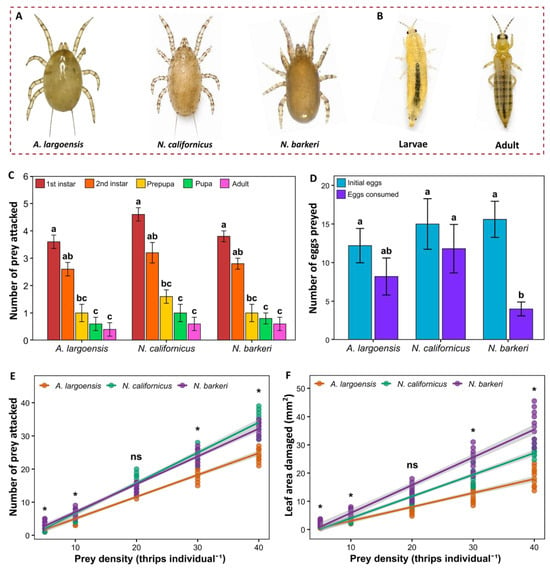
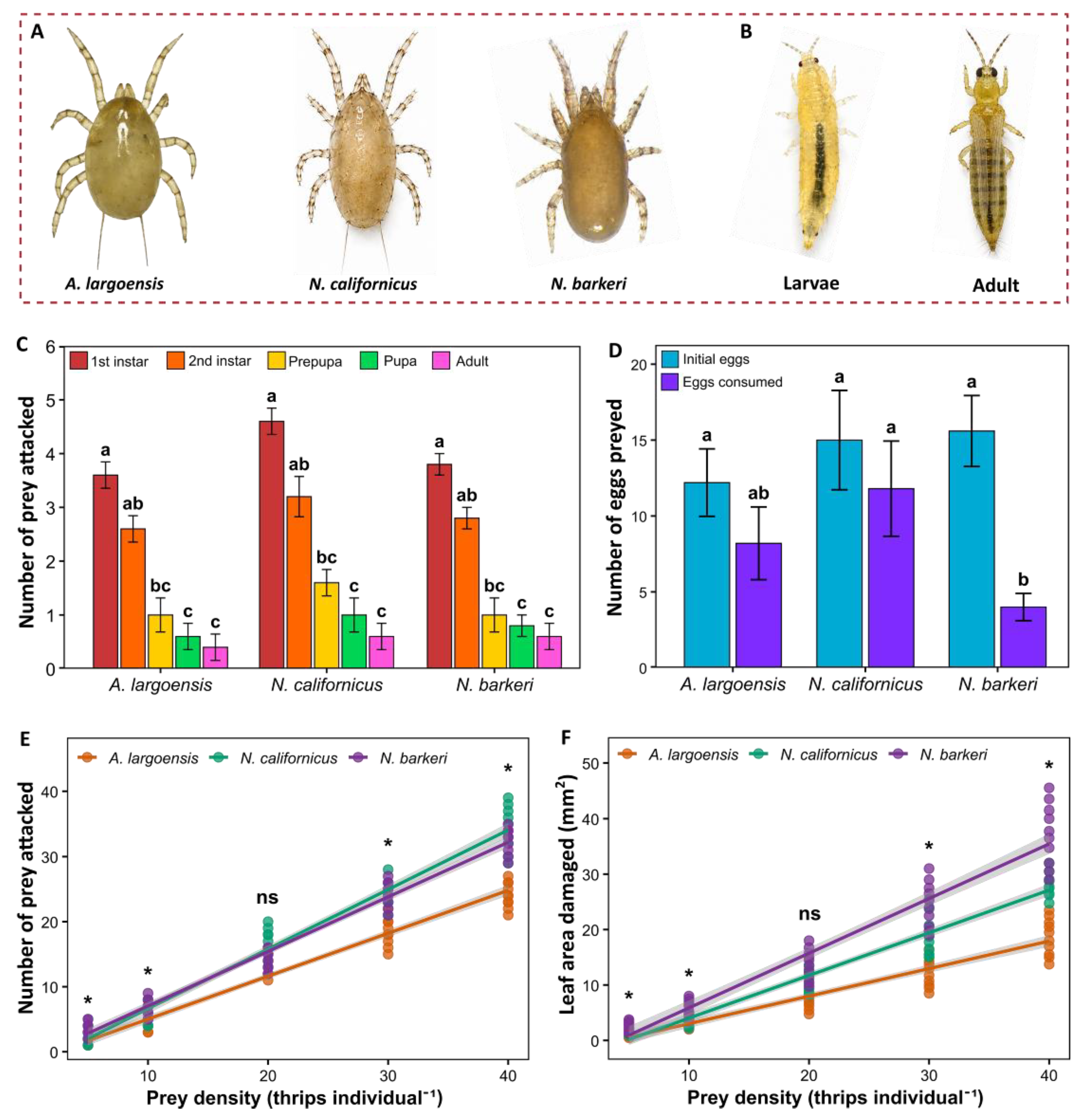
The three PDMs were readily distinguished by body shape and coloration (Figure 1A) and were tested against T. tabaci larvae (Figure 1B). The number of prey attacked declined progressively with increasing developmental stage across all three PDMs (GLM: A. largoensis, χ24 = 36.62, p < 0.001; N. californicus, χ24 = 50.16, p < 0.001; N. barkeri, χ24 = 36.15, p < 0.001; Figure 1C). First-instar larvae were attacked far more frequently than second-instar larvae; prepupae, pupae and adults were attacked considerably less often than either larval stage. This shared preference for early instars likely reflects the smaller body size, thinner cuticle and reduced defensive capacity of younger prey.
Figure 1.
Prey-stage selectivity, egg predation and density-dependent predation by three phytoseiid PDMs on T. tabaci. (A) Dorsal micrographs of the three PDMs used throughout the study: A. largoensis, N. californicus and N. barkeri. (B) Reference images of T. tabaci larvae and adults. (C) Number of prey attacked by each PDM when five developmental stages of T. tabaci were offered simultaneously (n = 5 replicates per PDM). (D) Initial number of eggs offered and number of eggs consumed by each PDM (n = 5 replicates per PDM). (E) Number of prey attacked (F) leaf area damaged by each PDM across five prey densities (n = 10 replicates per species at each density). Bars and points show mean ± SE. In (C,D), different letters indicate significant differences among the bars shown, analyzed by GLM (binomial or quasi-binomial as appropriate) followed by Tukey-adjusted pairwise comparisons. In (E,F), asterisks indicate a significant difference among the three PDMs at that density; pairwise comparisons are reported in the text analyzed by ANOVA followed by Tukey’s HSD performed separately at each prey density (* p < 0.05; ns = not significant).
Egg predation revealed a clear species difference: the number of eggs initially available did not differ among species, confirming equivalent starting conditions across arenas (F2,12 = 0.48, p = 0.628). N. californicus consumed nearly all the eggs it was offered, with no significant difference between the initial and consumed counts, identifying it as the most effective egg predator of the three PDMs. N. barkeri showed the opposite pattern: it consumed significantly fewer eggs than the number offered and significantly fewer than N. californicus consumed (p = 0.037), indicating that most eggs presented to this species survived predation. A. largoensis was intermediate, consuming a number of eggs that did not differ significantly from either the initial count or from N. californicus consumption (Figure 1D). N. californicus was therefore the strongest egg predator of the three PDMs; N. barkeri was comparatively ineffective against this life stage, despite performing similarly to A. largoensis against older larval instars. Prey attacked and leaf area damaged both increased with prey density across all three PDMs (Figure S1). Species differed significantly from one another at every density level tested, though the identity of the most effective predator shifted with density. At the lowest density, N. barkeri attacked significantly more prey than either A. largoensis or N. californicus, which did not differ from each other. At 10-prey, both N. californicus and N. barkeri attacked significantly more prey than A. largoensis, again without differing from one another. By 20-prey, N. californicus became the top performer, significantly exceeding both other species, while A. largoensis and N. barkeri converged to statistically indistinguishable attack rates. At the two highest densities, N. californicus and N. barkeri attacked comparable numbers of prey, both consistently and substantially exceeding A. largoensis (density: 5-prey, F2,27 = 15.73; 10-prey, F2,27 = 10.66; 20-prey, F2,27 = 12.61; 30-prey, F2,27 = 26.93; 40-prey, F2,27 = 47.78; p < 0.001; Figure 1E). Across the density gradient, A. largoensis consistently ranked at or near the bottom for raw prey attacked, never exceeding either of the other two species at any density tested.
Leaf area damaged followed a related but not identical trajectory (Figure 1F). At the two lowest densities, thrips-induced leaf damage closely mirrored the attack pattern: damage did not differ significantly between arenas containing A. largoensis and those containing N. californicus, while arenas containing N. barkeri sustained significantly greater damage than both. Leaf damage was consistently lowest in arenas containing A. largoensis, intermediate with N. californicus and highest with N. barkeri, across every density from 20-prey upward (density: 5-prey, F2,27 = 10.94; 10-prey, F2,27 = 20.61; 20-prey, F2,27 = 21.38; 30-prey, F2,27 = 31.07; 40-prey, F2,27 = 54.63; p < 0.001). This pattern did not simply track prey attacked, however: A. largoensis and N. californicus attacked statistically similar numbers of prey at the two highest densities, yet arenas containing N. californicus sustained significantly greater damage than those containing A. largoensis at both, a discrepancy suggesting that feeding behavior per prey item, not attack frequency alone, determines how much feeding time thrips retain before being intercepted and consequently how much leaf damage they inflict.
3.2. Foraging Behavior of Three Phytoseiid Predators Under Confined and Whole-Plant Conditions
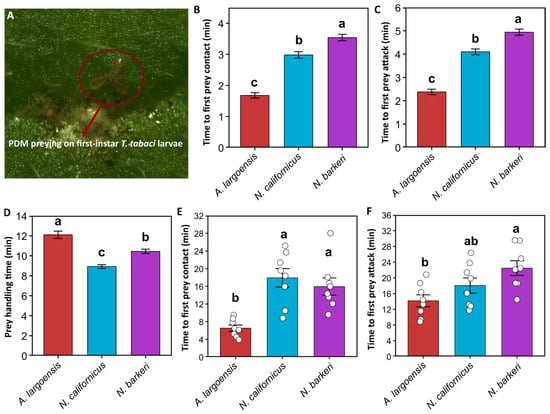
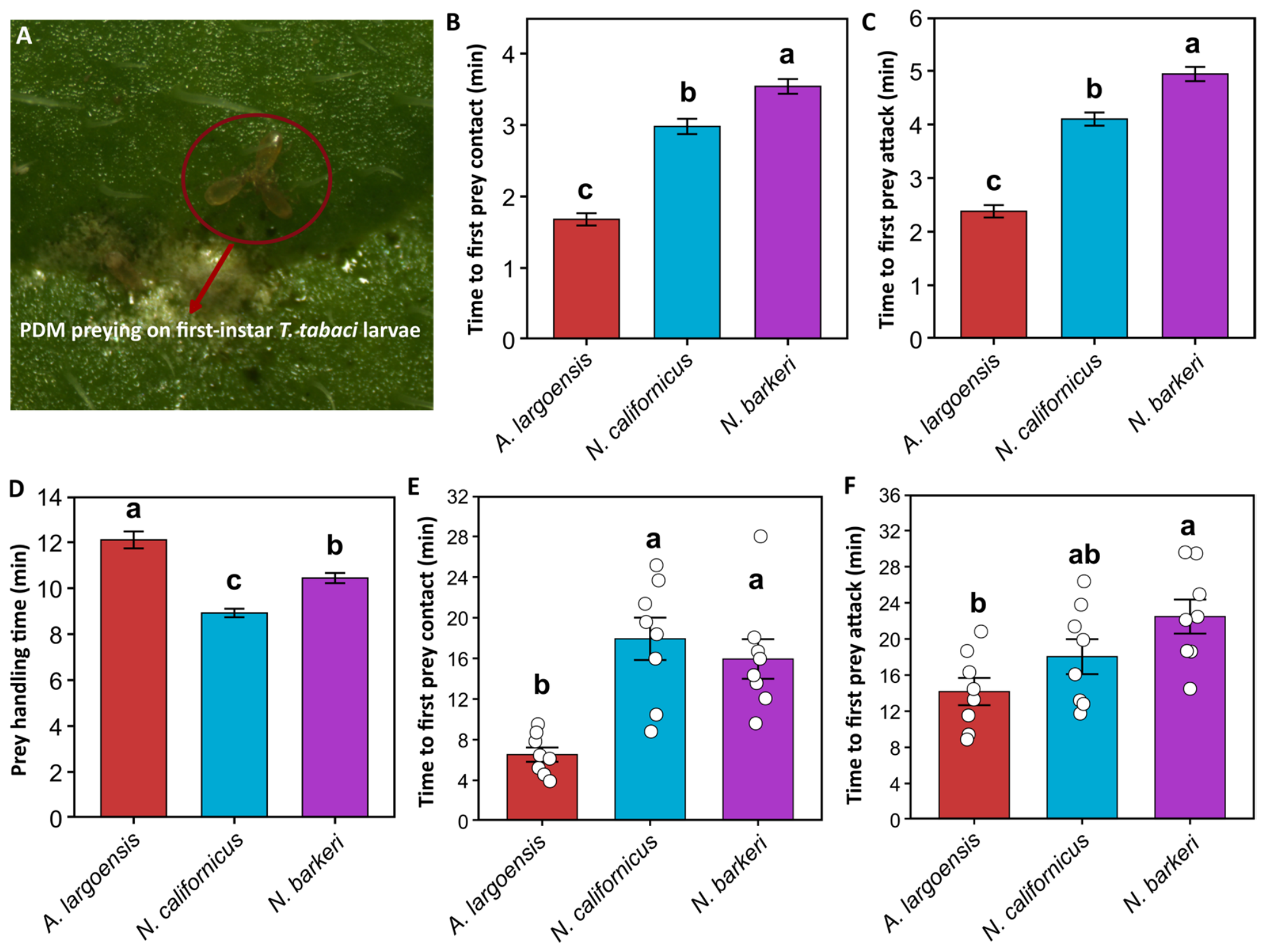
We compared the foraging behavior of A. largoensis, N. californicus and N. barkeri under confined Petri-dish conditions, using a thrips-infested leaflet as the arena (Figure 2A). PDMs differed significantly in latency to first physical contact with prey (F2,12 = 92.91, p < 0.001), latency to first attack (F2,12 = 111.06, p < 0.001), prey handling time (F2,12 = 34.81, p < 0.001) and pre-encounter searching time (F2,12 = 69.41, p < 0.001; Figure S2). A. largoensis was consistently the fastest of the three species across all latency measures and N. barkeri the slowest, with N. californicus intermediate (Figure 2B,C). Handling time followed a different ranking, with A. largoensis retaining each prey item longest, N. californicus releasing prey soonest and N. barkeri again intermediate (Figure 2D). A. largoensis’s advantage therefore lay specifically in prey location and attack initiation, not in the speed of subduing and consuming prey once contact had been made.
Figure 2.
Foraging behavior of three PDMs on T. tabaci under confined and whole-plant conditions. (A) PDMs preying on a first-instar T. tabaci larva during confined-arena assays. (B) Latency to first physical contact with prey following release. (C) Latency to first attack following release. (D) Prey handling time per capture event (n = 5 replicates per PDM). (E) Time to first prey contact and (F) time to first attack under whole-plant, glasshouse conditions, following release onto thrips-infested potato plants (n = 8 responding individuals per PDM). Bars show mean ± SE; white points in (E,F) show individual replicates. Different letters above bars indicate significant differences among the three PDMs within each panel. Data in (B–D) were analyzed by GLM followed by Tukey-adjusted pairwise comparisons; data in (E,F) were analyzed by ANOVA followed by Tukey’s HSD (p < 0.05).
We then tested whether this ranking held under whole-plant conditions, where predators located infested foliage across intact plant architecture rather than a confined arena. PDMs again differed significantly in time to first prey contact (F2,21 = 12.87, p < 0.001). A. largoensis located prey substantially faster than either N. californicus or N. barkeri, which did not differ from one another (Figure 2E). Time to first attack followed the same pattern (F2,21 = 5.41, p = 0.013): A. largoensis fastest, N. californicus intermediate, N. barkeri slowest (Figure 2F). The ranking observed in confined arenas was therefore preserved on intact plants, indicating that A. largoensis’s foraging-speed advantage is not an artifact of simplified laboratory conditions.
3.3. Survival of PDMs Under Varying Prey and Alternative Food Availability
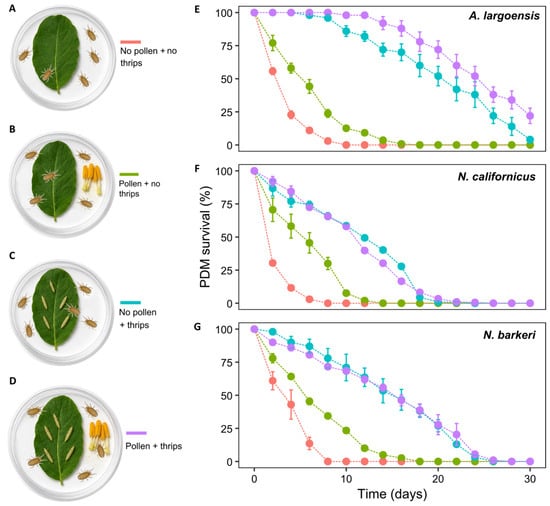
Survival differed significantly among PDMs (F2,936 = 19.49, p < 0.001), among food treatments (F3,936 = 257.69, p < 0.001) and over time (F1,936 = 2660.40, p < 0.001), with significant predator × treatment (F6,936 = 3.36, p = 0.003) and predator × treatment × day interactions (F6,936 = 2.79, p = 0.011; Figure 3A–D). These interactions indicate that the trajectory of survival decline depended on the food treatment experienced by each PDM, rather than PDMs differing by a constant offset.
Figure 3.
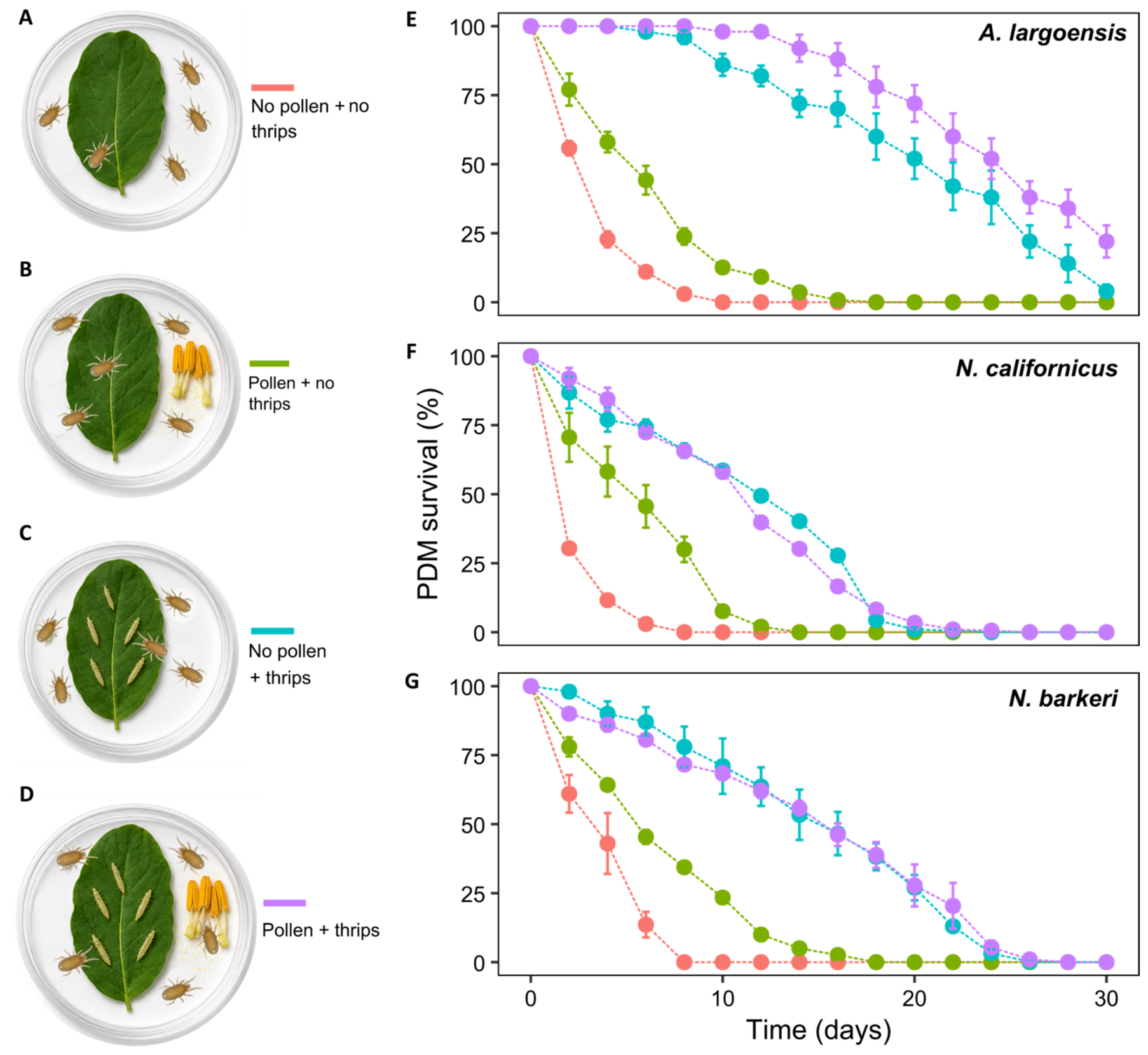
Survival of PDMs under combinations of prey and alternative food availability. (A–D) Experimental arenas illustrating the four food treatments: (A) no pollen and no thrips; (B) pollen supplied in the absence of thrips prey; (C) thrips prey supplied in the absence of pollen; and (D) combined availability of pollen and thrips prey. (E–G) Survival curves under each treatment, presented separately for (E) A. largoensis; (F) N. californicus; and (G) N. barkeri. Ten PDMs were released per arena and survivors counted every 2 days for 30 days; survival is expressed as the percentage of the initial 10 PDMs remaining. n = 5 replicate arenas per PDM × treatment combination. Points and error bars represent mean ± SE. Data were analyzed using a linear mixed-effects model with PDM, food treatment, exposure time and their interactions as fixed effects and replicate as a random effect, followed by pairwise comparisons among PDMs and among food treatments.
Food treatment was the dominant determinant of survival in all three PDMs (Figure 3E–G). Complete deprivation of both prey and pollen produced the most rapid decline, with no mites surviving beyond 8–10 days. Pollen alone extended survival to approximately 16–18 days but supported no PDMs to the end of the observation period. Both prey-containing treatments sustained survival substantially longer, confirming prey availability rather than pollen as the primary driver of persistence. The significant predator × treatment interaction reflected PDM differences in the additional benefit conferred by pollen when prey was available. In N. californicus and N. barkeri, survival under thrips-only and pollen-plus-thrips conditions was closely similar throughout, with all mites dying by approximately day 22 and day 26 respectively, indicating that pollen provided little further benefit once prey was present. In A. largoensis, by contrast, the two prey-containing treatments diverged from approximately day 8 onward and survival at day 30 was markedly higher when pollen was supplied alongside prey (approximately 22%) than when prey was provided alone (approximately 2%). A. largoensis was therefore the only PDM to derive additional benefit from pollen supplementation in the presence of prey and the only PDM with survivors remaining at the end of the 30-day period. Averaged across treatments, A. largoensis achieved the highest overall survival, followed by N. barkeri and then N. californicus. Pairwise comparisons confirmed that A. largoensis survived significantly better than both N. californicus (Δ = 18.3%, p < 0.001) and N. barkeri (Δ = 10.7%, p < 0.001) and that N. barkeri survived significantly better than N. californicus (Δ = 7.6%, p < 0.001).
3.4. Interspecific Interactions Among PDMs Under Prey-Present and Prey-Absent Conditions
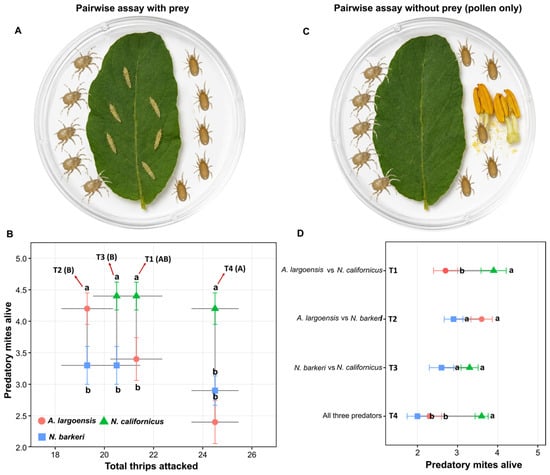
When thrips prey was present, total prey attacked differed significantly among the four combinations (T1, A. largoensis with N. californicus; T2, A. largoensis with N. barkeri; T3, N. barkeri with N. californicus; T4, all three PDMs) (GLM: F3,36 = 4.91, p = 0.006; Figure 4B). When thrips prey was present, total prey attacked differed significantly among the four combinations (GLM: F3,36 = 4.91, p = 0.006; Figure 4B). The number attacked was the highest in T4, intermediate in T1, and the lowest and statistically indistinguishable between T2 and T3. Because T4 contained 15 mites whereas each pairwise combination contained 10, differences in total prey attacked between T4 and the pairwise combinations reflect predator number and are not interpreted further.
Figure 4.
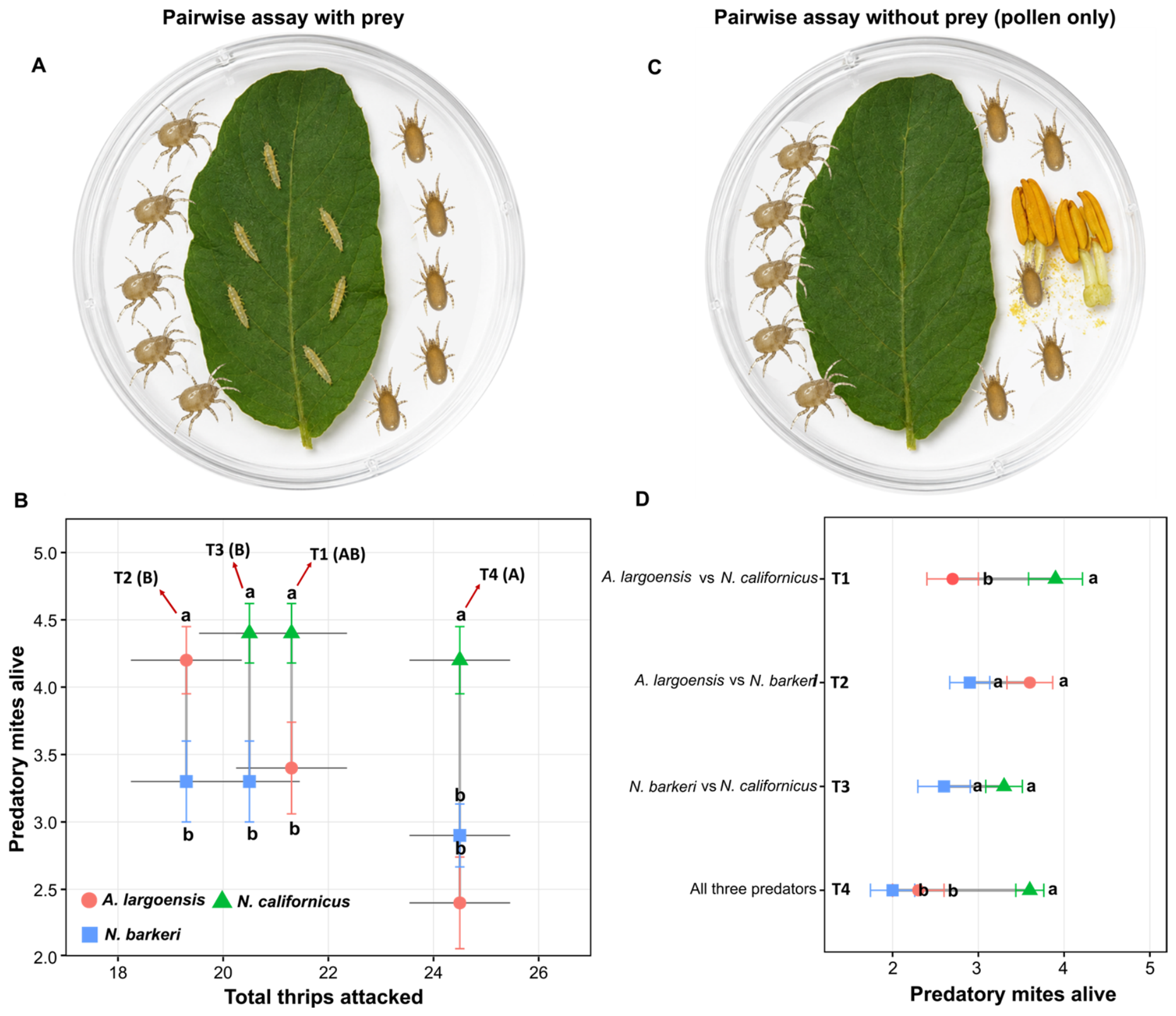
Survival and prey consumption of PDMs in mixed-PDM arenas under prey-present and prey-absent conditions. (A) Arena with T. tabaci prey only. (B) Total thrips attacked and number of PDMs surviving under each combination when only prey was available: T1, A. largoensis with N. californicus; T2, A. largoensis with N. barkeri; T3, N. barkeri with N. californicus; T4, all three PDMs combined. Uppercase letters indicate significant differences in prey attacked among combinations; lowercase letters indicate significant differences in survival among PDMs within each combination. (C) Arena with pollen only. (D) Number of PDMs surviving under each combination when only pollen was available. n = 10 replicate arenas per combination and condition. Points and error bars represent mean ± SE. Data were analyzed using binomial and quasi-binomial GLMs as appropriate.
Predator survival under the same prey-present conditions revealed a hierarchy that did not mirror individual foraging performance. Although A. largoensis had shown the fastest foraging and the highest survival when tested alone, it survived significantly less well than N. californicus when the two were paired (T1: χ21 = 6.00, p = 0.014). A. largoensis nevertheless survived significantly better than N. barkeri in direct pairing (T2: χ21 = 4.40, p = 0.036) and N. californicus survived better than N. barkeri when those two were combined (T3: χ21 = 7.06, p = 0.008). With all three PDMs together, survival again differed significantly (T4: χ22 = 15.90, p < 0.001), following the order N. californicus > A. largoensis > N. barkeri. This ranking was consistent across T1, T3 and T4, identifying N. californicus as the PDM with the greatest survival advantage in mixed assemblages despite its comparatively weaker solo foraging speed and survival.
A broadly similar but attenuated pattern emerged under pollen-only conditions (Figure 4D). N. californicus again survived significantly better than A. largoensis (T1: χ21 = 6.52, p = 0.011), indicating that this advantage was not contingent on prey availability. However, the difference between A. largoensis and N. barkeri was no longer significant in the absence of prey (T2: χ21 = 2.16, p = 0.141), nor was that between N. barkeri and N. californicus (T3: χ21 = 2.03, p = 0.154), indicating that the advantage of A. largoensis and N. californicus over N. barkeri was partly prey-dependent. Survival still differed significantly with all three PDMs combined (T4: χ22 = 11.90, p = 0.003), with N. californicus again highest. Taken together, these results indicate that relative survival in mixed assemblages was not predicted by individual foraging or survival performance and that N. californicus consistently attained the highest survival across both pairwise and three-PDM assays regardless of prey availability.
4. Discussion
Phytoseiid PDMs used against thrips differ in the food resources they exploit and in how those resources sustain them, yet candidate agents are typically screened on predation rate against the target pest alone, with resource use and interactions among co-occurring predators assessed separately if at all [22,34,35]. Whether performance measured under one set of resource conditions predicts performance under another or when a second predator is present is therefore rarely tested within a single system [36,37]. The present study addresses this gap by comparing three phytoseiids of different origin, one indigenous PDM not developed for augmentative release and two commercially available species, across the traits that determine performance in the field: prey use, survival on prey and pollen and their combination, and interactions when sharing an arena with a competitor.
All three PDMs consumed early larval instars of T. tabaci at the highest rate, consistent with the general expectation that phytoseiids target the most vulnerable prey stages, which have reduced mobility, thinner cuticle and limited defensive capacity [38,39]. This has a direct practical implication, since releases timed to coincide with peak larval emergence rather than adult activity should yield the greatest suppression of population growth, although earlier release while adult thrips are still active may allow predators to establish before larval densities rise, so the optimal timing will depend on how quickly a released population builds. This distinction is reinforced by the spatial separation of the later stages. T. tabaci prepupae and pupae leave the foliage and complete development in the soil and litter, whereas the three PDMs evaluated here are foliage-dwelling, so these stages are largely inaccessible in the field even though they were present in our leaf arenas. The low attack rates recorded for prepupae and pupae therefore represent an upper bound on their contribution to suppression, and control by these predators depends almost entirely on the larval stages that remain on the plant [31,40]. Egg predation followed a different pattern, in which N. californicus consumed nearly all the eggs offered while N. barkeri consumed significantly fewer than were available and left most of them intact, with A. largoensis intermediate and statistically inseparable from either. Because phytoseiids cannot pierce leaf tissue, access to embedded eggs is restricted to the exposed chorion, so the differences recorded here reflect the capacity to exploit that limited access rather than egg predation in an unrestricted sense. Phytoseiids therefore differ in their capacity to intercept thrips recruitment at the egg stage, and this capacity is independent of performance against larvae, since N. barkeri attacked larval instars at rates comparable to A. largoensis [38].
The behavioral results reveal a more nuanced picture than foraging speed alone would suggest. A. largoensis located and attacked prey fastest in both confined arenas and on whole plants, yet retained each prey item longest and attacked fewer prey than either congener across the density gradient. Longer handling time alongside faster prey location is consistent with a strategy of thorough extraction per prey item rather than rapid serial attack [41,42,43], which would account for the lower number attacked despite the faster interception. Notably, this did not translate into weaker crop protection, since thrips-induced leaf damage was lowest in A. largoensis arenas despite the fewest larvae being attacked, with the three PDMs separating significantly from one another at every density from 20 prey upward. The explanation lies in when prey were attacked rather than how many were attacked. Because A. largoensis intercepted prey soonest after release, thrips in these arenas fed for a shorter period before being attacked, and the damage a thrips inflicts accumulates with the time it spends feeding rather than being fixed at the moment of encounter. A predator that reaches prey quickly therefore removes feeding time from every individual it encounters, whereas one that reaches prey slowly allows damage to accumulate even from larvae it eventually attacks. Non-consumptive disturbance may contribute further, since larvae that are approached and attacked without being killed are likely to interrupt feeding and relocate [44,45], though this was not measured directly. Speed of interception, rather than total number attacked, therefore appears the more relevant predictor of leaf-level damage.
Persistence during periods of low prey availability often determines whether early-season releases establish a resident predator population before pest pressure builds [46]. Prey availability, rather than pollen, was the dominant driver of survival in all three PDMs, consistent with the recognition that pollen functions as a supplementary rather than fully substitutable food for many phytoseiids [18,47]. Pollen alone extended survival by roughly a week relative to complete deprivation but supported no individual of any species to the end of the observation period, although potato pollen may be nutritionally suboptimal for phytoseiids and survival on a higher-quality pollen such as maize could well differ. The significant predator × treatment interaction, however, indicates that this generalization requires qualification at the species level. In both Neoseiulus PDMs, pollen conferred no detectable additional benefit once prey was present, but in A. largoensis, survival was substantially higher on pollen plus prey than on prey alone and this was the only PDM with survivors remaining at day 30. That the two resources acted additively in one species and not the others suggests the difference lies in how the resources are used rather than in whether pollen is accepted at all, since every species survived longer on pollen than on nothing. One possibility is that mixed diets relieve a nutritional constraint that prey alone does not satisfy, so that pollen supplies something complementary rather than merely additional calories; another is that pollen reduces the energetic cost of search when prey is present but dispersed, an effect that would be strongest in the species that searches most actively. Distinguishing these requires measurement of feeding rate and reproductive output on mixed diets rather than survival alone. Either way, the capacity to exploit both resources together is practically valuable, since it suggests that supplementary pollen provision in the field would extend persistence for A. largoensis specifically [48,49]. More broadly, the survival hierarchy, A. largoensis > N. barkeri > N. californicus, did not track foraging speed or egg predation. N. californicus, the most effective egg predator and second-fastest forager, showed the weakest starvation tolerance, while N. barkeri, the slowest forager, tolerated nutritional stress comparatively well. Foraging efficiency and starvation resistance therefore appear to be governed by distinct mechanisms, and field persistence cannot be reliably predicted from short-term foraging assays [50,51].
Performance measured in isolation did not predict relative survival when PDMs were combined [52,53]. Despite its superior foraging speed and solo survival, A. largoensis survived significantly less than N. californicus in direct pairing, both with prey present and with pollen alone. This asymmetry is specific: A. largoensis survived better than N. barkeri in direct pairing, so it is subordinate to N. californicus rather than competitively weak in general. Asymmetric interactions among phytoseiids are well documented and have been related to body size, developmental stage and aggressiveness [53,54,55], and the dissociation observed here suggests that the sensory and behavioral traits underlying prey location differ from those determining standing within a mixed guild [56]. The advantage of A. largoensis and N. californicus over N. barkeri was significant only when prey was present, indicating a partly prey-dependent asymmetry, whereas the advantage of N. californicus over A. largoensis persisted regardless of food availability. These assays measured net survival outcomes, and distinguishing intraguild predation from interference or differential stress tolerance will require direct behavioral observation [57,58,59].
Several constraints bound the inferences drawn here, beginning with the fact that performance was assessed over short intervals on detached leaves and potted plants, so field validation is a necessary next step, alongside assessment of fecundity and net reproductive rate on each food regime, which would establish whether the survival differences recorded here translate into differences in population growth, together with thermal tolerance and compatibility with the selective insecticides used alongside releases in integrated programs, which together determine whether a released population establishes [60,61,62]. A single potato cultivar was used throughout, so leaf surface features cannot account for the differences recorded, but whether these rankings hold on other hosts of this polyphagous pest remains untested. Two features of the design also limit specific comparisons: predator number was higher in the three-PDM treatment than in the pairwise combinations, so the greater total prey attacked there reflects predator density and cannot be attributed to species complementarity.
5. Conclusions
Selecting a phytoseiid agent on the basis of predatory capacity alone risks overlooking traits that determine performance once the predator is in the field, as the present comparison makes clear. A. largoensis, an indigenous PDM not developed for augmentative release, located and attacked T. tabaci faster and tolerated food limitation better than two commercially available species, yet attacked fewer prey across the density gradient and was consistently outcompeted by N. californicus in shared arenas, so that foraging efficiency and standing within a mixed predator assemblage emerge as dissociable traits, from which neither can be inferred from the other. Food resource use divided the three species along a further axis, since prey rather than pollen sustained survival in every PDM but only A. largoensis gained additional benefit from the two resources together, indicating that the capacity to exploit a mixed diet is species-specific rather than a general property of the family. Obtained under laboratory and glasshouse conditions, these findings identify A. largoensis as a candidate worth further evaluation and caution against selecting biological control agents on the basis of any single assay.
Supplementary Materials
The following supporting information can be downloaded at: https://www.mdpi.com/article/10.3390/insects17101074/s1, Figure S1. Experimental design for the prey-density assay used to assess density-dependent predation by three phytoseiid PDMs, Figure S2. Mean searching time required by PDMs to locate T. tabaci prey under confined Petri-dish conditions.
Author Contributions
Conceptualization, W.Z., A.M. and Z.Z.; Methodology, L.K., C.X. and A.S.A.E.-E.; Investigation, A.M. and L.K.; Formal analysis, R.X., J.F., X.F. and A.M.; Writing—original draft preparation, A.M. and L.K.; Writing—review and editing, A.S.A.E.-E., C.X., W.Z., Z.W., R.X., X.F., J.F. and Z.Z.; Visualization, W.Z., R.X. and Z.W.; Project Administration, W.Z., A.M. and R.X.; Funding acquisition, W.Z., A.M. and R.X.; Supervision, W.Z. All authors have read and agreed to the published version of the manuscript.
Funding
This work was funded by the National Key R&D Program (2023YFC2604500), the National Nature Science Foundation of China (Grant Nos W2433069, 32272636, 32572935) and the Yunnan FVF-IPM Joint Lab (No. 202303AP140018). This work also supported by the earmarked fund for China Agriculture Research System (CARS-21-C05).
Data Availability Statement
The original contributions presented in this study are included in the article/Supplementary Material. Further inquiries can be directed to the corresponding authors.
Conflicts of Interest
The authors declare no conflicts of interest.
Abbreviations
The following abbreviations are used in this manuscript:
| PDM | predatory mite |
| GLM | generalized linear model |
| ANOVA | analysis of variance |
| HSD | honestly significant difference |
References
- Riegler, M. Insect threats to food security. Science 2018, 361, 846. [Google Scholar] [CrossRef] [Scilit]
- Savary, S.; Willocquet, L.; Pethybridge, S.J.; Esker, P.; McRoberts, N.; Nelson, A. The global burden of pathogens and pests on major food crops. Nat. Ecol. Evol. 2019, 3, 430–439. [Google Scholar] [CrossRef] [Scilit]
- Tonnang, H.E.Z.; Sokame, B.M.; Abdel-Rahman, E.M.; Dubois, T. Measuring and modelling crop yield losses due to invasive insect pests under climate change. Curr. Opin. Insect Sci. 2022, 50, 100873. [Google Scholar] [CrossRef] [Scilit]
- Birch, P.R.J.; Bryan, G.; Fenton, B.; Gilroy, E.M.; Hein, I.; Jones, J.T.; Prashar, A.; Taylor, M.A.; Torrance, L.; Toth, I.K. Crops that feed the world 8: Potato: Are the trends of increased global production sustainable? Food Secur. 2012, 4, 477–508. [Google Scholar] [CrossRef] [Scilit]
- Gao, Y.; Alyokhin, A.; Nauen, R.; Guedes, R.N.C.; Palli, S.R. Challenges and opportunities in managing pests of potato. Pest Manag. Sci. 2022, 78, 3729–3730. [Google Scholar] [CrossRef] [Scilit]
- Fathi, S.A.A. Screening of the susceptibility of newly released genotypes of potato to thrips infestation under field conditions in northwest Iran. Crop Prot. 2014, 62, 79–85. [Google Scholar] [CrossRef] [Scilit]
- Westmore, G.W.; Allen, G.R.; Wilson, C.R. Colour preference and potato cultivar oviposition choice by onion thrips, Thrips tabaci (Thysanoptera: Thripidae). J. Asia-Pac. Entomol. 2019, 22, 25–32. [Google Scholar] [CrossRef] [Scilit]
- Munawar, A.; Zhu, J.; Shi, X.-X.; El-Ela, A.A.; Ali, J.; Chen, X.; Mao, Z.; He, X.; Zhong, J.; Zhu, Z.; et al. Exogenous prohydrojasmon treatment improves potato resistance to specialist and generalist herbivores and enhances biological control. Pest Manag. Sci. 2026, 82, 3160–3171. [Google Scholar] [CrossRef] [Scilit]
- Hassan, E.-S.M.; El-Sheikh, M.F.; Hegazy, F.H.; Ali, F.A.; Mesbah, I.I. Efficacy of Bioinsecticides, Synthetic Insecticides, Macro and Micronutrients for the Management of Onion Thrips, Thrips tabaci in Onion: A Field Trial. J. Crop Health 2024, 76, 799–810. [Google Scholar] [CrossRef] [Scilit]
- Wakil, W.; Gulzar, S.; Wu, S.; Rasool, K.G.; Husain, M.; Aldawood, A.S.; Toews, M.D. Development of Insecticide Resistance in Field Populations of Onion Thrips, Thrips tabaci (Thysanoptera: Thripidae). Insects 2023, 14, 376. [Google Scholar] [CrossRef] [Scilit]
- Adesanya, A.W.; Waters, T.D.; Lavine, M.D.; Walsh, D.B.; Lavine, L.C.; Zhu, F. Multiple insecticide resistance in onion thrips populations from Western USA. Pestic. Biochem. Physiol. 2020, 165, 104553. [Google Scholar] [CrossRef] [Scilit]
- Peng, Z.; Wu, Q.; Li, Z. Overcoming insecticide resistance in thrips: A review of mechanisms and synergistic management tactics. Curr. Opin. Insect Sci. 2026, 77, 101565. [Google Scholar] [CrossRef] [Scilit]
- Lisi, F.; Siscaro, G.; Biondi, A.; Zappalà, L.; Ricupero, M. Non-target effects of bioinsecticides on natural enemies of arthropod pests. Curr. Opin. Environ. Sci. Health 2025, 45, 100624. [Google Scholar] [CrossRef] [Scilit]
- Schmidt-Jeffris, R.A. Nontarget pesticide impacts on pest natural enemies: Progress and gaps in current knowledge. Curr. Opin. Insect Sci. 2023, 58, 101056. [Google Scholar] [CrossRef] [Scilit]
- Tambo, J.A.; Kansiime, M.K.; Alaganthiran, J.R.; Danish, M.; Duah, S.A.; Faisal, S.; Khonje, M.G.; Mbugua, F.; Rajendran, G. Consumer pesticide concerns and the choice of fruit and vegetable markets in five low- and middle-income countries. Glob. Food Secur. 2024, 42, 100801. [Google Scholar] [CrossRef] [Scilit]
- Gontijo, L.M. Engineering natural enemy shelters to enhance conservation biological control in field crops. Biol. Control 2019, 130, 155–163. [Google Scholar] [CrossRef] [Scilit]
- Gutierrez, A.P.; Ponti, L.; Neuenschwander, P.; Yaninek, J.S.; Herren, H.R. Predicting natural enemy efficacy in biological control using ex-ante analyses. Sci. Rep. 2025, 15, 44886. [Google Scholar] [CrossRef] [Scilit]
- Munawar, A.; Xu, Y.; Abou El-Ela, A.S.; Zhang, Y.; Zhong, J.; Mao, Z.; Chen, X.; Guo, H.; Zhang, C.; Sun, Y.; et al. Tissue-specific regulation of volatile emissions moves predators from flowers to attacked leaves. Curr. Biol. 2023, 33, 2321–2329.e2325. [Google Scholar] [CrossRef] [Scilit]
- Mahmood, S.U.; Munawar, A.; Chen, X.; Nwanade, C.F.; Li, K.; Mao, R.; Baldwin, I.T.; Zhou, W.; Fang, X. Olfactory conditioning improves the predation efficacy of the predatory mite Amblyseius largoensis. Pest Manag. Sci. 2026. [Google Scholar] [CrossRef] [Scilit]
- Momen, F.; Fahim, S.; Barghout, M. Mass Production of Predatory Mites and Their Efficacy for Controlling Pests. In Cottage Industry of Biocontrol Agents and Their Applications: Practical Aspects to Deal Biologically with Pests and Stresses Facing Strategic Crops; El-Wakeil, N., Saleh, M., Abu-hashim, M., Eds.; Springer International Publishing: Cham, Switzerland, 2020; pp. 157–200. [Google Scholar]
- McMurtry, J.A.; Croft, B.A. Life-styles of phytoseiid mites and their roles in biological control. Annu. Rev. Entomol. 1997, 42, 291–321. [Google Scholar] [CrossRef] [Scilit]
- Mutuku, B.; Mwendwa, S.M.; Amwoka, E.M. Evaluation of selected crops for rearing predatory mite (Phytoseiulus persimilis), a predator of two-spotted red spider mites. Heliyon 2024, 10, e38161. [Google Scholar] [CrossRef] [Scilit]
- Kenis, M.; Lukas Seehausen, M. Considerations for Selecting Natural Enemies in Classical Biological Control. In Biological Control of Insect Pests in Plantation Forests; Hurley, B.P., Lawson, S.A., Slippers, B., Eds.; Springer Nature Switzerland: Cham, Switzerland, 2025; pp. 53–69. [Google Scholar]
- Abou Jawdah, Y.; Ezzeddine, N.; Fardoun, A.; Kharroubi, S.; Sobh, H.; Atamian, H.S.; Skinner, M.; Parker, B. Biological Control of Three Major Cucumber and Pepper Pests: Whiteflies, Thrips, and Spider Mites, in High Plastic Tunnels Using Two Local Phytoseiid Mites. Plants 2024, 13, 889. [Google Scholar] [CrossRef] [Scilit]
- Song, Z.-W.; Zheng, Y.; Zhang, B.; Li, D.-S. Study of the population dynamics of phytoseiid mites on citrus under natural conditions. Zoosymposia 2022, 22, 267. [Google Scholar] [CrossRef] [Scilit]
- Maoz, Y.; Gal, S.; Argov, Y.; Domeratzky, S.; Coll, M.; Palevsky, E. Intraguild interactions among specialised pollen feeders and generalist phytoseiids and their effect on citrus rust mite suppression. Pest Manag. Sci. 2016, 72, 940–949. [Google Scholar] [CrossRef] [Scilit]
- Döker, İ.; Revynthi, A.M.; Kazak, C.; Carrillo, D. Interactions among exotic and native phytoseiids (Acari: Phytoseiidae) affect biocontrol of two-spotted spider mite on papaya. Biol. Control 2021, 163, 104758. [Google Scholar] [CrossRef] [Scilit]
- Munkhtumur, M.; Mikawa, Y.; Mori, K.; Toyama, M.; Sonoda, S. Effect of pesticide use alteration on phytoseiid mite species composition and subsequent spider mite control using commercialized Neoseiulus californicus (Acari: Phytoseiidae) in Japanese pear orchards. Appl. Entomol. Zool. 2025, 60, 159–170. [Google Scholar] [CrossRef] [Scilit]
- Chi, Y.; Yu, C.; Feng, M.; Shu, K.; Zhu, Y.; Shi, W. Effects of field releases of Neoseiulus barkeri on Megalurothrips usitatus abundance and arthropod diversity. Sci. Rep. 2024, 14, 14247. [Google Scholar] [CrossRef] [Scilit]
- Munawar, A.; Zhang, Y.; Zhong, J.; Ge, Y.; Abou El-Ela, A.S.; Mao, Z.; Ntiri, E.S.; Mao, L.-J.; Zhu, Z.; Zhou, W. Heat stress affects potato’s volatile emissions that mediate agronomically important trophic interactions. Plant Cell Environ. 2022, 45, 3036–3051. [Google Scholar] [CrossRef] [Scilit]
- Gill, H.K.; Garg, H.; Gill, A.K.; Gillett-Kaufman, J.L.; Nault, B.A. Onion Thrips (Thysanoptera: Thripidae) Biology, Ecology, and Management in Onion Production Systems. J. Integr. Pest Manag. 2015, 6, 6. [Google Scholar] [CrossRef] [Scilit]
- Schneider, C.A.; Rasband, W.S.; Eliceiri, K.W. NIH Image to ImageJ: 25 years of image analysis. Nat. Methods 2012, 9, 671–675. [Google Scholar] [CrossRef] [Scilit]
- Xiaoduan, F.; Huilin, L.; Gecheng, O.; Yulu, X.; Mingfang, G.; Weinan, W. Effectiveness of Two Predatory Mite Species (Acari: Phytoseiidae) in Controlling Diaphorina citri (Hemiptera: Liviidae). Fla. Entomol. 2013, 96, 1325–1333. [Google Scholar] [CrossRef] [Scilit]
- Beretta, G.M.; Deere, J.A.; Messelink, G.J.; Muñoz-Cárdenas, K.; Janssen, A. Review: Predatory soil mites as biocontrol agents of above- and below-ground plant pests. Exp. Appl. Acarol. 2022, 87, 143–162. [Google Scholar] [CrossRef] [Scilit]
- Basha, H.A.; Mostafa, E.M.; Eldeeb, A.M. Mite pests and their predators on seven vegetable crops (Arachnida: Acari). Saudi J. Biol. Sci. 2021, 28, 3414–3417. [Google Scholar] [CrossRef] [Scilit]
- Tixier, M.-S. Predatory Mites (Acari: Phytoseiidae) in Agro-Ecosystems and Conservation Biological Control: A Review and Explorative Approach for Forecasting Plant-Predatory Mite Interactions and Mite Dispersal. Front. Ecol. Evol. 2018, 6, 192. [Google Scholar] [CrossRef] [Scilit]
- Bechtsoudis, A.; Pappas, M.L.; Samaras, K.; Broufas, G.D. Effects of Alternative Food Sources and Different Substrates on the Mass Rearing of Amblyseius andersoni. Plants 2025, 14, 2912. [Google Scholar] [CrossRef] [Scilit]
- Nguyen, V.H.; Jonckheere, W.; Nguyen, D.T.; de Moraes, G.J.; Van Leeuwen, T.; De Clercq, P. Phytoseiid mites prey effectively on thrips eggs: Evidence from predation trials and molecular analyses. Biol. Control 2019, 137, 104012. [Google Scholar] [CrossRef] [Scilit]
- Haliq, A.; Afzal, M.; Raza, A.M.; Kamran, M.; Khan, A.A.; Aqeel, M.A.; Ullah, M.I.; Khan, B.S.; Kanwal, H. Suitability of Thrips tabaci L. (Thysonaptera: Thripidae) as prey for the phytoseiid mite, Neoseiulus barkeri Hughes (Acari: Phytoseiidae). Afr. Entomol. 2018, 26, 131–135. [Google Scholar] [CrossRef] [Scilit]
- Gulzar, S.; Wakil, W.; Shapiro-Ilan, D.I. Potential use of entomopathogenic nematodes against the soil dwelling stages of onion thrips, Thrips tabaci Lindeman: Laboratory, greenhouse and field trials. Biol. Control 2021, 161, 104677. [Google Scholar] [CrossRef] [Scilit]
- Nguyen, V.H.; Song, Z.; Nguyen, D.T.; Van Leeuwen, T.; De Clercq, P. Functional Response of Four Phytoseiid Mites to Eggs and First-Instar Larvae of Western Flower Thrips, Frankliniella occidentalis. Insects 2024, 15, 803. [Google Scholar] [CrossRef] [Scilit]
- Alves, M.L.S.C.M.; Oliveira, L.S.C.; Freitas, M.R.A.; Melo, J.W.S.; Gondim, M.G.C., Jr.; Lima, D.B. Foraging behavior of Ambyseius largoensis in the predation of Raoiella indica. Syst. Appl. Acarol. 2025, 30, 1798–1810. [Google Scholar] [CrossRef] [Scilit]
- Rodríguez Morell, H.; Miranda, I.; Ramos, M.; Badii, M.H. Functional and numerical responses of Amblyseius largoensis (Muma) (Acari: Phytoseiidae) on Polyphagotarsonemus latus (Banks) (Acari: Tarsonemidae) in Cuba. Int. J. Acarol. 2010, 36, 371–376. [Google Scholar] [CrossRef] [Scilit]
- Lira, V.d.A.; Jumbo, L.O.V.; de Freitas, G.S.; Rêgo, A.S.; Galvão, A.S.; Teodoro, A.V. Efficacy of Amblyseius largoensis (Muma) as a biocontrol agent of the red palm mite Raoiella indica (Acari: Tenuipalpidae). Phytoparasitica 2021, 49, 103–111. [Google Scholar] [CrossRef] [Scilit]
- Carrillo, D.; de Coss, M.E.; Hoy, M.A.; Peña, J.E. Variability in response of four populations of Amblyseius largoensis (Acari: Phytoseiidae) to Raoiella indica (Acari: Tenuipalpidae) and Tetranychus gloveri (Acari: Tetranychidae) eggs and larvae. Biol. Control 2012, 60, 39–45. [Google Scholar] [CrossRef] [Scilit]
- Etienne, L.; Bresch, C.; van Oudenhove, L.; Mailleret, L. Food and habitat supplementation promotes predatory mites and enhances pest control. Biol. Control 2021, 159, 104604. [Google Scholar] [CrossRef] [Scilit]
- Goleva, I.; Zebitz, C.P.W. Suitability of different pollen as alternative food for the predatory mite Amblyseius swirskii (Acari, Phytoseiidae). Exp. Appl. Acarol. 2013, 61, 259–283. [Google Scholar] [CrossRef] [Scilit]
- Giselle Santos De, F.; Luis Oswaldo Viteri, J.; Adriano Soares, R.; Andréia Serra, G.; Ester Azevedo Do, A.; Adenir Vieira, T. Pollen as sole food source for two generalist predatory mite species (Acari: Phytoseiidae). Syst. Appl. Acarol. 2023, 28, 1569–1578. [Google Scholar] [CrossRef] [Scilit]
- Yue, B.; Tsai, J.H. Development, Survivorship, and Reproduction of Amblyseius largoensis (Acari: Phytoseiidae) on Selected Plant Pollens and Temperatures. Environ. Entomol. 1996, 25, 488–494. [Google Scholar] [CrossRef] [Scilit]
- Sheng, F.; Wei, J.; Wang, X.; Wang, E.; Xu, X.; Zhang, B. Starvation tolerance and effects on fitness of predatory mite Amblyseius orientalis. Exp. Appl. Acarol. 2025, 94, 44. [Google Scholar] [CrossRef] [Scilit]
- Yazdanpanah, S.; Fathipour, Y. Chapter 23—Foraging behavior of predatory mites. In Behavior of Insect Natural Enemies; Omkar, P., Yaghoub Fathipour, P., Eds.; Academic Press: Cambridge, MA, USA, 2026; pp. 403–424. [Google Scholar]
- Cakmak, I.; Janssen, A.; Sabelis, M.W.; Baspinar, H. Biological control of an acarine pest by single and multiple natural enemies. Biol. Control 2009, 50, 60–65. [Google Scholar] [CrossRef] [Scilit]
- Momen, F.M.; Abdel-Khalek, A. Intraguild predation in three generalist predatory mites of the family Phytoseiidae (Acari: Phytoseiidae). Egypt. J. Biol. Pest Control 2021, 31, 8. [Google Scholar] [CrossRef] [Scilit]
- Croft, B.A.; Croft, M.B. Intra- and Interspecific Predation Among Adult Female Phytoseiid Mites (Acari: Phytoseiidae): Effects on Survival and Reproduction. Environ. Entomol. 1996, 25, 853–858. [Google Scholar] [CrossRef] [Scilit]
- Walzer, A.; Blümel, S.; Schausberger, P. Population dynamics of interacting predatory mites, Phytoseiulus persimilis and Neoseiulus californicus, held on detached bean leaves. Exp. Appl. Acarol. 2001, 25, 731–743. [Google Scholar] [CrossRef] [Scilit]
- Schausberger, P.; Croft, B.A. Cannibalism and Intraguild Predation Among Phytoseiid Mites: Are Aggressiveness and Prey Preference Related to Diet Specialization? Exp. Appl. Acarol. 2004, 24, 709–725. [Google Scholar]
- Schausberger, P.; Nguyen, T.H.; Altintas, M. Early-life intraguild predation risk produces adaptive personalities in predatory mites. iScience 2024, 27, 109065. [Google Scholar] [CrossRef] [Scilit]
- Guo, Y.; Lv, J.; Jiang, X.; Wang, B.; Gao, Y.; Wang, E.; Xu, X. Intraguild predation between Amblyseius swirskii and two native Chinese predatory mite species and their development on intraguild prey. Sci. Rep. 2016, 6, 22992. [Google Scholar] [CrossRef] [Scilit]
- Urbaneja-Bernat, P.; Jaques, J.A. The impact of global change on the intraguild predation among three predatory mites of Tetranychus urticae in citrus orchards. J. Pest Sci. 2025, 98, 2363–2374. [Google Scholar] [CrossRef] [Scilit]
- Ghazy, N.A.; Osakabe, M.; Negm, M.W.; Schausberger, P.; Gotoh, T.; Amano, H. Phytoseiid mites under environmental stress. Biol. Control 2016, 96, 120–134. [Google Scholar] [CrossRef] [Scilit]
- Simoni, S.; Burgio, G.; Tarchi, F.; Guidi, S.; Goggioli, D.; Gagnarli, E.; Turillazzi, F.; Lanzoni, A. Kill rate as a tool in efficiency evaluation of Neoseiulus californicus (Acari: Phytoseiidae) mass reared on factitious food. J. Insect Sci. 2023, 23, 10. [Google Scholar] [CrossRef] [Scilit]
- van Lenteren, J.C.; Lanzoni, A.; Hemerik, L.; Bueno, V.H.P.; Bajonero Cuervo, J.G.; Biondi, A.; Burgio, G.; Calvo, F.J.; de Jong, P.W.; López, S.N.; et al. The pest kill rate of thirteen natural enemies as aggregate evaluation criterion of their biological control potential of Tuta absoluta. Sci. Rep. 2021, 11, 10756. [Google Scholar] [CrossRef] [Scilit]
Disclaimer/Publisher’s Note: The statements, opinions and data contained in all publications are solely those of the individual author(s) and contributor(s) and not of MDPI and/or the editor(s). MDPI and/or the editor(s) disclaim responsibility for any injury to people or property resulting from any ideas, methods, instructions or products referred to in the content. |
© 2026 by the authors. Licensee MDPI, Basel, Switzerland. This article is an open access article distributed under the terms and conditions of the Creative Commons Attribution (CC BY) license.