


Simple Summary
The mirid predator Tytthus chinensis is a natural enemy of the brown planthopper, an important rice pest in Asia. Providing alternative food resources may help this predator survive when prey is scarce. We investigated whether flowers of Tecoma stans, which provide nectar, could support adult survival and affect female reproductive development of T. chinensis under laboratory conditions. Access to T. stans flowers significantly extended adult longevity compared with the no-food treatments, and no significant difference in longevity was detected between predators provided with T. stans flowers and those provided with brown planthopper eggs. However, females provided with T. stans flowers alone showed limited ovariole development, whereas females provided with brown planthopper eggs showed clear ovariole development. These findings suggest that T. stans flowers may serve as an alternative food resource that supports adult survival, while access to prey appears to play an important role in ovariole development. Further field studies are needed to evaluate the potential of T. stans as an insectary plant in rice agroecosystems.
Abstract
The brown planthopper (Nilaparvata lugens, BPH) is a major pest in Asian rice ecosystems, and biological control by natural enemies is a key component of integrated pest management. Zoophytophagous mirid bugs, including Tytthus chinensis (Hemiptera: Miridae), play an important role as predators of BPH eggs and nymphs in Thailand. However, little is known about the potential of insectary plants to support the performance of T. chinensis. In this study, we evaluated the effects of Tecoma stans nectar on the longevity and reproductive development of T. chinensis under laboratory conditions. Adult longevity was compared among four feeding treatments: dry cotton, wet cotton, BPH eggs, and T. stans flowers. In addition, ovariole development was assessed under five feeding regimes combining BPH eggs and/or T. stans flowers. Access to T. stans nectar significantly extended adult longevity compared with the no-food treatments, and no significant difference in longevity was detected between predators provided with T. stans nectar and those provided with BPH eggs. Females provided with BPH eggs showed clear ovariole development, whereas those provided with T. stans nectar alone showed limited ovariole development. These results suggest that T. stans nectar may serve as an alternative food resource that supports adult survival, while access to prey appears to play an important role in reproductive development under the conditions tested. These laboratory findings support further evaluation of T. stans as a potential insectary plant for rice agroecosystems.
1. Introduction
Brown planthopper (BPH; Nilaparvata lugens (Stål), Hemiptera: Delphacidae) is a major pest across Asia, including Thailand. Both nymphs and adults feed on rice stems, causing plants to dry out and die over large areas, a phenomenon known as “hopper burn,” which ultimately leads to severe yield losses [1]. In addition, BPH transmits rice ragged stunt virus (RRSV) and rice grassy stunt virus (RGSV), both of which cause serious diseases in rice plants [2,3,4]. This pest can migrate long distances with the wind, allowing it to disperse widely across rice-growing regions [5,6]. Chemical control remains the primary strategy for managing BPH. However, reliance on insecticides has several drawbacks. Continuous application can lead to the rapid development of resistance in BPH populations [7], and insecticides may also cause negative side effects on natural enemies, resulting in pest resurgence and recolonization [8]. Some insecticides have even been reported to enhance BPH survival and reproduction [9]. Moreover, migration of resistant BPH populations can further diminish the effectiveness of chemical control [10]. The use of resistant rice cultivars is an alternative management approach; however, its effectiveness can be compromised [11], as BPH populations can adapt to resistant cultivars [12].
In this context, biological control using natural enemies remains a critical component of integrated pest management (IPM) for BPH in rice-field ecosystems. In Asian rice systems, zoophytophagous mirid bugs (Hemiptera: Miridae) are important natural enemies of BPH, preying on eggs and nymphs and contributing to the suppression of BPH populations [13,14]. In Thailand, the green mirid bug Cyrtorhinus lividipennis Reuter, a well-known predator of BPH, and another mirid species, Tytthus chinensis (Stål), are important natural enemies of BPH [15,16,17].
A study by Ritmontree et al. [18] demonstrated that T. chinensis is effective in controlling BPH populations. In addition, T. chinensis can prey on up to 20 eggs per day of Sogatella furcifera (Hemiptera: Delphacidae), a planthopper pest species closely related to BPH [19]. According to Bai et al. [20], T. chinensis and C. lividipennis exhibit different levels of tolerance to heat stress, with T. chinensis showing superior thermal tolerance. Considering that global warming may accelerate BPH outbreaks [21], T. chinensis and C. lividipennis may serve as complementary or alternative biological control agents under future climate scenarios. Therefore, it is important to study T. chinensis alongside the well-studied C. lividipennis.
Within the framework of IPM, insectary plants can contribute to sustainable pest management by strengthening the functional role of natural enemies and reducing reliance on chemical pesticides. The availability of food resources in the field strongly influences the performance of natural enemies. Therefore, enhancing the abundance and performance of natural enemies can be achieved through habitat management, such as the incorporation of insectary plants [22,23,24,25,26,27]. These flowering plants provide essential resources, including nectar, pollen, and shelter, which enhance the attraction, survival, development, and retention of beneficial natural enemies, including nectar-feeding parasitoids and zoophytophagous mirid bugs [28].
To identify suitable insectary plants, it is essential to first evaluate their effects on target natural enemies through controlled feeding experiments. To date, research on the effects of insectary plants on mirid performance has been conducted primarily on C. lividipennis. For example, Zhu et al. [29] assessed how several flowering plant species influence the survival and predation efficiency of C. lividipennis. In contrast, despite its importance as a predator of BPH, limited information is available on the effects of insectary plants or floral resources on the longevity and reproductive development of T. chinensis. Given that floral nectar has been shown to enhance the survival of C. lividipennis [29], it is reasonable to hypothesize that T. chinensis, which is closely related to C. lividipennis and shares similar ecological traits, may also benefit nutritionally from nectar. Therefore, in this study, we evaluated the effects of Tecoma stans (L.) Juss. ex Kunth (Lamiales: Bignoniaceae) nectar on T. chinensis, focusing specifically on adult longevity and reproductive development.
Yellow elder, T. stans, is a perennial shrub native to tropical and subtropical America but has become naturalized across Africa, the Pacific, and Asia, including Thailand [30,31]. The plant has received considerable attention for its medicinal and antibacterial properties [32,33,34,35]. T. stans provides nectar that attracts bees and other flower-visiting insects [36,37,38].
Two characteristics make T. stans a plausible candidate insectary plant for Thai rice landscapes. First, it flowers for extended periods, tolerates drought and high temperatures, and can grow under a wide range of soil conditions [38]. Consequently, T. stans nectar may be available during periods when planthopper prey are scarce. Second, T. stans is already widely established and grown as an ornamental plant in Thailand [39], although it is considered an invasive alien plant in some other parts of its introduced range.
Accordingly, this study evaluated the potential of T. stans as a food resource for T. chinensis under laboratory conditions. Specifically, we compared adult longevity among four feeding treatments (dry cotton, wet cotton, BPH eggs, and T. stans flowers) and assessed ovariole development under five feeding regimes involving BPH eggs and T. stans flowers. These experiments aimed to determine whether access to T. stans flowers supports adult survival and how different feeding regimes affect ovariole development, providing a basis for further evaluation of T. stans as a potential insectary plant.
2. Materials and Methods
2.1. Insect Rearing and Plant Cultivation
The original colony of the mirid predator Tytthus chinensis and the brown planthopper (BPH), Nilaparvata lugens, were obtained from the Rice Department, Bangkok, Thailand (Supplementary Figure S1). The mirids were reared in a cage (40.5 × 40.5 × 60 cm) containing 3–5-day-old rice seedlings (Oryza sativa f. indica ‘Pathum Thani 1′) with BPH eggs on the leaf sheath. The rice variety ‘Pathum Thani 1 (PT1)’ is recommended for cultivation in irrigated zones of the central region of Thailand [40]. Mass rearing was conducted in an open rooftop environment under natural temperature and light conditions at the Department of Zoology (13°50′46.1″ N, 100°34′16.9″ E), Faculty of Science, Kasetsart University, Thailand. Plants of yellow elder, Tecoma stans, were obtained from Nonthaburi Province, Thailand, and cultivated in 45 cm diameter pots under the same environmental conditions as the insect colonies. To prevent potential pesticide contamination affecting the test insects, flowering branches were removed, and plants were regrown for six months until flowering before the experiment.
2.2. Laboratory Conditions and Experimental Preparation
All experiments were conducted under controlled laboratory conditions (26 ± 1 °C, 60 ± 10% RH, 12 L:12 D photoperiod, a light intensity of approximately 2.5 klx, with the light phase from 06:00 to 18:00 h). BPH-infested rice seedlings were prepared by releasing approximately 500 adult BPH into trays (16 × 30 cm) containing approximately 300 rice seedlings aged 3–4 days for 2–3 nights. The seedlings were approximately one week old when used in the experiments. The exact number and age of individual BPH eggs were not quantified. The rice seedlings infested with BPH eggs were used for the experiments (hereafter BPH-infested rice seedlings). Prior to the experiments, the roots of each infested rice seedling were washed and wrapped with moist cotton during the trials. Tecoma stans flowers were prepared by cutting peduncles, each bearing three open flowers, and the cut surface of the peduncle was wrapped with moist cotton before use. The moist cotton was used to maintain the hydration of the plant material and remained accessible to T. chinensis during the experiments.
2.3. Longevity of the Mirid Predator Tytthus chinensis
Late-instar nymphs (fourth and fifth instars) were randomly collected from the rearing colony and maintained in holding containers until adult emergence. Before adult emergence, the rice seedlings in the holding containers were replaced with seedlings free of BPH eggs to prevent access to BPH eggs prior to treatment assignment. Newly emerged adults of each sex, within 6 h after emergence, were randomly allocated among the four feeding treatments, forming eight experimental groups. Each adult was individually introduced into a transparent plastic rearing container consisting of a cylindrical cup covered with a plastic dome (9.5 cm in diameter and 19.5 cm in height). Each container housed a single T. chinensis together with the feeding materials. The experimental containers were placed within the designated laboratory area, and their positions were not randomized or rearranged during the experiment.
The longevity experiments were conducted under four feeding conditions: (1) dry cotton (mean weight 0.62 g), (2) wet cotton moistened with 3 mL of water, (3) ten rice seedlings infested with BPH eggs, and (4) three intact open flowers of T. stans. Nectar was potentially available from both a nectary disc at the base of the ovary and extrafloral nectaries on the calyx [38,41]. These nectar sources are hereafter collectively referred to as T. stans nectar. The amount of nectar available to individual predators was not quantified.
The infested rice seedlings were replaced every 5–7 days. The removed seedlings were retained and monitored for subsequent BPH nymphal emergence to confirm that viable eggs were still present at the time of replacement. The T. stans flowers were replaced every 3 days to maintain resource quality. Each treatment consisted of 25–27 replicates for each sex. Insect survival was monitored twice daily at 08:00 and 16:00 h until all individuals had died (maximum observation period: 46 days).
2.4. Reproductive Development of the Mirid Predator Tytthus chinensis
The reproductive development of T. chinensis females fed on BPH eggs and/or T. stans nectar was examined by dissection. As in the longevity experiment, the rice seedlings in the holding containers were replaced with seedlings free of BPH eggs before adult emergence. Newly emerged females within 6 h after emergence were used in the reproductive development experiment. Females were individually reared using the same methods and under the same conditions described above and assigned to five feeding treatments: (1) BPH-infested rice seedlings for 3 days, (2) BPH-infested rice seedlings for 6 days, (3) BPH-infested rice seedlings for 3 days followed by T. stans flowers for 3 days, (4) T. stans flowers for 3 days followed by BPH-infested rice seedlings for 3 days, and (5) T. stans flowers for 6 days. In certain feeding experiments, the design consisted of two feeding phases, each lasting 3 days. Females were exposed to feeding regimes lasting either 3 or 6 days. In the sequential treatments, the 6-day period was divided into two equal 3-day phases to test whether the order of exposure to BPH eggs and T. stans flowers affected ovariole development. A treatment in which females received BPH eggs for 3 days was included for comparison with females fed BPH eggs for 6 days, allowing temporal changes in ovariole development to be assessed.
At the end of the feeding period, females were collected and preserved in 1.5 mL microcentrifuge tubes containing 95% ethanol. The number of ovarioles in each female was counted by dissection, and the straight-line length of each ovariole was measured using a Nikon SMZ800N stereomicroscope equipped with a digital imaging system and NIS-Elements D4.13.00 software. The mean ovariole length for each female was then calculated from all measured ovarioles. Females without developed ovarioles were recorded as zero for ovariole number, whereas no ovariole-length value was assigned to individuals without a measurable ovariole. Each treatment consisted of 10–11 females.
2.5. Statistical Analysis
Normality and homogeneity of variance were assessed using the Shapiro–Wilk and Levene’s tests, respectively. Because the assumptions for parametric analysis were not met for adult longevity, the effects of feeding treatment, sex, and their interaction were analyzed using the Scheirer–Ray–Hare test, a nonparametric extension of the Kruskal–Wallis test for factorial designs [42]. Ovariole number was analyzed using the Kruskal–Wallis test because the assumptions for parametric analysis were also not met. Where pairwise comparisons were required, Dunn’s multiple-comparison test with Bonferroni correction was used.
Mean ovariole length among the four BPH-containing feeding regimes was analyzed using one-way ANOVA. For this analysis, normality of the model residuals was assessed using the Shapiro–Wilk test and a normal Q–Q plot, and homogeneity of variance was assessed using Levene’s test. These diagnostic assessments suggested that the assumptions for ANOVA were reasonably met. The T. stans nectar-only treatment was excluded from this analysis because only one female had a measurable ovariole. All statistical analyses were performed in R (version 4.4.2; R Foundation for Statistical Computing, Vienna, Austria) [43] using the packages rcompanion, FSA, and car. A p value < 0.05 was considered statistically significant.
3. Results
3.1. Effect of Different Food Sources on the Longevity of the Mirid Predator Tytthus chinensis
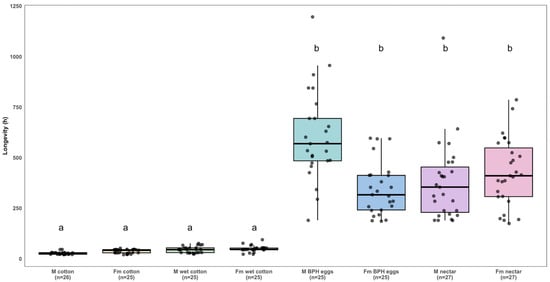
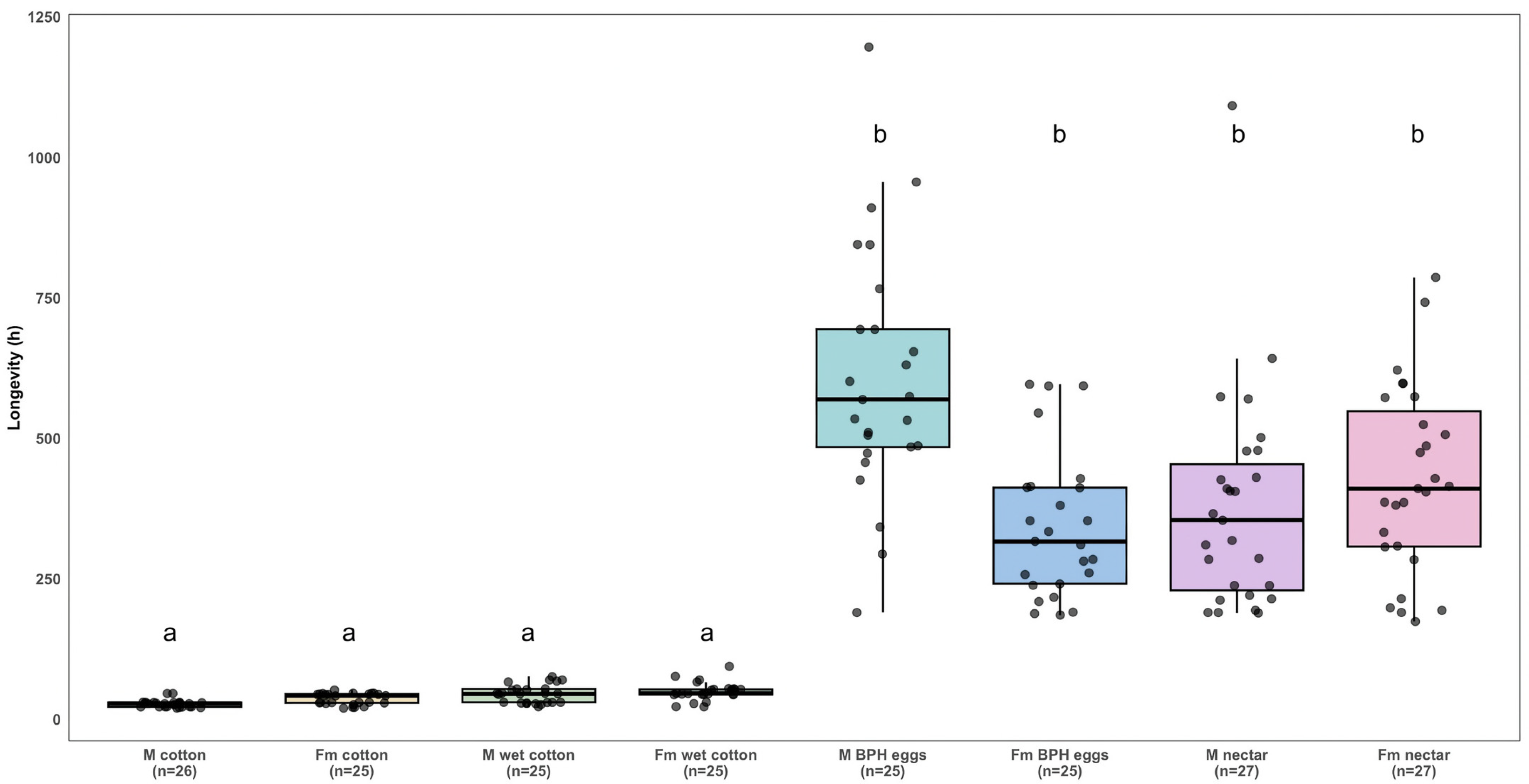
The longevity of adult T. chinensis varied depending on the feeding treatment provided (Figure 1). The Scheirer–Ray–Hare test indicated that feeding treatment had a significant effect on longevity (Df = 3, Sum Sq = 563,113, H = 160.17, p < 0.0001), whereas sex had no significant effect (Df = 1, Sum Sq = 1, H = 0.00, p = 0.984), and the interaction between feeding treatment and sex was not significant (Df = 3, Sum Sq = 24,392, H = 6.938, p = 0.074). For the pairwise comparisons shown in Figure 1, the eight combinations of feeding treatment and sex were treated as eight groups and compared using Dunn’s multiple-comparison test with Bonferroni correction. In the unfed treatments, individuals provided with dry cotton showed the shortest median longevity: 28 h (IQR: 22.00–29.75 h) for males and 42 h (IQR: 29.00–45.00 h) for females. In the wet-cotton treatment, maximum longevity reached 76 h in males and 94 h in females; however, longevity did not differ significantly between the dry- and wet-cotton groups (p > 0.05).
Figure 1.
Longevity (in hours) of male (M) and female (F) Tytthus chinensis under different feeding treatments. Box plots represent the median (horizontal line), interquartile range (box), and individual data points (dots). Treatments included dry cotton, wet cotton, BPH eggs, and Tecoma stans nectar. Different letters indicate significant differences among the eight combinations of feeding treatment and sex based on Dunn’s multiple-comparison test with Bonferroni correction (p < 0.05).
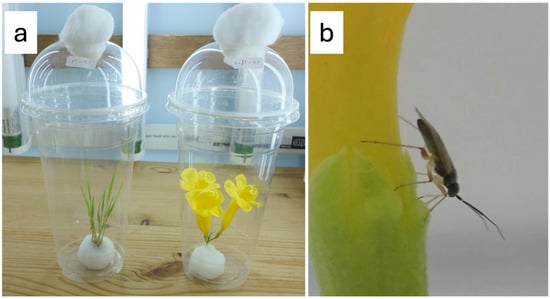
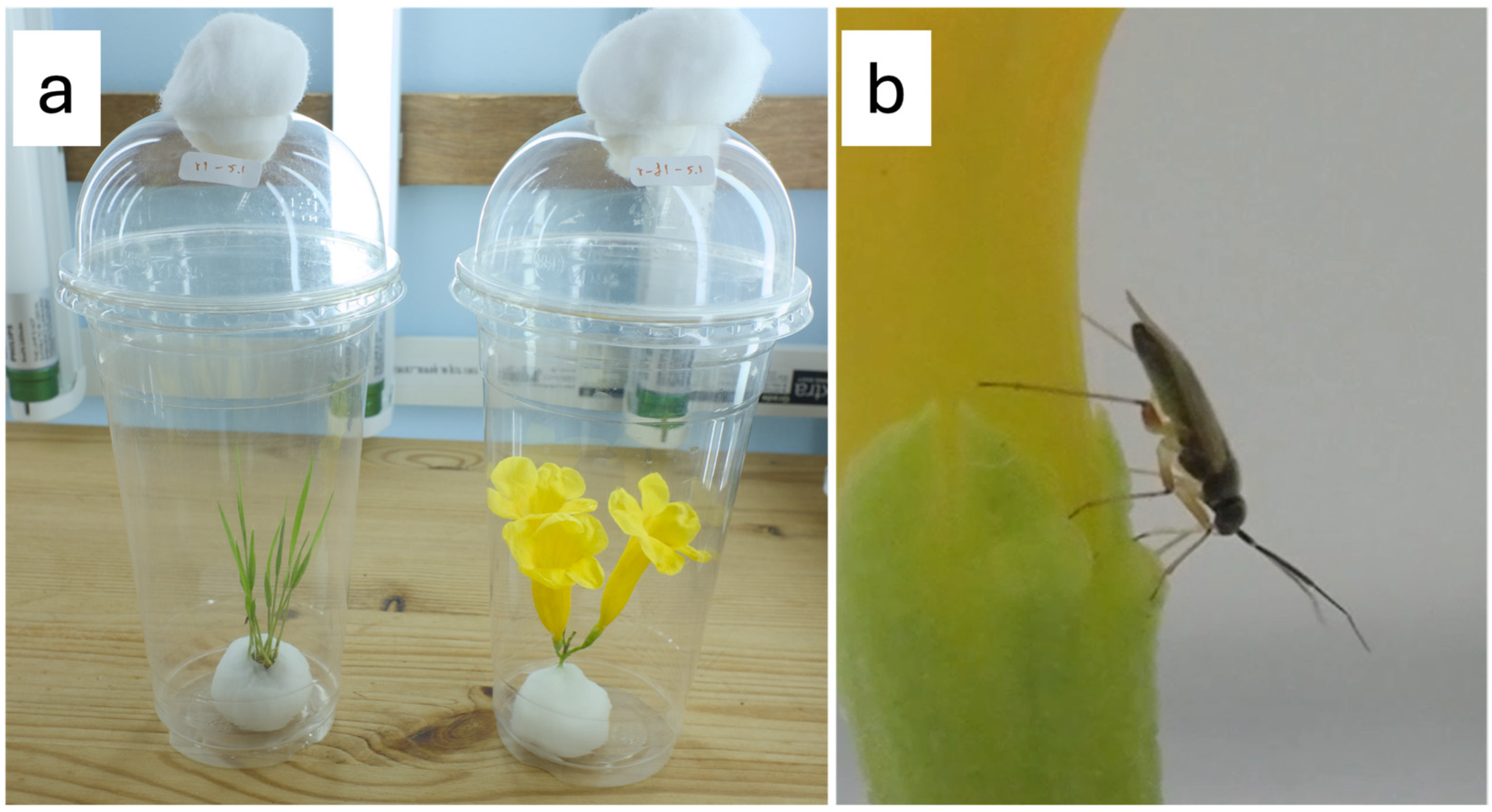
Access to BPH eggs or T. stans nectar substantially increased longevity relative to the unfed treatments. Insects provided with BPH eggs showed prolonged survival, with males showing a higher median longevity (median: 569.00 h; IQR: 484.00–694.00 h) than females (median: 316.00 h; IQR: 241.00–412.00 h), although the difference was not statistically significant (Dunn’s multiple comparison test, p > 0.05). Adults supplied with T. stans nectar also exhibited extended longevity. Predators were directly observed feeding on nectar droplets from the extrafloral nectaries on the calyx of T. stans (Figure 2). Females showed a higher median longevity (median: 410.00 h; IQR: 307.00–548.00 h) than males (median: 354.00 h; IQR: 229.00–453.50 h), but the difference was not statistically significant (Dunn’s multiple comparison test, p > 0.05). No significant difference in longevity was detected between groups provided with BPH eggs and those provided with T. stans nectar for either sex (Dunn’s multiple-comparison test, p > 0.05).
Figure 2.
Experimental setup and nectar feeding by adult Tytthus chinensis. (a) Representative experimental containers showing the Tecoma stans flower treatment and the BPH-infested rice seedling treatment. (b) Adult T. chinensis feeding on nectar at a visible nectary near the base of a T. stans flower during the feeding experiment. The image in (b) was extracted from Supplementary Video S1, which shows the same individual feeding on T. stans nectar.
3.2. Effect of Different Food Sources on the Reproductive Development of Female Tytthus chinensis
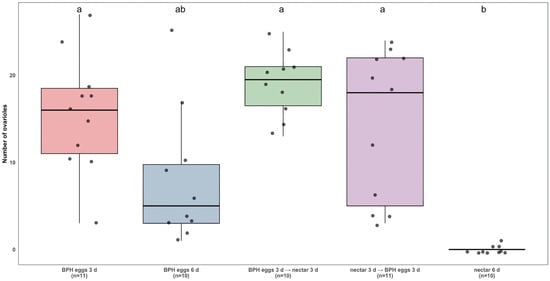
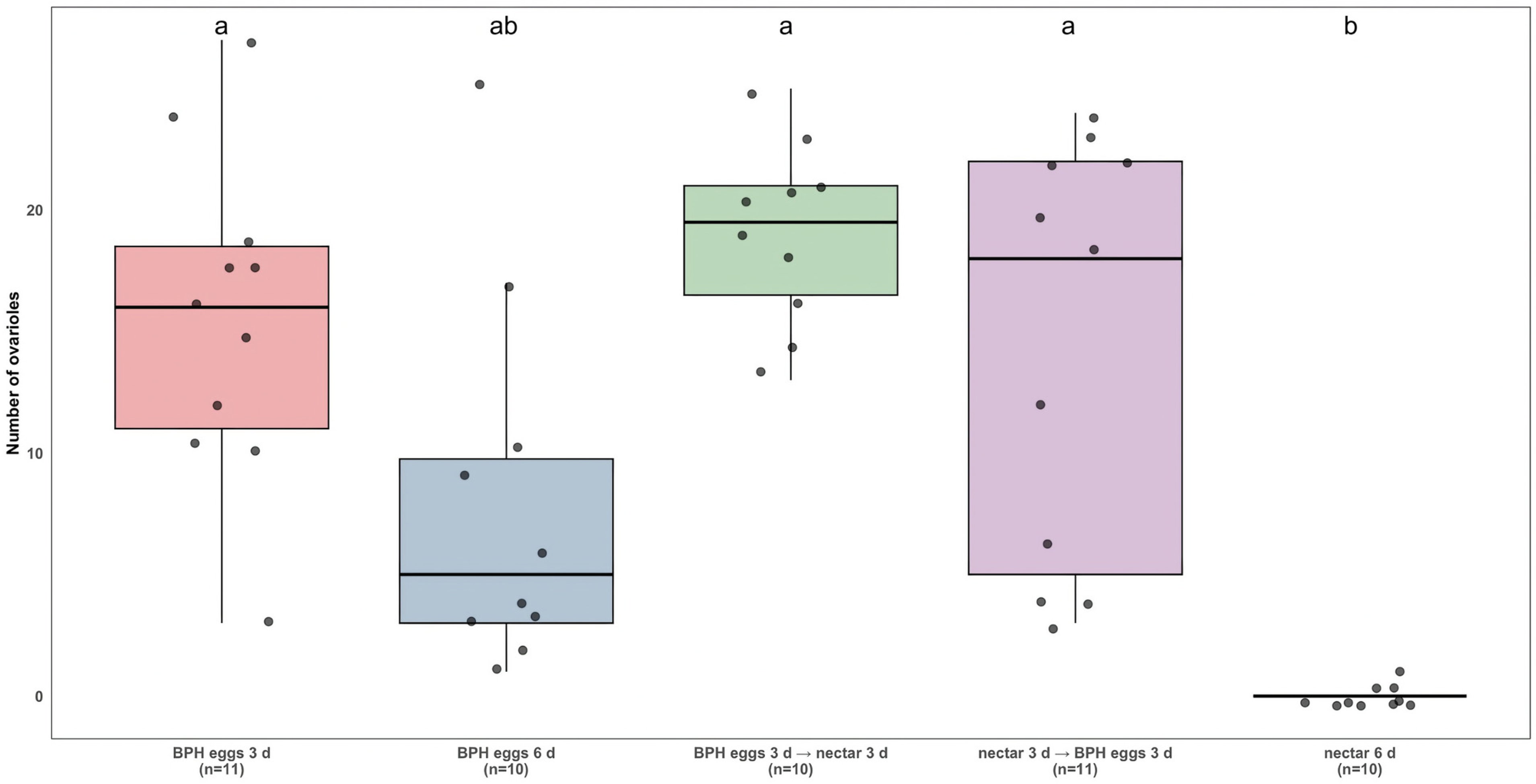
Ovarioles were observed in all individuals that were fed BPH eggs during the experimental period (treatments (1)–(4); Figure 3, Supplementary Figure S2). The number of ovarioles ranged from single digits to more than 20, depending on the feeding treatment (Figure 3). Among the egg-fed groups, individuals in treatments (1), (3), and (4) showed similar ovariole numbers, with median (IQR) values of 16.00 (11.00–18.50), 19.50 (16.50–21.00), and 18.00 (5.00–22.00), respectively, and maximum ovariole counts of 27, 25, and 24.
Figure 3.
Number of ovarioles per female Tytthus chinensis under five different feeding treatments. Each dot represents the total number of ovarioles counted in a single individual. Boxes show the interquartile range (IQR), the horizontal line indicates the median, and whiskers represent the minimum and maximum values. Different letters (a, b) denote statistically significant differences among treatments based on Dunn’s post hoc test (p < 0.05).
Statistical analysis using the Kruskal–Wallis test followed by Dunn’s multiple comparison test indicated that the T. stans nectar-only treatment (treatment 5) differed significantly from treatments 1, 3, and 4 (χ2 = 30.1, df = 4, p < 0.001). However, the nectar-only group (treatment 5) did not differ significantly from treatment (2), in which females were fed BPH eggs for six days (p > 0.05). In treatment (2), females fed BPH eggs for six consecutive days had a median ovariole count of 5 (IQR: 3.00–9.75), with a minimum of 1 and a maximum of 25. Although the maximum value was comparable to those in the other egg-fed treatments, the median value was markedly lower. In the T. stans nectar-only treatment (treatment 5), ovariole development occurred in only one of the ten individuals, and that female produced a single ovariole.
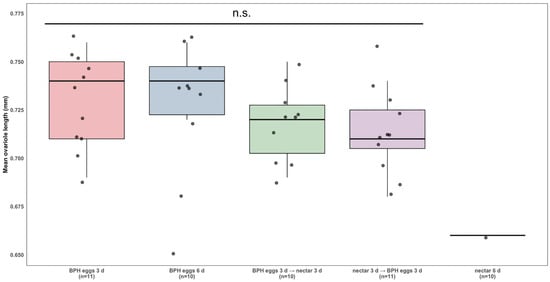
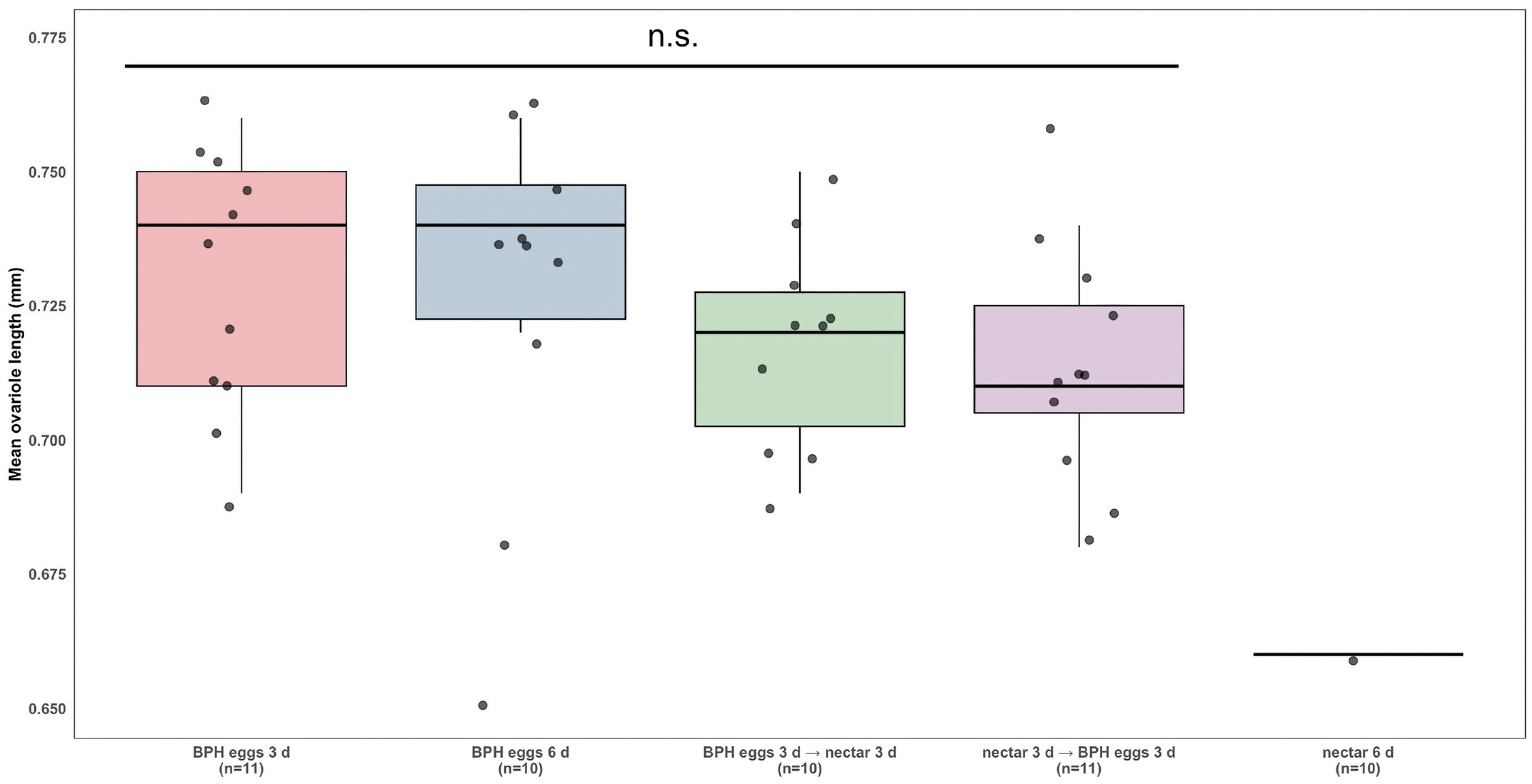
Ovariole length measurements showed that females in the egg-fed treatments (treatments 1–4) had average ovariole lengths ranging from 0.65 to 0.76 mm, with median values between 0.71 and 0.74 mm (Figure 4, Supplementary Figure S2). One-way ANOVA revealed no significant difference in mean ovariole length among the four BPH-containing treatments (F(3, 38) = 0.787, p = 0.509). In the T. stans nectar-only treatment (treatment 5), only one female developed a single ovariole with a length of 0.66 mm; therefore, no statistical comparison was possible.
Figure 4.
Mean ovariole length (mm) of female Tytthus chinensis under five dietary treatments. Each dot represents the mean ovariole length of an individual. Boxes indicate the interquartile range (IQR), the horizontal line indicates the median, and whiskers represent the minimum and maximum values. One-way ANOVA revealed no significant differences (n.s.) in mean ovariole length among treatments 1–4 (F(3, 38) = 0.787, p = 0.509). Only one female in the T. stans nectar treatment had a measurable ovariole. Therefore, this treatment was excluded from the statistical comparison of mean ovariole length, although the value for this individual is shown descriptively.
4. Discussion
4.1. The Potential of Tecoma stans as a Food Source for Tytthus chinensis
This study demonstrates that Tecoma stans nectar can serve as an alternative food resource for adult Tytthus chinensis, as access to nectar significantly increased longevity relative to the no-food treatments (dry cotton and wet cotton) in both males and females. No significant difference in longevity was detected between predators provided with T. stans nectar and those provided with BPH eggs. Although males provided with T. stans nectar had a lower median longevity than those provided with BPH eggs, this difference was not statistically significant. Individuals provided with T. stans nectar nevertheless had significantly greater longevity than those in the dry- and wet-cotton treatments.
Plant-derived food resources, particularly sugars, can enhance survival in predatory insects [44]. For example, access to flowering plants significantly increased the longevity of the predatory mirid Cyrtorhinus lividipennis compared with water or no-food controls [29]. T. stans nectar has been reported to contain predominantly glucose (57.5%) and fructose (41.3%), with a small proportion of sucrose (1.2%) [45]. This reported sugar composition may partly explain the extended longevity observed in the present study; however, the sugar composition of the nectar used in our experiment was not measured.
Another possible explanation lies in the floral structure. In the flowers used in this study, nectar was potentially available from two distinct sources: a nectary disc located at the base of the ovary, within the corolla tube [41], and extrafloral nectaries on the calyx [38], where nectar droplets were visible throughout the experiment. The availability of nectar from more than one site may therefore have contributed to the extended longevity recorded under the T. stans nectar treatment.
In contrast, the longevity of predators supplied only with moist cotton as a water source was not significantly greater than that of individuals provided with dry cotton. Although the moist cotton used to maintain the hydration of the T. stans flower peduncles was accessible to the predators, direct water intake from the cotton was not assessed and therefore cannot be excluded. However, the absence of a significant difference in longevity between the wet-cotton and dry-cotton treatments suggests that access to moisture alone was unlikely to account for the increased longevity observed in the T. stans nectar treatment. Humidity and water availability can influence insect survival [46,47,48]. Taken together, these results suggest that the longevity benefit associated with T. stans nectar is unlikely to be explained by moisture availability alone.
Our results indicate that T. chinensis follows a pattern previously documented in related mirids. However, the longevity observed in the present study was considerably longer than that reported for Cyrtorhinus lividipennis. Whereas access to flowers of Tagetes erecta, Tridax procumbens, Emilia sonchifolia, and Sesamum indicum extended longevity in C. lividipennis to 52.3–60.5 h [29], T. chinensis provided with T. stans nectar had an interquartile longevity range of 307–548 h in females and 229–454 h in males. Because these values were obtained under different experimental conditions, this comparison should be interpreted descriptively. The prolonged survival supported by T. stans nectar may be particularly relevant during short periods when BPH eggs are scarce. Wada et al. [49] reported a pre-oviposition period of approximately 4.1 d in tropical BPH populations under 25 ± 1 °C. Such a delay could potentially create a brief period following BPH colonization during which egg prey are scarce, and alternative food resources such as T. stans nectar may help sustain adult T. chinensis until BPH eggs become available. However, whether such a temporal gap occurs under field conditions and coincides with the arrival of T. chinensis remains to be tested. Furthermore, the present study did not include a rice seedling-only treatment or a combined BPH egg and T. stans flower treatment. Therefore, the effects of rice seedlings alone and the combined effects of the two food resources remain to be evaluated.
Overall, these findings indicate that T. stans nectar can support the adult survival of T. chinensis under laboratory conditions and suggest its potential as an alternative food resource during periods of prey scarcity. Its potential value as an insectary plant for supporting predator persistence and biological control in rice agroecosystems requires further evaluation under field conditions.
4.2. Comparative Effects of BPH Egg Predation and Tecoma stans Nectar Feeding on the Reproductive Development of Tytthus chinensis
The present results demonstrate differential effects of prey and non-prey food resources on the reproductive development of the mirid predator T. chinensis. The findings indicate that BPH egg ingestion plays an important role in ovariole development in female T. chinensis under the conditions tested. All females that fed on BPH eggs, either continuously or in sequence with T. stans nectar, showed observable ovariole development. In contrast, females fed exclusively on T. stans nectar showed limited ovariole development, with only one individual having a single ovariole. The group fed on BPH eggs for 6 d had a lower median ovariole number (5.00, IQR: 3.00–9.75) than the group fed on BPH eggs for 3 d (16.00, IQR: 11.00–18.50). The reason for this pattern remains unclear and cannot be determined from the present data.
The limited ovariole development observed in the T. stans nectar treatment suggests that, although T. stans nectar can support adult survival, nectar alone may be insufficient to support ovariole development under the conditions tested. Differences in nutritional composition between the two food sources may have contributed to this pattern, although protein and other nitrogenous nutrients were not measured in either T. stans nectar or BPH eggs. Protein is nevertheless one biologically plausible factor because of its established role in insect reproductive development [50] and affects mating behavior and reproductive performance [51]. Protein functions both as an energy source and as a signaling component that regulates hormone biosynthesis and secretion, including the initiation of egg production through the amino acid–Target of Rapamycin (AA/TOR) and insulin signaling pathways [52]. Furthermore, protein availability has also been shown to influence sex pheromone production [53]. Together, these findings highlight the importance of adequate protein intake for normal reproductive function [54], even though predatory Hemiptera exhibit considerable dietary flexibility [55].
This finding further supports the importance of food quality in sustaining reproductive development in insects [56,57,58]. In contrast, inadequate nutrition may lead to energetic trade-offs in resource allocation, thereby compromising other essential physiological functions [59]. The limited ovariole development observed with T. stans nectar alone further suggests an important role of access to prey in ovariole development. Therefore, T. chinensis can be considered a zoophytophagous predator [60], highlighting its potential role in biological control in agricultural ecosystems.
Although this outcome might appear intuitive, it could not be assumed a priori. Within the Miridae alone, the capacity of plant-derived resources to sustain reproduction varies considerably among species, with Deraeocoris signatus neither surviving nor reproducing on cotton tips and cotton squares without prey [61], whereas Nesidiocoris tenuis completes development and reproduces on the plant tissues of Cleome hassleriana or Sesamum indicum in the complete absence of prey [62]. Whether T. stans nectar supports survival alone or can also contribute to reproductive development has important implications for its potential use in biological control. Because oviposition was not systematically assessed in this study, the effects of the different feeding regimes on fecundity and reproductive success remain to be determined. Based on our findings, T. stans may have potential to support the survival of T. chinensis during periods of prey scarcity, although its effect on predator persistence under field conditions remains to be tested.
4.3. Potential Role of Tecoma stans in the Indirect Outcomes of Increasing Habitat Diversity for Pest Control
Habitat diversification using insectary plants can provide food resources and refuges for natural enemies and thereby support biological control in agricultural landscapes [63]. In this context, T. stans may represent a potential insectary plant because of its prolonged flowering and availability of nectar resources [38]. Flowering plants can function as both resource and refuge providers for natural enemies. By increasing plant species richness and structural complexity, such habitat enhancements support more diverse natural enemy communities. Floral resources can attract and sustain a wide range of predators and parasitoids, thereby supporting biological control services in a more stable and sustainable manner [23,24,25,64]. However, the provision of alternative food does not necessarily translate directly into improved pest suppression, as its effects may depend on predator population responses, timing of food availability, and the quality of the alternative food [65].
Nevertheless, field-scale studies are required to determine whether T. stans can promote natural enemy diversity and pest suppression under real agricultural conditions. Such studies will be crucial for designing habitat management strategies that align with agroecological principles while ensuring practical benefits for farmers.
Overall, the present study demonstrates that T. stans nectar can serve as an alternative food source that enhances the survival of the mirid predator T. chinensis, although prey consumption appears to play an important role in reproductive development under the conditions tested. These findings suggest that T. stans nectar may support the survival of T. chinensis during periods of prey scarcity. Accordingly, T. stans may warrant further evaluation as an insectary plant for habitat management aimed at supporting biological control in rice agroecosystems.
5. Conclusions
This study demonstrates that access to Tecoma stans flowers can substantially extend the adult longevity of the mirid predator Tytthus chinensis under laboratory conditions. No significant difference in longevity was detected between predators provided with T. stans nectar and those provided with brown planthopper eggs. However, T. stans nectar alone resulted in limited ovariole development, whereas females provided with prey showed clear ovariole development. These findings suggest that T. stans nectar may support adult survival, while access to prey appears to play an important role in reproductive development under the conditions tested. Thus, the potential value of T. stans as an insectary plant may lie in supporting predator survival during periods of prey scarcity. Given its prolonged flowering period and widespread occurrence in Thailand, T. stans may therefore warrant further evaluation as a potential insectary plant for habitat management aimed at supporting biological control in rice agroecosystems. Further field studies are needed to determine whether the benefits observed under laboratory conditions translate into increased predator persistence or pest suppression under field conditions.
Supplementary Materials
The following supporting information can be downloaded at: https://www.mdpi.com/article/10.3390/insects17101021/s1, Figure S1: Photographic documentation of the Tytthus chinensis rearing colony. (A) Rearing cage used to maintain the T. chinensis colony. (B–E) Representative adult T. chinensis individuals from the colony.; Figure S2: Representative photographs illustrating the dissection and observation of ovarioles in female Tytthus chinensis. (a) Abdomen of an adult female before dissection. (b) All ovarioles dissected from a single female, illustrating the material used for ovariole counting. (c–g) Representative ovarioles used for length measurements from females subjected to the five feeding treatments: (c) BPH eggs for 3 d, (d) BPH eggs for 6 d, (e) BPH eggs for 3 d followed by T. stans nectar for 3 d, (f) T. stans nectar for 3 d followed by BPH eggs for 3 d, and (g) T. stans nectar for 6 d.; Video S1: Adult Tytthus chinensis feeding on nectar at a visible nectary near the base of a Tecoma stans flower during the feeding experiment. The proboscis is clearly extended during feeding. A still image extracted from this video is presented in Figure 2b.
Author Contributions
Conceptualization: N.P., W.S. and K.K. Investigation: W.S., N.P. and A.T. Resources: W.S., N.P., K.K., A.T. and P.T. Writing—original draft: W.S. Writing—review and editing: N.P. and K.K. Funding acquisition: N.P. and W.S. All authors have read and agreed to the published version of the manuscript.
Funding
This research was supported by the Faculty of Science, Kasetsart University, through a thesis grant for publication, and the Agricultural Research Development Agency (Public Organization; CRP6205031250). Additional support was provided by the Department of Zoology, Faculty of Science, Kasetsart University.
Institutional Review Board Statement
This article does not contain any studies involving human participants or vertebrate animals performed by any of the authors. This study was performed in line with the principles of the Declaration of Animal Care and Use for Scientific Research. Approval was granted by the Kasetsart University Institutional Animal Care and Use Committee and was found to be in accordance with the guidelines for animal care and use under the Ethical Review Board of the Office of National Research Council of Thailand (NRCT) for the conduct of scientific research (No. ACKU69-SCI-002; License No. U1-06448-2560).
Data Availability Statement
The data presented in this study are available from the corresponding author upon reasonable request.
Conflicts of Interest
The authors declare no conflicts of interest.
References
- Rice Department, Ministry of Agriculture and Cooperatives. Brown Planthopper. 2016. Available online: https://rkb.ricethailand.go.th/web/content_page.php?code=IKC4N6RDUNUIBWGU4MR107J9ZQSBW&utm (accessed on 2 May 2025). (In Thai)
- Disthaporn, S. Characteristics of rice ragged stunt in Thailand. Trop. Agric. Res. Ser. 1985, 19, 160–164. Available online: https://www.jircas.go.jp/en/publication/tars/19/160 (accessed on 3 May 2025).
- Hibino, H.; Kimura, I.; Morinaka, T.; Putta, M.; Chettanachit, D.; Parejarearn, A.; Patirupanusara, T.; Disthaporn, S. Rice ragged stunt virus. Tech. Bull. Trop. Agric. Res. Cent. 1986, 21, 14–33. Available online: https://www.jircas.go.jp/en/publication/techtarc/21/14 (accessed on 3 May 2025).
- Kanngan, K.; Umalee, P.; Tangtrakulwanich, K.; Nilthong, R.; Nilthong, S. Identification of major brown planthopper resistance genes in indigenous Thai upland rice germplasm using molecular markers. Agronomy 2023, 13, 2605. [Google Scholar] [CrossRef] [Scilit]
- Hu, G.; Lu, M.-H.; Reynolds, D.R.; Wang, H.-K.; Chen, X.; Liu, W.-C.; Zhu, F.; Wu, X.-W.; Xia, F.; Xie, M.-C.; et al. Long-term seasonal forecasting of a major migrant insect pest: The brown planthopper in the Lower Yangtze River Valley. J. Pest. Sci. 2019, 92, 417–428. [Google Scholar] [CrossRef] [Scilit] [PubMed]
- Tyagi, S.; Narayana, S.; Singh, R.N.; Srivastava, C.P.; Twinkle, S.; Das, S.K.; Jeer, M. Migratory behaviour of brown planthopper, Nilaparvata lugens (Stål) (Hemiptera: Delphacidae), in India as inferred from genetic diversity and reverse trajectory analysis. 3 Biotech 2022, 12, 266. [Google Scholar] [CrossRef] [Scilit] [PubMed]
- Wang, Y.; Chen, J.; Zhu, Y.C.; Ma, C.; Huang, Y.; Shen, J. Susceptibility to neonicotinoids and risk of resistance development in the brown planthopper, Nilaparvata lugens (Stål) (Homoptera: Delphacidae). Pest. Manag. Sci. 2008, 64, 1278–1284. [Google Scholar] [CrossRef] [Scilit] [PubMed]
- Ngin, C.; Suon, S.; Tanaka, T.; Yamauchi, A.; Kawakita, K.; Chiba, S. Impact of insecticide applications on arthropod predators and plant feeders in Cambodian rice fields. Phytobiomes J. 2017, 1, 128–137. [Google Scholar] [CrossRef] [Scilit]
- Wu, J.-C.; Xu, J.-X.; Yuan, S.-Z.; Liu, J.-L.; Jiang, Y.-H.; Xu, J.-F. Pesticide-induced susceptibility of rice to brown planthopper Nilaparvata lugens. Entomol. Exp. Appl. 2001, 100, 119–126. [Google Scholar] [CrossRef] [Scilit]
- Hereward, J.P.; Cai, X.; Matias, A.M.A.; Walter, G.H.; Xu, C.; Wang, Y. Migration dynamics of an important rice pest: The brown planthopper (Nilaparvata lugens) across Asia—Insights from population genomics. Evol. Appl. 2020, 13, 2449–2459. [Google Scholar] [CrossRef] [Scilit] [PubMed]
- Wang, B.-J.; Xu, H.-X.; Zheng, X.-S.; Fu, Q.; Lu, Z.-X. High temperature modifies resistance performances of rice varieties to brown planthopper, Nilaparvata lugens (Stål). Rice Sci. 2010, 17, 334–338. [Google Scholar] [CrossRef] [Scilit]
- Horgan, F.G.; Peñalver Cruz, A.; Arida, A.; Ferrater, J.B.; Bernal, C.C. Adaptation by the brown planthopper to resistant rice: A test of female-derived virulence and the role of yeast-like symbionts. Insects 2021, 12, 908. [Google Scholar] [CrossRef] [Scilit] [PubMed]
- Fahad, S.; Saud, S.; Akhter, A.; Bajwa, A.A.; Hassan, S.; Battaglia, M.; Adnan, M.; Wahid, F.; Datta, R.; Babur, E.; et al. Bio-based integrated pest management in rice: An agro-ecosystems friendly approach for agricultural sustainability. J. Saudi Soc. Agric. Sci. 2021, 20, 94–102. [Google Scholar] [CrossRef] [Scilit]
- Heong, K.L.; Aquino, G.B.; Barrion, A.T. Arthropod community structures of rice ecosystems in the Philippines. Bull. Entomol. Res. 1991, 81, 407–416. [Google Scholar] [CrossRef] [Scilit]
- Ngoen-klan, R.; Deelee, R.; Amornsak, W. Preliminary survey of the brown planthopper, Nilaparvata lugens (Stål) (Hemiptera: Delphacidae) on different varieties of rice and its natural enemies in Central Thailand. Agric. Nat. Resour. 2019, 53, 410–422. [Google Scholar] [CrossRef] [Scilit]
- Henry, T.J. Revision of the plant bug genus Tytthus (Hemiptera, Heteroptera, Miridae, Phylinae). ZooKeys 2012, 220, 1–114. [Google Scholar] [CrossRef] [Scilit] [PubMed]
- Srirattanasak, W.; Chaiyawong, J.; Aranvikamit, S.; Boonpermuk, U. Insect and Animal Pests of Rice and Their Control; Bureau of Rice Research and Development, Rice Department: Bangkok, Thailand, 2011. (In Thai) [Google Scholar]
- Ritmontree, T.; Tangchoopong, S.; Phisitkul, S. The suitable ratio of mirid bug (Tytthus chinensis Stål) in controling brown planthopper (Nilaparvata lugens Stål.). In Proceedings of the 35th Kasetsart University Annual Conference: Plant Science, Agricultural Extension and Communication, and Agro-Industry, Bangkok, Thailand, 3–5 February 1997; pp. 378–382. (In Thai) [Google Scholar]
- Huang, Q.; Long, L.; Huang, S.; Wu, B.; Li, C.; Ling, Y. Functional and numerical responses of Tytthus chinensis (Hemiptera: Miridae) to Sogatella furcifera (Hemiptera: Delphacidae). Insects 2025, 16, 339. [Google Scholar] [CrossRef] [Scilit] [PubMed]
- Bai, Y.; Quais, M.K.; Zhou, W.; Zhu, Z.-R. Consequences of elevated temperature on the biology, predation, and competitiveness of two mirid predators in the rice ecosystem. J. Pest Sci. 2022, 95, 901–916. [Google Scholar] [CrossRef] [Scilit]
- Surmaini, E.; Sarvina, Y.; Susanti, E.; Widiarta, I.N.; Misnawati, M.; Suciantini, S.; Fanggidae, Y.R.; Rahmini, R.; Dewi, E.R. Climate change and the future distribution of brown planthopper in Indonesia: A projection study. J. Saudi Soc. Agric. Sci. 2024, 23, 130–141. [Google Scholar] [CrossRef] [Scilit]
- Arnó, J.; Oveja, M.F.; Gabarra, R. Selection of flowering plants to enhance the biological control of Tuta absoluta using parasitoids. Biol. Control 2018, 122, 41–50. [Google Scholar] [CrossRef] [Scilit]
- Cai, Z.; Ouyang, F.; Su, J.; Zhang, X.; Liu, C.; Xiao, Y.; Zhang, J.; Ge, F. Attraction of adult Harmonia axyridis to volatiles of the insectary plant Cnidium monnieri. Biol. Control 2020, 143, 104189. [Google Scholar] [CrossRef] [Scilit]
- Cai, Z.; Ouyang, F.; Chen, J.; Yang, Q.; Desneux, N.; Xiao, Y.; Zhang, J.; Ge, F. Biological control of Aphis spiraecola in apples using an insectary plant that attracts and sustains predators. Biol. Control 2021, 155, 104532. [Google Scholar] [CrossRef] [Scilit]
- Irvin, N.A.; Hoddle, M.S. The effects of floral nectar, extrafloral nectar and hemipteran honeydew on the fitness of Tamarixia radiata (Hymenoptera: Eulophidae), a parasitoid of Diaphorina citri. Biol. Control 2021, 163, 104753. [Google Scholar] [CrossRef] [Scilit]
- Laubertie, E.A.; Wratten, S.D.; Hemptinne, J.-L. The contribution of potential beneficial insectary plant species to adult hoverfly (Diptera: Syrphidae) fitness. Biol. Control 2012, 61, 1–6. [Google Scholar] [CrossRef] [Scilit]
- Shrestha, B.; Finke, D.L.; Piñero, J.C. The “botanical triad”: The presence of insectary plants enhances natural enemy abundance on trap crop plants in an organic cabbage agro-ecosystem. Insects 2019, 10, 181. [Google Scholar] [CrossRef] [Scilit] [PubMed]
- Zinati, G.M. Invite Insect Allies to Your Farm Using Insectary Strips: Field Guide to Control Striped Cucumber Beetles; Rodale Institute: Kutztown, PA, USA, 2018; Available online: https://rodaleinstitute.org/wp-content/uploads/111218_Insectary-Strips-Field-Guide_CS18.pdf (accessed on 19 August 2025).
- Zhu, P.; Lu, Z.; Heong, K.; Chen, G.; Zheng, X.; Xu, H.; Yang, Y.; Nicol, H.I.; Gurr, G.M. Selection of nectar plants for use in ecological engineering to promote biological control of rice pests by the predatory bug, Cyrtorhinus lividipennis (Heteroptera: Miridae). PLoS ONE 2014, 9, e108669. [Google Scholar] [CrossRef] [Scilit] [PubMed]
- Henderson, L. Alien Weeds and Invasive Plants: A Complete Guide to Declared Weeds and Invaders in South Africa; Agricultural Research Council: Pretoria, South Africa, 2001; p. 215. [Google Scholar]
- Royal Botanic Gardens, Kew. Tecoma stans (L.) Juss. ex Kunth. Plants of the World Online. Available online: https://powo.science.kew.org/taxon/urn:lsid:ipni.org:names:111284-1 (accessed on 3 May 2025).
- Salem, M.Z.M.; Gohar, Y.M.; Camacho, L.M.; El-Shanhorey, N.A.; Salem, A.Z.M. Antioxidant and antibacterial activities of leaves and branches extracts of Tecoma stans (L.) Juss. ex Kunth against nine species of pathogenic bacteria. Afr. J. Microbiol. Res. 2013, 7, 418–426. [Google Scholar] [CrossRef] [Scilit]
- Nguyen, T.-H.-T.; To, H.-L.; Nguyen, T.-D.; Nguyen, T.-B.-T.; Pham, N.-K.-T.; Nguyen, H.T.; Nguyen, C.H.; Nguyen, H.-H.; Nguyen, N.-H.; Duong, T.-H. Tecomastane, a new megastigmane from the flowers of Tecoma stans. Nat. Prod. Res. 2023, 37, 3563–3571. [Google Scholar] [CrossRef] [Scilit] [PubMed]
- Raju, S.; Kavimani, S.; Uma Maheshwara Rao, V.; Sreeramulu Reddy, K.; Vasanth Kumar, G. Floral extract of Tecoma stans: A potent inhibitor of gentamicin-induced nephrotoxicity in vivo. Asian Pac. J. Trop. Med. 2011, 4, 680–685. [Google Scholar] [CrossRef] [Scilit] [PubMed]
- Vasantharaj, S.; Sathiyavimal, S.; Bharathi, D.; Pannerselvam, B.; Jeon, S.; Srituravanich, W. Biosynthesis of copper oxide nanoparticles using Tecoma stans flower extract and its antibacterial, anticancer, and photocatalytic activities. Biocatal. Agric. Biotechnol. 2024, 58, 103137. [Google Scholar] [CrossRef] [Scilit]
- Curti, R.N.; Ortega-Baes, P. Relationship between floral traits and floral visitors in two coexisting Tecoma species (Bignoniaceae). Plant Syst. Evol. 2011, 293, 207–211. [Google Scholar] [CrossRef] [Scilit]
- dos Santos, J.M.A.; Carneiro, L.T.; Martins, C.F. Are native nectar robbers against the alien? Effects of floral larceny on the reproductive success of the invasive yellow bells (Tecoma stans, Bignoniaceae). Acta Oecol. 2020, 105, 103547. [Google Scholar] [CrossRef] [Scilit]
- Singh, S.; Miller, C.T.; Singh, P.; Sharma, R.; Rana, N.; Dhakad, A.K.; Dubey, R.K. A comprehensive review on ecology, life cycle and use of Tecoma stans (Bignoniaceae). Bot. Stud. 2024, 65, 6. [Google Scholar] [CrossRef] [Scilit] [PubMed]
- Bhasabutra, T.; Seemadua, S.; Shivas, R.G. First record of Prospodium appendiculatum on Tecoma stans in Thailand. Australas. Plant Dis. Notes 2012, 7, 123–124. [Google Scholar] [CrossRef] [Scilit]
- Rice Department, Ministry of Agriculture and Cooperatives. Pathum Thani 1. 2016. Available online: https://rkb.ricethailand.go.th/web/content_page.php?code=CXQK8Z8SSU1C4OCST4IZQ3XV4G8HA (accessed on 15 December 2025). (In Thai)
- Pelton, J. A survey of the ecology of Tecoma stans. Butler Univ. Bot. Stud. 1964, 14, 53–88. Available online: https://digitalcommons.butler.edu/botanical/vol14/iss1/11/ (accessed on 3 May 2025).
- Scheirer, C.J.; Ray, W.S.; Hare, N. The analysis of ranked data derived from completely randomized factorial designs. Biometrics 1976, 32, 429–434. [Google Scholar] [CrossRef] [Scilit]
- R Core Team. R: A Language and Environment for Statistical Computing; R Foundation for Statistical Computing: Vienna, Austria, 2024; Available online: https://www.R-project.org/ (accessed on 10 April 2026).
- Fratoni, S.; Duarte, M.V.A.; Vangansbeke, D.; Wäckers, F.L.; Dicke, M.; Pekas, A. A bittersweet meal: The impact of sugar solutions and honeydew on the fitness of two predatory gall midges. Biol. Control 2020, 140, 104098. [Google Scholar] [CrossRef] [Scilit]
- Galetto, L. Nectary structure and nectar characteristics in some Bignoniaceae. Plant Syst. Evol. 1995, 196, 99–121. [Google Scholar] [CrossRef] [Scilit]
- Dahake, A.; Persaud, S.G.; Jones, M.N.; Goyret, J.; Davidowitz, G.; Raguso, R.A. Dying of thirst: Osmoregulation by a hawkmoth pollinator in response to variability in ambient humidity and nectar availability. J. Insect Physiol. 2024, 159, 104700. [Google Scholar] [CrossRef] [Scilit] [PubMed]
- Papanikolaou, N.E.; Kavallieratos, N.G.; Boukouvala, M.C.; Malesios, C. Do temperature, relative humidity and interspecific competition alter the population size and the damage potential of stored-product insect pests? A hierarchical multilevel modeling approach. J. Therm. Biol. 2018, 78, 415–422. [Google Scholar] [CrossRef] [Scilit] [PubMed]
- Saxena, P. The effect of relative humidity on the survival and fecundity of adult and nymphal instars of Lohita grandis (Largidae: Heteroptera) in laboratory condition. Uttar Pradesh J. Zool. 2022, 43, 522–528. [Google Scholar] [CrossRef] [Scilit]
- Wada, T.; Ito, K.; Takahashi, A.; Tang, J. Variation of pre-ovipositional period in the brown planthopper, Nilaparvata lugens, collected in tropical, subtropical and temperate Asia. J. Appl. Entomol. 2007, 131, 698–703. [Google Scholar] [CrossRef] [Scilit]
- Rivera-Pérez, C.; Clifton, M.E.; Noriega, F.G. How micronutrients influence the physiology of mosquitoes. Curr. Opin. Insect Sci. 2017, 23, 112–117. [Google Scholar] [CrossRef] [Scilit] [PubMed]
- Wang, F.; Chambi, C.; Li, Z.; Huang, C.; Ma, Y.; Li, C.; Tian, X.; Sangija, F.; Ntambo, M.S.; Kankonda, O.M.; et al. Influence of supplemental protein on the life expectancy and reproduction of the Chinese citrus fruit fly, Bactrocera minax (Enderlein) (Diptera: Tephritidae). J. Insect Sci. 2018, 18, 25. [Google Scholar] [CrossRef] [Scilit] [PubMed]
- Smykal, V.; Raikhel, A.S. Nutritional control of insect reproduction. Curr. Opin. Insect Sci. 2015, 11, 31–38. [Google Scholar] [CrossRef] [Scilit] [PubMed]
- Gui, S.; Yuval, B.; Engl, T.; Lu, Y.; Cheng, D. Protein feeding mediates sex pheromone biosynthesis in an insect. eLife 2023, 12, e83469. [Google Scholar] [CrossRef] [Scilit] [PubMed]
- Al Shareefi, E.; Cotter, S.C. The nutritional ecology of maturation in a carnivorous insect. Behav. Ecol. 2019, 30, 256–266. [Google Scholar] [CrossRef] [Scilit]
- Torres, J.B.; Boyd, D.W. Zoophytophagy in predatory Hemiptera. Braz. Arch. Biol. Technol. 2009, 52, 1199–1208. [Google Scholar] [CrossRef] [Scilit]
- Adams, T.S. Effect of diet and mating status on ovarian development in a predaceous stink bug Perillus bioculatus (Hemiptera: Pentatomidae). Ann. Entomol. Soc. Am. 2000, 93, 529–535. [Google Scholar] [CrossRef] [Scilit]
- Lee, K.P. Dietary protein:carbohydrate balance is a critical modulator of lifespan and reproduction in Drosophila melanogaster: A test using a chemically defined diet. J. Insect Physiol. 2015, 75, 12–19. [Google Scholar] [CrossRef] [Scilit] [PubMed]
- Lv, J.; Yang, K.; Wang, E.; Xu, X. Prey diet quality affects predation, oviposition and conversion rate of the predatory mite Neoseiulus barkeri (Acari: Phytoseiidae). Syst. Appl. Acarol. 2016, 21, 279–287. [Google Scholar] [CrossRef] [Scilit]
- Schwenke, R.A.; Lazzaro, B.P.; Wolfner, M.F. Reproduction–immunity trade-offs in insects. Annu. Rev. Entomol. 2016, 61, 239–256. [Google Scholar] [CrossRef] [Scilit] [PubMed]
- Dumont, F.; Aubry, O.; Lucas, E. From evolutionary aspects of zoophytophagy to biological control. Front. Ecol. Evol. 2018, 6, 221. [Google Scholar] [CrossRef] [Scilit]
- Chinajariyawong, A.; Harris, V.E. Inability of Deraeocoris signatus (Distant) (Hemiptera: Miridae) to survive and reproduce on cotton without prey. Aust. J. Entomol. 1987, 26, 37–40. [Google Scholar] [CrossRef] [Scilit]
- Nakano, R.; Morita, T.; Okamoto, Y.; Fujiwara, A.; Yamanaka, T.; Adachi-Hagimori, T. Cleome hassleriana plants fully support the development and reproduction of Nesidiocoris tenuis. BioControl 2021, 66, 407–418. [Google Scholar] [CrossRef] [Scilit]
- Gurr, G.M.; Wratten, S.D.; Landis, D.A.; You, M. Habitat management to suppress pest populations: Progress and prospects. Annu. Rev. Entomol. 2017, 62, 91–109. [Google Scholar] [CrossRef] [Scilit] [PubMed]
- Scarlato, M.; Bao, L.; Rossing, W.A.H.; Dogliotti, S.; Bertoni, P.; Bianchi, F.J.J.A. Flowering plants in open tomato greenhouses enhance pest suppression in conventional systems and reveal resource saturation for natural enemies in organic systems. Agric. Ecosyst. Environ. 2023, 347, 108389. [Google Scholar] [CrossRef] [Scilit]
- Deere, J.A.; Beretta, G.M.; van Rijn, P.C.J.; Messelink, G.J.; Leman, A.; Janssen, A. Does alternative food for predatory arthropods improve biological pest control? A meta-analysis. Biol. Control 2024, 198, 105605. [Google Scholar] [CrossRef] [Scilit]
Disclaimer/Publisher’s Note: The statements, opinions and data contained in all publications are solely those of the individual author(s) and contributor(s) and not of MDPI and/or the editor(s). MDPI and/or the editor(s) disclaim responsibility for any injury to people or property resulting from any ideas, methods, instructions or products referred to in the content. |
© 2026 by the authors. Licensee MDPI, Basel, Switzerland. This article is an open access article distributed under the terms and conditions of the Creative Commons Attribution (CC BY) license.