


Skip Content
You are currently on the new version of our website. Access the old version .

Insects, Volume 13, Issue 3

2022 March - 89 articles

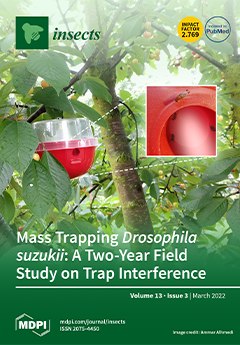
Cover Story: Drosophila suzukii is an invasive fruit fly that became a key pest of soft-skinned fruits during the past decade. Deploying attractive traps to control the pest population (mass trapping) could be part of the management strategy of D. suzukii. The present study analyzes whether mass trapping with different attractants could be viable for D. suzukii control and how far traps should be maximally spaced in a grid. By quantifying trap interference in 4 × 4 trapping grids, it was found in this two-year field study that workable trap densities can be expected to control D. suzukii. View this paper
  • Issues are regarded as officially published after their release is announced to the table of contents alert mailing list .
  • You may sign up for email alerts to receive table of contents of newly released issues.
  • PDF is the official format for papers published in both, html and pdf forms. To view the papers in pdf format, click on the "PDF Full-text" link, and use the free Adobe Reader to open them.

Articles (89)

  • Review
  • Open Access
49 Citations
9,252 Views
28 Pages

Functional Properties and Antimicrobial Activity from Lactic Acid Bacteria as Resources to Improve the Health and Welfare of Honey Bees

  • Massimo Iorizzo,
  • Francesco Letizia,
  • Sonia Ganassi,
  • Bruno Testa,
  • Sonia Petrarca,
  • Gianluca Albanese,
  • Dalila Di Criscio and
  • Antonio De Cristofaro

21 March 2022

Honey bees (Apis mellifera) are agriculturally important pollinators. Over the past decades, significant losses of wild and domestic bees have been reported in many parts of the world. Several biotic and abiotic factors, such as change in land use ov...

  • Article
  • Open Access
13 Citations
7,040 Views
14 Pages

Larvicidal Activity of Carbon Black against the Yellow Fever Mosquito Aedes aegypti

  • Erick J. Martínez Rodríguez,
  • Parker Evans,
  • Megha Kalsi,
  • Noah Rosenblatt,
  • Morgan Stanley and
  • Peter M. Piermarini

20 March 2022

The yellow fever mosquito Aedes aegypti is one of the deadliest animals on the planet because it transmits several medically important arboviruses, including Zika, chikungunya, dengue, and yellow fever. Carbon-based nanoparticles (CNPs) derived from...

  • Article
  • Open Access
12 Citations
7,176 Views
12 Pages

Impact of Heat Stress on the Predatory Ladybugs Hippodamia variegata and Propylaea quatuordecimpunctata

  • Qing Yang,
  • Jinping Liu,
  • Kris A. G. Wyckhuys,
  • Yizhong Yang and
  • Yanhui Lu

20 March 2022

In cotton-growing regions of northwestern China, Hippodamia variegata (Goeze) and Propylaea quatuordecimpunctata (Linnaeus) (Coleoptera: Coccinellidae) are key natural enemies of hemipteran pests. As only H. variegata can be encountered in hot, arid...

  • Article
  • Open Access
9 Citations
4,326 Views
13 Pages

Establishment, Genetic Diversity, and Habitat Suitability of Aedes albopictus Populations from Ecuador

  • Andrés Carrazco-Montalvo,
  • Patricio Ponce,
  • Stephany D. Villota,
  • Emmanuelle Quentin,
  • Sofía Muñoz-Tobar,
  • Josefina Coloma and
  • Varsovia Cevallos

19 March 2022

Aedes albopictus, also known as the tiger mosquito, is widespread worldwide across tropical, subtropical, and temperate regions. This insect is associated with the transmission of several vector-borne diseases, and, as such, monitoring its distributi...

  • Review
  • Open Access
46 Citations
10,687 Views
37 Pages

18 March 2022

Integrated pest management (IPM) has been practiced by the fruit industry for at least 30 years. Naturally occurring beneficial insects have been encouraged to thrive alongside introduced predatory insects. However, Conservation Biological Control (C...

  • Review
  • Open Access
22 Citations
7,483 Views
43 Pages

18 March 2022

Ixodids (hard ticks), ectoparasitic arthropods that vector the causal agents of many serious diseases of humans, domestic animals, and wildlife, have become increasingly difficult to control because of the development of resistance against commonly a...

  • Article
  • Open Access
5 Citations
3,639 Views
13 Pages

Inter-Alpha-Trypsin Inhibitor Heavy Chain 4 Plays an Important Role in the Development and Reproduction of Nilaparvata lugens

  • Jin-Liang Ji,
  • Shan-Jie Han,
  • Rui-Juan Zhang,
  • Jian-Bin Yu,
  • Ya-Bin Li,
  • Xiao-Ping Yu,
  • Guang-Fu Liu and
  • Yi-Peng Xu

18 March 2022

The brown planthopper, Nilaparvata lugens, is a difficult-to-control insect pest affecting rice yields in Asia. As a structural component of the inter-alpha-trypsin inhibitor (ITI), the inter-alpha-trypsin inhibitor heavy chain (ITIH) has been report...

  • Article
  • Open Access
2 Citations
5,236 Views
13 Pages

17 March 2022

Arion vulgaris are mostly controlled using chemical molluscicide products, and the detrimental environmental effects of these molluscicides can be reduced by decreasing the number of pellets applied per unit area. The objective of this study was to c...

  • Review
  • Open Access
25 Citations
9,763 Views
27 Pages

17 March 2022

Onion thrips, Thrips tabaci Lindeman, 1889 (Thysanoptera: Thripidae) is a pest of economic importance traditionally treated as a polyphagous, cosmopolitan single species. Recent genetic evidence, however, suggests that it is rather a cryptic species...

  • Article
  • Open Access
16 Citations
3,534 Views
15 Pages

Identification and Characterization of CYP6 Family Genes from the Oriental Fruit Moth (Grapholita molesta) and Their Responses to Insecticides

  • Hui Han,
  • Yanyu Yang,
  • Jun Hu,
  • Yuanxin Wang,
  • Zhiguo Zhao,
  • Ruiyan Ma,
  • Lingling Gao and
  • Yanqiong Guo

17 March 2022

Cytochrome P450 (CYP) monooxygenases comprise a superfamily of proteins that detoxify xenobiotics and plant secondary metabolites in insects. The CYP6 family is unique to the class Insecta, and its members participate in the metabolism of exogenous s...

  • Article
  • Open Access
14 Citations
3,368 Views
13 Pages

Heat Shock 70 kDa Protein Cognate 3 of Brown Planthopper Is Required for Survival and Suppresses Immune Response in Plants

  • Houhong Yang,
  • Xiaoya Zhang,
  • Hanjing Li,
  • Yuxuan Ye,
  • Zhipeng Li,
  • Xiao Han,
  • Yanru Hu,
  • Chuanxi Zhang and
  • Yanjuan Jiang

17 March 2022

The brown planthopper (Nilaparvata lugens) is a monophagous pest of rice (Oryza sativa), which threatens food security around the world. Insect Heat shock proteins 70 kDa (Hsp70s) play a key role in insect growth and development, however, if they als...

  • Article
  • Open Access
5 Citations
3,255 Views
12 Pages

17 March 2022

To prevent their ingestion by phytophagous insects, plants produce secondary metabolites as defensive weapons. Conversely, insects need to counter these metabolites to survive. Different species, though they are closely related, can evolve distinct s...

  • Article
  • Open Access
8 Citations
3,333 Views
13 Pages

17 March 2022

Antheraea pernyi is an important lepidopteran used as a model insect species to investigate immune responses, development, and metabolism modulation. DNA methylation has recently been found to control various physiological processes throughout the li...

  • Article
  • Open Access
15 Citations
9,617 Views
17 Pages

The Development and Evaluation of Insect Traps for the Asian Citrus Psyllid, Diaphorina citri (Hemiptera: Psyllidae), Vector of Citrus Huanglongbing

  • James Snyder,
  • Katrina L. Dickens,
  • Susan E. Halbert,
  • Stefanie Dowling,
  • Dyrana Russell,
  • Ruth Henderson,
  • Eric Rohrig and
  • Chandrika Ramadugu

16 March 2022

Citrus huanglongbing (HLB) is a severe problem for citrus cultivation. The disease management programs benefit from improved field tools suitable for surveying the ACP vector (Asian citrus psyllid, Diaphorina citri Kuwayama (Hemiptera: Psyllidae)) an...

  • Article
  • Open Access
5 Citations
2,857 Views
19 Pages

16 March 2022

Samia ricini nucleopolyhedrovirus (SariNPV) is one of the main pathogens of S. ricini sericulture and its infection causes severe impacts on economic sericulture development. To explore and reveal the molecular mechanisms of S. ricini in response to...

  • Article
  • Open Access
16 Citations
5,897 Views
19 Pages

15 March 2022

Hoverflies (Diptera: Syrphidae) and bees (Hymenoptera: Anthophila) are two key taxa for plant pollination. In the present research, the altitudinal distribution of these taxa was studied along two gradients (elevation range: 780–2130 m) in the...

  • Article
  • Open Access
7 Citations
4,550 Views
9 Pages

Crystallography of Contemporary Contact Insecticides

  • Bryan Erriah,
  • Xiaolong Zhu,
  • Chunhua T. Hu,
  • Bart E. Kahr,
  • Alexander Shtukenberg and
  • Michael D. Ward

15 March 2022

The active forms of contact insecticides used for combatting mosquito-borne infectious diseases are typically crystalline solids. Numerous molecular crystals are polymorphic, crystallizing in several solid forms characterized by different physicochem...

  • Article
  • Open Access
18 Citations
3,655 Views
16 Pages

15 March 2022

Silkworms, a model lepidopteran insect, have a very simple diet. Artificial diets as an alternative nutrient source for silkworms are gradually being developed. To understand the effects of various nutrients on the growth and development of silkworms...

  • Article
  • Open Access
5 Citations
4,205 Views
13 Pages

Behavioural Responses of Male Aedes albopictus to Different Volatile Chemical Compounds

  • Davide Carraretto,
  • Laura Soresinetti,
  • Irene Rossi,
  • Anna R. Malacrida,
  • Giuliano Gasperi and
  • Ludvik M. Gomulski

15 March 2022

The Asian tiger mosquito, Aedes albopictus, has become one of the most important invasive vectors for disease pathogens such as the viruses that cause chikungunya and dengue. Given the medical importance of this disease vector, a number of control pr...

  • Article
  • Open Access
6 Citations
4,224 Views
12 Pages

Characterization of Molting Process during the Different Developmental Stages of the Diamondback Moth Plutella xylostella

  • Licheng Gu,
  • Zhiwei Wu,
  • Xiaotong Wu,
  • Yuenan Zhou,
  • Pei Yang,
  • Xiqian Ye,
  • Min Shi,
  • Jianhua Huang and
  • Xuexin Chen

15 March 2022

The molting process of the lepidopteran insects is observed for many species. However, the detailed description of the morphological transformation and behavioral sequence during molting are rarely provided and visualized. Here, we described the molt...

  • Article
  • Open Access
13 Citations
4,828 Views
13 Pages

Geographical Variation of Honey Bee (Apis mellifera L. 1758) Populations in South-Eastern Morocco: A Geometric Morphometric Analysis

  • Abdessamad Aglagane,
  • Adam Tofilski,
  • Omar Er-Rguibi,
  • El-Mustapha Laghzaoui,
  • Latifa Kimdil,
  • El Hassan El Mouden,
  • Stefan Fuchs,
  • Andrzej Oleksa,
  • Ahmed Aamiri and
  • Mohamed Aourir

15 March 2022

In Morocco, there are two well-recognised honey bee (Apis mellifera L.) subspecies: A. m. intermissa in the north and A. m. sahariensis in the south-east. The latter subspecies is found in the arid and semiarid climates of the Sahara Desert. In this...

  • Article
  • Open Access
9 Citations
4,574 Views
12 Pages

Species Discrimination of Three Odontomachus (Formicidae: Ponerinae) Species in Thailand Using Outline Morphometrics

  • Yudthana Samung,
  • Tanawat Chaiphongpachara,
  • Jiraporn Ruangsittichai,
  • Patchara Sriwichai,
  • Anon Phayakkaphon,
  • Weeyawat Jaitrong,
  • Jean-Pierre Dujardin and
  • Suchada Sumruayphol

14 March 2022

All members of the ant genus Odontomachus Latreille, 1804 are venomous ants. Four species in this genus have been identified from Thailand: Odontomachus latidens Mayr, 1867; O. monticola Emery, 1892; O. rixosus Smith, 1757; and O. simillimus Smith, 1...

  • Review
  • Open Access
126 Citations
13,298 Views
25 Pages

The Contribution of Silk Fibroin in Biomedical Engineering

  • Cristian Lujerdean,
  • Gabriela-Maria Baci,
  • Alexandra-Antonia Cucu and
  • Daniel Severus Dezmirean

14 March 2022

Silk fibroin (SF) is a natural protein (biopolymer) extracted from the cocoons of Bombyx mori L. (silkworm). It has many properties of interest in the field of biotechnology, the most important being biodegradability, biocompatibility and robust mech...

  • Article
  • Open Access
8 Citations
4,340 Views
20 Pages

Soil Mite (Acari: Mesostigmata) Communities and Their Relationships with Some Environmental Variables in Experimental Grasslands from Bucegi Mountains in Romania

  • Minodora Manu,
  • Raluca Ioana Băncilă,
  • Owen John Mountford,
  • Teodor Maruşca,
  • Vasile Adrian Blaj and
  • Marilena Onete

14 March 2022

The main objective of the study was to analyse, for the first time in Romania, the relationships between five experimental grasslands and Mesostigmata fauna, considering: (1) the structural differences between mite communities; (2) the variations in...

  • Article
  • Open Access
3 Citations
3,981 Views
12 Pages

14 March 2022

The present study was dedicated to investigating the anatomical organization of distinct neuropils within the two brain hemispheres of a gynandromorphic moth of the species Helicoverpa armigera. High quality confocal imaging of a synapsin immuno-stai...

  • Article
  • Open Access
7 Citations
3,284 Views
16 Pages

14 March 2022

Long noncoding RNAs (lncRNAs) are important regulatory factors in multiple biological processes, and several lncRNAs are known to respond to insecticides. However, the lncRNA functions that are associated with terpinen-4-ol resistance in the red flou...

  • Article
  • Open Access
17 Citations
5,076 Views
16 Pages

Short Neuropeptide F and Its Receptor Regulate Feeding Behavior in Pea Aphid (Acyrthosiphon pisum)

  • Muhammad Bilal Amir,
  • Yan Shi,
  • Hehe Cao,
  • Muhammad Yasir Ali,
  • Muhammad Afaq Ahmed,
  • Guy Smagghe and
  • Tong-Xian Liu

13 March 2022

Insect short neuropeptide F (sNPF), an ortholog of prolactin-releasing peptide of invertebrates, regulates diverse biological processes, including feeding, olfaction, locomotion, and sleep homeostasis in insects. However, its function is still unclea...

  • Opinion
  • Open Access
73 Citations
12,709 Views
14 Pages

Overcoming Technical and Market Barriers to Enable Sustainable Large-Scale Production and Consumption of Insect Proteins in Europe: A SUSINCHAIN Perspective

  • Teun Veldkamp,
  • Nathan Meijer,
  • Frank Alleweldt,
  • David Deruytter,
  • Leen Van Campenhout,
  • Laura Gasco,
  • Nanna Roos,
  • Sergiy Smetana,
  • Ana Fernandes and
  • H. J. van der Fels-Klerx

12 March 2022

The expected global population growth to 9.7 billion people in 2050 and the significant change in global dietary patterns require an increase in global food production by about 60%. The protein supply for feed and food is most critical and requires a...

  • Article
  • Open Access
10 Citations
4,546 Views
15 Pages

Monarda didyma Hydrolate Affects the Survival and the Behaviour of Drosophila suzukii

  • Luca Finetti,
  • Stefano Civolani,
  • Daniele Mirandola,
  • Lorenzo Benetti,
  • Santolo Francati,
  • Federica Albanese,
  • Felicia Menicucci,
  • Marco Michelozzi,
  • Maria Grazia Bellardi and
  • Giovanni Bernacchia
  • + 1 author

11 March 2022

Drosophila suzukii (Matsumara) is an herbivorous pest whose control in the field with conventional chemical is particularly difficult and has important drawbacks. Here, we investigated the insecticidal properties of hydrolate from Monarda didyma, sca...

  • Article
  • Open Access
3,445 Views
19 Pages

Integrative Insight into Relationships between Florivorous Thrips Haplothrips leucanthemi and H. niger (Insecta, Thysanoptera)

  • Agnieszka Kaczmarczyk-Ziemba,
  • Halina Kucharczyk,
  • Marek Kucharczyk and
  • Kinga Kucharska

11 March 2022

Haplothrips niger is recognized as a parthenogenetic form of H. leucanthemi and is also considered to be a pest in clover-seed plantations. On the contrary, some researchers highlight the distinctiveness of H. niger and H. leucanthemi. Taking into ac...

  • Article
  • Open Access
11 Citations
4,468 Views
10 Pages

11 March 2022

Insecticide sprays are a common practice to control corn earworm, Helicoverpa zea (Boddie), and fall armyworm, Spodoptera frugiperda (J. E. Smith) (Lepidoptera: Noctuidae), in corn (Zea mays L.) at reproductive stages. Our objectives were to determin...

  • Article
  • Open Access
2 Citations
3,621 Views
14 Pages

11 March 2022

Slugs, primarily the gray garden slug, Deroceras reticulatum (Müller), are the most damaging non-arthropod pest of corn grown in conservation tillage systems in the US. These mollusks favor decaying plant residue on the soil surface, which provi...

  • Article
  • Open Access
8 Citations
5,642 Views
14 Pages

First Nationwide Monitoring Program for the Detection of Potentially Invasive Mosquito Species in Austria

  • Karin Bakran-Lebl,
  • Stefanie Pree,
  • Thomas Brenner,
  • Eleni Daroglou,
  • Barbara Eigner,
  • Antonia Griesbacher,
  • Johanna Gunczy,
  • Peter Hufnagl,
  • Stefanie Jäger and
  • Hans-Peter Fuehrer
  • + 14 authors

10 March 2022

In Austria, only fragmented information on the occurrence of alien and potentially invasive mosquito species exists. The aim of this study is a nationwide overview on the situation of those mosquitoes in Austria. Using a nationwide uniform protocol f...

  • Article
  • Open Access
8 Citations
3,630 Views
13 Pages

Analysis of Citrus Tristeza Virus Incidences within Asian Citrus Psyllid (Diaphorina citri) Populations in Florida via High-Throughput Sequencing

  • Kellee Britt,
  • Samantha Gebben,
  • Amit Levy,
  • Diann Achor,
  • Peggy Sieburth,
  • Kristian Stevens,
  • Maher Al Rwahnih and
  • Ozgur Batuman

10 March 2022

The destructive citrus disease, Huanglongbing (HLB) or citrus greening, continues to devastate Florida’s citrus industry. A hemipteran insect, the Asian citrus psyllid (ACP), disperses Candidatus Liberibacter asiaticus, one of the putative bact...

  • Article
  • Open Access
11 Citations
3,618 Views
12 Pages

Increased RNAi Efficiency by dsEGFP-Induced Up-Regulation of Two Core RNAi Pathway Genes (OfDicer2 and OfAgo2) in the Asian Corn Borer (Ostrinia furnacalis)

  • Yunhe Fan,
  • Mureed Abbas,
  • Xiaojian Liu,
  • Yanli Wang,
  • Huifang Song,
  • Tao Li,
  • Enbo Ma,
  • Kun Yan Zhu and
  • Jianzhen Zhang

10 March 2022

RNA interference (RNAi) is a sequence-specific gene silencing mechanism that holds great promise for effective management of agricultural pests. Previous studies have shown that the efficacy of RNAi varies among different insect species, which limits...

  • Communication
  • Open Access
6 Citations
4,759 Views
9 Pages

10 March 2022

Fluvalinate is a widely used insecticide for varroa mite control in apiculture. While most beekeepers have ignored the effects of low levels of fluvalinate on bees, this study aims to demonstrate its effects at very low concentrations. We first used...

  • Communication
  • Open Access
5 Citations
3,652 Views
9 Pages

10 March 2022

A new stag beetle fossil is described from the Yixian Formation in northeastern China. A new genus is established based on this well-preserved specimen. Prolucanus beipiaoensis gen. et sp. nov. is firmly placed in the extant lucanid subfamily Lu...

  • Review
  • Open Access
13 Citations
5,025 Views
10 Pages

Meta-Analysis of the Relative Abundance of Nuisance and Vector Mosquitoes in Urban and Blue-Green Spaces

  • Charlotte G. Rhodes,
  • Nicole A. Scavo,
  • Micaela Finney,
  • Juan P. Fimbres-Macias,
  • Macey T. Lively,
  • Brandon H. Strauss and
  • Gabriel L. Hamer

10 March 2022

Blue-green spaces (BGSs), urban areas characterized by the presence of vegetation and or water, and infrastructure form a potential solution for public health threats from increasing urbanization. We conducted a meta-analysis to test the hypothesis t...

  • Article
  • Open Access
8 Citations
3,208 Views
10 Pages

9 March 2022

Insects detect volatile chemosignals with olfactory sensory neurons (OSNs) that express olfactory receptors. Among them, the most sensitive receptors are the odorant receptors (ORs), which form cation channels passing Ca2+. OSNs expressing different...

  • Article
  • Open Access
5 Citations
2,790 Views
9 Pages

No Sting in the Tail for Sterile Bisex Queensland Fruit Fly (Bactrocera tryoni Froggatt) Release Programs

  • Olivia L. Reynolds,
  • Damian Collins,
  • Bernard C. Dominiak and
  • Terry Osborne

9 March 2022

Global markets do not tolerate the presence of fruit fly (Tephritidae) in horticultural produce. A key method of control for tephritidae pests, is the sterile insect technique (SIT). Several countries release a bisex strain, i.e., males and females,...

  • Article
  • Open Access
8 Citations
3,950 Views
15 Pages

Aphid Resistance in Pisum Affects the Feeding Behavior of Pea-Adapted and Non-Pea-Adapted Biotypes of Acyrthosiphon pisum Differently

  • Mauricio González González,
  • Jean Christophe Simon,
  • Akiko Sugio,
  • Arnaud Ameline and
  • Anas Cherqui

8 March 2022

Resistant genotypes of crops have emerged as an alternative and sustainable solution to pesticide use against pest insects. The resistance depends on the genetic diversity of the host plant and the pest species and can cause an alteration of the inse...

  • Article
  • Open Access
2 Citations
2,583 Views
13 Pages

8 March 2022

Tithonia rotundifolia (Mill.) S.F. Blake (Asteraceae) is among the three Tithonia species from Mexico that are invasive in South Africa. To curb its invasiveness and negative impact in South Africa, two chrysomelid beetles, Zygogramma signatipennis (...

  • Article
  • Open Access
45 Citations
8,190 Views
21 Pages

7 March 2022

Fall armyworm (FAW), Spodoptera frugiperda J.E Smith, (Lepidoptera: Noctuidae) is a serious invasive pest of maize that has been established in Kenya since 2016. Little is known about its co-occurrence with resident stemborers, relative infestation a...

  • Communication
  • Open Access
10 Citations
3,604 Views
6 Pages

7 March 2022

The two most common kissing bugs, Triatoma rubida and T. protracta, in the Sonoran Desert around Tucson, Arizona are hematophagous vectors of Chagas disease and can induce potentially life-threatening allergic reactions. They were surveyed during the...

  • Article
  • Open Access
6 Citations
4,288 Views
17 Pages

The Genomics and Population Genomics of the Light Brown Apple Moth, Epiphyas postvittana, an Invasive Tortricid Pest of Horticulture

  • Amali H. Thrimawithana,
  • Chen Wu,
  • John T. Christeller,
  • Robert M. Simpson,
  • Elena Hilario,
  • Leah K. Tooman,
  • Doreen Begum,
  • Melissa D. Jordan,
  • Ross Crowhurst and
  • Alessandro Grapputo
  • + 1 author

7 March 2022

The light brown apple moth, Epiphyas postvittana is an invasive, polyphagous pest of horticultural systems around the world. With origins in Australia, the pest has subsequently spread to New Zealand, Hawaii, California and Europe, where it has been...

  • Article
  • Open Access
10 Citations
3,651 Views
22 Pages

Modeling of Control Efforts against Rhipicephalus sanguineus, the Vector of Rocky Mountain Spotted Fever in Sonora Mexico

  • Gerardo Alvarez-Hernandez,
  • Alejandro Villegas Trejo,
  • Vardayani Ratti,
  • Michael Teglas and
  • Dorothy I. Wallace

7 March 2022

Rocky Mountain spotted fever (RMSF) is a significant health problem in Sonora, Mexico. The tick vector, Rhipicephalus sanguineus, feeds almost exclusively on domestic dogs that, in this region, also serve as the reservoir for the tick-borne pathogen,...

  • Article
  • Open Access
7 Citations
3,300 Views
9 Pages

6 March 2022

Although the behaviour of the Large Blue butterflies of the genus Phengaris (= Maculinea) is relatively well studied, most empirical data come from investigations of their dispersal and oviposition. Here, we assessed overall intersexual differences i...

  • Article
  • Open Access
33 Citations
6,580 Views
12 Pages

5 March 2022

The subfamily Entiminae is the largest group in the family Curculionidae, and it has long represented a challenge in traditional and molecular classification. Here, we analyzed intra- and interspecific genetic distances of 621 public COI barcode sequ...

  • Review
  • Open Access
54 Citations
9,722 Views
15 Pages

5 March 2022

There is a need for the development of sustainable, nonchemical tick management strategies. Mycoacaricide and mycoinsecticide product development worldwide has focused primarily on fungi in the genera Beauveria (Hypocreales: Cordycipitaceae) and Meta...

  • Article
  • Open Access
16 Citations
4,046 Views
13 Pages

5 March 2022

Odorant-degrading enzymes (ODEs) play an important role in rapidly degrading and inactivating odorant molecules that have completed information transmission, as well as in maintaining the stability and sensitivity of insect olfactory sensing systems....

of 2

Get Alerted

Add your email address to receive forthcoming issues of this journal.

XFacebookLinkedIn
Insects - ISSN 2075-4450