


You are currently on the new version of our website. Access the old version .

Insects, Volume 13, Issue 2

February 2022 - 114 articles

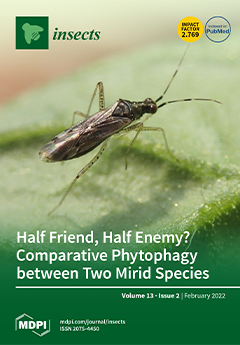
Cover Story: Omnivorous predators are important biological control agents in several vegetable crops. Nesidiocoris tenuis is a mirid used worldwide, and its phytophagy is well known, which is not the case for the Palearctic Dicyphus cerastii. To use the latter in biological control, it is crucial to evaluate the damage it causes on plants. We compared these two mirid species regarding phytophagy under laboratory and semi-field conditions. Both species produced plant damage and caused flower abortion. N. tenuis females produced more damage to tomato fruits. There was an increased frequency of D. cerastii females found on plants over time. Our results suggest that, although D. cerastii causes less damage to tomato fruits than N. tenuis, it does feed on the fruit and can cause floral abortion, requiring field evaluation and caution in its use. View this paper
  • Issues are regarded as officially published after their release is announced to the table of contents alert mailing list .
  • You may sign up for email alerts to receive table of contents of newly released issues.
  • PDF is the official format for papers published in both, html and pdf forms. To view the papers in pdf format, click on the "PDF Full-text" link, and use the free Adobe Reader to open them.

Articles (114)

  • Article
  • Open Access
10 Citations
3,911 Views
9 Pages

21 February 2022

Background: Commensal microbiota live in their host with a symbiotic relationship that affects the host’s health and physiology. Many studies showed that microbial load and composition were changed by aging and observed that increasing the abun...

  • Article
  • Open Access
8 Citations
4,512 Views
17 Pages

21 February 2022

Emphytusmiocenicus sp. nov., first fossil representative of this genus, is described from the upper Miocene of the diatom paleolake of Montagne d’Andance (Ardèche, France). Its placement is ensured by an in-depth comparison with all the extant and fo...

  • Article
  • Open Access
11 Citations
4,669 Views
11 Pages

21 February 2022

Aromia bungii (Faldermann) (Coleoptera: Cerambycidae) is an invasive pest, damaging Rosaceae trees (particularly Prunus) in Japan and Europe. The establishment of this beetle in Japan was first detected in 2012, and subsequently, it has rapidly expan...

  • Communication
  • Open Access
8 Citations
3,240 Views
8 Pages

Wolbachia in Aedes koreicus: Rare Detections and Possible Implications

  • Claudia Damiani,
  • Alessia Cappelli,
  • Francesco Comandatore,
  • Fabrizio Montarsi,
  • Aurelio Serrao,
  • Alice Michelutti,
  • Michela Bertola,
  • Maria Vittoria Mancini,
  • Irene Ricci and
  • Claudio Bandi
  • + 1 author

21 February 2022

The emerging distribution of new alien mosquito species was recently described in Europe. In addition to the invasion of Aedes albopictus, several studies have focused on monitoring and controlling other invasive Aedes species, as Aedes koreicus and...

  • Case Report
  • Open Access
9 Citations
4,257 Views
10 Pages

The Postmortem Interval of Two Decedents and Two Dog Carcasses at the Same Scene Based on Forensic Entomology

  • Liangliang Li,
  • Yinghui Wang,
  • Mingqing Liao,
  • Yanan Zhang,
  • Chengtao Kang,
  • Gengwang Hu,
  • Yi Guo and
  • Jiangfeng Wang

21 February 2022

In this paper, we report the estimation of the minimum PMIs of two human corpses and two dog carcasses using entomological evidence. Corpses of an elderly couple and carcasses of four dogs were found scattered on different floors in a house. The scen...

  • Article
  • Open Access
14 Citations
4,464 Views
12 Pages

Diversity and Molecular Evolution of Odorant Receptor in Hemipteran Insects

  • Jiahui Tian,
  • Youssef Dewer,
  • Haoyuan Hu,
  • Fengqi Li,
  • Shiyong Yang and
  • Chen Luo

21 February 2022

Olfaction is a critical physiologic process for insects to interact with the environment, especially plant-emitted volatiles, during which odorant receptors (ORs) play an essential role in host recognition. Although OR gene evolution has been studied...

  • Article
  • Open Access
16 Citations
4,338 Views
11 Pages

Field and Laboratory Efficacy of Low-Impact Commercial Products in Preventing Olive Fruit Fly, Bactrocera oleae, Infestation

  • Elissa Daher,
  • Nicola Cinosi,
  • Elena Chierici,
  • Gabriele Rondoni,
  • Franco Famiani and
  • Eric Conti

21 February 2022

The olive fruit fly, Bactrocera oleae, is the key pest of olive trees in several areas of the world. Given the need for the development of sustainable control methods, preventive tools, based on the manipulation of pest behaviour, must be considered....

  • Article
  • Open Access
8 Citations
3,786 Views
16 Pages

A Route to Translate a Silk-Based Medical Device from Lab to Clinic: The Silk Biomaterials Srl Experience

  • Giulia Alessandra Bassani,
  • Valentina Vincoli,
  • Marco Biagiotti,
  • Elisa Valsecchi,
  • Marta Virginia Zucca,
  • Claudia Clavelli,
  • Antonio Alessandrino and
  • Giuliano Freddi

21 February 2022

The medical device is a nerve conduit entirely made of Bombyx mori silk fibroin. It is a tubular scaffold used for repairing peripheral nerve gaps, whose function is to protect the severed nerves and to favor their natural healing process. As any imp...

  • Article
  • Open Access
44 Citations
6,081 Views
15 Pages

20 February 2022

The interactions between ambient temperatures and host plants are central to the population dynamics of invasive animal species. Despite significant research into the effects of temperatures, the performance of invasive species is also influenced by...

  • Article
  • Open Access
5 Citations
2,873 Views
14 Pages

18 February 2022

The abdominal and pregenital segments and the genitalia were studied in males of Fannia subpellucens (Zetterstedt, 1845), Fannia canicularis (Linnaeus, 1761) and Fannia incisurata (Zetterstedt, 1838). In comparison with the remaining members of the m...

of 12

Get Alerted

Add your email address to receive forthcoming issues of this journal.

XFacebookLinkedIn
Insects - ISSN 2075-4450