


Abstract
Surface waviness is one of the most important factors affecting bearing vibration. How to effectively control waviness in actual production is a technical challenge in bearing mass production at present. This study established a ball bearing vibration analysis model based on the relationship between raceway waviness and bearing vibration, analyzed the contact between bearing balls and raceway waviness, studied the influence of waviness amplitude A, order nv, ball diameter Dw and rotational speed v on rolling bearing vibration, and given a bearing vibration prediction method and optimization control model based on waviness amplitude and order. Taking the angular contact ball bearing 7008/P4 as an example, experimental verification was carried out with different waviness states in four processes: coarse grinding, fine grinding, ultra-precision and polishing. The error between the model calculation results and the actual test results does not exceed 5%, which had good accuracy and practicality. The results shown that the amplitude of waviness had the greatest influence on vibration, followed by the order of waviness, and the influence was more significant with the increase of rotational speed.
1. Introduction
As an extremely important key basic component, rolling bearings are widely used in important fields such as aerospace, large wind power equipment, weapons and equipment, high-speed railways and buses, automobile industry, industrial equipment, and precision machine tools, with a global annual output value of approximately US$50 billion [1,2,3,4]. Its operating state has a significant impact on the accuracy, reliability and lifespan of the entire mechanical system [5,6,7,8]. Surface waviness is an important index to reflect the microscopic geometry error of part surface. As a key component of mechanical equipment, rolling bearings directly affect the working performance of the entire mechanical system [9,10]. Although the processing technology and accuracy of bearings have been greatly improved, the influence of factors such as machine tool accuracy, fixture positioning error and vibration inevitably leads to shape errors such as waviness on the raceway surface of bearings [11,12]. Therefore, the study of bearing vibration characteristics based on bearing waviness models under actual working conditions is of great significance [13].
Fan et al. [14] investigated the relationship between the waviness observed on the surfaces of bearing raceways and rollers and electrical erosion corrosion. Lou et al. [15] revealed the microscopic characteristics and formation mechanism of bearing waviness damage to the entire machine. Studies have shown that waviness with alternating “bright” and “dark” shapes are produced on GCr15 bearing housings. Garnham et al. [16] studied the relationship between waviness and vibration coefficient of rolling bearings in dry wear tests. Pan et al. [17] established a dynamic model that considers the waviness parameters of the inner and outer rings for the vibration characteristics caused by bearing waviness and local defects and proposed a time-varying displacement excitation local defect model based on piecewise functions. The results show that the proposed model can effectively identify waviness characteristic frequencies (such as ball passage frequency and its harmonics) and local defect impact signals. Harder et al. [18] studied the relationship between the performance of thrust ball bearings under continuous mechanical loads at multiple stages and the degree of waviness. The critical points of gray matte and corrugated surfaces are defined. Song et al. [19] studied the basic manifestations of electrical bearing damage, especially the formation of waviness on the bearing raceway surface and the transformation process of martensite to ferrite. When the current density exceeds 0.95 A/mm2, the wear morphology of the bearing can be observed on the study surface. Zhou et al. [20] analyzed the evolution of contact load and corrugated surface stress during wear failure of cylindrical roller bearings. The results show that the contact stress in the inner raceway is greater than the contact stress in the outer raceway, and the contact stress in both the inner raceway and the outer raceway increases with the increase of the bearing wear level, with the increase in the inner raceway being greater than the increase in the outer raceway. Graf et al. [21] studied the results of durability tests of thrust bearings. Changes in surface waviness were analyzed using the Abbott–Firestone curve. These findings indicate that testing with additional electrical loads resulted in a significant reduction in roughness peaks. Correlation with acceleration measurements is performed. Furthermore, it is indicated that electrical loads may have an effect on light load stiffness. Tauviqirrahman et al. [22] proposed a new concept of the change in waviness on the raceway surface of a bearing after applying a load. The aim is to reduce bearing noise and improve load support without affecting friction. Simulation calculations show that the proposed improved bearing can significantly reduce bearing noise, enhance bearing capacity, and reduce friction. Narwat et al. [23] investigated the effects of bearing surface waviness orientation, turbulence (Reynolds number), and fluid flow coefficient on bearing film pressure, minimum film thickness, frictional torque, and stiffness coefficient. The results indicate that the waviness on the bearing surface tends to provide high film thickness values, but also enhances frictional torque. Litwin [24] studied that the surface waviness of the journal and bushing has an important impact on the performance of bearings. The results show that the waviness height has a great influence on the movement resistance and working performance of bearings. Yunlong et al. [25] established a dynamic model of angular contact ball bearings to study the influence of raceway surface waviness on ball movement and subsurface stress, in which the friction coefficient between the balls and the raceway is evaluated by an engineering method that considers surface waviness and slip-induced temperature rise.
Li et al. [26] studied wheel wear and rolling contact fatigue of subway vehicles under corrugation. Through statistical analysis of field data, the characteristics of ripples under service conditions are determined, and the ripples are applied to the established vehicle-rail coupling dynamics model. Then, the wear index and friction work were studied as wheel wear indexes. The results shown that the increase of surface fatigue index and cumulative fatigue in the wavelength range of 30–90 mm was 1.52 times and 6.16 times that in the wavelength range of 90–210 mm, respectively. Liu et al. [27] studied the friction and wear performance of bearing roller raceway surfaces under different textures in order to improve tribological performance and service life. The results show that the bearing capacity of oil film is obviously improved under cavitation conditions. An increased textured area fraction reduces the coefficient of friction and improves the wear resistance of the contact pair, while an increased texture orientation angle leads to a deterioration in lubrication performance. Yue et al. [28] investigated the friction and wear characteristics of lubricants used in steel and ceramic bearings. The frictional behavior of aerospace lubricants was evaluated in four material pairs over a temperature range from ambient temperature to 170 °C. Meanwhile, the friction characteristics of waviness were studied. The results show that aerospace lubricants exhibit excellent tribological properties in Si3N4-based systems compared to steel/steel systems, characterized by lower friction coefficients and less wear. Hu et al. [29,30,31,32] conducted a comprehensive study on the waviness, vibration and wear characteristics of bearings. The bearing characteristics were comprehensively analyzed through design, manufacturing and service experiments. The results show that the wear of the inner ring is greater than that of the outer ring, and the corrugated surface layer belongs to the nanocrystalline layer, which is about 400 nm. Yin et al. [33,34] used fault diagnosis methods to identify bearing lifespan. At the same time, the algorithm and experimental verification were carried out according to the basic error parameters of bearings (roughness and corrugation), and the basic characteristic signals of bearing life were obtained. In addition, many scholars have conducted detailed research on surface waviness, surface properties, simulation methods [35,36] and surface microscopic changes [37,38,39].
Most of the above references have studied the influence of corrugation on bearing vibration. However, for actual working conditions, ripple degree is a non-directly observable parameter. For example, reference [14] clearly states that the ripple degree is related to electrical erosion corrosion, but it cannot be directly observed in time work. For example, in references [16,21], the authors used corrugation and bearing vibration models to explore the influence between them, and also analyzed the changes in bearing corrugation observed through durability experimental data. But that is just a brief discussion. In order to deeply study the relationship between bearing corrugation and vibration influence, this paper deeply analyzes and constructs the relationship between channel corrugation and bearing vibration and establishes a theoretical model of ball bearing vibration. Meanwhile, based on the contact between bearing balls and raceway corrugations, the influence of the amplitude, order, ball diameter and rotational speed of bearing raceway corrugations on rolling bearing vibration is studied. Through the establishment of bearing vibration prediction method and optimization control model for corrugation amplitude and order, the accuracy of the model is verified by simulation and experiment. This model has high accuracy when studying angular contact ball bearings, and its main range is similar to that of bearings of size 7008. During the experiment, the high-end bearing 7008 was used as the carrier to conduct experiments and verifications on different corrugation states from the processing technology and procedures (four procedures: coarse grinding, fine grinding, ultra-precision, and polishing). The influence factors between bearing manufacturing performance and experimental scheme on bearing vibration and ripple degree are repeatedly explained. This is also the main academic contribution and innovation of this study.
2. Theoretical Model Analysis
2.1. Mathematical Model of Surface Waviness
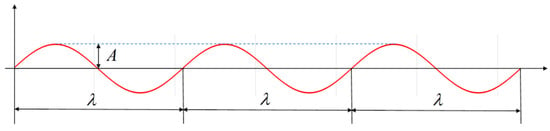
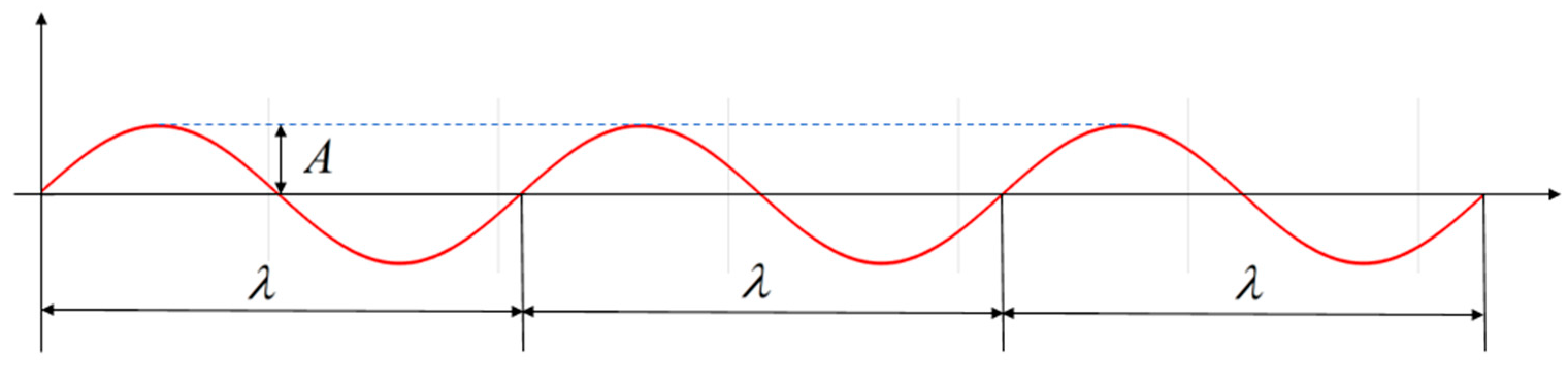
The shape of the surface waviness of the rolling bearing raceway can be assumed to be a sinusoidal waveform, and the wavelength of the waviness is assumed to be much larger than the size of the Hertz contact area between the rolling body and the raceway [40,41,42]. Here, only a single sinusoidal signal is used to simulate and analyze the influence of surface waviness on contact vibration, assuming that surface roughness is described by Equation (1).
where t is time, s. w is the rotational angular velocity of the bearing, rad/s. n is the order of the surface waviness, x(t) is the axial coordinate of a point on the corrugated surface, R is the radius, y(t) is the longitudinal coordinate of a certain point on the waviness surface, which is the waviness value of the ferrule surface, and A is the amplitude of the ripple. Figure 1 is a corrugated surface topography of Equation (1).
Figure 1.
Schematic diagram of bearing groove surface waviness.
2.2. Ripple Excitation Model
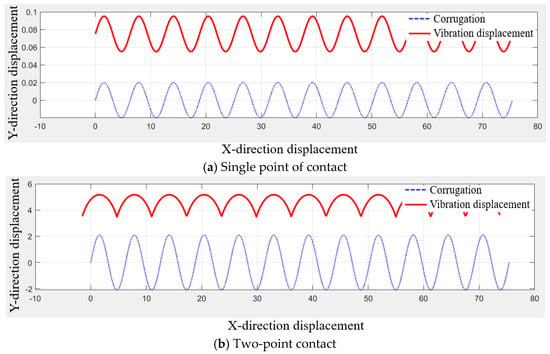
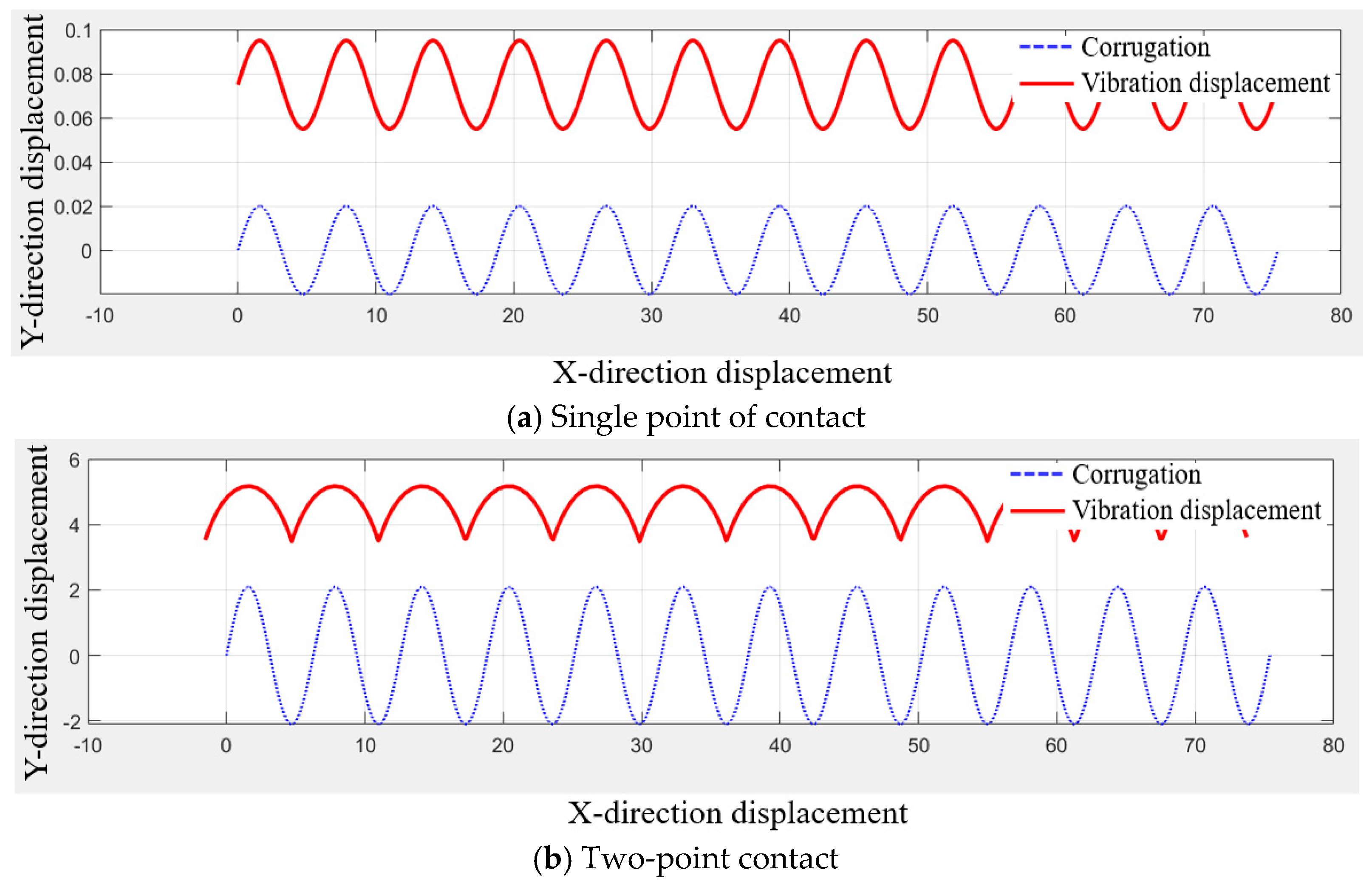
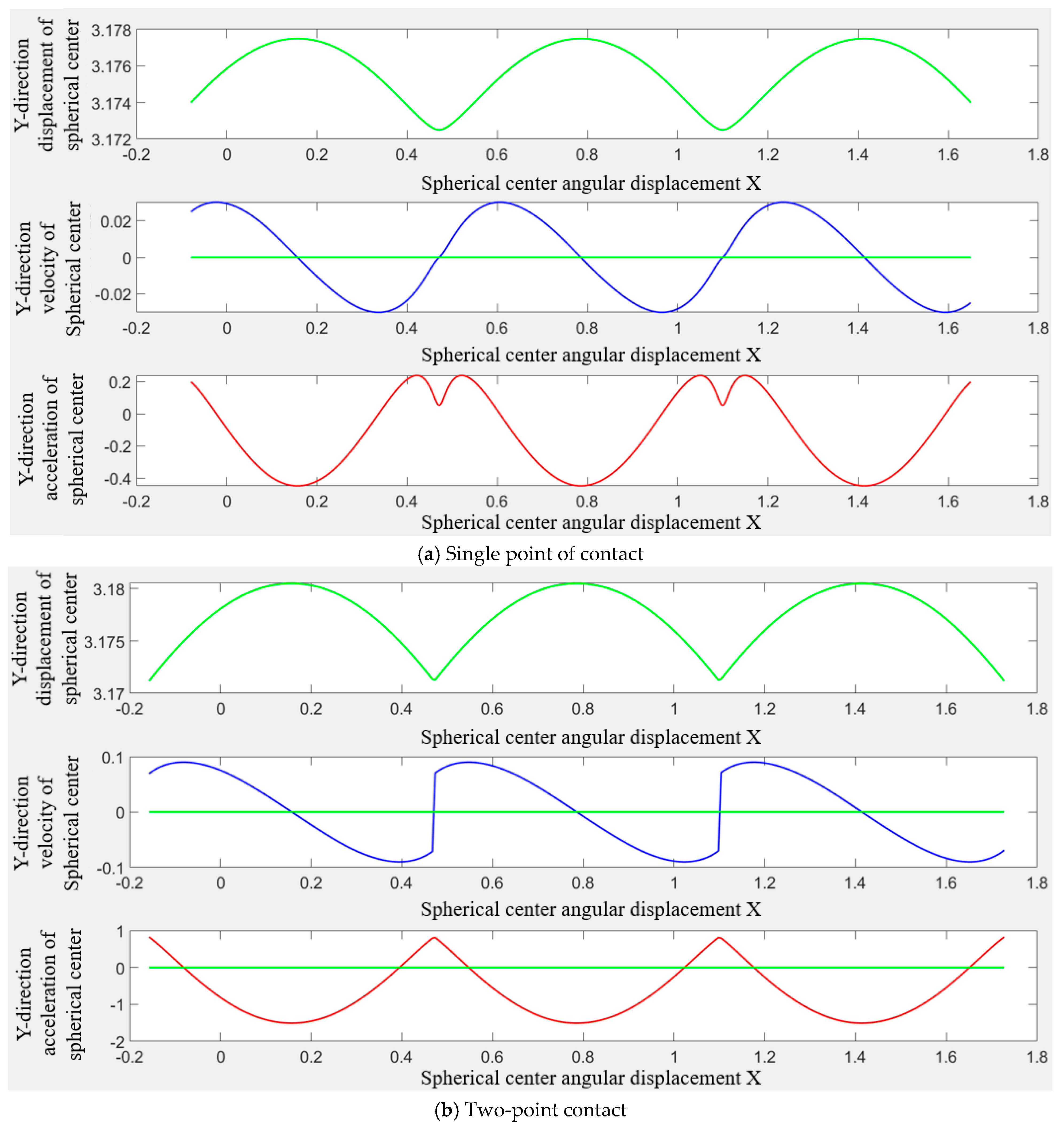
During bearing movement, the longitudinal vibration caused by the waviness degree has its vibration displacement, vibration velocity, and acceleration set to ys, yv, and ya, respectively. Vibration displacement is the change in the displacement of the spherical center in the Y-axis direction. Vibration velocity and acceleration can be obtained by calculating the first and second derivatives of Y(t) respectively according to the general curve Equation (2) of the spherical center trajectory to obtain Equation (3).
The vibration displacement is shown in Equation (2).
The vibration acceleration formula is expanded to Equation (4).
Equation (5) for finding the derivative of vibration acceleration.
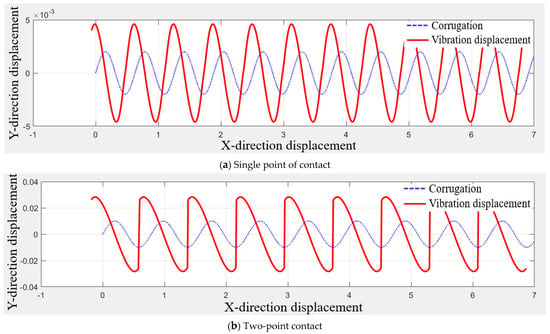
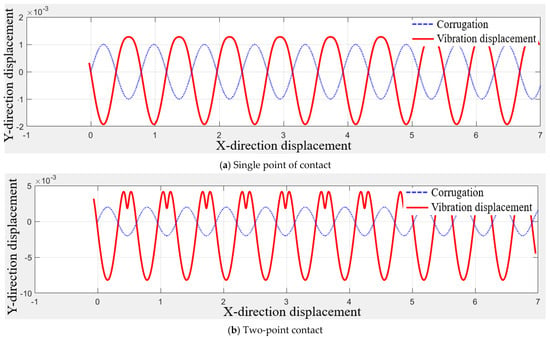
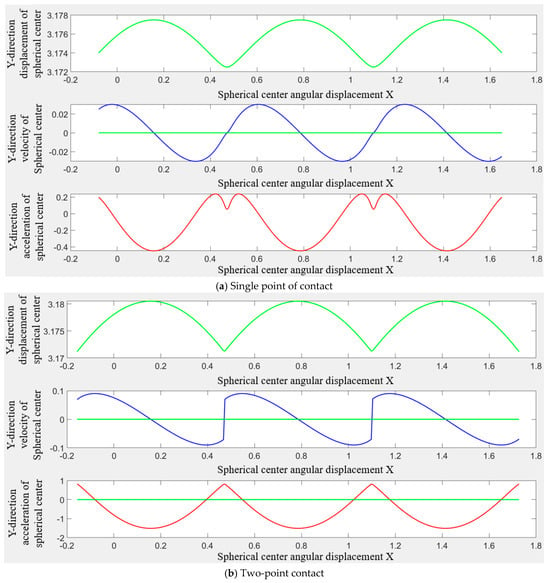
In Equation (5), when x is an integer multiple of π/2, the formula value is 0. That is, the maximum value of vibration acceleration occurs at the integer multiple of π/2. Figure 2 is a schematic diagram of the vibration displacement of single-point and two-point contact. Figure 3 is a schematic diagram of the contact velocity between the ball and the waviness of single-point and two-point contact. Figure 4 is a schematic diagram of the contact acceleration between the ball and the waviness of single-point and two-point contact. Figure 5 is a partially enlarged schematic diagram of the ball and the waviness of single-point and two-point contact.
Figure 2.
Vibration displacement in the time domain.
Figure 3.
Time-domain of the contact vibration velocity between the ball and the waviness.
Figure 4.
Time-domain of vibration acceleration in contact between a ball and waviness.
Figure 5.
Local amplification time domain of vibration parameters in contact between a ball and waviness.
2.3. Excitation Sensitivity Model
Because vibration acceleration can more accurately reflect the influence of surface waviness, this study focused on analyzing the relationship between vibration acceleration and surface waviness and vibration. From the vibration acceleration Equation (4), the waviness amplitude a, the waviness order nv, and the spherical radius R all have an influence on the vibration acceleration [43,44,45].
By calculating the partial derivative of vibration acceleration Equation (4) relative to ripple amplitude A, we can obtain the sensitivity of ripple amplitude A to the influence of vibration acceleration (Equation (6)) [46,47,48].
In the same way, the partial derivatives nv, R, and W can also be calculated for the vibrational acceleration to obtain the sensitivity coefficients of the influence of nv, R, and W on the vibrational acceleration. It is worth noting that the mode approximates a sinusoidal waveform and does not take into account multiple harmonic components, random ripples, load distribution, clearance, lubrication, cage dynamics, and installation errors. Actual bearing surface corrugation usually contains multi-order harmonics, random components, and local inhomogeneity. A single sine wave cannot fully represent the real topography, but it can be used as the smallest explainable unit of corrugation excitation for mechanism analysis and parameter sensitivity research.
2.4. Vibration Test System
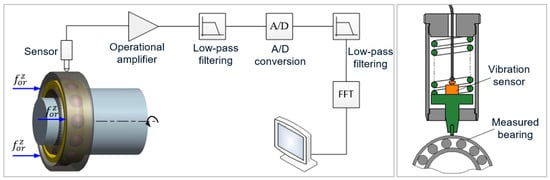
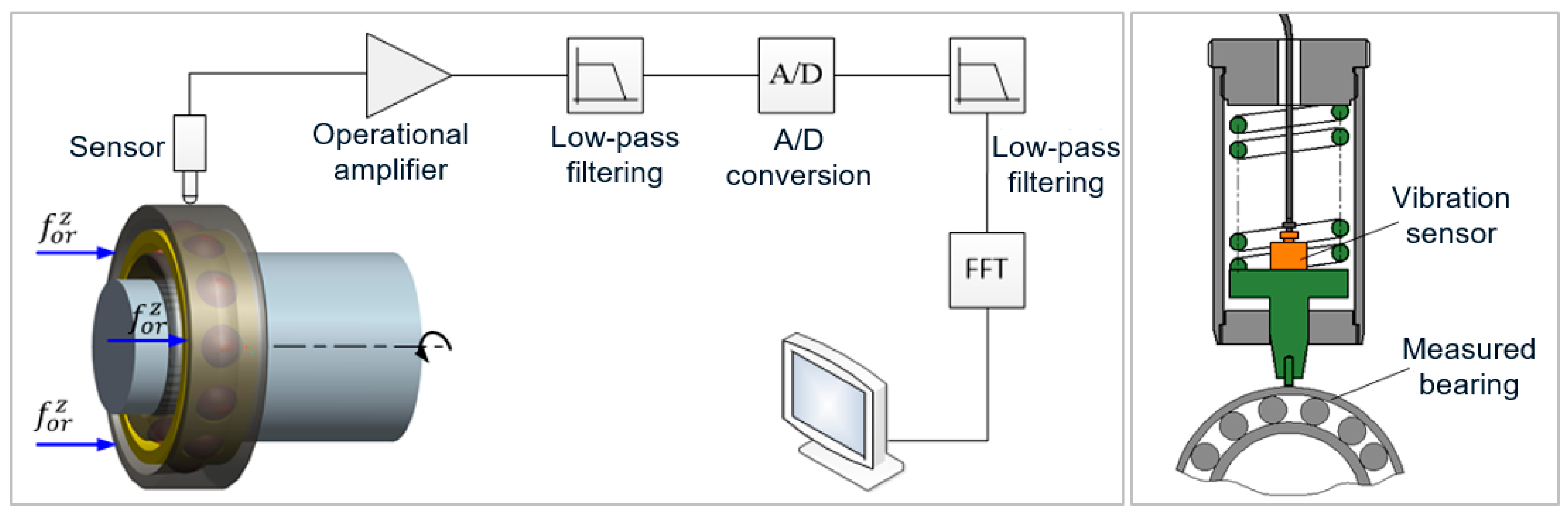
According to the industry standard of rolling bearing vibration measurement, during the measurement, the inner ring of the bearing under test rotates with the main shaft, while the outer ring remains macroscopically stationary. Under the condition of applying a certain external load, the radial vibration value of the outer ring of the bearing was picked up by a speed or acceleration sensor. The vibration sensor was fixed on the measuring rod through bolt connection, one end of the measuring rod was connected with the spring, and the other end was in contact with the outer ring of the bearing being measured. During measurement, the vibration of the outer ring excited the measuring rod, thus forming a mass-spring-contact pair system with sensors [49,50,51,52,53]. Figure 6 is a schematic diagram of the principle of bearing contact vibration detection.
Figure 6.
Bearing contact vibration detection principle.
Before measurement, the bearing to be tested was cleaned and air dried, and lubricating oil applied. It was then mounted on the spindle of the drive device and an axial load was applied. The position of the sensor rod was adjusted so that it was in contact with the outer ring of the bearing. The contact point was located halfway across the width of the outer ring cylindrical surface. During the measurement, the spindle speed was 1800 r/min and the axial load was 200 N. The data was saved after the vibration signal stabilized.
Under high-speed conditions, the influence of vibration acceleration on bearing performance was more significant and intuitive. Therefore, vibration acceleration was generally used to measure the vibration performance of high-speed angular contact ball bearings. Its calculation formula was Equation (7).
where yrms is the root mean square of the vibrational acceleration within a certain frequency range, where the frequency range was usually 50~10,000 Hz; g is the gravitational acceleration, whose value is 9.81 × 10⁻³ m/s2. The value of ya is the comprehensive vibration level of the bearing under test.
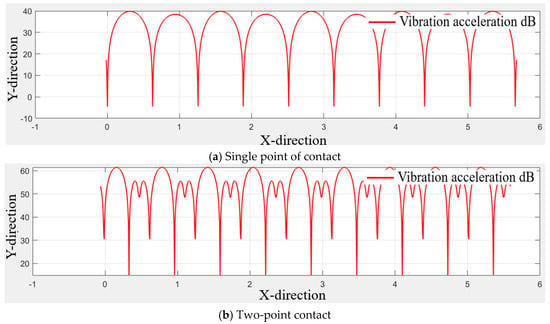
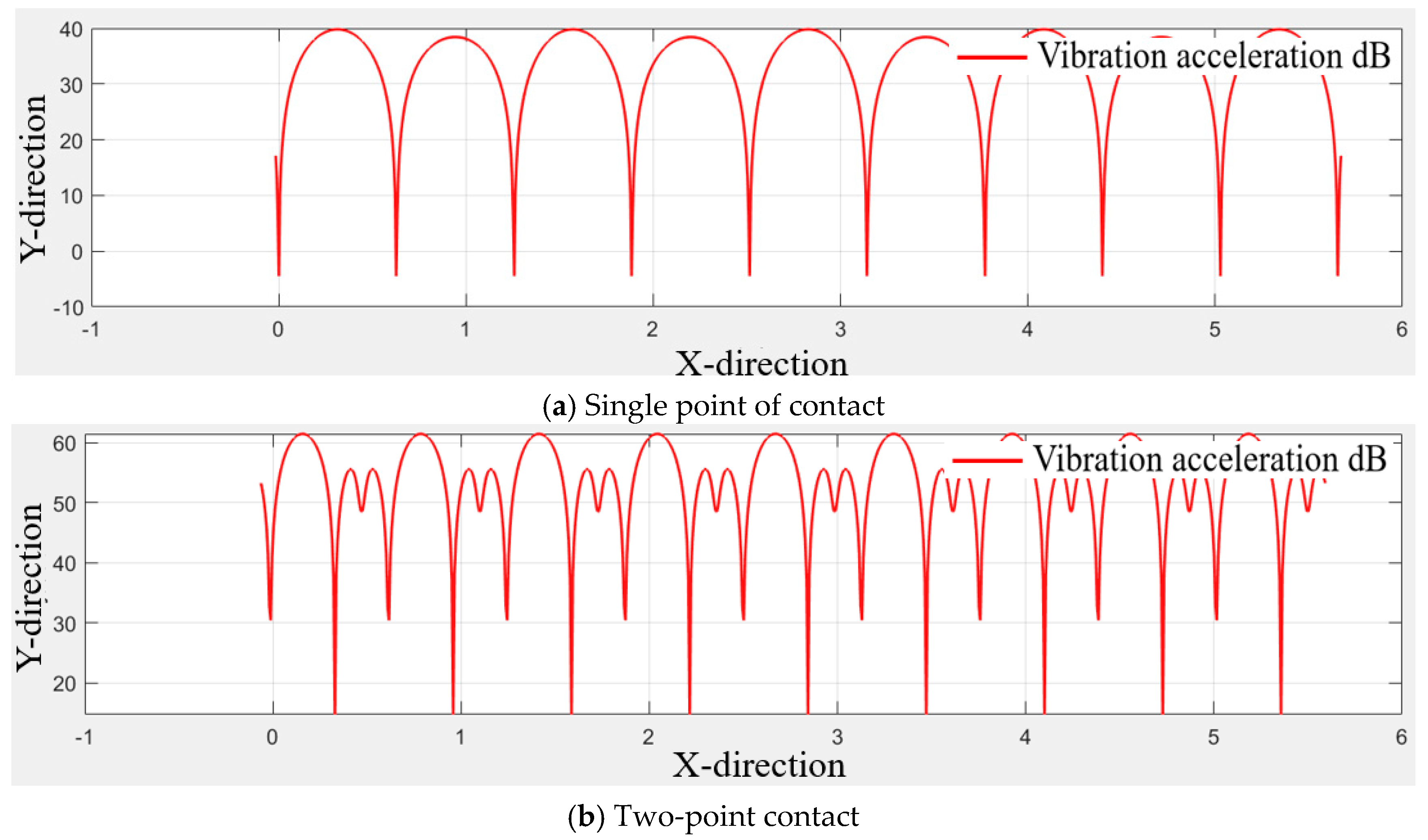
The bearing vibration acceleration was calculated according to Equation (4), and the bearing vibration results measured by the vibration acceleration tester can be predicted by incorporating it into Equation (7). Figure 7 is a schematic diagram of the vibration acceleration test prediction for single-point and two-point contact.
Figure 7.
Schematic diagram of vibration acceleration test prediction.
3. Analysis of Influencing Factors
Based on the basic parameters of angular contact ball bearing 7008/P4, the effects of the contact between the bearing ball and the raceway waviness, the waviness amplitude A and order nv, the rotational speed v and the ball diameter Dw on the vibration of rolling bearings were studied. The basic parameters of the bearing 7008/P4 were shown in Table 1.
Table 1.
Basic parameters of bearing 7008/P4.
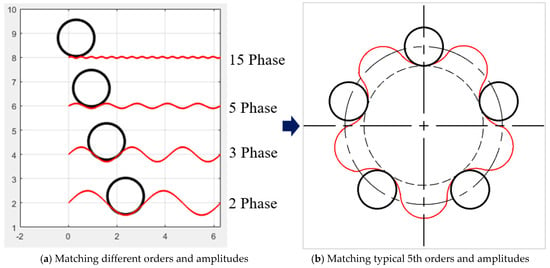
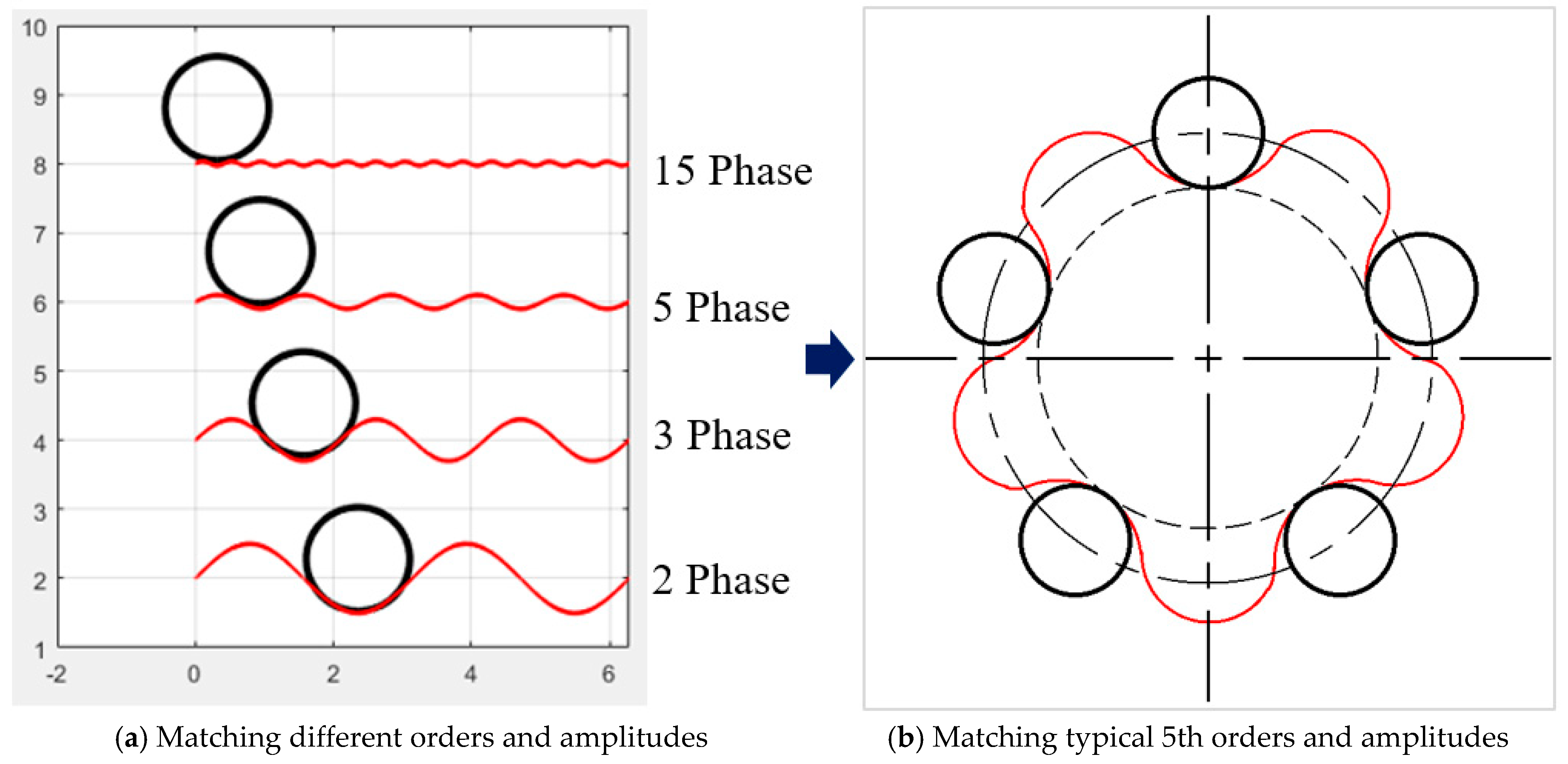
From Equations (1) to (7), given a constant sphere diameter, the order and amplitude of the surface waviness match when a single point comes into contact with the critical value. Table 2 shows the matching of several important orders and amplitudes of the surface waviness when a critical single point makes contact. Figure 8 is a schematic diagram.
Table 2.
Matching of importance order and amplitude.
Figure 8.
Matching ripple order and amplitude.
3.1. Impact of Amplitude
3.1.1. Influence of Amplitude on Vibration
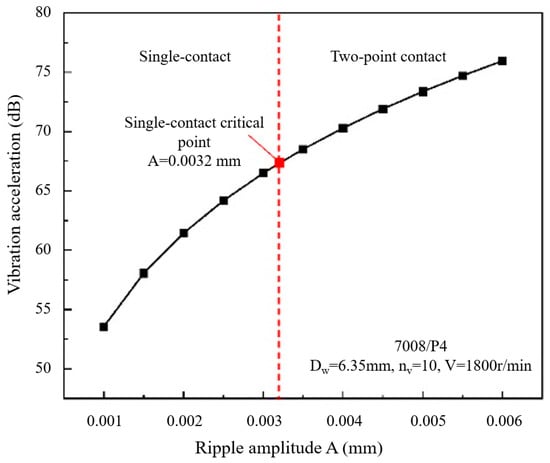
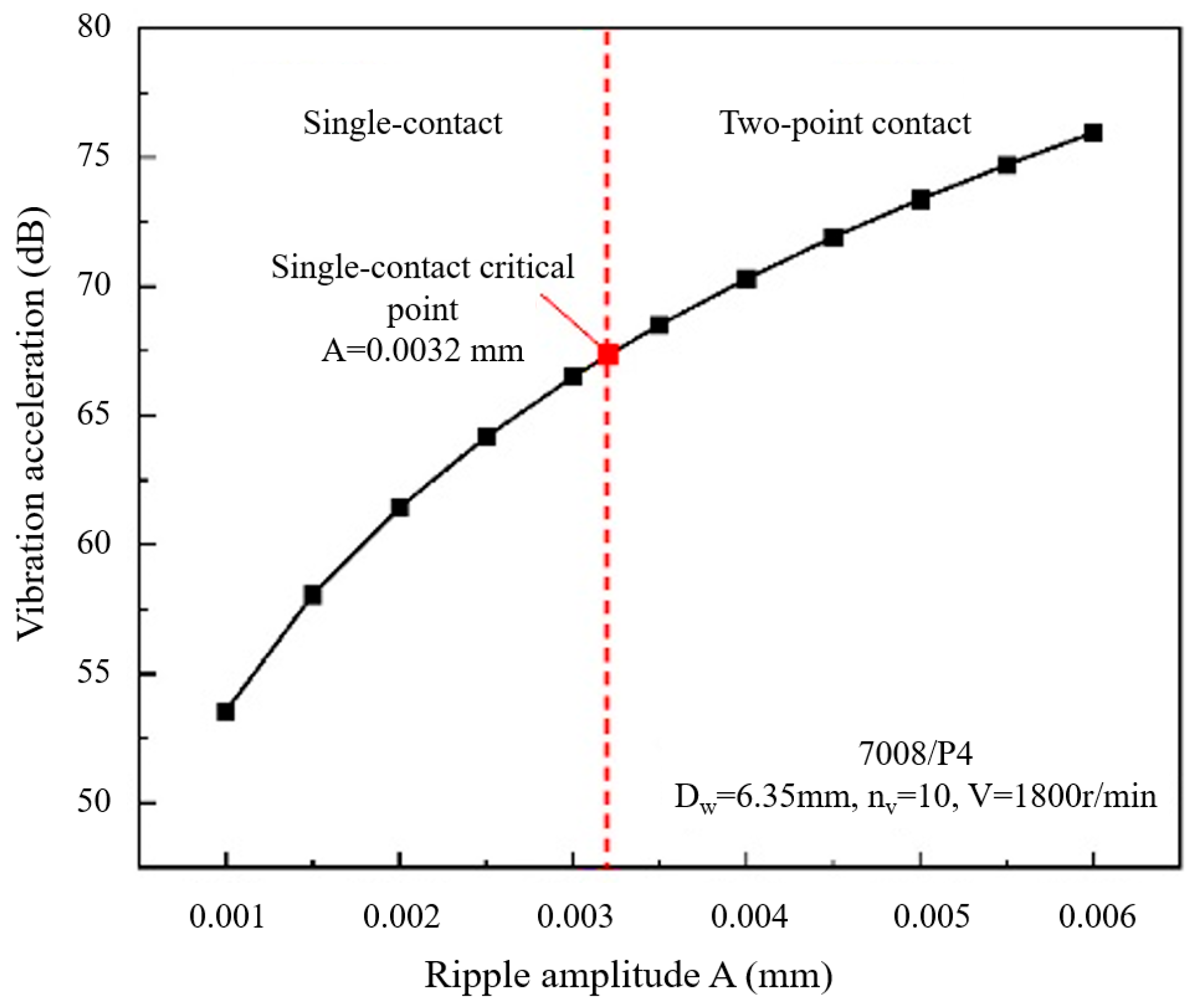
The bearing ball diameter Dw = 6.35 mm and the waviness order nv = 10. As can be seen from Equation (6), when the waviness amplitude A = 0.0032, the ball and the waviness are in exact single-point contact. Therefore, values were taken on both sides of the waviness amplitude A = 0.0032 to observe the influence of the waviness on bearing vibration. The influence of the waviness amplitude on bearing vibration is shown in Table 3.
Table 3.
Influence of waviness amplitude on bearing vibration.
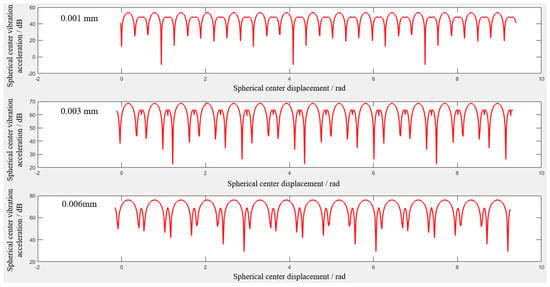
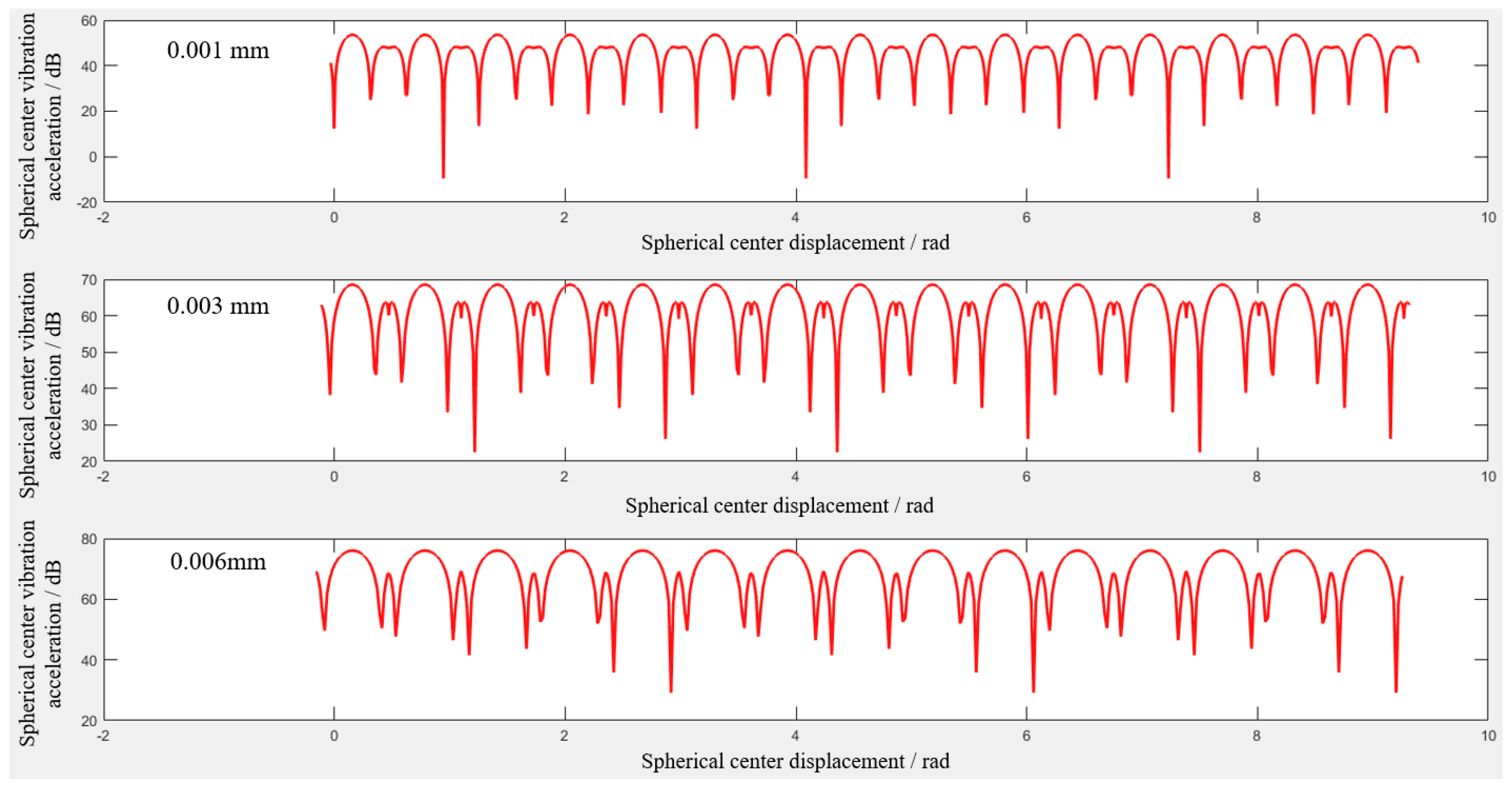
Figure 9 is a schematic diagram of vibration acceleration corresponding to the case where the amplitude A is a minimum value of 0.001 mm, an intermediate value of 0.003, and a maximum value of 0.006, respectively.
Figure 9.
The influence of ripple amplitude on vibration.
To visually display the impact of different amplitudes on bearing vibration acceleration, a trend curve of vibration acceleration as a function of amplitude A is plotted as shown in Figure 10.
Figure 10.
Influence of ripple amplitude on vibration.
For Table 3 and Figure 10, as the amplitude of the ripple increases, the bearing vibration intensifies, and the degree of intensification gradually becomes more moderate. This indicates that as the amplitude increases, its influence on the vibration gradually increases, but the degree of influence weakens. There is no change in vibration acceleration at or near the critical point of single-point contact and two-point contact, indicating that single-point contact and two-point contact have no influence on the maximum vibration acceleration.
3.1.2. Influence of Amplitude on the Sensitivity of Each Factor
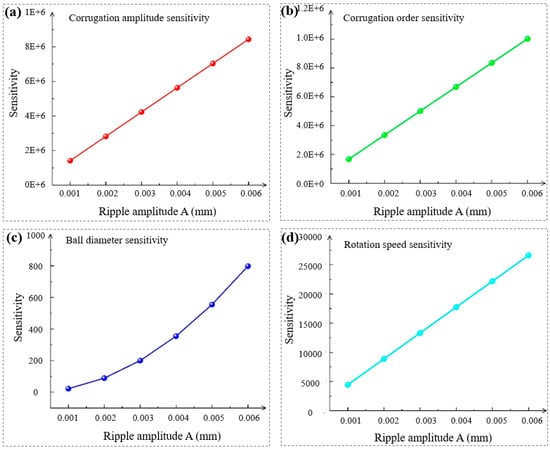
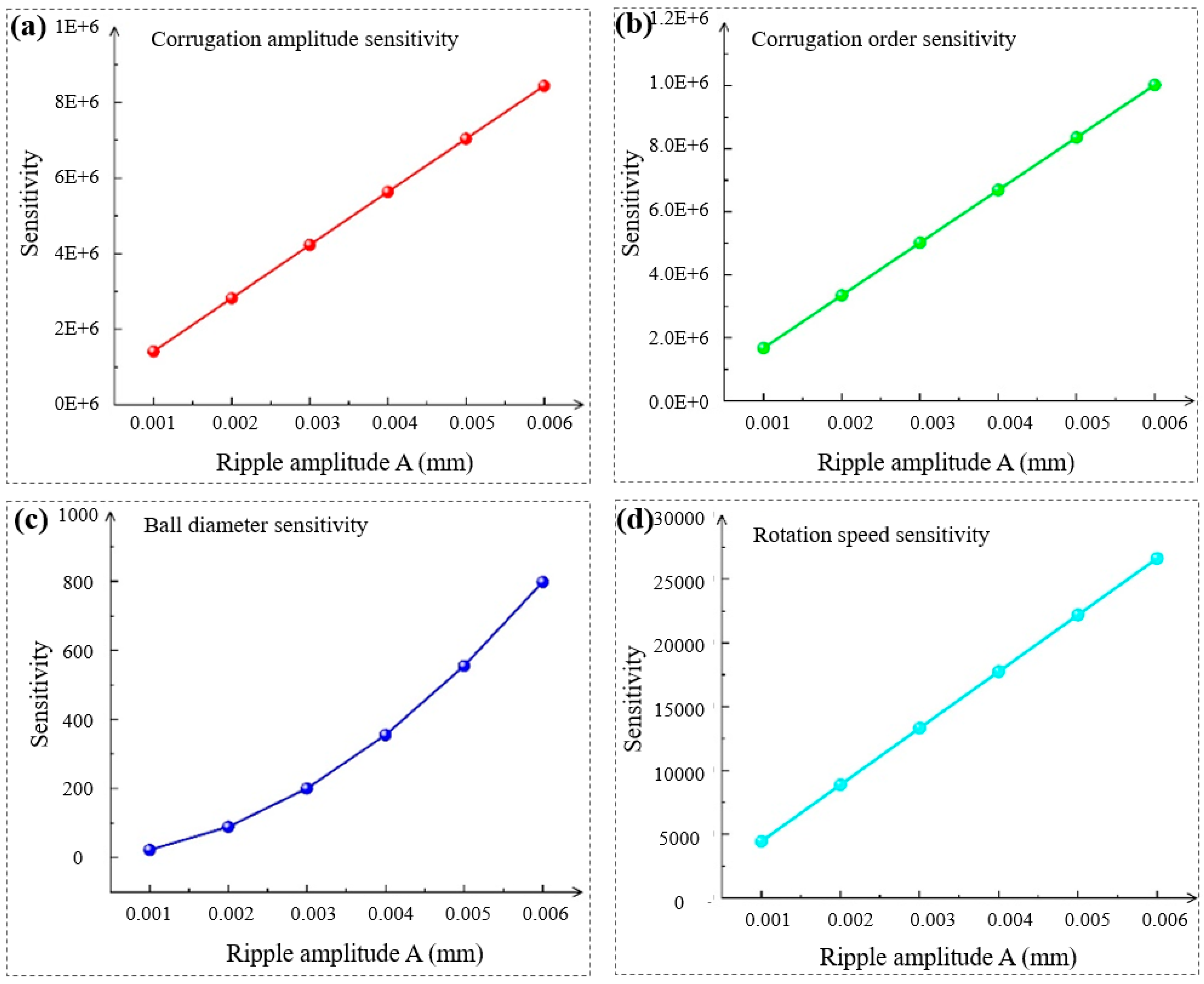
Assuming that the bearing ball diameter Dw = 6.35 mm, the waviness order nv = 5, and the rotation speed v = 1800 r/min remain unchanged, according to Equations (1)–(7), the sensitivity of each factor to bearing vibration at different waviness amplitudes can be obtained under the condition of maximum vibration acceleration. A bar comparison chart and trend curve of the sensitivity of each factor changing with the amplitude A are drawn as shown in Figure 11.
Figure 11.
The influence trend of amplitude on the sensitivity of various factors. (a) Corrugation amplitude sensitivity; (b) Corrugation order sensitivity; (c) Ball diameter sensitivity; (d) Rotation speed sensitivity.
For Figure 11, as the waviness amplitude increases, the sensitivity of the bearing’s waviness amplitude A, waviness order nv, bearing ball diameter Dw, and bearing speed v to vibration all increase. However, the sensitivity of the bearing’s waviness amplitude A, waviness order nv, and bearing speed v to vibration remains unchanged, while the sensitivity of the bearing’s ball diameter Dw increases with the increase in amplitude.
To more intuitively compare the sensitivity of each parameter to vibration as it changes with amplitude, the average of the sensitivities of each parameter is calculated, and the sensitivity of the sphere diameter is used as a reference. The sensitivity of each parameter is divided by the sensitivity of the sphere diameter to obtain a dimensionless value for the sensitivity comparison, as shown in Table 4.
Table 4.
Comparison of mean sensitivity values of each factor with amplitude change.
For Table 4, as the waviness amplitude increases, the influence of bearing waviness amplitude A, waviness order nv, bearing ball diameter Dw, and bearing speed v on vibration varies greatly. The influence of ball diameter was the smallest, and the influence of waviness order was the greatest. The average sensitivity was 1738 times that of ball diameter; the influence of waviness amplitude was also greater, 1464 times that of ball diameter; and the influence of bearing speed was smaller, 46 times that of ball diameter.
3.2. Influence of Order
3.2.1. Effect of Order on Vibration
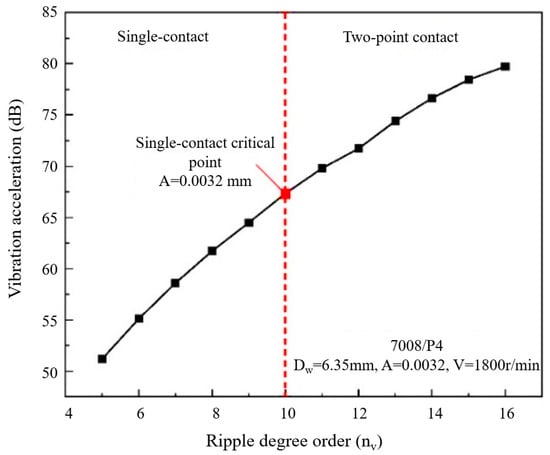
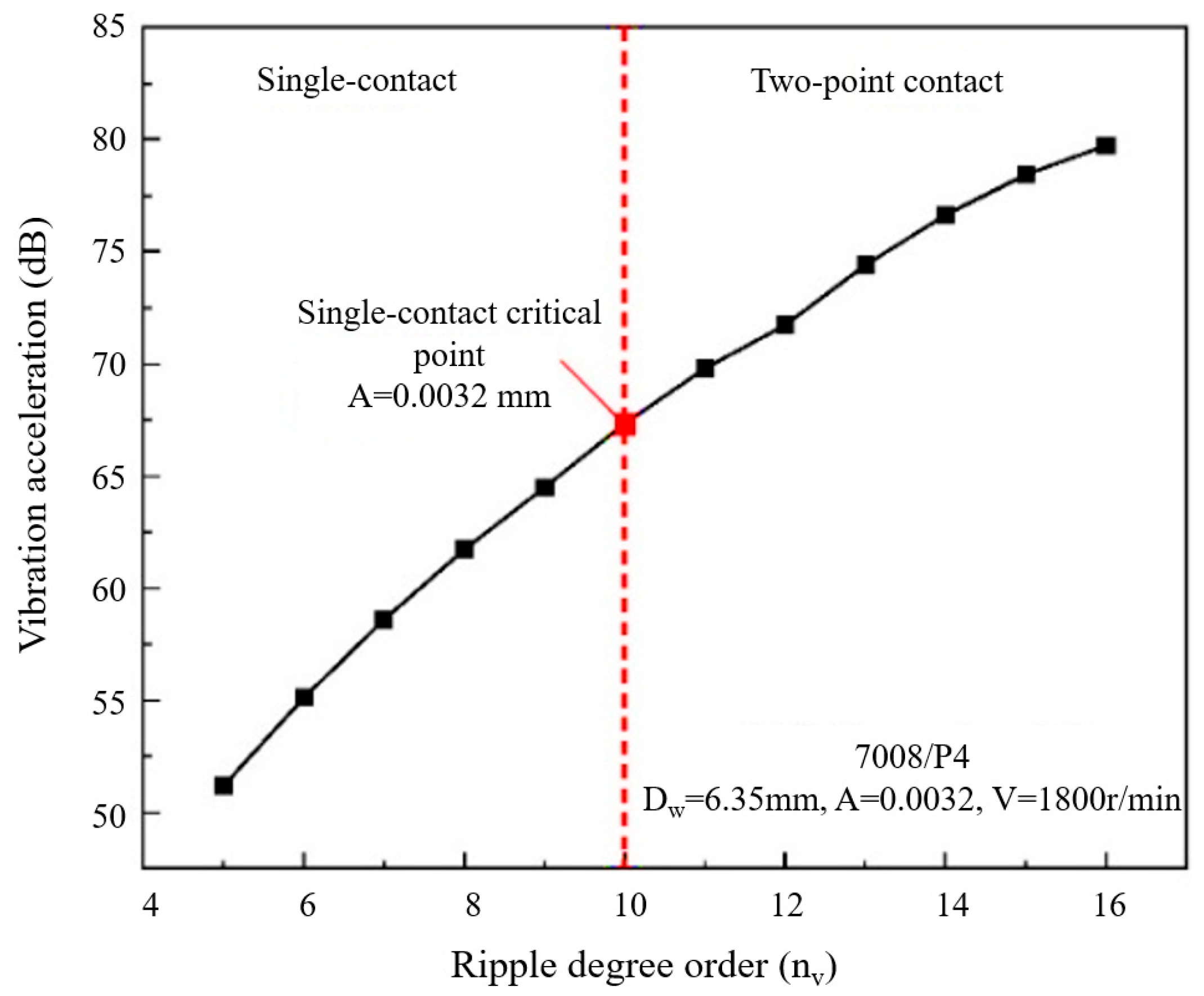
Bearing ball diameter Dw = 6.35 mm, waviness amplitude A = 0.0032, v = 1800 r/min. For Equation (6), when the waviness order nv = 10, the sphere and the waviness were in exact single-point contact. Therefore, values were taken on both sides of the waviness order nv = 10, and the influence of the waviness order nv on bearing vibration was observed. The trend curve of vibration acceleration changing with the order nv was plotted as shown in Figure 12.
Figure 12.
Influence of waviness order on vibration.
For Figure 12, as the waviness order increases, the bearing vibration intensifies, but the degree of intensification remains basically unchanged, indicating that the degree of its influence on vibration remains unchanged as the order increases. There was no change in vibration acceleration at or near the critical point of single-point contact and two-point contact, indicating that single-point contact and two-point contact have no influence on the maximum vibration acceleration.
3.2.2. Influence of Order on the Sensitivity of Each Factor
Bearing ball diameter Dw = 6.35 mm, waviness amplitude A = 0.0032 mm, v = 1800 r/min. According to Equations (1)–(7), the sensitivity of each factor to bearing vibration when taking different waviness orders can be obtained under the condition of maximum vibration acceleration. The calculation results are shown in Table 5.
Table 5.
Sensitivity of each factor at different ripple amplitudes.
For Table 5, as the waviness order increases, the sensitivity of the bearing’s waviness amplitude A, waviness order nv, bearing ball diameter Dw, and bearing speed v to vibration all increase, and the sensitivity becomes greater as the order increases.
To more intuitively compare the sensitivity of each parameter to vibration as a function of order, the average sensitivity of each parameter is calculated, and the sensitivity of the sphere diameter is used as a reference. The sensitivity of each parameter is divided by the sensitivity of the sphere diameter to obtain a dimensionless value for the sensitivity comparison, as shown in Table 6.
Table 6.
Comparison of average sensitivity values of each factor with order change.
For Table 6, as the waviness order increases, the influence of bearing waviness amplitude a, waviness order nv, bearing ball diameter Dw, and bearing speed v on vibration varies greatly. The influence of ball diameter was the smallest, while the influence of waviness amplitude was the largest, which was 1978 times that of ball diameter. Other influences were smaller. The average sensitivity of waviness order was 354 times that of ball diameter, and the bearing speed was 23 times that of ball diameter.
3.3. Influence of Ball Diameter
3.3.1. Influence of Ball Diameter on Vibration
The waviness n amplitude A = 0.0032, the waviness order nv = 10, and the rotation speed v = 1800 r/min. For Equation (6), when the bearing ball diameter Dw = 6.35 mm, the ball and the waviness were in exact single-point contact. Therefore, values were taken on both sides of the ball diameter Dw = 6.35 mm to see the influence of waviness on bearing vibration. The calculation results are shown in Table 7.
Table 7.
Influence of ripple amplitude on bearing vibration.
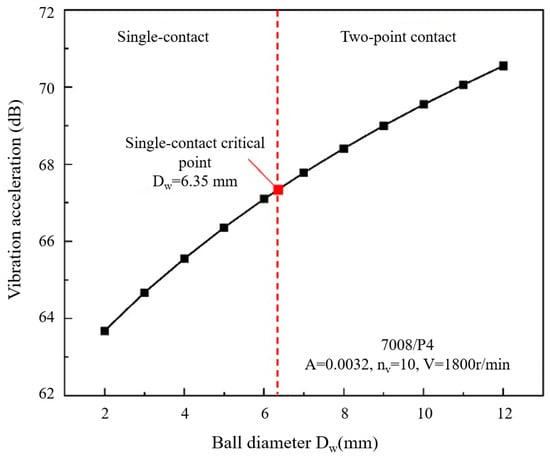
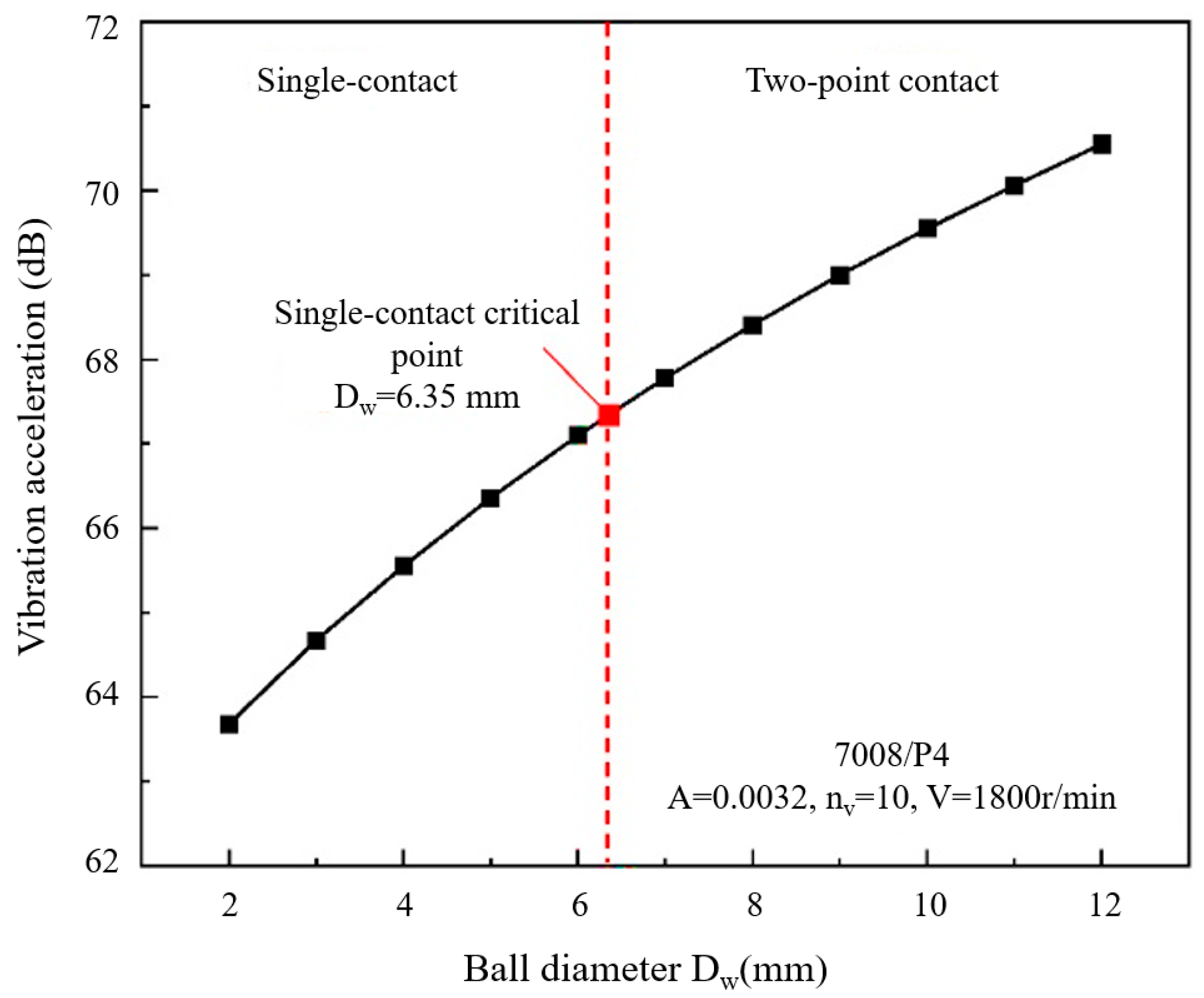
To visually display the impact of different ball diameters on bearing vibration acceleration, a trend curve of vibration acceleration versus ball diameter Dw was plotted as shown in Figure 13.
Figure 13.
Effect of bearing ball diameter on vibration.
For Table 7 and Figure 13, bearing vibration intensifies as the ball diameter of the bearing increases, but the degree of intensification remains basically unchanged, indicating that the degree of influence on vibration remains unchanged as the ball diameter increases. There was no change in vibration acceleration at or near the critical point of single-point contact and two-point contact, indicating that single-point contact and two-point contact have no influence on the maximum vibration acceleration.
3.3.2. Influence of Ball Diameter on Sensitivity of Various Factors
The waviness amplitude A = 0.0032 mm, the waviness order n = 10, and the rotation speed v = 1800 r/min. According to Equations (1)–(7), the sensitivity of each factor to bearing vibration under the condition of maximum vibration acceleration can be obtained by taking different ball diameters (set as a series of positive integers for ease of study). The calculation results are shown in Table 8.
Table 8.
Sensitivity of various factors at different sphere radii.
For Table 8, as the ball diameter increases, the sensitivity of the bearing waviness amplitude A to vibration increases, the sensitivity of waviness order nv and the bearing speed v to vibration both decrease, and the sensitivity of the bearing ball diameter Dw to vibration remains unchanged.
To more intuitively compare the sensitivity of each parameter to vibration as it changes with amplitude, the average of the sensitivities of each parameter was calculated, and the sensitivity of the sphere diameter was used as a reference. The sensitivity of each parameter was divided by the sensitivity of the sphere diameter to obtain a dimensionless value for the sensitivity comparison, as shown in Table 9.
Table 9.
Comparison of average sensitivity values of various factors with changes in sphere diameter.
For Table 9, as the waviness order increases, the sensitivity of bearing waviness amplitude a, waviness order nv, bearing ball diameter Dw, and bearing speed v to vibration varies greatly. The influence of ball diameter was the smallest, while the influence of waviness amplitude was the largest, which was 4057 times that of ball diameter. Other influences were smaller. The average sensitivity of the waviness order was 587 times that of ball diameter, and the bearing speed was 31 times that of ball diameter.
3.4. Influence of Rotational Speed
3.4.1. Influence of Rotational Speed on Vibration
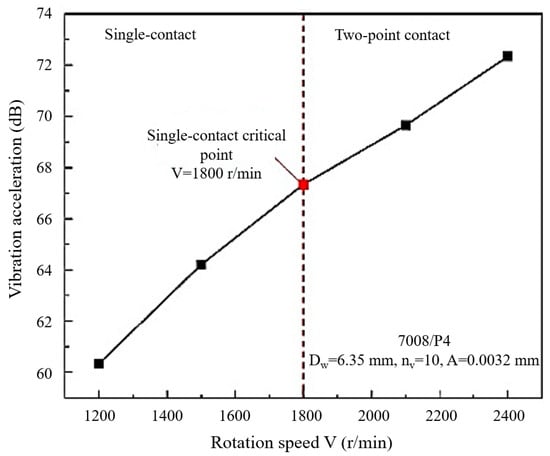
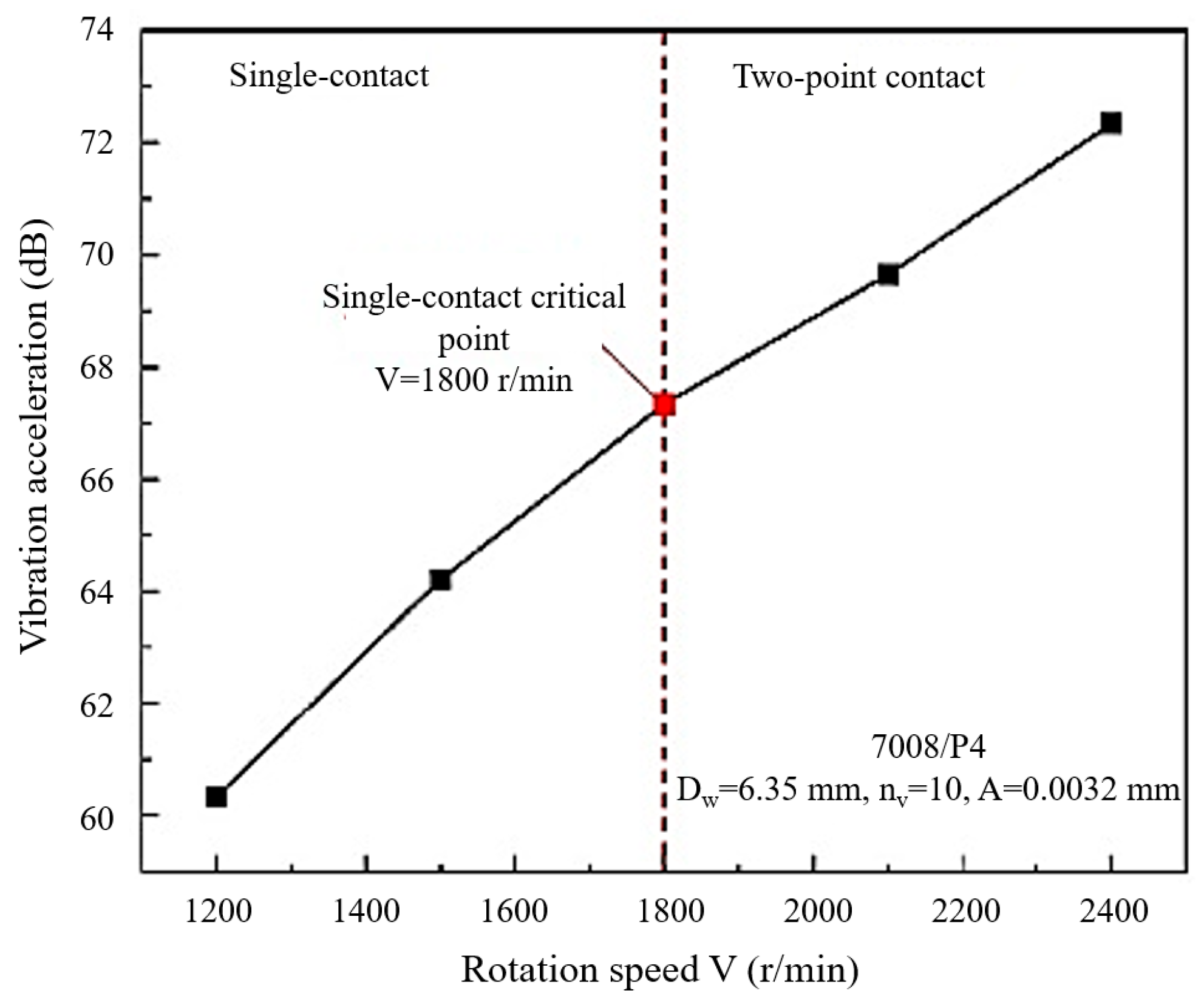
The bearing ball diameter Dw = 6.35 mm, the waviness order n = 10, and the waviness amplitude A = 0.0032. For Equation (6), when the rotation speed v = 1800 r/min, the ball and the waviness were in exact single-point contact. Therefore, values were taken on both sides of the rotational speed v = 1800 r/min to see the influence of surface waviness on bearing vibration, and the trend curve of vibration acceleration changing with bearing rotational speed v is plotted as shown in Figure 14.
Figure 14.
Effect of bearing speed on vibration.
For Figure 14, the bearing vibration intensifies as the rotation speed increases, but the degree of intensification remains basically unchanged, indicating that the degree of its influence on vibration remains unchanged as the rotation speed increases. There is no change in vibration acceleration at or near the critical point of single-point contact and two-point contact, indicating that single-point contact and two-point contact have no influence on the maximum vibration acceleration.
3.4.2. Influence of Rotational Speed on Sensitivity of Various Factors
The bearing ball diameter Dw = 6.35 mm, the waviness amplitude A = 0.0032 mm, and the waviness order nv = 10. According to Equations (1)–(7), the sensitivity of each factor to bearing vibration at different rotational speeds can be obtained under the condition of maximum vibration acceleration. The calculation results are shown in Table 10.
Table 10.
Sensitivity of each factor at different rotational speeds.
For Table 10, as the waviness order increases, the sensitivity of the bearing’s waviness amplitude A, waviness order nv, bearing ball diameter Dw, and bearing speed v to vibration all increases, and the sensitivity becomes greater as the order increases.
To more intuitively compare the sensitivity of each parameter to vibration as it changes with amplitude, the average of the sensitivities of each parameter is calculated, and the sensitivity of the sphere diameter is used as a reference. The sensitivity of each parameter is divided by the sensitivity of the sphere diameter to obtain a dimensionless value for the sensitivity comparison, as shown in Table 11.
Table 11.
Comparison of average sensitivity values of various factors as a function of rotational speed.
For Table 11, as the waviness order increases, the sensitivity of bearing waviness amplitude a, waviness order nv, bearing ball diameter Dw, and bearing speed v to vibration varies greatly. The influence of ball diameter was the smallest, while the influence of waviness amplitude was the largest, which was 1981 times that of ball diameter. Other influences were smaller. The average sensitivity of waviness order was 650 times that of ball diameter, and the bearing speed was 31 times that of ball diameter.
4. Vibration Prediction and Model Verification
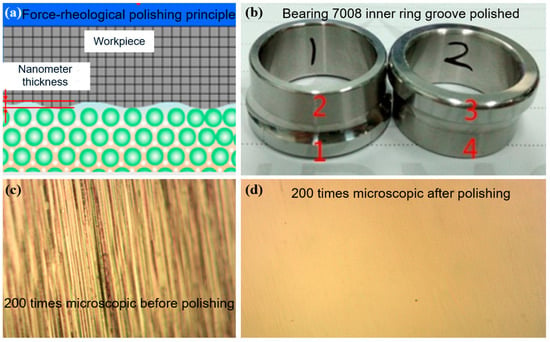
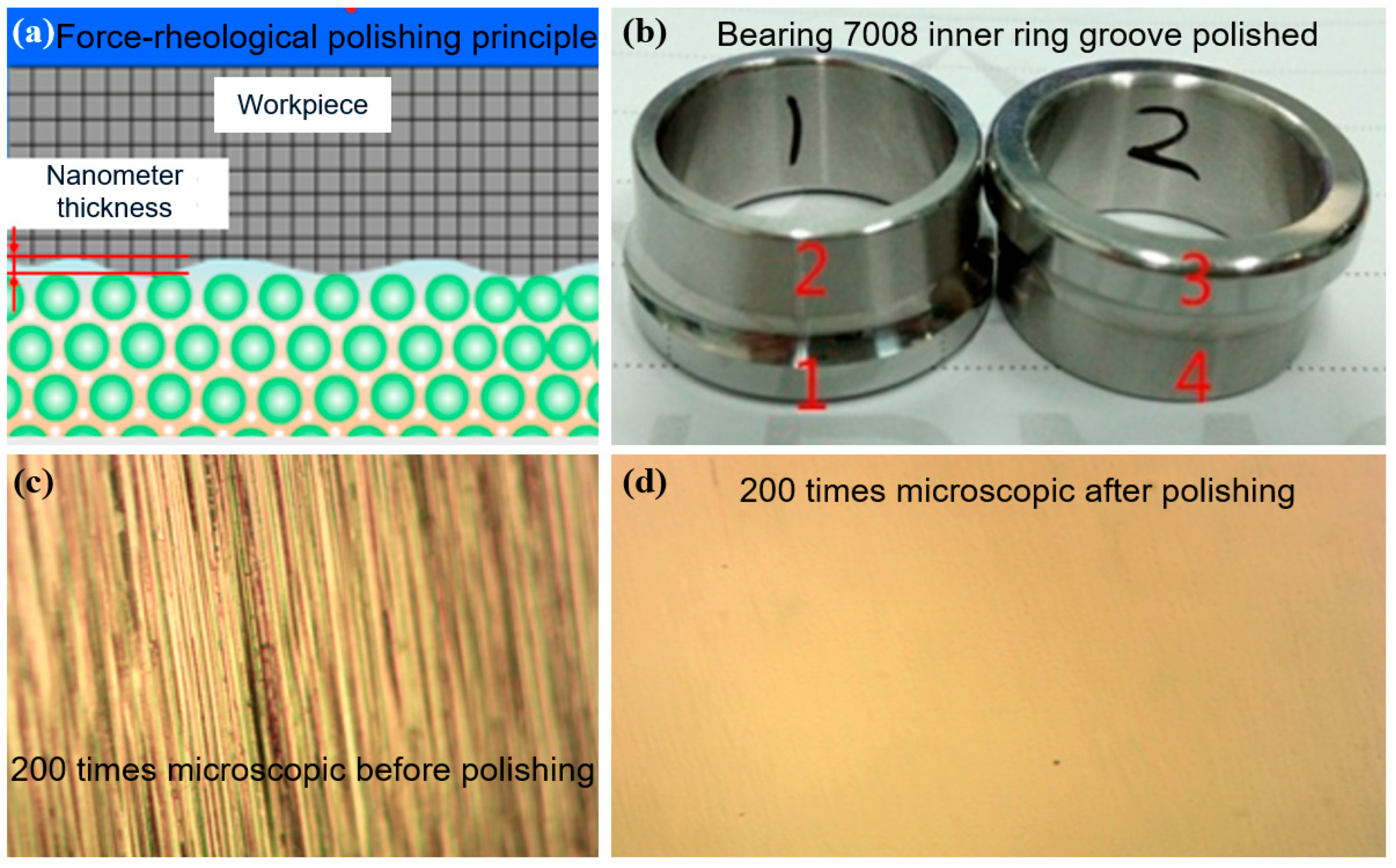
Taking 7008C/P4 as an object, five inner rings of this model of bearing were selected for coarse grinding, fine grinding, and ultra-fine grinding, respectively. In addition, five inner rings after ultra-fine grinding were selected for force-rheological polishing. During the experiment, many scholars also studied various sensors [54,55,56], thereby analyzing the surface roughness after final polishing. The principle of force-rheological polishing and the comparison of the surface quality of the front and rear bearings are shown in Figure 15.
Figure 15.
Principle of force-rheological polishing and surface quality of front and rear bearings. (a) Force-rheological polishing principle; (b) Bearing 7008 inner ring groove polished; (c) 200 times microscopic before polishing; (d) 200 times microscopic after polishing.
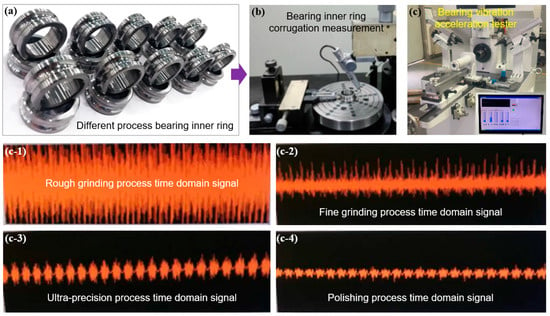
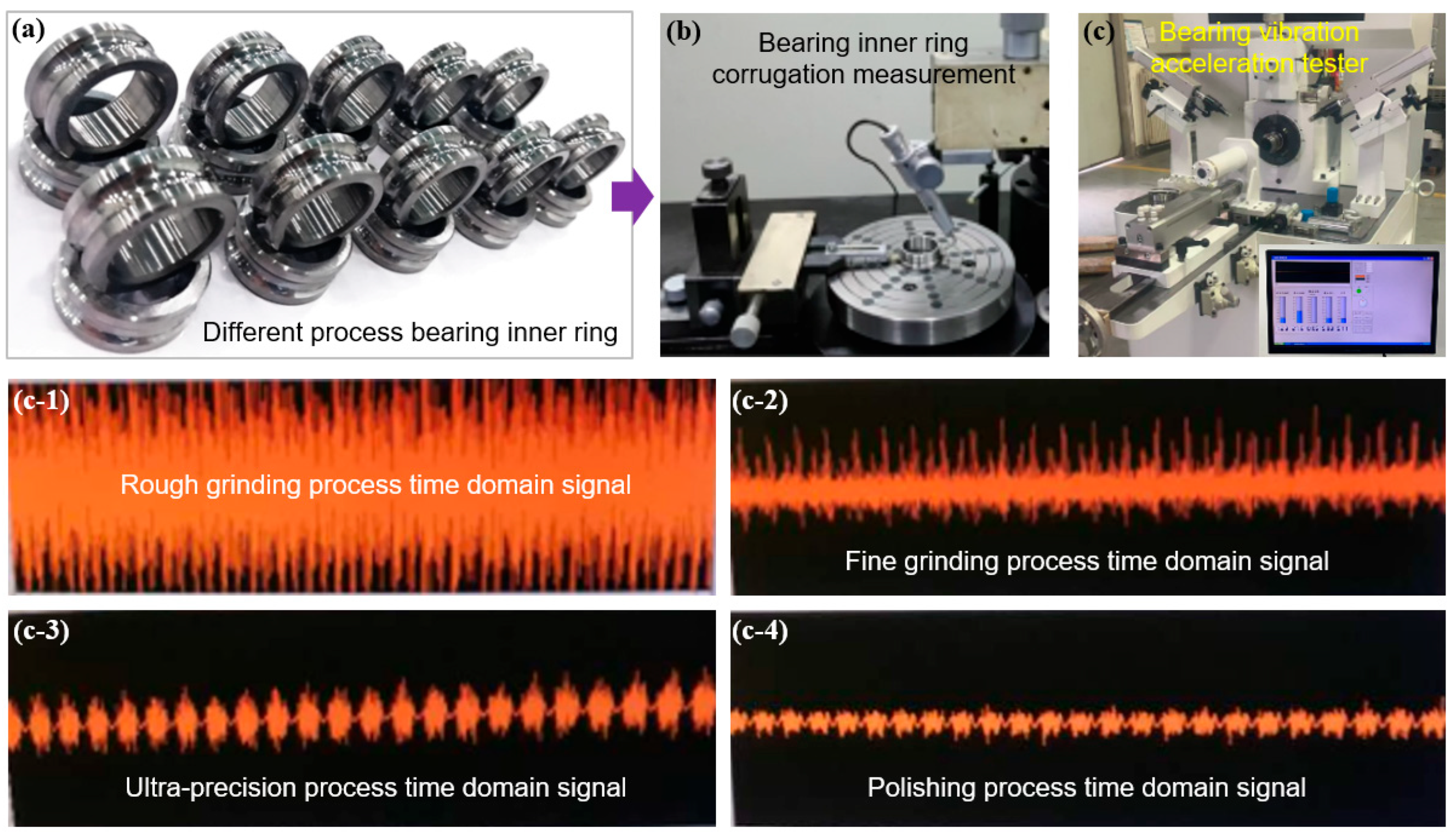
For the outer ring, finished outer rings with basically consistent waviness accuracy after ultra-precision were selected. High-precision steel balls (G5) were selected for the rolling elements, and four sets of five sets of bearings each were assembled for a total of 20 sets of bearings. Because the accuracy of bearing balls is high and the accuracy of the outer ring of the bearing is basically consistent, the influence of the surface quality of the outer ring and the steel ball on bearing vibration was negligible. Meanwhile, in order to reduce the workload, this paper only takes the 15th order of surface waviness and its amplitude as an example for illustration. The detection records of the ripple amplitudes for each group are shown in Table 12, where Av is the measured average. Figure 16a,b show the measurement of the bearing inner ring and waviness amplitude in different processes. Figure 16c is bearing vibration acceleration tester. Figure 16(c-1),(c-2),(c-3),(c-4) are time domain signals for different processes.
Table 12.
Bearing waviness amplitude test record.
Figure 16.
Comprehensive data measurement results under different processes.
Assuming the rotation speed v = 1800 rpm, the vibration acceleration corresponding to the waviness amplitude value detected in each process was calculated using a model, as shown in Table 13, where Gv is the average value of the vibration acceleration calculation.
Table 13.
Vibration acceleration values of bearing 7008.
The bearings after four processes were tested using a precision bearing vibration accelerometer. The rotation speed v of the detector S0910C(ZYS, CHINA, group standards) was 1800 rpm. The test results are shown in Table 14, where Gv0 is the average value of the vibration acceleration detection.
Table 14.
Bearing 7008 vibration acceleration values.
As shown in Table 13 and Table 14, as the machining precision increases and the surface quality of the bearing ring improves; the bearing vibration value also decreases significantly, and the deviation range of the vibration acceleration time domain signal also becomes significantly narrower and more uniform, as shown in Figure 16(c-1),(c-2),(c-3),(c-4). Table 15 shows the comparison and relative error between the calculated average of the model and the actual measured average.
Table 15.
Model calculation results and actual mean error.
For Table 15, the waviness amplitudes detected in each process and the corresponding vibration model’s calculated vibration values are basically consistent with the trend of changes in the actual detected vibration values. According to [1 − (max predicted value/max actual value)] × 100% = max mean error. The maximum average phase difference error does not exceed 5%, and the vibration analysis model calculation results are correct and highly accurate.
5. Conclusions
This study conducts in-depth research on the relationship between surface waviness and bearing vibration of angular contact ball bearings, obtains the influence law of waviness on bearing vibration, and proposes a precision angular contact ball bearing vibration prediction method and optimization control strategy based on the order and amplitude of waviness. The main research conclusions are as follows:
(1) Based on the relationship between the sinusoidal wave model of corrugation and the motion trajectory of the spherical center, this paper establishes a waviness excitation model and analyzes the excitation mechanism. During measurement, the inner ring of the bearing under test rotates with the main shaft, while the outer ring remains macroscopically stationary. Under the condition of applying a certain external load, the vibration value of the outer ring of the bearing along the radial direction is picked up by a velocity or acceleration sensor. Meanwhile, a bearing vibration acceleration analysis model based on waviness degree and a quantitative calculation method for the influence of the order and amplitude of waviness degree on vibration are given.
(2) Based on the basic parameters of angular contact ball bearing 7008/P4, this paper presents a bearing vibration prediction method and optimization control model based on waviness amplitude and order, and studies the influence of waviness-induced contact excitation between balls and raceway, waviness amplitude A and order nv, rotational speed v and ball diameter Dw on rolling bearing vibration. The results show that the amplitude of waviness has the greatest influence on vibration, followed by the order of waviness, and the influence is more significant with the increase of rotational speed.
(3) Taking the angular contact ball bearing 7008/P4 as an example, the experiment verified the different waviness states of the four processes of coarse grinding, fine grinding, ultra-precision grinding and polishing. The error between the model calculation results and the actual test results is no more than 5%, which has good accuracy and practicality.
Author Contributions
B.S. and D.W.: Writing—original draft. N.J., Y.G. and Y.S.: Writing—review & editing, Formal analysis. L.H.: Methodology, Conceptualization. All authors have read and agreed to the published version of the manuscript.
Funding
This research was funded by the National Natural Science Foundation of China (52505496), (52675601); Open Project of Anhui Province Key Laboratory of Critical Friction Pair for Advanced Equipment (LCFP-2512); Postdoctoral Fellowship Program of China Postdoctoral Science Foundation (GZC20250909) and National Key R&D Program of Manufacturing Basic Technology and Key Components (2023YFB2406400).
Data Availability Statement
No new data were created or analyzed in this study. Data sharing is not applicable to this article.
Conflicts of Interest
Author Lai Hu was employed by the company Hefei Bolin Advanced Materials Co., Ltd.; authors Dongfeng Wang and Ning Jin were employed by the company Luoyang Bearing Science and Technology Co., Ltd.; and author Yanjun Guo was employed by the company China Academy of Machinery Science and Technology Group Co., Ltd. The remaining authors declare that this research was conducted in the absence of any commercial or financial relationships that could be construed as a potential conflict of interest.
References
- Hu, L.; Wang, D.; Heow Pueh, L.; Wang, Z. Fatigue Failure of High Precision Spindle Bearing under Extreme Service Conditions. Eng. Fail. Anal. 2024, 25, 158. [Google Scholar] [CrossRef] [Scilit]
- Yu, G.; Liu, J.; Hu, L.; Jiang, A.; Wang, L. Motion system modeling and acceleration analysis of five-axis hybrid machine tool. Adv. Eng. Inform. 2026, 71, 104368. [Google Scholar] [CrossRef] [Scilit]
- Chen, G.; Yuan, L.; Chen, H.; Dou, C.; Ma, G.; Li, S. Machine tool spindle temperature field parametric modeling and thermal error compensation. Lubricants 2025, 13, 548. [Google Scholar] [CrossRef] [Scilit]
- Liu, J.; Li, H.; Song, C.; Wang, Q.; Ma, W.; Zhang, J. Balancing surface finish and ablation depth in direct laser turning of RB-SiC based on combined IPSO-SVR models with MOAHA-TOPSIS method. Opt. Laser Technol. 2026, 194, 114440. [Google Scholar] [CrossRef] [Scilit]
- Huang, S.; Liu, Z.; Li, Y.; Liu, C. Granular boundary layer induces drilling nonlinearity. Powder Technol. 2026, 474, 122306. [Google Scholar] [CrossRef] [Scilit]
- Hu, L.; Ye, J.; Cui, B.; Wang, Z.; Wang, Y. Prediction and evaluation of the influence of static-dynamic aging wear of grease on life of high performance bearings (HPBs). Eng. Fail. Anal. 2025, 179, 109829. [Google Scholar] [CrossRef] [Scilit]
- Ren, H.; Miao, Z.; Feng, X.; Labidi, A.; Zhao, Y.; Wang, C. Modulating the built-in electric field of S-scheme heterojunction via oxygen vacancies for boosting photocatalytic ciprofloxacin degradation. Chin. Chem. Lett. 2026, 37, 112557. [Google Scholar] [CrossRef] [Scilit]
- Hu, L.; Li, B.; Pueh, L.H.; Wang, Z.; Wang, Y. Effect of single/multi-particle grinding parameters on surface properties of bearing steel GCr15. Eng. Sci. Technol. An. Int. J. 2024, 58, 101851. [Google Scholar] [CrossRef] [Scilit]
- Chen, L.; Wang, Y.; Li, Y.; Zhang, Z.; Xue, Z.; Ban, X.; Hu, C.; Li, H.; Tian, J.; Mu, W.; et al. Effect of Nickel content and cooling rate on the microstructure of as cast 316 stainless steels. Crystals 2025, 15, 168. [Google Scholar] [CrossRef] [Scilit]
- Wang, S.; Yang, H.; Jiao, G.; Ren, M.; Li, X. ECG analog front end circuit-A review. Measurement 2026, 267, 120566. [Google Scholar] [CrossRef] [Scilit]
- Anami, K.; Sause, R.; Abbas, H.H. Fatigue of web-flange weld of corrugated web girders: 1. influence of web corrugation geometry and flange geometry on web-flange weld toe stresses. Int. J. Fatigue 2005, 27, 373–381. [Google Scholar] [CrossRef] [Scilit]
- Wu, X.; Ouyang, X.; Tian, J.; Zheng, Y.; Yuan, J.; Wang, W.-W.; Zuo, Y.; Fu, H.; Yu, W.; Wang, R. Self-sensing mechanism and theoretical model of prestressed FRP-ECC multifunctional composite beams under bending loads. Structures 2026, 87, 111585. [Google Scholar] [CrossRef] [Scilit]
- Hu, L.; Jia, P.; Wang, Z.; Wang, Y. Study on type of magnetic suspension rotor groove and wear of drop touchdown bearing. Eng. Appl. Comput. Fluid Mech. 2024, 10, 2422065. [Google Scholar] [CrossRef] [Scilit]
- Fan, Y.; Yang, J.; Gao, S.; Liu, J.; Ma, T. Experimental study on the evolution of electro-erosion waves in bearing rollers under current-carrying conditions. Sci. China Technol. Sci. 2026, 69, 1820302. [Google Scholar] [CrossRef] [Scilit]
- Lou, Z.; Song, C.; Ren, Y.; Pang, X.; Lu, H.; Du, S.; Zhang, Y. Formation of corrugated damage on bearing race under different AC shaft voltages. Materials 2024, 17, 859. [Google Scholar] [CrossRef] [Scilit] [PubMed]
- Garnham, J.E.; Brightling, J.R.; Beynon, J.H. Rolling-sliding dry wear testing—A vibration analysis. Wear 1988, 124, 45–63. [Google Scholar] [CrossRef] [Scilit]
- Pan, W.; Chen, Y.; Han, C.; Wang, J.; Bao, J. Rolling bearing fault vibration characteristic analysis software system accounting waviness and local defects. Int. J. Reliab. Saf. 2026, 20, 282–309. [Google Scholar] [CrossRef] [Scilit]
- Harder, A.; Zaiat, A.; Becker-Dombrowsky, F.M.; Puchtler, S.; Kirchner, E. Investigation of the voltage-induced damage progression on the raceway surfaces of thrust ball bearings. Machines 2022, 10, 832. [Google Scholar] [CrossRef] [Scilit]
- Song, C.; Ren, Y.; Huang, Q.; Zhang, Y.; Li, Y.; Cheng, J.; Pang, X.; Zhang, Y. Effect of shaft voltage on electric damage of GCr15 bearing material. Tribol. Int. 2024, 200, 110139. [Google Scholar] [CrossRef] [Scilit]
- Zhou, R.; Li, M.; Liu, H.; Pan, W.; Zhang, R.; Liu, Y. Theoretical and experimental study on the evolution of contact load during wear failure of cylindrical roller bearings. Eng. Fail. Anal. 2025, 169, 109218. [Google Scholar] [CrossRef] [Scilit]
- Graf, S.; Koch, O. Changes in surface topography and light load hardness in thrust bearings as a reason of tribo-electric loads. Lubricants 2024, 12, 303. [Google Scholar] [CrossRef] [Scilit]
- Tauviqirrahman, M.; Jamari, J.; Setiyana, B.; Muchammad, M.; Prabowo, D. Performance analysis of a new design concept of journal bearing with surface roughness. J. Tribol. 2023, 38, 1–18. [Google Scholar]
- Narwat, K.; Kumar, V.; Singh, S.J.; Kumar, A. Performance analysis of circular and lemon bore hydrodynamic journal bearing considering surface roughness and shear thinning effect. In Aerospace and Associated Technology; Routledge: London, UK, 2022; pp. 101–105. [Google Scholar] [CrossRef] [Scilit]
- Litwin, W. Influence of surface roughness topography on properties of water-lubricated polymer bearings: Experimental research. Tribol. Trans. 2011, 54, 351–361. [Google Scholar] [CrossRef] [Scilit]
- Yunlong, W.; Wenzhong, W.; Shengguang, Z.; Ziqiang, Z. Effects of raceway surface roughness in an angular contact ball bearing. Mech. Mach. Theory 2018, 121, 198–212. [Google Scholar] [CrossRef] [Scilit]
- Li, X.; Wang, Y.; Pu, G.; Wang, K. Research on the Wheel Wear and Rolling Contact Fatigue of Metro Vehicle Induced by Rail Corrugation. Tribol. Trans. 2024, 67, 1168–1179. [Google Scholar] [CrossRef] [Scilit]
- Liu, X.Y.; Yin, M.; Liu, C.Y.; Sun, J.; Shi, X.; Geng, L.; Yin, M. Effect of rolling surface texture on bearing friction pairs lubrication. iScience 2026, 29, 116521. [Google Scholar] [CrossRef] [Scilit] [PubMed]
- Yue, L.; Liu, C.; Xin, Q.; Xu, W.; Wang, B.; Bai, P. Effect of temperature on the friction performance and mechanisms of Si3N4 and steel interfaces in oil-lubricated term rolling bearing. Ind. Lubr. Tribol. 2025, 77, 1360–1369. [Google Scholar] [CrossRef] [Scilit]
- Hu, L.; Li, B.; Wang, Z.; Wang, Y. Analysis and evaluation of multi-state wear mechanism of elastic-flexible thin-walled bearings. Tribol. Int. 2025, 202, 110293. [Google Scholar] [CrossRef] [Scilit]
- Hu, L.; Li, W.; Li, B.; Cui, B.; Wang, Z.; Wang, Y. Wear characteristics and mechanism evaluation of high-speed petal magnetic rotor series bearings (HPMRSBs) in vacuum. Compos. Part B Eng. 2025, 313, 113369. [Google Scholar] [CrossRef] [Scilit]
- Hu, L.; Wang, Z.; Wang, J.; Wang, Y. Derivative Analysis and Evaluation of Roll-slip Fretting Wear Mechanism of Ultra-thin-walled Bearings under High Service. Wear 2024, 562–563, 205630. [Google Scholar] [CrossRef] [Scilit]
- Hu, L.; Pueh, L.H.; Wang, Z.; Wang, Y. Surface performance control and evaluation of precision bearing raceway with wireless sensing CBN grinding wheel. Wear 2025, 568, 205966. [Google Scholar] [CrossRef] [Scilit]
- Yin, C.; Dong, Y.; He, J.; Wang, Y. A fault evolution knowledge-driven adversarial meta-learning method for few-shot tool state recognition under variable working conditions. Eng. Appl. Artif. Intell. 2026, 167, 113806. [Google Scholar] [CrossRef] [Scilit]
- Yin, C.; Sun, T.; Wu, H.; Dong, Y. Trustworthy multistep-ahead remaining useful life prediction for rolling bearings with limited data. Reliab. Eng. Syst. Saf. 2025, 267, 111902. [Google Scholar] [CrossRef] [Scilit]
- Huang, S.; Liu, Z.; Yin, Y.; Liu, C. Generalizing Resistive Force Theory: Revealing and Modeling Nonlinear Intrusion Resistance in Solid-like Granular Matter. J. Mech. Phys. Solids 2026, 216, 106765. [Google Scholar] [CrossRef] [Scilit]
- Wang, Y.; Huang, Q.; Xu, Z.; Wei, Z.; Zhang, X.; Zhang, Y.; Liu, W.; Qi, J. The investigation of flocculation and deposition of heavy components in the crude oil tank based on experiment and molecular simulation. Fuel 2023, 353, 129217. [Google Scholar] [CrossRef] [Scilit]
- Chen, L.; Li, S.-Y.; Zhu, S.-Y.; Wang, T.; Huang, Q.-X. Physicochemical co-evolution of SUS304 ultra-thin steel foils induced by laser and its effect on interface bonding of steel/CFRP joints. J. Iron Steel Res. Int. 2026, 32, 80. [Google Scholar] [CrossRef] [Scilit]
- Liu, M.; Tian, J.; Zhao, J.; Sun, Y.; Liang, J.; Zheng, Y.; Zhang, W.; Wu, X.; Yuan, J.; Fu, H. Seismic performance of CFRP-strengthened steel fiber reinforced concrete composite columns: Experimental, numerical and theoretical analyses. Constr. Build. Mater. 2025, 505, 144692. [Google Scholar] [CrossRef] [Scilit]
- Tian, J.; Li, G.; Wu, X.; Yu, W.; Zuo, Y.; Yuan, J.; Wang, W.-W.; Fu, H.; Liu, M.; Wang, R. Self-sensing performance and theoretical model for the interface of self-sensing engineered cementitious composites and conductive concrete under shear loading. Case Stud. Constr. Mater. 2025, 23, e05618. [Google Scholar] [CrossRef] [Scilit]
- Yin, C.; Li, Y.; Wang, Y.; Dong, Y. Physics-guided degradation trajectory modeling for remaining useful life prediction of rolling bearings. Mech. Syst. Signal Process. 2025, 224, 112192. [Google Scholar] [CrossRef] [Scilit]
- Hu, L.; Ye, J.; Wang, Z.; Wang, Y. Evaluation of Active Magnetic Bearing System (AMB-S) and Touchdown Bearings (TDBs) Failure and Wear. Results Eng. 2026, 32, 113523. [Google Scholar] [CrossRef] [Scilit]
- He, H.; Wang, P.; Li, X.; Zhang, Y.; Zhang, X. Highly reliable RS-PUF based on reconfigurable gas sensor array. IEEE Sens. J. 2024, 24, 16875–16882. [Google Scholar] [CrossRef] [Scilit]
- Yan, J.; Chen, B.; Zhang, F.; Cheng, Y.; Wang, H.; Wang, H.; Wang, M.; Li, T.; Zhang, W. Meta-learning-based graph convolutional wavelet network for intelligent dynamic modeling of high-speed rail subsystems. IEEE Trans. Veh. Technol. 2026, 1–16. [Google Scholar] [CrossRef] [Scilit]
- Nan, Y.; Yu, J.; Li, X.; Wang, P.; Zheng, Y.; Wang, S. Temperature Compensation Method for Gas Sensors Based on Lightweight Mixture of Experts (MoE). IEEE Sens. J. 2025, 21, 25. [Google Scholar] [CrossRef] [Scilit]
- Xue, Z.; Yang, K.; Li, Y.; Pei, C.; Hou, D.; Zhao, Q.; Wang, Y.; Chen, L.; Chen, C.; Mu, W. The Influence of Heat Treatment Process on the Residual Ferrite in 304L Austenitic Stainless Steel Continuous Casting Slab. Materials 2025, 18, 3724. [Google Scholar] [CrossRef] [Scilit] [PubMed]
- Han, X.; Wang, S.; Yu, J.; Wang, P.; Li, X. Design of PUF based on a Cr2O3-SnO2 gas sensor for Internet of Things security. Measurement 2026, 276, 121395. [Google Scholar] [CrossRef] [Scilit]
- Ni, L.; Huang, X.; Chen, X.; Pu, J.; Wang, A.; Xin, S.; Meng, Y. In-memory unified TRNG and PUF based on RRAM random switching time. IEEE Trans. Electron Devices 2025, 72, 6729–6739. [Google Scholar] [CrossRef] [Scilit]
- Šafář, M.; Dütsch, L.; Harničárová, M.; Valíček, J.; Kušnerová, M.; Tozan, H.; Kopal, I.; Falta, K.; Borzan, C.; Palková, Z. Comprehensive prediction model for analysis of rolling bearing ring waviness. J. Manuf. Mater. Process. 2025, 9, 220. [Google Scholar] [CrossRef] [Scilit]
- Tabaszewski, M.; Firlik, B. Detection of the presence of rail corrugation using convolutional neural network. Eng. Trans. 2022, 70, 339–353. [Google Scholar] [CrossRef]
- Li, D.; Ye, J.; Chen, G.; Hu, L.; Wang, Z.; Qian, T. Performance evaluation of a halbach permanent magnet axial protection bearing under vertical magnetic levitation flywheel rotor drop. Lubricants 2026, 14, 40. [Google Scholar] [CrossRef] [Scilit]
- Demas, N.G.; Lorenzo-Martin, C.; Luna, R.; Erck, R.A.; Greco, A.C. The effect of current and lambda on white-etch-crack failures. Tribol. Int. 2023, 189, 108951. [Google Scholar] [CrossRef] [Scilit]
- Li, C.; Liu, P.Y.; Zhao, M.M.; Zhang, Y.F.; Bao, H.F.; Yang, M.; Chen, Y.Z.; Zhong, G.M. Regulation mechanism of dielectric constant onion transport behavior in vinylidene fluoride-based solid composite electrolytes. Electrochim. Acta 2026, 573, 149499. [Google Scholar] [CrossRef] [Scilit]
- Xue, Z.; Hou, D.; Chen, L.; Su, Z.; Liang, J.; Ma, S.; Li, Z.; Yang, K.; Sun, Y.; Chen, C. Effect of Nickel Content and Cooling Rate on the Microstructure of As-Cast 316 Stainless Steels Part II: Ferrite and Precipitated Phases Under the Same Sampling Conditions. Crystals 2026, 16, 508. [Google Scholar] [CrossRef] [Scilit]
- Liu, E.; Wang, X.; Li, J.; Chen, C.; Li, Q.; Lv, X.; Dang, J. Two-dimensional lamellar TiO2 surface-loaded RuCo nanoclusters for pH-universal electrocatalytic hydrogen evolution. J. Mater. Sci. Technol. 2026, 254, 71–80. [Google Scholar] [CrossRef] [Scilit]
- Guo, J.N.; Chen, C.; Dong, X.R.; Li, X.L.; Zhao, Q.H.; Zhang, M.X.; Yang, C.G. Multi-functional liquid metal/carbon nanotubes/bacterial cellulose flexible composite film, suitable for electromagnetic shielding, intelligent wearable sensors and joule heater materials. Olloids Surf. A-Physicochem. Eng. Asp. 2026, 752, 141829. [Google Scholar] [CrossRef] [Scilit]
- Guo, J.N.; Dong, X.R.; Ji, X.D.; Li, X.L.; Zhao, Q.H.; Zhang, M.X.; Yang, C.G. High-strength and flexible cross-linked Poly (vinyl alcohol-co-ethylene)/UHMWPE/Fe3O4@RGO nanofiber film for high-performance electromagnetic shielding. Surf. Interfaces 2026, 100, 110979. [Google Scholar] [CrossRef] [Scilit]

Disclaimer/Publisher’s Note: The statements, opinions and data contained in all publications are solely those of the individual author(s) and contributor(s) and not of MDPI and/or the editor(s). MDPI and/or the editor(s) disclaim responsibility for any injury to people or property resulting from any ideas, methods, instructions or products referred to in the content. |
© 2026 by the authors. Licensee MDPI, Basel, Switzerland. This article is an open access article distributed under the terms and conditions of the Creative Commons Attribution (CC BY) license.