


Abstract
Galactic B- and A-type supergiants serve as critical observational anchors for testing massive-star evolution models and calibrating extragalactic distance indicators. Building upon a uniform scale established in our previous work, we construct a self-consistent observational Hertzsprung–Russell diagram (HRD) for a homogeneous sample of 84 Galactic BA supergiants to evaluate their fundamental parameters, evolutionary masses, ages, and evolutionary status. Absolute bolometric luminosities are derived by combining Gaia DR3 astrometry with 3D spatial dust reddening maps and theoretical bolometric corrections. Comparison with Geneva evolutionary tracks for solar metallicity (), incorporating stellar wind mass loss and rotational mixing, demonstrates that the vast majority of the program stars represent massive post-main-sequence objects with initial masses of approximately 7– and ages of –57 Myr. Our homogeneous analysis also reveals a distinct subgroup of eight low-luminosity objects (), including stars whose cataloged luminosity classes are inconsistent with supergiant status as well as objects retaining supergiant spectral classifications despite their unexpectedly low derived luminosities. These findings highlight the importance of combining uniform spectroscopic calibrations with Gaia astrometry to refine Galactic supergiant censuses and improve the empirical basis of the flux-weighted gravity–luminosity relation.
1. Introduction
Galactic supergiants of spectral types B and A occupy a transitional evolutionary stage between the main sequence and the subsequent, more advanced phases of massive-star evolution. They are characterized by low surface gravities and large radii, with luminosities (L) typically ranging from to 5.8 while maintaining effective temperatures () in the range –20,000 K [1,2]. With initial masses typically in the range of ∼7–25 , these stars are among the optically brightest stellar populations, reaching absolute visual magnitudes as bright as [3], which makes them detectable and spectroscopically accessible out to several megaparsecs.
Massive stars play a pivotal role in the chemical and dynamical evolution of galaxies. During their post-main-sequence evolution, these objects traverse the upper Hertzsprung–Russell diagram (HRD), appearing observationally as luminous BA-type supergiants. This transitional phase is characterized by complex internal physics, including significant mass loss, rotational mixing, and structural readjustments [4,5]. Despite their brightness and significance, the evolutionary status of Galactic BA supergiants remains a subject of active debate, particularly regarding whether they are evolving redward for the first time or undergoing blue loops after a red supergiant phase [6]. Their upper luminosity boundary in the HRD, empirically known as the Humphreys–Davidson limit [7], provides an important observational constraint on the mass-loss histories and evolutionary pathways of the most massive stars. The location and distribution of BA supergiants therefore provide valuable empirical constraints on post-main-sequence evolution, including possible transitions toward and excursions from the red supergiant phase.
The HRD serves as the fundamental diagnostic tool for testing stellar evolution theories. However, the accurate placement of stars on the HRD requires highly precise determinations of both and L. Historically, luminosity estimates for Galactic hot supergiants suffered from large uncertainties in distance measurements, often relying on kinematic distances or membership in OB associations [8]. Modern distance determinations based on Gaia DR3 astrometry [9], together with quality-control procedures accounting for astrometric systematics and RUWE-based reliability criteria [10], provide substantially improved constraints on the distances and hence luminosities of Galactic hot supergiants.
Interpreting the observed positions of BA supergiants on the HRD requires comparison with modern stellar evolutionary models. The evolutionary grids computed by the Geneva group [4], spanning 0.8–120 at solar metallicity, provide a comprehensive set of models for massive stars, explicitly incorporating the effects of initial rotation and mass-loss rates. Rotation, in particular, enhances interior mixing, significantly altering the main-sequence lifetime, the surface chemical abundances, and the subsequent evolutionary tracks across the HRD. Comparison of a statistically significant, homogeneously analyzed sample of supergiants with these evolutionary models provides a valuable observational test of their predictions. Beyond their diagnostic value for evolutionary theory, precisely calibrated BA supergiants also underpin the flux-weighted gravity–luminosity relation (FGLR) [11,12], an extragalactic distance indicator that depends critically on accurate luminosity and gravity determinations of BA supergiants.
In our previous study [13], we established a uniform empirical scale for a sample of 84 Galactic BA supergiants based on a homogeneous set of optical spectral lines. This work forms part of our broader effort to develop consistent, model-driven approaches to spectroscopic analysis, including the MERLIS framework for measuring spectral-line parameters in heterogeneous stellar spectra [14]. In contrast to many previous studies based on heterogeneous datasets, the present analysis relies on a homogeneous temperature scale and uniformly determined stellar parameters for the entire sample, enabling a self-consistent comparison with modern stellar evolutionary models.
Building upon this foundation, the present work derives absolute luminosities for the sample and uses them to investigate the masses, ages, and positions of the program stars relative to the evolutionary tracks. By combining our robust, internally consistent estimates with modern Gaia astrometry, interstellar extinction, and appropriate bolometric corrections, we construct an observational HRD for the entire sample.
The primary objective of this paper is to compare our homogeneous sample of Galactic BA supergiants with the Geneva evolutionary tracks [4] in order to determine their masses and ages, and to identify the corresponding locations along the theoretical tracks, while identifying low-luminosity objects inconsistent with a supergiant classification. This homogeneous HRD forms the basis for the evolutionary analysis presented in this work.
2. Materials and Methods
To assess the evolutionary status of the program stars, we constructed an observational HRD and compared their positions with theoretical evolutionary tracks computed by the Geneva group [4]. These models were adopted because they consistently incorporate the effects of stellar rotation and mass loss, which are essential for describing the evolution of BA supergiants. Constructing a reliable HRD requires a rigorous, fully reproducible derivation of stellar absolute bolometric luminosities, combining optical photometry, high-precision astrometry, 3D interstellar dust mapping, and model atmosphere calibrations.
2.1. Distances and Astrometry
The individual distances d to the program stars are adopted from recent re-evaluations based on high-precision astrometry from the Gaia DR3 mission [9]. These astrometric distances carefully account for systematic zero-point offsets, RUWE-based quality filters, and Lutz–Kelker bias treatments, as detailed in [10].
2.2. Interstellar Extinction and 3D Reddening Mapping
Interstellar extinction along individual lines of sight is a critical parameter when evaluating the intrinsic luminosities of distant Galactic supergiants. To avoid the systematic overestimation inherent to integrated 2D Galactic maps, we queried the 3D spatial dust reddening model of Bayestar (bayestar2019 ) using the dustmaps Python package [15,16]. For each object, the median line-of-sight color excess was extracted at the stellar sky coordinates and Gaia-derived distance d using the median query mode.
To account for the impact of distance uncertainties () on the derived reddening, was additionally sampled at the lower () and upper () distance bounds. The corresponding uncertainty in the color excess was estimated as
The total visual extinction and its uncertainty were then computed assuming the standard total-to-selective extinction ratio :
2.3. Bolometric Corrections and Luminosity Derivation
The absolute visual magnitude for each star was determined from catalog apparent visual magnitudes , distance d, and extinction via
The absolute bolometric magnitude was subsequently obtained by applying the bolometric correction :
The bolometric corrections represent catalog-adopted values interpolated from the theoretical model atmosphere calibration tables of [17] using our previously derived uniform scale [13].
Finally, the absolute bolometric luminosity relative to the Sun, , was calculated using the standard relation
adopting the standard solar absolute bolometric magnitude mag. All parameters used are presented in Appendix A.
2.4. Error Propagation for Luminosities
The formal uncertainty on the logarithmic bolometric luminosity, , is evaluated by propagating the primary observational variance sources in quadrature:
where is the Gaia DR3 astrometric distance error and represents the uncertainty derived from the 3D bayestar2019 dust maps along each individual line of sight.
In this formulation, catalog apparent magnitudes () and derived bolometric corrections () are treated as nominal baseline quantities. Omitting explicit formal error terms () from Equation (6) is physically and mathematically justified by demonstrating that their combined variance contribution is negligible relative to the dominant distance and extinction uncertainties:
- Temperature-Propagated Uncertainty: The bolometric correction is tied to the spectroscopic effective temperature (). Evaluating the local derivative along the [17] calibration grid for BA supergiants (8000–15,000 K) yields typical slopes of mag K−1. For our spectroscopic temperature precision of K [13], the propagated uncertainty in bolometric correction is mag, which corresponds to a marginal luminosity variance contribution of only dex.
- Photometric Catalog Precision and Variability: The program stars are bright optical sources with high photometric precision ( mag). Even when accounting for potential low-amplitude intrinsic photometric variability ( mag) characteristic of massive supergiant atmospheres and cross-catalog heterogeneity, the resulting variance contribution to is dex.
By comparison, astrometric distance uncertainties () and line-of-sight extinction errors ( mag) generate individual variances of dex and dex, respectively. Combining the omitted terms in quadrature with the primary error budget () alters the net calculated uncertainty by less than . Consequently, omitting explicit and terms introduces no systematic bias and avoids artificial noise inflation.
2.5. Evolutionary Mass and Age Estimation
To determine initial masses (M) and evolutionary ages (t), observed stellar positions in the HRD were evaluated against the theoretical Geneva evolutionary grids for solar metallicity () with standard rotation () [4]. Objects with () were omitted prior to matching, leaving a primary target sample of 76 supergiants.
Rather than assigning parameters directly from discrete, nearest-neighbor grid points, parameter determination is formulated as a continuous two-dimensional interpolation across local track segments in the – plane.
2.5.1. Error-Weighted Distance Metric
Proximity between observed positions and theoretical model tracks is evaluated using an observational error-normalized -like distance metric,
where and are the individual observational uncertainties derived in Section 2.4. Normalizing by observational errors guarantees scale invariance between the temperature and luminosity axes, ensuring that parameters constrained with higher relative observational precision carry appropriate statistical weight.
Rather than assigning parameters directly from discrete, nearest-neighbor grid points, parameter determination is formulated as a continuous two-dimensional interpolation across local track segments in the – plane. Probabilistic approaches, such as Markov Chain Monte Carlo (MCMC) sampling, provide an alternative framework for exploring parameter uncertainties and degeneracies in stellar systems [18]; however, such sampling is beyond the scope of the present grid-based analysis.
2.5.2. Continuous Track Interpolation Scheme
Theoretical Geneva tracks were interpolated into continuous piecewise linear paths along chronological evolutionary age sequences (t). For a target star i, parameter estimation proceeds as follows:
- 1.
- Bounding Track Selection: The algorithm identifies the pair of adjacent evolutionary tracks with initial masses that bracket the star’s observational domain in temperature and luminosity.
- 2.
- Local Segment Optimization: On each bounding track, the point minimizing (Equation (7)) is located, yielding closest model coordinates at age on track , and at age on track .
- 3.
- Interpolated Parameter Assignment: Initial stellar mass and age are calculated by linear interpolation along the segment connecting the two minimal track points, inversely weighted by their normalized distances and :
2.5.3. Resolution of Multiple Track Crossings (Blue Loops)
Evolutionary tracks of massive stars may cross or overlap in the same region of the HRD, particularly during the post-MS Hertzsprung gap transit and subsequent core-He-burning blue loop excursions. This can result in multiple locations along theoretical tracks being consistent with the observed position. To account for this positional degeneracy:
- Theoretical tracks are divided chronologically into distinct evolutionary phases: (i) post-MS Hertzsprung gap transit, and (ii) blue loop excursion.
- For stars located within degenerate HRD regions, is evaluated independently for each candidate phase.
- The global minimum defines the primary solution. In cases of statistically degenerate minima (), phase assignment is weighted by the characteristic timescale of the phase (), favoring the evolutionary stage with the longer duration due to its higher intrinsic likelihood of observation given standard IMF and lifetime considerations.
While our current framework relies on a global minimum metric and phase prioritization to resolve grid crossings, we acknowledge that a fully probabilistic treatment assigning relative likelihoods or fractional weights to competing evolutionary paths is conceptually superior for population-wide statistics. Implementing such a framework, alongside rigorous evaluation of the initial mass function (IMF), requires sophisticated Bayesian or MCMC-based population synthesis methods, which are deferred to future specialized studies.
2.5.4. Formal Nature of Derived Uncertainties
Uncertainties on initial mass () and age () are computed by projecting the observational confidence ellipse through the continuous interpolation scheme onto the local track geometry.
We emphasize that and represent formal local uncertainties conditional on the adopted single-star evolutionary grid (). They quantify how observational precision maps onto the local topology of the model grid. They do not encapsulate total systematic uncertainties in stellar evolutionary theory, such as variations in convective overshooting, initial rotation distributions, mass-loss history, or binary interactions.
3. Results
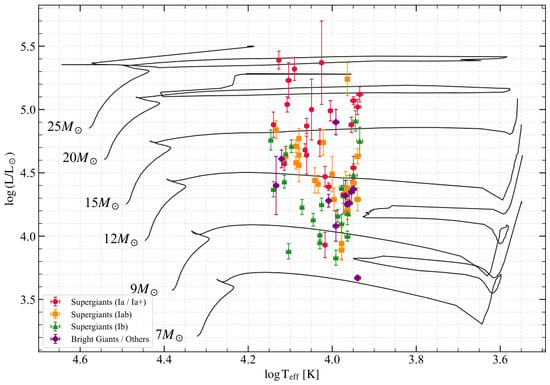
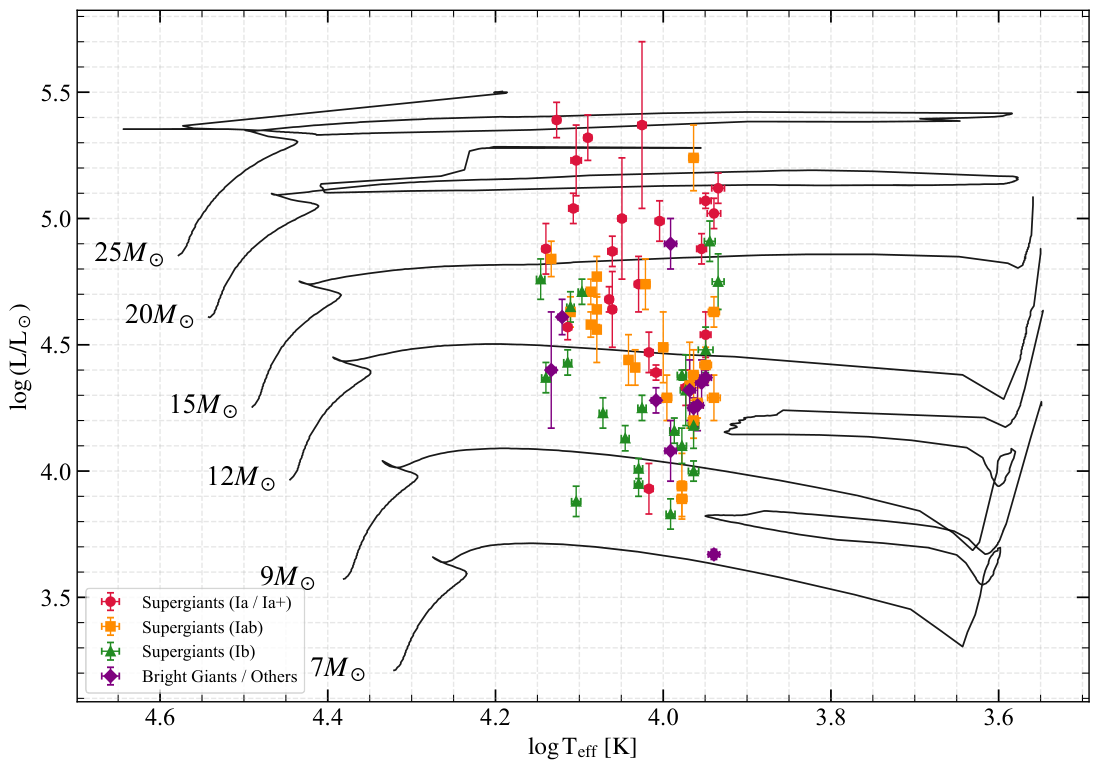
The resulting observational HRD for the main evolutionary sample is shown in Figure 1. Of the 84 program stars, 76 objects have and constitute the main evolutionary sample. The remaining eight objects have luminosities below this threshold and are excluded from the HRD and from the evolutionary mass and age analysis. The derived luminosities, initial evolutionary masses, and ages of the 76 stars in the main sample are listed in Table 1, while the eight low-luminosity objects are presented separately in Table 2.
Figure 1.
Observational Hertzsprung–Russell diagram of the 76 stars in the main evolutionary sample compared with Geneva evolutionary tracks for solar metallicity () and an initial rotational velocity of [4]. The eight objects with are not included in the diagram and are considered separately in Table 2.
Table 1.
Spectral types, bolometric luminosities, derived evolutionary masses, and ages of the 76 stars in the main sample with .
Table 2.
Spectral types and bolometric luminosities of the eight low-luminosity objects excluded from the evolutionary mass and age analysis ().
The main sample is concentrated in the upper, luminous region of the HRD and is broadly consistent with the Geneva evolutionary tracks for solar metallicity () and an initial rotational velocity of [4]. Grid-based matching of the observed positions to the evolutionary models yields initial masses of approximately 7– and evolutionary ages ranging from about 8 to 57 Myr. Most objects are located in regions of the Geneva tracks associated with the termination of core-hydrogen burning and subsequent post-main-sequence evolution. However, the positions of individual stars in the HRD may remain consistent with more than one evolutionary phase.
The uncertainties in vary across the sample and are particularly large for several objects, including HD 21389, HD 17088, and HD 42400. In these cases, the luminosity uncertainty is dominated by the uncertainty in the adopted interstellar extinction . Such uncertainties may arise from steep extinction gradients, unresolved small-scale structure, and limited tracer-star sampling along individual lines of sight in the 3D dust map.
The eight low-luminosity objects have derived values of and are therefore excluded from Figure 1 and from the evolutionary mass and age analysis. Their properties are listed separately in Table 2. Comparison of their derived luminosities with their current spectral classifications reveals two distinct groups: five objects have cataloged luminosity classes III–IV or II, or lack a clear luminosity class, and are therefore inconsistent with classical supergiant status, whereas three objects retain supergiant classifications despite their unexpectedly low derived luminosities. These objects are discussed separately in Section 4.
4. Discussion
As shown in Figure 1, the 76 stars in the main evolutionary sample occupy the upper part of the observational HRD and are broadly consistent with the Geneva evolutionary tracks for rotating solar-metallicity models () [4]. The derived luminosities and corresponding evolutionary parameters indicate a population dominated by luminous, evolved massive stars with initial masses of and ages ranging from to 57 Myr. Most objects are located in HRD regions associated with the termination of core-hydrogen burning and subsequent post-main-sequence evolution.
4.1. Physical Homogeneity and Catalog Sanity Checking
A major strength of the uniform framework established in this work—combining a single empirical calibration scale, Gaia DR3 astrometry, and 3D Bayestar extinction mapping—is its capacity to rigorously test the physical homogeneity of classical supergiant samples. Spectral classifications in heterogeneous literature catalogs often rely on subjective visual criteria. By pairing uniform spectroscopic temperatures with absolute bolometric luminosities derived from 3D extinction mapping, our methodology acts as a stringent diagnostic filter to identify objects whose assigned luminosity classes are physically inconsistent with their placement on the HRD.
Out of the initial sample of 84 cataloged BA supergiants and bright stars, our unified analysis reveals that eight objects ( ) fall below the luminosity threshold adopted for the evolutionary analysis, ; Table 2). These low-luminosity outliers naturally divide into two distinct categories:
- 1.
- Misclassified Subgiants and Giants: Five objects—HD 11577 (B9.5IV), HD 13717 (B9III), HD 28747 (B9), HD 71833 (B8II), and HD 147084 (A5II)—possess cataloged luminosity classes of III–IV, II, or lack a clear class. Their low derived luminosities () confirm that they are intrinsically less evolved intermediate-mass stars rather than classical supergiants.
- 2.
- Low-Luminosity Spectral Anomalies: Three objects—HD 43820 (A2Ib), HD 47314 (B8Ib), and HD 67456 (A3Ib)—retain supergiant or bright-supergiant classifications despite remarkably low derived luminosities (, , and , respectively). In particular, HD 43820 has , which is incompatible with the luminosity expected for a classical massive supergiant. These objects therefore require independent spectroscopic and evolutionary classification. Their low luminosities may indicate that they are lower-luminosity evolved stars rather than classical massive supergiants; possible alternatives include evolved low-mass objects, although their specific evolutionary nature cannot be established from the present HRD analysis alone. Dedicated follow-up observations, including detailed non-LTE atmospheric modeling and chemical-abundance analysis, are required to constrain their , , and evolutionary nature.
Eliminating these non-supergiant contamination sources prevents significant systematic bias when constructing empirical calibration baselines.
4.2. Morphological Substructure of the HRD
Inspection of the observational HRD (Figure 1) reveals an interesting morphological feature: the distribution shows a distinct separation between a tighter, nearly vertical sequence at cooler temperatures and a more scattered population of hotter, highly luminous objects transitioning away from the main sequence. While individual evolutionary tracks suffer from the phase degeneracies discussed below, this apparent visual separation—echoed in independent censuses of evolved high-mass stars—may reflect differences in evolutionary residence times between post-main-sequence transits and advanced core-helium-burning states. Further statistical mapping and abundance analyses are planned to test whether this empirical substructure maps cleanly to distinct evolutionary pathways.
4.3. Systematics, HRD Degeneracies, and Binary Interactions
An inherent complexity in interpreting the evolutionary status of individual massive stars is the spatial degeneracy in the upper HRD caused by multiple track crossings [19]. A star of a given and L may be traversing the Hertzsprung gap redward for the first time or undergoing a subsequent blueward excursion during core-helium burning after a red supergiant phase. Our grid-matching algorithm resolves this by identifying the global minimum in the error-weighted distance metric (), prioritizing longer evolutionary phases in rare ambiguous cases.
Furthermore, the derived masses and ages are conditional model-dependent estimates tied to single-star Geneva tracks incorporating rotational mixing and mass loss [4]. Unresolved binary interaction represents another key systematic factor: mass transfer, mergers, or stripping can drastically alter a star’s surface abundances, temperature, and apparent age [20]. Identifying specific binary survivors or fast rotators within the sample will require follow-up high-resolution spectroscopy to constrain detailed atmospheric chemical abundances.
The importance of binarity and circumstellar environments in interpreting the evolutionary status of peculiar B-type stars has been demonstrated for several B[e] and emission-line objects, including HD 85567 and MWC 645 [21,22]. More generally, the growing evidence for a high binary fraction among Be and B[e] stars highlights the need to consider binary interaction and mass-transfer histories when interpreting objects with anomalous spectroscopic properties [23].
A related caveat concerns the treatment of multiple track crossings (e.g., blue loops versus post-MS transitions). As noted in Section 2.5, our current analysis adopts a deterministic phase-assignment scheme based on timescale likelihoods. While this prevents artificial noise inflation in individual mass and age estimates, it inherently suppresses faster evolutionary phases in individual cases. A comprehensive statistical assessment—including a rigorous derivation of the stellar mass function and tracking fractional probabilities across overlapping Geneva grid segments—remains an important goal for subsequent work utilizing dedicated population synthesis modeling.
5. Conclusions
By integrating a uniform empirical scale with Gaia DR3 astrometry and 3D spatial dust maps, we have constructed a self-consistent observational HRD for a sample of 84 Galactic BA stars. The primary conclusions of this study are:
- 1.
- Diagnostic Power for Catalog Purity: Combining homogeneous spectroscopic temperatures with precision Gaia astrometry and 3D Bayestar extinction maps provides a robust methodology for auditing literature supergiant catalogs. This approach successfully identified eight low-luminosity stars () that contaminate the supergiant domain, purifying the sample for evolutionary analysis.
- 2.
- Fundamental Parameters of the Main Sample: The primary evolutionary sample of 76 Galactic BA supergiants forms a coherent population of evolved massive stars. Comparison with Geneva evolutionary models () yields initial masses of and ages of Myr, representing post-main-sequence objects near or after the termination of core-hydrogen burning.
- 3.
- Impact on Extragalactic Distance Anchors: Purifying Galactic supergiant samples by filtering out misclassified subgiants and low-luminosity contaminants provides a cleaner empirical foundation for calibrating the FGLR and testing mass-loss and mixing physics in massive stars.
Author Contributions
Data reduction, S.T.N. and N.L.V.; data analysis, S.T.N., N.L.V. and A.B.U.; writing—original draft preparation, S.T.N., N.L.V., D.T.A. and A.B.U.; writing—review and editing, S.A.K., A.T.A. and D.T.A. All authors have read and agreed to the published version of the manuscript.
Funding
This research was funded by the Science Committee of the Ministry of Science and Higher Education of the Republic of Kazakhstan (Grant No. AP23484898).
Data Availability Statement
The reduced continuum-normalized spectra and their associated metadata are publicly available through the Kazakhstan National Virtual Observatory (KazVO) via the KazVO spectral service (https://vo.fai.kz/obs_data.php?path=/tco_hot_supergiants/q/web, accessed on 16 September 2026). The analysis made use of publicly available data products from Gaia, SIMBAD, and NASA ADS, together with the TCO spectroscopic observations provided by Anatoly S. Miroshnichenko.
Acknowledgments
The authors are grateful to Anatoly S. Miroshnichenko for providing the TCO spectroscopic observations and for valuable scientific discussions and guidance. We are grateful to the anonymous referee for the careful review and constructive comments that helped improve the manuscript.
Conflicts of Interest
The authors declare no conflicts of interest.
Abbreviations
The following abbreviations are used in this manuscript:
| HRD | Hertzsprung–Russell diagram |
| Effective temperatures | |
| RUWE | Renormalized Unit Weight Error |
| RSG | Red Supergiant |
| FGLR | Flux-Weighted Gravity–Luminosity Relation |
Appendix A. Photometric Parameters of the Stellar Sample
Table A1 presents the photometric parameters, bolometric corrections, and distances adopted for the 84 stars in the sample. The table is divided into two parts to improve readability and reduce its vertical extent.
Table A1.
Photometric parameters, bolometric corrections, and distances for the selected stars.
References
- Kudritzki, R.-P.; Puls, J. Winds from Hot Stars. Annu. Rev. Astron. Astrophys. 2000, 38, 613–666. [Google Scholar] [CrossRef] [Scilit]
- Meynet, G.; Kudritzki, R.-P.; Georgy, C. The flux-weighted gravity–luminosity relationship of blue supergiant stars as a constraint for stellar evolution. Astron. Astrophys. 2015, 581, A36. [Google Scholar] [CrossRef] [Scilit]
- Kudritzki, R.-P.; Bresolin, F.; Przybilla, N. A New Extragalactic Distance Determination Method Using the Flux-weighted Gravity of Late B and Early A Supergiants. Astrophys. J. 2003, 582, L83–L86. [Google Scholar] [CrossRef] [Scilit] [PubMed]
- Ekström, S.; Georgy, C.; Eggenberger, P.; Meynet, G.; Mowlavi, N.; Wyttenbach, A.; Granada, A.; Decressin, T.; Hirschi, R.; Frischknecht, U.; et al. Grids of stellar models with rotation. I. Models from 0.8 to 120 M⊙ at solar metallicity (Z = 0.014). Astron. Astrophys. 2012, 537, A146. [Google Scholar]
- Firnstein, M.; Przybilla, N. Quantitative spectroscopy of Galactic BA-type supergiants. I. Atmospheric parameters. Astron. Astrophys. 2012, 543, A80. [Google Scholar]
- Georgy, C.; Ekström, S.; Granada, A.; Meynet, G.; Mowlavi, N.; Eggenberger, P.; Maeder, A. Populations of rotating stars. I. Models from 1.7 to 15 M⊙ at Z = 0.014, 0.006, and 0.002 with Ω/Ωcrit between 0 and 1. Astron. Astrophys. 2013, 553, A24. [Google Scholar]
- Humphreys, R.M.; Davidson, K. Studies of luminous stars in nearby galaxies. III. Comments on the evolution of the most massive stars in the Milky Way and the Large Magellanic Cloud. Astrophys. J. 1979, 232, 409–420. [Google Scholar] [CrossRef] [Scilit] [PubMed]
- Garmany, C.D.; Stencel, R.E. Galactic OB associations in the Northern Milky Way Galaxy. I–Longitudes 55° to 150°. A&AS 1992, 94, 211–244. [Google Scholar]
- Gaia Collaboration; Vallenari, A.; Brown, A.G.A.; Prusti, T.; de Bruijne, J.H.J.; Arenou, F.; Babusiaux, C.; Biermann, M.; Creevey, O.L.; Ducourant, C.; et al. Gaia Data Release 3. Summary of the content and survey properties. Astron. Astrophys. 2023, 674, A1. [Google Scholar]
- Vaidman, N.L.; Nurmakhametova, S.T.; Umirova, A.B.; Khokhlov, S.A.; Agishev, A.T.; Yermekbayev, B.S. Evaluating Gaia Astrometric Quality and Distances for Galactic Hot Supergiants. Universe 2025, 11, 359. [Google Scholar] [CrossRef] [Scilit]
- Urbaneja, M.A.; Kudritzki, R.-P.; Gieren, W.; Pietrzyński, G.; Bresolin, F.; Przybilla, N. LMC Blue Supergiant Stars and the Calibration of the Flux-weighted Gravity–Luminosity Relationship. Astron. J. 2017, 154, 102. [Google Scholar] [CrossRef] [Scilit]
- Kudritzki, R.-P.; Bresolin, F.; Przybilla, N.; Urbaneja, M.A.; Gieren, W.; Pietrzyński, G. Quantitative Spectroscopy of 24 A Supergiants in the Sculptor Galaxy NGC 300: Flux-weighted Gravity–Luminosity Relationship, Metallicity, and Metallicity Gradient. Astrophys. J. 2008, 681, 269–289. [Google Scholar] [CrossRef] [Scilit] [PubMed]
- Vaidman, N.L.; Miroshnichenko, A.S.; Nurmakhametova, S.T.; Danford, S.; Khokhlov, S.A.; Izmailova, I.M.; Omarov, C.T.; Zharikov, S.V.; Yakhiya, D.E.; Agishev, A.T.; et al. An Empirical Effective-Temperature Calibrations for Galactic B/A Supergiants. Astrophys. J. 2026, in press. [Google Scholar] [CrossRef] [Scilit]
- Vaidman, N.L.; Khokhlov, S.A.; Nurmakhametova, S.T.; Litvinov, N.A.; Agishev, A.T.; Khokhlov, A.A.; Agishev, D.T.; Alimbetova, D.A. MERLIS: Model-driven Measurement of Spectral-line Parameters in Heterogeneous Stellar Spectra. ApJ 2026, 1008, 4. [Google Scholar] [CrossRef] [Scilit]
- Green, G.M. dustmaps: A Python interface for maps of interstellar dust. J. Open Source Softw. 2018, 3, 695. [Google Scholar] [CrossRef] [Scilit]
- Green, G.M.; Schlafly, E.; Zucker, C.; Speagle, J.S.; Finkbeiner, D. A 3D Dust Map Based on Gaia, Pan-STARRS 1, and 2MASS. Astrophys. J. 2019, 887, 93. [Google Scholar] [CrossRef] [Scilit]
- Bessell, M.S.; Castelli, F.; Plez, B. Model atmospheres broad-band colors, bolometric corrections and temperature calibrations for O - M stars. Astron. Astrophys. 1998, 333, 231–250. [Google Scholar]
- Vaidman, N.L.; Nurmakhametova, S.T.; Miroshnichenko, A.S.; Khokhlov, S.A.; Agishev, A.T.; Khokhlov, A.A.; Ashimov, Y.K.; Yermekbayev, B.S. Determination of Orbital Parameters of Binary Star Systems Using the MCMC Method. Galaxies 2025, 13, 101. [Google Scholar] [CrossRef] [Scilit]
- Saio, H.; Georgy, C.; Meynet, G. Evolution of blue supergiants and α Cygni variables: Puzzling CNO surface abundances. Mon. Not. R. Astron. Soc. 2013, 433, 1246–1257. [Google Scholar] [CrossRef] [Scilit]
- Sana, H.; de Mink, S.E.; de Koter, A.; Langer, N.; Evans, C.J.; Gieles, M.; Gosset, E.; Izzard, R.G.; Le Bouquin, J.-B.; Schneider, F.R.N. Binary Interaction Dominates the Evolution of Massive Stars. Science 2012, 337, 444–446. [Google Scholar] [CrossRef] [Scilit] [PubMed]
- Khokhlov, S.A.; Miroshnichenko, A.S.; Mennickent, R.; Cabezas, M.; Zhanabaev, Z.Z.; Reichart, D.E.; Ivarsen, K.M.; Haislip, J.B.; Nysewander, M.C.; LaCluyze, A.P. Toward Understanding the B[e] Phenomenon. VI. Nature and Spectral Variations of HD 85567. ApJ 2017, 835, 53. [Google Scholar] [CrossRef] [Scilit]
- Nodyarov, A.S.; Miroshnichenko, A.S.; Khokhlov, S.A.; Zharikov, S.V.; Manset, N.; Klochkova, V.G.; Grankin, K.N.; Arkharov, A.A.; Efimova, N.; Klimanov, S.; et al. Toward Understanding the B[e] Phenomenon. IX. Nature and Binarity of MWC 645. ApJ 2022, 936, 129. [Google Scholar] [CrossRef] [Scilit]
- Miroshnichenko, A.S.; Zharikov, S.V.; Korčaková, D.; Manset, N.; Mennickent, R.; Khokhlov, S.A.; Danford, S.; Raj, A.; Zakhozhay, O.V. Binarity among objects with the Be and B[e] phenomena. Contrib. Astron. Obs. Skaln. Pleso 2020, 50, 513–517. [Google Scholar] [CrossRef] [Scilit]

Disclaimer/Publisher’s Note: The statements, opinions and data contained in all publications are solely those of the individual author(s) and contributor(s) and not of MDPI and/or the editor(s). MDPI and/or the editor(s) disclaim responsibility for any injury to people or property resulting from any ideas, methods, instructions or products referred to in the content. |
© 2026 by the authors. Licensee MDPI, Basel, Switzerland. This article is an open access article distributed under the terms and conditions of the Creative Commons Attribution (CC BY) license.