


Abstract
The optical counterpart of the gravitational wave event GW170817, known as kilonova, has provided strong evidence that binary neutron star mergers are favourable sites to host the r-process nucleosynthesis. Kilonova is a quasi-thermal electromagnetic emission powered by the radioactive decay of heavy neutron-rich nuclei produced by the r-process. Considering the variety of elements contributing to kilonova ejecta, essential information about its composition can be achieved through spectral characterisation, radiative transfer simulations, and opacities. The latter represents one of the most challenging aspects of the modelling, as it relies on accurate atomic structure calculations of energy levels and transitions. Since light r-process elements are major opacity contributors in early (<2 days) scenario, this work focuses on atomic calculations for Zr I–IV. Energy levels and bound-bound transitions are determined using the GRASP2018 code, assuming two different datasets for each ionisation stage: one including, and one excluding core-core and core-valence correlations. Results demonstrate that the inclusion of f shell and core correlations impacts on both energy levels and transitions. A systematic assessment of the accuracy is performed through detailed comparisons with the NIST ASD and literature references. Finally, these Zr data are integrated on the open access MARTINI platform.
1. Introduction
The gravitational wave event GW170817 was a watershed moment for astronomy, marking the beginning of the era of multi-messenger astronomy [1,2]. Besides the confirmation of general relativity predictions, GW170817 also provided answers to the origins of heavy elements in the Universe. Since 1974 [3], binary neutron star (BNS) and black hole-neutron star mergers have long been hypothesised as possible candidates to host the heavy element nucleosynthesis through the rapid neutron capture process (r-process) [4]. With the coalescence of BNS observed in 2017, this hypothesis has now been confirmed.
GW170817 is considered a milestone for the community also because, for the first time, it was possible to observe gravitational waves together with electromagnetic (EM) counterparts. Specifically, GW170817 was accompanied by a short gamma-ray burst (GRB170817A) [5,6,7] and an EM transient: the kilonova (KN; AT2017gfo) [8,9,10,11,12,13,14]. Kilonova is a quasi-thermal transient powered by radioactive decay of heavy neutron rich isotopes synthesised through the r-process, shortly after mass ejection of compact mergers [15,16,17]. Here, neutron-rich material is ejected at fractions of the speed of light and undergoes r-process nucleosynthesis. The produced heavy elements rapidly decay for instability, powering the surrounding ejecta environment into a quasi-thermal emission.
To correctly interpret KN spectra, accurate models require not only hydrodynamical and nucleosynthesis simulations, but also a complex set of physical inputs, ranging from nucleosynthesis yields to opacity. In this context, atomic calculations of energy levels, line strengths, and transitions are essential ingredients to correctly estimate the opacity and link specific atomic species to observable features. These represent the main challenges to provide critical information not yet well understood concerning the physics of the merger, the nucleosynthetic pathways that occur, and the KN emission itself.
In the literature, a considerable number of studies have focused on heavy r-process elements in a late KN epoch (>3–4 days) [18,19,20,21,22,23], while other works have instead concentrated on the early-time evolution (<2 days), distinguishing between the contributions of heavy species (e.g., lanthanides and actinides) [24,25,26,27,28] and those of lighter r-process elements [17,29,30]. However, investigations specifically targeting light elements at very early times (<2 days) remain comparatively limited with respect to the broader body of literature. For this reason, this work further focuses on this early phase, helping to fill the gap in the available atomic data for lighter elements. These elements are generally more accessible and safer to handle in laboratory environments, making them particularly suitable for experimental studies. In this context, selenium and zirconium (Zr) are among the primary candidates to be investigated in PANDORA (Plasma for Astrophysics Nuclear Decay Observation and Radiation for Archaeometry) [31], a magnetic trap facility currently under construction at the INFN—Laboratori Nazionali del Sud in Italy. A detailed study of atomic data, transition properties, and opacities has already been carried out for selenium [30]. Therefore, this work investigates Zr atomic calculations, as the availability of reliable atomic data is essential in view of future PANDORA measurements.
Following the established methodology adopted for selenium, this work focuses on atomic calculation of Zr I–IV in the framework of the early stage KN scenario (<2 days). Beside experimental purposes, Zr is selected because it also represents one of the most abundant light r-process elements produced at early KN emission [32,33,34]. Moreover, recent studies in the literature [22,23] have highlighted the significant contribution of lighter r-process elements, including Zr, to the KN ejecta opacity during the first few days after the merger (<2 days). Therefore, the Zr calculations presented in this work may provide a useful benchmark for comparison with existing results in the literature [22,23], in view of future KN opacity estimations and spectroscopic studies aimed at the identification and interpretation of experimental spectra. In this work, Zr atomic calculations are performed using the GRASP2018 (general relativistic atomic structure package) code [35], whose computational procedure is discussed and reported in Section 2. GRASP2018 is based on the fully relativistic (four-component) multi-configuration Dirac-Hartree-Fock (MCDHF) method [36,37]. It has become a widely-used code in atomic spectroscopy, with many applications in solar, stellar, and plasma physics. The code includes several additional routines such as relativistic configuration interaction (RCI), angular integrations with the second quantisation formalism [38,39], Breit interaction and also many-body quantum electrodynamics (QED) effects.
In atomic calculations, orbital correlations are essential to improve energy levels and transitions [40,41]. In view of this, the goal of this work is to estimate energy levels and transitions of Zr I–IV by including different types of orbital correlations in the electron configurations (ECs) forming the multi-reference (MR) sets. The calculations aim to get as close as possible to the NIST ASD (National Institute of Standards and Technology Atomic Spectra Database) [42], which serves as the main reference, and to evaluate how much these results deviate from those reported in the literature [22,23]. Moreover, the analysis assesses the intrinsic complexity of the Zr atomic calculations in GRASP2018. It is emphasised how sensitive the results are to the choice of both input parameters and computational procedure, together with the type of orbital correlations included. The entire analysis and results are presented in Section 3. Finally, these new Zr I–IV atomic data are now integrated and accessible on the MARTINI platform [30] to help constrain the atomic physics uncertainties involved in kilonova modelling and support future spectroscopic investigations.
2. Materials and Methods
Zr is a light r-process element bound to the lanthanide-poor components of the post-mergers ejecta that dominate the early blue emission of a KN [32,33,34]. It is very abundant in the early phases (∼10% of the total mass) [30,34] and, due to its moderate atomic structure complexity, it stands as one of the most interesting and feasible candidates among the light r-process element to be computationally studied. Moreover, in the KN early stage scenario (<2 days), densities do not vary significantly [43], internal collisional processes dominate, and the environment is effectively thermalised, leading to high ionisation states of all elements of the ejecta. In this context, considering the high temperature of the KN environment, it is reasonable to assume local thermodynamic equilibrium and include ionisation stages up to X in addition to neutral, which may potentially contribute to the estimation of KN opacity [22,24,26,27,28,30]. However, this work focuses only on the atomic calculation of the low-ionization stages of Zr, i.e., Zr I–IV. This restriction is mainly dictated by the computational methodology and the highly sophisticated treatment employed in the present calculations. The approach includes extensive orbital optimization, strong electron correlation effects, and large configuration state function (CSF) expansions to provide an accurate description of Zr I–IV atomic structure. Extending the same method to higher ionisation stages would lead to a considerable increase in computational complexity, and is therefore beyond the scope of the present study. Future calculations will extend the present investigation to higher ionization stages, in line with previous studies [26,28,30,44,45] highlighting their potential relevance for kilonova opacity modelling. In view of this, beside Zr I, only Zr II, Zr III, and Zr IV were considered in the analysis.
In GRASP2018, the calculations start from a carefully selected set of ECs defining the MR space and the corresponding initial spectroscopic orbitals. From this MR space where orbitals are kept frozen, CSFs are generated and used to construct the atomic wave functions within the MCDHF framework. The MCDHF method is then employed to determine the atomic state functions (ASF) , defined as
where the ASF are represented as linear combination of CSFs . These CSFs are eigenfunctions of parity P, total angular momentum operators and its projection , while coefficients describe mixing between different electronic configurations [41]. Electron-correlation effects are then progressively included through a layer-by-layer active-space (AS) approach. In AS, core orbitals are still kept frozen, while additional correlation of core-core (CC), core-valence (CV) and valence-valence (VV) orbitals are systematically added and optimized in order to improve the accuracy of the calculated atomic structure and transition properties.
An important note is that GRASP2018 performs a single run per element per ionisation state. Therefore, every time an ionisation stage is calculated, a corresponding MR set of ECs must be initially defined. In this Zr study, two datasets were considered for each ionisation state to investigate how the choice of ECs in MR and the electron correlations included in the corresponding AS affect the atomic energy structure.
The two datasets were constructed by considering different ECs lists in their MR. Specifically, as can be seen in Table A1, dataset A was generated by assuming Ar as the frozen core (i.e., [Ar]), with the 3d and 4s shells kept closed in the MR (i.e., MR A), whereas a Kr frozen core (i.e., [Kr], see Table A2) was used for dataset B in MR B. In the generation of the MR configurations, the outer-shell orbitals were initially treated as inactive (i). They were subsequently activated in the AS procedure to allow electron-correlation effects. Once the MR sets were defined, angular integration and the radial wave function estimation were performed, followed by the MCDHF calculations to retrieve the numerical representation of the ASF. The ASFs were then optimised through a layer-by-layer procedure, during which electron correlations were introduced in the calculation. Specifically, the active space associated with dataset A, namely ‘AS A’, included all three types of orbital correlations (i.e., CC, CV, and VV correlations) for each ionisation stage (see Table A1). The optimisation was implemented using a step-by-step procedure involving three different layers (i.e., L1, L2, and L3; see Table A3), obtained by increasing the principal quantum number by one at each layer for every orbital symmetry. On the contrary, the AS corresponding to dataset B (i.e., AS B) only included VV correlations (see Table A2) and a single layer of optimisation with virtual orbitals up to n-quantum number equal to seven. The complete list of ECs defining both datasets MR, together with the corresponding AS expansions and optimisation layers, are reported in Appendix A.
The last part of the calculation was related to the RCI and Breit interaction, both implemented to optimise the precision of the results. Finally, energy levels and transitions were calculated considering single and double (SD) excitations.
Within GRASP2018, the ASFs obtained from MCDHF and RCI calculations are used to evaluate the transition matrix elements in both Babushkin and Coulomb gauges. These results are then used to perform a transition quality assessment through the quantitative and qualitative evaluation (QQE) method [41], which compares the calculated transition with the standard reference information provided by the NIST ASD. In this context, the evaluation is based on
where and represent the line strengths derived from the transition matrix element, in Babushkin and Coulomb gauges, respectively. Equation (2) provides an internal consistency check on the quality of the computed ASFs, and a direct connection to the QQE classification method. Specifically, significant discrepancies between and highlight the possible incompleteness of the CSF expansion that defines the ASF (see Equation (1)) and limitations in the treatment of electron-correlation effects. In such cases, the corresponding transition is classified as low quality and assigned the label E. Conversely, a close agreement between the two gauges indicates a more accurate ASF representation, resulting in a high-quality transition probability classified as AA. The quality classes are ordered as follows: AA, A+, A, B+, B, C+, C, D+, D, and E, where class AA corresponds to the highest-quality transitions, while class E identifies transitions with the lowest reliability.
3. Results and Discussion
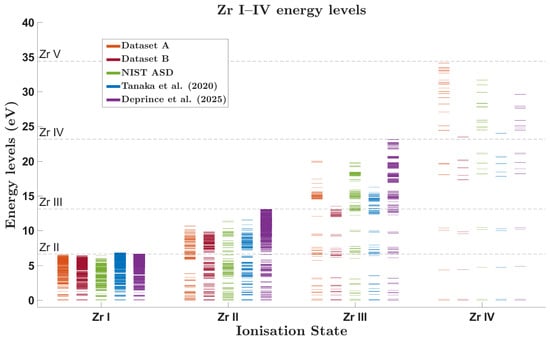
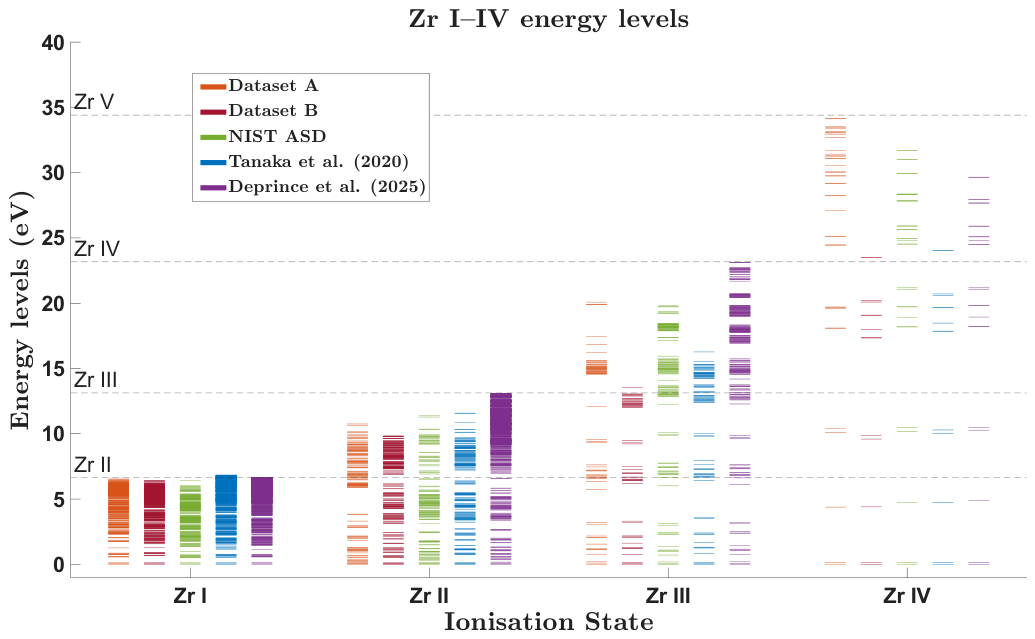
The analysis is restricted only to the bound-state energy levels because bound-bound transitions dominate in KN [22,45,46,47]. Figure 1 shows the energy levels of Zr I–IV generated from datasets A and B.
Figure 1.
Zr I–IV energy levels of datasets A and B compared with NIST ASD. The plot also includes literature references [22,23] for a consistent evaluation, and the dashed lines indicates the ionisation threshold for each Zr degree.
In addition to datasets A and B, the plot also includes the NIST ASD data and recent literature results [22,23]. To validate the precision of the results, an uncertainty on the energy levels was calculated. The criterion consisted of computing the mean relative differences, , between the predicted energy levels, , and those reported in the NIST ASD, , to assess how much Zr I–IV calculations of dataset A and B deviated from NIST ASD. This method was also applied to the literature data [22,23] to assess the consistency of the Zr calculations presented in this work with previous studies. The uncertainty was calculated with the following equation [41]:
where N represents the number of energy levels in common between the references. The energy levels discrepancies are reported in Table 1.
Table 1.
Zr I–IV energy levels uncertainty of datasets A, B and literature references [22,23] compared to NIST ASD.
Several insights emerge from Table 1. First of all, it shows that the energy levels obtained with dataset A are more precise and closer to the NIST ASD than dataset B. Specifically, Zr III and IV show an uncertainty below 7%, with results that are almost twice the times better than B. In the case of Zr I and II, the uncertainty is higher (>12%), but it still proves to be twice or even three-times better than the one predicted by dataset B. These results demonstrate that the only use of the VV correlation in AS is not enough to produce accurate estimates of energy levels. Instead, the inclusion of all three types of correlations (i.e., CC, CV, and VV) as in AS A (see Table A1) is necessary to achieve good precision. Table 1 further demonstrates that RCI calculations significantly affect the precision of the results. Specifically, Table A3 shows that the optimisation of the atomic structure of dataset A was performed in three successive steps, preserving the symmetry between even and odd parity while increasing the principal quantum number by one at each iteration. In contrast, Table A4 indicates that dataset B optimisation was performed using only a single layer that does not preserve the orbital symmetry between even and odd configurations. This asymmetry in the calculations led to a less reliable procedure and, consequently, to less accurate estimates of the energy levels as confirmed by Table 1.
The present GRASP2018 calculations are also compared with available theoretical datasets [48,49] to assess the consistency of the results and the impact of different atomic structure approaches. It is worth noting that the theoretical data of Tanaka et al. (2020) [22,48] and Deprince et al. (2025) [23,49] were obtained using different atomic structure codes, namely HULLAC (Hebrew University Lawrence Livermore Atomic Code) [50] and HFR (Hartree–Fock Relativistic) [51], respectively. Moreover, the ECs adopted in the two references are not identical and differ slightly from the configuration set assumed in the present calculations. On the one hand, Table 1 shows that, for Zr II–IV, dataset A results are in close agreement with the NIST ASD values with respect to dataset of 2020, whereas Zr I exhibits a significantly larger deviation. This suggests that the calculation strategy adopted for Zr I still requires further refinement to achieve good precision on the energy levels. In view of this, future improvements should focus on both the MR and the overall treatment of electron correlation in AS. On the other hand, datasets A and B exhibit noticeable differences with respect to the calculations of [23]. Specifically, the latter show a substantially better agreement with the NIST ASD values, with average level deviations typically reduced by a factor of two to three relative to the present calculations.
From Table 1, it also emerges that with an increase in the ionisation degree, the precision of the energy levels improves and this is consistent among all the datasets. This behaviour is expected, as the reduction in the number of electrons leads to weaker electron correlation between shells that simplifies the calculations. Furthermore, Table 1 shows that the error evaluation for each ionisation stage is based on a different number of levels, N. The reason lies in several factors, including the difficulty in identifying the specific level and the limited availability of data. Specifically, GRASP2018 performs a conversion from jj-coupling to LS-coupling [52,53] to enable a direct comparison of level labels with NIST ASD (this LS-based identification is approved by the atomic theory community). However, not all atomic codes have this transformation, with the consequence that labels for each level are often not explicitly reported. As a result, it becomes difficult to establish a consistent correspondence between all models calculations.
Concerning the limited availability of data, this issue is clearly visible in Zr II and IV of Figure 1. In this case, a mismatch in the total number of energy levels predicted by dataset A, NIST ASD, and the literature examples is clearly visible, affecting the resulting precision and restricting the analysis to only a few energy levels in common. Concerning the Zr IV results, Figure 1 shows that the dataset A calculations predict a larger number of bound-state energy levels than those reported in the NIST ASD. This indicates that the inclusion of in ECs leads to additional energy levels, which may have a significant impact on the calculation of bound–bound transitions for KN. However, dataset [23] provides a more extensive energy level structure across all ionisation stages, but it is important to note that the three theoretical datasets are based on fundamentally different computational strategies. As a consequence, the treatment of electron correlation and configuration mixing follows a different strategy, which does not rely on a systematic AS expansion for all the references. These methodological differences naturally affect the level of agreement between the three datasets and are expected to contribute to the observed discrepancies in energy levels.
In conclusion, dataset A calculations for Zr I–IV provide an additional energy level structure compared to the data currently available in both the NIST ASD and the literature. Although differences with other theoretical approaches remain, the present calculations offer an independent benchmark based on a fully relativistic MCDHF and RCI treatment. Consequently, they may contribute to future assessments of atomic data uncertainties and support spectroscopic and KN opacity studies.
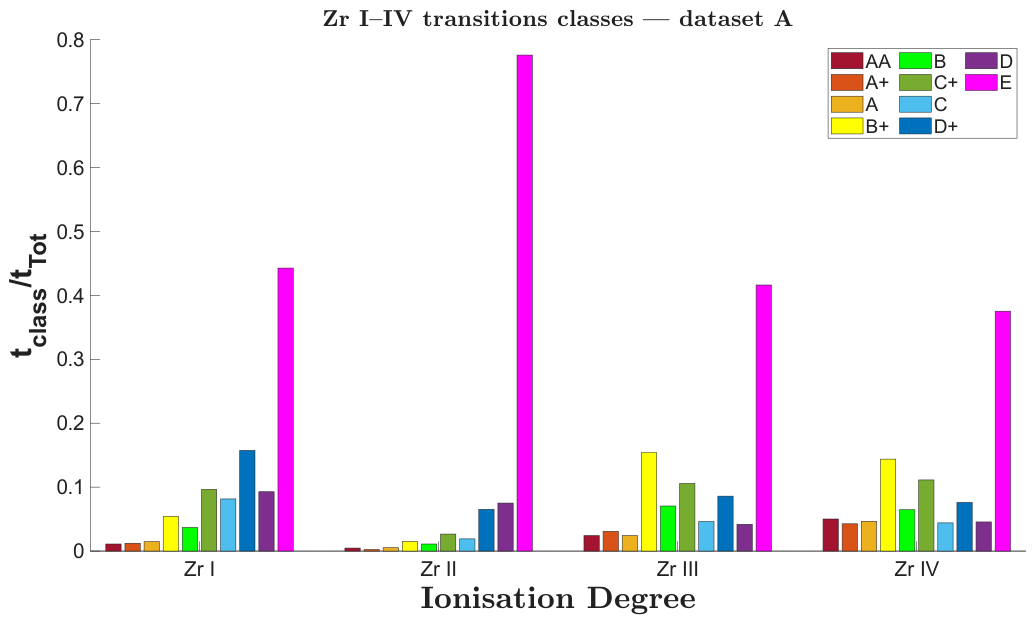
The final part of the work concerned the evaluation of bound-bound transitions. Since the results of Table 1 proved that the energy level structure of dataset A was more reliable than dataset B, bound-bound transitions were calculated only for A. The results are reported in Figure 2.
Figure 2.
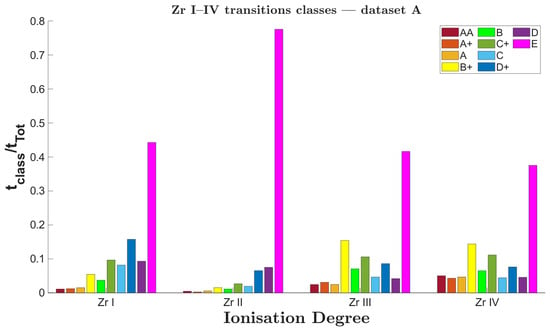
Zr I–IV bound-bound transitions of MR A. The coloured bars indicate an evaluation of the transitions, based on the wave function accuracy. Class AA indicates high wave function accuracy, while class E the lowest.
The bars in Figure 2 are derived from the QQE method [41], which relates the accuracy of the ASF with the gauges agreement of Equation (2) (see Section 2). Despite a slight improvement toward higher ionisation stages, the results show that class E transitions remain dominant at all ionisation stages of Zr. This trend is broadly consistent with the results of Table 1, which indicates an overall improvement in level accuracy when moving from Zr I to Zr IV compared to the NIST ASD. An exception is represented by Zr II, for which a larger fraction of class E transitions is observed with respect to the other ionisation stages. A possible explanation can be found in the corresponding energy level distribution shown in Figure 1, where a noticeable gap appears in the 4–6 eV range. The absence of levels in this region suggests an incomplete description of the electronic structure, which may affect both the number of calculated transitions and their accuracy classification.
Considering the observed correlation between energy level precision and transition quality behaviour, all Zr I–IV energy levels of set A were first calibrated with experimental data of NIST ASD. This investigation was aimed at assessing whether the class E transitions correspond to spectroscopically relevant lines and at verifying whether improved energy levels could enhance the overall transition quality. Following the calibration, all relevant spectroscopic quantities were recomputed accordingly. The comparison between theoretical and calibrated oscillator strengths () shows typical deviations on the order of 10–20%, without a systematic trend across the dataset. As a result, the energy level calibration does not significantly modify the transition dataset and, therefore, the transition quality distribution remained unchanged.
This result is consistent with the QQE method and the gauge criterion of Equation (2). Since and are mainly determined by the ASF rather than by the transition energies, the calibration of the energy levels has only a limited impact on the resulting quality classification. Consequently, the distribution of the transition classes remains largely unchanged when experimental energies are adopted.
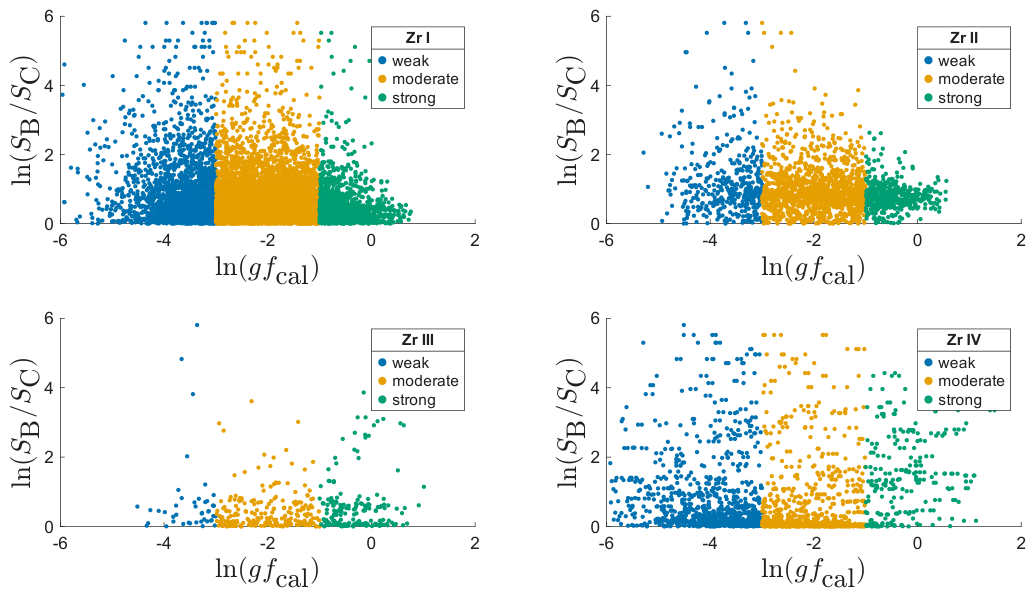
However, the limited impact of the energy level calibration does not imply that class E transitions are spectroscopically important. Indeed, it remains possible that these transitions are predominantly associated with weak lines. To test this hypothesis, the dependence of the gauge-quality classification on was investigated. The transitions were therefore separated into weak, moderate, and strong categories, and the distribution of was analysed for each subset. The adopted intervals are:
- ≤ −3 weak transition
- −3 < ≤ −1 moderate transition
- > −1 strong transition,
- and the results of the classification is reported below.
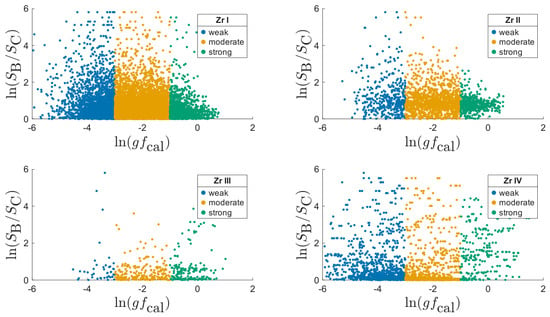
The plots of Figure 3 show that the majority of transitions are concentrated within a relatively limited range of gauge discrepancies for each ionisation state. Specifically, approximately 80% of the transitions in Zr I are found below ln(/) ≈ 3, while for Zr II and III about 90% remain below ln(/) ≈ 2.5. Moreover, in this case only a small fraction of transitions exceed these ranges for all the state of Zr. Noticeable differences can be observed for Zr IV. First, the total number of transitions is larger compared to Zr III. This is consistent with the energy level structure of Figure 1, as Zr IV contains a greater number of levels and therefore allows for a larger number of possible transitions. Second, the gauge agreement distribution, however, reveals a more complex picture: while the majority of transitions exhibit good agreement with ln(/, a significant fraction exceed the value of 3.
Figure 3.
Distribution of the gauge agreement indicator ln(/) as a function of the calibrated oscillator strength ln() for Zr I–II (top) and Zr III–IV (bottom). The colours in each plots identify the different strength classification (weak, moderate, and strong) of each transition, as defined in the text. The gauge agreement is assessed through the comparison of Babushkin and Coulomb line strengths (i.e., and , respectively), where smaller values of ln(/) indicate better agreement between the two forms and thus higher consistency of the ASF.
Finally, from Figure 3, it emerges that weak, moderate, and strong transitions exhibit similar distributions of across all ionisation stages, indicating that the classification is largely independent of . Therefore, although a significant fraction of transitions may formally belong to the lower-quality class E, the extended analysis here reported supports the robustness of the proposed classification scheme, suggesting that these classes should not be interpreted simply as a collection of physically weak transitions. Rather, they reflect the sensitivity of specific transitions to the underlying ASF and correlation treatment.
4. Conclusions
This work presented preliminary results concerning the atomic calculations of Zr I–IV energy levels and transitions in the framework of the kilonova modelling. The calculations were performed using GRASP2018 atomic code, highlighting the sensitivity of the atomic structure calculations to the choice of electron configurations and the treatment of orbital correlations. In the analysis, two different datasets, namely A and B, were considered per each ionisation stage. Dataset A included the core-core, the core-valence and the valence-valence correlations, while dataset B only assumed the valence-valence correlation. From a detailed comparison with NIST ASD, the results of dataset A were closer in agreement than those of dataset B, in every ionisation stage, with an uncertainty in the energy levels of about 7% for Zr III and IV, and 14% and 20% for Zr II and Zr I, respectively. The energy levels comparison proved that the inclusion of core correlations, together with a good RCI strategy, are needed to increase the precision of the results. Moreover, Zr IV results showed that the inclusion of additional ECs predicts a more complete energy level structure than available references, which could affect KN modelling. However, orbital correlations are not sufficient to achieve accurate atomic calculations. In particular, differences with respect to recent theoretical works remain, reflecting the impact of the underlying atomic structure methodologies. While the present MCDHF and RCI calculations provide a fully relativistic and systematically correlated framework, discrepancies in both energy levels and transition properties highlight the sensitivity of the results to the treatment of electron correlation and configuration interaction. Despite these differences, the present dataset constitutes an independent benchmark for Zr atomic structure calculations. Consequently, these results may contribute to future assessments of atomic data uncertainties and support both spectroscopic investigations and KN opacity modelling efforts. These newly Zr atomic data are now accessible from the open access MARTINI platform.
Funding
M.B. acknowledges funding by the European Union—NextGenerationEU RFF M4C2 1.1 PRIN 2022 project “2022RJLWHN URKA” and by INAF 2023 Theory Grant ObFu 1.05.23.06.06 “Understanding R-process & Kilonovae Aspects”.
Data Availability Statement
The zirconium data presented in this work are now accessible on the open access astrophysical platform MARTINI at https://martini.oa-abruzzo.inaf.it/ (accessed on 13 April 2026).
Conflicts of Interest
The author declares that there are no conflicts of interest.
Abbreviations
The following abbreviations are used in this manuscript:
| BNS | Binary Neutron Star |
| KN | Kilonova |
| MR | Multi-Reference |
| EC | Electron Configuration |
| CC | Core-Core |
| CV | Core-Valence |
| VV | Valence-Valence |
| GRASP2018 | General Relativistic Atomic Structure Package 2018 |
| NIST ASD | National Institute of Standards and Technology Atomic Spectra Database |
| ASF | Atomic State Function |
| CSF | Configuration State Function |
| AS | Active-Space |
| MCDHF | Multi-Configuration Dirac-Hartree-Fock |
| RCI | Relativistic Configuration Interaction |
| HULLAC | Hebrew University Lawrence Livermore Atomic Code |
| HFR | Hartree–Fock Relativistic |
| QQE | Quantitative and Qualitative Evaluation |
Appendix A
Table A1.
List of ECs in the MR and the corresponding electron correlations in AS for dataset A *.
Table A2.
List of ECs in the MR and the corresponding electron correlations in AS for dataset B *.
Table A3.
RCI layers of dataset A *.
Table A4.
RCI layers of dataset B *.
References
- Abbott, B.P.; Abbott, R.; Abbott, T.D.; Acernese, F.; Ackley, K.; Adams, C.; Adams, T.; Addesso, P.; Adhikari, R.X.; Adya, V.B.; et al. Gravitational Waves and Gamma-Rays from a Binary Neutron Star Merger: GW170817 and GRB 170817A. Astrophys. J. Lett. 2017, 848, L13. [Google Scholar] [CrossRef] [Scilit]
- Corsi, A.; Barsotti, L.; Berti, E.; Evans, M.; Gupta, I.; Kritos, K.; Kuns, K.; Nitz, A.H.; Owen, B.J.; Rajbhandari, B.; et al. Multi-messenger astrophysics of black holes and neutron stars as probed by ground-based gravitational wave detectors: From present to future. Front. Astron. Space Sci. 2024, 11, 1386748. [Google Scholar] [CrossRef] [Scilit]
- Lattimer, J.M.; Schramm, D.N. Black-hole-neutron-star collisions. Astrophys. J. 1974, 192, L145. [Google Scholar] [CrossRef] [Scilit]
- Cowan, J.J.; Sneden, C.; Lawler, J.E.; Aprahamian, A.; Wiescher, M.; Langanke, K.; Martínez-Pinedo, G.; Thielemann, F.-K.; Cowan, J.J.; Sneden, C.; et al. Origin of the heaviest elements: The rapid neutron-capture process. Rev. Mod. Phys. 2021, 93, 015002. [Google Scholar] [CrossRef] [Scilit]
- Abbott, B.P.; Abbott, R.; Abbott, T.D.; Acernese, F.; Ackley, K.; Adams, C.; Adams, T.; Addesso, P.; Adhikari, R.X.; Adya, V.B.; et al. Multi-messenger Observations of a Binary Neutron Star Merger. Astrophys. J. Lett. 2017, 848, L12. [Google Scholar] [CrossRef] [Scilit]
- He, X.B.; Tam, P.-H.T.; Shen, R.-F. GRB 170817A: A short GRB seen off-axis. Res. Astron. Astrophys. 2018, 18, 043. [Google Scholar] [CrossRef] [Scilit]
- Lyman, J.D.; Lamb, G.P.; Levan, A.J.; Mandel, I.; Tanvir, N.R.; Kobayashi, S.; Gompertz, B.; Hjorth, J.; Fruchter, A.S.; Kangas, T.; et al. The optical afterglow of the short gamma-ray burst associated with GW170817. Nat. Astron. 2018, 2, 751–754. [Google Scholar] [CrossRef] [Scilit]
- Evans, P.A.; Cenko, S.B.; Kennea, J.A.; Emery, S.W.K.; Kuin, N.P.M.; Korobkin, O.; Wollaeger, R.T.; Fryer, C.L.; Madsen, K.K.; Harrison, F.A.; et al. SwiftandNuSTARobservations of GW170817: Detection of a blue kilonova. Science 2017, 358, 1565–1570. [Google Scholar] [CrossRef] [Scilit] [PubMed]
- Kasliwal, M.M.; Nakar, E.; Singer, L.P.; Kaplan, D.L.; Cook, D.O.; Van Sistine, A.; Lau, R.M.; Fremling, C.; Gottlieb, O.; Jencson, J.E.; et al. Illuminating gravitational waves: A concordant picture of photons from a neutron star merger. Science 2017, 358, 1559–1565. [Google Scholar] [CrossRef] [Scilit] [PubMed]
- McCully, C.; Hiramatsu, D.; Howell, D.A.; Hosseinzadeh, G.; Arcavi, I.; Kasen, D.; Barnes, J.; Shara, M.M.; Williams, T.B.; Väisänen, P.; et al. The Rapid Reddening and Featureless Optical Spectra of the Optical Counterpart of GW170817, AT 2017gfo, during the First Four Days. Astrophys. J. Lett. 2017, 848, L32. [Google Scholar] [CrossRef] [Scilit]
- Pian, E.; D’Avanzo, P.; Benetti, S.; Branchesi, M.; Brocato, E.; Campana, S.; Cappellaro, E.; Covino, S.; D’Elia, V.; Fynbo, J.P.U. Spectroscopic identification of r-process nucleosynthesis in a double neutron-star merger. Nature 2017, 551, 67–70. [Google Scholar] [CrossRef] [Scilit] [PubMed]
- Smartt, S.J.; Chen, T.-W.; Jerkstrand, A.; Coughlin, M.; Kankare, E.; Sim, S.A.; Fraser, M.; Inserra, C.; Maguire, K.; Chambers, K.C. A kilonova as the electromagnetic counterpart to a gravitational-wave source. Nature 2017, 551, 75–79. [Google Scholar] [CrossRef] [Scilit] [PubMed]
- Soares-Santos, M.; Holz, D.E.; Annis, J.; Chornock, R.; Herner, K.; Berger, E.; Brout, D.; Chen, H.-Y.; Kessler, R.; Sako, M. The Electromagnetic Counterpart of the Binary Neutron Star Merger LIGO/Virgo GW170817. I. Discovery of the Optical Counterpart Using the Dark Energy Camera. Astrophys. J. Lett. 2017, 848, L16. [Google Scholar] [CrossRef] [Scilit]
- Utsumi, Y.; Tanaka, M.; Tominaga, N.; Yoshida, M.; Barway, S.; Nagayama, T.; Zenko, T.; Aoki, K.; Fujiyoshi, T.; Furusawa, H. J-GEM observations of an electromagnetic counterpart to the neutron star merger GW170817. Publ. Astron. Soc. Jpn. 2017, 69, 101. [Google Scholar] [CrossRef] [Scilit]
- Radice, D.; Bernuzzi, S.; Perego, A. The Dynamics of Binary Neutron Star Mergers and GW170817. Annu. Rev. Nucl. Part. Sci. 2020, 70, 95–119. [Google Scholar] [CrossRef] [Scilit]
- Kasen, D.; Metzger, B.; Barnes, J.; Quataert, E.; Ramirez-Ruiz, E. Origin of the heavy elements in binary neutron-star mergers from a gravitational-wave event. Nature 2017, 551, 80–84. [Google Scholar] [CrossRef] [Scilit] [PubMed]
- Metzger, B.D. Kilonovae. Living Rev. Relativ. 2019, 23, 59. [Google Scholar] [CrossRef] [Scilit]
- Gillanders, J.H.; McCann, M.; Sim, S.A.; Smartt, S.J.; Ballance, C.P. Constraints on the presence of platinum and gold in the spectra of the kilonova AT2017gfo. Mon. Not. R. Astron. Soc. 2021, 506, 3560–3577. [Google Scholar] [CrossRef] [Scilit]
- Fontes, C.J.; Fryer, C.L.; Wollaeger, R.T.; Mumpower, M.R.; Sprouse, T.M. Actinide opacities for modelling the spectra and light curves of kilonovae. Mon. Not. R. Astron. Soc. 2023, 519, 2862–2878. [Google Scholar]
- Flörs, A.; Silva, R.F.; Deprince, J.; Carvajal Gallego, H.; Leck, G.; Shingles, L.J.; Martínez-Pinedo, G.; Sampaio, J.M.; Amaro, P.; Marques, J.P.; et al. Opacities of singly and doubly ionized neodymium and uranium for kilonova emission modeling. Mon. Not. R. Astron. Soc. 2023, 524, 3083–3101. [Google Scholar] [CrossRef] [Scilit]
- Kato, D.; Tanaka, M.; Gaigalas, G.; Kitovienė, L.; Rynkun, P. Systematic opacity calculations for kilonovae—II. Improved atomic data for singly ionized lanthanides. Mon. Not. R. Astron. Soc. 2024, 535, 2670–2686. [Google Scholar] [CrossRef] [Scilit]
- Tanaka, M.; Kato, D.; Gaigalas, G.; Kawaguchi, K. Systematic opacity calculations for kilonovae. Mon. Not. R. Astron. Soc. 2020, 496, 1369–1392. [Google Scholar] [CrossRef] [Scilit]
- Deprince, J.; Wagle, G.; Ben Nasr, S.; Carvajal Gallego, H.; Godefroid, M.; Goriely, S.; Just, O.; Palmeri, P.; Quinet, P.; Van Eck, S. Kilonova ejecta opacity inferred from new large-scale HFR atomic calculations in all elements between Ca (Z = 20) and Lr (Z = 103). Astron. Astrophys. (A&A) 2025, 696, A32. [Google Scholar] [CrossRef] [Scilit]
- Banerjee, S.; Tanaka, M.; Kato, D.; Gaigalas, G.; Kawaguchi, K.; Domoto, N. Opacity of the Highly Ionized Lanthanides and the Effect on the Early Kilonova. Astrophys. J. 2022, 934, 117. [Google Scholar] [CrossRef] [Scilit]
- Carvajal Gallego, H.; Deprince, J.; Maison, L.; Palmeri, P.; Quinet, P. Overview of the contributions from all lanthanide elements to kilonova opacity in the temperature range from 25 000 to 40 000 K. Astron. Astrophys. (A&A) 2024, 685, A91. [Google Scholar] [CrossRef] [Scilit]
- Carvajal Gallego, H.; Deprince, J.; Berengut, J.C.; Palmeri, P.; Quinet, P. Opacity calculations in four to nine times ionized Pr, Nd, and Pm atoms for the spectral analysis of kilonovae. Mon. Not. R. Astron. Soc. 2022, 518, 332–352. [Google Scholar] [CrossRef] [Scilit]
- Carvajal Gallego, H.; Deprince, J.; Palmeri, P.; Quinet, P. Expansion and line-binned opacities of samarium ions for the analysis of early kilonova emission from neutron star mergers. Mon. Not. R. Astron. Soc. 2023, 522, 312–318. [Google Scholar] [CrossRef] [Scilit]
- Banerjee, S.; Tanaka, M.; Kato, D.; Gaigalas, G. Diversity of Early Kilonova with the Realistic Opacities of Highly Ionized Heavy Elements. Astrophys. J. 2024, 968, 64. [Google Scholar] [CrossRef] [Scilit]
- Villar, V.A.; Guillochon, J.; Berger, E.; Metzger, B.D.; Cowperthwaite, P.S.; Nicholl, M.; Alexander, K.D.; Blanchard, P.K.; Chornock, R.; Eftekhari, T. The Combined Ultraviolet, Optical, and Near-infrared Light Curves of the Kilonova Associated with the Binary Neutron Star Merger GW170817: Unified Data Set, Analytic Models, and Physical Implications. Astrophys. J. Lett. 2017, 851, L21. [Google Scholar] [CrossRef] [Scilit]
- Bezmalinovich, M.; Bulla, M.; Gaigalas, G.; Vescovi, D.; Canzari, M.; Cristallo, S. The MARTINI platform. I: Se I-X atomic calculation and expansion opacity for early stage kilonova spectral analysis. Astron. Astrophys. (A&A) 2026, 708, A366. [Google Scholar] [CrossRef] [Scilit]
- Mascali, D.; Santonocito, D.; Amaducci, S.; Andò, L.; Antonuccio, V.; Biri, S.; Bonanno, A.; Bonanno, V.P.; Briefi, S.; Busso, M.; et al. A Novel Approach to β-Decay: PANDORA, a New Experimental Setup for Future In-Plasma Measurements. Universe 2022, 8, 80. [Google Scholar] [CrossRef] [Scilit]
- Nedora, V.; Bernuzzi, S.; Radice, D.; Perego, A.; Endrizzi, A.; Ortiz, N. Spiral-wave Wind for the Blue Kilonova. Astrophys. J. Lett. 2019, 886, L30. [Google Scholar] [CrossRef] [Scilit]
- Perego, A.; Vescovi, D.; Fiore, A.; Chiesa, L.; Vogl, C.; Benetti, S.; Bernuzzi, S.; Branchesi, M.; Cappellaro, E.; Cristallo, S.; et al. Production of Very Light Elements and Strontium in the Early Ejecta of Neutron Star Mergers. Astrophys. J. 2022, 925, 22. [Google Scholar] [CrossRef] [Scilit]
- Vescovi, D.; Reifarth, R.; Cristallo, S.; Couture, A. Neutron-capture measurement candidates for the r-process in neutron star mergers. Front. Astron. Space Sci. 2022, 9, 994980. [Google Scholar] [CrossRef] [Scilit]
- Froese Fischer, C.; Gaigalas, G.; Jönsson, P.; Bieroń, J. GRASP2018—A Fortran 95 version of the General Relativistic Atomic Structure Package. Comput. Phys. Commun. 2019, 237, 184–187. [Google Scholar] [CrossRef] [Scilit]
- Grant, I.P. Relativistic Quantum Theory of Atoms and Molecules; Springer: New York, NY, USA, 2007. [Google Scholar]
- Froese Fischer, C.; Godefroid, M.; Brage, T.; Jönsson, P.; Gaigalas, G. Advanced multiconfiguration methods for complex atoms: I. Energies and wave functions. J. Phys. B 2016, 49, 182004. [Google Scholar] [CrossRef] [Scilit]
- Gaigalas, G.; Fritzsche, S.; Grant, I.P. Program to calculate pure angular momentum coefficients in -coupling. Comput. Phys. Commun. 2001, 139, 263–278. [Google Scholar] [CrossRef] [Scilit]
- Gaigalas, G.; Froese Fischer, C.; Rynkun, P.; Jönsson, P. JJ2LSJ Transformation and Unique Labeling for Energy Levels. Atoms 2017, 5, 6. [Google Scholar] [CrossRef] [Scilit]
- Radžiūtė, L.; Gaigalas, G. Energy levels and transition properties for As-like ions Se II, Br III, Kr IV, Rb V, and Sr VI. At. Data Nucl. Data Tables 2022, 147, 101515. [Google Scholar] [CrossRef] [Scilit]
- Kitovienė, L.; Gaigalas, G.; Rynkun, P.; Tanaka, M.; Kato, D. Theoretical Investigation of the Ge Isoelectronic Sequence. J. Phys. Chem. Ref. Data 2024, 53. [Google Scholar] [CrossRef] [Scilit]
- Kramida, A.; Ralchenko, Y. NIST Atomic Spectra Database, NIST Standard Reference Database 78; NIST: Washington, DC, USA, 1999.
- Pognan, Q.; Jerkstrand, A.; Grumer, J. NLTE effects on kilonova expansion opacities. Mon. Not. R. Astron. Soc. 2022, 513, 5174–5197. [Google Scholar] [CrossRef] [Scilit]
- Carvajal Gallego, H.; Berengut, J.C.; Palmeri, P.; Quinet, P. Large-scale atomic data calculations in Ce V – X ions for application to early kilonova emission from neutron star mergers. Mon. Not. R. Astron. Soc. 2021, 509, 6138–6154. [Google Scholar] [CrossRef] [Scilit]
- Banerjee, S.; Tanaka, M.; Kawaguchi, K.; Kato, D.; Gaigalas, G. Simulations of Early Kilonova Emission from Neutron Star Mergers. Astrophys. J. 2020, 901, 29. [Google Scholar] [CrossRef] [Scilit]
- Kasen, D.; Badnell, N.R.; Barnes, J. Opacities and spectra of the r-process ejecta from neutron star nergers. Astrophys. J. 2013, 774, 25. [Google Scholar] [CrossRef] [Scilit]
- Tanaka, M.; Hotokezaka, K. Radiative transfer simulations of neutron star merger ejecta. Astrophys. J. 2013, 775, 113. [Google Scholar] [CrossRef] [Scilit]
- Kato, D.; Murakami, I.; Tanaka, M.; Banerjee, S.; Gaigalas, G.; Kawaguchi, K. Japan-Lithuania Opacity Database for Kilonova; National Institute for Fusion Science: Toki City, Japan, 2021.
- Deprince, J.; Quinet, P.; Palmeri, P.; Ben Nasr, S.; Carvajal Gallego, H.; Godefroid, M.; Goriely, S.; Wagle, G.; Just, O.; Van Eck, S. HFR Atomic Database and Opacity Tables for Kilonovae from Mons and Brussels Universities. Astron. Astrophys. 2025. [Google Scholar] [CrossRef]
- Bar-Shalom, A.; Klapisch, M.; Oreg, J. HULLAC, an integrated computer package for atomic processes in plasmas. J. Quant. Spectrosc. Radiat. Transf. 2001, 71, 169–188. [Google Scholar] [CrossRef] [Scilit]
- Cowan, R.D. The Theory of Atomic Structure and Spectra; University of California Press: Berkeley, CA, USA, 1981. [Google Scholar]
- Gaigalas, G.; Žalandauskas, T.; Rudzikas, Z. Analytical expressions for special cases of LS-jj transformation matrices for a shell of equivalent electrons. Lith. J. Phys. 2001, 41, 226–231. [Google Scholar]
- Gaigalas, G.; Žalandauskas, T.; Rudzikas, Z. LS–jj transformation matrices for a shell of equivalent electrons. At. Data Nucl. Data Tables 2003, 84, 99–190. [Google Scholar] [CrossRef] [Scilit]

Disclaimer/Publisher’s Note: The statements, opinions and data contained in all publications are solely those of the individual author(s) and contributor(s) and not of MDPI and/or the editor(s). MDPI and/or the editor(s) disclaim responsibility for any injury to people or property resulting from any ideas, methods, instructions or products referred to in the content. |
© 2026 by the author. Licensee MDPI, Basel, Switzerland. This article is an open access article distributed under the terms and conditions of the Creative Commons Attribution (CC BY) license.