


Abstract
We present the EGIDE (Edge-on Galaxies in the DESI survey) project—a catalog of 149,215 edge-on galaxy candidates created using the data of the DESI Legacy Imaging Survey DR10 images. The catalog size is ten times greater than its predecessor and covers more than half of the sky. It is constructed in an automatic way, utilizing the full power of manual annotations from the GalaxyZoo volunteers, implemented in the Zoobot neural model, which was fine-tuned to search for edge-on galaxies specifically. To ensure the credibility of the dataset, subsequent manual supervision was performed. The EGIDE catalog provides homogeneous SExtractor photometry in the bands, total stellar mass estimates, redshifts for 98% of the sample, star formation rates, and other information. All of this is publicly available at The Edge-on Galaxy Database site. The preliminary analysis focused on differences between edge-on galaxies in the so-called blue sequence and red cloud populations. These galaxies demonstrate distinct properties: the number of redder galaxies decreases with increasing ratio faster than that of the bluer galaxies; galaxy thickness varies with galaxy color: red sequence galaxies are thicker than blue cloud galaxies; the flattening ratio increases significantly with total stellar mass only among redder cloud galaxies. It is an intriguing result that the same trend of q increasing at the high-mass end is detected by both the statistical models of figures of revolution and direct observations of edge-on galaxies in EGIDE independently. The full extent of this relationship’s validity can only be determined after properly accounting for the contributions of the bulge and the PSF.
1. Introduction
Edge-on disk galaxies, which are by definition inclined at nearly 90° to the line of sight, are a unique laboratory for studying the physical processes governing the internal and external evolution of galaxies and larger structures in the Universe. This orientation allows one to obtain, from observations, a lot of information about galaxies that is not available at other inclination angles. Consequently, there is a rich body of results and ongoing interest in these objects dating back to early pioneering works [1,2,3]. We list some of them below (see also a recent review in [4]).
First of all, for edge-on galaxies, we can directly obtain information on the thickness of the stellar disk and the vertical distribution of stellar matter within it. In the same way, we can estimate the thickness and properties of a gaseous disk [5]. The presence of so-called thick and thin disks, which are characterized by different scale heights of the stellar population , is clearly established in our Galaxy using a variety of methods (for example, five methods applied to APOGEE DR17 in [6]). In other galaxies, these two disks were first discovered in the edge-on galaxy NGC 4565 by [3]. The exponential scale height of the thick disk is larger than that of the thin disk (∼1 kpc and ∼0.3 kpc in the Milky Way [7]), and the latter comprises younger populations. These observations also hold true for other galaxies [8], which raises the question of whether thick disks are heated up during evolution or are born thick. Different possible causes of vertical heating have been proposed, such as bars, tidal interactions, major or minor mergers, spiral arms, radial migration, adiabatic heating, and scattering by clumps or giant molecular clouds [9,10].
This discussion has been reignited with the beginning of observations with the James Webb Space Telescope (JWST). With the ability to observe edge-on regular disk galaxies up to [11] and even beyond, JWST can now potentially directly observe all epochs during which disks formed. Data from the Hubble Space Telescope [12] and early JWST-based work suggest that disk thickness is almost constant across early epochs. The separation into thin and thick disks in Ref. [13] reveals that the thick disk forms first, and the transition epoch to two disks varies in time depending on the total stellar mass . The results, however, are not yet settled, as various JWST samples lead to different numbers: Ref. [14] suggests that disks have intermediate thickness at birth and then thicken due to the combined effects of decreasing surface mass density and violent gravitational instabilities, but they are not born as thin as reported in Ref. [15].
Quantitatively, the thickness of disks may be characterized by the intrinsic flattening (also called the oblateness or aspect ratio), defined as the ratio of disk height to disk radius. For observed galaxies, we see the apparent flattening , where b and a are the disk minor and major axes. Due to projection effects, as well as the influence of the bulge and dust, we find , but the true intrinsic galaxy shapes can still be inferred from these measurements in a statistical sense by rotating various shapes and measuring the resulting projection’s b and a. This study was initiated by Edwin Hubble in the 1930s, and since Ref. [16] we have known that , although individual galaxies have a fairly wide range of thicknesses, including ultra-thin galaxies, for which [17,18]. Statistical inference of for large samples such as GAMA DR3 [19] and SDSS [20,21], along with comparisons with cosmological simulations (Illustris, IllustrisTNG, EAGLE) in [22], reveal that the high fraction of thin disks observed in real galaxies does not match the simulations (see also [23,24]). There is an ongoing debate as to whether this effect is real or relates to an incorrect accounting of the spherical component [25] or perhaps to the fact that the apparent does not properly reflect the true three-dimensional shape [24]. Recent estimates of oblateness over a wide range in Ref. [26] show that, for 40% of galaxies , resulting in an extremely large number of “flat” dwarfs and an even greater inconsistency with simulations. Since edge-on galaxies have the advantage that we can measure flattening directly rather than statistically, larger samples of galaxies with the inclination are needed to resolve this discrepancy in versus .
To further complicate the situation, there are indications from JWST observations that high-redshift galaxies may not exhibit oblate (disky) geometry but instead contain a significant number of prolate objects [27,28], which could be misidentified as edge-on systems. The edge-on orientation of these prolate galaxies may also be a possible explanation for the nature of Little Red Dots [29]. Potentially, such objects can also help to distinguish between different models of dark matter origin [30]. Moreover, knowing the disk thickness in edge-on galaxies allows us to understand the properties of the dark halo. For example, the vertical force gradient can be measured as in UGC 7321, and the full halo shape can be recovered [31]. Another approach is that, under plausible assumptions about the Toomre parameter Q, we can derive the proportionality , where is the radial disk scale and is the total mass within a certain radius [32,33,34,35,36,37]. In other words, this imposes an independent constraint on the dark halo mass. Finally, the existence of superthin galaxies with observed (e.g., IC 5249) and with weak or no galactic bulges (cf. [38]) may imply the presence of an unusually massive dark halo with a compact core [36,38,39,40]. An alternative explanation derived from the TNG100 simulation in Ref. [41] links superthin galaxies to disk radial growth driven by specific mergers. In their picture, the existence of superthin galaxies is explained by subhalos that fall in at small angles and in the direction of rotation, i.e., when angular momentum is continuously pumped into the system since .
Many disk features are best seen when the disk is viewed edge-on and can be reliably studied only in this orientation. These include disk warps [42,43,44], flaring [8,45], central X-shaped structures from boxy/peanut-shaped (B/PS) bulges [46,47,48], polar rings [49,50,51,52], and some low-surface-brightness structures surrounding galaxies [53]. Photometric breaks in radial disk profiles and truncations are also more visible in edge-on galaxies [8,54], as are structures with lower surface brightnesses (Savchenko et al., in prep.). Additionally, the significantly lower uncertainty in the measured orientation parameters (inclination i and position angle) of edge-on galaxies is important when conducting research where precise knowledge of these parameters is crucial. This applies to studies related to the rotation velocity of the galaxy, such as Tully–Fisher measurements [55], or research that depends on the mutual orientation with cosmic filaments [56,57] or satellites [58,59].
Last but not least, an important advantage of galaxies viewed edge-on is the ability to study processes for which knowledge of the height above the disk plane is essential. For example, extraplanar diffuse ionized gas (DIG) contaminates photometry in the H filter when viewed face-on and must be separated from the disk emission [60,61]. Another example is the presence of extraplanar cold gas [62,63], which may be essential for the formation of lenticular S0 galaxies [64]. The disk vertical scale height is also crucial when volumetric information is needed, as in studies of large-scale star formation [65,66], disk gravitational stability [67,68,69,70,71], secular bar formation [72], and many others.
For all the reasons listed above, edge-on disk galaxies are therefore of particular interest for various areas of extragalactic astrophysics. Although disk thickness can now be easily studied in many available simulations, real observations are still preferred due to the possible presence of unphysical conditions in simulations (e.g., [73]). The importance of edge-on galaxies is emphasized by the efforts spent on compiling catalogs (and surveys, such as GECKOS [74]) devoted to them. The classic Flat Galaxies Catalog (FGC) [75] and the Revised Flat Galaxy Catalog (RFGC) [76] together contain around 4000 large ( arcsec) galaxies. A sample one and a half times larger was found in SDSS and presented in the EGIS (Edge-on Galaxies In SDSS) catalog [77]. Subsequent efforts allowed the construction of an even larger sample of 16,551 edge-on galaxies in the Pan-STARRS survey (EGIPS (https://www.sao.ru/edgeon/catalogs.php?cat=EGIPS (accessed on 10 June 2026)), [78,79]), where edge-on galaxies were visually inspected after automatic selection from the Pan-STARRS DR2 survey. There are also specialized samples, such as the 2MASS-selected Flat Galaxy Catalog (2MFGC) [80] or [81,82] from the same datasource, the B/PS-related subsample in [83], a catalog of low-surface-brightness edge-on galaxies [84], and others.
The number of disk galaxies with inclination between and varies as , which gives ≈1.75% of the total population for –. Therefore, in the forthcoming era of contemporary wide-field surveys, such as Rubin, Roman, Euclid, 4MOST, and others, it is anticipated that samples of approximately highly inclined galaxies will be identified. The manual detection of such sizable samples is well beyond the reasonable capabilities of any individual or group. For example, the largest relevant project, Galaxy Zoo, has already collected 104 million annotations for a million galaxies [85], but only around 15,000 edge-on galaxies with reliable annotations were found (see figure 3). The detection of the axis ratio q from photometric data, which is another method for finding edge-on galaxies, is susceptible to various influences, including projection effects, significant errors, and challenges in automatic decomposition. At the same time, the simplicity of form is a distinguishing characteristic of edge-on galaxies, which exhibit geometry and features (e.g., dust lanes) that are relatively straightforward to comprehend. In a previous study, an approach was proposed for EGIPS [78] that involved the implementation of an automatic detection system utilizing a neural network, which yielded satisfactory results.
In this study, we propose an expanded methodology, whereby a pre-trained model from an external dataset is utilized and subsequently fine-tuned through the application of transfer learning. This approach is employed for the identification of edge-on galaxies within the wide-field DESI Legacy Imaging DR10 survey. The resulting sample is referred to as EGIDE (The Edge-on Galaxies in the DESI Survey) (https://www.sao.ru/edgeon/catalogs.php?cat=EGIDE (accessed on 10 June 2026)). The EGIDE catalog, which we present here, contains more than 145,000 edge-on galaxies. The methodology employed here can be successfully applied to forthcoming Rubin, Roman, and Euclid data, and the EGIDE sample size is analogous to the expected sizes of future samples from these telescopes.
The present work is structured as follows. In Section 2, we describe the DESI DR10 data and outline the procedure used to detect edge-on galaxies. Section 3 presents an overview of the photometry extraction, its precision and the obtained results. In Section 4, we list information about distances to the galaxies in EGIDE. Section 5 discusses the completeness of our sample. In Section 6, we discuss our results, specifically the galaxy color-magnitude relation in Section 6.1, the color-flattening relation in Section 6.2, the mass-disk thickness relation in Section 6.3, and the number of galaxies versus flattening in Section 6.4. Finally, Section 7 summarizes our conclusions. In the Appendix A, Appendix B, Appendix C and Appendix D we provide additional details about neural network training, data cross-validation, and the methods used.
Throughout this paper, we assume a standard flat ΛCDM cosmology with , and = 70 km/s/Mpc, and use the AB magnitude system.
2. EGIDE Sample Building
As a source of observational images, we use the DESI Legacy Imaging Surveys in this work. The DESI Legacy Imaging Surveys (DESI Legacy) represent a comprehensive astrophysical campaign designed to provide the essential imaging dataset for target selection of the Dark Energy Spectroscopic Instrument (DESI; [86]). Initially, DESI Legacy delivers a uniform imaging coverage of approximately 14,000 square degrees of the sky in the optical bands, combining data from three individual telescopes: the Dark Energy Camera Legacy Survey (DECaLS; [87]), the Beijing–Arizona Sky Survey (BASS; [88]), and the Mayall z-band Legacy Survey (MzLS; [86]). These observations are complemented by photometry at infrared wavelengths using data from the Wide-field Infrared Survey Explorer (WISE) mission, thereby providing spectral energy distribution coverage from 0.4 μm to 4.5 μm. Additional data are provided in catalogs obtained using the TRACTOR probabilistic astronomical source detection algorithm [89]. Another significant source of information is the recently released DESI Data Release 1 (DESI DR1), which presents spectroscopic redshift measurements for millions of galaxies [90].
Throughout this work, we use images from the latest version of DESI Legacy available, which is DR10 (For details about the release, see https://www.legacysurvey.org/dr10/description/ (accessed on 10 June 2026).). The two most notable changes in this release are, first, the inclusion of i-band observations for the first time, and, second, the extension of the southern ( 32.375°) part of the survey [91]. The survey footprint is well represented in Figure 1. It is easy to see that the full DESI DR10 covers significant fractions of both the northern and southern celestial hemispheres and covers more than 20,000 square degrees of the sky. In addition to its extensive coverage, DESI Legacy DR10 has another advantage: the significant depth of the images, which reaches on average 28.5–29 mag arcsec−2 within a 10 arcsec square box at the level in the g-band [53].
Figure 1.
Final distribution of edge-on galaxies from the EGIDE, found in the DESI DR10 footprint, over the sky in the equatorial coordinate system. The gray line symbolically represents the plane of our Galaxy.
All coadded observations in DESI Legacy are grouped into so-called “bricks”. Each brick has an approximate size of 0.25° × 0.25° and is defined in terms of RA/DEC coordinates. There are 366,898 unique bricks in DR10, which have some small border overlap, and this is the reason why we see duplicate detections later. Each image has an identical pixel scale of 0.262 arcsec/pix. The median PSF FWHM is approximately 1.29 arcsec, 1.18 arcsec, and 1.11 arcsec for , respectively [86]. Note that starting from DESI DR9, the PSF model includes an inner and an outer component, where the latter represents large extended wings by a power law for g and r bands or a Moffat profile for z-band (https://www.legacysurvey.org/dr10/psf/ (accessed on 10 June 2026)).
To construct a sample of edge-on galaxies in the DESI survey, we used an approach similar to the one used in [79] to make the EGIPS database [78]. We downloaded all available images (“bricks”) in all available bands, and then performed an initial object search using the SExtractor package [92]. During this search, we excluded objects that were too small by allowing the SExtractor parameter A_IMAGE to be greater than 10 pixels (which roughly corresponds to a lower limit of the Kron radius of 9 arcsec). We also excluded objects that were too round (ELLIPTICITY < 0.4), as they usually cannot represent edge-on galaxies, and objects that were too elliptical (ELLIPTICITY > 0.95), because no real galaxies showed such ellipticities, but only image artifacts such as leaked signal from oversaturated bright stars. This preliminary stage resulted in objects. To find edge-on galaxies in this catalog, we utilized an artificial neural network classifier.
All necessary technical details about the neural network training are given in Appendix A. Here, for convenience, we provide only some of them. The main difference from our previous work [79] is that we trained a neural network classifier from scratch using our training set of edge-on galaxies solely, and not edge-on galaxies. In this work, we use another approach called fine-tuning [93], where we start with a neural network already pretrained on a broad generic task and then adapt it to our task of edge-on galaxies search. Starting from a pre-trained model instead of a random initial condition allows one to achieve a better convergence of the training process, especially for limited training samples [94]. The contemporary and upcoming wide-field surveys, such as Rubin, Roman, and Euclid, provide a plethora of data to build heavy foundation models that can be further fine-tuned to more specific tasks.
We use Zoobot as the base for our search. Zoobot [95] is a Python package that leverages deep learning to characterize the detailed appearance of galaxies. It is trained on around 92 million labels collected from Galaxy Zoo volunteers, who answered a series of questions about each galaxy’s morphology (see the example question tree in figure 4 in Ref. [96]). Zoobot learns to answer all of these diverse tasks simultaneously, acquiring a rich, transferable representation of galaxy structure that can be efficiently adapted to new related tasks. We trained nine independent models by repeatedly re-running the Zoobot fine-tuning process in order to reduce possible misclassifications of individual models. We used edge-on RFGC and EGIPS galaxies from the previous works as positive examples [79]; the training size is several thousand examples (see Appendix A for exact numbers). The performance of individual classifiers of the ensemble is significant, achieving 97% accuracy (see Figure A1). We select a galaxy as a candidate to be located edge-on if the majority of the ensemble models (at least five out of nine) vote for it.
Automated selection of galaxies works as a “black box” and, in principle, can be susceptible to errors of the first and second kind. Bright bars, stellar spikes due to the PSF, or other elongated structures can easily mimic edge-on galaxies; therefore, additional efforts are always needed to ensure the validity of the sample. The application of our neural ensemble resulted in a considerable number of false detections caused by horizontal lines due to CCD leakage around bright stars. This is a known problem in DESI Legacy, and examples of such stars can be easily found in the DESI Viewer (https://www.legacysurvey.org/viewer (accessed on 10 June 2026)). The number of such lines greatly exceeds the number of edge-on galaxies; thus, even a small fraction of false positive detections of them significantly contaminates the classification results. To solve this issue, we created a sample of 5000 such artifacts and trained another Zoobot classifier to separate these artifacts from edge-on disks. This genuinely fixed the problem.
To ensure the reliability of our results, as the last step of the sample building pipeline, we manually check all pre-selected candidates. From the 192,593 net-selected objects, we remove 43,378 or roughly 25% of the initial sample. These removals include not only clearly false detections but also cases where there is an edge-on galaxy within the cropped image that probably activates the network weights, as well as genuinely elongated objects that are nevertheless not edge-on (see examples in Figure A2). We also remove relatively few duplications caused by brick overlap (see above). We want to emphasize that a quarter of false detections constitutes only 3% of the initial sample pre-selected by SExtractor, and it is a satisfactory result considering the difficulty of some cases and the small training dataset. This rate can be clearly lowered with additional training, and future missions such as the wide-field surveys Rubin, Roman, and Euclid will clearly benefit from the EGIDE size, if it is used for updating weights.
The final Edge-on Galaxies in the DESI Survey (EGIDE) sample consists of 149,215 galaxies. Several examples of edge-on or nearly edge-on galaxies are presented in Figure 2 and in Appendix D. The sky distribution of all selected candidates is presented in Figure 1. It is clear that galaxies of our sample uniformly cover the DESI DR10 footprint without significant gaps. Overall, the distribution of EGIDE galaxies covers more than half of the sky. Note, however, that not all bands are available for every galaxy, with i-band images being the most deficient, as they cover only 72% of the entire sample.
Figure 2.
Examples of objects classified as truly edge-on galaxies. Ellipses of different colors show segmentation by SExtractor in different bands. More images can be found in the EGIDE project site https://www.sao.ru/edgeon/catalogs.php?cat=EGIDE (accessed on 10 June 2026). More images can be found in Appendix D and in the EGIDE project site https://www.sao.ru/edgeon/catalogs.php?cat=EGIDE (accessed on 10 June 2026).
In Table 1, we provide the intersection of the EGIDE sample with various extragalactic databases, including previously constructed catalogs of edge-on systems such as RFGC, EGIS, and EGIPS. We provide this information in case the reader is interested in edge-on galaxies within a specific survey and may be planning future research using this information.
Table 1.
The size of the intersection of the EGIDE sample with the surveys we are comparing with. The first column shows the acronym for the survey; the next columns show the reference, the intersection size, and the median Kron radius of the galaxies in the intersection. The lower part of the table, below the horizontal line, is dedicated to the surveys included in the RCSEDv2 project.
3. Photometry
3.1. Photometry Making
To obtain photometric parameters of the galaxies in our sample, we used the SExtractor software package (version 2.24.2) [92]. To perform photometry, we downloaded images of each galaxy in all available bands, using preliminary estimates of its coordinates and sizes that were obtained during the initial sample construction. To reduce the contamination of galaxy photometry by foreground stars, we decided to mask them out (even though the deblending algorithm of SExtractor effectively separates objects from each other, in some cases, it fails to do so when a star is projected onto a galactic body). To make a stellar mask, we queried the Gaia database [107] to obtain coordinates and magnitudes of stars in the image and then covered each star with a circular mask whose radius depends on the star’s magnitude in the G band. We empirically found that a mask with radius
effectively covers stars over the entire range of magnitudes. For consistency, we used the same mask for all bands.
Once the mask was ready, we automatically ran SExtractor for all bands and obtained a set of photometric parameters, including coordinates, sizes, fluxes, and position angles. To illustrate the photometry results, we used the estimates of geometric parameters (central coordinates, position angles, and major- and minor-axes sizes) to draw ellipses that contain the Kron fluxes. The resulting ellipses produced by SExtractor were checked (Images with them are available at the https://www.sao.ru/edgeon/catalogs.php?cat=EGIDE site (accessed on 10 June 2026).). There are some problematic situations where a close or foreground object distorts the ellipse boundary, or rare situations where the segmentation process splits objects into pieces. These often result in severe variation in ellipse properties between bands, such as position angle, and most suspicious cases can thus be easily identified; see examples of such cases in Figure A2. We provide an additional test, where we check the difference in the position angle of ellipses between bands and find that a difference of more than 2° occurs for ∼9000 cases, which is a small fraction. We validate all results without such problematic cases. Overall, the quality of our SExtractor aperture photometry was decent, and the comparison with other surveys in Appendix B strengthens this point. It is important to mention that, as was noted in [108], z-band images in the northern portion of the DESI footprint are significantly affected by pattern noise subtraction. It is not an issue in this work, since z-band photometry was not used in the analysis; however, the z-band magnitudes presented in EGIDE should be used with caution.
In total, for most of the galaxies in EGIDE, we measured the semi-major a and semi-minor b axes of the ellipse, its position angle and ellipticity, as well as the Petrosian [109] and Kron [110] magnitudes in each available image and band. We compare the results with other available measurements in Appendix B and find overall a reasonable match (see Figure A5). All magnitudes were corrected for Galactic extinction using the GMS25 map from Ref. [111]. This map gives similar values as the widely used recalibration of SFD data in Ref. [112], but was constructed with a hundred times more stars than the one used for SFD recalibration. We additionally check that usage of [112] extinctions, accessed via dustmaps [113], will not alter the results. The exact corrections were calculated from reddening for using table 6 coefficients in Ref. [112]. It is important to note that edge-on galaxies obviously have significant internal extinction, but it is difficult to measure (cf. [114]). We derived the K-correction in bands using the kcorrect software (Available at https://github.com/blanton144/kcorrect (accessed on 10 June 2026), we use version 5.1.9.) [115]. The estimated median K-correction is around 0.2 mag in the g-band, 0.1 mag in the r-band, and 0.05 mag in the i-band. Finally, corrections for SDSS stellar magnitudes to account for differences in bands with DESI Legacy were estimated using the B4–B6 equations from Ref. [86].
3.2. Oblateness Estimation: PSF Correction and Bias Sources
Oblateness estimates made by SExtractor are affected by various effects: image smearing by the PSF, finite resolution, and bulge impact all make small galaxies appear “rounder”. Since we use oblateness estimates for analysis throughout this work, in this subsection, we discuss the scales of these effects and how they can be reduced in our measurements.
Image smearing by the PSF alters the observed brightness distribution of astronomical objects, resulting in systematic biases of measured structural parameters, including major and minor axis lengths. As a consequence, the observed axis ratio is shifted toward rounder values and needs to be corrected. The values a and b of the major and minor axes presented in this work are based on the A_IMAGE and B_IMAGE output parameters of SExtractor, which are derived from the square roots of eigenvalues of the covariance matrix of the object brightness distribution. Convolution of a brightness distribution with a kernel results in the addition of their covariance matrices:
therefore, the intrinsic covariance matrix can be estimated as
Assuming that the PSF can be approximated by a circular Gaussian with dispersion , the intrinsic (deconvolved) object sizes can be estimated as
And thus:
Therefore, we correct all a and b values using the appropriate PSF of the DESI Legacy survey in each band. We note that this correction is approximate because real galaxy profiles and the PSF are generally non-Gaussian, while SExtractor moments are computed from weighted pixel distributions.
The effect of this correction is presented in Figure 3, where panel (a) shows the distribution before correction and panel (b) shows it after correction. We can clearly see how, after correction, the q values become smaller, especially for galaxies with small sizes, which appear rounder due to the PSF smearing effect. Now both small and large galaxies demonstrate thin objects, and the isolines appear straighter, as expected. We additionally filter out galaxies with q smaller than , a value interpolated from the lower boundary of larger galaxies, to remove those for which the correction results in unphysically small values.
Figure 3.
Distribution of q versus Kron radius in the r-band. In each plot, black contours show the density of EGIDE points (blue). The data are presented before PSF correction (a) and after correction (b–d). The horizontal line shows the boundary at ; points shown in magenta are filtered out. In panels (c,d), colored isolines show contours of constant relative error of the after PSF correction estimated without and with a bulge, respectively. The magenta line indicates the adopted error threshold used in the text.
After correction, we can obtain unrealistically small b values due to PSF variation and resolution effects, which are limited by the signal-to-noise level and other factors. To estimate the number of affected objects, we performed a numerical experiment. In this experiment, we created images of artificial galaxies with given values of a and b and then performed SExtractor photometry in the same way we did for real galaxies in our sample. We then compared the true (input) values of galactic parameters with the measured ones. Since the rounding effect should depend strongly on both the true values of galaxy size and its axis ratio (small and thin galaxies should be more affected by rounding), we performed this experiment for a range of combinations of a and .
We used the Imfit MakeImage [116] package to create 5000 model images of a galaxy with a pure exponential brightness distribution, normalized to magnitudes of 16 and 17 in the r-band (which are typical for galaxies in our sample; see the next section), convolved them with the r-band PSF image of the Legacy Survey, and then co-added them to a random position in a real DESI Legacy field in order to simulate the impact of the noise from real images. We then used SExtractor to perform photometry and obtain observed values of the a and b parameters.
The results of this experiment are presented in Figure 3, panel (c), where for each combination of observed values of a and , we show the relative error of the q measurement:
As expected, the error in the measured q value is positive, i.e., galaxies are observed to be rounder than they are in reality, and the smaller and thinner the galaxy, the larger the error. The errors for the 16th and 17th magnitude models are similar and can be used interchangeably. Using the isolines as presented, we can arguably select only galaxies with a relatively small error in q estimation. It is also clear from this figure that the majority of simulated galaxies in this experiment have after PSF correction. Note also the strong agreement between the density distribution of the estimated after correction and the presented isolines.
Last but not least, it is important to discuss here the bulge influence, which can increase the measured thickness if not taken into account. The bulge component light can be properly measured only after photometric decomposition, which is a tedious task if performed well. We will try to glimpse its effect indirectly using several approaches below.
In principle, the knowledge of morphological Hubble types can provide the needed (see, for example, figure 8 in [77]). For some edge-on galaxies in the intersection with the HyperLEDA database [117], see Table 1, we have estimated Hubble type t. There are only several thousand objects in total with available t, which are not enough for a full analysis, but in principle, this information can be used for the estimation of the bulge influence on q. According to the HyperLEDA database, in the intersection, we have 176 Sa, 289 Sb, and 1863 Sc galaxies. For them, we can estimate oblateness q and its standard deviation equal , , and , respectively. If we assume values similar to those found from photometric decomposition in EGIS [77] (see figure 8), then the bulge-to-total ratio will be approximately 0.6/0.3/0.2 for Sa/Sb/Sc bins accordingly. Given that there is no drastic difference in linear sizes between galactic types under consideration, we can assume only a moderate influence of bulge on q.
Bulge influence can potentially be approximated by metrics of galactic bulge strength, such as the concentration index C, the Sérsic index n, or the so-called Gini- bulge parameter (GMB), which is less sensitive to dust and mergers [118]. All of these, however, require calculating additional nontrivial parameters, whose estimation may also be unstable. We utilize the advantage of the already calculated CAS [119] statistics for EGIPS data and estimate the GMB parameter as (see [118]). A GMB value greater than zero indicates greater bulge domination, while a lower value indicates greater disk domination. We see a statistically significant anticorrelation between GMB and in EGIPS galaxies, with Spearman’s coefficient , and for GMB versus color. This could provide a clue about bulge influence, which may reasonably be expected to be of the same order in the EGIDE sample.
Finally, we carried out the same experiment as above with a model image of a galaxy, but with an additional bulge component to estimate the relative error of the q measurement. All parameters were similar, and we added a Sersic bulge with , which is expected to be a typical value in the sample (see figure 6 in [77]). The results are presented in Figure 3, lower right. As one might expect, for smaller galaxies the effect is significant; after PSF correction, it reaches a relative error of 30–50%. The same limit that we impose for reliable q estimation gives a conservative 25% error in q, which is smaller than the variance within individual Hubble types, as we showed previously.
To ensure the validity of the obtained results, in all places where it matters (Section 6.2, Section 6.3 and Section 6.4), we use only the subsample with estimated above the threshold line presented in Figure 3, consisting of 61,775 galaxies.
3.3. Photometry Results
A summary of some of the obtained photometry results and a comparison with the analogous EGIPS measurements are presented in Figure 4. With the green line in Figure 4, we also show properties for a -limited subsample of EGIDE galaxies between 5000 km/s and 15,000 km/s (see Section 5 for justification). In the top left panel, we show the angular Kron radius in arcseconds. The EGIDE distribution is shifted toward smaller angular sizes than EGIPS, with the average size almost twice as small (13.5 arcsec versus 22 arcsec). The reason is that we detect more distant galaxies in the DESI Legacy (see Section 4). Despite this, there are still many extended galaxies in our data, including 12,599 objects larger than the EGIPS median of arcsec in the r-band. Note that the size parameter presented here differs from figure 6 in [78], where the semi-major axis was shown before multiplication by the Kron coefficient.
Figure 4.
Distributions of the photometric properties of galaxies in EGIDE (red hatched), EGIPS (blue), and the volume-limited subsample of EGIDE (green, for 5000 km/s 15,000 km/s, see Section 5). Presented values are the Kron radius in the r band (upper left, panel a), apparent Petrosian magnitude in the r band (upper right, panel b), color (lower left, panel c), and (q-value) in the r band (lower right, d). In each panel, we also show the number N of galaxies in EGIPS and EGIDE that are greater than (or lower than) the displayed value, which is chosen as the median of the EGIPS distribution.
The top right panel in Figure 4 shows the distribution of the apparent Petrosian magnitude in the r-band. The EGIDE and EGIPS distributions are drastically different: there are almost no galaxies with mag in the new sample, and the distribution has a limit at mag. The absence of galaxies with bright apparent does not mean that EGIDE contains fainter objects than EGIPS. Quite the contrary, we actually have more massive and more luminous galaxies in EGIDE (Compare also with Figure 7 in the Section 5.); they are simply much more distant (see Figure 5).
Figure 5.
The redshift distribution of edge-on galaxies for the EGIS (green), EGIPS (blue), and EGIDE (red hatched for the whole dataset and magenta for the smaller subsample with information from other surveys) samples. The median values for EGIPS (blue) and EGIDE (red) are indicated by the vertical dashed lines. Each bin size is 500 km/s. For illustration purposes, we limit the figure to an 80,000 km/s range, which contains 94% of the EGIDE sample.
In the bottom left panel of Figure 4, we show the color distribution from EGIPS and EGIDE in the same photometric system. Here, it is evident that the majority of galaxies in our sample exhibit rather red colors. These optical colors are similar to those from EGIPS: its median value mag divides the EGIDE sample in half, i.e., close to its median. At the same time, for the volume-limited sample from EGIDE (green line), we see two clearly separated peaks, which are absent in the other distributions. Thus, it is clear that from the colors alone, red and blue galaxies are well separated only in a small range.
In the bottom right panel in Figure 4, we show the distribution in the r-band. We can see that indeed all galaxies in EGIDE are highly flattened objects, with a median value of . We want to emphasize again that, as Section 2 describes, we do not use q information directly during selection. Since many of the obtained values are small, these are indeed edge-on galaxies. Compared to the previous EGIPS sample [78], the new distribution is shifted by – in terms of quartiles. Another difference is a larger tail of galaxies with rather round isophotes of the ellipses produced by SExtractor in EGIDE. As we discuss in Section 3.2, these differences may be caused by various factors, which may relate to the deeper surface brightness limit in DESI images compared to Pan-STARRS, PSF, and bulge influence, or to the fact that some candidates have orientations other than edge-on. Nevertheless, we still have many thin galaxies in EGIDE. For instance, in [41], the condition is used as the boundary for “superthin” galaxies. We prefer to traditionally define superthin galaxies as those with major-to-minor axial ratios [17,18,38], and refer to objects with as “thin.” We have 8,278 thin galaxies in EGIPS, while the same criterion in the newly formed EGIDE yields an almost three times larger sample consisting of 22,958 objects. For “superthin” galaxies with , the proportion is reversed: 63 and 32 in EGIPS and EGIDE, respectively.
For all bands under consideration, we show the measured q and the standard deviations in Table 2. Besides the already mentioned difference between EGIPS and EGIDE, we also note that the flattening in the g-band is, on average, smaller than in the r-band in all cases, and that the dispersion is largely similar between bands. Galaxies with a semi-major axis larger than 20 arcsec show smaller relative thickness, probably due to the lower impact of the PSF roundening, as Table 2 suggests, and have lower uncertainties in the EGIPS case.
Table 2.
Number of galaxies and the median value for the EGIPS and EGIDE samples. Values are presented for each band under consideration for the whole sample, and additionally for the large ( arcsec) galaxies.
Last but not least important is a comparison with independent oblateness q measurements available in other surveys. We provide such a comparison in Appendix C. In total, we compare with ellipticity components from Dark Energy Spectroscopic Instrument Data Release 1 (DESI DR1, [90]), (minor-to-major axis ratio) measurements in REGALADE [120], the same axis ratio logr25 from HyperLEDA data [117], and also statistical q modeling from [26]. As Figure A6 demonstrates, all of these measurements have distributions very similar to what we measure here, thus validating the small q values found in this work. One visible peculiarity is the significantly smaller values obtained from DESI DR1, which may likely relate to the methodology they used: in all examined cases, probabilistic TRACTOR models result in much greater a than observed. Another interesting feature of Figure A6 comes from the comparison with the [26] model for galaxies in the mass bin from 9.0 to 9.5 . We can see that for subsamples obtained according to different methods and data actually fit the left and right wings of the reconstructed model in this mass bin relatively well. This may imply that the oblate model in Ref. [26] fits the actual thickness of galaxies we obtain directly for edge-on galaxies very well. On the other hand, this may be a coincidence, and that requires further testing (see also discussion in Section 6.3).
4. Redshift Distribution
For a better understanding of the objects we work with, for example, to derive stellar masses, we need information about their distances. To obtain this, we use a recently compiled database called REGALADE (the Revised Galaxy List for the Advanced Detector Era, [120]). This new all-sky catalog combines data from various surveys (DESI, Pan-STARRS, Cosmicflows, SDSS, etc.) for more than 80 million galaxies out to a distance of 2000 Mpc ( or 111,000 km/s).
For 98% of the galaxies in EGIDE (145,876 objects), we find z information within 5 arcsec of REGALADE sources, and for the majority of our data (137,678 galaxies or 92%), the Euclidean distance between coordinates is less than 1 arcsec. Since the authors of Ref. [120] mix all spectroscopic, photometric, and redshift-independent distances in the same table, this could potentially bias the results. To ensure reliability, we additionally collect z measurements from three other sources. The first is the HyperLEDA database [117], from which we take data in the CMB frame of reference. The second source is the DESI DR1 [90], which contains spectroscopic redshift measurements for . However, since DESI DR1 is included in REGALADE, we use the specific Stellar Mass and Emission Line Catalog Value-Added Catalog (EMLines VAC), which contains information for galaxies with reliable redshift measurements. In both cases, we match galaxies within 1 arcsec distance. The third source we consult is the second version of the Reference Catalog of Spectral Energy Distributions of galaxies (RCSEDv2 (https://rcsed2.voxastro.org/ (accessed on 10 June 2026)), [121]). We find significant agreement between the redshifts z from the different databases; see the comparison in Appendix B. Throughout the paper, we verify that all dependent results remain the same when using different z sources.
The resulting redshift distribution is presented in Figure 5. It is clear that the effective depth of the EGIDE catalog is significantly increased compared to EGIPS: the median velocity is three times larger, equal to ∼33,750 km/s, which corresponds to a luminosity distance of about 520 Mpc for the adopted cosmology. Note also that the distribution of EGIDE galaxies has a long tail that extends to the REGALADE boundary of Mpc. Compared to EGIPS, we also see slightly fewer large galaxies in the km/s covered local volume, which is due to the selection criteria (see also Table 1). These galaxies are too large to be detected by the neural network and were manually added in EGIPS. Thus, we want to emphasize that EGIPS and RFGC can be used as good supplements to complete EGIDE in the km/s velocity range.
5. Completeness
To assess the completeness of the constructed EGIDE sample, we use several approaches. The first is to perform the classical test, also known as the luminosity-volume test, which indicates whether a sample of objects is uniformly distributed in space [122], as expected from their fluxes. For the 40% most luminous galaxies in EGIDE (58,302 objects), we obtain in the g-band, indicating a high degree of completeness for this subsample. Inclusion of galaxies with lower flux results in a more incomplete subsample ( for the 50% quantile). From the comparison with EGIPS in Section 3, we also know that the size-selected sample is also incomplete: for galaxies with a Kron r-band radius larger than 15 arcsec.
Two additional tests are implemented and shown in Figure 6. Here, we plot the - cumulative distribution (completely analogous to figure 3 in [78]), which should have a slope of for a uniform distribution of galaxies if we neglect cosmological effects. We can see that indeed the average slope is close to , but there is a knee in the distribution around arcsec. Before the knee, the slope is closer to , and after it, it is . For the populations of blue mag and red mag galaxies (see motivation in Section 6.1), the situation is the same. On the right side of Figure 6, we plot the -apparent Petrosian magnitude cumulative distribution for all bands. For a uniform distribution, the slope of such a distribution should be . For the part between 12 mag and 17 mag, where the increase is steady, we see slopes slightly larger, around –, which may indicate an excess of faint galaxies in EGIDE. As in Figure 4, we see the limiting magnitude to be mag.
Figure 6.
(Left): Completeness function in the form of versus for EGIDE galaxies. Different colors show the whole sample (black), galaxies with color (red), and galaxies with color (blue). The line marks the linear fit to the whole distribution. (Right): Cumulative distribution of apparent magnitude. Individual black lines correspond to the g, r, i, and z bands, and the line shows the linear fit in the given magnitude range for the r-band.
As a final test, we plot stellar mass versus redshift in Figure 7. Total stellar mass estimates were made using the calibrations from [123] with DESI g and r absolute stellar magnitudes. These estimates are in good agreement with SED-estimated masses from CIGALE [124] from DESI DR1 [90] and with estimates in REGALADE; see details in Appendix B. The distribution shows a traditional shape with a visible selection bias, where only more massive (i.e., more luminous) galaxies are visible at larger distances. Comparing with the EGIPS sample, we can clearly see that EGIDE lacks some galaxies in the nearby volume but has significantly improved depth in terms of and also contains more massive galaxies (median value in EGIDE versus in EGIPS). We schematically mark the observational limitations for both surveys with lines in Figure 7. It is reasonable to analyze two distinct subsamples: (1) galaxies with 5000 km/s 15,000 km/s, which include both faint and luminous objects and correctly represent the flux dynamic range; and (2) galaxies in the mass bin, which correctly represent the distance range. These subsamples can be considered volume- or mass-complete, and we test all the aforementioned results with both to see if there is any difference in the conclusions.
Figure 7.
(Upper): Total stellar mass versus redshift for EGIPS (blue) and EGIDE (red). Isocontours show the density distribution for the EGIDE sample. The blue and black dashed lines schematically show the observational limitations for each mass. In the right subplot, we show histograms of for both surveys. (Lower): Total SFR versus stellar mass relation for galaxies in the intersection of EGIDE with DESI DR1. Isocontours show the general DESI EDR sample (see text for details). The red dashed line separates SFMS galaxies from early-type galaxies.
6. Discussion
In this Section, we present some derived results about the EGIDE sample. Specifically, we discuss the galaxy color–magnitude diagram, the color–flattening relation, and the disk thickness dependence on stellar mass.
6.1. Galaxy Color-Magnitude Diagram
In Figure 8, we present the color versus absolute magnitude diagram (CMD) for galaxies in EGIDE. We use the r-band instead of i because the latter is available for only 70% of the sample. For easier comparison with previous results, we show three separate redshift bins: the nearby bin < 10,000 km/s, the intermediate bin 10,000 < < 30,000 km/s, and the bin for 85% of all galaxies in the sample with < 60,000 km/s. For comparison, we also overlay SDSS DR12 [125] data as contours for the same bins, corrected to fit DESI magnitudes (see Section 3). In all three subpanels of the SDSS data, we can clearly see the red cloud, preferentially populated by early-type disk galaxies, which are also brighter, and the dimmer blue cloud, formed by spiral galaxies [126]. For < 10,000 km/s, we see good agreement between EGIDE and SDSS DR12 data, with edge-on galaxies equally populating the red and blue clouds. For galaxies with larger redshifts (second and third panels), as well as for the entire EGIDE sample, we see, first, that galaxies tend primarily to occupy the red sequence with no clear presence of the so-called green valley, and second, that the color is shifted to redder and, to a lesser extent, to bluer values compared to SDSS photometry. This fact—that the SDSS contours are shifted toward bluer galaxies—may be explained by higher internal extinction in edge-on galaxies relative to galaxies with arbitrary inclinations, as well as by the deeper limit of the DESI Legacy observations. Note, however, that this effect should be more important for star-forming galaxies with high dust influence. The high prominence of red-sequence galaxies in Figure 8 may be due to a significant fraction of lenticular galaxies in the constructed EGIDE sample. Unlike late-type galaxies, edge-on lenticular galaxies may be harder to detect due to the absence of spiral arms or prominent dust lanes. Potentially, there can also be some elongated elliptical galaxies of type E7 with , but this type is rare, and the detection of S0 galaxies is much more probable.
Figure 8.
The galaxy color versus absolute magnitude in the g-band diagram. The density distribution of the EGIDE galaxies is shown in reddish colors and cyan contours. We show subsamples in three -limited bins, marked at the top of each panel. The black solid isocontours illustrate the distribution of a general sample of galaxies from the SDSS DR7 survey, converted into the same photometric system.
Optical colors alone are not optimal to clearly separate red and blue clouds in CMD, with often implemented as a better choice [127]. However, when available, it is even better to use for this purpose the physically motivated star formation rate (SFR)- plane. In Figure 7, we show these values for 30,986 EGIDE galaxies with available SED models with estimated SFR from DESI DR1. Overlaid on the density distribution in Figure 7 are contours for the general sample from the DESI Early Data Release (EDR) (https://data.desi.lbl.gov/doc/releases/edr/ (accessed on 10 June 2026)). We choose to use EDR over DR1 data for practical reasons because it produces essentially the same contours but faster due to being 16 times smaller. To plot the contours, we select only morphological EDR data with exponential, Sérsic, and de Vaucouleurs models (EXP, SER, and DEV codes) and with to match the EGIDE distance volume. We can clearly see the star-forming main sequence (SFMS), which is essentially the equivalent of the blue cloud in the galactic CMD. A slightly less populated “red and dead” area with more massive early-type galaxies (ETGs) is also evident in Figure 7. We see that the EGIDE galaxies coincide well with the general population contours from DESI EDR. For later use, we mark the separation line between ETG and SFMS galaxies as , which is similar to H-related local SFMS in [128].
6.2. Color–Flatness Relation
In Figure 9, we show color versus for the EGIDE galaxies. Despite the ten times larger sample size and other principal differences between the samples, we observe a similar picture to what was found for EGIPS [78]. The obvious cluster or overdensity of galaxies represents thick, –5, and red, – mag, objects. The thinner galaxies with are, on average, bluer by – mag. Overall, the distribution is visually shifted toward a smaller compared to the analogous figure 10 for EGIPS [78], with a heavily visible “tail” around . The running medians in both samples are very close to each other, confirming the same trend. The result in Figure 9 holds if we use subsamples with only large galaxies ( arcsec), as we show in the upper right panel.
Figure 9.
The color versus inverse thickness in the r-band for the EGIDE galaxies. In each panel, for comparison, the dashed brown line shows the running median over vertical bins for the EGIPS galaxies. Colors show the density distribution for the whole sample (upper left), for galaxies with a Kron radius larger than 15 arcsec (upper right), and for the mass-limited (lower left) and volume-limited (lower right) subsamples. The red line shows the running median for the corresponding subsample. Additionally, in the upper right subplot, we show the running median for SFMS and non-SFMS galaxies in EGIDE (see the separation line in Figure 7, right).
Similar conclusions were already made previously for smaller samples of galaxies in color as well (e.g., figure 4 in [129] or figure 7 in [77]). The internal extinction variation due to a small inclination difference from the edge-on orientation cannot be the explanation, because when increases, we expect to find galaxies closer to edge-on, and thus they must be redder. Existing statistical models from [114] that connect extinction and inclination predict an effect that is similar in magnitude to what we observe, but reversed. Thus, there must be another explanation, which may potentially be the effect of the bulge, because light from a bulge would geometrically lead to a greater axis ratio (see Section 3.2). Indeed, as Figure 7 and Figure 8 clearly show, we have many galaxies with a significant spherical component. While whether disk thickness depends on morphology is a debated question [130,131,132], such a dependency could potentially have a similar effect on color (see figure 8 for EGIS in [77]). Note that in the SAMI survey [133], the authors measure that the color of bulges is only slightly redder by mag than the color of disks, which they also attribute to higher metallicities rather than older stellar populations. Such a difference is rather small to be important for the measured effect if or less.
We also plot in Figure 9 the star-forming galaxy subsample, selected as in Figure 7, to check whether such separation affects the versus relation. This results in an almost constant shift between the two subpopulations of about – mag, even for thin galaxies with , where galaxies around the SFMS are bluer (see lines in the upper right panel of Figure 9). This experiment shows that there is indeed a difference between these subpopulations, but the trend is almost the same for both. Note that even for star-forming galaxies, those with larger bulges should show redder colors; therefore, selecting a subsample of SFMS galaxies cannot fully remove the bulge effect.
On the bottom row of Figure 9, we show the same q versus dependence for the mass-limited (, left) and -limited (5000 km/s 15,000 km/s, right) subsamples. These subplots demonstrate interesting results. The most massive galaxies are indeed redder and lie above the median line for the whole EGIDE sample, and demonstrate an almost constant color of mag with flattening. On the other side, the volume-limited subsample shows clear bimodality with only a few galaxies in the transition zone between two distinct clouds. These two clouds are equally well populated; the redder one demonstrates rounder galaxies with and mag, while the blue galaxies are thinner with and a color of mag. Further investigation of this dependence is beyond the scope of this paper, but such a clear separation, combined with the fact that massive galaxies have almost the same color regardless of axis ratio, clearly needs to be explained. One of the possible directions to explain such dependence is the well-known relation of dispersion versus stellar age population [134].
6.3. Mass–Thickness Relation
As another scientific application of the newly built EGIDE sample, we compare how the flattening q depends on the total stellar mass . To ensure consistency of the methodology, i.e., that the same photometry is used for mass derivation, we use the [123] calibrations for mass derivation (see also Appendix B for details and comparison with other mass measurements). In Figure 10, we show results in the r-band across five orders of magnitude in mass bins. Despite the small – across the whole range, we can see in the Figure that q is not constant: it increases toward the high-mass end of the distribution. We also see a slight increase in for dwarf galaxies, but it is far less significant.
Figure 10.
(Left): Black points and the latte-colored line of arbitrary width show the flattening of galaxies measured for EGIDE in different stellar mass bins. Blue points represent the peak value for statistical oblate models in [26] (obtained via private communication for most of the bins). The green line and points show measured in DESI DR1 for ∼20% of the EGIDE galaxies. (Right): Same values as in the left panel for EGIDE, but separated into star-forming main sequence (SFMS; see Figure 7, right) galaxies (blue line and points) and galaxies from the so-called green valley and red cloud (red line and points).
To validate this result, we compare it with other studies. Recently, in Ref. [26], a broad range of surveys (GAMA, DESI, ALFALFA) with hundreds of thousands of galaxies at arbitrary inclinations was used to infer the abundance of intrinsically flat galaxies needed to reproduce the observed abundance of highly elongated systems in projection. To do so, the authors in Ref. [26] used two statistical models for r-band images: an oblate model, where , and a triaxial model, where (in this notation, ). In Figure 10, we show the peaks of the q distribution for the oblate model from their work (for mass bin , see their Figure 6; data for other mass bins were obtained via private communication with José Benavides). It is evident that while the statistically derived q values from [26] are smaller, which is expected by definition, we can see agreement between the trends in the two datasets. Their sample is limited to , but the steepness of the trend, the location of the minimum, and the slightly larger q values for dwarfs are all consistent (Spearman correlation ). This similarity between two explicitly different samples, when one represents direct measurements from observations and the other a statistical modeling approach, cross-validates both studies. Note, however, that measurements of the axis ratio q in both samples may suffer from PSF smearing, resolution, and bulge effects, as discussed in Section 3.2.
Several other findings support this result. For example, the lower envelope curve of versus for galaxies in SDSS DR7 from figure 1 in Ref. [135] should clearly describe only edge-on systems, and it is consistent with Figure 10. In Ref. [132], the authors perform photometric decomposition for a subsample of EGIS galaxies and find that increases for brighter galaxies in the SDSS i band (see figure 12, left). In Ref. [136], the authors note that dwarf galaxies, which are located on the left side of the mass distribution, are systematically thicker than the general population. Finally, for a subsample of our galaxies from DESI DR1, we plot , derived using the two ellipticity components and from the TRACTOR models, versus the same masses we use. Although these are automatic measurements and can be susceptible to errors, broadly shows the same trend. However, the values are lower, and the minimum is shifted toward larger galaxies.
The observed trend in Figure 10 can be justified at least qualitatively. If disks are in a submarginal stability regime with Toomre Q assumed constant and slightly above unity, then we can show, as in Ref. [137], that the vertical-to-radial disk scale is proportional to the ratio of disk mass to total mass: where is the mass of the dark halo, for example, . If we take into account any stellar mass–halo mass (SMHM) relationship, for example, as presented in figure 14 in Ref. [138], we can broadly assume , where for . Substituting into the previous relationship, we can derive that
This can, in principle, justify the observed trend in Figure 10, if we assume that and are close and well-correlated values. Note, however, that the derived simple power law predicts an increase in flattening larger than observed for realistic ; thus, it is probably also governed by additional processes.
Interestingly, it was shown in Ref. [139] for 49 edge-on bulgeless disk galaxies that is higher when rotation speed is lower, with a clear transition region around km/s. This is a reverse trend to the picture presented here and in Ref. [26], if we assume the influence of the bulge on to be small. Note, however, that the sample in Ref. [139] is rather small and that the decision to use bulgeless galaxies can, in principle, bias the results, since we can expect that processes that form or grow a massive bulge can also heat the disk [140]. On the other hand, if we roughly estimate using the approximation from Ref. [141] and the transition value km/s from [139], we obtain . This value is close to the beginning of the SMHM peak in figure 14 of [138], showing that indeed such rotation speed can be in the transition region and affect due to different halo contributions, as described in the previous paragraph.
Of course, the trend presented in Figure 10 could be related to factors other than the disk, such as the spheroidal component. Thus, for galaxies at the high-mass end, we can expect to find lenticular galaxies, which may have a large bulge-to-total ratio , which in turn will increase the b value. In Ref. [25], the authors found the fraction of stellar mass in the spheroidal component in TNG50 simulated galaxies and evaluated concentration versus stellar mass for galaxies from the HSC-SSP survey. They indeed found (figures 5 and 6) that the spherical component fraction shows a similar U-shaped trend with . Another piece of evidence is Ref. [132], where figure 13 exactly shows that flattening increases as increases.
As another independent test of the spheroidal component influence, we can proceed as follows. Based on the SFR–stellar mass relation presented in Figure 7, we separate the star-forming main-sequence galaxies from the red cloud using the separation line shown in that figure. For each of these two classes, we present the mass-q relation separately on the right side of Figure 10. Note that these are not exactly the same galaxies as in the left subplot, because we have SFR information only for a subsample of 30833 objects, which is roughly 20% of the EGIDE sample size. In Figure 10, we see that galaxies from the so-called red cloud, which potentially have a larger spherical component, follow exactly the same previously demonstrated trend, as do galaxies from the main sequence. Similarly to that, if we instead split galaxies into blue and red according to the CMD presented in Figure 8 with colors and , then for both types of galaxies we will see an increase similar to that presented in Figure 10.
6.4. Count Drop with Color
Previously, for the EGIPS sample, we detected a difference in the number distribution of galaxies with for galaxies of different colors (see figure 11 in Ref. [78]). Thus, the axis ratio functions of red () and blue () galaxies are noticeably different; i.e., the number of redder galaxies drops with increasing faster than for the bluer galaxies. Overall, the slope coefficient k in the relation was found to form a U-shape with color (see figure 2 in Ref. [78] and also Ref. [142]).
Here in Figure 11, we present a similar analysis but for the color. Motivated by the CMD distributions in Figure 8, we present fits for versus in the g-band for blue and red galaxies with conditions 0.2 mag mag and 0.7 mag mag, respectively. We indeed see the same picture as before: the decline of red galaxies is faster than that of the bluer ones. The effect is smaller than that presented in [78], probably because of the smaller and more distant galaxies, but it is still noticeable. The slope values k are larger because the number of galaxies in the bins is much larger than in EGIPS, while the right-side end of the distribution is similar to that in EGIPS (see also Figure 9 in Section 6.2). On the right panel of Figure 11, we present the slope k in various color bins. The rate of decline becomes gradually flatter for bluer colors and remains nearly the same for galaxies with mag and mag. This can be explained by the fact that younger and bluer stellar populations form thinner disks, as the well-known vertical dispersion versus age relation dictates [143,144]; thus, such galaxies have higher counts in the bins. Note that the same conclusions about k in can, in principle, be derived from Figure 9.
Figure 11.
(Left): distribution of the EGIDE galaxies by the axis ratio in the g band. Distributions for different -selected subsamples are also shown. Lines represent the linear fits in the given coordinates.(Right): points show the dependence of the decline rate of the distribution function of the axis ratios for a given color bin. Vertical error bars represent 1- uncertainties of the fit. Lines with transparent colors show the same dependence for the mass-limited (green) and volume-limited (blue) subsamples (see Section 5 for details).
We also plot in Figure 11 the same dependency for the mass-limited and -volume-limited subsamples, defined in Section 5. For the latter, there are not enough galaxies with to fit the linear regression properly, so we limit the k estimation for it to this value. We can clearly see that for the volume-limited sample, the galaxy count N drop is almost the same: . For the mass-limited data, the decline coefficient k increases across the entire presented color range. From the comparison with the full EGIDE, it is clear that the peak value of , as well as the whole dependence for redder galaxies, is indeed defined more by massive galaxies.
7. Conclusions
We have presented the EGIDE (Edge-on Galaxies in the DESI Survey) catalog, a new large-scale sample of 149,215 edge-on galaxy candidates selected from the DESI Legacy Imaging Surveys DR10. The catalog is publicly available through the Edge-on Galaxy Database (https://www.sao.ru/edgeon/catalogs.php?cat=EGIDE (accessed on 10 June 2026)). EGIDE is approximately ten times larger than its predecessor, Edge-on Galaxies in the Pan-STARRS survey (EGIPS), and covers more than half of the sky, providing a homogeneous dataset for studying the vertical structure of disk galaxies and statistical properties of edge-on systems. The edge-on selection methodology combines a neural network search using a fine-tuned Zoobot model with manual visual inspection, resulting in a reliable sample.
For each galaxy in EGIDE, the catalog provides homogeneous SExtractor photometry in the bands (Kron and Petrosian magnitudes, ellipse parameters), total stellar masses estimated using color-based calibrations, and redshifts for 98% of the sample, which were collected primarily from REGALADE. Cross-identifications with HyperLEDA, RCSEDv2, DESI DR1 and other surveys (see Table 1) are also included.
The EGIDE dataset has the following key properties:
- Galaxies in EGIDE have a median angular half-size of the major axis equal to 13.5 arcsec and are highly flattened objects with (Figure 4, Table 2 and Figure A6). Measurements of the axis ratio q may suffer from PSF smearing, resolution, and bulge effects, especially for smaller galaxies. We correct for PSF smearing, impose a constraint on the relative error of q, and discuss the bulge influence in Section 3.2.
- Due to methodological reasons, the sample lacks very close and extended edge-on galaxies; thus, previous surveys of edge-on galaxies such as RFGC, EGIS, and EGIPS should be seen as complementary to the EGIDE dataset.
- The test indicates that the sample is mostly complete for the 40% most luminous galaxies (), with a depth limit of mag in the r-band (Figure 6).
- Edge-on galaxies in EGIDE populate both the red and blue sequences (see Figure 7 and Figure 8, right). Compared to the SDSS DR7 reference sample, EGIDE galaxies are shifted to fainter absolute magnitudes and exhibit a broader range of colors, which is potentially explained by the greater depth of the DESI Legacy images and by internal extinction.
The analysis presented in this paper leads to the following results:
- The color–inverse flattening diagram confirms the previously found bimodality: a dense cloud of thicker (–5) and redder (– mag) galaxies is followed by a population of thinner () galaxies that are bluer by – mag (Figure 9). This bimodality appears to be a fundamental property of disc galaxies, and is better visible for the volume-limited subsample, while massive galaxies form a single cluster with near-constant color. Despite the tenfold increase in sample size, the running medians of EGIDE and EGIPS are nearly identical on these plots, but there is also a noticeable difference between galaxies from the star-forming main sequence (SFMS) and non-SFMS areas.
- The flattening increases with total stellar mass at the high-mass end (Figure 10, left). The same trend is independently recovered from the statistical oblate models of Ref. [26], and from DESI DR1 ellipticity measurements, cross-validating our approach. We found that the increase in is driven by both red cloud early-type galaxies, as well as SFMS galaxies (Figure 10, right).
- The number of red galaxies drops with increasing faster than that of blue galaxies (Figure 11). The decline coefficient k in is for red galaxies and for blue galaxies in the full sample. For the volume-limited subsample, for all colors, while for the mass-limited subsample, k increases across the entire color range, indicating that the change in k is primarily driven by massive systems.
- Comparisons with HyperLEDA, DESI DR1, RCSEDv2 and REGALADE show good agreement in redshift (NMAD ≈ 20–170 km/s, Figure A3), total stellar mass (NMAD ≈ 0.15 dex, Figure A4), and apparent magnitude (NMAD ≈ 0.10 mag, Figure A5). Flatness measurements from these independent sources also confirm the small values found in EGIDE (see Figure A6).
In summary, EGIDE provides a large, reliable, and publicly accessible catalog of edge-on galaxies. The first scientific results strengthen, confirm, and extend earlier findings on color-flattening and mass-flattening relations, and highlight the hypothetical importance of the spheroidal component in shaping the observed flattening of massive galaxies. The methodology developed here can be directly applied to upcoming wide-field surveys such as Euclid, Roman, and LSST, where samples of similarly large size will become routinely available. The EGIDE catalog is well-suited for the search for specific objects (e.g., superthin galaxies, polar rings, boxy bulges, galactic fountains, etc.), as well as for future studies of disk vertical structure and comparisons with cosmological simulations with robust statistical analyses across mass, color, and environment.
Author Contributions
Conceptualization, A.A.M., S.S.S., D.I.M.; Methodology, A.A.M., S.S.S., D.I.M.; Validation, A.A.M., I.V.C., S.S.S., D.I.M.; Software, A.A.M., S.S.S., D.I.M.; Formal analysis, A.A.M.; Investigation, A.A.M., S.S.S., I.V.C.; Data curation, A.A.M., D.I.M., E.V.R.; Resources, D.I.M.; Writing—Original Draft Preparation, A.A.M.; Writing—Review and Editing, A.A.M., S.S.S., D.I.M., V.P.R., I.V.C., M.D.K., A.V.A., A.M.S., E.V.R., D.V.B.; Visualization, A.A.M., S.S.S., I.V.C.; Supervision, A.A.M. All authors have read and agreed to the published version of the manuscript.
Funding
D.V.B. is partly supported by Russian Science Foundation grant no. 22–12–00080, which helps to collect and process needed data from RCSEDv2 database. For all other work, we acknowledge financial support from the Russian Science Foundation, grant no. 24–72–10084.
Data Availability Statement
The public access to the EGIDE catalog is supported by the Edge-on Galaxy Database (https://www.sao.ru/edgeon/ (accessed on 10 June 2026)) [145].
Acknowledgments
We thank two anonymous referees for their work in identifying issues with the original draft of the paper, and acknowledge that they helped substantially improve the text. We thank José Benavides for kindly providing the data. We thank Vasilisa I. Sorokina for help with extinction data. The Legacy Surveys consist of three individual and complementary projects: the Dark Energy Camera Legacy Survey (DECaLS; Proposal ID #2014B-0404; PIs: David Schlegel and Arjun Dey), the Beijing-Arizona Sky Survey (BASS; NOAO Prop. ID #2015A-0801; PIs: Zhou Xu and Xiaohui Fan), and the Mayall z-band Legacy Survey (MzLS; Prop. ID #2016A-0453; PI: Arjun Dey). DECaLS, BASS and MzLS together include data obtained, respectively, at the Blanco telescope, Cerro Tololo Inter-American Observatory, NSF’s NOIRLab; the Bok telescope, Steward Observatory, University of Arizona; and the Mayall telescope, Kitt Peak National Observatory, NOIRLab. Pipeline processing and analyses of the data were supported by NOIRLab and the Lawrence Berkeley National Laboratory (LBNL). The Legacy Surveys project is honored to be permitted to conduct astronomical research on Iolkam Du’ag (Kitt Peak), a mountain with particular significance to the Tohono O’odham Nation. NOIRLab is operated by the Association of Universities for Research in Astronomy (AURA) under a cooperative agreement with the National Science Foundation. LBNL is managed by the Regents of the University of California under contract to the U.S. Department of Energy. This project used data obtained with the Dark Energy Camera (DECam), which was constructed by the Dark Energy Survey (DES) collaboration. Funding for the DES Projects has been provided by the U.S. Department of Energy, the U.S. National Science Foundation, the Ministry of Science and Education of Spain, the Science and Technology Facilities Council of the United Kingdom, the Higher Education Funding Council for England, the National Center for Supercomputing Applications at the University of Illinois at Urbana-Champaign, the Kavli Institute of Cosmological Physics at the University of Chicago, Center for Cosmology and Astro-Particle Physics at the Ohio State University, the Mitchell Institute for Fundamental Physics and Astronomy at Texas A&M University, Financiadora de Estudos e Projetos, Fundacao Carlos Chagas Filho de Amparo, Financiadora de Estudos e Projetos, Fundacao Carlos Chagas Filho de Amparo a Pesquisa do Estado do Rio de Janeiro, Conselho Nacional de Desenvolvimento Cientifico e Tecnologico and the Ministerio da Ciencia, Tecnologia e Inovacao, the Deutsche Forschungsgemeinschaft and the Collaborating Institutions in the Dark Energy Survey. The Collaborating Institutions are Argonne National Laboratory, the University of California at Santa Cruz, the University of Cambridge, Centro de Investigaciones Energeticas, Medioambientales y Tecnologicas-Madrid, the University of Chicago, University College London, the DES-Brazil Consortium, the University of Edinburgh, the Eidgenossische Technische Hochschule (ETH) Zurich, Fermi National Accelerator Laboratory, the University of Illinois at Urbana-Champaign, the Institut de Ciencies de l’Espai (IEEC/CSIC), the Institut de Fisica d’Altes Energies, Lawrence Berkeley National Laboratory, the Ludwig Maximilians Universitat Munchen and the associated Excellence Cluster Universe, the University of Michigan, NSF’s NOIRLab, the University of Nottingham, the Ohio State University, the University of Pennsylvania, the University of Portsmouth, SLAC National Accelerator Laboratory, Stanford University, the University of Sussex, and Texas A&M University. BASS is a key project of the Telescope Access Program (TAP), which has been funded by the National Astronomical Observatories of China, the Chinese Academy of Sciences (the Strategic Priority Research Program ”The Emergence of Cosmological Structures” Grant # XDB09000000), and the Special Fund for Astronomy from the Ministry of Finance. The BASS is also supported by the External Cooperation Program of Chinese Academy of Sciences (Grant # 114A11KYSB20160057), and Chinese National Natural Science Foundation (Grant # 12120101003, # 11433005). The Legacy Survey team makes use of data products from the Near-Earth Object Wide-field Infrared Survey Explorer (NEOWISE), which is a project of the Jet Propulsion Laboratory/California Institute of Technology. NEOWISE is funded by the National Aeronautics and Space Administration. The Legacy Surveys imaging of the DESI footprint is supported by the Director, Office of Science, Office of High Energy Physics of the U.S. Department of Energy under Contract No. DE-AC02-05CH1123, by the National Energy Research Scientific Computing Center, a DOE Office of Science User Facility under the same contract; and by the U.S. National Science Foundation, Division of Astronomical Sciences under Contract No. AST-0950945 to NOAO.
Conflicts of Interest
The authors declare no conflicts of interest.
Appendix A. Neural Net Training and Pipeline Details
To build our classifier, we used convnext_nano model from the Zoobot project [95]. Zoobot models predict morphological classification of galaxies based on their images. To do so, they were trained on a huge dataset of about 92 million labels collected from Galaxy Zoo volunteers.
The DESI survey does not have full coverage by all bands; some regions are covered only by some subset of bands like or . Since the input dimension of a neural classifier is fixed (so it should have a fixed number of bands), it is not possible to make a single classifier work with all the regions of the survey. Therefore, we decided to train three independent classifiers for band subsets , , and . Together, these three classifiers cover the vast majority of the survey. Like in our previous work, instead of training a single classifier, we decided to train an ensemble of nine models for each band combination.
To make a training sample, we used a combination of EGIPS and RFGC samples as a source of positive examples of edge-on galaxies. To achieve better training results, we performed an additional visual inspection and excluded some galaxies from this sample that have considerable deviations from edge-on orientations. As negative examples, we took a random sample of galaxies of various types and orientations from the HyperLEDA database and excluded edge-on disks from it. The galaxies that were excluded from the positive sample after the visual inspection were included in the negative sample. Our experiments showed that this significantly improved the performance of the resulting trained models. Since edge-on/not edge-on classification does not have a strict condition (like, for example, spirals/ellipticals), it is necessary to provide enough borderline examples during the training process. Without this model underperforms for such borderline cases. The number of positive examples in our training samples is: -classifier—1226, -classifier—2543, -classifier—1229. The difference in number reflects the difference in overlapping between the parent sample (EGIPS+RFGC) and the DESI footprint in different passbands. The number of negative examples is the same as that of positive ones. The learning curve for the -classifier is demonstrated in Figure A1; two other classifiers show similar statistics.
Figure A1.
Learning curve of the edge-on/not edge-on classifier: test sample accuracy (left) and loss function (right) as a function of epoch number. Solid lines—mean value among all classifiers of the ensemble, shaded regions show ± standard deviation.
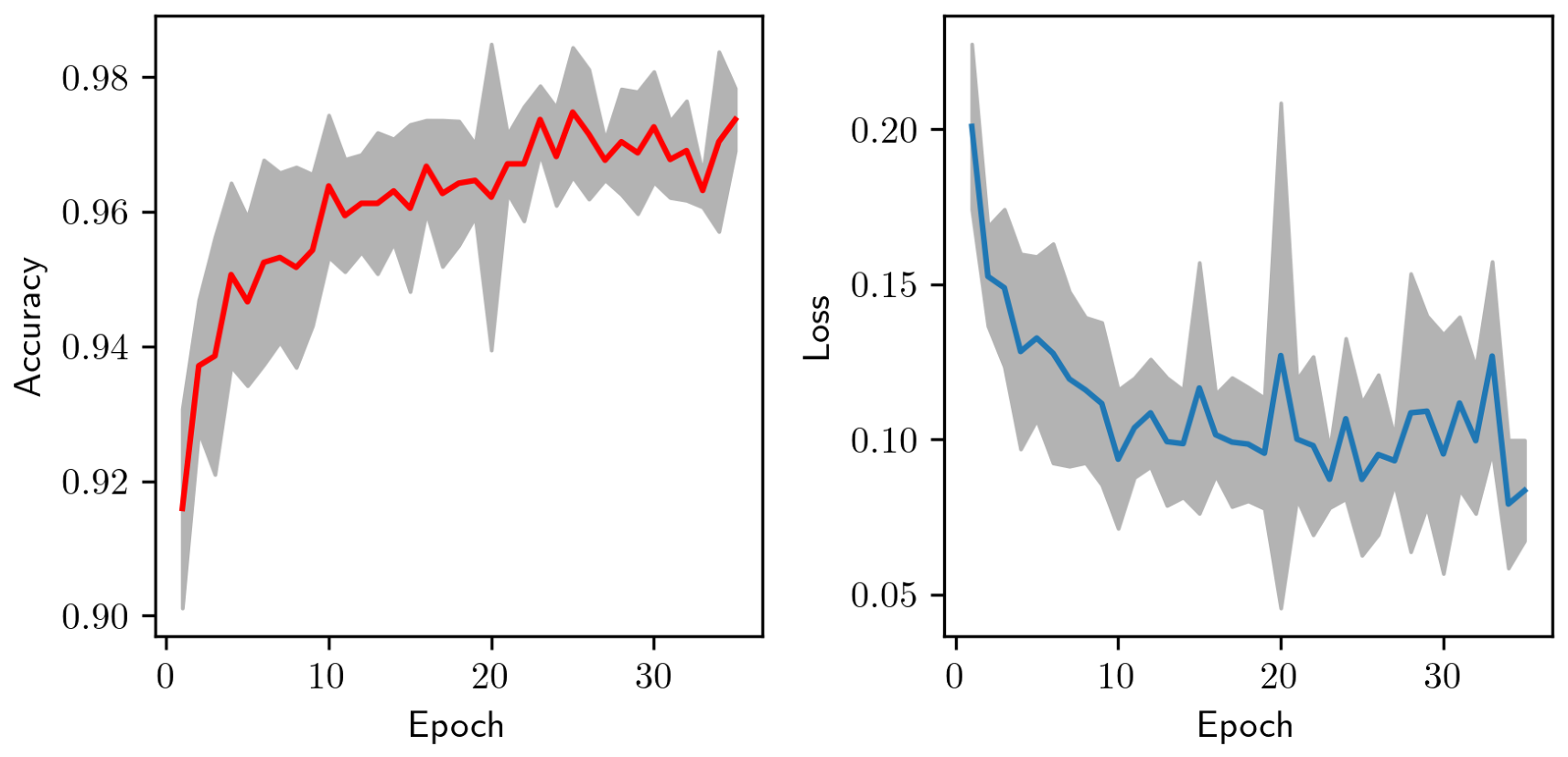
Figure A2.
Examples of various problems related to edge-on detection and processing. Columns from left to right: CCD leakage detected as edge-on, star rays, artifacts in DESI Legacy. Last column in the example of bad photometry measurements using SExtractor.
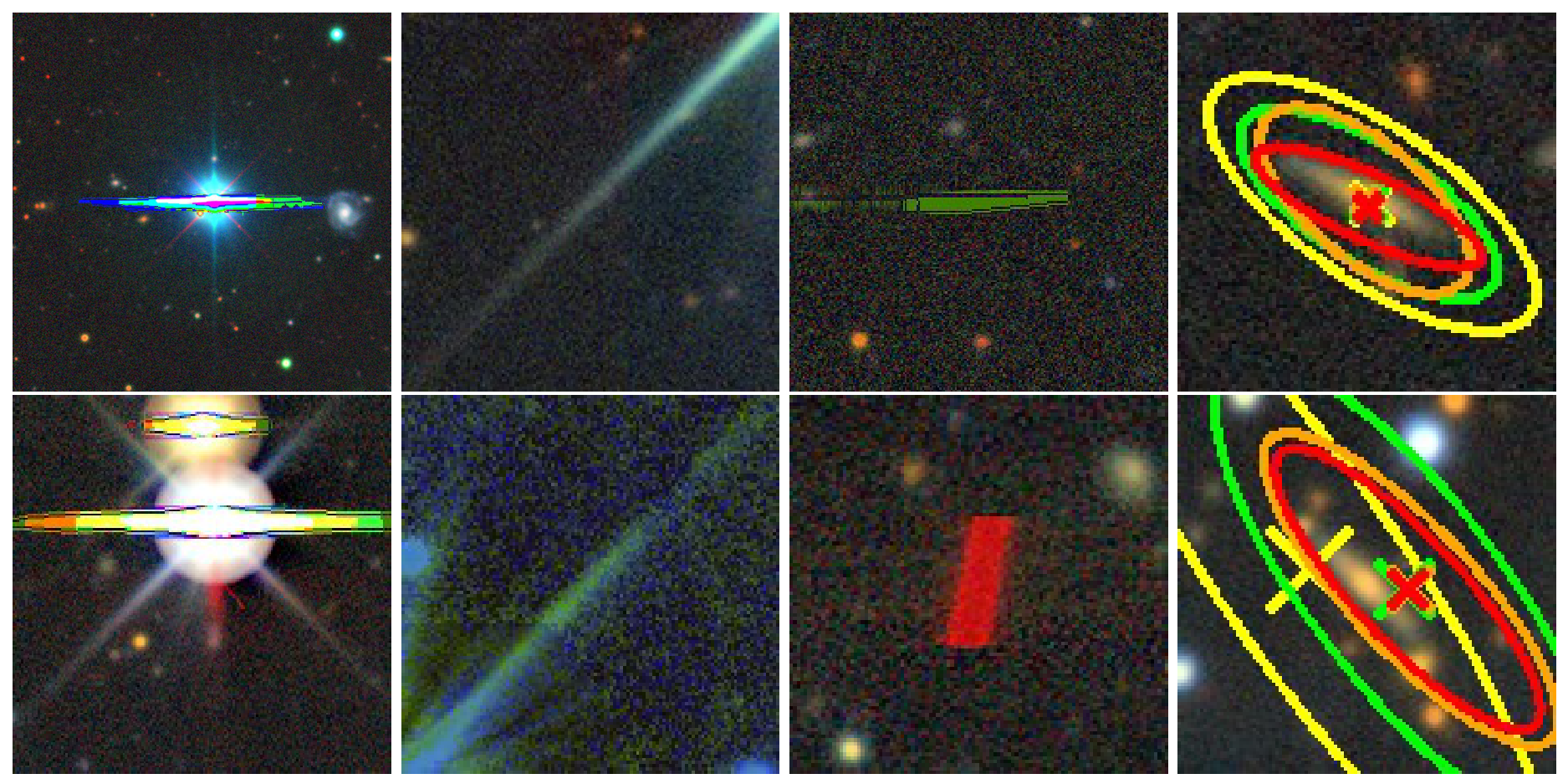
Appendix B. Surveys Data Cross-Validation
In this Appendix, we provide a comparison and cross-validation of the same parameters between different surveys. We do this to find independent evidence that galaxies in EGIDE are correctly cross-identified and that the methods we use for parameter estimation are robust. We compare redshifts, total stellar mass estimates, and apparent magnitudes. Also, the flattening distributions across the various datasets used are compared in the next Appendix C.
In Figure A3, we compare estimates. For the list of surveys used, consult Section 4. On the left panel, we show from the HyperLEDA database [117], which is a compilation of redshift sources in the CMB frame, versus the Dark Energy Spectroscopic Instrument Data Release 1 (DESI DR1) [90], which collects spectroscopic redshift measurements up to . Specifically, we use the Stellar Mass and Emission Line Catalog Value Added Catalog (EMLines VAC), which contains information for galaxies with reliable redshift measurements. In the center of Figure A3, we compare REGALADE redshifts, which we use as the reference for EGIDE, with combined data from DESI DR1 and HyperLEDA. In both panels, we see good agreement between the various estimates from different sources, with a normalized median absolute deviation (NMAD, a robust statistical measure of dispersion) of about 170 km/s in both cases. In the majority of cases, as the bottom subplots show, the difference lies within 500 km/s at all distances. On the right panel of Figure A3, we compare REGALADE data with 30,410 galaxies from the RCSEDv2 database [121], which includes DESI among other surveys (see Table 1). In this case, the NMAD is drastically smaller, around 20 km/s, the overall scatter lies within 100 km/s, and some systematic difference is much more evident.
In Figure A4, we present a comparison of total stellar masses for galaxies in EGIDE obtained in three different ways. In the DESI DR1 EMLines VAC, stellar masses (Available in column MASS_CG of the Stellar Mass and Emission Line Catalog.) were derived using Code Investigating GALaxy Emission (CIGALE; [124]), which combines spectra with broadband photometry from the DESI Legacy Surveys (g, r, z, , and bands). In the REGALADE survey [120], the authors measure stellar masses using Kron magnitudes from Pan-STARRS photometry in the optical bands, as well as distance D and photometric redshift estimates, and additional information from two catalogs based on DESI Legacy DR9 and DR10, which include WISE photometry in and . In total, REGALADE-related masses were derived on page 6 of [120] using the following calibration (—constant values):
On the other hand, Ref. [123] compares optical and IR counterparts from [146] and finds a simple formula for estimating galaxy masses using absolute stellar magnitudes in the g and r DESI bands. We use available distance measurements and these calibrations to find the stellar mass as (see details in [123])
On the left side of Figure A4, we compare the stellar masses used here from the photometry obtained in Section 3 with masses from SED-fitting estimates. We can see that, regardless of visible systematic differences, the NMAD lies within the relative error, which is ≈30% for CIGALE-based data in this sample, and the overall agreement is good. On the right panel, we compare the two estimates based on the photometric calibrations derived in REGALADE and [123]. Despite the five times larger sample than in the left panel and different methods, the two parts of Figure A4 look nearly the same: the NMAD is approximately 0.15 dex, the difference interval is about 0.5 dex, and the method we adopt for EGIDE galaxies overweights massive galaxies and underweights lighter ones, with the transition at . In total, we can conclude that the [123] g and r-based method for mass estimation works relatively well and can be used as a good proxy for total stellar mass.
Finally, in this Appendix, we compare the apparent Kron magnitudes in the r and z bands from REGALADE with those measured in this work in Section 3. Values from REGALADE are measured in the Pan-STARRS system and reduced to DESI bands for proper comparison. In Figure A5, we see that the NMAD is mag and the agreement between the independent apparent magnitude estimates is decent. For the z-band, we see sub-line systematics, and the overall agreement is worse than for the r-band, but the difference is well below 0.5 mag.
Figure A3.
Comparison of from DESI DR1, HyperLEDA, RCSEDv2, and REGALADE, where the latter is used for the EGIDE sample. In the bottom panel below each subplot, we show the difference between values, and the lines indicate the median, zero, and ±NMAD levels.
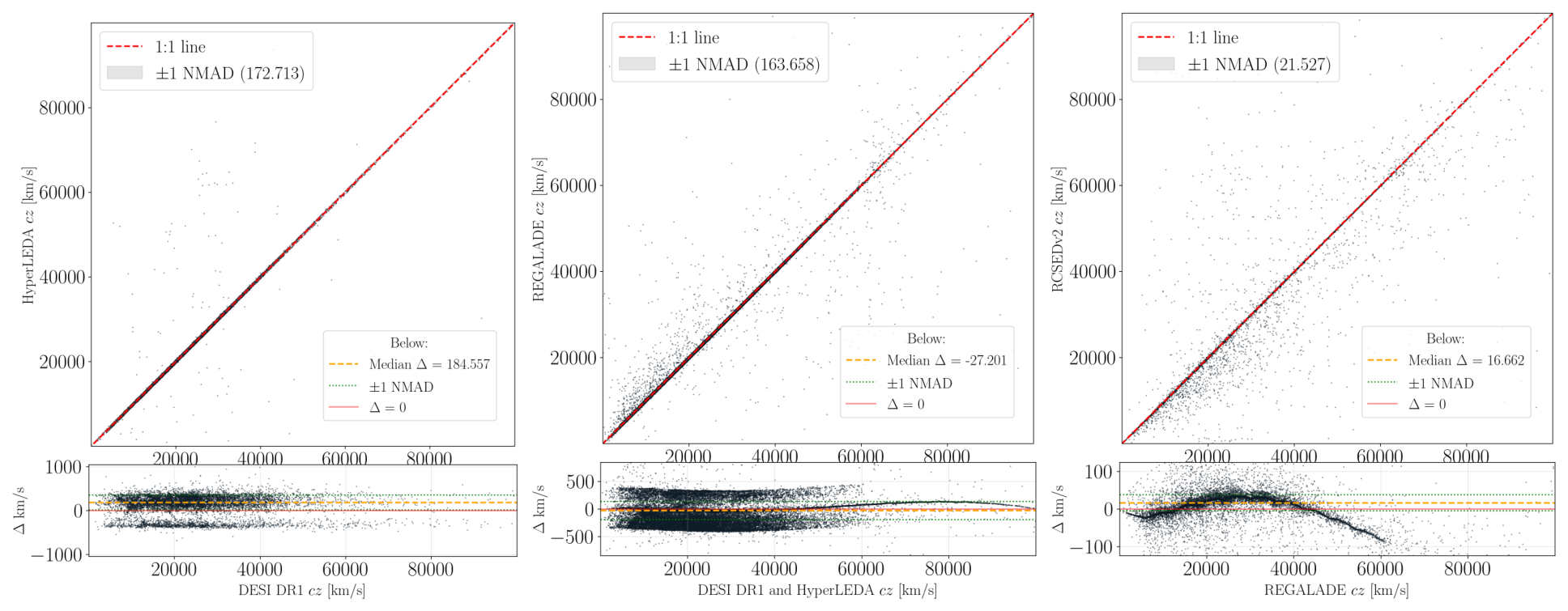
Figure A4.
Comparison of the total stellar masses for galaxies. (Left): the x-axis values are from CIGALE [124] fitting in DESI DR1 [90], while the y-axis values are adopted for EGIDE from the color-related calibrations in [123]. (Right): the x-axis values are from the calibrations in REGALADE, while the vertical axis is the same as on the left.
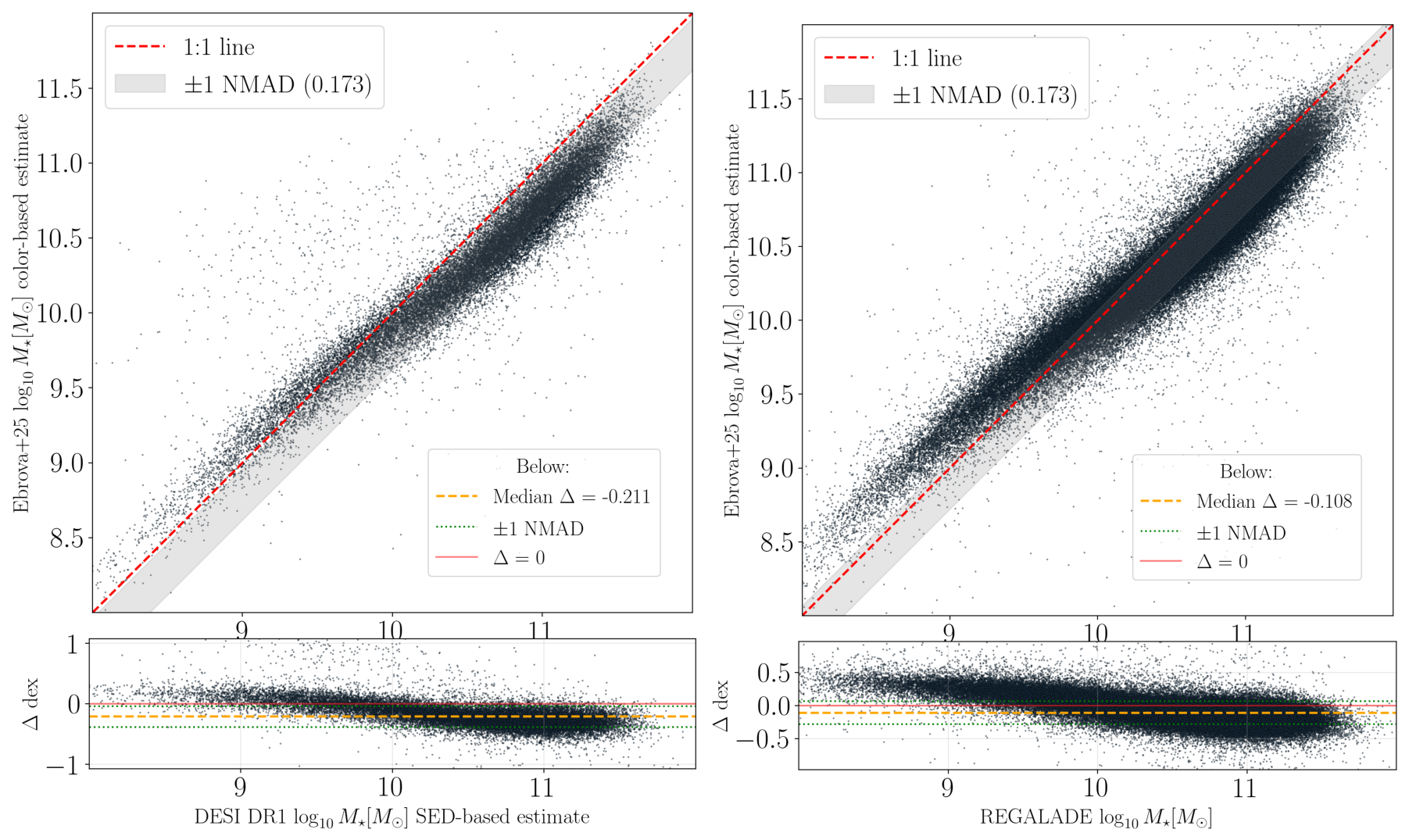
Figure A5.
Comparison of the apparent Kron magnitude in EGIDE photometry (vertical axis) and in REGALADE (horizontal axis). The (left) plot is for the r band, and the (right) plot is for the z band.
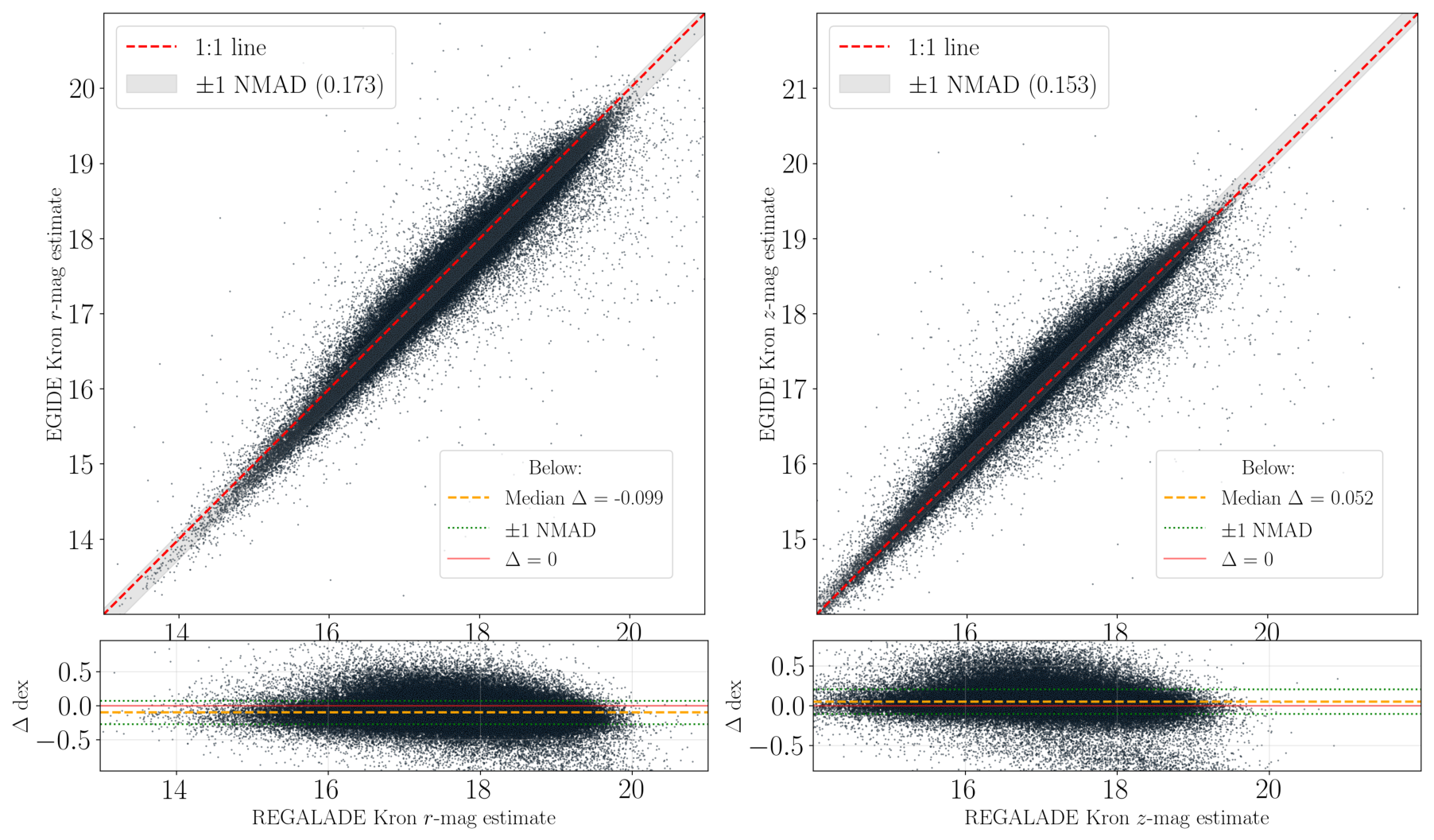
Appendix C. Flatness Measurements in Other Surveys
In this Appendix, we provide flatness measurements from various other sources and the details of estimation in Figure A6. We do this to find independent evidence that galaxies in EGIDE are indeed edge-on, and to increase the reader’s confidence in our work.
In the HyperLEDA [117] subset, we use the apparent axis ratio logr25. This parameter is the axis ratio of the 25 mag/arcsec2 isophote in the B-band. These values are slightly larger on average, as Figure A6 shows.
From the REGALADE [120] data, we have and , which are the semi-major and semi-minor axes of the ellipse. In this work, the authors recalibrate sizes from the used catalogs to the same notation as that used in the Siena Galaxy Atlas [108], i.e., to the mag/arcsec2 isophote in the r-band. The estimate of flattening is in good agreement with the measured using the EGIDE photometry in Section 3.
Finally, to compute the shape for DESI DR1 galaxies, we use the two ellipticity components and , which are then converted to using the formula (See https://www.legacysurvey.org/dr10/catalogs/#ellipticities and parameters SHAPE_E1 and SHAPE_E2 in Table dr1_galaxy_stellarmass_lineinfo_v1.0 of the Stellar Mass and Emission Line Catalog.):
The resulting distribution has a median with a standard deviation of . It is difficult to say why these values are noticeably lower than the values from our photometry and other surveys. We notice that in all examined cases probabilistic TRACTOR models result in much bigger a than observed, and thus in smaller q. In any case, such small values further validate that the collected candidates are very elongated and most likely visible edge-on.
Figure A6.
Distributions of the axis ratio from various datasets and comparison with the EGIDE . Columns from left to right: from HyperLEDA, q from DESI DR1 ellipticities, and ratio from REGALADE. The upper row shows the full distribution for the intersection with each respective survey (see Table 1 for details). In the bottom row, we show the distribution only for the mass bin, where the green line shows the distribution from figure 6 in [26].
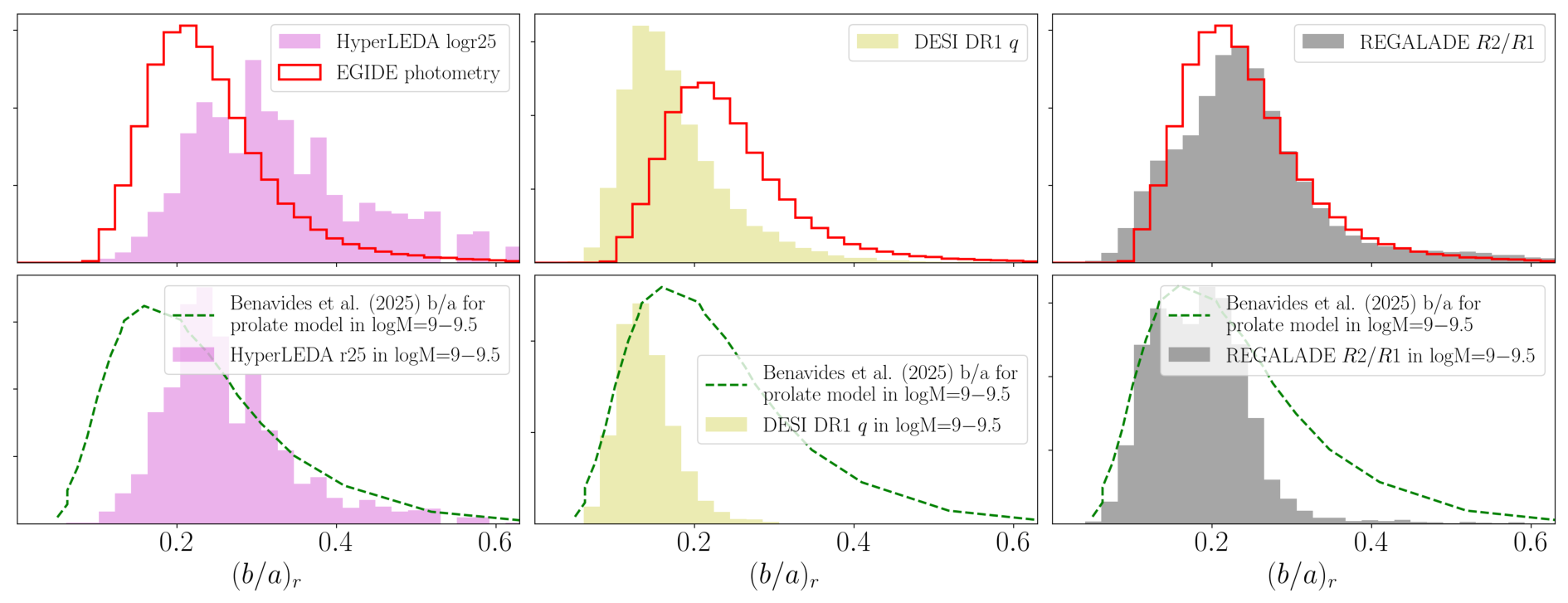
Appendix D. Gallery of Edge-On Galaxies from EGIDE
In this Appendix, we show a preview of other examples of edge-on galaxies from EGIDE. They are arranged in the same way as in Figure 9, representing objects of different flatness and color.
Figure A7.
Gallery of galaxies from EGIDE with varying flatness in the r-band (horizontal axis) and color using Petrosian magnitudes (vertical axis). Marked ellipses are detected by SExtractor and used in the photometry measurements. The numbers show the range of flatness and color bin in each column and row, respectively.
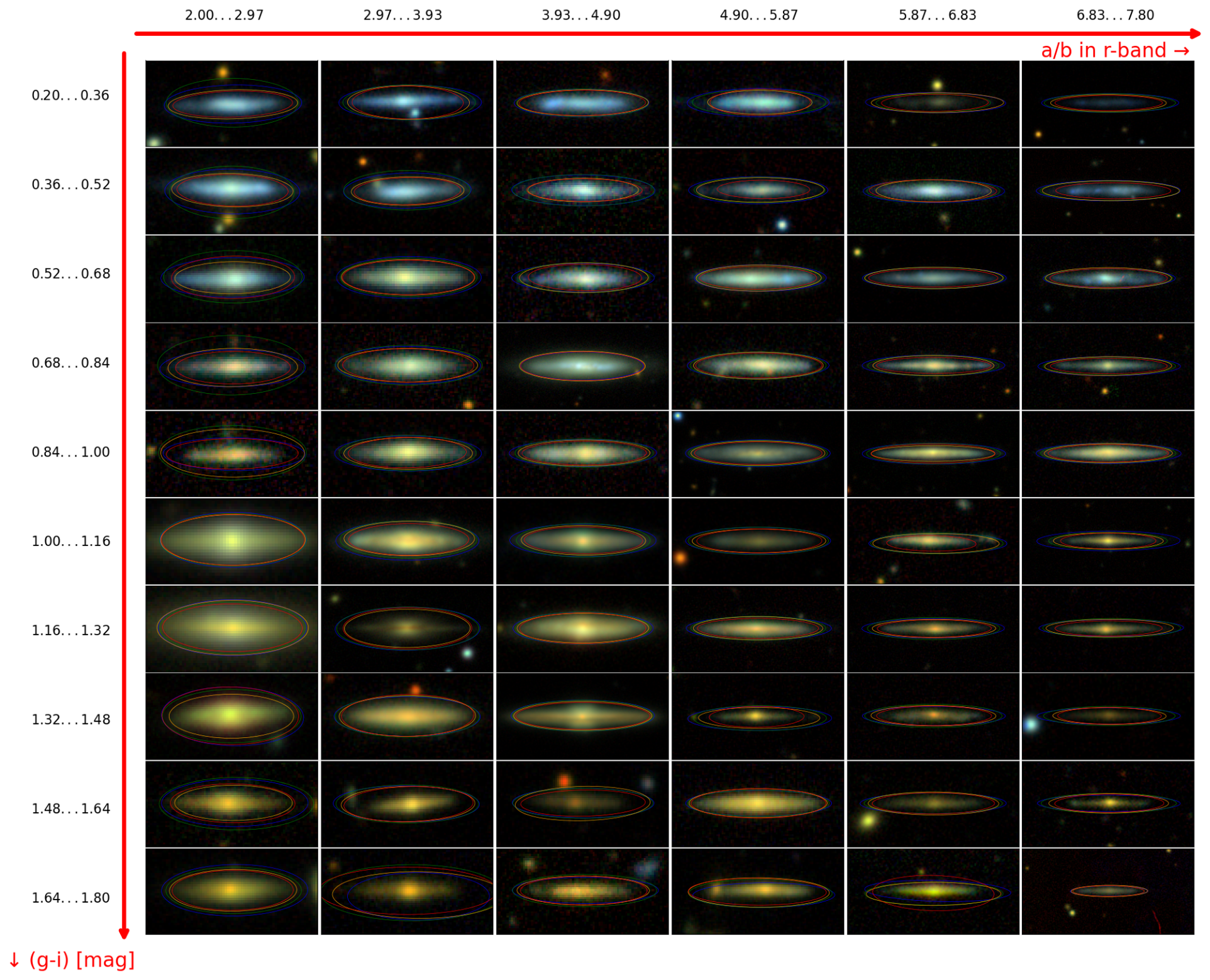
References
- Kormendy, J.; Bruzual, A.G. The minor-axis brightness profile of the spiral galaxy NGC 4565 and the problem of massive halos. Astrophys. J. 1978, 223, L63–L66. [Google Scholar] [CrossRef] [Scilit]
- Burstein, D. Structure and origin of S0 galaxies. III. The luminosity distribution perpendicular to the plane of the disks in S0’s. Astrophys. J. 1979, 234, 829–836. [Google Scholar] [CrossRef] [Scilit] [PubMed]
- van der Kruit, P.C.; Searle, L. Surface photometry of edge-on spiral galaxies. I—A model for the three-dimensional distribution of light in galactic disks. Astron. Astrophys. 1981, 95, 105–115. [Google Scholar]
- Jog, C.J. Vertical structure and dynamics of a galactic disk. Phys. Rep. 2026, 1163, 1–98. [Google Scholar] [CrossRef] [Scilit]
- Bizyaev, D.; Walterbos, R.A.M.; Chen, Y.M.; Drory, N.; Lane, R.R.; Brownstein, J.R.; Riffel, R.A. SDSS-IV MaNGA—Gas rotation velocity lags in the final sample of MaNGA galaxies. Mon. Not. R. Astron. Soc. 2022, 515, 1598–1609. [Google Scholar] [CrossRef] [Scilit]
- Alinder, S.; Bensby, T.; McMillan, P. Impact of selection criteria on the structural parameters of the Galactic thin and thick discs. arXiv 2025, arXiv:2511.10092. [Google Scholar] [CrossRef] [Scilit]
- Bland-Hawthorn, J.; Gerhard, O. The Galaxy in Context: Structural, Kinematic, and Integrated Properties. Annu. Rev. Astron. Astrophys. 2016, 54, 529–596. [Google Scholar] [CrossRef] [Scilit]
- Martig, M.; Pinna, F.; Falcón-Barroso, J.; Martín-Navarro, I.; Minchev, I.; Ding, Y. Disc growth and vertical heating of lenticular galaxies in the Fornax cluster. arXiv 2025, arXiv:2511.19632. [Google Scholar] [CrossRef] [Scilit]
- Struck, C.; Elmegreen, B.G.; DOnghia, E. Scattering, Migration, Re-circularization and Relaxation to Build Out Galaxy Disks with Exponential Profiles. arXiv 2026, arXiv:2602.21171. [Google Scholar] [CrossRef] [Scilit]
- Grand, R.J.J.; Springel, V.; Gómez, F.A.; Marinacci, F.; Pakmor, R.; Campbell, D.J.R.; Jenkins, A. Vertical disc heating in Milky Way-sized galaxies in a cosmological context. Mon. Not. R. Astron. Soc. 2016, 459, 199–219. [Google Scholar] [CrossRef] [Scilit]
- Yan, H.; Sun, B.; Ling, C. An Edge-on Regular Disk Galaxy at z = 5.289. Astrophys. J. 2024, 975, 44. [Google Scholar] [CrossRef] [Scilit]
- Hamilton-Campos, K.A.; Simons, R.C.; Peeples, M.S.; Snyder, G.F.; Heckman, T.M. The Physical Thickness of Stellar Disks to z ∼ 2. Astrophys. J. 2023, 956, 147. [Google Scholar] [CrossRef] [Scilit]
- Tsukui, T.; Wisnioski, E.; Bland-Hawthorn, J.; Freeman, K. The emergence of galactic thin and thick discs across cosmic history. Mon. Not. R. Astron. Soc. 2025, 540, 3493–3522. [Google Scholar] [CrossRef] [Scilit]
- Yu, S.Y.; Ho, L.C.; Tsukui, T.; Silverman, J.D.; Huertas-Company, M.; Koekemoer, A.M.; Franco, M.; Massey, R.; Yang, L.; Arango-Toro, R.C.; et al. Through Thick and Thin: The Cosmic Evolution of Disk Scale Height. arXiv 2026, arXiv:2601.04988. [Google Scholar] [CrossRef] [Scilit]
- van Asselt, M.; Rizzo, F.; Di Mascolo, L. Early thin-disc assembly revealed by JWST edge-on galaxies. arXiv 2026, arXiv:2601.03339. [Google Scholar] [CrossRef] [Scilit]
- Sandage, A.; Freeman, K.C.; Stokes, N.R. The Intrinsic Flattening of e, so, and Spiral Galaxies as Related to Galaxy Formation and Evolution. Astrophys. J. 1970, 160, 831. [Google Scholar] [CrossRef] [Scilit] [PubMed]
- Goad, J.W.; Roberts, M.S. Spectroscopic Observations of Superthin Galaxies. In Proceedings of the Bulletin of the American Astronomical Society; American Institute of Physics: New York, NY, USA, 1979; Volume 11, p. 668. [Google Scholar]
- Goad, J.W.; Roberts, M.S. Spectroscopic observations of superthin galaxies. Astrophys. J. 1981, 250, 79–86. [Google Scholar] [CrossRef] [Scilit] [PubMed]
- Baldry, I.K.; Liske, J.; Brown, M.J.I.; Robotham, A.S.G.; Driver, S.P.; Dunne, L.; Alpaslan, M.; Brough, S.; Cluver, M.E.; Eardley, E.; et al. Galaxy And Mass Assembly: The G02 field, Herschel-ATLAS target selection and data release 3. Mon. Not. R. Astron. Soc. 2018, 474, 3875–3888. [Google Scholar] [CrossRef] [Scilit]
- Padilla, N.D.; Strauss, M.A. The shapes of galaxies in the Sloan Digital Sky Survey. Mon. Not. R. Astron. Soc. 2008, 388, 1321–1334. [Google Scholar] [CrossRef] [Scilit]
- Ahumada, R.; Allende Prieto, C.; Almeida, A.; Anders, F.; Anderson, S.F.; Andrews, B.H.; Anguiano, B.; Arcodia, R.; Armengaud, E.; Aubert, M.; et al. The 16th Data Release of the Sloan Digital Sky Surveys: First Release from the APOGEE-2 Southern Survey and Full Release of eBOSS Spectra. Astrophys. J. Suppl. Ser. 2020, 249, 3. [Google Scholar] [CrossRef] [Scilit]
- Haslbauer, M.; Banik, I.; Kroupa, P.; Wittenburg, N.; Javanmardi, B. The High Fraction of Thin Disk Galaxies Continues to Challenge ΛCDM Cosmology. Astrophys. J. 2022, 925, 183. [Google Scholar] [CrossRef] [Scilit]
- van de Sande, J.; Lagos, C.D.P.; Welker, C.; Bland-Hawthorn, J.; Schulze, F.; Remus, R.S.; Bahé, Y.; Brough, S.; Bryant, J.J.; Cortese, L.; et al. The SAMI Galaxy Survey: Comparing 3D spectroscopic observations with galaxies from cosmological hydrodynamical simulations. Mon. Not. R. Astron. Soc. 2019, 484, 869–891. [Google Scholar] [CrossRef] [Scilit]
- Klein, C.; Bullock, J.S.; Xia, L.; Moreno, J.; Feldmann, R.; Mercado, F.J.; Faucher-Giguère, C.A.; Stern, J.; Sanchez, N.N.; Hussein, A. The shape of FIREbox galaxies and a potential tension with low-mass disks. arXiv 2025, arXiv:2503.05612. [Google Scholar] [CrossRef] [Scilit]
- Xu, D.; Gao, H.; Bottrell, C.; Yesuf, H.M.; Shi, J. IllustrisTNG in the HSC-SSP: No Shortage of Thin Disk Galaxies in TNG50. Astrophys. J. 2024, 974, 88. [Google Scholar] [CrossRef] [Scilit]
- Benavides, J.A.; Sales, L.V.; Navarro, J.F.; White, S.D.M.; Frenk, C.S.; Oman, K.A.; Cole, S. The abundance of thin dwarf galaxies: A challenge for cosmological simulations. Open J. Astrophys. 2026, 8, 62091. [Google Scholar] [CrossRef] [Scilit]
- Gibson, J.L.; Nelson, E.; Williams, C.C.; Price, S.H.; Whitaker, K.E.; Suess, K.A.; de Graaff, A.; Johnson, B.D.; Bunker, A.J.; Baker, W.M.; et al. JADES Ultrared Flattened Objects: Morphologies and Spatial Gradients in Color and Stellar Populations. Astrophys. J. 2024, 974, 48. [Google Scholar] [CrossRef] [Scilit]
- Pandya, V.; Zhang, H.; Huertas-Company, M.; Iyer, K.G.; McGrath, E.; Barro, G.; Finkelstein, S.L.; Kümmel, M.; Hartley, W.G.; Ferguson, H.C.; et al. Galaxies Going Bananas: Inferring the 3D Geometry of High-redshift Galaxies with JWST-CEERS. Astrophys. J. 2024, 963, 54. [Google Scholar] [CrossRef] [Scilit]
- Peng, Y. A Unified Explanation for JWST Little Red Dots and High-Redshift Low-Mass Disk-like Galaxies: Prolate Galaxies Viewed End-on vs Side-on. arXiv 2026, arXiv:2603.01668. [Google Scholar] [CrossRef] [Scilit]
- Pozo, A.; Broadhurst, T.; Emami, R.; Mocz, P.; Vogelsberger, M.; Hernquist, L.; Conselice, C.J.; Luu, H.N.; Smoot, G.F.; Windhorst, R. A smooth filament origin for distant prolate galaxies seen by JWST and HST. Nat. Astron. 2025, 10, 306–316. [Google Scholar] [CrossRef] [Scilit]
- O’Brien, J.C.; Freeman, K.C.; van der Kruit, P.C. The dark matter halo shape of edge-on disk galaxies. IV. UGC 7321. Astron. Astrophys. 2010, 515, A63. [Google Scholar] [CrossRef] [Scilit]
- Sotnikova, N.Y.; Rodionov, S.A. Estimating the dark halo mass from the relative thickness of stellar disks. Astron. Lett. 2006, 32, 649–660. [Google Scholar] [CrossRef] [Scilit]
- Khoperskov, A.; Bizyaev, D.; Tiurina, N.; Butenko, M. Numerical modelling of the vertical structure and dark halo parameters in disc galaxies. Astron. Nachrichten 2010, 331, 731. [Google Scholar] [CrossRef] [Scilit]
- Marchuk, A.; Kozlov, M. Estimating the contribution of a dark halo at different distances in the disk of an edge-on galaxy. Publ. Pulkovo Obs. 2025, 237, 33–50. [Google Scholar] [CrossRef] [Scilit]
- Rodionov, S.A.; Sotnikova, N.Y. Bending instability in galactic discs: Advocacy of the linear theory. Mon. Not. R. Astron. Soc. 2013, 434, 2373–2379. [Google Scholar] [CrossRef] [Scilit]
- Zasov, A.V.; Makarov, D.I.; Mikhailova, E.A. Thickness of Thin Stellar Disks and the Mass of the Dark Halo. Sov. Astron. Lett. 1991, 17, 374. [Google Scholar]
- Bizyaev, D.; Kajsin, S. The Stellar Disk Thickness of Low Surface Brightness Galaxies. Astrophys. J. 2004, 613, 886–897. [Google Scholar] [CrossRef] [Scilit]
- Bizyaev, D.; Makarov, D.I.; Reshetnikov, V.P.; Mosenkov, A.V.; Kautsch, S.J.; Antipova, A.V. Spectral Observations of Superthin Galaxies. Astrophys. J. 2021, 914, 104. [Google Scholar] [CrossRef] [Scilit]
- Banerjee, A.; Bapat, D. Mass modelling of superthin galaxies: IC5249, UGC7321 and IC2233. Mon. Not. R. Astron. Soc. 2017, 466, 3753–3761. [Google Scholar] [CrossRef] [Scilit]
- Kurapati, S.; Banerjee, A.; Chengalur, J.N.; Makarov, D.; Borisov, S.; Afanasiev, A.; Antipova, A. Mass modelling of a superthin galaxy, FGC 1540. Mon. Not. R. Astron. Soc. 2018, 479, 5686–5695. [Google Scholar] [CrossRef] [Scilit]
- Hu, J.; Xu, D.; Li, C. Formation of Superthin Galaxies in IllustrisTNG. Res. Astron. Astrophys. 2024, 24, 075019. [Google Scholar] [CrossRef] [Scilit]
- Reshetnikov, V.P.; Chugunov, I.V.; Marchuk, A.A.; Mosenkov, A.V.; Kozlov, M.D.; Savchenko, S.S.; Makarov, D.I.; Antipova, A.V.; Sypkova, A.M. Galactic warps: From cosmic noon to the current epoch. Astron. Astrophys. 2025, 697, L1. [Google Scholar] [CrossRef] [Scilit]
- Reshetnikov, V.P.; Mosenkov, A.V.; Moiseev, A.V.; Kotov, S.S.; Savchenko, S.S. Galaxies with conspicuous optical warps. Mon. Not. R. Astron. Soc. 2016, 461, 4233–4245. [Google Scholar] [CrossRef] [Scilit]
- Reshetnikov, V.; Combes, F. Statistics of optical WARPS in spiral disks. Astron. Astrophys. 1998, 337, 9–16. [Google Scholar] [CrossRef] [Scilit]
- Ranaivoharimina, N.; Randriamampandry, T.; Wang, J.; Menéndez-Delmestre, K.; Gonçalves, T.S. On the Stellar Disk Vertical Scale Height of Edge-on Galaxies from S4G. Astrophys. J. 2024, 977, 66. [Google Scholar] [CrossRef] [Scilit]
- Marchuk, A.A.; Smirnov, A.A.; Sotnikova, N.Y.; Bunakalya, D.A.; Savchenko, S.S.; Reshetnikov, V.P.; Usachev, P.A.; Tikhonenko, I.S.; Zozulia, V.D.; Zakharova, D.A. B/PS bulges in DESI Legacy edge-on galaxies - I. Sample building. Mon. Not. R. Astron. Soc. 2022, 512, 1371–1390. [Google Scholar] [CrossRef] [Scilit]
- Smirnov, A.; Marchuk, A.; Zozulia, V.; Sotnikova, N.; Savchenko, S. Boxy/Peanut Bulges: Comparative Analysis of EGIPS Galaxies and TNG50 Models. Galaxies 2026, 14, 4. [Google Scholar] [CrossRef] [Scilit]
- Smirnov, A.A.; Savchenko, S.S. New X-shaped bulge photometric model as a tool for measuring B/PS bulges and their X-structures in photometric studies. Mon. Not. R. Astron. Soc. 2020, 499, 462–481. [Google Scholar] [CrossRef] [Scilit]
- Moiseev, A.V.; Smirnova, K.I.; Smirnova, A.A.; Reshetnikov, V.P. A new catalogue of polar-ring galaxies selected from the Sloan Digital Sky Survey. Mon. Not. R. Astron. Soc. 2011, 418, 244–257. [Google Scholar] [CrossRef] [Scilit]
- Mosenkov, A.V.; Bahr, S.K.H.; Reshetnikov, V.P.; Shakespear, Z.; Smirnov, D.V. The occurrence rate of galaxies with polar structures may be significantly underestimated. Astron. Astrophys. 2024, 681, L15. [Google Scholar] [CrossRef] [Scilit]
- Smirnov, D.V.; Reshetnikov, V.P. The luminosity function of ringed galaxies. Mon. Not. R. Astron. Soc. 2022, 516, 3692–3700. [Google Scholar] [CrossRef] [Scilit]
- Reshetnikov, V.; Combes, F. Polar-ring galaxies: The SDSS view on the symbiotic galaxies. Mon. Not. R. Astron. Soc. 2015, 447, 2287–2294. [Google Scholar] [CrossRef] [Scilit]
- Bahr, S.K.H.; Mosenkov, A.V.; Guerrette, J.A.; Jensen, I.H.; George, J.X.; Spigarelli, T.E.; Smith, R.P.; Burton, B.T.; Beckstead, K.W.; Seguine, J.D.; et al. COUGS-DESI: A Catalog of Unusual Galaxies with Polar Structures in the DESI Legacy Imaging Surveys. arXiv 2026, arXiv:2601.02579. [Google Scholar] [CrossRef] [Scilit]
- Chen, L.; Du, M.; Lu, S.; Li, J.; Ho, L.C. Down-bending Breaks in Galactic Disks Are an Intrinsic Byproduct of Inside-out Growth. arXiv 2026, arXiv:2602.00626. [Google Scholar] [CrossRef] [Scilit]
- Makarov, D.I.; Zaitseva, N.A.; Bizyaev, D.V. The Tully-Fisher relation for flat galaxies. Mon. Not. R. Astron. Soc. 2018, 479, 3373–3380. [Google Scholar] [CrossRef] [Scilit]
- Antipova, A.V.; Makarov, D.I.; Libeskind, N.I.; Tempel, E. Orientation of galaxy spins relative to filaments of the large-scale structure of the Universe. Publ. Astron. Soc. Aust. 2025, 42, e084. [Google Scholar] [CrossRef] [Scilit]
- Zee, W.B.G.; Jung, S.L.; Paudel, S.; Yoon, S.J. Warped Disk Galaxies. II. From the Cosmic Web to the Galactic Warp. Astrophys. J. 2025, 993, 205. [Google Scholar] [CrossRef] [Scilit]
- Kroupa, P.; Theis, C.; Boily, C.M. The great disk of Milky-Way satellites and cosmological sub-structures. Astron. Astrophys. 2005, 431, 517–521. [Google Scholar] [CrossRef] [Scilit]
- Karachentsev, I.D.; Kroupa, P. A co-rotating gas and satellite structure around the interacting galaxy pair NGC 4490/85. Mon. Not. R. Astron. Soc. 2024, 528, 2805–2811. [Google Scholar] [CrossRef] [Scilit]
- Postnikova, V.K.; Bizyaev, D. SDSS-IV MaNGA: Ionization Sources of the Extra-planar Diffuse Ionized Gas. Astron. Lett. 2023, 49, 151–166. [Google Scholar] [CrossRef] [Scilit]
- Sardaneta, M.M.; Amram, P.; Rampazzo, R.; Rosado, M.; Fuentes-Carrera, I.; Ghosh, S. Extraplanar emission in isolated edge-on late-type galaxies—II. The Hα kinematics. Mon. Not. R. Astron. Soc. 2025, 544, 1861–1896. [Google Scholar] [CrossRef] [Scilit]
- Gentile, G.; Józsa, G.I.G.; Serra, P.; Heald, G.H.; de Blok, W.J.G.; Fraternali, F.; Patterson, M.T.; Walterbos, R.A.M.; Oosterloo, T. HALOGAS: Extraplanar gas in NGC 3198. Astron. Astrophys. 2013, 554, A125. [Google Scholar] [CrossRef] [Scilit]
- Jiménez-López, D.; García-Burillo, S.; Querejeta, M.; Usero, A.; Tarrío, P. Imaging the disk-halo interface of NGC 891: A 2.7 kpc-thick molecular gas disk. arXiv 2026, arXiv:2603.06913. [Google Scholar] [CrossRef] [Scilit]
- Sil’chenko, O.K.; Moiseev, A.V.; Egorov, O.V. The Gas Kinematics, Excitation, and Chemistry, in Connection with Star Formation, in Lenticular Galaxies. Astrophys. J. Suppl. Ser. 2019, 244, 6. [Google Scholar] [CrossRef] [Scilit]
- Krumholz, M.R.; Dekel, A.; McKee, C.F. A Universal, Local Star Formation Law in Galactic Clouds, nearby Galaxies, High-redshift Disks, and Starbursts. Astrophys. J. 2012, 745, 69. [Google Scholar] [CrossRef] [Scilit]
- Bacchini, C.; Fraternali, F.; Iorio, G.; Pezzulli, G. Volumetric star formation laws of disc galaxies. Astron. Astrophys. 2019, 622, A64. [Google Scholar] [CrossRef] [Scilit]
- Marchuk, A.A. Gravitational instability and star formation in NGC 628. Mon. Not. R. Astron. Soc. 2018, 476, 3591–3599. [Google Scholar] [CrossRef] [Scilit]
- Marchuk, A.A.; Sotnikova, N.Y. Two-component gravitational instability in spiral galaxies. Mon. Not. R. Astron. Soc. 2018, 475, 4891–4910. [Google Scholar] [CrossRef] [Scilit]
- Romeo, A.B.; Wiegert, J. The effective stability parameter for two-component galactic discs: Is Q−1≈ Q−1stars + Q−1gas? Mon. Not. R. Astron. Soc. 2011, 416, 1191–1196. [Google Scholar] [CrossRef] [Scilit]
- Romeo, A.B.; Falstad, N. A simple and accurate approximation for the Q stability parameter in multicomponent and realistically thick discs. Mon. Not. R. Astron. Soc. 2013, 433, 1389–1397. [Google Scholar] [CrossRef] [Scilit]
- Kostiuk, V.S.; Gusev, A.S.; Marchuk, A.A.; Shimanovskaya, E.V. Gravitational instability and spatial regularity of the gas clouds and young stellar population in spiral arms of NGC 628. Astron. Astrophys. 2025, 698, L6. [Google Scholar] [CrossRef] [Scilit]
- Aumer, M.; Binney, J.; Schönrich, R. Migration and kinematics in growing disc galaxies with thin and thick discs. Mon. Not. R. Astron. Soc. 2017, 470, 3685–3706. [Google Scholar] [CrossRef] [Scilit]
- Mitrašinović, A. Living on the edge: A quantitative warning on boundary artifacts in the IllustrisTNG. Astron. Astrophys. 2025, 703, L16. [Google Scholar] [CrossRef] [Scilit]
- van de Sande, J.; Fraser-McKelvie, A.; Fisher, D.B.; Martig, M.; Hayden, M.R.; Geckos Survey Collaboration. GECKOS: Turning galaxy evolution on its side with deep observations of edge-on galaxies. In Proceedings of the Early Disk-Galaxy Formation from JWST to the Milky Way; IAU Symposium; Tabatabaei, F., Barbuy, B., Ting, Y.S., Eds.; Cambridge University Press: Cambridge, UK, 2024; Volume 377, pp. 27–33. [Google Scholar] [CrossRef] [Scilit]
- Karachentsev, I.D.; Karachentseva, V.E.; Parnovskij, S.L. Flat galaxies catalogue. Astron. Nachrichten 1993, 314, 97–222. [Google Scholar] [CrossRef] [Scilit]
- Karachentsev, I.D.; Karachentseva, V.E.; Kudrya, Y.N.; Sharina, M.E.; Parnovskij, S.L. The revised Flat Galaxy Catalogue. Bull. Spec. Astrophys. Obs. 1999, 47, 5–185. [Google Scholar] [CrossRef] [Scilit]
- Bizyaev, D.V.; Kautsch, S.J.; Mosenkov, A.V.; Reshetnikov, V.P.; Sotnikova, N.Y.; Yablokova, N.V.; Hillyer, R.W. The Catalog of Edge-on Disk Galaxies from SDSS. I. The Catalog and the Structural Parameters of Stellar Disks. Astrophys. J. 2014, 787, 24. [Google Scholar] [CrossRef] [Scilit]
- Makarov, D.; Savchenko, S.; Mosenkov, A.; Bizyaev, D.; Reshetnikov, V.; Antipova, A.; Tikhonenko, I.; Usachev, P.; Borisov, S.; Makarova, L.; et al. The Edge-on Galaxies in the Pan-STARRS survey (EGIPS). Mon. Not. R. Astron. Soc. 2022, 511, 3063–3075. [Google Scholar] [CrossRef] [Scilit]
- Savchenko, S.S.; Makarov, D.I.; Antipova, A.V.; Tikhonenko, I.S. Search for the edge-on galaxies using an artificial neural network. Astron. Comput. 2024, 46, 100771. [Google Scholar] [CrossRef] [Scilit]
- Mosenkov, A.V.; Sotnikova, N.Y.; Reshetnikov, V.P. 2MASS photometry of edge-on spiral galaxies—I. Sample and general results. Mon. Not. R. Astron. Soc. 2010, 401, 559–576. [Google Scholar] [CrossRef] [Scilit]
- Bizyaev, D.; Mitronova, S. Structural Parameters of Stellar Disks from two Micron All Sky Survey Images of Edge-on Galaxies. Astrophys. J. 2009, 702, 1567–1574. [Google Scholar] [CrossRef] [Scilit]
- Bizyaev, D.; Mitronova, S. Photometric parameters of edge-on galaxies from 2MASS observations. Astron. Astrophys. 2002, 389, 795–801. [Google Scholar] [CrossRef] [Scilit]
- Yoshino, A.; Yamauchi, C. Box/peanut and bar structures in edge-on and face-on nearby galaxies in the Sloan Digital Sky Survey—I. Catalogue. Mon. Not. R. Astron. Soc. 2015, 446, 3749–3767. [Google Scholar] [CrossRef] [Scilit]
- Xing, Y.; Yi, Z.; Liang, Z.; Su, H.; Du, W.; He, M.; Liu, M.; Kong, X.; Bu, Y.; Wu, H. Edge-on Low-surface-brightness Galaxy Candidates Detected from SDSS Images Using YOLO. Astrophys. J. Suppl. Ser. 2023, 269, 59. [Google Scholar] [CrossRef] [Scilit]
- Walmsley, M.; Bamford, S.; Dickinson, H.; Géron, T.; Gordon, A.J.; Ferguson, A.M.N.; Fortson, L.; Kruk, S.; Lines, N.; Lintott, C.J.; et al. Galaxy Zoo Evo: 1 million human-annotated images of galaxies. arXiv 2025, arXiv:2512.23691. [Google Scholar] [CrossRef] [Scilit]
- Dey, A.; Schlegel, D.J.; Lang, D.; Blum, R.; Burleigh, K.; Fan, X.; Findlay, J.R.; Finkbeiner, D.; Herrera, D.; Juneau, S.; et al. Overview of the DESI Legacy Imaging Surveys. Astron. J. 2019, 157, 168. [Google Scholar] [CrossRef] [Scilit]
- Flaugher, B.; Diehl, H.T.; Honscheid, K.; Abbott, T.M.C.; Alvarez, O.; Angstadt, R.; Annis, J.T.; Antonik, M.; Ballester, O.; Beaufore, L.; et al. The Dark Energy Camera. Astron. J. 2015, 150, 150. [Google Scholar] [CrossRef] [Scilit]
- Zou, H.; Zhou, X.; Fan, X.; Zhang, T.; Zhou, Z.; Nie, J.; Peng, X.; McGreer, I.; Jiang, L.; Dey, A.; et al. Project Overview of the Beijing-Arizona Sky Survey. Publ. Astron. Soc. Pac. 2017, 129, 064101. [Google Scholar] [CrossRef] [Scilit]
- Lang, D.; Hogg, D.W.; Mykytyn, D. The Tractor: Probabilistic Astronomical Source Detection and Measurement; Astrophysics Source Code Library: Online, 2016. [Google Scholar]
- DESI Collaboration; Karim, M.A.; Adame, A.G.; Aguado, D.; Aguilar, J.; Ahlen, S.; Alam, S.; Aldering, G.; Alexander, D.M.; Alfarsy, R.; et al. Data Release 1 of the Dark Energy Spectroscopic Instrument. arXiv 2025, arXiv:2503.14745. [Google Scholar] [CrossRef] [Scilit]
- Drlica-Wagner, A.; Carlin, J.L.; Nidever, D.L.; Ferguson, P.S.; Kuropatkin, N.; Adamów, M.; Cerny, W.; Choi, Y.; Esteves, J.H.; Martínez-Vázquez, C.E.; et al. The DECam Local Volume Exploration Survey: Overview and First Data Release. Astrophys. J. Suppl. Ser. 2021, 256, 2. [Google Scholar] [CrossRef] [Scilit]
- Bertin, E.; Arnouts, S. SExtractor: Software for source extraction. Astron. Astrophys. 1996, 117, 393–404. [Google Scholar] [CrossRef] [Scilit]
- Ridnik, T.; Ben-Baruch, E.; Noy, A.; Zelnik-Manor, L. ImageNet-21K Pretraining for the Masses. arXiv 2021, arXiv:2104.10972. [Google Scholar] [CrossRef] [Scilit]
- Walmsley, M.; Bowles, M.; Scaife, A.M.M.; Shingirai Makechemu, J.; Gordon, A.J.; Ferguson, A.M.N.; Mann, R.G.; Pearson, J.; Popp, J.J.; Bovy, J.; et al. Scaling Laws for Galaxy Images. arXiv 2024, arXiv:2404.02973. [Google Scholar] [CrossRef] [Scilit]
- Walmsley, M.; Allen, C.; Aussel, B.; Bowles, M.; Gregorowicz, K.; Slijepcevic, I.; Lintott, C.; Scaife, A.; Jabłońska, M.; Karchev, K.; et al. Zoobot: Adaptable Deep Learning Models for Galaxy Morphology. J. Open Source Softw. 2023, 8, 5312. [Google Scholar] [CrossRef] [Scilit]
- Walmsley, M.; Lintott, C.; Géron, T.; Kruk, S.; Krawczyk, C.; Willett, K.W.; Bamford, S.; Kelvin, L.S.; Fortson, L.; Gal, Y.; et al. Galaxy Zoo DECaLS: Detailed visual morphology measurements from volunteers and deep learning for 314 000 galaxies. Mon. Not. R. Astron. Soc. 2022, 509, 3966–3988. [Google Scholar] [CrossRef] [Scilit]
- Paturel, G.; Petit, C.; Prugniel, P.; Theureau, G.; Rousseau, J.; Brouty, M.; Dubois, P.; Cambrésy, L. HYPERLEDA. I. Identification and designation of galaxies. Astron. Astrophys. 2003, 412, 45–55. [Google Scholar] [CrossRef] [Scilit]
- Simard, L.; Mendel, J.T.; Patton, D.R.; Ellison, S.L.; McConnachie, A.W. A Catalog of Bulge+disk Decompositions and Updated Photometry for 1.12 Million Galaxies in the Sloan Digital Sky Survey. Astrophys. J. Suppl. Ser. 2011, 196, 11. [Google Scholar] [CrossRef] [Scilit]
- Mink, J.; Brown, W.R.; Chilingarian, I.V.; Fabricant, D.; Kurtz, M.J.; Moran, S.; Rhee, J.; Tokarz, S.; Wyatt, W.F. Center for Astrophysics Optical Infrared Science Archive. I. FAST Spectrograph. Astron. J. 2021, 161, 3. [Google Scholar] [CrossRef] [Scilit]
- Colless, M.; Dalton, G.; Maddox, S.; Sutherland, W.; Norberg, P.; Cole, S.; Bland-Hawthorn, J.; Bridges, T.; Cannon, R.; Collins, C.; et al. The 2dF Galaxy Redshift Survey: Spectra and redshifts. Mon. Not. R. Astron. Soc. 2001, 328, 1039–1063. [Google Scholar] [CrossRef] [Scilit]
- Blake, C.; Amon, A.; Childress, M.; Erben, T.; Glazebrook, K.; Harnois-Deraps, J.; Heymans, C.; Hildebrandt, H.; Hinton, S.R.; Janssens, S.; et al. The 2-degree Field Lensing Survey: Design and clustering measurements. Mon. Not. R. Astron. Soc. 2016, 462, 4240–4265. [Google Scholar] [CrossRef] [Scilit]
- Jones, D.H.; Saunders, W.; Colless, M.; Read, M.A.; Parker, Q.A.; Watson, F.G.; Campbell, L.A.; Burkey, D.; Mauch, T.; Moore, L.; et al. The 6dF Galaxy Survey: Samples, observational techniques and the first data release. Mon. Not. R. Astron. Soc. 2004, 355, 747–763. [Google Scholar] [CrossRef] [Scilit]
- Fabricant, D.; Fata, R.; Roll, J.; Hertz, E.; Caldwell, N.; Gauron, T.; Geary, J.; McLeod, B.; Szentgyorgyi, A.; Zajac, J.; et al. Hectospec, the MMT’s 300 Optical Fiber-Fed Spectrograph. Publ. Astron. Soc. Pac. 2005, 117, 1411–1434. [Google Scholar] [CrossRef] [Scilit]
- Huchra, J.P.; Geller, M.J.; Clemens, C.M.; Tokarz, S.P.; Michel, A. CfA redshift catalogue. Bull. Inform. Cent. Donnees Stellaires 1992, 41, 31. [Google Scholar]
- Yao, S.; Wu, X.B.; Ai, Y.L.; Yang, J.; Yang, Q.; Dong, X.; Joshi, R.; Wang, F.; Feng, X.; Fu, Y.; et al. The Large Sky Area Multi-object Fiber Spectroscopic Telescope (LAMOST) Quasar Survey: The Fourth and Fifth Data Releases. Astrophys. J. Suppl. Ser. 2019, 240, 6. [Google Scholar] [CrossRef] [Scilit]
- Falco, E.E.; Kurtz, M.J.; Geller, M.J.; Huchra, J.P.; Peters, J.; Berlind, P.; Mink, D.J.; Tokarz, S.P.; Elwell, B. The Updated Zwicky Catalog (UZC). Publ. Astron. Soc. Pac. 1999, 111, 438–452. [Google Scholar] [CrossRef] [Scilit]
- Gaia Collaboration; Vallenari, A.; Brown, A.G.A.; Prusti, T.; de Bruijne, J.H.J.; Arenou, F.; Babusiaux, C.; Biermann, M.; Creevey, O.L.; Ducourant, C.; et al. Gaia Data Release 3. Summary of the content and survey properties. Astron. Astrophys. 2023, 674, A1. [Google Scholar] [CrossRef] [Scilit]
- Moustakas, J.; Lang, D.; Dey, A.; Juneau, S.; Meisner, A.; Myers, A.D.; Schlafly, E.F.; Schlegel, D.J.; Valdes, F.; Weaver, B.A.; et al. Siena Galaxy Atlas 2020. Astrophys. J. Suppl. Ser. 2023, 269, 3. [Google Scholar] [CrossRef] [Scilit]
- Petrosian, V. Surface Brightness and Evolution of Galaxies. Astrophys. J. 1976, 210, L53. [Google Scholar] [CrossRef] [Scilit]
- Kron, R.G. Photometry of a complete sample of faint galaxies. Astrophys. J. Suppl. Ser. 1980, 43, 305–325. [Google Scholar] [CrossRef] [Scilit] [PubMed]
- Gontcharov, G.A.; Marchuk, A.A.; Savchenko, S.S.; Mosenkov, A.V.; Il’in, V.B.; Poliakov, D.M.; Smirnov, A.A.; Krayani, H. Foreground Extinction to Extended Celestial Objects. I. New Extinction Maps. Res. Astron. Astrophys. 2025, 25, 125016. [Google Scholar] [CrossRef] [Scilit]
- Schlafly, E.F.; Finkbeiner, D.P. Measuring Reddening with Sloan Digital Sky Survey Stellar Spectra and Recalibrating SFD. Astrophys. J. 2011, 737, 103. [Google Scholar] [CrossRef] [Scilit]
- Green, G. dustmaps: A Python interface for maps of interstellar dust. J. Open Source Softw. 2018, 3, 695. [Google Scholar] [CrossRef] [Scilit]
- Shao, Z.; Xiao, Q.; Shen, S.; Mo, H.J.; Xia, X.; Deng, Z. Inclination-dependent Luminosity Function of Spiral Galaxies in the Sloan Digital Sky Survey: Implications for Dust Extinction. Astrophys. J. 2007, 659, 1159–1171. [Google Scholar] [CrossRef] [Scilit]
- Blanton, M.R.; Roweis, S. K-Corrections and Filter Transformations in the Ultraviolet, Optical, and Near-Infrared. Astron. J. 2007, 133, 734–754. [Google Scholar] [CrossRef] [Scilit]
- Erwin, P. IMFIT: A Fast, Flexible New Program for Astronomical Image Fitting. Astrophys. J. 2015, 799, 226. [Google Scholar] [CrossRef] [Scilit]
- Makarov, D.; Prugniel, P.; Terekhova, N.; Courtois, H.; Vauglin, I. HyperLEDA. III. The catalogue of extragalactic distances. Astron. Astrophys. 2014, 570, A13. [Google Scholar] [CrossRef] [Scilit]
- Rodriguez-Gomez, V.; Snyder, G.F.; Lotz, J.M.; Nelson, D.; Pillepich, A.; Springel, V.; Genel, S.; Weinberger, R.; Tacchella, S.; Pakmor, R.; et al. The optical morphologies of galaxies in the IllustrisTNG simulation: A comparison to Pan-STARRS observations. Mon. Not. R. Astron. Soc. 2019, 483, 4140–4159. [Google Scholar] [CrossRef] [Scilit]
- Conselice, C.J. The Relationship between Stellar Light Distributions of Galaxies and Their Formation Histories. Astrophys. J. Suppl. Ser. 2003, 147, 1. [Google Scholar] [CrossRef] [Scilit] [PubMed]
- Tranin, H.; Blagorodnova, N.; Gómez-Muñoz, M.A.; Wavasseur, M.; Groot, P.J.; Landsberg, L.; Stoppa, F.; Bloemen, S.; Vreeswijk, P.M.; Pieterse, D.L.A.; et al. A catalog to unite them all: REGALADE, a revised galaxy compilation for the advanced detector era. Astron. Astrophys. 2026, 706, A284. [Google Scholar] [CrossRef] [Scilit]
- Chilingarian, I.V.; Zolotukhin, I.Y.; Katkov, I.Y.; Melchior, A.L.; Rubtsov, E.V.; Grishin, K.A. RCSED—A Value-added Reference Catalog of Spectral Energy Distributions of 800,299 Galaxies in 11 Ultraviolet, Optical, and Near-infrared Bands: Morphologies, Colors, Ionized Gas, and Stellar Population Properties. Astrophys. J. Suppl. Ser. 2017, 228, 14. [Google Scholar] [CrossRef] [Scilit]
- Thuan, T.X.; Seitzer, P.O. An H I survey of Nilson dwarf galaxies. II. Statistical properties. Astrophys. J. 1979, 231, 680–687. [Google Scholar] [CrossRef] [Scilit] [PubMed]
- Ebrová, I.; Bílek, M.; Eliášek, J. Photometric stellar masses for galaxies in DESI Legacy Imaging Surveys. Astron. Astrophys. 2025, 704, A232. [Google Scholar] [CrossRef] [Scilit]
- Boquien, M.; Burgarella, D.; Roehlly, Y.; Buat, V.; Ciesla, L.; Corre, D.; Inoue, A.K.; Salas, H. CIGALE: A python Code Investigating GALaxy Emission. Astron. Astrophys. 2019, 622, A103. [Google Scholar] [CrossRef] [Scilit]
- Alam, S.; Albareti, F.D.; Allende Prieto, C.; Anders, F.; Anderson, S.F.; Anderton, T.; Andrews, B.H.; Armengaud, E.; Aubourg, É.; Bailey, S.; et al. The Eleventh and Twelfth Data Releases of the Sloan Digital Sky Survey: Final Data from SDSS-III. Astrophys. J. Suppl. Ser. 2015, 219, 12. [Google Scholar] [CrossRef] [Scilit]
- Blanton, M.R.; Hogg, D.W.; Bahcall, N.A.; Baldry, I.K.; Brinkmann, J.; Csabai, I.; Eisenstein, D.; Fukugita, M.; Gunn, J.E.; Ivezić, Ž.; et al. The Broadband Optical Properties of Galaxies with Redshifts 0.02 < z < 0.22. Astrophys. J. 2003, 594, 186–207. [Google Scholar] [CrossRef] [Scilit]
- Salim, S. Green Valley Galaxies. Serbian Astron. J. 2014, 189, 1–14. [Google Scholar] [CrossRef] [Scilit]
- Sánchez, S.F.; Avila-Reese, V.; Rodríguez-Puebla, A.; Ibarra-Medel, H.; Calette, R.; Bershady, M.; Hernández-Toledo, H.; Pan, K.; Bizyaev, D. SDSS-IV MaNGA - an archaeological view of the cosmic star formation history. Mon. Not. R. Astron. Soc. 2019, 482, 1557–1586. [Google Scholar] [CrossRef] [Scilit]
- Kautsch, S.J. The Edge-on Perspective of Bulgeless, Simple Disk Galaxies. Publ. Astron. Soc. Pac. 2009, 121, 1297. [Google Scholar] [CrossRef] [Scilit]
- Heidmann, J.; Heidmann, N.; de Vaucouleurs, G. Inclination and absorption effects on the apparent diameters, optical luminosities and neutral hydrogen radiation of galaxies—I. Optical and 21-cm line data. Mem. R. Astron. Soc. 1972, 75, 85. [Google Scholar]
- de Grijs, R. The global structure of galactic discs. Mon. Not. R. Astron. Soc. 1998, 299, 595–610. [Google Scholar] [CrossRef] [Scilit]
- Mosenkov, A.V.; Sotnikova, N.Y.; Reshetnikov, V.P.; Bizyaev, D.V.; Kautsch, S.J. Does the stellar disc flattening depend on the galaxy type? Mon. Not. R. Astron. Soc. 2015, 451, 2376–2389. [Google Scholar] [CrossRef] [Scilit]
- Barsanti, S.; Owers, M.S.; McDermid, R.M.; Bekki, K.; Bland-Hawthorn, J.; Brough, S.; Bryant, J.J.; Cortese, L.; Croom, S.M.; Foster, C.; et al. The SAMI Galaxy Survey: Bulge and Disk Stellar Population Properties in Cluster Galaxies. Astrophys. J. 2021, 906, 100. [Google Scholar] [CrossRef] [Scilit]
- Thulasidharan, L.; D’Onghia, E.; Benjamin, R.; Drimmel, R.; Poggio, E.; Queiroz, A. The Age-Thickness Relation of the Milky Way Disk: A Tracer of Galactic Merging History. arXiv 2024, arXiv:2412.12304. [Google Scholar] [CrossRef] [Scilit]
- Sánchez-Janssen, R.; Méndez-Abreu, J.; Aguerri, J.A.L. Thin discs, thick dwarfs and the effects of stellar feedback. Mon. Not. R. Astron. Soc. 2010, 406, L65–L69. [Google Scholar] [CrossRef] [Scilit]
- Roychowdhury, S.; Chengalur, J.N.; Karachentsev, I.D.; Kaisina, E.I. The intrinsic shapes of dwarf irregular galaxies. Mon. Not. R. Astron. Soc. 2013, 436, L104–L108. [Google Scholar] [CrossRef] [Scilit]
- Zasov, A.V.; Bizyaev, D.V.; Makarov, D.I.; Tyurina, N.V. Relationship between the Thickness of Stellar Disks and the Relative Mass of a DarkGalactic Halo. Astron. Lett. 2002, 28, 527–535. [Google Scholar] [CrossRef] [Scilit]
- Behroozi, P.S.; Wechsler, R.H.; Conroy, C. The Average Star Formation Histories of Galaxies in Dark Matter Halos from z = 0–8. Astrophys. J. 2013, 770, 57. [Google Scholar] [CrossRef] [Scilit]
- Dalcanton, J.J.; Yoachim, P.; Bernstein, R.A. The Formation of Dust Lanes: Implications for Galaxy Evolution. Astrophys. J. 2004, 608, 189–207. [Google Scholar] [CrossRef] [Scilit]
- Bournaud, F.; Elmegreen, B.G.; Martig, M. The Thick Disks of Spiral Galaxies as Relics from Gas-rich, Turbulent, Clumpy Disks at High Redshift. Astrophys. J. 2009, 707, L1–L5. [Google Scholar] [CrossRef] [Scilit]
- Oman, K.A.; Navarro, J.F.; Sales, L.V.; Fattahi, A.; Frenk, C.S.; Sawala, T.; Schaller, M.; White, S.D.M. Missing dark matter in dwarf galaxies? Mon. Not. R. Astron. Soc. 2016, 460, 3610–3623. [Google Scholar] [CrossRef] [Scilit]
- Kudrya, Y.N.; Karachentsev, I.D.; Karachentseva, V.E.; Parnovskii, S.L. The apparent and true peak flattenings of flat galaxies. Astron. Lett. 1994, 20, 8–11. [Google Scholar]
- Sun, W.; Shen, H.; Jiang, B.; Liu, X. The Age-Velocity Dispersion Relations of the Galactic Disk as Revealed by the LAMOST-Gaia Red Clump Stars. Astrophys. J. 2025, 979, 103. [Google Scholar] [CrossRef] [Scilit]
- Wielen, R. The Diffusion of Stellar Orbits Derived from the Observed Age-Dependence of the Velocity Dispersion. Astron. Astrophys. 1977, 60, 263–275. [Google Scholar]
- Makarov, D.I.; Antipova, A.V. Database for Studying Edge-on Galaxies. Astrophys. Bull. 2021, 76, 218–227. [Google Scholar] [CrossRef] [Scilit]
- Salo, H.; Laurikainen, E.; Laine, J.; Comerón, S.; Gadotti, D.A.; Buta, R.; Sheth, K.; Zaritsky, D.; Ho, L.; Knapen, J.; et al. The Spitzer Survey of Stellar Structure in Galaxies (S4G): Multi-component Decomposition Strategies and Data Release. Astrophys. J. Suppl. Ser. 2015, 219, 4. [Google Scholar] [CrossRef] [Scilit]
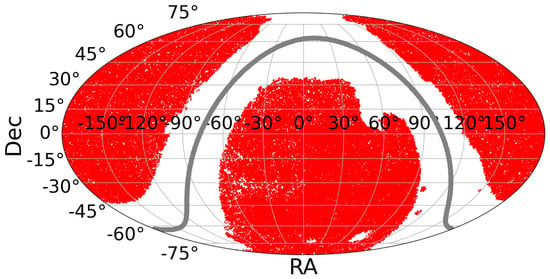
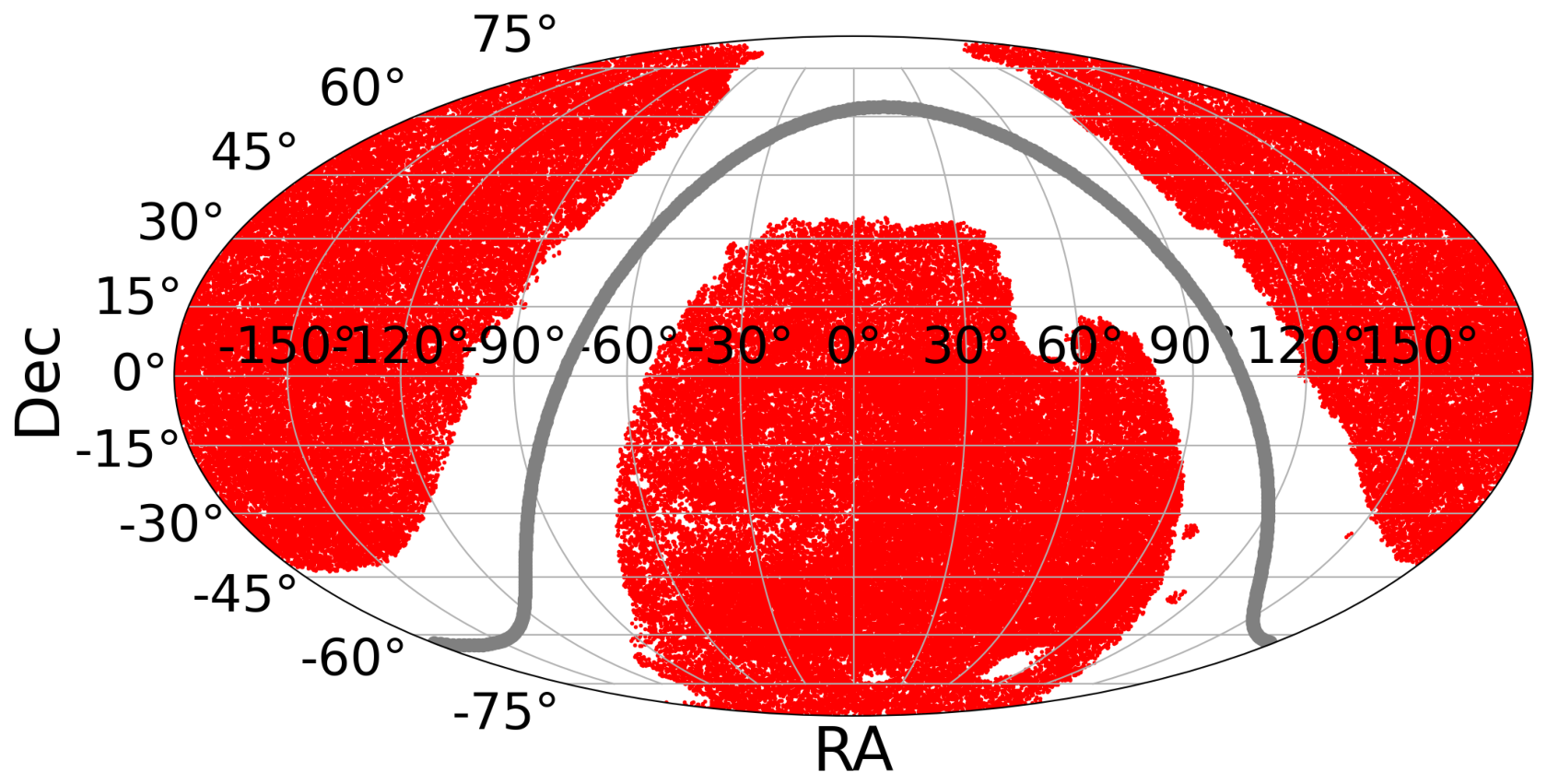
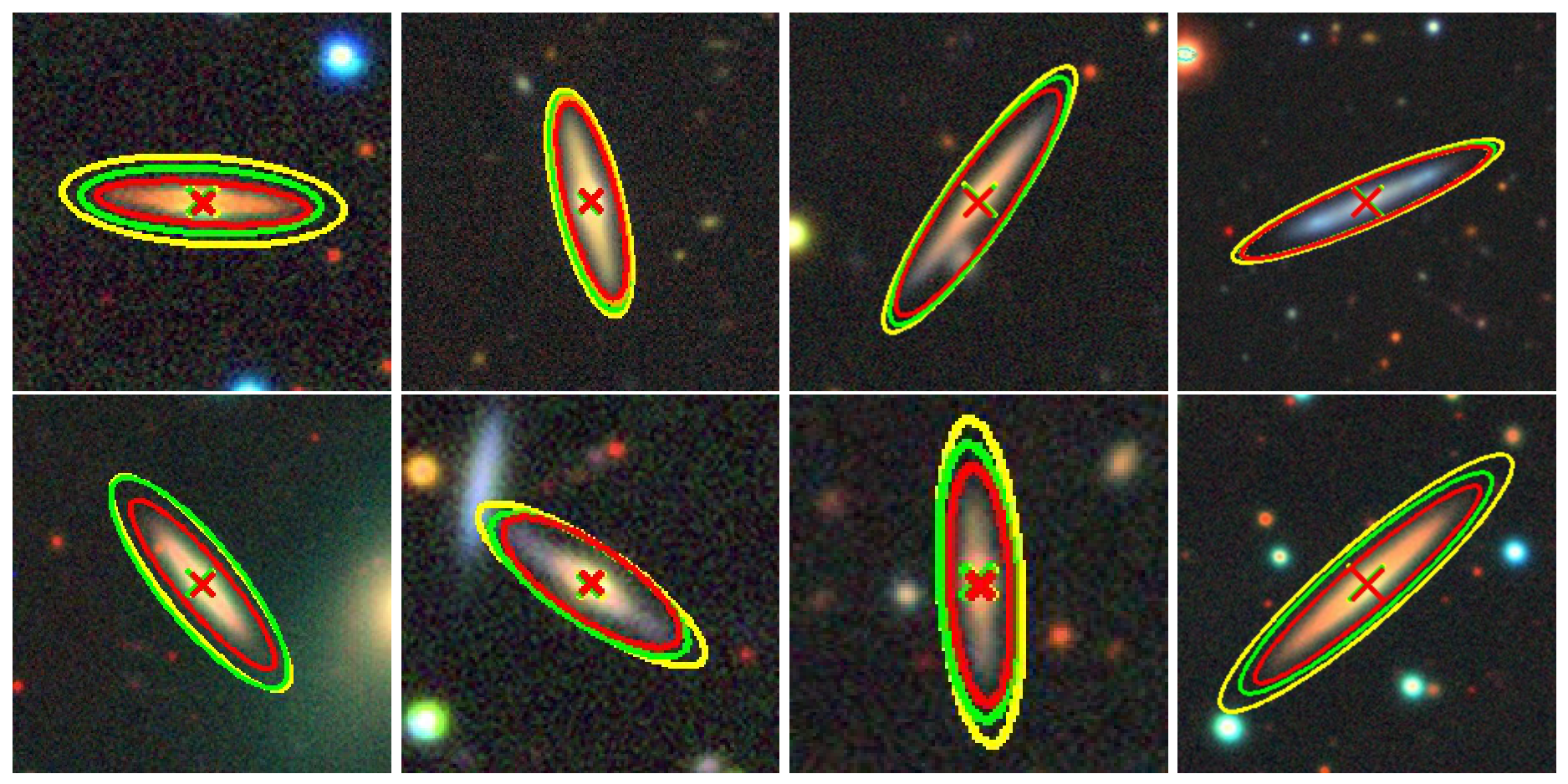
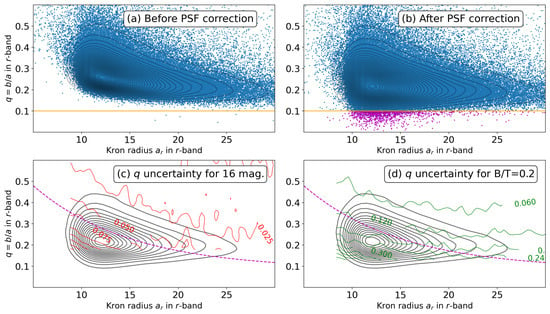
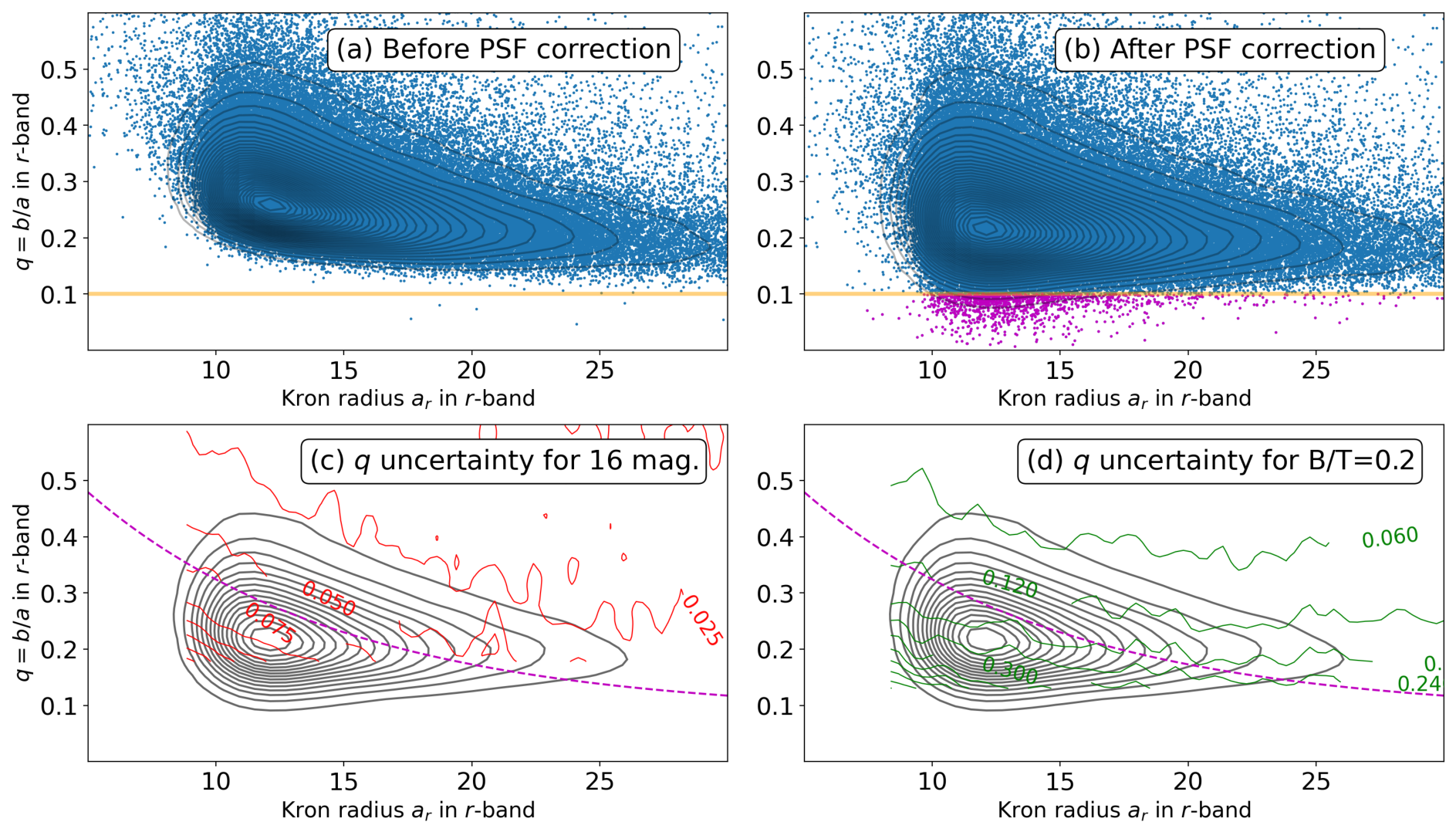
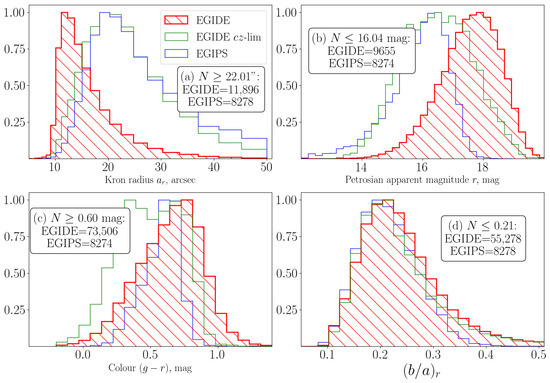
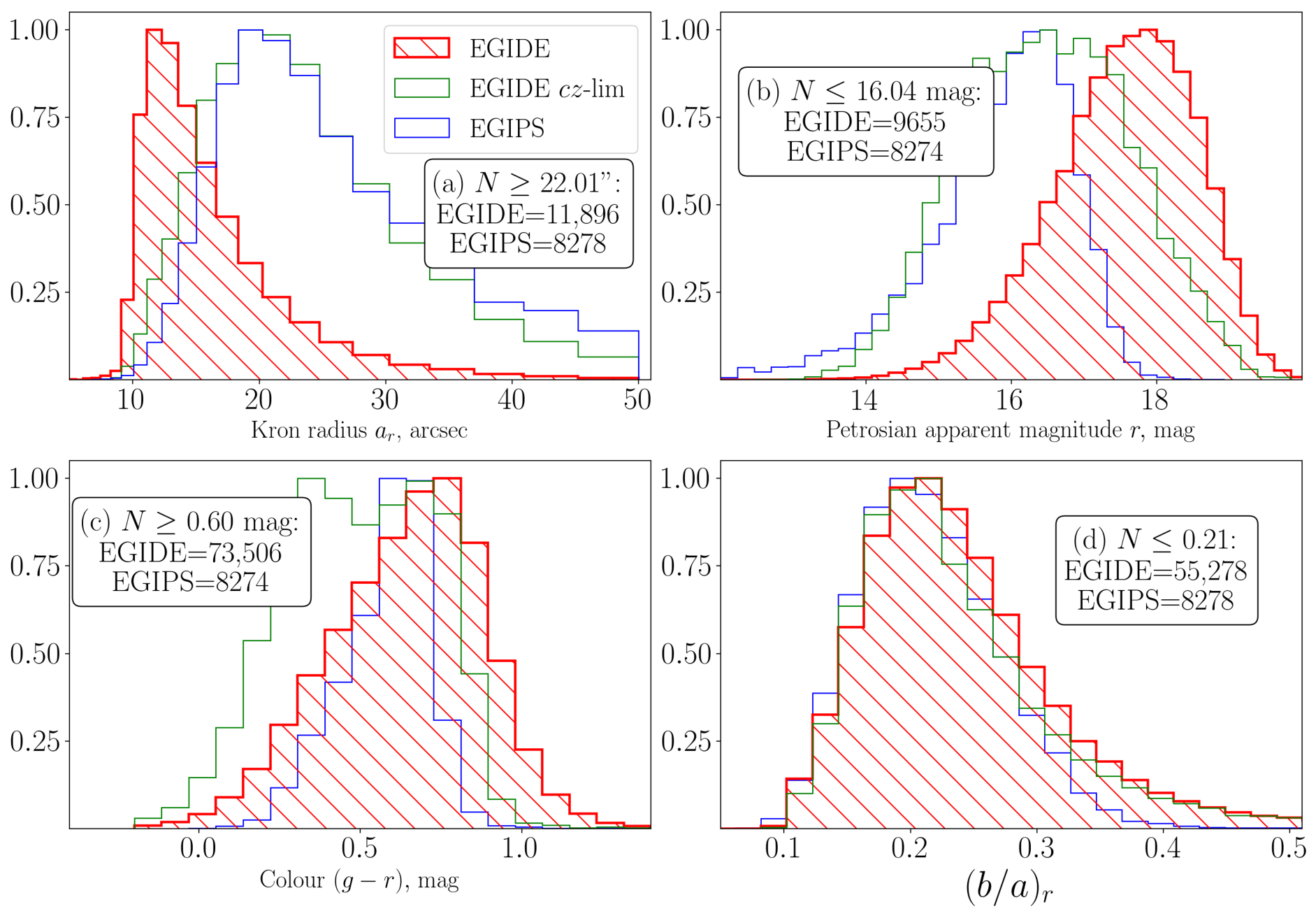
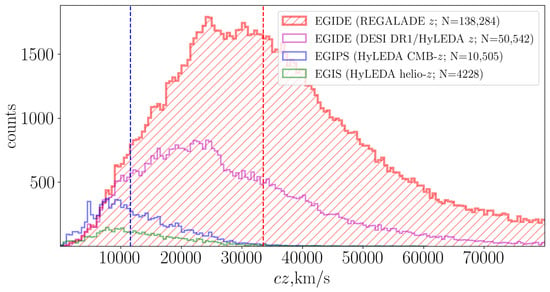
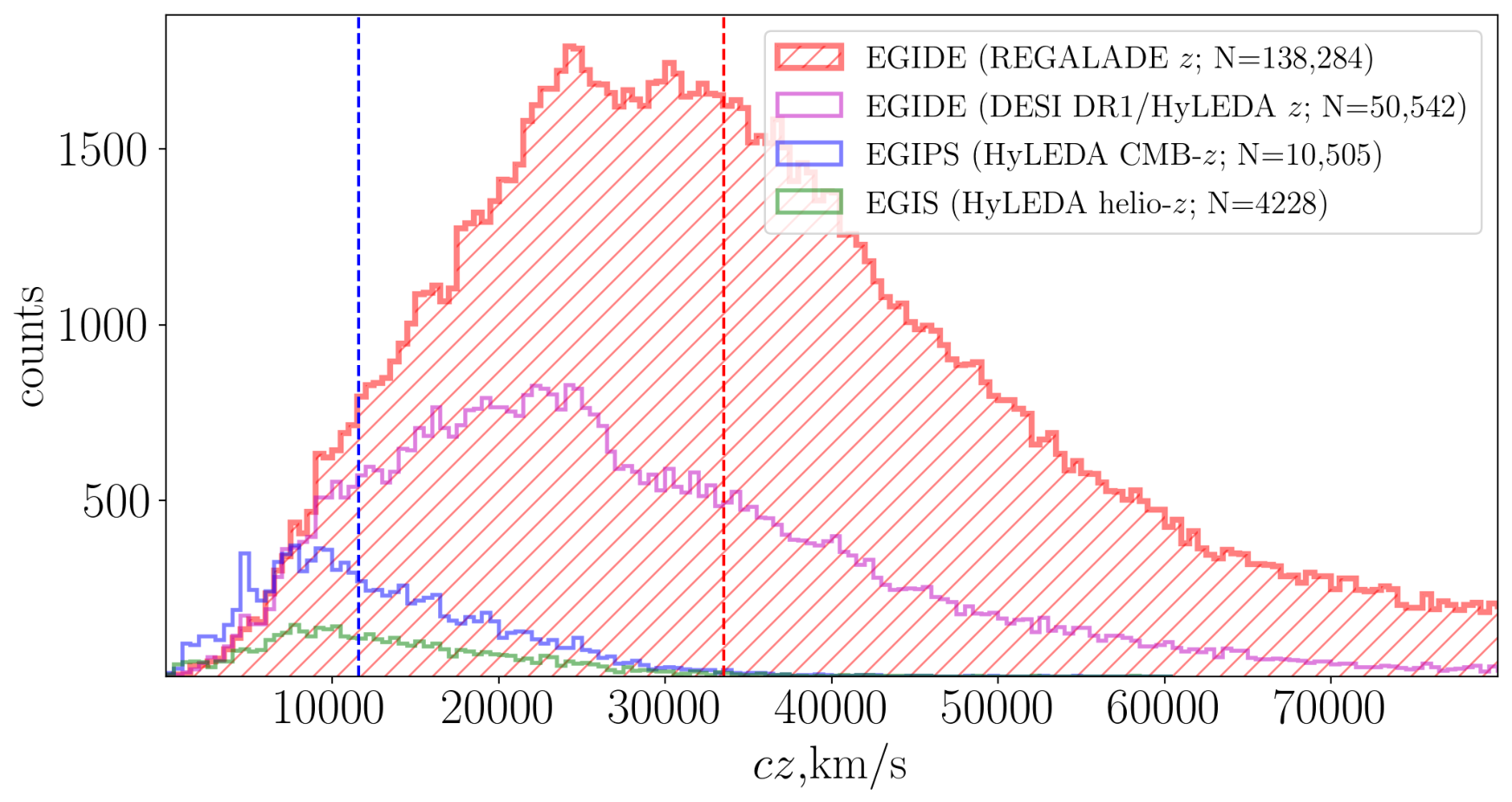
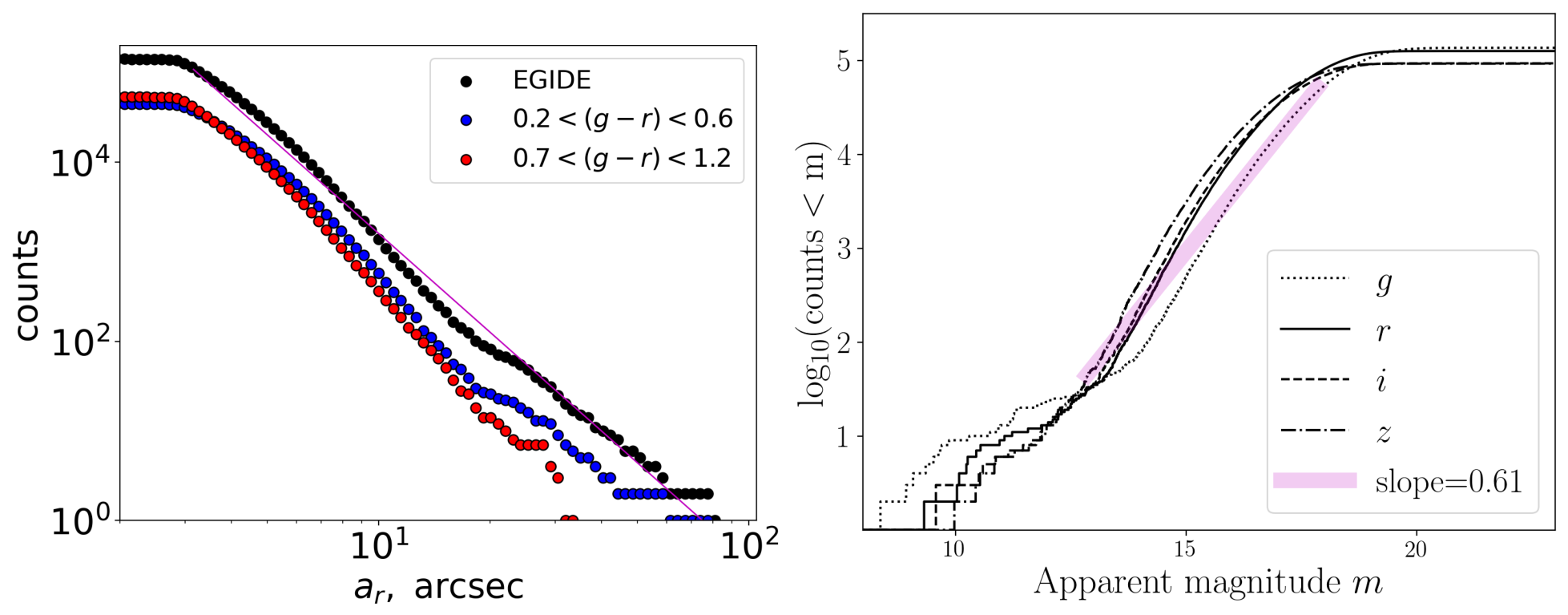
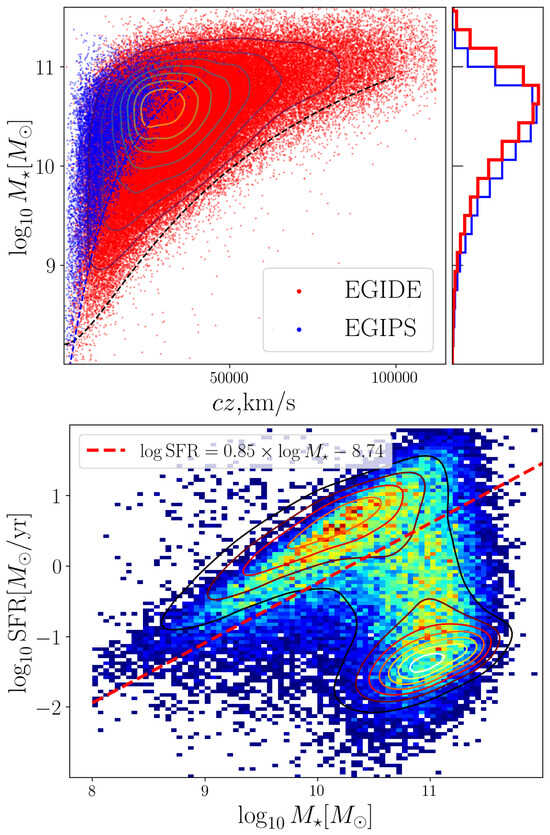
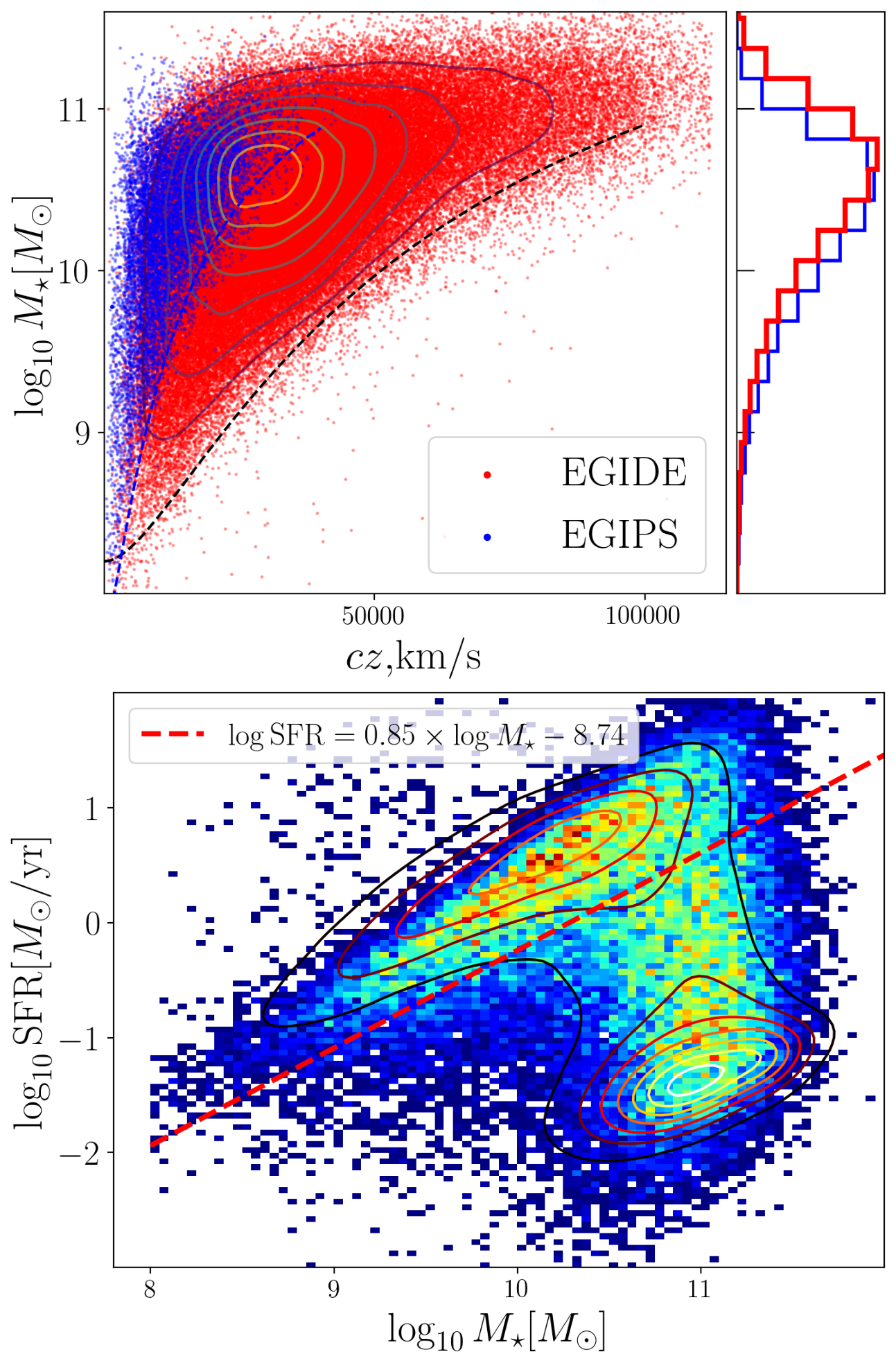
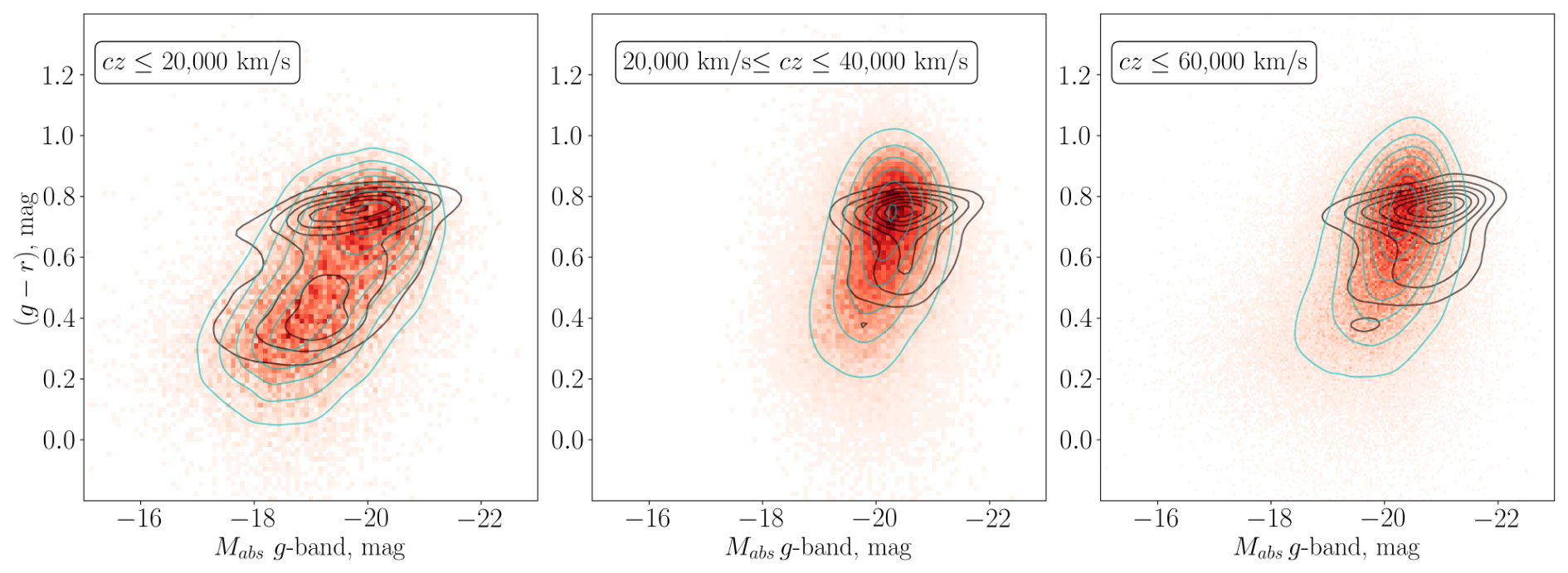
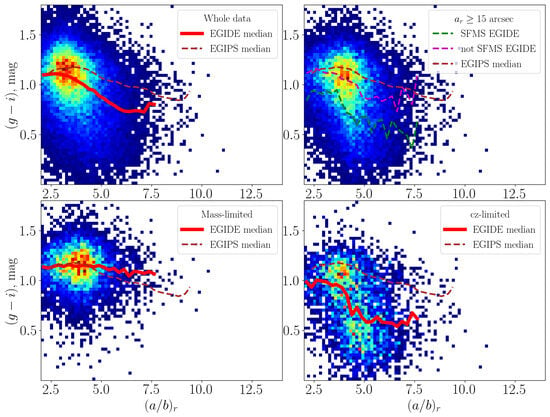
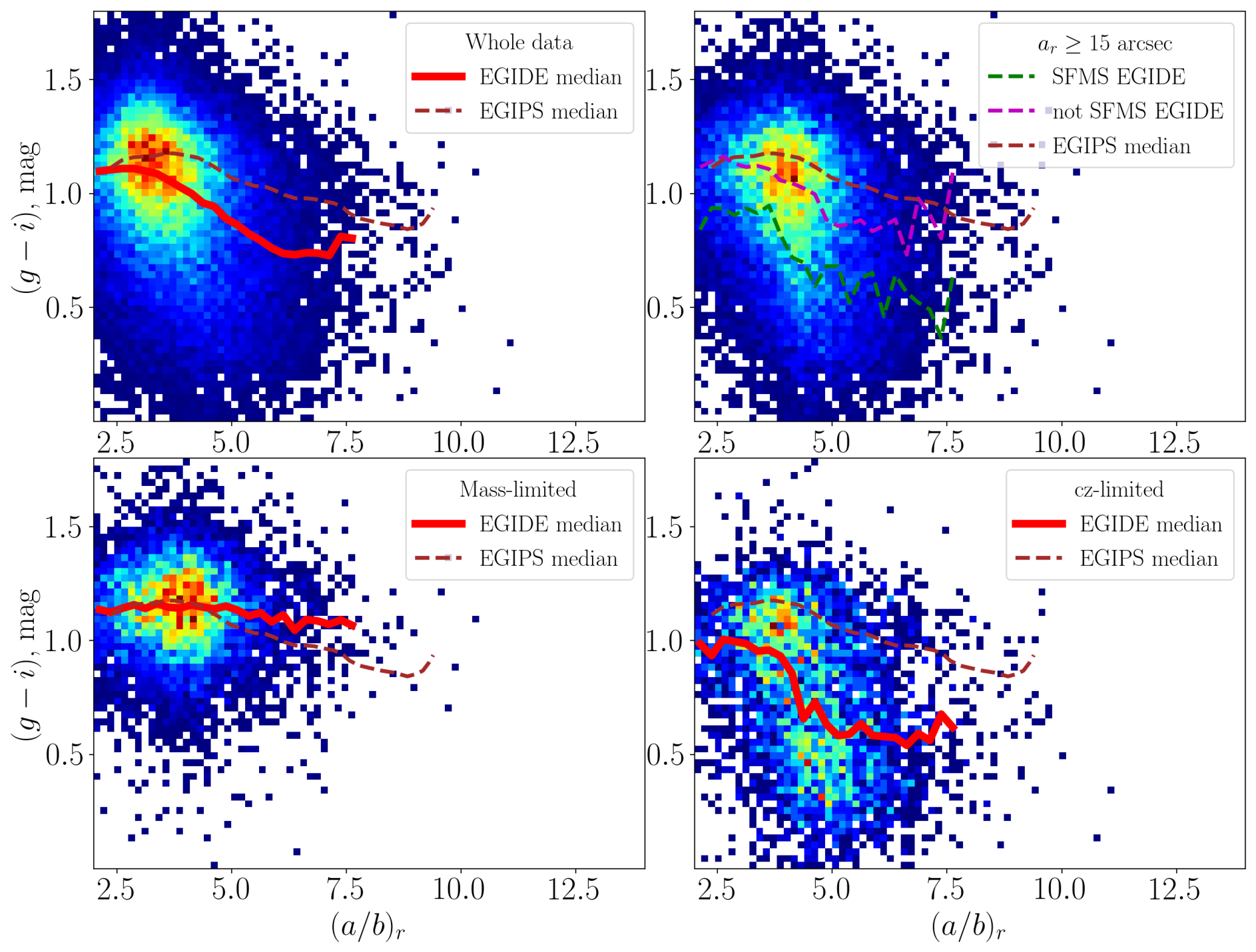
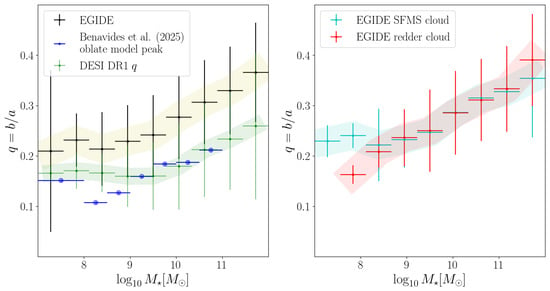
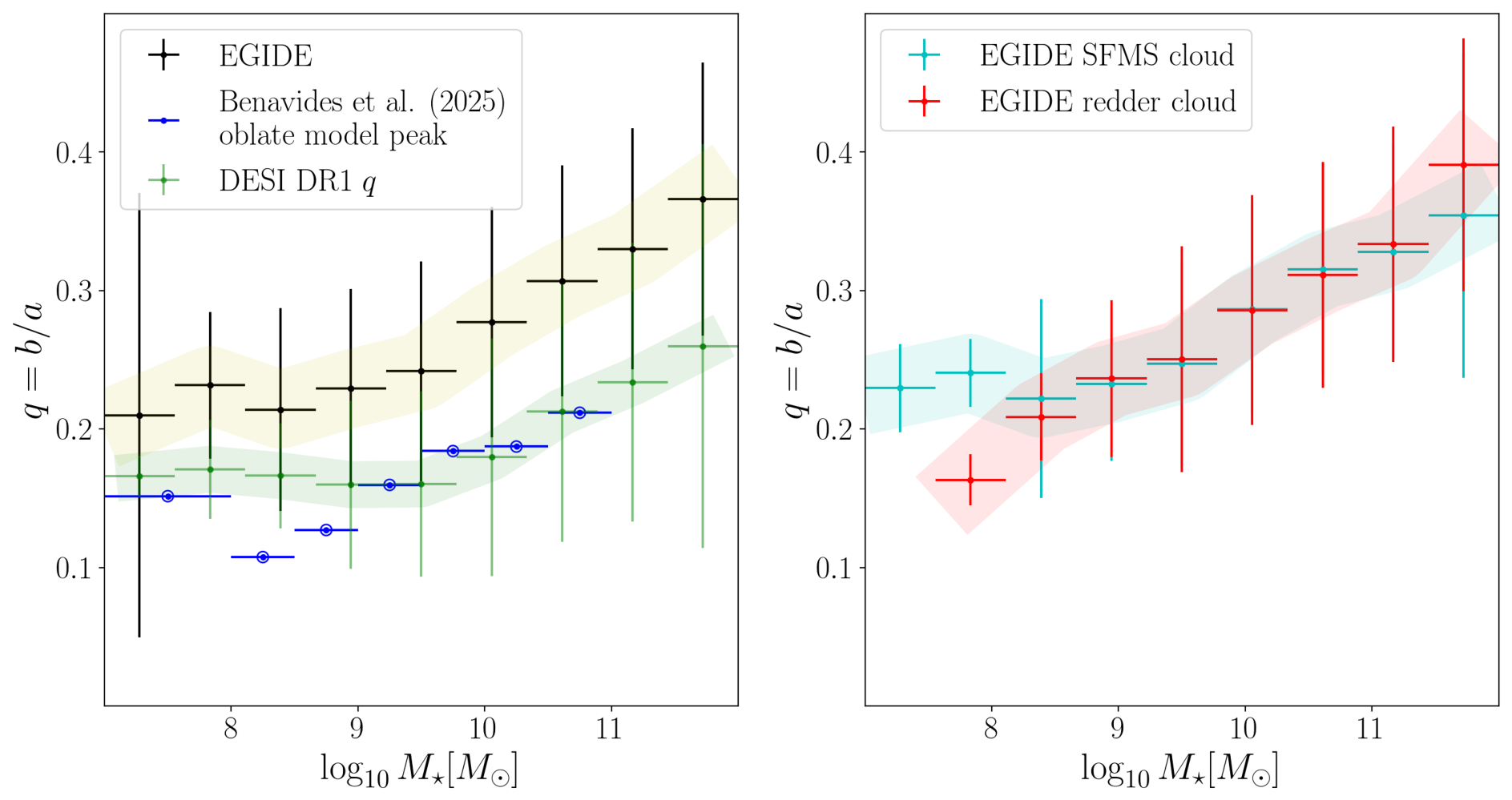
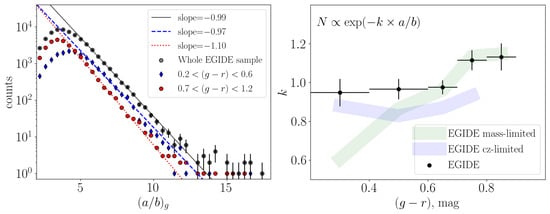
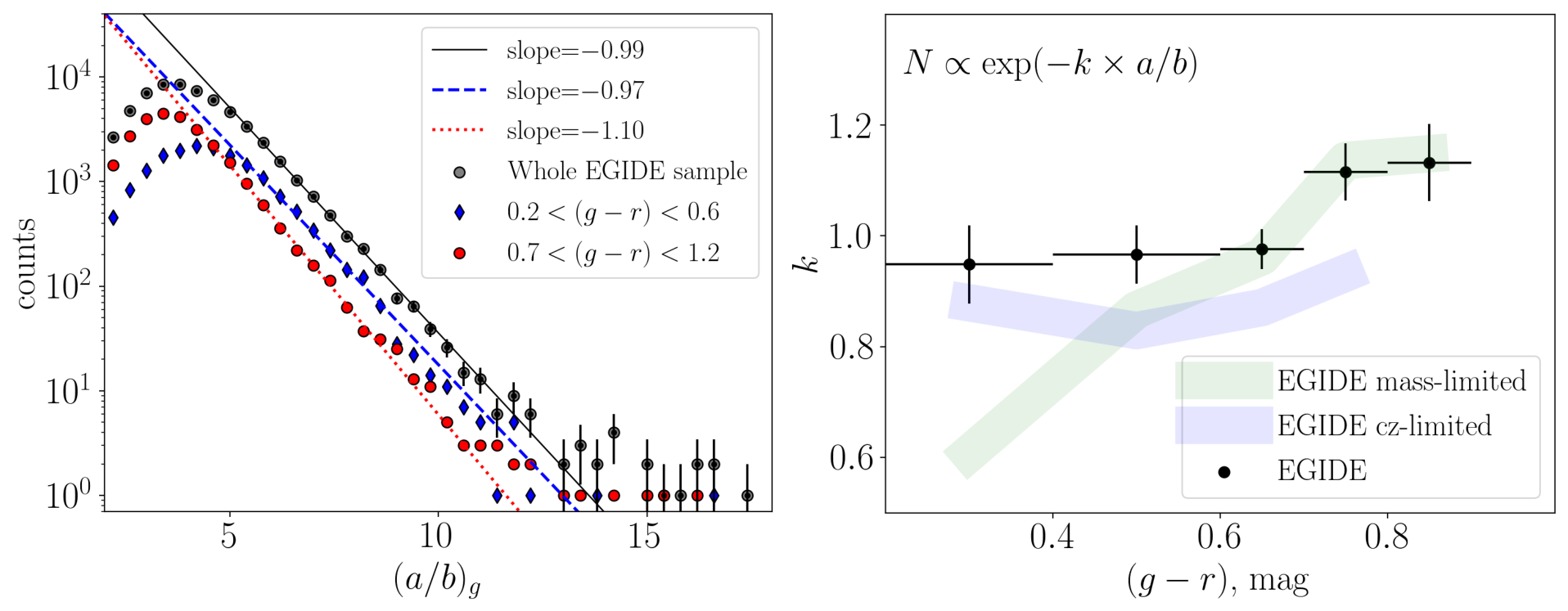

Disclaimer/Publisher’s Note: The statements, opinions and data contained in all publications are solely those of the individual author(s) and contributor(s) and not of MDPI and/or the editor(s). MDPI and/or the editor(s) disclaim responsibility for any injury to people or property resulting from any ideas, methods, instructions or products referred to in the content. |
© 2026 by the authors. Licensee MDPI, Basel, Switzerland. This article is an open access article distributed under the terms and conditions of the Creative Commons Attribution (CC BY) license.