


Abstract
Identifying the sources of Ultra-High Energy Cosmic Rays (UHECRs, eV) remains a fundamental challenge in astrophysics due to the significant deflections of charged particles by Galactic and extragalactic magnetic fields. Until now, dozens of events with energies over eV—Extreme Energy Cosmic Rays (EECRs)—were detected by the Pierre Auger Observatory and Telescope Array, but none of them showed a statistically significant association with potential sources. In this study, we investigate potential sources of EECRs with arrival directions from Local Void region. Since the energy loss lengths of such EECRs are of order of 20–40 Mpc, i.e., smaller than the Local Void extension (∼60 Mpc), potential sources should be predominantly Galactic ones. Since the most promising UHECR accelerators are mildly relativistic shocks, we consider Galactic microquasars, magnetars, and pulsar wind nebulae as potential sources of EECRs in the Local Void sky region. Using event-by-event reconstruction of trajectories of detected EECRs via CRPropa backtracking in the Galactic magnetic field, we find the potential Galactic sources and corresponding charges Z for some of the detected EECRs. The most promising coincidence is found between the EECR event triplet detected by PAO and TA and SGR 1900+14, a Galactic magnetar exhibiting high-energy flaring activity, with the inferred propagation time delay being consistent with the characteristic age of the magnetar.
1. Introduction
Despite significant advances in experimental capabilities over the past decade, the physical origin of Ultra-High Energy Cosmic Rays (UHECRs) has not yet been conclusively established [1,2,3]. In particular, the Pierre Auger Observatory (PAO) has reported a statistically significant large-scale dipole anisotropy of approximately 6% in the distribution of UHECRs above ∼8 EeV and “Hot Spot” on UHECR sky map in Southern hemisphere, indicating that arrival directions at the highest energies are not fully isotropic and likely retain information about source distributions and intervening magnetic fields [4,5]. At the same time, the Telescope Array (TA) has reported similar UHECR “Hot Spot” in Northern hemisphere and recently detected an Extreme Energy Cosmic Ray (EECR, eV) event—the “Amaterasu” particle—with arrival direction pointing towards the Local Void [6,7,8]. The Local Void is a prominent nearby underdensity in the local large-scale structure, whose geometry and boundaries have been reconstructed using distance–velocity data from the Cosmicflows-3 survey [9]. The line of sight toward the Local Void is not expected to contain a powerful extragalactic accelerators, but dozen EECR events from the Local Void were detected by PAO and TA. Therefore, a subset of EECR events might be associated with Galactic sources.
Although the prevailing view favors an extragalactic origin for most UHECRs, Galactic sources remain well-motivated candidates for a subset of events, particularly within specific energy ranges, mass compositions, and arrival directions [10,11]. Recent observational results and theoretical investigations have further strengthened the case that certain Galactic objects may operate as extreme particle accelerators [12,13,14].
Microquasars have emerged as especially promising candidates in this context. Recent observations by Large High Altitude Air Shower Observatory (LHAASO) have revealed gamma-ray emission above 100 TeV from several microquasars, including SS 433, V4641 Sgr, and GRS 1915+105—exhibiting extended gamma-ray morphologies on spatial scales of approximately 50–100 pc [15]. Such extended emission regions are consistent with efficient hadronic acceleration and propagation beyond the immediate jet-launching zone. From a theoretical point of view, detailed modeling of SS 433 suggests that protons can be accelerated to maximum energies approaching eV, placing this system within the range required for UHECR production under optimistic assumptions [16]. Proposed acceleration mechanisms in microquasars include diffusive shock acceleration in relativistic jets, magnetic reconnection in accretion flows, and shear acceleration in jet–cocoon structures, all of which may operate episodically during high power outbursts.
Magnetars—young neutron stars with extremely high surface magnetic fields ∼– G—constitute another well-motivated class of Galactic UHECR candidates [17,18,19]. In young, rapidly rotating neutron stars with millisecond spin periods and ultra-strong magnetic fields, unipolar induction and magnetohydrodynamic processes can, in principle, accelerate heavy nuclei (particularly iron) to ultra-high energies. Moreover, transient relativistic jets from giant magnetar flares can also accelerate UHECRs [20,21]. Numerical backtracking studies employing contemporary Galactic magnetic field models have shown that the reconstructed trajectories of a small number of UHECR events pass within ∼1 kpc of known soft gamma repeaters (SGRs) or anomalous X-ray pulsars (AXPs), with SGR 1900+14 repeatedly identified as a close match across multiple field realizations [22,23]. These results support scenarios in which large magnetic deflections of heavy primaries, transient magnetar activity, or compact object merger remnants contribute to the observed UHECR population.
Globular clusters represent a further class of Galactic UHECR candidates. Their exceptionally high stellar densities and the presence of abundant compact object populations, including millisecond pulsars and interacting binaries, provide environments in which particle acceleration processes may operate [24,25]. In addition to this, tidal disruption events (TDEs) in globular clusters—disruption of white dwarfs by intermediate-mass black holes (IMBHs) accompanied by transient relativistic jet—are potential sites for accelerating UHECRs [26]. However, compared to microquasars or magnetars, the underlying acceleration mechanisms and the maximum achievable particle energies in globular clusters remain less likely [10,27].
Pulsar wind nebulae, created by passage of ultrarelativistic electron-positron plasma through a relativistic terminal shock, are also promising Galactic sources of UHECRs [3,10,12,13,18,19].
In our work, we investigate potential sources of EECRs with arrival directions from Local Void region. Since the Local Void with extension ∼60 Mpc has an extreme scarcity of galaxies, potential sources should be predominantly Galactic and include relativistic plasma flows: microquasars, magnetars, and pulsar wind nebulae. Using event-by-event reconstruction of trajectories of detected EECRs in the Galactic magnetic field, we find the potential Galactic sources and corresponding charges Z for some of the detected EECRs.
The text is organized as follows. In Section 2, we outline the Local Void sky region and describe the selection of UHECR/EECR events from the PAO and TA datasets, as well as the candidate Galactic sources considered in this region. Section 3 and Section 4 present the results of calculation of the backtracked UHECR trajectories in the Galactic magnetic field for the different assumed nuclear compositions using the JF12 and UF23 magnetic-field models, and include a statistical analysis of possible associations between events and candidate sources. The inferred patterns of UHECR arrival directions and the probabilities of hits on the selected sources for different compositions and magnetic-field uncertainties, together with their implications for a potential Galactic origin of the observed UHECRs from the Local Void region, are presented. Finally, in Section 5 we summarize and discuss the obtained results.
2. Local Void Region: EECR Events and Their Potential Galactic Sources
2.1. Detected EECR Events from Local Void Region
EECR events from Local Void region were taken from two observatories—Pierre Auger Observatory (PAO2022) [28] and Telescope Array (TA2014) [29].
The Pierre Auger Observatory is the largest in the world hybrid observatory in the Southern Hemisphere (Malargüe, Argentina) that employs two independent techniques to study UHECRs:
- -
- by an array of 1660 surface detectors—water-filled tanks covering 3000 km2 of the Argentine Pampa,
- -
- by fluorescence detectors that can observe air showers up to 15 km away, providing precise measurements of cosmic-ray energy and direction.
Combining surface and fluorescence detectors enables cross-validation of data, improving accuracy in determining primary cosmic-ray energy. While fluorescence detectors operate only on clear, moonless nights, surface detectors function continuously, ensuring uninterrupted observations. This dual approach enhances the reliability of cosmic-ray measurements and helps refine detection techniques.
The Telescope Array experiment—the largest hybrid observatory in the Northern Hemisphere (Millard County, UT, USA)—studies ultra-high-energy cosmic rays using a hybrid detection system that combines ground-based scintillation detectors and air-fluorescence telescopes. It consists of 507 surface detectors (SD) that measure charged particles at the Earth’s surface and three fluorescence stations that observe the night sky above.
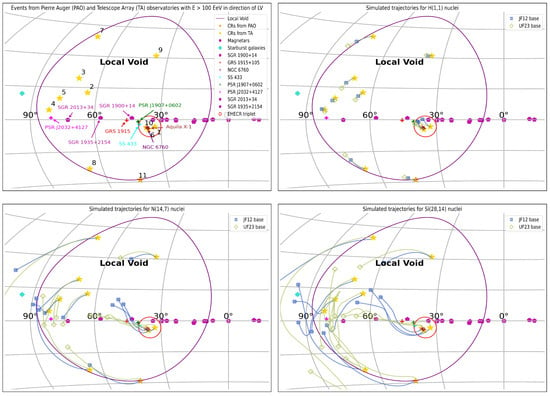
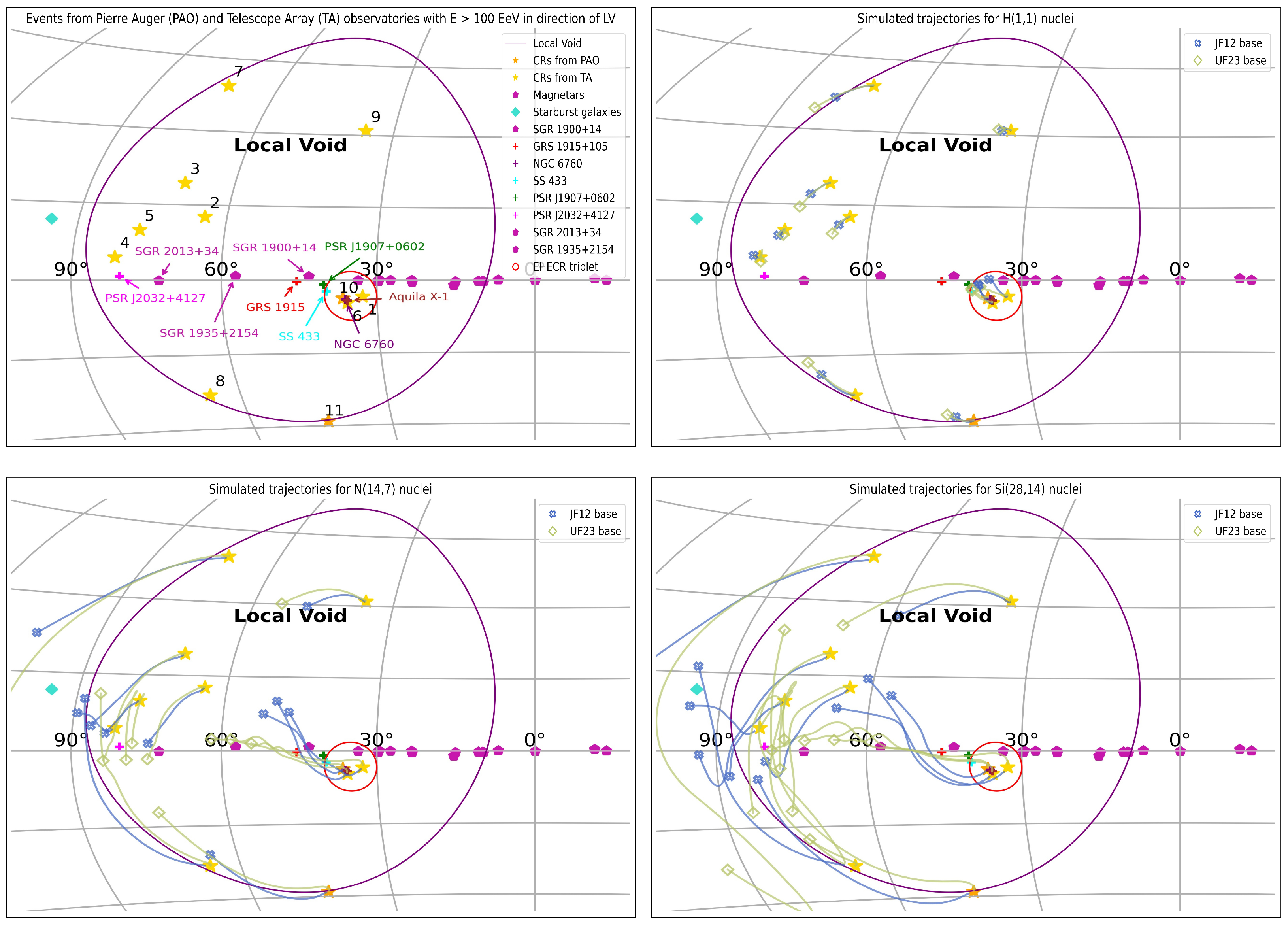
The full map containing all UHECR events listed in Table 1, together with selected potential Galactic source candidates, is shown in Figure 1.
Table 1.
UHECRs inside the Local Void: parameters.
Figure 1.
Local Void region: EECR events and their potential Galactic sources—top left. Deflection of EECRs in Galactic magnetic field: H(Z = 1)—top right, N(Z = 7)—bottom left, Si(Z = 14)—bottom right.
2.2. Potential Galactic Sources of EECR Events
In this paper we focus on a selected set of Galactic objects located in the direction of the Local Void (Table 2). These candidates were chosen based on their ability to act as particle accelerators capable of producing cosmic rays up to eV, as well as their spatial location within the region of interest. The distances to these objects were taken from corresponding articles [sgr: [30] (close and mid), 12.5 kpc—main one, [31], grs: [30], ngs: [32], ss: [33]].
- SGR 1900+14 is a Soft Gamma Repeater (SGR) associated with a magnetar. Using the measured spin period and period derivative, [34] reported one of the first estimates of its magnetic field strength, B∼. The source and its surrounding region were later studied in [35], which explores the HE and VHE emission in the vicinity of the magnetar.
- GRS 1915+105 is a Galactic microquasar, a black-hole low-mass X-ray binary (BH-LMXB) system with a K-type giant donor star. It is widely regarded as the archetypal microquasar and was the first Galactic source in which relativistic matter ejection (superluminal radio jets) was observed [36]. The system exhibits recurrent and strong variability across multiple wavelengths, including frequent X-ray and radio outbursts [37]. More recently, UHE emission from the direction of GRS 1915+105 was reported in the range of 25– by LHAASO with a significance of [15].
- PSR J1907 is a -ray pulsar PSR J1907+06 near the TeV source MGRO J1908+06. The TeV source is the pulsar wind nebula of PSR J1907+0602 [38].
- SS 433 is a Galactic microquasar located within the supernova remnant W50 at a distance of ∼4.5– kpc, consisting of a black hole accreting from an A-type donor star [39,40]. It launches baryon-loaded, precessing relativistic jets with an initial velocity of ∼0.26c, oriented nearly perpendicular to our line of sight and extending to tens of parsecs (up to ∼40 pc) from the central source [39,40]. In the gamma-ray band, TeV emission from both lobes and VHE/UHE emission from the lobes and the central source have been reported, making SS 433 a strong Galactic PeVatron candidate [15,41].
- NGC 6760 is a Galactic globular cluster. Radio observations reported a phase-coherent timing solution for the binary pulsar PSR J1911+0102A and the discovery of a millisecond pulsar, PSR J1911+0101B ( ms), indicating a compact pulsar population near the cluster center and a notably large dispersion-measure spread, likely related to turbulence in the interstellar medium on parsec scales [42].
- SNR W51 (W51C; G49.2−0.7) is part of the W51 complex, one of the largest and most active star-forming regions in the Galaxy due to its large spatial extent and ongoing star formation processes [43]. The complex includes a prototypical SNR–molecular-cloud system, with SNR W51C interacting with MC W51B, located to the southeast of W51B [44]. With a -ray luminosity exceeding , W51C is among the brightest Galactic -ray sources [45]. Extensive multiwavelength observations of the W51 complex, spanning energies from MeV to PeV, have been reported using instruments including Fermi-LAT, HAWC, H.E.S.S., and LHAASO.
- Aql X-1 (V1333 Aql) is one of the archetypal transient neutron-star LMXBs, first identified in 1973, and has been extensively studied thanks to its relative proximity (∼6 ± 2 kpc) and frequent, nearly yearly outbursts [46,47]. The system consists of a neutron star accreting from a K-type donor star in a 18.95 hr orbit [48]. Frequent Type-I X-ray bursts securely establish the compact object as a neutron star, and burst oscillations revealed a spin frequency of 549 Hz [47].
- SNR G57.2+0.8 is a Galactic supernova remnant associated with the magnetar SGR J1935+2154, a soft gamma repeater discovered in 2014 and confirmed through X-ray pulsations with a spin period of ∼3.24– s [49]. Timing measurements indicate a strong magnetic field (∼2.2 G) and a characteristic age of a few kyr, consistent with a young magnetar [50]. The source became particularly important after its 2020 bursting episode, when millisecond radio bursts were detected together with high-energy activity, strengthening the magnetar–FRB connection [51].
- SGR 2013+34 is a candidate magnetar reported in connection with the short X-ray transient/GRB 050925, but its nature remains less firmly established than that of classical Galactic SGRs. Owing to the limited observational constraints, it is generally treated as a tentative magnetar candidate in source lists [52].
- The Cygnus bubble (Cygnus X region) is a prime Galactic environment for cosmic-ray acceleration studies because it hosts a concentration of powerful accelerators, including the massive Cygnus OB2 association, Wolf–Rayet stars, pulsars, supernova remnants, and the microquasar Cygnus X-3 [53,54]. In particular, Cygnus OB2, located near the center of the diffuse emission region, contains a rich population of O and Wolf–Rayet stars and injects a large mechanical wind power (∼2–3 ), making collective stellar-wind acceleration a leading explanation for the diffuse HE–VHE -ray emission [54]. Among individual compact-object candidates, pulsars and their nebulae contribute locally, but current data indicate they are unlikely to dominate the integrated diffuse emission at the highest energies. The young SNR -Cygni is bright in radio, X-rays, and rays and reaches at least tens of TeV, with hadronic interactions in nearby gas often invoked for its high-energy emission, although it is unlikely by itself to explain the full extended UHE signal [55].
Table 2.
Physical parameters of potential sources.
3. Galactic Magnetic Field and Its Influence on UHECR Propagation
To identify and statistically validate potential sources of extremely high-energy cosmic rays, we conducted multiple numerical simulations using the CRPropa3 Python library (version is 3.2.1-167-g61a6257e) [62]. CRPropa is an open-source framework for simulating the propagation of ultra-high-energy nuclei up to iron through (extra)galactic environments. It accounts for pion production, photodisintegration, pair production losses, and nuclear decay within ambient low-energy photon fields. The software also models deflections in (inter)galactic magnetic fields, secondary electromagnetic cascades, and neutrino propagation across diverse source distributions and magnetic environments, enabling predictions of UHECR spectra, composition, and arrival directions. Using this software we have calculated backtracking trajectories for mentioned above events from PAO and TA list using recent models of Galactic magnetic field.
3.1. Models of Galactic Magnetic Field
The Jansson–Farrar 2012 Galactic Magnetic Field model (JF12) [63] provides a data constrained description of the Milky Way magnetic field based on polarized synchrotron emission and Faraday rotation measures. The model incorporates a spiral disk field, a toroidal halo component, and an out-of-plane (X-shaped) structure, the latter improving consistency with polarization patterns observed both in the Milky Way and in external edge-on galaxies. In addition to the large-scale regular field, JF12 includes a striated (anisotropic random) component aligned with the coherent field and an isotropic turbulent component representing small-scale fluctuations. These three components—regular, striated, and turbulent—can be activated or deactivated independently in practical implementations. The model successfully reproduces large-scale polarization morphologies and rotation-measure distributions; however, in its standard public implementation only the fixed best-fit parameter set is available, and the field parameters cannot be varied.
The more recent Unger–Farrar 2023 Galactic Magnetic Field model (UF23) [64] extends this approach by introducing updated divergence-free parameterizations and fitting multiple global realizations to modern full sky rotation measure and synchrotron datasets. Rather than relying on a single best-fit configuration, UF23 provides an ensemble of coherent-field models that enables a systematic quantification of uncertainties associated with Galactic magnetic field modeling.
3.2. Recovering of Trajectories of Detected UHECR Events in Galaxy
We adopted a backtracking approach in which antiparticles with charge and energy E were injected at the observer’s position and propagated to the Galactic boundary. The injection point was placed at the Solar position, defined as kpc in Galactocentric coordinates, consistent with contemporary Astropy conventions [65]. The Galaxy in this study was modeled as a sphere with a radius of 20 kpc. Energies and arrival directions were sampled from normal distributions with means and standard deviations adopted from the experimental reports of TA [6] and PAO [66]. The assumed energy uncertainties were 7% and 15%, respectively, while the corresponding angular resolutions were and .
The initial conditions of the backtracked particles were sampled from the reconstructed properties of individual UHECR events reported by TA and PAO. Experimental uncertainties were incorporated by sampling the injection parameters as follows:
- Energy:Energies were sampled from a Gaussian distribution centered on the measured value , with a standard deviation corresponding to the detector energy resolution. Random sampling was performed using the Box–Muller algorithm as implemented in the CRPropa randNorm function.To ensure consistency between datasets, we applied the inter-experimental energy scaling relation [67] with the coefficients and , defined asThe adopted relative energy uncertainties were and for the PAO [66] and TA [6] datasets, respectively.
- Direction: To account for experimental uncertainties, initial arrival directions were sampled from a von Mises-Fisher (vMF) distribution centered on the reconstructed event direction . This ensures that the stochastic sampling reproduces the reported angular resolution of the PAO () and TA () surface detectors.
To quantify the systematic uncertainty arising from the specific topology of the magnetic field (cosmic variance), we performed an ensemble study using 400 independent realizations (25 events each, so trajectories for one observed event in total) of the random turbulent field, generated by varying the random seed. The full field strength was obtained by summing the regular component with these randomized realizations.
3.3. Event Density
In this work we use similar approach to [7,68] to estimate whether an object is a candidate for EHECR source we use a probability density approach. Firstly, we calculate the probability density function (PDF) at each grid point p with Gaussian kernel and Haversine distance as a metric. So, in the result, we obtain:
where is the normalization constant required to ensure the entire PDF integrates to 1 over the spherical domain, —angular distance on sphere (Haversine distance), h—bandwidth (0.3 degrees converted to radians), n—data points (in our case—intersections of trajectories with candidates surface, perpendicular to the line of sight).
After calculating the probability density, we obtain event density by multiplying PDF by number of events and converting it to .
In this case, would be the maximum event density over the distribution, and —density at the candidate’s location on the grid.
3.4. Model Parameters
Model parameters, used in simulation are presented in Table 3.
Table 3.
Simulation parameters.
4. Potential Galactic Sources of UHECR Events: Role of Magnetic Field Deflection
As follows from Figure 1, arrival directions of detected by PAO and TA UHECRs coincide with potential Galactic sources only in case of EECR triplet (events 1,6,10 vs sources Aquila X-1, NGC 6760). Table 4, Table 5 and Table 6 and Figure 1—top right, bottom left, bottom right demonstrate the general trend of the influence of the magnetic field. For EECR hydrogen H (protons) and He, the maximum deflection at the boundary of Galaxy do not improve coincidence with another potential Galactic sources (but He for UF23 magnetic field model). In the case of C-N-O group (z = 6–8) there are some confirmation of potential sources PSR J1907 (UF23 model) and Aql X-1 (JF12 model) and significant connection with SS 433 (both JF12 and UF23 models), GRS 1915 (UF23 model) and SGR 1900 (JF12 model). In the case of Si (Z = 14) there is significant connection with PSR 1907 (UF23 model) and some confirmation for GRS 1915 (JF12 model), SGR 2013(JF12 model) SGR 1935 (UF23 model). For EECR Fe (Z = 26) deflection in Galactic magnetic field exceeds the Local Void angular extension.
Table 4.
Relative density () (See Section 3.3 for the detailed explanation) for triplet candidates for combined field (in case of JF12—base + striated + turbulent, in case of UF23—base + turbulent) for TA-LV-1 EECR. Relative densities below the 0.05 threshold are denoted with a dash (“-”), whereas values are explicitly reported.
Table 5.
Relative density () (See Section 3.3 for the detailed explanation) for triplet candidates for combined field (in case of JF12—base + striated + turbulent, in case of UF23—base + turbulent) for TA-LV-2 EECR. Relative densities below the 0.05 threshold are denoted with a dash (“-”), whereas values are explicitly reported.
Table 6.
Relative density () (See Section 3.3 for the detailed explanation) for triplet candidates for combined field (in case of JF12—base + striated + turbulent, in case of UF23—base + turbulent) for PA-LV EECR. Relative densities below the 0.05 threshold are denoted with a dash (“-”), whereas values are explicitly reported.
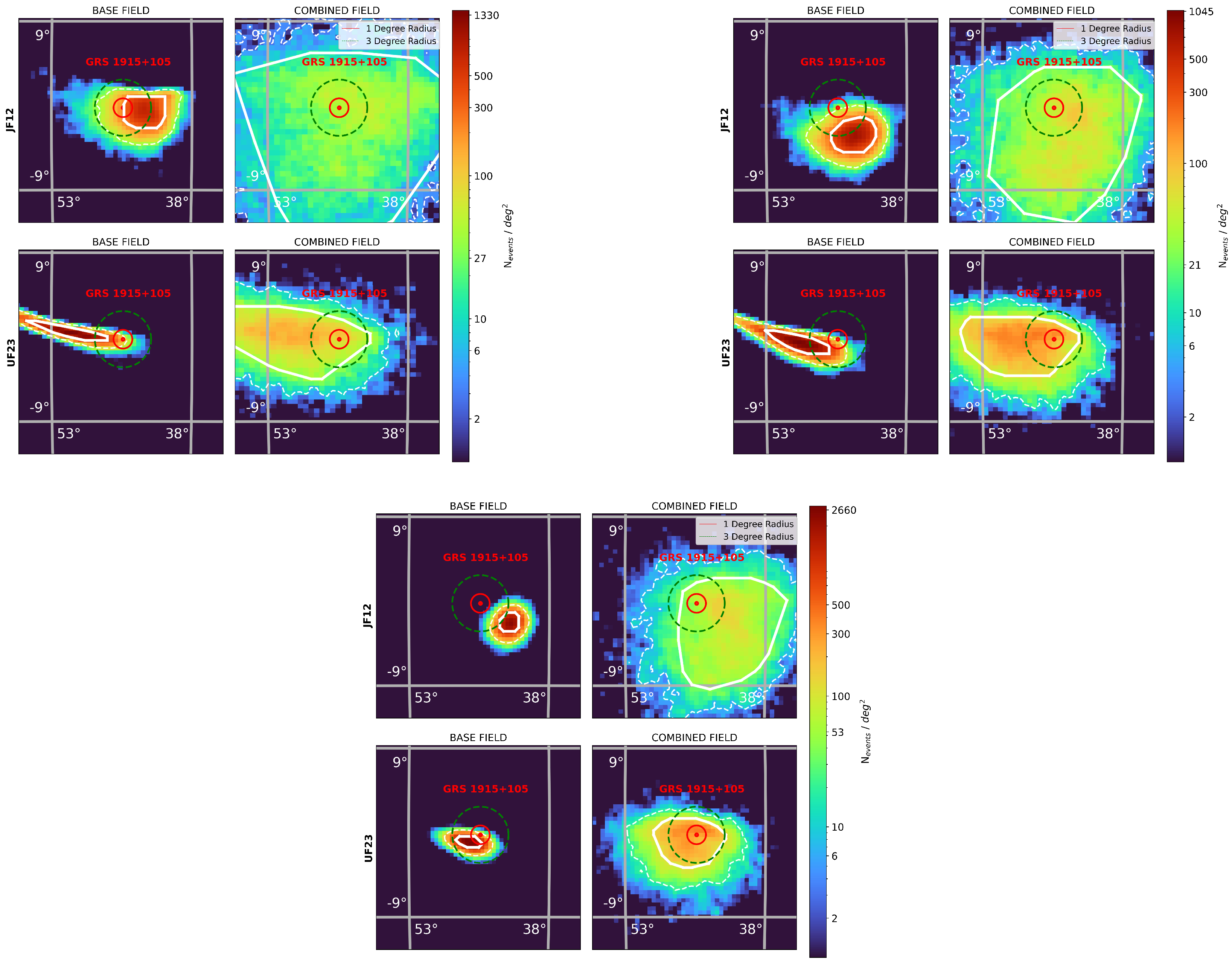
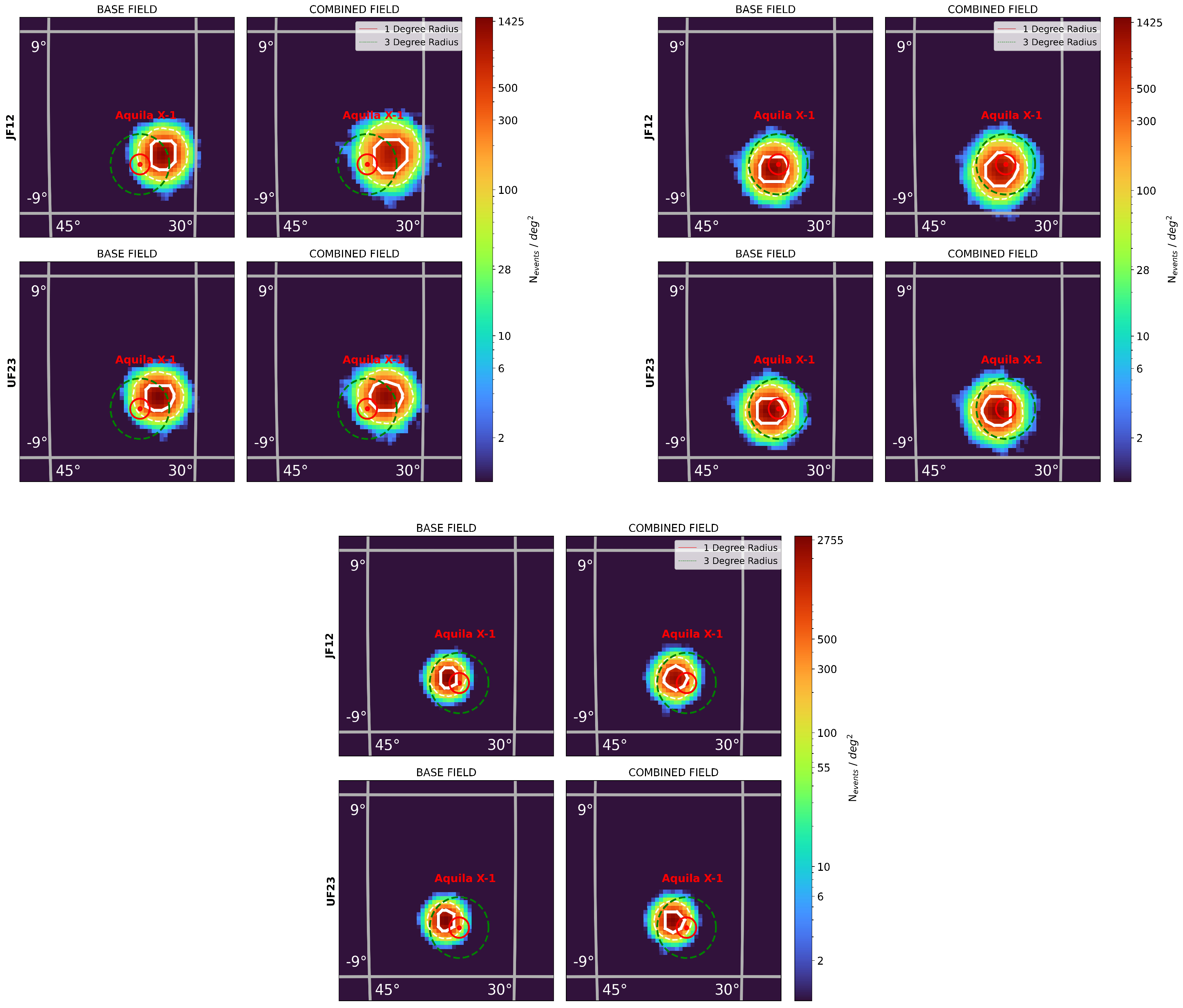
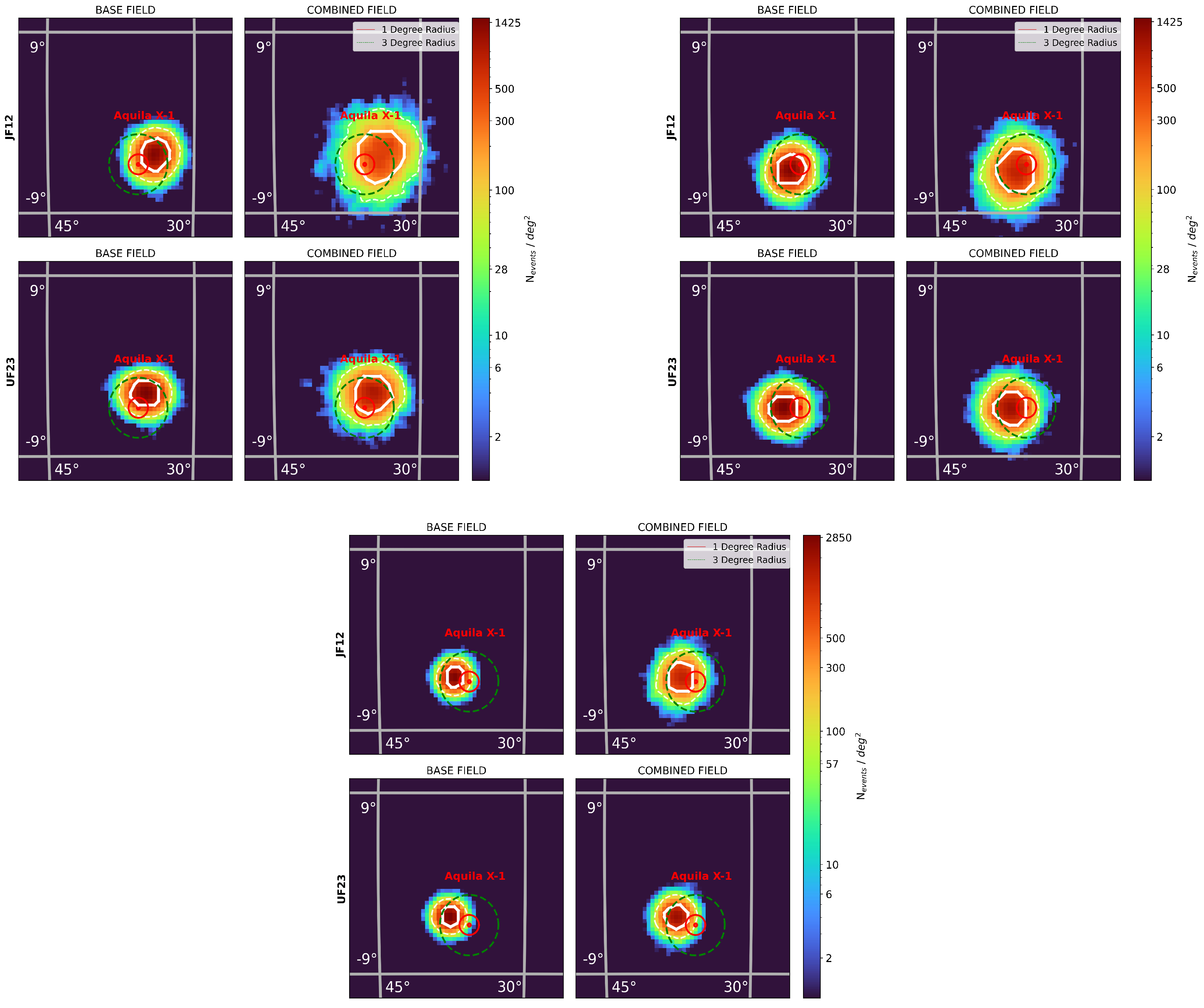
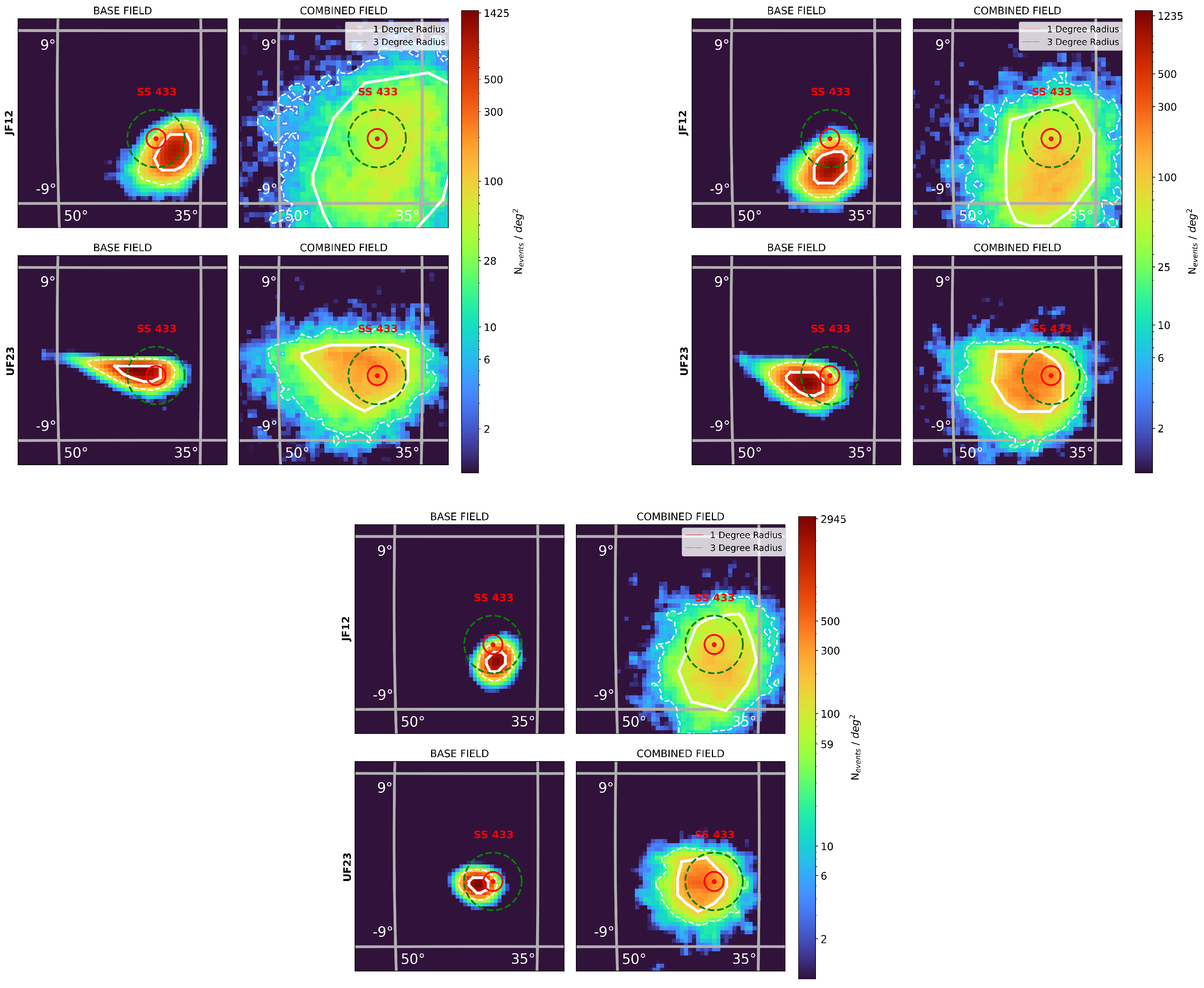
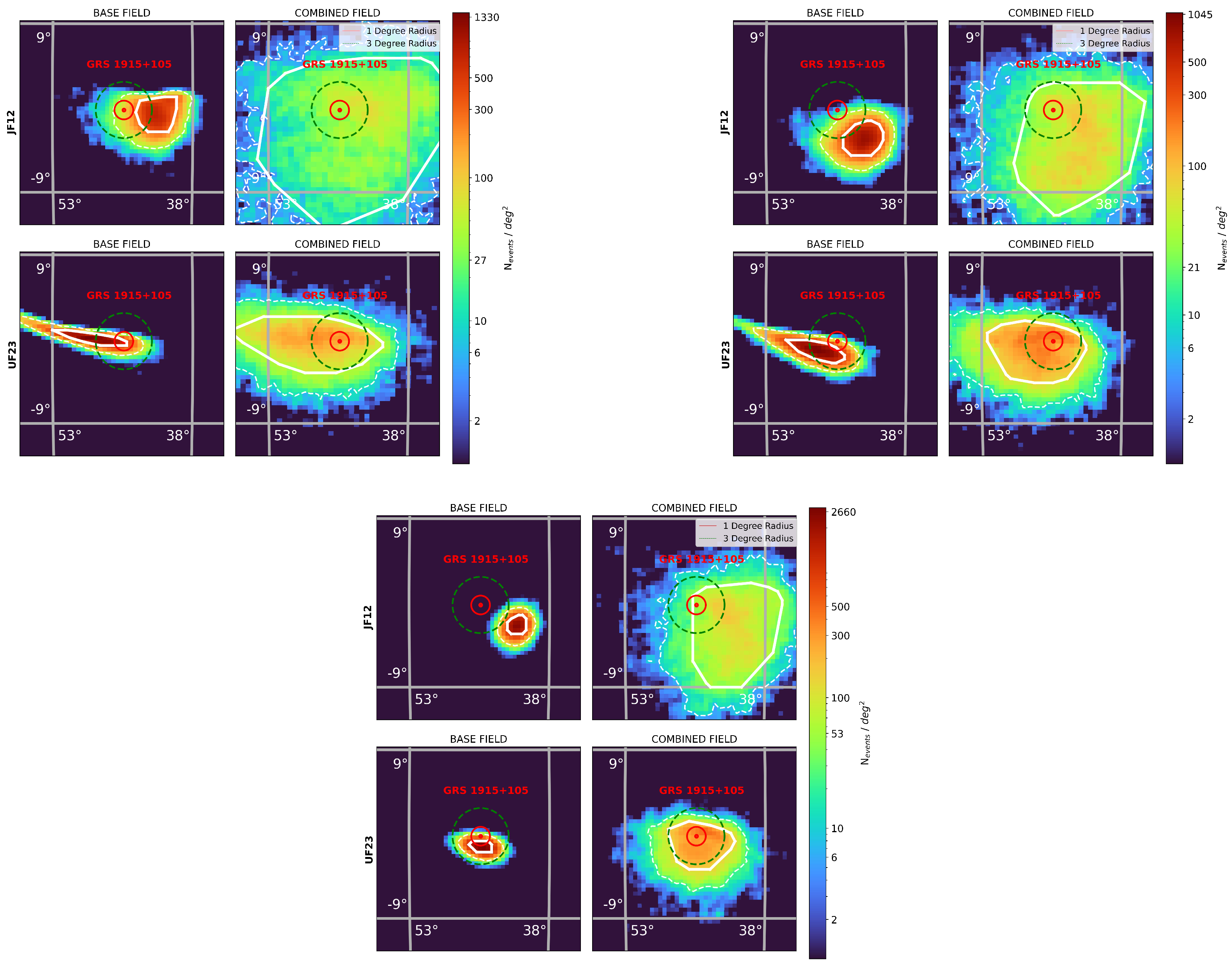
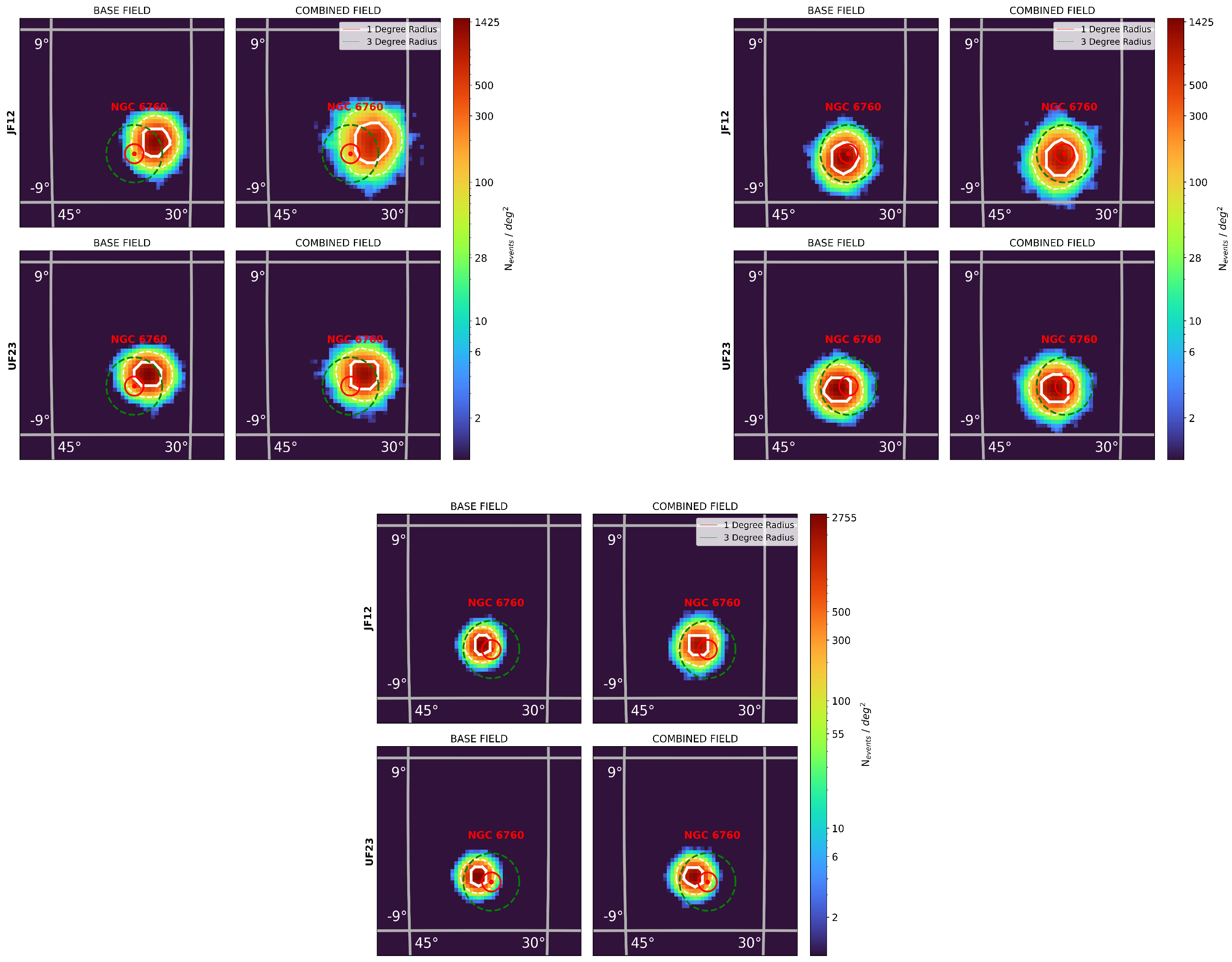
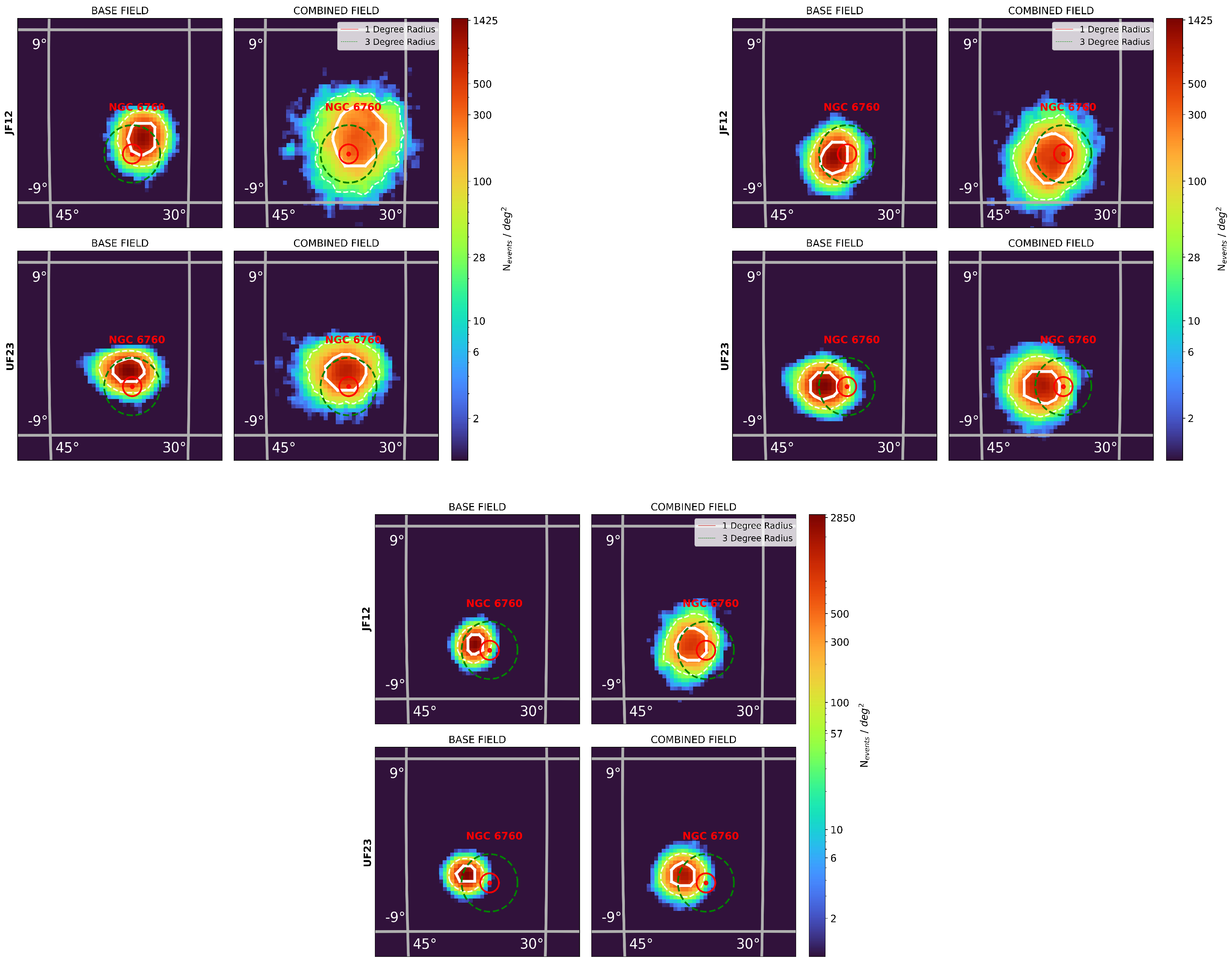
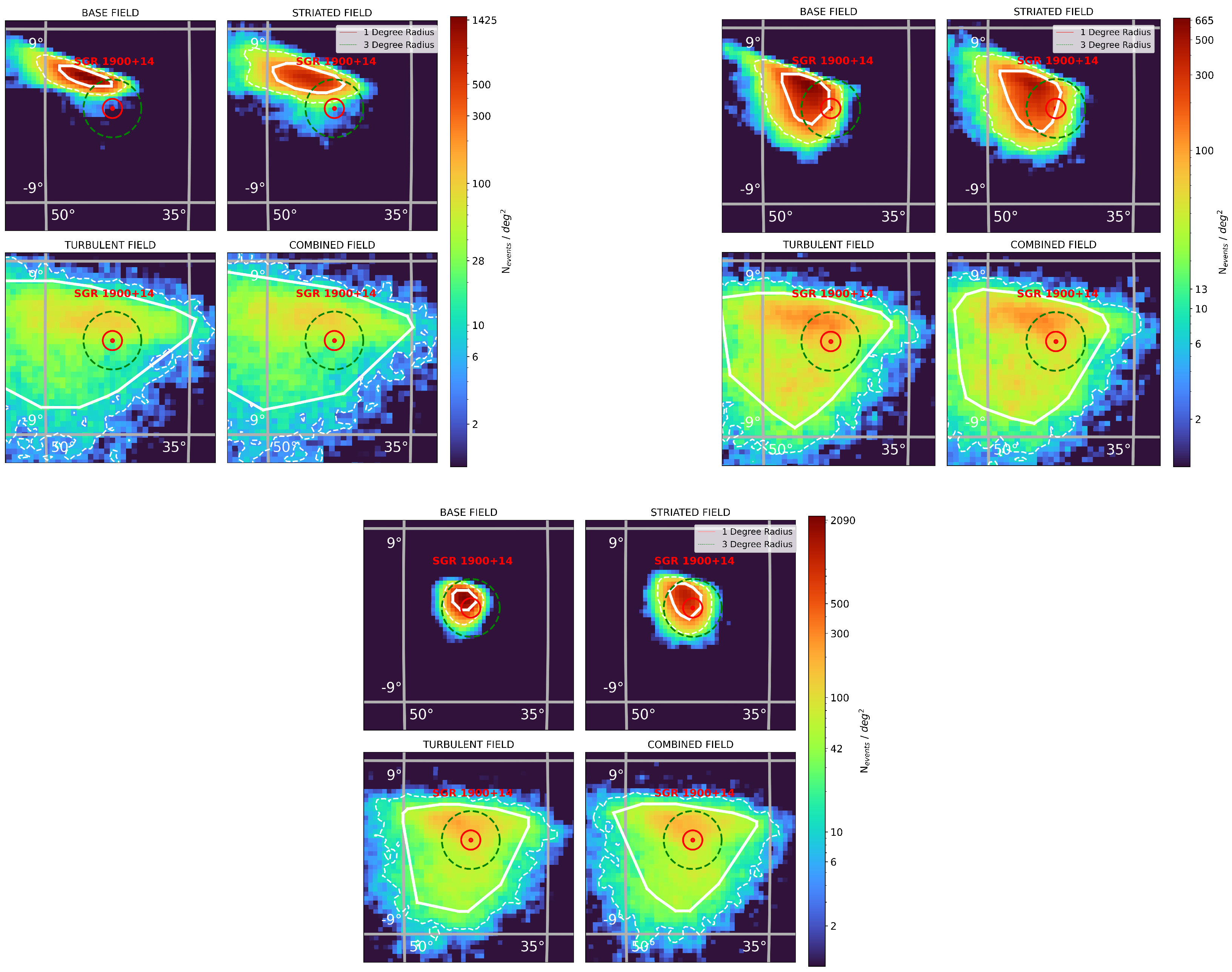
Presented in Table 4, Table 5 and Table 6 results are illustrated in following Figure 1, Figure 2, Figure 3, Figure 4, Figure 5, Figure 6, Figure 7, Figure 8, Figure 9 and Figure 10 and Figure A2, Figure A3, Figure A4, Figure A5, Figure A6, Figure A7, Figure A8 and Figure A9 where density maps of backtracking trajectories near the corresponding potential sources are presented. So in the case of EECR protons (H) the potential Galactic source is Aql X-1 (Figure 2 and Figure 3) and NGC 6760 (Figure 6 and Figure 7). In case of EECR CNO nuclei main potential sources (at least statistically) are SS 433 (Figure A1, Figure 4 and Figure A2) and GRS 1915+105 (Figure A8, Figure 5 and Figure A9).
Figure 2.
Simulated arrival direction density maps in Galactic coordinates for particles propagating in arrival direction of events from LV triplet through various components of Galactic magnetic field models (JF12 and UF23). The spatial distribution of the simulated trajectories is calculated using Kernel Density Estimation (KDE) with a bandwidth to smooth the discrete event coordinates into a continuous probability density field. The solid white line represents 68% convex hull, and the dashed white line—contour level with density = 0.05. The circles around the source positions with radius of 1 degree (red) and 3 degree (green) are illustrative and are given to estimate the angular scales of the images. The resulting event density, measured in particles per square degree, is visualized using the logarithmic scale. The color range is globally synchronized across all subpanels to ensure direct, proportional comparability of particle dispersion across the different magnetic field configurations. Each of three plots correspond to TA-LV-1 (left), TA-LV-2 (right), and PA-LV (bottom) observed events. Within each panel, the left column shows propagation in the base (coherent) magnetic field, while the right column shows propagation in the combined (base + turbulent) field. Simulated nuclei: H; Potential source: Aquila X-1.
Figure 3.
Same as Figure 2, with identical magnetic field configurations and analysis procedure, but for simulated He nuclei.
Figure 4.
Same as Figure 2, with identical magnetic field configurations and analysis procedure, but for simulated N nuclei and assuming SS 433 as the potential source.
Figure 5.
Same as Figure 2, with identical magnetic field configurations and analysis procedure, but for simulated N nuclei and assuming GRS 1915+105 as the potential source.
Figure 6.
Same as Figure 2, with identical magnetic field configurations and analysis procedure for simulated H nuclei, but assuming the globular cluster NGC 6760 as the potential source.
Figure 7.
Same as Figure 2, with identical magnetic field configurations and analysis procedure but for simulated He nuclei, assuming the globular cluster NGC 6760 as the potential source.
Figure 8.
Simulated arrival direction density maps in Galactic coordinates for particles propagating in arrival direction of events from LV triplet through JF12 magnetic field. The spatial distribution of the simulated trajectories is calculated using KDE with a bandwidth to smooth the discrete event coordinates into a continuous probability density field. The solid white line represents 68% convex hull, and the dashed white line—contour level with density = 0.05. The resulting event density, measured in particles per square degree, is visualized using the logarithmic scale. The color range is globally synchronized across all subpanels to ensure direct, proportional comparability of particle dispersion across the different magnetic field configurations. Each of three plots correspond to TA-LV-1 (left), TA-LV-2 (right), and PA-LV (bottom) observed events. For each plot, top left axis shows the result of propagation of the CR in base (coherent) JF12 field, top right axis—base + striated component, bottom left—base + turbulent (stochastic) component, and bottom-right—combined field, where all previous components are summed up. Simulated nuclei: N; Potential source: SGR 1900+14.
Estimation of Confidence Level for Source Candidates
Table 4, Table 5 and Table 6 show that only three eV EECRs—TA 2008 (TA-LV-1), TA 2011 (TA-LV-2), and PAO 2008 (PA-LV)—have candidate sources among the Galactic sources considered. After energy calibration, only three TA and two PAO EECRs remained in the Local Void (LV) region. Therefore, we estimate the confidence level for the source candidates listed in Table 4, Table 5 and Table 6.
The Local Void can be approximated by a circle on the sky centered at , , with radius , corresponding to a solid angle . The TA detector observes the main part of the LV (excluding the region with ) with an effective solid angle due to the aperture correction. The PAO detector also observes the main part of the LV (excluding the region with ) with an effective solid angle due to the same aperture correction. This implies that, in the case of isotropic EECR intensity, TA and PAO detect only 71% and 33% of events from the LV, respectively.
As mentioned above, following [7,68], we consider as candidate sources those objects that overlap with the 5% density contour of backtraced EECR arrival directions at the corresponding source distances. For each candidate source, the associated solid angle is corrected for the detector aperture using the factor and is used in subsequent calculations.
With these data at hand, we calculate the local probability of random coincidence between a candidate source and background EECR events. We consider the case of three TA and two PAO observed EECR events. For the three TA events, the null hypothesis gives the probability of random coincidence in the simplest approximation as . For a Poisson distribution with and mean , the probability is . The corresponding Li–Ma statistical significance S is calculated following [69].
Here, for sky regions corresponding to the source (on) and background (off), the parameter is defined as , and and are the numbers of events in the source and background regions, respectively. The local probability is given by the Gaussian probability corresponding to the significance S, i.e., . In our case, and for TA, and for PAO EECRs.
All three approaches give similar results. In the following, we use the Li–Ma approach, which is very effective for large values of and , but is less reliable for small samples.
Table 7.
Metrics S and for TA-LV-1 EECR potential candidates.
Table 8.
Metrics S and for TA-LV-2 EECR potential candidates.
Table 9.
Metrics S and for PA-LV EECR potential candidates.
In numerous blind searches for UHECR sources, scanning the entire sky and varying the lower energy threshold to identify statistical excesses in the arrival directions of UHECRs, the maximum significance typically results from a set of trial calculations with different parameters. For N independent trial experiments, the global p-value increases according to [69]:
In many cases, the trials factor, i.e., the effective number of independent trials (the look-elsewhere effect), is not known, making it difficult to assess the true significance of a detected signal. The global p-value can be estimated using Monte Carlo simulations of (10–100) k background-only realizations to obtain the distribution of local p-values for background-generated hot spots. The global p-value is then defined as the probability of obtaining a local p-value smaller than the one observed experimentally.
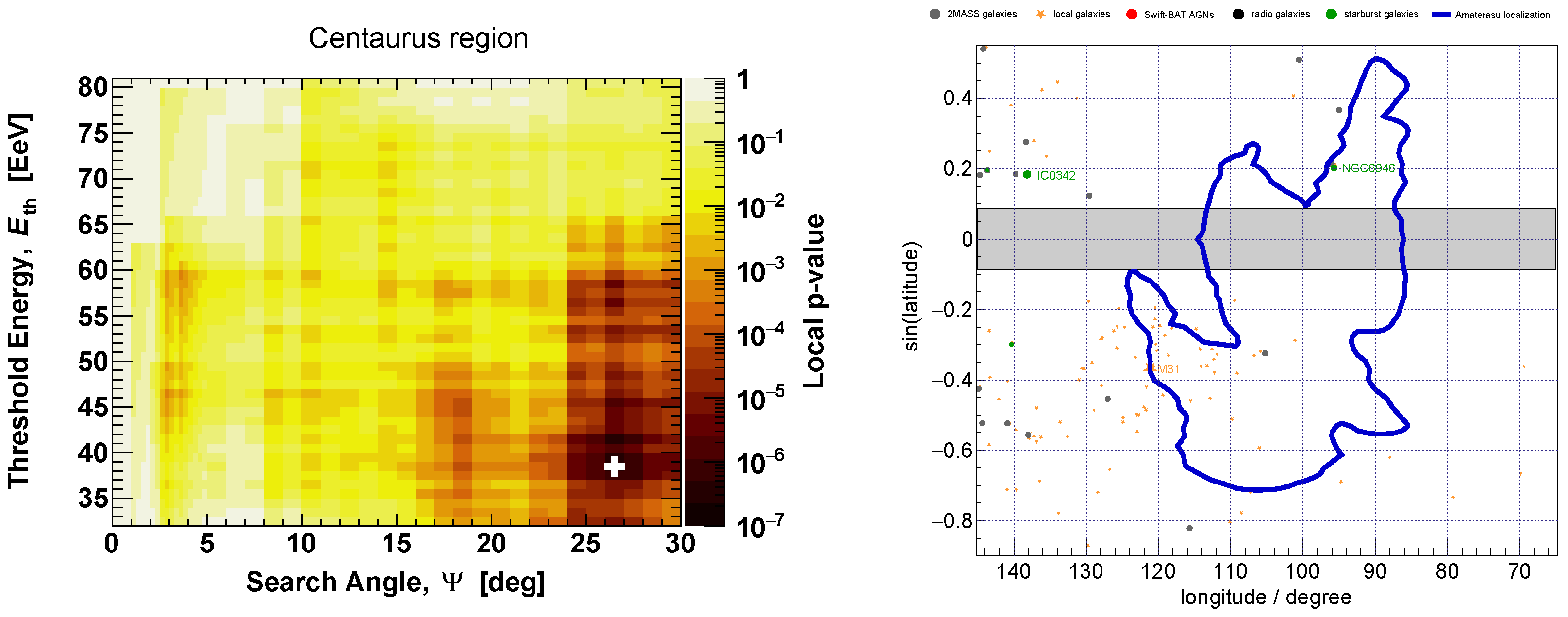
In ref. [70], a blind search was performed to identify an excess in the Centaurus region (Figure 9, left). For the smallest local p-value , the corresponding post-trial global p-value increases to , corresponding to a one-sided significance of .
In our case of EECRs, only five eV events lie within the LV boundary with , representing rare events without clustering. Therefore, we do not employ blind searches, but instead use an event-by-event approach similar to [7], in which the source of the highest-energy cosmic ray “Amaterasu” recorded by the TA detector was investigated (Figure 9, right).
The Amaterasu event was backtracked through the GMF to define the source localization region as an area on the sky where the density of backtracked events exceeds 0.05 of the maximum value. It was found that the corresponding solid angle of the localization region for an iron nucleus () is 6.6% of , i.e., the local probability for this single event over the entire sky is , corresponding to (one-sided). Potential EECR sources within this localization region were considered as candidates; however, the absence of common accelerators (AGN, radio galaxies, starburst galaxies, etc.) in this area supports models of transient sources in ordinary galaxies [7].
Namely, following the Amaterasu case, we search for potential Galactic sources of each EECR in the LV region, since potential extragalactic sources in this direction are practically absent due to the negligible number of ordinary galaxies. In this case, characterizes the confidence level of the source candidates, analogous to the Amaterasu EECR case.
Figure 9.
Search for UHECR sources as statistical excesses in the arrival directions of UHECRs. Left: blind search with trials over the search angle and UHECR threshold energy in the Centaurus A region (Figure 2 from [70]). Right: event-by-event search with backtracking of the Amaterasu event in the Galactic magnetic field to identify the source localization region, corrected for Galactic magnetic-field effects. The blue contour corresponds to 5% of the maximum event density of the distribution (Figure 5e from [7]).
The complicated structure of the regular component of the Galactic magnetic field results in magnetic lensing, leading to the appearance of multiple images of single sources, caustics, and significant energy-dependent flux variations. In particular, magnetic lensing can create artificial “hotspots” ([71,72] and references therein).
To estimate the impact of magnetic lensing on our search for EECR sources, we performed Monte Carlo simulations of this effect by backtracking events randomly distributed over the LV, with parameters corresponding to our EECR sample. We then calculated the amplification (de)magnification factor A for all EECR–candidate source pairs as the ratio of the number of particles crossing the localization region to the number of particles crossing this region in the absence of a magnetic field, .
The results, presented in Table 10, Table 11 and Table 12, show that in the region of the Galactic plane, magnetic-field magnification dominates, with A∼2–5 in some cases. Therefore, this effect requires separate consideration.
Table 10.
Solid angle and Amplification for TA-LV-1 EECR potential candidates.
Table 11.
Solid angle and Amplification for TA-LV-2 EECR potential candidates.
Table 12.
Solid angle and Amplification for PA-LV EECR potential candidates.
5. Discussion and Conclusions
For almost a decade, we have been living in the era of multimessenger astronomy, observing astronomical objects through a combination of the four messengers—electromagnetic radiation, gravitational waves, neutrinos, and cosmic rays. But only cosmic ray messengers still cover their sources. The main reason, of course, is the deflection and diffuse propagation of charged particles in extragalactic and Galactic magnetic fields. Even UHECRs cannot penetrate our Galaxy without considerable deflection. Therefore, the most promising way to discover UHECR sources is to deal with maximum-energy EECR events from sky directions with minimum magnetic fields. And with this, maximum-energy EECRs have very short energy-loss lengths due to their interaction with the intergalactic photon background—the expected maximum distance to the source of the Amaterasu event is only of order 30–50 Mpc. This distance is less than the size of the Local Void, from which this particle came. Despite this, the Pierre Auger Observatory and the Telescope Array detected a dozen EECRs, including a triplet of them, from the direction of the Local Void. This means that at least some of these events may have Galactic sources. In our work, we test this possibility—we consider Galactic microquasars, magnetars, and pulsar wind nebulae as potential sources of these events. Using event-by-event reconstruction of the trajectories of detected EECRs via CRPropa backtracking in the Galactic magnetic field, we find a set of their potential Galactic sources. Among them, in the case of light nuclei (H, He), are the microquasars Aql X-1 and SS 433, the globular cluster NGC 6760, and the magnetar SGR 1900+14 (He nuclei and UF23 magnetic field model).
In the case of CNO-group nuclei, potential sources are the microquasars Aql X-1, SS 433, and GRS 1915 (UF23 magnetic field model), and the magnetar SGR 1900+14 (JF12 magnetic field model). For more massive Si nuclei, the potential source is PSR 1907.
It is worth noting that the magnetar SGR 1900+14 has been considered as a source of the EECR triplet for a long time [22,35,73] because it is one of only three magnetars in our Galaxy and the Large Magellanic Cloud observed to produce a giant flare (in 1998) with a relativistic transient jet. Furthermore, UHE-ray emission from the SGR 1900+14 region can be explained by a magnetar-wind nebula created by a newly born millisecond magnetar. Both relativistic flows can accelerate EECRs [14,35,74].
The problem with the giant flare model for a 2 kyr-old magnetar is the delay in the EECR arrival time relative to the electromagnetic signal. Propagation of EECRs from Galactic sources corresponds to the case of pre-diffusive (ballistic) propagation, where the influence of random fields can be described in terms of a diffusion process in the particle momentum space—a small-angle random scattering around the main trajectory in the regular field. The average angular EECR deflection and the corresponding time delay in the random field with the coherence length are as follows [75]:
and
where L is the full distance covered by a CR particle on its way from the source to the observer.
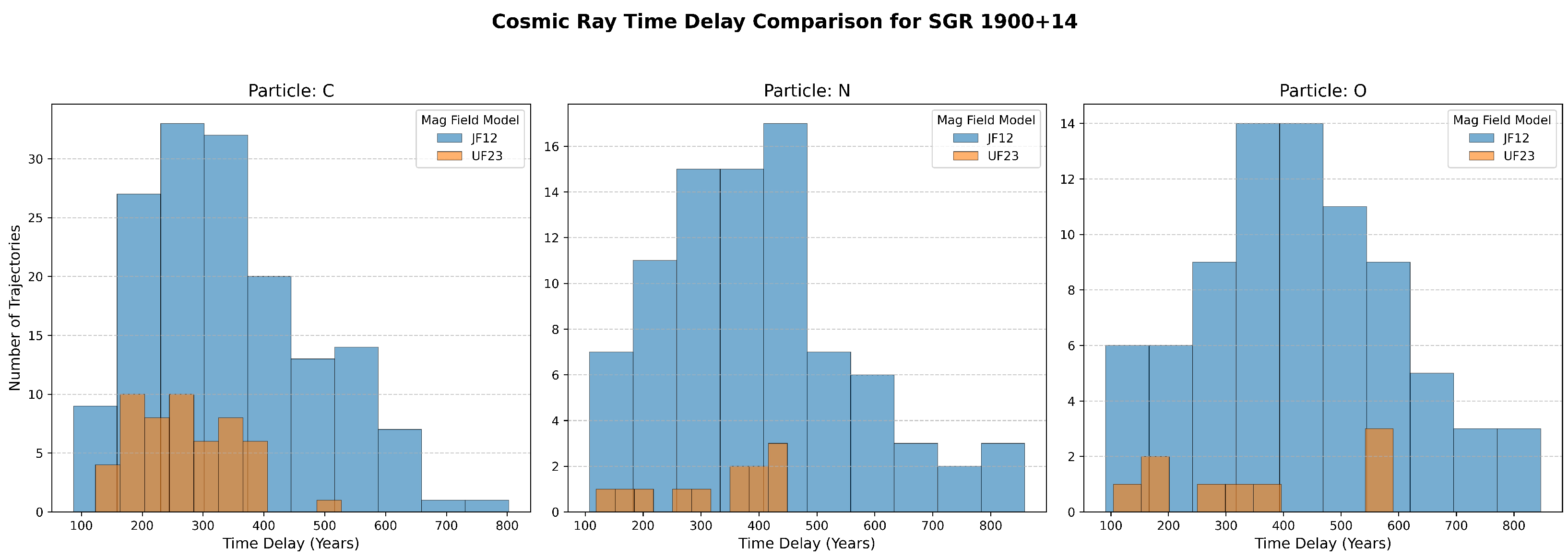
In case of magnetar SGR1900+14 as candidate source EECRs could be accelerated during the magnetar-connected Supernova explosion (about 2 kyr ago), or during one of the numerous giant magnetar flares (a similar to one detected in 1998). In Figure 10 the histogram of time delay for EECRs accelerated in giant magnetar flare above 300–400 years ago is presented. Such timescales are typical for recurrent magnetar activity [76].
Figure 10.
Cosmic ray arrival time delays by particle type and magnetic field model (for both JF12 and UF23). The histograms show the geometric delay (in years) compared to a direct photon path for C, N, and O nuclei. Mean across all particle types is in a 300–400 years range.
Author Contributions
Conceptualization, B.H. and L.Z.; methodology, L.Z., O.G., V.B. and B.H.; writing—original draft preparation, O.G., B.H. and L.Z.; writing—review and editing, B.H., L.Z., O.G., O.P., V.B., V.V. and P.P.; software, O.G.; visualization, O.G.; validation, O.P., V.V. and P.P.; formal analysis, B.H., L.Z. and O.G.; investigation, B.H., L.Z., O.G., V.B., O.P., V.V. and P.P.; supervision, B.H. and L.Z. All authors have reviewed, discussed, and commented on the present results. All authors have read and agreed to the published version of the manuscript.
Funding
The work of L.Z. has received funding from the MSCA4Ukraine project, grant number Ref 1.4-UKR-1245772-MSCA4Ukraine, which is funded by the European Union. The views and opinions expressed are, however, those of the author(s) only and do not necessarily reflect those of the European Union, the European Research Executive Agency, or the MSCA4Ukraine Consortium. Neither the European Union nor the European Research Executive Agency, nor the MSCA4Ukraine Consortium as a whole, nor any individual member institutions of the MSCA4Ukraine Consortium, can be held responsible for them. The work of O.G. was supported by the Ministry of Education and Science of Ukraine under grant for TSNUK No. 25BF051-04. The work of V.B. was supported by the Ministry of Education and Science of Ukraine under grant for TSNUK No. 24BF023-01. The work of B.H. was supported by the National Research Foundation of Ukraine under project No. 2023.03/0149. This research was conducted with support from the Centre for the Collective Use of Scientific Equipment “Laboratory of High Energy Physics and Astrophysics” of Taras Shevchenko National University of Kyiv.
Data Availability Statement
The dataset used for the high-energy cosmic ray simulations is publicly available at https://zenodo.org/records/6759610 (accessed on 26 April 2026) and is released under a Creative Commons Attribution-ShareAlike 4.0 International (CC BY-SA 4.0) license for data from Pierre Auger Observatory and at https://content.cld.iop.org/journals/2041-8205/790/2/L21/revision1/apjl498370t1_mrt.txt (accessed on 26 April 2026) for Telescope Array. The full codebase required to reproduce the results presented in this work is accessible via GitHub at https://github.com/alexgugnin/galactic_CR_backtracking (accessed on 26 April 2026). CRPropa3 version is 3.2.1-167-g61a6257e, requirements for virtual environment also can be found in requirements.txt in the repository. This study is independent and not endorsed by the Pierre Auger Collaboration. All other original data presented in the study are available on request from the corresponding author.
Conflicts of Interest
The authors declare no conflicts of interest.
Abbreviations
The following abbreviations are used in this manuscript:
| AGASA | Akeno Giant Air Shower Array |
| AXP | Anomalous X-ray Pulsar |
| BH-HMXB | Black Hole High-Mass X-ray Binary |
| BH-LMXB | Black Hole Low-Mass X-ray Binary |
| CNO | Carbon–Nitrogen–Oxygen group |
| CRPropa | Cosmic Ray Propagation framework |
| CRPropa3 | Cosmic Ray Propagation framework version 3 |
| EECR | Extreme Energy Cosmic Ray |
| FRB | Fast Radio Burst |
| GMF | Galactic Magnetic Field |
| HAWC | High-Altitude Water Cherenkov Observatory |
| HMXB | High-Mass X-ray Binary |
| ICRS | International Celestial Reference System |
| JF12 | Jansson–Farrar 2012 Galactic Magnetic Field model |
| KDE | Kernel Density Estimation |
| LHAASO | Large High Altitude Air Shower Observatory |
| LMXB | Low-Mass X-ray Binary |
| NS-LMXB | Neutron Star Low-Mass X-ray Binary |
| PAO | Pierre Auger Observatory |
| PAO2022 | Pierre Auger Observatory 2022 data release |
| PSF | Point Spread Function |
| PWN | Pulsar Wind Nebula |
| SGR | Soft Gamma Repeater |
| SNR | Supernova Remnant |
| TA | Telescope Array |
| TA2014 | Telescope Array 2014 data set |
| TDE | Tidal Disruption Event |
| UF23 | Unger–Farrar 2023 Galactic Magnetic Field model |
| UHECR | Ultra-High Energy Cosmic Ray |
| vMF | von Mises–Fisher distribution |
Appendix A
Figure A1.
Same as Figure 2 with identical magnetic field configurations and analysis procedure, but for simulated C nuclei and potential source SS 433.
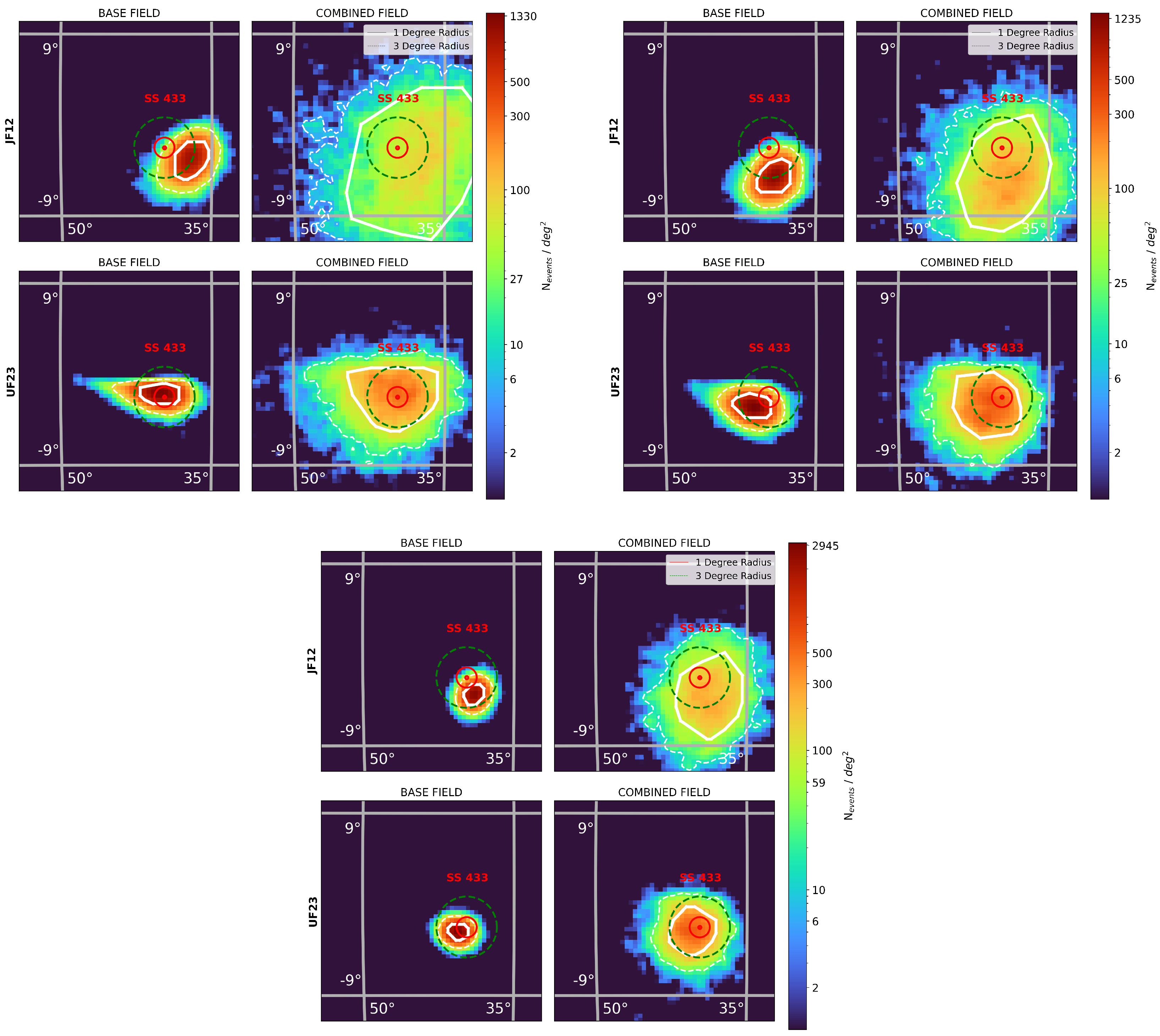
Figure A2.
Same as Figure 2 with identical magnetic field configurations and analysis procedure, but for simulated O nuclei and potential source SS 433.
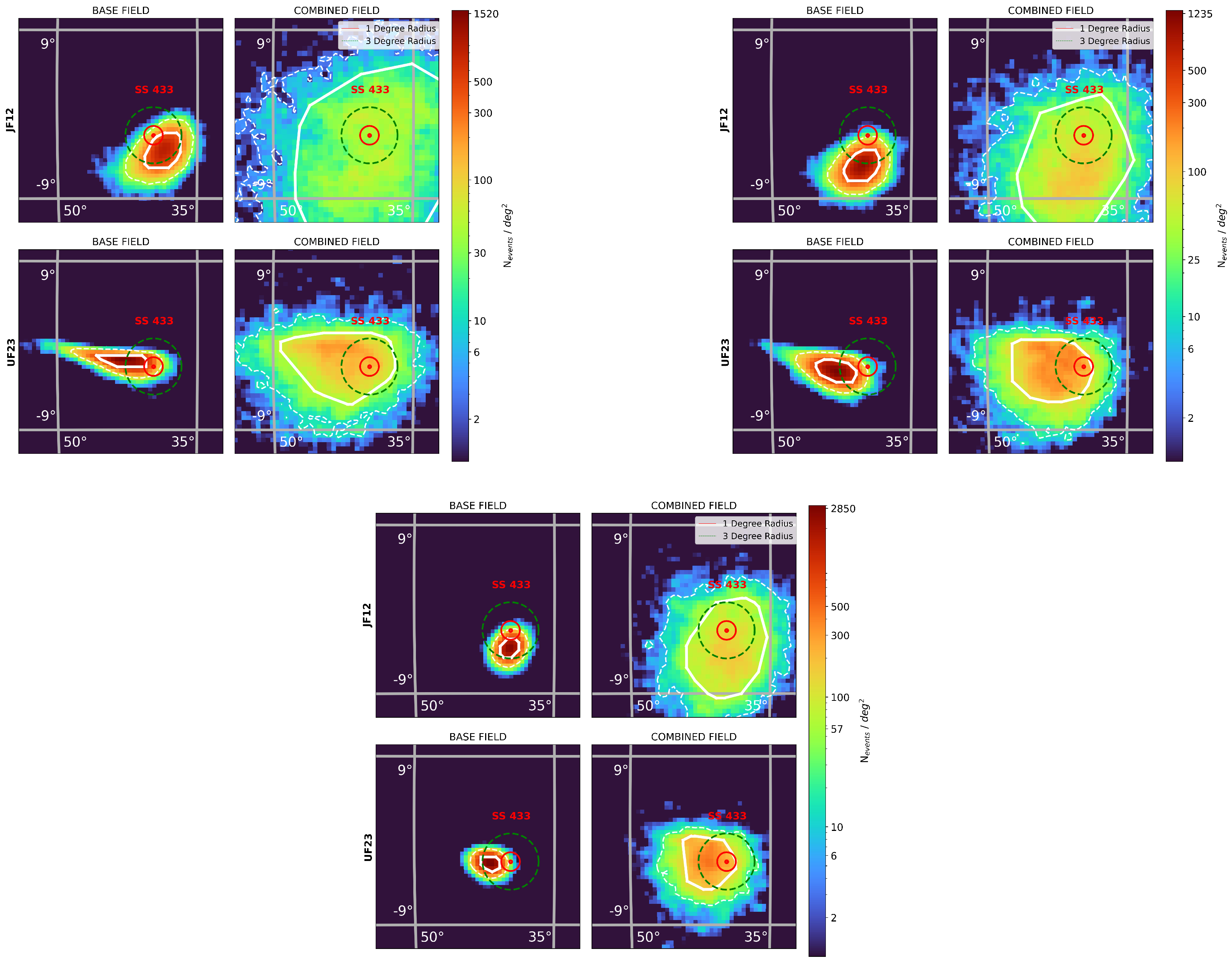
Figure A3.
Simulated arrival direction density maps in Galactic coordinates for particles propagating in arrival direction of events from LV triplet through JF12 magnetic field. The spatial distribution of the simulated trajectories is calculated using KDE with a bandwidth to smooth the discrete event coordinates into a continuous probability density field. The solid white line represents 68% convex hull, and the dashed white line—contour level with density = 0.05. The resulting event density, measured in particles per square degree, is visualized using the logarithmic scale. The color range is globally synchronized across all subpanels to ensure direct, proportional comparability of particle dispersion across the different magnetic field configurations. Each of three plots correspond to TA-LV-1 (left), TA-LV-2 (right), and PA-LV (bottom) observed events. For each plot, top left axis shows the result of propagation of the CR in base (coherent) JF12 field, top right axis—base + striated component, bottom left—base + turbulent (stochastic) component, and bottom-right—combined field, where all previous components are summed up. Simulated nuclei: C; Potential source: SGR 1900+14.
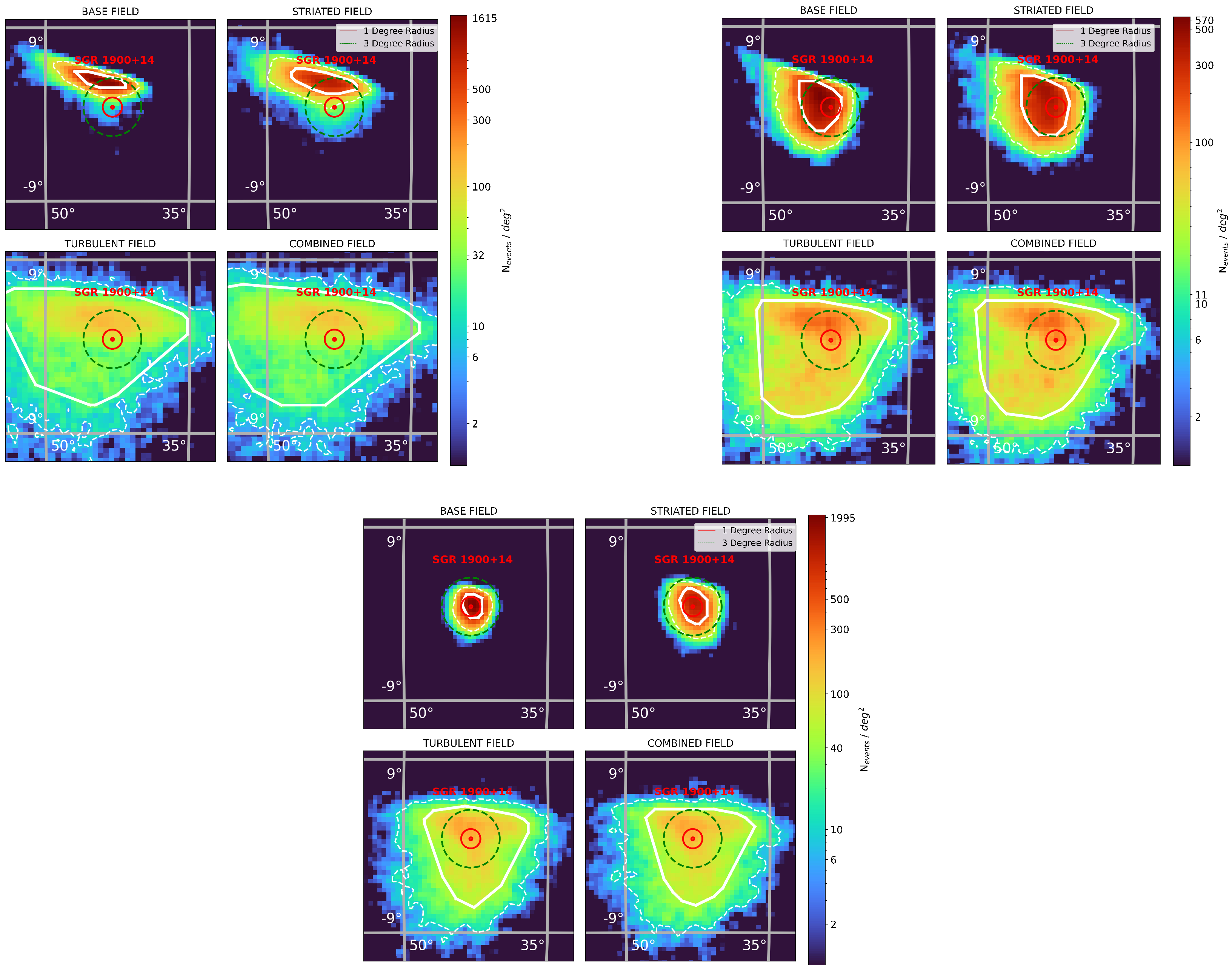
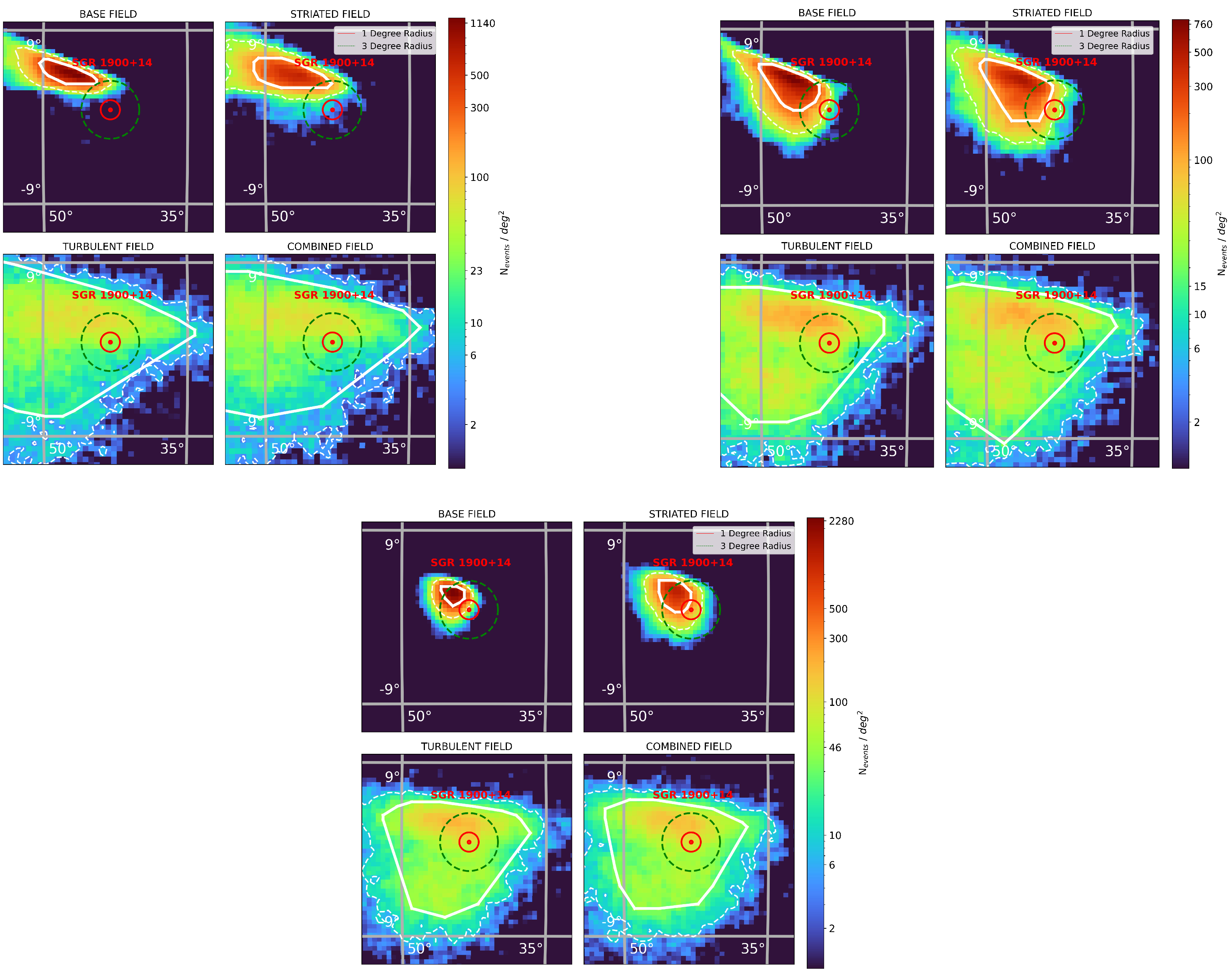
Figure A5.
Same as Figure 2 with identical magnetic field configurations and analysis procedure, but for simulated C nuclei and potential source SGR 1900+14.
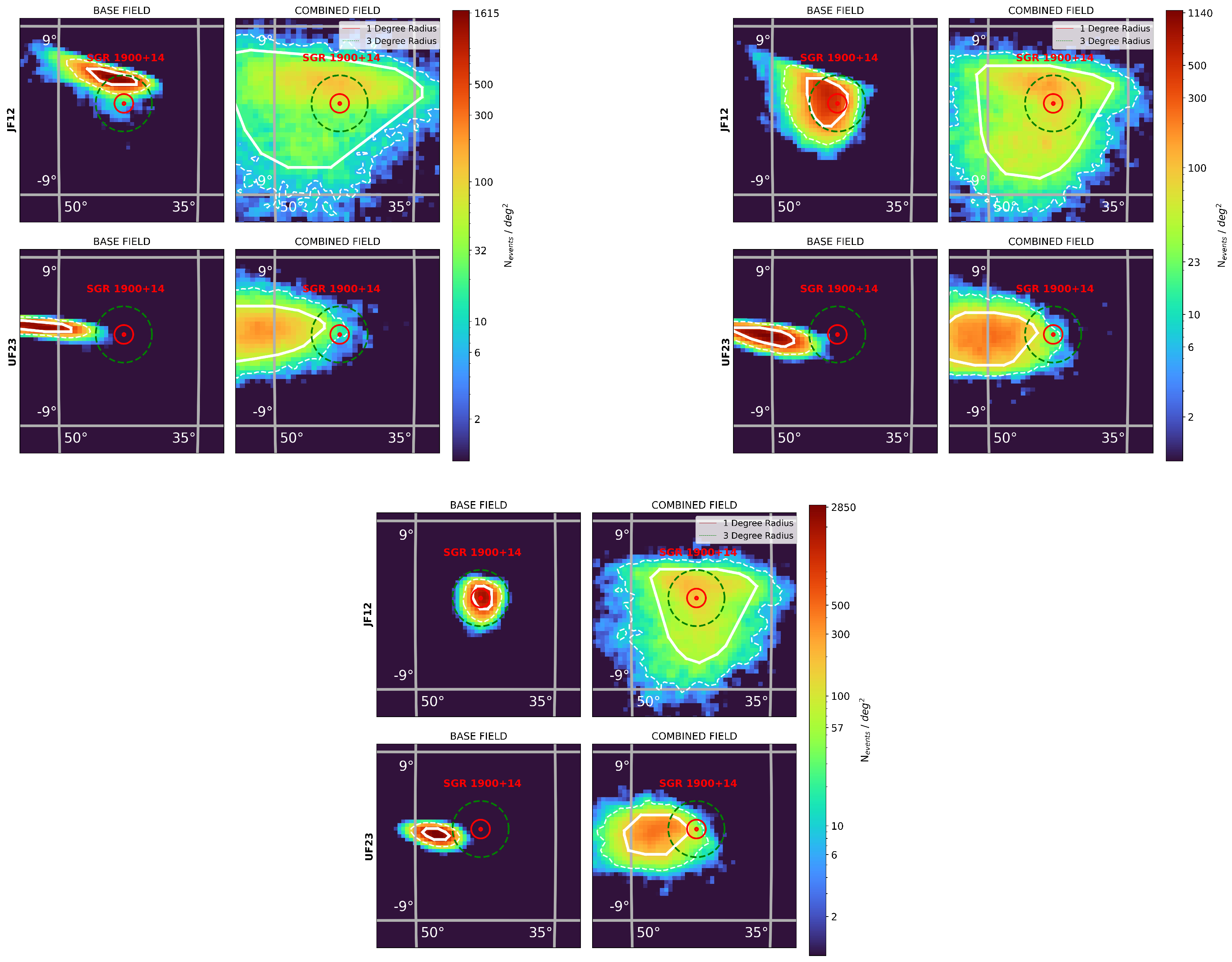
Figure A6.
Same as Figure 2 with identical magnetic field configurations and analysis procedure, but for simulated N nuclei and potential source SGR 1900+14.
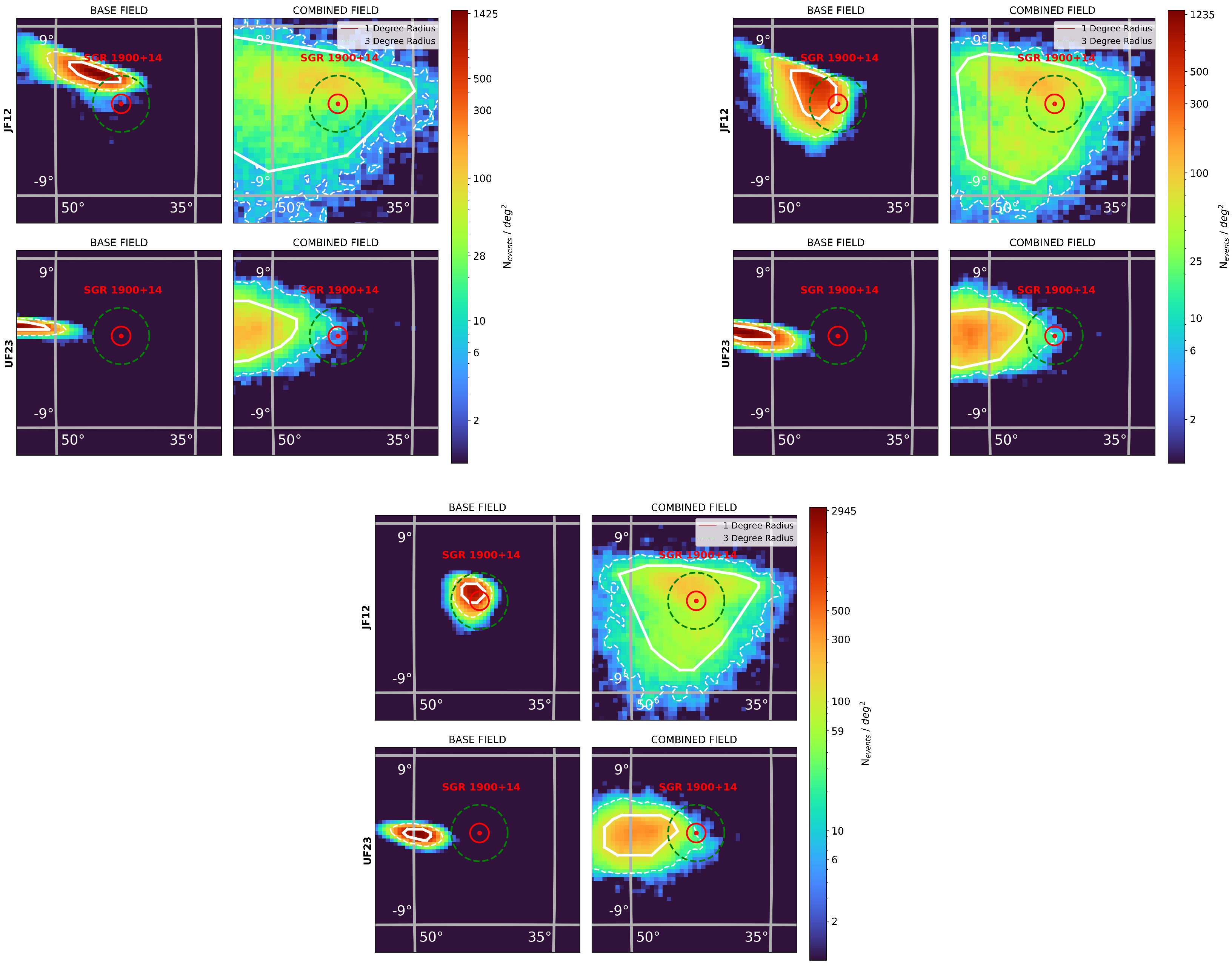
Figure A7.
Same as Figure 2 with identical magnetic field configurations and analysis procedure, but for simulated O nuclei and potential source SGR 1900+14.
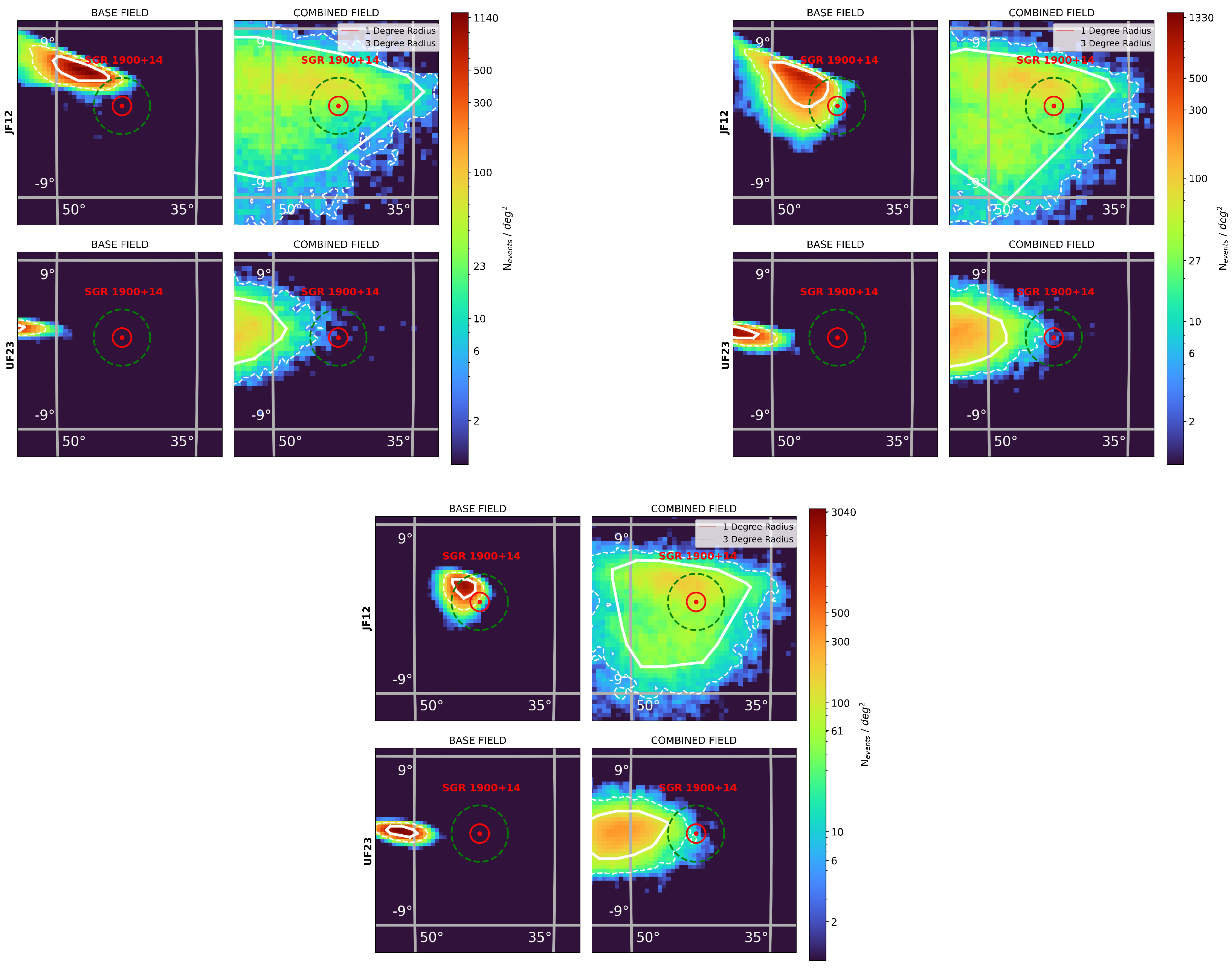
Figure A8.
Same as Figure 2 with identical magnetic field configurations and analysis procedure, but for simulated C nuclei and potential source GRS 1915+105.
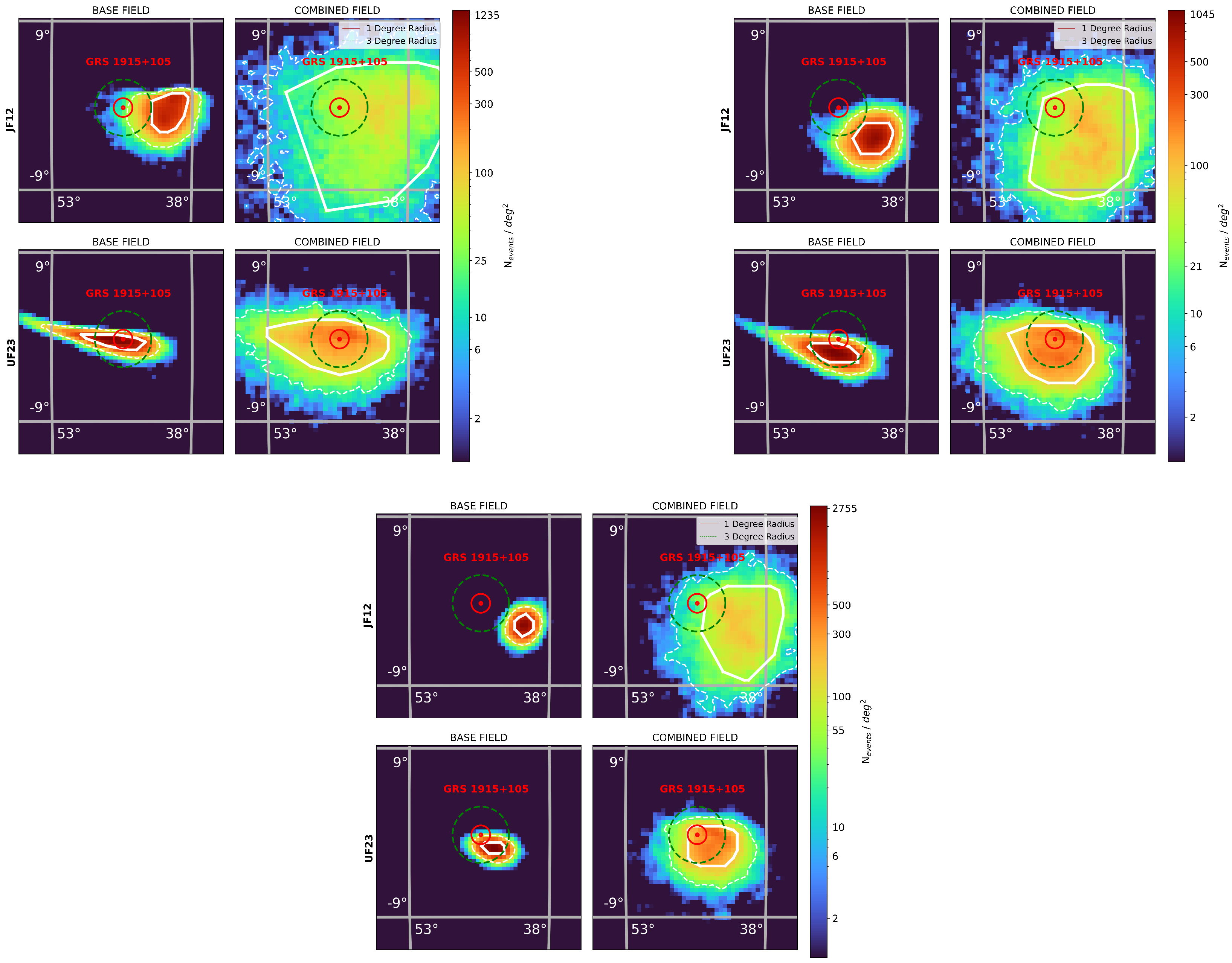
Figure A9.
Same as Figure 2 with identical magnetic field configurations and analysis procedure, but for simulated O nuclei and potential source GRS 1915+105.
References
- Berezinskii, V.S.; Bulanov, S.V.; Dogiel, V.A.; Ptuskin, V.S. Astrophysics of Cosmic Rays; North-Holland: Amsterdam, The Netherlands, 1990. [Google Scholar]
- Hillas, A.M. TOPICAL REVIEW: Can diffusive shock acceleration in supernova remnants account for high-energy galactic cosmic rays? J. Phys. G Nucl. Phys. 2005, 31, R95–R131. [Google Scholar] [CrossRef] [Scilit]
- Blasi, P. The origin of galactic cosmic rays. Astron. Astrophys. Rev. 2013, 21, 70. [Google Scholar] [CrossRef] [Scilit]
- Pierre Auger Collaboration; Aab, A.; Abreu, P.; Aglietta, M.; Samarai, I.A.; Albuquerque, I.F.M.; Allekotte, I.; Almela, A.; Alvarez Castillo, J.; Alvarez-Muñiz, J.; et al. Observation of a large-scale anisotropy in the arrival directions of cosmic rays above 8 × 10¹⁸ eV. Science 2017, 357, 1266–1270. [Google Scholar] [CrossRef] [Scilit]
- Ahlers, M. Searching for All-scale Anisotropies in the Arrival Directions of Cosmic Rays above the Ankle. Astrophys. J. 2018, 863, 146. [Google Scholar] [CrossRef] [Scilit]
- Telescope Array Collaboration; Abbasi, R.U.; Allen, M.G.; Arimura, R.; Belz, J.W.; Bergman, D.R.; Blake, S.A.; Shin, B.K.; Buckland, I.J.; Cheon, B.G.; et al. An extremely energetic cosmic ray observed by a surface detector array. Science 2023, 382, 903–907. [Google Scholar] [CrossRef] [Scilit] [PubMed]
- Unger, M.; Farrar, G.R. Where Did the Amaterasu Particle Come From? Astrophys. J. Lett. 2024, 962, L5. [Google Scholar] [CrossRef] [Scilit]
- Bourriche, N.; Capel, F. Beyond the Local Void: A comprehensive view on the origins of the Amaterasu particle. In Proceedings of the 7th International Symposium on Ultra High Energy Cosmic Rays, Mendoza, Argentina, 17–21 November 2024; Sissa Medialab srl: Trieste, Italy, 2025; p. 71. [Google Scholar] [CrossRef] [Scilit]
- Tully, R.B.; Pomarède, D.; Graziani, R.; Courtois, H.M.; Hoffman, Y.; Shaya, E.J. Cosmicflows-3: Cosmography of the Local Void. Astrophys. J. 2019, 880, 24. [Google Scholar] [CrossRef] [Scilit]
- Kotera, K.; Olinto, A.V. The Astrophysics of Ultrahigh-Energy Cosmic Rays. Annu. Rev. Astron. Astrophys. 2011, 49, 119–153. [Google Scholar] [CrossRef] [Scilit]
- Aloisio, R.; Berezinsky, V.; Blasi, P. Ultra high energy cosmic rays: Implications of Auger data for source spectra and chemical composition. J. Cosmol. Astropart. Phys. 2014, 10, 020. [Google Scholar] [CrossRef] [Scilit]
- Fang, K.; Kotera, K.; Olinto, A.V. Newly Born Pulsars as Sources of Ultrahigh Energy Cosmic Rays. Astrophys. J. 2012, 750, 118. [Google Scholar] [CrossRef] [Scilit]
- Alves Batista, R.; Biteau, J.; Bustamante, M.; Dolag, K.; Engel, R.; Fang, K.; Kampert, K.H.; Kostunin, D.; Mostafa, M.; Murase, K.; et al. Open questions in cosmic-ray research at ultrahigh energies. Front. Astron. Space Sci. 2019, 6, 23. [Google Scholar] [CrossRef] [Scilit]
- Globus, N.; Blandford, R. Ultra High Energy Cosmic Ray Source Models: Successes, Challenges and General Predictions. Eur. Phys. J. Web Conf. 2023, 283, 04001. [Google Scholar] [CrossRef] [Scilit]
- Cao, Z.; Aharonian, F.; Bai, Y.X.; Bao, Y.W.; Bastieri, D.; Bi, X.J.; Bi, Y.J.; Bian, W.Y.; Bukevich, A.V.; Cai, C.; et al. Ultrahigh-energy gamma-ray emission associated with black hole–jet systems. Natl. Sci. Rev. 2025, 12, nwaf496. [Google Scholar] [CrossRef] [Scilit] [PubMed]
- Huxtable, G.B.; Eltawil, N.; Feng, W.X.; Player, G.; Wang, W.; Tajima, T.; Ebisuzaki, T. Signatures of wakefield acceleration in astrophysical jets via gamma-rays and UHECRs. Mon. Not. R. Astron. Soc. 2023, 522, 5402–5414. [Google Scholar] [CrossRef] [Scilit]
- Arons, J. Magnetars in the Metagalaxy: An Origin for Ultra-High-Energy Cosmic Rays in the Nearby Universe. Astrophys. J. 2003, 589, 871–892. [Google Scholar] [CrossRef] [Scilit]
- Kotera, K.; Amato, E.; Blasi, P. The fate of ultrahigh energy nuclei in the immediate environment of young fast-rotating pulsars. J. Cosmol. Astropart. Phys. 2015, 8, 026. [Google Scholar] [CrossRef] [Scilit]
- Piro, A.L.; Kollmeier, J.A. Ultrahigh-energy Cosmic Rays from the “En Caul” Birth of Magnetars. Astrophys. J. 2016, 826, 97. [Google Scholar] [CrossRef] [Scilit]
- Asano, K.; Yamazaki, R.; Sugiyama, N. Possibility of Ultra High-Energy Cosmic Rays from the Giant Flare in Soft Gamma Repeater 1806-20. Publ. Astron. Soc. Jpn. 2006, 58, L7–L10. [Google Scholar] [CrossRef] [Scilit]
- Shimoda, J.; Wada, T. On Acceleration of Highest-energy Cosmic Rays in a Novel Scenario of Magnetar Transients. Astrophys. J. 2025, 986, 213. [Google Scholar] [CrossRef] [Scilit]
- Hnatyk, B.; Hnatyk, R.; Zhdanov, V.; Voitsekhovskyi, V. High-energy and very high-energy gamma-ray emission from the magnetar SGR 1900+14 outskirts. Proc. Sci. 2021, ICRC2021, 672. [Google Scholar] [CrossRef] [Scilit]
- Nagar, N.M.; Matulich, J. Ultra-high energy cosmic rays detected by Auger and AGASA. Corrections for galactic magnetic field deflections, source populations, and arguments for multiple components. Astron. Astrophys. 2010, 523, A49. [Google Scholar] [CrossRef] [Scilit]
- Bednarek, W.; Sitarek, J. High-energy γ-rays from globular clusters. Mon. Not. R. Astron. Soc. 2007, 377, 920–930. [Google Scholar] [CrossRef] [Scilit]
- Venter, C.; De Jager, O.C.; Clapson, A.C. Predictions of Gamma-Ray Emission from Globular Cluster Millisecond Pulsars Above 100 MeV. Astrophys. J. Lett. 2009, 696, L52–L55. [Google Scholar] [CrossRef] [Scilit]
- Alves Batista, R.; Silk, J. Ultrahigh-energy cosmic rays from tidally-ignited white dwarfs. Phys. Rev. D 2017, 96, 103003. [Google Scholar] [CrossRef] [Scilit]
- Abdo, A.A.; Ackermann, M.; Ajello, M.; Atwood, W.B.; Axelsson, M.; Baldini, L.; Ballet, J.; Barbiellini, G.; Bastieri, D.; Baughman, B.M.; et al. Detection of High-Energy Gamma-Ray Emission from the Globular Cluster 47 Tucanae with Fermi. Science 2009, 325, 845. [Google Scholar] [CrossRef] [Scilit]
- The Pierre Auger Collaboration. Pierre Auger Observatory Open Data. 2024. Available online: https://zenodo.org/records/10488964 (accessed on 26 April 2026).
- Abbasi, R.U.; Abe, M.; Abu-Zayyad, T.; Allen, M.; Anderson, R.; Azuma, R.; Barcikowski, E.; Belz, J.W.; Bergman, D.R.; Blake, S.A.; et al. Indications of Intermediate-Scale Anisotropy of Cosmic Rays with Energy Greater Than 57 EeV in the Northern Sky Measured with the Surface Detector of the Telescope Array Experiment. Astrophys. J. Lett. 2014, 790, L21. [Google Scholar] [CrossRef] [Scilit]
- Zhou, X.; Su, Y.; Yang, J.; Chen, X.; Sun, Y.; Jiang, Z.; Wang, M.; Wang, H.; Zhang, S.; Xu, Y.; et al. A Systematic Study of Associations between Supernova Remnants and Molecular Clouds. Astrophys. J. Suppl. Ser. 2023, 268, 61. [Google Scholar] [CrossRef] [Scilit]
- Davies, B.; Figer, D.F.; Kudritzki, R.P.; Trombley, C.; Kouveliotou, C.; Wachter, S. The Progenitor Mass of the Magnetar SGR1900+14. Astrophys. J. 2009, 707, 844–851. [Google Scholar] [CrossRef] [Scilit]
- Vasiliev, E.; Baumgardt, H. Gaia EDR3 view on galactic globular clusters. Mon. Not. R. Astron. Soc. 2021, 505, 5978–6002. [Google Scholar] [CrossRef] [Scilit]
- Bowler, M.G.; Keppens, R. W 50 and SS 433. Astron. Astrophys. 2018, 617, A29. [Google Scholar] [CrossRef] [Scilit]
- Kouveliotou, C.; Strohmayer, T.; Hurley, K.; van Paradijs, J.; Finger, M.H.; Dieters, S.; Woods, P.; Thompson, C.; Duncan, R.C. Discovery of a Magnetar Associated with the Soft Gamma Repeater SGR 1900+14. Astrophys. J. Lett. 1999, 510, L115–L118. [Google Scholar] [CrossRef] [Scilit]
- Hnatyk, B.; Hnatyk, R.; Zhdanov, V.; Voitsekhovskyi, V. Unveiling the nature of the unidentified gamma-ray sources 4FGL J1908.6+0915e, HESS J1907+089/HOTS J1907+091, and 3HWC J1907+085 in the sky region of the magnetar SGR 1900+14. Mon. Not. R. Astron. Soc. 2022, 514, 762–779. [Google Scholar] [CrossRef] [Scilit]
- Mirabel, I.F.; Rodríguez, L.F. A superluminal source in the Galaxy. Nat. Phys. 1994, 371, 46–48. [Google Scholar] [CrossRef] [Scilit]
- Méndez, M.; Karpouzas, K.; García, F.; Zhang, L.; Zhang, Y.; Belloni, T.M.; Altamirano, D. Coupling between the accreting corona and the relativistic jet in the microquasar GRS 1915+105. Nat. Astron. 2022, 6, 577–583. [Google Scholar] [CrossRef] [Scilit]
- Abdo, A.A.; Ackermann, M.; Ajello, M.; Baldini, L.; Ballet, J.; Barbiellini, G.; Bastieri, D.; Baughman, B.M.; Bechtol, K.; Bellazzini, R.; et al. PSR J1907+0602: A Radio-Faint Gamma-Ray Pulsar Powering a Bright TeV Pulsar Wind Nebula. Astrophys. J. 2010, 711, 64–74. [Google Scholar] [CrossRef] [Scilit]
- Marshall, H.L.; Canizares, C.R.; Schulz, N.S. The High-Resolution X-Ray Spectrum of SS 433 Using the Chandra HETGS. Astrophys. J. 2002, 564, 941. [Google Scholar] [CrossRef] [Scilit]
- Margon, B.; Ford, H.C.; Grandi, S.A.; Stone, R.P.S. Enormous periodic Doppler shifts in SS433. Astrophys. J. Lett. 1979, 233, L63–L68. [Google Scholar] [CrossRef] [Scilit]
- Kleiner, T.K.; VERITAS Collaboration. VERITAS Observations of the Microquasar SS 433. In Proceedings of the 39th International Cosmic Ray Conference, Geneva, Switzerland, 14–24 July 2025; Sissa Medialab srl: Trieste, Italy, 2025. [Google Scholar]
- Freire, P.C.C.; Hessels, J.W.T.; Nice, D.J.; Ransom, S.M.; Lorimer, D.R.; Stairs, I.H. The Millisecond Pulsars in NGC 6760. Astrophys. J. 2005, 621, 959–965. [Google Scholar] [CrossRef] [Scilit]
- Ginsburg, A. A review of the W51 Cloud. arXiv 2017, arXiv:1702.06627. [Google Scholar] [CrossRef] [Scilit]
- Jogler, T.; Funk, S. Revealing W51C as a Cosmic Ray Source Using Fermi-LAT Data. Astrophys. J. 2016, 816, 100. [Google Scholar] [CrossRef] [Scilit]
- Abdo, A.A.; Ackermann, M.; Ajello, M.; Baldini, L.; Ballet, J.; Barbiellini, G.; Baring, M.G.; Bastieri, D.; Baughman, B.M.; Bechtol, K.; et al. Fermi-LAT discovery of extended gamma-ray emission in the direction of supernova remnant W51C. Astrophys. J. 2009, 706, L1. [Google Scholar] [CrossRef] [Scilit]
- Kunte, P.K.; Durgaprasad, N.; Gokhale, G.S.; Iyengar, V.S.; Manchanda, R.K.; Sreekantan, B.V. Hard X Rays from the Region of Aquila XR-1. Nat. Phys. Sci. 1973, 245, 37–38. [Google Scholar] [CrossRef] [Scilit]
- Galloway, D.K.; Muno, M.P.; Hartman, J.M.; Psaltis, D.; Chakrabarty, D. Thermonuclear (Type I) X-Ray Bursts Observed by the Rossi X-Ray Timing Explorer. Astrophys. J. Suppl. Ser. 2008, 179, 360–422. [Google Scholar] [CrossRef] [Scilit]
- Mata Sánchez, D.; Muñoz-Darias, T.; Casares, J.; Jiménez-Ibarra, F. The donor of Aquila X-1 revealed by high-angular resolution near-infrared spectroscopy. Mon. Not. R. Astron. Soc. 2017, 464, L41–L45. [Google Scholar] [CrossRef] [Scilit]
- Tavani, M.; Casentini, C.; Ursi, A.; Verrecchia, F.; Addis, A.; Antonelli, L.A.; Argan, A.; Barbiellini, G.; Baroncelli, L.; Bernardi, G.; et al. An X-ray burst from a magnetar enlightening the mechanism of fast radio bursts. Nat. Astron. 2021, 5, 401–407. [Google Scholar] [CrossRef] [Scilit]
- Israel, G.L.; Esposito, P.; Rea, N.; Coti Zelati, F.; Tiengo, A.; Campana, S.; Mereghetti, S.; Rodriguez Castillo, G.A.; Götz, D.; Burgay, M.; et al. The discovery, monitoring and environment of SGR J1935+2154. Mon. Not. R. Astron. Soc. 2016, 457, 3448–3456. [Google Scholar] [CrossRef] [Scilit]
- CHIME/FRB Collaboration; Andersen, B.C.; Bandura, K.M.; Bhardwaj, M.; Bij, A.; Boyce, M.M.; Boyle, P.J.; Brar, C.; Cassanelli, T.; Chawla, P.; et al. A bright millisecond-duration radio burst from a Galactic magnetar. Nat. Phys. 2020, 587, 54–58. [Google Scholar] [CrossRef] [Scilit]
- Geminardi, A.; Esposito, P.; Bernardi, G.; Pilia, M.; Pelliciari, D.; Naldi, G.; Dallacasa, D.; Turolla, R.; Stella, L.; Perini, F.; et al. The Northern Cross Fast Radio Burst project—V. Search for transient radio emission from Galactic magnetars. A&A 2025, 700, A19. [Google Scholar] [CrossRef] [Scilit]
- Quintana, A.L.; Wright, N.J. Revisiting the Cygnus OB associations. Mon. Not. R. Astron. Soc. 2021, 508, 2370–2385. [Google Scholar] [CrossRef] [Scilit]
- Vieu, T.; Larkin, C.J.K.; Härer, L.; Reville, B.; Sander, A.A.C.; Ramachandran, V. Hydrodynamic simulation of Cygnus OB2: The absence of a cluster wind termination shock. Mon. Not. R. Astron. Soc. 2024, 532, 2174–2188. [Google Scholar] [CrossRef] [Scilit]
- MAGIC Collaboration; Acciari, V.A.; Ansoldi, S.; Antonelli, L.A.; Arbet Engels, A.; Baack, D.; Babi’c, A.; Banerjee, B.; Barres de Almeida, U.; Barrio, J.A.; et al. Study of the GeV to TeV morphology of the ni SNR (G 78.2+2.1) with MAGIC and Fermi-LAT—Evidence for cosmic ray escape. A&A 2023, 670, A8. [Google Scholar] [CrossRef] [Scilit]
- Lyne, A.G.; Stappers, B.W.; Keith, M.J.; Ray, P.S.; Kerr, M.; Camilo, F.; Johnson, T.J. The binary nature of PSR J2032+4127. Mon. Not. R. Astron. Soc. 2015, 451, 581–587. [Google Scholar] [CrossRef] [Scilit]
- Acharyya, A.; Adams, C.B.; Bangale, P.; Bartkoske, J.T.; Benbow, W.; Buckley, J.H.; Christiansen, J.L.; Chromey, A.J.; Duerr, A.; Errando, M.; et al. Multiwavelength Investigation of γ-Ray Source MGRO J1908+06 Emission Using Fermi-LAT, VERITAS and HAWC. Astrophys. J. 2024, 974, 61. [Google Scholar] [CrossRef] [Scilit]
- Kocabıyık, T.; Güngör, C.; Sağlam, M.T.; Güver, T.; Bostancı, Z.F. A detailed spectral study of intermittent-accreting millisecond X-ray pulsar Aql X-1 during pulse-on and pulse-off stages. Mon. Not. R. Astron. Soc. 2025, 537, 500–506. [Google Scholar] [CrossRef] [Scilit]
- Reid, M.J.; McClintock, J.E.; Steiner, J.F.; Steeghs, D.; Remillard, R.A.; Dhawan, V.; Narayan, R. A Parallax Distance to the Microquasar GRS 1915+105 and a Revised Estimate of its Black Hole Mass. Astrophys. J. 2014, 796, 2. [Google Scholar] [CrossRef] [Scilit]
- Zhong, S.Q.; Dai, Z.G.; Zhang, H.M.; Deng, C.M. On the Distance of SGR 1935+2154 Associated with FRB 200428 and Hosted in SNR G57.2+0.8. Astrophys. J. Lett. 2020, 898, L5. [Google Scholar] [CrossRef] [Scilit]
- Olausen, S.A.; Kaspi, V.M. The McGill Magnetar Catalog. Astrophys. J. Suppl. Ser. 2014, 212, 6. [Google Scholar] [CrossRef] [Scilit]
- Alves Batista, R.; Becker Tjus, J.; Dörner, J.; Dundovic, A.; Eichmann, B.; Frie, A.; Heiter, C.; Hoerbe, M.R.; Kampert, K.H.; Merten, L.; et al. CRPropa 3.2—An advanced framework for high-energy particle propagation in extragalactic and galactic spaces. J. Cosmol. Astropart. Phys. 2022, 2022, 035. [Google Scholar] [CrossRef] [Scilit]
- Jansson, R.; Farrar, G.R. A New Model of the Galactic Magnetic Field. Astrophys. J. 2012, 757, 14. [Google Scholar] [CrossRef] [Scilit]
- Unger, M.; Farrar, G.R. The Coherent Magnetic Field of the Milky Way. Astrophys. J. 2024, 970, 95. [Google Scholar] [CrossRef] [Scilit]
- Astropy Collaboration; Price-Whelan, A.M.; Lim, P.L.; Earl, N.; Starkman, N.; Bradley, L.; Shupe, D.L.; Patil, A.A.; Corrales, L.; Brasseur, C.E.; et al. The Astropy Project: Sustaining and Growing a Community-oriented Open-source Project and the Latest Major Release (v5.0) of the Core Package. Astrophys. J. 2022, 935, 167. [Google Scholar] [CrossRef] [Scilit]
- Abreu, P.; Aglietta, M.; Albury, J.M.; Allekotte, I.; Almeida Cheminant, K.; Almela, A.; Alvarez-Muñiz, J.; Alves Batista, R.; Ammerman Yebra, J.; Anastasi, G.A.; et al. Arrival Directions of Cosmic Rays above 32 EeV from Phase One of the Pierre Auger Observatory. Astrophys. J. 2022, 935, 170. [Google Scholar] [CrossRef] [Scilit]
- Gálvez Ureña, A.; Higuchi, R.; Kim, J.; Kuznetsov, M.; Lundquist, J.P.; Mariani, F.M.; Rubtsov, G.; Tinyakov, P.; Urban, F. The Pierre Auger Collaboration; et al. New full-sky studies of the distribution of ultra-high-energy cosmic-ray arrival directions. In Proceedings of the 39th International Cosmic Ray Conference, Geneva, Switzerland, 14–24 July 2025; Sissa Medialab srl: Trieste, Italy, 2025; p. 282. [Google Scholar]
- Unger, M.; Farrar, G.R. The Galactic Magnetic Field and UHECR Deflections. In Proceedings of the 7th International Symposium on Ultra High Energy Cosmic Rays, Malargüe, Argentina, 17–24 November 2024; Sissa Medialab srl: Trieste, Italy, 2025; p. 3. [Google Scholar] [CrossRef] [Scilit]
- Li, T.P.; Ma, Y.Q. Analysis methods for results in gamma-ray astronomy. Astrophys. J. 1983, 272, 317–324. [Google Scholar] [CrossRef] [Scilit]
- The Pierre Auger Collaboration; Halim, A.A.; Abreu, P.; Aglietta, M.; Allekotte, I.; Almeida Cheminant, K.; Almela, A.; Aloisio, R.; Alvarez-Muniz, J.; Ammerman Yebra, J.; et al. An update on the arrival direction studies made with data from the Pierre Auger Observatory. In Proceedings of the 38th International Cosmic Ray Conference, Nagoya, Japan, 26 July–3 August 2023; Sissa Medialab srl: Trieste, Italy, 2024; p. 252. [Google Scholar] [CrossRef] [Scilit]
- Bister, T.; Farrar, G.R.; Unger, M. The Large-scale Anisotropy and Flux (de)magnification of Ultrahigh-energy Cosmic Rays in the Galactic Magnetic Field. Astrophys. J. Lett. 2024, 975, L21. [Google Scholar] [CrossRef] [Scilit]
- de Oliveira Franco, D.; Sigl, G. Lensing effects of ultra-high-energy cosmic rays propagating in the Galactic magnetic field. arXiv 2025, arXiv:2509.18814. [Google Scholar] [CrossRef] [Scilit]
- Hnatyk, R.; Voitsekhovskyi, V. Extremely High Energy (E > 1020 eV) Cosmic Rays: Potential Sources. Kinemat. Phys. Celest. Bodies 2020, 36, 129–139. [Google Scholar] [CrossRef] [Scilit]
- Bhattacharya, M.; Horiuchi, S.; Murase, K. On the synthesis of heavy nuclei in protomagnetar outflows and implications for ultra-high energy cosmic rays. Mon. Not. R. Astron. Soc. 2022, 514, 6011–6024. [Google Scholar] [CrossRef] [Scilit]
- Waxman, E.; Miralda-Escude, J. Images of Bursting Sources of High-Energy Cosmic Rays: Effects of Magnetic Fields. Astrophys. J. Lett. 1996, 472, L89. [Google Scholar] [CrossRef] [Scilit]
- Trigg, A.C.; Burns, E.; Negro, M.; Bala, S.; Bhat, P.N.; Cleveland, W.H.; Frederiks, D.D.; Goldstein, A.; Hristov, B.A.; Kocevski, D.; et al. From Rare Events to a Population: Discovering Overlooked Extragalactic Magnetar Giant Flare Candidates in Archival Fermi Gamma-ray Burst Monitor Data. arXiv 2025, arXiv:2510.23367. [Google Scholar] [CrossRef] [Scilit]

Disclaimer/Publisher’s Note: The statements, opinions and data contained in all publications are solely those of the individual author(s) and contributor(s) and not of MDPI and/or the editor(s). MDPI and/or the editor(s) disclaim responsibility for any injury to people or property resulting from any ideas, methods, instructions or products referred to in the content. |
© 2026 by the authors. Licensee MDPI, Basel, Switzerland. This article is an open access article distributed under the terms and conditions of the Creative Commons Attribution (CC BY) license.