


Abstract
Neutron capture reactions are the main contributors to the synthesis of heavy elements through the s-process. 22Ne25Mg is the main neutron source in stars, together with 13C16O. At energies < 700 keV, limited data are available, i.e., reaction cross-section upper limits from direct experiments and highly uncertain estimates from indirect sources exist. The ERC project SHADES is currently performing direct cross-section measurements at these energies. We will present details on the ongoing experiment and discuss target characteristics, experimental backgrounds, and preliminary analyses on the detector efficiency and the 832 keV resonance.
1. Introduction
In stars, the 22Ne25Mg reaction is of primary relevance in the synthesis of elements beyond iron. In particular, together with 13C16O in AGB1 stars, it is responsible for the synthesis of 90 < A < 204 elements, in what is usually referred to as the s-process. Its negative Q-value of −478 keV requires a temperature of for 22Ne25Mg to be activated, which is typical of the short helium-flash episodes in thermally pulsating AGB stars [1]. In massive stars, it is also the main source of neutrons and is responsible for the synthesis of 60 < A < 90 elements via the reaction chain 14N, which is initiated with the 14N from the CNO cycle [2].
22Ne26Mg directly competes with 22Ne25Mg in 22Ne destruction. With its positive Q-value of 10.6 MeV, it activates at a lower temperature and can deplete the 22Ne before the star temperature is high enough for the neutron channel to be open. An accurate knowledge of the low energy cross section of both reactions is then required for an accurate understanding of the s-process in several stellar scenarios.
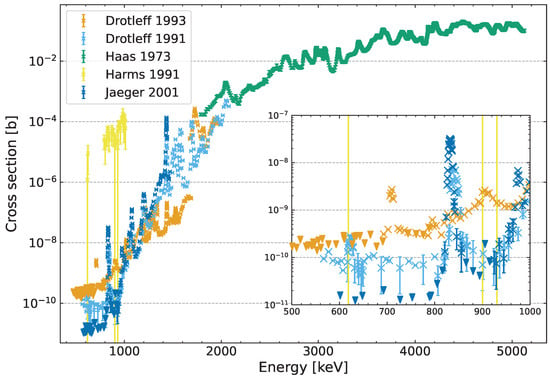
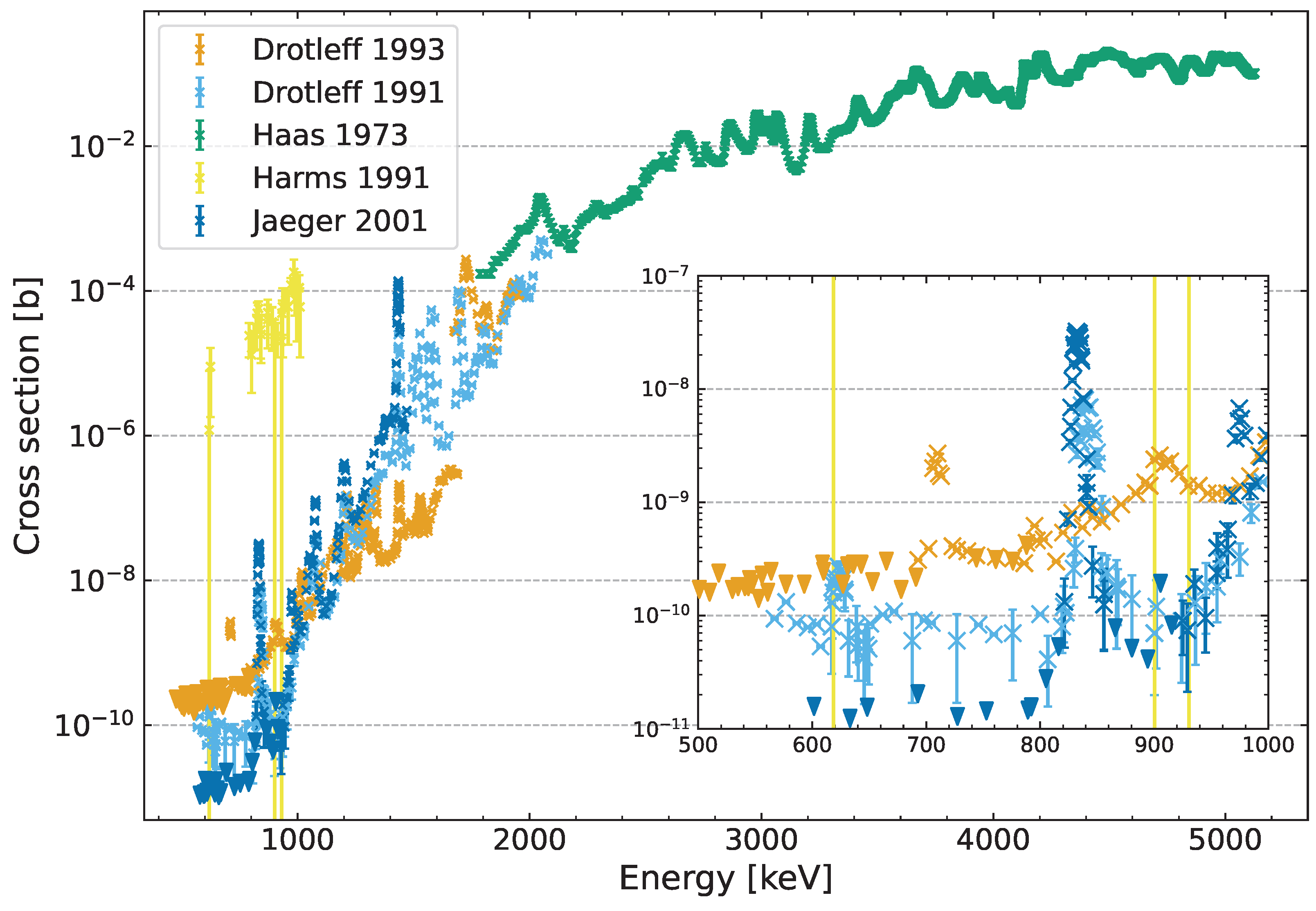
Cross-section measurements of 22Ne25Mg below 1 MeV are extremely challenging. As shown in Figure 1, except for a strong resonance located at = 832 keV, only upper limits have been measured so far [3,4,5]. The background induced by cosmic-rays, the ion beam, and by the intrinsic radioactivity of detectors, limited the sensitivity of experiments and the possibility to investigate low cross-section regimes. Despite the contribution of indirect investigations towards improving our understanding of low energy resonant capture mechanisms [6,7], direct measurements are still required to solve present discrepancies [8]. To improve our understanding of the s-process, a new experimental campaign on the direct measurement of 22Ne25Mg is ongoing at the IBF [9,10] of the LNGS-INFN [11] by the ERC funded project SHADES and the LUNA collaboration [12,13,14] (and references therein). Together with ASFIN [15,16], n-TOF [17,18], ERNA [19,20,21,22,23], and PANDORA [24], LUNA is one of the main contributors to nuclear astrophysics research in Italy. In this work, we give an overview of the experiment and some very preliminary results.
Figure 1.
Extant literature on 22Ne25Mg [3,4,25,26,27]. Cross section is shown as a function of -beam energies. Lower triangles identify upper limits. Harms et al. data [26] are not to scale.
2. Experimental Methods
The sensitivity of previous cross-section measurements has been limited by the high neutron flux from either the cosmic rays or induced by the ion beam impinging portions of the experimental setup [28]. The SHADES project designed different strategies to mitigate this issue and maximize the signal-to-noise ratio: performing measurements in an underground location with a very high intensity ion beam; using a high-purity, enriched 22Ne windowless gas target; and employing a hybrid 3He proportional counter-EJ-309 liquid scintillator detection array (See Figure 2 in [29]). These are key ingredients described in the following section.
The natural neutron flux is reduced up to four orders of magnitude in LNGS [30,31], making it an ideal place to perform nuclear astrophysics experiments. At this level, the intrinsic natural radioactivity of a detector became a major source of background, e.g., [32] (and references therein). We performed an investigation to identify and quantify these contaminants and their effects [33], using a similar analysis that had already been performed in the past by the LUNA collaboration for similar 3He proportional counters [34]. Briefly, after an initial calibration with certified neutron sources, a PSD algorithm was set to separate neutron and -ray events. The scintillators were then moved underground in LNGS in the LUNA400 accelerator hall [35,36] (and references therein) and a 1-month-long background spectra was acquired. The neutron events exceeded the expected one and well defined spot were seen in the PSD matrix. A time-coincidence analysis between acquired events has shown that those spots were due to ff particles emitted by actinides in the detector case, which caused a background level of 64 events/h in the relevant region of interest. Despite this, the proportional counter-scintillator coincidence measurements could completely suppress this contribution.
The IBF can deliver an up to 500 4He+ beam [9]. This can increase the signal-to-noise ratio in the case of time-dependent background sources, such as cosmic-ray induced background and the intrinsic background of the detectors. At the same time, if the beam impinges on parts of the setup, it can cause a BIB that can drastically reduce the detection sensitivity [28]. Among the others, 13C and 10B are the most abundant species, which can cause an intense BIB for 22Ne25Mg measurements.
During the measurement, we could exploit the whole beam current below the 830 keV resonance. At higher energies, the high reaction rate made the neutron flux from the reaction too high, increasing the detection dead time. For this, we limited the beam current to 150 μA. A total of almost 1000 C was accumulated, especially at the lower energies.
13C and 10B contaminants are commonly found in ion beam setup materials, and the associated cross-section is an order of magnitude higher than the one of interest. To reduce their presence, the beam line parts exposed to the ion beam and its halo were coated with oxygen-free high-conductivity copper cleaned with a nitric acid solution in an ultrasound bath. In addition, only aluminum was used for the vacuum sealings: the standard viton material is well known to release carbon compounds under a vacuum, which can accumulate on the walls of the ion beam line.
The 99.995% enriched 22Ne gas is extremely expensive and makes a gas recirculation system necessary. Over time, this can lead to a build up of carbon chemical compounds from vacuum sealing, from the oil of the vacuum pumps, and the small yet unavoidable leaks of the vacuum system. In addition to the aluminum vacuum sealings, we employed silicon-industry-grade pumps, which are very demanding in term of cleanliness, and a noble gas purifier in order to minimize carbon content in the gas target. Gas purity was monitored during beam time by measuring the yield of the 830 keV resonance.
The detection array has the capability to remove BIB events and increase the measurement sensitivity. To put it into operation, we performed a preliminary performance measurement campaign at the Goethe University Frankfurt’s Van de Graaff accelerator facility FRANZ [37]. Here, neutrons in the energy range 50–700 keV were measured with a reduced version of the array. Energy calibrations were performed and the pulse shape analysis techniques were improved using two approaches: the standard PSD and a more sophisticated neural network analysis, which proved to be performing more at the lowest energies [38].
A 1-year-long 22Ne25Mg measurement campaign was started at IBF in November 2024. It included a precise determination of the = 706 keV resonance energy and its uncertainty. In addition, we performed long runs below 800 keV when searching for new resonances or, in case they are not accessible, in the search of lower upper limits for the cross section.
To determine the detection array efficiency, devoted measurements were performed at the HUN-REN Institute for Nuclear Research (ATOMKI) in Hungary, exploiting the 51Vn reaction down to threshold energies. A solid target was employed and the detection array moved along the beam direction to evaluate the efficiency for neutrons generated in a region corresponding to the gas target section. Analysis is undergoing. Details and results will be reported in a devoted publication.
3. Results
Also, in LNGS, 22Ne25Mg has been challenging. BIB proved to be the main background source, against which we iteratively applied the solution described in the previous section.
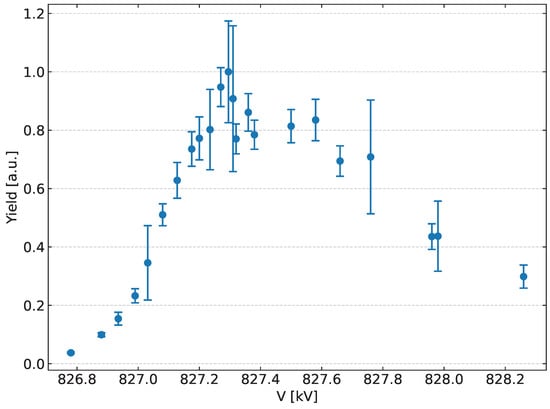
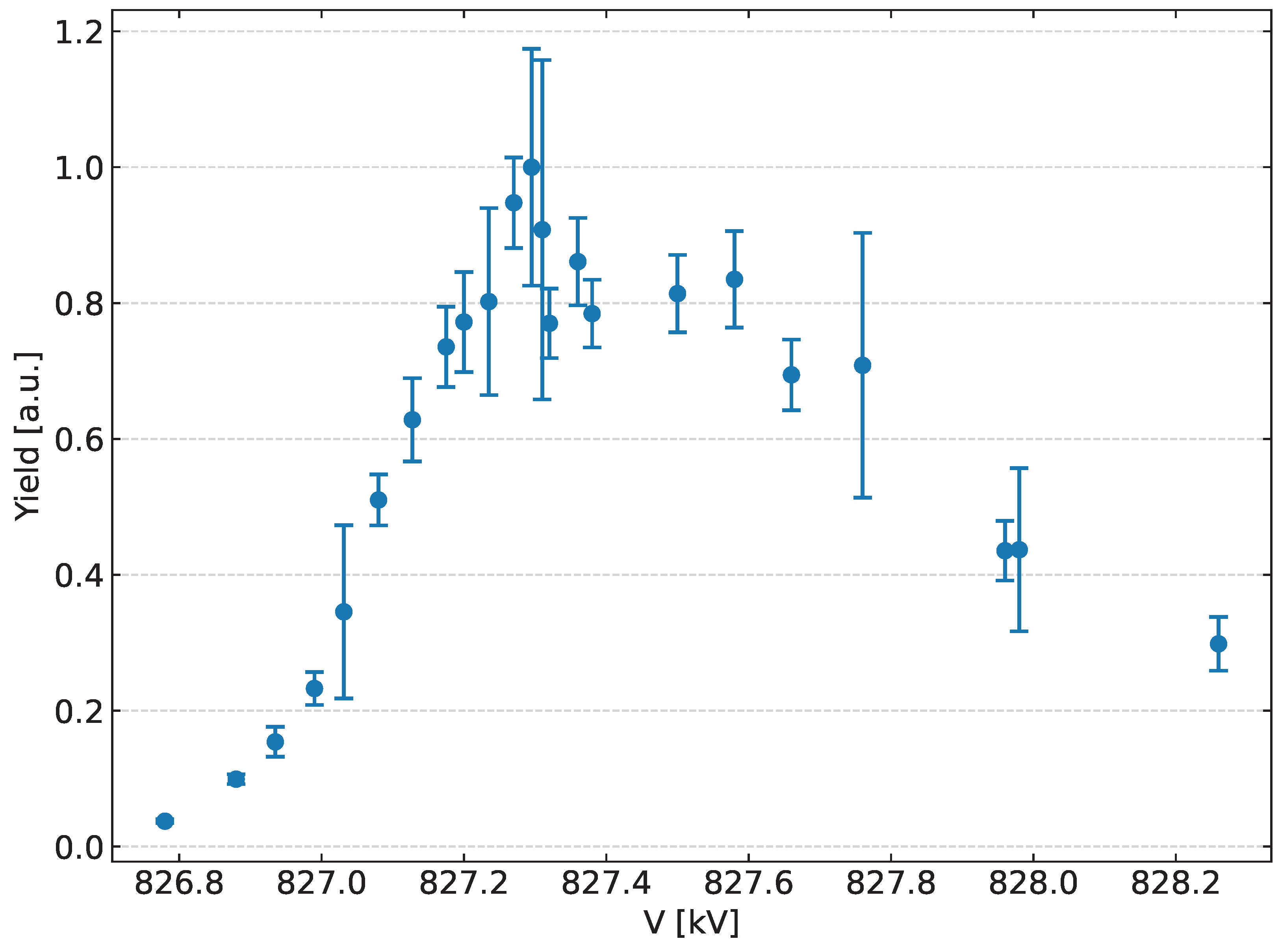
As preliminary results, Figure 2 reports an energy scan of the = 706 keV resonance. Uncertainty bars represent the statistical uncertainty. We repeated the same investigation for several target thicknesses ranging from about 500 eV up to 40 keV. The analysis is still ongoing, but a reduction in the overall resonance energy uncertainty is expected.
Figure 2.
Experimental yield around the = 706 keV resonance energy.
BIB was particularly problematic at the lowest energies. The straggling of the ion beam in the gas target causes losses of the beam into the several aperture along the beam line, in particular on the one downstream of the reaction chamber. Being close to the detector array, BIB events had a higher detection efficiency compared to other portions of the beam line. To compensate for this, in addition to the anti-coincidence capability of the detector array, we performed measurements at the same energy and ion beam tuning parameters with both 22Ne gas and 20Ne gas. This allows for a better background subtraction, pushing the measurement sensitivity close to the ideal one. The measurement campaign ended on December 2025 and the analysis is currently ongoing.
4. Discussion
Low energy measurements of 22Ne25Mg are required to properly constrain the stellar models of massive AGB stars, and to better understand the nucleosynthesis of trans-ferric isotopes. In IBF-LNGS, we performed a long measurement campaign to improve the state of the art, which is currently limited by the energy definition of the = 706 keV resonance and the lack of cross section data at lower energies, where only upper limits are available. We preliminarily conclude that the energy precision improves to on the order of 100 eV and that the upper limit for the low-energy cross sections is reduced by a factor of 2. However, additional analyses are required to confirm these values and to further improve the sensitivity of the measurement. For this, future experiments may also consider the use of a supersonic gas jet target [39,40], which requires no apertures for the confinement of the gas close to the reaction region.
The s-process is still a hot topic in nuclear astrophysics [41], together with reactions such as 12C+12C [42,43] and 12C [44,45]. With this work, we are pushing the accuracy and the precision of its determination to levels required for astrophysical models. For this, a comprehensive R-Matrix analysis (e.g., [46,47,48]) will be performed as a final step, with the goal to provide reliable extrapolations of the reaction rates at the stellar energies.
Author Contributions
Conceptualization, A.B.; methodology, A.B.; software, D.R., D.M. and T.W.C.; Validation, A.B.; formal analysis, D.R., A.B., D.M. and T.W.C.; investigation, D.R., A.B., D.M. and T.W.C.; resources, A.B.; data curation, A.B. and T.W.C.; writing—original draft preparation, D.R.; writing—review and editing, D.R., A.B. and D.M.; Visualization, D.R. and A.B.; supervision, D.R. and A.B.; project administration, A.B.; Funding acquisition, A.B. All authors have read and agreed to the published version of the manuscript.
Funding
Support from the European Union (ERC-StG 2019 SHADES, grant agreement #852016) is acknowledged.
Data Availability Statement
The data presented in this study are available on request from the corresponding author.
Conflicts of Interest
The authors declare no conflicts of interest.
Abbreviations
The following abbreviations are used in this manuscript:
| ERC | European Research Council |
| SHADES | Scintillator-3He Array for Deep-underground Experiments on the S-process |
| BIB | beam induced background |
| AGB | asymptotic giant branch |
| IBF | ion beam facility |
| LNGS | laboratory nazionali del Gran Sasso |
| INFN | istituto nazionale di fisica nucleare |
| ASFIN | Astrofisica nucleare |
| n-TOF | the neutron time-of-flight facility |
| ERNA | European recoil separator for nuclear astrophysics |
| PANDORA | Plasma for Astrophysics, Nuclear Decays Observation and Radiation for Archaeometry |
| PSD | pulse shape discrimination |
Note
| 1 | Acronyms are defined at the end of the article. |
References
- Käppeler, F.; Gallino, R.; Bisterzo, S.; Aoki, W. The s process: Nuclear physics, stellar models, and observations. Rev. Mod. Phys. 2011, 83, 157–193. [Google Scholar] [CrossRef] [Scilit]
- Raiteri, C.M.; Busso, M.; Gallino, R.; Picchio, G. S-Process Nucleosynthesis in Massive Stars and the Weak Component. II. Carbon Burning and Galactic Enrichment. Astrophys. J. 1991, 371, 665–672. [Google Scholar] [CrossRef] [Scilit]
- Jaeger, M.; Kunz, R.; Mayer, A.; Hammer, J.W.; Staudt, G.; Kratz, K.L.; Pfeiffer, B. 22Ne(α, n)25Mg: The Key Neutron Source in Massive Stars. Phys. Rev. Lett. 2001, 87, 202501. [Google Scholar] [CrossRef] [Scilit]
- Drotleff, H.W.; Denker, A.; Hammer, J.W.; Knee, H.; Küchler, S.; Streit, D.; Rolfs, C.; Trautvetter, H.P. New 22Ne(α,n)25Mg-resonances at very low energies relevant for the astrophysical s-process. Z. Phys. A Hadron. Nucl. 1991, 338, 367–368. [Google Scholar] [CrossRef] [Scilit]
- Wolke, K. Helium burning of 22Ne. Z. Phys. A 1989, 334, 491. [Google Scholar]
- Adsley, P.; Battino, U.; Best, A.; Caciolli, A.; Guglielmetti, A.; Imbriani, G.; Jayatissa, H.; La Cognata, M.; Lamia, L.; Masha, E.; et al. Reevaluation of the 22Ne(α, γ)26Mg and 22Ne(α, n)25Mg reaction rates. Phys. Rev. C 2021, 103, 015805. [Google Scholar] [CrossRef] [Scilit]
- Wiescher, M.; deBoer, R.J.; Görres, J. The resonances in the 22Ne+α fusion reactions. Eur. Phys. J. A 2023, 59, 11. [Google Scholar] [CrossRef] [Scilit]
- Best, A.; Adsley, P.; Amberger, R.; Battino, U.; Chillery, T.; La Cognata, M.; deBoer, R.J.; Mercogliano, D.; Ota, S.; Rapagnani, D.; et al. The 22Ne(α,n)25Mg reaction–state of the art, astrophysics, and perspectives. Eur. Phys. J. A 2025, 61, 99. [Google Scholar] [CrossRef] [Scilit] [PubMed]
- Junker, M.; Imbriani, G.; Best, A.; Boeltzig, A.; Compagnucci, A.; Di Leva, A.; Ferraro, F.; Rapagnani, D.; Rigato, V. The deep underground Bellotti Ion Beam Facility—Status and perspectives. Front. Phys. 2023, 11, 1291113. [Google Scholar] [CrossRef] [Scilit]
- Compagnucci, A.; Formicola, A.; Campostrini, M.; Cruz, J.; Aliotta, M.; Ananna, C.; Barbieri, L.; Barile, F.; Bemmerer, D.; Best, A.; et al. Towards a comprehensive study of the 14N(p,γ)15O astrophysical key reaction: Description of the experimental technique including novel target preparation. Eur. Phys. J. A 2025, 61, 191. [Google Scholar] [CrossRef] [Scilit]
- Buompane, R.; Cavanna, F.; Curceanu, C.; D’Onofrio, A.; Di Leva, A.; Formicola, A.; Gialanella, L.; Gustavino, C.; Imbriani, G.; Junker, M.; et al. Nuclear Physics Mid Term Plan at LNGS. Eur. Phys. J. Plus 2024, 139, 224. [Google Scholar] [CrossRef] [Scilit]
- Skowronski, J.; Masha, E.; Piatti, D.; Aliotta, M.; Babu, H.; Bemmerer, D.; Boeltzig, A.; Depalo, R.; Caciolli, A.; Cavanna, F.; et al. Improved S factor of the 12C(p,γ)12N reaction at E = 320–620 keV and the 422 keV resonance. Phys. Rev. C 2023, 107, L062801. [Google Scholar] [CrossRef] [Scilit]
- Masha, E.; Barbieri, L.; Skowronski, J.; Aliotta, M.; Ananna, C.; Barile, F.; Bemmerer, D.; Best, A.; Boeltzig, A.; Broggini, C.; et al. First measurement of the low-energy direct capture in 20Ne(p,γ)21Na and improved energy and strength of the Ec.m. = 368 keV resonance. Phys. Rev. C 2023, 108, L052801. [Google Scholar] [CrossRef] [Scilit]
- Gesuè, R.; Ciani, G.; Piatti, D.; Boeltzig, A.; Rapagnani, D.; Aliotta, M.; Ananna, C.; Barbieri, L.; Barile, F.; Bemmerer, D.; et al. First Direct Measurement of the 64.5 keV Resonance Strength in the 17O(p,γ)18F Reaction. Phys. Rev. Lett. 2024, 133, 052701. [Google Scholar] [CrossRef] [Scilit]
- Spitaleri, C.; Cherubini, S.; La Cognata, M.; Lamia, L.; Mukhamedzhanov, A.; Pizzone, R.; Romano, S.; Sergi, M.; Tumino, A. Trojan Horse Method: Recent applications in nuclear astrophysics. Nucl. Phys. A 2010, 834, 639c–642c. [Google Scholar] [CrossRef] [Scilit]
- Pizzone, R.; Spitaleri, C.; Cherubini, S.; La Cognata, M.; Lamia, L.; Romano, S.; Sergi, M.; Tumino, A.; Li, C.; Wen, Q.; et al. Trojan Horse Method: A useful tool for electron screening effect investigation. Nucl. Phys. A 2010, 834, 673c–675c. [Google Scholar] [CrossRef] [Scilit]
- Borcea, C.; Cennini, P.; Dahlfors, M.; Ferrari, A.; Garcia-Muñoz, G.; Haefner, P.; Herrera-Martınez, A.; Kadi, Y.; Lacoste, V.; Radermacher, E.; et al. Results from the commissioning of the n_TOF spallation neutron source at CERN. Nucl. Instrum. Methods Phys. Res. Sect. A Accel. Spectrometers Detect. Assoc. Equip. 2003, 513, 524–537. [Google Scholar] [CrossRef] [Scilit]
- Esposito, R.; Calviani, M.; Aberle, O.; Barbagallo, M.; Cano-Ott, D.; Coiffet, T.; Colonna, N.; Domingo-Pardo, C.; Dragoni, F.; Franqueira Ximenes, R.; et al. Design of the third-generation lead-based neutron spallation target for the neutron time-of-flight facility at CERN. Phys. Rev. Accel. Beams 2021, 24, 093001. [Google Scholar] [CrossRef] [Scilit]
- Buompane, R.; Di Leva, A.; Gialanella, L.; D’Onofrio, A.; De Cesare, M.; Duarte, J.; Fülöp, Z.; Gasques, L.; Gyürky, G.; Morales-Gallegos, L.; et al. Determination of the 7Be(p,γ)7B cross section at astrophysical energies using a radioactive 7Be ion beam. Phys. Lett. B 2022, 824, 136819. [Google Scholar] [CrossRef] [Scilit]
- Buompane, R.; De Cesare, N.; Di Leva, A.; D’Onofrio, A.; Gialanella, L.; Romano, M.; De Cesare, M.; Duarte, J.; Fülöp, Z.; Morales-Gallegos, L.; et al. Test measurement of 7Be(p, γ)8B with the recoil mass separator ERNA. Eur. Phys. J. A 2018, 54, 92. [Google Scholar] [CrossRef] [Scilit]
- Rapagnani, D.; De Cesare, M.; Alfano, D.; Buompane, R.; Cantoni, S.; De Stefano Fumo, M.; Del Vecchio, A.; D’Onofrio, A.; Porzio, G.; Rufolo, G.; et al. Ion Beam Analysis for recession determination and composition estimate of Aerospace Thermal Protection System materials. Nucl. Instrum. Methods Phys. Res. Sect. B Beam Interact. Mater. At. 2020, 467, 53–57. [Google Scholar] [CrossRef] [Scilit]
- De Cesare, M.; Savino, L.; Di Leva, A.; Rapagnani, D.; Del Vecchio, A.; D’Onofrio, A.; Gialanella, L. Gamma and infrared novel methodologies in Aerospace re-entry: γ-rays crystal efficiency by GEANT4 for TPS material recession assessment and simultaneous dual color infrared temperature determination. Nucl. Instrum. Methods Phys. Res. Sect. B Beam Interact. Mater. At. 2020, 479, 264–271. [Google Scholar] [CrossRef] [Scilit]
- Di Leva, A.; Imbriani, G.; Buompane, R.; Gialanella, L.; Best, A.; Cristallo, S.; De Cesare, M.; D’Onofrio, A.; Duarte, J.; Gasques, L.; et al. Measurement of 1323 and 1487 keV resonances in 15N (α,γ)19F with the recoil separator ERNA. Phys. Rev. C 2017, 95, 045803. [Google Scholar] [CrossRef] [Scilit]
- Goasduff, A.; Santonocito, D.; Menegazzo, R.; Capra, S.; Pullia, A.; Raniero, W.; Rosso, D.; Toniolo, N.; Zago, L.; Naselli, E.; et al. A high resolution γ-ray array for the pandora plasma trap. Front. Phys. 2022, 10, 936081. [Google Scholar] [CrossRef] [Scilit]
- Haas, F.X.; Bair, J.K. Total Neutron Yield from the (α, n) Reaction on 21,22Ne. Phys. Rev. C 1973, 7, 2432–2436, Erratum in Phys. Rev. C 1974, 10, 961–962. https://doi.org/10.1103/PhysRevC.10.961. [Google Scholar] [CrossRef] [Scilit]
- Harms, V.; Kratz, K.L.; Wiescher, M. Properties of 22Ne(α, n)25Mg resonances. Phys. Rev. C 1991, 43, 2849–2861. [Google Scholar] [CrossRef] [Scilit]
- Drotleff, H.W.; Denker, A.; Knee, H.; Soine, M.; Wolf, G.; Hammer, J.W.; Greife, U.; Rolfs, C.; Trautvetter, H.P. Reaction Rates of the s-Process Neutron Sources 22Ne(α, n)25Mg and 13C(α, n)16O. Astrophys. J. 1993, 414, 735. [Google Scholar] [CrossRef] [Scilit]
- Campostrini, M.; Imbriani, G.; Masha, E.; Piatti, D.; Rapagnani, D. Overcoming intrinsic and beam-induced backgrounds at LUNA. Eur. Phys. J. Spec. Top. 2024, 233, 2843–2857. [Google Scholar] [CrossRef] [Scilit]
- Best, A.; Rapagnani, D.; Mercogliano, D. The Ongoing Deep Underground Measurement of 22Ne(α, n)25Mg at the Ion Beam Facility of the INFN-LNGS. Galaxies 2024, 12, 68. [Google Scholar] [CrossRef] [Scilit]
- Bettini, A. The world deep underground laboratories. Eur. Phys. J. Plus 2012, 127, 114. [Google Scholar] [CrossRef] [Scilit]
- Best, A.; Görres, J.; Junker, M.; Kratz, K.L.; Laubenstein, M.; Long, A.; Nisi, S.; Smith, K.; Wiescher, M. Low energy neutron background in deep underground laboratories. Nucl. Instrum. Methods Phys. Res. Sect. A Accel. Spectrometers Detect. Assoc. Equip. 2016, 812, 1–6. [Google Scholar] [CrossRef] [Scilit]
- Piatti, D.; Masha, E.; Aliotta, M.; Balibrea-Correa, J.; Barile, F.; Bemmerer, D.; Best, A.; Boeltzig, A.; Broggini, C.; Bruno, C.G.; et al. First direct limit on the 334 keV resonance strength in 22Ne(α,γ)26Mg reaction. Eur. Phys. J. A 2022, 58, 194. [Google Scholar] [CrossRef] [Scilit]
- Ananna, C.; Rapagnani, D.; Dell’Aquila, D.; Di Leva, A.; Imbriani, G.; Junker, M.; Mercogliano, D.; Best, A. Intrinsic background of EJ-309 liquid scintillator detectors. Nucl. Instrum. Methods Phys. Res. Sect. A Accel. Spectrometers Detect. Assoc. Equip. 2024, 1060, 169036. [Google Scholar] [CrossRef] [Scilit]
- Balibrea-Correa, J.; Ciani, G.; Buompane, R.; Cavanna, F.; Csedreki, L.; Depalo, R.; Ferraro, F.; Best, A. Improved pulse shape discrimination for high pressure 3He counters. Nucl. Instrum. Methods Phys. Res. Sect. A Accel. Spectrometers Detect. Assoc. Equip. 2018, 906, 103–109. [Google Scholar] [CrossRef] [Scilit]
- Pantaleo, F.R.; Boeltzig, A.; Best, A.; Perrino, R.; Aliotta, M.; Balibrea-Correa, J.; Barile, F.; Bemmerer, D.; Broggini, C.; Bruno, C.G.; et al. Low-energy resonances in the 18O(p, γ)19F reaction. Phys. Rev. C 2021, 104, 025802. [Google Scholar] [CrossRef] [Scilit]
- Skowronski, J.; Gesuè, R.M.; Boeltzig, A.; Ciani, G.F.; Piatti, D.; Rapagnani, D.; Aliotta, M.; Ananna, C.; Barile, F.; Bemmerer, D.; et al. Advances in radiative capture studies at LUNA with a segmented BGO detector. J. Phys. G Nucl. Phys. 2023, 50, 045201. [Google Scholar] [CrossRef] [Scilit]
- Alzubaidi, S.; Bartz, U.; Basten, M.; Bechtold, A.; Chau, L.P.; Claessens, C.; Dinter, H.; Droba, M.; Fix, C.; Hähnel, H.; et al. The Frankfurt neutron source FRANZ. Eur. Phys. J. Plus 2016, 131, 124. [Google Scholar] [CrossRef] [Scilit]
- Chillery, T.; Rapagnani, D.; Ananna, C.; D’Amore, E.; Imbriani, G.; di Leva, A.; Mercogliano, D.; Skowronski, J.; Brückner, B.; Dellmann, S. A prototype neutron-detector array for future deep-underground s-process studies. J. Phys. G Nucl. Part. Phys. 2025, 52, 075202. [Google Scholar] [CrossRef] [Scilit]
- Brandi, F.; L’Abate, L.; Rapagnani, D.; Buompane, R.; di Leva, A.; Gialanella, L.; Gizzi, L.A. Optical and spectroscopic study of a supersonic flowing helium plasma: Energy transport in the afterglow. Sci. Rep. 2022, 10, 5087. [Google Scholar] [CrossRef] [Scilit]
- Rapagnani, D.; Cutrone, L.; Ranuzzi, G.; De Stefano Fumo, M.; Savino, L.; De Cesare, M.; Buompane, R.; Del Vecchio, A.; Di Leva, A.; Duarte, J.; et al. Feasibility study of a compact and multi-gas supersonic plasma jet for nuclear astrophysics and space research. Nucl. Instrum. Methods Phys. Res. Sect. A Accel. Spectrometers Detect. Assoc. Equip. 2023, 1056, 168536. [Google Scholar] [CrossRef] [Scilit]
- Schatz, H.; Becerril Reyes, A.; Best, A.; Brown, E.; Chatziioannou, K.; Chipps, K.; Deibel, C.; Ezzeddine, R.; Galloway, D.; Hansen, C.; et al. Horizons: Nuclear astrophysics in the 2020s and beyond. J. Phys. G Nucl. Part. Phys. 2022, 49, 110502. [Google Scholar] [CrossRef] [Scilit]
- Romoli, M.; Morales-Gallegos, L.; Aliotta, M.; Bruno, C.; Buompane, R.; D’Onofrio, A.; Davinson, T.; De Cesare, M.; Di Leva, A.; Di Meo, P.; et al. Development of a two-stage detection array for low-energy light charged particles in nuclear astrophysics applications. Eur. Phys. J. A 2018, 54, 142. [Google Scholar] [CrossRef] [Scilit]
- Morales-Gallegos, L.; Aliotta, M.; Gialanella, L.; Best, A.; Bruno, C.; Buompane, R.; Davinson, T.; De Cesare, M.; Di Leva, A.; D’Onofrio, A.; et al. Direct measurements of the 12C+12C reactions cross-sections towards astrophysical energies. Eur. Phys. J. A 2024, 60, 11. [Google Scholar] [CrossRef] [Scilit]
- deBoer, R.J.; Görres, J.; Wiescher, M.; Azuma, R.E.; Best, A.; Brune, C.R.; Fields, C.E.; Jones, S.; Pignatari, M.; Sayre, D.; et al. The 12C(α, γ)16O reaction and its implications for stellar helium burning. Rev. Mod. Phys. 2017, 89, 035007. [Google Scholar] [CrossRef] [Scilit]
- Duarte, J.; Di Leva, A.; Buompane, R.; Formicola, A.; Harke, J.; Rapagnani, D.; Santonastaso, C.; Gialanella, L. A new way to unravel the 12C(α,γ)16O cross section components using neural networks. Eur. Phys. J. A 2025, 61, 12. [Google Scholar] [CrossRef] [Scilit]
- Rapagnani, D.; Straniero, O.; Imbriani, G.; Aliotta, M.; Ananna, C.; Barile, F.; Barbieri, L.; Bemmerer, D.; Best, A.; Boeltzig, A.; et al. Revision of the CNO cycle: Rate of 17O destruction in stars. Phys. Rev. C 2025, 111, 025805. [Google Scholar] [CrossRef] [Scilit]
- Skowronski, J.; Piatti, D.; Rapagnani, D.; Aliotta, M.; Ananna, C.; Barbieri, L.; Barile, F.; Bemmerer, D.; Best, A.; Boeltzig, A.; et al. Comparative analysis of R -matrix fitting: 12C(p,γ)13N as a test case. Phys. Rev. C 2025, 111, 035802. [Google Scholar] [CrossRef] [Scilit]
- Skowronski, J.; Boeltzig, A.; Ciani, G.; Csedreki, L.; Piatti, D.; Aliotta, M.; Ananna, C.; Barile, F.; Bemmerer, D.; Best, A.; et al. Proton-Capture Rates on Carbon Isotopes and Their Impact on the Astrophysical 12C/13C Ratio. Phys. Rev. Lett. 2023, 131, 162701. [Google Scholar] [CrossRef] [Scilit]
Disclaimer/Publisher’s Note: The statements, opinions and data contained in all publications are solely those of the individual author(s) and contributor(s) and not of MDPI and/or the editor(s). MDPI and/or the editor(s) disclaim responsibility for any injury to people or property resulting from any ideas, methods, instructions or products referred to in the content. |
© 2026 by the authors. Licensee MDPI, Basel, Switzerland. This article is an open access article distributed under the terms and conditions of the Creative Commons Attribution (CC BY) license.