


Abstract
Background: Rapid diagnostic tests (RDTs) are used as first line for malaria detection in clinical practice and in surveillance programmes in Cameroon. Most are designed to identify the P. falciparum histidine-rich protein 2 (PfHRP2). False-negative RDT results have several causes, including low parasite density, prozone effect and poor test quality or handling, but also P. falciparum parasites lacking the HRP2 protein following pfhrp2 gene deletion. This study aimed to evaluate the sensitivity of a new HRP2-based RDT (Acro Malaria P.f./P.v./Pan Rapid Test Cassette) and to investigate whether the false-negative HRP2-based RDT results were due to confirmed pfhrp2 or pfhrp3 deletions. Methods: A retrospective analysis was performed on the 406 samples collected in Makenene in the Central Region of Cameroon, between September and October 2021. The P. falciparum PCR-positive samples were tested using the RDT, real-time PCR being used as the reference standard because it also detects submicroscopic infections. Samples that were PCR-positive but RDT-negative were analysed for pfhrp2 and pfhrp3 genes. Results: Of the 406 samples analysed using real-time PCR, 185 tested positive for P. falciparum parasites (prevalence 45.6%; 95% CI 40.6–50.6%). Of these 185 PCR-positive samples, 179 were detected by the HRP2-based RDT, giving a sensitivity of 96.8% (95% CI 94.2–99.3%). Six samples (3.2%; 95% CI 1.2–6.9%) were not detected by the RDT. Of these six false-negative samples, four (66.7%) were pfhrp2-deleted and three (50.0%) were pfhrp2/pfhrp3-deleted. The parasites lacking pfhrp2, pfhrp3 and pfhrp2/pfhrp3 represented four samples (2.2%), three samples (1.6%) and three samples (1.6%) of the 185 PCR-confirmed P. falciparum isolates, respectively. The three isolates with a pfhrp3 deletion were the same three isolates that carried the dual pfhrp2/pfhrp3 deletion; the categories therefore overlap and the percentages are not additive. Conclusions: These preliminary observations suggest that deletions of pfhrp2 and pfhrp3 genes contribute to false-negative HRP2-based RDT results, although the small number of false negatives (n = 6) means these proportions should be interpreted with caution. These figures nevertheless remain low and suggest that HRP2-based RDTs remain valuable for malaria detection in clinical practice and in surveillance programmes in Cameroon.
1. Introduction
Malaria, caused by Plasmodium falciparum, remains a significant global public health issue in Africa. Malaria cases are estimated to have increased from 7.343 million to 7.586 million between 2023 and 2024 in Cameroon [1]. Malaria deaths were estimated at 11,700 (confidence interval [9800, 14,400]) in Cameroon and represented 1.9% of the 610,000 deaths reported worldwide in 2024 [2]. The prevalence of P. falciparum remains high in Makenene (4°53′04″ N; 10°47′40″ E), a commune situated in the Mbam-et-Inoubou division in the Central Region of Cameroon, despite mosquito net distribution campaigns [3,4]. Rapid diagnostic tests (RDTs) are used as first line for malaria detection in clinical practice and in surveillance programmes in Cameroon [5,6,7].
Currently, more than 330 RDTs are commercially available and new RDTs have been evaluated every year since 2008 through the World Health Organisation (WHO) product testing programme. This programme focuses on performance in correctly detecting parasites but also on thermal stability, lot-to-lot variation, anomalies and compliance with best practices on labelling and instructions for use of the tests [8]. Only 86 RDTs were approved in 2026, according to the requirements of the Global Fund and WHO [9]. Most RDTs are designed to identify P. falciparum-specific proteins and target either the P. falciparum histidine-rich protein 2 (PfHRP2) or the P. falciparum lactate dehydrogenase (PfLDH). The RDTs can detect other pan malaria (all species) antigens, such as pLDH or pALD (aldolase).
Incorrect storage or transport, improper handling or interpretation, poor product design or manufacturing quality, and poor thermal stability may affect RDT performance. Independently of these operational factors, very low parasite densities may not be detected because they are below the detection threshold of the test [10]. A false-negative result can occur due to a prozone-like effect in high parasite densities [11,12]. Conversely, a false-positive result can occur due to persistent positivity, resulting from the detection of the HRP2 antigen, which may remain in the patient’s blood for up to several weeks after the parasites have been cleared following effective treatment [13,14,15]. False-negative RDT results can also be due to genetic variation in the pfhrp2 gene that can modify the HRP2 protein, leading to either a new epitope that is not recognised by RDT antigens or to P. falciparum parasites lacking the HRP2 protein following pfhrp2 gene deletion [16,17]. However, most of the antibodies used in HRP2-based RDTs can also detect the HRP3 protein due to structural homology [18].
Most P. falciparum parasites lacking the pfhrp2 gene also lost the pfhrp3 gene [19,20,21]. These two deletions are not a single simultaneous event: pfhrp2 and pfhrp3 lie on different chromosomes (8 and 13, respectively) and are lost independently. Dual-deleted parasites are nevertheless frequently reported, because loss of pfhrp3 removes the cross-reacting HRP3 antigen and therefore confers an advantage against HRP2-based RDTs only once pfhrp2 is already absent.
The performance of HRP2-based RDTs has been evaluated regularly in Cameroon since 2011. Across these field evaluations, which involved 22 different tests compared with microscopy or PCR in Yaoundé, Dschang, the Mount Cameroon region, Central Cameroon and Southwest Cameroon, reported sensitivities ranged widely, from 45% to 98%, and specificities from 63% to 100% [22,23,24,25,26,27,28]. A detailed summary of these evaluations is provided in Table 1. None of these studies investigated pfhrp2 or pfhrp3 gene deletions.
Table 1.
Field evaluations of malaria rapid diagnostic tests reported in Cameroon.
In 2010, South America, and more specifically Peru, was the first region to report the emergence of pfhrp2-deleted parasites collected between 2003 and 2008 [29]. The emergence of parasites lacking the pfhrp2 gene was reported more recently and with lower prevalence in Africa (Democratic Republic of Congo, Djibouti, Eritrea, Ethiopia, Ghana, Kenya, Mali, Mozambique, Rwanda, Senegal, Sudan and Uganda) [16,30,31]. However, a retrospective study showed that 2% of the P. falciparum parasites presented pfhrp2 deletion in Mali as early as 1996; pfhrp3 deletion was not assessed in this study [32]. Little data was reported for Cameroon. One study showed that 2.2% and 1.9% of 153 P. falciparum isolates collected in 2019 in Yaoundé and Mfou (Central Region of Cameroon) were pfhrp2- and pfhrp2/pfhrp3-deleted parasites, respectively [33]. The overall proportions of pfhrp2- and pfhrp3- and pfhrp2/pfhrp3-deleted parasites were 13.5%, 3.1% and 3.1% of 96 isolates, respectively, collected in the North, Far North and littoral regions [34]. The proportion of parasites lacking the pfhrp2 gene varied from 0% (25 samples) to 33.3% (24 samples) in the same Far North region. A prevalence of 1.5% (pfhrp2 negative), 1.2% (pfhrp3 negative) and 0.6% (pfhrp2/pfhrp3 negative) was observed on 324 P. falciparum samples collected between 2020 and 2021 in the region of Mount Cameroon [35]. Of the 324 microscopy- and PCR-positive samples, 4.9% (16 isolates) were RDT-negative (SD Bioline Malaria Ag P.f). Of the 16 RDT-negative samples, 31.3% (n = 5) were pfhrp2-deleted, 25.0% (n = 4) were pfhrp3-deleted and 12.5% (n = 2) were pfhrp2/pfhrp3-deleted. A study on parasites collected in intense perennial transmission settings of Cameroon (Southwest, Northwest, Centre and East regions) and in low seasonal settings (Adamawa and Far North regions) in 2019 and 2021 showed a proportion of 3.6% of pfhrp2-deleted parasites, 2.7% of pfhrp3-deleted parasites and 2.4% of pfhrp2/pfhrp3-deleted parasites compared to 0.7% of pfhrp2-deleted parasites, pfhrp3-deleted parasites and pfhrp2/pfhrp3-deleted [36]. The prevalence of false-negative RDTs (SD Bioline Malaria Ag P.f) (n = 33) caused by confirmed pfhrp2 deletion, pfhrp3 deletion and pfhrp2/pfhrp3 deletions was 78.8%, 69.7% and 63.6%, respectively.
The present study aimed to evaluate the sensitivity of a new HRP2-based RDT (Acro Malaria P.f./P.v./Pan Rapid Test Cassette) on P. falciparum field isolates collected in Central Cameroon in 2021 and to investigate whether the false-negative HRP2-based RDT results were due to confirmed pfhrp2 or pfhrp3 deletions.
2. Materials and Methods
2.1. Blood Sample Collection
A retrospective analysis was performed on 406 samples collected in asymptomatic participants, in Makenene (4°53′04″ N; 10°47′40″ E), a commune situated in the Mbam-et-Inoubou division in the Central Region of Cameroon, between September and October 2021 as part of a previously described community-based cross-sectional study [3,37], in which households were selected at random in central and peripheral neighbourhoods and blood samples were obtained from consenting household members of all ages, screened at home rather than presenting for care. Venous blood samples were collected from 406 participants in tubes containing EDTA and then stored directly at −20 °C. The frozen samples were subsequently sent to the National Reference Centre for Malaria in Marseille.
2.2. Real-Time PCR for P. falciparum Diagnosis
Genomic DNA was extracted from blood samples using the QIAamp 96 DNA Qiacube HT kit according to the manufacturer’s recommendations (Qiagen GmbH, Hilden, Germany). The 406 blood samples were analysed using real-time PCR performed on Light Cycler 2.0 (Roche Group, Rotkreuz, Switzerland) to identify the P. falciparum species, as previously described [38]. The real-time PCR was conducted as part of a prior study to assess the prevalence of antimalarial drug resistance molecular markers [37]. Briefly, P. falciparum was detected by individual real-time PCR amplifications targeting specific genes using the Light Cycler® TaqMan® Master Mix (Roche Group, Rotkreuz, Switzerland). The following oligonucleotide primers and probes designed with Primer Express software v2.0 (Applied Biosystems, Foster City, CA, USA) were used: forward-5′-TTTATGTATTGGTATAACATTCGG-3′, reverse-5′-GGCAAATAACTTTATCATAGAATTGAC-3′ and probe-5′-FAM-TACACTACCAACACATGGGGCTACAAGAGGT-BBQ-3′ for P. falciparum aquaglyceroporin gene (AJ413249). For each PCR run, two negative controls (water and human DNA) and a positive control (3D7 DNA from P. falciparum) were used.
2.3. Rapid Diagnostic Test for P. falciparum Diagnosis
The PCR-positive samples were tested using the Acro Malaria P.f./P.v./Pan Rapid Test Cassette (Cat. No. IMPVF-402, Acro Biotech, Montclair, CA, USA), a histidine-rich protein 2-based RDT (HRP2) which previously showed 96.8% sensitivity against 186 P. falciparum parasites collected from imported cases in various African regions, including 27 isolates from Cameroon [39]. This RDT was used and recommended by the National Reference Centre for Malaria from 2020 to early 2026. RDTs were performed and read according to the manufacturer’s instructions, which define a positive result as any visible test line together with a visible control line; readings were performed independently by two operators blinded to the PCR result, and discordant readings were resolved by a third reader. To determine the performance of the test, the results obtained were compared with those of the real-time PCR, which served as the reference standard. Because the objective was to identify and characterise false-negative HRP2-based results, only PCR-positive samples were tested by RDT. As a consequence, no true-negative results were generated and specificity, positive predictive value and negative predictive value could not be estimated in this study. The Ct threshold of 32.35, defining the Ct value beyond which the detection of P. falciparum parasites using Acro Malaria P.f./P.v./Pan RDT becomes less effective (for comparison, the threshold was estimated at 24.96 for P. falciparum using the SD Bioline Malaria Ag P.f/Pan), was estimated on isolates collected from African cases imported to France in a previous study [39] and is used here only as an external reference point.
2.4. Detection of Deletion of pfhrp2 and 3 Genes
pfhrp2 and pfhrp3 genes in the samples undetected by the Acro Malaria P.f./P.v./Pan Rapid Test Cassette were amplified by PCR using specific pairs of primers previously described [40]; primer sequences and cycling conditions are reproduced in full in Table 2. The PCR reaction mixture included 5 µL of genomic DNA, 1X reaction buffer (Promega, Madison, WI, USA), 200 µM of deoxynucleoside triphosphate mixture (dGTP, dATP, dTTP and dCTP), 2.5 mM of MgCl2, 0.5 µM of each primer and 0.04 unit/µL of GoTaq® G2 DNA polymerase (Promega, Madison, WI, USA) in a final volume of 25 µL. The thermal cycler was programmed as follows: initial denaturation at 95 °C for two minutes, followed by 35 cycles of denaturation at 95 °C for 30 s, specific hybridisation at 58 °C for 30 s and extension at 72 °C for one minute per 1000 base pairs. A final extension step at 72 °C for five minutes concluded the amplification. Purified genomic DNA from the clone 3D7 (no deletion) served as a positive control, and Dd2 (pfhrp2 deletion) and HB3 (pfhrp3 deletion) as negative controls, together with water and human DNA as no-template and non-specific controls; the deletion status of the 3D7, Dd2 and HB3 DNAs had been confirmed in-house by PCR before use, and all three were included in every amplification batch. The PCR amplicons were visualised by electrophoresis on a 1.5% agarose gel prepared in 0.5× TBE buffer.
Table 2.
Primer sequences and cycling conditions used for pfhrp2, pfhrp3 and pfmdr1 amplification.
The pfhrp2 and pfhrp3 genes were considered deleted when exon 2 failed to amplify in the presence of successful amplification of the control gene pfmdr1. Exon 1 was amplified but was not used as a criterion for calling deletions, because the published primers cross-bind between pfhrp2 and pfhrp3; deletion calls were therefore based on the exon 2 result alone, the same criterion being applied to pfhrp3 as to pfhrp2. In every sample lacking amplification of pfhrp2 or pfhrp3, the quality and sufficient amount of P. falciparum DNA was verified by amplification of a separate P. falciparum pfmdr1 gene. All six false-negative samples yielded a clear pfmdr1 amplicon of the expected size, confirming that DNA quality and quantity were adequate and that the absence of a pfhrp2 or pfhrp3 product reflected gene deletion rather than amplification failure.
2.5. Statistical Analysis
Data were summarised as counts and percentages. Sensitivity was calculated as the proportion of PCR-positive samples detected by the RDT. Exact (Clopper–Pearson) 95% confidence intervals were computed for all proportions. The proportions of RDT-detected samples above and below the Ct threshold of 32.35 were compared using Fisher’s exact test, with a two-sided significance level of 0.05. Analyses were performed in R version 4.4.1 (R Foundation for Statistical Computing, Vienna, Austria). Given the small number of false-negative samples, subgroup proportions are reported with their confidence intervals and are interpreted as descriptive only; no inferential comparison between deletion categories was attempted.
3. Results
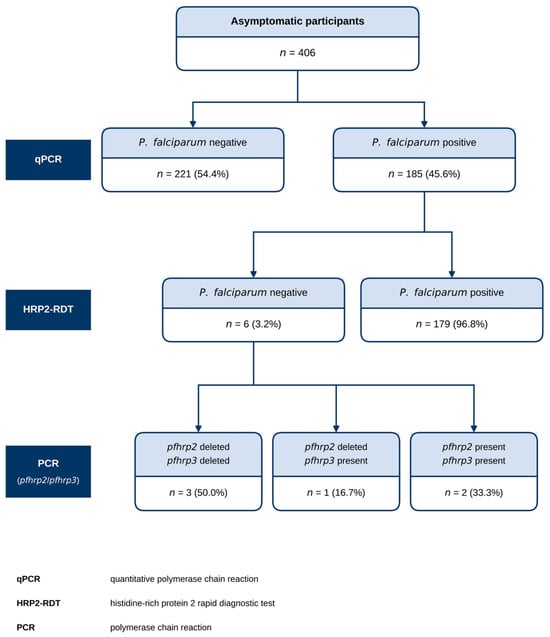
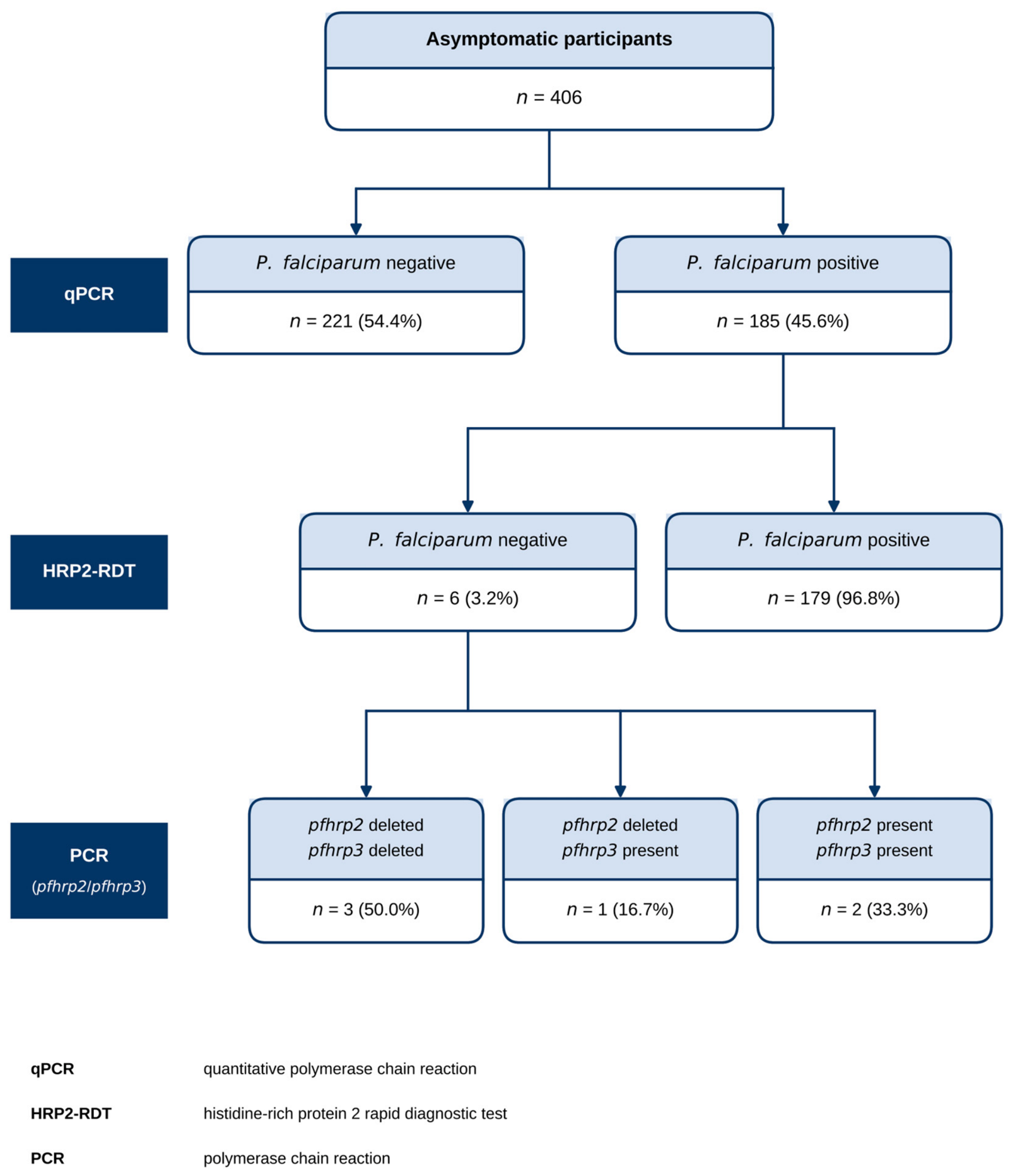
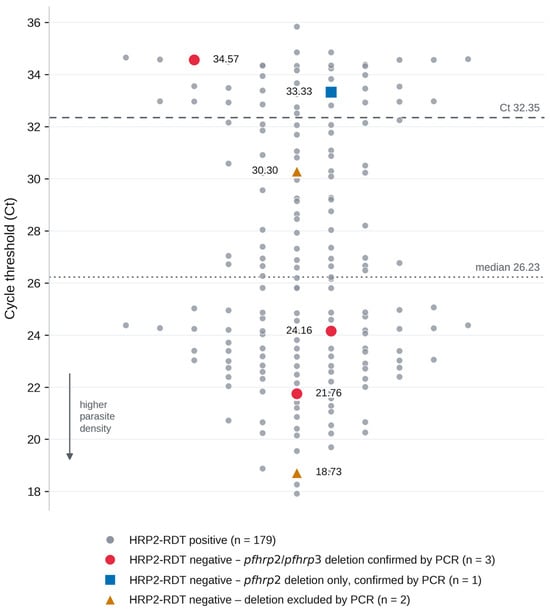
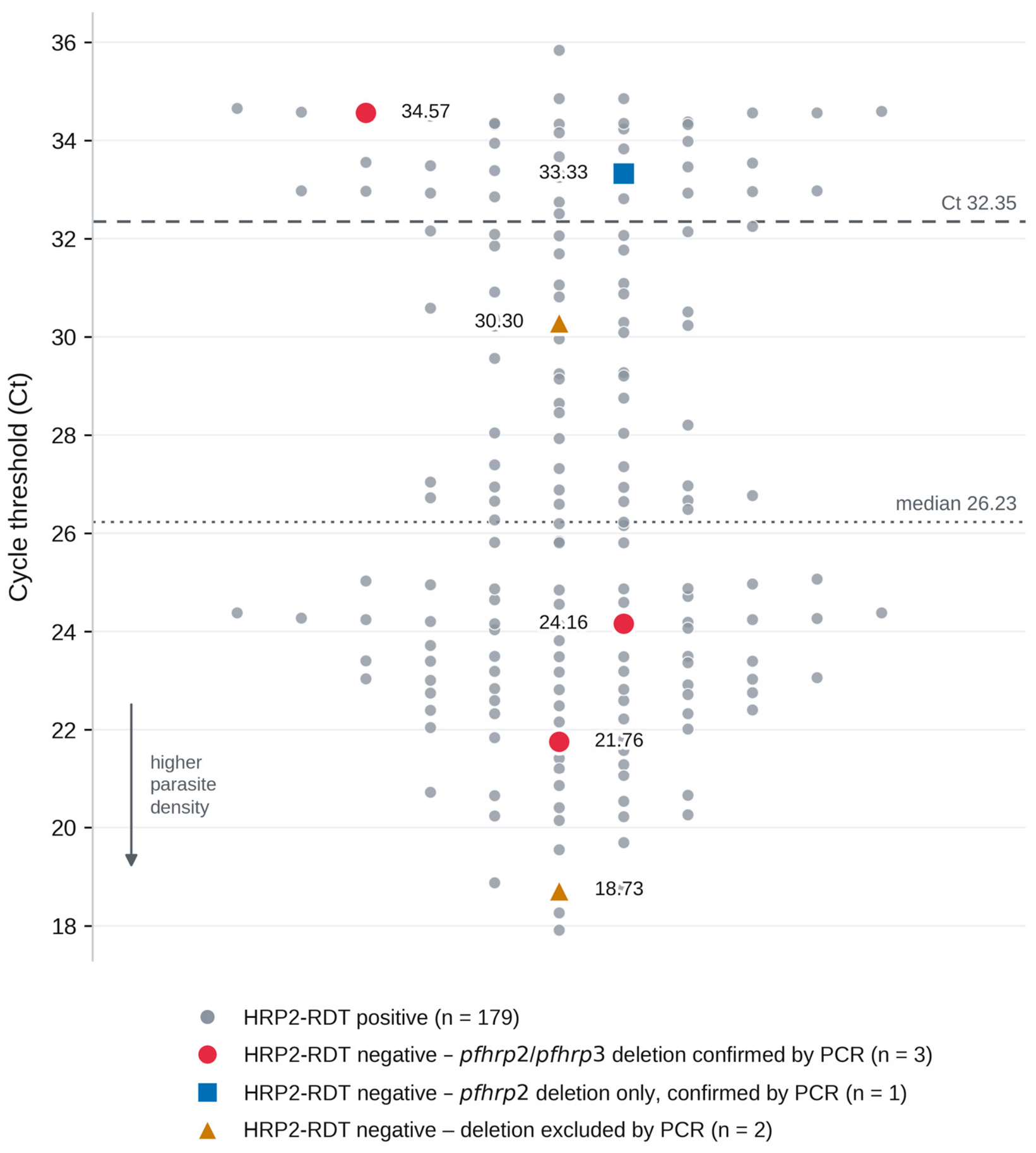
Of the 406 blood samples analysed using real-time PCR (Figure 1), 185 samples tested positive for P. falciparum parasites (prevalence 45.6%; 95% CI 40.6–50.6%) with cycle threshold (Ct) values ranging from 17.92 to 35.84 (Figure 2).
Figure 1.
Flow chart illustrating the overall study procedure and results, Makenene, Central Cameroon, 2021. Deletion status was determined by PCR: “deleted” denotes a confirmed deletion, that is, failure to amplify exon 2 together with successful amplification of the pfmdr1 gene, and “present” denotes successful amplification of the gene, which excludes a deletion. Percentages in the lower row are calculated within the six false-negative samples (n = 6 as denominator): 3/6 (50.0%) dual pfhrp2/pfhrp3 deletion, 1/6 (16.7%) pfhrp2 deletion only and 2/6 (33.3%) no detectable deletion. The corresponding proportions of the 185 PCR-confirmed isolates are given in the text.
Figure 2.
Distribution of Ct values of the 185 P. falciparum PCR-positive samples. Each point is one sample. The six samples not detected by the Acro Malaria P.f./P.v./Pan Rapid Test Cassette are shown in colour, labelled with their Ct value and distinguished by their pfhrp2/pfhrp3 status as determined by PCR: dual pfhrp2/pfhrp3 deletion confirmed (n = 3), pfhrp2 deletion only confirmed (n = 1) and deletion excluded, both genes being amplified (n = 2). The dashed line marks the Ct threshold of 32.35 previously reported for this test [39]; the dotted line is the median Ct (26.23). Lower Ct values correspond to higher parasite densities.
Of the 185 samples which were confirmed as P. falciparum mono-infections by PCR, 179 tested positive with the HRP2-based RDT. Six samples (3.2%; 95% CI 1.2–6.9%) were not detected by the Acro Malaria P.f./P.v./Pan Rapid Test Cassette. This RDT therefore showed a sensitivity of 96.8% (95% CI 94.2–99.3%) against P. falciparum parasites. Because only PCR-positive samples were tested by RDT, specificity, positive predictive value and negative predictive value could not be estimated.
Of the six samples which were undetected by the Acro Malaria P.f./P.v./Pan Rapid Test Cassette, three (50%) showed a deletion of pfhrp2 and pfhrp3 (Ct = 21.76; 24.16 and 34.57), one showed a deletion only of pfhrp2 (Ct = 33.33) and two showed no deletions (Ct = 18.73 and 30.30). The parasites lacking pfhrp2, pfhrp3 and pfhrp2/pfhrp3 which were undetected by the HRP2-based RDT, represented four (2.2%; 95% CI 0.6–5.4%), three (1.6%; 95% CI 0.3–4.7%) and three (1.6%; 95% CI 0.3–4.7%) of the 185 PCR-confirmed P. falciparum isolates in Makenene, Central Cameroon, in 2021, respectively (Figure 1). Expressed within the six false-negative samples, 4/6 (66.7%; 95% CI 22.3–95.7%) carried a pfhrp2 deletion, 3/6 (50.0%; 95% CI 11.8–88.2%) a dual pfhrp2/pfhrp3 deletion and 2/6 (33.3%; 95% CI 4.3–77.7%) no detectable deletion. No isolate carried only a pfhrp3 deletion: the three pfhrp3-deleted isolates were the three dual-deleted isolates. The deletion categories therefore overlap and their percentages must not be summed.
Ct values of the 185 PCR-positive samples are shown in Figure 2, with the six RDT-negative samples highlighted. Their Ct values (18.73, 21.76, 24.16, 30.30, 33.33 and 34.57) were distributed across the whole range observed and did not cluster at the high-Ct, low-parasitaemia end of the distribution. Of the 41 samples with a Ct above 32.35, 39 (95.1%; 95% CI 83.5–99.4%) were detected by the RDT, compared with 140 of 144 (97.2%; 95% CI 93.0–99.2%) samples with a Ct of 32.35 or below (Fisher’s exact test, p = 0.62).
4. Discussion
P. falciparum malaria can progress to severe disease within days, so prompt treatment depends on a diagnosis that is both rapid and accurate. Although microscopy remains the reference method for malaria diagnosis, the WHO recommends that all suspected malaria cases be confirmed using parasitological methods, and RDTs are the mainstay of that confirmation where microscopy is not available. HRP2-based RDTs are the most widely used tests in Africa because almost all cases there are due to P. falciparum, because HRP2 is abundant and stable, and because the tests are affordable, heat-tolerant and simple to use in the field. Their reliance on a single antigen is also their weakness, since any parasite that does not express HRP2 is invisible to them.
The Acro Malaria P.f./P.v./Pan Rapid Test Cassette showed acceptable sensitivity (96.8%) for identifying P. falciparum parasites in comparison with molecular diagnosis of P. falciparum samples with Ct ranging between 17.92 and 35.84. The same point estimate (96.8%) was obtained in a previous evaluation of this test on 186 P. falciparum parasites collected from imported cases originating from several African countries [39]. The agreement between the two estimates should nevertheless be interpreted cautiously, since that panel comprised imported cases of diverse geographical origin and was not drawn from a single endemic community, so the two populations of isolates are not directly comparable. Moreover, the Acro Malaria P.f./P.v./Pan Rapid Test Cassette demonstrated comparable results in terms of performance (sensitivity) to most RDTs recommended by the Global Fund and the WHO [22,41]. The performance of the Acro Malaria P.f./P.v./Pan Rapid Test Cassette was higher than that of the SD Bioline Malaria Antigen P.f (/Pan), which is widely used in Africa, and more particularly in Cameroon [25,26,27,28,39,42,43].
The parasites lacking pfhrp2, pfhrp3 and pfhrp2/pfhrp3 which were undetected by HRP2-based RDT represented four (2.2%; 95% CI 0.6–5.4%), three (1.6%; 95% CI 0.3–4.7%) and three (1.6%; 95% CI 0.3–4.7%) of the 185 PCR-confirmed P. falciparum isolates in Makenene, Central Cameroon, in 2021, respectively, the pfhrp3-deleted isolates being the same three isolates as those carrying the dual deletion. These data were comparable to previous data in Cameroon over the same period of time (2019–2021) [33,35,36]. Moreover, a low prevalence of pfhrp2-deleted parasites was reported in countries sharing a common border with Cameroon, including Nigeria (0.03% to 0.6%) [44,45], Gabon (1%) [45], the Republic of Congo (0%) [45] and Chad (4.7%) [46].
Of the six samples which were undetected by the Acro Malaria P.f./P.v./Pan Rapid Test Cassette, 66.7% (n = 4) were pfhrp2-deleted and 50% (n = 3) were pfhrp2/pfhrp3-deleted. These data were comparable to those obtained in the Southwest, Northwest, Central and East regions of Cameroon in 2019–2021, showing that the prevalence of false-negative RDTs caused by the confirmed pfhrp2 deletion and pfhrp2/pfhrp3 deletions was 78.8% and 63.6%, respectively [36], but higher than those reported in the Mount Cameroon region in 2020–2021 (31.3% for parasites lacking the pfhrp2 gene and 12.5% for those lacking the pfhrp2/pfhrp3 genes) [35]. In southern Ethiopia, 70% of HRP2-based false negatives were associated with pfhrp2/pfhrp3 deletions in 2022 [47]. Three of five false-negative RDTs in imported malaria cases to the UK and Ireland were explained by pfhrp2/pfhrp3 dual deletions [48].
Among the six false-negative samples tested with the Acro Malaria P.f./P.v./Pan Rapid Test Cassette, two showed no deletions (Ct = 18.73 and 30.30). These Ct values were below the threshold of 32.35, above which Acro Malaria P.f./P.v./Pan Rapid Test Cassette sensitivity is low for P. falciparum detection [39]. Lower Ct values were linearly correlated with increasing parasitaemia [49]. Low parasitaemia therefore does not explain why these two samples were missed, and no pfhrp2 or pfhrp3 deletion was detected in either of them. Two mechanisms remain plausible. First, sequence polymorphism in pfhrp2 and pfhrp3 may alter the epitopes recognised by the antibodies used in the test without any loss of the gene. Second, an operational cause such as a prozone-like effect, which has been described at high parasite densities and would be consistent with the Ct of 18.73 observed in one of the two samples, cannot be excluded. Sequencing of the pfhrp2 and pfhrp3 genes of these two isolates would be required to distinguish between these possibilities, and is a necessary next step that the present study did not undertake. Indeed, high genetic diversity and high polymorphism of the amino-acid sequences found in pfhrp2 and pfhrp3 may have an impact on the RDT results and diagnosis of malaria [16]. One of the three P. falciparum samples lacking the pfhrp2/pfhrp3 genes and the one lacking only the pfhrp2 gene also exhibited the equivalent of very low parasitaemia (Ct = 34.57 and 33.33, respectively, above the threshold of 32.35). However, detection was not significantly less frequent above this threshold: 39 of the 41 samples with a Ct above 32.35 were detected by the Acro Malaria P.f./P.v./Pan Rapid Test Cassette (95.1%), compared with 140 of 144 (97.2%) samples at or below the threshold (Fisher’s exact test, p = 0.62). These data provide no evidence of reduced sensitivity at low parasitaemia, although the small number of false-negative results gives this comparison very limited statistical power and a clinically relevant difference cannot be excluded.
These findings have two practical implications. The present data were obtained in asymptomatic carriers, so the clinical implication is an extrapolation, but it is the one that matters most. At the level of the individual patient, a false-negative HRP2-based RDT in a febrile patient delays or withholds antimalarial treatment and, in a setting where P. falciparum can progress rapidly to severe disease, that delay carries real risk; clinicians should therefore not regard a negative RDT as excluding malaria when the clinical suspicion is strong, and should seek microscopy or a non-HRP2 test in that situation. At the level of the programme, a deletion prevalence of the order of 2% is well below the 5% threshold at which the WHO recommends switching away from HRP2-only tests, so these data support the continued use of HRP2-based RDTs in this area while also arguing for periodic, prospectively designed surveillance rather than reliance on retrospective surveys such as this one. Given that the deleted parasites that are selected by the diagnostic test used, one might assume that the proportion observed in 2021 no longer reflects the current situation.
This study has several limitations. First, the samples were collected in 2021 and analysed subsequently, so the estimates reported here describe the situation in that year and not necessarily the current one; since deleted parasites are under positive selection wherever HRP2-based tests are used, the present figures should be regarded as a baseline rather than a current measurement. Second, the number of samples (185 P. falciparum isolates) and, more particularly, the number of false-negative RDTs was low. This limitation is common to all studies attempting to establish a link between false-negative RDT results and the deletion of the pfhrp2 and pfhrp3 genes. Third, only PCR-positive samples were tested by RDT, so no true-negative results were generated and specificity, positive predictive value and negative predictive value could not be estimated; the sensitivity reported here is therefore not accompanied by a full assessment of diagnostic accuracy. Fourth, deletions were called by failure to amplify exon 2 with a successful amplification of the control pfmdr1 gene, and were not confirmed by sequencing at the nucleotide level; nor were pfhrp2 and pfhrp3 sequenced in the two false-negative samples without detectable deletion, so antigenic polymorphism as a cause of those two results remains untested. Finally, the six false-negative samples are too few to support precise subgroup estimates, as the width of the confidence intervals reported above makes clear.
5. Conclusions
This study shows the misdiagnosis of P. falciparum parasites using HRP2-based RDT, the Acro Malaria P.f./P.v./Pan Rapid Test Cassette (3.2%) and the presence of 2.2% of P. falciparum parasites lacking pfhrp2, 1.6% lacking pfhrp3 and 1.6% lacking pfhrp2/pfhrp3 in Makenene, Central Cameroon, as early as 2021. The three isolates lacking pfhrp3 were the same isolates as those carrying the dual pfhrp2/pfhrp3 deletion, so these proportions overlap and are not additive. These figures remain relatively low and suggest that this type of HRP2-based RDT and, more specifically, the Acro Malaria P.f./P.v./Pan Rapid Test Cassette remains valuable for the detection of malaria in clinical practice and in surveillance programmes in Cameroon. Deletion of the pfhrp2 and pfhrp3 genes accounted for four of the six false-negative results observed here, which supports their contribution to HRP2-based RDT failure, while the two remaining false negatives show that gene deletion is not the only mechanism involved. Recently, a mathematical modelling study suggested that the risk of the selection and spread of pfhrp2 and pfhrp3 gene deletions was low in Cameroon [17].
Author Contributions
M.M. took part in methodology, formal analysis, validation, supervision and drafted the original manuscript revision. N.A.K.-C. contributed to the investigation of the samples, formal analysis, data curation and manuscript revision. J.D. contributed to field investigation. N.B. (Nicolas Belin) contributed to the investigation of the samples and formal analysis. T.T. took part in field investigation, conceptualisation, methodology and supervision. N.B. (Nicolas Benoit) took part in the investigation of the samples, formal analysis, data curation and validation. N.G. contributed to the investigation of the samples and formal analysis. O.D. contributed to the investigation of the samples, formal analysis and manuscript revision. R.B. took part in field investigation of the samples, supervision and manuscript revision. C.A.-N. contributed to the field investigation, conceptualisation and supervision. B.P. contributed to the conceptualisation, formal analysis, funding acquisition, project administration, supervision, validation, and drafted the original manuscript revision. All authors have read and agreed to the published version of the manuscript.
Funding
This work was supported by the Direction Générale de l’Armement [grant NBC-5-2511], by Santé Publique France [grant CNR Paludisme], by the National Research Agency under the “Investments for Future” programme [grant ANR-10-IAHU] and by the European Regional Development Fund (ERDF) [grant FEDER IHUPERF].
Institutional Review Board Statement
Before the study began, authorisation was obtained from the Director of the District Medical Centre (DMC) of Makenene, and an administrative permit was secured from the Divisional Officer of the Makenene district (No. 04/AR/JOR-04/SP). Additionally, the study received approval from the Regional Committee for Ethics and Human Health Research of the Centre Region (CE No. 1289/CRERSHC/2021) on 22 March 2021.
Informed Consent Statement
Verbal consent was first obtained from the heads of households, followed by written consent from each participant before their inclusion in the study. Participants were informed about the confidentiality and voluntary nature of the study and assured they could withdraw at any time.
Data Availability Statement
The datasets used and analysed in this study are available from the corresponding author on reasonable request.
Acknowledgments
The authors thank the participants from the communities who made this study possible and the health personnel who assisted with this work.
Conflicts of Interest
The authors declare no conflicts of interest. The funders had no role in the design of the study; in the collection, analyses, or interpretation of data; in the writing of the manuscript; or in the decision to publish the results.
Abbreviations
The following abbreviations are used in this manuscript:
| pALD | pan-aldolase |
| P.f. | Plasmodium falciparum |
| PfHRP2 | Plasmodium falciparum histidine-rich protein 2 |
| PfHRP3 | Plasmodium falciparum histidine-rich protein 3 |
| PfLDH | Plasmodium falciparum lactate dehydrogenase |
| P.v. | Plasmodium vivax |
| RDT | Rapid diagnostic test |
| Se | Sensitivity |
| Sp | Specificity |
| WHO | World Health Organisation |
References
- World Health Organization. World Malaria Report, 2025. 2025. Available online: https://www.who.int/teams/global-malaria-programme/reports/world-malaria-report-2025 (accessed on 30 June 2026).
- World Health Organization. Malaria 2024 Cameroon Country Profile. 2025. Available online: https://cdn.who.int/media/docs/default-source/malaria/country-profiles/2025/malaria-2025-cmr.pdf (accessed on 30 June 2026).
- Djoufounna, J.; Mayi, M.P.A.; Bamou, R.; Foyet, J.V.; Tabue, R.; Lontsi-Demano, M.; Achu-Fosah, D.; Antonio-Nkondjio, C.; Tchuinkam, T. High prevalence of asymptomatic Plasmodium falciparum malaria in Makenene, a locality in the forest-savannah transition zone, Centre Region of Cameroon. Curr. Res. Parasitol. Vector Borne Dis. 2022, 2, 100104. [Google Scholar] [CrossRef] [Scilit] [PubMed]
- Djoufounna, J.; Bamou, R.; Foyet, J.V.; Ningahi, L.G.; Mayi, M.P.A.; Antonio-Nkondjio, C.; Tchuinkam, T. A five-year malaria prevalence/frequency in Makenene in a forest-savannah transition ecozone of Central Cameroon: The results of a retrospective study. Trop. Med. Infect. Dis. 2024, 9, 231. [Google Scholar] [CrossRef] [Scilit] [PubMed]
- Tabue, R.N.; Neh, F.; Evina, E.; Bomba, D.A.; Voundi, J.V.; Fosso, J.; Zeh, A.M. Prevalence of Plasmodium species using rapid diagnostic tests in Cameroon: First-year data from routine malaria surveillance. BioMed. Res. Int. 2026, 2026, e6605623. [Google Scholar] [CrossRef] [Scilit] [PubMed]
- Programme National de Lutte contre le Paludisme. Guide de Prise en Charge du Paludisme au Cameroun à L’usage du Personnel de Santé. 2019. Available online: https://www.severemalaria.org/sites/default/files/content/document/GUIDE%20PEC%20%20PALUDISME%202019%2018%20JUIN.pdf (accessed on 30 June 2026).
- Programme National de Lutte contre le Paludisme, 2024. Plan Stratégique National de Lute Contre le Paludisme au Cameroun 2024–2028. Available online: https://pnlpcameroun.cm/wp-content/uploads/2025/12/Cameroun_Paludisme-PSNLP-2024-2028.pdf (accessed on 30 June 2026).
- World Health Organization. Malaria Rapid Diagnostic Test Performance. Results of WHO Product Testing of Malaria RDTs: Round 8 (2016–2018). 2018. Available online: https://iris.who.int/server/api/core/bitstreams/123148ec-c00a-42cd-b471-0fdd743447a2/content (accessed on 30 June 2026).
- The Global Fund. List of Rapid Diagnostic Test (RDT) Kits for Malaria. 2026. Available online: https://www.theglobalfund.org/media/wwoh0ze0/psm_qadiagnosticsmalaria_list_en.pdf (accessed on 30 June 2026).
- Ranadive, N.; Kunene, S.; Darteh, S.; Ntshalintshali, N.; Nhlabathi, N.; Dlamini, N.; Chitundu, S.; Saini, M.; Murphy, M.; Soble, A.; et al. Limitations of rapid diagnostic testing in patients with suspected malaria: A diagnostic accuracy evaluation from Swaziland, a low-endemicity country aiming for malaria elimination. Clin. Infect. Dis. 2017, 64, 1221–1227. [Google Scholar] [CrossRef] [Scilit] [PubMed]
- Perez-Ugarte, A.; Maturana, C.R.; Silgado, A.; Serrat, F.Z.; Goterris, L.; Paredes-Carmona, F.; Sulleiro, E. Unexpected false-negative result in a traveler’s malaria diagnosis. J. Trop. Med. 2023, 30, taac124. [Google Scholar] [CrossRef] [Scilit] [PubMed]
- Eeckhout, K.; Ver Elst, K.; Vermeiren, S.; Weekx, S. A false-negative rapid diagnostic malaria test and white blood cell inclusions in a patient with severe Plasmodium falciparum infection. Int. J. Lab. Hematol. 2021, 43, 1262–1263. [Google Scholar] [CrossRef] [Scilit] [PubMed]
- Kavanaugh, M.J.; Azzam, S.E.; Rockabarnd, D.M. Malaria rapid diagnostic tests: Literary review and recommendation for a quality assurance, quality control algorithm. Diagnostics 2021, 11, 768. [Google Scholar] [CrossRef] [Scilit] [PubMed]
- Ojeniyi, F.D.; Ayoola, A.O.; Ibitoye, O.; Opaleye, O.O.; Olowe, O.A.; Ehigie, L.O.; Thomas, B.N.; Ojurongbe, O. Performance and challenges of malaria rapid diagnostic tests in endemic regions of Africa. Sci. Rep. 2025, 15, 43663. [Google Scholar] [CrossRef] [Scilit] [PubMed]
- Ntuku, H.; Whittemore, B.; Dausab, L.; Jang, I.K.; Golden, A.; Sheahan, W.; Wu, X.; Slater, H.; Domingo, G.J.; Das, S.; et al. Post-treatment duration of positivity for standard and ultra-sensitive Plasmodium falciparum antigen-based rapid diagnostic tests, a cohort study from a low-endemic setting in Namibia. EBioMedicine 2025, 111, 105489. [Google Scholar] [CrossRef] [Scilit] [PubMed]
- Gendrot, M.; Fawaz, R.; Dormoi, J.; Madamet, M.; Pradines, B. Genetic diversity and deletion of Plasmodium falciparum histidine-rich protein 2 and 3: A threat to diagnosis of P. falciparum malaria. Clin. Microbiol. Infect. 2019, 25, 580–585. [Google Scholar] [CrossRef] [Scilit] [PubMed]
- Watson, O.J.; Tran, T.N.-A.; Zupko, R.J.; Symons, T.; Thomson, R.; Visser, T.; Rumisha, S.; Dzianach, P.A.; Hathaway, N.; Kim, I.; et al. Global risk of selection and spread of Plasmodium falciparum histidine-rich protein 2 and 3 gene deletions. Nat. Med. 2025, 31, 3372–3379. [Google Scholar] [CrossRef] [Scilit] [PubMed]
- Wellems, T.E.; Howard, R.J. Homologous genes encode two distinct histidine-rich proteins in a cloned isolate of Plasmodium falciparum. Proc. Natl. Acad. Sci. USA 1986, 83, 6065–6069. [Google Scholar] [CrossRef] [Scilit] [PubMed]
- Houzé, S.; Hubert, V.; Le Pessec, G.; Le Bras, J.; Clain, J. Combined deletions of pfhrp2 and pfhrp3 Plasmodium falciparum malaria false-negative rapid diagnostic test. J. Clin. Microbiol. 2011, 49, 2694–2696. [Google Scholar] [CrossRef] [Scilit] [PubMed]
- Wurtz, N.; Fall, B.; Bui, K.; Pascual, A.; Fall, M.; Camara, C.; Diatta, B.; Fall, K.B.; Mbaye, P.S.; Diémé, Y.; et al. Pfhrp2 and pfhrp3 polymorphisms in Plasmodium falciparum isolates from Dakar, Senegal: Impact on rapid malaria diagnostic tests. Malar. J. 2013, 12, 34. [Google Scholar] [CrossRef] [Scilit] [PubMed]
- Kumari, S.; Sharma, S.; Ahmed, N.; Srivastava, B.; Anvikar, A.R. Co-occurrence of Pfhrp2/3 gene deletions and mutations in the drug resistance genes (Pfdhfr and Pfdhps) in the north east regions of India: An observation. J. Vector Borne Dis. 2026, 63, 122–130. [Google Scholar] [CrossRef] [Scilit] [PubMed]
- Ali, I.M.; Bigoga, J.D.; Forsah, D.A.; Cho-Ngwa, F.; Tchinda, V.; Moor, V.A.; Fogako, J.; Nyongalema, P.; Nkoa, T.; Same-Ekobo, A.; et al. Field evaluation of the 22 rapid diagnostic tests for community management of malaria with artemisinin combination therapy in Cameroon. Malar. J. 2016, 15, 31. [Google Scholar] [CrossRef] [Scilit] [PubMed]
- Ngalame, A.L.; Watching, D.; Kibu, O.Z.; Zeukdo, E.M.; Nsagha, D.S. Assessment of the diagnostic performance of the SD Bioline Malaria antigen test for the diagnosis of malaria in the Tombel health district, Southwest region of Cameroon. PLoS ONE 2025, 20, e0298992. [Google Scholar] [CrossRef] [Scilit] [PubMed]
- Ali, I.M.; Nji, A.M.; Bonkum, J.C.; Moyeh, M.N.; Carole, G.K.; Efon, A.; Dabou, S.; Tchuenkam, V.P.K.; Tah, C.; Kengne, J.-P.C.; et al. Diagnostic accuracy of CareStart™ Malaria HRP2 and SD Bioline Pf/PAN for malaria in febrile outpatients in varying malaria transmission settings in Cameroon. Diagnostics 2021, 11, 1556. [Google Scholar] [CrossRef] [Scilit] [PubMed]
- Nana, R.R.D.; Makoge, V.; Ngum, N.L.; Amvongo-Adjia, N.; Singh, V.; Somo, R.M. Evaluating the dual reactivity on SD Bioline malaria rapid diagnosis tests as a potential indicator of high parasitemia due to Plasmodium falciparum. Pathog. Glob. Health 2021, 115, 487–495. [Google Scholar] [CrossRef] [Scilit] [PubMed]
- Missoup, V.O.; Suh, P.F.; Ndjebakal, C.N.; Tagne, D.; Poumachu, Y.; Joko, S.; Djilla, A.K.; Njiokou, F.; Mbacham, W.; Wondji, C.; et al. Malaria infection prevalence and diagnostic performance of the Abbott Bioline Malaria Ag P.f/Pan rapid test in rural populations of Central Cameroon. Sci. Rep. 2025, 15, 17930. [Google Scholar] [CrossRef] [Scilit] [PubMed]
- Teh, R.N.; Sumbele, I.U.N.; Nkeudem, G.A.; Meduke, D.N.; Ojong, S.T.; Kimbi, H.K. Concurrence of CareStart™ Malaria HRP2 RDT with microscopy in population screening for Plasmodium falciparum in the Mount Cameroon area: Predictors for RDT positivity. Trop. Med. Health 2019, 47, 17. [Google Scholar] [CrossRef] [Scilit] [PubMed]
- Tahar, R.; Sayang, C.; Foumane, V.N.; Soula, G.; Moyou-Somo, R.; Delmont, J.; Basco, L.K. Field evaluation of rapid diagnostic tests for malaria in Yaoundé, Cameroon. Acta Trop. 2013, 125, 214–219. [Google Scholar] [CrossRef] [Scilit] [PubMed]
- Gamboa, D.; Ho, M.-F.; Bendezu, J.; Torres, K.; Chiodini, P.L.; Barnwell, J.W.; Incardona, S.; Perkins, M.; Bell, D.; McCarthy, J.; et al. A large proportion of P. falciparum isolates in the Amazon Region of Peru lack pfhrp2 and pfhrp3: Implications for malaria rapid diagnostic tests. PLoS ONE 2010, 5, e8091. [Google Scholar] [CrossRef] [Scilit] [PubMed]
- Zeleke, A.J.; Hailu, A.; Bayih, A.G.; Kefale, M.; Amare, A.T.; Tegegne, Y.; Aemero, M. Plasmodium falciparum histidine-rich protein 2 and 3 genes deletion in global settings (2010–2021): A systematic review and meta-analysis. Malar. J. 2022, 21, 26. [Google Scholar] [CrossRef] [Scilit] [PubMed]
- World Health Organization. Response Plan to pfhrp2. Deletion, Second Edition. 2024. Available online: https://www.who.int/publications/i/item/9789240101838 (accessed on 30 June 2026).
- Koita, O.A.; Doumbo, O.K.; Ouattara, A.; Tall, L.K.; Konaré, A.; Diakité, M.; Diallo, M.; Sagara, I.; Masinde, G.L.; Doumbo, S.N.; et al. False-negative rapid diagnostic tests for malaria and deletion of the histidine-rich repeat region of the hrp2 gene. Am. J. Trop. Med. Hyg. 2012, 86, 194–196. [Google Scholar] [CrossRef] [Scilit] [PubMed]
- Nana, R.R.D.; Ngum, N.L.; Makoge, V.; Amvongo-Adja, N.; Hawadak, J.; Singh, V. Rapid diagnostic tests for malaria diagnosis in Cameroon: Impact of histidine rich protein 2/3 deletions and lactate dehydrogenase gene polymorphism. Diagn. Microbiol. Infect. Dis. 2024, 108, 116103. [Google Scholar] [CrossRef] [Scilit] [PubMed]
- Foko, L.P.K.; Moukoko, C.E.E.; Jakhan, J.; Narang, G.; Hawadak, J.; Motse, F.D.K.; Pande, V.; Singh, V. Deletions of histidine-rich protein 2/3 genes in natural Plasmodium falciparum populations from Cameroon and India: Role of asymptomatic and submicroscopic infections. Am. J. Trop. Med. Hyg. 2024, 110, 1100–1109. [Google Scholar] [CrossRef] [Scilit] [PubMed]
- Eyong, E.M.; Etutu, S.J.M.; Jerome, F.C.; Nyasa, R.B.; Kwenti, T.E.; Moyeh, M.N. Plasmodium falciparum histidine-rich protein 2 and 3 gene deletion in the Mount Cameroon region. IJID Reg. 2022, 3, 300–307. [Google Scholar] [CrossRef] [Scilit] [PubMed]
- Apinjoh, T.O.; Tangi, L.N.; Oriero, E.C.; Drammeh, S.; Ntui-Njock, V.N.; Etoketim, B.; Chi, H.F.; Kwi, P.N.; Njie, B.; Oboh, M.A.; et al. Histidine-rich protein (hrp2) 2-based RDT false-negatives and Plasmodium falciparum hrp 2 and 3 gene deletions in low, seasonal and intense perennial transmission zones in Cameroon: A cross-sectional study. BMC Infect. Dis. 2024, 24, 1080. [Google Scholar] [CrossRef] [Scilit] [PubMed]
- Kala-Chouakeu, N.A.; Djoufounna, J.; Benoit, N.; Tchuinkam, T.; Delandre, O.; Almeras, L.; Bamou, R.; Antonio-Nkondjio, C.; Madamet, M.; Pradines, B. Prevalence of antimalarial drug resistance molecular markers in Makenene, central Cameroon. Int. J. Parasitol. Drugs Drug Resist. 2026, 30, 100633. [Google Scholar] [CrossRef] [Scilit] [PubMed]
- Wurtz, N.; Lekweiry, K.M.; Bogreau, H.; Pradines, B.; Rogier, C.; Boukhary, A.O.M.S.; Hafid, J.E.; Salem, M.S.O.A.; Trape, J.-F.; Basco, L.K.; et al. Vivax malaria in Mauritania includes infection of Duffy-negative individual. Malar. J. 2011, 10, 336. [Google Scholar] [CrossRef] [Scilit] [PubMed]
- Madamet, M.; Fonta, I.; Mosnier, J.; Benoit, N.; Amalvict, R.; Briolant, S.; French National Reference Centre for Imported Malaria Study Group; Pradines, B. Comparison of SD Bioline Malaria Ag Pf/Pan and Acro Malaria P.f./P.v./Pan with microscopy and real time PCR for the diagnosis of human Plasmodium species. Diagnostics 2024, 14, 721. [Google Scholar] [CrossRef] [Scilit] [PubMed]
- Jones, S.; Subramaniam, G.; Plucinski, M.M.; Patel, D.; Padilla, J.; Aidoo, M.; Talundzic, E. One-step PCR: A novel protocol for determination of pfhrp2 deletion status in Plasmodium falciparum. PLoS ONE 2020, 15, e0236369. [Google Scholar] [CrossRef] [Scilit] [PubMed]
- Gendrot, M.; Madamet, M.; Fonta, I.; Benoit, N.; Amalvict, R.; Mosnier, J.; French National Reference Centre for Imported Malaria Study Group; Pradines, B. Comparative assessment of the sensitivity of ten commercial rapid diagnostic test kits for the detection of Plasmodium. Diagnostics 2022, 12, 2240. [Google Scholar] [CrossRef] [Scilit] [PubMed]
- Ouédraogo, D.F.; Natama, H.M.; Sorgho, H.; Kaboré, S.B.; Somé, M.A.; Millogo, A.; Ouédraogo, A.-R.; Guetens, P.; Kattenberg, J.H.; Savadogo, A.; et al. Performances of malaria PfHRP2 and the combined PfHRP2/pLDH based rapid diagnostic tests among children under five years of age in a high seasonal malaria transmission area in Burkina Faso. Acta Parasitol. 2025, 70, 132. [Google Scholar] [CrossRef] [Scilit] [PubMed]
- Olubiyi, B.; Alabi, A.; Isiko, I. Field performance of the SD Bioline Malaria Ag P.f. rapid diagnostic test among children under five in Nigeria: Insights from the 2021 malaria indicator survey. Malar. J. 2026, 25, 115. [Google Scholar] [CrossRef] [Scilit] [PubMed]
- Ikegbunam, M.; Maurer, M.; Abone, H.; Ezeagwuna, D.; Sandri, T.L.; Esimone, C.; Ojurongbe, O.; Woldearegai, T.G.; Kreidenweiss, A.; Held, J.; et al. Evaluating malaria rapid diagnostic tests and microscopy for detecting Plasmodium infection and status of Plasmodium falciparum histidine-rich protein 2/3 gene deletions in Southeastern Nigeria. Am. J. Trop. Med. Hyg. 2024, 110, 902–909. [Google Scholar] [CrossRef] [Scilit] [PubMed]
- Krueger, T.; Ikegbunam, M.; Lissom, A.; Sandri, T.L.; Ntabi, J.D.M.; Djontu, J.C.; Baina, M.T.; Lontchi, R.A.L.; Maloum, M.; Ella, G.Z.; et al. Low prevalence of Plasmodium falciparum histidine-rich protein 2 and 3 deletions—A multiregional study in Central and West Africa. Pathogens 2023, 12, 455. [Google Scholar] [CrossRef] [Scilit] [PubMed]
- Issa, M.S.; Warsame, M.; Mahamat, M.H.T.; Saleh, I.D.M.; Boulotigam, K.; Djimrassengar, H.; Issa, A.H.; Abdelkader, O.; Hassoumi, M.; Djimadoum, M.; et al. Therapeutic efficacy of artesunate-amodiaquine and artemether-lumefantrine for the treatment of uncomplicated falciparum malaria in Chad: Clinical and genetic surveillance. Malar. J. 2023, 22, 240. [Google Scholar] [CrossRef] [Scilit] [PubMed]
- Mekonen, B.; Dugassa, S.; Feleke, S.M.; Dufera, B.; Gidisa, B.; Adamu, A.; Mandefro, A.; Tasew, G.; Golassa, L. Widespread pfhrp2/3 deletions and HRP2-based false-negative results in southern Ethiopia. Malar. J. 2024, 23, 108. [Google Scholar] [CrossRef] [Scilit] [PubMed]
- Nolder, D.; Stewart, L.; Tucker, J.; Ibrahim, A.; Gray, A.; Corrah, T.; Gallagher, C.; John, L.; O’bRien, E.; Aggarwal, D.; et al. Failure of rapid diagnostic tests in Plasmodium falciparum malaria cases among travelers to the UK and Ireland: Identification and characterization of the parasites. Intern. J. Infect. Dis. 2021, 108, 132–144. [Google Scholar] [CrossRef] [Scilit] [PubMed]
- Khaimar, K.; Martin, D.; Lau, R.; Ralevski, F.; Pillai, D.R. Multiplex real-time quantitative PCR, microscopy and rapid diagnostic immuno-chromatographic tests for the detection of Plasmodium spp.: Performance, limit of detection analysis and quality assurance. Malar. J. 2009, 8, 294. [Google Scholar] [CrossRef] [Scilit] [PubMed]

Disclaimer/Publisher’s Note: The statements, opinions and data contained in all publications are solely those of the individual author(s) and contributor(s) and not of MDPI and/or the editor(s). MDPI and/or the editor(s) disclaim responsibility for any injury to people or property resulting from any ideas, methods, instructions or products referred to in the content. |
© 2026 by the authors. Licensee MDPI, Basel, Switzerland. This article is an open access article distributed under the terms and conditions of the Creative Commons Attribution (CC BY) license.