


Abstract
Background/Objectives: Chromosomal microarray analysis (CMA) is widely used in the genetic evaluation of autism spectrum disorder (ASD), yet its diagnostic contribution in clinically nonsyndromic ASD, particularly in Brazilian populations, remains insufficiently characterized. This study aimed to determine the diagnostic yield of CMA and characterize clinically relevant copy number variants (CNVs) in a cohort of individuals with clinically nonsyndromic ASD from southern Brazil. Methods: In this observational cohort study, 215 individuals with clinically diagnosed ASD underwent high-resolution CMA using the Agilent CGH + SNP Array 180K platform. Individuals with dysmorphic features, known or suspected genetic syndromes, major congenital malformations, epilepsy, or macrocephaly/microcephaly were excluded. CNVs were classified according to American College of Medical Genetics and Genomics guidelines, and the diagnostic yield was compared with that of national and international reference cohorts using Fisher’s exact test. Results: Pathogenic or likely pathogenic CNVs were identified in six individuals, corresponding to a diagnostic yield of 2.8% (95% CI, 1.3–6.1%). These included deletions at 2q11.1–q11.2, 2p16.3 (NRXN1), 15q11.2 (BP1–BP2), and 3q29, and duplications at 16p11.2 and 6p22.3–p22.2. Although the diagnostic yield was lower than that reported in phenotypically heterogeneous ASD cohorts, it did not differ significantly from yields observed in comparably selected nonsyndromic subgroups. Conclusions: CMA identified clinically relevant recurrent CNVs at neurodevelopmental loci even in a clinically nonsyndromic ASD cohort. The comparatively low diagnostic yield highlights the substantial influence of clinical and phenotypic selection on the diagnostic contribution of CMA.
1. Introduction
Autism spectrum disorder (ASD) is a neurodevelopmental condition characterized by persistent difficulties in social communication and social interaction, together with restricted and repetitive patterns of behavior, interests, or activities, with symptoms emerging during the early developmental period [1]. The reported prevalence of ASD has increased substantially over recent decades, with recent estimates indicating that approximately 2.3% of 8-year-old children in the United States meet diagnostic criteria for ASD [2]. In Brazil, epidemiological data on ASD were historically limited to a small number of studies conducted in restricted geographic regions; however, the inclusion of a specific question on ASD diagnosis in the 2022 Brazilian Population Census enabled, for the first time, nationally representative estimates. According to preliminary results released by the Brazilian Institute of Geography and Statistics (IBGE), an estimated 2.4 million individuals in Brazil (1.2% of the population aged 2 years or older) reported a diagnosis of ASD, with higher prevalence among males (1.5%) than females (0.9%) and the highest prevalence observed among children aged 5–9 years (2.6%) [3].
The etiology of ASD is complex and multifactorial, with a substantial genetic contribution. Heritability estimates range from approximately 70% to 90% [4,5], and numerous genomic variants have been implicated in ASD susceptibility [6]. Among the genetic alterations associated with ASD are copy number variants (CNVs), defined as submicroscopic deletions or duplications of genomic segments that may alter the dosage of genes involved in neurodevelopment [7,8].
Chromosomal microarray analysis (CMA) has been widely recommended as a first-tier genetic test in the evaluation of individuals with ASD and other neurodevelopmental disorders because of its ability to detect submicroscopic chromosomal imbalances that are not identifiable by conventional karyotyping [9,10]. The diagnostic yield of CMA varies substantially according to the clinical characteristics of the population studied, with higher yields generally reported in individuals with dysmorphic features, congenital anomalies, intellectual disability, epilepsy, or other features suggestive of a syndromic or complex neurodevelopmental presentation [8,11,12].
Despite the increasing use of genomic testing, data on CMA findings in Brazilian individuals with ASD remain limited. A recent large retrospective study from southern Brazil reported a CMA diagnostic yield of approximately 10% among 333 individuals with ASD; however, the sample was derived from a broader referral population that included individuals with neurodevelopmental disorders and congenital anomalies [11]. More broadly, comparisons of CMA diagnostic yield across ASD studies are complicated by substantial phenotypic heterogeneity, as cohorts frequently differ in the inclusion of individuals with dysmorphic features, congenital anomalies, epilepsy, intellectual disability, and other indicators of syndromic or complex neurodevelopmental presentations. Consequently, the diagnostic contribution of CMA specifically in clinically nonsyndromic ASD remains incompletely characterized.
Therefore, the present study was designed to address this gap by evaluating CMA findings in a cohort of individuals with clinically nonsyndromic ASD from southern Brazil. Participants with dysmorphic features, known or suspected genetic syndromes, major congenital malformations, epilepsy, or macrocephaly/microcephaly were excluded. We aimed to determine the diagnostic yield of CMA, characterize the pathogenic and likely pathogenic CNVs identified, examine their associated clinical and psychiatric phenotypes, and compare the observed diagnostic yield with that reported in national and international reference cohorts. By focusing on a clinically nonsyndromic ASD population, this study sought to further clarify how phenotypic selection influences the diagnostic contribution of CMA.
2. Materials and Methods
2.1. Study Design and Setting
This study was a retrospective secondary analysis of prospectively collected clinical and genetic data from an observational cohort established within the framework of the multicenter project “Intellectual Disability and Autism: Clinical and Genetic Characterization of a Population from Southern Brazil”. The study was conducted at Hospital Pequeno Príncipe, Faculdades Pequeno Príncipe, Instituto de Pesquisa Pelé Pequeno Príncipe and Centro de Neuropediatria do Hospital de Clínicas da Universidade Federal do Paraná (UFPR), in Curitiba, Paraná, Brazil.
2.2. Participants
A total of 235 children and adolescents with a clinical diagnosis of ASD were recruited from outpatient clinics in Curitiba and surrounding municipalities in the metropolitan region. Participants of both sexes were eligible for inclusion and were aged 6 to 18 years at enrollment. Before inclusion in the genomic analysis, all participants underwent clinical evaluation by the study neuropediatrician and were classified as having clinically nonsyndromic ASD. Individuals with dysmorphic features, known or suspected genetic syndromes, major congenital malformations, epilepsy, or macrocephaly/microcephaly were excluded prior to CMA testing. Of the 235 participants initially recruited, 20 did not undergo CMA because they did not attend the scheduled sample collection or withdrew from the study, resulting in a final cohort of 215 participants. All participants met DSM-5 criteria for ASD requiring Level 1 support.
2.3. Chromosomal Microarray Analysis
Peripheral blood samples were collected in EDTA tubes and centrifuged at 600 g to separate the leukocyte buffy coat, which was stored at −80 °C until DNA extraction. Genomic DNA was extracted using a commercial silica column-based kit (PureLink™ Genomic DNA Mini Kit, Invitrogen (Waltham, MA, USA); Mammalian Cells and Blood Lysate Protocol), according to the manufacturer’s instructions, and stored at −30 °C prior to shipment. DNA concentration was determined by fluorometry (Qubit 3 Fluorometer, Qubit dsDNA BR Assay Kit, Invitrogen) and spectrophotometry (NanoDrop One Microvolume UV-Vis Spectrophotometer, Thermo Fisher, Waltham, MA, USA), with A260/280 and A260/230 absorbance ratios used to assess DNA purity. Samples were shipped as pre-extracted genomic DNA; extraction was performed in-house and was not repeated by the reference laboratory.
Chromosomal microarray analysis (CMA) was performed by a+ Medicina Diagnóstica (Grupo Fleury, São Paulo, Brazil), an ISO 9001-certified [13] laboratory network accredited by PALC (Programa de Acreditação de Laboratórios Clínicos, SBPC/ML) and CAP (College of American Pathologists), using a high-resolution genome-wide platform (Agilent® CGH + SNP Array 180K (Agilent Technologies, Santa Clara, CA, USA); proprietary pipeline_CGH_v.5.1.2). The platform detects copy number variants (CNVs) in selected genes and across genomic segments larger than approximately 200 kb, and, through selected single-nucleotide polymorphism (SNP) probes, identifies uniparental isodisomy and regions of absence of heterozygosity (AOH) spanning more than 10 Mb. Genomic coordinates were based on the GRCh37 (hg19) reference genome. All CNV/AOH calling and classification were performed internally using the laboratory’s proprietary, validated pipeline; probe spacing, internal quality-control thresholds, and the minimum number of consecutive probes required to call a CNV are embedded parameters of this pipeline and are not disclosed in the clinical report format provided to the referring physician.
CNVs were classified according to the American College of Medical Genetics and Genomics (ACMG) and Clinical Genome Resource (ClinGen) technical standards for the interpretation and reporting of constitutional copy-number variants [8], as pathogenic, likely pathogenic, variant of uncertain significance (VUS), likely benign, or benign, based on an integrated evaluation of gene content, dosage sensitivity, overlap with established genomic disorders, evidence from public databases (DECIPHER, DGV, ClinGen, ClinVar, OMIM), and the current literature.
AOH regions exceeding 10 Mb were reported separately from CNV findings and were not classified using the ACMG/ClinGen CNV framework [8], consistent with laboratory practice for this platform. The reported segment represented the largest contiguous AOH region detected in each case; smaller regions below the platform’s individual reporting threshold were incorporated into an overall estimate of genome-wide homozygosity (percentage of total autosomal genome in AOH), as provided by the laboratory. Percentages within a range not considered indicative of excessive homozygosity were not flagged as suggestive of parental consanguinity, in accordance with established thresholds in the literature. Genes within AOH regions were reviewed against disease-gene databases for association with recessive or imprinting-related conditions. Where an AOH finding involved the X chromosome, the laboratory’s copy-number notation (indicating two allelic copies, consistent with 46,XX constitution) confirmed true homozygosity rather than physiological male hemizygosity. Clinically relevant findings were not subjected to orthogonal confirmation (e.g., qPCR or FISH), consistent with standard practice for findings already established and validated by the reference laboratory’s accredited pipeline.
2.4. Clinical Assessment and Data Collection
ASD diagnoses were established by participating child psychiatrists following comprehensive clinical assessment and were based on the diagnostic criteria of the Diagnostic and Statistical Manual of Mental Disorders, Fifth Edition (DSM-5; American Psychiatric Association) [1]. Psychiatric comorbidities were assessed by the same psychiatrists using the Schedule for Affective Disorders and Schizophrenia for School-Age Children, Present and Lifetime Version (K-SADS-PL) [14]. Neurological evaluation, including the assessment of dysmorphic features, known or suspected genetic syndromes, epilepsy, and other neurological exclusion criteria, was performed by participating pediatric neurologists following current clinical recommendations for the evaluation of individuals with ASD [15]. Psychologists administered the Portuguese versions of the Autism Diagnostic Interview–Revised (ADI-R) [16] and the Autism Diagnostic Observation Schedule, Second Edition (ADOS-2) [17] for ASD diagnostic characterization, as well as the Wechsler Intelligence Scale for Children, Fourth Edition (WISC-IV) [18] for cognitive assessment. Clinical and behavioral data were collected by the multidisciplinary research team.
2.5. Statistical Analysis
Descriptive analyses were performed for all clinical and genetic variables. Categorical variables are presented as absolute frequencies and percentages. The diagnostic yield of CMA was expressed as a proportion with a 95% confidence interval calculated using the Wilson score method. The proportion of pathogenic or likely pathogenic CNVs identified in the present cohort was compared with those reported in national and international reference cohorts, both overall and, where available, within nonsyndromic or least dysmorphic subgroups [11,19,20], using Fisher’s exact test. Psychiatric comorbidities identified using the K-SADS-PL were summarized descriptively for the overall cohort and for participants with pathogenic or likely pathogenic CNVs. All statistical tests were two-sided, and a p value < 0.05 was considered statistically significant. Given the exploratory and descriptive nature of the comparisons across six reference cohorts, p values were not adjusted for multiple comparisons, and nominal, unadjusted p values are reported throughout. Data were organized and tabulated using Microsoft Excel (Microsoft Corporation, Redmond, WA, USA), and confidence intervals and Fisher’s exact tests were calculated using Python 3.12 with the SciPy 1.16 and statsmodels libraries 0.15.
2.6. Ethics
The study was approved by the Research Ethics Committee of Faculdades Pequeno Príncipe (CEP/FPP; approval No. 2.493.486; CAAE 70043317.4.0000.5580, approval date 9 February 2018) and by the Brazilian National Research Ethics Commission (CONEP; approval No. 2.450.903, approval date 21 December 2017), in accordance with Brazilian National Health Council Resolution No. 466/2012. Participants were originally enrolled in the multicenter parent project “Intellectual Disability and Autism: Clinical and Genetic Characterization of a Population from Southern Brazil.” Written informed consent was obtained from parents or legal guardians before clinical evaluation and biological sample collection, and assent was obtained from minors aged 7 years or older using age-appropriate assent forms. Participation was voluntary, and parents or legal guardians could withdraw consent at any time without prejudice to the participant’s ongoing clinical care. All data were anonymized before analysis, and participants were identified only by numeric codes. Clinically relevant genetic findings were disclosed to participants and their families, accompanied by individualized genetic counseling.
2.7. Use of Generative Artificial Intelligence
During manuscript preparation, Claude Sonnet 5 (high effort mode; Anthropic, San Francisco, CA, USA) was used by the first author solely for English-language editing and refinement and to assist in the preparation of the graphical abstract. The tool was not used for study design, data collection, data generation, statistical analysis, or data interpretation. All AI-assisted output was critically reviewed and edited by the authors, who take full responsibility for the accuracy, integrity, and content of the manuscript.
3. Results
3.1. Cohort Characteristics
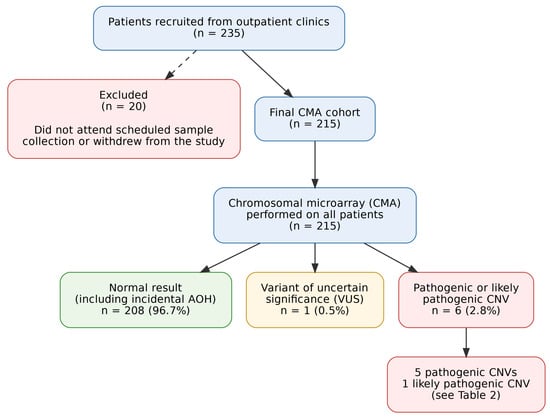
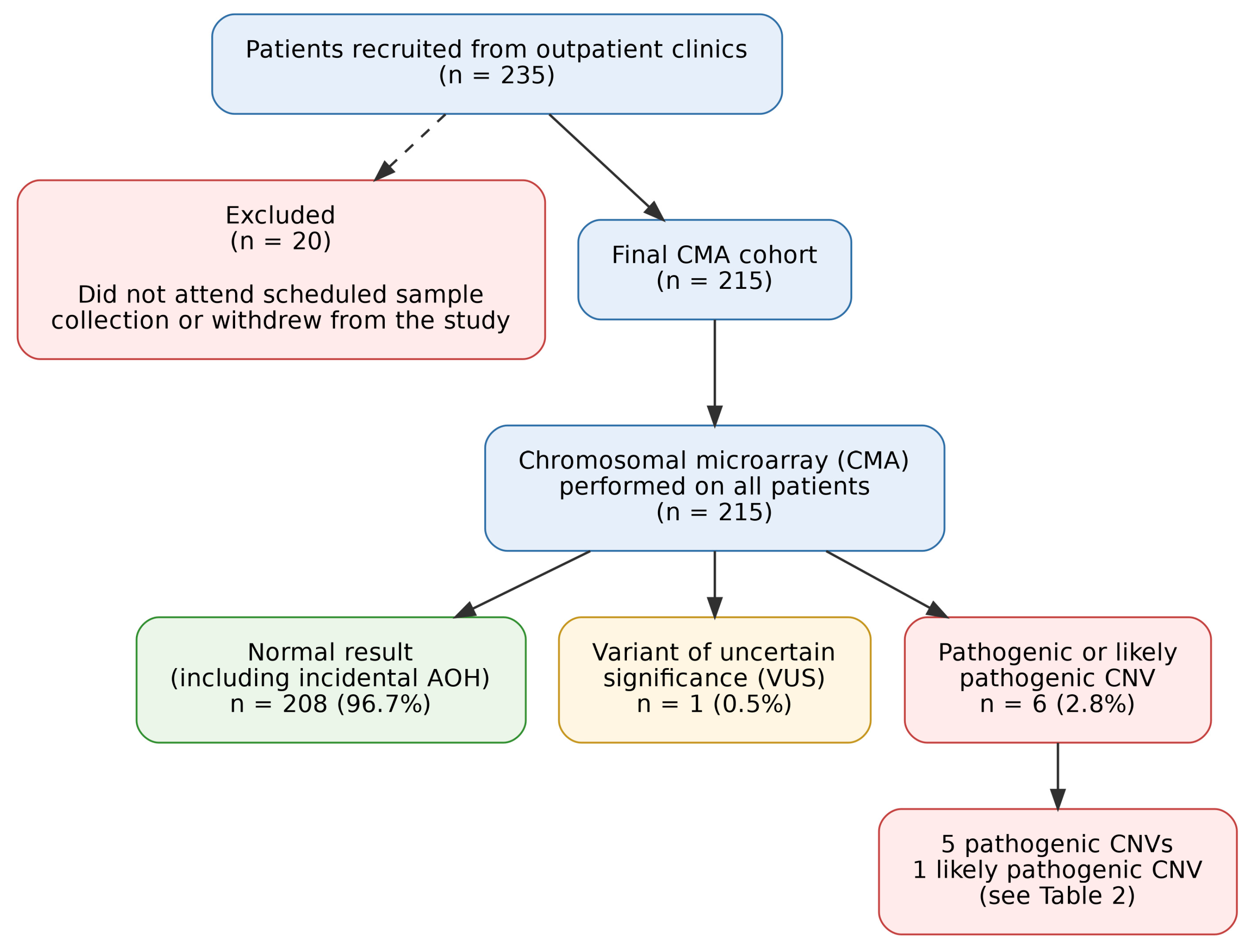
Of the 235 patients recruited, 215 underwent CMA and were included in the final analysis (Figure 1). The remaining 20 patients did not undergo testing because they did not attend the scheduled sample collection or withdrew from the study. The cohort consisted predominantly of male patients, consistent with the approximately 4:1 male-to-female ratio reported for ASD in the literature. All participants met diagnostic criteria for ASD requiring Level 1 support. The demographic and diagnostic characteristics of the cohort are summarized in Table 1.
Figure 1.
Flow diagram of study participants, from recruitment through chromosomal microarray (CMA) results. The dashed arrow indicates excluded participants, whereas solid arrows indicate the flow of included participants through CMA testing and classification. Box colors visually distinguish exclusion and the different CMA result categories.
Table 1.
Demographic and diagnostic characteristics of the study cohort.
3.2. Genomic Findings
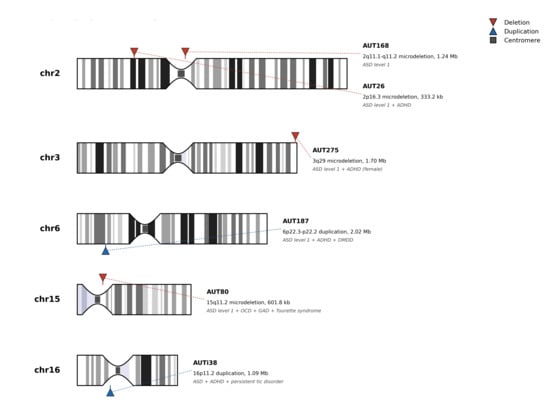
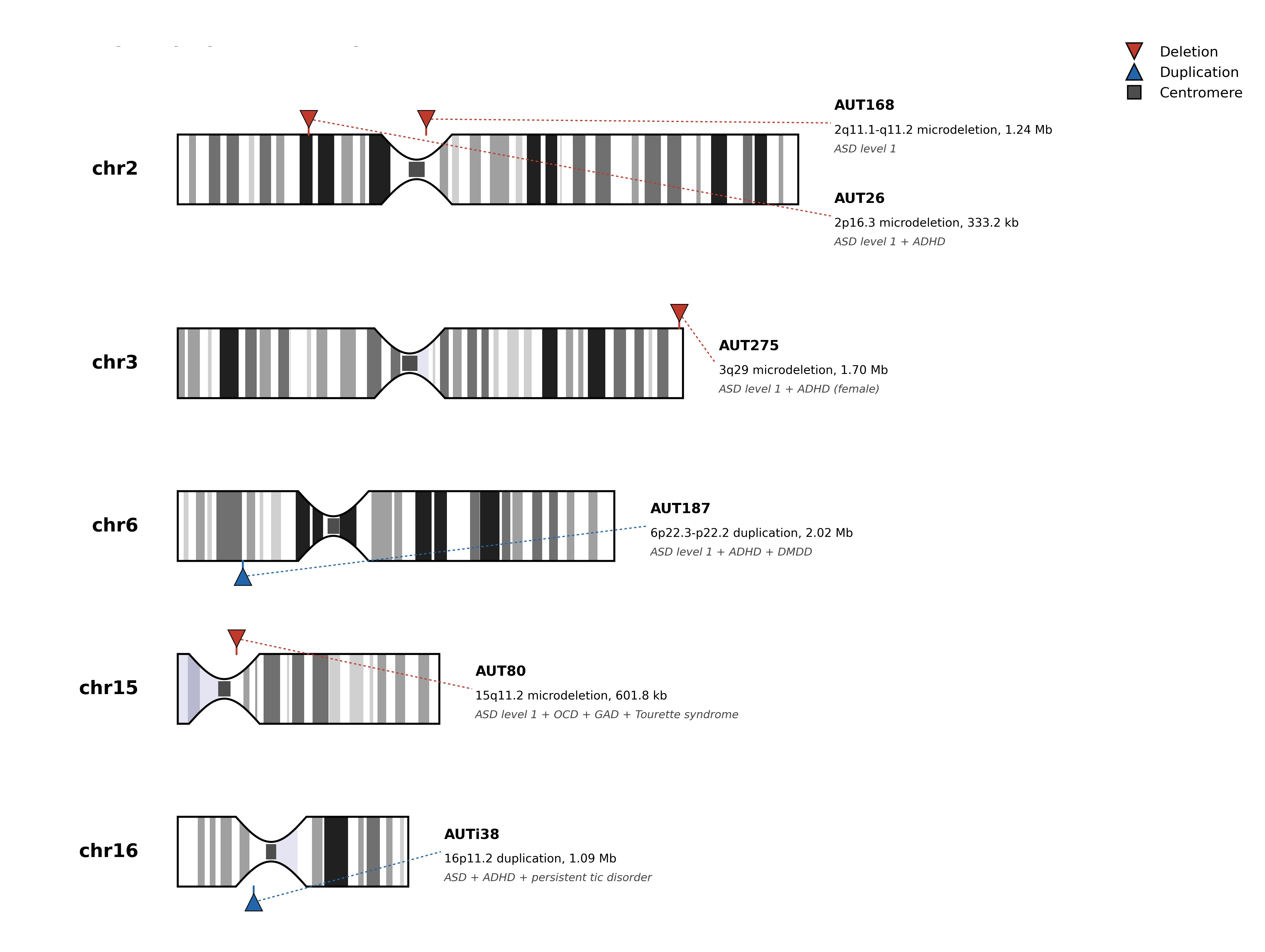
Pathogenic or likely pathogenic CNVs were identified in 6 of the 215 participants, corresponding to a diagnostic yield of 2.8% (95% CI, 1.3–6.1%; Wilson score method). Five participants harbored pathogenic CNVs, whereas one harbored a likely pathogenic CNV. All identified CNVs involved genomic regions previously associated with ASD or other neurodevelopmental disorders. The genomic findings are summarized in Table 2, and the chromosomal locations of the identified CNVs are shown in Figure 2.
Table 2.
Pathogenic and likely pathogenic copy number variants identified in participants with nonsyndromic autism spectrum disorder.
Figure 2.
Chromosomal ideogram showing the location of the six pathogenic/likely pathogenic CNVs identified in this cohort. Red markers indicate deletions; blue markers indicate duplications. Chromosome banding is illustrative. Positions are based on GRCh37/hg19 coordinates.
In addition, one variant of uncertain significance (VUS), a 1.8 Mb deletion at 4q32.1, was identified and was not included in the diagnostic yield, in accordance with current ACMG classification criteria. Regions of absence of heterozygosity (AOH) larger than 10 Mb were identified in three participants (Xp11.4–p11.21, 15.37 Mb; 22q12.1–q13.31, 20.79 Mb; and 14q13.1–q22.1, 17.75 Mb). None of these regions involved loci associated with recognized imprinting disorders.
3.3. Psychiatric Comorbidities in the Overall Cohort
Psychiatric comorbidities were assessed by psychiatrists participating in the study using the K-SADS-PL in 210 of the 215 participants included in the final cohort. ADHD was the most frequent psychiatric comorbidity, identified in 111 participants (52.9%), followed by specific phobia (36.7%), anxiety disorders (19.5%), tic disorders or Tourette syndrome (16.7%), depressive disorders or dysthymia (9.5%), enuresis (7.6%), encopresis (6.2%), and oppositional defiant disorder (3.8%). These findings are summarized in Table 3.
Table 3.
Psychiatric comorbidities identified using the K-SADS-PL among assessed participants (n = 210).
3.4. Comparison of CMA Diagnostic Yield with Reference Cohorts
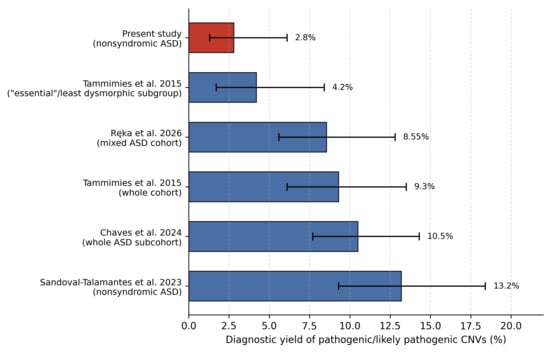
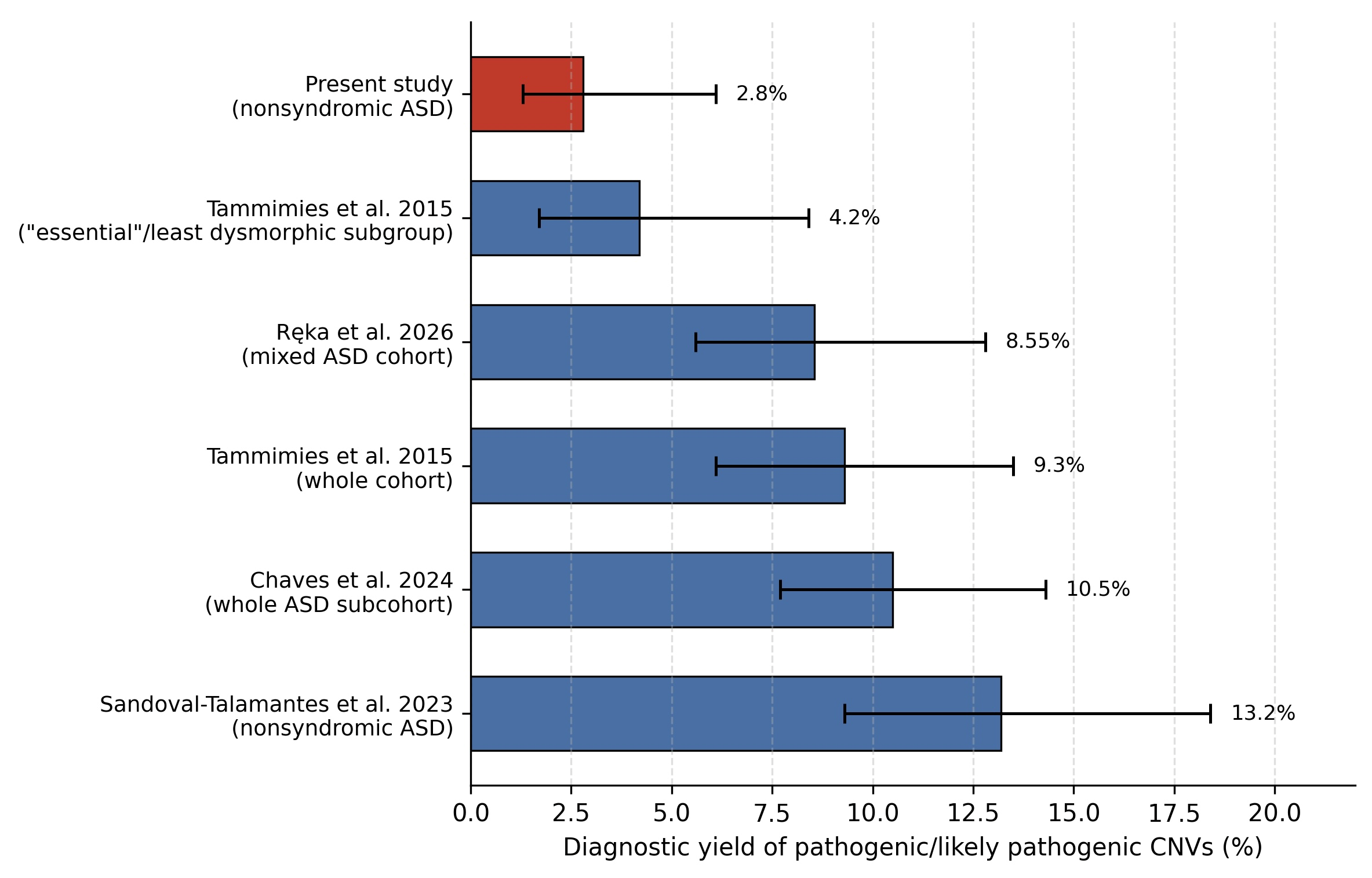
The diagnostic yield observed in the present cohort was compared with that reported in national and international reference cohorts. The yield did not differ significantly from that reported in the least dysmorphic (“essential”) ASD subgroup of Tammimies et al. [20] (4.2% vs. 2.8%; Fisher’s exact test, OR 0.66, p = 0.57). The diagnostic yield reported for the isolated-ASD subgroup of Chaves et al. [11] was numerically higher than that observed in the present cohort (approximately 7% vs. 2.8%; OR 0.40), although the difference did not reach conventional statistical significance (Fisher’s exact test, p = 0.12). In contrast, the diagnostic yield was significantly lower than that reported in the overall, phenotypically heterogeneous cohorts of Tammimies et al. [20] (9.3%; OR 0.28, p = 0.004), Sandoval-Talamantes et al. [19] (13.2%; OR 0.19, p < 0.001), Chaves et al. [11] (10.5%; OR 0.24, p < 0.001), and Ręka et al. [21] (8.55%; OR 0.31, p = 0.014). These comparisons are shown in Figure 3. Table 4 summarizes the clinical definitions, selection criteria, sample sizes and diagnostic yields of these reference cohorts.
Figure 3.
Diagnostic yield of chromosomal microarray in the present study compared with international and national reference cohorts. Error bars represent 95% confidence intervals (Wilson score method) calculated from the counts reported in each original publication [11,19,20,21]. The red bar represents the present study, whereas the blue bars represent the reference cohorts.
Table 4.
Clinical definitions, phenotypic selection criteria, sample sizes and chromosomal microarray diagnostic yields of the present cohort and of the reference cohorts used for comparison.
3.5. Familial Occurrence of ASD Within the Cohort
Information on ASD among relatives was collected at enrolment in the original study and was reviewed here for the 215 participants. Twenty-four participants (11.2%) belonged to 12 sibships in which two or more siblings met diagnostic criteria for ASD, were enrolled and underwent CMA. Five further participants had a sibling who was assessed in the study but did not enter the final CMA cohort, either because ASD was not confirmed on standardized assessment or because CMA was not performed, so that 29 participants (13.5%) had at least one sibling assessed. A parent with ASD was recorded for 9 participants (4.2%): 6 mothers and 3 fathers. Taking parents and siblings together, 31 participants (14.4%) had at least one affected first-degree relative, and 60 (27.9%) had at least one affected relative of any degree (Table 5).
Table 5.
Familial occurrence of autism spectrum disorder among the 215 participants.
Three of the six participants with a pathogenic or likely pathogenic CNV (AUT26, AUT168 and AUT187) had a relative with a reported ASD diagnosis, and none had a parent with ASD. Two of them had a sibling assessed in the study. AUT187, who carries the 6p22.3–p22.2 duplication, has a sibling (AUT188) who also met diagnostic criteria for ASD but whose CMA was normal, so the duplication does not segregate with the phenotype in this family. The sibling of AUT26, who carries the 2p16.3 deletion involving NRXN1, had been referred with a previous clinical diagnosis of ASD but did not meet criteria on any of the standardized instruments and did not undergo CMA. No molecular segregation analysis was performed in either family, so these observations rest on clinical phenotype and, in one case, on the sibling’s CMA result.
4. Discussion
The present study identified pathogenic or likely pathogenic CNVs in 2.8% of individuals with clinically nonsyndromic ASD. Despite the comparatively low diagnostic yield, CMA identified recurrent and clinically relevant genomic alterations in a carefully selected cohort characterized by the absence of dysmorphic features, recognized or suspected genetic syndromes, major congenital malformations, epilepsy, and macrocephaly or microcephaly. These findings highlight the substantial influence of phenotypic selection on the diagnostic yield of CMA and demonstrate that clinically relevant CNVs can still be identified in individuals with apparently nonsyndromic ASD. Although the diagnostic yield reported for the isolated-ASD subgroup by Chaves et al. was numerically higher than that observed in the present cohort (approximately 7% vs. 2.8%, representing an approximately 2.5-fold difference), this difference did not reach conventional statistical significance (Fisher’s exact test, p = 0.12). This comparison should nevertheless be interpreted cautiously given the relatively small number of pathogenic findings and, importantly, differences in the clinical definitions and phenotypic selection criteria used to define the two ASD populations. In particular, the ‘isolated ASD’ subgroup reported by Chaves et al. and the clinically nonsyndromic ASD cohort evaluated in the present study should not be considered directly equivalent.
Beyond the overall diagnostic yield, the specific CNVs identified in this cohort (Table 2) illustrate the heterogeneous genomic architecture underlying ASD. The 2q11.1–q11.2 deletion and the 2p16.3 deletion disrupting NRXN1 both involve genes with well-established haploinsufficiency evidence; genotype–phenotype studies of NRXN1 exon-level deletions indicate that disruptions overlapping the α-promoter and initial coding exons, as observed in AUT26, are among those most consistently associated with neurodevelopmental phenotypes, although reduced penetrance and variable expressivity remain characteristic of this locus [22,23]. The 16p11.2 duplication (AUTi38) corresponds to one of the best-replicated recurrent CNVs in ASD and related neuropsychiatric disorders [24], while the 3q29 deletion (AUT275) is notable for conferring one of the highest odds ratios for schizophrenia among known structural variants, in addition to its established association with ASD and intellectual disability [25]. The 6p22.3–p22.2 duplication (AUT187), classified as likely pathogenic largely on the basis of absence from control populations rather than an established triplosensitivity mechanism, illustrates the comparatively weaker evidence base still available for gains relative to losses within current CNV interpretation frameworks.
The 15q11.2 (BP1–BP2) deletion identified in AUT80 merits separate comment. Although classified as pathogenic in the reference laboratory report, this recurrent CNV is widely regarded in the literature as a low-penetrance susceptibility locus rather than a fully penetrant pathogenic variant, with population-based penetrance estimates around 10% or lower and frequent inheritance from unaffected or mildly affected parents [26,27]. Current ClinGen dosage-sensitivity curation of this region reflects population-level, subclinical evidence rather than a discrete haploinsufficient gene mechanism, explicitly distinguishing it from classical high-penetrance microdeletion syndromes. We therefore interpret this finding as a genetic risk allele contributing, alongside the patient’s additional psychiatric comorbidities (Table 2), to a multifactorial neurodevelopmental phenotype, rather than as a standalone causal diagnosis, a distinction with direct relevance for genetic counseling and recurrence-risk estimation. Notably, this classification predates the 2023 publication of the ClinGen Low Penetrance/Risk Allele Working Group framework, which formally established a distinct “risk allele” category for structural variants with this evidentiary profile, separate from traditional pathogenic classification [28]. As the reference laboratory report for this participant was issued in 2022, prior to this framework’s publication, its classification followed the ACMG/ClinGen technical standards in effect at the time [8], which did not yet formally distinguish risk alleles from traditional pathogenic CNVs.
The familial data collected in the original study add context to these findings. A first-degree relative with ASD was recorded for 14.4% of participants and an affected relative of any degree for 27.9%, in keeping with the familial aggregation typical of ASD. None of the six participants carrying a pathogenic or likely pathogenic CNV had a parent with ASD, and in the one family where such a participant had an affected sibling who was also tested, the duplication was present in only a single affected sibling (Section 3.5). A single family cannot support a general conclusion, but the observation fits the view that several of the recurrent CNVs identified here act as susceptibility alleles of incomplete penetrance rather than as fully penetrant monogenic causes. Establishing inheritance would require molecular segregation analysis, which was not performed here.
The comparatively low diagnostic yield observed in our cohort should be interpreted in the context of the substantial phenotypic heterogeneity across published ASD cohorts. As shown by the comparisons presented in Section 3.4, the diagnostic yield in the present study did not differ significantly from that reported in the least dysmorphic (“essential”) ASD subgroup described by Tammimies et al. [20] or from the isolated-ASD subgroup reported by Chaves et al. [11]. In contrast, significantly higher yields were observed in broader cohorts that included individuals with more heterogeneous or complex neurodevelopmental phenotypes [11,19,20,21]. Taken together, these findings suggest that differences in clinical and phenotypic selection account for a substantial proportion of the variability in CMA diagnostic yield reported across ASD studies.
This interpretation is supported by the phenotypic composition of the reference cohorts. In the study by Tammimies et al. [20], the diagnostic yield increased substantially across dysmorphology strata, whereas Chaves et al. [11] reported a higher yield among individuals with syndromic ASD than among those with isolated ASD. Moreover, even cohorts described as nonsyndromic or primary ASD were not necessarily restricted to individuals without additional clinical features associated with an increased likelihood of identifying a genetic etiology. For example, the “essential” ASD subgroup described by Tammimies et al. [20] included individuals with macrocephaly and major congenital anomalies, whereas the cohort reported by Sandoval-Talamantes et al. [19] included individuals with intellectual disability or psychomotor delay and epilepsy. Similarly, a cohort study of genetic testing requests in children with ASD by Garrido-Torres et al. [29] reported comparable heterogeneity in the clinical indications underlying referral for genetic evaluation. By contrast, the present study applied more restrictive clinical selection criteria, excluding individuals with dysmorphic features, recognized or suspected genetic syndromes, major congenital malformations, epilepsy, and macrocephaly or microcephaly. This more stringent phenotypic selection likely contributed to the comparatively lower diagnostic yield observed in our cohort.
The findings also underscore the importance of interpreting CMA diagnostic yield within the specific clinical context in which testing is performed. A lower yield in a clinically homogeneous, nonsyndromic cohort should not necessarily be interpreted as evidence of reduced biological relevance of CNVs in ASD, nor as a population-specific difference. Rather, it may reflect the exclusion of phenotypic features that are themselves associated with a higher probability of identifying pathogenic genomic alterations. The lack of significant differences between the present cohort and comparably selected nonsyndromic subgroups supports this interpretation and emphasizes the need for careful consideration of cohort composition when comparing diagnostic yields across studies.
In this context, the role of CMA in individuals with isolated or clinically nonsyndromic ASD warrants a nuanced interpretation. Although the overall diagnostic yield may be lower than that observed in individuals with syndromic or complex neurodevelopmental presentations, the identification of a pathogenic or likely pathogenic CNV can still have substantial clinical value for the individual patient and family. A molecular diagnosis may inform prognosis, guide surveillance for associated medical or psychiatric manifestations, support recurrence-risk assessment, and facilitate genetic counseling. Thus, the clinical contribution of CMA cannot be fully captured by the diagnostic-yield percentage alone.
At the same time, the comparatively low yield observed in this clinically selected cohort highlights the potential complementary role of sequencing-based approaches. In the cohort reported by Tammimies et al. [20], whole-exome sequencing identified additional molecular diagnoses beyond those detected by CMA, illustrating the contribution of sequence-level variants to the genetic architecture of ASD. Clinical exome or genome sequencing may therefore provide additional diagnostic value in individuals with negative CMA findings, including those with apparently nonsyndromic presentations. Nevertheless, CMA remains particularly suited to the detection of recurrent and submicroscopic genomic imbalances, including the clinically relevant CNVs identified in the present cohort, supporting a complementary or stepwise genomic approach tailored to the clinical phenotype, available resources, and evolving diagnostic guidelines.
4.1. Limitations
This study has several limitations. Although the clinical and genetic data were prospectively collected within the framework of the original multicenter study, the present investigation represents a retrospective secondary analysis of these previously collected data. Consequently, the variables available for the current analyses were limited to those collected under the original study protocol. In addition, the deliberate selection of a clinically homogeneous cohort of individuals with nonsyndromic ASD requiring Level 1 support may limit the generalizability of the observed diagnostic yield to broader ASD populations, particularly those including individuals with more complex neurodevelopmental, neurological, or syndromic presentations. However, this phenotypic homogeneity also represents a strength of the study, as it allowed the diagnostic contribution of CMA to be evaluated in a more narrowly defined ASD population.
Comparisons with reference cohorts were based on nominal, unadjusted p-values; because several comparisons were performed, the borderline result relative to the Ręka et al. [21] cohort (p = 0.014) should be regarded as exploratory, whereas the differences from the larger phenotypically heterogeneous cohorts were more robust.
The absence of exome or genome sequencing data in individuals with negative CMA results precludes the identification of single-nucleotide variants and small indels that may contribute to the genetic etiology in a subset of patients, limiting a more comprehensive genomic characterization of the cohort.
In addition, the lack of parental segregation studies for the identified CNVs limits the interpretation of variants of uncertain significance (VUS) and CNVs with borderline clinical relevance. Inheritance status (de novo versus inherited) was not assessed in this cohort, although it represents an important line of evidence within ACMG guidelines that may contribute to variant reclassification. Family data have a further limitation. ASD among relatives was recorded at enrolment and is reported in Section 3.5, but the original study did not include a structured instrument for psychiatric disorders other than ASD in parents or other relatives; the K-SADS-PL was applied to the participants themselves, with a parent as informant. Psychotic, affective and other disorders in adult relatives, which bear on the multifactorial model of idiopathic ASD, were therefore not recorded in a form that permits systematic analysis. ASD in parents and in more distant relatives was also based on information given by the family rather than on standardized assessment, unlike the sibling diagnoses, which were confirmed within the study. Structured family psychiatric histories and parental segregation studies are planned for future work in this cohort.
Finally, the cohort included several sibling pairs, introducing a degree of non-independence among observations that was not accounted for in the descriptive and comparative analyses presented here. Not all siblings of enrolled probands underwent genetic testing, which further limits the assessment of variant segregation within families.
4.2. Clinical and Research Implications
The present findings have implications for both clinical practice and future genomic research in ASD. From a clinical perspective, the relatively low diagnostic yield observed in this carefully selected nonsyndromic cohort should not be interpreted as evidence against genetic testing. Even in individuals without dysmorphic features, major congenital anomalies, epilepsy, abnormal head circumference, or a clinically recognizable genetic syndrome, CMA identified recurrent CNVs with potential implications for genetic counseling, recurrence-risk assessment, and surveillance for associated neurodevelopmental, medical, and psychiatric manifestations. These findings support consideration of genomic evaluation beyond patients with overtly syndromic presentations, while emphasizing that pre-test counseling should address the expected variation in diagnostic yield according to phenotype.
The results also highlight the importance of interpreting CNVs within their broader clinical and familial context. Recurrent CNVs associated with ASD may show variable expressivity and incomplete penetrance, and some may function as susceptibility alleles rather than fully penetrant causal variants. Accordingly, parental testing and segregation analysis may provide important additional information for variant interpretation, recurrence-risk estimation, and genetic counseling, particularly for CNVs with reduced penetrance or uncertain clinical significance.
From a research perspective, future studies should combine detailed and standardized phenotypic characterization with family-based genomic analyses and sequencing approaches. The relatively low CMA yield in this clinically homogeneous cohort suggests that sequence-level variants not detectable by microarray may account for part of the unexplained genetic contribution to nonsyndromic ASD. Integration of CMA with exome or genome sequencing, together with systematic assessment of psychiatric phenotypes in participants and relatives, may help clarify the contribution of CNVs, sequence variants, and their interactions to the heterogeneous genetic architecture of ASD. Larger multicenter cohorts using harmonized phenotypic definitions will also be important to enable more meaningful comparisons of diagnostic yield across populations.
5. Conclusions
In this clinically well-characterized cohort of individuals with nonsyndromic ASD requiring Level 1 support, chromosomal microarray analysis (CMA) identified pathogenic or likely pathogenic CNVs in 2.8% of participants. Although the diagnostic yield was comparatively low, recurrent CNVs of clinical relevance were identified even in individuals without features suggestive of syndromic or complex neurodevelopmental presentations. These findings demonstrate that phenotypic selection substantially influences CMA diagnostic yield and should be carefully considered when interpreting and comparing results across ASD cohorts. Overall, this study provides one of the largest clinically well-characterized cohorts of individuals with nonsyndromic ASD evaluated by CMA in Brazil, contributing additional evidence on the diagnostic yield and potential clinical relevance of CMA in this specific population.
Author Contributions
Conceptualization, W.d.S.S. and M.L.C.; methodology, B.C.d.F., R.G.M., W.d.S.S. and M.L.C.; formal analysis, W.d.S.S. and M.L.C.; investigation, B.C.d.F., R.G.M., S.A., G.M.S.D. and M.C.B.C.; data curation, W.d.S.S., B.C.d.F., R.G.M., S.A., G.M.S.D. and M.C.B.C.; writing, original draft preparation, W.d.S.S.; writing—review and editing, M.L.C.; supervision, M.L.C.; project administration, B.C.d.F., R.G.M., M.L.C.; funding acquisition, B.C.d.F., R.G.M., M.L.C. All authors have read and agreed to the published version of the manuscript.
Funding
This work was supported by the Programa Nacional de Apoio à Atenção da Saúde da Pessoa com Deficiência (PRONAS) [grant number 25000161705/2014-37] and CAPES grant 001 to W.d.S.S. This study also received partial financial support from a project approved by Conselho Estadual dos Direitos da Criança e do Adolescente (CEDCA), funded through tax incentive programs, via Fundo Estadual para Infância e Adolescência (FIA-PR), from Paraná, Brazil.
Institutional Review Board Statement
The study was conducted in accordance with the Declaration of Helsinki, and the study was approved by the Research Ethics Committee of Faculdades Pequeno Príncipe (CEP/FPP; approval No. 2.493.486 approval date 9 February 2018; CAAE 70043317.4.0000.5580) and by the Brazilian National Research Ethics Commission (CONEP; approval No. 2.450.903, approval date 21 December 2017), in accordance with Brazilian National Health Council Resolution No. 466/2012. Participants were originally enrolled in the multicenter parent project “Intellectual Disability and Autism: Clinical and Genetic Characterization of a Population from Southern Brazil”.
Informed Consent Statement
Informed consent was obtained from all participants involved in the study. Written informed consent was obtained from the parents or legal guardians of all participants, and age-appropriate assent was obtained from minors aged 7 years or older.
Data Availability Statement
The data presented in this study are available on request from the corresponding author. The data are not publicly available due to privacy and ethical restrictions concerning identifiable genetic and clinical information of minors.
Acknowledgments
The authors thank the patients and their families for their participation, and the clinical and laboratory teams of the participating institutions. The authors are grateful to Roberto Rosati for his expert guidance regarding the genetic testing protocols used in this study. The authors gratefully acknowledge the institutional support of the Instituto de Pesquisa Pelé Pequeno Príncipe and the Associação Hospitalar de Proteção à Infância Dr. Raul Carneiro. During the preparation of this manuscript, the first author used Claude Sonnet 5 (high effort mode; Anthropic, San Francisco, CA, USA) for English-language editing and refinement and for assistance in preparing the graphical abstract. The authors reviewed and edited the output and take full responsibility for the content of this publication.
Conflicts of Interest
The authors declare no conflicts of interest. The funders had no role in the design of the study; in the collection, analyses, or interpretation of data; in the writing of the manuscript; or in the decision to publish the results.
Abbreviations
The following abbreviations are used in this manuscript:
| ASD | Autism spectrum disorder |
| CMA | Chromosomal microarray analysis |
| CNV | Copy number variant |
| ADI-R | Autism Diagnostic Interview–Revised |
| ADOS-2 | Autism Diagnostic Observation Schedule, Second Edition |
| ACMG | American College of Medical Genetics and Genomics |
| ADHD | Attention-deficit/hyperactivity disorder |
| AOH | Absence of heterozygosity |
| VUS | Variant of uncertain significance |
| WES | Whole-exome sequencing |
| SNP | Single nucleotide polymorphism |
| OCD | Obsessive–compulsive disorder |
| GAD | Generalized anxiety disorder |
| MDD | Major depressive disorder |
| DMDD | Disruptive mood dysregulation disorder |
| ODD | Oppositional defiant disorder |
References
- American Psychiatric Association. Diagnostic and Statistical Manual of Mental Disorders (DSM-5), 5th ed.; American Psychiatric Publishing: Arlington, VA, USA, 2013. [Google Scholar]
- Hirota, T.; King, B.H. Autism Spectrum Disorder: A Review. JAMA 2023, 329, 157–168. [Google Scholar] [CrossRef] [Scilit] [PubMed]
- Instituto Brasileiro de Geografia e Estatística (IBGE). Censo Demográfico 2022: Pessoas com Deficiência e Pessoas Diagnosticadas com Transtorno do Espectro Autista–Resultados Preliminares da Amostra; IBGE: Rio de Janeiro, Brazil, 2025. Available online: https://biblioteca.ibge.gov.br/index.php/biblioteca-catalogo?view=detalhes&id=2102178 (accessed on 29 July 2026).
- Muhle, R.A.; Reed, H.E.; Stratigos, K.A.; Veenstra-VanderWeele, J. The Emerging Clinical Neuroscience of Autism Spectrum Disorder: A Review. JAMA Psychiatry 2018, 75, 514–523. [Google Scholar] [CrossRef] [Scilit] [PubMed]
- Lord, C.; Elsabbagh, M.; Baird, G.; Veenstra-VanderWeele, J. Autism Spectrum Disorder. Lancet 2018, 392, 508–520. [Google Scholar] [CrossRef] [Scilit] [PubMed]
- Sanders, S.J.; He, X.; Willsey, A.J.; Ercan-Sencicek, A.G.; Samocha, K.E.; Cicek, A.E.; Murtha, M.T.; Bal, V.H.; Bishop, S.L.; Dong, S.; et al. Insights into Autism Spectrum Disorder Genomic Architecture and Biology from 71 Risk Loci. Neuron 2015, 87, 1215–1233. [Google Scholar] [CrossRef] [Scilit] [PubMed]
- Abedini, S.S.; Akhavantabasi, S.; Liang, Y.; Heng, J.I.T.; Alizadehsani, R.; Dehzangi, I.; Bauer, D.C.; Alinejad-Rokny, H. A Critical Review of the Impact of Candidate Copy Number Variants on Autism Spectrum Disorder. Mutat. Res. Rev. Mutat. Res. 2024, 793, 108509. [Google Scholar] [CrossRef] [Scilit] [PubMed]
- Riggs, E.R.; Andersen, E.F.; Cherry, A.M.; Kantarci, S.; Kearney, H.; Patel, A.; Raca, G.; Ritter, D.I.; South, S.T.; Thorland, E.C.; et al. Technical Standards for the Interpretation and Reporting of Constitutional Copy-Number Variants: A Joint Consensus Recommendation of the American College of Medical Genetics and Genomics (ACMG) and the Clinical Genome Resource (ClinGen). Genet. Med. 2020, 22, 245–257. [Google Scholar] [CrossRef] [Scilit] [PubMed]
- Miller, D.T.; Adam, M.P.; Aradhya, S.; Biesecker, L.G.; Brothman, A.R.; Carter, N.P.; Church, D.M.; Crolla, J.A.; Eichler, E.E.; Epstein, C.J.; et al. Consensus Statement: Chromosomal Microarray Is a First-Tier Clinical Diagnostic Test for Individuals with Developmental Disabilities or Congenital Anomalies. Am. J. Hum. Genet. 2010, 86, 749–764. [Google Scholar] [CrossRef] [Scilit] [PubMed]
- Schaefer, G.B.; Mendelsohn, N.J. Clinical Genetics Evaluation in Identifying the Etiology of Autism Spectrum Disorders: 2013 Guideline Revisions. Genet. Med. 2013, 15, 399–407. [Google Scholar] [CrossRef] [Scilit] [PubMed]
- Chaves, T.F.; Ocampos, M.; Barbato, I.T.; de Camargo Pinto, L.L.; de Luca, G.R.; Barbato Filho, J.H.; Bernardi, P.; Muniz, Y.C.N.; Maris, A.F. A Cohort Study of Neurodevelopmental Disorders and/or Congenital Anomalies Using High Resolution Chromosomal Microarrays in Southern Brazil Highlighting the Significance of ASD. Sci. Rep. 2024, 14, 3762. [Google Scholar] [CrossRef] [Scilit] [PubMed]
- Ziats, C.A.; Patterson, W.G.; Friez, M. Syndromic Autism Revisited: Review of the Literature and Lessons Learned. Pediatr. Neurol. 2021, 114, 21–25. [Google Scholar] [CrossRef] [Scilit] [PubMed]
- ISO 9001:2015; Quality Management Systems—Requirements. International Organization for Standardization (ISO): Geneva, Switzerland, 2015.
- Kaufman, J.; Birmaher, B.; Brent, D.; Rao, U.; Flynn, C.; Moreci, P.; Williamson, D.; Ryan, N. Schedule for Affective Disorders and Schizophrenia for School-Age Children-Present and Lifetime Version (K-SADS-PL): Initial Reliability and Validity Data. J. Am. Acad. Child Adolesc. Psychiatry 1997, 36, 980–988. [Google Scholar] [CrossRef] [Scilit] [PubMed]
- Hyman, S.L.; Levy, S.E.; Myers, S.M. Council on Children with Disabilities, Section on Developmental and Behavioral Pediatrics. Identification, Evaluation, and Management of Children with Autism Spectrum Disorder. Pediatrics 2020, 145, e20193447. [Google Scholar] [CrossRef] [Scilit] [PubMed]
- Becker, M.M.; Wagner, M.B.; Bosa, C.A.; Schmidt, C.; Longo, D.; Papaleo, C.; Riesgo, R.S. Translation and Validation of the Autism Diagnostic Interview-Revised (ADI-R) for Autism Diagnosis in Brazil. Arq. Neuro-Psiquiatr. 2012, 70, 185–190. [Google Scholar] [CrossRef] [Scilit] [PubMed][Green Version]
- Lord, C.; Rutter, M.; DiLavore, P.C.; Risi, S.; Gotham, K.; Bishop, S.L. Autism Diagnostic Observation Schedule, 2nd ed.; Western Psychological Services: Torrance, CA, USA, 2012. [Google Scholar]
- Wechsler, D. Wechsler Intelligence Scale for Children, 4th ed.; The Psychological Corporation: San Antonio, TX, USA, 2003. [Google Scholar]
- Sandoval-Talamantes, A.K.; Mori, M.Á.; Santos-Simarro, F.; García-Miñaur, S.; Mansilla, E.; Tenorio, J.A.; Peña, C.; Adan, C.; Fernández-Elvira, M.; Rueda, I.; et al. Chromosomal Microarray in Patients with Non-Syndromic Autism Spectrum Disorders in the Clinical Routine of a Tertiary Hospital. Genes 2023, 14, 820. [Google Scholar] [CrossRef] [Scilit] [PubMed]
- Tammimies, K.; Marshall, C.R.; Walker, S.; Kaur, G.; Thiruvahindrapuram, B.; Lionel, A.C.; Yuen, R.K.C.; Uddin, M.; Roberts, W.; Weksberg, R.; et al. Molecular Diagnostic Yield of Chromosomal Microarray Analysis and Whole-Exome Sequencing in Children with Autism Spectrum Disorder. JAMA 2015, 314, 895–903. [Google Scholar] [CrossRef] [Scilit] [PubMed]
- Ręka, G.; Wojciechowska, K.; Styka, B.; Janiszewska, M.; Lejman, M. Diversity of Molecular Karyotypes of 234 Pediatric Patients with Autism Spectrum Disorder in Chromosomal Microarray Analysis. BMC Psychiatry 2026, in press. [Google Scholar] [CrossRef] [Scilit] [PubMed]
- Schaaf, C.P.; Boone, P.M.; Sampath, S.; Williams, C.; Bader, P.I.; Mueller, J.M.; Shchelochkov, O.A.; Brown, C.W.; Crawford, H.P.; Phalen, J.A.; et al. Phenotypic Spectrum and Genotype-Phenotype Correlations of NRXN1 Exon Deletions. Eur. J. Hum. Genet. 2012, 20, 1240–1247. [Google Scholar] [CrossRef] [Scilit] [PubMed]
- Al Shehhi, M.; Forman, E.B.; Fitzgerald, J.E.; McInerney, V.; Krawczyk, J.; Shen, S.; Betts, D.R.; Ardle, L.M.; Gorman, K.M.; King, M.D.; et al. NRXN1 Deletion Syndrome; Phenotypic and Penetrance Data from 34 Families. Eur. J. Med. Genet. 2019, 62, 204–209. [Google Scholar] [CrossRef] [Scilit] [PubMed]
- Weiss, L.A.; Shen, Y.; Korn, J.M.; Arking, D.E.; Miller, D.T.; Fossdal, R.; Saemundsen, E.; Stefansson, H.; Ferreira, M.A.R.; Green, T.; et al. Association between Microdeletion and Microduplication at 16p11.2 and Autism. N. Engl. J. Med. 2008, 358, 667–675. [Google Scholar] [CrossRef] [Scilit] [PubMed]
- Mulle, J.G.; Dodd, A.F.; McGrath, J.A.; Wolyniec, P.S.; Mitchell, A.A.; Shetty, A.C.; Sobreira, N.L.; Valle, D.; Rudd, M.K.; Satten, G.; et al. Microdeletions of 3q29 Confer High Risk for Schizophrenia. Am. J. Hum. Genet. 2010, 87, 229–236. [Google Scholar] [CrossRef] [Scilit] [PubMed]
- Cox, D.M.; Butler, M.G. The 15q11.2 BP1–BP2 Microdeletion Syndrome: A Review. Int. J. Mol. Sci. 2015, 16, 4068–4082. [Google Scholar] [CrossRef] [Scilit] [PubMed]
- Burnside, R.D.; Pasion, R.; Mikhail, F.M.; Carroll, A.J.; Robin, N.H.; Youngs, E.L.; Gadi, I.K.; Keitges, E.; Jaswaney, V.L.; Papenhausen, P.R.; et al. Microdeletion/Microduplication of Proximal 15q11.2 between BP1 and BP2: A Susceptibility Region for Neurological Dysfunction Including Developmental and Language Delay. Hum. Genet. 2011, 130, 517–528. [Google Scholar] [CrossRef] [Scilit] [PubMed]
- Schmidt, R.J.; Steeves, M.; Bayrak-Toydemir, P.; Benson, K.A.; Coe, B.P.; Conlin, L.K.; Ganapathi, M.; Garcia, J.; Gollob, M.H.; Jobanputra, V.; et al. Recommendations for Risk Allele Evidence Curation, Classification, and Reporting from the ClinGen Low Penetrance/Risk Allele Working Group. Genet. Med. 2023, 26, 101036. [Google Scholar] [CrossRef] [Scilit] [PubMed]
- Garrido-Torres, N.; Marqués Rodríguez, R.; Alemany-Navarro, M.; Sánchez-García, J.; García-Cerro, S.; Ayuso, M.I.; Fernández-Elvira, M.; Guerrero-Jiménez, M.; Ruiz-Veguilla, M.; Crespo-Facorro, B. Exploring Genetic Testing Requests, Genetic Alterations and Clinical Associations in a Cohort of Children with Autism Spectrum Disorder. Eur. Child Adolesc. Psychiatry 2024, 33, 3829–3840. [Google Scholar] [CrossRef] [Scilit] [PubMed]

Disclaimer/Publisher’s Note: The statements, opinions and data contained in all publications are solely those of the individual author(s) and contributor(s) and not of MDPI and/or the editor(s). MDPI and/or the editor(s) disclaim responsibility for any injury to people or property resulting from any ideas, methods, instructions or products referred to in the content. |
© 2026 by the authors. Licensee MDPI, Basel, Switzerland. This article is an open access article distributed under the terms and conditions of the Creative Commons Attribution (CC BY) license.