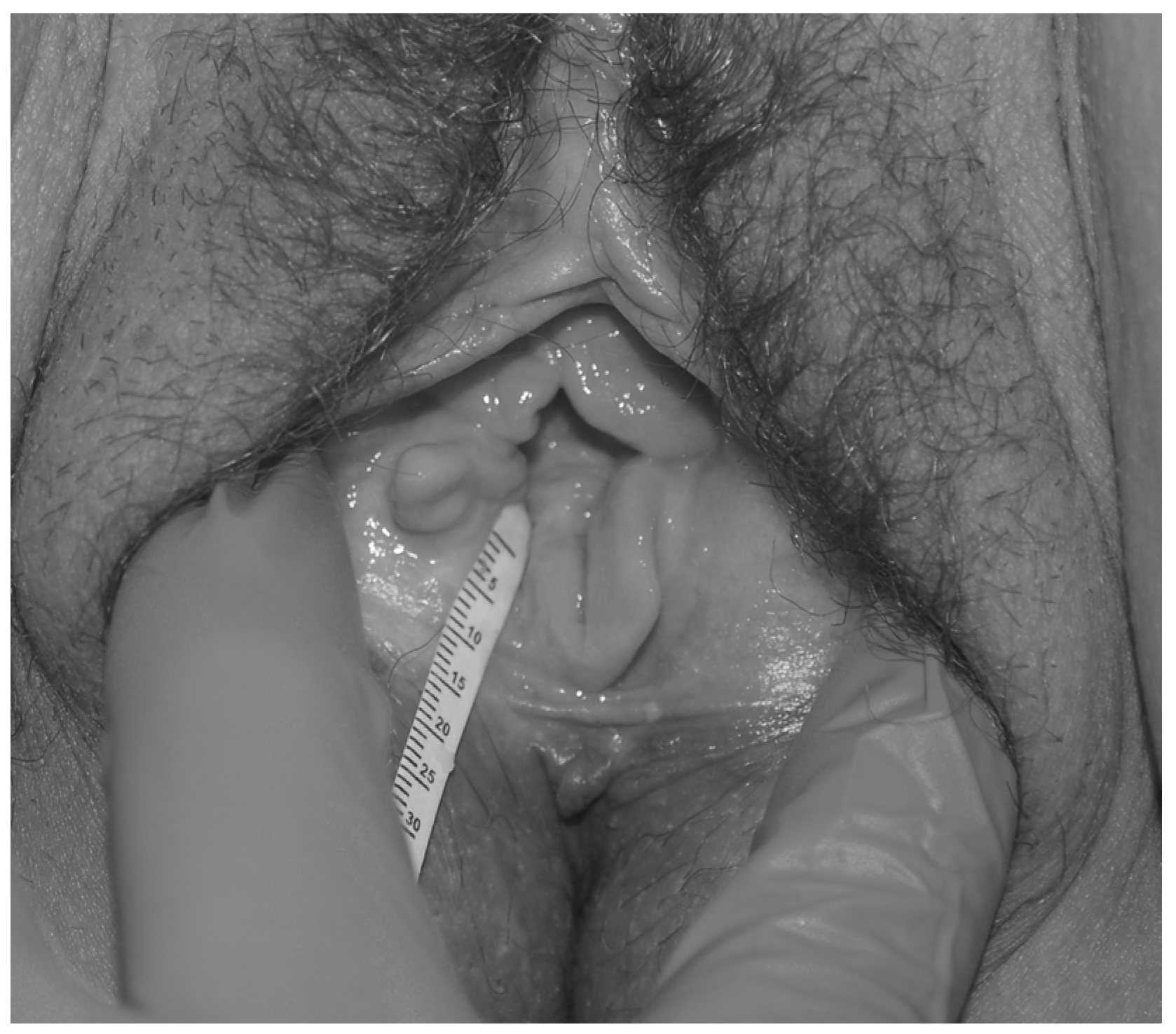
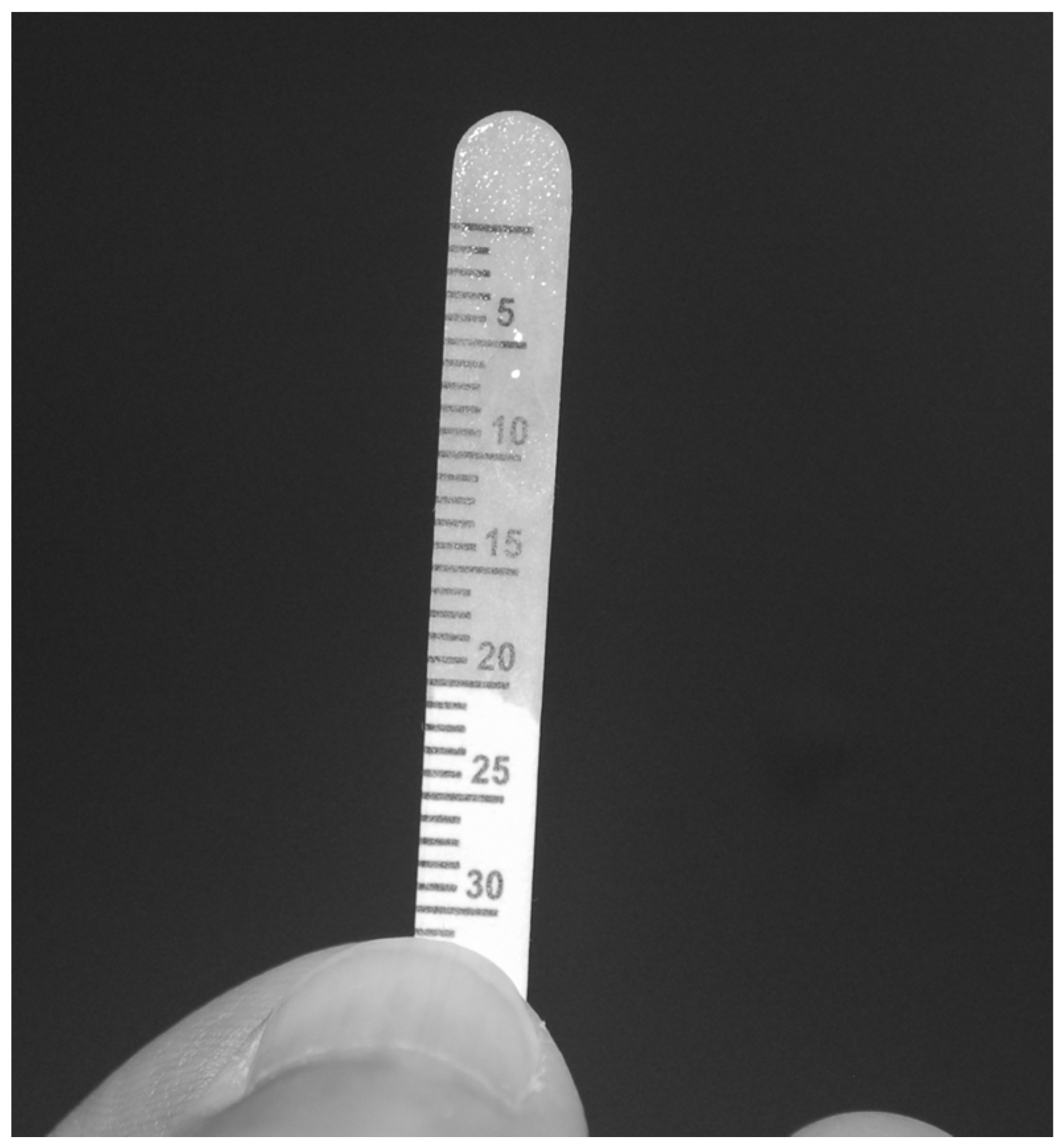
“Modified Schirmer Test” as an Objective Measurement for Vaginal Dryness: A Prospective Cohort Study

Abstract
1. Introduction
2. Materials and Methods
3. Results
4. Discussion
5. Conclusions
Author Contributions
Funding
Institutional Review Board Statement
Informed Consent Statement
Data Availability Statement
Conflicts of Interest
References
- Portman, D.J.; Gass, M.L.S. Genitourinary syndrome of menopause: New terminology for vulvovaginal atrophy from the International Society for the Study of Women’s Sexual Health and The North American Menopause Society. Menopause 2014, 21, 1063–1068. [Google Scholar] [CrossRef] [Scilit]
- Bachmann, G.A.; Nevadunsky, N.S. Diagnosis and treatment of atrophic vaginitis. Am. Fam. Physician 2000, 61, 3090–3096. [Google Scholar] [PubMed]
- Sturdee, D.W.; Panay, N. Recommendations for the management of postmenopausal vaginal atrophy. Climacteric 2010, 13, 509–522. [Google Scholar] [CrossRef] [Scilit]
- Parish, S.J.; Nappi, R.E.; Krychman, M.L.; Kellogg-Spadt, S.; Simon, J.A.; Goldstein, J.A.; Kingsberg, S.A. Impact of vulvovaginal health on postmenopausal women: A review of surveys on symptoms of vulvovaginal atrophy. Int. J. Womens Health 2013, 5, 437–447. [Google Scholar] [CrossRef] [Scilit] [PubMed]
- Tan, O.; Bradshaw, K.; Carr, B.R. Management of vulvovaginal atrophy-related sexual dysfunction in postmenopausal women: An up-to-date review. Menopause 2012, 19, 109–117. [Google Scholar] [CrossRef] [Scilit] [PubMed]
- Management of symptomatic vulvovaginal atrophy: 2013 position statement of The North American Menopause Society. Menopause 2013, 20, 888–902. [CrossRef] [Scilit]
- Bachmann, G.; Bouchard, C.; Hoppe, D.; Ranganath, R.; Altomare, C.; Vieweg, A.; Graepel, J.; Helzner, E. Efficacy and safety of low-dose regimens of conjugated estrogens cream administered vaginally. Menopause 2009, 16, 719–727. [Google Scholar] [CrossRef] [Scilit]
- Pérez-López, F.R.; Vieira-Baptista, P.; Phillips, N.; Cohen-Sacher, B.; Fialho, S.C.A.V.; Stockdale, C.K. Clinical manifestations and evaluation of postmenopausal vulvovaginal atrophy. Gynecol. Endocrinol. 2021, 37, 740–745. [Google Scholar] [CrossRef] [Scilit]
- Perino, A.; Calligaro, A.; Forlani, F.; Tiberio, C.; Cucinella, G.; Svelato, A.; Saitta, S.; Calagna, G. Vulvo-vaginal atrophy: A new treatment modality using thermo-ablative fractional CO2 laser. Maturitas 2015, 80, 296–301. [Google Scholar] [CrossRef] [Scilit]
- Gaspar, A.; Addamo, G.; Brandi, H. Vaginal Fractional CO2 Laser: A Minimally Invasive Option for Vaginal Rejuvenation. Am. J. Cosmet Surg. 2011, 28, 156–162. [Google Scholar] [CrossRef] [Scilit]
- Gambacciani, M.; Palacios, S. Laser therapy for the restoration of vaginal function. Maturitas 2017, 99, 10–15. [Google Scholar] [CrossRef] [Scilit]
- Stachowicz, A.M.; Hoover, M.L.; Karram, M.M. Clinical utility of radiofrequency energy for female genitourinary dysfunction: Past, present, and future. Int. Urogynecol. J. 2021, 32, 1345–1350. [Google Scholar] [CrossRef] [Scilit]
- Singh, P.; Chong, C.Y.L.; Han, H.C. Effects of Vulvovaginal Laser Therapy on Postmenopausal Vaginal Atrophy: A Prospective Study. J. Gynecol. Surg. 2019, 35, 99–104. [Google Scholar] [CrossRef] [Scilit]
- Salvatore, S.; Maggiore, U.L.; Athanasiou, S.; Origoni, M.; Candiani, M.; Calligaro, A.; Zerbinati, N. Histological study on the effects of microablative fractional CO2 laser on atrophic vaginal tissue: An ex vivo study. Menopause 2015, 22, 845–849. [Google Scholar] [CrossRef] [Scilit] [PubMed]
- Cruz, V.L.; Steiner, M.L.; Pompei, L.M.; Strufaldi, R.; Fonseca, F.L.; Santiago, L.H.; Wajsfeld, T.; Fernandes, C.E. Randomized, double-blind, placebo-controlled clinical trial for evaluating the efficacy of fractional CO2 laser compared with topical estriol in the treatment of vaginal atrophy in postmenopausal women. Menopause 2017, 25, 21–28. [Google Scholar] [CrossRef] [Scilit] [PubMed]
- Athanasiou, S.; Pitsouni, E.; Falagas, M.E.; Salvatore, S.; Grigoriadis, T. CO2-laser for the genitourinary syndrome of menopause. How many laser sessions? Maturitas 2017, 104, 24–28. [Google Scholar] [CrossRef] [Scilit] [PubMed]
- Pitsouni, E.; Grigoriadis, T.; Tsiveleka, A.; Zacharakis, D.; Salvatore, S.; Athanasiou, S. Microablative fractional CO2-laser therapy and the genitourinary syndrome of menopause: An observational study. Maturitas 2016, 94, 131–136. [Google Scholar] [CrossRef] [Scilit]
- Takacs, P.; Sipos, A.G.; Kozma, B.; Cunningham, T.D.; Larson, K.; Lampé, R.; Poka, R. The Effect of Vaginal Microablative Fractional CO2 Laser Treatment on Vaginal Cytology. Lasers Surg. Med. 2020, 52, 708–712. [Google Scholar] [CrossRef] [Scilit]
- Filippini, M.; Luvero, D.; Salvatore, S.; Pieralli, A.; Montera, R.; Plotti, F.; Candiani, M.; Angioli, R. Efficacy of fractional CO2 laser treatment in postmenopausal women with genitourinary syndrome: A multicenter study. Menopause 2020, 27, 43–49. [Google Scholar] [CrossRef] [Scilit]
- Bachmann, G.A.; Notelovitz, M.; Kelly, S.J.; Owens, A.; Thompson, C. Long-term nonhormonal treatment of vaginal dryness. Clin. Pract. Sex 1992, 8, 3–8. [Google Scholar]
- Pieralli, A.; Fallani, M.G.; Becorpi, A.; Bianchi, C.; Corioni, S.; Longinotti, M.; Tredici, Z.; Guaschino, S. Fractional CO2 laser for vulvovaginal atrophy (VVA) dyspareunia relief in breast cancer survivors. Arch. Gynecol. Obstet. 2016, 294, 841–846. [Google Scholar] [CrossRef] [Scilit]
- Stone, A.; Gamble, C.J. The quantity of vaginal fluid. Am. J. Obstet. Gynecol. 1959, 78, 279–281. [Google Scholar] [CrossRef] [Scilit]
- Godley, M.J. Quantitation of vaginal discharge in healthy volunteers. BJOG Int. J. Obstet. Gynaecol. 1985, 92, 739–742. [Google Scholar] [CrossRef] [Scilit] [PubMed]
- Eschenbach, D.A.; Thwin, S.S.; Patton, D.L.; Hooton, T.M.; Stapleton, A.E.; Agnew, K.; Winter, C.; Meier, A.; Stamm, W.E. Influence of the normal menstrual cycle on vaginal tissue, discharge, and microflora. Clin. Infect. Dis. 2000, 30, 901–907. [Google Scholar] [CrossRef] [Scilit]
- Wall, L.L.; Couchman, G.M.; McCoy, M.C. Vaginal discharge as a confounding factor in the diagnosis of urinary incontinence by perineal pad testing. Int. Urogynecology J. 1991, 2, 219–221. [Google Scholar] [CrossRef] [Scilit]



| Score | 1 | 2 | 3 | 4 | 5 |
|---|---|---|---|---|---|
| Elasticity | None | Poor | Fair | Good | Excellent |
| Fluid Volume (Pooling of Secretions) | None | Scant amount, vault not entirely covered | Superficial amount, vault entirely covered | Moderate amount of dryness (small areas of dryness on cotton-tip applicator) | Normal amount (fully saturates on cotton-tip applicator) |
| pH | 6.1 or above | 5.6–6.0 | 5.1–5.5 | 4.7–5.0 | 4.6 or below |
| Epithelial Integrity | Petechiae noted before contact | Bleeds with light contact | Bleeds with scraping | Not friable, thin epithelium | Normal |
| Moisture (Coating) | None, surface inflamed | None, surface not inflamed | Minimal | Moderate | Normal |
| Study Group | Control (N = 28) | GSM (N = 30) | |
|---|---|---|---|
| Age | Mean (Std. Deviation) | 38.2 (6.7) | 48.3 (7.1) |
| Median (Range) | 36.5 (28–52) | 47.5 (36–63) | |
| Gravidity | Mean (Std. Deviation) | 3.1 (1.9) | 4.1 (2.1) |
| Median (Range) | 3 (0–9) | 4 (2–10) | |
| Vaginal Deliveries | Mean (Std. Deviation) | 1.8 (1.4) | 3 (1.3) |
| Median (Range) | 2 (0–4) | 3 (1–8) | |
| Hormonal Status | Menstruation (%) | 19 (67.9) | 0 (0) |
| Amenorrhea with Hormonal IUD (%) | 7 (25) | 0 (0) | |
| Perimenopause (%) | 2 (7.1) | 0 (0) | |
| Menopause (%) | 0 (0) | 30 (100) | |
| Contraception | None (%) | 8 (28.6) | 30 (100) |
| BTL (%) | 2 (7.1) | 0 (0) | |
| Condoms (%) | 4 (14.3) | 0 (0) | |
| Copper IUD (%) | 4 (14.3) | 0 (0) | |
| Hormonal IUD (%) | 7 (25) | 0 (0) | |
| HCs (%) | 3 (10.7) | 0 (0) | |
| Study Group | Control (N = 28) | Atrophy (N = 30) | t-Test for Equality of Means | ||
|---|---|---|---|---|---|
| Mean (Std. Deviation) | Median (Range) | Mean (Std. Deviation) | Median (Range) | ||
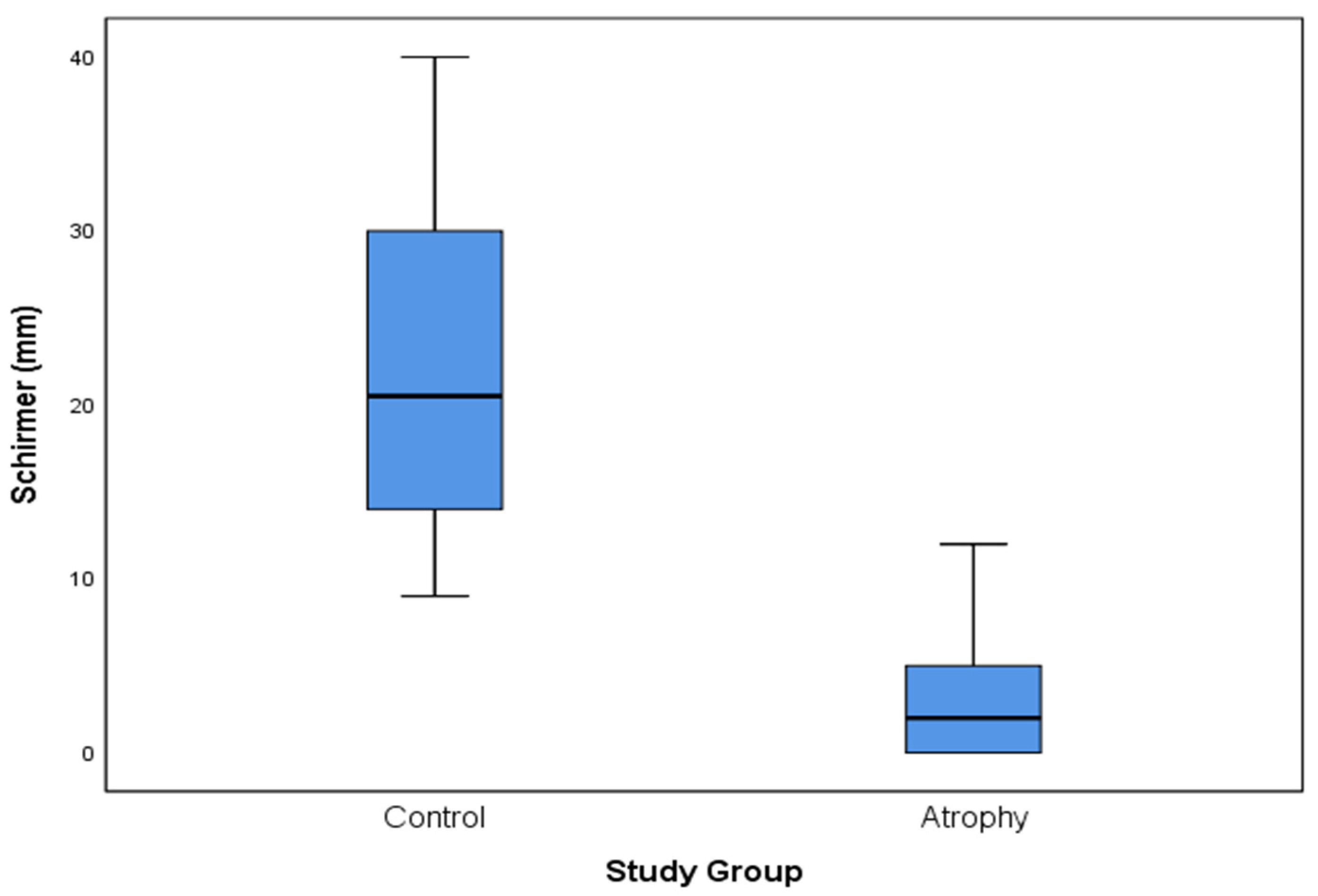
| Modified Schirmer (mm) | 21.7 (9.3) | 20.5 (9–40) | 3.3 (3.9) | 2 (0–12) | p < 0.001 |
| pH | 4.1 (0.4) | 4 (4–6) | 6.9 (0.85) | 7 (5–8) | p < 0.001 |
| VHI | 24.3 (1.0) | 25 (22–25) | 12.3 (2.3) | 12.5 (8–18) | p < 0.001 |
| VAS daily dryness | 0.4 (0.8) | 0 (0–3) | 6.0 (3.8) | 7.5 (0–10) | p < 0.001 |
| VAS intercourse dryness | 0.9 (1.1) | 0 (0–3) | 9.7 (0.5) | 10 (8–10) | p < 0.001 |
| Modified Schirmer (mm) | pH | VHI | VAS Daily Dryness | ||
|---|---|---|---|---|---|
| Correlation Coefficient (Significance) | pH | −0.714 (0.0) | |||
| VHI | 0.775 (0.0) | −0.901 (0.0) | |||
| VAS daily dryness | −0.544 (0.0) | 0.711 (0.0) | −0.709 (0.0) | ||
| VAS intercourse dryness | −0.821 (0.0) | 0.885 (0.0) | −0.936 (0.0) | 0.731 (0.0) |
Publisher’s Note: MDPI stays neutral with regard to jurisdictional claims in published maps and institutional affiliations. |
© 2022 by the authors. Licensee MDPI, Basel, Switzerland. This article is an open access article distributed under the terms and conditions of the Creative Commons Attribution (CC BY) license (https://creativecommons.org/licenses/by/4.0/).
Share and Cite
Gabrieli, D.; Suissa-Cohen, Y.; Jaber, S.; Lev-Sagie, A. “Modified Schirmer Test” as an Objective Measurement for Vaginal Dryness: A Prospective Cohort Study. Diagnostics 2022, 12, 574. https://doi.org/10.3390/diagnostics12030574
Gabrieli D, Suissa-Cohen Y, Jaber S, Lev-Sagie A. “Modified Schirmer Test” as an Objective Measurement for Vaginal Dryness: A Prospective Cohort Study. Diagnostics. 2022; 12(3):574. https://doi.org/10.3390/diagnostics12030574
Chicago/Turabian StyleGabrieli, Dana, Yael Suissa-Cohen, Sireen Jaber, and Ahinoam Lev-Sagie. 2022. "“Modified Schirmer Test” as an Objective Measurement for Vaginal Dryness: A Prospective Cohort Study" Diagnostics 12, no. 3: 574. https://doi.org/10.3390/diagnostics12030574
APA StyleGabrieli, D., Suissa-Cohen, Y., Jaber, S., & Lev-Sagie, A. (2022). “Modified Schirmer Test” as an Objective Measurement for Vaginal Dryness: A Prospective Cohort Study. Diagnostics, 12(3), 574. https://doi.org/10.3390/diagnostics12030574