Skip to Content
You are currently on the new version of our website. Access the old version .

Life, Volume 9, Issue 3

2019 September - 23 articles

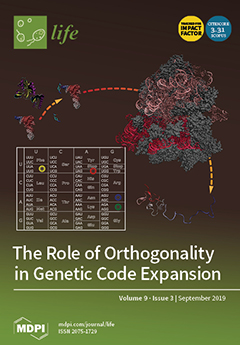
Cover Story: Across the domains of life, a nearly universal genetic code underlies the translation of genetic information into proteins. In select cases, this universal code is slightly altered to encode amino acids beyond the standard 20, thus expanding the genetic code. In recent decades, methods have been developed for artificially expanding the genetic code to incorporate nonstandard amino acids. However, orthogonality between native and artificially introduced translational system components has been a longstanding issue. Novel approaches to enhance this orthogonality include the development of optimized orthogonal translation systems, orthogonal tethered ribosomes, and the recoding of genomes to fundamentally alter the genetic code. View this paper.
  • Issues are regarded as officially published after their release is announced to the table of contents alert mailing list .
  • You may sign up for email alerts to receive table of contents of newly released issues.
  • PDF is the official format for papers published in both, html and pdf forms. To view the papers in pdf format, click on the "PDF Full-text" link, and use the free Adobe Reader to open them.

Articles (23)

  • Article
  • Open Access
13 Citations
13,914 Views
15 Pages

16 September 2019

Condensation reactions between biomolecular building blocks are the main synthetic channels to build biopolymers. However, under highly diluted prebiotic conditions, condensations are thermodynamically hampered since they release water. Moreover, the...

  • Essay
  • Open Access
6 Citations
33,625 Views
12 Pages

16 September 2019

Naked mole-rats are eusocial, hairless mammals that are uniquely adapted to their harsh, low-oxygen subsurface habitat. Although their encephalization quotient, a controversial marker of intelligence, is low, they exhibit many features considered tel...

  • Article
  • Open Access
3 Citations
3,582 Views
24 Pages

15 September 2019

The goal of our research is the development of algorithmic tools for the analysis of chemical reaction networks proposed as models of biological homochirality. We focus on two algorithmic problems: detecting whether or not a chemical mechanism admits...

  • Article
  • Open Access
2 Citations
8,477 Views
18 Pages

Characterizing Interstellar Medium, Planetary Surface and Deep Environments by Spectroscopic Techniques Using Unique Simulation Chambers at Centro de Astrobiologia (CAB)

  • Eva Mateo-Marti,
  • Olga Prieto-Ballesteros,
  • Guillermo Muñoz Caro,
  • Cristobal González-Díaz,
  • Victoria Muñoz-Iglesias and
  • Santos Gálvez-Martínez

10 September 2019

At present, the study of diverse habitable environments of astrobiological interest has become a major challenge. Due to the obvious technical and economical limitations on in situ exploration, laboratory simulations are one of the most feasible rese...

  • Review
  • Open Access
18 Citations
8,425 Views
12 Pages

The Vulnerability of Microbial Ecosystems in a Changing Climate: Potential Impact in Shark Bay

  • Max Reinold,
  • Hon Lun Wong,
  • Fraser I. MacLeod,
  • Julia Meltzer,
  • April Thompson and
  • Brendan P. Burns

2 September 2019

The potential impact of climate change on eukaryotes, including humans, has been relatively well described. In contrast, the contribution and susceptibility of microorganisms to a changing climate have, until recently, received relatively less attent...

  • Article
  • Open Access
2 Citations
4,836 Views
16 Pages

27 August 2019

We describe the design of an instrument, the OxR (for Oxygen Release), for the enzymatically specific and non-enzymatic detection and quantification of the reactive oxidant species (ROS), superoxide radicals (O2•−), and peroxides (O22&minu...

  • Article
  • Open Access
30 Citations
7,889 Views
17 Pages

22 August 2019

The early metabolism arising in a Thioester world gave rise to amino acids and their simple peptides. The catalytic activity of these early simple peptides became instrumental in the transition from Thioester World to a Phosphate World. This transiti...

  • Article
  • Open Access
11 Citations
4,429 Views
23 Pages

21 August 2019

The growth of a population of protocells requires that the two key processes of replication of the protogenetic material and reproduction of the whole protocell take place at the same rate. While in many ODE-based models such synchronization spontane...

  • Review
  • Open Access
46 Citations
6,835 Views
18 Pages

Universal Molecular Triggers of Stress Responses in Cyanobacterium Synechocystis

  • Kirill S. Mironov,
  • Maria A. Sinetova,
  • Maria Shumskaya and
  • Dmitry A. Los

20 August 2019

Systemic analysis of stress-induced transcription in the cyanobacterium Synechocystis sp. strain PCC 6803 identifies a number of genes as being induced in response to most abiotic stressors (heat, osmotic, saline, acid stress, strong light, and ultra...

  • Essay
  • Open Access
9 Citations
7,213 Views
16 Pages

8 August 2019

A key aspect of biological evolution is the capacity of living systems to process information, coded in deoxyribonucleic acid (DNA), and used to direct how the cell works. The overall picture that emerges today from fields such as developmental, synt...

  • Article
  • Open Access
20 Citations
4,826 Views
20 Pages

Survival of RNA Replicators Is Much Easier in Protocells Than in Surface-Based, Spatial Systems

  • Vismay Shah,
  • Jonathan de Bouter,
  • Quinn Pauli,
  • Andrew S. Tupper and
  • Paul G. Higgs

7 August 2019

In RNA-World scenarios for the origin of life, replication is catalyzed by polymerase ribozymes. Replicating RNA systems are subject to invasion by non-functional parasitic strands. It is well-known that there are two ways to avoid the destruction of...

  • Article
  • Open Access
7 Citations
4,471 Views
11 Pages

29 July 2019

One approach to understanding how life-like properties emerge involves building synthetic cellular systems that mimic certain dynamical features of living cells such as bacteria. Here, we developed a model of a reaction network in a cellular system i...

  • Article
  • Open Access
13 Citations
5,099 Views
27 Pages

29 July 2019

Terrestrial hot springs have provided a niche space for microbial communities throughout much of Earth’s history, and evidence for hydrothermal deposits on the Martian surface suggest this could have also been the case for the red planet. Prior...

  • Review
  • Open Access
10 Citations
4,623 Views
11 Pages

26 July 2019

Organic compounds are present as complex mixtures in extraterrestrial materials including meteorites, which may have played important roles in the origin of life on the primitive Earth. However, the distribution and formation mechanisms of meteoritic...

  • Article
  • Open Access
38 Citations
6,222 Views
19 Pages

Cultivar-Specific Performance and Qualitative Descriptors for Butterhead Salanova Lettuce Produced in Closed Soilless Cultivation as a Candidate Salad Crop for Human Life Support in Space

  • Christophe El-Nakhel,
  • Maria Giordano,
  • Antonio Pannico,
  • Petronia Carillo,
  • Giovanna Marta Fusco,
  • Stefania De Pascale and
  • Youssef Rouphael

14 July 2019

Plant production is crucial for space journeys self-autonomy by contributing to the dietary intake necessary to sustain the physical and psychological well-being of space colonists, as well as for contributing to atmospheric revitalization, water pur...

  • Review
  • Open Access
70 Citations
11,084 Views
28 Pages

9 July 2019

The discovery of the genetic roots of various human diseases has motivated the exploration of different exogenous nucleic acids as therapeutic agents to treat these genetic disorders (inherited or acquired). However, the physicochemical properties of...

  • Concept Paper
  • Open Access
22 Citations
8,185 Views
9 Pages

The Role of Orthogonality in Genetic Code Expansion

  • Pol Arranz-Gibert,
  • Jaymin R. Patel and
  • Farren J. Isaacs

5 July 2019

The genetic code defines how information in the genome is translated into protein. Aside from a handful of isolated exceptions, this code is universal. Researchers have developed techniques to artificially expand the genetic code, repurposing codons...

  • Article
  • Open Access
11 Citations
5,169 Views
11 Pages

Formation of Abasic Oligomers in Nonenzymatic Polymerization of Canonical Nucleotides

  • Chaitanya V. Mungi,
  • Niraja V. Bapat,
  • Yayoi Hongo and
  • Sudha Rajamani

4 July 2019

Polymerization of nucleotides under prebiotically plausible conditions has been a focus of several origins of life studies. Non-activated nucleotides have been shown to undergo polymerization under geothermal conditions when subjected to dry-wet cycl...

  • Perspective
  • Open Access
2 Citations
4,339 Views
11 Pages

Systems Analysis for Peptide Systems Chemistry

  • Martha A. Grover,
  • Ming-Chien Hsieh and
  • David G. Lynn

1 July 2019

Living systems employ both covalent chemistry and physical assembly to achieve complex behaviors. The emerging field of systems chemistry, inspired by these biological systems, attempts to construct and analyze systems that are simpler than biology,...

  • Article
  • Open Access
19 Citations
5,886 Views
13 Pages

1 July 2019

In extant biology, biopolymers perform multiple crucial functions. The biopolymers are synthesized by enzyme-controlled biosystems that would not have been available at the earliest stages of chemical evolution and consist of correctly sequenced and/...

  • Review
  • Open Access
30 Citations
7,053 Views
22 Pages

27 June 2019

In recent years, metabolic engineering of microorganisms has attained much research interest to produce biofuels and industrially pertinent chemicals. Owing to the relatively fast growth rate, genetic malleability, and carbon neutral production proce...

Get Alerted

Add your email address to receive forthcoming issues of this journal.

XFacebookLinkedIn
Life - ISSN 2075-1729