


Abstract
Red algae (Rhodophyta) are an ancient lineage of photosynthetic eukaryotes that play important roles in marine ecosystems. However, genomic information for many species within the order Rhodymeniales remains limited, particularly for mitochondrial genomes. In this study, we sequenced, assembled, and analyzed the complete mitochondrial genome (mitogenome) of Rhodymenia intricata to investigate its genome organization, gene content, and phylogenetic position within Rhodymeniales. The mitogenome of R. intricata is a circular DNA molecule of 26,213 bp containing 49 genes, including 25 protein-coding genes (PCGs), 21 tRNA genes, and 3 rRNA genes. The genome shows a strong A + T bias (70.9%) and positive AT and GC skews, typical of red algal mitogenomes. Comparative analysis with other Rhodymeniales mitogenomes revealed generally conserved gene content and organization, with several lineage-specific features such as the presence of the rpl20 gene, an additional open reading frame (orf148), and three rRNA genes (rnl, rns, and rns5). Codon usage analysis indicated a preference for leucine and isoleucine codons and dominant start and stop codons (ATG and TAA). Phylogenetic analysis based on a concatenated dataset of 23 mitochondrial PCGs strongly supported the monophyly of Rhodymeniales and confirmed the close relationship between R. intricata and R. pseudopalmata. Overall, this study presents the first complete mitogenome of R. intricata and expands mitogenomic resources for Rhodymeniales, providing new insights into mitogenome evolution and phylogenetic relationships in red algae.
1. Introduction
Red algae (phylum Rhodophyta) are among the most ancient photosynthetic eukaryotes and play key roles in marine ecosystems by driving primary production, forming benthic habitats, and supporting ecological diversity [1,2]. The class Florideophyceae contains most extant red algal diversity, with morphologically complex taxa across temperate and tropical seas [3]. Within this class, the order Rhodymeniales is ecologically important, exhibiting diverse reproductive traits and thalli ranging from fleshy to flattened or hollow [4]. Despite their prominence, genomic data, particularly organellar genomes, remain limited. The genus Rhodymenia (Rhodymeniaceae) includes widely distributed species inhabiting rocky intertidal and subtidal zones. Rhodymenia intricata (Okamura) Okamura 1930, found mainly in the Northwest Pacific [5], is well-documented morphologically but lacks comprehensive genomic studies. Ecologically, R. intricata contributes to habitat complexity and nutrient cycling in coastal environments. Additionally, species of Rhodymenia are of applied interest due to their potential as sources of bioactive compounds and as food in some regions. In particular, the absence of complete mitochondrial genome (mitogenome) data has restricted phylogenetic analyses within Rhodymeniales.
Mitogenomes are valuable for phylogenetics due to their conserved gene content and compact structure. In red algae, they typically encode oxidative phosphorylation genes (nad, cox, atp, sdh), ribosomal proteins, rRNAs, and tRNAs. While gene content is broadly conserved, variations in genome size, nucleotide composition, introns, and gene order occur across lineages [6,7,8], offering insights into genome evolution beyond morphology. Next-Generation Sequencing has enabled rapid assembly of organellar genomes in red algae [9]. Yet, mitogenomes for Rhodymeniales remain scarce, limiting comparative studies. Expanding these resources can reveal structural conservation, codon usage, and nucleotide composition patterns, enhancing understanding of mitochondrial evolution [8,10]. Mitochondrial genomes often provide higher resolution for phylogenetic analyses in red algae due to their conserved gene content, uniparental inheritance, and reduced recombination compared to nuclear markers, making them especially valuable for resolving evolutionary relationships where nuclear data may be ambiguous.
Phylogenetic analyses based on concatenated mitochondrial protein-coding genes (PCGs) have proven effective for resolving evolutionary relationships among red algae at both intergeneric and interspecific levels [11,12,13]. Model-based approaches, such as maximum likelihood methods, enable robust reconstruction of phylogenetic relationships and assessment of statistical support for inferred clades. For Rhodymeniales, mitogenome-based phylogenies can clarify interspecific relationships and refine the systematic framework of the order, addressing challenges posed by morphological plasticity and overlapping diagnostic traits.
This study reports the whole mitogenome sequence of Rhodymenia intricata and presents a comprehensive analysis of its genomic architecture. The mitogenome was assembled and annotated to identify PCGs, tRNAs, rRNAs, and structural features. We further conducted comparative analyses with other available mitogenomes within Rhodymeniales to evaluate genome structure, nucleotide composition, and gene content conservation. In addition, phylogenetic reconstruction based on concatenated mitochondrial PCGs was performed to determine the evolutionary position of R. intricata within the order. This study expands mitogenomic resources for Rhodymeniales and provides new insights into mitogenome evolution and phylogenetic relationships within this ecologically important group.
2. Materials and Methods
2.1. Sample Collection and DNA Extraction
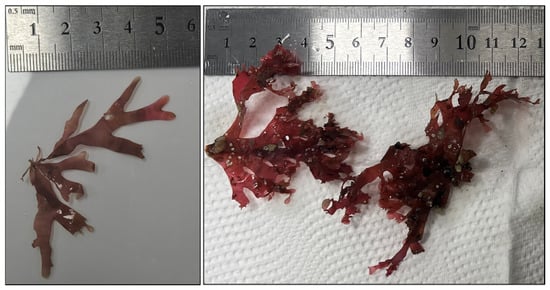
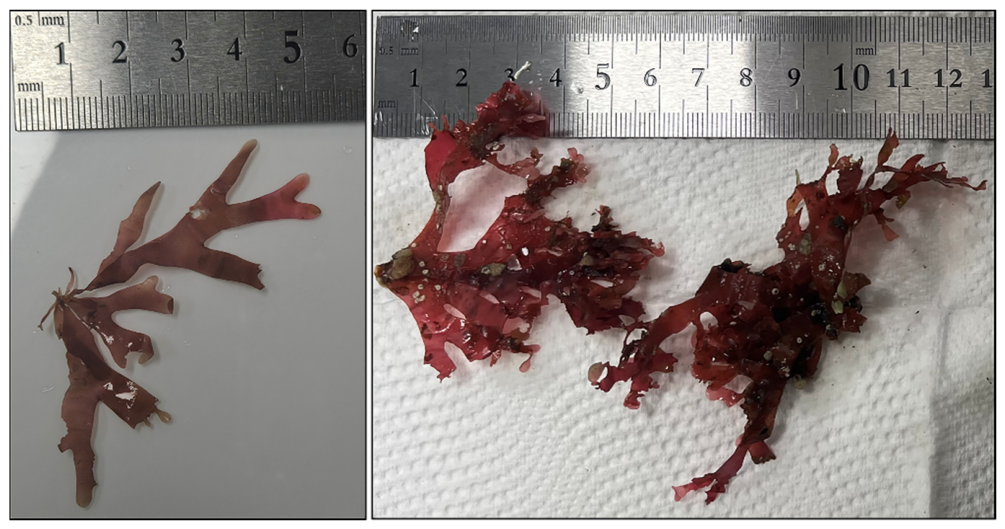
A specimen of the red macroalga Rhodymenia intricata (Figure 1) was collected in the coastal waters of Busan, South Korea (35°16′ N, 129°15′ E) in August 2024. This sample is currently archived at the Ecological Restoration Group of the Marine Eco-Technology Institute (Busan) with ID PU-T01-S-MA-11. Total genomic DNA was extracted with the DNeasy Plant Kit (Qiagen, Hilden, Germany) according to the manufacturer’s instructions. The DNA concentration was quantified using a NanoDrop spectrophotometer (Thermo Fisher Scientific, D1000, Waltham, MA, USA) to ensure quality for downstream applications. Purified DNA extracts are kept at −20 °C.
Figure 1.
A specimen of Rhodymenia intricata, a macroalga collected from the East Sea near Busan, South Korea. The thallus measures 2–6 cm in length, is bright red in color, and leaves are flat and fan-shaped. Branching is irregular, and the branch tips are rounded.
2.2. Library Preparation, Sequencing, and Mitogenome Assembly
Genomic DNA was prepared using the TruSeq Nano DNA Library Preparation Kit (Illumina, San Diego, CA, USA) and sequenced on the Illumina HiSeq 2500 platform by Macrogen Inc. (Daejeon, South Korea; https://www.macrogen.com/ko/, accessed on 20 August 2026). Paired-end sequencing (2 × 150 bp) was performed, targeting an average insert size of 350 bp. To improve data quality, low-quality reads (Phred score < 20) and adapter sequences were removed using Trimmomatic v0.38 [14]. Read quality was evaluated with FastQC v0.11.7 [15]. A subset of high-quality reads was randomly selected for de novo mitogenome assembly. The mitogenome of R. intricata was assembled using SPAdes v3.15.0 [16] based on Illumina short-read data. The mitogenome of Rhodymenia pseudopalmata (GenBank accession: NC_023252.1), a representative species of the Rhodymeniaceae, was used as the seed and reference sequence.
2.3. Mitogenome Annotation and Analysis
The mitogenome (assembled) was compared with previously published mitogenome sequences in the NCBI database using BLAST (version 2.17.0). Genome annotation was conducted using MFannot [17] with Translation Table 4. PCGs were predicted using ORF Finder and subsequently validated through BLAST searches against the NCBI protein database [18]. RNA genes were identified using RNAmmer [19] and tRNAscan-SE 2.0 [20], while RNAweasel was employed to confirm RNA gene boundaries and detect potential intronic regions [21]. Tandem repeats were detected using Tandem Repeats Finder v4.09 [22]. A circular mitogenome map was generated using OGDraw v1.3.1 [23]. MEGA11 (v11.2.8) was used to determine the nucleotide composition and relative synonymous codon usage (RSCU) [24]. Strand asymmetry was assessed according to the formulas GC-skew = (G − C)/(G + C) and AT-skew = (A − T)/(A + T) [25].
2.4. Phylogenetic Analysis
To determine the phylogenetic position of R. intricata within the order Rhodymeniales, a phylogenetic analysis was conducted based on mitochondrial PCG sequences. A total of five complete mitogenomes, including that of R. intricata, were retrieved from the GenBank database according to the updated phylogenetic framework of the order Rhodymeniales [12]. Four species were designated as the ingroup, whereas A. flabellatum was selected as the outgroup (Table 1). The analysis included 23 conserved mitochondrial PCGs: seven NADH dehydrogenase subunits (nad1-6 and nad4 L), four ATP synthase subunits (atp4, atp6, atp8, and atp9), four ribosomal proteins (rps3, rps11, rps12, and rpl16), three cytochrome c oxidase subunits (cox1-3), three succinate dehydrogenase subunits (sdh2-4), apocytochrome b (cob), and the secY-independent protein translocase (tatC). Nucleotide sequences of these genes were concatenated and aligned using MAFFT v7.0 [26]. The best-fitting nucleotide substitution model was selected using ModelFinder implemented in IQ-TREE, based on the Bayesian Information Criterion (BIC), which identified GTR + F + I + G4 as the optimal model [27]. A Maximum Likelihood (ML) phylogenetic tree was constructed in IQ-TREE, and node reliability was assessed with 1000 ultrafast bootstrap replicates [28]. Branch support was evaluated with 1000 ultrafast bootstrap replicates to assess node reliability. The resulting ML tree was visualized using the Interactive Tree of Life (iTOL) v7 web interface [29].
Table 1.
List of the red algae species mitogenome sequences used in this study.
3. Results
3.1. Genome Structure, Organization and Composition
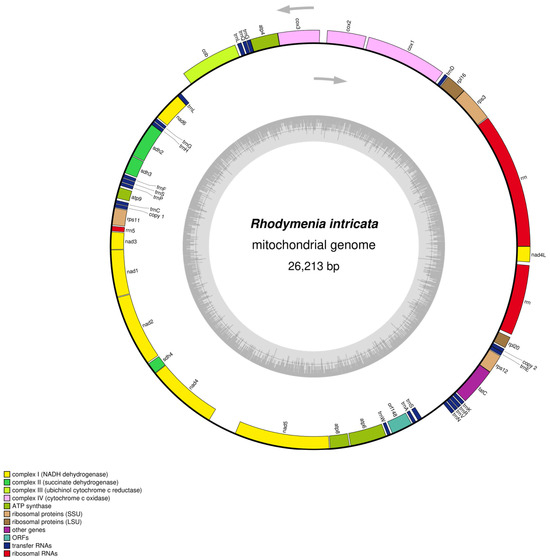
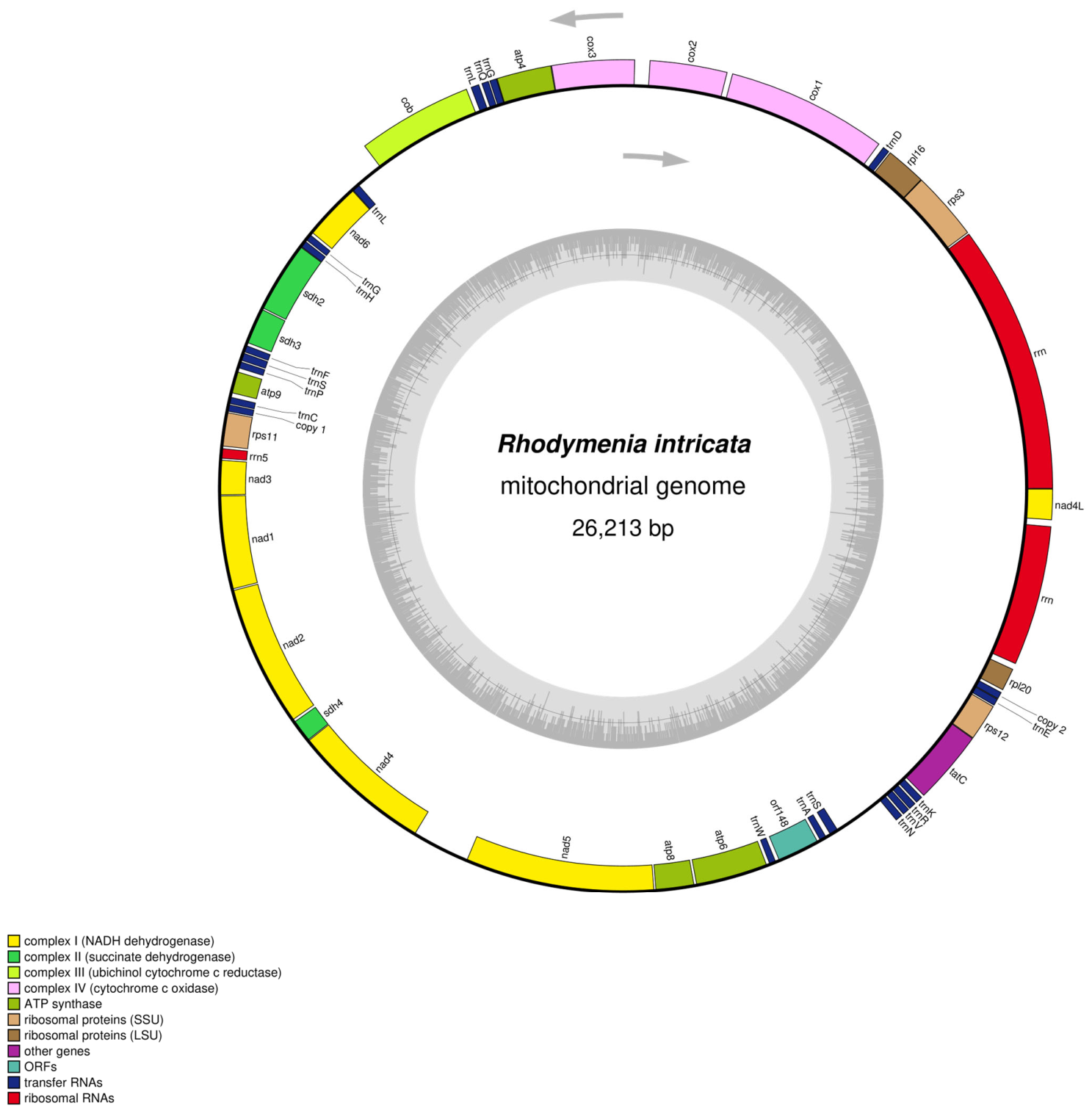
Sequencing of the R. intricata genomic library using the Illumina platform generated 16,023,654 raw reads with a GC content of 43.7%. During preprocessing, duplicate reads and potential contaminants were also removed to ensure high-quality input for assembly. The data showed high quality, with Q20 and Q30 scores of 98.3% and 94.1%, respectively. After filtering low-quality reads, 14,910,404 clean reads were retained, with improved quality scores (Q20: 99.6%; Q30: 96.7%) and a GC content of 43.2%. De novo assembly of the filtered reads achieved complete mitogenome coverage with an average depth of 43.65 X. The average insert size was 375.65 bp (±135.57 bp). Sequencing depth was assessed across the mitogenome and found to be evenly distributed, supporting the reliability of the assembly. Circularization of the contig was validated by confirming overlapping terminal sequences and consistent read mapping across the junction. The final assembly produced a single circular contig of 26,213 bp, representing the complete mitogenome of R. intricata (Figure 2), deposited in GenBank under accession number PX733923. The mitogenome GC content was 29.1%, markedly lower than that of the raw reads. Annotation identified 49 genes, including 25 PCGs, 21 tRNAs, and 3 rRNAs (Table 2). One open reading frame (ORF), orf148, was also detected. The heavy (H) strand encoded 11 PCGs, 10 tRNAs, and 2 rRNAs, whereas the light (L) strand encoded 14 PCGs (including orf148), 11 tRNAs, and 1 rRNA. The mitogenome showed a strong A + T bias (70.9%), with nucleotide proportions of 37.4% A, 33.6% T, 14.7% G, and 14.4% C (Table 3). Positive AT skew (0.054) and GC skew (0.009) values indicate a slight preference for A over T and G over C.
Figure 2.
Circular mitochondrial genome of Rhodymenia intricata (GenBank accession number PX733923). Arrows indicate gene orientation, and colors represent functional gene groups with their corresponding acronyms.
Table 2.
Features of the mitogenome of Rhodymenia intricata (GenBank accession number PX733923).
Table 3.
Nucleotide composition of mitogenomes in four Rhodymeniales species.
3.2. Intergenic Regions and Codon Usage
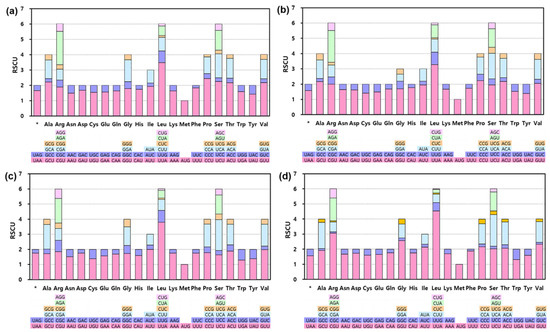
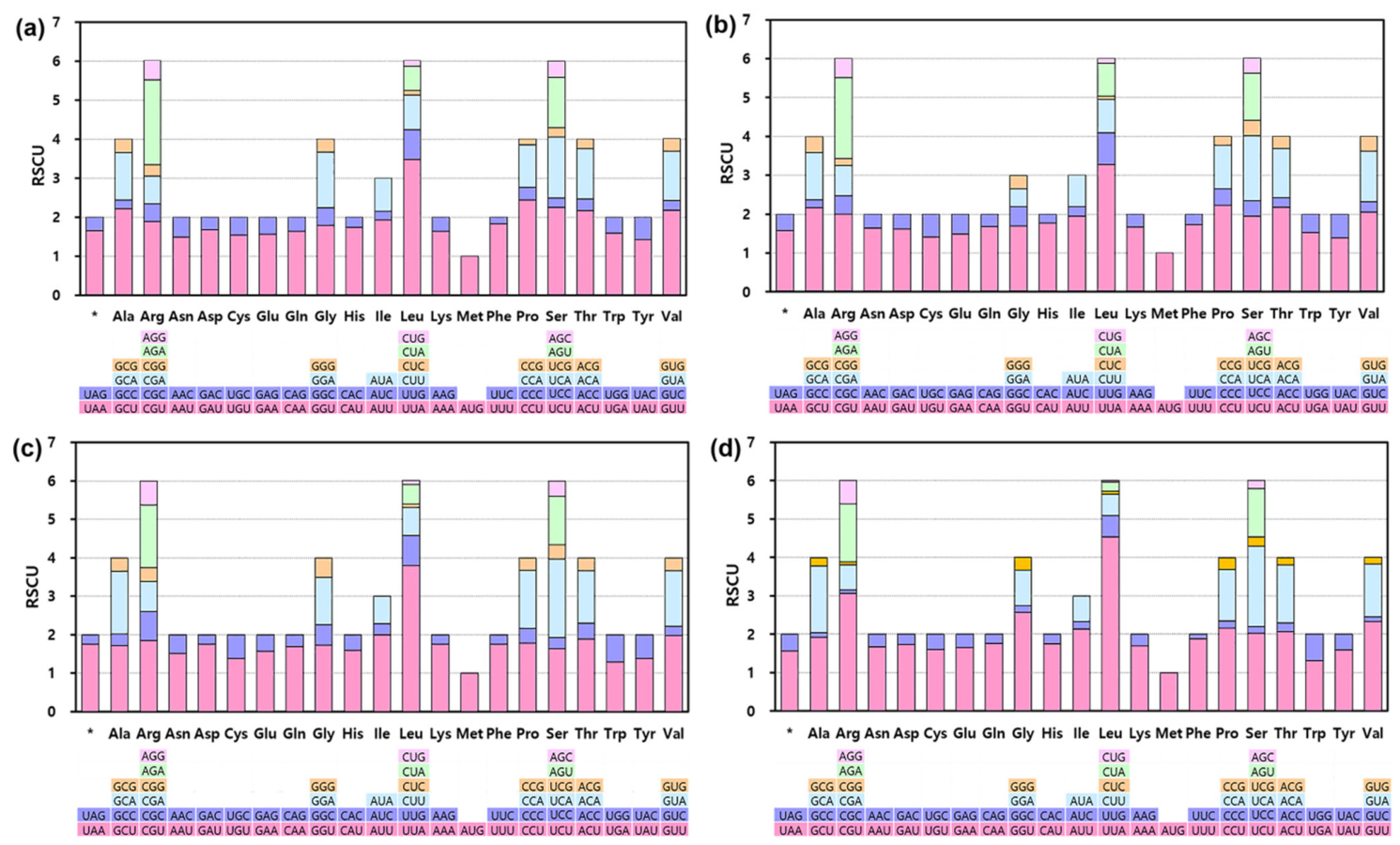
Analysis of the mitogenome of R. intricata revealed only one gene overlap, consisting of a single base pair between the rps3 and rpl16 genes. All other genes were separated by intergenic spacer regions ranging from 1 to 597 bp. In total, these spacers covered 2395 bp, accounting for 9.1% of the mitogenome. The longest spacer (597 bp) was located between nad4 and nad5 (Table 2). RSCU analysis of the mitochondrial PCGs was performed and compared with three other Rhodymeniales species (Figure 3). The PCGs encoded 5798 amino acids. Leucine was the most abundant (853 residues; 14.7%), followed by isoleucine (10.9%), phenylalanine (9.7%), serine (8.9%), and valine (5.9%). A clear codon usage bias was observed. The codon UUA (leucine) was the most frequently used (493 occurrences) and had the highest RSCU value (3.47), indicating strong preference. AUG (methionine) showed an RSCU value of 1, suggesting no bias. Overall, 29 codons had RSCU values above one (preferred), while 34 had values below one, indicating lower usage.
Figure 3.
Relative synonymous codon usage (RSCU) patterns of mitochondrial PCGs across four Rhodymeniales species: (a) Rhodymenia intricata, (b) Rhodymenia pseudopalmata, (c) Fushitsunagia catenata, and (d) Coeloseira compressa. Note: * indicate stop codon.
3.3. Protein Coding Genes
The mitogenome of R. intricata contains 25 PCGs covering 18,069 bp, which represents 68.9% of the total genome. The overall AT content of these genes is 71.3% (Table 3). Table 4 summarizes the base skew values and nucleotide composition for all genes. Among the PCGs, nad5 is the longest gene (1986 bp), and rpl20 is the shortest (228 bp). All genes show a strong A + T bias, with AT content ranging from 64.5% (atp9) to 77.3% (atp4). Strand asymmetry analysis showed that most genes have negative AT-skew values, indicating more thymine than adenine. However, four genes (rpl16, rps11, rps12, and rpl20) showed positive AT-skew. For GC-skew, most genes were positive, while eleven genes (rps3, rpl16, atp4, sdh2, sdh3, rps11, atp8, atp6, orf148, tatC, and rps12) had negative values (Table 4). Comparison with other Rhodymeniales species shows that most possess 24–26 PCGs, indicating strong conservation of mitochondrial gene content (Table 5). ATG was the most common start codon and TAA the most frequent stop codon. Exceptions included cox2, rps11, and tatC (TTG start codon) and cox2, sdh2, nad4, and nad5 (TAG stop codon). The mitogenome also contains one ORF gene (orf148).
Table 4.
Nucleotide composition and skews of protein-coding genes in the mitogenome of Rhodymenia intricata.
Table 5.
Features of mitochondrial protein-coding genes in four Rhodymeniales species.
3.4. Transfer and Ribosomal RNA Genes
Most mitogenomes of Rhodymeniales contain two rRNA genes forming the typical rRNA operon (Table 1). In contrast, the mitogenome of R. intricata contains three rRNA genes (Table 2; Figure 2). Two genes, rnl (2654 bp) and rns (1388 bp), are located on the H-strand, while rns5 (107 bp) is found on the L-strand. Together, these rRNA genes span 4149 bp, accounting for 15.8% of the mitogenome. The rnl and rns genes are separated by nad4 L, and rns5 is positioned between rps11 and nad3. A total of 21 tRNA (Table 2) genes were identified, covering 1600 bp (6.1% of the genome). Their lengths range from 72 bp (trnD, trnG, trnW) to 94 bp (trnS). No introns were detected, and trnI was not found in the mitogenome. Anticodon analysis showed standard codon–anticodon pairing patterns, similar to other Rhodymeniales species. Three tRNA genes (trnG, trnL, and trnS) each had two different anticodons, whereas methionine had only one. This pattern suggests some redundancy and flexibility in mitochondrial codon recognition in R. intricata.
3.5. Phylogeny
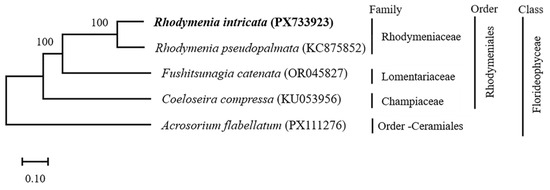
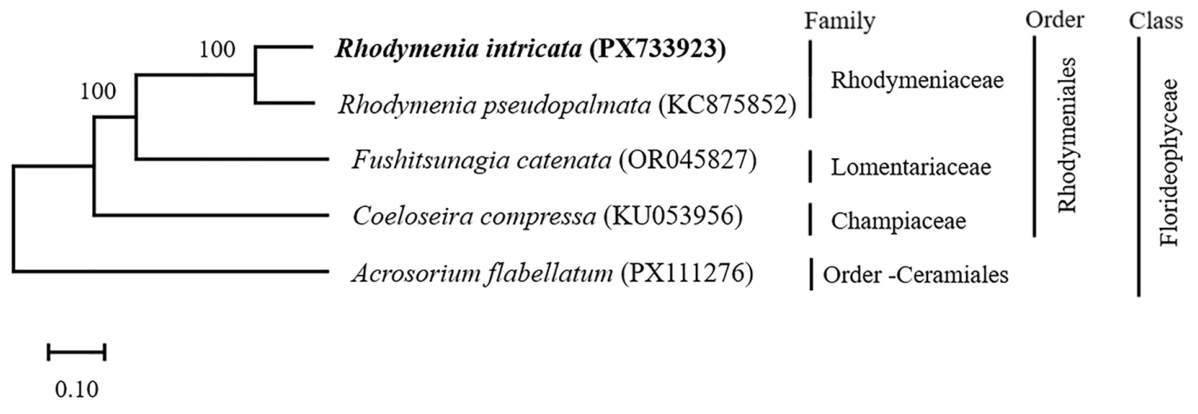
An ML phylogenetic tree was constructed using a concatenated dataset of 23 conserved PCGs. The phylogenetic tree was rooted using A. flabellatum as the outgroup (Figure 4). The resulting topology clearly resolved the evolutionary relationships among the sampled Rhodymeniales taxa and showed strong statistical support at most nodes. The two species, R. intricata and R. pseudopalmata, clustered together with high bootstrap support, confirming their close relationship within the family Rhodymeniaceae. In contrast, F. catenata and C. compressa formed separate and well-defined branches, consistent with their classification in different families. The key nodes showed bootstrap values of 100%, indicating very strong confidence in the inferred relationships. The newly generated mitogenome sequence in this study was clearly positioned within the Rhodymeniales clade, supporting its taxonomic placement. Overall, the phylogenetic tree agrees with current family-level classifications and demonstrates that concatenated mitochondrial PCGs provide reliable markers for resolving evolutionary relationships within Rhodymeniales.
Figure 4.
ML phylogenetic tree of the order Rhodymeniales constructed from a concatenated alignment of 23 conserved PCGs. The tree was rooted with Acrosorium flabellatum (PX111276) as the outgroup. Bootstrap support values (%) are shown at each node. Tree visualized using iTOL. Newly generated sequence from this study is indicated in bold. GenBank accession numbers are provided in parentheses following the species names.
4. Discussion
The mitogenome of R. intricata shows many features typical of Rhodymeniales. It has a circular structure, biased AT composition, positive AT and GC skews, and a compact organization. We did not compare total gene counts with C. compressa (KU053956) because only a partial mitogenome sequence is available for this species [31]. The genome size of R. intricata (26,213 bp) is slightly larger than most other Rhodymeniales mitogenomes (Table 1). The observed increase is primarily due to the presence of the rpl20 gene, an additional orf148 gene (Table 2), and the overall greater cumulative length of PCGs (Table 3).
The positive AT and GC skew values indicate strand-specific nucleotide preferences, a pattern also reported in other Rhodymeniales species [12,30,31]. Such compositional asymmetry reflects lineage-specific evolutionary pressures acting on mitogenomes. Intergenic regions in R. intricata occupy only a small portion of the genome and include a single gene overlap and short intergenic spacers (Table 2). The complete absence of introns in the R. intricata mitogenome reflects mitochondrial genome streamlining, a characteristic feature of many Florideophyceae that likely results from ancestral intron loss and/or reduced intron invasion. This compact gene arrangement aligns with patterns observed in other red algal mitogenomes, where genome expansion typically arises through gene duplication or intron insertion rather than the accumulation of large non-coding regions [8,9,32]. Codon usage analysis revealed a bias toward specific amino acids, particularly leucine and isoleucine, and a clear preference for ATG as the start codon and TAA as the stop codon (Figure 3; Table 5). Similar codon usage patterns have been reported in other Rhodymeniales mitogenomes, suggesting that translational selection plays an important role in shaping codon composition in this group [12,30]. Overall, the PCG content of R. intricata is largely conserved within Rhodymeniales, but some lineage-specific differences are evident.
One notable feature is the presence of the rpl20 gene and an additional ORF (orf148), which are absent in R. pseudopalmata and F. catenata (Table 5) [12,30]. Gain and loss of genes such as rpl20, tatC, and sdh have been documented in other red algal lineages, reflecting the dynamic nature of mitogenome evolution [9,33]. These lineage-specific changes may result from functional shifts, gene transfer to the nucleus, or mitochondrial–nuclear coevolution [9,34]. Despite these differences, the overall PCG composition and nucleotide bias patterns remain highly conserved across Rhodymeniales (Table 3), highlighting strong evolutionary constraints on mitochondrial function.
The origin of orf148 may represent a relatively recent genomic finding. Novel mitochondrial ORFs can arise through several mechanisms, including local sequence rearrangements, duplication followed by sequence divergence, or accumulation of mutations within previously non-coding regions that create a new uninterrupted open reading frame [35,36]. In compact mitochondrial genomes, where intergenic regions are often limited, the emergence of a novel ORF may result from the modification or repurposing of pre-existing genomic sequences [37]. At present, however, there is insufficient evidence to determine whether orf148 represents a functional protein-coding gene or a non-functional ORF. In particular, the absence of experimental evidence for transcription, translation, or a conserved protein domain prevents assignment of a specific biological function [38]. Comparative analysis of related red algal mitochondrial genomes may therefore be useful for determining whether orf148 is lineage-specific or represents a more widely conserved feature [39].
The identification of TTG as the predicted start codon for cox2, rps11, and tatC in R. intricata provides an interesting feature of its compact mitogenome. Although AUG is the canonical translation-initiation codon, alternative initiation codons such as UUG (TTG in the DNA sequence) can be recognized by translation systems of bacterial and organellar origin [40,41,42]. Thus, these TTG sites may represent functional alternative initiation codons rather than annotation errors [42]. Their occurrence in three mitochondrial genes suggests that the mitochondrial translation machinery of R. intricata may tolerate some flexibility in start-codon recognition. Such flexibility could reflect the evolutionary history of mitochondria and the retention of bacterial-type translational features despite extensive genome reduction [43].
The rRNA and tRNA gene complement of R. intricata is also generally conserved. Its mitogenome contains three rRNA genes (rns, rnl, and rns5), whereas R. pseudopalmata, F. catenata and C. compressa lack the rns5 gene [12,30,31]. The presence of 21 tRNA genes in R. intricata is similar to R. pseudopalmata, but slightly fewer than the 19 tRNAs reported for C. compressa, and slightly lower than the 23 tRNAs reported for F. catenata (Table 1). In Rhodymeniales, the number of tRNAs typically ranges from 18 to 23 [9,12,44]. Interestingly, the trnI gene is absent in R. intricata, F. catenata, and C. compressa, but present in R. pseudopalmata [12,30,31]. Previous studies have shown that reanalysis of red algal mitogenomes with updated sequencing and annotation tools sometimes reveals genes previously considered lost [9], suggesting that careful reannotation remains important.
The presence of the rns5 gene is another notable feature of the R. intricata mitochondrial genome. The rns5 gene encodes a component of the small subunit of the mitochondrial ribosome and is therefore associated with the machinery required for mitochondrial protein synthesis [45,46]. The presence of rns5 in R. intricata appears to represent a lineage-specific feature rather than a universally conserved characteristic across Rhodophyta [6,8].
The absence of the mitochondrial trnI gene in R. intricata is notable because isoleucine represents approximately 10.9% of the amino acid composition of its mitochondrial PCGs. The relatively high requirement for isoleucine suggests that its incorporation during mitochondrial protein synthesis must nevertheless be efficiently maintained. One possible mechanism is the import of nuclear-encoded tRNAs into mitochondria [47,48]. In several eukaryotic organisms, loss of mitochondrial tRNA genes has been compensated by the import of corresponding tRNAs synthesized from nuclear genes [42,49]. Thus, nuclear-encoded isoleucine tRNA import may potentially compensate for the loss of mitochondrial trnI in R. intricata [50]. However, this hypothesis cannot be confirmed from the mitogenome sequence alone. The possibility of an unrecognized divergent mitochondrial tRNA or other lineage-specific mechanisms of tRNA recognition also cannot be excluded. Comparative nuclear genomic and transcriptomic analyses, together with direct characterization of mitochondrial tRNAs, will be required to determine how isoleucine decoding is maintained in R. intricata [49].
Although anticodon usage is generally conserved, the presence of multiple anticodon variants for certain tRNAs (trnG, trnL, and trnS) indicates functional redundancy and flexibility in codon recognition. Similar patterns have been reported in other Rhodymeniales species, where anticodon diversity may improve translational efficiency and adaptability [9]. Variation in tRNA gene number and anticodon composition likely reflects lineage-specific fine-tuning of mitochondrial translation.
Phylogenetic analysis further clarifies the evolutionary placement of R. intricata. The topology recovered here is consistent with previous mitochondrial-based reconstructions [12]. Rhodymeniales formed a strongly supported monophyletic group, resolving into three main families: Rhodymeniaceae, Lomentariaceae, and Champiaceae. R. intricata clustered with its congeneric species R. pseudopalmata with high bootstrap support, confirming its taxonomic placement within Rhodymeniaceae. Lomentariaceae appeared as the earliest diverging lineage, followed by Champiaceae, indicating an early split among these families. This pattern agrees with earlier mitochondrial and multigene phylogenies [11,31].
Overall, the mitogenome of R. intricata combines conserved features typical of Rhodymeniales with lineage-specific gene content variation. The presence of additional genes and ORFs, together with consistent phylogenetic placement, highlights the dynamic yet structured evolution of mitogenomes in this order.
5. Limitations and Future Perspectives
This study provides key insights into the mitogenome of R. intricata, but several limitations remain. The mitogenome was assembled from a single specimen, so features such as the absence of trnI, TTG start codons, presence of rns5, and orf148 may not capture intraspecific variation. Environmental influences and functional validation were not assessed, and the findings rely primarily on in silico analyses. Future work is needed to include transcriptomic/proteomic validation, nuclear and chloroplast genome sequencing, and population-level sampling across diverse regions to clarify organellar variation, ecological adaptation, and evolutionary patterns within Rhodymeniales.
6. Conclusions
In this study, the complete mitogenome of R. intricata was successfully sequenced, assembled, and analyzed, providing new genomic information for the order Rhodymeniales. The mitogenome is a circular DNA molecule of 26,213 bp and contains 49 genes, including 25 PCGs, 21 tRNAs, and 3 rRNAs. The genome shows a strong A + T bias, positive AT and GC skews, and a compact organization, which are characteristic features of red algal mitogenomes. Comparative analysis with other Rhodymeniales species revealed that the overall gene content and genome organization of R. intricata are largely conserved. However, several lineage-specific features were identified, including the presence of the rpl20 gene, an additional ORF (orf148), and three rRNA genes (rnl, rns, and rns5). The absence of the trnI gene and the presence of multiple anticodon variants in some tRNAs further highlight the dynamic nature of mitogenome evolution within this group. Codon usage analysis showed a clear preference for certain amino acids, particularly leucine and isoleucine, as well as dominant start and stop codons (ATG and TAA), reflecting translational selection in the mitogenome. Phylogenetic analysis based on concatenated mitochondrial PCGs provides strong support for the monophyly of Rhodymeniales and clearly resolved relationships within its major families. R. intricata clustered closely with its congeneric species R. pseudopalmata, confirming its taxonomic position within the family Rhodymeniaceae. The topology obtained in this study is consistent with previous mitochondrial and multigene phylogenetic studies.
Overall, the mitogenome of R. intricata expands the currently available mitogenomic resources for Rhodymeniales and provides valuable insights into genome organization, gene evolution, and phylogenetic relationships within this group of red algae. These findings contribute to a better understanding of mitogenome evolution in Rhodophyta and provide a useful reference for future comparative and evolutionary studies of red algal mitogenomes.
Author Contributions
M.P.P., J.-O.K. and K.K. conceptualized and designed the study and contributed to manuscript writing. M.P.P., J.-O.K. and K.K. were responsible for conducting the experiments and analyzing the data. Y.J.P., J.W.C., S.-I.K., G.B.P. and R.E.M. were also involved in data analysis. M.P.P., Y.J.P., J.W.C., S.-I.K., G.B.P. and R.E.M. managed visualization, and data curation. M.P.P. wrote the original draft. K.L. handled sample collection, identification, and deposition. J.-O.K. and K.K. oversaw the interpretation of experimental data, critical revisions of the manuscript, funding acquisition, and final approval of the version for publication. All authors have read and agreed to the published version of the manuscript.
Funding
This research was supported by the Global—Learning and Academic research institution for Master’s, PhD students, and Postdocs (LAMP) Program of the National Research Foundation of Korea (NRF) grant funded by the Ministry of Education (No. RS-2023-00301702) and Global Joint Research Program funded by Pukyong National University (Project No.: 202607180001).
Institutional Review Board Statement
Not applicable.
Informed Consent Statement
Not applicable.
Data Availability Statement
The genome sequence data that support the findings of this study are openly available in GenBank of NCBI at (https://www.ncbi.nlm.nih.gov/, accessed on 20 August 2026) under accession number PX733923. The associated BioProject, Bio-Sample and SRA numbers were PRJNA1390879, SAMN54208080, and SRR36514420, respectively.
Acknowledgments
During the preparation of this work the author(s) used ChatGPT and QuillBot on a limited basis to improve the readability and language of the manuscript. After using this tool/service, the author(s) reviewed and edited the content as needed and take(s) full responsibility for the content of the article.
Conflicts of Interest
Author Kwangsup Lee was employed by the company Marine Eco-Technology Institute. The remaining authors declare that the research was conducted in the absence of any commercial or financial relationships that could be construed as a potential conflict of interest.
References
- Yoon, H.S.; Hackett, J.D.; Ciniglia, C.; Pinto, G.; Bhattacharya, D. A molecular timeline for the origin of photosynthetic eukaryotes. Mol. Biol. Evol. 2004, 21, 809–818. [Google Scholar] [CrossRef] [Scilit] [PubMed]
- Burger, G.; Nedelcu, A.M. Mitochondrial Genomes of Algae. In Genomics of Chloroplasts and Mitochondria; Springer: Dordrecht, The Netherlands, 2012; pp. 127–157. [Google Scholar] [CrossRef] [Scilit]
- Saunders, G.W.; Hommersand, M.H. Assessing red algal supraordinal diversity and taxonomy in the context of contemporary systematic data. Am. J. Bot. 2004, 91, 1494–1507. [Google Scholar] [CrossRef] [Scilit] [PubMed]
- Le Gall, L.; Saunders, G.W. A nuclear phylogeny of the Florideophyceae (Rhodophyta) inferred from combined EF2, small subunit and large subunit ribosomal DNA: Establishing the new red algal subclass Corallinophycidae. Mol. Phylogenetics Evol. 2007, 43, 1118–1130. [Google Scholar] [CrossRef] [Scilit] [PubMed]
- Guiry, M.D.; Guiry, G.M. AlgaeBase. World-Wide Electronic Publication, National University of Ireland, Galway. 2026. Available online: https://www.algaebase.org/ (accessed on 1 June 2024).
- Patil, M.P.; Kim, J.O.; Kim, K.; Kim, Y.R.; Yoon, S. Complete mitochondrial genome and phylogenetic analysis of the marine red alga Polyopes affinis (Rhodophyta: Halymeniales). Mitochondrial DNA Part B 2022, 7, 1387–1388. [Google Scholar] [CrossRef] [Scilit] [PubMed]
- Yang, E.C.; Kim, K.M.; Kim, S.Y.; Lee, J.; Boo, G.H.; Lee, J.H.; Nelson, W.A.; Yi, G.; Schmidt, W.E.; Fredericq, S.; et al. Highly conserved mitochondrial genomes among multicellular red algae of the Florideophyceae. Genome Biol. Evol. 2015, 7, 2394–2406. [Google Scholar] [CrossRef] [Scilit] [PubMed]
- Patil, M.P.; Kim, J.O.; Kim, Y.R.; Yoon, S.; Kim, K. Complete mitogenome sequencing, annotation, and phylogeny of Grateloupia turuturu, a red alga with intronic cox1 gene. Life 2023, 13, 1642. [Google Scholar] [CrossRef] [Scilit] [PubMed]
- Salomaki, E.D.; Lane, C.E. Red algal mitochondrial genomes are more complete than previously reported. Genome Biol. Evol. 2017, 9, 48–63. [Google Scholar] [CrossRef] [Scilit] [PubMed][Green Version]
- Lee, Y.; Cho, C.H.; Noh, C.; Yang, J.H.; Park, S.I.; Lee, Y.M.; West, J.A.; Bhattacharya, D.; Jo, K.; Yoon, H.S. Origin of minicircular mitochondrial genomes in red algae. Nat. Commun. 2023, 14, 3363. [Google Scholar] [CrossRef] [Scilit] [PubMed]
- Filloramo, G.V.; Saunders, G.W. Application of multigene phylogenetics and site-stripping to resolve intraordinal relationships in the Rhodymeniales (Rhodophyta). J. Phycol. 2016, 52, 339–355. [Google Scholar] [CrossRef] [Scilit] [PubMed]
- Patil, M.P.; Oktavitri, N.I.; Kim, Y.R.; Yoon, S.; Lee, I.C.; Kim, J.O.; Kim, K. Complete mitochondrial genome and its phylogenetic position in red algae Fushitsunagia catenata from South Korea. Life 2024, 14, 534. [Google Scholar] [CrossRef] [Scilit] [PubMed]
- Qiu, H.; Price, D.C.; Yang, E.C.; Yoon, H.S.; Bhattacharya, D. Evidence of ancient genome reduction in red algae (Rhodophyta). J. Phycol. 2015, 51, 624–636. [Google Scholar] [CrossRef] [Scilit] [PubMed]
- Bolger, A.M.; Lohse, M.; Usadel, B. Trimmomatic: A flexible trimmer for Illumina sequence data. Bioinformatics 2014, 30, 2114–2120. [Google Scholar] [CrossRef] [Scilit] [PubMed]
- Andrews, S. FastQC: A Quality Control Tool for High Throughput Sequence Data; Babraham Institute: Cambridge, UK, 2010; Available online: https://www.bioinformatics.babraham.ac.uk/ (accessed on 21 August 2026).
- Bankevich, A.; Nurk, S.; Antipov, D.; Gurevich, A.A.; Dvorkin, M.; Kulikov, A.S.; Lesin, V.M.; Nikolenko, S.I.; Pham, S.; Prjibelski, A.D.; et al. SPAdes: A new genome assembly algorithm and its applications to single-cell sequencing. J. Comput. Biol. 2012, 19, 455–477. [Google Scholar] [CrossRef] [Scilit] [PubMed]
- Beck, N.; Lang, B. MFannot, Organelle Genome Annotation Webserver; Université de Montréal: Montreal, QC, Canada, 2010; Available online: https://megasun.bch.umontreal.ca/cgi-bin/dev_mfa/mfannotInterface.pl (accessed on 21 August 2026).
- Gish, W.; States, D.J. Identification of protein coding regions by database similarity search. Nat. Genet. 1993, 3, 266–272. [Google Scholar] [CrossRef] [Scilit] [PubMed]
- Lagesen, K.; Hallin, P.; Rødland, E.A.; Stærfeldt, H.H.; Rognes, T.; Ussery, D.W. RNAmmer: Consistent and rapid annotation of ribosomal RNA genes. Nucleic Acids Res. 2007, 35, 3100–3108. [Google Scholar] [CrossRef] [Scilit] [PubMed]
- Chan, P.P.; Lowe, T.M. tRNAscan-SE: Searching for tRNA Genes in Genomic Sequences. In Gene Prediction: Methods in Molecular Biology; Springer: New York, NY, USA, 2019; pp. 1–14. [Google Scholar] [CrossRef] [Scilit] [PubMed]
- Lang, B.F.; Laforest, M.J.; Burger, G. Mitochondrial introns: A critical view. Trends Genet. 2007, 23, 119–125. [Google Scholar] [CrossRef] [Scilit] [PubMed]
- Benson, G. Tandem repeats finder: A program to analyze DNA sequences. Nucleic Acids Res. 1999, 27, 573–580. [Google Scholar] [CrossRef] [Scilit] [PubMed]
- Greiner, S.; Lehwark, P.; Bock, R. OrganellarGenomeDRAW (OGDRAW) version 1.3. 1: Expanded toolkit for the graphical visualization of organellar genomes. Nucleic Acids Res. 2019, 47, W59–W64. [Google Scholar] [CrossRef] [Scilit] [PubMed]
- Tamura, K.; Stecher, G.; Kumar, S. MEGA11: Molecular evolutionary genetics analysis version 11. Mol. Biol. Evol. 2021, 38, 3022–3027. [Google Scholar] [CrossRef] [Scilit] [PubMed]
- Perna, N.T.; Kocher, T.D. Patterns of nucleotide composition at fourfold degenerate sites of animal mitochondrial genomes. J. Mol. Evol. 1995, 41, 353–358. [Google Scholar] [CrossRef] [Scilit] [PubMed]
- Katoh, K.; Rozewicki, J.; Yamada, K.D. MAFFT online service: Multiple sequence alignment, interactive sequence choice and visualization. Brief. Bioinform. 2019, 20, 1160–1166. [Google Scholar] [CrossRef] [Scilit] [PubMed]
- Kalyaanamoorthy, S.; Minh, B.Q.; Wong, T.K.; Von Haeseler, A.; Jermiin, L.S. ModelFinder: Fast model selection for accurate phylogenetic estimates. Nat. Methods 2017, 14, 587–589. [Google Scholar] [CrossRef] [Scilit] [PubMed]
- Trifinopoulos, J.; Nguyen, L.T.; von Haeseler, A.; Minh, B.Q. W-IQ-TREE: A fast online phylogenetic tool for maximum likelihood analysis. Nucleic Acids Res. 2016, 44, W232–W235. [Google Scholar] [CrossRef] [Scilit] [PubMed]
- Letunic, I.; Bork, P. Interactive Tree of Life (iTOL) v6: Recent updates to the phylogenetic tree display and annotation tool. Nucleic Acids Res. 2024, 52, W78–W82. [Google Scholar] [CrossRef] [Scilit] [PubMed]
- Kim, K.M.; Yang, E.C.; Yi, G.; Yoon, H.S. Complete mitochondrial genome of sublittoral macroalga Rhodymenia pseudopalmata (Rhodymeniales, Rhodophyta). Mitochondrial DNA 2014, 25, 273–274. [Google Scholar] [CrossRef] [Scilit] [PubMed]
- Kilpatrick, Z.M.; Hughey, J.R. Mitochondrial and plastid genome analysis of the marine red alga Coeloseira compressa (Champiaceae, Rhodophyta). Mitochondrial DNA Part B 2016, 1, 456–458. [Google Scholar] [CrossRef] [Scilit] [PubMed]
- Burger, G.; Saint-Louis, D.; Gray, M.W.; Lang, B.F. Complete sequence of the mitochondrial DNA of the red alga Porphyra purpurea: Cyanobacterial introns and shared ancestry of red and green algae. Plant Cell 1999, 11, 1675–1694. [Google Scholar] [CrossRef] [Scilit] [PubMed]
- Tamayo, D.A.; Hughey, J.R. Organellar genome analysis of the marine red alga Dasya binghamiae (Dasyaceae, Rhodophyta) reveals an uncharacteristic florideophyte mitogenome structure. Mitochondrial DNA Part B 2016, 1, 510–511. [Google Scholar] [CrossRef] [Scilit] [PubMed]
- Seo, M.H.; Kang, S.C.; Kim, K.M.; Kwak, M.S.; Jo, J.; Choi, H.G.; Boo, G.H.; Yoon, H.S. Novel rearrangements in the mitochondrial genomes of the Ceramiales (Rhodophyta) and evolutionary implications. Algae 2023, 38, 253–264. [Google Scholar] [CrossRef] [Scilit]
- Zhang, N.; Li, Y.; Halanych, K.M.; Kong, L.; Li, Q. A comparative analysis of mitochondrial ORFs provides new insights on expansion of mitochondrial genome size in Arcidae. BMC Genom. 2022, 23, 809. [Google Scholar] [CrossRef] [Scilit] [PubMed]
- Selifanova, M.; Demianchenko, O.; Noskova, E.; Pitikov, E.; Skvortsov, D.; Drozd, J.; Vatolkina, N.; Apel, P.; Kolodyazhnaya, E.; Ezhova, M.A.; et al. ORFans in mitochondrial genomes of marine polychaete Polydora. Genome Biol. Evol. 2023, 15, evad219. [Google Scholar] [CrossRef] [Scilit] [PubMed]
- Guerra, D.; Lopes-Lima, M.; Froufe, E.; Gan, H.M.; Ondina, P.; Amaro, R.; Klunzinger, M.W.; Callil, C.; Prié, V.; Bogan, A.E.; et al. Variability of mitochondrial ORFans hints at possible differences in the system of doubly uniparental inheritance of mitochondria among families of freshwater mussels (Bivalvia: Unionida). BMC Evol. Biol. 2019, 19, 229. [Google Scholar] [CrossRef] [Scilit] [PubMed]
- Schultz, D.T.; Eizenga, J.M.; Corbett-Detig, R.B.; Francis, W.R.; Christianson, L.M.; Haddock, S.H. Conserved novel ORFs in the mitochondrial genome of the ctenophore Beroe forskalii. PeerJ 2020, 8, e8356. [Google Scholar] [CrossRef] [Scilit] [PubMed]
- Pereira, K.D.; Tamborlin, L.; Meneguello, L.; de Proença, A.R.G.; Almeida, I.C.D.P.A.; Lourenco, R.F.; Luchessi, A.D. Alternative start codon connects eIF5A to mitochondria. J. Cell. Physiol. 2016, 231, 2682–2689. [Google Scholar] [CrossRef] [Scilit] [PubMed]
- Okimoto, R.; Macfarlane, J.L.; Wolstenholme, D.R. Evidence for the frequent use of TTG as the translation initiation codon of mitochondrial protein genes in the nematodes, Ascaris suum and Caenorhabditis elegans. Nucleic Acids Res. 1990, 18, 6113–6118. [Google Scholar] [CrossRef] [Scilit] [PubMed]
- Golderer, G.; Dlaska, M.; Gröbner, P.; Piendl, W. TTG serves as an initiation codon for the ribosomal protein MvaS7 from the archaeon Methanococcus vannielii. J. Bacteriol. 1995, 177, 5994–5996. [Google Scholar] [CrossRef] [Scilit] [PubMed][Green Version]
- Quek, Z.B.R.; Chang, J.J.M.; Ip, Y.C.A.; Chan, Y.K.S.; Huang, D. Mitogenomes reveal alternative initiation codons and lineage-specific gene order conservation in echinoderms. Mol. Biol. Evol. 2021, 38, 981–985. [Google Scholar] [CrossRef] [Scilit] [PubMed]
- Donath, A.; Jühling, F.; Al-Arab, M.; Bernhart, S.H.; Reinhardt, F.; Stadler, P.F.; Donath, A.; Jühling, F.; Al-Arab, M.; Bernhart, S.H.; et al. Improved annotation of protein-coding genes boundaries in metazoan mitochondrial genomes. Nucleic Acids Res. 2019, 47, 10543–10552. [Google Scholar] [CrossRef] [Scilit] [PubMed]
- Hughey, J.R.; Miller, K.A. Genetic investigation of three type specimens of Osmundea (Rhodomelaceae, Rhodophyta) from the Gulf of California, Mexico and California, USA. Phytotaxa 2021, 489, 65–78. [Google Scholar] [CrossRef] [Scilit]
- Szymanski, M.; Barciszewska, M.Z.; Erdmann, V.A.; Barciszewski, J. 5S ribosomal RNA database. Nucleic Acids Res. 2002, 30, 176–178. [Google Scholar] [CrossRef] [Scilit] [PubMed]
- Valach, M.; Burger, G.; Gray, M.W.; Lang, B.F. Widespread occurrence of organelle genome-encoded 5S rRNAs including permuted molecules. Nucleic Acids Res. 2014, 42, 13764–13777. [Google Scholar] [CrossRef] [Scilit] [PubMed]
- Schneider, A. Mitochondrial tRNA import and its consequences for mitochondrial translation. Annu. Rev. Biochem. 2011, 80, 1033–1053. [Google Scholar] [CrossRef] [Scilit] [PubMed]
- Salinas-Giegé, T.; Giegé, R.; Giegé, P. tRNA biology in mitochondria. Int. J. Mol. Sci. 2015, 16, 4518–4559. [Google Scholar] [CrossRef] [Scilit] [PubMed]
- Kolesnikova, O.A.; Entelis, N.S.; Jacquin-Becker, C.; Goltzene, F.; Chrzanowska-Lightowlers, Z.M.; Lightowlers, R.N.; Martin, R.P.; Tarassov, I. Nuclear DNA-encoded tRNAs targeted into mitochondria can rescue a mitochondrial DNA mutation associated with the MERRF syndrome in cultured human cells. Hum. Mol. Genet. 2004, 13, 2519–2534. [Google Scholar] [CrossRef] [Scilit] [PubMed]
- Jühling, F.; Pütz, J.; Bernt, M.; Donath, A.; Middendorf, M.; Florentz, C.; Stadler, P.F. Improved systematic tRNA gene annotation allows new insights into the evolution of mitochondrial tRNA structures and into the mechanisms of mitochondrial genome rearrangements. Nucleic Acids Res. 2012, 40, 2833–2845. [Google Scholar] [CrossRef] [Scilit] [PubMed]

Disclaimer/Publisher’s Note: The statements, opinions and data contained in all publications are solely those of the individual author(s) and contributor(s) and not of MDPI and/or the editor(s). MDPI and/or the editor(s) disclaim responsibility for any injury to people or property resulting from any ideas, methods, instructions or products referred to in the content. |
© 2026 by the authors. Licensee MDPI, Basel, Switzerland. This article is an open access article distributed under the terms and conditions of the Creative Commons Attribution (CC BY) license.