Mitochondrial and Nuclear Markers Reveal Contrasting Patterns of Genetic Diversity in the Red Palm Weevil (Rhynchophorus ferrugineus) from Qassim Province, Saudi Arabia

 ,
,  ,
,  and
and 
Abstract
1. Introduction
2. Materials and Methods
2.1. Collection of Rhynchophorus ferrugineus Specimens
2.2. DNA Extraction
2.3. Molecular Markers and Rationale for Selection
2.3.1. PCR Amplification
- ITS2-F: 5′-ATATGCTTAAATTCAGCGG-3′;
- ITS2-R: 5′-GGGTCGATGAAGAACGCAGC-3′ [7].
- A total of 25 µL of 2× GoTaq Green Master Mix (Promega);
- A total of 20 pM of each forward and reverse primer;
- Approximately 40 ng of genomic DNA template;
- Nuclease-free water to complete final volume.
- Initial denaturation at 94 °C for 5 min to ensure complete DNA strand separation.
- 35 amplification cycles consisting of:
- ○
- Denaturation at 94 °C for 30 s;
- ○
- Primer annealing at 50 °C for 30 s;
- ○
- Extension at 72 °C for 30 s.
- Final extension at 72 °C for 7 min to complete DNA synthesis.
2.3.2. DNA Sequencing and Sequence Processing
2.3.3. Sequence Alignment and Phylogenetic Reconstruction
2.3.4. Sequence Submission to Genbank and Data Availability
2.3.5. Sequence Variation and Genetic Diversity Analysis
3. Results
3.1. Genetic Variation in Rhynchophorus Ferrugineus Populations
3.1.1. COI-Based Genetic Variation Among Qassim Specimens
3.1.2. Mitochondrial COI-Based Phylogenetic Relationships and Genetic Structure of R. ferrugineus Specimens
3.1.3. ITS-Based Genetic Variation Among Qassim Specimens
3.1.4. Comparative Analysis of Local and Global COI Haplotypes
3.1.5. Comparative Analysis of ITS Sequence Variation Among Qassim and R. ferrugineus Reference Populations
3.1.6. Comparative ITS Relationships Between Qassim R. ferrugineus Haplotypes and Related Rhynchophorus Species
3.2. Comparative Evaluation of COI and ITS Datasets
3.3. Phylogenetic Relationships and Clustering Patterns of Qassim R. ferrugineus Haplotypes
3.4. Contrasting Mitochondrial and Nuclear Patterns of Genetic Diversity Within a Global Phylogenetic Framework
4. Discussion
4.1. Comparative Assessment of Mitochondrial and Nuclear Markers in R. ferrugineus Populations from Qassim Province
4.2. Contrasting Genetic Signals Revealed by Mitochondrial and Nuclear Markers
4.3. Phylogenetic Relationships and Regional Genetic Connectivity of R. ferrugineus
4.4. Biological Significance and Implications of Contrasting Mitochondrial and Nuclear Diversity Patterns
5. Conclusions
Supplementary Materials
Author Contributions
Funding
Institutional Review Board Statement
Informed Consent Statement
Data Availability Statement
Acknowledgments
Conflicts of Interest
References
- Abdel-Baky, N.F.; Motawei, M.I.; Al-Nujiban, A.A.S.; Aldeghairi, M.A.; Al-Shuraym, L.A.M.; Alharbi, M.T.M.; Rehan, M. Detection of adaptive genetic diversity and chemical composition in date palm cultivars and their implications in controlling red palm weevil, Rhynchophorus ferrugineus. Braz. J. Biol. 2023, 83, e270940. [Google Scholar] [CrossRef] [Scilit] [PubMed]
- Abdel-Baky, N.F.; Aldeghairi, M.A.; Motawei, M.I.; Al-Shuraym, L.A.; Al-Nujiban, A.A.; Alharbi, M.T.M.; Rehan, M. Genetic diversity of palm weevils, Rhynchophorus spp. (Coleoptera: Curculionidae) by mitochondrial COI gene sequences declares a new species, R. bilineatus, in Qassim, Saudi Arabia. Arab. J. Sci. Eng. 2023, 48, 63–80. [Google Scholar] [CrossRef] [Scilit]
- Abdel-Baky, N.F.; Aldeghairi, M.A.; Motawei, M.I.; Al-Shuraym, L.A.M.; Al-Nujiban, A.A.S.; Alharbi, M.T.M.; Rehan, M. Monitoring infestation percentages of the invasive red palm weevil, Rhynchophorus ferrugineus (Coleoptera: Curculionidae), and management tactics: A six-year study. Braz. J. Biol. 2022, 82, e263707. [Google Scholar] [CrossRef] [Scilit] [PubMed]
- Abdel-Baky, N.F.; Hamed, K.E.; Al-Otaibi, N.D.; Aldeghairi, M.A. Bioassay of some indigenous entomopathogens for controlling Rhynchophorus ferrugineus Olivier in Saudi Arabia. Pak. J. Biol. Sci. 2021, 24, 944–952. [Google Scholar] [CrossRef] [Scilit] [PubMed]
- Abdel-Banat, B.M.A.; El-Shafie, H.A.F. Management of the red palm weevil in date palm plantations in Al-Ahsa Oasis of Saudi Arabia. Plant Health Cases 2023, 16, phcs20230001. [Google Scholar] [CrossRef] [Scilit]
- Al-Ayied, H.Y.; Alswailem, A.M.; Shair, O.; Al Jabr, A.M. Evaluation of phylogenetic relationship between three phenotypically different forms of red date palm weevil Rhynchophorus ferrugineus using RAPD. Arch. Phytopathol. Plant Prot. 2006, 39, 303–309. [Google Scholar] [CrossRef] [Scilit]
- Alshehri, M.A.; Alasmari, A.; Prasannakumar, C.; Panneerselvam, C.; Sayed, S. Haplotype diversity of palm weevil in Saudi Arabia through ITS gene sequencing. J. King Saud. Univ. Sci. 2022, 34, 101893. [Google Scholar] [CrossRef] [Scilit]
- Altschul, S.F.; Gish, W.; Miller, W.; Myers, E.W.; Lipman, D.J. Basic local alignment search tool. J. Mol. Biol. 1990, 215, 403–410. [Google Scholar] [CrossRef] [PubMed]
- Al-Zyoud, F.; Shibli, R.; Ghabeish, I. Current status, challenges, management and future perspectives of the red palm weevil eradication: A review. J. Exp. Biol. Agric. Sci. 2021, 9, 697–714. [Google Scholar] [CrossRef] [Scilit]
- Amor, R.B.; Giménez, E.A.; de Miguel Gómez, M.D. The competitive advantage of the Tunisian palm date sector in the Mediterranean region. Span. J. Agric. Res. 2015, 13, e0101. [Google Scholar] [CrossRef] [Scilit]
- El-Sabea, A.M.R.; Faleiro, J.R.; Abo-El-Saad, M.M. The threat of red palm weevil to date plantations of the Gulf region. Outlook Pest. Manag. 2009, 20, 131–134. [Google Scholar] [CrossRef] [Scilit]
- El-Zoghby, I.R.; Awad, N.S.; Alkhaibari, A.M.; Abdel-Hameid, N.F. Ultrastructure traits and genetic variability of red palm weevil Rhynchophorus ferrugineus (Olivier) adults from different geographical locations in Egypt. Diversity 2022, 14, 404. [Google Scholar] [CrossRef] [Scilit]
- VanWoerkom, A.H.; Aćimović, S.G.; Sundin, G.W.; Cregg, B.M.; Mota-Sanchez, D.; Vandervoort, C.; Wise, J.C. Trunk Injection: An Alternative Technique for Pesticide Delivery in Apples. Crop Prot. 2014, 65, 173–185. [Google Scholar] [CrossRef] [Scilit]
- Ferry, M.; Gomez, S. Assessment of risks and potential of injection techniques in integrated programs to eradicate the red palm weevil: Review and new perspectives. Fruits 2014, 69, 143–157. [Google Scholar] [CrossRef] [Scilit]
- Dembilio, Ó.; Jaques, J.A. Biology and management of red palm weevil. In Sustainable Pest Management in Date Palm: Current Status and Emerging Challenges; Wakil, W., Faleiro, J.R., Miller, T.A., Eds.; Springer International Publishing: Cham, Switzerland, 2015; pp. 13–36. [Google Scholar] [CrossRef] [Scilit]
- El-Mergawy, R.A.A.M.; Al-Ajlan, A.M.; Abdalla, N.A.; Nasr, M.I.; Silvain, J.-F. Genetic comparison among Rhynchophorus ferrugineus and four Rhynchophorus species. J. Agric. Sci. Technol. B 2011, 1, 610–615. [Google Scholar]
- Biedrzycka, A.; Fijarczyk, A.; Kloch, A.; Porth, I.M. Genomic basis of adaptations to new environments in expansive and invasive species. Front. Ecol. Evol. 2022, 10, 974649. [Google Scholar] [CrossRef] [Scilit]
- Bock, D.G.; Caseys, C.; Cousens, R.D.; Hahn, M.A.; Heredia, S.M.; Hübner, S. What we still don’t know about invasion genetics. In Invasion Genetics: The Baker and Stebbins Legacy; Spencer, C.H., Robert, I., Katrina, M., Loren, H., Eds.; John Wiley & Sons: Hoboken, NJ, USA, 2016; pp. 346–370. [Google Scholar] [CrossRef] [Scilit]
- Camacho-Cervantes, M.; Ortega-Iturriaga, A.; Del-Val, E. From effective biocontrol agent to successful invader: Harlequin ladybird invasion. PeerJ 2017, 5, e3296. [Google Scholar] [CrossRef] [Scilit] [PubMed]
- Dong, Z.; Wang, Y.; Li, C.; Li, L.; Men, X. Mitochondrial DNA as a Molecular Marker in Insect Ecology: Current Status and Future Prospects. Ann. Entomol. Soc. Am. 2021, 114, 470–476. [Google Scholar] [CrossRef] [Scilit]
- Rugman-Jones, P.F.; Hoddle, C.D.; Hoddle, M.S.; Stouthamer, R. The lesser of two weevils: Molecular-genetics of pest palm weevil populations confirm Rhynchophorus vulneratus (Panzer 1798) as a valid species distinct from R. ferrugineus (Olivier 1790), and reveal the global extent of both. PLoS ONE 2013, 8, e78379. [Google Scholar] [CrossRef] [Scilit] [PubMed]
- Pérez-Sayas, C.; Pina, T.; Sabater-Muñoz, B.; Gómez-Martínez, M.A.; Jaques, J.A.; Hurtado-Ruiz, M.A. DNA barcoding and phylogeny of Acari species based on ITS and COI markers. J. Zool. Syst. Evol. Res. 2022, 2022, 5317995. [Google Scholar] [CrossRef] [Scilit]
- Wang, A.K.; Li, F.Y.; Wang, D.S.; He, Y.R.; Li, Y.X.; Yan, Z.C. Which molecular marker is better? Comparative analyses of COI and ITS2 in molecular identification of Trichogramma (Hymenoptera: Trichogrammatidae). BioControl 2023, 68, 483–494. [Google Scholar] [CrossRef] [Scilit]
- Zhang, H.; Ning, X.; Yu, X.; Bu, W.J. Integrative species delimitation based on COI, ITS, and morphological evidence illustrates a unique evolutionary history of the genus Paracercion (Odonata: Coenagrionidae). PeerJ 2021, 9, e11459. [Google Scholar] [CrossRef] [Scilit] [PubMed]
- Stern, R.F.; Andersen, R.A.; Jameson, I.; Küpper, F.C.; Coffroth, M.A.; Vaulot, D.; Le Gall, F.; Véron, B.; Brand, J.J.; Skelton, H.; et al. Evaluating the ribosomal internal transcribed spacer (ITS) as a candidate dinoflagellate barcode marker. PLoS ONE 2012, 7, e42780. [Google Scholar] [CrossRef] [Scilit] [PubMed]
- Dentinger, B.T.M.; Didukh, M.Y.; Moncalvo, J.M. Comparing COI and ITS as DNA barcode markers for mushrooms and allies (Agaricomycotina). PLoS ONE 2011, 6, e25081. [Google Scholar] [CrossRef] [Scilit] [PubMed]
- Hazzouri, K.M.; Sudalaimuthuasari, N.; Kundu, B.; Nelson, D.; Al-Deeb, M.A.; Le Mansour, A.; Al-Rumaihi, F.; Al-Khayri, J.M.; Kennedy, J.; Amiri, K.M.; et al. The genome of pest Rhynchophorus ferrugineus reveals gene families important at the plant–beetle interface. Commun. Biol. 2020, 3, 323. [Google Scholar] [CrossRef] [Scilit] [PubMed]
- Lee, S.H.; Kim, Y.H.; Kwon, D.H.; Cha, D.J.; Kim, J.H. Mutation and duplication of arthropod acetylcholinesterase: Implications for pesticide resistance and tolerance. Pestic. Biochem. Physiol. 2015, 120, 118–124. [Google Scholar] [CrossRef] [Scilit] [PubMed]
- Arab News. Saudi Arabia: Red Palm Weevil Management News; Arab News: Riyadh, Saudi Arabia, 2025; Available online: https://www.arabnews.com/node/2607112/amp (accessed on 14 March 2026).
- Gazette, S. Al-Qassim Region Gets Ready for Dates Harvesting from 8 Million Date Palms. 2023. Available online: https://saudigazette.com.sa/article/607189/SAUDI-ARABIA/Al-Qassim-Region-gets-ready-for-dates-harvesting-from-8-million-date-palms (accessed on 14 July 2026).
- Egonyu, J.P.; Anyango, B.; Tanga, C.M.; Subramanian, S. Morphological Variations in the African Palm Weevil, Rhynchophorus phoenicis (F.) (Coleoptera: Curculionidae), in Kenya and Uganda. Afr. Zool. 2024, 59, 60–65. [Google Scholar] [CrossRef] [Scilit]
- Roberts, B.J.; Bi Tra Serges, D.; Jean Louis, K.K.; Collins, C. The Mitochondrial Genome of an Important Edible Insect Species, the African Palm Weevil (Rhynchophorus phoenicis). Mitochondrial DNA Part B 2024, 9, 601–604. [Google Scholar] [CrossRef] [Scilit] [PubMed]
- Saitou, N.; Nei, M. The Neighbor-Joining Method: A New Method for Reconstructing Phylogenetic Trees. Mol. Biol. Evol. 1987, 4, 406–425. [Google Scholar] [CrossRef] [Scilit] [PubMed]
- Slatkin, M. A Measure of Population Subdivision Based on Microsatellite Allele Frequencies. Genetics 1995, 139, 457–462. [Google Scholar] [CrossRef] [Scilit] [PubMed]
- Kumar, S.; Stecher, G.; Li, M.; Knyaz, C.; Tamura, K. MEGA X: Molecular evolutionary genetics analysis across computing platforms. Mol. Biol. Evol. 2018, 35, 1547–1549. [Google Scholar] [CrossRef] [Scilit] [PubMed]
- Nei, M. Molecular Evolutionary Genetics; Columbia University Press: New York, NY, USA, 1987; pp. 10–88. [Google Scholar]
- Rozas, J.; Ferrer-Mata, A.; Sánchez-DelBarrio, J.C.; Guirao-Rico, S.; Librado, P.; Ramos-Onsins, S.E.; Sánchez-Gracia, A. DnaSP 6: DNA sequence polymorphism analysis of large data sets. Mol. Biol. Evol. 2017, 34, 3299–3302. [Google Scholar] [CrossRef] [Scilit] [PubMed]
- Saengprajak, J.; Phetsom, J.; Sangdee, A.; Saengprajak, A.; Thanyasiriwat, T.; Mahakham, W. Phylogenetic Relationship Based on DNA Barcodes and Comparative Analysis of Phytochemical Contents among Rhynchostylis Orchids in Thailand. Sci. Rep. 2026, 16, 13992. [Google Scholar] [CrossRef] [Scilit] [PubMed]
- Bidyananda, N.; Jamir, I.; Nowakowska, K.; Varte, V.; Vendrame, W.A.; Devi, R.S.; Nongdam, P. Plant Genetic Diversity Studies: Insights from DNA Marker Analyses. Int. J. Plant Biol. 2024, 15, 607–640. [Google Scholar] [CrossRef] [Scilit]
- de Flamingh, A.; Rivera-Colón, A.G.; Gnoske, T.P.; Kerbis Peterhans, J.C.; Catchen, J.; Malhi, R.S.; Roca, A.L. Numt Parser: Automated Identification and Removal of Nuclear Mitochondrial Pseudogenes (NUMTs) for Accurate Mitochondrial Genome Reconstruction in Panthera. J. Hered. 2022, 114, 120–130. [Google Scholar] [CrossRef] [Scilit] [PubMed]
- Sadder, M.T.; Vidyasagar, P.S.P.V.; Aldosari, S.A.; Abdel-Azim, M.M.; Al-Doss, A.A. Phylogeny of Red Palm Weevil (Rhynchophorus ferrugineus) Based on ITS1 and ITS2. Orient. Insects 2015, 49, 198–211. [Google Scholar] [CrossRef] [Scilit]
- Naveed, H.; Andoh, V.; Islam, W.; Chen, L.; Chen, K. Sustainable Pest Management in Date Palm Ecosystems: Unveiling the Ecological Dynamics of Red Palm Weevil (Coleoptera: Curculionidae) Infestations. Insects 2023, 14, 859. [Google Scholar] [CrossRef] [Scilit] [PubMed]
- Spennemann, D.H.R. Review of Vertebrate-Mediated Dispersal of Date Palm. Zool. Middle East. 2018, 64, 283–296. [Google Scholar] [CrossRef] [Scilit]
- Wang, G.; Hou, Y.; Zhang, X.; Zhang, J.; Li, J.; Chen, Z. Strong population genetic structure of an invasive species, Rhynchophorus ferrugineus (Olivier), in southern China. Ecol. Evol. 2017, 7, 10770–10781. [Google Scholar] [CrossRef] [Scilit] [PubMed]
- Yang, B.; Zhang, Z.; Yang, C.Q.; Wang, Y.; Orr, M.C.; Wang, H.; Zhang, A.B. Identification of species by combining molecular and morphological data using convolutional neural networks. Syst. Biol. 2022, 71, 690–705. [Google Scholar] [CrossRef] [Scilit] [PubMed]
- Yasin, M.; Wakil, W.; El-Shafie, H.A.; Bedford, G.O.; Miller, T.A. Potential role of microbial pathogens in control of red palm weevil (Rhynchophorus ferrugineus)—A review. Entomol. Res. 2017, 47, 219–234. [Google Scholar] [CrossRef] [Scilit]
- Zhang, Z.; Bi, G.; Liu, G.; Du, Q.; Zhao, E.; Yang, J.; Shang, E. Complete mitochondrial genome of Rhynchophorus ferrugineus. Mitochondrial DNA Part A 2017, 28, 208–209. [Google Scholar] [CrossRef] [Scilit] [PubMed]
- Garnas, J.R.; Auger-Rozenberg, M.A.; Roques, A.; Bertelsmeier, C.; Wingfield, M.J.; Saccaggi, D.L. Complex Patterns of Global Spread in Invasive Insects: Eco-evolutionary and Management Consequences. Biol. Invasions 2016, 18, 935–952. [Google Scholar] [CrossRef] [Scilit]
- San Jose, M.; Doorenweerd, C.; Rubinoff, D. Genomics Reveals Widespread Hybridization Across Insects with Ramifications for Species Boundaries and Invasive Species. Curr. Opin. Insect Sci. 2023, 58, 101052. [Google Scholar] [CrossRef] [Scilit] [PubMed]
- Nienhaus, H.; Fitzpatrick, S.W.; Bloom, D.D.; Schriever, T.A. Dispersal Ability and Biogeographic Gradients Influence Gene Flow of Three Aquatic Insects in Laurentian Great Lakes Interdunal Wetlands. Freshw. Sci. 2023, 42, 88–103. [Google Scholar] [CrossRef] [Scilit] [PubMed]
- Wang, Y.; Chen, J. Genetic Adaptation in Avian Species to Rapid Environmental Changes. Int. J. Mol. Evol. Biodivers. 2024, 14, 197–207. [Google Scholar] [CrossRef] [Scilit]
- Zhan, A. Multi-Omics-Driven Adaptive Management of Biological Invasions: Toward a Proactive, Predictive, and Integrative Framework. Biol. Divers. 2025, 2, 163–192. [Google Scholar] [CrossRef] [Scilit]
- McGaughran, A.; Dhami, M.K.; Parvizi, E.; Vaughan, A.L.; Gleeson, D.M.; Hodgins, K.A. Genomic Tools in Biological Invasions: Current State and Future Frontiers. Genome Biol. Evol. 2024, 16, evad230. [Google Scholar] [CrossRef] [Scilit] [PubMed]
- Goldshtein, E.; Soroker, V.; Sadeh, A.; Cohen, Y. Canary Palms in Rural Areas as Invasion Bridges: Exploring Simulated Red Palm Weevil Spread Across Date Palm Plantations. Ecol. Model. 2025, 503, 111071. [Google Scholar] [CrossRef] [Scilit]
- Wang, W.G.; Zhang, Z.X.; Hou, H.Y.; Tang, T.B. Analysis of the Population Genetic Structure of Rhynchophorus ferrugineus in Fujian, China, Revealed by Microsatellite Loci and Mitochondrial COI Sequences. Entomol. Exp. Appl. 2015, 155, 28–38. [Google Scholar] [CrossRef] [Scilit]
- Liu, L.; Yan, W.; Liu, B.; Qin, W. Molecular Insights into Red Palm Weevil Resistance Mechanisms of Coconut (Cocos nucifera) Leaves. Plants 2024, 13, 1928. [Google Scholar] [CrossRef] [Scilit] [PubMed]
- Abdel-Baky, N.F.; Alhewairini, S.S.; Alsalhee, S.A.; Alanazi, T.S.; Alharbi, R.R. Feeding or starvation: Which condition makes the red palm weevil (Rhynchophorus ferrugineus Olivier) more susceptible to insecticides? Front. Insect Sci. 2026, 5, 1743217. [Google Scholar] [CrossRef] [Scilit] [PubMed]



| Specimen No. | Specimen Code (COI) | Specimen Code (ITS) | COI | ITS Accession No. | |
|---|---|---|---|---|---|
| Accession No. | Status | ||||
| 1 | SA1-1 | Q1 | PZ578201 | New | PP376129 |
| 2 | SA1-2 | Q2 | MW507794 | Reference # 2 | PP376130 |
| 3 | Q1-3 | Q3 | PP275884 | New | PP376131 |
| 4 | SA1-4-1 | Q4 | PZ578202 | New | PP376132 |
| 5 | SA1-4-2 | Q5 | MW507795 | Reference # 2 | PP376133 |
| 6 | SA1-4-3 | Q6 | PZ578204 | New | PP376134 |
| 7 | SA1-4-4 | Q7 | MW507796 | Reference # 2 | PP376135 |
| 8 | SA1-5 | Q8 | MW507797 | Reference # 2 | PP376136 |
| 9 | SA2-1 | Q9 | PZ578205 | New | PP376137 |
| 10 | SA2-2 | Q10 | PZ578206 | New | PP376138 |
| 11 | SA2-3 | Q11 | MW507798 | Reference # 2 | PP376139 |
| 12 | SA2-4 | Q12 | PZ578207 | New | PP376140 |
| 13 | SA2-5 | Q13 | PZ578208 | New | PP376141 |
| 14 | SA2a1 | Q14 | PZ578209 | New | PP376142 |
| 15 | SA2a2 | Q15 | PZ578210 | New | PP376143 |
| 16 | SA3-1-1 | Q16 | PZ578211 | New | PP376144 |
| 17 | SA3-1-2 | Q17 | PZ578212 | New | PP376145 |
| 18 | SA3-2-1 | Q18 | PZ578213 | New | PP376146 |
| 19 | SA3-2-2 | Q19 | PZ578214 | New | PP376147 |
| 20 | Q3-3 | Q20 | PP275885 | New | PP376148 |
| 21 | SA3-3-a | Q21 | PZ578215 | New | PP376149 |
| 22 | SA3-3-b | Q22 | — | — | PP376150 |
| 23 | SA3-3-c | Q23 | MW507799 | Reference # 2 | PP376151 |
| 24 | SA3-4-1 | Q24 | PZ578216 | New | PP376152 |
| 25 | SA3-4-2 | Q25 | PZ578217 | New | PP376153 |
| 26 | SA3-5 | Q26 | MW507800 | Reference # 2 | PP376154 |
| 27 | SA3-6 | Q27 | — | — | PP376155 |
| 28 | SA4-1-1 | Q28 | PZ578218 | New | PP376156 |
| 29 | SA4-1-2 | Q29 | MW507801 | Reference # 2 | PP376157 |
| 30 | SA4-2 | Q30 | PZ578219 | New | PP376158 |
| 31 | SA4-3 | Q31 | MW507802 | Reference # 2 | PP376159 |
| 32 | SA5-1-1 | Q32 | MW507803 | Reference # 2 | PP376160 |
| 33 | SA5-1-2 | Q33 | PZ578220 | New | PP376161 |
| 34 | SA5-2 | Q34 | PZ578221 | New | PP376162 |
| 35 | SA5-3 | Q35 | MW507804 | Reference # 2 | PP376163 |
| 36 | SA5-4 | Q36 | PZ578222 | New | PP376164 |
| 37 | SA5-5 | Q37 | PZ578223 | New | — |
| 38 | SA6-1 | Q38 | PZ578224 | New | PP376165 |
| 39 | SA6-2 | Q39 | PZ578225 | New | PP376166 |
| 40 | Q6-3 | Q40 | PP275886 | New | PP376167 |
| 41 | SA7-2-1 | Q41 | PZ578226 | New | PP376168 |
| 42 | SA7-2-2 | Q42 | PZ578227 | New | PP376169 |
| 43 | SA7-3-1 | Q43 | PZ578228 | New | PP376170 |
| 44 | SA7-3-2 | Q44 | MW507805 | Reference # 2 | PP376171 |
| 45 | SA7-4 | Q45 | PZ578229 | New | PP376172 |
| 46 | Q7-5 | Q46 | PP275887 | New | PP376173 |
| 47 | SA7-7-1 | Q47 | PZ578230 | New | PP376174 |
| 48 | SA7-7-2 | Q48 | MW507806 | Reference # 2 | PP376175 |
| 49 | SA7-7-3 | Q49 | PZ578231 | New | PP376176 |
| 50 | SA8-1 | Q50 | PZ578232 | New | — |
| 51 | SA8-2 | Q51 | MW507807 | Reference # 2 | PP376177 |
| 52 | SA8-3 | Q52 | PZ578233 | New | — |
| 53 | SA8-4-1 | Q53 | PZ578234 | New | — |
| 54 | SA8-4-2 | Q54 | PZ578203 | New | PP376178 |
| 55 | SA8-5 | Q55 | PZ578235 | New | PP376179 |
| 56 | SA9-1 | Q56 | MW507808 | Reference # 2 | PP376180 |
| 57 | SA9-2 | Q57 | MW507809 | Reference # 2 | PP376181 |
| Parameter | COI Marker | ITS Marker |
|---|---|---|
| Total specimens analyzed | 57 | 57 |
| Successfully sequenced samples | 55 | 53 |
| Sequencing success rate (%) | 96.5 | 93 |
| Missing sequences | 2 | 4 |
| Newly generated sequences | 39 | 53 |
| Previously available reference sequences | 16 | 0 |
| Contribution of newly generated sequences (%) | 70.19 | 100.00 |
| Reference sequence proportion (%) | 29.09 | 0.00 |
| Genetic Variation Category | Genetic Distance Range (p-Distance) 1 | Mean p-Distance 2 | Biological Interpretation 3 |
|---|---|---|---|
| Identical or highly conserved haplotypes | 0.0–0.0021 | 0.0005 | Represents dominant mitochondrial lineages with identical or nearly identical sequences |
| Low variation haplotypes | 0.0021–0.0058 | 0.0038 | Indicates minor sequence diversification among local haplotypes |
| Moderately differentiated haplotypes | 0.0058–0.0077 | 0.0067 | Reflects limited local mitochondrial differentiation |
| Overall within-Qassim variation | 0.0–0.0077 | 0.0031 | Supports low overall mitochondrial diversity and weak internal population structuring |
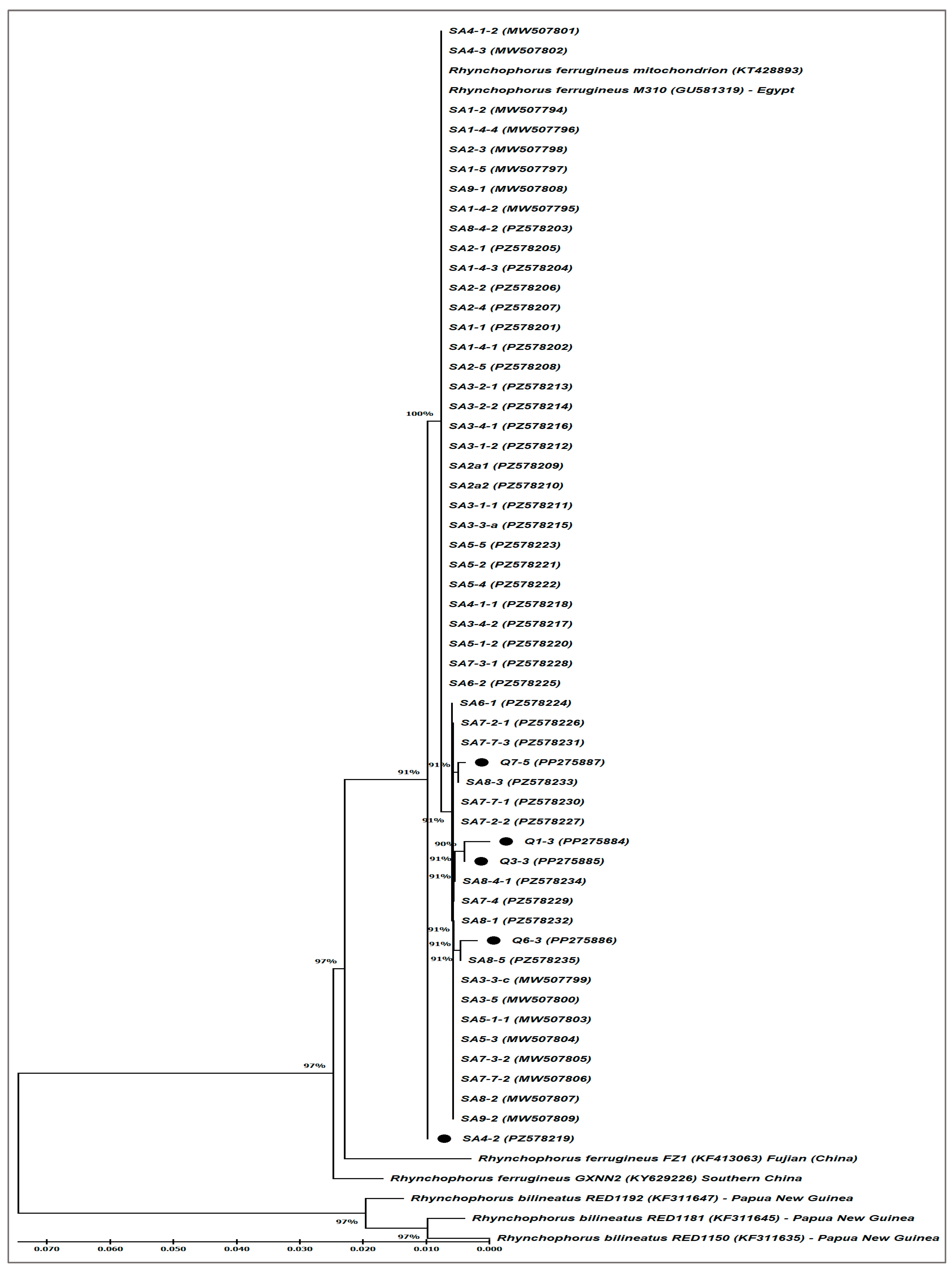
| Major cluster | Sub-Cluster | Representative Sequences | Bootstrap Support (%) | Phylogenetic Interpretation |
|---|---|---|---|---|
| Cluster I: Saudi/Qassim lineage | I-A | Most of identified specimens such as SA1-2, SA4-3, SA9-1, SA2-1, SA1-4-3, SA2-2, SA3-1-1, SA5-1-2, and SA6-2 together with Egypt reference (GU581319) and mitochondrial reference (KT428893). | 100 | Dominant mitochondrial haplotype with highly conserved COI sequences |
| I-B | Q7-5 (PP275887), Q1-3 (PP275884), Q3-3 (PP275885), Q6-3 (PP275886) and neighboring specimens | 90–91 | Minor derived haplotypes differing by few nucleotide substitutions | |
| I-D | SA4-2 (PZ578219) | 91 | Most divergent haplotype within the Saudi lineage | |
| Cluster II: Asian lineage | II-A | R. ferrugineus GXNN2 (KY629226), Southern China; R. ferrugineus FZ1 (KF413063), Fujian, China | 97 | Distinct geographic lineage indicating regional differentiation |
| Cluster III: Outgroup lineage | III-A | Rhynchophorus bilineatus RED1192, RED1181, RED1150 (Papua New Guinea) | 97 | Outgroup cluster showing species-level divergence |
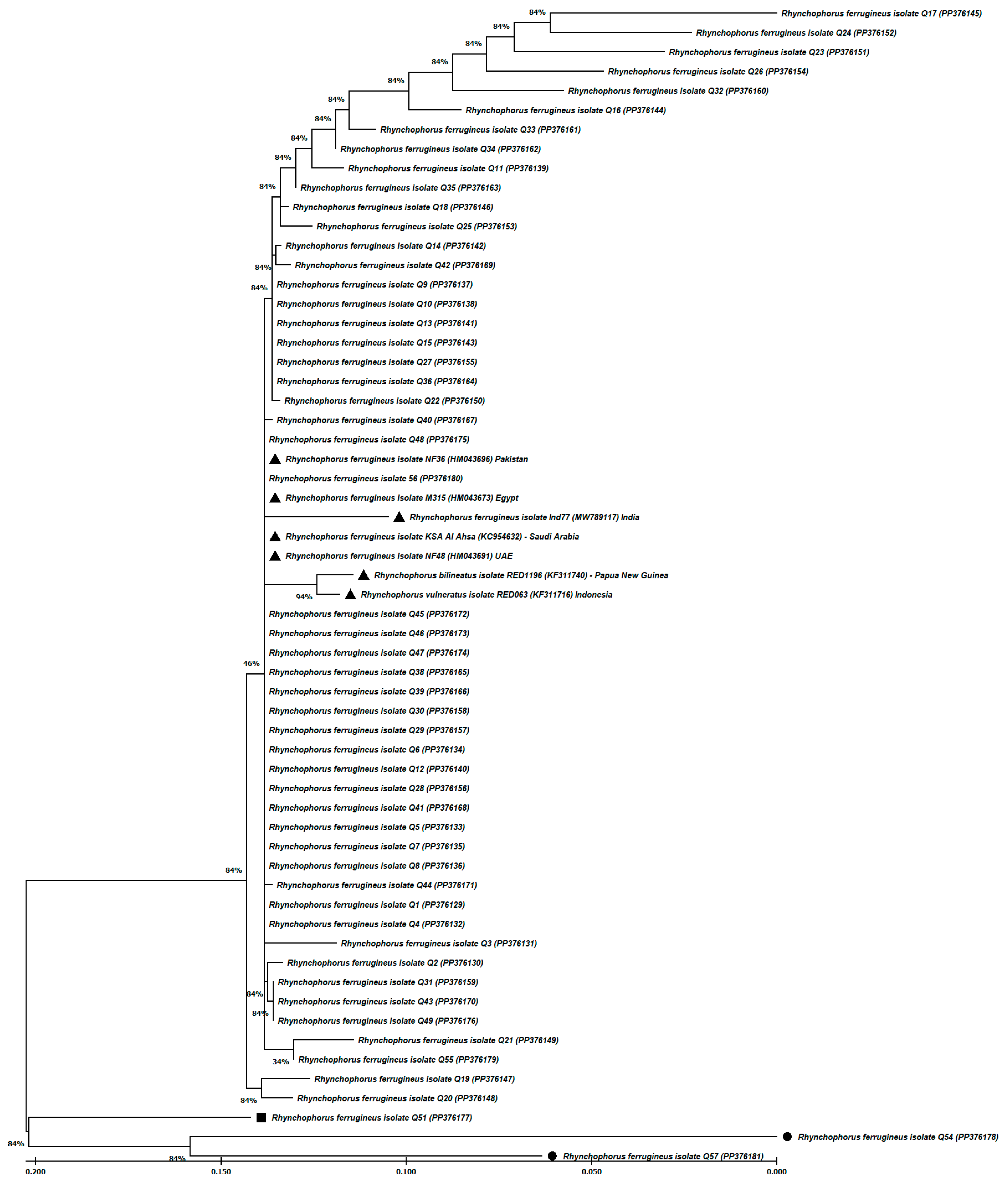
| Major Cluster | Sub-Cluster | Representative Sequences | Bootstrap Support (%) | Phylogenetic Interpretation |
|---|---|---|---|---|
| Cluster I | I-A | Main Qassim lineage: Q17, Q24, Q23, Q26, Q32, Q16, Q33, Q34, Q11, Q35, Q18, Q25, Q14, Q42, Q9, Q10, Q13, Q15, Q27, Q36, and Q22 | ~84 | Dominant Qassim lineage with showing closely related or moderate sequence variation |
| I-B | International-reference lineage: Pakistan (NF36), Egypt (M315), India (Ind77), Saudi reference (KSA Al Ahsa), and UAE (NF48), in addition to local specimens such as Q40, Q48, and Q56. | 84–94 | National and international reference haplotypes clustered with selected Qassim sequences | |
| I-C | Secondary Qassim lineage: Q45, Q46, Q47, Q38, Q39, Q30, Q29, Q6, Q12, Q28, Q41, Q5, Q7, Q8, Q44, Q1, Q4, Q3, Q2, Q31, Q43, Q49, Q21, and Q55 | 34–84 | Large secondary Qassim assemblage indicating moderate diversity | |
| Cluster II | II-A | Q19, Q20 | 84 | Haplotypes with increased local diversity |
| Cluster III: Divergent ITS haplotypes | III-A | Q51 | 84 | Distinct lineage separated from major Qassim groups |
| Cluster IV: Divergent ITS haplotypes | IV-A | Q54 and Q57 | — | Highly divergent local haplotype |
| Comparative Group 1 | Representative Populations/Accessions 2 | Genetic Distance Range (p-Distance) 3 | Mean 4 | Genetic Identity (%) 5 | Interpretation 6 |
|---|---|---|---|---|---|
| Egypt/type mitochondrion | GU581319- KT428893 | 0.0–0.0078 | 0.0032 | 99.55–100.00 | Nearly identical mitochondrial lineage with strong regional affinity |
| Mixed Qassim haplotypes | SA1–SA9 populations | 0.0021–0.0077 | 0.0045 | 99.14–99.79 | Minor internal differentiation among local haplotypes |
| China haplotypes | KY629226–KF413063 | 0.0233–0.0446 | 0.0314 | 96.31- 97.41 | Moderate genetic diversity within the same species |
| R. bilineatus | RED1150, RED1181, RED1192 | 0.1099–0.1413 | 0.1300 | 85.87–88.00 | Clear species-level separation |
| Qassim haplotypes vs. both species | SA-series vs. R. bilineatus/R. vulneratus | 0.1150–0.1413 | 0.1280 | 85.87–88.50 | Stable interspecific divergence |
| High divergence (>10%) | R. bilineatus and R. vulneratus comparisons | 0.1150–0.1413 | 0.1280 | 85.87–88.50 | Deep phylogenetic separation |
| Extreme divergence | Maximum interspecific comparisons | >0.1413 | 0.1413 | <85.87 | Broad evolutionary separation |
| Parameter | COI Dataset | ITS Dataset | Comparative Interpretation |
|---|---|---|---|
| Marker type | Mitochondrial DNA | Nuclear ribosomal DNA | Represents maternal inheritance versus biparental nuclear inheritance |
| Molecular region | Cytochrome c oxidase subunit I | Internal transcribed spacer | Different evolutionary rates and inheritance patterns |
| Total specimens analyzed | 57 | 57 | Same biological samples |
| Successfully sequenced samples | 55 | 53 | COI showed slightly higher sequencing efficiency |
| Sequencing success (%) | 96.5% | 93% | COI amplified more consistently |
| Number of failed sequences | 2 | 4 | Greater sequence loss in ITS |
| Number of analyzed haplotypes | 55 COI haplotypes | 53 ITS haplotypes | Similar overall dataset sizes |
| Number of newly generated sequences | 39 | 53 | ITS dataset entirely generated in this study |
| Percentage of newly generated sequences | 70.91% | 100.00% | ITS contributed a larger novel sequence resource |
| Sequence conservation | High | Moderate | COI more conserved than ITS |
| Internal nucleotide variation | Low | Moderate–high | Greater heterogeneity in ITS |
| Pairwise divergence among local haplotypes | 0.0–0.0077 | 0.0–0.2599 | ITS detected broader variation |
| Mean divergence within Qassim populations | Very low | Moderate | Greater population differentiation in ITS |
| Principal phylogenetic clusters | 3 | 4 | ITS resolved more major groups |
| Number of sub-clusters | 5 | Multiple (>6) | Greater internal branching in ITS |
| Bootstrap support | 90–100% | 34–94% | COI exhibited stronger node support |
| Dominant lineage pattern | One principal mitochondrial lineage | Multiple nuclear lineages | ITS revealed more complex structure |
| Relationship with Middle East populations | Very close | Very close | Both markers indicated regional connectivity |
| Relationship with India populations | Moderate divergence | Moderate divergence | Geographic differentiation detected by both |
| Relationship with Chinese populations | Moderate divergence | Not represented | Only evaluated in COI |
| Relationship with R. bilineatus | Strong species separation | Strong species separation | Both markers resolved species boundaries |
| Most divergent local variants | SA4-2 | Q51, Q54, Q57 | ITS detected more divergent local variants |
| Geographic discrimination capacity | Moderate | High | ITS showed better geographic resolution |
| Population differentiation capacity | Moderate | High | ITS better resolved internal diversity |
| Ability to detect local structuring | Limited | Strong | ITS identified broader subdivision patterns |
| Suitability for species identification | Excellent | Good–excellent | COI remains more stable for species identification |
| Suitability for population genetic studies | Moderate | High | ITS provides higher discriminatory power |
| Overall marker performance | Stable and conservative | Sensitive and discriminatory | Complementary rather than competing markers |
Disclaimer/Publisher’s Note: The statements, opinions and data contained in all publications are solely those of the individual author(s) and contributor(s) and not of MDPI and/or the editor(s). MDPI and/or the editor(s) disclaim responsibility for any injury to people or property resulting from any ideas, methods, instructions or products referred to in the content. |
© 2026 by the authors. Licensee MDPI, Basel, Switzerland. This article is an open access article distributed under the terms and conditions of the Creative Commons Attribution (CC BY) license.
Share and Cite
Alhewairini, S.S.; Rehan, M.; Motawei, M.I.; Alazzazy, M.; Abdel-Baky, N.F. Mitochondrial and Nuclear Markers Reveal Contrasting Patterns of Genetic Diversity in the Red Palm Weevil (Rhynchophorus ferrugineus) from Qassim Province, Saudi Arabia. Life 2026, 16, 1200. https://doi.org/10.3390/life16071200
Alhewairini SS, Rehan M, Motawei MI, Alazzazy M, Abdel-Baky NF. Mitochondrial and Nuclear Markers Reveal Contrasting Patterns of Genetic Diversity in the Red Palm Weevil (Rhynchophorus ferrugineus) from Qassim Province, Saudi Arabia. Life. 2026; 16(7):1200. https://doi.org/10.3390/life16071200
Chicago/Turabian StyleAlhewairini, Saleh S., Medhat Rehan, Mohamed I. Motawei, Mahmoud Alazzazy, and Nagdy F. Abdel-Baky. 2026. "Mitochondrial and Nuclear Markers Reveal Contrasting Patterns of Genetic Diversity in the Red Palm Weevil (Rhynchophorus ferrugineus) from Qassim Province, Saudi Arabia" Life 16, no. 7: 1200. https://doi.org/10.3390/life16071200
APA StyleAlhewairini, S. S., Rehan, M., Motawei, M. I., Alazzazy, M., & Abdel-Baky, N. F. (2026). Mitochondrial and Nuclear Markers Reveal Contrasting Patterns of Genetic Diversity in the Red Palm Weevil (Rhynchophorus ferrugineus) from Qassim Province, Saudi Arabia. Life, 16(7), 1200. https://doi.org/10.3390/life16071200