Microbial Biosurfactants: A Bridge from Aquatic Environments to Subsurface Oil Recovery: Mechanisms, Challenges, Prospects

Abstract
1. Introduction
2. Mechanisms of Biosurfactant-Based Microbial-Enhanced Oil Recovery in Reservoirs
2.1. Interfacial Tension Reduction
2.2. Wettability Alteration: The Primary Driver of Recovery
2.2.1. Mechanisms of Wettability Reversal
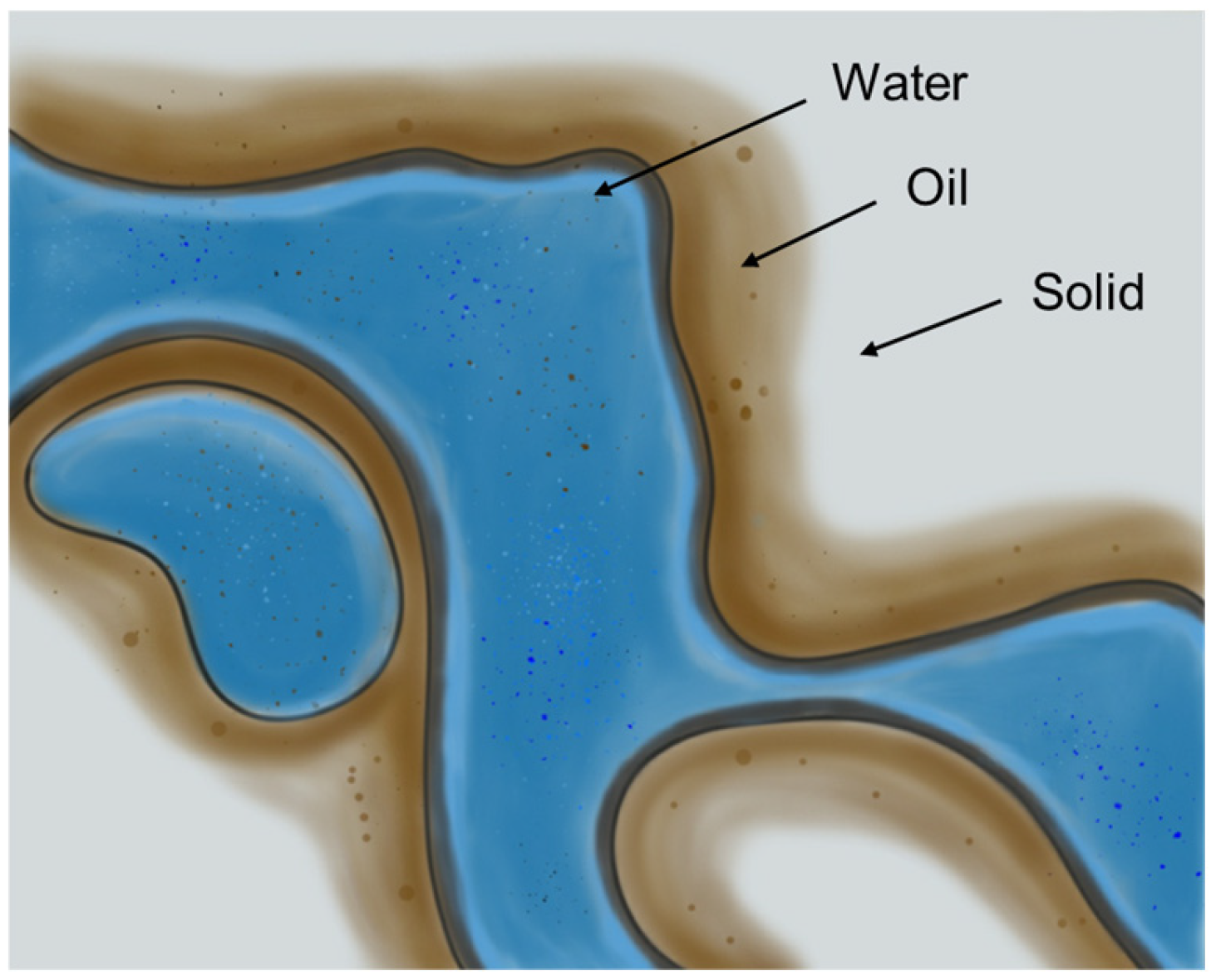
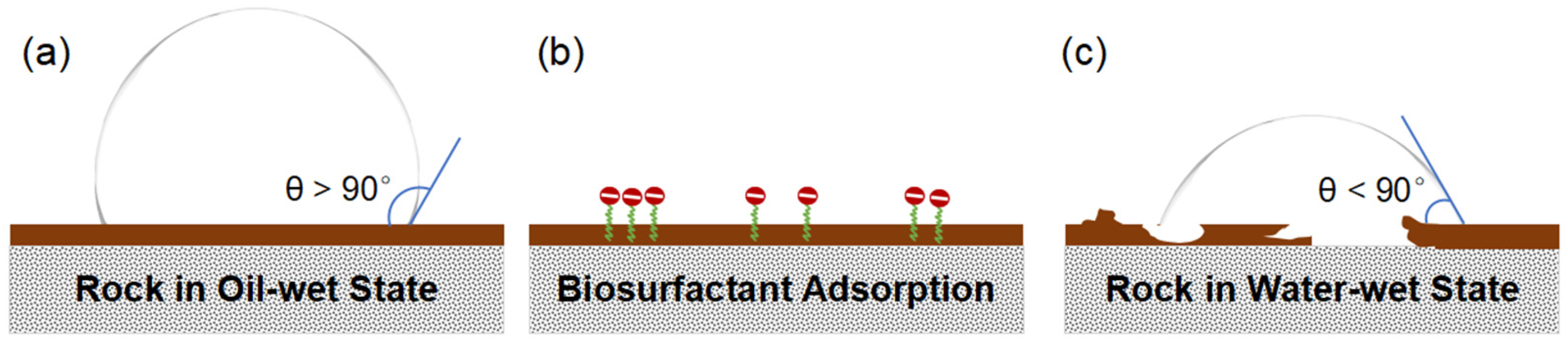
- Initial State: In an oil-wet system, polar organic components from crude oil firmly adhere onto the rock surface, creating a hydrophobic layer. Oil spreads across this surface, the water phase contact angle (θ) is greater than 90°.
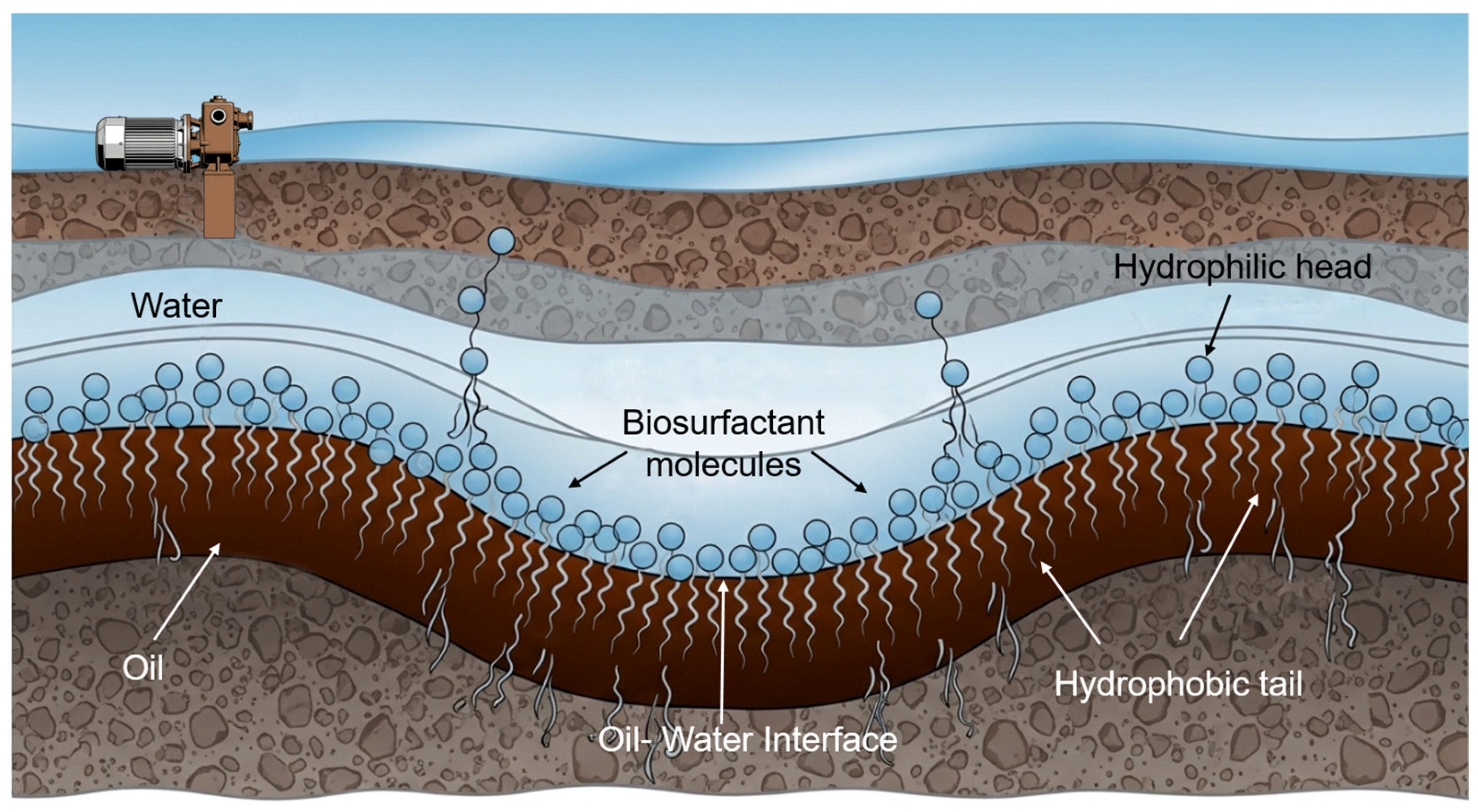
- Biosurfactant Introduction: When a biosurfactant solution is introduced, the amphiphilic molecules migrate to the interfaces.
- Adsorption and Displacement: The biosurfactant molecules then adsorb onto the rock surface. The specific interaction depends on the nature of the biosurfactant and rock mineralogy. The hydrophobic tail of the biosurfactant can interact with the adsorbed oil layer via hydrophobic interactions, while the hydrophilic head has an affinity for the water phase. In many cases, the biosurfactant can insert itself between the rock surface and the adsorbed oil film, effectively “lifting off” or displacing the organic material.
- Formation of a Water-wet Layer: As biosurfactants accumulate at the surface, they orient themselves with their hydrophilic head groups facing outwards into the aqueous phase. This creates a new, stable hydrophilic layer on the rock surface.
- Final State: The rock now preferentially contacts water. The oil film retracts into discrete droplets, and the contact angle drops below 90°. Consequently, water can spontaneously penetrate finer pore networks, thereby mobilizing the trapped oil and improving the overall sweep efficiency of the waterflood. A study showed that wettability alteration alone could be responsible for an oil production increase of over 50% in a mature well, boosting overall recovery from around 32% of OOIP to over 62% in MEOR cases [44].
2.2.2. Adsorption Behaviors on Different Rock Surfaces
- Carbonate Surfaces (Limestone, Dolomite): Carbonate rocks are typically composed of calcite (CaCO3) and dolomite (CaMg(CO3)2). In reservoir brines, their surfaces often carry a positive charge. Anionic biosurfactants (which are common), such as the glycolipid rhamnolipid and the lipopeptide surfactin, possess negatively charged carboxylate groups (-COO−) in their hydrophilic heads. This leads to strong electrostatic attraction between the biosurfactant and the positively charged carbonate surface, promoting robust adsorption and effective wettability alteration [43]. Nevertheless, this interaction can be complex. High salinity, particularly the presence of divalent cations (Ca2+, Mg2+) in seawater or formation brine, can screen the electrostatic charges or lead to biosurfactant precipitation, potentially inhibiting its effectiveness.
- Sandstone Surfaces (Quartz, Feldspars, Clays): Sandstone reservoirs are primarily composed of quartz (SiO2), with varying amounts of feldspars and clays. Under typical reservoir pH conditions, these silicate minerals carry a negative surface charge. Consequently, anionic biosurfactants would experience electrostatic repulsion, hindering their adsorption. In such cases, adsorption is driven by other forces like hydrophobic interactions between the biosurfactant tail and any adsorbed organic matter, or van der Waals forces. A major challenge in sandstone reservoir is the significant biosurfactant loss through adsorption onto clays, which possess high surface area and complex charge distribution. Non-ionic or cationic biosurfactants may be more effective in these formations, although they are less commonly studied for MEOR. Despite this challenge, biosurfactants demonstrably alter sandstone wettability: contact angle measurements on sandstone slices treated with a microbial consortium show a decrease from >120° (oil-wet) to 60° (water-wet) within 3–4 days, corresponding to a huge capillary pressure change of ~5000 Pa, sufficient to increase oil recovery via spontaneous imbibition [44]. This mechanistic gap was later addressed by Zihui Chen et al. [75], whose AFM and molecular simulation study elucidated the distinct actions of two key biosurfactants, providing a quantitative and structural explanation for their differing efficacies. They reported that rhamnolipid reduces the adhesion force between oil and glass by adsorbing onto the oil film and presenting hydrophilic head groups outward, thereby lowering surface hydrophobicity to create a weakly water-wet state. In contrast, surfactin can peel the oil film away from the rock surface and reverse the interaction force between oil and a glass surface from attractive to repulsive, leaving a strongly water-wet rock surface. The more effective and efficient wettability alteration capability of surfactin stems from its much higher adsorption energy (−38.01 eV) compared to rhamnolipid (−12.23 eV) on hydrophobic surfaces. This difference in the adsorption energy is attributed to their different molecular structures: the longer alkyl chain (C12) of surfactin strengthens hydrophobic–hydrophobic interactions, whereas shorter tails (C7) and the presence of a carboxyl group of rhamnolipid diminishes its hydrophobicity and adsorption stability. This fundamental insight confirms that overcoming sandstone’s mineralogical constraints requires biosurfactants with molecular structures specifically tailored for strong hydrophobic adsorption—directly linking nano-scale interactions to macroscopic recovery efficacy, which is critical for designing effective MEOR strategies.
2.3. Emulsification and Mobility Control
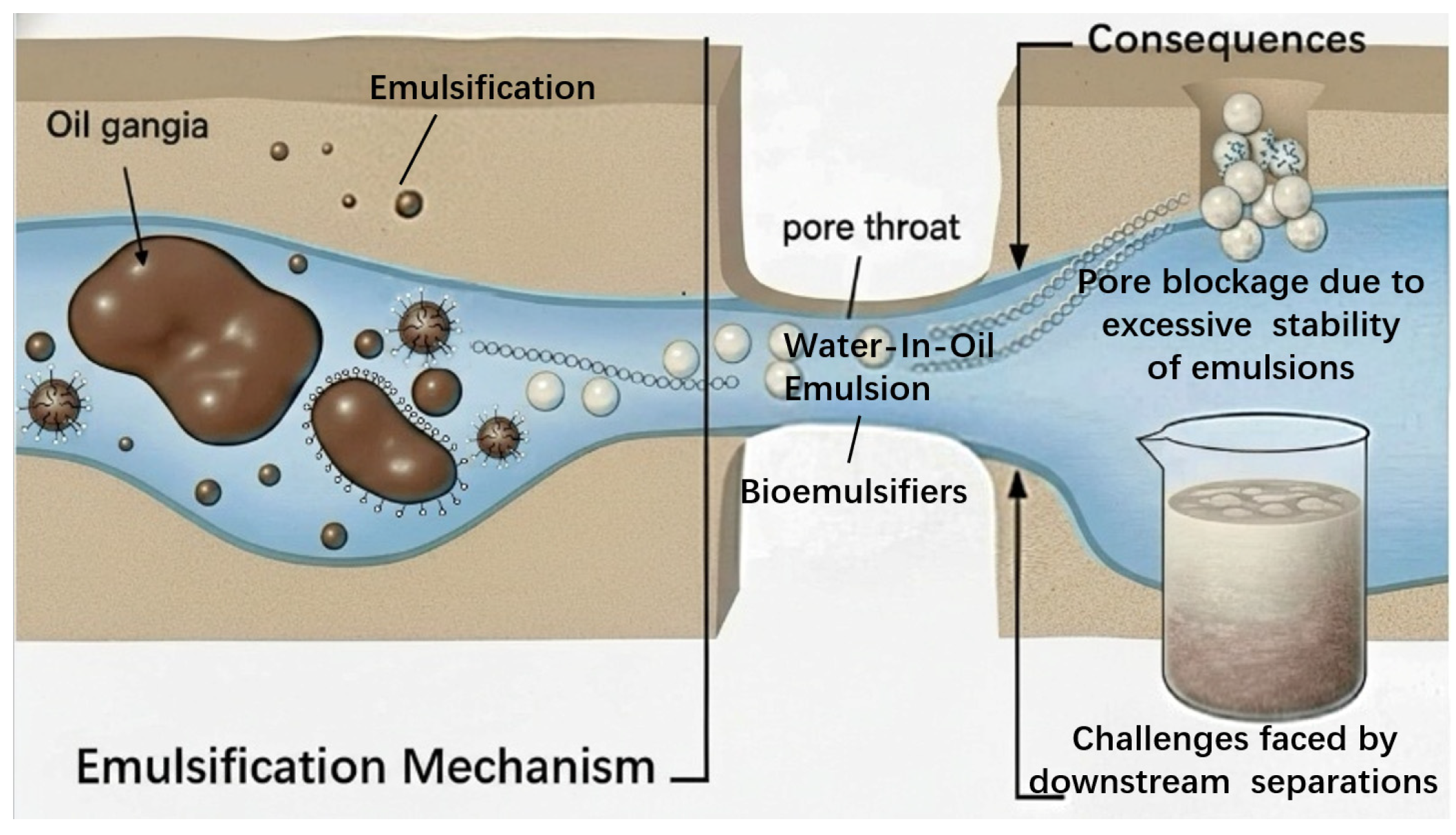
- Emulsification: By drastically lowering IFT, biosurfactants can promote the formation of emulsions, typically O/W emulsions. These emulsions break down large, continuous oil ganglia into smaller, mobile droplets that can be more easily transported through the porous medium. High-MW polymeric biosurfactants, often called bioemulsifiers, are particularly effective at creating stable emulsions that can be flushed out of the reservoir [55]. Nevertheless, the formation of overly stable emulsions can be detrimental, causing pore plugging and posing challenges for downstream oil–water separation facilities (see Figure 5).
- Mobility Control: A successful waterflood requires favorable mobility control, meaning the displacing fluid (water) should not advance much faster than the displaced fluid (oil). An unfavorable viscosity ratio leads to “viscous fingering”, where water bypasses large regions of oil, severely reducing sweep efficiency [76]. During in situ MEOR applications, biosurfactants are usually not the only product generated by microorganisms; biopolymers like xanthan gum and scleroglucan can also be produced. The co-produced biopolymers improve the overall rheological behavior of the injected fluid via enhancing the viscosity of the injected water [77,78]. This enhances the mobility ratio and leads to a more stable displacement front and a much higher volumetric sweep efficiency, ensuring that the mobilized oil is effectively pushed towards the production wells. The synergy between biosurfactants mobilizing the oil and biopolymers improving the sweep is a powerful combination for maximizing recovery [4,79].
2.4. Complementary Roles of Other Microbial Products in Microbial-Enhanced Oil Recovery
- Organic Acids: Many microorganisms, such as Clostridium species, ferment carbohydrates to produce low-MW organic acids [4]. These acids play a dual role. First, they can dissolve carbonate minerals in the reservoir rock, a process often referred to as “acidizing,” which enlarges pore throats and increases rock permeability [4,10]. Second, the reaction of these acids with carbonates can generate significant volumes of CO2 in situ, contributing to reservoir repressurization and oil swelling [4,10].
- Biomass (Microbial Cells): The accumulation of microbial cells, or biomass, within the porous matrix can be strategically beneficial. By selectively plugging high-permeability “thief zones,” biomass can divert subsequent injection water into lower-permeability and unswept oil-rich layers, thereby improving macroscopic sweep efficiency [4,10]. Furthermore, microbial cells themselves can act as surface-active agents, adhering to oil droplets and contributing to oil emulsification. Their attachment to rock surfaces can also alter the local wettability, aiding in oil release [4].
- Gases (CO2, CH4, H2): Microbial metabolism produces various gases, with CO2 being the most significant for EOR [80]. The in situ generation of gases serves multiple functions: (1) Reservoir Repressurization: Gas accumulation increases reservoir pressure, providing a driving force to push oil towards production wells. (2) Oil Swelling and Viscosity Reduction: CO2 is highly soluble in crude oil, causing it to swell, significantly reducing its viscosity, which makes it more mobile [4,10]. (3) Increased Permeability: CO2 can dissolve in formation water to form carbonic acid, which, similar to organic acids, can react with and dissolve carbonate rocks, further enhancing permeability [4].
- Biosurfactants: As detailed in previous sections, biosurfactants are key to reducing oil–rock interfacial tension and facilitating emulsification. This action helps to mobilize trapped oil by forming stable oil-in-water emulsions and reducing the adhesive forces that bind oil to the rock surface.
- Biopolymers: Produced by microorganisms like Xanthomonas campestris and Bacillus species, biopolymers such as xanthan gum primarily function in mobility control [4,81]. By increasing the viscosity of the injected water, they improve the mobility ratio, suppress viscous fingering, and lead to a more stable displacement front [82]. In some cases, biopolymers can also contribute to selective pore plugging, similar to biomass, by forming biofilms that block high-permeability zones [10].
3. Biosurfactant Categories and Formulations
3.1. Glycolipids
3.1.1. Rhamnolipids
3.1.2. Sophorolipids
3.2. Lipopeptides
3.2.1. Surfactin
3.2.2. Lichenysin
3.3. High Molecular Weight Bioemulsifiers
3.4. Formulation of Biosurfactants
4. Synergistic Biopolymer and Biocomplex Formulations
4.1. Synergy with Biopolymers: Integrating Pore-Scale Mobilization with Macroscopic Sweep
- Role of Biopolymers: This macroscopic challenge is addressed by co-injecting biosurfactants with viscosity-enhancing biopolymers, such as xanthan gum or scleroglucan. These are high-MW polysaccharides produced by microorganisms—xanthan gum by the bacterium Xanthomonas campestris and scleroglucan by the fungus Sclerotium rolfsii., respectively. By significantly thickening the aqueous phase at low concentrations, they function as highly effective viscosifiers, improve the oil–water mobility ratio and establish a stable displacement front [107,108]. Their excellent shear-thinning behavior ensures injectability, while their relative stability at reservoir temperatures underpins their widespread use in EOR for reliable mobility control [109,110,111].
- Synergistic Mechanism: The composite system of biosurfactants and biopolymers creates a synergistic “release-and-sweep” mechanism. In the combined flooding process, biosurfactants work at the leading edge by reducing IFT and altering wettablility to remove the aged oil from rock surfaces, then biopolymers enhance the mobility of the displaced oil toward production well by increasing the viscosity of the injected fluid [112]. This synergy enhances both pore-scale displacement and reservoir-scale sweep efficiency, yielding significantly EOR results than using either agent alone [111,112,113].
4.2. Synergy with Nanoparticles and Chemicals: Augmenting Interfacial Activity and Stability
- Biosurfactant–Nanoparticle Hybrids: Recently, the combination of biosurfactants with nanoparticles (e.g., silica, ZnO) has become a research focus, as nanoparticles can synergistically improve the interfacial performance at both fluid–rock and fluid–fluid interfaces to a higher level [115,116]. Studies have shown that nanoparticles and biosurfactants could co-adsorb, and form a denser and more resilient film, thus achieving ultra-low IFT [117,118]. Azarshin et al. revealed that nanoparticles can generate structural disjoining pressure to peel oil films from rock surfaces, which accounts for their highly effective wettability alteration ability [119]. In the meantime, biosurfactants act as dispersants, preventing nanoparticles from aggregation and ensuring their propagation in deep reservoir. Furthermore, Yulong Liu et al. synthesized a promising biological nanocomposite fluid for offshore oilfield application with nano-Fe3O4, nano-Ag and biopolymer sodium alginate, and revealed that nanoparticles can interact with polymer chains in this tertiary formulations, enhancing thermal and mechanical stability of the entire displacing system [120]. The outstanding synergy effect was also confirmed by a recent work by Amr Gazem et al., who integrated ZnO nanoparticles with a rhamnolipid/sophorolipid blend and xanthan gum, which achieved 95.14% oil recovery at 70 °C—significantly outperforming the base biosurfactant–polymer formulation without nanoparticles (80.94%) and brine flooding (58.34%) [116].
- Bio-based Alkali–Surfactant–Polymer (Bio-ASP) Formulations: Incorporating biosurfactants into the established ASP flooding framework creates an environmentally optimized Bio-ASP system. Adding a low-concentration of alkali (e.g., sodium carbonate) can generate in situ soaps with the biosurfactant to achieve ultra-low IFT. An IFT of 0.02 mN/m was achieved by Taher Al-Ghailani et al. [121], with 0.9% (w/v) alkali added into a 20-times diluted biosurfactant solution. A synergy effect was also observed in altering wettability and reducing the adsorption loss of the biosurfactant onto negatively charged rock surfaces. Consequently, Bio-ASP significantly improves chemical utilization efficiency, owing to these combined advantages, making it a highly promising EOR strategy [112,121].
4.3. The Synergistic Outcome and Potential
5. Key Challenges for Biosurfactant Application in Subsurface Reservoirs
5.1. Resilience Under Extreme Reservoir Environments
- High Temperature: In deep formations, reservoir temperatures can easily exceed 70 °C and even surpass 120 °C. Such heat can denature the proteinaceous components of lipopeptides or degrade glycolipid structures, leading to irreversible loss of surface activity. Therefore, it is necessary to screen and engineer thermotolerant strains. Encouragingly, many biosurfactants, especially lipopeptides from Bacillus species, display innate thermal robustness that often surpasses synthetic surfactants. Bo Wu et al. reported that lipopeptide produced by the Bacillus subtilis strain kept excellent surface activity at 120 °C and pH 5–12 [54]. Marcela Nunes Argentin et al. isolated bacterial strain Ar70C7-2 from a rock of a deep offshore Brazilian oil reservoir and obtained the produced biosurfactant, which showed splendid emulsification and IFT reduction ability and maintained its stability at temperatures ranging from −18 to 121 °C [3,123]. Surfactin from Bacillus tequilensis was also reported to show negligible decay in interfacial tension reduction after 10 days of aging at 90 °C [100].
- High Salinity: Formation water is often highly saline, with total dissolved solids frequently exceeding 100,000 ppm (10% salinity) and sometimes reaching saturation levels (>20%). High salt concentration can screen electrostatic repulsions, especially the presence of divalent cations (e.g., Ca2+, Mg2+), which can precipitate anionic biosurfactants by forming insoluble salts and removing them from the solution [37,43,114,124]. High ionic strength can also alter the HLB of the surfactant, thus impairing its performance in IFT reduction and wettability alteration. Luckily, like biosurfactants produced by thermophilic microorganisms can endure high temperature, biosurfactants produced by halophilic microorganisms often exhibit exceptional salt tolerance ability. Xiaotong Wang et al. obtained a biosurfactant from Bacillus halotolerans and demonstrated that it can maintain high activity in salinities up to 21% NaCl [125]. Notably, tolerance is not universal; the stability of common biosurfactants like rhamnolipid, for example, has been observed to decrease with increasing salinity [91]. Therefore, screening or engineering microbial strains specifically adapted to target reservoir conditions is crucial.
- pH Fluctuations: Reservoir pH can vary, though it is typically near-neutral to slightly alkaline. The activity of biosurfactants, particularly those with ionizable functional groups like carboxylates or amines, is pH-dependent. At low pH, for instance, the carboxylate groups of anionic biosurfactants become protonated, reducing their solubility in water and diminishing their surface activity [126,127]. The ideal biosurfactant should have a broad pH stability range that encompasses the conditions of the target reservoir.
5.2. Adsorption and Loss
- (1)
- Rock Type and Mineralogy
- Sandstone Reservoirs: Composed primarily of quartz, sandstone surfaces are negatively charged under typical reservoir conditions. This results in weak electrostatic adsorption of anionic biosurfactants (e.g., rhamnolipids) but strong attraction to cationic surfactants [75].
- Carbonate Reservoirs: Carbonates (e.g., limestone, dolomite) present a greater challenge. Due to the adsorption of crude oil components like asphaltenes, the rock surfaces are often oil-wet [128,129,130]. Therefore, wettability alteration is a key target for biosurfactants, but their high adsorption and loss remains a major problem. More critically, the surface charge of carbonates is highly pH-dependent. At typical formation brine pH, which is usually below the zero point of charge of calcite (8–9.5), carbonate surfaces are positively charged [131,132]. The strong electrostatic attraction between the positively charged rock surface and negatively charged biosurfactants leads to much higher adsorption losses.
- (2)
- Biosurfactant Concentration
- (3)
- Brine Chemistry
- Use of Sacrificial Adsorbing Agents: Pre-injecting agents that competitively adsorb to mineral sites can reduce subsequent biosurfactant loss. Nanoparticles (e.g., SiO2, CaCO3, TiO2, ZrO2 and Al2O3) are especially attractive because of their high surface area and tunability [135,136,137,138]. For instance, the addition of colloidal SiO2 has been shown to reduce the adsorption of an anionic surfactant on sandstone by up to 61% [137].
- Formulation Engineering: Co-injecting polymers or alkali can alter system chemistry. Polymers can provide steric hindrance, while alkali increases pH and can reverse carbonate surface charge to negative, repelling anionic surfactants [114].
- Operational Optimization: Tailoring the ionic strength or pH of the injection brine to minimize electrostatic attraction between the biosurfactant and the target rock can significantly reduce adsorption.
5.3. Scalability and Economic Hurdles
5.3.1. The Challenge of High Production Costs
5.3.2. Economic Viability: Evidence from Field Applications
- Shengli Oilfield: MEOR technology demonstrated significant long-term economic benefits. From 1998 to December 2019, field applications across 10 blocks achieved a cumulative incremental oil production of 30 × 104 tons, with an average input–output ratio of 1:5.7 [149].
- Yanchang Oilfield: A field pilot was conducted in the Xingzichuan area, involving nine injection wells and 43 production wells, with a cumulative injection of 269.8 tons of the biosurfactant formulation. Following implementation, fluid production increased from 215 m3/d to 281 m3/d, with a well response rate of 90%, a 40% improvement in single-well productivity, and a cumulative incremental oil production of 1.36 × 10⁴ tons [143].
- Daqing Oilfield: Microbial huff ‘n’ puff treatments in 93 wells achieved a success rate of 74.2%, with an average incremental oil of 149 tons per well and a cumulative oil increase of 1.39 × 10⁴ tons. Importantly, the chemical cost per ton of incremental oil was only CNY 300 (approximately USD 43, based on an exchange rate of 7 CNY/USD), underscoring its cost-effectiveness [150].
5.3.3. Pathways to Large-Scale Implementation
6. Field Applications for Biosurfactant-Based Microbial-Enhanced Oil Recovery
6.1. Historical Overview and Implementation Strategies
- Huff-n-Puff (Cyclic Microbial Recovery): This is a single-well stimulation technique. A formulation of microbes and/or nutrients is injected into a production well. The well is then shut-in for a period (the “huff” or “soak” phase) to allow for microbial growth and biosurfactant production. Afterwards, the well is put back on production (the “puff” phase). The produced fluids contain mobilized oil. This method is relatively low-cost and is used to treat near-wellbore damage and stimulate individual wells. Some heavy oil wells that have undergone multiple rounds of steam stimulation are also attempting to apply microbial huff-and-puff technology to extend their economic life. Currently, the success rate of microbial huff-and-puff remains relatively low, at approximately 70% [80].
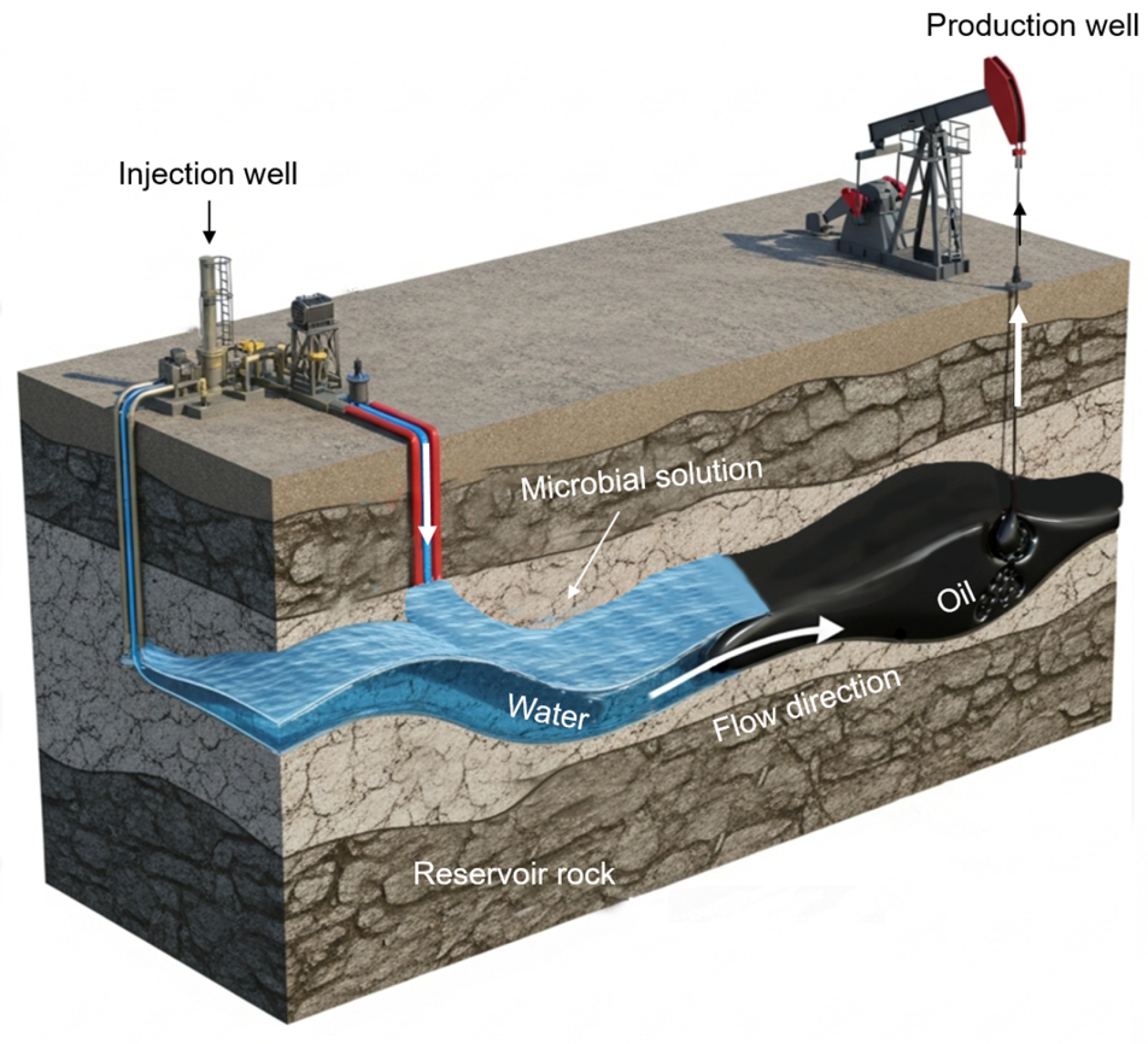
- Microbial Flooding: This is a reservoir-wide process analogous to a chemical flood, where a microbial/nutrient solution is injected continuously or in slugs into injector wells to displace oil towards producers. This approach is more complex but holds significant potential for enhancing ultimate recovery [38]. Field applications of the microbial huff-and-puff trial in China’s extra-low permeability reservoirs achieved an average incremental oil of 149 tons per well. A microbial flooding project in the Chaoyanggou Oilfield resulted in a cumulative incremental production of 60,000 tons, enhancing oil recovery by 4.95%. These successes, alongside systematic research on reservoir microbial ecology have demonstrated the viability of this method, despite its high cost of CNY 300 to 557 per ton of incremental oil [150].
6.2. The Core Operational Decision: Ex Situ vs. In Situ Microbial-Enhanced Oil Recovery
6.3. Key Insights from Field Trials
- (1)
- Comprehensive reservoir assessment: A successful MEOR project requires a deep understanding of the reservoir’s geology, mineralogy, fluid properties, temperature, pressure, and indigenous microbial population, which is crucial for selecting the right MEOR strategy (in situ vs. ex situ) and the appropriate microbial strain or biosurfactant.
- (2)
- Tailored Strain Selection: There is no one-size-fits-all microbe. The chosen strain (for in situ) or the production strain (for ex situ) must be robust enough to thrive or produce metabolites that are stable under the specific reservoir’s temperature, salinity, and pressure. Bioprospecting from environments analogous to oil reservoirs (e.g., hypersaline lakes, hydrothermal vents) is a promising source of suitable candidates [168].
- (3)
- Targeted Nutrient Delivery: In in situ MEOR, the nutrient formulation directs the subsurface microbial metabolism. It must be designed to maximize the production of desired metabolites (like biosurfactants) while minimizing unwanted outcomes like excess biomass (which causes plugging) or hydrogen sulfide (H2S) from reservoir souring [169]. The inclusion of nitrate is a common strategy to outcompete sulfate-reducing bacteria [170].
- (4)
- Robust Process Monitoring: An integrated monitoring program is key to timely and effective process optimization. This includes the monitoring of injection/production rates and pressures, chemical composition analysis of produced fluids (e.g., pH, biosurfactants, polymers, microbial counts), and fluid movement.
7. Overcoming Challenges and Future Perspectives
7.1. Cost-Effective Production: The Quest for Cheaper Feedstocks
- Agro-Industrial Wastes: Substrates like molasses from sugar refining, crude glycerol from biodiesel production, whey from the dairy industry, and residues from vegetable oil processing are rich in carbohydrates and lipids, making them ideal feedstocks for many biosurfactant-producing microbes.
- Lignocellulosic Biomass: Developing microbial strains or consortia that can directly convert non-food plant biomass (e.g., corn stover, switchgrass) into biosurfactants would open up a vast and sustainable resource base.
7.2. Hybrid Technologies: The Power of Synergy
- Biosurfactants and Low-Salinity Water (LSW) Flooding: LSW flooding is an emerging EOR technique where water with reduced salinity is injected into the reservoir. Low-salinity environment can induce wettability alteration in the rock surface towards a more water-wet state by modifying the ion-exchange equilibrium. This phenomenon is particularly pronounced in sandstone reservoirs containing clays. Combining LSW in MEOR can provide a favorable initial shift in wettability and a better environment for biosurfactant to function, thus lowering the consumption of biosurfactant and the overall cost [174,175].
- Biosurfactants and Smart Waterflooding: “Smart Water” is an extension of LSW. In smart waterflooding, the ionic composition (instead of only the total salinity) of the injected water is carefully customized to promote rock–fluid interactions. A smart water formulation could be designed to maximize the stability and activity of a co-injected biosurfactant, creating a highly optimized and targeted EOR fluid [176,177].
7.3. Environmental Impact and Lifecycle Assessment
7.4. Conclusions
Author Contributions
Funding
Institutional Review Board Statement
Informed Consent Statement
Data Availability Statement
Acknowledgments
Conflicts of Interest
Abbreviations
| ASP | Alkaline–surfactant–polymer |
| Bio-ASP | Bio-based Alkali–Surfactant–Polymer |
| cEOR | Chemical Enhanced Oil Recovery |
| CMC | Critical micelle concentration |
| EOR | Enhanced Oil Recovery |
| HLB | Hydrophilic–lipophilic balance |
| HTHS | High temperature, high salinity |
| LSW | Low-Salinity Water |
| MEOR | Microbial-Enhanced Oil Recovery |
| MW | Molecular weight |
| OOIP | Original oil in place |
| UTC | Unit Technical Cost |
Appendix A
Appendix A.1. Methodology
Appendix A.2. Field Applications Summary

| Country | Oilfield/Block | Application Period | Application Process/Scale (and Biosurfactant Used) | Production Performance Results | Success/ Response Rate |
|---|---|---|---|---|---|
| USA | DuPont Test Block | 2006–2012 | Ex situ Microbial Flooding (Biosurfactant-based metabolites), 17 wells | Out of 17 wells, 15 responded; water cut reduced by 5%; oil production increased by 15–20% [183] | 88.2% |
| Bakken Shale | 2021 | Biosurfactant Huff ‘n’ Puff/15 wells | Average cumulative incremental oil of 1700 bbl per well; quick return on investment [184] | Successful | |
| Oman | Eastern Reservoir | Recent | Bio-ASP Flooding/Core flood study (Lipopeptide biosurfactant–surfactin) | Achieved 32% additional oil recovery in Berea cores [121] | Lab Success |
| China | Daqing Chaoyanggou Oilfield | 2004–2018 | Ex situ Microbial Flooding (Surfactant-producing mixed culture)/9 injectors, 24 producers | Cumulative incremental oil: 60,000 t; recovery factor increased by 4.95%; water cut dropped from 46.8% to 40.3%; monthly oil production peaked at 843 t from 361 t [150] | 70% |
| Daqing Sanan Oilfield | 2011 | Indigenous Microbial Flooding (Surfactant-producing functional flora)/1 injector, 4 producers | Cumulative incremental oil: 6243 t; recovery factor increased by 3.93%; water cut dropped from 96.2% to 93.9% [150] | Successful | |
| Daqing Multiple Blocks | Recent | Biochemical ASP Flooding (Lipopeptides, Rhamnolipids Surfactant-producing microbes)/189 injectors, 203 producers | Saved 25% on surfactant costs; in the Sartu pilot (23 injectors, 33 producers), maximum water cut drop was 18%, recovery factor increased by 12.74% [143] | Successful | |
| Shengli Zhan 3 Block | 2011–2019 | Indigenous Microbial Flooding (Lipopeptides, Rhamnolipids)/3 injectors, 11 producers | Cumulative incremental oil: 61,300 t; recovery factor increased by 3.13% [80,185] | Successful | |
| Shengli Xin 68 Block | 2016–2019 | Indigenous Microbial Flooding/2 injectors, 6 producers | Cumulative incremental oil: 12,000 t; recovery factor increased by 2.98% [149] | Successful | |
| Shengli Binnan Shan 14 Block | 2018–2020 | Microbial + CO2 Huff ‘n’ Puff (Surfactant-producing microbes)/13 wells | Cumulative incremental oil: 12,000 t; Well SJSH14X60’s oil production increased from 0.5 t/d to 7 t/d [149] | 90.5% | |
| Shengli SJSH10P2 Well | 2019–2020 | Microbial + Biosurfactant Huff ‘n’ Puff/Single well | Peak oil production: 8.6 t/d; oil–gas ratio reached 1.56 (compared to 0.55 for the last steam stimulation cycle) [149] | Successful | |
| Shengli Luo 9 Shi 1 Block | 2020–2021 | Microbial Polysaccharide + Fermentation Broth Huff ‘n’ Puff (Rhamnolipids)/4 wells | Cumulative incremental oil: 2730 t [146] | 4 out of 4 wells responded | |
| Yanchang Xingzichuan Oilfield | Recent | Biosurfactant-based Compound Flooding/9 injectors, 43 producers | Cumulative incremental oil: 13,600 t; well response rate: 90%; single-well productivity increased by 40% [143] | 90% |
References
- Falkowski, P.G.; Fenchel, T.; Delong, E.F. The Microbial Engines That Drive Earth’s Biogeochemical Cycles. Science 2008, 320, 1034–1039. [Google Scholar] [CrossRef] [Scilit]
- Datta, P.; Tiwari, P.; Pandey, L.M. Isolation and characterization of biosurfactant producing and oil degrading Bacillus subtilis MG495086 from formation water of Assam oil reservoir and its suitability for enhanced oil recovery. Bioresour. Technol. 2018, 270, 439–448. [Google Scholar] [CrossRef] [Scilit]
- Argentin, M.N.; Martins, L.F.; Sousa, M.P.; Bossolan, N.R.S. Biosurfactant from a thermo-halophilic strain of Bacillus alveayuensis isolated from a Brazilian oil reservoir: Production, chemical characterization, antimicrobial activity, and efficiency in wettability reversal and oil removal from oil-soaked sand. Geoenergy Sci. Eng. 2023, 231, 212324. [Google Scholar] [CrossRef] [Scilit]
- Niu, J.; Liu, Q.; Lv, J.; Peng, B. Review on microbial enhanced oil recovery: Mechanisms, modeling and field trials. J. Pet. Sci. Eng. 2020, 192, 107350. [Google Scholar] [CrossRef] [Scilit]
- BP p.l.c. BP Statistical Review of World Energy 2022|71st Edition. 2022, p. 3. Available online: https://www.bp.com.cn/content/dam/bp/country-sites/zh_cn/china/home/reports/statistical-review-of-world-energy/2022/bp-stats-review-2022-full-report_zh_resized.pdf (accessed on 4 February 2026).
- IEA. Electricity Mid-Year Update 2025. Available online: https://www.iea.org/reports/electricity-mid-year-update-2025 (accessed on 4 February 2026).
- Yasari, E.; Pishvaie, M.R.; Khorasheh, F.; Salahshoor, K.; Kharrat, R. Application of multi-criterion robust optimization in water-flooding of oil reservoir. J. Pet. Sci. Eng. 2013, 109, 1–11. [Google Scholar] [CrossRef] [Scilit]
- Sorbie, K.; Skauge, A. Mobilization of by-passed oil by viscous crossflow in EOR processes. In Proceedings of the IOR 2019–20th European Symposium on Improved Oil Recovery, Pau, France, 8–11 April 2019; pp. 1–16. [Google Scholar]
- de Araujo, L.L.G.C.; Sodré, L.G.P.; Brasil, L.R.; Domingos, D.F.; de Oliveira, V.M.; da Cruz, G.F. Microbial enhanced oil recovery using a biosurfactant produced by Bacillus safensis isolated from mangrove microbiota—Part I biosurfactant characterization and oil displacement test. J. Pet. Sci. Eng. 2019, 180, 950–957. [Google Scholar] [CrossRef] [Scilit]
- Sen, R. Biotechnology in petroleum recovery: The microbial EOR. Prog. Energy Combust. Sci. 2008, 34, 714–724. [Google Scholar] [CrossRef] [Scilit]
- Belyaev, S.S.; Borzenkov, I.A.; Nazina, T.N.; Rozanova, E.P.; Glumov, I.F.; Ibatullin, R.R.; Ivanov, M.V. Use of microorganisms in the biotechnology for the enhancement of oil recovery. Microbiology 2004, 73, 590–598. [Google Scholar] [CrossRef] [Scilit]
- Lazar, I.; Petrisor, I.; Yen, T. Microbial enhanced oil recovery (MEOR). Pet. Sci. Technol. 2007, 25, 1353–1366. [Google Scholar] [CrossRef] [Scilit]
- McInerney, M.J.; Nagle, D.P.; Knapp, R.M. Microbially enhanced oil recovery: Past, present, and future. In Petroleum Microbiology; Magot, M., Ollivier, B., Pandey, L.M., Eds.; Wiley: Hoboken, NJ, USA, 2005; pp. 215–237. [Google Scholar]
- Van Hamme, J.D.; Singh, A.; Ward, O.P. Recent advances in petroleum microbiology. Microbiol. Mol. Biol. Rev. 2003, 67, 503–549. [Google Scholar] [CrossRef] [Scilit]
- Fletcher, A.J.; Davis, J.P. How EOR Can be Transformed by Nanotechnology. In Proceedings of the SPE Improved Oil Recovery Symposium, Tulsa, OK, USA, 24–26 April 2010. [Google Scholar]
- Patel, J.; Borgohain, S.; Kumar, M.; Rangarajan, V.; Somasundaran, P.; Sen, R. Recent developments in microbial enhanced oil recovery. Renew. Sustain. Energy Rev. 2015, 52, 1539–1558. [Google Scholar] [CrossRef] [Scilit]
- Asl, H.F.; Zargar, G.; Manshad, A.K.; Takassi, M.A.; Ali, J.A.; Keshavarz, A. Experimental investigation into l-Arg and l-Cys eco-friendly surfactants in enhanced oil recovery by considering IFT reduction and wettability alteration. Pet. Sci. 2019, 17, 105–117. [Google Scholar] [CrossRef] [Scilit]
- Shirazi, M.; Mahani, H.; Tamsilian, Y.; Muggeridge, A.; Masihi, M. Full life cycle review of water-based CEOR methods from pre-injection to post-production. Fuel 2024, 356, 129574. [Google Scholar] [CrossRef] [Scilit]
- Bai, M.; Zhang, Z.; Cui, X.; Song, K. Studies of injection parameters for chemical flooding in carbonate reservoirs. Renew. Sustain. Energy Rev. 2017, 75, 1464–1471. [Google Scholar] [CrossRef] [Scilit]
- Wang, D.; Seright, R.S.; Shao, Z.; Wang, J. Key aspects of project design for polymer flooding at the Daqing Oilfield. SPE Reserv. Eval. Eng. 2008, 11, 1117–1124. [Google Scholar] [CrossRef] [Scilit]
- Morel, D.; Vert, M.; Jouenne, S.; Nahas, E. SPE 116672 Polymer Injection in Deep Offshore Field: The Dalia Angola Case. In Proceedings of the SPE Annual Technical Conference and Exhibition, Denver, CO, USA, 21–24 September 2008; pp. 4425–4436. [Google Scholar]
- Prasad, D.; Pandey, A.; Kumar, M.S.; Koduru, N. SPE-169146-MS Pilot to Full-field Polymer Application in One of the Largest Onshore Field in India. In Proceedings of the SPE/DOE Symposium on Improved Oil Recovery, Richardson, TX, USA, 12–16 April 2014; pp. 1582–1594. [Google Scholar]
- Mehta, N.; Kapadia, G.; Panneer Selvam, V. SPE-179807-MS Challenges in Full Field Polymer Injection Mangala in Field. In Proceedings of the SPE EOR Conference at Oil and Gas West Asia, Muscat, Oman, 21–23 March 2016; pp. 1–11. [Google Scholar]
- Lu, Q.; Ning, Y.; Wang, J.; Yang, X. Full Field Offshore Surfactant-Polymer Flooding in Bohai Bay China. In Proceedings of the SPE Asia Pacific Enhanced Oil Recovery Conference (SPE Enhanced Oil Recovery Conference), Kuala Lumpur, Malaysia, 11–13 August 2015. [Google Scholar]
- Pitts, M.J.; Dean, E.; Wyatt, K.; Skeans, E.; Deo, D.; Galipeault, A.; Mohagen, D.; Humphry, C. Instow: A Full-Field, Multipatterned Alkaline-Surfactant-Polymer Flood—Analyses and Comparison of Phases 1 and 2. SPE Reserv. Eval. Eng. 2021, 24, 874–888. [Google Scholar] [CrossRef] [Scilit]
- Mahrouqi, D.A.; Sulaimani, H.; Farajzadeh, R.; Svec, Y.; Farsi, S.; Baqlani, S.; Battash, M.; Hadidi, K.; Kindi, O.; Balushi, A.; et al. Advancement Towards the Full-Field Implementation of Marmul Alkaline-Surfactant-Polymer in the Sultanate of Oman. In Proceedings of the Abu Dhabi International Petroleum Exhibition & Conference, Abu Dhabi, United Arab Emirates, 15–18 November 2021. [Google Scholar]
- Robbana, E.; Buikema, T.; Mair, C.; Williams, D.; Mercer, D.; Webb, K.; Hewson, A.; Reddick, C. Low Salinity Enhanced Oil Recovery—Laboratory to Day One Field Implementation—LoSal EOR into the Clair Ridge Project. In Proceedings of the Abu Dhabi International Petroleum Conference and Exhibition, Abu Dhabi, United Arab Emirates, 11–14 November 2012. [Google Scholar]
- Baginski, V.; Larsen, D.; Waldman, T.; Manrique, E.; Ravikiran, R. Logistic Considerations for Safe Execution of Offshore Chemical EOR Projects. In Proceedings of the SPE Asia Pacific Enhanced Oil Recovery Conference, Kuala Lumpur, Malaysia, 11–13 August 2015. [Google Scholar]
- Abdullahi, M.B.; Rajaei, K.; Junin, R.; Bayat, A.E. Appraising the impact of metal-oxide nanoparticles on rheological properties of HPAM in different electrolyte solutions for enhanced oil recovery. J. Pet. Sci. Eng. 2019, 172, 1057–1068. [Google Scholar] [CrossRef] [Scilit]
- Maia, A.M.; Borsali, R.; Balaban, R.C. Comparison between a polyacrylamide and a hydrophobically modified polyacrylamide flood in a sandstone core. Mater. Sci. Eng. C 2009, 29, 505–509. [Google Scholar] [CrossRef] [Scilit]
- Jouenne, S. Polymer flooding in high temperature, high salinity conditions: Selection of polymer type and polymer chemistry, thermal stability. J. Pet. Sci. Eng. 2020, 195, 107545. [Google Scholar] [CrossRef] [Scilit]
- Argillier, J.-F.; Henaut, I.; Noik, C.; Viera, R.; Roca Leon, F.; Aanesen, B. Influence of Chemical EOR on Topside Produced Water Management. In Proceedings of the SPE Improved Oil Recovery Symposium, Tulsa, OK, USA, 12–16 April 2014. [Google Scholar]
- Al Shehai, A. Royal Commission at Yanbu Environmental Regulations. Procedia Eng. 2015, 125, 193–198. [Google Scholar] [CrossRef] [Scilit]
- Kaiser, A.; White, A.; Lukman, A.; Istiyarso, I.; Gernand, M.; ShamsiJazeyi, H.; Wylde, J.; Alvarez, L. The Influence of Chemical EOR on Produced Water Separation and Quality. In Proceedings of the SPE Asia Pacific Enhanced Oil Recovery Conference, Kuala Lumpur, Malaysia, 11–13 August 2015. [Google Scholar]
- Dwyer, P.; Delamaide, E. Produced Water Treatment—Preparing for EOR Projects. In Proceedings of the SPE Produced Water Handling & Management Symposium, Galveston, TX, USA, 20–21 May 2015. [Google Scholar]
- Badmus, S.O.; Amusa, H.K.; Oyehan, T.A.; Saleh, T.A. Environmental risks and toxicity of surfactants: Overview of analysis, assessment, and remediation techniques. Environ. Sci. Pollut. Res. Int. 2021, 28, 62085–62104. [Google Scholar] [CrossRef] [Scilit] [PubMed]
- Raouf, S.; Ismail, Y.; Gamaleldin, N.; Aboelkhair, H.; Attia, A. Screening of sustainable biosurfactant produced by indigenous bacteria isolated from Egyptian oil fields for microbial enhanced oil recovery. Geoenergy Sci. Eng. 2024, 239, 212974. [Google Scholar] [CrossRef] [Scilit]
- Nikolova, C.; Gutierrez, T. Use of Microorganisms in the Recovery of Oil from Recalcitrant Oil Reservoirs: Current State of Knowledge, Technological Advances and Future Perspectives. Front. Microbiol. 2020, 10, 2996. [Google Scholar] [CrossRef] [Scilit] [PubMed]
- Omoniyi, O.; Abdulmalik, F. A review of microbial enhanced oil recovery: Current development and future prospects. Int. J. Sci. Eng. Res. 2015, 6, 1378–1389. [Google Scholar]
- Wu, B.; Xiu, J.; Yu, L.; Huang, L.; Yi, L.; Ma, Y. Research advances of microbial enhanced oil recovery. Heliyon 2022, 8, e11424. [Google Scholar] [CrossRef] [Scilit]
- Brown, L.R. Microbial enhanced oil recovery (MEOR). Curr. Opin. Microbiol. 2010, 13, 316–320. [Google Scholar] [CrossRef] [Scilit]
- Mahmoud, T.; Samak, N.A.; Abdelhamid, M.M.; Aboulrous, A.A.; Xing, J. Modification Wettability and Interfacial Tension of Heavy Crude Oil by Green Bio-surfactant Based on Bacillus licheniformis and Rhodococcus erythropolis Strains under Reservoir Conditions: Microbial Enhanced Oil Recovery. Energy Fuels 2021, 35, 1648–1663. [Google Scholar] [CrossRef] [Scilit]
- Jahanbani Veshareh, M.; Ayatollahi, S. Microorganisms’ effect on the wettability of carbonate oil-wet surfaces: Implications for MEOR, smart water injection and reservoir souring mitigation strategies. J. Pet. Explor. Prod. Technol. 2019, 10, 1539–1550. [Google Scholar] [CrossRef] [Scilit]
- Alkan, H.; Szabries, M.; Dopffel, N.; Koegler, F.; Baumann, R.-P.; Borovina, A.; Amro, M. Investigation of spontaneous imbibition induced by wettability alteration as a recovery mechanism in microbial enhanced oil recovery. J. Pet. Sci. Eng. 2019, 182, 106163. [Google Scholar] [CrossRef] [Scilit]
- Fenibo, E.O.; Ijoma, G.N.; Selvarajan, R.; Chikere, C.B. Microbial Surfactants: The Next Generation Multifunctional Biomolecules for Applications in the Petroleum Industry and Its Associated Environmental Remediation. Microorganisms 2019, 7, 581. [Google Scholar] [CrossRef] [Scilit]
- Gudiña, E.J.; Fernandes, E.C.; Rodrigues, A.I.; Teixeira, J.A.; Rodrigues, L.R. Biosurfactant production by Bacillus subtilis using corn steep liquor as culture medium. Front. Microbiol. 2015, 6, 59. [Google Scholar] [CrossRef] [Scilit]
- Purwasena, I.A.; Astuti, D.I.; Syukron, M.; Amaniyah, M.; Sugai, Y. Stability test of biosurfactant produced by Bacillus licheniformis DS1 using experimental design and its application for MEOR. J. Pet. Sci. Eng. 2019, 183, 106383. [Google Scholar] [CrossRef] [Scilit]
- Ron, E.Z.; Rosenberg, E. Biosurfactants and oil bioremediation. Curr. Opin. Biotechnol. 2002, 13, 249–252. [Google Scholar] [CrossRef] [Scilit]
- De Almeida, D.G.; Soares Da Silva, R.D.C.F.; Luna, J.M.; Rufino, R.D.; Santos, V.A.; Banat, I.M.; Sarubbo, L.A. Biosurfactants: Promising Molecules for Petroleum Biotechnology Advances. Front. Microbiol. 2016, 7, 1718. [Google Scholar] [CrossRef] [Scilit]
- Gudiña, E.J.; Pereira, J.F.; Costa, R.; Coutinho, J.A.; Teixeira, J.A.; Rodrigues, L.R. Biosurfactant-producing and oil-degrading Bacillus subtilis strains enhance oil recovery in laboratory sand-pack columns. J. Hazard. Mater. 2013, 261, 106–113. [Google Scholar] [CrossRef] [Scilit]
- Lake, L.W. Enhanced Oil Recovery; Prentice-Hall Inc.: Hoboken, NJ, USA, 1989. [Google Scholar]
- Guo, H.; Song, K.; Hilfer, R. A Brief Review of Capillary Number and its Use in Capillary Desaturation Curves. Transp. Porous Media 2022, 144, 3–31. [Google Scholar] [CrossRef] [Scilit]
- Khaksar Manshad, A.; Rezaei, M.; Moradi, S.; Nowrouzi, I.; Mohammadi, A.H. Wettability alteration and interfacial tension (IFT) reduction in enhanced oil recovery (EOR) process by ionic liquid flooding. J. Mol. Liq. 2017, 248, 153–162. [Google Scholar] [CrossRef] [Scilit]
- Wu, B.; Xiu, J.; Yu, L.; Huang, L.; Yi, L.; Ma, Y. Biosurfactant production by Bacillus subtilis SL and its potential for enhanced oil recovery in low permeability reservoirs. Sci. Rep. 2022, 12, 7785. [Google Scholar] [CrossRef] [Scilit] [PubMed]
- Liu, Q.; Niu, J.; Liu, Y.; Li, L.; Lv, J. Optimization of lipopeptide biosurfactant production by Bacillus licheniformis L20 and performance evaluation of biosurfactant mixed system for enhanced oil recovery. J. Pet. Sci. Eng. 2022, 208, 109678. [Google Scholar] [CrossRef] [Scilit]
- Huang, L. Analysis of Microbial Communities in Typical Oil Reservoirs and Research on Oil Displacement Mechanism. Ph.D. Thesis, University of Chinese Academy of Sciences, Beijing, China, 2014. [Google Scholar]
- Urum, K.; Pekdemir, T. Evaluation of biosurfactants for crude oil contaminated soil washing. Chemosphere 2004, 57, 1139–1150. [Google Scholar] [CrossRef] [Scilit]
- Hung, H.-C.; Shreve, G.S. Effect of the hydrocarbon phase on interfacial and thermodynamic properties of two anionic glycolipid biosurfactants in hydrocarbon/water systems. J. Phys. Chem. B 2001, 105, 12596–12600. [Google Scholar] [CrossRef] [Scilit]
- Daoshan, L.; Shouliang, L.; Yi, L.; Demin, W. The effect of biosurfactant on the interfacial tension and adsorption loss of surfactant in ASP flooding. Colloids Surf. A Physicochem. Eng. Asp. 2004, 244, 53–60. [Google Scholar] [CrossRef] [Scilit]
- Benincasa, M.; Abalos, A.; Oliveira, I.; Manresa, A. Chemical structure, surface properties and biological activities of the biosurfactant produced by Pseudomonas aeruginosa LBI from soapstock. Antonie Van Leeuwenhoek 2004, 85, 1–8. [Google Scholar] [CrossRef] [Scilit]
- Huszcza, E.; Burczyk, B. Biosurfactant production by Bacillus coagulans. J. Surfactants Deterg. 2003, 6, 61–64. [Google Scholar] [CrossRef] [Scilit]
- Lin, S.-C.; Minton, M.A.; Sharma, M.M.; Georgiou, G. Structural and immunological characterization of a biosurfactant produced by Bacillus licheniformis JF-2. Appl. Environ. Microbiol. 1994, 60, 31–38. [Google Scholar] [CrossRef] [Scilit]
- Kim, H.-S.; Jeon, J.-W.; Kim, S.-B.; Oh, H.-M.; Kwon, T.-J.; Yoon, B.-D. Surface and physico-chemical properties of a glycolipid biosurfactant, mannosylerythritol lipid, from Candida antarctica. Biotechnol. Lett. 2002, 24, 1637–1641. [Google Scholar] [CrossRef] [Scilit]
- Choi, K.-S.; Kim, S.-H.; Lee, T.-H. Purification and characterization of biosurfactant from Tsukamurella sp. 26A. J. Microbiol. Biotechnol. 1999, 9, 32–38. [Google Scholar]
- Makkar, R.; Cameotra, S.S. Biosurfactant production by a thermophilic Bacillus subtilis strain. J. Ind. Microbiol. Biotechnol. 1997, 18, 37–42. [Google Scholar] [CrossRef] [Scilit]
- Deleu, M.; Razafindralambo, H.; Popineau, Y.; Jacques, P.; Thonart, P.; Paquot, M. Interfacial and emulsifying properties of lipopeptides from Bacillus subtilis. Colloids Surf. A Physicochem. Eng. Asp. 1999, 152, 3–10. [Google Scholar] [CrossRef] [Scilit]
- Moghadam, A.M.; Salehi, M.B. Enhancing hydrocarbon productivity via wettability alteration: A review on the application of nanoparticles. Rev. Chem. Eng. 2019, 35, 531–563. [Google Scholar] [CrossRef] [Scilit]
- Anderson, W.G. Wettability Literature Survey–Part 1: Rock/Oil/Brine Interactions and the Effects of Core Handling on Wettability. J. Pet. Technol. 1986, 38, 1125–1144. [Google Scholar] [CrossRef] [Scilit]
- Kanj, M.; Sakthivel, S.; Giannelis, E. Wettability Alteration in Carbonate Reservoirs by Carbon Nanofluids. Colloids Surf. A Physicochem. Eng. Asp. 2020, 598, 124819. [Google Scholar] [CrossRef] [Scilit]
- Mousavi, S.-P.; Hemmati-Sarapardeh, A.; Norouzi-Apourvari, S.; Jalalvand, M.; Schaffie, M.; Ranjbar, M. Toward mechanistic understanding of wettability alteration in calcite and dolomite rocks: The effects of resin, asphaltene, anionic surfactant, and hydrophilic nano particles. J. Mol. Liq. 2021, 321, 114672. [Google Scholar] [CrossRef] [Scilit]
- Mwangi, P.; Brady, P.V.; Radonjic, M.; Thyne, G. The effect of organic acids on wettability of sandstone and carbonate rocks. J. Pet. Sci. Eng. 2018, 165, 428–435. [Google Scholar] [CrossRef] [Scilit]
- Gao, Y.; Xie, X.; Wang, S.; Tang, L.; Geng, Z.; Li, J. Pore-scale experimental investigation of the remaining oil formation in water-wet, mixed-wet and oil-wet sandstone samples. J. Pet. Sci. Eng. 2022, 216, 110790. [Google Scholar] [CrossRef] [Scilit]
- Xu, Y.; Yan, G.; Hou, B.; Su, K.; Zhang, F.; Liu, B.; Li, S.; Zhao, S.; Liu, Y. Different effects of resins and asphaltenes concentration of crude oil on sandstone wettability. Fuel 2024, 370, 131825. [Google Scholar] [CrossRef] [Scilit]
- Khajepour, H.; Mahmoodi, M.; Biria, D.; Ayatollahi, S. Investigation of wettability alteration through relative permeability measurement during MEOR process: A micromodel study. J. Pet. Sci. Eng. 2014, 120, 10–17. [Google Scholar] [CrossRef] [Scilit]
- Chen, Z.; Lin, J.; Wang, W.; Wang, L.; Chang, J. Insights into wettability alteration mechanisms of microbial enhanced oil recovery by different biosurfactants in sandstone oil reservoir. Colloids Surf. A Physicochem. Eng. Asp. 2024, 691, 133889. [Google Scholar] [CrossRef] [Scilit]
- Kargozarfard, Z.; Riazi, M.; Ayatollahi, S. Viscous fingering and its effect on areal sweep efficiency during waterflooding: An experimental study. Pet. Sci. 2019, 16, 105–116. [Google Scholar] [CrossRef] [Scilit]
- Wever, D.A.Z.; Picchioni, F.; Broekhuis, A.A. Polymers for enhanced oil recovery: A paradigm for structure–property relationship in aqueous solution. Prog. Polym. Sci. 2011, 36, 1558–1628. [Google Scholar] [CrossRef] [Scilit]
- Couto, M.R.; Gudiña, E.J.; Ferreira, D.; Teixeira, J.A.; Rodrigues, L.R. The biopolymer produced by Rhizobium viscosum CECT 908 is a promising agent for application in microbial enhanced oil recovery. New Biotechnol. 2019, 49, 144–150. [Google Scholar] [CrossRef] [Scilit] [PubMed]
- Correia, J.A.H. Development of (Bio) Molecules’ Cocktails (Including (Bio) Polymers and (Bio) Surfactants) to Promote Additional Oil Recovery. Ph.D. Thesis, Universidade do Minho, Braga, Portugal, 2024. [Google Scholar]
- Wang, W. Research advance and development trend in microbial enhanced oil recovery technology. Pet. Geol. Recovery Effic. 2021, 28, 1–9. [Google Scholar] [CrossRef]
- Tyagi, A.; Mahajan, S.; Prajapat, G.; Shivnani, B.; Sawant, D.M.; Agrawal, A. A comprehensive review of polymers and their derivatives for enhanced oil recovery. J. Environ. Chem. Eng. 2025, 13, 117601. [Google Scholar] [CrossRef] [Scilit]
- Standnes, D.C.; Skjevrak, I. Literature review of implemented polymer field projects. J. Pet. Sci. Eng. 2014, 122, 761–775. [Google Scholar] [CrossRef] [Scilit]
- Rosenberg, E.; Ron, E.Z. High-and low-molecular-mass microbial surfactants. Appl. Microbiol. Biotechnol. 1999, 52, 154–162. [Google Scholar] [CrossRef] [Scilit]
- Dong, H.; Xia, W.; Dong, H.; She, Y.; Zhu, P.; Liang, K.; Zhang, Z.; Liang, C.; Song, Z.; Sun, S.; et al. Rhamnolipids Produced by Indigenous Acinetobacter junii from Petroleum Reservoir and its Potential in Enhanced Oil Recovery. Front. Microbiol. 2016, 7, 1710. [Google Scholar] [CrossRef] [Scilit] [PubMed]
- Cooper, D.G.; Goldenberg, B.G. Surface-active agents from two Bacillus species. Appl. Environ. Microbiol. 1987, 53, 224–229. [Google Scholar] [CrossRef] [Scilit]
- Xia, W.; Du, Z.; Cui, Q.; Dong, H.; Wang, F.; He, P.; Tang, Y. Biosurfactant produced by novel Pseudomonas sp. WJ6 with biodegradation of n-alkanes and polycyclic aromatic hydrocarbons. J. Hazard. Mater. 2014, 276, 489–498. [Google Scholar] [CrossRef] [Scilit]
- Liu, J.-F.; Mbadinga, S.M.; Yang, S.-Z.; Gu, J.-D.; Mu, B.-Z. Chemical structure, property and potential applications of biosurfactants produced by Bacillus subtilis in petroleum recovery and spill mitigation. Int. J. Mol. Sci. 2015, 16, 4814–4837. [Google Scholar] [CrossRef] [Scilit]
- Zheng, C.; He, J.; Wang, Y.; Wang, M.; Huang, Z. Hydrocarbon degradation and bioemulsifier production by thermophilic Geobacillus pallidus strains. Bioresour. Technol. 2011, 102, 9155–9161. [Google Scholar] [CrossRef] [Scilit] [PubMed]
- Yadav, K.K.; Mandal, A.K.; Sen, I.K.; Chakraborti, S.; Islam, S.S.; Chakraborty, R. Flocculating property of extracellular polymeric substances produced by a biofilm-forming bacterium Acinetobacter junii BB1A. Appl. Biochem. Biotechnol. 2012, 168, 1621–1634. [Google Scholar] [CrossRef] [Scilit]
- Dastgheib, S.; Amoozegar, M.; Elahi, E.; Asad, S.; Banat, I. Bioemulsifier production by a halothermophilic Bacillus strain with potential applications in microbially enhanced oil recovery. Biotechnol. Lett. 2008, 30, 263–270. [Google Scholar] [CrossRef] [Scilit]
- Khademolhosseini, R.; Jafari, A.; Mousavi, S.M.; Hajfarajollah, H.; Noghabi, K.A.; Manteghian, M. Physicochemical characterization and optimization of glycolipid biosurfactant production by a native strain of Pseudomonas aeruginosa HAK01 and its performance evaluation for the MEOR process. RSC Adv. 2019, 9, 7932–7947. [Google Scholar] [CrossRef] [Scilit] [PubMed]
- Soroush, A.; Azizollah, K. Petroleum Emulsion Stability and Separation Strategies: A Comprehensive Review. ChemEngineering 2025, 9, 113. [Google Scholar] [CrossRef] [Scilit]
- Hassan, A.M.; Al-Shalabi, E.W.; Ayoub, M.A. Updated perceptions on polymer-based enhanced oil recovery toward high-temperature high-salinity tolerance for successful field applications in carbonate reservoirs. Polymers 2022, 14, 2001. [Google Scholar] [CrossRef] [Scilit]
- Geetha, S.J.; Banat, I.M.; Joshi, S.J. Biosurfactants: Production and potential applications in microbial enhanced oil recovery (MEOR). Biocatal. Agric. Biotechnol. 2018, 14, 23–32. [Google Scholar] [CrossRef] [Scilit]
- Rikalović, M.G.; Vrvić, M.M.; Karadžić, I.M. Rhamnolipid biosurfactant from Pseudomonas aeruginosa: From discovery to application in contemporary technology. J. Serbian Chem. Soc. 2015, 80, 279–304. [Google Scholar] [CrossRef] [Scilit]
- Kobayashi, Y.; Fukuoka, T. Sophorolipids, commercialized glycolipid biosurfactants: Derivatives, component analysis, and applications. J. Am. Oil Chem. Soc. 2025, 102, 251–260. [Google Scholar] [CrossRef] [Scilit]
- Jiménez-Peñalver, P.; Castillejos, M.; Koh, A.; Gross, R.; Sánchez, A.; Font, X.; Gea, T. Production and characterization of sophorolipids from stearic acid by solid-state fermentation, a cleaner alternative to chemical surfactants. J. Clean. Prod. 2018, 172, 2735–2747. [Google Scholar] [CrossRef] [Scilit]
- Pang, Z.; Zhang, W.; Zhang, B.; Navaz, S.; Wang, F.; Liao, Y. Biosynthesis and modification strategies of novel cyclic lipopeptide secreted by Bacillus spp.: Research progress. Process Biochem. 2025, 151, 27–42. [Google Scholar] [CrossRef] [Scilit]
- Gao, L.; Du, K.; Zhou, Y.; Li, C.; Su, Y.; Xia, X. Metabolic reprogramming of Bacillus subtilis for surfactin: Maximizing titer/yield/productivity and tailoring C14/C15 homologue proportions. Chem. Eng. J. 2025, 527, 171675. [Google Scholar] [CrossRef] [Scilit]
- Datta, P.; Tiwari, P.; Pandey, L.M. Experimental investigation on suitability of Surfactin for enhanced oil recovery: Stability, adsorption equilibrium and kinetics studies. J. Environ. Chem. Eng. 2022, 10, 107083. [Google Scholar] [CrossRef] [Scilit]
- Datta, P.; Tiwari, P.; Pandey, L.M. Oil washing proficiency of biosurfactant produced by isolated Bacillus tequilensis MK 729017 from Assam reservoir soil. J. Pet. Sci. Eng. 2020, 195, 107612. [Google Scholar] [CrossRef] [Scilit]
- Nerurkar, A.S. Structural and molecular characteristics of lichenysin and its relationship with surface activity. Biosurfactants 2010, 672, 304–315. [Google Scholar]
- Tao, W.; Lin, J.; Wang, W.; Huang, H.; Li, S. Designer bioemulsifiers based on combinations of different polysaccharides with the novel emulsifying esterase AXE from Bacillus subtilis CICC 20034. Microb. Cell Factories 2019, 18, 173. [Google Scholar] [CrossRef] [Scilit] [PubMed]
- Zosim, Z.; Fleminger, G.; Gutnick, D.; Rosenberg, E.; Wise, G.S. Effect of protein on the emulsifying activity of emulsan. J. Dispers. Sci. Technol. 1989, 10, 307–317. [Google Scholar] [CrossRef] [Scilit]
- Dong, D.; Wang, X.; Cai, M.; Wang, J.; Han, Y.; Zhang, X.; Huang, Z. Partial purification and chemical characterization of a bioemulsifier and its application in MEOR. In Advances in Applied Biotechnology: Proceedings of the 2nd International Conference on Applied Biotechnology (ICAB 2014)-Volume II; Springer: Berlin/Heidelberg, Germany, 2015; pp. 587–598. [Google Scholar]
- Gbadamosi, A.O.; Junin, R.; Manan, M.A.; Agi, A.; Oseh, J.O.; Usman, J. Synergistic application of aluminium oxide nanoparticles and oilfield polyacrylamide for enhanced oil recovery. J. Pet. Sci. Eng. 2019, 182, 106345. [Google Scholar] [CrossRef] [Scilit]
- Gbadamosi, A.O.; Junin, R.; Manan, M.A.; Yekeen, N.; Augustine, A. Hybrid suspension of polymer and nanoparticles for enhanced oil recovery. Polym. Bull. 2019, 76, 6193–6230. [Google Scholar] [CrossRef] [Scilit]
- Kumar, S.; Saxena, N.; Mandal, A. Synthesis and evaluation of physicochemical properties of anionic polymeric surfactant derived from Jatropha oil for application in enhanced oil recovery. J. Ind. Eng. Chem. 2016, 43, 106–116. [Google Scholar] [CrossRef] [Scilit]
- Wever, D.-A.Z. Synthesis and Evaluation of Novel Linear and Branched Polyacrylamides for Enhanced Oil Recovery. Ph.D. Thesis, University of Groningen, Groningen, The Netherlands, 2013. [Google Scholar]
- Sveistrup, M.; van Mastrigt, F.; Norrman, J.; Picchioni, F.; Paso, K. Viability of biopolymers for enhanced oil recovery. J. Dispers. Sci. Technol. 2016, 37, 1160–1169. [Google Scholar] [CrossRef] [Scilit]
- Machale, J.; Majumder, S.K.; Ghosh, P.; Sen, T.K. Development of a novel biosurfactant for enhanced oil recovery and its influence on the rheological properties of polymer. Fuel 2019, 257, 116067. [Google Scholar] [CrossRef] [Scilit]
- Olajire, A.A. Review of ASP EOR (alkaline surfactant polymer enhanced oil recovery) technology in the petroleum industry: Prospects and challenges. Energy 2014, 77, 963–982. [Google Scholar] [CrossRef] [Scilit]
- Sheng, J.J. A comprehensive review of alkaline-surfactant-polymer (ASP) flooding. In Proceedings of the SPE Western Regional & AAPG Pacific Section Meeting 2013 Joint Technical Conference, Monterey, CA, USA, 19–25 April 2013; p. SPE–165358–MS. [Google Scholar]
- Deshmukh, M.; Pathan, A. Advancements and challenges in the use of surfactants and nanoparticles for enhanced oil recovery: Mechanisms, synergies, and field applications. Environ. Sci. Pollut. Res. 2025, 32, 8766–8800. [Google Scholar] [CrossRef] [Scilit]
- Hou, J.; Sui, H.; Du, J.; Sun, L. Synergistic effect of silica nanofluid and biosurfactant on bitumen recovery from unconventional oil. J. Dispers. Sci. Technol. 2020, 43, 704–715. [Google Scholar] [CrossRef] [Scilit]
- Gazem, A.; Krishna, S.; Al-Yaseri, A. Polymer formulations with binary biosurfactants and zinc oxide nanoparticles for enhanced oil recovery. Fuel 2025, 400, 135733. [Google Scholar] [CrossRef] [Scilit]
- Almahfood, M.; Bai, B. The synergistic effects of nanoparticle-surfactant nanofluids in EOR applications. J. Pet. Sci. Eng. 2018, 171, 196–210. [Google Scholar] [CrossRef] [Scilit]
- Shi, Y.; Wang, X.; Mohanty, K. Effect of a nanoparticle on wettability alteration and wettability retainment of carbonate reservoirs. J. Pet. Sci. Eng. 2022, 215, 110684. [Google Scholar] [CrossRef] [Scilit]
- Azarshin, S.; Moghadasi, J.; A Aboosadi, Z. Surface functionalization of silica nanoparticles to improve the performance of water flooding in oil wet reservoirs. Energy Explor. Exploit. 2017, 35, 685–697. [Google Scholar] [CrossRef] [Scilit]
- Liu, Y.; Fu, J.; Zeng, H.; Qu, R.; Feng, Q.; Li, X.; Zhang, F.; She, Y. Synthesis of biological nanocomposite fluids and enhanced crude oil recovery. Fuel 2024, 363, 130954. [Google Scholar] [CrossRef] [Scilit]
- Al-Ghailani, T.; Al-Wahaibi, Y.M.; Joshi, S.J.; Al-Bahry, S.N.; Elshafie, A.E.; Al-Bemani, A.S. Application of a new bio-ASP for enhancement of oil recovery: Mechanism study and core displacement test. Fuel 2021, 287, 119432. [Google Scholar] [CrossRef] [Scilit]
- Ayman, A.; Abdelhamid, M.; Jaeger, P.; Mostafa, E.M. Optimizing Oil Recovery with Eco-Friendly Biopolymer-Stabilized Aluminum Oxide Nanofluids: A Comparative Investigation of Egg and Soy Proteins. Egypt. J. Chem. 2025, 68, 323–331. [Google Scholar] [CrossRef] [Scilit]
- Sałek, K.; Euston, S.R. Sustainable microbial biosurfactants and bioemulsifiers for commercial exploitation. Process Biochem. 2019, 85, 143–155. [Google Scholar] [CrossRef] [Scilit]
- Alyousef, M.H.; Kamal, M.S.; Murtaza, M.; Hussain, S.M.S.; Raza, A.; Patil, S.; Mahmoud, M. Enhancing Aqueous Stability of Anionic Surfactants in High Salinity and Temperature Conditions with SiO2 Nanoparticles. ACS Omega 2024, 9, 49804–49815. [Google Scholar] [CrossRef] [Scilit] [PubMed]
- Wang, X.-T.; Liu, B.; Li, X.-Z.; Lin, W.; Li, D.-A.; Dong, H.; Wang, L. Biosurfactants produced by novel facultative-halophilic Bacillus sp. XT-2 with biodegradation of long chain n-alkane and the application for enhancing waxy oil recovery. Energy 2022, 240, 122802. [Google Scholar] [CrossRef] [Scilit]
- Cooper, D.; Zajic, J.; Denis, C. Surface active properties of a biosurfactant from Corynebacterium lepus. J. Am. Oil Chem. Soc. 1981, 58, 77–80. [Google Scholar] [CrossRef] [Scilit]
- Zou, C.; Wang, M.; Xing, Y.; Lan, G.; Ge, T.; Yan, X.; Gu, T. Characterization and optimization of biosurfactants produced by Acinetobacter baylyi ZJ2 isolated from crude oil-contaminated soil sample toward microbial enhanced oil recovery applications. Biochem. Eng. J. 2014, 90, 49–58. [Google Scholar] [CrossRef] [Scilit]
- Ivanova, A.; Mitiurev, N.; Cheremisin, A.; Orekhov, A.; Kamyshinsky, R.; Vasiliev, A. Characterization of organic layer in oil carbonate reservoir rocks and its effect on microscale wetting properties. Sci. Rep. 2019, 9, 10667. [Google Scholar] [CrossRef] [Scilit] [PubMed]
- Standnes, D.C.; Austad, T. Wettability alteration in chalk: 2. Mechanism for wettability alteration from oil-wet to water-wet using surfactants. J. Pet. Sci. Eng. 2000, 28, 123–143. [Google Scholar] [CrossRef] [Scilit]
- Shi, Y.; Miller, C.; Mohanty, K. Surfactant-aided low-salinity waterflooding for low-temperature carbonate reservoirs. SPE J. 2021, 26, 2214–2230. [Google Scholar] [CrossRef] [Scilit]
- Yao, Y.; Wei, M.; Kang, W. A review of wettability alteration using surfactants in carbonate reservoirs. Adv. Colloid Interface Sci. 2021, 294, 102477. [Google Scholar] [CrossRef] [Scilit] [PubMed]
- Deng, X.; Kamal, M.S.; Patil, S.; Hussain, S.M.S.; Zhou, X. A review on wettability alteration in carbonate rocks: Wettability modifiers. Energy Fuels 2019, 34, 31–54. [Google Scholar] [CrossRef] [Scilit]
- Al-Sulaimani, H.; Al-Wahaibi, Y.; Al-Bahry, S.; Elshafie, A.; Al-Bemani, A.; Joshi, S.; Ayatollahi, S. Residual-oil recovery through injection of biosurfactant, chemical surfactant, and mixtures of both under reservoir temperatures: Induced-wettability and interfacial-tension effects. SPE Reserv. Eval. Eng. 2012, 15, 210–217. [Google Scholar] [CrossRef] [Scilit]
- Scerbacova, A.; Ivanova, A.; Grishin, P.; Cheremisin, A.; Tokareva, E.; Tkachev, I.; Sansiev, G.; Fedorchenko, G.; Afanasiev, I. Application of alkalis, polyelectrolytes, and nanoparticles for reducing adsorption loss of novel anionic surfactant in carbonate rocks at high salinity and temperature conditions. Colloids Surf. A Physicochem. Eng. Asp. 2022, 653, 129996. [Google Scholar] [CrossRef] [Scilit]
- Nourafkan, E.; Hu, Z.; Wen, D. Nanoparticle-enabled delivery of surfactants in porous media. J. Colloid Interface Sci. 2018, 519, 44–57. [Google Scholar] [CrossRef] [Scilit]
- Yekeen, N.; Al-Yaseri, A.; Idris, A.K.; Khan, J.A. Comparative effect of zirconium oxide (ZrO2) and silicon dioxide (SiO2) nanoparticles on the adsorption properties of surfactant-rock system: Equilibrium and thermodynamic analysis. J. Pet. Sci. Eng. 2021, 205, 108817. [Google Scholar] [CrossRef] [Scilit]
- Kesarwani, H.; Sharma, S.; Mandal, A. Application of novel colloidal silica nanoparticles in the reduction of adsorption of surfactant and improvement of oil recovery using surfactant polymer flooding. ACS Omega 2021, 6, 11327–11339. [Google Scholar] [CrossRef] [Scilit]
- Saxena, N.; Kumar, A.; Mandal, A. Adsorption analysis of natural anionic surfactant for enhanced oil recovery: The role of mineralogy, salinity, alkalinity and nanoparticles. J. Pet. Sci. Eng. 2019, 173, 1264–1283. [Google Scholar] [CrossRef] [Scilit]
- Sharma, R.; Lamsal, B.P. Understanding bio-based surfactants, their production strategies, techno-economic viability, and future prospects of producing them on sugar-rich renewable resources. Processes 2025, 13, 2811. [Google Scholar] [CrossRef] [Scilit]
- Henkel, M.; Müller, M.M.; Kügler, J.H.; Lovaglio, R.B.; Contiero, J.; Syldatk, C.; Hausmann, R. Rhamnolipids as biosurfactants from renewable resources: Concepts for next-generation rhamnolipid production. Process Biochem. 2012, 47, 1207–1219. [Google Scholar] [CrossRef] [Scilit]
- Sharon, A.B.; Ahuekwe, E.F.; Nzubechi, E.G.; Oziegbe, O.; Oniha, M. Statistical optimization strategies on waste substrates for solving high-cost challenges in biosurfactants production: A review. IOP Conf. Ser. Earth Environ. Sci. 2023, 1197, 012004. [Google Scholar] [CrossRef] [Scilit]
- Jahanbani Veshareh, M.; Ganji Azad, E.; Deihimi, T.; Niazi, A.; Ayatollahi, S. Isolation and screening of Bacillus subtilis MJ01 for MEOR application: Biosurfactant characterization, production optimization and wetting effect on carbonate surfaces. J. Pet. Explor. Prod. Technol. 2018, 9, 233–245. [Google Scholar] [CrossRef] [Scilit]
- Li, Y.; Wang, W.; Cao, Y.; Cao, G.; Song, Y.; Lin, J.; Yue, S.; Sun, G.; Ding, M.; Hu, J.; et al. Research and application progress of biological agents in oilfield development in contest of “dual carbon” goals. Pet. Geol. Recovery Effic. 2026, 33, 1–13. [Google Scholar] [CrossRef]
- Kłosowska-Chomiczewska, I.E.; Burakowska, G.; Żmuda-Trzebiatowska, P.; Soukup, A.; Rok-Czapiewska, I.; Hallmann, E.; Pokynbroda, T.; Karpenko, O.; Mędrzycka, K.; Macierzanka, A. High Internal Phase Oil-in-Water Emulsions Stabilised by Cost-Effective Rhamnolipid/Alginate Biocomplexes. Molecules 2025, 30, 595. [Google Scholar] [CrossRef] [Scilit] [PubMed]
- Shaikhah, D.; Loise, V.; Angelico, R.; Porto, M.; Calandra, P.; Abe, A.A.; Testa, F.; Bartucca, C.; Oliviero Rossi, C.; Caputo, P. New trends in biosurfactants: From renewable origin to green enhanced oil recovery applications. Molecules 2024, 29, 301. [Google Scholar] [CrossRef] [Scilit]
- Cao, G.; Li, C.; Chen, Q.; Liu, T.; Wang, W.; Wang, L.; Sun, G. Performance Evaluation and Application of Microbial Huff and Puff System for Shengli Oilfield. Oilfield Chem. 2022, 39, 493–497. [Google Scholar] [CrossRef]
- Dey, S.; Talukdar, A.; Bhattacharya, S. Microbial degradation and valorization of food wastes: Waste to wealth approaches towards sustainability. Discov. Chem. 2025, 2, 147. [Google Scholar] [CrossRef] [Scilit]
- Tackie-Otoo, B.N.; Otchere, D.A.; Latiff, A.H.A.; Ayoub Mohammed, M.A.; Hassan, A.M. Evaluation of the Oil Recovery Potential and Cost Implication Analysis of Alternative ASP Formulations for Sandstone and Carbonate Reservoirs. ACS Omega 2024, 9, 20859–20875. [Google Scholar] [CrossRef] [Scilit]
- Lin, J.; Wang, W.; Hu, J.; Wu, X.; Tan, X.; Ding, M.; Cao, G. Progress in research and application of microbial enhanced oil recovery technology in Shengli Oilfield. Pet. Geol. Recovery Effic. 2021, 28, 18–26. [Google Scholar] [CrossRef]
- Hou, Z.; Li, W.; Le, J.; Jin, R.; Dou, X. Research and application of microbial enhanced oil recovery technology in Daqing Oilfield. Pet. Geol. Recovery Effic. 2021, 28, 10–18. [Google Scholar]
- Nassar, H.; El-Gendy, N.S. Biotechnology-driven applications for advancing sustainability in petroleum industry. Int. J. Environ. Sci. Technol. 2026, 23, 312. [Google Scholar] [CrossRef] [Scilit]
- Shu, Q.; Hu, J.; Wang, W.; Lin, J.; Yu, T.; Zhang, Z.; Yin, F.; Zheng, W. Research progress and development trend of biochemical composite enhanced oil recovery technology. Pet. Geol. Recovery Effic. 2024, 31, 27–37. [Google Scholar] [CrossRef]
- Safdel, M.; Anbaz, M.A.; Daryasafar, A.; Jamialahmadi, M. Microbial enhanced oil recovery, a critical review on worldwide implemented field trials in different countries. Renew. Sustain. Energy Rev. 2017, 74, 159–172. [Google Scholar] [CrossRef] [Scilit]
- Perfumo, A.; Rancich, I.; Banat, I.M. Possibilities and challenges for biosurfactants use in petroleum industry. Biosurfactants 2010, 672, 135–145. [Google Scholar]
- Youssef, N.; Elshahed, M.S.; McInerney, M.J. Microbial processes in oil fields: Culprits, problems, and opportunities. Adv. Appl. Microbiol. 2009, 66, 141–251. [Google Scholar] [PubMed]
- Luft, L.; Confortin, T.C.; Todero, I.; Zabot, G.L.; Mazutti, M.A. An overview of fungal biopolymers: Bioemulsifiers and biosurfactants compounds production. Crit. Rev. Biotechnol. 2020, 40, 1059–1080. [Google Scholar] [CrossRef] [Scilit]
- Reis, R.S.; Pacheco, G.; Pereira, A.; Freire, D. Biosurfactants: Production and applications. In Biodegradation-Life of Science; IntechOpen: London, UK, 2013. [Google Scholar]
- Al-Wahaibi, Y.; Al-Hadrami, H.; Al-Bahry, S.; Elshafie, A.; Al-Bemani, A.; Joshi, S. Injection of biosurfactant and chemical surfactant following hot water injection to enhance heavy oil recovery. Pet. Sci. 2016, 13, 100–109. [Google Scholar] [CrossRef] [Scilit]
- Landa-Marbán, D. Mathematical Modeling of Microbial Enhanced Oil Recovery with Focus on Bio-Plug Technology: From the Pore to the Core Scale. Ph.D. Thesis, University of Bergen, Bergen, Norway, 2019. [Google Scholar]
- Park, T.; Jeon, M.-K.; Yoon, S.; Lee, K.S.; Kwon, T.-H. Modification of interfacial tension and wettability in oil–brine–quartz system by in situ bacterial biosurfactant production at reservoir conditions: Implications for microbial enhanced oil recovery. Energy Fuels 2019, 33, 4909–4920. [Google Scholar] [CrossRef] [Scilit]
- Ahmadi, M.A.; Shadizadeh, S.R. Experimental investigation of a natural surfactant adsorption on shale-sandstone reservoir rocks: Static and dynamic conditions. Fuel 2015, 159, 15–26. [Google Scholar] [CrossRef] [Scilit]
- Stewart, T.L.; Fogler, H.S. Biomass plug development and propagation in porous media. Biotechnol. Bioeng. 2001, 72, 353–363. [Google Scholar] [CrossRef] [Scilit]
- Stewart, T.L.; Scott Fogler, H. Pore-scale investigation of biomass plug development and propagation in porous media. Biotechnol. Bioeng. 2002, 77, 577–588. [Google Scholar] [CrossRef] [Scilit]
- Vance, I.; Thrasher, D.R. Reservoir souring: Mechanisms and prevention. In Petroleum Microbiology; Wiley: Hoboken, NJ, USA, 2005; pp. 123–142. [Google Scholar]
- Peters, K.E.; Fowler, M.G. Applications of petroleum geochemistry to exploration and reservoir management. Org. Geochem. 2002, 33, 5–36. [Google Scholar] [CrossRef] [Scilit]
- Liu, K.; Wei, X. Oil recovery: Experiences and economics of microbially enhanced oil recovery (MEOR). In Consequences of Microbial Interactions with Hydrocarbons, Oils, and Lipids: Production of Fuels and Chemicals; Springer: Cham, Switzerland, 2017; pp. 671–688. [Google Scholar]
- She, H.; Kong, D.; Li, Y.; Hu, Z.; Guo, H. Recent advance of microbial enhanced oil recovery (MEOR) in China. Geofluids 2019, 2019, 1871392. [Google Scholar] [CrossRef] [Scilit]
- Leary, D.K. Bioprospecting and the genetic resources of hydrothermal vents on the high seas: What is the existing legal position, where are we heading and what are our options. Macquarie J. Int. Comp. Environ. Law 2004, 1, 137. [Google Scholar]
- Gieg, L.M.; Jack, T.R.; Foght, J.M. Biological souring and mitigation in oil reservoirs. Appl. Microbiol. Biotechnol. 2011, 92, 263–282. [Google Scholar] [CrossRef] [Scilit]
- Fan, F.; Zhang, B.; Liu, J.; Cai, Q.; Lin, W.; Chen, B. Towards sulfide removal and sulfate reducing bacteria inhibition: Function of biosurfactants produced by indigenous isolated nitrate reducing bacteria. Chemosphere 2020, 238, 124655. [Google Scholar] [CrossRef] [Scilit] [PubMed]
- Hirasaki, G.J.; Miller, C.A.; Puerto, M. Recent advances in surfactant EOR. SPE J. 2011, 16, 889–907. [Google Scholar] [CrossRef] [Scilit]
- Hemlata, B.; Selvin, J.; Tukaram, K. Optimization of iron chelating biosurfactant production by Stenotrophomonas maltophilia NBS-11. Biocatal. Agric. Biotechnol. 2015, 4, 135–143. [Google Scholar] [CrossRef] [Scilit]
- Jain, R.M.; Mody, K.; Joshi, N.; Mishra, A.; Jha, B. Effect of unconventional carbon sources on biosurfactant production and its application in bioremediation. Int. J. Biol. Macromol. 2013, 62, 52–58. [Google Scholar] [CrossRef] [Scilit] [PubMed]
- Gazem, A.; Krishna, S.; Al-Yaseri, A. Low-salinity enhanced oil recovery using biosurfactant-ZnO nanoparticle-xanthan gum formulations: A comparative study of rhamnolipid and sophorolipid systems. J. Mol. Liq. 2025, 432, 127894. [Google Scholar] [CrossRef] [Scilit]
- Bemani, A.; Ahmadi, M.; Motamedi, H.; Soulgani, B.S. The impacts of hybrid of microbial enhanced oil recovery and low salinity water flooding on oil recovery mechanisms: An experimental and theoretical Investigation. J. Mol. Liq. 2025, 418, 126687. [Google Scholar] [CrossRef] [Scilit]
- Honarvar, B.; Rahimi, A.; Safari, M.; Khajehahmadi, S.; Karimi, M. Smart water effects on a crude oil-brine-carbonate rock (CBR) system: Further suggestions on mechanisms and conditions. J. Mol. Liq. 2020, 299, 112173. [Google Scholar] [CrossRef] [Scilit]
- Norouzpour, M.; Azdarpour, A.; Nabipour, M.; Santos, R.M.; Manshad, A.K.; Iglauer, S.; Akhondzadeh, H.; Keshavarz, A. Red beet plant as a novel source of natural surfactant combined with ‘Smart Water’for EOR purposes in carbonate reservoirs. J. Mol. Liq. 2023, 370, 121051. [Google Scholar] [CrossRef] [Scilit]
- Bippus, L.; Briem, A.K.; Beck, A.; Zibek, S.; Albrecht, S. Life cycle assessment for early-stage process optimization of microbial biosurfactant production using kinetic models—A case study on mannosylerythritol lipids (MEL). Front. Bioeng. Biotechnol. 2024, 12, 1347452. [Google Scholar] [CrossRef] [Scilit]
- Briem, A.K.; Bippus, L.; Oraby, A.; Noll, P.; Zibek, S.; Albrecht, S. Environmental Impacts of Biosurfactants from a Life Cycle Perspective: A Systematic Literature Review. In Biosurfactants for the Biobased Economy; Springer: Cham, Switzerland, 2022; Volume 181, pp. 235–269. [Google Scholar]
- Elias, A.M.; Longati, A.A.; Ellamla, H.R.; Furlan, F.F.; Ribeiro, M.P.A.; Marcelino, P.R.F.; dos Santos, J.C.; da Silva, S.S.; Giordano, R.C. Techno-Economic-Environmental Analysis of Sophorolipid Biosurfactant Production from Sugarcane Bagasse. J. Ind. Eng. Chem. Res. 2021, 60, 9833–9850. [Google Scholar] [CrossRef] [Scilit]
- Noll, P.; Solarte-Toro, J.C.; Restrepo-Serna, D.L.; Treinen, C.; Poveda-Giraldo, J.A.; Henkel, M.; Alzate, C.A.C.; Hausmann, R. Limits for sustainable biosurfactant production: Techno-economic and environmental assessment of a rhamnolipid production process. Bioresour. Technol. Rep. 2024, 25, 101767. [Google Scholar] [CrossRef] [Scilit]
- Melikoglu, M. Biosurfactants for enhanced oil recovery and bioremediation in the modern petroleum industry: A global review. JCIS Open 2026, 21, 100168. [Google Scholar] [CrossRef] [Scilit]
- Jackson, S.C.; Alsop, A.W.; Fallon, R.; Perry, M.P.; Hendrickson, E.R.; Fisher, J. Field implementation of DuPont’s microbial enhanced oil recovery technology. In Proceedings of the SPE Annual Technical Conference and Exhibition, San Antonio, TX, USA, 8–10 October 2012; p. SPE–159128–MS. [Google Scholar]
- Pearl, M.; Nelson, E.; Rothe, J.; Black, K.; Muus, P.; Dittus, A.; Shumway, M.; Kakadjian, E.; Au Yong, H. Rethinking Surfactant Huff-n-Puff for Enhanced Oil Recovery in the Bakken: Recent Pilot Field Study Utilizing Multifunctional Biosurfactants. In Proceedings of the SPE Annual Technical Conference and Exhibition, New Orleans, LA, USA, 23–25 September 2024; p. D021S013R004. [Google Scholar]
- Hu, J.; Cao, G.; Wang, W.; Wu, X.; Cao, Y.; Wang, W.; Tang, C. Change of biological features and its impact on flooding effect of indigenous MEOR in Zhan3 block. J. China Univ. Pet. (Ed. Nat. Sci.) 2017, 41, 174–179. [Google Scholar] [CrossRef]



| Biosurfactant | Interfacial Tension (mN/m) | Liquid Phase | Reference |
|---|---|---|---|
| Rhamnolipid PG201 | 4.5 | Ekofisk crude oil | [57] |
| 0.08 at PH 5.4 | dodecane benzene | [58] | |
| Rhamnolipid Dyna 201 | 0.06 at PH 5.4 0.94 at PH 5.7 | Isooctane benzene | [58] |
| Rhamnolipid | 4 | Crude oil | [59] |
| 1.32 | hexadecane | [60] | |
| Bacillus biosurfactant | 4.5 | hexadecane | [61] |
| Bacillus lipopeptide JF-2 | 0.006 at PH 6 0.023 at PH 7 | Decane/5° NaC1 | [62] |
| Mannosylerythritol lipid | 0.1 | Kerosene | [63] |
| Trehalose glycolipid | 1.5 | hexadecane | [64] |
| Lipopeptide Surfactin | 0.2 2.03 | Diesel oil | [65] |
| 2.03 | dodecane | [66] |
| Biosurfactant Class | Sub-Type Example | Producing Microorganism (Typical) | Key Structural Features | Properties and MEOR Relevance |
|---|---|---|---|---|
| Glycolipids | Rhamnolipids | Pseudomonas aeruginosa | One or two rhamnose sugar molecules linked to one or two β-hydroxy fatty acid chains. Anionic. | Excellent IFT reduction. Proven wettability alteration capability. High stability in a wide range of T, pH, and salinity [91]. |
| Sophorolipids | Starmerella bombicola (Yeast) | Sophorose (a disaccharide) linked to a long-chain hydroxy fatty acid. Can be lactonic (cyclic) or acidic (linear). Non-ionic/Anionic. | Good emulsifying properties. Production yields are often high. Potential for cost-effective EOR applications [92]. | |
| Lipopeptides | Surfactin | Bacillus subtilis | A cyclic lipopeptide of 7 amino acids linked to a C12-C16 β-hydroxy fatty acid chain. Anionic. | Extremely high surface activity; one of the most effective biosurfactants known. Reduces surface tension of water to ~27 mN/m [3]. Good thermal stability, but can be sensitive to divalent cations/high salinity [43]. |
| Lichenysin | Bacillus licheniformis | Similar structure to surfactin; cyclic heptapeptide linked to a β-hydroxy fatty acid. Anionic. | High thermal and pH stability. Particularly effective and stable in high-salinity environments, making it a strong candidate for offshore EOR [93]. |
| Feature | Ex Situ MEOR (Biosurfactant Injection) | In Situ MEOR (Microbial Injection) |
|---|---|---|
| Concept | Biosurfactants are produced in industrial fermenters, separated, and injected as a chemical solution into the reservoir [154]. | A consortium of selected microorganisms and a nutrient package (e.g., molasses) are injected into the reservoir. Biosurfactants are produced downhole [155]. |
| Formulation | Purified or semi-purified biosurfactant solution, often combined with biopolymers or other agents [156]. | Microbial inoculum, carbon source (molasses, sugars), nitrogen/phosphorus sources, and minerals. |
| Advantages | High Control: Precise control over the type, concentration, and quality of the biosurfactant being injected [157,158]. Predictable: Process performance is easier to model and predict. No Bio-Plugging Risk: Avoids risks of uncontrolled biomass growth and reservoir souring [159]. | Lower Cost: Avoid expensive downstream processing and purification. Deep Penetration: Microbes can travel deep into the reservoir and produce agents at the oil–rock interface where they are most needed [160]. Synergistic Mechanisms: Multiple EOR mechanisms (biosurfactants, biopolymers, acids, gases) function concurrently. |
| Disadvantages | High Cost: Fermentation and especially purification costs are a major economic barrier [91,115]. Adsorption Loss: Injected surfactant is subject to significant loss via adsorption onto rock surfaces [161]. Transport Issues: Ensuring the formulation reaches the target zone without degradation. | Uncontrollable: Hard to control microbial growth and metabolic activity in subsurface reservoir. Plugging Risk: Uncontrolled biomass growth can plug pore throats and damage permeability [162,163]. Reservoir Souring: Potential H2S production by sulfate-reducing bacteria [164]. Nutrient Transport: Poor nutrient distribution uniformity. |
| Best Suited For | High-temperature reservoirs where microbial survival is difficult; reservoirs where precise chemical control is desired; testing specific biosurfactant performance. | Reservoirs with low-moderate temperature (<80 °C); reservoirs with favorable geochemistry; cost-sensitive operations [165]. |
Disclaimer/Publisher’s Note: The statements, opinions and data contained in all publications are solely those of the individual author(s) and contributor(s) and not of MDPI and/or the editor(s). MDPI and/or the editor(s) disclaim responsibility for any injury to people or property resulting from any ideas, methods, instructions or products referred to in the content. |
© 2026 by the authors. Licensee MDPI, Basel, Switzerland. This article is an open access article distributed under the terms and conditions of the Creative Commons Attribution (CC BY) license.
Share and Cite
Chang, J.; Yang, W.; Jin, Y.; Zhou, Z.; Song, Z.; Zhao, W.; Liang, S.; Ma, Y. Microbial Biosurfactants: A Bridge from Aquatic Environments to Subsurface Oil Recovery: Mechanisms, Challenges, Prospects. Life 2026, 16, 484. https://doi.org/10.3390/life16030484
Chang J, Yang W, Jin Y, Zhou Z, Song Z, Zhao W, Liang S, Ma Y. Microbial Biosurfactants: A Bridge from Aquatic Environments to Subsurface Oil Recovery: Mechanisms, Challenges, Prospects. Life. 2026; 16(3):484. https://doi.org/10.3390/life16030484
Chicago/Turabian StyleChang, Jing, Wei Yang, Yulin Jin, Zhichao Zhou, Zhaoxi Song, Wei Zhao, Shizhen Liang, and Yanfang Ma. 2026. "Microbial Biosurfactants: A Bridge from Aquatic Environments to Subsurface Oil Recovery: Mechanisms, Challenges, Prospects" Life 16, no. 3: 484. https://doi.org/10.3390/life16030484
APA StyleChang, J., Yang, W., Jin, Y., Zhou, Z., Song, Z., Zhao, W., Liang, S., & Ma, Y. (2026). Microbial Biosurfactants: A Bridge from Aquatic Environments to Subsurface Oil Recovery: Mechanisms, Challenges, Prospects. Life, 16(3), 484. https://doi.org/10.3390/life16030484