


Abstract
Descriptive agronomic phenotyping was performed on sampled plants of two Artemisia argyi cultivars, HA and QA. Observed phenotypic trends included taller plant height and longer root length among QA individuals, while HA individuals showed relatively higher leaf SPAD values and catalase (CAT) activity. Soil pH and available nitrogen showed higher mean values in HA samples, whereas soil sucrase activity showed higher mean values in QA samples. Rhizosphere microbial communities were characterized by bacterial 16S rRNA gene and fungal ITS2 amplicon sequencing, and functional potential was assessed via shotgun metagenomic sequencing. Bacterial alpha diversity indices appeared similar among sampled individuals, and bacterial community composition showed a descriptive separation trend in this exploratory dataset. Variation in fungal alpha diversity and community composition was observed among the samples. Amplicon sequencing revealed observable differences in the relative abundance of several bacterial genera (e.g., Sphingomonas, Bradyrhizobium, and Chloracidobacterium) and fungal taxa, including Rhizophagus irregularis, Entrophospora candida, and Entrophospora sp. SA101, across the sampled plants. KEGG profiles from shotgun metagenomic data showed a higher relative abundance of methane metabolism pathways in QA samples and ABC transporter pathways in HA samples. This exploratory survey provides candidate traits, microbial taxa, and functional pathways for future hypothesis-driven validation and serves as foundational baseline data for subsequent research on Artemisia argyi cultivars.
1. Introduction
Artemisia argyi (A. argyi), a plant of significant value in both traditional medicine and ecology, has long attracted considerable attention [1]. In recent years, with the ongoing advancements in modern medical research, A. argyi has found widespread application in moxibustion and traditional Chinese medicine formulations. Consequently, the investigation of its medicinal components and effects has emerged as a prominent research area [2]. A. argyi contains a variety of chemical constituents, and its essential oil is one of the primary active ingredients. Recent studies have shown that A. argyi essential oil can regulate lipid metabolism and gut microbiota [3]. Among these, volatile oils represent one of the primary active ingredients of A. argyi, characterized by a complex chemical composition that encompasses various terpenes (such as eucalyptus olefins). These terpenes and other A. argyi components exhibit significant antioxidant and immunomodulatory properties and can influence inflammation-related signaling pathways [4,5,6]. Furthermore, numerous components isolated from A. argyi demonstrate anti-tumor activity by inducing apoptosis, reducing angiogenesis, and inhibiting metastasis across various cancer types [7,8,9,10]. From an ecological standpoint, A. argyi is widely distributed and exhibits high adaptability, thriving in diverse soil textures [11]. Its well-developed root system enhances the physical properties of the soil, while the organic matter it secretes promotes the proliferation of beneficial microorganisms, such as nitrogen-fixing and phosphorus-solubilizing bacteria. This process not only improves soil fertility but also plays a crucial role in the material circulation and energy flow within the ecosystem [12].
There are significant differences in growth characteristics and environmental adaptability among different plant species, which are reflected in their rhizosphere microbiome [13,14,15]. Nevertheless, it remains unclear whether stable phenotypic and rhizosphere microbial variation occurs among cultivars of the same plant species. However, research on the characteristics of A. argyi varieties remains limited. Previous studies have primarily focused on analyzing the characteristics of individual A. argyi varieties, with relatively few systematic comparative studies conducted across multiple varieties. For instance, while key trait indicators such as phenotypic and molecular properties of specific A. argyi varieties have been reported [16,17,18], a more comprehensive and in-depth comparative analysis among various varieties is lacking. These differences hold considerable significance for cultivation and resource utilization. Regarding soil–plant–microbiome interactions, most studies concentrate on the interaction between a single variety and the soil environment, while research on the differences and underlying mechanisms among multiple varieties within this microecosystem remains insufficient. Wang et al. [19] examined the influence of different nitrogen levels on the agronomic traits and active ingredients of A. argyi leaves, revealing the interaction between soil nitrogen environmental factors and individual A. argyi varieties, as well as the regulatory mechanisms governing the formation of secondary metabolites in A. argyi. Additionally, Li et al. [5] identified the chemosensory effects of A. argyi on the germination and growth of various weeds, which highlights aspects of the interaction between A. argyi and the soil environment, particularly the impact of chemosensory substances secreted by A. argyi into the soil on the growth of other plants. Different species exhibit varying effects on soil microbial communities due to their distinct root secretions and morphologies. Studying these differences is essential for understanding the ecological relationship between A. argyi and soil, as well as for promoting sustainable soil utilization. Previous studies have demonstrated that root-associated microorganisms, such as Bacillus amyloliquefaciens, can modulate plant growth via rhizosphere microbiome reprogramming [20,21]. A comparable situation arises in the research of rhizosphere microbial communities and metabolic pathways, where the absence of comprehensive comparative analyses among different varieties of A. argyi hampers efforts to elucidate the relationship between the characteristics of A. argyi varieties and their ecological adaptations.
Shotgun metagenomics has been widely applied to plant rhizosphere microbiome studies, enabling comprehensive analysis of soil microbial community structure and function [4,22,23], and has been extensively applied in crops such as soybean [24], wheat [25], sorghum [26], and peanut [27]. These studies have revealed the complex interactions between crops and the rhizosphere microbiome, as well as their effects on plant growth and soil health. However, despite the significance of A. argyi as a medicinal and economic crop, systematic observational investigations of rhizosphere microbial communities across different cultivars remain scarce. Therefore, this exploratory work characterized sampled plants of two A. argyi cultivars, HA and QA. We employed shotgun metagenomics, together with amplicon sequencing, to describe variation in rhizosphere microbial community structure and functional pathways across the sampled individuals. Combined with observational profiling of agronomic traits, soil physicochemical properties, and soil enzyme activities, this study aims to document phenotypic and edaphic variation and identify candidate microbial and functional features associated with the sampled plants. This survey provides preliminary clues for subsequent well-replicated hypothesis-driven validation of cultivar-associated traits and rhizosphere interactions and offers baseline data to support future research on the cultivation and sustainable utilization of A. argyi.
2. Materials and Methods
2.1. Sample Collection
Two varieties of A. argyi (HA: Hai Ai; QA: Qi Ai) were collected from the Miluo A. argyi experimental base located in Miluo City, Yueyang City, Hunan Province, China (113°04′ E, 28°49′ N), in October 2024. The samples were selected from the same field that had been continuously cultivated for three years, under uniform soil conditions and management practices. At each collection point, four green wormwood plants without visible disease symptoms per cultivar were sampled from two adjacent rows in the same field, avoiding edge effects. Rhizosphere soil was collected by shaking soil closely associated with the rhizomes of A. argyi. As no independent replicated plots were available, the four plants per cultivar were treated as sampling units rather than independent experimental replicates. A total of eight rhizosphere soil samples were used for soil physicochemical property analysis, soil enzyme activity measurement, amplicon sequencing, and shotgun metagenomic sequencing. Technical replicates, where performed, were averaged prior to data summarization. The samples were snap-frozen in liquid nitrogen in the field, transported to the laboratory on dry ice, and stored at −80 °C until analysis.
2.2. Plant Agronomic Properties and Soil Physical and Chemical Properties
Plant agronomic properties were assessed by two approaches: (1) measurement of plant height and leaf SPAD values in plants without visible disease symptoms of the two cultivars at the experimental site and (2) a plant retrieval experiment, in which soil adhering to the rhizomes was washed away and root length was measured for each plant using a kit from Nanjing JiChe Biotechnology Co., Ltd, Nanjing, China. Leaf superoxide dismutase (SOD, kit JC0101-M), catalase (CAT, hydrogen peroxidase kit), and peroxidase (POD, kit JC0102-S) activities were also measured. For each cultivar, four sampled plants were used as sampling units; three technical replicates were performed for each assay and averaged prior to data summarization. Leaf enzyme activities were expressed per gram of fresh weight. Soil physical and chemical properties were determined using rhizosphere soil samples collected from the field, including pH and available nitrogen, phosphorus, and potassium (N/P/K). Soil enzyme activities were assessed using a soil urease kit (S-UE, JC0901-M), soil acid phosphatase kit (S-ACP, JC0915-M), and soil sucrase kit (S-UC, JC0907-M) [28]. For each cultivar, four sampled plants were used as sampling units, and soil enzyme activities were expressed per gram of dry soil.
2.3. DNA Extraction and Next-Generation Sequencing, Quantitative PCR
DNA was extracted from eight rhizosphere soil samples representing four sampled plants per cultivar using the MoBIO PowerSoil DNA Isolation Kit (MoBio Laboratories, Carlsbad, CA, USA). Sequencing of the amplicons for the bacterial 16S rRNA gene and the fungal ITS2 region was performed at Majorbio in a 2 × 300 bp paired-end mode utilizing the Illumina MiSeq platform (Illumina, San Diego, CA, USA). Fungal ITS2 amplicon sequencing was used to characterize the overall fungal community rather than for AMF-specific quantification. Sequences were clustered into operational taxonomic units (OTUs) at 97% similarity. The raw data can be accessed from NCBI. For shotgun metagenomic sequencing, the same eight rhizosphere soil samples were used, corresponding to four sampling units per cultivar. Libraries were constructed with the Illumina Nextera Kit at Majorbio and sequenced on the Illumina HiSeq 2500 platform. Raw sequencing data were deposited in the NCBI Sequence Read Archive (SRA) under BioProject accession number PRJNA1240069. Additionally, quantitative real-time PCR (qPCR) was performed on a Rotor-Gene Q5plex instrument (Qiagen, Hilden, Germany) using SYBR® Green chemistry to determine the absolute abundances of bacterial and fungal DNA in rhizosphere soil samples. Each 20 µL reaction contained 10 µL of 2× SYBR® Premix Ex Taq™ (TaKaRa, Shiga, Japan), 0.4 µL each of forward and reverse primers (10 µM), 2 µL of template DNA (approximately 10 ng), and 6.8 µL of nuclease-free water. The bacterial 16S rRNA gene was amplified with primers 338F (5′-ACTCCTACGGGAGGCAGCA-3′) and 518R (5′-ATTACCGCGGCTGCTGG-3′), whereas the fungal internal transcribed spacer (ITS) region was targeted using ITS1F (5′-CTTGGTCATTTAGAGGAAGTAA-3′) and ITS2R (5’-GCTGCGTTCTTCATCGATGC-3’). The thermal cycling protocol consisted of initial denaturation at 95 °C for 30 s, followed by 40 cycles of denaturation at 95 °C for 5 s, annealing at 56 °C (for bacteria) or 52 °C (for fungi) for 30 s, and extension at 72 °C for 30 s. Standard curves were constructed from 10-fold serial dilutions (101–108 copies per µL) of plasmid DNA harboring the respective target fragments. Each dilution and each sample were tested in triplicate as technical replicates. Amplification efficiencies ranged from 92% to 99%, with all standard curves yielding R2 > 0.99.
2.4. Processing of Amplicon Sequence Data
The quality of Illumina R1 and R2 reads was assessed using FastQC. SEQTK was employed to trim low-quality regions, and FLASH was utilized to assemble the paired-end reads. Subsequently, SEQTK was again used to remove primer sequences, followed by quality control in mothur to eliminate short sequences, as well as those containing ambiguous characters or long homopolymers. OTUs were clustered at 97% similarity using UPARSE and used for all downstream analyses. Chimeric sequences were removed using the UCHIME algorithm in conjunction with reference databases to create the OTU abundance table. Taxonomic assignment was performed using the RDP classifier (version 2.13) against the SILVA 16S rRNA database (Release 138) for bacteria and the UNITE database (version 8.0) for fungi, with a confidence threshold of 0.7. In Venn diagrams and Circos plots, OTUs were used to represent microbial taxa at different taxonomic levels. In mothur, the OTU abundance table was normalized to the minimum number of sequences to calculate α-diversity indices [29].
2.5. Processing of Rhizosphere Soil Metagenomics Data
Shotgun metagenomics was employed to analyze the functional gene composition of rhizosphere soil samples. Raw reads were quality-filtered using Fastp (v0.23.0) to remove adapters and low-quality bases. The resulting clean reads were de novo assembled into contigs using MEGAHIT (v1.2.9), and open reading frames (ORFs) were predicted using Prodigal (v2.6.3) with a minimum length of 100 bp. A non-redundant gene catalog was constructed using CD-HIT (v4.6.1), and gene abundances were calculated by mapping the clean reads back to this catalog using SOAPaligner (soap2.21). Taxonomic classification was based on the NCBI NR database (20230830) using DIAMOND (v2.0.13). When assignments were only resolved to genus level, the term “genus-level taxon” was used; species-level names were reported only when the database assignment supported them [30]. For functional annotation, genes were aligned against the KEGG database (20230830) using DIAMOND. KEGG pathway profiles were summarized descriptively; no cultivar-effect enrichment testing was used.
2.6. Statistical Analysis
All data analyses were performed in R. Technical replicates were averaged prior to data summarization. Data are presented as individual values and mean ± SD or median/IQR. Alpha diversity indices were summarized descriptively. Beta diversity patterns were visualized using Bray–Curtis distance matrices and ordination. PCA was performed on Hellinger-transformed genus-level relative abundance data. KEGG pathway relative-abundance profiles were summarized descriptively. No cultivar-effect inference was made.
3. Results
3.1. Differences in Agronomic Traits of Two A. argyi Cultivars
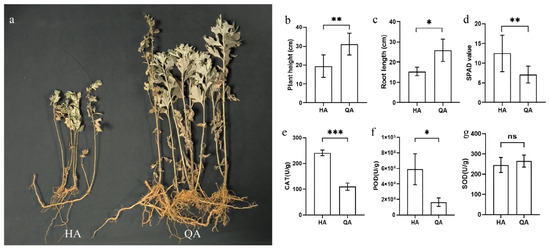
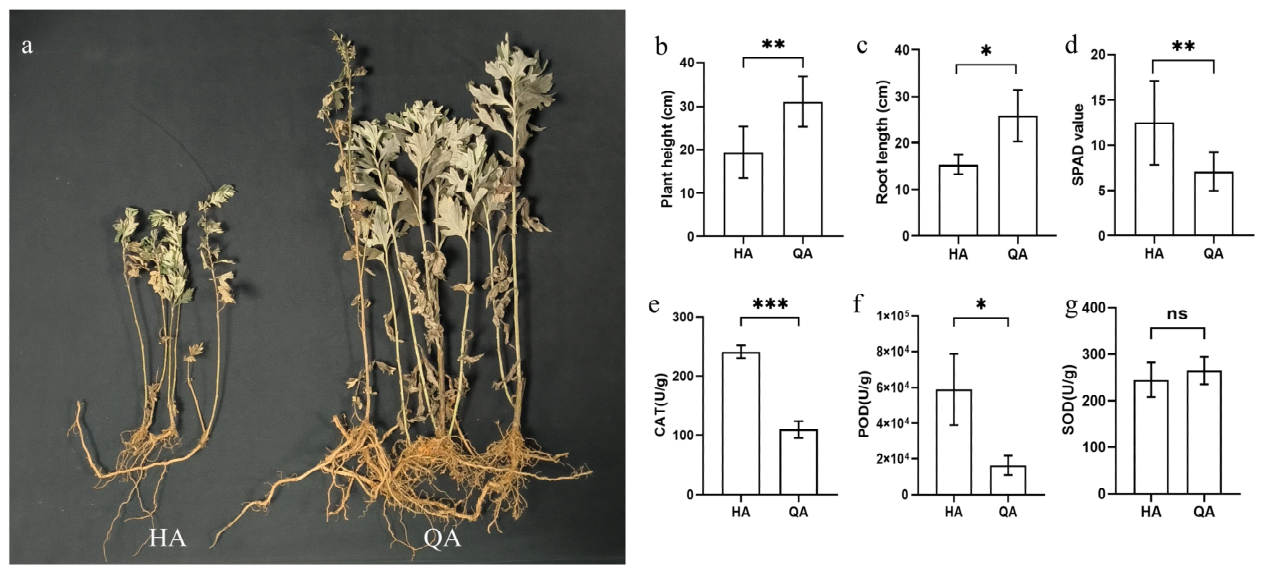
Figure 1 illustrates observed differences in various agronomic traits between HA and QA. Specifically, QA samples were taller than HA samples, with a mean plant height 1.60 times that of HA (Figure 1a,b). Furthermore, root length was greater in QA samples, approximately 1.68 times that of HA (Figure 1c), which may be associated with its capacity to absorb soil nutrients and water. In contrast, leaf SPAD values were numerically higher in HA samples than in QA samples. When assessing the leaf enzyme activities of both varieties simultaneously, a difference in CAT and POD activity was observed (Figure 1e,f). HA samples showed numerically higher SPAD values and CAT activity, which may be associated with photosynthetic performance and antioxidant capacity; however, photosynthetic efficiency and stress tolerance were not directly measured in this study. SOD activity was comparable between HA and QA samples (Figure 1g). This descriptive pattern should not be interpreted as evidence that their antioxidant defense mechanisms are equivalent.
Figure 1.
Exploring the differences in plant agronomic traits and leaf enzyme activity of two A. argyi cultivars: (a) differences in appearance between the two varieties; (b) plant height (cm); (c) root length (cm); (d) SPAD value; (e) CAT (U/g); (f) POD (U/g); (g) SOD (U/g). Data are presented as individual values and mean ± SD. The asterisks indicate significant differences (* p < 0.05, ** p < 0.01, *** p < 0.001, and ns p > 0.05).
3.2. Soil Edaphic Properties and Soil Enzyme Activity
The physicochemical properties and soil enzyme activities of the HA and QA varieties are summarized in Table 1. Soil pH was numerically higher in HA samples (6.53) than in QA samples (5.40). Additionally, available nitrogen was numerically higher in HA samples. However, available phosphorus and available potassium were comparable between the two sample sets. Regarding soil enzyme activities, soil sucrase activity was numerically higher in QA samples. These observed patterns may inform future exploration of soil nutrient utilization strategies. Soil acid phosphatase (S-ACP) and soil urease (S-UE) activities were comparable between sample sets (Table 1). Overall, these findings describe similarities and differences in the physicochemical properties and enzyme activities of the two sample sets, providing a foundation for further exploration of their characteristics and ecological roles.
Table 1.
Soil physicochemical properties and soil enzyme activities of the two A. argyi cultivars.
3.3. Alpha Diversity Index Analysis of Rhizosphere Soil Mycorrhizal Communities
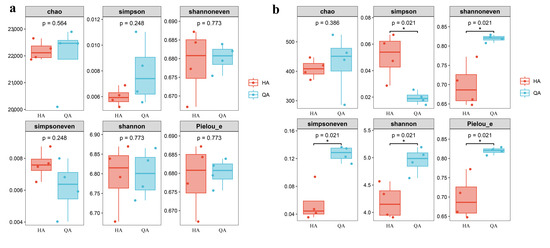
Most diversity indices (Chao, Simpson, Shannon, and Pielou_e) for bacteria in HA and QA were comparable between the two sample sets (Figure 2a). However, for fungi, the Simpson, Shannon, and Pielou_e indices appeared to differ between sample sets (Figure 2b), with the median diversity indices of HA being slightly higher than those of QA. These findings suggest that fungal alpha diversity in the rhizosphere soil may differ between sample sets, whereas bacterial alpha diversity indices were comparable.
Figure 2.
Box plots of alpha diversity indices: (a) bacteria; (b) fungi. Data are presented as individual values and median/IQR. p-values are shown in the panels. Asterisks (*) indicate significant differences (p < 0.05).
3.4. Rhizosphere Soil Bacterial and Fungal Abundance, Richness, and Community Assemblages
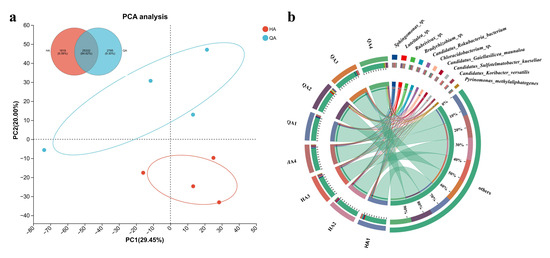
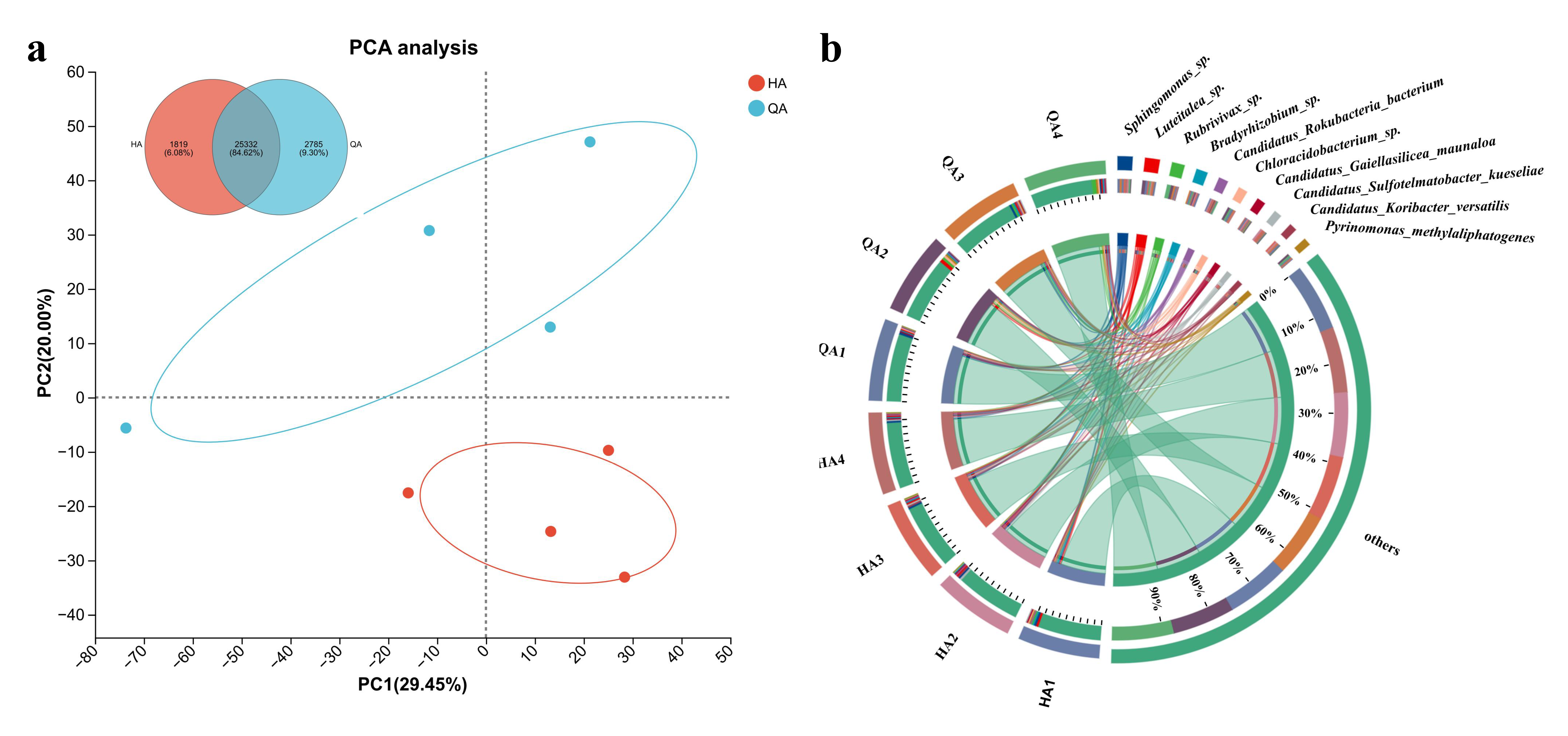
The results presented in Figure 3a provide valuable multi-dimensional insights into the microbial community. The Venn diagram illustrates that 84.62% (25332 OTUs) of the bacterial OTUs were shared between the two cultivars. The principal component analysis (PCA) diagram of microbial communities at the genus level shows a descriptive separation trend between the two sample sets (Figure 3a). No cultivar-effect test statistics are reported for bacterial community structure. Stacked bar plots showing relative abundances at the genus level revealed distinct microbial profiles between the two sample sets. The PCA plot showed that PC1 and PC2 explained 29.45% and 20.00% of the total variance, respectively. Notably, Sphingomonas sp., Luteitalea sp., and Rubrivivax sp. were distinctly identified (Figure 3b), while key bacterial taxa such as Bradyrhizobium sp. and Chloracidobacterium sp. showed relative-abundance differences. These genera are known to possess plant-growth-promoting traits, such as nutrient solubilization and phytohormone production, and may potentially be associated with the growth and development of A. argyi through their effects on nutrient cycling and soil properties.
Figure 3.
Effects of rhizosphere soil bacterial community structure based on 16S rRNA amplicon sequencing: (a) PCA analysis and Venn plots; (b) sample vs. taxa Circos plots. Note: The semicircle on the left represents the taxa abundance composition of the sample; different colors represent different taxa, and the length represents the abundance ratio of a certain taxon in the sample. The semicircle on the right represents the distribution of taxa in different samples at this clustering level. Taxonomic assignments are primarily reported at the genus level or above, and species-level names are only shown when supported by the reference database.
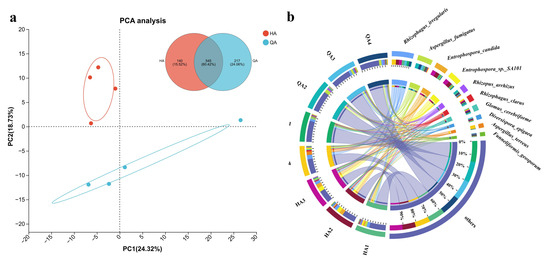
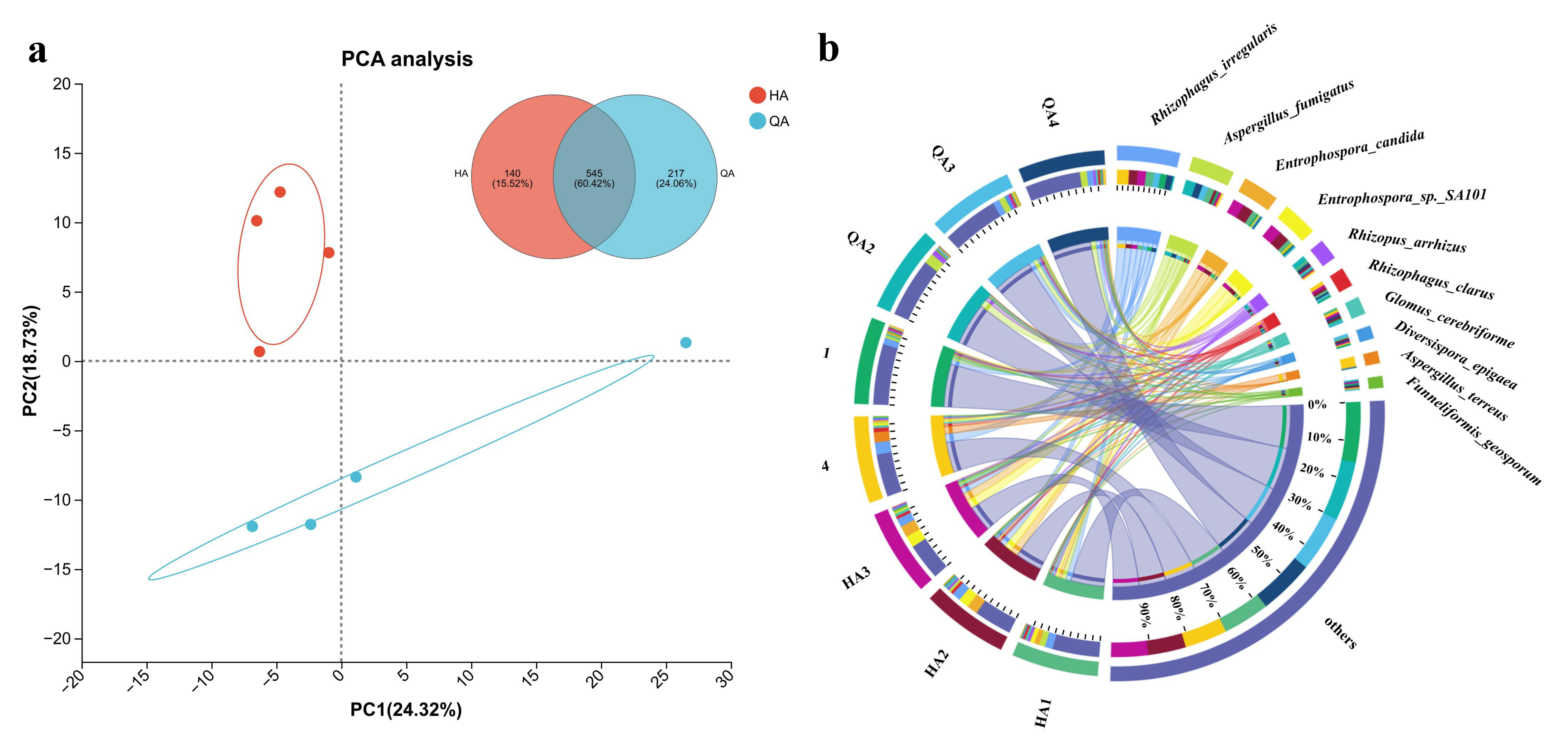
The results presented in Figure 4a provide descriptive information regarding the microbial community. The Venn diagram illustrates that 60.42% (545 fungal taxa) of the fungal taxa are shared between the two varieties, indicating similarities in their basic microbial composition. Further examination of the fungal PCA graph at the genus level demonstrates a descriptive degree of dispersion, suggesting differences in microbial community structure between the two sample sets. No cultivar-effect test statistics are reported for fungal community structure. The PCA plot showed that PC1 and PC2 explained 24.32% and 18.73% of the total variance, respectively. Through Circos diagram analysis, relative-abundance differences were observed for Rhizophagus irregularis, Entrophospora candida, and Entrophospora sp. SA101, suggesting their potential to form symbiotic relationships with A. argyi plants. These relationships may be beneficial, enhancing normal physiological functions such as root growth and development, thereby possibly improving the overall vitality and ecological adaptability of A. argyi plants. In contrast, Aspergillus fumigatus and Rhizopus arrhizus belong to saprophytic fungi and were also detected in the rhizosphere soils.
Figure 4.
Effects of rhizosphere soil fungal community structure based on fungal ITS2 amplicon sequencing: (a) PCA analysis and Venn plots; (b) sample vs. taxa Circos plots. Note: The semicircle on the left represents the taxa abundance composition of the sample; different colors represent different taxa, and the length represents the abundance ratio of a certain taxon in the sample. The semicircle on the right represents the distribution of taxa in different samples at the taxonomic classification level. Taxonomic assignments are primarily reported at the genus level or above, and species-level names are only shown when supported by the reference database.
3.5. KEGG Profiles of Rhizosphere Soil Functional Microorganisms and Correlation with Environmental Factors in Soil
Descriptive comparison of KEGG pathway relative-abundance profiles is presented in Figure 5a. Among the top 20 functions identified in the total abundance of the metabolic pathway difference groups selected in the heat map, methane metabolism pathways showed higher relative abundance in QA samples, suggesting a potential difference in microbial functional potential between the two rhizosphere soils. In contrast, ABC transporter pathways showed higher relative abundance in HA samples, which are essential for nutrient acquisition and the excretion of harmful substances. The Mantel test and correlation heatmap (Figure 5b) revealed descriptive community–environment association patterns between the two sample sets. Mantel correlation patterns suggested that the QA rhizosphere community was associated with plant height and available nitrogen, whereas the HA community was associated with root length and soil pH. Furthermore, the correlation heatmap indicated descriptive correlation patterns among environmental factors; for instance, plant height was positively correlated with root length, POD, CAT, pH, and quick-acting nitrogen but negatively correlated with SPAD. This suggests that the two sample sets may be associated with distinct sets of environmental factors, which may contribute to their different growth patterns and resource utilization strategies, providing a basis for future research on varietal characterization.
Figure 5.
Descriptive comparison of KEGG pathway relative abundance and correlations with soil environmental factors: (a) KEGG pathway relative-abundance profile. Note: QA group, default purple color; HA group, red color. (b) Heatmap of Mantel test network. Lines in the figure represent community and environmental factor correlations, and heatmaps represent correlations between environmental factors; different colors in the heatmaps represent positive and negative correlations, and color depth represents the extent of positive and negative correlations. Asterisks indicate the level of statistical significance (* p < 0.05, ** p < 0.01).
4. Discussion
4.1. Analysis of the Ecological Adaptation Mechanism of Differences in Agronomic Traits
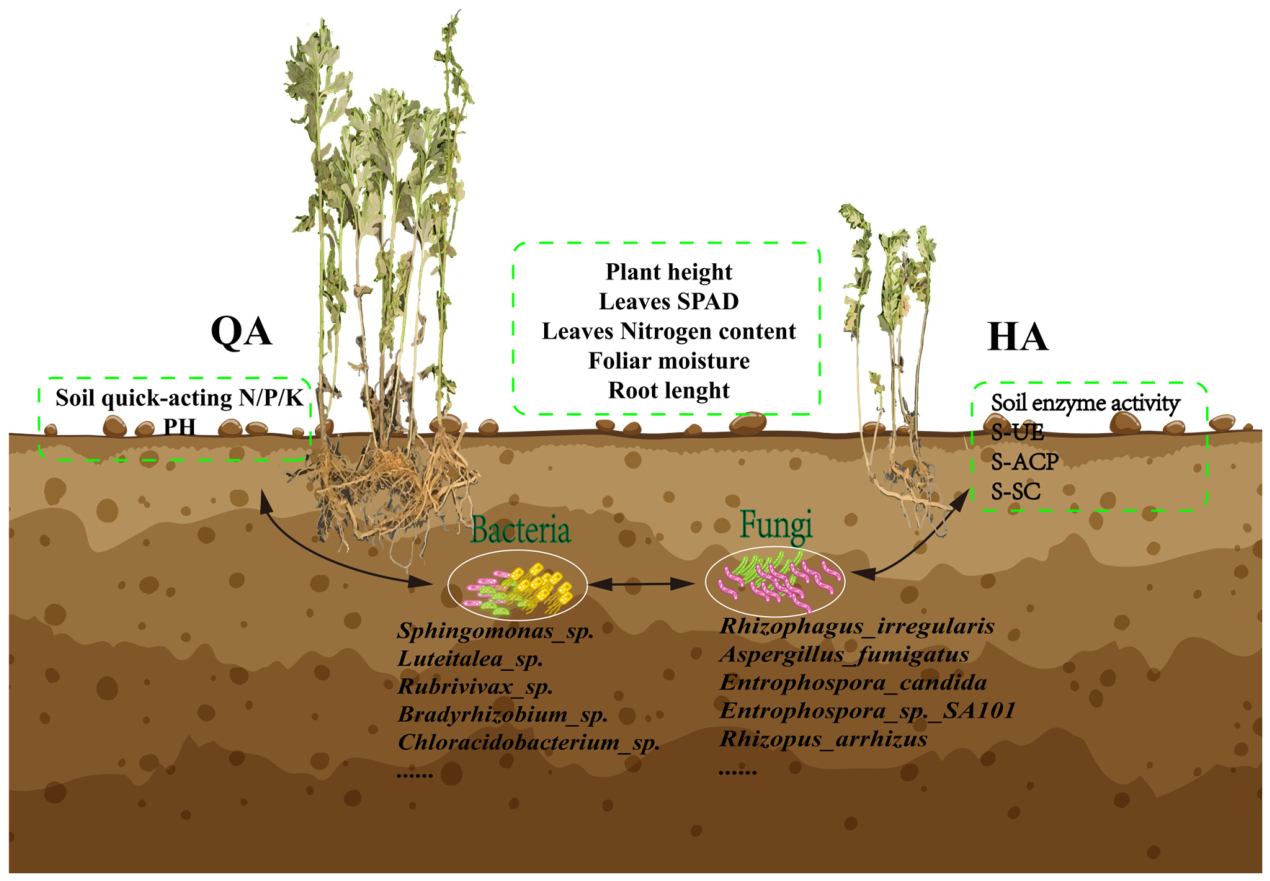
In the field of plant ecological adaptation, numerous scholars have investigated the relationship between plant agronomic traits and environmental adaptation. Guo et al. [31] highlighted that plant height and root length are crucial indicators of a plant’s adaptation to its environment. This observation aligns with our findings from a field trial involving two cultivars of A. argyi, HA and QA (Figure 6). In this trial, QA exhibited taller plants and longer roots, which is consistent with the findings of Zhang et al. [8] that plants enhance light competition and nutrient uptake by increasing their height and root length. These morphological differences may be associated with differences in resource acquisition, but competitive ability and nutrient uptake efficiency were not directly measured. Furthermore, we not only focused on plant morphology but also conducted an in-depth comparison of physiological indicators, including leaf SPAD values and enzyme activities. Xu et al. [32] demonstrated that leaf SPAD values are closely related to photosynthetic efficiency. Based on the conditions of the field trial, the higher SPAD value of HA leaves may indicate higher chlorophyll content; however, photosynthetic efficiency and low-light adaptation were not measured in this study. Antioxidant enzymes play a crucial role in plant stress tolerance [33,34]. These trait differences may inform future breeding research; however, no breeding assay or genetic verification was performed in this study, and multi-site trials and controlled experiments are required to evaluate their breeding value [35]. Furthermore, because the two cultivars were planted in adjacent rows within the same field, future studies should include independent randomized field plots and multi-site trials to further validate these findings.
Figure 6.
Potential maps for multidimensional variability exploration of QA and HA varieties. Dashed boxes represent the measured traits, and arrows denote interactions among plants and rhizosphere microbes.
4.2. Ecological Effects of Rhizosphere Soil Properties and Differences in Enzyme Activity
Rhizosphere soil properties and enzyme activity can influence plant growth and ecological adaptability [36,37,38]. Soil property analyses (Table 1) showed numerically higher soil pH and available nitrogen in HA samples and higher soil sucrase activity in QA samples; available phosphorus, available potassium, S-ACP, and S-UE were comparable between sample sets. Soil pH was numerically higher in HA (6.53) than in QA (5.40), which may influence nutrient availability and microbial community composition in the rhizosphere. This finding is consistent with the research of Schmidt et al. [39], which indicates that organic acids released by plant root systems affect rhizosphere soil pH, thereby influencing the availability of soil nutrients. The numerically higher available nitrogen in HA soil may be associated with the root exudation of amino acids and amides, although these mechanisms were not directly determined in this study. This aligns with Hartmann et al. [40], who found that amino acids and amides released by plant root systems promote nitrogen mineralization. Regarding soil enzymes, S-SC activity was numerically higher in QA than in HA, whereas S-ACP and S-UE were comparable. These observed differences in soil enzyme activities may reflect variations in soil carbon-utilization potential rather than overall nutrient cycling potential [41,42,43]. These variations in soil properties and enzyme activity further describe observed differences between the two A. argyi sample sets; however, their ecological significance remains to be determined. The experimental results suggest that HA and QA may differ in belowground nutrient acquisition strategies, but this hypothesis was not directly tested. These findings offer a novel perspective on soil adaptability studies concerning A. argyi varieties.
4.3. Effects of Functional Diversity of Soil Rhizosphere Microbial Communities
Analysis of the rhizosphere microbial community showed comparable bacterial alpha diversity indices between sample sets, whereas fungal alpha diversity and fungal community structure appeared to differ descriptively between HA and QA. The abundance of bacteria such as Sphingomonas sp. was higher in the HA rhizosphere soil, which may be associated with its enhanced stress resistance and organic degradation capabilities [44,45,46]. Sphingomonas sp. is a group of Gram-negative bacteria commonly found in soils, capable of degrading various organic pollutants, including polycyclic aromatic hydrocarbons (PAHs) and pesticide residues. This ability has been reported to potentially facilitate plant growth in contaminated soils [46,47], although this specific function was not tested in the present study. Furthermore, Sphingomonas has been reported to possess the potential to secrete plant growth-promoting substances, such as indole acetic acid (IAA), which may contribute to enhanced stress resistance and growth potential in plants [48,49], but direct experimental validation is required to confirm this in our system. In comparison, the higher abundance of arbuscular mycorrhizal fungi, such as Rhizophagus irregularis, in the rhizosphere soil of QA may be linked to its more efficient phosphorus uptake capacity. Rhizophagus irregularis can expand the uptake range of the root system through its mycelial network, significantly increasing phosphorus utilization by the plant, particularly in phosphorus-deficient soils. This symbiotic relationship is essential for plant growth [50]. Because ITS2 amplicon sequencing has lower specificity for AMF than 18S rRNA primers, the AMF-related results (e.g., Rhizophagus irregularis and Entrophospora candida) should be considered exploratory. Future studies should use AMF-specific 18S rRNA primers to validate these findings. In contrast, Aspergillus fumigatus and Rhizopus arrhizus displayed distinct characteristics, as they belong to saprophytic fungi. These species have been primarily reported as storage pathogens causing fruit spoilage or as opportunistic pathogens in immunocompromised hosts, rather than as obligate plant pathogens directly infecting the roots of living plants [51,52]. Their presence in the rhizosphere soils in this study more likely reflects their saprophytic roles in decomposing soil organic matter, rather than direct pathogenic effects on A. argyi roots. However, whether their long-term enrichment in the rhizosphere exerts indirect effects on root health through competition or the production of secondary metabolites warrants further investigation. These differences suggest that HA and QA may exhibit distinct adaptation strategies associated with different environmental factors: HA may be associated with nitrogen-rich conditions, whereas QA may be associated with soils rich in organic carbon. However, these are potential ecological interpretations based on correlation analyses, and direct experimental validation (e.g., microbial inoculation assays) is required. These findings offer a new perspective on the ecological adaptability of A. argyi varieties and provide a basis for future functional studies.
4.4. Analysis of Differences in KEGG Metabolic Pathways and Ecological Adaptability
Descriptive KEGG pathway profiles (Figure 5a) showed higher relative abundance of methane metabolism pathways in QA samples. While similar patterns have been reported in wetland plant studies [53,54], our study did not measure environmental parameters such as soil oxygen levels or methane concentrations. Therefore, this pattern is presented as an observed functional difference between sample sets, suggesting a potential divergence in microbial metabolic capabilities related to carbon cycling. Further studies incorporating relevant environmental measurements are needed to determine the ecological significance of the higher relative abundance of this pathway in QA. In contrast, ABC transporter pathways showed higher relative abundance in HA samples, which parallels the findings by Wicaksono [52] regarding plants with efficient nutrient utilization. Descriptive Mantel correlation patterns (Figure 5b) suggested that QA microbial communities were associated with plant height, POD, CAT, soil pH, and available nitrogen, while HA communities were associated primarily with root length, pH, and nitrogen. These observed associations suggest that the two varieties may be associated with distinct sets of environmental factors: QA appears to be more closely associated with aboveground traits, whereas HA appears to be more closely associated with root-associated processes. Collectively, these results describe divergent correlation patterns among agronomic traits, soil properties, and rhizosphere microbiomes. Such insights provide a foundation for future hypothesis-driven research; however, causal relationships and breeding applications require further experimental validation.
5. Conclusions
This study integrated agronomic and soil measurements with bacterial 16S rRNA gene and fungal ITS2 amplicon sequencing and shotgun metagenomic functional profiling to characterize sampled plants of two A. argyi cultivars, HA and QA. QA samples exhibited greater mean plant height and root length, whereas HA samples displayed elevated mean leaf SPAD values and CAT activity. Mean soil pH and available nitrogen were higher in HA samples, while mean soil sucrase activity was higher in QA samples. Bacterial alpha diversity indices were comparable between sample sets, and bacterial community structure showed a descriptive separation; fungal alpha diversity, community structure, and the relative abundance of key taxa appeared to differ. KEGG profiles indicated higher relative abundance of methane metabolism pathways in QA samples and ABC transporter pathways in HA samples. Collectively, these descriptive patterns provide candidate traits, taxa, and functional pathways for hypothesis-driven validation in independent replicated field experiments.
Author Contributions
Y.F. and J.X. designed the research, led the experimental setup, and wrote the initial manuscript draft. Z.Z. (Ziqian Zhang), X.H. and Q.K. investigated agronomic traits and conducted the experiments. R.S., Y.L. and W.W. collected and analyzed rhizosphere soil samples and data. F.C. and Z.Z. (Zhixiong Zeng) revised the manuscript for practical relevance, evaluated research significance, and contributed to breeding-related discussions. All authors have read and agreed to the published version of the manuscript.
Funding
This work was supported by the National Natural Science Foundation of China (NSFC 32272011), the Science and Technology Innovation Program of Hunan Province (2026JJ90160), and the Science Research Project of the Hunan Provincial Department of Education (24A0690 and 24C0626).
Institutional Review Board Statement
Not applicable.
Informed Consent Statement
Not applicable.
Data Availability Statement
The datasets generated during the current study are available in the NCBI Sequence Read Archive repository PRJNA1240069.
Conflicts of Interest
The authors declare no conflicts of interest.
References
- Yi, X.; Wang, X.; Wu, L.; Wang, M.; Yang, L.; Liu, X.; Chen, S.; Shi, Y. Integrated analysis of basic helix loop helix transcription factor family and targeted terpenoids reveals candidate AarbHLH genes involved in terpenoid biosynthesis in Artemisia argyi. Front. Plant Sci. 2022, 12, 811166. [Google Scholar] [CrossRef] [Scilit] [PubMed]
- Yang, H.; Li, X.; Guo, X.; Zhou, J.; Shen, Z.; Liu, L.; Wei, W.; Yang, L.; Yu, Z.; Chen, J.; et al. Moxibustion for primary dysmenorrhea: A resting-state functional magnetic resonance imaging study exploring the alteration of functional connectivity strength and functional connectivity. Front. Neurosci. 2022, 16, 969064. [Google Scholar] [CrossRef] [Scilit] [PubMed]
- Wang, K.; Ma, J.; Li, Y.; Han, Q.; Yin, Z.; Zhou, M.; Luo, M.; Chen, J.; Xia, S. Effects of essential oil extracted from Artemisia argyi leaf on lipid metabolism and gut microbiota in high-fat diet-fed mice. Front. Nutr. 2022, 9, 1024722. [Google Scholar] [CrossRef] [Scilit] [PubMed]
- Li, J.; Zhang, H.; Wang, T.; Peng, L.; Huang, K.; Tang, X.; Li, W.; Xu, Z.; Li, C.; Chen, F.; et al. Functional Differentiation of Industrial Hemp Rhizosphere Microbiome along Environmental Gradients. Front. Plant Sci. 2025, 16, 1578662. [Google Scholar] [CrossRef] [Scilit] [PubMed]
- Li, Y.; Tian, Y.; Zhong, W.; Wang, N.; Wang, Y.; Zhang, Y.; Zhang, Z.; Li, J.; Ma, F.; Zhao, Z.; et al. Artemisia argyi essential oil inhibits hepatocellular carcinoma metastasis via suppression of DEPDC1 dependent Wnt/β-catenin signaling pathway. Front. Cell Dev. Biol. 2021, 9, 664791. [Google Scholar] [CrossRef] [Scilit] [PubMed]
- Miao, Y.; Luo, D.; Zhao, T.; Du, H.; Liu, Z.; Xu, Z.; Guo, L.; Chen, C.; Peng, S.; Li, J.X.; et al. Genome sequencing reveals chromosome fusion and extensive expansion of genes related to secondary metabolism in Artemisia argyi. Plant Biotechnol. J. 2022, 20, 1902–1915. [Google Scholar] [CrossRef] [Scilit] [PubMed]
- Hu, J.; Bai, M.; Xing, Y.; Liu, J.; Xu, K.; Xiong, X.; Liu, H.; Yin, Y. Artemisia annua Residue Regulates Immunity, Antioxidant Ability, Intestinal Barrier Function, and Microbial Structure in Weaned Piglets. Animals 2024, 14, 3569. [Google Scholar] [CrossRef] [Scilit] [PubMed]
- Zhang, X.W.; Wang, S.; Tu, P.F.; Zeng, K.W. Sesquiterpene lactone from Artemisia argyi induces gastric carcinoma cell apoptosis via activating NADPH oxidase/reactive oxygen species/mitochondrial pathway. Eur. J. Pharmacol. 2018, 837, 164–170. [Google Scholar] [CrossRef] [Scilit] [PubMed]
- Dai, X.; Sun, Y.; Zhang, T.; Ming, Y.; Hongwei, G. An overview on natural farnesyltransferase inhibitors for efficient cancer therapy. J. Enzym. Inhib. Med. Chem. 2020, 35, 1027–1044. [Google Scholar] [CrossRef] [Scilit] [PubMed]
- Tseng, C.P.; Huang, Y.L.; Chang, Y.W.; Liao, H.R.; Chen, Y.L.; Hsieh, P.W. Polysaccharide-containing fraction from Artemisia argyi inhibits tumor cell-induced platelet aggregation by blocking interaction of podoplanin with C-type lectin-like receptor 2. J. Food Drug Anal. 2020, 28, 115–123. [Google Scholar] [CrossRef] [Scilit] [PubMed]
- Mei, Q.; Chen, X.; Xiang, L.; Liu, Y.; Su, Y.; Gao, Y.; Dai, W.; Dong, P.; Chen, S. DNA barcode for identifying Folium Artemisiae argyi from counterfeits. Biol. Pharm. Bull. 2016, 39, 1531–1537. [Google Scholar] [CrossRef] [Scilit] [PubMed]
- Gu, H.; Zhang, S.; Liu, L.; Yang, Z.; Zhao, F.; Tian, Y. Antimicrobial potential of endophytic fungi from Artemisia argyi and bioactive metabolites from Diaporthe sp. AC1. Front. Microbiol. 2022, 13, 908836. [Google Scholar] [CrossRef] [Scilit] [PubMed]
- Sun, B.; Tian, Y.X.; Zhang, F.; Chen, Q.; Zhang, Y.; Luo, Y.; Wang, X.R.; Lin, F.C.; Yang, J.; Tang, H.R. Variations of alkaloid accumulation and gene transcription in Nicotiana tabacum. Biomolecules 2018, 8, 114. [Google Scholar] [CrossRef] [Scilit] [PubMed]
- Hou, S.; Ren, X.; Yang, Y.; Wang, D.; Du, W.; Wang, X.; Li, H.; Han, Y.; Liu, L.; Sun, Z. Genome-wide development of polymorphic microsatellite markers and association analysis of major agronomic traits in core germplasm resources of Tartary buckwheat. Front. Plant Sci. 2022, 13, 819008. [Google Scholar] [CrossRef] [Scilit] [PubMed]
- Zhang, Y.; Li, J.; Zhou, D.; Song, J.; Gao, J. Nitrogen uptake and distribution in different Chinese cabbage genotypes under low nitrogen stress. Int. J. Mol. Sci. 2022, 23, 1573. [Google Scholar] [CrossRef] [Scilit] [PubMed]
- Liu, Y.; He, Y.; Wang, F.; Xu, R.; Yang, M.; Ci, Z.; Wu, Z.; Zhang, D.; Lin, J. From longevity grass to contemporary soft gold: Explore the chemical constituents, pharmacology, and toxicology of Artemisia argyi H. Lév. & Vaniot essential oil. J. Ethnopharmacol. 2021, 279, 114404. [Google Scholar] [CrossRef] [Scilit] [PubMed]
- Xu, R.; Ming, Y.; Li, Y.; Li, S.; Zhu, W.; Wang, H.; Guo, J.; Shi, Z.; Shu, S.; Xiong, C.; et al. Full-length transcriptomic sequencing and temporal transcriptome expression profiling analyses offer insights into terpenoid biosynthesis in Artemisia argyi. Molecules 2022, 27, 5948. [Google Scholar] [CrossRef] [Scilit] [PubMed]
- Su, P.; Ding, S.; Wang, D.; Kan, W.; Yuan, M.; Chen, X.; Tang, C.; Hou, J.; Wu, L. Plant morphology, secondary metabolites and chlorophyll fluorescence of Artemisia argyi under different LED environments. Photosynth. Res. 2024, 159, 153–164. [Google Scholar] [CrossRef] [Scilit] [PubMed]
- Wang, Z.; Zhao, T.; Ma, L.; Chen, C.; Miao, Y.; Guo, L.; Liu, D. Mechanisms governing the impact of nitrogen stress on the formation of secondary metabolites in Artemisia argyi leaves. Sci. Rep. 2023, 13, 12866. [Google Scholar] [CrossRef] [Scilit] [PubMed]
- Wang, J.; Xu, J.; Fu, P.; Li, J.; Tang, B.; Zhang, Y.; Zeng, Z.; Fu, Y. Bacillus amyloliquefaciens ART9 modulates the growth of Radix serratulae Chinensis through rhizosphere microbiome reprogramming and root transcriptomic regulation. Front. Plant Sci. 2026, 17, 1891133. [Google Scholar] [CrossRef] [Scilit] [PubMed]
- Seitz, V.A.; McGivern, B.B.; Daly, R.A.; Chaparro, J.M.; Borton, M.A.; Sheflin, A.M.; Kresovich, S.; Shields, L.; Schipanski, M.E.; Wrighton, K.C.; et al. Variation in root exudate composition influences soil microbiome membership and function. Appl. Environ. Microbiol. 2022, 88, e00226-22. [Google Scholar] [CrossRef] [Scilit] [PubMed]
- Tian, Y.; Zhao, Y.; Fu, X.; Yu, C.; Gao, K.; Liu, H. Isolation and identification of Talaromyces sp. strain Q2 and its biocontrol mechanisms involved in the control of Fusarium wilt. Front. Microbiol. 2021, 12, 724842. [Google Scholar] [CrossRef] [Scilit] [PubMed]
- Xu, Y.; Huang, Y.; Guo, L.; Zhang, S.; Wu, R.; Fang, X.; Xu, H.; Nie, Q. Metagenomic analysis reveals the microbiome and antibiotic resistance genes in indigenous Chinese yellow-feathered chickens. Front. Microbiol. 2022, 13, 930289. [Google Scholar] [CrossRef] [Scilit] [PubMed]
- Chouhan, U.; Gamad, U.; Choudhari, J.K. Metagenomic analysis of soybean endosphere microbiome to reveal signatures of microbes for health and disease. J. Genet. Eng. Biotechnol. 2023, 21, 84. [Google Scholar] [CrossRef] [Scilit] [PubMed]
- Perry, E.K.; Newman, D.K. Prevalence and correlates of phenazine resistance in culturable bacteria from a dryland wheat field. Appl. Environ. Microbiol. 2022, 88, e02320-21. [Google Scholar] [CrossRef] [Scilit] [PubMed]
- Chiniquy, D.; Barnes, E.M.; Zhou, J.; Hartman, K.; Li, X.; Sheflin, A.; Pella, A.; Marsh, E.; Prenni, J.; Deutschbauer, A.M.; et al. Microbial community field surveys reveal abundant Pseudomonas population in sorghum rhizosphere composed of many closely related phylotypes. Front. Microbiol. 2021, 12, 598180. [Google Scholar] [CrossRef] [Scilit] [PubMed]
- Bigatton, E.D.; Verdenelli, R.A.; Haro, R.J.; Ayoub, I.; Barbero, F.M.; Martín, M.P.; Dubini, L.E.; Jorrín Novo, J.V.; Lucini, E.I.; Castillejo, M.Á. Metagenomic analysis to assess the impact of plant growth-promoting rhizobacteria on peanut (Arachis hypogaea L.) crop production and soil enzymes and microbial diversity. J. Agric. Food Chem. 2024, 72, 22385–22397. [Google Scholar] [CrossRef] [Scilit] [PubMed]
- Fu, Y.; Liu, T.; Wang, X.; Wang, Y.; Gong, Q.; Li, G.; Lin, Q.; Zhu, S. Untargeted metabolomics reveal rhizosphere metabolites mechanisms on continuous ramie cropping. Front. Plant Sci. 2023, 14, 1217956. [Google Scholar] [CrossRef] [Scilit] [PubMed]
- Hamonts, K.; Trivedi, P.; Grinyer, J.; Holford, P.; Drigo, B.; Anderson, I.A.; Singh, B.K. Yellow canopy syndrome in sugarcane is associated with shifts in the rhizosphere soil metagenome but not with overall soil microbial function. Soil Biol. Biochem. 2018, 125, 275–285. [Google Scholar] [CrossRef] [Scilit]
- Bano, S.; Wu, Q.; Yu, S.; Wang, X.; Zhang, X. Soil properties drive nitrous oxide accumulation patterns by shaping denitrifying bacteriomes. Environ. Microbiome 2024, 19, 94. [Google Scholar] [CrossRef] [Scilit] [PubMed]
- Guo, Y.; Wang, Q.; Zhao, X.; Li, Z.; Li, M.; Zhang, J.; Wei, K. Field irrigation using magnetized brackish water affects the growth and water consumption of Haloxylon ammodendron seedlings in an arid area. Front. Plant Sci. 2022, 13, 929021. [Google Scholar] [CrossRef] [Scilit] [PubMed]
- Xu, Y.; Magwanga, R.O.; Cai, X.; Zhou, Z.; Wang, X.; Wang, Y.; Zhang, Z.; Jin, D.; Guo, X.; Wei, Y.; et al. Deep transcriptome analysis reveals reactive oxygen species (ROS) network evolution, response to abiotic stress, and regulation of fiber development in cotton. Int. J. Mol. Sci. 2019, 20, 1863. [Google Scholar] [CrossRef] [Scilit] [PubMed]
- Huang, W.D.; He, Y.Z.; Wang, H.H.; Zhu, Y.Z. Leaf physiological responses of three psammophytes to combined effects of warming and precipitation reduction in Horqin Sandy Land, Northeast China. Front. Plant Sci. 2022, 12, 785653. [Google Scholar] [CrossRef] [Scilit] [PubMed]
- Khandagale, K.; Roylawar, P.; Kulkarni, O.; Khambalkar, P.; Ade, A.; Kulkarni, A.; Singh, M.; Gawande, S. Comparative transcriptome analysis of onion in response to infection by Alternaria porri (Ellis) Cifferi. Front. Plant Sci. 2022, 13, 857306. [Google Scholar] [CrossRef] [Scilit] [PubMed]
- Li, Y.; Liu, F.; Li, P.; Wang, T.; Zheng, C.; Hou, B. An Arabidopsis cytokinin-modifying glycosyltransferase UGT76C2 improves drought and salt tolerance in rice. Front. Plant Sci. 2020, 11, 560696. [Google Scholar] [CrossRef] [Scilit] [PubMed]
- Kertesz, M.A.; Mirleau, P. The role of soil microbes in plant sulphur nutrition. J. Exp. Bot. 2004, 55, 1939–1945. [Google Scholar] [CrossRef] [Scilit] [PubMed]
- Hill, P.W.; Marsden, K.A.; Jones, D.L. How significant to plant N nutrition is the direct consumption of soil microbes by roots? New Phytol. 2013, 199, 948–955. [Google Scholar] [CrossRef] [Scilit] [PubMed]
- Smith, M.E.; Facelli, J.M.; Cavagnaro, T.R. Interactions between soil properties, soil microbes and plants in remnant-grassland and old-field areas: A reciprocal transplant approach. Plant Soil 2018, 433, 127–145. [Google Scholar] [CrossRef] [Scilit]
- Schmidt, J.E.; Vannette, R.L.; Igwe, A.; Blundell, R.; Casteel, C.L.; Gaudin, A.C.M. Effects of agricultural management on rhizosphere microbial structure and function in processing tomato plants. Appl. Environ. Microbiol. 2019, 85, e01064-19. [Google Scholar] [CrossRef] [Scilit] [PubMed]
- Hartmann, A.; Schmid, M.; Tuinen, D.V.; Berg, G. Plant-driven selection of microbes. Plant Soil 2009, 321, 235–257. [Google Scholar] [CrossRef] [Scilit]
- Duan, C.; Mei, Y.; Wang, Q.; Wang, Y.; Li, Q.; Hong, M.; Hu, S.; Li, S.; Fang, L. Rhizobium inoculation enhances the resistance of alfalfa and microbial characteristics in copper-contaminated soil. Front. Microbiol. 2022, 12, 781831. [Google Scholar] [CrossRef] [Scilit] [PubMed]
- Pasley, H.R.; Cairns, J.E.; Camberato, J.J.; Vyn, T.J. Nitrogen fertilizer rate increases plant uptake and soil availability of essential nutrients in continuous maize production in Kenya and Zimbabwe. Nutr. Cycl. Agroecosyst. 2019, 115, 373–389. [Google Scholar] [CrossRef] [Scilit] [PubMed]
- Li, T.; Ren, J.; He, W.; Wang, Y.; Wen, X.; Wang, X.; Ye, M.; Chen, G.; Zhao, K.; Hou, G.; et al. Anatomical structure interpretation of the effect of soil environment on fine root function. Front. Plant Sci. 2022, 13, 993127. [Google Scholar] [CrossRef] [Scilit] [PubMed]
- Gao, J.; Ellis, L.B.M.; Wackett, L.P. The University of Minnesota Biocatalysis/Biodegradation Database: Improving public access. Nucleic Acids Res. 2010, 38, D488–D491. [Google Scholar] [CrossRef] [Scilit] [PubMed]
- Lowman, S.; Kim-Dura, S.; Mei, C.; Nowak, J. Strategies for enhancement of switchgrass (Panicum virgatum L.) performance under limited nitrogen supply based on utilization of N-fixing bacterial endophytes. Plant Soil 2016, 405, 47–63. [Google Scholar] [CrossRef] [Scilit]
- Khan, A.L.; Waqas, M.; Asaf, S.; Kamran, M.; Shahzad, R.; Bilal, S.; Khan, M.A.; Kang, S.M.; Kim, Y.H.; Yun, B.W.; et al. Plant growth-promoting endophyte Sphingomonas sp. LK11 alleviates salinity stress in Solanum pimpinellifolium. Environ. Exp. Bot. 2017, 133, 58–69. [Google Scholar] [CrossRef] [Scilit]
- Waigi, M.G.; Kang, F.; Goikavi, C.; Ling, W.; Gao, Y. Phenanthrene biodegradation by sphingomonads and its application in the contaminated soils and sediments: A review. Int. Biodeterior. Biodegrad. 2015, 104, 333–349. [Google Scholar] [CrossRef] [Scilit]
- Asaf, S.; Numan, M.; Khan, A.L.; Al-Harrasi, A. Sphingomonas: From diversity and genomics to functional role in environmental remediation and plant growth. Crit. Rev. Biotechnol. 2020, 40, 138–152. [Google Scholar] [CrossRef] [Scilit] [PubMed]
- Kim, Y.J.; Park, J.Y.; Balusamy, S.R.; Huo, Y.; Nong, L.K.; Thi Le, H.; Yang, D.C.; Kim, D. Comprehensive genome analysis on the novel species Sphingomonas panacis DCY99T reveals insights into iron tolerance of ginseng. Int. J. Mol. Sci. 2020, 21, 2019. [Google Scholar] [CrossRef] [Scilit] [PubMed]
- Peña Venegas, R.A.; Lee, S.J.; Thuita, M.; Mlay, D.P.; Masso, C.; Vanlauwe, B.; Rodriguez, A.; Sanders, I.R. The phosphate inhibition paradigm: Host and fungal genotypes determine arbuscular mycorrhizal fungal colonization and responsiveness to inoculation in cassava with increasing phosphorus supply. Front. Plant Sci. 2021, 12, 693037. [Google Scholar] [CrossRef] [Scilit] [PubMed]
- Sugui, J.A.; Kwon-Chung, K.J.; Juvvadi, P.R.; Latgé, J.P.; Steinbach, W.J. Aspergillus fumigatus and related species. Cold Spring Harb. Perspect. Med. 2014, 5, a019786. [Google Scholar] [CrossRef] [Scilit] [PubMed]
- Wicaksono, W.A.; Cernava, T.; Berg, C.; Berg, G. Bog ecosystems as a playground for plant–microbe coevolution: Bryophytes and vascular plants harbour functionally adapted bacteria. Microbiome 2021, 9, 170. [Google Scholar] [CrossRef] [Scilit]
- Laanbroek, H.J. Methane emission from natural wetlands: Interplay between emergent macrophytes and soil microbial processes. A mini review. Ann. Bot. 2010, 105, 141–153. [Google Scholar] [CrossRef] [Scilit] [PubMed]
- Li, Q.; Deng, H.; He, R.; Hu, S.; Sun, L.; Li, M.; Wu, Q.L.; Zeng, J. Effects of different emergent macrophytes on methane flux and rhizosphere microbial communities in wetlands. Sci. Total Environ. 2024, 932, 172565. [Google Scholar] [CrossRef] [Scilit] [PubMed]

Disclaimer/Publisher’s Note: The statements, opinions and data contained in all publications are solely those of the individual author(s) and contributor(s) and not of MDPI and/or the editor(s). MDPI and/or the editor(s) disclaim responsibility for any injury to people or property resulting from any ideas, methods, instructions or products referred to in the content. |
© 2026 by the authors. Licensee MDPI, Basel, Switzerland. This article is an open access article distributed under the terms and conditions of the Creative Commons Attribution (CC BY) license.