


Abstract
Active acoustic signaling can improve robot navigation in crowds, but methods based on a cooperative-response assumption may generate unnecessary signals near static pedestrians and misjudge signaling effectiveness when non-cooperative pedestrians approach. This study proposes heterogeneous interactive crowd navigation with acoustic signaling, a selective acoustic-signaling method for heterogeneous crowds. The proposed method models dynamic cooperative pedestrians, static non-responsive pedestrians, and approaching non-cooperative chasers. A differentiated reinforcement-learning social reward suppresses ineffective signaling in static-only neighborhoods, while a second training stage introduces non-cooperative chasers controlled by a standard optimal reciprocal collision avoidance policy with fixed parameters to improve motion avoidance when signaling cannot alter chaser motion. Experiments in corridor and square-hall environments used 500 test episodes per setting. The differentiated reward reduced total signaling rates by 41.2% and 47.0%, respectively, and reduced static-condition signaling rates to 0%, while largely preserving dynamic-condition signaling and navigation time. In complete heterogeneous scenarios, the proposed method achieved success rates of 0.94 and 0.91, collision rates of 0.02 and 0.04, and catch rates of 0.08 and 0.12. These results indicate improved signaling selectivity and navigation performance under the evaluated controlled simulation conditions involving predefined cooperative and non-responsive pedestrian behaviors.
1. Introduction
As mobile robots are increasingly deployed in human-shared spaces such as shopping malls, airports, and service corridors, they must navigate safely and efficiently through dynamic crowds. Unlike geometric obstacle avoidance in static environments, crowd navigation must also account for uncertainty in pedestrian motion and sustained human–robot interaction. Avoiding collisions while balancing navigation safety and travel efficiency remains a central problem in mobile robot navigation [1,2].
Model-based crowd-navigation methods include local collision-avoidance approaches based on robot dynamics [3], social-force-based interaction models [4,5], multi-agent collision avoidance under reciprocal velocity constraints [6,7], and dense-crowd navigation based on joint trajectory prediction [8]. Deep reinforcement learning methods learn navigation policies through interaction with the environment and improve decision-making in complex multi-pedestrian settings [9,10,11,12]. More recent methods, including Deep Reinforcement Learning-based Velocity Obstacle (DRL-VO) and Heterogeneous Interaction Graph Transformer (HEIGHT), explicitly model velocity conflicts, heterogeneous spatiotemporal interactions, and environmental constraints, thereby improving navigation in crowded and confined spaces [13,14]. Nevertheless, these methods resolve conflicts primarily by modifying the robot’s own motion. They cannot actively communicate a passing intention or request surrounding pedestrians to release local space and therefore remain susceptible to freezing, prolonged waiting, or excessive detouring when passage is constrained.
To address the limitations of purely passive avoidance, Learning to Balance the Safety–Efficiency Trade-Off (L2B) integrates navigation and acoustic signaling into a unified decision framework. The robot jointly selects a motion action and a signaling action, while a social reward balances navigation safety and travel efficiency [15]. In its simulation environment, dynamic pedestrians within the signaling range adjust their motion directions according to the Extended Reciprocal Velocity Obstacle (ERVO) mechanism, thereby releasing local passage space. L2B thus extends motion-only collision avoidance to joint motion–signaling decision-making and alleviates inefficiency caused by excessive detouring or waiting.
L2B focuses primarily on when the robot should signal, and its simulation training assumes that dynamic cooperative pedestrians respond to acoustic signals according to predefined rules. Consequently, heterogeneity in pedestrian responsiveness is represented only to a limited extent. In real crowds, the robot may encounter pedestrians who temporarily occupy space without moving, as well as pedestrians who fail to respond to the robot’s acoustic signal and continue moving into a conflicting or approaching configuration. Such behavior may arise from distraction, inattention, conflicting motion intentions, or limited willingness to yield. In these cases, signaling does not produce the cooperative clearance response assumed during training. A policy may therefore overestimate the effect of signaling on the environment, increasing the likelihood of dangerously close encounters or collisions. Previous work has shown that introducing challenging interaction agents during training can expose policy weaknesses and improve adaptation to non-cooperative behavior [16].
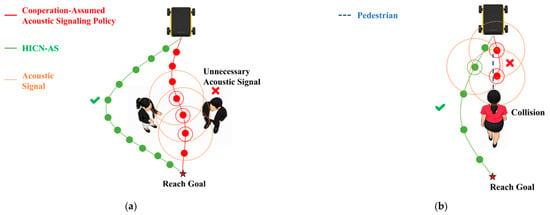
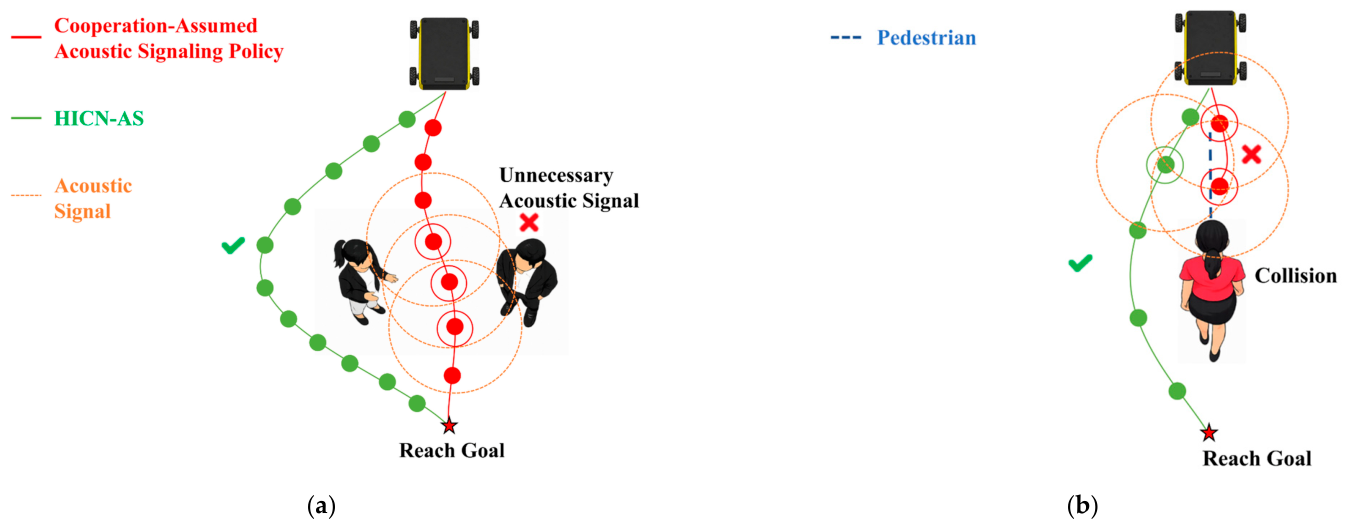
To address redundant signaling near static pedestrians and persistent moving conflicts in which acoustic signaling is ineffective, this study proposes Heterogeneous Interactive Crowd Navigation with Acoustic Signaling (HICN-AS). HICN-AS retains the attention-based value-network architecture and joint motion–signaling action space adopted in L2B; its algorithmic changes instead lie in the reward formulation and the training-state distribution. First, the original undifferentiated nearest-pedestrian signaling reward is replaced by a static–moving differentiated social reward that penalizes ineffective signaling in static-only proximity states while retaining signaling for moving-pedestrian conflicts. Second, a fixed-chaser augmentation stage introduces persistent moving conflicts whose state transitions are unaffected by acoustic signaling, thereby exposing the robot policy to signaling-failure states during training. These modifications specifically address heterogeneous signaling effectiveness without introducing a new value-network architecture or an adversarially optimized pedestrian policy. Figure 1 illustrates the resulting behavioral differences under the considered heterogeneous pedestrian scenarios.
Figure 1.
Comparison between the signaling-navigation policy based on the cooperative-response assumption and the proposed method in heterogeneous pedestrian scenarios. (a) In the presence of a static pedestrian, the signaling-navigation policy based on the cooperative-response assumption continues to execute signaling actions along the path, thereby disturbing the pedestrian. In contrast, the proposed method bypasses the static pedestrian and reaches the goal safely without signaling. (b) In the presence of an approaching non-cooperative pedestrian, the cooperative assumption that signaling can induce pedestrians to yield no longer holds. Relying only on signaling may lead to collision-avoidance failure. The proposed method instead selects signaling and motion-avoidance actions through joint motion–signaling decision-making and safely reaches the goal.
The main contributions of this study are as follows:
- A heterogeneous pedestrian-response model is constructed for dynamic cooperative pedestrians, static non-responsive pedestrians, and non-cooperative chasers.
- A differentiated reinforcement-learning social reward is designed for static and moving pedestrians to reduce ineffective signaling near static pedestrians while largely maintaining navigation efficiency and close-range safety.
- Non-cooperative chaser-augmented training is introduced so that the navigation policy can handle interactions in which non-cooperative chasers ignore acoustic signaling and continue approaching the robot. The policy learns to preserve signaling in moving-pedestrian proximity states while using navigation actions to avoid persistent-approach risk.
- Ablation studies of the social-reward modification and non-cooperative chaser-augmented training, together with complete heterogeneous-scenario experiments, were conducted in corridor and square-hall environments to evaluate the proposed method in terms of signaling selectivity, persistent-approach risk control, and navigation efficiency.
The remainder of this paper is organized as follows. Section 2 reviews related studies on passive crowd-aware navigation, active interactive navigation, and approaches for modeling non-cooperative pedestrian behaviors. Section 3 presents the proposed HICN-AS framework, including the problem formulation, heterogeneous pedestrian-response model, differentiated social reward design, and non-cooperative chaser-augmented training strategy. Section 4 describes the simulation environments, experimental parameter settings, training details, evaluation protocols, and computational-performance benchmark. Section 5 reports the experimental results from the ablation studies, complete heterogeneous-scenario comparisons, computational-performance evaluation, and qualitative trajectory analyses. Section 6 discusses the methodological implications, limitations, open research questions, and sim-to-real considerations. Finally, Section 7 concludes this work with closing observations.
2. Related Work
2.1. Passive Crowd-Aware Robot Navigation
Early crowd-navigation methods relied primarily on explicit motion models and manually designed collision-avoidance rules. The social force model describes pedestrian motion and group interactions through virtual forces [4], whereas Reciprocal Velocity Obstacle (RVO) and Optimal Reciprocal Collision Avoidance (ORCA) use reciprocal velocity obstacles and velocity-space constraints, respectively, to achieve real-time multi-agent collision avoidance [6,7]. These methods are interpretable but depend on prescribed motion rules and therefore have limited ability to represent temporal dependencies and heterogeneous interactions in complex crowds.
To improve crowd-interaction modeling, Collision Avoidance with Deep Reinforcement Learning (CADRL), Long Short-Term Memory Reinforcement Learning (LSTM-RL), and Socially Attentive Reinforcement Learning (SARL) use deep value learning, recurrent state encoding, and attention mechanisms, respectively, for multi-pedestrian navigation [9,10,11,12]. Social Long Short-Term Memory (Social LSTM) models social dependencies among pedestrians from a trajectory-prediction perspective [17], whereas Relational Graph Learning (RGL) and graph-convolutional methods informed by human gaze use graph structures to represent higher-order interactions [18,19]. More recently, DRL-VO has incorporated velocity-obstacle information into reinforcement-learning decisions [13], Frozone has mitigated robot freezing through hazardous-region prediction [20], and HEIGHT has jointly modeled robots, pedestrians, and environmental constraints using a heterogeneous spatiotemporal graph [14].
These methods improve interaction representation and collision avoidance in complex crowds, but conflict resolution still relies mainly on robot deceleration, waiting, or detouring. When local passage space is occupied, the robot cannot actively communicate its passing intention or request pedestrians to release space.
2.2. Active Interactive Navigation
Some studies communicate robot intent implicitly through socially compliant trajectories. Inverse reinforcement learning recovers social path costs from human demonstrations [21], generative adversarial imitation learning learns socially compliant behavior from raw depth observations [22], and NaviGAN uses a generative model to produce socially acceptable robot trajectories [23]. Such methods express social behavior through path geometry, velocity modulation, and spatial yielding; however, interaction remains dominated by robot motion, and the primary objective is socially compliant trajectory generation rather than the effectiveness of an additional communication action.
Explicit interaction communicates robot state and passing intent through sound, lighting, or display interfaces. Compared with implicit motion-based interaction, explicit signals can serve as passage requests or safety warnings, but their practical effect depends on whether nearby individuals perceive, understand, and respond to them. Executing a signaling action does not imply that the conflict has been resolved, and excessive or repeated signaling may also reduce the appropriateness of the interaction.
L2B further integrates navigation actions and active path-clearing actions into a unified decision framework, allowing the robot to choose between detouring and acoustic signaling while balancing safety and efficiency through a social reward [15]. In its simulation environment, dynamic pedestrians within the signaling range change their directions according to an ERVO model and release local passage space. This work demonstrates that explicit acoustic interaction can complement robot motion decisions. However, its transition dynamics are primarily based on the assumption that dynamic pedestrians respond to signals according to predefined rules, without separately representing static non-responsive pedestrians, dynamic cooperative pedestrians, and non-cooperative chasers. When signaling cannot alter the behavior of the principal interaction agent, the policy may signal redundantly or overestimate the contribution of signaling to collision avoidance.
2.3. Modeling Non-Cooperative Pedestrians and Expanding the Training Distribution
RVO and ORCA generally assume that neighboring agents possess a basic capacity for reciprocal collision avoidance [6,7]. This assumption does not fully account for difficult interactions involving ignored signals, persistent approaches, or active obstruction. Robust and adversarial reinforcement-learning methods improve adaptation to abnormal behavior and distribution shifts by introducing disturbances or opponents during training, thereby exposing policy weaknesses in high-risk states [24,25].
In crowd navigation, SPACE generates difficult scenarios through adversarial environment design [26], and Crowd-Steer increases behavioral diversity using high-fidelity crowd simulation [27]. Yuan et al. construct learnable chasers and employ iterative adversarial training between the navigator and chasers to improve cross-scenario stability [16].
Unlike methods that jointly optimize the navigator and an adversarial chaser, this study uses a fixed-parameter ORCA-controlled approaching agent to construct a controlled non-responsive interaction condition. The chaser is not intended to reproduce the full decision process of an adversarial human; rather, it provides a repeatable stress-test abstraction of persistent approach and failed signaling while retaining basic ORCA collision-avoidance constraints. During augmented training, only the robot value network is updated.
Existing passive-navigation methods resolve conflicts primarily through the robot’s own motion, whereas explicit acoustic-interaction methods are commonly developed under predefined pedestrian-response rules. Difficult-behavior training can expand the state distribution encountered by a policy; however, joint motion–signaling decisions remain underexplored when signaling cannot change the state of the principal interaction agent. This study therefore investigates differentiated signaling under heterogeneous pedestrian responses and non-cooperative chaser-augmented training.
3. Materials and Methods
3.1. Problem Formulation and Joint Motion–Signaling Decision-Making
We consider the task of moving a robot from an initial position to a goal without collision in a crowd and formulate it as a partially observable sequential decision problem. The robot and the crowd are controlled by a robot policy and fixed crowd policies, respectively; only the robot policy is trained, whereas the crowd policies remain fixed as part of the environmental state-transition process.
At time , the crowd state comprises observable and hidden components. The observable component contains kinematic information such as pedestrian positions, velocities, and radii, whereas the hidden component includes pedestrian goals, motion intentions, and unobserved behavioral parameters. The robot state and the observable crowd state jointly form the system state, which is formulated as shown in Equation (1):
Pedestrian category labels are maintained internally by the simulation environment to determine pedestrian state-transition dynamics but are not provided to the value network. The value network selects joint motion–signaling actions solely from observable kinematic states, including pedestrian positions, velocities, and radii. Consequently, cooperative pedestrians and non-cooperative chasers with similar instantaneous kinematic states may be indistinguishable to the policy at a given decision step; their different state-transition dynamics subsequently produce different kinematic observations after interaction. These updated observations are used reactively at each decision step; the current HICN-AS policy does not explicitly infer, store, or input a pedestrian-responsiveness label or cooperative/chaser identity. HICN-AS therefore adapts to evolving kinematic observations without explicit pedestrian-type recognition or online responsiveness classification.
The reinforcement-learning objective is to learn an optimal robot policy that maximizes the expected discounted return. The optimal value function is defined in Equation (2):
where is the discount factor, is the robot preferred speed, and is the episode termination time. Under value iteration, the optimal policy is formulated by Equation (3):
where denotes the state-transition kernel induced jointly by the robot action and the fixed pedestrian policies. Because the joint observable state space is high-dimensional, we retain the deep state-value network used in SARL and L2B [12,15] to approximate the value function without changing its architecture. The joint motion–signaling action is defined as shown in Equation (4):
where denotes the navigation action and denotes the acoustic-signaling action. When = 1, the robot emits an acoustic signal; when = 0, the robot remains silent. The holonomic action space contains eight discrete motion directions, each paired with signaling and non-signaling options, together with one stop action.
3.2. Heterogeneous Pedestrian Responses and Reinforcement-Learning Social Reward
Real-world crowds exhibit continuous and substantially richer behavioral diversity than can be exhaustively represented in simulation. Controlled abstractions are therefore commonly used in crowd-navigation studies to isolate specific interaction mechanisms. For example, HEIGHT distinguishes heterogeneous entity and interaction types through a structured representation [14], whereas L2B adopts a simplified ERVO-based pedestrian-response model to investigate active path-clearing behavior [15]. Following this controlled-modeling principle, this study considers three explicitly defined pedestrian-response models corresponding to the interaction conditions of interest.
Dynamic cooperative pedestrians move toward preset goals and may alter their motion in response to acoustic signaling according to the ERVO-based mechanism, whereas static non-responsive pedestrians remain stationary. Non-cooperative chasers ignore acoustic signaling and persistently approach the robot under a fixed-parameter ORCA policy. The chaser is not intended as a literal model of adversarial human behavior; rather, it provides a controlled stress-test condition that combines persistent reduction in robot–pedestrian separation with the absence of a yielding response. Updating the chaser goal to the robot’s current position maintains the conflict long enough to expose the policy to repeated signaling-failure states, while the fixed ORCA policy preserves basic local collision-avoidance constraints.
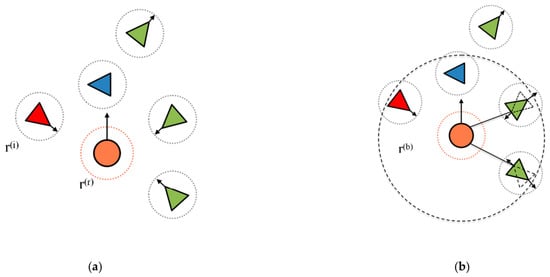
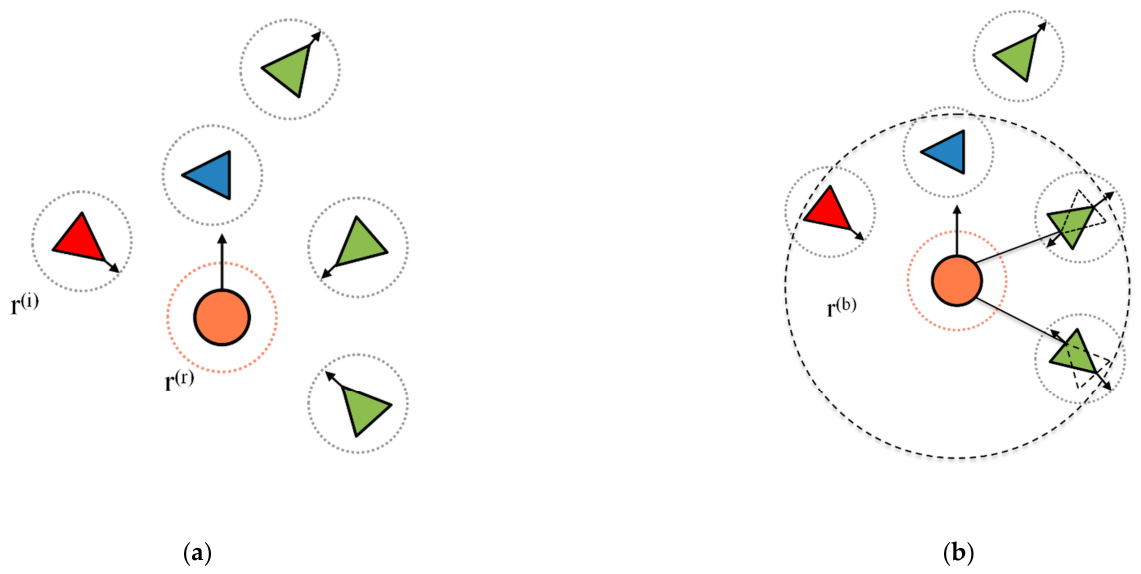
Together, these models span the two behavioral dimensions considered in this study—mobility and responsiveness to acoustic signaling—and provide a controlled setting for evaluating signaling selectivity and motion avoidance. They are not intended to represent the full behavioral diversity of real-world crowds. Here, “non-cooperative” denotes non-response to the robot’s acoustic signal rather than the absence of basic collision-avoidance behavior. Figure 2 illustrates the response characteristics of the three pedestrian categories. In Figure 2a, the orange circle represents the robot with radius , whereas the green, blue, and red triangles represent dynamic cooperative pedestrians, static non-responsive pedestrians, and non-cooperative chasers, respectively, each with radius . Each arrow points in the corresponding pedestrian’s direction of motion. When the robot executes an acoustic-signaling action (Figure 2b), dynamic cooperative pedestrians within the circular signaling region of radius centered on the robot adjust their motion directions according to Equations (5) and (6); static pedestrians remain stationary, whereas non-cooperative chasers ignore the signal and continue moving under a standard ORCA policy with fixed parameters.
Figure 2.
Heterogeneous pedestrian-response model: (a) spatial configuration of the heterogeneous crowd; (b) pedestrian behavioral responses under active acoustic signaling.
3.2.1. Acoustic Responses of Heterogeneous Pedestrians
The acoustic response of dynamic cooperative pedestrians is modeled using the ERVO-based mechanism adopted in [15]. Let the robot’s position at time t be ; for pedestrian i, let , , and denote position, velocity, and robot–pedestrian distance, respectively; and let denote the effective signaling radius. When the robot signals and the pedestrian lies within this radius, the signaling influence is represented by the Gaussian function formulated in Equation (5):
The velocity response of dynamic cooperative pedestrian is calculated via Equation (6):
The signaling influence decays as the robot–pedestrian distance increases. Consistent with Equations (5) and (6), the implemented acoustic-response condition depends only on the robot–pedestrian distance and the binary signaling action. A dynamic cooperative pedestrian is affected when and ; no additional angular or orientation constraint is imposed. Within the effective range, the desired response velocity of a dynamic cooperative pedestrian is redirected away from the robot, after which ERVO computes the actual velocity from the states of surrounding agents.
The velocity of a static non-responsive pedestrian remains zero, and its position is unaffected by acoustic signaling. Because signaling cannot alter the state of a static pedestrian, successful passage must rely on the robot’s own motion, while the differentiated reward discourages unnecessary acoustic signaling in this condition.
The non-cooperative chaser likewise does not respond to acoustic signaling. Its goal is updated at every time step to the robot’s current position, and its velocity is computed online using a standard ORCA policy with fixed parameters. The chaser’s motion update is independent of the signaling action. The ORCA policy and its parameters are not optimized and remain fixed throughout training, whereas the chaser’s position, velocity, goal, and action evolve with the environment state.
3.2.2. Static–Moving Differentiated Social Reward
An acoustic-signaling policy based on a cooperative-response assumption evaluates the signaling action using a single distance to the nearest pedestrian and does not further distinguish whether the nearby agent is static or moving. While retaining the original reward structure, the proposed method divides pedestrians into moving and static groups for reward computation.
Let the sets of dynamic cooperative pedestrians, static non-responsive pedestrians, and non-cooperative chasers be denoted by , , and , respectively. For reward computation during simulation training, the environment uses a static–moving grouping: dynamic cooperative pedestrians and non-cooperative chasers are combined into the moving-pedestrian set = ∪ , whereas static non-responsive pedestrians form the set . Here, “moving” refers to pedestrian mobility and the presence of a dynamic interaction conflict rather than guaranteed responsiveness to acoustic signaling. This static–moving grouping is used by the simulator only to compute the social reward and is not provided to the value network as a pedestrian-category input. The pedestrian categories remain behaviorally distinct in the simulation and follow different post-signaling state-transition models. The corresponding nearest-neighbor distances are defined in Equation (7):
The total reward comprises an environment reward and a social reward, as formulated in Equation (8):
The environment reward follows the structure of L2B [15] and rewards earlier arrival at the goal while penalizing collisions, as defined in Equation (9):
where is the robot goal position, is the episode time limit, is the arrival-reward decay coefficient, is the goal-reaching threshold, and is the minimum net separation between the robot and all pedestrians. The numerical value used in the experiments is reported in Section 4.1. On this basis, the social reward in L2B, which uses a single nearest-pedestrian distance, is replaced with the following static–moving differentiated formulation in Equation (10):
where is the discomfort-distance threshold, and are the weights of the discomfort-distance and signaling-interaction terms, respectively, and is the penalty weight for ineffective signaling near static pedestrians. The numerical values of these coefficients and the corresponding distance parameters are reported in Section 4.1.
The first two cases in Equation (10) discourage the robot from withholding an acoustic signal when a moving pedestrian creates a close-range conflict. If a dynamic cooperative pedestrian or a non-cooperative chaser enters the discomfort region or signaling range while the robot does not signal, the corresponding negative reward is applied. Importantly, this moving-pedestrian condition represents the presence of a dynamic interaction conflict rather than an assumption that every moving pedestrian will yield in response to the signal.
Acoustic signaling and pedestrian response are treated as two distinct aspects of the interaction. The signaling action serves as an explicit warning and communication of the robot’s presence or passing intention, whereas the pedestrian’s subsequent motion response is determined by its behavioral model. Therefore, acoustic signaling is retained as an available interaction action when a nearby moving pedestrian creates a potential conflict, even though the signal does not necessarily induce a yielding response.
The two moving-pedestrian categories remain distinct in their post-signaling state transitions. For a dynamic cooperative pedestrian, acoustic signaling can alter its motion through the ERVO-based response defined in Equations (5) and (6). In contrast, a non-cooperative chaser ignores the acoustic signal and continues moving according to its fixed-parameter ORCA policy. Thus, grouping the two categories for reward computation does not imply that signaling is assumed to have the same effect on them.
When signaling successfully affects a cooperative pedestrian, the resulting motion adjustment can help release local passage space. When a non-cooperative chaser continues to approach after signaling, the conflict remains unresolved, and the robot must instead adjust its own velocity, direction, and relative position. The second-stage chaser-augmented training repeatedly exposes the policy to such signaling-ineffective states, enabling it to learn motion-based avoidance rather than relying on signaling alone.
The third case penalizes signaling near a static non-responsive pedestrian when no moving pedestrian is present within the signaling range. When moving and static pedestrians coexist in the robot’s neighborhood, the moving-pedestrian conflict takes precedence, preventing the static-pedestrian penalty from suppressing signaling intended for moving-pedestrian conflicts. In all other cases, the social reward is zero.
Importantly, the static–moving grouping used in Equation (10) is maintained on the simulator side for reward computation and is not provided to the value network as an explicit pedestrian-category input. Within the moving-pedestrian set, the reward does not further distinguish dynamic cooperative pedestrians from non-cooperative chasers according to their acoustic responsiveness. Instead, their different responses to signaling are represented through the corresponding pedestrian state-transition dynamics: cooperative pedestrians may alter their motion after signaling, whereas chasers continue to evolve independently of the signaling action. The learned policy selects actions from observable kinematic states without explicit cooperative/chaser classification. This separation between simulator-side category labels and policy observations allows differentiated action selection to emerge through reinforcement learning rather than through a direct label-to-action mapping. Repeated observations of near-zero pedestrian velocity, together with the penalty for signaling near static pedestrians, reduce the expected return associated with unnecessary signaling, whereas continued approach after signaling leads to high-risk subsequent states that favor motion-adjustment actions. The resulting behavior therefore arises from observable state evolution and reward feedback.
3.3. Non-Cooperative Chaser-Augmented Training
To improve the robot’s adaptability when acoustic signaling cannot change pedestrian behavior, this study adopts a two-stage non-cooperative chaser-augmented training scheme. In the first stage, the robot is initialized by imitation learning and then trained by reinforcement learning in an environment containing dynamic cooperative pedestrians and static non-responsive pedestrians, yielding the Ours-SD policy.
In the second stage, Ours-SD is used to initialize the robot value network, and non-cooperative chasers controlled by a fixed-parameter ORCA policy are added to the training environment. Only the robot value network is updated, while all pedestrian policies remain fixed. The procedure therefore expands the robot’s training-state distribution rather than performing alternating navigator–chaser optimization or full adversarial reinforcement learning. Repeated exposure to persistent conflicts in which acoustic signaling is ineffective encourages the policy to adjust the robot’s velocity, direction, and relative position rather than relying on signaling alone.
The resulting HICN-AS policy retains acoustic signaling for cooperative interactions while using motion adjustment when signaling cannot resolve a persistent moving conflict.
4. Experiments
4.1. Simulation Environment and Experimental Parameter Settings
Two environments—a corridor and a square hall—were constructed in the CrowdNav framework. The robot and pedestrians were represented as two-dimensional discs with a radius of 0.3 m. The robot’s preferred speed was 1.0 m/s, the simulation time step was 0.25 s, and the maximum episode duration was 25 s. The acoustic-signaling radius, discomfort-distance threshold, and goal-reaching threshold were set to 1.0 m, 0.2 m, and 0.3 m, respectively. The corridor measured 12 m × 2.4 m and was used to evaluate static occupancy and persistent-approach risks under lateral space constraints. The square hall measured 10 m × 10 m and was used to evaluate multidirectional interactions involving more pedestrians.
The reward coefficients were fixed throughout training and evaluation. The arrival-reward decay coefficient was set to α = 0.1; the discomfort-distance and signaling-interaction weights were set to η = 0.5 and β = 0.2, respectively; and the penalty weight for ineffective signaling near static pedestrians was set to λ = 0.4.
The environment maintained three pedestrian categories. Dynamic cooperative pedestrians (D) were controlled by ERVO and could change their motion directions according to Equations (5) and (6) when they were within the signaling range and the robot executed an acoustic-signaling action. Static non-responsive pedestrians (S) maintained zero velocity. Non-cooperative chasers (N) ignored acoustic signaling, used the robot’s current position as a dynamic goal, and computed their actions online using a standard ORCA policy with fixed parameters. The chasers retained basic collision-avoidance constraints; thus, the evaluation considered difficult interactions involving persistent approaches and non-response to acoustic signaling rather than unconstrained intentional collisions.
For reproducibility, the pedestrian motion models used fixed parameters throughout training and evaluation. For the standard ORCA policy controlling the non-cooperative chasers, the neighbor distance was set to 10 m, the maximum number of neighbors to 10, the agent time horizon to 5 s, and the obstacle time horizon to 5 s. The chaser radius and maximum speed were set to 0.3 m and 1.0 m/s, respectively, with a simulation time step of 0.25 s. The ERVO model for dynamic cooperative pedestrians used the same neighbor distance of 10 m, maximum number of neighbors of 10, agent time horizon of 5 s, obstacle time horizon of 5 s, pedestrian radius of 0.3 m, maximum speed of 1.0 m/s, and simulation time step of 0.25 s. The effective acoustic-signaling radius for the ERVO response was = 1.0 m, and the signal-induced pedestrian response was governed by Equations (5) and (6). All ORCA and ERVO parameters remained fixed and were not optimized during reinforcement learning.
4.2. Training Details
We used the same attention-based SARL state-value network as L2B to explicitly encode pairwise robot–pedestrian interactions and aggregate multi-pedestrian interaction information through an attention-based aggregation mechanism. The value network was first initialized by imitation learning. The imitation-learning dataset was generated using ORCA and contained 3000 demonstration episodes. Training used the Adam optimizer with a learning rate of 0.01 for 50 epochs.
After imitation-learning initialization, first-stage reinforcement learning was conducted in an environment containing dynamic cooperative pedestrians and static non-responsive pedestrians. The Adam optimizer was used with a learning rate of 0.001, a mini-batch size of 100, and a discount factor of γ = 0.9. The value network was trained for 20,000 episodes. A standard ε-greedy exploration strategy was adopted: ε decreased linearly from 0.5 to 0.1 over the first 5000 episodes and remained at 0.1 thereafter. The policy obtained in the first stage is denoted Ours-SD.
To control the effect of the second-stage training budget on the ablation results, two continued-training branches were constructed from the Ours-SD policy obtained after 20,000 episodes. The branch without chasers continued training for 10,000 episodes in the original static–dynamic environment, yielding the equal-budget baseline Ours-SD-30K with a total reinforcement-learning budget of 30,000 episodes. The chaser branch added non-cooperative chasers controlled by a standard ORCA policy with fixed parameters to the original training environment and continued training for 10,000 episodes, yielding the final policy HICN-AS. The two branches used the same value-network architecture, reward function, optimizer, learning rate, mini-batch size, discount factor, exploration strategy, and number of parameter updates; the only difference was whether non-cooperative chasers were included in the second-stage training environment. Therefore, Ours-SD-30K and HICN-AS both used a total reinforcement-learning budget of 30,000 episodes.
4.3. Experimental Design and Baselines
The differentiated-reward ablation was conducted in the 3D+1S corridor scenario and the 7D+2S square-hall scenario, both without non-cooperative chasers. The chaser-augmentation ablation and the complete heterogeneous-scenario evaluation were conducted in the 3D+1S+1N corridor scenario and the 7D+2S+2N square-hall scenario. The training configurations of Ours-SD, Ours-SD-30K, and HICN-AS are described in Section 4.2.
4.4. Evaluation Metrics and Test Protocol
All methods used identical test-scene generation seeds and initial states, and each setting was evaluated over 500 episodes. Because acoustic signaling may alter the subsequent trajectories of dynamic cooperative pedestrians, comparisons were based on identical initial conditions rather than identical trajectories throughout execution. Success, Collision, and Timeout denote mutually exclusive termination outcomes, while Time is the mean navigation time over successful episodes. Discomfort Frequency is the proportion of decision steps in which the minimum net robot–pedestrian separation falls below the discomfort threshold, and Avg. Min Sep. in Danger is the average nearest net separation over those discomfort states.
For methods with acoustic signaling, Total SR is the number of signaling decisions divided by the total number of decision steps. Static SR, Dynamic SR, and Mixed SR use static-only, dynamic-only, and mixed-condition decision steps, respectively, as their denominators and quantify the conditional tendency to signal in each interaction condition. Catch rate is the proportion of episodes in which at least one chaser enters the predefined discomfort region ; this event may overlap with success, collision, or timeout. DtoP is obtained by averaging the episode-wise minimum robot–pedestrian distance over all test episodes, with larger values indicating greater distance margins.
The present evaluation adopts controlled simulation assumptions to isolate the effects of the proposed signaling reward and chaser-augmented training. Observation noise in pedestrian kinematic states is not modeled, acoustic-signal reception follows the predefined signaling region without missed-detection uncertainty, and pedestrian responses are applied according to predefined state-transition models without explicit perception or reaction delays. The current evaluation therefore does not explicitly account for perception errors, uncertain acoustic-signal detection, response delays, or stochastic human reactions.
4.5. Computational Performance Evaluation Setup
Computational performance was additionally evaluated using the same policy action-selection implementation on a workstation equipped with a 12th Gen Intel Core i5-12600KF CPU and 32 GB RAM, running Ubuntu 20.04.6 LTS, Python 3.6.15, and PyTorch 1.10.1. All timing measurements were performed on the CPU without GPU acceleration. The wall-clock latency of the complete policy action-selection procedure was measured at each decision step using a high-resolution timer, excluding environment-state updates, pedestrian simulation, visualization, and other simulator-side computations. The first 100 decision steps were discarded as warm-up samples. The computational benchmark used the complete heterogeneous corridor (3D+1S+1N) and square-hall (7D+2S+2N) configurations employed in the final HICN-AS evaluation. These configurations were selected so that the measured policy latency directly reflects the pedestrian counts and interaction settings used in the complete heterogeneous-scenario experiments.
5. Results
5.1. Ablation of the Static–Moving Differentiated Reward
L2B and Ours-SD use the same value network, action space, and ERVO pedestrian model; therefore, the differences in Table 1 are primarily attributable to the social reward. In the corridor and square hall, Ours-SD reduced Total SR from 17.40% and 24.56% to 10.23% and 13.02%, corresponding to relative reductions of 41.2% and 47.0%, respectively. Static SR decreased to 0% in both environments, indicating that no signaling actions were observed under purely static conditions in the evaluated episodes. Mixed SR decreased from 34.77% and 55.89% to 13.22% and 24.43%, respectively, showing that the differentiated reward also reduced some of the redundant signaling when static and dynamic pedestrians coexisted.
Table 1.
Ablation study of the static–moving differentiated reward.
The changes in Dynamic SR were markedly smaller than those in Static SR and Mixed SR: from 13.38% to 11.00% in the corridor and from 21.17% to 20.47% in the square hall. Thus, the reduction in Total SR did not result from uniformly suppressing all signaling actions, and the differentiated reward largely preserved signaling under dynamic-pedestrian conditions. The two methods produced identical Discomfort Frequency and Avg. Min Sep. in Danger values, and their mean navigation times differed only slightly. The corridor time decreased from 10.96 s to 10.45 s, whereas the square-hall time changed from 10.70 s to 10.73 s. These results indicate that improved signaling selectivity was not achieved through substantial additional detouring or reduced close-range separation.
This ablation clarifies the functional scope of the differentiated reward. It neither changes the value-network architecture nor removes the signaling action; instead, it conditions signaling on the motion state of nearby pedestrians. Near a static pedestrian, the policy shifts from signaling-based interaction to motion-based detouring, while retaining signaling near dynamic cooperative pedestrians. A qualitative demonstration of this ablation is provided in Supplementary Video S1.
5.2. Ablation of Non-Cooperative Chaser-Augmented Training
Ours-SD-30K and HICN-AS use identical networks, action spaces, reward functions, and training budgets; the principal difference is that HICN-AS encounters non-cooperative chasers controlled by a standard ORCA policy with fixed parameters during the second stage. Table 2 therefore evaluates training-state distribution expansion rather than network changes. In 3D+1S+1N, HICN-AS increased the success rate from 0.81 to 0.94, reduced the collision rate from 0.11 to 0.02 and the catch rate from 0.24 to 0.08, and shortened the mean navigation time from 11.62 to 10.40 s. In 7D+2S+2N, the success rate increased from 0.73 to 0.91, the collision rate decreased from 0.16 to 0.04, the catch rate decreased from 0.33 to 0.12, and the mean navigation time decreased from 12.36 to 10.60 s.
Table 2.
Ablation study of non-cooperative chaser-augmented training.
Because the chasers remain non-responsive to acoustic signaling, the chaser-augmented training exposes the robot policy to persistent conflicts that must be resolved through motion adjustment. The simultaneous reductions in collision rate, catch rate, and navigation time therefore indicate improved handling of persistent-approach risk rather than merely more conservative waiting or wider detours.
5.3. Evaluation in Complete Heterogeneous Scenarios
Table 3 compares the four methods in the complete heterogeneous scenarios. SARL relies exclusively on robot motion and, in 7D+2S+2N, achieved a collision rate of 0.08 but a timeout rate of 0.37, indicating limited goal-directed progress under the combined effects of high density, static occupancy, and persistent pursuit. L2B incorporates active signaling, but static pedestrians and non-cooperative chasers do not respond to the signal. Its collision rates were 0.27 and 0.32 and its catch rates were 0.38 and 0.49 in the corridor and square hall, respectively, reflecting a mismatch between the cooperative-response assumption used in training and the heterogeneous test dynamics.
Table 3.
Performance comparison in heterogeneous environments.
HEIGHT provided comparatively strong passive collision avoidance, with collision rates of 0.08 and 0.06 in the two environments. However, because it relies entirely on motion adjustment, its success rates remained lower and its catch rates higher than those of HICN-AS. This indicates that stronger passive interaction modeling alone does not necessarily resolve persistent-approach risk while maintaining navigation efficiency.
HICN-AS achieved success rates of 0.94 and 0.91, collision rates of 0.02 and 0.04, catch rates of 0.08 and 0.12, mean navigation times of 10.40 and 10.60 s, and DtoP values of 1.02 and 1.05 m in the corridor and square hall, respectively. Under the tested settings, HICN-AS achieved the highest success rates, lowest collision and catch rates, shortest mean navigation times, and largest DtoP values among the evaluated methods. The combination of shorter navigation times and larger distance margins indicates that the efficiency gain was not accompanied by reduced minimum robot–pedestrian separation.
5.4. Computational Performance and Real-Time Feasibility
Let N denote the number of observed pedestrians and A the number of candidate joint motion–signaling actions. For each candidate action, the attention-based value network processes N pedestrian states before aggregation, giving a per-decision complexity of O(AN). Because A = 17 is fixed in the present implementation, the online complexity scales as O(N). The differentiated reward and chaser-augmented training do not add an inference network or online pedestrian-category classifier. The computational performance of HICN-AS is summarized in Table 4.
Table 4.
Computational performance of the HICN-AS inference architecture.
For the corridor and square-hall configurations, the mean decision latencies were 8.18 and 8.75 ms, the P95 latencies were 19.46 and 21.61 ms, and the corresponding processing rates were 122.27 and 114.34 Hz, respectively. Both settings therefore retained a large computational margin.
The 0.25 s simulation control interval corresponds to a 4 Hz decision requirement and a 250 ms computation budget per control step. The largest measured P95 latency (21.61 ms) was substantially below this budget, demonstrating policy-level real-time feasibility for the present implementation. End-to-end timing with perception, pedestrian tracking, communication, acoustic actuation, and low-level robot control remains to be validated on a physical platform.
5.5. Qualitative Trajectory Analysis
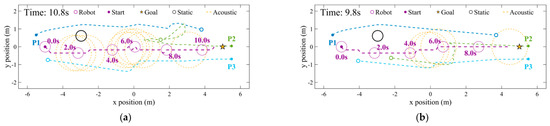
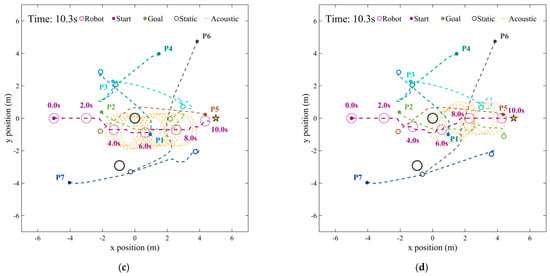
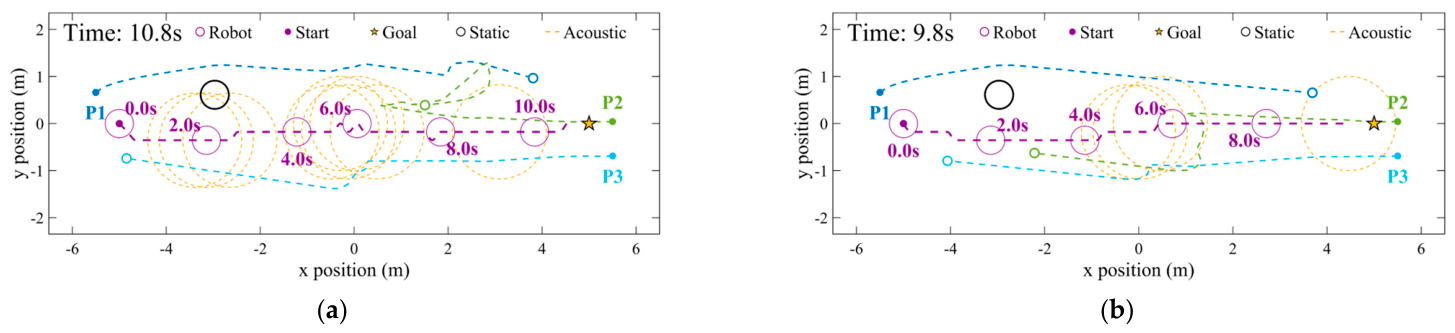
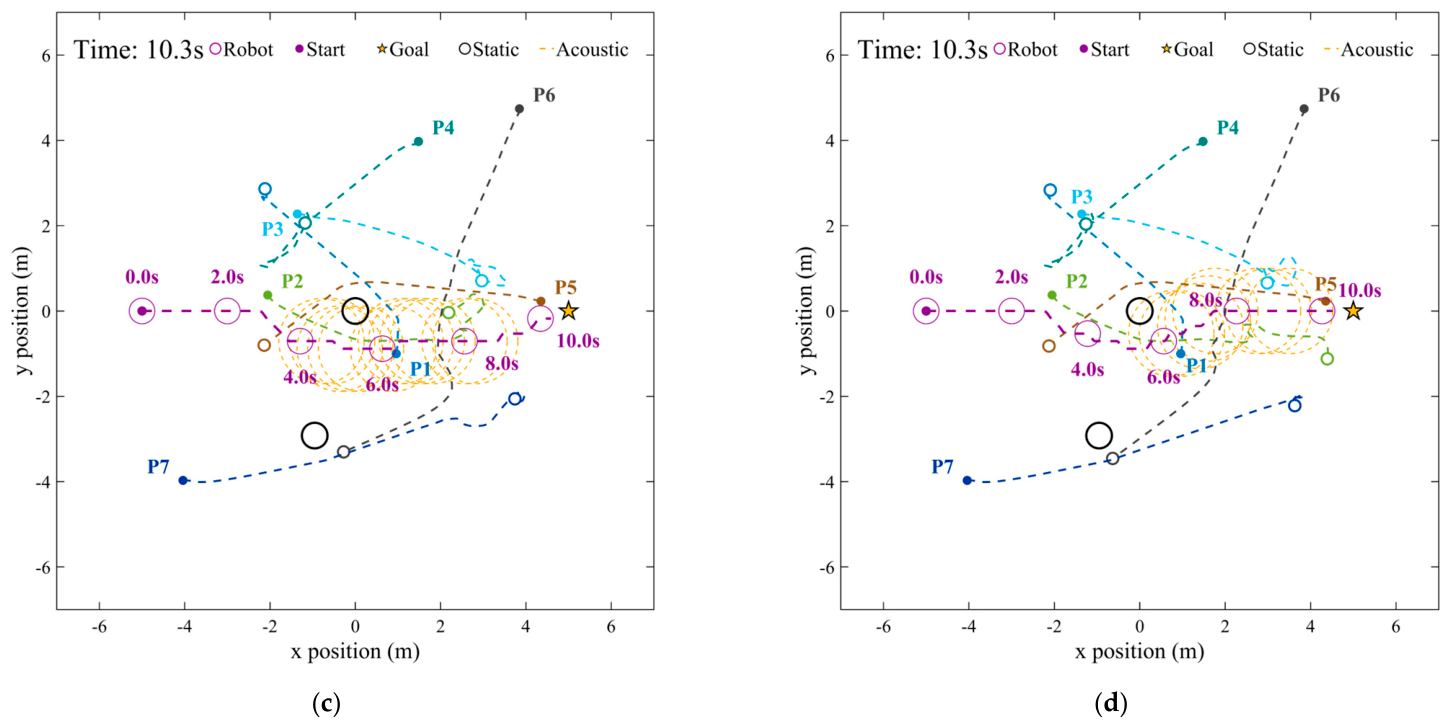
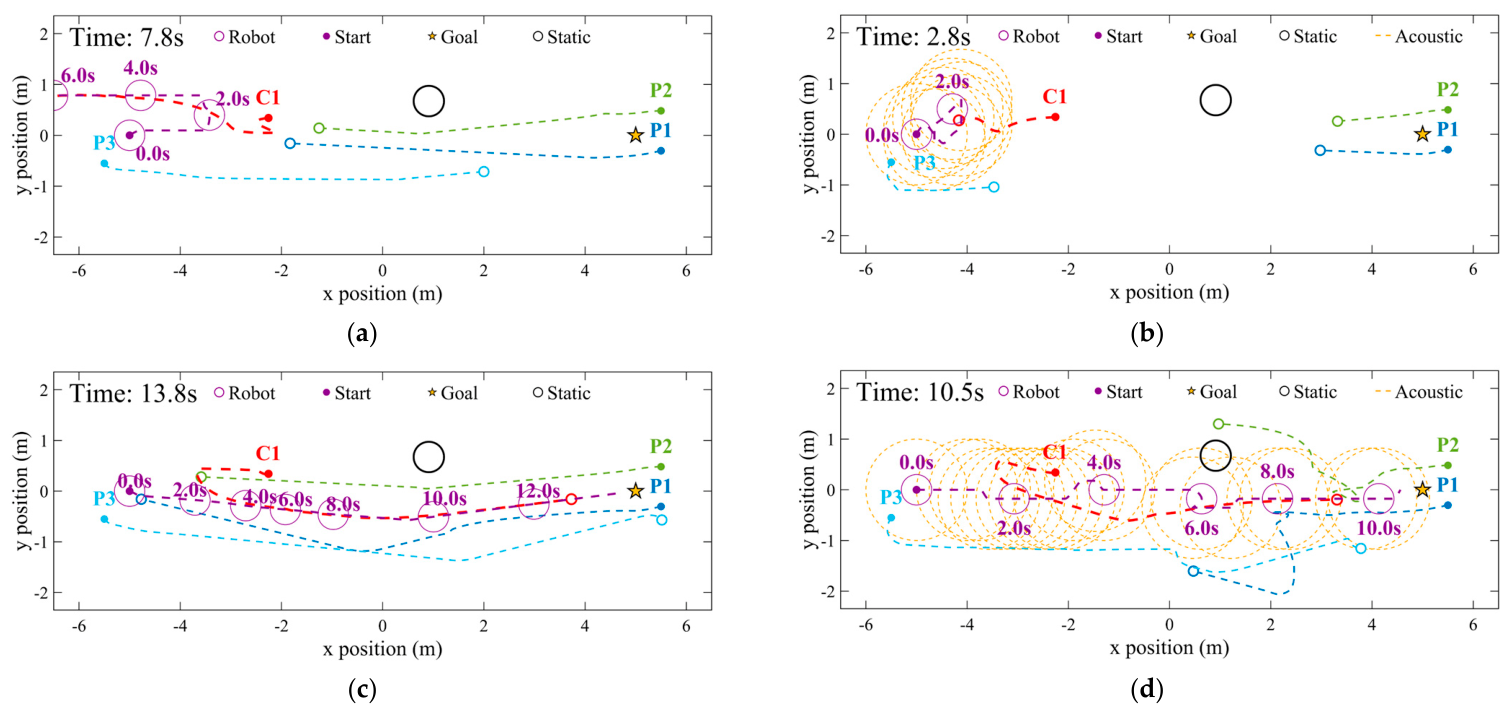
Figure 3 compares representative trajectories in the static–dynamic pedestrian scenarios. In both the corridor and square-hall environments, L2B produces signaling regions distributed continuously along the robot path and may still signal near static pedestrians (Figure 3a,c). In contrast, Ours-SD concentrates signaling near locations where dynamic-pedestrian trajectories may intersect the robot path and remains silent in purely static neighborhoods (Figure 3b,d). This behavior is consistent with Static SR decreasing to 0%, Mixed SR decreasing substantially, and Dynamic SR changing only slightly.
Figure 3.
Representative trajectories in static–dynamic pedestrian scenarios. (a) L2B in the corridor (3D+1S); (b) Ours-SD in the corridor (3D+1S); (c) L2B in the square hall (7D+2S); (d) Ours-SD in the square hall (7D+2S).
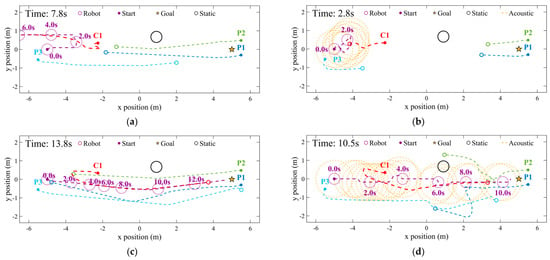
Figure 4 compares representative trajectories in the heterogeneous corridor scenario. SARL makes local motion adjustments after the chaser approaches but has difficulty continuously increasing its distance from the non-cooperative chaser (Figure 4a). L2B produces dense signaling near the start, while the chaser’s motion remains unaffected by the acoustic signal (Figure 4b). HEIGHT completes some episodes through navigation actions but requires a longer interaction process (Figure 4c). HICN-AS retains acoustic signaling while continuously adjusting its own motion, allowing the chaser to fall behind while maintaining progress toward the goal (Figure 4d).
Figure 4.
Representative trajectories in the heterogeneous corridor scenario (3D+1S+1N). (a) SARL; (b) L2B; (c) HEIGHT; (d) HICN-AS.
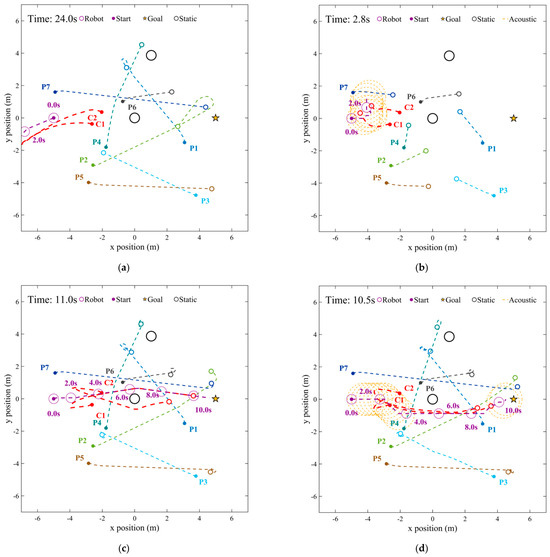
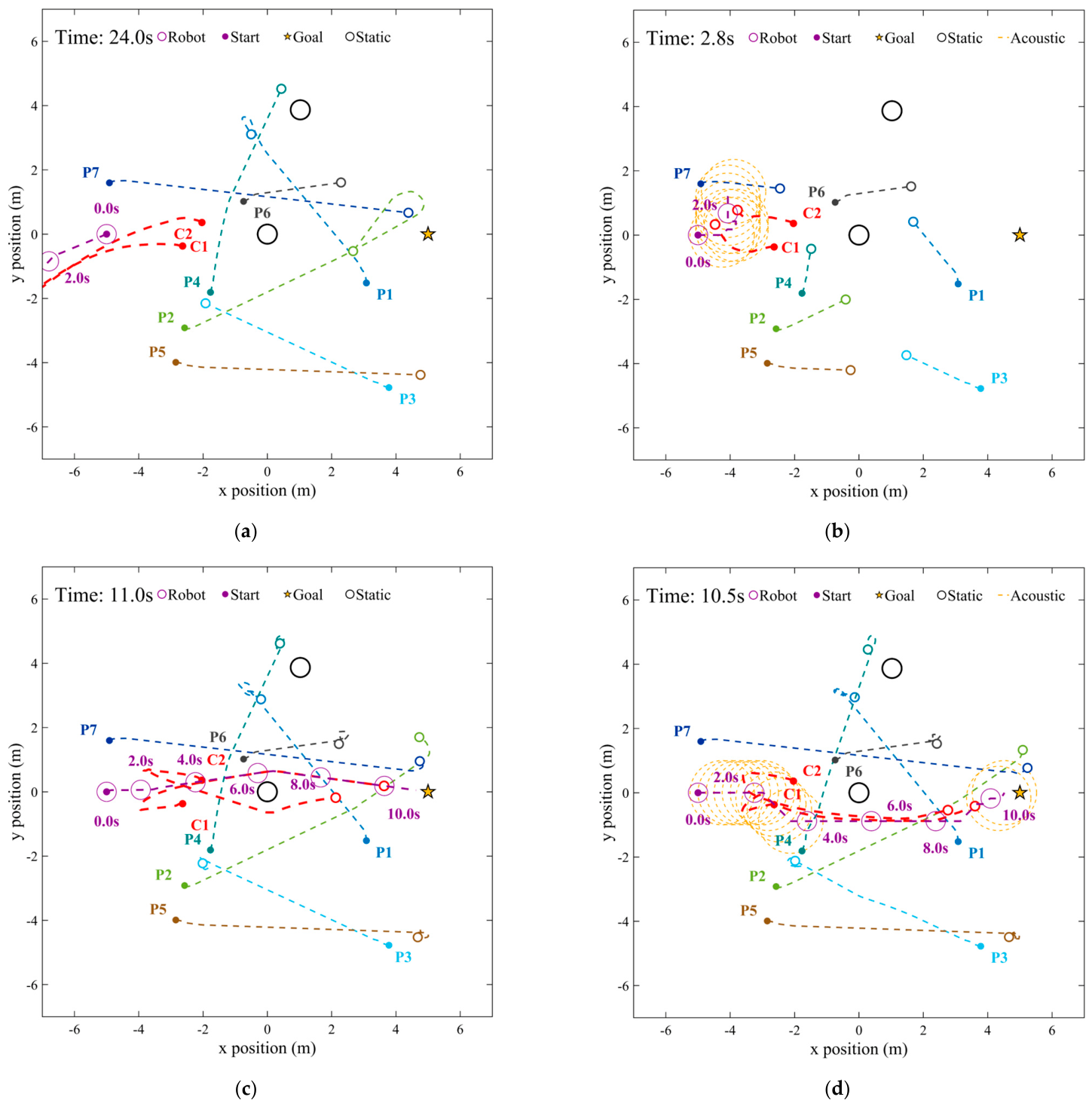
Figure 5 compares representative trajectories in the heterogeneous square-hall scenario. The representative SARL episode approaches the time limit and exhibits repeated direction changes with insufficient progress (Figure 5a). L2B continues to signal while two chasers approach, and the robot repeatedly adjusts within a small displacement region without promptly increasing its distance from the chasers (Figure 5b). HEIGHT can detour around static pedestrians, but the chasers remain in pursuit over a long segment (Figure 5c). HICN-AS signals to dynamic cooperative pedestrians, detours around static non-responsive pedestrians without signaling, and primarily uses motion-based avoidance to adjust its relative position with respect to non-cooperative chasers (Figure 5d). The trajectories illustrate behavioral mechanisms only; method comparisons are based primarily on the statistics over 500 test episodes. Additional qualitative comparisons of navigation performance in heterogeneous crowd environments are provided in Supplementary Video S2.
Figure 5.
Representative trajectories in the heterogeneous square-hall scenario (7D+2S+2N). (a) SARL; (b) L2B; (c) HEIGHT; (d) HICN-AS.
6. Discussion
6.1. Methodological Insights and Mechanism Synthesis
Across the evaluated scenarios, the differentiated reward and chaser-augmented training played complementary roles. The differentiated reward reduced ineffective signaling in static-only proximity states while largely preserving signaling under dynamic-pedestrian conditions, whereas chaser augmentation exposed the policy to persistent moving conflicts in which signaling was ineffective and promoted motion-based avoidance. Accordingly, the signaling selectivity considered in this study primarily concerns static versus moving interaction conditions. Chaser augmentation does not learn a separate chaser-specific signaling-suppression rule; rather, it improves the robot’s motion response when signaling fails to resolve a persistent moving conflict. Together, the experimental results support the intended combination of selective signaling and motion-based handling of signaling failure under the evaluated simulation conditions.
The trajectories in Figure 3, Figure 4 and Figure 5 also clarify the relationship between HICN-AS and conventional geometric obstacle-avoidance methods such as classical Bug algorithms [28]. Both may require the robot to modify its motion to bypass a spatial conflict, as illustrated in Figure 3, where HICN-AS remains silent near static pedestrians and detours around the occupied region. However, classical Bug algorithms primarily rely on local obstacle encounters and boundary following in geometrically defined environments, whereas HICN-AS operates in dynamic multi-pedestrian environments and jointly selects motion and acoustic-signaling actions. Because dynamic cooperative pedestrians may respond to signaling while static pedestrians and non-cooperative chasers do not, the policy must determine both whether acoustic interaction is useful and how to adjust its motion when signaling is ineffective. The persistent chaser interactions in Figure 4 and Figure 5 further distinguish the two settings by introducing time-varying robot–pedestrian conflicts rather than fixed obstacle boundaries. HICN-AS therefore extends the decision scope from motion-only obstacle avoidance to joint motion–signaling interaction under heterogeneous pedestrian responses. Because classical Bug algorithms were not included as baselines, no quantitative superiority over Bug-type navigation is claimed.
6.2. Limitations and Open Research Questions
While HICN-AS demonstrates improved signaling selectivity and navigation performance under the evaluated simulation conditions, several limitations remain. First, the current framework does not explicitly estimate pedestrian responsiveness online. As described in Section 3.1, the policy adapts to observable kinematic evolution without receiving pedestrian-category or responsiveness labels. In physical deployment, responsiveness should instead be treated as a latent and potentially time-varying interaction state. A practical estimator could compare short-term motion before and after acoustic signaling using changes in heading, relative velocity, robot–pedestrian separation, and lateral displacement, with gaze or body orientation providing additional cues when motion evidence is ambiguous. Continued approach with little signal-correlated motion change would indicate lower responsiveness, whereas motion away from the robot after signaling would provide evidence of a responsive interaction. Developing and validating such an estimator remains an important direction for real-world deployment.
Second, the present evaluation is restricted to three behavioral models: ERVO-based cooperative yielding, static non-responsive occupancy, and a fixed-parameter ORCA-based persistent approach. These models isolate specific failures of acoustic interaction rather than reproduce the full behavioral diversity of real crowds. In particular, the chaser should be interpreted as a controlled persistent-approach stress condition rather than a literal or statistically validated model of non-cooperative human behavior. Real pedestrians may additionally exhibit group interactions, distracted or wandering motion, probabilistic yielding, varying walking speeds, and time-varying responsiveness. Future work should therefore evaluate HICN-AS under broader behavioral distributions and incorporate learned or data-driven pedestrian models.
Third, the current evaluation does not explicitly model several sources of sensing and interaction uncertainty, including observation noise in pedestrian kinematics, uncertain acoustic-signal reception, perception and reaction delays, stochastic human responses, or environmental acoustic effects such as ambient noise, reflections, occlusion, and directionality. Future work should evaluate robustness under these uncertainties and incorporate probabilistic pedestrian-response and signal-reception models.
6.3. Sim-to-Real Considerations
The present study is validated entirely in controlled simulation, and transfer to a physical mobile robot remains to be demonstrated. A physical implementation would introduce three main system-level discrepancies: perception and tracking errors in pedestrian-state estimation, platform dynamics and actuation delays that are absent from the simplified holonomic model, and environment-dependent acoustic propagation and response timing. These factors affect the end-to-end closed-loop system rather than the policy network alone.
Accordingly, the present results demonstrate mechanism-level and policy-level feasibility rather than real-world deployment performance. Future validation should proceed from progressively uncertainty-perturbed simulations to physical-robot experiments with human participants. Such experiments should evaluate not only navigation outcomes but also pedestrian-tracking robustness, acoustic-signal reception and response uncertainty, and end-to-end computational latency including perception, communication, acoustic actuation, and low-level robot control.
7. Conclusions
This paper proposed Heterogeneous Interactive Crowd Navigation with Acoustic Signaling (HICN-AS), a selective active-signaling framework for mobile-robot navigation under the heterogeneous pedestrian-response models considered in this study. By combining a static–moving differentiated social reward with non-cooperative chaser-augmented training, the proposed method suppresses ineffective acoustic signaling near static non-responsive pedestrians while enabling motion-based avoidance when signaling cannot alter the trajectories of approaching chasers. Across the evaluated corridor and square-hall simulations with the three predefined pedestrian-response models, HICN-AS achieved improved signaling selectivity, lower collision and catch risks, and higher navigation efficiency than the evaluated passive baselines and the cooperative-response baseline. These findings are limited to the controlled simulation conditions and predefined pedestrian-response models evaluated in this study.
Supplementary Materials
The following supporting information can be downloaded at: https://www.mdpi.com/article/10.3390/machines14091011/s1, Video S1: Ablation study of the differentiated social reward under static and dynamic pedestrian conditions; Video S2: Comparison of navigation performance in heterogeneous crowd environments.
Author Contributions
Conceptualization, Z.W. and W.Z.; methodology, Z.W. and W.Z.; software, Z.W.; validation, Z.W.; formal analysis, Z.W.; investigation, Z.W.; data curation, Z.W.; writing—original draft preparation, Z.W.; writing—review and editing, W.Z., X.L., Y.W., A.Y. and H.A.; visualization, Z.W.; supervision, W.Z., X.L., Y.W., A.Y. and H.A.; project administration, W.Z. and X.L.; funding acquisition, W.Z. and X.L. All authors have read and agreed to the published version of the manuscript.
Funding
This work was supported in part by the National Foreign Expert Program of China, under Grant H20251088, and in part by the JUST Scientific Research Start-up Fund for Advanced Talents, under Grant 1022932404.
Institutional Review Board Statement
Not applicable.
Informed Consent Statement
Not applicable.
Data Availability Statement
The data presented in this study are available from the corresponding author upon reasonable request.
Acknowledgments
The authors would like to thank the members of the robotics laboratory for their valuable discussions and technical support. During the preparation of this manuscript, the authors used ChatGPT (OpenAI GPT-5.5) solely for language polishing, grammar checking, and improving the clarity and readability of academic expressions. The tool was used only during the manuscript preparation stage and was not used for literature review, scientific analysis, experimental design, simulation implementation, data processing, result interpretation, or generation of scientific conclusions. All scientific contents, including the research methodology, experimental settings, simulation results, analyses, and conclusions, were independently developed, verified, and reviewed by the authors. The authors take full responsibility for the final content of the manuscript.
Conflicts of Interest
The authors declare no conflicts of interest.
References
- Le, H.; Saeedvand, S.; Hsu, C.-C. A comprehensive review of mobile robot navigation using deep reinforcement learning algorithms in crowded environments. J. Intell. Robot. Syst. 2024, 110, 158. [Google Scholar] [CrossRef] [Scilit]
- Mavrogiannis, C.; Baldini, F.; Wang, A.; Zhao, D.; Trautman, P.; Steinfeld, A.; Oh, J. Core challenges of social robot navigation: A survey. ACM Trans. Hum.-Robot Interact. 2023, 12, 36. [Google Scholar] [CrossRef] [Scilit]
- Fox, D.; Burgard, W.; Thrun, S. The dynamic window approach to collision avoidance. IEEE Robot. Autom. Mag. 1997, 4, 23–33. [Google Scholar] [CrossRef] [Scilit]
- Helbing, D.; Molnár, P. Social force model for pedestrian dynamics. Phys. Rev. E 1995, 51, 4282–4286. [Google Scholar] [CrossRef] [Scilit] [PubMed]
- Ferrer, G.; Garrell, A.; Sanfeliu, A. Robot companion: A social-force based approach with human awareness-navigation in crowded environments. In Proceedings of the IEEE/RSJ International Conference on Intelligent Robots and Systems (IROS); IEEE: Piscataway, NJ, USA, 2013; pp. 1688–1694. [Google Scholar] [CrossRef] [Scilit]
- van den Berg, J.; Lin, M.; Manocha, D. Reciprocal velocity obstacles for real-time multi-agent navigation. In Proceedings of the IEEE International Conference on Robotics and Automation (ICRA); IEEE: Piscataway, NJ, USA, 2008; pp. 1928–1935. [Google Scholar] [CrossRef] [Scilit]
- van den Berg, J.; Guy, S.J.; Lin, M.; Manocha, D. Reciprocal n-body collision avoidance. In Robotics Research; Springer: Berlin, Germany, 2011; pp. 3–19. [Google Scholar] [CrossRef] [Scilit]
- Trautman, P.; Krause, A. Unfreezing the robot: Navigation in dense, interacting crowds. In Proceedings of the IEEE/RSJ International Conference on Intelligent Robots and Systems (IROS); IEEE: Piscataway, NJ, USA, 2010; pp. 797–803. [Google Scholar] [CrossRef] [Scilit]
- Chen, Y.F.; Liu, M.; Everett, M.; How, J.P. Decentralized non-communicating multiagent collision avoidance with deep reinforcement learning. In Proceedings of the IEEE International Conference on Robotics and Automation (ICRA); IEEE: Piscataway, NJ, USA, 2017; pp. 285–292. [Google Scholar] [CrossRef] [Scilit]
- Chen, Y.F.; Everett, M.; Liu, M.; How, J.P. Socially aware motion planning with deep reinforcement learning. In Proceedings of the IEEE/RSJ International Conference on Intelligent Robots and Systems (IROS); IEEE: Piscataway, NJ, USA, 2017; pp. 1343–1350. [Google Scholar] [CrossRef] [Scilit]
- Everett, M.; Chen, Y.F.; How, J.P. Motion planning among dynamic, decision-making agents with deep reinforcement learning. In Proceedings of the IEEE/RSJ International Conference on Intelligent Robots and Systems (IROS); IEEE: Piscataway, NJ, USA, 2018; pp. 3052–3059. [Google Scholar] [CrossRef] [Scilit]
- Chen, C.; Liu, Y.; Kreiss, S.; Alahi, A. Crowd-robot interaction: Crowd-aware robot navigation with attention-based deep reinforcement learning. In Proceedings of the IEEE International Conference on Robotics and Automation (ICRA); IEEE: Piscataway, NJ, USA, 2019; pp. 6015–6022. [Google Scholar] [CrossRef] [Scilit]
- Xie, Z.; Dames, P. DRL-VO: Learning to navigate through crowded dynamic scenes using velocity obstacles. IEEE Trans. Robot. 2023, 39, 2700–2719. [Google Scholar] [CrossRef] [Scilit]
- Liu, S.; Xia, H.; Pouria, F.C.; Hong, K.; Chakraborty, N.; Hu, Z.; Biswas, J.; Driggs-Campbell, K. HEIGHT: Heterogeneous Interaction Graph Transformer for robot navigation in crowded and constrained environments. IEEE Trans. Autom. Sci. Eng. 2026, 23, 1211–1230. [Google Scholar] [CrossRef] [Scilit]
- Nishimura, M.; Yonetani, R. L2B: Learning to balance the safety–efficiency trade-off in interactive crowd-aware robot navigation. In Proceedings of the 2020 IEEE/RSJ International Conference on Intelligent Robots and Systems (IROS), Las Vegas, NV, USA, 25–29 October 2020; pp. 11004–11010. [Google Scholar] [CrossRef] [Scilit]
- Yuan, T.; Zhu, W.; Hayashibe, M. Iterative adversarial learning with chaser agents for time-efficient crowd-aware navigation. IEEE Robot. Autom. Lett. 2026, 11, 4082–4089. [Google Scholar] [CrossRef] [Scilit]
- Alahi, A.; Goel, K.; Ramanathan, V.; Robicquet, A.; Fei-Fei, L.; Savarese, S. Social LSTM: Human trajectory prediction in crowded spaces. In Proceedings of the IEEE Conference on Computer Vision and Pattern Recognition (CVPR); IEEE: Piscataway, NJ, USA, 2016; pp. 961–971. [Google Scholar] [CrossRef] [Scilit]
- Chen, C.; Hu, S.; Nikdel, P.; Mori, G.; Savva, M. Relational graph learning for crowd navigation. In Proceedings of the IEEE/RSJ International Conference on Intelligent Robots and Systems (IROS); IEEE: Piscataway, NJ, USA, 2020; pp. 10007–10013. [Google Scholar] [CrossRef] [Scilit]
- Chen, Y.; Liu, C.; Shi, B.E.; Liu, M. Robot navigation in crowds by graph convolutional networks with attention learned from human gaze. IEEE Robot. Autom. Lett. 2020, 5, 2754–2761. [Google Scholar] [CrossRef] [Scilit]
- Sathyamoorthy, A.J.; Patel, U.; Guan, T.; Manocha, D. Frozone: Freezing-free, pedestrian-friendly navigation in human crowds. IEEE Robot. Autom. Lett. 2020, 5, 4352–4359. [Google Scholar] [CrossRef] [Scilit]
- Kim, B.; Pineau, J. Socially adaptive path planning in human environments using inverse reinforcement learning. Int. J. Soc. Robot. 2016, 8, 51–66. [Google Scholar] [CrossRef] [Scilit]
- Tai, L.; Zhang, J.; Liu, M.; Burgard, W. Socially compliant navigation through raw depth inputs with generative adversarial imitation learning. In Proceedings of the IEEE International Conference on Robotics and Automation (ICRA); IEEE: Piscataway, NJ, USA, 2018; pp. 1111–1117. [Google Scholar] [CrossRef] [Scilit]
- Tsai, C.-E.; Oh, J. A Generative Approach for Socially Compliant Navigation. In Proceedings of the 2020 IEEE International Conference on Robotics and Automation (ICRA), Paris, France, 31 May–31 August 2020; pp. 2160–2166. [Google Scholar] [CrossRef] [Scilit]
- Pinto, L.; Davidson, J.; Sukthankar, R.; Gupta, A. Robust adversarial reinforcement learning. In Proceedings of the International Conference on Machine Learning (ICML); JMLR.org: Cambridge, MA, USA, 2017; pp. 2817–2826. Available online: https://proceedings.mlr.press/v70/pinto17a.html (accessed on 2 September 2026).
- Pan, X.; Seita, D.; Gao, Y.; Canny, J. Risk-averse robust adversarial reinforcement learning. In Proceedings of the IEEE International Conference on Robotics and Automation (ICRA); IEEE: Piscataway, NJ, USA, 2019; pp. 8522–8528. [Google Scholar] [CrossRef] [Scilit]
- Kim, J.; Hwang, H.S.; Seok, J. Adversarial environment design for crowd navigation based on deep reinforcement learning. Eng. Appl. Artif. Intell. 2025, 159, 111621. [Google Scholar] [CrossRef] [Scilit]
- Liang, J.; Patel, U.; Sathyamoorthy, A.J.; Manocha, D. Crowd-Steer: Realtime Smooth and Collision-Free Robot Navigation in Densely Crowded Scenarios Trained using High-Fidelity Simulation. In Proceedings of the Twenty-Ninth International Joint Conference on Artificial Intelligence (IJCAI-20), Yokohama, Japan, 7–15 January 2021; 2020; pp. 4221–4228. [Google Scholar] [CrossRef] [Scilit]
- Lumelsky, V.J.; Stepanov, A.A. Path-planning strategies for a point mobile automaton moving amidst unknown obstacles of arbitrary shape. Algorithmica 1987, 2, 403–430. [Google Scholar] [CrossRef] [Scilit]

Disclaimer/Publisher’s Note: The statements, opinions and data contained in all publications are solely those of the individual author(s) and contributor(s) and not of MDPI and/or the editor(s). MDPI and/or the editor(s) disclaim responsibility for any injury to people or property resulting from any ideas, methods, instructions or products referred to in the content. |
© 2026 by the authors. Licensee MDPI, Basel, Switzerland. This article is an open access article distributed under the terms and conditions of the Creative Commons Attribution (CC BY) license.