

Uncertainty and Sensitivity Analyses of an Annular Thermoelectric Refrigerator Based on Latin Hypercube Sampling


Abstract
1. Introduction
2. Numerical Model of the Annular Thermoelectric Refrigerator
2.1. Working Principle
- (1)
- The physical properties of the semiconductor materials, including the Seebeck coefficient, thermal conductivity, and electrical resistivity, were assumed to be constant and independent of the temperature and spatial position, so the Thomson effect was neglected [22].
- (2)
- Only steady-state refrigeration conditions were considered.
- (3)
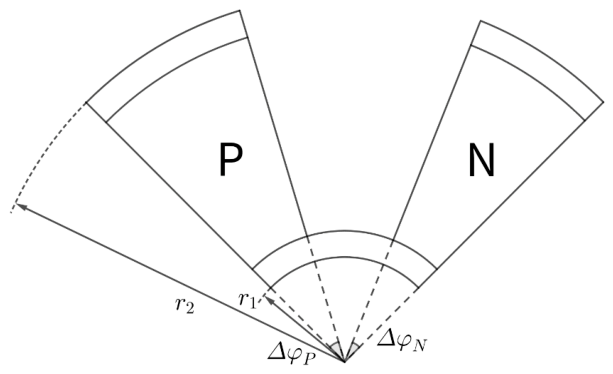
- The lateral surfaces of the refrigeration system were assumed to be adiabatic, and only one-dimensional steady-state radial heat transfer was considered with heat flowing along the radial direction from the cold side to the hot side.
- (4)
- The thermal conductivities and electrical resistivities of the p- and n-type semiconductors were considered equal to each other and equivalent to those of the complete device; the Seebeck coefficient for the p-type semiconductor was assumed to be positive, that for the n-type semiconductor was assumed to be negative, and both were set to half of that for the complete device to ensure structural and performance symmetry [23].
2.2. Evaluation of Refrigeration Performance
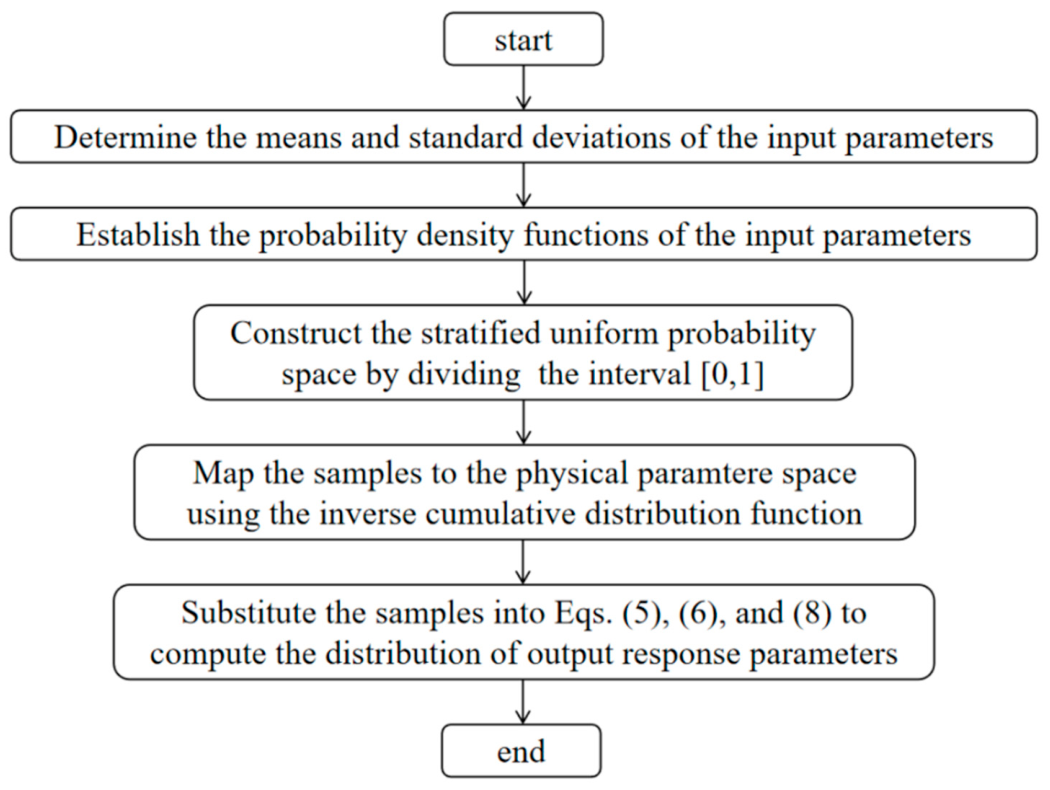
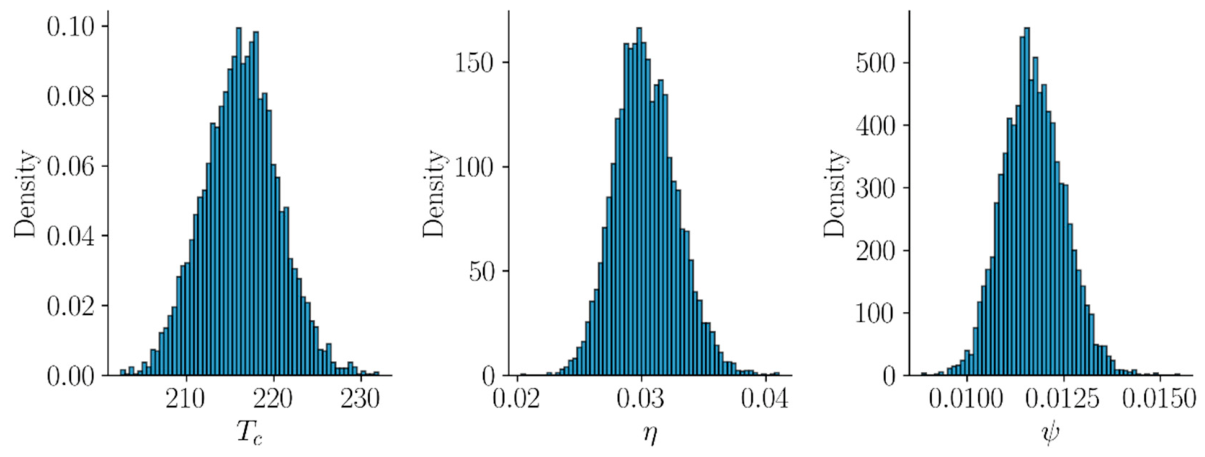
3. Dispersion Analysis Based on Latin Hypercube Sampling
4. Sensitivity Analysis
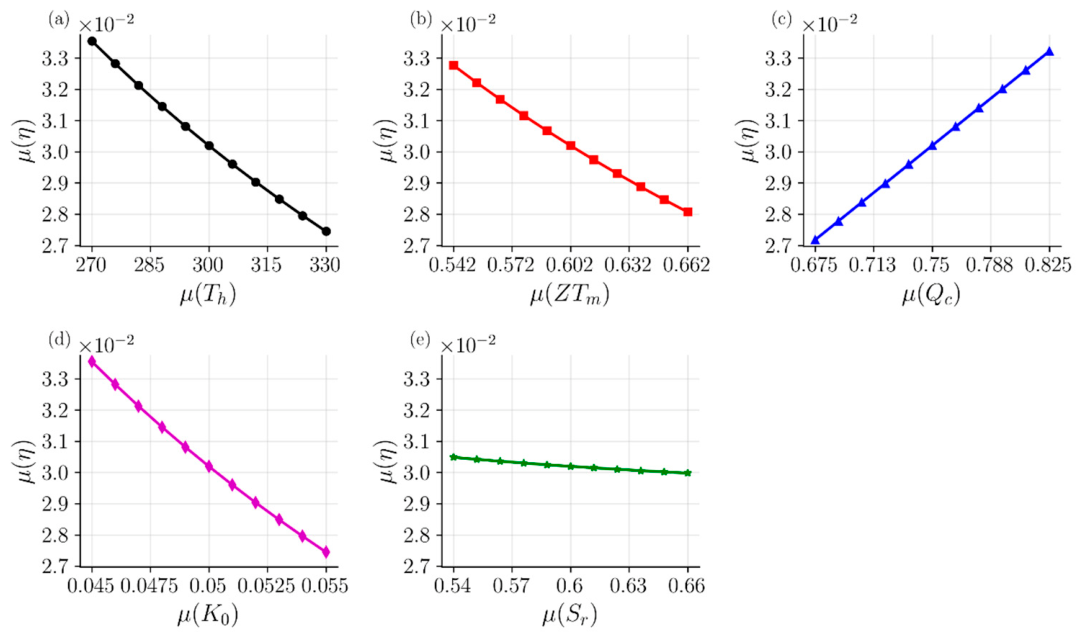
4.1. Mean Shift Analysis
4.1.1. Sensitivity of Output
4.1.2. Sensitivity of
4.1.3. Sensitivity of
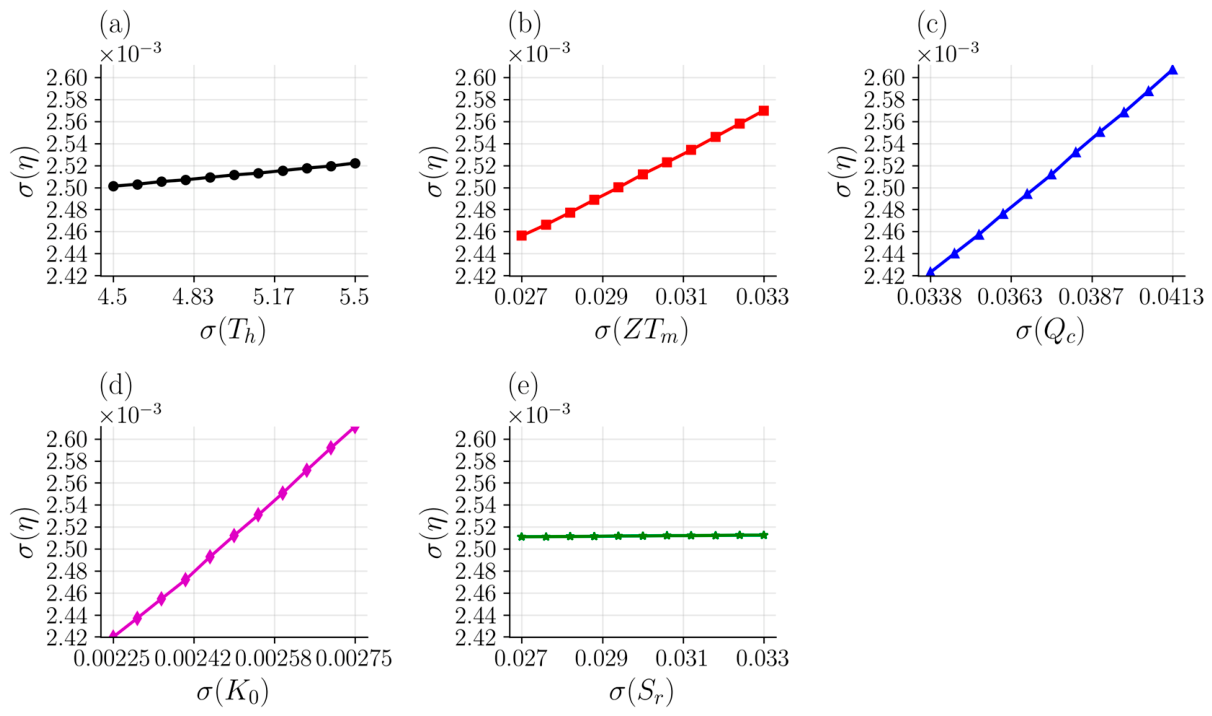
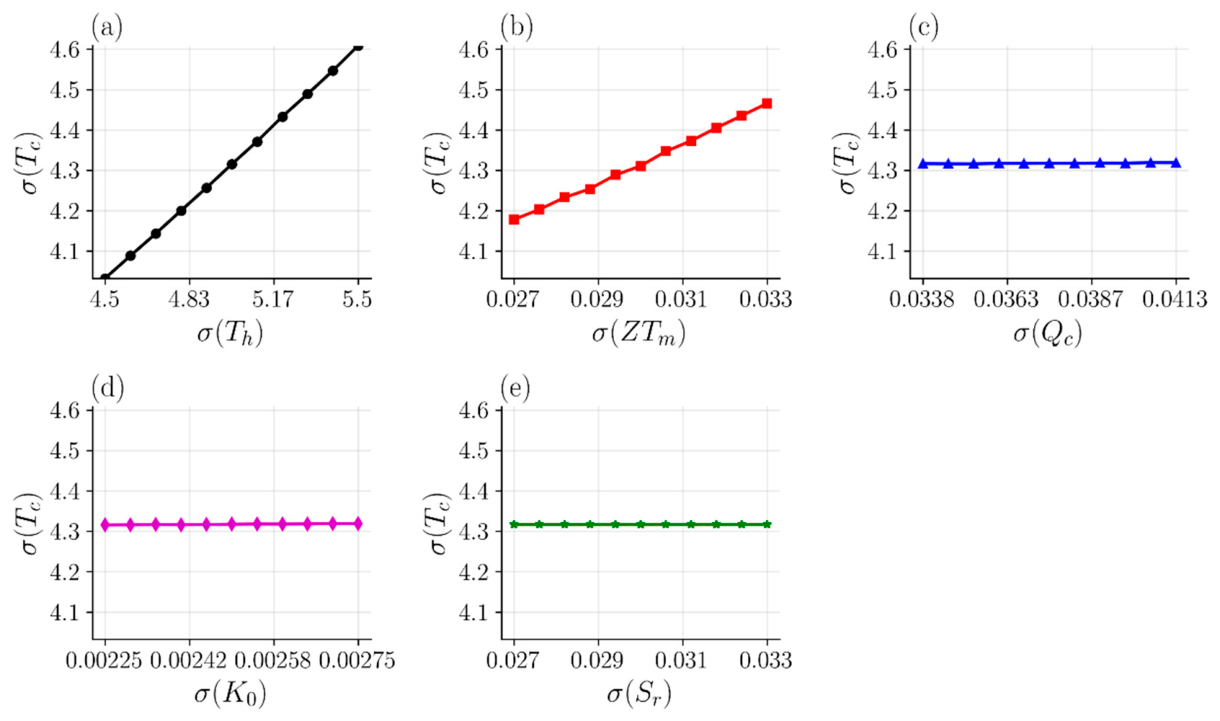
4.2. Standard Deviation Shift Analysis
4.2.1. Sensitivity of
4.2.2. Sensitivity of
4.2.3. Sensitivity of
5. Conclusions
Author Contributions
Funding
Data Availability Statement
Conflicts of Interest
References
- Bayendang, N.P.; Kahn, M.T.; Balyan, V. The Question of Thermoelectric Devices Electrical Resistance—A Practical Investigation From a Peltier Effect (Thermoelectric Cooler/Thermoelectric Heater) Perspective. Heat Transf. 2026, 55, 1770–1779. [Google Scholar] [CrossRef]
- Solovev, B.; Khuziakhmetov, B.; Gamisonia, G.; Khazieva, R. Seebeck effect-based energy generation using Peltier modules. In Proceedings of the 2025 International Ural Conference on Electrical Power Engineering (UralCon); IEEE: New York, NY, USA, 2025; pp. 870–874. [Google Scholar] [CrossRef]
- Chen, J.; Wang, R.; Ding, R.; Luo, D. Numerical study on the influence of the Peltier effect on the output of thermoelectric generator system. Zhongnan Daxue Xuebao (Ziran Kexue Ban)/J. Cent. South Univ. (Sci. Technol.) 2025, 56, 771–780. [Google Scholar] [CrossRef]
- Sanduleac, I.; Andronic, S.; Balmus, I. Organic Nanostructured Crystals for Thermoelectric Cooling in Medical Applications. IFMBE Proc. 2024, 91, 88–95. [Google Scholar] [CrossRef]
- Mohamed, E.S. Experimental evaluation of the thermoelectric package air conditioning for an automotive interior application. Int. J. Refrig. 2025, 174, 34–46. [Google Scholar] [CrossRef]
- Zhao, J. Performance Optimization Study of Segmented Semiconductor Thermoelectric Conversion Units. Master’s Thesis, Huazhong University of Science and Technology, Wuhan, China, 2023. [Google Scholar] [CrossRef]
- Ferrario, A.; Boldrini, S.; Miozzo, A.; Fabrizio, M. Temperature dependent iterative model of thermoelectric generator including thermal losses in passive elements. Appl. Therm. Eng. 2019, 150, 620–627. [Google Scholar] [CrossRef]
- Navarro-Peris, E.; Corberan, J.M.; Ancik, Z. Evaluation of the potential recovery of compressor heat losses to enhance the efficiency of refrigeration systems by means of thermoelectric generation. Appl. Therm. Eng. 2015, 89, 755–762. [Google Scholar] [CrossRef]
- Yang, G.; Sang, L.; Yun, F.-F.; Mitchell, D.R.G.; Casillas, G.; Ye, N.; See, K.; Pei, J.; Wang, X.; Li, J.-F.; et al. Significant Enhancement of Thermoelectric Figure of Merit in BiSbTe-Based Composites by Incorporating Carbon Microfiber. Adv. Funct. Mater. 2021, 31, 2008851. [Google Scholar] [CrossRef]
- Kim, S.; Kihoi, S.K.; Kim, H.; Kahiu, J.N.; Lee, H.S. Synergetic effect of Bi and Al co-doping in GeTe-based thermoelectric materials leading to optimized carrier concentration tuning and high ZT. J. Alloys Compd. 2024, 970, 172574. [Google Scholar] [CrossRef]
- Xie, L.; Yang, J.; Liu, Z.; Qu, N.; Dong, X.; Zhu, J.; Shi, W.; Wu, H.; Peng, G.; Guo, F.; et al. Highly efficient thermoelectric cooling performance of ultrafine-grained and nanoporous materials. Mater. Today 2023, 65, 5–13. [Google Scholar] [CrossRef]
- Wang, Q.; Tang, Y.; Miura, A.; Miyazaki, K.; Horita, Z.; Iikubo, S. Improving thermoelectric properties of Bi2Te3 by straining under high pressure: Experiment and DFT calculation. Scr. Mater. 2024, 243, 115991. [Google Scholar] [CrossRef]
- Ji, D.; Haile, N.F.; Li, X.; Li, B.; Rezeq, M.; Cantwell, W.; Zheng, L. Band degeneracy and convergence in high performing thermoelectric materials. Appl. Energy 2026, 404, 127182. [Google Scholar] [CrossRef]
- Ali, A.; Shahid, I.; Ahmad, I.; Xiang, L.; Arif, N.; Younis, M.; Zeng, Y.-J. 2D ferroelectric In2SSeTe with low lattice thermal conductivity and high Seebeck coefficient: A promising thermoelectric material. Chem. Phys. Lett. 2026, 884, 142586. [Google Scholar] [CrossRef]
- Liu, H.; Li, G.; Zhao, X.; Ma, X.; Shen, C. Investigation of the impact of the thermoelectric geometry on the cooling performance and thermal—Mechanic characteristics in a thermoelectric cooler. Energy 2023, 267, 126471. [Google Scholar] [CrossRef]
- Gao, Y.; Zhu, S.; Gao, J.; Miao, L.; Xu, F.; Sun, L. Wearable thermoelectric cooler encapsulated with low thermal conductivity filler and honeycomb structure for high cooling effect. Mater. Today Phys. 2024, 46, 101491. [Google Scholar] [CrossRef]
- Zhang, J.; Song, X.; Tie, Y.; Li, C.; Zhao, H. A novel sandwich-structural cooling and heating system with high power, high COP and small size based on thermoelectric cooler. Energy Convers. Manag. 2024, 322, 119126. [Google Scholar] [CrossRef]
- Tsai, Y.-F.; Wei, P.-C.; Tsou, N.-T.; Chao, Y.-C.; Yen, H.-W.; Lin, J.-Y.; Wang, K.-K.; Wu, H.-J. Grand herringbone architecture securing the high thermoelectric performance of GeTe. Mater. Today Phys. 2024, 41, 101329. [Google Scholar] [CrossRef]
- Zhang, F.; Wang, W.; Zhang, J.; Du, R.; Wang, X.; Liu, Z. Global sensitivity analysis and optimization of a multistage thermoelectric generator based on failure probability. Energy Rep. 2023, 10, 4629–4640. [Google Scholar] [CrossRef]
- Zhang, F.; Cheng, L.; Wu, M.; Xu, X.; Wang, P.; Liu, Z. Performance analysis of two-stage thermoelectric generator model based on Latin hypercube sampling. Energy Convers. Manag. 2020, 221, 113159. [Google Scholar] [CrossRef]
- Wang, X.; Zhang, B.; Yang, P.; Gao, Z.; Zhang, F. Global sensitivity analysis and optimization of multi-stage TEG based on random and fuzzy mixed input variables. Appl. Therm. Eng. 2024, 248, 123212. [Google Scholar] [CrossRef]
- Sandoz-Rosado, E.J.; Weinstein, S.J.; Stevens, R.J. On the Thomson effect in thermoelectric power devices. Int. J. Therm. Sci. 2013, 66, 1–7. [Google Scholar] [CrossRef]
- Meng, F.; Chen, L.; Sun, F. A numerical model and comparative investigation of a thermoelectric generator with multi-irreversibilities. Energy 2011, 36, 3513–3522. [Google Scholar] [CrossRef]
- Cai, Y.; Xiang, Z.; Hong, B.; Huang, N.; Zhao, F. Dimensionless analysis and performance evaluation of annular thermoelectric cooler. Cryog. Supercond. 2021, 49, 70–77. [Google Scholar] [CrossRef]
- Shen, Z.-G.; Wu, S.-Y.; Xiao, L. Theoretical analysis on the performance of annular thermoelectric couple. Energy Convers. Manag. 2015, 89, 244–250. [Google Scholar] [CrossRef]
- Hu, Z.; de León, F.; Wang, R.; Li, Y. Effects of Installing Different Types of Cooling Fins on the Cold Side of a Thermoelectric Power Generation Device on the Thermal Efficiency and Exergy Efficiency of Power Cable Surface Waste Heat Recovery. Micromachines 2023, 14, 1591. [Google Scholar] [CrossRef]
- Al-Tahaineh, H. A novel approach and exergy analysis for a concentrated photovoltaic system for thermoelectric absorption cooling. Clean. Energy 2025, 9, 11–21. [Google Scholar] [CrossRef]
- Ma, M.; Yu, J. An analysis on a two-stage cascade thermoelectric cooler for electronics cooling applications. Int. J. Refrig. 2014, 38, 352–357. [Google Scholar] [CrossRef]
- Hakimi, F. Robust Estimation with Latin Hypercube Sampling: A Central Limit Theorem for Z-estimators. arXiv 2026, arXiv:2502.06321. [Google Scholar] [CrossRef]
- Boschini, M.; Gerosa, D.; Crespi, A.; Falcone, M. “LHS in LHS”: A new expansion strategy for Latin hypercube sampling in simulation design. SoftwareX 2025, 31, 102294. [Google Scholar] [CrossRef]
- Bayar, G.; Hambarci, G. Improving measurement accuracy of indoor positioning system of a Mecanum wheeled mobile robot using Monte Carlo—Latin hypercube sampling based machine learning algorithm. J. Frankl. Inst. 2023, 360, 13994–14021. [Google Scholar] [CrossRef]
- Joy, G.; Huyck, C.; Yang, X.-S. Parameter Tuning of the Firefly Algorithm by Three Tuning Methods: Standard Monte Carlo, Quasi-Monte Carlo and Latin Hypercube Sampling Methods. arXiv 2025, arXiv:2504.18545. [Google Scholar] [CrossRef]
- Buljan, I.; Benković, M.; Jurina, T.; Sokač Cvetnić, T.; Valinger, D.; Gajdoš Kljusurić, J.; Jurinjak Tušek, A. Simulation and Local Parametric Sensitivity Analysis of a Computational Model of Fructose Metabolism. Processes 2025, 13, 125. [Google Scholar] [CrossRef]






| Parameter | Mean | Standard Deviation |
|---|---|---|
| 0.6 | 0.03 | |
| 300 | 5 | |
| 0.6018 | 0.03 | |
| 0.75 | 0.0375 | |
| 0.05 | 0.0025 |
| Shifted Input Parameter | Direction of Influence | ||
|---|---|---|---|
| 0.195 | 0.776 | Positive | |
| 0.046 | 0.183 | Negative | |
| 0.005 | 0.020 | Positive | |
| 0.005 | 0.020 | Negative | |
| 0.001 | 0.001 | Negative |
| Shifted Input Parameter | Direction of Influence | ||
|---|---|---|---|
| 0.202 | 0.260 | Negative | |
| 0.156 | 0.200 | Negative | |
| 0.200 | 0.258 | Positive | |
| 0.202 | 0.260 | Negative | |
| 0.017 | 0.022 | Negative |
| Shifted Input Parameter | Direction of Influence | ||
|---|---|---|---|
| 0.184 | 0.320 | Negative | |
| 0.010 | 0.017 | Positive | |
| 0.182 | 0.317 | Positive | |
| 0.184 | 0.320 | Negative | |
| 0.015 | 0.026 | Negative |
Disclaimer/Publisher’s Note: The statements, opinions and data contained in all publications are solely those of the individual author(s) and contributor(s) and not of MDPI and/or the editor(s). MDPI and/or the editor(s) disclaim responsibility for any injury to people or property resulting from any ideas, methods, instructions or products referred to in the content. |
© 2026 by the authors. Licensee MDPI, Basel, Switzerland. This article is an open access article distributed under the terms and conditions of the Creative Commons Attribution (CC BY) license.
Share and Cite
Ma, J.; Song, M.; Li, X.; Zhang, F. Uncertainty and Sensitivity Analyses of an Annular Thermoelectric Refrigerator Based on Latin Hypercube Sampling. Machines 2026, 14, 653. https://doi.org/10.3390/machines14060653
Ma J, Song M, Li X, Zhang F. Uncertainty and Sensitivity Analyses of an Annular Thermoelectric Refrigerator Based on Latin Hypercube Sampling. Machines. 2026; 14(6):653. https://doi.org/10.3390/machines14060653
Chicago/Turabian StyleMa, Jinhao, Meilin Song, Xue Li, and Feng Zhang. 2026. "Uncertainty and Sensitivity Analyses of an Annular Thermoelectric Refrigerator Based on Latin Hypercube Sampling" Machines 14, no. 6: 653. https://doi.org/10.3390/machines14060653
APA StyleMa, J., Song, M., Li, X., & Zhang, F. (2026). Uncertainty and Sensitivity Analyses of an Annular Thermoelectric Refrigerator Based on Latin Hypercube Sampling. Machines, 14(6), 653. https://doi.org/10.3390/machines14060653