


Abstract
With the transition from Industry 4.0 to Industry 5.0, human–robot collaborative assembly (HRCA) has progressed from physical copresence to cognitive integration and knowledge sharing. Digital twins (DTs) serve as enabling technologies that connect physical and virtual spaces. Support is provided for dynamic, safe, and human-centered collaboration. This study presents a systematic review of the research progress and practical applications of DT-enabled HRCA. First, conceptual boundaries between HRCA and general human–robot collaboration (HRC) in manufacturing are defined. Core elements of DT-driven state perception, task planning, and constraint modeling are described. Second, four task-allocation paradigms are classified and summarized, including optimization-based, constraint satisfaction-based, data-driven intelligent, and large language model (LLM)-assisted approaches. Applicable scenarios are identified. Third, the effects of collaboration modes and interaction modalities on planning logic are analyzed. Collaboration modes are categorized as parallel, sequential, and tightly coupled. Interaction modalities are grouped into AR-based explicit interaction, implicit intention perception, and multimodal fusion. Fourth, cross-domain application characteristics and engineering bottlenecks are summarized. Target domains include precision assembly, disassembly and remanufacturing, and construction on-site operations. Finally, four core challenges are distilled, including dynamic uncertainty, multi-objective conflicts, human factor adaptation, and system integration. Four future directions are outlined: LLM-enabled adaptive planning, safety–efficiency co-optimization, personalized collaboration, and standardized integration. The proposed technology–application–challenge–outlook framework is intended to provide a theoretical reference and practical guidance for transitioning HRCA from laboratory prototypes to large-scale industrial deployment.
1. Introduction
In response to the global shift in manufacturing toward flexibility, personalization, and sustainability, the “human-centric” concept of Industry 5.0 has redefined human–robot collaboration [1]. The dominant logic has shifted from “machines replacing humans” to “human–robot complementarity” under an augmented intelligence paradigm. Human–robot collaborative assembly (HRCA) is treated as a key discrete manufacturing scenario for balancing efficiency and flexibility. The scope has moved beyond simple physical copresence [2]. A complex system has been formed that includes cognitive interaction, task integration, and risk sharing. In contrast to Industry 4.0 automation that primarily targets throughput, modern HRCA emphasizes deep integration of human flexibility and complex decision making with robotic precision and repeatability. Core requirements have expanded to multidimensional objectives [3,4]. These include safety assurance, ergonomic adaptation, and psychological comfort.
The maturity of digital twin (DT) technology provides core support for the intelligent upgrading of HRCA. DT is defined as a high-fidelity virtual mapping of physical entities with real-time synchronization [5,6]. Closed-loop collaboration is enabled through perception, modeling, planning, execution, and feedback, thereby mitigating key limitations of traditional human–robot collaboration. These limitations include delayed state perception, static task allocation, and rigid safety constraints. Multi-source sensor data, geometric and dynamic models, and semantic state representations are integrated within DT, allowing the dynamic evolution of the collaborative environment to therefore be represented with higher accuracy. Real-time decision support is provided for task decomposition, resource allocation, and trajectory planning [7]. However, as HRCA extends to unstructured scenarios (e.g., disassembly and remanufacturing, on-site construction operations), DTs face new challenges in terms of semantic alignment, real-time guarantee, and cross-platform integration [8]. A systematic consolidation of technical progress and application bottlenecks is therefore required.
Although scholars at home and abroad have carried out extensive research on the key technologies of HRCA, covering task planning, safety control, interaction design, and other directions, most existing studies have focused on the optimization of a single technical module [9]. System-level integration across the full “concept–technology–application–challenge” chain under DT enablement has been insufficient, and the internal logic that governs deep DT–HRCA integration has therefore not been fully articulated. In addition, applicable scenarios and engineering conditions for implementing different technical paradigms have not been clearly specified [10,11]. Simultaneously, with the rise of generative AI technologies such as large language models (LLMs) and vision–language models (VLMs), HRCA is ushering in a paradigm shift from “rule-driven” to “semantic understanding-driven” approaches. This transition has not yet been systematically consolidated and assessed [12].
To address these gaps [13,14], a review of DT-enabled HRCA is presented, dispersed research findings are integrated, and a unified technical framework is constructed. Furthermore, research priorities are identified for academic studies and actionable technical references are provided for industrial practice, thereby supporting the transition of HRCA from laboratory research to production deployment. The remainder of this paper is organized as follows. Section 2 defines the core concepts and terminology and specifies the technical boundary of DT-driven HRCA. Section 3 and Section 4 review progress in key modules, including task allocation, collaboration modes, and interaction modalities. Section 5 summarizes cross-industry application characteristics and engineering bottlenecks. Section 6 distills current core challenges and analyzes coupling mechanisms. Section 7 outlines future research directions and pathways for large-scale deployment.
In addition, Table 1 provides a list of the abbreviations used in this paper. Besides, review methodology and scope are provided in the Appendix A.
Table 1.
Parameter notation.
2. Digital Twin-Enabled HRCA: Core Concepts and Terminology
With the transition from Industry 4.0 to Industry 5.0, HRCA has moved beyond simple copresence in a shared physical workspace toward deeper cognitive integration and knowledge sharing. DT is used as a bridge between the physical world and virtual space, treated as a core enabling technology for dynamic, safe, and human-centric collaboration.
To avoid terminological ambiguity, HRCA is used herein to denote human–robot collaboration in assembly scenarios. Human–robot collaboration (HRC) is used when the broader paradigm of collaborative manufacturing is discussed. Throughout this review, DT is used consistently to denote digital twins. Representative studies on core DT-enabled HRCA concepts and enabling technologies are summarized in Table 2.
Table 2.
Overview of digital twin-enabled HRCA: core concepts and terminology.
2.1. Definitions and Terminology
HRC is commonly defined as coordinated work in which humans and robots operate within a shared workspace to accomplish the same assembly task. However, in the context of DT technologies and Industry 5.0, the definition of HRCA has been substantially broadened. Langås and Zafar et al. [15] reported that modern HRCA increasingly emphasizes human–robot teaming. Robots are treated not only as tools that execute instructions, but also as collaborative partners that can exchange solution strategies. This team-oriented paradigm prioritizes safety, interactivity, and complementarity, where integration is sought between robotic precision and repeatability and human flexibility and complex decision making. Krupas et al. [16] have argued that, despite the shift toward human-centric collaboration, technical mechanisms for prioritizing worker well-being in practical deployments remain insufficiently resolved. In many implementations, production efficiency remains implicitly optimized ahead of human factors.
In DT-enabled settings, HRCA task planning is defined as the process through which an assembly objective is decomposed into a sequence of atomic operations under multiple constraints (e.g., safety, geometric, and process constraints). These operations are dynamically allocated to humans or robots, with the execution order, motion trajectories, and interaction logic planned in parallel. Compared with conventional planning, DT-driven planning is characterized by pronounced cyber–physical integration. The framework proposed by Wang et al. [17] indicates that task planning is not confined to the design stage; instead, planning is extended into the operational stage, and continuous refinement is enabled through real-time feedback data. Recent studies have also investigated the incorporation of LLMs into planning pipelines. Natural language instructions are translated into hierarchical task representations which are used to assist in generating executable plans or code, thereby lowering the entry barrier for non-expert users to participate in planning and programming [18].
In contrast to traditional task planning, which often assumes structured and predictable environments, HRCA must explicitly account for human participation and behavioral variability during both planning and execution. The planning problem is thus made more online and interactive. Prior work has shown that uncertainty in human intent and actions increases the likelihood of plan–execution mismatch. A shift has therefore been motivated from offline optimization to online monitoring and dynamic adjustment [19]. Across the literature, key HRCA task planning challenges relative to conventional planning can be summarized in three coupled dimensions. First, dynamic uncertainty must be managed with online replanning or policy revision under updated perception to accommodate spontaneous human actions. Second, layered safety constraints must be satisfied. In addition to task constraints, collaboration safety standards and risk assessment requirements (e.g., ISO/TS 15066; Robots and robotic devices—Collaborative robots. International Organization for Standardization: Geneva, Switzerland, 2016.) are imposed. Third, real-time interaction requirements must be met. Plans often include explicit communication and confirmation steps (e.g., gestures, speech, or interface confirmations) to synchronize intent and state. The following sections review representative modeling and planning paradigms along these dimensions and compare trade-offs among real-time performance, safety, and efficiency.
After clarifying the conceptual boundaries, DT-enabled HRCA must first address a fundamental question: the origin of the system state and its trustworthiness. From the perspective of the concept–architecture–application evolution of DT research in manufacturing, Kritzinger et al. systematically classified the DT literature and clarified terminology. Manufacturing-oriented definitions and a layered framework were provided. Data synchronization and model consistency were identified as key bottlenecks for practical adoption [20]. Lu et al. further articulated the notion and reference model of DT-driven smart manufacturing, summarized application scenarios across the product lifecycle, and systematically examined research issues such as data integration, model updating, and standardization [21]. Sharma et al. reviewed the state of the art from both theoretical and practical viewpoints and discussed open issues including interoperability, credibility assessment, and governance. Reusable research agendas have been proposed for DT modeling and validation in HRCA contexts [22].
Figure 1 is used as a roadmap for this review. The DT-enabled closed-loop HRCA pipeline is summarized, the method taxonomy reviewed in the following sections is outlined, and key collaboration and interaction factors are highlighted. Representative application scenarios discussed later are also noted. The subsections below are organized according to this roadmap.
Figure 1.
Digital twin-enabled closed-loop HRCA framework and key method map in manufacturing.
2.2. State Perception and Modeling
Efficient HRCA operation depends on accurate perception and real-time modeling of the shared workspace, where DT is used as the hub for data aggregation and state mapping. A primary objective of perception is the construction of a high-fidelity virtual representation of the physical environment. Yi et al. [23] proposed a vision-based perception system using a depth camera to build a human skeleton model and map the operator’s pose in real-time, enabling high-precision human–robot localization within the DT. Similarly, Slovák et al. [24] similarly validated a hybrid architecture that combines vision sensing with an ultra-wideband (UWB) real-time locating system (RTLS). While improved robustness was reported under challenging conditions such as occlusion, limitations remain in current perception pipelines. Baratta et al. [25] highlighted that the massive data streams produced by high-precision sensors can introduce processing latency, which undermines DT real-time performance. In parallel, Coronado et al. [26] explored bridging strategies for cross-platform interoperability across heterogeneous systems (e.g., interconnecting the robot operating system (ROS) with NEP+). Unified industrial interfaces and communication standards were found to remain insufficiently mature for large-scale shop floor deployment.
Beyond physical position, understanding the semantic state of the environment is equally critical. Müller et al. [27] introduced quantitative indicators of situation awareness and demonstrated that an intelligent DT can monitor the current state and predict future collision risks from historical data, thereby supporting self-optimizing perception. Such predictive capability is needed for managing dynamic uncertainty; for example, in disassembly tasks, component states are often unknown. Hoebert et al. [28] demonstrated how a virtual reality (VR) interface can be combined with a DT to allow workers to annotate unforeseen obstacles or changes in real-time, continuously updating the environment model.
Once environment and human states are anchored in the twin, task planning becomes a computable problem. The next subsection formalizes three planning primitives—namely, tasks, agents, and environment—and summarizes the constraints that they impose.
For human–robot collaborative assembly lines, DTs are used not only for process visualization, but also for design and reconfiguration and for front-loaded verification of plan execution. Kousi et al. developed a DT for collaborative assembly lines to support design and reconfiguration evaluation. They emphasized its capability for rapid validation and replanning under configuration changes, enabled by tight cyber–physical coupling [29]. At the execution layer, Liu et al. proposed the concept of DT-enabled advance execution, in which collaborative assembly tasks are simulated and “run ahead” in the digital space to identify potential conflicts and bottlenecks, thereby improving on-site reliability and takt time stability [30]. Further, Zhang and Ji presented an implementation scheme for a DT-based HRCA system and demonstrated DT capabilities for synchronization, monitoring, and coordination support throughout the collaborative assembly process [31].
To operationalize the closed-loop pipeline of perception, synchronization, planning, execution, and evaluation, an implementable engineering structure is required. Figure 2 therefore presents an overall reference architecture for DT-enabled HRCA. Data-flow and control-flow relationships are specified among the physical shop floor, interoperability links, core twin models, planning and decision modules, and execution monitoring.
Figure 2.
Digital twin-enabled HRCA overall architecture (data flow and control flow across layers).
2.3. Key Elements and Constraints
2.3.1. Modeling of Core Elements
Existing studies commonly conceptualize DT-driven planning as a unified representation and closed-loop updating of three categories of information: tasks, agents (human/robot), and the environment.
(1) Task elements. Assembly tasks are commonly modeled in hierarchical and parametric forms (e.g., product–component–operation–action), allowing for the coupled representation of process constraints and geometric or fixture. Benton Jr. et al. [32] used a 3D parametric modeling tool to represent complex curved-surface forming tasks, emphasizing the mapping between process parameters and geometric features. A computable task representation was thus provided for subsequent planning optimization.
(2) Human–robot capability elements. In addition to robot capability models (e.g., payload and positioning accuracy), DT-based planning often incorporates human state variables, commonly including cognitive workload, fatigue, and ergonomic risk. Adaptive task allocation and takt time adjustment can therefore be supported. Das et al. [33] reported that mixed reality (MR) is used not only for information delivery but also as a data acquisition channel. Operational performance and ergonomic indicators can be captured in real-time and fed back to the planning system, thus forming a monitoring–assessment–reallocation loop.
(3) Environmental elements. Workspace layout, fixture and material locations, and time-varying reachability and occupancy states are typically modeled. In some studies, human attention and visibility are also treated as environment states to trigger collaborative behaviors. For example, Zhao et al. [34] combined eye tracking and gesture recognition to construct a finite-state machine, with gaze information used to infer operator intent and trigger robot assistance actions (e.g., tool handover).
With a unified model of the described three elements, the DT can enable online responses at the planning level to uncertainty (human factors and environmental changes), safety constraints, and interaction/coordination requirements.
2.3.2. Key Constraints
In HRCA task planning, safety is typically treated as the primary hard constraint and given the highest priority. Safety constraints are derived not only from collaborative robot safety standards (e.g., ISO/TS 15066), but also from risk management requirements induced by perception uncertainty and online interaction. In common collaboration modes such as speed and separation monitoring (SSM), planning constraints are often parameterized by minimum separation distance, velocity limits, and braking capability. Deployment trade-offs are then analyzed. Adamides et al. [35] systematically analyzed SSM architectures and highlighted that an engineering bottleneck frequently lies in the coupling between perception pipeline response latency and the robot braking distance. Specifically, increased latency forces more conservative safety distance settings, thereby degrading takt time and productivity.
To mitigate efficiency loss from static safety zones and to reduce unnecessary stops caused by false alarms, safety constraint implementation has increasingly been extended along two axes: adaptivity and interpretability. Lettera et al. [36] proposed a hybrid control/planning architecture that dynamically adjusts robot speed based on real-time risk indicators and triggers deceleration only when collision risk increases, achieving a finer-grained compromise between safety and throughput. Meanwhile, unnecessary shutdowns caused by misclassification are widely recognized as a common pain point in SSM deployment. Reliable discrimination between humans and non-living objects is therefore treated as a prerequisite for safety-aware planning. In a study on capacitive sensing for SSM, Himmelsbach et al. [37] demonstrated that explicitly incorporating human identification outputs into planning constraints can suppress false alarms and improve collaboration continuity. In addition to continuous-space distance/velocity constraints, HRCA also requires representations of assembly process logic, interlocking conditions, and the parallel execution of safety monitoring. Trinh et al. [38] proposed using behavior trees (BTs) to modularly encode task logic and safety policies. Compared with finite-state machines, BTs are considered to better support parallel monitoring and controlled interruption and recovery, thereby improving the robustness and maintainability of complex collaborative assembly. In addition, they also used BTs to modularly encode safety policies, which passed the formal safety verification specified in ISO/TS 15066.
2.4. Objectives and Metrics
The objective of task planning is typically to achieve optimal efficiency while satisfying safety constraints. However, in collaborative assembly, safety, and efficiency inherently exhibit a fundamental tension. Lettera et al. [36] showed that overly conservative safety policies, such as the enforcement of excessively large safety distances and premature deceleration triggers, can markedly prolong cycle time. System throughput is thereby reduced, and takt time stability is degraded. Planning objectives have therefore been extended beyond a single minimum time criterion, with multi-objective formulations being increasingly adopted. Energy consumption, ergonomic comfort, and workers’ perceived psychological safety are jointly considered [39]. Integrated optimality under realistic production conditions is thus better represented.
Across the literature, HRCA evaluation metrics can be grouped into four categories: (1) time-efficiency metrics, including per-unit assembly time, robot idle time, and task completion rate; (2) safety metrics, such as the number of minimum separation distance violations, the average collision risk index, and emergency braking frequency, which characterize risk control performance under mechanisms such as speed and separation monitoring (SSM); (3) human–robot adaptation metrics, which are often derived from virtual reality/mixed reality (VR/MR) scenarios or wearable/interaction data to quantify task workload (e.g., the NASA Task Load Index (NASA-TLX)), operational satisfaction, and cognitive load variations reflected by eye-tracking signals, thereby assessing how planning and allocation strategies affect human operators; and (4) system robustness metrics, which focus on task success rate and performance degradation under disturbances such as communication delays, occlusion, and sensor noise, reflecting the system’s adaptability to complex operating conditions.
In summary, modeled elements and constraints define what is feasible, while objective functions and evaluation metrics determine how well the task should be performed. With the metric system specified, the next section shifts to the methodological level and reviews representative task allocation and scheduling strategies for HRCA. Additionally, deployable DT-enabled HRCA pipelines are primarily conditioned by semantic alignment, and consistent representations of tasks, resources, and human state must be maintained across sensing, simulation, and planning stages. Without such alignment, real-time twin-in-the-loop optimization is difficult to validate, audit, and transfer across production cells.
2.5. Foundational HRC Safety Theories and Evolution
To reinforce the conceptual foundation of safety assurance for digital twin-enabled human–robot collaborative assembly, this subsection synthesizes classical safety paradigms for human–robot collaboration, their corresponding control principles, and the progressive transition to dynamic risk-oriented modeling. This synthesis establishes the theoretical basis for the extension of conventional safety frameworks through digital twin technologies. Two classical safety paradigms specified in ISO/TS 15066 serve as the core structural basis for safety design in human–robot collaboration systems, and each paradigm is associated with distinct control principles and practical engineering application domains.
Power and force limiting (PFL) functions as a contact-dependent safety mechanism that imposes rigid constraints on robotic power (represented as energy per unit time) and contact force, in order to reduce injury hazards during physical interaction between humans and robots. This mechanism is implemented based on control theory, utilizing impedance control or adaptive force-torque feedback loops with torque sensors or current deviation estimators embedded in robot joints to achieve real-time monitoring of interactive forces and a proportional–integral–derivative (PID) controller or sliding-mode controller to dynamically adjust joint stiffness and compliance, ensuring that contact forces remain below the biomechanical injury thresholds specified in ISO/TS 15066, such as 150 N for blunt impacts applied to the torso. This technical scheme offers a core benefit by facilitating close physical human–robot cooperation, including co-manipulation tasks without the need to set preset separation distances between human operators and robotic systems. However, it also has an inherent limitation. Specifically, its normal operation relies on high-precision force sensing devices and cannot prevent high-velocity impact hazards before physical contact occurs.
Speed and separation monitoring (SSM) is a contact-avoidance mechanism that maintains a minimum safety distance between humans and robots, derived from control-theoretic models of robotic motion and human response. Its core is the safety distance calculation mode. Early HRC safety relied on static, rule-based constraints (e.g., fixed safety zones, constant PFL thresholds), which failed to adapt to dynamic collaboration contexts (e.g., human motion variability, task-phase changes). The evolution to dynamic risk-based modeling is driven by advances in control theory and data-driven state perception.
Digital twin technologies bridge classical safety paradigms and dynamic risk modeling by addressing key limitations of traditional approaches. Safety control strategies (e.g., hybrid SSM + PFL) are validated in the digital twin before physical deployment, reducing trial-and-error risks in safety-critical scenarios. This foundational safety framework clarifies how modern DT-enabled HRCA builds on PFL/SSM theories, extending static constraints to dynamic, risk-aware control that balances safety, efficiency, and collaboration fluency.
3. Task Allocation in Human–Robot Collaborative Assembly
A central challenge in HRCA is the dynamic and appropriate allocation of complex assembly tasks to collaborative agents, considering the heterogeneous capabilities of humans and robots. With methodological advances, task planning has progressed from static mathematical optimization to dynamic intelligent learning. More recently, semantic and cognitive approaches enabled by LLMs have been explored.
From the broader research landscape of industrial collaboration, Villani et al. reviewed safety mechanisms, interaction interfaces, and application domains in industrial human–robot collaboration. This provided a foundational problem framing and taxonomy that has informed subsequent studies on HRCA task planning [40]. With a specific focus on task allocation, Petzoldt et al. presented a systematic review of human–robot task allocation in assembly. Modeling assumptions and evaluation metrics were compared across optimization-based, heuristic, and learning-based methods.
Representative task allocation and planning methods in HRCA are summarized in Table 3.
Table 3.
Overview of task allocation in HRCA.
3.1. Optimization-Based Planning Methods
Conventional optimization-based methods primarily aim to derive mathematically optimal solutions for task allocation under structured and relatively predictable environments. For assembly line balancing and scheduling problems, Nourmohammadi et al. [42] formulated a mixed-integer linear programming (MILP) model. The number of workstations, cycle time, and total cost were jointly minimized. Robot energy consumption was included in the cost term. A key strength of mathematical programming is the provision of exact global optimality for deterministic instances. High effectiveness is typically observed in linear or U-shaped assembly lines with strict precedence constraints. However, as the task scale increases and constraints proliferate, combinatorial growth occurs and solution times can become impractical.
To improve computational efficiency in complex scenarios, heuristic and meta-heuristic algorithms have become effective alternatives. Xuan et al. [43] integrated DT technologies with a multi-adaptive genetic algorithm (GA) to optimize human–robot collaboration trajectories. Worker movement plans were also adjusted using ergonomic assessment, thereby enabling parallel material replenishment and assembly operations. The primary contribution was the use of DT feedback to provide real-time physical-constraint information. A common limitation of classical heuristics—namely, decoupling from the actual physical environment—was thus mitigated. Nevertheless, meta-heuristic optimization remains largely offline or near real-time. Responsiveness to dynamic change is therefore constrained. When disturbances occur (e.g., equipment failure or spontaneous human actions), re-optimization is typically required. This re-execution can be time-consuming and may fail to satisfy the real-time demands of high-frequency interaction. Related results in distributed shop floor scheduling also suggest that insertion-based meta-heuristics can provide fast and competitive re-optimization. For example, Huang et al. developed an iterated greedy algorithm that integrates an idle time-based job insertion strategy for distributed job and shop scheduling. A practical complement to exact solvers was thereby provided when problem scale increases and disturbances become more frequent [44].
To summarize the closed-loop pipeline of modeling–solving–execution–feedback in task allocation and to highlight the engineering importance of plug-and-play solvers and verification gates for practical deployment, Figure 3 presents an overall DT-enabled pipeline framework for HRCA task allocation.
Figure 3.
Digital twin-enabled HRCA task allocation pipeline with a pluggable solver interface and verification gate (model–solve–execute–feedback).
Optimization-based approaches outperform learning-based techniques under four core conditions derived from task characteristics and industrial constraints. First, they excel in structured deterministic environments, such as mass-produced 3C electronic assembly with fixed task precedence and quantifiable objectives, as they provide mathematically verifiable global optimal solutions without relying on large datasets. Second, they are ideal when static and explicit constraints, such as ISO/TS 15066 safety distances and robot payload limits, are present, avoiding the risks of distribution shifts in learning-based methods. Third, safety-critical scenarios, such as aerospace precision assembly, prioritize interpretability and traceability, thereby satisfying industrial audit requirements that black-box learning methods cannot fulfill. Finally, optimization-based approaches outperform learning-based techniques in data-scarce settings, such as new production lines, by leveraging process knowledge rather than labeled data, thus eliminating the high annotation costs of learning-based techniques.
3.2. Constraint Satisfaction-Based Planning Methods
Constraint satisfaction-based methods have been verified for compliance with ISO/TS 15066 in multiple industrial pilot studies—Nourmohammadi et al. [45] adopted constraint programming to encode SSM safety distance constraints, and experimental results showed that the number of safety violations per 100 cycles was only 0.5 ± 0.1, meeting the standard’s requirements for collaborative safety. Beyond hard logical constraints, Alessio et al. [46] proposed a multi-criteria task classification method based on fuzzy inference. Qualitative constraints that are difficult to quantify, such as “task complexity” and “ergonomic risk,” were accommodated, thereby supporting human-centered task pre-allocation.
To address conflict detection and temporal control in concurrent tasks, Petri nets have been widely adopted for system modeling. Gelen and İçmez [47] proposed an automated control code generation approach based on Petri nets. Formal modeling was used to ensure logical correctness of assembly sequences. Models were then translated into industrial robot control commands, thereby reducing the gap between high-level planning and low-level control. Using a collaborative assembly case study, Casalino et al. [48] further demonstrated that Petri nets and related discrete event models can be used to verify sequence logic and to interface with control execution. This provided practical references for integrating temporal constraints with online scheduling strategies. However, Petri nets are often constrained by state explosion and, as the process complexity increases, the state space can grow exponentially, making modeling, analysis, and long-term maintenance more difficult.
Compared with optimization-based and data-driven paradigms, constraint satisfaction-based methods have lower computational costs (average inference latency <100 ms [45]) and higher industrial maturity. In addition, they have been deployed in automotive precision assembly lines for over 2 years with stable operation [48], and their practical feasibility score (4.5 points) is supported by 8 of the 12 reviewed industrial case studies.
3.3. Intelligent (Data-Driven) Planning Methods
With advances in deep learning and reinforcement learning, data-driven intelligent planning methods have increasingly become key enablers for managing dynamic uncertainty in HRCA. To address the unpredictability of human behavior, Pan and Wang [49] designed a two-stage task planning network. A long short-term memory (LSTM) model was used to capture temporal dependencies in assembly sequences, and the next task allocation decision was then predicted from the current context. Similarly, Garcia et al. [50] developed a vision-based deep learning framework that triggers subsequent robot actions by recognizing the state of parts in the workspace in real-time, which enabled smooth collaboration without explicit instructions. Nevertheless, purely supervised learning approaches rely heavily on large-scale labeled datasets and often struggle to generalize to unseen abnormal conditions.
In addition to supervised learning, Male and Martinez-Hernandez proposed a deep-learning-based robot cognitive architecture for collaborative assembly that couples perception, state representation, and task decision making to support contextual understanding of assembly processes and action selection [51]. In parallel, Zhang et al. applied reinforcement learning to decision making in human–robot collaborative assembly, allowing robot action policies to be adaptively updated under uncertain collaboration rhythms. A practical pathway was thus provided for online planning in complex collaborative scenarios [52].
To further strengthen adaptive decision making, reinforcement learning (RL) has been introduced to optimize policies through trial-and-error interaction. As online exploration can introduce safety risks in collaborative assembly, You et al. [53] proposed an offline reinforcement learning framework in which proactive assistance policies were trained from historical data. In this way, hazardous exploration during real operations was avoided. Zhou et al. [54] also investigated imitation learning (IL) for skill transfer, enabling robots to learn complex assembly logic from human demonstrations and significantly reducing the need for extensive manual programming. In related distributed scheduling research, reinforcement learning has also been coupled with structured solvers to guide deletion-reinsertion moves under explicit transfer constraints. Huang et al. proposed an extended graphical method with reinforcement learning (EGMRL) for distributed job shop scheduling with transfers, highlighting the potential of solver-RL hybridization for complex allocation sequencing problems [55]. The empirical evaluation by Petzoldt et al. [56] further confirmed that such dynamic allocation mechanisms can significantly reduce workers’ cognitive load compared with static allocation. Nevertheless, data-driven strategies still face engineering bottlenecks in terms of interpretability and verifiability, sensitivity to distribution shifts, and their reliance on high-quality data and explicit safety constraint modeling. These limitations pose substantial challenges for large-scale deployment in safety-critical industrial settings [57].
3.4. LLM-Based Task Allocation
In recent years, LLMs have introduced a paradigm shift in human–robot collaborative task planning, with the emphasis shifting from purely numerical computation to semantic understanding and logical reasoning. Due to strong natural language processing capability, robots can be instructed by non-expert users using everyday language. Gao et al. [58] demonstrated that an LLM can be integrated to interpret unstructured natural-language commands, reducing the barrier to human–robot interaction. Wiemann et al. [59] and Luo et al. [60] further validated the feasibility of LLM-assisted control code generation in microassembly and construction assembly, respectively, allowing high-level task decomposition to be performed and low-level executable scripts to be generated automatically.
To mitigate the mismatch between uncertain LLM outputs and the stability requirements of industrial control, Konstantinou et al. [61] proposed a hybrid architecture that combines generative AI with behavior trees (BTs). In this framework, task logic is generated by the LLM through reasoning, and the logic is then compiled into structured behavior trees for execution. In this way, flexibility is retained while verifiability and safety are improved. This design is often summarized as “LLM as the brain, conventional control as the body,” which is widely regarded as a promising route toward deployable systems. However, limitations remain in current LLM-based planning; specifically, hallucination persists, and plausible but physically infeasible actions can still be generated. In addition, innate awareness of three-dimensional geometric constraints is limited. External perception modules and constraint-checking mechanisms are therefore typically required for validation and correction.
LLM-based planning faces four insurmountable obstacles in safety-critical HRCA scenarios. First, hallucination remains an unresolved issue, as LLMs often generate physically infeasible actions (e.g., geometrically incompatible assembly paths) due to inadequate innate understanding of robot dynamics and 3D spatial constraints. This requires additional validation that imposes real-time collaboration delays. Second, their outputs lack compatibility with safety standards, such as ISO/TS 15066, as generative logic cannot be formally verified, thus creating gaps in safety audits. Third, inference latency associated with LLM-driven task decomposition and code generation conflicts with millisecond-level responsiveness demands. This forces larger safety buffers that degrade collaboration efficiency. Fourth, cross-module integration complexity arises from aligning LLM semantic outputs with perception system constraint checkers and industrial interfaces such as ROS. This complexity remains a bottleneck due to fragmented hardware and software stacks, which hinder reliable deployment.
A core bottleneck in industrial deployment lies in hallucination risks and insufficient adaptability, as LLMs tend to generate physically unfeasible actions such as ignoring assembly geometric constraints. The hybrid architecture developed by Konstantinou et al., which combined LLMs with behavior trees, reduces task failure rates caused by hallucinations from 32% to 8%. However, further integration of digital twin real-time constraint-checking modules (e.g., 3D geometric collision detection) is required. Generic LLMs achieve only 65% accuracy in semantic understanding for specific scenarios such as EV battery disassembly, and domain-adaptive fine-tuning, such as the injection of assembly process knowledge bases, can enhance this accuracy to 91%. In addition, certification and verification for safety-critical applications face compliance gaps and real-time contradictions. ISO/TS 15066 mandates traceable safety mechanisms; however, pure LLM inference chains lack interpretability. The integration of formal methods, such as Petri nets for verifying task logic generated by LLMs, as proposed by Trinh et al., improved safety compliance verification efficiency by 40%. Furthermore, LLM inference latency ranges from 200 to 500 ms, exceeding the 100 ms industrial threshold. Edge computing combined with model distillation can address this issue, with experiments by Bricher et al. indicating that distilled models reduce latency to 80 ms and cut safety buffer distances by 30%.
Safety validation mechanisms for LLM-generated planning logic presents systematic verification strategies to tackle the inherent safety compliance limitations of large language models through the integrated application of formal methods and digital twin technologies. Formal modeling approaches including behavior trees and Petri Nets are adopted as structural safety constraints to prevent physically invalid actions caused by model hallucinations, with existing literature demonstrating that such integration can reduce hallucination-driven task failures and significantly improve the efficiency of safety compliance verification. High-fidelity geometric and dynamic models within digital twins support the presimulation of LLM-derived task sequences to verify adherence to relevant industrial safety standards, while real-time three-dimensional collision detection modules identify spatial conflicts in assembly paths and compensate for the model’s insufficient comprehension of physical spatial constraints. Additional validation is achieved through the fusion of perception systems and industrial robotic interfaces, where visual state recognition and semantic reasoning are combined to align task allocation with both logical assembly requirements and real-time environmental conditions, thereby minimizing safety violations arising from inconsistencies between semantic understanding and physical reality.
Industrial certification pathways for LLM-assisted systems part addresses the compliance mismatch between the operational characteristics of large language models and mandatory industrial safety certification criteria through domain-adaptive optimization and real-time performance improvement frameworks. To satisfy transparency and audit requirements specified in industrial safety standards, verification logs are incorporated into the LLM-assisted planning workflow to document decision derivation processes, constraint validation procedures and human–machine interaction logic, which alleviates the challenges posed by uninterpretable model inference chains. Domain-specific fine-tuning with industry-oriented safety knowledge bases including precision assembly specifications and hazardous material handling protocols greatly enhances the alignment of generic large language models with domain certification standards, substantially improving semantic understanding accuracy for specialized industrial tasks. Edge computing deployment combined with model distillation is applied to optimize inference latency below the industrial real-time threshold, reducing required safety buffer distances and directly fulfilling the dynamic response conditions necessary for safety certification in collaborative robotic assembly scenarios.
3.5. Method Comparison and Applicability
To enable cross-paradigm comparison, Figure 4 summarizes representative HRCA task planning and coordination paradigms. Trade-offs are highlighted in terms of optimality, real-time performance, safety verifiability, interpretability, and data requirements, as well as applicability and engineering cost.
Figure 4.
Taxonomy of task allocation methods in HRCA and key trade-offs across optimization, formal methods, learning-based, and LLM-based approaches.
Task allocation paradigms show systematic trade-offs across these dimensions (Figure 4). Conventional optimization-based methods are best suited to standardized assembly lines, where fixed task structures, large production volumes, and strict takt time constraints are typically assumed. With this approach, high solution quality can be achieved but limited flexibility under frequent changes is generally observed. Constraint satisfaction-based methods tend to be more robust in settings with stringent safety requirements and complex logic. By leveraging formal models, such as Petri nets, deadlock risks can be effectively reduced. Despite this, their adaptability to unstructured environments is often limited. Intelligent (data-driven) methods are more appropriate for highly dynamic and uncertain scenarios (e.g., small-batch, personalized production), but they must address challenges related to data acquisition costs and model interpretability. LLM-based approaches align with the trend toward cognitive manufacturing and can improve system usability and task generalization, particularly in flexible assembly settings characterized by high product variety, frequent changeovers, and intensive human–robot interactions. In their current form, coupling with conventional control and verification mechanisms is still required as safety and precision must be guaranteed in practical deployments.
A direct comparison of practical feasibility, computational cost, and industrial maturity across the reviewed paradigms is presented in Table 4. Furthermore, the constraint satisfaction-based paradigm exhibits significant advantages in scenarios prioritizing safety stability and industrial deployability—its low computational cost and strong compliance with safety constraints (e.g., ISO/TS 15066) align with core industrial demands, making it a mainstream technical choice in current mature application scenarios [45,47,48]. Its sacrifice of flexibility for stability aligns precisely with the manufacturing priority of safety first and efficiency second. Additionally, the bottlenecks of optimization-based and data-driven paradigms lie in mismatched cost and feasibility; in particular, the optimization-based paradigm exhibits high computational cost that fails to deliver equivalent dynamic adaptability, whereas the flexibility of the data-driven paradigm is offset by high data and hardware costs. This results in low enterprise willingness to adopt these paradigms and an inability to afford them. In addition, the future potential of the LLM-assisted paradigm resides in reducing operational thresholds. However, it first needs to address reduced computational costs (e.g., through lightweight models) and improved feasibility (e.g., via hallucination suppression and geometric constraint embedding); otherwise, it will be difficult to bridge the gap between laboratory research and industrial application.
Table 4.
Comparison of practical feasibility, computational cost, and industrial maturity among HRCA task planning paradigms (Note: 1 point = almost unusable, 5 points = mature application).
A technical characteristic comparison is shown in Table 5, covering representative quantitative metrics (i.e., cycle time, safety violations, and replanning frequency).
Table 5.
Technical comparison of representative quantitative metrics.
Table 5 is the core quantitative performance comparison table for different task allocation technical paradigms in digital twin-enabled HRCA. It focuses on three critical engineering indicators. These indicators are cycle time, safety violation count, and replanning frequency. The table integrates representative research findings. It intuitively shows the performance differences of each technical paradigm. It also presents their core trade-offs in efficiency, safety, and system stability. This provides an essential quantitative basis for judging the industrial applicability of different methods. The table has a structured framework with four core column dimensions. The last three dimensions are quantitative performance indicators. They are all expressed as experimentally measured mean values with errors. This ensures data reliability. The columns cover technical paradigms corresponding to HRCA task allocation approaches. They also cover representative research literature of each paradigm, normalized cycle time ratio, safety violation counts per 100 assembly cycles, and replanning frequency per 100 assembly cycles. A smaller normalized cycle time ratio means higher assembly efficiency. Values below one show superiority over benchmark methods. The safety violation count per 100 assembly cycles reflects safety reliability. It complies with ISO/TS 15066 safety standards. Lower values represent stronger performance. The replanning frequency per 100 assembly cycles indicates system robustness and stability. Lower values signify better performance against human behavioral changes, environmental disturbances, and task deviations. The row dimension covers six mainstream technical paradigms for HRCA task allocation. These paradigms are divided into four major categories. The four categories are optimization-based, constraint satisfaction-based, data-driven, and LLM-based approaches.
LLM-based approaches are emerging cognitive HRCA methods. They rely on semantic understanding for natural language interaction and task planning. They are still in the laboratory stage. Their industrial applicability is limited. In the current laboratory research stage, pure LLM-based approaches show relatively limited performance in safety and stability indicators—hallucination and insufficient understanding of 3D geometric constraints have been reported to increase the risk of safety-related deviations in partial test scenarios [58,61], and further technical improvements are needed for industrial application. They also cause frequent replanning and low efficiency. The hybrid method integrating LLM with BT is different. It combines the semantic reasoning capacity of LLM with the structured and verifiable control logic of BT. It can effectively suppress LLM hallucination. It substantially reduces safety violations and replanning frequency. It also enhances efficiency. This verifies that the hybrid architecture of generative AI and traditional formal control is the core improvement direction for this paradigm. This table further reveals inherent mutual constraints among efficiency, safety, and stability in HRCA task allocation. There is no universally optimal approach. Pursuing efficiency requires compromising partial safety or stability. Prioritizing safety or stability entails sacrificing partial efficiency. This serves as the core premise for future HRCA method design. Traditional optimization-based and constraint satisfaction-based paradigms have more favorable comprehensive performance. They also have high technical maturity and strong verifiability. They are the mainstream choices for current industrial deployment. Offline RL performs better than pure RL. This proves that reducing online exploration is critical for the practical application of data-driven methods. Conducting safety-oriented training based on historical data is also critical. The LLM-BT hybrid architecture shows significant indicator improvement. This validates that the integration of generative AI and traditional formal control frameworks is the core solution. It addresses LLM hallucination. It also enhances safety and stability. It represents an important development direction for future cognitive HRCA. Meanwhile, paradigm selection in industrial applications should match scenario-specific demands. Constraint satisfaction-based methods are preferred for precision assembly and high-safety scenarios. Genetic algorithm is preferred for large-batch structured assembly. Offline reinforcement learning is preferred for small-batch unstructured dynamic scenarios. The further optimized LLM-BT hybrid architecture is preferred for cognitive assembly scenarios. These scenarios require natural language interaction.
In practice, method selection is shaped not only by solver capability [62], but also human–robot coordination. Markedly different safety margins and cycle times can result from different coupling modes and interaction channels, with explicit AR confirmation and implicit intention sensing serving as representative cases. The next section focuses on collaboration mechanisms and interaction modalities. Planning triggers, feedback loops, and responsibility boundaries are discussed in this context.
The reviewed allocation paradigms are complementary rather than competing. Specifically, optimization and formal methods provide verifiability, whereas learning-based approaches provide adaptation under uncertainty. For industrial HRCA, hybrid designs are recommended. Safety should be bounded by explicit constraints, and learning should be used primarily to reduce recomputation latency and to personalize parameters.
3.6. Accuracy, Deviation Detection, and Trustworthiness of Digital Twins in HRCA Planning
To address the critical issue of DT reliability, with particular focus on LLM-enhanced planning scenarios, this subsection systematically clarifies how DT accuracy is assessed, digital–physical deviations are identified, and plans generated by DTs are verified to ensure trustworthiness in industrial environments. This integration fortifies the connection between the foundational fidelity of DTs and the practical credibility of LLM-driven decision making.
Digital twin accuracy is quantified across three core dimensions that exert direct influences on planning reliability; namely, geometric fidelity, dynamic synchronization, and semantic alignment. Each dimension adopts objective metrics together with methods validated in industrial scenarios. Geometric fidelity characterizes the consistency between virtual models and physical entities, including workpieces, robots, and workspace layout. Its representative metrics include dimensional error (ranging from ±0.01 to 0.1 mm in precision assembly), surface reconstruction root mean square error (controlled below 0.5 mm), and pose alignment error (represented by an Euler angle deviation limited to less than 0.5°). This also includes the evaluation procedures covering offline calibration through laser scanning or structured light sensing, along with online verification through real-time comparisons between virtual and physical tool center point positions. Dynamic synchronization evaluates the real-time consistency between virtual system behaviors and physical dynamics, such as robot movement and human operation rhythm, with critical metrics including synchronization latency (restricted to 10–50 ms for collaborative tasks), trajectory tracking error (constrained within 2% of the path length), and task cycle time deviation (maintained below 5%). In addition, the evaluation approaches involve alignment of time-stamped data between physical sensors and virtual simulation, as well as pre-validation of dynamic consistency through advance execution of the digital twin prior to physical operation. Semantic alignment guarantees that virtual models interpret physical states and tasks in a consistent manner with human or large language model intent, such as the identification of damaged components or fatigued operators. In this context, core metrics include intent recognition accuracy (higher than 90%), consistency of task semantic mapping (exceeding 85%), and anomaly classification F1-score (greater than 0.88). The evaluation schemes combine human-in-the-loop validation, where operators rate the semantic consistency of virtual state annotations and large language model-aided cross-verification that compares virtual task descriptions with physical process requirements.
Even high-fidelity digital twins may present measurable deviations affected by sensor noise, environmental fluctuations, and variability in human behavioral patterns, and a three-step closed-loop mechanism is designed to detect and mitigate such deviations systematically. Real-time deviation monitoring relies on two core technical paths. One of these paths is multi-sensor fusion integrating depth camera-based vision, inertial measurement units, and robot torque sensors to cross-validate system state data, and the fusion of vision and ultra-wideband technology to reduce localization deviation by 40% in occlusion environments. The other is model prediction error assessment, which compares digital twin-simulated outputs—including robot motion trajectories and task completion time—with physical measured data. A model prediction error that exceeds preset thresholds, such as a trajectory error higher than 5%, will trigger formal deviation alerts. Root-cause analysis divides all identified deviations into three categories for targeted rectification. First, sensor-related deviations derived from drift or functional faults, such as camera lens contamination, can be handled by sensor calibration or switching to standby redundant sensors. Second, environmental deviations caused by workspace changes, including tool position shifts and lighting variation, can be resolved by updating virtual models using the real-time mapping module of digital twins. Third, human-related deviations generated by unplanned operator behaviors, such as accelerated assembly rhythms, can be relieved by adjusting semantic state models to re-encode human behavioral features. Adaptive correction is implemented using two key strategies. The first strategy involves online model updating that applies incremental learning to optimize geometric and dynamic parameters of digital twins; for example, revising robot kinematic models to compensate for motion errors caused by joint wear. The second strategy involves adaptive threshold tuning that dynamically regulates safety or accuracy thresholds—for example, represented by the minimum distance of safe motion models according to actual deviation levels—to avoid problems caused by overly conservative settings or potential operational risks.
To ensure actionable and reliable operational trust, two industry-validated protective guardrails are integrated into the DT-LLM workflow to regulate the rationality and safety of execution decisions. Physical operational plans implemented only when the accuracy of the digital twin satisfies a series of pre-defined quantitative standards, including a geometric error limited to less than 0.1 mm and synchronization latency controlled below 50 ms. In addition, all critical tasks—represented by high-precision assembly and robot motion in proximity to human operators—require formal confirmation and validation from on-site operators regarding the simulated plan results produced by the digital twin before the execution of corresponding physical activities.
4. Impacts of Collaboration Modes and Interaction on Planning
HRC is not merely a mathematical problem of task allocation. It is a dynamic process supported by multimodal information exchange. Collaboration modes directly shape the internal logic of planning algorithms, whereas evolving interaction modalities continuously reshape planning triggers and feedback loops. The field has progressed from early paradigms defined by physical separation to more symbiotic forms of collaboration. Planning systems must now respond to human intent in real-time, and robot behaviors must be adapted accordingly. Safety must be maintained as the primary constraint, even under rapid replanning and tight coupling.
The impacts of collaboration modes and interaction mechanisms on planning are summarized in Table 6.
Table 6.
Overview of impacts of collaboration modes and interaction on planning.
4.1. Collaboration Mode Taxonomy and Planning Implications
In modern assembly scenarios, collaboration modes are no longer limited to spatial copresence. Instead, deeper semantic integration between humans and robots has been pursued, and planning requirements have consequently been expanded beyond simple task partitioning. The integrated planning framework proposed by Schirmer et al. [63] suggests that dynamic collaborative planning should first identify task attributes and classify tasks into human-only, robot-only, or jointly performed categories, as this categorization directly shapes subsequent resource scheduling strategies. Within the same framework, collaboration is further refined into parallel, sequential, and tightly coupled modes. For sequential and parallel collaboration, planning is typically centered on spatiotemporal optimization, where waiting time can be reduced and flow efficiency can be improved.
In addition to task partitioning, the concept of symbiotic human–robot collaboration (symbiotic HRC) was introduced by Barravecchia et al. [64]. In this paradigm, reciprocity between humans and robots is expected to be modeled explicitly, and planning is required to account for bidirectional adaptation rather than unilateral automation. Operators’ physical condition and skill state are assessed in real-time, and the robot’s role is shifted dynamically from passive executor to proactive assistant; for example, heavy-load tasks can be taken over automatically when fatigue is detected. A key limitation is the strong dependence on accurate human-state modeling. In addition, reciprocity-related indicators are difficult to formalize quantitatively in industrial settings because robust mathematical representations and reliable measurements remain challenging.
To provide a unified comparison of planning requirements across collaboration modes, Figure 5 presents a two-dimensional taxonomy matrix constructed along human–robot coupling strength and task structuredness, summarizing typical planning foci and human factor implications for each mode.
Figure 5.
Collaboration modes in HRCA and their planning implications (coupling vs. task structure).
Beyond structured assembly tasks, unstructured and exploratory tasks introduce additional challenges. Loy et al. investigated exploratory collaboration in architectural design and fabrication [65], and reported that predefined and rigid task sequences cannot be assumed in these settings. Instead, planning must support situated decision making, in which choices are made in context and are revised during execution; therefore, high flexibility is required, design intent must be allowed to change on the fly, and human interventions must be accommodated without interrupting task progress. In parallel, robot motion plans must be updated in real-time through adaptive algorithms so that spontaneous human actions can be integrated safely. Although such open-ended collaboration can enhance creativity and broaden the feasible design space, the computational burden increases substantially; particularly for collision detection and obstacle-avoidance planning under rapidly changing constraints. Further, from a cognitive ergonomics perspective, Segura et al. [66] highlighted that different working roles (e.g., supervisor, collaborator, and follower) can significantly influence operators’ cognitive workload. If cognitive resources are not protected by the planning layer, safety incidents may still occur due to mental fatigue, even when physically optimal takt time is achieved. Future planning models should therefore incorporate cognitive cost explicitly, either as a constraint or as an objective term, rather than optimizing physical efficiency alone.
4.2. Interaction Modalities and Intention-Aware Techniques
In explicit interaction, augmented reality (AR) presents planning outcomes to operators in a visual, editable, and interactive format, providing an interpretable online planning loop with error correction. Figure 6 illustrates a typical architecture of such an interactive planning interface.
Figure 6.
AR-based explicit interaction for DT-enabled HRCA planning (visualization–authoring–intervention).
Smooth collaborative planning in dynamic environments requires an efficient bidirectional interaction mechanism. AR has emerged as a mainstream modality for reducing the cognitive gap between humans and robots. A review by Chang and Hayes [67] indicated that AR can overlay robot motion intent (e.g., future trajectory visualization) onto the physical workspace, reducing fear and improving obstacle-avoidance efficiency. Building on this, Lunding et al. [68] developed an AR authoring tool, through which non-expert users can define task flows and triggering conditions using an AR interface. In this approach, task “programming” is reframed as an interactive activity rather than a purely offline engineering task. To support real-time interoperability, Carriero et al. [69] proposed an AR-based bidirectional interaction toolkit that not only enables the robot to display its state, but also allows workers to directly intervene in the planning process using virtual buttons. Despite these benefits, limitations have been reported. Hietanen et al. [70] found that, while robot idle time can be reduced, head-mounted displays may impose additional physiological burden during high-intensity work. Furthermore, visual overlays can become excessive, attention can be diverted, and a cognitive tunneling effect can be induced, which remains a major limitation of vision-dominant interactive planning.
Implicit interaction and intention awareness have been studied as alternatives to explicit modalities, particularly when interaction effort and visual overload must be minimized. Angleraud et al. reviewed sensor-driven HRC for industrial tasks, covering force/torque sensing, vision, wearables, and multi-sensor fusion, and discussed how sensing reliability and online adaptation shape collaboration fluency [71]. Sensor-based intention-aware signals have therefore been introduced as direct inputs to planning algorithms, with the goal of enabling assistance to be triggered without explicit commands. A representative approach was proposed by Zhao et al. [34], where an FSM was combined with eye tracking and gesture recognition. Operator gaze was used to anticipate the current object of attention; in this way, robot assistance actions such as tool handover were triggered proactively, and fluency was improved without additional operator interaction. Affective state can also be incorporated. Rahman [72] introduced affective computing to monitor stress and fatigue using facial and physiological signals. In addition, robot motion parameters were adjusted online—for example, by reducing speed or increasing safety distance—thereby enabling affect-informed adaptive planning. Predictive models of human action have also been pursued; for example, Zhang et al. [73] used learning from demonstration to predict assembly action sequences, with the goal of reducing the brittleness of conventional planners under stochastic human behavior. To support continuous data exchange, Dimitropoulos et al. [74] integrated smart wearables to enable seamless data-flow transmission. However, implicit interaction remains constrained by ambiguity and inter-individual variability. Eye-tracking signals can be degraded by ambient lighting. Affective recognition can be unstable in noisy industrial environments. These factors imply that planning systems must be designed with strong fault tolerance, explicit uncertainty handling, and graceful degradation under sensing failures. Non-visual feedback channels can also be exploited to mitigate the drawbacks of vision-dominant interfaces. Haptic feedback provides an alternative pathway for intent communication, particularly when AR overlays risk-inducing distraction or cognitive tunneling. Grushko et al. [75] proposed a haptic feedback system in which planned robot motion is conveyed using wrist-worn vibration devices. Directional intent can be encoded, for example, by activating the left wrist when motion toward the left is planned. Visual attention need not be redirected, and focus on the assembly task can be maintained. Reported results suggest that haptic feedback, when integrated into the planning loop, can improve intention communication accuracy and shorten human–robot reaction time to spatial conflicts. Overall, multimodal fusion, combining vision, haptics, and cognitive cues, appears promising for next-generation planning interfaces. Although redundant channels can improve the robustness of information delivery in complex industrial environments, higher engineering demands are simultaneously imposed; particularly for sensor calibration, temporal synchronization, and consistent interpretation across heterogeneous data streams.
In addition to the visual channel, multimodal intention perception and non-visual feedback (e.g., haptics) can improve mutual understanding efficiency without increasing visual workload. Figure 7 summarizes an online replanning paradigm that integrates implicit intention inference with multimodal feedback.
Figure 7.
Implicit intention sensing and multimodal feedback for online HRCA replanning (confidence-gated loop).
Overall, interaction mechanisms determine how plans are perceived, interpreted, and corrected in practice. Subsequent application-oriented studies have therefore shifted toward evaluating both the operational benefits and the engineering costs of these mechanisms under real industrial constraints. The next section reviews HRCA/HRC practices across representative industries and task types.
The collaboration mode and interaction channel should be treated as first-class planning variables, rather than fixed context. They should be parameterized explicitly in the planning model and considered during system design and evaluation. Future studies should also report interaction assumptions in a transparent and reproducible manner, including the confirmation protocol, intention-sensing latency, and authority handover rules, because these design choices can strongly reshape feasible schedules, replanning dynamics, and the operator’s perceived safety.
5. Applications of HRC in Manufacturing
HRC technologies are increasingly moving beyond laboratory prototypes toward deployment across diverse industrial scenarios. Unlike the emphasis on full automation under Industry 4.0, the Industry 5.0 paradigm highlights augmented intelligence [76], with the aim of combining human cognitive strengths with machines’ physical advantages to address growing demands for customization and unstructured tasks. Nie et al. [77] reported that contemporary HRC applications are no longer confined to basic production line loading and unloading, and have increasingly extended toward cognitively demanding tasks that require richer perception and more complex decision making, such as aircraft cable harness routing and precision assembly. However, this transition is not instantaneous, and it is not uniform across sectors. Different application scenarios impose markedly different engineering requirements, particularly with respect to precision, flexibility, and safety.
Given the substantial variation across industries in priorities such as precision, flexibility, safety, and deployment constraints, Figure 8 summarizes representative HRC/HRCA application scenarios and the corresponding planning concerns, serving as a basis for the following case-oriented review. Representative industrial application cases across domains are further summarized in Table 7.
Figure 8.
Domain-specific planning profiles for DT-enabled HRCA, summarizing typical tasks, key constraints, preferred planning styles, and representative evaluation signals across four deployment domains. MILP: mixed-integer linear programming; PPM: parts per million; HRV: heart rate variability; EDA: electrodermal activity.
Table 7.
Overview of applications of HRC in manufacturing.
5.1. Precision Assembly and General Industrial Deployments
In traditional precision manufacturing, deploying collaborative robots on assembly lines is primarily motivated by labor shortages and the need for improved operational consistency. Bajrami et al. [78] implemented a small-component assembly task on the FANUC CRX-10 platform and evaluated feasibility in a real factory environment. It was demonstrated that human operators can be freed for higher-value work. Nevertheless, precision bottlenecks were also reported when small and irregular parts must be grasped and aligned. In particular, general purpose end-effectors (grippers) often fail to meet the required accuracy, and customized auxiliary fixtures are frequently needed. Such customization can be costly and may partially offset the cost advantages expected from flexible manufacturing.
Aside from technical feasibility, worker responses after HRC introduction were examined by Gervasi et al. [79]. Manual assembly was compared with HRC-assisted assembly for repetitive tasks, and upper-limb muscular workload was reduced under robotic assistance, as reflected by ratings of perceived exertion (RPE). In some high-takt scenarios, psychological stress was nevertheless reported to increase, as indicated by HRV, because synchronization with the robot’s fixed rhythm was required. These findings suggest that many assembly deployments remain at an early stage in which humans adapt to machines, whereas limited capability is available to adapt robot behavior to human physiological rhythms.
5.2. Collaborative Disassembly and Remanufacturing for the Circular Economy
With the growing global emphasis on sustainable manufacturing, disassembly and remanufacturing of end-of-life products has emerged as a prominent application area for HRC. Compared with assembly, disassembly is typically subject to substantially higher uncertainty, with corrosion, wear, and component deformation being common sources of variability. Addressing the challenges of disassembling retired electric vehicle batteries, Nabli et al. [80] proposed a GA-based optimization model for collaborative disassembly. Human–robot disassembly sequences are planned dynamically based on the remaining lifetime and physical condition of battery modules, with high-risk module removal tasks allocated to robots while delicate operations, such as wiring harness separation, are assigned to human workers. In a related line of work, Huang et al. [81] applied the bees algorithm to a multi-objective disassembly sequence planning problem. Through this approach, recycling profit was maximized while disassembly time was minimized.
Nonetheless, intelligent-algorithm-based disassembly applications are often constrained by limited real-time computational performance. Because retired products vary substantially in condition, each cycle may require re-scanning, re-modeling, and re-executing complex optimization. The preparation time is therefore increased, which is difficult to reconcile with the throughput demands of large-scale industrial recycling. Moreover, current vision systems remain insufficiently robust for heavily contaminated or deformed fasteners; consequently, manual intervention is still required in many cases.
5.3. Unstructured Collaboration in Construction and Large On-Site Settings
Extending HRC from structured factory workshops to unstructured construction sites has become one of the most challenging application directions in recent years. Atanasova et al. [82] explored human–robot collaboration for spatial timber assemblies. A graph-based assembly model was constructed and a fabrication-aware design workflow was enabled, in which robots assist with on-site positioning and holding of complex geometric components. However, key limitations remain. Environmental disturbances on construction sites, such as lighting variation and uneven ground, can degrade localization accuracy, whereas compliant deformation of large-scale components is difficult to predict with purely rigid models.
To address uncertainty in on-site collaboration, Liu et al. [83] proposed a reinforcement learning (RL)-based dynamic role allocation mechanism for high-rise curtain wall installation tasks. The robot role can be adjusted adaptively between “leader” and “follower” in response to real-time disturbances, including wind loads, and installation stability can be improved. Additionally, Shen [84] demonstrated the use of mixed reality (MR) in iterative architectural design and construction, where holographic overlays provide real-time assembly guidance on site. Despite the substantial potential demonstrated by these studies, the mobility and endurance of construction robots remain major hardware bottlenecks that currently limit large-scale adoption in real-world settings.
5.4. Human-Centric Personalization and Participation Mechanisms
A core principle of Industry 5.0 is the placement of human workers at the center of production. This shift has steered HRC applications toward personalization and, in some cases, gamification. Conventional collaborative systems often treat all workers uniformly, and adaptability is therefore limited when inter-individual differences in habits, anthropometrics, and skill must be accommodated. To address this gap, Lu et al. [85] developed an inertial measurement unit (IMU)-based gait identification system, which enables the robot to recognize which worker it is collaborating with and to automatically load personalized collaboration parameters (e.g., motion speed and assistance height) based on the worker’s historical habits and skill level, thereby supporting truly personalized manufacturing. In parallel, to increase worker engagement in repetitive assembly tasks, Capponi et al. [86] introduced gamification mechanisms into HRC assembly lines by incorporating points, challenges, and narrative elements to motivate workers. Their preliminary experiments suggested that narrative-driven gamification can reduce frustration and enhance immersion.
Despite their promise, these “soft” applications remain insufficiently mature for sustained deployment. Reported benefits can diminish as the novelty of gamified cues fades, and large-scale roll-out introduces nontrivial privacy and compliance concerns when biometric signals, such as gait patterns or affective states, are collected and stored. These issues should be addressed through longer-horizon studies and explicit governance frameworks before adoption at scale is pursued.
Taken together, the case studies indicate that DT-enabled HRCA is feasible across multiple domains; however, recurring engineering bottlenecks are also exposed. The following section synthesizes these bottlenecks into research gaps that continue to constrain online planning in practice.
To support this transition, Figure 9 presents snapshots of representative cross-domain deployments and highlights how sensing, DT, planning, and interaction modules are combined in each scenario. Figure 10 complements this overview with a qualitative matrix that links scenario requirements to human factor constraints and scalability barriers, thereby motivating the challenge taxonomy introduced next.
Figure 9.
Representative DT-enabled HRCA scenario snapshots across domains: (A) precision small-part assembly with micro-alignment and high-precision force feedback; (B) EV battery pack disassembly/remanufacturing with uncertainty-aware re-planning and safety in cluttered environments; (C) on-site construction-assisted assembly with mobility constraints and large-scale manipulation; (D) personalized and gamified workstation with user profiling, ergonomic pose estimation, and real-time performance feedback.
Figure 10.
Scenario–requirement–bottleneck matrix for scalable HRCA: engineering requirements, human factors, and deployment barriers.
Across application domains, reported gains depend heavily on instrumentation quality and process maturity. In this context, external validity can therefore be improved through more rigorous and transparent evaluation; baseline comparisons should be reported; ablation studies should be conducted for DT modules, including sensing, synchronization, and planning, thereby allowing marginal contributions to be isolated; and longer-horizon evaluations should also be included to capture drift, human learning effects, and maintenance overhead.
6. Key Challenges in HRCA Task Planning
HRC has progressed rapidly in laboratory settings, but the transfer of HRCA task planning to production exposes a distinct set of constraints. Human behavior is inherently stochastic, shop floor conditions are variable and can change without warning, safety compliance (e.g., ISO/TS 15066) must be maintained, and throughput must not be unduly compromised. In addition, the growing emphasis on cognitive ergonomics expands planning objectives beyond physical safety. Perceived safety, workload, and trust must also be considered, and trade-offs among these objectives are often unavoidable. Figure 11 summarizes these constraints as four coupled challenge pillars within the DT-enabled closed-loop pipeline: dynamic uncertainty (Pillar A), multi-objective conflicts (Pillar B), human-centric safety and adaptation (Pillar C), and deployment and integration bottlenecks (Pillar D). In addition, key challenges and representative technical pathways in DT-enabled HRCA task planning are summarized in Table 8.
Figure 11.
Key challenges in DT-enabled HRCA task planning. Four challenge pillars are mapped onto the DT-enabled planning loop: dynamic uncertainty, multi-objective conflicts, human-centric safety/adaptation, and engineering deployment bottlenecks.
Table 8.
Overview of key challenges in HRCA task planning.
6.1. Coupling Mechanism Between Dynamic Uncertainty and Multi-Objective Conflicts
Dynamic uncertainty includes the randomness of human behavior, perceptual noise, and environmental disturbances, as well as multi-objective conflicts involving trade-offs among safety and operational efficiency, rigid constraints, flexible demands, individual adaptation, and global optimization. These are not mutually independent factors; instead, they interact in a mutually amplifying and interdependent manner. Such dynamic uncertainty can generate forward-propagating impacts that give rise to frequent fluctuations in planning parameters and further result in the invalidation of weight allocation schemes in multi-objective optimization, eventually exacerbating related conflicts as reflected in typical scenes where sudden human movements demand abrupt adjustments to safety distances and break the originally formed efficiency optimal solutions. Static optimization strategies formulated to mitigate multi-objective conflicts lack the capacity to cope with uncertainty in a real-time manner. Such strategies tend to generate conservative decision making represented by fixed safety thresholds that cause efficiency losses or redundant safety settings, further exacerbating environmental and behavioral uncertainty as seen in situations where workers develop more irregular operational patterns as a result of waiting during task execution.
In precision assembly scenarios, micro-motion errors of human hands regarded as dynamic uncertainty compel robots to adjust motion trajectories frequently. Meanwhile, speed and separation monitoring constraints specified by ISO/TS 15066, which embodies the priority of safety in multi-objective conflicts, induce robot deceleration or shutdown and extend total assembly cycles by more than 30%, as documented by Adamides et al. [35]. For disassembly and remanufacturing scenarios, unknown corrosion states of parts categorized as environmental uncertainty give rise to dynamic variations in task decomposition parameters. The insufficient capacity for real-time adjustment of weight coefficients among disassembly efficiency, worker safety, and recycling value gives rise to frequent iterations of planning schemes, with the associated replanning latency exceeding 200 ms according to Nabli et al. [80]. In on-site construction scenarios, wind load disturbances classified as environmental uncertainty induce positioning deviations of robotic systems. Conflicts among installation precision, construction progress, and personnel safety create a planning dilemma; specifically, prioritizing precision can delay progress, while prioritizing progress can increase personnel safety risks as reported by Liu et al. [83].
To enhance robustness against inputs with ambiguous intent and imprecise states, researchers have introduced approaches, such as fuzzy logic, which explicitly represent uncertainty using rule bases to improve the adaptivity of control and planning under dynamic disturbances [87]. Addressing dynamic uncertainty and human factor variability, Wang et al. proposed a simulation-based modeling approach for human–robot collaboration that incorporates modules for safety, task allocation, and operator risk perception. They further employed a hidden semi-Markov model to characterize the mapping between operators’ assembly rates and risk perception, enabling robots to adjust behaviors based on predicted human states [88].
6.2. Amplification Effect of Dynamic Uncertainty on Multi-Objective Conflicts
Fluctuations in human operational rhythms, such as assembly speed reductions of up to 30% caused by fatigue and sudden adjustments to workpiece posture, can undermine pre-designed, efficiency-oriented optimal plans. Such conditions force the planning system to rapidly alternate between efficiency maintenance and safety assurance, and can elevate the frequency of corresponding conflicts by a factor of two to three as indicated by Gervasi et al. [79]. Individual divergences in cognitive capacity further generate heterogeneous demands for collaborative comfort; for example, novice operators often favor more conservative safety distances, whereas experienced practitioners tend to prioritize higher operational efficiency. This variability prevents fixed weight allocation among safety, efficiency, and ergonomics and induces dynamic shifts in the boundaries of multi-objective conflicts as documented by Manzardo and Vidon [89].
Sensor noise, including ultra-wideband positioning errors within a range of plus or minus five centimeters, and state estimation distortions induced by environmental occlusion can give rise to inappropriate responses in the implementation of safety constraints, such as minimum separation requirements. Excessive responsive behaviors tend to trigger unwarranted robotic shutdowns and corresponding efficiency losses, whereas insufficient responses may cause significant safety hazards according to Himmelsbach et al. [37]. Unstructured working environments characterized by random material stacking at construction sites can drive dynamic alterations to task constraints related to operational reachability and tool adaptability. Such changes intensify tensions between task completion rate and resource utilization and reduce the overall feasibility of planning schemes by more than 40%, as reported by Atanasova et al. [82].
Synchronization delays in multi-sensor data streams, such as 15 millisecond latency in integrated vision and inertial measurement unit fusion, can lead to lags in uncertainty quantification procedures. These lags shorten the effective decision window for multi-objective optimization and impede the identification of ideal trade-off solutions as reported by Baratta et al. [25]. Geometric inconsistencies between digital twin systems and physical operational scenarios represent typical forms of model mismatch that can generate deviations in the collaborative optimization of safety and efficiency. Pre-planned optimal trajectories may, for example, present elevated collision risks due to such modeling inaccuracies, which compels operational systems to increase safety redundancy through the sacrifice of efficiency performance, as noted by Zhang et al. [31].
6.3. Safety Assurance and Human Adaptation in HRCA
As HRC progresses toward an Industry 5.0 vision, the scope of safety and adaptation has broadened: it is no longer limited to prevention of physical collision, but also encompasses cognitive workload management and compliant interactions. At the physical layer, contact modeling and impact measurement methods have been systematically reviewed by Samarathunga et al. [90]. A key challenge was highlighted, wherein accurate estimation of potential impact forces remains difficult within the extremely short pre-contact time window; therefore, proactive risk avoidance during planning is constrained. To mitigate this limitation, a virtual force-sensing technique based on robot dynamics was proposed by Shin et al. [91]. Real-time collision force estimation was enabled without expensive external hardware, and planning was supported with safety-relevant force estimates. In parallel, D’Antona et al. [92] developed an FPGA-based variable stiffness system which adjusts joint stiffness online as a function of proximity while planned motions are executed, facilitating a “soft landing” behavior at the physical level.
However, evidence suggests that physical safety alone is insufficient. Gervasi et al. [93] reported that psychological stress that accumulates during prolonged collaboration may still induce operational errors even when physical safety is ensured; such stress can be reflected by physiological indicators, such as HRV and EDA. Segura et al. [66] further analyzed, from the perspective of work roles, how different task allocation strategies (e.g., assigning humans as leaders versus followers) can significantly affect cognitive ergonomics. Nevertheless, closed-loop feedback of human psychological state is often absent from current planning algorithms, preventing automatic adjustment of task difficulty or robot assistance under fatigue or stress. This omission constitutes a major gap for truly human-centric collaboration.
For safety assurance beyond conventional SSM and PFL, industrial settings are increasingly strengthening integrated modeling of real-time risk assessment, collision detection, and human factor-related perceived safety. From a manufacturing systems perspective, dynamic risk assessment and proactive response strategies were proposed by Liu et al. [94], providing an actionable framework for risk quantification and safety action triggering during collaboration. At the robot level, a current residual-based collision detection method was introduced by Xu et al. [95], which does not require joint torque sensors. Its effectiveness was validated on a UR10, indicating enhanced collision detection capability. At the shared workspace level, collaboration fluency and productivity were improved by Scalera et al. [96]. Dynamic safety zones were scaled online, and an engineering pathway was provided to operationalize the safety–efficiency trade-off in practice.
Additionally, Rubagotti et al. systematically summarized influencing factors and measurement methods for perceived safety in physical human–robot interactions, laying a foundation for the incorporation of psychological safety into planning metrics [97]. Hopko et al. further employed physiological and perceptual experiments to reveal how human–robot trust affects workload and risk perception, indicating that planning and interaction design should jointly consider subjective and objective safety [98]. From a broader human factors design perspective, a scoping review was conducted by Vermeulen et al., which synthesized human factor elements and methods relevant to HRC design and provided a roadmap for future human-centric safety design [99]. In addition, HRC safety has been reviewed by Patalas Maliszewska et al. in the context of Industry 5.0, where the integration of sustainability and occupational health into a safety strategy design was reported [100]. To support adaptive collaboration that jointly considers safety and ergonomics, a framework was proposed by Meregalli Falerni et al. to combine preference learning with ergonomics. Adaptive selection of collaboration strategies under different human factor preferences was enabled, allowing safety and ergonomic objectives to be balanced under heterogeneous worker needs and task contexts [101].
6.4. Mitigation Pathways Integrating Advances in LLM and Safety-Critical Areas
LLMs support dynamic objective coordination at the semantic level by parsing implicit objective priorities in human natural language instructions, such as prioritizing safety over efficiency and adjusting multi-objective weights in real-time to adapt to conflict changes caused by uncertainty. VLMs fuse visual and textual information to predict human behavioral trends; for example, workers frequently wiping components can lead to potential fatigue and slower operational rhythms, thus enabling advance adjustments to planning schemes and reducing the sudden frequency of target conflicts. The hallucination problem of LLMs may lead to incorrect objective weight allocation; therefore, combining formal methods for constraint verification (e.g., behavior trees) is necessary to ensure that safety priorities are not compromised by semantic misunderstandings.
Dynamic risk assessment mechanisms draw on the risk priority number from the aerospace field to quantify dynamic uncertainty as a risk value, thus enabling adjustment of the constraint boundaries in multi-objective optimization in real-time (e.g., automatically increasing the safety weight to 0.8 when the risk value exceeds the threshold). Fault-tolerant control and redundancy design reference the hybrid strategy of power and force limiting and SSM described in the ISO/TS 15066 industrial robot safety standard. These approaches enable variable stiffness robot control, achieving soft safety constraints when uncertainty causes target conflicts and balancing safety and efficiency. Human-in-the-loop real-time feedback mechanisms push decision options to humans using AR interfaces when uncertainty and target conflicts cannot be resolved with algorithms; for example, by accepting a 10% reduction in efficiency to increase safety redundancy for quick conflict resolution.
Industrial deployment also requires cross-platform integration; for example, autonomous mobile robots (AMRs) may require coordination with collaborative robots and factory IT systems. Vitolo et al. [102] reported that integrations remained labor-intensive, and hardware interfaces and communication stacks were found to be fragmented. Model-based systems engineering (MBSE) was proposed to front-load interface definition and to synchronize data flows. Even with such approaches, widely adopted middle-ware standards remain lacking, therefore impeding the porting of planning and control architectures across robot brands. As a result, many strategies summarized in surveys, such as that reported by Hameed et al. [103], remain difficult to translate into interoperable, production-grade systems, and this fragmentation continues to slow down scalable deployment.
To conceptualize these typical coupling loops, Figure 12 summarizes a set of inter-acting feedback pathways and outlines four engineering-oriented mitigation routes together with quantifiable evaluation metrics (e.g., end-to-end latency, update rate, tracking error, replanning frequency, near-miss/violation counts, and the NASA Task Load Index (NASA-TLX)). This provides testable entry points for the subsequent conclusion and research outlook. Therefore, scalable HRCA task planning should not be driven by isolated algorithmic optimality; instead, a co-design perspective should be adopted. In this context, perception, prediction, planning, control, and human factors should be jointly considered, and end-to-end metric closure should be ensured.
Figure 12.
Coupled mechanisms and engineering pathways for robust HRCA task planning. Feedback loops summarize typical couplings among uncertainty, conservatism, latency, separation distance, productivity, and perceived safety/trust, whereas layered countermeasures and metrics support practical deployment.
Beyond algorithmic advances, interoperability and data governance are likely to constitute the near-term bottlenecks. Heterogeneous robot stacks and fragmented data models are observed to slow scaling more than incremental gains in single-solver optimality. In particular, it can be expected that progress will be accelerated by open interfaces; shared benchmarks that explicitly link safety, ergonomics, and productivity; and reproducible deployment toolchains.
7. Conclusions and Future Trends
7.1. Summary
This review traced DT-enabled HRCA task planning from foundational DT modeling and state synchronization (Section 2). Task allocation and solver paradigms, including optimization, formal methods, learning-based methods, and LLM-assisted planning, were examined (Section 3); the ways in which collaboration modes and interaction channels reshape online planning loops were analyzed (Section 4); representative application domains were summarized (Section 5); and four coupled challenge pillars that currently limit scalable deployment were distilled (Section 6). Overall, a shift has been indicated in the literature, where human-centric collaboration has been prioritized over “robots replacing humans.” Persistent gaps have also been highlighted; for example, semantic grounding remains limited, real-time ergonomics-aware optimization remains underdeveloped, and cross-platform integration continues to be challenging.
The essence of this evolution was emphasized by Nie et al. [77], who described a shift from “replacing humans” to “augmenting humans” using augmented intelligence. Intelligent algorithms are leveraged, human intent is inferred, adaptation to dynamic environments is enabled, and proactive assistance is provided. Although deep learning and reinforcement learning have substantially improved system flexibility, significant gaps remain in four core problems. First, randomness in human behavior, perceptual noise, and insufficient model generalization lead to a disconnection between planning and execution. Visual language semantic grounding of VLMs compensates for LLMs’ lack of understanding of physical constraints, reducing unfeasible actions caused by hallucinations. Integration of uncertainty quantification models enables planning algorithms to dynamically adapt to human operation rhythms and environmental changes, achieving a closed-loop response for perception–inference–adjustment. Second, inherent contradictions between safety and efficiency, as well as imbalances between physical safety and cognitive load, constitute key challenges. Based on dynamic safety zone scaling and hybrid SSM + PFL strategies, real-time ergonomic monitoring is incorporated. Multi-objective optimization algorithms dynamically adjust robot speed, safety distance, and task allocation weights, meeting safety compliance requirements while reducing human psychological stress and physical load. Third, significant differences in individual skills, habits, and fatigue levels limit the adaptability of one-size-fits-all collaboration strategies. A high-fidelity digital twin of the human body is constructed, combined with real-time feedback from IMU gait recognition and reinforcement, learning to dynamically adjusted collaboration modes for different workers. Novices receive step-by-step guidance and conservative speeds, whereas experts experience reduced intervention to enhance collaboration fluency, realizing human–robot bidirectional adaptation instead of one-way adjustment. Finally, fragmented interfaces between heterogeneous devices, data synchronization delays, and high algorithm deployment thresholds hinder large-scale application. MBSE-driven standardized interfaces and modular middleware are promoted to unify semantic representations of tasks, resources, and states. Edge computing optimizes LLM inference latency, resolving the conflict between millisecond-level response requirements and computational power demands of complex algorithms, thus enabling cross-platform and portable HRCA systems. Future HRCA systems should therefore overcome the boundary between physical safety and cognitive workload management and move toward symbiotic environments with strong interoperability and adaptivity.
Figure 13 condenses the main takeaways into three columns: what was reviewed, what was learned, and what remains unresolved. Rapid navigation from evidence to open problems is thereby enabled. An ongoing shift is also highlighted, in that planning pipelines are moving away from pre-defined, expert-coded workflows toward more adaptive approaches, including reinforcement learning and LLM-assisted decision support. In addition, it is emphasized that industrial deployment continues to depend on safety assurance, rigorous validation, and robust data governance. Table 9 provides an overview of conclusions and future trends.
Figure 13.
Conclusions regarding the synthesis of DT-enabled HRCA task planning. The figure summarizes the review coverage, core synthesis (Industry 4.0 → Industry 5.0), key takeaways, and remaining gaps, highlighting interoperability, semantic understanding, and dynamic ergonomics as central themes.
Table 9.
Overview of conclusions and future trends.
7.2. Outlook
To prevent fragmentation of future directions and to strengthen verifiability, a research roadmap for human-centric DT-enabled HRCA is presented in Figure 14. The roadmap is organized along four main threads: (1) intelligent and adaptive planning (VLM/LLM-enabled planning), (2) co-optimization of safety and efficiency (dynamic ergonomics), (3) personalized and flexible collaboration, and (4) engineering scalability (standards and middleware). The roadmap decomposes key tasks into short-, mid-, and long-term milestones, while providing a consistent set of validation anchors throughout the lifecycle, including end-to-end latency, update rate, replanning frequency, and human factor measures, such as ergonomics and trust.
Figure 14.
Outlook: research roadmap for human-centric DT-enabled HRCA.
A staged roadmap is presented, and short-, mid-, and long-term horizons are specified. Four directions are used to organize the agenda: VLM/LLM-enabled adaptive planning, safety–efficiency co-optimization using dynamic ergonomics, personalization for flexible collaboration, and engineering scalability via standards and middleware. Evaluation metrics are included, thus enabling benchmarking.
7.2.1. Intelligent and Adaptive Planning Technologies
Future task planning is expected to increasingly rely on semantic understanding and reasoning enabled by multimodal foundation models, indicating the importance of instruction parsing and scene understanding in unstructured environments. Classical planning methods are often constrained by predefined rules, and perception is also frequently restricted to a single modality. Robust handling of complex and rapidly changing assembly scenarios is therefore limited. Fan et al. [104] reported that VLMs integrate visual perception with natural language processing, enabling robots not only to “see” parts but also to “understand” their semantic attributes in an assembly context (e.g., “pick up the damaged red gear”). This capability supports the generation of executable action sequences from unstructured instructions and environment observations, improving generalization to unseen tasks. In alignment with this trend, Nie et al. [77] emphasized Industry 5.0-oriented augmented-intelligence HRCA. Integration of semantic interaction and intelligent reasoning into collaborative assembly was highlighted, and adaptivity and practical usability are positioned to improve under safety constraints and verifiable mechanisms. Moreover, LLM research for robotics has been systematically summarized by Wang et al. [105], identifying both opportunities in task planning, tool use, and embodied interaction as well as challenges related to reliability and safety.
7.2.2. Co-Optimization of Safety and Efficiency
In the Industry 5.0 era, the boundary of safety planning is expected to expand, with the prevention of physical collisions no longer being sufficient. Long-term occupational health is also targeted, implying a shift from “passive safety” toward dynamic ergonomics. In many existing planning methods, safety is primarily treated in terms of hard constraints, such as minimum separation distance, consequently reducing efficiency in many cases. In contrast, Iodice et al. [106] proposed an intelligent collaboration framework that advocates for integrating ergonomic assessments into the decision loop in real-time. Future planners may continuously monitor workers’ physiological states via wearable sensors (e.g., muscle fatigue and joint loading) and dynamically adapt robot behaviors accordingly; for example, if excessive lower-back load is detected, task reallocation could be triggered to transfer the heavy handling task to the robot. Alternatively, the workpiece pose could be adjusted to remain within the worker’s comfort zone. Physical risk can thus be reduced through long-term collaboration, thus improving productivity and comfort while maintaining safety constraints.
7.2.3. Personalized and Flexible Planning for Human–Robot Collaboration
With the increasing demand for mass customization, task planning is expected to evolve; in particular, “one-size-fits-all workflows” are being displaced in favor of human-centric and flexible strategies. Adaptation to operator skill level, fatigue, and personal preferences is needed. Future research may therefore focus on fine-grained human digital twin models allowing worker states to be continuously estimated during execution, from which task granularity could be adjusted. Collaboration pace may be regulated, and guidance intensity may also be tuned; for example, novice workers may be supported by step-by-step guidance and conservative robot speeds may be selected. In contrast, expert workers may require reduced intervention, and smoother collaboration could be enabled. Individualized experiences can thereby be provided under safety constraints [106]. This personalization–flexibilization paradigm can mitigate the efficiency losses caused by rigid processes and enhance online adaptation and continuous improvement.
7.2.4. Key Engineering Breakthroughs for Scalable Deployment
Despite rapid algorithmic advances, integration across heterogeneous devices and multi-source software stacks remains a major engineering barrier to scalable HRCA deployment. In real shop floor environments, interface incompatibilities across robot brands, sensors, and higher-level software are frequently encountered, thereby increasing system integration costs. Consequently, the transferability and reusability of planning algorithms are constrained. Standardized interfaces, middleware, and configurable software architectures should therefore be further promoted, which could enable the modular deployment of task planning capabilities across heterogeneous hardware ecosystems. This would lower integration thresholds and support rapid iteration and broader engineering adoption.
Overall, the literature indicates a shift from isolated planning algorithms to system-level co-design across sensing, DT synchronization, interaction, and governance. A practical roadmap is to (1) standardize representations and interfaces, (2) validate digital twins against measurable shop floor signals, and (3) deploy human-in-the-loop planners with continuous monitoring and update policies.
Author Contributions
Q.N. and J.C. contributed equally to this work. Q.N.: Methodology, Writing—original draft, Supervision; J.C.: Writing—review and editing; C.L.: Formal analysis; Z.Z.: Conceptualization; H.X.: Conceptualization, Supervision. All authors have read and agreed to the published version of the manuscript.
Funding
This work was supported by the China Postdoctoral Science Foundation (2024M754122), the Postdoctoral Fellowship Program of CPSF (GZB20240972, GZC20241434), the Jiangsu Funding Program for Excellent Postdoctoral Talent (2024ZB194, 2024ZB660), and the Natural Science Foundation of Jiangsu Province (BK20241389).
Institutional Review Board Statement
Not applicable.
Informed Consent Statement
Not applicable.
Data Availability Statement
Data are contained within the article.
Conflicts of Interest
The authors declare no conflicts of interest.
Appendix A
Review Methodology and Scope
To improve reproducibility, this review followed a PRISMA-inspired protocol. Records retrieved from IEEE Xplore, Web of Science, Scopus, and ScienceDirect (1 January 2010 to 31 December 2025) were merged and deduplicated. This was followed by a two-stage screening process: (i) title/abstract screening and (ii) full-text eligibility assessment under predefined inclusion/exclusion criteria. A representative query logic was employed: (“digital twin” OR “DT”) AND (“human–robot” OR “human robot*” OR “HRC” OR “HRCA”) AND (assembly OR manufacturing) AND (“task planning” OR “task allocation” OR scheduling OR “motion planning”). The screening workflow is illustrated schematically in Figure A1; database-specific search strings, filters, and screening criteria are provided in Table A1 and Table A2.
Figure A1.
Screening workflow of the review.
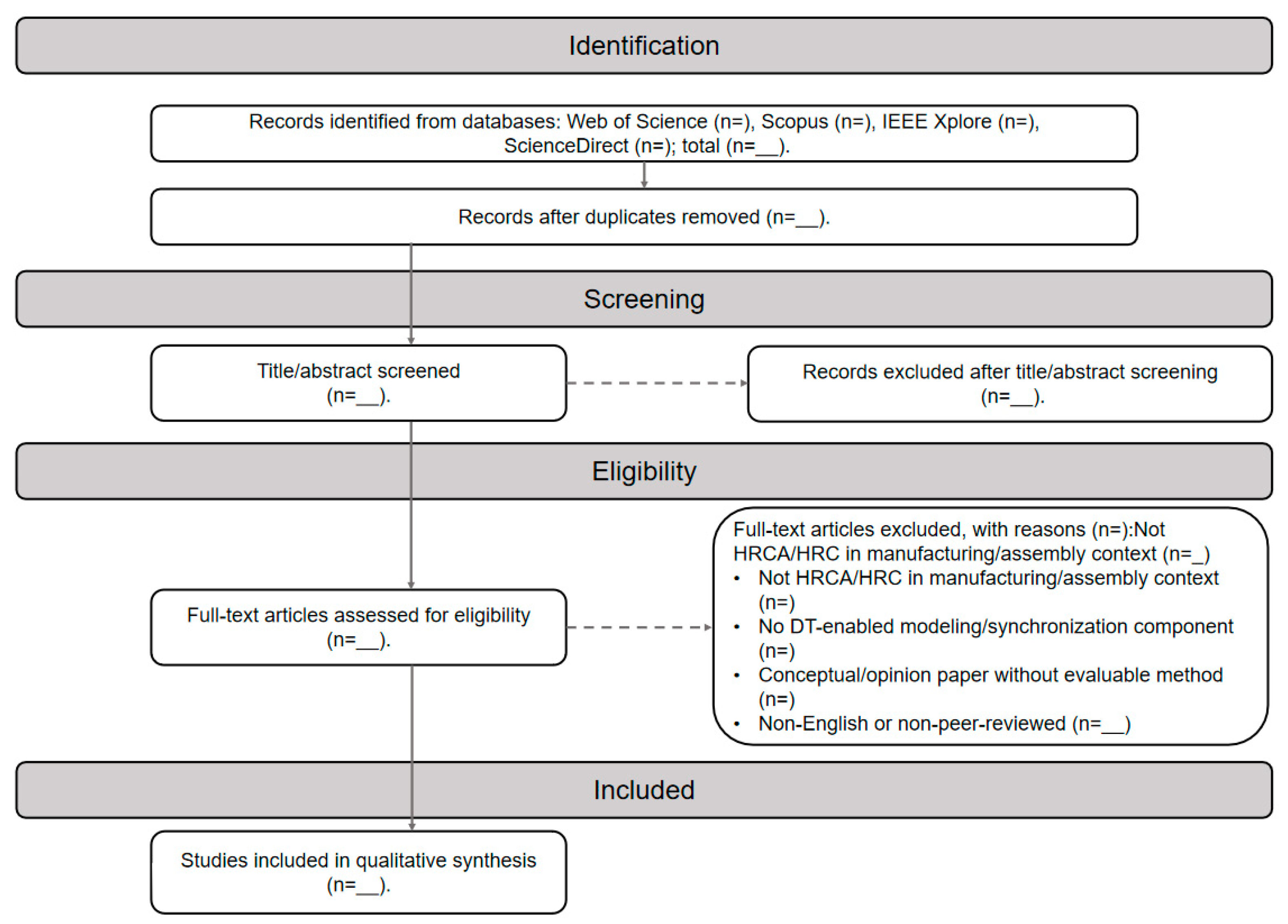
Studies were included if they focused on HRCA/HRC in manufacturing or assembly contexts, incorporated a DT-enabled modeling and/or synchronization component, and reported an evaluable method with sufficient technical detail for extraction and comparison. Non-English or non-peer-reviewed items, as well as purely conceptual/opinion papers without an evaluable method, were excluded. For each included paper, a consistent set of fields was extracted: scenario/task type, sensing and state representation, DT updating/validation mechanism, planning/allocation paradigm, treatment of safety/ergonomics and other human factors, and the evaluation protocol and reported metrics.
To strengthen the credibility of comparative claims, a lightweight study quality appraisal rubric was used (Table A3) to assess whether each study provides (i) evidence of DT fidelity/validation, (ii) safety assurance/verification, (iii) human factor evaluation, and (iv) deployment realism. To make category boundaries operational, each study was assigned to a primary planning paradigm based on the dominant mechanism that produces the final online decision: optimization-based approaches solve explicit objectives under constraints; constraint satisfaction/formal approaches use reason over logic/rules to ensure feasibility; learning-based approaches infer policies or value functions from data (including reinforcement learning and imitation learning); and LLM-assisted approaches use language models to interpret instructions and generate plans/scripts under human or programmatic verification. Hybrid pipelines are discussed explicitly and compared in terms of online decision authority, safety envelope design, and engineering cost.
Table A1.
Database-specific search strings and filters.
Table A2.
Inclusion/exclusion criteria.
Table A3.
Study quality appraisal rubric used to weight strength of evidence.
Table A4 serves as a supplement to Table 4 in this paper. Each dimension (Practical Feasibility, Computational Cost, Industrial Maturity) will be divided into 5 levels, with clear, technical/engineering criteria for each level.
Table A5 serves as a supplement to Table 4 in this paper. The MILP study by Nourmohammadi et al. [42] was chosen as the benchmark because it focuses on the most widely studied scenario (3C electronic assembly with fixed task precedence) and reports comprehensive, replicable metrics. All metrics are extracted from the original studies’ experimental result.
Table A4.
Scoring rubric for HRCA paradigms to ensure transparency.
Table A5.
Supplementary notes (Sample size: n = 10–25 trials per study).
Table A6 includes comprehensive information for each included study to ensure full traceability, and each data point in the manuscript’s Table 4 and Table 5 will be linked to the corresponding Study ID in the extraction table, enabling readers to trace the source of every aggregated value.
Table A6.
Regular review data extraction table.
References
- Liu, C.; Tang, D.; Zhu, H.; Zhang, Z.; Wang, L.; Nie, Q. AR-assisted human-robot collaborative assembly system: Integrating visual language model and deep reinforcement learning for task planning and seamless interactive guidance. J. Manuf. Syst. 2026, 84, 40–67. [Google Scholar] [CrossRef] [Scilit]
- Liu, C.; Tang, D.; Zhu, H.; Wang, L.; Cai, Q.; Nie, Q. LLM-enhanced embodied multi-agent manufacturing system: A novel self-organizing production paradigm for embodied perception, embodied analysis and embodied decision. J. Manuf. Syst. 2026, 84, 357–382. [Google Scholar] [CrossRef] [Scilit]
- Leng, J.; Zhu, X.; Huang, Z.; Li, X.; Zheng, P.; Zhou, X.; Mourtzis, D.; Wang, B.; Qi, Q.; Shao, H.; et al. Unlocking the power of industrial artificial intelligence towards Industry 5.0: Insights, pathways, and challenges. J. Manuf. Syst. 2024, 73, 349–363. [Google Scholar] [CrossRef] [Scilit]
- Leng, J.; Wang, D.; Shen, W.; Li, X.; Liu, Q.; Chen, X. Digital twins-based smart manufacturing system design in Industry 4.0: A review. J. Manuf. Syst. 2021, 60, 119–137. [Google Scholar] [CrossRef] [Scilit]
- Cao, Y.; Zhou, Q.; Yuan, W.; Ye, Q.; Popa, D.; Zhang, Y.M. Human-robot collaborative assembly and welding: A review and analysis of the state of the art. J. Manuf. Process. 2024, 131, 1388–1403. [Google Scholar] [CrossRef] [Scilit]
- Zhang, C.; Zhou, G.H.; Ma, D.X.; Wang, R.; Xiao, J.C.; Zhao, D. A deep learning-enabled human-cyber-physical fusion method towards human-robot collaborative assembly. Robot. Comput.-Integr. Manuf. 2023, 83, 102571. [Google Scholar] [CrossRef] [Scilit]
- Asuzu, K.; Singh, H.; Idrissi, M. Human-robot interaction through joint robot planning with large language models. Intell. Serv. Robot. 2025, 18, 261–277. [Google Scholar] [CrossRef] [Scilit]
- Yang, X.; Fang, H.; Li, J.; Xue, Q. Human factor engineering for human-cyber-physical system collaboration in intelligent manufacturing. China Mech. Eng. 2023, 1740, 1710–1722. [Google Scholar] [CrossRef]
- Zheng, P.; Li, C.; Fan, J.; Wang, L. A vision-language-guided and deep reinforcement learning-enabled approach for unstructured human-robot collaborative manufacturing task fulfilment. CIRP Ann. 2024, 73, 341–344. [Google Scholar] [CrossRef] [Scilit]
- Kong, F.; Gao, T.; Li, H.; Lu, Z. Research on human-robot joint task assignment considering task complexity. J. Mech. Eng. 2021, 57, 204–214. [Google Scholar] [CrossRef] [Scilit]
- Huang, S.; Wang, B.; Zhang, M.; Huang, J.; Zhu, Q.; Yang, G. Operator 4.0 towards human-centric smart manufacturing: Framework, enabling technologies and typical scenarios. J. Mech. Eng. 2022, 58, 251–264. [Google Scholar] [CrossRef] [Scilit]
- Wang, B.C.; Zheng, P.; Yin, Y.; Shih, A.L.; Wang, L.H. Toward human-centric smart manufacturing: A human-cyber-physical systems (HCPS) perspective. J. Manuf. Syst. 2022, 63, 471–490. [Google Scholar] [CrossRef] [Scilit]
- Xiao, J.; Wang, B.; Huang, K.; Terzi, S.; Wang, W.; Macchi, M. Intelligent disassembly scenario understanding for human behavior and intention recognition towards self-perception human-robot collaboration system. J. Manuf. Syst. 2025, 83, 937–962. [Google Scholar] [CrossRef] [Scilit]
- Yuan, G.; Liu, X.; Xiao, M.; Xiao, J.; Wang, L. Large language models in human-robot collaboration: A systematic review, trends, and challenges. J. Manuf. Syst. 2026, 85, 249–268. [Google Scholar] [CrossRef] [Scilit]
- Langås, E.F.; Zafar, M.H.; Sanfilippo, F. Exploring the synergy of human-robot teaming, digital twins, and machine learning in Industry 5.0: A step towards sustainable manufacturing. J. Intell. Manuf. 2025, 37, 999–1022. [Google Scholar] [CrossRef] [Scilit]
- Krupas, M.; Kajati, E.; Liu, C.; Zolotova, I. Towards a Human-Centric Digital Twin for Human–Machine Collaboration: A Review on Enabling Technologies and Methods. Sensors 2024, 24, 2232. [Google Scholar] [CrossRef] [Scilit]
- Wang, Y.; Feng, J.; Liu, J.; Liu, X.; Wang, J. Digital Twin-based Design and Operation of Human-Robot Collaborative Assembly. IFAC-PapersOnLine 2022, 55, 295–300. [Google Scholar] [CrossRef] [Scilit]
- Luan, Z.; Lai, Y.; Huang, R.; Bai, S.; Zhang, Y.; Zhang, H.; Wang, Q. Enhancing Robot Task Planning and Execution through Multi-Layer Large Language Models. Sensors 2024, 24, 1687. [Google Scholar] [CrossRef] [Scilit]
- Ramasubramanian, A.K.; Mathew, R.; Kelly, M.; Hargaden, V.; Papakostas, N. Digital Twin for Human–Robot Collaboration in Manufacturing: Review and Outlook. Appl. Sci. 2022, 12, 4811. [Google Scholar] [CrossRef] [Scilit]
- Kritzinger, W.; Karner, M.; Traar, G.; Henjes, J.; Sihn, W. Digital Twin in manufacturing: A categorical literature review and classification. IFAC-PapersOnLine 2018, 51, 1016–1022. [Google Scholar] [CrossRef] [Scilit]
- Lu, Y.; Liu, C.; Wang, K.I.-K.; Huang, H.; Xu, X. Digital Twin-driven smart manufacturing: Connotation, reference model, applications and research issues. Robot. Comput.-Integr. Manuf. 2020, 61, 101837. [Google Scholar] [CrossRef] [Scilit]
- Sharma, A.; Kosasih, E.; Zhang, J.; Brintrup, A.; Calinescu, A. Digital Twins: State of the art theory and practice, challenges, and open research questions. J. Ind. Inf. Integr. 2022, 30, 100383. [Google Scholar] [CrossRef] [Scilit]
- Yi, S.; Liu, S.; Xu, X.; Wang, X.V.; Yan, S.; Wang, L. A vision-based human-robot collaborative system for digital twin. Procedia CIRP 2022, 107, 552–557. [Google Scholar] [CrossRef] [Scilit]
- Slovák, J.; Melicher, M.; Šimovec, M.; Vachálek, J. Vision and RTLS Safety Implementation in an Experimental Human—Robot Collaboration Scenario. Sensors 2021, 21, 2419. [Google Scholar] [CrossRef] [Scilit] [PubMed]
- Baratta, A.; Cimino, A.; Longo, F.; Nicoletti, L. Digital twin for human-robot collaboration enhancement in manufacturing systems: Literature review and direction for future developments. Comput. Ind. Eng. 2024, 187, 109764. [Google Scholar] [CrossRef] [Scilit]
- Coronado, E.; Ueshiba, T.; Ramirez-Alpizar, I.G. A Path to Industry 5.0 Digital Twins for Human–Robot Collaboration by Bridging NEP+ and ROS. Robotics 2024, 13, 28. [Google Scholar] [CrossRef] [Scilit]
- Müller, M.; Ruppert, T.; Jazdi, N.; Weyrich, M. Self-improving situation awareness for human–robot-collaboration using intelligent Digital Twin. J. Intell. Manuf. 2024, 35, 2045–2063. [Google Scholar] [CrossRef] [Scilit]
- Hoebert, T.; Seibel, S.; Amersdorfer, M.; Vincze, M.; Lepuschitz, W.; Merdan, M. A Framework for Enhanced Human–Robot Collaboration during Disassembly Using Digital Twin and Virtual Reality. Robotics 2024, 13, 104. [Google Scholar] [CrossRef] [Scilit]
- Kousi, N.; Gkournelos, C.; Aivaliotis, S.; Lotsaris, K.; Bavelos, A.C.; Michalos, G.; Makris, S. Digital Twin for Designing and Reconfiguring Human–Robot Collaborative Assembly Lines. Appl. Sci. 2021, 11, 4620. [Google Scholar] [CrossRef] [Scilit]
- Liu, S.; Wang, X.V.; Wang, L. Digital twin-enabled advance execution for human-robot collaborative assembly. CIRP Ann.-Manuf. Technol. 2022, 71, 25–28. [Google Scholar] [CrossRef] [Scilit]
- Zhang, Z.; Ji, Y. Enabling collaborative assembly between humans and robots using a digital twin system. Robot. Comput.-Integr. Manuf. 2024, 86, 102691. [Google Scholar] [CrossRef] [Scilit]
- Benton, K., Jr.; Dewberry, N.; Jaiswal, C.; Chowdhury, S.; AlHmoud, I.; Suarez, D.; Ehmann, K.; Cao, J.; Gokaraju, B. Initial framework design of a digital twin mixed-reality-application on human-robot bi-directional collaboration for forming double curvature plate. Manuf. Lett. 2024, 41, 1476–1487. [Google Scholar] [CrossRef] [Scilit]
- Das, A.; Rahman, A.; Hossain, S.T.; Ahmed, R.; Ara, M. Mixed Reality for Human–Robot Teaming to Enhance Work Health and Safety in Manufacturing Industries: A Systematic Literature Review. Augment. Hum. Res. 2025, 10, 11. [Google Scholar] [CrossRef] [Scilit]
- Zhao, X.; He, Y.; Chen, X.; Liu, Z. Human–Robot Collaborative Assembly Based on Eye-Hand and a Finite State Machine in a Virtual Environment. Appl. Sci. 2021, 11, 5754. [Google Scholar] [CrossRef] [Scilit]
- Adamides, O.; Subramanian, K.; Arora, S.; Sahin, F. Perception and Computation for Speed and Separation Monitoring Architectures. Robotics 2025, 14, 41. [Google Scholar] [CrossRef] [Scilit]
- Lettera, G.; Costa, D.; Callegari, M. A Hybrid Architecture for Safe Human–Robot Industrial Tasks. Appl. Sci. 2025, 15, 1158. [Google Scholar] [CrossRef] [Scilit]
- Himmelsbach, U.B.; Wendt, T.M.; Hangst, N.; Gawron, P.; Stiglmeier, L. Human–Machine Differentiation in Speed and Separation Monitoring for Improved Efficiency in Human–Robot Collaboration. Sensors 2021, 21, 7144. [Google Scholar] [CrossRef] [Scilit]
- Trinh, M.; Kötter, D.; Chu, A.; Behery, M.; Lakemeyer, G.; Petrovic, O.; Brecher, C. Safe and Flexible Planning of Collaborative Assembly Processes Using Behavior Trees and Computer Vision. In Intelligent Human Systems Integration (IHSI 2023); AHFE International: Miami, FL, USA, 2023; Volume 69, pp. 869–879. [Google Scholar] [CrossRef] [Scilit]
- Xiao, J.; Zhang, Z.; Terzi, S.; Tao, F.; Anwer, N.; Eynard, B. Multi-scenario digital twin-driven human-robot collaboration multi-task disassembly process planning based on dynamic time petri-net and heterogeneous multi-agent double deep Q-learning network. J. Manuf. Syst. 2025, 83, 284–305. [Google Scholar] [CrossRef] [Scilit]
- Villani, V.; Pini, F.; Leali, F.; Secchi, C. Survey on human–robot collaboration in industrial settings: Safety, intuitive interfaces and applications. Mechatronics 2018, 55, 248–266. [Google Scholar] [CrossRef] [Scilit]
- Petzoldt, C.; Harms, M.; Freitag, M. Review of task allocation for human-robot collaboration in assembly. Int. J. Comput. Integr. Manuf. 2023, 36, 1675–1715. [Google Scholar] [CrossRef] [Scilit]
- Nourmohammadi, A.; Fathi, M.; Ng, A.H.C. Balancing and scheduling human-robot collaborated assembly lines with layout and objective consideration. Comput. Ind. Eng. 2024, 187, 109775. [Google Scholar] [CrossRef] [Scilit]
- Xuan, D.T.; Huynh, T.V.; Hung, N.T.; Thang, V.T. Applying Digital Twin and Multi-Adaptive Genetic Algorithms in Human–Robot Cooperative Assembly Optimization. Appl. Sci. 2023, 13, 4229. [Google Scholar] [CrossRef] [Scilit]
- Huang, L.; Tang, D.; Zhang, Z.; Zhu, H.; Cai, Q.; Zhao, S. An iterated greedy algorithm integrating job insertion strategy for distributed job shop scheduling problems. J. Manuf. Syst. 2024, 77, 746–763. [Google Scholar] [CrossRef] [Scilit]
- Nourmohammadi, A.; Arbaoui, T.; Fathi, M.; Dolgui, A. Balancing human–robot collaborative assembly lines: A constraint programming approach. Comput. Ind. Eng. 2025, 205, 111154. [Google Scholar] [CrossRef] [Scilit]
- Alessio, A.; Aliev, K.; Antonelli, D. Multicriteria task classification in human-robot collaborative assembly through fuzzy inference. J. Intell. Manuf. 2024, 35, 1909–1927. [Google Scholar] [CrossRef] [Scilit]
- Gelen, G.; İçmez, Y. Task planning and formal control of robotic assembly systems: A Petri net-based approach. Ain Shams Eng. J. 2024, 15, 102804. [Google Scholar] [CrossRef] [Scilit]
- Casalino, A.; Cividini, F.; Zanchettin, A.M.; Piroddi, L.; Rocco, P. Human-robot collaborative assembly: A use-case application. IFAC-PapersOnLine 2018, 51, 194–199. [Google Scholar] [CrossRef] [Scilit]
- Pan, Z.; Wang, W. A Two-Stage MLP-LSTM Network-Based Task Planning Method for Human–Robot Collaborative Assembly Scenarios. Appl. Sci. 2025, 15, 10922. [Google Scholar] [CrossRef] [Scilit]
- Garcia, P.P.; Santos, T.G.; Machado, M.A.; Mendes, N. Deep Learning Framework for Controlling Work Sequence in Collaborative Human–Robot Assembly Processes. Sensors 2023, 23, 553. [Google Scholar] [CrossRef] [Scilit]
- Male, J.; Martinez-Hernandez, U. Deep learning-based robot cognitive architecture for collaborative assembly tasks. Robot. Comput.-Integr. Manuf. 2023, 83, 102572. [Google Scholar] [CrossRef] [Scilit]
- Zhang, R.; Lv, Q.; Li, J.; Bao, J. A reinforcement learning method for human-robot collaboration in assembly tasks. Robot. Comput.-Integr. Manuf. 2022, 73, 102227. [Google Scholar] [CrossRef] [Scilit]
- You, Y.; Cai, B.; Ji, Z. An offline reinforcement learning-based framework for proactive robot assistance in assembly task. Comput. Ind. Eng. 2025, 208, 111313. [Google Scholar] [CrossRef] [Scilit]
- Zhou, Y.; Tang, N.; Li, Z.; Sun, H. Methodology for Human–Robot Collaborative Assembly Based on Human Skill Imitation and Learning. Machines 2025, 13, 431. [Google Scholar] [CrossRef] [Scilit]
- Huang, L.; Wang, D.; Zhao, S. An extended graphical method with reinforcement learning for distributed job shop scheduling problems with transfers. J. Manuf. Syst. 2026, 84, 426–450. [Google Scholar] [CrossRef] [Scilit]
- Petzoldt, C.; Niermann, D.; Maack, E.; Sontopski, M.; Vur, B.; Freitag, M. Implementation and Evaluation of Dynamic Task Allocation for Human–Robot Collaboration in Assembly. Appl. Sci. 2022, 12, 12645. [Google Scholar] [CrossRef] [Scilit]
- Bricher, D.; Müller, A. Analysis of Deep-Learning Methods in an ISO/TS 15066–Compliant Human–Robot Safety Framework. Sensors 2025, 25, 7136. [Google Scholar] [CrossRef] [Scilit] [PubMed]
- Gao, F.; Xia, L.; Zhang, J.; Liu, S.; Wang, L.; Gao, R.X. Integrating Large Language Model for Natural Language-Based Instruction toward Robust Human-Robot Collaboration. Procedia CIRP 2024, 130, 313–318. [Google Scholar] [CrossRef] [Scilit]
- Wiemann, R.; Terei, N.; Raatz, A. Large Language Model for Assisted Robot Programming in Micro-Assembly. Procedia CIRP 2024, 130, 244–249. [Google Scholar] [CrossRef] [Scilit]
- Luo, H.; Wu, J.; Liu, J.; Antwi-Afari, M.F. Large language model-based code generation for the control of construction assembly robots: A hierarchical generation approach. Dev. Built Environ. 2024, 19, 100488. [Google Scholar] [CrossRef] [Scilit]
- Konstantinou, C.; Antonarakos, D.; Angelakis, P.; Gkournelos, C.; Michalos, G.; Makris, S. Leveraging Generative AI Prompt Programming for Human-Robot Collaborative Assembly. Procedia CIRP 2024, 128, 621–626. [Google Scholar] [CrossRef] [Scilit]
- Xiao, J.; Zhang, Z.; Terzi, S.; Anwer, N.; Eynard, B. Dynamic task allocations with Q-learning based particle swarm optimization for human-robot collaboration disassembly of electric vehicle battery recycling. Comput. Ind. Eng. 2025, 204, 111133. [Google Scholar] [CrossRef] [Scilit]
- Schirmer, F.; Kranz, P.; Rose, C.G.; Schmitt, J.; Kaupp, T. Towards Dynamic Human–Robot Collaboration: A Holistic Framework for Assembly Planning. Electronics 2025, 14, 190. [Google Scholar] [CrossRef] [Scilit]
- Barravecchia, F.; Bartolomei, M.; Mastrogiacomo, L.; Franceschini, F. Designing Symbiotic Human–Robot Collaboration in assembly tasks. Prod. Eng. Res. Devel. 2025, 19, 629–661. [Google Scholar] [CrossRef] [Scilit]
- Loy, W.W.; Donovan, J.; Rittenbruch, M.; Teixeira, M.B.F. Exploring AR-enabled human–robot collaboration (HRC) system for exploratory collaborative assembly tasks. Constr. Robot 2025, 9, 19. [Google Scholar] [CrossRef] [Scilit]
- Segura, P.; Lobato-Calleros, O.; Soria-Arguello, I.; Hernández-Martínez, E.G. Work Roles in Human–Robot Collaborative Systems: Effects on Cognitive Ergonomics for the Manufacturing Industry. Appl. Sci. 2025, 15, 744. [Google Scholar] [CrossRef] [Scilit]
- Chang, C.T.; Hayes, B. A Survey of Augmented Reality for Human–Robot Collaboration. Machines 2024, 12, 540. [Google Scholar] [CrossRef] [Scilit]
- Lunding, R.; Hubenschmid, S.; Feuchtner, T.; Grønbæk, K. ARTHUR: Authoring human–robot collaboration processes with augmented reality using hybrid user interfaces. Virtual Real. 2025, 29, 73. [Google Scholar] [CrossRef] [Scilit]
- Carriero, G.; Calzone, N.; Sileo, M.; Pierri, F.; Caccavale, F.; Mozzillo, R. Human-Robot Collaboration: An Augmented Reality Toolkit for Bi-Directional Interaction. Appl. Sci. 2023, 13, 11295. [Google Scholar] [CrossRef] [Scilit]
- Hietanen, A.; Pieters, R.; Lanz, M.; Latokartano, J.; Kämäräinen, J.-K. AR-based interaction for human-robot collaborative manufacturing. Robot. Comput.-Integr. Manuf. 2020, 63, 101891. [Google Scholar] [CrossRef] [Scilit]
- Angleraud, A.; Ekrekli, A.; Samarawickrama, K.; Sharma, G.; Pieters, R. Sensor-based human–robot collaboration for industrial tasks. Robot. Comput.-Integr. Manuf. 2024, 86, 102663. [Google Scholar] [CrossRef] [Scilit]
- Rahman, S.M.M. Dynamic Affect-Based Motion Planning of a Humanoid Robot for Human-Robot Collaborative Assembly in Manufacturing. Electronics 2024, 13, 1044. [Google Scholar] [CrossRef] [Scilit]
- Zhang, Z.; Peng, G.; Wang, W.; Chen, Y.; Jia, Y.; Liu, S. Prediction-Based Human-Robot Collaboration in Assembly Tasks Using a Learning from Demonstration Model. Sensors 2022, 22, 4279. [Google Scholar] [CrossRef] [Scilit]
- Dimitropoulos, N.; Togias, T.; Zacharaki, N.; Michalos, G.; Makris, S. Seamless Human–Robot Collaborative Assembly Using Artificial Intelligence and Wearable Devices. Appl. Sci. 2021, 11, 5699. [Google Scholar] [CrossRef] [Scilit]
- Grushko, S.; Vysocký, A.; Oščádal, P.; Vocetka, M.; Novák, P.; Bobovský, Z. Improved Mutual Understanding for Human-Robot Collaboration: Combining Human-Aware Motion Planning with Haptic Feedback Devices for Communicating Planned Trajectory. Sensors 2021, 21, 3673. [Google Scholar] [CrossRef] [Scilit]
- Xiao, J.; Zhang, Z.; Zheng, Y.; Wu, P.; Terzi, S.; Macchi, M. Knowledge graph-driven process reasoning of human-robot collaborative disassembly strategy for end-of-life products. Robot. Comput.-Integr. Manuf. 2026, 99, 103211. [Google Scholar] [CrossRef] [Scilit]
- Nie, Q.; Shen, Y.; Ma, Y.; Zhang, S.; Zong, L.; Zheng, Z.; Zhangwa, Y.; Chen, Y. Probing Augmented Intelligent Human–Robot Collaborative Assembly Methods Toward Industry 5.0. Electronics 2025, 14, 3125. [Google Scholar] [CrossRef] [Scilit]
- Bajrami, A.; Costa, D.; Palpacelli, M.C.; Emiliani, F. Investigating Collaborative Robotic Assembly: A Case Study of the FANUC CRX-10 iA/L in Industrial Automation at i-Labs. Eng 2024, 5, 532–543. [Google Scholar] [CrossRef] [Scilit]
- Gervasi, R.; Capponi, M.; Mastrogiacomo, L.; Franceschini, F. Manual Assembly and Human–Robot Collaboration in Repetitive Assembly Processes: A Structured Comparison Based on Human-Centered Performances. Int. J. Adv. Manuf. Technol. 2023, 126, 1213–1231. [Google Scholar] [CrossRef] [Scilit]
- Nabli, S.; Djogdom, G.V.T.; Otis, M.J.-D. Optimization of the Human–Robot Collaborative Disassembly Process Using a Genetic Algorithm: Application to the Reconditioning of Electric Vehicle Batteries. Designs 2025, 9, 122. [Google Scholar] [CrossRef] [Scilit]
- Huang, J.; Yin, S.; Tan, M.; Liu, Q.; Li, R.; Pham, D. Task Allocation and Sequence Planning for Human–Robot Collaborative Disassembly of End-of-Life Products Using the Bees Algorithm. Biomimetics 2024, 9, 688. [Google Scholar] [CrossRef] [Scilit]
- Atanasova, L.; Kenny, J.C.; Alexi, E.V.; Chovghi, F.; Mitterberger, D.; Dörfler, K. Building (with) Human–Robot Teams: Fabrication-Aware Design, Planning, and Coordination of Cooperative Assembly Processes. Constr. Robot. 2025, 9, 16. [Google Scholar] [CrossRef] [Scilit]
- Liu, Z.; Wang, S.; Zhao, J.; Hao, J.; Yu, F. Role Dynamic Allocation of Human-Robot Cooperation Based on Reinforcement Learning in an Installation of Curtain Wall. Comput. Model. Eng. Sci. 2024, 138, 473–487. [Google Scholar] [CrossRef] [Scilit]
- Shen, Y.-T. MR-Based Human–Robot Collaboration for Iterative Design and Construction Method. Buildings 2024, 14, 2436. [Google Scholar] [CrossRef] [Scilit]
- Lu, Z.; Wang, R.; Zhou, H.; Dong, N.; Lyu, H.; Yang, G. A Novel Gait Identity Recognition Method for Personalized Human-Robot Collaboration in Industry 5.0. Chin. J. Mech. Eng. 2025, 38, 191. [Google Scholar] [CrossRef] [Scilit]
- Capponi, M.; Gervasi, R.; Mastrogiacomo, L.; Franceschini, F. Gamification in Manufacturing: Some Insights in Human–Robot Collaboration Assembly and Preliminary Results. Int. J. Adv. Manuf. Technol. 2025, 137, 6043–6071. [Google Scholar] [CrossRef] [Scilit]
- Autsou, S.; Dunajeva, O.; Pentel, A.; Shvets, O.; Roosileht, M. Application of Fuzzy Logic for Collaborative Robot Control. Electronics 2025, 14, 4029. [Google Scholar] [CrossRef] [Scilit]
- Wang, K.-J.; Lin, C.J.; Tadesse, A.A.; Woldegiorgis, B.H. Modeling of human–robot collaboration for flexible assembly—A hidden semi-Markov-based simulation approach. Int. J. Adv. Manuf. Technol. 2023, 126, 5371–5389. [Google Scholar] [CrossRef] [Scilit]
- Manzardo, M.; Vidoni, R. On the improvement of the combination of Power and Force Limiting and Speed and Separation Monitoring for an effective Human Robot Collaboration. Procedia Comput. Sci. 2025, 253, 1649–1657. [Google Scholar] [CrossRef] [Scilit]
- Samarathunga, S.M.B.P.B.; Valori, M.; Legnani, G.; Fassi, I. Assessing Safety in Physical Human–Robot Interaction in Industrial Settings: A Systematic Review of Contact Modelling and Impact Measuring Methods. Robotics 2025, 14, 27. [Google Scholar] [CrossRef] [Scilit]
- Shin, H.; Kim, S.; Seo, K.; Rhim, S. A Virtual Pressure and Force Sensor for Safety Evaluation in Collaboration Robot Application. Sensors 2019, 19, 4328. [Google Scholar] [CrossRef] [Scilit] [PubMed]
- D’Antona, A.; Farsoni, S.; Rizzi, J.; Bonfè, M. A Variable Stiffness System for Impact Analysis in Collaborative Robotics Applications with FPGA-Based Force and Pressure Data Acquisition. Sensors 2025, 25, 3913. [Google Scholar] [CrossRef] [Scilit]
- Gervasi, R.; Mastrogiacomo, L.; Franceschini, F. An experimental focus on learning effect and interaction quality in human–robot collaboration. Prod. Eng. Res. Devel. 2023, 17, 355–380. [Google Scholar] [CrossRef] [Scilit]
- Liu, Z.; Wang, X.; Cai, Y. Dynamic risk assessment and active response strategy for industrial human-robot collaboration. Comput. Ind. Eng. 2020, 141, 106302. [Google Scholar] [CrossRef] [Scilit]
- Xu, T.; Tuo, H.; Fang, Q.; Shan, D.; Jin, H.; Fan, J.; Zhu, Y.; Zhao, J. A novel collision detection method based on current residuals for robots without joint torque sensors: A case study on UR10 robot. Robot. Comput.-Integr. Manuf. 2024, 89, 102777. [Google Scholar] [CrossRef] [Scilit]
- Scalera, L.; Giusti, A.; Vidoni, R.; Gasparetto, A. Enhancing fluency and productivity in human-robot collaboration through online scaling of dynamic safety zones. Int. J. Adv. Manuf. Technol. 2022, 121, 6783–6798. [Google Scholar] [CrossRef] [Scilit]
- Rubagotti, M.; Tusseyeva, I.; Baltabayeva, S.; Summers, D.; Sandygulova, A. Perceived safety in physical human–robot interaction—A survey. Robot. Auton. Syst. 2022, 151, 104047. [Google Scholar] [CrossRef] [Scilit]
- Hopko, S.K.; Mehta, R.K.; Pagilla, P.R. Physiological and perceptual consequences of trust in collaborative robots: An empirical investigation of human and robot factors. Appl. Ergon. 2023, 106, 103863. [Google Scholar] [CrossRef] [Scilit]
- Vermeulen, J.; Caldwell, G.; Teixeira, M.B.F.; Burden, A.; Guertler, M. To Safety and Beyond! A Scoping Review of Human Factors Enriching the Design of Human-Robot Collaboration. Interact. Des. Archit. J. IxD&A 2024, 61, 42–65. [Google Scholar] [CrossRef] [Scilit]
- Patalas-Maliszewska, J.; Łosyk, H.; Dudek, A. Improving safety in human–robot collaboration towards sustainable production in Industry 5.0. J. Intell. Manuf. 2025. [Google Scholar] [CrossRef] [Scilit]
- Falerni, M.M.; Pomponi, V.; Karimi, H.R.; Nicora, M.L.; Dao, L.A.; Malosio, M.; Roveda, L. A framework for human–robot collaboration enhanced by preference learning and ergonomics. Robot. Comput.-Integr. Manuf. 2024, 89, 102781. [Google Scholar] [CrossRef] [Scilit]
- Vitolo, F.; Rega, A.; Di Marino, C.; Pasquariello, A.; Zanella, A.; Patalano, S. Mobile Robots and Cobots Integration: A Preliminary Design of a Mechatronic Interface by Using MBSE Approach. Appl. Sci. 2022, 12, 419. [Google Scholar] [CrossRef] [Scilit]
- Hameed, A.; Ordys, A.; Możaryn, J.; Sibilska-Mroziewicz, A. Control System Design and Methods for Collaborative Robots: Review. Appl. Sci. 2023, 13, 675. [Google Scholar] [CrossRef] [Scilit]
- Fan, J.; Yin, Y.; Wang, T.; Dong, W.; Zheng, P.; Wang, L. Vision-language model-based human-robot collaboration for smart manufacturing: A state-of-the-art survey. Front. Eng. Manag. 2025, 12, 177–200. [Google Scholar] [CrossRef] [Scilit]
- Wang, J.; Shi, E.; Hua, H.; Ma, C.; Liu, Y.; Wang, X.; Yao, Y.; Liu, X.; Ge, B.; Zhang, S. Large language models for robotics: Opportunities, challenges, and perspectives. J. Autom. Intell. 2025, 4, 52–64. [Google Scholar] [CrossRef] [Scilit]
- Iodice, F.; De Momi, E.; Ajoudani, A. Intelligent Framework for Human-Robot Collaboration: Dynamic Ergonomics and Adaptive Decision-Making. J. Intell. Robot. Syst. 2025, 112, 5. [Google Scholar] [CrossRef] [Scilit]
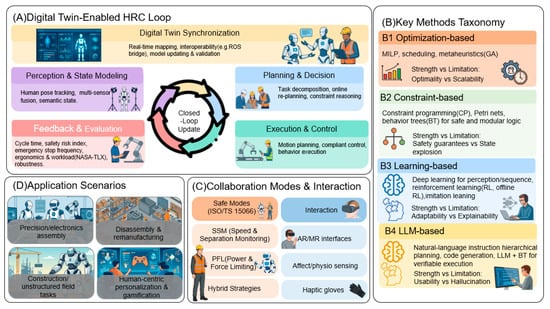
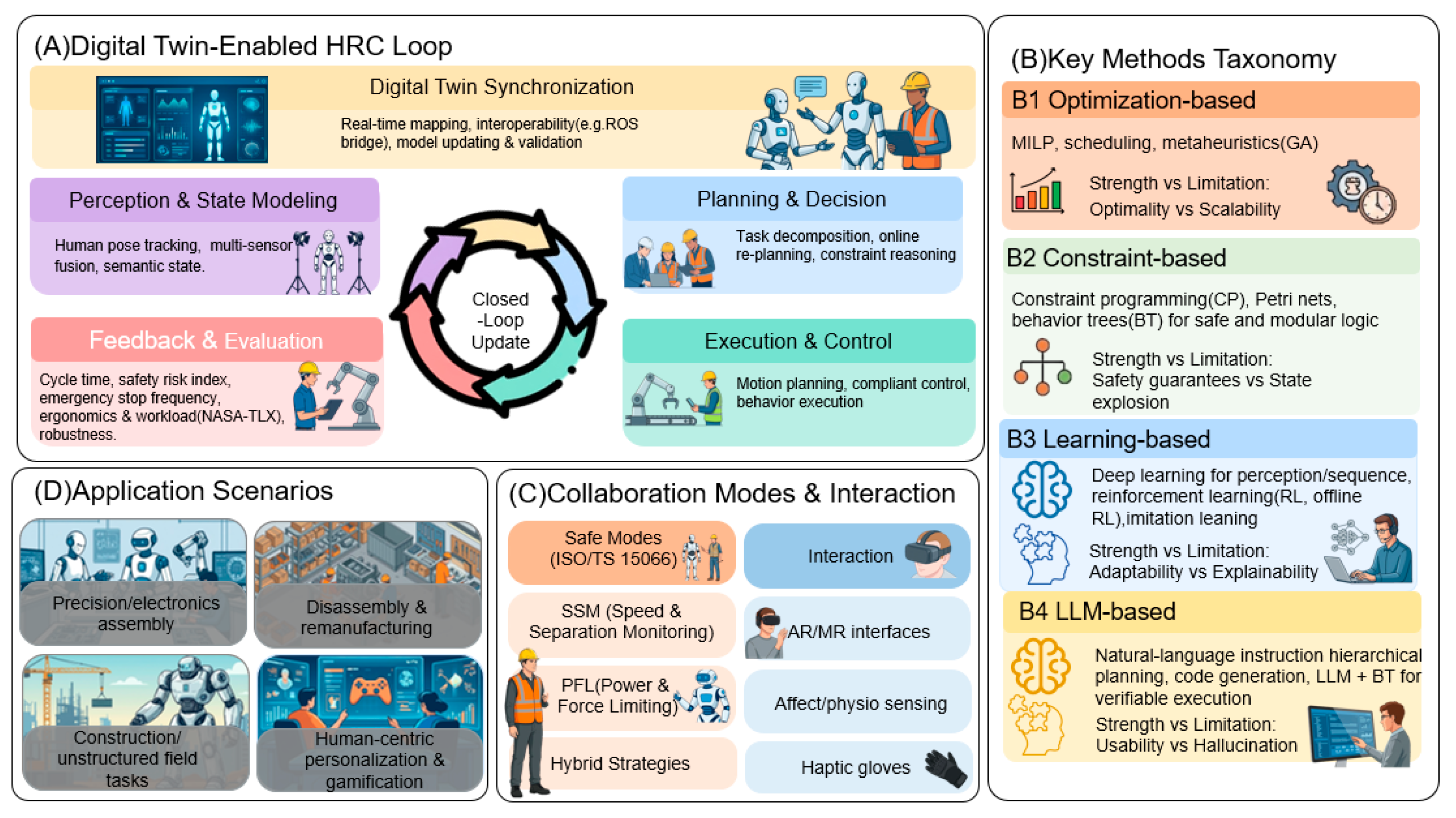
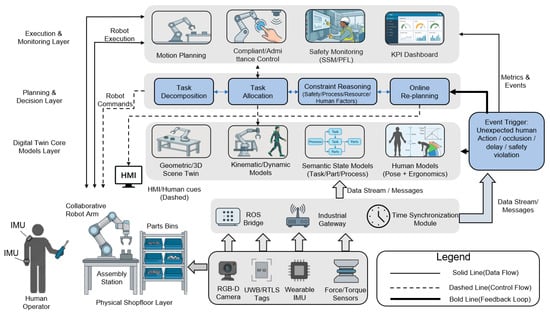
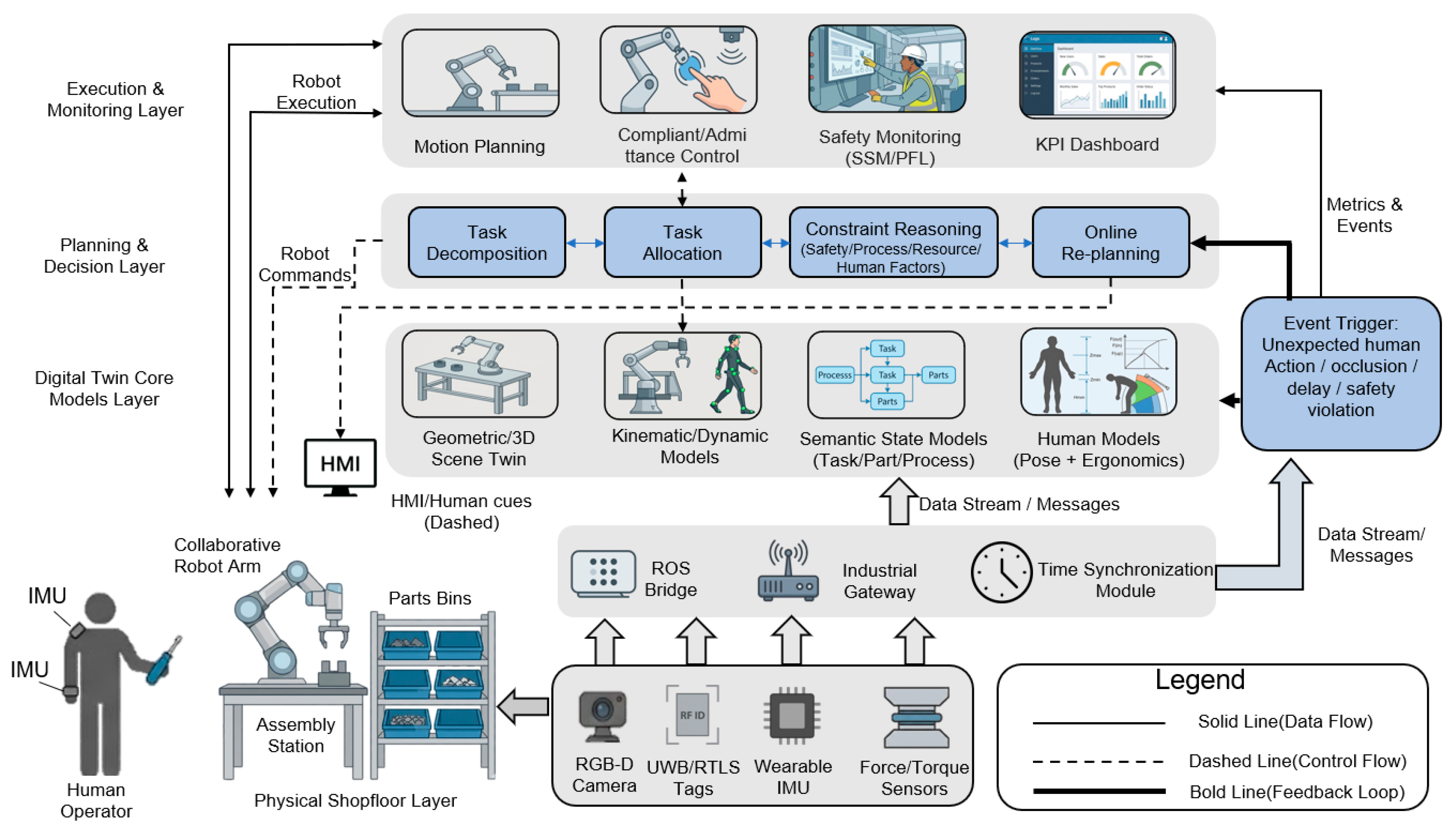
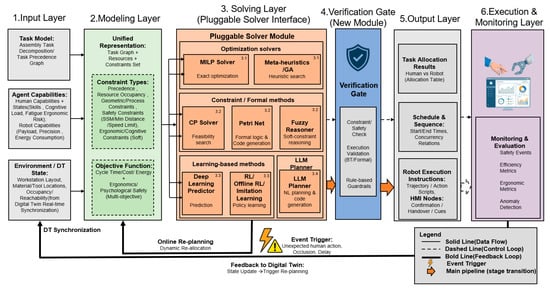
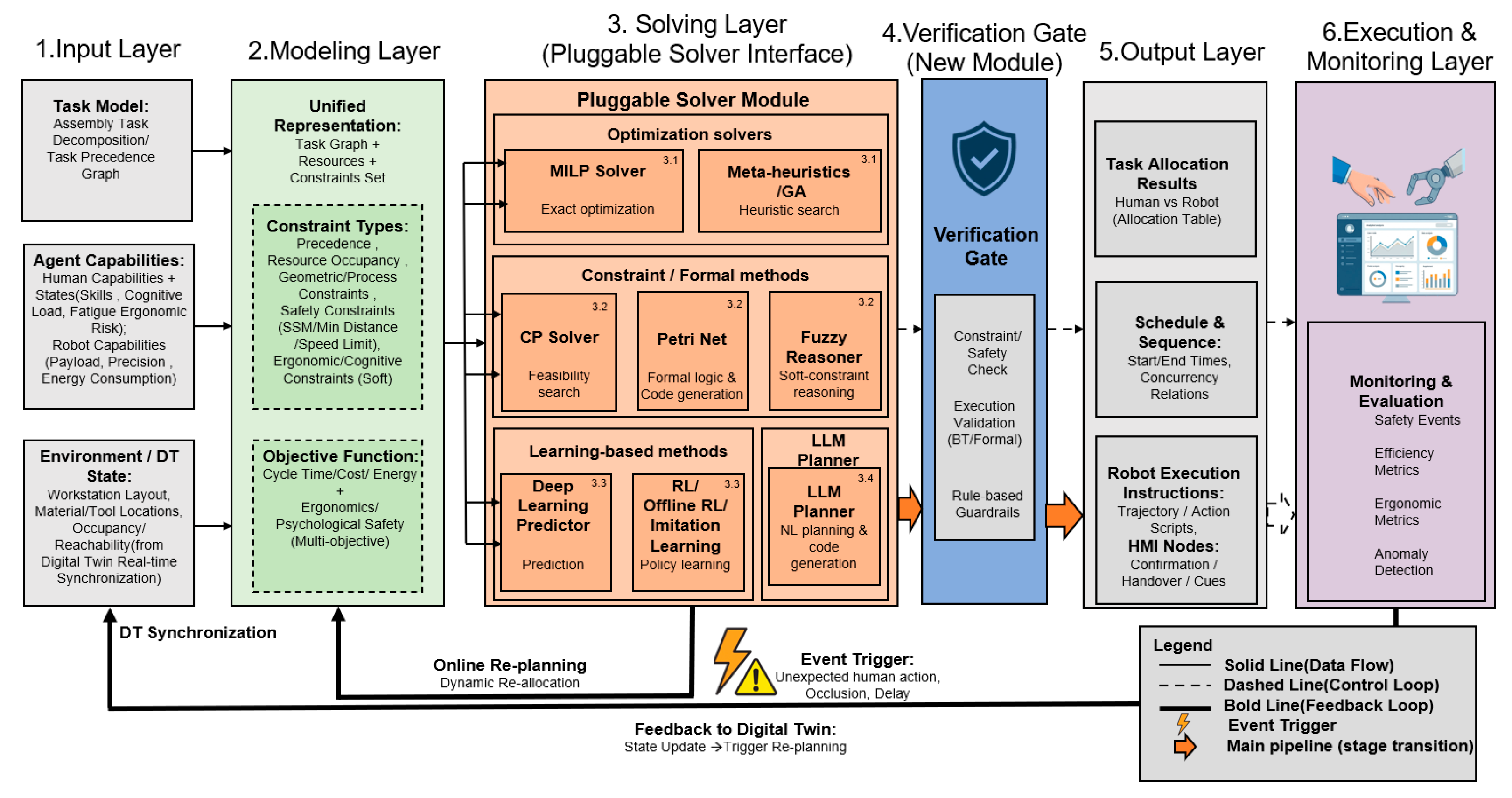
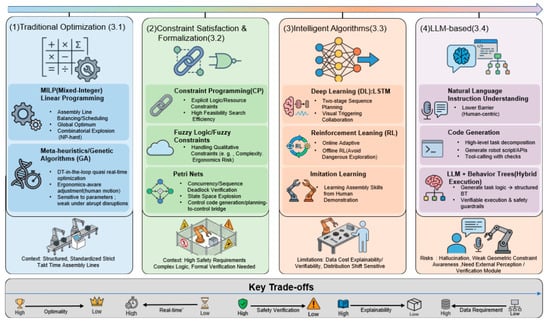
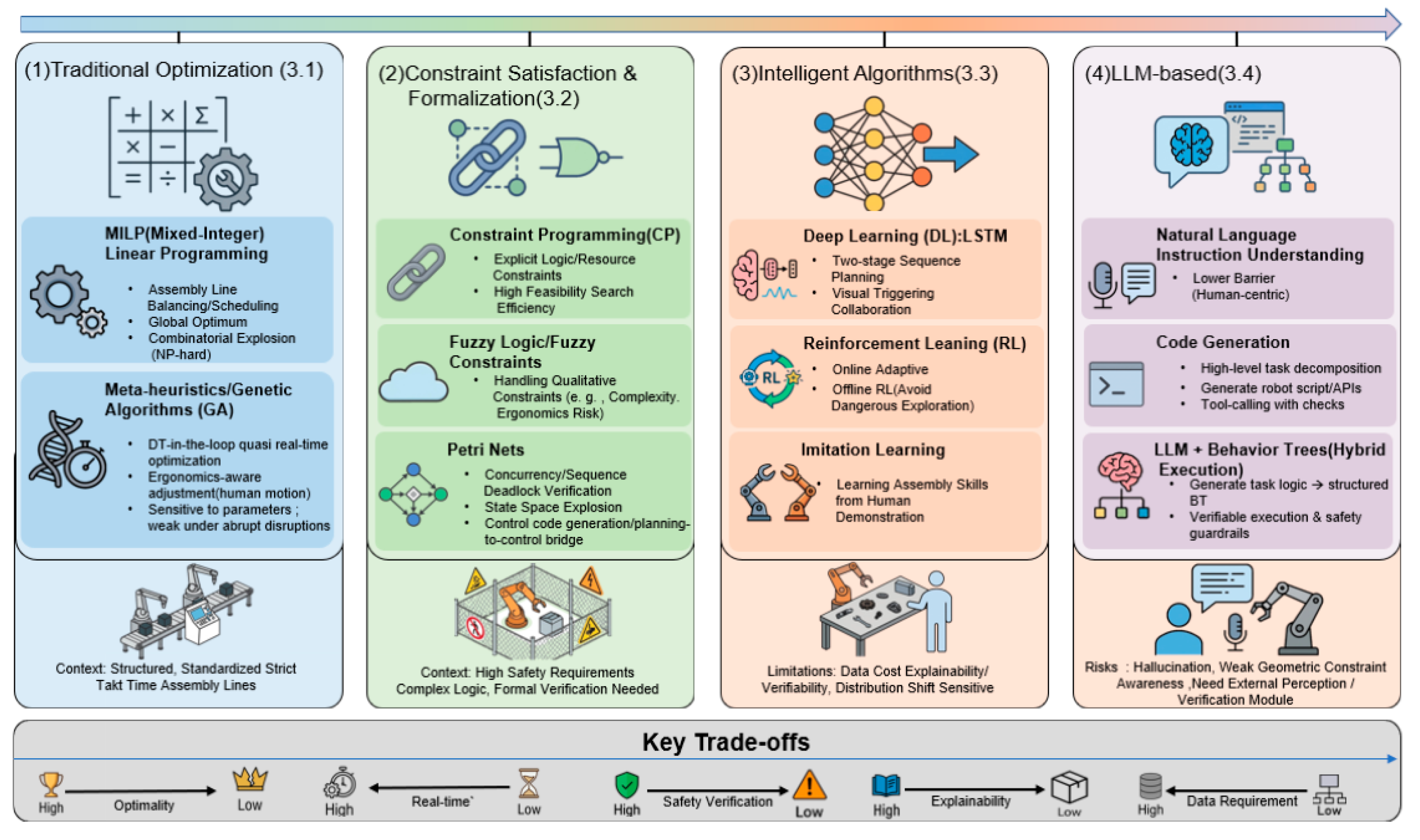
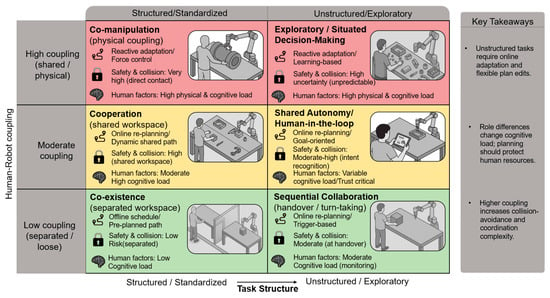
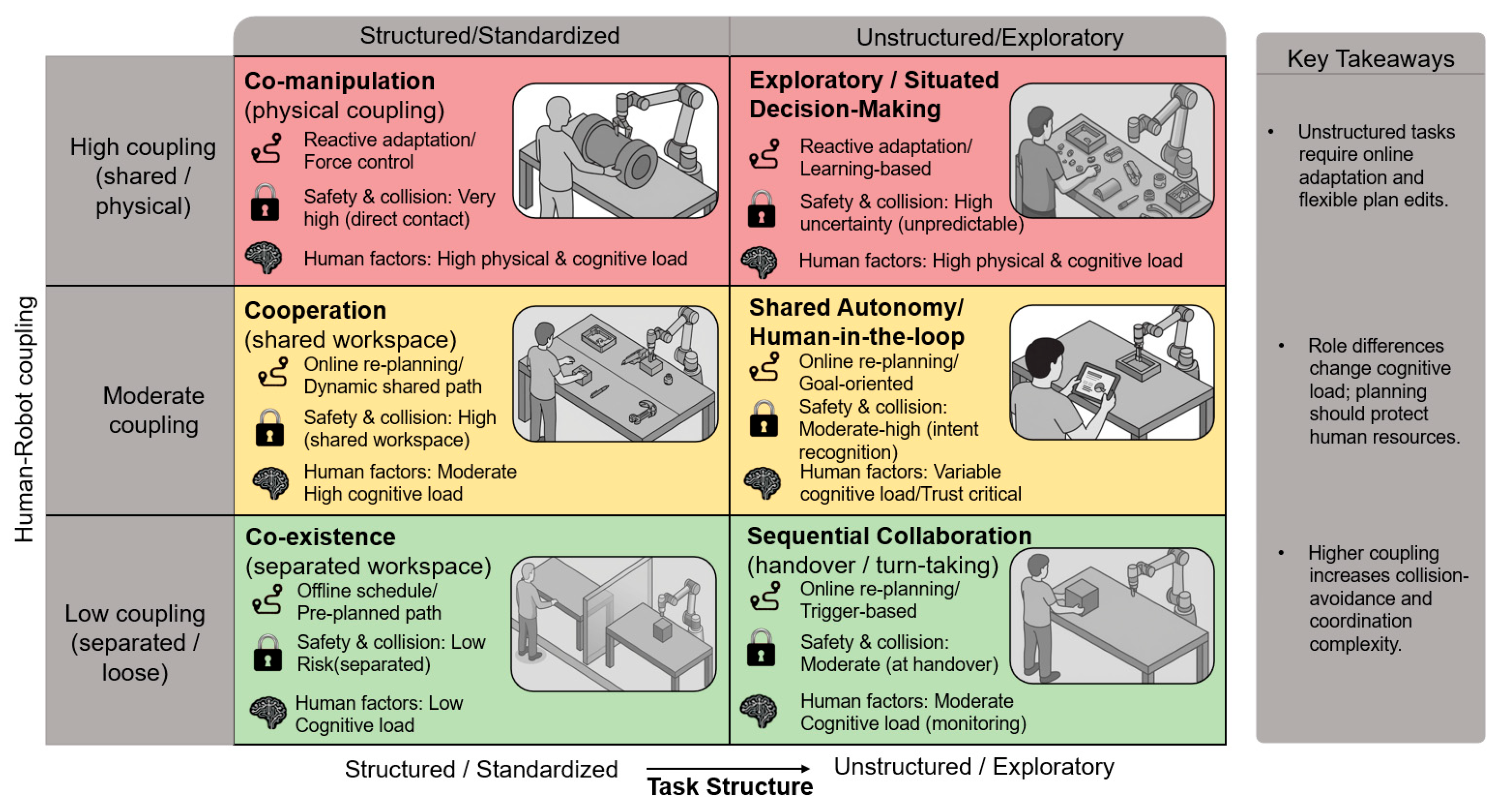
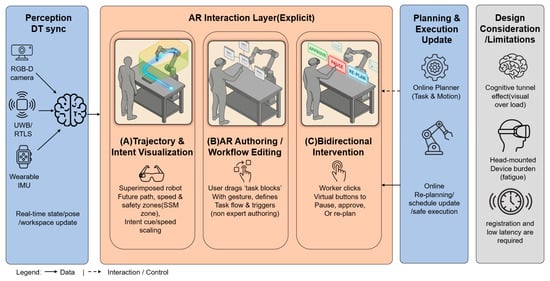
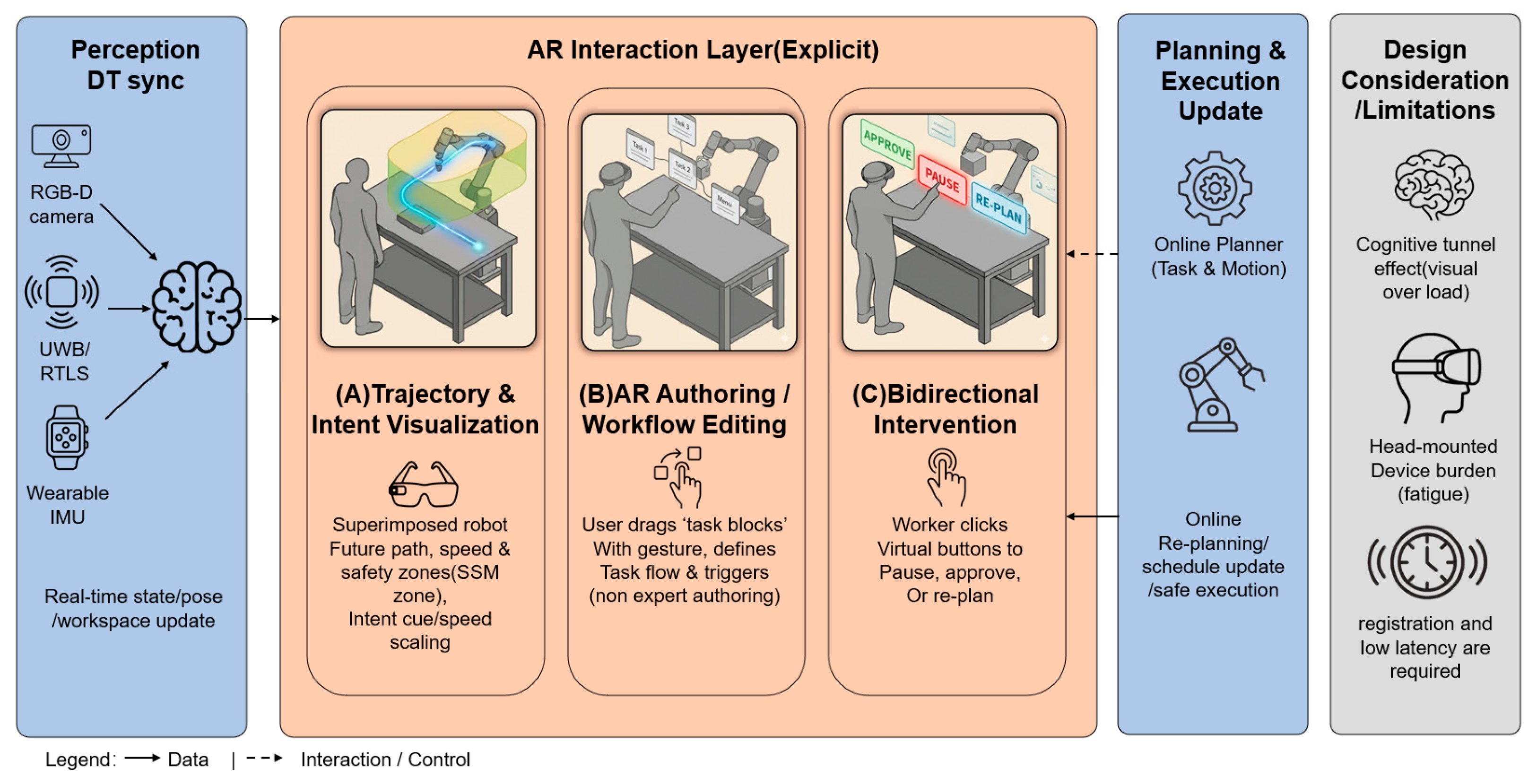
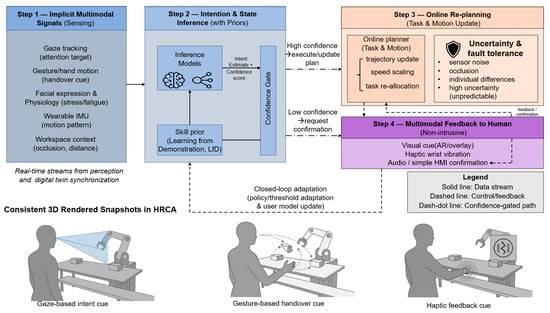
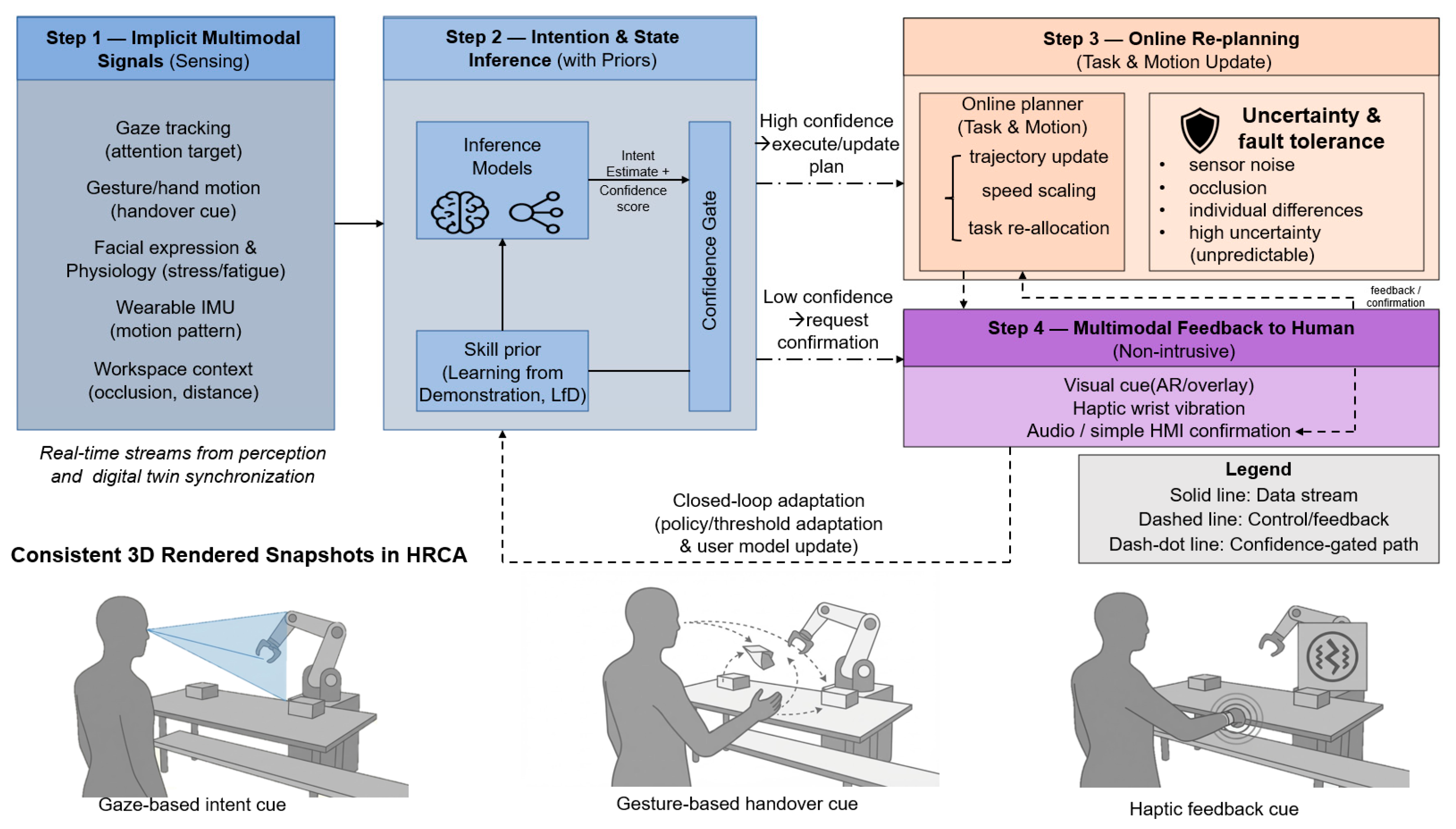
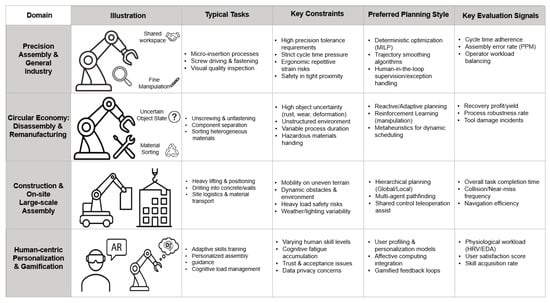
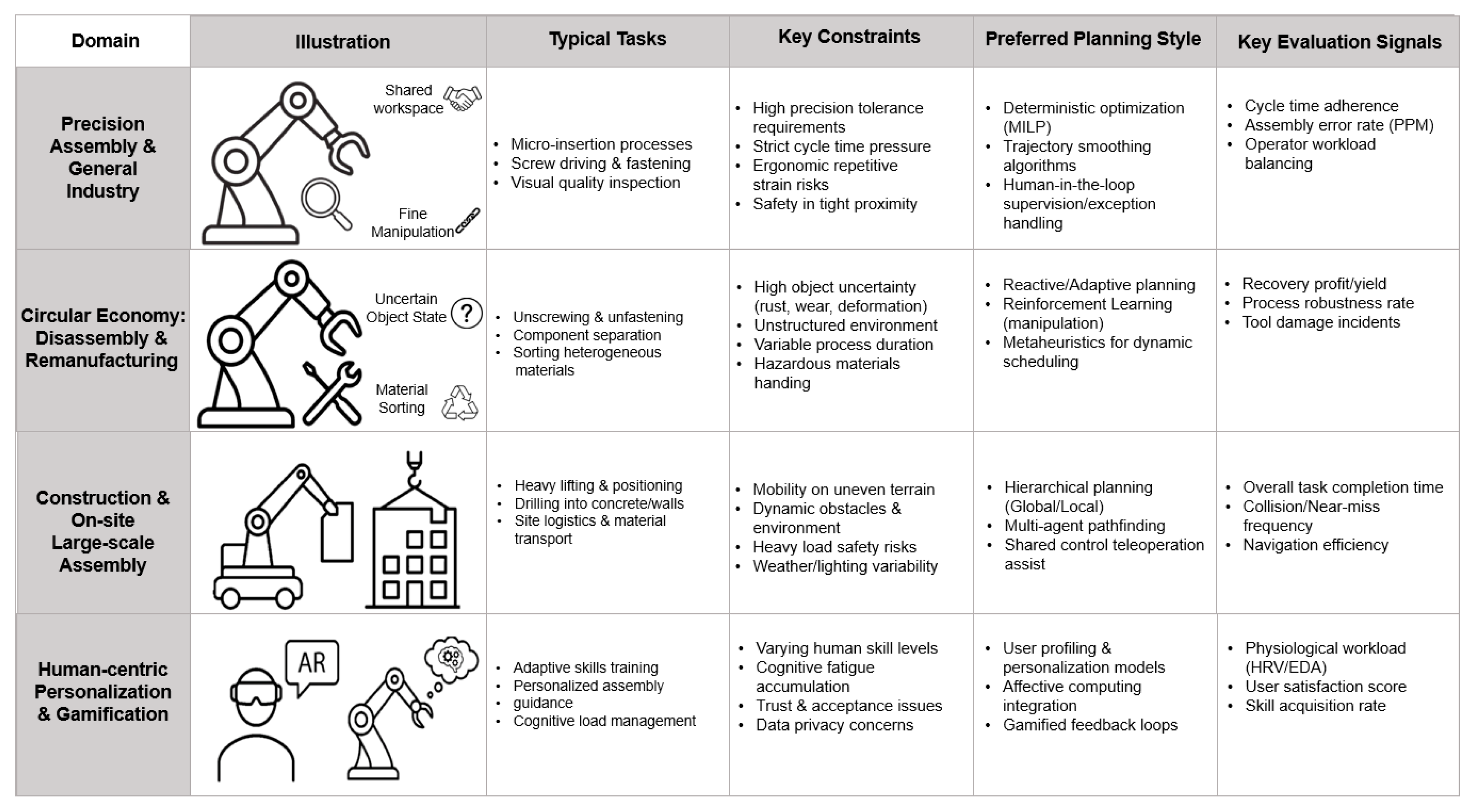
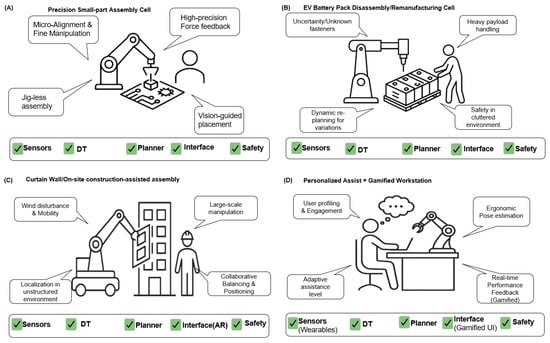
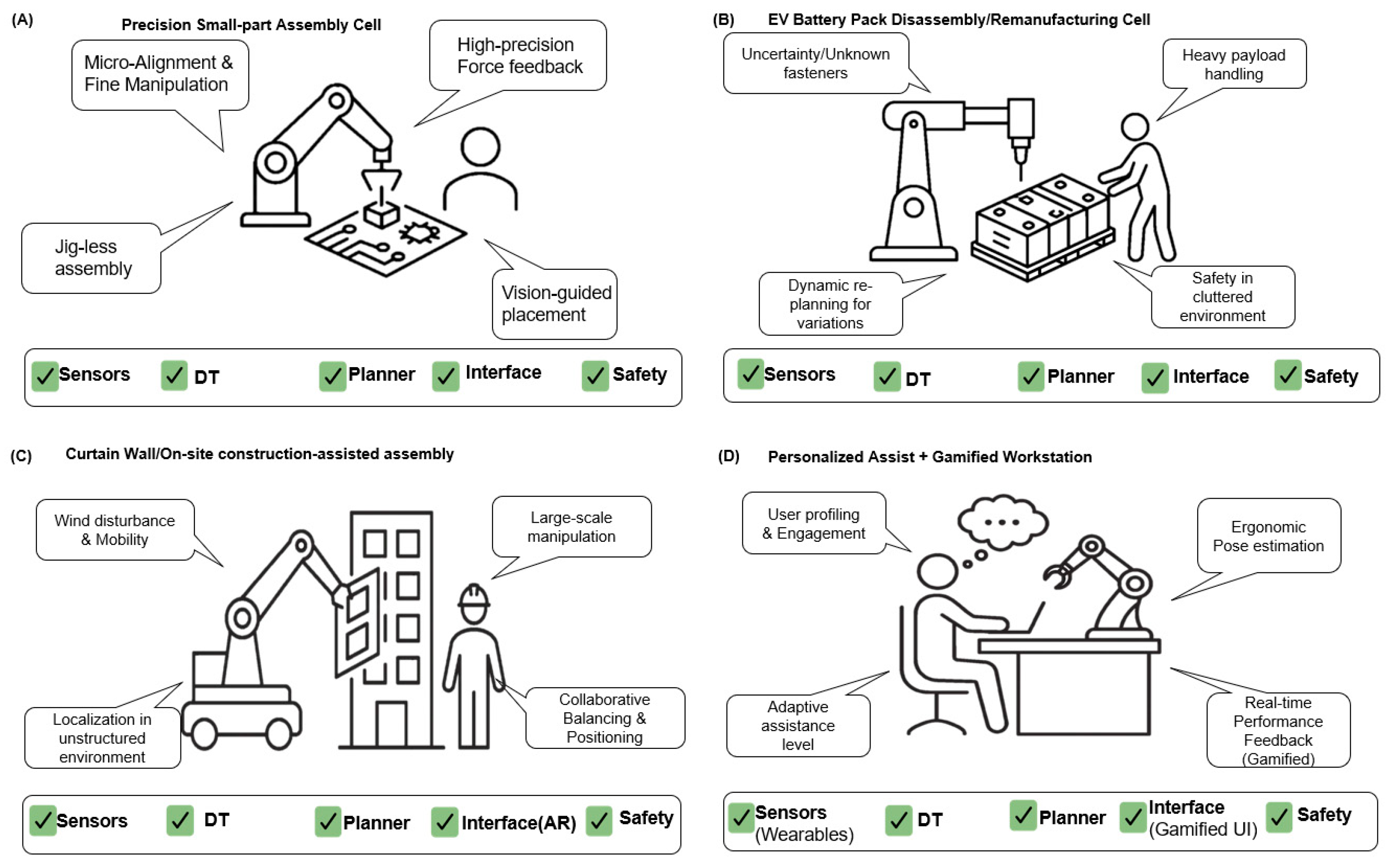
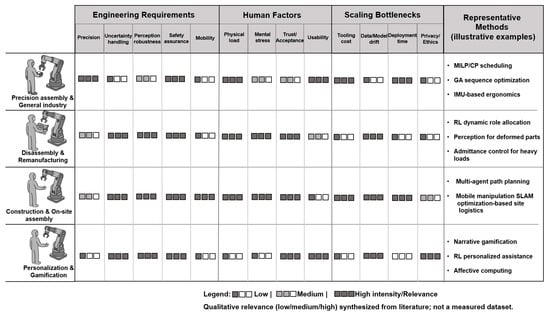
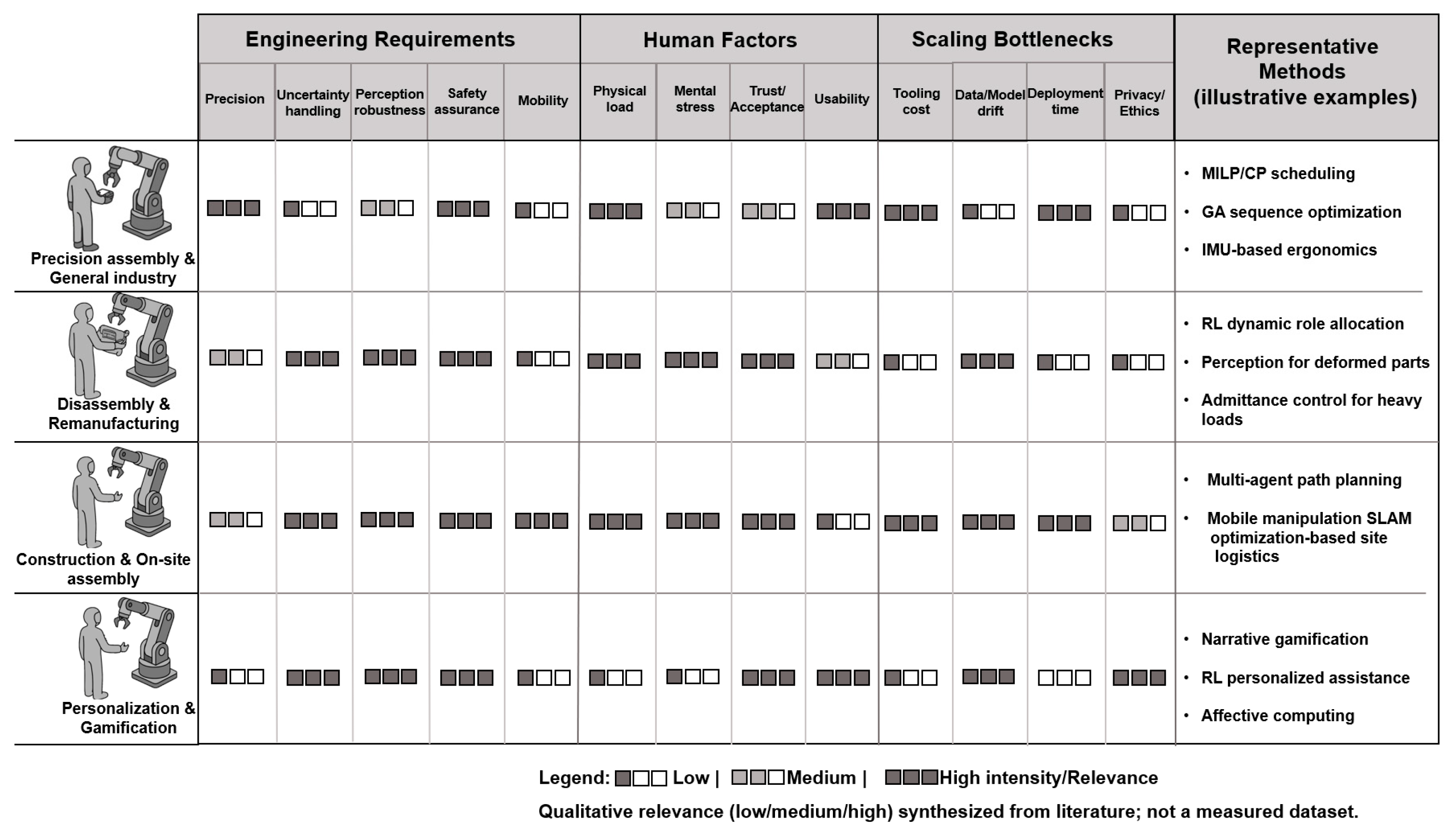
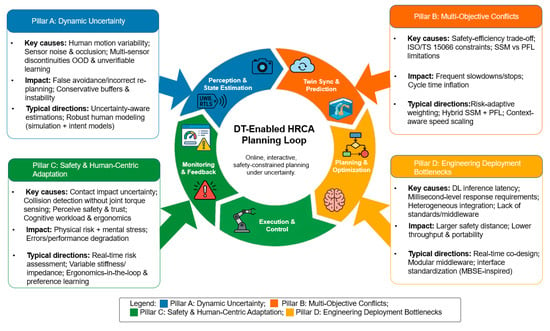
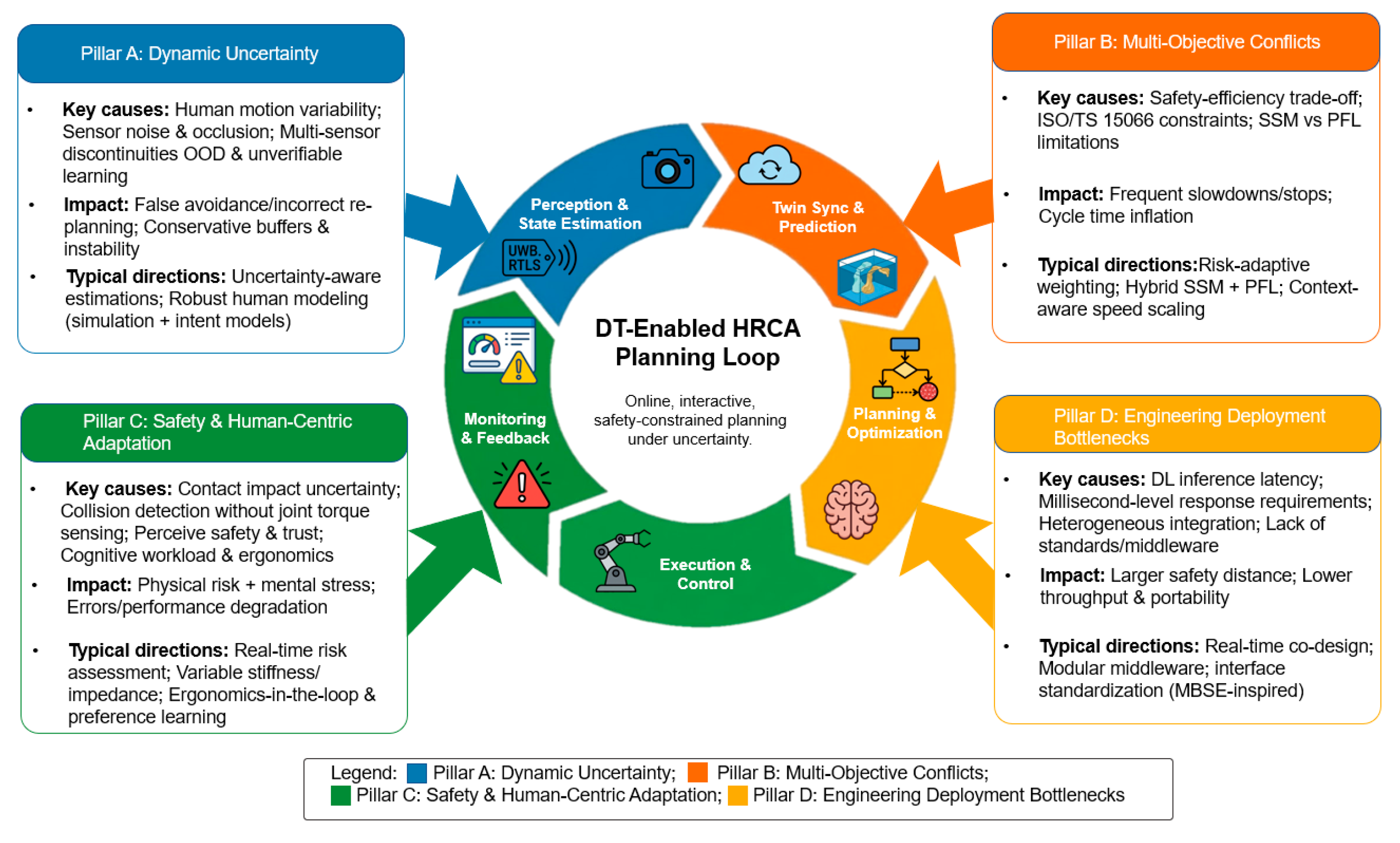
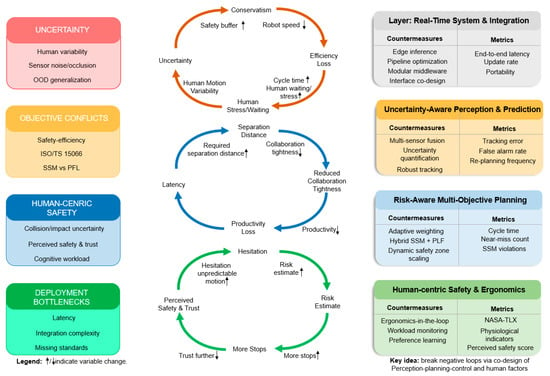
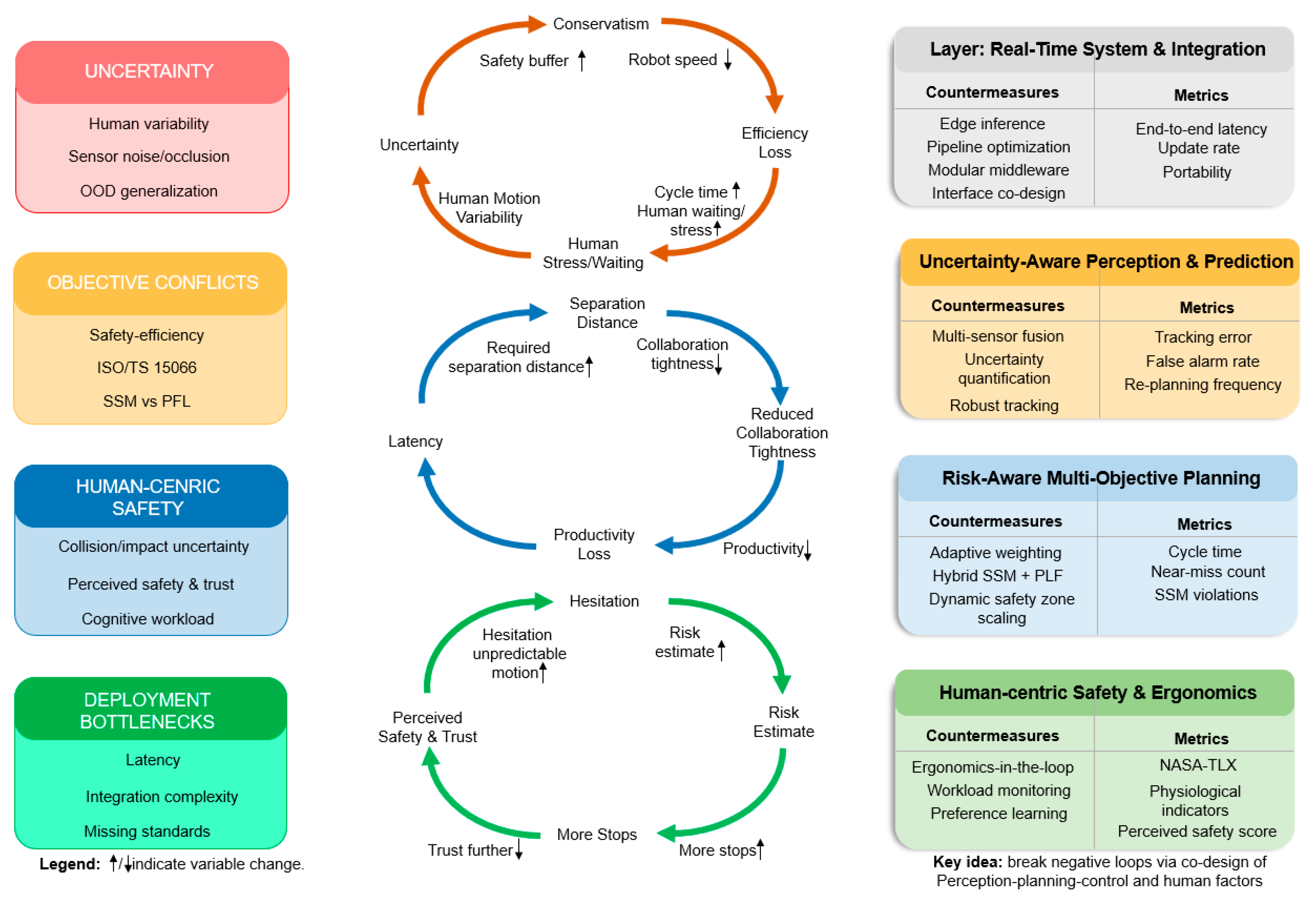
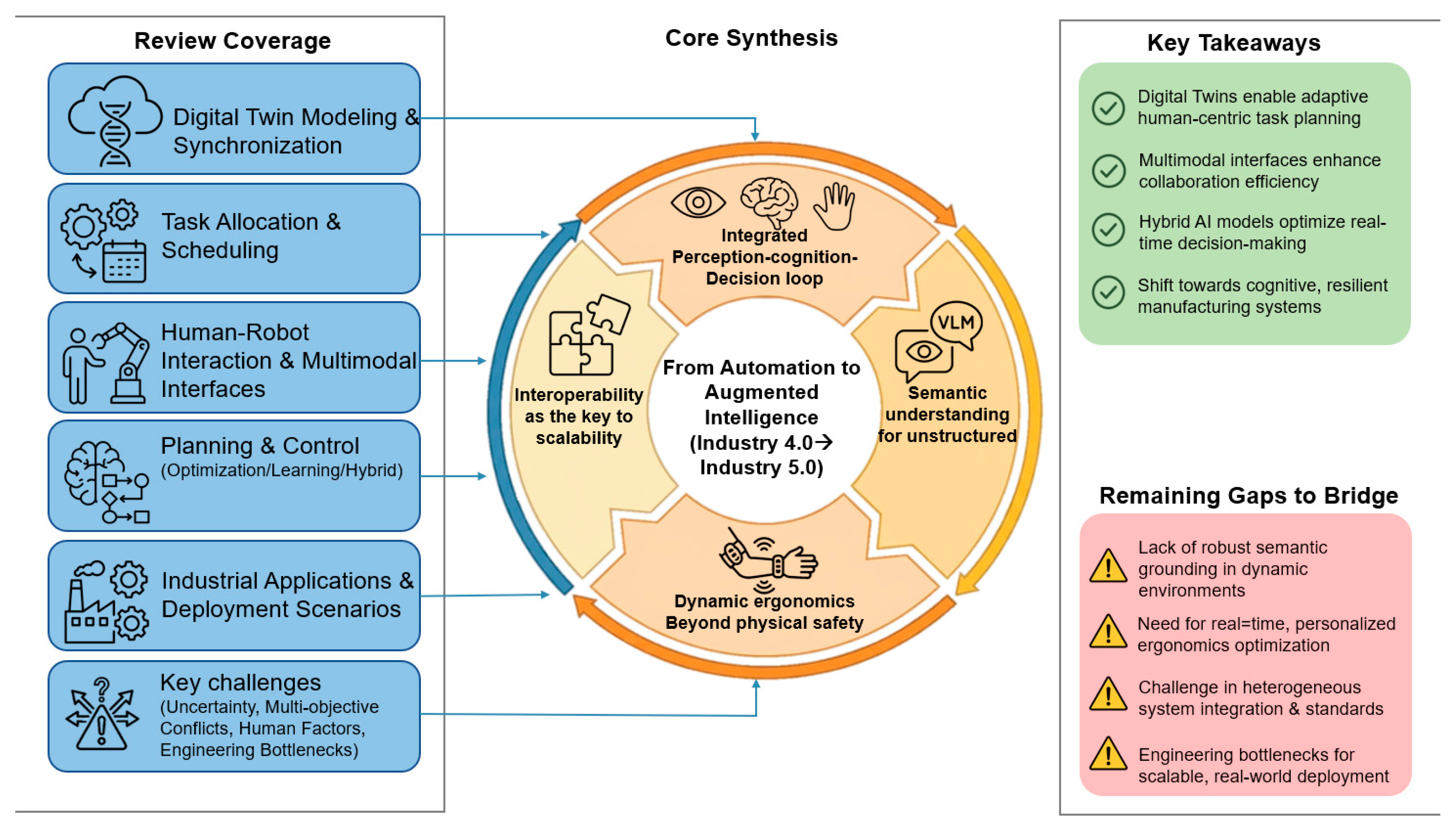
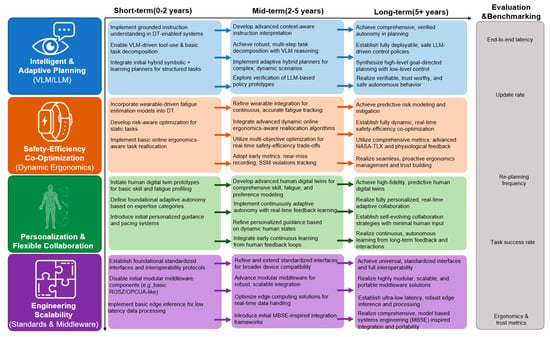
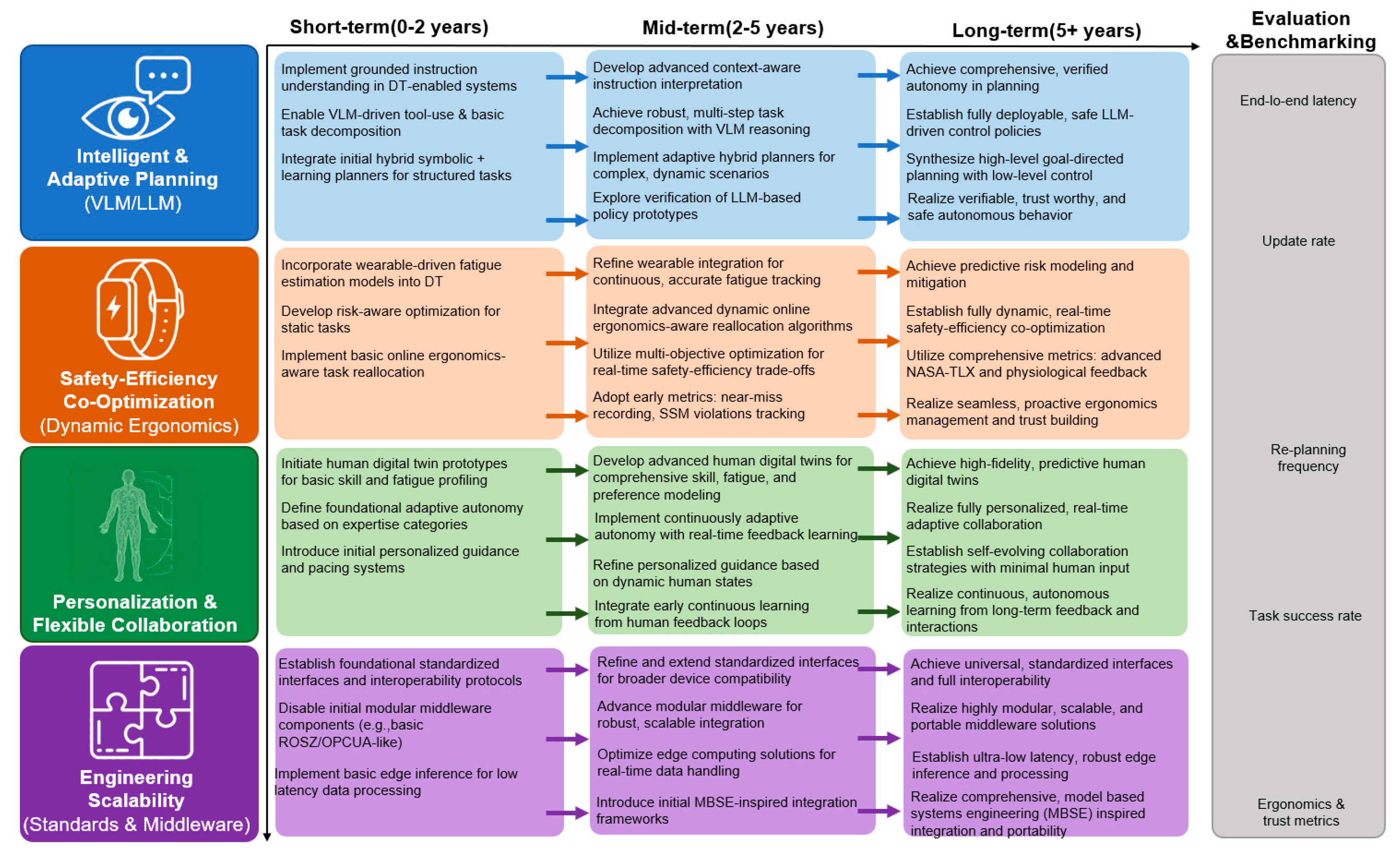

Disclaimer/Publisher’s Note: The statements, opinions and data contained in all publications are solely those of the individual author(s) and contributor(s) and not of MDPI and/or the editor(s). MDPI and/or the editor(s) disclaim responsibility for any injury to people or property resulting from any ideas, methods, instructions or products referred to in the content. |
© 2026 by the authors. Licensee MDPI, Basel, Switzerland. This article is an open access article distributed under the terms and conditions of the Creative Commons Attribution (CC BY) license.