


Abstract
Robotic manipulation requires an agent to perceive the spatial structure of the physical world and anticipate how the environment changes during interaction. However, existing behavior-cloning and world-model-based methods often rely on 2D visual observations or weak multimodal fusion, which limits their ability to reason about 3D geometry and spatially consistent future states. To address this problem, we propose the Spatial Foresight Inverse Dynamics (SpaFID), a 3D-aware manipulation framework that combines semantic-geometric representation learning with latent-space future prediction. Specifically, we first develop the Semantic-Geometric Aligner, which aligns and fuses visual features rich in spatial semantics with 3D geometric features to achieve an effective representation of physical space. Second, we introduce the Spatial Foresight module to predict next-step latent changes associated with demonstrated manipulation behavior, providing future-aware features for action generation. These foresight features are then integrated with the current robot state, providing rich spatiotemporal context for the inverse dynamics head to generate action. The framework is trained end-to-end with Low-Rank Adaptation (LoRA) fine-tuning of the visual backbone, reducing the number of trainable backbone parameters. Across five independent training runs, SpaFID achieved success rates of 87.6 ± 1.8% on Meta-World and 69.2 ± 2.4% on RLBench, outperforming Lift3D by 5.8 and 4.2 percentage points, respectively.
1. Introduction
Robotic manipulation couples perception with physical action: observations must be translated into end-effector motion and gripper commands under the robot’s kinematic and sensing constraints [1]. Broader surveys have also examined embodied-AI applications in healthcare, illustrating the extension of embodied systems to application-specific settings [2]. As tasks move beyond pick-and-place toward assembly, insertion, and contact-rich interaction, a policy must identify relevant objects, estimate their relative spatial configuration, and account for changes during execution. Depth and pose errors can accumulate over successive control steps, causing missed grasps, misalignment, or interrupted contact.
In an RGB-D manipulation system, image features provide semantic context, depth observations provide geometric measurements, and proprioception describes the robot configuration. Their utility depends on maintaining correspondence across sensor and robot coordinate frames. Recent robotic systems address this interface through geometry-enriched visual control, depth correction, and task-oriented RGB-D grasp selection [3,4,5]. These developments motivate associating semantic context with measured workspace geometry. Anticipating the next observation can further inform action prediction, but a predicted feature is useful only if it improves control from the current configuration. SpaFID addresses this representation-to-action problem through semantic-geometric alignment and a learned one-step latent predictor.
Existing methods provide only a partial solution to this problem. Policies that rely mainly on images benefit from strong semantic representations, but monocular observations often contain ambiguous depth, scale, and object-pose information. This ambiguity limits their reliability under viewpoint changes and strict spatial constraints [6]. In contrast, 3D representations such as point clouds and voxels provide explicit geometric structure and are increasingly used for robotic manipulation [7,8]. Reviews of point-cloud completion and sparse-voxel hierarchies further document complementary approaches to representing and modeling 3D geometry [9,10]. However, 3D features often lack the rich semantic knowledge encoded by pretrained vision models, especially for task-relevant objects and language-conditioned instructions. Moreover, existing multimodal policies commonly process 2D and 3D features independently or combine them through simple concatenation. As a result, high-level semantic information is not always well aligned with the physical structure of the workspace, which limits reliable spatial reasoning for action generation.
Many observation-conditioned manipulation policies predict actions directly from current observations. Nevertheless, predictive modeling has also been investigated in robot control and manipulation. Pavlichenko and Behnke incorporate forward-dynamics prediction into a learned two-stage model for flexible-joint manipulator trajectory tracking [11]. Tian et al. introduce Predictive Inverse Dynamics Models (PIDM), which predict actions conditioned on forecasted visual states [12]. Related approaches also investigate visual prediction and latent-space modeling for representation learning and robotic manipulation [13,14,15]. These studies demonstrate the relevance of predictive information to robotic control. Building on this direction, SpaFID investigates one-step prediction in a latent representation that combines image semantics with point-cloud geometry. Its predictor is not conditioned on a candidate action; instead, it estimates the next latent representation associated with the demonstration distribution and supplies this representation to the action decoder.
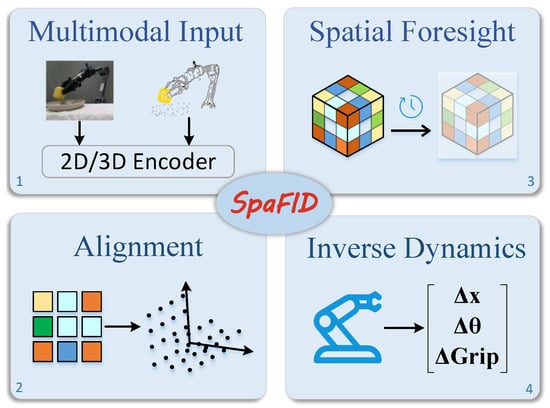
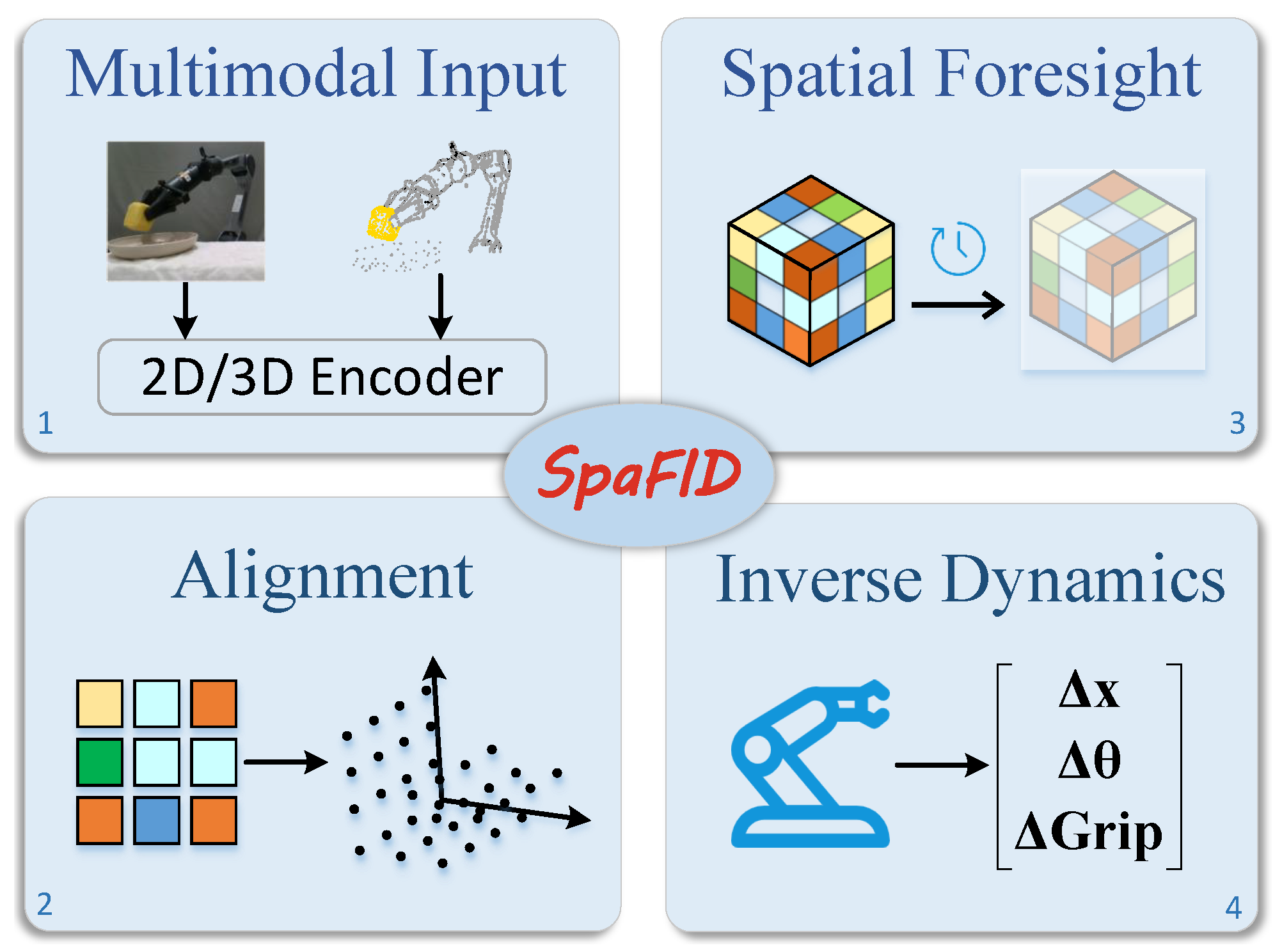
In this work, we propose Spatial Foresight Inverse Dynamics (SpaFID), a framework that combines semantic-geometric representation learning with future latent-state prediction for robotic manipulation, as illustrated in Figure 1. Specifically, SpaFID introduces a Semantic-Geometric Aligner, which first encodes RGB images and 3D point clouds, and then aligns semantic features extracted from RGB images onto sampled 3D points using camera geometry and fuses them with local geometric features. Based on this representation, the Spatial Foresight module predicts the latent state at the next step through self-supervised transition learning. The predicted future representation is then integrated with the robot’s proprioceptive state through cross-attention and passed to an inverse-dynamics prediction head. Here, inverse dynamics denotes learned action prediction from temporally ordered observations or their latent representations, following common usage in robot imitation learning. The entire framework is trained end-to-end with parameter-efficient Low-Rank Adaptation (LoRA) fine-tuning.
Figure 1.
The proposed SpaFID. The framework processes multimodal input through encoders and utilizes the alignment module to fuse features into a 3D latent space. The Spatial Foresight module predicts the next global latent representation associated with the demonstration distribution and the Inverse Dynamics module generates control commands for task execution.
To evaluate the proposed SpaFID, we conduct extensive experiments on two simulation benchmarks and various real-world scenarios. Comparisons with leading 2D and 3D representation-based methods show that SpaFID consistently achieves superior performance, confirming its robustness and 3D spatial awareness. To assess generalization, we introduce diverse manipulation objects, background scenes, and lighting conditions in real-world settings. SpaFID demonstrates favorable adaptability by effectively leveraging 3D spatial information and predicted future states within the latent space. Our contributions are as follows:
- We propose SpaFID, a 3D-aware manipulation framework that combines semantic-geometric representation learning with future latent-state prediction.
- We design the Semantic-Geometric Aligner (SGA) module to associate visual features with calibrated 3D locations, providing a joint representation of semantic context and workspace geometry. This module aligns visual semantics with point cloud geometry, enhancing spatial expressiveness through joint semantic-spatial representations.
- We introduce the Spatial Foresight (SF) module, which learns environmental transitions in a self-supervised manner. By adding predicted dynamics into the decision loop via cross-attention, the Spatial Foresight module facilitates a transition from passive reaction to predictive decisions.
2. Related Work
2.1. Visual Representation Learning for Manipulation
CLIP is an image–language model whose visual encoder provides semantic features learned through contrastive pretraining [16]. R3M is a visual representation model pretrained on human videos for transfer to robotic manipulation [17]. VC-1 is a pretrained visual backbone developed for embodied tasks [18]. These encoders provide useful perceptual priors, but their pretraining objectives do not directly establish correspondence between image features and robot-base coordinates. Image-based manipulation remains viable; the question here is whether explicit geometric grounding adds a benefit under the evaluated spatial constraints.
Recent work in Robotics also connects representation design to visual feedback control. Botezatu et al. [3] augment a ResNet-18 input with interest-point maps and combine real and synthetic images for an eye-in-hand control system. This illustrates how geometry-related visual cues can affect convergence and motion smoothness. SpaFID uses a different observation interface: it associates image features with RGB-D-derived point locations and supplies the fused representation to a learned manipulation decoder.
2.2. 3D Perception for Robotic Manipulation
PointNet, PointNet++, and PointNext learn geometric features from point sets [19,20,21]. PerAct and RVT use voxelized or multi-view representations for manipulation [22,23]. Related feed-forward 3D representation work has also explored voxel-aligned prediction for 3D Gaussian splatting [24]. DP3 studies point-cloud-conditioned visuomotor learning, while Lift3D transfers pretrained visual representations to 3D policies [7,25]. Spatially aware vision-language-action models further investigate geometric information in semantic reasoning and action generation [26,27].
Physical sensing introduces an additional issue: depth is a measurement with errors, rather than an exact scene description. Baserud et al. [4] integrate depth-corrected perception with a dual-arm textile-unfolding pipeline and evaluate calibration as well as task execution. Ni et al. [5] combine vision-language target grounding, transparent-object depth completion, and RGB-D task-oriented grasp ranking. Their system couples semantic task information with repaired geometry at the grasp-candidate level. SpaFID instead aligns visual features with point tokens and learns demonstrated actions with future-latent features. This distinction concerns the representation and decision interface; it does not imply superiority over these application-specific systems.
2.3. Visual Foresight and World Models
Predictive models can supply future observations, goal representations, or latent features to a policy. Memory-augmented multimodal agents have also been studied for video understanding [28]. Video Prediction Policy uses predictive visual representations for robot learning, and FLARE studies implicit world modeling through future-latent prediction [29,30]. Goal-VLA explores generated goal images for manipulation, while Unified Video Action Model studies video and action modeling together [31,32]. These methods predict different targets and should not all be grouped as pixel-space models. Other work evaluates the implicit world models captured by generative models and investigates visual foresight for tabletop manipulation [33,34].
For SpaFID, the distinction is the prediction space and how its output enters the decoder. Semantic-Geometric Aligner (SGA) associates visual context with measured 3D locations before next-step latent prediction. SF supplies predicted features through proprioception-conditioned attention. The future observation is available as a training target, but is replaced by a predicted feature at deployment. Geometric grounding of the input does not guarantee physical realizability of the predicted latent state; that claim would require geometric or contact-level validation.
2.4. Inverse Dynamics and Imitation Learning
Imitation learning uses demonstrations to learn an observation-to-action mapping. Predictive inverse dynamics additionally uses temporally ordered observations or features to estimate the action connecting them [12]. This learned action inference differs from model-based inverse dynamics for torque computation or trajectory optimization [35]. SpaFID uses the term for pose-and-gripper prediction from perception, predicted features, and proprioception.
Demonstration-based robotics also includes structured motion representations. Cui et al. [36] introduce graph-based spatial coupling of dynamic movement primitives for cooperative manipulation, with simulation and dual-arm UR5 tests. Their contribution concerns coordination of motion primitives and formation preservation. SpaFID addresses a complementary level: learning perceptual features and next-step latent transitions for action decoding. Evaluation on several robot setups does not, by itself, demonstrate zero-shot transfer across embodiments.
2.5. Closed-Loop Execution and Manipulation Precision
Manipulation accuracy depends on what happens after an object is detected or grasped. Valdes et al. [37] study online self-supervised correction of in-hand error in pick-and-assembly operations, connecting learned correction to operation cycle time. The depth-correction study of Baserud et al. [4] and the integrated grasping system of Ni et al. [5] likewise connect perception stages to physical execution. These studies motivate reporting the sensor-to-robot interface and task-level outcomes alongside representation quality.
SpaFID predicts features and demonstrated actions rather than introducing an online error-correction controller or a depth-repair module. Its contribution is future-aware action conditioning within a semantic-geometric representation. System comparisons, component ablations, and physical disturbance tests evaluate that contribution from different perspectives; they do not establish force regulation, analytical stability, or collision avoidance.
3. Materials and Methods
In this section, we introduce the problem statement of the proposed SpaFID framework. We then present the Semantic-Geometric Aligner (SGA) and Spatial Foresight (SF) modules, which are designed to achieve physically consistent alignment of multimodal features and capture the dynamic features of environmental evolution in a latent space, respectively. Finally, we describe the loss functions used for the end-to-end training of the SpaFID.
3.1. Problem Statement
We formulate robotic manipulation as a goal-directed sequential decision-making problem. At each time step t, the agent receives multimodal observations and outputs control actions to execute specific manipulation tasks. The observation space is a tuple , where denotes the RGB visual image, represents the 3D point clouds describing the precise physical structure, and represents the robot’s proprioceptive state, including joint angles and end-effector poses. The action output is defined as a vector . This vector comprises the pose increment of the end-effector, where represents position and represents quaternion orientation, alongside the control commands for the gripper state .
The orientation increment is represented by a quaternion with component order . It is expressed in the robot base frame. Before execution, the predicted quaternion increment is normalized:
The commanded orientation is obtained by composing the normalized increment with the current orientation:
where ⊗ denotes the Hamilton quaternion product and is the current unit orientation quaternion. The composed quaternion is normalized again before transmission to the controller. If the predicted increment has a norm below , the identity quaternion is used instead of applying the normalization formula.
The objective is to learn a policy that predicts actions by integrating current perception with predictive foresight. Formally, it can be expressed as follows:
where denotes the learnable parameters of the policy, denotes the unified 3D latent representation of the current observation , and represents the predicted future state transition in the latent space, signifies the robot’s proprioceptive state. By conditioning action prediction on both current and predicted future representations, the policy incorporates anticipated scene changes into the decision process rather than relying only on the current observation.
Training samples are demonstration transitions . The action target supervises the decoder, while the next RGB-point observation supplies the future-latent target. At deployment, only is observed and is predicted. The stated observation tuple does not include a language instruction; comparisons with language-conditioned systems concern perceptual design rather than equivalent task interfaces. RGB observations are obtained from simulator cameras in the simulation experiments and from a RealSense RGB-D camera (RealSense Inc., Cupertino, CA, USA) in the real-world experiments. The camera configurations and experimental platforms are described in Section 3.6.
3.2. Semantic-Geometric Aligner
Point clouds provide explicit spatial measurements for manipulation, as investigated in point-cloud policies and lifted visual representations [7,25]. Their accuracy depends on depth sensing and calibration, and geometry alone does not provide the semantic priors of a pretrained visual encoder. SGA associates visual features with local geometric features through calibrated projection, aiming to make their spatial correspondence explicit.
Semantic-Geometric Alignment. The SGA module adopts a dual-branch architecture. Given the point cloud and RGB image , the 3D branch extracts geometry-aware representations through a 3D tokenizer, while the image branch uses a frozen SpatialBot vision tower to obtain spatial visual features, while the fusion encoder is initialized from the Lift3D-CLIP checkpoint. Their configurations are reported in Section 3.5, to obtain visual features:
where and denote the geometric and visual encoders, respectively.
To establish correspondence between the 3D geometry and 2D semantics, each sampled 3D point is projected onto the image plane using the camera intrinsic matrix K and extrinsic transformation T. The corresponding semantic feature is then retrieved from the visual feature map through bilinear sampling:
where denotes the 3D-to-2D projection function and represents the i-th sampled point. Meanwhile, the corresponding geometric feature is obtained from the 3D feature representation . Through this projection-based alignment, SGA effectively transfers high-level semantic knowledge from the image domain into the physical 3D workspace while preserving geometric consistency.
Each input point contains coordinates and RGB values, , with coordinates expressed in the robot base frame. For , projection uses
Here, transforms robot-base coordinates into camera coordinates. Image coordinates are mapped to the visual feature-map resolution before bilinear sampling; projections outside the image or behind the camera are masked. Correspondence depends on camera calibration and valid depth measurements.
Multimodal Feature Fusion. The sampled visual features are projected into the same feature dimension as the geometric tokens. Geometric and aligned visual tokens are concatenated along the token dimension rather than the channel dimension. Positional and modality embeddings are used to encode their spatial and modality information.
where and denote the geometric and aligned visual token sequences, respectively. Here, M is the number of geometric tokens and . A learnable CLS token is prepended to the combined sequence. The Transformer encoder jointly processes the tokens, and its final CLS output provides the global scene representation:
This global vector is supplied to the future predictor and action decoder. Internal token representations are distinguished from , which denotes a single global representation throughout the following sections.
3.3. Spatial Foresight Module
The predicted latent state serves as a look-ahead representation that captures the expected semantic and geometric evolution of the scene under the demonstrated manipulation behavior. Rather than modeling analytical physical dynamics, SF learns a spatially grounded latent transition that provides future-aware features for policy learning.
The predictor is not conditioned on a candidate action. It estimates a transition associated with the demonstration distribution, rather than a general action-conditioned world model. This distinction matters when interpreting behavior outside the training distribution.
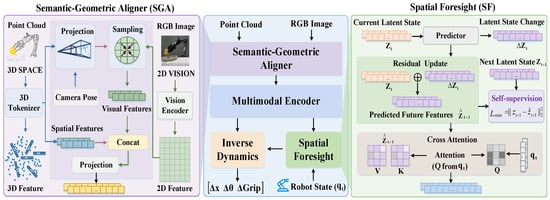
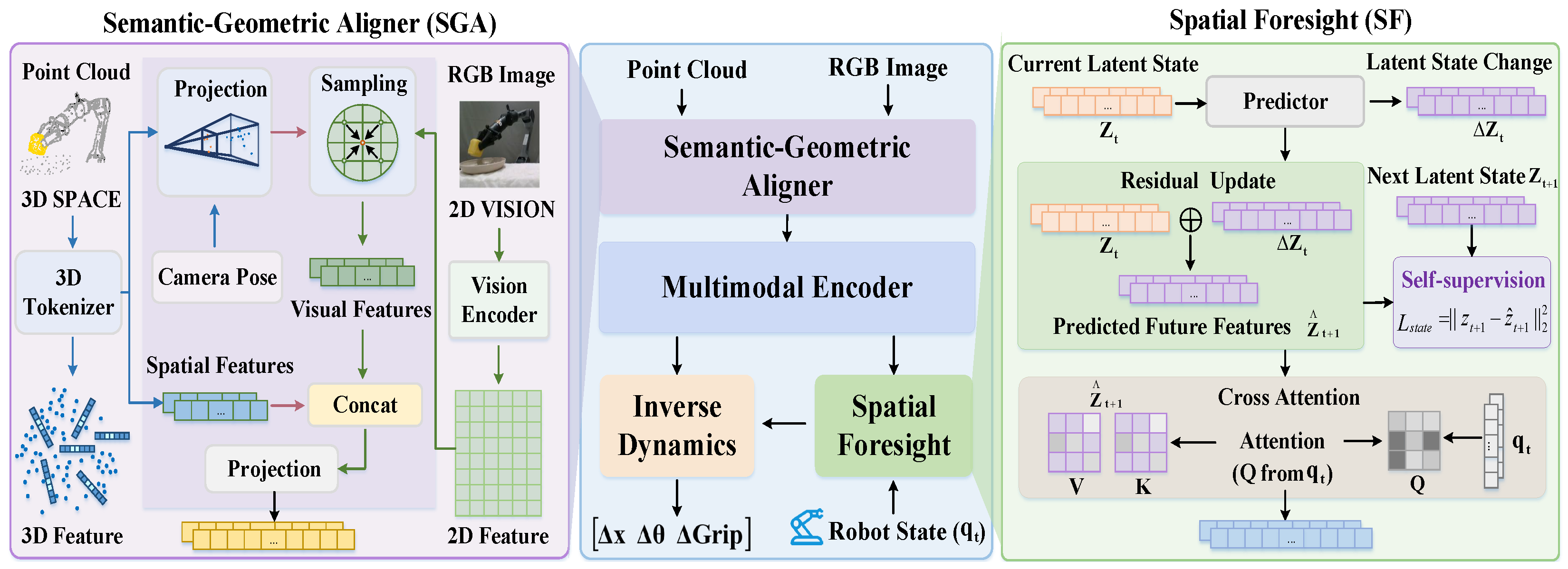
As illustrated in Figure 2, the SF module first predicts the latent state variation based on the current representation through a learnable transition function:
where denotes the state transition predictor parameterized by . The future latent representation is then obtained through residual state propagation:
Figure 2.
Illustration of SpaFID pipeline. The framework aligns RGB and point cloud inputs through the Semantic-Geometric Aligner module using projection and sampling. These features are processed by a Multimodal Encoder for latent modeling. Finally, the Spatial Foresight predicts future state transitions, while the Inverse Dynamics module decodes the final control commands.
The residual formulation predicts a change relative to the current latent state rather than reconstructing the future representation independently. The predicted feature is passed to the action decoder; its practical value is assessed by comparing the complete model with a current-observation-only variant.
The action decoder uses a multi-head cross-attention layer. A linear projection of the current proprioceptive state forms the query, while the predicted global representation of the next observation provides a single token that serves as both the key and the value.
Here, denotes the robot’s proprioceptive state at time step t. The learnable weight matrix and bias vector project the proprioceptive state to , which is used as the query token. Here, is the proprioceptive input dimension and D is the dimension of the global latent representation. The attention output is scaled by a learnable scalar gate and concatenated with the current global representation. The resulting feature is passed to a batch-normalized multilayer perceptron to predict the robot action. Because the future context consists of a single token, the attention layer does not select among spatial tokens. Finally, the fused representation is fed into the Inverse Dynamics module to decode the control command for robot end-effector manipulation.
The predictor is not conditioned on candidate actions. It therefore does not model the outcomes of arbitrary alternative actions and should not be interpreted as a general action-conditioned world model.
3.4. Model Training
The SpaFID framework is trained in an end-to-end manner to simultaneously optimize action prediction accuracy and latent space dynamics consistency. The total training loss function is formulated as a weighted combination of the action prediction loss and the environment state prediction loss :
where is a scaling factor used to balance the two objectives. In our implementation, we set .
Action Prediction Loss. The action objective comprises position, rotation, and gripper losses. Position and gripper predictions are supervised using mean squared error:
For rotation, a unit quaternion and its negation represent the same orientation. We therefore use an antipodal-invariant loss. Let denote a normalized nonzero quaternion. The rotation objective is
Here, B denotes the minibatch size. The absolute inner product makes the rotation loss invariant to the quaternion sign. The action loss is
To balance the different components of the action loss, we set the empirical weights for position, rotation, and gripper states to , , and , respectively.
Global Future-State Prediction Loss. The future-state objective compares the predicted global representation with the global CLS representation of the next observation. It does not compare point tokens by index across time. Consequently, this objective does not require index-wise temporal correspondence between independently sampled point clouds.
where B is the batch size, , and sg denotes stop-gradient. The target representation is computed using the shared encoder with gradient tracking disabled and is explicitly detached. No separate exponential-moving-average target encoder is used. The shared encoder is updated through the current-observation branch according to the parameter-freezing configuration.
We insert LoRA adapters into the attention projection layers of the visual backbone while freezing most pretrained weights. This reduces the number of trainable backbone parameters; deployment latency and transfer to new platforms require separate measurements.
3.5. Implementation Details
The point-cloud backbone follows the Lift3D-CLIP ViT-B/32 [25] configuration and is initialized from the Lift3D pretrained checkpoint. A frozen SpatialBot [8] vision tower extracts image features. Sampled visual features are projected from 1152 to 768 dimensions, followed by layer normalization and dropout with a probability of 0.1. Geometric and aligned visual tokens are concatenated along the sequence dimension.
We train a separate policy for each task. We use Adam with an initial learning rate of , a batch size of 16, and 100 training epochs. The learning rate follows cosine annealing with a 10-epoch warm-up and a warm-up factor of 0.1, online validation is performed every 10 epochs using 25 rollouts. The checkpoint with the highest validation success rate is selected for an independent final evaluation of 50 rollouts per task. We measure inference with a batch size of one on the same deployment hardware for all compared methods. We exclude warm-up iterations and synchronize GPU operations at the timing boundaries. Model-forward latency covers encoding, future prediction, feature fusion, and action decoding. Perception-to-command latency additionally includes observation preprocessing and command preparation. We report the median and 95th-percentile latency. For more details, see Table 1.
Table 1.
Architecture and adaptation configuration.
3.6. Experimental Platforms and Data Collection
3.6.1. Simulation Environments and Tasks
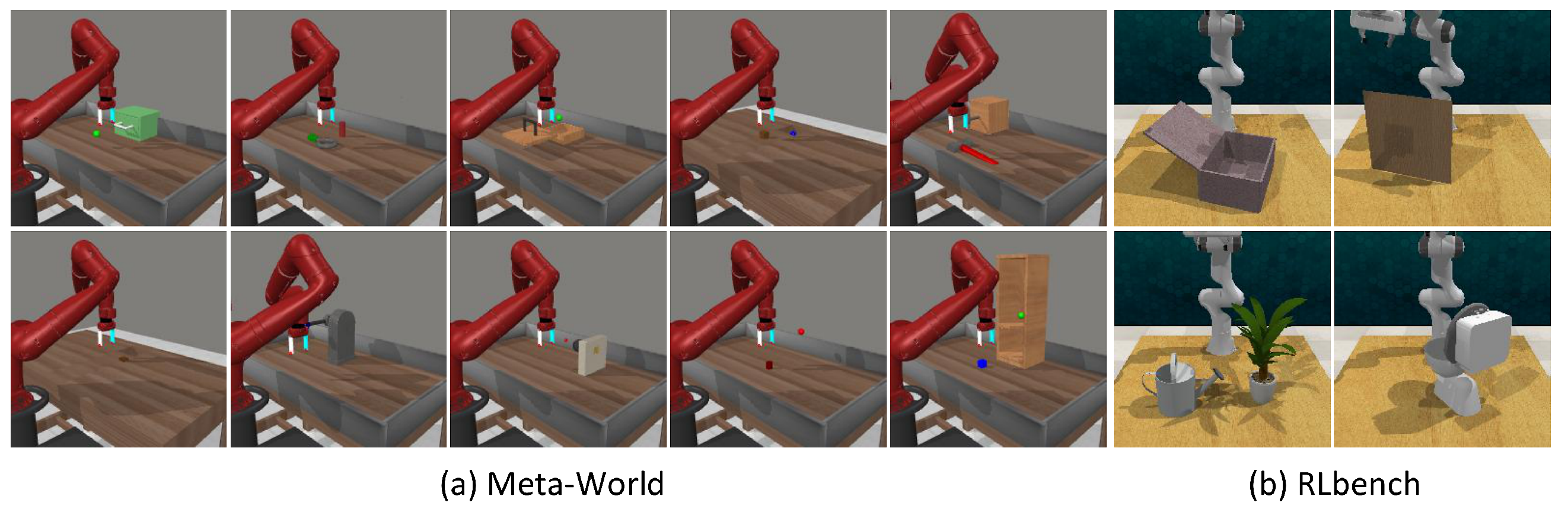
Environment. We evaluate SpaFID in MuJoCo [38] and CoppeliaSim [39] using tasks from Meta-World [40] and RLBench [41]. Meta-World uses a Sawyer robot with a parallel gripper and a corner-view camera, while RLBench uses a Franka Panda robot with a front-view camera. For both benchmarks, the observation includes a RGB image, a single-view point cloud with 1024 points, and robot proprioception, including joint positions, joint velocities, and gripper state. The official simulators provide collision detection and physics simulation.
Tasks. Figure 3 illustrates the simulation tasks from Meta-World and RLBench. We select 10 tasks with different difficulty levels in Meta-World: Drawer Open, Reach, Peg-unplug Side, Lever Pull, Hammer, Sweep Into, Box Close, Shelf Place, Assembly, and Hand Insert. For RLBench, we evaluate Close Box, Unplug Charger, Water Plants, and Toilet Seat Down. Following the standard RLBench data-collection protocol, demonstrations are generated using predefined keypoints and the Open Motion Planning Library (OMPL) [42]. For each task, all collected demonstrations are used for policy training: 25 demonstrations per task in Meta-World, 100 demonstration episodes per task in RLBench. Policy success is determined automatically by the task-specific success condition in the respective simulator.
Figure 3.
Simulation tasks. We evaluate SpaFID across Meta-World and RLbench simulation benchmarks.
3.6.2. Real-World Platform and Tasks
Hardware. We use two AGILEX PIPER manipulators (AgileX Robotics, Dongguan, China) configured in a master–slave teleoperation setup. An Intel RealSense D435i RGB-D camera (RealSense, Cupertino, CA, USA) is mounted above the workspace to provide real-time visual observations. The camera streams RGB-D images at a resolution of 640 × 480 and a frequency of 30 Hz. To assess robustness under practical deployment conditions, we introduce controlled variations in object placement and lighting during evaluation.
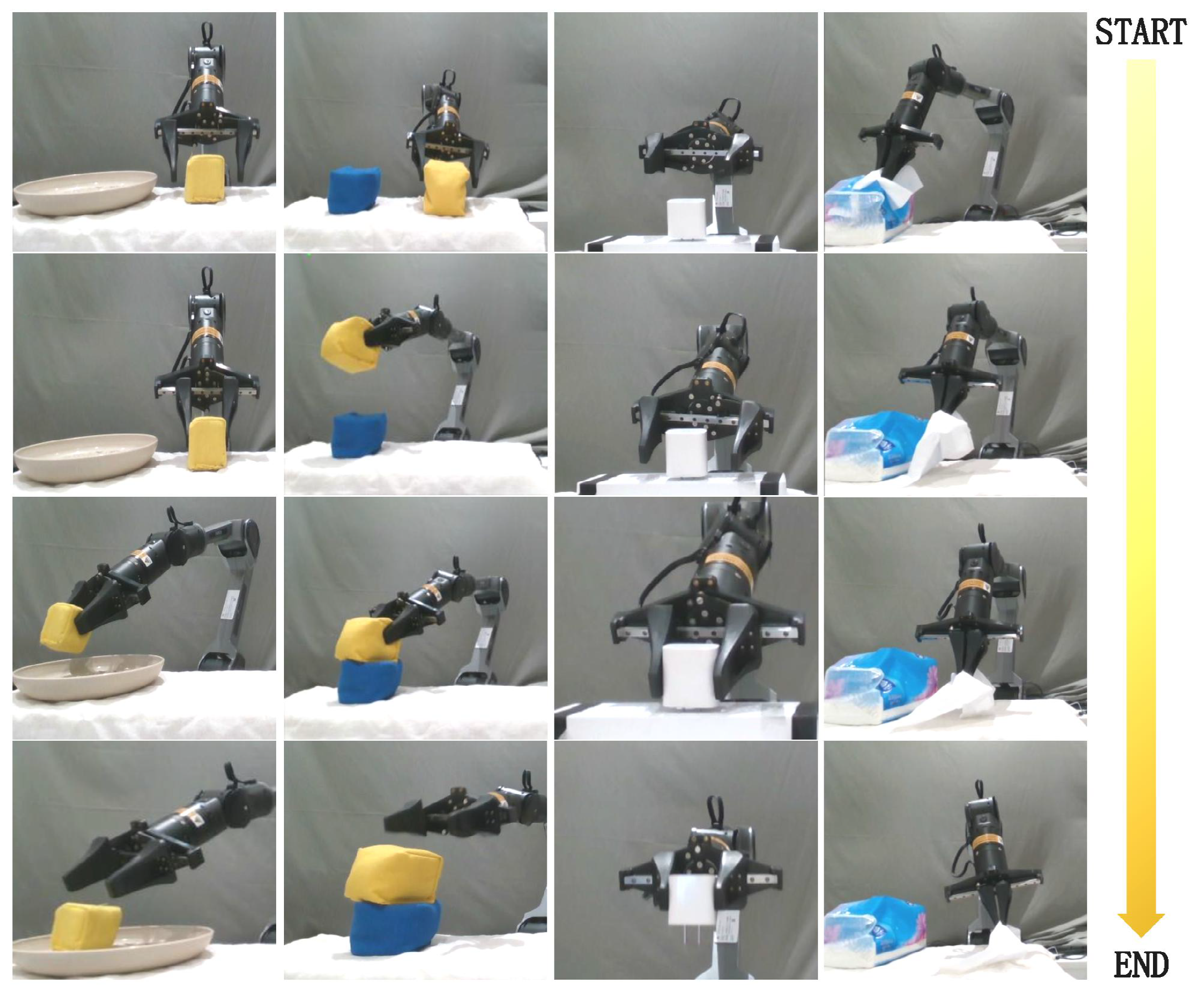
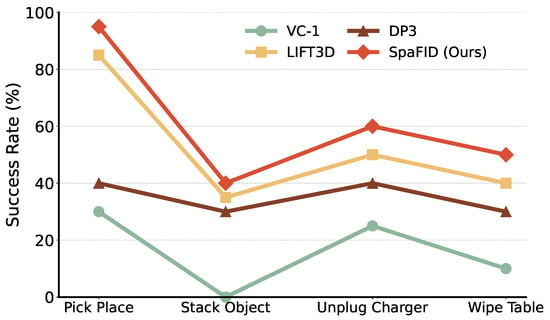
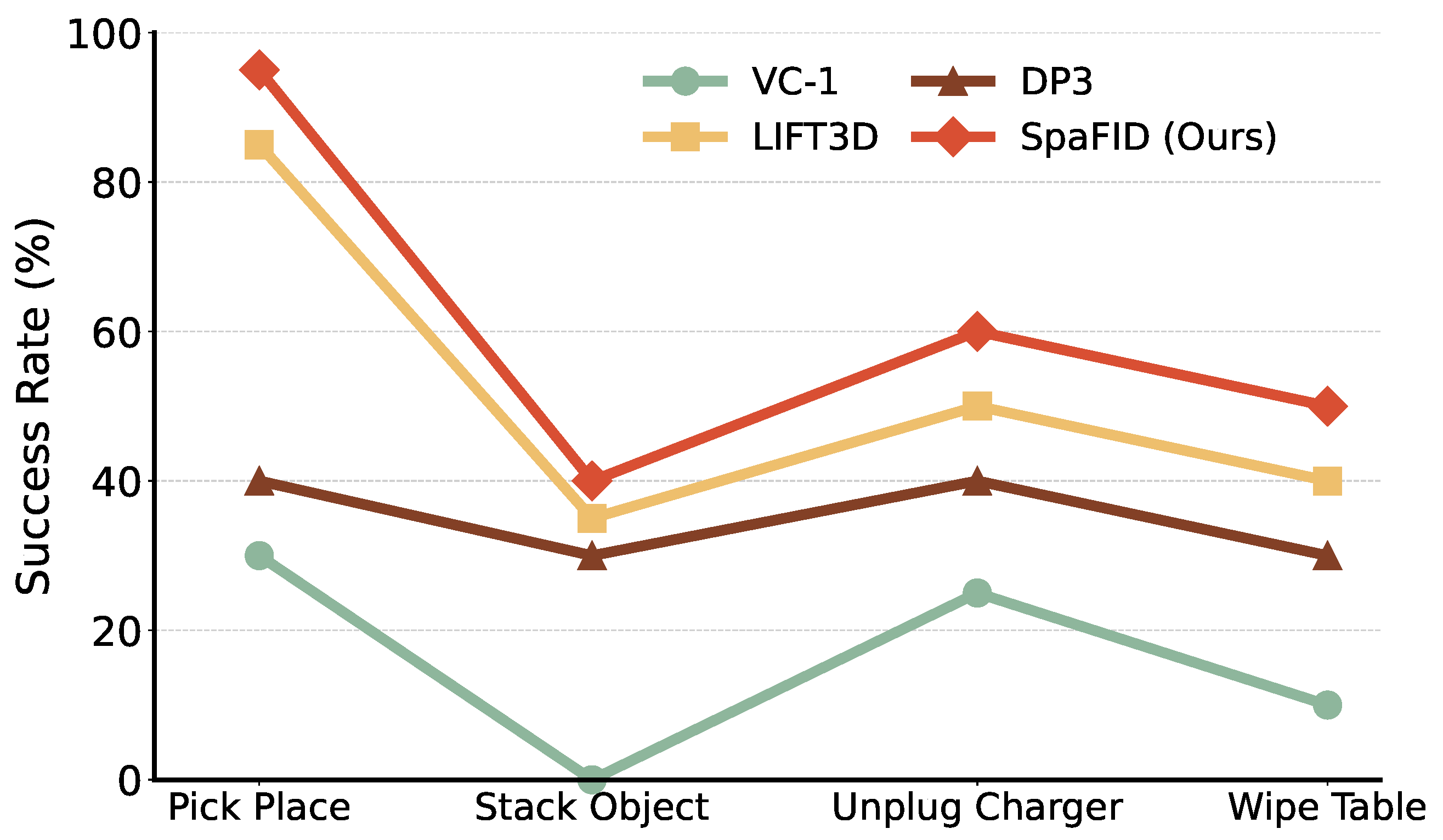
Tasks. As shown in Figure 4, we collect real-world robotic demonstrations to evaluate four tasks with increasing difficulty: Pick Place, Stack Object, Unplug Charger, and Wipe Table. The first two tasks evaluate basic object transport and spatial arrangement. Unplug Charger requires precise pose alignment, while Wipe Table involves continuous contact and trajectory control. For data collection, we gather 30 demonstrations per task through teleoperation and extract several key frames to construct the training datasets. In the physical experiments, a trial is counted as successful only if the robot completes the full task, partial completion is counted as a failure.
Figure 4.
Real-World Tasks. Each column represents a different task, while each row demonstrates keyframes of task execution. From left to right, the tasks are: Pick Place, Stack Object, Unplug Charger and Wipe Table.
3.7. Evaluation Protocol and Baselines
For the repeated-run simulation comparisons, each trained policy is evaluated on 50 test rollouts per task. The numbers of trials and the aggregation rules for the physical baseline comparison experiments are reported with Figure 5, respectively. For an individual evaluation run, the success rate is the number of successful trials divided by the total number of trials. To assess variability across independent training runs, we repeat the main comparisons and key ablations using five random seeds: 0, 1, 2, 3, and 4. Each trained policy is evaluated using 50 test rollouts per task. For each training run, benchmark performance is calculated as the arithmetic mean of its task success rates. We report the mean and sample standard deviation of these benchmark scores across training runs. For comparisons with the principal baselines, we also report 95% confidence intervals for the mean performance difference using 10,000 paired bootstrap resamples of training runs. Each resampled unit retains all task and rollout outcomes associated with that run, preserving the experimental grouping. These intervals characterize training and evaluation variability on the fixed set of benchmark tasks.
Figure 5.
Success rates of SpaFID and baseline methods across four real-world tasks.
Methods are evaluated on matched task demonstrations, test initializations, action interfaces, and rollout budgets wherever their observation requirements permit. Image-based methods receive RGB observations, point-based methods receive point clouds, and multimodal methods receive both. Each method’s proprioceptive inputs and method-specific training settings are documented separately. Checkpoint selection uses validation data only. The selected policy is then evaluated using independent test rollouts. Within-framework ablations retain the same data and training budget while changing the specified component or supervision objective. Repeated-training comparisons report uncertainty across independent training runs.
Diagnostic Evaluation of Future Representations. We evaluate whether the predicted global representation encodes task-relevant geometric changes. A lightweight regression probe is fitted on observed CLS representations from training demonstrations to estimate the selected geometric variable. The encoder and probe are then held fixed during evaluation on held-out demonstrations. For each transition, the same probe reads the variable from the current CLS representation, the predicted next CLS representation, and the encoded next observation. All three estimates are evaluated against the measured value at the next observation. The current representation serves as a no-change reference, while the encoded next observation provides a reference for how well the variable can be read from an observed representation.
Calibration and Depth Sensitivity. We evaluate calibration and depth errors separately with the trained policies fixed. To isolate sensitivity to RGB–point projection errors, we perturb the camera extrinsics used by the alignment module while keeping the captured RGB-D observations and the reconstructed point cloud unchanged. Translation and rotation errors are varied in separate tests. For the depth-noise test, we perturb valid depth measurements before reconstructing the point cloud and retain the nominal camera calibration. The clean and perturbed conditions use matched task initializations. We report the success rate at each perturbation level and its change from the clean condition.
Execution-Time Object Displacement. We test execution-time object displacement on Pick and Place and Stack Object, two tasks from the original real-world evaluation. After the robot begins its approach and before first contact, the object to be grasped is moved laterally by a prescribed offset. The policy continues execution with subsequent observations, without a reset or additional adaptation. Full SpaFID and the variant without SF are evaluated under matched initial configurations and perturbation conditions.
Baselines. We compare our SpaFID with three groups of methods. The first group contains 2D representation models, including CLIP [16], R3M [17], and VC-1 [18], to test whether large-scale visual pretraining alone provides sufficient spatial cues for visuomotor control. The second group includes 3D representation methods, including PointNet [19], PointNet++ [20], PointNext [21], SPA [43], and Lift3D [25], which directly encode geometric observations and therefore serve as strong spatial-reasoning baselines. The third group consists of end-to-end 3D policies, DP3 [7] and RVT-2 [44], to compare against policy architectures specifically designed for 3D robotic manipulation. For each baseline, we follow the implementation and configuration described in its original publication.
4. Experimental Results
To evaluate the performance of SpaFID in robotic manipulation tasks, we first present experimental results in both simulated and real-world environments. We then conduct ablation studies to evaluate the effectiveness of each component of the proposed framework, followed by generalization experiments across different object instances, backgrounds, and lighting conditions. Finally, we analyze representative failure cases to better understand the limitations of SpaFID.
4.1. Simulation Results
Performance Comparison. Table 2 and Table 3 report the success rates on Meta-World and RLBench, respectively. The results in these tables are obtained from the run with training seed 0. SpaFID achieves a mean success rate of 88.2% in the Meta-World benchmark, outperforming existing baseline methods. Compared to 2D pretrained models like R3M (74.6%) and 3D backbones such as PointNext (65.2%), these results are consistent with the motivation for spatially grounded prediction, but benchmark comparisons alone cannot isolate the contribution of SGA or SF. This module aligns high-level 2D semantic features with 3D geometric information to overcome the limitations of using only a single modality in complex environments. In tasks with high spatial awareness requirements, such as Shelf Place and Hand Insert, SpaFID shows a clear advantage, because of the Spatial Foresight module predicts future states in the latent space, enabling the model to optimize actions based on predicted spatial changes. Additionally, in high-precision RLBench tasks like Unplug Charger, SpaFID reaches a 44% success rate, which is higher than RVT-2 (8%) and Lift3D (36%). This result further confirms the robustness of our framework in handling high-precision spatial alignment by combining spatial foresight and inverse dynamics.
Table 2.
Comparison of success rates between our SpaFID and baselines in Meta-World benchmarks. And bold denotes the best performance.
Table 3.
Comparison of success rates between our SpaFID and baselines in RLBench benchmarks. And bold denotes the best performance.
As shown in Table 4, SpaFID exceeds Lift3D by 5.8 percentage points on Meta-World and 4.2 percentage points on RLBench when averaged across five training runs. The corresponding confidence intervals exclude zero under this evaluation protocol. These findings support a positive average difference on the evaluated tasks, while the reported standard deviations quantify variation across training runs.
Table 4.
Success rates across five independent training runs. For each run, the benchmark score is the unweighted mean of its task success rates. Results are reported as the mean ± sample standard deviation across runs. The 95% confidence intervals refer to the mean difference between SpaFID and Lift3D, in percentage points.
4.2. Real-World Results
Performance Comparison. For real-world evaluation, we compare SpaFID with three representative baselines: VC-1, Lift3D, and DP3. These methods are selected to cover the main categories used in our simulation study, including 2D pretrained visual representations, 3D representation learning, and end-to-end 3D manipulation policies. We focus on these representative baselines because real-world robot evaluation requires substantial deployment time, hardware calibration, and safety checking. As shown in Figure 5, SpaFID achieves the highest observed success rates among the evaluated methods on the four physical tasks. SpaFID achieves success rates of 40% on Stack Object, 50% on Wipe Table, and 60% on Unplug Charger. These tasks require stable placement, sustained surface contact, and precise alignment during withdrawal, respectively. The comparison shows how the complete policy performs across these execution demands. Section 4.3 examines the contributions of the individual modules, and Section 5.3 discusses representative real-world failures.
Table 5 reports model size and inference latency under the same measurement protocol. The measured policy update frequency is reported separately from the RGB-D camera acquisition rate. We compare the perception-to-command latency with the control interval used on the robot.
Table 5.
Model size and deployment cost measured on an RTX 4090 with batch size one and FP32 inference. Latency is reported as median (P50)/95th percentile (P95).
4.3. Ablation Study
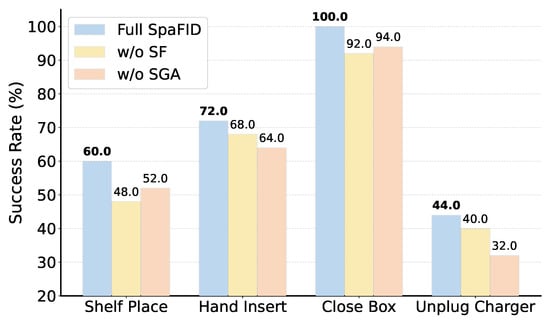
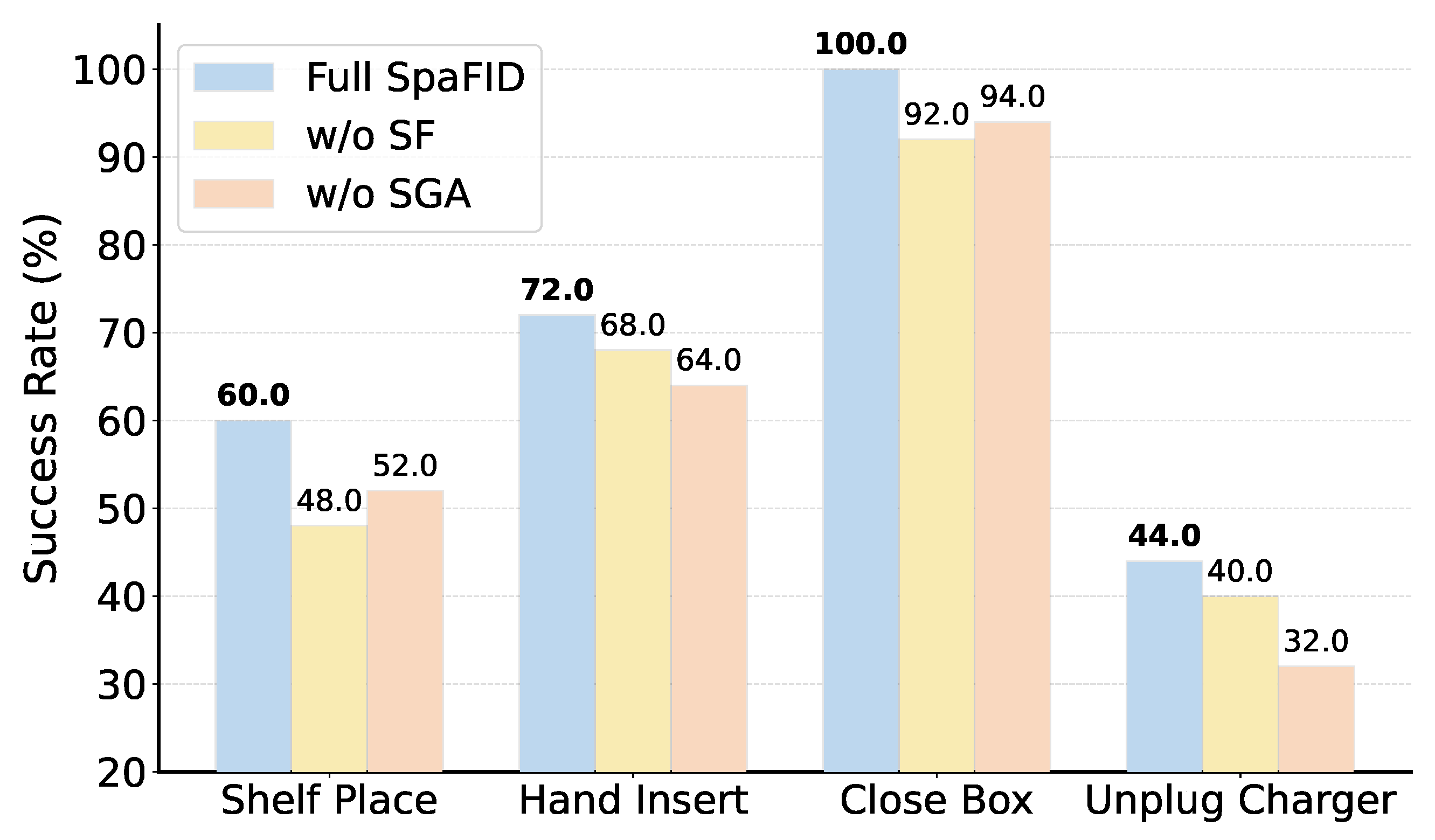
To further explore the effectiveness of the SGA and SF in SpaFID, we conduct ablation experiments by individually removing each module while keeping the other components. We compare the full model with two variants: (1) w/o SGA, which removes the semantic-geometric projection alignment and uses simple feature concatenation instead. (2) w/o SF, which removes the predictive branch in the latent space, generating action based only on the current observation.
As shown in Figure 6, the full SpaFID achieves the best performance across all evaluated tasks. Removing SGA decreases the success rate on the spatially demanding Hand Insert task from 72% to 64%, showing the importance of aligning semantic features with local geometry. Removing SF also reduces performance on tasks involving continuous motion, such as Close Box, where anticipating state transitions helps maintain a stable action trajectory. Together, this demonstrates that SGA and SF provide complementary benefits: SGA improves spatial representation, while SF introduces predictive information into action generation.
Figure 6.
Ablation studies of our proposed SpaFID.
4.3.1. Future-Latent Consistency
To test whether SF predicts beyond the current representation, we compare three variants in the SGA latent space. No-change sets . Aux-MLP uses a parameter-matched auxiliary branch without next-latent supervision, controlling for additional branch capacity. SF uses the true next-observation latent as its prediction target. MSE and cosine similarity measure agreement between predicted and target future features. Overlap@10 measures agreement between the ten spatial tokens with the largest predicted and target latent changes relative to the current state.
Table 6 reports the lowest MSE and highest cosine similarity and Overlap@10 for SF. Relative to No-change, MSE decreases from 0.184 to 0.121; relative to Aux-MLP, it decreases from 0.171 to 0.121. These comparisons support the utility of next-latent supervision for prediction agreement beyond simply retaining current features or adding a branch. The metrics evaluate latent consistency; they do not establish physical realizability, contact accuracy, or action quality.
Table 6.
Consistency between predicted and target future latent representations. And bold denotes the best performance, the upward and downward arrows indicate whether higher or lower values are better for each evaluation metric, respectively.
We examine whether the one-step prediction captures changes in lid angle for Close Box and connector separation for Unplug Charger. The diagnostic results compare estimates from the current, predicted next, and observed next representations against the corresponding measurements. Representative transitions show the current and actual next observations alongside the predicted and measured geometric values. Table 7 shows that the predicted next representation provides more accurate estimates of future geometric quantities than the current representation. For Close Box, the lid-angle error decreases from 8.6 to 5.1 degrees; for Unplug Charger, the connector-separation error decreases from 6.8 to 4.2 mm. The improvements across angular and translational quantities indicate that SF captures task-relevant future changes beyond retaining the current scene representation. Together with the latent-consistency results in Table 6, these findings provide complementary evidence that the predicted features encode information relevant to the subsequent geometric configuration.
Table 7.
Geometric readout from current and future global representations on held-out demonstrations. Values are mean absolute errors relative to measurements at the next observation, lower is better.
4.3.2. Action Utility of Predicted Features
Prediction agreement alone does not show that future features improve manipulation. We therefore compare four decoder inputs: current latent only, predicted future latent only, concatenated current and predicted future latents, and the full proprioception-conditioned cross-attention fusion. The variants use the same demonstrations, action supervision, training protocol, and 50-rollout task-evaluation budget.
As shown in Table 8, full fusion achieves a mean success rate of 77.3%, compared with 69.3% for current features, 64% for predicted future features, and 73.3% for concatenation. The improvement over current-only input is 8.0 percentage points, while the improvement over concatenation is 4.0 percentage points. Future-only input performs worse than current-only input, suggesting that the predicted representation complements rather than replaces the observed configuration. These results support the use of learned fusion for action conditioning within the tested architecture.
Table 8.
Task success rates (%) for different current and predicted future feature inputs. Mean denotes the arithmetic average over the three tasks. And bold denotes the best performance.
Capacity-Matched Control. To distinguish the effect of future-state supervision from additional predictor capacity, we compare the model without SF, a parameter-matched Aux-MLP control, and full SpaFID. Aux-MLP retains the same residual predictor and action-decoder connection as the full model, but is trained with the action objective alone. Its output participates in action generation, and its parameters receive gradients from the action loss.
As shown in Table 9, the auxiliary predictors in Aux-MLP and SpaFID each contain 1,182,720 parameters. Their architecture consists of Linear (768, 768), LayerNorm, GELU, and Linear (768, 768). Training data, optimization budgets, seeds, and evaluation conditions are matched across variants.
Table 9.
Capacity-matched evaluation on RLBench. Success rates are averaged across four tasks and five independent training runs.
Full SpaFID exceeds Aux-MLP by 3.6 percentage points, with a 95% confidence interval of percentage points. This comparison suggests that additional predictor capacity alone does not account for the full observed improvement. The benefit is associated with next-state supervision under the evaluated training and task conditions.
4.3.3. Observation Representation Ablation
To examine the contribution of point-wise semantic-geometric alignment, we compare RGB-only input, point-only input, naive RGB–point concatenation, and SGA fusion. All variants use the same action head, action loss, demonstrations, training budget, and task-evaluation protocol. Table 10 reports measured task success rates for these representation variants.
Table 10.
Measured task success rates (%) for observation representation variants. Mean denotes the arithmetic average over the four tasks. And bold denotes the best performance.
SGA fusion reaches a mean success rate of 69.0%, improving on RGB-only input by 14.5 percentage points, point-only input by 10 percentage points, and naive concatenation by 6.5 percentage points. The gain over concatenation is consistent with a benefit from aligning semantic features with sampled 3D locations beyond simply making both modalities available. The results evaluate the complete representation variants; parameter-count differences remain relevant when interpreting the mechanism of improvement.
4.4. Generalization
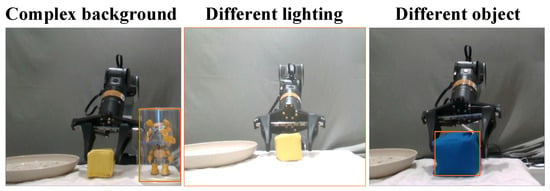
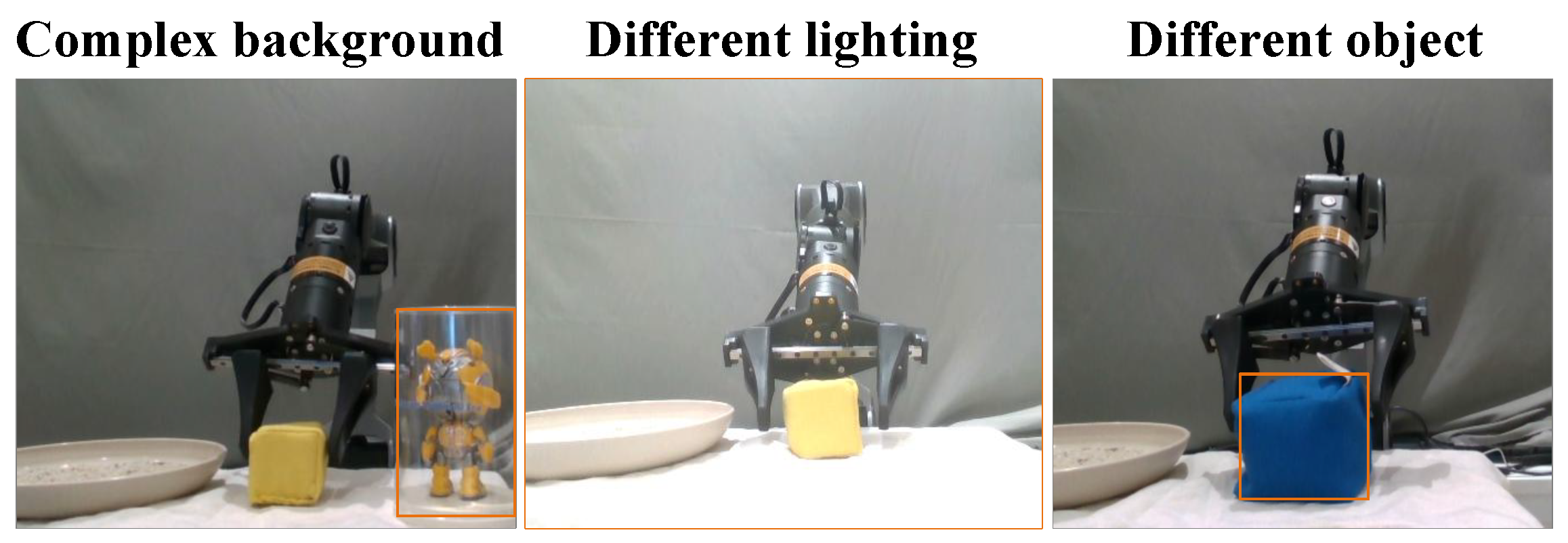
To evaluate the robustness and adaptability of SpaFID in unpredictable environments, we use the Pick Place task to evaluate generalization under three representative disturbance conditions, as illustrated in Figure 7. We add a visual distractor beside the grasp target, on the right side of the camera view, the yellow target object, the tray, and the gray backdrop are retained. We increase the illumination of the tabletop and the grasp target by the light source, the yellow target object and the tray are retained. We replaced the yellow block with a blue block while keeping the same placement tray, this situation tests the ability to generalize to different grasping objects, with both color and size changing.
Figure 7.
Generalization Settings. Three test scenarios, with the orange box highlighting the specific changes.
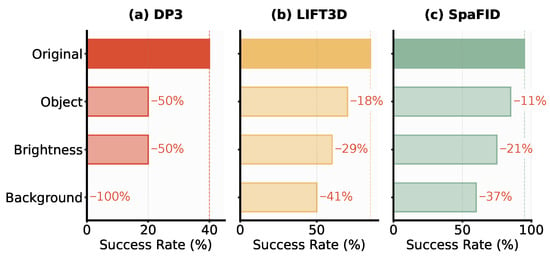
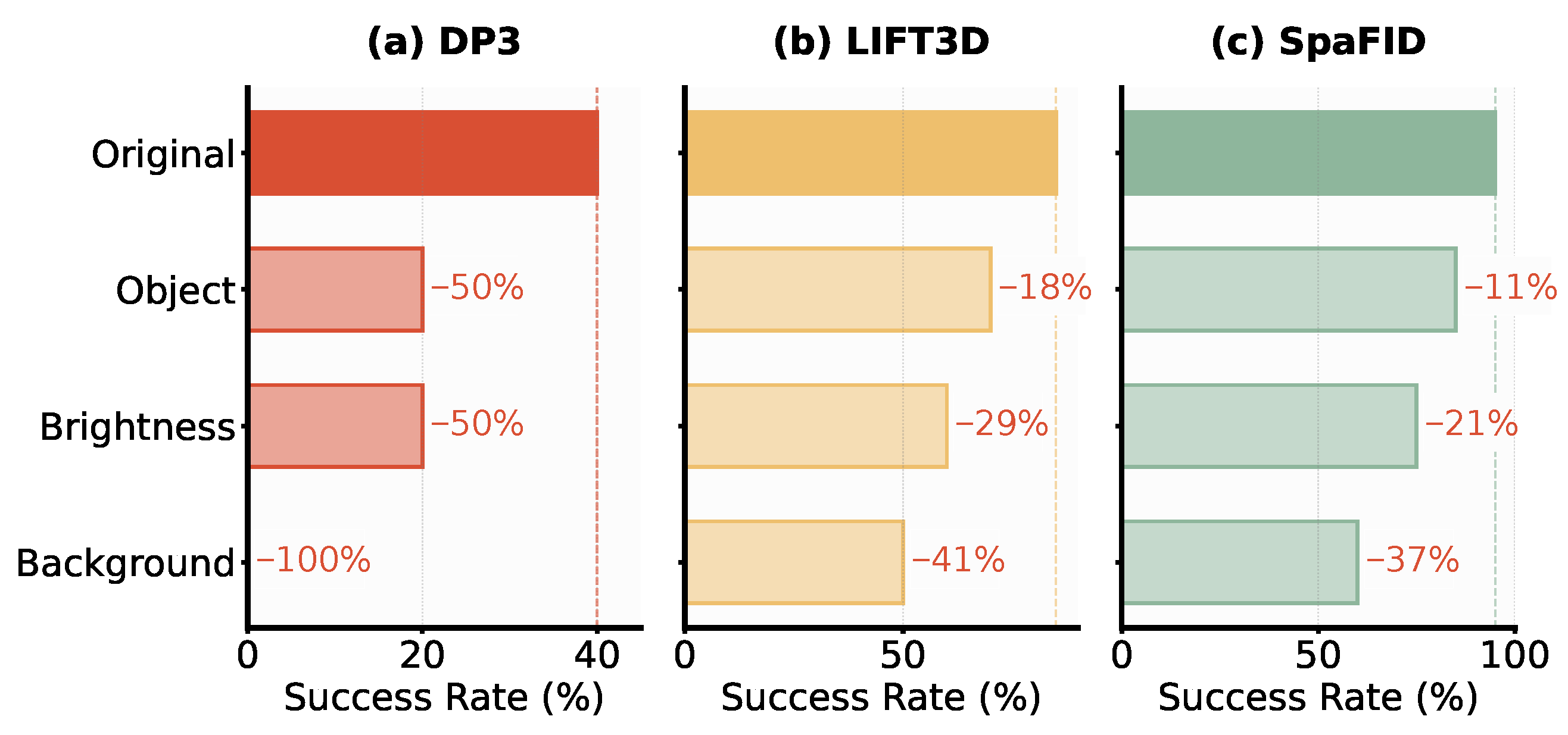
As shown in Figure 8 and Table 11, SpaFID achieves the highest observed success rate under all three perturbations on the Pick Place task. DP3 is particularly sensitive to background changes and fails in this setting, while Lift3D also experiences substantial performance degradation across the three conditions. In contrast, SpaFID shows a smaller performance drop under object changes, decreasing by 11 percentage points, compared with 18 points for Lift3D and 50 points for DP3. The results suggest that aligning semantic cues with explicit geometry reduces sensitivity to appearance variations, while future latent-state prediction provides additional support for stable action generation under unseen conditions.
Figure 8.
Generalization results under different disturbances. ‘Object’, ‘Background’, ‘Brightness’ represent different manipulated objects, background scenes and lighting conditions, respectively.
Table 11.
Success rates (%) on the Pick Place task under the original and perturbed conditions shown in Figure 8. Values in parentheses indicate decreases in percentage points relative to each method’s success rate under the original condition. And bold denotes the best performance.
We compare full SpaFID with a variant that does not use projection-based alignment. For each method, we report both the success rate under perturbation and the decrease relative to its own clean-condition success rate. This distinguishes sensitivity to the perturbation from performance differences already present without it.
Table 12 characterizes the sensitivity of SpaFID to projection-calibration errors and depth noise. Under small extrinsic perturbations, SpaFID maintains success rates of 94% with a 1 cm translation error and 92% with a 2-degree rotation error, compared with 96% under clean conditions. For depth noise, it achieves success rates of 94%, 86%, and 74% at , 5, and 10 mm, respectively, exceeding the variant without projection alignment by 8, 8, and 10 percentage points. These results show that the benefit of semantic-geometric alignment is retained across the tested depth-noise levels. The extrinsic perturbation results additionally quantify how projection accuracy affects this benefit, providing a practical characterization of the calibration requirements for deployment.
Table 12.
Sensitivity to projection calibration errors and depth noise on Close Box. Each condition uses 50 rollouts. Drops are relative to each method’s clean condition.
Table 13 examines whether the benefit of SF is retained when the object moves during execution. Following a 3 cm lateral displacement, SpaFID achieves success rates of 68% on Pick and Place and 30% on Stack Object, outperforming the variant without SF by 14 and 10 percentage points, respectively. Relative to each method’s undisplaced performance, SpaFID also exhibits smaller success-rate drops: 24 versus 30 percentage points on Pick and Place, and 14 versus 18 percentage points on Stack Object. The higher disturbed-condition success rates, together with the smaller drops from the corresponding undisplaced conditions, support the contribution of future-latent supervision to manipulation under execution-time object displacement.
Table 13.
Task success under execution-time object displacement. The object is moved laterally by 3 cm after approach begins and before first contact. Each method is evaluated on 50 trials per task and condition.
5. Discussion
5.1. Interpretation of Alignment and Foresight
SGA and SF address different parts of the perception-to-action pipeline. Projection-based alignment associates visual context with measured 3D locations, while SF supplies a predicted transition feature. Component ablations support their utility in the evaluated framework. However, the method does not enforce conservation laws, nonpenetration, or contact constraints, and latent similarity is not equivalent to physical consistency. The evidence supports a useful learned representation rather than an analytical model of manipulation dynamics.
Because SF is not action-conditioned, it predicts changes associated with demonstrated behavior rather than evaluating arbitrary candidate actions. This limits its use as a planning model when the robot deviates from the demonstration distribution. Multi-step prediction and action-conditioned rollouts require further validation.
5.2. Deployment Robustness and Reproducibility
RGB–point-cloud correspondence depends on depth quality and camera-to-robot calibration. Table 11 quantifies these effects on Close Box under controlled projection errors and depth noise. SpaFID achieves success rates of 94% with a 1 cm extrinsic translation error and 92% with a 2-degree rotation error, compared with 96% under the clean condition. It also maintains higher absolute success rates than the variant without projection alignment at all tested depth-noise levels. Under larger extrinsic perturbations, however, its success rate decreases, underscoring the importance of accurate calibration. The controlled tests characterize sensitivity at the specified perturbation levels; they do not evaluate time-varying calibration drift.
Table 5 reports the measured deployment cost, including a median perception-to-command latency of 91 ms, a 95th-percentile latency of 112 ms, and a policy update rate of 9.5 Hz on the evaluated hardware. These measurements describe the deployed policy loop separately from the 30 Hz camera acquisition rate. Table 4 and Table 9 report variation across independent training runs for the benchmark comparison and the parameter-matched ablation, respectively. These estimates characterize reproducibility under the reported training and evaluation protocols.
5.3. Failure Case Analysis and Limitations
As shown in Figure 5, SpaFID achieves the highest success rate among the evaluated methods on Stack Object (40%), Wipe Table (50%), and Unplug Charger (60%). These tasks require different forms of spatial precision: Stack Object requires accurate placement and stable release, Wipe Table requires sustained tool–surface contact, and Unplug Charger requires alignment during engagement and withdrawal. The gains across these tasks show that the benefit of SpaFID extends to several types of physical interaction.
To better understand the remaining failures, we examine representative rollouts at the level of execution stages. In Wipe Table, for example, the tool occasionally slips or loses contact during the wiping motion. This observation identifies sustained contact during the sweep as a concrete target for improving execution reliability. We also observe cases in which the controller rejects an unreachable target pose, highlighting the value of checking command feasibility before execution. Together, these observations motivate complementing SpaFID’s spatial representation and predictive features with contact feedback and feasibility checks in future work.
6. Conclusions
SpaFID improves robotic manipulation by combining semantic-geometric alignment with spatial foresight in a 3D latent space. The proposed framework aligns 2D visual semantics with 3D geometric structure and predicts future latent-state transitions, enabling the policy to reason jointly about the current spatial configuration and its likely evolution. Experiments on Meta-World, RLBench, and real-world manipulation tasks show consistent improvements over representative 2D, 3D, and end-to-end manipulation baselines. Generalization studies under changed backgrounds, lighting conditions, and object instances further demonstrate the robustness of spatially grounded foresight. Future work will incorporate tactile feedback for contact-rich manipulation and explore foundation-model-based high-level planning for long-horizon embodied tasks.
Author Contributions
Conceptualization, C.M. and Y.Z.; Methodology, C.M. and J.S.; Software, J.P.; Validation, C.M. and J.P.; Resources, X.W.; Data curation, Z.L. and Y.Z.; Writing—original draft, C.M. and Z.L.; Writing—review & editing, X.W.; Visualization, C.M.; Project administration, J.S. All authors have read and agreed to the published version of the manuscript.
Funding
This research received no external funding.
Data Availability Statement
The original contributions presented in this study are included in the article. Further inquiries can be directed to the corresponding author.
Acknowledgments
During the preparation of this manuscript and the accompanying reviewer response letters, the authors used GPT5.6-based tools for the purposes of English language proofreading, stylistic refinement, and LaTeX formatting consistency checks. The authors have reviewed and edited the output and take full responsibility for the content of this publication.
Conflicts of Interest
The authors Jingyuan Sun is employed by Huawei Technologies. The authors declare that the research was conducted without any commercial or financial relationships that could be construed as a potential conflict of interest.
References
- Xu, Z.; Wu, K.; Wen, J.; Li, J.; Liu, N.; Che, Z.; Tang, J. A survey on robotics with foundation models: Toward embodied ai. arXiv 2024, arXiv:2402.02385. [Google Scholar]
- Liu, Y.; Cao, X.; Chen, T.; Jiang, Y.; You, J.; Wu, M.; Wang, X.; Feng, M.; Jin, Y.; Chen, J. A survey of embodied ai in healthcare: Techniques, applications, and opportunities. arXiv 2025, arXiv:2501.07468. [Google Scholar]
- Botezatu, A.-P.; Iancu, A.-I.; Burlacu, A. Hybrid Deep Learning Framework for Eye-in-Hand Visual Control Systems. Robotics 2025, 14, 66. [Google Scholar] [CrossRef] [Scilit]
- Båserud, T.E.; Johansen, J.; Jha, A.; Tyapin, I. Dual-Arm Robotic Textile Unfolding with Depth-Corrected Perception and Fold Resolution. Robotics 2026, 15, 78. [Google Scholar] [CrossRef] [Scilit]
- Ni, K.; Yang, X.; Chen, T.; Zhu, M. Vision-Language Model-Guided Transparent Object Perception and Task-Oriented Grasping for Robotic Manipulation. Robotics 2026, 15, 135. [Google Scholar] [CrossRef] [Scilit]
- Qu, D.; Song, H.; Chen, Q.; Yao, Y.; Ye, X.; Ding, Y.; Wang, Z.; Gu, J.; Zhao, B.; Wang, D.; et al. Spatialvla: Exploring spatial representations for visual-language-action model. arXiv 2025, arXiv:2501.15830. [Google Scholar]
- Ze, Y.; Zhang, G.; Zhang, K.; Hu, C.; Wang, M.; Xu, H. 3d diffusion policy: Generalizable visuomotor policy learning via simple 3d representations. arXiv 2024, arXiv:2403.03954. [Google Scholar]
- Cai, W.; Ponomarenko, I.; Yuan, J.; Li, X.; Yang, W.; Dong, H.; Zhao, B. Spatialbot: Precise spatial understanding with vision language models. In Proceedings of the 2025 IEEE International Conference on Robotics and Automation (ICRA), Atlanta, GA, USA, 19–23 May 2025; pp. 9490–9498. [Google Scholar]
- Fei, B.; Yang, W.; Chen, W.-M.; Li, Z.; Li, Y.; Ma, T.; Hu, X.; Ma, L. Comprehensive review of deep learning-based 3D point cloud completion processing and analysis. IEEE Trans. Intell. Transp. Syst. 2022, 23, 22862–22883. [Google Scholar] [CrossRef] [Scilit]
- Ren, X.; Huang, J.; Zeng, X.; Museth, K.; Fidler, S.; Williams, F. Xcube: Large-scale 3d generative modeling using sparse voxel hierarchies. In Proceedings of the IEEE/CVF Conference on Computer Vision and Pattern Recognition, Seattle, WA, USA, 16–22 June 2024; pp. 4209–4219. [Google Scholar]
- Pavlichenko, D.; Behnke, S. Flexible-joint manipulator trajectory tracking with two-stage learned model utilizing a hardwired forward dynamics prediction. Int. J. Semant. Comput. 2022, 16, 403–423. [Google Scholar] [CrossRef] [Scilit]
- Tian, Y.; Yang, S.; Zeng, J.; Wang, P.; Lin, D.; Dong, H.; Pang, J. Predictive inverse dynamics models are scalable learners for robotic manipulation. In Proceedings of the International Conference on Learning Representations (ICLR), Singapore, 24–28 April 2025. [Google Scholar]
- Cen, J.; Yu, C.; Yuan, H.; Jiang, Y.; Huang, S.; Guo, J.; Li, X.; Song, Y.; Luo, H.; Wang, F.; et al. Worldvla: Towards autoregressive action world model. arXiv 2025, arXiv:2506.21539. [Google Scholar]
- Assran, M.; Bardes, A.; Fan, D.; Garrido, Q.; Howes, R.; Muckley, M.; Rizvi, A.; Roberts, C.; Sinha, K.; Zholus, A.; et al. V-jepa 2: Self-supervised video models enable understanding, prediction and planning. arXiv 2025, arXiv:2506.09985. [Google Scholar]
- Zhang, W.; Liu, H.; Qi, Z.; Wang, Y.; Yu, X.; Zhang, J.; Dong, R.; He, J.; Lu, F.; Wang, H.; et al. Dreamvla: A vision-language-action model dreamed with comprehensive world knowledge. arXiv 2025, arXiv:2507.04447. [Google Scholar]
- Radford, A.; Kim, J.W.; Hallacy, C.; Ramesh, A.; Goh, G.; Agarwal, S.; Sastry, G.; Askell, A.; Mishkin, P.; Clark, J.; et al. Learning transferable visual models from natural language supervision. In Proceedings of the International Conference on Machine Learning, Virtually, 18–24 July 2021; pp. 8748–8763. [Google Scholar]
- Nair, S.; Rajeswaran, A.; Kumar, V.; Finn, C.; Gupta, A. R3m: A universal visual representation for robot manipulation. arXiv 2022, arXiv:2203.12601. [Google Scholar]
- Majumdar, A.; Yadav, K.; Arnaud, S.; Ma, J.; Chen, C.; Silwal, S.; Jain, A.; Berges, V.-P.; Wu, T.; Vakil, J.; et al. Where are we in the search for an artificial visual cortex for embodied intelligence? Adv. Neural Inf. Process. Syst. 2023, 36, 655–677. [Google Scholar] [CrossRef] [Scilit]
- Qi, C.R.; Su, H.; Mo, K.; Guibas, L.J. Pointnet: Deep learning on point sets for 3d classification and segmentation. In Proceedings of the IEEE Conference on Computer Vision and Pattern Recognition, Honolulu, HI, USA, 21–26 July 2017; pp. 652–660. [Google Scholar]
- Qi, C.R.; Yi, L.; Su, H.; Guibas, L.J. Pointnet++: Deep hierarchical feature learning on point sets in a metric space. Adv. Neural Inf. Process. Syst. 2017, 30, 5105–5114. [Google Scholar]
- Qian, G.; Li, Y.; Peng, H.; Mai, J.; Hammoud, H.; Elhoseiny, M.; Ghanem, B. Pointnext: Revisiting pointnet++ with improved training and scaling strategies. Adv. Neural Inf. Process. Syst. 2022, 35, 23192–23204. [Google Scholar] [CrossRef] [Scilit]
- Shridhar, M.; Manuelli, L.; Fox, D. Perceiver-actor: A multi-task transformer for robotic manipulation. In Conference on Robot Learning; PMLR: Cambridge, MA, USA, 2023; pp. 785–799. [Google Scholar]
- Goyal, A.; Xu, J.; Guo, Y.; Blukis, V.; Chao, Y.-W.; Fox, D. Rvt: Robotic view transformer for 3d object manipulation. In Conference on Robot Learning; PMLR: Cambridge, MA, USA, 2023; pp. 694–710. [Google Scholar]
- Wang, W.; Chen, Y.; Zhang, Z.; Liu, H.; Wang, H.; Feng, Z.; Qin, W.; Chen, F.; Zhu, Z.; Chen, D.Y.; et al. Volsplat: Rethinking feed-forward 3d gaussian splatting with voxel-aligned prediction. arXiv 2025, arXiv:2509.19297. [Google Scholar]
- Jia, Y.; Liu, J.; Chen, S.; Gu, C.; Wang, Z.; Luo, L.; Li, X.; Wang, P.; Wang, Z.; Zhang, R.; et al. Lift3d policy: Lifting 2d foundation models for robust 3d robotic manipulation. In Proceedings of the Computer Vision and Pattern Recognition Conference, Nashville, TN, USA, 10–17 June 2025; pp. 17347–17358. [Google Scholar]
- Li, X.; Heng, L.; Liu, J.; Shen, Y.; Gu, C.; Liu, Z.; Chen, H.; Han, N.; Zhang, R.; Tang, H.; et al. 3ds-vla: A 3d spatial-aware vision language action model for robust multi-task manipulation. In Proceedings of the 9th Annual Conference on Robot Learning, Seoul, Republic of Korea, 27–30 September 2025. [Google Scholar]
- Huang, H.; Cen, M.; Tan, K.; Quan, X.; Huang, G.; Zhang, H. Graphcot-vla: A 3d spatial-aware reasoning vision-language-action model for robotic manipulation with ambiguous instructions. Proc. AAAI Conf. Artif. Intell. 2026, 40, 18324–18332. [Google Scholar] [CrossRef] [Scilit]
- Fan, Y.; Ma, X.; Wu, R.; Du, Y.; Li, J.; Gao, Z.; Li, Q. Videoagent: A memory-augmented multimodal agent for video understanding. In European Conference on Computer Vision; Springer Nature: Cham, Switzerland, 2024; pp. 75–92. [Google Scholar]
- Hu, Y.; Guo, Y.; Wang, P.; Chen, X.; Wang, Y.-J.; Zhang, J.; Sreenath, K.; Lu, C.; Chen, J. Video prediction policy: A generalist robot policy with predictive visual representations. arXiv 2024, arXiv:2412.14803. [Google Scholar]
- Zheng, R.; Wang, J.; Reed, S.; Bjorck, J.; Fang, Y.; Hu, F.; Jang, J.; Kundalia, K.; Lin, Z.; Magne, L.; et al. Flare: Robot learning with implicit world modeling. arXiv 2025, arXiv:2505.15659. [Google Scholar]
- Chen, H.; Guo, J.; Wang, B.; Zhang, T.; Huang, X.; Zheng, B.; Hou, Y.; Tie, C.; Deng, J.; Shao, L. Goal-VLA: Image-Generative VLMs as Object-Centric World Models Empowering Zero-shot Robot Manipulation. arXiv 2025, arXiv:2506.23919. [Google Scholar]
- Li, S.; Gao, Y.; Sadigh, D.; Song, S. Unified video action model. arXiv 2025, arXiv:2503.00200. [Google Scholar]
- Vafa, K.; Chen, J.Y.; Rambachan, A.; Kleinberg, J.; Mullainathan, S. Evaluating the world model implicit in a generative model. Adv. Neural Inf. Process. Syst. 2024, 37, 26941–26975. [Google Scholar] [CrossRef] [Scilit]
- Zhang, C.; Zhang, X.; Pan, W.; Zheng, L.; Zhang, W. Generative Visual Foresight Meets Task-Agnostic Pose Estimation in Robotic Table-Top Manipulation. arXiv 2025, arXiv:2509.00361. [Google Scholar]
- Kurtz, V.; Castro, A.; Önol, A.Ö.; Lin, H. Inverse dynamics trajectory optimization for contact-implicit model predictive control. Int. J. Robot. Res. 2026, 45, 23–40. [Google Scholar] [CrossRef] [Scilit]
- Cui, Z.; Chen, J.; Xu, X.; Chu, H.K. Robust Graph-Based Spatial Coupling of Dynamic Movement Primitives for Multi-Robot Manipulation. Robotics 2026, 15, 29. [Google Scholar] [CrossRef] [Scilit]
- Valdés, S.; Ojer, M.; Lin, X. Online Self-Supervised Learning for Accurate Pick Assembly Operation Optimization. Robotics 2025, 14, 4. [Google Scholar] [CrossRef] [Scilit]
- Todorov, E.; Erez, T.; Tassa, Y. Mujoco: A physics engine for model-based control. In Proceedings of the 2012 IEEE/RSJ International Conference on Intelligent Robots and Systems, Vilamoura-Algarve, Portugal, 7–12 October 2012; pp. 5026–5033. [Google Scholar]
- Rohmer, E.; Singh, S.P.N.; Freese, M. V-REP: A versatile and scalable robot simulation framework. In Proceedings of the 2013 IEEE/RSJ International Conference on Intelligent Robots and Systems, Tokyo, Japan, 3–7 November 2013; pp. 1321–1326. [Google Scholar]
- Yu, T.; Quillen, D.; He, Z.; Julian, R.; Hausman, K.; Finn, C.; Levine, S. Meta-world: A benchmark and evaluation for multi-task and meta reinforcement learning. In Conference on Robot Learning; PMLR: Cambridge, MA, USA, 2020; pp. 1094–1100. [Google Scholar]
- James, S.; Ma, Z.; Arrojo, D.R.; Davison, A.J. Rlbench: The robot learning benchmark & learning environment. IEEE Robot. Autom. Lett. 2020, 5, 3019–3026. [Google Scholar] [CrossRef] [Scilit]
- Sucan, I.A.; Moll, M.; Kavraki, L.E. The open motion planning library. IEEE Robot. Autom. Mag. 2012, 19, 72–82. [Google Scholar] [CrossRef] [Scilit]
- Zhu, H.; Yang, H.; Wang, Y.; Yang, J.; Wang, L.; He, T. Spa: 3d spatial-awareness enables effective embodied representation. Int. Conf. Learn. Represent. 2025, 2025, 26361–26391. [Google Scholar]
- Goyal, A.; Blukis, V.; Xu, J.; Guo, Y.; Chao, Y.-W.; Fox, D. Rvt-2: Learning precise manipulation from few demonstrations. arXiv 2024, arXiv:2406.08545. [Google Scholar]

Disclaimer/Publisher’s Note: The statements, opinions and data contained in all publications are solely those of the individual author(s) and contributor(s) and not of MDPI and/or the editor(s). MDPI and/or the editor(s) disclaim responsibility for any injury to people or property resulting from any ideas, methods, instructions or products referred to in the content. |
© 2026 by the authors. Licensee MDPI, Basel, Switzerland. This article is an open access article distributed under the terms and conditions of the Creative Commons Attribution (CC BY) license.