


Abstract
This paper investigates the dynamical behavior of a three-species commensalism–amensalism system with Beddington–DeAngelis functional response. The model describes a novel tripartite interaction: a neutral–commensal species (e.g., sea anemone) simultaneously engages in a commensal relationship with a commensal–amensal species (e.g., clownfish) and an indirect nutritional coupling with a neutral–amensal species (e.g., crustacean), while the commensal–amensal and neutral–amensal species interact amensalistically. This paper makes three principal contributions. First, by constructing a Volterra-type Lyapunov function, we rigorously prove the global asymptotic stability of the unique positive equilibrium of the -subsystem in the positive quadrant, and further establish the global asymptotic stability of both the amensal-free equilibrium and the coexistence equilibrium in the positive octant. Second, selecting the commensal benefit coefficient c as the bifurcation parameter, we present a complete and rigorous proof of a transcritical bifurcation. Third, we provide systematic Maple-based numerical verification: the bifurcation diagram exhibits excellent agreement with the theoretical curve, and logarithmic-scale plots confirm exponential convergence rates. Ecologically, our results reveal a sharp threshold phenomenon: when the commensal benefit coefficient lies below a critical value , the commensal species inevitably goes extinct and the system collapses to a two-species state; when c exceeds , the commensal species can invade and achieve stable three-species coexistence. The explicit formula for this threshold provides a quantitative criterion for determining the minimum mutualistic strength required for persistence in conservation contexts. The results obtained in this paper substantially extend the existing theoretical understanding of three-species commensalism–amensalism systems.
Keywords:
amensalism; Beddington–DeAngelis functional response; global stability; Lyapunov function; transcritical bifurcation; center manifold reduction MSC:
34C23; 34D05; 34D20; 34D23; 37G10; 92D25
1. Introduction
While predation, competition, and mutualism have each spawned a vast mathematical literature, unilateral interactions—where one species affects another without being affected in return—remain comparatively understudied, despite their documented prevalence in natural ecosystems [1]. The two canonical unilateral interactions are commensalism (one species benefits, the other is unaffected) and amensalism (one species is harmed, the other is unaffected).
Mathematical modelling of ecological interactions now constitutes a mature interdisciplinary enterprise, in which dynamical systems theory provides the principal framework for analyzing population persistence and species coexistence [2]. While bidirectional interactions—predation, competition, mutualism—have received sustained mathematical attention, the dynamical theory of unilateral interactions remains comparatively underdeveloped [3]. Recent field-informed modelling work has underscored the need for mechanistic treatments of mixed positive–negative interaction networks in spatially structured habitats [4].
Mougi [3] provided the first systematic evidence that unilateral interactions play critical roles in maintaining community stability. Through large-scale ecological network simulations, Mougi demonstrated that networks dominated by commensalistic and amensalistic interactions exhibit stability characteristics fundamentally different from those governed by bidirectional interactions. This landmark finding has stimulated a growing body of mathematical research, which we now review in a structured manner. One theme that will emerge is the contrast between models that permit oscillatory dynamics and those whose unilateral architecture precludes it.
1.1. Two-Species Unilateral Interaction Models
The mathematical study of unilateral interactions began with two-species systems. On the amensalism side, Sun [5] first proposed the basic Lotka–Volterra framework; subsequently, Guan and Chen [6] incorporated the Beddington–DeAngelis (BD) functional response with Allee effects, Luo and Wang [7] further analyzed the global dynamics under weak Allee effect, and Zhao et al. [8,9] extended it. More recent contributions include discrete-time models that uncover chaos and period-doubling [10], and systems incorporating strong Allee effects [11,12,13,14]. On the commensalism side, Chen et al. [15] studied a Holling type II model with stage structure, Fang et al. [16] considered Allee effects together with non-selective harvesting, Ditta et al. [17] explored periodic dynamics in a harvested discrete-time system, and Qu [18] introduced two time delays that induce Hopf bifurcations. Further developments, including seasonal commensalism and weak Allee effects, are surveyed in [19,20,21].
All of the above works, however, are confined to the two-species framework. In real ecosystems a single species often participates simultaneously in multiple unilateral interactions, making three-species models indispensable for capturing ecologically realistic scenarios.
1.2. Three-Species Models Involving Unilateral Interactions
We now present a systematic review of existing three-species models that incorporate unilateral interactions. These can be classified into four categories according to their interaction architecture.
1.2.1. Type I: Commensalism + Parasitism with a Shared Host
Puspitasari et al. [22] proposed a three-species model in which a commensal and a parasite share a common host: the commensal benefits from the host without cost, while the parasite benefits from (and harms) the host. Michaelis–Menten-type harvesting acts upon the commensal. Eight equilibria were identified and local stability was analyzed via eigenvalue methods; subsequent corrections and strengthened results were provided by Liu and Yue [23] and Chen, Zhou, and Lin [24]. Crucially, this model contains no amensalistic interaction, and all interspecific coupling terms remain linear. Consequently, oscillatory dynamics are absent—a pattern shared by most pure unilateral-interaction models.
1.2.2. Type II: Predation + Competition + Commensalism (Food-Web Structure)
Gakkhar and Gupta [25] and Gupta, Jena, and Priyadarshi [26] investigated tri-trophic food-web models in which commensalism enters as a secondary interaction alongside predation and competition (with Holling type II or III functional responses). These systems exhibit rich oscillatory and even chaotic dynamics—Hopf bifurcations, stable limit cycles, period-2 solutions—that are driven primarily by the bidirectional antagonistic interactions rather than by unilateral interactions per se. This contrast suggests that models constructed exclusively from unilateral interactions may belong to a qualitatively distinct dynamical class from those incorporating bidirectional feedback—a distinction that the present paper will substantiate mathematically.
1.2.3. Type III: Amensalism + Parasitism
Abd Alhadi and Naji [27,28] proposed and analyzed three-species models that combine amensalism with parasitism. Global stability was established via Lyapunov functions, and transcritical bifurcations were identified through Sotomayor’s theorem. Commensalism, the positive counterpart of unilateral interactions, is conspicuously absent from these models, and all interaction terms retain the linear mass-action (Lotka–Volterra) form.
1.2.4. Type IV: Commensalism in a Food Chain with Harvesting
Jawad and Hassan [29] considered a four-species food chain in which commensalism appears as one among several interaction types; saddle-node, transcritical, and pitchfork bifurcations were reported. Amensalism is not present in this model.
1.2.5. Summary of the Literature Landscape
To crystallize how the present work differs from existing three-species formulations, we compare the key structural features of the four model categories in Table 1. The table highlights interaction types, functional response forms, coupling architecture, and the presence or absence of oscillatory dynamics—factors that collectively determine the mathematical behavior and ecological relevance of each model.
Table 1.
Comparison of three-species models involving unilateral interactions.
1.3. The Research Gap and the Present Contribution
Table 1 reveals a conspicuous gap in the literature: no existing three-species model simultaneously incorporates commensalism and amensalism as its two defining unilateral interactions. Type I models pair commensalism with parasitism rather than amensalism; Type II formulations embed commensalism within food webs governed primarily by predation and competition; Type III systems couple amensalism with parasitism and employ only linear interaction terms; and Type IV works involve four species without any amensalistic component.
In real ecosystems, however, a single species can simultaneously engage in both commensalistic and amensalistic relationships with different partners. A well-documented marine example illustrates precisely this configuration [31,32,33]. Specifically, sea anemones shelter clownfish without cost to themselves—a clear case of commensalism—while their toxins impair crustacean nervous systems (amensalism). Simultaneously, clownfish and crustaceans compete for resources, with clownfish being disadvantaged—a second amensalistic link. Meanwhile, crustacean movements generate water currents that indirectly enhance food delivery to the anemones, completing a three-species network in which commensalism and amensalism operate simultaneously. This ecologically motivated configuration had not been mathematically modeled until the recent work of Shofiyya et al. [30].
Shofiyya et al. [30] proposed the following system, which is the object of study in the present paper:
Here denotes the neutral–commensal species (sea anemone), the commensal–amensal species (clownfish), and the neutral–amensal species (crustacean). Three interaction pathways define the network architecture. First, z supplies a nutritional subsidy to x through the linear term , while x reciprocates via the per capita contribution ; crucially, this coupling is fully autonomous and independent of y. Second, x confers a commensal benefit upon y through the Beddington–DeAngelis functional response , whose saturation form accounts for handling time and mutual interference between the two populations. Third, z exerts an amensalistic suppression on y via the linear inhibition term . Thus the system embodies, within a single three-species framework, the two canonical forms of unilateral interaction.
Shofiyya et al. established positivity and boundedness of solutions, identified four equilibrium points (,, , ), and derived local asymptotic stability conditions via the Routh–Hurwitz criterion (Theorems 4–7 in [30]). Their work laid the essential foundation, yet a closer reading reveals that several fundamental questions were left open.
The most significant of these concerns global stability. Theorems 6 and 7 of [30] provide only local asymptotic stability conditions— for the amensal-extinction equilibrium and for the coexistence equilibrium . Local stability guarantees attractivity solely within an infinitesimal neighborhood of the equilibrium; it cannot exclude the possibility that trajectories starting farther afield converge to a limit cycle or diverge altogether. For ecological models, where the central question is whether a population can recover from an arbitrarily large perturbation, global stability is the decisive criterion.
Closely related is the issue of bifurcation structure. The threshold values and mark the boundaries of the local stability regions for and , yet the dynamical mechanism connecting these two equilibria—which, after all, represent the amensal-extinction and coexistence states of the very same ecological system—remains unidentified. One would naturally expect a transcritical bifurcation to mediate the transition, but neither the nature of the bifurcation at nor the direction of exchange of stability is established in the original work.
Finally, the numerical evidence presented in [30] is limited to a single set of initial conditions (see their Section 5); without a systematic exploration of the phase space or a bifurcation diagram, the analytical stability thresholds lack quantitative corroboration.
The present paper addresses each of these open problems through a systematic re-examination of the model proposed by Shofiyya et al. [30]. We first establish, in Section 3, the global asymptotic stability of both and : the proof proceeds by constructing a Volterra-type Lyapunov function that renders the autonomous -subsystem globally stable in , and then leverages -limit set arguments together with the theory of asymptotically autonomous systems to lift this stability to the full three-dimensional dynamics. In Section 4 we turn to the bifurcation structure. All three conditions of Sotomayor’s theorem are verified rigorously, the normal form is derived on the center manifold, and we prove that the resulting transcritical bifurcation between and is global: over the entire range of the bifurcation parameter c, the system admits no limit cycles or other non-trivial attractors. We further explain this absence of oscillations as a structural consequence of the unilateral coupling architecture (Section 4.3 and Section 6).
Section 5 complements the analysis with comprehensive numerical simulations—multiple initial conditions, a full bifurcation diagram, and quantitative validation of every theoretical prediction—together with the complete Maple code used to generate them.
The model formulation and necessary mathematical preliminaries are given in the next section.
The remainder of this paper is organized as follows. Section 2 recalls the model equations and summarizes the existing analytical results from [30]. Section 3 is devoted to the global stability analysis: we first establish the global asymptotic stability of the autonomous -subsystem via a Volterra-type Lyapunov function, then leverage -limit set arguments and the theory of asymptotically autonomous systems to prove global stability of and . Section 4 presents a rigorous bifurcation analysis using Sotomayor’s theorem, deriving the normal form on the center manifold and demonstrating that the transcritical bifurcation between and is global—no limit cycles or other non-trivial attractors appear over the entire range of the bifurcation parameter c. Section 5 provides comprehensive numerical simulations, including a bifurcation diagram and multi-initial trajectories, that quantitatively validate all theoretical predictions. Section 6 concludes with a discussion that locates our findings within the wider landscape of ecological modelling, addresses the comparative absence of oscillatory dynamics in unilateral systems, and outlines directions for future extensions.
2. Model Description and Preliminaries
2.1. The Model Equations
We consider the following three-species system of ordinary differential equations due to Shofiyya et al. [30]:
Here , , and denote, respectively, the population densities at time t of the neutral–commensal species (sea anemone), the commensal–amensal species (clownfish), and the neutral–amensal species (crustacean). All parameters are positive real numbers: are intrinsic growth rates; are intraspecific competition coefficients; is the coefficient of food subsidy provided by crustaceans to sea anemones; c is the commensal benefit coefficient of clownfish derived from sea anemones; are the half-saturation constants of the Beddington–DeAngelis functional response; and is the amensal inhibition coefficient of crustaceans on clownfish. Initial conditions satisfy . The reader is referred to [30,34,35,36,37] for the detailed model derivation and additional ecological context.
Remark 1.
A key structural feature of system (2) is that and do not depend explicitly on y; hence the -subsystem is fully autonomous and decoupled from y. This property serves as the cornerstone of our global stability analysis.
2.2. Existing Analytical Results
Shofiyya et al. [30] established the following foundational results, which we quote directly:
Theorem 1
(Positivity and Boundedness). All solutions of system (2) with positive initial conditions remain positive for all and are uniformly bounded in .
Theorem 2
(Existence and Uniqueness of Solutions). The right-hand side of system (2) is Lipschitz continuous on , and for any positive initial condition there exists a unique global solution.
2.3. Equilibrium Points
System (2) possesses four nonnegative equilibrium points:
- E1: —only the neutral–commensal species survives;
- E2: —the neutral–amensal species goes extinct, wherewhere
- E3: — the commensal–amensal species goes extinct;
- E4: — three-species coexistence.
Here is the unique positive real root of the cubic equation
and
and possess at least one positive eigenvalue and are therefore always unstable [30]. The local stability conditions for and are given in Theorems 6 and 7 of the original paper and are not repeated here. The central goal of the present paper is to elevate these local results to global ones and to reveal the bifurcation structure connecting and .
3. Global Stability Analysis
3.1. Global Stability of the -Subsystem
Consider the -subsystem decoupled from y:
This system possesses a unique positive equilibrium in .
Theorem 3.
Proof.
Construct the following Volterra-type Lyapunov function:
where is a positive parameter to be chosen. V is and positive definite on , and satisfies (radial unboundedness).
The Lie derivative along system (5) is
Using the equilibrium conditions and , we expand term by term:
Using the identity and combining, we obtain:
Choosing to eliminate the cross term, we obtain:
Since , we have for all . The equality holds if and only if and , and the maximal invariant set contained in is the singleton . By Lyapunov’s direct method and LaSalle’s invariance principle [38], is globally asymptotically stable. □
Remark 2.
The key to the construction (6) lies in exploiting the natural structure of the Volterra-type function in ecological models, which enables the cross term to be eliminated exactly by a suitable choice of k. This method is superior to conventional quadratic Lyapunov functions because it simultaneously guarantees global positive definiteness and radial unboundedness on .
3.2. Global Stability of
Define the bifurcation function
Theorem 4.
If , i.e.,
then the equilibrium is globally asymptotically stable in .
Proof.
By Theorem 3, for any initial condition , we have and .
Consider the dynamics of y:
Since and , for any there exists such that for all :
Because , we choose . Then for :
Hence decreases monotonically with zero as a lower bound, so .
More rigorously, let be an arbitrary initial point. Its -limit set is nonempty, compact, connected, and invariant. By the convergence of x and z:
On , the limit equation is
Noting that . As , the dominant term . Hence, F is a strictly decreasing function, since , it follows that for all , which means that the compact invariant sets are only . Thus is globally asymptotically stable. □
3.3. Global Stability of
Theorem 5.
If , i.e.,
then the coexistence equilibrium is globally asymptotically stable in .
Proof.
If , then for defined in (10), , is strictly decreasing on , the equation has a unique positive root in , and for , for . Hence is globally asymptotically stable for (10) on .
By Theorem 3, . Take any ; its -limit set satisfies
is invariant under the flow of (2), so is also an -limit set of (10). Equation (10) is a one-dimensional autonomous ODE; its compact -limit sets must be fixed points, and hence
Since , is a repeller for (10) (for , ). The initial condition ensures , so . Thus is globally asymptotically stable. □
4. Transcritical Bifurcation
4.1. Equilibrium Coincidence and Spectral Analysis
From (8), is strictly increasing in c; hence there exists a unique such that . At , we have —the two equilibria coincide.
To perform the bifurcation analysis, we translate the system at . Let , , , and denote . The system becomes
For simplicity, we denote
and .
The Jacobian matrix at this equilibrium reveals the spectral structure that underpins the bifurcation analysis. Evaluating at yields
Note that , and hence
Hence,
where
Proposition 1.
possesses a simple zero eigenvalue; the remaining two eigenvalues have negative real parts.
Proof.
The characteristic polynomial is
The block is precisely the Jacobian of the -subsystem at . From the negative definiteness of in Theorem 3, this block has negative trace and positive determinant; hence both eigenvalues have negative real parts. The full spectrum is therefore with . □
4.2. Sotomayor Verification and Center Manifold Reduction
Theorem 6.
(Transcritical Bifurcation). Let be defined by (9). System (2) undergoes a transcritical bifurcation at . Specifically:
- (i)
- There exist and families of equilibria passing through ;
- (ii)
- For , is locally asymptotically stable, while does not lie in ();
- (iii)
- For , is unstable, while lies in and is locally asymptotically stable;
- (iv)
- On the center manifold, the reduced dynamics are governed by the transcritical normal formwhere .
Proof.
We apply Sotomayor’s theorem [39] and verify its three conditions.
Right and left eigenvectors. Right eigenvector satisfies . Since the second column of is entirely zero:
Left eigenvector satisfies :
Writing component-wise:
The coefficient determinant of this homogeneous linear system is
This is precisely the Jacobian determinant of the -subsystem. Since this subsystem is asymptotically stable at , we have . Hence the homogeneous system admits only the trivial solution . The component is free; we take
The normalization condition is automatically satisfied.
Verification of (S1): .
Computing :
At , we have , , , and hence
and . Hence (S1) holds.
Verification of (S2): .
- First compute :Computing term by term:At (where ):ThusHence (S2) holds.
Verification of (S3): .
- The second derivative :since only , while all other . We compute :At (where ):The remaining components satisfy . HenceTherefore, (S3) holds. By Sotomayor’s theorem, the system undergoes a transcritical bifurcation at . Conclusion (i) is proved.
Center manifold reduction. By Proposition 1, the center direction is and the stable directions span the -plane. The center manifold theorem [40] guarantees the existence of a local center manifold:
where and .
On , the v-dynamics become
Expanding the BD term in a Taylor series and using (the center manifold is quadratically tangent to the center direction):
Substituting:
Conclusion (iv) is proved. The inequality confirms that the normal form is indeed of transcritical type (rather than pitchfork).
The reduced one-dimensional system has two equilibria: (corresponding to ) and (the y-component of ). Their stability follows directly: when , is stable and lies outside the nonnegative half-line; when , is unstable and is stable. By the reduction principle [40], the local stability of the full system is completely determined by the reduced dynamics. Conclusions (ii) and (iii) are proved. □
4.3. Global Nature of the Bifurcation and Structural Absence of Oscillations
Corollary 1
(Global Transcritical Bifurcation). Under the conditions of Theorem 6:
This elevates what is usually a merely local transcritical bifurcation to a global transcritical bifurcation: over the entire range of the bifurcation parameter, the system converges to a unique equilibrium, and the dynamics are globally devoid of complexity.
Remark 3
(Structural reasons for the absence of oscillatory dynamics). The conclusion that system (2) admits no Hopf bifurcation, no limit cycles, and no quasiperiodic solutions is not an artifact of the particular parameter values chosen; it has a clear structural origin rooted in the unilateral coupling architecture. Three independent mathematical arguments support this result.
- (i)
- Jacobian sign structure precludes Hopf bifurcation. At the bifurcation point , the Jacobian (14) has its second column identically zero—a direct consequence of the fact that y does not appear in or . The characteristic polynomial therefore factorizes as , where is the Jacobian of the -subsystem. Since is a matrix whose eigenvalues have strictly negative real parts for all admissible parameters (Proposition 1), the full Jacobian can never possess a pair of purely imaginary eigenvalues. Hence Hopf bifurcation is ruled out a priori by the sign pattern of the interaction matrix—no additional genericity conditions need to be checked.
- (ii)
- Asymptotic reduction to one-dimensional monotone dynamics. As established in Section 3.2 and Section 3.3, the ω-limit set of every trajectory lies in the invariant fiber , on which the y-dynamics reduce to the scalar ODE with for all . A one-dimensional autonomous system cannot support periodic orbits, and the strict monotonicity of F further guarantees that convergence is monotone rather than oscillatory. The transcritical normal form derived in Theorem 6 is precisely the universal unfolding of this one-dimensional dynamics on the center manifold.
- (iii)
- Absence of bidirectional feedback loops. In classical ecological models, oscillations arise from closed negative-feedback cycles: prey stimulates predator growth, which in turn suppresses prey, creating alternating phases of expansion and decline. In system (2), all interspecific interactions are strictly unilateral—the commensal benefit flows from sea anemones to clownfish without reciprocation, and the amensal inhibition acts on clownfish without clownfish affecting crustaceans. No species both influences and is influenced by another. The dynamical consequence is that the interaction graph contains no directed cycles, and the system is effectively open-loop with respect to interspecific couplings.
These structural features are not peculiar to the present model; they characterize the entire class of continuous-time ODE systems in which the -subsystem is autonomous and the third species y is a passive responder. Within this class, the transcritical bifurcation proved in Theorem 6 is the only codimension-one bifurcation that can occur in the positive orthant.
5. Numerical Verification
5.1. Simulation Setup and Case Studies
We adopt the following parameter set (ecologically plausible and satisfying ):
| Parameter | Value | Biological Meaning |
| Intrinsic growth rate of sea anemone | ||
| Intraspecific competition of sea anemone | ||
| Food subsidy from crustaceans to sea anemone | ||
| Intrinsic growth rate of clownfish | ||
| Intraspecific competition of clownfish | ||
| Amensal inhibition coefficient | ||
| Growth parameter of crustacean | ||
| Intraspecific competition of crustacean | ||
| m | BD half-saturation constant (with respect to x) | |
| n | BD half-saturation constant (with respect to y) | |
| c | Variable | Commensal benefit coefficient (bifurcation parameter) |
Computation yields: , , .
- Case A: (Extinction of the commensal species).
Five distinct initial conditions are chosen to verify global convergence:
| IC | |||
| IC1 | 1.0 | 0.5 | 0.3 |
| IC2 | 3.0 | 1.0 | 1.5 |
| IC3 | 0.5 | 0.2 | 0.1 |
| IC4 | 4.0 | 1.5 | 2.0 |
| IC5 | 2.0 | 0.05 | 0.5 |
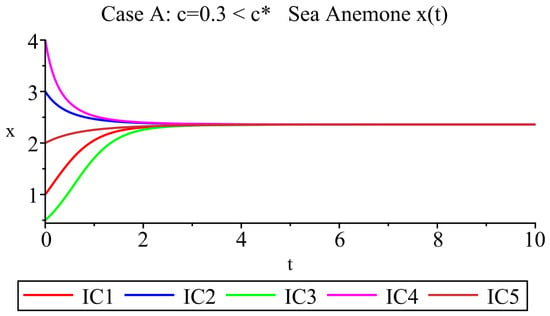
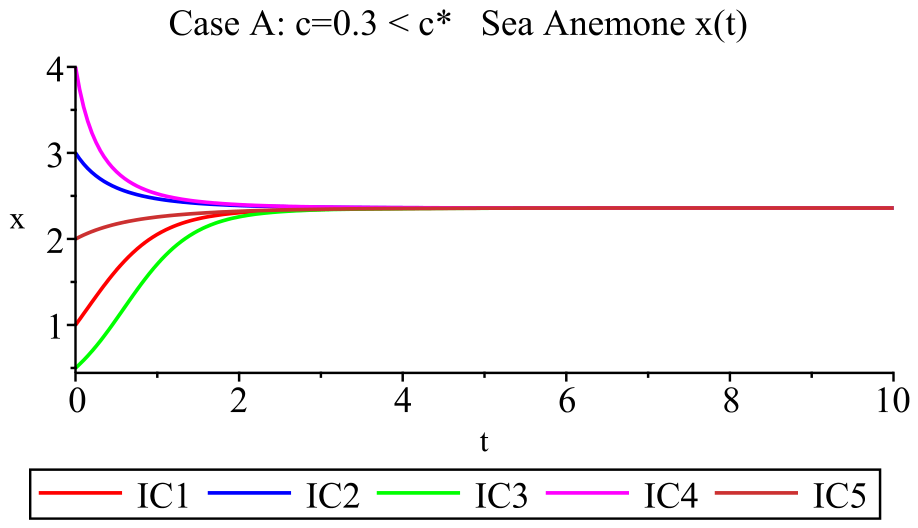
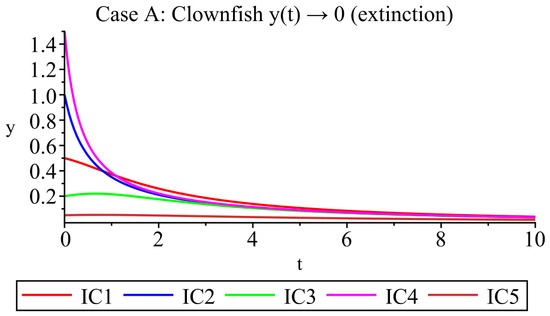
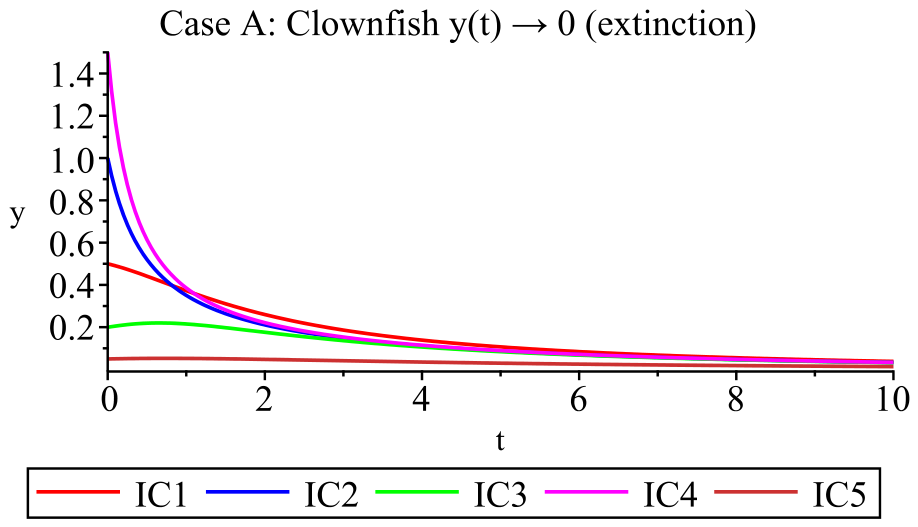
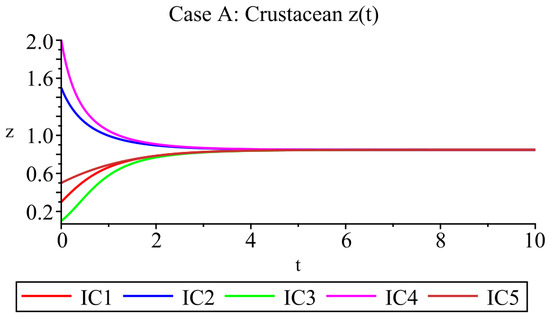
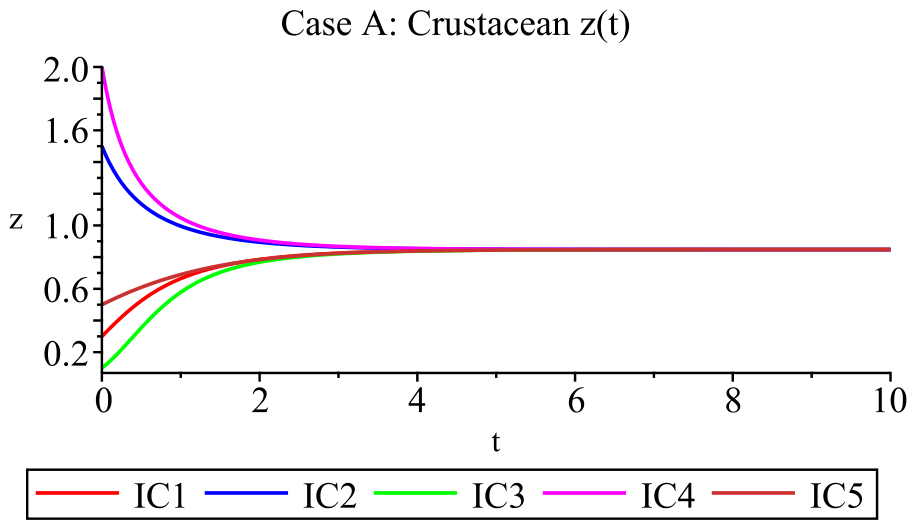
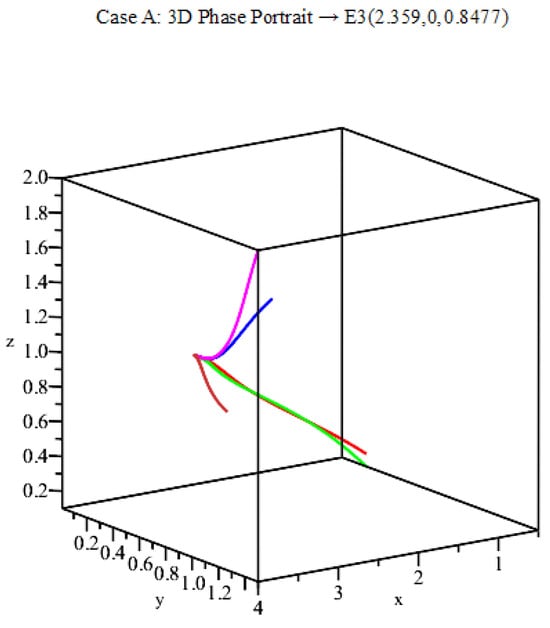
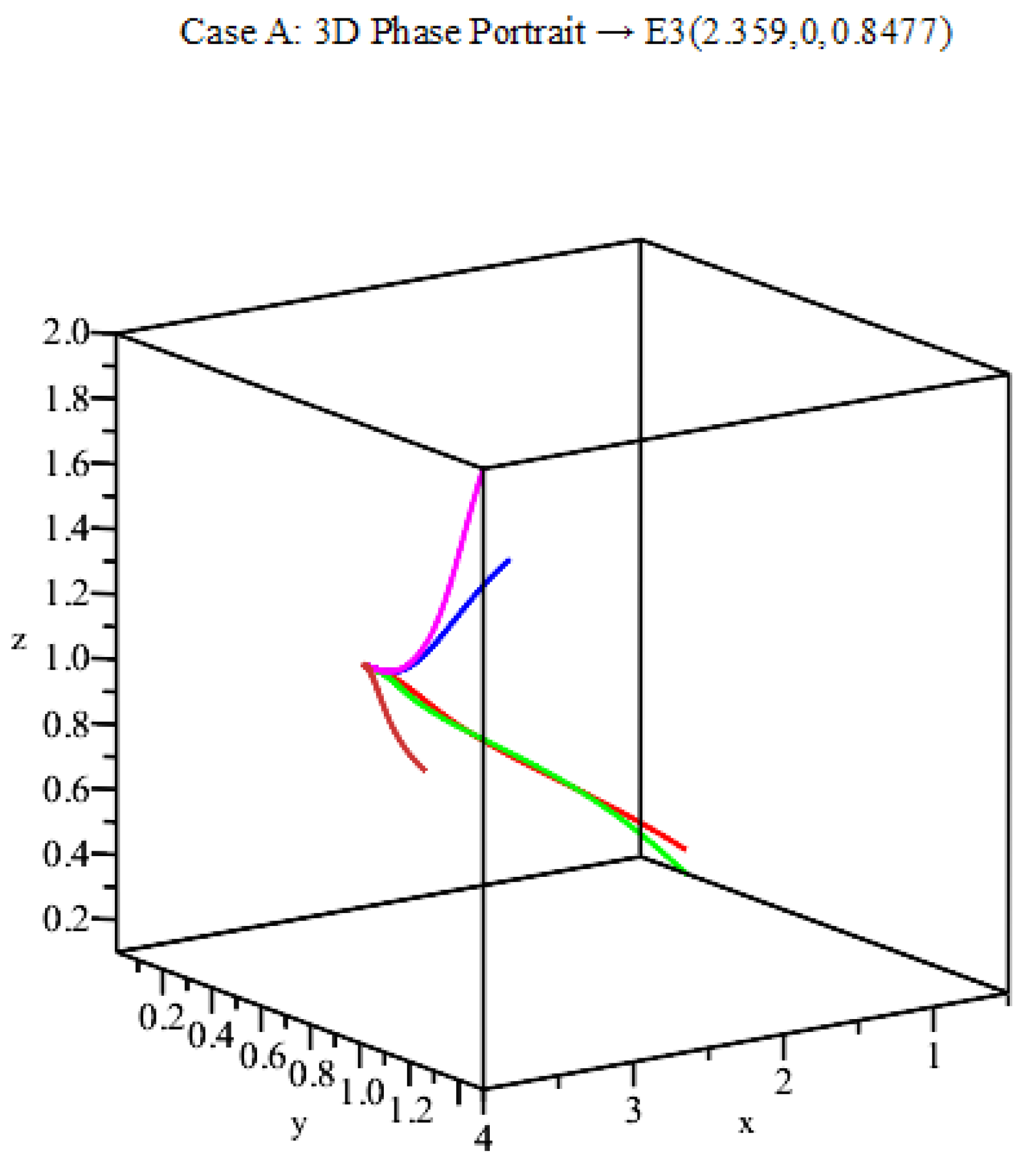
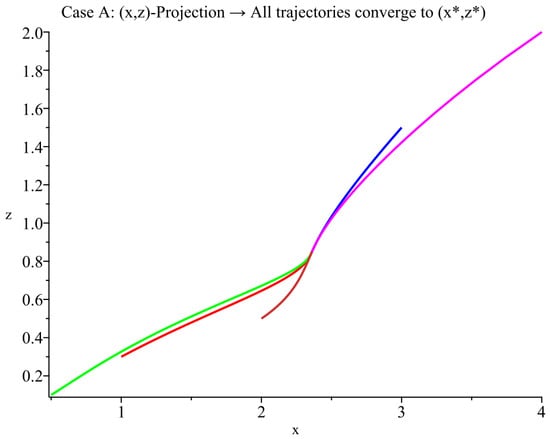
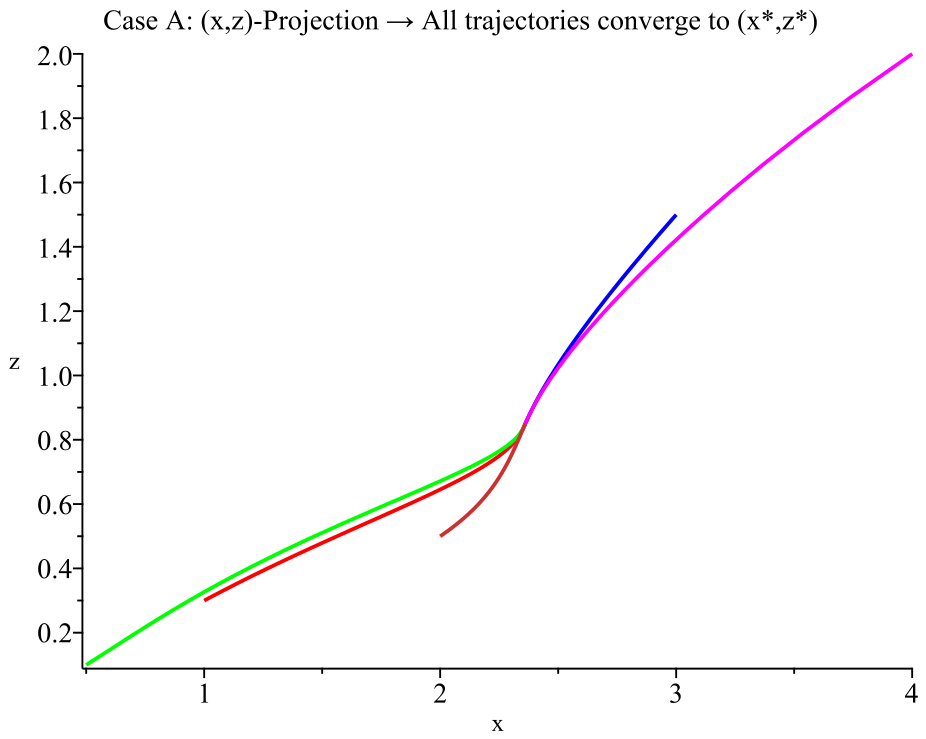
Numerical simulations (, fourth-order Runge–Kutta with adaptive step size) reveal: and for all initial conditions; and decreases monotonically to 0 ( for all ICs). In the 3D phase portrait, all trajectories converge to on the -plane. Figure 1, Figure 2 and Figure 3 are the time series solution of , and , respectively. Figure 4 is the phase portrait of the system. Figure 5 is the projection of solutions onto the -plane. One could see that as
Figure 1.
Time series solutions of sea anemone for case .
Figure 2.
Time series solutions of clownfish for case .
Figure 3.
Time series solutions of crustacean for case .
Figure 4.
phase portrait of the system for the case .
Figure 5.
Projection of solutions onto the -plane.
- Case B: (Three-species coexistence).
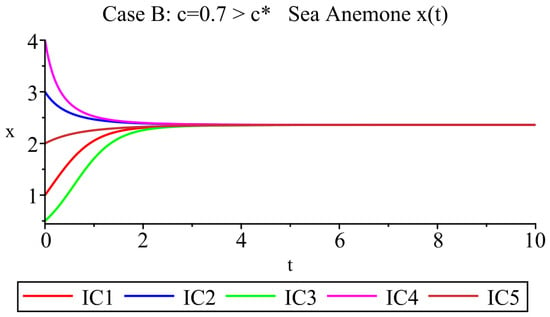
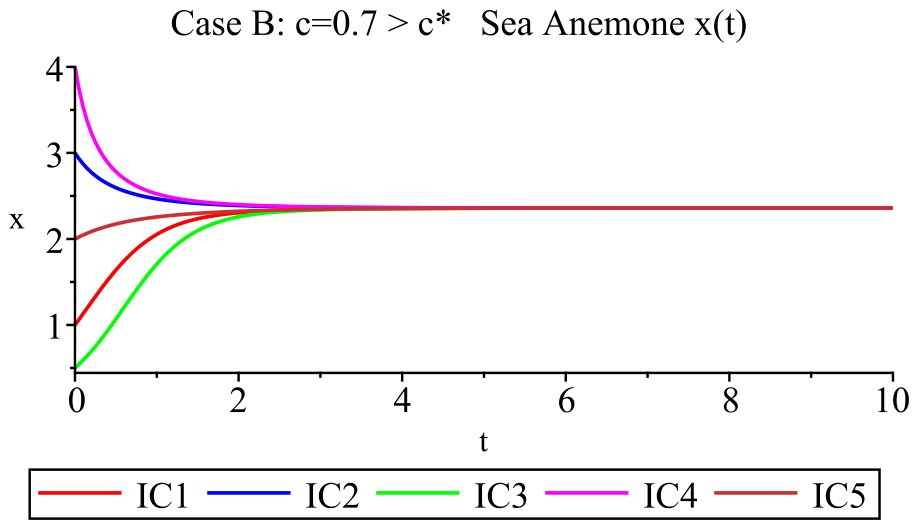
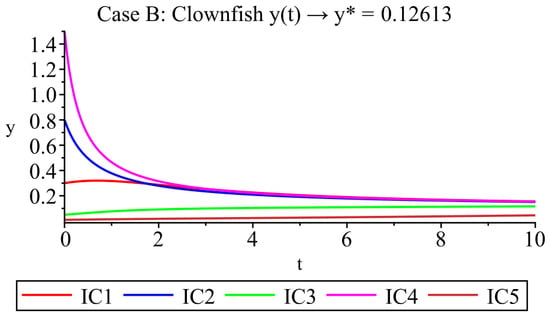
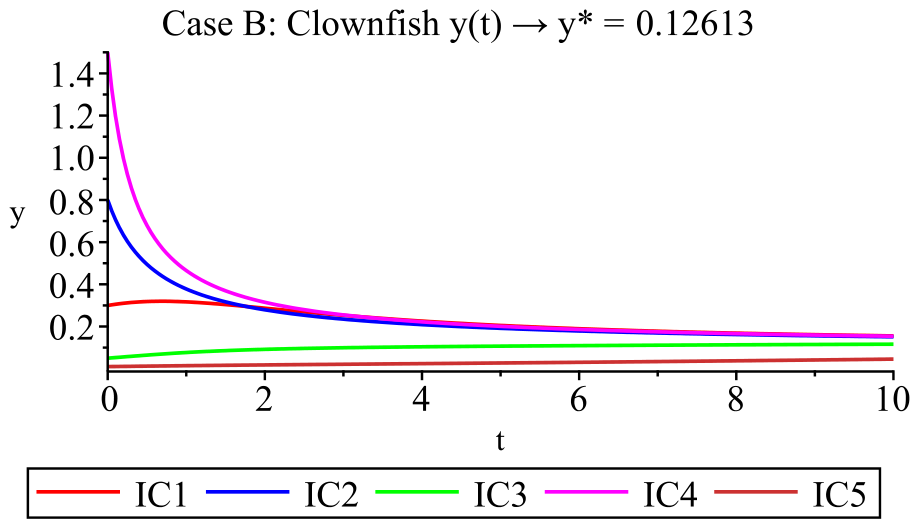
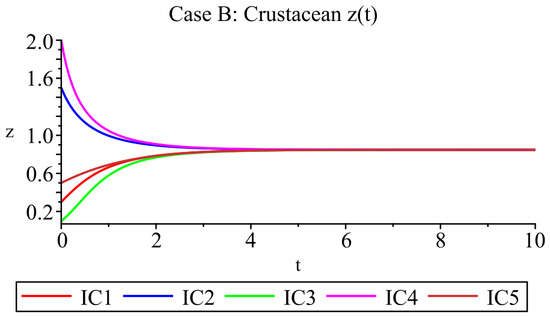
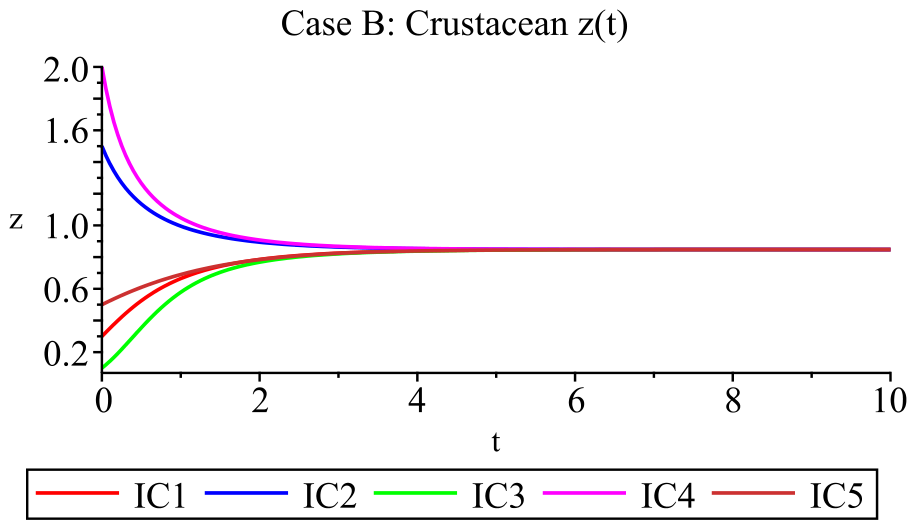
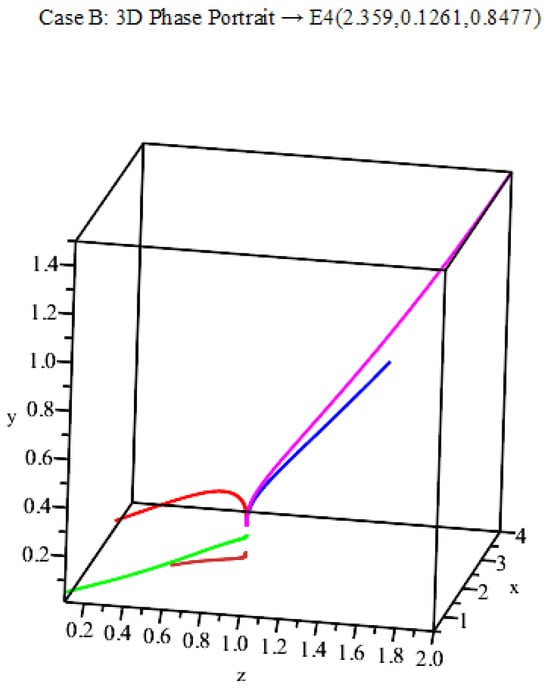
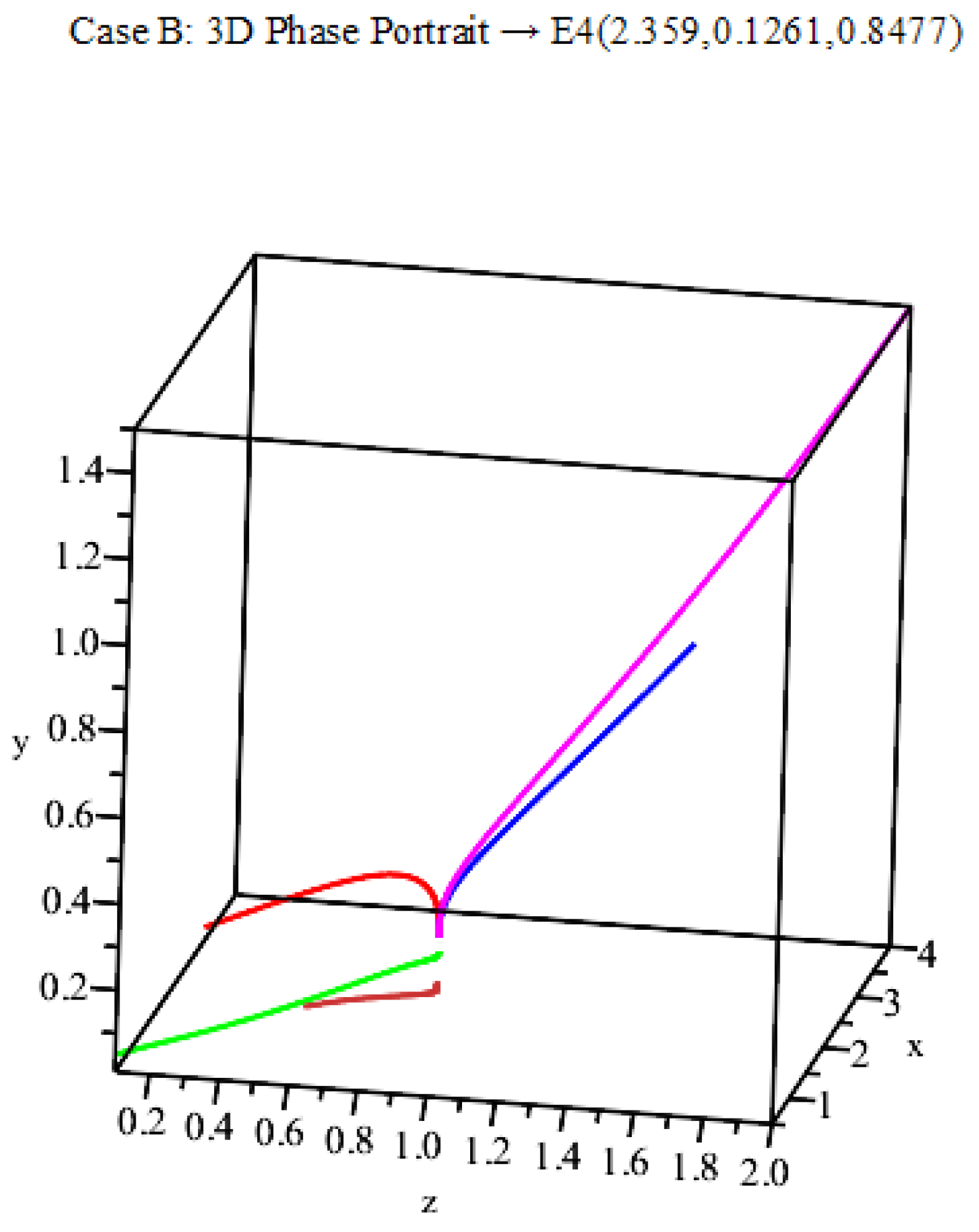
With , we obtain . Using five distinct initial conditions distributed across the phase space (with values ), all trajectories converge to . Figure 6, Figure 7 and Figure 8 are the time series solution of , and , respectively. Figure 9 is the phase portrait of the system.
Figure 6.
Time series solutions of sea anemone for case .
Figure 7.
Time series solutions of clownfish for case .
Figure 8.
Time series solutions of crustacean for case .
Figure 9.
phase portrait of the system for the case .
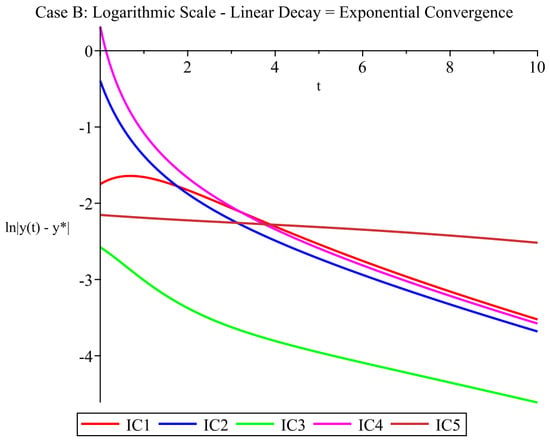
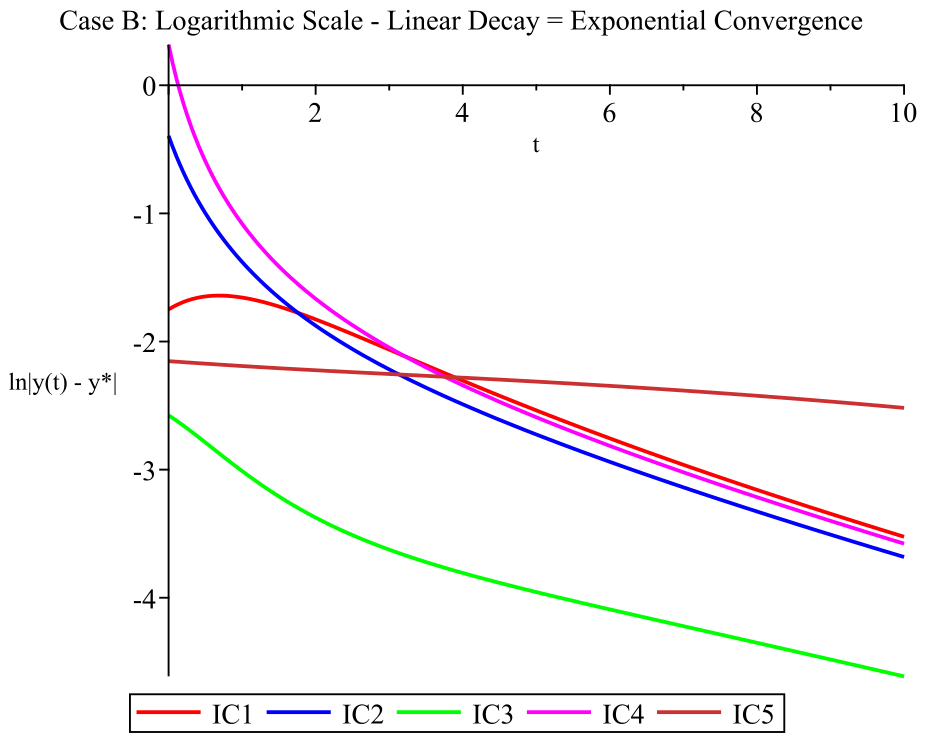
The plot (Figure 10) exhibits a clear linear decay trend, confirming the exponential convergence rate. Theoretically, the exponential decay rate is governed by , corresponding to a half-life of approximately time units.
Figure 10.
Graph of the function .
5.2. Bifurcation Diagram and Numerical Validation
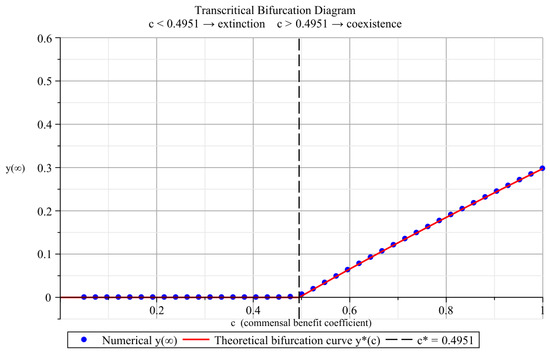
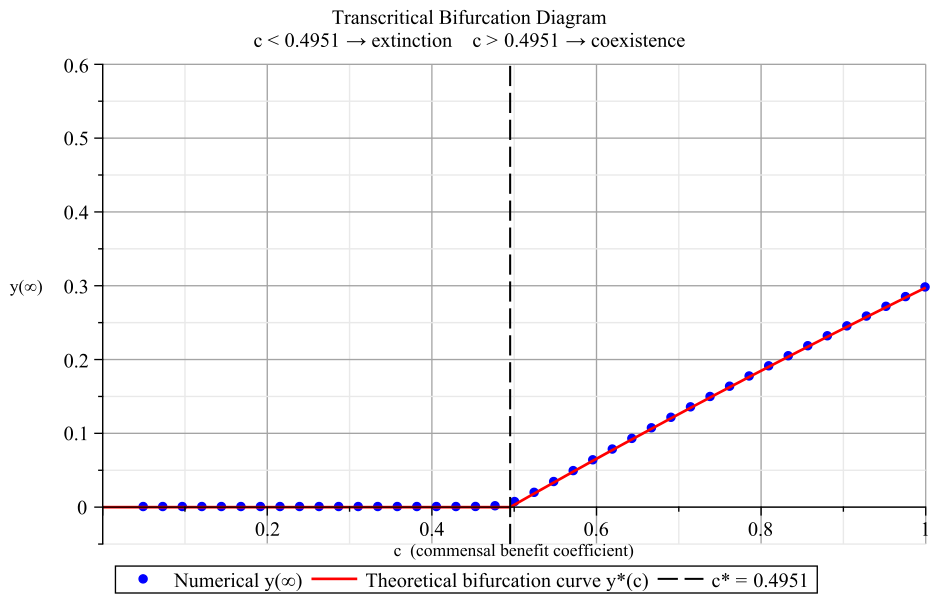
Scanning (step size , 40 values in total), for each c we integrate from to and record as the steady-state value . Comparison of the numerical scatter plot (blue filled circles) with the theoretical bifurcation curve (red solid line) (Figure 11) demonstrates:
Figure 11.
Transcritical bifurcation diagram.
- For , (the zero branch), in exact agreement with the theory;
- For , (the nonzero branch), and the numerical points lie almost perfectly on the theoretical curve;
- At , the zero and nonzero branches intersect, exhibiting the classical transcritical bifurcation morphology.
- Verification of the limit function .
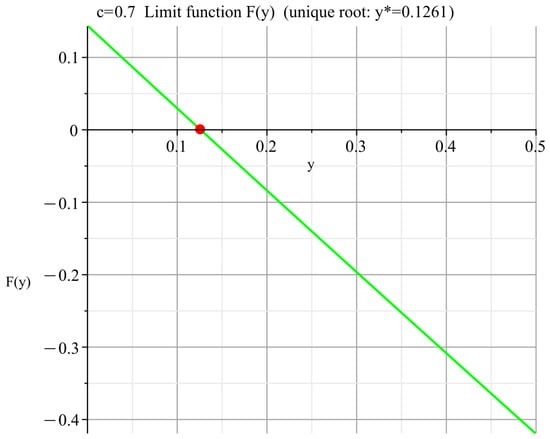
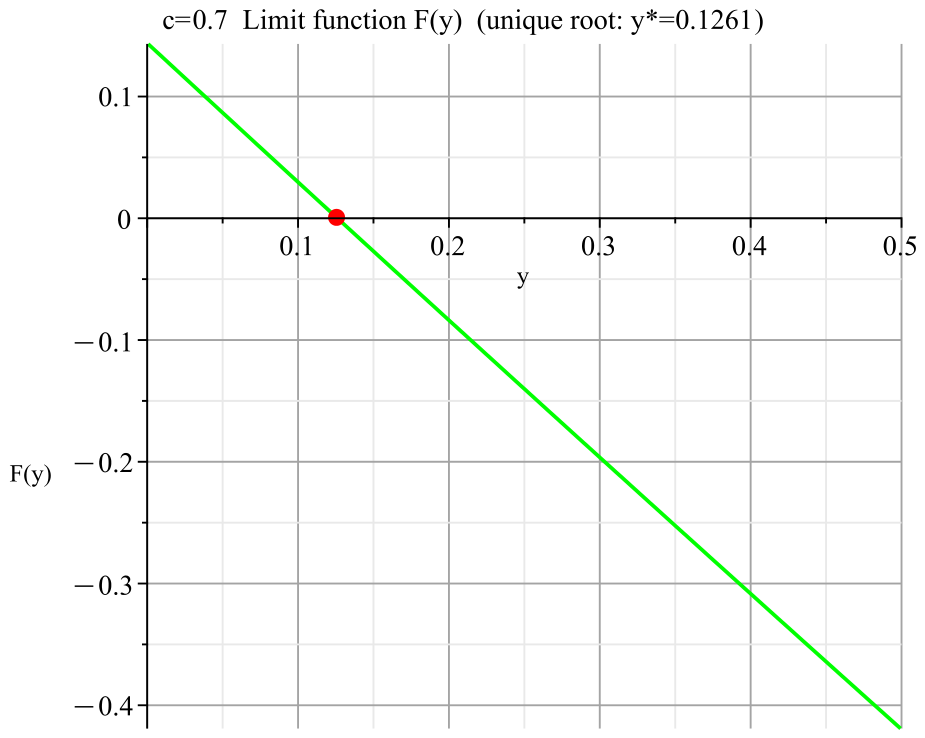
For , plotting confirms that is strictly decreasing () and that has a unique root in , ruling out the possibility of multiple coexisting equilibria in the one-dimensional limit equation (Figure 12).
Figure 12.
Strictly decreasing of function , .
6. Discussion
6.1. Comparison with Existing Results
Shofiyya et al. [30] obtained, via local linearization, the stability condition for and for , but did not reveal the bifurcation relationship between the two equilibria. The present paper has proved that:
- As c approaches from below, and coincide at ;
- A transcritical bifurcation occurs at , with stability exchanged between and ;
- The bifurcation is global; i.e., there exist no attractors other than the locally stable equilibrium.
In other words, the stability condition for in the original paper is algebraically equivalent to the existence condition for —indeed, , which we have rigorously proved. The condition in the original paper is thus essentially a more conservative subset of .
6.2. Superiority of the Lyapunov Approach
Global stability analysis of systems with three or more species has traditionally been avoided due to the difficulty of constructing Lyapunov functions. The success of the present paper stems from two structural features of the model: the decoupling of the -subsystem, and the algebraic form of the BD functional response, which allows the cross term to be eliminated by tuning a single parameter. The applicability of the Volterra-type function in commensalism–amensalism systems suggests that similar constructions may be systematically feasible for a broad class of ecological models with unilateral interactions.
6.3. Ecological Implications
The central ecological findings of this paper can be summarized in three points:
- (1)
- A threshold dictates invasion success. The persistence of the commensal species (clownfish) is determined by a precise threshold . This threshold represents a delicate balance between the commensal benefit term and the amensal loss term —the former must exceed the latter minus the intrinsic growth rate for the commensal species to invade.
- (2)
- The foundational role of neutral species. Regardless of the presence of the commensal species, the neutral species (sea anemone and crustacean) maintain stable positive densities. This is consistent with conclusions from two-species commensalism [15] and amensalism [9] models: neutral species constitute the cornerstone of community persistence.
- (3)
- Convergent dynamics without oscillations. Global convergence to a fixed point implies the absence of the oscillatory behavior commonly observed in predator–prey systems. This feature stems from the very nature of unilateral interactions—the lack of bidirectional negative feedback loops predisposes the dynamics toward monotone convergence. A detailed mathematical and ecological discussion is provided in Section 6.4.
6.4. Structural Absence of Oscillatory Dynamics
The global convergence result established in Section 3 and Section 4 and Corollary 1 implies that system (2) exhibits no oscillatory behavior whatsoever—no Hopf bifurcations, no limit cycles, no periodic or quasiperiodic solutions. This finding naturally raises three questions, which we address below.
6.4.1. Is the Absence of Oscillations an Intrinsic Structural Property of Unilateral Interactions?
The evidence presented in this paper, together with the pattern observed across the literature surveyed in Section 1 (see Table 1), strongly supports an affirmative answer. As detailed in Remark 3, the absence of oscillations stems from three structural features shared by pure unilateral-interaction models: (i) the Jacobian possesses a zero column, factorizing the characteristic polynomial and precluding purely imaginary eigenvalues; (ii) the asymptotic dynamics reduce to a one-dimensional gradient-like system on an invariant fiber; and (iii) no species both affects and is affected by another—bidirectional feedback loops, the engines of oscillation in predator–prey and food-web models, are absent.
These features are not parameter-dependent; they follow directly from the interaction architecture. Table 1 reveals a striking dichotomy: models incorporating at least one bidirectional antagonistic interaction (Type II: predation + competition + commensalism) exhibit Hopf bifurcations and chaos [25,26], while all pure unilateral-interaction models (Types I, III, IV) display only equilibrium convergence. This suggests that the dynamical simplicity observed here is a signature of pure unilateral interaction networks, not a limitation of the specific model.
6.4.2. Could Modifications of the Model Produce Hopf or Hopf-like Bifurcations?
While the present model is structurally incapable of supporting oscillatory dynamics, several biologically plausible modifications could alter this conclusion. First, introducing a time delay in the commensal benefit term (e.g., ) would increase the effective dimensionality of the system and could destabilize the equilibrium via a delay-induced Hopf bifurcation—a mechanism already documented in two-species commensalism models [18]. Second, allowing the amensal toxicity parameter to depend on the population density of the neutral species (reflecting metabolic costs of toxin production by sea anemones) would introduce a density-dependent feedback that breaks the autonomous nature of the -subsystem. Third, replacing the singular term with a Holling-type or Michaelis–Menten functional response would modify the Jacobian sign pattern and could, in conjunction with other modifications, produce a pair of purely imaginary eigenvalues. Investigating these enriched model variants constitutes a natural direction for future work.
6.4.3. How Does This Behavior Compare with Related Ecological Models Exhibiting Cyclic Dynamics?
The contrast with classical ecological models is instructive. In the Lotka–Volterra predator–prey system and its derivatives, the bidirectional antagonistic interaction creates a closed feedback loop that generates neutrally stable cycles or, with nonlinear functional responses, stable limit cycles via Hopf bifurcation [2,39]. Even in models where commensalism or amensalism is present, oscillatory dynamics persist as long as at least one bidirectional interaction remains in the network—as exemplified by the Type II models in Table 1 and by broader food-web modelling studies [4].
What distinguishes system (2) is that it is, to the best of our knowledge, the first three-species model in which all interspecific interactions are strictly unilateral (commensalism + amensalism) and a nonlinear functional response (Beddington–DeAngelis) is employed. The resulting dynamical picture—global convergence to a unique equilibrium, with a single transcritical bifurcation as the only qualitative transition—may therefore be viewed not as a shortcoming but as a characteristic dynamical signature of pure unilateral interaction networks. From an ecological standpoint, this suggests that communities structured predominantly by commensalistic and amensalistic interactions may exhibit greater long-term predictability and be less prone to boom–bust population cycles than those governed by predation and competition.
7. Conclusions
This paper has provided a systematic and in-depth study of the three-species commensalism–amensalism model proposed by Shofiyya et al. [30]. The main conclusions are as follows:
- (1)
- By constructing a Volterra-type Lyapunov function, we proved that the unique positive equilibrium of the -subsystem is globally asymptotically stable in , and subsequently established, via -limit set analysis, the global asymptotic stability of (amensal extinction) and (three-species coexistence). These results elevate the local stability conclusions of the original paper to the global level.
- (2)
- We rigorously proved that the system undergoes a transcritical bifurcation at . Through verification of all three conditions of Sotomayor’s theorem and center manifold reduction, we derived the classical normal form . The bifurcation is global: over the entire range of c, the system converges precisely to a unique equilibrium.
- (3)
- We provided complete Maple-based numerical verification: time series and 3D phase portraits for multiple initial conditions, together with a bifurcation diagram, were all in excellent agreement with the theoretical conclusions. Logarithmic-scale plots confirmed the exponential convergence rate.
From a methodological perspective, this paper demonstrates how the organic combination of Lyapunov’s direct method, Sotomayor’s bifurcation theorem, and center manifold reduction can achieve a complete qualitative analysis for a class of ecological models with unilateral interactions. From an ecological perspective, this paper reveals a precise invasion threshold in commensalism–amensalism systems, providing quantitative insight into how unilateral interactions shape community structure.
Author Contributions
Writing—original draft preparation, X.L., Q.Y. and F.C.; writing—review and editing, X.L., Q.Y. and F.C. All authors have read and agreed to the published version of the manuscript.
Funding
This research was funded by the Social Science Project of Anhui Provincial Department of Education (2025AHGXSK30179), Anhui Provincial Research Center for Eco-agriculture of Chinese Medicinal Herbs Research Platform Project, the Social Science Project of Anhui Provincial Department of Education (2022AH051657) and the Natural Science Foundation of Fujian Province (2024J01273).
Data Availability Statement
Data are contained within the article.
Conflicts of Interest
The authors declare no conflicts of interest.
References
- Veiga, J.P. Commensalism, amensalism, and synnecrosis. In Encyclopedia of Evolutionary Biology; Kliman, R.M., Ed.; Academic Press: Oxford, UK, 2016; pp. 322–328. [Google Scholar]
- Murray, J.D. Mathematical Biology: I. An Introduction, 3rd ed.; Interdisciplinary Applied Mathematics; Springer: Berlin/Heidelberg, Germany, 2002; Volume 17. [Google Scholar]
- Mougi, A. The roles of amensalistic and commensalistic interactions in large ecological network stability. Sci. Rep. 2016, 6, 29929. [Google Scholar] [CrossRef] [Scilit] [PubMed]
- Savoca, M.S.; Giuffrida, A.; Morabito, S.; De Marco, A.; Giacobbe, S. Modelling prey–predator interactions in Messina beachrock pools. Ecol. Model. 2020, 434, 109206. [Google Scholar]
- Sun, G.C. Qualitative analysis of a two-species amensalism model. J. Jiamusi Univ. (Nat. Sci. Ed.) 2003, 21, 283–286. [Google Scholar]
- Guan, X.; Chen, F. Dynamical analysis of a two species amensalism model with Beddington–DeAngelis functional response and Allee effect on the second species. Nonlinear Anal. Real World Appl. 2019, 48, 71–93. [Google Scholar]
- Luo, D.; Wang, Q. Global dynamics of a Beddington–DeAngelis amensalism system with weak Allee effect on the first species. Appl. Math. Comput. 2021, 408, 126368. [Google Scholar]
- Zhao, M.; Du, Y. Stability and bifurcation analysis of an amensalism system with Allee effect. Adv. Differ. Equ. 2020, 2020, 341. [Google Scholar] [CrossRef] [Scilit]
- Zhao, M.; Ma, Y.; Du, Y. Global dynamics of an amensalism system with Michaelis–Menten type harvesting. Electron. Res. Arch. 2023, 31, 549. [Google Scholar]
- Chong, Y.; Chen, F. Global stability, bifurcations and chaos control in a discrete amensalism model with cover and saturation effect. J. Appl. Anal. Comput. 2025, 15, 2977–3003. [Google Scholar] [CrossRef] [Scilit] [PubMed]
- Guo, X.; Ding, L.; Hui, Y.; Song, X. Dynamics of an amensalism system with strong Allee effect and nonlinear growth rate in deterministic and fluctuating environment. Nonlinear Dyn. 2024, 112, 21389–21408. [Google Scholar] [CrossRef] [Scilit]
- Luo, D.; Qiu, Y. Global dynamics of a Holling-II amensalism system with a strong Allee effect on the harmful species. Int. J. Bifurc. Chaos 2024, 34, 2450115. [Google Scholar] [CrossRef] [Scilit]
- Bugalia, S.; Kumar, S.; Triapthi, J.P.; Martcheva, M. Dynamic interplay of Allee effect and harvesting in a diseased amensalism model: Unraveling ecological complexity. Math. Comput. Simul. 2026, 245, 295–324. [Google Scholar] [CrossRef] [Scilit]
- Singh, M.K.; Sharma, A. Analysis of qualitative behaviour of two-species amensalism model under constant-yield harvesting. In AIP Conference Proceedings; AIP Publishing LLC: Melville, NY, USA, 2025; Volume 3283, p. 040017. [Google Scholar]
- Chen, F.; Li, Z.; Chen, L. Dynamic behaviors of a stage structure commensalism system with Holling type II commensalistic benefits. Wseas Trans. Math. 2022, 21, 810–824. [Google Scholar] [CrossRef] [Scilit]
- Fang, K.; Wang, Y.; Chen, F.; Chen, X. Dynamics of a modified Lotka–Volterra commensalism system incorporating Allee effect and symmetric non-selective harvest. Symmetry 2025, 17, 852. [Google Scholar]
- Ditta, A.; Naik, P.A.; Ahmed, R.; Huang, Z. Exploring periodic behavior and dynamical analysis in a harvested discrete-time commensalism system. Int. J. Dyn. Control 2025, 13, 63. [Google Scholar] [CrossRef] [Scilit]
- Qu, M. Dynamical analysis of a Beddington–DeAngelis commensalism system with two time delays. J. Appl. Math. Comput. 2023, 69, 4111–4134. [Google Scholar]
- Tassaddiq, A.; Ahmed, R.; Ditta, A. Exploring stability and bifurcation in a discretized commensalism model. Nonlinear Dyn. 2025, 113, 28463–28475. [Google Scholar] [CrossRef] [Scilit]
- Sari, T. Commensalism and syntrophy in the chemostat: A unifying graphical approach. AIMS Math. 2024, 9, 18625–18669. [Google Scholar] [CrossRef] [Scilit]
- Osuna, O.; Villavicencio-Pulido, G. A seasonal commensalism model with a weak Allee effect to describe climate-mediated shifts. Sel. Mat. 2024, 11, 212–221. [Google Scholar] [CrossRef] [Scilit]
- Puspitasari, N.; Kusumawinahyu, W.M.; Trisilowati. Dynamic analysis of the symbiotic model of commensalism and parasitism with harvesting in commensal populations. JTAM (J. Teor. Dan Apl. Mat.) 2021, 5, 193–204. [Google Scholar] [CrossRef] [Scilit]
- Liu, X.; Yue, Q. Stability property of the boundary equilibria of a symbiotic model of commensalism and parasitism with harvesting in commensal populations. AIMS Math. 2022, 7, 18793–18808. [Google Scholar] [CrossRef] [Scilit]
- Chen, F.; Zhou, Q.; Lin, S. Global stability of symbiotic model of commensalism and parasitism with harvesting in commensal populations. WSEAS Trans. Math. 2022, 21, 424–428. [Google Scholar] [CrossRef] [Scilit]
- Gakkhar, S.; Gupta, K. A three species dynamical system involving prey–predation, competition and commensalism. Appl. Math. Comput. 2016, 273, 54–67. [Google Scholar] [CrossRef] [Scilit]
- Gupta, P.; Jena, I.; Priyadarshi, A. Complex dynamics of a tri-trophic food web model under commensalism, refuse and competition. J. Sci. Res. (Banaras Hindu Univ.) 2023, 67, 57–72. [Google Scholar] [CrossRef] [Scilit]
- Abd Alhadi, A.R.S.; Naji, R.K. The contribution of amensalism and parasitism in the three-species ecological system’s dynamic. Commun. Math. Biol. Neurosci. 2024, 2024, 33. [Google Scholar]
- Abd Alhadi, A.R.S.; Naji, R.K. The role of amensalism and parasitism on the dynamics of three species ecological system. Results Control Optim. 2025, 19, 100571. [Google Scholar] [CrossRef] [Scilit]
- Jawad, S.; Hassan, S.K. Bifurcation analysis of commensalism interaction and harvesting on food chain model. Braz. J. Biom. 2023, 41, 218–233. [Google Scholar]
- Shofiyya, N.; Kusumawinahyu, W.M.; Habibah, U. Model of three species commensalism-amensalism symbiosis with Beddington–DeAngelis functional responses. CAUCHY—J. Mat. Murni Dan Apl. 2025, 10, 1054–1068. [Google Scholar] [CrossRef] [Scilit]
- Cariello, L.; De Santis, A.; Fiore, F.; Piccoli, R.; Spagnuolo, A.; Zanetti, L.; Parente, A. Calitoxin, a neurotoxic peptide from the sea anemone Calliactis parasitica: Amino-acid sequence and electrophysiological properties. Biochemistry 1989, 28, 2484–2489. [Google Scholar] [CrossRef] [Scilit] [PubMed]
- Alwi, C.; Muzammil, W.; Susiana, S. Makanan dan kebiasaan makan kepiting merah (Thalamita spinimana, Dana 1852) di perairan Dompak, Tanjungpinang, Kepulauan Riau. J. Mar. Res. 2022, 11, 729–737. [Google Scholar] [CrossRef] [Scilit]
- Fish, J.; Fish, S. A Student’s Guide to the Seashore; Cambridge University Press: Cambridge, UK, 2011. [Google Scholar]
- Camp, E.F.; Hobbs, J.-P.A.; De Brauwer, M.; Dumbrell, A.J.; Smith, D.J. Cohabitation promotes high diversity of clownfishes in the coral triangle. Proc. R. Soc. B Biol. Sci. 2016, 283, 20160277. [Google Scholar] [CrossRef] [Scilit] [PubMed]
- Xia, Y.; Zhao, N. New results on global exponential convergence of discontinuous HCNNs with time-varying leakage delays. Complex Syst. Stab. Control 2026, 2, 8. [Google Scholar] [CrossRef] [Scilit]
- Florko, K.R.N.; Davidson, E.R.; Lees, K.J.; Hammer, L.J.; Lavoie, M.F.; Lennox, R.J.; Simard, E.; Archambault, P.; Auger-Méthé, M.; McKindsey, C.W.; et al. Tracking movements of decapod crustaceans: A review of a half-century of telemetry-based studies. Mar. Ecol. Prog. Ser. 2021, 679, 219–239. [Google Scholar] [CrossRef] [Scilit]
- Clarke, J.L.; Davey, P.A.; Aldred, N. Sea anemones (Exaiptasia pallida) use a secreted adhesive and complex pedal disc morphology for surface attachment. BMC Zool. 2020, 5, 5. [Google Scholar] [CrossRef] [Scilit]
- Chen, L.S. Mathematical Models and Methods in Ecology; Science Press: Beijing, China, 1988. (In Chinese) [Google Scholar]
- Perko, L. Differential Equations and Dynamical Systems, 3rd ed.; Springer Science & Business Media: Berlin/Heidelberg, Germany, 2013. [Google Scholar]
- Carr, J. Applications of Centre Manifold Theory; Springer Science & Business Media: Berlin/Heidelberg, Germany, 2012. [Google Scholar]

Disclaimer/Publisher’s Note: The statements, opinions and data contained in all publications are solely those of the individual author(s) and contributor(s) and not of MDPI and/or the editor(s). MDPI and/or the editor(s) disclaim responsibility for any injury to people or property resulting from any ideas, methods, instructions or products referred to in the content. |
© 2026 by the authors. Licensee MDPI, Basel, Switzerland. This article is an open access article distributed under the terms and conditions of the Creative Commons Attribution (CC BY) license.