


Abstract
In this paper, we investigate the dynamics of quantum correlations in the ground-state hyperfine manifold of the hydrogen atom subjected to a static external magnetic field and local pure dephasing. The electron–proton spin pair is modeled as a bipartite two-qubit system evolving under the combined effects of hyperfine coupling, Zeeman splitting, and a Lindblad master equation that describes Markovian dissipative processes. Employing exact analytical solutions for the time-dependent density matrix elements (derived in the Markovian open-system framework), we quantify entanglement persistence via concurrence and state stability via Uhlmann fidelity with respect to the initial preparation. For an initial Werner state, numerical results reveal that the external magnetic field substantially modifies the system dynamics: Both concurrence and fidelity exhibit pronounced dependence on the Zeeman parameter, producing field-controlled oscillations, delayed entanglement sudden death, and altered decoherence rates. This behavior originates from Zeeman-induced lifting of hyperfine degeneracies, symmetry breaking of the isotropic Werner state, and redistribution of populations and coherences. Unlike previous studies that treat hyperfine interactions, Zeeman splitting, or decoherence in isolation, the present work provides a unified analytical treatment that simultaneously incorporates all three mechanisms. The findings underscore the competition between coherent hyperfine coupling and environmental noise and open new pathways for precision spectroscopy and robust quantum information protocols based on atomic spin degrees of freedom.
Keywords:
open quantum systems; hyperfine coupling; Zeeman effects; pure dephasing; correlations; electron–proton spin MSC:
81Q93; 34A30; 81Q05; 81P40
1. Introduction
The hydrogen atom stands out in quantum mechanics due to its straightforward nature and exact solvability, making it a cornerstone for developing the theory and a standard reference in atomic physics, chemistry, and connected fields [1,2,3]. Besides its key historical place, it offers a clean, precisely controllable setup for studying basic quantum information ideas. Specifically, the linked spin states of the electron and proton form an effective two-qubit system, allowing clear examination of bipartite quantum correlations—like entanglement and state fidelity—rooted in core physical mechanisms. A central characteristic of hydrogen is its hyperfine structure, produced by the magnetic coupling between electron and proton spins. This interaction removes the ground-state degeneracy, creating singlet and triplet levels that can show built-in quantum correlations. Applying an external magnetic field adds Zeeman splitting, which disrupts rotational invariance and alters both the energy levels and eigenstate forms. Together, the hyperfine interaction and Zeeman effect create a versatile environment for exploring coherent spin evolution, level anticrossings, and magnetically tunable quantum correlations. At low temperatures, hydrogen’s hyperfine states exhibit nonclassical correlations tied to the balance between hyperfine energy differences and thermal effects. Earlier research indicates that these correlations weaken with rising temperature and disappear above a specific energy threshold [4,5,6]. Experiments on spin-polarized hydrogen trapped in solid matrices also show clear departures from standard Boltzmann behavior at low temperatures [4,7], underscoring the role of quantum coherence and correlations in such systems. These findings call for a careful theoretical study of how hyperfine and Zeeman terms influence quantum correlations in practical settings. In quantum information terms, spin pairs resembling the electron–proton system in hydrogen have attracted a great deal of attention as possible information carriers. Examples include electron spins in semiconductor quantum dots [8,9] and nuclear spins in solid-state setups proposed for quantum computing and communication [10,11,12]. Unlike studies centered on spatial or coordinate-based entanglement [13] or abstract analyses of hyperfine effects [14], this work focuses on spin entanglement driven by natural hyperfine coupling while fully accounting for an external magnetic field via the Zeeman contribution. This approach unifies the description of field-driven control and decoherence processes.
In recent years, several studies have focused heavily on measuring quantum correlations in open spin systems, using tools like concurrence and Uhlmann fidelity. These measures offer different views on how nonclassical properties hold up against environmental decoherence [15,16,17]. The concurrence provides a reliable, easy-to-calculate way to assess bipartite entanglement in two-qubit setups—such as the electron–proton spin pair in hydrogen. It shows how the built-in hyperfine couplings create inseparable correlations, which an external magnetic field can fine-tune through Zeeman splitting [15,18,19,20]. At the same time, Uhlmann fidelity tracks the overlap between a system’s evolving density operator and a selected reference state. This helps reveal how stable initial quantum states remain under dissipation and pinpoints conditions where coherence survives despite phase-damping effects [16,21]. New theoretical work has applied these tools to hydrogen’s hyperfine structure, revealing sharp shifts from classical to quantum geometric correlations in the presence of pure dephasing noise [22]. Comparisons with other quantumness indicators—such as local quantum uncertainty and quantum steering—show that while entanglement usually fades quickly, these wider measures stay robust much longer in hydrogen-like systems. This suggests useful paths for keeping quantum resources alive in noisy settings [23]. When used on hydrogen’s hyperfine levels, these measures highlight the detailed balance between natural atomic forces and applied fields. They link core quantum mechanics to resource-based ideas in quantum information, enabling reliable forecasts of how correlations fade under real-world noise [17,24]. Such insights support advances in quantum technologies, from spin-based computing to ultra-precise sensors [25,26].
To model these spin systems realistically, an open quantum system framework is essential. Environmental noise always causes decoherence and weakens quantum correlations. The theory of open quantum systems supplies the right methods to handle the balance between coherent motion and dissipation [27,28]. The Lindblad master equation forms the main tool for describing Markovian dissipative effects in atomic and spin platforms. It allows exact analytical solutions for dephasing while keeping the density operator trace-preserving and completely positive [28,29,30]. Recent progress has used this approach on the hyperfine structure of hydrogen, revealing sharp jumps from classical to quantum decoherence regimes under phase-randomization processes. This points to a common pattern seen in many open quantum systems [22]. Studies of wider quantum correlations—like local quantum uncertainty and entanglement—show that entanglement often drops fast, but other measures such as quantum discord and coherence resist noise better. These findings suggest ways to reduce noise damage in real atomic settings [23]. This structure supports accurate predictions of how correlations evolve in hydrogen-like systems. It also carries deep meaning for quantum technologies, such as spin-based sensing and computation, by guiding methods to control errors and protect resources against unavoidable environmental coupling [26,31].
Although several recent works have investigated quantum correlations in hydrogen-like systems and open spin models, most existing studies focus either on isolated hyperfine interactions, purely thermal properties, or generic two-qubit decoherence scenarios treated independently. A systematic analysis combining hyperfine coupling, Zeeman-induced level structure, and environmentally induced dephasing within a unified analytical framework remains comparatively unexplored. In particular, the combined influence of magnetic-field control and decoherence on both entanglement generation and state fidelity in the hydrogen electron–proton spin system has not been fully clarified. The present work addresses this gap by providing an exact open-system treatment of the hyperfine–Zeeman dynamics and by identifying how external magnetic fields can modify the robustness and temporal behavior of quantum correlations under realistic dissipative conditions. While several qualitative aspects of the dynamics—such as field-induced oscillations and dephasing-driven entanglement degradation—are familiar from generic two-qubit open-system models, the present framework is qualitatively distinct because it is derived directly from the microscopic spin Hamiltonian of the hydrogen atom rather than from a phenomenological two-qubit interaction. The hyperfine strength is fixed by fundamental physical constants, and the Zeeman couplings incorporate the opposite gyromagnetic signs of the electron and proton, leading to the distinct parameters and . A central new finding is that both concurrence and the time of entanglement sudden death depend exclusively on and are independent of ; this permits the experimental simplification without loss of generality for entanglement studies. Furthermore, it provides the exact analytical solutions (Appendix B and Appendix C) yields closed-form expressions for the full density matrix, concurrence, and Uhlmann fidelity under the simultaneous action of hyperfine coupling, Zeeman splitting, and local pure dephasing—enabling precise, experimentally testable predictions for field-tunable quantum correlations in a real atomic platform. These features go beyond what can be obtained from abstract two-qubit models with arbitrary coupling strengths and provide a physically motivated setting for exploring magnetic field control in precision spectroscopy and atomic spin quantum information protocols. The present work therefore supplies not merely a parameterized instance of known two-qubit phenomenology but a unified analytical treatment anchored in the experimentally accessible energy scales of the hydrogen hyperfine manifold.
Our study centers on two key measures of quantum correlations: concurrence and Uhlmann fidelity. The concurrence gives a strict gauge of nonclassical correlations linking the electron and proton spins. The fidelity shows how well the time-developing mixed state stays close to a selected reference state. Used together, these tools reveal both the amount of entanglement and the durability of quantum states in open-system conditions. By tracking their time dependence, we find conditions where hyperfine-driven coherence resists decoherence and cases where an external magnetic field either strengthens or weakens quantum correlations. The main contribution of this work is the development of an analytically solvable open-system description of the hydrogen hyperfine spin manifold that simultaneously incorporates hyperfine interaction, Zeeman splitting, and Markovian dephasing dynamics. Within this framework, we investigate how magnetic-field tuning modifies the competition between coherent hyperfine oscillations and environmentally induced decoherence and how this interplay governs the evolution of concurrence and Uhlmann fidelity. Beyond the standard description of entanglement decay in generic two-qubit systems, our analysis highlights the physically distinctive role of the hydrogen hyperfine structure as a controllable platform for studying field-driven quantum correlations in atomic spin systems.
The manuscript is organized as follows. In Section 2, we present the spin–spin (hyperfine) interaction in ground-state hydrogen in the presence of a static magnetic field. Section 3 is devoted to the description of the open-system dynamics of the hyperfine–Zeeman spin system, including phase dephasing and the resulting evolution of the density matrix elements within the Lindblad formalism. In Section 4, we introduce the quantum correlation quantifiers employed in this work, namely concurrence and fidelity, for the hyperfine-coupled electron–proton spin system. Section 5 provides a numerical analysis and a discussion of their time-dependent behavior under the dephasing dynamics. Finally, Section 6 summarizes the main findings and outlines their physical implications.
2. Spin–Spin Coupling in Ground-State Hydrogen Under a Static Magnetic Field
In the electronic ground configuration of hydrogen, the dominant internal spin interaction arises from the magnetic dipolar coupling between the electron and proton [20,32,33]. This effect is described by the hyperfine Hamiltonian, which can be written as
where and denote the Pauli operator vectors acting on the electron and proton spin subspaces, respectively. Both particles behave as spin- systems. The interaction strength is given by [32]
with being the vacuum permeability, being the Bohr radius, and being the electron and proton gyromagnetic factors, and , being their respective masses. This parameter characterizes the contact magnetic dipole interaction associated with the electron density at the proton position.
When a uniform external magnetic field is present, Zeeman contributions from both constituents must be included. The corresponding term reads
where the magnetic moment operators are linked to spin via
Here, and denote the Bohr and nuclear magnetons. The numerical values and are used for the electron and proton.
Substituting these relations yields
with and .
The complete spin Hamiltonian for ground-state hydrogen in a magnetic field is therefore [34,35,36,37,38]
This operator incorporates both hyperfine mixing and Zeeman splitting, which together determine the detailed level structure.
The spin state space of each particle is two-dimensional. Choosing the eigenbasis of the z-component spin operators,
the total Hilbert space becomes
spanned by the product basis
Correct treatment of the relative signs in the Zeeman couplings is crucial: They reflect the opposite charge and precession directions of the two spins and lead to the characteristic combinations that control the coherent evolution of the coupled system (see Appendix A). For a field oriented along the z axis, the Hamiltonian can be diagonalized exactly. The resulting eigenenergies and their associated eigenvectors in the uncoupled spin basis are obtained analytically; the full procedure and explicit formulas are collected in Appendix A to streamline the main text.
3. Decoherence Dynamics in the Hyperfine–Zeeman Spin System
In realistic physical settings, quantum coherence is inevitably affected by environmental noise. Within the hyperfine manifold of the hydrogen atom subjected to an external magnetic field, one of the dominant decoherence mechanisms is pure dephasing, in which stochastic phase fluctuations suppress quantum coherences while leaving population probabilities unchanged. Such dephasing processes naturally arise from temporal fluctuations of the magnetic field, which couple differently to the electron and proton spin degrees of freedom through the Zeeman interaction.
In realistic experimental environments, the electron–proton spin system of hydrogen is inevitably coupled to surrounding magnetic and electromagnetic fluctuations, leading to decoherence of the hyperfine spin states. In the present work, we focus specifically on phase-dephasing processes arising from weak stochastic fluctuations of the external magnetic environment. Such fluctuations couple to the electron and proton magnetic moments through the Zeeman interaction and primarily induce random phase shifts between the spin states without significantly modifying the state populations. This regime is particularly relevant when the energy relaxation timescale is much longer than the phase coherence timescale, as commonly encountered in spin resonance and weakly dissipative atomic systems. Under these assumptions, the reduced dynamics can be described within the standard Born–Markov approximation, where the coupling between the spin system and the environment is sufficiently weak and the environmental correlation time remains much shorter than the characteristic timescale of the hyperfine dynamics. In this limit, memory effects become negligible, and the evolution is well represented by a completely positive and trace-preserving Lindblad master equation. The resulting dephasing model provides an effective description of the dominant coherence loss mechanism while preserving the analytical tractability of the hyperfine–Zeeman dynamics. Although non-Markovian effects may become relevant in strongly correlated or structured environments, the present work is restricted to the weak-coupling Markovian regime in order to isolate the fundamental interplay between hyperfine coupling, Zeeman splitting, and phase decoherence.
The reduced dynamics of the coupled electron–proton spin system are modeled within the Markovian open quantum system framework and governed by a Lindblad master equation. Throughout this work, we adopt natural units by setting () [39,40,41],
where H denotes the total hyperfine–Zeeman Hamiltonian, and accounts for the dissipative interaction with the environment. An important advantage of the present approach is that the reduced dynamics can be obtained analytically, enabling a transparent identification of the separate roles played by hyperfine coupling, Zeeman splitting, and dephasing in the evolution of quantum correlations.
3.1. Phase Dephasing
In the present work, we focus on local dephasing processes acting independently on the electron and proton spins. This choice is motivated by the fact that weak stochastic magnetic field fluctuations coupled through the Zeeman interaction primarily induce random phase shifts between hyperfine spin states while producing negligible population transfer. Accordingly, the dominant decoherence mechanism in the considered weak-dissipation regime is phase randomization rather than energy relaxation. The present analysis therefore concentrates on the regime where the longitudinal relaxation timescale associated with amplitude damping is much longer than the transverse dephasing timescale. Under these conditions, the pure-dephasing Lindblad model provides an effective and analytically tractable description of the dominant environmental effects. Although amplitude-damping processes may become relevant in strongly dissipative environments or in the presence of additional relaxation channels, their investigation lies beyond the scope of the present work and constitutes an interesting direction for future studies.
This situation is relevant when magnetic field fluctuations are spatially inhomogeneous on the scale of the electron–proton separation or when the two spins experience distinct effective noise sources [22,23,34]. Under these conditions, the Lindblad operators take the form
with corresponding dephasing rates and , respectively. The resulting dissipator is
where we have used the identities . The dephasing operators are chosen diagonal in the spin basis, reflecting the fact that environmental magnetic fluctuations act predominantly through phase randomization rather than spin–flip transitions.
By contrast, collective dephasing arises when both spins couple identically to a common fluctuating field, leading to a single Lindblad operator proportional to . Such noise preserves coherence within decoherence-free subspaces, notably protecting certain entangled states. While collective dephasing is relevant in highly correlated environments, the local model adopted here provides a more general description for realistic magnetic noise in hydrogen-based spin systems. On the other hand, the use of a Markovian master equation is justified when the environmental correlation time is much shorter than the characteristic timescales of the system dynamics. In the present context, the dominant noise source is assumed to be slowly varying magnetic-field fluctuations originating from external electromagnetic environments or technical noise, whose correlation times are typically short compared to the inverse hyperfine splitting and Zeeman frequencies. Under these conditions, memory effects in the environment can be neglected, and the system–environment interaction leads to an effectively time-local evolution of the reduced density matrix. The Markov approximation therefore provides an accurate and physically transparent description of decoherence in the hyperfine–Zeeman spin system while allowing for an exact analytical treatment of coherence and correlation dynamics.
3.2. Dynamics of the Density Matrix Elements
The time evolution of the density matrix elements is obtained by projecting the master equation onto the computational basis and solving the resulting coupled first-order differential equations. Indeed, we consider the time evolution of the hydrogen electron–proton spin system under local pure-dephasing noise using the definitions
and the computational basis .
By expressing the reduced density matrix in the Bell basis, the spectral properties of the system can be obtained analytically, which considerably simplifies the evaluation of the quantum correlation measures. We get for the evolution of the density matrix as:
The diagonal elements evolve according to
Hence, the populations and , corresponding to the fully polarized states and , are constants of motion. Populations and are coherently coupled via the hyperfine interaction .
The off-diagonal elements evolve in several coupled sets:
Single-spin coherences:
with Hermitian conjugates and .
Double-spin coherence:
Single-excitation coherences:
Remaining coherences:
with and .
These coupled differential equations fully determine the time evolution of the density matrix elements. Their structure reflects the competition between coherent hyperfine dynamics and incoherent environmental damping.
The population dynamics are governed exclusively by the hyperfine interaction , while local dephasing affects only the coherences. The fully polarized states and form a decoherence-free subspace (DFS), remaining invariant under local phase noise. Populations and , corresponding to and , exchange population coherently via . The associated single-excitation coherences decay at the rate , reflecting independent dephasing of each spin. Single-spin coherence pairs and are coupled through and modulated by the external field via , producing oscillatory dynamics damped by local dephasing. The double-spin coherence evolves independently, acquiring a Zeeman phase and decaying at the maximal rate . The single-excitation coherence is tied to the population difference , directly reflecting hyperfine-mediated exchange. Overall, coherences associated with a single spin decay at rates or , while those involving both spins decay faster at . This hierarchy emphasizes the importance of noise locality and symmetry in preserving quantum correlations and defining decoherence-free subspaces in the hyperfine-coupled electron–proton system. Such magnetic-noise-induced dephasing mechanisms are widely used in the description of atomic spin coherence loss in magnetic-resonance- and spin-based quantum information platforms.
To investigate the time evolution of the density matrix of the hydrogen atom under hyperfine and Zeeman interactions, we consider a general mixed X-state with maximally mixed marginals, , given by
where the real parameters fully characterize the initial quantum correlations. The above system (14)–(25) can be solved analytically due to its closed structure in the Bell-diagonal representation, allowing us to obtain explicit time-dependent expressions for all density matrix elements. The corresponding analytical solutions of the density matrix elements are presented in Appendix B.
This general X-state form encompasses several important classes of states as special cases, including maximally entangled Bell states () and Werner states (). It therefore provides a unified framework for systematically investigating the dynamics of quantum correlations in the hyperfine–Zeeman system.
In summary, this section has established the analytical framework for describing the reduced dynamics of the coupled electron–proton spin system in hydrogen under the combined action of the hyperfine interaction, Zeeman splitting induced by an external magnetic field, and environmental pure-dephasing processes. The dephasing mechanism preserves the populations of the hyperfine–Zeeman energy levels while progressively suppressing quantum coherences, thereby enabling a clear separation between the unitary spin dynamics and the dissipative effects of the environment. Instead of restricting the analysis to specific pure-state configurations such as single-excitation (EPR-like) or aligned-spin Bell states, we consider a more general and physically relevant class of initial states, namely mixed two-qubit X states with maximally mixed marginals. Within this broader setting, we derive closed-form expressions for the time-dependent density matrix elements. The analytical solutions, presented in Appendix B, explicitly demonstrate how the hyperfine and Zeeman energy splittings govern the coherent phase evolution, while the dephasing process controls the decay of off-diagonal coherences without altering the population dynamics. This formulation allows a complete analytical treatment of the dynamics while keeping the main text focused on the physical interpretation of the results.
4. Quantum Quantifiers in Open Hyperfine Spin Systems
In this section, we introduce the quantum quantifiers for open hyperfine–Zeeman spin systems subject to pure dephasing. We focus in particular on the concurrence as a measure of entanglement and the Uhlmann fidelity, which probe complementary facets of nonclassical correlations. Applying these measures to the exact density matrices obtained above enables a systematic analysis of the robustness and decay of quantum correlations in hydrogen, highlighting the distinct roles played by hyperfine coupling, external magnetic fields, and phase decoherence. All quantifiers are defined through standard formal expressions and assessed against well-established physical criteria [15,16,19,21,42,43,44,45,46,47].
4.1. Concurrence for Hyperfine-Coupled Electron–Proton Spins
The hyperfine interaction between electron and proton spins naturally generates quantum entanglement, and, in the presence of an external magnetic field, the Zeeman splitting can further induce or modulate entanglement between the two spins. We consider concurrence [15] as an entanglement measure in our analysis. This choice is particularly appropriate here, as the electron–proton spin pair spans an effective two-qubit Hilbert space, while local Lindblad operators modeling dephasing and relaxation act directly on the spin coherences. To quantify entanglement dynamics, we use the concurrence, which provides a measure of nonclassical correlations between the electron and proton spin subsystems. For a reduced density matrix describing the electron–proton spin state, the concurrence [15,48,49] is defined as
where are the eigenvalues, arranged in decreasing order, of the matrix
with the spin-flipped density matrix
Within the hyperfine–Zeeman setting, the concurrence provides a direct measure of how electron–proton spin correlations are generated by coherent hyperfine coupling and subsequently suppressed by Zeeman splitting and environmental dephasing. Values correspond to separable spin configurations, while signals maximally entangled hyperfine states. Intermediate values characterize partially entangled mixed states arising from the competition between coherent spin dynamics and incoherent Lindblad processes. The concurrence therefore serves as a reliable indicator of the persistence or degradation of entanglement resources in realistic open hyperfine spin systems.
For the specific density matrices considered in the previous cases, the X-state structure allows the concurrence to be expressed in a particularly simple form:
where
Employing the solutions provided in Appendix B yields the dynamics of the concurrence. These simplifications considerably streamline the analytical evaluation of entanglement dynamics and clearly illustrate the direct connection between specific density matrix elements and the degree of quantum correlations in these physically relevant subspaces.
4.2. Fidelity and Stability Under Zeeman-Induced Decoherence
While entanglement measures quantify nonclassical correlations, they do not fully describe how closely the evolving state follows its initial preparation. To complement entanglement analysis, we employ fidelity, a fundamental quantity in quantum information theory that characterizes the similarity between quantum states and is widely used in the study of open-system dynamics [16,21,45,46]. This measure provides a direct assessment of the stability of the quantum state under environmental noise.
For two arbitrary mixed states and , the Uhlmann fidelity is defined as
with . The maximum value is attained if and only if , whereas smaller values indicate increasing distinguishability due to decoherence, dissipation, or coherent distortions induced by Zeeman splitting.
In the special case of pure states, and , the fidelity reduces to [16]
which admits a simple geometric interpretation as the overlap between state vectors.
When the reference state is pure, , the preceding expression simplifies substantially, as shown in Appendix C:
Throughout this work, fidelity is evaluated with respect to the initial state of the system rather than an external target state, ensuring that directly quantifies the stability of the initially prepared hyperfine spin configuration against environmental noise and Zeeman-driven decoherence within the open-quantum-system framework [47,50].
In the present open hyperfine spin system, fidelity is employed to monitor how the reduced density matrix departs from its initial configuration under Lindblad evolution. In particular, Zeeman-induced energy splittings combined with local dephasing channels lead to a progressive suppression of spin coherences, which is directly reflected in the decay of . Unlike entanglement measures, fidelity is sensitive to both classical and quantum features of the state, making it a valuable complementary diagnostic. The analytic expressions for the fidelity corresponding to the time-evolved density matrices of the hydrogen hyperfine–Zeeman system are provided in Appendix C. These formulas explicitly relate the fidelity to the relevant density matrix elements for the chosen initial states, enabling a straightforward evaluation of the overlap between the evolving state and its initial preparation.
In the following, we explore the time-dependent behavior of these quantities by substituting the analytically derived density matrix elements into the corresponding definitions.
5. Dynamics of Quantum Correlation Quantifiers: Analytical Results and Visualization
In this section, we analyze the time evolution of quantum correlation quantifiers in the hydrogen hyperfine–Zeeman system. The dynamics are obtained from the exact analytical solutions of the density matrix derived in Appendix B for the distinct initial states and . All correlation measures, including entanglement and fidelity, are evaluated directly from these closed-form expressions. The numerical component of the analysis consists solely in the evaluation and visualization of these analytical results. This approach allows us to clearly illustrate the interplay between coherent hyperfine dynamics, Zeeman splitting, and local dephasing, without the need for solving differential equations numerically. The results highlight the distinct dynamical behavior of quantum correlations for different initial preparations and provide insight into their robustness under decoherence in physically relevant subspaces.
In particular, the dynamics can be interpreted in terms of two physically distinct regimes: a hyperfine-dominated regime, where coherent spin exchange governs entanglement generation, and a Zeeman-dominated regime, where external-field-induced level splitting suppresses spin mixing and modifies the decay and oscillatory structure of quantum correlations. This separation is crucial for distinguishing the present hydrogen-specific results from generic two-qubit decoherence models.
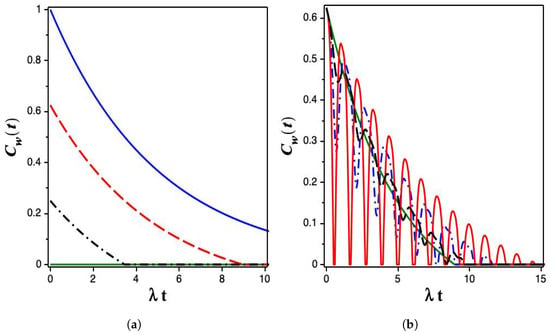
Figure 1 show the time evolution of the concurrence as a function of the dimensionless time for an initially the Werner entangled state (26), with . The system parameters are chosen such that the electron and proton dephasing rates are equal, , resulting in a total dephasing rate .
Figure 1.
The time evolution of the concurrence is plotted as a function of the dimensionless time for Werner entangled state with the parameters . The plots are illustrated for , giving a total dephasing rate . Here, denotes the hyperfine coupling constant, and is the total dephasing rate arising from electron and proton contributions. (a) The color code is (green solid line), (dash-dotted black line), (dashed red line), and (Solid blue line), for the case of absence of the external field . (b) The color code is (green solid line), (dash-dotted black line), (dashed blue line), and (Solid red line), as the concurrence is independent of , we set and .
First, we analyze the case of the absence of the external field by imposing . Panel (a) represents the variation of the concurrence for different values of the parameter a. At , the values of the concurrence depend strongly on a, consistent with the formula . For , (the orange line starts low). For , (black dash-dotted line). For , (red dashed line). For , (the solid blue line starts at the maximum entanglement). All curves exhibit a monotonic decay toward zero concurrence, indicating loss of entanglement due to dephasing. The total dephasing rate is , with equal contributions from electron () and proton () subsystems. This monotonic decay corresponds to the pure dephasing regime in the absence of coherent driving, where no internal or external field-induced mixing competes with environmental noise. In this limit, the dynamics reduces to a purely dissipative evolution, providing a reference baseline for comparison with field-controlled cases. The decay rate appears independent of the initial concurrence value—all curves seem to decay with a similar time constant set by . This suggests the disentanglement dynamics are governed primarily by the dephasing environment, not the initial degree of entanglement. For , entanglement completely disappears, while for , it persists even for larger values. Higher initial entanglement correlates with longer survival time before reaching , though all eventually undergo entanglement sudden death within the displayed time window. The Werner state’s robustness against dephasing is limited: Even maximal initial entanglement (, Bell state mixture) decays fully under the chosen dephasing rates. The equal contribution from electron and proton dephasing suggests symmetric decoherence effects from both subsystems in this model. The figure demonstrates that while initial entanglement in Werner states can be tuned via parameter a, its time evolution under independent dephasing channels is characterized by exponential decay with a rate determined by the total dephasing strength . Entanglement disappears faster for states with lower initial concurrence, but all eventually suffer complete loss within finite time, illustrating the fragility of quantum correlations under dephasing noise.
Panel (b) shows the dynamics of the concurrence for the initial density matrix corresponds to parameters , which satisfies the positivity conditions, and for different values of the Zeeman coupling. The initial concurrence indicates substantial but not maximal entanglement, consistent with a mixed entangled state. Unlike the zero-field case, the presence of Zeeman coupling introduces coherent spin precession that competes with dephasing, leading to a qualitatively different dynamical behavior characterized by oscillatory modulation of entanglement. This is a signature of field-controlled quantum coherence specific to the hyperfine–Zeeman structure, rather than a generic two-qubit dissipative model. The concurrence exhibits distinctly different decay patterns depending on : (orange solid): Shows nearly monotonic decay to zero, reaching entanglement death at . (black solid): Displays clear oscillations superimposed on overall decay, with entanglement vanishing at . (blue dash-dotted): Exhibits more pronounced oscillations with larger amplitude, reaching zero concurrence by . (red dashed): Shows the strongest oscillatory behavior, with entanglement disappearing earliest at . The oscillatory behavior for non-zero arises from coherent dynamics induced by the Zeeman coupling, which competes with the incoherent dephasing processes. The time of entanglement sudden death (ESD) increases significantly with increasing . This field-dependent delay of entanglement decay highlights the role of the external magnetic field as a control parameter that reshapes the balance between coherent hyperfine dynamics and environmental decoherence. The oscillations in concurrence for result from the interplay between: Coherent Zeeman dynamics: drives unitary evolution that periodically modulates the quantum correlations. Incoherent dephasing: causes exponential decay of coherence. Interference effects: The competition between these processes creates oscillatory decay envelopes, reminiscent of damped Rabi oscillations in open quantum systems. For , only dephasing acts, leading to monotonic decay. Non-zero introduces coherent oscillations whose frequency scales with .
Remarkably, concurrence depends only on , not on . This indicates that proton Zeeman terms couple more strongly to the entanglement dynamics than nuclear Zeeman terms in this specific hyperfine interaction configuration. This permits the experimental simplification without loss of generality for entanglement studies. The observed behavior aligns with theoretical predictions for two-qubit systems under local dephasing with local coherent drives: ESD occurs in finite time for all parameter values, coherent drives () induce oscillations before death, larger drives lead to faster overall decay but more pronounced oscillations, and the decay envelope follows approximately modulated by oscillatory terms. However, unlike abstract two-qubit models with phenomenological coupling, the present system embeds these effects in the physically meaningful hyperfine structure of hydrogen, where the Zeeman interaction directly modifies the energy-level splitting and hence the coherence pathways. For the practical implications for quantum information, can be adjusted (via external magnetic field) to control both the ESD time and the oscillation pattern. The oscillations suggest possibilities for entanglement revival through dynamic control of . The oscillation damping rate provides additional information about environmental interactions beyond simple exponential decay. The different behaviors for positive and negative might be exploited for directional protection of entanglement. For experimental realizations in solid-state spin systems: Magnetic field alignment relative to crystal axes affects the effective . Temperature variations might modify both the effective and Zeeman couplings. Pulse sequences could potentially synchronize with oscillations to enhance entanglement persistence. The -dependent ESD times provide benchmarks for quantum memory performance. These results demonstrate that magnetic interactions provide an effective control mechanism for tailoring entanglement dynamics in hyperfine-coupled spin systems. While they cannot fully suppress decoherence, they significantly reshape the transient behavior of quantum correlations, which is of direct relevance for spin-based quantum information processing and quantum control applications. While the present model captures the essential features of decoherence-induced degradation of quantum correlations, it does not account for memory effects or strong coupling regimes, which may lead to non-Markovian revivals and enhanced correlation lifetimes.
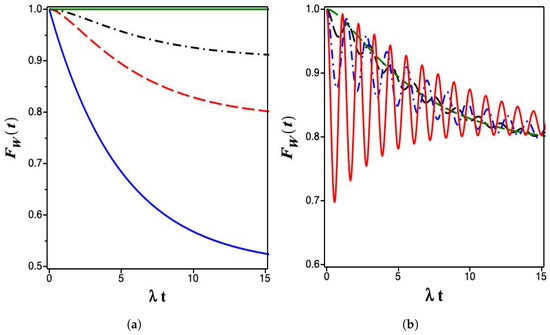
Figure 2 represent the time evolution of the fidelity between the time-evolved state and the initial Werner state is analyzed as a function of the dimensionless time , where is the hyperfine coupling constant. The system evolves under simultaneous hyperfine and Zeeman interactions, with equal electron and proton dephasing rates fixed at , yielding a total dephasing rate . In contrast to entanglement measures, the fidelity quantifies the global overlap of the full density operator, making it sensitive to both population redistribution among hyperfine levels and phase coherence loss induced by the environment. This allows one to probe how the internal atomic structure is modified by external control fields during the dissipative evolution. The initial Werner state can be equivalently written as with the parameter a restricted to to ensure positivity. Its eigenvalues are for the singlet component and (threefold degenerate) for the triplet state. The value of a controls both entanglement and purity: corresponds to the pure singlet state , while introduces mixing with the maximally mixed state . As expected, all fidelity curves begin at because . The subsequent decay is due to dephasing, with a rate largely independent of a, consistent with pure-dephasing dynamics where coherence loss is insensitive to the initial state’s entanglement content. Panel (a) shows the case of zero external magnetic field (). Although all curves start at unity and decay at similar rates, their steady-state values differ markedly with a: for (blue solid line) corresponding to maximal initial entanglement, the asymptotic fidelity is highest; for (red dashed) it is intermediate; for (black dash-dotted) it is lower; and for (green solid), representing the separable Werner state, the asymptotic fidelity approaches zero. This trend reveals that states with higher initial entanglement retain a larger residual overlap with their original form even after complete dephasing, demonstrating an entanglement-enhanced robustness against decoherence in the fidelity measure. This behavior reflects the structure of the hyperfine manifold, where the singlet component is more resilient under symmetric dephasing channels, leading to a nontrivial dependence of the long-time state overlap on the initial singlet–triplet mixing rather than on entanglement alone.
Figure 2.
Time evolution of fidelity for the initial Werner state under hyperfine and Zeeman couplings with equal dephasing rates (). (a) The parameter a controls the initial entanglement and purity: (green solid), (black dash-dotted), (red dashed), (blue solid). In this case, . (b) The fidelity does not depend on , thus we set and . The color code is (green solid line), (dash-dotted black line), (dashed blue line), and (solid red line).
Panel (b) examines the influence of the Zeeman coupling for a fixed initial entanglement (), with set to zero—a choice that does not affect the dynamics due to symmetry. The fidelity evolution exhibits damped oscillations, whose frequency and envelope depend on : at (green solid line) the decay is monotonic; at (black dash-dotted) it is weakly modulated; at (blue dashed) the oscillatory decay is pronounced; and at (red solid) oscillations become faster with reduced amplitude. These oscillations arise from the coherent Zeeman splitting, which periodically modulates the overlap between and . Physically, this reflects the fact that the Zeeman interaction modifies the eigenbasis of the hyperfine Hamiltonian, inducing coherent precession between spin configurations that continuously reshapes the projection of the evolving state onto the initial Werner state. This mechanism is absent in generic two-qubit models without field-dependent level structure. The decay envelope is governed by the hyperfine coupling and the total dephasing rate . Thus, the interplay of hyperfine interaction, Zeeman coupling, and dephasing collectively dictates the entanglement preservation in the fidelity sense. Unlike , which can settle at a non-zero plateau depending on a, the concurrence—a measure of distillable entanglement—decays to zero for all parameters shown. This highlights a key distinction: Fidelity captures state overlap, which may remain finite even after entanglement vanishes. Thus, while a non-zero fidelity indicates a residual memory of the initial state, it does not imply the survival of useful quantum correlations for tasks such as teleportation or quantum cryptography.
The dynamics can be qualitatively classified into different regimes depending on the relative strength of the hyperfine coupling, Zeeman splitting, and decoherence rate. In the weak-decoherence regime, coherent oscillations dominate the dynamics, while in the strong-decoherence regime, exponential decay suppresses quantum correlations. Intermediate regimes exhibit crossover behavior between these two limits. The time scales governing the decay of quantum correlations are primarily determined by the dephasing rate , while the Zeeman term controls the oscillatory structure of the coherent evolution. Increasing accelerates the suppression of nonclassical correlations, whereas stronger magnetic field contributions enhance coherent modulation effects. The observed decay rates scale approximately with the decoherence parameter , while the characteristic oscillation frequencies are set by the hyperfine and Zeeman energy scales.
For experimental implementations in spin-based quantum systems (e.g., nitrogen-vacancy centers in diamond or donor spins in silicon), these results suggest that operating at low magnetic fields (minimizing ) prolongs the fidelity plateau and reduces oscillatory loss; that the initial entanglement level (a) offers a trade-off where higher entanglement improves asymptotic fidelity but increases sensitivity to mixing; that monitoring concurrence provides a more stringent, application-relevant probe of usable entanglement than fidelity alone; and that engineering dephasing rates () remains critical, as they set the timescale for coherence loss regardless of magnetic field settings. Overall, the fidelity dynamics demonstrate that the hydrogen hyperfine–Zeeman system cannot be reduced to a simple phenomenological two-qubit decoherence model, since the external field actively reshapes the coherent evolution through basis mixing and energy-level restructuring intrinsic to the atomic spin Hamiltonian.
The obtained dynamics reveal two physically distinct regimes governed by the competition between hyperfine coupling and Zeeman splitting. In the weak-field regime, hyperfine interaction dominates, leading to strong electron–proton correlations and coherent oscillatory exchange dynamics determined by the intrinsic structure of the hydrogen atom. In the strong-field regime, Zeeman splitting suppresses spin mixing and alters the oscillation spectrum, resulting in reduced quantum correlations and increased susceptibility to dephasing. Importantly, this crossover behavior is specific to the hyperfine manifold, where the external field modifies the eigenstructure of the system rather than merely adding a perturbative driving term. Consequently, the magnetic field acts as a tunable control parameter that governs the balance between coherent atomic dynamics and environmentally induced decoherence. All plots are therefore generated by direct evaluation of analytically known functions, ensuring full reproducibility of the results.
6. Conclusions
We have analyzed the open-system dynamics of the hyperfine-coupled electron–proton spin pair in the ground-state hydrogen atom under the influence of a static magnetic field. The combined hyperfine and Zeeman interactions were incorporated within the Lindblad master equation formalism to describe phase-dephasing processes and the resulting time evolution of the density matrix. We evaluated the stability and correlation robustness of quantum states in a dissipative environment using concurrence and fidelity. Notably, for systems starting in a Werner state, we found that the external magnetic field strength, through the Zeeman parameter (), directly modulates both indicators, leading to oscillatory correlation dynamics. Unlike generic two-qubit open-system models where external fields act only as local driving terms, the present hydrogen hyperfine–Zeeman system exhibits a field-dependent restructuring of the eigenbasis, where the magnetic field modifies the spin eigenstates and coherence pathways in a nontrivial way due to the intrinsic hyperfine coupling. This leads to qualitatively modified dynamics of both concurrence and fidelity, showing strong sensitivity to the interplay between internal atomic structure and external control fields. Overall, the numerical analysis highlights how decoherence degrades nonclassical correlations, while the external magnetic field actively reshapes their temporal behavior by tuning the coherent structure of the hyperfine manifold. In contrast to standard two-qubit decoherence scenarios, the Zeeman interaction here does not merely perturb the dynamics but fundamentally alters the effective energy-level structure governing entanglement evolution. This provides a physically grounded mechanism for magnetic-field control of quantum correlations in atomic spin systems. This deeper understanding of the interplay between spin–spin coupling, environmental noise, and external fields is highly relevant for precision spectroscopy, quantum metrology, and the development of robust quantum information protocols utilizing hyperfine degrees of freedom. The present analysis is based on a Markovian Lindblad description and a two-qubit approximation of the hyperfine manifold. Consequently, non-Markovian memory effects, strong system–environment correlations, and multi-atom interactions are not included. Future work may extend the present model to non-Markovian environments and multi-spin systems, where collective decoherence and environment-induced correlations may further enrich the dynamics of quantum correlations.
Author Contributions
Writing—original draft preparation, K.B. and S.B. All authors have read and agreed to the published version of the manuscript.
Funding
This work was supported and funded by the Deanship of Scientific Research at Imam Mohammad Ibn Saud Islamic University (IMSIU) (grant number IMSIU-DDRSP2603).
Data Availability Statement
The original contributions presented in this study are included in the article. Further inquiries can be directed to the corresponding author.
Conflicts of Interest
The authors declare no conflicts of interest.
Appendix A. Exact Diagonalization of the Spin Hamiltonian in a Longitudinal Magnetic Field
This appendix outlines the analytical diagonalization of the ground-state hydrogen spin Hamiltonian when a static magnetic field is applied along the z direction. For , the Hamiltonian introduced in Section 2 becomes
We work in the uncoupled product basis given in Equation (9). In this representation:
- The Zeeman contribution is diagonal,where we have defined
- The spin–spin coupling operator reads
The full Hamiltonian matrix therefore takes the block form
The states and are already eigenvectors, with eigenvalues
The central state,
yields the remaining eigenvalues
where .
The associated eigenstates can be written as
with the amplitude ratio determined from the eigenvalue problem,
Imposing normalization gives
In the zero-field limit (), the eigenstates reduce to symmetric and antisymmetric combinations,
with eigenenergies , , respectively [20,32,33].
Conversely, in the strong-field regime , the mixing becomes negligible, and the eigenvectors approach the uncoupled states,
up to corrections of order .
This completes the analytical characterization of the combined hyperfine and Zeeman structure for a magnetic field oriented along the quantization axis.
Appendix B. Analytical Solutions for Werner-Type X States of the Density Matrix
The initial density matrix is taken in the standard X form with maximally mixed marginals,
where . This class includes Bell states and Werner states as special cases.
Due to symmetry, the dynamics separate into two independent states: (i) the Bell-like state and (ii) the single-excitation state . Here, we focus on the latter, which is responsible for the evolution of , , and .
- 1.
- Directly solvable componentsFor :Hence,Then by Hermiticity,
- 2.
- Zero componentsThe subsystems for and are homogeneous linear with zero initial conditions, givingHence also and by Hermiticity.
- 3.
- The non-trivial blockLetFrom the equations, S is constant:The remaining variables satisfy the real linear systemwith initial conditionsThe system (A25) is a set of three coupled linear first-order differential equations with constant coefficients. Its solution is obtained by assuming exponential forms , , and , where the () are the roots of the cubic characteristic equationFor each mode k, the eigenvector relations of the system matrix giveThe amplitudes are determined by imposing the initial conditions , , . Substituting the general solution into these conditions yields the linear systemThe coefficients are obtained by solving the system via matrix inversion or Cramer’s rule. Once the are known, the corresponding and follow immediately from the relations above.
These results show that, for Werner-type X states, the hyperfine interaction induces coherent population exchange within the single-excitation manifold, while pure dephasing exponentially suppresses both the coherence and the population imbalance. In the long time limit, the system relaxes toward an incoherent mixture with equal populations, providing a transparent setting for analyzing the decay of entanglement and fidelity.
The states and are simultaneous eigenstates of both the hyperfine Hamiltonian and the local dephasing operators. As a result, their populations form a decoherence-free subspace, remaining invariant in time. The only environmental effect is an exponential decay of the coherence at the maximal rate , accompanied by a purely Zeeman-induced phase oscillation at frequency .
Appendix C. Fidelity Between a Time-Dependent Mixed State and Its Pure Initial Preparation
This appendix provides a compact and self-contained derivation of the fidelity between the reduced density operator of an open quantum system and its initially prepared pure state. The result is particularly useful for analyzing the stability of hyperfine-coupled spin states evolving under Lindblad dynamics.
We begin with the Uhlmann definition of fidelity for two arbitrary quantum states [16,21,45],
When the reference state is pure, , the above expression simplifies substantially. Introducing the auxiliary (generally unnormalized) vector
one finds
The operator is of rank one and possesses a single nonvanishing eigenvalue . Its positive square root is therefore well defined, yielding
Consequently, the fidelity reduces to the simple overlap
which is the standard expression for the fidelity between a mixed state and a pure state.
- Application to pure X-State Density Matrix
In this section we derive the expression of the Uhlmann fidelity between the initial state and the evolved density matrix , both having the X-state structure.
The initial state is defined in (A16), which is a Bell-diagonal X state. The dynamical state keeps the general X form (Appendix B)
For notational simplicity, we suppress the explicit time dependence throughout.
Both and decompose into two independent subspaces .
Therefore,
with
Given that fidelity is additive over direct sums in this structure,
where .
For two arbitrary density matrices and , the fidelity simplifies to [16,21,50]
Applying this to each block, we get the contribution from the state
Contribution of the state is
The total fidelity is, therefore,
with and given above. This formula is fully analytical and depends only on the X-state matrix elements of and the correlation parameters of the initial Bell diagonal state.
Under the assumption that
With , the first block contribution is
For the second block, , giving
Combining both blocks, we can obtain exact fidelity. These expressions are exact under the only assumption and apply to arbitrary X-state matrices with the standard block structure.
References
- Bohr, N. On the Constitution of Atoms and Molecules. Philos. Mag. 1913, 26, 1. [Google Scholar] [CrossRef] [Scilit]
- Bethe, H.; Salpeter, E. Quantum Mechanics of One- and Two-Electron Atoms; Springer: Springer Science & Business Media: Berlin/Heidelberg, Germany, 2013. [Google Scholar]
- Series, G.W. Spectrum of Atomic Hydrogen; Oxford University: New York, NY, USA, 1957. [Google Scholar]
- Sheludiakov, S.; McColgan, P.T.; Lee, D.M.; Khmelenko, V.V.; Järvinen, J.; Ahokas, J.; Vasiliev, S. Polarized Phases of H Atoms Embedded in Solid H2 Films. Phys. Rev. Lett. 2019, 122, 225301. [Google Scholar] [CrossRef] [Scilit]
- Ahokas, J.; Vainio, O.; Novotny, S.; Järvinen, J.; Khmelenko, V.V.; Lee, D.M.; Vasiliev, S. Magnetic resonance study of H atoms in thin films of H2 at temperatures below 1 K. Phys. Rev. B 2010, 81, 104516. [Google Scholar] [CrossRef] [Scilit]
- Ahokas, J.; Järvinen, J.; Khmelenko, V.V.; Lee, D.M.; Vasiliev, S. Exotic Behavior of Hydrogen Atoms in Solid at Temperatures below 1 K. Phys. Rev. Lett. 2006, 97, 095301. [Google Scholar] [CrossRef] [Scilit]
- Bigelow, N.P.; Freed, J.H.; Lee, D.M. Nuclear-Spin Waves in Polarized Atomic Hydrogen Gas: Temperature and Density Dependence in the Hydrodynamic and Knudsen Regimes. Phys. Rev. Lett. 1989, 63, 1609. [Google Scholar] [CrossRef] [Scilit]
- Johnson, A.C.; Petta, J.R.; Marcus, C.M.; Hanson, M.P.; Gossard, A.C. Triplet-Singlet Spin Relaxation via Nuclei in a Double Quantum Dot. Nature 2005, 435, 925. [Google Scholar] [CrossRef] [Scilit] [PubMed]
- Petta, J.R.; Johnson, A.C.; Taylor, J.M.; Laird, E.A.; Yacoby, A.; Lukin, M.D.; Marcus, C.M.; Hanson, M.P.; Gossard, A.C. Coherent Manipulation of Coupled Electron Spins in Semiconductor Quantum Dots. Science 2005, 309, 2180. [Google Scholar] [CrossRef] [Scilit] [PubMed]
- Taylor, J.M.; Engel, H.A.; Dür, W.; Yacoby, A.; Marcus, C.M.; Zoller, P.; Lukin, M.D. Fault-Tolerant Architecture for Quantum Computation Using Electrically Controlled Semiconductor Spins. Nat. Phys. 2005, 1, 177. [Google Scholar] [CrossRef] [Scilit]
- Ladd, T.D.; Jelezko, F.; Laflamme, R.; Nakamura, Y.; Monroe, C.; O’Brien, J.L. Quantum Computers. Nature 2010, 464, 45. [Google Scholar] [CrossRef] [Scilit]
- Bennett, C.H.; DiVincenzo, D.P. Quantum Information and Computation. Nature 2000, 404, 247. [Google Scholar] [CrossRef] [Scilit]
- Tommassini, P.; Timmermans, E.; Piza, A.F.R.d. Relaxation and Decoherence in Two-Level Quantum Systems. Am. J. Phys. 1998, 66, 881. [Google Scholar]
- Zhu, G.; Du, K.; Li, Y. Decoherence and Classical Correlation in a Two-Level System Coupled to an Environment. Physica A 2005, 346, 295. [Google Scholar] [CrossRef] [Scilit]
- Wootters, W.K. Entanglement of Formation of an Arbitrary State of Two Qubits. Phys. Rev. Lett. 1998, 80, 2245. [Google Scholar] [CrossRef] [Scilit]
- Jozsa, R. Fidelity for mixed quantum states. J. Mod. Opt. 1994, 41, 2315–2323. [Google Scholar] [CrossRef] [Scilit]
- Adesso, G.; Bromley, T.R.; Cianciaruso, M. Measures and applications of quantum correlations. J. Phys. A Math. Theor. 2016, 49, 473001. [Google Scholar] [CrossRef] [Scilit]
- Wootters, W.K. Entanglement of Formation and Concurrence. Quantum Inf. Comput. 2001, 1, 27. [Google Scholar] [CrossRef] [Scilit]
- Hill, S.; Wootters, W.K. Entanglement of a Pair of Quantum Bits. Phys. Rev. Lett. 1997, 78, 5022. [Google Scholar] [CrossRef] [Scilit]
- Maleki, Y.; Sheludiakov, S.; Khmelenko, V.V.; Scully, M.O.; Lee, D.M.; Zheltikov, A.M. Natural and magnetically induced entanglement of hyperfine-structure states in atomic hydrogen. Phys. Rev. A 2021, 103, 052804. [Google Scholar] [CrossRef] [Scilit]
- Uhlmann, A. The transition probability in the state space of a *-algebra. Rep. Math. Phys. 1976, 9, 273–279. [Google Scholar] [CrossRef] [Scilit]
- Berrada, K.; Bougouffa, S. Unveiling Sudden Transitions Between Classical and Quantum Geometric Correlations in the Hyperfine Structure of the Hydrogen Atom Under Dephasing Noise. Entropy 2025, 27, 1161. [Google Scholar] [CrossRef] [Scilit]
- Berrada, K.; Bougouffa, S. Local Quantum Uncertainty and Entanglement in the Hyperfine Structure of the Hydrogen Atom: A Lindblad Approach. Mathematics 2025, 13, 3340. [Google Scholar] [CrossRef] [Scilit]
- Girolami, D.; Tufarelli, T.; Adesso, G. Characterizing nonclassical correlations via local quantum uncertainty. Phys. Rev. Lett. 2013, 110, 240402. [Google Scholar] [CrossRef] [Scilit]
- Berrada, K.; Bougouffa, S. Quantum Coherence and Mixedness in Hydrogen Atoms: Dephasing Effects in Hyperfine Structures. Symmetry 2025, 17, 1633. [Google Scholar] [CrossRef] [Scilit]
- Qi, B.; Hou, Z.; Li, L.; Dong, D.; Xiang, G.; Guo, C. Harnessing the power of quantum systems based on spin magnetic resonance: From ensembles to single spins. Adv. Quantum Technol. 2020, 3, 1900107. [Google Scholar]
- von Neumann, J. Mathematical Foundations of Quantum Mechanics; Princeton University Press: Princeton, NJ, USA, 1955. [Google Scholar]
- Breuer, H.-P.; Petruccione, F. The Theory of Open Quantum Systems; Oxford University Press: Oxford, UK, 2002. [Google Scholar]
- Lindblad, G. On the generators of quantum dynamical semigroups. Commun. Math. Phys. 1976, 48, 119. [Google Scholar] [CrossRef] [Scilit]
- Gorini, V.; Kossakowski, A.; Sudarshan, E.C.G. Completely positive dynamical semigroups of N-level systems. J. Math. Phys. 1976, 17, 821. [Google Scholar] [CrossRef] [Scilit]
- Lu, Y.; Shuang, Z.; Shao, X.Q. Robust and optimal control of open quantum systems. Sci. Adv. 2025, 11, eadr0875. [Google Scholar] [CrossRef] [Scilit]
- Demtröder, W. Atoms, Molecules and Photons; Springer: Berlin/Heidelberg, Germany, 2010; Volume 3. [Google Scholar]
- Pethick, C.J.; Smith, H. Bose–Einstein Condensation in Dilute Gases; Cambridge University Press: Cambridge, UK, 2008. [Google Scholar] [CrossRef] [Scilit]
- Berrada, K.; Bougouffa, S. Harnessing quantum entanglement and fidelity in hydrogen atoms: Dynamics under dephasing noise. Appl. Sci. 2025, 15, 10938. [Google Scholar] [CrossRef] [Scilit]
- Ruth, D.; Slifer, K.; Chen, J.P.; Carlson, C.E.; Hagelstein, F.; Pascalutsa, V.; Deur, A.; Kuhn, S.; Ripani, M.; Zheng, X.; et al. New spin structure constraints on hyperfine splitting and proton Zemach radius. Phys. Lett. B 2024, 859, 139116. [Google Scholar] [CrossRef] [Scilit]
- Hagelstein, F.; Lensky, V.; Pascalutsa, V. Chiral perturbation theory of the hyperfine splitting in (muonic) hydrogen. arXiv 2023, arXiv:2305.09633. [Google Scholar] [CrossRef] [Scilit]
- Jóźwiak, H.; Tscherbul, T.V.; Wcisło, P. Hyperfine and Zeeman interactions in ultracold collisions of molecular hydrogen with atomic lithium. J. Chem. Phys. 2024, 160, 124309. [Google Scholar] [CrossRef] [Scilit]
- Baker, C.J.; Bertsche, W.; Capra, A.; Carruth, C.; Cesar, C.L.; Charlton, M.; Cridland, A.; Eriksson, S.; Isaac, A.; Jones, J.; et al. Precision spectroscopy of the hyperfine components of the 1S–2S transition in antihydrogen. Nat. Phys. 2025, 21, 201–207. [Google Scholar] [CrossRef] [Scilit]
- Nathan, F.; Rudner, M.S. Universal Lindblad equation for open quantum systems. Phys. Rev. B 2020, 102, 115109. [Google Scholar] [CrossRef] [Scilit]
- Manzano, D. A short introduction to the Lindblad master equation. AIP Adv. 2020, 10, 025106. [Google Scholar] [CrossRef] [Scilit]
- Budini, A.A. Lindblad rate equations. Phys. Rev. A 2006, 74, 053815. [Google Scholar] [CrossRef] [Scilit]
- Coffman, V.; Kundu, J.; Wootters, W.K. Distributed Entanglement. Phys. Rev. A 2000, 61, 052306. [Google Scholar] [CrossRef] [Scilit]
- Bennett, C.H.; Bernstein, H.J.; Popescu, S.; Schumacher, B. Concentrating Partial Entanglement by Local Operations. Phys. Rev. A 1996, 53, 2046. [Google Scholar] [CrossRef] [Scilit] [PubMed]
- Petz, D. Quantum Information Theory and Quantum Statistics; Springer Science & Business Media: Berlin/Heidelberg, Germany, 2007. [Google Scholar]
- Miszczak, J.A.; Puchała, Z.; Horodecki, P.; Uhlmann, A.; Życzkowski, K. Sub- and super-fidelity as bounds for quantum fidelity. Quantum Inf. Comput. 2009, 9, 0103–0130. [Google Scholar] [CrossRef] [Scilit]
- Barnett, S.M. Quantum Information; Oxford University Press: Oxford, UK, 2009. [Google Scholar]
- Nielsen, M.A.; Chuang, I.L. Quantum Computation and Quantum Information; Cambridge University Press: Cambridge, UK, 2000. [Google Scholar]
- Bougouffa, S.; Ficek, Z. Evidence of indistinguishability and entanglement determined by the energy-time uncertainty principle in a system of two strongly coupled bosonic modes. Phys. Rev. A 2016, 93, 063848. [Google Scholar] [CrossRef] [Scilit]
- Walborn, S.P.; Ribeiro, P.H.S.; Davidovich, L.; Mintert, F.; Buchleitner, A. Experimental determination of entanglement with a single measurement. Nature 2006, 440, 1022–1024. [Google Scholar] [CrossRef] [Scilit]
- Barnum, H.; Knill, E. Reversing quantum dynamics with near-optimal quantum fidelity. J. Math. Phys. 2002, 43, 2097–2106. [Google Scholar] [CrossRef] [Scilit]
Disclaimer/Publisher’s Note: The statements, opinions and data contained in all publications are solely those of the individual author(s) and contributor(s) and not of MDPI and/or the editor(s). MDPI and/or the editor(s) disclaim responsibility for any injury to people or property resulting from any ideas, methods, instructions or products referred to in the content. |
© 2026 by the authors. Licensee MDPI, Basel, Switzerland. This article is an open access article distributed under the terms and conditions of the Creative Commons Attribution (CC BY) license.