


Abstract
Soft-core Coulomb fluids, exemplified by the two-dimensional Gaussian-charge one-component plasma, serve as fundamental benchmarks for both mathematical theory and computational modeling of coarse-grained dynamics, including stochastic density functional theory, dynamical density functional theory, and dissipative particle dynamics. In these systems, the conventional mean-field description, or the random phase approximation (RPA), is frequently employed due to its analytic simplicity; however, its validity is restricted to weak coupling regimes. Here we demonstrate that Coulomb correlations induce a structural crossover to a strongly correlated liquid where the nearest-neighbor distance saturates rather than decreasing monotonically, a behavior fundamentally incompatible with mean-field predictions. Central to our analysis is the emergence of a universal scaling law: when rescaled by the coupling constant, the short-range direct correlation function (DCF) collapses onto a single curve across the strong coupling regime. Exploiting this universality, we construct a closed-form analytic representation of the DCF using a two-Gaussian basis. This compact form accurately reproduces hypernetted-chain radial distribution functions and structure factors while ensuring exact compliance with thermodynamic sum rules. Beyond theoretical elegance, the proposed kernel offers a computationally efficient alternative to RPA-based approximations, enabling real-space dynamical methods to incorporate strong correlations without modifying long-range smoothed-charge electrostatics. Its analytic transparency bridges rigorous integral equation theory and practical dynamical kernels, additionally providing a physics-informed prior for emerging machine-learning models. Collectively, these results establish a mathematically rigorous testbed for advancing the modeling of strongly correlated soft matter systems.
Keywords:
mathematical modeling of Coulomb fluids; soft-core fluids; direct correlation function; analytic closed form representation; universal scaling law; strongly correlated systems MSC:
82B05; 82D10; 46N55
1. Introduction
The statistical mechanics of soft-core fluids [1] provides a robust framework for linking rigorous mathematical theory with high-performance computational modeling. Unlike simple atomic liquids characterized by harshly repulsive hard cores, soft-core particles can interpenetrate, leading to unique thermodynamic and structural phenomena that remain finite even at zero separation [1,2,3]. Such effective interactions are ubiquitous in soft matter physics, where the structural properties of complex entities like polymer coils, star polymers, and dendrimers are often governed by ultrasoft, coarse-grained potentials [1]. In particular, the Gaussian core model has long served as a paradigmatic example, exhibiting a "mean-field fluid" behavior at high densities where multi-particle overlaps suppress local correlations and simplify the collective description [4,5,6,7,8,9]. Similarly, the ultrasoft restricted primitive model [10,11,12,13,14,15,16,17], representing polyelectrolytes through Gaussian charge distributions [18,19,20,21,22,23,24,25,26,27,28], provides a stable framework for exploring Coulomb criticality and screening without the necessity of hard cores.
Building upon these foundations, the two-dimensional (2D) Gaussian-charge one-component plasma (OCP) acts as a tractable yet physically relevant benchmark for various coarse-grained dynamical frameworks. In these systems, smearing point charges into Gaussian clouds is not merely a numerical convenience but a first-principles approach that removes the short-distance singularity of the Coulomb potential [29,30], thereby ensuring thermodynamic stability without the necessity of hard cores [10,11,12,13,14,15,16,17]. Consequently, the Gaussian-charge OCP [29,30] offers a clear way to study the competition between entropic effects and electrostatic repulsions, which determines the crossover of correlations in complex polyelectrolyte systems. Furthermore, it enables systematic evaluation of sophisticated field-theoretic approaches [31,32], including stochastic density functional theory (sDFT) [33,34,35,36,37,38], dynamical density functional theory (DDFT) [33,39,40,41,42], and dissipative particle dynamics (DPD) [24,43,44].
The relevance of the sDFT framework, particularly through the Dean-Kawasaki model, has grown significantly as it justifies the inclusion of stochastic processes into modified Poisson-Nernst-Planck dynamics [37,38,45,46]. While deterministic modified Poisson-Nernst-Planck models have successfully addressed steric effects, ion-ion correlations, and dielectric boundary effects in biological ion channels and nanochannels, the stochastic formulation, especially when linearized, allows for the computation of density and charge fluctuation correlations around uniform states [33]. Recent advancements in sDFT have formulated concentration, dependent electrical conductivity and long-range fluctuation, induced forces, bridging the gap between exact many-body dynamics and macroscopic transport coefficients [47,48,49,50,51,52,53,54,55]. These developments demonstrate that the stochastic nature of the systems allows us to compute correlation functions for density and charge fluctuations that exhibit power-law behavior or long-range fluctuation-induced forces (e.g., Casimir-like forces), even in the steady state. However, many of these stochastic models still rely on regularized interaction kernels or the random phase approximation (RPA) [56] to maintain analytic tractability.
Because particle overlap is inherently allowed in these soft-core systems, the liquid structure is primarily determined by the interaction potential itself rather than by excluded-volume effects [1]. This property motivates the widespread use of the RPA, a mean-field closure that simplifies the Ornstein-Zernike integral equation by assuming the direct correlation function (DCF) is simply proportional to the interaction potential [56]. While the RPA yields compact and efficient formulas for the weak-coupling regime, its neglect of short-range correlations becomes a critical failure as the coupling strength increases. Under strong coupling, Coulomb interactions generate non-trivial correlations that lead to the saturation of nearest-neighbor distances, a structural crossover that RPA cannot capture. While the hypernetted-chain (HNC) approximation offers a superior improvement for Coulombic systems [56,57], its reliance on iterative numerical solutions makes it computationally demanding for real-space sDFT/DDFT simulations. To pave the way for more elaborate stochastic Poisson-Nernst-Planck models [38] that capture the benefits of both deterministic accuracy and stochastic fluctuations, a mathematically precise, closed-form analytic representation of the DCF is indispensable.
We address this issue by revealing a universal scaling property of the short-range DCF in the strong-coupling regime of the 2D Gaussian-charge OCP. When the short-range component is rescaled by the coupling constant , the curves collapse onto a single profile over a wide range of . Using this universality, we derive a compact analytic representation of the DCF based on two Gaussian functions. This representation (i) reproduces HNC results for radial distribution functions (RDFs) and structure factors, (ii) complies with the relevant sum rules [57,58,59], and (iii) is computationally efficient, making it suitable as a replacement for RPA kernels in dynamical simulations [33].
This paper is organized as follows: Section 2 introduces the Gaussian-charge OCP model and the integral-equation theory used to compute equilibrium properties. Section 3 analyzes the structural crossover and the universal scaling law, and presents the two-Gaussian representation. Section 4 validates the closed-form short-range DCF against HNC results and sum rules, together with implications for dynamical simulations and data-driven modeling. Finally, Section 5 summarizes the findings and outlines future directions.
2. Model and Methods
We consider the 2D OCP, a system of identical particles carrying Gaussian-smeared charges. These charges are embedded in a uniform neutralizing background with density , where each particle has valence z. Using a Gaussian-charge distribution is not merely a computational convenience but a physically motivated approach in soft matter theory [22,27,28,29,30,32]. This approach removes the short-distance singularity of the bare Coulomb potential and ensures thermodynamic stability. The model also provides a clear analytic description of effective interactions, making it suitable for analyzing coarse-grained macromolecular systems [1].
The characteristic length scale of the system is the Wigner–Seitz radius a, defined by . The radius represents the typical interparticle spacing, and all spatial coordinates in this study are normalized by a. This normalization gives a dimensionless number density . The charge distribution of a single particle follows a Gaussian form: , corresponding to a charge cloud with a standard deviation of (in units of a). The resulting pair interaction potential takes the following soft-core form [57]:
where is the dimensionless coupling constant. The function is the standard exponential integral of the first order (often denoted to distinguish it from ). In the following derivations, this potential is treated consistently as a finite-valued function at the origin, , where is the Euler–Mascheroni constant.
The equilibrium structure of the fluid is described by the Ornstein–Zernike relation, which connects the total correlation function and the DCF . In Fourier space, the structure factor can be written as
Equation (2) follows from the Ornstein–Zernike equation [56]: . The RPA, which assumes , provides a simple starting point by considering only the long-range part of the potential [56]. However, the RPA cannot capture the strong structural correlations that appear at large . To describe these correlations, we decompose the full DCF into a long-range RPA term and a short-range contribution [57]:
To compute accurately, we use the HNC approximation, which is widely recognized as effective for Coulombic and soft-core systems. The HNC closure is given by [57]
Although the HNC provides reliable equilibrium structures, its iterative numerical solution makes direct application in real-space dynamical methods computationally expensive. Therefore, finding an analytic closed-form representation of is essential.
The Ornstein–Zernike equation with the HNC closure (4) is solved numerically using an iterative scheme based on standard integral equation methods. Calculations use a uniform radial grid of points with a maximum radius of 16, giving a resolution of . To improve convergence, we apply Anderson mixing [60] with a memory parameter of 4, which stabilizes the solution up to with a convergence tolerance of . To ensure the robustness of our numerical HNC results, we confirmed that the resulting RDFs and DCFs remained invariant when the grid resolution was increased to with the same tolerance, demonstrating that the observed scaling behavior is independent of numerical discretization.
3. Results: Scaling Collapse and a Compact Analytic Form of Short-Range DCF
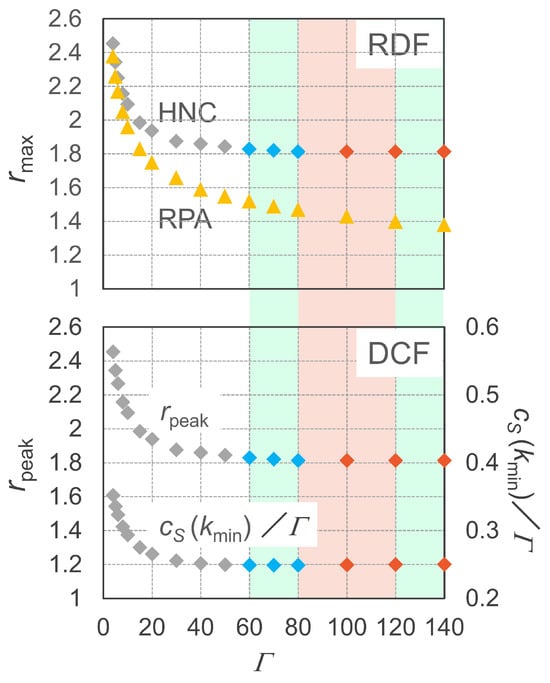
Figure 1 compares RPA and HNC predictions for the RDF peak position , a key indicator of the typical nearest-neighbor distance in the fluid. The upper panel shows a clear qualitative difference between the two approaches. The RPA predicts a monotonic decrease of with increasing , indicating continuous particle compression as Coulomb coupling intensifies. This behavior is consistent with the mean-field assumption that particles respond only to the average electrostatic field, allowing greater overlap as the effective temperature decreases.
Figure 1.
Upper and lower panels show the -dependence of HNC results; here, the yellow triangles indicate RPA results, while the HNC color coding is as follows: gray (), blue (), and red (). The (upper panel) compares RDF peak positions from HNC and RPA, while the (lower panel) presents the peak position of for (see inset in Figure 2) and the scaled Fourier component at . Background shading identifies the scope of our theoretical framework: the orange-shaded regime () highlights where the RDFs and structure factors are accurately reproduced by our proposed model. Our compact analytic representation of the short-range DCF further covers the green-shaded regions ( and ), for which a robust formula valid over is presented in Equations (5)–(7).
In contrast, the HNC results reveal a distinct structural crossover. For , the RPA and HNC curves are similar, indicating that mean-field theory is adequate in the weak-coupling regime. As increases beyond 10, deviations become more pronounced. The HNC curve shows a transition: first decreases and then approaches a plateau at about for . This saturation persists up to , indicating that the local liquid structure reaches a limiting configuration where further increases in coupling strength do not compress the first coordination shell. This behavior signals the emergence of strong short-range correlations that stabilize the nearest-neighbor distance, a feature absent in RPA. It is important to clarify that the observed saturation of around –80 represents a smooth structural crossover rather than a true thermodynamic phase transition. This crossover marks a fundamental shift from an entropy-dominated regime to an interaction-dominated regime. At weaker coupling, entropic effects favor particle interpenetration to achieve density homogenization, a behavior distinct from that of atomic liquids with hard cores. As the coupling strength increases, strong electrostatic repulsions begin to govern the local structure, suppressing particle overlaps and leading to the observed saturation of the nearest neighbor distance. This structural reorganization can be viewed as a precursor to crystallization, representing a characteristic feature of strongly coupled liquid states where local order begins to emerge.
To quantify this crossover, we identify three coupling regimes based on the HNC results: (i) a low regime (, gray symbols in Figure 1), where the structure gradually departs from RPA predictions; (ii) an intermediate regime (, blue symbols), where the crossover to strongly correlated liquid states occurs; and (iii) a high regime (, red symbols), where stabilizes and short-range correlations dominate the liquid structure.
The lower panel of Figure 1 supports the structural crossover by tracking two additional quantities derived from the short-range DCF : the first peak position for (shown in the inset of Figure 2) and the scaled Fourier component evaluated at the smallest wavenumber . Both quantities show similar trends. In the low regime, they change more rapidly with , reflecting the evolving balance between long-range electrostatics and short-range packing effects. As the system enters the intermediate regime, the rate of change slows, and by the high regime, both and become nearly constant, mirroring the saturation observed in .
Figure 2.
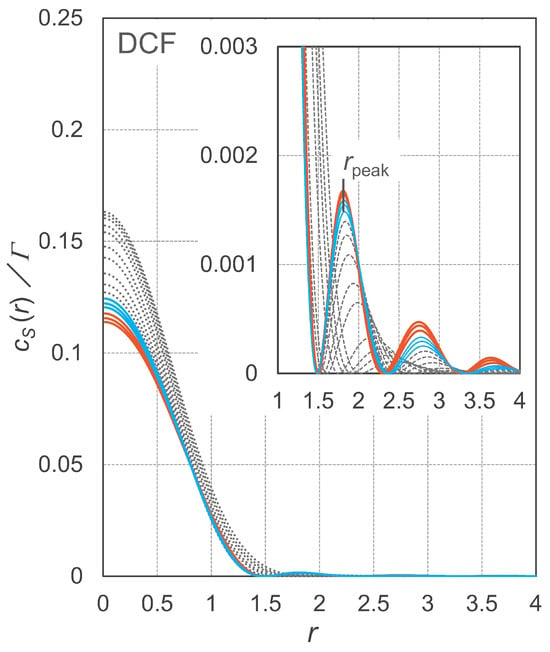
Sixteen curves of from HNC are plotted over the same range, using the same color coding as that in Figure 1. The inset highlights , where small oscillations with appear.
The behavior of is particularly informative. Since the Fourier transform approaches the spatial integral of as , the near constancy of suggests that the entire short-range correlation profile, when rescaled by , becomes universal across the strong-coupling regime. Figure 2 confirms this: sixteen curves of spanning the same coupling range collapse onto a single universal profile for , especially in the core region . The main peak at and its decay are nearly identical across the intermediate and high regimes. The inset of Figure 2 magnifies and shows small oscillations with . These oscillations represent subtle correlations beyond the main Gaussian core but remain very weak, typically less than 1–2% of the peak amplitude at .
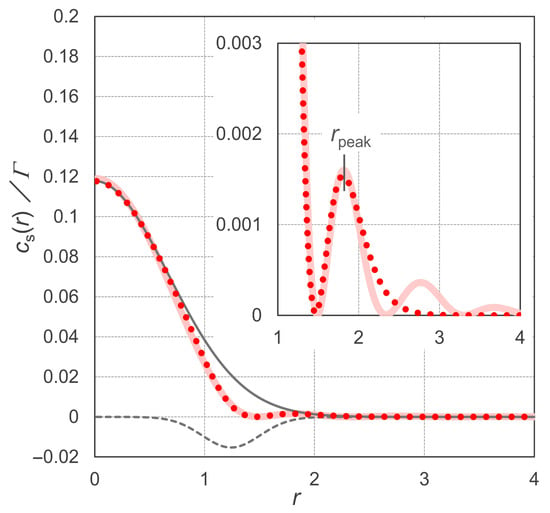
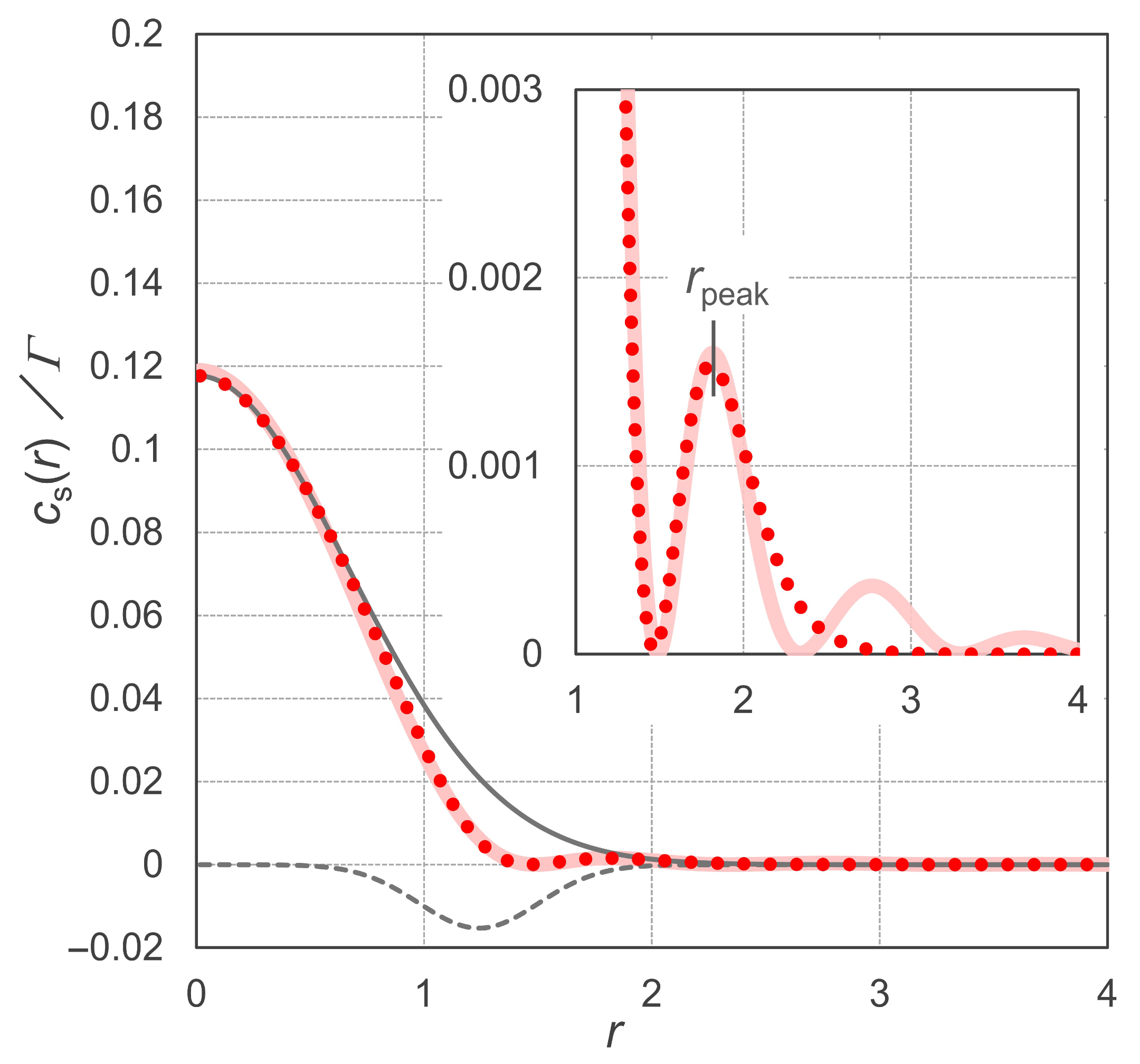
Motivated by the observed universality, we seek a compact analytic representation of the averaged curve over . Figure 3 shows this average (red solid line) and demonstrates that it can be captured by a simple two-Gaussian form. The proposed representation decomposes the short-range DCF into a dominant main component and a small residual correction:
Here, is a Gaussian centered at the origin, representing the dominant short-range repulsion induced by charge overlap. The residual term , a Gaussian centered at , accounts for the first oscillation peak visible in the inset of Figure 2. Subtracting this term reproduces the small dip and subsequent recovery in near .
The mathematical form (5) of the two-Gaussian basis given by Equations (6) and (7) is physically justified by the HNC closure in Equation (4). This relation imposes two distinct structural requirements on the correlation at short distances. First, near the origin (), where strong repulsion leads to , a large positive is necessary to satisfy the HNC closure (4). The primary Gaussian term (6) in our model represents this core exclusion effect, capturing the strong-coupling physics where particle overlaps are prohibited beyond what the bare interaction potential describes. It is important to note that since represents the correlation correction that cannot be fully captured by the RPA, which accounts only for the bare interaction between Gaussian-charge distributions, it is physically natural to adopt a two-Gaussian form to describe these short-range corrections. Second, as approaches its first peak, it must cross zero at a specific distance . At this point (), the closure relation strictly demands . The second Gaussian term (7), which carries a negative amplitude, acts as a critical adjustment to satisfy this constraint. Physically, it describes the balance at between interaction-driven exclusion and the entropic drive toward density homogenization through particle overlap. Thus, the two-Gaussian basis is not a mere fitting function but the minimal hierarchical representation required to satisfy these competing physical constraints, which explains why simpler exponential or single-term forms are insufficient.
The optimized parameters, obtained by least-squares fitting to the HNC data averaged over the entire range of , are , , , , and . These universal, dimensionless values provide a high-precision representation of the scaling form for the short-range DCF across the strong-coupling regime. To ensure reproducibility, this averaged dataset of and the corresponding parameter set are provided in the Supplementary Materials. As evidenced by the fact that this single, constant parameter set accurately reproduces both the RDFs and structure factors for all individual values, our scaling representation proves remarkably robust without any fine-tuning.
The red dotted curve in Figure 3 shows the result of Equations (5)–(7), which overlaps closely with the averaged HNC solution. The gray solid line shows the main contribution , which dominates for , while the gray dashed line shows the residual component , which introduces the small peak near . This simple two-Gaussian representation captures the full spatial dependence of over several correlation lengths, including subtle oscillatory features whose amplitude is only 1% of the maximum. This compactness is useful for applications: the analytic form can be evaluated directly, without iterative solution of integral equations, making it suitable for real-time dynamical simulations.
4. Discussions: Comparison with the HNC Results and Sum-Rule Consistency
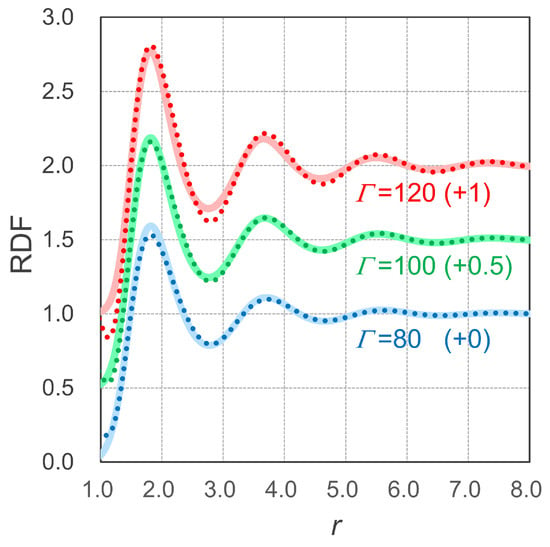
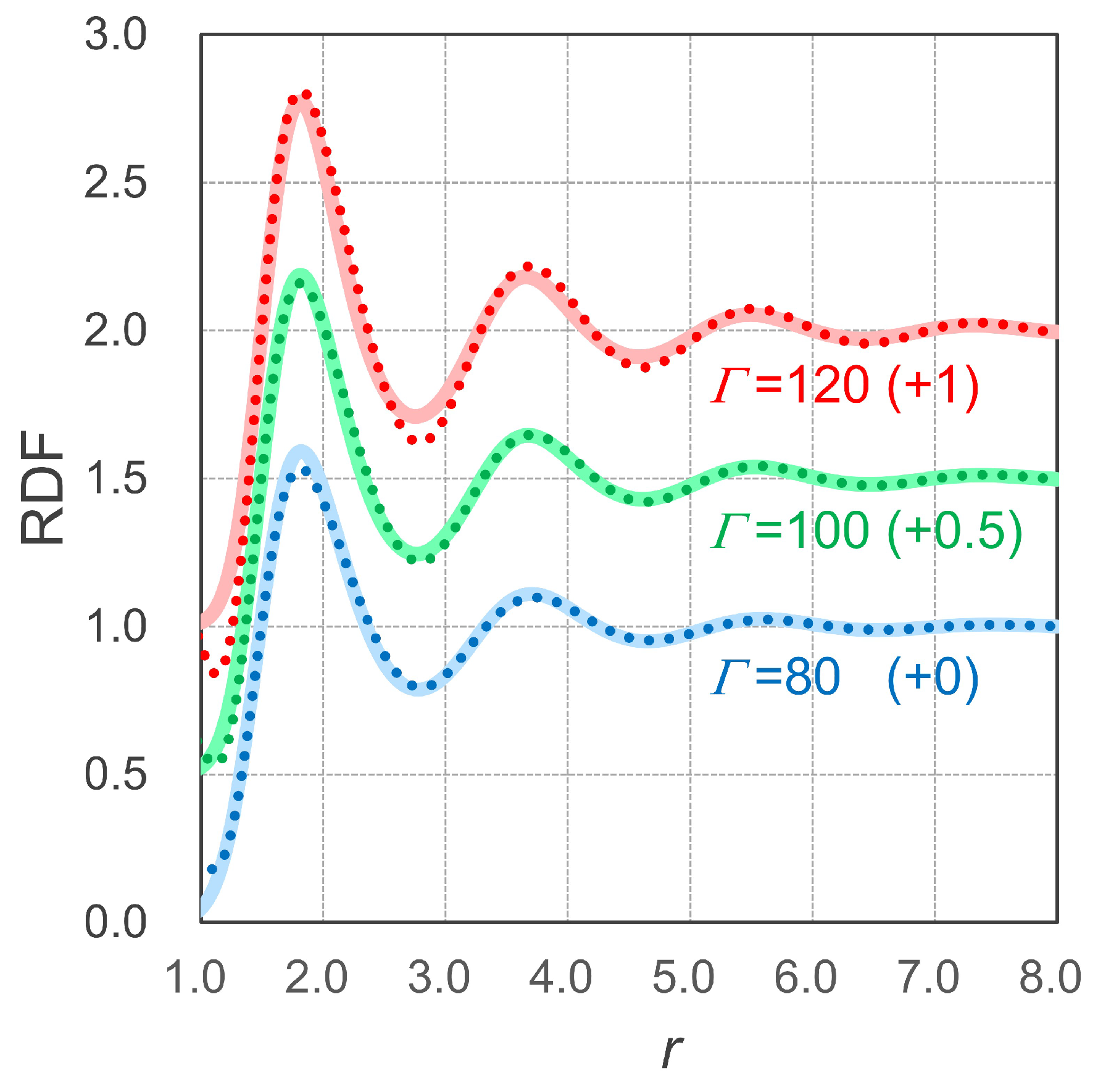
Having established the analytic form of , we test its predictive power by computing the full DCF and solving the Ornstein–Zernike relation to obtain the RDF . Figure 4 shows the comparison for three representative coupling strengths: (blue), 100 (green), and 120 (red), spanning the crossover and high regimes. The solid lines are HNC solutions from the full iterative procedure, while the dotted lines are predictions from our two-Gaussian analytic kernel. The agreement is good. For all three values of , the analytic representation reproduces the peak position , the peak height, the shoulder for , and the gradual approach to unity at large r.
To further validate the analytic kernel, we compute the structure factor via the Fourier-space Ornstein-Zernike relation. Combining Equations (2) and (5)–(7), we have
Both and have simple closed forms:
In contrast, while the proposed kernel possesses a closed-form expression in real space for enhanced utility in dynamical methods, its inverse (Hankel) transform involving a shifted Gaussian does not lend itself to the simple analytical form that the original Gaussian possesses. Therefore, is evaluated numerically via a 2D Hankel transform for computational convenience; this approach is straightforward and ensures practical efficiency for repeated use across different scaling parameters.
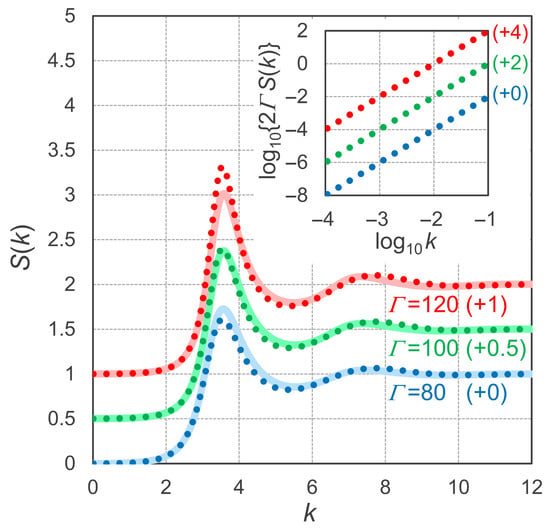
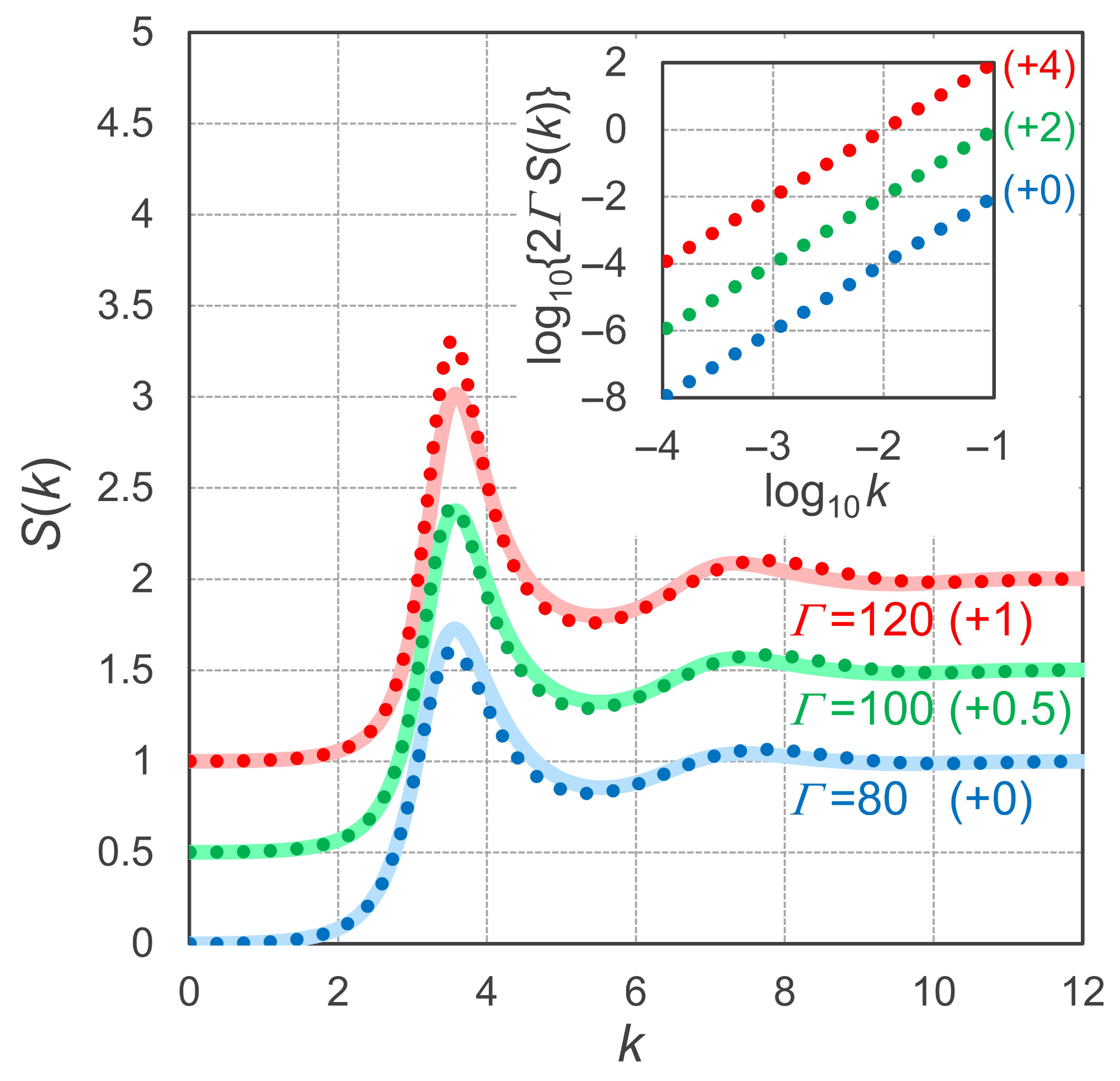
Figure 5 shows over for the same three coupling strengths as in Figure 4, with color coding and curve styles matched for consistency. The main panel shows that our analytic kernel reproduces the HNC structure factors across the entire wavenumber range. The first peak of , near –5, corresponds to the inverse of the nearest-neighbor distance and is captured in both position and height. Secondary oscillations at intermediate k are also reproduced, indicating that the analytic form describes not only the dominant correlation length but also higher-order structural features. Quantitatively, the two-Gaussian kernel demonstrates excellent agreement with the HNC data, with the maximum relative deviation for the peak heights of both and remaining within 3% for all representative values.
The inset of Figure 5 magnifies the small-k region () on a log–log scale. This region is crucial for verifying thermodynamic consistency, as the long-wavelength behavior of is governed by the sum rules [57,58,59]. For the 2D OCP, the long-wavelength behavior is governed by the second-moment sum rule, which reflects plasma screening:
Equation (11) represents the second-moment sum rule with for the dimensionless screening length [57], while ensuring that vanishes as (zeroth-moment sum rule) [57,58,59]. In the long-wavelength limit (), the behavior of charged systems is dominated by the long-range potential. The second-moment sum rule is naturally satisfied in our framework by ensuring that the DCF follows its exact asymptotic form, , for large r. In Fourier space, this means that the contribution of the Gaussian potential governs the small-k behavior of , which is the necessary condition for . Our proposed short-range representation, , consisting of rapidly decaying Gaussians, does not interfere with this long-range dominant behavior, thus preserving the fundamental sum rule without further numerical adjustment.
Equation (11) implies with slope 2 on a log–log plot. The inset confirms this behavior: all three dotted curves (analytic results for , 100, 120) show the correct scaling. This shows that our two-Gaussian representation fits the HNC data in real space and satisfies the sum rules that follow from electrostatic screening and thermodynamic stability. This consistency is nontrivial. Many approximate closures or empirical fits can reproduce locally but violate long-wavelength constraints, leading to unphysical thermodynamic properties. Our analytic kernel avoids this because it preserves the decomposition : the long-range part ensures that as (zeroth-moment sum rule), and the short-range correction does not alter the leading behavior. The fact that both sum rules are satisfied to numerical precision confirms the consistency of our approach.
The combined validation in real space and Fourier space establishes our two-Gaussian representation as a reliable and efficient alternative to full HNC solutions in the strong-coupling regime. Its analytic form is directly applicable to several dynamical methods. In sDFT/DDFT [33], the DCF enters as a convolution kernel in the free-energy functional. Our closed form enables real-space implementation without iterative integral equation solvers, reducing computational cost while maintaining HNC-level accuracy. For the DPD method [43], the kernel provides a short-range correction compatible with many-body formulations, allowing DPD simulations to incorporate strong correlations beyond mean-field approximations.
The analytical representation of the short-range DCF offered in this work provides significant practical advantages for dynamic simulation frameworks [33,43]. In traditional approaches, obtaining the correlation functions in the strong-coupling regime requires numerical integral equation solvers, which often necessitate over iterations to reach convergence in the present regime of . By replacing these heavy iterative processes with our two-Gaussian kernel, the computational bottleneck associated with solving the HNC equation at each time step or for each state point is effectively eliminated. Furthermore, because our model is defined as a simple sum of Gaussians in real space, it is exceptionally well-suited for grid-based dynamic simulations. Unlike numerical tables that require complex interpolation, our analytic form allows for direct and efficient evaluation of correlation forces and local potentials. This real-space advantage is particularly relevant for sDFT/DDFT [33], where the local density updates depend on the direct integration of correlation kernels. The transition from a computationally demanding numerical solver to a one-step analytic evaluation thus substantially enhances the feasibility of large-scale or long-time simulations of Gaussian-charge systems.
Moreover, the universality of the scaling law offers a physics-informed prior for machine-learning models [61]. Data-driven approaches to liquid-state theory often require large training datasets and can lack interpretability. By constraining neural-network architectures to reproduce the two-Gaussian form in the strong-coupling regime, one can reduce the number of parameters, improve generalization, and ensure consistency with known physical limits. This hybrid physics–AI strategy is promising for extending our results to more complex systems, such as multi-component plasmas, ionic liquids, and charged colloidal suspensions.
5. Conclusions and Outlook
This study reveals a fundamental structural crossover in the 2D Gaussian-charge OCP at strong Coulomb coupling. We show that beyond , the nearest-neighbor distance, as measured by the RDF peak position , stabilizes at approximately and ceases to compress further despite increasing coupling strength. This saturation marks a clear breakdown of the RPA, which predicts continuous compression and increasingly strong particle overlap. The stabilization of reflects the emergence of robust short-range correlations that resist further structural reorganization, a hallmark of strongly correlated liquid states.
Central to our analysis is the discovery of a universal scaling law: when rescaled by the coupling constant , the short-range DCF collapses onto a single curve across the entire strong-coupling regime (). This universality is not limited to the main correlation peak but extends to subtle oscillatory features. The observed collapse is robust, persisting over nearly a factor of variation in , and indicates that thermal fluctuations become negligible compared to electrostatic interactions in this regime. Leveraging this universality, we construct a compact analytic representation of based on a two-Gaussian decomposition: a dominant Gaussian centered at the origin encodes the core repulsion due to charge overlap, while a second Gaussian provides the necessary adjustment for structural balance.
Extensive validation confirms the accuracy and consistency of our analytic kernel. In real space, the RDFs computed from the two-Gaussian form agree closely with full HNC solutions for , 100, and 120, capturing peak positions, heights, and decay profiles. In Fourier space, the structure factor reproduces HNC results across four decades in wavenumber, from small-k screening behavior to large-k oscillations. Most importantly, our kernel satisfies both the zeroth-moment sum rule ( as ) and the second-moment sum rule ( for small k), ensuring thermodynamic and electrostatic consistency. This dual compliance with real-space accuracy and Fourier-space rigor is rare among analytic closures.
Furthermore, the validity of our results is supported by their consistency with the established limiting cases. As the coupling strength decreases, the short-range correction , which represents the deviation from the RPA, diminishes. This indicates a smooth transition toward the weak coupling limit where . The asymptotic connectivity reinforces the reliability of our analytic representation. While this study focuses on the Gaussian charge model, the fundamental physics captured by our two Gaussian representation is also expected to be a universal feature of various soft-core systems. The hierarchical balance between core exclusion and entropic homogenization is a general property of such potentials. Future work will explore the applicability of this analytic framework to other bounded potential models. We believe that providing such a simple and physically grounded analytic kernel will significantly enhance the feasibility of large scale dynamic simulations for a wide range of complex fluids and soft matter.
Beyond equilibrium structure, the proposed kernel offers methodological advantages for dynamical simulations. Its closed analytic form allows direct integration into sDFT/DDFT [33], where the DCF enters as a convolution kernel in the free-energy functional. Unlike full HNC solutions, which require iterative schemes at each time step, our two-Gaussian representation can be evaluated instantly, reducing computational cost while preserving HNC-level accuracy. This efficiency is important for studying non-equilibrium processes such as phase separation, pattern formation, and relaxation dynamics in strongly correlated soft matter. For the DPD method [43], our results provide a physically motivated short-range correction that complements standard many-body formulations. By retaining the long-range smoothed-charge electrostatics () and adding the universal short-range kernel , DPD simulations can incorporate strong correlations without altering the functional form or introducing ad hoc parameters.
Looking ahead, several extensions are promising. First, generalizing the scaling analysis to three-dimensional soft-core systems and multi-component mixtures would test the robustness of universality across dimensionality and composition. Second, incorporating the two-Gaussian kernel into time-dependent DDFT will enable systematic studies of relaxation dynamics, spinodal decomposition, and driven phase transitions in strongly coupled plasmas and charged colloids. Third, coupling our kernel with neural-network architectures offers a route to hybrid physics–AI models; encoding the universal two-Gaussian structure as an inductive bias can reduce training data requirements and improve extrapolation. Finally, extending the framework to finite-temperature quantum plasmas, where Fermi statistics and quantum diffraction modify effective interactions, is a long-term goal.
Supplementary Materials
The following supporting information can be downloaded at https://www.mdpi.com/article/10.3390/axioms15020123/s1. README.txt: Technical documentation for reproducibility containing the optimized parameter set and the physical background of the data averaging; averaged_dataset.csv: Numerical dataset for the short-range direct correlation function () averaged over .
Funding
This research received no external funding.
Data Availability Statement
The numerical data and parameters supporting the findings of this study are available in the Supplementary Materials.
Acknowledgments
The author would like to thank the Academic Editor and the anonymous reviewers for their constructive comments and insightful suggestions, which have significantly improved the mathematical precision and the reproducibility of this work.
Conflicts of Interest
The author declares no conflict of interest.
Nomenclature
| 2D | two-dimensional |
| OCP | one-component plasma |
| sDFT | stochastic density functional theory |
| DDFT | dynamical density functional theory |
| DPD | dissipative particle dynamics |
| RPA | random phase approximation |
| HNC | hypernetted-chain |
| DCF | direct correlation function |
| RDF | radial distribution function |
References
- Likos, C.N. Effective interactions in soft condensed matter physics. Phys. Rep. 2001, 348, 267–439. [Google Scholar] [CrossRef] [Scilit]
- Louis, A.A.; Bolhuis, P.G.; Hansen, J.P. Mean-field fluid behavior of the Gaussian core model. Phys. Rev. E 2000, 62, 7961–7972. [Google Scholar] [CrossRef] [Scilit]
- Likos, C.N.; Mladek, B.M.; Gottwald, D.; Kahl, G. Why do ultrasoft repulsive particles cluster and crystallize? Analytical results from density-functional theory. J. Chem. Phys. 2007, 126, 224502. [Google Scholar] [CrossRef] [Scilit] [PubMed]
- Ikeda, A.; Miyazaki, K. Thermodynamic and structural properties of the high density Gaussian core model. J. Chem. Phys. 2011, 135, 024901. [Google Scholar] [CrossRef] [Scilit]
- Ikeda, A.; Miyazaki, K. Glass Transition of the Monodisperse Gaussian Core Model. Phys. Rev. Lett. 2011, 106, 015701. [Google Scholar] [CrossRef] [Scilit]
- Ikeda, A.; Miyazaki, K. Slow dynamics of the high density Gaussian core model. J. Chem. Phys. 2011, 135, 054901. [Google Scholar] [CrossRef] [Scilit]
- Coslovich, D.; Ikeda, A. Cluster and reentrant anomalies of nearly Gaussian core particles. Soft Matter 2013, 9, 6786. [Google Scholar] [CrossRef] [Scilit]
- Archer, A.J.; Rucklidge, A.M.; Knobloch, E. Quasicrystalline Order and a Crystal-Liquid State in a Soft-Core Fluid. Phys. Rev. Lett. 2013, 111, 165501. [Google Scholar] [CrossRef] [Scilit] [PubMed]
- Coslovich, D.; Ikeda, A.; Miyazaki, K. Mean-field dynamic criticality and geometric transition in the Gaussian core model. Phys. Rev. E 2016, 93, 042602. [Google Scholar] [CrossRef] [Scilit]
- Hakem, F.; Johner, A.; Joanny, J.F. Polymeric Salts: Statica nd Dynamic Debye-Hückel Theory. Macromolecules 1998, 31, 8305–8311. [Google Scholar] [CrossRef] [Scilit]
- Chen, Y.G.; Weeks, J.D. Local molecular field theory for effective attractions between like charged objects in systems with strong Coulomb interactions. Proc. Natl. Acad. Sci. USA 2006, 103, 7560–7565. [Google Scholar] [CrossRef] [Scilit]
- Coslovich, D.; Hansen, J.P.; Kahl, G. Ultrasoft primitive model of polyionic solutions: Structure, aggregation, and dynamics. J. Chem. Phys. 2011, 134, 244514. [Google Scholar] [CrossRef] [Scilit]
- Nikoubashman, A.; Hansen, J.P.; Kahl, G. Mean-field theory of the phase diagram of ultrasoft, oppositely charged polyions in solution. J. Chem. Phys. 2012, 137, 094905. [Google Scholar] [CrossRef] [Scilit] [PubMed]
- Warren, P.B.; Vlasov, A.; Anton, L.; Masters, A.J. Screening properties of Gaussian electrolyte models, with application to dissipative particle dynamics. J. Chem. Phys. 2013, 138, 204907. [Google Scholar] [CrossRef] [Scilit]
- Warren, P.B.; Masters, A.J. Phase behaviour and the random phase approximation for ultrasoft restricted primitive models. J. Chem. Phys. 2013, 138, 074901. [Google Scholar] [CrossRef] [Scilit]
- Warren, P.B.; Vlasov, A. Screening properties of four mesoscale smoothed charge models, with application to dissipative particle dynamics. J. Chem. Phys. 2014, 140, 084904. [Google Scholar] [CrossRef] [Scilit]
- Rotenberg, B.; Bernard, O.; Hansen, J.P. Salt-induced effective interactions and phase separation of an ultrasoft model of polyelectrolytes. Mol. Phys. 2014, 112, 1313–1319. [Google Scholar] [CrossRef] [Scilit]
- Caillol, J.M.; Levesque, D. Liquid-vapor transition and critical behavior of the ultrasoft restricted primitive model of polyelectrolytes: A Monte Carlo study. J. Chem. Phys. 2014, 140, 214505. [Google Scholar] [CrossRef] [Scilit] [PubMed]
- Patsahan, O. Gas-liquid critical point of the ultrasoft restricted primitive model from analytic theory. Condens. Matter Phys. 2015, 18, 24601. [Google Scholar] [CrossRef] [Scilit]
- Mao, R.; Lee, M.T.; Vishnyakov, A.; Neimark, A.V. Modeling Aggregation of Ionic Surfactants Using a Smeared Charge Approximation in Dissipative Particle Dynamics Simulations. J. Phys. Chem. B 2015, 119, 11673–11683. [Google Scholar] [CrossRef] [Scilit]
- Frydel, D. The double-layer structure of overscreened surfaces by smeared-out ions. J. Chem. Phys. 2016, 145, 184703. [Google Scholar] [CrossRef] [Scilit]
- Frydel, D. Mean Field Electrostatics Beyond the Point Charge Description. In Advances in Chemical Physics; John Wiley & Sons, Inc.: Hoboken, NJ, USA, 2016. [Google Scholar] [CrossRef] [Scilit]
- Remsing, R.C.; Weeks, J.D. Role of Local Response in Ion Solvation: Born Theory and Beyond. J. Phys. Chem. B 2016, 120, 6238–6249. [Google Scholar] [CrossRef] [Scilit]
- Eslami, H.; Khani, M.; Müller-Plathe, F. Gaussian Charge Distributions for Incorporation of Electrostatic Interactions in Dissipative Particle Dynamics: Application to Self-Assembly of Surfactants. J. Chem. Theory Comput. 2019, 15, 4197–4207. [Google Scholar] [CrossRef] [Scilit] [PubMed]
- Ye, B.B.; Chen, S.; Wang, Z.G. GCMe: Efficient Implementation of the Gaussian Core Model with Smeared Electrostatic Interactions for Molecular Dynamics Simulations of Soft Matter Systems. J. Chem. Theory Comput. 2024, 20, 6870–6880. [Google Scholar] [CrossRef] [Scilit] [PubMed]
- Abraham, G.R.; Li, T.; Nguyen, A.; Jacobs, W.M.; Saleh, O.A. Cooperation and Competition of Base Pairing and Electrostatic Interactions in Mixtures of DNA Nanostars and Polylysine. J. Am. Chem. Soc. 2025, 147, 42452–42461. [Google Scholar] [CrossRef] [Scilit] [PubMed]
- Zhu, G.; Xu, Z.; Yang, Y.; Dai, X.; Yan, L.T. Hierarchical Crystals Formed from DNA-Functionalized Janus Nanoparticles. ACS Nano 2018, 12, 9467–9475. [Google Scholar] [CrossRef] [Scilit]
- Zhu, G.; Gao, L.; Wang, Y.; Tlusty, T.; Yan, L.T. Programmable Potentials Choreograph Defects in a Colloidal Crystal Shell. Phys. Rev. Lett. 2024, 132, 048201. [Google Scholar] [CrossRef] [Scilit]
- Heyes, D.M.; Rickayzen, G. Continuous distributions of charges: Extensions of the one component plasma. J. Chem. Phys. 2014, 140, 024506. [Google Scholar] [CrossRef] [Scilit]
- Heyes, D.; Rickayzen, G. Clustering of continuous distributions of charge. Mol. Phys. 2014, 112, 1398–1404. [Google Scholar] [CrossRef] [Scilit]
- Frusawa, H. Electrostatic contribution to colloidal solvation in terms of the self-energy-modified Boltzmann distribution. Phys. Rev. E 2020, 101, 012121. [Google Scholar] [CrossRef] [Scilit]
- Frusawa, H. On the equivalence of self-consistent equations for nonuniform liquids: A unified description of the various modifications. J. Stat. Mech. Theory Exp. 2021, 2021, 013213. [Google Scholar] [CrossRef] [Scilit]
- te Vrugt, M.; Löwen, H.; Wittkowski, R. Classical dynamical density functional theory: From fundamentals to applications. Adv. Phys. 2020, 69, 121–247. [Google Scholar] [CrossRef] [Scilit]
- Frusawa, H.; Hayakawa, R. On the controversy over the stochastic density functional equations. J. Phys. A Math. Gen. 2000, 33, L155–L160. [Google Scholar] [CrossRef] [Scilit]
- Frusawa, H. Stochastic dynamics and thermodynamics around a metastable state based on the linear Dean–Kawasaki equation. J. Phys. A Math. Theor. 2019, 52, 065003. [Google Scholar] [CrossRef] [Scilit]
- Frusawa, H. Transverse Density Fluctuations around the Ground State Distribution of Counterions near One Charged Plate: Stochastic Density Functional View. Entropy 2019, 22, 34. [Google Scholar] [CrossRef] [Scilit] [PubMed]
- Frusawa, H. Stochastic Density Functional Theory on Lane Formation in Electric-Field-Driven Ionic Mixtures: Flow-Kernel-Based Formulation. Entropy 2022, 24, 500. [Google Scholar] [CrossRef] [Scilit]
- Frusawa, H. Electric-field-induced oscillations in ionic fluids: A unified formulation of modified Poisson–Nernst–Planck models and its relevance to correlation function analysis. Soft Matter 2022, 18, 4280–4304. [Google Scholar] [CrossRef] [Scilit]
- Archer, A.J.; Evans, R. Dynamical density functional theory and its application to spinodal decomposition. J. Chem. Phys. 2004, 121, 4246–4254. [Google Scholar] [CrossRef] [Scilit] [PubMed]
- Archer, A.J.; Walters, M.C.; Thiele, U.; Knobloch, E. Solidification in soft-core fluids: Disordered solids from fast solidification fronts. Phys. Rev. E 2014, 90, 042404. [Google Scholar] [CrossRef] [Scilit]
- Archer, A.J.; Rucklidge, A.M.; Knobloch, E. Soft-core particles freezing to form a quasicrystal and a crystal-liquid phase. Phys. Rev. E 2015, 92, 012324. [Google Scholar] [CrossRef] [Scilit]
- Treffenstädt, L.L.; Schindler, T.; Schmidt, M. Dynamic decay and superadiabatic forces in the van Hove dynamics of bulk hard sphere fluids. SciPost Phys. 2022, 12, 133. [Google Scholar] [CrossRef] [Scilit]
- Español, P.; Warren, P.B. Perspective: Dissipative particle dynamics. J. Chem. Phys. 2017, 146, 150901. [Google Scholar] [CrossRef] [Scilit]
- Zhao, J.; Chen, S.; Zhang, K.; Liu, Y. A review of many-body dissipative particle dynamics (MDPD): Theoretical models and its applications. Phys. Fluids 2021, 33, 112002. [Google Scholar] [CrossRef] [Scilit]
- Mahdisoltani, S.; Golestanian, R. Long-Range Fluctuation-Induced Forces in Driven Electrolytes. Phys. Rev. Lett. 2021, 126, 158002. [Google Scholar] [CrossRef] [Scilit]
- Mahdisoltani, S.; Golestanian, R. Transient fluctuation-induced forces in driven electrolytes after an electric field quench. New J. Phys. 2021, 23, 073034. [Google Scholar] [CrossRef] [Scilit]
- Avni, Y.; Adar, R.M.; Andelman, D.; Orland, H. Conductivity of Concentrated Electrolytes. Phys. Rev. Lett. 2022, 128, 098002. [Google Scholar] [CrossRef] [Scilit] [PubMed]
- Bernard, O.; Jardat, M.; Rotenberg, B.; Illien, P. On analytical theories for conductivity and self-diffusion in concentrated electrolytes. J. Chem. Phys. 2023, 159, 164105. [Google Scholar] [CrossRef] [Scilit] [PubMed]
- Bonneau, H.; Avni, Y.; Andelman, D.; Orland, H. Frequency-dependent conductivity of concentrated electrolytes: A stochastic density functional theory. J. Chem. Phys. 2024, 161, 244501. [Google Scholar] [CrossRef] [Scilit] [PubMed]
- Robin, P. Correlation-induced viscous dissipation in concentrated electrolytes. J. Chem. Phys. 2024, 160, 064503. [Google Scholar] [CrossRef] [Scilit]
- Berthoumieux, H.; Démery, V.; Maggs, A.C. Nonlinear conductivity of aqueous electrolytes: Beyond the first Wien effect. J. Chem. Phys. 2024, 161, 184504. [Google Scholar] [CrossRef] [Scilit]
- Illien, P.; Carof, A.; Rotenberg, B. Stochastic Density Functional Theory for Ions in a Polar Solvent. Phys. Rev. Lett. 2024, 133, 268002. [Google Scholar] [CrossRef] [Scilit] [PubMed]
- Bonneau, H.; Démery, V.; Raphaël, E. Stationary and transient correlations in driven electrolytes. J. Stat. Mech. Theory Exp. 2025, 2025, 033201. [Google Scholar] [CrossRef] [Scilit]
- Le Bon, L.; Carof, A.; Illien, P. Non-Gaussian density fluctuations in the Dean-Kawasaki equation. Phys. Rev. E 2025, 112, 034127. [Google Scholar] [CrossRef] [Scilit]
- Illien, P. The Dean-Kawasaki equation and stochastic density functional theory. Rep. Prog. Phys. 2025, 88, 086601. [Google Scholar] [CrossRef] [Scilit]
- Hansen, J.P.; McDonald, I.R. Theory of Simple Liquids; Academic Press: Cambridge, MA, USA, 2013. [Google Scholar] [CrossRef] [Scilit]
- Frusawa, H. Bridging 3D Confinement and 2D Correlations in Counterion Layers at Charged Interfaces: An Extended Percus Relation from First Principles. Symmetry 2025, 17, 1783. [Google Scholar] [CrossRef] [Scilit]
- Martin, P.A. Sum rules in charged fluids. Rev. Mod. Phys. 1988, 60, 1075–1127. [Google Scholar] [CrossRef] [Scilit]
- Torquato, S. Hyperuniform states of matter. Phys. Rep. 2018, 745, 1–95. [Google Scholar] [CrossRef] [Scilit]
- Anderson, D.G. Iterative Procedures for Nonlinear Integral Equations. J. ACM 1965, 12, 547–560. [Google Scholar] [CrossRef] [Scilit]
- Bui, A.T.; Cox, S.J. Learning Classical Density Functionals for Ionic Fluids. Phys. Rev. Lett. 2025, 134, 148001. [Google Scholar] [CrossRef] [Scilit]
Disclaimer/Publisher’s Note: The statements, opinions and data contained in all publications are solely those of the individual author(s) and contributor(s) and not of MDPI and/or the editor(s). MDPI and/or the editor(s) disclaim responsibility for any injury to people or property resulting from any ideas, methods, instructions or products referred to in the content. |
© 2026 by the author. Licensee MDPI, Basel, Switzerland. This article is an open access article distributed under the terms and conditions of the Creative Commons Attribution (CC BY) license.