


Abstract
Let G be a graph and let be two disjoint vertex subsets with . A many-to-many k-disjoint path cover of G is a set of k vertex-disjoint paths, each joining a source in S to a sink in T, whose union covers all vertices of G. The cover is paired if each vertex of S must be joined to a prescribed vertex of T, and unpaired otherwise. Let be an n-dimensional Cayley graph generated by a unicyclic graph with bipartition and . Let and be two vertex subsets with . In this paper, we prove that admits an unpaired many-to-many two-disjoint path cover with at most faulty edges for .
Keywords:
Cayley graphs; unicyclic graphs; modified bubble-sort networks; Hamiltonian paths; disjoint path covers; fault tolerance MSC:
05C25; 05C38; 05C90
1. Introduction
The topology of an interconnection network is a critical factor in determining the communication efficiency and fault tolerance of parallel and distributed systems [1]. Graph-theoretic models have become fundamental tools for analyzing and comparing network topologies. Typically, an interconnection network is modeled as a graph in which vertices represent processors, memory modules, or switches, and edges represent communication links [2,3,4].
Path embedding is a fundamental problem in network communication and has been extensively studied [5,6,7]. A Hamiltonian path is a spanning path and is a special type of path embedding [8,9]. However, many applications require embedding two or more paths in networks, which gives rise to the many-to-many k-disjoint path cover problem [10,11,12,13,14,15]. Given a graph G, let and be two disjoint vertex subsets of equal size k in G. A many-to-many k-disjoint path cover joining S and T is a set of k vertex-disjoint paths whose union covers all vertices of G, with each path connecting one source in S to one sink in T. The cover is paired if each vertex of S must be joined to a designated vertex of T, or unpaired otherwise. A graph G is said to be f-edge fault-tolerant k-disjoint path coverable if, after removing at most f edges, the remaining graph still admits such a cover [16,17,18,19,20].
Among various network topologies, Cayley graphs have received extensive attention owing to their desirable properties, including high symmetry, regularity and vertex-transitivity [2,4,8,21]. Let G be a group with identity element e, and let B be a subset of with . The Cayley graph has vertex set G and edge set . In this paper, the set is denoted by , and the symmetric group on is denoted by . For convenience, the transposition is a permutation that exchanges the elements in positions i and j. The transposition generating graph is a graph with vertex set and edge set . If is a tree, we call a Cayley graph generated by a transposition tree, denoted by . The properties of , including connectivity, Hamiltonian laceability under edge faults, and many-to-many two-disjoint path covers, have been extensively studied [22,23,24].
If is a unicyclic graph, we denote it by . Then is the Cayley graph generated by a unicyclic graph, denoted by . In particular, if is a cycle, then is called the modified bubble-sort graph, denoted by . The properties of graphs have been extensively studied, such as conditional connectivity [25,26] and disjoint path covers [22,27]. In particular, Qiao et al. [22] investigated the many-to-many two-disjoint path covers of with edge faults and proved that is -edge fault-tolerant many-to-many two-disjoint path coverable for . As a corollary, they derived that is -edge fault-tolerant many-to-many two-disjoint path coverable. Meanwhile, Ref. [27] shows that admits the paired many-to-many two-disjoint path covers under fault-free conditions.
This paper investigates the edge fault-tolerant unpaired many-to-many two-disjoint path covers of , and shows that for , admits such covers in the presence of at most faulty edges. Since disjoint path covers serve as a fundamental model for parallel routing, our study on the edge fault-tolerant unpaired two-disjoint path cover of goes beyond a theoretical extension, providing valuable guidance for designing robust and scalable interconnection networks.
2. Preliminaries
For standard definitions not given here, we follow the terminology of Book [28]. For a path in G, we use to denote the subpath of P from to . In this paper, we write for , and for . A path in a graph G that visits every vertex of G exactly once is called a Hamiltonian path. A bipartite graph G is Hamiltonian laceable if it has a Hamiltonian path between any two vertices from distinct partite sets of G.
Proposition 1
([29]). Let be a transposition graph corresponding to the transposition generating set for . Then if and only if .
The following result in [22] indicates the fault tolerance of many-to-many unpaired two-disjoint path covers in Cayley graphs generated by transposition trees .
Lemma 1
([22]). is f-edge fault-tolerant unpaired two-disjoint path coverable with and .
Lemma 2
([30]). Let T be a labeled tree of order n, and let e be an edge of T. The two components of are denoted by and , where . Furthermore, let B, , and be transposition sets on satisfying , , and . Then, has components and each component is isomorphic to .
It has been shown that is connected if and only if its transposition generating graph is connected [29]. Thus, cannot be disconnected by removing an edge of the cycle in , but it can be disconnected by removing a cut edge of if has one. Let j be a leaf vertex of , and let e be the edge incident to j in . Then has two components and , such that and . By Lemma 2, we can decompose into n components by removing the edge e, with each component isomorphic to , that is, .
In this paper, we take a leaf vertex of to be n if has leaf vertices, and the subgraph of induced by the vertex set is denoted by , where means the n-th position of a permutation x. The decomposition of induced by the leaf vertex n yields n copies of , denoted by . Then, for , is said to be the outgoing neighbor of x, and is called an outgoing edge corresponding to x.
Proposition 2
([31]). There are independent edges, denoted by , between and , where are two distinct integers in . Moreover, among all vertices in , there are white vertices and black vertices in .
Since the transposition generating graph of has no leaf vertices and every vertex on is incident with exactly two edges, there are independent edges between and by Proposition 2. Moreover, if the transposition generating graph of is a unicyclic graph other than a cycle, it contains leaf vertices. This structural difference breaks the bidirectional symmetry, resulting in only half the number of independent edges between and , which is exactly .
Lemma 3
([32]). Let x and y be two distinct vertices in which comes from different bipartite sets. Suppose that e is an edge in with . Then with admits a Hamiltonian path joining x and y passing through the edge e.
Corollary 1.
Let x and y be two distinct vertices in which comes from different bipartite sets. Suppose that e is an edge in with . Then with admits a Hamiltonian path joining x and y passing through the edge e.
Proof.
For , . Let be an edge such that u and x belong to the same partite set, v and y belong to the same partite set, and . Let the remaining two vertices in be w and b, so that the bipartition of is and . Then a Hamiltonian path can be constructed. When , for any given edge , there exists a transposition such that . Since the unique cycle in has length at least 3, there exists an edge on this cycle. Thus, and the edge . By Lemma 3, there exists a Hamiltonian path in joining x and y passing through the edge e. Because is a spanning subgraph of , the Hamiltonian path also exists in . □
Lemma 4
([33]). is -edge fault-tolerant Hamiltonian laceable with .
Lemma 5.
For and , with . Set and so that they come from different partite sets. Let F be a set of faulty edges in with . Then has a Hamiltonian path joining u and v.
Proof.
Without loss of generality, we can assume that u is a white vertex and v is a black vertex. Let and be a permutation on I such that and . Since for , for each , there exists at least one fault-free edge such that is a black vertex and is a white vertex. By Lemma 4, there exist a Hamiltonian path from u to in , Hamiltonian paths from to in for every , and a Hamiltonian path from to v in . Then a Hamiltonian path is constructed as . □
Note that Lemma 5 is derived for , as the inequalities used in its proof only hold under this condition. To establish the main result for all , we handle the base cases and separately, which correspond to Lemma 7 and Lemma 9, respectively. For the remaining cases where , we proceed with the inductive step using Lemma 5.
3. Fault-Tolerant Unpaired Many-to-Many Two-Disjoint Path Cover of
Let and be two subsets of , where is a white vertex and is a black vertex for . We will construct an unpaired two-disjoint path cover between S and T in . Before proceeding to the main results, recall a result on the unpaired many-to-many two-disjoint path cover of the modified bubble-sort graph as follows.
Lemma 6
([22]). is f-edge fault-tolerant unpaired two-disjoint path coverable with and .
If the transposition generating graph of is a cycle, then is the modified bubble-sort graph . Lemma 6 shows that admits an unpaired two-disjoint path cover under edge faults. Therefore, in what follows, we consider only unicyclic graphs other than cycles. If contains a pendant path of length at least 2, let n be its leaf with unique neighbor , and let be the other neighbor of on this path. Otherwise, take an arbitrary leaf n with unique neighbor , and let the two neighbors of on the cycle be and .
Lemma 7.
is unpaired two-disjoint path coverable.
Proof.
Let and be the bipartition of . Let . Then . Since is Hamiltonian laceable, there exists a Hamiltonian path in joining any two vertices in different partite sets. Hence, and are vertex-disjoint and cover ; thus, forms an unpaired two-disjoint path cover of . □
In the following, for each transposition , let denote the set of edges of generated by . For distinct , let denote the set of faulty edges between and , and set .
Lemma 8.
Let the transposition generating graph of be a 3-cycle with a pendant edge. Let with , and be the set of faulty cross-edges in with . Then, for any two distinct vertices x and y in different bipartite sets of such that at least one of their outgoing neighbors and is not in , there exists a Hamiltonian path P from x to y in .
Proof.
Let x be a black vertex and y be a white vertex; assume the outgoing neighbor is not in . Without loss of generality, assume that , where .
Case 1. x and y belong to the same component of , without loss of generality; assume that .
Case 1.1. for . If one of the two edges between and is faulty, assume that the other fault-free edge connects a white vertex w in to a black vertex b in . Let be an edge such that is a black vertex in , and is a white vertex in . Since edges and are outgoing edges between and for , and are fault-free. Given that is not in , the edge . By Corollary 1, has a Hamiltonian path from x to y through . By Lemma 4, there exist Hamiltonian paths from to w in and from b to in . Let . Thus, P is a Hamiltonian path of .
Case 1.2. for (or for ). There exist edges and such that , , and . Since for , the edges , , and are fault-free. Given that is not in , the edge . By Corollary 1, there exist Hamiltonian paths in from x to y containing and in from to containing . By Lemma 4, there exists a Hamiltonian path from to in . Let . Then P is the Hamiltonian path of .
Case 2. x and y belong to two different components of , without loss of generality; assume that and .
Case 2.1. for (or for ). Let be an edge in and be a white vertex. Suppose that , , since for , the edges , , and are fault-free. Furthermore, because is not in and , it follows that . By Corollary 1, there is a Hamiltonian path in from x to z through ; by Lemma 4, there exist Hamiltonian paths from to y in and from to in . Let . Thus, P is the desired path of .
Case 2.2. for . Let u be a white vertex in and v be a black vertex in , such that . Since for , the edges and are fault-free. By Lemma 4, there exist Hamiltonian paths from x to u in , from to in , and from v to y in . Let . Then P is the desired path of . □
Since is a Cayley graph generated by the symmetric group, its underlying symmetric group structure inherently guarantees that is vertex-transitive. Specifically, this vertex-transitive property allows us to utilize graph automorphisms to fix a target vertex, say , in . On this basis, we only need to discuss the positional distribution of , and . This significantly reduces the exhaustive case analysis in the subsequent path constructions.
Lemma 9.
is many-to-many unpaired 1-edge fault-tolerant two-disjoint path coverable.
Proof.
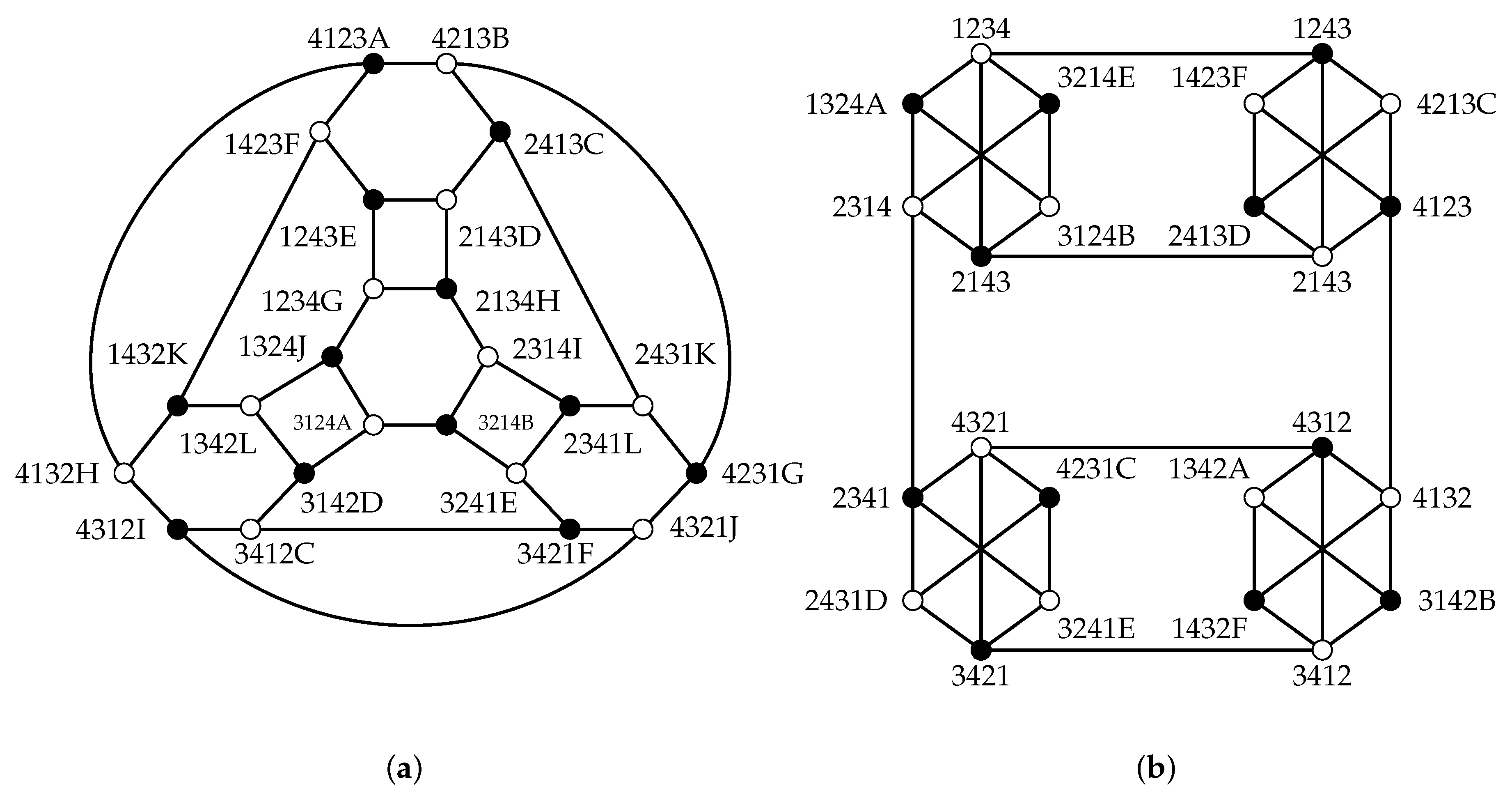
Up to isomorphism, has just two types: one whose transposition generating graph is the 4-cycle , the other whose transposition generating graph is the 3-cycle with a pendant edge, as shown in Figure 1b,c. For the former, that is, , the result follows from Lemma 7.
Let edge e be the unique faulty edge of . We now consider whose transposition generating graph is a 3-cycle with a pendant edge. Its edges fall into four types: , , and . If , then without loss of generality, assume that . By Lemma 1, is fault-free and isomorphic to . Therefore, is unpaired two-disjoint path coverable. If , we decompose into four copies of along the leaf vertex 4, denoted by , , , and . Each copy is isomorphic to the complete bipartite graph and contains no faulty edges, where is a permutation on . There are two independent edges between any two different copies. Since is vertex transitive, we may fix , yielding four subcases as follows.
Case 1. . In this case, by Lemma 7, since is fault-free, there exists an unpaired two-disjoint path cover . Without loss of generality, assume joins to and joins to , where . Let x be the neighbor of on . Since there is only one faulty cross edge, at least one of and has fault-free outgoing edges; assume it is . And let , then and . By Lemma 8, there exists a Hamiltonian path P from to x in . Let and . Thus, forms a many-to-many unpaired two-disjoint path cover of .
Case 2. lie in two copies of , and denote and .
Case 2.1. , . Since only one outgoing edge is faulty, there exists at least one black vertex in such that is fault-free. By Lemma 7, there is an unpaired two-disjoint path cover with joining to and joining to x. And let , then and . By Lemma 8, there exists a Hamiltonian path P from to in . Let and . Thus, forms the desired two-disjoint path cover of .
Case 2.2. , . Then at least one of and has no faulty edges to either or ; assume it is . Without loss of generality, assume that the fault-free edge between and connects a white vertex to a black vertex . Then in , there is an edge such that is black and is white. Since has no faulty edges to either or , the edges are fault-free. By Corollary 1, there is a Hamiltonian path in from to through . By Lemma 4, there exist Hamiltonian paths from to in , from to w in , and from to b in . Let and . Then, forms the desired two-disjoint path cover of .
Case 2.3. , .
Case 2.3.1. . Relabel the four copies as such that , , and there is no faulty cross edge between and for . For each , there exist fault-free edges and between and with black and white. By Lemma 7, there exist unpaired two-disjoint path covers in for such that joins to , joins to ; for , joins to and joins to ; and joins to , joins to . Let and . Then, forms the desired two-disjoint path cover of . If , we can also use to relabel the four copies such that for , then the desired path cover can be constructed.
Case 2.3.2. . Without loss of generality, assume that the fault-free edge between the two copies connects a white vertex w in to a black vertex b in . Let and be black vertices, where and . Since , the edges are fault-free. By Lemma 7, there is an unpaired two-disjoint path cover in with joining to x and joining to y, and an unpaired two-disjoint path cover in with joining to and joining to . By Lemma 4, there exist Hamiltonian paths from to b in and from w to u in . Let and . Then, forms the desired unpaired two-disjoint path cover of .
Case 2.4. , . This case is similar to Case 2.1, and the detailed proofs are omitted.
Case 3. lie in three copies of .
Case 3.1. , and .
Case 3.1.1. . Since there is only one faulty outgoing edge and contains three black vertices, there exist at least two black vertices x and y such that and are fault-free. If and (or and ), then in , there is an edge with and , such that the edges are fault-free. By Lemma 7, there exists an unpaired two-disjoint path cover in with joining to x and joining to y. By Corollary 1, there is a Hamiltonian path in from to through . By Lemma 4, there exist Hamiltonian paths from to in and from to in . Let and . Then, forms a many-to-many unpaired two-disjoint path cover of .
If and , there exists a black vertex such that and is fault-free. The subsequent constructions are analogous to the preceding ones and are therefore omitted.
Case 3.1.2. for . In this case, there exist two black vertices x and y such that , , and the edges are fault-free. Let be an edge in either or , such that . There are two such edges, for at least one of which and are fault-free. Without loss of generality, assume it lies in . The rest is similar to Case 3.1.1.
Case 3.2. , and . At least one of , , and is connected to the other two copies by fault-free edges. And let , then . Since we aim to construct a Hamiltonian path covering with endpoints and , we do not need to consider the distribution of their outgoing neighbors in this case. By following a construction similar to that in Case 2 of Lemma 8, we obtain such a path P. Let and . Thus, forms the desired two-disjoint path cover of .
Case 3.3. , and . The detailed proof is omitted since it is similar to Case 3.1.
Case 3.4. , and . The detailed proof is omitted since it is similar to Case 3.2.
Case 4. lie in four distinct copies of . Assume that , , and . Since there only exists exactly one faulty cross edge, without loss of generality, assume that and . There exist two black vertices and such that , , and the edges are fault-free. By Lemma 4, there exist Hamiltonian paths from to x in , from to in , from to y in , and from to in . Let and and is the desired two-disjoint path cover. □
Figure 1.
Illustrations (a) whose transposition generating graph is ; (b) whose transposition generating graph is with a pendant edge. (White/black dots represent even/odd transpositions, respectively; edges between vertices with identical labels are omitted.)
Theorem 1.
is f-edge fault-tolerant unpaired two-disjoint path coverable with for .
Proof.
The result follows from Lemma 6 when the transposition generating graph of is an n-cycle. Thus, it remains to consider other unicyclic transposition generating graphs. For , Theorem 1 follows from Lemma 7. Hence, it suffices to prove that for . By Lemma 9, the base case holds. For and , assume that is f-edge fault-tolerant unpaired two-disjoint path coverable. Decompose into n copies of , say . Let F be the set of faulty edges in with , and let be the set of faulty edges in with for . Let be the set of faulty edges between different copies with . Let . Since is vertex-transitive, we may fix . We consider the locations of in four cases.
Case 1. . The induction hypothesis yields an unpaired two-disjoint path cover between S and T; we assume that path joins to and path joins to in .
Case 1.1. . According to the number of faulty edges between and , we consider two subcases.
Case 1.1.1. .
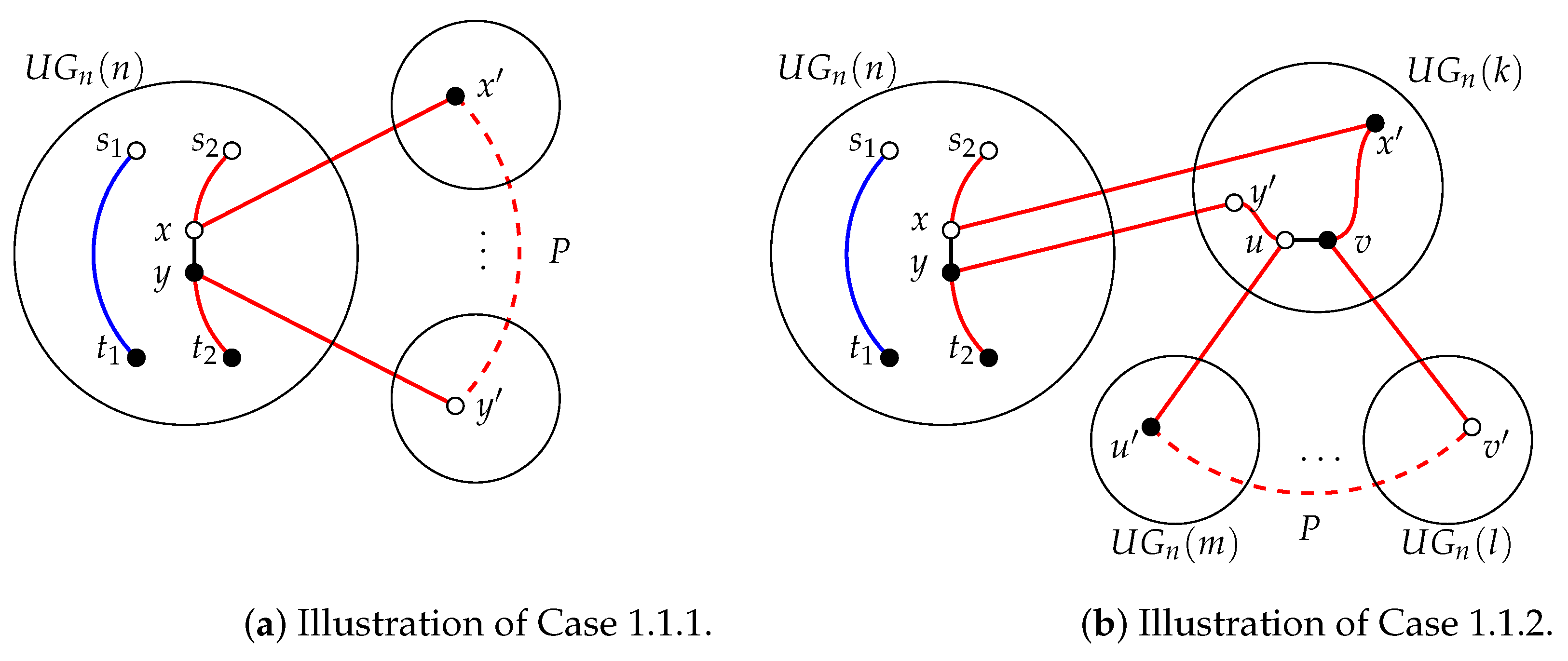
(a). If contains trees of length at least 2, then by Lemma 3, removing decomposes into components isomorphic to . The minimum number of edges in on needed to join all components is at least . Since , there exists at least one fault-free edge on or such that both and are fault-free. Moreover, and belong to different copies of . Without loss of generality, assume is on . By Lemma 5, there exists a path P from to spanning all vertices of . Then construct a new path . Thus, forms a path cover of , as shown in Figure 2a.
(b). If contains only trees of length 1, then by Lemma 3, removing and decomposes into components isomorphic to . At least edges from on are required to join these components. Since , there exists at least one fault-free edge on or such that both and are fault-free. The rest of the construction is analogous to that in Case 1.1.1(a) and is omitted here.
Case 1.1.2. Since , all edges inside each copy are fault-free. There must exist an edge on or such that and are fault-free. If no edge of or satisfies this requirement, then there are at least faulty edges in . Since for , this contradicts . Assume lies on . If and are in different copies, this case is similar to Case 1.1.1. Otherwise, assume and lie in the same copy with . Let be an edge of with , where and . Since for , we can choose an edge e such that both and are fault-free. By Corollary 1, there exists a Hamiltonian path H in from to through the edge e. By Lemma 5, there exists a path P from to that spans . Thus, forms a path cover of , as shown in Figure 2b, where .
Case 1.2. . Let be a faulty edge. Applying the induction hypothesis to , we obtain an unpaired two-disjoint path cover between S and T. If , it is similar to Case 1.1.1. Otherwise, assume . If and are in different copies, this case is also similar to Case 1.1.1. If they are in the same copy , it is similar to Case 1.1.2.
Figure 2.
Illustrations for Case 1 of Theorem 1.
Case 2. lie in two copies of , denoted by and , where . There are four subcases.
Case 2.1. and .
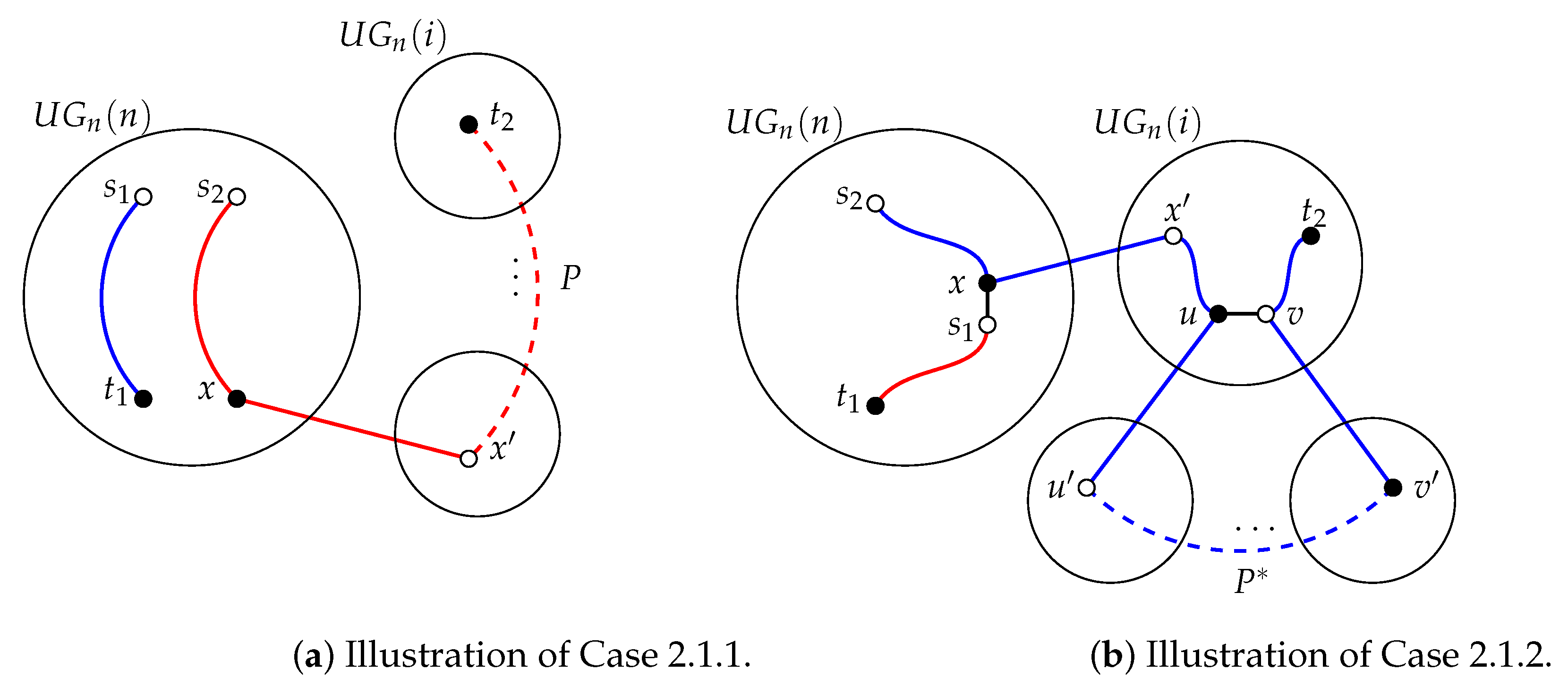
Case 2.1.1. Let . Let be a black vertex in , where . Since for , such that and is fault-free. The induction hypothesis yields an unpaired two-disjoint path cover between and in , where joins to and joins to x. Then, by Lemma 5, there exists a path P from to that spans all vertices of . Let . Then forms the desired path cover of , as shown in Figure 3a.
Case 2.1.2. . Since there are no faulty edges between any two copies of , we have . By Lemma 4, there exists a Hamiltonian path P from to in . Since lies on P, let x be a neighbor of on P. If the outgoing neighbor of x does not belong to , then by Lemma 5, there exists a Hamiltonian path H from to in . Let and . Then forms the desired path cover of .
Now assume that is in . Since , there exists an edge in with , such that the edges are fault-free and . By Corollary 1, there exists a Hamiltonian path H in from to through . By Lemma 5, there exists a path from to that spans all vertices of . Let and . Then forms the desired path cover of , as shown in Figure 3b.
Figure 3.
Illustrations for Case 2.1 of Theorem 1.
Case 2.2. and . It is similar to case 2.1.
Case 2.3. and .
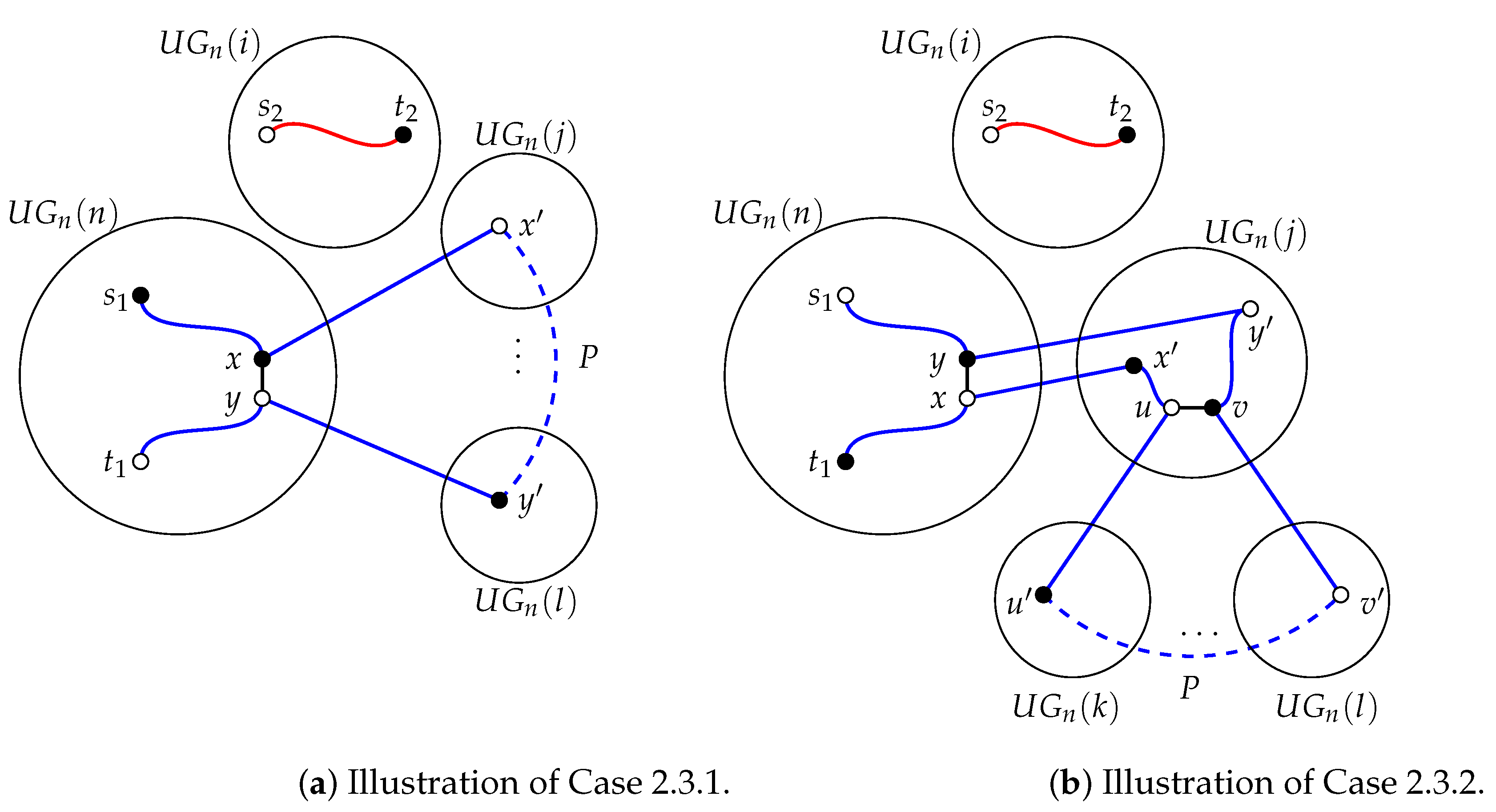
Case 2.3.1. or . We assume w.l.o.g. that . By Lemma 4, there exists a Hamiltonian path in from to . Let in with , where and for . Since for , the edges and are fault-free. By Corollary 1, there exists a Hamiltonian path H in from to through . By Lemma 5, there exists a path P from to that visits all vertices of . Let . Then forms the desired path cover of , as shown in Figure 4a.
Case 2.3.2. and . By Lemma 4, there exist a Hamiltonian path from to in and a Hamiltonian path from to in . Since and with , at least three copies of are fault-free, denoted by , , and . Let with . Moreover, there are at most faults between different copies, thus . Since for , there exists a black vertex on with such that fault-free, where . And if x lies on , let and be two neighbors of x on . Since the types of any two consecutive edges are different, at least one of and does not belong to . Denote this vertex by y with . Since for , both and are fault-free. If , then by Lemma 5, there exists a path P from to spanning all vertices of . Let . Then forms the desired path cover of .
Otherwise, and all edges in are fault-free. Let be an edge in with , where and . Since for , we can choose an edge such that both and are fault-free. By Corollary 1, there exists a Hamiltonian path H in from to through the edge . By Lemma 5, there exists a path P from to spanning all vertices of . Let . Then forms the desired path cover of , as shown in Figure 4b.
Figure 4.
Illustrations for Case 2.3 of Theorem 1.
Case 2.4. and .
Case 2.4.1. for every .
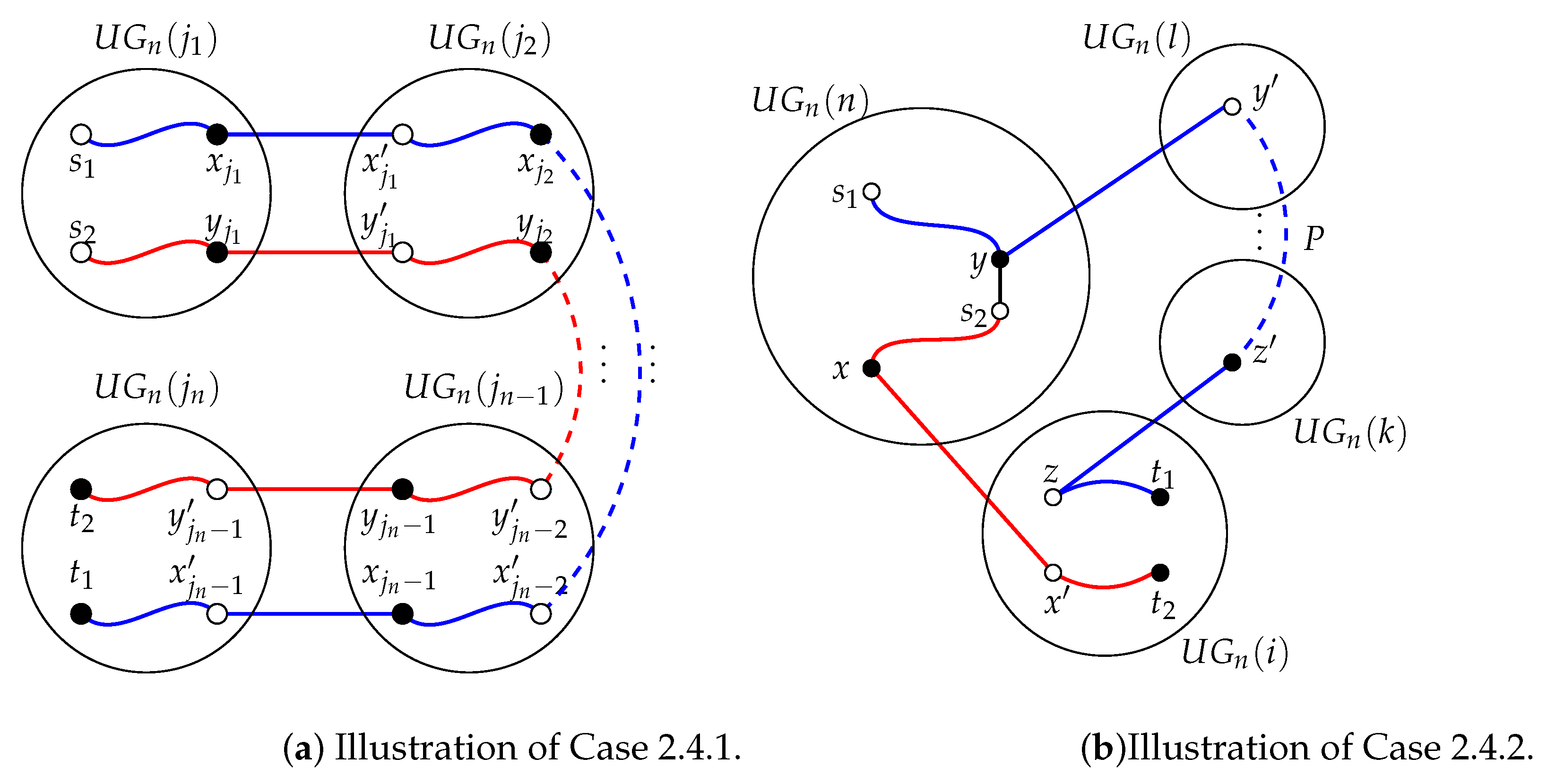
(a). . Relabel the n copies as such that and . Since for , Proposition 2 guarantees a pair of fault-free edges and between and for , where and are two black vertices in . The induction hypothesis yields an unpaired two-disjoint path cover in , where joins to and joins to , and an unpaired two-disjoint path cover in with joining to and joining to for . Moreover, there exists a two-disjoint path cover in , where joins to and joins to . Let and . Then forms the desired path cover of , as shown in Figure 5a.
(b). . In this case, there are no faulty edges inside the copies, and the induction hypothesis holds in each copy. We relabel the n copies such that and . After relabeling, the number of faulty edges between and , denoted by , satisfies for each . Since the subsequent construction of the two-disjoint path cover is analogous to that in Case 2.4.1(a), the details are omitted.
Case 2.4.2. for some , we assume w.l.o.g. that . Since , there exists a black vertex of , such that is fault-free. By Lemma 4, there exists a Hamiltonian path H from to x. Since must lie on H, assume that the vertex y is a neighbor of on H such that the outgoing edge is fault-free.
If , say with , then there exists a white vertex in , where , such that is fault-free. By the induction hypothesis, there exists an unpaired two-disjoint path cover in between and , where joins z to and joins to . Since and lie in different copies, by Lemma 5, there exists a path P from to that spans all vertices of . Let and . Then forms the desired path cover of , as shown in Figure 5b.
If , the induction hypothesis yields an unpaired two-disjoint path cover in between and , where joins to and joins to . There exists an edge on such that and are fault-free, which holds since . To construct the path cover of , we consider two cases: either and are in distinct copies, or both are in the same copy, . Since the argument is similar to that in Case 2.3.2, so the detailed proofs are omitted.
Figure 5.
Illustrations for Case 2.4 of Theorem 1.
Case 3. lie in three copies of , that is, , and , where with .
Case 3.1. , and .
Case 3.1.1. . Since for , there exists a black vertex in such that is fault-free. Similarly, since for , there exists a black vertex in where , such that is fault-free. The induction hypothesis yields an unpaired two-disjoint path cover in between and , where joins to x and joins to y. By Lemma 4, there exists a Hamiltonian path H from to in . By Lemma 5, there exists a path P from to that spans all vertices of . Let and . Then forms the desired path cover of .
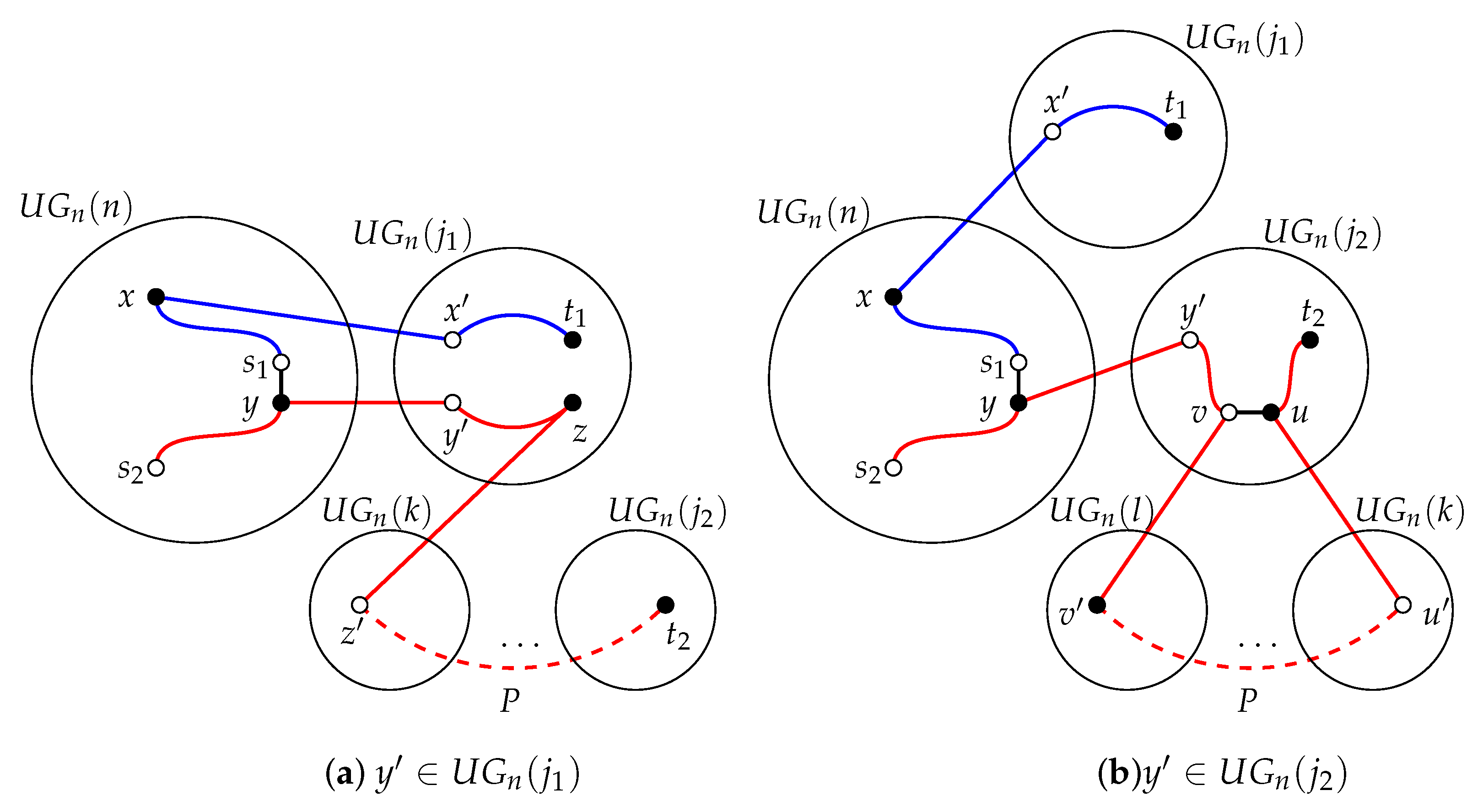
Case 3.1.2. . There exists a black vertex in such that and is fault-free. By Lemma 4, there is a Hamiltonian path H from x to . Since lies on H, let y be a neighbor of on H such that y is closer to on H. Based on the location of , we have three subcases.
If for , then by Lemma 5, there exists a path P from to spanning all vertices of . By Lemma 4, there is a Hamiltonian path L from to . Thus, the path cover forms the desired path cover of , where and .
If , choose a black vertex z in such that and is fault-free, where for . By the induction hypothesis, there is an unpaired two-disjoint path cover in between and , where joins to and joins to z. By Lemma 5, there exists a path P from to spanning all vertices of . Let and and is the desired unpaired two-disjoint path cover, as shown in Figure 6a.
If , let be an edge in with , where and for . By Corollary 1, there exists a Hamiltonian path from to through . By Lemma 5, there exists a path P from to spanning all vertices of . Moreover, by Lemma 4, there is a Hamiltonian path L from to . Let and . Then forms the unpaired path cover of , as shown in Figure 6b.
Figure 6.
Illustrations for Case 3.1.2 of Theorem 1.
Case 3.2. , and . By Lemma 4, there exists a Hamiltonian path from to ; by Lemma 5, there exists a path from to spanning all vertices of . Thus, forms the desired unpaired two-disjoint path cover of .
Case 3.3. , and . This case is similar to Case 3.1, so we omit the details of its proof.
Case 3.4. , and . This case is similar to Case 3.2, so we omit the details of its proof.
Case 4. lie in four distinct copies of . Assume that , , , and , where are distinct. By Lemma 5, there exists a Hamiltonian path spanning from to , and a path from to passing through all remaining vertices of . Thus, forms the desired path cover of . □
4. Conclusions
This paper studies the unpaired many-to-many two-disjoint path cover problem for Cayley graphs generated by unicyclic graphs under edge faults. It is shown that an n-dimensional Cayley graph generated by a unicyclic graph admits an unpaired two-disjoint path cover in the presence of at most faulty edges for . In view of the degree of , the result is optimal. We provide an example to show that is not -edge fault-tolerant unpaired two-disjoint path coverable. Let v be any vertex of that is incident with exactly two edges, say and . If we assume that and are the sources of the two-disjoint path covers . Then v must be on both and , which is a contradiction.
The Cayley graph is -edge fault-tolerant unpaired many-to-many two-disjoint path coverable [22]. Since is -regular while is n-regular, our result demonstrates an improvement in the edge fault tolerance from to . Furthermore, the edge fault-tolerant many-to-many k-disjoint path covers of would be future problems.
Author Contributions
Conceptualization, Y.L. and H.Q.; methodology, Y.L. and H.Q.; writing—original draft preparation, Y.L.; writing—review and editing, H.Q.; supervision, H.Q.; funding acquisition, H.Q. All authors have read and agreed to the published version of the manuscript.
Funding
This work was supported by the Natural Science Foundation of Xinjiang, China (No. 2024D01C225), the Xinjiang Tianchi Doctoral Project, China (No. 51052601537), and the National Natural Science Foundation of China (No. 12401467).
Data Availability Statement
The original contributions presented in this study are included in the article. Further inquiries can be directed to the corresponding author.
Acknowledgments
The authors would like to express their gratitude to the editor and anonymous reviewers for their valuable comments and constructive suggestions on the original manuscript.
Conflicts of Interest
The authors declare no conflicts of interest.
References
- Xu, J.-M. Topological Structure and Analysis of Interconnection Networks; Kluwer Academic Publishers: Dordrecht, The Netherlands, 2001. [Google Scholar]
- Lakshmivarahan, S.; Jwo, J.-S.; Dhall, S.K. Symmetry in interconnection networks based on Cayley graphs of permutation groups: A survey. Parallel Comput. 1993, 19, 361–407. [Google Scholar] [CrossRef] [Scilit]
- Schibell, S.T.; Stafford, R.M. Processor interconnection networks from Cayley graphs. Discret. Appl. Math. 1992, 40, 333–357. [Google Scholar] [CrossRef] [Scilit]
- Hsieh, S.-Y.; Hsiao, T.-T. The k-degree Cayley graph and its topolog ical properties. Networks 2006, 47, 26–36. [Google Scholar] [CrossRef] [Scilit]
- Liu, M.; Liu, H. Paths and cycles embedding on faulty enhanced hypercube networks. Acta Math. Sci. 2013, 33, 227–246. [Google Scholar] [CrossRef] [Scilit]
- Hsieh, S.-Y. Embedding longest fault-free paths onto star graphs with more vertex faults. Theor. Comput. Sci. 2005, 337, 370–378. [Google Scholar] [CrossRef] [Scilit]
- Tsai, C.H.; Tan, J.J.M.; Liang, T.; Hsu, L.H. Fault-tolerant hamiltonian laceability of hypercubes. Inf. Process. Lett. 2002, 83, 301–306. [Google Scholar] [CrossRef] [Scilit]
- Curran, S.J.; Gallian, J.A. Hamiltonian cycles and paths in Cayley graphs and digraphs—A survey. Discret. Math. 1996, 156, 1–18. [Google Scholar] [CrossRef] [Scilit]
- Xue, S.; Deng, Q.; Li, P.; Chen, J. Hamiltonian paths and Hamiltonian cycles passing through prescribed linear forests in star graph with fault-tolerant edges. Discret. Appl. Math. 2023, 334, 68–80. [Google Scholar] [CrossRef] [Scilit]
- Park, J.-H.; Kim, H.-C.; Lim, H.-S. Many-to-many disjoint path covers in the presence of faulty elements. IEEE Trans. Comput. 2009, 58, 528–540. [Google Scholar] [CrossRef] [Scilit]
- Park, J.-H. Paired many-to-many disjoint path covers in restricted hypercube-like graphs. Theor. Comput. Sci. 2016, 634, 24–34. [Google Scholar] [CrossRef] [Scilit]
- Chen, X.-B. Paired many-to-many disjoint path covers of the hypercubes. Inform. Sci. 2013, 236, 218–223. [Google Scholar] [CrossRef] [Scilit]
- Zhang, S.; Wang, S. Many-to-many disjoint path covers in k-ary n-cubes. Theor. Comput. Sci. 2013, 491, 103–118. [Google Scholar]
- Coleman, A.; Fischberg, G.; Gong, C.; Harrington, J.; Wong, T.W.H. Paired (n − 1)-to-(n − 1) disjoint path covers in bipartite transposition-like graphs. Discret. Appl. Math. 2025, 376, 449–461. [Google Scholar] [CrossRef] [Scilit]
- Metsidik, M.; Yan, Q. Degree conditions for disjoint path covers in graphs. Discret. Appl. Math. 2026, 379, 45–55. [Google Scholar] [CrossRef] [Scilit]
- Chen, X.-B. Paired many-to-many disjoint path covers of hypercubes with faulty edges. Inform. Process. Lett. 2012, 112, 61–66. [Google Scholar] [CrossRef] [Scilit]
- Niu, R.; Xu, M. The unpaired many-to-many k-disjoint paths in bipartite hypercube-like networks. Theor. Comput. Sci. 2022, 911, 26–40. [Google Scholar] [CrossRef] [Scilit]
- Sitanayah, L.; Brown, K.N.; Sreenan, C.J. A fault-tolerant relay placement algorithm for ensuring k vertex-disjoint shortest paths in wireless sensor networks. Ad. Hoc Netw. 2014, 23, 145–162. [Google Scholar] [CrossRef] [Scilit]
- Li, J.; Wang, G.; Chen, L. Paired 2-disjoint path covers of multi-dimensional torus networks with 2n − 3 faulty edges. Theor. Comput. Sci. 2017, 677, 1–11. [Google Scholar] [CrossRef] [Scilit]
- Chen, C.; Li, P.; Liu, X. Paired 2-disjoint path cover of burnt pancake graphs with n − 3 faulty elements. Discret. Appl. Math. 2026, 380, 307–325. [Google Scholar] [CrossRef] [Scilit]
- Huang, X.; Li, J.; He, W. Hamiltonian laceability of bubble-sort star graphs with edge-faults. Discret. Appl. Math. 2026, 380, 442–457. [Google Scholar] [CrossRef] [Scilit]
- Qiao, H.; Meng, J.; Sabir, E. The edge fault-tolerant two-disjoint path covers of Cayley graphs generated by a transposition tree. Discret. Appl. Math. 2024, 356, 174–181. [Google Scholar] [CrossRef] [Scilit]
- Yang, W.; Li, H.; Meng, J. Conditional connectivity of Cayley graphs generated by transposition trees. Inform. Process. Lett. 2012, 110, 1027–1030. [Google Scholar]
- Li, H.; Yang, W.; Meng, J. Fault-tolerant Hamiltonian laceability of Cayley graphs generated by transposition trees. Discret. Math. 2012, 312, 3087–3095. [Google Scholar] [CrossRef] [Scilit]
- Yu, X.; Huang, X.; Zhang, Z. A kind of conditional connectivity of Cayley graphs generated by unicyclic graphs. Inform. Sci. 2013, 243, 86–94. [Google Scholar] [CrossRef] [Scilit]
- Zheng, W.; Zhou, S.; Yang, L. Fault tolerability of Cayley graphs generated by transposition unicyclic graphs with a triangle. Discret. Appl. Math. 2026, 384, 372–385. [Google Scholar] [CrossRef] [Scilit]
- Qiao, H.; Sabir, E.; Zhang, M. Many-to-many two-disjoint path covers in Cayley graphs generated by unicyclic graphs. Discret. Appl. Math. 2026, 392, 229–235. [Google Scholar] [CrossRef] [Scilit]
- Bondy, J.A.; Murty, U.S.R. Graph Theory; Springer: London, UK, 2008. [Google Scholar]
- Godsil, C.; Royle, G. Algebraic Graph Theory; Springer: New York, NY, USA, 2001. [Google Scholar]
- Feng, Y.; Xie, Y.; Liu, F.; Xu, S. The extendability of Cayley graphs generated by transposition trees. Mathematics 2022, 10, 1575. [Google Scholar] [CrossRef] [Scilit]
- Cheng, E.; Lipták, L. Linearly many faults in cayley graphs generated by transposition trees. Inform. Sci. 2007, 177, 4877–4882. [Google Scholar] [CrossRef] [Scilit]
- Xue, S.; Deng, Q.; Li, P. Fault-tolerant strongly Hamiltonian laceability and hyper-Hamiltonian laceability of Cayley graphs generated by transposition trees. Comput. J. 2021, 66, 384–398. [Google Scholar] [CrossRef] [Scilit]
- Lin, Y.; Qiao, H.; Sabir, E.; Zhang, M. The edge fault-tolerant Hamilton laceability of Cayley graphs generated by unicyclic graphs. Discret. Appl. Math. 2026; submitted.
Disclaimer/Publisher’s Note: The statements, opinions and data contained in all publications are solely those of the individual author(s) and contributor(s) and not of MDPI and/or the editor(s). MDPI and/or the editor(s) disclaim responsibility for any injury to people or property resulting from any ideas, methods, instructions or products referred to in the content. |
© 2026 by the authors. Licensee MDPI, Basel, Switzerland. This article is an open access article distributed under the terms and conditions of the Creative Commons Attribution (CC BY) license.