


Abstract
Let be linearly independent. For , let be the equal-weight self-similar measure generated by the iterated function system , where for . We investigate the spectrality of . For every integer , we show that is a spectral measure if and only if q is even. When q is odd, any mutually orthogonal family of exponential functions in contains at most four elements, and this bound is sharp. For arbitrary , we establish a necessary and sufficient condition for the existence of an infinite orthogonal family of exponential functions in .
Keywords:
spectral measure; spectrum; Bernoulli convolution; Fourier transform; orthogonal exponential functions MSC:
42C05; 28A80; 42A16; 42B10
1. Introduction
Let be a compactly supported Borel probability measure on . For a countable set , write
We call a spectral measure if is an orthonormal basis for for some countable set . Such a set is called a spectrum of . The study of spectrality originates in the work of Fuglede [1] and remains a fundamental topic in harmonic analysis. He, Lai, and Lau [2] established that every spectral measure is of pure type: it is either discrete, absolutely continuous, or singularly continuous with respect to Lebesgue measure. In the discrete case, spectrality is closely related to integer tiles [2]. For absolutely continuous measures, Dutkay and Lai [3] showed that spectrality forces the measure to be the normalized restriction of Lebesgue measure to a measurable set . The connection between the spectrality of and its tiling properties is the focus of the Fuglede problem (see, e.g., [1,4,5,6]). In the singularly continuous setting, Jorgensen and Pedersen [7] provided the first example of a spectral measure by proving that the middle-fourth Cantor measure is a spectral measure. Their result stimulated extensive research on the spectrality of fractal measures; see Refs. [5,8,9,10,11,12,13,14,15,16] and the references therein.
Let be a contractive affine iterated function system (IFS) on of the form
where each is a real matrix whose singular values are all greater than 1, and . By Hutchinson’s theorem [17], this system admits a unique nonempty compact set satisfying
For any positive weights with , there is also a unique Borel probability measure such that
The set K and the measure are called the self-affine set and self-affine measure associated with the IFS, respectively.
The spectral theory of fractal measures is well developed for systems with a common contraction matrix, whereas the case of distinct contraction matrices remains less understood. Wu and Liu [15] established the existence of spectral self-similar measures in this latter setting. More recently, Wu [16] studied the one-dimensional self-similar measures defined with equal weights by
where and . He characterized their spectrality by the condition with . The proof represents the Fourier transform of as an infinite product of matrix-valued functions with identically vanishing determinants. This representation reduces the alternating system to an ordinary self-similar measure with a common positive contraction ratio. We apply this matrix-product method to a planar four-digit system. The resulting identity identifies the entire measure, and therefore transfers both orthogonality and completeness. The contributions below are the explicit planar reduction, the sharp four-element bound in the odd-integer case, and the arithmetic characterization of infinite orthogonal families.
Let and let satisfy . We study the equal-weight self-similar measure associated with the IFS
For reciprocal-integer contraction ratios, the following theorem characterizes spectrality and gives a sharp bound on the size of orthogonal exponential families in the nonspectral case.
Theorem 1.
Let be an integer, and let be linearly independent. Then is a spectral measure if and only if q is even. If q is odd, every mutually orthogonal family of exponential functions in has cardinality at most 4, and this bound is attained.
The proof of the spectrality characterization in Theorem 1 proceeds in three steps. First, invariance under invertible linear transformations yields
where and ; see Proposition 1. Next, an infinite matrix-product representation of the Fourier transform of , derived in Lemma 2, leads to
see Theorem 6. Here, denotes the one-dimensional Bernoulli convolution, whose definition and spectrality criterion are recalled in Section 2. Finally, we use that criterion for even q and a Fourier zero-set argument for odd q.
Let denote the equal-weight self-similar measure associated with the IFS
This system differs from the IFS in (1) only by the absence of the alternating factor . For the digit set with linearly independent and an integer , Li and Wu [14] obtained the spectrality criterion for . The equivalence (25) relates their common-contraction system to the alternating system. In this parallelogram-digit case, linear conjugacy allows to be arbitrary linearly independent real vectors. Theorem 1 also determines the largest possible orthogonal family for odd q.
For general , we characterize the existence of infinite orthogonal families of exponential functions.
Theorem 2.
Let , and let be linearly independent. Then contains an infinite mutually orthogonal family of exponential functions if and only if
for some and coprime integers , with p odd and q even.
The proof of Theorem 2 applies the preceding linear reductions to orthogonal exponential families. An application of the infinite Ramsey theorem shows that admits an infinite orthogonal exponential family exactly when does. The result of Hu and Lau [12] then yields the stated arithmetic condition. Conversely, when this condition holds, an infinite orthogonal family for the one-dimensional Bernoulli convolution embeds into the product space and transfers to through the corresponding inverse-transpose linear maps on frequencies. The question of completeness for general is discussed in Section 5.
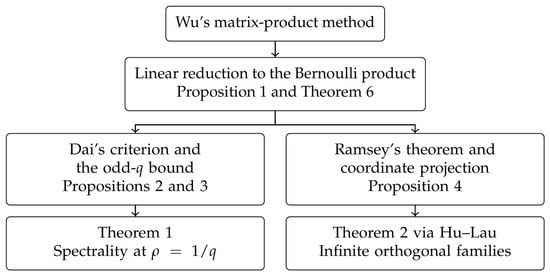
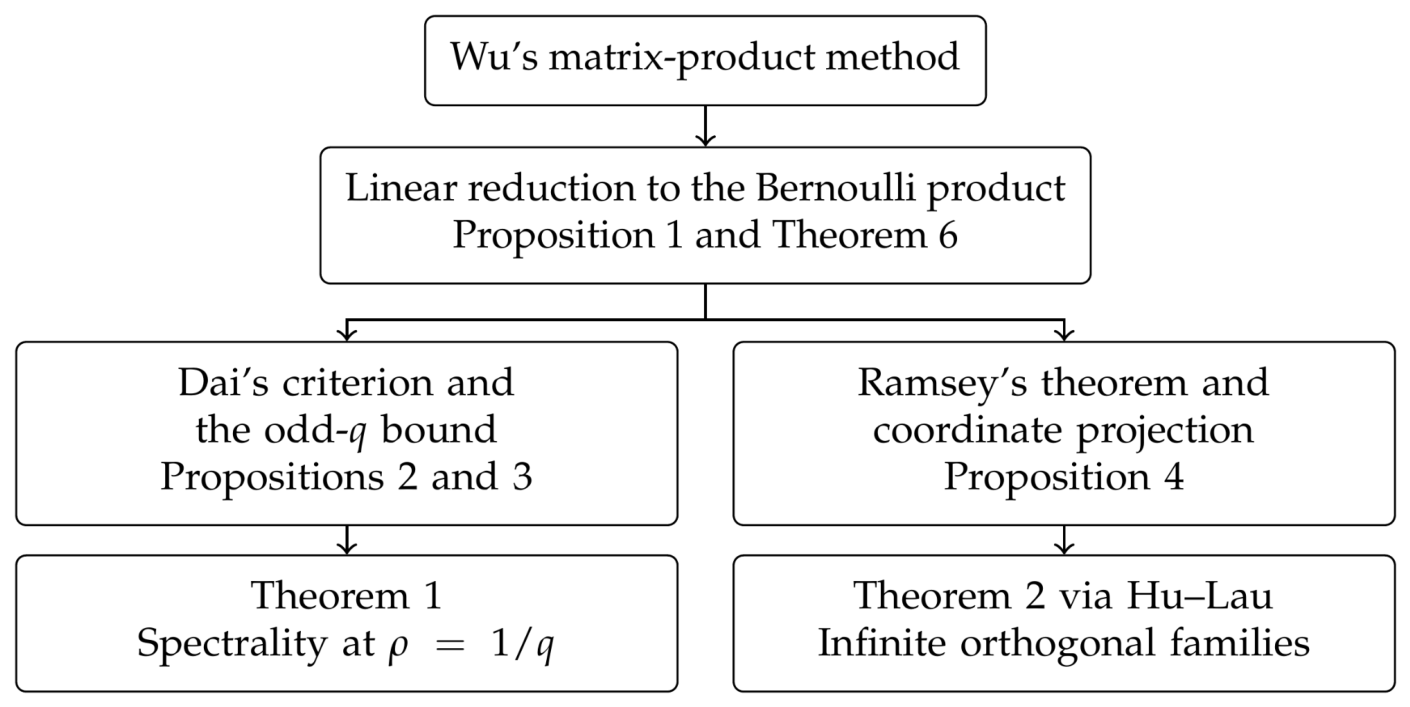
Figure 1 summarizes the roles of the earlier results and the intermediate steps in the two proofs.
Figure 1.
Proof dependencies for Theorems 1 and 2. The matrix-product method follows Wu [16].
The remainder of the paper is organized as follows. Section 2 introduces the notation, definitions, and auxiliary results. Section 3 is devoted to studying the spectrality of . Section 4 proves Theorems 1 and 2. Finally, Section 5 summarizes the results and presents further remarks and open questions.
2. Preliminaries
This section introduces the notation, definitions, and auxiliary results needed in the subsequent analysis. Let be a compactly supported Borel probability measure on . Its support consists of the points x such that for every , where is the open ball of radius r. For an IFS with positive weights as in Section 1, the support of the invariant measure satisfies , so it is the attractor K. If the support is infinite, one can choose arbitrarily many pairwise disjoint open balls of positive measure. Their indicator functions are mutually orthogonal in , so is infinite-dimensional.
For a countable set , write
and . The Fourier transform of is defined by
with zero set
It is well known that the family is orthogonal in if and only if
A set satisfying (3) is called a bi-zero set of .
Let be a finite digit set with . Its mask polynomial is
For and a finite digit set , we write for the self-similar measure satisfying
Taking Fourier transforms and iterating gives
Consequently,
To justify this identity, fix and observe that as . Thus, , so the product in (6) can vanish only if one of its factors is zero.
The measure is the one-dimensional Bernoulli convolution. Its support contains 0 and for every , as seen from the expansion with . Hence, both and its product with itself have infinite support. Equations (4) and (7) yield
Write . The Fourier transform of a product measure factors into the Fourier transforms of its components. Thus, the zero set of the Fourier transform of is
Put . The normalizations of Hu and Lau [12] and Dai [9] are the images of under and , respectively. These affine changes of variables preserve orthogonality and completeness by rescaling the frequencies and multiplying the exponentials by constant phases. Hu and Lau established the following criterion.
Theorem 3
(Hu–Lau, [12]). The space admits an infinite mutually orthogonal family of exponential functions if and only if
for some , where p is odd, q is even, and .
Dai [9] subsequently gave a complete characterization of spectrality for these measures.
Theorem 4
(Dai, [9]). The measure is spectral if and only if for some integer .
Theorems 3 and 4 will be used to prove Theorems 2 and 1, respectively. We also recall the infinite Ramsey theorem.
Theorem 5
(Ramsey’s theorem, [18]). Let be a countably infinite set, and let be positive integers. Denote by the collection of all k-element subsets of . For any partition of into r classes, there exists an infinite subset such that all members of belong to a single class.
Finally, we record the invariance of spectrality and mutual orthogonality of exponential families under invertible linear transformations.
Lemma 1.
Let and set . For any set , the family is mutually orthogonal in if and only if is mutually orthogonal in . Moreover, Γ is a spectrum of μ if and only if is a spectrum of ν.
Proof.
Define the operator by . It is straightforward to verify that U is an isometry. Since A is invertible, U is surjective, with inverse , and hence is unitary. For each ,
Thus, U maps onto . Both assertions follow because unitary operators preserve orthogonality and completeness. □
For each linearly independent pair , let be the equal-weight self-similar measure generated by the IFS in (1). With and , is well-defined since . The following proposition establishes the corresponding equivalences for spectrality and mutually orthogonal exponential families between and for all linearly independent .
Proposition 1.
Let and be linearly independent. Then is a spectral measure if and only if is a spectral measure. More generally, for every set , is mutually orthogonal in if and only if is mutually orthogonal in , where . In particular, if is a spectrum of , then is a spectrum of .
Proof.
Fix any with . Define . Note that . By Lemma 1, it suffices to show that
Recall that both and are the unique self-similar measures satisfying
respectively, where and for all . It follows that
for every Borel set . Since and , a direct calculation gives for every . Substituting this into (11) yields
for every Borel set . Comparing (12) with the first equation in (10), the uniqueness of yields
The desired assertions now follow from Lemma 1. □
In view of Proposition 1, we need only consider the spectrality of and mutually orthogonal exponential families in .
3. Spectral Analysis of
Let and let be the equal-weight self-similar measure generated by the IFS
where , and . In this section, we study the spectrality of and mutually orthogonal exponential families in .
Let be the Fourier transform of . Since
it follows that has the following expression
for all . Similarly, we have
for all . For each , we define
Combining this with (13) and (14), we find
A direct computation gives . Hence, admits the rank-one factorization
where
Lemma 2.
For every , we have
where .
Proof.
Theorem 6.
Let . Then is a spectral measure if and only if is a spectral measure. More generally, for every set , is mutually orthogonal in if and only if is mutually orthogonal in , where
In particular, if Γ is a spectrum of , then is a spectrum of .
Proof.
Comparing (6) and (17), and invoking the uniqueness of the Fourier transform for finite Borel measures, we obtain
Set . A direct verification shows that is invertible and . Applying (5) gives
Thus, . Combining this identity with (19) and the fact that , we have
Consequently, the desired results follow immediately from Lemma 1 and (20). □
Combining Proposition 1 and Theorem 6, we establish the following equivalence:
Moreover, combining the orthogonality assertions in Proposition 1 and Theorem 6, we obtain, for every ,
We now consider the two-scale geometry of the attractor of . Let K be the support of and set . In the product coordinates of (20), put and for . Then is the nth approximation of K under the equivalent common-contraction IFS. If , the intervals of length in have disjoint interiors. Thus, with denoting planar area,
The two-scale formulation compares the measured areas at two resolutions [19]. He, Liu, and Liu [20] use a two-scale model to describe the porosity of recycled aggregate concrete. Here, the coarse approximation is planar, so . At every pair of successive levels , the area-based two-scale descriptor is
For example, it equals 2 at and at . The Hausdorff dimension of the limiting set in this range is by the open set condition in the product coordinates [17] and invariance under the invertible linear map. If , the two first-level intervals cover , so for all n. In this range, K is a parallelogram, and both and equal 2. In general, these two quantities need not coincide.
4. Proof of Theorems 1 and 2
In this section, we mainly prove Theorems 1 and 2. Let and let be the equal-weight self-similar measure generated by the IFS
where , and . To prove Theorem 1, we first establish the spectrality of the reference measure for when q is even, and then show the maximal orthogonal set bound when q is odd.
Proposition 2.
Let be an even integer. Then is a spectral measure. Furthermore, if is a spectrum of , then
is a spectrum of , where is defined by (18).
Proof.
Suppose that for some integer . Then Theorem 4 implies that is a spectral measure, and hence is also a spectral measure. Indeed, if is a spectrum of , then is a spectrum of . Consequently, the desired results follow from Theorem 6. □
When , the measure is Lebesgue measure on , so one can take . For even , the digit construction in Ref. [5] gives
Since
we may write
For example, when , (23) gives the spectrum , since ranges over this lattice as range over . When , write the two one-dimensional frequencies as and , with . Then a spectrum is
The four frequencies for are , , , and .
We now turn to the odd case and establish the maximal cardinality bound for mutually orthogonal exponential families. To this end, we introduce the following auxiliary function. For a real number x, write for its fractional part. Define a function
Adding modulo 1 interchanges the half-intervals and . Thus, implies .
Proposition 3.
Let be an odd integer. Every mutually orthogonal family of exponentials in has cardinality at most 4 and there exists such a family with four elements. In particular, is not a spectral measure.
Proof.
Assume that is odd. By Theorem 6, it suffices to prove the statement for . Let be a bi-zero set of . We define a map by
where is defined by (24). For every , the integer is odd, so . By (8), this gives . If two points of have the same value of , then their fractional parts in each coordinate lie in the same half-interval, and neither coordinate difference is a half-integer. But for distinct points of a bi-zero set, (3) and (9) require at least one coordinate difference to belong to . Thus, is injective, and
To see that the bound is sharp, put and set
The difference of two distinct points of has at least one coordinate equal to t or . Both numbers lie in by (8). By (9), is a bi-zero set of the product measure. Its four exponentials attain the bound, which transfers to the reference measure. The product measure has infinite-dimensional by Section 2, so a family of at most four exponentials cannot be complete. □
We now prove Theorem 1.
Proof of Theorem 1.
Combine Propositions 1, 2 and 3. □
Corollary 1.
Let be an even integer and let be linearly independent. Then
is a spectrum of , where and is defined by (23).
Proof.
Since is a spectrum of , the desired result follows from Proposition 1. □
Let be linearly independent, and let denote the equal-weight self-similar measure generated by the IFS in (2). Put . Note that . Since , we obtain
Combining this with Lemma 1 and the spectrality equivalence in (21), we find
Consequently, the following corollary holds, which extends [14] (Theorem 2.7).
Corollary 2.
Let be an integer, let be linearly independent, and let denote the equal-weight self-similar measure generated by the IFS in (2). Then is a spectral measure if and only if q is even.
Proof.
Combine Theorem 1 and (25). □
To prove Theorem 2, we turn to the case . Theorem 2 follows by combining the tensor representation with known results on Bernoulli convolutions. We first give the relationship between infinite orthogonal sets and Ramsey’s theorem.
Proposition 4.
Let . Then contains an infinite mutually orthogonal family of exponential functions if and only if does.
Proof.
Assume that the product admits an infinite orthogonal exponential family, and choose a countably infinite subset of its frequency set. For every unordered pair with distinct elements, (3) and (9) imply that for at least one . Assign the pair to class if , and to class otherwise. The symmetry of makes the assignment independent of the order of the pair. This is a two-color partition of the two-element subsets of , and every pair in has its kth coordinate difference in .
Apply Theorem 5 with and to obtain an infinite subset whose pairs all belong to one class, say . Since , any two distinct points of have distinct jth coordinates. The projection is therefore infinite, and every nonzero difference of its elements lies in . By (3), is an infinite orthogonal family in .
Conversely, suppose that is an infinite bi-zero set of . For distinct ,
Thus, is an infinite bi-zero set of the product measure. □
By the theorem of Hu and Lau (see Theorem 3), we have the following results.
Proposition 5.
Let . contains an infinite mutually orthogonal family of exponential functions if and only if
for some and coprime integers , where p is odd and q is even. Moreover, if Γ is an infinite bi-zero set of , then is an infinite bi-zero set of .
Proof.
By Theorem 6, contains an infinite mutually orthogonal family of exponentials if and only if the same is true for . Proposition 4 reduces the latter property to the existence of an infinite mutually orthogonal family in . The equivalence in (26) now follows from Theorem 3. The final assertion follows by applying the converse construction in Proposition 4 and then the orthogonality assertion in Theorem 6. □
Corollary 3.
Let be an integer and . Then contains an infinite mutually orthogonal family of exponential functions if and only if M is even.
Proof.
If M is even, then the condition in Proposition 5 holds with , , and . Conversely, if (26) holds for , then
Both fractions are in reduced form, so and . Since q is even, M is even. □
We now prove Theorem 2.
Proof of Theorem 2.
Suppose first that contains an infinite mutually orthogonal family of exponential functions. By Proposition 1 and Theorem 6, the product space also contains such a family. Proposition 4 then implies that contains an infinite mutually orthogonal family. Theorem 3 yields
for some and coprime integers , with p odd and q even.
Conversely, assume that has the displayed form. By Theorem 3, there exists an infinite bi-zero set of . Proposition 4 shows that is an infinite bi-zero set of . Therefore, by (22),
is a bi-zero set of . Since and are invertible and is infinite, is infinite. Hence, is an infinite mutually orthogonal family in , completing the proof. □
The preceding characterization immediately yields the following necessary arithmetic condition for spectrality.
Corollary 4.
Let and let be linearly independent. If is a spectral measure, then there exist and coprime positive integers such that where p is odd and q is even. In particular, every spectral parameter ρ is algebraic.
Proof.
By Proposition 1 and (20), the measure is an invertible linear image of the product of two Bernoulli convolutions. Its space is therefore infinite-dimensional, so any spectrum gives an infinite orthogonal exponential family. By Theorem 2, there exist and coprime integers such that where p is odd and q is even. Thus, is a zero of the nonzero polynomial , and hence is algebraic. □
5. Conclusions
We conclude with a brief summary of the preceding results. We studied the spectrality of planar self-similar measures with alternating contractions and the mutually orthogonal exponential families in their spaces. Let be the equal-weight self-similar measure generated by the IFS in (1). We first established that every such measure is spectrally equivalent to the reference measure , where and . Next, by factoring the matrix in the Fourier recursion, whose determinant vanishes identically, we reduced the matrix product to a scalar infinite product. This yields an invertible linear equivalence between and , preserving both spectra and mutually orthogonal exponential families. Combining these equivalences with the one-dimensional results and the Fourier zero-set analysis gives the following conclusions.
When with an integer, is spectral if and only if q is even. For odd q, the largest orthogonal exponential family has four elements. Theorem 2 characterizes the parameters that admit an infinite orthogonal exponential family.
Write . For with q even, Theorem 1 gives a spectrum . The samples , , reconstruct any :
This gives an energy-preserving decomposition of signals on the measure support, and a sampling identity for the Fourier transforms of measures . It also gives a matrix representation of each bounded operator T on through the entries . Rao et al. [21] study function approximation on an interval using generalized Kantorovich–Schurer–Stancu operators. Fourier truncation in the present setting gives approximation by finite exponential sums, with squared error equal to the sum of squared omitted coefficients.
When the arithmetic condition of Theorem 2 holds, an infinite orthogonal family gives the same coefficient and reconstruction formulas on its closed span. For a general , the series gives the orthogonal projection onto that span. Keeping a finite set of coefficients of largest modulus gives sparse approximations within the span. The family is a Parseval frame for its closed span; if incomplete, it has no lower frame bound on the whole space. Theorem 2 does not settle the existence of nonorthogonal Fourier frames.
Completeness for general is the subject of the following conjecture.
Conjecture 1. For every ,
where are linearly independent.
By Dai’s theorem (Theorem 4), the full classification of would follow from the implication
for all . Indeed, (27) and Dai’s theorem would imply . Conversely, the product of two spectral measures is spectral. Hence, if (27) holds, then
Consequently, Conjecture 1 would follow. Kolountzakis et al. ([13], Theorem 1.2) show that if is spectral and is contained in an additive subgroup , then the product admits a spectrum with first coordinates in . Under the equality , spectrality of the product implies spectrality of both factors. For Bernoulli convolutions, the equality hypothesis is satisfied at , where . It fails in general. For example, (8) gives and , so is not an additive subgroup.
The argument for the odd-q bound extends to the reference system with and , where and all maps have equal weights. In the matrix factorization of Section 3, replacing and its conjugate by and its conjugate, with normalization , gives the reduced digit set . This is the image of under the invertible map . Thus, the measure is a linear image of .
For odd with , (7) gives , since the mask zeros are precisely the nonintegral multiples of and multiplication by q preserves that set. Two numbers whose difference lies in have different values of . Pairing this m-valued function on the first coordinate with from (24) on the second gives an injection on each product bi-zero set into a set of elements. The grid attains the bound because every distinct pair differs in some coordinate by a first-level mask zero scaled by q. Apply the inverse transpose to this product grid.
For real , the maps in (1) have Lipschitz constant , and Hutchinson’s contractive IFS theorem requires . Identifying the plane with , a complex multiplier z with gives a contractive IFS with a rotation. A real change of coordinates generally conjugates the resulting linear part to a different matrix. The product reduction in this paper uses the fact that real scalar multiplication commutes with the coordinate changes and acts separately on the two real coordinates.
Funding
The author is supported by the NSF of Hunan Province (Grant No. 2024JJ4017) and the Science and Technology Innovation Program of Hunan Province (Grant No. 2024RC3227).
Data Availability Statement
The original contributions presented in this study are included in the article. Further inquiries can be directed to the corresponding author.
Acknowledgments
The author thanks the editors and reviewers for their comments.
Conflicts of Interest
The author declares no conflicts of interest.
References
- Fuglede, B. Commuting self-adjoint partial differential operators and a group theoretic problem. J. Funct. Anal. 1974, 16, 101–121. [Google Scholar] [CrossRef] [Scilit]
- He, X.-G.; Lai, C.-K.; Lau, K.-S. Exponential spectra in L2(μ). Appl. Comput. Harmon. Anal. 2013, 34, 327–338. [Google Scholar] [CrossRef] [Scilit]
- Dutkay, D.E.; Lai, C.-K. Uniformity of measures with Fourier frames. Adv. Math. 2014, 252, 684–707. [Google Scholar] [CrossRef] [Scilit]
- Kolountzakis, M.N.; Matolcsi, M. Tiles with no spectra. Forum Math. 2006, 18, 519–528. [Google Scholar] [CrossRef] [Scilit]
- Łaba, I.; Wang, Y. On spectral Cantor measures. J. Funct. Anal. 2002, 193, 409–420. [Google Scholar] [CrossRef] [Scilit]
- Tao, T. Fuglede’s conjecture is false in 5 and higher dimensions. Math. Res. Lett. 2004, 11, 251–258. [Google Scholar] [CrossRef] [Scilit]
- Jorgensen, P.E.T.; Pedersen, S. Dense analytic subspaces in fractal L2-spaces. J. Anal. Math. 1998, 75, 185–228. [Google Scholar] [CrossRef] [Scilit]
- An, L.-X.; Lai, C.-K. Product-form Hadamard triples and its spectral self-similar measures. Adv. Math. 2023, 431, 109257. [Google Scholar] [CrossRef] [Scilit]
- Dai, X.-R. When does a Bernoulli convolution admit a spectrum? Adv. Math. 2012, 231, 1681–1693. [Google Scholar] [CrossRef] [Scilit]
- Dai, X.-R.; He, X.-G.; Lau, K.-S. On spectral N-Bernoulli measures. Adv. Math. 2014, 259, 511–531. [Google Scholar] [CrossRef] [Scilit]
- Dutkay, D.E.; Haussermann, J.; Lai, C.-K. Hadamard triples generate self-affine spectral measures. Trans. Am. Math. Soc. 2019, 371, 1439–1481. [Google Scholar] [CrossRef] [Scilit]
- Hu, T.-Y.; Lau, K.-S. Spectral property of the Bernoulli convolutions. Adv. Math. 2008, 219, 554–567. [Google Scholar] [CrossRef] [Scilit]
- Kolountzakis, M.N.; Lai, C.-K.; Lai, K.; Li, J. Spectrality of factors of product spectral measures. arXiv 2026, arXiv:2607.01500v1. [Google Scholar] [CrossRef] [Scilit]
- Li, Q.; Wu, Z.-Y. On spectral and non-spectral problem for the planar self-similar measures with four element digit sets. Forum Math. 2021, 33, 1629–1639. [Google Scholar] [CrossRef] [Scilit]
- Wu, H.-H.; Liu, J.-C. Construction of a class of spectral measures. Forum Math. 2022, 34, 1507–1517. [Google Scholar] [CrossRef] [Scilit]
- Wu, H.-H. Spectral self-similar measures with alternate contraction ratios and consecutive digits. Adv. Math. 2024, 443, 109585. [Google Scholar] [CrossRef] [Scilit]
- Hutchinson, J.E. Fractals and self-similarity. Ind. Univ. Math. J. 1981, 30, 713–747. [Google Scholar] [CrossRef]
- Ramsey, F.P. On a problem of formal logic. Proc. Lond. Math. Soc. 1930, 30, 264–286. [Google Scholar] [CrossRef] [Scilit]
- He, J.-H.; El-Dib, Y.O. A tutorial introduction to the two-scale fractal calculus and its application to the fractal Zhiber–Shabat oscillator. Fractals 2021, 29, 2150268. [Google Scholar] [CrossRef] [Scilit]
- He, C.-H.; Liu, H.-W.; Liu, C. A fractal-based approach to the mechanical properties of recycled aggregate concretes. Facta Univ. Ser. Mech. Eng. 2024, 22, 329–342. [Google Scholar] [CrossRef] [Scilit]
- Rao, N.; Heshamuddin, M.; Srivastava, A.; Kumar, P. Approximation properties of generalized Kantorovich–Schurer–Stancu operators. Asian-Eur. J. Math. 2025, 18, 2550036. [Google Scholar] [CrossRef] [Scilit]
Disclaimer/Publisher’s Note: The statements, opinions and data contained in all publications are solely those of the individual author(s) and contributor(s) and not of MDPI and/or the editor(s). MDPI and/or the editor(s) disclaim responsibility for any injury to people or property resulting from any ideas, methods, instructions or products referred to in the content. |
© 2026 by the author. Licensee MDPI, Basel, Switzerland. This article is an open access article distributed under the terms and conditions of the Creative Commons Attribution (CC BY) license.