


Abstract
This paper investigates null-framed curves in Minkowski 3-space with particular emphasis on curves admitting singular points. The null-framed structure is defined by choosing u and as null vector fields and v as a spacelike vector field. An additional condition involving the Lorentzian vector product is imposed in order to determine the orientation of the frame. Using the resulting relations among the frame vectors, the associated Frenet-type equations and framed curvature functions are derived. At regular intervals, the connection between the null-framed structure and the classical null Frenet frame is established for an arbitrary parameter. The transition to a pseudo-arc parameter is then incorporated explicitly, which leads to expressions for the classical Frenet vectors and torsion in terms of the framed quantities. These formulas take simpler forms when the framed parameter coincides with the pseudo-arc parameter, and further reductions are obtained under additional conditions on the frame vectors. Existence and uniqueness theorems are established for prescribed framed curvature functions together with admissible initial data. The uniqueness result is formulated with respect to orientation-preserving Lorentzian congruence. Finally, an example possessing a genuine singular point is presented. Although the original curve is not regular at this point, its null-framed structure remains well-defined. The obtained results extend the geometric description of null curves to singular points where the classical null Frenet frame is not directly applicable.
MSC:
53A04; 53B30; 57R45
1. Introduction
Among its many topics, differential geometry studies the geometric properties of curves and surfaces from both local and global points of view. Its close relations with linear algebra, differential equations and topology make it important not only in pure mathematics but also in several areas of physics and engineering. For regular curves in three-dimensional Euclidean space, the Serret–Frenet formula gives a moving frame that describes the geometric behavior of the curve along its path. Despite these advantages, the positive-definite metric of Euclidean geometry restricts its use in physical problems where time and causal relations have an essential role. This situation motivates the consideration of Lorentz–Minkowski space, whose metric has an indefinite signature and leads to the distinction of vectors and curves as spacelike, timelike or null. Curve and surface theory in Lorentz–Minkowski space has therefore received considerable attention, particularly because of its relation to relativity theory. From this point of view, the classical theory of curves and surfaces in Euclidean space needs to be extended to spaces with more general metric structures. Lorentz–Minkowski space is particularly important in this direction from both mathematical and relativistic perspectives. Its metric naturally distinguishes spacelike, timelike and null directions. The geometry of curves and surfaces in this space differs essentially from its Euclidean counterpart and gives rise to geometric properties that do not occur in positive-definite spaces. In this sense, Lorentz–Minkowski space occupies a special place among pseudo-Riemannian manifolds and provides a natural connection between Euclidean and pseudo-Riemannian geometry. By means of suitably defined Frenet frames, geometric properties of curves and structures of submanifolds can be described in detail [1]. Pseudo-Riemannian manifolds are important in both geometric theory and physical applications. In particular, Minkowski spacetime is one of the fundamental models of relativity [2]. The geometric analysis of regular spacelike curves in Minkowski 3-space was studied by Izumiya, Pei and Sano [3]. The optical interpretation of these curves also provides a physical viewpoint for their geometric properties. Based on Fermat’s principle in the particle description of light, the light cone front can be regarded as the surface formed by the trajectories of light rays emitted from each point of a spacelike curve. This construction is closely related to studies concerning wave fronts and their singularities [4]. The classical geometry of null curves in Lorentzian spaces has been studied from several points of view. Bonnor investigated null curves in Minkowski space-time and developed fundamental results concerning their geometric description [5]. Duggal and Jin examined the differential geometry of null curves and later presented a broader treatment of null curves and null hypersurfaces in semi-Riemannian manifolds [6,7]. In the three-dimensional case, Inoguchi and Lee studied null curves in Minkowski 3-space and described their geometric properties by means of an adapted null frame [8]. These studies provide the classical background for the Frenet-type description of regular null curves used in the present paper.
The differential geometric study of curves and surfaces with singular points has developed considerably through studies on fronts and frontals, particularly by investigating evolutes and involutes associated with their singular structures [9,10,11]. For a regular curve in three-dimensional Euclidean space, curvature and torsion are defined at every point. These quantities lead to the Serret–Frenet formulas and allow the geometric properties of the curve to be investigated. However, at a singular point, the unit tangent vector of a curve is not continuous. Therefore, curvature and torsion cannot be defined in the usual sense and such curves cannot be parametrized by arc length. To overcome this difficulty, a unit normal vector field perpendicular to the tangent direction is introduced and this leads to the notion of a Legendre curve. A curve obtained in this way is called a frontal. When the corresponding Legendre curve is an immersion, the notion of a front is obtained. Regular plane curves are typical examples of front curves, although fronts may also contain singular points. Even when the curve itself is singular, the normal vector field remains well-defined. Hence, a Frenet frame for the front can be constructed by using this field. In Ref. [12], existence and uniqueness theorems were proved by using the curvature data of a Legendre curve. An arc-length parameter for a Legendre immersion was also introduced. This idea can be extended to the unit tangent sphere, where the existence of Legendre curves was established together with corresponding uniqueness results [13]. On the other hand, framed curves in Euclidean space provide a common generalization of both regular curves and Legendre curves. In Ref. [14], framed curves were introduced and Frenet–Serret type formulas in three-dimensional Euclidean space were obtained. The conditions under which these curves become planar Legendre curves were also investigated. Several related studies on framed curves in three- and four-dimensional Euclidean spaces can be found in Refs. [15,16,17,18,19,20,21]. In another direction, Derin Yaqub and Güngör [22] constructed the Serret–Frenet apparatus for quaternionic framed curves. Azak, Sürekçi and Güngör [23] extended this construction to quaternionic framed Bertrand curves and derived necessary and sufficient conditions for the existence of such curve pairs. The quaternionic approach gives an algebraic viewpoint to the theory of framed curves. A considerable amount of research on framed curves has also been carried out in pseudo-Riemannian spaces such as Lorentz–Minkowski space. Motivated by studies on the unit tangent sphere, frontals in Hyperbolic 2-space and de Sitter 2-space were introduced in Ref. [24]. The curvatures and Serret–Frenet type frames of timelike and spacelike Legendrian curves were obtained and the parallels and evolutes of the corresponding frontals were investigated. In this direction, special families of curves arising from reflected light rays and singularity analyses of their associated submanifolds have also been considered [25,26]. Özyurt [27] studied singular curves in Minkowski 3-space together with their geometric invariants. Li and Pei [28] classified the nullcone fronts of spacelike framed curves and examined their singularities. Li, Pei and Zhao [29] determined the singularity types of evolutes and focal surfaces associated with spacelike framed curves having lightlike components. Zhang, Li and Pei [30] investigated circular evolutes and involutes of spacelike framed curves together with their duality properties. Yadav and Yadav [31] constructed translation surfaces from non-null-framed curves and calculated their curvatures. Chen and Takahashi [32] introduced lightcone-framed curves to investigate the geometry of mixed-type curves in Lorentz–Minkowski 3-space. They derived the associated structure equations and obtained an adapted frame through a suitable rescaling. Based on the resulting curvature functions, they also established existence and uniqueness results for lightcone-framed curves. Unlike the construction in Ref. [32], which is based on the pairing and accommodates curves of mixed type, the null-framed curves considered in the present study are based on the pairing , where u is null and v is spacelike. In addition, the condition is imposed to determine the orientation of the frame. Therefore, the null-framed structure studied here is not obtained merely by restricting the lightcone-framed curves in Ref. [32] to the null case. Based on this structure, we derive the corresponding Frenet-type equations, establish the relation to the classical null Frenet frame on regular intervals, prove existence and uniqueness for prescribed framed curvatures and admissible initial data, and present an example with a genuine singular point. Wu, Zhou, Yao and Pei [33] extended the notion of Bertrand curves to non-lightlike framed curves and obtained the corresponding existence and uniqueness conditions.
2. Preliminaries
Let denote the three-dimensional Lorentzian affine space equipped with the flat metric tensor g of signature . For arbitrary vectors and in , the bilinear form associated with g is given by
The character of a vector in depends on the sign of A vector is called spacelike when or , timelike when , null (or lightlike) when and . The Lorentzian length of a non-null vector is given by and two vectors and are said to be orthogonal in Lorentzian space, if [34,35,36]. If and belong to , their Lorentzian cross product is written as
A curve is said to be regular if for all . A regular curve in can locally be spacelike, timelike or null (lightlike) if all its velocity vectors are, respectively, spacelike, timelike or null [34,35,36].
Let be a regular curve. According to the type of its velocity vector , the curve is said to be spacelike, timelike, or null. A curve whose tangent field satisfies for all is referred to as a null curve. For such curves, one may choose a pair of linearly independent null vector fields T and B, together with a spacelike vector field N adapted to . When the curve is non-geodesic and reparametrized by a suitable pseudo–arc parameter , the Frenet-type equations take the form
where , , , , , . In particular, characterizes null straight lines, while corresponds to all other cases [34,35,36].
In the Minkowski space , three fundamental model surfaces frequently appear in geometric constructions. The first one is the hyperbolic plane, characterized as
the de Sitter 2-space as
and the (open) lightcone as
ref. [36]. To establish the main geometric tool of the paper, we recall a collection of double fibrations that connect these pseudo-spheres in Minkowski space. For suitable pairs belonging to submanifolds , we consider the following four fibrations:
Each is a smooth submanifold of the corresponding product space and the projections are known to define Legendrian fibrations, a property that plays a central role in the analysis of hypersurfaces in these Lorentzian model spaces [9,37].
Proposition 1.
For any vectors let be an isometry where is a Lorentzian group consists of the square matrices with , , and such that
Therefore, we know that
ref. [34].
3. Main Results
This section is devoted to the principal results on null-framed curves with singular points in Minkowski 3-space. We first introduce a null-framed curve by taking u and as null vector fields and v as a spacelike vector field, subject to the prescribed Lorentzian inner product relations together with a vector product condition fixing the orientation. The corresponding Frenet-type equations are then derived. We next investigate the relation between the null-framed structure and the classical null Frenet frame on intervals where the base curve is regular. Since a null-framed curve is initially defined with respect to an arbitrary parameter, the transformation laws of the framed curvatures under reparametrization are first determined. The Frenet vectors T, N, and B, together with the torsion , are subsequently expressed in terms of the framed curvatures for a general parameter. The case in which the parameter is chosen to be a pseudo-arc parameter is then considered, leading to simplified forms of these relations. Some particular cases describing special correspondences between the null-framed structure and the Frenet frame are also obtained. After these results, existence and uniqueness theorems are established for prescribed framed curvatures and suitable initial data. Finally, a null curve with a genuine singular point is presented as an example. The example shows that the null-framed vectors and framed curvatures remain well-defined at the singular point, where the classical null Frenet frame is not available, and also illustrates the relation between the two structures along the regular parts of the curve.
3.1. Null-Framed Curves and Frenet-Type Equations
Definition 1.
Let be a smooth curve. Suppose that there exist a smooth null vector field and a smooth function such that
for all . A point is called a singular point of φ if and only if Let be a smooth map and suppose that the frame vectors satisfy the orientation condition
for every . Then is called a null-framed curve and φ is called its original curve.
The preceding definition specifies the fundamental relations among the vector fields , u, v and associated with a null-framed curve. Using these relations, the derivatives of the frame vectors can be expressed again in terms of u, v and . In particular, differentiating the Lorentzian inner product conditions arising from the structure of together with the vector product relation fixing the orientation yields the necessary relations among the coefficients governing the variation of the frame. Accordingly, the Frenet-type equations of a null-framed curve are given in the following theorem.
Theorem 1.
Let be a null-framed curve satisfying Then, the derivatives of the frame vectors u, v, and ψ are determined by the Frenet-type system
where The functions are called the framed curvature functions associated with the null-framed curve.
Proof.
Since u, v, and form a basis along the null-framed curve, we write , where , , and are differentiable functions. Since u is null, , and differentiation gives . Using and , we obtain . Hence, . Now, we define and . Then, and . Therefore, and consequently, . Thus, . Next, we write . Since v is spacelike, , and hence . It follows that . We now define . Then, , so that and . Differentiating gives . Since , we obtain . On the other hand, . Therefore, . Thus, . Finally, let . By differentiating the relations , , and , and using the definitions of and , we directly obtain , , and . Hence, . Combining the expressions obtained for , , and , we arrive at
Hence, the Frenet-type equations of the null-framed curve follow. □
The next proposition concerns the regular part of the original curve and clarifies how the null-framed data are related to the classical null Frenet apparatus. Because the framed curve is introduced with an arbitrary parameter, the passage to a pseudo-arc parameter is incorporated into the analysis from the outset. This makes it possible to determine the reparametrization behavior of the framed curvatures and to derive explicit expressions for the Frenet vectors T, N, and B, as well as the torsion , in terms of the framed quantities and the parameter change.
Proposition 2.
Let be a null-framed curve with framed curvature functions and let be an interval on which the original curve φ is regular. Let t denote the parameter of the null-framed curve and let s be a pseudo-arc parameter of φ on J. Put
Then, on each connected regular interval, the pseudo-arc parameter condition is expressed in terms of the null-framed quantities as Define , where and The classical null Frenet vectors and the torsion are related to the null-framed quantities by
Moreover, where and
Proof.
Since is regular on J, we have . Let and
Using , the tangent vector of the classical null Frenet frame is
Since s is a pseudo-arc parameter, . Differentiating T with respect to s, we obtain , where and . From the Frenet-type equations of the null-framed curve, . Therefore,
Since s is a pseudo-arc parameter, . Using , , and , we obtain . Thus, on each connected regular interval,
For notational convenience, define
Then, , and hence . To determine the binormal vector, write , where a, b, and c are differentiable functions of the pseudo-arc parameter s. The classical null Frenet frame satisfies , , and . From , together with , we obtain , and therefore . Next, the condition gives , so that . Finally, using , we have . Substituting the expressions for a and b yields . Consequently,
It remains to determine the torsion. Differentiating with respect to s, we obtain . Using and , we find . On the other hand, the classical null Frenet equation is . Using the expressions obtained for T and B, we have
The coefficients of u and v agree by virtue of . Comparing the coefficients of , we obtain
Finally, differentiating with respect to s, we obtain
Thus, the stated relations between the null-framed quantities and the classical null Frenet frame follow. □
The preceding proposition treats the null-framed curve with respect to an arbitrary parameter and relates it to the classical null Frenet frame through a change to a pseudo-arc parameter on the regular part of the curve. We now consider the special case in which the parameter of the framed curve itself is chosen to be the pseudo-arc parameter. Under this assumption, the terms arising from the parameter transformation simplify, leading to more direct expressions for the Frenet vectors and the torsion. The following corollary records this particular case.
Corollary 1.
Let be a null-framed curve with framed curvature functions , and let be an interval on which the original curve φ is regular. Suppose that the parameter t itself is chosen as a pseudo-arc parameter on J. Then , so that and . Consequently, the pseudo-arc condition reduces to , . For notational convenience, define . Then, the classical null Frenet vectors and the torsion are given by
Moreover, . Thus, when the parameter of the null-framed curve is itself the pseudo-arc parameter, the general relations in the preceding proposition reduce to the above expressions.
The result follows directly from the relations in (4) by taking , so that , , and .
Under the pseudo-arc parameter assumption in Corollary 1, where the null-framed curve parameter coincides with the pseudo-arc parameter, the relations between the null-framed structure and the classical null Frenet frame simplify further under additional conditions. In particular, special relations involving the spacelike vector field v lead to reduced expressions for the framed curvatures and the torsion. The following two corollaries describe these cases.
Corollary 2.
Under the assumptions of Corollary 1, suppose that the spacelike vector field v coincides with the principal normal vector N of the classical null Frenet frame, that is, . Then , , and . In this case,
and
Proof.
From Corollary 1, when t is the pseudo-arc parameter, we have , where . Since and the vector fields v and are linearly independent, comparison of the corresponding coefficients gives and . Hence, and . Therefore, from and , we obtain and . Substituting and into the corresponding formulas of Proposition 2 gives
and
Since , we also have . Substitution of these relations into the torsion formula yields
Thus, the stated formulas follow. □
Corollary 3.
Under the assumptions of Corollary 1, suppose that the coefficient of v in the expression of the binormal vector B vanishes. Then . In this case,
and
Proof.
From Corollary 1, the coefficient of v in B is . Since and on the regular interval, the assumption implies . Hence, from , we obtain . Substituting into the corresponding relations of Proposition 2 gives
Moreover, , and the torsion formula reduces to
Thus, the result follows. □
3.2. Existence and Uniqueness Theorems for Null-Framed Curves
After examining the relation between the null-framed structure and the classical null Frenet frame on regular intervals, we now consider the existence and uniqueness of null-framed curves. For prescribed framed curvature functions and suitable initial data, we first establish the existence of a null-framed curve. We then address uniqueness by showing that two null-framed curves with the same framed curvature functions are uniquely determined up to an orientation-preserving Lorentzian congruence. These results clarify how the framed curvature functions, together with the initial data, determine the null-framed curve.
Theorem 2.
Let be a smooth mapping. For any , , and admissible initial frame compatible with the null-framed structure, there exists a null-framed curve having framed curvature functions and satisfying , , , and .
Proof.
Fix , , and an admissible initial frame satisfying , , , , , and , together with the orientation condition . Consider the linear differential system
with initial conditions , , and . Since , , and are smooth, the existence and uniqueness theorem for linear differential systems guarantees a unique smooth solution on I. Define
Then, and . To verify that the required inner product relations are preserved, define , , , , , and . Differentiating these functions and using the differential system above gives
The initial frame gives . The constant vector is a solution of the above linear system. Hence, by uniqueness, , , , , , and on I. Therefore, , , , , , and throughout I. Thus u and are null, v is spacelike, and . These relations imply . Since the prescribed initial frame satisfies , continuity on I preserves this choice of orientation. Hence,
for all . Finally, the differential system together with the preserved inner product relations gives , , and . Since , the functions are precisely the prescribed framed curvature functions. Therefore, is the required null-framed curve. □
Before stating the uniqueness theorem, we introduce the notion of orientation-preserving Lorentzian congruence for null-framed curves, following the corresponding idea used for lightcone-framed curves in [32]. Let and be two null framed curves.
Definition 2.
Let and be two null-framed curves defined on the same interval I. They are said to be orientation-preserving Lorentzian congruent if there exist a constant vector and a constant matrix such that, for every ,
Theorem 3.
Let and be two null-framed curves on the same interval I, with framed curvature functions and , respectively. Then the two null-framed curves are orientation-preserving Lorentzian congruent if and only if , , , and on I.
Proof.
Assume first that and are orientation-preserving Lorentzian congruent. Then there exist a constant matrix and a constant vector such that , , and . We first determine the transformation of the null vector field . From the orientation condition and the identity
we obtain . On the other hand, using , we have
Hence,
The same argument gives . Since preserves the Lorentzian vector product, it follows that
Differentiating gives . Since and , we obtain . Since is nonzero and A is invertible, on I. Moreover, A is constant, and therefore and . Since A preserves the Lorentzian inner product,
and
Thus, the framed curvature functions of the two null-framed curves coincide.
Conversely, assume that , , , and on I. Fix . The triples and satisfy the same Lorentzian inner product relations and the same orientation condition. Hence, there exists a matrix such that , , and . Since A is constant, the triple satisfies
Because the framed curvature functions are equal, satisfies the same linear differential system. The two triples also have the same initial values at . Therefore, by uniqueness for linear differential systems,
on I. Finally, using and , we obtain
Hence, , so there exists a constant vector such that
Consequently, and are orientation-preserving Lorentzian congruent. □
3.3. Example
Example 1.
Consider the curve
Its derivative is
Taking
we obtain . Since , the vector field ψ is a nonzero null vector field. By definition, is a singular point of φ if and only if . Since , the curve has a unique singular point at . We choose the null vector field
Indeed, . From the orientation condition , the vector field v is determined by . A direct computation gives
The vector fields u, v, and ψ satisfy , , , , , and . Hence, . Moreover, by construction,
Therefore,
is a null-framed curve. Differentiating the frame vector fields gives
Using , , and , we obtain
Thus, the framed curvature functions are
At , we have , whereas , , and . In addition, and . Thus, the null-framed structure and the framed curvature functions remain well-defined at the singular point. Furthermore,
and these vectors are linearly independent. Hence, the singular point at is not merely produced by a quadratic reparametrization of a regular curve. Thus, the example exhibits nontrivial singular behavior while admitting a smooth null-framed structure through the singular point.
For , the curve is regular. Let be a connected regular interval, let s be a pseudo-arc parameter on J, and set . Since and , the pseudo-arc condition becomes
Moreover, the function takes the form
Hence, Proposition 2 gives
and
Since and , the torsion reduces to
where
Thus, the null-framed structure extends smoothly through the singular point , while on each connected regular interval the associated classical null Frenet frame is obtained from the relations in Proposition 2.
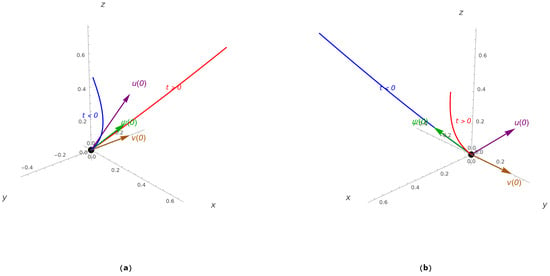
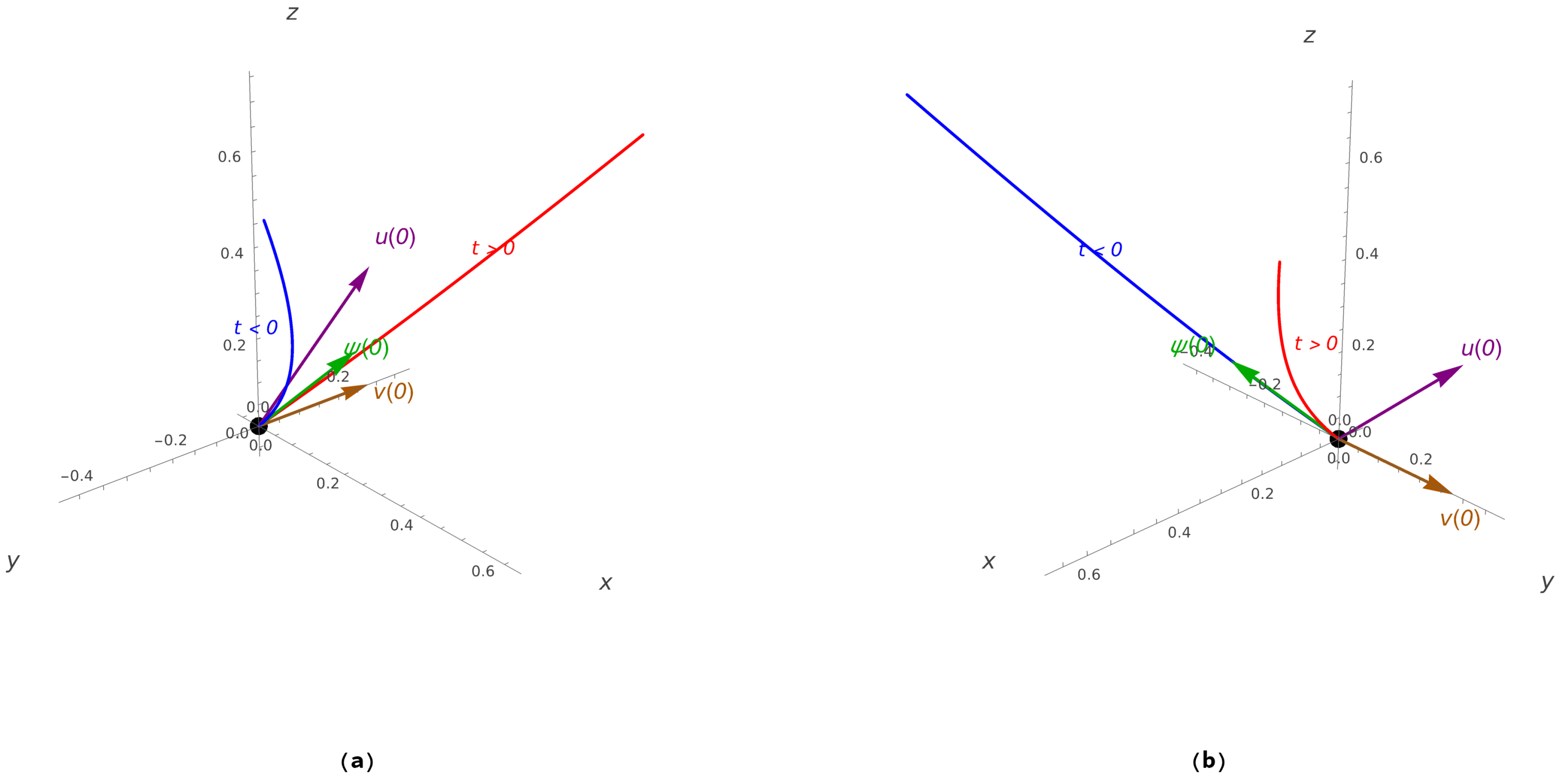
The null-framed curve and the frame vectors at the singular point are illustrated in Figure 1.
Figure 1.
Two views of the null-framed curve : (a) the curve and the frame vectors at the singular point; (b) the same curve and frame vectors from a different viewing angle. The point is the singular point of the original curve . The vectors , , and are displayed at this point, illustrating that the null-framed structure remains well-defined at the singular point.
4. Conclusions
In this paper, null-framed curves in Minkowski 3-space have been studied with particular attention to their behavior at singular points. A null-framed structure has been introduced by taking u to be a null vector field and v to be a spacelike vector field, together with an orientation condition formulated by means of the Lorentzian vector product. This condition determines the orientation of the frame and yields a definite relation among the frame vectors. On this basis, the Frenet-type equations of a null-framed curve and the corresponding framed curvature functions have been derived. On regular intervals, the connection between the null-framed structure and the classical null Frenet frame has been established for an arbitrary parameter. The passage from the framed parameter to a pseudo-arc parameter has been incorporated explicitly, leading to expressions for the classical Frenet vectors and the torsion in terms of the framed quantities. When the framed parameter itself is chosen as the pseudo-arc parameter, these formulas simplify considerably, and additional reductions arise under further conditions imposed on the frame vectors. Existence and uniqueness results have also been obtained for prescribed framed curvature functions and admissible initial data. The existence theorem shows that these data determine a null-framed curve satisfying the associated Frenet-type differential system. The uniqueness theorem, on the other hand, proves that two null-framed curves with identical framed curvature functions are related by an orientation-preserving Lorentzian congruence. The orientation condition is essential in this argument, since it guarantees the compatibility of the initial frames with an element of . The final example exhibits a genuine singular point at which the original curve ceases to be regular, while the null-framed structure and the framed curvature functions remain well-defined. On each regular part of the same curve, the classical null Frenet frame is recovered through the relations obtained in the regular case. In this sense, the null-framed approach provides a unified description of the geometry of the curve across both singular and regular points.
The results obtained here may provide a basis for further investigations of null-framed curves in higher-dimensional Lorentzian spaces and for the analysis of more general types of singular behavior.
Author Contributions
Conceptualization, T.E. and M.A.G.; Methodology, T.E. and M.A.G.; Software, T.E.; Validation, T.E. and M.A.G.; Formal Analysis, M.A.G.; Investigation, T.E.; Resources, T.E.; Data Curation, T.E. and M.A.G.; Writing—Original Draft Preparation, T.E.; Writing—Review and Editing, M.A.G.; Visualization, M.A.G.; Supervision, M.A.G. All authors have read and agreed to the published version of the manuscript.
Funding
This research received no external funding.
Data Availability Statement
The original contributions presented in this study are included in the article. Further inquiries can be directed to the corresponding author.
Conflicts of Interest
The authors declare no conflicts of interest.
References
- O’Neill, B. Elementary Differential Geometry; Academic Press: New York, NY, USA, 1966. [Google Scholar]
- O’Neill, B. Semi-Riemannian Geometry with Applications to Relativity; Academic Press: New York, NY, USA, 1983. [Google Scholar]
- Izumiya, S.; Pei, D.; Sano, T. The lightcone Gauss map and the lightcone developable of a spacelike curve in Minkowski 3-space. Glasg. Math. J. 2000, 42, 75–89. [Google Scholar] [CrossRef] [Scilit]
- Izumiya, S. Wave Front Propagations and Singularities; Kyoritsu Publishing Co., Ltd.: Tokyo, Japan, 2018. [Google Scholar]
- Bonnor, W.B. Null curves in a Minkowski space-time. Tensor 1969, 20, 229–242. [Google Scholar]
- Duggal, K.L.; Jin, D.H. Geometry of null curves. Math. J. Toyama Univ. 1999, 22, 95–120. [Google Scholar]
- Duggal, K.L.; Jin, D.H. Null Curves and Hypersurfaces of Semi-Riemannian Manifolds; World Scientific: Singapore, 2007. [Google Scholar]
- Inoguchi, J.-I.; Lee, S. Null curves in Minkowski 3-space. Int. Electron. J. Geom. 2008, 1, 40–83. [Google Scholar]
- Arnold, V.I.; Gusein-Zade, S.M.; Varchenko, A.N. Singularities of Differentiable Maps; Birkhäuser: Boston, MA, USA, 1985. [Google Scholar]
- Arnold, V.I. Singularities of Caustics and Wave Fronts; Springer: Dordrecht, The Netherlands, 1990. [Google Scholar]
- Izumiya, S.; Fuster, M.C.R.; Ruas, M.A.S.; Tari, F. Differential Geometry from a Singularity Theory Viewpoint; World Scientific: Singapore, 2015. [Google Scholar]
- Fukunaga, T.; Takahashi, M. Existence and uniqueness for Legendre curves. J. Geom. 2013, 104, 297–307. [Google Scholar] [CrossRef] [Scilit]
- Takahashi, M. Legendre curves in the unit spherical bundle and evolutes. Hokkaido Univ. Prepr. Ser. Math. 2015, 1071, 1–19. [Google Scholar]
- Honda, S.; Takahashi, M. Framed curves in the Euclidean space. Adv. Geom. 2016, 16, 265–276. [Google Scholar] [CrossRef] [Scilit]
- Akyiğit, M.; Yıldız, Ö.G. On the framed normal curves in Euclidean 4-space. Fundam. J. Math. Appl. 2021, 4, 258–263. [Google Scholar] [CrossRef] [Scilit]
- Doğan Yazıcı, B.; Özkaldı Karakuş, S.; Tosun, M. Characterizations of framed curves in four-dimensional Euclidean space. Univ. J. Math. Appl. 2021, 4, 125–131. [Google Scholar] [CrossRef] [Scilit]
- Fukunaga, T.; Takahashi, M. Framed surfaces and one-parameter families of framed curves in Euclidean 3-space. J. Singul. 2020, 21, 30–49. [Google Scholar] [CrossRef] [Scilit]
- Honda, S.; Takahashi, M. Bertrand and Mannheim curves of framed curves in the 3-dimensional Euclidean space. Turk. J. Math. 2020, 44, 883–899. [Google Scholar] [CrossRef] [Scilit]
- Li, Y.; Eren, K.; Ayvacı, K.H.; Ersoy, S. The developable surfaces with pointwise 1-type Gauss map of Frenet-type framed base curves in Euclidean 3-space. AIMS Math. 2023, 8, 2226–2239. [Google Scholar] [CrossRef] [Scilit]
- Okuyucu, O.Z.; Canbirdi, M. Framed slant helices in Euclidean 3-space. Adv. Differ. Equ. 2021, 2021, 504. [Google Scholar] [CrossRef] [Scilit]
- Yıldız, Ö.G. On the evolution of framed curves in Euclidean 3-space. Math. Methods Appl. Sci. 2022, 45, 12158–12166. [Google Scholar] [CrossRef] [Scilit]
- Derin Yaqub, Z.; Güngör, M.A. Serret-Frenet formula of quaternionic framed curves. Math. Sci. Appl. E-Notes 2025, 13, 92–105. [Google Scholar] [CrossRef] [Scilit]
- Azak, A.Z.; Sürekçi, A.; Güngör, M.A. Quaternionic framed Bertrand curves. Int. Electron. J. Geom. 2025, 18, 185–195. [Google Scholar] [CrossRef] [Scilit]
- Chen, L.; Takahashi, M. Dualities and evolutes of fronts in hyperbolic and de Sitter space. J. Math. Anal. Appl. 2016, 437, 133–159. [Google Scholar] [CrossRef] [Scilit]
- Ateş, F.; Ekmekçi, F.N. Light patterns generated by the reflected rays. Optik 2020, 224, 165507. [Google Scholar] [CrossRef] [Scilit]
- Ateş, F. Singularities of reflected spherical light rays from spacelike curve on the de Sitter 3-space. Optik 2021, 242, 167303. [Google Scholar] [CrossRef] [Scilit]
- Özyurt, C. Singular Curves and Their Properties. Master’s Thesis, Ankara University, Ankara, Turkey, 2021. [Google Scholar]
- Li, P.; Pei, D. Nullcone fronts of spacelike framed curves in Minkowski 3-space. Mathematics 2021, 9, 2939. [Google Scholar] [CrossRef] [Scilit]
- Li, P.C.; Pei, D.H.; Zhao, X. Spacelike framed curves with lightlike components and singularities of their evolutes and focal surfaces in Minkowski 3-space. Acta Math. Sin. Engl. Ser. 2024, 40, 1521–1532. [Google Scholar] [CrossRef] [Scilit]
- Zhang, W.; Li, P.; Pei, D. Circular evolutes and involutes of spacelike framed curves and their duality relations in Minkowski 3-space. AIMS Math. 2024, 9, 5688–5707. [Google Scholar] [CrossRef] [Scilit]
- Yadav, A.; Yadav, A.K. Translation framed surfaces generated by non-null framed curves in Minkowski 3-space. Int. J. Maps Math. 2024, 7, 97–121. [Google Scholar]
- Chen, L.; Takahashi, M. Lightcone framed curves in the Lorentz-Minkowski 3-space. Turk. J. Math. 2024, 48, 307–326. [Google Scholar] [CrossRef] [Scilit]
- Wu, L.; Zhou, A.; Yao, K.; Pei, D. Generalized Bertrand curves of non-light-like framed curves in Lorentz–Minkowski 3-space. Mathematics 2024, 12, 2593. [Google Scholar] [CrossRef] [Scilit]
- Couto, I.T.; Lymberopoulos, A. Introduction to Lorentz Geometry, Curves and Surfaces; CRC Press: Oxon, UK, 2021. [Google Scholar]
- López, R. Differential geometry of curves and surfaces in Lorentz-Minkowski space. Int. Electron. J. Geom. 2014, 7, 44–107. [Google Scholar] [CrossRef] [Scilit]
- Walrave, J. Curves and Surfaces in Minkowski Space. Ph.D. Thesis, K.U. Leuven, Leuven, Belgium, 1995. [Google Scholar]
- Izumiya, S. Legendrian dualities and spacelike hypersurfaces in the lightcone. Mosc. Math. J. 2009, 9, 325–357. [Google Scholar] [CrossRef] [Scilit]
Disclaimer/Publisher’s Note: The statements, opinions and data contained in all publications are solely those of the individual author(s) and contributor(s) and not of MDPI and/or the editor(s). MDPI and/or the editor(s) disclaim responsibility for any injury to people or property resulting from any ideas, methods, instructions or products referred to in the content. |
© 2026 by the authors. Licensee MDPI, Basel, Switzerland. This article is an open access article distributed under the terms and conditions of the Creative Commons Attribution (CC BY) license.