


Abstract
The aims of this paper are two-fold. First, we present the result of the decomposition on the iterations of a Collatz transform into arithmetic sequences. With this, we prove that in Furstenberg topology, the set of (odd) integers with an infinite stopping time is closed and nowhere dense. Then, we move our considerations to some monoids in , where we define a suitably modified Collatz transform, and we present some results of numerical investigations on the behaviour of these modified transforms.
MSC:
11B25; 11B83; 11B37
1. Introduction
1.1. Notation
Throughout this paper, is the set of non-negative integers (natural numbers), is the set of positive integers and X denotes the set of odd positive integers. The classical Collatz function is defined by the formula
The so-called function is defined as
For future use, we also define a version of the map T. Let . We may uniquely write , where is odd and . The number (i.e., the adic norm of n) is denoted by .
Definition 1.
The map given by the formula
is called the Collatz transform.
1.2. On the Collatz Problem
Here, we recall only basic facts about the Collatz problem. For much more information on the subject and a comprehensive bibliography, we refer the reader to [1,2,3,4,5].
With function T defined above and the integer , the trajectory of n under the function T is an infinite sequence: where , and .
For a given n, we have a priori two possibilities: the correspondence is injective or it is not. If the map is injective, it must tend to infinity, . Such trajectories are said to be divergent. If the map is not injective, then there exists , such that for all sufficiently large , we have . Such a trajectory is said to be cyclic. For a cyclic trajectory, let . The finite sequence is called a cycle of the trajectory . The smallest such number p is the length of the cycle. When the length of the cycle equals 2 (i.e., ), then it is easy to see that the cycle equals . In this case, it is called a trivial cycle, and the trajectory is said to be convergent. When , the cycle is said to be non-trivial.
The Collatz problem, see [6], may be formulated as follows.
Conjecture 1
([6]). For each , the trajectory is convergent.
Thus, the Collatz conjecture excludes the existence of divergent trajectories and non-trivial cycles.
This conjecture is a constant source of inspiration for mathematicians and computer scientists, who connect it with various fields of research: complex analysis, operator theory, number theory, probability, and many others; see, as an example [7,8,9,10,11,12,13,14].
The convergence of the trajectories was checked by computers, to our knowledge, for [15]. Terras, in 1976 [16], proved that a set of n such that for every there is , even if not empty, is relatively small (i.e., its density is zero; see Section 4). In 2019, Tao [17] proved that for any function with , the inequality holds, in the sense of logarithmic density, for almost all .
Additionally, we would like to remark that in this paper, we mainly focus on the transform from Definition 1. The notions of cyclic or divergent trajectories for are analogous to those for T. However, the lengths of the cycles may, of course, differ; e.g., a trivial cycle for has a length of one.
1.3. Decomposition into Arithmetic Sequences
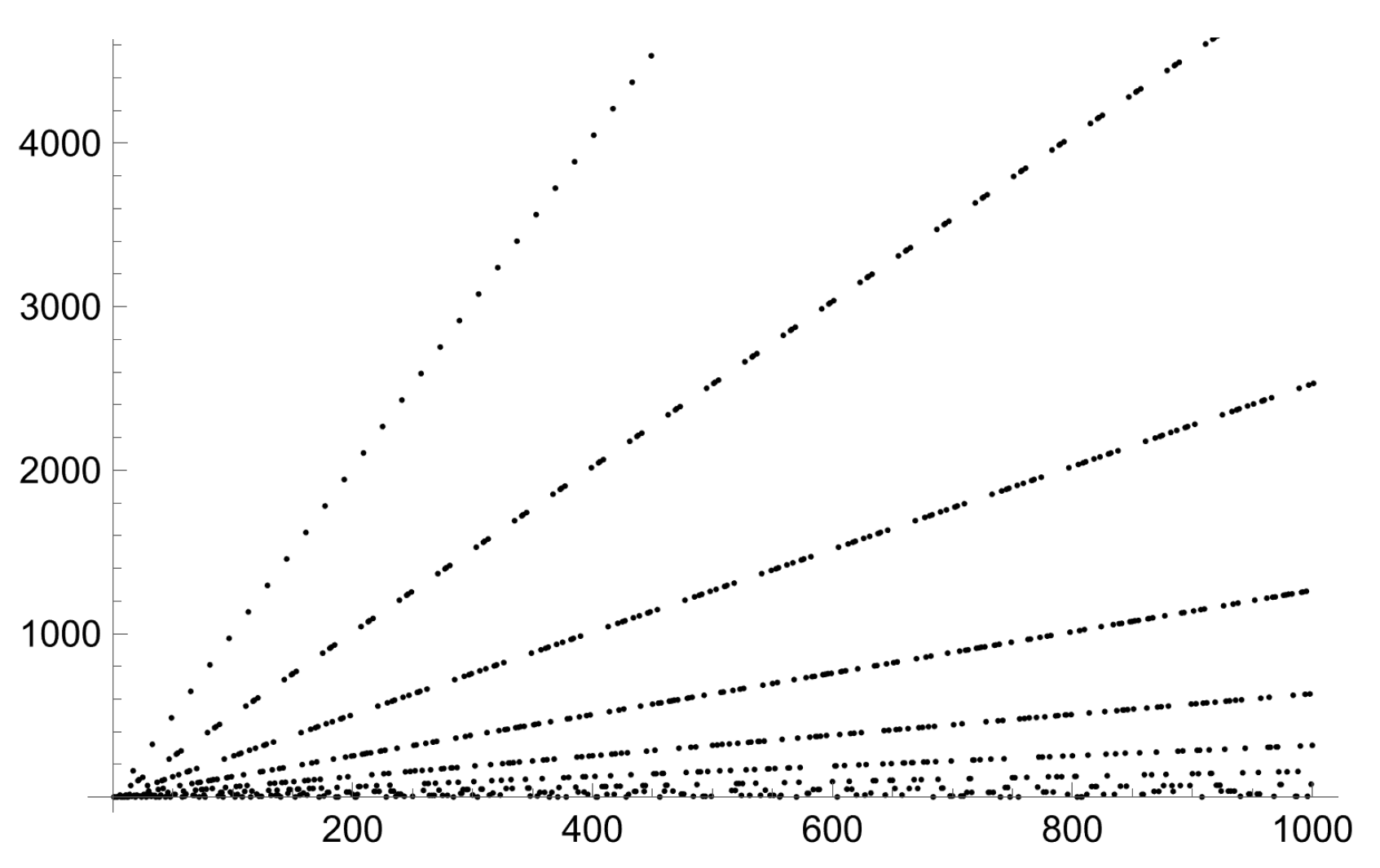
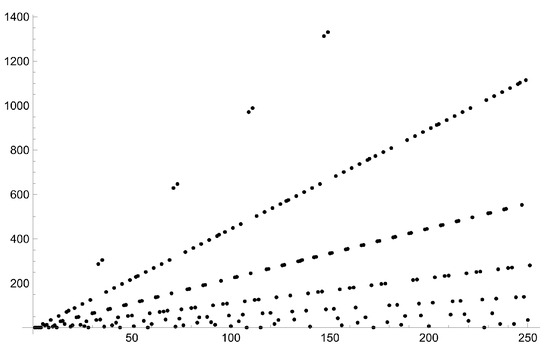
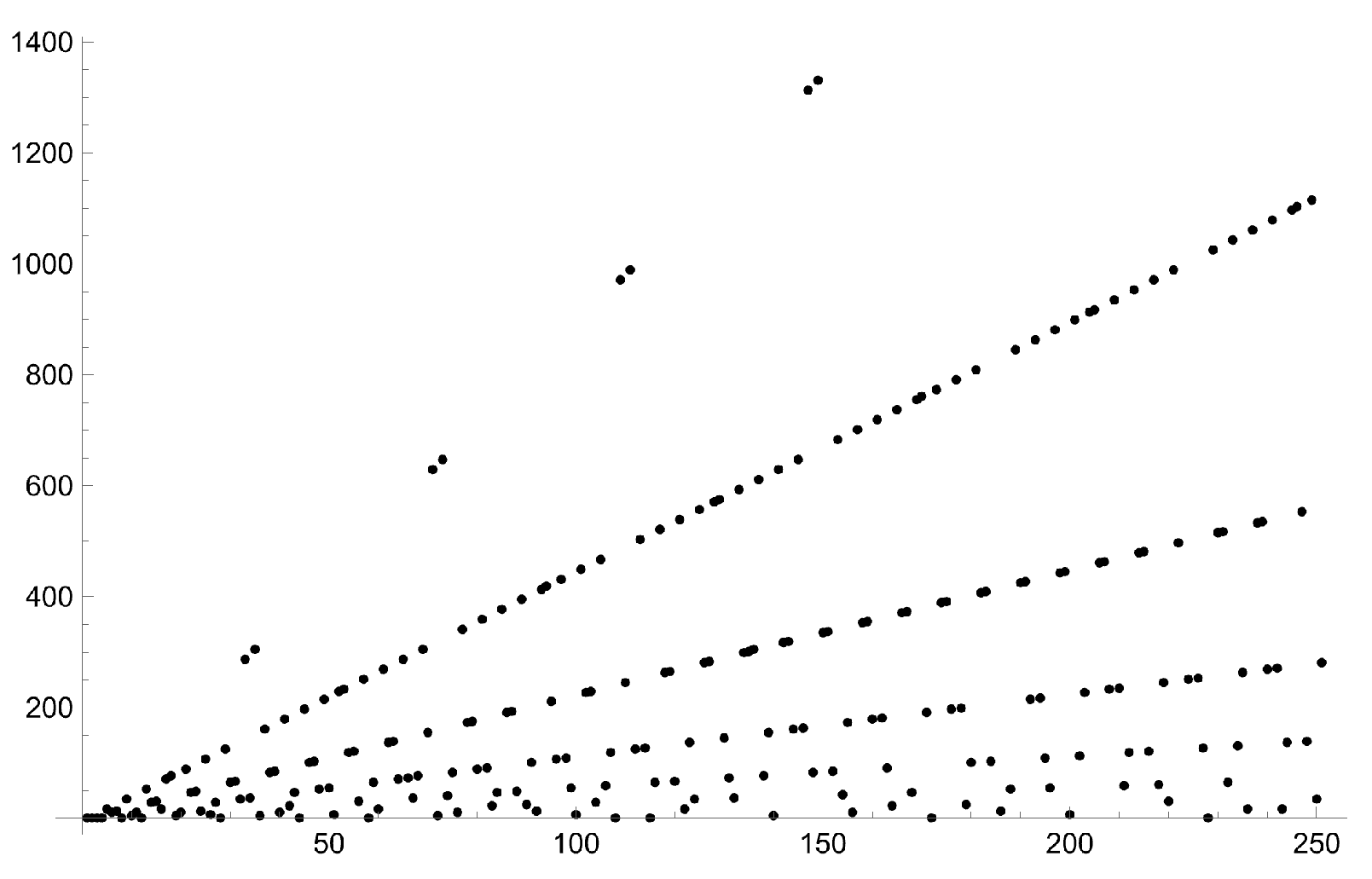
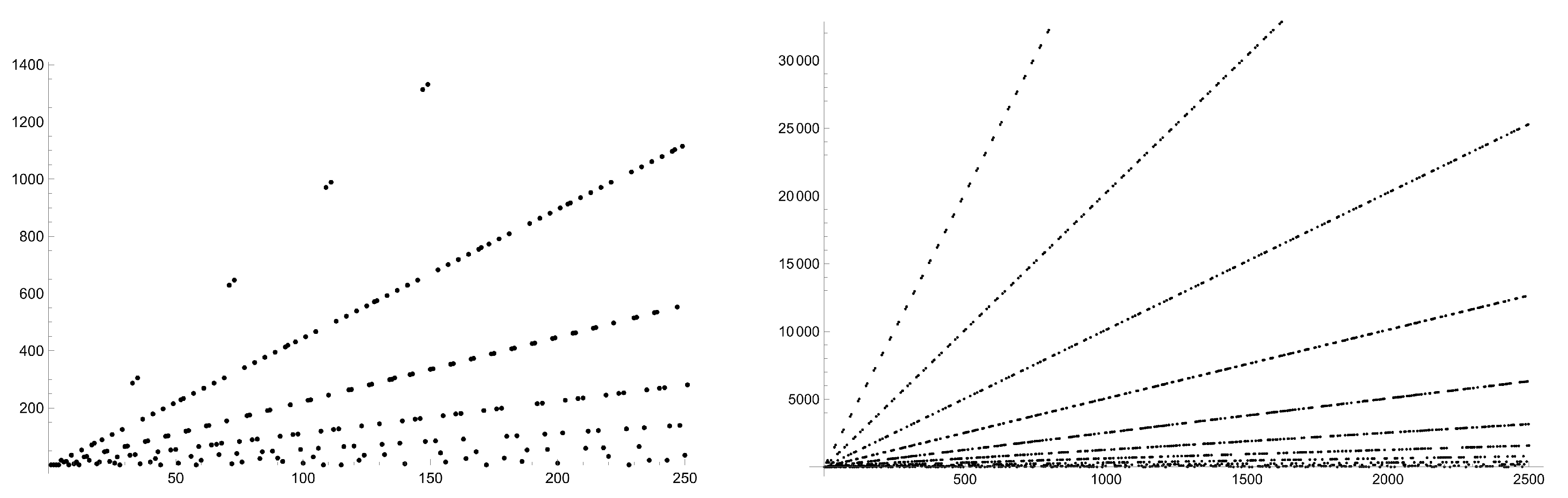
We show a, hopefully, interesting description of the k-th iteration of . We think this result is noteworthy and may provide new insight into the Collatz problem. The main idea behind this result is that the domain of (that is, the set X) can be divided into separate arithmetic sequences, and for integers in any such sequence, the graph of lies on a line with a given slope. Before we quote the result (Theorem 3), let us present Figure 1, showing the idea of the result.
Figure 1.
The idea behind Theorem 3; a graph of .
Theorem 1.
Let and let . Let . Then there exists a family of subsets satisfying the following properties:
- (1)
- Each is an arithmetic sequence.
- (2)
- If , then
- (3)
- (4)
- For each , there exist positive rational numbers and such that for each , we have
- (5)
- (6)
- The difference in the sequence equals .
- (7)
- The difference in the sequence equals .
1.4. LikeNs, Motivation and a Very Short Introduction
In this subsection, we present structures named ‘likes’ described in [18,19]. We investigate the behaviour of a suitably modified Collatz transform on in Section 5. The motivation for considering such structures is the fact that the map can be considered as well as the map where is a set of odd numbers divisible by 3. The problem is that restricted, for example, to is not a map into . It turns out that by defining the modified Collatz transform on some subsets of X, that is, on likens, we may omit this problem. Moreover, our approach makes the domain of the Collatz transform smaller and, at the same time, slightly changes the ‘affinity’ of this function. In this way, we obtain a source of interesting numerical results, obtained with low computer processing power. We hope that these results broaden our understanding of the Collatz problem.
Take , treated as a monoid. We define likens as follows:
Definition 2.
Let be an infinite subset of such that , and is closed with respect to the multiplication in , i.e., is a monoid.
For future use, observe that we may analogously define as a monoid in X.
As is a strictly increasing sequence of natural numbers, For any (or in X), we define a successor of n in :
Definition 3.
If the context is clear, we write only .
Now, let denote the sequence of prime numbers and let q be a fixed prime number. Then, the liken, denoted as , is the monoid generated by the set . For example, is the monoid of all odd numbers, . More generally, is the monoid in , generated by the set , where A is a finite subset of .
Remark 1.
In what follows, we are interested only in likens , or even , where , so when the context is clear, we will write instead of or .
1.5. Paper Organization
The paper is organized as follows. In Section 2, we present the result of the decomposition of the iterations of a transform into arithmetic sequences. In Section 3, we deal with the Furstenberg topology in X and prove that is continuous in this topology. In Section 4, we prove that a set of , with infinite stopping time, is closed and nowhere dense (in the Furstenberg topology). In Section 5, we generalize to likens, and in Section 6, we present the results of the numerical experiments.
2. Arithmetic Sequences
Let be the Collatz transform, as in Definition 1. The aim of this section is to construct an infinite sequence of families of sets, and then to study its properties. Each family is a countable family of subsets of X. The elements of the family are denoted by , where The sequence is constructed recursively.
2.1. Construction of
Family is constructed as follows. Take an arbitrary Let be given by
Then,
Now, we describe how to construct when is given. The family consists of sets of the form , so we choose an index . For this selected index, we consider the index . This index is associated with the set that is in , which has already been constructed. Define an auxiliary set using the formula
Finally, we put:
2.2. Some Properties of
Now, we study the properties of the constructed sequence .
Property 1.
For each , the set
is an arithmetic sequence with difference .
Proof.
Note that .
Suppose now that there exists an even integer r such that and such that for some , . Then, write for some and . Hence, as we have Since , the left-hand side is divisible by , so , and so, . Thus, we have As a consequence, since is even, we see that is divisible by , which is, according to the definition of , impossible. □
Property 2.
For each , if , then
Proof.
Suppose, on the contrary, that there exists . Hence, , for some . This is impossible when . □
Property 3.
We have
Proof.
Indeed, if , then is even, so there exists and such that . As a consequence, . □
2.3. Arithmetic Sequences and
As the proof of Theorem 3 is by inductive argument, it will be useful to consider the graph of the first iteration of the Collatz transform. As we have observed above, its domain is the set X, which can be decomposed into a countable family of arithmetic progressions . Thus, is the disjoint union of its restriction to the sets , and we have the following:
Property 4.
Property 5.
is an arithmetic sequence with the difference
We have . From Property 1, is an arithmetic sequence with the difference . Take two consecutive terms of , say, x and . We have
As a consequence of the above properties, we obtain the following:
Theorem 2.
Let . Then, the points of the graph of satisfy . Hence, they lie on the (real) line
The next property concerns some arithmetic sequences in X.
Property 6.
Let be an arithmetic sequence in X such that , where r is odd. Take .
Then, the set
is an arithmetic sequence.
Proof.
It is enough to show that the set is an arithmetic sequence.
Any i such that must satisfy
Let As is even, is also even, so for some z. Thus,
As is odd, it has an inverse in the ring ; hence,
Denote as t.
Thus, , so iff
and thus is an arithmetic sequence. □
Finally, let us observe the following:
Property 7.
Keeping the notation as above, given a sequence , we obtain a sequence of arithmetic progressions such that for and .
Proof.
Indeed, for a given p and q, suppose that is the common element of and . Then, for some k and m, we have and , so , and this is impossible.
Then, take . As is even, there exists (only one) p such that is odd, so . □
2.4. Description of the Second Iteration
Section 2.3 gives a description of the graph of . This section describes the graph of . In fact, it is the second step in the inductive proof of Theorem 3. We include it here to simplify the reading of the (rather technical) proof of Theorem 3.
Recall the construction of the family of sets .
The family consists of sets of the form . So we choose the index and take the index . This index is associated with the set in , which has already been constructed. Define auxiliary sets as Then,
From Properties 6 and 7 we see that the set is an arithmetic sequence, consisting of such for which is odd; moreover, changing , we obtain a disjoint decomposition of into arithmetic sequences , i.e., such that and
Changing both and , we obtain a decomposition of
into arithmetic sequences.
Now, take The set is the set of values of the first iteration on the arithmetic sequence . Now, take into account an arbitrary point For this point, there is exactly one integer such that . Thus, belongs to and . Since , there exists exactly one integer such that belongs to the set and Thus,
As a consequence, the point lies on the graph of an affine function , where and
2.5. Description of the k-th Iteration
The description of is one of the essential results of this paper. Perhaps this result is already known to specialists on the subject, but we were unable to find it. Thus, we present it as the following Theorem. To simplify the notation, we slightly change the indexing of the sets in the family .
Theorem 3.
Let and let . Let . Then, there exists a family of subsets satisfying the following properties:
- (1)
- Each is an arithmetic sequence.
- (2)
- If , then
- (3)
- (4)
- For each , there exist positive rational numbers and such that for each , we have
- (5)
- (6)
- The difference in the sequence equals .
- (7)
- The difference in the sequence equals .
Before starting the proof, we present a picture illustrating the idea of the Theorem. Figure 2 shows for all odd n up to 500.
Figure 2.
Graph of .
Proof.
For n the proof follows from the construction given in Section 2.1, Properties 1–5 and Theorem 2.
Next, assume that , and there exist sets satisfying Properties 1–7. We want to prove that for each , there exist sets satisfying (1)–(7).
Each such is of the form , for some , We define using Property 6, which we are able to do as, according to the inductive assumption, the sequence is arithmetic. Take, as in this property, and . Define
Thus, the following are true:
- (1)
- The below follows from Property 6.
- (2)
- If , then or . If , then by inductive assumption, and as , we are finished. If but , we obtain the claim from Property 7.
- (3)
- Take . We haveFrom Property 7,Thus, we obtainby inductive assumption.
- (4)
- We want to prove that if , then , for some numbers ( and ). Observe that on , the transform acts as Replacing z with and using the inductive assumption, we are finished.
- (5)
- The proof is a direct consequence of the above.
- (6)
- Let . We haveandsoFrom (5), we have and so,As is even, is divisible by .On the other hand, analogously, as in the proof of Property 1, we check that the difference in the sequence cannot be less than .
- (7)
- Take two consecutive elements of . From (6), we know that they are given by and .Thus, two consecutive terms of are given by and . From this, we have
□
3. Furstenberg Topology on Odd Positive Integers
In 1955, Furstenberg, in [20], defined a topology on integers. We will use his definition, restricted to X.
Let X be a set of all odd positive integers.
Definition 4.
Let . Then, if and only if for any , there exists such that for all , we have .
Thus, is open iff every point is contained in U together with an arithmetic sequence, or
Remark 2.
(1) is a topology in X.
- (2)
- The set is a neighbourhood of a.
- (3)
- Let and . Then, the set (arithmetic sequence) is closed in
Proof.
(1) and (2) are an immediate consequence of the definition.
(3) is also easy, but we put it here for the sake of completeness.
Take . We have to show that V is an open set. Observe that . For an integer , let . Thus, is an open set, as it is in fact . As , we are finished. □
We recall below some properties of the Furstenberg topology. They are proved in [20].
Proposition 1.
(1) is a Hausdorff space.
- (2)
- ( is a regular space.
- (3)
- ( has a countable basis.
- (4)
- ( is (from the Uryhson theorem) metrizable.
The following theorem is, to the best of our knowledge, new.
Theorem 4.
is continuous as a map from to itself.
Proof.
We have to show that is continuous in every . This means that for every neighbourhood V of , there exists a neighbourhood U of x, such that .
Without loss of generality, we may assume that where r is a positive integer. Let us also define an auxiliary set as . Now, let p be such an integer that is an odd number (thus, ). Let
U is a neighbourhood of x, as p is fixed. Take a number . Thus, for some j. We have
Let .
Then, As must be odd and is odd, the only possibility is . So,
So, , and we are finished. □
Remark 3.
From this Theorem, we immediately determine that any iteration of is continuous in .
4. Stopping Time
The main result of this Section is Theorem 6, which describes, in , a property of the set of odd integers with a finite stopping time.
Recall the notion of a (finite) stopping time.
Definition 5.
We say that has a finite stopping time if and only if there exists a positive integer k such that . The least such k, if it exists, is called , the stopping time of n. If a given n does not have a finite stopping time, we say .
For a natural number k, define a set Let and take the complement of V in X, namely the set . Then, for , there is Note that in a nontrivial cycle (if one exists), with being the maximum and the minimum of the cycle values, does have a finite stopping time and does not. However, it is not difficult to see the following:
Remark 4.
Collatz Conjecture is true if and only if S is empty.
Unfortunately, so far, there is no proof that S is empty. However, Terras, in his paper [16], proved the following theorem.
Theorem 5.
The density of S is 0.
Recall that the (natural) density of a set is defined as follows:
Definition 6.
Let . Let . The upper asymptotic density of A is , and the lower asymptotic density of A is . If , then is the density of A.
Remark 5.
Observe that if A contains an (infinite) arithmetic sequence, then
The main result of this Section is a theorem about the topological properties of the set of with an infinite stopping time. We prove that this set is closed and nowhere dense in ; this gives a result densewise weaker than Theorem 5, but perhaps interesting on its own.
Theorem 6.
The set S (of n with ) is closed and nowhere dense in .
Proof.
Let denote an arithmetic sequence in X, with . As R must be even, there exist (unique) integers, and , such that Denote .
From the definition of , it follows that there exists a unique integer , such that We write .
First, we prove the following:
Lemma 1.
For every with , there exists a smaller open set such that and .
Proof.
Let and .
Case 1. . Recall that , where Observe that , i.e., . Indeed,
In this case, establish . Then, , and so, is a neighbourhood of with , as .
Case 2. Take and take a subsequence of given by , where
We compute, as above, that . Thus, is a neighbourhood of with , as □
From Lemma 1 we have the following:
Corollary 1.
Every neighbourhood with is an image by of some .
Proof.
Indeed, applying the lemma to instead of , we obtain . We have, as in the lemma, for some neighbourhood of ; then, arguing inductively, we obtain
□
Next, we need
Lemma 2.
For every neighbourhood of , there exists a (finite) sequence of neighbourhoods of , with
- 1.
- is a neighbourhood of with .
- 2.
- .
- 3.
- , with
Proof.
We proceed as follows. If , then we are finished. If , then apply Lemma 1 to this . This way, we obtain with . We proceed in this way until for some (finite) k, we obtain . The last statement follows from Corollary 1. □
The last Lemma we need is as follows:
Lemma 3.
For any , the set is open.
Proof.
We proceed by induction. Take , so . From Theorem 3, we know that there exists an arithmetic sequence such that all points are on a line with a slope (for some natural j). As , this slope must be less than one, so at most, . As a consequence, all the points are “under” the line . Thus, for all i, ; the sequence is contained in , so is open.
Let and let . Thus, , so for and ; in other words, This implies that , so Thus, . As is open and is continuous, the set is open, which ends the proof. □
Let us now prove the theorem. As is open and , S is closed. Assume that S is not nowhere dense. Then S has an interior point (in topology ). Thus, there exists such that for some even , there is . Using Lemmas 1 and 2, we obtain a neighbourhood with and form Corollary 1, , . Thus, we may apply Property 6 to , so we may decompose into (nonempty for every ) arithmetic sequences, say, for short, such that for every , we have
As is bijective, there exist satisfying
From Theorem 3, it follows that there exist and such that
Thus,
For big enough p, the coefficient is smaller than 1. So, there exist (infinitely many) points with “under” the line , i.e., , so they have a finite stopping time, which is a contradiction. □
Remark 6.
The proof of Theorem 6 may be obtained in an easier way if we use Theorem 5.
Proof.
As above, S is closed. Assume that S is not nowhere dense. Then, S has an interior point (in ). Thus, this point is contained in S with an arithmetic sequence; see Remark 2. But then, , from Remark 5, and this is a contradiction with Theorem 5. □
Remark 7.
Let be a family of all arithmetic progressions of the form . Let be a subfamily which is a filter basis. For such S, we have the topology , analogous to the Furstenberg topology. We can then investigate the properties of in . As far as nowhere denseness is considered, the Furstenberg topology is the best, as it is the strongest one, so the nowhere dense set is the smallest.
5. Generalized Collatz Transform
The Collatz problem has been generalized or reformulated in many ways. One possible group of generalizations of the Collatz problem preserves the set of positive integers as the domain of the Collatz function, but the formula defining T is replaced by a formula similar to it. For example, instead of one may consider the functions or or, more generally, affine functions of type . The Collatz functions of this type may not seem to differ, from a numerical point of view, from the function. However, the numerical data obtained, for example, for the function , suggest that in this case, almost all orbits escape to infinity, that is, are divergent; see [2].
Another method of changing the problem is to reduce it to residue classes. A subset is sufficient if the convergence of all trajectories for implies the convergence of all trajectories for . Trivially, the set of all natural numbers that are not divisible by 3 is sufficient. A less trivial example of a sufficient set is the set ; see [1,21] for a generalization.
Finally, we may generalize both the domain of T and T itself. In [1,3], we can find information on the possibility of such modifications of the Collatz problem in or in . There are many such extensions; for example, for , let us denote . One may easily observe that if , then ; see [1,22].
Our approach to generalization of the Collatz problem, on the one hand, restricts the domain of the function, and on the other hand, leaves the Collatz transform intact as much as possible.
We restrict our considerations to likens. Let us start with some remarks, showing that likens have interesting topological properties.
Remark 8.
The Furstenberg topology may also be defined on likens The small difference is as follows: Let . Then, if and only if for any , there exists an integer such that for all , we have .
Remark 9.
For any primes , the likens are open in Furstenberg topology.
Indeed, arithmetic sequences are closed in X; thus, is open.
From now on, we restrict our considerations to likens , where is a prime number. As the context is clear, we still denote as .
We define a generalized Collatz transform as a function from , defined as follows:
Definition 7.
Let .
where is the successor of in ; see Definition 3. In other words, if is divisible by q, we replace it with .
Remark 10.
- (1)
- Strictly speaking, the first iteration of the transforms (i.e., itself) is a map from X to and only starting from the second iteration may we speak of a map from to . This is also the case for , treated as .
- (2)
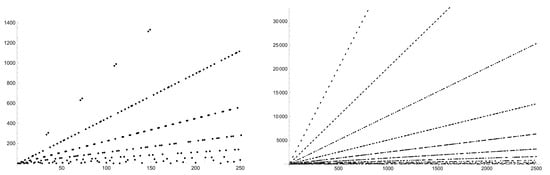
- We will not prove it here, but, as it visible in Figure 3, this version of Theorem 3 holds also for and .Figure 3. Decomposition of and into arithmetic sequences.
6. Some Numerical Results and Questions
Numerically investigating transformations in for several initial values of q, we discovered some phenomena not detected (so far) in the classical case. In what follows, we present a number of numerical results for , where represents prime numbers less than 100. This investigation was carried out with Mathematica, version 13.0 [23].
6.1. Cycles
Observation 1.
The Collatz function admits a non-trivial cycle.
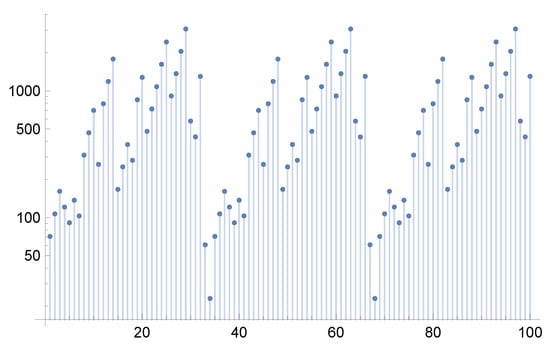
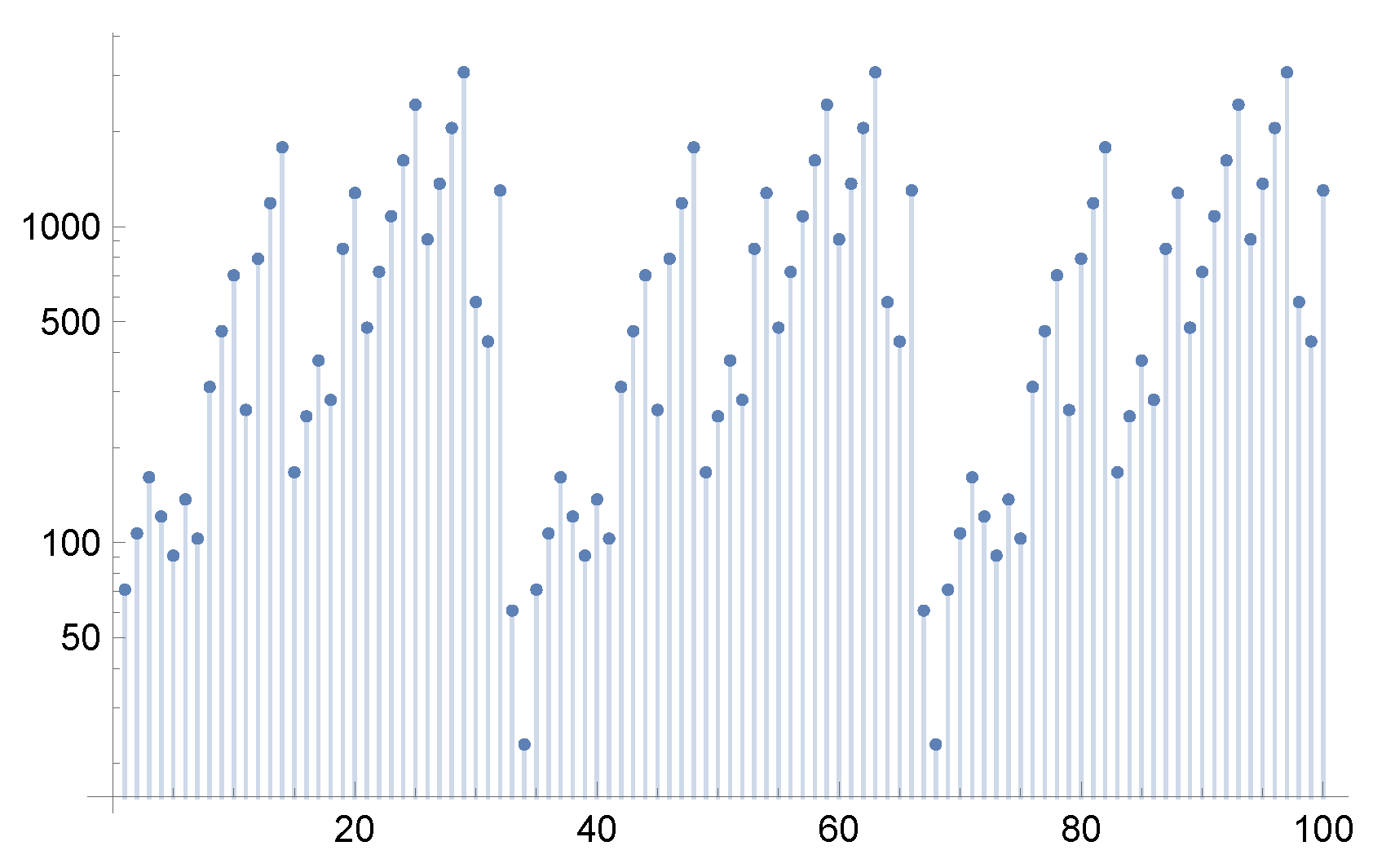
This cycle was found by performing a numerical search. We list below all the elements of the trajectory :
| Cycle for | ||||||||||||||
| i | 0 | 1 | 2 | 3 | 4 | 5 | 6 | 7* | 8 | 9 | 10* | 11 | 12 | 13 |
| 71 | 107 | 161 | 121 | 91 | 137 | 103 | 311 | 467 | 701 | 263 | 791 | 1187 | 1781 | |
| i | 14 | 15 | 16 | 17 | 18* | 19 | 20 | 21 | 22 | 23 | 24 | 25 | 26 | 27 |
| 167 | 251 | 377 | 283 | 851 | 1277 | 479 | 719 | 1079 | 2429 | 1619 | 1367 | 2051 | 3077 | |
| i | 28 | 29 | 30* | 31 | 32 | 33* | ||||||||
| 577 | 433 | 1301 | 61 | 23 | 71 | |||||||||
Remark 11.
A comment is needed. We have . In , there is , but ; hence, .
We use the notation to denote a case when .
Figure 4 shows the behaviour of in the logarithmic scale (ListLogPlot command in Mathematica [23]).
Figure 4.
Cycle for 71 in .
Observation 2.
Non-trivial cycles were also found to exist in for primes
Non-trivial cycles were also found for other values.
Observation 3.
| Cycle for | ||||||||||
| i | 0 | 1 | 2 | 3* | 4 | 5 | 6 | 7 | 8 | 9 |
| 103 | 155 | 233 | 701 | 263 | 395 | 593 | 445 | 167 | 251 | |
| i | 10 | 11 | 12 | 13 | 14 | 15 | 16 | 17 | 18* | 19 |
| 377 | 283 | 425 | 319 | 479 | 719 | 1079 | 1619 | 2429 | 7289 | |
| i | 20* | 21 | 22 | 23 | 24 | 25* | 26 | 27 | 28 | 29 |
| 21,869 | 8201 | 6151 | 9227 | 13,841 | 41,525 | 3893 | 365 | 137 | 103 | |
Figure 5.
Cycle for 103 in .
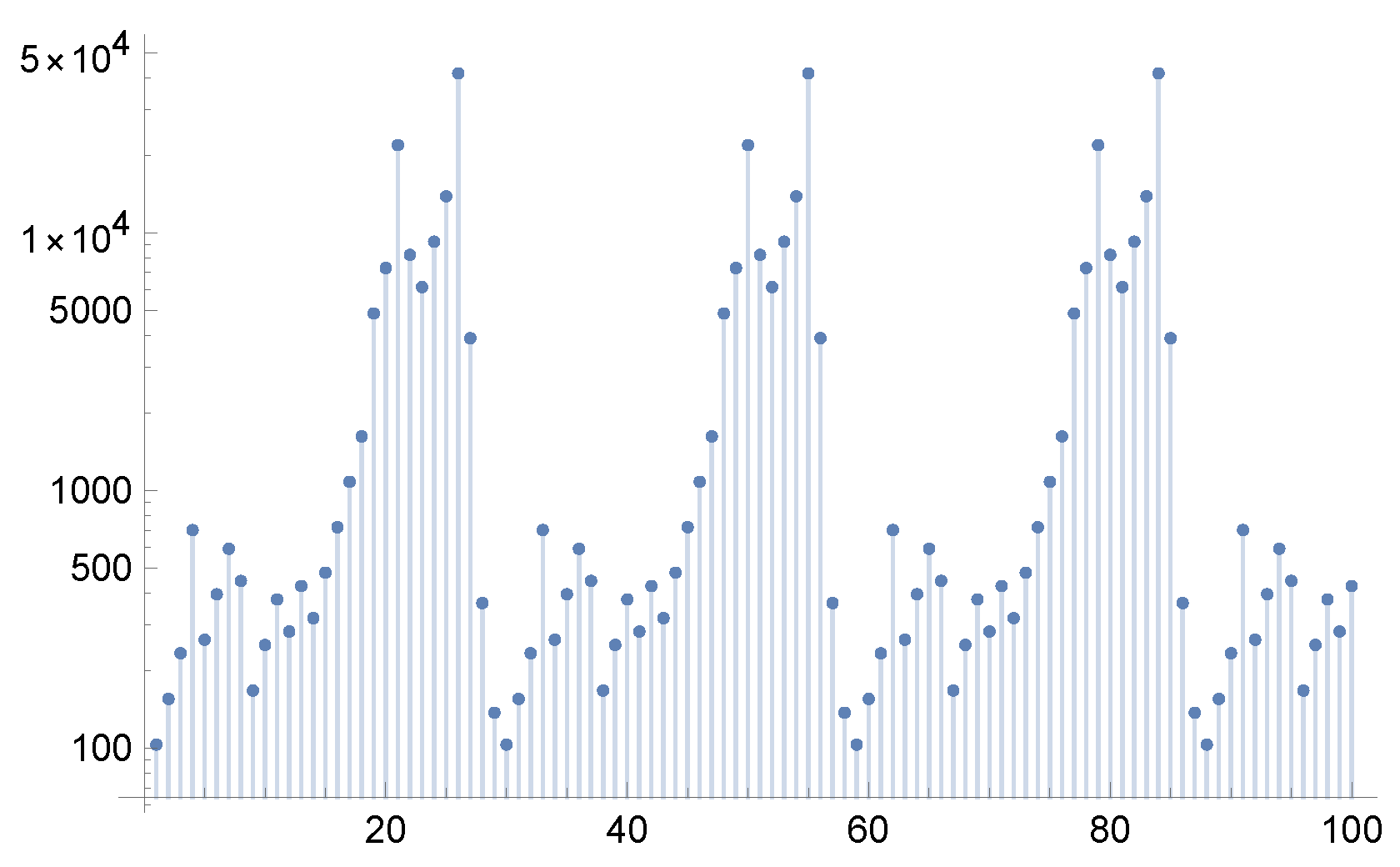
The shortest nontrivial cycle we found is for in .
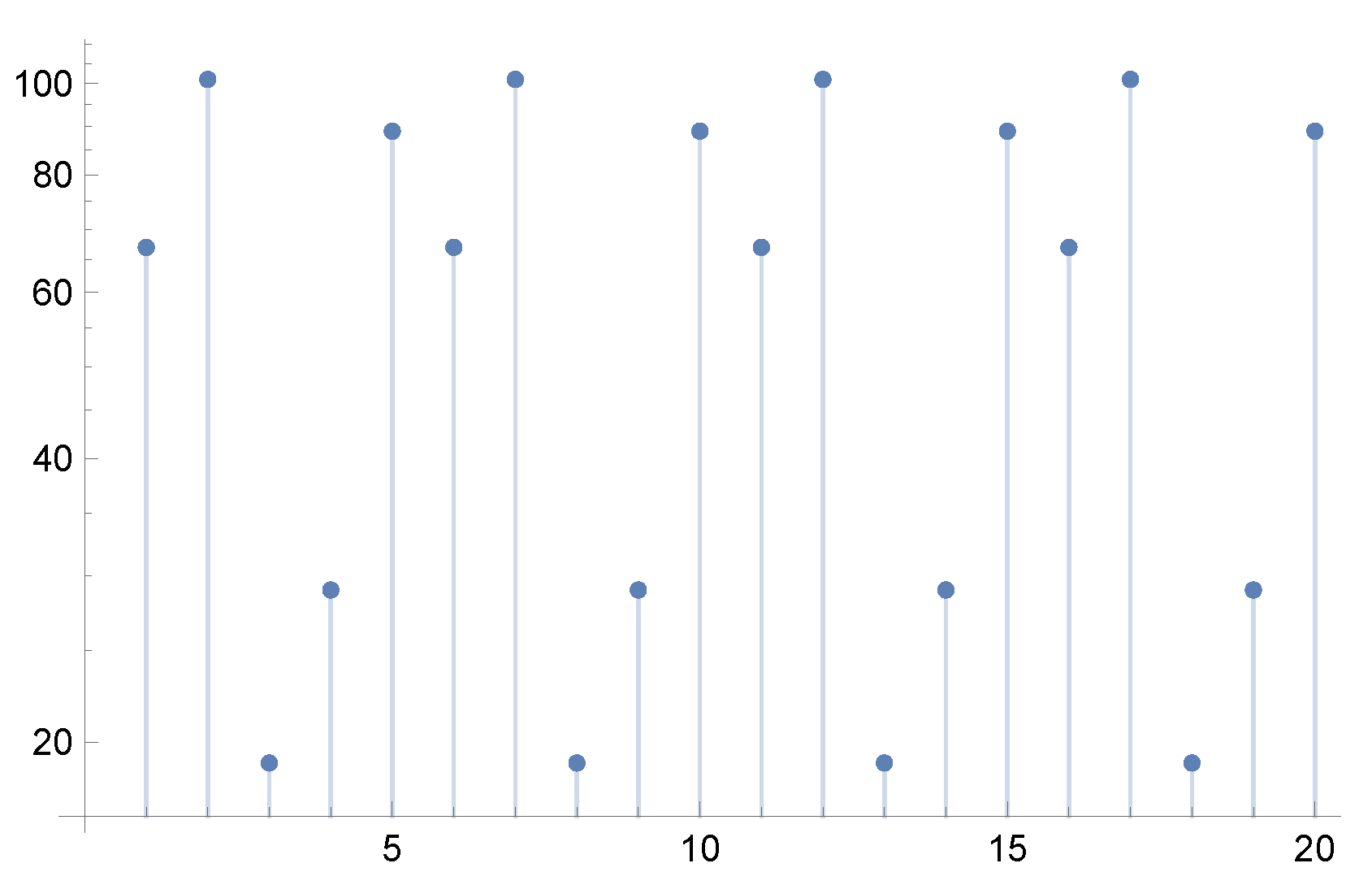
| Cycle for | ||||||
| i | 0 | 1 | 2 | 3 | 4* | 5 |
| 67 | 101 | 19 | 29 | 89 | 67 | |
Figure 6.
Cycle for 67 in .
| Cycle for | ||||||||||||
| i | 0 | 1 | 2 | 3 | 4 | 5 | 6 | 7 | 8 | 9 | 10 | 11 |
| 137 | 103 | 155 | 233 | 175 | 395 | 263 | 395 | 593 | 445 | 167 | 251 | |
| i | 12* | 13 | 14 | 15 | 16 | 17 | 18* | 19 | 20 | 21 | 22 | 23 |
| 755 | 1133 | 425 | 319 | 479 | 719 | 2159 | 3239 | 4859 | 7289 | 5467 | 8201 | |
| i | 24 | 25 | 26 | 27 | 28 | 29 | 30 | |||||
| 6151 | 9227 | 13,841 | 10,381 | 3893 | 365 | 137 | ||||||
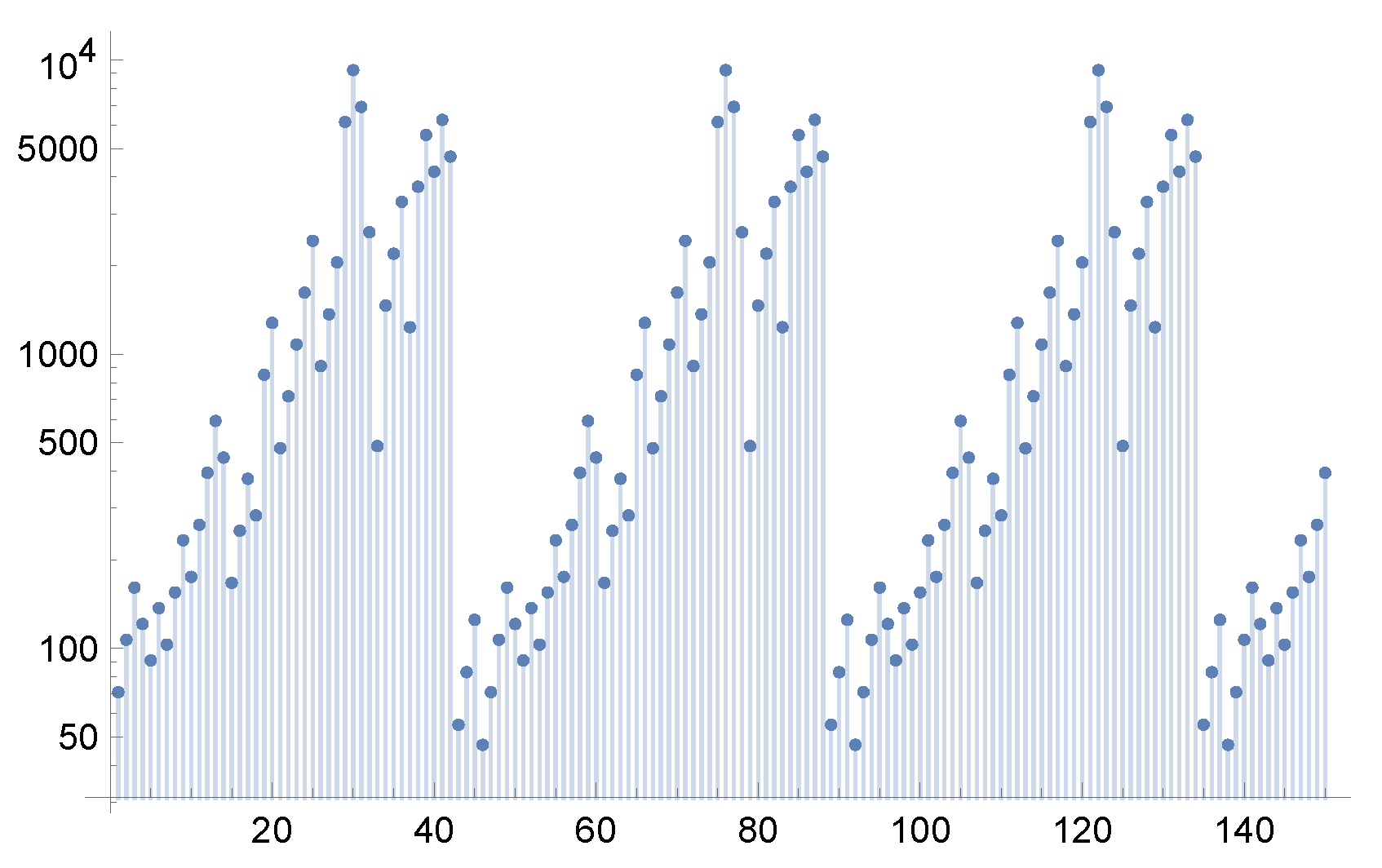
The longest cycle we found was for 71 in .
| Cycle for | ||||||||||||
| i | 0 | 1 | 2 | 3 | 4 | 5 | 6 | 7 | 8 | 9 | 10 | 11 |
| 71 | 107 | 161 | 121 | 91 | 137 | 103 | 155 | 233 | 175 | 263 | 395 | |
| i | 12 | 13 | 14 | 15 | 16 | 17 | 18* | 19 | 20 | 21 | 22 | 23 |
| 593 | 445 | 167 | 251 | 377 | 283 | 851 | 1277 | 479 | 719 | 1079 | 1619 | |
| i | 24 | 25 | 26 | 27 | 28* | 29 | 30 | 31 | 32 | 33* | 34 | 35 |
| 2429 | 911 | 1367 | 2051 | 6155 | 9233 | 6925 | 2597 | 487 | 1463 | 2195 | 3293 | |
| i | 36 | 37* | 38 | 39 | 40 | 41 | 42 | 43 | 44 | 45 | 46 | |
| 1235 | 3707 | 5561 | 4171 | 6257 | 4693 | 55 | 83 | 125 | 47 | 71 | ||
Figure 7.
Cycle for 71 in .
Observation 4.
We searched for cycles for , but to no avail. If allows a cycle, then it is “far”. Also, for the successive prime numbers from 23 to 47 in the studied ranges, all trajectories were convergent. But, rather unexpectedly, we found a cycle for .
| Cycle for | |||||||||||
| i | 0 | 1* | 2 | 3 | 4 | 5 | 6 | 7 | 8 | 9 | 10 |
| 35 | 107 | 161 | 121 | 91 | 137 | 103 | 155 | 233 | 175 | 263 | |
| i | 11 | 12 | 13 | 14 | 15 | 16 | 17 | 18 | 19 | 20 | 21 |
| 395 | 593 | 445 | 167 | 251 | 377 | 433 | 325 | 61 | 23 | 35 | |
Observation 5.
The biggest prime for which we found a cycle in is 83.
| Cycle for | |||||||||||
| i | 0 | 1 | 2 | 3 | 4 | 5 | 6 | 7 | 8 | 9 | 10 |
| 103 | 155 | 233 | 175 | 263 | 395 | 593 | 445 | 167 | 251 | 377 | |
| i | 11 | 12 | 13 | 14 | 15 | 16* | 17 | 18 | 19 | 20 | 21 |
| 283 | 425 | 319 | 479 | 719 | 2159 | 3239 | 4859 | 7289 | 5467 | 8201 | |
| i | 22 | 23 | 24 | 25 | 26 | 27 | 28 | 29 | |||
| 6151 | 9227 | 13,841 | 10,381 | 3893 | 365 | 137 | 103 | ||||
6.2. Divergent Trajectory?
Let us go back to . Our numerical experiments on the generalized Collatz problem in allowed us to discover non-trivial cycles of Collatz transforms for a few initial primes. The number of detected cycles is not too large, and it seems that there is no reason to conclude that the cycles listed above are all cycles for (given q), or even that the number of cyclic trajectories is finite. We think that more extensive numerical research will detect further cycles in these s where we found a cycle, and further prime numbers q for which admit a cycle.
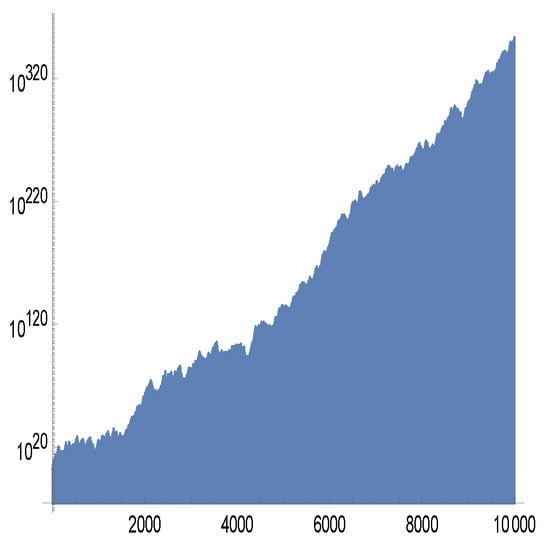
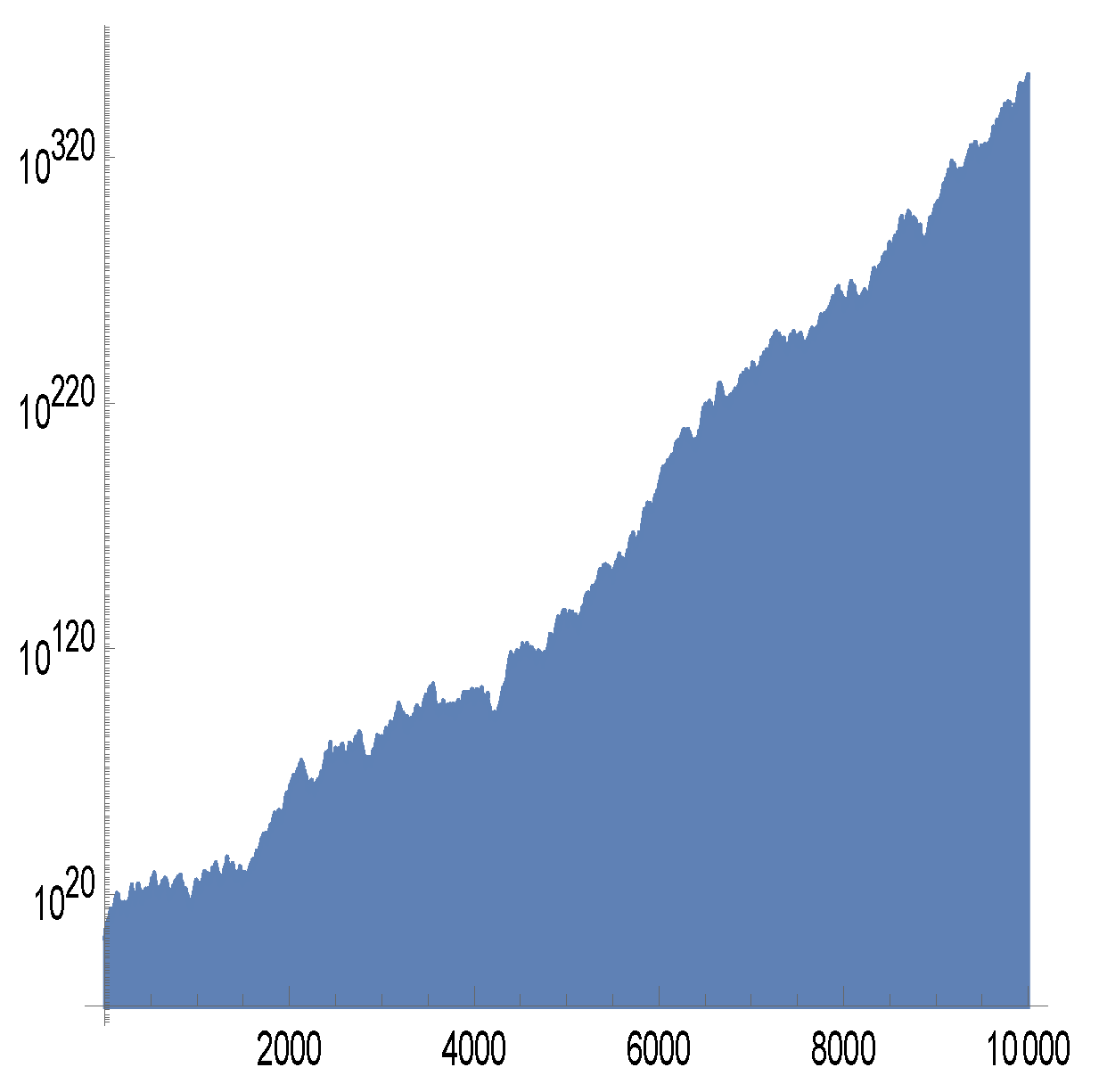
The problem of the existence of divergent trajectories is more complicated as it cannot be solved numerically. However, to our surprise, we found a phenomenon in , which suggests the existence of a divergent trajectory in . For , all trajectories are convergent or cyclic. But our numerical results suggest that is divergent.
Below there are some results of the computations and in Figure 8, a plot of the beginning of the orbit.
Figure 8.
Graph showing possible divergence.
- (1)
- For , we have .
- (2)
- For , we have .
- (3)
- For , we have .
- (4)
- For , we have .
- (5)
- For , we have .
- (6)
- For , we have .…
- (7)
- For , we have .
- (8)
- For , we have .
- (9)
- For , we have .
- (10)
- For , we have .…
- (11)
- Computations in progress.
We finish with the following questions.
Question 1.
- (1)
- Is really divergent?
- (2)
- If yes, is the only where a divergent trajectory exists?
- (3)
- If yes, why?
Author Contributions
Conceptualization, E.T.; Methodology, E.T. and H.T.-G.; Software, H.T.-G.; Validation, H.T.-G.; Formal analysis, E.T. and H.T.-G.; Writing—original draft, E.T. and H.T.-G.; Writing—review & editing, E.T. and H.T.-G. All authors have read and agreed to the published version of the manuscript.
Funding
This research received no external funding.
Data Availability Statement
The original contributions presented in this study are included in the article. Further inquiries can be directed to the corresponding author.
Conflicts of Interest
The authors declare no conflicts of interest.
References
- Chamberland, M. A 3x + 1 survey: Number theory and dynamical systems. In The Ultimate Challenge: The 3x + 1 Problem; Lagarias, J.C., Ed.; American Mathematical Society: Providence, RI, USA, 2010; pp. 57–78. [Google Scholar]
- Lagarias, J.C. The 3x + 1 problem: An annotated bibliography (1963–1999). In The Ultimate Challenge: The 3x + 1 Problem; Lagarias, J.C., Ed.; American Mathematical Society: Providence, RI, USA, 2010; pp. 267–341. [Google Scholar]
- Lagarias, J.C. The Ultimate Challenge: The 3x + 1 Problem; American Mathematical Society: Providence, RI, USA, 2010. [Google Scholar]
- Wirsching, G.J. The dynamical system generated by the 3n + 1 function. In Lecture Notes in Mathematics; Springer: Berlin/Heidelberg, Germany, 1998; Volume vii, 158p. [Google Scholar]
- Lagarias, J.C. The 3x + 1 problem and its generalizations. Amer. Math. Mon. 1985, 92, 3–23. [Google Scholar]
- Collatz, L. Über die Verzweigung der Reihen 2sp. Acta Arith. 1937, 3, 351–369. [Google Scholar]
- Bell, J.P.; Lagarias, J.C. 3x + 1 inverse orbit generating functions almost always have natural boundaries. Acta Arith. 2015, 170, 101–120. [Google Scholar]
- Hercher, C. There are no Collatz m-cycles with m ≤ 91. J. Integer Seq. 2023, 26, 22. [Google Scholar]
- Lagarias, J.C.; Soundararajan, K. Benford’s law for the 3x + 1 function. J. Lond. Math. Soc. II Ser. 2006, 74, 289–303. [Google Scholar]
- Monks, K.; Monks, K.G.; Monks, K.M.; Monks, M. Strongly sufficient sets and the distribution of arithmetic sequences in the 3x + 1 graph. Discret. Math. 2013, 313, 468–489. [Google Scholar] [CrossRef] [Scilit]
- Mori, T. Application of operator theory for the collatz conjecture. Adv. Oper. Theory 2025, 10, 37. [Google Scholar] [CrossRef] [Scilit]
- Rozier, O. The 3x + 1 problem: A lower bound hypothesis. Funct. Approx. Comment. Math. 2017, 56, 7–23. [Google Scholar] [CrossRef] [Scilit]
- Schwob, M.R.; Shiue, P.; Venkat, R. Novel theorems and algorithms relating to the Collatz conjecture. Int. J. Math. Math. Sci. 2021, 5754439. [Google Scholar] [CrossRef] [Scilit]
- Simons, J.; de Weger, B. Theoretical and computational bounds form-cycles of the 3n+ 1-problem. Acta Arith. 2005, 117, 51–70. [Google Scholar]
- Barina, D. Convergence verification of the Collatz problem. J. Supercomput. 2020, 77, 2681–2688. [Google Scholar]
- Terras, R. A stopping time problem on the positive integers. Acta Arith. 1976, 30, 241–252. [Google Scholar] [CrossRef] [Scilit]
- Tao, T. Almost all orbits of the Collatz map attain almost bounded values. In Forum of Mathematics, Pi; Cambridge University Press: Cambridge, UK, 2022; Volume 10, p. e12. [Google Scholar]
- Tutaj, E. LikeN’s—A point of view on natural numbers. Ann. Univ. Paedagog. Crac. Stud. Math. 2017, 16, 95–115. [Google Scholar]
- Tutaj, E. On a certain characterisation of the semigroup of positive natural numbers with multiplication. Ann. Univ. Paedagog. Crac. Stud. Math. 2022, 21, 71–92. [Google Scholar] [CrossRef] [Scilit]
- Furstenberg, H. On the infinitude of primes. Amer. Math. Mon. 1955, 62, 353. [Google Scholar]
- Monks, K.M. The sufficiency of arithmetic progressions for the 3x + 1 conjecture. Proc. Amer. Math. Soc. 2006, 134, 2861–2872. [Google Scholar]
- Dumont, J.; Reiter, C.; Clifford, A. Real dynamics of a 3-power extension of the 3x + 1 function. Dyn. Contin. Discrete Impuls. Syst. Ser. A Math. Anal. 2003, 10, 875–893. [Google Scholar]
- Wolfram Research, Inc. Mathematica, Version 13.0; Wolfram Research, Inc.: Champaign, IL, USA, 2021. [Google Scholar]
Disclaimer/Publisher’s Note: The statements, opinions and data contained in all publications are solely those of the individual author(s) and contributor(s) and not of MDPI and/or the editor(s). MDPI and/or the editor(s) disclaim responsibility for any injury to people or property resulting from any ideas, methods, instructions or products referred to in the content. |
© 2025 by the authors. Licensee MDPI, Basel, Switzerland. This article is an open access article distributed under the terms and conditions of the Creative Commons Attribution (CC BY) license (https://creativecommons.org/licenses/by/4.0/).