


Abstract
This paper provides a solution to the new fractional-order Lorenz–Stenflo model using the adaptive predictor–corrector approach and the -Laplace New Iterative Method (), representing an extensive comparison between both techniques with RK4 related to accuracy and error analysis. The results show that the suggested approaches allow one to be more accurate in analyzing the dynamics of the system. These techniques also produce results that are comparable to the results of other approximate techniques. The techniques can, thus, be used on a wider class of systems in order to provide more accurate results. These techniques also appropriately identify chaotic attractors in the system. These techniques can be applied to solve various numerical problems arising in science and engineering in the future.
MSC:
26A33; 44A10; 65P20
1. Introduction
Work on a new chaotic system with multifold attractors by Lai et al. [1], the investigation of the fractional-order Chua system by Petras [2], and the research on FPGA-based sound encryption using fractional-order chaotic systems performed by Abd El-Maksoud et al. [3] provide further signs of the ability of fractional calculus to efficiently model real dynamic processes to discover their chaotic behavior.
Related works encompass investigations into fractional predator–prey chaos [4], innovative numerical techniques for fractional chaos [5], and fractional modeling of robotic manipulators [6]. The works mentioned above include ecological models, numerical methods, and robotics and fractional disease models [7], in addition to the foundational contributions of Oldham and Spanier about fractional calculus [8] and Gorenflo and Mainardi with respect to continuum mechanics [9], as well as those of Samko, Kilbas, and Marichev for fractional calculus [10], laying out a theoretical framework, as well as numerous applications in different disciplines of mathematics and sciences. An in-depth investigation of concealed attractors in dynamical systems was presented in [11]. The entropy-driven examination of analysis, signal encryption, and component estimates in novel circuits, along with various systems [12], extends fractional calculus to vast and diverse applications that are useful in scientific discovery and technological innovation.
The significance of the FDE is explained by the development of different methods for its solution in recent years, provided by modern trends in computational techniques [13,14,15,16], its ability to solve problems in physics and engineering, and its accounting for interdisciplinary intersections in areas such as economics, biology, and management [17,18,19,20,21,22,23,24].
The modeling of chaotic systems has become one of the most extensively explored fields, used universally throughout the natural and technical sciences [25]. Integrating chaotic systems into electrical circuits creates a complicated modeling process with a proper confrontation of real-life conditions; thus, it could be considered a rather challenging factor to predict. It uses phase portraits and advanced algorithms, searching for behaviors of chaotic systems to control the influence of model parameters, finding the Lyapunov, and tracking chaotic and even hyperchaotic behavior based on initial conditions [26,27,28]. Many analytical techniques have been combined with the Laplace transform to effectively solve differential equations [29,30,31,32].
The combination of the -Laplace method and the New Iterative Method (NIM) was first introduced in [33]. The advantages of the NIM [34,35,36] are that it does not need any perturbation parameters in the equation or any calculation of Adomian polynomials. The -Laplace method can work with generalized differential equations and is versatile when compared to the standard Laplace method that is explored in this paper.
This research area is concerned with analyzing fractional-order chaotic systems, acknowledging that systems of fractional order present solutions to complications that arise from derivatives of non-integer order [37]. This issue differentiates it from other forms that emphasize aspects different than Liouville and Caputo derivatives, Lyapunov analysis, and bifurcations [38,39,40,41,42,43]. Other works [44,45] move deeper into wide fractional chaotic and hyperchaotic systems, applying exact similar derivatives. Investigating amplitude control for dynamically symmetric systems also extends the scope and importance [46]. This research centers on new areas of fractional calculus applications, which may show the hidden properties of chaotic systems and open new possibilities for the development of fractional calculus and its application in numerous science fields. Further work on the other unexplored forms of derivatives and their relevance to chaotic dynamics may lead to important developments in the future.
The chaotic system proposed here is built upon the foundational Lorenz–Stenflo model previously introduced in [47,48,49]. The Lorenz–Stenflo model is a captivating chaos theory system used to understand the behavior of specific dynamic systems. The fractional modified Lorenz–Stenflo system is an extension of the renowned Lorenz system, initially formulated to study atmospheric convection [50]. This model is notable for its sensitivity to initial conditions, famously called the “butterfly effect”, where tiny changes in starting parameters lead to vastly different outcomes. This section introduces a novel fractional system utilizing a generalized Liouville–Caputo-type fractional derivative operator expressed through a system of five fractional-order differential equations:
where , , , , , , and , with initial conditions of , , , , and .
This study aims to show numerical approaches, precisely the APC-G adaptive approach and the new iterative -Laplace method, to solve the fractional Lorenz–Stenflo model. The novelty of these methods is that they are much more accurate and efficient than the traditional methods, such as the RK4 method, in modeling the behavior of chaotic attractors. The successful implementation of these algorithms in this study will lead to future possibilities of enhancing numerical solutions to chaotic systems in diverse science and engineering fields. This study addresses the need for accurate and efficient methods to solve fractional-order chaotic systems, which traditional approaches struggle to handle. It bridges this gap by employing and comparing the APC-G and methods with RK4, focusing on accuracy and error analysis.
The remainder of this work is organized as follows: Section 2 provide some basic definitions used in our work. Section 3 illustrates the schema of the Adaptive Predictor–Corrector (APC-G) method. Section 4 presents the new iterative -Laplace method. Section 5 discusses the application of the new iterative -Laplace method. Section 6 discusses numerical method accuracy, and Section 7 concludes the study.
2. Mathematical Preliminaries
This section provides a brief overview of the operator derivatives, mainly focusing on fractional variants central to our analysis.
Definition 1.
The generalized fractional integral of function f, , , is given in [46].
Definition 2.
Let , , , and . The generalized Riemann–Liouville (FD) of order α with dependence on a parameter (ρ) is defined as [51]
In particular, if , , and , we have
Definition 3.
Let and if . We define the generalized Caputo (FD) of the function (f) of order α with a parameter of as follows [51]:
where . In the case of and , we have
Notice that if , f is an absolutely continuous function on [a,b]; then, the generalized Caputo (FD) is given by
Also, if . Particularly,
Definition 4.
The new generalized Caputo (FD) operator is given by
where and (see [52]).
Definition 5.
Given the function , the ρ-Laplace transform is defined by [53]
The -Laplace transform of the generalized Caputo (FD) is defined by
3. Algorithm of the Adaptive Predictor–Corrector (APC-G) Method
In this part, we present the numerical algorithm named the APC-G adaptive approach, which was developed to solve initial value problems (IVPs) involving a generalized Caputo (FD) easily and efficiently [51].
where is the generalized Caputo (FD). Then, for , , , and , and we obtain the following:
where
The interval of is partitioned into N unequal subintervals Utilizing mesh points, we assume that function f has a unique solution on .
The equation is given. To obtain a numerical solution for the initial value problem (IVP), we construct a sequence of approximations denoted as , . Given the prior evaluations of and for , our objective is to employ the integral equation to derive the approximation of .
By substituting
we get
that is,
We use trapezoidal quadrature to approximate the integrals on the right-hand side of Equation (15), resulting in the corrector formula for ,
where
In the final step, we replace the predictor value () produced by applying the one-step Adams–Bashforth approach to integral Equation (14) with the amount () on the right side of the expression in Formula (16). This is accomplished by replacing the function expressed as with the quantity expressed as at each integral in Equation (16).
Hence, the formula completely illustrates our APC-G to decide the approximation of ,
where . We can use Equation (18) to find the expected value of , which should be less than or equal to . The weights () are set up according to (18). To make the proposed adaptive APC-G method work, we need a grid that is not flat: , where and and N is a real number [48]. It is important to note that the APC-G method cannot be used to solve IVPs described with the generalized Caputo (FD) if we use a uniform grid like the one in [54].
By applying this method to Equation (1), we obtain approximations of , , , , and . These approximations are defined for , representing the number of iterations, and for , indicating a positive time duration. The specific expressions for these approximations outlined are as follows:
where and
The solutions of Equation (1) obtained with the help of the adaptive (APC-G) method are presented in Table 1 and Table 2, corresponding to two sets of parameters. Table 1 compares the results obtained by the implementation of the adaptive (APC-G) method at , , and with the results obtained by the RK4 method. The APC-G method shows high conformity with the findings, displaying its efficiency and precision in solving fractional models. In particular, when the step size (h) goes down, the solutions tend to coincide, indicating the flexibility of the method. Thus, as presented in Table 2, , , and . The solutions seem to vary because of changes in the fractional-order parameter (). This sensitivity of the solution to is significant in real-world problems in which fractional-order effects are present. Overall, the APC-G method was found to be efficient for analyzing fractional-order systems while providing satisfactory and reliable results for additional studies and applications in various scientific and engineering fields.
Table 1.
Solutions of system (1), where , , and .
Table 2.
Solutions of system (1), where , , and .
4. -Laplace New Iterative Method (LρNIM)
This section outlines the NIM’s approach to solving fractional systems, explained here by considering the following system of a fractional differential system involving generalized derivatives.
The above system is subject to the following initial conditions:
Here, is the generalized fractional derivative of the functions (, where j refers to the equation in the system). The terms and represent the linear and nonlinear parts, respectively. Application of the -Laplace transform to Equation (25) yields the following expression:
Taking , we get
Now, we take the solution of (27) in the form of
Then,
Then, (28) can be written as
Furthermore, the repeating formula can be obtained as follows:
5. Application of the New Iterative -Laplace Method
In this section, we analyze the system described by Equation (20). Using the LNIM method outlined earlier, we start with initial conditions as the first approximation that is, = 0.1, . We obtain the approximate solutions for the system variables. The general form of the series solution is given by
We apply the method explained in the previous section to get
The approximate solution of system (1) in the series form
Table 3, Table 4 and Table 5 present the approximate solutions of Equation (1) obtained with the help of the method for two different parameter values. When , , and t changes, it is evident from Table 3 that the method successfully captures changes in the system at each t. The system naturally changes its behavior over time, as reflected by the symbolizing of this change. The obtained results generally conform with the results that were attained by using the APC-G method, as well as those of the RK4 method; therefore, the employment of the method offers a guarantee of accuracy and reliability. Table 4 provides the solutions when and . Considering the influence of fractional-order parameters, when , , and t is varied, the outcomes indicate the flexibility and simplicity of using the method with different parameters. Exploiting the approach yields satisfactory results for the precise and stable solution of the fractional-order Lorenz–Stenflo model. In view of these conclusions, adopting in solving numerical computations for dynamical systems in several related applications is credible. Table 5 provides the solutions when and , and t is varied.
Table 3.
solutions of Equation (1) when and .
Table 4.
solutions of Equation (1) when and .
Table 5.
solutions of Equation (1) when and .
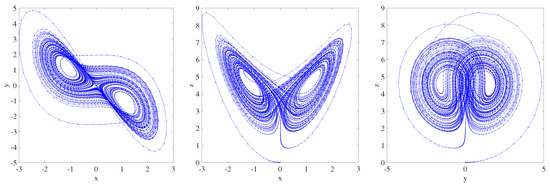
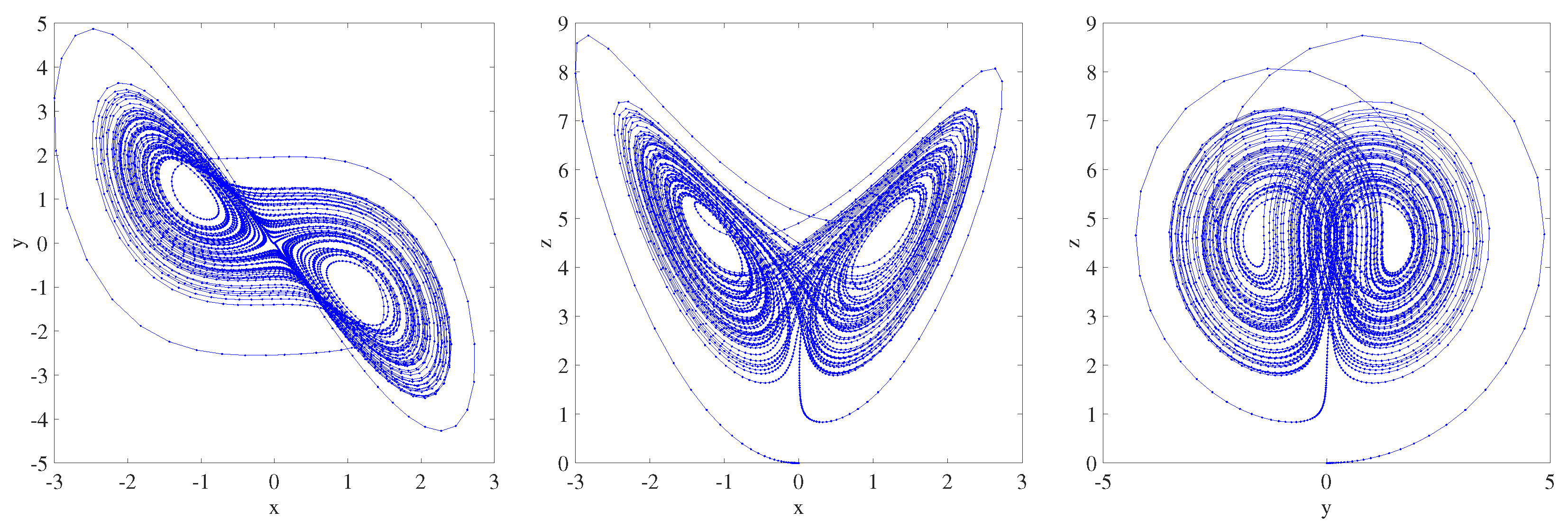
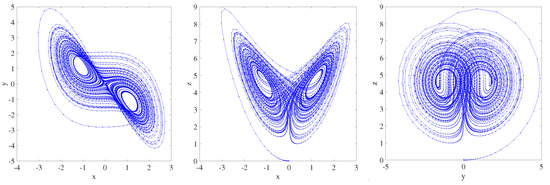
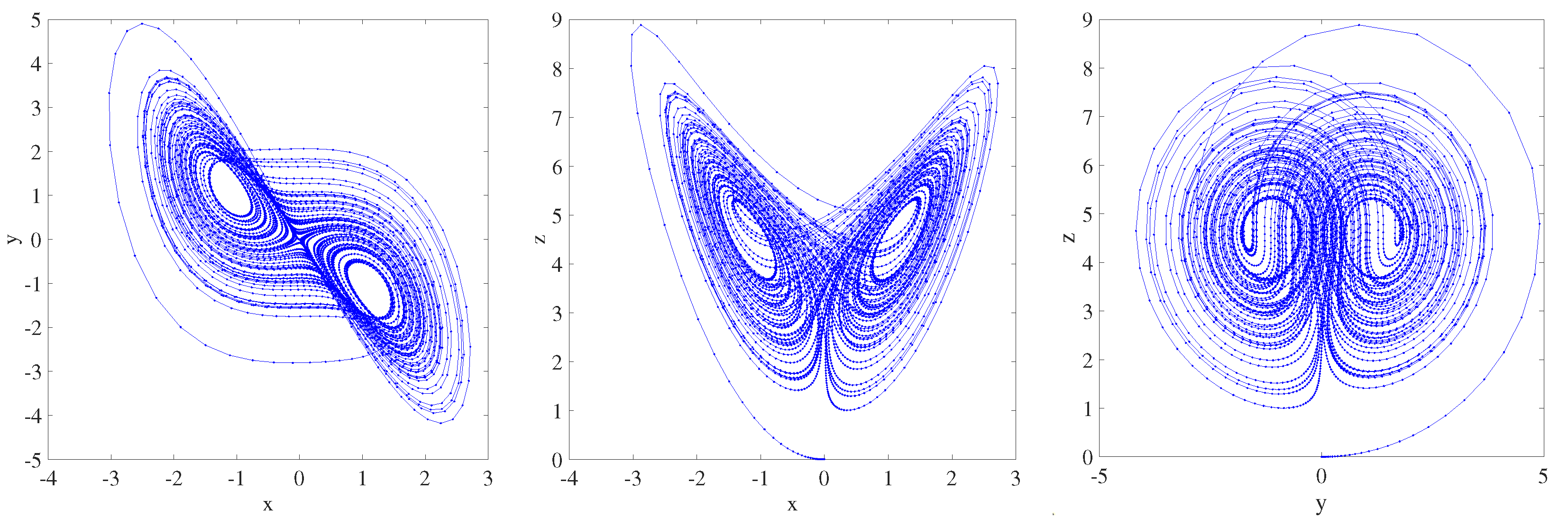
The figures display the long-term system state obtained in response to the defined parameters using the APC-G adaptive approach in system (1), where , , , , , , and under the abovementioned initial conditions, which is critical in analyzing system behavior. The chosen set of parameters () is illustrated in Figure 1; it previews a typical Lorenz-like attractor and demonstrates the system’s behavior in response to the variation of initial values. In Figure 2 for , we can see very small distortions in the shape of the attractor, showing how minor parameter changes strongly influence the system dynamics. These chaotic phase diagrams stress the complexity and fragile character of the system, which have been crucial for the analysis of its behavior for a long time and are useful for outlooks on applications in directions such as stability and control of chaotic dynamics in various fields.
Figure 1.
Chaotic phase diagram when (,) = (1, 1).
Figure 2.
Chaotic phases diagram when (,) = (0.95, 1.1).
6. Numerical Method Accuracy
This section evaluates the accuracy of , RK4, and ABC numerical methods in solving fractional systems with and varying step sizes. Comparative error analysis highlights their convergence and reliability for precise computations.
Table 6, Table 7 and Table 8 present the results that confirm the accuracy and convergence of the , RK4, and ABC methods for . In Table 6, it is observed that for the comparison of error values between and APC-G, produces highly accurate results at relatively small time steps. Again, as shown in Table 7, yields very robust performance for four terms, unlike the other methods. Finally, the comparison of APC-G with RK4 in Table 8 shows close agreement. However, APC-G results in slightly higher deviations for some of the variables.
Table 6.
Error comparison of the accuracies of the , RK4, and ABC methods with when and .
Table 7.
Error comparison of the accuracies of the L, and ABC, RK4, and LNIM methods with when .
Table 8.
Error comparison of the accuracies of the , RK4, and ABC methods with when .
These results really pinpoint the reliability of for iterative solutions, its precision for fine step sizes, and its competitive performance compared to the RK4 and ABC methods. The differences in errors are minimal, further validating the suitability of all three methods for solving fractional systems.
7. Conclusions
The APC-G adaptive approach and the new iterative -Laplace method have been validated as highly effective tools for the numerical solution of the novel fractional-order Lorenz–Stenflo model. This study’s outcomes demonstrate these methods’ capacity to produce accurate solutions consistent with those generated by other numerical approaches. Their successful use in modeling attractors’ chaotic behaviors adds to the reliability of these mathematical structures for the analysis of dynamical systems. For these reasons, extending these methods to various other systems can extend the accuracy and usefulness of numerical solutions in science and engineering. In the future, using such methods when analyzing the intricacies of various models will undeniably help advance our capacity to probe, analyze, and control the vast scale of disordered and unpredictable elements found in natural and artificial systems. This work lays the foundation for future works attempting to provide further analysis of numerical techniques to enhance understanding of the stochastic behaviors embedded in dynamic systems, and we aim to solve new fractional models [55,56] and compare them with other numerical methods [57,58].
Author Contributions
Methodology, Investigation, M.E., M.A.A. and A.B.M.A.; Funding acquisition, A.B.M.A.; Software, M.B. and R.S.; Resources, M.B.; Writing—original draft, M.B. and M.A.A.; Writing—review and editing, A.B.M.A., M.E. and R.S. All authors have read and agreed to the published version of the manuscript.
Funding
This work was supported by the Researchers Supporting Project (RSPD2024R920), King Saud University, Saudi Arabia.
Institutional Review Board Statement
Not applicable.
Informed Consent Statement
Not applicable.
Data Availability Statement
Data are contained within the article.
Acknowledgments
The authors would like to extend their sincere appreciation to the Researchers Supporting Project (RSPD2024R920), King Saud University, Saudi Arabia.
Conflicts of Interest
The authors declare that there are no conflicts of interest regarding the publication of this article.
Abbreviations
| Abbreviation | Full Term |
| APC-G | Adaptive Predictor–Corrector |
| NIM | -Laplace New Iterative Method |
| RK4 | Runge–Kutta Fourth Order |
| FD | Fractional Derivative |
| IVPs | Initial Value Problems |
References
- Lai, Q.; Akgul, A.; Li, C.; Xu, G.; Çavuşoğlu, Ü. A New Chaotic System with Multiple Attractors: Dynamic Analysis, Circuit Realization and S-Box Design. Entropy 2017, 20, 12. [Google Scholar] [CrossRef] [Scilit] [PubMed]
- Petráš, I. A note on the fractional-order Chua’s system. Chaos Solitons Fractals 2008, 38, 140–147. [Google Scholar] [CrossRef] [Scilit]
- Abd El-Maksoud, A.J.; Abd El-Kader, A.A.; Hassan, B.G.; Rihan, N.G.; Tolba, M.F.; Said, L.A.; Radwan, A.G.; Abu-Elyazeed, M.F. FPGA implementation of sound encryption system based on fractional-order chaotic systems. Microelectronics 2019, 90, 323–335. [Google Scholar] [CrossRef] [Scilit]
- Kumar, S.; Kumar, R.; Cattani, C.; Samet, B. Chaotic behaviour of fractional predator-prey dynamical system. Chaos Solitons Fractals 2020, 135, 109811. [Google Scholar] [CrossRef] [Scilit]
- Toufik, M.; Atangana, A. New numerical approximation of fractional derivative with non-local and non-singular kernel: Application to chaotic models. Eur. Phys. J. Plus 2017, 132, 444. [Google Scholar] [CrossRef] [Scilit]
- Bingi, K.; Prusty, B.R.; Singh, A.P. A Review on Fractional-Order Modelling and Control of Robotic Manipulators. Fractal Fract. 2023, 7, 77. [Google Scholar] [CrossRef] [Scilit]
- Singh, J.; Kumar, D.; Hammouch, Z.; Atangana, A. A fractional epidemiological model for computer viruses pertaining to a new fractional derivative. Appl. Math. Comput. 2018, 316, 504–515. [Google Scholar] [CrossRef] [Scilit]
- Oldham, K.B.; Spanier, J. The Fractional Calculus; Academic Press: New York, NY, USA, 1974. [Google Scholar]
- Gorenflo, R.; Mainardi, F. Fractional Calculus. In Fractals and Fractional Calculus in Continuum Mechanics; Carpinteri, A., Mainardi, F., Eds.; International Centre for Mechanical Sciences; Springer: Vienna, Austria, 1997; Volume 378. [Google Scholar]
- Samko, S.; Kilbas, A.A.; Marichev, O. Fractional Integrals and Derivatives; CRC Press: Boca Raton, FL, USA, 1993. [Google Scholar]
- Dudkowski, D.; Jafari, S.; Kapitaniak, T.; Kuznetsov, N.V.; Leonov, G.A.; Prasad, A. Hidden attractors in dynamical systems. Phys. Rep. 2016, 637, 1–50. [Google Scholar] [CrossRef] [Scilit]
- Xu, G.; Shekofteh, Y.; Akgül, A.; Li, C.; Panahi, S. A New Chaotic System with a Self-Excited Attractor: Entropy Measurement, Signal Encryption, and Parameter Estimation. Entropy 2018, 20, 86. [Google Scholar] [CrossRef] [Scilit]
- Ghanbari, B.; Atangana, A. Some new edge detecting techniques based on fractional derivatives with non-local and non-singular kernels. Adv. Differ. Equ. 2020, 2020, 435. [Google Scholar] [CrossRef] [Scilit]
- Almutairi, D.K.; Abdoon, M.A.; Salih, S.Y.M.; Elsamani, E.A.; EL Guma, F.; Berir, M. Modeling and Analysis of a Fractional Visceral Leishmaniosis with Caputo and Caputo–Fabrizio derivatives. J. Niger. Soc. Phys. Sci. 2023, 5, 1453. [Google Scholar] [CrossRef] [Scilit]
- Petras, I. Control of fractional-order Chua’s system. arXiv 2000, arXiv:nlin/0008029. [Google Scholar]
- Odabasi, M. Traveling wave solutions of conformable time-fractional Zakharov–Kuznetsov and Zoomeron equations. Chin. J. Phys. 2020, 64, 194–202. [Google Scholar] [CrossRef] [Scilit]
- Abdoon, M.A.; Hasan, F.L. Advantages of the Differential Equations for Solving Problems in Mathematical Physics with Symbolic Computation. Math. Model. Eng. Probl. 2022, 9, 268–276. [Google Scholar] [CrossRef] [Scilit]
- Abdoon, M.A.; Hasan, F.L.; Taha, N.E. Computational Technique to Study Analytical Solutions to the Fractional Modified KDV-Zakharov-Kuznetsov Equation. Abstr. Appl. Anal. 2022, 2022, 1–9. [Google Scholar] [CrossRef] [Scilit]
- Srivastava, H.M. An Introductory Overview of Fractional-Calculus Operators Based Upon the Fox-Wright and Related Higher Transcendental Functions. Adv. Eng. Comput. 2021, 5, 135. [Google Scholar] [CrossRef] [Scilit]
- Srivastava, H.M. Some parametric and argument variations of the operators of fractional calculus and related special functions and integral transformations. J. Nonlinear Convex Anal. 2021, 22, 1501–1520. [Google Scholar]
- Srivastava, H.M. A Survey of Some Recent Developments on Higher Transcendental Functions of Analytic Number Theory and Applied Mathematics. Symmetry 2021, 13, 2294. [Google Scholar] [CrossRef] [Scilit]
- Alexan, W.; Alexan, N.; Gabr, M. Multiple-Layer Image Encryption Utilizing Fractional-Order Chen Hyperchaotic Map and Cryptographically Secure PRNGs. Fractal Fract. 2023, 7, 287. [Google Scholar] [CrossRef] [Scilit]
- Stamov, G.; Stamova, I. Extended Stability and Control Strategies for Impulsive and Fractional Neural Networks: A Review of the Recent Results. Fractal Fract. 2023, 7, 289. [Google Scholar] [CrossRef] [Scilit]
- Zhang, X.; Boutat, D.; Liu, D. Applications of Fractional Operator in Image Processing and Stability of Control Systems. Fractal Fract. 2023, 7, 359. [Google Scholar] [CrossRef] [Scilit]
- Lei, T.; Mao, B.; Zhou, X.; Fu, H. Dynamics Analysis and Synchronous Control of Fractional-Order Entanglement Symmetrical Chaotic Systems. Symmetry 2021, 13, 1996. [Google Scholar] [CrossRef] [Scilit]
- Rahman, Z.-A.S.A.; hlJasim, B.H.; Al-Yasir, Y.I.A.; Abd-Alhameed, R.A. High-Security Image Encryption Based on a Novel Simple Fractional-Order Memristive Chaotic System with a Single Unstable Equilibrium Point. Electronics 2021, 10, 3130. [Google Scholar] [CrossRef] [Scilit]
- Ahmed, E.; Elgazzar, A.S. On fractional order differential equations model for nonlocal epidemics. Physica A 2007, 379, 607–614. [Google Scholar] [CrossRef] [Scilit] [PubMed]
- Matouk, A.E.; Abdelhameed, T.N.; Almutairi, D.K.; Abdelkawy, M.A.; Herzallah, M.A.E. Existence of Self-Excited and Hidden Attractors in the Modified Autonomous Van Der Pol-Duffing Systems. Mathematics 2023, 11, 591. [Google Scholar] [CrossRef] [Scilit]
- ELbadri, M. A New Homotopy Perturbation Method for Solving Laplace Equation. Adv. Theor. Appl. Math. 2013, 8, 237–242. [Google Scholar]
- Elbadri, M. Comparison between the Homotopy Perturbation Method and Homotopy Perturbation Transform Method. Appl. Math. 2018, 9, 130–137. [Google Scholar] [CrossRef]
- Elbadri, M. An approximate solution of a time fractional Burgers’ equation involving the Caputo-Katugampola fractional derivative. Partial. Differ. Equ. Appl. Math. 2023, 8, 100560. [Google Scholar] [CrossRef] [Scilit]
- Elbadri, M. Initial Value Problems with Generalized Fractional Derivatives and Their Solutions via Generalized Laplace Decomposition Method. Adv. Math. Phys. 2022, 2022, 1–7. [Google Scholar] [CrossRef] [Scilit]
- Bhangale, N.; Kachhia, K.B.; Gómez-Aguilar, J.F. A new iterative method with ρ-Laplace transform for solving fractional differential equations with Caputo generalized fractional derivative. Eng. Comput. 2022, 38, 2125–2138. [Google Scholar] [CrossRef] [Scilit]
- Khan, M.J.; Nawaz, R.; Farid, S.; Iqbal, J. New Iterative Method for the Solution of Fractional Damped Burger and Fractional Sharma-Tasso-Olver Equations. Complexity 2018, 2018, 1–7. [Google Scholar] [CrossRef] [Scilit]
- Alderremy, A.A.; Elzaki, T.M.; Chamekh, M. New transform iterative method for solving some Klein-Gordon equations. Results Phys. 2018, 10, 655–659. [Google Scholar] [CrossRef] [Scilit]
- Daftardar-Gejji, V.; Jafari, H. An iterative method for solving nonlinear functional equations. J. Math. Anal. Appl. 2006, 316, 753–763. [Google Scholar] [CrossRef] [Scilit]
- Danca, M.-F.; Kuznetsov, N.V. Matlab Code for Lyapunov Exponents of Fractional-Order Systems. Int. J. Bifurc. Chaos Appl. Sci. Eng. 2018, 28, 1850067. [Google Scholar] [CrossRef] [Scilit]
- Rajagopal, K.; Vaidyanathan, S.; Karthikeyan, A.; Duraisamy, P. Dynamic analysis and chaos suppression in a fractional order brushless DC motor. Electr. Eng. 2016, 99, 721–733. [Google Scholar] [CrossRef] [Scilit]
- Rajagopal, K.; Karthikeyan, A.; Duraisamy, P. Hyperchaotic Chameleon: Fractional Order FPGA Implementation. Complexity 2017, 2017, 1–16. [Google Scholar] [CrossRef] [Scilit]
- Diouf, M.D.; Sene, N. Analysis of the Financial Chaotic Model with the Fractional Derivative Operator. Complexity 2020, 2020, 1–14. [Google Scholar] [CrossRef] [Scilit]
- Chen, W.-C. Nonlinear dynamics and chaos in a fractional-order financial system. Chaos Solitons Fractals 2008, 36, 1305–1314. [Google Scholar] [CrossRef] [Scilit]
- Rajagopal, K.; Akgul, A.; Jafari, S.; Karthikeyan, A.; Cavusoglu, U.; Kacar, S. An exponential jerk system, its fractional-order form with dynamical analysis and engineering application. Soft Comput. 2019, 24, 7469–7479. [Google Scholar] [CrossRef] [Scilit]
- Sene, N. Analysis of a fractional-order chaotic system in the context of the Caputo fractional derivative via bifurcation and Lyapunov exponents. J. King Saud Univ. Sci. 2021, 33, 101275. [Google Scholar] [CrossRef] [Scilit]
- Owolabi, K.M.; Gómez-Aguilar, J.F.; Fernández-Anaya, G.; Lavín-Delgado, J.E.; Hernández-Castillo, E. Modelling of Chaotic Processes with Caputo Fractional Order Derivative. Entropy 2020, 22, 1027. [Google Scholar] [CrossRef] [Scilit]
- Sene, N. Mathematical views of the fractional Chua’s electrical circuit described by the Caputo-Liouville derivative. Rev. Mex. Física 2021, 67, 91–99. [Google Scholar] [CrossRef] [Scilit]
- Katugampola, U.N. New approach to a generalized fractional integral. Appl. Math. Comput. 2011, 218, 860–865. [Google Scholar] [CrossRef] [Scilit]
- Deressa, C.T.; Etemad, S.; Kaabar, M.K.; Rezapour, S. Qualitative Analysis of a Hyperchaotic Lorenz-Stenflo Mathematical Model via the Caputo Fractional Operator. J. Funct. Spaces 2022, 2022, 1–21. [Google Scholar] [CrossRef] [Scilit]
- Stenflo, L. Generalized Lorenz equations for acoustic-gravity waves in the atmosphere. Phys. Scr. 1996, 53, 83–84. [Google Scholar] [CrossRef] [Scilit]
- Zhang, F.; Chen, R.; Chen, X. Analysis of a Generalized Lorenz–Stenflo Equation. Complexity 2017, 2017, 1–6. [Google Scholar] [CrossRef] [Scilit]
- Khan, N.A.; Qureshi, M.A.; Akbar, S.; Ara, A. From chaos to encryption using fractional order Lorenz-Stenflo model with flux-controlled feedback memristor. Phys. Scr. 2022, 98, 014002. [Google Scholar] [CrossRef] [Scilit]
- Redhwan, S.S.; Shaikh, S.L.; Abdo, M.S. Theory of Nonlinear Caputo-Katugampola Fractional Differential Equations. arXiv 2020, arXiv:1911.08884. [Google Scholar]
- Odibat, Z.; Baleanu, D. Numerical simulation of initial value problems with generalized Caputo-type fractional derivatives. Appl. Numer. Math. 2020, 156, 94–105. [Google Scholar] [CrossRef] [Scilit]
- Jarad, F.; Abdeljawad, T. A modified Laplace transform for certain generalized fractional operators. Results Nonlinear Anal. 2018, 1, 88–98. [Google Scholar]
- Diethelm, K.; Ford, N.J.; Freed, A.D. A Predictor-Corrector Approach for the Numerical Solution of Fractional Differential Equations. Nonlinear Dyn. 2002, 29, 3–22. [Google Scholar] [CrossRef] [Scilit]
- Mittal, R.C.; Pandit, S. Quasilinearized Scale-3 Haar wavelets-based algorithm for numerical simulation of fractional dynamical systems. Eng. Comput. 2018, 35, 1907–1931. [Google Scholar] [CrossRef] [Scilit]
- Mittal, R.C.; Pandit, S. A numerical algorithm to capture spin patterns of fractional Bloch nuclear magnetic resonance flow models. J. Comput. Nonlinear Dyn. 2019, 14, 081001. [Google Scholar] [CrossRef] [Scilit]
- Elbadri, M.; Abdoon, M.A.; Almutairi, D.K.; Almutairi, D.M.; Berir, M. Numerical Simulation and Solutions for the Fractional Chen System via Newly Proposed Methods. Fractal Fract. 2024, 8, 709. [Google Scholar] [CrossRef] [Scilit]
- Abdoon, M.A.; Elgezouli, D.E.; Halouani, B.; Abdelaty, A.M.Y.; Elshazly, I.S.; Ailawalia, P.; El-Qadeem, A.H. Novel Dynamic Behaviors in Fractional Chaotic Systems: Numerical Simulations with Caputo Derivatives. Axioms 2024, 13, 791. [Google Scholar] [CrossRef] [Scilit]

Disclaimer/Publisher’s Note: The statements, opinions and data contained in all publications are solely those of the individual author(s) and contributor(s) and not of MDPI and/or the editor(s). MDPI and/or the editor(s) disclaim responsibility for any injury to people or property resulting from any ideas, methods, instructions or products referred to in the content. |
© 2024 by the authors. Licensee MDPI, Basel, Switzerland. This article is an open access article distributed under the terms and conditions of the Creative Commons Attribution (CC BY) license (https://creativecommons.org/licenses/by/4.0/).