1. Introduction
Graphs considered in this paper are finite and simple. For a graph G and , let be the length of the shortest path between the endpoints of e and . The edge chromatic number of G, denoted by , is the minimum number of colors needed to color the edges of G so that edges e and with are colored by distinct colors. An edge list assignment L assigns to each edge e a set of permissible colors. We say G is edge L-colorable if there exists a function such that
, ;
, if .
The edge list chromatic number is the smallest k such that G is edge L-colorable for every edge list assignment L with .
DP-coloring is a generalization of list coloring introduced by Dvořák and Postle [
1]. Then, Bernshteyn and Kostochka introduced edge DP-coloring of
G as DP-coloring of the line graph of
G [
2]. To be precise, edge DP-coloring of a graph
G is defined as follows:
Definition 1. Assume G is a graph and is a mapping that assigns to each edge e of G a positive integer . A cover of the line graph of G is a pair , where is a family of pairwise disjoint sets, and is a family of bipartite graphs such that has the bipartite set and and . An g-cover is a cover such that for each edge e. An -edge coloring of G is a mapping ϕ such that for each edge e, and for any pair of edges with , (for convenience, we write for ).
Definition 2. If G has an -edge coloring for every g-cover , then we say G is edge DP-g-colorable. If for each edge e, then edge DP-g-colorable is called edge DP-k-colorable. The edge DP-chromatic number of G, denoted by , is the minimum integer k such that G is edge DP-k-colorable.
It is easy to see and well known that for any graph G, .
A graph
G is
-minor free if it has no subgraph isomorphic to a subdivision of
. There are many good results based on the
-minor free graphs. Beaudou, Foucaud, and Naserasr [
3] studied the homomorphism of
-minor free graphs with odd girth. Combined with results from [
4,
5], it is obvious that every
-minor free graph is 2-degenerate, and its strong edge chromatic number is at most
. Meanwhile, Juvan, Mohar, and Thomas proved the following theorem.
Theorem 1 ([
6])
. Let G be a -minor free graph with . Then . The following conjecture is known as the edge list coloring conjecture, which was proposed by several researchers (see [
7,
8]).
Conjecture 1. for a loopless multigraph G.
The conjecture is verified for bipartite multigraphs [
9], complete graphs of odd order [
10], and complete graphs
where
p is an odd prime [
11], and remains largely open in general.
Vizing’s theorem implies that for every simple graph, the edge chromatic number is at most . The next conjecture is a combination of Conjecture 1 and Vizing’s theorem.
Conjecture 2. for a simple graph G.
Borodin [
12] proved Conjecture 2 for planar graphs
G when
, and Bonamy [
13] improved this result to planar graphs with
.
Theorem 2 ([
12])
. If G is a planar graph with , then Theorem 3 ([
13])
. If G is a planar graph with , then By Theorem 3, we can see that if
G is a planar graph with
, then
Moreover, edge DP-coloring and DP-coloring of graphs are also studied in the literature [
14,
15,
16]. In particular, the following two results were proved by Zhang et al. in [
16].
Theorem 4. Assume that G is a planar graph with maximum degree Δ such that G has no cycle of length k for . Then, if either and , or and .
Theorem 5. If G is a planar graph with maximum degree , then .
In this paper, we first study edge DP-coloring of -minor free graphs by following the theorem and constructing a -minor free graph with , which is not edge DP-3-colorable.
Theorem 6. Let G be a -minor free graph with maximum degree Δ. Then, .
Then, consideration of the edge DP-chromatic number of planar graph G with as an improvement of Theorem 5 is given by following Corollary 1, which is implied from Theorem 7.
Theorem 7. If G is a planar graph with maximum degree Δ, and with no intersecting triangles, then .
Corollary 1. If G is a planar graph with and with no intersecting triangles, then .
Compared with Theorems 5 and 7, the discharging method, as a powerful tool for graph-coloring problems, is also used to consider reducible configurations. By our result, we give one sufficient condition for planar graph G with such that .
Our paper is organized as follows. In
Section 2, some lemmas that are used in the proof of Theorems 6 and 7 are listed. In
Section 3, we complete the proof of Theorem 6, and a
-minor free graph with
that is not edge DP-3-colorable is given, corresponding the matching assignment
, which is described in this part. In
Section 4, the proof of Theorem 7 is given. Finally, in the
Section 5, the conclusions of this paper are stressed.
2. Some Preliminaries
In this section, we introduce some lemmas that are used in the proof of our results. It is well known [
6] that a
-minor free graph has some special structure, as shown in the lemma below.
Lemma 1 ([
6])
. There exists one of the following structures in every -minor free graph G:- (a)
A vertex of degree at most one;
- (b)
Two distinct vertices of degree two with the same neighbors;
- (c)
Two distinct vertices u,v and not necessarily distinct vertices such that the neighbors of v are u and w, and every neighbor of u is equal v, w, or z;
- (d)
Five distinct vertices ,,,,w such that the neighbors of w are ,,,, and the neighbors of are w and for .
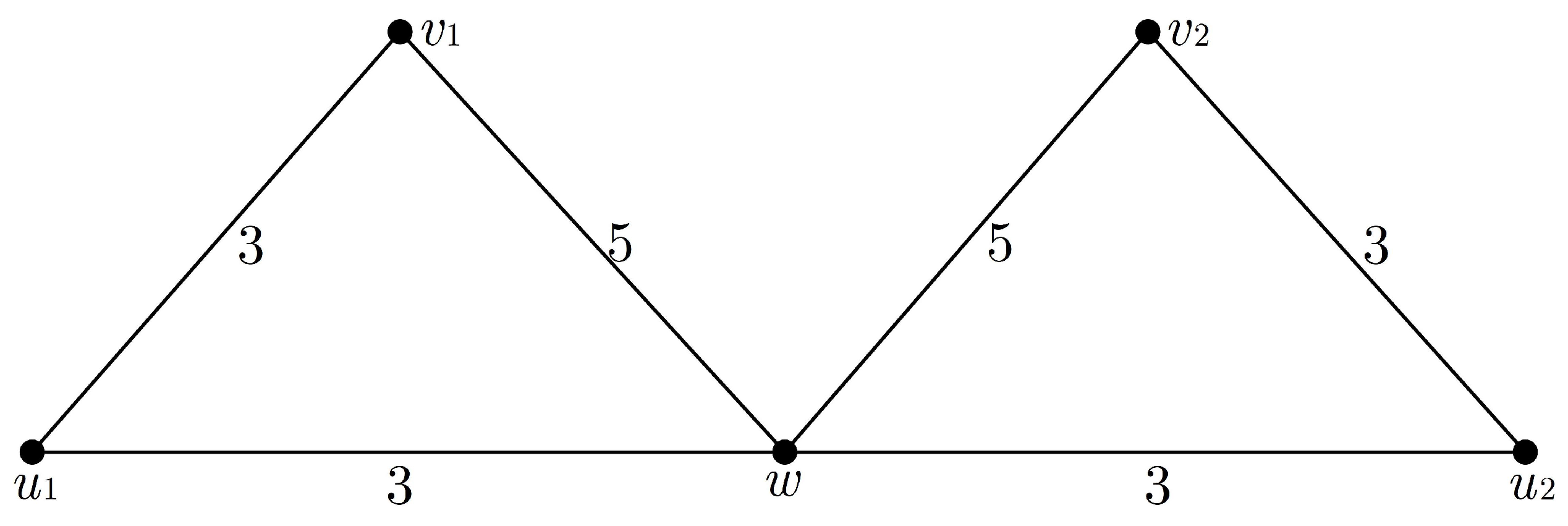
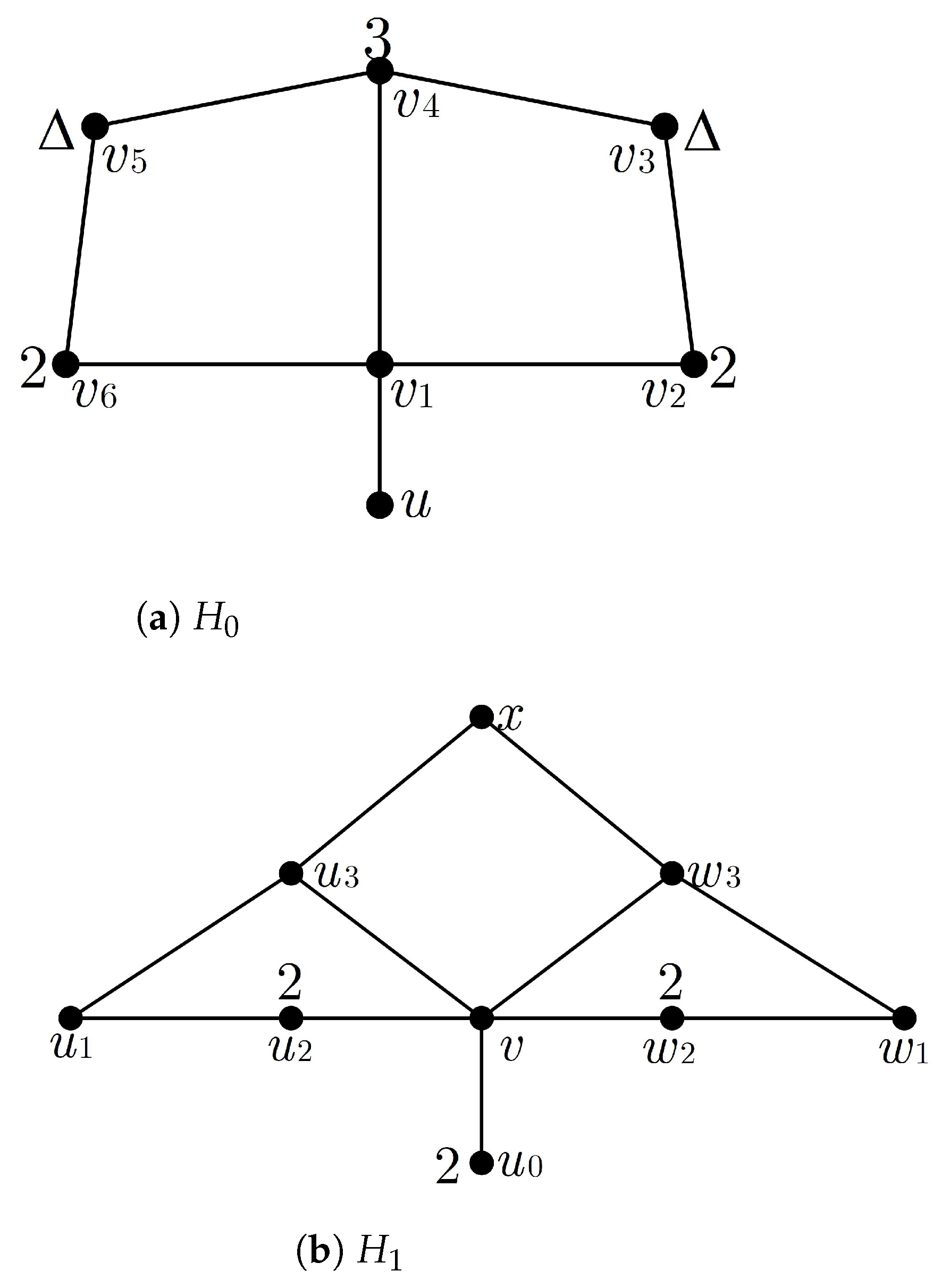
Below, we provide a special edge list assignment
L and show that the graph of
(as shown in
Figure 1) in Lemma 1 is edge DP-
L-colorable.
Lemma 2. Let H be the graph in Figure 1, and L be an edge list assignment with if , and if . Then, H has an -edge coloring for any cover . Proof. The proof is trivial since H can be colored greedily by the order of . □
Let
G be a graph with a cover
. Suppose that
H is a subgraph of
G and
has an
-edge coloring with
There is a mapping such that for each edge e in , and for any pair of edges with , .
For
, we define a new list assignment
and a new family of bipartite graphs
as below:
and
If
has an
-edge coloring
and
H has an
-edge coloring
, then
is an
-edge coloring of
G. Hence,
G has an
-edge coloring. This gives the following lemma, proved in [
16].
Lemma 3 ([
16])
. Let G be a graph with a cover , and H be a subgraph of G. If has an -edge coloring and H has an -edge coloring, then G has an -edge coloring, where , , , and are defined as above. Besides, Zhang et al. [
16] provided the following lemmas as powerful tools to study the edge DP-coloring of planar graphs. Let
G be a graph; a vertex
v of
G is a pendant vertex if
v has degree 1. Similarly, an edge of a graph is said to be pendant if one of its endpoints is a pendant vertex.
Lemma 4 ([
16])
. Let G be a cycle with a pendant edge, and L be an edge list assignment of G satisfying for every . Then, G has an -edge coloring for any cover , where M is a family of bipartite graphs over L. Lemma 5 ([
16])
. Let (), where is a cycle and is a pendant edge. If L is an edge list assignment of G satisfying , for , for other edges e of G, then G has an -edge coloring for any cover , where M is a family of bipartite graphs over L. Before the next section, some notations need to be introduced in advance. Let G be a graph and f be a k-face; all vertices of f will be ordered as clockwise, and denoted by . The definitions of all symbols used are shown clearly by the following table.
| The Definitions of All Symbols |
| Symbol | Definition |
| The set of all vertices in G |
| The set of all faces in G |
| k(; )-vertex | A vertex of degree k (at least k; at most k) |
| k(; )-face | A face of length k (at least k; at most k) |
| -face | All vertices of face will be ordered as clockwise and for each , is -vertex |
| -edge | is a -edge if has degree for |
3. Edge DP-Coloring of -Minor Free Graph
In this section, we provide a proof of Theorem 6 and construct a -minor free graph with that is not edge DP-3-colorable.
Theorem 8. Let G be a -minor free graph with maximum degree Δ; then, .
Proof. Assume that G is a counterexample of Theorem 6 with minimal. Let be a cover with for all such that G does not have an -edge coloring. As G is a -minor free graph, G contains one of the structures (a–d) in Lemma 1.
(a) Assume that with and . Then, has an -edge coloring by minimality, where and are defined in Lemma 3. Note that e has at most incident edges in . Thus, we have , and so e can be colored properly. Then, G has an -edge coloring by Lemma 3, a contradiction.
(b) Let such that (it may happen that and ). Set , where (or ). By minimality, has an -edge coloring. And C has an -edge coloring because of , . Similarly, G has an -edge coloring by Lemma 3, a contradiction.
(c) If
, then this situation is included in (a) or (b). Assume that
. Then,
has an
-edge coloring by minimality. Note that
and
. Thus,
So could be colored directly. By Lemma 3, G could have an -edge coloring, a contradiction.
(d) Let
H be the graph in
Figure 1. Then
has an
-edge coloring by minimality. It is easy to check that for all
,
satisfies the condition in Lemma 2. Thus,
H has an
-edge coloring, and so
G has an
-edge coloring, a contradiction. □
In the following, we will introduce a -minor free graph G with a maximum degree of 3, which is not edge DP-3-colorable. In particular, we will define a -minor free graph G, a cover with , such that G has no -edge coloring.
Definition 3. Let be a cover of G and be an adjacent pair. We call the cover M straight over if every satisfies . Especially, for edge set E, we call M straight over E if M is straight over every adjacent pair , .
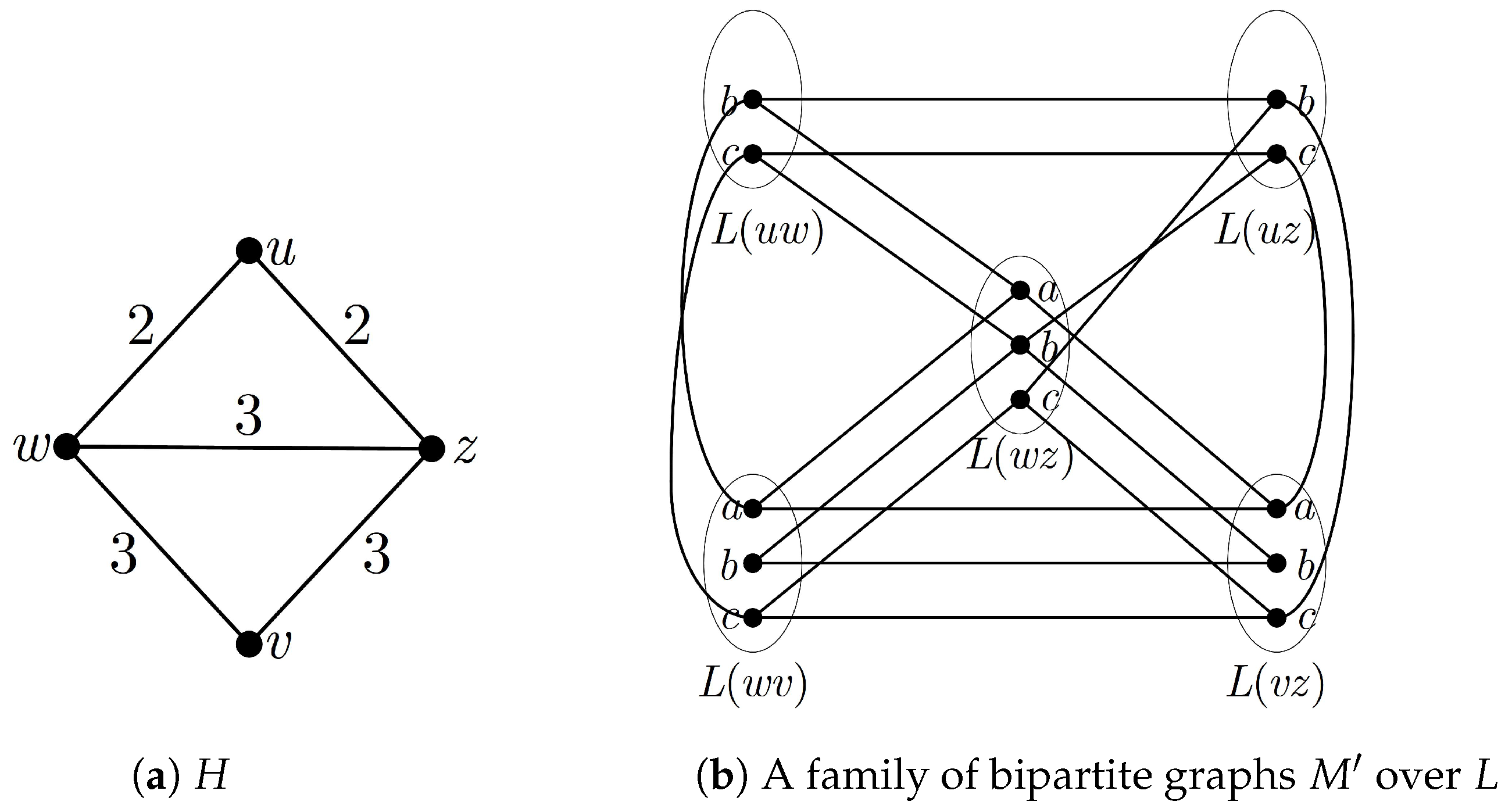
Lemma 6. Let H be the graph in Figure 2a with an edge list assignment L, where for
, and
otherwise. Then, there exists a family of bipartite graphs over L such that H does not have any -edge coloring. Proof. Let
be the family of bipartite graphs over
L, as shown in
Figure 2b, which is straight over
and
. Assume that
H has an
-edge coloring
. Without loss of generality, we may assume that
. Then, the only choice for edge
is
, respectively. Now we cannot find available colors for
. Similarly, we can get a contradiction if
. Therefore,
H does not have an
-edge coloring. □
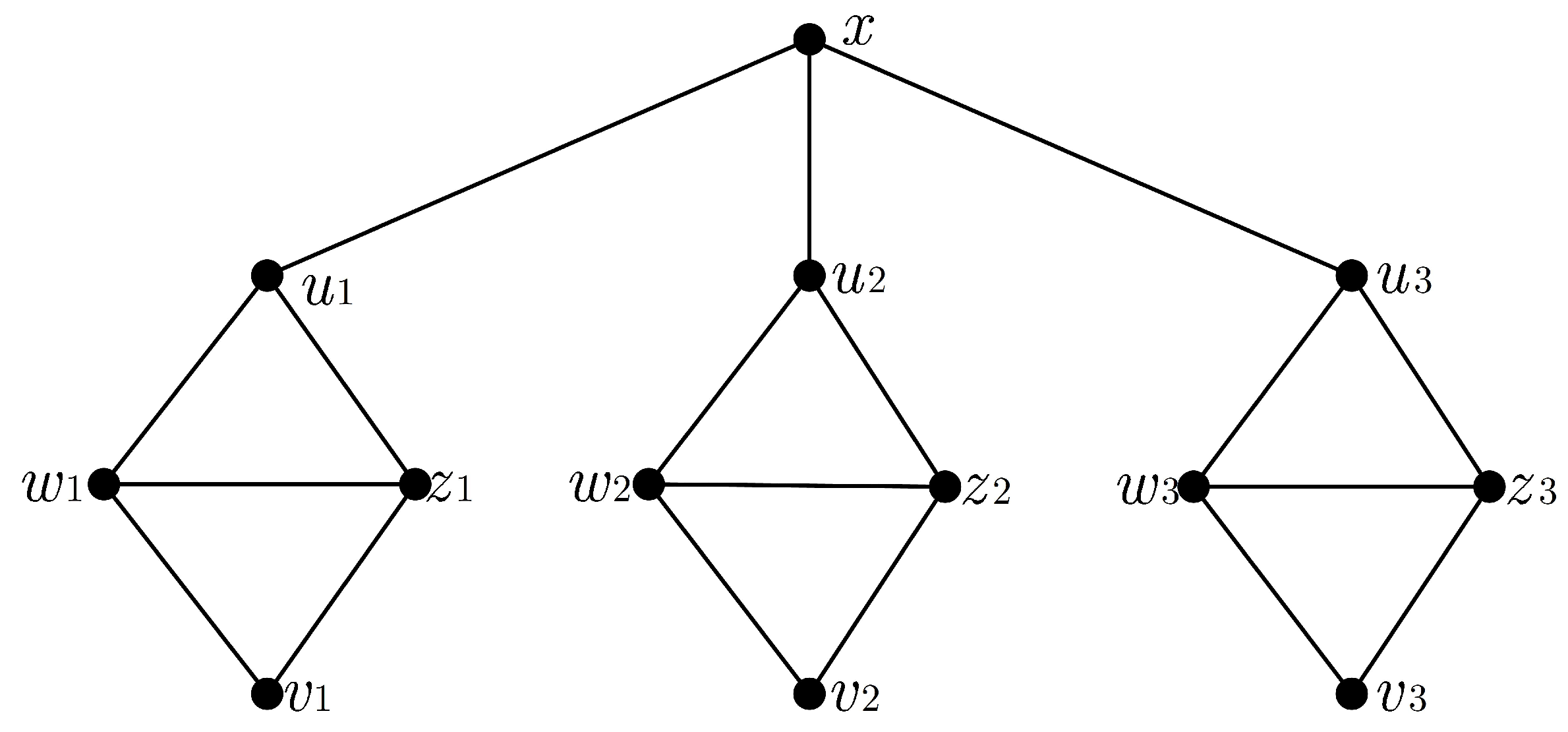
Lemma 7. Let G be a -minor free graph as shown in Figure 3. Then, G is not edge DP-3-colorable. Proof. Let for each . Set , and for . Note that is a copy of H in Lemma 6. Now, we will define a family of bipartite graphs M over L such that G has no -edge coloring. Let M be a family of bipartite graphs over L such that
M is straight over ;
For
,
,
(
is shown in
Figure 2b).
Assume that G has an -edge coloring . As M is straight over , there must exist exactly one edge , say s.t. . Then a is not available for and . Thus, for graph , the remaining list assignment satisfies for and otherwise. By Lemma 6, does not have -edge coloring, and so G does not have an -edge coloring. Therefore, G is not edge DP-3-colorable. □
4. Proof of Theorem 7
Assume G is a counterexample to Theorem 7 such that is minimal. Then, there exists a cover with for such that G has no -edge coloring.
The lemma below shows some properties of the minimal counterexample
G. We say
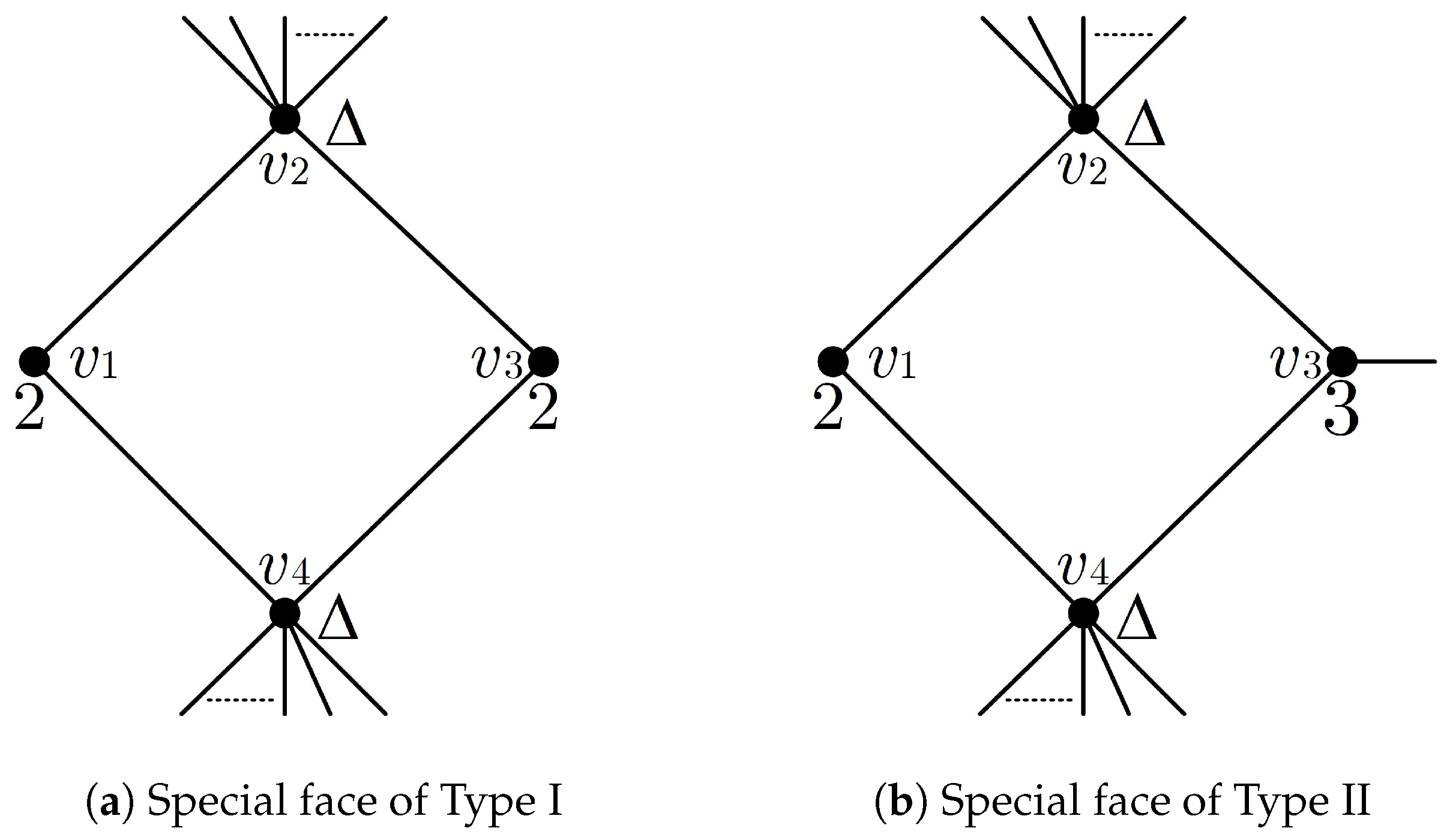
f is a special 4-face with facial cycle
if either (Type I)
,
or (Type II)
,
. Let
(
) be the set of special faces of Type I (Type II), respectively.
Figure 4 describes these two kinds of special faces.
Lemma 8. If G is a counterexample to Theorem 7 with minimal, then all of following hold:
- (a)
G is connected.
- (b)
Each is incident to at most one triangle.
- (c)
for any edge .
- (d)
If and v is incident to some , then all vertices in are -vertex.
- (e)
G does not contain (shown in Figure 5a) as its subgraph, where Δ
-vertex is incident to a 2-vertex u and two special faces of Type II. - (f)
G does not contain (shown in Figure 5b) as its subgraph, where Δ
-vertex v is incident to a 2-vertex and three 4-faces. Moreover, and are two special faces of Type II and shares a common -edge with two special faces. Here, and
are not necessarily different.
Proof. (a,b) It is trivial, since G is a minimal counterexample and does not have intersecting triangles.
(c) Assume that there is an edge
of
G satisfying
. Let
. By minimality,
has an
-edge coloring for cover
, the definition of
and
are given in
Section 2. Note that
. Thus,
e could be colored. By Lemma 3,
G has an
-edge coloring, a contradiction.
(d) Let with and with . Note that and . Assume there exists with . Let H be a subgraph of G with and . Then, by the minimality of G, has an -edge coloring . Now we consider for . It is easy to check that , for , for . By Lemma 4, H has an -edge coloring . Since has an -edge coloring , G has an -edge coloring .
(e) Assume . Then, has an -edge coloring. Note that is a structure described in Lemma 5 with . Based on its degree condition, it is easy to check that , , and for otherwise. By Lemma 5, has an -edge coloring. Thus, G has an -edge coloring by Lemma 3, which is a contradiction.
(f) Observe that is the structure of Lemma 5 with and . Thus, we have for , for and . Thus, has an -edge coloring, and so G has an -edge coloring by Lemma 3, which is a contradiction. □
To drive a contradiction by discharging analysis, we first define an initial charge as for and for .
By Euler’s formula
, the total sum of charges of vertices and faces satisfies the following identity:
Next, we design appropriate discharging rules and redistribute charges accordingly. Once the discharging is finished, a new charge is produced. Note that the discharging process preserves the total sum of charges of G. However, we will show that for all , which leads to an obvious contradiction, and subsequently the proof is complete.
Our discharging rules are defined as follows. (For -face f, we always assume has the minimal degree).
- (R1)
Every 2-vertex v receives 1 from every incident face.
- (R2)
If a -vertex v is incident to a -face f; and
- (R2.1)
v is adjacent to two 2-vertices which are incident to f, then v gives 1 to f.
- (R2.2)
v is adjacent to exactly one 2-vertex which is incident to f, then v gives to f.
- (R3)
Let be a 3-face.
- (R3.1)
If , then each of and gives 2 to f, respectively.
- (R3.2)
If , then each of and gives to f, respectively.
- (R3.3)
If , then each of and gives to f; gives to f.
- (R3.4)
If ,
and with , then each of and gives 1 to f.
otherwise, gives to f, each of and gives to f.
- (R3.5)
If , then each of and gives 1 to f.
- (R4)
Let be a 4-face.
- (R4.1)
If (note that ), and
, then each of and gives 2 to f ( due to (c) in Lemma 8).
, then each of and gives to f ().
, then each of and gives to f and gives to f.
, then each of and gives to f and gives to f.
, then each of and gives 1 to f, gives 1 to f.
- (R4.2)
If , and
, then each of and gives 1 to f.
, then each of and gives to f and gives to f.
- (R4.3)
If , then each of and gives to f.
- (R5)
Let be a 5-face. By (c) in Lemma 8 and symmetry, we could assume has the second smallest degree.
- (R5.1)
If ,
and , then each of and gives 1 to f.
and , then each of and gives to f, gives 1 to f.
otherwise, each of and gives to f.
- (R5.2)
If ,
and , then each of and gives to f.
otherwise, each of and gives to f.
- (R5.3)
If is a -vertex, then each gives to f for .
Note that each face f only gives a charge to incident 2-vertex. Assume that . If there is a 2-vertex , then there exist two -vertices as its neighbors on f by (c) in Lemma 8. Thus, by (R1) and (R2), each -vertices gives at least to f, and so . If f is a d-face, , then by rules (R3), (R4) and (R5). After all, the final charge of every face is nonnegative.
As for any edge (by (c) of Lemma 8), each v of G has degree at least 2. Now, we will consider the final charge of d-vertex, where . If , then . As v does not give out any charge, by rule (R1). Now it suffices to consider the vertex v with .
Claim 1. If v is d-vertex with , then .
Proof. If , then v does not give out or get any charge by all discharging rules. So, .
If , then v gives at most to every incident face by rules (R3), (R4) and (R5). So, .
Next considering any 5-vertex v. If v is not incident to any 3-face, then by rules (R4) and (R5), we obtain . Otherwise, v is incident to exactly one 3-face by (b) in Lemma 8. For , let in cyclic order and for , let be the face incident to v with , where indices are taken module 5. Assume that the unique 3-face is . If v gives at most to , then obviously. So, considering v gives 1 to by rule (R3.4). Then, such that , and so, v gives at most to the face with by (R4.3) and (R5). Thus, .
If , then v sends at most 1 to every incident face by (R3), (R4), and (R5). So, .
If , by (R3), (R4) and (R5), then v sends at most to 3-face, and v sends at most 1 to every incident -face. Therefore, we obtain . □
Claim 2. If v is a -vertex, then .
Proof. For , let in cyclic order and be the face incident to v with , where indices are taken module . Let . We call is a petal of v if P is formed by some consecutive adjacent and set .
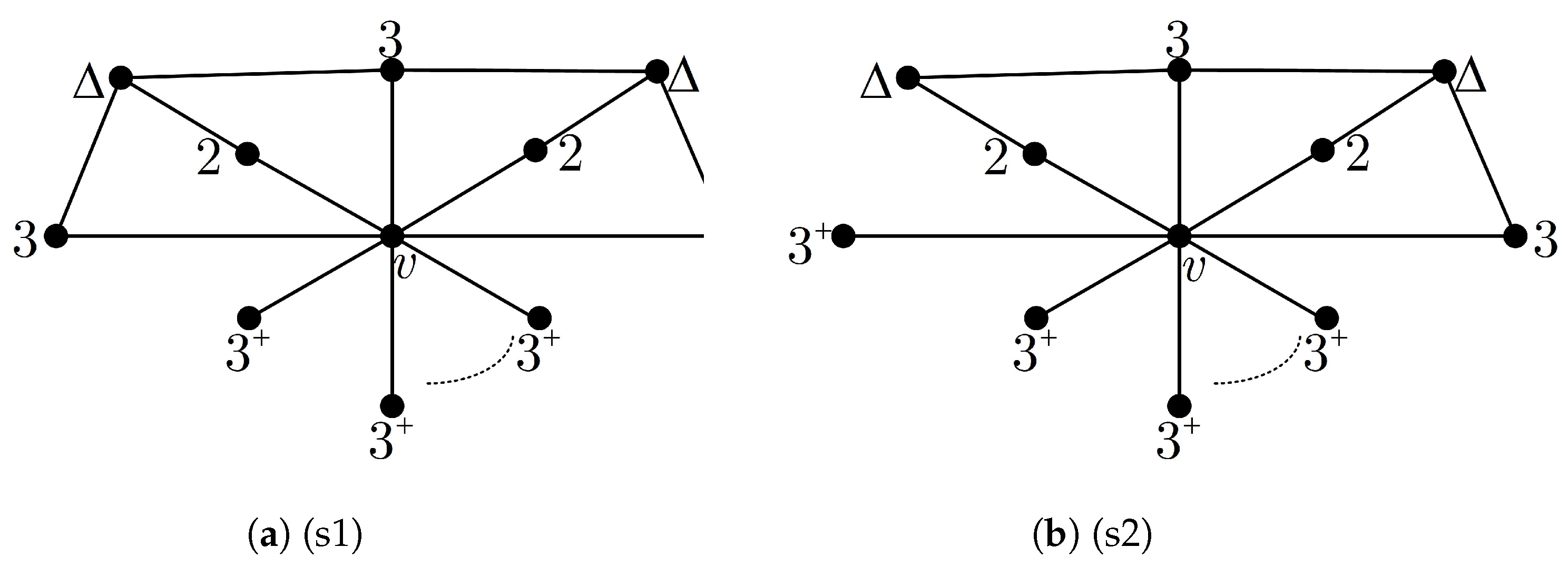
If , then there is some subgraph of G, which contradicts (e) of Lemma 8. Thus, we can have the following observation.
Observation 1. Let w be the number of petals around v. If , i.e., , then and one of the following situations appears.
- (s1)
- (s2)
- (s3)
and two consecutive adjacent special faces share common -edge, ;
- (s4)
and two consecutive adjacent special faces share common -edge, ;
- (s5)
, .
Note that if there is some 3-face in F, there is exactly one 3-face in F since there are no intersecting triangles in G. Now we will consider three cases based on the existence of special faces in F. Assume that for . By the (R2), (R3), (R4) and (R5), v sends at most 2 to the possible unique 3-face and at most to -faces. Thus, since . Assume that there is some special 4-face of Type I in F, say . By (d) in Lemma 8, the degree of is at least 3, for . If one of and is 3-face, say , then v sends 2 to , at most 2 to , at most to , and at most 1 to by rules (R3.5). So, since . Otherwise, v sends 2 to , at most to , and possible 3-face, and at most 1 to other . So, .
In the following, we will assume that and , i.e., there is some for . It suffices to consider all situations in Observation 1. Note that v sends to each .
(s1) (see in
Figure 6a): As every vertex
that is not incident to faces in
is
-vertex,
v sends at most
to the possible 3-face and at most 1 to every
-faces not contained in the petal. Thus,
since
.
(s2) Assume
v has a petal
(as shown in
Figure 6b). By (e) in Lemma 8, the degree of
is at least 3 for
. If
, then
has a chord
. So that is impossible and
must be a
-face. Therefore,
v sends at most
to the possible 3-face, at most
to
, at most 1 to other
-faces, and so
since
.
(s3) Assume v has exactly one petal . Similarly, v sends to for and the degree of is at least 3, for . If one of and is a 3-face, say , then as a face has a chord , a contradiction. So and are -face. Therefore, v sends at most to , sends at most to the possible 3-face and sends at most 1 to other -faces. So, since .
Before the analysis of (s4) and (s5), let be the set of all petals of v with size i and for . Set . Then, . Let and set . Note that for any :
If and , then v sends at most 1 to f.
If f ∈ F′ and |f| = 3, then v sends to f.
If for some , then v sends to f.
Otherwise, v sends at most to every -face f.
Now we consider two cases based on the existence of a 3-face.
Case 1. For any , .
(s4) Note that and each is sharing -edges with two faces in . When , the only possibility is that and . In this situation, every face in shares -edge with two different petals in respectively. Hence, implies that by .
Thus,
is at least
. So,
since
and
.
(s5) Note that
. As each
is sharing an
-edge with some face in
,
. Thus, we have
since
and
.
Case 2. There is some such that is a 3-face. We may assume that and .
(s4) Similarly, we have
is at least
and
. Note that
v sends at most
to each petal in
and sends at most 3 to each petal in
. Assume that
is not a
-face. If
, then
v sends at most
to
, sends at most 1 to
faces in
, and sends at most
to other
-face. Thus, we have
If
, then
contains a
-edge and one of
, say
. Thus,
is a
-face containing a
-edge. If
, then
v sends at most
to
, sends at most 1 to
and
faces in
. Thus, we have
Otherwise,
and
is a
-face containing a
-edge. Thus,
receives at most
from
v by (R2), (R4) and (R5). And so,
As
and
, Equations (
1)–(
3) are not negative except when
and
. Then,
is adjacent to some
and some
, and so there is a
-edge or
-edge in
. It is a contradiction since
for any
.
Assume that
is a
-face. Clearly, we have
and one of
contains a
-edge. Without loss of generality, we may assume that
is a
-face with a
-edge. Similarly, if
, then
receives at most 1 from
v by (R2), (R4) and (R5). Thus,
Otherwise,
and
is a
-face containing a
-edge. Thus, each
receives at most 1 from
v and
receives at most
from
v by (R2), (R4) and (R5). So,
As
,
and the existence of the 3-face, Equations (
4) and (
5) are not negative unless when
and
, or
. Note that
v sends 2 to face
, sends 3 to each petal in
and sends
to each petal in
.
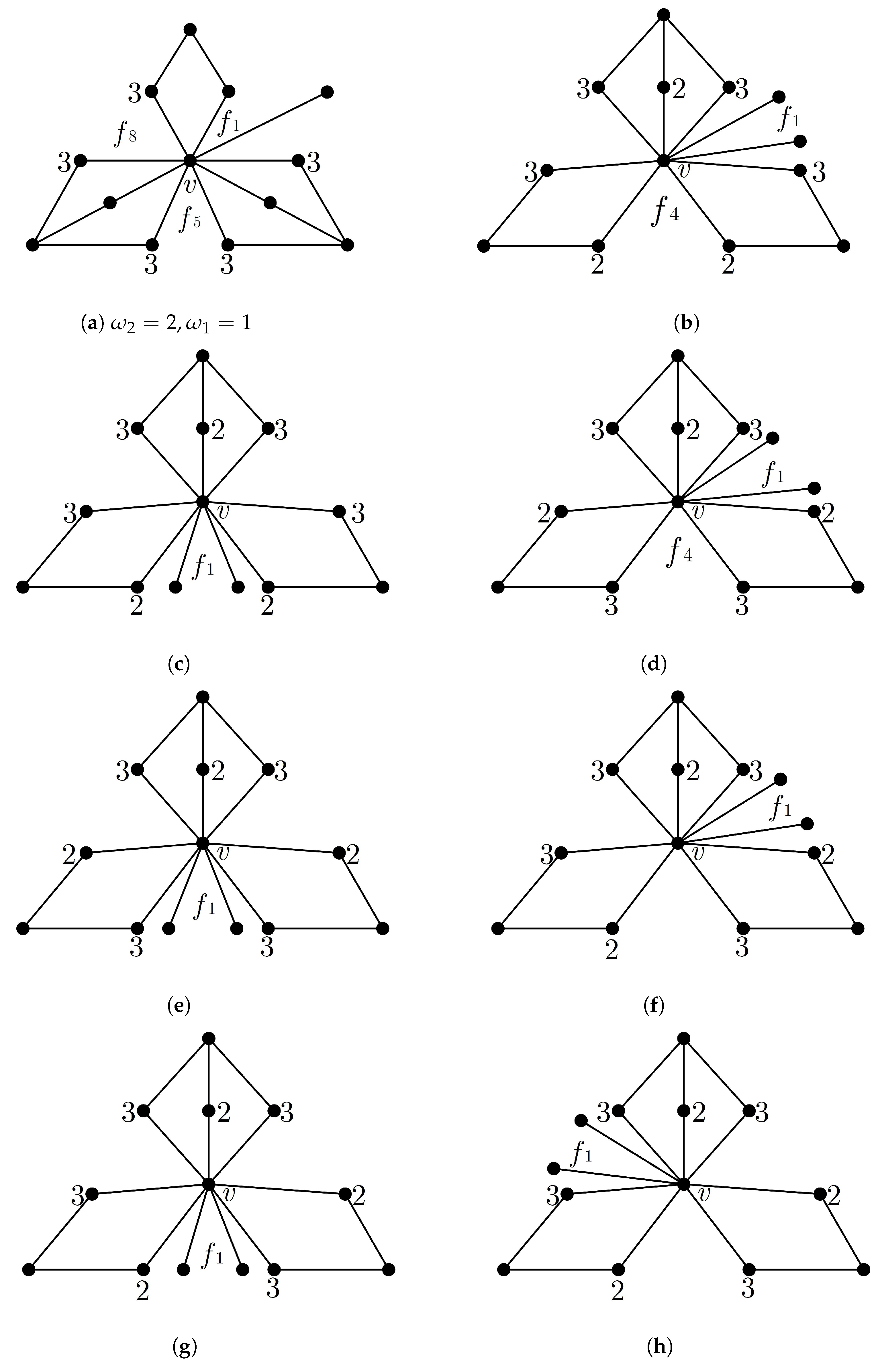
When
and
, it suffices to consider the structure in
Figure 7a by symmetry and the existence of
-face. Note that
and
are not 4-faces due to (f) in Lemma 8. So,
and
receive at most
from
v by (R5.2) respectively. Thus, we have
.
Now, we consider the situation when
and
. Note that for any
-face
,
f receives at most 1 from
v. By all degree conditions and the absence of chord in any face, the unique
-face does not share any edge with any petals. All situations are shown in
Figure 7b–h. Based on
and (R4.1, R5.1). Thus, we have
.
(s5) Note that and .
Assume
is not a
-face. If
, then
since
.
If
, then we can assume that
, and so
is a
-face containing a
-edge. Note that
. If
, then
receives at most 1 from
v by (R2), (R4) and (R5). Thus,
since
.
Otherwise,
and
is a
-face containing a
-edge. Then,
and each
receives at most 1 from
v and
receives at most
from
v by (R2), (R4), and (R5). So,
since
.
Assume that
is a
-face. Clearly, we have
. Similarly, if
, then
receives at most 1 from
v by (R4) and (R5). Thus,
Otherwise,
and
is a
-face containing a
-edge. Thus, each
receives at most 1 from
v and
receives at most
from
v by (R2), (R4) and (R5). Thus,
Combined with
and
, Equations (
6) and (
7) are not negative unless
,
and
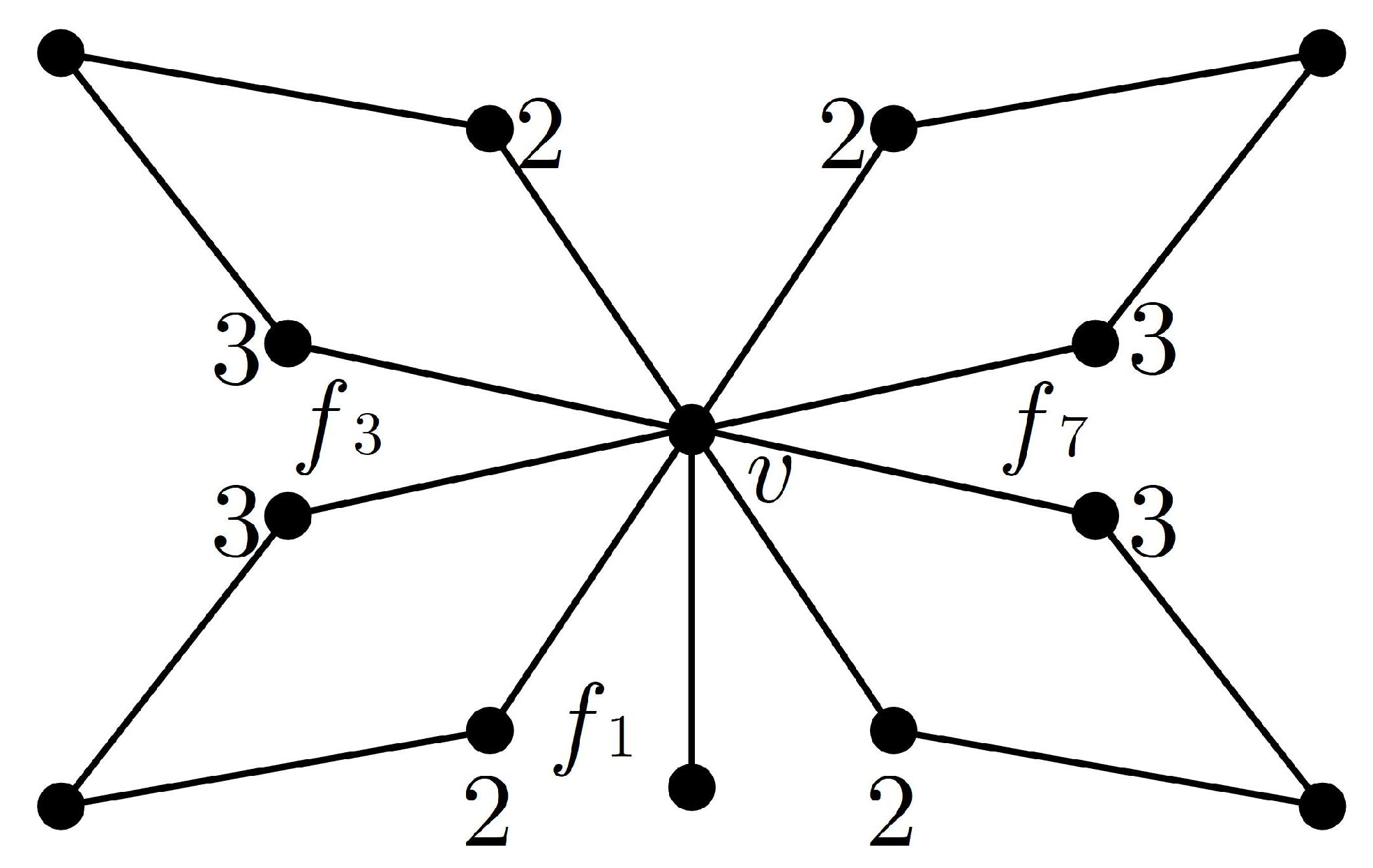
(shown in
Figure 8). Similarly, by all degree conditions and the absence of chord of any face, the unique 3-face
does not appear in any position. □
By Claims 1 and s, for , the final charge of d-vertex is nonnegative. The proof of Theorem 7 is completed.