


Abstract
In this paper, we study a class of conformable frictionless contact problems with the surface traction driven by the conformable impulsive differential equation. The existence of a mild solution for conformable impulsive hemivariational inequality is obtained by the Rothe method, subjectivity of multivalued pseudomonotone operators and the property of the conformable derivative. Notice that we imply some new fractional viscoelastic constitutive laws.
Keywords:
conformable impulsive differential equation; conformable hemivariational inequality; conformable frictionless contact problem; Rothe method MSC:
49J40; 34H05
1. Introduction
Variational inequalities were proposed by Signorini in the 1950s in the context of applications to the rigid contact problem in elasticity and mainly involved convex energy functionals or nonempty closed convex sets. Variational inequalities represent powerful mathematical tools with application to contact mechanics, see [1,2,3,4]. With the development of solid contact mechanics, the researchers realized that not all contact problems are modeled by variational inequalities. Hemivariational inequalities were firstly introduced by Panagiotopoulos in the 1980s, which was mainly used to deal with the mechanical problems of nonsmooth and nonconvex functions, see [5]. During the last 30 years, hemivariational inequalities have been substantially developed in both application and mathematics, see [6,7,8,9,10,11,12,13,14,15]. Moreover, numerical analysis of hemivariational inequalities has achieved good results, see [16,17,18]. In particular, the PDAS approach [17] provides suitable analytical and numerical tools for the solution of hemivariational inequalities. This method is of great significance for solving crack problems.
Systems consisting of variational inequalities and differential equations were first studied by Pang and Stewart [19] in 2008 in a framework of finite-dimensional spaces. They called this complex system a differential variational inequality (DVI, for short) and are mainly applied to electrical circuits with ideal diodes, dynamic contact mechanics, economical dynamics, dynamic traffic networks and so on. Differential hemivariational inequalities (DHVIs, for short) as extensions of differential variational inequalities are mainly organized by hemivariational inequalities and differential equations. Obviously, DHVI mainly involves nonsmooth and nonconvex functions. The mathematical results on DHVIs have found applications to contact problems, see [20,21,22].
As we all know, the traditional constitutive laws of viscoelastic materials are obtained by linear springs and Newton dashpot in series and parallel. However, the creep and relaxation processes of viscoelastic materials can not be accurately described by this scheme. Abel dashpot modeled by fractional time derivative can effectively characterize the creep and relaxation processes of viscoelastic materials. In recent years, the frictional contact problems for a viscoelastic body with the time-fractional viscoelastic Kelvin–Voigt constitutive law have attracted widespread attention. Zeng and Migórski [23,24] used the Rothe method to study a frictional quasistatic contact problem. Based on the Rothe method and numerical analysis, Weng et al. considered a new class of fractional differential hemivariational inequality with an application in [25]. In real life, the traditional fractional derivative sometimes causes great difficulties in analysis and calculation. To overcome the above difficulties, conformable derivatives as a new fractional derivative are proposed in [26]. Recently, conformable derivatives have attracted attention in mathematics and applications, see [27,28,29,30,31,32]. It can describe Newtonian mechanics [29], the logical model [30] and cobweb model [31]. It is worth mentioning that Ma et al. [32] established a grey model with a conformal derivative in view of the computational complexity of the existing fractional grey model and the new model was superior to the existing fractional grey model in predicting the natural gas consumption of 11 countries and is more effective than the existing model in nonsmooth time-series prediction.
In this paper, we consider the quasistatic conformable viscoelastic to frictionless contact problem with the surface traction driven by the conformable impulsive differential equation. Next, we briefly present our innovation in this paper.
We give an analysis of constitutive laws by the property of conformable derivative and study the quasistatic conformable viscoelastic to frictionless contact problem. Because a conformable derivative is a form of fractional derivative, our model can accurately describe the creep and relaxation processes of viscoelastic materials. It is necessary to mention that our viscoelastic body is the generalized fractional Kelvin–Voigt constitutive of the conformable type and the contact boundary is modeled with the Clarke subdifferential of a nonconvex and nonsmooth function. In addition, the contact surface is vulnerable to impact, and this phenomenon is described by impulsive differential equations. Therefore, our new contact model leads to a new class of fractional hemivariational inequalities. Based on the literature [23,24,25], we will use the Rothe method to solve the existence of weak solutions for hemivariational inequality.
This paper is organized as follows. In Section 2, we give the basic notations and some important results. In Section 3, we obtain the new fractional viscoelastic constitutive laws. In Section 4, we give the quasistatic contact problem. Finally, we obtain the existence solvability for the contact problem.
2. Preliminaries
In this section, we recall the basic notations and preliminary results.
Let V and be reflexive and separable Banach spaces and . denote the duality of V and . We use the notation to denote the spaces of all continuous functions. the space of function such that is continuous and and exist with , where . The norms of the above spaces are defined separately as follows:
and
Next, let us recall some conformable definitions and conclusions.
Definition 1
([28]). The conformable derivative with lower index a of a function is defined as:
and
Definition 2
([28]). The conformable integral with lower index a of a function is defined as
Lemma 1
([28]). For , one has
Remark 1
([26]). If exists and is finite, we say that y is -differentiable at . When , we have . Indeed, note that for , the conformable derivative exists if and only if y is differentiable at t and .
For more details about conformable derivatives, we can refer to [26,27] and the references therein. Then, we will review the definition of generalized clarke for a locally Lipschitz functional on a Banach space X. According to [13], we denote by the clarke generalized directional derivative of F at x in the direction v, that is
Recall also that the generalized clarke subdifferential of F at x, denoted by , is a subset given by
for all .
3. Conformable Type Viscoelastic Constitutive Laws
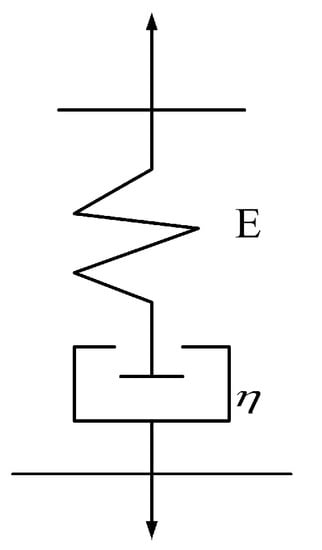
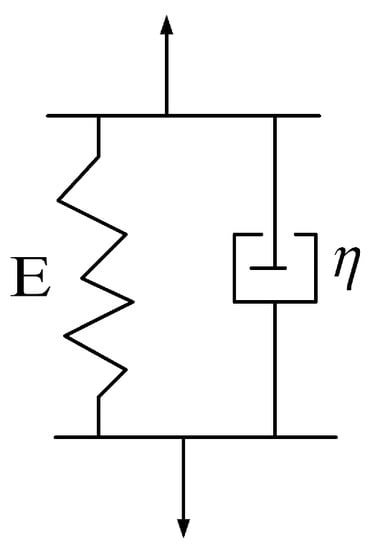
Before implying the conformable constitutive laws, let us review the constitutive model. According to rheology, the idealized elastic and viscous properties of the substance can be ideally modeled with the linear spring and Newton dashpot. The linear spring obeies the Hooke’s law and the Newton dashpot obeies Newton’s law , where the coefficient denotes the Young modulus of elasticity and is the Newtonian Viscosity. is the time derivative of the strain , and denotes the stress of the dashpot element. Then, people produce the Maxwell model, see Figure 1, and the Kelvin–Voigt model, Figure 2, by combining the linear spring and Newton dashpot. In order to improve the quality of models, more elements are used, for example, the generalized Maxwell and Voigt model and the Burgers model. However, the constitutive laws are influenced by a larger number of parameters, from which many difficulties in theoretical and numerical analyses arise. In order to overcome the above difficulties, fractional constitutive models have been used. Therefore, the fractional model is a natural extension of the integral order case. For the fractional constitutive models, we can refer to [33,34]. In particular, Han et al. [35] implied the creep and relaxation behavior for THE Caputo fractional-order Maxwell model and the fractional Kelvin–Voigt model.
Figure 1.
The Maxwell model.
Figure 2.
The Kelvin–Voigt model.
Motivated by the above works, we imply the conformable constitutive laws. The basic conformable element is called the conformable Scott-Blair dashpot, and it satisfies the law of the form
where and are the stress and strain of the Scott-Blair dashpot element, and is the conformable fractional integral with a lower index of 0.
If for , according to the definition of conformable integral, we have
Thus, we imply the creep compliance of the Scott-Blair model
We can choose a different number . Therefore, we get a series of strain creep compliance for the conformable Scott-Blair model.
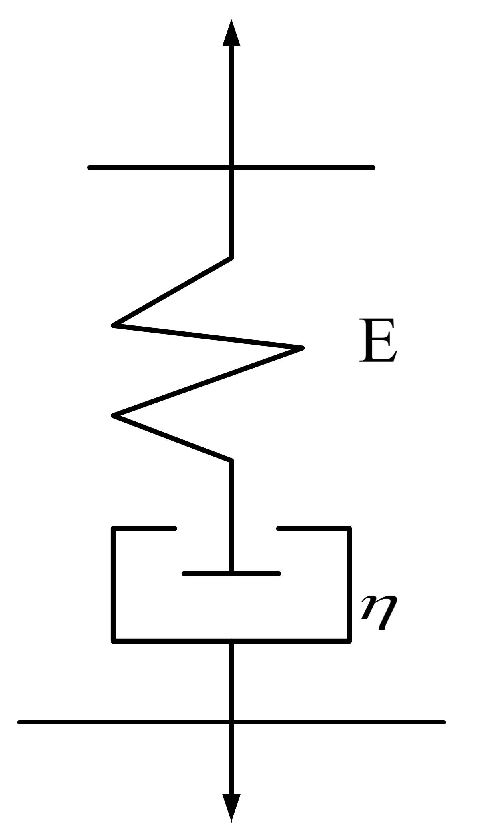
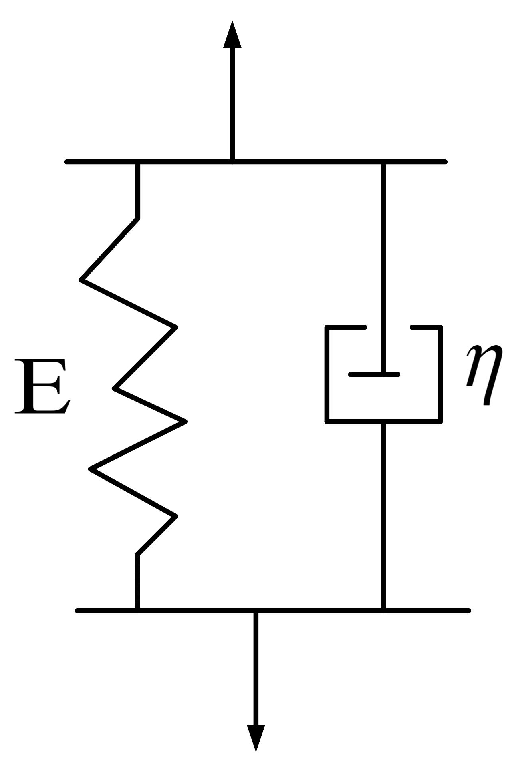
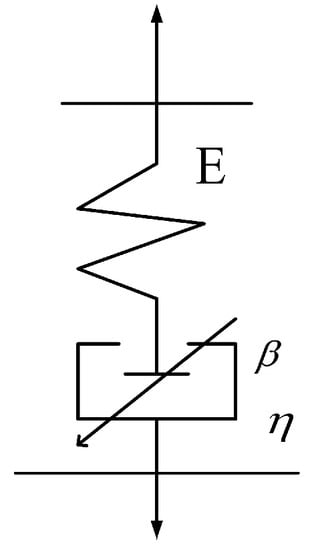
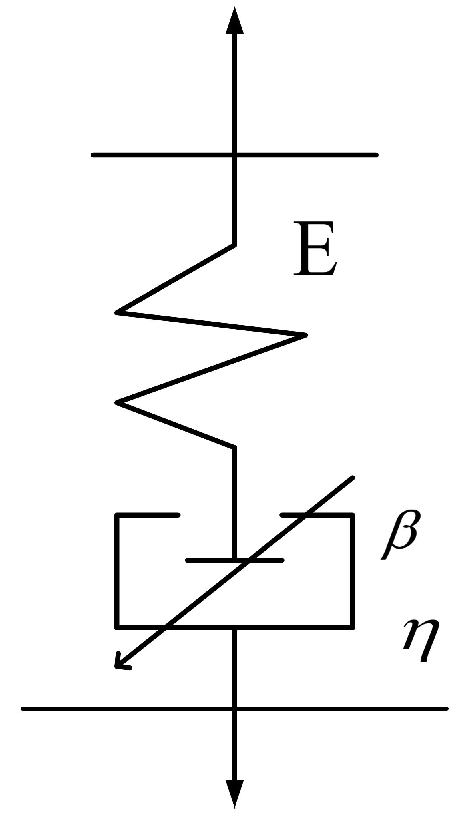
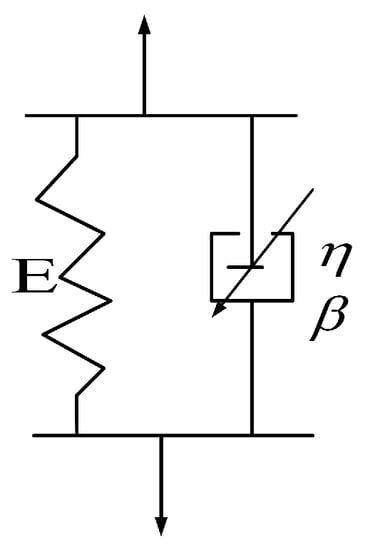
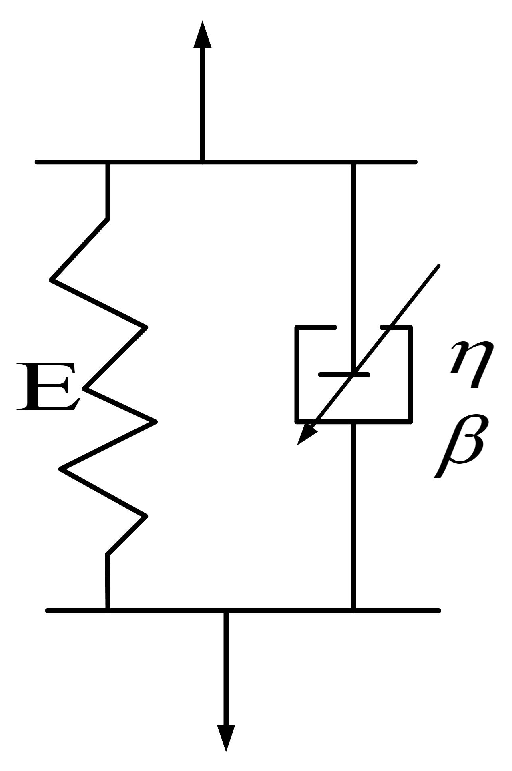
Now, we can deduce that the conformable Maxwell model, Figure 3, and the conformable Kelvin–Voigt model, Figure 4, by combining the linear spring with the conformable Scott-Blair dashpot. As is known to all, if a system of elements is connected in parallel, their stresses coincide, and the total strain equals the sum of stresses in separate elements. It is obvious that the fractional Kelvin–Voigt constitutive law in the one-dimensional case is described as follows
for and . On the other hand, according to Figure 3, we know that the elements are connected in serial. Thus, the fractional Maxwell constitutive law in the one-dimensional case can be formulated by
Figure 3.
The Conformable Maxwell model.
Figure 4.
The Conformable Kelvin–Voigt model.
Similarly, in order to improve the quality of models, we can use more elements, which implies the generalized conformable Maxwell and conformable Voigt models, the conformable Burgers model, etc. Next, we push to creep the conformable Kelvin–Voigt model.
Using creep compliance of the conformable Kelvin–Voigt model: we obtain from for that
Similarly, we can also choose a different number . Meanwhile, we get a series of strain creep compliance for the conformable Kelvin–Voigt model.
4. Quasistatic Conformable Viscoelastic Frictionless Contact Problem
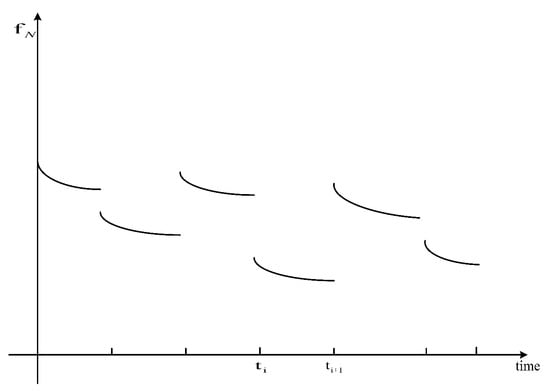
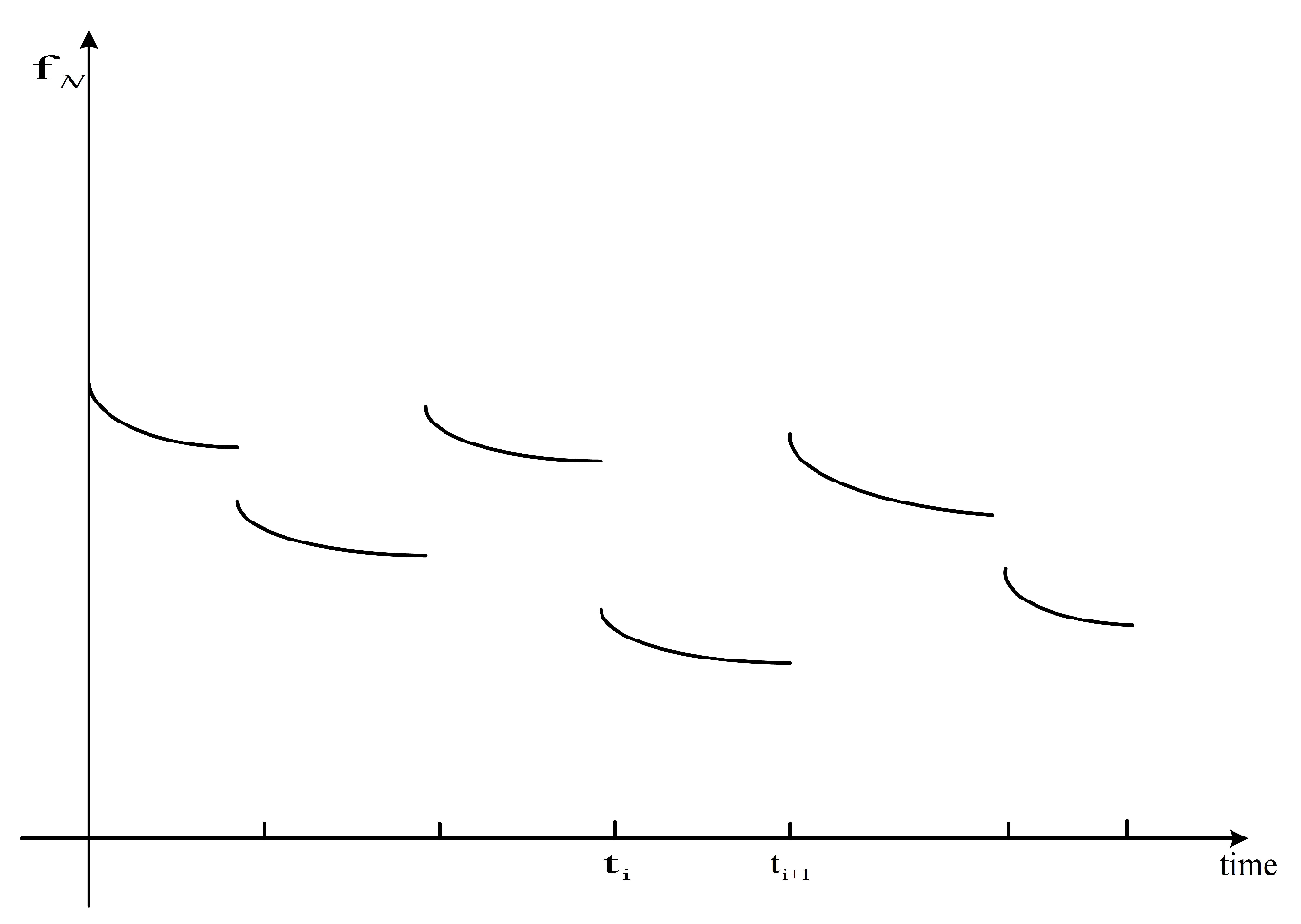
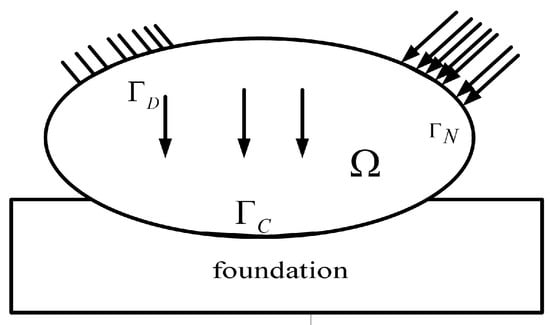
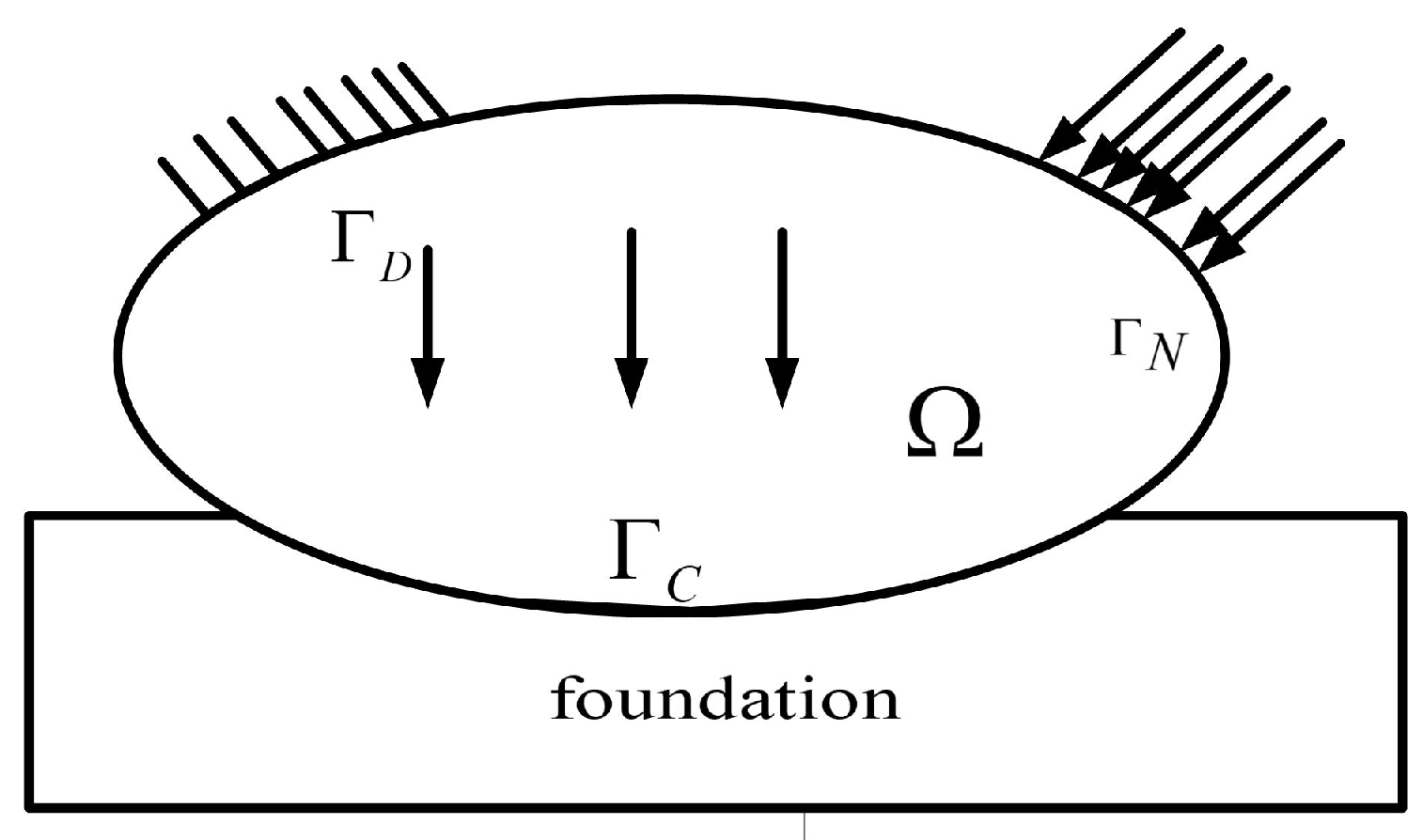
In real life, the surface traction will suddenly change due to external interference, see Figure 5 and Figure 6. We regard this phenomenon as an impulsive effect. On the other hand, the surface traction is influenced by a larger number of parameters, for example, the pointwise fractional density of active bonds and the roughness of the surface traction . Therefore, the force on the surface of the viscoelastic body can not be changed uniformly. Namely, the change rate of the force on each place of the contact surface is also different. Based on the above fact and discussion in the third part, we study the quasistatic conformable viscoelastic frictionless contact problem for a viscoelastic body with Kelvin–Voigt constitutive law. Meanwhile, we use a conformable impulsive differential equation to describe the influence on the surface traction , see Figure 6.
Figure 5.
The force on surface traction .
Figure 6.
A deformable body in contact with a foundation.
Next, we review the physical setting of the contact problem and introduce the basic notations. We study a deformable viscoelastic body, which occupies a domain with the boundary . The boundary consists of three disjoint measurable parts and with means , see Figure 6.
Let be a unit outward normal vector, and be the space of second-order symmetric tensors on . The inner products and corresponding norms in and are denoted by
where , and denote the displacement tensors, the stress tensor, and the linearized strain tensor, the indices run from 1 to d and the summation convention over repeated indices is used. On the other hand, we denote by and the normal and tangential components of the displacement . The normal and tangential components of the displacement on is denoted by and .
This paper considers the following new conformable contact problem with the surface traction by a conformable impulsive differential equation.
Problem 1.
Find a displacement filed , a stress field and a surface traction density such that
We give a brief description. Equation (3) is the conformable Kelvin–Voigt viscoelastic constitutive law. It is made of the linear spring and the conformable Scott-Blair dashpot in parallel. We extend (2) to the general d-dimensional case to obtain (3). The conformable Kelvin–Voigt viscoelastic constitutive law presents elastic and viscous features. Elastic properties are described by springs, and viscous properties are modeled by dashpots. and stand for the viscosity and elasticity operators. On the other hand,
denotes the linearized or the small strain tensor. Equation (4) denotes the equilibrium equation, and Equation (5) denotes that the body is clamped on . Equations (6)–(9) show that the traction is acted on and the density of the surface traction is governed by a conformable impulsive differential equation, is an impulsive function with and and with and being the left and the right limit of at and . Equation (10) denotes contact condition, where is locally Lipschitz functionals. We need to explain the contact conditions. Equation (11) represents the frictionless contact problem.
In this paper, we consider the following spaces and .
The space is endowed with the Hilbert structure by the inner product by
and the associated norm . For space , we consider the inner product by
and the associated norm , and it is well known that is a real Hilbert space with the inner product. From the Sobolev trace theorem [23,24,35], there exists the smallest constant , such that
In order to study the solution to Problem 1, we give some hypotheses on the relevant dates.
the viscosity operator satisfies the following conditions:
(a) for a.e. and ;
(b) with ;
(c) for a.e. and all with .
the elasticity operator satisfies the following conditions:
(a) for a.e. and ;
(b) with .
the function is such that
(a) is measurable on for all , and there exists such that ;
(b) is locally Lipschitz on for a.e. ;
(c) there exists such that for all ;
(d) for a.e. , all with .
(e) is upper semicontinuous for all and a.e. .
: the function satisfies the following conditions:
(a) is measurable on for all ;
(b) for a.e. and all with ;
(c) there exists satisying
where .
: is bounded, and there exists satisfying
and
: the densities of body force satisfies the following condition:
.
It follows from the Green formula that
On the other hand, we have
Combined with the Green formula, we infer that
Then, we have the following variational inequality
Therefore, we get the following variational formulation of Problem 1.
Problem 2.
Find a displacement vector and a surface traction density such that
5. The Conformable Impulsive Hemivariational Inequality
To prove Problem 2, we need to consider the following conformable impulsive differential problem
According to [36], Lemma 1 and Defination 2, the above problem is equivalent to the following integral equation
Then, the assumption implies that is well defined. Meanwhile, we assert that . Indeed, for and , it follows from Equation (13) and condition that
On the other hand, since . Then, we have .
When and , we have
Since . Thus, .
When and , we can show that
Since . Thus .
To study Problem 2, we first consider the following conformable differential hemivariational inequality.
Lemma 2.
For any given , find such that
Here
Next, we define the following operators.
According to conditions and , we imply that the operators A and B satisfy the following conditions.
. There exists a constant such that
.
Thus, system (14) is equivalent to the following system
According to Remark 1, we have
Let . Then, we infer that
Then, system (15) is equivalent to the following problem.
Problem 3.
Find such that
Let and . Next, we discuss the following Rothe problem.
Problem 4.
Find such that and
with . Here,
Lemma 3.
If the conditions hold. Then there exists such that Problem 4 has at least one solution for all .
Proof.
Given , we will show that there exist such that Equations (17) and (18) hold. We claim that operator
is pseudomonotone. Where
It follows from conditions and that
where . By and , operator
is bounded and continuous. Thus, we infer that the above operator is pseudomonotone. On the other hand, It follows from condition that is pseudomonotone. Thus, by (Corollary 7, [24]), we have as a pseudomonotone. Next, we will show that the operator is coercive. Indeed, by conditions and , we have
By condition , we have . Taking , we have for all . Meanwhile, the operator L is coercive. By (Theorem 1.3.70, [37]), system (17) has at least one solution for all . The proof is complete. □
Lemma 4.
Assume that conditions hold. Then, we have
where .
Proof.
According to Lemma 3, Equation (17) and taking , we have
Combined with conditions and Equation (18), we have
Taking , we have
By condition , there exists constant , for all such that
Then, we have
By Equation (18) and condition , we can easily obtain
Thus, we complete the proof of the lemma. □
Theorem 1.
If hypotheses hold. Let be a sequence with as . Then we have
where and is a solution to Problem 3.
Proof.
By Lemma 4, there exists a constant such that . We claim that there exists such that
Then we have
It follows from and that and Thus, we complete the proof of the assertion. By (Theorem 16, [24]), we infer that
By Lemma 4, the sequence is bounded in . There is subsequence again such that weakly in . On the other hand, we have
It follows from condition that
Thus, we infer that
As , we have
where and . Then, we imply that
where . Thus, is a solution of Problem 3. □
When the contact surface is impacted at , the corresponding displacement is given. Similar to the proof of Theorem 1, for any given , there exists such that (14) hold.
Theorem 2.
If satisfies the following system
and
where . Then is a solution to Problem 2.
6. Conclusions
In this paper, we study a class of conformable frictionless contact problems with the surface traction driven by the conformable impulsive differential equation. Under quite general assumptions on the data and employing a subjectivity theorem for pseudomonotone operators and the Rothe method, we prove that the system has at least one solution. In the future, we plan to apply the theoretical results established in the current paper to conformable frictional contact problems.
Author Contributions
The contributions of all authors (J.H. (Jianwei Hao), J.W. and J.H. (Jiangfeng Han)) are equal. All the main results were developed together. All authors have read and agreed to the published version of the manuscript.
Funding
The authors thanks the referees for their careful reading of the article and insightful comments. This work is partially supported by Training Object of High Level and Innovative Talents of Guizhou Province ((2016)4006), Major Research Project of Innovative Group in Guizhou Education Department ([2018]012).
Institutional Review Board Statement
Not applicable.
Informed Consent Statement
Not applicable.
Data Availability Statement
Not applicable.
Conflicts of Interest
The authors declare no conflict of interest. The order of authors is arranged alphabetically according to their family/last names.
References
- Han, W.M.; Sofonea, M. Quasistatic Contact Problems in Viscoelasticity and Viscoplasticity; American Mathematical Society: Providence, RI, USA, 2002. [Google Scholar]
- Sofonea, M.; Han, W.M.; Shillor, M. Analysis and Approximation of Contact Problems with Adhesion or Damage; Chapman and Hall/CRC: Boca Raton, FL, USA, 2005. [Google Scholar]
- Sofonea, M.; Matei, A. Variational Inequalities with Applications: A Study of Antiplane Frictional Contact Problems; Springer Science & Business Media: Berlin/Heidelberg, Germany, 2009. [Google Scholar]
- Sofonea, M.; Matei, A. Mathematical Models in Contact Mechanics; Cambridge University Press: Cambridge, UK, 2012. [Google Scholar]
- Naniewicz, Z.; Panagiotopoulos, P.D. Mathematical Theory of Hemivariational Inequalities and Applications; Marcel Dekker, Inc.: New York, NY, USA, 1995. [Google Scholar]
- Haslinger, J.; Miettinen, M.; Panagiotopoulos, P.D. Finite Element Method for Hemivariational Inequalities: Theory, Methods and Applications; Kluwer Academic Publishers: Dordrecht, The Netherlands, 1999. [Google Scholar]
- Panagiotopoulos, P.D. Nonconvex energy functions, hemivariational inequalities and substationary principles. Acta Mech. 1983, 42, 160–183. [Google Scholar]
- Bartosz, K.; Sofonea, M. The Rothe method for variational-hemivariational inequalities with applications to contact mechanics. SIAM J. Math. Anal. 2016, 48, 861–883. [Google Scholar] [CrossRef] [Scilit]
- Zeng, S.D.; Migorski, S.; Khan, A.A. Nonlinear quasi-hemivariational inequalities: Existence and optimal control. SIAM J. Control. Optim. 2021, 59, 1246–1274. [Google Scholar] [CrossRef] [Scilit]
- Liu, Z.H.; Zeng, S.D.; Motreanu, D. Evolutionary problems driven by variational inequalities. J. Differ. Equ. 2016, 260, 6787–6799. [Google Scholar] [CrossRef] [Scilit]
- Han, W.M.; Migórski, S.; Sofonea, M. Analysis of a general dynamic history-dependent variational-hemivariational inequality. Nonlinear Anal. Real World Appl. 2017, 36, 69–88. [Google Scholar] [CrossRef] [Scilit]
- Xiao, Y.B.; Sofonea, M. Generalized penalty method for elliptic variational-hemivariational inequalities. Appl. Math. Optim. 2021, 83, 789–812. [Google Scholar] [CrossRef] [Scilit]
- Migórski, S.; Ochal, A.; Sofonea, M. Nonlinear Inclusions and Hemivariational Inequalities: Models and Analysis of Contact Problems; Springer: New York, NY, USA, 2013. [Google Scholar]
- Migórski, S.; Pczka, D. Almost history-dependent variational-hemivariational inequality for frictional contact problems. SIAM J. Math. Anal. 2020, 52, 4362–4390. [Google Scholar] [CrossRef] [Scilit]
- Sofonea, M.; Xiao, Y.B.; Zeng, S.D. Generalized penalty method for history-dependent variational-hemivariational inequalities. Nonlinear Anal. Real World Appl. 2021, 61, 103329. [Google Scholar] [CrossRef] [Scilit]
- Kovtunenko, V.A. A hemivariational inequality in crack problems. Optimization 2011, 60, 1071–1089. [Google Scholar] [CrossRef] [Scilit]
- Kovtunenko, V.A.; Leugering, G. A shape-topological control problem for nonlinear crack-defect interaction: The antiplane variational model. SIAM J. Control Optim. 2016, 54, 1329–1351. [Google Scholar] [CrossRef] [Scilit]
- Kovtunenko, V.A.; Leugering, G. A shape-topological control of variational inequalities. Eurasian Math. J. 2016, 7, 41–52. [Google Scholar]
- Pang, J.S.; Stewart, D. Differential variational inequalities. Math. Program. 2008, 113, 345–424. [Google Scholar] [CrossRef] [Scilit]
- Migórski, S.; Zeng, S.D. A class of differential hemivariational inequalities in Banach spaces. J. Glob. Optim. 2018, 72, 761–779. [Google Scholar] [CrossRef] [Scilit]
- Liu, Z.H.; Zeng, S.D.; Motreanu, D. Partial differential hemivariational inequalities. Adv. Nonlinear Anal. 2018, 7, 571–586. [Google Scholar] [CrossRef] [Scilit]
- Liu, Z.H.; Motreanu, D.; Zeng, S.D. Generalized penalty and regularization method for differential variational-hemivariational inequalities. SIAM J. Optim. 2021, 31, 1158–1183. [Google Scholar] [CrossRef] [Scilit]
- Zeng, S.D.; Migórski, S. A class of time-fractional hemivariational inequalities with application to frictional contact problem. Commun. Nonlinear Sci. Numer. Simul. 2018, 56, 34–48. [Google Scholar] [CrossRef] [Scilit]
- Zeng, S.D.; Liu, Z.H.; Migórski, S. A class of fractional differential hemivariational inequalities with application to contact problem. Z. Für Angew. Math. Und Phys. 2018, 69, 1–23. [Google Scholar] [CrossRef] [Scilit]
- Weng, Y.H.; Chen, T.; Li, X.S.; Huang, N.J. Rothe method and numerical analysis for a new class of fractional differential hemivariational inequality with an application. Comput. Math. Appl. 2021, 98, 118–138. [Google Scholar] [CrossRef] [Scilit]
- Abdeljawad, T. On conformable fractional calculus. J. Comput. Appl. Math. 2015, 279, 57–66. [Google Scholar] [CrossRef] [Scilit]
- Bouaouid, M.; Hilal, K.; Melliani, S. Existence of mild solutions for conformable fractional differential equations with nonlocal conditions. Rocky Mt. J. Math. 2020, 50, 871–879. [Google Scholar] [CrossRef] [Scilit]
- Li, M.M.; Wang, J.R.; O’Regan, D. Existence and Ulam’s stability for conformable fractional differential equations with constant coefficients. Bull. Malays. Math. Sci. Soc. 2019, 42, 1791–1812. [Google Scholar] [CrossRef] [Scilit]
- Chung, W.S. Fractional Newton mechanics with conformable fractional derivative. J. Comput. Appl. Math. 2015, 290, 150–158. [Google Scholar] [CrossRef] [Scilit]
- Abdeljawad, T.; Al-Mdallal, Q.M.; Jarad, F. Fractional logistic models in the frame of fractional operators generated by conformable derivatives. Chaos Solitons Fractals 2019, 119, 94–101. [Google Scholar] [CrossRef] [Scilit]
- Bohner, M.; Hatipoglu, V.F. Dynamic cobweb models with conformable fractional derivatives. Nonlinear Anal. Hybrid Syst. 2019, 32, 157–167. [Google Scholar] [CrossRef] [Scilit]
- Ma, X.; Wu, W.Q.; Zeng, B.; Wang, Y.; Wu, X.X. The conformable fractional grey system model. ISA Trans. 2020, 96, 255–271. [Google Scholar] [CrossRef] [Scilit]
- Mainardi, F. Fractional Calculus and Waves in Linear Viscoelasticity: An Introduction to Mathematical Models; World Scientific: Singapore, 2010. [Google Scholar]
- Muller, S.; Kastner, M.; Brummund, J.; Ulbricht, V. A nonlinear fractional viscoelastic material model for polymers. Comput. Mater. Sci. 2011, 50, 2938–2949. [Google Scholar] [CrossRef] [Scilit]
- Han, J.F.; Migórski, S.; Zeng, H.D. Weak solvability of a fractional viscoelastic frictionless contact problem. Appl. Math. Comput. 2017, 303, 1–18. [Google Scholar] [CrossRef] [Scilit]
- Qiu, W.Z.; Wang, J.R.; O’Regan, D. Existence and Ulam stability of solutions for conformable impulsive differential equations. Bull. Iran. Math. Soc. 2020, 46, 1613–1637. [Google Scholar] [CrossRef] [Scilit]
- Denkowski, Z.; Migórski, S.; Papageorgiou, N.S. An Introduction to Nonlinear Analysis: Theory; Springer: New York, NY, USA, 2003. [Google Scholar]
Publisher’s Note: MDPI stays neutral with regard to jurisdictional claims in published maps and institutional affiliations. |
© 2022 by the authors. Licensee MDPI, Basel, Switzerland. This article is an open access article distributed under the terms and conditions of the Creative Commons Attribution (CC BY) license (https://creativecommons.org/licenses/by/4.0/).