


Abstract
Let be a connected graph with and . A bijection is called local antimagic total labeling if, for any two adjacent vertices u and v, , where , and is the set of edges incident to u. Thus, any local antimagic total labeling induces a proper coloring of G, where the vertex x in G is assigned the color . The local antimagic total chromatic number, denoted by , is the minimum number of colors taken over all colorings induced by local antimagic total labelings of G. In this paper, we present the local antimagic total chromatic numbers of some wheel-related graphs, such as the fan graph , the bowknot graph , the Dutch windmill graph , the analogous Dutch graph and the flower graph .
1. Introduction
Let be a connected simple graph with n vertices and m edges. In 2017, Arumugam et al. [1] and Bensmail et al. [2] independently introduced the notation of local antimagic labeling of graphs. A bijection is called a local antimagic labeling of G if any two adjacent vertices u and v in G satisfy , where , and is the set of edges incident to u. It is clear that assigning to x for each naturally induces a proper vertex coloring of G, which is called a local antimagic coloring of G. A graph G is called local antimagic if G has a local antimagic labeling. The local antimagic chromatic number [1] of G, denoted by , is the minimum number of colors taken over all colorings of G induced by local antimagic labelings of G.
Arumugam et al. [1] presented the local antimagic chromatic numbers of some families of graphs, such as star , path , cycle , wheel , friendship graph , complete graph , complete bipartite graph and the join graph , where G is a graph of order and is the complement graph of the complete graph . Meanwhile, many researchers have studied the local antimagic chromatic numbers of classes of many graphs. In [3], Lau et al. gave counterexamples to the lower bound of that was obtained in [1]. Another counterexample was independently found by Shaebani [4]. Lau et al. gave affirmative solutions on Problem 3.3 of [1] and settled Theorem 2.15 of [1]. Moreover, they also completely determined the local antimagic chromatic number of a complete bipartite graph. In [5], Lau et al. presented some sufficient conditions for , where H is obtained from G by deleting or adding a certain edge. They then determined the exact values of the local antimagic chromatic numbers of many cycle-related join graphs. Nazula et al. [6] determined the local antimagic chromatic number of unicyclic graphs. Premalatha et al. [7] determined the local antimagic chromatic number of the corona product of two graphs, such as paths with null graphs. In [8], Bača et al. estimated that for the bounds of the local antimagic chromatic number for disjoint union of multiple copies of a graph, there are trees and graphs with vertices of even degrees and with chromatic index 3. From the results proved by Haslegrave [9], Bača et al. obtained that the local antimagic chromatic numbers of disjoint union of arbitrary graphs are finite if and only if none of these graphs contain an isolated edge as a subgraph.
Recently, Putri et al. [10] extended this notion by labeling the vertices and edges of a graph G to establish a vertex coloring. The local antimagic total labeling on a graph G is defined to be an assignment so that the weights of any two adjacent vertices u and v are distinct, that is, , where . Analogous to the local antimagic labeling, any local antimagic total labeling induces a proper vertex coloring of G, where the vertex x in G is assigned the color . The local antimagic total chromatic number of G, denoted by , is the minimum number of colors taken over all colorings induced by local antimagic total labelings of G. Clearly, for any graph G. Putri et al. [10] presented the local antimagic total chromatic numbers of some families tree, such as star, double star, banana tree graph, centipede graph, and the amalgamation of the star graph. In [11], Kurniawati et al. determined the exact values of local antimagic total chromatic numbers of graphs , when G is the star, path, cycle and friendship graphs. Moreover, Kurniawati et al. [12] determined the exact value of graphs , when G is the star, path, cycle and friendship graphs.
In this paper, we present the local antimagic total chromatic numbers of some wheel-related graphs, such as the fan graph , the bowknot graph , the Dutch windmill graph , the analogous Dutch windmill graph and the flower graph .
2. Main Results
In this section, we compute the local antimagic total chromatic numbers of some wheel-related graphs. In [1], Arumugam et al. presented the exact value of with three cases: (i) for , (ii) for and (iii) for . However, they only presented the range of for . Then Lau et al. [3] gave the exact value of that for . In [5], Lau et al. corrected three errors of the local antimagic labeling for and one error of the local antimagic labeling for . Arumugam et al. and Lau et al. completely determined the exact value of the local antimagic chromatic number of the wheel in the following lemma.
Lemma 1
([1,3]). For the wheel of order , we have
Lemma 2
([10]). For any graph G, we have .
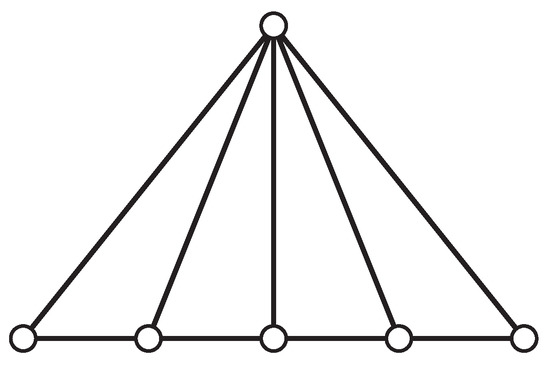
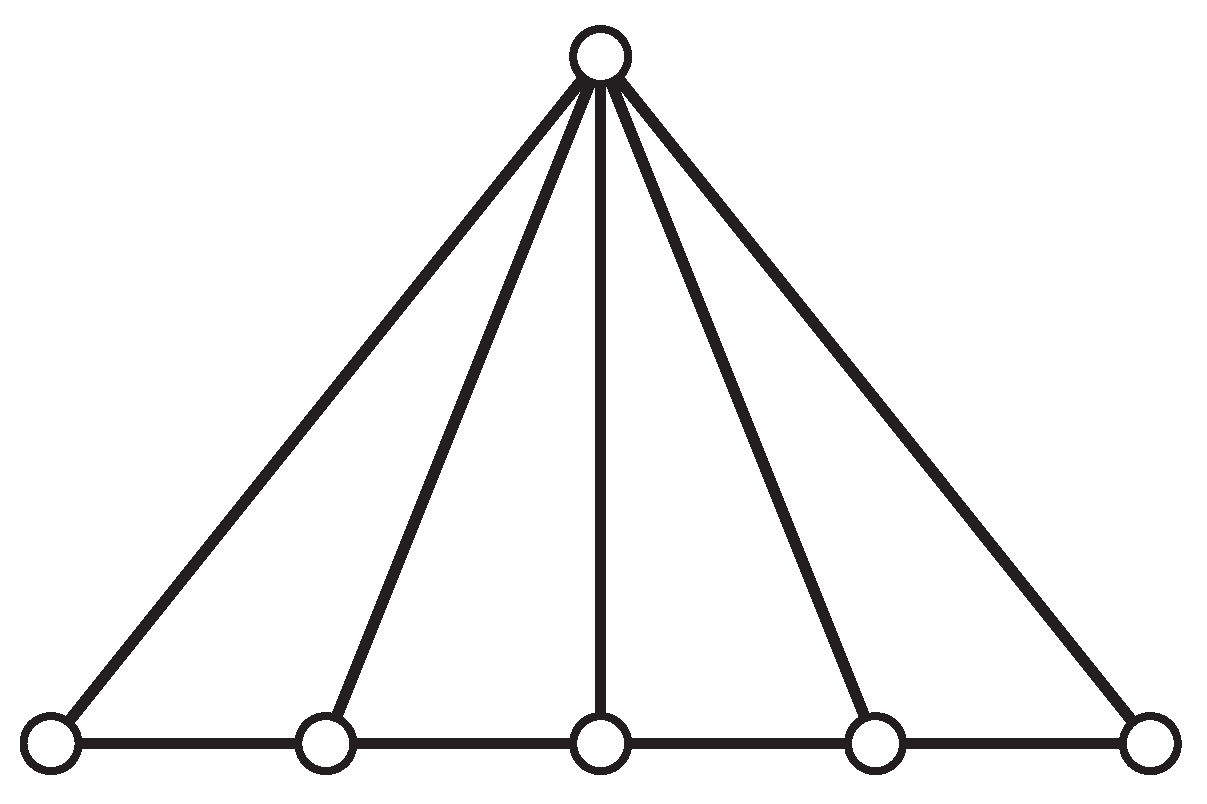
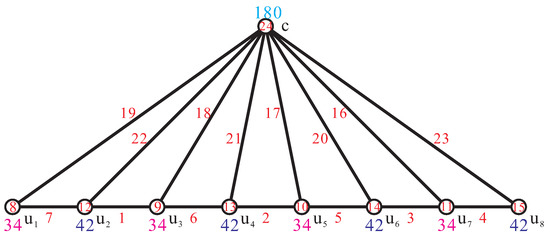
The fan graph of order is obtained by deleting a rim edge of the wheel , where the central vertex of is also the central vertex of . The fan graph is shown in Figure 1. In fact, Slamin et al. [13] in 2018 and Amalia et al. [14] in 2021 presented the exact value of the local antimagic total chromatic number of the fan graph. However, the following local antimagic total labeling of the fan graph in Theorem 1 is different from that of these authors.
Figure 1.
The fan graph .
Theorem 1.
For the fan graph and , then .
Proof.
Let and be vertex set and edge set of the fan graph, respectively. Then we obtain and . It is clear that . In order to prove that , it suffices to prove that , which means that we should obtain a local antimagic total labeling using three distinct colors. Define . Let , and label the edges for i such that as follows:
Then label the remaining edges and vertices of graph . Let us discuss two cases for n.
Case 1. For odd n.
From the above labelings, we have
Thus f is a local antimagic total labeling using three colors, and we obtain .
Case 2. For even n.
From the above labelings, we have
Thus f is a local antimagic total labeling using three colors, and we obtain . The proof is complete. □
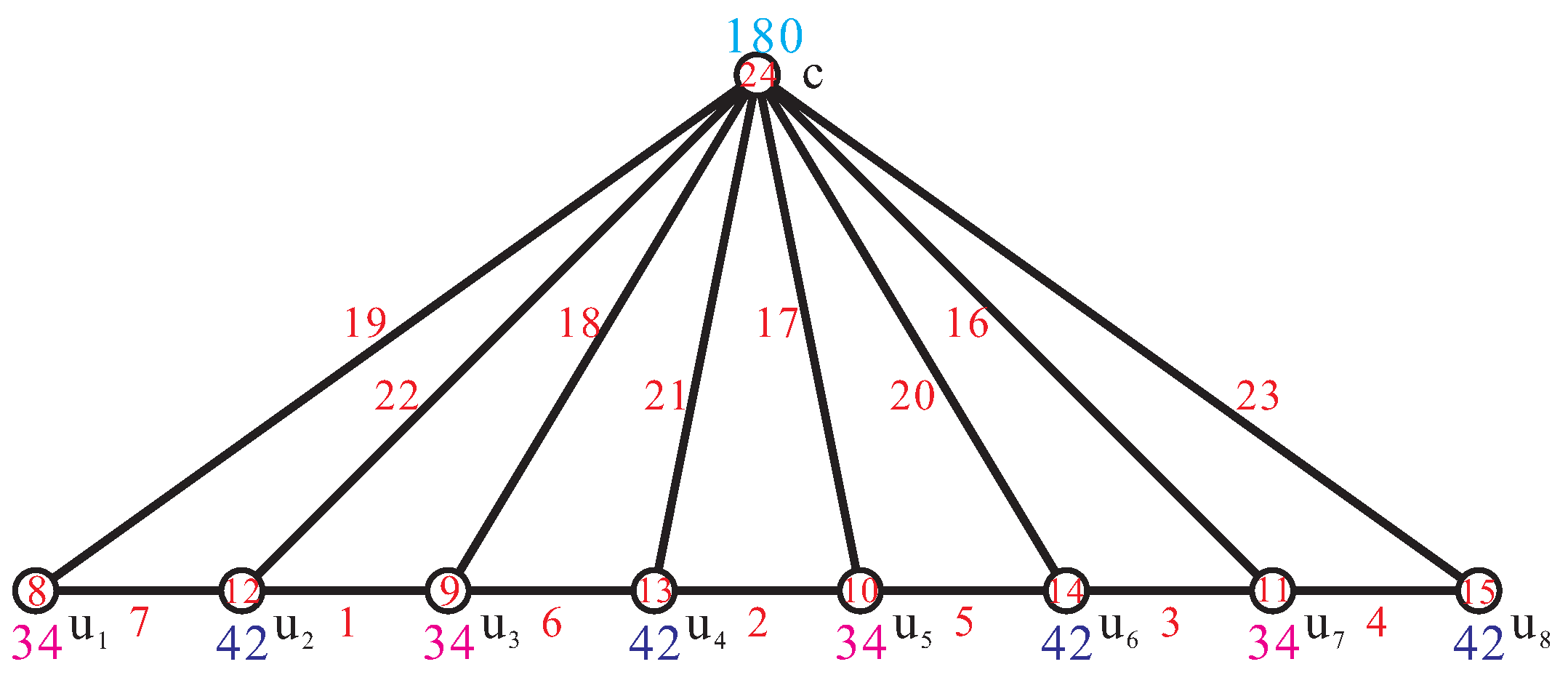
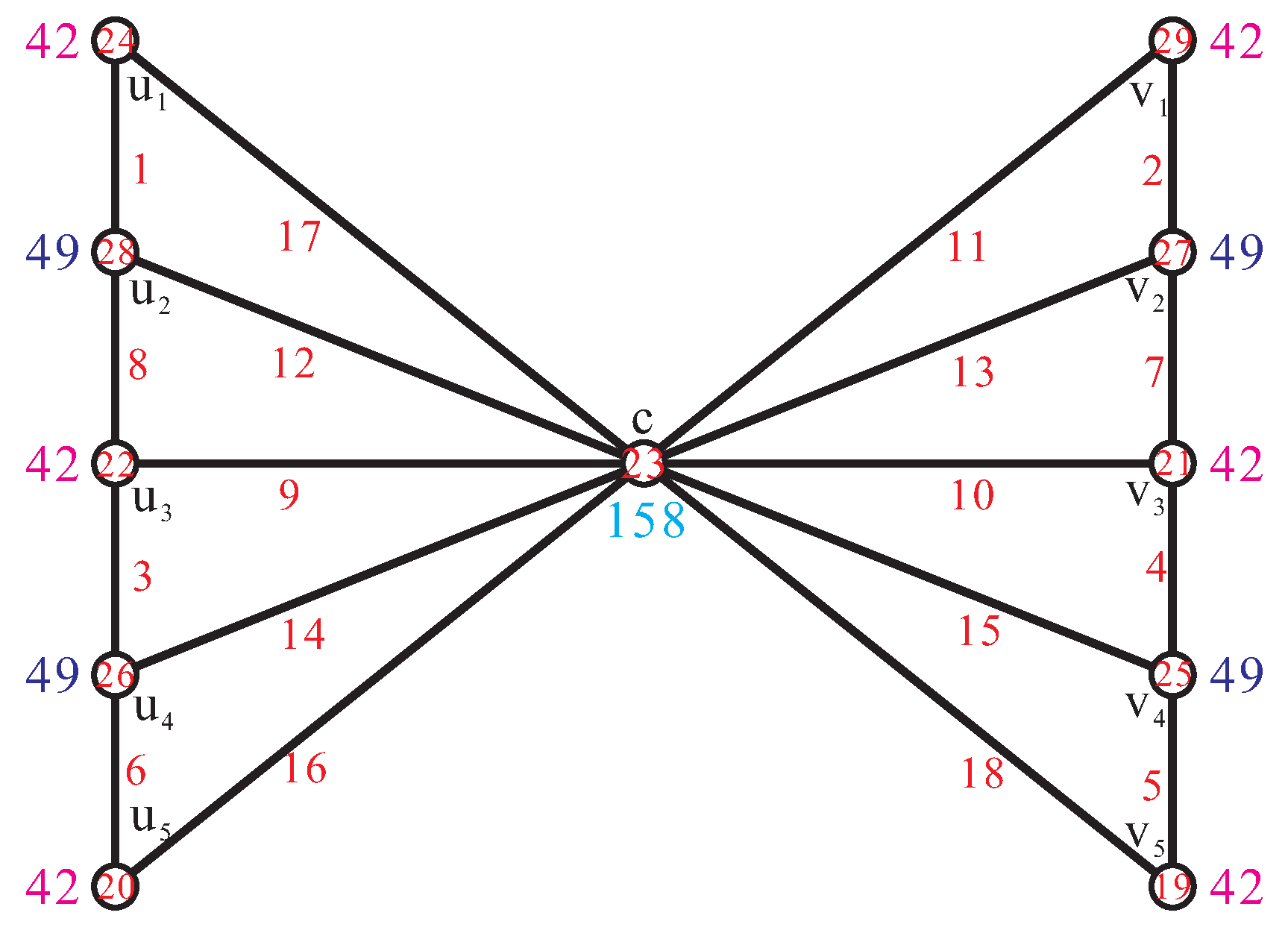
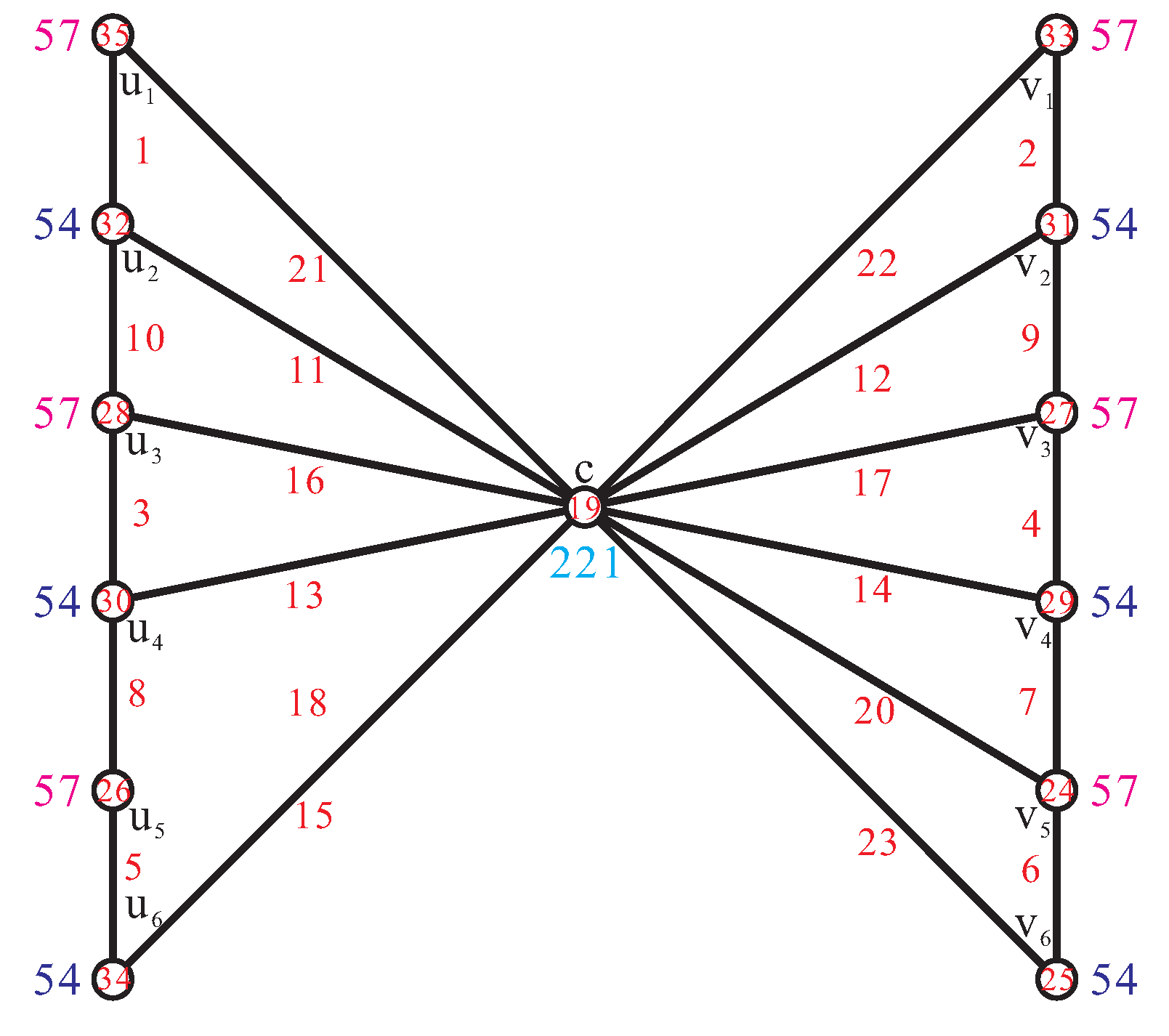
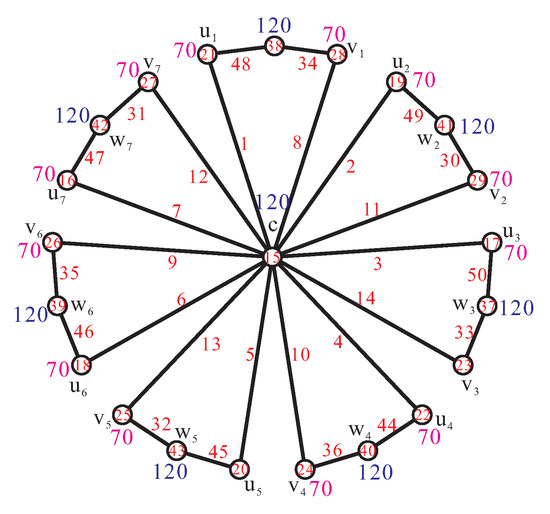
All figures in this paper, the red front represents the local antimagic total labeling of edges and vertices of graph; other colors represent the sum of weights of vertex and the edges incident with the vertex in the local antimagic total labeling of graphs. Different colors are selected to clearly see the number of different colors of vertices in the figure.
Example 1.
Figure 2.
The local antimagic total labeling of .
Figure 3.
The local antimagic total labeling of .
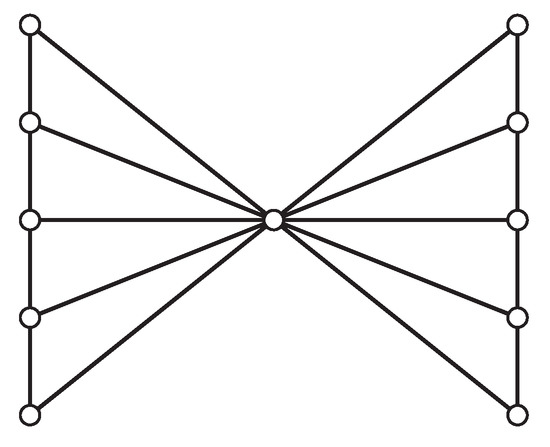
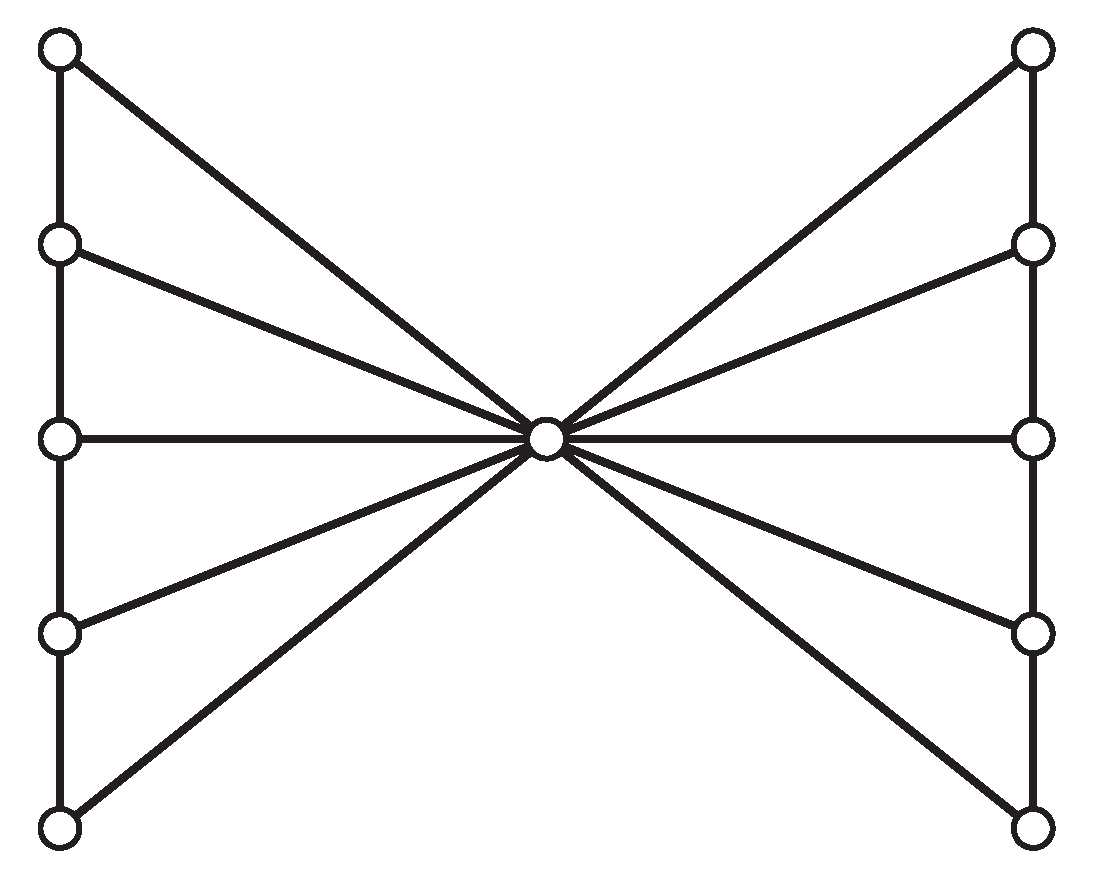
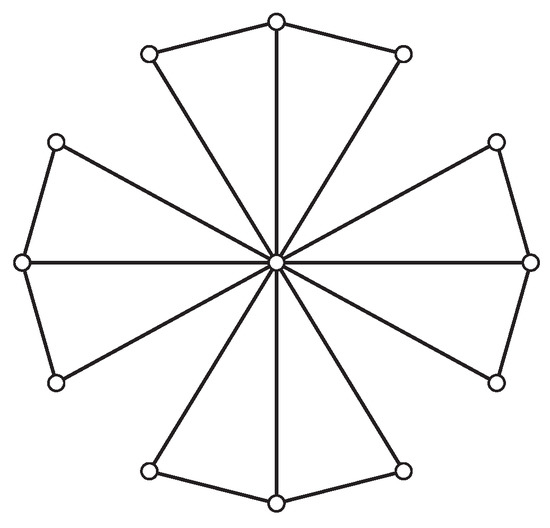
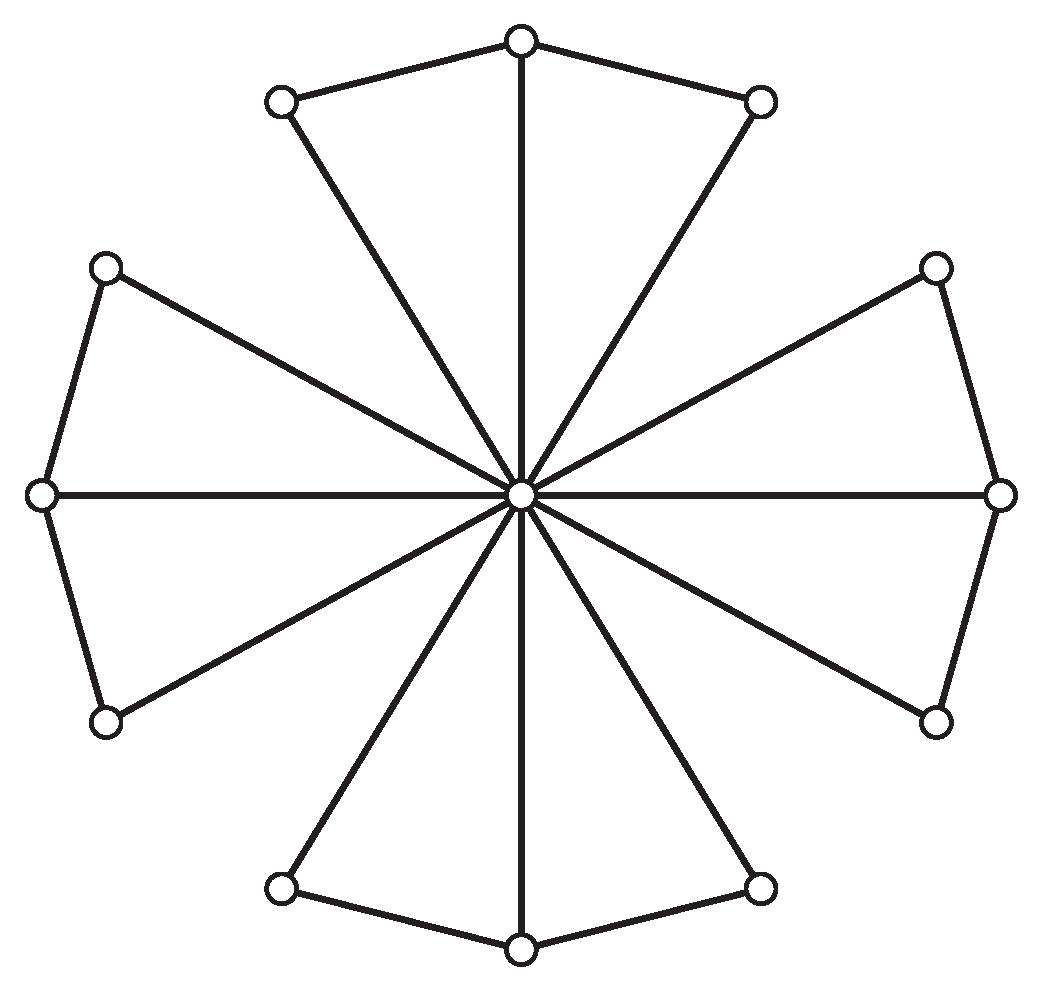
The bowknot graph, denoted by , is the graph by gluing two central vertices of double fan graphs . Obviously, the bowknot graph is obtained from the wheel by deleting two edges every edges on the rim of the wheel, and shown in Figure 4. It has vertices and edges.
Figure 4.
The bowknot graph .
Theorem 2.
For the bowknot graph , we have .
Proof.
Let be the vertex set of graph , and let be the edge set of . Since is an induced subgraph of , we have . Define and consider the following two cases.
Case 1. If n is odd.
Firstly, label the edges of as follows:
Secondly, label the vertices of by the following way:
Accordingly, we have
It is clear that f is a local antimagic total labeling of using three distinct colors and for odd n.
Case 2. If n is even.
Label the edges of as follows:
Then, give the exact values of the vertices of :
From above labelings under f, we obtain
Clearly, f is a local antimagic total labeling of using three distinct colors and . Hence, we obtain for , and the proof is completed. □
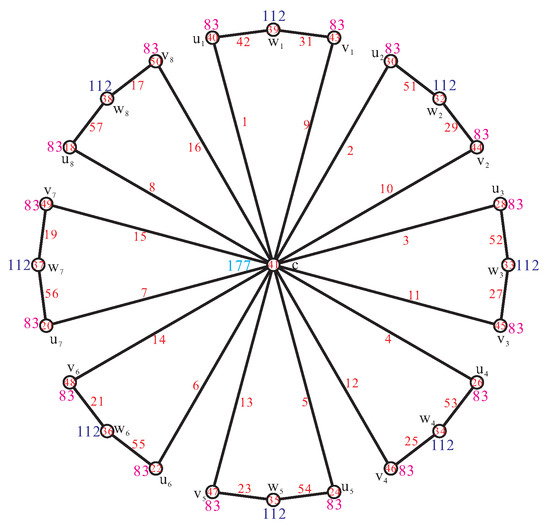
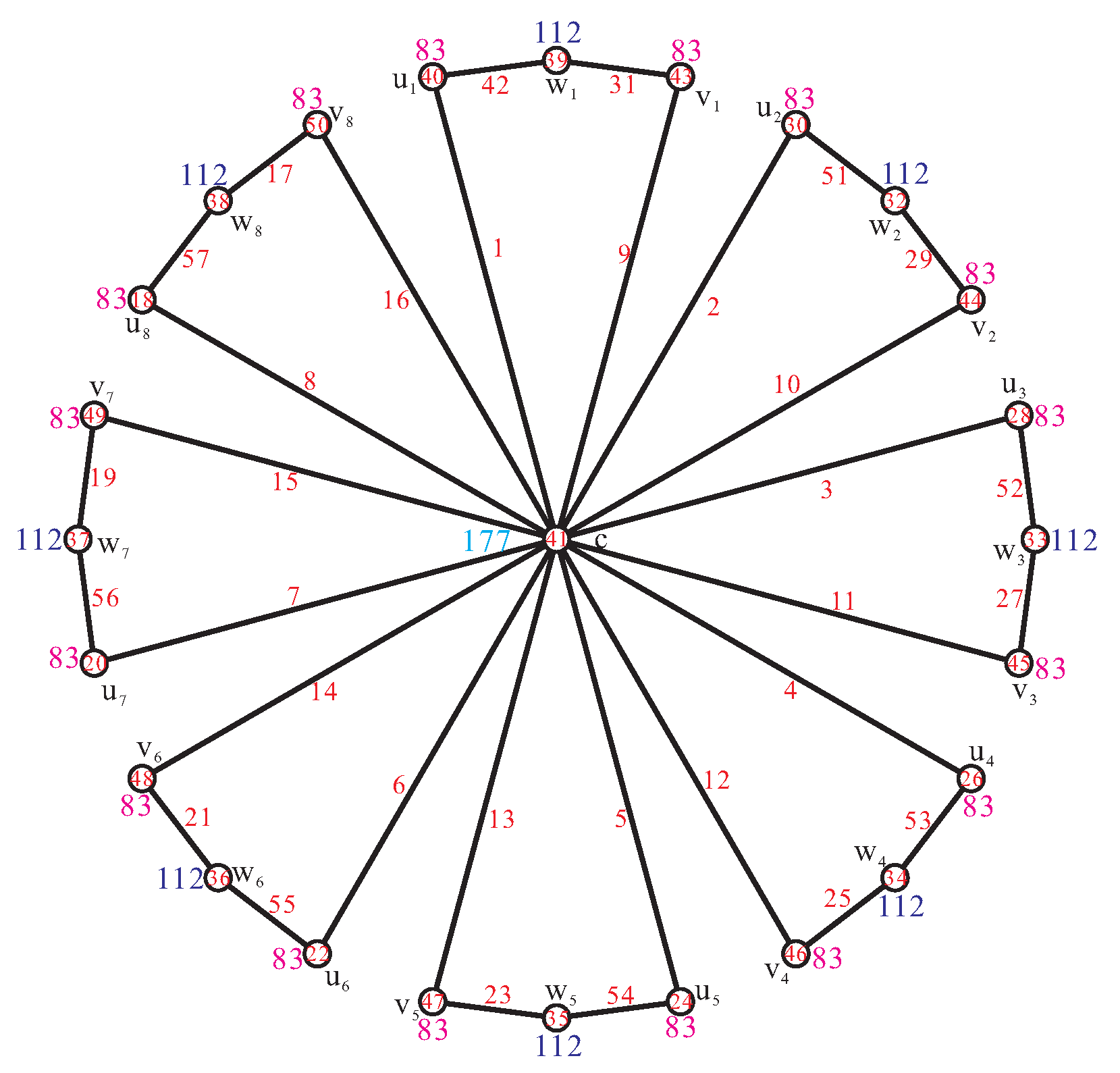
Example 2.
Let and . We have the local antimagic total labelings of the bowknot graph and in Figure 5 and Figure 6.
Figure 5.
The local antimagic total labeling of .
Figure 6.
The local antimagic total labeling of .
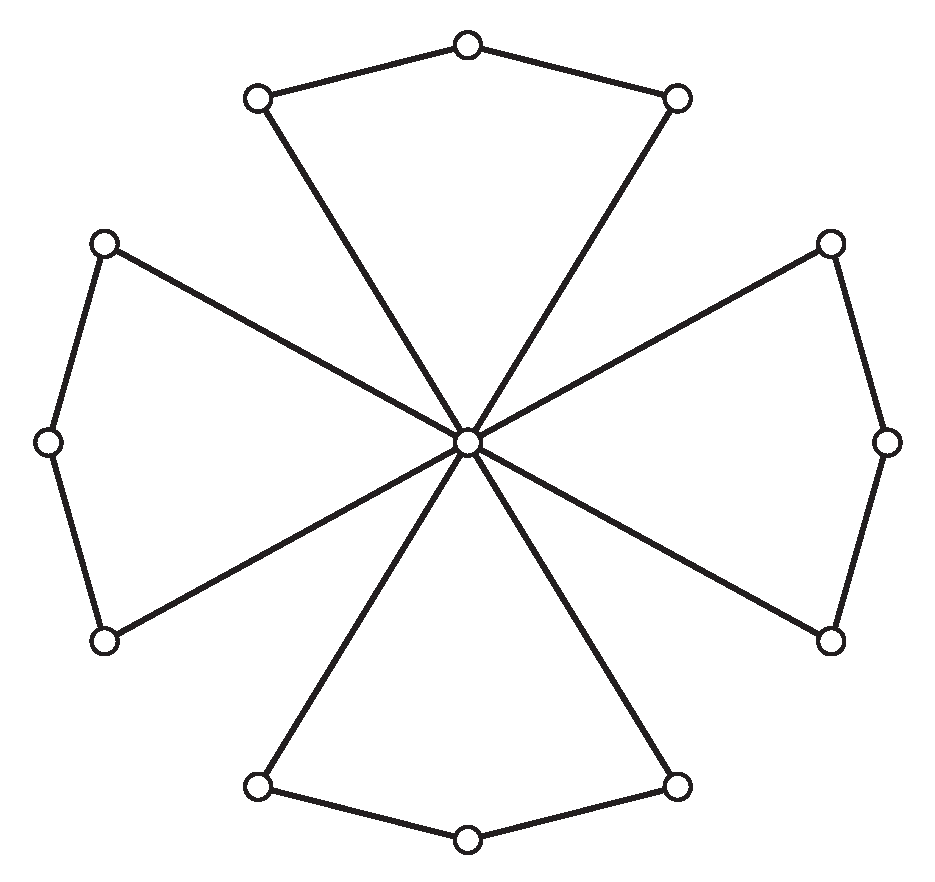
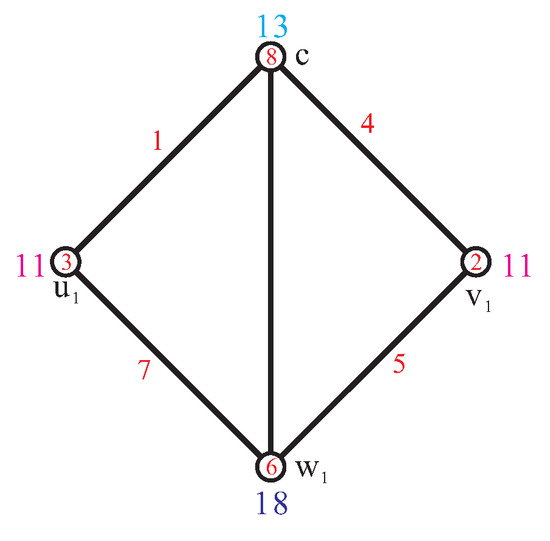
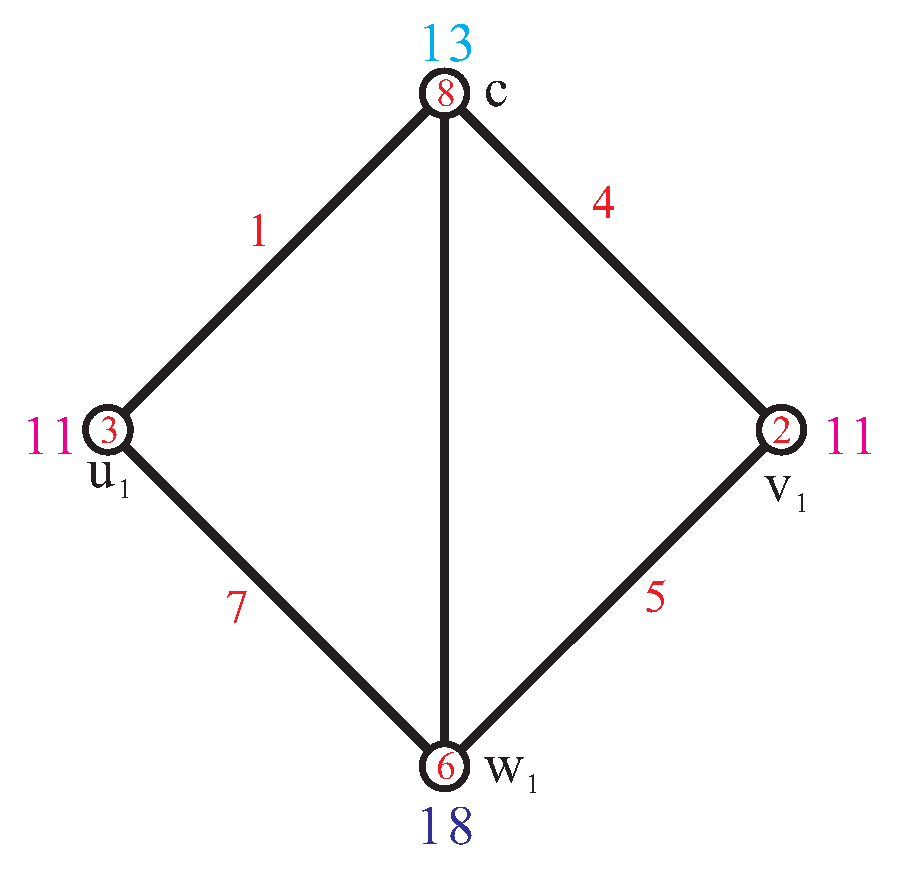
The Dutch windmill graph, denoted by , is a graph of order and size by gluing a common vertex of n cycles . A example of the Dutch windmill graph is shown in Figure 7. Note that the Dutch windmill graph is obtained from the wheel by deleting one edge continuously every 2 edges on the rim of the wheel , and then delete the middle spoke edge of each vane in the resulting graph. Let and be the vertex and edge sets of graph , respectively.
Figure 7.
The Dutch graph .
Theorem 3.
For the Dutch windmill graph , we have
Proof.
Obviously, the lower bound of the local antiamgic total chromatic number for graph is two since . Then we consider the upper bound of .
Define . Let be the sum of the weights of the vertex c and the edges incident with the vertex c and let be the sum of the weights of the vertices for . If we use the minimum weights, label the vertex c and the edges incident with the vertex c, then , and if we use the maximum weights, label the edges and the vertices for , then . Suppose that there is a local antiamgic total labeling using two distinct colors labeling the graph ; thus, the color of the vertex c is same as the vertices for . It means and so . When , there possibly is obtained a local antimagic total labeling f using two distinct colors such that the vertex c and the vertices have the same color for . However, when , there must exist three different colors. Consider two cases as follows:
Case 1. For .
According to the parity of n, there are two subcases to confirm the exact values of the local antimagic total labeling.
Subcase 1. If n is odd.
Label the edges and vertices of the graph by the following way:
Then
From the above vertex weights, we have
Therefore, f is a local antimagic total labeling of the graph using three distinct colors and so for odd n.
Subcase 2. If n is even.
Label the edges and vertices of the graph by the following way:
Then
For the vertex weights under the labeling f, we have
The above arguments indicate that f is a local antimagic total labeling of with three colors, and so for even n.
Case 2. For .
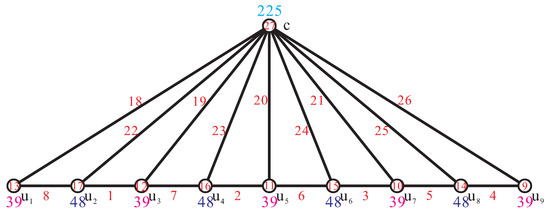
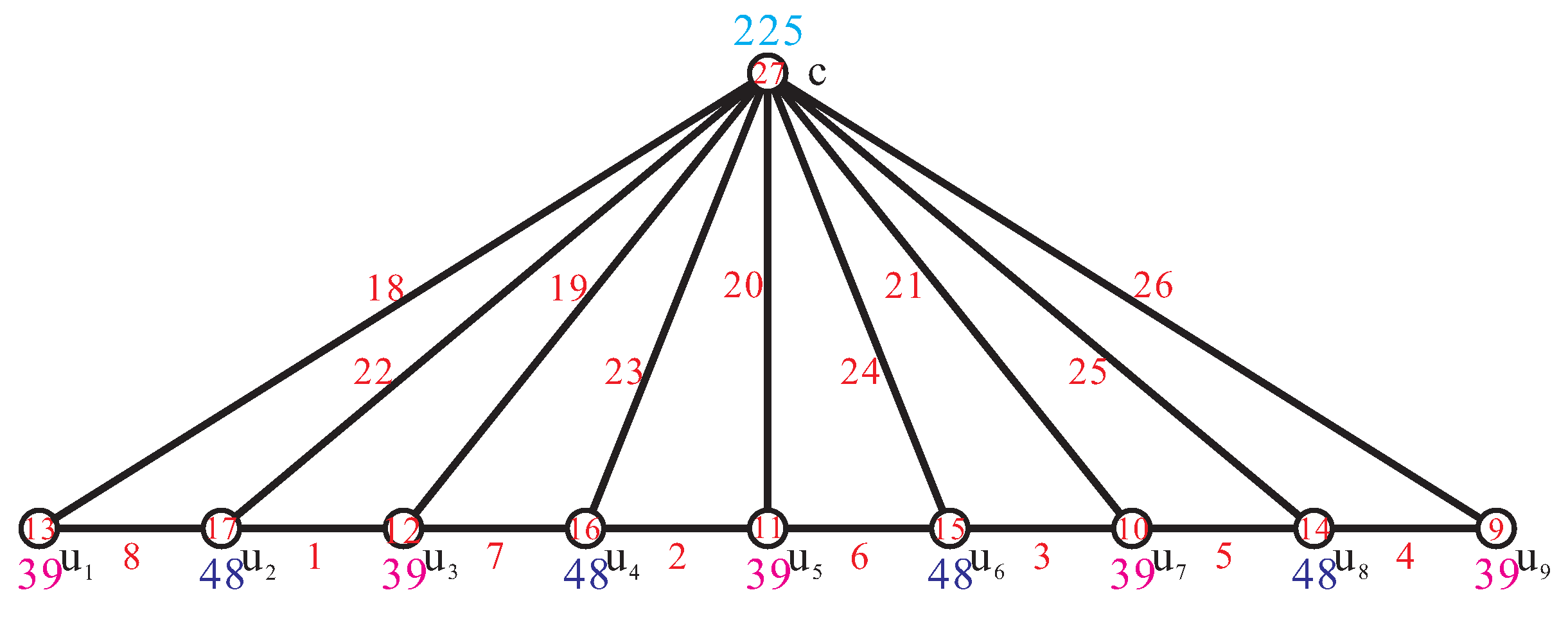
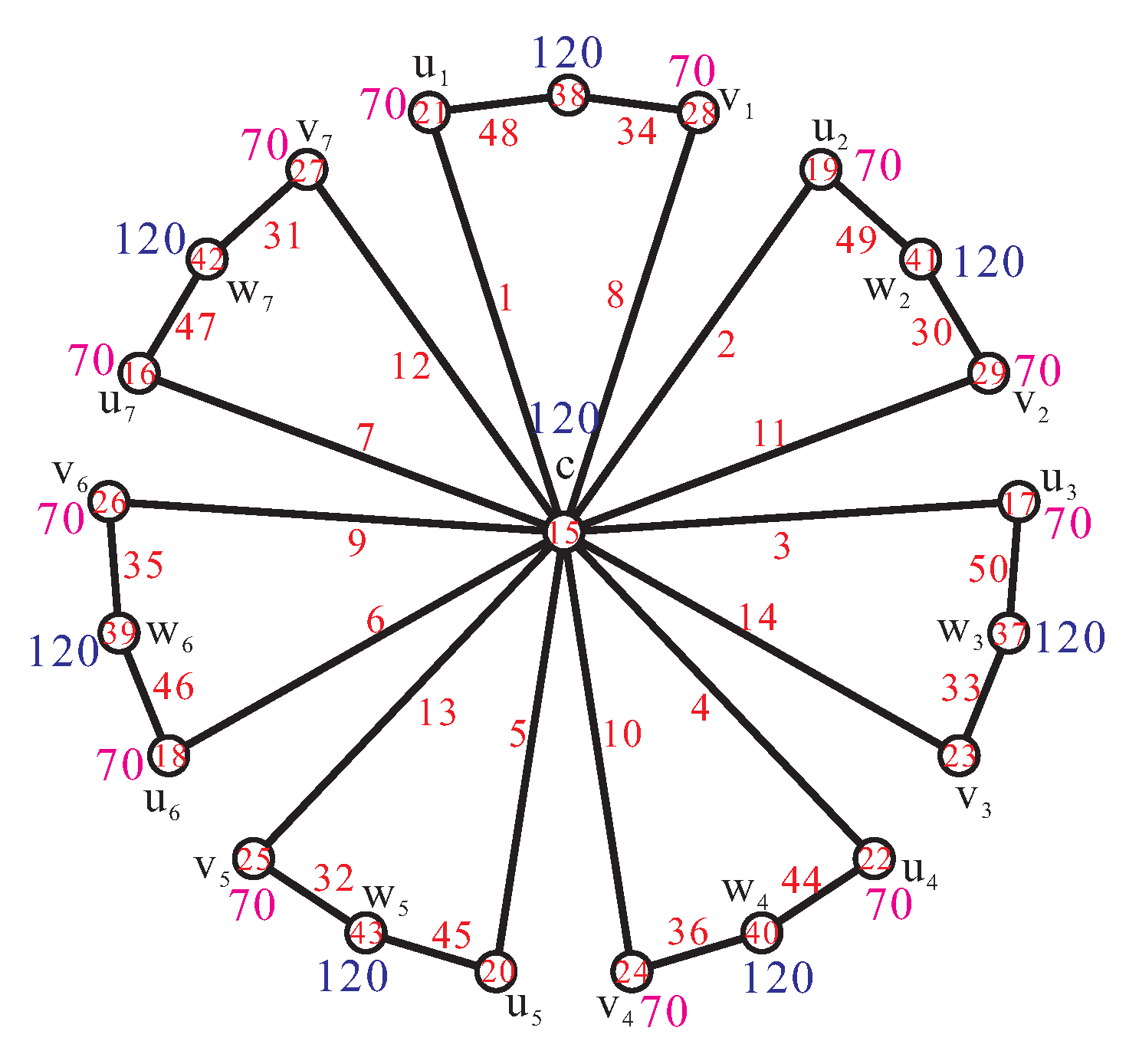
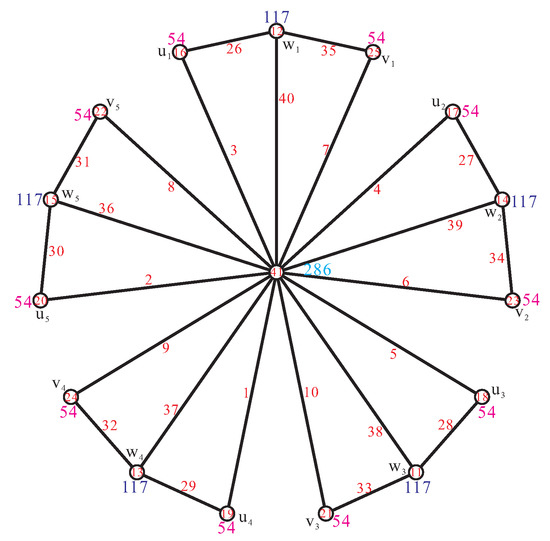
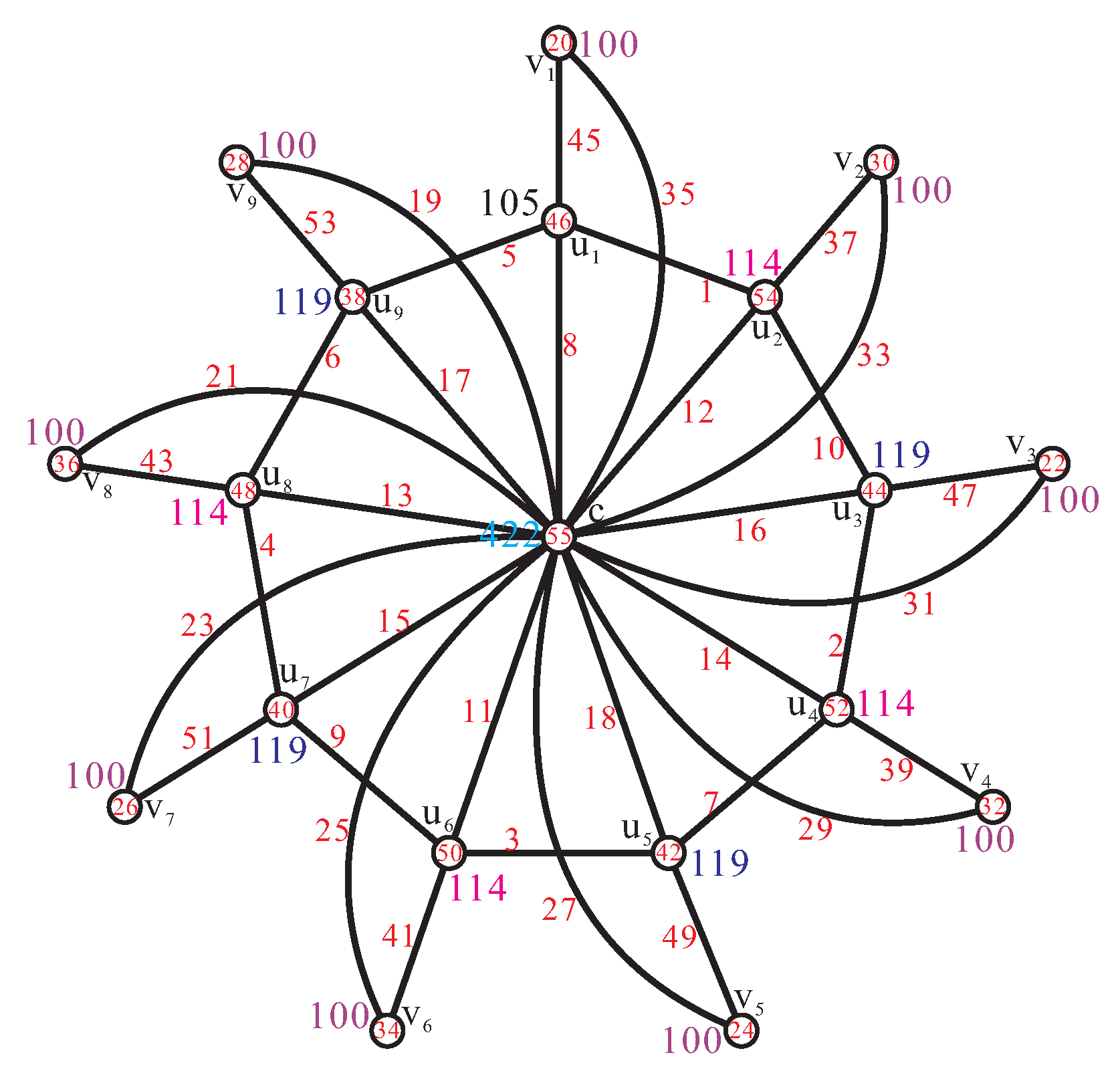
Present the detailed local antimagic total labeling for each n when . The following figure is shown the local antimagic total labeling for in Figure 8.
Figure 8.
The local antimagic total labeling of .
The exact value of each edge and vertex of the local antimagic total labelings for are given in Table 1, Table 2, Table 3, Table 4 and Table 5.
Table 1.
.
Table 2.
.
Table 3.
.
Table 4.
.
Table 5.
.
When , we obtain that and for . Similarly, when , we obtain that and for . When , we obtain that and for . Therefore .
When , and for . Similarly, when , and for . Therefore .
In conclusion, the local antimagic total chromatic number of the graph is for , and for , respectively. The proof is done. □
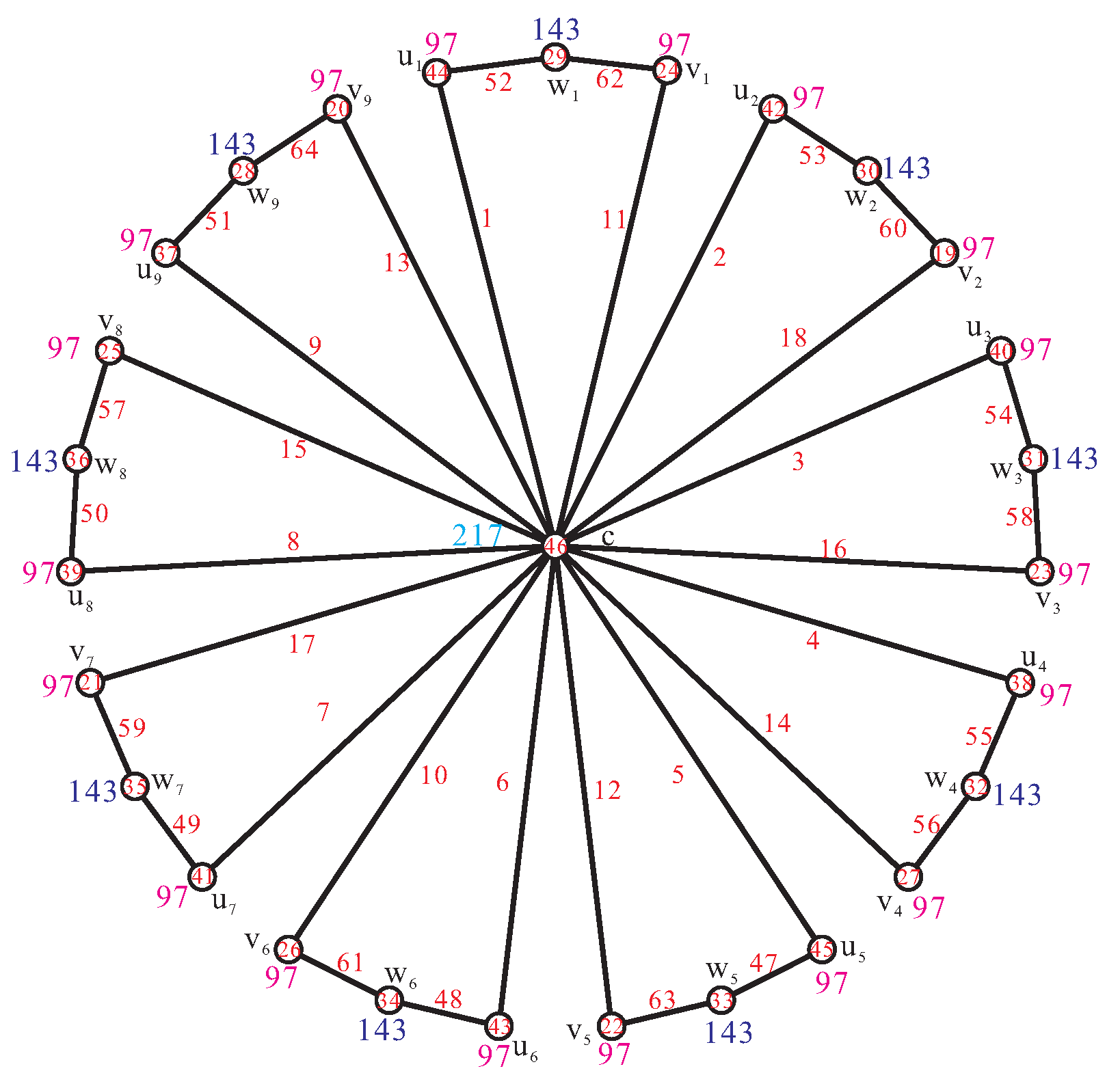
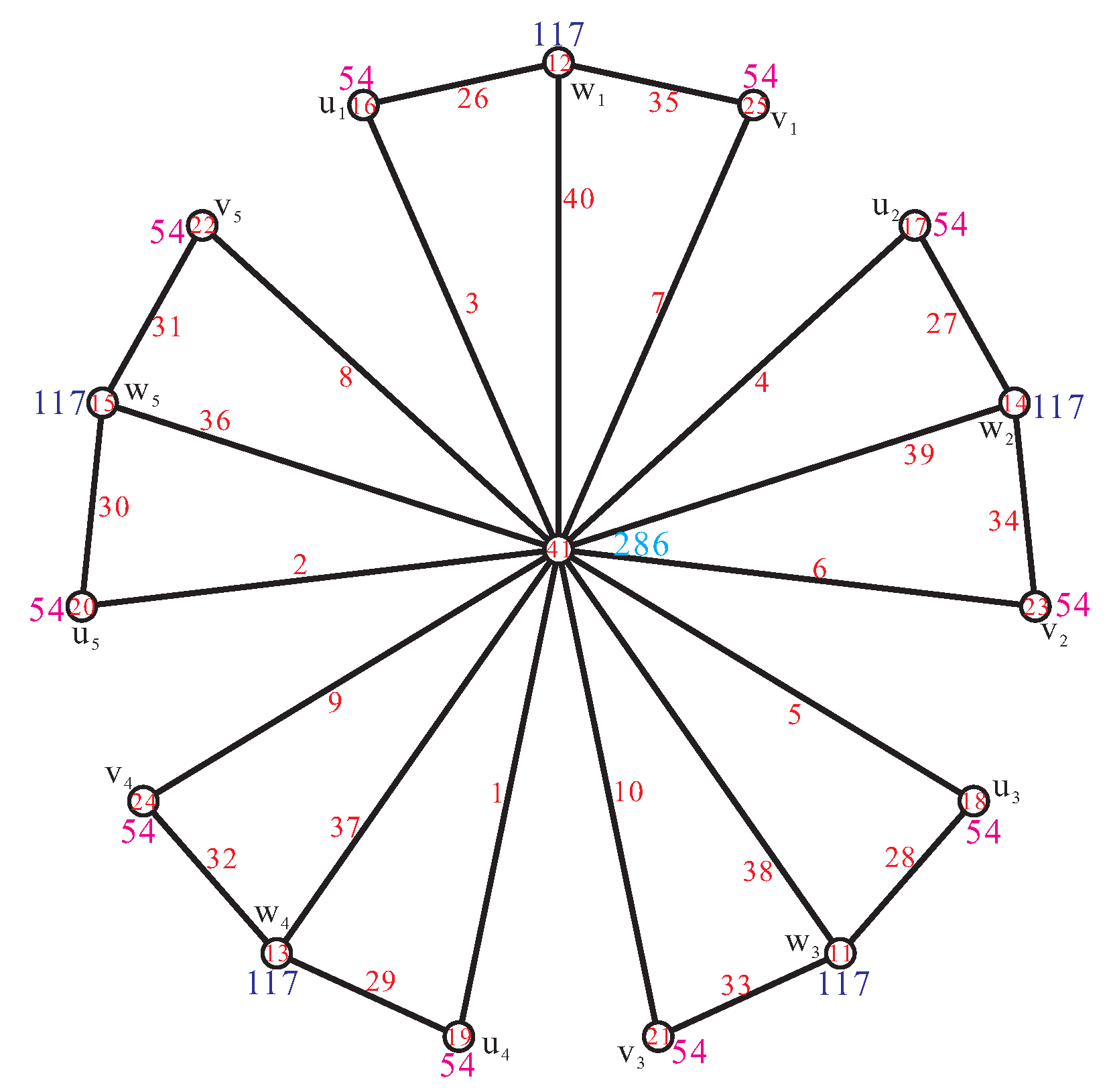
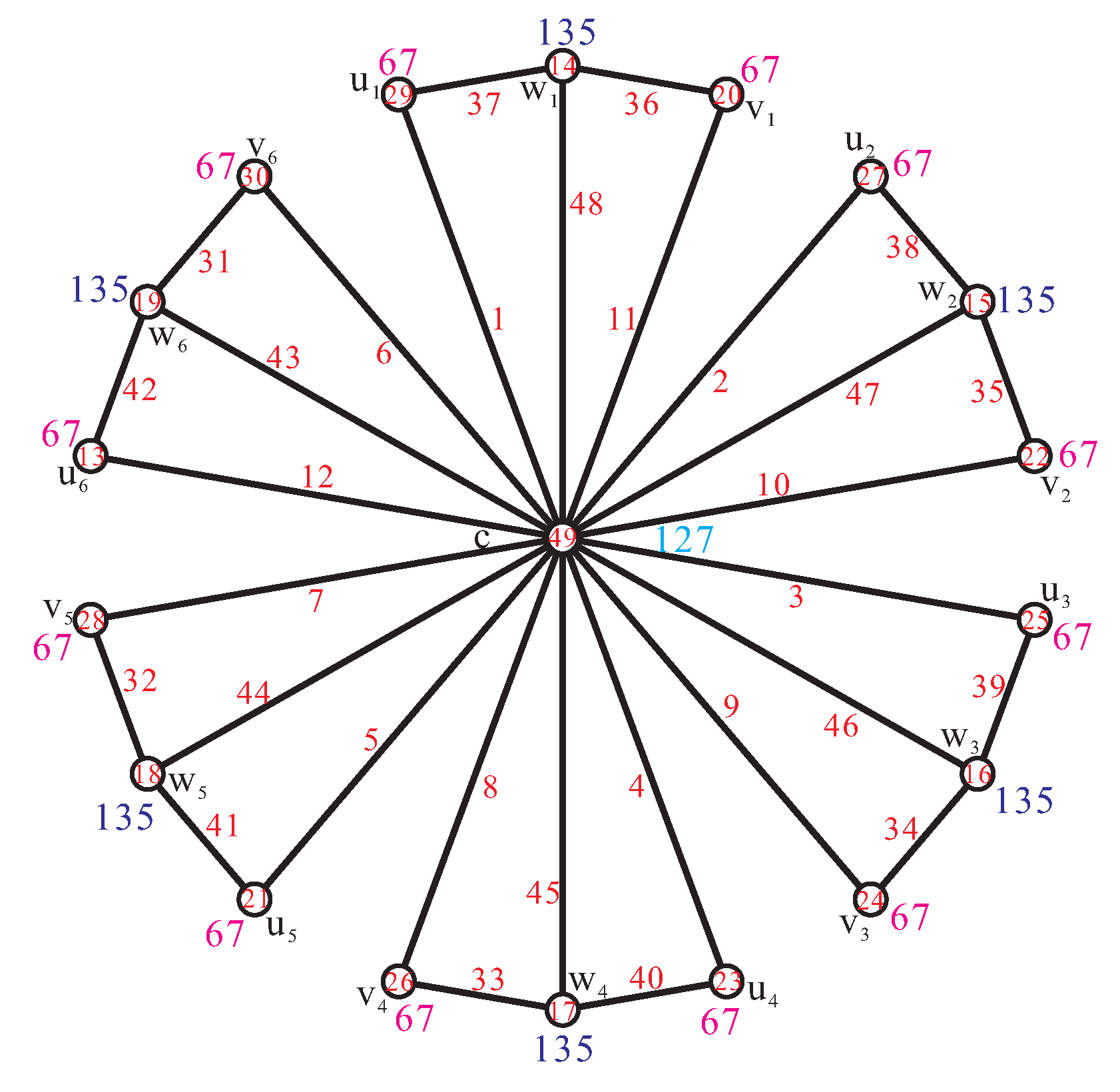
Example 3.
Figure 9.
The local antimagic total labeling of .
Figure 10.
The local antimagic total labeling of .
The analogous Dutch windmill graph, denoted by , is obtained from the Dutch windmill graph by adding edges for each . The graph has vertices and edges. It can be seen that the analogous Dutch windmill graph can be viewed as from the wheel by deleting one edge continuously every 2 edges on the rim of the wheel. The analogous Dutch windmill graph is shown in Figure 11.
Figure 11.
The analogous Dutch windmill graph .
Theorem 4.
For the analogous Dutch windmill graph, , we have .
Proof.
The lower bound of the local antimagic total chromatic number of graph is 3 since is an induced subgraph of graph and . Define . We discuss two cases for the exact value of each vertex and edge as follows.
Case 1. If n is odd.
For , the local antimagic total labeling of the graph is shown in Figure 12.
Figure 12.
The local antimagic total labeling of .
Label the edges of by the following way:
Then label the vertices of as follows:
For the vertex weights under the labeling f, we have
The above arguments indicate that f is a local antimagic labeling of with three colors, and so for odd n.
Case 2. If n is even.
We give the following exact values of edges of :
Then label the vertices as follows:
We obtain that,
It is clear that f is a local antimagic total labeling of using three colors and so for even n. The proof is complete. □
Example 4.
Figure 13.
The local antimagic total labeling of .
Figure 14.
The local antimagic total labeling of .
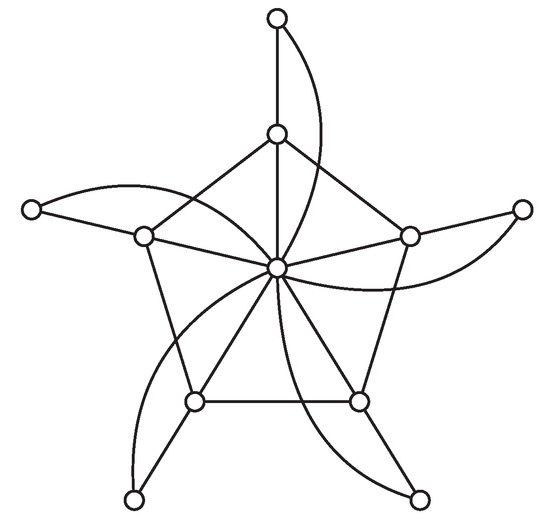
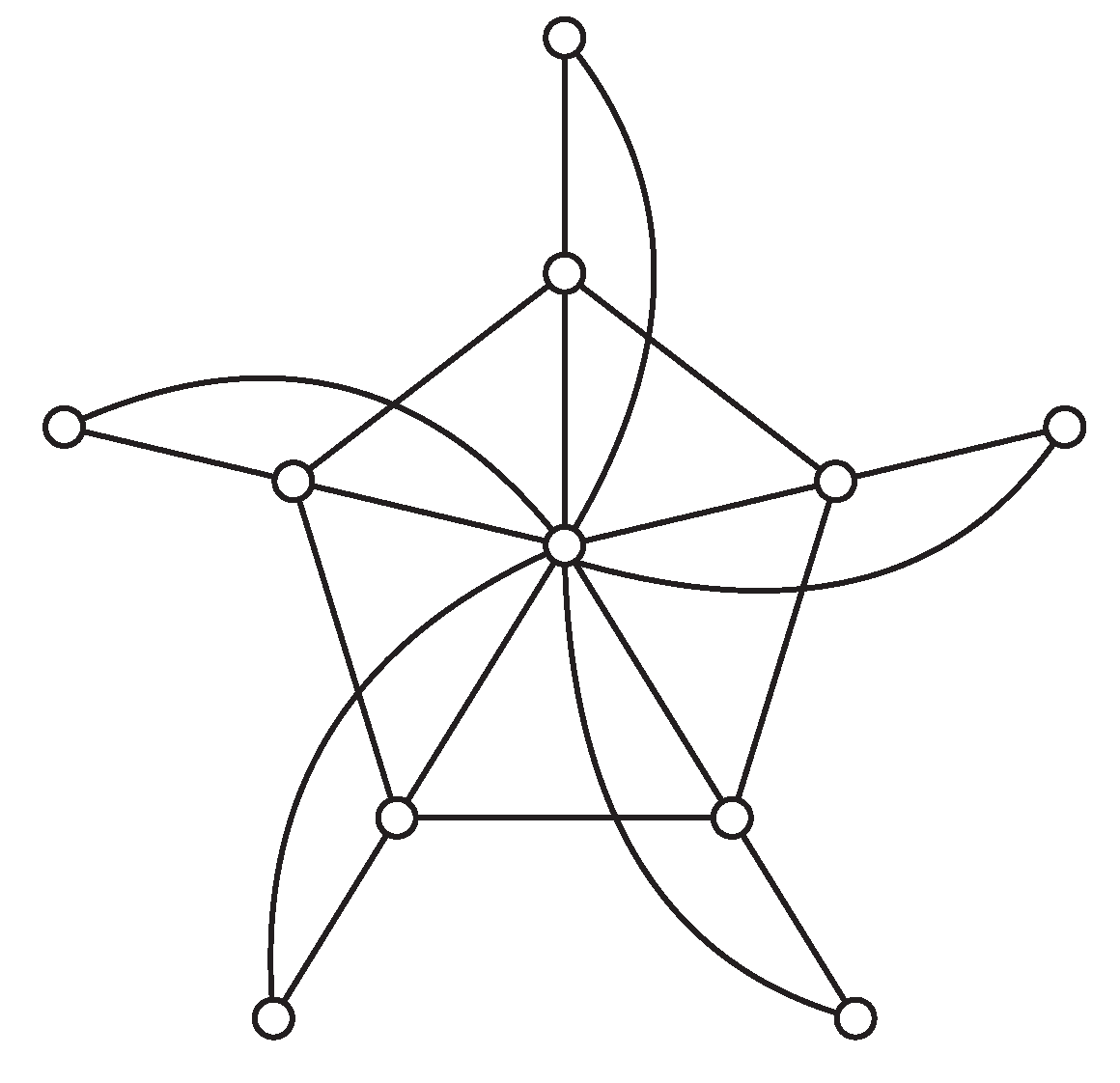
The flower graph of order is a graph obtained by adjoining firstly a pendant edge to each vertex on the rim of the wheel graph , then joining every pendant vertex to the central vertex of by an edge. The flower graph is shown in Figure 15. Then we respectively obtain the lower and upper bounds of the local antimagic vertex total chromatic number of the flower graph .
Figure 15.
The flower graph .
Theorem 5.
For the flower graph , we have
Proof.
for odd n and for even n since is the induced subgraph of graph . Then give the upper bound of the local antimigic total chromatic number of the flower graph.
The flower graph has vertices and edges. The vertex set of is and the edge set of is , where the edge is the edge . Let f be the local antimagic labeling of the graph defined in Lemma 1 such that the vertices are assigned four distinct colors for odd n and three colors for even n.
Define a bijection . Firstly, label the edges of the subgraph of the such that , where . Secondly, label the remaining edges and vertices of using since the wheel has edges. Let us discuss two cases for n.
Case 1. If n is odd.
By Lemma 1, for , the vertex weights of graph are, respectively, , for odd i and , for even i and . For , the vertex weights of graph are, respectively, , for odd i and , for even i and . Then
Conclude the vertex weights under labeling g for each vertex of the graph as follows:
For ,
For ,
It is clear that g is a local antimagic total labeling of the graph using five colors, and so .
Case 2. If n is even.
By Lemma 1, for , the vertex weights of graph are, respectively, for odd i and for even i and . For , the vertex weights of graph are, respectively, for odd i and , for even i and . Then
Accordingly, we obtain the vertex weights under labeling g for each vertex of the graph .
For ,
For ,
Therefore g is a local antimagic total labeling of graph with four colors and . The proof is done. □
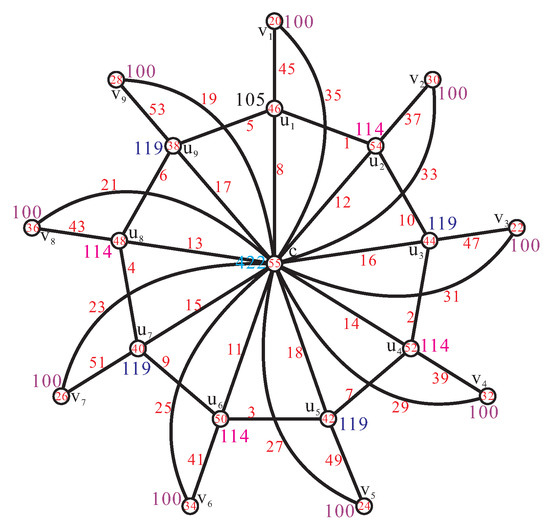
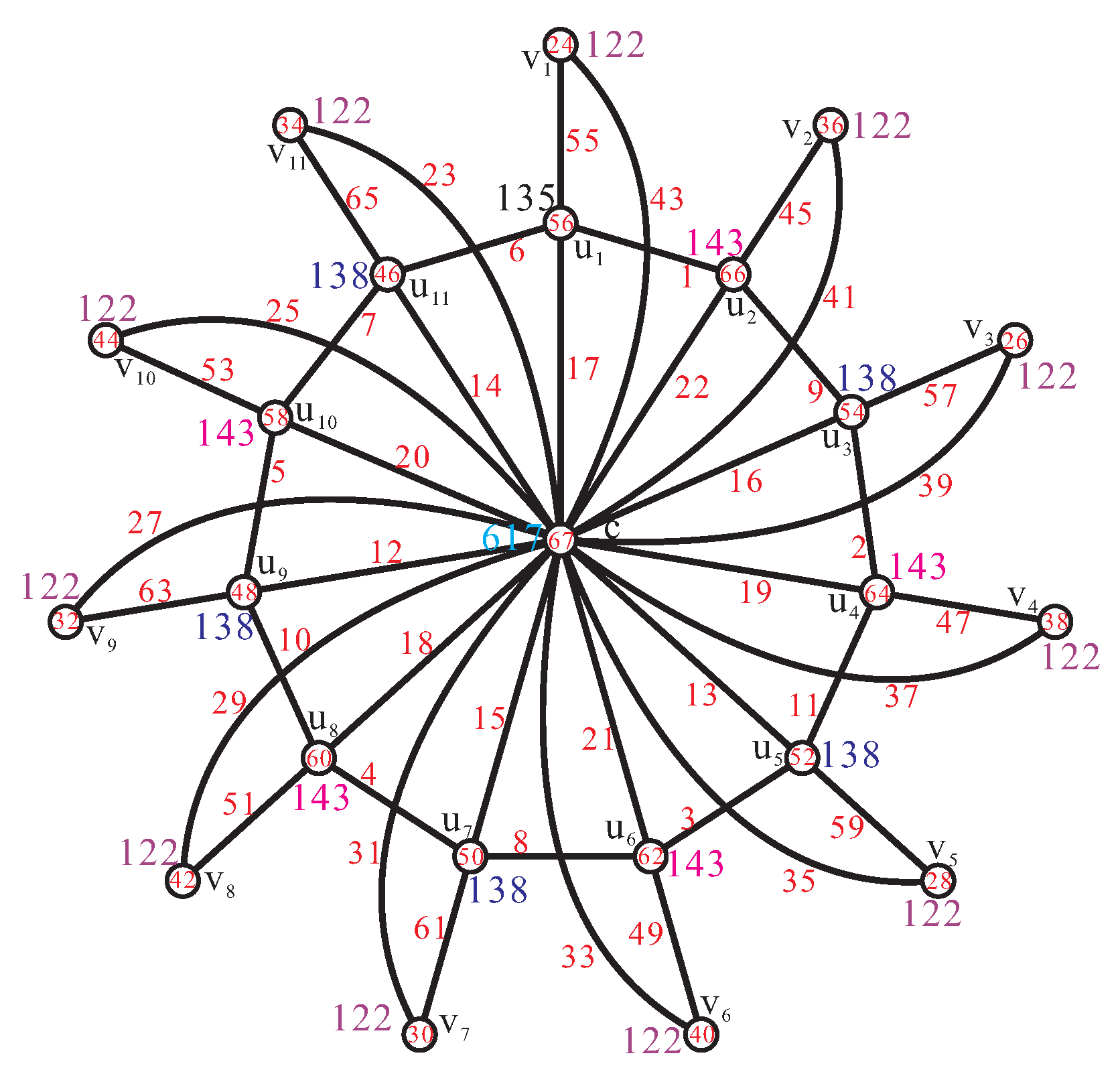
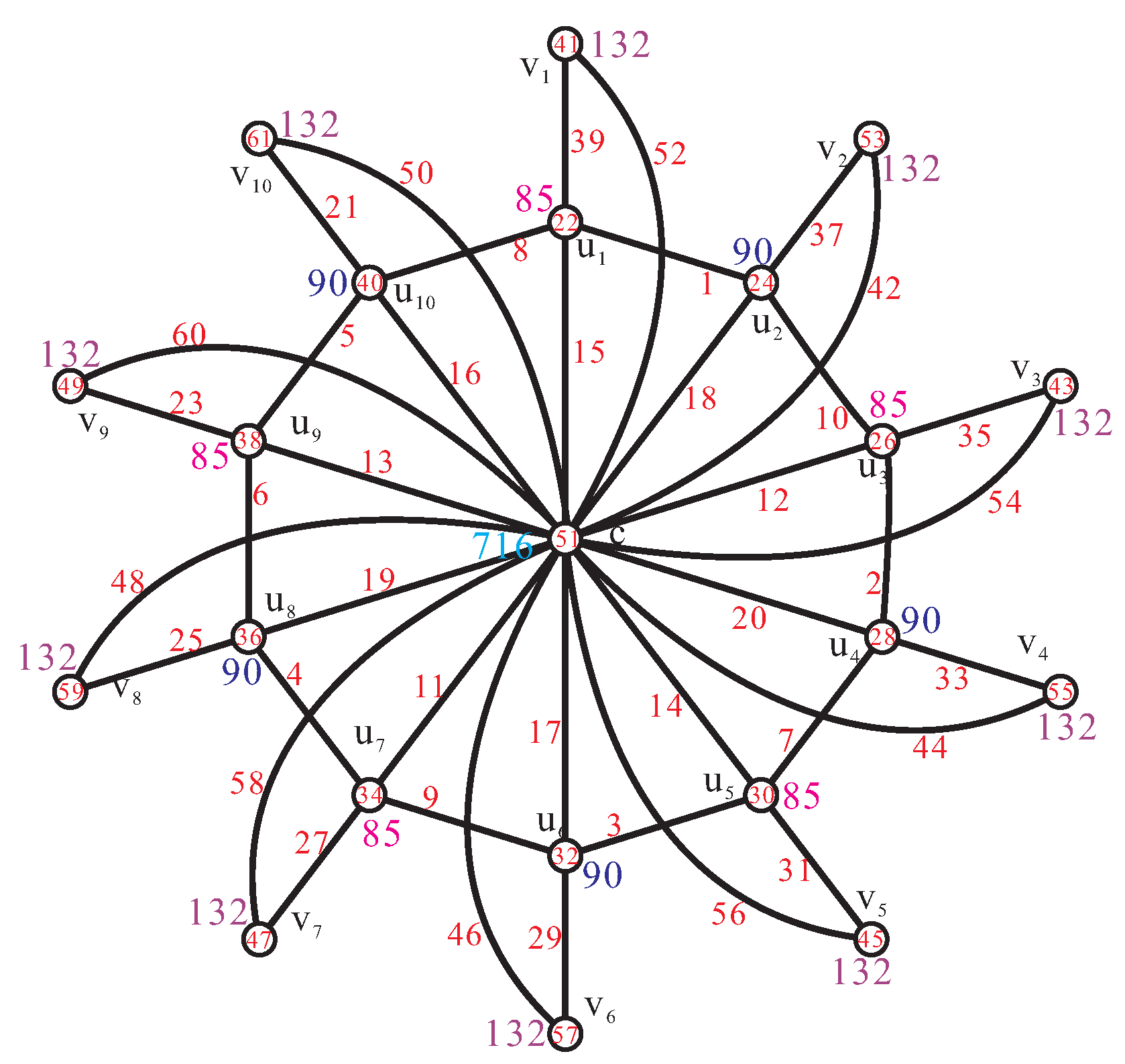
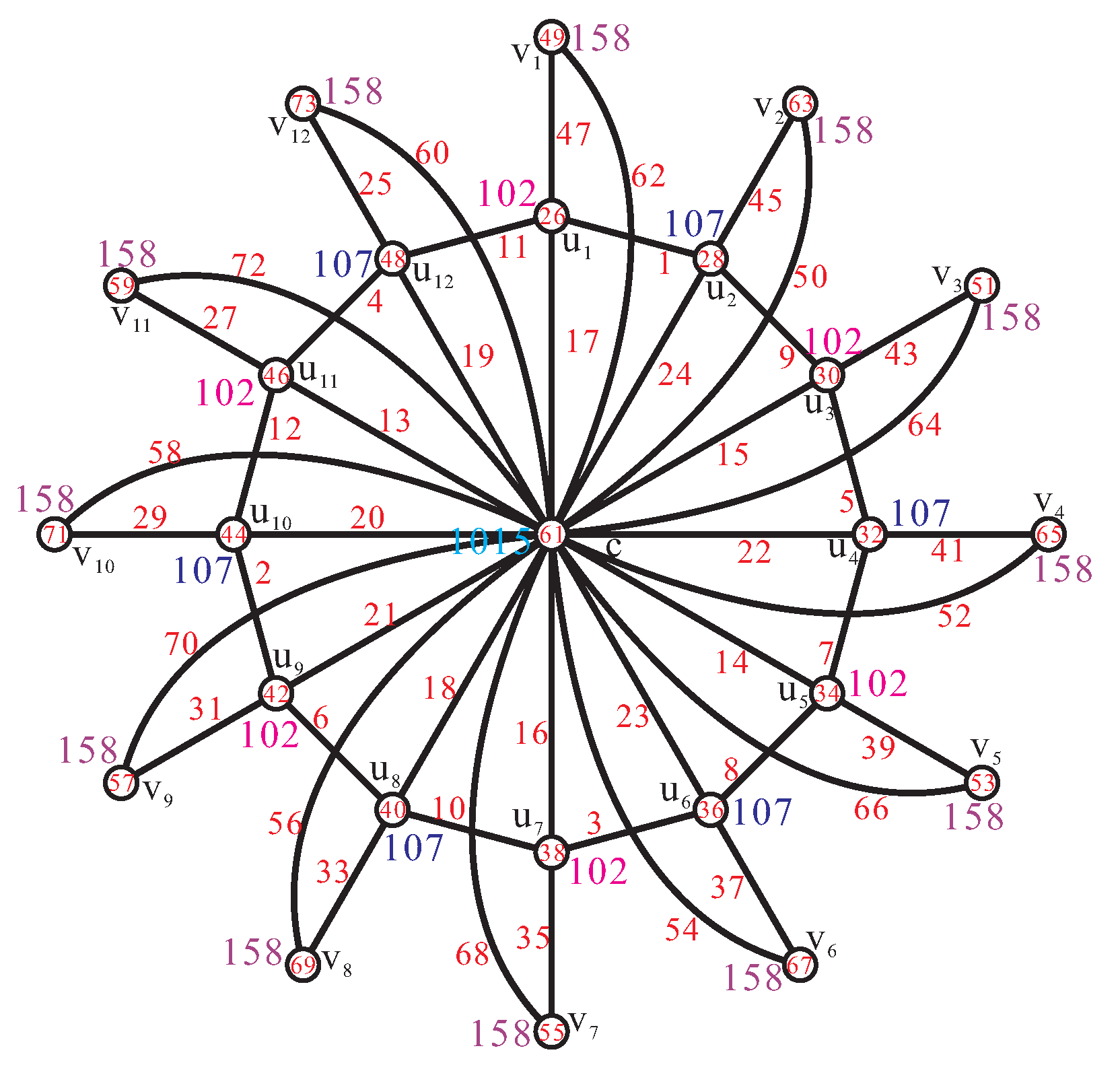
Example 5.
Figure 16.
The local antimagic total labeling of .
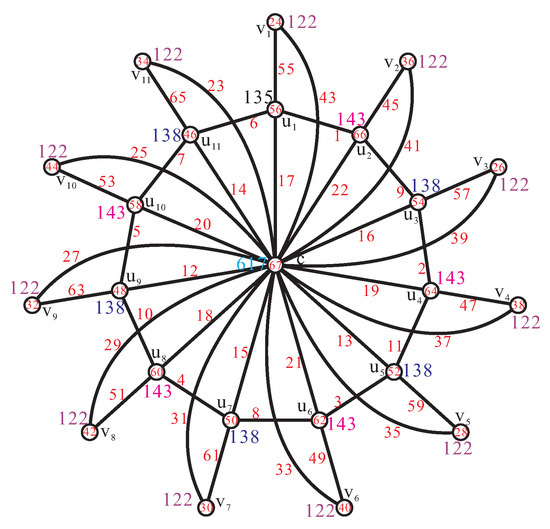
Figure 17.
The local antimagic total labeling of .
3. Conclusions
Note that the difference of the local antimagic chromatic coloring and the local antimagic total chromatic coloring is that the former is assigning weighted values for the edge set of graph G, which induces a proper vertex coloring of G; the latter is assigning the vertex and edge set of graph G simultaneously, which also induces a proper vertex coloring of G.
For a graph G with independent vertices, the determination of the local antimagic chromatic number is easier than that of the local antimagic total chromatic number. In fact, the weighted values of independent edges in the local antimagic coloring of G must be different, but may be the same in the local antimagic total chromatic coloring of G. In this paper, we consider the local antimagic total chromatic colorings of wheel-related graphs which have no independent edges, and present the local antimagic total chromatic numbers of the fan graph , the bowknot graph , the Dutch windmill graph , the analogous Dutch graph and the flower graph .
Author Contributions
Conceptualization, X.Y. and H.B.; methodology, X.Y.; software, H.Y.; validation, X.Y., H.B. and H.Y.; formal analysis, D.L.; investigation, X.Y.; resources, H.B.; data curation, H.Y.; writing—original draft preparation, X.Y.; writing—review and editing, H.B.; visualization, D.L.; supervision, H.B.; project administration, H.B.; funding acquisition, H.B. All authors have read and agreed to the published version of the manuscript.
Funding
Supported by NSFC (Grant No.11761070, 61662079). 2021 Xinjiang Uygur Autonomous Region National Natural Science Foundation Joint Research Fund (2021D01C078). 2020 Special Foundation for First-class Specialty of Applied Mathematics Xinjiang Normal University.
Data Availability Statement
Not applicable.
Acknowledgments
The authors are grateful to anonymous referees for the many valuable comments, suggestions and references that improved this article. This work was supported by NSFC grant nos. 11761070 and 61662079.
Conflicts of Interest
The authors declare that there is no conflict of interest regarding the publication of this paper.
References
- Arumugam, S.; Premalatha, K.; Bacǎ, M.; Semaničová-Feňovčíková, A. Local antimagic vertex coloring of a graph. Graphs Combin. 2017, 33, 275–285. [Google Scholar] [CrossRef] [Scilit]
- Bensmail, J.; Senhaji, M.; Lyngsie, K.S. On a combination of the 1-2-3 Conjecture and the Antimagic Labelling Conjecture. Discret. Math. Theor. Comput. Sci. 2017, 19, 21. [Google Scholar]
- Lau, G.C.; Shiu, W.C.; Ng, H.K. Affirmative solutions on local antimagic chromatic number. Graphs Comb. 2020, 5, 69–78. [Google Scholar] [CrossRef] [Scilit]
- Shaebani, S. On local antimagic chromatic number of graphs. Algebr. Syst. 2020, 7, 245–256. [Google Scholar]
- Lau, G.C.; Shiu, W.C.; Ng, H.K. On local antimagic chromatic number of cycle-related join graphs. Discuss. Math. Graph Theory 2021, 41, 133–152. [Google Scholar] [CrossRef] [Scilit]
- Nazula, N.H.; Slamin, S.; Dafik, D. Local antimagic vertex coloring of unicyclic graphs. Indones. J. Comb. 2018, 2, 30–34. [Google Scholar] [CrossRef] [Scilit]
- Premalatha, K.; Arumugam, S.; Lee, Y.C.; Wang, T.M. Local antimagic chromatic number of trees-I. J. Discret. Math. Sci. Cryptogr. 2020, 1–12. [Google Scholar] [CrossRef] [Scilit]
- Bača, M.; Semaničovvá-Feňovčíková, A.; Wang, T.M. Local Antimagic Chromatic Number for Copies of Graphs. Mathematics 2021, 9, 1230. [Google Scholar] [CrossRef] [Scilit]
- Haslegrave, J. Proof of a local antimagic conjecture. Discret. Math. Theor. Comput. Sci. 2018, 20, 18. [Google Scholar]
- Putri, D.F.; Dafik, D.; Agustin, I.H.; Alfarisi, R. On the local vertex antimagic total coloring of some families tree. J. Phys. Conf. Ser. 2018, 1008, 012035. [Google Scholar] [CrossRef] [Scilit]
- Kurniawati, E.Y.; Agustin, I.H.; Dafik; Marsidi. On the vertex local antimagic total labeling chromatic number of G ⊙ K2. J. Phys. Conf. Ser. 2019, 1211, 012018. [Google Scholar] [CrossRef] [Scilit]
- Kurniawati, E.K.; Agustin, I.H.; Dafik; Marsidi. The local antimagic total vertex coloring of graphs with homogeneous pendant vertex. J. Phys. Conf. Ser. 2019, 1306, 012047. [Google Scholar] [CrossRef] [Scilit]
- Slamin, D.; Hasan, M.A. Pewarnaan titik total anti-ajaib lokal pada keluarga graf roda. Pros. Konf. Nas. Mat. XIX 2018, in press. [Google Scholar]
- Amalia, R. Masruroh Local antimagic vertex total coloring on fan graph and graph result-ing from comb product operation. J. Phys. Conf. Ser. 2021, 1836, 012012. [Google Scholar] [CrossRef] [Scilit]







Publisher’s Note: MDPI stays neutral with regard to jurisdictional claims in published maps and institutional affiliations. |
© 2022 by the authors. Licensee MDPI, Basel, Switzerland. This article is an open access article distributed under the terms and conditions of the Creative Commons Attribution (CC BY) license (https://creativecommons.org/licenses/by/4.0/).