


Abstract
Audio magnetotelluric (AMT) sounding is an essential tool for mineral exploration and subsurface electrical structure imaging. However, persistent cultural noise can severely degrade AMT data quality, particularly in mining areas with strong anthropogenic interference. In this study, we introduce an improved K-Singular Value Decomposition (K-SVD) dictionary learning method for time-domain AMT data denoising, incorporating three key innovations: (1) automatic identification of noise-contaminated segments using local kurtosis; (2) adaptive dictionary initialization combining principal component analysis with Gaussian perturbation, which accelerates convergence and avoids local minima; and (3) online atom screening and updating to maintain the noise specificity of the learned atoms. The proposed method learns noise morphology directly from raw AMT data without requiring reference stations or external training datasets. Synthetic experiments demonstrate that the method more effectively suppresses square-wave and charge-discharge noise compared with wavelet thresholding methods and conventional K-SVD, while better preserving signal morphology. Field applications further show that it significantly enhances the quality of observed data and apparent resistivity-phase curves compared with the widely used robust estimation method. The proposed method provides an efficient, reference-free solution for AMT data denoising in mining areas with strong cultural noise.
1. Introduction
Magnetotellurics (MT) and audio magnetotellurics (AMT) are important geophysical exploration techniques widely used for mineral resource exploration and deep electrical structure studies [1,2]. Nevertheless, MT and AMT data are inherently weak and nonstationary [3], making them highly susceptible to cultural noise interference. To ensure AMT data quality, field sites are typically located far from interference sources, which restricts the flexibility of AMT surveys. Compared with MT, AMT employs higher sampling frequencies and is more sensitive to high-frequency noise, making it particularly vulnerable to environmental noise interference [4]. In mineral exploration districts, AMT surveys are frequently conducted near mining facilities, industrial infrastructure, transportation networks, and power transmission systems. These environments often generate persistent cultural noise that severely contaminates AMT observations and reduces the reliability of geoelectrical interpretation.
To improve the quality of field MT/AMT data, various methods have been proposed for suppressing or isolating noise. The most widely used techniques are the remote reference method [5,6,7] and robust estimation methods [8,9,10], which have become standard approaches for MT/AMT data processing [3]. However, the remote reference method heavily depends on the quality of the reference stations, while robust estimation methods generally require a predominance of high-quality data; these prerequisites are often difficult to satisfy in practical field exploration. Furthermore, denoising techniques based on data segment selection or signal decomposition, such as the frequency-domain selection scheme [11] and the Hilbert-Huang transform [12], are effective in certain cases but still exhibit significant limitations in complex environments characterized by persistent, strong interference.
Time-domain signal-to-noise separation provides a direct strategy for denoising. In this framework, the observed time series is treated as a linear superposition of high-quality signals and strong interference, which typically exhibit distinct morphological and amplitude characteristics [13]. For strong interference noise, applying signal decomposition techniques to extract and remove the noise component is an effective strategy [14]. Commonly used signal separation techniques include wavelet transform [15], morphological filtering [16], and empirical mode decomposition [17]. More recently, an adaptive decomposition method with low parameter sensitivity has been developed for nonstationary noise suppression in MT data [18]. Despite their respective advantages, these approaches often remain insufficient in complex environments with strong cultural noise, partly because fixed basis functions or empirical thresholds adapt poorly to varying noise morphologies.
With the rapid advancement of artificial intelligence, machine learning techniques have increasingly been applied to the signal-noise separation of AMT data, showing substantial potential in geophysical data processing [19,20]. For instance, deep learning models such as convolutional neural networks (CNNs) and long short-term memory (LSTM) networks have been used to classify observational data, effectively distinguishing useful signals from noise while preserving the intrinsic characteristics of the observed MT data [21]. Recurrent neural networks (RNNs) combined with LSTM architectures have also been employed for MT noise suppression [22]. Recent strategies that combine initial identification with subsequent noise suppression have been proposed to minimize the loss of low-frequency components and high-quality signals [23]. Deep learning models, including multilevel wavelet CNNs [24], layer-wise progressive extraction networks [25], and RepVGG-DnCNN-based signal-noise recognition and separation networks [26], have been introduced to further improve MT/AMT denoising. These advancements in deep learning techniques have expanded the applicability of MT/AMT denoising, making deep learning a crucial and effective tool for MT/AMT data processing. However, such data-driven methods require large and representative training datasets, and their performance may degrade when the noise characteristics of the survey area differ from those in the training data.
Sparse representation theory offers an alternative approach by leveraging the distinct sparsity characteristics of signal and noise. This property allows for the design of dictionary atoms that are highly sensitive to noise but relatively insensitive to the true signal, thus facilitating effective noise extraction. K-SVD dictionary learning methods can automatically capture the intrinsic structures of both signals and noise, while preserving the integrity of the signal, thereby enabling high-fidelity noise separation [27]. In the context of AMT signal processing, denoising methods based on dictionary learning have demonstrated robust performance across diverse interference scenarios [28,29,30]. However, these K-SVD dictionary learning methods have mainly focused on sparse reconstruction or dictionary training itself, while noise segment selection, dictionary initialization, and atom maintenance during training have received little attention.
In AMT observational data, persistent cultural noise, such as power-frequency interference and discharge-like noise, is widespread. These noise sources often obscure weak geological responses associated with mineralized structures and deep ore-controlling features, presenting substantial challenges to conventional processing techniques [4]. When standard approaches, including remote reference, robust estimation, and manual data segment selection, prove insufficient, more adaptive and robust solutions are required.
To address these challenges, we propose an improved adaptive K-SVD dictionary learning method for AMT denoising. In contrast to previous K-SVD dictionary learning studies, the proposed method improves the full denoising workflow through three contributions: (1) automatic identification of noise-contaminated segments from raw AMT time series using local kurtosis; (2) principal component analysis (PCA)-based dictionary initialization with Gaussian perturbation to improve stability and accelerate convergence; and (3) online atom screening and updating to maintain the noise specificity of dictionary atoms. The proposed method directly extracts noise features from raw AMT observation data, enabling efficient signal and noise separation without relying on external training datasets or reference stations. It substantially enhances the suppression of strong, persistent cultural noise, thereby improving AMT data quality for mineral exploration and enhancing the reliability of deep electrical structure imaging in mineralized districts.
2. Methodology
2.1. K-SVD Dictionary Learning
Dictionary learning was first introduced by Olshausen and Field, who employed maximum likelihood estimation to learn a set of dictionaries that enable signals to be sparsely represented using a few atoms [31]. Building on this foundation, Engan proposed the method of optimal directions (MOD) for dictionary design [32]. A significant advancement came with Aharon, who introduced the K-SVD dictionary learning method, which has become widely adopted [27]. As a generalization of the K-means algorithm, the K-SVD method iteratively updates the dictionary and sparse coefficients via singular value decomposition (SVD).
In recent years, K-SVD dictionary learning has increasingly been applied to MT/AMT data processing. For instance, Li constructed the training matrix and the data matrix to be processed and employed K-SVD dictionary learning to develop a complete dictionary for MT signal-to-noise separation [33]. Feng applied K-SVD dictionary learning to marine MT data to extract magnetic noise information and facilitate phase correction [34]. Furthermore, Gui combined mathematical morphological filtering (MMF) with K-SVD dictionary learning to suppress interference while preserving effective low-frequency signals and high-quality signals [23]. The core principle of K-SVD dictionary learning involves deriving an overcomplete dictionary from a training dataset, enabling each sample to be represented as a sparse linear combination of a few dictionary atoms [35].
Given a training dataset , where each column represents a signal sample. The objective of K-SVD dictionary learning is to obtain an overcomplete dictionary , and a corresponding sparse coefficient matrix , such that the following optimization problem is satisfied:
where denotes the Frobenius norm, represents the L0 norm (the number of nonzero elements), and T0 is the sparsity constraint.
The K-SVD dictionary learning algorithm solves the optimization problem through an alternating iterative procedure consisting of two stages:
Stage 1. Sparse coding: With the dictionary D fixed, the orthogonal matching pursuit (OMP) algorithm is used to compute the sparse coefficient vector for each training sample :
Stage 2. Dictionary update: With the sparse coefficient matrix X fixed, the dictionary atoms dk are updated sequentially. The detailed steps are as follows:
(1). For the k-th dictionary atom dk, define the index set of samples that currently use atom dk:
(2). Compute the residual matrix Ek by excluding the contribution of the k-th atom:
(3). Form the submatrix by extracting the columns of Ek indexed by the set , and perform SVD:
(4). Update the k-th atom dk as the first column of :
(5). Update the sparse coefficients , where is the largest singular value and is the first column of V:
These two stages are iteratively repeated until the sparse-coding residual falls below a specified threshold or the maximum number of iterations is reached, yielding the final sparse representation [27]. K-SVD dictionary learning can effectively preserve the main features of signals and demonstrates good generalization ability for nonstationary data. However, when processing signals with complex structures or severe interference, it may still suffer from slow convergence, sensitivity to random initialization, and degraded denoising performance. These limitations motivate the methodological improvements proposed in this study.
2.2. Improved K-SVD Dictionary Learning
When conventional K-SVD dictionary learning is applied to learn a noise dictionary for strong, persistent cultural noise in AMT data, three practical challenges emerge: (i) reliably extracting noise-dominated segments from the raw observations, (ii) strong sensitivity of the algorithm to the initial dictionary, and (iii) the tendency for some atoms to drift from representing noise toward representing useful signals during training. To address these issues, we adopt three complementary strategies: (1) automatic extraction of noise segments using kurtosis, (2) PCA-based adaptive initialization of the noise dictionary, and (3) an online atom screening and replacement mechanism that ensures the learned dictionary remains focused on noise structures. Collectively, these strategies significantly improve the accuracy and robustness of signal-to-noise separation in AMT data.
- Strategy 1: Automatic extraction of cultural noise segments
Impulsive or transient cultural noise typically exhibits sharp amplitude spikes and a distinctly non-Gaussian profile, which deviates markedly from the background AMT signal. These characteristics can be effectively quantified using higher-order statistics such as kurtosis. In time-series analysis, kurtosis indicators are widely employed to locate transient events, and recent geophysical studies have shown that localized kurtosis computed in sliding windows provides a robust discriminator between strong interference and background signal [36,37].
Given an AMT time series yi, we apply a sliding window of length L starting at time index t. The local mean and standard deviation within this window are defined as:
The standardized windowed kurtosis indicator K(t) is then introduced to quantify the impulsiveness within the signal window [37]:
Here, μ(t) and σ(t) denote the mean and standard deviation of the signal within the window, respectively. Larger kurtosis values indicate sharper fluctuations of the signal over that interval, which typically correspond to stronger cultural noise interference. By applying the adaptively determined threshold Kth, time intervals with K(t) > Kth are automatically identified and labeled as noise segments Tnoise, which are then used to construct the noise training set for dictionary learning.
The window length L is strategically set to 5 s, representing a careful trade-off between two requirements: it is sufficiently short to resolve individual transient noise events, yet long enough to yield a statistically robust kurtosis estimate. Being an order of magnitude larger than the fundamental 0.5 s dictionary atom, this window ensures that the extracted noise segments (Tnoise) encapsulate complete morphological patterns of the cultural noise, which is a prerequisite for training a representative and discriminative noise dictionary in the subsequent step. Concurrently, the threshold Kth is adaptively determined for each analysis window using a statistical criterion based on Equation (9), which is designed to separate the heavy-tailed distribution characteristic of noise from the Gaussian-like distribution of the background AMT signal: an overly low Kth would misclassify valid signal segments as noise, whereas an overly high Kth would leave strongly contaminated segments unidentified, which motivates the adaptive statistical criterion adopted here. This two-fold parameter selection helps ensure that the identified Tnoise segments are highly representative, thereby establishing a reliable foundation for the PCA-based adaptive dictionary initialization in Strategy 2.
- Strategy 2: Adaptive optimization of dictionary initialization
The convergence behavior and final performance of K-SVD dictionary learning are critically dependent on the initial dictionary [38]. Simple random initialization often leads to slow convergence or entrapment in undesirable local minima, particularly when processing nonstationary AMT signals contaminated by complex cultural noise. To overcome this limitation, we adopt a data-driven initialization strategy that uses PCA to construct an initial dictionary that is intrinsically aligned with the dominant noise structures [39]. PCA is a classical technique that extracts orthogonal directions of maximum variance in multivariate data and is well established in the statistical literature [40].
From the automatically identified noise segments Tnoise, we extract noise patches of length n, forming the noise training matrix:
where each column yi represents a single noise patch and m is the total number of such patches. This matrix Ynoise serves as the foundational dataset for learning the initial noise subspace. Then we compute the sample covariance matrix C, which captures the second-order statistics of the noise patches:
Subsequently, an eigen decomposition is performed on C:
where is the orthogonal matrix of eigenvectors, and is the diagonal matrix of corresponding eigenvalues, ordered such that .
The eigenvectors (principal components) associated with the largest eigenvalues represent the directions of maximum variance in the noise data. We select the first K eigenvectors to form the core of our initial dictionary:
Here, K is the predefined number of atoms. This construction ensures that the initial atoms span the subspace containing the most significant noise energy.
Although the PCA basis provides a statistically optimal starting point in a least-squares sense, it may lack the sufficient diversity to capture all nuances of complex cultural noise. To mitigate this and to reduce the risk of convergence to an overly restricted representation, we introduce a mild Gaussian perturbation to the PCA-based atoms. The final initial dictionary is defined as:
Here, G is a random matrix with entries drawn independently from the standard normal distribution N(0, 1), and α is a small perturbation factor (typically α ∈ [0.01, 0.05]) that injects diversity without deviating significantly from the PCA-guided structure.
This hybrid initialization strategy combines the global structure captured by PCA with the exploratory capability introduced by random perturbations. The PCA foundation accelerates the initial convergence by starting near a representative noise subspace, while the controlled perturbation improves the ability of K-SVD dictionary learning to escape shallow local minima and discover a more complete and effective noise dictionary.
The perturbation factor α controls the diversity of the initial dictionary: an overly small α provides insufficient diversity, whereas an overly large α drives the initial atoms away from the dominant noise subspace. In our experiments, the denoising results remained stable within α ∈ [0.01, 0.05] (α = 0.03 in this study). The patch length n = 0.5 s ensures that each atom captures complete noise morphologies, and the dictionary size K = 256 is chosen such that the first K principal components explain more than 99% of the noise energy, covering the dominant noise morphologies without introducing redundant atoms.
- Strategy 3: Online screening and updating mechanism of noise atoms
During the iterative K-SVD dictionary learning process, some atoms may become rarely used or gradually align with the useful AMT signal rather than the noise. If such atoms are not corrected, the dictionary progressively loses its specificity to noise, leading to degraded denoising performance. To maintain the dictionary’s focus on noise structures, we introduce an online screening and replacement mechanism inspired by online dictionary learning strategies [41].
Let denote the current dictionary and let be the sparse coefficient matrix corresponding to the noise training data Ynoise. For each atom dk, the set of samples that use it is defined in Equation (3). The residual matrix excluding the contribution of dk is then given by:
To evaluate the fidelity of dk as a noise atom, we define a matching score:
where σk is a scale parameter estimated from the residual energies. Atoms with Mk < γ are regarded as ineffective noise atoms and are replaced by a high-energy residual segment:
Here, i* denotes the index of the sample with the largest residual norm. This residual-driven replacement strategy continuously refreshes the dictionary, preserves its relevance to the underlying noise structures, and improves the robustness of the learning process in complex interference environments.
The replacement threshold γ controls the frequency of atom screening: an overly low γ retains rarely used or signal-drifting atoms, whereas an overly high γ triggers frequent replacement and increases the computational cost; the denoising performance remained stable for (γ ∈ [0.7, 0.9]) (γ = 0.8 in our experiments). In addition, the sparsity constraint T0 in the sparse-coding stage balances complete noise extraction against signal leakage.
The complete workflow of the proposed method is summarized in Algorithm 1.
| Algorithm 1. Improved K-SVD dictionary learning for AMT data denoising |
| Input: AMT time series y; window length L; patch length n; dictionary size K; sparsity constraint T0; perturbation factor α; replacement threshold γ; maximum iteration number Imax. Output: Denoised AMT time series ŷ.
|
2.3. AMT Data Processing
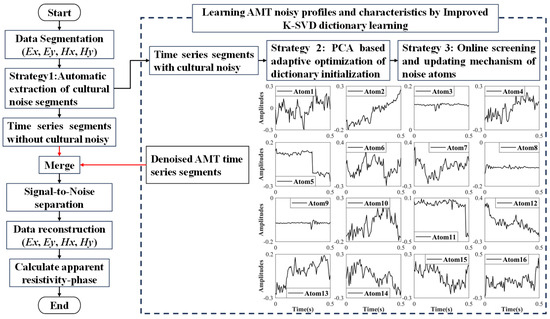
The overall workflow of AMT data denoising is illustrated in Figure 1. First, the original TS4 time-series data are decomposed into four components (Ex, Ey, Hx, Hy) and segmented into analysis windows to improve computational efficiency. The proposed improved K-SVD dictionary learning is then applied separately to each component to capture noise features (the corresponding learned dictionary atoms are shown on the right side of Figure 1). The methodology involves three main steps: (1) automatic extraction of cultural noise segments using kurtosis, whereby the AMT signals are separated into noise-contaminated segments and high-quality segments; (2) adaptive optimization of dictionary initialization using PCA; and (3) online screening and updating of noise atoms during dictionary learning. After training, sparse decomposition based on the learned dictionary is performed to extract noise components from the observed data, yielding denoised time-domain signals. Finally, the denoised electric and magnetic components are recombined into a complete time series, from which apparent resistivity and phase are calculated to evaluate processing performance. This workflow exhibits strong generalization capability and effectively suppresses various types and intensities of noise in AMT data without requiring external training datasets, underscoring its practical applicability in field surveys.
Figure 1.
Flowchart of AMT data processing (left) and dictionary atoms learned via improved K-SVD dictionary learning (right).
3. Simulation Data Experiment
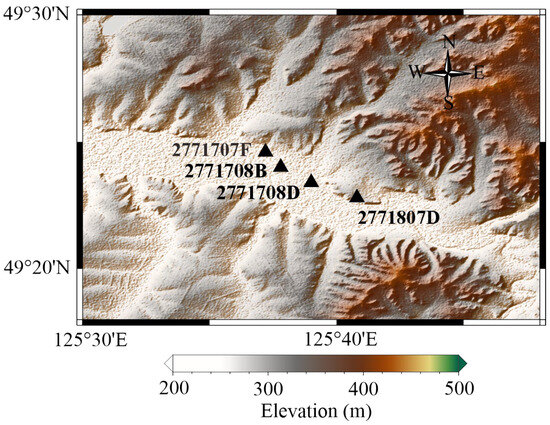
To evaluate the effectiveness and robustness of the proposed improved K-SVD dictionary learning method for AMT signal denoising, a series of simulation experiments were conducted using synthetic noise. High-quality AMT data from field observation site 2771807D in Heilongjiang Province, characterized by minimal noise contamination, were selected as the reference dataset. The geographic locations of this reference site and the three field test sites analyzed in Section 4 (2771707F, 2771708B, and 2771708D) are shown in Figure 2; the four sites are closely spaced, allowing their results to serve as mutual references for one another. Typical cultural noise-such as charge-discharge and square-wave interference-was artificially superimposed to simulate persistent noise commonly encountered in field AMT data. The synthesized dataset was then employed to rigorously assess the performance of the improved K-SVD dictionary learning algorithm in separating signal from noise.
Figure 2.
Location map of the AMT survey area in Heilongjiang Province, China. Black triangles denote station locations. Site 2771807D provides the high-quality reference data for the simulation experiment (Section 3). Sites 2771707F, 2771708B, and 2771708D are the field test sites analyzed in Section 4.
3.1. Comparison of Time-Domain and Frequency-Domain
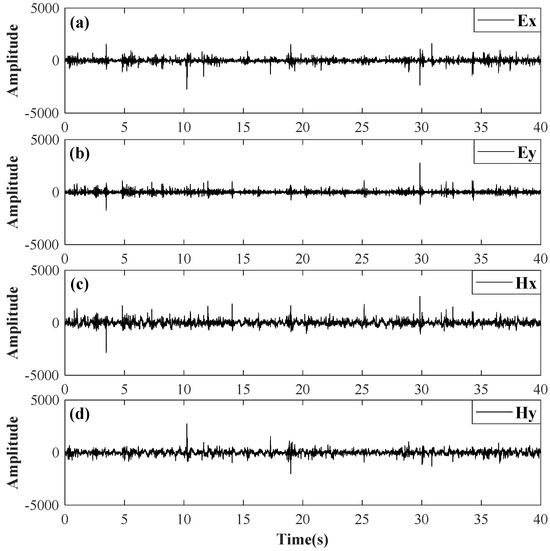
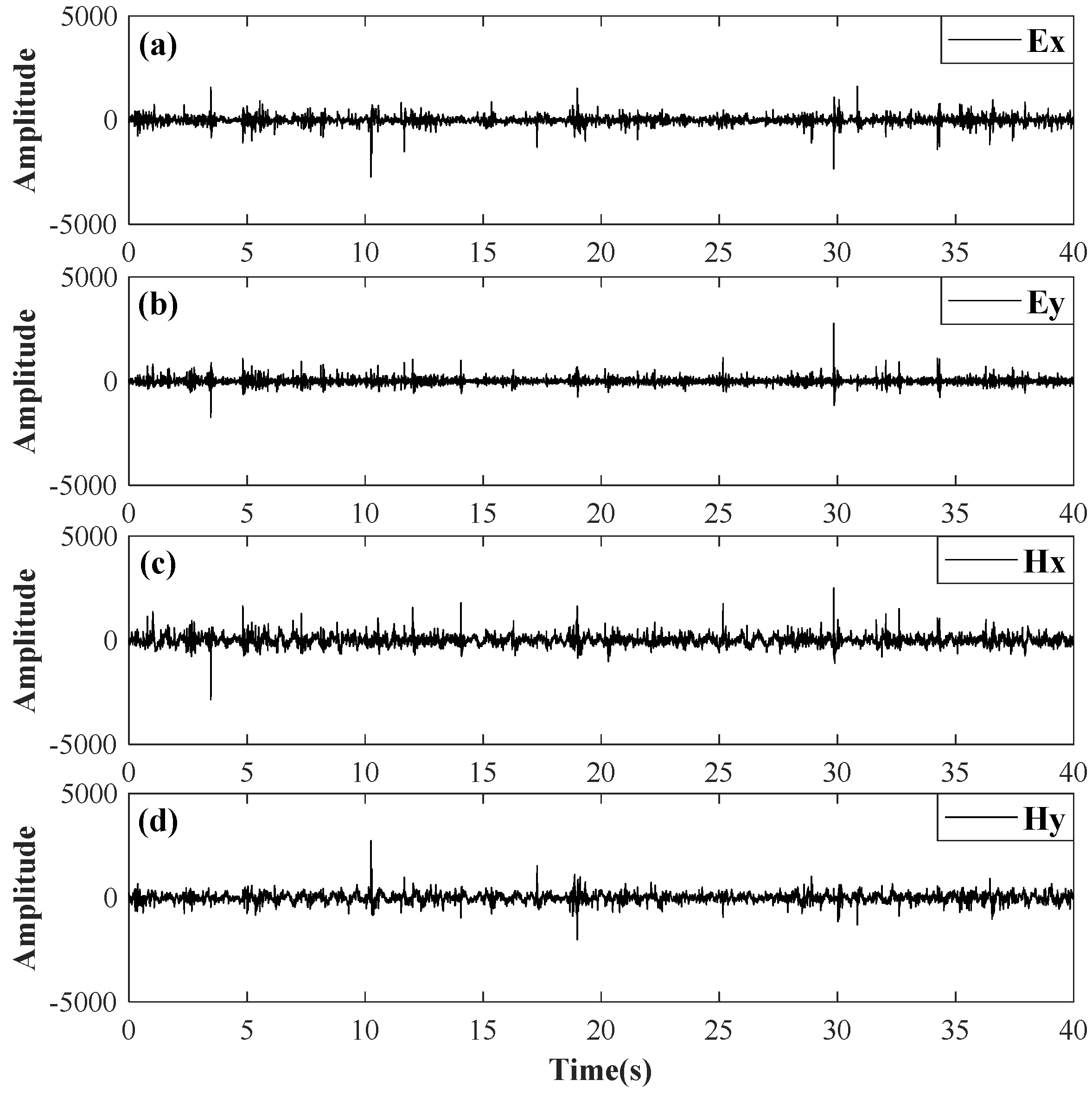
High-quality AMT data typically exhibit significant randomness, with surface observations characterized by relatively weak amplitudes and a lack of significant periodicity. Figure 3 shows the time series waveforms of the Ex, Ey, Hx and Hy components recorded at field observation site 2771807D. All four waveforms are stable and free of abnormal amplitude spikes, indicating negligible noise contamination. As a result, this dataset serves as a reliable reference for simulation testing.
Figure 3.
Time series of the Ex (a), Ey (b), Hx (c), and Hy (d) components at observation site 2771807D, Heilongjiang Province, China.
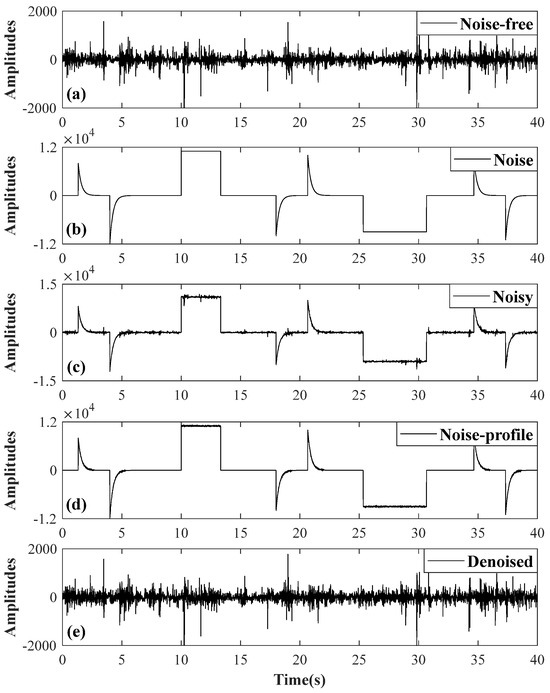
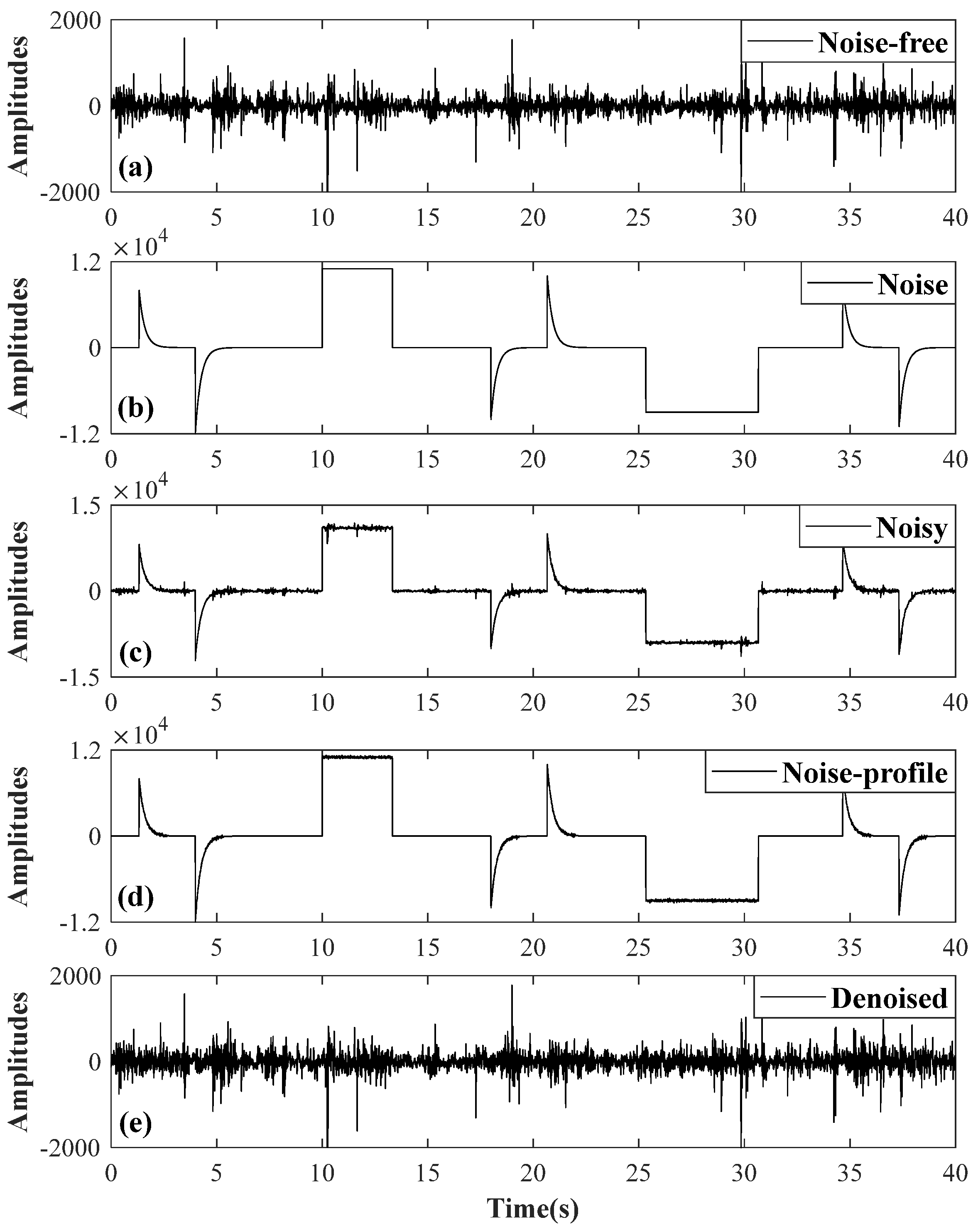
To simulate noise interference scenarios, square-wave and charge-discharge noise with varying amplitudes were added to the two electric field components (Ex and Ey). Figure 4 illustrates the denoising process. Figure 4a shows the raw noise-free Ex component; Figure 4b shows the simulated noise, comprising charge-discharge and square-wave components. This noise was linearly superimposed onto the raw high-quality AMT time series to generate noisy AMT data (Figure 4c). The improved K-SVD dictionary learning method proposed in this study was then applied to denoise the noisy data. Figure 4d depicts the noise morphology extracted from the simulated noisy data, where the waveform closely matches the artificially added noise, with only minor local amplitude differences. The final denoised result, shown in Figure 4e, essentially overlaps with the original data, exhibiting only minor deviations during noise interference intervals. This demonstrates the method’s excellent AMT data recovery capability in the time domain.
Figure 4.
Denoising process for simulated noisy AMT data using the proposed method. (a) Raw noise-free time series; (b) Simulated noise; (c) Synthetic noisy data; (d) Extracted noise profile; (e) Denoised time series obtained with the proposed method.
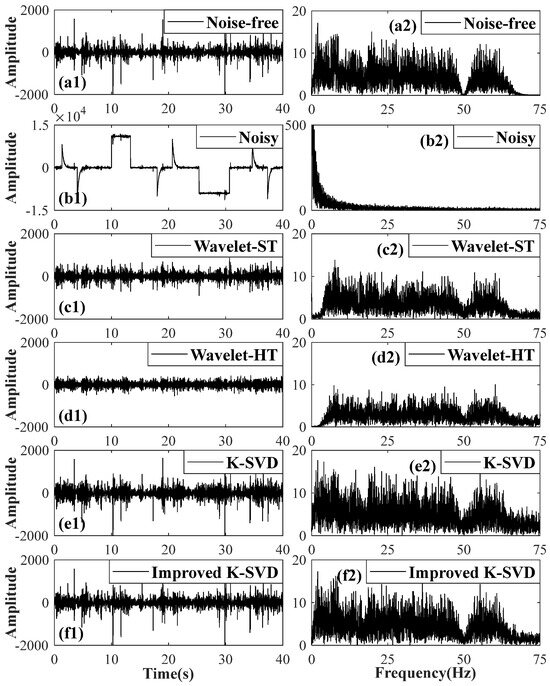
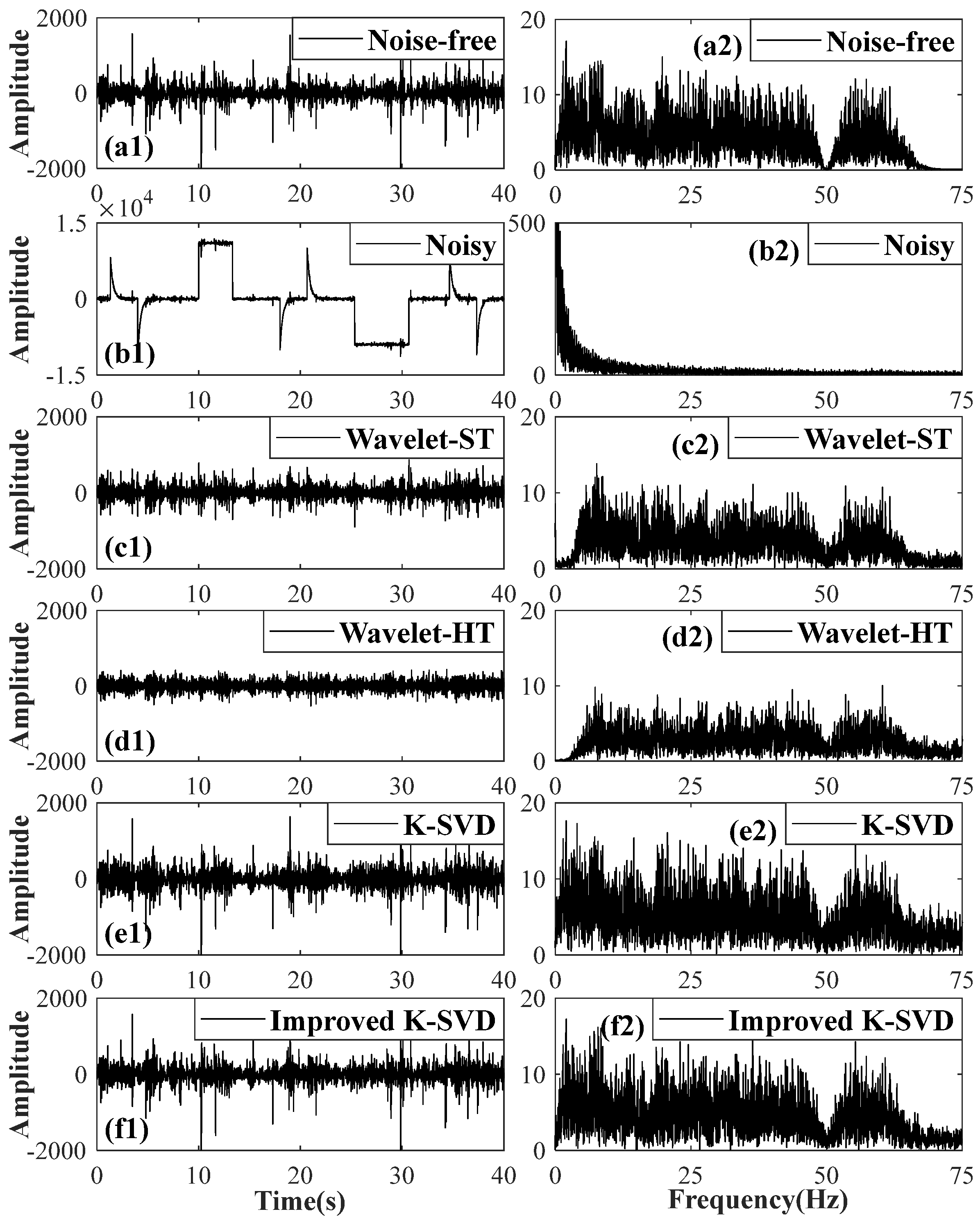
To further evaluate the denoising performance, Figure 5 compares the results of various denoising methods in both the time and frequency domains. Figure 5(a1,a2) show the time-domain waveform and spectrum of the raw high-quality signal, respectively. Figure 5(b1,b2) display the corresponding results for the noisy data, where the presence of noise induces significant spectral distortion. Figure 5(c1,c2,d1,d2) show the denoising results using wavelet soft thresholding (Wavelet-ST) and wavelet hard thresholding (Wavelet-HT). Although both approaches suppress a portion of the noise, they tend to over-process, particularly in the 0–10 Hz and 50–75 Hz bands, resulting in deviations from the raw spectrum and reduced spectral fidelity. Figure 5(e1,e2,f1,f2) present the results from conventional K-SVD dictionary learning and the improved K-SVD dictionary learning method, respectively. While the conventional method effectively preserves the valid AMT signal, the improved method achieves superior noise suppression and spectral restoration, with its frequency-domain response almost completely overlapping the raw data. These results confirm the significant advantage of the proposed method in both the time and frequency domains.
Figure 5.
Comparison of denoising results in the time and frequency domains using different methods. (a1) Time-domain waveform of the noise-free data; (a2) Frequency spectrum of the noise-free data; (b1) Time-domain waveform of the noisy data; (b2) Frequency spectrum of the noisy data; (c1) Time-domain waveform after denoising by Wavelet-ST; (c2) Frequency spectrum after denoising by Wavelet-ST; (d1) Time-domain waveform after denoising by Wavelet-HT; (d2) Frequency spectrum after denoising by Wavelet-HT; (e1) Time-domain waveform after denoising by conventional K-SVD dictionary learning; (e2) Frequency spectrum after denoising by conventional K-SVD dictionary learning; (f1) Time-domain waveform after denoising by improved K-SVD dictionary learning; (f2) Frequency spectrum after denoising by improved K-SVD dictionary learning.
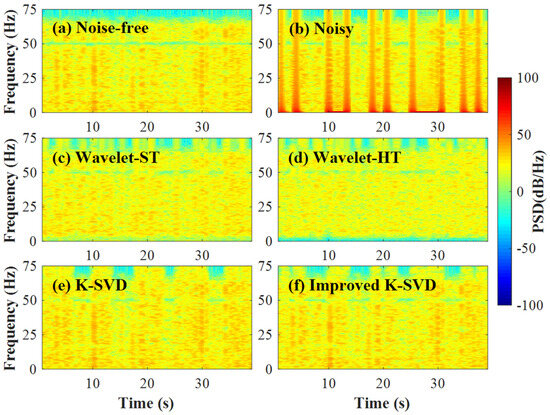
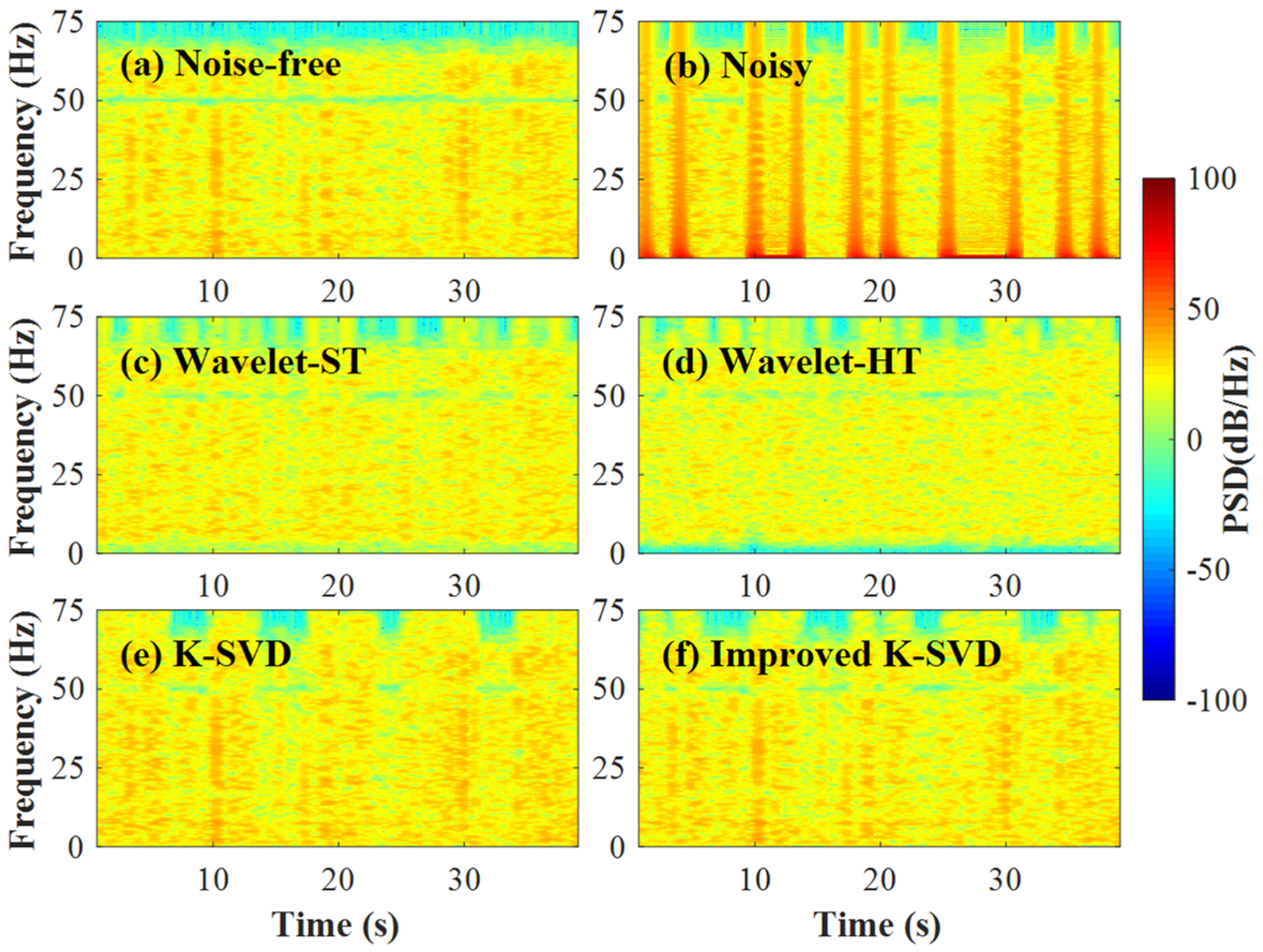
To provide a clearer view of the performance of each method in noise suppression, Figure 6 presents the time-frequency spectrograms of the signals obtained using the short-time Fourier transform (STFT). Figure 6a depicts the original high-quality signal, which exhibits a uniform and stable power spectral density (PSD) distribution over time without discernible anomalies. Figure 6b illustrates the spectrogram after noise addition, revealing a significant increase in energy across multiple frequency bands, particularly during interference periods, where vertical high-energy stripes are observed, indicating that the noise affects the entire frequency range. Figure 6c,d present the results after wavelet denoising; while the PSD in some bands is reduced, both signal loss and introduction of new noise remain evident. Figure 6e illustrates the result of conventional K-SVD dictionary learning, which effectively preserves the signal but still exhibits some high-frequency signal loss. Figure 6f shows the result from the improved K-SVD dictionary learning method, where the PSD distribution closely matches that of Figure 6a, confirming the method’s strong noise suppression and effective signal preservation in both the time and frequency domains.
Figure 6.
Timefrequency spectrograms for different denoising methods. (a) Noise-free signal; (b) Signal with simulated noise; (c) Wavelet-ST denoised; (d) Wavelet-HT denoised; (e) Conventional K-SVD dictionary learning denoised; (f) Improved K-SVD dictionary learning denoised.
3.2. Quantitative Evaluation
Five quantitative metrics were employed in the simulation experiments to evaluate the denoising performance of each method: signal-to-noise ratio (SNR), time-domain reconstruction error (TRE), frequency-domain reconstruction error (FRE), time-domain normalized cross correlation (TNCC) and frequency-domain normalized cross correlation (FNCC). SNR quantifies the quality of the denoised signal, whereas TRE and FRE measure the deviation between the denoised signal and the original signal in the time and frequency domains, respectively. TNCC and FNCC evaluate the similarity in waveform morphology between the denoised and original signals. Higher SNR values indicate superior denoising quality. Values of TNCC and FNCC closer to 1 indicate a higher degree of waveform similarity. Conversely, values of TRE and FRE closer to 0 indicate more effective separation of strong interference. The corresponding mathematical formulations are provided below.
The SNR is defined as:
The TNCC and FNCC are defined as:
The TRE and FRE are defined as:
where T1(x) and F1(x) denote the original time-domain and frequency-domain signals, respectively; T2(x) and F2(x) represent the denoised time-domain and frequency-domain signals, x denotes the sample index and N is the total number of signal samples.
As quantitatively summarized in Table 1, all denoising methods provide substantial noise suppression for the simulated data and markedly enhance the quality of the AMT signals compared with the noisy input. Among them, the improved K-SVD dictionary learning method achieves the best overall performance across all evaluation metrics. In particular, it yields the highest SNR and the largest TNCC and FNCC values, together with the lowest TRE and FRE values, indicating that it effectively suppresses strong interference while preserving the waveform morphology of the valid signal. These results confirm the superior denoising capability of the proposed method.
Table 1.
Quantitative evaluation metrics and computation time of different denoising methods on the simulated noisy data (Ex component).
The computation time of each method, measured on the Ex-component time series, is listed in the last column of Table 1. Due to the incorporation of the proposed strategies (kurtosis-based noise segmentation, PCA-based initialization, and online atom screening), the improved K-SVD method incurs a moderately higher computational cost than the conventional K-SVD dictionary learning. However, the additional overhead remains acceptable in view of the significant gains in denoising performance. Moreover, the four components at each site are processed independently, and different sites can likewise be processed in parallel; the computational cost therefore scales approximately linearly with the record length and the number of measurement sites, making the method practical for routine processing of large AMT datasets. All experiments were performed on a workstation equipped with an NVIDIA GeForce RTX 4070 SUPER GPU (12 GB GDDR6X VRAM).
3.3. Analysis of the Apparent Resistivity-Phase Responses
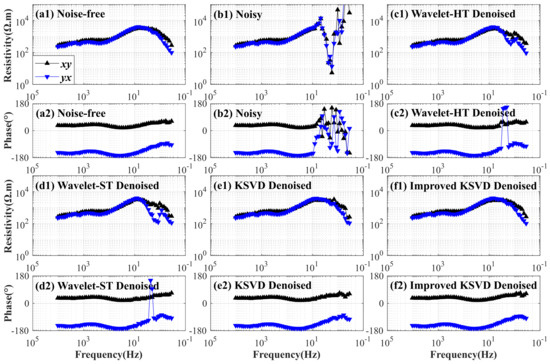
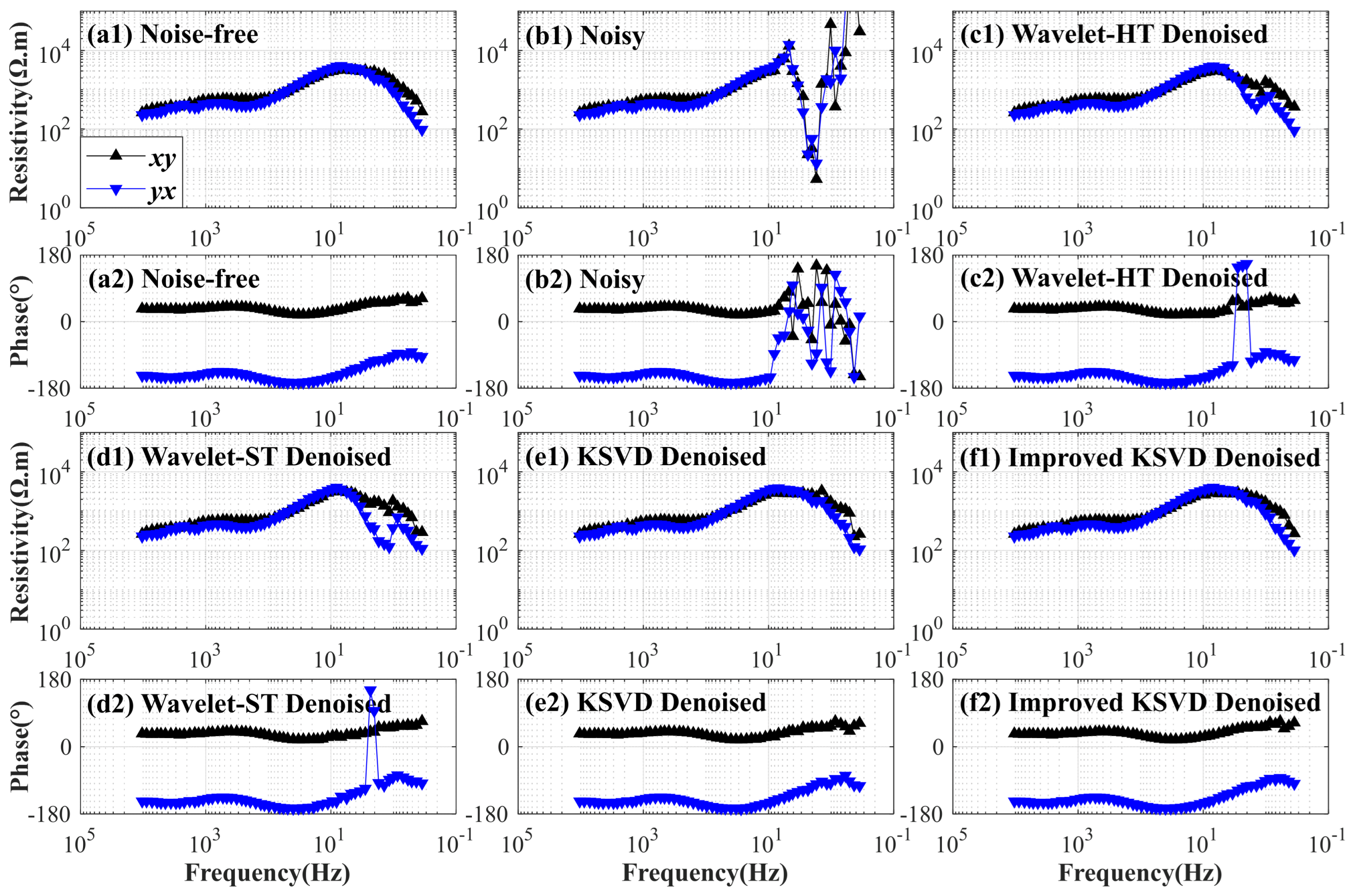
To further validate the efficacy of the proposed method in suppressing simulated noise, apparent resistivity and phase curves at observation site 2771807D were computed using the SSMT2000 software (Version 0.6.0.69). As shown in Figure 7(b1,b2), the noise-contaminated data for both the xy and yx modes exhibit pronounced distortion below 10 Hz. The strong deviation of the apparent resistivity and phase curves from the high-quality reference curves indicates severe degradation of low-frequency components caused by the simulated noise. After applying the improved K-SVD dictionary learning algorithm, the apparent resistivity and phase responses in both modes are largely restored (Figure 7(f1,f2)). The denoised curves remain morphologically consistent with the reference AMT responses, displaying only minor localized deviations. In contrast, the apparent resistivity-phase curves obtained using the other denoising methods, such as Wavelet-HT (Figure 7(c1,c2)), Wavelet-ST (Figure 7(d1,d2)), and conventional K-SVD dictionary learning (Figure 7(e1,e2)), still show noticeable discrepancies relative to the original high-quality data. These results demonstrate that the proposed method can effectively suppress noise while preserving the critical features of AMT data, confirming its applicability to geophysical field data processing.
Figure 7.
Apparent resistivity-phase curves after denoising by different method. (a1) Apparent resistivity of the noise-free data; (a2) Phase of noise-free data; (b1) Apparent resistivity of noisy data; (b2) Phase of noisy data; (c1) Apparent resistivity after denoising by Wavelet-HT; (c2) Phase after denoising by Wavelet-HT; (d1) Apparent resistivity after denoising by Wavelet-ST; (d2) Phase after denoising by Wavelet-ST; (e1) Apparent resistivity after denoising by conventional K-SVD dictionary learning; (e2) Phase after denoising by conventional K-SVD dictionary learning; (f1) Apparent resistivity after denoising by improved K-SVD dictionary learning; (f2) Phase after denoising by improved K-SVD dictionary learning.
4. Field Data Experiment
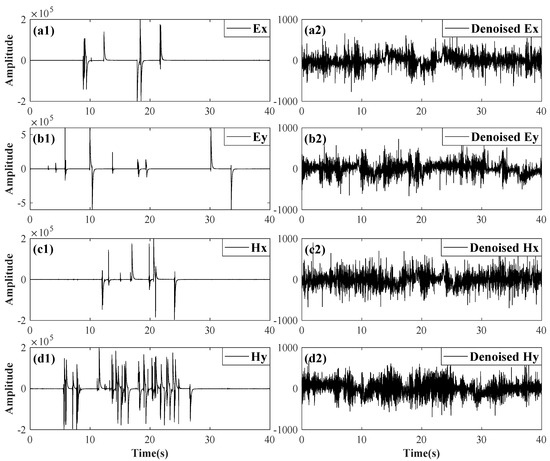
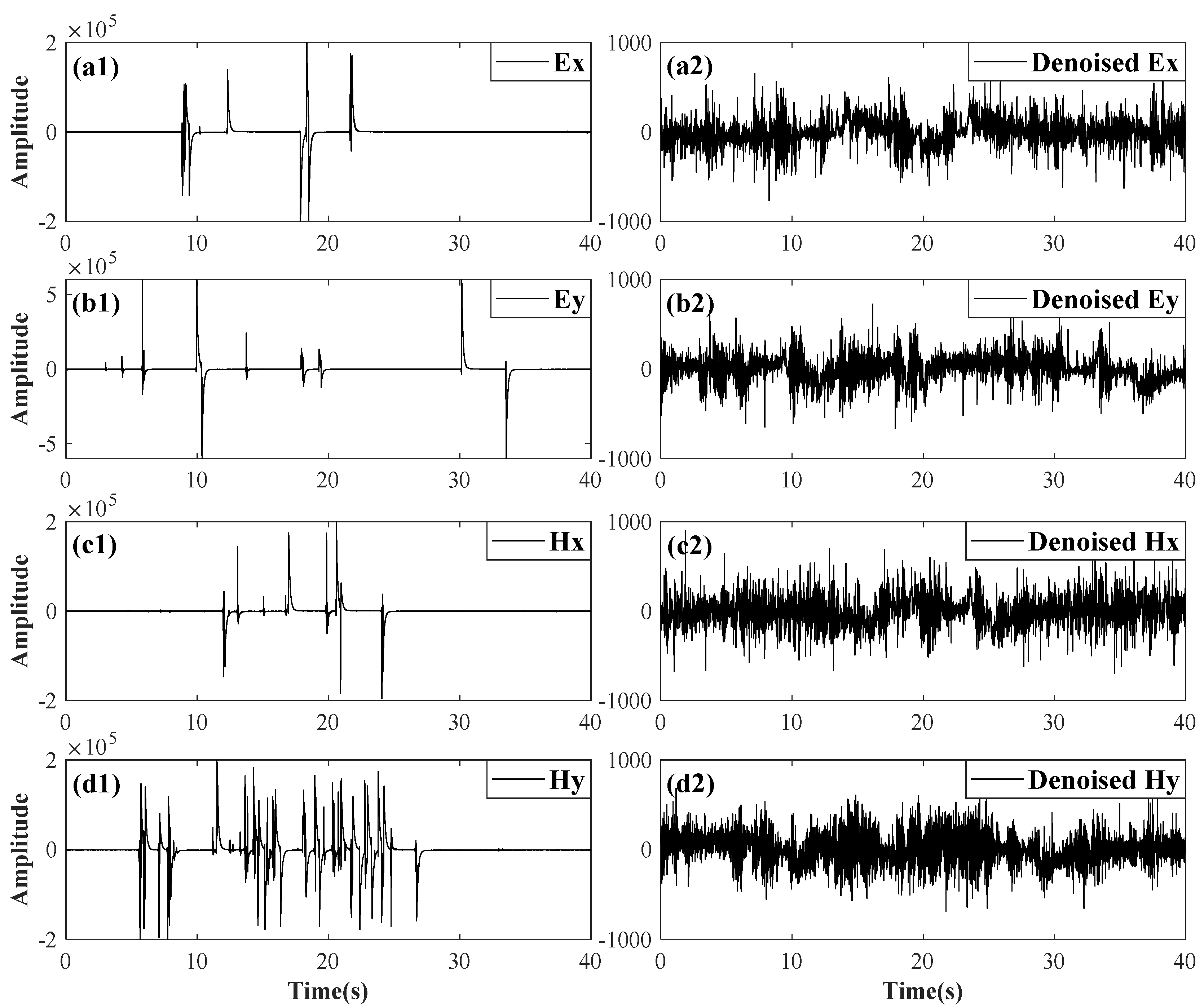
To further verify the practicality and robustness of the proposed method in field data applications, we applied it to AMT field observation sites from Heilongjiang Province that were severely contaminated by strong charge-discharge interference noise. As illustrated in Figure 8(a1,b1,c1,d1), the four components (Ex, Ey, Hx, Hy) at observation site 2771707F exhibit large-amplitude and morphologically complex cultural interference, which severely obscures the true AMT signal. By applying the improved K-SVD dictionary learning method, the dominant cultural noise components are effectively isolated from the raw data, as shown in Figure 8(a2,b2,c2,d2). The denoised results demonstrate that the proposed method not only removes large-amplitude noise with high precision, but also substantially enhances overall data quality, thereby facilitating a more accurate restoration of the AMT signals.
Figure 8.
Time series of Ex, Ey, Hx, and Hy at site 2771707F in Heilongjiang Province, China. (a1) Time series of the raw AMT Ex component with strong interference; (b1) Time series of the raw AMT Ey component with strong interference; (c1) Time series of the raw AMT Hx component with strong interference; (d1) Time series of the raw AMT Hy component with strong interference; (a2) Denoised time series of the Ex component; (b2) Denoised time series of the Ey component; (c2) Denoised time series of the Hx component; (d2) Denoised time series of the Hy component.
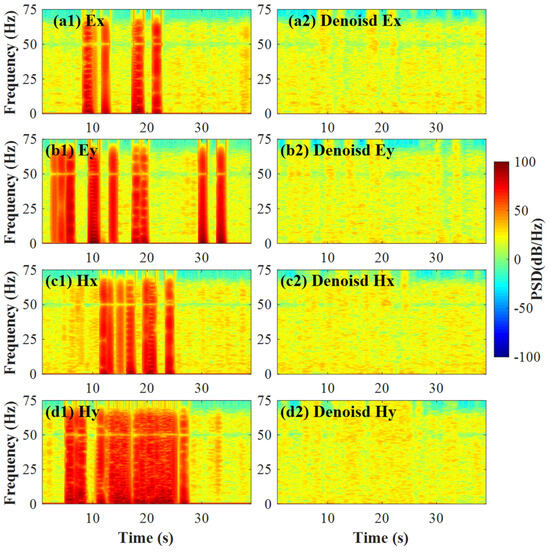
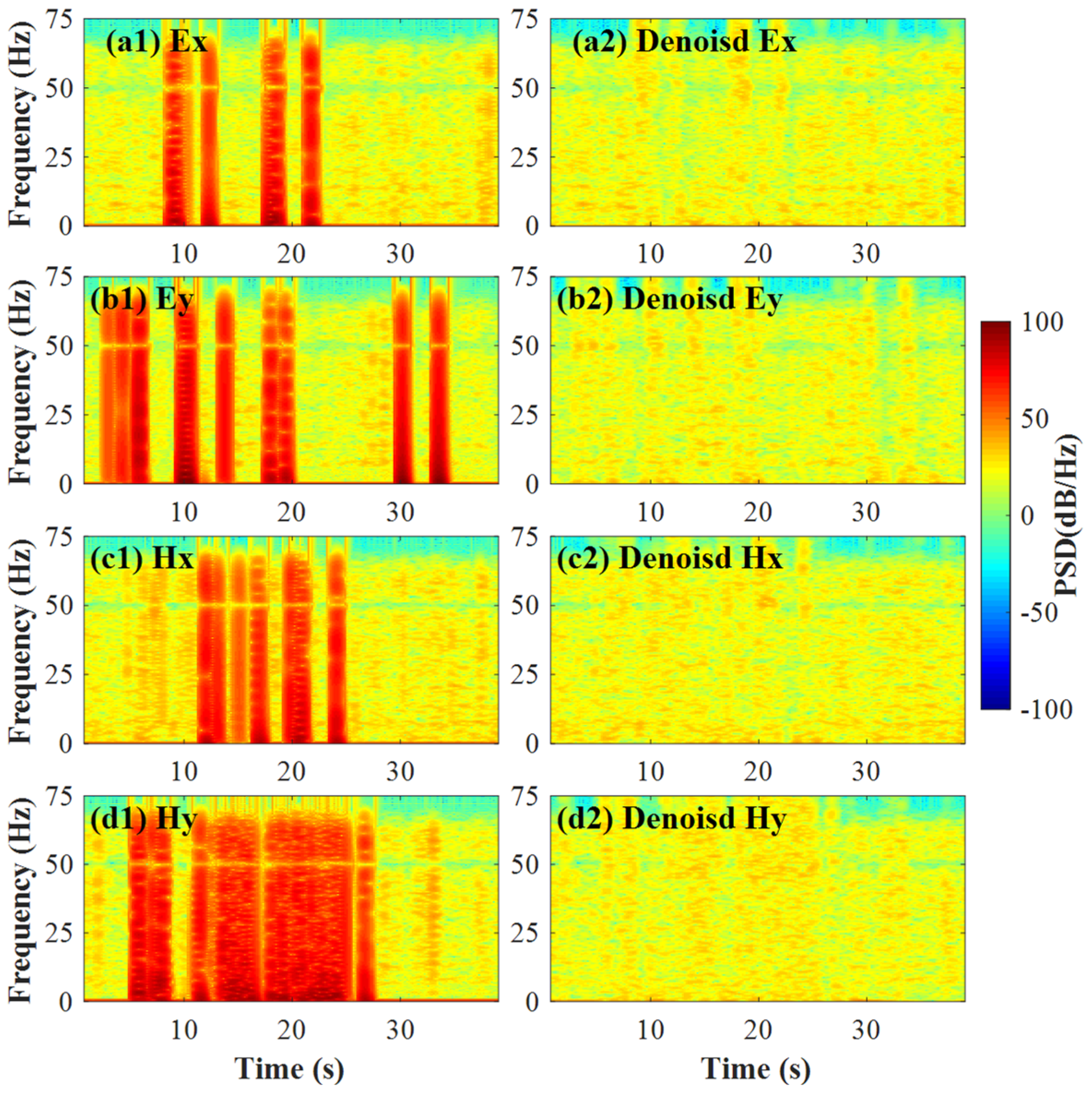
In addition, STFT analysis was performed on the Ex, Ey, Hx, and Hy components of this field dataset to evaluate their time-frequency characteristics after denoising (Figure 9). The raw data with strong interference exhibits abnormally high PSD values during the interference period, with distinct vertical stripe-like clusters across multiple frequency bands, indicative of strong cultural noise contamination. After denoising by the improved K-SVD dictionary learning method, the noise energy in the time-frequency spectrum is significantly reduced, the interference bands are essentially removed, and the PSD distribution becomes stable and consistent with that observed during undisturbed periods. These results confirm that the proposed method not only effectively suppresses high-intensity cultural noise, but also preserves the integrity of the frequency-domain characteristics without introducing spectral distortion, thereby demonstrating its robustness and reliability for field AMT data processing.
Figure 9.
Time-frequency spectrograms of Ex, Ey, Hx, and Hy components before and after signal-to-noise separation by the proposed method at site 2771707F with strong cultural noise interference, Heilongjiang Province, China. (a1) Time-frequency spectrogram of the raw AMT Ex component with strong interference; (b1) Time-frequency spectrogram of the raw AMT Ey component with strong interference; (c1) Time-frequency spectrogram of the raw AMT Hx component with strong interference; (d1) Time-frequency spectrogram of the raw AMT Hy component with strong interference; (a2) Denoised time-frequency spectrogram of the Ex component; (b2) Denoised time-frequency spectrogram of the Ey component; (c2) Denoised time-frequency spectrogram of the Hx component; (d2) Denoised time-frequency spectrogram of the Hy component.
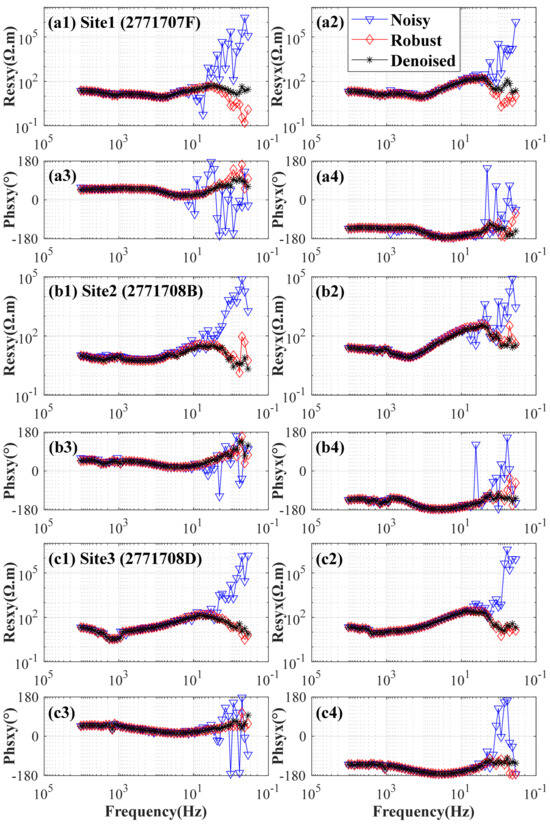
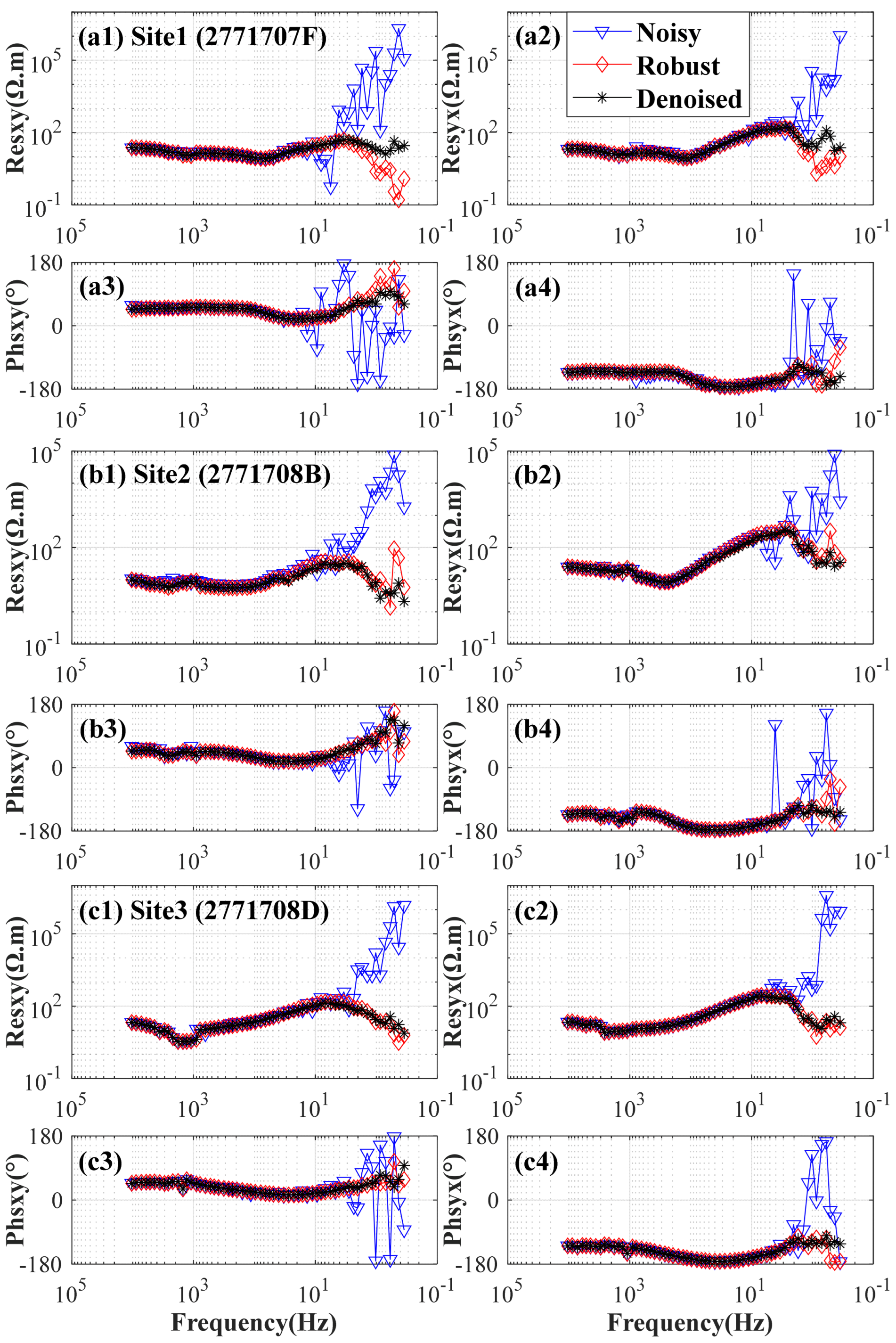
To validate the denoising performance of our proposed method on different field datasets, we selected three field sites (2771707F, 2771708B, and 2771708D) along the same AMT survey line. Data at all sites were acquired with the same instrumentation and are strongly affected by cultural noise. The proposed method was applied to each site, and the resulting apparent resistivity-phase curves are shown in Figure 10. These sites are located on the same survey line as the reference site 2771807D used in the simulation tests, and their response trends are theoretically expected to be consistent. As shown in Figure 10, the raw data exhibit pronounced distortions in the apparent resistivity and phase curves at frequencies below 10 Hz, characterized by strong fluctuations and instability, which are typical signatures of cultural noise contamination. After applying the improved K-SVD dictionary learning method, the sounding curves at all three sites show substantial improvement in both the xy and yx modes, transitioning from irregular and unstable to smooth, stable, and well-ordered. Moreover, their overall morphology closely matches that of the high-quality reference data, thereby confirming the effectiveness of the proposed method in suppressing cultural noise.
Figure 10.
Apparent resistivity and phase curves before and after denoising by the proposed method at sites 2771707F, 2771708B, and 2771708D in Heilongjiang Province, China. (a1,b1,c1) Apparent resistivity of the xy mode; (a2,b2,c2) Apparent resistivity of the yx mode; (a3,b3,c3) Phase of the xy mode; (a4,b4,c4) Phase of the yx mode. Red curves show the results of the robust estimation method for comparison.
For comparison, the commonly used robust estimation denoising method was also applied to the three field observation sites (shown in Figure 10). The results indicate that the robust method can effectively mitigate the influence of cultural noise, yielding a substantial improvement in apparent resistivity-phase curves. Compared with our proposed approach, it yields a similar overall trend in the sounding curves. These findings demonstrate that the improved K-SVD dictionary learning is not only comparable to the traditional robust method in terms of denoising performance, but also offers a distinct advantage in selectively suppressing noise components. This selective suppression helps to avoid excessive attenuation of the effective signal, thereby offering the potential to acquire higher-quality observation data in practical exploration applications.
5. Discussion and Conclusions
This paper addresses the pervasive and persistent challenge of strong cultural noise in AMT field data. Such interference is particularly common in mineral exploration districts, where mining activities, industrial facilities, and power infrastructure often generate persistent electromagnetic noise that degrades the quality of AMT observations and limits the reliability of geological interpretation. We propose an improved K-SVD dictionary learning denoising method that achieves effective and adaptive signal-to-noise separation without requiring reference stations or training datasets. Noise-dominated segments are accurately identified using an automatic local kurtosis mechanism, and an adaptive initial dictionary is constructed via PCA dimensionality reduction combined with Gaussian perturbation. In addition, an online noise atom screening and dynamic updating strategy is implemented, markedly improving the ability of K-SVD dictionary learning to capture and suppress complex cultural noise features.
Simulation experiments demonstrate that the improved K-SVD dictionary learning method consistently outperforms both conventional K-SVD dictionary learning and wavelet thresholding techniques in terms of noise suppression and signal preservation, achieving superior performance across multiple quantitative evaluation metrics. Field data applications further confirm its capability to effectively recover raw AMT signals under persistent and strong cultural noise conditions, thereby significantly improving data quality and enhancing the fidelity of apparent resistivity-phase curves. In our tests, its denoising performance is also comparable to that of the widely used robust estimation method, while effectively avoiding excessive attenuation of valid signals.
In summary, the improved K-SVD dictionary learning method exhibits strong noise adaptability, high generalization capability and excellent denoising accuracy. It can enhance AMT data quality under diverse noise types and amplitudes, making it particularly suitable for field AMT surveys conducted in noisy environments. For AMT surveys in mineral exploration districts, the proposed method can effectively improve data reliability under strong cultural noise conditions.
The main advantages of the proposed strategy are its reference-free implementation without external training datasets, automatic identification of noise-contaminated segments, improved dictionary initialization, and online atom screening and updating. Its main limitations are the reduced effectiveness against low-amplitude or approximately stationary noise, the dependence on several key parameters, its higher computational cost relative to that of simpler methods, and the limited number of field validation datasets. Future work will focus on adaptive parameter optimization, joint time-frequency denoising, computational acceleration, and further validation using AMT datasets from different geological settings and, where available, geological or drilling constraints.
Author Contributions
H.K.: Conceptualization, Methodology, Software, Visualization, Investigation, Supervision, Formal Analysis, Writing—Original Draft; X.T.: Software, Validation, Resources, Supervision, Conceptualization, Funding Acquisition, Writing—Review and Editing; C.F.: Supervision, Formal Analysis, Methodology, Software, Data Curation; J.Y.: Methodology, Validation, Writing—Review and Editing; F.T.: Data Curation, Writing—Review and Editing. All authors have read and agreed to the published version of the manuscript.
Funding
This research was funded by Deep Earth Probe and Mineral Resources Exploration-National Science and Technology Major Project, grant number 2024ZD1002205.
Data Availability Statement
Data associated with this research are available and can be obtained by contacting the corresponding author.
Conflicts of Interest
Jinfeng Yang is employed by the company Beijing Urban Construction Exploration & Surveying Design Research Institute Co., Ltd. The remaining authors declare that the research was conducted in the absence of any commercial or financial relationships that could be construed as a potential conflict of interest.
References
- Deng, J.Z.; Yu, H.; Chen, H.; Du, Z.J.; Yang, H.Y.; Li, H.X.; Xie, S.P.; Chen, X.; Guo, F.S. Ore-controlling structures of the Xiangshan volcanic Basin, SE China: Revealed from three-dimensional inversion of Magnetotelluric data. Ore Geol. Rev. 2020, 127, 103807. [Google Scholar] [CrossRef] [Scilit]
- Yu, H.; Deng, J.Z.; Tang, B.; Egbert, G.; Chen, H. Electrical image of magmatic system beneath the xiangshan volcanogenic uranium deposit, southeast China: Linking magmatic evolution and uranium metallogenesis. Geology 2023, 51, 870–874. [Google Scholar] [CrossRef] [Scilit]
- Neukirch, M.; García, X. Nonstationary magnetotelluric data processing with instantaneous parameter. J. Geophys. Res. Solid Earth 2014, 119, 1634–1654. [Google Scholar] [CrossRef] [Scilit]
- Tang, J.T.; Li, G.; Zhou, C.; Ren, Z.Y.; Xiao, X.; Liu, Z.J. Denoising AMT data based on dictionary learning. Chin. J. Geophys. 2018, 61, 3835–3850. [Google Scholar] [CrossRef]
- Gamble, T.D.; Goubau, W.M.; Clarker, J. Magnetotellurics with a remote magnetic reference. Geophysics 1979, 44, 53–68. [Google Scholar] [CrossRef] [Scilit]
- Egbert, G.D.; Booker, J.R. Multivariate analysis of geomagnetic array data: 1. The response space. J. Geophys. Res. Solid Earth 1989, 94, 14227–14247. [Google Scholar] [CrossRef] [Scilit]
- Müller-Petke, M. Non-remote reference noise cancellation-using reference data in the presence of surface-NMR signals. J. Appl. Geophys. 2020, 177, 104040. [Google Scholar] [CrossRef] [Scilit]
- Egbert, G.D.; Booker, J.R. Robust estimation of geomagnetic transfer functions. Geophys. J. Int. 1986, 87, 173–194. [Google Scholar] [CrossRef] [Scilit]
- Wang, H.; Egbert, G.; Yao, Y.S.; Cheng, J.L. Array analysis of magnetic and electric field observatories in China: Estimation of magnetotelluric impedances at very long periods. Geophys. J. Int. 2020, 222, 305–326. [Google Scholar] [CrossRef] [Scilit]
- Cordell, D.; Unsworth, M.J.; Lee, B.; Hanneson, C.; Milling, D.K.; Mann, R. Estimating the geoelectric field and electric power transmission line voltage during a geomagnetic storm in Alberta, Canada using measured magnetotelluric impedance data: The influence of three-dimensional electrical structures in the lithosphere. Space Weather 2021, 19, e2021SW002803. [Google Scholar] [CrossRef] [Scilit]
- Weckmann, U.; Magunia, A.; Ritter, O. Effective noise separation for magnetotelluric single site data processing using a frequency domain selection scheme. Geophys. J. Int. 2005, 161, 635–652. [Google Scholar] [CrossRef] [Scilit]
- Cai, J.H.; Tang, J.T.; Hua, X.R.; Gong, Y.R. An analysis method for magnetotelluric data based on the Hilbert-Huang Transform. Explor. Geophys. 2009, 40, 197–205. [Google Scholar] [CrossRef] [Scilit]
- Xiao, X.; Tang, J.T.; Zhou, C.; Lü, Q.T. Magnetotelluric sounding in the LujiangZongyang oredistrict and preliminary study of electrical structure. Acta Geosci. Sin. 2011, 85, 873–886. Available online: http://geo.ijournals.cn/dzxb/dzxb/article/abstract/2011074 (accessed on 12 May 2011).
- Di-Giuseppe, M.G.; Troiano, A.; Patella, D. Separation of plain wave and near field contributions in Magnetotelluric time-series: A useful criterion emerged during the Campi Flegrei (Italy) prospecting. J. Appl. Geophys. 2018, 156, 55–66. [Google Scholar] [CrossRef] [Scilit]
- Trad, D.O.; Travassos, J.M. Wavelet filtering of magnetotelluric data. Geophysics 2000, 65, 482–491. [Google Scholar] [CrossRef] [Scilit]
- Tang, J.T.; Li, J.; Xiao, X.; Zhang, L.C.; Lü, Q.T. Mathematical morphology filtering and noise suppression of magnetotelluric sounding data. Chin. J. Geophys. 2012, 55, 1784–1793. [Google Scholar] [CrossRef]
- Cai, J.H. A combinatorial filtering method for magnetotelluric data series with strong interference. Arab. J. Geosci. 2016, 9, 628. [Google Scholar] [CrossRef] [Scilit]
- Guo, Z.Y.; Huang, C.; Jiang, W.; Hong, T.; Han, J.T. An adaptive decomposition method with low parameter sensitivity for non-stationary noise suppression in magnetotelluric data. Minerals 2025, 15, 808. [Google Scholar] [CrossRef] [Scilit]
- Adler, A.; Araya-Polo, M.; Poggio, T. Deep learning for seismic inverse problems: Toward the acceleration of geophysical analysis workflows. IEEE Signal Process. Mag. 2021, 38, 89–119. Available online: https://ieeexplore.ieee.org/abstract/document/9363496 (accessed on 25 February 2021). [CrossRef] [Scilit]
- Ajithabh, K.S.; Patro, P.K. SigMT: An open-source Python package for magnetotelluric data processing. Comput. Geosci. 2023, 171, 105270. [Google Scholar] [CrossRef] [Scilit]
- Li, J.; Liu, Y.C.; Tang, J.T.; Peng, Y.Q.; Zhang, X.; Li, Y. Magnetotelluric data denoising method combining two deep-learning-based models. Geophysics 2023, 88, E13–E28. [Google Scholar] [CrossRef] [Scilit]
- Han, Y.; An, Z.G.; Di, Q.Y.; Wang, Z.X.; Kang, L.L. Research on noise suppression of magnetotelluric signal based on recurrent neural network. Chin. J. Geophys. 2023, 66, 4317–4331. [Google Scholar] [CrossRef]
- Gui, T.F.; Deng, J.Z.; Li, G.; Chen, H.; Yu, H.; Feng, M. De-noising magnetotelluric data based on machine learning. J. Appl. Geophys. 2024, 230, 105538. [Google Scholar] [CrossRef] [Scilit]
- Zhang, L.; Liu, Z.G.; Lu, G.Y.; Tang, J.T.; Yu, M.B.; Zhang, H.; Sun, J. Audio-frequency magnetotellurics signal denoising based on multilevel wavelet convolutional neural networks. Geophys. Prospect. 2026, 74, e70158. [Google Scholar] [CrossRef] [Scilit]
- Li, J.; Wang, C.; Chen, C.J.; Qi, Q.B.; Hong, D.; Tang, J.T. Enhancing magnetotelluric data denoising using a layer-wise progressive extraction network. Earth Planets Space 2026, 78, 71. [Google Scholar] [CrossRef] [Scilit]
- Wang, Q.; Bai, X.M.; Li, G.; Deng, J.Z. Audio magnetotelluric signal-noise recognition and separation based on RepVGG-DnCNN. J. Geophys. Eng. 2026, 23, 130–146. [Google Scholar] [CrossRef] [Scilit]
- Aharon, M.; Elad, M.; Bruckstein, A. K-SVD: An Algorithm for Designing Overcomplete Dictionaries for Sparse Representation. IEEE Trans. Signal Process. 2006, 54, 4311–4322. Available online: https://ieeexplore.ieee.org/document/1710377 (accessed on 30 November 2006). [CrossRef] [Scilit]
- Li, G.; Liu, X.Q.; Tang, J.T.; Deng, J.Z.; Hu, S.G.; Zhou, C.; Chen, C.J.; Tang, W.W. Improved shift-invariant sparse coding for noise attenuation of magnetotelluric data. Earth Planets Space 2020, 72, 45. [Google Scholar] [CrossRef] [Scilit]
- Zhang, L.; Tang, J.T.; Li, G.; Chen, W.J. Audio magnetotelluric denoising via variational mode decomposition and adaptive dictionary learning. J. Appl. Geophys. 2022, 204, 104748. [Google Scholar] [CrossRef] [Scilit]
- Zhang, L.; Li, G.; Chen, H.; Tang, J.T.; Yang, G.C.; Yu, M.B.; Hu, Y.; Xu, J.; Sun, J. Identification and suppression of multi-component noise in audio magnetotelluric based on convolutional block attention module. IEEE Trans. Geosci. Remote Sens. 2024, 62, 5905515. Available online: https://ieeexplore.ieee.org/abstract/document/10419374 (accessed on 5 February 2024). [CrossRef] [Scilit]
- Olshausen, B.A.; Field, D.J. Emergence of simple-cell receptive field properties by learning a sparse code for natural images. Nature 1996, 381, 607–609. [Google Scholar] [CrossRef] [Scilit] [PubMed]
- Engan, K.; Aase, S.O.; Husoy, J.H. Method of optimal directions for frame design. In Proceedings of the 1999 IEEE International Conference on Acoustics, Speech, and Signal Processing, Phoenix, AZ, USA, 15–19 March 1999; Volume 5, pp. 2443–2446. Available online: https://ieeexplore.ieee.org/abstract/document/760624 (accessed on 6 August 2002).
- Li, J.; Peng, Y.Q.; Tang, J.T.; Li, Y. Denoising of magnetotelluric data using K-SVD dictionary training. Geophys. Prospect. 2021, 69, 448–473. [Google Scholar] [CrossRef] [Scilit]
- Feng, C.Q.; Li, Y.G.; Wu, Y.J.; Duan, S.M. A noise suppression method of marine magnetotelluric data using K-SVD dictionary learning. Chin. J. Geophys. 2022, 65, 1853–1865. [Google Scholar] [CrossRef]
- Li, G.; Gu, X.J.; Ren, Z.Y.; Wu, Q.H.; Liu, X.Q.; Zhang, L.; Xiao, D.H.; Zhou, C. Deep learning optimized dictionary learning and its application in eliminating strong magnetotelluric noise. Minerals 2022, 12, 1012. [Google Scholar] [CrossRef] [Scilit]
- Antoni, J. The spectral kurtosis: A useful tool for characterising non-stationary signals. Mech. Syst. Signal Process. 2006, 20, 282–307. [Google Scholar] [CrossRef] [Scilit]
- Papadaniil, C.D.; Hadjileontiadis, L.J. Efficient heart sound segmentation and extraction using ensemble empirical mode decomposition and kurtosis features. IEEE J. Biomed. Health Inform. 2013, 18, 1138–1152. Available online: https://ieeexplore.ieee.org/abstract/document/6680648 (accessed on 11 December 2013). [CrossRef] [Scilit] [PubMed]
- Rusu, C.; Dumitrescu, B. An initialization strategy for the dictionary learning problem. In Proceedings of the 2014 IEEE International Conference on Acoustics, Speech and Signal Processing (ICASSP), Florence, Italy, 4–9 May 2014; pp. 6731–6735. Available online: https://ieeexplore.ieee.org/abstract/document/6854903 (accessed on 14 July 2014).
- Yi, S.Y.; He, Z.Y.; Jing, X.Y.; Li, Y.; Cheng, Y.M.; Nie, F.P. Adaptive weighted sparse principal component analysis for robust unsupervised feature selection. IEEE. Trans. Neural Netw. Learn. Syst. 2019, 31, 2153–2163. Available online: https://ieeexplore.ieee.org/abstract/document/8818654 (accessed on 28 August 2019). [CrossRef] [Scilit] [PubMed]
- Jolliffe, I.T.; Cadima, J. Principal component analysis: A review and recent developments. Philos. Trans. R. Soc. A 2016, 374, 20150202. [Google Scholar] [CrossRef] [Scilit] [PubMed]
- Mairal, J.; Bach, F.; Ponce, J.; Sapiro, G. Online learning for matrix factorization and sparse coding. J. Mach. Learn. Res. 2010, 11, 19–60. [Google Scholar] [CrossRef] [Scilit]

Disclaimer/Publisher’s Note: The statements, opinions and data contained in all publications are solely those of the individual author(s) and contributor(s) and not of MDPI and/or the editor(s). MDPI and/or the editor(s) disclaim responsibility for any injury to people or property resulting from any ideas, methods, instructions or products referred to in the content. |
© 2026 by the authors. Licensee MDPI, Basel, Switzerland. This article is an open access article distributed under the terms and conditions of the Creative Commons Attribution (CC BY) license.