


Abstract
The NE- to E-trending ductile shear zones are well-exposed in the Wulashan–Daqingshan Complex of the Khondalite Belt, an Orosirian collisional orogen in the northwestern North China Craton. However, the timing of the shear zone activity remains ambiguous. In this study, we performed field-based structural observations and apatite and zircon U–Pb geochronology on these shear zones. The results show that the pre- and post-kinematic intrusions yielded magmatic zircon U–Pb ages of 1967 ± 24 Ma and 1812 ± 18 Ma, interpreted to broadly provide the maximum and minimum age constraints for shearing. Meanwhile, eight samples of mylonites gave a range of apatite U–Pb ages between 1878 ± 34 Ma and 1798 ± 29 Ma, considered to record the timing of shear deformation. Moreover, a similar metamorphic zircon U–Pb age of 1876 ± 38 Ma was also obtained from another mylonite. Combined with available data, we summarized that orogen-parallel ductile shear zones in the Helanshan, Qianlishan, Wulashan–Daqingshan and Jining Complexes of the Khondalite Belt have comparable deformation ages of 1904–1823 Ma, 1902–1801 Ma, 1906–1798 Ma and ~1866 Ma, respectively. These late Orosirian (1.90–1.80 Ga) shear zones were inferred to result from the prolonged orogenic processes of the Khondalite Belt, in response to the collision between the Yinshan and Ordos Blocks.
1. Introduction
Shear zones are key structural elements in understanding the kinematic evolution of orogenic belts [1,2,3,4,5]. At mid-to-lower crustal level, they typically appear as high-strain tabular zones that are characterized by various degrees of ductile deformation and mylonitization [2,6,7,8,9,10]. Determination of the timing of shear zone activity is crucial, but it remains one of the most challenging problems in geochronology [3,5,11,12,13]. Commonly, the deformation ages of ductile shear zones are directly obtained from mylonitized rocks, using U–Pb geochronology on U-bearing minerals (e.g., zircon, monazite, titanite and apatite), K–Ar and Rb–Sr geochronology on K-bearing minerals (e.g., hornblende, muscovite and biotite) [5,14,15,16,17]. Meanwhile, geochronological data from shear zone-related magmatic rocks (particularly pre-, syn- and post-kinematic intrusions) and adjacent blocks can indirectly place temporal constraints on shear zone activity [10,13,14,18]. To avoid ambiguous interpretations that arise from isolated ages, it is fundamental to combine all the direct and indirect geochronological data based on multiproxy approaches [3,11,19]. Furthermore, the integration of structural and geochronological data in different parts of the shear zones will help to reconstruct their tectono-thermal history [4,11,20].
The Khondalite Belt has been described as an Orosirian continent–continent collisional orogen that extends E–W for over 1000 km in the northwestern North China Craton (Figure 1a) [21,22,23,24]. This belt is inferred to undergo a long-lived (>100 Myr) orogenic evolution, characterized by polyphase deformation, high-grade metamorphism and magmatism [23,25,26,27,28,29,30,31]. The Wulashan–Daqingshan Complex (WDC) is located in the middle segment of the Khondalite Belt, and this complex features a series of orogen-parallel ductile shear zones (Figure 1b), together called the Wulashan–Daqingshan ductile shear zones (WDSZ) [16,25,32]. Previous investigations have mainly focused on metamorphic and magmatic evolution in this complex [22,33,34,35,36,37,38,39]. Although some researchers have conducted zircon U–Pb and biotite Ar–Ar geochronology on the WDSZ [16,32,40,41], the timing of formation and development of these shear zones was still poorly constrained. In this study, we report apatite and zircon U–Pb ages obtained from mylonites and shear zone-related intrusions in the WDSZ. Moreover, we compiled available geochronological data from shear zones in different complexes of the Khondalite Belt. Integrated with previous studies, these results will provide new insights into the tectonic evolution of the orogen-parallel ductile shear zones of the Khondalite Belt.
2. Geological Setting
The Khondalite Belt was considered to have resulted from the ~1.95 Ga collision between the northern Yinshan Block and the southern Ordos Block, which led to the assembly of the Western Block in the North China Craton (Figure 1a) [21,22,23,24,42,43,44,45,46,47]. From west to east, this orogenic belt dominantly comprises the Helanshan, Qianlishan, Wulashan–Daqingshan and Jining Complexes [21,25]. Lithologically, they are characterized by intensely deformed, upper amphibolite to granulite facies metasedimentary rocks (i.e., the khondalites), typically including graphite-bearing garnet-sillimanite gneisses, felsic paragneisses, garnet quartzites, calc-silicate rocks, and marbles [21,25,48]. Of these, medium- to high-pressure pelitic granulites mainly recorded similar clockwise P–T paths, involving post-peak isothermal decompression processes [22,35,39,48,49,50,51,52]. Spatially associated with the khondalites, the occurrence of S-type granites, charnockites, tonalite–trondhjemite–granodiorite (TTG) gneisses and mafic granulites has been observed [21,25,48]. It is worth noting that the near NE–SW- to E–W-striking, orogen-parallel ductile shear zones commonly appear in the Khondalite Belt, for instance, the E-trending Zongbieli shear zone in the Helanshan Complex and the NE(E)-trending Xuwujia shear zone in the Jining Complex [16,32,53,54,55,56,57].
The WDC is the most complex Precambrian litho-tectonic unit of the Khondalite Belt, with a protracted evolution history from the late Neoarchean to Paleoproterozoic [21,25,58]. This complex mainly comprises high-grade metamorphic supracrustal and intrusive rocks, of which the former is represented by the late Neoarchean to Paleoproterozoic Xinghe (Sanggan) Group, the Paleoproterozoic Lower Wulashan and Upper Wulashan Groups [25,59,60,61,62,63,64]. The Xinghe Group primarily consists of banded iron formation (BIF)-bearing mesocratic and leucocratic granulite sub-units, and their protoliths were considered as basic-intermediate and intermediate-acid volcano-sedimentary rocks [48,61,62,63,64,65,66], respectively. The Lower Wulashan Group is mainly composed of melanocratic gneisses (e.g., amphibole–plagioclase gneisses) interlayered with minor felsic gneisses, which have been metamorphosed from volcanic rocks and volcano-sedimentary rocks [34,61,62,63,64]. The Upper Wulashan Group comprises typical rock assemblages of the khondalites, and their protoliths were inferred to have been deposited at approximately 2.00–1.95 Ga [22,25,34,61,62,63,64,65,66,67,68]. The high-grade metamorphic intrusive rocks dominantly include charnockitic, dioritic, granitic and TTG gneisses, as well as meta-mafic dykes [58,61,62,63,64].
Figure 1.
(a) Tectonic framework of the Precambrian basement rocks of the North China Craton (modified after [21]). HL, Helanshan Complex; QL, Qianlishan Complex; WD, Wulashan–Daqingshan Complex; JN, Jining Complex. (b) Simplified geological map of the Wulashan–Daqingshan Complex in the middle segment of the Khondalite Belt (modified after [61,62,63,64]).
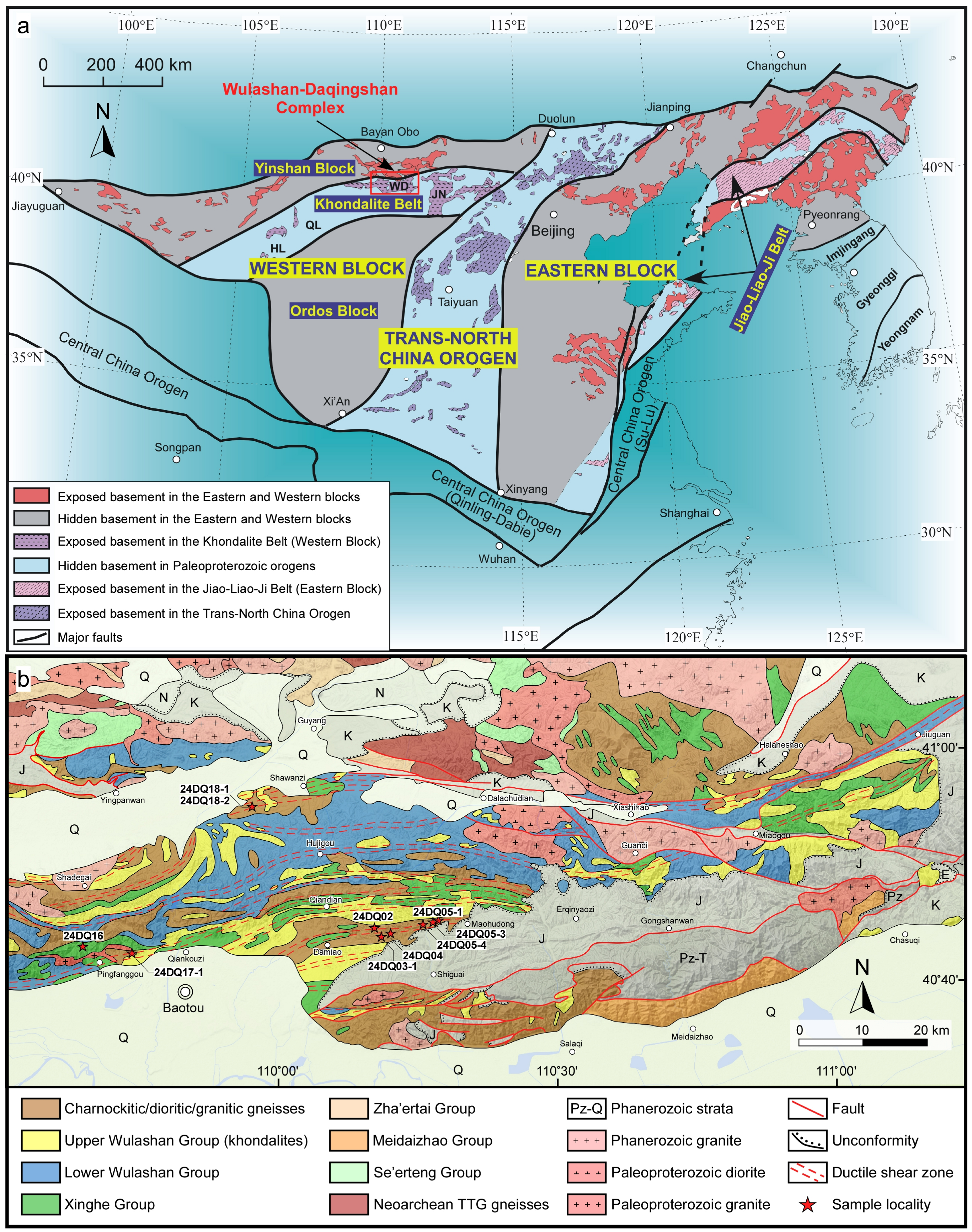
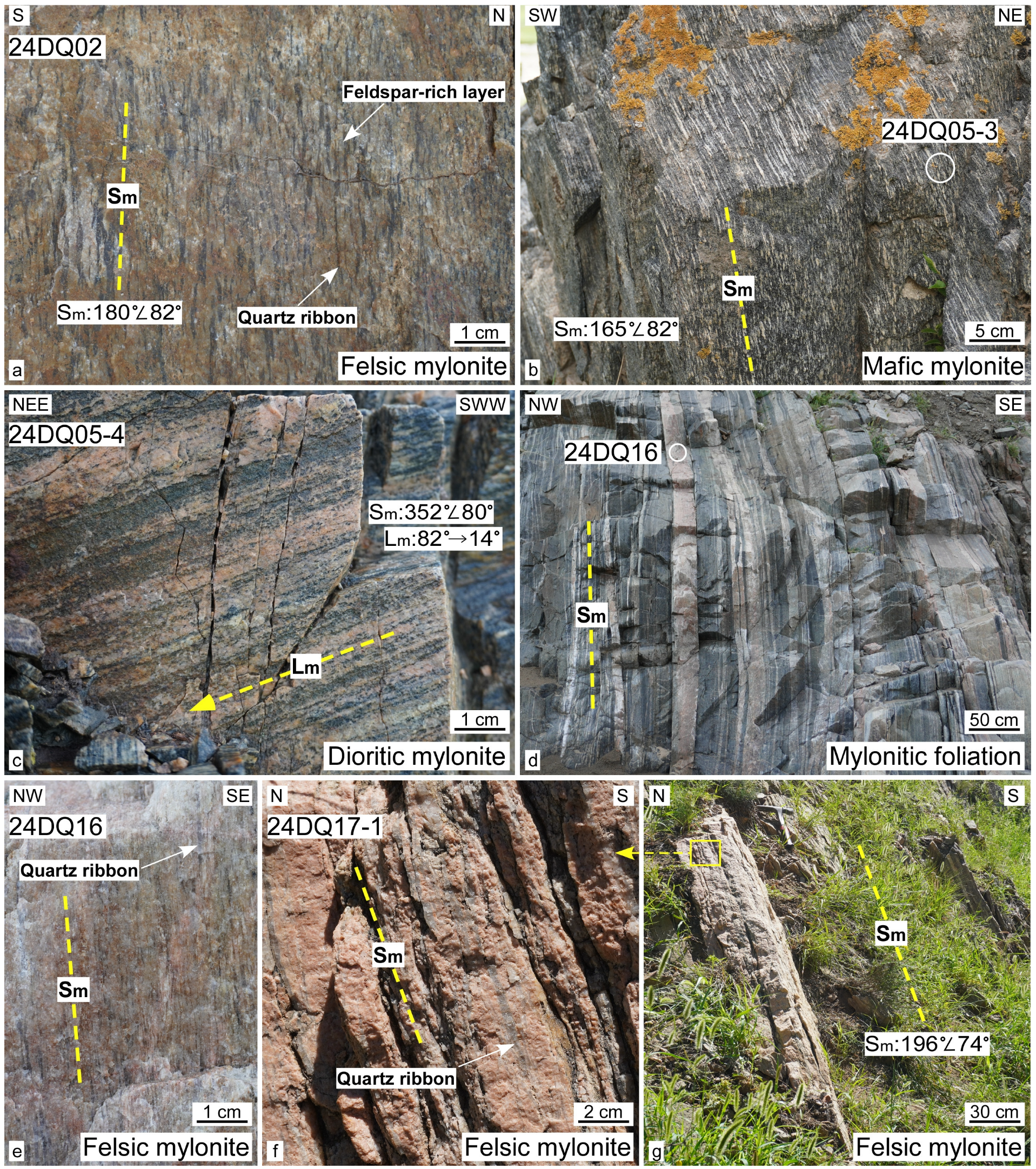
Numerous geochronological investigations reveal that episodic granitoids in the WDC were mainly dated at 2.55–2.43 Ga, 2.30–2.00 Ga, 1.96–1.93 Ga, and 1.85–1.81 Ga [34,41,47,69,70]. Mafic intrusions roughly yielded crystallization ages of 2.50–2.44 Ga, 2.30–2.10 Ga, 1.97–1.92 Ga, and 1.87–1.82 Ga [34,37,40]. Two major episodes of regional high-grade metamorphism have been constrained at 2.52–2.45 Ga and 1.95–1.80 Ga [33,34,35,36,37,38,39,40,41,65,66,67,68,71,72]. Meanwhile, structural observations show that a series of orogen-parallel strike-slip shear zones remarkably occurred in the WDC (Figure 1b), characterized by high-temperature mylonites, ductile structures and fabrics [16,25,32,73,74,75,76]. These shear zones predominantly strike NE to E, and they commonly developed steep to sub-vertical mylonitic foliations (Sm) that mostly dip 70–85° to N(NW) or S(SE) (Figure 2 and Figure 3; [16,25,73,75]). The mylonitic foliations (Sm) can be observed to bear sub-horizontal stretching lineations (Lm), mainly plunging 5–20° towards (NE)E or (SW)W (Figure 2c; [16,25,73]). It is notable that there are only a few geochronological investigations focused on the WDSZ. For example, Wang et al. (1999) found that an 1819 ± 3 Ma undeformed granitic dyke truncated the shear zone in this region, and its age was considered as the upper bound of the timing of shear deformation [32]. Gong et al. (2014) reported three biotite Ar–Ar ages (1885 ± 20 Ma, 1819 ± 14 Ma and 1814 ± 13 Ma) from mylonites and a magmatic zircon U–Pb age of 1858 ± 21 Ma from a syn-tectonic granitic dyke, and these data were interpreted to roughly reflect the deformation age of the WDSZ [16].
Figure 2.
Typical field photos showing mylonitized rocks in the NE- to E-trending ductile shear zones of the Wulashan–Daqingshan Complex: (a) a felsic mylonite (Sample 24DQ02) suffered shear zone activity and developed nearly E–W-striking mylonitic foliations (Sm). Note that plastically deformed quartz grains generally occur as lobes and ribbons. (b) Meta-mafic intrusions were reworked by ductile shear deformation to become mafic mylonites (Sample 24DQ05-3). (c) A dioritic mylonite (Sample 24DQ05-4) features the steep mylonitic foliations (Sm) with shallowly NEE-plunging stretching lineations (Lm). (d,e) Sub-vertical mylonitic foliations in the felsic mylonite (Sample 24DQ16). (f,g) A felsic mylonite (Sample 24DQ17-1) is characterized by strongly aligned quartz ribbons and feldspar-rich layers.
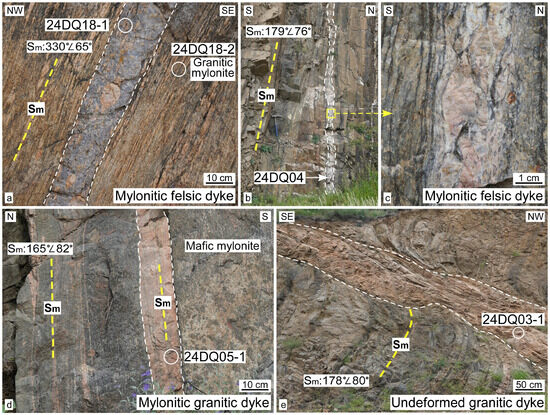
Figure 3.
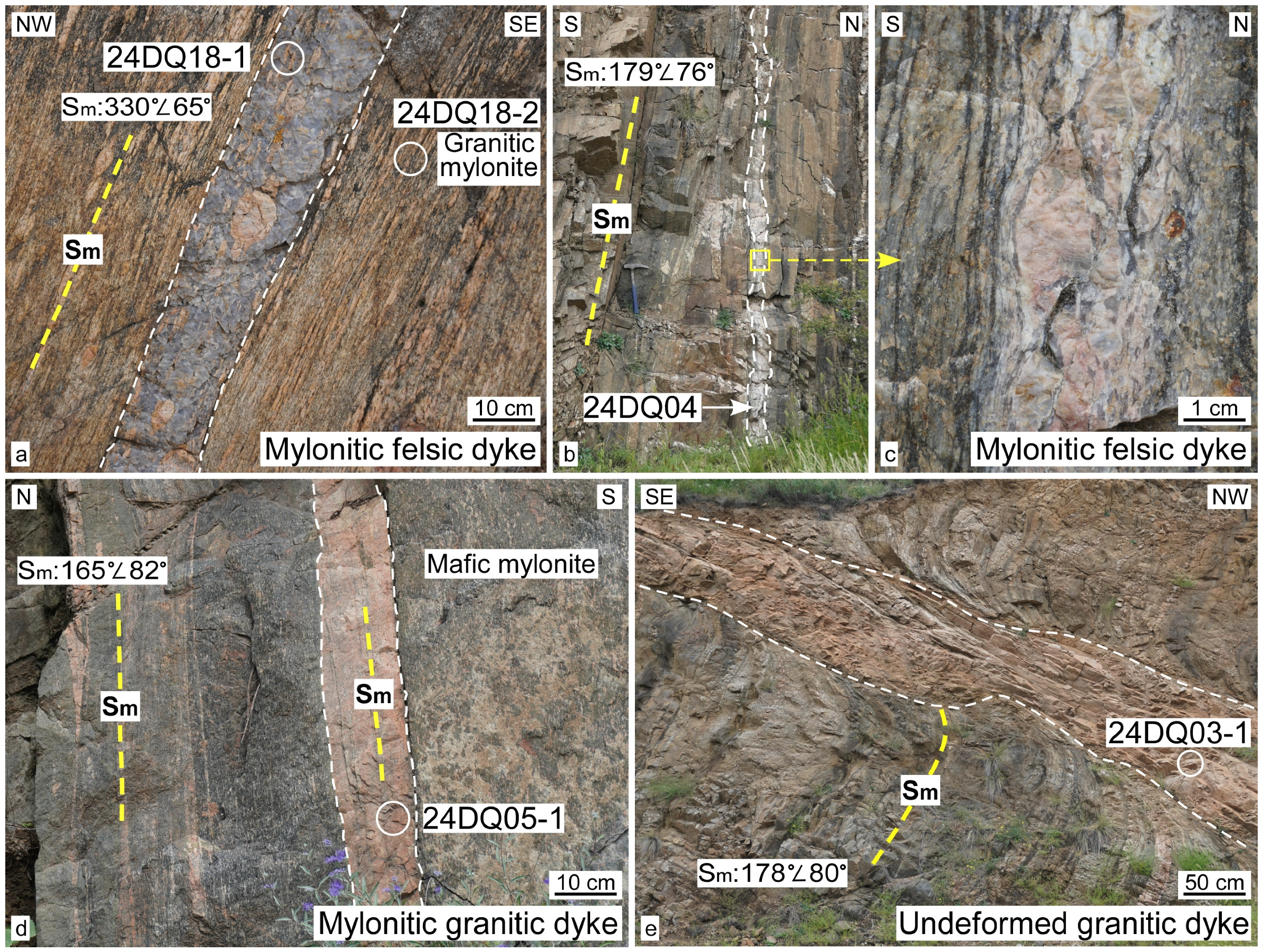
Representative field photos of shear zone-related dykes in the Wulashan–Daqingshan Complex: (a) a mylonitic felsic dyke (Sample 24DQ18-1) occurred within the host granitic mylonite (Sample 24DQ18-2). Note that some K-feldspar porphyroclasts in this deformed dyke appeared as augens and lobes. (b,c) A deformed felsic dyke (Sample 24DQ04) underwent mylonitization, showing parallelism with the mylonitic foliations (Sm) in the host rocks. (d) A pre-kinematic granitic dyke (Sample 24DQ05-1) intruded meta-mafic rocks, and then they together suffered ductile shear deformation to become mylonites. The mafic mylonite in this outcrop is adjacent to Sample 24DQ05-3 in Figure 2b. (e) A post-kinematic undeformed granitic dyke (Sample 24DQ03-1) has clearly crosscut the steep mylonitic foliations (Sm) in the neighboring mylonites.
3. Samples and Methods
3.1. Sample Descriptions
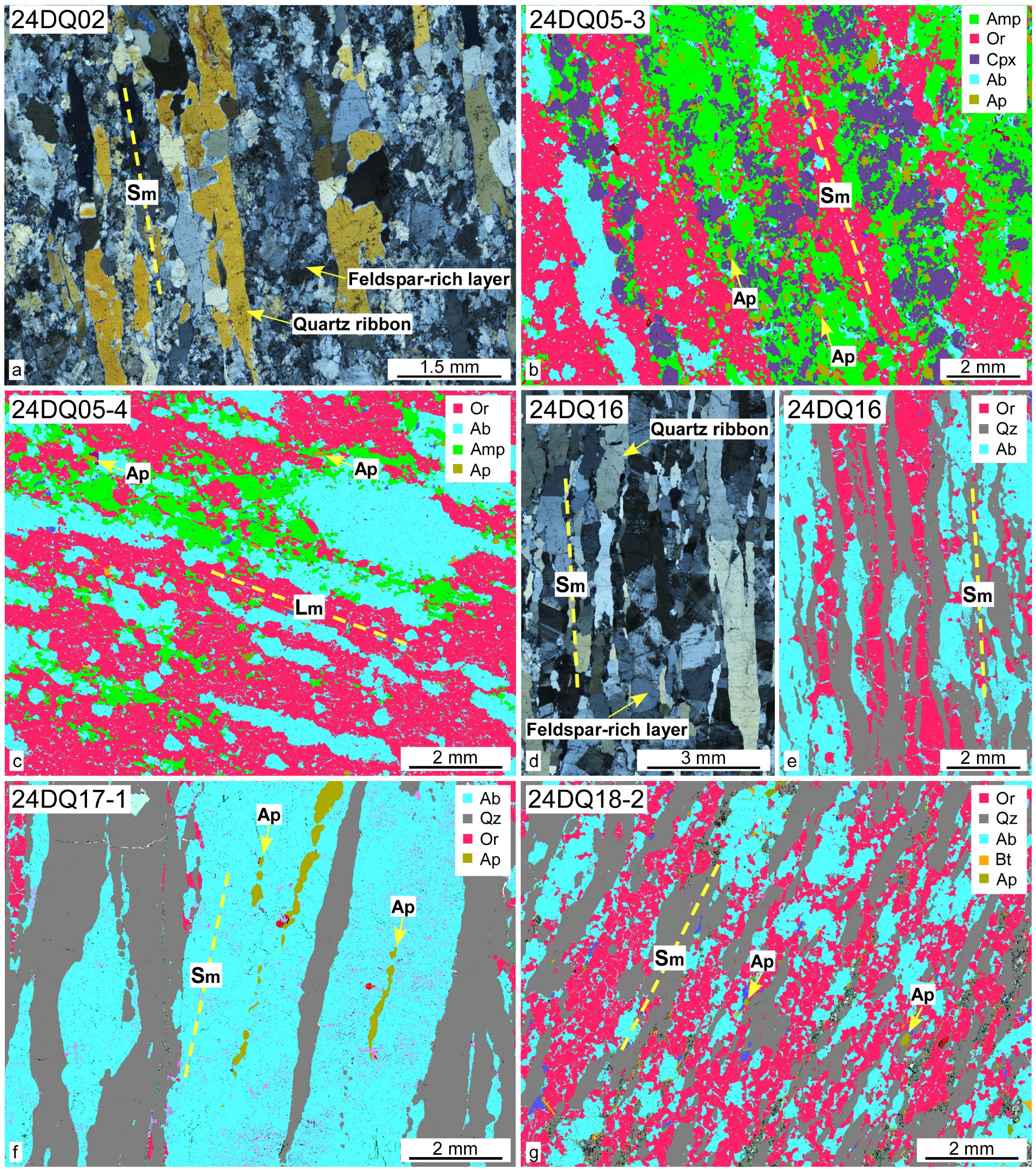
In the WDSZ, we have collected eight samples of felsic, granitic, dioritic and mafic mylonites (Figure 2 and Figure 3a–c) for apatite U–Pb dating, and two shear zone-related intrusions (Figure 3d,e) for zircon U–Pb dating, respectively. Of these, felsic and granitic mylonites (Samples 24DQ02, 04, 16, 17-1, 18-1 and 18-2) generally developed the mylonitic foliations (Sm), typically defined by the preferential orientation of lobate- to rectangular-shaped quartz ribbons and fine-grained recrystallized feldspar-rich layers (e.g., Figure 2a,e,f and Figure 4a,d–f). These textures suggest that the ductile deformation probably happened at high-temperature conditions up to 650 °C [3,6]. The dioritic mylonite (Sample 24DQ05-4) is mainly composed of strongly aligned amphibole, albite and orthoclase aggregates (Figure 2c and Figure 4c). The mafic mylonite (Sample 24DQ05-3) dominantly comprises preferentially oriented amphibole, clinopyroxene, orthoclase and albite grains (Figure 2b and Figure 4b). In the thin sections, apatite grains are commonly observed to appear along the mylonitic foliations (Sm) or stretching lineations (Lm) (e.g., Figure 4b,c,f,g), indicative of their syn-kinematic (re)crystallization. Additionally, a pre-existing granitic dyke (Sample 24DQ05-1) was reworked by shear zone activity to become granitic mylonite (Figure 3d), suggesting that it probably formed prior to the mylonitization. A post-kinematic undeformed granitic dyke (Sample 24DQ03-1) clearly cut the mylonitic foliations in the neighboring mylonites (Figure 3e), indicating that this dyke was emplaced later than the shear deformation.
Figure 4.
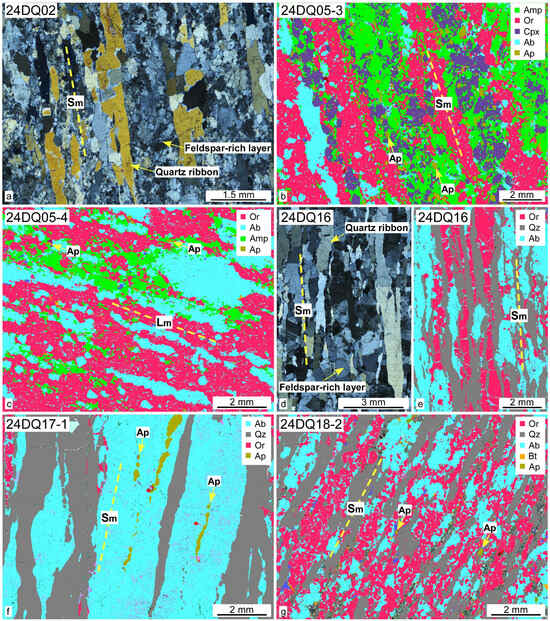
Typical photomicrographs and TIMA mineral scanning map of mylonites: (a) the felsic mylonite (Sample 24DQ02) is mainly featured by the preferential orientation of quartz ribbons and feldspar-rich layers. (b) Mylonitic foliations (Sm) in the mafic mylonite (Sample 24DQ05-3) are shown by strongly aligned amphibole, orthoclase, clinopyroxene, and albite grains. (c) Stretching lineations (Lm) in the dioritic mylonite (Sample 24DQ05-4) are remarkably defined by the alignment of orthoclase, albite, and amphibole aggregates. (d–f) The felsic mylonites (Samples 24DQ16 and 24DQ17-1) are characterized by polycrystalline quartz ribbons with lobate to rectangular shape, separated by fine-grained recrystallized layers of orthoclase and albite. (g) The granitic mylonite (Sample 24DQ18-2) mainly consists of preferentially oriented orthoclase, quartz, albite, and biotite grains. Note that apatite grains generally occur along the mylonitic foliations (Sm) or stretching lineations (Lm), indicative of their syn-kinematic (re)crystallization. Ab, albite; Or, orthoclase; Qz, quartz; Amp, amphibole; Cpx, clinopyroxene; Ap, apatite; Bt, biotite. (a,d) cross-polarized light; (b,c,e,f) mineral-phase scanning images.
3.2. Analytical Methods
Mineral-phase scanning and apatite and zircon U–Pb dating in this study were conducted at Guangzhou Tuoyan Analytical Technology Co., Ltd., Guangzhou, China. Of these, mineral-phase scanning of thin sections was performed by TESCAN Integrated Mineral Analyzer (TIMA), using a TESCAN MIRA3 scanning electron microscope (TESCAN Group, Brno, Czech Republic). Apatite and zircon grains were separated from ten rock samples as mentioned above, and U–Pb dating was conducted by Laser Ablation Inductively Coupled Plasma Mass Spectrometry (LA-ICP-MS), following the analytical procedures described in [77,78]. The software Iolite 4.0 was employed for off-line raw data reduction [79]. Age calculations, Tera–Wasserburg (T–W) and Concordia diagrams were generated using IsoplotR (version 6.8) [80]. Apatite and zircon U–Pb data in this study have been provided as Supplementary Materials (Tables S1 and S2).
4. Results
4.1. Apatite U–Pb Geochronology of Mylonites
4.1.1. Sample 24DQ02
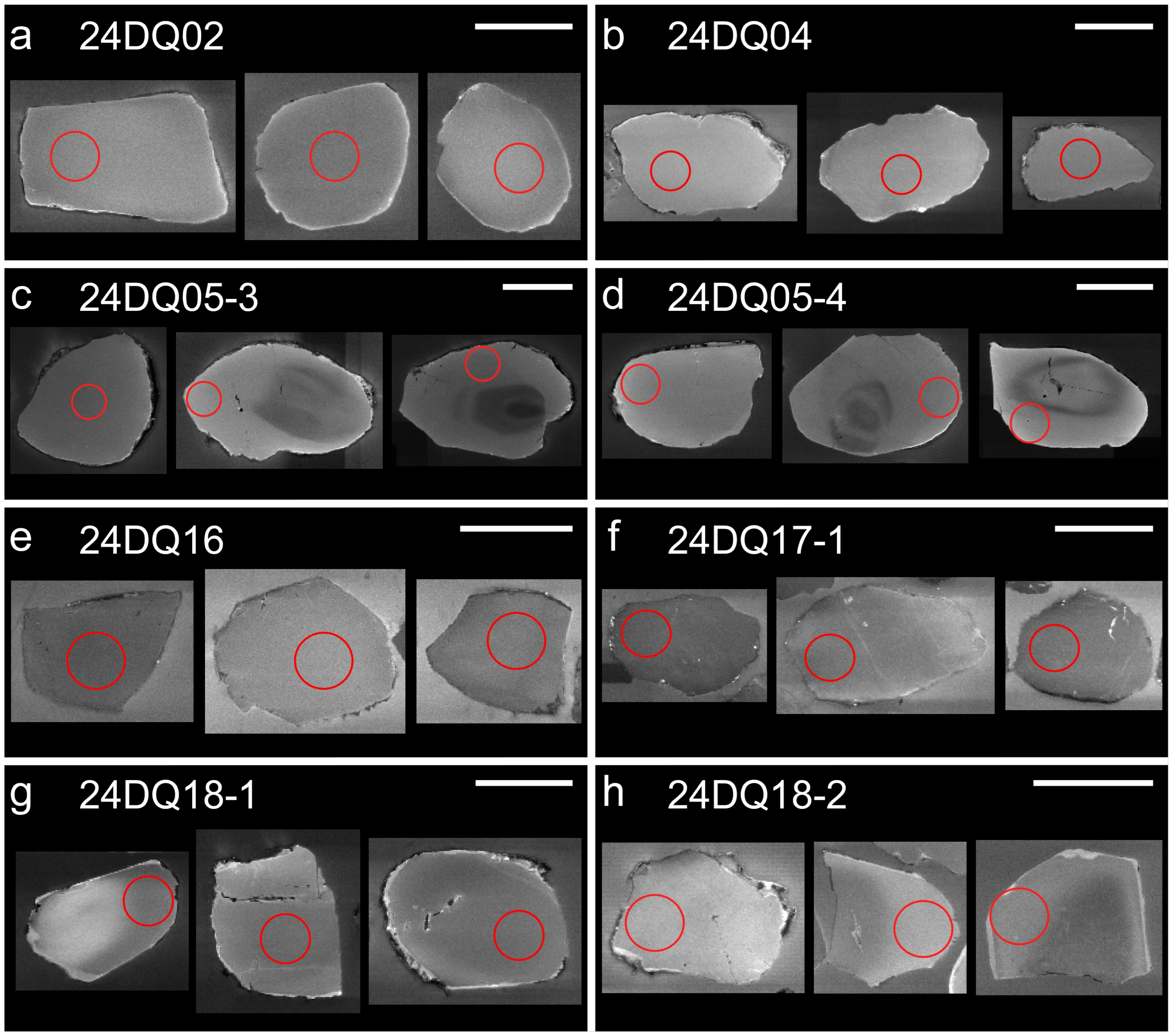
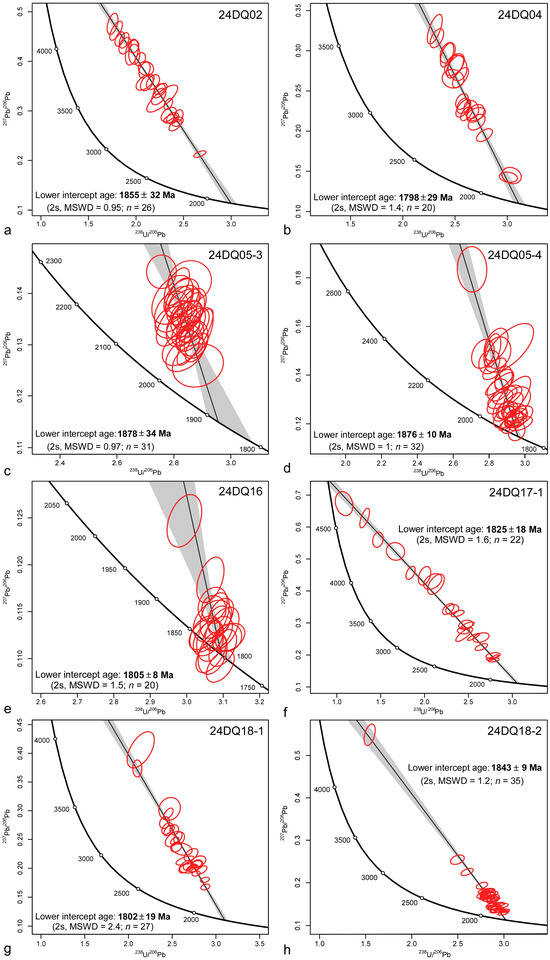
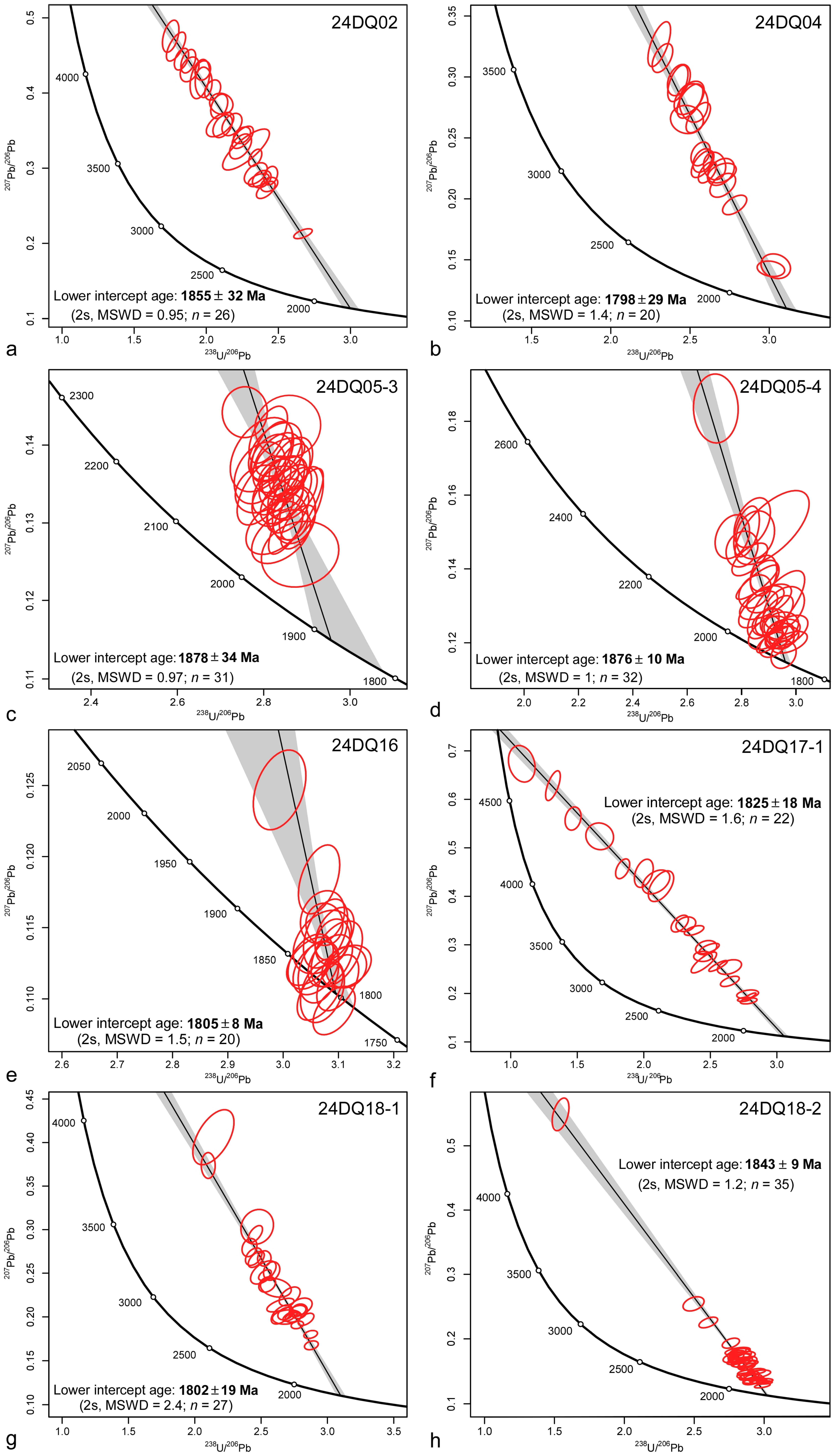
Apatite grains separated from the felsic mylonite (Sample 24DQ02) are euhedral to subhedral in morphology, varying from 100 to 200 μm in grain size. In the cathodoluminescence (CL) images, almost all apatite grains have homogeneous structures (Figure 5a). Totally, twenty-six apatite grains were analyzed in this sample (Table S1), and these data defined a lower intercept age of 1855 ± 32 Ma in the Tera–Wasserburg diagram (MSWD = 0.95, n = 26; Figure 6a).
Figure 5.
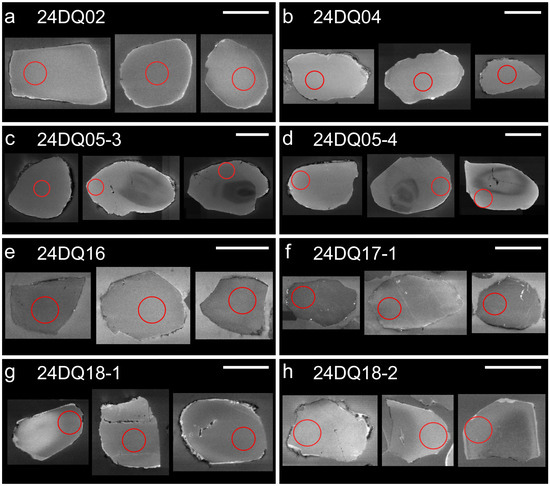
Representative CL images of apatite grains from mylonites. (a) Sample 24DQ02. (b) Sample 24DQ04. (c) Sample 24DQ05-3. (d) Sample 24DQ05-4. (e) Sample 24DQ16. (f) Sample 24DQ17-1. (g) Sample 24DQ18-1. (h) Sample 24DQ18-2. Red circles indicate the locations of analytical spots. The white scale bars are 100 µm.
Figure 6.
Tera–Wasserburg diagrams showing apatite U–Pb dating results of mylonites. (a) Sample 24DQ02. (b) Sample 24DQ04. (c) Sample 24DQ05-3. (d) Sample 24DQ05-4. (e) Sample 24DQ16. (f) Sample 24DQ17-1. (g) Sample 24DQ18-1. (h) Sample 24DQ18-2.
4.1.2. Sample 24DQ04
This felsic mylonite (Sample 24DQ04) contains apatite grains that are generally subhedral and 150–200 μm in size. The CL images reveal that they are typically characterized by homogeneous and structureless grains (Figure 5b). Twenty apatite grains have been analyzed in this sample (Table S1), and they yielded a lower intercept age of 1798 ± 29 Ma (MSWD = 1.4, n = 20) in the Tera–Wasserburg diagram (Figure 6b).
4.1.3. Sample 24DQ05-3
In this mafic mylonite (Sample 24DQ05-3), apatite grains are mainly subhedral to anhedral, with grain sizes of 150–300 μm. The CL images show that these apatite grains are generally homogeneous and structureless (Figure 5c). Meanwhile, some apatite grains exhibit clear core-rim textures, of which the cores are chaotic, surrounded by structureless rims. Thirty-one spots were conducted on the apatite rims and homogeneous grains in this sample (Table S1). They displayed a well-constrained lower intercept age of 1878 ± 34 Ma (MSWD = 0.97, n = 31) in the Tera–Wasserburg diagram (Figure 6c).
4.1.4. Sample 24DQ05-4
Apatite grains from the dioritic mylonite (Sample 24DQ05-4) are commonly subhedral in morphology and 100–250 μm in grain size. In the CL images (Figure 5d), some apatite grains have low-luminescent nebulous cores with structureless rims, and the other grains are homogeneous. In this sample, thirty-two data points on the homogeneous apatite grains and rims were analyzed (Table S1), and they gave a lower intercept age of 1876 ± 10 Ma (MSWD = 1, n = 32; Figure 6d) in the Tera–Wasserburg diagram.
4.1.5. Sample 24DQ16
In the felsic mylonite (Sample 24DQ16), apatite grains are euhedral to subhedral, and their grain sizes vary from 100 to 200 μm. Most of these grains display homogeneous internal textures in the CL images (Figure 5e). Fourteen apatite grains from this sample have been analyzed (Table S1), and they yielded a lower intercept age of 1805 ± 8 Ma (MSWD = 1.5, n = 14) in the Tera–Wasserburg diagram (Figure 6e).
4.1.6. Sample 24DQ17-1
Apatite grains collected from the felsic mylonite (Sample 24DQ17-1) mainly exhibit subhedral to anhedral morphology, with grain sizes of 100–250 μm. In the CL images, they are generally characterized by low-luminescent homogeneous grains (Figure 5f). A total of twenty-two grains were analyzed in this sample (Table S1). In the Tera–Wasserburg diagram, they well defined a lower intercept age of 1825 ± 18 Ma (MSWD = 1.6, n = 22; Figure 6f).
4.1.7. Sample 24DQ18-1
The felsic mylonite (Sample 24DQ18-1) has apatite grains that are euhedral to subhedral and 100–200 μm in grain size. The CL images show that apatite grains dominantly exhibit homogeneous structures, and some of them contain nebulous cores with structureless rims (Figure 5g). In this sample, twenty-seven data points were performed on the apatite rims and homogeneous grains (Table S1), and they gave a lower intercept age of 1802 ± 19 Ma (MSWD = 2.4, n = 27; Figure 6g) in the Tera–Wasserburg diagram.
4.1.8. Sample 24DQ18-2
Apatite grains separated from the granitic mylonite (Sample 24DQ18-2) are euhedral to subhedral in morphology, ranging from 100 to 200 μm in grain size. The CL images show that some apatite grains have dark, chaotic cores surrounded by structureless rims, and the remaining grains are homogeneous (Figure 5h). A total of thirty-five spots were analyzed on the apatite rims and homogeneous grains (Table S1). They yielded a lower intercept age of 1843 ± 9 Ma (MSWD = 1.2, n = 35; Figure 6h) in the Tera–Wasserburg diagram.
4.2. Zircon U–Pb Geochronology of Shear Zone-Related Dykes
4.2.1. Pre-Kinematic Mylonitic Granitic Dyke (Sample 24DQ05-1)
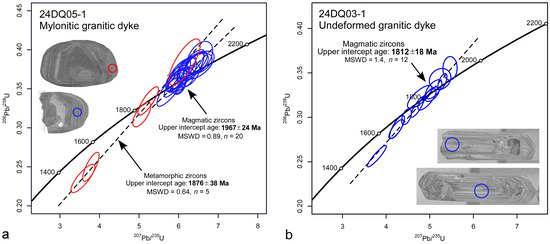
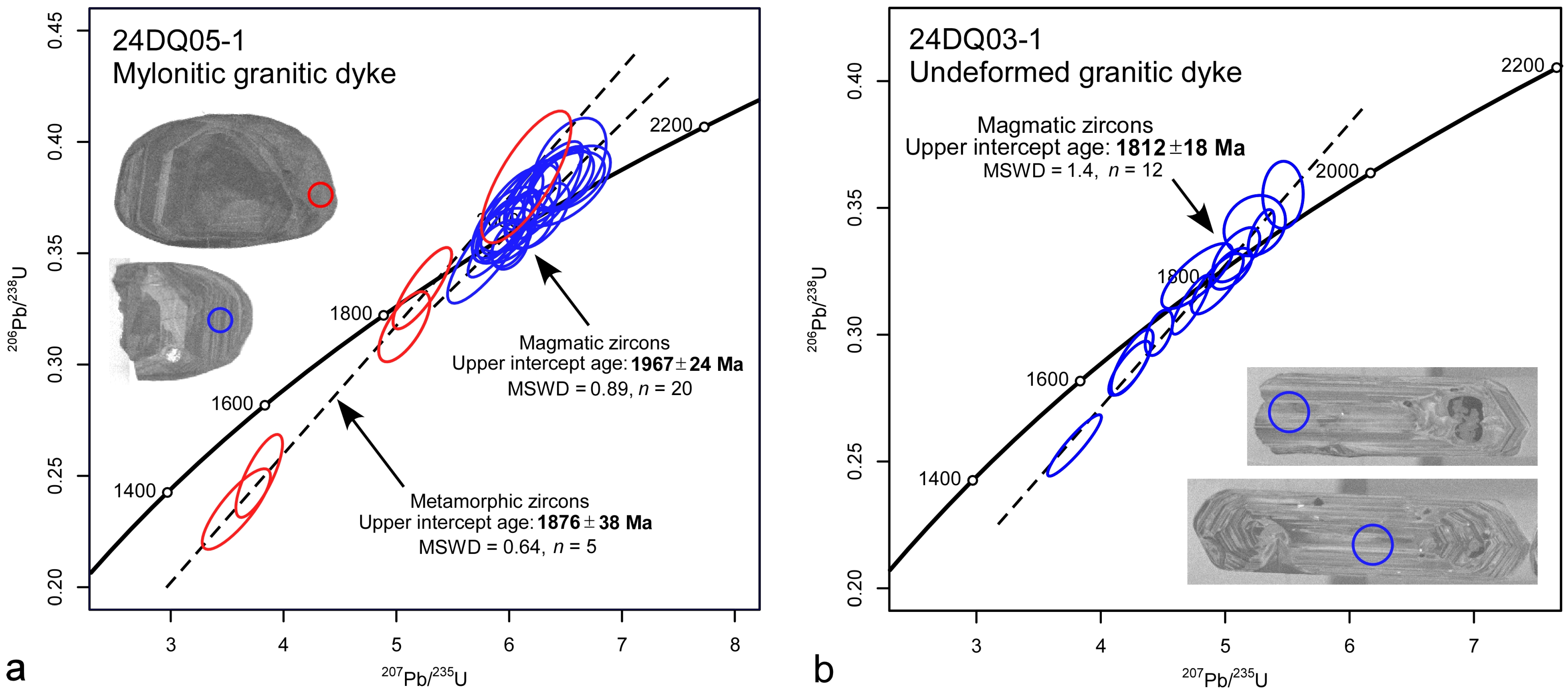
In this mylonitized granitic dyke (Sample 24DQ05-1), zircon grains are mainly subhedral to anhedral, stubby in shape, and they vary from 100 to 250 μm in grain size. The CL images reveal that these zircon grains are characterized by typical core-rim textures (Figure 7a). Of these, the zircon cores exhibit concentrically oscillatory zoning, interpreted to be of magmatic origin. These cores are commonly surrounded by low luminescent, chaotic or structureless rims, regarded to result from metamorphic recrystallization and overgrowth. In total, twenty-five data points were analyzed in this sample (Table S2). Twenty spots were conducted on the oscillatory-zoned cores, and these analyses showed a well-constrained upper intercept age of 1967 ± 24 Ma (MSWD = 0.89, n = 20) in the Concordia diagram (Figure 7a), considered as the emplacement age of this pre-kinematic granitic dyke. Meanwhile, the remaining five spots were undertaken on the metamorphic overgrowth rims, and these data yielded an upper intercept age of 1876 ± 38 Ma (MSWD = 0.64, n = 5; Figure 7a).
Figure 7.
Typical CL images of zircons and concordia diagrams of their U–Pb dating results. (a) Sample 24DQ05-1. (b) Sample 24DQ03-1. Blue circle/ellipse, magmatic zircon; red circle/ellipse, metamorphic zircon. Circles indicate the analytical spots with a diameter of 30 µm.
4.2.2. Post-Kinematic Undeformed Granitic Dyke (Sample 24DQ03-1)
Zircon grains separated from the granitic dyke (Sample 24DQ03-1) are mainly euhedral to subhedral and prismatic in morphology, with grain sizes of 100–150 μm. The CL images show that almost all these zircon grains are concentrically oscillatory-zoned (Figure 7b), indicative of magmatic origin. A total of twelve zircon grains were analyzed in this sample (Table S2), and they well defined a discordia line with an upper intercept age of 1812 ± 18 Ma (MSWD = 1.4, n = 12; Figure 7b) in the Concordia diagram. It is interpreted as the crystallization age of this post-kinematic granitic dyke.
5. Discussion
5.1. Age Constraints from Shear Zone-Related Intrusions
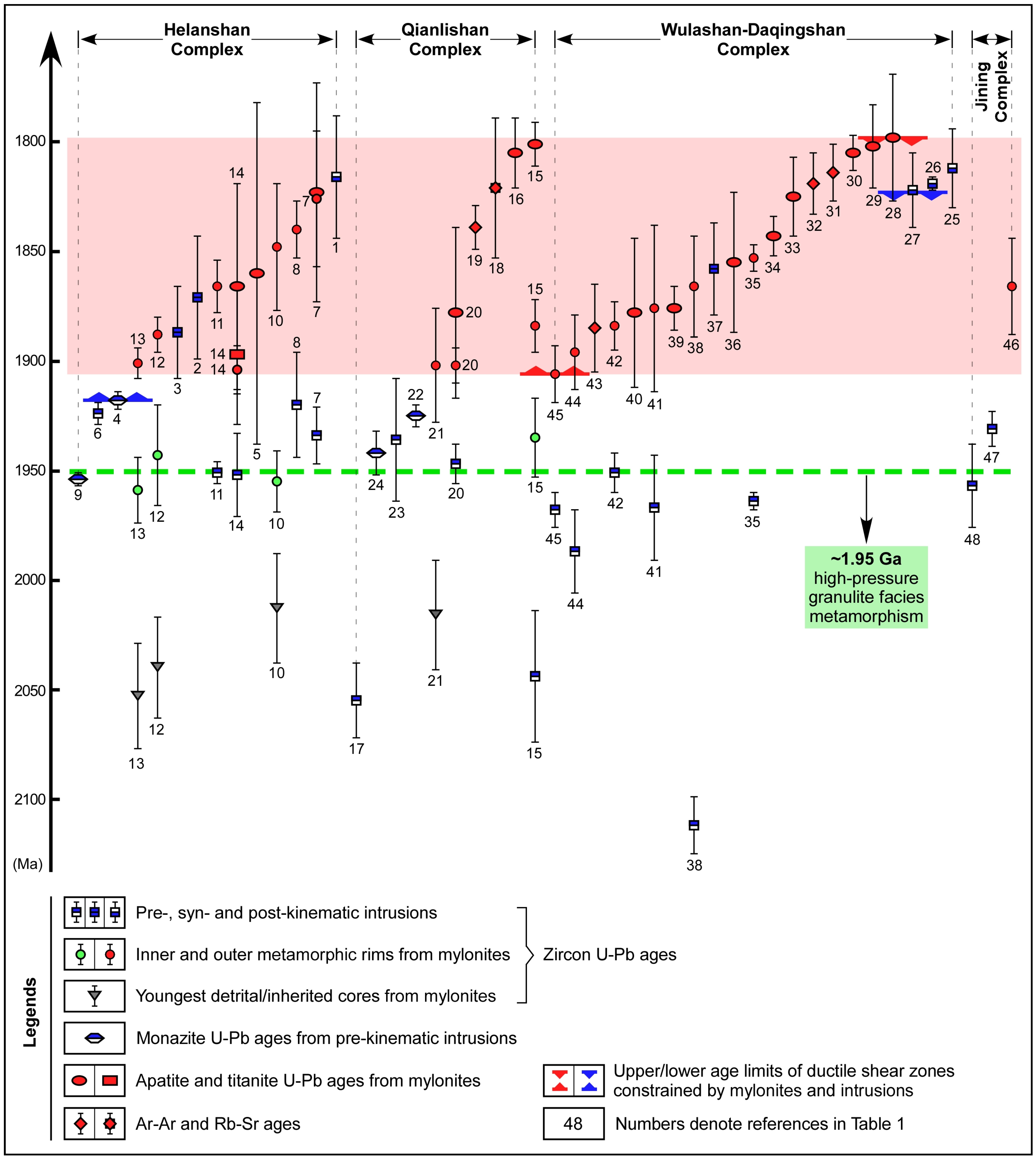
Combined with field-based structural observations, the formation ages of shear zone-related intrusions can indirectly put irreplaceable constraints on the timing of shear deformation in the WDC. As shown in Table 1 and Figure 8, we have compiled available geochronological data from orogen-parallel ductile shear zones in different complexes of the Khondalite Belt. In the WDSZ, we found a pre-kinematic granitic dyke (Sample 24DQ05-1) that was reworked by the shear zone activity and gave a magmatic zircon U–Pb age of 1967 ± 24 Ma (Figure 3d and Figure 7a). Its crystallization age provides a lower bound on the timing of ductile shear deformation. Similarly, four pre-existing intrusions have been affected by shearing in the WDC, and they were dated at 1987 ± 19 Ma, 1968 ± 8 Ma, 1964 ± 4 Ma and 1951 ± 9 Ma (Table 1) [40,41]. These emplacement ages imply that the WDSZ occurred at some time after 1951 ± 9 Ma (Figure 8). In the WDC, a syn-kinematic granitic dyke appeared along the mylonitic foliations and yielded a formation age of 1858 ± 21 Ma, considered to roughly reflect the deformation age of the WDSZ [16]. Later, a post-kinematic undeformed granitic dyke (Sample 24DQ03-1) obviously crosscut the mylonitic foliations (Sm) (Figure 3e). It showed a magmatic zircon U–Pb age of 1812 ± 18 Ma (Figure 7b), interpreted to place an upper time limit on the shearing (Figure 8). This is coherent with the observation that two such post-kinematic granitic dykes in the WDSZ gave similar ages of 1819 ± 3 Ma and 1822 ± 17 Ma [32,41]. Taken together, the above-stated pre-, syn-, and post-kinematic intrusions indicate that the development of the WDSZ has probably happened at some time between 1951 ± 9 Ma and 1822 ± 17 Ma (Figure 8).
Table 1.
Summary of available shear zone-related geochronological data in the Khondalite Belt.
Figure 8.
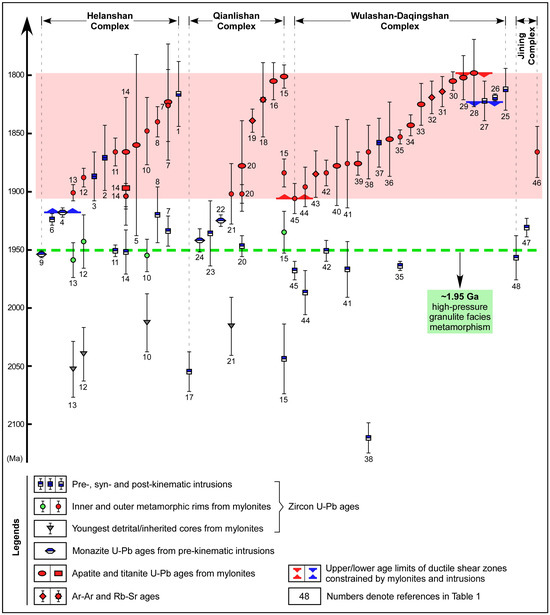
Summary of available shear zone-related geochronological data in the Khondalite Belt. The descriptions, age interpretations, and references of forty-eight dating samples are listed in Table 1. See the text for details.
5.2. Age Constraints from Mylonites in the WDSZ
New geochronological data obtained by directly dating mylonites are crucial to assessing the deformation age of the WDSZ. In this study, the 1967 ± 24 Ma granitic dyke (Sample 24DQ05-1) suffered mylonitization, and it also contained zircon overgrowth rims of metamorphic origin, yielding a U–Pb age of 1876 ± 38 Ma (Figure 3d and Figure 7a). We believe that this metamorphic age approximately reflects the timing of shear zone activity (Figure 8). This inference is supported by five other metamorphic zircon U–Pb ages estimated from mylonitized rocks, ranging from 1906 ± 13 Ma to 1853 ± 6 Ma (Table 1) [40,41]. Notably, we conducted apatite U–Pb dating of eight samples of felsic, granitic, dioritic and mafic mylonites, and they gave a range of apatite U–Pb ages between 1878 ± 34 Ma and 1798 ± 29 Ma (Figure 2, Figure 3 and Figure 6), interpreted to record the deformation age of shearing (Figure 8). These apatite U–Pb ages are in good agreement with three biotite Ar–Ar ages of 1885 ± 20 Ma, 1819 ± 14 Ma and 1814 ± 13 Ma obtained from mylonites in the WDSZ [16]. Based on these zircon, apatite U–Pb ages, and biotite Ar–Ar ages, we regard that the WDSZ most likely developed in the period of 1906–1798 Ma (Figure 8), consistent with the age constraints from shear zone-related intrusions within error.
5.3. Synthesis of Geochronological Constraints
The NE- to E-trending orogen-parallel ductile shear zones commonly occur in the Helanshan, Qianlishan, Wulashan–Daqingshan and Jining Complexes of the Khondalite Belt [16,32,53,54,55,56,57,81], and it is thus necessary to combine geochronological data in different complexes to robustly evaluate the deformation age of the shearing (Table 1; Figure 8). In the Helanshan Complex, seven granitic dykes that predated the shear deformation yielded magmatic zircon and monazite U–Pb ages between 1954 ± 3 Ma and 1918 ± 4 Ma [55,56,81]. Comparably, four pre-existing granitic dykes in the Qianlishan Complex showed crystallization ages from 1947 ± 9 Ma to 1925 ± 5 Ma [27,57,81]. Similar magmatic zircon U–Pb ages (1957 ± 19 Ma and 1931 ± 8 Ma) from two pre-kinematically emplaced intrusions have also been reported in the Jining Complex [54,84]. These U–Pb ages are broadly comparable to those dating results (1987 ± 19 Ma to 1951 ± 9 Ma; this study, [40,41]) from five pre-kinematic intrusive rocks in the WDSZ. Hence, we interpret that the above-stated emplacement ages of 1987–1918 Ma provide a maximum age constraint at ~1918 Ma (Figure 8). Moreover, an undeformed leucocratic dyke that was dated at 1816 ± 28 Ma intruded mylonites in the Helanshan Complex [56]. Its formation age was largely coeval with three such post-kinematic intrusions (1822 ± 17 Ma, 1819 ± 3 Ma and 1812 ± 18 Ma; this study, [32,41]) in the WDC, and they broadly provide a minimum age constraint for shearing. Consequently, these geochronological data from pre- and post-kinematic intrusions confine the timing of orogen-parallel shear zone activity in the Khondalite Belt to some time between ~1918 Ma and ~1822 Ma (Figure 8).
In addition, the deformation age of ductile shear zones in the Helanshan Complex has also been estimated at 1904–1823 Ma (Table 1; Figure 8), evidenced by metamorphic zircon (1904–1826 Ma, [55,56]), titanite (1897 ± 32 Ma, [81]) and apatite (1866–1823 Ma, [81]) U–Pb ages from mylonites. This is consistent with the viewpoint that the mylonitization in the Qianlishan Complex roughly happened in the period of 1902–1801 Ma, recorded by metamorphic zircon (1902 ± 8 Ma, 1902 ± 26 Ma, [57]) and apatite (1878–1801 Ma, [81]) U–Pb ages, biotite Ar–Ar age (1839 ± 10 Ma, [83]) and Rb–Sr mineral isochron age (1821 ± 32 Ma, [82]). Moreover, a pelitic mylonite in the Jining Complex yielded a metamorphic zircon U–Pb age of 1866 ± 32 Ma, broadly representing the timing of shear deformation [54]. These geochronological data are also supported by the age results of 1906–1798 Ma in the WDSZ, and they dominantly fall into the age range from ~1918 Ma to ~1822 Ma, inferred from the above-stated pre- and post-kinematic intrusions (Figure 8). Therefore, the geochronological data from mylonites indicate that the orogen-parallel ductile shear zones in the Helanshan (1904–1823 Ma), Qianlishan (1902–1801 Ma), Wulashan–Daqingshan (1906–1798 Ma) and Jining (~1866 Ma) Complexes have comparable deformation ages at c.a. 1.90–1.80 Ga (Figure 8). These late Orosirian (1.90–1.80 Ga) shear zones were the product of the prolonged collisional orogeny between the Yinshan and Ordos Blocks, and they have probably accommodated post-collisional deformation and displacements in the Khondalite Belt [21,22,23,28,29,56,57].
6. Conclusions
The NE- to E-trending ductile shear zones are the most conspicuous structures in the Wulashan–Daqingshan Complex. In this study, magmatic zircon U–Pb ages of the pre- and post-kinematic granitic dykes broadly provide the maximum and minimum age constraints for shearing at 1967 ± 24 Ma and 1812 ± 18 Ma. Apatite and metamorphic zircon U–Pb ages of mylonites range from 1878 ± 34 Ma to 1798 ± 29 Ma, interpreted to represent the timing of shear deformation. Integrated with available data, we infer that the orogen-parallel ductile shear zones in the Helanshan, Qianlishan, Wulashan–Daqingshan and Jining Complexes of the Khondalite Belt have comparable deformation ages of 1904–1823 Ma, 1902–1801 Ma, 1906–1798 Ma and ~1866 Ma, respectively. These late Orosirian (1.90–1.80 Ga) shear zones resulted from the prolonged orogenic processes of the Khondalite Belt, in response to the collision between the Yinshan and Ordos Blocks.
Supplementary Materials
The following supporting information can be downloaded at https://www.mdpi.com/article/10.3390/min16080817/s1: Table S1: LA-ICP-MS apatite U–Pb data of mylonites in the Wulashan–Daqingshan Complex; Table S2: LA-ICP-MS zircon U–Pb data of shear zone-related dykes in the Wulashan–Daqingshan Complex.
Author Contributions
Conceptualization, H.Q. and S.W.; methodology, H.Q., Z.G., and Y.Z.; software, H.Q., Z.G., Y.Z., and X.L.; investigation, H.Q., Z.G., Y.Z., X.L., and S.W.; data curation, H.Q.; writing—original draft preparation, H.Q., Z.G., Y.Z., X.L. and S.W.; writing—review and editing, H.Q. and S.W.; supervision, H.Q.; funding acquisition, H.Q. and S.W. All authors have read and agreed to the published version of the manuscript.
Funding
This study was supported by the Science and Technology Department of Sichuan Province (Grant No. 2024ZYD0085), the National Natural Science Foundation of China (Grant No. 42302222), the Leshan Normal University (Grant No. KYCXTD2023-2 and RC202009), and the Provincial Natural Science Foundation of Hunan (Grant No. 2024JJ6102).
Data Availability Statement
Data are available in this article and its Supplementary Materials.
Acknowledgments
The editors and anonymous reviewers are thanked for their valuable and constructive comments on the manuscript.
Conflicts of Interest
The authors declare no conflicts of interest.
References
- Ramsay, J.G.; Graham, R.H. Strain variation in shear belts. Can. J. Earth Sci. 1970, 7, 786–813. [Google Scholar] [CrossRef] [Scilit]
- Ramsay, J.G. Shear zone geometry: A review. J. Struct. Geol. 1980, 2, 83–99. [Google Scholar] [CrossRef] [Scilit]
- Fossen, H.; Cavalcante, G.C.G. Shear zones—A review. Earth-Sci. Rev. 2017, 171, 434–455. [Google Scholar] [CrossRef] [Scilit]
- Oriolo, S.; Oyhantçabal, P.; Wemmer, K.; Basei, M.A.S.; Benowitz, J.; Pfander, J.; Hannich, F.; Siegesmund, S. Timing of deformation in the Sarandí del Yí Shear Zone, Uruguay: Implications for the amalgamation of Western Gondwana during the Neoproterozoic Brasiliano-Pan-African Orogeny. Tectonics 2016, 35, 754–771. [Google Scholar] [CrossRef] [Scilit]
- Kirkland, C.L.; Olierook, H.K.; Danišík, M.; Liebmann, J.; Hollis, J.; Ribeiro, B.V.; Rankenburg, K. Dating mylonitic overprinting of ancient rocks. Commun. Earth Environ. 2023, 4, 47. [Google Scholar] [CrossRef] [Scilit]
- Passchier, C.W.; Trouw, R. Microtectonics; Springer: Berlin/Heidelberg, Germany, 2005. [Google Scholar]
- Law, R.D. Deformation thermometry based on quartz c-axis fabrics and recrystallization microstructures: A review. J. Struct. Geol. 2014, 66, 129–161. [Google Scholar] [CrossRef] [Scilit]
- Ribeiro, B.V.; Kirkland, C.L.; Kelsey, D.E.; Reddy, S.M.; Hartnady, M.I.; Faleiros, F.M.; Rankenburg, K.; Liebmann, J.; Korhonen, F.J.; Clark, C. Time-strain evolution of shear zones from petrographically constrained Rb–Sr muscovite analysis. Earth Planet. Sci. Lett. 2023, 602, 117969. [Google Scholar] [CrossRef] [Scilit]
- Cao, S.; Neubauer, F. Deep crustal expressions of exhumed strike-slip fault systems: Shear zone initiation on rheological boundaries. Earth-Sci. Rev. 2016, 162, 155–176. [Google Scholar] [CrossRef] [Scilit]
- Sun, S.; Dong, Y. High temperature ductile deformation, lithological and geochemical differentiation along the Shagou shearzone, Qinling Orogen, China. J. Struct. Geol. 2023, 167, 104791. [Google Scholar] [CrossRef] [Scilit]
- Oriolo, S.; Wemmer, K.; Oyhantçabal, P.; Fossen, H.; Schulz, B.; Siegesmund, S. Geochronology of shear zones—A review. Earth-Sci. Rev. 2018, 185, 665–683. [Google Scholar] [CrossRef] [Scilit]
- Harrigan, C.O.; Trevino, S.F.; Schmitz, M.D.; Tikoff, B. Determining the initiation of shear zone deformation using titanite petrochronology. Earth Planet. Sci. Lett. 2024, 631, 118620. [Google Scholar] [CrossRef] [Scilit]
- Li, W.; Cao, S.; Dong, Y.; Zhan, L.; Tao, L. Crustal anatexis and initiation of the continental-scale Chongshan strike-slip shear zone on the southeastern Tibetan Plateau. Tectonics 2023, 42, e2023TC007864. [Google Scholar] [CrossRef] [Scilit]
- Qiu, E.; Zhang, Y.; Larson, K.P.; Li, B. Dating strike-slip ductile shear through combined zircon-, titanite-and apatite U–Pb geochronology along the southern Tan-Lu Fault zone, East China. Tectonics 2023, 42, e2022TC007734. [Google Scholar] [CrossRef] [Scilit]
- Reiners, P.W.; Ehlers, T.A.; Zeitler, P.K. Past, present, and future of thermochronology. Rev. Mineral. Geochem. 2005, 58, 1–18. [Google Scholar] [CrossRef] [Scilit]
- Gong, W.; Hu, J.; Wu, S.; Chen, H.; Qu, H.; Li, Z.; Liu, Y.; Wang, L. Possible southwestward extrusion of the Ordos Block in the Late Paleoproterozoic: Constraints from kinematic and geochronologic analysis of peripheral ductile shear zones. Precambrian Res. 2014, 255, 716–733. [Google Scholar] [CrossRef] [Scilit]
- Zhang, H.; Hou, G.; Zhang, B.; Tian, W. Kinematics, temperature and geochronology of the Qingyi ductile shear zone: Tectonic implications for late Neoarchean microblock amalgamation in the Western Shandong Province, North China craton. J. Struct. Geol. 2022, 161, 104645. [Google Scholar] [CrossRef] [Scilit]
- van der Pluijm, V.A.; Mezger, K.; Cosca, M.A.; Essene, E.J. Determining the significance of high-grade shear zones by using temperature-time paths, with examples from the Grenville orogen. Geology 1994, 22, 743–746. [Google Scholar] [CrossRef] [Scilit]
- Simonetti, M.; Carosi, R.; Montomoli, C.; Law, R.D.; Cottle, J.M. Unravelling the development of regional-scale shear zones by a multidisciplinary approach: The case study of the Ferrière-Mollières Shear Zone (Argentera Massif, Western Alps). J. Struct. Geol. 2021, 149, 104399. [Google Scholar] [CrossRef] [Scilit]
- Ávila, C.; Archanjo, C.; Viegas, G.; Filho, A.; Hollanda, M. Kinematics, displacement and timing of shear zone junctions: The case of the Taperoá-Patos shear system, Borborema Province, NE Brazil. Tectonophysics 2025, 912, 230859. [Google Scholar] [CrossRef] [Scilit]
- Zhao, G.; Sun, M.; Wilde, S.A.; Li, S. Late Archean to Paleoproterozoic evolution of the North China Craton: Key issues revisited. Precambrian Res. 2005, 136, 177–202. [Google Scholar] [CrossRef] [Scilit]
- Zhao, G.; Cawood, P.A.; Li, S.; Wilde, S.A.; Sun, M.; Zhang, J.; He, Y.; Yin, C. Amalgamation of the North China Craton: Key issues and discussion. Precambrian Res. 2012, 222, 55–76. [Google Scholar] [CrossRef] [Scilit]
- Yin, C.; Zhao, G.; Xiao, W.; Lin, S.; Gao, R.; Zhang, J.; Qian, J.; Gao, P.; Qiao, H.; Li, W. Paleoproterozoic accretion and assembly of the Western Block of North China: A new model. Earth-Sci. Rev. 2023, 241, 104448. [Google Scholar] [CrossRef] [Scilit]
- Guo, J.; Peng, P.; Chen, Y.; Jiao, S.; Windley, B.F. UHT sapphirine granulite metamorphism at 1.93–1.92 Ga caused by gabbronorite intrusions: Implications for tectonic evolution of the northern margin of the North China Craton. Precambrian Res. 2012, 222, 124–142. [Google Scholar] [CrossRef] [Scilit]
- Lu, L.; Xu, X.; Liu, F. Early Precambrian Khondalites in North China; Changchun Publishing House: Changchun, China, 1996. [Google Scholar]
- Yin, C.; Zhao, G.; Sun, M.; Xia, X.; Wei, C.; Zhou, X.; Leung, W. LA-ICP-MS U–Pb zircon ages of the Qianlishan Complex: Constrains on the evolution of the Khondalite Belt in the Western Block of the North China Craton. Precambrian Res. 2009, 174, 78–94. [Google Scholar] [CrossRef] [Scilit]
- Yin, C.; Qiao, H.; Lin, S.; Li, C.; Zhang, J.; Qian, J.; Wu, S. Deformation history of the Qianlishan complex, Khondalite belt, North China: Structures, ages and tectonic implications. J. Struct. Geol. 2020, 141, 104176. [Google Scholar] [CrossRef] [Scilit]
- Qiao, H.; Yin, C.; Xiao, W.; Zhang, J.; Qian, J.; Wu, S. Paleoproterozoic polyphase deformation in the Helanshan Complex: Structural and geochronological constraints on the tectonic evolution of the Khondalite Belt, North China Craton. Precambrian Res. 2022, 368, 106468. [Google Scholar] [CrossRef] [Scilit]
- Qiao, H.; Deng, P.; Li, J. Geochronological constraints on the origin of the Paleoproterozoic Qianlishan gneiss domes in the Khondalite belt of the North China craton and their tectonic implications. Minerals 2023, 13, 1361. [Google Scholar] [CrossRef] [Scilit]
- Wu, S.; Yin, C.; Davis, D.W.; Zhang, J.; Qian, J.; Qiao, H.; Xiao, Y.; Liu, J. Metamorphic evolution of high-pressure felsic and pelitic granulites from the Qianlishan Complex and tectonic implications for the Khondalite Belt, North China Craton. Geol. Soc. Am. Bull. 2020, 132, 2253–2266. [Google Scholar] [CrossRef] [Scilit]
- Wu, S.; Yin, C.; Qian, J.; Qiao, H.; Wang, X.; Xia, Y.; Zhang, Y. Paleoproterozoic ultrahigh-temperature metamorphism in the Helanshan Complex, North China Craton: New constraints from chloritized sapphirine-bearing pelitic granulites. Lithos 2024, 488, 107814. [Google Scholar] [CrossRef] [Scilit]
- Wang, H.; Yuan, G.; Xing, H.; Wang, J. On the tectonic implication for Xiashihao-Jiuguan ductile shear zone in Guyang-Wuchuan area, Inner Mongolia. Prog. Precambrian Res. 1999, 22, 1–20, (In Chinese with English abstract). [Google Scholar] [CrossRef] [Scilit]
- Wang, B.; Wei, C.; Shi, T.; Wang, W.; Liu, X.; Cheng, B. Paleoproterozoic multiple metamorphic overprinting of granulite facies in the Daqingshan area of the North China Craton and its tectonic implications. Geol. Soc. Am. Bull. 2026. [Google Scholar] [CrossRef] [Scilit]
- Dong, C.Y.; Ma, M.Z.; Wilde, S.A.; Liu, S.J.; Li, P.C.; Xu, Z.Y.; Wan, Y.S. The first identification of early Paleoproterozoic (2.46–2.38 Ga) supracrustal rocks in the Daqingshan area, northwestern North China Craton: Geology, geochemistry and SHRIMP U-Pb dating. Precambrian Res. 2022, 377, 106727. [Google Scholar] [CrossRef] [Scilit]
- Jiao, S.J.; Guo, J.H. Paleoproterozoic UHT metamorphism with isobaric cooling (IBC) and followed decompression–heating path in the Khondalite Belt (North China Craton): New evidence from two sapphirine formation processes. J. Metamorph. Geol. 2020, 38, 357–378. [Google Scholar] [CrossRef] [Scilit]
- Wang, B.; Wei, C.J. Identifying ultrahigh-temperature metamorphism in basic granulites. J. Petrol. 2024, 65, egae046. [Google Scholar] [CrossRef] [Scilit]
- Liu, P.; Liu, F.; Liu, C.; Liu, J.; Wang, F.; Xiao, L.; Cai, J.; Shi, J. Multiple mafic magmatic and high-grade metamorphic events revealed by zircons from meta-mafic rocks in the Daqingshan–Wulashan Complex of the Khondalite Belt, North China Craton. Precambrian Res. 2014, 246, 334–357. [Google Scholar] [CrossRef] [Scilit]
- Liu, P.; Liu, F.; Cai, J.; Liu, C.; Liu, J.; Wang, F.; Xiao, L.; Shi, J. Spatial distribution, P–T–t paths, and tectonic significance of high-pressure mafic granulites from the Daqingshan–Wulashan Complex in the Khondalite Belt, North China Craton. Precambrian Res. 2017, 303, 687–708. [Google Scholar] [CrossRef] [Scilit]
- Cai, J.; Liu, F.; Liu, P. Paleoproterozoic multistage metamorphic events in Jining metapelitic rocks from the Khondalite Belt in the North China Craton: Evidence from petrology, phase equilibria modelling and U–Pb geochronology. J. Asian Earth Sci. 2017, 138, 515–534. [Google Scholar] [CrossRef] [Scilit]
- Wan, Y.; Xu, Z.; Dong, C.; Nutman, A.; Ma, M.; Xie, H.; Liu, S.; Liu, D.; Wang, H.; Cu, H. Episodic Paleoproterozoic (~2.45, ~1.95 and ~1.85 Ga) mafic magmatism and associated high temperature metamorphism in the Daqingshan area, North China Craton: SHRIMP zircon U–Pb dating and whole-rock geochemistry. Precambrian Res. 2013, 224, 71–93. [Google Scholar] [CrossRef] [Scilit]
- Liu, S.J.; Dong, C.Y.; Xu, Z.Y.; Santosh, M.; Ma, M.Z.; Xie, H.Q.; Liu, D.Y.; Wan, Y.S. Palaeoproterozoic episodic magmatism and high-grade metamorphism in the North China Craton: Evidence from SHRIMP zircon dating of magmatic suites in the Daqingshan area. Geol. J. 2013, 48, 429–455. [Google Scholar]
- Yin, C.; Zhao, G.; Guo, J.; Sun, M.; Xia, X.; Zhou, X.; Liu, C. U–Pb and Hf isotopic study of zircons of the Helanshan Complex: Constrains on the evolution of the Khondalite Belt in the Western Block of the North China Craton. Lithos 2011, 122, 25–38. [Google Scholar] [CrossRef] [Scilit]
- Qiao, H.; Yin, C.; Li, Q.; He, X.; Qian, J.; Li, W. Application of the revised Ti-in-zircon thermometer and SIMS zircon U-Pb dating of high-pressure pelitic granulites from the Qianlishan-Helanshan Complex of the Khondalite Belt, North China Craton. Precambrian Res. 2016, 276, 1–13. [Google Scholar] [CrossRef] [Scilit]
- Shi, Q.; Shu, R.; Chen, X.; Zhao, G.; Chen, Y.; Wang, Z.; Ma, L.; Xu, Z.; Liu, Z.; Chen, K. Paleoproterozoic granite in the khondalite belt, northern margin of the North China craton: Response to the assembly of the columbia supercontinent. Precambrian Res. 2025, 417, 107640. [Google Scholar] [CrossRef] [Scilit]
- Wu, B.; Long, X.P.; Lan, C.Y.; Zhang, S.T.; Zuo, R.; Wang, J.Y. Paleoproterozoic tectonic evolution of the Khondalite Belt in the North China Craton: Constraints from the geochronology and geochemistry of 1.9–2.3 Ga felsic and basic intrusive rocks in the Jining area. Precambrian Res. 2022, 371, 106570. [Google Scholar] [CrossRef] [Scilit]
- Jiao, S.J.; Fitzsimons, I.C.; Zi, J.W.; Evans, N.J.; McDonald, B.J.; Guo, J.H. Texturally controlled U-Th-Pb monazite geochronology reveals Paleoproterozoic UHT metamorphic evolution in the Khondalite belt, North China craton. J. Petrol. 2020, 61, egaa023. [Google Scholar] [CrossRef] [Scilit]
- Jiang, X.Z.; Yu, S.Y.; Liu, Y.J.; Li, S.Z.; Lv, P.; Peng, Y.B.; Gao, X.Y.; Ji, W.T.; Li, C.Z.; Xie, W.M. Episodic metamorphism and anatexis within the Khondalite Belt, North China Craton: Constraint from Late-Paleoproterozoic fluid-fluxed melting of the Daqingshan Complex. Precambrian Res. 2022, 369, 106504. [Google Scholar] [CrossRef] [Scilit]
- Zhai, M.G. Khondalite revisited-record of special geological processes on Earth. Acta Petrol. Sin. 2022, 96, 2967–2997. [Google Scholar]
- Yin, C.Q.; Zhao, G.C.; Wei, C.J.; Sun, M.; Guo, J.H.; Zhou, X. Metamorphism and partial melting of high-pressure pelitic granulites from the Qianlishan Complex: Constraints on the tectonic evolution of the Khondalite Belt in the North China Craton. Precambrian Res. 2014, 242, 172–186. [Google Scholar] [CrossRef] [Scilit]
- Yin, C.Q.; Zhao, G.C.; Sun, M. High-pressure pelitic granulites from the Helanshan Complex in the Khondalite Belt, North China Craton: Metamorphic P-T path and tectonic implications. Am. J. Sci. 2015, 315, 846–879. [Google Scholar] [CrossRef] [Scilit]
- Cai, J.; Liu, F.; Liu, P.; Liu, C.; Wang, F.; Shi, J. Silica-undersaturated spinel granulites in the Daqingshan complex of the Khondalite Belt, North China Craton: Petrology and quantitative P–T–X constraints. Precambrian Res. 2015, 266, 119–136. [Google Scholar] [CrossRef] [Scilit]
- Jiao, S.J.; Guo, J.H.; Harley, S.L.; Peng, P. Geochronology and trace element geochemistry of zircon, monazite and garnet from the garnetite and/or associated other high-grade rocks: Implications for Palaeoproterozoic tectonothermal evolution of the Khondalite Belt, North China Craton. Precambrian Res. 2013, 237, 78–100. [Google Scholar] [CrossRef] [Scilit]
- Guo, J.H.; Zhai, M.G. Mylonite of granulite facies in Xuwujia, Nei Monggol. Acta Geol. Sin. 1992, 27, 190–192. [Google Scholar]
- Li, X.P.; Yang, Z.Y.; Zhao, G.C.; Grapes, R.; Guo, J.H. Geochronology of khondalite-series rocks of the Jining Complex: Confirmation of depositional age and tectonometamorphic evolution of the North China Craton. Int. Geol. Rev. 2011, 53, 1194–1211. [Google Scholar] [CrossRef] [Scilit]
- Qiao, H.Z.; Yin, C.Q.; Zhang, J.; Qian, J.H.; Wu, S.J. New Discovery of ~1866 Ma high-temperature mylonite in the Helanshan Complex: Marking a late-stage ductile shearing in the Khondalite Belt, North China Craton. Acta Geol. Sin. (Engl. Ed.) 2021, 95, 1418–1419. [Google Scholar] [CrossRef] [Scilit]
- Qiao, H.; Zhao, G.; Yin, C.; Qian, J.; Wu, S.; Deng, P.; Li, J. Geochronology of the paleoproterozoic Helanshan ductile shear zones: Insights into temporal framework of polyphase deformation in the Khondalite belt, North China Craton. Precambrian Res. 2024, 410, 107481. [Google Scholar] [CrossRef] [Scilit]
- Qiao, H.; Liu, M.; Dai, C. Timing and tectonic implications of the development of the Orosirian Qianlishan ductile shear zones in the Khondalite belt, North China Craton. Minerals 2024, 14, 561. [Google Scholar] [CrossRef] [Scilit]
- Wei, C.; Zhai, M.; Wang, B. Four phases of Orosirian metamorphism in the north North China Craton (NNCC): Insights into the regional tectonic framework and evolution. Earth-Sci. Rev. 2023, 241, 104449. [Google Scholar] [CrossRef] [Scilit]
- Jin, W.; Li, S.X.; Liu, X.S. A study on characteristics of Early Precambrian high-grade metamorphic rock series and their metamorphic dynamics. Acta Petrol. Sin. 1991, 7, 27–35, (In Chinese with English abstract). [Google Scholar]
- Liu, X.S.; Jin, W.; Li, S.X.; Xu, X.C. Two types of Precambrian high-grade metamorphism, Inner Mongolia, China. J. Metamorph. Geol. 1993, 11, 499–510. [Google Scholar] [CrossRef] [Scilit]
- Yang, Z.S.; Xu, Z.Y.; Liu, Z.H. Khondalite event and Archean crust structure evolvement. Prog. Precambrian Res. 2000, 23, 206–212, (In Chinese with English abstract). [Google Scholar]
- Yang, Z.S.; Xu, Z.Y.; Liu, Z.H. Consideration and practice of the construction of lithostratigraphic system in high-grade metamorphic terrains: A case study in the Daqingshan-Wulashan area. Geol. China 2003, 30, 343–351, (In Chinese with English abstract). [Google Scholar]
- Xu, Z.Y.; Liu, Z.H.; Yang, Z.S. Structures of early metamorphic strata in the khondalite series in the Daqingshan-Wulashan area, Inner Mongolia. J. Stratigr. 2005, 29, 423–432, (In Chinese with English abstract). [Google Scholar]
- Xu, Z.Y.; Liu, Z.H.; Yang, Z.S.; Wu, X.W.; Chen, X.F. Structure of metamorphic strata of the khondalite series in the Daqingshan-Wulashan area, central Inner Mongolia, China, and their geodynamic implications. Geol. Bull. China 2007, 26, 526–536. [Google Scholar]
- Wan, Y.S.; Liu, D.Y.; Dong, C.Y.; Xu, Z.Y.; Wang, Z.J.; Wilde, S.A.; Yang, Y.H.; Liu, Z.H.; Zhou, H.Y. The Precambrian Khondalite Belt in the Daqingshan area, North China Craton: Evidence for multiple metamorphic events in the Palaeoproterozoic era. Geol. Soc. Lond. Spec. Publ. 2009, 323, 73–97. [Google Scholar] [CrossRef] [Scilit]
- Dong, C.Y.; Wan, Y.S.; Wilde, S.A.; Xu, Z.Y.; Ma, M.; Xie, H.Q.; Liu, D.Y. Earliest Paleoproterozoic supracrustal rocks in the North China Craton recognized from the Daqingshan area of the Khondalite Belt: Constraints on craton evolution. Gondwana Res. 2014, 25, 1535–1553. [Google Scholar] [CrossRef] [Scilit]
- Wan, Y.S.; Song, B.; Liu, D.; Wilde, S.A.; Wu, J.; Shi, Y.; Yin, X.; Zhou, H. SHRIMP U-Pb zircon geochronology of Palaeoproterozoic metasedimentary rocks in the North China Craton: Evidence for a major Late Palaeoproterozoic tectonothermal event. Precambrian Res. 2006, 149, 249–271. [Google Scholar] [CrossRef] [Scilit]
- Xia, X.P.; Sun, M.; Zhao, G.; Wu, F.; Xu, P.; Zhang, J.; Luo, Y. U–Pb and Hf isotopic study of detrital zircons from the Wulashan khondalites: Constraints on the evolution of the Ordos Terrane, Western Block of the North China Craton. Earth Planet. Sci. Lett. 2006, 241, 581–593. [Google Scholar] [CrossRef] [Scilit]
- Dong, C.; Xu, Z.; Wilde, S.A.; Ma, M.; Liu, S.; Xie, S.; Li, P.; Wan, Y.S. Establishing the occurrence of late Neoarchean–earliest Palaeoproterozoic magmatism in the Daqingshan area, northwestern North China Craton: SIMS U-Pb zircon dating, Lu-Hf and Sm–Nd isotopes and whole-rock geochemistry. Geol. Mag. 2023, 160, 732–754. [Google Scholar] [CrossRef] [Scilit]
- Xu, C.; Sun, F.; Fan, X.; Li, L.; Liu, J.; Yu, L. Late Paleoproterozoic crustal evolution in the Daqingshan area: Evidences from adakitic and A-type granitoids in the Guyang Changshengqu goldfield, Khondalite Belt, North China Craton. Precambrian Res. 2020, 345, 105761. [Google Scholar] [CrossRef] [Scilit]
- Jiao, S.; Guo, J.; Wang, L.; Peng, P. Short-lived high-temperature prograde and retrograde metamorphism in Shaerqin sapphirine-bearing metapelites from the Daqingshan terrane, North China Craton. Precambrian Res. 2015, 269, 31–57. [Google Scholar] [CrossRef] [Scilit]
- Shi, Q.; Ding, D.; Xu, Z.; Li, W.; Li, G.; Li, C.; Zhao, Z.; Zhang, G.; Jiang, X. Metamorphic evolution of Daqingshan supracrustal rocks and garnet granite from the North China Craton: Constraints from phase equilibria modelling, geochemistry, and SHRIMP U–Pb geochronology. Gondwana Res. 2021, 97, 101–120. [Google Scholar] [CrossRef] [Scilit]
- Yu, H.F.; Sun, D.Y. Evolution of deformation and metamorphism in the ductile shear zone of the Daqingshan area. J. Changchun Coll. Geol. 1996, 26, 310–315. [Google Scholar]
- Chen, X.F.; Liu, Z.H.; Xu, Z.Y.; Zhao, Q.Y.; Wu, X.W. The characters and genesis of the lower-crust Daqingshan ductile shear zones in the Inner Mongolia. Mineral. Petrol. 2008, 28, 48–53. [Google Scholar]
- Liu, Z.; Pan, B.; Li, P.; Zhu, K.; Dong, X. Ductile Shear Zone in High-Grade Metamorphic Rocks and Its Rheomorphic Mechanism in the Daqing Mountain Area, Inner Mongolia. Earth Sci. 2017, 42, 2105–2116. [Google Scholar]
- Liu, T.J.; Li, W.; Liu, Y.J.; Jin, W.; Zhao, Y.; Iqbal, M.Z. Deformation characteristics of the high-grade metamorphic and anatectic rocks in the Daqingshan Paleoproterozoic orogenic belt, Inner Mongolia: A case study from the Shijiaqu-Xuehaigou area. Precambrian Res. 2022, 374, 106644. [Google Scholar] [CrossRef] [Scilit]
- Xing, L.; Li, W.; Zang, M.; Liu, H.; Chen, W.; Zhang, M. Genesis of the sediment-hosted qukuleke Au deposit in the east kunlun orogenic belt, NW China: Constraints from geology, apatite U–Pb age, and C–O–S–Pb isotopes. Ore Geol. Rev. 2024, 170, 106126. [Google Scholar] [CrossRef] [Scilit]
- Lu, C.; Qian, J.; Yin, C.; Gao, P.; Guo, M.; Zhang, W. Ultrahigh temperature metamorphism recorded in the Lüliang Complex, Trans-North China Orogen: P–T–t evolution and heating mechanism. Precambrian Res. 2022, 383, 106900. [Google Scholar] [CrossRef] [Scilit]
- Paton, C.; Hellstrom, J.; Paul, B.; Woodhead, J.; Hergt, J. Iolite: Freeware for the visualisation and processing of mass spectrometric data. J. Anal. At. Spectrom. 2011, 26, 2508. [Google Scholar] [CrossRef] [Scilit]
- Vermeesch, P. IsoplotR: A free and open toolbox for geochronology. Geosci. Front. 2018, 9, 1479–1493. [Google Scholar] [CrossRef] [Scilit]
- Qiao, H.; Liu, M.; Dai, C.; Wu, S. Dating the Orosirian orogen-parallel shear zones in the western Khondalite Belt, North China Craton: New constraints from monazite, titanite and apatite U-Pb ages. Front. Earth Sci. 2025, 13, 1603597. [Google Scholar] [CrossRef] [Scilit]
- Yan, Y. A study on P-T condition and mineralogy of the metamorphic complex of the Qianlishan Group, Nei Mongol. In Petrology Research (Second Collection); Institute of Geology, Chinese Academy of Science, Ed.; Geological Publishing House: Beijing, China, 1983; (In Chinese with English abstract). [Google Scholar]
- Shen, Q.; Fu, Y.; Zhang, M. 40Ar/39Ar dating on biotite from the Qianlishan group in Bohai Bay, Nei Monggol. Bull. Inst. Geol. Chin. Acad. Geol. Sci. 1988, 18, 68–74, (In Chinese with English abstract). [Google Scholar]
- Peng, P.; Guo, J.H.; Zhai, M.G.; Bleeker, W. Paleoproterozoic gabbronoritic and granitic magmatism in the northern margin of the North China Craton: Evidence of crust-mantle interaction. Precambrian Res. 2010, 183, 635–659. [Google Scholar] [CrossRef] [Scilit]

Disclaimer/Publisher’s Note: The statements, opinions and data contained in all publications are solely those of the individual author(s) and contributor(s) and not of MDPI and/or the editor(s). MDPI and/or the editor(s) disclaim responsibility for any injury to people or property resulting from any ideas, methods, instructions or products referred to in the content. |
© 2026 by the authors. Licensee MDPI, Basel, Switzerland. This article is an open access article distributed under the terms and conditions of the Creative Commons Attribution (CC BY) license.