


Abstract
The Casas Novas gold deposit is located in the Escoural Gold District of the Ossa Morena Zone (OMZ, SW Iberia) and consists of an orogenic gold system characterized by structurally controlled mesothermal lodes, which are related to a major shear zone. The mineralization shows evidence of two distinct metallogenic phases during regional metamorphism: (i) an early higher-temperature stage marked by Co-Ni-rich loellingite hosting Au-(Ag) alloys accompanied by pyrrhotite, and (ii) a later low-temperature stage with arsenopyrite, gold, maldonite and Bi-Te sulfosalts. Detailed textural analysis documents the evolution from initial Au-Ag alloys enclosed in Co-Ni-rich loellingite to subsequent Au-Bi-Te phases and newly formed arsenopyrite. The results show the thermal and chemical changes in the system, demonstrating the importance of fluid–rock interactions in the redox conditions, which became more oxidized, controlling the gold deposition. The comprehensive overview of the processes that led to the concentration of gold in the Casas Novas deposit provides a valuable contribution to the ongoing studies into the auriferous region of the Escoural Gold District.
1. Introduction
Over the years, the study of gold deposits has transitioned from a primarily empirical perspective to a more sophisticated scientific approach, which is essential for modern mineral exploration. This evolution mirrors advancements in applications, shifting from gold’s primary use as an ornament to its current roles across various fields. The increasing scientific interest in gold deposits extends beyond their technological applications to the refinement of metallogenic models that underpin mineral exploration. Advancing our understanding of the geological processes responsible for gold deposition is critical for predicting mineralization zones and improving exploration strategies. In particular, crustal tectono-metamorphic processes constitute one of the main mechanisms responsible for gold endowment, giving rise to some of the world’s largest gold deposits [1,2]. These processes are specifically relevant during the Paleozoic, when the Gondwana–Laurasia continental collision developed a set of orogenic gold deposits throughout the collision front [3]. In this context, the mineralization observed in the Iberian Massif can be contextualized as part of a broader metallogenic continuum encompassing Paleozoic terranes of North Africa, West and Central Europe. These domains, which were contiguous along the northern margin of the ancient supercontinent Gondwana, exhibit a common tectonothermal evolution characterized by an early phase of extensional regimes succeeded by late Paleozoic compressional events related to the Variscan orogeny [4]. The collision between the Gondwana and Laurussia continents during the Carboniferous period facilitated the formation of crustal-scale shear zones in the orogenic front, promoting the reactivation of basement structures and the emplacement of hydrothermal systems [5]. Shear-zone-hosted gold deposits, developed during Variscan times, have been reported throughout the belt, spanning the Bohemian Massif (e.g., [6]), French massifs (e.g., [7,8]), Iberian Massif (e.g., [9,10]) and in the North African Variscides (e.g., [11]).
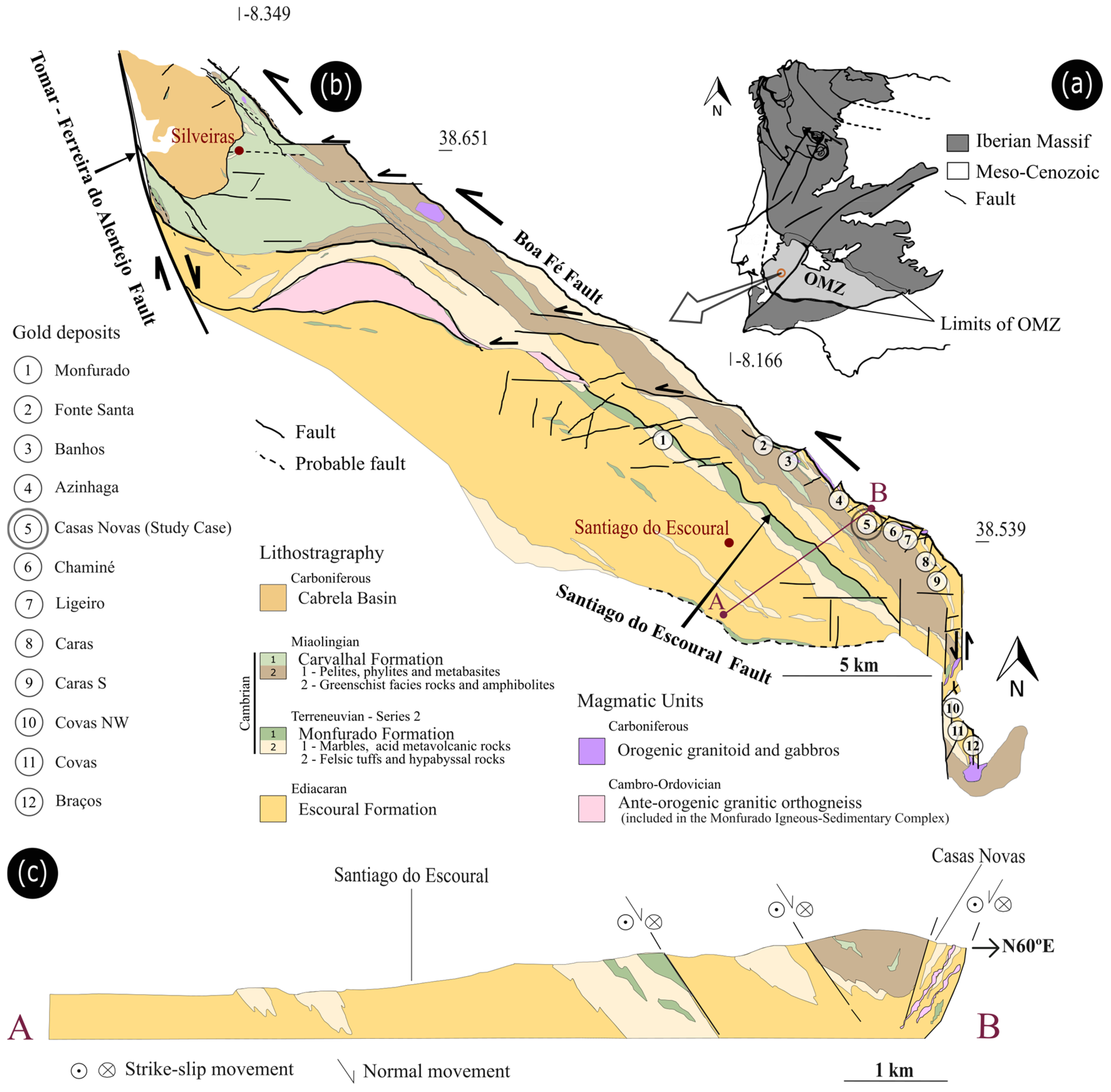
The Ossa-Morena Zone (OMZ) is a tectonostratigraphic zone of the Iberian Massif that provides a favorable structural and lithological framework for gold occurrences (Figure 1). Among the major structures within this domain is the Montemor-o-Novo Shear Zone (MNSZ), a regionally significant shear zone in south-central Portugal. The Casas Novas gold deposit, situated within the MNSZ, is characterized as an orogenic gold system. Orogenic gold systems are characterized by structurally controlled, mesothermal vein-type deposits, and they have become a key focus in geodynamically complex regions such as the OMZ [1,3,12]. Tectono-metamorphic processes played a key role in the mobilization and deposition of economically important metals, as evidenced by structural and mineralogical features that reflect the intense hydrothermal activity during the Variscan orogeny [3,10,12,13,14].
The coeval development of orogenic gold systems during specific metamorphic stages is known to occur, specifically in greenschist–amphibolite facies conditions, given the pre-enrichment of the host rocks [1,2,15]. The regional tectono-metamorphic evolution has been previously described in detail [16], which stated a prograde stage compatible with such conditions, followed by P-T retrogression in the MNSZ. This led to the emplacement of a set of gold-bearing lodes across the region that exhibit local textural and mineralogic differences. Detailed textural and mineralogic analyses of these deposits provide insights into the multiphase mineral deposition related to the different metamorphic stages. Likewise, constraining local changes in the P-T conditions, using the metamorphic mineralogy, permits an understanding of the different deposit types.
Figure 1.
(a) Tectonostratigraphic zonation of the Iberian Massif (adapted from [17,18]), with the location of the Ossa-Morena Zone (OMZ). (b) Generalized geological map of the Montemor-o-Novo Shear Zone (MNSZ) within OMZ. Coordinate system: EPSG:4326 (WGS 84). (c) Schematic geological cross-section of the MNSZ, with additional detail (adapted from [16]).
2. Regional and Local Geology
The regional lithostratigraphic sequence is characterized by the early Paleozoic rift-related units of the OMZ, variably metamorphosed, where the Cambrian succession (a detrital-carbonate unit contemporaneous with bimodal volcanic rocks, followed by a volcano-sedimentary complex) overlies the Ediacaran Série Negra Group (metasedimentary rocks) [16,19,20,21]. The Ordovician–Silurian sequence consists mostly of detrital metasedimentary rocks, settled under passive-margin conditions, and from the mid-Devonian, a flysch-like synorogenic succession was followed by orogenic plutonism from the Variscan orogeny [19,20,22,23,24]. The Variscan orogeny resulted in the development of contrasting tectono-metamorphic units: (i) a high-temperature belt near the collision front, (ii) high-pressure rocks in an intermediate zone, and (iii) a lower-grade unit in the outwards region; additionally, a parautochthonous unit and an ophiolite complex were thrusted to the inner OMZ domains [22,25,26,27]. Among the Variscan structures, a large gneiss dome developed (the Évora Massif), imposing a metamorphic zoning in the surrounding units [22,28].
The MNSZ (Figure 1) is included in the Évora Massif [16,22] at the southern hanging wall of the gneiss dome superstructure and extends 30 km from the Cabrela basin to Nossa Senhora da Boa Fé, ranging in width from 2 to 10 km. It corresponds to a crustal-scale shear zone that affects the pre-Carboniferous successions, which underwent greenschist-to-amphibolite facies metamorphism [16]. The principal metasedimentary formations of the MNSZ from bottom to top include the Ediacaran Escoural Formation, the Cambrian Terreneuvian-Series 2 Monfurado Formation, the Miaolingian Carvalhal Formation, and the Carboniferous Cabrela Formation and Pedreira da Engenharia [16]. The Ediacaran Escoural Formation serves as a metallotect for most gold mineralizations in the MNSZ (usually intersected in drill cores) [29,30]; however, other metal deposits may be found in upper Cambrian units [12].
Previous assessments of the regional gold deposits highlighted their disposition along a belt within the MNSZ (Figure 1), informally known as the Escoural Gold District [12]. Most of the deposits found therein are hosted in the Ediacaran and Cambrian (Terreneuvian–Series 2) units. The Casas Novas gold deposit (approximately 140 km southeast of Lisbon, in the Alentejo region, about 15 km northwest of the town of Évora) is located to the east of the Escoural municipality (Montemor-o-Novo). It consists of an area of poor outcrops where a set of drill cores was extracted. The deposit is exclusively located within metasedimentary rocks of the Ediacaran Série Negra Group, locally intersected by Variscan granitic dykes.
3. Materials and Methods
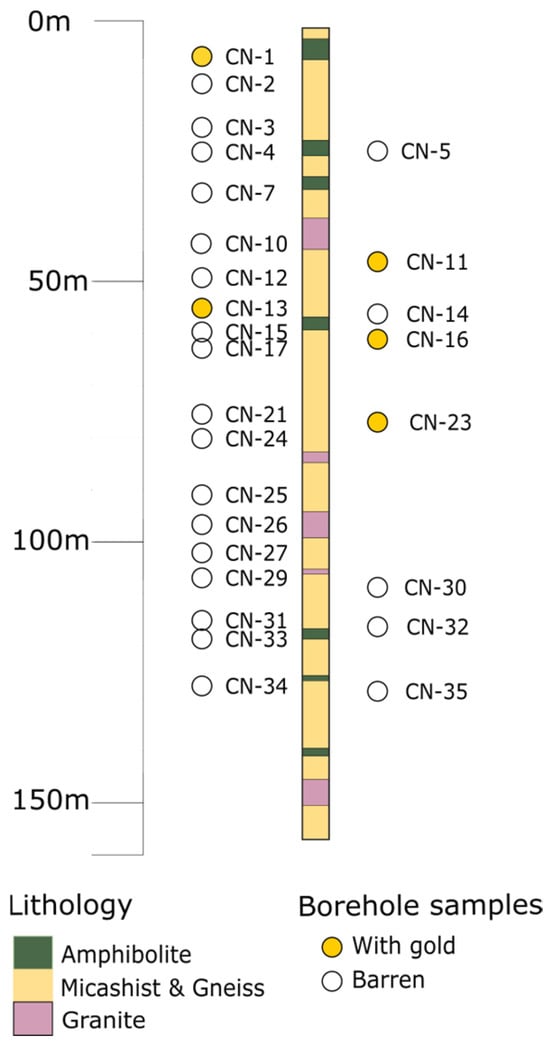
This study focuses on 27 samples from a borehole executed by Colt Resources in the Casas Novas area. The site is recognized as one of the most promising gold-bearing zones in the region. Drilled in 2012, the hole extends to a depth of 157.55 m and is inclined 45° towards the northeast from the surface (Figure 2). The sampling process involved selecting these 27 samples from the borehole, aimed at identifying the diverse lithologies and the corresponding mineralization present, as well as exploring the relationship between the two. From the selected samples, 34 polished thin sections (PTS) were prepared for detailed analysis.
Figure 2.
Representation of the lithology and spatial location of the samples throughout the borehole, including the presence of gold.
Polished thin sections were observed under a petrographic microscope with transmitted and reflected light to identify the main mineral phases and establish the ore paragenesis. Scanning electron microscopy with energy-dispersive spectroscopy (SEM-EDS) analysis and backscattered electron (BSE) image acquisition were performed using a VP-SEM-EDS Hitachi S3700N (operating at an accelerating voltage of 20 kV) with a Bruker Xflash 5010SDD X-ray spectrometer at the HERCULES Laboratory of the University of Évora (Portugal). Compositional data were normalized to 100% and median values were calculated for each mineral to provide a robust representation of their typical chemical signatures.
4. Petrography
4.1. Host Rock Description
A comprehensive examination of the 34 PTS was conducted to establish a lithological characterization of the various units, their relation with the mineralization, and to attempt to characterize the regional tectono-metamorphic features. This characterization encompasses petrographic analyses, detailing mineral paragenesis, textures, veins, and the presence of ore minerals. The lithological units studied comprise amphibolites, mica schists, and felsic orthogneisses from the Escoural Formation, intersected by different types of veins, some of them mineralized (described in the next section). Additionally, centimetric quartz-feldspar veins are present, along with sericite and chlorite veinlets. Some undeformed leucocratic granites intrude the Ediacaran Escoural Formation, though interpreted as leucosomes from the underlying Variscan migmatite [16].
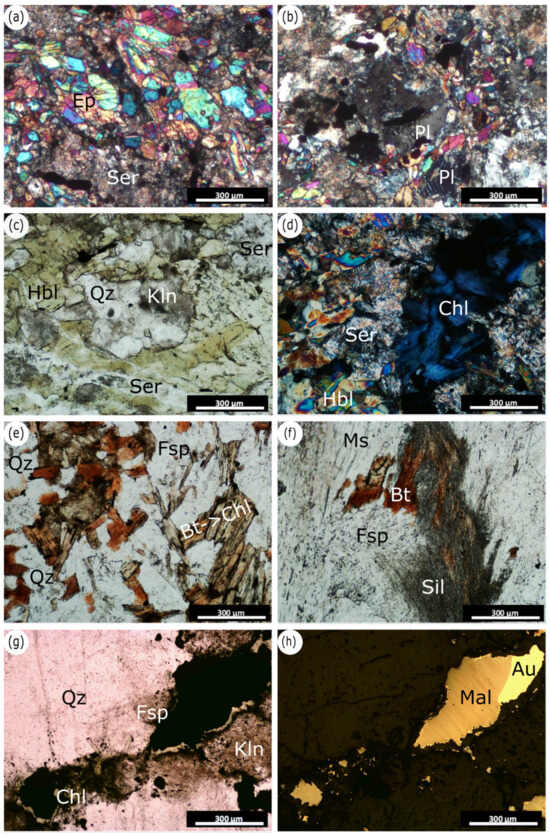
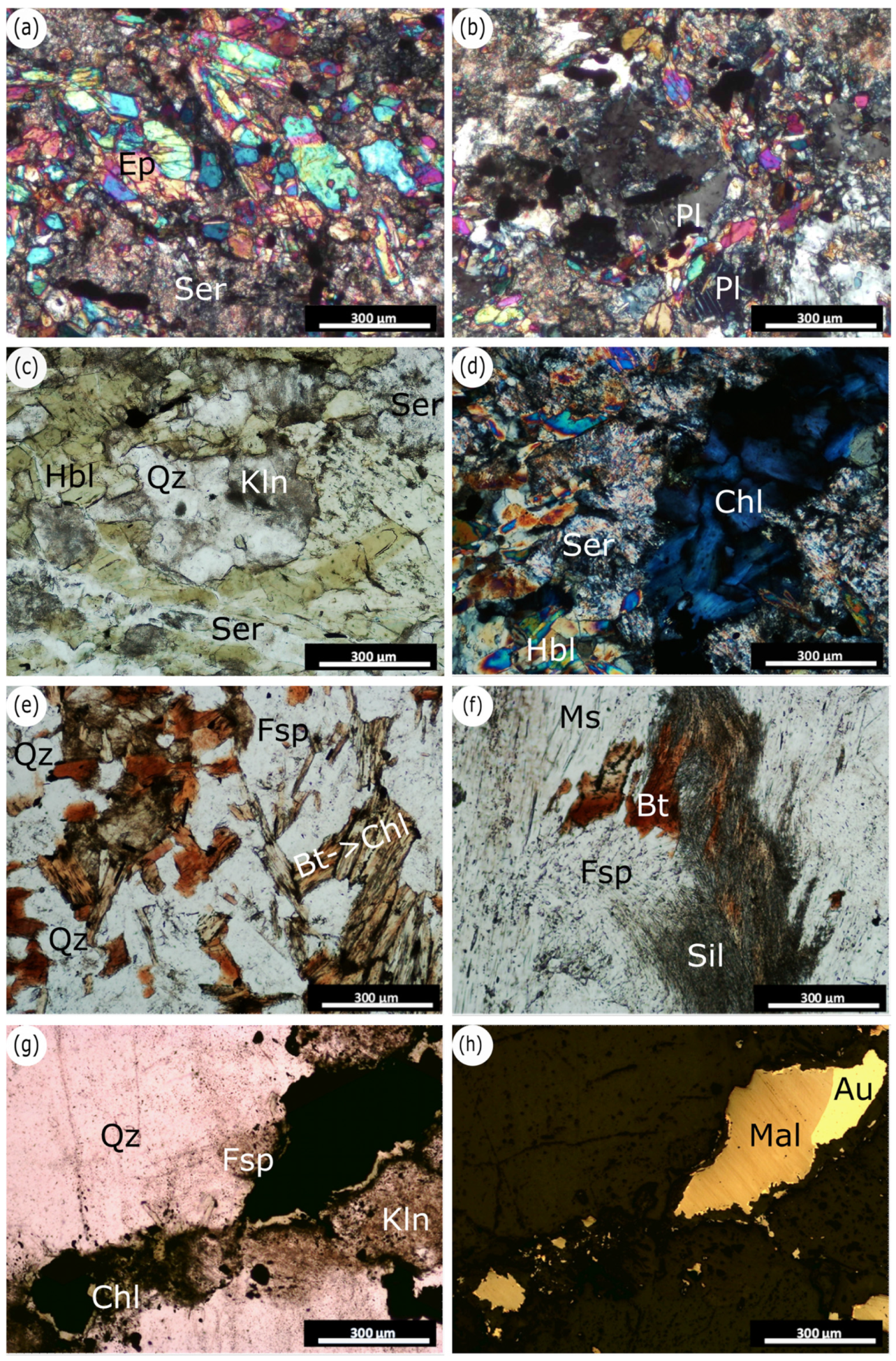
Under microscopic examination, amphibolites exhibit a texture composed of hornblende (with occasional tremolite), pistachite epidote (Figure 3a), plagioclase, quartz, and biotite. The plagioclase is extensively sericitized and kaolinized (Figure 3b,c). Quartz and biotite are sporadic. The metallic minerals identified include pyrite, ilmenite, and rutile, oriented along the foliation. Distinct fracture-filling assemblages were also identified: (i) sericite and chlorite veinlets, intersecting the main foliated texture (Figure 3d), (ii) quartz–feldspathic veins containing sericite, kaolinite, and chlorite, and (iii) late-stage carbonates. In association with the sericite veins, the ore minerals include arsenopyrite, loellingite, pyrrhotite, chalcopyrite, and pyrite. Gold was identified as inclusions in arsenopyrite. Based on index mineralogy, these amphibolites were likely metamorphosed under epidote–amphibolite conditions, though variably retrogressed.
Figure 3.
Photomicrographs of host-rock thin sections: (a) epidote in amphibolite (crossed nicols); (b) the feldspar in amphibolite is extensively sericitized and kaolinized (crossed nicols); (c) hornblende and quartz in amphibolite that was extensively sericitized and kaolinized; (d) presence of chlorite within a sericite vein intersecting the amphibolites (crossed nicols); (e) lepidogranoblastic texture indicating the transition from biotite to chlorite in micaschist; (f) occurrence of sillimanite within the gneiss; (g) quartzofeldspathic veins with kaolinite and chlorite; (h) mineralization in reflected light (crossed nicols). Abbreviations: Pl—Plagioclase, Ep—Epidote, Fsp—Feldspar, Qz—Quartz, Bt—Biotite, Ms—Muscovite, Chl—Chlorite, Sil—Sillimanite, Ser—Sericite, Mal—Maldonite and Au—Native gold.
The micaschists are composed of quartz and feldspar coexisting alongside biotite and muscovite. Quartz is present in subhedral to anhedral grains; however, contrary to typical deformed rocks, there is minimal evidence of deformation features such as undulatory extinction or subgranulation. The boundaries are frequently irregular yet not serrated or sharply angular. K-feldspar displays subhedral forms in well-developed crystals, though they are variably kaolinized and sometimes contain sericite in the core. Plagioclase occurs as subhedral or euhedral crystals and exhibits signs of alteration, with albite twinning poorly developed. Observed biotites are subhedral, often elongated parallel to the foliation. Varying degrees of chloritization were observed (Figure 3e), with some biotites entirely transformed. The micaschists contain accessory pyrite, ilmenite, and rutile. Several veins intersecting the primary texture are also present: (i) quartz and chlorite veins, (ii) quartz veins, (iii) calcite veins containing chlorite, (iv) mineralized quartz and feldspar veins with chlorite and sericite. The vein mineralization comprises gold, maldonite, hedleyite, arsenopyrite, loellingite, ilmenite, rutile, pyrrhotite, chalcopyrite, and pyrite.
The paragneisses are strongly foliated with alternating bands of biotite, some of which are chloritized, with portions of feldspar and quartz. The feldspars have undergone processes of alteration such as sericitization and kaolinization. Sillimanite is also observed (Figure 3f), which infers a high metamorphic grade. Opaque minerals, such as pyrite and iron oxides, were also identified. Gneiss-hosted veins include: (i) quartz veins containing sericite and chlorite, (ii) sericite veinlets containing chlorite, and (iii) carbonate veins, where pyrite, chalcopyrite and pyrrhotite are present. Strongly silicified samples exhibit a porphyrogranoblastic texture consisting of quartz and feldspar, including larger K-feldspar porphyroblasts. Some of these feldspar crystals are euhedral and exhibit varying degrees of alteration. Biotite, which may be fully chloritized, is also present. Accessory minerals such as pyrite, ilmenite, and rutile are found.
4.2. Description of Mineralized Veins
Strongly silicified zones, veins, and veinlets of medium-grained quartz–feldspar (Figure 3g) that intersect the micaschists host an ensemble of ore minerals, including gold (Figure 3h), maldonite, hedleyite, arsenopyrite, loellingite, pyrrhotite, chalcopyrite, and pyrite. Partial alteration of feldspar to sericite and kaolinite is observed. Biotite, along with sericite and chlorite, envelops the gold-related mineralization (Figure 3g,h).
5. Ore Assemblages
The mineralization in the Casas Novas deposit hosts a set of ore minerals with textural features able to represent the system progression during the orogenic metamorphic stages.
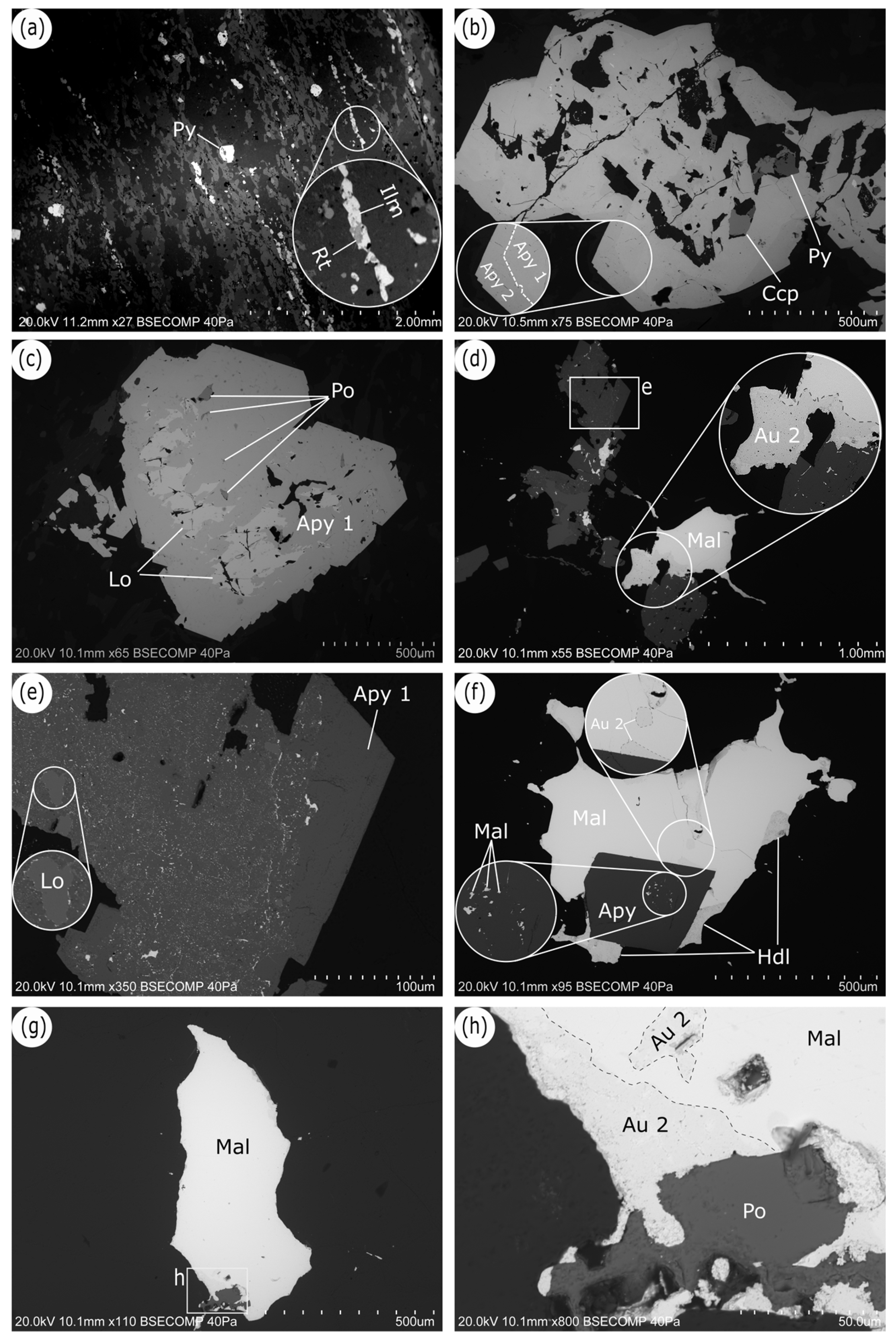
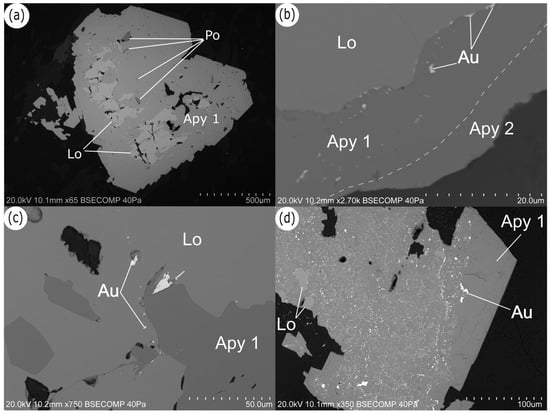
Pyrite (FeS2) is present either as an accessory mineral in the host rocks or within mineralized veins. In the host rocks, pyrite 1 (Py 1) frequently occurs as porous euhedral crystals associated with ilmenite and rutile (Figure 4a). During the subsequent stages of mineralization, the deposition of chalcopyrite (CuFeS2) and later-stage pyrite 2 (Py 2) is observed filling fractures in arsenopyrite (Figure 4b) and loellingite.
Figure 4.
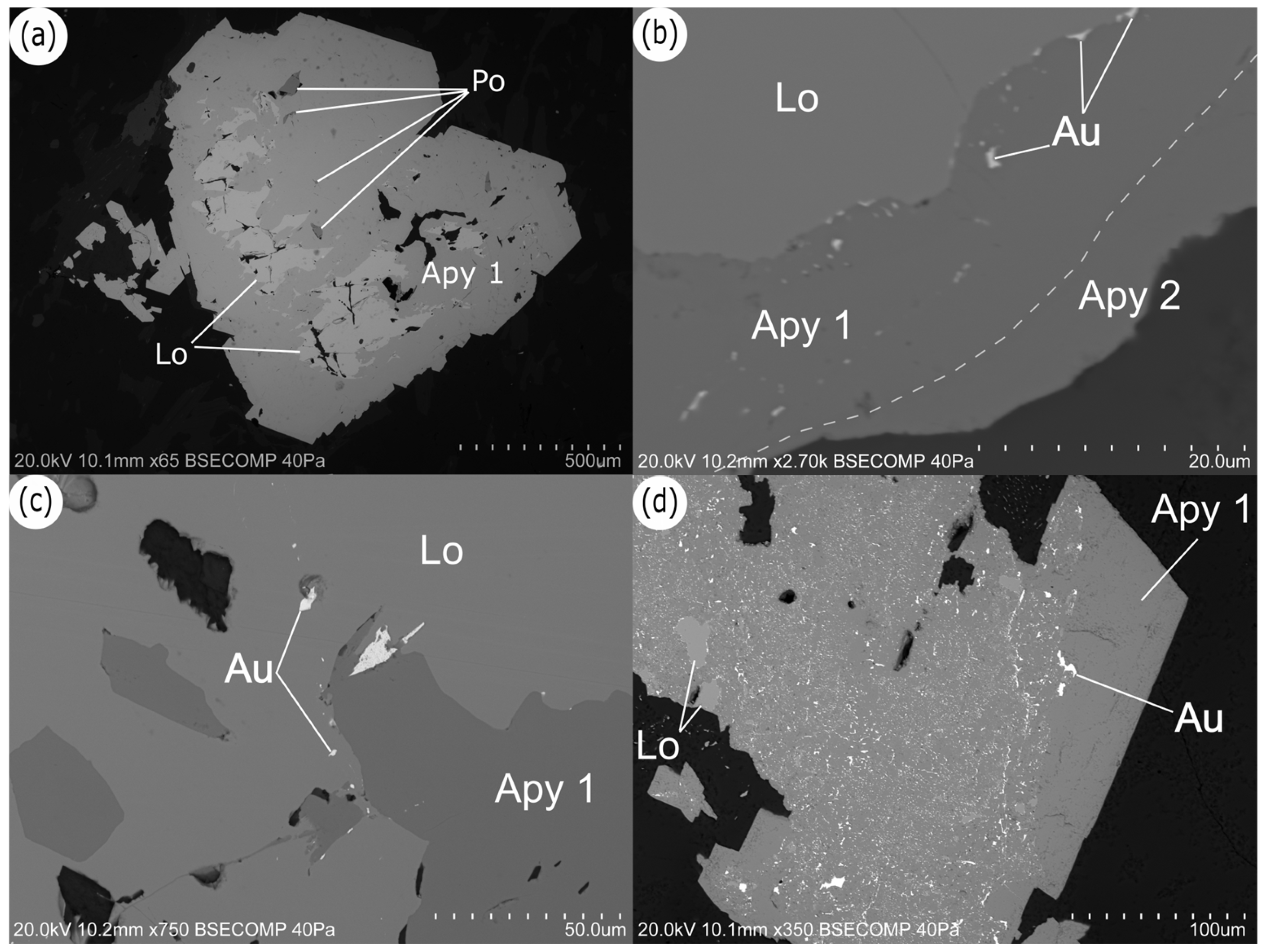
BSE images from SEM exemplifying ore-stage mineralization: (a) host-rock mineral assemblage comprising pyrite, ilmenite, and rutile; (b) zoning observed as darker arsenopyrite 2 edging arsenopyrite 1; (c) rounded anhedral loellingite enclosed within arsenopyrite 1; (d) Representation of gold mineralization in ore stage; (e) microcrystals of Au, Bi, and Te-bearing minerals (Au 2 and maldonite) within arsenopyrite and proximal to loellingite; (f) hedleyite associated with maldonite and native gold; (g,h) association of maldonite, native gold and pyrrhotite. Abbreviations: Apy 1—Arsenopyrite 1, Apy 2—Arsenopyrite 2, Lo—Loellingite, Py—Pyrite, Po—Pyrrhotite, Cpy—Chalcopyrite, Mal—Maldonite, Au 2—Native gold and Hdl—Hedleyite.
Arsenopyrite (FeAsS) was identified in 10 PTS. Microscopic examination shows size variability, with some crystals over 500 μm. It forms euhedral to subhedral crystals with prismatic habits. The BSE images from SEM show crystal zoning, in which arsenopyrite 1 (Apy 1) is found in crystal cores, surrounded by arsenopyrite 2 (Apy 2), usually as a darker rim, as shown in Figure 4b.
Loellingite (FeAs2) predominantly occurs as anhedral, rounded crystals enclosed within Apy 1, as well as subhedral crystals exceeding 100 µm in size (Figure 4c–e).
Under microscopic observation, pyrrhotite (Fe1−xS) was predominantly observed as rounded to sub-rounded grains as inclusions within loellingite and arsenopyrite (Figure 4c). Pyrrhotite was also detected within carbonate veinlets, exhibiting a spatial association with chalcopyrite and pyrite. Though occurring with less frequency, pyrrhotite was identified associated with maldonite (Au2Bi) and native gold (Figure 4g,h).
Within the analyzed samples, gold occurs as an Au(-Ag) alloy (denoted Au 1), native gold (denoted Au 2), and maldonite (Figure 4f–h). Native gold and maldonite are, in certain cases, observed as larger crystals, reaching up to 600 µm, and are observed macroscopically (Figure 4f,g). Native gold occasionally appears on the periphery or in the interior of maldonite (Figure 4h). In addition to its association with this Bi mineral, Au 2 was observed within a sericite vein, filling fractures in quartz. Bismuth and tellurium minerals (native bismuth and hedleyite (Bi7Te3)) are sometimes associated with arsenopyrite, maldonite and Au 2. These minerals appear as irregular grains (Figure 4e), except in one of the samples, which displays crystals as large as 100 µm (Figure 4f). Accurate identification has only been achieved using SEM-EDS.
6. Ore Mineral Chemistry
SEM-EDS analyses allowed for the identification of minerals and the determination of subtle compositional variations among them, in addition to corroborating mineral zoning. SEM mapping enabled a more precise delineation of zoning and cryptic textures of the minerals, thus allowing for an improved understanding of the processes of substitution and metal enrichment or depletion.
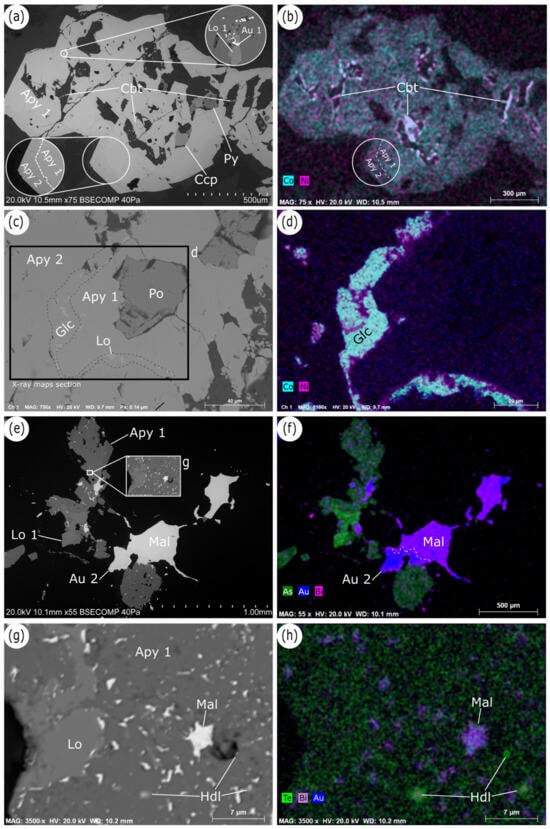
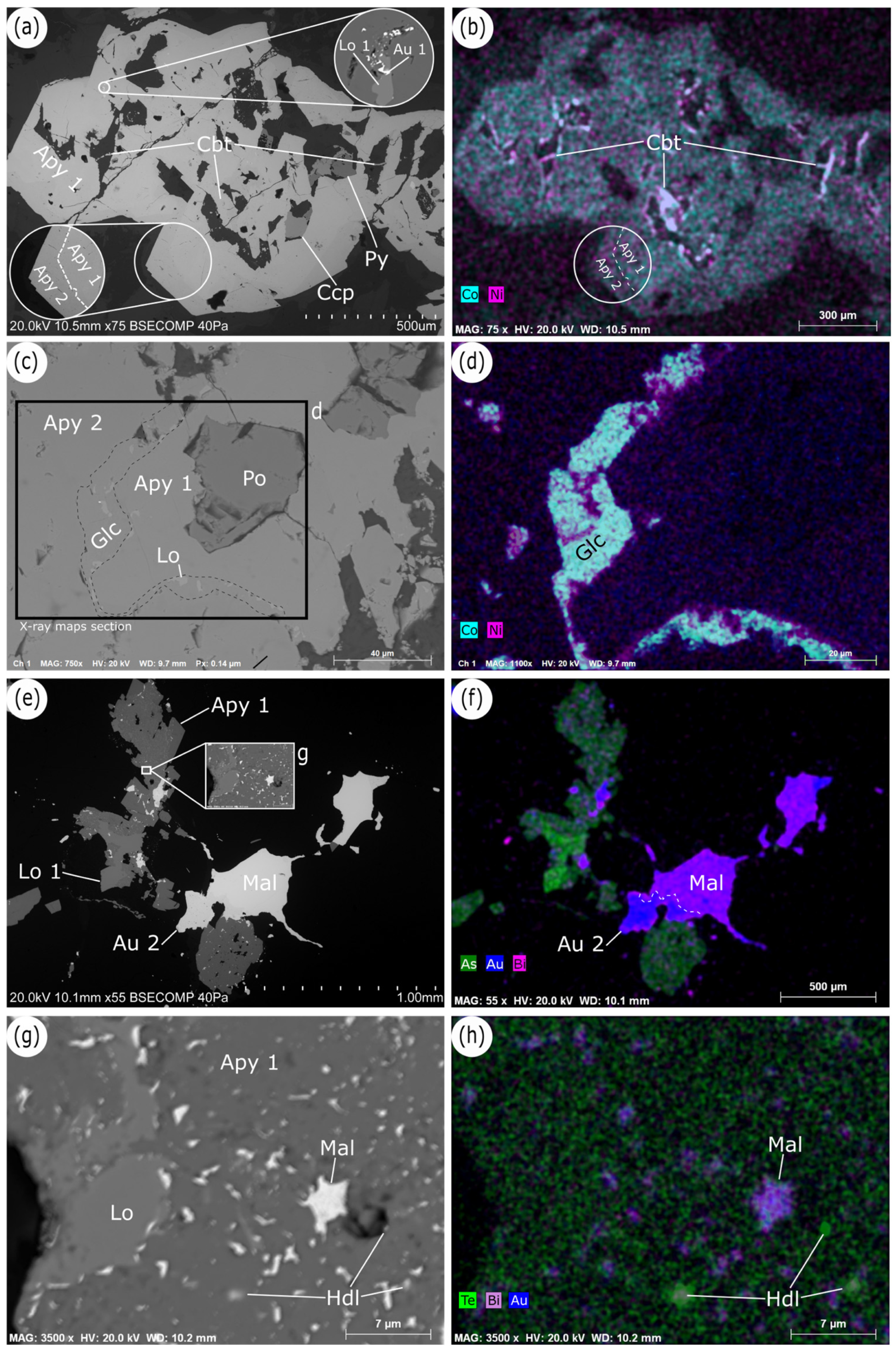
SEM-EDS analyses and X-ray mapping revealed the presence of cobalt and nickel in the composition of the first generation of arsenopyrite (Apy 1) as well as in loellingite (Table 1). In some Apy 1 analyses, nickel concentrations are below the detection limit. A second generation of arsenopyrite (Apy 2) is observed at the margins of Apy 1 (Figure 5a) and displays cobalt and nickel content consistently below the detection limit. Associated with the arsenopyrite devoid of Co and Ni, loellingite inclusions are also depleted in these elements. Loellingite often contains Co and Ni and displays reduced Fe values, suggesting the substitution of Fe by these elements (Table 1). Cobaltite (CoAsS) was detected in the cracks or fractures of arsenopyrite (Figure 5a,b). Another occurrence of cobaltite was documented in pyrrhotite, adjacent to pentlandite (((Fe,Ni)9S8)). Unusual glaucodot ((Co0.50Fe0.50)AsS) rich in Ni occurs in close spatial relationship with Apy 1, Apy 2, and Lo 1 (Figure 5c,d).
Table 1.
Median normalized SEM-EDS compositional data (wt.%) for sulfides minerals.
Figure 5.
BSE images from SEM correspond to sections (a,c,e,g) of the x-ray map representations denoted as (b,d,f,h): (a) zoning is observed, with darker arsenopyrite 2 bordering arsenopyrite 1; (b) displays cobaltite surrounding fractures within arsenopyrite 1; (c,d) presence of Ni-enriched glaucodot situated between arsenopyrite 1, loellingite 1, and arsenopyrite 2; (e,f) interaction between arsenopyrite 1, loellingite 1, maldonite, and gold 2 is depicted; (g,h) association between arsenopyrite 1, loellingite 1, maldonite, and hedleyite. Abbreviations: Apy 1—Arsenopyrite 1, Apy 2—Arsenopyrite 2, Lo—Loellingite, Py—Pyrite, Po—Pyrrhotite, Cpy—Chalcopyrite, Mal—Maldonite, Au—Native gold, Hdl—Hedleyite and Glc—Glaucodot.
SEM-EDS analyses of pyrite, pyrrhotite, and chalcopyrite are consistent with their ideal chemical compositions (Table 1). Pyrite (Py 1) samples from the host rock were also analyzed, exhibiting a median composition of 46.48% Fe and 53.52% S, which is closer to the values most commonly reported for this mineral. Pyrite 2 (Py 2) showed a higher Fe content compared to its stoichiometric composition. The analyzed average values of chalcopyrite appear to be enriched in Fe and depleted in Cu. Additional sulfides containing Pb were identified in some samples; these sulfides correspond to galena (PbS).
A cluster of minerals primarily composed of Bi and Te has been identified (Table 2). These minerals include native bismuth and hedleyite.
Table 2.
Median normalized SEM-EDS compositional data (wt.%) for bismuth and tellurium minerals.
A total of twenty-five SEM-EDS analyses (Table 3) were conducted on the five gold-bearing samples. The gold designated Au 1, refers to gold containing small quantities of silver (Ag). The silver content is up to 7.20% in one sample. The Au(–Ag) alloy is identified within the arsenopyrite–loellingite association, manifesting both at the margins and within loellingite (Figure 5a), and as inclusions within arsenopyrite. In arsenopyrite, the gold inclusions are distributed in patterns that outline as pseudomorphosed crystals of loellingite. Maldonite is observed in two samples, for which 16 specific spot analyses were executed. On rare occasions, native gold may be enveloped as an inclusion within maldonite. Maldonite is included in arsenopyrite (Figure 5e,f) and coincides with native gold and tellurium-bearing minerals (Figure 5g,h). This Au-Bi alloy occasionally forms along the periphery of loellingite and appears as isolated grains within mineralized veins.
Table 3.
Median normalized SEM-EDS compositional data (wt.%) for gold-bearing minerals.
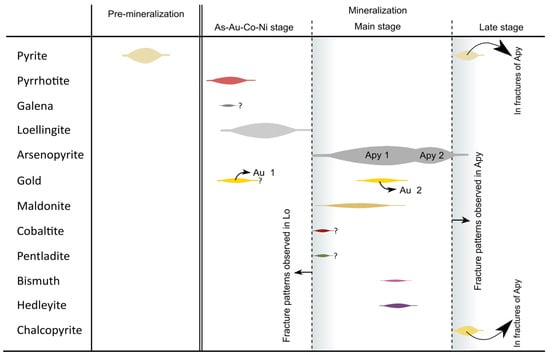
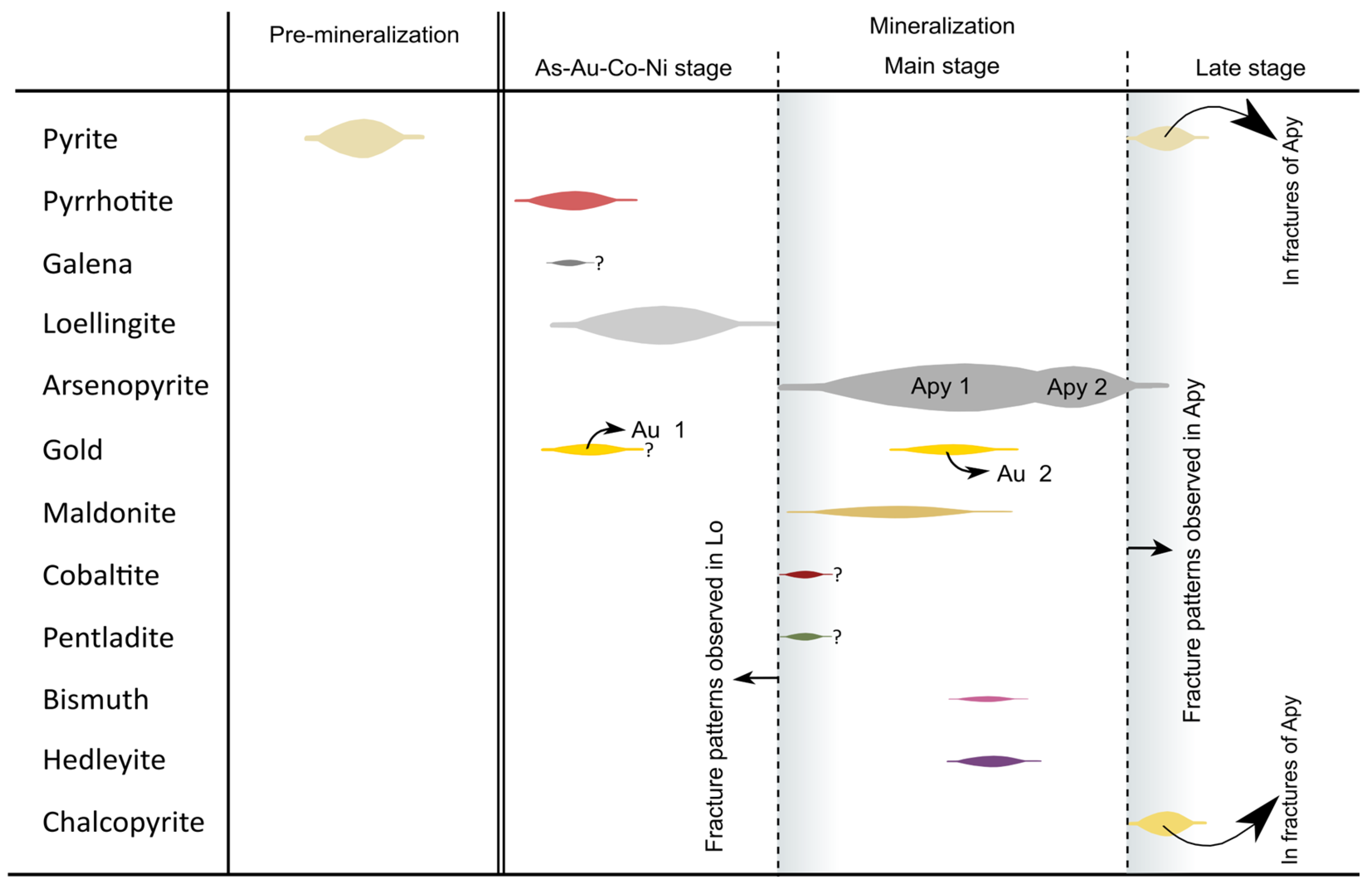
The textural and mineralogical features of the samples throughout the borehole can be synthetized into a paragenetic framework, describing the several ore-forming stages for the Casas Novas deposit (Figure 6).
Figure 6.
Proposed paragenetic framework for the Casas Novas mineralization. Abbreviations: Apy 1—Arsenopyrite 1, Apy 2—Arsenopyrite 2, Au 1—Au(-Ag) alloy and Au 2—Native gold.
7. Discussion
The metallographic and SEM-EDS data from Casas Novas provide new insights into the mineralogical assemblages and textural relationships that control gold distribution in the Escoural Gold District. The predominance of arsenopyrite and loellingite, together with their consistent association with gold, underlines the fundamental role of Fe-As phases in auriferous concentration. These ores occur in sericitic as well as in quartz–feldspar veins cutting amphibolites (epidote–amphibolite facies), micaschists, and sillimanite-bearing paragneisses, confirming that gold mineralization is not restricted to a single lithology but is widespread across multiple host rocks.
The observed replacement textures, such as anhedral loellingite enclosed within euhedral arsenopyrite, are consistent with progressive transformations driven by greenschist-to-amphibolite facies metamorphism. Chichorro (2006) [16], for the Casas Novas area, reports metamorphic conditions at least up to mid-amphibolite facies, which is consistent with our observations regarding the epidote–amphibolite facies mafic rocks (formed at ca. 400–600 °C) and the sillimanite zone paragneiss (>500 °C). Maia et al. (2022) [12] obtained similar peak temperatures based on homogenization fluid inclusion temperatures in tourmaline in another gold deposit from the Escoural District (Monfurado prospect). This is broadly in line with the model proposed by Tomkins and Mavrogenes (2001) [15], in which prograde metamorphism destabilizes auriferous arsenopyrite, promoting its breakdown into loellingite and pyrrhotite with associated gold and sulfur liberation. Nevertheless, the lack of a primary auriferous arsenopyrite formed in early phases during prograde metamorphism does not allow further inferences regarding the model. Two alternative scenarios may account for the observed mineral associations: (1) retrograde metamorphism affecting a pre-existing auriferous arsenopyrite, with transformation into loellingite and pyrrhotite under suitable conditions, where textural relationships between pyrrhotite, loellingite, and arsenopyrite are key; and (2) primary loellingite with gold, later overprinted by a hydrothermal stage with high sulfur fugacity, leading to the transformation of Fe-arsenide into Fe-sulfarsenide and gold release, without requiring prograde metamorphic destabilization. The first scenario is chemically represented by reaction 1:
2 FeAsS (arsenopyrite) → FeAs2 (loellingite) + FeS (pyrrhotite) + 0.5 S2
This reaction causes the native gold to be expelled from arsenopyrite, potentially becoming included within the loellingite structure due to its affinity. Subsequent to the metamorphic peak, retrograde metamorphism and the associated temperature decrease induce the alteration of loellingite and pyrrhotite to arsenopyrite [15,31]. This second scenario is chemically represented by reaction 2:
(FeAs2 (loellingite) + (1/x) FeS(1 + x) (pyrrhotite) → 2 FeAsS (arsenopyrite) + ([1 + x]/x) FeS
This alteration induces the diffusion of gold, causing it to migrate toward the rim or into the interior of loellingite [15], though as rare relicts (Figure 7b,c). This model can be briefly outlined in four stages, which were discerned within the samples studied (Figure 7).
Figure 7.
BSE images from SEM showing the stages regarding destabilization of loellingite and auriferous remobilization within the samples under investigation: (a) relationship of arsenopyrite, loellingite and pyrrhotite in a single crystal; (b) gold concentration proximal to loelingite; (c) interstitial incorporation of gold into loelingite; (d) retrograde evolution inducing loellingite alteration to arsenopyrite, with gold entrapment preserved. Abbreviations: Apy 1—Arsenopyrite 1, Lo—Loellingite 1, Po—Pyrrhotite and Au—Not differentiated Au 1, Au 2 and maldonite.
The progressive transformation drives the redistribution of gold, allowing it to migrate to grain boundaries, accumulate at the loellingite interfaces, and eventually become trapped in arsenopyrite during retrogression. The four-stage evolutionary sequence identified in the samples (diffusion, accumulation, incorporation, and stabilization) could be compatible with the metamorphic remobilization model [15].
The assemblages observed point to localized variations in redox and sulfur fugacity, creating conditions favorable for Au-Bi-Te alloy stability. In addition to the metamorphic remobilization pathway, an alternative scenario may also be considered: the presence of primary loellingite with gold, subsequently affected by a hydrothermal overprint characterized by high sulfur fugacity. This late-stage fluid activity could promote the transformation of Fe-arsenide into Fe-sulfarsenide phases, facilitating gold release without requiring prograde metamorphic destabilization. Such a mechanism would account for the observed mineral associations and compositional zoning and may reflect localized fluid–rock interaction superimposed on the regional metamorphic framework.
SEM-EDS analyses and textural relationships demonstrate significant Co and Ni incorporation into the earliest generation of loellingite (Lo 1) and arsenopyrite (Apy 1), with subsequent generations showing depletion in these elements. This suggests that the mineralizing fluids were initially capable of transporting such metals, possibly derived from devolatilization of mafic or volcano-sedimentary country rocks [32]. Such behavior is parallel to observations from Paleoproterozoic orogenic Au-Co-Ni deposits in the Pohjanmaa Belt of western Finland [33], where multi-stage mineralization and the role of Co/Ni in early arsenide phases are well documented.
A useful comparison can be drawn with the Kurula deposit, also in the Paleoproterozoic Pohjanmaa Belt, recently described by [33]. Similar to Casas Novas, Kurula is characterized by an orogenic Au system with atypical Co enrichment and minor Ni, where gold is hosted by arsenopyrite and loellingite, and cobalt is preferentially incorporated into early arsenide generations. However, the metallogenic interpretation for Kurula differs from the classic metamorphic remobilization model: the authors [33] propose that mineralization formed directly through increased sulfur activity and replacement of Fe-arsenides by Fe-sulfarsenides, consistent with the hydrothermal overprint scenario (option 2) rather than a prograde–retrograde metamorphic sequence involving gold-bearing arsenopyrite, loellingite, and pyrrhotite (option 1). This distinction is relevant for Casas Novas, where both textural and compositional evidence may reflect a hybrid evolution, with initial Co-Ni-rich arsenides formed under metamorphic conditions, followed by localized hydrothermal modification under high sulfur fugacity. Such a model supports the classification of Casas Novas within the same subgroup of orogenic Au-Co-Ni deposits as Kurula, while also highlighting the potential role of late-stage fluid activity in gold redistribution and sulfarsenide formation.
The recognition of such deposits in both the OMZ and the Pohjanmaa Belt highlights the potential fluid–rock interaction with mafic lithologies and reduced redox conditions in controlling the atypical transition metal signature of these systems. This comparison strengthens the interpretation that Casas Novas represents an orogenic Au system with a distinct Co-Ni association and emphasizes the need to reconsider other OMZ Escoural District deposits, considering models that account for multi-stage mineralization and incorporate the role of transition metals. Maia et al. (2022) [12] recently described the Monfurado deposit, also located in the OMZ Escoural District, as a typical Au-As system where gold is closely associated with arsenopyrite and structurally controlled quartz veins. In contrast, the Casas Novas deposit exhibits a more complex metal association, with Co- and Ni-rich arsenopyrite and loellingite. This distinction highlights that both orogenic gold systems might coexist within the OMZ, mirroring the situation documented in the Pohjanmaa Belt of western Finland [33], where Au-only mineralization (Laivakangas, Huhta) occurs alongside Co- and Ni-enriched systems (Kurula, Jouhineva). In particular, the strong similarities between Casas Novas and Kurula suggest that fluid–rock interaction with mafic lithologies and reduced redox conditions may represent a common control on the development of Au-Co-Ni signatures in orogenic systems [33,34].
According to Maia et al. (2022) [12], gold at Monfurado was most likely transported by metamorphic fluids as bisulfide complexes (Au(HS)−2), in agreement with the widely accepted mechanism for orogenic gold deposits. Precipitation occurred through variations in fO2 and fS2, leading to the incorporation of gold into arsenopyrite. A similar transport mechanism is plausible for Casas Novas, where the textural evidence indicates that Au was also introduced and redistributed during metamorphism in association with arsenopyrite–loellingite–pyrrhotite reactions. However, Casas Novas differs in the subsequent modes of gold remobilization: in addition to being hosted within As-bearing phases, gold is associated with Bi-Te alloys such as maldonite and hedleyite, reflecting the presence of Bi and Te in the fluid. This distinction emphasizes that while the transport processes might have been the same in both deposits, the precipitation conditions diverged, forming a different mineral assemblage.
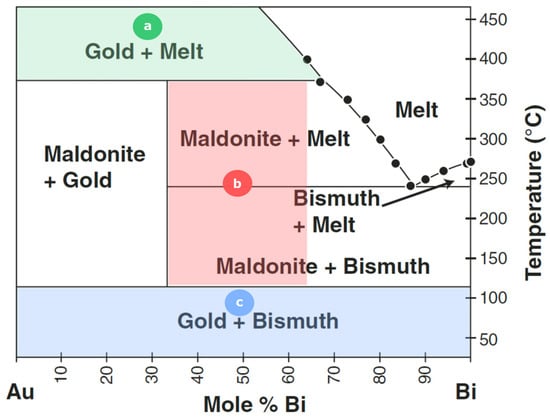
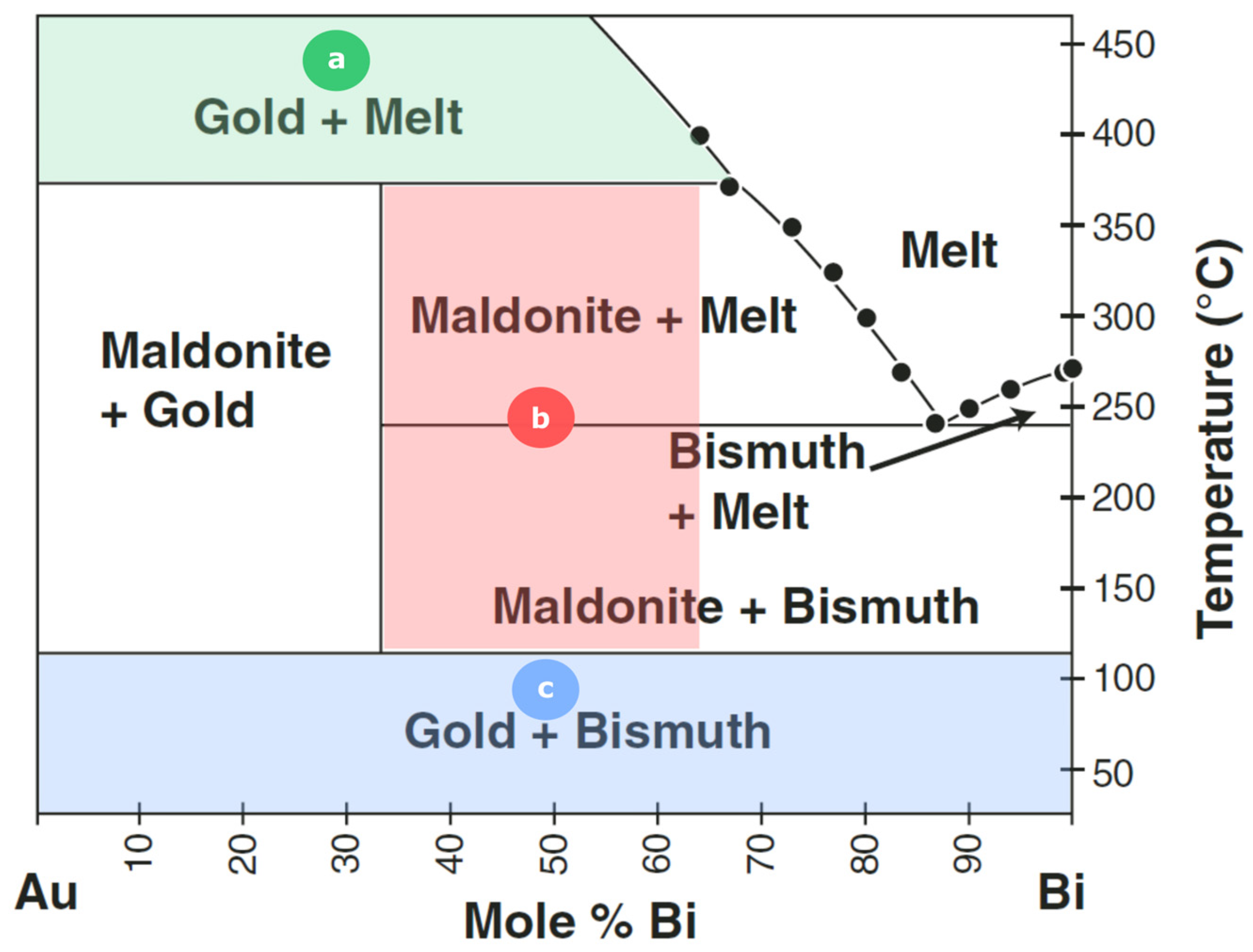
The Au-Ag alloy identified occurs preferentially in association with early loellingite (Lo 1) enriched in Co and Ni. Since loellingite precipitates at relatively high temperatures, it is plausible that the Au-Ag alloy also crystallized at higher temperatures. This relationship suggests that Co and Ni fluids are involved in the mobilization and precipitation of Au during the earliest stages of mineralization. A clear distinction can therefore be made between an early high-temperature stage, characterized by Au-Ag alloys hosted in Co-Ni-rich loellingite, and later stages of mineralization marked by the formation of maldonite, native gold, and Bi-Te minerals. This latter association reflects gold remobilization and recrystallization under lower-T conditions, driven by changes in the composition of mineralizing fluids and system dynamics. The significance of Bi in these later assemblages is notable. Its behavior is consistent with the liquid bismuth collector model [35], in which Bi scavenges gold from hydrothermal fluids, even when the fluid is undersaturated in Au. The model demonstrates that Bi-bearing fluids can incorporate gold at concentrations several orders of magnitude higher than coexisting aqueous fluids, offering a plausible mechanism for Au enrichment in polymetallic systems where Bi is available. Okamoto and Massalski (1983) [36] proposed an Au-Bi phase diagram (Figure 8a) that shows that Au forms at high temperatures with some Ag incorporation (Figure 8a; >371 ± 2 °C), consistent with the early Au-Ag alloys. With decreasing temperature, maldonite crystallizes at intermediate conditions (Figure 8b; ~116–371 °C), as observed in some samples, where maldonite shows Bi contents of 34.7–62.2 wt.%. Finally, native Au and Bi (including Bi tellurides) are present at lower temperatures (Figure 8c; <116 °C), typically at the periphery of maldonite. This sequence matches the petrographic evidence from Casas Novas, indicating progressive cooling from above 371 °C to below 116 °C. Such temperature decreases in ore assemblages for other deposits from the Escoural District have been previously described [12], based on fluid inclusions from baryte, tremolite and quartz. The evolutionary progression from initial Au-Ag alloys within Co-Ni-enriched loellingite to subsequent Au-Bi-Te phases documents the gradual thermal and chemical development of the system and demonstrates that Casas Novas broadens the metallogenic spectrum of the OMZ.
Figure 8.
Au–Bi phase diagram (after [35,36]) applied to Casas Novas, showing the inferred crystallization fields of Au–Ag alloys (>371 ± 2 °C; (a)), maldonite (~116–371 °C; (b)), and native Au with Bi ± Bi tellurides (<116 °C; (c)).
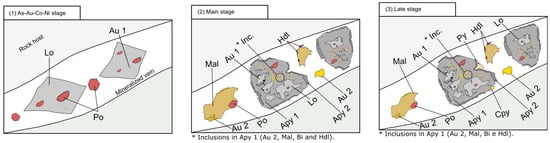
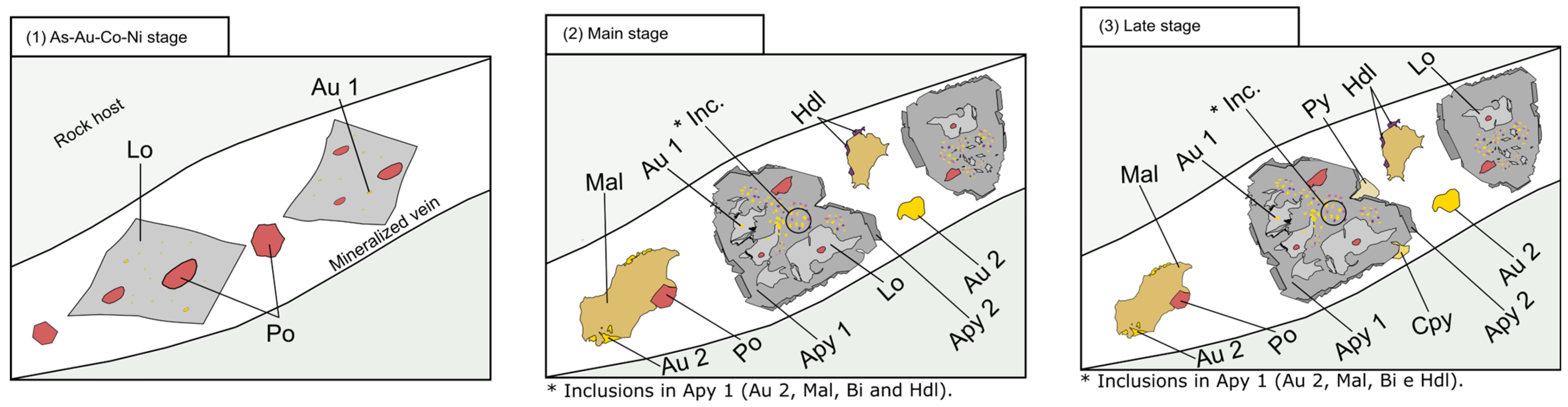
Based on [35,36], it is possible to establish the following associations: Au 1 is located at point ‘a’ (Figure 8), indicative of its formation during an earlier phase, predominantly found within or on the periphery of loellingite. The crystallization temperatures for this phase exceed 371 ± 2 °C. Maldonite is associated with point ‘b’ (Figure 8), where the majority of these minerals exhibit a bismuth composition ranging from 34.72 to 62.22 wt.%. The crystallization temperatures for maldonite fall between approximately 116 °C and 371 ± 2 °C. Finally, Au 2 (native) and bismuth (bismuth and Bi tellurides) are linked to point ‘c’ (Figure 8), where they are observed on the periphery of maldonite, with crystallization temperatures below approximately 116 °C. This is likely coetaneous with metamorphic retrogression. Figure 9 demonstrates the evolution of the Casas Novas mineralizing system. The textural and chemical characteristics indicate the presence of an early, pre-mineralization stage preceding the main mineralizing event, followed by a late mineralization episode.
Figure 9.
Schematic diagram for the various stages of Casas Novas mineralization. Abbreviations: Apy 1—Arsenopyrite 1, Apy 2—Arsenopyrite 2, Lo—Loellingite, Py—Pyrite, Po—Pyrrhotite, Cpy—Chalcopyrite, Mal—Maldonite, Au 1—Au(-Ag) alloy, Au 2—Native gold and Hdl—Hedleyite.
8. Conclusions
This study analyzes a set of polished thin sections from a borehole in the Casas Novas deposit, Escoural Gold District (OMZ), with the aim of constraining gold metallogenesis through the characterization of all lithologies, mineral phases, and paragenesis associated with lodes. The host rocks include amphibolites, mica schists, paragneisses, and strongly silicified zones with quartz–feldspar veins and sericite/chlorite veins.
Distinct metallogenic phases were identified starting with early higher-temperature stages during prograde metamorphism (up to ca. 400–600 °C) marked by (i) early Co-Ni-enriched loellingite hosting Au-Ag alloys, progressively reworked into (ii) the main native gold and sulfide-forming stage, accompanied by a relatively lower-temperature assemblage of maldonite and Bi-Te minerals. Textural relationships, such as loellingite enclosed in zoned arsenopyrite and gold migrating toward grain boundaries, also support a metamorphic-related remobilization model, widely accepted in the literature.
The consistent presence of Co and Ni in early arsenide generations, coupled with the occurrence of Bi-Te minerals, positions Casas Novas within a subgroup of complex orogenic gold deposits. This may be evidence for fluid–rock interaction with mafic lithologies and reduced redox conditions in shaping the deposit’s features. These findings challenge conventional models of OMZ gold systems and underscore the need to re-evaluate other regional deposits through the lens of multi-stage mineralization and transition metal participation.
From an exploration standpoint, arsenopyrite zonation, loellingite replacement textures, and the presence of Bi-Te phases emerge as valuable tools for characterizing different types of mineralization in the deposit. Detailed mineral chemistry offers a robust tool to distinguish conventional Au-As systems from Au-Co-Ni assemblages. Future work should integrate fluid inclusion studies and stable isotope geochemistry to refine genetic models and improve targeting strategies.
Author Contributions
Conceptualization, D.S.P., J.R. and P.N.; methodology, D.S.P. and P.N.; validation, P.N. and J.P.; formal analysis, D.S.P. and P.N.; investigation, D.S.P., J.R. and P.N.; writing—original draft preparation, D.S.P.; writing—review and editing, all authors; supervision, P.N., J.P. and M.F.-F.; funding acquisition, P.N. and J.M. All authors have read and agreed to the published version of the manuscript.
Funding
The authors acknowledge the financial support provided to the Institute of Earth Sciences (ICT) through the multi-annual funding contract with the Foundation for Science and Technology (FCT), under project UID/04683/2025 (https://doi.org/10.54499/UID/04683/2025), and the funding through the project ZOM3D (Modelos Metalogénicos 3D da Zona de Ossa-Morena–Valorização dos Recursos Minerais do Alentejo), with reference ALT20-03-0145-FEDER-000028, funded by Alentejo 2020 (Regional Operational Program of Alentejo) through the FEDER/FSE/FEEI programs. J. Roseiro also thanks the FCT, for support through the doctoral grant (UI/BD/150937/2021, https://doi.org/10.54499/UI/BD/150937/2021), and the Society of Economic Geologists for the support through the Hugh McKinstry Fund (SRG 21-46).
Data Availability Statement
The original contributions presented in this study are included in the article. Further inquiries can be directed to the corresponding author.
Conflicts of Interest
The authors declare no conflict of interest.
Abbreviations
The following abbreviations are used in this manuscript:
| OMZ | Ossa Morena Zone |
| MNSZ | Montemor Novo Shear Zone |
| PTS | Polished thin sections |
| SEM-EDS | Scanning electron microscopy with energy dispersive spectroscopy |
| Ep | Epidote |
| Pl | Plagioclase |
| BSE | Backscattered electron |
| Fsp | Feldspar |
| Qz | Quartz |
| Bt | Biotite |
| Ms | Muscovite |
| Chl | Chlorite |
| Sil | Sillimanite |
| Ser | Sericite |
| Mal | Maldonite |
| Au | Native gold |
| Apy | Arsenopyrite |
| Lo | Loellingite |
| Py | Pyrite |
| Po | Pyrrhotite |
| Cpy | Chalcopyrite |
| Hdl | Hedleyite |
References
- Groves, D.; Goldfarb, J.; Robert, F.; Hart, C. Gold Deposits in Metamorphic Belts: Overview of Current Understanding, Outstanding Problems, Future Research, and Exploration Significance. Econ. Geol. 2003, 98, 1–29. [Google Scholar] [CrossRef] [Scilit]
- Groves, D.; Goldfarb, R.; Gebre-Mariam, M.; Hagemann, S.; Robert, F. Orogenic Gold Deposits: A Proposed Classification in the Context of Their Crustal Distribution and Relationship to Other Gold deposit types. Ore Geol. Rev. 1998, 13, 7–27. [Google Scholar] [CrossRef] [Scilit]
- Romer, R.L.; Kroner, U. Paleozoic Gold in the Appalachians and Variscides. Ore Geol. Rev. 2018, 92, 475–505. [Google Scholar] [CrossRef] [Scilit]
- Martínez Catalán, J.R.; Schulmann, K.; Ghienne, J.F. The Mid-Variscan Allochthon: Keys from Correlation, Partial Retrodeformation and Plate-Tectonic Reconstruction to Unlock the Geometry of a Non-Cylindrical Belt. Earth. Sci. Rev. 2021, 220, 103700. [Google Scholar] [CrossRef] [Scilit]
- Hoepffner, C.; Soulaimani, A.; Piqué, A. The Moroccan Hercynides. J. Afr. Earth Sci. 2005, 43, 144–165. [Google Scholar] [CrossRef] [Scilit]
- Strnad, L.; Goliáš, V.; Mihaljevič, M.; Pudilová, M. The Variscan Kašperské Hory Orogenic Gold Deposit, Bohemian Massif, Czech Republic. Ore Geol. Rev. 2012, 48, 428–441. [Google Scholar] [CrossRef] [Scilit]
- Boiron, M.C.; Cathelineau, M.; Dubessy, J.; Bastoul, A.M. Fluids in Hercynian Au Veins from the French Variscan Belt. Mineral. Mag. 1990, 54, 231–243. [Google Scholar] [CrossRef] [Scilit]
- Bouchot, V.; Ledru, P.; Lerouge, C.; Lescuyer, J.L.; Milesi, J.P. 5: Late Variscan Mineralizing Systems Related to Orogenic Processes: The French Massif Central. Ore Geol. Rev. 2005, 27, 169–197. [Google Scholar] [CrossRef] [Scilit]
- Cepedal, A.; Fuertes-Fuente, M.; Martín-Izard, A.; García-Nieto, J.; Boiron, M.C. An Intrusion-Related Gold Deposit (IRGD) in the NW of Spain, the Linares Deposit: Igneous Rocks, Veins and Related Alterations, Ore Features and Fluids Involved. J. Geochem. Explor. 2013, 124, 101–126. [Google Scholar] [CrossRef] [Scilit]
- Noronha, F.; Cathelineau, M.; Boiron, M.C.; Banks, D.A.; Dória, A.; Ribeiro, M.A.; Nogueira, P.; Guedes, A. A Three Stage Fluid Flow Model for Variscan Gold Metallogenesis in Northern Portugal. J. Geochem. Explor. 2000, 71, 209–224. [Google Scholar] [CrossRef] [Scilit]
- Bouabdellah, M.; Slack, J.F. Geologic and Metallogenic Framework of North Africa; Springer International Publishing: Cham, Switzerland, 2016; pp. 3–81. [Google Scholar] [CrossRef] [Scilit]
- Maia, M.; Roseiro, J.; Nogueira, P.; Noronha, F.; Fuertes-Fuente, M.; Cepedal, A.; Mirão, J. New Insights on the Escoural Orogenic Gold District (Ossa-Morena Zone, SW Iberia): Geochemistry, Fluid Inclusions and Stable Isotope Constraints from the Monfurado Gold Prospect. Ore Geol. Rev. 2022, 142, 104736. [Google Scholar] [CrossRef] [Scilit]
- Tornos, F.; Conde, C.; Rodriguez, D.; García, D.; Hanchar, J.M.; García Nieto, J.; Ares, G.; Bauer, T.E.; Rodriguez Pevida, L. Replacive IOCG Systems in the Ossa Morena Zone (SW Iberia): The Role of Pre-Existing Ironstones as a Geochemical Trap. Ore Geol. Rev. 2024, 174, 106259. [Google Scholar] [CrossRef] [Scilit]
- Oliveira, D.; Robb, L.; Inverno, C.; Charlesworth, A. Metallogenesis of the São Martinho and Mosteiros Gold Deposits, Tomar Cordoba Shear Zone, Portugal. Int. Geol. Rev. 2007, 49, 907–930. [Google Scholar] [CrossRef] [Scilit]
- Tomkins, A.G.; Mavrogenes, J.A. Redistribution of Gold within Arsenopyrite and lollingite during Pro- and Retrograde Metamorphism: Application to Timing of Mineralization. Econ. Geol. 2001, 96, 525–534. [Google Scholar] [CrossRef]
- Chichorro, M. A Evolução Tectónica da Zona de Cisalhamento de Montemor-o-Novo (Sudoeste da Zona de Ossa Morena–Área de Santiago Do Escoural–Cabrela). Ph.D. Thesis, Universidade de Évora, Évora, Portugal, 2006. [Google Scholar]
- Julivert, M.; Fontboté, J.; Ribeiro, A.; Conde, L. Mapa Tectónico de La Península; Instituto Geológico y Minero de España: Madrid, Spain, 1974. [Google Scholar]
- Lotze, F. Zur Geologie Der Iberischen Meseta. Geotektonische Forschungen 1945, 6, 78–92. [Google Scholar]
- Araújo, A.; Piçarra, J.; Borrego, J.; Pedro, J.; Oliveira, J. As Regiões Central e Sul da Zona de Ossa-Morena. In Geologia de Portugal no Contexto da Ibéria; Universidade de Évora: Évora, Portugal, 2013; Volume 1, pp. 509–549. ISBN 978-972-592-364-1. [Google Scholar]
- Oliveira, J.; Oliveira, V.; Piçarra, J. Traços Gerais da Evolução Tectono-Estratigráfica da Zona de Ossa Morena. Comun. Serv. Geol. Port. 1991, 77, 3–26. [Google Scholar]
- Sánchez-García, T.; Chichorro, M.; Solá, A.R.; Álvaro, J.J.; Díez-Montes, A.; Bellido, F.; Ribeiro, M.L.; Quesada, C.; Lopes, J.C.; Dias da Silva, Í.; et al. The Cambrian-Early Ordovician Rift Stage in the Gondwanan Units of the Iberian Massif; Springer International Publishing: Cham, Switzerland, 2019; pp. 27–74. [Google Scholar] [CrossRef] [Scilit]
- Dias da Silva, Í.; Pereira, M.F.; Silva, J.B.; Gama, C. Time-Space Distribution of Silicic Plutonism in a Gneiss Dome of the Iberian Variscan Belt: The Évora Massif (Ossa-Morena Zone, Portugal). Tectonophysics 2018, 747, 298–317. [Google Scholar] [CrossRef] [Scilit]
- Robardet, M.; Gutiérrez-Marco, J.C. The Ordovician, Silurian and Devonian Sedimentary Rocks of the Ossa-Morena Zone (SW Iberian Peninsula, Spain). J. Iber. Geol. 2004, 30, 73–92. [Google Scholar]
- Roseiro, J.; Moreira, N.; Nogueira, P.; Maia, M.; Araújo, A.; Pedro, J. Depositional Environment and Passive-to-Active Margin Transition as Recorded by Trace Elements Chemistry of Lower-Middle Palaeozoic Detrital Units from the Ossa-Morena Zone (SW Iberia). Comun. Geológicas 2020, 107, 39–46. [Google Scholar]
- Chichorro, M.; Pereira, M.F.; Díaz-Azpiroz, M.; Williams, I.S.; Fernández, C.; Pin, C.; Silva, J.B. Cambrian Ensialic Rift-Related Magmatism in the Ossa-Morena Zone (Évora–Aracena Metamorphic Belt, SW Iberian Massif): Sm–Nd Isotopes and SHRIMP Zircon U–Th–Pb Geochronology. Tectonophysics 2008, 461, 91–113. [Google Scholar] [CrossRef] [Scilit]
- Moreira, N.; Pedro, J. Cartografia Estrutural da Região de Viana Do Alentejo-Alvito; Organização Tectono-Estratigráfica Do SW Da Zona de Ossa-Morena; Universidade de Coimbra: Coimbra, Portugal, 2023. [Google Scholar]
- Ribeiro, A.; Munhá, J.; Fonseca, P.E.; Araújo, A.; Pedro, J.C.; Mateus, A.; Tassinari, C.; Machado, G.; Jesus, A. Variscan Ophiolite Belts in the Ossa-Morena Zone (Southwest Iberia): Geological Characterization and Geodynamic Significance. Gondwana Res. 2010, 17, 408–421. [Google Scholar] [CrossRef] [Scilit]
- Pereira, M.; Silva, J.; Chichorro, M. Internal Structure of the Évora High-Grade Terrains and the Montemor-o-Novo Shear Zone (Ossa Morena Zone, Portugal). Geogaceta 2003, 33, 71–74. [Google Scholar]
- SRK Consulting. NI 43-101 Technical Report—Boa Fé/Montemor Gold Project—Alentejo Region of Southern Portugal; SRK Consulting: Vancouver, BC, Canada, 2012. [Google Scholar]
- Ribeiro, C. Estudo Metalogenético da Mineralização Aurífera Do Escoural (Évora); Universidade de Évora: Évora, Portugal, 1994. [Google Scholar]
- Neumayr, P.; Cabri, L.; Groves, D.; Mikucki, E.; Jackman, J. The Mineralogical Distribution of Gold and Relative Timing of Gold Mineralisation in Two Archaean Settings of High Metamorphic Grade in Australia. Can. Mineral. 1993, 31, 711–725. [Google Scholar]
- Phillips, G.N.; Powell, R. Formation of Gold Deposits: A Metamorphic Devolatilization Model. J. Metamorph. Geol. 2010, 28, 689–718. [Google Scholar] [CrossRef] [Scilit]
- Hector, S.; Patten, C.G.C.; Kolb, J.; de Araujo Silva, A.; Walter, B.F.; Molnár, F. Orogenic Au Deposits with Atypical Metal Association (Cu, Co, Ni): Insights from the Pohjanmaa Belt, Western Finland. Ore Geol. Rev. 2023, 154, 105326. [Google Scholar] [CrossRef] [Scilit]
- Pitcairn, I.K.; Craw, D.; Teagle, D.A.H. Metabasalts as Sources of Metals in Orogenic Gold Deposits. Miner. Depos. 2014, 50, 373–390. [Google Scholar] [CrossRef] [Scilit]
- Tooth, B.; Brugger, J.; Ciobanu, C.; Liu, W. Modeling of Gold Scavenging by Bismuth Melts Coexisting with Hydrothermal Fluids. Geology 2008, 36, 815–818. [Google Scholar] [CrossRef] [Scilit]
- Okamoto, H.; Massalski, T.B. The Au-Bi (Gold-Bismuth) System. Bull. Alloy Phase Diagr. 1983, 4, 401–407. [Google Scholar] [CrossRef] [Scilit]

Disclaimer/Publisher’s Note: The statements, opinions and data contained in all publications are solely those of the individual author(s) and contributor(s) and not of MDPI and/or the editor(s). MDPI and/or the editor(s) disclaim responsibility for any injury to people or property resulting from any ideas, methods, instructions or products referred to in the content. |
© 2026 by the authors. Licensee MDPI, Basel, Switzerland. This article is an open access article distributed under the terms and conditions of the Creative Commons Attribution (CC BY) license.