


Abstract
The No. VI ore block of the Galinge skarn system in the Qimantagh metallogenic belt, East Kunlun, contains proximal Fe-oxide mineralization and distal Pb–Zn sulfide mineralization that are spatially zoned and locally overprinted along faults and interlayer fracture zones. To constrain the controls on Fe–Pb–Zn zonation and overprinting within this ore block, we integrated LA–ICP–MS zircon U–Pb dating, zircon Lu–Hf isotopes, whole-rock major and trace elements, and in situ trace elements of magnetite, pyrite, chalcopyrite, pyrrhotite, and arsenopyrite. Zircon U–Pb ages indicate two Indosinian intrusive pulses: an early granodiorite at 235.1 ± 0.51 Ma and a younger granodiorite–quartz diorite at 229.52 ± 0.46 Ma. Excluding the hydrothermally altered sample ZK26804-805, the intrusive rocks are metaluminous, medium- to high-K calc-alkaline I-type granitoids mainly derived from remelting of ancient crustal material, with a greater juvenile crustal or mantle contribution in the younger phase. Magnetite is generally Zn-rich and Pb-poor, whereas late pyrite and chalcopyrite are enriched in Pb, Ag, Cd, and Bi; local Sb–As anomalies in magnetite and arsenopyrite indicate late hydrothermal overprinting. The Fe and Pb–Zn mineralization is best interpreted as staged products of one multipulse magmatic–hydrothermal system controlled not only by intrusive pulses but also by inherited structural pathways, host-rock reactivity, and evolving redox-sulfidation conditions. The interpretation of Sb–As enrichment in magnetite is therefore used cautiously because these elements may occur as lattice substitutions and/or micro- to nano-inclusions introduced or modified during retrograde alteration.
1. Introduction
Skarn deposits form through intense metasomatism at contacts between magmatic intrusions and carbonate rocks or Ca-rich volcanic–sedimentary sequences, and they are important hosts for Fe, Cu, Zn–Pb, W–Sn and other metals [1,2]. Typical skarn systems commonly show pronounced temporal and spatial zonation. Early high-temperature and relatively oxidized magmatic fluids form garnet–pyroxene skarn and oxide mineralization such as magnetite, whereas pyrite, chalcopyrite, galena, sphalerite and other sulfides commonly precipitate in distal contact zones or late fractures during cooling, fluid mixing, and changes in oxygen and sulfur fugacity [3,4]. Clarifying the spatio-temporal relationship between Fe-oxide mineralization and Pb–Zn sulfide mineralization within a single skarn system is therefore critical for understanding ore-forming dynamics and exploration zoning in Fe-polymetallic skarn deposits. Recent in situ trace-element studies of magnetite and sulfides further show that oxide-to-sulfide transition and metal zonation can be sensitively recorded by mineral chemistry [5,6,7,8].
The Eastern Kunlun Orogenic Belt (EKOB), located along the northern margin of the Tibetan Plateau, is an important western segment of the Central China Orogenic System. It records the opening, subduction, closure and collisional evolution of the Proto-Tethys and Paleo-Tethys oceans and is characterized by multiphase magmatism and polymetallic mineralization [9,10,11,12,13,14]. Indosinian granitoid magmatism and porphyry–skarn ore systems, especially those formed at ca. 250–200 Ma, are particularly well developed. They represent a key stage in the transition from Paleo-Tethyan subduction to collision and post-collisional extension and provided important thermal and material inputs for Fe (±Cu) and Ag–Pb–Zn mineralization in the Qimantagh belt.
The Qimantagh area lies on the northwestern margin of the EKOB and is controlled by NWW-trending fault–thrust systems, interlayer detachment zones and folds. Late Triassic granodiorite, monzogranite and related dike assemblages are widespread in the area [10,15]. Regional studies indicate that Middle–Late Triassic magmatism evolved from subduction-related calc-alkaline magmas to more evolved late-stage magmas and was closely associated with multistage porphyry–skarn polymetallic mineralization in the Qimantagh metallogenic belt [16,17,18].
The Galinge deposit is one of the largest and best-studied skarn-type Fe-polymetallic deposits in the Qimantagh metallogenic belt. Ore bodies are mainly hosted by carbonate rocks and intermediate–mafic volcanic–sedimentary rocks of the Ordovician Qimantagh Group and are controlled jointly by Indosinian granodiorite and NWW-trending fault systems [19,20,21,22,23,24,25]. At the deposit scale, proximal magnetite mineralization and distal Pb–Zn sulfide mineralization show a clear spatial zonation, whereas late sulfides locally overprint early magnetite bodies along distal faults and interlayer fracture zones, forming a characteristic coexistence–differentiation association.
Previous studies of the Galinge deposit have provided substantial information on skarn zonation, mineralization timing and mineral geochemistry. Examples include 40Ar/39Ar geochronology of phlogopite and fluid-evolution records from Cl-rich amphibole and tourmaline [26,27,28,29], as well as zircon geochronology, Hf isotopes and Fe–Ti oxides that constrain the age framework, magma source and oxygen fugacity of the Galinge ore system [30,31,32]. However, most existing studies focus on ore blocks I–V, where Fe mineralization dominates. The Fe–Pb–Zn composite mineralization recently recognized in the distal zones of ore blocks VI–VII remains insufficiently studied. In these ore blocks, some ore bodies contain coexisting Fe and Pb–Zn mineralization, some are Pb–Zn dominated, and others show late Pb–Zn veins cutting and overprinting early Fe ore. These relationships imply that mineralization was not a single-metal or single-stage process but resulted from the coupling of multiple magmatic–hydrothermal events. A unified ore-block-scale framework linking intrusive phases, fluid pulses, mineral chemistry and ore-body zonation is still lacking. Accordingly, whether Fe and Pb–Zn mineralization in the No. VI ore block was controlled by different magmatic–hydrothermal pulses, and how source and evolutionary differences between the two intrusive phases affected metal zonation and redistribution requires systematic constraints. Recent studies of deposits such as Yemaquan, Niukutou and Hutouya have focused mainly on intrusion petrogenesis, garnet geochronology or mineral trace-element tracers [33,34,35,36], whereas coupled Fe–Pb–Zn zonation and late overprinting within a single ore block have rarely been discussed in detail.
This study focuses specifically on the No. VI ore block of the Galinge deposit and presents systematic sampling along exploration lines 268 and 260. We integrate zircon U–Pb–Hf isotopic data, whole-rock geochemistry and in situ trace elements of key ore minerals from two intermediate to felsic intrusive phases. The objectives are to: (1) determine the phases and timing of ore-related intrusions in the No. VI ore block; (2) constrain the source compositions, magmatic differentiation and tectonic affinity of the two intrusive phases; (3) identify metal partitioning, mineral hosts and late overprinting during the Fe and Pb–Zn stages; and (4) establish, with explicit recognition of evidence strength and model applicability, a genetic model for Fe–Pb–Zn zonation and overprinting controlled by multipulse intrusion, structural-lithological pathways, host-rock reaction, and evolving redox-sulfidation state.
2. Geological Background
2.1. Regional Geology
The EKOB is located in the northern Tibetan Plateau, bounded by the Qaidam Basin to the north and the Bayan Har–Songpan–Ganzi orogenic system to the south. It is a composite orogenic belt formed by the assembly of multiple sutures and blocks [10]. Regionally, the EKOB is subdivided from north to south into the North Kunlun (Qimantagh) belt, the Central Kunlun belt and the South Kunlun belt, and is controlled by major structures such as the East Kunlun–A’nyemaqen suture. Indosinian magmatism related to Paleo-Tethyan subduction, collision and subsequent extension is widely exposed and is highly coupled with porphyry–skarn polymetallic mineralization [9,37,38].
The Qimantagh fold belt is an important magmatic and metallogenic district in the western EKOB. It contains well-developed NWW-trending fault–thrust systems, interlayer detachment zones and folds, as well as intense multiphase magmatism. The main strata include Ordovician Qimantagh Group carbonate rocks, siliceous rocks and intermediate–mafic volcanic rocks within volcanic–sedimentary successions. These strata are intruded by Middle–Late Triassic granodiorite, monzogranite and related dikes [15]. Regionally, Indosinian magmatic–hydrothermal activity generated a zoned metallogenic pattern dominated by Fe (±Cu) skarn mineralization and outward transition to Ag–Pb–Zn sulfide mineralization. Previous studies indicate that crust–mantle mixing, crystal-mush reactivation and structural pathways jointly controlled the spatial distribution of Fe–Pb–Zn–Cu ore systems in the Qimantagh belt [39,40,41,42,43,44,45].
2.2. Deposit Geology
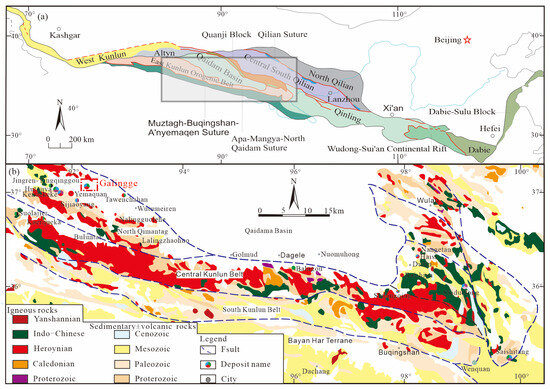
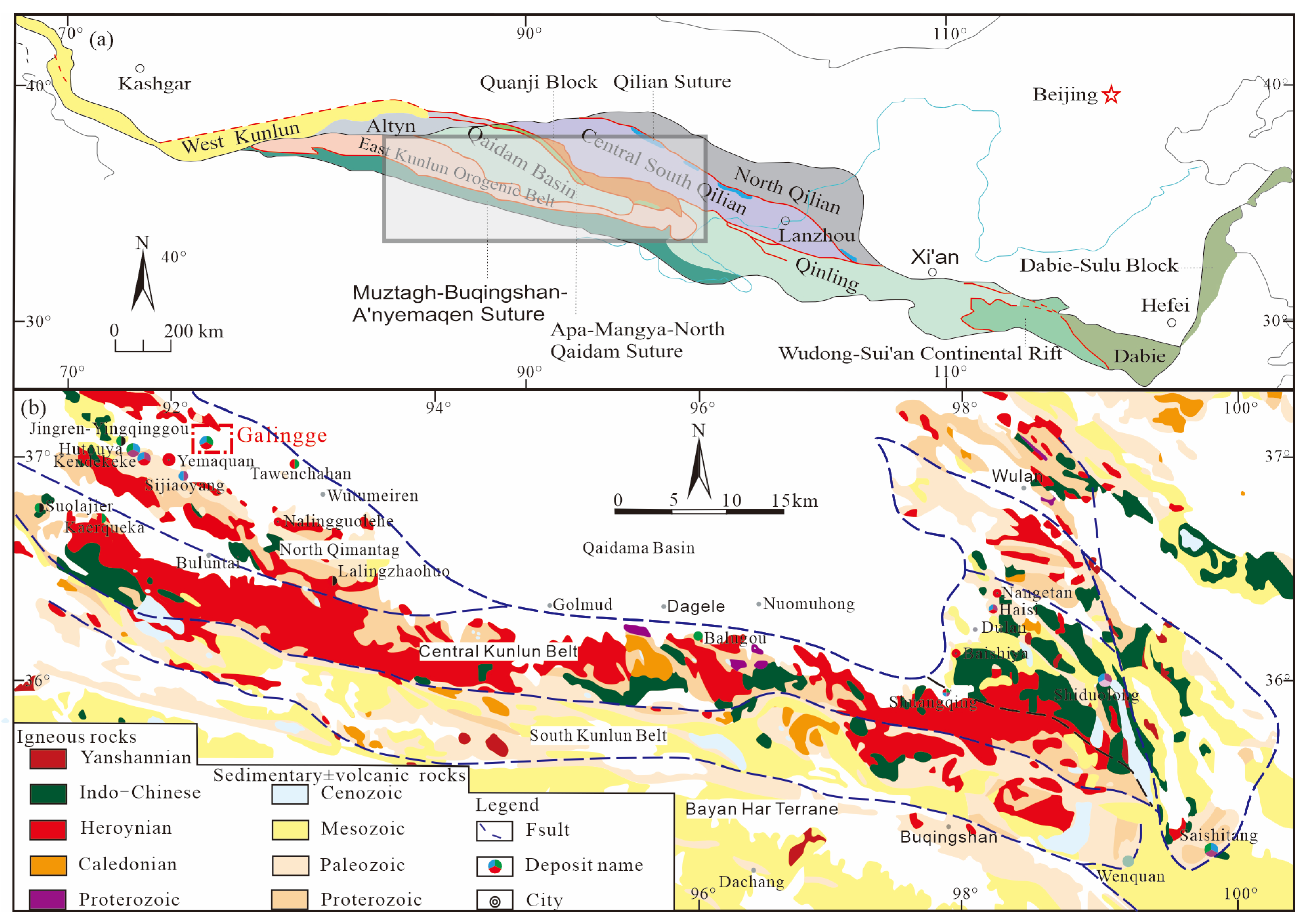
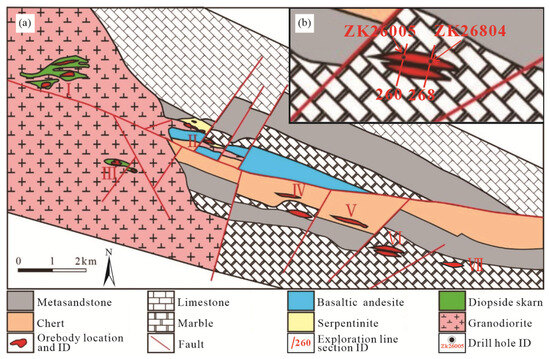
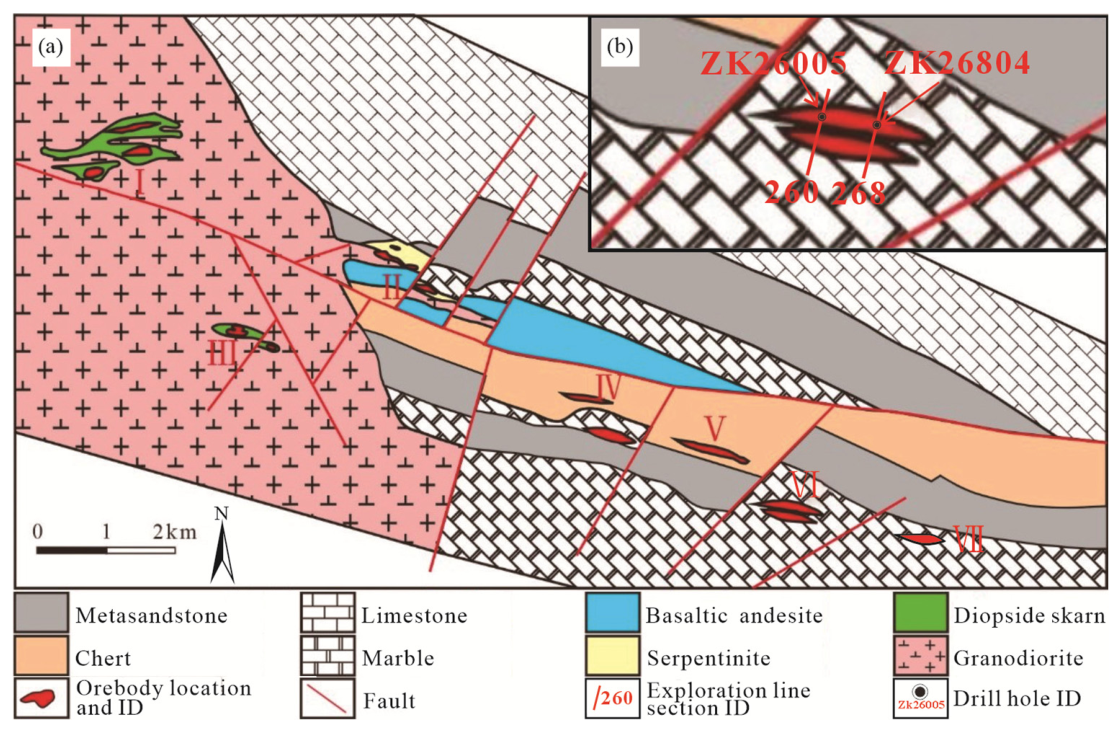
The Galinge Fe-polymetallic deposit is located in the Qimantagh Mountains southwest of Golmud City, Qinghai Province, in the central part of the Qimantagh metallogenic belt of the western EKOB (Figure 1). The mining area is covered by a relatively thick Quaternary cover (approximately 170–200 m). Basement rocks are dominated by carbonate rocks, siliceous rocks and intermediate–mafic volcanic rocks of the Ordovician Qimantagh Group, with local sandstone and argillaceous dolostone [20]. Indosinian intermediate to felsic intrusions and related dikes are widely exposed or revealed by drilling. Ore bodies generally strike NWW and occur mainly as stratiform, lenticular or bedded bodies controlled by intrusive contacts, interlayer fracture–detachment zones and NWW-trending fault systems (Figure 2).
Figure 1.
(a) Schematic tectonic framework of the Eastern Kunlun Orogenic Belt (modified from [46]); (b) simplified geological map of the Eastern Kunlun Orogenic Belt showing the distribution of skarn deposits (modified from [47]).
Figure 2.
(a) Geological map of the Galinge deposit showing ore blocks I–VII; (b) enlarged view of the No. VI ore block showing drill holes ZK26005 and ZK26804 and exploration lines 260 and 268 (modified from [29]).
The Galinge mining area is divided into seven ore blocks, which differ in ore type and host-rock assemblage. Ore blocks I–V are dominated by proximal Fe mineralization, whereas ore blocks VI–VII more commonly contain distal galena–sphalerite mineralization and local Fe–Pb–Zn composite mineralization. Overall, NWW-trending faults and interlayer fracture–detachment zones are the most important ore-controlling structures, and ore bodies in different blocks commonly occur as stratiform, stratiform-like or lenticular bodies.
In terms of ore assemblages, ore blocks I–III are dominated by magnetite with local pyrrhotite, chalcopyrite or Co mineralization; ore blocks IV–V contain relatively abundant magnetite and pyrrhotite; and ore blocks VI–VII are characterized by galena–sphalerite mineralization in garnet–pyroxene skarn, with local magnetite and Ag-bearing ore. These differences indicate significant metal zonation and stage transition within the same magmatic–hydrothermal system at Galinge.
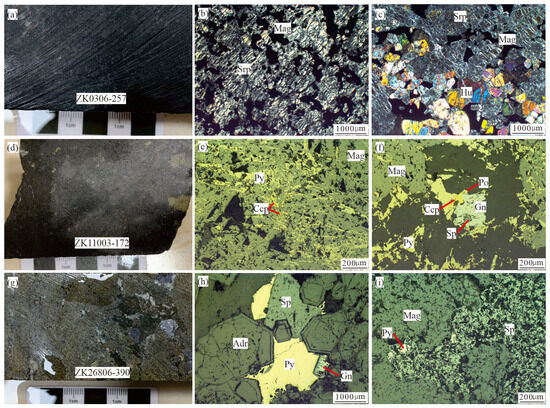
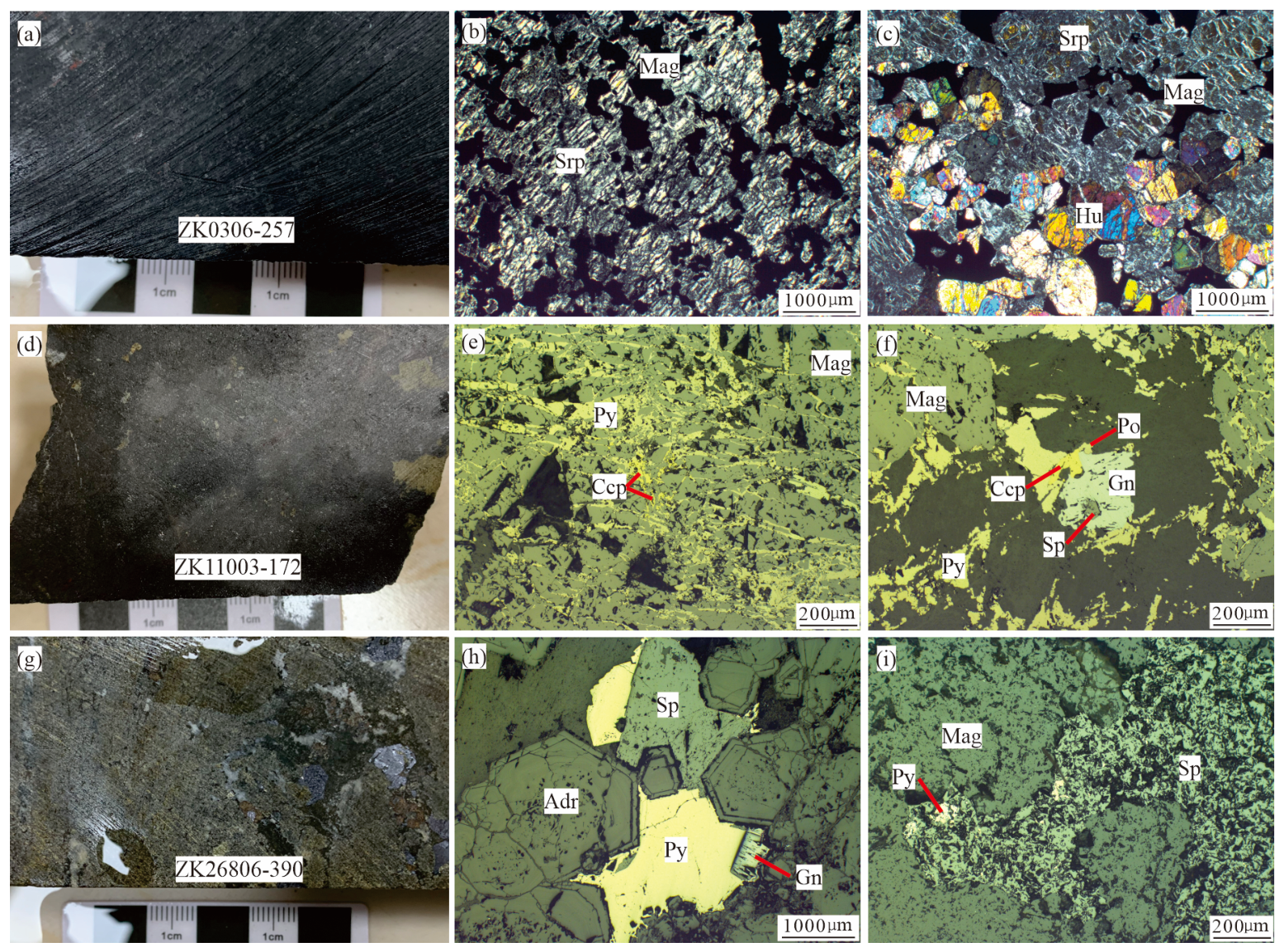
Wall-rock alteration is dominated by skarnization and retrograde alteration and is controlled jointly by intrusive contacts, carbonate horizons, faults and interlayer fracture–detachment zones. Proximal zones are dominated by Mg-rich and Ca-rich skarn, which gradually passes outward into Mn-rich hedenbergite skarn accompanied by galena–sphalerite mineralization [28,48]. The abundant serpentine in Figure 3b,c,i is interpreted as a retrograde hydration product of Mg-rich skarn minerals, locally after humite- or olivine-bearing prograde assemblages, rather than as evidence for primary igneous olivine. The paragenetic sequence can generally be divided into a skarn stage, a retrograde alteration stage and a quartz–calcite–sulfide stage. Magnetite mainly formed during the skarn-to-retrograde transition and may have continued into the retrograde stage, whereas galena, sphalerite, pyrite and chalcopyrite commonly occur in late fractures, veins and distal skarn zones. Recent work on ilvaite in the retrograde alteration assemblage further indicates multiple fluid pulses and fluctuations in thermodynamic conditions during this stage [49].
Figure 3.
Typical ore-mineral assemblages from different ore blocks of the Galinge deposit. (a,d,g) Drill-core photographs showing representative Fe, Fe-polymetallic and Pb–Zn ore textures; (b,c) Mg-rich skarn assemblages with serpentine ± humite ± magnetite; (e,f) magnetite-sulfide assemblages with pyrite, chalcopyrite, pyrrhotite, sphalerite and galena; (h,i) distal skarn and sulfide assemblages with andradite, pyrite, sphalerite, galena and magnetite. Abbreviations: Adr, andradite; Hu, humite; Srp, serpentine; Mag/Mt, magnetite; Po, pyrrhotite; Ccp, chalcopyrite; Py, pyrite; Sp, sphalerite; Gn, galena.
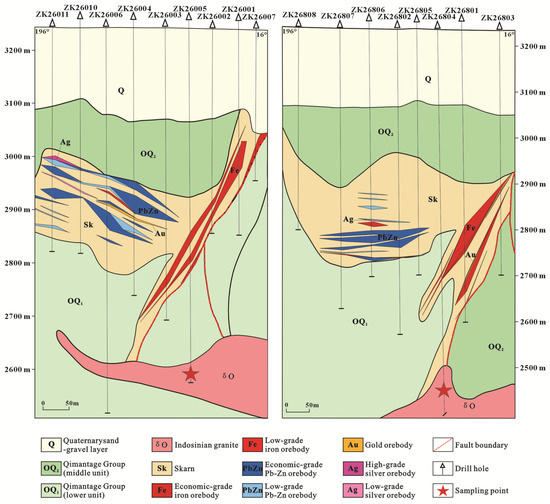
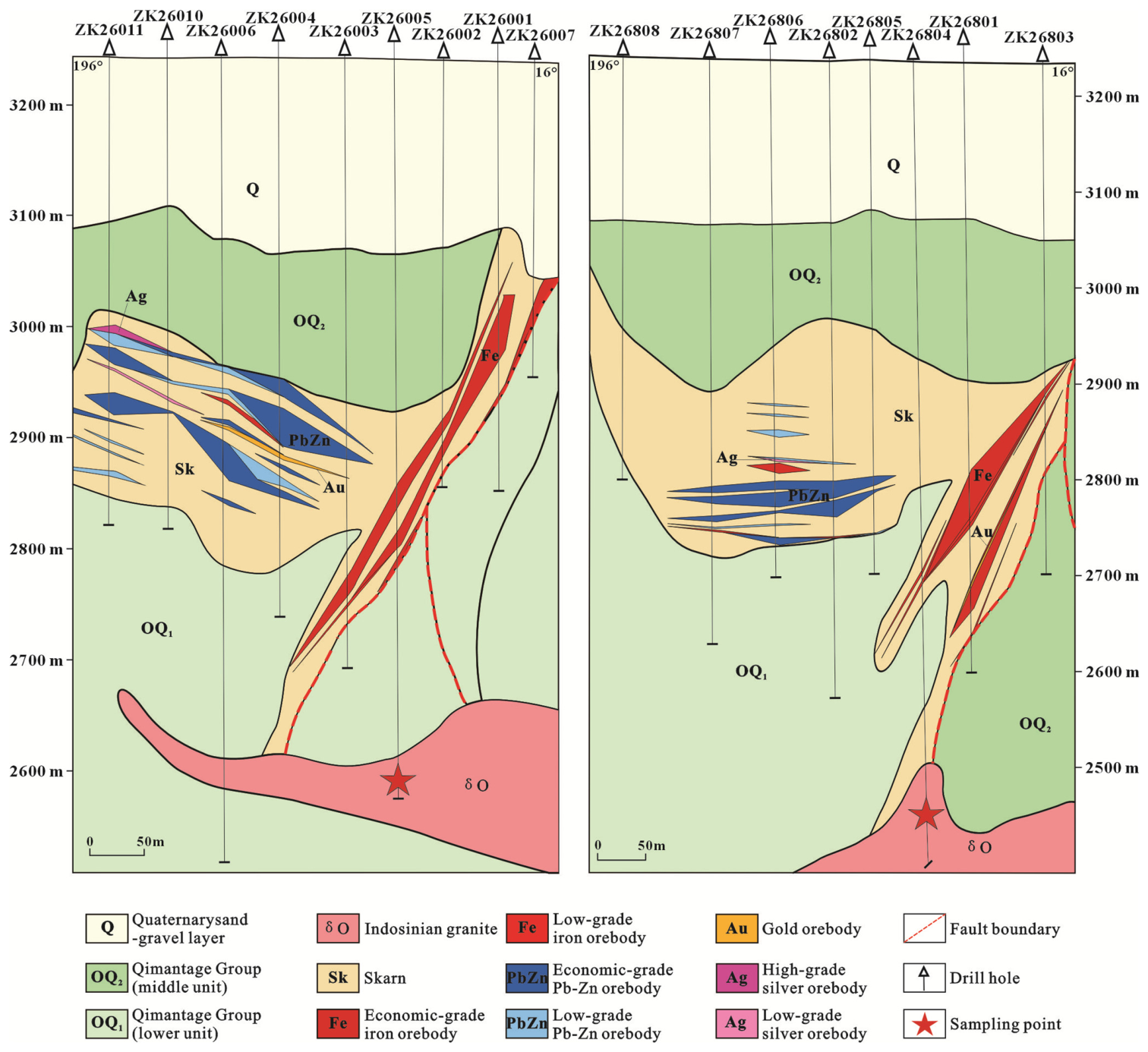
The No. VI ore block lies in the eastern distal part of the mining area and is one of the most representative areas showing Fe–Pb–Zn coexistence and differentiation (Figure 2). Exploration data indicate that several NW-trending magnetite and Pb–Zn sulfide ore bodies have been delineated. These ore bodies are controlled by the combined effects of carbonate horizons, interlayer fracture–detachment zones, NWW-trending faults and branches of concealed intrusions (Figure 4). Therefore, skarn bodies in section view are not interpreted as simple contact-parallel aureoles around the exposed granitoid alone; some skarn zones occur away from, or at high angles to, the mapped intrusive contact because hydrothermal flow was channelized by permeable structures and favorable carbonate layers. The ore assemblages record a clear oxide-to-sulfide evolution. Proximal to deep parts are dominated by massive or banded magnetite with minor pyrite, pyrrhotite and chalcopyrite, whereas distal contact zones and upper levels are dominated by galena–sphalerite (±pyrite, chalcopyrite). Gangue minerals include Mn-bearing hedenbergite, andradite, epidote, chlorite, wollastonite, quartz and calcite.
Figure 4.
Cross sections along exploration lines 260 and 268 in the No. VI ore block of the Galinge deposit, showing ore bodies and sampling positions.
Fe and Pb–Zn mineralization in the No. VI ore block shows both pronounced spatial zonation and local structural overprinting, but the zonation should not be attributed to distance from the intrusive contact alone. Exploration line 268 is closer to the concealed intermediate to felsic intrusion and its contact-related structural corridor, and the deep part contains a continuous skarn–magnetite zone closely associated with garnet–pyroxene skarn. In contrast, exploration line 260 is located in a distal structural-lithological trap where faults and interlayer fracture zones are superimposed on carbonate horizons; Pb–Zn sulfide ore bodies are more abundant and commonly occur in Mn-rich skarn and retrograde alteration zones. Locally, galena–sphalerite veins cut early magnetite or fill fractures, indicating that late Pb–Zn mineralization inherited earlier pathways and overprinted early Fe ore. The resulting deposit-scale pattern is characterized by deep/proximal Fe mineralization and upper/distal Pb–Zn ± Ag mineralization, with local overlap where late S-rich fluids reused early Fe-stage channels.
On this basis, exploration lines 268 and 260 were selected as key comparative sections for this study. Line 268 constrains the proximal Fe-rich end member and its ore-related intrusive, skarn and mineral assemblages, whereas line 260 constrains the distal Pb–Zn-rich end member and overprinting features in fault- and interlayer-controlled carbonate rocks. The two sections therefore provide a unified structural and lithofacies framework for assessing how intrusive pulses, lithological traps and inherited fluid pathways jointly controlled ore-body zonation.
3. Samples and Analytical Methods
3.1. Sample Collection
This study focuses on the No. VI ore block of the Galinge deposit. Sampling was carried out along exploration lines 268 and 260 (Figure 4). Both sections intersect Indosinian intermediate to felsic intrusive rocks or concealed intrusive branches and associated skarn-mineralization zones in the distal part of the mining area. They are key sections for identifying the spatial relationship between Fe and Pb–Zn ore bodies. Line 268 is closer to the intrusive contact-related structural corridor and contains magnetite ore, whereas line 260 lies in a distal fault–interlayer fracture zone where Pb–Zn sulfide ore bodies are more concentrated. Sampling therefore had two objectives: first, to compare two phases of intermediate to felsic intrusions in order to define the timing and source differences of magmatic events; and second, to select representative ore samples from proximal Fe ore bodies and distal Pb–Zn ore bodies to trace metal partitioning and late overprinting during different mineralization stages.
Intrusive rock samples: Ten drill-core samples of intermediate to felsic intrusive rocks were collected. Five granodiorite samples from 788–805 m depth in drill hole ZK26804 on line 268 (ZK26804-1, ZK26804-2, ZK26804-788, ZK26804-793 and ZK26804-805) represent the early intrusive phase near the contact-related structural corridor. Five granodiorite–quartz diorite samples from 656–658 m depth in drill hole ZK26005 on line 260 (ZK26005-1, ZK26005-2, ZK26005-3, ZK26005-656 and ZK26005-658) represent the younger intrusive phase in the distal contact zone. Petrographically, the relatively fresh granitoids consist mainly of plagioclase, quartz, K-feldspar and hornblende ± biotite, with accessory zircon, apatite and Fe–Ti oxides; muscovite, garnet and cordierite, which would be typical indicators of strongly peraluminous S-type granites, were not observed. All samples were collected from relatively fresh core intervals away from obvious skarnization, intense sulfidation and fracture fillings and were used for whole-rock major, trace and rare earth element analyses, zircon U–Pb dating and Lu–Hf isotope analyses. Sample ZK26804-805 shows extremely low Na2O, high loss on ignition (LOI) and anomalously high Rb/Sr, and is therefore treated as a hydrothermally altered sample; it has been excluded from the whole-rock data tables, petrochemical diagrams and primary petrogenetic interpretation.
Ore and skarn samples: To compare the staged and overprinting relationships between Fe and Pb–Zn mineralization within the same ore block, ore samples were collected from two representative ore-body types and prepared as thin sections and polished sections. Proximal Fe ore samples were mainly obtained from massive to banded magnetite bodies in the skarnized contact zone of line 268. They contain minor pyrite, pyrrhotite and chalcopyrite, with gangue minerals dominated by garnet (andradite ± grossular), hedenbergite and amphibole. Distal Pb–Zn ore samples were mainly collected from galena–sphalerite ore bodies along line 260 and adjacent fault–interlayer fracture zones. These samples commonly contain pyrite and chalcopyrite, locally pyrrhotite and arsenopyrite, and gangue minerals dominated by Mn-bearing hedenbergite, epidote, chlorite, wollastonite and quartz–calcite. In several samples, sulfide veins can be observed cutting or replacing early magnetite, providing textural evidence for late overprinting.
After petrographic examination, representative minerals with good preservation, relatively large grain size and limited late alteration were selected from Fe and Pb–Zn ore samples for LA–ICP–MS in situ trace-element analysis. Target minerals included magnetite from the Fe stage (some samples were used to identify late overprinting), early and late pyrite and chalcopyrite from the sulfide stages, and later pyrrhotite and arsenopyrite. Mineral generations were defined mainly from crosscutting relationships, replacement textures and mineral assemblages under reflected- and transmitted-light microscopy. Trace-element contrasts among minerals from different ore types and stages were then used to trace Fe and Pb–Zn partitioning during magmatic–hydrothermal evolution.
3.2. Whole-Rock Major- and Trace-Element Analyses
Whole-rock major- and trace-element analyses were completed at relevant laboratories of Peking University. Major elements were determined by X-ray fluorescence spectroscopy (XRF) using fused glass disks. Approximately 0.5 g of powdered sample was weighed into a crucible, mixed with boric acid and fused at high temperature to produce a glass disk. Major oxides were measured using an XRF-1500 instrument (Shimadzu Corporation, Kyoto, Japan) with external calibration, and relative analytical errors were generally less than 2%. Trace elements were determined by inductively coupled plasma mass spectrometry (ICP–MS; Element II). Approximately 40 mg of sample powder was dissolved using acid digestion prior to analysis, and relative errors were generally better than 5%–10%.
3.3. LA–ICP–MS Zircon U–Pb Dating
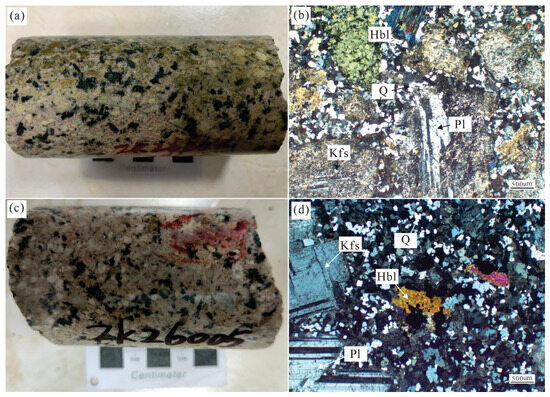
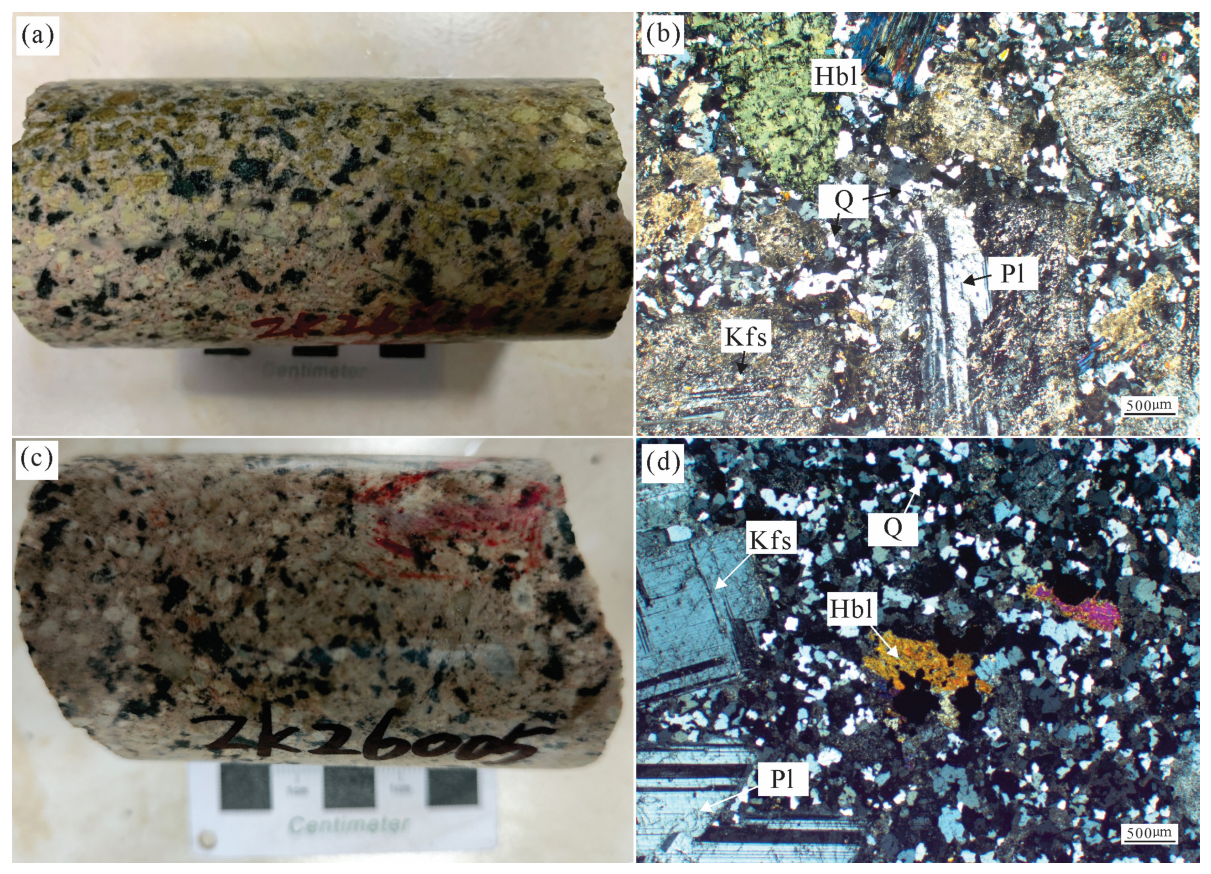
Zircon U–Pb isotope analyses were conducted at Beijing Zircon Navigator Analysis and Testing Co., Ltd. (Beijing, China). The laser-ablation system was an NWR 213 nm solid-state laser (Elemental Scientific Lasers (ESL), Omaha, MT, USA), coupled to a Neptune Plus multi-collector inductively coupled plasma mass spectrometer (Thermo Fisher Scientific, Bremen, Germany). The laser spot diameter was typically 55 μm, with an energy density of 7–8 J cm−2 and a repetition rate of 10 Hz. Zircon standard 91500 [50] and NIST SRM 610 glass [51] were used as external standards for isotope fractionation correction. Offline data reduction was carried out using ICPMSDataCal 10.8, and concordia diagrams and weighted mean ages were calculated using Isoplot/Ex 3.0 [52]. Representative hand specimens and photomicrographs of the intermediate to felsic intrusive rocks are shown in Figure 5.
Figure 5.
Representative samples of intermediate to felsic intrusive rocks from the No. VI ore block of the Galinge deposit. (a,c) Drill-core photographs of samples ZK26804-793 and ZK26005-656, respectively; (b,d) photomicrographs taken with a petrographic microscope under crossed polarizers. Abbreviations: Q, quartz; Pl, plagioclase; Kfs, K-feldspar; Hbl, hornblende.
3.4. Zircon Hf Isotope Analysis
Zircon Hf isotope analyses were also completed at the Beijing Zircon Navigator laboratory. In situ 176Hf/177Hf ratios were measured by MC–ICP–MS on the same zircon grains used for U–Pb dating or at adjacent sites. Instrumental mass fractionation was corrected using the 91500 zircon standard. Interferences of 176Lu and 176Yb on 176Hf were corrected following the methods of references [53,54]. Values of εHf(t), single-stage model ages (TDM) and two-stage model ages (TDM2) were calculated using parameters consistent with published references [55,56,57].
3.5. LA–ICP–MS Trace-Element Analysis of Ore Minerals
In situ trace-element analyses of pyrite, chalcopyrite, magnetite, pyrrhotite and arsenopyrite were conducted at Wuhan Sample Solution Analytical Technology Co., Ltd. (Wuhan, China) using a GeoLas HD (Coherent, Göttingen, Germany) laser-ablation system coupled to an Agilent 7900 ICP–MS (Agilent Technologies, Santa Clara, CA, USA). Helium was used as the carrier gas during ablation and was mixed with argon before entering the ICP–MS. Each analysis included approximately 20 s of background acquisition and 50 s of sample ablation. Laser energy was 80 mJ, the repetition rate was 5 Hz, and the spot diameter was 44 μm. Offline data reduction was performed using ICPMSDataCal 10.8 [58]. Values below detection limits (BDL) were not included in the calculation of means and quartiles for the box plots, but detection information was retained to identify stage-specific element associations.
4. Results
4.1. Zircon U–Pb Ages
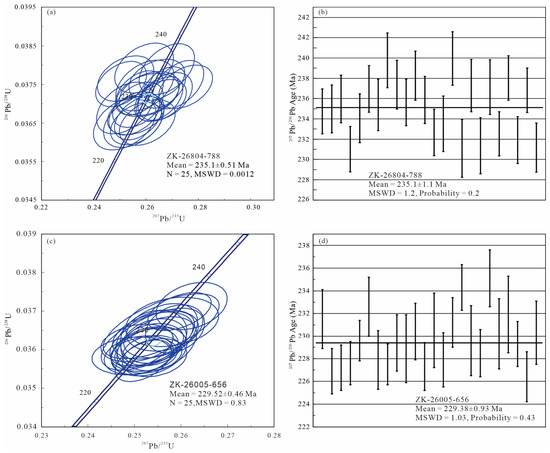
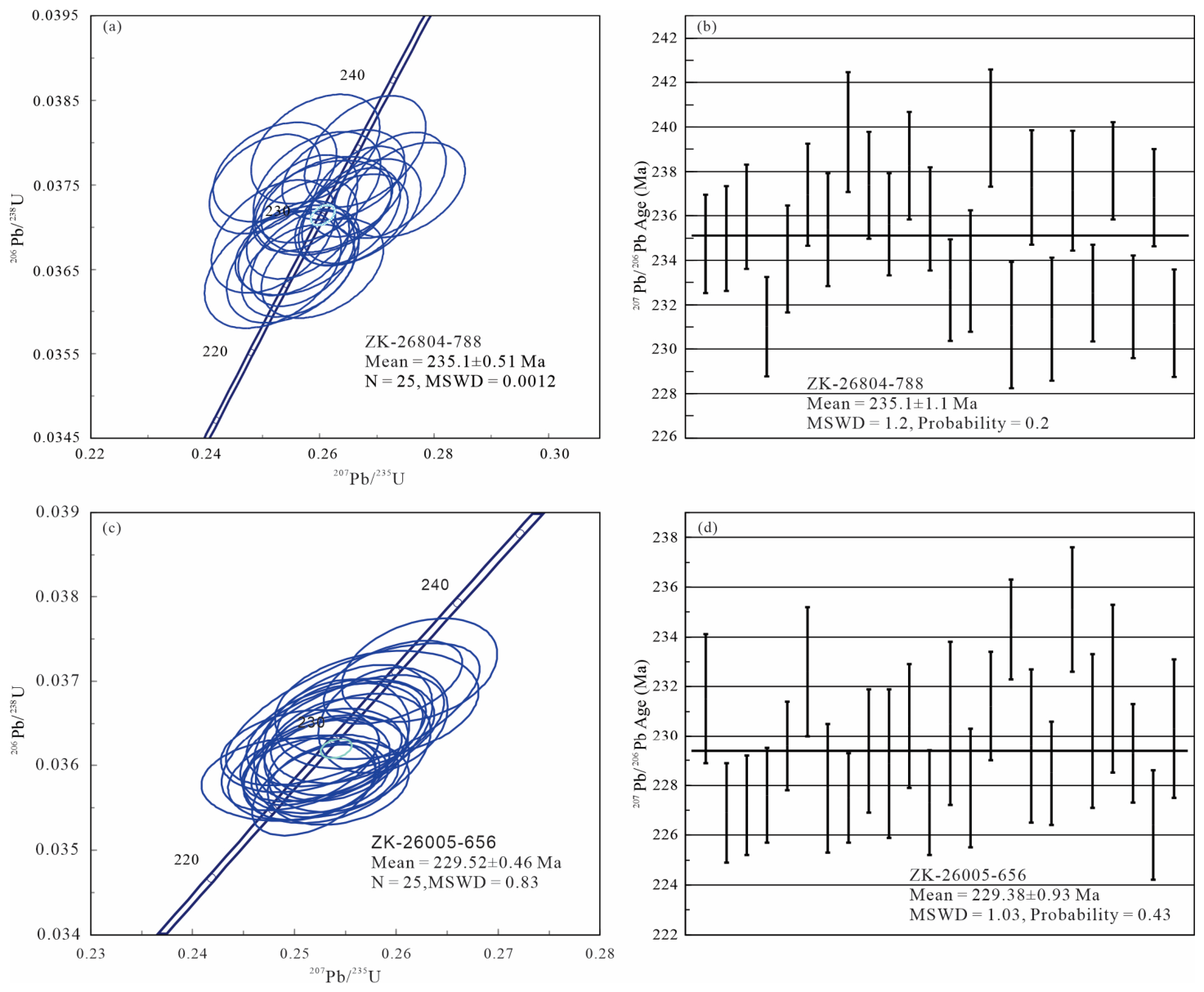
To constrain the formation age of ore-related intrusions in the No. VI ore block, LA–ICP–MS zircon U–Pb dating was performed on early sample ZK26804-788 and younger sample ZK26005-656 (Table 1; Figure 6). The age data are displayed on Tera–Wasserburg concordia diagrams [59]. Zircons from both samples are mostly euhedral to subhedral prismatic grains with clear oscillatory zoning. They have Th = 79–389 ppm, U = 187–471 ppm and Th/U = 0.44–0.64, consistent with a typical magmatic origin [60].
Figure 6.
Zircon U–Pb concordia diagrams and weighted mean 206Pb/238U ages for the two intermediate to felsic intrusive samples. (a,b) ZK26804-788; (c,d) ZK26005-656.
For early granodiorite sample ZK26804-788, 25 analyses were obtained. One younger analysis (ZK26804-788-009; 225.7 Ma) was excluded from the weighted-mean calculation because it deviates from the coherent main zircon population, although it is retained in Table 1 for transparency. The remaining 24 analyses are generally distributed along the concordia line and yield a weighted mean 206Pb/238U age of 235.1 ± 0.51 Ma, representing the crystallization age of the early intrusive phase.
For younger granodiorite–quartz diorite sample ZK26005-656, 25 valid analyses were also obtained. The 206Pb/238U ages range from 226.4 to 235.1 Ma. The analyses plot close to the concordia line and yield a weighted mean 206Pb/238U age of 229.52 ± 0.46 Ma (MSWD ≈ 1), indicating that the younger intrusive phase formed in the Late Triassic.
The crystallization ages of the two intrusive phases differ by approximately 5–6 Ma, indicating that the No. VI ore block records at least two closely spaced but compositionally distinct Indosinian magmatic pulses. This age window is broadly consistent with the regional understanding of multistage Late Triassic magmatic–metallogenic activity in the Galinge deposit and adjacent areas.
4.2. Whole-Rock Major- and Trace-Element Compositions
Whole-rock major-, trace- and rare-earth-element data for the two intermediate to felsic intrusive phases are listed in Table 2 and Table 3. Sample ZK26804-805 was removed from these tables and from petrochemical diagrams because its extremely low Na2O, high LOI and anomalous Rb/Sr indicate hydrothermal overprinting and disturbed alkali balance. Overall, the remaining samples have intermediate to felsic compositions, but they differ in alkali components, Rb/Sr, Sr/Y and total rare earth element contents. These differences provide a basis for comparing the degree of magmatic differentiation and source characteristics of the two phases. Because the samples were collected from a skarn deposit environment, mobile elements such as Na, K, Ca, Rb and Sr may have been affected by later hydrothermal alteration. Interpretations of magma source and tectonic affinity therefore emphasize relatively immobile elements, REE patterns, high-field-strength element (HFSE) anomalies and zircon Hf isotopes.
Younger ZK26005-series samples have SiO2 = 62.91–65.48 wt.%, Al2O3 = 14.49–15.27 wt.%, MgO = 1.34–2.23 wt.%, CaO = 4.69–7.95 wt.%, TFe2O3 = 2.57–4.46 wt.% and TiO2 = 0.43–0.51 wt.% (Table 2). K2O and Na2O contents are 0.68–6.02 wt.% and 2.27–4.44 wt.%, respectively. These samples have Sr = 251–309 ppm, Y = 19.9–27.0 ppm, Rb/Sr = 0.07–0.60 and Sr/Y = 10.65–13.67 (Table 3), indicating relatively Sr-rich and Rb-poor characteristics.
The early ZK26804 series shows a narrower compositional range, but sample ZK26804-805 displays clear alteration signals: very low Na2O (0.14 wt.%), high LOI (5.21 wt.%), anomalously low Sr (34.6 ppm) and high Rb (272 ppm). These features suggest strong Na depletion and K-rich hydrothermal alteration. Therefore, primary magmatic interpretations are based mainly on the relatively fresh samples. Excluding ZK26804-805, early granodiorite samples have SiO2 = 62.74–63.67 wt.%, Al2O3 = 14.68–15.10 wt.%, K2O = 4.23–4.40 wt.%, Na2O = 2.78–3.01 wt.%, CaO = 3.82–4.33 wt.% and MgO = 1.88–2.27 wt.%. In trace elements, they have Rb = 200–208 ppm and Sr = 217–244 ppm, with Rb/Sr values markedly higher than those of the younger samples and generally lower Sr/Y values (Table 3).
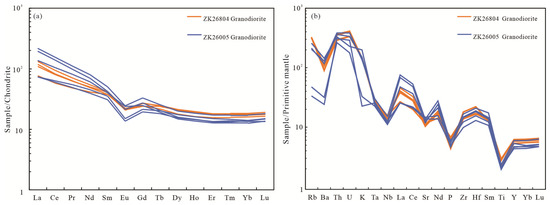
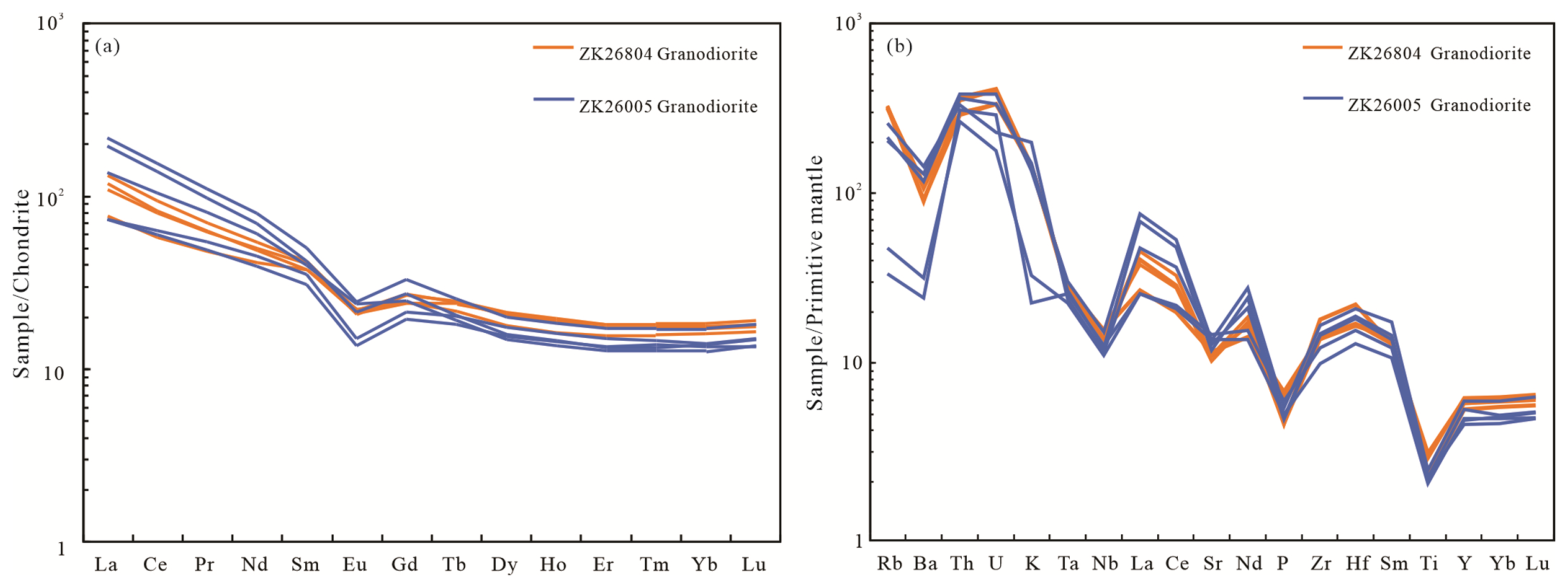
In terms of rare earth elements, both sample groups have ΣREE = 98.3–302.4 ppm. Chondrite-normalized REE patterns are overall right-inclined, with enriched LREE, relatively flat HREE and variable negative Eu anomalies (Figure 7a). Primitive-mantle-normalized trace-element diagrams show that both intrusive phases are enriched in large-ion lithophile elements (LILEs) such as Rb, Ba and K and depleted in HFSE such as Nb, Ta and Ti (Figure 7b). Overall, the younger intrusive phase is richer in Sr and has higher Sr/Y, whereas the relatively fresh early intrusive samples have higher Rb/Sr and greater total REE contents.
Figure 7.
Chondrite-normalized rare earth element patterns (a) and primitive-mantle-normalized trace-element spider diagrams (b) for the two intermediate to felsic intrusive phases.
Table 1.
LA–ICP–MS zircon U–Pb dating results of intermediate to felsic intrusive rocks from the No. VI ore block of the Galinge deposit.
Table 2.
Whole-rock major-element compositions of intermediate to felsic intrusive rocks from the No. VI ore block of the Galinge deposit.
Table 3.
Whole-rock trace and rare earth element compositions of intermediate to felsic intrusive rocks from the No. VI ore block of the Galinge deposit.
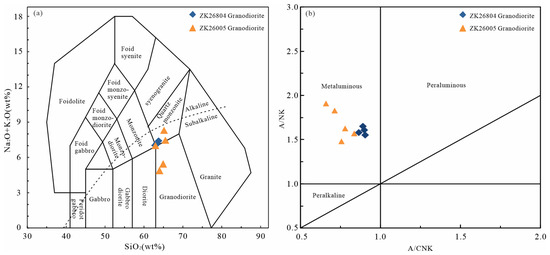
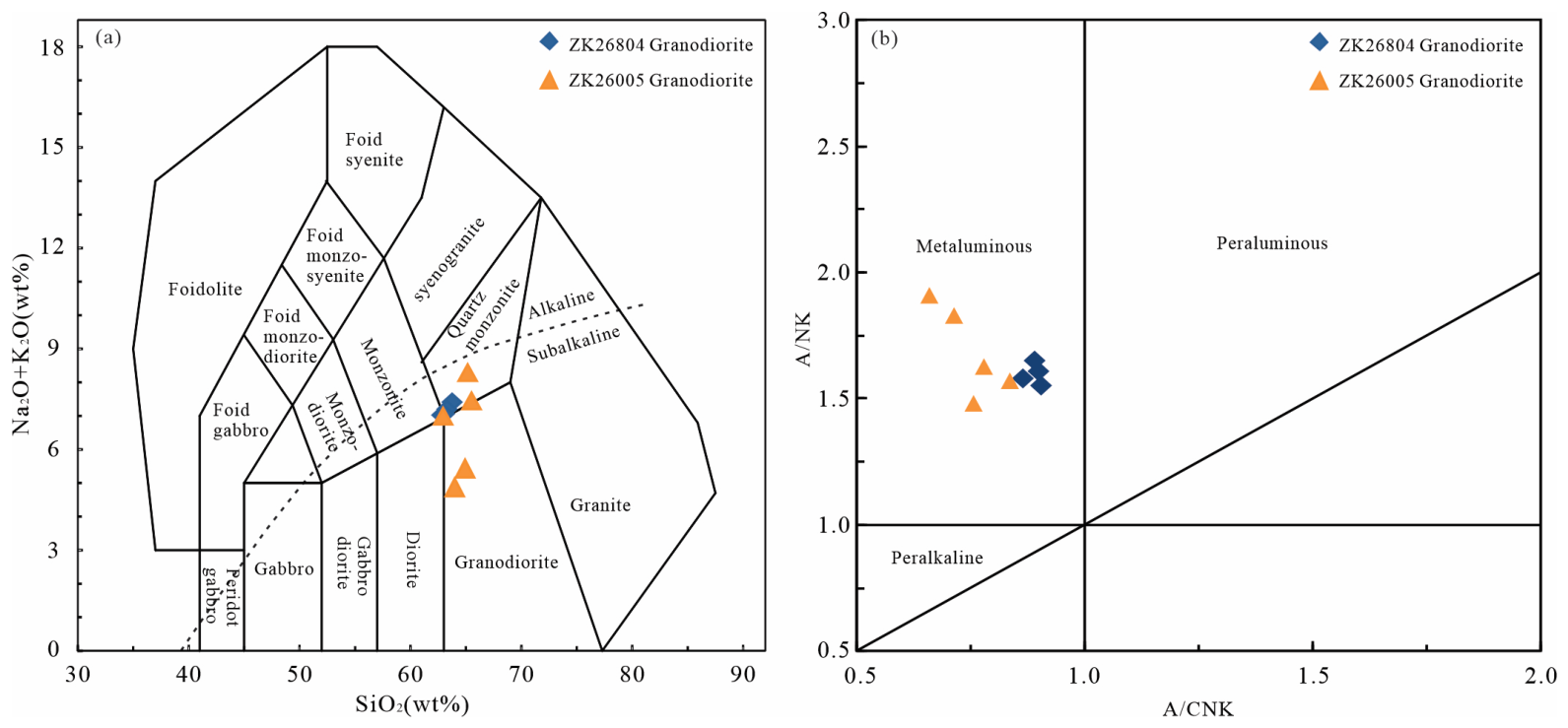
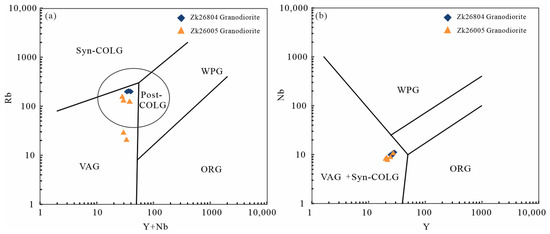
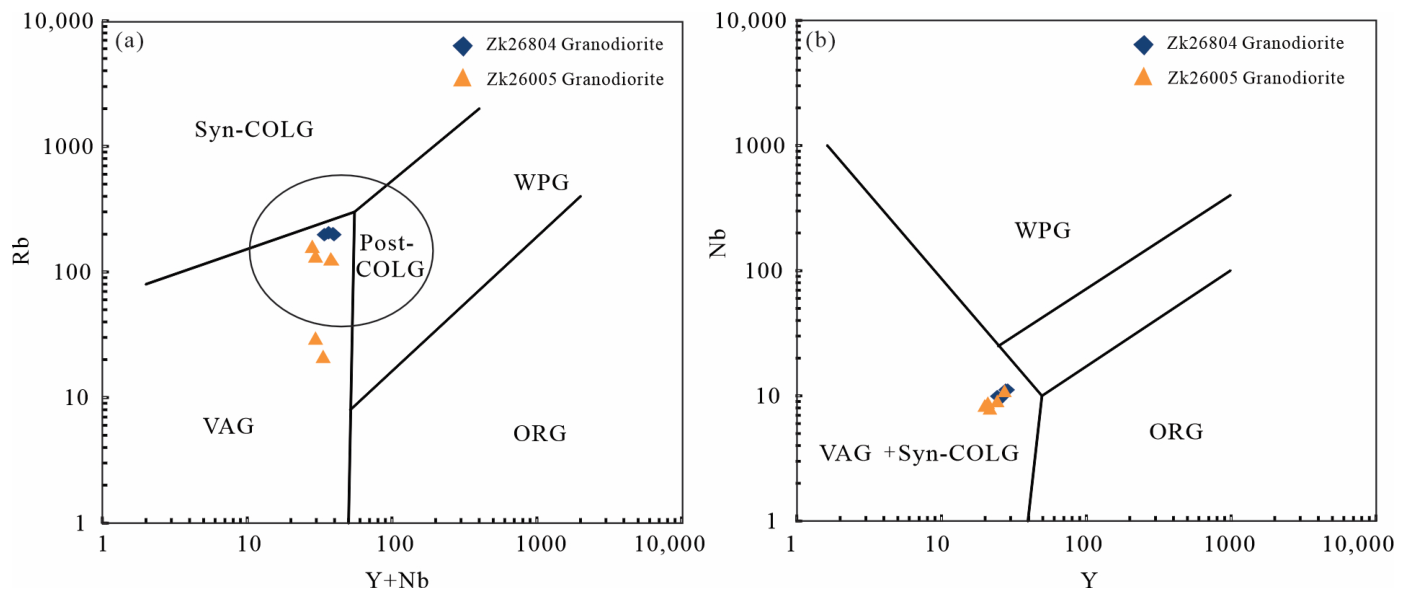
On discrimination diagrams, both sample suites plot in the subalkaline, high-K calc-alkaline granodioritic to dioritic fields (Figure 8a). Recalculation of the Shand parameters using molar proportions gives A/CNK = 0.66–0.90 and A/NK = 1.48–1.90 for the relatively fresh samples, so they plot in the metaluminous field on the corrected A/NK–A/CNK diagram (Figure 8b). On the Rb–(Y + Nb) and Nb–Y tectonic discrimination diagrams, the samples mainly fall within or near the transition between volcanic-arc granite and syn-collisional granite fields (Figure 9a,b).
Figure 8.
(a) Positions of the two intrusive phases on the total alkalis versus SiO2 (TAS) diagram [61]; (b) the A/NK–A/CNK diagram [62].
Figure 9.
(a) Rb–(Y + Nb) tectonic discrimination diagram [63]; (b) Nb–Y tectonic discrimination diagram [63]. Abbreviations: WPG, within-plate granite; VAG, volcanic-arc granite; Syn-COLG, syn-collisional granite; ORG, ocean-ridge granite.
4.3. Zircon Hf Isotopes
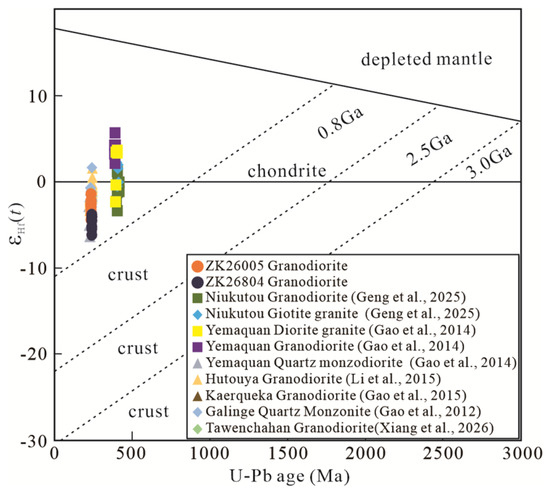
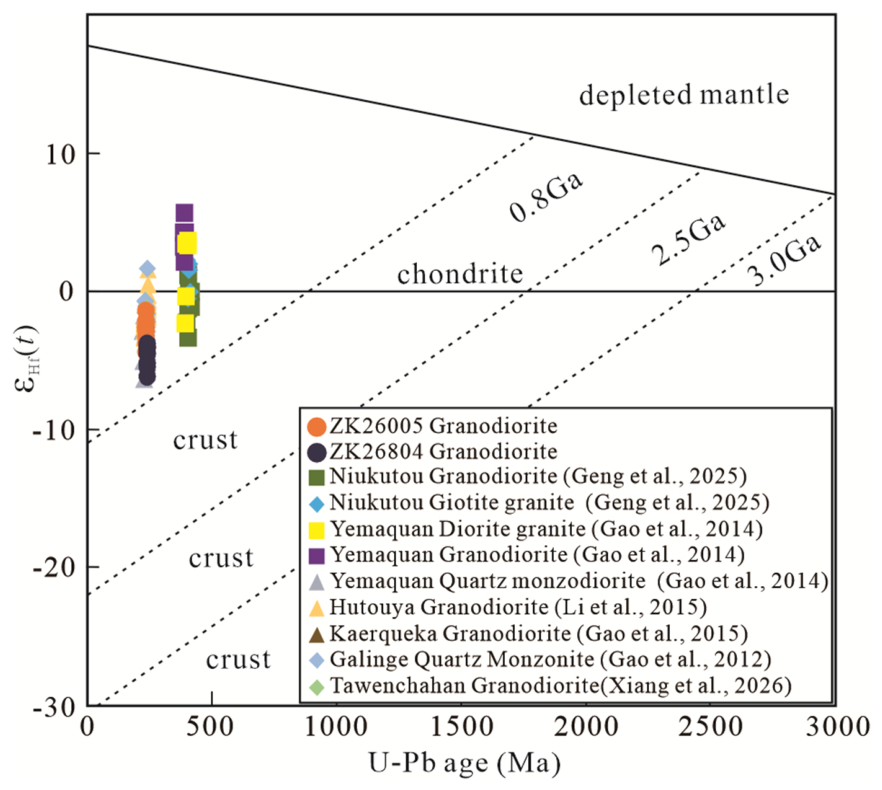
Zircon Hf isotope results are listed in Table 4, and the εHf(t)–U–Pb age relationship for the two dated samples in this study, together with published regional Hf datasets for comparison, is shown in Figure 10.
Figure 10.
εHf(t) vs. zircon U–Pb age correlation diagram of intrusive rocks from Galinge and other deposits in Qimantagh area [30,43,44,64,65,66].
Zircons from early sample ZK26804-788 have 176Hf/177Hf = 0.282456–0.282524 (mean = 0.282499), corresponding to εHf(t) = −6.12 to −3.74 (mean = −4.61). Their TDM2 values range from 1504 to 1655 Ma, with an average of approximately 1.56 Ga, and fLu/Hf ranges from −0.985 to −0.972 (Table 4).
Zircons from the younger sample ZK26005-656 have 176Hf/177Hf = 0.282509–0.282594 (mean = 0.282554) and εHf(t) = −4.34 to −1.36 (mean = −2.77). Their TDM2 values range from 1348 to 1538 Ma, with an average of approximately 1.44 Ga, and fLu/Hf ranges from −0.984 to −0.975.
Overall, zircon εHf(t) values of both intrusive phases are negative and fLu/Hf values are low, indicating that the magmas were mainly derived from partial melting of Mesoproterozoic to Paleoproterozoic ancient crustal material. In combination with the regional tectonic setting and granitoid assemblages, this source can be further interpreted as involving remelting of ancient crust, possibly including lower crust, with variable addition of juvenile components. The younger ZK26005 intrusive phase has higher εHf(t) values and younger TDM2 ages than the early phase, suggesting a relatively greater contribution from juvenile crustal or mantle-derived material. These isotopic differences, together with contrasting Rb/Sr and Sr/Y values, indicate that ore-related magmatism in the No. VI ore block was not generated by the evolution of a single homogeneous magma but by superimposed magmatic pulses.
Published zircon Hf isotope data from Galinge and adjacent Qimantagh deposits are retained in Figure 10 to place the No. VI ore block intrusions in a regional magmatic framework. These published datasets define a broad regional εHf(t) array that includes both negative values and moderately positive values [30,43,44,64,65,66]. The two intrusive phases analyzed in this study fall within the negative part of this regional field and overlap published Galinge–Yemaquan–Hutouya–Ka’erqueka granitoid data, supporting derivation mainly from ancient crustal material. The early ZK26804 granodiorite plots toward the more evolved, ancient-crustal end of the array, whereas the younger ZK26005 granodiorite–quartz diorite is shifted to higher εHf(t) values and younger TDM2 ages, closer to the relatively more juvenile regional datasets. This comparison indicates that the No. VI intrusive pulses are part of the regional Qimantagh magmatic–metallogenic event but record different proportions of old-crust remelting and juvenile input, consistent with a multipulse rather than a single homogeneous magma system.
4.4. Mineral Geochemistry
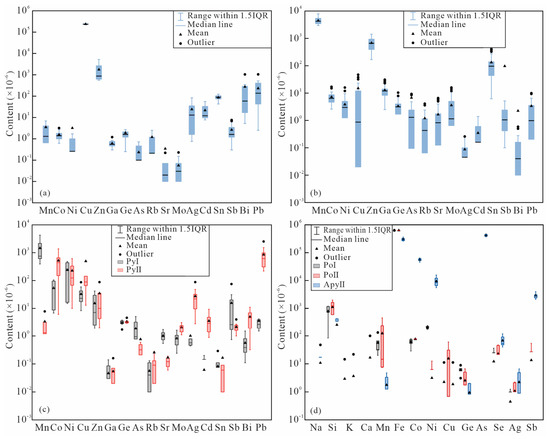
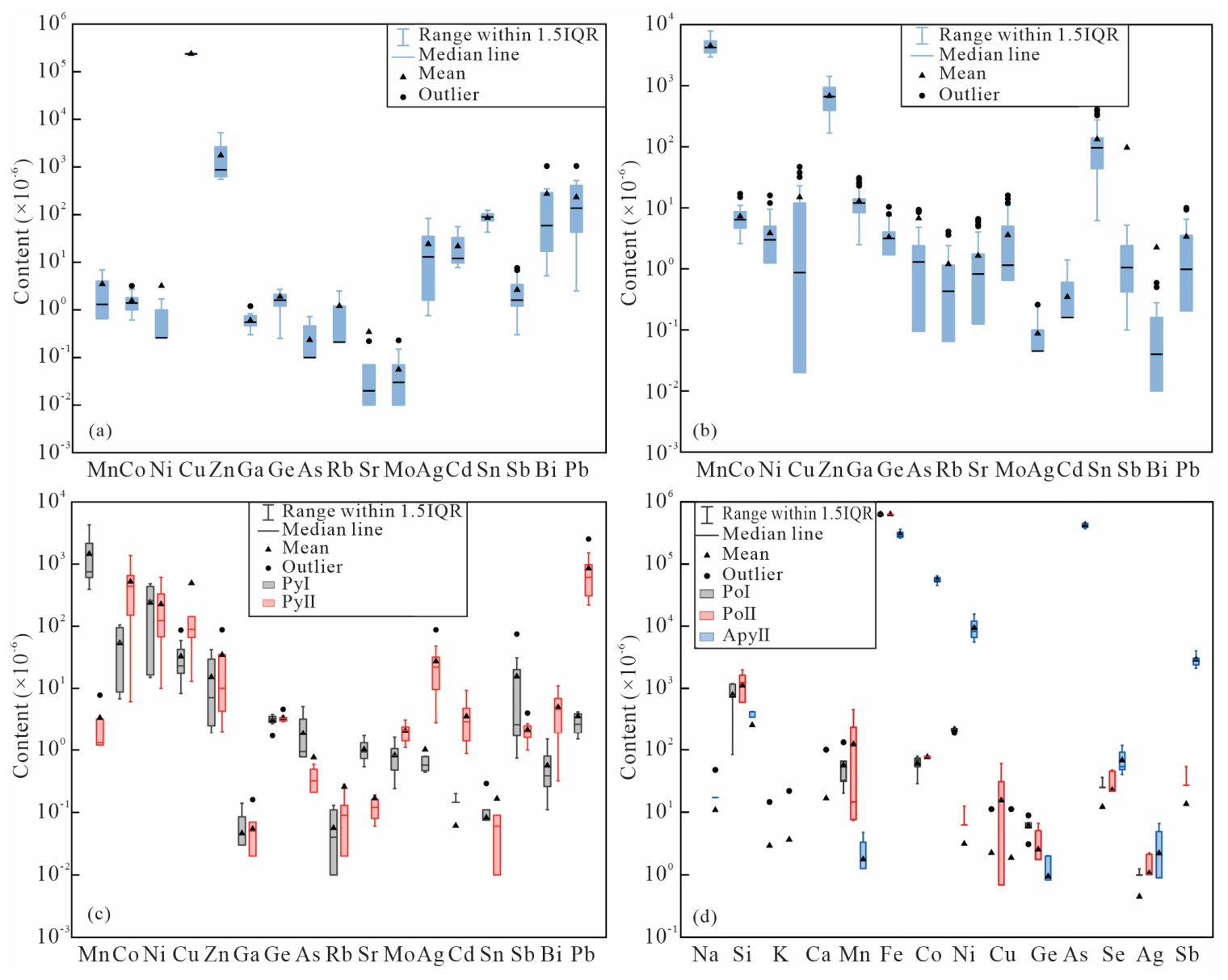
To identify differences in metal partitioning between the Fe and Pb–Zn stages in the No. VI ore block, LA–ICP–MS in situ trace-element analyses were performed on pyrite (Py), chalcopyrite (Ccp), magnetite (Mt), pyrrhotite (Po) and arsenopyrite (Apy) from representative ore samples. The 268-02 series was collected from the proximal Fe ore body along line 268 and represents early sulfides, whereas the 260-06 series was collected from the Pb–Zn ore body along line 260 and represents late sulfides. Results are listed in Table 5, Table 6 and Table 7, where BDL denotes below detection limit. Values below detection limits were not included in means or quartiles. In Figure 11, boxes represent the interquartile range, center lines are medians, whiskers represent 1.5 IQR, triangles show arithmetic means of non-BDL data, and points beyond the whiskers are plotted as outliers. Because the y-axes are logarithmic and the distributions are commonly skewed, arithmetic means may plot outside the interquartile box.
Figure 11.
Box plots of trace-element contents in ore minerals from the Galinge deposit. (a) Chalcopyrite; (b) magnetite; (c) pyrite; (d) pyrrhotite and arsenopyrite. Boxes represent the interquartile range; center lines are medians; whiskers indicate 1.5 IQR; triangles are arithmetic means of non-BDL data; circles are measured points or outliers plotted on logarithmic axes.
Based on microscopic assemblages and crosscutting relationships, pyrite is divided into early pyrite (Py I) and late pyrite (Py II). Py I has relatively low Pb contents (1.5–10.0 ppm; mean = 3.55 ppm), Zn = 1.9–42.0 ppm (mean = 15.26 ppm), Ag mostly between 0.44 and 4.00 ppm, and Cd generally below 0.20 ppm. Co and Ni contents are 6.8–105 ppm (mean = 53.54 ppm) and 15–483 ppm (mean = 240 ppm), respectively. In contrast, Py II has markedly higher Pb contents of 220–2536 ppm (mean = 855.67 ppm), Zn = 2.0–131 ppm (mean = 34.69 ppm), and significantly elevated Ag (2.80–88.0 ppm) and Cd (0.88–9.30 ppm). Co and Ni contents of Py II range from 6.1 to 1374 ppm (mean = 522.57 ppm) and from 10 to 615 ppm (mean = 226.67 ppm), respectively, suggesting that late-stage fluids had a stronger capacity to transport chalcophile metals.
Table 4.
Zircon Hf isotope data for intermediate to felsic intrusive rocks from the No. VI ore block of the Galinge deposit.
Table 5.
Trace-element contents of pyrite and chalcopyrite from the No. VI ore block of the Galinge deposit.
Table 6.
Trace-element contents of magnetite from the No. VI ore block of the Galinge deposit.
Table 7.
Trace-element contents of pyrrhotite and arsenopyrite from the No. VI ore block of the Galinge deposit.
Chalcopyrite contains very high Cu contents (approximately 22.8–25.0 wt.%), Zn = 552–5230 ppm and Pb = 2.5–1048 ppm. It is also enriched in Ag (0.76–83.0 ppm), Cd (7.70–56.0 ppm) and Bi (5.20–1924 ppm), and contains moderate Sn (43–123 ppm) (Table 5; Figure 11a). These data indicate that chalcopyrite is an important host for late-stage chalcophile elements.
Magnetite shows clear compositional differences (Table 6; Figure 11b). Magnetite from the 268-05 and 268-07 series has high Zn contents of 497–1422 ppm and 474–1276 ppm, with mean values of approximately 894 ppm and 860 ppm, respectively, whereas Sb and As are generally low. Magnetite from the 268-08 series has lower Zn contents of 240–400 ppm. Notably, magnetite from the 268-09 series shows strong Sb (±As) enrichment: Sb = 0.19–4936 ppm (mean = 549.52 ppm) and As = 1.70–234.9 ppm (mean of non-zero values = 49.92 ppm), whereas Zn is relatively low overall (168–911 ppm; mean = 414.67 ppm). Together with textural evidence and the occurrence of As–Sb-bearing minerals, this feature is interpreted to suggest late Sb–As-rich hydrothermal overprinting of early Fe mineralization, although the exact siting of these elements in magnetite requires further microanalytical verification.
Pyrrhotite and arsenopyrite record characteristics of later stages in the ore system (Table 7; Figure 11d). Early pyrrhotite (Po I) has relatively high Ni contents (188–236 ppm) and Co = 28.9–79.2 ppm. Late pyrrhotite (Po II) has Co = 73.6–78.6 ppm, markedly lower Ni in the measured grains, and local Sb enrichment up to 54.1 ppm. Arsenopyrite (Apy II) is characterized by very high As (369,843–464,191 ppm) and prominent Co (45,139–64,939 ppm), with Ni = 5515–15,625 ppm, Sb = 2109–4020 ppm and Se = 40.3–118 ppm. These features indicate that the late-stage fluids were enriched in As–Sb–Co.
In summary, magnetite in the oxide stage is characterized by high Zn and variable Sb–As associations, whereas the sulfide stage, particularly late Py II and chalcopyrite, is significantly enriched in Pb, Ag, Cd and Bi. Pyrrhotite and arsenopyrite record a still later Co–As (±Sb) enrichment. These differences indicate significant metal redistribution and zoned migration from Fe to Pb–Zn (±Ag, Cd, Bi) within the same skarn system, providing key mineralogical evidence for discussing Fe–Pb–Zn coexistence and differentiation.
5. Discussion
5.1. Magmatism and Mineralization Timing
Zircon LA–ICP–MS U–Pb dating indicates that ore-related intermediate to felsic intrusions in the No. VI ore block includes at least two Indosinian magmatic events. The early granodiorite crystallized at 235.1 ± 0.51 Ma, whereas the younger granodiorite–quartz diorite crystallized at 229.52 ± 0.46 Ma. Together with reported ages for granitic porphyry (ca. 230.1 Ma) and diorite porphyry (ca. 229.5 Ma) in the No. VI ore block, these ages suggest sustained but pulsed magmatism during the Late Triassic [21,67].
Regionally, ore-related intrusions in the Galinge deposit and adjacent areas mostly cluster around 235–228 Ma, indicating that the Indosinian ore systems in the Qimantagh belt were not single instantaneous events but rather products of several closely spaced magmatic–hydrothermal pulses [36,64,65,66,67,68,69]. In the No. VI ore block, the association of the ca. 235 Ma intrusive phase with proximal Fe mineralization and the ca. 229–230 Ma intrusive phase with distal Pb–Zn enrichment is treated as a working hypothesis based on spatial relationships, mineral assemblages and regional metallogenic age frameworks, rather than as a direct ore-mineral age correlation.
It should be emphasized that this study directly constrains the crystallization ages of intrusive rocks, not the ages of ore minerals or alteration minerals. Therefore, the relationship between early intrusion and Fe mineralization and between younger intrusion and Pb–Zn mineralization is regarded as a spatial–temporal working hypothesis constrained by section position, intrusion–ore relationships, mineral assemblages and regional metallogenic age frameworks, rather than as a strict one-to-one age correlation. The contrasting Fe and Pb–Zn assemblages are not attributed solely to the modest Hf-isotope differences between the two intrusive phases. Instead, the available evidence suggests that intrusive pulses, host-rock reactivity, inherited faults and interlayer fracture zones, cooling, and inferred changes in redox–sulfidation state jointly influenced ore precipitation. The early intrusive phase is interpreted to have favored high-temperature and relatively oxidized fluid–carbonate reaction, whereas the younger intrusive phase likely recharged the system hydrothermally along inherited pathways and enhanced volatile, sulfur and chalcophile-metal input, thereby favoring distal Pb–Zn sulfide precipitation and local overprinting of early Fe ore. Potential time lags between intrusion crystallization, fluid exsolution, skarn formation and sulfide precipitation, as well as possible contributions from concealed intrusive branches or sustained cooling/recharge, remain plausible and should be tested by direct dating of ore or alteration minerals in future work.
5.2. Petrogenesis and Magma Source of the Granitoids
Whole-rock geochemistry and REE/spider diagrams show that both intrusive phases have high-K calc-alkaline granitoid affinities. They are enriched in LILEs such as Rb, Ba and K and depleted in HFSE such as Nb, Ta and Ti, suggesting a source modified by subduction-related processes. Based on TAS and petrochemical classification diagrams, the ore-related intrusions can be assigned to a granodiorite–diorite association. After excluding the altered sample ZK26804-805, recalculated A/CNK values of the relatively fresh samples are all <1.0, indicating metaluminous compositions. This metaluminous character, together with the presence of hornblende ± biotite and the absence of diagnostic strongly peraluminous minerals such as muscovite, garnet and cordierite, supports classification as I-type granitoids rather than S-type granites. Sample ZK26804-805 shows obvious Na2O depletion, elevated LOI and anomalously high Rb/Sr, indicating later fluid alteration and making it unsuitable as a primary source proxy.
Zircon Hf isotopic data further show that both intrusive phases have negative εHf(t) values and TDM2 ages concentrated between 1.35 and 1.66 Ga, indicating that their principal source was partial melting of Mesoproterozoic to Paleoproterozoic ancient crustal material. The younger ZK26005 phase has relatively higher εHf(t) values and younger TDM2 ages, suggesting a greater contribution from juvenile crustal or mantle-derived components. Together with the higher Sr/Y and lower Rb/Sr values of the younger samples, this difference suggests source mixing or different degrees of intracrustal differentiation, but the isotopic contrast is modest and is not used alone to explain the Fe versus Pb–Zn ore assemblages.
Thus, the ore-related magmatism in the No. VI ore block is best interpreted not as a continuous evolution of a single homogeneous magma but as a multistage petrogenetic process dominated by remelting of subduction-modified old crust and superimposed late mantle-derived heat or juvenile material input. Differences in source composition, differentiation degree and volatile supply may have influenced metal transport capacity, but the final mineralization style was also strongly filtered by structural permeability, host lithology and evolving redox-sulfidation conditions.
The Pearce Nb–Y and Rb–(Y + Nb) diagrams are not used here as a stand-alone proof of tectonic setting. Instead, they are combined with the regional East Kunlun–Qimantagh tectonic framework and recent studies that emphasize the Late Triassic transition from Paleo-Tethyan subduction-related magmatism to collisional/post-collisional extension, slab rollback or breakoff, lithospheric thinning, crust–mantle interaction and crystal-mush reactivation [39,40,41,42,43,44,45]. In this context, the VAG to syn-COLG affinity, negative Nb–Ta–Ti anomalies, enriched LILE patterns, variable Sr/Y ratios and zircon Hf isotopes are consistent with multipulse magma generation during a changing convergent-to-extensional regime. Such a geodynamic transition could provide repeated heat and volatile input, reopen inherited faults and interlayer detachment zones, and promote focused hydrothermal flow through reactive carbonate horizons in the No. VI ore block.
5.3. Fe–Pb–Zn Coexistence, Differentiation and Model Applicability
Fe and Pb–Zn mineralization in the No. VI ore block shows clear spatial zonation and local structural overprinting and is interpreted to record inferred changes in temperature, oxygen fugacity and sulfidation state within the skarn system. Because no new fluid-inclusion microthermometry or stable O–H–S–C isotope data are presented in this study, these physicochemical changes are treated as interpretations based on mineral assemblages, crosscutting textures, published fluid-evolution studies of the Galinge system and the ore-mineral trace-element patterns reported here. In section view, Fe-rich ores are concentrated in deeper and more proximal structural corridors near concealed intrusive branches, whereas Pb–Zn sulfide ores are concentrated in upper to distal Mn-rich skarn and interlayer fracture–detachment zones. Local sulfide veins cutting early magnetite indicate that late hydrothermal fluids reactivated and redistributed metals along inherited pathways within the early Fe ore system [7,70]. Therefore, the difference between Fe-oxide and Pb–Zn sulfide mineralization is interpreted as the combined result of fluid evolution and structural-lithological filtering rather than the simple presence or absence of Fe or sulfides in a given magmatic pulse.
The geochronological and geochemical data presented here show that the No. VI ore block contains at least two intermediate to felsic intrusive phases closely related to mineralization: early ZK26804 granodiorite at 235.1 Ma and younger ZK26005 granodiorite–quartz diorite at 229.52 Ma. The two phases share inheritance but differ in source characteristics, differentiation degree and volatile input. Hf isotopes indicate that both were mainly derived from remelting of Mesoproterozoic to Paleoproterozoic crust, but the higher εHf(t) values and younger TDM2 ages of the younger phase suggest a relatively greater juvenile crustal or mantle contribution. Whole-rock data show that the younger phase is richer in Sr and has higher Sr/Y, whereas the early phase has higher Rb/Sr. These differences are interpreted as permissive factors that influenced fluid composition, but the observed ore zoning requires the additional effects of fault and interlayer permeability, carbonate reaction, cooling and increasing sulfidation.
Fe mineralization: The early intrusive phase is interpreted to be more closely coupled with proximal magnetite mineralization. During crystallization and fluid exsolution, magmatic fluids released from this phase likely reacted strongly with carbonate wall rocks in high-permeability contact and fault-related zones, forming garnet–pyroxene skarn and favoring abundant magnetite precipitation under inferred high-temperature and relatively oxidized conditions. The Cl-rich amphibole and high-salinity fluid stages identified by previous studies [27,29] are consistent with the Zn-rich and Pb-poor character of magnetite documented here. This does not mean that early fluids were incapable of carrying sulfur or Pb–Zn metals; rather, under the proximal conditions preserved along line 268, Fe-oxide precipitation was favored and sulfides were limited.
Pb–Zn mineralization: The younger intrusive phase and its evolved fluids are more closely related to distal Pb–Zn mineralization, but this relationship is also treated as an inferred genetic link rather than a directly dated ore-forming event. Continued differentiation and recharge may have supplied new hydrothermal pulses and increased the capacity of the system to transport Pb, Zn, Ag, Cd, Bi and other chalcophile elements. The available mineral assemblages and trace-element patterns are consistent with cooling, pressure decrease, higher effective sulfur activity, wall-rock reaction and possible external-fluid input; however, these processes are inferred from petrographic and geochemical evidence and published Galinge fluid studies rather than directly measured here. Under these inferred cooler and more reduced/sulfidized conditions, Fe was mainly incorporated into sulfides such as pyrite, pyrrhotite and chalcopyrite rather than forming abundant magnetite. Enrichment of Pb–Ag–Cd in late pyrite and chalcopyrite, together with Sb–As anomalies in part of the late magnetite and arsenopyrite, suggests that late S-rich fluids triggered metal redistribution and overprinting mineralization when they passed through the early Fe ore system [7,8,71].
From the perspective of mineral trace-element behavior, Zn, Sb and As enrichment in magnetite should not be interpreted as a single-process indicator. Zn may enter magnetite through coupled lattice substitution involving Fe2+/Fe3+ sites during the skarn-to-retrograde transition, but part of the Zn budget may also be hosted by submicroscopic sphalerite or other sulfide inclusions. Sb and As are less likely to be fully accommodated in the magnetite lattice; they may occur as micro- to nano-scale inclusions of sulfides, arsenides or sulfosalts, along grain boundaries and microfractures, or as components introduced by surface adsorption, fluid-assisted diffusion or recrystallization during retrograde alteration. Therefore, the Sb–As-rich magnetite population is used here mainly as a textural-geochemical marker of late hydrothermal overprinting, not as proof that all Sb and As are structurally bound in magnetite. LA–ICP–MS time-resolved signals, petrographic context and coexisting arsenopyrite/pyrite–chalcopyrite assemblages should be considered together when using these elements for petrogenetic and metallogenic interpretation [3,5,6,7,8,70,71,72,73,74]. Pb has lower compatibility in the magnetite lattice and is more likely to remain in later S-rich fluids, where it precipitates as galena and sphalerite or occurs as micro-inclusions or solid-solution components in pyrite–chalcopyrite assemblages during cooling, increasing sulfur activity, pH change or fluid mixing.
In summary, Fe–Pb–Zn coexistence and differentiation in the No. VI ore block can be described as the response of a coupled system involving multipulse intrusion, staged fluid evolution, host-rock reaction and inherited structural/lithological pathways. The early intrusive phase was more likely coupled with high-temperature, relatively oxidized and Cl-rich skarn–magnetite mineralization, whereas the younger intrusive phase and its evolved fluids were more likely to drive distal Pb–Zn sulfide precipitation under cooler, more S-rich and volatile-rich conditions. Local overprinting occurred where late fluids reused fault–interlayer fracture zones and early Fe-stage channels. The final ore pattern is therefore dominated by spatial zonation with local coexistence within structural pathways.
From a deposit-scale perspective, the model of system-level coexistence, stage-level differentiation and structural overprinting proposed for the No. VI ore block is not intended as a universal model for all skarn deposits. Rather, it applies to a specific class of Fe–Pb–Zn systems that meet the following conditions: (1) temporally close but compositionally distinct intermediate to felsic intrusive pulses are present; (2) skarnization and retrograde alteration are developed at intrusion–carbonate contacts and along structurally controlled carbonate horizons away from the exposed contact; and (3) high-permeability structures such as faults and interlayer fracture zones can inherit early channels and accommodate late hydrothermal flow. Key transferable parameters include the time interval between intrusive pulses, the composition and reactivity of carbonate protoliths, structural permeability of faults and interlayer detachment zones, volatile/Cl flux, magma fertility and the direction of redox–sulfidation evolution.
Where these conditions are satisfied, Fe and Pb–Zn mineralization can be expressed at the system scale as staged products of the same magmatic–hydrothermal system. In skarn systems that lack multiphase intrusion or obvious structural pathways, or that are dominated by diffuse metasomatism, however, the spatial relationship and mineralization stages of Fe and Pb–Zn may differ. Therefore, the model proposed here should be applied mainly to Fe–Pb–Zn skarn systems formed at intermediate to felsic intrusion–carbonate contacts and in structurally controlled carbonate horizons with multiphase intrusion and well-developed fluid pathways.
5.4. Metallogenic Implications for Comparable Fe–Pb–Zn Skarn Systems
Within the applicability conditions described above, the model of system-level coexistence, stage-level differentiation and local overprinting recognized in the No. VI ore block has implications for the Qimantagh belt and other Fe–Pb–Zn skarn systems that contain multiphase intermediate to felsic intrusions, carbonate host rocks and high-permeability fault–interlayer fracture zones. Here, comparable systems should not be generalized to all skarn deposits; rather, they should be restricted to composite skarn systems in which multipulse magmatic–hydrothermal activity repeatedly uses earlier structural and lithological pathways.
First, multiphase intrusion is critical for composite mineralization. In districts with multiple intermediate to felsic intrusive events, the combination of an early proximal intrusive phase and a late distal intrusive or dike system is more favorable for forming Fe–Pb–Zn composite mineralization. Regional comparison and exploration evaluation should therefore prioritize recognition of multiphase magmatism and superposition relationships, rather than attributing all mineralization to a single intrusive event.
Second, spatial zonation is controlled jointly by host rocks and structures. In such systems, Fe commonly concentrates in proximal contact zones where Mg- or Ca-rich skarn is developed, whereas Pb–Zn is more likely to concentrate in Mn-rich skarn, retrograde alteration zones and high-permeability fault–interlayer fracture zones. Integrated analysis of host-rock assemblages, alteration zonation and fluid pathways is therefore essential for explaining Fe–Pb–Zn zonation and local overlap.
Third, mineral trace elements can provide stage indicators when interpreted with textures and element-hosting mechanisms. Zn enrichment and Pb depletion in magnetite may indicate early Fe-stage fluid conditions, whereas Pb–Ag–Cd enrichment in late pyrite/chalcopyrite and As–Sb anomalies in arsenopyrite and some magnetite can indicate late Pb–Zn hydrothermal activity and overprinting. However, these criteria should be applied together with petrographic evidence and time-resolved LA–ICP–MS signals, because some Zn, Sb and As may reside in micro- to nano-inclusions or along grain boundaries rather than exclusively in the host-mineral lattice.
Fourth, local overprinting is important for recognizing composite mineralization. When late S-rich fluids reactivate early Fe ore channels or interlayer fracture zones, Fe–Pb–Zn composite mineralization or Pb–Zn overprinting of Fe ore is most likely to form. Therefore, in deposits with similar structural and lithological conditions, Fe and Pb–Zn should not be treated simply as independent mineralizing events, but as continuous responses of the same ore-forming system at different times and positions.
6. Conclusions
- (1)
- Ore-related intermediate to felsic intrusive rocks in the No. VI ore block of the Galinge deposit yield LA–ICP–MS zircon U–Pb ages of 235.1 ± 0.51 Ma and 229.52 ± 0.46 Ma. These ages indicate at least two closely spaced Late Triassic magmatic pulses and provide a magmatic time framework for multistage Fe and Pb–Zn mineralization.
- (2)
- Both intrusive phases have medium- to high-K calc-alkaline I-type granitoid affinities, are enriched in LILEs and depleted in HFSE, and show LREE-enriched, relatively flat HREE patterns with negative Eu anomalies. Zircon εHf(t) values are −6.12 to −3.74 for ZK26804 and −4.34 to −1.36 for ZK26005, indicating that the magmas were mainly derived from remelting of Mesoproterozoic to Paleoproterozoic ancient crustal material. The younger phase has higher εHf(t) values and younger TDM2 ages, possibly reflecting a greater contribution from juvenile crustal or mantle-derived components.
- (3)
- In situ trace elements of ore minerals reveal clear stage-specific metal partitioning. Magnetite from the Fe stage is generally Zn-rich and Pb-poor, whereas late pyrite and chalcopyrite are significantly enriched in Pb, Ag, Cd and Bi. Arsenopyrite is rich in As and Sb and has high Co contents, and part of the late magnetite shows Sb (±As) enrichment, indicating local overprinting of early Fe mineralization by late-stage hydrothermal fluids.
- (4)
- Considering section-scale zonation, differences between intrusive phases and ore-mineral geochemistry, Fe and Pb–Zn mineralization in the No. VI ore block is best interpreted as a staged evolution within the same multipulse magmatic–hydrothermal system. The linkage between the ca. 235 Ma intrusive phase and proximal skarn–magnetite mineralization, and between the ca. 229–230 Ma intrusive phase and distal Pb–Zn sulfide mineralization, is proposed as a working hypothesis rather than a direct ore-age constraint. The transferability of this model depends on key parameters including the time interval between intrusive pulses, carbonate protolith composition and reactivity, structural permeability, volatile/Cl flux, magma fertility and inferred redox–sulfidation evolution. Inherited faults, interlayer fracture zones and reactive carbonate horizons were essential in focusing late hydrothermal flow and producing local overprinting of early Fe ore.
Author Contributions
Conceptualization, J.Y.; Methodology, H.T. and G.Q.; Software, G.Q. and Z.W.; Validation, H.T. and D.Y.; Formal analysis, H.L.; Investigation, Z.W., H.T., G.Q., J.Y., D.Y., H.L., J.W. and J.L.; Resources, J.Y. and H.L.; Data curation, Z.W., H.T., J.W. and J.L.; Writing—original draft, Z.W.; Writing—review and editing, H.T. and G.Q.; Supervision, H.T.; Project administration, G.Q. and H.T.; Funding acquisition, H.T. and J.Y. All authors have read and agreed to the published version of the manuscript.
Funding
This article is jointly funded by the National Key Research and Development Program of China (2025YFE0213305), the Deployment of Key Mineral Exploration in Qinghai Province for the 15th Five-Year Plan (QHCD-2026-153-2), and the Geological Survey Project of China Geological Survey (DD202602110301).
Data Availability Statement
The data presented in this study are available in this article. Additional raw analytical data are available from the corresponding author upon reasonable request.
Conflicts of Interest
The authors declare no conflicts of interest.
References
- Einaudi, M.T.; Burt, D.M. Introduction; terminology, classification, and composition of skarn deposits. Econ. Geol. 1982, 77, 745–754. [Google Scholar] [CrossRef] [Scilit]
- Meinert, L.D. Skarns and skarn deposits. Geosci. Can. 1992, 19, 145–162. [Google Scholar]
- Meinert, L.D.; Hedenquist, J.W.; Satoh, H.; Matsuhisa, Y. Formation of anhydrous and hydrous skarn in Cu-Au ore deposits by magmatic fluids. Econ. Geol. 2003, 98, 147–156. [Google Scholar] [CrossRef] [Scilit]
- Nadoll, P.; Angerer, T.; Mauk, J.L.; French, D.; Walshe, J. The chemistry of hydrothermal magnetite: A review. Ore Geol. Rev. 2014, 61, 1–32. [Google Scholar] [CrossRef] [Scilit]
- Liang, X.; Wang, F.Y.; Zhang, L.; Zhang, J.W.; Wei, C.S.; Fan, Y.; Guo, X.Z.; Zhou, T.F.; Zhang, J.Q.; Lü, Q.T. Cobalt distribution and enrichment in skarn iron deposits: A case study of the Zhuchong skarn iron deposit, Eastern China. Ore Geol. Rev. 2023, 163, 105778. [Google Scholar] [CrossRef] [Scilit]
- Zeng, Z.; Siddique, U.; Sun, M.; Gao, Q.; Chen, Y.; Chen, L.; Li, Z. The Mineral Chemistry of Magnetite and Its Constraints on Ore-Forming Mechanism in the Sandaozhuang Skarn-Type W-Mo Deposit in East Qinling, China. Minerals 2023, 13, 1091. [Google Scholar] [CrossRef] [Scilit]
- Cheng, X.; Zhou, Y.; Wang, J.; Zhao, C.; Huang, J.; Li, P.; Wang, H.; Chen, F. Sources and ore-forming environment of the Jinchanghe Pb–Zn polymetallic skarn deposit, Baoshan Block, SW China: Constraints from Cu-S isotopic and trace elemental compositions of sulfides. Minerals 2024, 14, 644. [Google Scholar] [CrossRef] [Scilit]
- Wang, W.; Shen, H.; Huang, S.; Shi, J.; Zhang, Y. Physicochemical constraints and fluid evolution pathways in skarn mineralization: Insights from sphalerite geochemistry at the Dafang Pb–Zn–Au–Ag deposit, South China. Front. Earth Sci. 2025, 13, 1673352. [Google Scholar] [CrossRef] [Scilit]
- Feng, C.Y.; Wang, H.; Qu, H.Y.; Yu, M.; Zhong, S.H. Paleo-Tethyan Evolution of the Eastern Kunlun Orogen and Characteristics of Large-Scale Metallogenesis. Miner. Depos. 2024, 43, 1316–1335. (In Chinese) [Google Scholar]
- Dong, Y.P.; He, D.F.; Sun, S.S.; Liu, X.M.; Zhou, X.H.; Zhang, F.F.; Yang, Z.; Cheng, B.; Zhao, G.C.; Li, J.H. Subduction and accretionary tectonics of the East Kunlun Orogen, western segment of the Central China Orogenic System. Earth-Sci. Rev. 2018, 186, 231–261. [Google Scholar] [CrossRef] [Scilit]
- Dong, Y.; Sun, S.; Santosh, M.; Zhao, J.; Sun, J.; He, D.; Shi, X.; Hui, B.; Cheng, C.; Zhang, G. Central China Orogenic Belt and amalgamation of East Asian continents. Gondwana Res. 2021, 100, 131–194. [Google Scholar] [CrossRef] [Scilit]
- Yu, M.; Zeng, Q.; Wang, H.; Zhang, J.; Mao, J.; Feng, C. Lithospheric influence on metallogenesis in the East Kunlun Orogen: Insights from isotopic and geochemical mapping. J. Geochem. Explor. 2024, 263, 107515. [Google Scholar] [CrossRef] [Scilit]
- Zhong, S.H.; Li, S.Z.; Feng, C.Y.; Tang, H.J.; Zhang, Y.; He, S.Y. Proto-Tethyan and Paleo-Tethyan Collisional Magmatism and Porphyry Mineralization: A Case Study of the Qimantagh Area, Eastern Kunlun. Geol. Bull. China 2025, 44, 511–533. (In Chinese) [Google Scholar]
- Song, J.; Pei, X.; Li, Z.; Li, R.; Pei, L.; Chen, Y.; Liu, C. The initial subduction time of the Proto-Tethys Ocean in the Eastern Kunlun Orogen: Evidence from the Kekesha intrusion. Minerals 2025, 15, 127. [Google Scholar] [CrossRef] [Scilit]
- Zhao, Y.M.; Feng, C.Y.; Li, D.X.; Liu, H.C.; Xiao, Y.; Yu, M.; Ma, S.C. Metallogenic Geological Background and Alteration–Mineralization Characteristics of the Major Skarn Fe-Polymetallic Deposits in the Qimantagh Area, Western Qinghai. Miner. Depos. 2013, 32, 1–19. (In Chinese) [Google Scholar]
- Xin, W.; Xu, Q.L.; Zhang, Y.T. Paleozoic to Early Mesozoic intrusive rocks in the East Kunlun Orogenic Belt, northwestern China: Petrogenesis and implications for two Tethys evolution events. Arab. J. Geosci. 2021, 14, 2147. [Google Scholar] [CrossRef] [Scilit]
- Gao, H.C.; Sun, F.Y. Middle to Late Triassic granitic magmatism in the East Kunlun Orogenic Belt, NW China: Petrogenesis and implications for a transition from subduction to post-collision setting of the Palaeo-Tethys Ocean. Geol. J. 2021, 56, 3378–3395. [Google Scholar] [CrossRef] [Scilit]
- Fan, X.Z.; Sun, F.Y.; Xu, C.H.; Wu, D.Q.; Yu, L.; Wang, L.; Yan, C.; Bakht, S. Volcanic rocks of the Elashan Formation in the Dulan-Xiangride Basin, East Kunlun Orogenic Belt, NW China: Petrogenesis and implications for Late Triassic geodynamic evolution. Int. Geol. Rev. 2022, 64, 1270–1293. [Google Scholar]
- Kong, D.F. Mineralization and Genesis of the Galinge Iron Polymetallic Deposit in Qinghai Province. Master’s Thesis, Central South University, Changsha, China, 2014. (In Chinese) [Google Scholar]
- Kou, Y.C.; Li, Z.Y.; Wang, Y.X.; Meng, J.H. Geological–Geophysical Model of the Galinge Skarn Fe-Polymetallic Deposit. Northwest. Geol. 2010, 43, 20–31. (In Chinese) [Google Scholar]
- Gao, J.; Zhou, Y.; Wang, T.; Li, Z.; Wang, Y.; Xiao, F.; Wang, Z. Triassic Skarn Co Mineralization in Eastern Segment of East Kunlun Orogenic Belt, China: Insights from Haisi Fe-Co Deposit. Minerals 2026, 16, 194. [Google Scholar] [CrossRef] [Scilit]
- Chen, J.; Wu, H.; Niu, X.; Niu, S.; Wang, Y.; Wang, J.; Wang, Z. Geology and geochronology of the Lalingzaohuo cobalt-bearing copper polymetallic skarn deposit, East Kunlun. Ore Geol. Rev. 2023, 154, 105349. [Google Scholar] [CrossRef] [Scilit]
- Yu, M. Study on Skarn Mineralogy and Characteristics of Mineralization–Alteration Zoning in the Galinge Iron Deposit, Qinghai Province. Master’s Thesis, China University of Geosciences (Beijing), Beijing, China, 2013. (In Chinese) [Google Scholar]
- Wu, T.X.; Li, H.L. Geological and Geochemical Characteristics of the Galinge Fe-Polymetallic Deposit, Qinghai. Bull. Mineral. Petrol. Geochem. 2009, 28, 157–161. (In Chinese) [Google Scholar]
- Chen, S.S.; Fu, Y.X.; Bao, G.Y.; Zhang, L.; Xu, D.R.; Li, H.M. Characteristics and Genesis of the Galinge Fe-Polymetallic Deposit in the Western Eastern Kunlun, Qinghai Province. Miner. Resour. Geol. 2009, 23, 542–546. (In Chinese) [Google Scholar]
- Yu, M.; Feng, C.Y.; Liu, H.C.; Li, D.W.; Wang, H.; Liu, J.N.; Zhao, Y.M.; Li, D.X. Phlogopite 40Ar/39Ar Geochronology of the Galinge Skarn Iron Deposit, Qinghai, and Its Metallogenic Significance. Acta Geol. Sin. 2015, 89, 510–521. (In Chinese) [Google Scholar]
- Yu, M.; Feng, C.Y.; Liu, H.C.; Li, D.W.; Wang, H.; Liu, J.N.; Zhao, Y.M.; Li, D.X. Mineral Geochemistry of Cl-Rich Amphibole from the Galinge Skarn Iron Deposit, Qinghai, and Its Metallogenic Significance. Acta Petrol. Mineral. 2015, 34, 721–740. (In Chinese) [Google Scholar]
- Yu, M.; Feng, C.Y.; Mao, J.W.; Zhao, Y.M.; Li, D.X.; Zhu, Y.F. Multistage skarn-related tourmaline from the Galinge deposit, Qiman Tagh, western China: A fluid evolution perspective. Can. Mineral. 2017, 55, 3–19. [Google Scholar] [CrossRef] [Scilit]
- Yu, M.; Feng, C.Y.; Zhu, Y.F.; Mao, J.W.; Zhao, Y.M.; Li, D.X. Multistage amphiboles from the Galinge iron skarn deposit in Qiman Tagh, western China: Evidence of igneous rocks replacement. Mineral. Petrol. 2016, 111, 81–97. [Google Scholar] [CrossRef] [Scilit]
- Gao, Y.B.; Li, W.Y.; Ma, X.G.; Tang, Q.Y.; Zhang, Z.W. Geochronological and Hf Isotopic Constraints on the Genesis of the Galinge Iron Deposit, Eastern Kunlun. J. Lanzhou Univ. Nat. Sci. 2012, 48, 36–47. (In Chinese) [Google Scholar]
- Yu, M.; Feng, C.Y.; Liu, H.C.; Li, D.W.; Wang, H.; Liu, J.N.; Zhao, Y.M.; Li, D.X. Fe–Ti Oxides and Their Thermodynamic Significance in the Galinge Skarn Fe-Polymetallic Deposit, Qinghai. Acta Geosci. Sin. 2016, 37, 204–214. (In Chinese) [Google Scholar]
- Zhao, J.F.; Wang, X.Z.; Ye, Y.H.; Jin, Y. Geological Characteristics and Genesis of the Galinge Iron Deposit, Golmud, Qinghai Province. China Manganese Ind. 2018, 36, 109–112. (In Chinese) [Google Scholar]
- Zhang, A.K.; Mo, X.X.; Yuan, W.M.; Khattak, N.U.; Feng, C.Y.; Zhang, W.Q.; Liu, G.L.; Jing, X.Y.; Hao, N.N. Petrogenesis and tectonic setting of the Yemaquan granite from the iron–polymetallic ore area of Qimantag, Eastern Kunlun Mountains, Qinghai–Tibet Plateau. Isl. Arc 2017, 26, e12190. [Google Scholar] [CrossRef] [Scilit]
- Su, M.H.; Che, Y.Y.; Liu, T.; Li, H.; Liu, L.; Jin, T.; He, S. Multiple generations of garnet and their genetic significance in the Niukutou cobalt-rich Pb–Zn–(Fe) skarn deposit, East Kunlun Orogenic Belt, western China. Ore Geol. Rev. 2024, 174, 106308. [Google Scholar] [CrossRef] [Scilit]
- Gao, H.; Sun, F.; Li, B.; Qian, Y.; Wang, L.; Zhang, Y. Geochronological and geochemical constraints on the origin of the Hutouya polymetallic skarn deposit in the East Kunlun Orogenic Belt, NW China. Minerals 2020, 10, 1136. [Google Scholar] [CrossRef] [Scilit]
- Deng, Z.; Zhong, S.; Yan, J.; Seltmann, R.; Dolgopolova, A.; Tang, H.J.; He, S.Y.; Luo, C.H. Magma mixing formed mineralized Middle–Late Triassic granitoids in the Qimantagh metallogenic belt, NW China: A case study from the Hutouya skarn deposit. Ore Geol. Rev. 2024, 171, 106192. [Google Scholar] [CrossRef] [Scilit]
- Hao, N.N.; Yuan, W.M.; Zhang, A.K.; Feng, C.Y.; Chen, X.N.; Wang, S.; Zhang, W.Q.; Liu, G.L. Evolution process of the Late Silurian–Late Devonian tectonic environment in Qimantagh in the western portion of East Kunlun, China: Evidence from the geochronology and geochemistry of granitoids. J. Earth Syst. Sci. 2015, 124, 171–196. [Google Scholar] [CrossRef] [Scilit]
- Tao, W.; Dong, J.; Wang, C.; Li, H.; Mao, X.; Zhao, X.; Li, W.; Wang, S.; Lin, Y. Two ophiolite belts in the East Kunlun Orogenic Belt record evolution from the Proto-Tethys to Paleo-Tethys oceans. Int. Geol. Rev. 2023, 65, 1957–1976. [Google Scholar]
- Wang, W.; Jiang, S.Y.; Chen, Z.P.; Su, H.M.; Li, H.; He, S. The origin and mineralization processes of the Dulenggou copper-cobalt deposit in the East Kunlun orogenic belt, western China. Ore Geol. Rev. 2024, 171, 106186. [Google Scholar] [CrossRef] [Scilit]
- Zhang, X.K.; Jiang, S.Y.; Su, H.M.; Wang, W.; Xia, Q.; Liu, Y.; Li, S. Geochemistry of cassiterite and skarn minerals as indicators for formation mechanism and fluid evolution of the newly discovered Jinshui skarn tin deposit in the East Kunlun orogenic belt, NW China. Ore Geol. Rev. 2025, 179, 106541. [Google Scholar] [CrossRef] [Scilit]
- Yin, S.; Ma, C.; Xu, J.; Fu, J.; Zhang, X.N. The role of crystal mush in porphyry systems: A case study from the Baishiya ore field, East Kunlun orogenic belt, northern Qinghai-Tibet plateau. Ore Geol. Rev. 2022, 146, 104962. [Google Scholar] [CrossRef] [Scilit]
- Li, W.Y. Geological Composition and Prospecting Potential of the Qimantagh Exploration Target Area. Northwest. Geol. 2010, 43, 1–9. (In Chinese) [Google Scholar]
- Gao, Y.B.; Li, K.; Qian, B.; Li, W.Y.; Li, D.S.; Su, S.S.; Zhang, C.G.; Zhang, D.M.; Wang, S.M. Petrogenesis of Granodiorite and Mafic Microgranular Enclaves in the Ka’erqueka Cu Deposit, East Kunlun: Evidence from Zircon U–Pb Age, Geochemistry and Sr–Nd–Hf Isotopes. Geol. China 2015, 42, 646–662. (In Chinese) [Google Scholar]
- Geng, J.; Wang, Y.W.; Wang, X.Y.; Chen, Y. Geochronology, Source, Petrogenesis and Geodynamic Background of Haixi Magmatic Rocks in the Niukutou Area, Qinghai. Sci. Geol. Sin. 2025, 60, 165–190. (In Chinese) [Google Scholar]
- Guo, X.; Jia, Q.; Lü, X.; Li, J.; Kong, H.; Yao, X. The Permian Sn metallogenic event and its geodynamic setting in East Kunlun, NW China: Evidence from zircon and cassiterite geochronology, geochemistry, and Sr–Nd–Hf isotopes of the Xiaowolong skarn Sn deposit. Ore Geol. Rev. 2020, 118, 103370. [Google Scholar] [CrossRef] [Scilit]
- Li, H.; Jiang, S.Y.; Li, S.J.; Su, H.M.; Dong, J.X.; Li, Y.B.; Chen, X.L. Geological characteristics, genetic mechanisms and prospecting indicators of magmatic Ni-Co deposits in the East Kunlun Orogenic Belt. Acta Petrol. Sin. 2023, 39, 1041–1060, (In Chinese with English abstract). [Google Scholar] [CrossRef] [Scilit]
- Dong, G.; Luo, M.; Mo, X.; Zhao, Z.D.; Dong, L.Q.; Yu, X.H.; Wang, X.; Li, X.W.; Huang, X.F.; Liu, Y.B. Petrogenesis and tectonic implications of Early Paleozoic granitoids in the East Kunlun Belt: Evidence from geochronology, geochemistry and isotopes. Geosci. Front. 2018, 9, 1383–1397. [Google Scholar] [CrossRef] [Scilit]
- Yu, M. Zonation Characteristics of Metasomatic Rocks and Ore-Related Intrusions in the Galinge Skarn Fe-Type Polymetallic Deposit, Qinghai. Miner. Depos. 2012, 31, 145–146. (In Chinese) [Google Scholar]
- Yu, M.; Dick, J.M.; Mao, J.W.; Feng, C.Y.; Li, B.; Lu, A.H.; Zhu, Y.F.; Lai, J.Q. Ilvaite as a thermodynamic recorder of multistage retrograde alteration in the large Galinge skarn Fe deposit, western China. J. Cent. South Univ. 2019, 26, 3534–3550. [Google Scholar] [CrossRef] [Scilit]
- Wiedenbeck, M.; Allé, P.; Corfu, F.; Griffin, W.L.; Meier, M.; Oberli, F.; von Quadt, A.; Roddick, J.C.; Spiegel, W. Three natural zircon standards for U–Th–Pb, Lu–Hf, trace element and REE analyses. Geostand. Newsl. 1995, 19, 1–23. [Google Scholar] [CrossRef] [Scilit]
- Jochum, K.P.; Weis, U.; Stoll, B.; Kuzmin, D.; Yang, Q.; Raczek, I.; Jacob, D.E.; Stracke, A.; Birbaum, K.; Frick, D.A.; et al. Determination of Reference Values for NIST SRM 610–617 Glasses Following ISO Guidelines. Geostand. Geoanal. Res. 2011, 35, 397–429. [Google Scholar] [CrossRef] [Scilit]
- Ludwig, K.R. ISOPLOT 3.00: A Geochronological Toolkit for Microsoft Excel; Berkeley Geochronology Center: Berkeley, CA, USA, 2003. [Google Scholar]
- Machado, N.; Simonetti, A. U–Pb Dating and Hf Isotopic Composition of Zircon by Laser-Ablation MC–ICP–MS. In Laser Ablation-ICPMS in the Earth Sciences: Principles and Applications; Sylvester, P., Ed.; Mineralogical Association of Canada: St. John’s, NL, Canada, 2001; pp. 121–146. [Google Scholar]
- Wu, F.Y.; Yang, Y.H.; Xie, L.W.; Yang, J.H.; Xu, P. Hf isotopic compositions of the standard zircons and baddeleyites used in U–Pb geochronology. Chem. Geol. 2006, 234, 105–126. [Google Scholar] [CrossRef] [Scilit]
- Blichert-Toft, J.; Albarède, F. The Lu–Hf geochemistry of chondrites and the evolution of the mantle–crust system. Earth Planet. Sci. Lett. 1997, 148, 243–258. [Google Scholar] [CrossRef] [Scilit]
- Vervoort, J.D.; Blichert-Toft, J. Evolution of the depleted mantle: Hf isotope evidence from juvenile rocks through time. Geochim. Cosmochim. Acta 1999, 63, 533–556. [Google Scholar] [CrossRef] [Scilit]
- Griffin, W.L.; Wang, X.; Jackson, S.E.; Pearson, N.J.; O’Reilly, S.Y.; Xu, X.S.; Zhou, X.M. Zircon chemistry and magma mixing, SE China: In-situ analysis of Hf isotopes, Tonglu and Pingtan igneous complexes. Lithos 2002, 61, 237–269. [Google Scholar] [CrossRef] [Scilit]
- Liu, Y.; Hu, Z.; Gao, S.; Günther, D.; Xu, J.; Gao, C.; Chen, H. In situ analysis of major and trace elements of anhydrous minerals by LA-ICP-MS without applying an internal standard. Chem. Geol. 2008, 257, 34–43. [Google Scholar] [CrossRef] [Scilit]
- Tera, F.; Wasserburg, G.J. U–Th–Pb systematics in three Apollo 14 basalts and the problem of initial Pb in lunar rocks. Earth Planet. Sci. Lett. 1972, 14, 281–304. [Google Scholar] [CrossRef] [Scilit]
- Hoskin, P.W.O.; Schaltegger, U. The composition of zircon and igneous and metamorphic petrogenesis. Rev. Mineral. Geochem. 2003, 53, 27–62. [Google Scholar] [CrossRef] [Scilit]
- Middlemost, E.A.K. Naming materials in the magma/igneous rock system. Earth-Sci. Rev. 1994, 37, 215–224. [Google Scholar] [CrossRef] [Scilit]
- Maniar, P.D.; Piccoli, P.M. Tectonic discrimination of granitoids. Geol. Soc. Am. Bull. 1989, 101, 635–643. [Google Scholar] [CrossRef] [Scilit]
- Pearce, J.A.; Harris, N.B.W.; Tindle, A.G. Trace element discrimination diagrams for the tectonic interpretation of granitic rocks. J. Petrol. 1984, 25, 956–983. [Google Scholar] [CrossRef] [Scilit]
- Gao, Y.B.; Li, W.Y.; Qian, B.; Li, K.; Li, D.; He, S.; Zhang, Z.; Zhang, J. Geochronology, Geochemistry and Hf Isotopic Characteristics of Granitoid Plutons Related to the Yemaquan Iron Deposit, East Kunlun. Acta Petrol. Sin. 2014, 30, 1647–1665. (In Chinese) [Google Scholar]
- Li, K.; Gao, Y.B.; Qian, B.; He, S.Y.; Liu, Y.L.; Zhang, Z.W.; Zhang, J.W.; Wang, Y.L. Geochronology, Geochemistry and Hf Isotopic Characteristics of Granites in the Hutouya Pb–Zn Polymetallic Ore District, Qimantagh, East Kunlun. Geol. China 2015, 42, 630–645. (In Chinese) [Google Scholar]
- Xiang, X.; Chen, C.; Lv, X.; Huang, B.; Xu, R.; Liu, H.; Zhang, Z.; Liu, Y. Petrogenesis and Geological Significance of Intrusive Rocks in the Tawenchahanxi Iron Deposit, Qimantagh Area, East Kunlun: Constraints from Geochronology, Petrogeochemistry, and Zircon Hf Isotopes. Minerals 2026, 16, 242. [Google Scholar] [CrossRef] [Scilit]
- Xiao, Y.; Feng, C.Y.; Liu, J.N.; Yu, M.; Zhou, J.H.; Li, D.X.; Zhao, Y.M. Two-Period Magmatism and Mineralisation in the Galinge Skarn Fe-Co Deposit, East Kunlun, Qinghai: Constraints from Geochronology and Geochemistry. Acta Geol. Sin. Engl. Ed. 2026, 100, 429–451. [Google Scholar] [CrossRef] [Scilit]
- Liu, T.; Jiang, S.Y.; Wang, W.; Su, H.M. Fluid evolution of the Yemaquan Fe–polymetallic deposit in the East Kunlun metallogenic belt, western China: Insights from garnet geochronology and geochemistry. Lithos 2025, 508–509, 108119. [Google Scholar]
- Liu, T.; Jiang, S.Y.; Wang, W.; Su, H.M.; Zhang, X.K.; Zhang, Y.; He, S. Cobalt occurrence and enrichment of the Kendekeke cobalt-rich Fe skarn deposit in the East Kunlun orogenic belt, western China. Ore Geol. Rev. 2025, 184, 106763. [Google Scholar] [CrossRef] [Scilit]
- Wu, X.; Xie, G.; Xu, J.; Liu, W. Controls on metal zonation in porphyry-skarn systems: Evidence from the Tonglushan Cu polymetallic deposit, Eastern China. Am. Mineral. 2026, 111, 173–189. [Google Scholar] [CrossRef] [Scilit]
- Dong, R.; Hu, J.; Wang, S.; Yu, D.; Guo, R.; Yan, Q.H.; Gao, S.; Guo, W. Mineralogy and geochemistry of the pyrite from the Henghui skarn iron deposit in central North China craton: Insights into cobalt mineralization. Ore Geol. Rev. 2024, 168, 106053. [Google Scholar] [CrossRef] [Scilit]
- Hu, J.; Xu, J.; Zheng, W.; Zhao, T.; Xing, B. Magnetite texture and composition in the Makeng Fe skarn deposit, Southeastern China. J. Geochem. Explor. 2026, 283, 107975. [Google Scholar] [CrossRef] [Scilit]
- Kara, H.; Yalçın, C.; Ertürk, M.A.; Kalender, L. Mineral Chemistry and Iron Isotope Characteristics of Magnetites in Pertek Fe-Skarn Deposit (Türkiye). Minerals 2025, 15, 369. [Google Scholar] [CrossRef] [Scilit]
- Song, Z.; Li, H.; Li, L.; Ding, J.; Meng, J. Iron Isotopes and Trace Element Compositions of Magnetite from the Submarine Volcanic-Hosted Iron Deposits in East Tianshan, NW China: New Insights into the Mineralization Processes. J. Earth Sci. 2021, 32, 219–234. [Google Scholar] [CrossRef] [Scilit]
Disclaimer/Publisher’s Note: The statements, opinions and data contained in all publications are solely those of the individual author(s) and contributor(s) and not of MDPI and/or the editor(s). MDPI and/or the editor(s) disclaim responsibility for any injury to people or property resulting from any ideas, methods, instructions or products referred to in the content. |
© 2026 by the authors. Licensee MDPI, Basel, Switzerland. This article is an open access article distributed under the terms and conditions of the Creative Commons Attribution (CC BY) license.