


Abstract
This study investigated the kinetics of chalcopyrite dissolution in an alkaline monosodium glutamate (MSG) solution using H2O2 and KMnO4. The aims were to optimize process conditions for maximum copper dissolution and to study the kinetic mechanism of dissolution under varying conditions, such as particle size, oxidant type and concentration, temperature, and the presence of gangue minerals. Results showed that KMnO4 exhibited better oxidative efficiency and stability than H2O2, yielding copper recoveries above 90% in most conditions while keeping the dissolution of some gangue metals, such as calcium, magnesium, and iron, lower, thereby reducing MSG consumption. Temperature and particle size were the most important factors in the effects on leaching kinetics; smaller particles allow higher initial reaction rates, while larger particles allow prolonged dissolution. The shrinking core model (SCM) was thus used to perform kinetic analysis and determine that diffusion controls the leaching process through the product layer. The calculated activation energies of 18.2 kJ/mol of MSG-H2O2 and 17.3 kJ/mol of MSG-KMnO4 confirm the diffusional mechanism.
1. Introduction
Chalcopyrite (CuFeS2) is recognized as the most abundant copper-bearing mineral globally, and it comprises more than 70% of the current global copper reserves and accounts for a significant portion of copper production [1,2,3]. Chalcopyrite ores are commonly treated through concentration using flotation and pyrometallurgy. This is associated with several problems, including the generation of flotation tailings (between 97% and 98% of the total mineral processed by weight), the generation of gases, such as SO2, difficult management of by-products, and high water and energy consumption. Therefore, despite the important advances in pyrometallurgy to mitigate environmental concerns, it has been widely accepted that hydrometallurgical techniques can be efficient in the processing of complex, low-grade minerals with impurity contents such as arsenic, mercury, or antimony [3,4]. However, its refractory nature presents slow leaching kinetics, making there is no economically viable process on an industrial scale that allows copper to be extracted from this type of mineral by conventional hydrometallurgical processes such as sulfuric, hydrochloric, and nitric acids [5].
In addition, the depletion of copper oxides will lead to a reduction in copper production by hydrometallurgical means, from 30.8% of Chile’s total copper production in 2015 to 12% in 2027, according to Cochilco’s projections. This situation will lead to the underutilization of hydrometallurgical facilities, accounting for nearly 38.3% of Chile’s installed capacity for processing copper minerals [6,7,8]. That represents an opportunity to seek alternatives to treat copper sulfide minerals by hydrometallurgical means, using this potential idle productive capacity. Therefore, recent research on copper leaching from chalcopyrite has focused on various innovative approaches to enhance efficiency through alternative processes such as bioleaching [9,10], ionic liquids [2,11], ammonia [3,7,12,13,14,15], and amino acids [16] like glycine [17,18,19,20,21] and monosodium glutamate (MSG) [3,7,12,13,14,15,16,17,18,19,20,21,22,23,24,25,26], addressing the mineral’s inherent refractory nature.
Over the past decade, alkaline leaching has come into the limelight with great potential to overcome some of these challenges. Alkaline reagents such as ammonia and glycine have been proven to show selectivity and less environmental impact than their acid counterparts. The implementation of ammonia faces several technical, operational, and environmental issues due to its high volatility, toxicity to aquatic organisms, and adverse effects on human health [7,21,27,28,29]. Glycine has emerged as a promising leaching agent due to its ability to form stable complexes with copper. However, its applicability to chalcopyrite leaching still needs to be improved because of slow kinetics and high reagent costs. This has driven the exploration of other organic reagents, including monosodium glutamate (MSG), as potential leaching agents. According to some preliminary studies, MSG, as a commonly used food additive, has several merits for copper extraction, including less environmental impact, consumption of fewer reagents, and suitability with mild operating conditions [1,2,3,4,5,6,7,8,9,10,11,12,13,14,15,16,17,18,19,20,21,22,23,24,25,26,27,28,29].
The present work investigates chalcopyrite leaching in an alkaline MSG solution with hydrogen peroxide (H2O2) and potassium permanganate (KMnO4) as oxidants, optimizes process parameters, and elucidates the kinetics of copper dissolution. The work addresses critical knowledge gaps regarding the roles of particle size, particle type, oxidant concentration, temperature, and gangue minerals in copper recovery. This work applies kinetic modeling and process optimization to study the dissolution mechanisms of chalcopyrite in MSG solutions. It evaluates the feasibility of this alternative approach to copper recovery from a sustainability point of view.
The results will contribute to improving environmentally friendly leaching technologies for refractory copper ores, generally corresponding to the increasing demands within sustainable resource extraction methods in the mining industry.
2. Materials and Methods
2.1. Materials
The sample used in this study was obtained from an Australian mining company. The mineral was dry, ground, and sieved to obtain four different size fractions: +38–53 µm, +53–75 µm, +75–106 µm, and +106–150 µm. X-ray diffraction (XRD) of the sample showed that the sample contains pyrrhotite, pentlandite, chalcopyrite, and magnetite. The percentage of the elemental composition of the various size fractions was determined by XRF analysis (Table 1).
Table 1.
Percentages of the elemental composition in each particle size fraction of the sample determined by XRF. wt% element concentration.
The main chemicals used in the experiments were monosodium glutamate (C5H8NO4Na), hydrogen peroxide (H2O2), potassium permanganate (KMnO4), and sodium hydroxide (NaOH). Monosodium glutamate was of commercial grade (Ajinomoto) and was used as a leaching reagent. H2O2 and KMnO4 analytical-grade levels were obtained from Merck (Australia) for use as oxidizing agents in the process. NaOH analytical grade obtained from Merck (Australia) was used to adjust pH because no extraneous cations such as calcium or magnesium would enter the solution. The solvent used was Deionized water to maintain the purity of the solution.
2.2. Procedure
Each experiment was conducted in a thermally controlled LABWIT ZWY-211B incubator shaker to quantify the effect of different factors on the copper leaching kinetic from the ore sample in alkaline MSG solutions. In each test, 500 mL conical flasks were filled with 300 mL 0.5 M MSG solution and desired oxidant concentrations at pH 9.4 using sodium hydroxide (NaOH). The required solution temperature was achieved and maintained with a digitally controlled heated system integrated into the incubator shaker. At the desired temperature, 30 g of the sample was added to the solution, and the shaker was started. The leaching test was carried out for 24 h. After a specific leaching time, the shaker was stopped, the slurry was allowed to stand for one minute for the particles to settle, and then 3 mL solution was extracted and filtered through a 0.45-µm diameter syringe-membrane filter to determine copper concentration using Inductively Coupled Plasma Optical Emission Spectroscopy ICP-OES. The percentage of copper extraction was calculated based on the amount of copper released in the solution, normalized to the total amount. At the end of the experiment, the solution was filtered, and the leach residue was rinsed with deionized water to remove any adsorbed species. Finally, the leach residue was dried in an oven at 50 °C and analyzed through XRD.
2.3. Kinetic SCM Modelling
The shrinking core model (SCM) has been developed to study the reaction kinetics of such a heterogeneous leaching process. For the leaching kinetics of most minerals, the shrinking core model has been widely employed and is thought to depict reality accurately in a wide range of leaching scenarios. According to the SCM, the solid–liquid reactions during the leaching process occur in five successive stages [30]:
- Diffusion of the reactant through the liquid film surrounding the particle to the particle surface
- Diffusion of the liquid reactant through the solid product layer to the unreacted core surface
- The reaction of the liquid reactant with the solid at the reaction surface
- Diffusion of the formed liquid products through the solid product layer to the outer surface of the solid, and finally
- Diffusion of the liquid products through the liquid film back to the main body of the fluid
These stages are described by rate equations that relate the extent of reaction to time [30]:
Film Diffusion Controls:
Product layer diffusion controls:
Chemical reaction controls:
where represents the solid particle conversion fraction, , , and represent the apparent rate constants for each controlling step, and t represents the reaction time. For many of these reactions, the leaching kinetics could not be satisfactorily explained purely by either a chemical or a diffusional step. For such complex situations, several workers have suggested mixed control models; for example, [31,32]. These models show that interfacial mass transfer and solid-film diffusion add to the reaction kinetics simultaneously, providing a more realistic representation of the leaching process. Thus, concluded that. The following equation gives the mixed control model:
Experimental data are plotted using these equations to identify the rate-controlling step, and the model equation with a correlation coefficient closest to one is deemed to represent the dominant mechanism.
The energy activation describes the relationship between temperature and reaction rates. Hence, by using the Arrhenius formula given in Equation (5), activation energy is another important quantity that can support the rate-determining component in hydrometallurgical processes as follows [33]:
where k is the reaction rate constant (min−1), A is the exponential factor (min−1), Ea is the activation energy (J mol−1), R is the gas constant (8.314 J mol−1 K−1), and T is the leaching temperature (Kelvin).
To understand whether the mechanism of copper–glutamate dissolution is either diffusion-controlled or chemically controlled, the activation energy for copper dissolution was calculated by a plot of rate constants vs. 1/T. A straight line is obtained from the leaching experiments conducted at 15, 30, 45, and 60 °C. The activation energy can be calculated using the slope of this line and the following equation:
3. Results and Discussions
3.1. Effect of the Type and Concentration of the Oxidizing Reagent
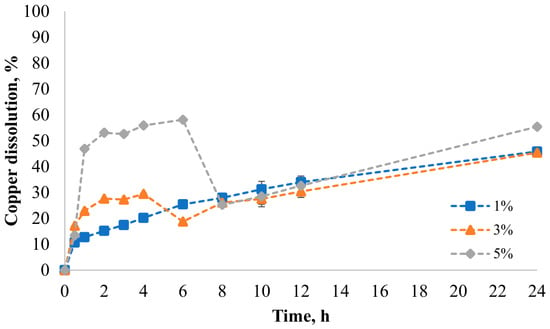
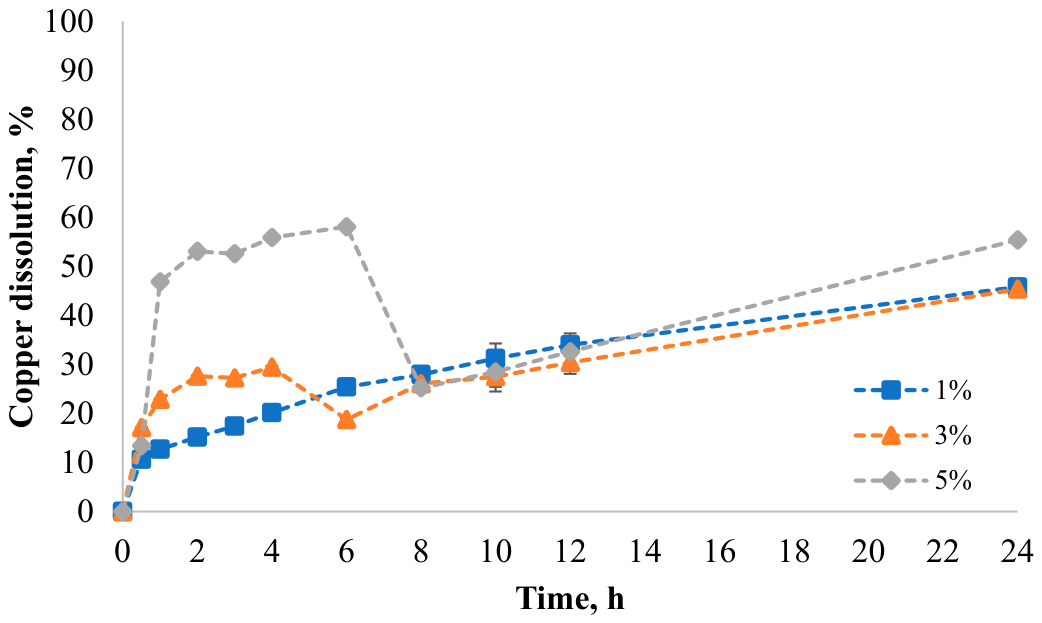
The influence of oxidizing reagent type and concentration on leaching efficiency was assessed using hydrogen peroxide (H2O2) at 1%, 3%, and 5% (v/v) and potassium permanganate (KMnO4) at 1 g/L, 2 g/L, and 3 g/L. A particle size range of +53–75 µm was used. The stirring speed, temperature, initial MSG concentration, and solution pH were maintained constant at 300 rpm, 30 °C, 0.5 M MSG, and 9.4, respectively. The results in Figure 1 indicate that higher H2O2 concentrations (3% and 5%) produced faster copper extraction during the initial 10 h than 1% H2O2. However, after this period, the dissolution rates tended to converge, and after 24 h, similar copper recoveries were obtained for all peroxide concentrations. This behavior suggests that although higher H2O2 concentrations initially enhance sulfide oxidation, the overall leaching process may become controlled by diffusion limitations or surface passivation phenomena at longer reaction times. A possible explanation for this behavior is the formation of highly reactive hydroxyl radicals (OH•) generated during peroxide decomposition, which can promote sulfide oxidation and the formation of elemental sulfur species on the mineral surface [27,34]. The accumulation of sulfur-containing species may partially hinder reagent diffusion and reduce the accessibility of the reactive surface, affecting the overall dissolution kinetics. Similar passivation behavior associated with sulfur formation during sulfide oxidation has been previously reported in alkaline and glycine-based leaching systems [27,34]. The following reactions can represent the formation of elemental sulfur and its subsequent oxidation to sulfate ions:
Figure 1.
Copper extraction in the MSG-H2O2 system. Working conditions: pH = 9.4, MSG concentration = 0.5 M, PS = 53–75 µm, and solids content = 10% wt%.
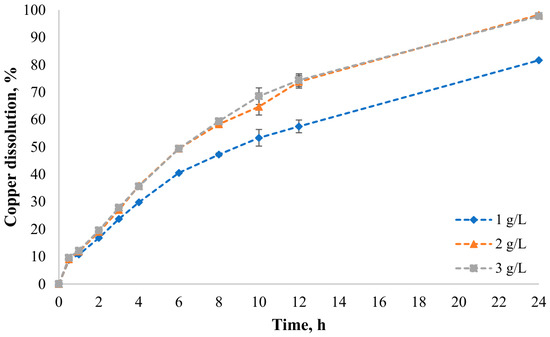
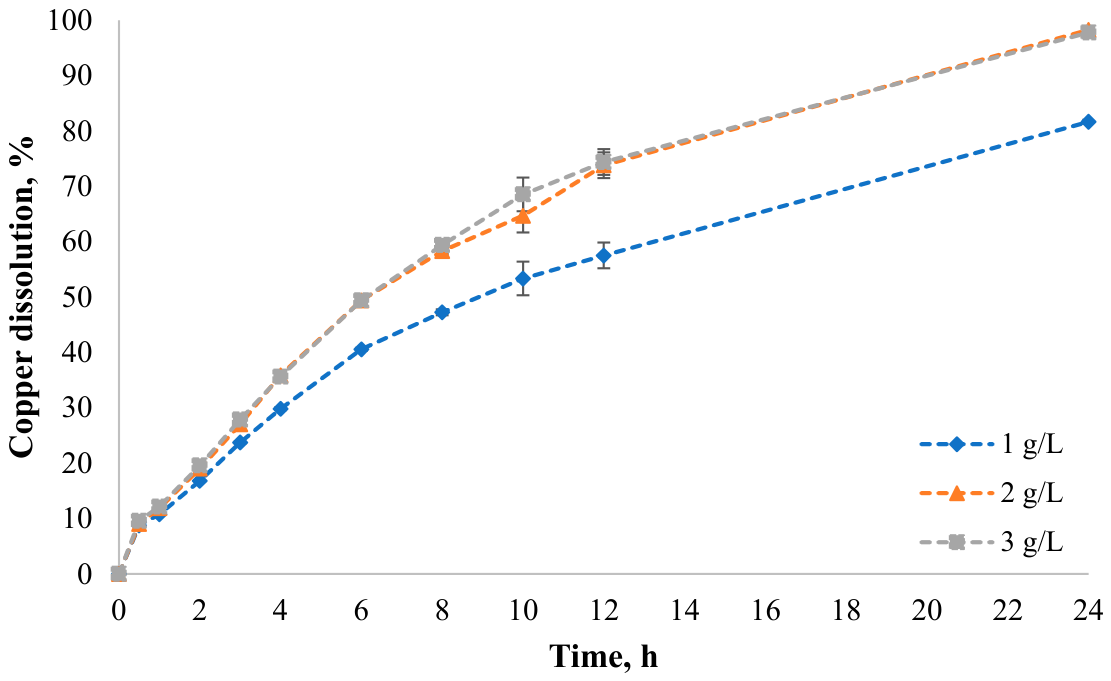
The influence of KMnO4 concentration on copper leaching from chalcopyrite ore is represented in Figure 2. A positive correlation between oxidant concentration and copper extraction was evident from the results obtained. Higher concentrations of KMnO4 accelerated the leaching process, especially during the first 10 h, where 3 g/L showed the fastest dissolution rates. After 24 h, the extractions reached about 90% for 3 g/L and about 70% for 1 g/L, thus showing improved recoveries with the increase in oxidant availability. However, the gap between 2 g/L and 3 g/L narrowed after 10 h, showing a case of diminishing returns at higher concentrations.
Figure 2.
Copper extraction in the MSG-KMnO4 system. Working conditions: pH = 9.4, MSG concentration = 0.5 M, PS = 53–75 µm, temperature = 30 °C, and solids content = 10% wt%.
Among the two oxidants used, potassium permanganate (KMnO4) exhibited better performance in comparison to hydrogen peroxide (H2O2), both in the kinetic and general aspects of copper leaching. Indeed, differences between these two oxidants became greater after some periods of leaching, at which stage the oxidative efficiency of KMnO4 provided continued dissolution of copper, whereas H2O2 tended to plateau, most probably because it decomposed, or its oxidative potential decreased under the operating conditions used in this test. These results indicate that KMnO4 is more appropriate for long-lasting leaching processes that require continuous oxidation, while H2O2 could be more effective for fast and short-term leaching. KMnO4 is effective due to its high oxidative potential and stability, which ensure consistent copper dissolution.
3.2. Effects of Particle Size
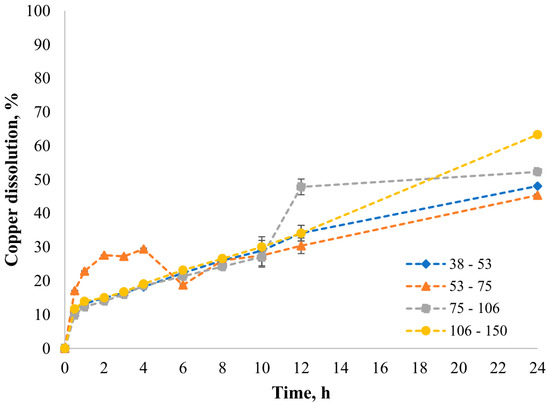
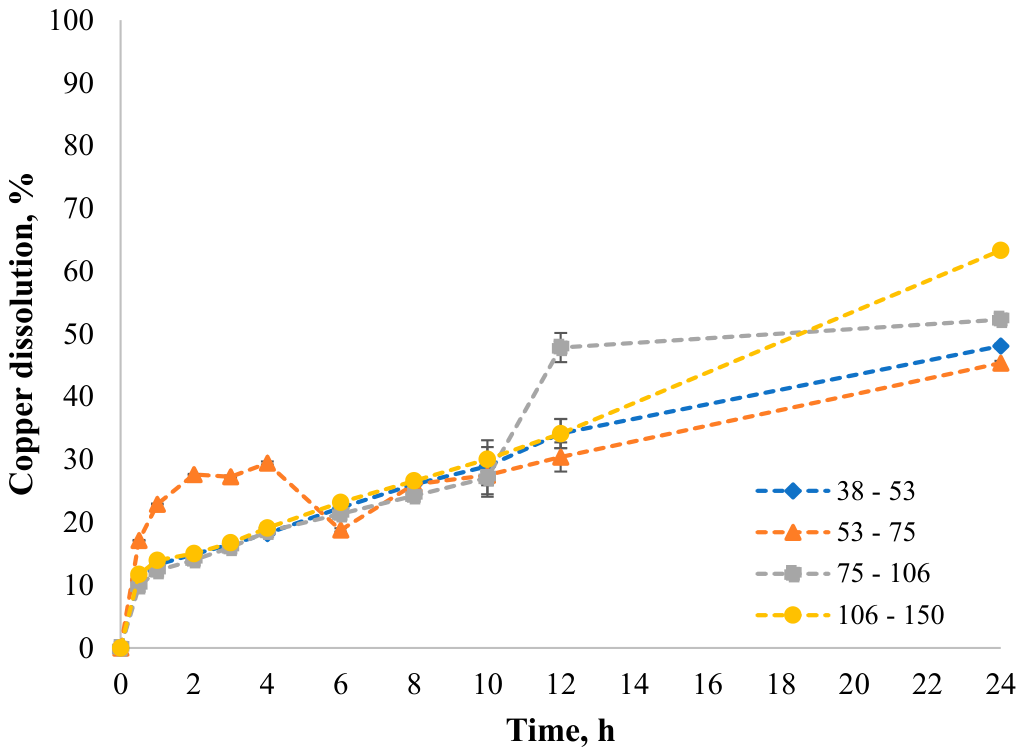
The effect of particle size on copper dissolution rate was investigated using the four fractions of 38–53, 53–75, 75–106, and 106–150 µm. Figure 3 presents the trends for kinetics and the level of copper dissolution in the MSG-H2O2 system with varying particle sizes. The copper dissolution profiles exhibit a general increase in leaching efficiency with time for all size ranges, although distinct behaviors are observed depending on particle size. In the early stage (up to 6 h), the 53–75 µm fraction shows the fastest initial dissolution, reaching over 30% extraction. However, its performance plateaus and shows fluctuations, indicating possible surface passivation or experimental variability. In contrast, the coarser fractions (75–106 µm and 106–150 µm) exhibit slower initial kinetics but achieve significantly higher overall dissolution at 24 h, reaching over 50% and 60%, respectively. The finest size fraction (38–53 µm) presents a more gradual and consistent leaching profile, ultimately achieving around 47% copper dissolution after 24 h. The copper dissolution profiles exhibit a general increase in leaching efficiency with time for all size ranges, although distinct behaviors are observed depending on particle size. This might be due to its lower initial passivation rate, which allows more sustained reaction rates. Agglomeration effects could also occur in smaller particles and limit reagent diffusion, thus reducing their overall recovery.
Figure 3.
Effect of particle size on copper leaching in the MSG-H2O2 system. Working conditions: pH = 9.4, MSG concentration = 0.5 M, H2O2 concentration = 3%, temperature = 30 °C, and solids content = 10% w/v.
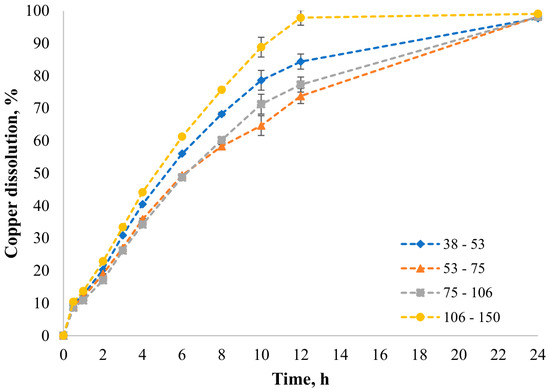
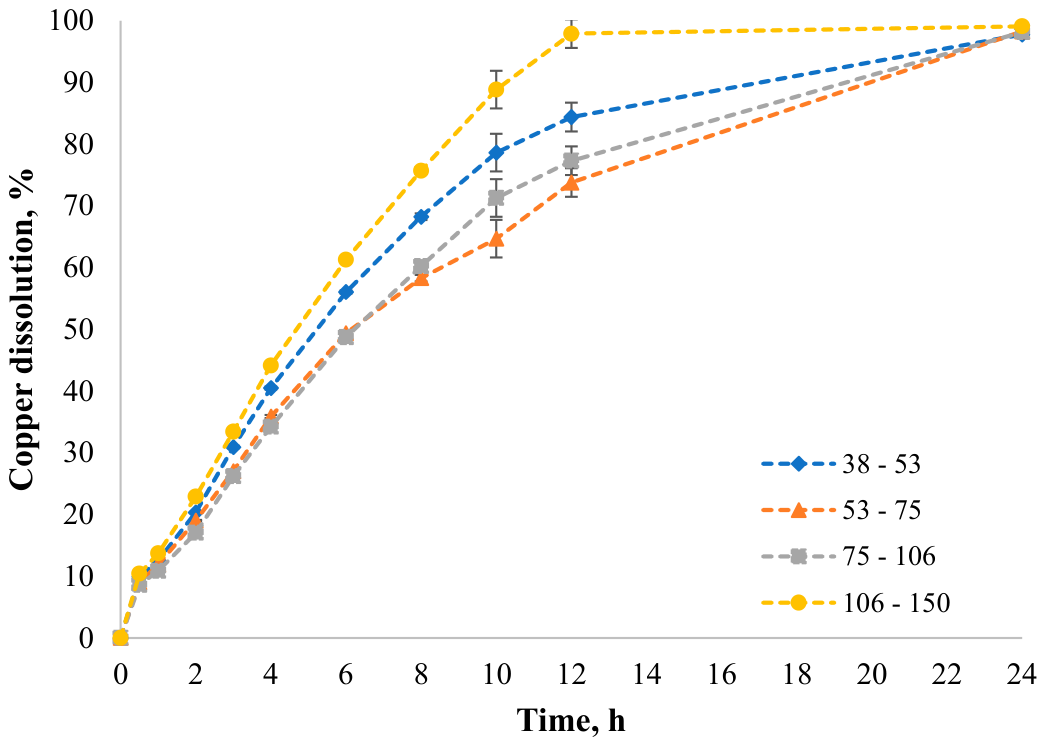
Figure 4 presents the kinetics of copper dissolution in the MSG-KMnO4 system for different particle size fractions for 24 h. Four particle size fractions were evaluated: 38–53 µm, 53–75 µm, 75–106 µm, and 106–150 µm. Larger particle size fractions, 106–150 µm, exhibit the highest dissolution rates of copper and recovery, especially beyond 12 h. This is explicable for a couple of reasons. Coarser particles may have higher internal porosity, which allows the leachant to penetrate deeper and enhances copper dissolution. In addition, mineralogical differences may favor the presence of easily leachable copper oxides in larger particles. The behavior of intermediate-size fractions (53–75 µm and 75–106 µm) is transitional between these extremes, where dissolution rates and recovery improve as the particle size is reduced. On the other hand, finer fractions, for example, 38–53 µm, could be affected by passivation effects through the formation of precipitate layers, such as native sulfur, that prevent further leachant penetration. It may also reduce the effective surface area and leachant accessibility by agglomerating fine particles during leaching.
Figure 4.
Effect of particle size on copper leaching in the MSG-KMnO4 system. Working conditions: pH = 9.4, MSG concentration = 0.5 M, KMnO4 concentration = 2 g/L, temperature = 30 °C, and solids content = 10% w/v.
3.3. Effects of Temperature
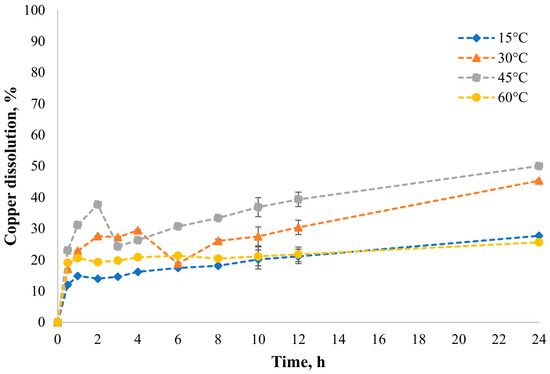
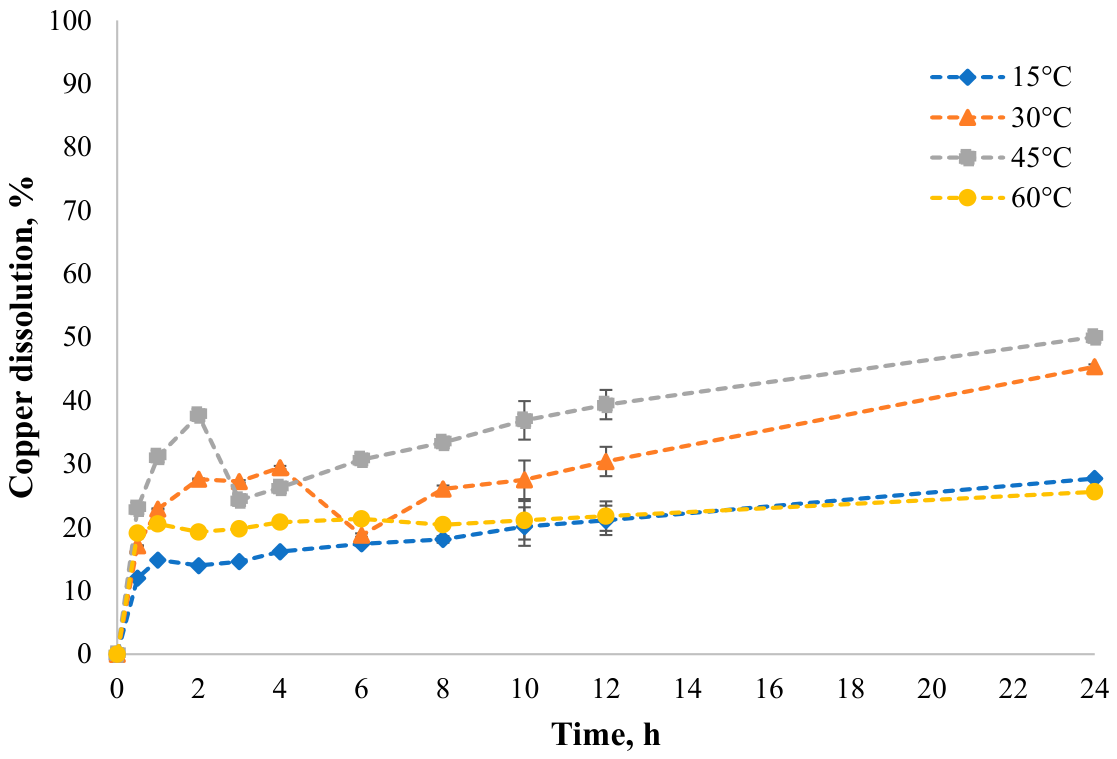
The leaching rate experiments of copper versus temperature dependence were carried out in the temperature range from 15 to 60 °C in solutions containing 0.5 M MSG and an H2O2 concentration of 3% for 24 h. Figure 5 illustrates a plot of temperature effects on copper dissolution. The leaching increases with the increase in temperature, but among these tested temperatures, it reaches the highest dissolution at about 45 °C. The trend indicates that temperature enhances both the kinetics and overall effectiveness of the leaching process, probably because of increased reactivity between copper and the MSG. At lower temperatures of 15 °C and 30 °C, dissolution is slower, and the copper recovery remains moderate, indicating that these temperatures do not provide enough energy to drive the reaction efficiently. Surprisingly, at 60 °C, though dissolution occurs, the recovery is lower than that at 30 and 45 °C, possibly due to the thermal decomposition of H2O2 or other side reactions, which reduces its oxidizing efficiency.
Figure 5.
Effect of temperature on copper leaching in the MSG-H2O2 system. Working conditions: pH = 9.4, MSG concentration = 0.5 M, H2O2 concentration = 2 g/L, PS = 53–75 µm, and solids content = 10% w/v.
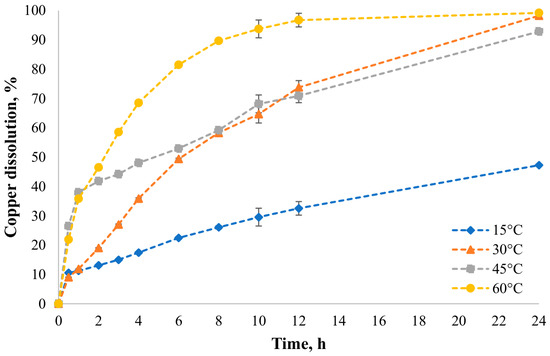
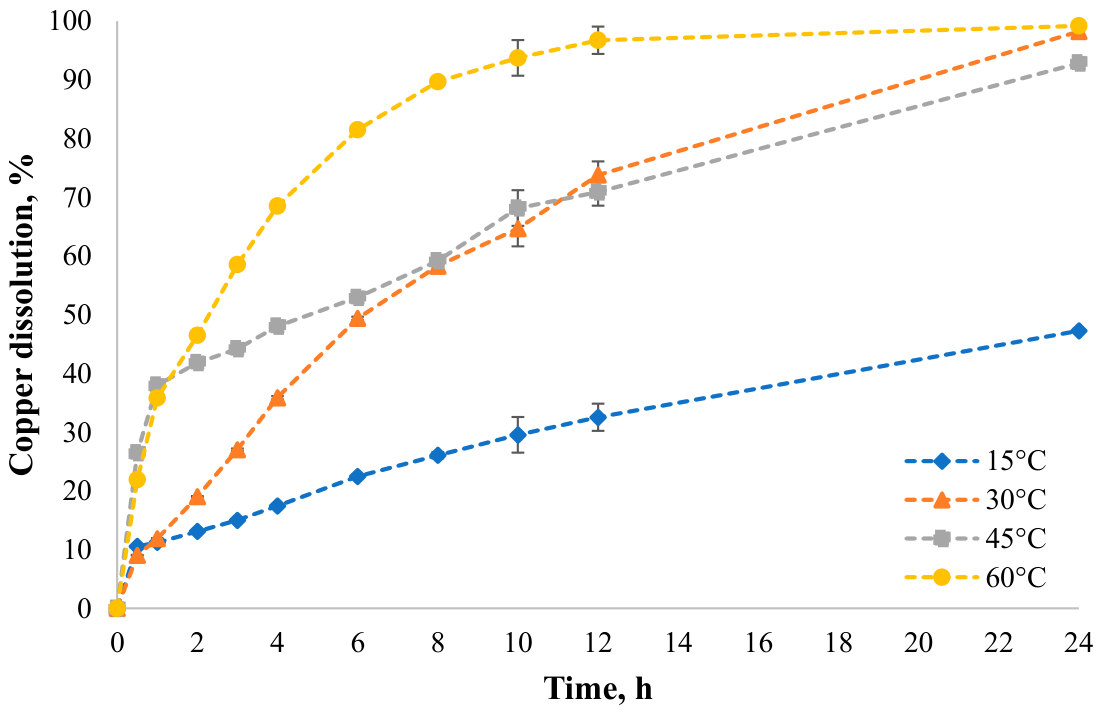
Figure 6 shows the effect of temperature on copper dissolution in the MSG-KMnO4 system at different temperatures. The results show that copper dissolution increases with increased temperature, giving 47.3, 98.3, 92.9, and 99.2% final extraction values for 15, 30, 45, and 60 °C, respectively. If the test was performed at 15 °C, it is much slower, with about 35% dissolved after 24 h. Contrasting with this, in the case of 60 °C, more than 90% copper dissolution is attained in 10 h, while the rate of reaction improves significantly with an increase in temperature. Intermediate temperatures of 30 and 45 °C increase copper recovery rates and dissolution extents proportionally, reaching almost 80% dissolution in 10 h at 45 °C. This trend reflects the temperature-dependent nature of the leaching reaction, probably due to increased rates of chemical reactions and better mass transfer at higher temperatures.
Figure 6.
Effect of temperature on copper leaching in the MSG-KMnO4 system. Working conditions: pH = 9.4, MSG concentration = 0.5 M, KMnO4 concentration = 3%, PS = 53–75 µm, and solids content = 10% w/v.
Both systems show temperature-dependent kinetics, with increased dissolution of copper at higher temperatures. However, the MSG-KMnO4 system realizes appreciably higher dissolution rates and efficiencies due to the stronger oxidizing power of KMnO4. For example, MSG-KMnO4 realizes 90% dissolution of copper in 10 h at 60 °C, while MSG-H2O2 realizes only about 50% after 24 h at the same temperature. At 15 °C, MSG-KMnO4 exhibits about 35% dissolution, whereas it is about ~25% in MSG-H2O2. It indicates that under similar conditions, KMnO4 gave a better performance in the promotion of copper leaching, which means it was a more efficient oxidant in this system.
3.4. Effects of Other Element Ions
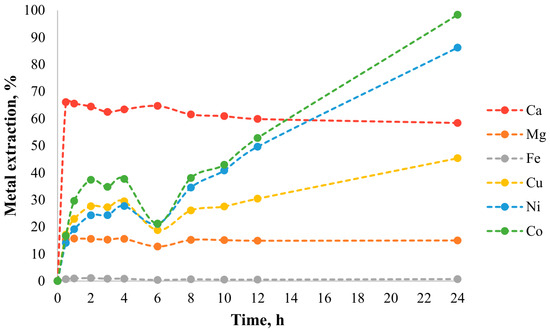
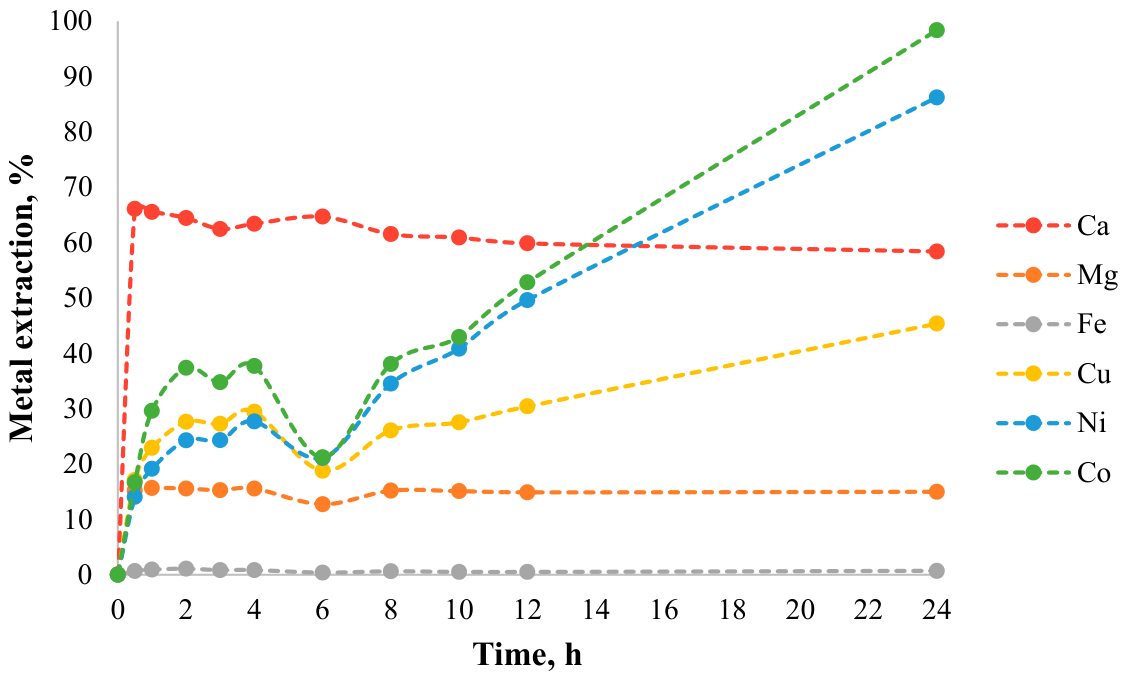
The solutions were analyzed to determine if as much MSG would dissolve other metals present in the sample. Figure 7 presents the extraction of calcium (Ca), magnesium (Mg), iron (Fe), copper (Cu), nickel (Ni), and cobalt (Co) in an MSG-H2O2 leaching system. Notably, these were the only elements detected in the leachate under the experimental conditions. Ca shows fast leaching kinetics, with about 70% extraction in the first half hour, probably connected to the high solubility of calcium salts under the leaching conditions. Mg is almost constant, indicating low leaching, probably due to low reactivity or formation of stable, insoluble compounds. The Fe shows quasi-null extraction during the entire test. Cu, Ni, and Co present different behaviors indicative of selective leaching. These metal extractions increase steadily, with Co and Ni showing a significantly higher final recovery (98% and 86%, respectively) than Cu (50%), demonstrating that Ni and Co favorably interact with the MSG-H2O2 system. The interplay between these metals highlights the selective nature of the leaching system, where dissolution kinetics and thermodynamic stability of metal complexes dictate the extraction behavior. These trends align with studies demonstrating the selective dissolution of metals in hydrogen peroxide-based systems [22].
Figure 7.
Effect of other metals on copper leaching in the MSG-H2O2 system. Working conditions: pH = 9.4, MSG concentration = 0.5 M, H2O2 concentration = 3%, PS = 53–75 µm, temperature = 30 °C, and solids content = 10% w/v.
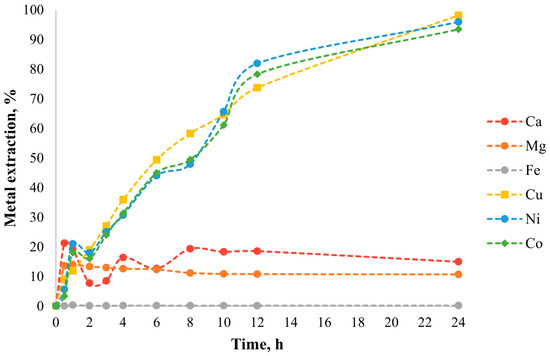
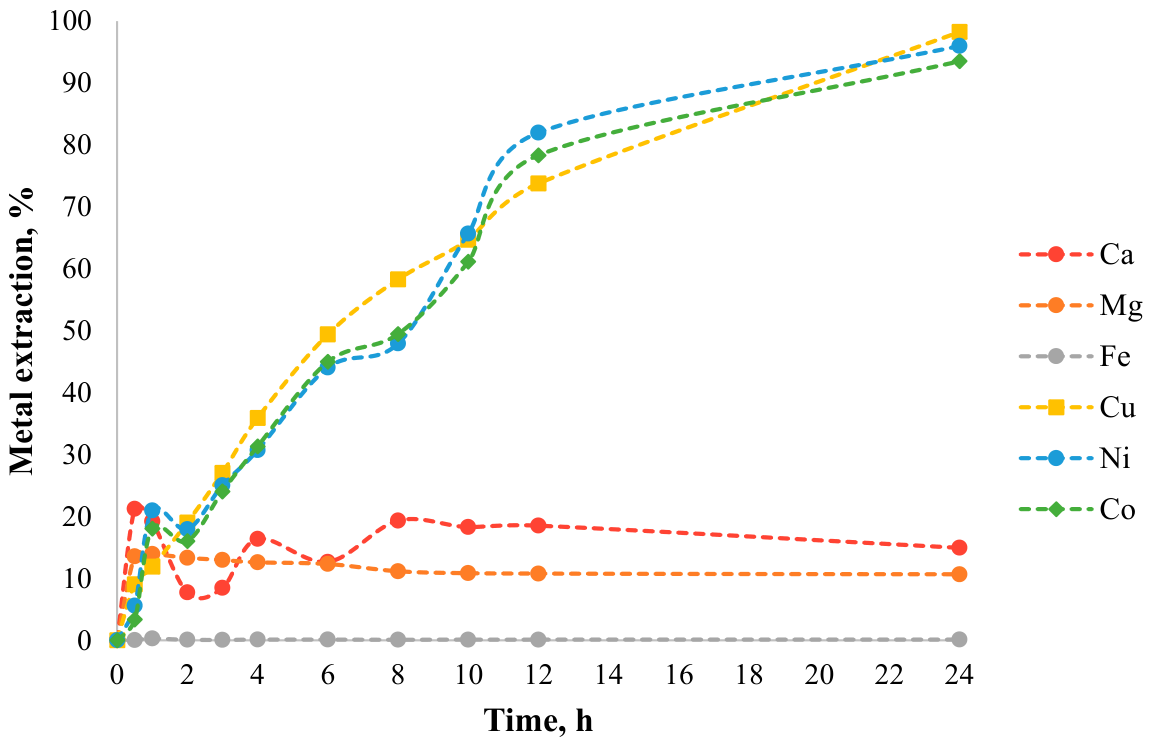
The effect of other metal ions on copper leaching in the MSG-KMnO4 system is illustrated in Figure 8. It is observed that the leaching of Ca and Mg remains very low and relatively invariant, indicating limited interaction with the KMnO4 oxidant. Similarly, Fe does not exhibit any detectable dissolution, as in the case of the MSG-H2O2 system, thus confirming that Fe is not reactive under these conditions. On the contrary, Cu, Ni, and Co exhibit marked progressive leaching behavior, with final recoveries of 98.3%, 96%, and 93.5%, respectively. The better extraction performance of these metals by KMnO4 indicates their strong oxidative potential, which is effective in driving the dissolution of these metals with stability in the solution. High selectivity of the MSG-KMnO4 system was observed, attributed to the priority of Cu, Ni, and Co extraction while suppressing the dissolution of Ca, Mg, and Fe. Overall, KMnO4 proved to be an excellent oxidant with excellent recoveries and selectivity for copper and associated metals, therefore becoming a valuable alternative for efficient leaching.
Figure 8.
Effect of other metals on copper leaching in the MSG-KMnO4 system. Working conditions: pH = 9.4, MSG concentration = 0.5 M, KMnO4 concentration = 2 g/L, temperature = 30 °C, PS = 53–75 µm, and solids content = 10% w/v.
3.5. Kinetic Analysis
The rate constants and correlation coefficients for each process variable were determined from plots of the various shrinking core kinetic models. Table 2 and Table 3 show determined correlation coefficients (R2) for the models and variables in the MSG-H2O2 and MSG-KMnO4 systems, respectively. The values of regression coefficients obtained after fitting the experimental data in the shrinking core models indicate the dynamic interaction of chemical reactions and diffusion controls. At low H2O2 concentrations (1%) and low temperatures (15 °C), the diffusion through the product layer was dominant, as shown by the highest R2. Increasing the H2O2 concentration and temperature improved reaction kinetics, shifting the rate control towards chemical reactions; under moderate conditions, the models of Mixed Control fitted well. Smaller particles (38–53 μm) favored chemical control because of the higher surface area, while for intermediate sizes, 53–106 μm, the process was controlled by diffusion. At a higher temperature of 60 °C and a higher oxidant concentration of 5%, the system became controlled by chemical reaction, which resulted from the enhancement of the reaction rate and minimum diffusion resistance. These results reveal that in the MSG-H2O2 system, copper dissolution is controlled by chemical reaction and diffusion through the product layer. However, the dominant rate-limiting step is diffusion through the product layer since estimated time contributions at different temperatures are far higher than those of the chemical reaction model.
Table 2.
Correlation coefficient values of the shrinking core kinetic model for copper leaching in the MSG-H2O2 system.
Table 3.
Correlation coefficient values of the shrinking core kinetic model for copper leaching in the MSG-KMnO4 system.
On the other hand, the determined R2 for the various models and variables in the MSG-KMnO4 system (Table 3) indicated that chemical reaction and diffusion through the product layer controlled the copper leaching kinetics. At low KMnO4 concentrations of 1 g/L, there was a dynamic interplay between chemical reaction and diffusion product layer dominance. However, increasing the concentration of KMnO4 resulted in the development of reaction kinetics and shifted the rate control towards chemical reaction, just like in the MSG-H2O2 system. At temperatures of 15 and 45 °C, the leaching process was controlled by both chemical reaction and diffusion through the product layer. In contrast, the contribution from the chemical reaction was almost null when the temperature was raised to 60 °C.
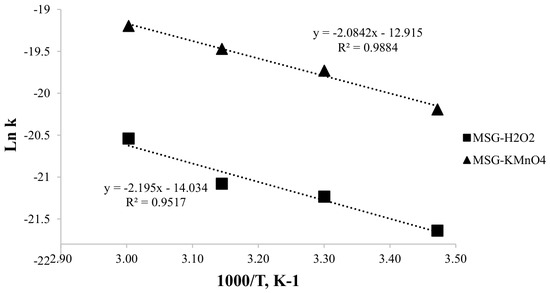
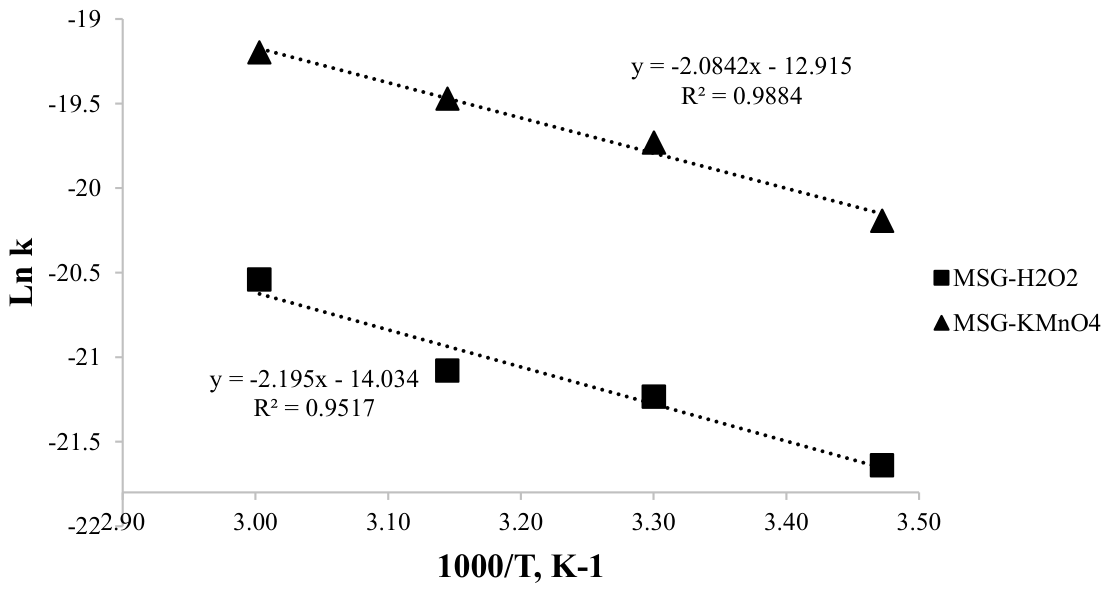
The apparent rate constants obtained from the plots of versus time at investigated temperatures were used to create Arrhenius plots for MSG-H2O2 and MSG-KMnO4 systems. From the slope of the fitted equation in Figure 9, the apparent activation energies were calculated to be 18.2 kJ/mol for the MSG-H2O2 system and 17.3 kJ/mol for the MSG-KMnO4 system. Therefore, the observed activation energies indicate that the dissolution mechanism of copper in both systems is diffusional product layer controlled.
Figure 9.
Arrhenius plot for product layer diffusion-controlled copper leaching in MSG-H2O2 and MSG-KMnO4 systems.
Using values determined for each process variable for copper leaching, an empirical power law model was established using plots of lnk versus ln [H2O2], ln [KMnO4], ln [PS] (Equation (9)). The straight-line slope in each plot shows the calculated reaction order with respect to the variable.
The values of the constants Km, a, and b for the copper leaching in the MSG-H2O2 system were 2.93, 0.35, and −0.62, respectively. The obtained reaction orders to the MSG-KMnO4 system can be empirically represented by Equation (10):
The empirical kinetic expression obtained for the MSG–KMnO4 system indicates that the leaching rate is positively influenced by KMnO4 concentration, with a lower dependence on monosodium glutamate concentration. Direct comparison of these parameters with kinetic constants reported for conventional H2SO4–KMnO4 and H2SO4–H2O2 systems is difficult because different kinetic models, experimental conditions, particle sizes, and mineralogical characteristics have been employed in previous studies. Li et al. reported that chalcopyrite leaching kinetics are strongly influenced by oxidant type, redox potential, temperature, and passivation phenomena; moreover, diffusion control, chemical reaction control, and mixed control mechanisms have been reported under different leaching conditions [35]. Therefore, the kinetic parameters obtained in the present study should be interpreted as specific to the alkaline MSG–KMnO4 system and are not directly comparable to the apparent kinetic constants reported for acidic leaching systems.
4. Conclusions
The effects of oxidant type and concentration, temperature, particle size, and gangue minerals on copper leaching in alkaline MSG solutions were investigated. It was observed that copper dissolution rates are increased by using KMnO4 as an oxidant; indeed, KMnO4 exhibits high efficiency, especially in continuous leaching, for its high oxidative potential and stability. KMnO4 also depresses the dissolution of gangue metals like Ca, Mg, and Fe while increasing the recovery of interest metals like Cu, Ni, and Co compared with H2O2. Recoveries of almost 100% of these metals in MSG-KMnO4 systems were realized at a temperature of 30 °C in 24 h. Of all the parameters evaluated, temperature and particle size were considered critical factors influencing the kinetics and extent of copper dissolution. Thus, optimum conditions must be balanced between higher reaction rates and sustained dissolution. Kinetic modeling thus confirmed that, in both systems, the rate-determining step is the diffusion of reagents through the product layer. Calculated apparent activation energies were 18.2 kJ/mol and 17.3 kJ/mol for MSG-H2O2 and MSG-KMnO4 systems. These results present a bright outlook for using MSG as a benign substitute for conventional leaching reagents and give further impetus toward developing green resource-extraction technologies for refractory copper ores. Its use in hydrometallurgy could further be examined to optimize its industrial adoption and extend its usefulness into metal recovery processes.
Author Contributions
Conceptualization, C.G.P.S.; methodology, C.G.P.S.; validation, C.G.P.S., C.F.I., L.G.D. and H.E.; formal analysis, C.G.P.S.; investigation, C.G.P.S.; resources, C.G.P.S., C.F.I., L.G.D. and H.E.; data curation, C.G.P.S.; writing—original draft preparation, C.G.P.S.; writing—review and editing, C.G.P.S., C.F.I., L.G.D. and H.E.; visualization, C.G.P.S.; supervision, C.F.I., L.G.D. and H.E.; project administration, C.G.P.S., C.F.I., L.G.D. and H.E.; funding acquisition, C.G.P.S., C.F.I., L.G.D. and H.E. All authors have read and agreed to the published version of the manuscript.
Funding
This research received external funding from ANID Chile through the ANID-PFCHA/National doctorate/2020-21200126, ANID projects CIA250010, Fondecyt Project 1211044, Anillo Project ACT210027, CODELCO through the “Piensa Minería” contest.
Data Availability Statement
The data presented in this study are available on request from the corresponding author. The data are not publicly available due to privacy or ethical restrictions.
Acknowledgments
Authors gratefully acknowledge the financial support of ANID Chile through the ANID-PFCHA/National doctorate/2020-21200126, ANID projects CIA250010, Fondecyt Project 1211044, Anillo Project ACT210027, CODELCO through the “Piensa Minería” contest, and the support from Curtin University.
Conflicts of Interest
The authors declare no conflict of interest.
References
- Aguirre, C.L.; Toro, N.; Carvajal, N.; Watling, H.; Aguirre, C. Leaching of Chalcopyrite (CuFeS2) with an Imidazolium-Based Ionic Liquid in the Presence of Chloride. Miner. Eng. 2016, 99, 60–66. [Google Scholar] [CrossRef] [Scilit]
- Hu, J.; Tian, G.; Zi, F.; Hu, X. Leaching of Chalcopyrite with Hydrogen Peroxide in 1-Hexyl-3-Methyl-Imidazolium Hydrogen Sulfate Ionic Liquid Aqueous Solution. Hydrometallurgy 2017, 169, 1–8. [Google Scholar] [CrossRef] [Scilit]
- Velásqvuez-Yévenes, L.; Ram, R. The Aqueous Chemistry of the Copper-Ammonia System and Its Implications for the Sustainable Recovery of Copper. Clean. Eng. Technol. 2022, 9, 100515. [Google Scholar] [CrossRef] [Scilit]
- Sokić, M.D.; Marković, B.; Živković, D. Kinetics of Chalcopyrite Leaching by Sodium Nitrate in Sulphuric Acid. Hydrometallurgy 2009, 95, 273–279. [Google Scholar] [CrossRef] [Scilit]
- Wu, J.; Ahn, J.; Lee, J. Kinetic and Mechanism Studies Using Shrinking Core Model for Copper Leaching from Chalcopyrite in Methanesulfonic Acid with Hydrogen Peroxide. Miner. Process. Extr. Metall. Rev. 2021, 42, 38–45. [Google Scholar] [CrossRef] [Scilit]
- Comisión Chilena del Cobre (COCHILCO). Anuario de Estadísticas del Cobre y Otros Minerales 2001–2020; Comisión Chilena del Cobre (COCHILCO): Santiago, Chile, 2021.
- Conejeros, V.; Pérez, K.; Jeldres, R.I.; Castillo, J.; Hernández, P.; Toro, N. Novel Treatment for Mixed Copper Ores: Leaching Ammonia–Precipitation–Flotation (L.A.P.F.). Miner. Eng. 2020, 149, 106242. [Google Scholar] [CrossRef] [Scilit]
- Watling, H.R. Chalcopyrite Hydrometallurgy at Atmospheric Pressure: 1. Review of Acidic Sulfate, Sulfate-Chloride and Sulfate-Nitrate Process Options. Hydrometallurgy 2013, 140, 163–180. [Google Scholar] [CrossRef] [Scilit]
- Latyuk, E.; Melamud, V.; Lavrinenko, A.; Makarov, D.; Bulaev, A. Non-Ferrous Metals and PGM Recovery from Low-Grade Copper–Nickel Concentrate by Bioleaching and Further Cyanidation. Minerals 2022, 12, 340. [Google Scholar] [CrossRef] [Scilit]
- Wang, X.; Ma, L.; Wu, J.; Xiao, Y.; Tao, J.; Liu, X. Effective Bioleaching of Low-Grade Copper Ores: Insights from Microbial Cross Experiments. Bioresour. Technol. 2020, 308, 123273. [Google Scholar] [CrossRef] [Scilit]
- Kim, B.; Joo, E.; Kang, Y.; Lee, J. Application of Ionic Liquids for Metal Dissolution and Extraction. J. Ind. Eng. Chem. 2018, 61, 388–397. [Google Scholar] [CrossRef] [Scilit]
- Hedjazi, F.; Monhemius, A.J. Industrial Application of Ammonia-Assisted Cyanide Leaching for Copper-Gold Ores. Miner. Eng. 2018, 126, 123–129. [Google Scholar] [CrossRef] [Scilit]
- Liu, W.; Tang, M.-T.; Tang, C.-B.; He, J.; Yang, S.-H.; Yang, J.-G. guang Dissolution Kinetics of Low Grade Complex Copper Ore in Ammonia-Ammonium Chloride Solution. Trans. Nonferrous Met. Soc. China 2010, 20, 910–917. [Google Scholar] [CrossRef] [Scilit]
- Liu, Z.X.; Yin, Z.L.; Hu, H.P.; Chen, Q.Y. Leaching Kinetics of Low-Grade Copper Ore Containing Calcium-Magnesium Carbonate in Ammonia-Ammonium Sulfate Solution with Persulfate. Trans. Nonferrous Met. Soc. China 2012, 22, 2822–2830. [Google Scholar] [CrossRef] [Scilit]
- Reilly, I.G.; Scott, D.S. The Leaching of a Chalcopyrite Concentrate in Ammonia. Can. J. Chem. Eng. 1977, 55, 527–533. [Google Scholar] [CrossRef] [Scilit]
- Jamett, I.; Carrasco, P.; Olmos, M.; Hernández, P. Glycine/Glutamate: “Green“ Alternatives to Recover Metals from Minerals/Residues—Review of Current Research. Minerals 2023, 13, 22. [Google Scholar] [CrossRef] [Scilit]
- Deng, Z.; Oraby, E.; Li, H.; Eksteen, J. Extraction of Copper from Chalcopyrite Using Alkaline Glycine–Ammonia Solutions. Minerals 2022, 12, 1507. [Google Scholar] [CrossRef] [Scilit]
- Khezri, M.; Rezai, B.; Akbar Abdollahzadeh, A.; Molaeinasab, M.; Wilson, B.P.; Lundström, M. Glycine Leaching of Sarcheshmeh Chalcopyrite Concentrate at High Pulp Densities in a Stirred Tank Reactor. Miner. Eng. 2020, 157, 106555. [Google Scholar] [CrossRef] [Scilit]
- Perea, C.G.; Tang, T.; He, C.; Polenio, A.; Eksteen, J.J. Extraction of Nickel, Cobalt and Copper from Low Grade Finely Disseminated Polymetallic Concentrates Utilizing Alkaline Glycine and Subsequent Metal Recovery from Solution. Hydrometallurgy 2026, 242, 106668. [Google Scholar] [CrossRef] [Scilit]
- Tanda, B.C. Glycine as a Lixiviant for the Leaching of Low Grade Copper-Gold Ores. Ph.D. Thesis, Curtin University, Perth, Australia, 2017. [Google Scholar]
- Tanda, B.C.; Eksteen, J.J.; Oraby, E.A.; O’Connor, G.M. The Kinetics of Chalcopyrite Leaching in Alkaline Glycine/Glycinate Solutions. Miner. Eng. 2019, 135, 118–128. [Google Scholar] [CrossRef] [Scilit]
- Prasetyo, E.; Anderson, C.; Nurjaman, F.; Al Muttaqii, M.; Handoko, A.S.; Bahfie, F.; Mufakhir, F.R. Monosodium glutamate as selective lixiviant for alkaline leaching of zinc and copper from electric arc furnace dust. Metals 2020, 10, 644. [Google Scholar] [CrossRef] [Scilit]
- Perea, C.G.; Ihle, C.; Estay, H.; Dyer, L. A novel treatment approach for copper ores based on glutamate leaching. In Proceedings of the ALTA 2023 Conference, Perth, Australia, 1–5 May 2023. [Google Scholar]
- Perea, C.G.; Ihle, C.; Dyer, L.; Díaz Quezada, S.; Estay, H. Study of a Copper Oxide Leaching in Alkaline Monosodium Glutamate Solution. Minerals 2024, 14, 714. [Google Scholar] [CrossRef] [Scilit]
- Perea, C.G.; Restrepo Baena, O.J.; Ihle, C.F.; Estay, H. Copper leaching from wastes electrical and electronic equipment (WEEE) using alkaline monosodium glutamate: Thermodynamics and dissolution tests. Clean. Eng. Technol. 2021, 5, 100312. [Google Scholar] [CrossRef] [Scilit]
- Perea, C.G.; Ihle, C.F.; Dyer, L.; Quezada, S.D.; González, C.; Estay, H. Leaching of Complex Copper Concentrates in Alkaline Monosodium Glutamate Solutions. Miner. Eng. 2025, 232, 109560. [Google Scholar] [CrossRef] [Scilit]
- Eksteen, J.J.; Oraby, E.A.; Tanda, B.C. A Conceptual Process for Copper Extraction from Chalcopyrite in Alkaline Glycinate Solutions. Miner. Eng. 2017, 108, 53–66. [Google Scholar] [CrossRef] [Scilit]
- Li, H.; Oraby, E.; Eksteen, J. Extraction of Copper and the Co-Leaching Behaviour of Other Metals from Waste Printed Circuit Boards Using Alkaline Glycine Solutions. Resour. Conserv. Recycl. 2020, 154, 1–12. [Google Scholar] [CrossRef] [Scilit]
- Tanda, B.C.; Eksteen, J.J.; Oraby, E.A. An Investigation into the Leaching Behaviour of Copper Oxide Minerals in Aqueous Alkaline Glycine Solutions. Hydrometallurgy 2017, 167, 153–162. [Google Scholar] [CrossRef] [Scilit]
- Levenspiel, O. Ingeniería de las Reacciones Químicas; Wiley: Mexico City, Mexico, 2004. [Google Scholar]
- Wadsworth, M.E.; Miller, J.D. Rate Processes of Extractive Metallurgy; Sohn, H.Y., Wadsworth, M.E., Eds.; Hydrometallurgical Processes; Springer: New York, NY, USA, 1979; pp. 133–244. [Google Scholar] [CrossRef] [Scilit]
- Dickinson, C.F.; Heal, G.R. Solid-Liquid Diffusion Controlled Rate Equations. Thermochim. Acta 1999, 340–341, 89–103. [Google Scholar] [CrossRef] [Scilit]
- Marsden, J.O.; House, C.I. Study of a Copper Oxide Leaching in Alkaline. In The Chemistry of Gold Extraction; SME: Englewood, CO, USA, 2006; pp. 111–145. [Google Scholar]
- Baba, A.A.; Adekola, F.A.; Atata, R.F.; Ahmed, R.N.; Panda, S. Bioleaching of Zn(II) and Pb(II) from Nigerian Sphalerite and Galena Ores by Mixed Culture of Acidophilic Bacteria. Trans. Nonferrous Met. Soc. China 2011, 21, 2535–2541. [Google Scholar] [CrossRef] [Scilit]
- Li, Y.; Kawashima, N.; Li, J.; Chandra, A.P.; Gerson, A.R. A Review of the Structure, and Fundamental Mechanisms and Kinetics of the Leaching of Chalcopyrite. Adv. Colloid Interface Sci. 2013, 197–198, 1–32. [Google Scholar] [CrossRef] [Scilit]

Disclaimer/Publisher’s Note: The statements, opinions and data contained in all publications are solely those of the individual author(s) and contributor(s) and not of MDPI and/or the editor(s). MDPI and/or the editor(s) disclaim responsibility for any injury to people or property resulting from any ideas, methods, instructions or products referred to in the content. |
© 2026 by the authors. Licensee MDPI, Basel, Switzerland. This article is an open access article distributed under the terms and conditions of the Creative Commons Attribution (CC BY) license.