


Abstract
Coal rank exerts a fundamental control on the distribution of elements during density-based separation, yet this influence remains poorly understood. The primary objective of this study is to elucidate how coal rank governs the enrichment and partitioning of major, trace, and rare earth elements (REY) in float–sink products, and to assess the implications for clean coal utilization and critical metal recovery. To achieve this, three Late Paleozoic bituminous coals of different ranks from Shanxi Province, China, were subjected to density fractionation (1.3–1.8 g/cm3) combined with proximate and ultimate analyses, X-ray fluorescence (XRF), inductively coupled plasma mass spectrometry (ICP-MS), X-ray diffraction (XRD), and coal petrography. The results show that coal rank fundamentally governs element distribution and enrichment patterns. With increasing rank, the dominant inorganic minerals shift from clay minerals to carbonates, leading to pronounced differentiation in elemental affinities. In medium- to high-rank bituminous coals, chalcophile elements (e.g., As, Mo, Tl) associated with sulfides are significantly enriched in high-density fractions, whereas in high-rank bituminous coals, carbonate-related elements (e.g., Sr, Ca, Mg) show marked enrichment. Rare earth elements are primarily hosted in clay and phosphate minerals. Light rare earth elements dominate in medium- to high-rank coals, while middle rare earth elements increase in high-rank coals due to carbonate influence. Density-based separation effectively concentrates hazardous elements (e.g., As, Pb, Cd) in high-density tailings, demonstrating substantial potential for mitigating environmental risks. Meanwhile, critical metals such as lithium (Li), strontium (Sr), and REY are enriched in medium- to high-density products, with Li hosted in clay minerals and Sr strongly enriched in carbonate-rich high-rank coal (up to 1525 μg/g), indicating recoverable resources from coal processing wastes.
1. Introduction
Coal remains a cornerstone of the global energy supply, accounting for more than 50% of primary energy consumption in developing economies such as China [1]. However, its combustion and utilization release potentially hazardous elements (e.g., arsenic, selenium, lead) as well as greenhouse gases, raising significant environmental and health concerns [2,3]. To mitigate these impacts, coal cleaning through physical separation methods such as flotation has become a critical step for reducing ash, sulfur, and trace element contents prior to combustion. Density-based separation exploits the density contrast between organic macerals and mineral matter, effectively producing low-ash clean coal and high-ash tailings.
Coal rank, which reflects the degree of coal metamorphism, profoundly affects the chemical structure of organic matter, the types and abundances of minerals, and the physical properties of coal. Studies indicate that low-rank coals are generally rich in clay minerals, whereas high-rank coals exhibit more stable organic structures and mineral assemblages dominated by carbonates and sulfides [4,5]. The systematic evolution of mineral assemblages with coal rank has been further documented by Dai et al. (2015) [6]. Such mineralogical differences are likely to strongly influence element partitioning during density-based separation. The distribution behavior of elements during density fractionation is strongly influenced by their modes of occurrence (e.g., organic association, sulfide-bound, clay-mineral bound, or carbonate-bound) [7]. Recent studies have specifically examined trace element migration during density-based separation and flotation [8]. Nevertheless, systematic comparative studies on element behavior in float–sink products across different coal ranks within the same geological setting are still lacking. In particular, how coal rank influences the differential enrichment of major, trace, and rare earth elements during density fractionation remains poorly examined. Furthermore, although the environmental risks associated with hazardous elements from coal combustion are widely recognized, the potential for recovering critical metals (e.g., lithium, gallium, rare earth elements) from coal processing wastes is increasingly being considered in the context of resource sustainability [9,10,11].
The Late Paleozoic coal seams in Shanxi Province, northern China, offer an ideal natural laboratory to address these research gaps. This region hosts a continuous coal rank sequence from lignite to anthracite within similar sedimentary basins, thereby minimizing regional variability and enabling a focused investigation of coal rank effects [12]. In this study, we selected coal samples of different ranks—medium-rank bituminous, medium–high-rank bituminous, and high-rank bituminous—from three coalfields in Shanxi Province. Systematic float–sink experiments were conducted across seven density fractions (<1.3, 1.3–1.4, 1.4–1.5, 1.5–1.6, 1.6–1.7, 1.7–1.8, >1.8 g/cm3), followed by comprehensive geochemical and mineralogical analyses. The Late Paleozoic coal-bearing strata in North China were deposited in a stable epeiric sea environment with episodic marine incursions, and the sedimentological framework of this region has been well established by previous studies [12]. This geological setting minimizes provenance variations across the study area and allows the observed differences in element geochemistry to be attributed primarily to coal rank rather than to changes in sediment source.
The specific objectives of this study are: (1) to elucidate how coal rank controls the distribution and enrichment of major, trace, and rare earth elements in density-separated fractions; (2) to identify the principal mineral hosts and modes of occurrence of key elements; (3) to assess the environmental implications of hazardous element enrichment in tailings; and (4) to evaluate the resource potential of critical metals in specific density fractions. The findings will advance the understanding of coal geochemistry and offer practical guidance for optimizing cleaning technologies, reducing environmental footprints, and improving the efficiency of coal resource recovery. In this context, we define hazardous elements refer to As, Pb, Cd, Tl, Sb, and Mo, which are known to pose significant environmental and health risks during coal utilization. While critical metals include Li, Sr, and rare earth elements (REY), whose strategic importance is recognized in the European Commission’s Critical Raw Materials List (2023) [13], the U.S. Geological Survey’s Critical Minerals List (2022) [14], and China’s Strategic Mineral Resources Catalog [15].
2. Geological Background
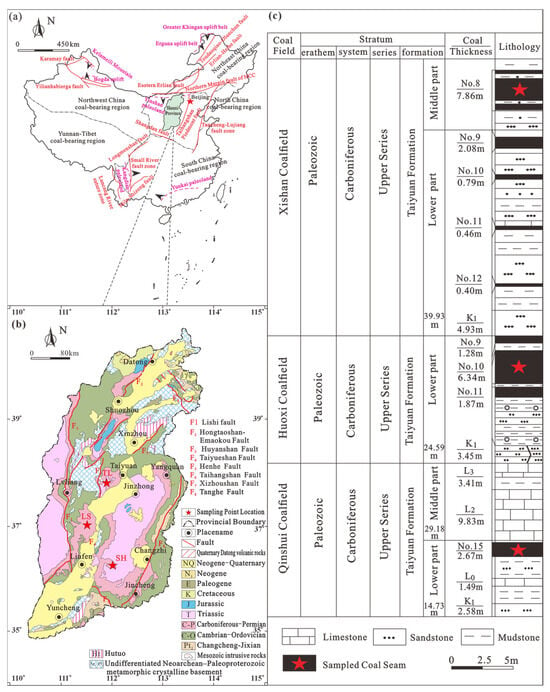
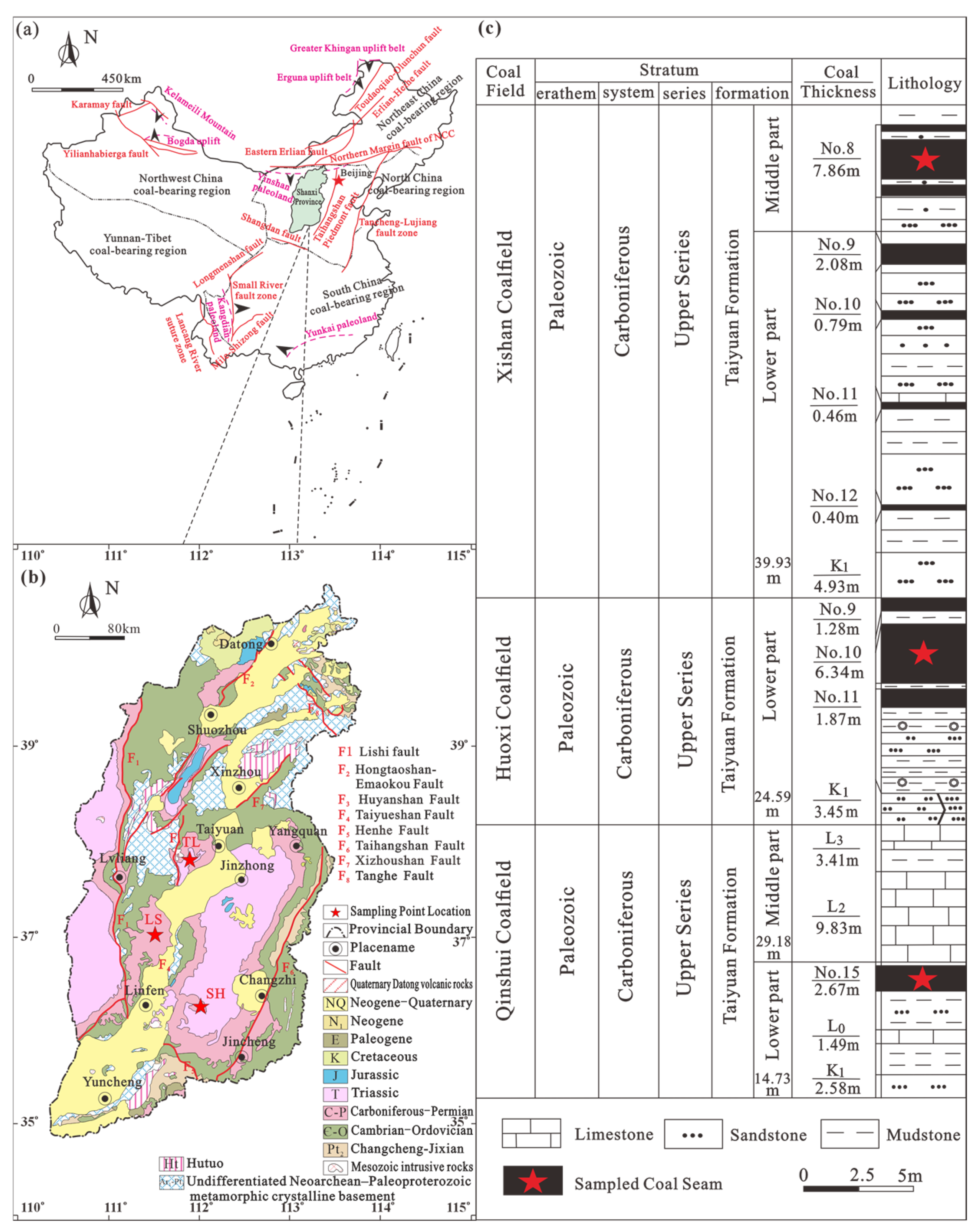
Shanxi Province in North China is a major coal-producing base in North China and contains six coalfields (Figure 1a,b). With the exception of the Datong-Ningwu area in the north, which hosts Carboniferous–Permian and Jurassic coal measures, all other coalfields are of Carboniferous–Permian age. These six coalfields belong to the same Carboniferous-Permian giant coal-bearing basin of North China, developed on the paleo-weathering surface of Ordovician and older Paleozoic strata. Devonian, Silurian, and Early Carboniferous strata are absent, whereas Late Paleozoic Carboniferous–Permian, Mesozoic Triassic, Jurassic, Cretaceous, and Cenozoic strata are widely exposed. This geological framework provides an ideal context for studying the evolutionary sequence of coal ranks within a single basin and their control on element enrichment.
Figure 1.
(a) Map of coal-bearing regions in China; (b) regional geographical map of research region (modified from reference [16]); (c) stratigraphic column of the coal-bearing strata.
The study area is located on the Shanxi Uplift, along the eastern margin of the North China Craton (NCC). The tectonic evolution experienced Paleozoic cratonic stability followed by Mesozoic Indosinian–Yanshanian compression, which induced folding and faulting that controlled coal seam burial depth and subsequent thermal maturation. Cenozoic Himalayan extension further modified the structural framework, creating uplifted blocks and down-dropped basins that influenced the present-day distribution of coal ranks [17,18].
Magmatic activity, particularly during the Yanshanian period, played a critical role in coal metamorphism. Although large-scale intrusions are absent in the Qinshui Basin, its location near the Taihangshan deep fault zone subjected it to significant remote thermal effects, resulting in high-rank bituminous coal to anthracite. In contrast, the Xishan and Huoxi coalfields experienced weaker magmatic influence, preserving medium- to high-volatile bituminous coal.
Coal samples for this study were systematically collected from the main minable seams of the Carboniferous–Permian Taiyuan Formation in three representative coalfields—Xishan, Huoxi, and Qinshui—located in central–northern Shanxi Province (Figure 1). Significant inter-coalfield variability exists in seam stratigraphy and thickness (Figure 1c). In the Xishan Coalfield, the Taiyuan Formation hosts multiple minable seams; Seam No. 8 occurs in the middle–lower interval and reaches a maximum thickness of ~7.86 m. In the Huoxi Coalfield, Seam No. 10 is developed in the lower part of the formation, with a thickness of 6.34 m. In the Qinshui Coalfield, Seam No. 15 is concentrated in the lower Taiyuan Formation, with a thickness of ~2.67 m.
Differences in stratigraphic position, burial depth, and tectonic–magmatic history across these coalfields have produced a complete coal rank sequence from medium-rank bituminous to high-rank bituminous coal. This natural gradation provides an ideal basis for investigating the influence of coal rank on element geochemistry during density-based separation.
3. Materials and Methods
Three representative bituminous coals from the North China Craton basin were selected to cover a controlled rank gradient: medium-rank (TL8, Ro,max = 1.10%), medium–high-rank (LS10, 1.32%), and high-rank (SH15, 1.77%), classified according to ASTM D388-23 [19]. All raw coal samples were collected using the channel sampling method from the main minable seams (Seam No. 8 for TL, No. 10 for LS, and No. 15 for SH). A single composite channel sample weighing approximately 5–8 kg was collected from each seam, following standard Chinese sampling procedures. For each seam, a full-channel section was sampled vertically from the roof to the floor at a representative location, with the sampling thickness covering the entire seam (approximately 7.86 m for Seam No. 8, 6.34 m for Seam No. 10, and 2.67 m for Seam No. 15) to ensure representativeness. Samples were immediately sealed to prevent oxidation.
3.1. Float-Sink Testing and Density Fractionation
Raw coal samples were crushed and sieved to a nominal top size of −0.5 mm. Float–sink tests were performed in strict accordance with the Chinese National Standard GB/T 478-2008 (“Method for Determination of Density Distribution of Coal”) [20]. Aqueous zinc chloride (ZnCl2) solutions were used to prepare seven density fractions: <1.3, 1.3–1.4, 1.4–1.5, 1.5–1.6, 1.6–1.7, 1.7–1.8, and >1.8 g/cm3. For each raw coal sample (TL8, LS10, SH15), the float–sink procedure yielded seven density-separated products, designated as TL1–TL6, LS1–LS7, and SH1–SH7, respectively (the <1.3 fraction is numbered 1, and density increases sequentially; for TL, the 1.6–1.7 and 1.7–1.8 g/cm3 fractions were combined as TL5 due to low yield). Each density-separated product was washed, dried, and weighed, and the yield was calculated for subsequent analysis. To avoid potential interference from residual ZnCl2 on trace element analysis, all density fractions were rinsed with deionized water at least three times until no Cl− was detected by AgNO3 solution testing. Blank samples were also analyzed to verify that Zn and Cl residues had negligible effects on the results.
3.2. Analytical Testing Methods
Proximate analysis (moisture content Mad, ash yield Ad, volatile matter Vdaf, and fixed carbon FCd) and ultimate analysis (carbon, hydrogen, and nitrogen) were conducted following standard Chinese national methods for coal analysis. Total sulfur content was determined using an SDLA618 industrial sulfur analyzer and an SDS720 automatic sulfur analyzer (both from Sundytech, Changsha, China), following GB/T 214-2007 [21]. Nitrogen content was quantified by the Kjeldahl method. All analyses were performed at the Shanxi Key Laboratory of Coal and Coal Measure Gas Geology. Polished coal pellets were prepared following standard procedures for coal petrographic sample preparation. Maceral composition was evaluated following International Committee for Coal and Organic Petrology (ICCP) guidelines [22]. Maceral identification, quantitative assessment, and vitrinite reflectance measurements were performed using a Leica DM4P (Leica Microsystems, Wetzlar, Germany) integrated reflected-light microscope equipped with the BRICC-M™ (Beijing IRICC Technology, Beijing, China) coal petrography analysis system. Random vitrinite reflectance was determined in compliance with GB/T 40485-2021 (maceral identification) [23], and maceral composition was evaluated following standard Chinese guidelines [24].
Mineralogy was determined using a Bruker D8 Advance X-ray diffractometer (XRD) (Bruker AXS, Karlsruhe, Germany) with Cu-Kα radiation (λ = 1.5406 Å), operated at 40 kV and 40 mA. Diffraction patterns were collected over a 2θ range of 5–80° with a step size of 0.02° and a scan rate of 4°/min at ambient conditions. Raw XRD data were processed by background subtraction, Kα2 stripping, and Savitzky–Golay smoothing. Phase identification and semi-quantitative analysis were performed using Jade 2010 software (version 2.6, Materials Data, Livermore, CA, USA) with reference to the ICDD PDF-2 database. Relative mineral abundances were calculated based on normalized peak area ratios of diagnostic reflections. It should be noted that XRD identification of clay minerals in coal is semiquantitative; overlapping peaks may obscure minor phases such as mixed-layer illite/smectite. Therefore, the mineralogical interpretations are primarily based on the most prominent diagnostic reflections, and the term “clay minerals” is used where specific identification is ambiguous.
Major oxides (SiO2, Al2O3, Fe2O3, CaO, MgO, Na2O, K2O, MnO, TiO2, P2O5) were determined by wavelength-dispersive X-ray fluorescence (WDXRF) using a PANalytical Axios spectrometer (Malvern Panalytical, Almelo, The Netherlands), following standard industrial methods for silicate rock analysis. Trace elements and rare earth elements plus yttrium (REY) were quantified by quadrupole inductively coupled plasma mass spectrometry (ICP-MS) using an Agilent 7900 instrument (Agilent Technologies, Santa Clara, CA, USA), following standard ICP-MS methods for geological samples. Sample digestion was performed using closed-vessel microwave-assisted acid decomposition with an HNO3–HF–HClO4 mixture. Rhodium (Rh) was used as an internal standard for signal drift correction. Analytical accuracy and precision were verified by concurrent analysis of certified reference materials NIST SRM 1632c (coal) and GBW07407 (soil). Arsenic (As) concentrations were validated using certified reference materials and internal quality control protocols.
Data reduction, statistical analysis, and graphical visualization were performed using Microsoft Excel 2019 (Microsoft, Redmond, WA, USA) and OriginPro 2022 (OriginLab, Northampton, MA, USA). The concentration coefficient (CC) was calculated relative to the global coal average reported by Ketris and Yudovich (2009) [25]. Rare earth element patterns were normalized to upper continental crust (UCC) values from Taylor and McLennan (1985) [26]. UCC normalization was chosen because it best represents the terrigenous clastic input typical of the study area, where REY are primarily derived from clay minerals of felsic source rocks. This approach also facilitates direct comparison with regional and global coal geochemistry studies. Neither North American Shale Composite (NASC) nor chondrite normalization was applied, as they are less representative of the continental provenance of these coals. Detailed micro-textural relationships and trace mineral phases (e.g., phosphates, Ti-oxides) require higher-resolution techniques such as SEM-EDS or TEM, which are planned for future work.
4. Results
4.1. Coal Quality and Petrographic Characteristics
Float–sink tests revealed systematic variations in density distribution across the three coal samples of different ranks, with a consistent trend: ash yield (Ad) increases markedly with density, whereas fixed carbon (FCd) and organic matter content decrease progressively (Table 1). This confirms that density-based separation effectively partitions organic-rich float fractions from mineral-enriched sink fractions.
Compared with previous studies on density fractionation of coals from other regions, our results show similar overall trends but with notable differences in the magnitude of ash and sulfur enrichment. For instance, Song et al. reported that for coals from the Huoxi Coalfield [27], the ash yield in the >1.8 g/cm3 fraction was typically 40%–50%, whereas in our LS samples (also from Huoxi) it reached 54.08%. This discrepancy likely arises from differences in original mineral matter content and maceral composition: our LS samples contain higher proportions of inertinite (up to 41.22% in LS4) and clay-associated minerals, which increase the density of middlings fractions. Similarly, the total sulfur content in our TL6 (15.69%) is considerably higher than the average for medium-rank coals in North China (ca. 2%–3% [12]), which can be attributed to the abundant pyrite mineralization in the Xishan Coalfield under locally reducing conditions, as also evidenced by the strong Fe2O3-S correlation. In contrast, Dai et al. reported that high-rank coals from the Qinshui Basin typically have total sulfur <1% [12], consistent with our SH samples (St,d ≤ 0.41%), confirming that advanced coalification promotes sulfur loss and carbonate formation. These comparisons underscore that both coal rank and local depositional environment (e.g., reducing vs. oxidizing conditions, availability of detrital iron) jointly control the efficiency of density separation and the final quality of clean coal products.
In terms of coal quality parameters, the coal quality of the low-density grade (<1.3 g/cm3) product is the best. For TL, LS, and SH, ash yields in this fraction are 1.57%, 2.23%, and 7.82%, respectively, with fixed carbon reaching 72.94%, 80.09%, and 86.10%. In contrast, ash yield increases sharply in higher density fractions, peaking in the >1.8 g/cm3 fraction at 33.45% (TL6), 54.08% (LS7), and 53.04% (SH7), with FCd decreasing to <30%. Total sulfur (St,d) follows a similar pattern, showing pronounced enrichment in high-density fractions—especially in TL6 (15.69%)—indicating a dominant association with dense sulfide and silicate minerals. Volatile matter (Vdaf) remains relatively invariant across density fractions for TL and LS, but SH7 shows an elevated Vdaf (40.16%), likely due to decomposition of carbonate minerals during high-temperature analysis, releasing CO2 and artificially increasing volatile yield.
Maceral composition exhibits rank-dependent, density-selective partitioning (Table 1). Vitrinite content decreases monotonically with increasing density, dominating the <1.3 g/cm3 fraction (80.56% in TL1, 89.36% in LS1, 68.50% in SH1), confirming its low-density affinity. Inertinite content increases systematically with density, becoming dominant in the 1.5–1.8 g/cm3 interval (e.g., 71.63% in TL5; 71.10% in SH4), consistent with its higher specific gravity. Mineral matter content correlates strongly with ash yield, remaining <10% in low-density fractions but exceeding 50% in several sink fractions (e.g., 54.21% in TL6; 53.25% in LS6). This indicates that float–sink separation efficiently concentrates minerals into tailings.
Table 1.
Proximate, ultimate, and maceral analyses of coals in different density fractions.
Comprehensively evaluated, the density-based separation process achieved effective enrichment of organic macerals (predominantly vitrinite) in low-density fractions and concurrent concentration of inertinite and mineral matter in high-density fractions across all three coal ranks. This density-gradient differentiation of maceral composition provides a crucial mineralogical and material basis for elucidating the mechanisms underlying the enrichment patterns of major and trace elements in specific density fractions. The SH high-rank bituminous coal exhibits a characteristic sharp decline in vitrinite content coupled with dominant inertinite and mineral proportions in high-density fractions, suggesting fundamentally distinct geochemical behaviors of elements compared to TL and LS bituminous coals dominated by vitrinite–sulfide assemblages. These differential mechanisms will be systematically investigated in subsequent sections.
4.2. Distribution of Major Elements
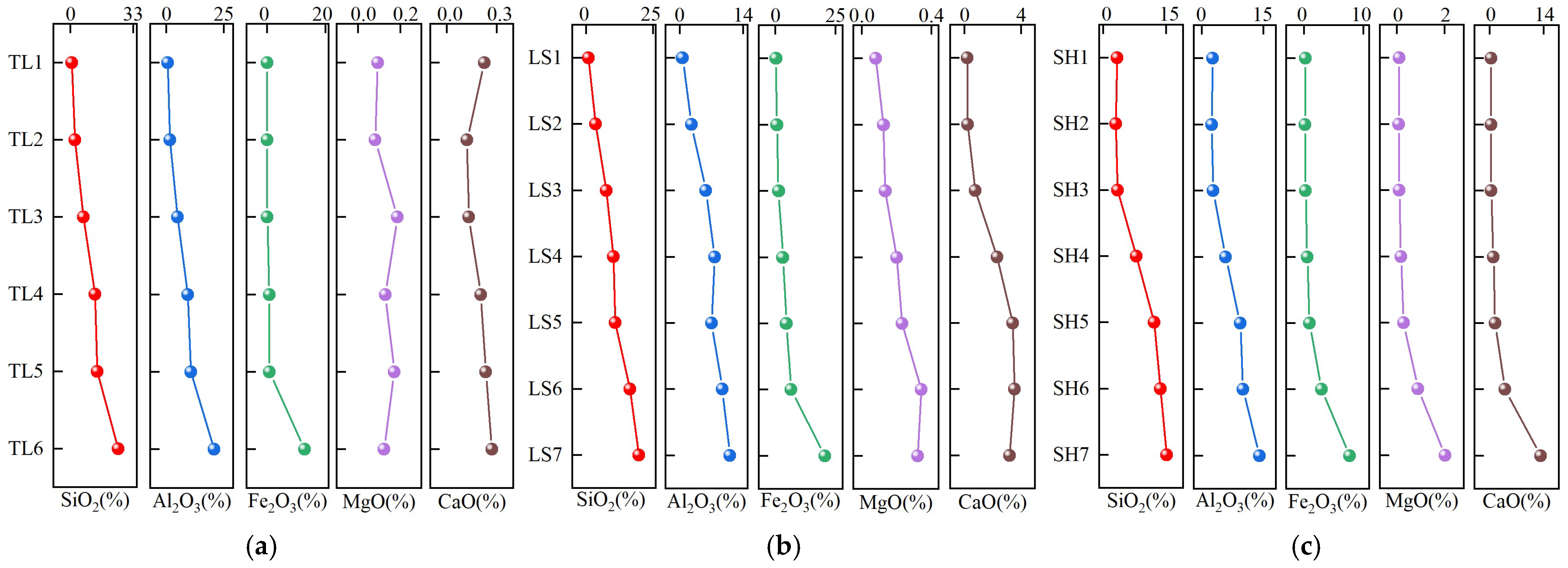
XRF analysis shows that major element distributions exhibit pronounced density-dependent differentiation, significantly influenced by coal rank-controlled mineral assemblages. Overall, the contents of SiO2, Al2O3, Fe2O3, CaO, and MgO increase markedly with density (Table 2, Figure 2), consistent with the increase in ash yield. This confirms that major elements reside predominantly in inorganic minerals and tend to enrich in high-density products [29,30].
Table 2.
Content of major elements in different density coal samples.
Figure 2.
(a) TL, (b) LS, and (c) SH coal samples: distributions of major element oxides (SiO2, Al2O3, Fe2O3, CaO, and MgO) across density fractions.
SiO2 and Al2O3 dominate across all samples. The SiO2/Al2O3 ratios range from 1.08 to 1.77 (average ~ 1.35), with most samples between 1.25 and 1.45, close to the theoretical ratio of kaolinite (~1.18) [31]. This indicates that the aluminosilicate minerals in the studied coals are dominated by kaolinite. Density differentiation is mainly reflected in variations in the abundance of these clay minerals, transitioning from trace occurrences in low-density fractions to significant enrichment in high-density fractions [27].
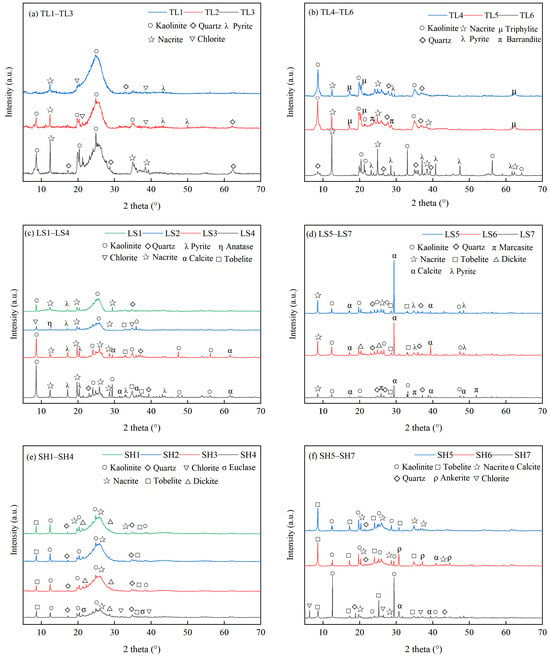
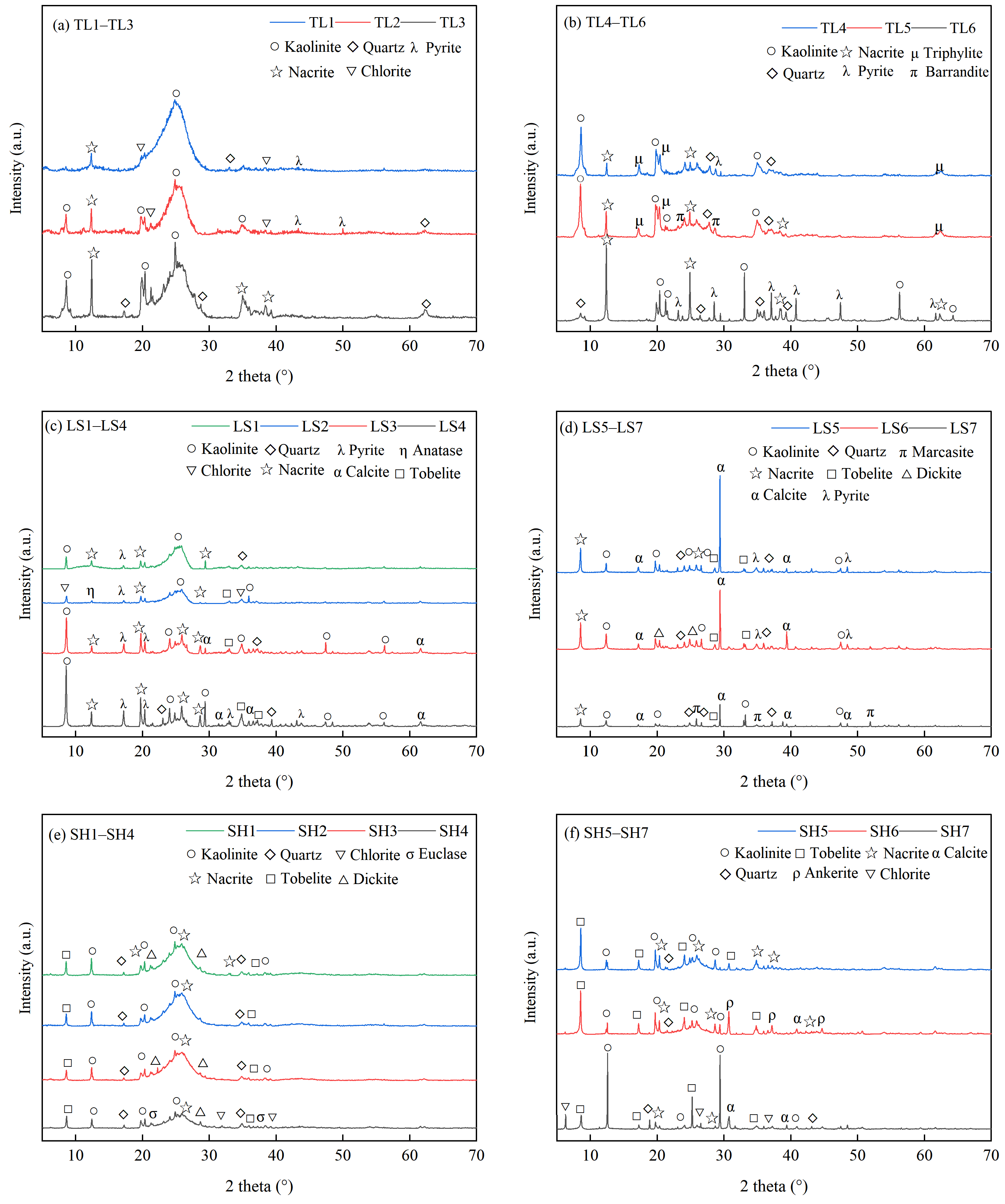
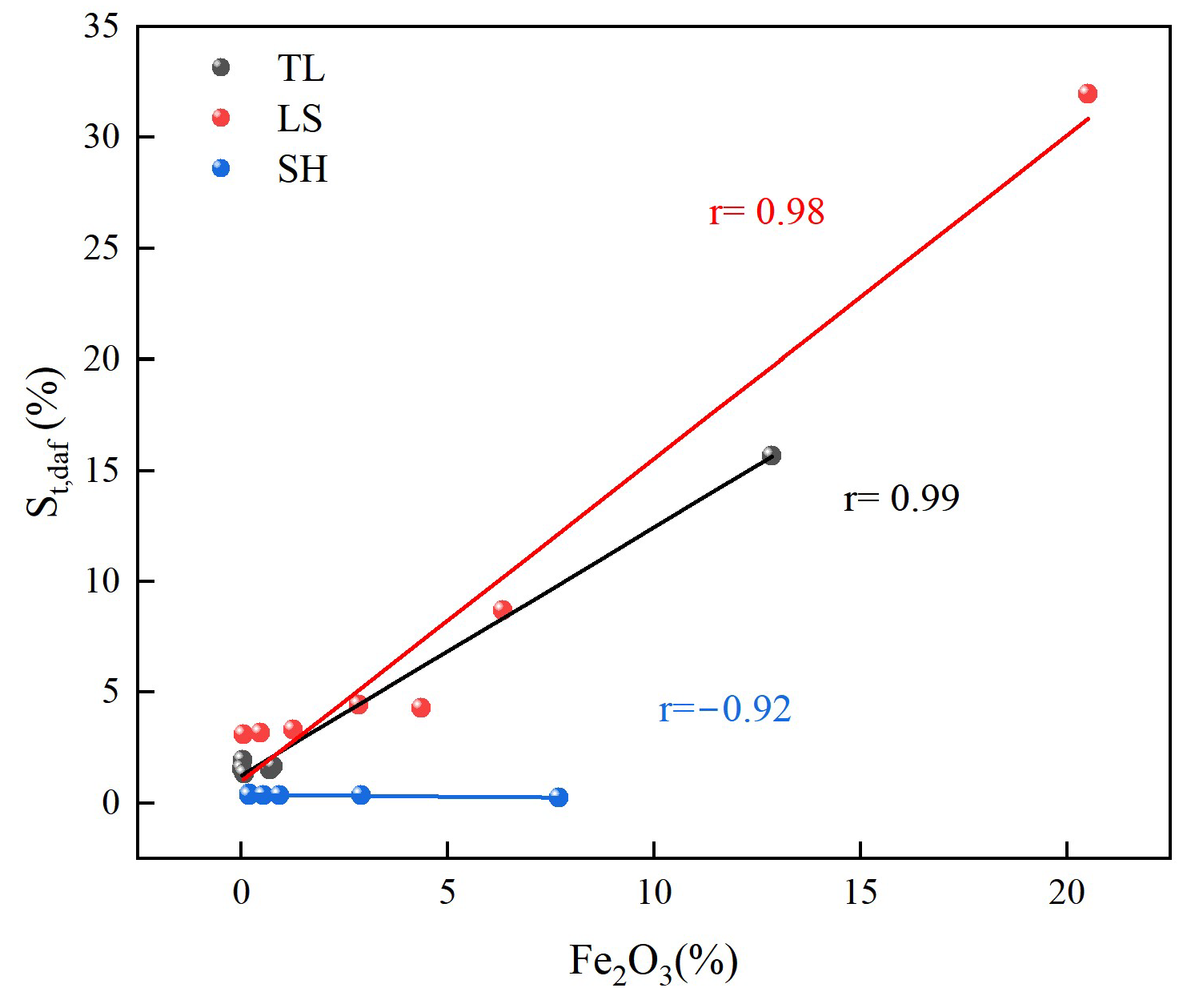
Iron (Fe) distribution shows distinct rank dependency. In medium-rank (TL) and medium–high-rank (LS) coals, Fe2O3 content is minimal in low-density fractions (TL1: 0.04%; LS1: 0.06%) but becomes drastically enriched in high-density fractions (TL6: 12.85%; LS7: 20.51%). This enrichment aligns closely with total sulfur content (St,d), and XRD identifies pyrite as the main carrier (Figure 3). In contrast, in high-rank coal SH, Fe2O3 content is substantially lower (SH7: 7.69%), indicating limited sulfide development.
Figure 3.
X-ray diffraction (XRD) patterns of coal samples from the TL (a,b), LS (c,d), and SH (e,f) groups, with major mineral phases identified.
Calcium (Ca) and magnesium (Mg) serve as key geochemical indicators of coal rank. In TL and LS, CaO and MgO contents are generally low with limited variation. In SH, however, both elements show explosive enrichment in high-density fractions (>1.7 g/cm3): CaO increases from ~0.3% in SH1 to 13.18% in SH7, and MgO from ~0.1% to 2.01%. This trend corresponds to abundant carbonate minerals (calcite, ankerite) detected by XRD (Figure 3), indicating that intense carbonatization during high-rank coal evolution dominates the inorganic composition of high-density fractions.
In summary, high-density fractions of TL and LS are characterized by clay minerals (carrying Si, Al) and sulfides (carrying Fe), whereas those of SH are dominated by carbonates (carrying Ca, Mg). This fundamental mineralogical divergence governed by coal rank provides essential context for understanding trace and REY enrichment. Specifically, in the low-density fractions (<1.3 g/cm3), TL1 (high-volatile bituminous) and LS1 (medium-volatile bituminous) have very low ash yields (1.57% and 2.23%, respectively) and thus extremely low major element contents, whereas SH1 (low-volatile bituminous) has a slightly higher ash yield (7.82%) due to its more advanced coalification and higher inertinite content, resulting in moderately elevated SiO2 and Al2O3. These differences are intrinsic to coal rank and are not analytical artifacts.
4.3. Enrichment Behavior of Trace Elements
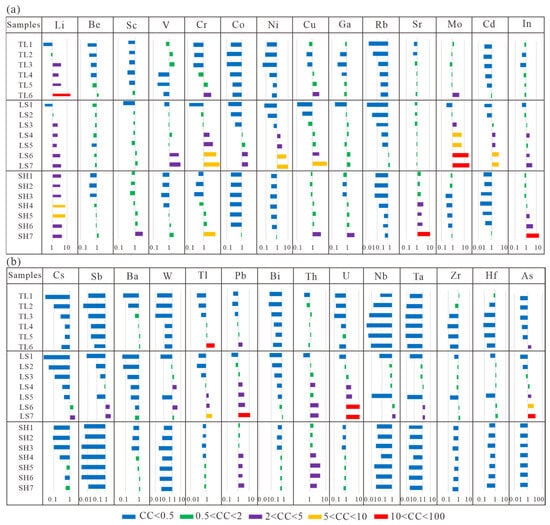
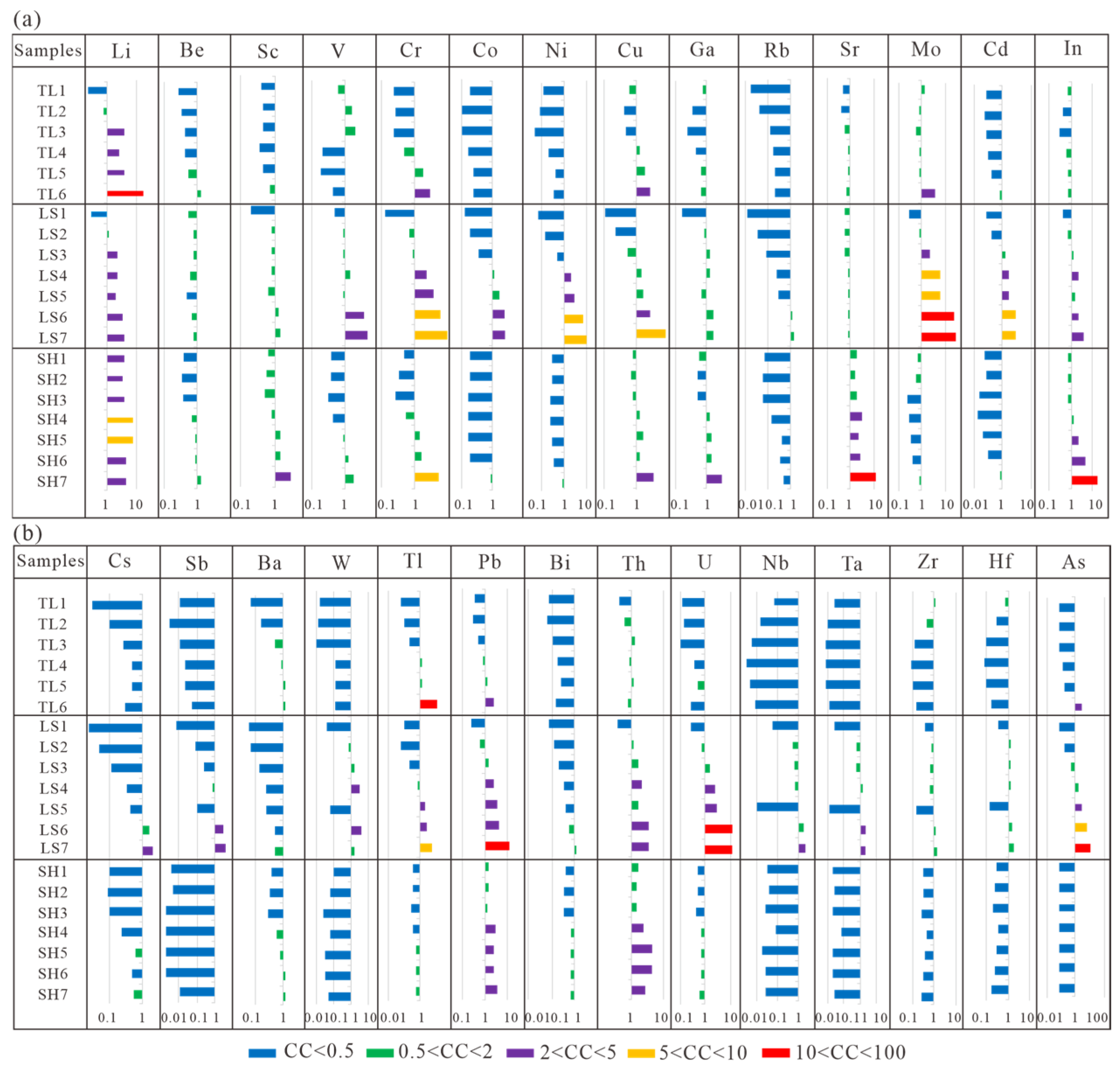
ICP-MS analyses indicate that the enrichment behavior of trace elements in the studied coals is predominantly governed by a dual mechanism: density differentiation and coal rank-controlled mineral assemblages. Enrichment coefficients (CC) were calculated relative to the average global coal values of Ketris and Yudovich (2009) [25]. According to the classification of Dai et al. [32], CC > 100 denotes anomalous enrichment, 10 < CC < 100 indicates high enrichment, 5 < CC < 10 represents enrichment, 2 < CC < 5 signifies slight enrichment, 0.5 < CC < 2 is considered normal, and CC < 0.5 indicates depletion. Overall, the vast majority of trace elements exhibit depletion or normal levels (CC < 2) in low-density fractions (<1.3 g/cm3), while their concentrations increase significantly in medium- to high-density fractions (>1.4 g/cm3). Some elements (Li, Sr, Mo, Tl, Pb, U, As) reach enrichment (5 < CC < 10) or even high enrichment (CC > 10) levels (Figure 4, Table 3). This general trend confirms the strong affinity of trace elements for inorganic minerals, and their migration during the flotation process is strictly controlled by the density of the carrier minerals [32].
Figure 4.
Concentration coefficient (CC) of trace elements in coal samples from the TL, LS, and SH groups. (Data of world coal average from Ketris and Yudovich (2009) [25]). (a) Trace elements for Li, Be, Sc, V, Cr, Co, Ni, Cu, Ga, Rb, Sr, Mo, Cd, and In; (b) Trace elements for Cs, Sb, Ba, W, Tl, Pb, Bi, Th, U, Nb, Ta, Zr, Hf, and As.
Table 3.
Content of trace elements in different density coal samples (μg/g).
Chalcophile elements show strong rank dependency. In TL and LS, As, Mo, Cd, Pb, and Tl exhibit pronounced enrichment in the >1.8 g/cm3 fraction. For example, LS7 has Mo = 62.7 μg/g (CC = 28.5), As CC = 10.41, and Cd CC = 9.82 (Figure 4). These enrichment profiles are synchronous with total sulfur and Fe2O3 variations (Figure 2), and XRD confirms abundant pyrite (Figure 3), indicating that these elements are primarily hosted in sulfide minerals, particularly pyrite [32].
In contrast, the extremely low-sulfur SH bituminous coal shows very low overall contents of chalcophile elements (e.g., Sb, Bi), with no obvious density-dependent enrichment trend (Figure 4). For example, As remains stable at ~0.6 μg/g across all density fractions (CC = 0.07), indicating a significantly depleted state. This absence of enrichment is not solely due to the scarcity of sulfide minerals; it may also reflect differences in trace element occurrence modes. With increasing coalification, the macromolecular structure of organic matter becomes more compact, and some trace elements become dispersed within the organic matrix via organic associations (e.g., complexation with oxygen- or nitrogen-containing functional groups) [33], rather than being concentrated in specific density fractions. Such organically bound elements resist effective enrichment by physical density separation, resulting in a uniform distribution across all fractions and an overall depletion signature. Furthermore, some sulfur-affinitive elements may occur as finely disseminated inclusions in silicates or organic matter, further reducing their selectivity for density-based enrichment [34].
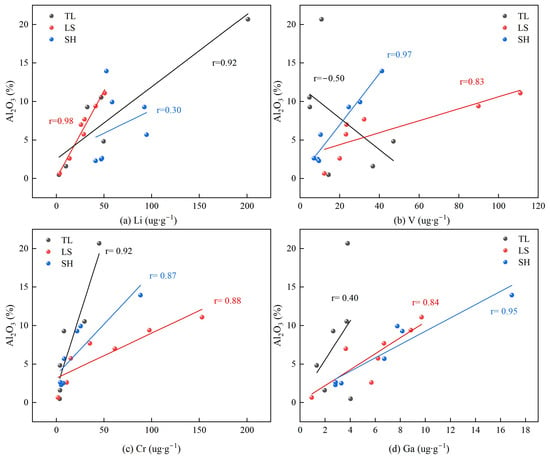
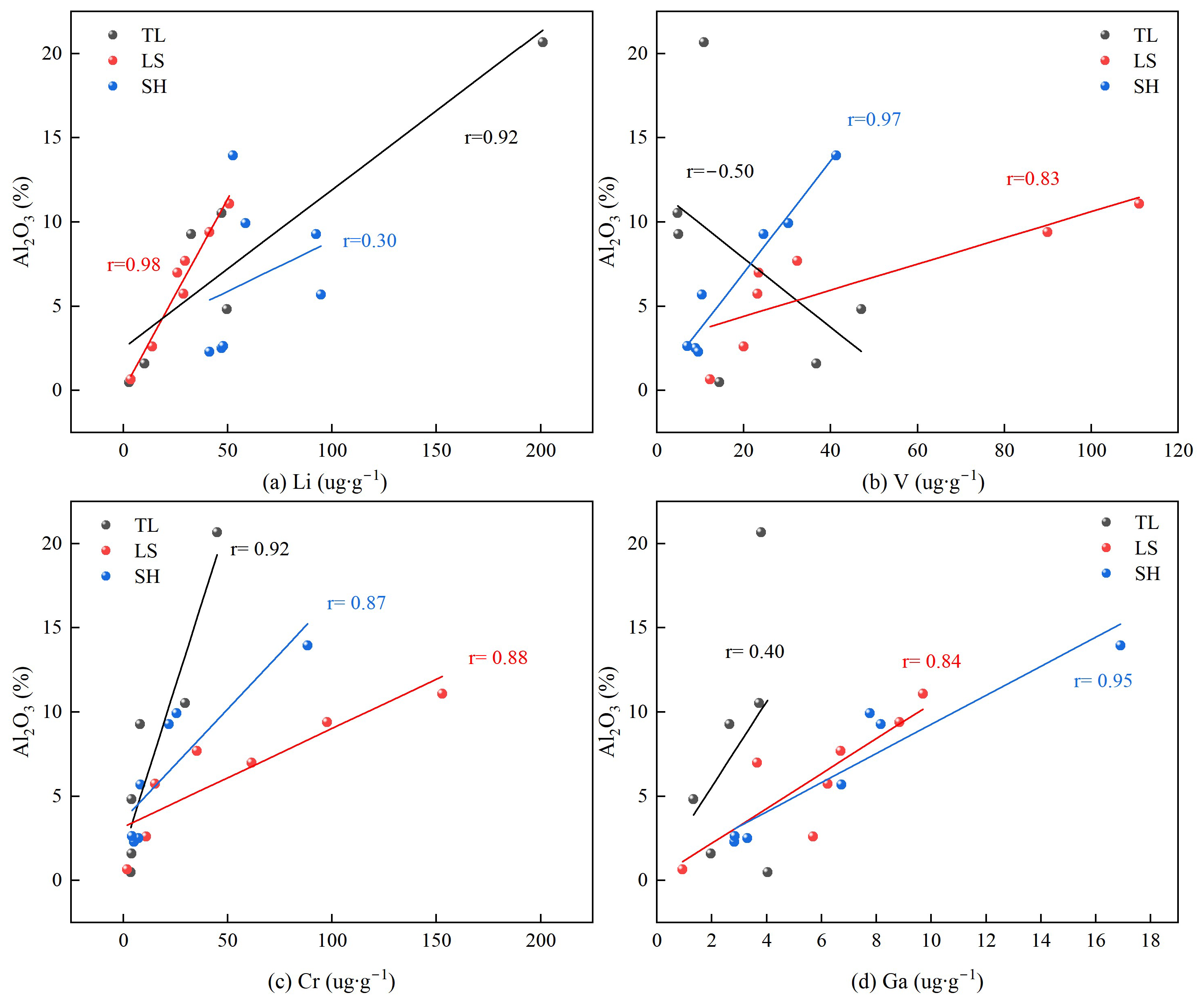
The distribution of lithophile elements is closely linked to silicate or carbonate minerals. Specifically, Li, V, Cr, and Ga show strong positive correlations with Al2O3 (Figure 5), indicating that they are predominantly hosted in aluminosilicate clay minerals. The exceptionally high r for Cr (0.99) is geochemically plausible, as Cr3+ readily substitutes for Al3+ in clay mineral lattices. Subset cross-validation confirmed that this correlation is not an artifact of small sample size or overfitting. Accordingly, these elements exhibit continuous and stable enrichment with increasing density. For instance, Li reaches 201 μg/g (CC = 16.75) in TL6, and Cr attains 153 μg/g (CC = 9.56) in LS7. In contrast, Sr displays a distinct enrichment behavior, correlating strongly with CaO content. In the high-rank, carbonate-rich SH coal, Sr content in the >1.8 g/cm3 fraction (SH7) reaches 1525 μg/g (CC = 13.86), indicating a highly enriched state. This enrichment is directly linked to the abundant occurrence of carbonate minerals such as calcite and ankerite in this sample [32].
Figure 5.
Correlation plots of (a) Li, (b) V, (c) Cr, and (d) Ga with Al2O3, showing the corresponding correlation coefficients (R) for each element. Samples from different coal ranks (TL, LS, SH) are distinguished by different colors (see legend). The r values were calculated from all density fractions combined (n = 20).
In summary, trace element enrichment serves as a sensitive geochemical indicator of coal rank and diagenetic processes. High-density fractions of medium-rank coals act as “reservoirs” for chalcophile hazardous elements (As, Mo, Cd), posing higher environmental risks. In contrast, high-rank coal SH exhibits selective enrichment of carbonate-associated elements (e.g., Sr). Thus, density differentiation is the direct physical process, while coal rank-controlled mineral assemblages (sulfides vs. carbonates) constitute the intrinsic geochemical mechanism.
Comprehensive analysis reveals that the enrichment of trace elements serves as a sensitive geochemical indicator for distinguishing coal ranks and diagenetic processes. Due to the development of abundant sulfide minerals in medium-rank bituminous coal TL and medium-to-high-rank bituminous coal LS, their high-density fractions act as “enrichment reservoirs” for chalcophile hazardous elements (e.g., As, Mo, Cd), posing relatively high potential environmental risks [33]. In contrast, high-rank bituminous coal SH, having undergone intense carbonation, exhibits selective enrichment of carbonate-associated elements (e.g., Sr) in its high-density fraction. Thus, density differentiation is the direct physical process governing the macroscopic distribution of trace elements, while the dominant mineral types (sulfides versus carbonates) determined by coal rank evolution constitute the intrinsic geochemical mechanism that fundamentally regulates the selective enrichment of distinct elemental assemblages.
The uniformly low As content (~0.6 μg/g) across all density fractions of the high-rank SH coal reflects the absence of sulfide hosts and the geochemical behavior of As during advanced coalification. First, SH coal has very low total sulfur (≤0.41%, Table 1), and XRD confirms negligible pyrite (Figure 3), the primary carrier of As in most coals. Second, during high-rank metamorphism (Ro,max = 1.77%), thermal decomposition of any originally present As-bearing sulfides would have released As, which was either lost via fluid escape or incorporated into the organic matrix. Organically bound As is not density-selective, resulting in a uniform distribution. Thus, physical separation is ineffective for As removal from such coals.
4.4. Geochemistry of Rare Earth Elements (REY)
Analysis of rare earth element (REE) data reveals that the geochemical behavior of REY in the studied coals is controlled by density fractionation and the synergistic interaction between coal rank and mineral composition [35]. The content, distribution patterns, and anomaly parameters of REY collectively serve as sensitive indicators for identifying coal-forming material sources, sedimentary environments, and post-depositional alterations [36].
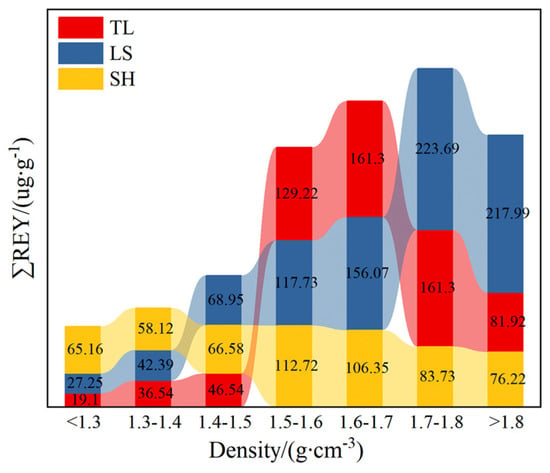
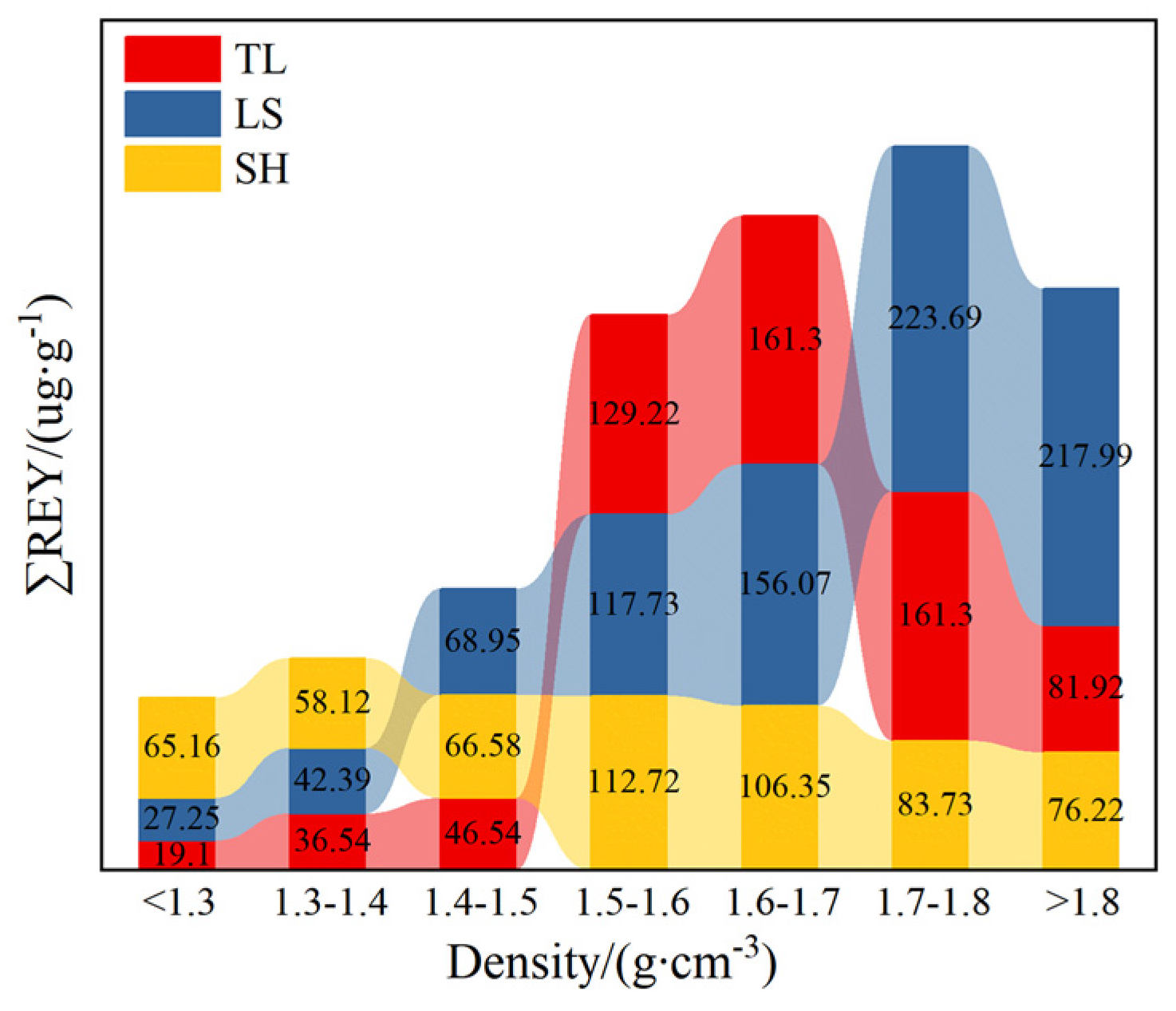
Total REY content (∑REY, Table 4) varies systematically with density, although the enrichment peaks and amplitudes differ by coal rank (Figure 6). In all three coals, ∑REY peaks in the 1.6–1.8 g/cm3 density range. The medium-rank (TL) and medium–high-rank (LS) coals exhibit sharp and pronounced enrichment peaks. For example, ∑REY in LS6 reaches 223.69 μg/g, which is 8.2 times that of the low-density fraction (LS1), corresponding to a concentration coefficient (CC) of 3.27 (Table 4). This strong enrichment is primarily attributed to the high concentration of clay and phosphate minerals in this density interval, which are the main inorganic hosts of REY [37].
Table 4.
Geochemical parameters of rare earth elements in different density coal samples (μg/g).
Figure 6.
REY contents in coal samples of different density fractions for the TL, LS, and SH groups.
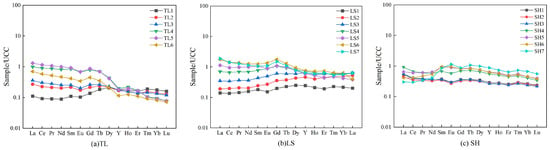
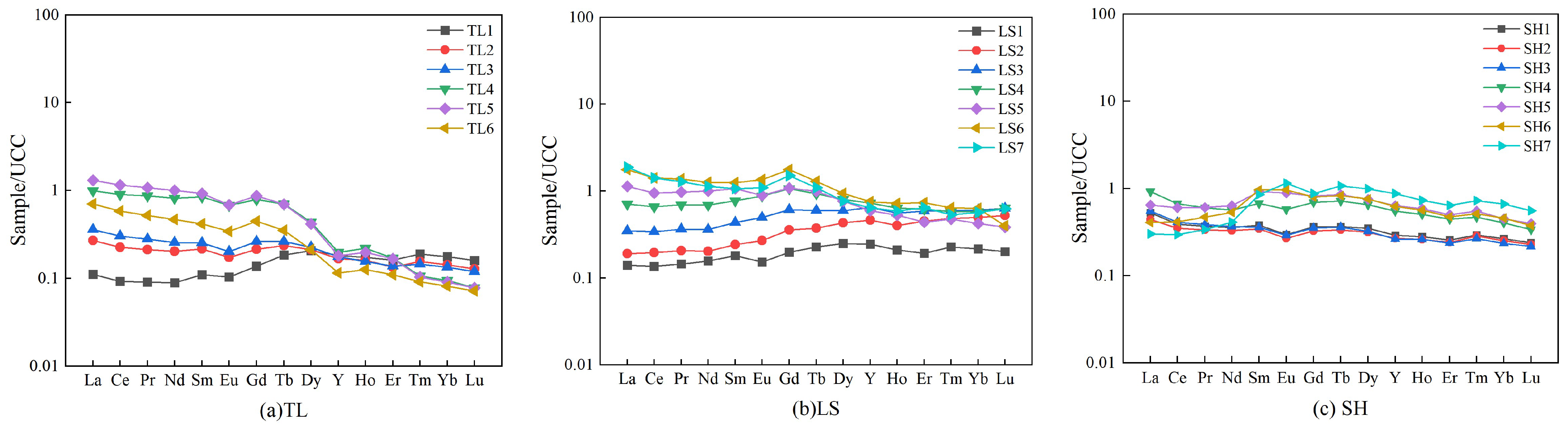
The upper continental crust (UCC)-normalized REY distribution patterns (Taylor and McLennan, 1985 [26]) clearly demonstrate the profound influence of coal rank (Figure 7, Table 4). REY enrichment in coals is classified into three types: L-type (light REY-enriched; (La/Lu)N > 1), M-type (medium REY-enriched; (La/Sm)N < 1 and (Gd/Lu)N > 1), and H-type (heavy REY-enriched; (La/Lu)N < 1).
Figure 7.
Upper continental crust (UCC)-normalized rare earth element (REY) distribution patterns of typical coal samples from TL (a), LS (b), and SH (c) groups.
The partition curves of medium-rank (TL) and medium–high-rank (LS) coals both exhibit a pronounced right-leaning pattern, indicating significant light REE (LREE) enrichment and relative heavy REE (HREE) depletion, with (La/Yb)N ratios consistently exceeding 1. This pattern reflects typical sedimentary characteristics dominated by felsic terrigenous clastic input, where REY are primarily inherited from clay minerals in the source region.
Notably, the TL1 sample (density < 1.3 g/cm3) exhibits H-type enrichment, with (La/Lu)N and (La/Yb)N ratios of 0.70 and 0.64, respectively, indicating relative HREE enrichment. The original interpretation attributing this pattern to organic matter is geochemically questionable, as organic matter in coal typically preferentially complexes LREEs over HREEs. Given the lack of direct evidence from organic functional groups or phosphorus analyses, an alternative explanation is proposed: trace heavy minerals (e.g., zircon, xenotime) occurring as micro-inclusions within the low-density organic matter may be responsible for the H-type anomaly. The measured P2O5 content in TL1 is only 0.02 wt.% (Table 2), which neither confirms nor excludes the presence of phosphate phases. In the absence of in-situ micro-analytical techniques (e.g., SEM-EDS, LA-ICP-MS), the exact HREE host phase(s) in this sample remain to be verified [37].
In contrast, high-rank coal SH, particularly its high-density fraction SH7, shows a trend toward middle REY (MREE) enrichment, with a flattened or slightly “bulging” pattern. This is often associated with diagenetic fluid activity or selective adsorption by carbonates or phosphates.
Cerium (δCe) and europium (δEu) anomalies provide paleoenvironmental clues (Figure 7) [38]. δCe values range from 0.89 to 0.99, indicating weak to no negative anomaly, reflecting suboxic to weakly reducing conditions. δEu anomalies vary with coal rank: TL and LS show weak to moderate negative anomalies (mean δEu = 0.85), indicative of felsic source rocks or plagioclase weathering [39]. In SH coal, the negative Eu anomaly diminishes, and some high-density samples (e.g., SH7, δEu = 1.33) show positive anomalies, likely due to fluid interaction during high-rank coalification or enhanced reducing conditions that alter Eu behavior [40].
In summary, REY not only serve as reliable tracers of sediment provenance and depositional environment but also exhibit differentiation behaviors that are directly responsive to flotation processes. They are primarily concentrated in the 1.4–1.8 g/cm3 density fraction, which corresponds to intermediate products (“middlings”)—a distribution pattern of significant technological relevance. The observed differences in partition patterns, notably LREE enrichment in medium- to high-rank bituminous coals versus MREE enrichment in high-rank bituminous coal, are fundamentally controlled by variations in primary mineral composition (clay-dominated) and subsequent diagenetic modifications (fluid or carbonate influence) [12]. These findings provide a robust basis for pre-concentrating REY resources via density separation and for reconstructing coal diagenetic evolution using REY fingerprinting.
5. Discussion
5.1. Coal Rank–Mineral Evolution Control on Element Occurrence
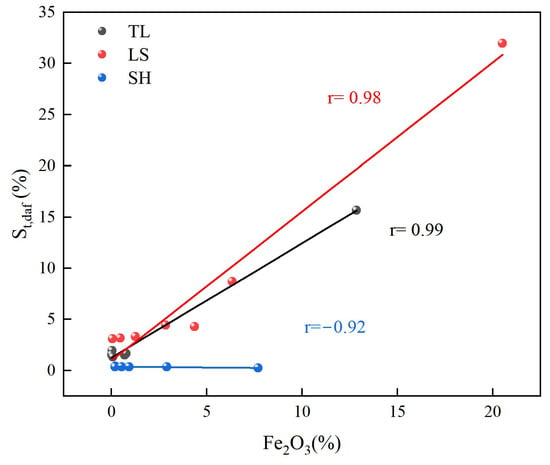
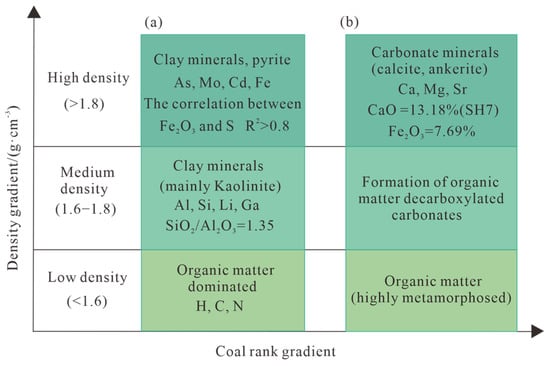
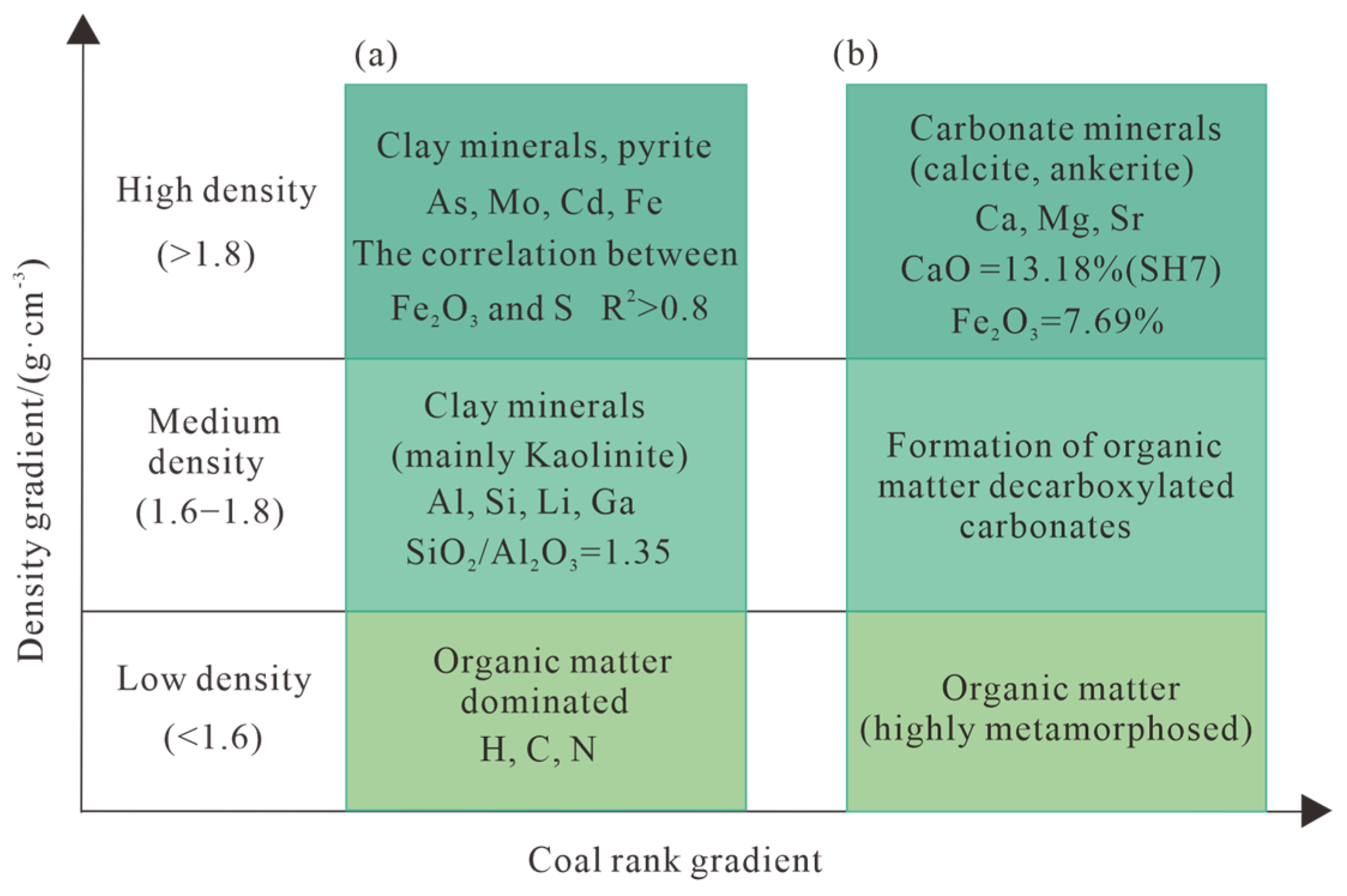
This study confirms that coal rank is the primary factor governing the geochemical behavior of elements during density-based separation. In medium-rank (TL) and medium–high-rank (LS) bituminous coals, abundant terrigenous detrital clay minerals (e.g., kaolinite) and syngenetic pyrite were preserved during diagenesis. Both XRD and major element analyses show stable SiO2/Al2O3 ratios (~1.35) and a strong positive correlation between Fe2O3 and total sulfur content (R2 > 0.8, Figure 8), confirming the coexistence of aluminosilicate and sulfide minerals [35]. Consequently, during density separation, lithophile elements (Al, Si, Li, Ga) are enriched with clay minerals, while chalcophile elements (As, Mo, Cd) are concentrated with pyrite in medium- to high-density fractions, forming a “clay–sulfide” co-controlled element differentiation model (Figure 9a) [41].
Figure 8.
Correlation between Fe2O3 and total sulfur content (St,daf) in TL, LS, and SH coal samples.
Figure 9.
Conceptual model of mineral–element differentiation controlled by coal rank evolution. (a) Medium- to high-rank bituminous coal: Clay and sulfide minerals dominate, and lithophile and thiophilic elements are co-enriched in the medium–high density stage. (b) High-rank bituminous coal: Carbonate minerals dominate, and lithophile elements (Ca, Mg, Sr) are enriched in the high-density stage.
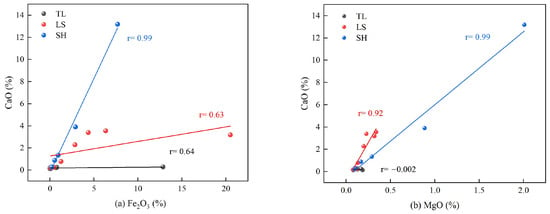
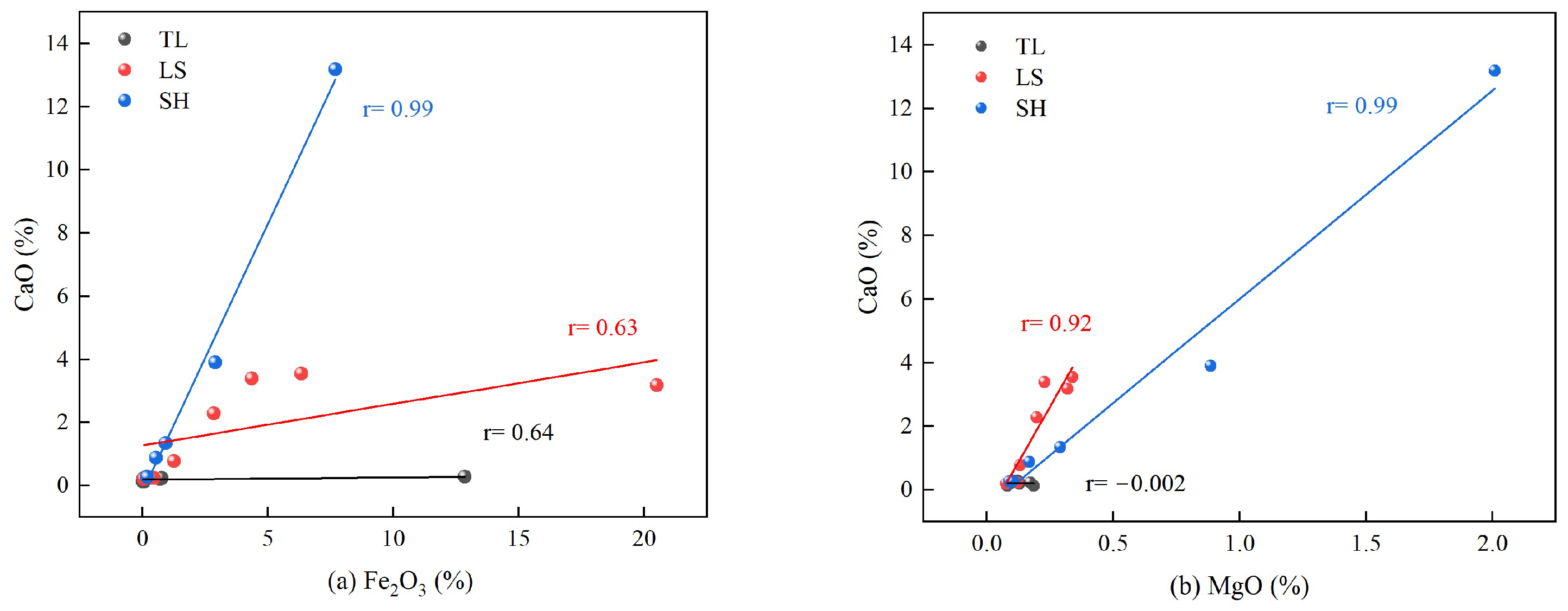
In contrast, high-rank bituminous coal SH underwent advanced metamorphism, leading to a fundamental reorganization of the mineral assemblage. Thermodynamic conditions promoted the partial recrystallization of clay minerals, while CO2 released from organic decarboxylation combined with Ca2+, Mg2+, and Fe2+ to form widespread carbonate minerals (calcite, ankerite). As a result, elements such as Ca, Mg, and Sr became the primary contributors to high-density fractions [6]. Particularly in sample SH7, CaO reaches 13.18% (Table 2) while Fe2O3 is only 7.69%, forming a stark contrast with lower-rank coals. This reveals a “carbonate-dominated” element differentiation model in high-rank bituminous coal (Figure 9b) [41]. The evolutionary sequence from clay/sulfide to carbonate minerals predefines the “pathway” of elements along the density gradient, establishing coal rank as a key predictor of element distribution in flotation products (Figure 10).
Figure 10.
(a) Correlation between CaO and Fe2O3 contents; (b) correlation between CaO and MgO contents, with corresponding correlation coefficients (R) for different sample groups (TL, LS, SH).
Based on these observations, two conceptual models are proposed:
“Clay-sulfide model”–applicable to medium- and medium–high-rank bituminous coals (TL and LS), where element enrichment is jointly controlled by clay minerals (hosting Li, Ga, V, Cr) and pyrite (hosting As, Mo, Cd, Tl). These elements are primarily enriched in the medium- to high-density fractions (1.4–1.8 g/cm3).
“Carbonate model”–applicable to high-rank bituminous coal (SH), where carbonate minerals (calcite, ankerite) dominate the inorganic assemblage, leading to strong enrichment of Ca, Mg, and Sr in the high-density fractions (>1.7 g/cm3), along with a characteristic MREE enrichment pattern.
5.2. Environmental Mobility and Removal Potential of Hazardous Elements
Chalcophile hazardous elements (As, Pb, Cd, Tl) form a notable “enrichment zone” in the high-density fractions of medium-rank bituminous coals (Figure 4), indicating that conventional flotation can effectively separate them into tailings, thereby significantly reducing the environmental risk of clean coal [40]. For example, in the LS7 sample (>1.8 g/cm3), As reaches 86.4 μg/g (Table 3), accounting for >85% of the total As across all density fractions; the CC of Cd reaches 9.82 (Figure 4). Mass balance calculations indicate that separating and properly disposing of this high-density tailings (yield ~ 15%–25%) could reduce the hazardous element load in clean coal (<1.6 g/cm3) by 60%–80%. This provides a clear pathway for source emission reduction based on density separation.
However, in high-rank bituminous coal SH, due to the scarcity of sulfides, hazardous elements are mostly dispersed within silicates or organic matter, exhibiting higher concealment [40]. As content in SH samples is generally below 1 μg/g and shows weak correlation with density (Table 3), suggesting occurrence as finely disseminated inclusions or organically bound forms that resist gravity separation. This underscores that hazardous element removal strategies must be tailored to coal rank: for medium-rank coals, enhanced desulfurization and high-density tailings separation are recommended; for high-rank coals, advanced purification techniques such as fine grinding–flotation or chemical leaching need to be explored. The absence of As enrichment in SH coal further supports the proposed carbonate model: chalcophile elements do not substitute into carbonate lattices and remain low and uniform across all densities.
5.3. Resource Potential of Critical Metals and Implications for Recovery
This study identifies two element-enriched density fractions with potential recovery value. Lithium (Li) is concentrated in the 1.6–1.8 g/cm3 fraction of TL and LS coals (TL5: 47.2 μg/g; LS6: 41.4 μg/g) (Table 3, Figure 5). The strong correlation with Al2O3 (R = 0.92) confirms clay minerals as the primary host [42]. Strontium (Sr) shows pronounced enrichment in the >1.7 g/cm3 fraction of SH coal (SH7: 1525 μg/g, CC = 13.86), concurrent with increased carbonate content.
The high concentration coefficients (CC > 5) and spatial consistency elevate the grades of these elements in tailings or middlings to levels comparable to industrial cut-off grades of certain low–grade ores [43]. For instance, the Sr content in SH7 already exceeds the mining grade of many strontianite deposits (Table 3). Therefore, coal-based solid waste should no longer be regarded merely as “waste” but rather re-evaluated as a non-traditional “urban mine” for resource potential. Subsequent targeted extraction of valuable elements can be achieved through techniques such as magnetic separation, acid leaching, or bioleaching.
The density-dependent enrichment patterns established in this study offer direct guidance for coal preparation. For medium- to high-sulfur bituminous coals (e.g., TL and LS), where hazardous chalcophile elements (As, Mo, Cd, Tl) are strongly enriched in the >1.6 g/cm3 fractions, a cut-density of 1.6 g/cm3 is recommended for industrial flotation circuits. This threshold effectively balances clean coal yield (typically 65%–75% in the <1.6 g/cm3 products) with the removal of ≥70% of the total hazardous element load (as estimated from mass balance calculations). For high-rank, carbonate-rich coals (e.g., SH), hazardous elements show limited density selectivity, but the same cut-density can still recover critical metals (Sr, REY) from the 1.6–1.8 g/cm3 middlings without compromising clean coal quality.
Furthermore, the systematic variation of element–mineral associations with coal rank underscores the need for a coal quality–element database that links proximate/ultimate analysis, maceral composition, and density fraction data to trace element concentrations. Such a database should include at minimum: (i) coal rank parameters (Ro,max, Vdaf), (ii) ash yield and total sulfur content per density fraction, (iii) concentrations of hazardous elements (As, Pb, Cd, Tl, Mo) and critical metals (Li, Sr, REY), and (iv) dominant mineral assemblages (XRD-derived). This framework enables predictive modeling of element deportment in flotation streams and supports the design of tailored separation strategies for different coal ranks.
5.4. Geological and Process Implications of REY Fractionation Patterns
The distribution patterns of REY not only archive information on coal-forming environments and sediment provenance but also directly reflect differential element behavior during density fractionation. As shown in Figure 6, ∑REY concentrations peak in the 1.6–1.8 g/cm3 fraction for all three coals, with LS coal showing the most pronounced enrichment (LS6: 223.7 μg/g). This peak density interval corresponds closely to the enrichment zones of clay minerals and phosphates, confirming that REY primarily reside in these inorganic phases [37]. Notably, in TL and LS, ∑REY declines in the >1.8 g/cm3 fraction, suggesting that extremely dense fractions (enriched in sulfides or coarse-grained minerals) have limited REY hosting capacity. In contrast, SH coal shows a broader ∑REY peak with no marked decrease at higher densities, implying a more uniform distribution of REY among multiple mineral types, including late-stage carbonates. This density-enrichment regularity highlights a clear target for process optimization: by enhancing the separation and recovery of the 1.6–1.8 g/cm3 middling fraction, it is feasible to achieve simultaneous pre-concentration of REY and control of clean coal ash content.
In the UCC-normalized patterns (Figure 7), TL and LS display significant light REE (LREE) enrichment (L-type) and negative Eu anomalies (δEu = 0.8–0.9), indicative of weathering and deposition under reducing conditions typical of felsic source rocks. Their right-leaning patterns align with the composition of the North China Craton’s upper crust, supporting a dominant terrigenous clastic input [44].
In contrast, the high-density fraction of SH coal (e.g., SH7) exhibits a trend toward middle REE (MREE) enrichment (M-type), with a flattened pattern and weakened Eu anomaly (δEu = 1.33). Such patterns are often associated with carbonate diagenetic fluid activity or hydrothermal overprinting [45], consistent with the widespread occurrence of calcite and ankerite in SH coal (Figure 3). This may imply that during high-rank bituminization, fluid activity contributed to REY redistribution, enhancing MREE enrichment in carbonate minerals. The REY enrichment peaks are coal-rank-dependent yet consistently located within a separable density window, suggesting that density-based separation can achieve preliminary REY enrichment without substantially compromising clean coal yield, thereby supplying high-quality feed for subsequent hydrometallurgical extraction.
The evolution of Eu anomalies carries significant genetic implications. Under reducing diagenetic fluid conditions, Eu3+ can be reduced to Eu2+. The ionic radius of Eu2+ (1.17 Å) closely resembles that of Ca2+ (1.00 Å), facilitating substitution into carbonate mineral lattices via isomorphism [46]. Consequently, the attenuation of negative δEu anomalies and the emergence of positive anomalies in SH coals reflect two pivotal processes: (1) a shift of the diagenetic environment toward reducing conditions, promoting Eu3+ reduction, and (2) involvement of carbonate-rich fluids, providing a pathway for Eu2+ incorporation into carbonate minerals. These fluids may originate from mixing of CO2 released by organic decarboxylation with formation water or be associated with distal thermal effects of Yanshanian magmatic activity [44].
5.5. Carbonate Control on REY Enrichment in High-Rank Coal
This study simultaneously identifies three key phenomena in the high-density fraction of SH bituminous coal: pronounced MREE enrichment, strong Sr enrichment, and abundant carbonate minerals (calcite and ankerite) (Figure 3). The spatial correlation among these features strongly indicates that authigenic carbonate minerals are the key mechanism controlling REY redistribution and enrichment in this coal.
These observations are highly consistent with established sedimentary diagenesis models [42]. During late-stage coalification, carbonate-rich fluids migrating through the coal seam precipitated carbonates in response to pH/Eh changes [47]. During this process, REY transported by the fluid can be incorporated into carbonates via two main mechanisms: surface adsorption and, more importantly, isomorphous substitution. Given that the ionic radii of MREEs (Sm3+–Dy3+) closely match that of Ca2+, they preferentially substitute for Ca2+ sites in calcite or ankerite lattices, driven by favorable kinetic and thermodynamic conditions. This mechanism satisfactorily explains the observed “hump-shaped” MREE enrichment pattern [46].
Furthermore, the suppression of the δEu anomaly to near unity indicates a relatively reducing diagenetic environment, facilitating reduction of Eu3+ to Eu2+. The consequent divergence in Eu geochemical behavior, combined with its ionic radius similarity to Sr2+, enables its co-precipitation and enrichment in carbonate minerals. This finding further supports the hypothesis of concurrent REY and alkaline earth metal carbonate precipitation [48]. Essentially, the REY distribution pattern in SH coal reflects a geochemical process wherein fluid–rock interactions during high-rank coalification drive selective REY enrichment in secondary carbonates [37,48].
6. Conclusions
This study systematically investigated the geochemical behavior of elements in float–sink products from three Late Paleozoic bituminous coals of different ranks in Shanxi Province, China. The main conclusions are as follows:
- (1)
- Coal rank fundamentally controls element distribution by governing the evolution of inorganic mineral assemblages. With increasing rank, the dominant minerals shift from clay minerals (mainly kaolinite) to carbonates (calcite, ankerite), which fundamentally alters the geochemical affinities of elements;
- (2)
- Hazardous chalcophile elements (As, Mo, Cd, Tl) are significantly enriched in high-density fractions of medium- to high-rank bituminous coals due to their strong association with pyrite. Density-based separation can effectively concentrate these elements into tailings, thereby reducing environmental risks. In contrast, such enrichment is limited in high-rank coals where sulfides are scarce;
- (3)
- Critical metals and REY show recovery potential from coal processing wastes. Lithium is hosted in clay minerals and shows enrichment in medium- to high-density fractions, with the highest concentration observed in the highest-density fraction (>1.8 g/cm3) of the medium-rank coal, while strontium is associated with carbonates in high-rank coals. REY are primarily concentrated in the 1.6–1.8 g/cm3 density fraction, with LREE dominance in lower-rank coals and MREE enrichment in high-rank coals due to carbonate influence;
- (4)
- The established “clay-sulfide model” for medium- to medium–high-rank coals and “carbonate model” for high-rank coals provide a predictive framework for element migration during beneficiation, guiding the optimization of coal cleaning technologies and the recovery of critical metals from coal-derived wastes.
Author Contributions
Conceptualization, D.L.; methodology, W.Y.; validation, W.Y.; formal analysis, W.Y. and B.X.; investigation, W.Y. and B.X.; resources, D.L.; data curation, W.Y.; writing-original draft preparation, D.L.; writing-review and editing, F.Z.; visualization, W.Y.; supervision, D.L. and F.Z.; project administration, F.Z.; funding acquisition, F.Z. All authors have read and agreed to the published version of the manuscript.
Funding
This research was jointly supported by the Ministry of Natural Resources of China through the Deep Earth probe and Mineral Resources Exploration-National Science and Technology Major Project (No. 2025ZD1005707) and National Natural Science Foundation of China (Nos. 41802191 and 41372164).
Data Availability Statement
The data are contained within the article.
Acknowledgments
Thanks to the reviewers for their careful suggestions and academic editors for their sincere affirmations. Thanks to all those who helped with the field sampling and experiments.
Conflicts of Interest
The authors declare no conflicts of interest.
References
- International Energy Agency. Coal 2024: Analysis and Forecast to 2027; International Energy Agency: Paris, France, 2024.
- Tian, H.Z.; Lu, L.; Hao, J.M.; Gao, J.J.; Cheng, K.; Liu, K.Y.; Qiu, P.P.; Zhu, C.Y. A Review of Key Hazardous Trace Elements in Chinese Coals: Abundance, Occurrence, Behavior during Coal Combustion and Their Environmental Impacts. Energy Fuels 2013, 27, 601–614. [Google Scholar] [CrossRef] [Scilit]
- Lu, M.F.; Liu, R.J.; Shen, M.L.; Liu, G.J.; Hu, H.; Xie, Z.F.; Yue, Z. Enrichment characteristics, volatilization properties, speciation transformation, and environmental implications of trace elements during coal combustion from Huaibei Coalfield, Anhui, China. Int. J. Coal Geol. 2025, 312, 104911. [Google Scholar] [CrossRef] [Scilit]
- Finkelman, R.B.; Palmer, C.A.; Wang, P. Quantification of the modes of occurrence of 42 elements in coal. Int. J. Coal Geol. 2018, 185, 138–160. [Google Scholar] [CrossRef] [Scilit]
- Finkelman, R.B.; Dai, S.F.; French, D. The importance of minerals in coal as the hosts of chemical elements: A review. Int. J. Coal Geol. 2019, 212, 103251. [Google Scholar] [CrossRef] [Scilit]
- Dai, S.F.; Li, T.J.; Jiang, Y.F.; Ward, C.R.; Hower, J.C.; Sun, J.H.; Liu, J.J.; Song, H.J.; Wei, J.P.; Li, Q.Q.; et al. Mineralogical and geochemical compositions of the Pennsylvanian coal in the Hailiushu Mine, Daqingshan Coalfield, Inner Mongolia, China: Implications of sediment-source region and acid hydrothermal solutions. Int. J. Coal Geol. 2015, 137, 92–110. [Google Scholar] [CrossRef] [Scilit]
- Noble, A.; Luttrell, G.H. A review of state-of-the-art processing operations in coal preparation. Int. J. Min. Sci. Technol. 2015, 25, 511–521. [Google Scholar] [CrossRef] [Scilit]
- Duan, P.P.; Han, S.J.; Wang, W.F.; Tang, Y.G. Distribution and migration of trace elements during flotation in Ge-rich low-rank coal from Wulantuga Coal Mine, Inner Mongolia, China. ACS Omega 2022, 7, 1782–1791. [Google Scholar] [CrossRef] [Scilit]
- Shao, P.; Hou, H.J.; Wang, W.L.; Qin, K.M.; Wang, W.F. Distribution and enrichment of Al-Li-Ga-REEs in the high-alumina coal of the Datong Coalfield, Shanxi Province, China. Ore Geol. Rev. 2022, 140, 104597. [Google Scholar] [CrossRef] [Scilit]
- Zou, J.H.; Chen, H.Y.; Zhao, L.; Wang, X.H.; Li, H.; Li, T.; Wang, H. Enrichment of critical elements (Li-Ga-Nb-Ta-REE-Y) in the coals and host rocks from the Daping Mine, Yudongnan Coalfield, SW China. Ore Geol. Rev. 2023, 152, 105245. [Google Scholar] [CrossRef] [Scilit]
- Lu, Q.F.; Qin, S.J.; Wang, W.F.; Wang, Q.; Kang, S. Geochemistry of Late Permian coals from the Yueliangtian coal deposit, Guizhou: Evidence of sediment source and evaluation on critical elements. Sci. Total Environ. 2023, 856, 159123. [Google Scholar] [CrossRef] [Scilit]
- Dai, S.F.; Ren, D.Y.; Chou, C.L.; Finkelman, R.B.; Seredin, V.V.; Zhou, Y.P. Geochemistry of trace elements in Chinese coals: A review of abundances, genetic types, impacts on human health, and industrial utilization. Int. J. Coal Geol. 2012, 94, 3–21. [Google Scholar] [CrossRef] [Scilit]
- European Commission. Study on the Critical Raw Materials for the EU 2023—Final Report; ET-07-23-116-EN-N; Publications Office of the European Union: Luxembourg, 2023; ISBN 978-92-68-00414-2.
- U.S. Geological Survey. 2022 Final List of Critical Minerals. Fed. Reg. 2022, 87, 10381–10382. [Google Scholar]
- Ministry of Natural Resources of the People’s Republic of China. Catalog of Strategic Mineral Resources; Ministry of Natural Resources of the People’s Republic of China: Beijing, China, 2016. (In Chinese)
- Wei, Y.S.; Feng, Z.Q.; Yan, T.; Yang, W.B.; Duan, C.S. Mesozoic tectonic evolution of central North China Craton: A Case Study from Shanxi Province. J. Jilin Univ. (Earth Sci. Ed.) 2022, 52, 1127–1152. (In Chinese) [Google Scholar]
- Kusky, T.M.; Windley, B.F.; Zhai, M.-G. Tectonic evolution of the North China Block: From orogen to craton to orogen. In Mesozoic Sub-Continental Lithospheric Thinning Under Eastern Asia; Zhai, M.G., Windley, B.F., Kusky, T.M., Meng, Q.R., Eds.; Geological Society Special Publication: London, UK, 2007; Volume 280, pp. 1–34. [Google Scholar]
- Zhai, M.G.; Santosh, M. The early Precambrian odyssey of the North China Craton: A synoptic overview. Gondwana Res. 2011, 20, 6–25. [Google Scholar] [CrossRef] [Scilit]
- ASTM D388-23; Standard Classification of Coals by Rank. ASTM International: West Conshohocken, PA, USA, 2023.
- GB/T 478-2008; Method for Float and Sink Analysis of Coal. Standardization Administration of the People’s Republic of China: Beijing, China, 2008. (In Chinese)
- GB/T 214-2007; Determination of Total Sulfur in Coal. Standardization Administration of the People’s Republic of China: Beijing, China, 2007. (In Chinese)
- Taylor, G.H.; Teichmüller, M.; Davis, A.; Diessel, C.F.K.; Littke, R.; Robert, P. Organic Petrology; Gebrüder Borntraeger: Berlin, Germany; Stuttgart, Germany, 1998; 704p. [Google Scholar]
- GB/T 40485-2021; Method of Determining Automatically the Random Reflectance of Vitrinite in Coal—Image Analysis Method. Standardization Administration of the People’s Republic of China: Beijing, China, 2021. (In Chinese)
- GB/T 8899-2013; Determination of Maceral Group Composition and Minerals in Coal. Standardization Administration of the People’s Republic of China: Beijing, China, 2013. (In Chinese)
- Ketris, M.P.; Yudovich, Y.E. Estimations of Clarkes for carbonaceous biolithes: World averages for trace element contents in black shales and coals. Int. J. Coal Geol. 2009, 78, 135–148. [Google Scholar] [CrossRef] [Scilit]
- Taylor, S.R.; McLennan, S.M. The Continental Crust: Its Composition and Evolution; Blackwell Scientific Publications: Oxford, UK, 1985; pp. 57–72. [Google Scholar]
- Song, C.G.; Liu, D.N.; Zhao, F.H.; Zhou, A.J.; Zou, Y.; Guan, Z.H. Geochemical characteristics of major and trace elements in coals of different densities from the Huoxi Coalfield. J. China Coal Soc. 2018, 43, 253–261. (In Chinese) [Google Scholar]
- Liu, D.N.; Zhang, Q.; Zhao, F.H.; Liu, X.; Zhang, S.Q. The occurrence and distribution of nitrogen in coal of different ranks and densities. Minerals 2024, 14, 549. [Google Scholar] [CrossRef] [Scilit]
- Wen, B.F.; Xia, W.C.; Sokolovic, J.M. Recent advances in effective collectors for enhancing the flotation of low rank/oxidized coals. Powder Technol. 2017, 319, 1–11. [Google Scholar] [CrossRef] [Scilit]
- Ward, C.R. Analysis, origin and significance of mineral matter in coal: An updated review. Int. J. Coal Geol. 2016, 165, 1–27. [Google Scholar] [CrossRef] [Scilit]
- Di, S.B.; Dai, S.F.; Nechaev, V.P.; French, D.; Graham, I.T.; Zhao, L.; Finkelman, R.B.; Wang, H.D.; Zhang, S.W.; Hou, Y.J. Mineralogy and enrichment of critical elements (Li and Nb-Ta-Zr-Hf-Ga) in the Pennsylvanian coals from the Antaibao Surface Mine, Shanxi Province, China: Derivation of pyroclastics and sediment-source regions. Int. J. Coal Geol. 2023, 273, 104262. [Google Scholar] [CrossRef] [Scilit]
- Dai, S.F.; Finkelman, R.B.; French, D.; Hower, J.C.; Graham, I.T.; Zhao, F.H. Modes of occurrence of elements in coal: A critical evaluation. Earth-Sci. Rev. 2021, 222, 103815. [Google Scholar] [CrossRef] [Scilit]
- Dai, S.F.; Yan, X.Y.; Ward, C.R.; Hower, J.C.; Zhao, L.; Wang, X.B. Valuable elements in Chinese coals: A review. Int. Geol. Rev. 2018, 60, 590–620. [Google Scholar] [CrossRef] [Scilit]
- Finkelman, R.B. Trace elements in coal: Environmental and health significance. Biol. Trace Elem. Res. 1999, 67, 197–204. [Google Scholar] [CrossRef] [Scilit]
- Dai, S.F.; Finkelman, R.B. Coal as a promising source of critical elements: Progress and future prospects. Int. J. Coal Geol. 2018, 186, 155–164. [Google Scholar] [CrossRef] [Scilit]
- Balaram, V. Rare earth elements: A review of applications, occurrence, exploration, analysis, recycling, and environmental impact. Geosci. Front. 2019, 10, 1285–1303. [Google Scholar] [CrossRef] [Scilit]
- Seredin, V.V.; Dai, S.F. Coal deposits as potential alternative sources for lanthanides and yttrium. Int. J. Coal Geol. 2012, 94, 67–93. [Google Scholar] [CrossRef] [Scilit]
- Zhang, K.; Shields, G.A. Sedimentary Ce anomalies: Secular change and implications for paleoenvironmental evolution. Earth-Sci. Rev. 2022, 229, 104015. [Google Scholar] [CrossRef] [Scilit]
- Yu, C.L.; Huang, W.H.; Jiu, B.; Hao, R.L. Geochemistry characteristics and paleoenvironmental significance of trace elements in coal and coal gangue in the Yangcheng mining area, Qinshui Basin. ACS Omega 2022, 7, 13748–13760. [Google Scholar] [CrossRef] [Scilit]
- Wang, Q.; Dai, S.F.; French, D.; Spiro, B.; Graham, I.; Liu, J.J. Hydrothermally altered coal from the Daqingshan Coalfield, Inner Mongolia, northern China: Evidence from stable isotopes of C within organic matter and C-O-Sr in associated carbonates. Int. J. Coal Geol. 2023, 276, 104330. [Google Scholar] [CrossRef] [Scilit]
- Parzentny, H.R.; Lewinska-Preis, L. The role of sulphide and carbonate minerals in the concentration of chalcophile elements in the bituminous coal seams of a paralic series (Upper Carboniferous) in the Upper Silesian Coal Basin (USCB), Poland. Chem. Erde-Geochem. 2006, 66, 227–247. [Google Scholar] [CrossRef] [Scilit]
- Uysal, I.T.; Golding, S.D.; Glikson, M. Petrographic and isotope constraints on the origin of authigenic carbonate minerals and the associated fluid evolution in Late Permian coal measures, Bowen Basin (Queensland), Australia. Sediment. Geol. 2000, 136, 189–206. [Google Scholar] [CrossRef] [Scilit]
- Dai, S.F.; Zhao, L.; Wei, Q.; Song, X.L.; Wang, W.F.; Liu, J.; Duan, P.P. Critical metal resources in Chinese coal measures: Enrichment types and distribution. Sci. Bull. 2020, 65, 3715–3729. [Google Scholar]
- Zhang, S.; Xiu, W.; Sun, B.; Liu, Q.F. Provenance of multi-stage volcanic ash recorded in the Late Carboniferous coal in the Jungar Coalfield, North China, and their contribution to the enrichment of critical metals in the coal. Int. J. Coal Geol. 2023, 273, 104265. [Google Scholar] [CrossRef] [Scilit]
- Dai, S.F.; Graham, I.T.; Ward, C.R. A review of anomalous rare earth elements and yttrium in coal. Int. J. Coal Geol. 2016, 159, 82–95. [Google Scholar] [CrossRef] [Scilit]
- Bau, M. Rare-earth element mobility during hydrothermal and metamorphic fluid-rock interaction and the significance of the oxidation state of europium. Chem. Geol. 1991, 93, 219–230. [Google Scholar] [CrossRef] [Scilit]
- Fu, B.; Hower, J.C.; Zhang, W.C.; Luo, G.Q.; Hu, H.Y.; Yao, H. A review of rare earth elements and yttrium in coal ash: Content, modes of occurrences, combustion behavior, and extraction methods. Prog. Energy Combust. Sci. 2022, 88, 100954. [Google Scholar] [CrossRef] [Scilit]
- Frimmel, H.E. Trace element distribution in Neoproterozoic carbonates as palaeoenvironmental indicator. Chem. Geol. 2009, 258, 338–353. [Google Scholar] [CrossRef] [Scilit]

Disclaimer/Publisher’s Note: The statements, opinions and data contained in all publications are solely those of the individual author(s) and contributor(s) and not of MDPI and/or the editor(s). MDPI and/or the editor(s) disclaim responsibility for any injury to people or property resulting from any ideas, methods, instructions or products referred to in the content. |
© 2026 by the authors. Licensee MDPI, Basel, Switzerland. This article is an open access article distributed under the terms and conditions of the Creative Commons Attribution (CC BY) license.